Liotard and the Lavergne Family Breakfast @ the National Gallery

‘The Lavergne Family Breakfast’ is generally considered the masterpiece of Swiss painter Jean-Etienne Liotard (1702 to 1789). It was made not in oil paint but in pastel, of which Liotard was an acknowledged master.

Executed across more than six sheets of paper, ‘The Lavergne Family Breakfast’ is Liotard’s largest and most ambitious pastel. It depicts a breakfast between an elegantly dressed woman and a young girl, whose hair is still in paper curlers. Between the two lies a luxurious breakfast still life. Although not strictly a portrait, the sitters have long been associated with relatives of Liotard’s, the Lavergne family, who lived in Lyon.

The calm domesticity of the scene is accentuated by the tremendous technical brilliance of his pastelwork, recording a hundred tiny details – the sheen on the metal coffee pot, the shiny ceramic jug, the silky fabrics, the reflections in the black lacquer tray, down to individual notes on the sheet music peeping out from the drawer at the bottom left.

The Lavergne Family Breakfast in pastel by Jean-Etienne Liotard (1754) Private collection, Waddesdon © Courtesy the owner

But it is not only a remarkable work in itself, it is also remarkable for the fact that twenty years later, Liotard painted exactly the same scene, with almost digital accuracy, in oil paint. According to the curators this is an extremely rare example of a painter anywhere ever painting the precise same subject with such photographic accuracy, in two different media. Above is the pastel version. Below is the paint version.

The Lavergne Family Breakfast in paint by Jean-Etienne Liotard (1773) © The National Gallery, London

In 2019 the National Gallery acquired the oil version and this provided the impetus to request the loan of the pastel version (in a private collection) so that the two works could be hung side by side. Both versions were made for Liotard’s most important patron, William Ponsonby, Viscount Duncannon (1704 to 1793) and this is probably the first time in 250 years that they have been seen side by side to compare and admire the difference in technique and effect between the two.

Can you spot the differences? The oil one is better at depicting darkness – the shadows, on the figures’ skin and on the background wall, are deeper and richer. As to the actual design, the curators remark only two significant differences between the two versions: There are only two differences: in the oil painting the bright blue decorations on the porcelain have turned brown, probably due to the use of smalt (a blue pigment that loses its colour), and in both works the signature on the sheet of music poking out of the table drawer bears a different date.

Using this pairing as a centrepiece the National Gallery has created a small (three rooms) but lovely and FREE exhibition, bringing together about 20 other works and objects to give a charming overview of Liotard’s life and career.

Pastel

Liotard was extremely versatile, producing works in pastel, oil, enamel, chalk and even on glass, but was best known for his work in pastel. Pastel is a notoriously delicate medium but the exhibition doesn’t just tell us this, it devotes an entire display to it.

Installation view of ‘Liotard and the Lavergne Family Breakfast’ at the National Gallery. Photo by the author

Here we can see an antique box of pastels from 1910 Paris alongside the tools you needed to use them, namely:

  • a colour chart from La Maison du Pastel, Paris, showing the range of colours available in the 1930s
  • a box of charcoal sticks for drawing, produced by the Maison Macle in the second half of the 19th century
  • a porte-crayon (chalk holder) used for holding chalks whilst drawing
  • a selection of ‘stumps’ used to blend pastels on the picture surface
  • blue rag paper, of the sort used by pastellists

And there’s a lovely, calm, silent 4-minute video showing modern-day French artisans creating pastel pencils by hand. As the curators explain:

Pastel crayons are made of coloured pigment, a pale, chalky filler and a binder to hold them together. Until the late 17th century they had to be rolled by hand in the studio – a lengthy and laborious process. By the 18th century it was possible to buy ready-made pastel crayons in major European cities. The pastels on view here are antiques, made in Paris in the 1910s.

The act of using pastels is described as ‘painting’ in pastel. But unlike oil paint, pastel was not applied with a brush, nor could you mix pastel crayons to create new colours. Artists therefore needed many crayons to work with. In Liotard’s day pastellists painted onto vellum (prepared animal skin) or thick paper made from rags. These surfaces were often roughened with pumice stones or razor blades so that the pastel medium – in essence, millions of coloured particles – had something onto which to cling. The 18th-century art critic and philosopher Denis Diderot (1713 to 1784) described pastel, which commanded very high prices but was also extremely fragile, as ‘precious dust’.

Fascinating and instructive.

Travels

Liotard worked across the length and breadth of 18th-century Europe, from Paris, Rome, London and Amsterdam to the courts of Versailles and Vienna, and the show features a wall-sized map showing his extensive peregrinations.
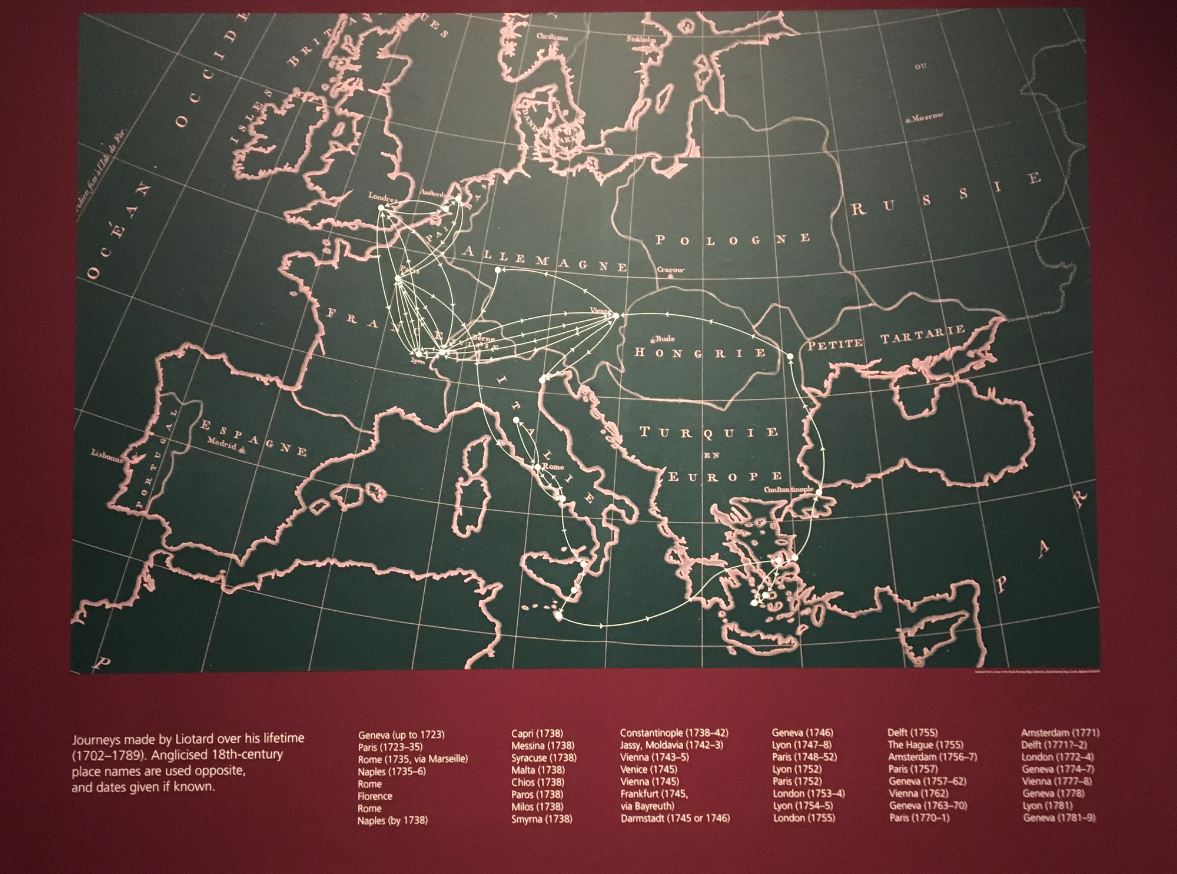
Map showing Jean-Etienne Liotard’s travels round Europe. Photo by the author

Liotard’s most extended stay was in distant Constantinople where he accompanied his patron Viscount Duncannon. He spent four years there and developed a taste for oriental life and manners. He grew a long beard, adopted Turkish dress and nicknamed himself ‘the Turkish painter.’ The exhibition includes a group of black and red chalk drawings made on his travels, most strikingly charming studies he made of (European) women in Oriental dress.

Portrait of Signora Marigot, Smyrna by Jean-Etienne Liotard (1738) Musée du Louvre. Photo © RMN-Grand Palais (Musée du Louvre) / Jean-Gilles Berizzi

On this portrait the curators comment:

Liotard drew this portrait in Smyrna (present-day Īzmir) in May 1738, while on route to Constantinople. Smyrna was the busiest port on the Turkish coast, and Signora Marigot probably belonged to its thriving international community. Liotard captures her confident pose with great economy, using bare paper to create the folds of her gown and the ornaments in her hair. The high level of detail is characteristic of an artist skilled at working on a miniaturist’s scale.

Liotard in London

Liotard’s arrival in London in 1753, with a full beard and Turkish dress, created a sensation. He was introduced to the Royal Family, took lodgings in Golden Square near Piccadilly and advertised his works in the newspapers. A young Joshua Reynolds, later first President of the Royal Academy, enviously described Liotard’s ‘vast business at 25 guineas a head in crayons’ and Horace Walpole marvelled at a viscountess having her four daughters painted by Liotard ‘as his price is so great’.

London provided rich possibilities for a portraitist. It was taken as fact in the 18th century that the British loved having their portraits painted. Even allowing for a visit to Lyon in 1754, where ‘The Lavergne Family Breakfast’ was painted, some 50 works survive from the two years that Liotard spent in London between 1753 and 1755. Nobles, celebrities and even the Royal Family asked Liotard to paint their portraits in pastel, some of them donning Turkish dress themselves.

Take this striking portrait of Lady Anne Somerset, later Countess of Northampton.

Lady Anne Somerset, later Countess of Northampton by Jean-Etienne Liotard (about 1755) © The Devonshire Collections, Chatsworth. Reproduced by permission of the Chatsworth Settlement Trustees

As the curators explain:

With her cascading auburn locks and plunging neckline, Lady Anne (1741 to 1763) looks older than her fourteen years. But women’s lives were accelerated in the 18th century and Lady Anne was already active on the London social scene when this portrait was painted. She may have chosen this Turkish dress – either a garment Liotard owned or one inspired by his drawing Woman from Constantinople (also in display) – to create a more grown up, sophisticated persona.

Miniatures

Liotard also gained a reputation for his skill at creating miniatures. Several are featured here including a stunning miniature self-portrait. It’s only about 2 inches tall so the exquisiteness of the detail is breath-taking. Surely he must have used some kind of magnifying glass and the brushes must have had only a handful of hairs in them. A photo doesn’t do the richness of the real thing justice. Look at the perfectly painted flowers decorating his collar!

Self Portrait on enamel with ivory backing by Jean-Etienne Liotard (about 1753) Royal Collection Trust © His Majesty King Charles III 2023

The curators:

Liotard exploits the smooth and luminous surface of enamel to paint his wiry beard, the folds of his raspberry-red jacket and the tiny flowers that dance along his collar in minute detail. His first training as an artist in Geneva was with a miniaturist and he could rely on his skill in this demanding form of painting to impress. This miniature was probably intended as a means of self-promotion on his first arrival in London, capturing his unusual appearance.

Chocolate tracing

As well as the Family Breakfast the exhibition displays several other works highlighting Liotard’s skill at depicting porcelain services. Sadly, they don’t have the original of one of his other Greatest Hits, The Chocolate Girl (about 1756), which is astonishing both for the wonderful poise of the central figure and the incredible realistic detail of the chocolate cup and glass of water. What they do have is a tracing of the original work which Liotard would have used to generate copies, the same technique he used for making his copy of the Family Breakfast.

Porcelain

And this brings us to the final section of the exhibition, which focuses on Liotard’s fascination for, and incredible skill at depicting, porcelain.

Throughout his career Liotard was fascinated by porcelain, repeatedly depicting cups, saucers and the act of using them in his works. In this he was not alone: throughout the 18th century, paintings of people drinking tea, coffee and chocolate became extremely popular. Such paintings played on the idea of taste: both the literal tastes depicted in these pictures and the tasteful refinement of the scenes portrayed. Liotard was unusual, however, in his fidelity to the porcelain he depicted.

The cups and saucers in ‘The Lavergne Family Breakfast’, for example, can be identified as true Japanese porcelain and not cheaper European imitations. It is not surprising that Liotard owned several pieces of important porcelain, including the boxed tea service displayed nearby.

And here’s a photo of that tea service:

Luxury tea service given to Liotard by the Empress Maria-Theresa during his third visit to Vienna in 1777. Photo by the author

The curators:

Liotard received this luxury tea service as a gift from the Empress Maria-Theresa (1717 to 1780) during his third visit to Vienna in 1777 to 1778. He had not only worked extensively for the Empress as a portraitist, producing likenesses of her and her family in pastel, oil, enamel and chalk, but he had also enjoyed privileged access to the Imperial Porcelain Manufactory where this tea service was made. Liotard’s lifelong fascination with technical experimentation led him to help develop new enamel colours for production.

Summary

Eccentric man, amazing skills, beautiful art, lovely exhibition. And it’s FREE.

Video focusing on pastel


Related links

More National Gallery reviews

Joshua Reynolds: The Life and Times of The First President of the Royal Academy by Ian McIntyre (2003)

Sir Joshua Reynolds (1723 to 1792) was one of – if not the – leading English painter of the 18th century. He specialised in portraits, painting about 2,000 of them during a long and busy professional career, as well as 200 ‘subject pictures’, and over 30 self-portraits.

Self-portrait by Sir Joshua Reynolds (1780) Note the bust of Michelangelo, the Rembrandtesque hat, and the text of one of his Discourses folded in his hand © Royal Academy of Arts

Reynolds promoted a ‘Grand Style’ in painting which was less interested in visual or psychological accuracy to his sitters than in placing them in idealised and heroic poses and settings. He was known – and criticised – for pinching aspects from the Old Masters – poses, tints, props, tricks of lighting and so on.

So when you look at this painting – of Reynolds’s lifelong friend, the successful actor David Garrick – you see that not only is he caught between the two allegorical figures representing Comedy and Tragedy, but that the figures are each painted in different styles – the figure of Comedy on the left in a flirty rococo style of Correggio, the figure of Tragedy is done in a consciously ‘antique’ or neo-classical style reminiscent of Guido Reni, dressed in Roman robes with a stern profile – and Garrick in the middle, is wearing a historical costume reminiscent of van Dyck but his face is done in an unashamedly realistic or figurative style.

David Garrick Between Tragedy and Comedy by Joshua Reynolds (1760)

Reynolds was a founder and first president of the Royal Academy of Arts. He gave an inaugural lecture and this soon settled into an annual – later, biannual – lecture or ‘discourse’. At the end of his life these were published together as 20 or so Discourses about art, which were influential for decades afterwards.

The biography

Ian McIntyre’s biography of Sir Joshua Reynolds is a big book, weighing in at 608 pages, including index and notes (542 pages of actual text). What makes it hugely enjoyable is the way McIntyre very deliberately widens its scope to become a portrait of the age. Not a page goes by without entertaining and often amusing digressions away from the basic chronology of events.

For example, before we’re ten pages in we’ve had a whistlestop history of Devon and the town Reynolds was born in, Plympton, from Roman times to his birth in 1723. There’s an interesting explanation of the medieval and Renaissance tradition of Emblem Books and in particular the work of Jacob Cats, little known in this country but hugely influential on the continent. A little detour into the life of a well-known gypsy of the early 18th century, Bamfylde Carew. And so on.

The book is packed with footnotes, often as many as six on a page, giving biographical snapshots of every single person Reynolds comes into contact with, reads or meets or writes to or mentions, often with a bit of background about their achievements in art or literature – Reynolds cultivated friendships with the leading writers of the time – or, quite often, the wars or battles they were involved in, as a) Reynolds painted a large number of military and naval personnel and b) Britain was almost continually at war throughout the 18th century.

This blizzard of contextual information is partly explained because, as McIntyre candidly points out, we don’t actually know all that much about Reynolds’s life. We know he went to Italy to study the Old Masters for an extended stay from ages 25 to 27 (1750 to 1752). Then he returned to London, set up a studio, and quickly became very successful. We have annual business ‘pocketbooks’ he kept, and these are packed full of appointments with sitters, practical notes about rents and paints and canvas and shopping (p.94). We have the accounts and minutes of the Royal Academy which he set up and ran from 1768 till his death in 1792, the Discourses he published to the world – the written version of the lectures he delivered at the Academy – and numerous descriptions of him in the diaries and letters of contemporaries – but not much more.

Reynolds didn’t keep a diary or interesting notes and thoughts about art which contain breath-taking insights and ideas. He never married, and so didn’t have either a wife or children to write memoirs about him. He doesn’t appear to have had affairs, or if he did they were kept very secret (the issue is discussed on p.85). His sister, Fanny, was his housekeeper for 25 years, followed by a niece.

Er, that’s about it in terms of a ‘personal’ life.

`So in a way McIntyre’s strategy of padding out the story with reams and reams of information about pretty much everyone else alive at the time was a necessity – a factual account of just Reynolds’s life would be quite sparse. Still, McIntyre’s encyclopedic approach makes for a highly enjoyable account.

As does his rangy, slangy style. He is at pains to emphasise that he is not a stuffy art critic, he’s one of the boys:

  • Then, brushing away a crocodile tear, he [an anonymous critic] put the boot in. (p.319)
  • Reynolds was taking a fair amount of stick in the press… (p.320)

18th century artists

Thus McIntyre doesn’t just place Reynolds in the 18th century art world – he introduces us to quite an intimidating number of 18th century artists, starting with Reynolds’s predecessors in Britain, referencing leading contemporary painters in France and Italy, and then a host of other contemporary painters – the famous, the not so famous, and the downright obscure. They include – and this list excludes all the many sculptors:

  • Sir Godfrey Kneller (1646 to 1723) leading portraitist of his time
  • Francesco Solimena (1657 to 1747) leading Italian painter of the Baroque
  • Jonathan Richardson (1667 to 1745) whose book, ‘An Essay on the Theory of Painting’ inspired young Reynolds
  • Joseph Highmore (1692 to 1780)
  • William Hogarth (1697 to 1764) leading English artist, caricaturist and printmaker
  • Jean-Baptiste-Siméon Chardin (1699 to 1779) ‘the other great middle-class painter of the century’ specialising in quiet domestic scenes, in contrast to either grand historical paintings, or pink and blue rococo
  • John Shackleton (? to 1767) Principal ‘Painter in Ordinary’ to George II and George III
  • Thomas Hudson (1701 to 1779) Reynolds was apprenticed to him
  • Francesco Zuccarelli (1702 to 1788) Italian landscape painter from Venice
  • Jean-Étienne Liotard (1702 to 1789) French portraitist working mainly in pastel
  • Francis Hayman (1708 to 1776)
  • Arthur Devis (1712 to 1787) started as landscape artist, then portraits of members of pro-Jacobite Lancashire families, then portraits of London society
  • Allan Ramsay (1713 to 1784) rising star arrived in London from Rome in 1738, painted the definitive image of the coronation of King George III and a stream of royal commissions
  • Claude-Joseph Vernet (1714 to 1789) landscape and marine painter
  • Richard Wilson (1714 to 1782) ‘the classic master of British 18th century landscape painting’
  • Henry Robert Morland (1716 to 1797) Young woman shucking oysters
  • Richard Dalton (1720 to 1791)
  • Katherine Read (1721 to 1778) Scottish portrait painter
  • John Astley (1724 to 1787) portrait painter
  • George Stubbs (1724 to 1806) English painter of horses
  • Francis Cotes (1726 to 1770) pioneer of English pastel painting
  • Thomas Gainsborough (1727 to 1788)
  • Anton Raphael Mengs (1728 to 1779) German artist, precursor of neo-classicism
  • Charles Catton (1728 to 1798) coach painter to George III
  • George Barrett Senior (1732 to 1784) Irish, leading contemporary landscape painter
  • Jean-Honoré Fragonard (1732 to 1806) late Rococo painter of remarkable facility, exuberance, and hedonism
  • Robert Edge Pine (1730 to 1788)
  • George Romney (1730 to 1802) portrait painter in the Reynolds / Ramsay league
  • Sawrey Gilpin (1733 to 1807) English animal painter, illustrator and etcher who specialised in painting horses and dogs
  • Johann Zoffany (1733 to 1810) German neo-classical painter
  • Joseph Wright (1734 to 1797) to become Wright of Derby
  • Jeremiah Meyer (1735 to 1789) Painter in Miniatures to Queen Charlotte, Painter in Enamels to King George III
  • John Singleton Copley (1738 to 1815) Anglo-American painter, active in both colonial America and England
  • Benjamin West (1738 to 1820) first American artist to visit Rome, settled in London as a painter of historical scenes, early pioneer of neo-classicism
  • Nicholas Pocock (1740 to 1821) master of a merchant ship aged 26, he became a noted painter of naval battles
  • Ozias Humphry (1740 to 1810) a leading English painter of portrait miniatures, later oils and pastels
  • Angelica Kauffman (1741 to 1807) history painter and portraitist
  • Ozias Humphrey (1742 to 1810) a leading English painter of portrait miniatures, later oils and pastels
  • Mary Moser (1744 to 1819) English painter specialised in flowers
  • Philip Reinagle (1749 to 1833) pupil of Allan Ramsey, specialised in hunting pictures: Members of the Carrow Abbey Hunt
  • Robert Smirke (1753 to 1845) English painter and illustrator, specialising in small paintings of literary subjects
  • James Gillray (1756 to 1815) British caricaturist and printmaker
  • Thomas Rowlandson (1757 to 1827) English artist and caricaturist of the Georgian Era
  • Maria Cosway (1760 to 1838) Italian-English artist and educationalist
  • John Opie (1761 to 1807) English painter of historical subjects and portrait, took London by storm in 1781
  • Thomas Phillips (1770 to 1845) leading English portrait painter of the day, notable for portraits of William Blake and Lord Byron
  • Benjamin Haydon (1786 to 1846) British painter who specialised in grand historical pictures,

As with many of McIntyre’s digressions about contemporary figures, I found it well worth taking a few minutes to look up each of these painters. I was particularly drawn to some of the pictures of Jean-Étienne Liotard who I’d never heard of before.

The Chocolate Girl by Jean-Etienne Liotard (1744)

Provenances

An interesting aspect of Reynolds’s career is the number of portraits which have gone missing or are disputed. That the authorship of works of art can be disputed is significant: it shows you that, when the provenance of a painting is crystal clear, then the experts can confidently pontificate about its distinctive composition and style; but where there is no signature of clear history of ownership, where the authorship is disputed, then style and composition are not enough to determine the identity of the painter. Take this portrait of a black man.

Portrait of an African by Allan Ramsay (1757 to 1760)

It is instructive to learn that it was once thought to be a portrait of Olaudah Equiano and painted by Joshua Reynolds, but is now generally accepted to a portrait of the young Ignatius Sancho painted by the Scottish painter, Allan Ramsay. The point being that the ‘house style’ of 18th century portrait painters was so similar, overlapped at so many points, that even experts can’t tell them apart.

Destructions

McIntyre’s book is extremely thorough. He documents the sitters and the painting sessions for what seems like every one of Reynold’s nearly two and a half thousand paintings. But a theme which emerges is the dismayingly large number of paintings which have been lost or destroyed, by Reynolds:

  • Portrait of Lady Edgcumbe – destroyed by bombing during Second World War
  • Portrait of Thomas Boone – untraced
  • Portrait of Jane Hamilton – untraced
  • Portrait of Mrs Baddeley – untraced
  • Portrait of Alexander Fordyce – untraced
  • Portrait of Elizabeth Montagu – untraced

No fewer than nineteen works by Reynolds were destroyed in a disastrous fire at the family seat of the Dukes of Rutland, Belvoir Castle in Grantham, Leicestershire, in 1816 (in which also perished works by Titian, Rubens and Van Dyck).

Or other artists of the day:

  • Benjamin West’s Cimon and Iphigenia and Angelica and Medoro – untraced

Which gives rise to a meta-thought: I wonder what percentage of all the paintings ever painted, still exist? Half? A quarter? To put it another way – how much of all the art ever created has been ‘lost’?

[The beginnings of an answer are given in Peter H. Wilson’s vast history of the Thirty Years War where he writes that Dutch artists produced several million paintings in the 16th and 17th centuries combined – ‘of which perhaps 10 per cent survive‘ (p.816). 10% – is that a good working guesstimate?]

Miscellaneous notes

Reynolds’s first studio was at 5 Great Newport Street, in London’s West End. It was on the edge of the country, with a good sized garden both behind and in front (inconvenient in rainy weather since rich people’s carriages couldn’t park right outside the door, p.119). His rival, Allan Ramsay (1713 to 1784) lived round the corner in Soho Square.

In 1760 he moved to a house on the west side of Leicester Fields, later Leicester Square. The Prince of Wales kept a big house dominating the north side. Hogarth had lived since 1733 in a house on the east side.

Reynolds’s style is considered ‘more masculine and less ornamental’ than that of his main rival, Allan Ramsay, who was therefore generally thought to be the better painter of women portraits (p.117).

Penny-pinching Reynolds was careful with money. Anecdotes abound. He got up early to visit the fishmarket to select the best value fish then returned home with detailed instructions to his servant about which ones to buy. He made a fuss about the value of an old mop (p.122)

Vandal

Reynolds was fantastically disrespectful of old paintings. Apparently, he stripped back layer by layer of paint to see how they had been painted, a number of Venetian paintings and one by Watteau – stripped them right down to the canvas until he had utterly destroyed them (p.239).

Factory production

None of your romantic waiting-for-inspiration nonsense, 18th century painters painted to order and commission and on an awesome scale. Allan Ramsay’s portraits of George III and Queen Charlotte dressed for his coronation (1761) was so popular that his studio i.e. assistants, produced no fewer than one hundred and fifty pairs of the paintings to meet the market; buyers including members of the royal family, sovereigns, heads of state, colonial governors, ambassadors, corporations, institutions and courtiers.

Knock ’em out, pile ’em high was the watchword. When one aristocratic sitter offered to come for an additional sitting so that Reynolds could have a session devoted to her hands (of which she was very proud) Reynolds casually told her not to bother as he normally used his servants as models for hands (p.137). (This chimes with the revelation in James Hamilton’s book that Gainsborough generally painted the entire body of his sitters from models, often his wife or grown-up daughters.)

Anti-romanticism

It has been the fate of arts to be enveloped in mysterious and incomprehensible language, as if it was thought necessary that even the terms should correspond to the idea entertained of the instability and uncertainty of the rules which they expressed.

To speak of genius and taste as any way connected with reason or common sense, would be, in the opinion of some towering talkers, to speak like a man who possessed neither, who had never felt that enthusiasm, or, to use their own inflated language, was never warmed by that Promethean fire, which animates the canvas and vivifies the marble.

If, in order to be intelligible, I appear to degrade art by bringing her down from her visionary situation in the clouds, it is only to give her a more solid mansion upon the earth.  It is necessary that at some time or other we should see things as they really are, and not impose on ourselves by that false magnitude with which objects appear when viewed indistinctly as through a mist. (Discourse 7)

No good at drawing

Reynolds was acknowledged to be more interested in colour and tone than in drawing and design. He himself confessed he wasn’t too strong on anatomy. One of the hardest parts of pure figure drawing is hands and Reynolds’s sitters hands are often ungainly, stylised or hidden. He wasn’t too bothered about strict visual accuracy:

The likeness consists more in taking the general air, than in observing the exact similitude of every feature. (quoted on page 127)

‘Flying colours’

Throughout his career Reynolds experimented with materials that make an oil painting, incorporating at one time or another, asphalt, wax, charcoal, experimenting with non-traditional types of key colours such as incarnadine for red. This was often disastrous, as scores of anecdotes testify, the painter Benjamin Haydon just one who was sharply critical of his over-treatment of his paintings (quoted page 282).

One painting, being carried to its patron, was knocked in the street and the entire creation simply slid off the canvas and onto the street. Many others complained that the colours changed. The sky in Admiral Barrington’s portrait changed from blue to green within months of receiving it (p.362). Hence his reputation for ‘flying colours’ and many burlesques and parodies about them.

Rich

As a result of his astonishing industry, Reynolds was by 1762 making £6,000 a year (p.141). By way of comparison, the homely parson in Goldsmith’s The Deserted Village has a stipend of:

A man he was, to all the country dear,
And passing rich with forty pounds a year.

By about 1780 it cost 50 guineas for a ‘head’, 70 guineas for a ‘half length’, 200 guineas for a full length (p.361).

Reynolds’s deafness

In Rome in 1751 Reynolds suffered a heavy head cold which left him partially deaf. For the rest of his life he carried about an ear trumpet. There are numerous humorous anecdotes of him pretending not to hear unflattering or critical remarks.

Reynolds’s height

Sir Joshua Reynolds was five feet five and one-eighths of an inch tall (p.149).

Reynolds and the king

Despite his prolific portrayal of the British aristocracy, Reynolds was disliked by King George III and never got the post of Principle Painter in Ordinary which he aimed for. This post went to Allan Ramsay in 1761. A number of reasons are given for this dislike, for example that when Reynolds was offered the presidency of the newly founded Royal Academy in 1768 but said he’d have to consult his close friends, Dr Johnson and Edmund Burke. Since it was a royal appointment which the king had personally agreed, he was offended that Reynolds hesitated, and particularly offended at the mention of Edmund Burke, a critic of the king. And his friendship with John Wilkes, a radical critic of the king and the Establishment as a whole (p.322).

Reynolds and Dr Johnson

I’d like to like Dr Johnson more than I do. At the end of the day, his bluff English pragmatism comes close to philistinism. His rudeness was legendary, as was his greed (the story of a host setting out bowls of clotted cream, strawberries and a jar of cider for a party of guests and Johnson eating the lot, or asking for pancakes and eating 13 in a row) and his addiction to tea. And his depression: letters are quoted in which he describes his morbid fear of being left alone to his thoughts. Which is why it was difficult to get rid of him; he’d pop round for tea then stay, talking interminably, till past midnight. If he was ever left out of a conversation:

His mind appeared to be preying on itself; he fell into a reverie accompanied with strange antic gesticulations. (Reynolds, quoted page 210)

Reynolds and his sister

Reynolds’s sister, Francis (1729 – 1807), acted as his housekeeper from when he moved to London in the early 1750s until 1779, when some kind of argument – still unknown – led to her leaving and her place being taken by their nieces. Fanny was an artist in her own right, of histories and portraits. She also wrote and won the support of Dr Johnson, who encouraged her and remained friendly and supportive even after the break with her brother. Mutual friends were critical of Reynolds’s treatment of her, e.g. Mrs Thrale (p.327).

Reynolds and Gainsborough

The ‘Grand Style’ which Reynolds spoke about in his Discourses meant improving on nature, removing blemishes and imperfections, creating an idealised image.

The likeness consists more in taking the general air, than in observing the exact similitude of every feature. (p.127)

And by ‘idealised’ he often meant aspiring to the style of Roman art and architecture, all pillars and togas. Thus Gainsborough and Reynolds disagreed about what their sitters should wear. Gainsborough, the more informal, casual and bohemian (p.338) of the pair thought it was an important part of capturing a sitter’s personality that they wore their own clothes; Reynolds, by contrast, kept a wardrobe of ‘idealised’ costumes and often painted his sitters in Romanised togas and tunics. The Dowager Duchess of Rutland complained that Reynolds made her try on eleven different dresses before settling on what she dismissed as ‘that nightgown’ (p.151).

Benjamin West, the American painter of historical scenes and second President of the Royal Academy, is quoted criticising Reynolds’s fondness for dressing his female sitters in antique robes, pointing out how much more interesting and useful for posterity it would be to see them in their actual everyday wear.

Technical terms

Conversation piece

An informal group portrait, popular in Britain in the 18th century, beginning in the 1720s, distinguished by portrayal of a group apparently engaged in genteel conversation or some activity, very often outdoors. Typically the group will be members of a family, but friends may be included, and some groups are of friends, members of a society or hunt, or some other grouping.

Fancy picture

Fancy picture refers to a type of eighteenth century painting that depicts scenes of everyday life but with elements of imagination, invention or storytelling. The name fancy pictures was given by Sir Joshua Reynolds to the supreme examples of the genre produced by Thomas Gainsborough in the decade before his death in 1788, particularly those that featured peasant or beggar children in particular. (Source: Tate)

Profile portrait

The profile portrait ultimately derived from coins and medals from ancient Rome. It could be used as a commemoration of the dead, or as a tribute to the living great.

Eighteenth century London courtesans

In terms of his desire to associate himself with the celebrity of others, the most compelling paintings by Reynolds are surely his portraits of courtesans which he began to make from the late 1750s onwards.

I include this list not out of a conscious or unconscious wish to define women by their sexuality, but because these women’s lives are fascinating, and the niche they occupied in the society of their time so startlingly different from our day.

Eighteenth century women artists

  • Katherine Read (1721 to 1778) Scottish portrait painter
  • Angelica Kauffman (1741 to 1807) history painter and portraitist
  • Mary Moser (1744 to 1819) English painter specialised in flowers
  • Maria Cosway (1760 to 1838) Italian-English artist and educationalist

Those are the ones I noticed in the text. There’s a full list of eighteenth century women artists online:


More eighteenth century reviews