Jenny Saville: The Anatomy of Painting @ the National Portrait Gallery

Very few exhibitions I’ve been to can match the storming impact of the famous 1997 Sensation exhibition which introduced a stunned world to the fantastically accomplished and diverse Young British Artists, including Jake and Dinos Chapman, Tracey Emin, Marcus Harvey, Damien Hirst, Sarah Lucas, Ron Mueck, Chris Ofili, Marc Quinn, Sam Taylor-Wood, Gavin Turk, Gillian Wearing and Rachel Whiteread. What a galaxy of talent!

One of the obvious standout artists was Jenny Saville, born in 1970, who was represented by five awesome pieces. I fell in love on the spot and have been a huge fan ever since.

Now the National Portrait Gallery is hosting the largest major museum exhibition of Jenny Saville’s huge and dazzling portraits ever to be held in the UK, bringing together 45 works made throughout her career. Did I mention they were big? They are enormous. And very, very visceral, filling the frame with giant blunt, sometimes brutal images, punk painting, in-your-face, no-holds-barred depictions of the physicality of being human, the overwhelming immediacy of flesh and blood.

A visitor observes Reverse, 2002-2003 by Jenny Saville. Private Collection courtesy Gagosian © Jenny Saville, displayed as part of ‘Jenny Saville: The Anatomy of Painting’ at the National Portrait Gallery © David Parry

The exhibition kicks off with a couple of her greatest hits from the Sensation show and then moves in chronological order up to the present, giving you a good sense of how her approach and style has changed over the past 30 years or so, with a couple of rooms dwelling on specific themes.

This isn’t the official gallery list but my subjective impression of the different spaces and what they contained. I won’t review them all, but this is my list:

  1. Sensation – immense female nudes (5 paintings)
  2. Corridor (4 works)
  3. Side room with big swathe portraits (7)
  4. Side room 2 with sketches and Rosetta II, a notable example of her paint splattering
  5. Mothers and babies (8 pictures)
  6. Charcoal naked group portraits (10)
  7. Final room – most recent works: 10 enormous heads, very bright dayglo colours, the images broken up by slabs of paint and some disintegrating into montage

Sensation

‘Propped’ is a good example of the kind of thing she made her name with. Absolutely immense images of naked women portrayed with unflattering super-realism, huge limbs, bellies, boobs, blotchy fleshtones. What was so exciting about the pieces in the Sensation show was her huge, in your-face approach to her naked women, filling the huge canvases to bursting, booming out at you, with tremendous energy and confidence. To a very ancient genre she seemed to have brought something utterly new.

Propped by Jenny Saville (1992) Private Collection © Jenny Saville, Courtesy Gagosian

‘Propped’ is one of the most famous of these early works, making the viewer step back from the size and imposition of such an enormous image. Only slowly do you register the details, such as the silk slippers tucked behind the implausibly slender black stool, or realise that her hands are almost like talons, cutting into the flesh of her thighs.

Pretty immediately you realise that there is text written across the image (something I always like in modern art) but, if you try to decipher it, realise that it’s mirror i.e. reversed writing. This is because, the painting was originally displayed facing a mirror in which you could read the text.

It is, apparently, a quote from the French feminist Luce Irigaray, and reads: ‘If we continue to speak in this sameness – speak as men have spoken for centuries, we will fail each other.’ Fair enough, I’m sure feminist theorists have by now worked out an alternative language to speak in so as not to be dominated by men.

My view is that human nature doesn’t really change – and why should anyone who understands biology and genetics expect it to – but the ways in which that nature is expressed – art and culture, discourse and ideology – are changing and shifting all the time, which is one of the things which makes contemporary art so exciting, even as the definition of what art even is, or is for, continually shifts and realigns as well. (For the last decade or so, the main purpose of art has been to act as a class of assets, alongside property and football clubs, purchased by Arab sobereign funds and Russian oligarchs.)

From a technical point of view, the two things I noticed are 1) the debt the portrait’s extremely patchwork flesh tones owed to the example of Lucien Freud, with his huge mottled naked portraits – only redone with Saville’s powerfully feminist, female point of view.

And 2) the finish of the images. What I mean is the outline of the figure is very clearly defined, and there are no blots or spots or splatters or swathes of paint. As we will see, all this changes as Saville’s work develops.

‘Propped’ is one of the works Saville displayed in her graduate show at the Glasgow School of Art (in 1992). Can you imagine being this talented and finished, at such a young age!

Rosetta II

Ten years later, in 2005, Rosetta II is a good example of her evolution towards splatter and flicks. The subject matter is very specific, the look of a blind person, hence the blued-out eyes. But what’s really obvious is the transformation in her technique.

Rosetta II by Jenny Saville (2005 to 2006) Private collection © Jenny Saville, Courtesy Gagosian

Gone are the perfect outlines of the figure and the finish of the flesh so dominant in her epic 1990s works, which so often featured the entire body imagined as a zeppelin bursting out of the frame. Here the focus is much, much more tightly on just the head and neck while at the same time, the finish is obviously much more rough and ready. The central image, and even more the background, is constructed of great swathes or blocks of paint, deliberately rough and dynamic…. while at the bottom of the work you can clearly see where she’s left in loads of splatters and dribbles to indicate the rough, unfinished vibe.

Most of the rest of the show is like this, rougher, looser, bigger splashes of colour, enormous swathes and strokes of bright colours overlapping and clashing.

3. Mothers and babies

In the 2010s Saville produced a series of works depicting the special relationship between mothers and babies, mothers and children, pregnant women with babies and toddlers.

There are eight or so of these works, mainly created using charcoal outlines, multiple outlines as if the figures are moving and, in cartoon style, leaving echoes of their outlines behind. Or, in a more art history way, echoing the cartoons and preparatory sketches of Old Masters, painters like Rubens or Rembrandt, and some of the titles reference Renaissance compositions by the like of Michelangelo.

They are mainly in black and white, against grey backgrounds, but with splashes of colour. The wall labels tell us that Saville worked by creating multiple impressions of each figure – drawing them, erasing them, then superimposing new versions. The result is a sense of movement but as in a strange, grey dream-world.

This is not necessarily the most representative example, because the title, Aleppo, suggests something to do Syrian civil war and so the patches of red are, maybe, something to do with blood. So this is the least intimate and motherly of the set. But you can see how different the style and technique are from what we’ve seen in either the Sensation-era paintings, or the big swathe-and-splatter brushstroke works.

Aleppo by Jenny Saville (2017 to 2018) Collection of the artist © Jenny Saville. Courtesy NGS

The curators claim the dynamic interplay of multiple outlines of the same figures create ‘a type of layering that helps embed memory into the paper and raw canvas’. What do you think?

Charcoal nude full-body group portraits

The next room extends the same technique beyond mothers and children, to groups of naked bodies strewn around on sofas and beds.

Compass by Jenny Saville (2013) Private collection © Jenny Saville. Courtesy Gagosian

Several things are noticeable about these. It feels like the first time we’ve seen fully naked bodies since the Sensation works of the early 1990s and the change wrought by 20 years is striking. Unlike the monumental distorted, frame-filling images of the early days, these charcoal and pastel studies are much more restrained and demure. Everything seems to be in proportion and a realistic size, including the sweet limp willy in the centre of the composition.

But the depictions of limbs, bellies, boobs and so on all feel calm and chaste, imbued with a photographic accuracy. In fact these could be examples from a textbook on How To Draw, the kind of you find in all the bookshops at Tate, the National, the Royal Academy etc.

Possibly there’s meant to be some erotic overtone but, as I say, once you’ve looked at scores of nude studies well, the excitement wears off and you become interested in the technique. This example, provided by the press office, is one of the clearest images – most of the others are heavily scored with lines drawn all over them, starting off from the original figure shapes but then going wild, as in this example.

Out of one, two (symposium) by Jenny Saville (2016)

5. Final room, recent works

The final room contains 10 paintings and what leaps out at you is how brightly coloured they are, how massive they are, and how they focus in on just the faces.
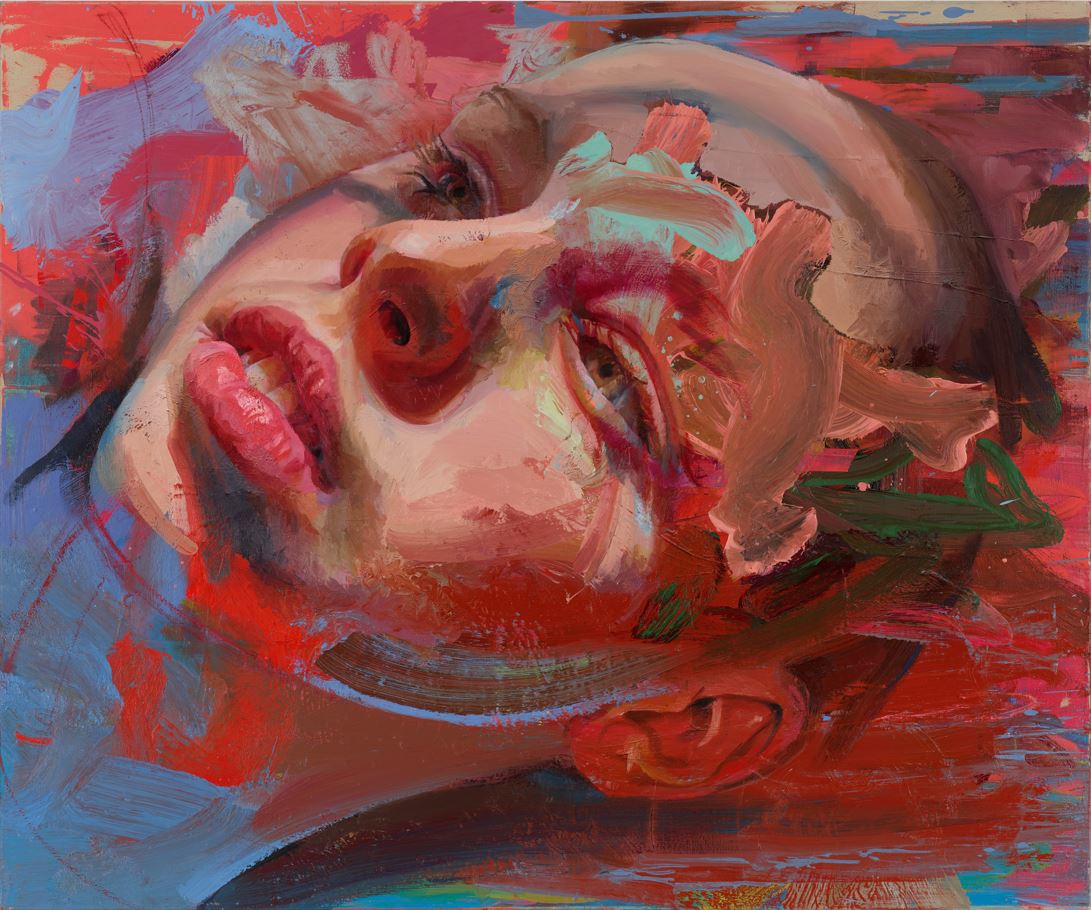
Drift by Jenny Saville (2020 to 2022) Private Collection courtesy Gagosian © Jenny Saville, Courtesy Gagosian

Wow, what a vibrant new dayglo palette she’s been using since about 2020, lurid, super-bright, acid or ecstasy trip brightness!

Compare Drift (2022) with Rosetta II (2006) and notice several things. Although Rosetta II uses huge wide brushstrokes, the colours are all from the same sort of palette, dominated by that turquoise or aquamarine blue, contrasted with cream of the flesh, with some darker highlights to mould it.

In Drift, though, what is immediately apparent is at least two things. One is that the outline and shape of the face is actually limned in with more precision than Rosetta II and others from that period. But far more obvious is the disruptive impact of the dayglo colours. Looked at from one angle, the head in Drift looks like a kind of science fiction image, like the images we see in movies or TV series where there’s some kind of digital glitch, where the face goes pixilated or shreds into patches of unrelated colour.

This thought arose primarily from the images themselves, but when I read the wall label for the room, it actually talked about bang up-to-date ideas about digital technology, about artificial intelligence, about the strange new spaces being opened up by digital techniques.

And while half of the images are traditional, whole portraits, three or four of them introduce a completely new element in her practice which is collage, cutting up aspects of the image – generally eyes – and pasting them in inappropriate positions.

Cascade by Jenny Saville (2020) © Jenny Saville/DACS/Prudence Cuming Associates

Montage

See what I mean? Three or four of the works in this final room are completely unlike the others in using what is (after all) the hundred-year-old technique of photomontage, taking key bits of a portrait and moving them around. Note how the backgrounds to these juxtaposed eyes have gone completely wild. There is, in fact, an upside-down face but it’s an effort to identify it through the blizzard of huge swathes and squiggles of super-saturated paint.

Twombly and de Kooning

Some previous works had referenced Rubens or Rembrandt but the curators point to the influence on these recent works of the abstract painters Willem de Kooning and Cy Twombly. You can see it in the big squiggles or pure paint, red, blue, green.

Digital

Of one painting here, Latent, the curators write that ‘latent space’ is a concept in artificial intelligence which refers to the analysis of hidden structural similarities between visual data. Thus these most recent portraits can be said to build forms by finding the structural similarities between portraits and colours.

This kind of talk, about AI, is obviously bang up to date.

Youth

Which brings us to another, related, point. All the people in this final room are young, young women. Youth, energy and vitality embodied in works of super-vibrant colourfulness. Walking back to the beginning you realise that those earliest works – the vast, bloated naked women – now feel, paradoxically, as if they are portraits of older or middle-aged people. Whereas her most recent works focus unremittingly on The Young, on super-colourful semi-abstraction, and on notions around the new digital age. As if as she’s grown older, Saville has in fact gotten younger, more energised and digitally savvy.

The Anatomy of Painting

The curators give one very revealing fact and quote. Apparently Saville has observed plastic surgery operations, which prompted the thought:

“Witnessing a surgeon makes you see how layered flesh is… I started to think about not just the anatomy of the body, but about the anatomy of painting: the layering, the pace and tempo of the painted surface, the viscosity of the paint.”

Hence the exhibition sub-title. Although the paintings start with enormous bodies, and then alternate between very sever close-up portraits and wider-angle depictions of bodies on sofas or beds – in the end it is very easy to see that her entire career has consisted of adventures with paint (and charcoal and pastel). Starting from basic, photographically accurate images, and then creating layer after layer of paint and resonance and implication, with ringing, ravishing results.

Genius at work

An awesome display of dazzling works by one of the most staggeringly gifted painters working anywhere. Must see.


Related links

Related reviews

Liotard and the Lavergne Family Breakfast @ the National Gallery

‘The Lavergne Family Breakfast’ is generally considered the masterpiece of Swiss painter Jean-Etienne Liotard (1702 to 1789). It was made not in oil paint but in pastel, of which Liotard was an acknowledged master.

Executed across more than six sheets of paper, ‘The Lavergne Family Breakfast’ is Liotard’s largest and most ambitious pastel. It depicts a breakfast between an elegantly dressed woman and a young girl, whose hair is still in paper curlers. Between the two lies a luxurious breakfast still life. Although not strictly a portrait, the sitters have long been associated with relatives of Liotard’s, the Lavergne family, who lived in Lyon.

The calm domesticity of the scene is accentuated by the tremendous technical brilliance of his pastelwork, recording a hundred tiny details – the sheen on the metal coffee pot, the shiny ceramic jug, the silky fabrics, the reflections in the black lacquer tray, down to individual notes on the sheet music peeping out from the drawer at the bottom left.

The Lavergne Family Breakfast in pastel by Jean-Etienne Liotard (1754) Private collection, Waddesdon © Courtesy the owner

But it is not only a remarkable work in itself, it is also remarkable for the fact that twenty years later, Liotard painted exactly the same scene, with almost digital accuracy, in oil paint. According to the curators this is an extremely rare example of a painter anywhere ever painting the precise same subject with such photographic accuracy, in two different media. Above is the pastel version. Below is the paint version.

The Lavergne Family Breakfast in paint by Jean-Etienne Liotard (1773) © The National Gallery, London

In 2019 the National Gallery acquired the oil version and this provided the impetus to request the loan of the pastel version (in a private collection) so that the two works could be hung side by side. Both versions were made for Liotard’s most important patron, William Ponsonby, Viscount Duncannon (1704 to 1793) and this is probably the first time in 250 years that they have been seen side by side to compare and admire the difference in technique and effect between the two.

Can you spot the differences? The oil one is better at depicting darkness – the shadows, on the figures’ skin and on the background wall, are deeper and richer. As to the actual design, the curators remark only two significant differences between the two versions: There are only two differences: in the oil painting the bright blue decorations on the porcelain have turned brown, probably due to the use of smalt (a blue pigment that loses its colour), and in both works the signature on the sheet of music poking out of the table drawer bears a different date.

Using this pairing as a centrepiece the National Gallery has created a small (three rooms) but lovely and FREE exhibition, bringing together about 20 other works and objects to give a charming overview of Liotard’s life and career.

Pastel

Liotard was extremely versatile, producing works in pastel, oil, enamel, chalk and even on glass, but was best known for his work in pastel. Pastel is a notoriously delicate medium but the exhibition doesn’t just tell us this, it devotes an entire display to it.

Installation view of ‘Liotard and the Lavergne Family Breakfast’ at the National Gallery. Photo by the author

Here we can see an antique box of pastels from 1910 Paris alongside the tools you needed to use them, namely:

  • a colour chart from La Maison du Pastel, Paris, showing the range of colours available in the 1930s
  • a box of charcoal sticks for drawing, produced by the Maison Macle in the second half of the 19th century
  • a porte-crayon (chalk holder) used for holding chalks whilst drawing
  • a selection of ‘stumps’ used to blend pastels on the picture surface
  • blue rag paper, of the sort used by pastellists

And there’s a lovely, calm, silent 4-minute video showing modern-day French artisans creating pastel pencils by hand. As the curators explain:

Pastel crayons are made of coloured pigment, a pale, chalky filler and a binder to hold them together. Until the late 17th century they had to be rolled by hand in the studio – a lengthy and laborious process. By the 18th century it was possible to buy ready-made pastel crayons in major European cities. The pastels on view here are antiques, made in Paris in the 1910s.

The act of using pastels is described as ‘painting’ in pastel. But unlike oil paint, pastel was not applied with a brush, nor could you mix pastel crayons to create new colours. Artists therefore needed many crayons to work with. In Liotard’s day pastellists painted onto vellum (prepared animal skin) or thick paper made from rags. These surfaces were often roughened with pumice stones or razor blades so that the pastel medium – in essence, millions of coloured particles – had something onto which to cling. The 18th-century art critic and philosopher Denis Diderot (1713 to 1784) described pastel, which commanded very high prices but was also extremely fragile, as ‘precious dust’.

Fascinating and instructive.

Travels

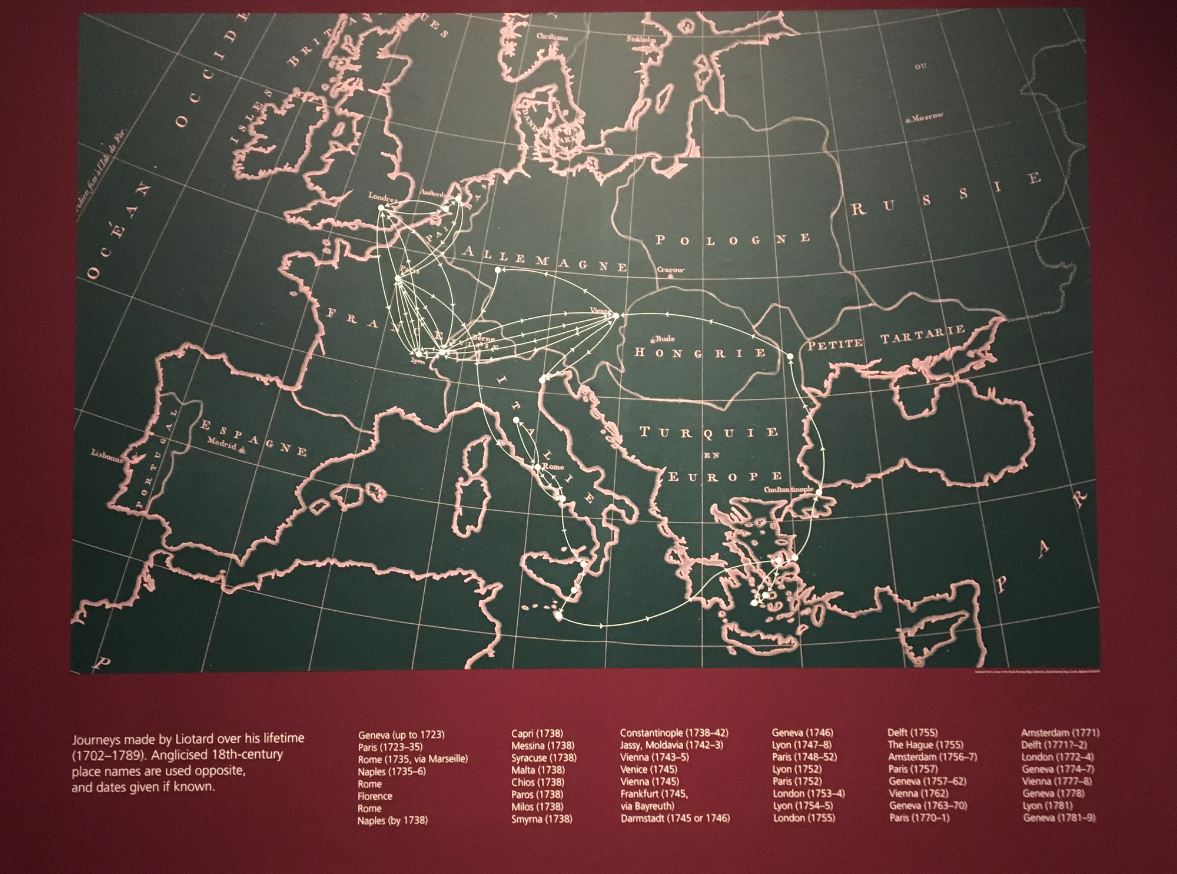
Liotard worked across the length and breadth of 18th-century Europe, from Paris, Rome, London and Amsterdam to the courts of Versailles and Vienna, and the show features a wall-sized map showing his extensive peregrinations.

Map showing Jean-Etienne Liotard’s travels round Europe. Photo by the author

Liotard’s most extended stay was in distant Constantinople where he accompanied his patron Viscount Duncannon. He spent four years there and developed a taste for oriental life and manners. He grew a long beard, adopted Turkish dress and nicknamed himself ‘the Turkish painter.’ The exhibition includes a group of black and red chalk drawings made on his travels, most strikingly charming studies he made of (European) women in Oriental dress.

Portrait of Signora Marigot, Smyrna by Jean-Etienne Liotard (1738) Musée du Louvre. Photo © RMN-Grand Palais (Musée du Louvre) / Jean-Gilles Berizzi

On this portrait the curators comment:

Liotard drew this portrait in Smyrna (present-day Īzmir) in May 1738, while on route to Constantinople. Smyrna was the busiest port on the Turkish coast, and Signora Marigot probably belonged to its thriving international community. Liotard captures her confident pose with great economy, using bare paper to create the folds of her gown and the ornaments in her hair. The high level of detail is characteristic of an artist skilled at working on a miniaturist’s scale.

Liotard in London

Liotard’s arrival in London in 1753, with a full beard and Turkish dress, created a sensation. He was introduced to the Royal Family, took lodgings in Golden Square near Piccadilly and advertised his works in the newspapers. A young Joshua Reynolds, later first President of the Royal Academy, enviously described Liotard’s ‘vast business at 25 guineas a head in crayons’ and Horace Walpole marvelled at a viscountess having her four daughters painted by Liotard ‘as his price is so great’.

London provided rich possibilities for a portraitist. It was taken as fact in the 18th century that the British loved having their portraits painted. Even allowing for a visit to Lyon in 1754, where ‘The Lavergne Family Breakfast’ was painted, some 50 works survive from the two years that Liotard spent in London between 1753 and 1755. Nobles, celebrities and even the Royal Family asked Liotard to paint their portraits in pastel, some of them donning Turkish dress themselves.

Take this striking portrait of Lady Anne Somerset, later Countess of Northampton.

Lady Anne Somerset, later Countess of Northampton by Jean-Etienne Liotard (about 1755) © The Devonshire Collections, Chatsworth. Reproduced by permission of the Chatsworth Settlement Trustees

As the curators explain:

With her cascading auburn locks and plunging neckline, Lady Anne (1741 to 1763) looks older than her fourteen years. But women’s lives were accelerated in the 18th century and Lady Anne was already active on the London social scene when this portrait was painted. She may have chosen this Turkish dress – either a garment Liotard owned or one inspired by his drawing Woman from Constantinople (also in display) – to create a more grown up, sophisticated persona.

Miniatures

Liotard also gained a reputation for his skill at creating miniatures. Several are featured here including a stunning miniature self-portrait. It’s only about 2 inches tall so the exquisiteness of the detail is breath-taking. Surely he must have used some kind of magnifying glass and the brushes must have had only a handful of hairs in them. A photo doesn’t do the richness of the real thing justice. Look at the perfectly painted flowers decorating his collar!

Self Portrait on enamel with ivory backing by Jean-Etienne Liotard (about 1753) Royal Collection Trust © His Majesty King Charles III 2023

The curators:

Liotard exploits the smooth and luminous surface of enamel to paint his wiry beard, the folds of his raspberry-red jacket and the tiny flowers that dance along his collar in minute detail. His first training as an artist in Geneva was with a miniaturist and he could rely on his skill in this demanding form of painting to impress. This miniature was probably intended as a means of self-promotion on his first arrival in London, capturing his unusual appearance.

Chocolate tracing

As well as the Family Breakfast the exhibition displays several other works highlighting Liotard’s skill at depicting porcelain services. Sadly, they don’t have the original of one of his other Greatest Hits, The Chocolate Girl (about 1756), which is astonishing both for the wonderful poise of the central figure and the incredible realistic detail of the chocolate cup and glass of water. What they do have is a tracing of the original work which Liotard would have used to generate copies, the same technique he used for making his copy of the Family Breakfast.

Porcelain

And this brings us to the final section of the exhibition, which focuses on Liotard’s fascination for, and incredible skill at depicting, porcelain.

Throughout his career Liotard was fascinated by porcelain, repeatedly depicting cups, saucers and the act of using them in his works. In this he was not alone: throughout the 18th century, paintings of people drinking tea, coffee and chocolate became extremely popular. Such paintings played on the idea of taste: both the literal tastes depicted in these pictures and the tasteful refinement of the scenes portrayed. Liotard was unusual, however, in his fidelity to the porcelain he depicted.

The cups and saucers in ‘The Lavergne Family Breakfast’, for example, can be identified as true Japanese porcelain and not cheaper European imitations. It is not surprising that Liotard owned several pieces of important porcelain, including the boxed tea service displayed nearby.

And here’s a photo of that tea service:

Luxury tea service given to Liotard by the Empress Maria-Theresa during his third visit to Vienna in 1777. Photo by the author

The curators:

Liotard received this luxury tea service as a gift from the Empress Maria-Theresa (1717 to 1780) during his third visit to Vienna in 1777 to 1778. He had not only worked extensively for the Empress as a portraitist, producing likenesses of her and her family in pastel, oil, enamel and chalk, but he had also enjoyed privileged access to the Imperial Porcelain Manufactory where this tea service was made. Liotard’s lifelong fascination with technical experimentation led him to help develop new enamel colours for production.

Summary

Eccentric man, amazing skills, beautiful art, lovely exhibition. And it’s FREE.

Video focusing on pastel


Related links

More National Gallery reviews

Berthe Morisot: Shaping Impressionism @ Dulwich Picture Gallery

This is a lovely exhibition, the first major UK exhibition of the leading French Impressionist Berthe Morisot’s work since 1950, but it’s also much more than that.

At the Ball by Berthe Morisot (1875) © Musée Marmottan Monet, Paris

It is also a sustained comparison of Morisot’s work with the 18th century artists she knew and loved, which means that about a third of the paintings on display (about 15 out of a total 45 or so) are not by Morisot at all, but by eighteenth century classics, such as Watteau, Fragonard, Boucher and, surprisingly, the Brits Joshua Reynolds and Thomas Gainsborough.

A collaboration

How did this come about? Well, the Musée Marmottan Monet is ‘the world’s leading research centre for the work of Berthe Morisot’ and it turns out that Morisot was very influenced by eighteenth century art – the French eighteenth century work of Fragonard and Watteau and Boucher, but also the English eighteenth century art which she saw on her honeymoon to England in 1875.

And Dulwich Picture Gallery houses a celebrated collection of 18th century painting. So this exhibition is by way of being a collaboration between these two galleries – The Musée Marmottan Monet providing nine key examples of Morisot’s work (along with prime examples from international collections) and these are then juxtaposed with French and English eighteenth century paintings from the Dulwich collection and elsewhere – with the aim of demonstrating Morisot’s debt to the previous century, both in subject matter and aspects of her painting style.

Berthe Morisot potted biography

Berthe Marie Pauline Morisot (1841 to 1895) was a French painter and a founding member of Impressionism. In 1864, she exhibited for the first time in the highly esteemed Salon de Paris. Her work was selected for exhibition in six subsequent Salons until, in 1874, she joined the ‘rejected’ Impressionists in the first of their own exhibitions, a show which included Cézanne, Degas, Monet, Pissarro, Renoir and Sisley. Morisot went on to participate prominently in seven of the eight Impressionist exhibitions between 1874 and 1886 (she missed one in 1878, having just given birth to her daughter, Julie). In 1894 the art critic Gustave Geffroy as one of ‘les trois grandes dames’ of Impressionism, alongside Marie Bracquemond and Mary Cassatt.

Morisot was well connected. She came from an affluent family who secured her painting lessons, first copying works in the Louvre, and then as a pupil to landscape painter Camille Corot, who taught her to make swift outdoor sketches.

She married Eugène Manet, brother of her friend and colleague Édouard Manet. Her sister, Edma, was also a painter. The Symbolist poet Stephane Mallarmé was a family friend. She was a member of the haut bohemien.

Room one

The exhibition is in four rooms. The first room contains eight paintings, designed partly to give you an introduction to her light and airy style, but almost all of the captions also draw attention to the fact that, even at the time, many critics spotted her closeness in spirit to eighteenth century painting.

Installation view of Room 1 of ‘Berthe Morisot: Shaping Impressionism’ at Dulwich Picture Gallery

What they meant was that something in the lightness and airiness of her style, something in the domestic intimacy of her subjects (almost entirely women), and even in her use of shades of white and silver, related directly back to the mood and tone of French Rococo painting.

‘Woman at her Toilette’ by Berthe Morisot (1875 to 1880). Image courtesy of The Art Institute of Chicago, Stickney Fund

Take ‘Woman at her Toilette’. To quote the curators:

With its silvery palette and fluent brushwork, the painting appears as ephemeral as a mirror reflection. Reviewing it at the Fifth Impressionist exhibition in 1880, art critic Paul Mantz noted: ‘everything floats, nothing is formulated […] there is here a finesse like that found in Fragonard.’

Or:

The genius of the eighteenth century, but not its debauchery, lives again in these familiar and select images, which are animated by a kind of airy voluptuousness.’ (Henri Focillon)

Or take the painting at the start of this review, ‘At the Ball’. The woman in evening dress is holding an eighteenth-century fan, opened to display a picture-within-the-picture, a scene of outdoor courtship known as a fête galante, a genre invented by the eighteenth-century artist Watteau. (The fan belonged to Morisot and is included in the exhibition so we can admire its civilised 18th century style.)

Morisot was fond of making this kind of allusion to eighteenth-century visual culture and the connection proved attractive to collectors. The curators tell us that Rococo art had gone into a long period of neglect after the French Revolution but that, in Morisot’s generation, it underwent a revival. Exhibitions reintroduced eighteenth-century French art to the public and the Louvre opened new rooms devoted to the era.

So when Renoir declared her ‘the last elegant and “feminine” artist that we have had since Fragonard’ and Paul Girard, reviewing her summary exhibition in 1896 commented that her work was ‘the eighteenth century modernised’, it showed that she was very much on trend, and it was reflected in her sales. ‘At the Ball’ was bought from the Second Impressionist Exhibition in 1876 by art collector Georges de Bellio, to complement his existing collection of eighteenth-century art, and many of her works were sold to collectors with similar tastes.

Room two

The second room has the highest proportion of non-Morisot to Morisot, 8 or so works by other artists to her four. This is the room where the curators show a number of eighteenth century works and explore Morisot’s relationship to them. This turns out to be quite complicated, in the sense that she had a multi-levelled relationship with the artists of the preceding century, which evolved over time.

Engaging the classics

In her late teens and early twenties she had undergone supervised training which consisted of copying classic works at the Louvre. Over 20 years later, she returned to the Louvre to engage with the classics, no longer copying them but translating them into her own, loose, rough, late-impressionist style.

In her forties and fifties, Morisot engaged directly with grand mythological paintings in museum collections, translating elements of their compositions into her own Impressionist language. Unlike the copies that formed part of her own early training, these are original interpretations by a confident, mature artist.

Thus the exhibition shows us (a photo of) Apollo revealing his divinity to the shepherdess Issé by the great Rococo painter François Boucher:

‘Apollo revealing his divinity to the shepherdess Issé’ by François Boucher (1750)

And then shows us Morisot’s interpretation or translation or reinvention of the two embracing young women at the bottom left of the painting into her own hazy, light, unfinished style:

‘Apollo revealing his divinity to the shepherdess Issé, after François Boucher’ by Berthe Morisot (1892) © Musée Marmottan Monet, Paris

Now this raises all kinds of questions. On the face of it, I prefer the Boucher, as I consistently preferred all the 18h century originals to Morisot’s ‘interpretations’ when they were laid side by side. There’s more depth, more perspective, more (wonderful) painting technique, more detail and more visual pleasure to be had by the works by Fragonard, Boucher and Watteau on show here. They look and feel like the luxury objects they were intended to be.

And yet, Morisot’s work is doing something different: its looseness, its rough finish, its lack of interest in realistic perspective or twinkly detail are the result of something else. There’s a lot of experimentation going on in the technique, namely the long, blunt, wide brushstrokes which can be seen in the green reeds. (And it’s fascinating to learn that Monet very much liked this feature of Morisot’s later style, and went on to use a similar combination of short and longer sinewy brushstrokes and pastel colouring in his paintings of water lilies.)

But, arguably, there’s also a psychological dimension at play. In the Boucher work, the embracing women are yet more examples of the kind of sumptuous sensuality which floods the painting. In Morisot’s version they’re still naked, and we can see the outlines of their bodies, and yet these bodies are being dissolved into or drowned or clambered over by the powerful green reeds, powerful green reeds which, on the left, swirl and curve, leading the viewer’s eyes into a background which isn’t magically alluring but is more unadorned and bleak. Humanless and troubling.

The female gaze

Something similar can be said of another direct comparison the show gives us. First, look at this characteristically sensual and saucy painting by Fragonard of a woman reclining, all pink nipples and soft porn confection:

‘Young Woman Sleeping’ by François Boucher. Fondation Jacquemart-André – Institut de France, Domaine de Chaalis, Fontaine- Chaalis

Pretty obviously this painting, and this entire genre of painting, was designed to please and titillate its male audience with what T.S. Eliot called the ‘promise of pneumatic bliss’. And here is Morisot’s reinterpretation:

‘Resting’ by Berthe Morisot (1892) Private Collection

Same subject i.e. head and shoulders of a topless young woman reclining on an ornamental sofa or bed and yet…the Morisot comes from a different world, both artistically and psychologically. On the painterly level, the Bouchard buries the outlines of the subject in a realistic depiction i.e. you see more or less what you would see in real life, maybe a little Photoshopped and improved, but the outlines are soft a gentle.

On the contrary, the Morisot makes a point of emphasising outlines. Note the strong green lines shaping her hair, particularly as it tumbles onto her shoulder, the outline of her right shoulder against the pillow, the outlines of her right boob and forearm and left handing resting on it.

This painting isn’t interested in realism; it is making a statement about the artificiality of painting itself. In this respect, several of her later (this is from 1892) works reminded me of Gauguin, who had long ago ceased bothering about ‘realism’ and become interested in simplifying patterns and designs using heavy outlines, shapes which refer back to objects in the real world but take them a long way towards a kind of primitive abstraction.

Morisot isn’t Gauguin, but I thought some of her later works had moved just as far beyond impressionism, but in her own distinctive way. Another vivid example is ‘Julie Manet and her Greyhound Laertes’ from right at the end of her life (1893 – she died in 1895)

The straight-on face and the black, very loosely painted dress, reminded me of Edvard Munch more than Renoir or the other classic-era impressionists.

And this brings me to the other aspect of the work, which is its psychological impact. The Bouchard woman, a sleek airbrushed imago, has been painted for male viewing pleasure. The Morisot picture for other reasons altogether. As discussed, it is, on one level, an exercise in painterly technique, in exploring the world beyond pure realism. But on a psychological level it is just as complex. This woman doesn’t exist to give any man pleasure. This isn’t painted for the controlling male gaze. She comes across as a real individual, with idiosyncratic hair, colouring, non-male-fantasy boobs; like a painting of a woman who happens not to be wearing a top.

And, as well, there is some kind of power radiating from t, a sense of psychological depth. She reminds me of the heroines of late Victorian fiction, of Hardy or Zola or Henry James, of women whose every transient thought and emotion and response is annotated and analysed in vertiginous detail over three or four hundred pages novels.

There are a lot of paintings of women in the exhibition but, in my opinion, there is quite a big gulf between Morisot’s pretty-pretty, dressed-up Victorian women from the 1870s and 1880s, which are often variation on Renoir’s delightful dancing ladies – and these later depictions, which are something altogether different. They anticipate the much blunter honesty and psychological complexity of much early twentieth century portraiture.

Working in pastel

Room three also contains a useful contrast in the medium of pastel. From the 18th century we have a stunningly beautiful portrait of an unknown man by Jean-Baptiste Perronneau. This is the kind of work that has to be seen in the flesh to be appreciated. A reproduction like this flattens and smooths it out. In the flesh you can see the amazing amount of work that’s gone into the pastelwork, for example the way repeated layerings of broad blue crayon create a rich sensual impression like you could reach out and touch it, whereas, the wall label tells us, the intricate detail of his neckerchief was achieved with a fine-nibbed pen. It looks pretty good in this reproduction, but it’s a wonder to stand in front of.

Portrait of a Man, Thought to be Louis Journu, Known as Montagny by Jean-Baptiste Perronneau (1757 to 1758)

And so, placed next to it is a very good pastel portrait of her daughter Julie by Morisot:

Girl carrying a basket by Berthe Morisot (1891)

Again, the Morisot doesn’t have the astonishing finish or visual depth of the Perronneau. And yet, in its very sketchiness, it indicates an infinitely more modern consciousness, a proto-modern sensibility made of gaps and fragments, the strange ellipses and leaps of consciousness which modernist literature was about to start exploring about a decade later (I’m thinking about the earliest works of Kafka and Joyce).

The French eighteenth century

So, as mentioned above, the exhibition is worth visiting to see not just works by Morisot, but also (an admittedly small) number of works by French eighteenth century masters. There’s a pretty poor portrait of a young girl by Fragonard but a dazzling work by Watteau:

Les Plaisirs du bal by Antoine Watteau (1715 to 1717) Courtesy Dulwich Picture Gallery

Completely different in style from those guy’s frothy confections and commedia dell’arte whimsy, there’s a lovely piece by the master of eighteenth century realism, Jean-Baptiste-Siméon Chardin, The Scullery Maid, a characteristically humble domestic scene of a serving maid getting eggs out of a jug surrounded by beautifully depicted bowls and servant-level bric-a-brac.

This leads off in another direction because it turns out that Morisot’s sister, Edma, was also an artist and she is represented here by just one work, a beautiful landscape in the manner of Jean-Baptiste-Camille Corot who both girls had studied under. These are all delights.

Landscape by Edma Morisot (1860s) D. and J. Waller

The English connection

But back to the English. The exhibition explains that Morisot spent her honeymoon (with Manet’s brother, Eugène) on a trip which took in the joys of the Isle of Wight and then London. In London she saw the huge collection amassed by Sir Richard Wallace, Marquess of Hertford, which has been preserved for the nation as the Wallace Collection.

It was here that she was introduced to the works of 18th century English masters such as Joshua Reynolds, Thomas Gainsborough and George Romney. The exhibition takes a little detour to explain the different styles of these three men, and discuss some key works by each of them, and then how their styles or motifs found their way into Morisot’s work.

Gainsborough is the most obviously close to Morisot because of his light, feathery, sketchy approach, which drew criticism from the more grand and finished Reynolds, yet was precisely the quality that attracted the quick, sketchy Frenchwoman.

Installation view of ‘Berthe Morisot: Shaping Impressionism’ at Dulwich Picture Gallery, setting ‘Mrs Mary Robinson’ by George Romney (1781, on the left) against ‘Winter, or Woman with a Muff’ by Berthe Morisot (1880)

Summary

Not all of Morisot’s work is great. The fourth and final room contains only works by her and I have to admit I didn’t like most of them.

Installation view of Room 4 of ‘Berthe Morisot: Shaping Impressionism’ at Dulwich Picture Gallery

Worthy depictions of domestic interiors, of her growing daughter, intimate portraits of women outside in the Bois de Boulogne or out in a boat or resting on divans (clearly a full-time occupation for many Victorian ladies), I often found their style either washed-out (several of the supposedly sweet and intimate studies of her daughter gave her such a yellow-pale face she looked like a corpse, for example, ‘Children with a basin‘) or so quick and sketchy as to feel amateurish.

Very good amateurish, but in many of her paintings the multiple clumsinesses wherever I looked just stopped me really enjoying them, giving in, surrendering, saying Yes.

‘Eugène Manet on the Isle of Wight’ by Berthe Morisot (1885) © Musée Marmottan Monet, Paris

By contrast, I was enraptured by almost all the eighteenth century works (except for the ghastly, ugly Fragonard in room one), by her sister’s one work, and also by the massive work by a painter I haven’t mentioned yet, her contemporary James Tissot (The Ball on Shipboard), included because Tissot moved from Paris to London and made a great success of his career, so much so that, on her honeymoon trip, Morisot seriously considered doing the same and moving to London.

Even the 18th century ‘cartoons’ or preliminary sketches for big works like by Boucher (‘Vulcan’s Forge) delighted and enchanted with a depth and finish and wonderful technique, in a way that most of the Morisot didn’t.

For this reason I hardly think it the scandal of the century that Morisot isn’t as well known as many of the other impressionists. To be blunt, I don’t think she’s as good. Or definitely not on the strength of the works presented here, a handful of which are really good, some are pretty good, and some are positively poor.

But then again, it depends on your aesthetic. Did my general preference for the 18th century works indicate that I’m a peasant, a man of poor taste, a liker of pretty pictures and chocolate box art, who doesn’t appreciate more demanding (and hardly that demanding) art?

Here’s a test. Here’s the bold, take-no-prisoners self-portrait which the curators open the show with.

Self-portrait by Berthe Morisot (1885) © Musée Marmottan Monet, Paris

I get that she’s a strong independent woman, and that this comes over not only in the directness of her gaze but in the super-confidence with which she didn’t finish it. The French have an expression, ‘je-m’en-foutisme’, which translates as ‘I don’t give a damn-ism’ (or ruder, four-letter equivalents).

So, is the scrappy finish and the lack of immediate visual appeal outweighed by the strength of character and psychological depth of a painting like this? Your answer will determine whether you like Morisot, or at least the selection of 30 or so Morisot paintings to be found in this small but incredibly stimulating and hugely enjoyable exhibition.

The merch

I’ve made the point in previous reviews of Impressionist exhibitions, but one reason for the ongoing popularity of the Impressionists is simply that their paintings transfer so well onto posters and mugs and tea towels and jigsaws and the whole world of merchandise. Painting which, large and in the flesh feel half finished and scrappy, when reduced to the size of a coffee cup or tea tray, suddenly look finished, light and attractive. Never ceases to amaze me. As you can see from the full range of Morisot merchandise on sale at the Dulwich Picture Gallery shop:

The promotional video


Related links

Related reviews

More Dulwich Picture Gallery reviews

Edgar Degas: Drawings and Pastels by Christopher Lloyd (2014)

Degas’s forensic approach favours those moments when humanity reveals its frailties.
(Edgar Degas: Drawings and Pastels, page 191)

This book contains 238 illustrations, mostly in colour, of the pencil, black-chalk, pen-and-ink and charcoal drawings and the innumerable highly-coloured pastels of the master draughtsman among the Impressionists, Edgar Degas (1834 to 1917).

As a devotee of disegno (the Renaissance term for the art of drawing, and by extension of creating a composition) I found many of Degas’s drawings as ravishing as a work of art can be. Size-wise the book is half way between normal paperback and coffee table so the reproductions aren’t big, but they’re big enough to delight and amaze.

The text is by one-time Surveyor of the Queen’s pastels, Christopher Lloyd (born in 1945). Lloyd points out that it was only after Degas’s death in 1917, when the contents of his studio were auctioned off, that anyone really appreciated the enormous number of sketches and pastels which Degas had created throughout his life, not to mention the contents of the 30-plus notebooks he left. There is a vast amount of material.

Lloyd treats Degas’ life and works in straightforward chronological manner:

Beginnings 1853 to 1855

His family was affluent. Dad was a banker from a French family who emigrated to Naples. Another branch of the degas family moved to New Orleans, USA and became successful in the cotton trade.

Italy 1856 to 1859

Degas goes on a self-financed odyssey round the great galleries of Italy, sketching everything he saw.

History Paintings 1860 to 1865

Degas makes a concerted effort to conform and paint the kind of history paintings which French High Society and the official Salon prized most. The book includes reproductions of Semiramis Building Babylon (1861), The Daughter of Jephthah (1860), Scene of War in the Middle Ages (1865) and so on – which are, frankly, not that convincing. By contrast, the preparatory sketches to these big works are almost all breath-taking. Degas kept the early work, Young Spartans Exercising (1860) in his studio and carried on tinkering with it well into the 1880s, though he never got the faces right. Anyway, the history strategy failed, with none of the history paintings being accepted by the Salon.

Changing Directions 1865 to 1870

Degas meets Manet, only two years older than him (born in 1832). Overlapping with his history paintings he starts to sketch scenes of modern life. Compare Portrait of Mlle Eugenie Fiocre a propos the ballet ‘Le Source’ (1868), with Racehorses before the stands (1866 to 1868).

Confronting the Modern World 1870 to 1879

Degas takes a five-month trip to his relatives in New Orleans, which opens his eyes about the vastness of the modern world. But it’s back in Paris that Degas becomes part of the new avant-garde, meeting Monet, Pissarro, Sisley, Renoir et al, and playing a key role in organising the first Impressionist exhibition in 1874. During the 1870s he really consolidates his interest in certain key subjects: ballet dancers, horse-racing, women at work (washerwomen, milliners), women at their toilette.

Retreat into the Studio 1880 to 1890

Degas diversifies into print-making, painting fans, and making sketches for large-scale friezes – though these never seem to have been completed. He experimented with stylised viewpoints, compressing the picture space, and deliberately cropping images, an aesthetic effect copied from photography.

Landscape Drawings

Degas notoriously deprecated landscape painting (odd, really, considering that that was the core motif of Impressionism). He made some landscapes on his travels (he was probably the most-travelled of the Impressionists) but as objects of fact rather than sentimental ‘beauty’. Then in the 1890s he began to extend his interest in the monotype technology he’d first used in the 1880s, this time experimentally manipulating oil paint over the basic printed image. This created a suite of works which, ironically, was the subject of the only one-man show ever devoted to him in his lifetime (in 1892). They surprised his devotees by moving decisively beyond Impressionism and into the hazy, half-imaginary world of fin-de-siècle Symbolism: Landscape with smokestacks (1890), Landscape (1890).

‘The Dying of the Light’ 1890 to 1912

Degas’s eyesight deteriorated at the same time as he switched to the chosen medium of his final years, intensely coloured pastel, laid on with repeated, thick lines and hatchings, each layer preserved with a fixative and then drawn over again. This produced super-luminous visions which he often dabbed with wetted pastel sticks to produce magical sparkles and highlights: After The Bath, Woman With A Towel (1897), The dancers (1892).

Lloyd not only takes us through Degas’ life, but systematically covers Degas’ various subject areas – the dancers and ballerinas (which form over half of Degas’s total oeuvre), the racehorses, the women workers (milliners, laundresses), and the women at their toilettes.

Half the pleasure comes from the sketches of subjects which don’t figure so much in the finished pastels or oil paintings but which he endlessly explored. Studies pure and simple of faces, men standing around, nude women and more ballerinas.

What an eye! And what an ability to rough out the forms and gestures of human beings with such conviction, creating brisk, confident lines on paper which bring an entire human moment to life.

Some staggering sketches

Study of a ribbon (1882) by Degas

Study of a ribbon (1882) by Degas

New terms

  • balletomane – a ballet enthusiast.
  • contre-jour (‘against daylight’) uses sources of daylight in a painting or pastel to produce backlighting of the subject. The effect usually hides details, causes a stronger contrast between light and dark, creates silhouettes and emphasizes lines and shapes.
  • les rats – nickname for the youngest ballet dancers in the corps de ballet. Edmond de Goncourt described them as ‘little monkey girls’ (quoted page 118).
  • mise-en-page – fancy French term for page layout and design.
  • repoussoir – one of the pictorial means of achieving perspective or spatial contrasts by the use of illusionistic devices such as the placement of a large figure or object in the immediate foreground of a painting to increase the illusion of depth in the rest of the picture.

Related links

Nineteenth century France reviews

Drawn in Colour: Degas from the Burrell @ The National Gallery

A loan from the Burrell Collection

The Burrell Collection Glasgow is currently closed for a major refurbishment until 2020. Among other things it houses a spectacular collection of works by Hilaire-Germain-Edgar Degas who, as it happens, passed away a hundred years ago this September (1834–1917). So what better way to celebrate this centenary – and display works which would otherwise be gathering dust in a warehouse somewhere – than by loaning this priceless collection to the National Gallery in London, where it nicely complements the National Gallery’s own collection of Degas pastels?

Thus, in the Ground Floor galleries (conveniently close to the café and restaurant) you can visit this fabulous FREE exhibition of 13 pastels, three drawings, and four oil paintings by Degas, the first time that most of them have been seen outside Glasgow since they were acquired in the early 1900s.

At the Jewellers(1887) by Hilaire-Germain-Edgar Degas. Pastel on paper © CSG CIC Glasgow Museums Collection

At the Jewellers (1887) by Hilaire-Germain-Edgar Degas. Pastel on paper © CSG CIC Glasgow Museums Collection

The show is downstairs in the fairly newish exhibition space of the Annenberg Wing. The light is deliberately dimmed to preserve works which, we are told, have already faded significantly in their 130 years of existence. It’s like entering a cathedral and oh, what entrancing, ravishing objects are here to worship!

There are some oil paintings, a few rough sketches and one statue – but this show is mostly about Degas’s supernatural gift with pastels – and what a gift it was!

The wall panels (and the book in the shop outside) liberally describe Degas as the most gifted draughtsman of the 19th century and his skill at creating outlines and shapes is breath-taking. Look at the horse on the far right of Jockeys in the rain. The closer you look the more perfect it becomes.

Jockeys in the Rain (1883-6) by Hilaire-Germain-Edgar Degas. Pastel on tracing paper © CSG CIC Glasgow Museums Collection

Jockeys in the Rain (1883 to 1886) by Hilaire-Germain-Edgar Degas. Pastel on tracing paper © CSG CIC Glasgow Museums Collection

His early training was academic, trained to draw in studios with a spell in Rome to sketch and draw from classical masters. But he wasn’t satisfied and embarked on a lifelong course of technical experimentation with materials, and particularly with the supremely flexible medium of pastel that he came to prefer over painting in oil.

Degas had a deep interest in Japanese prints and helped bring them to public attention in 1870s Paris. He used photographs as models for his subjects. And he studied classical friezes for their posing of the human subject and of horses.

Pastel became increasingly important to Degas in his later years at a time when, coincidentally, brilliant colour began to play an essential role in the contemporary art he admired, and his own eyesight started to fail. The tactile immediacy and luminous colours of pastel, as well as its ephemeral and fragile quality, allowed him to create astonishingly bold and dynamic works of art, distinct from those of his fellow Impressionists.

Degas and pastels

1. Smooth

In his early works (1870s) Degas uses pastels ‘unfixed’ by oil or fixative; they are flat, and highly smudged and blended in order to create an oil painting effect.

2. Rough and lined

As he became more proficient (1880s) Degas came to use a ‘fixative’ between successive layers of pastel to build up layers, to create what experts call a ‘crust’. In tandem he dropped the technique of blurring and adopted strong, visible, directional strokes, strikingly virile lines which seem gouged across the paper as you look closely. The harshness of this cross-hatching is evident in the two works above which are to a large extent made up out of lines.

3. Colour

As the 19th century progressed industrial scientists developed new ranges of vivid and vibrant colours. These became available as readymade oil paints in tubes – which greatly helped the Impressionists aim of painting out of doors, far from the studio. But they also became available as pastel sticks, sticks made from chalk, binding agents and dyes.

4. Water

Degas developed a technique of dipping the tips of the pastel sticks into water in order to dab thick and bright highlights on top of finished works, for example the decorative highlights on the dresses of the Three dancers

Innovations

Degas was one of the greatest artistic innovators of his age.

1. Subject matter

He turned from the traditional subjects and technical conventions of his training to find new ways to depict modern, urban life. In Degas’s work, both the highs and lows of Parisian life are depicted: from scenes of elegant spectators and jockeys at the racecourse, to tired young women ironing in subterranean workshops.

His most famous subjects were ballet dancers, generally caught in informal, behind-the-scenes moments; and women at their toilette, bathing or combing their hair. If we didn’t know it before, we learn that Degas lived close to the Paris Opera where ballet was performed and gained regular entrance to the rehearsal studios, and even to the wings of the theatre itself.

2. Private moments

With his intimate depictions of women bathing or combing their hair Degas knew he was subverting artistic tradition. Until his time women had mostly been posed in a way that presupposed an audience (for example, the great odalisques of Ingres). Degas’ women aren’t posing for anyone.

Woman in a Tub (1896-1901) by Hilaire-Germain-Edgar Degas. Pastel on paper © CSG CIC Glasgow Museums Collection

Woman in a Tub (1896 to 1901) by Hilaire-Germain-Edgar Degas. Pastel on paper © CSG CIC Glasgow Museums Collection

The apparent crudity and the unashamed frankness of these works shocked and repelled contemporary audiences. Obviously we in 2017 have seen and read everything, nothing shocks us. But these works momentarily begged the question: are they more ‘natural’ than the Ingres/Salon tradition of perfectly portrayed naked women? Or are they more creepily ‘voyeuristic’? Is there something suspect about viewing naked women at such vulnerable and exposed moments?

The wall labels raise this question without resolving it: I think the answer is that the subject matter is mostly eclipsed by the technique. Sure, they’re scantily clad women; but quite obviously there is nothing salacious or pornographic about them – there are hardly any bare boobs whereas there are lots of backs bent or stretching. The real interest of the pictures is in their unusual composition, and especially in their vibrant use of colour.

3. Unconscious movements

Having studied the human figure as it is carefully posed in art school, in statues and in all previous art, Degas was restless to capture fleeting movements and impressions of modern life. His private women, the famous ballet dancers, and the jockeys, are all caught in off-guard poses.

You never (so far as I know) see the horses racing. You see them jostling nervously before, or calming down exhaustedly after, the race.

Similarly, the hundreds of sketches, pastels, oils and sculptures he made of ballet dancers are very rarely of performances – overwhelmingly, they’re of ballerinas backstage, or from the wings, in rehearsal, resting, stretching. The show includes an example of a ballerina adjusting a shoulder strap. Moments like that. Or these three ballerinas. What are they doing? Where are they? In a rehearsal studio? In the wings during a performance?

Unofficial locations, off-guard moments, unconscious gestures. (Look at the hand of the ballerina on the right. The other two ballerinas pressing against the wall or theatre ‘flat’.)

The Red Ballet Skirts (1900) by Hilaire-Germain-Edgar Degas. Pastel on tracing paper © CSG CIC Glasgow Museums Collection

The Red Ballet Skirts (1900) by Hilaire-Germain-Edgar Degas. Pastel on tracing paper © CSG CIC Glasgow Museums Collection

And yet these fleeting moments are given an extraordinary permanence. The stunning contrast between vibrant orange of the tutus and the lurid green of the flat create an incredibly visual dynamic. But is is the very strong outlines in black (look at the confidence of the black strokes over the tutus to indicate folds of fabric) and the fact that the figures are lit from above, which combine to give the image a monumental, sculpted feel.

4. Composition

Several points about the compositions:

Ungainly

He is interested in the ungainly in human posture. In no way is the woman bending over in her bathtub gracious. In fact, the more you look at her the more her posture begins to dissolve into a purely formal arrangement of colours. (Degas was affected by the later, semi-abstract work of Gauguin.) What do his two most famous subjects, ballerinas and horse, have in in common? They are both in constant motion, an endless supply of odd, awkward, spontaneous, fleeting poses.

Cropped

Degas had the habit of cropping images in mid-person or subject. Many of the horse pictures crop horses half way through. None of the examples I’ve included really show this brutal cropping, but some in the exhibition do. It’s related, in some of them, to the way he often began a composition on one sheet, and then added other sheets around it, as the composition grew. Sounds odd, but you can see the joins in several of these works (which you are allowed to view from gloriously close-up, really feeling every stroke of the pastel stick).

Cramped

Degas’ routine cropping of subjects is accompanied by his often experimental construction of pictorial space. The people depicted are frequently cramped right into the frame of the picture. Take the vertiginous perspective of the two women crammed together in the work at the top of this post, At the Jewellers or the way the two women in a theatre box are cropped at the edges to make us feel as if we’re thrust right into the scene in the final picture below, Women in a Theatre Box.

Empty

Conversely, there can be oddly empty space, as in Woman in a Tub. Come to think of it, where is this tubbing taking place? Where are the details of the room which would give it perspective and context, window, door, carpet, mirror, cupboards? Is the white patch on the left a rug? You realise the tub and woman are floating in an abstract orange space.

A little more intelligible, more readable, is the great gap on the left of Jockeys in the Rain. Combined with the unusually realistic depiction of the horizon, very high in the picture, the composition creates a great sense of space, itself indicating… what? The restlessness of horses, and riders, jostling and shuffling, ready for the race to begin? And why on earth is it in the rain? The scattered blue slashes of pastel from top right are also on a (mild) diagonal and, once you notice them, add to the sense of unease and restlessness.

Empty or cramped or oddly cropped, Degas is always experimenting with compositional space.

Unfinished

Degas had a lifelong habit of leaving works unfinished, whether it’s because he was a perfectionist, or restless to move on, or on aesthetic principles, is difficult to gauge. Different models and colleagues have left different accounts of his feverish impatience.

Look at At the jewellers (above). Not only are the two ‘finished’ figures awkward and cramped but (and I have to admit I didn’t notice this at first, maybe because I was standing too close to it) but there’s an entire third figure on the right, barely sketched in and left completely abandoned. Why? Lots of the ballet dancer works reveal big patches of unprepared canvas left exposed.

You can see how this could be part of the aesthetic of catching life on the fly, on the move, the brief unconscious gestures of his subjects, patting their hair or adjusting a strap – just those quick fleeting glimpses of entirely modern life which – as Degas knew from his impeccably classical training – nobody in the history of art had tried to capture before.

So maybe their incompleteness is part of the fleetingness.

5. Colour

Some of the sketches are more or less monochrome and the oil paintings are fairly conventional in colouring – but the pastel works – wow! They are an explosion of the most vivid reds and greens and blues, mauves and oranges.

Three Dancers (1900-5) by Hilaire-Germain-Edgar Degas. Pastel on tracing paper © CSG CIC Glasgow Museums Collection

Three Dancers (1900 to 1905) by Hilaire-Germain-Edgar Degas. Pastel on tracing paper © CSG CIC Glasgow Museums Collection

It’s striking to see green used so routinely to convey flesh colour (see the haunch of the woman in the tub) but in fact this technique goes back to the Renaissance.

But the real shock is the red and oranges. The background to the woman in a tub or the women in a box and the ballerinas’ dresses. Wow. It is a shocking and intense colour which dominates the exhibition rooms and has, appropriately enough, been chosen as the exhibition poster. Incredibly, conservationists have shown that the colours were all originally much more intense but that exposure to light has faded them. Dayglo Degas!

In these works you can really see why he came to love pastel: not only were a) new industrially-developed and astonishingly vivid colours available, but b) you can build up a real depth of colour by repeated hatching and ‘fixing’ and colouring again but c) but without having to paint right up to the lines, as you’re obliged to in oil, able to leave large amounts of the surface rough and patchy – the hatching style gives you visual permission to do this – and so d) fulfilling the contemporary, fleeting, impressionist aesthetic.

The commentary uses words like iridescent, fluorescent, vibrant, but words can’t really do justice to quite how astonishingly, violently loud these colours are. They leap off the surface. And yet this vibrancy is always mediated, compromised, somehow made all-the-more dynamic, by the very obvious hatching, the rough bare lines of blue or orange or black which create a tremendous sense of dynamism and excitement.

It’s small, it’s free, but this is one of the most visually exciting exhibitions I’ve been to in ages.

Women in a Theatre Box (1885-90) by Hilaire-Germain-Edgar Degas. Pastel on paper © CSG CIC Glasgow Museums Collection

Women in a Theatre Box (1885 to 1890) by Hilaire-Germain-Edgar Degas. Pastel on paper © CSG CIC Glasgow Museums Collection

P.S.

Nowhere in the exhibition information did it mention that the National Gallery does have other Degas works on display, upstairs in room 42. Worth walking up a flight of stairs and through a few rooms to make your Degas experience complete!

Video

Most galleries nowadays produce short highlights videos to promote their exhibitions. But the National Gallery is now making available recordings of the fifty-minute-long lectures or introductions to their main exhibitions, given by the exhibition curators.

This is an excellent idea, as it helps you get a real sense of what the curators are trying to do, of the practical problems of arranging exhibitions by theme or chronology or medium and so on, plus snippets and insights not available at the show itself.


Related links

Nineteenth century France reviews

Reviews of other National Gallery exhibitions

Delacroix and the Rise of Modern Art @ the National Gallery

‘The seeds of almost every art movement current in 19th century Paris were sown by artists copying and emulating Delacroix’s work.’

Ferdinand Victor Eugène Delacroix (1798 to 1863) was the leading exponent of Romanticism in French art, active from his first exhibition at the annual Salon de Paris in 1823 through to his last appearance in 1853. He pioneered a colourful, vibrant, spontaneous-feeling approach to depicting historical subjects, scenes from the ‘exotic East’, landscapes, nudes and still lifes.

Self Portrait by Eugène Delacroix (about 1837) Musée du Louvre, Paris (RF 25) © RMN-Grand Palais (musée du Louvre) / Jean-Gilles Berizzi

Self Portrait by Eugène Delacroix (about 1837) Musée du Louvre, Paris © RMN-Grand Palais (musée du Louvre) / Jean-Gilles Berizzi

I thought the title of this exhibition was a bit modish, that the tag ‘…and the rise of modern art’ could be applied to umpteen 19th century painters simply by living before the deluge of Modernism – but in fact the show completely convinces you that Delacroix really was instrumental in the rise of modern art.

It does this by avoiding a straightforwardly chronological survey of his career. Instead the exhibition consists of six rooms, each of which addresses a specific theme or subject – and then hangs Delacroix paintings from the 1830s, 40s and 50s next to works which strikingly resemble them, refer to them or incorporate their techniques, by artists of the next two generations, including Renoir, Monet, Cézanne, Van Gogh, Gauguin, Matisse and Kandinsky, along with the lesser-known Symbolist artists, Gustave Moreau and Odilon Redon.

What the exhibition makes clear is that later artists didn’t just copy or learn from Delacroix in subtle and obscure ways, visible only to scholars and experts. They paid direct homage to him, copying his subjects and compositions and styles and ideas in ways which are immediately visible to even an untrained eye. They wrote letters, commentaries, essays and articles explicitly acknowledging their debt to him, and even made paintings showing him being levitated to heaven or showered with awards by a grateful posterity. As Cézanne, a really devout follower, said: ‘We all paint in Delacroix’s language’.

Apotheosis of Delacroix by Paul Cézanne (1890-4) Paris, Musée d’Orsay, on loan to the Musée Granet / Aix-en-Provence (RF 1982-38) © RMN-Grand Palais (musée d'Orsay) / Hervé Lewandowski

Apotheosis of Delacroix by Paul Cézanne (1890 to 1894) © RMN-Grand Palais (Musée d’Orsay) / Hervé Lewandowski

After Delacroix’s death the contents of his studio were sold off and revealed a wealth of previously unknown outdoors paintings, which had a strong impact on the young Impressionists who were just starting out on their careers. They found in Delacroix a liberation from the official Salon art of the day, the inspiration to capture the warmth and vibrancy of the everyday, the exotic, the exciting, instead of the glacial cool of the perfectly poised subjects concocted in the artist’s studio.

When a later generation wanted to move beyond Impressionism in the 1890s, Delacroix’s sometimes blurry use of paint pointed the way for Symbolist painters seeking misty, portentous shapes and mythological images – but also provided inspiration for the Post-Impressionists (Gauguin, van Gogh) who were interested in bold experiments with colour for its own sake.

Still Life with a Sketch after Delacroix by Paul Gauguin (1887) Musée d'Art moderne et contemporain de Strasbourg © Photo Musées de Strasbourg, M. Bertola

Still Life with a Sketch after Delacroix by Paul Gauguin (1887) Musée d’Art moderne et contemporain de Strasbourg © Photo Musées de Strasbourg, M. Bertola

And when his collected writings on art, painting technique and broader aesthetics were published in three volumes between 1893 and 1895, the depth and variety of ideas contained in their 1,438 pages crystallised Delacroix’s position as a key thinker, who could be plundered by all the various schools of modern art.

Rough not smooth

As his Wikipedia entry makes clear:

In contrast to the Neoclassical perfectionism of his chief rival Ingres, Delacroix took for his inspiration the art of Rubens and painters of the Venetian Renaissance, with an attendant emphasis on colour and movement rather than clarity of outline and carefully modelled form.

Rather than smooth perfection, Delacroix developed a technique of painting au premier coup, trying to complete a work in one sitting, or over a few days at most. This makes a lot of his paintings quite rough to look at – in fact not that many of the Delacroixs on show here are, in themselves, that appealing.

The Death of Sardanapalus (reduced replica) by Eugène Delacroix (1846) © Philadelphia Museum of Art, Pennsylvania. The Henry P. McIlhenny Collection in memory of Frances P. McIlhenny, 1986 (1986-26-17)

The Death of Sardanapalus (reduced replica) by Eugène Delacroix (1846) © Philadelphia Museum of Art, Pennsylvania

The above is a small-scale copy of the large original. The exhibition juxtaposes it with the The Eternal Feminine by Cézanne, pointing out the way that both works feature a still figure on a bed regarding the mayhem of activity around them.

The Eternal Feminine by Paul Cézanne (about 1877) © The J. Paul Getty Museum, Los Angeles, California (87.PA.79)

The Eternal Feminine by Paul Cézanne (about 1877) © The J. Paul Getty Museum, Los Angeles

Close up

Some paintings are best viewed from a distance, like a lot of the Impressionist works at the Inventing Impressionism show hanging in these very rooms a year ago. But if I learned one thing about Delacroix’s paintings it is that they are best looked at very close up. At medium distance often the composition looks a bit shabby, the figures not too convincing and the background sketched in. But really close up – a foot from the canvas – you can see the confidence of the quick, flicking brushstrokes.

Thus the poster for the show is a big close-up of a lion’s head, its glaring eye set among a mesh of bold strokes. But when you see the source work you realise the lion’s head is only about two inches square – tiny – and the overall impression a bit murky, the composition of the bodies very staged, the landscape in the background looking like waves.

Lion Hunt by Eugène Delacroix (1861) © The Art Institute of Chicago, Illinois Potter Palmer Collection, 1922.404

Lion Hunt by Eugène Delacroix (1861) © The Art Institute of Chicago

Unless you go close. Close up you can see and enjoy the flicks and flecks of the brush which create the overall image.

Detail from Lion Hunt by Eugène Delacroix (1861) © The Art Institute of Chicago, Illinois Potter Palmer Collection, 1922.404

Detail from Lion Hunt by Eugène Delacroix (1861) © The Art Institute of Chicago

Once I’d grasped this was the best way to enjoy Delacroix’s paintings, I spent more and more time with my nose a foot from the surface, marvelling at the dexterity and energy of the quick confident brushstrokes, in a way more entranced by them than by the ostensible subject matter. And looking at them this closely also helps you to understand why later painters found his approach so liberating: you can see the freedom of the way he paints echoed or repeated in Renoir, Cézanne and many others. There’s a particularly direct line from the Delacroix flecks and flicks of paint to van Gogh’s striking use of strong, well-defined, directional brushstrokes in bold un-naturalistic colours, having taken Delacroix’s example and turned it into a whole style.

Pietà (after Delacroix) by Vincent van Gogh (1889) © Van Gogh Museum (Vincent Van Gogh Foundation), Amsterdam (s168V/1962)

Pietà (after Delacroix) by Vincent van Gogh (1889) © Van Gogh Museum

Comparisons

So throughout the exhibition, we are invited to compare and contrast numerous originals by Delacroix with works by later artists which directly or indirectly pay homage or rework his themes, subjects or handling: especially the rough improvised handling of the paint, and the use of bright and unexpected colour.

Compare Delacroix’s treatment of a classical Greek myth – the shaping of the figures, above all the amazing bursts of orange and yellow at the heart of it…

Apollo Slaying Python, Preliminary Sketch by Eugène Delacroix (1850) Van Gogh Museum, Amsterdam (purchased with support from the BankGiro Lottery) (s526 S2012) © Van Gogh Museum, Amsterdam

Apollo Slaying Python, Preliminary Sketch by Eugène Delacroix (1850) © Van Gogh Museum

…with the treatment of a similar subject done 45 years later by the Symbolist painter, Odilon Redon.

Pegasus and the hydra Odilon Redon (after 1900) Collection Kröller-Müller Museum, Otterlo, The Netherlands (KM 104.067) © Collection Kröller-Müller Museum, Otterlo. Photo Rik Klein Gotink

Pegasus and the hydra by Odilon Redon (after 1900) © Collection Kröller-Müller Museum, Otterlo. Photo Rik Klein Gotink

The not very good, characteristically rushed Ovid among the Scythians (1862) is hung next to similar compositions by, among others, Degas: Alexander and Bucephalus (1862), and Young Spartans Exercising (1860).

Delacroix’s Bathers of 1854 is compared with a series of later depictions of the same subject…

Bathers by Eugène Delacroix (1854) © Wadsworth Atheneum Museum of Art, Hartford, Connecticut. The Ella Gallup Sumner and Mary Catlin Sumner Collection Fund, 1952.300

Bathers by Eugène Delacroix (1854) © Wadsworth Atheneum Museum of Art, Hartford, Connecticut

… including Cezanne’s Battle of Love.

The Battle of Love by Paul Cézanne (about 1880) National Gallery of Art, Washington, DC. Gift of the W. Averell Harriman Foundation in memory of Marie N. Harriman, 1972.9.2. Image courtesy of the Board of Trustees, National Gallery of Art, Washington, DC.

The Battle of Love by Paul Cézanne (about 1880) Courtesy of the Board of Trustees, National Gallery of Art, Washington, DC

To reiterate, it’s not the brilliance of the finished compositions which are important – it’s the freedom of those swiftly administered flecking brushstrokes, and the bold use of colour, which later painters dwelt on.

Flowers

One particular Delacroix quote crops up several times in the wall panels – ‘The primary merit of a painting is to be a feast for the eye’ – and this seems particularly appropriate to the room devoted to paintings of flowers, a modest but vibrant genre which Delacroix is credited with bringing back into fashion.

In this room hang just seven paintings and we can play the exhibition game of comparing a Delacroix from the early century with a selection of gorgeous paintings by his inheritors, including Gauguin, van Gogh and Redilon. Here’s a Delacroix flower painting:

A Basket of Fruit in a Flower Garden by Eugène Delacroix (1848-9) © Philadelphia Museum of Art, Pennsylvania. John G. Johnson Collection, 1917 (1917,974)

A Basket of Fruit in a Flower Garden by Eugène Delacroix (1848 to 1849) © Philadelphia Museum of Art, Pennsylvania. John G. Johnson Collection, 1917 (1917,974)

Compare and contrast with:

A Vase of Flowers by Paul Gauguin (1896) © The National Gallery, London (NG 3289)

A Vase of Flowers by Paul Gauguin (1896) © The National Gallery, London

And my favourite, Ophelia among the flowers by Odilon Redon. This is done with pastel on canvas and, close up, you can see how the crayon effect creates the misty washes of colour across the canvas, which add to the sense of mysteriousness but also to the sense of colour creating shapes from its own logic.

Ophelia among the Flowers by Odilon Redon (about 1905-8) © The National Gallery, London, Bought with a contribution from The Art Fund, 1977 (NG 6438)

Ophelia among the Flowers by Odilon Redon (about 1905 to 1908) © The National Gallery, London

Throughout the show, in the rooms devoted to landscapes, or his trip to North Africa, or music and aesthetics, there are many, many more beautiful paintings, including masterpieces by Gauguin and van Gogh and Monet and Cézanne and Signac and Matisse, a wonderful array of colour and composition which, one by one and systematically, not only validate the curator’s argument for the massive influence of Delacroix on later generations of artists, but are also objects of joy and wonder in their own right.

The Mural Projects

Most of the paintings in the exhibition are on the small side, the exception which proves the rule being the two life-size full length portraits by Delacroix and John Singer Sargent which I mentioned at the start.

The main surprise of the show is the revelation that Delacroix also created a range of enormous murals as public commissions, wall and ceiling paintings as big as Michelangelo’s in the Sistine Chapel. They obviously can’t be packed up and shipped along to these exhibition rooms in London and so we learn about them in a dark room off to the side of the exhibition, in which a high quality US-made video is projected onto an enormous screen to show the vast panoramas Delacroix created for:

  • The Salon du Roi
  • The Library of the Deputy of Chambers
  • the Galère d’Apollon
  • The Chapel of Holy Angels, in the church of Saint-Sulpice

Conclusion

This is a lovely exhibition, which both proves its point and is also a sumptuous visual feast. At 63 paintings it is on the small side, which is all the better because it gives you time to really soak up some of the masterpieces on display.

The final painting is a direct tribute to Delacroix by Fantin-Latour, celebrating the unveiling of a monument to Delacroix in the Luxembourg Gardens. Delacroix’s name is just about visible in capitals at the bottom left, the skyline of Paris visible in the bottom right, but the dominant figure is the kindly goddess of Posterity sprinkling flowers – made doubly significant, as we have seen, because of the achievement of Delacroix’s own flower paintings – to immortalise his name.

Immortality by Ignace-Henri-Théodore Fantin-Latour (1889) © Amgueddfa Cymru - National Museum Wales (NMWA 2462)

Immortality by Ignace-Henri-Théodore Fantin-Latour (1889) © Amgueddfa Cymru – National Museum Wales


Related links

Reviews of other National Gallery exhibitions