
Very few exhibitions I’ve been to can match the storming impact of the famous 1997 Sensation exhibition which introduced a stunned world to the fantastically accomplished and diverse Young British Artists, including Jake and Dinos Chapman, Tracey Emin, Marcus Harvey, Damien Hirst, Sarah Lucas, Ron Mueck, Chris Ofili, Marc Quinn, Sam Taylor-Wood, Gavin Turk, Gillian Wearing and Rachel Whiteread. What a galaxy of talent!
One of the obvious standout artists was Jenny Saville, born in 1970, who was represented by five awesome pieces. I fell in love on the spot and have been a huge fan ever since.
Now the National Portrait Gallery is hosting the largest major museum exhibition of Jenny Saville’s huge and dazzling portraits ever to be held in the UK, bringing together 45 works made throughout her career. Did I mention they were big? They are enormous. And very, very visceral, filling the frame with giant blunt, sometimes brutal images, punk painting, in-your-face, no-holds-barred depictions of the physicality of being human, the overwhelming immediacy of flesh and blood.

A visitor observes Reverse, 2002-2003 by Jenny Saville. Private Collection courtesy Gagosian © Jenny Saville, displayed as part of ‘Jenny Saville: The Anatomy of Painting’ at the National Portrait Gallery © David Parry
The exhibition kicks off with a couple of her greatest hits from the Sensation show and then moves in chronological order up to the present, giving you a good sense of how her approach and style has changed over the past 30 years or so, with a couple of rooms dwelling on specific themes.
This isn’t the official gallery list but my subjective impression of the different spaces and what they contained. I won’t review them all, but this is my list:
- Sensation – immense female nudes (5 paintings)
- Corridor (4 works)
- Side room with big swathe portraits (7)
- Side room 2 with sketches and Rosetta II, a notable example of her paint splattering
- Mothers and babies (8 pictures)
- Charcoal naked group portraits (10)
- Final room – most recent works: 10 enormous heads, very bright dayglo colours, the images broken up by slabs of paint and some disintegrating into montage
Sensation
‘Propped’ is a good example of the kind of thing she made her name with. Absolutely immense images of naked women portrayed with unflattering super-realism, huge limbs, bellies, boobs, blotchy fleshtones. What was so exciting about the pieces in the Sensation show was her huge, in your-face approach to her naked women, filling the huge canvases to bursting, booming out at you, with tremendous energy and confidence. To a very ancient genre she seemed to have brought something utterly new.

Propped by Jenny Saville (1992) Private Collection © Jenny Saville, Courtesy Gagosian
‘Propped’ is one of the most famous of these early works, making the viewer step back from the size and imposition of such an enormous image. Only slowly do you register the details, such as the silk slippers tucked behind the implausibly slender black stool, or realise that her hands are almost like talons, cutting into the flesh of her thighs.
Pretty immediately you realise that there is text written across the image (something I always like in modern art) but, if you try to decipher it, realise that it’s mirror i.e. reversed writing. This is because, the painting was originally displayed facing a mirror in which you could read the text.
It is, apparently, a quote from the French feminist Luce Irigaray, and reads: ‘If we continue to speak in this sameness – speak as men have spoken for centuries, we will fail each other.’ Fair enough, I’m sure feminist theorists have by now worked out an alternative language to speak in so as not to be dominated by men.
My view is that human nature doesn’t really change – and why should anyone who understands biology and genetics expect it to – but the ways in which that nature is expressed – art and culture, discourse and ideology – are changing and shifting all the time, which is one of the things which makes contemporary art so exciting, even as the definition of what art even is, or is for, continually shifts and realigns as well. (For the last decade or so, the main purpose of art has been to act as a class of assets, alongside property and football clubs, purchased by Arab sobereign funds and Russian oligarchs.)
From a technical point of view, the two things I noticed are 1) the debt the portrait’s extremely patchwork flesh tones owed to the example of Lucien Freud, with his huge mottled naked portraits – only redone with Saville’s powerfully feminist, female point of view.
And 2) the finish of the images. What I mean is the outline of the figure is very clearly defined, and there are no blots or spots or splatters or swathes of paint. As we will see, all this changes as Saville’s work develops.
‘Propped’ is one of the works Saville displayed in her graduate show at the Glasgow School of Art (in 1992). Can you imagine being this talented and finished, at such a young age!
Rosetta II
Ten years later, in 2005, Rosetta II is a good example of her evolution towards splatter and flicks. The subject matter is very specific, the look of a blind person, hence the blued-out eyes. But what’s really obvious is the transformation in her technique.

Rosetta II by Jenny Saville (2005 to 2006) Private collection © Jenny Saville, Courtesy Gagosian
Gone are the perfect outlines of the figure and the finish of the flesh so dominant in her epic 1990s works, which so often featured the entire body imagined as a zeppelin bursting out of the frame. Here the focus is much, much more tightly on just the head and neck while at the same time, the finish is obviously much more rough and ready. The central image, and even more the background, is constructed of great swathes or blocks of paint, deliberately rough and dynamic…. while at the bottom of the work you can clearly see where she’s left in loads of splatters and dribbles to indicate the rough, unfinished vibe.
Most of the rest of the show is like this, rougher, looser, bigger splashes of colour, enormous swathes and strokes of bright colours overlapping and clashing.
3. Mothers and babies
In the 2010s Saville produced a series of works depicting the special relationship between mothers and babies, mothers and children, pregnant women with babies and toddlers.
There are eight or so of these works, mainly created using charcoal outlines, multiple outlines as if the figures are moving and, in cartoon style, leaving echoes of their outlines behind. Or, in a more art history way, echoing the cartoons and preparatory sketches of Old Masters, painters like Rubens or Rembrandt, and some of the titles reference Renaissance compositions by the like of Michelangelo.
They are mainly in black and white, against grey backgrounds, but with splashes of colour. The wall labels tell us that Saville worked by creating multiple impressions of each figure – drawing them, erasing them, then superimposing new versions. The result is a sense of movement but as in a strange, grey dream-world.
This is not necessarily the most representative example, because the title, Aleppo, suggests something to do Syrian civil war and so the patches of red are, maybe, something to do with blood. So this is the least intimate and motherly of the set. But you can see how different the style and technique are from what we’ve seen in either the Sensation-era paintings, or the big swathe-and-splatter brushstroke works.

Aleppo by Jenny Saville (2017 to 2018) Collection of the artist © Jenny Saville. Courtesy NGS
The curators claim the dynamic interplay of multiple outlines of the same figures create ‘a type of layering that helps embed memory into the paper and raw canvas’. What do you think?
Charcoal nude full-body group portraits
The next room extends the same technique beyond mothers and children, to groups of naked bodies strewn around on sofas and beds.

Compass by Jenny Saville (2013) Private collection © Jenny Saville. Courtesy Gagosian
Several things are noticeable about these. It feels like the first time we’ve seen fully naked bodies since the Sensation works of the early 1990s and the change wrought by 20 years is striking. Unlike the monumental distorted, frame-filling images of the early days, these charcoal and pastel studies are much more restrained and demure. Everything seems to be in proportion and a realistic size, including the sweet limp willy in the centre of the composition.
But the depictions of limbs, bellies, boobs and so on all feel calm and chaste, imbued with a photographic accuracy. In fact these could be examples from a textbook on How To Draw, the kind of you find in all the bookshops at Tate, the National, the Royal Academy etc.
Possibly there’s meant to be some erotic overtone but, as I say, once you’ve looked at scores of nude studies well, the excitement wears off and you become interested in the technique. This example, provided by the press office, is one of the clearest images – most of the others are heavily scored with lines drawn all over them, starting off from the original figure shapes but then going wild, as in this example.

Out of one, two (symposium) by Jenny Saville (2016)
5. Final room, recent works
The final room contains 10 paintings and what leaps out at you is how brightly coloured they are, how massive they are, and how they focus in on just the faces.
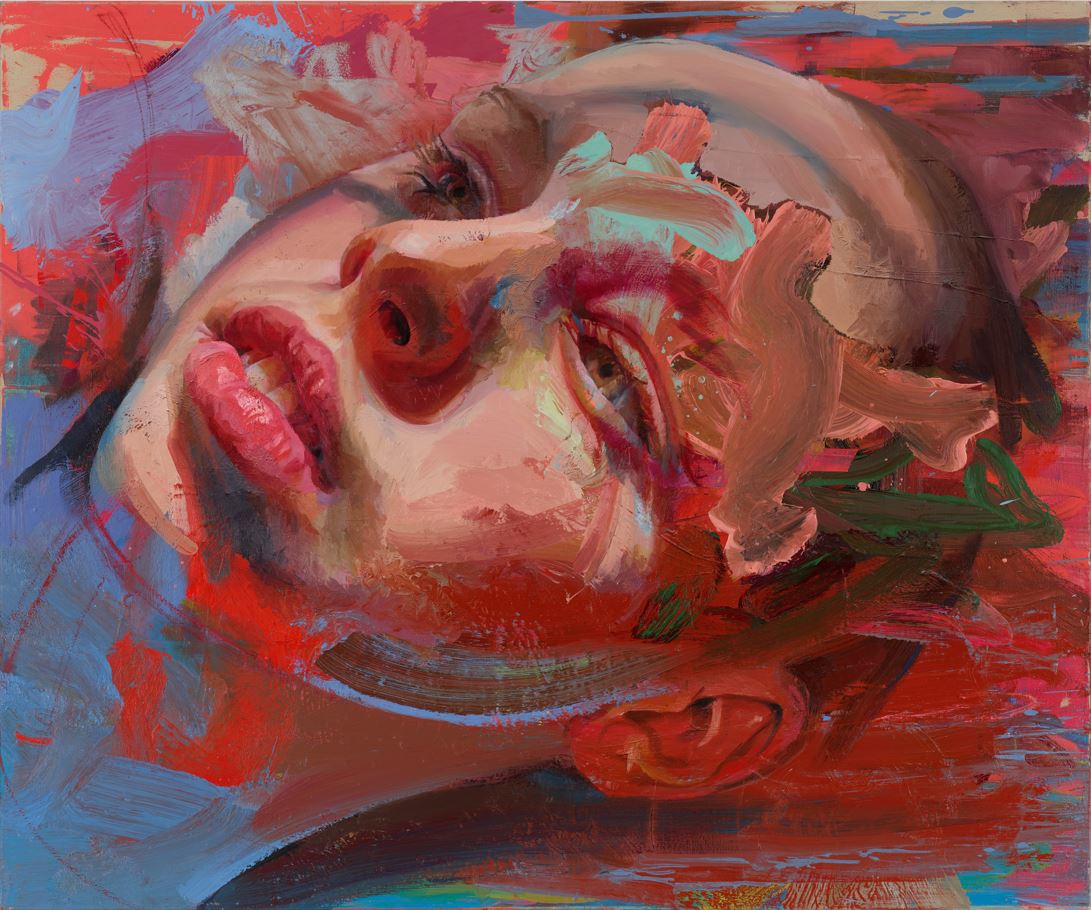
Drift by Jenny Saville (2020 to 2022) Private Collection courtesy Gagosian © Jenny Saville, Courtesy Gagosian
Wow, what a vibrant new dayglo palette she’s been using since about 2020, lurid, super-bright, acid or ecstasy trip brightness!
Compare Drift (2022) with Rosetta II (2006) and notice several things. Although Rosetta II uses huge wide brushstrokes, the colours are all from the same sort of palette, dominated by that turquoise or aquamarine blue, contrasted with cream of the flesh, with some darker highlights to mould it.
In Drift, though, what is immediately apparent is at least two things. One is that the outline and shape of the face is actually limned in with more precision than Rosetta II and others from that period. But far more obvious is the disruptive impact of the dayglo colours. Looked at from one angle, the head in Drift looks like a kind of science fiction image, like the images we see in movies or TV series where there’s some kind of digital glitch, where the face goes pixilated or shreds into patches of unrelated colour.
This thought arose primarily from the images themselves, but when I read the wall label for the room, it actually talked about bang up-to-date ideas about digital technology, about artificial intelligence, about the strange new spaces being opened up by digital techniques.
And while half of the images are traditional, whole portraits, three or four of them introduce a completely new element in her practice which is collage, cutting up aspects of the image – generally eyes – and pasting them in inappropriate positions.

Cascade by Jenny Saville (2020) © Jenny Saville/DACS/Prudence Cuming Associates
Montage
See what I mean? Three or four of the works in this final room are completely unlike the others in using what is (after all) the hundred-year-old technique of photomontage, taking key bits of a portrait and moving them around. Note how the backgrounds to these juxtaposed eyes have gone completely wild. There is, in fact, an upside-down face but it’s an effort to identify it through the blizzard of huge swathes and squiggles of super-saturated paint.
Twombly and de Kooning
Some previous works had referenced Rubens or Rembrandt but the curators point to the influence on these recent works of the abstract painters Willem de Kooning and Cy Twombly. You can see it in the big squiggles or pure paint, red, blue, green.
Digital
Of one painting here, Latent, the curators write that ‘latent space’ is a concept in artificial intelligence which refers to the analysis of hidden structural similarities between visual data. Thus these most recent portraits can be said to build forms by finding the structural similarities between portraits and colours.
This kind of talk, about AI, is obviously bang up to date.
Youth
Which brings us to another, related, point. All the people in this final room are young, young women. Youth, energy and vitality embodied in works of super-vibrant colourfulness. Walking back to the beginning you realise that those earliest works – the vast, bloated naked women – now feel, paradoxically, as if they are portraits of older or middle-aged people. Whereas her most recent works focus unremittingly on The Young, on super-colourful semi-abstraction, and on notions around the new digital age. As if as she’s grown older, Saville has in fact gotten younger, more energised and digitally savvy.
The Anatomy of Painting
The curators give one very revealing fact and quote. Apparently Saville has observed plastic surgery operations, which prompted the thought:
“Witnessing a surgeon makes you see how layered flesh is… I started to think about not just the anatomy of the body, but about the anatomy of painting: the layering, the pace and tempo of the painted surface, the viscosity of the paint.”
Hence the exhibition sub-title. Although the paintings start with enormous bodies, and then alternate between very sever close-up portraits and wider-angle depictions of bodies on sofas or beds – in the end it is very easy to see that her entire career has consisted of adventures with paint (and charcoal and pastel). Starting from basic, photographically accurate images, and then creating layer after layer of paint and resonance and implication, with ringing, ravishing results.
Genius at work
An awesome display of dazzling works by one of the most staggeringly gifted painters working anywhere. Must see.
Related links
- Jenny Saville: The Anatomy of Painting continues at the National Portrait Gallery until 7 September 2025
 Books & Boots