Jenny Saville: The Anatomy of Painting @ the National Portrait Gallery

Very few exhibitions I’ve been to can match the storming impact of the famous 1997 Sensation exhibition which introduced a stunned world to the fantastically accomplished and diverse Young British Artists, including Jake and Dinos Chapman, Tracey Emin, Marcus Harvey, Damien Hirst, Sarah Lucas, Ron Mueck, Chris Ofili, Marc Quinn, Sam Taylor-Wood, Gavin Turk, Gillian Wearing and Rachel Whiteread. What a galaxy of talent!

One of the obvious standout artists was Jenny Saville, born in 1970, who was represented by five awesome pieces. I fell in love on the spot and have been a huge fan ever since.

Now the National Portrait Gallery is hosting the largest major museum exhibition of Jenny Saville’s huge and dazzling portraits ever to be held in the UK, bringing together 45 works made throughout her career. Did I mention they were big? They are enormous. And very, very visceral, filling the frame with giant blunt, sometimes brutal images, punk painting, in-your-face, no-holds-barred depictions of the physicality of being human, the overwhelming immediacy of flesh and blood.

A visitor observes Reverse, 2002-2003 by Jenny Saville. Private Collection courtesy Gagosian © Jenny Saville, displayed as part of ‘Jenny Saville: The Anatomy of Painting’ at the National Portrait Gallery © David Parry

The exhibition kicks off with a couple of her greatest hits from the Sensation show and then moves in chronological order up to the present, giving you a good sense of how her approach and style has changed over the past 30 years or so, with a couple of rooms dwelling on specific themes.

This isn’t the official gallery list but my subjective impression of the different spaces and what they contained. I won’t review them all, but this is my list:

  1. Sensation – immense female nudes (5 paintings)
  2. Corridor (4 works)
  3. Side room with big swathe portraits (7)
  4. Side room 2 with sketches and Rosetta II, a notable example of her paint splattering
  5. Mothers and babies (8 pictures)
  6. Charcoal naked group portraits (10)
  7. Final room – most recent works: 10 enormous heads, very bright dayglo colours, the images broken up by slabs of paint and some disintegrating into montage

Sensation

‘Propped’ is a good example of the kind of thing she made her name with. Absolutely immense images of naked women portrayed with unflattering super-realism, huge limbs, bellies, boobs, blotchy fleshtones. What was so exciting about the pieces in the Sensation show was her huge, in your-face approach to her naked women, filling the huge canvases to bursting, booming out at you, with tremendous energy and confidence. To a very ancient genre she seemed to have brought something utterly new.

Propped by Jenny Saville (1992) Private Collection © Jenny Saville, Courtesy Gagosian

‘Propped’ is one of the most famous of these early works, making the viewer step back from the size and imposition of such an enormous image. Only slowly do you register the details, such as the silk slippers tucked behind the implausibly slender black stool, or realise that her hands are almost like talons, cutting into the flesh of her thighs.

Pretty immediately you realise that there is text written across the image (something I always like in modern art) but, if you try to decipher it, realise that it’s mirror i.e. reversed writing. This is because, the painting was originally displayed facing a mirror in which you could read the text.

It is, apparently, a quote from the French feminist Luce Irigaray, and reads: ‘If we continue to speak in this sameness – speak as men have spoken for centuries, we will fail each other.’ Fair enough, I’m sure feminist theorists have by now worked out an alternative language to speak in so as not to be dominated by men.

My view is that human nature doesn’t really change – and why should anyone who understands biology and genetics expect it to – but the ways in which that nature is expressed – art and culture, discourse and ideology – are changing and shifting all the time, which is one of the things which makes contemporary art so exciting, even as the definition of what art even is, or is for, continually shifts and realigns as well. (For the last decade or so, the main purpose of art has been to act as a class of assets, alongside property and football clubs, purchased by Arab sobereign funds and Russian oligarchs.)

From a technical point of view, the two things I noticed are 1) the debt the portrait’s extremely patchwork flesh tones owed to the example of Lucien Freud, with his huge mottled naked portraits – only redone with Saville’s powerfully feminist, female point of view.

And 2) the finish of the images. What I mean is the outline of the figure is very clearly defined, and there are no blots or spots or splatters or swathes of paint. As we will see, all this changes as Saville’s work develops.

‘Propped’ is one of the works Saville displayed in her graduate show at the Glasgow School of Art (in 1992). Can you imagine being this talented and finished, at such a young age!

Rosetta II

Ten years later, in 2005, Rosetta II is a good example of her evolution towards splatter and flicks. The subject matter is very specific, the look of a blind person, hence the blued-out eyes. But what’s really obvious is the transformation in her technique.

Rosetta II by Jenny Saville (2005 to 2006) Private collection © Jenny Saville, Courtesy Gagosian

Gone are the perfect outlines of the figure and the finish of the flesh so dominant in her epic 1990s works, which so often featured the entire body imagined as a zeppelin bursting out of the frame. Here the focus is much, much more tightly on just the head and neck while at the same time, the finish is obviously much more rough and ready. The central image, and even more the background, is constructed of great swathes or blocks of paint, deliberately rough and dynamic…. while at the bottom of the work you can clearly see where she’s left in loads of splatters and dribbles to indicate the rough, unfinished vibe.

Most of the rest of the show is like this, rougher, looser, bigger splashes of colour, enormous swathes and strokes of bright colours overlapping and clashing.

3. Mothers and babies

In the 2010s Saville produced a series of works depicting the special relationship between mothers and babies, mothers and children, pregnant women with babies and toddlers.

There are eight or so of these works, mainly created using charcoal outlines, multiple outlines as if the figures are moving and, in cartoon style, leaving echoes of their outlines behind. Or, in a more art history way, echoing the cartoons and preparatory sketches of Old Masters, painters like Rubens or Rembrandt, and some of the titles reference Renaissance compositions by the like of Michelangelo.

They are mainly in black and white, against grey backgrounds, but with splashes of colour. The wall labels tell us that Saville worked by creating multiple impressions of each figure – drawing them, erasing them, then superimposing new versions. The result is a sense of movement but as in a strange, grey dream-world.

This is not necessarily the most representative example, because the title, Aleppo, suggests something to do Syrian civil war and so the patches of red are, maybe, something to do with blood. So this is the least intimate and motherly of the set. But you can see how different the style and technique are from what we’ve seen in either the Sensation-era paintings, or the big swathe-and-splatter brushstroke works.

Aleppo by Jenny Saville (2017 to 2018) Collection of the artist © Jenny Saville. Courtesy NGS

The curators claim the dynamic interplay of multiple outlines of the same figures create ‘a type of layering that helps embed memory into the paper and raw canvas’. What do you think?

Charcoal nude full-body group portraits

The next room extends the same technique beyond mothers and children, to groups of naked bodies strewn around on sofas and beds.

Compass by Jenny Saville (2013) Private collection © Jenny Saville. Courtesy Gagosian

Several things are noticeable about these. It feels like the first time we’ve seen fully naked bodies since the Sensation works of the early 1990s and the change wrought by 20 years is striking. Unlike the monumental distorted, frame-filling images of the early days, these charcoal and pastel studies are much more restrained and demure. Everything seems to be in proportion and a realistic size, including the sweet limp willy in the centre of the composition.

But the depictions of limbs, bellies, boobs and so on all feel calm and chaste, imbued with a photographic accuracy. In fact these could be examples from a textbook on How To Draw, the kind of you find in all the bookshops at Tate, the National, the Royal Academy etc.

Possibly there’s meant to be some erotic overtone but, as I say, once you’ve looked at scores of nude studies well, the excitement wears off and you become interested in the technique. This example, provided by the press office, is one of the clearest images – most of the others are heavily scored with lines drawn all over them, starting off from the original figure shapes but then going wild, as in this example.

Out of one, two (symposium) by Jenny Saville (2016)

5. Final room, recent works

The final room contains 10 paintings and what leaps out at you is how brightly coloured they are, how massive they are, and how they focus in on just the faces.
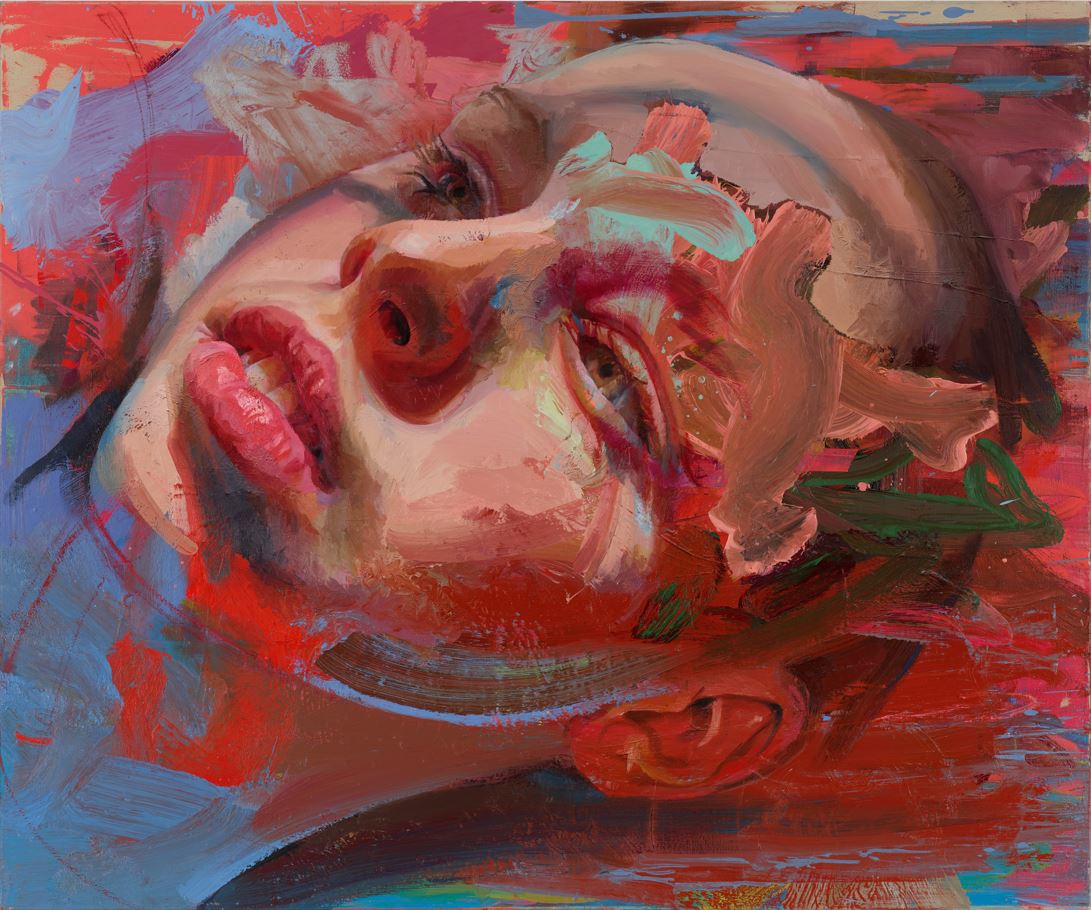
Drift by Jenny Saville (2020 to 2022) Private Collection courtesy Gagosian © Jenny Saville, Courtesy Gagosian

Wow, what a vibrant new dayglo palette she’s been using since about 2020, lurid, super-bright, acid or ecstasy trip brightness!

Compare Drift (2022) with Rosetta II (2006) and notice several things. Although Rosetta II uses huge wide brushstrokes, the colours are all from the same sort of palette, dominated by that turquoise or aquamarine blue, contrasted with cream of the flesh, with some darker highlights to mould it.

In Drift, though, what is immediately apparent is at least two things. One is that the outline and shape of the face is actually limned in with more precision than Rosetta II and others from that period. But far more obvious is the disruptive impact of the dayglo colours. Looked at from one angle, the head in Drift looks like a kind of science fiction image, like the images we see in movies or TV series where there’s some kind of digital glitch, where the face goes pixilated or shreds into patches of unrelated colour.

This thought arose primarily from the images themselves, but when I read the wall label for the room, it actually talked about bang up-to-date ideas about digital technology, about artificial intelligence, about the strange new spaces being opened up by digital techniques.

And while half of the images are traditional, whole portraits, three or four of them introduce a completely new element in her practice which is collage, cutting up aspects of the image – generally eyes – and pasting them in inappropriate positions.

Cascade by Jenny Saville (2020) © Jenny Saville/DACS/Prudence Cuming Associates

Montage

See what I mean? Three or four of the works in this final room are completely unlike the others in using what is (after all) the hundred-year-old technique of photomontage, taking key bits of a portrait and moving them around. Note how the backgrounds to these juxtaposed eyes have gone completely wild. There is, in fact, an upside-down face but it’s an effort to identify it through the blizzard of huge swathes and squiggles of super-saturated paint.

Twombly and de Kooning

Some previous works had referenced Rubens or Rembrandt but the curators point to the influence on these recent works of the abstract painters Willem de Kooning and Cy Twombly. You can see it in the big squiggles or pure paint, red, blue, green.

Digital

Of one painting here, Latent, the curators write that ‘latent space’ is a concept in artificial intelligence which refers to the analysis of hidden structural similarities between visual data. Thus these most recent portraits can be said to build forms by finding the structural similarities between portraits and colours.

This kind of talk, about AI, is obviously bang up to date.

Youth

Which brings us to another, related, point. All the people in this final room are young, young women. Youth, energy and vitality embodied in works of super-vibrant colourfulness. Walking back to the beginning you realise that those earliest works – the vast, bloated naked women – now feel, paradoxically, as if they are portraits of older or middle-aged people. Whereas her most recent works focus unremittingly on The Young, on super-colourful semi-abstraction, and on notions around the new digital age. As if as she’s grown older, Saville has in fact gotten younger, more energised and digitally savvy.

The Anatomy of Painting

The curators give one very revealing fact and quote. Apparently Saville has observed plastic surgery operations, which prompted the thought:

“Witnessing a surgeon makes you see how layered flesh is… I started to think about not just the anatomy of the body, but about the anatomy of painting: the layering, the pace and tempo of the painted surface, the viscosity of the paint.”

Hence the exhibition sub-title. Although the paintings start with enormous bodies, and then alternate between very sever close-up portraits and wider-angle depictions of bodies on sofas or beds – in the end it is very easy to see that her entire career has consisted of adventures with paint (and charcoal and pastel). Starting from basic, photographically accurate images, and then creating layer after layer of paint and resonance and implication, with ringing, ravishing results.

Genius at work

An awesome display of dazzling works by one of the most staggeringly gifted painters working anywhere. Must see.


Related links

Related reviews

When Forms Come Alive: Sixty Years of Restless Sculpture @ the Hayward Gallery

This is a great, a really great exhibition. I came out wreathed in smiles, hesitated a moment, then went back in and did the whole thing all over again. And I wasn’t the only one enjoying it – it was packed, very noticeably with young families with prams and crawling babies and toddlers and junior school-aged kids. This is unusual at London art galleries which are generally full of doddering grey-haired old seniors. Word has somehow gotten around about what fun it is!

Planet organic

Why? Well, it’s billed as a massive survey of abstract, organic sculpture featuring the work of 21 international artists from the past 60 years. Obviously the broad term ‘sculpture’ can include realistic depictions of people and animals, depictions of buildings or manufactured objects, along with all manner of angular modernists creations. But all those possibilities and visions have been omitted as the curators have chosen works expressly designed to convey the shapes and forms and motions of organic life.

Bubbling foam and shiny baubles, hanging mesh and oozing tubes, wormlike mouldings and flying tutus, pendulous eggs and looping strands, tenuous tendons and metallic tangles, hidden claws and giant talons, all the works have been chosen for the way they capture, suggest, echo, are based on the endlessly moving, changing, bubbling, proliferating forms of organic life.

It’s a show of (mostly static) works which, however, suggest movement, melting, flux and floating, congeries and conglomerations, a continually impressive collection of sculptural forms that seem to ooze, undulate, blossom, erupt and sprawl all over the gallery space and beyond.

The drag of political art

Many if not most modern art exhibitions are highly themed and conceptualised – many are overtly political and polemical, such as the current exhibitions at the Barbican (the politics of textiles), Tate Britain (Women in Revolt!) and Dulwich Picture Gallery (Black artists’ takes on the genre of landscape painting).

Art works in those kinds of shows are more often than not chosen to make a political point and so are accompanied by baleful and grim text labels, ramming home the curators’ woke concerns. (I’m not using ‘woke’ in a general derogatory sense but in its original dictionary definition of ‘alert to racial prejudice and discrimination’, which is exactly what the Barbican and Dulwich shows are at pains to be.)

The joy of fun art

Anyway, that’s all by way of explaining that this show comes as quite a relief from the relentless preaching of art curators, because it is actually about art, just art, just the expression of forms and shapes for their own sake, for the fun of exploring and playing.

It feels playful. It feels fun. The promotional photos show small children looking in awe at a huge agglomeration of metal balls (‘Untitled’ by Tara Donovan) or two giant carrot shapes (‘Tunnel Boring Machines’ by Teresa Solar Abboud), and a child’s perspective is entirely appropriate to get the most from the wonderful shapes and vibrant colours on display – to the flying skirts (DRAFT) and bubbling foam (Michel Blazy) and funny sounds and neon constructions (E.J. Hill) and huge blobs and massive pink fabric worms (Eva Fàbregas) and big blob of metal lava (Lynda Benglis) and dangling fabrics (Ernesto Neto) and looming dolmen (Phyllida Barlow).

We are, just occasionally, allowed to stop feeling guilty about our part in the slave trade or institutional misogyny; we are allowed to relax and let our minds frolic and sport around and under and into weird and wonderful shapes, to be let off the leash of society’s endless worrying about ‘issues’ and let the carefree mind rediscover the primal joy of shapes and patterns created for our delight – and this is the exhibition to do it at!

It’s a welcome reminder that art can actually be carefree and fun, strange and mysterious, teasing and tantalising. For once I felt like I was visiting an exhibition of art designed to uplift and inspire me instead of attending my company’s compulsory course on inclusion and diversity.

We are allowed to smile. We are allowed to laugh out loud. We suddenly remember something we’d forgotten amid the stern and serious lecturing of those other exhibitions, that art can be liberating and light and frolicsome and funny. I’m smiling. Give yourself a treat.

Engineering

Buried in the layout is a form of chronological order, and you could take it that way, studying the wall labels to follow changing looks and trends from the 1950s onwards.  But what this approach highlights is not so much developments in the artistic imagination as in technology and engineering. In each successive decade you can see how technological developments in moulding and shaping, erecting and supporting, above all in the variety and malleability of a steadily increasing diversity of materials, allowed artists’ imaginations to bloom and expand.

Gallery

Here’s a gallery of some of the most striking works and, as I increasingly do, I’ll add in the curators’ own wall labels about them. These are italicised to make it crystal clear they are not my words.

Tara Donovan

Installation view of ‘Untitled (Mylar)’ by Tara Donovan (2011) Photo by Jo Underhill

Tara Donovan makes her sculpture from manufactured materials that are often a part of consumers’ everyday lives but she finds her primary inspiration in nature. Untitled (Mylar) is created from thousands of flat, reflective discs of Mylar (a metallic polyester film), which have been folded, hot-glued and massed into spheres of varying sizes. Together they form a gigantic agglomeration that appears to mimic the growth patterns of biological or molecular structures. As always in Donovan’s work, light is an important factor, which she thinks of as an additional material, generating kaleidoscopic perceptual shifts of reflectivity as the viewer moves around the installation.

Eva Fàbregas

Installation view of ‘Pumping’ by Eva Fàbregas (2019) Photo by Jo Underhill

‘My work aims to fully inhabit the world of the senses, to imagine other possible bodies, other ways of feeling, caring and being in the world.’

A trio of massive inflatables crawls across the exhibition space. Made from stretched fabric and inflated balls, these tangled, pulsating forms appear distinctly intestinal. The sculptures are like instruments, activated by a choreography of subsonic frequencies, elastic rhythms, and textural sounds. The bass-heavy soundtrack is inspired by the artist’s experience of sound systems in nightclubs; Eva Fàbregas intends for the low audio frequencies in her work, emitted by multiple subwoofers, to be felt and not just heard. We resonate together with the sculptures, recalling forms of communication that occur inside us – at a cellular level – and between our bodies and the world.

Marguerite Humeau

Installation view of ‘The Guardian of Ancient Yeast’ by Marguerite Humeau (2023) Photo by Jo Underhill

‘There are forms of life that will survive us. How can we take them as our guides or companions to understand how to navigate our own futures?’

The sculptures in this room by Marguerite Humeau evoke forms that exist in nature: honeycomb, gills of mushrooms, discs of bracket fungi. The tallest sculpture, The Guardian of Ancient Yeast, takes its shape from termite mounds. Working collectively, termites build enormous structures to protect and grow fungi that feed the entire colony. Humeau draws a parallel with the way yeast has contributed to the evolution of human societies through its use in making bread and beer, which have been staples of communal gatherings for millennia. Multiple musical loops, all recorded from one single saxophone, connect the sculptures through a dynamic soundscape, as if they are engaged in ongoing conversations and attempting to synchronise. This interconnectedness hints at the opportunities that can arise from the interdependence of organisms.

Choi Jeong Hwa

Installation view of ‘Blooming matrix’ by Choi Jeong Hwa (2008) Photo by Jo Underhill

Choi Jeong Hwa’s columns of discarded junk are bearers of memory across time, space and cultures. Built from a mix of man-made and natural objects that were once the stuff of everyday life, their varied textures and symmetrical shapes echo structures found in nature. Choi refers to his playful and dynamic forms as ‘stupas’ – markers for religious places of burial and/or meditation. Individually and collectively, they point to the consumerism and overconsumption that has caused the environmental loss of the plant-life they resemble.

Jean-Luc Moulène

Installation view of ‘Plongement 1’ and ‘Méduse’ by Jean-Luc Moulène (2023 and 2018) Photos by the author

With their intricate play of irregular forms, Jean-Luc Moulène’s small sculptures often convey a sense of fluid movement. Méduse (the French word for jellyfish) brings to mind that creature’s shape-shifting mode of propulsion, its tentacles floating freely behind its open, bell-shaped body. Even in his blown glass and metal sculptures that draw on the shapes of different types of knots, the artist imbues his objects with a suggestion of dynamic change and deformation.

Plongement 1 reminded me (and the gallery attendant I discussed it with) of the Alien movies. We shared a very slight worry that, if we turned our backs on it, the metal claw would leap out of its glass container and grab us.

Lynda Benglis

Installation view of ‘Quartered Meteor’ by Lynda Benglis (1969, cast 1975) Photo by the author

‘The pouring of the material was very much about wanting to create undulating surfaces and complex planes that resist geometry; I like things to flow.’

A cast of an earlier work made from polyurethane foam (‘King of Flot’, 1969), this sculpture is made from lead – one of the most malleable metals – but its uncanny sense of liquidity is at odds with its solid form. To create the original work, Lynda Benglis heaped polyurethane into the corner of a room. Installed just away from the wall, this sculpture is strangely solid, like lava that has stopped mid-flow. The title alludes to the fiery conditions under which it could become molten again, drawing our attention to the instability of all forms.

Ruth Asawa

Installation view of sculptures by Ruth Asawa. Photo by Jo Underhill

These hanging sculptures are looped from wire using a basket-making technique that Ruth Asawa learned in Toluca, Mexico. The resulting objects have a lightness and transparency that belies their complexity, not unlike the natural forms – leaves, seed pods and spiders’ webs – that fascinated Asawa and inspired her artistic work. The nested, intersecting and continuous surfaces produce variations in density, which affect the patterns of light that pass through the forms and the shadows that they cast. Each work presented here shows a different stage in the development of Asawa’s technique from the 1950s to the 1990s.

Installation view of ‘A Subsequent Offering’ by E.J. Hill (2017) Photo by Jo Underhill

‘Thinking about roller coasters is one way for me to communicate ideas that I have about struggle and mortality and the impulse to go higher and faster and test our physical and mental limits.’

E.J. Hill has described rollercoasters as public monuments to the possibility of attaining joy, which, as he notes, is ‘a critical component of social equity.’ Although Hill’s gallery-scaled rollercoaster is unrideable, it prompts us to imagine the terror evoked by free-falling, the joy of moving at high speed, and the thrill of being propelled around its looping track. The public expression of these emotions presupposes a sense of safety that, as Hill points out, is not equally available to all bodies: ‘So much of my life in this body, in a black body, being queer, it’s not quiet, it’s very loud, aggressive and violent. That’s my experience. I feel like the counter to that, to all those loops and twists and turns, absolutely has to be a self-imposed quietness and stillness.’ For the first presentation of this work Hill lay on the platform at the centre of the installation, all day, every day, inserting his own immobile body into the scene. As a subsequent offering, this sculpture is what Hill describes as a ‘performance relic’, but one that invites us all to think about the nature of collective experience.

Installation view of ‘untitled: girl ii; 2019’ by Phyllida Barlow. Photo by the author

Writing about the nature of sculpture, Phyllida Barlow (1944 to 2023) noted that it can be awkward, unbalanced, restless and unpredictable – qualities that she seems to convoke in ‘untitled: girl ii; 2019’. Like all her sculpture, this massive dolmen-like object asks us to walk around it, wonder about it. Its figurative appearance, like a voluminous dancer en pointe with swollen, meaty thighs, seems both ominous and absurd. In a poetic text she wrote when this sculpture was first shown, the artist revealed that its genesis lay in a memory from her childhood: in an abandoned house on a wild moor, among ‘unnameable things’, Barlow recalled ‘these big shapes, anthropomorphic…dumb, curvaceous, still, biding time…’

DRIFT

Installation view of ‘Shylight’ by DRIFT (2006 to 2014) Photo by the author

DRIFT describe Shylight as ‘a performative sculpture; when you enter the space it becomes a kind of dance that is performed in front of you.’ Shylight’s fluidly ascending and descending lights are programmed to open and close like flowers whose petals furl and unfurl in response to changes in light or climate. DRIFT’s aim is to call attention to such rhythms and harmonies in our everyday natural environment. The impetus for their work can be as varied as the flight patterns of birds, a proliferation of dandelion seedheads, or the formation of a mass of clouds, coupled with innovative, cutting-edge technology.

Installation view of two ‘Tunnel Boring Machines’ by Teresa Solar Abboud (2021) Photo by the author

‘These works are a reimagination of the underground, with vibrant, finely finished elements that ooze out from the pores of the rough clay. They are hybrids between biology, geology and engineering.’

These three Tunnel Boring Machines by Teresa Solar Abboud resemble composite entities combining industrial and organic materials and forms. Emerging from clay bases, sleekly shaped ‘limbs’ painted in bright, artificial colours, suggest a range of forms – fins, propeller blades, aerodynamic appendages – all of which appear to be engineered to generate dynamic movement. In contrast, roughly-worked, heavy clay ‘joints’ function as bases or points of equilibrium for these polished elements. For the artist clay evokes the ancient, raw material of mud, which ‘always speaks to the underground, the mountains, the landscape; that which is underneath us all the time but we can never see.’

The one big drawback

The exhibition’s wall labels and individual captions, the press and promotional material and everything on the website, all trumpet the notion that the artworks capture the fundamental principle of organic life that nothing in the world stays the same, that everything is moving, changing and transforming

We are repeatedly told about the works’ ‘sensuous textures and surprising physical qualities’, and that sculpture ‘can be an indispensable vehicle for rediscovering and recovering lost dimensions of physical experience’.

All of which made it the more frustrating that you’re not allowed to touch them. Not only are there grey strips on the floor around all the artefacts beyond which you must not tread, but entrance into the exhibition is delayed while the ticket guy tells every single visitor that they MUST NOT TOUCH THE ARTWORKS.

God, how frustrating. I wanted again and again to reach out and touch and stroke and caress and run my fingers over these balls and bulges and foams and fantastical shapes, fabric and metal and glass and foam, closed my eyes and really, really let my other senses enjoy their involutions and contortions and reshaping of space.

Take the neon rollercoaster by E.J. Hill. He tells us how he spent whole days lying on the mat built into the sculpture, on the left hand side in the photo. My God, wouldn’t it be great if visitors could do that – lie down and become part of the sculpture. Or ‘Pumping’ by Eva Fàbregas, the room-sized arrangement of big pink fabric worms, just crying out, if not for me then certainly for little kids to run in and out of its arches and folds and explore, giggling and squealing!

Alas that in this of all exhibitions, which is about organic shapes and contours and materials and complex patterns, the visitor has to keep their distance, is kept apart from, detached from, prevented from enjoying, the really full all-sensual experience which the works so obviously cry out for.

And there were so many little kids on my visit, who would have loved to have run in and out of the bigger pieces, or run their hands across the surfaces of the weird and wonderful creations, generating a real sense of awe and strangeness which might last them a lifetime.

Instead, for all the curators’ brave talk of joyous this and sensual that, ‘When Forms Come Alive’ is visually stunning but remains as emotionally cold and sensually sterile as an operating theatre. Shame.

The artists

Twenty-one artists, 2 from the UK, 7 from the USA.

They are Ruth Asawa (USA), Nairy Baghramian (Iran), Phyllida Barlow (UK), Lynda Benglis (USA), Michel Blazy (France), Paloma Bosquê (Brazil), Olaf Brzeski (Poland), Choi Jeonghwa (South Korea), Tara Donovan (USA), DRIFT (Netherlands), Eva Fàbregas (Spain), Holly Hendry (UK), EJ Hill (USA), Marguerite Humeau (France), Jean-Luc Moulène (France), Senga Nengudi (USA), Ernesto Neto (Brazil), Martin Puryear (USA), Matthew Ronay (USA), Teresa Solar Abboud (Spain) and Franz West (Germany).


Related links

More Hayward Gallery reviews