The Long Now @ the Saatchi Gallery

The Saatchi Gallery is 40 years old. To celebrate they are staging this big, varied, confusing, uneven and sometimes stunning exhibition of recent and contemporary art. It showcases some 100 works by nearly 50 artists, including new works by some of the iconic artists long associated with the Gallery (such as Damien Hirst and Jenny Saville, Gavin Turk and Jake Chapman), alongside works from a new, younger generation.

Installation view of room 2 in The Long Now at the Saatchi Gallery, showing the Jenny Saville painting at the end and a Polly Morgan sculpture on the wall on the right (photo by the author)

The curators have divided the pieces up into ten sections, each with a distinct theme. The themes reflect concepts which have underpinned exhibitions throughout the Saatchi Gallery’s 40-year existence, and are:

  1. Mark making
  2. Lyrical abstraction
  3. Reverb
  4. Inner landscape
  5. The Yard
  6. Circulation-Refraction
  7. Post-human
  8. Bardo
  9. Exposed
  10. 20:50

But having gone round the exhibition twice, it dawned on me that it’s actually a show of two halves. What I mean is that, varied and often very good though many of the earlier works are, the show feels like it leads up, in the second half, from The Yard onwards, to a succession of large and dazzling installations. These are so striking as to risk overwhelming the earlier, more traditional or modestly sized works. For this review I’ll cut across the themes to divide them up by media or format.

Painting

The curators are at pains to emphasise that the Saatchi Gallery has always had a special commitment to painting, and so the show includes works by leading contemporary painters like Alex Katz, Michael Raedecker, Ansel Krut, Martine Poppe and Jo Dennis. The first room contains one of the most striking paintings, ‘Chance Composition 206’ by Alice Anderson, which dominates by dint of its sheer size. Anderson paints found objects and scatters them across the surface of the canvas, sometimes in the course of dances, and her work apparently references everything from Indigenous dances to quantum physics. What comes over is it’s big and dynamic and exciting.

Installation of The Long Now at the Saatchi Gallery showing ‘Chance Composition 206’ by Alice Anderson (photo by Matt Chung)

The obvious comparison is with the Abstract Expressionism of Jackson Pollock but Anderson does feel, on closer examination, distinctly different. Even after all these years, I still like the drama of seeing the thick congealed daubs and brushstrokes of paint on the canvas, something which thrilled me at the Van Gogh/Anselm Kiefer exhibition.

Detail of ‘Composition 206’ by Alice Anderson in the Long Now at the Saatchi Gallery (photo by the author)

There were lots of subtler works which I don’t have time to linger on, but the other really striking painting in the show is a characteristically enormous portrait by Jenny Saville, ‘Passage’ from 2004.

Installation view of ‘Passage’ by Jenny Saville (2004) in The Long Now at the Saatchi Gallery (photo by Matt Chung)

As you’ll remember from my review of the recent Saville show at the National Portrait Gallery, Saville has triumphantly shown that painting, portrait painting, and nude painting are still very viable formats. As usual the small flat reproduction in this review in no way conveys the energy and excitement of the paint, of seeing first-hand the dynamic swathes and strokes of paint across the canvas.

Obviously the subject matter is that obsession of so many modern artists and curators, gender. In this case the subject is a transvestite with – if I understand the notes right – a ‘natural penis’ and artificial boobs. No doubt he or she is being brave and speaking their truth and being seen etc etc. For me, though, none of that’s very interesting; the magical, riveting thing is the way great daubs of paint on a flat surface can convey weight and shape and heft and character. She really is a painter of staggering genius.

Sculpture

But it was easy to breeze past a lot of the paintings and not give them the time they require because there were so many more funky distracting sculptures. Born in 1973, Jo Dennis is Scottish. Her big (three and a half metres tall) work, ‘Mother’, is constructed from steel frames supporting found material including tent canvas, yarn and the artist’s own clothes, which are them spray painted. I liked it very much, its presence and shape and dynamic. Without touching it you can feel the roughness of the material, and the whole thing has an imposing totemic presence.

‘Mother’ by Jo Dennis (2025) in The Long Now at the Saatchi Gallery (photo by the author)

This second room had a bunch of fun and funky sculptures including works by Olivia Bax, born 1988 in Singapore, which use chicken wire and metal frames as the basis for angular, metallic, wood, clay and plastic pieces, which I liked very much.

Installation view of The Long Now at the Saatchi Gallery (photo by Matt Chung)

In the same room is a clutch of works by Polly Morgan. Born in 1980, the interesting thing about Morgan is she had no formal art training and is self taught. She uses the skins of real snakes, paints and decorates them, then stuffs and coils them within boxes made from polystyrene packing. Striking, aren’t they? Clever idea, lovely designs.

Two coiled snake works by Polly Morgan in The Long Now at the Saatchi Gallery

Photography

There were a handful of works by photographers. By far the most striking is this pastiche of John Everett Millais’s famous painting of Ophelia in the water, recreated in a pool in Hackney not far from a railway line. It comes from a massive series of photos of Hackney taken by English photographer Tom Hunter. Some of these were published in a beautiful book in 2012 and you can read his introductory essay to it online.

From ‘The Way Home’ by Tom Hunter (2000)

Other notable photos include:

  • a characteristically beautiful shot of an open cast coal mine by Edward Burtynsky, shown from far above by a drone camera in such a way as to convert it into an abstract work of art
  • a photo by Jeff McMillan of a long low shed in a desert with six big coloured canvases hung on it, the idea being that the pieces weather naturally in the elements before being displayed in the gallery

Rock star art

A special mention for a work by a bona fide rock star, John Squire. Born in 1962, Squire is famous as the guitarist in the Manchester band The Stone Roses, who lit up the rock firmament with their trippy sound in 1989 and ’90. In case you’ve never heard them, this is what they sounded like. Note Squire’s wonderful, transcendent guitar work, combining gutsy rock chords with shimmering arpeggios.

Anyway, back in the reverential silence of the art world, after their brief glorious career the Roses petered out and Squire took to art. He’s had numerous exhibitions, has his own website and is represented in this show by a big attractive work titled ‘The Way Things Aren’t’. In this series he used editing software to alter online images and then recreates them as paintings. As the title rather obviously indicates, these cut up-and-pasted, refracted-through-three-media images are intended to reflect the post-truth, fake news digital world we all now inhabit – but the point, as always, is the striking impact of the work itself, the intriguing (or disturbing?) interplay of the multiple fingers against the Twiggy-style wide eyes…

Installation view of ‘The Way Things Aren’t’ by John Squire (2018) in The Long Now at the Saatchi Gallery (photo by Matt Chung)

The installations

The problem with The Long Now, if problem it is, is that the subtlety and variety of many of the works, many of the paintings and sculptures in the earlier galleries, is rather swamped by what comes next, a sequence of big, loud, installations in the middle and later galleries.

YARD and Golden Lotus

It begins with the final gallery on the first floor of the exhibition. This contains two installations which are dramatic enough in themselves but have been combined to make an experience which rather eclipses the mute paintings and small sculptures earlier on.

On the floor of this gallery is Allan Kaprow’s YARD, a random arrangement of used car tyres. Very unusually for any art gallery or installation, visitors are encouraged to climb all over it and so I did and it was lots of fun, albeit with a fair risk of twisting your ankle or falling over, given the bendy shifting nature of the tyres. Meanwhile at the same time, suspended from the ceiling is a car, a real, life-size, actual car. It’s a vintage Lotus, suspended upside-down by chains attached to the ceiling and moving; it slowly rotates while pulsing music emanates from a sound system strapped to its chassis. This stunning piece is by Conrad Shawcross and titled ‘Golden Lotus (Inverted)’.

Installation view of YARD by Allan Kaprow and ‘Golden Lotus (Inverted)’ by Conrad Shawcross in The Long View at the Saatchi Gallery (photo by Matt Chung)

As I’ve mentioned before, I grew up in a gas station and so am very partial to industrial subjects, sculptures and installations. The smell of petrol, oil and tyres take me back to my childhood. There was a tyre bay attached to the garage and behind our house was a big old shed, with rotting wooden walls and a rusty corrugated iron roof and in it were piled row upon row of tyres, stacked to form columns. When we played hide and seek as kids, it was a nifty trick to wriggle down the hollow tube formed by the empty centres of a dozen or so tyres stacked in a column, although if you half wriggled, half fell down the tube with your arms by your side, sometimes you got stuck, and sometimes a bit panicky, unless you wobbled the entire column so much it fell over and you were able to free yourself from the resulting mess of tyres, which generally spilled filthy rubbery water all over your clothes. All of which explains why I loved this installation to bits.

The next gallery is a return to the normal, formal, restrained air of a gallery. It has been partitioned off to display two video installations.

Chino Moya

Chino Moya is a London-based, Madrid-raised writer, film director, photographer and artist known for his multidisciplinary approach to exploring themes of collapsing utopias.

One of his ongoing projects is titled ‘Deemona’. It creates a fictional dystopian world expressed across various media, including video installations, photography and digital art. In this future world society is entirely governed by the scientific method and algorithms which act as new gods. This society is divided into four classes members of which are portrayed in the works on show here. They aren’t paintings but video animations and all done in a very distinctive style, a kind of sci fi new-classicism, very restrained and controlled, in a palette of green-blue, burgundy, and grey, designed to evoke non-places like office environments.

Some of the video installations from Deemona by Chino Moya in The Long View at the Saatchi Gallery (photo by Matt Chung)

What you have is eight video installations depicting isolated figures dressed in futuristic costumes who are slowly performing subtle, stylised movements. Each figure is situated in a static landscape filled with geometric architecture, arches, domes, a ‘starved classicism’ most associated with totalitarian regimes or utopian futures. The videos are cool, understated and strangely compelling and note the decoration surrounding them –the black dado railing along the gallery wall and the mysterious geometric objects scattered around the floor all add to the creation of a distinct futureworld. Here’s an interview with Moya explaining it all.

Mat Collishaw

We are polluting the oceans as never before, filling them with heavy metals, microplastics and industrial waste which are devastating marine life. In a darkened room is playing Mat Collishaw’s entrancing film, ‘Aftermath’, which brings together haunting imagines based on these themes. He imagines a future where human cities have been flooded by rising sea levels and in which new, mutated forms of ocean life swim between banks of abandoned, flooded computer servers, the kind which supported (current) the boom in artificial intelligence. The film’s soundtrack is the haunting ‘Cantus in memory of Benjamin Britten’ by Estonian composer Arvo Pärt, which you can hear not only in the darkened space where the film is projected, but in the rooms approaching and after it, casting a ghostly soundscape onto other, silent, works.

Bardo

Thus the Cantus follows you as you walk into the next room which is devoted to just one installation, ‘Bardo’ by ex-Young British Artist Gavin Turk (born 1967). It is, basically, a maze of mirrors, a bit confusing and disorientating as you make your way through its reflective corridors, surprisingly intricate given its relatively small size. I’ve walked through a number of mazes comparable to this but the idea here is that all the panels are not immaculate and shiny but – continuing the theme of environmental degradation – fragmented and dirty, spattered with what looks like peeling plaster or the deteriorated silvering you get behind old mirrors, crumbling and falling off, to convey ideas of decay and collapse.

Bardo by Gavin Turk in The Long View at the Saatchi Gallery (photo by Matt Chung)

20:50

For some time you’ve been able to smell the industrial aroma of heavy motor oil. All is revealed when you walk through the arch into the final space, which is housing Richard Wilson’s seminal installation, 20:50. This was a defining piece of British contemporary art when it was originally presented at the original Saatchi Galleries in north London in 1987. It can be installed in different spaces and involves sealing the floor, walls and doors of the room, building a sort of tray which completely fills the room apart from a walkway like a sort of trench out into it, then pouring thick black engine oil into the tray. The result is you walk along the trench to half way into the room and find yourself surrounded by the absolutely dead calm surface of the black oil in which all the features of the room (including yourself if you lean over it) are reflected.

20:50 by Richard Wilson in The Long View at the Saatchi Gallery (photo by the author)

As mentioned, I grew up in a gas station and filled countless thousands of cars up with petrol before checking their oil with a dipstick and a rag and offering customers top-ups of Castrol GTX or other oil, so the sight and smell of so much oil has a complex impact on me.

But for most people who haven’t had that experience this is still an amazingly potent work. Onto its placid black surface can be projected all a visitor’s anxieties about the dominance of our world by oil: the skewing of global politics and economies by oil; the existence of entire (repressive) regimes based on oil production; its countless toxic by-products destroying, for example, the river deltas of Nigeria; its central role in generating global warming. It was a potent symbol when it was first unveiled in 1987; now it has acquired mountains of additional symbolism and meaning.

And yet, at the same time, its immaculate stillness, the perfection of its reflection of the walls, windows and ceiling, create a strange, eerie, poisoned meditation. Strange, upsetting, beautiful but ominous, all at the same time.

Comments

The room full of engine oil is the climax of the show and there is, appropriately enough, no way out of it. Many galleries are arranged so you exit the last room into the shop, and are dumped from the World of Art into the world of tote bags and fridge magnets. Here, there is no way out of the world of oil except to turn back and retrace your steps, passing all the installations I’ve listed and back towards the paintings and smaller sculptures, dialling down the art and your psychological state, calming down from these big immersive installations, back to the world of modest-scale sculptures and flat paintings, before finally stumbling out of the gallery into the busy streets of Chelsea, dazed and stunned by everything you’ve seen.

Artists

The ones I liked and/or mentioned in my review, are highlighted in bold.

  • Alice Anderson
  • Olivia Bax
  • Frankie Boyle
  • Edward Burtynsky
  • Peter Buggenhout
  • André Butzer
  • Jake Chapman
  • Mat Collishaw
  • Dan Colen
  • John Currin
  • Jo Dennis
  • Zhivago Duncan
  • Olafur Eliasson
  • Rafael Gómezbarros
  • Ximena Garrido-Lecca
  • Damien Hirst
  • Tom Hunter
  • Henry Hudson
  • Alex Katz
  • Allan Kaprow
  • Maria Kreyn
  • Ansel Krut
  • Rannva Kunoy
  • Christopher Le Brun
  • Chris Levine
  • Ibrahim Mahama
  • Carolina Mazzolari
  • Jeff McMillan
  • Misha Milovanovich
  • Polly Morgan
  • Ryan Mosley
  • Chino Moya
  • Tim Noble
  • Alejandro Ospina
  • Steven Parrino
  • Martine Poppe
  • Michael Raedecker
  • Sterling Ruby
  • Jenny Saville
  • Petroc Sesti
  • Conrad Shawcross
  • Soheila Sokhanvari
  • John Squire
  • Dima Srouji
  • Gavin Turk
  • Richard Wilson
  • Alexi Williams Wynn

Related links

  • The Long Now continues at the Saatchi Gallery until 1 March 2026

Related reviews

Jenny Saville: The Anatomy of Painting @ the National Portrait Gallery

Very few exhibitions I’ve been to can match the storming impact of the famous 1997 Sensation exhibition which introduced a stunned world to the fantastically accomplished and diverse Young British Artists, including Jake and Dinos Chapman, Tracey Emin, Marcus Harvey, Damien Hirst, Sarah Lucas, Ron Mueck, Chris Ofili, Marc Quinn, Sam Taylor-Wood, Gavin Turk, Gillian Wearing and Rachel Whiteread. What a galaxy of talent!

One of the obvious standout artists was Jenny Saville, born in 1970, who was represented by five awesome pieces. I fell in love on the spot and have been a huge fan ever since.

Now the National Portrait Gallery is hosting the largest major museum exhibition of Jenny Saville’s huge and dazzling portraits ever to be held in the UK, bringing together 45 works made throughout her career. Did I mention they were big? They are enormous. And very, very visceral, filling the frame with giant blunt, sometimes brutal images, punk painting, in-your-face, no-holds-barred depictions of the physicality of being human, the overwhelming immediacy of flesh and blood.

A visitor observes Reverse, 2002-2003 by Jenny Saville. Private Collection courtesy Gagosian © Jenny Saville, displayed as part of ‘Jenny Saville: The Anatomy of Painting’ at the National Portrait Gallery © David Parry

The exhibition kicks off with a couple of her greatest hits from the Sensation show and then moves in chronological order up to the present, giving you a good sense of how her approach and style has changed over the past 30 years or so, with a couple of rooms dwelling on specific themes.

This isn’t the official gallery list but my subjective impression of the different spaces and what they contained. I won’t review them all, but this is my list:

  1. Sensation – immense female nudes (5 paintings)
  2. Corridor (4 works)
  3. Side room with big swathe portraits (7)
  4. Side room 2 with sketches and Rosetta II, a notable example of her paint splattering
  5. Mothers and babies (8 pictures)
  6. Charcoal naked group portraits (10)
  7. Final room – most recent works: 10 enormous heads, very bright dayglo colours, the images broken up by slabs of paint and some disintegrating into montage

Sensation

‘Propped’ is a good example of the kind of thing she made her name with. Absolutely immense images of naked women portrayed with unflattering super-realism, huge limbs, bellies, boobs, blotchy fleshtones. What was so exciting about the pieces in the Sensation show was her huge, in your-face approach to her naked women, filling the huge canvases to bursting, booming out at you, with tremendous energy and confidence. To a very ancient genre she seemed to have brought something utterly new.

Propped by Jenny Saville (1992) Private Collection © Jenny Saville, Courtesy Gagosian

‘Propped’ is one of the most famous of these early works, making the viewer step back from the size and imposition of such an enormous image. Only slowly do you register the details, such as the silk slippers tucked behind the implausibly slender black stool, or realise that her hands are almost like talons, cutting into the flesh of her thighs.

Pretty immediately you realise that there is text written across the image (something I always like in modern art) but, if you try to decipher it, realise that it’s mirror i.e. reversed writing. This is because, the painting was originally displayed facing a mirror in which you could read the text.

It is, apparently, a quote from the French feminist Luce Irigaray, and reads: ‘If we continue to speak in this sameness – speak as men have spoken for centuries, we will fail each other.’ Fair enough, I’m sure feminist theorists have by now worked out an alternative language to speak in so as not to be dominated by men.

My view is that human nature doesn’t really change – and why should anyone who understands biology and genetics expect it to – but the ways in which that nature is expressed – art and culture, discourse and ideology – are changing and shifting all the time, which is one of the things which makes contemporary art so exciting, even as the definition of what art even is, or is for, continually shifts and realigns as well. (For the last decade or so, the main purpose of art has been to act as a class of assets, alongside property and football clubs, purchased by Arab sobereign funds and Russian oligarchs.)

From a technical point of view, the two things I noticed are 1) the debt the portrait’s extremely patchwork flesh tones owed to the example of Lucien Freud, with his huge mottled naked portraits – only redone with Saville’s powerfully feminist, female point of view.

And 2) the finish of the images. What I mean is the outline of the figure is very clearly defined, and there are no blots or spots or splatters or swathes of paint. As we will see, all this changes as Saville’s work develops.

‘Propped’ is one of the works Saville displayed in her graduate show at the Glasgow School of Art (in 1992). Can you imagine being this talented and finished, at such a young age!

Rosetta II

Ten years later, in 2005, Rosetta II is a good example of her evolution towards splatter and flicks. The subject matter is very specific, the look of a blind person, hence the blued-out eyes. But what’s really obvious is the transformation in her technique.

Rosetta II by Jenny Saville (2005 to 2006) Private collection © Jenny Saville, Courtesy Gagosian

Gone are the perfect outlines of the figure and the finish of the flesh so dominant in her epic 1990s works, which so often featured the entire body imagined as a zeppelin bursting out of the frame. Here the focus is much, much more tightly on just the head and neck while at the same time, the finish is obviously much more rough and ready. The central image, and even more the background, is constructed of great swathes or blocks of paint, deliberately rough and dynamic…. while at the bottom of the work you can clearly see where she’s left in loads of splatters and dribbles to indicate the rough, unfinished vibe.

Most of the rest of the show is like this, rougher, looser, bigger splashes of colour, enormous swathes and strokes of bright colours overlapping and clashing.

3. Mothers and babies

In the 2010s Saville produced a series of works depicting the special relationship between mothers and babies, mothers and children, pregnant women with babies and toddlers.

There are eight or so of these works, mainly created using charcoal outlines, multiple outlines as if the figures are moving and, in cartoon style, leaving echoes of their outlines behind. Or, in a more art history way, echoing the cartoons and preparatory sketches of Old Masters, painters like Rubens or Rembrandt, and some of the titles reference Renaissance compositions by the like of Michelangelo.

They are mainly in black and white, against grey backgrounds, but with splashes of colour. The wall labels tell us that Saville worked by creating multiple impressions of each figure – drawing them, erasing them, then superimposing new versions. The result is a sense of movement but as in a strange, grey dream-world.

This is not necessarily the most representative example, because the title, Aleppo, suggests something to do Syrian civil war and so the patches of red are, maybe, something to do with blood. So this is the least intimate and motherly of the set. But you can see how different the style and technique are from what we’ve seen in either the Sensation-era paintings, or the big swathe-and-splatter brushstroke works.

Aleppo by Jenny Saville (2017 to 2018) Collection of the artist © Jenny Saville. Courtesy NGS

The curators claim the dynamic interplay of multiple outlines of the same figures create ‘a type of layering that helps embed memory into the paper and raw canvas’. What do you think?

Charcoal nude full-body group portraits

The next room extends the same technique beyond mothers and children, to groups of naked bodies strewn around on sofas and beds.

Compass by Jenny Saville (2013) Private collection © Jenny Saville. Courtesy Gagosian

Several things are noticeable about these. It feels like the first time we’ve seen fully naked bodies since the Sensation works of the early 1990s and the change wrought by 20 years is striking. Unlike the monumental distorted, frame-filling images of the early days, these charcoal and pastel studies are much more restrained and demure. Everything seems to be in proportion and a realistic size, including the sweet limp willy in the centre of the composition.

But the depictions of limbs, bellies, boobs and so on all feel calm and chaste, imbued with a photographic accuracy. In fact these could be examples from a textbook on How To Draw, the kind of you find in all the bookshops at Tate, the National, the Royal Academy etc.

Possibly there’s meant to be some erotic overtone but, as I say, once you’ve looked at scores of nude studies well, the excitement wears off and you become interested in the technique. This example, provided by the press office, is one of the clearest images – most of the others are heavily scored with lines drawn all over them, starting off from the original figure shapes but then going wild, as in this example.

Out of one, two (symposium) by Jenny Saville (2016)

5. Final room, recent works

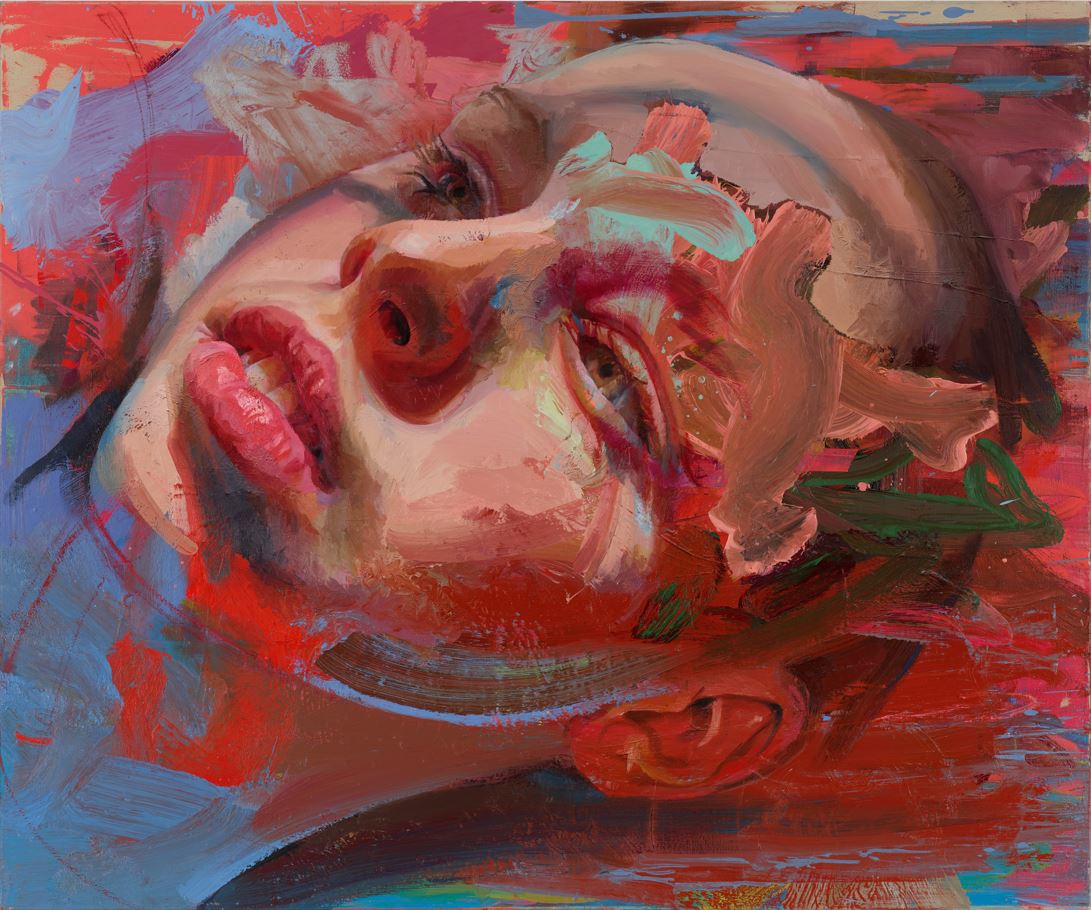
The final room contains 10 paintings and what leaps out at you is how brightly coloured they are, how massive they are, and how they focus in on just the faces.

Drift by Jenny Saville (2020 to 2022) Private Collection courtesy Gagosian © Jenny Saville, Courtesy Gagosian

Wow, what a vibrant new dayglo palette she’s been using since about 2020, lurid, super-bright, acid or ecstasy trip brightness!

Compare Drift (2022) with Rosetta II (2006) and notice several things. Although Rosetta II uses huge wide brushstrokes, the colours are all from the same sort of palette, dominated by that turquoise or aquamarine blue, contrasted with cream of the flesh, with some darker highlights to mould it.

In Drift, though, what is immediately apparent is at least two things. One is that the outline and shape of the face is actually limned in with more precision than Rosetta II and others from that period. But far more obvious is the disruptive impact of the dayglo colours. Looked at from one angle, the head in Drift looks like a kind of science fiction image, like the images we see in movies or TV series where there’s some kind of digital glitch, where the face goes pixilated or shreds into patches of unrelated colour.

This thought arose primarily from the images themselves, but when I read the wall label for the room, it actually talked about bang up-to-date ideas about digital technology, about artificial intelligence, about the strange new spaces being opened up by digital techniques.

And while half of the images are traditional, whole portraits, three or four of them introduce a completely new element in her practice which is collage, cutting up aspects of the image – generally eyes – and pasting them in inappropriate positions.

Cascade by Jenny Saville (2020) © Jenny Saville/DACS/Prudence Cuming Associates

Montage

See what I mean? Three or four of the works in this final room are completely unlike the others in using what is (after all) the hundred-year-old technique of photomontage, taking key bits of a portrait and moving them around. Note how the backgrounds to these juxtaposed eyes have gone completely wild. There is, in fact, an upside-down face but it’s an effort to identify it through the blizzard of huge swathes and squiggles of super-saturated paint.

Twombly and de Kooning

Some previous works had referenced Rubens or Rembrandt but the curators point to the influence on these recent works of the abstract painters Willem de Kooning and Cy Twombly. You can see it in the big squiggles or pure paint, red, blue, green.

Digital

Of one painting here, Latent, the curators write that ‘latent space’ is a concept in artificial intelligence which refers to the analysis of hidden structural similarities between visual data. Thus these most recent portraits can be said to build forms by finding the structural similarities between portraits and colours.

This kind of talk, about AI, is obviously bang up to date.

Youth

Which brings us to another, related, point. All the people in this final room are young, young women. Youth, energy and vitality embodied in works of super-vibrant colourfulness. Walking back to the beginning you realise that those earliest works – the vast, bloated naked women – now feel, paradoxically, as if they are portraits of older or middle-aged people. Whereas her most recent works focus unremittingly on The Young, on super-colourful semi-abstraction, and on notions around the new digital age. As if as she’s grown older, Saville has in fact gotten younger, more energised and digitally savvy.

The Anatomy of Painting

The curators give one very revealing fact and quote. Apparently Saville has observed plastic surgery operations, which prompted the thought:

“Witnessing a surgeon makes you see how layered flesh is… I started to think about not just the anatomy of the body, but about the anatomy of painting: the layering, the pace and tempo of the painted surface, the viscosity of the paint.”

Hence the exhibition sub-title. Although the paintings start with enormous bodies, and then alternate between very sever close-up portraits and wider-angle depictions of bodies on sofas or beds – in the end it is very easy to see that her entire career has consisted of adventures with paint (and charcoal and pastel). Starting from basic, photographically accurate images, and then creating layer after layer of paint and resonance and implication, with ringing, ravishing results.

Genius at work

An awesome display of dazzling works by one of the most staggeringly gifted painters working anywhere. Must see.


Related links

Related reviews

I Am Now You / Mother by Marcia Michael @ Autograph ABP

Autograph ABP is a charity that works internationally in photography and film, cultural identity, race, representation and human rights. ABP stands for the Association of Black Photographers.

Originally based in Brixton, ABP moved to a new, purpose-built gallery and offices at Rivington Place in Shoreditch in 2007. It is here that the ABP gallery is currently hosting two FREE exhibitions of photography.

I Am Now You, Mother by Marcia Michael

In I Am Now You – Mother Marcia Michael (b.1973) ‘visualises the act of matrilineage through the body of her mother, Myrtle McKnight.’ In practice, this means she has taken photos of herself and her mother, naked and clothed, sometimes alone, sometimes together.

According to the introduction, Michael:

uses photography and oral history to retrieve lost and reimagined narratives of her matrilineal ancestry, creating an intimate dialogue between mother and daughter in order to visualise history from her mother’s memory.

In the artist’s words:

My desire is to recover a visual and aural narrative of my matrilineal history and reunite the present with the past. The body is testament to the refusal to forget. The body, my mother’s body, is all of my histories.

The introduction again:

Adapting call and response as a visual methodology, Michael’s call for historical understanding is met by her mother’s response permitting the search to be mediated through her body. The resulting visual conversation is unsettling in its revelatory rawness, and affirmative in its courageous offering: a ‘dialogue of matrilineage’.

In practice, it is the photos of Michael’s mother’s naked body which are most visually interesting. She’s no longer young and she is quite big, but these are – as I see them – big pluses. A lot of the youngish women artists I go to see take photos or videos of themselves naked (for example, Aneta Grzeszykowska, in the review of Calvert 22 I’ll publish tomorrow). Indeed Michael includes one striking photo of herself reclining in an armchair stark naked in this exhibition.

But most of us are not young and trim, and get quite sick of being bombarded by images of svelte young things in movies, adverts, on the internet, on TV, and even the art world.

Even in the art world, realistic depictions of the older human body, or of fat people, in less than pristine condition, looking less than ‘buffed’, ‘ripped’ and ‘hot’, are relatively rare, photos even rarer. (This is part of the reason I immediately loved the paintings of Jenny Saville when I saw them at the Sensation exhibition 21 years ago.)

So while I quite liked the obvious visual comparisons and connections which Michael’s draws with her mother – like the double portrait in the painting below, wearing the same dress – hopefully you agree with me that the really visually interesting part of the work is the central shot of their bare bodies, skin against skin. It’s not rude or provocative. It is, in purely aesthetic terms, a really interesting composition of curves and contours, a study in human flesh, such as artists from Rubens to Freud have made, shot in a wonderfully intimate way which captures the play of light and shade on brown skin.

In purely visual terms, it is a fascinating and entrancing composition.

And then it has this added layer of meaning, which is that it is the juxtaposition of the bodies of a mother and her grown-up daughter. If you have children of your own, it comes freighted with all kinds of added meanings and memories of your own cuddle time with your kids, evocative of that childhood intimacy, but also marking the distance from it which adult bodies have travelled.

Many of the photographs’ titles include the Latin Partus sequitur ventrem – ‘that which is brought forth follows the womb’.

This historical law, which decreed that the social status of the mother is inherited by the child, shapes the mother for Michael as both maker and marker of history.

Some of the works – triptychs or juxtapositions of three images – really drill down into the notion of the body, exploring all the strange and plangent postures it is capable of. I was particularly troubled by this one. As in a religious triptych the left and the right panels are in one style, and act as introductions or pointers towards the central one whose importance, here is emphasised by the way it is in colour, contrasting with the outer panels’ black and white.

Both types of image are unnerving. The one on the right is in shadow and hard to make out, but the image on the left is well lit and this makes the marks on the back all the more striking and obtrusive. What are they? I happen to be reading about slavery in a history of America so thoughts of whippings and beatings sprang to mind, but these marks cannot possibly be caused by anything like that. Can they? What are they?

And the central image of the two female bodies, intimately linked, entirely stripped of any sexual or sensual connotations, become studies in the shapes the body makes, and – again – almost abstract studies of light and shade, light falling on the central thigh and the buttock above it, contrasting with other darker shadowed areas of the image.

What does each of these images do to the mind and the imagination, what do they say? And how much more are your reactions complicated by their placement next to each other?

All the wall labels, the introduction and Michael’s own statements emphasise the theme of the mother and the handing down of identity from mother to daughter – no doubt that was the conscious aim of the project. But the impact of the images, on the viewer less limited or restricted by this perspective, is much bigger, much weirder, much more puzzling and uncanny.

Remembering You Remember Me

There’s also a video, projected onto one wall, titled Remembering You Remember Me. (In this installation photo, you can see the triptych or single photos of Michael and her mother on the left-hand wall, and then how the right-hand wall is covered with a blown-up photo of woodland, trees and tracks; and how it is onto this backdrop that the video is projected.)

Installation view of I Am Now You - Mother

Installation view of I Am Now You – Mother

In this video a very old, white-haired Myrtle McKnight is presented in five simultaneous streams next to each other, in each one each retelling the birth of her child.

The words, and the sounds we all make when speaking (the ers and ums) create a powerful and disorientating effect. It reminded me of some of Steve Reich’s early minimalist works where tapes of human speech are spliced and repeated with variations to produce unnerving and challenging sounds.

Here, the many voices of Myrtle McKnight, set against each other, create a more troubling effect, an unearthly, sometimes angular and discordant, strangely poignant sense of the fragility of human identity.


Related links

Other Autograph exhibitions

More photography reviews

All Too Human @ Tate Britain

Britain is a collection of chilly rainswept islands in the North Atlantic, on the same latitude as Moscow (as we may learn to our cost in the decades to come, if global warming really does disrupt the Gulf Stream). For more than half the year the sky is overcast and grey. Whereas the inhabitants of southern countries like Spain or Italy have a tradition of living outside for much of the year, and dressing their finest every night for the evening stroll or passeggiata, ours is a country of fusty pubs for the working class and dinner parties for the posh. Ours is an indoors country.

This basic fact about life in Britain come across very strongly in Tate Britain’s new exhibition, All Too Human: Bacon, Freud And A Century Of Painting Life. It is a show of some 93 paintings, one sculpture and half a dozen black-and-white photographs by some of the most celebrated British artists of the past 100 years who have painted depictions of the human body. In roughly chronological order the artists are:

  • Walter Sickert b.1860
  • David Bomberg b.1890
  • Stanley Spencer b.1891
  • Chaim Soutine b.1893
  • Giacometti b.1901
  • William Coldstream b.1908
  • Francis Bacon b.1909
  • John Deakin b.1912
  • Lucian Freud b.1922
  • Francis Souza b.1924
  • Leon Kossoff b.1926
  • Dorothy Mead b.1928
  • Michael Andrew b.1928
  • Frank Auerbach b.1931
  • Dennis Creffield b.1931
  • Euan Uglow b.1932
  • R.B. Kitaj b.1932
  • Paula Rego b.1935
  • Celia Paul b.1959
  • Cecily Brown b.1969
  • Jenny Saville b.1970
  • Lynette Yiadom-Boakye b.1970

Mud or Mad

A reviewer of Tennyson’s long poem, Maud (1855) sardonically commented that it would have been more accurately named if either of the vowels had been removed. As I walked round this grim, dark and oppressive exhibition, I began to think most of the works on display could similarly be divided into ‘Mud’ or ‘Mad’, with maybe the additional category of ‘Livid Corpse’.

1. Mud

The School of Mud was inaugurated by Walter Sickert, leader of the so-called Camden Town Group. While John Singer Sargent was painting evocative portraits of fine society ladies or women with parasols lounging in the Mediterranean sunshine, Sickert painted prostitutes in dingy attics or leering crowds in half-lit music halls. The three works by him here are deliberately squalid, dark and dingy, so dark you have to peer up close to see any detail.

Nuit d'Été by Walter Richard Sickert (c.1906) Private Collection, Ivor Braka Ltd

Nuit d’Été by Walter Richard Sickert (c.1906) Private Collection, Ivor Braka Ltd

Rooms five and six of the exhibition explore the work of David Bomberg as artist and teacher at Borough Polytechnic, where his emphasis on the tactile quality of paint influenced his students Leon Kossoff and Frank Auerbach.

Bomberg is represented by Vigilante, which I quite liked because of its powerful vertical lines, which reminded me of the Vorticist work of Wyndham Lewis or Jacob Epstein. But it was his use of thick impasto which influenced his students and went on to become the distinguishing characteristic of the paintings of Kossoff and Auerbach.

Head of Jake by Frank Auerbach (1997) © Frank Auerbach, courtesy Marlborough Fine Art

Head of Jake by Frank Auerbach (1997) © Frank Auerbach, courtesy Marlborough Fine Art

These murky, smeary, thick abortions of the darkest browns and blacks possible made me think of an explosion in a sewage farm. Some of them made me feel physically sick. The joke is that many of them are meant to be outdoors scenes. Is this how you see or experience London?

Early Morning Willesden Junction by Leon Kossoff

Early Morning Willesden Junction by Leon Kossoff

Or this?

Mornington Crescent by Frank Auerbach (1965)

Mornington Crescent by Frank Auerbach (1965)

The commentary claims that:

Both Auerbach and Kossoff display great sensitivity to the conditions of light, convey the dynamism of city life and reflect the mood of a specific moment

which I thought might be a joke. Let’s look again at Kossoff’s sensitive depiction of light.

Early Morning Willesden Junction by Leon Kossoff

Early Morning Willesden Junction by Leon Kossoff

Not quite so muddy, but still revelling in gloom, bleakness of mood, greys and blacks splattered with neurotic blotches of colour, is the handful of works later in the show by Celia Paul.

Painter and Model by Celia Paul (2012) © Celia Paul, courtesy the artist and Victoria Miro, London / Venice

Painter and Model by Celia Paul (2012) © Celia Paul, courtesy the artist and Victoria Miro, London / Venice

Cheerful stuff, eh? The smear-and-daub tradition (Sickert-Bomberg-Auerbach) which this exhibition reveals to be a major thread in modern British art is represented in our day by the bang up-to-date works of Cecily Brown.

Boy with a Cat by Cecily Brown (2015) © Cecily Brown. Photo by Richard Ivey

Boy with a Cat by Cecily Brown (2015) © Cecily Brown. Photo by Richard Ivey

2. Mad

Only room one deals with the depiction of the human figure between 1918 and 1945. That’s not much space for nearly thirty years, is it? Murky Sickert, distorted Soutine and blue-veined Stanley Spencer are the only artists included (We’ll come back to Spencer under the category of ‘livid corpses’) thus omitting quite a lot of other artists active during this period.

Then it’s quickly on to Francis Bacon, who dominates rooms two and seven with his screaming popes, tortured dogs and baboons, men turning into hunks of meat. All depicted against precise geometric backgrounds as if caught in cages or on stage as specimens. Angst. Existential despair etc.

Portrait by Francis Bacon (1962) © The Estate of Francis Bacon. All rights reserved. DACS, London

Portrait by Francis Bacon (1962) © The Estate of Francis Bacon. All rights reserved. DACS, London

In the hall outside the exhibition there’s a loop of videos playing which show interviews with some of the featured artists, alongside display cases and wall displays showing photographs of the artists’ studios. Bacon’s was a notoriously filthy, dirty, messy cave with only a skylight allowing the grey light of Soho to penetrate down into the torture chamber. It tends to confirm your prejudices to learn that Lucian Freud’s studio, also in Soho, was nearly as dirty and scrappy.

The room after the early Bacon is devoted to Francis Souza whose strikingly large paintings are done in an edgy, angular, primitive style. The room is dominated by an enormous Crucifixion and a full figure painting of a naked black woman. Reproductions can’t convey how enormous, dark and menacing they are.

Again – dark dark dark, intense or even demented. I actually liked them, they have a terrific style, but God the mood they convey is wretched.

Room ten of the exhibition is devoted to paintings by Paul Rego. To quote the curators (there are three curators, all women):

Women’s lives and stories have often been overlooked in art as a historically male-dominated activity. Rego places them at the centre of her work. Women are portrayed as undertaking a variety of activities, in a broad range of moods and temperaments, as victims, culprits, carers, passive observers and sexually-charged creatures. As viewers we are drawn into and become complicit in an unruly world shaped by patriarchal power.

Here’s an example: can you feel yourself being drawn into it and becoming complicit in an unruly world shaped by patriarchal power?

The Family by Paula Rego (1988) Marlborough International Fine Art © Paula Rego

The Family by Paula Rego (1988) Marlborough International Fine Art © Paula Rego

Obviously, the more you look at it, the more disturbing it becomes. Maybe that’s what the commentary meant. For me the disturbing element is the way the schoolgirl fiddling with the man’s trousers in a way which in recent times we’ve been taught to think of as paedophilia, as being a sex crime. Yet she has the head of an adult woman. So…

Livid corpses

There aren’t any actual corpses on display, that’s just a short hand way of describing a style of painting human skin and bodies which emphasises the whiteness of English complexions, the lack of exposure to sunlight which leaves so many English bodies pale, pallid and covered in blue veins.

The exhibition decisively shows the strong tradition in English art of arranging and depicting the naked human body in the most unflattering way possible, as if it was a corpse just been pulled out of the Thames. It is as unsensual and unsexy as it is possible to be.

One recurrent cliché or trope of this styleis to depict a woman mostly wearing clothes but revealing one slack, white, veined breast in the most unappealing way possible. We see Stanley Spencer establishing this tradition in room one.

Nude Portrait of Patricia Preece by Stanley Spencer (1935)

Nude Portrait of Patricia Preece by Stanley Spencer (1935)

(There’s a lot more to Spencer than his full frontal nudes, as any visitor to the Stanley Spencer Gallery in Cookham or even to the 1910 room in Tate Britain will discover – but for some reason it’s always the saggy-boobed and flaccid-penised nudes which feature in exhibitions like this, never the scores of paintings he did of the cheerfully clothed men and women of his native Cookham.) Anyway, saggy blue-veined boobs was a motif picked up by young Lucian Freud fifteen years later.

Girl with a White Dog by Lucian Freud (1950-1) © Tate

Girl with a White Dog by Lucian Freud (1950-1) © Tate

Freud makes his first appearance as a pupil of art school teacher William Coldstream in room four, and then has the largest room in the show – room seven ‘Lucian Freud: In the Studio’ – devoted to him, with 13 big paintings.

It is interesting to learn that Freud’s mature style was the result of his switching from the small brushes which produced the smooth finish of paintings like the one above, to using bigger, coarser brushes which produced a more modern, slightly blotchy style. And that he moved away from the sitter – instead of being close and smooth, his portraits become more distant, more mottled.

Those changes by themselves, however, don’t account for the drastic change from the smooth, light palette of the painting above to his fascination with all the hues of brown, orange, grey and white which result in the characteristic blotched skin of his mature work.

David and Eli by Lucian Freud

David and Eli by Lucian Freud

The Freud room is full of paintings which revel in the ungainliness and the sheer ugliness of raw, naked, gawky, livid English bodies. Feet with their corns, legs with varicose veins, the tanned face and chest contrasting with the rest of the pallid body, the livid puce of this man’s flaccid cock and balls. In all of Freud’s ugly nudes I get the feeling the painter is daring you to come out and say how disgusted you are. Just how ugly can he make his people, before the viewer cries ‘Enough!’

Recognisably in the same tradition of ‘English ugly’ are the paintings of Jenny Saville although, unlike Freud, for reasons I can’t quite define, I’ve always loved Saville’s work.

Saville broke through in the fabulous Sensation exhibition of 1997, with paintings of grotesquely fat people who seemed to be pushing right up against the surface of the canvas, squeezed and compressed right into your face. All her works are awesomely big.

For some reason, although Freud’s blotchy nudes with their hairy penises and ragged vulvas make me feel like I’m in a butcher’s shop, I find Saville’s work visually thrilling and exciting. But it’s still from the very English ‘school of ugly’.

Reverse by Jenny Saville (2002-3) © Jenny Saville. Courtesy of the artist and Gagosian

Reverse by Jenny Saville (2002to 2003) © Jenny Saville. Courtesy of the artist and Gagosian

A little light

Is there any light in this gallery of murk, madness and tormented flesh? Yes, some. I’d never heard of Michael Andrews. In line with the general vibe two of his paintings here are of gloomy roughly-sketched interiors in Soho, namely the notorious Colony Club where Bacon et al. hung out, drank and bitched. But there is also this surprisingly touching outdoors scene.

Melanie and Me Swimming by Michael Andrews (1978-9) Tate © The estate of Michael Andrews

Melanie and Me Swimming by Michael Andrews (1978 to 1979) Tate © The estate of Michael Andrews

It was admiring the grace and tenderness in this painting which brought home to me how much the qualities of gentleness or grace are missing from almost all of these paintings – certainly from all the screaming Bacons, blotchy Freuds, oily Kossoffs, murky Auerbachs and mad Regos.

And for that matter, scenes simply set outdoors are few and far between in this show: there are none in the Bacon room, none in the Freud room. Even when there are supposedly outdoor scenes, as in the Auerbach and Kossoff rooms, you wouldn’t really know it, so buried are the motifs in layers of industrial thickness sludge.

No – happy, light, outdoor scenes are conspicuous by their complete absence, as is the depiction of the human body as a thing of beauty. Think of Aubrey Hepburn. Think of a ballerina. Think of Lionel Messi nutmegging a defender. Think of a hundred images of people in outdoors settings, laughing at cafes, walking through woods, gardening, sunbathing.

All of that, almost all of actual human life, is consciously excluded from this parade of horrors and corpses.

It’s odd that anyone takes ‘Art’ as being in any way representative of the actual life of its era when it is quite obviously the opposite – the product of a cloistered, hermetically-sealed world which almost makes a virtue of not capturing or depicting the actual lives of the people around it.

The only room which provided a relief from torture and turpitude was room four, devoted to the teachings of William Coldstream at the Slade School of Fine Art. Coldstream developed a process for marking out the canvas with precise grids to help construct a realistic image, deliberately leaving bits of grid visible to hint at the geometric framework beneath the ‘reality’.

Seated nude by William Coldstream (1973)

Seated nude by William Coldstream (1973)

I liked the precision of his draughtsmanship and the way you can see original lines of the sketch showing through the oil colours. That sense of outlines and shape. Three or four of Coldstream’s relatively light and airy works are included, alongside some by his pupil Euan Uglow.

Georgia by Euan Uglow (1973) © The Estate of Euan Uglow

Georgia by Euan Uglow (1973) © The Estate of Euan Uglow

In the flesh, up close, you can see traces of the lines of the grid which Uglow created across the canvas and many of the little crosses formed by the crossing of lines remain visible through the paint. I like that sense of the mechanical or mathematical emerging from the picture – or the sense of the work being unfinished, a work in progress.

As to the actual image, it’s another unsmiling person. In an exhibition devoted to the depiction of human beings over the past 100 years of English art not one person is smiling, let alone laughing (apart from the mad mother in the Paul Rego painting).

All confirming that ‘Art’ is a bloody serious, sombre, tragic business, you know.

Contemporary artists

The eleventh and final room is devoted to works by four younger or contemporary artists, all four of them women – including Jenny Saville, Cecily Brown and Celia Paul (all mentioned and illustrated above).

The Saville I loved, the Brown and Paul a lot less so. And, alas, as so often with contemporary artists, their work turns out – according to the (female) curators – to be all about sexuality and identity.

In their representations of figures they explore what it is to be human from a contemporary perspective. Throughout their work, they investigate and stretch stereotypical views on femininity, masculinity, race and many other categories that define and constrain identity.

Last word for Lynette Yiadom-Boakye, born in 1970 and so, along with Saville, the youngest artist in the show. According to the wall label she knocks out her paintings in a day of rapid and intense work. I liked both her pieces on display here, because I like disegno, the ability to conceive and carry out accurate line drawings. Both her works here display extremely skilled draughtsmanship, a handy way with oil paints, and the ability to create mood and expression.

Coterie Of Questions by Lynette Yiadom-Boakye (2015) © Lynette Yiadom-Boakye

Coterie Of Questions by Lynette Yiadom-Boakye (2015) © Lynette Yiadom-Boakye

Still, though – very dark aren’t they? Britain is for much of the year a dark and gloomy place which, at least according to this exhibition, has inspired a lot of dark and gloomy art – and the sombre palette of Yiadom-Boakye’s work fits right into that tradition.

The promotional video


Related links

Reviews

More Tate Britain reviews