Ernest Cole: A Lens in Exile @ Autograph ABP

Autograph is a small but stylish gallery over towards Shoreditch which specialises in Black photographers. To be precise:

Established in 1988, Autograph’s mission is to champion the work of artists who use photography and film to highlight questions of race, representation, human rights and social justice.

Its exhibitions are consistently excellent and are FREE.

Ernest Cole potted biography

There are two Ernest Cole exhibitions on in London at the moment. A big show at the Photographers’ Gallery in Soho displays nearly 100 photos from his landmark book, ‘A House of Bondage‘. This recorded in unflinching photos and sometimes harrowing documentary prose life for oppressed Blacks in the apartheid South Africa which Cole grew up in.

In 1966 Cole left South Africa with a case full of his negatives. He went to New York where the contacts he’d built up in his five years as a freelance photographer paid off. He showed the work to editors from Magnum Photos who took it up and got him a book publishing deal, and ‘A House of Bondage’ was written and published the following year (1967).

In America

But then he found himself, an outsider, with some but not many contacts, in the relentlessly competitive world of New York photography, magazines, newspapers and so on. So, on the back of the critical and commercial success of ‘Bondage’ he conceived several projects. The Autograph exhibition features quotes from letters Cole wrote and interviews he gave. Several of the letters are to arts funding organisations and in one of them (to the Ford Foundation) he mentions two specific photo projects he  was seeking funding for, ‘The Negro in the Rural South’ and ‘A Study of Negro Life in the City’.

Cole travelled to the South to take photos of poor rural communities but, as far as I can make out, none of these photos have surfaced. For the second project Cole took thousands and thousands of photographs of New York street life, specifically the street life of Harlem, the part of Manhattan Island above 96th Street which was, at the time, almost entirely populated by the Black community. Most are in black and white but about a quarter are in a vibrant but beautifully dated and nostalgic colour.

Harlem, New York City, about 1970 by Ernest Cole © Ernest Cole / Magnum Photos

The rediscovered archive

The introduction to the show comes in the first (small) room. Here we learn from the wall caption that between 1967 and 1972 Cole took an estimated 40,000 photos (!). However, neither the city or rural projects was completed, no book was forthcoming, and Cole released very few of the photos during his lifetime. In the mid-’70s Cole’s life fell into disarray due to illness, he could get no work, he was sometimes reduced to homelessness and lost control of his archive. Surprisingly, despite the highly American provenance of all these images, he spent a lot of time in Sweden where he worked with a photography collective before dropping the medium altogether to take up film-making. He died of cancer back in New York City in February 1990 at the age of just 49.

What’s triggered this revival of interest in his work is that in 2017 a huge trove of his negatives was discovered in a Stockholm bank vault. As a result the Ernest Cole Family Trust was established to publicise and protect his legacy. This helps to explain the impetus behind the recent republication of ‘House of Bondage’ (2022) and the publication, now, finally, of his New York street photos, in a handsome volume titled The True America (2024).

Installation view of ‘Ernest Cole: A Lens in Exile’ at Autograph (photo by Kate Elliott)

‘Photography as a Social Weapon’

In the photo above you can see the small first room through the archway in the middle. In this space are displayed seven photos, the biographical wall label I’ve been quoting from, and a film. The film is a 5-minute clip from a long interview with Cole shot in 1969 and titled ‘Photography as a Social Weapon’. What comes over from this clip first and foremost is what a very charismatic and articulate man he was. But there are two main learnings from the interview:

1. The first is about the model for his vision. Cole tells us that the first ever photobook he got his hands on in South Africa inspired his vision and crystallised what he wanted to achieve. It was ‘People of Moscow’ by Henri Cartier-Bresson and he was inspired by the Frenchman’s way of capturing of the poetry of everyday life.

2. The second is his disillusionment. As he educated himself in South Africa (via a photography correspondence course from England and by meeting artists and musicians) he heard about the United Nations and about the existence of an African-Asian bloc. They’ll save us, he thought; they’ll intervene in South Africa to overthrow the evil apartheid system. But when he arrived in New York he slowly realised that South Africa was just one item on the agenda of its regular meetings, that the same countries stood up and made the same loud criticism of SA, and then the meeting moved onto the next item. Nobody was going to intervene. It was up to Black South Africans to liberate themselves.

And this was part of a broader disillusionment with American society. In the interview he expressed a hope of being liberated from the day-to-day experience of racism which had made life so unbearable in South Africa. But everywhere he went (and the label tells us he visited Chicago, Cleveland, Memphis, Atlanta and Los Angeles, as well as rural areas of the South) he found American Blacks to be poor and oppressed and discriminated against. Eventually he reached the devastating conclusion that Black people in America were no better off than Black people in apartheid South Africa. It was oppression everywhere.

He happened to travel American during the climax of the Civil Rights Movement, in the months either side of the assassination of Martin Luther King (4 April 1968) and in some of the photos captures the way many young Blacks had moved beyond King’s Christian faith in non-violent protest to believing that only direct, and potentially violent, action could liberate them. Hence also one of the best photos, of a proud young Black woman staring unflinchingly into the camera, wearing a lapel badge of herself carrying a submachine gun. Hence the several photos of Black Panthers looking uncompromising.

Black Panthers in the Park, Harlem, New York City 1968 by Ernest Cole © Ernest Cole / Magnum Photos

The main gallery contains 42 photos, 20 in colour and four of them blown up and printed on the wall.  All of them are shots of people in the street, street scenes, a few posed but mostly spontaneous documentary shots. He had such a gift, he had such an eye for capturing people in their variety and humanity. I can’t show them all so will give a verbal summary.

There’s a drunk passed out on the sidewalk, a street vendor selling clams, a smartly dressed Black couple in downtown Manhattan, a kids playing with a hula hoop, another child held by his Dad brandishing a toy popgun. There’s a man wearing a billboard warning against the dangers of Dope!, there’s a couple of guys in African tribal dress sitting on an open-top car obviously going very slowly through a little mob of onlookers and bearing a placard reading ‘Don’t riot. Get wise. Go to Africa.’

In the same spirit there are three or four shots of what appears to be a motorcade of cars carrying placards depicting African leaders, namely Patrice Lumumba of the Congo and Marcus Garvey, the Jamaican politician and activist. As you might expect there are also some very stylish, cool and nattily dressed people: a cool all of woman wearing what I take to be an African outfit in a north African, Muslim style. A very cool dude wearing no shirt, just a loose gold embroidered waistcoat, a loose necktie and a purple hat, smoking a cigar.

Apart from anything else there’s a very strong nostalgic feel about lots of the images. As a boy I watched a range of TV shows from the late ’60s’ and early ’70s which featured not just Black but white hipsters and dudes, everyone wearing shades and cowboy hats and tasselled suede jackets and so on. Many of these photos, putting aside the race issue, evoke nostalgia for the street fashions of half a century ago.

There are hardly any white people in the photos. Two are very negative. One shows a middle-aged businessmen looking contemptuously, maybe angrily, at a Black couple having a snog in the lee of some building work. There’s a highly symbolic shot of a middle-aged Black shoeshine guy on his knees in front of a suited white man who is nonchalantly leafing through a wad of dollar bills – an upsetting emblem of money-colour-power dominating Black poverty and humiliation.
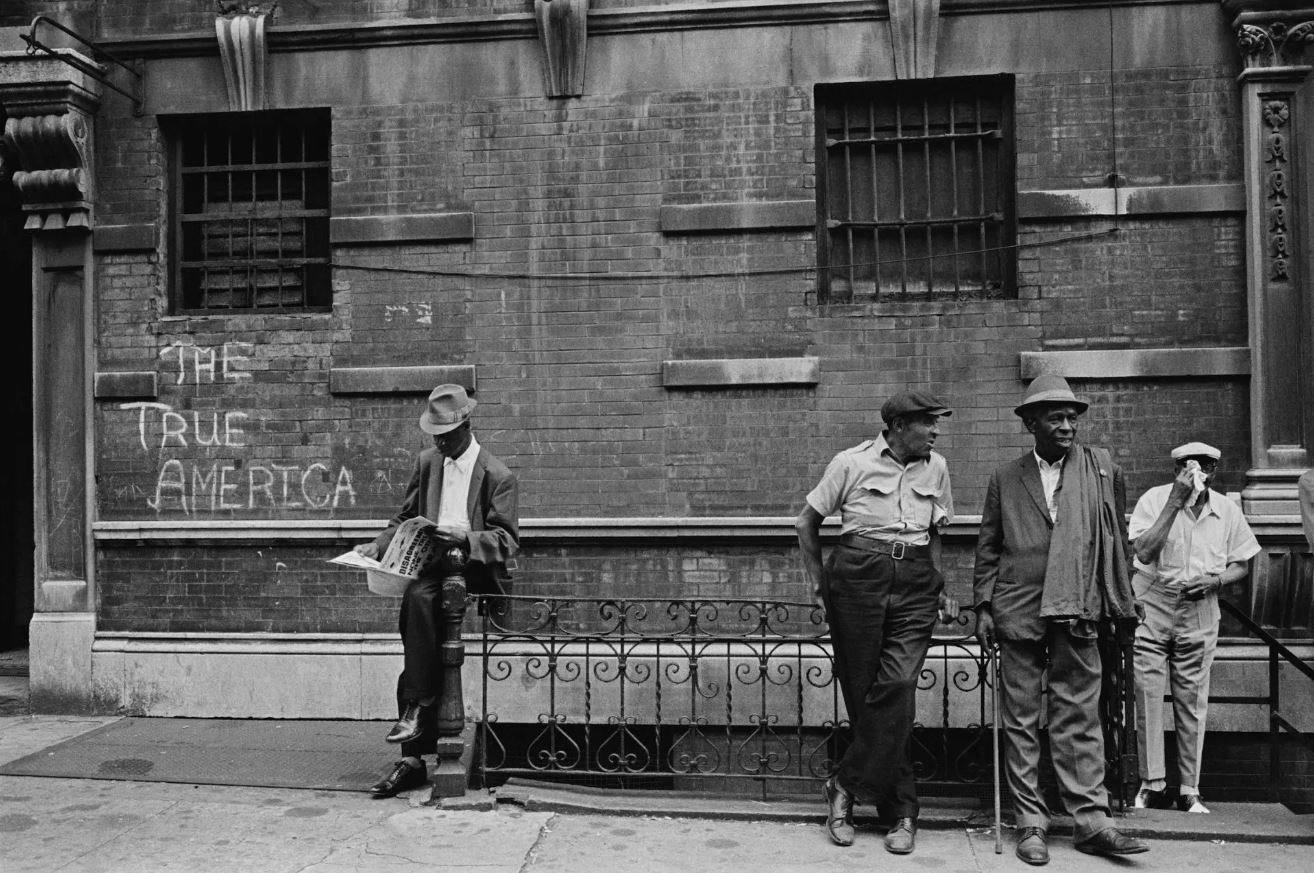
Harlem, New York, 1969 by Ernest Cole © Ernest Cole / Magnum Photos

And nowadays…?

As you walk round, and as you read the wall labels in which Cole described his disillusionment and  growing sense that Blacks are oppressed everywhere, it’s impossible not to ponder the current situation of Black people.

It’s far too big a question for me to handle and, not being Black, my opinion is of questionable use anyway. We now have many Black people in positions of power and position. In the UK not long ago there was a Black Chancellor of the Exchequer and we currently have a Black Foreign Secretary. Black faces are increasingly prominent across public discourse, in the media of TV, film, theatre and art. But how that translates into everyday life, I have no idea. The Guardian reports almost daily of British institutions being called out for institutional racism, racism still (apparently) flourishes in the police, young Black men are five times as likely to be stopped and searched by the cops etc.

I read the news, I watch TV and movies and go to art exhibitions and see more and more Black faces, issues and discussions, but what Black life is like in the UK I haven’t a clue. And that’s just in England, my home country. I couldn’t possibly guess at the situation in the US, except for a) my awareness (like everyone else’s) of the Black Lives Matter movement which sprang up following the murder of George Floyd in May 2020, and b) the fact that all the media I read harp on constantly about ongoing racism and racial injustice in the States.

Anyway, I thought I’d end by mentioning that, in among the many street shots, there are a few more optimistic ones, which depict interracial couples arm-in-arm or hand-in-hand on the New York subway. It’s not much but, in their way, these are the opposite of the standing businessman and the kneeling shoeshine man, these are images of love and equality. If they hardly changed society at large – which, as I’ve just mentioned, appears to remain in many ways horribly unchanged – still, maybe they are images of hope that ordinary people can find their own ways to overcome prejudice and bigotry and to live the lives they want to.

Midtown Manhattan, New York, 1971 by Ernest Cole © Ernest Cole / Magnum Photos


Related links

Related reviews

The Island by Mónica de Miranda @ Autograph

‘Tide’ from ‘The Island’ by Mónica de Miranda (2021) © Mónica de Miranda

Autograph

Autograph is a small gallery in Hoxton, which is open from Wednesday to Saturday only, but is FREE. Details of opening hours and location are on their website.

It’s housed in an ultra-modern building with a main gallery space – one wide square room with high ceilings – on the ground floor, and other spaces, of more conventional size, upstairs.

Whenever I’ve visited there’s only been a handful of other visitors so, apart from the exhibitions themselves, it feels like a cool, slick oasis of calm amid the hustling backstreets of Hoxton let alone the hectic traffic on nearby Shoreditch High Street.

Currently, Autograph is displaying a work by the Angolan-Portuguese artist Mónica de Miranda.

Mónica de Miranda: official biography

De Miranda is an Angolan Portuguese visual artist, filmmaker and researcher who works and lives between Lisbon and Luanda. Her work incorporates photography, video, drawing, sculpture and installation. Through it she investigates postcolonial politics of geography, history, and subjectivity in relation to Africa and its diaspora through a critical spatial arts practice.

Often conceptual and research-based, de Miranda is interested in the convergence of socio-political narratives, gender, and memory at the boundaries between fiction and documentary.

De Miranda is affiliated with the University of Lisbon where she is engaged on projects dealing with ethical and cultural aspects of contemporary migration movements linked to lusophone Africa, such as Post-Archive: Politics of Memory, Place and Identity, and Visual Culture, Migration, Globalization and Decolonization.

Intriguingly for someone who has roots in, what for many Brits are rather exotic countries – Portugal and Angola – her qualifications are very English. She holds undergraduate and post-graduate degrees in art and arts education from Camberwell College of Arts and the Institute of Education, and a doctorate in Visual Art from the University of Middlesex.

The exhibition

The exhibition consists of two elements:

1. The Island is a film, a 37-minute art film. This is being played on a continuous loop in the upstairs exhibition space. The room is dark, you make your way to one of the 4 or 5 basic benches provided, settle down and watch.

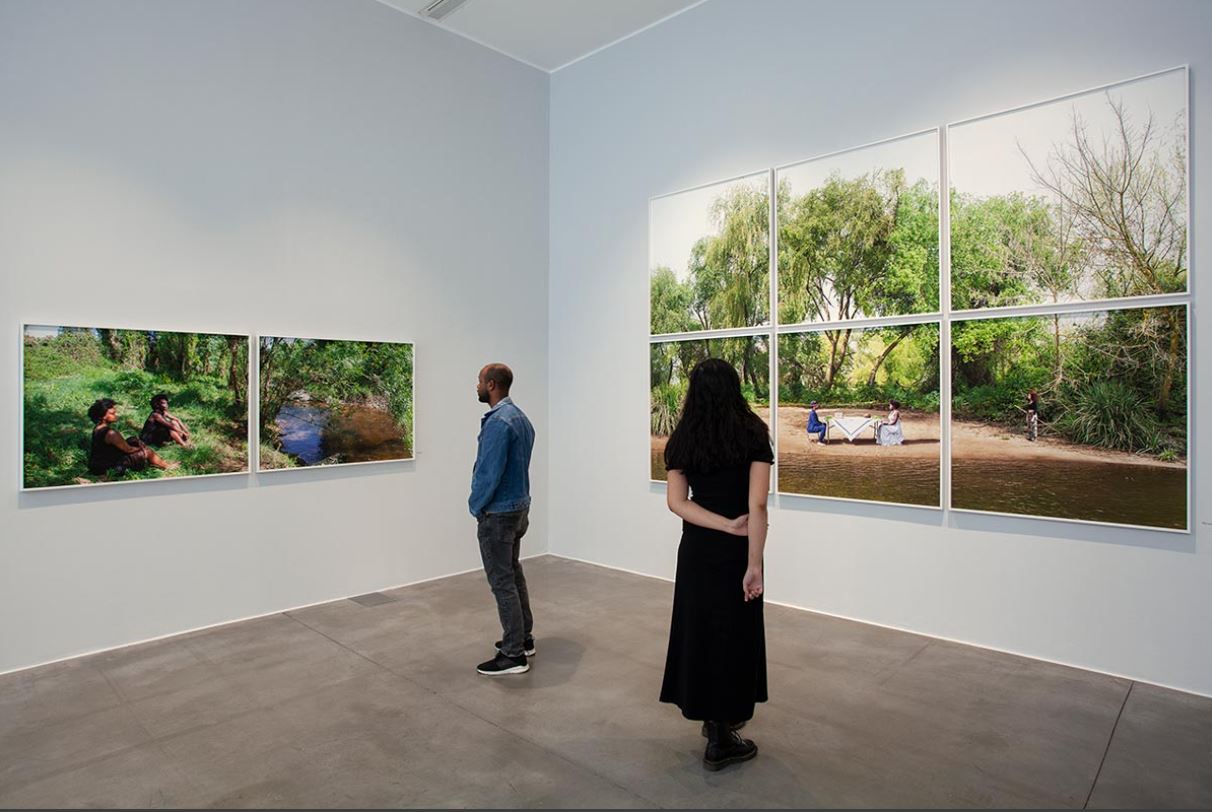
2. The main exhibition space downstairs contains half a dozen still photographs from the film. These have been blown up to large scale and cut up into a number of perfectly symmetrical separate frames. So one still from the film may be cut up into two, four or six separate sections, each beautifully framed and placed with mathematical precision on the white walls.

Installation view of photographic stills from ‘The Island’ by Mónica de Miranda at Autograph

They are all large, digitally clear, very calming images of a handful of people in lovely rural settings. Presumably they’re in Portugal, maybe even in Angola, but the lack of tropical foliage, and the look of the trees often made it feel like somewhere in the Thames Valley.

There are only about 6 of these big cut-up photos in the entire exhibition space. It makes for clarity and calm. It’s a very mindful experience.

The film

The problem with making any kind of art film must be persuading the audience to sit all the way through it. I wonder if there’s any data, from any gallery, of what percentage of visitors make it all the way through an art film. I watched about ten minutes of it.

During that time a striking, statuesque black woman wearing a long white dress stood in a haunting, abandoned quarry. Then she was wearing a bright red jacket trimmed with gold epaulettes and standing in what looked like a ruined outdoor auditorium with tiers of concrete benches.

Still from ‘The Island’ by Mónica de Miranda @ Autograph © Mónica de Miranda

Two young black women wearing black jumpers and red berets (the uniform, I think, of 1970s radicals) walked along paths through woods. The same two women wearing white dresses played on a hilltop with panoramic views over a wooded landscape. Without warning they are suddenly wearing Regency era dresses. Time jumps. Different historical eras are overlapped, photoshopped. At another point we see them sitting on a fallen tree half-sunk in a lake (see image at the start of this review).

The statuesque woman sat on some rocks. She was joined by a handsome black man. Cut to the same couple sitting down at a table placed just so on the sandy bank of a river. Long lazy tracking shots of the riverbank, as from a boat slowly drifting along the river.

Three points:

1. It’s all shot in a slow, classic style i.e. all the shots are long and lingering, they’re all set up to give full view of the scene. It’s consciously beautiful, especially the shots in the abandoned quarry, now filled with a huge pool of deep green water, some of which were really haunting.

‘Whistle for the Wind’ from ‘The Island’ by Mónica de Miranda (2021) © Mónica de Miranda

2. But more striking is the words. There are frequent shots of the striking woman speaking deep and meaningful sentences while staring into the middle distance. When she and the handsome man sit down at the dinner table on the river bank they don’t chat, they declaim more deep and meaningful sentences. As the two young women pick flowers in the woods, or walk through woodland paths or hold hands and spin round on the hilltop, there’s a voiceover of the same kind of deep and meaningful commentary. All spoken in a rich Portuguese accent, heavy on ‘sh’ sounds, sounding more East European than Latin.

I can’t find a transcript anywhere online. All I can find is the text accompanying the trailer on YouTube, where the voiceover tells us:

Do not stay lost.
Do not stay forgotten.
Do not lose the memory of who you are.
Breathe!

All the voiceover for the ten or so minutes I saw is like this. It, could have been copied from any one of the hundreds of books which fill the Spirituality and Mindfulness sections of bookshops. Like mottos from a series of inspirational posters. From the same place as the famous ‘Desiderate’ prose poem of healing advice:

Go placidly amid the noise and the haste, and remember what peace there may be in silence…

Either you like this kind of thing or you don’t. Chacun à son goût. Personally, I found it very relaxing. My companion had to stifle her titters.

Thirdly, the music. It’s very, very low-key, slowly-changing chords generated by some kind of synthesiser or electronic instruments i.e. not orchestra or pop music etc. It’s ambient, relaxing and lulling. It reminds me of Brian Eno’s ambient albums from the 70s and 80s.

The combination of the bland bromides of the voiceover, sensitively read in a rich Portuguese accent, the slow ambient music, and the lazy tracking shots of the riverbank, of girls walking through woods, of the striking woman standing in abandoned sites…explain why after ten or 12 minutes I fell slowly, lazily asleep. I think I was woken up by my own snoring.

‘Ground Work’ from ‘The Island’ by Mónica de Miranda (2021) © Mónica de Miranda

The curators’ version

The curator’s commentary accompanying the show wants us to believe that de Miranda:

deploys the metaphor of the island as a utopian place of isolation, refuge, and escape: a space for collective imaginings that speak to new and old freedoms. Anchored in cultural affinities and ecofeminism, the artist considers soil as an organic repository of time and memory, where ancestral and ecological trauma linked to colonial excavations continue to unfold. The Island urges us to develop a more conscious relationship between our bodies, the past and the lands we inhabit – and all that they hold – towards regenerative possible futures.

The visitor is free to take these ideas and spin them on into complex post-colonial critiques, pondering empire, slavery, colonialism, gender and ethnicity, all the usual topics of contemporary art.

But as an actual sensory experience the film, and then the big white room full of beautiful photos, are wonderfully calming, relaxing and healing. If you’re in that part of London on one of the days when Autograph is open, it’s worth making a detour to experience a chilled half hour of these calm and healing music and images.


Related links

Angola reviews

In case you get the impression that Angola is all beautiful woods, picturesque ruins and spiritual ladies, here are reviews of books by people who’ve worked in or visited this tragic, war-torn country recently.

Other Autograph exhibitions

More photography reviews

Lina Iris Viktor @ Autograph

Lina Iris Viktor was born in 1987, in Britain, to parents from Liberia, West Africa. She now lives and works in New York.

This wonderful FREE exhibition of her stunning art at the Autograph gallery in Shoreditch is Viktor’s first major solo show in the UK, with more than 60 works on display.

It’s in two parts, the downstairs gallery and the upstairs gallery.

Downstairs: Dark Continent

First, they have created a special atmosphere by painting the walls white and installing an elaborate metal grilled partition, designed as the outlines of zoomorphic shapes. In fact it is titled The Black Ark and its latticed, modular design is inspired by the nets of Liberian fishermen. Beside it is dotted metallic tropical foliage which appears in her Dark Continent paintings, transformed into sculptures (and titled Black Botanica).

In and out of this installation you wander as you take in the half dozen or so massive paintings and the 50 or so wonderful prints.

Installation view of Lina Iris Viktor at Autograph showing The Black Ark latticework. Photo by the author

Both the large pictures and the normal-sized prints begin with striking photos Viktor has taken of herself nude. But not au naturel. She has painted her naked body the deepest darkest shade of black possible.

She adopts a pose (lying down, sitting towards us, sideways-on, yawning, apparently moaning or sleeping or reaching out – there are over 50 different poses) and the prints the resulting large digital photo onto canvas. But the photo is only the start of a long and arduous process. Viktor then paints in:

  • a deep jet black background
  • an orange-golden head-dress (and a sly touch of gold at her loins, sometimes visible sometimes not)
  • a burnished beaten golden sun image
  • in the foreground a flutter of short flowers and grasses painted in whitish-grey

II. For Some Are Born to Endless Night. Dark Matter from the series Dark Continent: The Seven (2015-9) by Lina Iris Viktor. Courtesy of the artist and Mariane Ibrahim Gallery

The black really is deep jet black. Viktor’s work explores the notion and fact of blackness: as colour, as material and as political statement. Viktor is quoted as calling black ‘the proverbial materia prima: the source, the dark matter that birthed everything’.

Upstairs: The Blue Void

The room upstairs is painted a solid, opulent ultramarine blue (emulating the ‘Blue Room’ in Viktor’s New York studio). In it hang four massive paintings, except that ‘painting’ doesn’t do justice to the immensely ornate, decorated, raised surfaces of these highly ornamented artifacts.

Installation view of Syzygy by Lina Iris Viktor at Autograph. Photo by the author

Only by going up close to the paintings can you see the extraordinary care and attention which has gone into creating and raised and embossed surfaces. Those patterns on the cloak or kaftan she’s wearing in the painting above have been created by arranging hundreds of individual tiny balls into shapes and patterns, and then painting them silver.

Take this work, from the series A Haven. A Hell. A Dream Deferred and titled Eleventh. The words embossed across the surface of the work refer to tribes in Liberia, the sinuous golden lines refer to maps and tribal borders, and so the whole thing can be interpreted in a political or sociological way as a comment on the creation and tribulations of the free slave state of Liberia.

Eleventh from the series A Haven. A Hell. A Dream Deferred by Lina Iris Viktor (2018) Courtesy of the artist and Mariane Ibrahim Gallery

In the words of the wall label:

The A Haven. A Hell. A Dream Deferred. works reinterpret the Libyan Sybil, a prophetess from antiquity invoked by eighteenth-century abolitionists as a mythical oracle who foresaw the trans-Atlantic slave trade.

But the real artistic point (for me, at any rate) is the incredible detailing of the raised surfaces. The big golden pillar behind the woman’s head looks as if it has been beaten and hammered into elaborate shapes and reliefs. And the golden lines aren’t painted flat – they are raised lines, as if created out of clay or plasticine, and then carefully gilded.

Detail from Eleventh from the series A Haven. A Hell. A Dream Deferred by Lina Iris Viktor (2018) Courtesy of the artist and Mariane Ibrahim Gallery. Photo by the author

In fact these shapes are formed of copolymer resin which has been used to build up all manner of relief surfaces across the work, from the waving lines, to the outlines of the flowers, or the wording, as you can see from this close-up detail. The whole surface is incredibly elaborately constructed, built up from a mind-bogglingly three-dimensional elements.

It’s almost always true that it’s better to see works of art in the flesh rather than as reproductions, precisely because of the added excitement, interest and dynamism conveyed by big three-dimensional objects, but it is especially true of Viktor’s work.

As a man I openly admit that the initial ‘hit’ from most of the Dark Continent pieces is the impression of an attractive naked woman in a variety of poses – but get beyond that first impression and you are free to respond to the dazzlingly complex, strange, mysterious and entrancing symbols and motifs which Viktor has surrounded herself with, the shimmering lines and spirals and triangles and whorls picked out in thick 24-karat gold, gleaming and shimmering against the primal blackness.

It creates a rich and deep and wonderful visual experience. Go and see.

Materia Prima II by Lina Iris Viktor (2015) Courtesy of the artist and Mariane Ibrahim Gallery

Video

In this interview Viktor explains the importance to her art of 24-karat gold leaf (and ultramarine blue and black and white).


Related links

Other Autograph exhibitions

Liberty / Diaspora by Omar Victor Diop @ Autograph ABP

Autograph ABP is a lovely, big, open gallery space not far from Old Street tube station, devoted to exhibitions of photography by people of colour. It has just finished a ravishing exhibition by Senegalese photographer Omar Victor Diop, born 1980 in Dakar.

Thiaroye 1944 by Omar Victor Diop

Thiaroye 1944 by Omar Victor Diop

The ground floor exhibition space displays thirty beautiful digital photographs which feature Diop himself wearing the historical costumes of black people from defining moments in history. The photos are divided into two distinct projects:

Liberty: A Universal Chronology of Black Protest

This series reinterprets defining moments of historical revolt and black struggle in Africa and the diaspora. Diop dresses up as characters from key events such as the Alabama marches on Washington (Selma 1965), lesser-known resistance movements against colonial oppression in south-eastern Nigeria (The Women’s War 1929) and the more recent Million Hoodie March in New York.

Selma 1965 by Omar Victor Diop

Selma 1965 by Omar Victor Diop

Diop appears as the main character throughout the series, but also – thank to modern digital wizardry – sometimes also appears multiple times, as African railway workers, French migrants, Second World War soldiers, Jamaican maroons and members of the Black Panther Party, as appropriate.

The Ibo Women's War 1929 by Omar Victor Diop

The Ibo Women’s War 1929 by Omar Victor Diop

The most immediately obvious thing about all the photos is how stunningly beautiful Diop is. I took my teenage son to the exhibition with me and he agreed. He didn’t read any of the historic stories or references, he just enjoyed them as images in which a gorgeous young black man gets to dress up in lots of historical costumes.

Omar Ibn Said (1770-1864) by Omar Victor Diop

Omar Ibn Said (1770 to 1864) by Omar Victor Diop

Project Diaspora

The second series is titled Project Diaspora. Once again Omar dresses up and photographs himself in images quoting or parodying portraits celebrating four centuries of notable Africans in the diaspora.

These include:

  • Frederick Douglass (1818 to 1895), the abolitionist leader who was the most photographed person of his time
  • Olaudah Equiano (1745 to 1797) a freed slave, writer and activist in London
  • St Bénédicte de Palermo (1526 to 1589), a saint in the Catholic and Lutheran church
  • Prince Dom Nicolau (c.1830 to 1860), the Congolese African leader
  • August Sabac El Cher (c.1836 to 1885), an early Afro-German soldier
  • Jean-Baptise Belley (1746 to 1805), who fought during the French Revolution, and so on
Jean-Baptiste Belley (1746-1805) by Omar Victor Diop

Jean-Baptiste Belley (1746 to 1805) by Omar Victor Diop

Each of these characters has an extensive wall label describing who they were and what they did and why they matter. For example,

Jean-Baptiste Belley was a native of Senegal, born on the island of Gorée and former slave of Santo Domingo in the West Indies who bought his freedom with his savings. During the period of the French Revolution, he became a member of the National Convention and the Council of Five Hundreds of France. He was also known as Mars. Original painting by Girodet.

I found it a struggle to assimilate so many diverse historical periods and events, and my son didn’t bother but just enjoyed the sheer beauty of Omar himself, captured in enormous photographs which are all composed with a strange, interplanetary calmness.

Installation view of Liberty/Diaspora by Omar Victor Diop

Installation view of Liberty/Diaspora by Omar Victor Diop

And the footballs? I wondered whether you’d notice that. In many of the historic poses the figure is holding a modern plastic football, often very prominent, brightly coloured and incongruous. Why?

In Diop’s own words:

‘Football is an interesting global phenomenon that for me often reveals where society is in terms of race. When you look at the way that the African football royalty is perceived in Europe, there is an interesting blend of glory, hero-worship and exclusion. Every so often, you get racist chants or banana skins thrown on the pitch and the whole illusion of integration is shattered in the most brutal way. It’s that kind of paradox I am investigating in the work.’

A beautiful young man dressed up in historical costumes and carrying a football. What more could you ask for in a photography exhibition?


Related links

Other Autograph exhibitions

More photography reviews

I Am Now You / Mother by Marcia Michael @ Autograph ABP

Autograph ABP is a charity that works internationally in photography and film, cultural identity, race, representation and human rights. ABP stands for the Association of Black Photographers.

Originally based in Brixton, ABP moved to a new, purpose-built gallery and offices at Rivington Place in Shoreditch in 2007. It is here that the ABP gallery is currently hosting two FREE exhibitions of photography.

I Am Now You, Mother by Marcia Michael

In I Am Now You – Mother Marcia Michael (b.1973) ‘visualises the act of matrilineage through the body of her mother, Myrtle McKnight.’ In practice, this means she has taken photos of herself and her mother, naked and clothed, sometimes alone, sometimes together.

According to the introduction, Michael:

uses photography and oral history to retrieve lost and reimagined narratives of her matrilineal ancestry, creating an intimate dialogue between mother and daughter in order to visualise history from her mother’s memory.

In the artist’s words:

My desire is to recover a visual and aural narrative of my matrilineal history and reunite the present with the past. The body is testament to the refusal to forget. The body, my mother’s body, is all of my histories.

The introduction again:

Adapting call and response as a visual methodology, Michael’s call for historical understanding is met by her mother’s response permitting the search to be mediated through her body. The resulting visual conversation is unsettling in its revelatory rawness, and affirmative in its courageous offering: a ‘dialogue of matrilineage’.

In practice, it is the photos of Michael’s mother’s naked body which are most visually interesting. She’s no longer young and she is quite big, but these are – as I see them – big pluses. A lot of the youngish women artists I go to see take photos or videos of themselves naked (for example, Aneta Grzeszykowska, in the review of Calvert 22 I’ll publish tomorrow). Indeed Michael includes one striking photo of herself reclining in an armchair stark naked in this exhibition.

But most of us are not young and trim, and get quite sick of being bombarded by images of svelte young things in movies, adverts, on the internet, on TV, and even the art world.

Even in the art world, realistic depictions of the older human body, or of fat people, in less than pristine condition, looking less than ‘buffed’, ‘ripped’ and ‘hot’, are relatively rare, photos even rarer. (This is part of the reason I immediately loved the paintings of Jenny Saville when I saw them at the Sensation exhibition 21 years ago.)

So while I quite liked the obvious visual comparisons and connections which Michael’s draws with her mother – like the double portrait in the painting below, wearing the same dress – hopefully you agree with me that the really visually interesting part of the work is the central shot of their bare bodies, skin against skin. It’s not rude or provocative. It is, in purely aesthetic terms, a really interesting composition of curves and contours, a study in human flesh, such as artists from Rubens to Freud have made, shot in a wonderfully intimate way which captures the play of light and shade on brown skin.

In purely visual terms, it is a fascinating and entrancing composition.

And then it has this added layer of meaning, which is that it is the juxtaposition of the bodies of a mother and her grown-up daughter. If you have children of your own, it comes freighted with all kinds of added meanings and memories of your own cuddle time with your kids, evocative of that childhood intimacy, but also marking the distance from it which adult bodies have travelled.

Many of the photographs’ titles include the Latin Partus sequitur ventrem – ‘that which is brought forth follows the womb’.

This historical law, which decreed that the social status of the mother is inherited by the child, shapes the mother for Michael as both maker and marker of history.

Some of the works – triptychs or juxtapositions of three images – really drill down into the notion of the body, exploring all the strange and plangent postures it is capable of. I was particularly troubled by this one. As in a religious triptych the left and the right panels are in one style, and act as introductions or pointers towards the central one whose importance, here is emphasised by the way it is in colour, contrasting with the outer panels’ black and white.

Both types of image are unnerving. The one on the right is in shadow and hard to make out, but the image on the left is well lit and this makes the marks on the back all the more striking and obtrusive. What are they? I happen to be reading about slavery in a history of America so thoughts of whippings and beatings sprang to mind, but these marks cannot possibly be caused by anything like that. Can they? What are they?

And the central image of the two female bodies, intimately linked, entirely stripped of any sexual or sensual connotations, become studies in the shapes the body makes, and – again – almost abstract studies of light and shade, light falling on the central thigh and the buttock above it, contrasting with other darker shadowed areas of the image.

What does each of these images do to the mind and the imagination, what do they say? And how much more are your reactions complicated by their placement next to each other?

All the wall labels, the introduction and Michael’s own statements emphasise the theme of the mother and the handing down of identity from mother to daughter – no doubt that was the conscious aim of the project. But the impact of the images, on the viewer less limited or restricted by this perspective, is much bigger, much weirder, much more puzzling and uncanny.

Remembering You Remember Me

There’s also a video, projected onto one wall, titled Remembering You Remember Me. (In this installation photo, you can see the triptych or single photos of Michael and her mother on the left-hand wall, and then how the right-hand wall is covered with a blown-up photo of woodland, trees and tracks; and how it is onto this backdrop that the video is projected.)

Installation view of I Am Now You - Mother

Installation view of I Am Now You – Mother

In this video a very old, white-haired Myrtle McKnight is presented in five simultaneous streams next to each other, in each one each retelling the birth of her child.

The words, and the sounds we all make when speaking (the ers and ums) create a powerful and disorientating effect. It reminded me of some of Steve Reich’s early minimalist works where tapes of human speech are spliced and repeated with variations to produce unnerving and challenging sounds.

Here, the many voices of Myrtle McKnight, set against each other, create a more troubling effect, an unearthly, sometimes angular and discordant, strangely poignant sense of the fragility of human identity.


Related links

Other Autograph exhibitions

More photography reviews

Devotion: A Portrait of Loretta by Franklyn Rodgers @ Autograph ABP

Autograph ABP is a charity that works internationally in photography and film, cultural identity, race, representation and human rights. ABP stands for the Association of Black Photographers.

Originally based in Brixton, ABP moved to a new, purpose-built gallery and offices at Rivington Place in Shoreditch in 2007. It is here that the ABP gallery is currently hosting two FREE exhibitions of photography by black photographers.

Devotion: A Portrait of Loretta by Franklyn Rodgers

For some years photographer Franklyn Rodgers has been taking large-scale portrait photos of the most important person in his life, his mother, Loretta. More recently he has branched out into taking portraits of Loretta’s circle of friends and family. To quote the man himself:

Devotion – A Portrait of Loretta represents the connectivity between faith, family and friends, echoed in the wider social experience assigned to them in their time and location. It is a meditation on strength, resilience, fortitude and the ability to endure. It is an idea through which the connectivity it brokers opens up the reconfiguring of survival, rooted firmly in the legacy of a cultural matriarch. To pay homage, both as Loretta’s son and as an artist, in recognition of a way of thinking that represents a coping mechanism to collectively overcome, forgive and conversely transform: a process of creation through a different lens. Evidenced over time in the cultural landscape that now defines our nation.

The photos are enormous and capture a staggering amount of detail.

Friendships

As the director of ABP, Dr Mark Sealy MBE, puts it:

Loretta and the devoted network of relationships that are presented in the exhibition could, if we so choose, unlock the face of our own humanity. ‘Identity is not only a departure from self; it is a return to self’ (French philosopher Emmanuel Levinas) This unlocking process, however, only becomes possible at the point in which we fully recognise the civil responsibility we have for both Loretta and her friends. The underlying theoretical question with which Rodgers’ photography works presents us fundamentally concerns our understanding of what it means to actually look into the human face.

Installation of Devotion by Franklyn Rodgers

Installation view of Devotion by Franklyn Rodgers

Confrontations

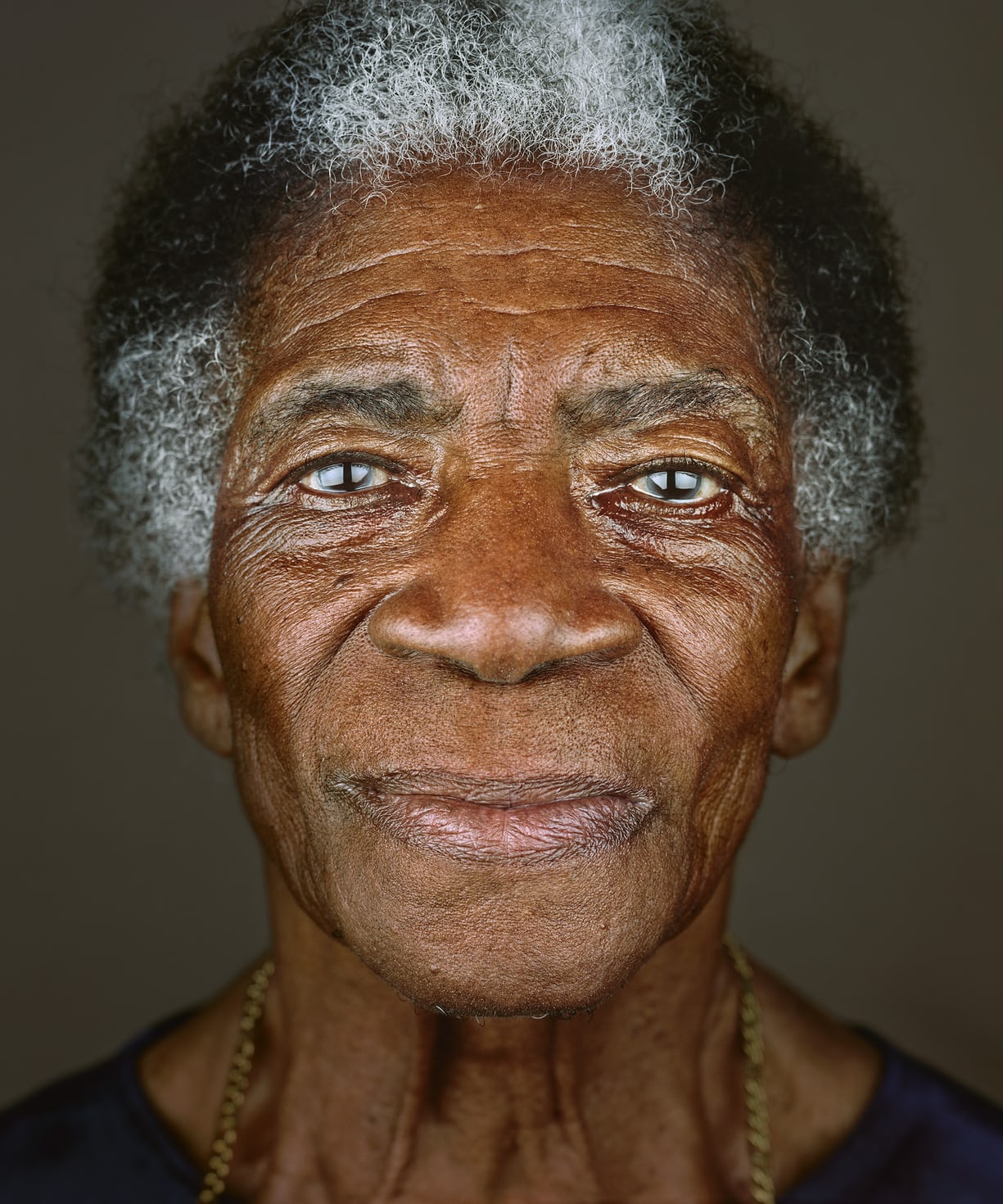
It is certainly true that the size of the portraits, and the way they are cropped very closely so as to be, literally, in your face, is almost forcing a response, coercing you to engage somehow, forcing us ‘to unlock the face of our own humanity’ maybe.

Mrs Iris Simms (2013) by Franklyn Rodgers

Mrs Iris Simms (2013) by Franklyn Rodgers

Care

Probably the portraits are a mirror and you project onto them your own concerns. Because I cared for both my parents as they died, and have been the main carer for my children, these enormous portraits trigger emotions of care and concern in me. These women look as if they have lived. They look as if they have suffered. I found myself uncomfortably moved by them. Unsettled by their unrelenting gaze.

Sealy again:

Through his photographs of his mother Rodgers invites us to enter the sacred realm of human recognition. In his hands the camera is repurposed as a device that aids the case for greater safekeeping and care across the human condition.

Installation of Devotion by Franklyn Rodgers

Installation view of Devotion by Franklyn Rodgers

Technical fluency

But maybe that’s just me, my life experiences, which I’m projecting onto them.

On the technical front, I am astonished at the pin-prick clarity of such enormous prints. Having recently seen the vast photographic prints by Andreas Gursky at the Hayward Gallery, and the massive photos by Alex Prager at the Photographers’ Gallery, I realise that we are living in an age when photos can now be blown-up and printed on an enormous scale without losing – in fact, enhancing – a tremendous, an almost intimidating, clarity of detail.

But whereas Prager’s and Gursky’s photos are almost entirely staged to capture large groups of people or (in Prager’s case) bizarre scenes, Rodgers’ photos obviously have a completely different feel. I wouldn’t call it ‘intimate’, they’re too big for that. But about as close up as you can get to a human face. And determined to capture every pore and blemish of the skin.

Looking again, I realise that all the faces are completely expressionless. I think it was at the National Portrait Gallery’s 2017 exhibition that I noticed that not a single one of the 70 or so portraits on display showed a single person smiling, let alone laughing i.e. it’s a common trope or convention of 21st century portraiture, to remain completely expressionless..

Maybe smiling or laughing immediately limits a portrait, because the viewer knows what mood the sitter is in. Smiling or laughter defuse the tension between viewer and portrait. Whereas depicting blank unsmiling portraits makes the face so much more powerful, inscrutable and mysterious.

What, you find yourself asking, is this array of senior citizens thinking? About their experiences of being black in Britain? About the nature of identity in a society mediated by images? About what’s for dinner? Who knows.

Time

As T.S. Eliot wrote a hundred years ago, ‘Time is time and runs away.’ Sealy again:

The act of photographing his mother’s face also marks Rodgers’s awareness of time moving uncontrollably fast. This sense of temporal dis-ease creates the conditions of having to act in the present and take responsibility for the now. Rodgers’ photographs of his mother and her circle of friends are therefore an invitation to look into their faces as part of a self-reflective journey to one’s own humanity, because, ultimately, it is only when we can recognise all the Lorettas of the world that we can then recognise ourselves.

It’s a room full of intense, brilliant and powerfully questioning portraits.


Related links

Other Autograph exhibitions

More photography reviews