De Profundis by Oscar Wilde (1897)

You were my enemy, such an enemy as no man ever had…In less than three years you entirely ruined me from every point of view.
(De Profundis, page 181)

While in prison doing two years hard labour for ‘acts of gross indecency’ (May 1895 to May 1897), Oscar Wilde wrote an enormous letter to his erstwhile lover, Lord Alfred Douglas, nicknamed ‘Bosie’. It is a very long, very detailed indictment of Douglas’s selfish, spoilt behaviour for the entire period of their affair (they were introduced in June 1891), including a detailed description the hectic days leading up to his fateful trial.

Wilde wrote the letter in January, February and March 1897, towards the end of his imprisonment (May 1897). Wilde was upset that Douglas didn’t bother writing to him in prison (‘I waited month after month to hear from you’, p.238) and then had learned to his dismay (as he mentions on the first page) that Douglas planned to publish Wilde’s letters without permission and dedicate poems to him unasked – just the most recent of the many abuses of their friendship which Wilde taxed Douglas with.

Wilde wrote it under the strict prison regime at Reading Gaol, on sheets of prison notepaper which he had to return to the warders every evening. He wasn’t allowed to post it to Douglas but was permitted to take it with him when he finally left gaol. He presented it to his most loyal friend, Robert Ross, who he had selected to be his literary executor, with instructions to have two copies made and send the original to its intended addressee, Douglas. Shrewdly, Ross sent Douglas only a typed copy of the letter with a covering note and Douglas later stated that, after reading the note, he burned the letter unread. Typical.

After Wilde’s death in November 1900, Ross published extracts from the letter in a 1905 edition of Wilde’s letters, under the Biblical title which Wilde himself had suggested. ‘De Profundis’ is Latin for ‘from the depths’ and the phrase comes from the Latin translation of Psalm 130, ‘From the depths, I have cried out to you, O Lord’, so entirely appropriate if a little melodramatic.

In the preface to the 1905 edition, Ross included an extract from Wilde’s instructions to him which included the author’s own summary of the work:

I don’t defend my conduct. I explain it. Also in my letter there are several passages which explain my mental development while in prison, and the inevitable evolution of my character and intellectual attitude towards life that has taken place, and I want you and others who stand by me and have affection for me to know exactly in what mood and manner I face the world. Of course, from one point of view, I know that on the day of my release I will merely be moving from one prison into another, and there are times when the whole world seems to be no larger than my cell, and as full of terror for me. Still at the beginning I believe that God made a world for each separate man, and within that world, which is within us, one should seek to live.

The version Ross published in 1905 was incomplete, less than half the manuscript with all references to the Queensberry family removed (for fear of libel from this super-litigious family), in effect removing almost the entire first half. Succeeding editions gave more of text until, in 1962, the complete and correct version appeared in the complete edition of Wilde’s letters, edited by Rupert Hart-Davis. Interestingly it appears that the full text version is still not available online as it is still in copyright in the USA. If you Google it, you are taken to variations on the heavily edited, incomplete 1905 version.

Structure

The letter is traditionally divided into two parts but when I read it, I thought it falls into four.

Opening lines

HM Prison, Reading

Dear Bosie,

After long and fruitless waiting I have determined to write to you myself, as much for your sake as for mine, as I would not like to think that I had passed through two long years of imprisonment without ever having received a single line from you, or any news or message even, except such as gave me pain…

Part 1. Wilde’s time with Douglas

In the first half Wilde describes in excruciating detail the pair’s relationship, with numerous descriptions of Douglas’s unbearably spoilt, selfish and exploitative behaviour, his insensate rages, his addiction to a:

world of coarse uncompleted passions, of appetite without distinction, desire without limit, and formless greed.

How Douglas’s presence and demands for attention prevented Wilde doing a stroke of work, how he destroyed the ‘intellectual atmosphere, quiet, peace and solitude’ he needed to work.

My life, as long as you were by my side, was entirely sterile and uncreative.

While you were with me you were the absolute ruin of my art and, in allowing you to stand persistently between Art and myself I give to myself shame and blame in the highest degree.

He describes how Douglas lived a recklessly extravagant lifestyle and expected Wilde to pay for everything. At various points Wilde tots up what this or that escapade cost him, numbers imprinted on his memory since, as a result of the first trial, he had been declared bankrupt and had to go through his accounts line by line with a Bankruptcy Receiver (p.157). He estimates that between autumn 1892 and May 1895 he spent more than £5,000 cash on Douglas, not counting bills.

Every day I had to pay for every single thing you did all day long. (p.228)

I blame myself for having allowed you to bring me to utter and discreditable financial ruin.

You demanded without grace and received without thanks.

According to Wilde he found Douglas’s behaviour so intolerable that they broke up every three months or so, on one occasion Wilde fleeing England altogether to escape him (p.162). Yet always, at that point, Douglas bombarded him with begging letters and his mother (a surprisingly regular presence in the letters) would beg Wilde to be kind to her son and so…he would forgive him and take him back only for the same pattern to repeat itself. Wilde, humbled by prison life, blames himself for his weakness as much as Douglas for his heedless selfishness.

I will begin by telling you that I blame myself terribly. (p.154)

Most of all I blame myself for the entire ethical degradation I allowed you to bring on me. (p.157)

Ethically you had been even more destructive to me than you had been artistically. (p.159)

The accusations lead up to a detailed description of their stay, in October 1894, at the Grand Hotel in Brighton (pages 164 to 167) where Wilde tenderly nursed Douglas through a bout of flu with flowers and books and choice food; but then, when he was better and Wilde, having moved to lodgings, went down with it, Douglas disappeared off to entertain himself, only returning to demand more money, leaving Wilde, weak and feverish, to fend for himself, and at one point uttering the famous words: ‘When you are not on your pedestal you are not interesting. The next time you are ill I will go away at once.‘ (p.168).

At one point Douglas became so furiously angry with Wilde for cramping his pleasures and approached the sick man’s bed in such a threatening manner, that Wilde fled the bedroom and didn’t return until he’d summoned the landlord for safety (p.166). Later Douglas wrote to him that it was an uglier moment than he imagined (p.167). Did he mean he intended to kill Wilde? Wilde thinks so. He wonders whether he had the pistol on him which he often brandished around, one time letting it off in a restaurant by mistake (p.175); or had seized a paperknife?

Wilde is portentous. The letter loses no opportunity to elevate this sordid and pathetic affair and his wretched exploitation by a spoilt brat, to the rank of some great work of art or a tragedy supervised by the Greek gods:

The gods are strange. It is not of our vices only they make instruments to scourge us. They bring us to ruin through what in us is good, gentle, humane, loving. But for my pity and affection for you and yours, I would not now be weeping in this terrible place. (p.169)

The Fates were weaving into one scarlet pattern the threads of our divided lives… (p.173)

He describes how, when Douglas sent him an undergraduate poem, Wilde replied with a letter intended to be a prose poem invoking the Greeks, how Douglas gave this letter to a friend who passed it to blackmailers who tried to extort money from Wilde and distributed letters round society, to the manager of a theatre staging one of his plays, how it was produced in court against him, used as evidence of his corrupting influence, and helped convict and send him to prison.

The story of his gift of the Phrases and Philosophies for the Use of the Young to a magazine set up by an undergraduate friend of Douglas’s, who then published it alongside a number of gay stories, which were read out as evidence against him at the trial.

The centrality of HATE for his father, much stronger than love for anyone else, in Douglas’s character (pages 174 to 180).

Details of the selling-off of Wilde’s belongings including priceless presentation volumes by all the authors of his day (p.179).

Part one ends with Wilde concluding that the only way to deal with such a monster of selfish ingratitude is to forgive him. He must forgive Douglas for his own sake. Otherwise he will carry the poison of bitterness in his heart forever and it will kill him.

I am far more of an individualist than I ever was. Nothing seems to me of the smallest value except what one gets out of oneself. My nature is seeking a fresh mode of self-realisation. That is all I am concerned with. And the first thing that I have got to do is to free myself from any possible bitterness of feeling against the world. (p.195)

The notion of forgiveness is the hinge into the second part of this long, long letter, which deals with what Wilde has learned through his two long years of intense suffering.

Part 2. Court, goal, suffering and enlightenment

Clergymen and people who use phrases without wisdom sometimes talk of suffering as a mystery. It is really a revelation.

Having raked over their relationship and the events which led up to his arrest, trials and imprisonment, Wilde turns to consider the spiritual aspects of the experience, what he has learned, how he is managing it.

I have to make everything that has happened to me good for me. (p.197)

The important thing, the thing that lies before me, the thing that I have to do, or be for the brief remainder of my days one maimed, marred and incomplete, is to absorb into my nature all that has been done to me, to accept it without complain, fear or reluctance. (p.197)

To reject one’s own experiences is to arrest one’s own development. (p.197)

I saw then that the only thing for me was to accept everything. (p.207)

I am simply concerned with my whole mental attitude towards life as a whole (p.199)

I write this account of the mode of my being transferred here simply that it should be realised how hard it has been for me to get anything out of my punishment but bitterness and despair. I have, however, to do it, and now and then I have moments of submission and acceptance. All the spring may be hidden in the single bud, and the low ground nest of the lark may hold the joy that is to herald the feet of many rose-red dawns. So perhaps whatever beauty of life still remains to me is contained in some moment of surrender, abasement, and humiliation. I can, at any rate, merely proceed on the lines of my own development, and, accepting all that has happened to me, make myself worthy of it. (p.219)

For a while this striving of acceptance of everything which has happened to you reminds me of Nietzsche and the myth of eternal recurrence. But then he changes the tone by moving to a whole hearted consideration of Jesus. With typical Wilde bravado, and consistent with the depiction of him in his essay The Soul of Man Under Socialism, Wilde portrays Jesus as a romantic, individualist artist (much like himself).

Christ’s place indeed is with the poets. (p.205)

Like everyone else, he appropriates Jesus for his ideology, in this case his aesthetic and poetics. Thus Wilde interprets Jesus’ entire life as ‘the most wonderful of poems’, rewriting Jesus’ entire career in his late-Romantic purple prose.

Christ, like all fascinating personalities, had the power of not merely saying beautiful things himself, but of making other people say beautiful things to him…

The Letter morphs into The Soul of Man Under Socialism when Wilde declares that Jesus was, above all, ‘the most supreme of individualists’ in fact ‘Christ was not merely the supreme individualist, but he was the first individualist in history.’ (p.207) All his alleged teachings and philanthropy really were about just one thing – perfecting oneself.

But Wilde’s (mis)interpretation also generates new insights:

With a width and wonder of imagination that fills one almost with awe, he took the entire world of the inarticulate, the voiceless world of pain, as his kingdom, and made of himself its eternal mouthpiece. Those of whom I have spoken, who are dumb under oppression, and ‘whose silence is heard only of God,’ he chose as his brothers. He sought to become eyes to the blind, ears to the deaf, and a cry in the lips of those whose tongues had been tied. His desire was to be to the myriads who had found no utterance a very trumpet through which they might call to heaven. And feeling, with the artistic nature of one to whom suffering and sorrow were modes through which he could realise his conception of the beautiful, that an idea is of no value till it becomes incarnate and is made an image, he made of himself the image of the Man of Sorrows, and as such has fascinated and dominated art as no Greek god ever succeeded in doing.

That Wilde could conceive and write this while ill and depressed, imprisoned, shamed and bankrupted, having lost his belongings, reputation, career and family, is impressive. What it shows to me is that his aesthetic philosophy wasn’t an add-on which he worked up for public effect, but ran through him to the core.

What it also indicates is a substantial change in style from the first ‘half’. There Wilde had come close to whining in a text dominated by autobiographical reminiscences. Here, as you can see, the text feels much more worked-over, burnished and melliflous, to reflect a careful development of thought very similar to his critical essays.

He has been reading the four gospels in their original Greek and quotes from them with his own translations.

He moves on to explain the superiority of Christ’s all-encompassing compassion to the brutality of most of the Greek gods and their myths. And then gives an aesthetic explanation for the entire conception of ‘prophecy’ (i.e. that Jesus was the fulfilment of Old Testament prophecies) by saying:

Every single work of art is the fulfilment of a prophecy: for every work of art is the conversion of an idea into an image. Every single human being should be the fulfilment of a prophecy: for every human being should be the realisation of some ideal, either in the mind of God or in the mind of man.

This has the neatness, stylishness, of his essays. If he ever writes anything artistic again, he will take as his theme ‘Christ as the precursor of the romantic movement in life’ (p.213). In his hands Jesus comes perilously close to sounding like Oscar Wilde:

If the only thing that he ever said had been, ‘Her sins are forgiven her because she loved much,’ it would have been worthwhile dying to have said it. His justice is all poetical justice, exactly what justice should be.

And goes on to say that Christ ‘preached the enormous importance of living completely for the moment’. I won’t quote it all but his rewriting of the antinomian Jesus is extremely persuasive. His interpretation of the salvation of Mary Magdelen just for a moment of pure love is moving, as is his reading of Jesus’s special mode of understanding the sinner:

In a manner not yet understood of the world he regarded sin and suffering as being in themselves beautiful holy things and modes of perfection.

This strikes me as a very profound insight, the most profound thing I’ve come across in Wilde. And yet, the next minute, he sounds a little silly, too like the provocative poseur of his pre-prison days:

There is something so unique about Christ. Of course just as there are false dawns before the dawn itself, and winter days so full of sudden sunlight that they will cheat the wise crocus into squandering its gold before its time, and make some foolish bird call to its mate to build on barren boughs, so there were Christians before Christ. For that we should be grateful. The unfortunate thing is that there have been none since.

You can see how that has been worked-up to arrive at the provocative punchline. Or:

Indeed, that is the charm about Christ, when all is said: he is just like a work of art. He does not really teach one anything, but by being brought into his presence one becomes something.

What is pretty obviously missing from all this is any sense of divinity, of God the father and Creator who, if you read the Gospels, Jesus is very much at pains to invoke. Wilde describes an almost secular Jesus, a preacher of self-awareness and self-development, even at the cost of personal pain. It’s no surprise that the Catholic Church refused to accept him when he left prison, despite repeated attempts. It was quite simply because he wasn’t a Christian.

Nowadays this type of positive self-overcoming is called mindfulness or resilience, and Wilde gives the same basic thought a number of very powerful expressions:

And for the last seven or eight months, in spite of a succession of great troubles reaching me from the outside world almost without intermission, I have been placed in direct contact with a new spirit working in this prison through man and things, that has helped me beyond any possibility of expression in words: so that while for the first year of my imprisonment I did nothing else, and can remember doing nothing else, but wring my hands in impotent despair, and say, ‘What an ending, what an appalling ending!’ now I try to say to myself, and sometimes when I am not torturing myself do really and sincerely say, ‘What a beginning, what a wonderful beginning!’ It may really be so. It may become so. If it does I shall owe much to this new personality that has altered every man’s life in this place.

This was due, as the notes tell us, to the arrival of a new governor of the prison. The governor for Wilde’s first year had been a martinet who kept the letter of the law and subjected the inmates to fierce discipline. In July 1896 he was replaced by Major James Nelson who immediately set out installing a more humane regime.

In a structured passage he rejects morality, reason and religion. ‘My Gods dwell in temples made with hands’. Wilde reworks his doctrine of the acceptance of experience: all of it must be accepted and transformed, whatever its origin.

Part 3. Back to Bosie

These repeated exhortations to acceptance reach a climax and then there’s a transition to what I take to be the third part of the letter. This returns to the subject matter and style of part 1, namely a return to wringing his hands over the entire wretched Queensberry family, and a return to the more factual, documentary and accusatory tone of part 1. This time round it’s Douglas’s mother who gets extended criticism for her cowardice in refusing to speak directly to her son but writing Wilde begging him to do her dirty work – i.e. telling her son to pull himself together – for her, and ending all her letters with the same refrain: ‘On no account let Alfred know that I have written to you.’

Part 4. Practicalities

In the last few pages Wilde turns to two practical issues. First he describes the details of his bankruptcy which is genuinely harrowing. He can scarcely believe that Douglas thought it would be ripping good fun if Wilde was declared bankrupt because it would stop his father claiming his court costs. I.e. he didn’t think for a minute of the impact on Wilde, just about spiting his hated father. That’s motivated from start to finish of their wretched affair, Douglas’s hatred of his father, and Wilde found himself trapped in the middle, and was ruined for it.

Then he describes what he plans to do at his release, namely go straight to France to stay with close friends who have remained true and commune with nature. There is no place for him in England. He wants to be beside the sea and praises the ancient Greeks’ attitude to the primal elements of nature.

Then he reiterates the need for him to accept his past in order to move into the future. It has been an epic read. What it must have cost him to write! And so it ends.

Subjects

Prison life:

‘We who live in prison, and in whose lives there is no event but sorrow, have to measure time by throbs of pain and the record of bitter moments. Suffering – curious as it may seem to you – is the means by which we exist because it is the only means by which we become conscious of existing, and the remembrance of suffering in the past is necessary to us as the warrant, the evidence, of our continued identity’ p.164)

Suffering is one very long moment. We cannot divide it by seasons. We can only record its moods, and chronicle their return. With us time itself does not progress. It revolves. It seems to circle round one centre of pain. The paralysing immobility of a life every circumstance of which is regulated after an unchangeable pattern, so that we eat and drink and lie down and pray, or kneel at least for prayer, according to the inflexible laws of an iron formula: this immobile quality, that makes each dreadful day in the very minutest detail like its brother, seems to communicate itself to those external forces the very essence of whose existence is ceaseless change. Of seed-time or harvest, of the reapers bending over the corn, or the grape gatherers threading through the vines, of the grass in the orchard made white with broken blossoms or strewn with fallen fruit: of these we know nothing and can know nothing…

For us there is only one season, the season of sorrow. The very sun and moon seem taken from us. Outside, the day may be blue and gold, but the light that creeps down through the thickly-muffled glass of the small iron-barred window beneath which one sits is grey and niggard. It is always twilight in one’s cell, as it is always twilight in one’s heart. And in the sphere of thought, no less than in the sphere of time, motion is no more… (p.186)

To those who are in prison tears are a part of every day’s experience. A day in prison on which one does not weep is a day on which one’s heart is hard, not a day on which one’s heart is happy. (p.219)

The terrible incident at Clapham Junction where he was made to stand in prison clothes, in chains, waiting for the train to Reading while trainload after trainload of scurrying passengers mocked and jeered and then spat at him (p.219). Compare and contrast with the incident of Robert Ross doffing his hat to Wilde after his conviction.

What you learn from prison:

One of the many lessons that one learns in prison is that things are what they are, and will be what they will be. (p.185)

Philosophising:

To be entirely free, and at the same time entirely dominated by law, is the eternal paradox of human life which we realise at every moment (p.172)

Fine writing (p.176)

Literature the greatest art (p.188)

The purple pageant of my incommunicable woe (p.186), laurel and bayleaf )p.187).

Douglas’s appalling character

‘So full of terrible defects, so utterly ruinous both to yourself and to others’ (p.162)

Douglas takes advantage of his ‘proverbial good nature and Celtic laziness’ (p.158).

Douglas’s extravagance (pages 156 to 157, 172).

Douglas stops Wilde working (pages 154, 155, 156).

Douglas’s rages (pages 158, 166).

Douglas’s terrible translation of Salome (pages 155, 160, 161).

I knew quite well that no translation, unless one done by a poet, could render the colour and cadence of my work in any adequate measure… (p.161)

Douglas gives careless gifts of suits away to his gay lovers and rent boys, their pockets still filled with incriminating letters. Some of the recipients used them to try and blackmail Wilde, and then were produced in court, linking him to the world of rent-boys which his young lover had led him into.

You had left my letters lying about for blackmailing companions to steal, for hotel servants to pilfer, for housemaids to sell. (p.182)

The Marquess of Queensbury – epileptic fury (p.167), vendetta (pages 174 to 175).

I who appealed to all the ages have had to accept my verdict from one who is an ape and a buffoon. (p.184)

Details of the days surrounding the trials – ‘Blindly I staggered as an ox into the shambles’ (p.158), ‘You forced me to stay to brazen it out’ (p.159). Douglas taunts into launching the action against Queensbury; when Wilde says he has no money, Douglas says his family will pay the costs so that ‘I had no excuse left for not going. I was forced into it’ (p.171)

At one point Wilde anticipates W.H Auden’s great poem, Musee des Beaux Arts:

There is no error more common than that of thinking that those who are the causes or occasions of great tragedies share in the feelings suitable to the tragic mood: no error more fatal than expecting it of them. The martyr in his ‘shirt of flame’ may be looking on the face of God, but to him who is piling the faggots or loosening the logs for the blast the whole scene is no more than the slaying of an ox is to the butcher, or the felling of a tree to the charcoal burner in the forest,

Thoughts

Gripping

De Profundis is by far the most gripping and ‘real’ thing Wilde ever wrote. All his letters are wonderful, and reading Wilde’s correspondence is to be touched and inspired by such a warm, humane, literate and educated presence – but ‘De Profundis’ is something else. It plunges you straight into a realistic depiction of a tortured, modern relationship with none of the artifice or elaboration which makes the plays or essays or Dorian Gray so artificial and false. (OK, there’s a fair amount of artifice in the description of his philosophy, invoking Jesus and the Greek gods, but in the core passages devoted to Douglas and his terrible father, and Wilde’s litany of humiliations, it feels immediate and lacerating.) I half expected rereading it for this blog to be a chore but I was absolutely gripped and absorbed.

Beggars

Was ever such an extensive character assassination committed to paper? After reading the content, it is astonishing that – as if deliberately dramatising his ongoing addiction to this vile young man – despite the letter’s vivid portrait of Douglas’s despicable character which emerges, Wilde starts the letter ‘Dear Bosie’ and ends it ‘Your Affectionate Friend’.

And it quite beggars belief that after writing the longest indictment any writer ever wrote of their one-time lover – decrying his extravagance, selfishness and ruinous improvidence – Wilde got back together with Douglas. He wrote asking to see him as soon as he was freed from prison and the pair went to briefly live together in Naples, until the friends and family of both men forced them to part. Among countless other passages of flaming criticism, Wilde writes:

It would be impossible for me now to have for you any feeling other than that of contempt and scorn, for myself other than any feeling of scorn and contempt. (p.192)

And yet…he went running back to this object of scorn and contempt. If the letter itself didn’t convey this, the fact that he reunited with such a worm suggests it was a profound psychological addiction, like heroin or cocaine, rather than a healthy, reciprocal relationship.

But why, that’s the great question. Bosie was a monster of selfishness, given to epic rages, nowhere near Wilde’s intellectual equal, completely unsympathetic to his artistry and utterly ruinous for his concentration and writing – why did Wilde keep going back to him, and went back after the wretched worm had utterly ruined his life? It absolutely wasn’t his personality or intellect or even looks. Was he great at some particular sexual kink? But Douglas, in his later memoirs, denied that they even had sex, saying most of what they did was kissing and cuddling and Bosie’s main activity was lining up rent boys and like-minded young men for Wilde to take his pleasure with. Why? Why did he go back to him?

Letters to be published

That said, there’s something peculiar about baring one’s soul, and listing every argument from a long and stormy relationship, with a view to its eventual publication. The letter is a gruesomely detailed description of a deeply troubled relationship but, you can’t help wondering, even here, was Wilde performing? Was he writing with an audience in mind? Yes, most definitely. It combines a detailed chronology of their affair and of the events leading up to the trials with passages of moralising about love and beauty and art and the soul which are quite clearly aimed at a wider audience, as crafted as anything (as I suggested above).

Homosexual absence

Initially I thought the letter completely suppressed any mention of homosexuality or the acts of ‘gross indecency’ Wilde was convicted of, probably for legal, social, all kinds of reasons. But slowly I realised I was wrong. The ‘issue’ is referred to half a dozen times, most clearly in an anecdote towards the end.

First of all, Wilde refers four or five times to the reason he and Douglas met in the first place, which is that Douglas, while an undergraduate at Oxford, wrote him a letter asking for his advice and help with a problem of a particular nature.

I told her [Douglas’s mother] the origin of our friendship was you in your undergraduate days at Oxford coming to beg me to help you in very serious trouble of a particular character. I told her that your life had been continually in the same manner troubled… (p.163)

Our friendship really begins with you begging me in a most pathetic and charming letter to assist you in a position appalling to anyone, doubly so to a young man at Oxford… (p.169)

I would not have expected or wished for you to have stated how and for what purpose you had sought my assistance in your trouble at Oxford… (p.184)

When Edward Levy, at the very beginning of our friendship, seeing your manner of putting me forward to bear the brunt, and annoyance, and expense even of that unfortunate Oxford mishap of yours, if we must so term it, in reference to which his help and advice had been sought, warned me for the space of an hour against knowing you, you laughed. (p.190)

Ten seconds searching on the internet tell me that in the spring of 1892 Douglas was being blackmailed by a young man over an indiscreetly gay letter he had sent him. Douglas wrote to Wilde asking for help, Wilde travelled down to Oxford and spent the weekend at Douglas’s lodgings. Back in London he consulted his solicitor, George Lewis, who advised resolving the problem by paying the blackmailer £100.

But this sequence of events is nowhere referred to in De Profundis and this leads to several thoughts. One is that, if course Wilde doesn’t make anything explicit in the letter: 1) he was a gentleman and gentlemen don’t discuss sex of any variety; 2) he regarded it as beneath his dignity and certainly beneath the moral purpose of the letter; 3) anything he wrote could possibly be used against him in yet another prosecution.

The second thought arises from something intriguing I read about ‘De Profundis’ which is that gay consciousness had barely begun. A man was a gentleman and he may or may not have peculiar tastes but a) no-one talked about it b) there was a less clear-cut line between gay and straight than was to be drawn during the twentieth century (and now, in the 21st century, is being blurred and elided again). So Wilde may never have thought of himself as homosexual but merely a gentleman who enjoyed Uranian activities.

The third thought is that this absence of sex does something funny to the text. It’s packed with accusations against Douglas, including lots of financial details, descriptions of his horrid family etc, then moves on to discuss spiritual and psychological development. And yet, all the time, it (almost completely) ignores the elephant in the room. A huge letter rotating around his prosecution and conviction and imprisonment and yet which…never directly addresses or refutes the prosecution case or evidence.

But as you read on, slowly slowly the love that dare not speak its name does make an appearance in asides and references. Is homosexuality what he’s referring to here, where he writes of a meretricious article Douglas had written for the Mercure de France, that:

Along with genius goes often a curious perversity of passion and desire?…[that] the pathological phenomenon in question is also found amongst those who have not genius. (p.183)

Later:

The gods had given me almost everything. But I let myself be lured into long spells of senseless and sensual ease. I amused myself with being a flâneur, a dandy, a man of fashion. I surrounded myself with the smaller natures and the meaner minds. I became the spendthrift of my own genius, and to waste an eternal youth gave me a curious joy. Tired of being on the heights, I deliberately went to the depths in the search for new sensation. What the paradox was to me in the sphere of thought, perversity became to me in the sphere of passion. Desire, at the end, was a malady, or a madness, or both. I grew careless of the lives of others. I took pleasure where it pleased me, and passed on. (p.194)

And, in one of the rare references to the actual court case:

When your father’s Counsel desiring to catch me in a contradiction suddenly produced in court a letter of mine, written to you in March ’93, in which I stated that, rather than endure a repetition of the hideous scenes you seemed to have such a terrible pleasure in making, I would readily consent to be ‘blackmailed by every renter in London’, it was a very real grief to me that that side of my friendship with you should incidentally be revealed to the common gaze. (p.185)

‘That side of my friendship with you’ = gay sex. The entire long letter could be seen as Wilde’s attempt to deny ‘that side of my friendship with you’ (sex) and focus overwhelmingly on love, psychology, and then Christ and penitence. But according to modern accounts Wilde had lots of sex with lots of rent boys, servants and others, and he often coerced them into the act. In De Profundis Wilde suppresses all of that. Or, by his own lights, was he simply being a civilised gentleman and not mentioning it, preferring (still) to come across as artist by concentrating on character, emotion and so on?

When I told you that even that unfortunate young man who ultimately stood beside me in the Dock had warned me more than once that you would prove far more fatal in bringing me to utter destruction than any of the common lads I was foolish enough to know, you laughed, though not with much sense of amusement. (p.190)

‘I was foolish enough to know‘? He did a bit more than ‘know’ them. Later in life, Douglas said that the pair rarely if ever had sex and the relationship was mostly restricted to kissing and stormy arguments, but at the same time frankly admitted that the pair mostly procured gay partners for each other.

The references build up. Wilde describes how boring Douglas’s conversation was:

…and fascinating, terribly fascinating though the one topic round which your talk invariably centred was, still at the end it became quite monotonous to me… (p.161)

Since he was not an intellectual, pretty uncultivated and not interested in Wilde’s work, would this one fascinating topic have been…gay sex? Did Bosie beguile Wilde not by any physical acts at all, but with his knowledge of forbidden sins i.e. gay sex and the gay underworld?

Towards the end of the long letter comes the only place (I think) where Wilde directly addresses the issue:

A great friend of mine — a friend of ten years’ standing — came to see me some time ago, and told me that he did not believe a single word of what was said against me, and wished me to know that he considered me quite innocent, and the victim of a hideous plot. I burst into tears at what he said, and told him that while there was much amongst the definite charges that was quite untrue and transferred to me by revolting malice, still that my life had been full of perverse pleasures and strange passions, and that unless he accepted that as a fact about me and realised it to the full I could not possibly be friends with him any more, or ever be in his company. It was a terrible shock to him, but we are friends, and I have not got his friendship on false pretences. (p.230)

Justification for consorting with lowlife

And then the danger – Wilde wanted to walk on the wild side, to play with fire.

People thought it dreadful of me to have entertained at dinner the evil things of life, and to have found pleasure in their company. But they, from the point of view through which I, as an artist in life, approached them, were delightfully suggestive and stimulating. It was like feasting with panthers. The danger was half the excitement… They were to me the brightest of gilded snakes. Their poison was part of their perfection…I didn’t feel at all ashamed of having known them. They were intensely interesting… (p.221)

This is fine as artistic justification but it doesn’t address the central accusation, that he had widespread and systematic gross indecency with lots of young men, many of them boys, some borderline children (aged 15 and younger).

Wilde the abuser

For unscholarly but modern indictments of Wilde’s exploitative behaviour, see:

Getting over it

Towards the end of ‘De Profundis’, Wilde launches into another sequence of pages trying to analyse how Douglas created such havoc in his life. He keeps coming up with formulations and saying ‘That’s it’, and being content for half a page… before coming round to the subject again and setting off on a whole new analysis. It is clear that, in writing the letter, Wilde was still very much working it through and this is what gives it – despite the artful passages I’ve mentioned – its psychologically gripping quality. He writes that at moments he has accepted the past and is ready to move on, but the sheer length of the letter, not to mention its repetitive analyses of the same traumas and wounds, shows that he was far from cured.


Credit

Page references are to the 1979 Oxford University Press edition of the Selected Letters of Oscar Wilde edited by Rupert Hart-Davis.

Related link

As explained above, you can read the bowdlerised, short version of ‘De Profundis’ at any number of places on the net, such as Planet Gutenberg – but this is the short version Robbie Ross prepared with all references to the Queensberry family removed. The full text is still not available online as it is still in copyright in the USA.

Related reviews

The Island by Mónica de Miranda @ Autograph

‘Tide’ from ‘The Island’ by Mónica de Miranda (2021) © Mónica de Miranda

Autograph

Autograph is a small gallery in Hoxton, which is open from Wednesday to Saturday only, but is FREE. Details of opening hours and location are on their website.

It’s housed in an ultra-modern building with a main gallery space – one wide square room with high ceilings – on the ground floor, and other spaces, of more conventional size, upstairs.

Whenever I’ve visited there’s only been a handful of other visitors so, apart from the exhibitions themselves, it feels like a cool, slick oasis of calm amid the hustling backstreets of Hoxton let alone the hectic traffic on nearby Shoreditch High Street.

Currently, Autograph is displaying a work by the Angolan-Portuguese artist Mónica de Miranda.

Mónica de Miranda: official biography

De Miranda is an Angolan Portuguese visual artist, filmmaker and researcher who works and lives between Lisbon and Luanda. Her work incorporates photography, video, drawing, sculpture and installation. Through it she investigates postcolonial politics of geography, history, and subjectivity in relation to Africa and its diaspora through a critical spatial arts practice.

Often conceptual and research-based, de Miranda is interested in the convergence of socio-political narratives, gender, and memory at the boundaries between fiction and documentary.

De Miranda is affiliated with the University of Lisbon where she is engaged on projects dealing with ethical and cultural aspects of contemporary migration movements linked to lusophone Africa, such as Post-Archive: Politics of Memory, Place and Identity, and Visual Culture, Migration, Globalization and Decolonization.

Intriguingly for someone who has roots in, what for many Brits are rather exotic countries – Portugal and Angola – her qualifications are very English. She holds undergraduate and post-graduate degrees in art and arts education from Camberwell College of Arts and the Institute of Education, and a doctorate in Visual Art from the University of Middlesex.

The exhibition

The exhibition consists of two elements:

1. The Island is a film, a 37-minute art film. This is being played on a continuous loop in the upstairs exhibition space. The room is dark, you make your way to one of the 4 or 5 basic benches provided, settle down and watch.

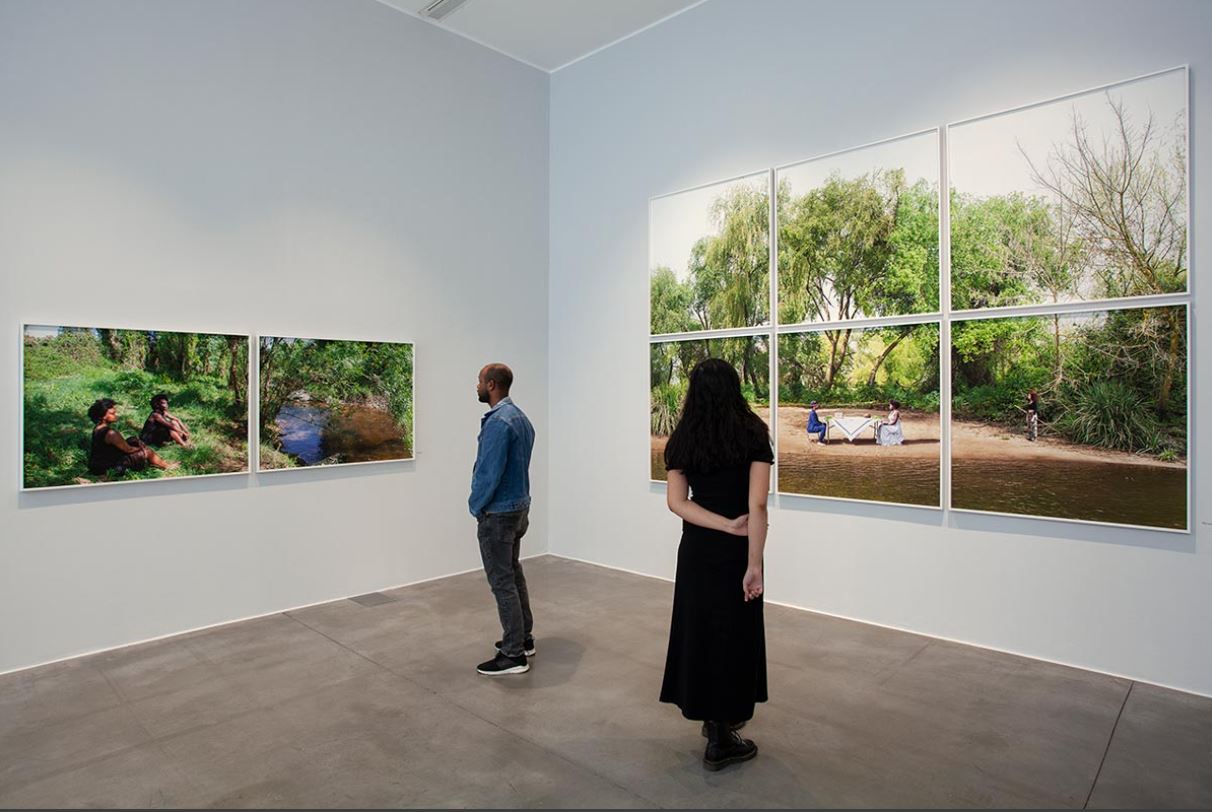
2. The main exhibition space downstairs contains half a dozen still photographs from the film. These have been blown up to large scale and cut up into a number of perfectly symmetrical separate frames. So one still from the film may be cut up into two, four or six separate sections, each beautifully framed and placed with mathematical precision on the white walls.

Installation view of photographic stills from ‘The Island’ by Mónica de Miranda at Autograph

They are all large, digitally clear, very calming images of a handful of people in lovely rural settings. Presumably they’re in Portugal, maybe even in Angola, but the lack of tropical foliage, and the look of the trees often made it feel like somewhere in the Thames Valley.

There are only about 6 of these big cut-up photos in the entire exhibition space. It makes for clarity and calm. It’s a very mindful experience.

The film

The problem with making any kind of art film must be persuading the audience to sit all the way through it. I wonder if there’s any data, from any gallery, of what percentage of visitors make it all the way through an art film. I watched about ten minutes of it.

During that time a striking, statuesque black woman wearing a long white dress stood in a haunting, abandoned quarry. Then she was wearing a bright red jacket trimmed with gold epaulettes and standing in what looked like a ruined outdoor auditorium with tiers of concrete benches.

Still from ‘The Island’ by Mónica de Miranda @ Autograph © Mónica de Miranda

Two young black women wearing black jumpers and red berets (the uniform, I think, of 1970s radicals) walked along paths through woods. The same two women wearing white dresses played on a hilltop with panoramic views over a wooded landscape. Without warning they are suddenly wearing Regency era dresses. Time jumps. Different historical eras are overlapped, photoshopped. At another point we see them sitting on a fallen tree half-sunk in a lake (see image at the start of this review).

The statuesque woman sat on some rocks. She was joined by a handsome black man. Cut to the same couple sitting down at a table placed just so on the sandy bank of a river. Long lazy tracking shots of the riverbank, as from a boat slowly drifting along the river.

Three points:

1. It’s all shot in a slow, classic style i.e. all the shots are long and lingering, they’re all set up to give full view of the scene. It’s consciously beautiful, especially the shots in the abandoned quarry, now filled with a huge pool of deep green water, some of which were really haunting.

‘Whistle for the Wind’ from ‘The Island’ by Mónica de Miranda (2021) © Mónica de Miranda

2. But more striking is the words. There are frequent shots of the striking woman speaking deep and meaningful sentences while staring into the middle distance. When she and the handsome man sit down at the dinner table on the river bank they don’t chat, they declaim more deep and meaningful sentences. As the two young women pick flowers in the woods, or walk through woodland paths or hold hands and spin round on the hilltop, there’s a voiceover of the same kind of deep and meaningful commentary. All spoken in a rich Portuguese accent, heavy on ‘sh’ sounds, sounding more East European than Latin.

I can’t find a transcript anywhere online. All I can find is the text accompanying the trailer on YouTube, where the voiceover tells us:

Do not stay lost.
Do not stay forgotten.
Do not lose the memory of who you are.
Breathe!

All the voiceover for the ten or so minutes I saw is like this. It, could have been copied from any one of the hundreds of books which fill the Spirituality and Mindfulness sections of bookshops. Like mottos from a series of inspirational posters. From the same place as the famous ‘Desiderate’ prose poem of healing advice:

Go placidly amid the noise and the haste, and remember what peace there may be in silence…

Either you like this kind of thing or you don’t. Chacun à son goût. Personally, I found it very relaxing. My companion had to stifle her titters.

Thirdly, the music. It’s very, very low-key, slowly-changing chords generated by some kind of synthesiser or electronic instruments i.e. not orchestra or pop music etc. It’s ambient, relaxing and lulling. It reminds me of Brian Eno’s ambient albums from the 70s and 80s.

The combination of the bland bromides of the voiceover, sensitively read in a rich Portuguese accent, the slow ambient music, and the lazy tracking shots of the riverbank, of girls walking through woods, of the striking woman standing in abandoned sites…explain why after ten or 12 minutes I fell slowly, lazily asleep. I think I was woken up by my own snoring.

‘Ground Work’ from ‘The Island’ by Mónica de Miranda (2021) © Mónica de Miranda

The curators’ version

The curator’s commentary accompanying the show wants us to believe that de Miranda:

deploys the metaphor of the island as a utopian place of isolation, refuge, and escape: a space for collective imaginings that speak to new and old freedoms. Anchored in cultural affinities and ecofeminism, the artist considers soil as an organic repository of time and memory, where ancestral and ecological trauma linked to colonial excavations continue to unfold. The Island urges us to develop a more conscious relationship between our bodies, the past and the lands we inhabit – and all that they hold – towards regenerative possible futures.

The visitor is free to take these ideas and spin them on into complex post-colonial critiques, pondering empire, slavery, colonialism, gender and ethnicity, all the usual topics of contemporary art.

But as an actual sensory experience the film, and then the big white room full of beautiful photos, are wonderfully calming, relaxing and healing. If you’re in that part of London on one of the days when Autograph is open, it’s worth making a detour to experience a chilled half hour of these calm and healing music and images.


Related links

Angola reviews

In case you get the impression that Angola is all beautiful woods, picturesque ruins and spiritual ladies, here are reviews of books by people who’ve worked in or visited this tragic, war-torn country recently.

Other Autograph exhibitions

More photography reviews

The odes of Horace

The gods watch over me; a heart
That’s reverent and the poets art
Please them.
(Horace Book 1, ode 17, in James Michie’s translation)

Come, learn this air
And sing it to delight me.
A good song can repair
The ravages inflicted by black care.
(Book 4, ode 11)

Horace’s works

Scholars broadly agree the following dates for Horace’s body of poetry:

Horace’s odes

Horace published 104 odes. They are divided into 4 books. He published the first 3 books of odes in 23 BC, containing 88 carmina or songs. He prided himself on the skill with which he adapted a wide variety of Greek metres to suit Latin, which is a more concise, pithy and sententious language than Greek.

I shall be renowned
As one who, poor-born, rose and pioneered
A way to fit Greek rhythms to our tongue… (3.30)

Horace aimed to create interest by varying the metre as much as possible, using over a dozen different verse formats. He was particularly indebted to metres associated with two Greek poets, Alcaeus and Sappho. Of the 104 odes, 37 are in Alcaics and 26 in Sapphics i.e. over half.

The precise definition of these forms is highly technical, so I refer you to the Wikipedia articles for Alcaics and Sapphics.

Despite all this skillful adaptation, the odes were not greeted with the acclaim Horace hoped for, which may explain why he seems to have abandoned ode writing and returned to the hexameters in which he had written the satires. Using this he now proceeded to write two books of epistles, ‘elegant and witty reflections on literature and morality,’ according to James Michie, which scholars think were published in 20 and 12 BC, respectively.

In 17 BC Augustus commissioned Horace to write an ode to be sung at the start of the Secular Games which he had reinstated as part of his policy of reviving traditional Roman festivals, customs and religious ceremonies. Soon afterwards, Augustus asked Horace to write odes on the military victories of his grandsons Drusus and Tiberius. Whether these commissions renewed an interest in the form or spurred him to assemble works he’d been writing in the interim we don’t know but in about 11 BC Horace published his fourth, final and shortest book of odes, containing just 15 poems.

What is an ode?

The following is adapted from the Wikipedia definition:

An ode (from Ancient Greek: ᾠδή, romanized: ōdḗ) is a sub-type of lyrical poem. An ode generally praises or glorifies an event or individual. Whereas a pure lyric uses impassioned and emotional language, and a satire uses harsh and demotic language, an ode – insofar as it is an address to a named individual, whether friend, emperor or god – generally has a dignified and sincere tone (although part of Horace’s practice was experimenting with and varying that tone).

Greek odes were originally poetic pieces performed with musical accompaniment. As time passed they gradually became known as personal lyrical compositions whether sung (with or without musical instruments) or merely recited (always with accompaniment). The primary instruments used were the aulos and the lyre. There are three typical forms of odes: the Pindaric, Horatian, and irregular.

  • The typical Pindaric ode was structured into three major parts: the strophe, the antistrophe, and the epode. However, Horace’s odes do not follow this pattern.
  • Horatian odes do not have the three-part structure of Pindaric odes. They tend to be written as continuous blocks of verse, or, more often, are divided into four-line stanzas. It’s in this division into neat 4-line stanzas that they most imitate Greek lyricists such as Alcaeus and Anacreon.
  • Irregular odes use rhyme but not the three-part form of the Pindaric ode, nor the two- or four-line stanza of the Horatian ode.

An ode is short. I’ve recently read the Eclogues of Virgil which are fairly long and the Georgics which felt very long: Horace’s odes are the opposite. Some are as short as 8 lines, for example book 1 ode 30 and 4.10.

Subject matter

Horace was praised by critics for not just adapting the Greek forms of Alcaeus and Sappho to Latin, but filling them with details of the social life of Rome in the age of Augustus. He broadened the subject matter to cover a much wider range of subjects including love and jealousy, friendship and mourning, hymns to various gods, addresses to the all-powerful emperor Augustus, reflections on mortality, promotion of the golden mean and patriotic criticism of excess luxury and calls for society to return to the sterner, abstemious values of their Roman ancestors. There are several poems consisting entirely of eulogy to Augustus, describing him as a blessing to the nation, the only man who could bring peace and wishing him success in his military campaigns in the East. I enjoy John Dryden’s description of Horace as “a well-mannered court slave”. It doesn’t feel that when you read all his other poems, but when you read the Augustus ones, you immediately get what Dryden was saying. The word ‘poet’ is only one letter away from ‘pet’.

Underlying all the poems, and appearing them as either passing references or the central subject, are two ‘philosophical’ themes: the uncertainty and transience of life, and the need to observe moderation in all things, what Aristotle had defined as ‘the golden mean’ between extremes:

All who love safety make their prize
The golden mean and hate extremes… (2.10)

James Michie

Greek and Latin poets did not use rhyme to structure their poetry, they used the counting of syllables in each line according to a variety of patterns established by various ancient Greek poets and copied and adapted by the Romans.

English poets by contrast, since the Middle Ages, use beats or emphasis instead of counting syllables, and have used rhyme. Not exclusively, witness the reams of blank verse used in the dramas of Shakespeare and his contemporaries or in Milton’s Paradise Lost, but certainly in short lyrics and Horace’s odes are short lyrics. All 104 of Horace’s odes fit onto just 114 pages of English verse.

This explains the decision of James Michie, translator of the 1964 Penguin paperback edition of the complete odes of Horace, to cast them into predominantly rhymed verse.

The Penguin edition is interesting and/or useful because it features the Latin on one page, with Michie’s English translation on the page opposite. I did Latin GCSE and so, with a bit of effort, can correlate the English words to the original Latin phrases, though I don’t have anything like enough Latin to appreciate Horace’s style.

Book 1 is the longest, containing 38 odes. Book 2 has 20. Book 3 has 30, and the final, short one, book 4, has 15.

Themes

Direct address to gods

Any summary of Horace as the poet of friendship and conviviality has to take account that about one in six of the poems are straight religious hymns to named deities. Michie’s (admirably brief) introduction explains that the poems give no evidence about how sincerely Horace felt these religious sentiments. Probably he was religious in the same way most educated Romans of his time were, as Cicero was: viewing religion and the old festivals and ceremonies as important for the social cohesion of Rome.

In this view the correct ceremonies had to be carried out on the correct occasions to the correct deities in order to ensure the state’s security and future. Whether an individual ‘believed’ in the gods or not was irrelevant: correct action was all. The importance of internal, psychological ‘belief’ only became an issue with the slow arrival of Christianity well over a hundred years later. In the meantime, correct invocations of the gods could be seen as part of civic and patriotic duty, especially for Augustus, who in so many ways tried to restore the old ceremonies, rites and festivals of Republican Rome.

1.10 To Mercury

You are the one my poem sings –
The lyre’s inventor; he who brings
Heaven’s messages; the witty
Adventurer who takes delight
In slyly stowing out of sight
Anything he finds pretty.

1.21 To Diana

Virgin maidens, praise Diana.
Young men, sing a like hosanna

1.30 Prayer to Venus

O Queen of Cnidos, Paphos,
Come, leave, though dearly thine,
Cyprus; for here’s thick incense,
And Glycera calls divine
Venus to her new shrine.

1.31 Prayer to Apollo

What boon, Apollo, what does the poet as
He pours the new wine out of the bowl at your
New shrine request?

Incidentally, note the slight complexity of this long sentence. It took me a few readings to realise it is:

What boon, Apollo, what does the poet (as
He pours the new wine out of the bowl at your
New shrine) request?

We’ll come back to this issue, the sometimes grammatically challenging nature of Michie’s translation.

1.35 Hymn to Fortuna

O goddess ruling over favoured Antium,
With power to raise our perishable bodies
From low degree or turn
The pomp of triumph into funeral,

Thee the poor farmer with his worried prayer
Propitiates…

To women

The poems of heterosexual men are often about difficulties with relationships. Horace has poems directly addressing women, lovers, more often ex-lovers; or addressing women who are messing with his friends’ emotions; or poems to male friends offering advice about their relationships with women. I can see how a feminist critic might object to Horace’s basic stance and to much of the detail of what he says. For me the main effect is to create a sense of the extended social circle the poet inhabits.

Come, let’s
Go to the cave of love
And look for music in a jollier key. (2.1)

Horace plays at being jealous, while never achieving the emotional intensity of Catullus. And this is because his ‘love’ poems, such as 1.13, often turn out to be really promoting his philosophy of life, namely moderation in all things, wine, women, politics and poetry.

1.13 To Lydia

Happy are they alone whom affections hold
Inseparable united; those who stay
Friends without quarrels, and who cannot be torn away
From each other’s arms until their dying day.

1.16 is addressed to an unnamed women who he has, apparently, infuriated by writing a witty lampoon about her. Horace apologises unreservedly for upsetting her. But the poem is really about the emotion of anger, how ruinous it is for individuals and nations, how it must be avoided at all costs. Moments like this accumulate to make you suspect that even Horace’s most ‘passionate’ poems are clever artifice. It is hard to imagine the poet who promoted moderation and sensible restraint at every opportunity ever losing his head over anyone, no matter how he poses.

1.19 The Poet’s Love for Glycera

The Mother of the Loves, unkindly
Goddess, and Semele’s son combine
With wild abandon to remind me
That though I had thought desire
Dead, it still burns. The fire

Is Glycera.

1.23 To Chloe

This is such fun I’ll quote it in its entirety. Whether it reflects any real situation, I doubt. It feels more like a witty exercise, in the manner of Marvell’s To His Coy Mistress. To understand it you need to realise the first line means ‘Chloe, why won’t you venture near ME’, but Michie cannot quite say that in order to preserve his tight rhyme scheme. And to know that ‘dam’ is an archaic poetic word for ‘mother’. So that the majority of the poem is treating this young woman, Chloe, as if she is as timorous and scared as Bambi.

Chloe, you will not venture near,
Just like a lost young mountain deer
Seeking her frantic dam; for her each
Gust in the trees is a needless fear.

Whether the spring-announcing breeze
Shudders the light leaves or she sees
The brambles twitched by a green lizard,
Panic sets racing her heart and knees.

Am I a fierce Gaetulian
Lion or some tiger with a plan
To seize and maul you? Come, now, leave your
Mother: you’re ready to know a man.

So, in fact, this middle-aged man is preparing ‘to seize and maul’ this timorous young woman. If we attribute the speaking voice to 40-something Horace, it is inappropriate. But if it is a song to be sung by any young man, less so.

Here he is gently mocking a friend (in fact a fellow poet, Tibullus) because his girlfriend’s dumped him:

Tibullus, give up this extravagant grieving
For a sweetheart turned sour. ‘Why was she deceiving?’
You ask, and then whimper long elegies on
The theme of the older man being outshone… (1.33)

In praise of booze

Horace is surprisingly insistent on the blessings of wine and the vine, with a number of poems recommending it as the appropriate accompaniment to all sorts of situations, from cheering up a doleful lover to consoling a parent for the loss of a child, celebrating an old friend having his citizenship restored or safely returned from a long journey (1.36), or just a way to forget sorrows and anxieties and be sociable (2.11). In ancient Rome wine was never drunk neat, but always diluted with water:

Come, boy, look sharp. Let the healths rip!
To midnight! The new moon! The augurship
Of our Murena! Mix the bowls – diluted
With three or nine parts wine: tastes must be suited.
The poet, who loves the Muses’ number, nine,
Inspired, demands that measure of pure wine. (3.19)

Above all wine was shared. In ancient Rome wine was drunk in social situations, among friends and with slaves to open the bottles and mix them correctly. In Horace’s day, men who got together to hold a convivial evening elected one of their number ‘president’ by rolling dice to see who got the highest score, and the president then selected which wines were to be drunk, in which order, to command the slaves, and institute topics of conversation or games.

Who’ll win the right to be
Lord of the revelry
By dicing highest? (2.7)

In other words, ‘wine’ symbolises not just a drink but a much deeper concept of sociability and conviviality. And importantly, this sociability was the cure for anxiety, depression and grief. So ‘wine’ isn’t at all about seeking intoxication or oblivion; quite the opposite: ‘wine’ symbolises the moderation and sociable common sense which Horace is always promoting. Even when he appears to be promoting booze, it’s really this idea he’s promoting.

Let Damalis, the girl we crown
Champion drinker, be put down
By Bassus at the game of sinking
A whole cup without breath or blinking. (1.36)

And, as with almost all aspects of Roman life, there was a ‘religious’ aspect in the sense that the Romans thanked the gods for all their blessings (just as they attributed all disasters to the malign influence of Fortune). It was ‘fitting’ to thank the gods, and often this was done with ‘libations’ i.e. pouring part of each bottle of wine onto the ground as an offering to the gods, as thanks for blessings received, as hope for blessings continued.

Pay Jove his feast, then. In my laurel’s shade
Stretch out the bones that long campaigns have made
Weary. Your wine’s been waiting
For years: no hesitating! (2.7)

In the following extract the ‘fast-greying tops’ means the greying heads of hair of Horace and his friend, Quinctilius, who he’s trying to persuade to stop being so anxious about life.

Futurity is infinite:
Why tax the brain with plans for it?
Better by this tall plane or pine
To sprawl and while we may, drink wine
And grace with Syrian balsam drops
And roses these fast-greying tops.
Bacchus shoos off the wolves of worry. (2.11)

1.11 carpe diem, quam minimum credula postero

Horace’s attitude overlaps with the modern notion of mindfulness. According to this website, ‘Mindfulness is the basic human ability to be fully present, aware of where we are and what we’re doing, and not overly reactive or overwhelmed by what’s going on around us. As he tells Maecenas:

Be a plain citizen for once – you fret
Too much about the people’s sufferings.
Relax. Take what the hour gives, gladly. Let
Others attend the graver side of things. (3.8)

The shame of recent Roman history i.e. the civil wars

This attitude is not bourgeois complacency (‘Hey slave, bring us more booze!’). Well, OK, it is – but it is given more bite by the historical background. Rome had just emerged from about 13 years of civil war (Antony and Octavian against Caesar’s assassins) or a very uneasy peace leading to another civil war (Octavian against Antony). Unlike most bourgeois Horace had led a legion in a major battle (Philippi), seen men hacked to pieces around him, and seen his cause completely crushed. What good had the assassination of Julius Caesar and then Brutus and Cassius’s war against Octavian and Antony achieved? Nothing. Absolutely nothing except tens of thousands of Roman dead and devastation of entire provinces.

And he refers to it repeatedly, the utter pointlessness and futility of war.

Alas, the shameful past – our scars, our crimes, our
Fratricides! This hardened generation
Has winced at nothing, left
No horror unexplored… (1.35)

Our fields are rich with Roman
Dead and not one lacks graves to speak against our
Impious battles. Even
Parthia can hear the ruin of the West. (2.1)

So Horace’s is not the complacent attitude of a pampered aristocrat who has never known trouble, but of a self-made man who has seen a whole lot of trouble and therefore knows the true value of peace. Although he wears it lightly, it is a hard-won philosophy. And he refers to it, repeatedly.

Greek mythology

Horace is so identified in my mind with Rome, with Augustus, with the golden age of Roman literature, that it comes as a shock to see just how much of the subject matter is Greek. Take 1.15 which is a dramatic address to Paris as he abducts Helen by the sea goddess Nereus, foreseeing the long siege and destruction of Troy. 2.4 is about inappropriate love but stuffed with examples from Troy. But all of the poems contain references to Greek mythology and require a good working knowledge of its complex family trees: just who is son of Latona, who is Semele’s son? Who are:

Yet how could mighty Mimas or Typhoeus
Or Rhoetus or Porphyrion for all hid
Colossal rage or fierce
Enceladus who tore up trees for darts

Succeed? (3.4)

Or take the long poem 3.27 which contains a rather moving soliloquy by the maid Europa who, in a fit of madness, let herself be raped by a bull, a sophisticated poem full of unexpected compassion for the miserable young woman who is, of course, Jupiter in disguise. The poem contains a twist in the tail, for Venus has been standing by all through the girl’s frantic speech, enjoying the scene with that detached cruelty typical of the gods and only at the end reveals the bull in question was none other than Jupiter in disguise, hence explaining the girl’s powerlessness to resist.

False modesty

That said, there is another repeated trope which, as it were, modifies the Hellenic influence and this is Horace’s stock protestations that his muse and lyre and skill aren’t up to epic or serious verse, are instead designed for more homely, lowly subject matter. He turns this into a joke on a couple of occasions when he’s getting carried away invoking the Mighty Warriors of the Trojan War and suddenly realises what he’s doing, back pedals and dials it down.

Where are you rambling, Muse? This theme’s beyond your
Light-hearted lyre. End now. Absurd presumption
To tell tales of the gods
And mar high matters with your reedy voice! (3.3)

Maybe 1.6 is the best expression of this repeated trope of inadequacy. To understand it you need to know that Varius is a rival Roman poet, famous for his high-flown tragedies, and that the poem is directly addressed to Marcus Vipsanius Agrippa, the Roman general who Augustus relied on to win his battles.

That eagle of Homeric wing,
Varius, will in due course sing
Your courage and your conquests, every deed
Of daring that our forces,
Riding on ships or horses
Accomplish with Agrippa in the lead.

But I’m not strong enough to try
Such epic flights. For themes as high
As iron Achilles in his savage pique,
Crafty Ulysses homing
After long ocean-roaming,
Or Pelops’ house of blood, my wings feel weak.

And both my modesty and my Muse,
Who tunes her lyre to peace, refuse
To let her tarnish in the laureate’s part
Our glorious Augustus’
Or your own battle-lustres
With my imperfect and unpolished art…

Feasts, and the war where girls’ trimmed nails
Scratch fiercely at besieging males –
These are the subjects that appeal to me,
Flippant, as is my fashion,
Whether the flame of passion
Has scorched me or has left me fancy-free.

As usual, the translation is fluent and clever, but I stumbled over the grammar of ‘Augustus” and it took me a few goes to realise he’s saying ‘my muse refuses to tarnish either Augustus’s, or your, battle-lustres’. Maybe you got it first time, but at quite a few places, Michie’s ingenuity in rhyming results in phrases which made me stumble. Anyway, here is Horace again, protesting the modesty of his poetic aims and means:

The history of the long Numantian war;
Iron Hannibal; the sea incarnadined
Off Sicily with Carthaginian gore;
Wild Lapiths fighting blind-

Drunk Centaurs; or the Giants who made the bright
Halls of old Saturn reel till Hercules
Tame them – you’d find my gentle lyre too slight
An instrument for these

Magnificent themes, Maecenas… (2.12)

Friends

The majority of the poems address a named individual, buttonholing and badgering them, and the number of these addressed poems, added to the variety of subject matter, creates a sense of great sociability, of a buzzing circle of friends. Horace comes over as a very sociable man with a word of advice for all his many friends, something which really struck me in the run of poems at the start of book 2:

Sallustius Crispus, you’re no friend of metal
Unless it’s made to gleam with healthy motion… (2.2)

Maintain and unmoved poise in adversity;
Likewise in luck, one free of extravagant
Joy. Bear in mind my admonition,
Dellius… (2.3)

Dear Phocian Xanthias, don’t feel ashamed
Of loving a servant… (2.4)

Septimius, my beloved friend,
Who’d go with me to the world’s end… (2.6)

Pompeius, chief of all my friends, with whom
I often ventured to the edge of doom
When Brutus led our line… (2.7)

Barine, if for perjured truth
Some punishment had ever hurt you –
One blemished nail or blackened tooth –
I might believe this show of virtue… (2.7)

The clouds disgorge a flood
Of rain; fields are churned mud;
The Caspian seas
Are persecuted by the pouncing blasts;
But, Valgius, my friend, no weather lasts
For ever… (2.9)

Licinius, to live wisely shun
The deep sea; on the other hand,
Straining to dodge the storm don’t run
Too close in to the jagged land… (2.10)

‘Is warlike Spain hatching a plot?’
You ask me anxiously. ‘And what
Of Scythia?’ My dear Quinctius
There’s a whole ocean guarding us.
Stop fretting… (2.11)

Male friends he addresses poems to include: Maecenas his patron and ‘inseperable friend’ (2.17), Virgil, Sestius, Plancus, Thaliarchus, Leuconoe, Tyndaris, Aristius Fuscus, Megilla of Opus, Iccius, Tibullus, Plotius Numida, Asinius Pollio, Sallustius Crispus, Quintus Dellius, Xanthias Phoceus, Septimius, Pompeius Varus, C. Valgius Rufus, Lucius Licinius Murena, Quinctius Hirpinus, Postumus, Aelius Lama, Telephus, Phidyle, Ligurinus, Julus, Torquatus, Caius Marcius Censorinus and Lollius.

The women he addresses include: Pyrrha, Lydia (who appears in 4 poems 1.8, 1.13, 1.25, 3.9), the unnamed lady of 1.16, Glycera (twice 1.19, 1.30, 1.33), Chloe, Barine, Asterie, Lyce, Chloris, Galatea and Phyllis.

All go to create the sense of a thriving active social life, an extended circle of friends and acquaintances which is very…urbane. Civilised, indulgent, luxurious:

Boy, fetch me wreaths, bring perfume, pour
Wine from a jar that can recall
Memories of the Marsian war… (3.14)

The predominant tone is of friendship and fondness and frank advice:

Then go, my Galatea, and, wherever
You choose, live happily… (3.27)

But the reader is left to wonder whether any of these people (apart from Maecenas and Virgil, and maybe one or two others) ever actually existed, or whether they are characters in the play of his imaginarium.

The simple life

Again and again Horace contrasts the anxious life of high officials in Rome with the simplicity of life on his farm out in the country, and the even simpler pleasures of life the peasants who live on it. The theme is elaborated at greatest length in one of the longest poems, 3.29, where Horace invites careworn Maecenas to come and stay on his farm, yet another excuse to repeat his injunction to Live in the Present, for nobody knows what the future holds.

Call him happy
And master of his own soul who every evening
Can say, ‘Today I have lived…’

Homosexuality

As long as a Roman citizen of the upper class married, sired male children and performed his religious and family duties, the details of his sexuality weren’t important, or might have prompted waspish gossip, but weren’t illegal. Homosexuality isn’t as prominent in Horace’s poetry as it is in Virgil’s, but it’s here as part of his urbane mockery of his own love life and one poem in particular, 4.1, is a passionate and surprisingly moving poem of unrequited love for a youth named Ligurinus.

Why then,
My Ligurinus, why
Should the reluctant-flowing tears surprise these dry
Cheeks, and my fluent tongue
Stumble in unbecoming silences among
Syllable? In dreams at night
I hold you in my arms, or toil behind your flight
Across the Martian Field,
Or chase through yielding waves the boy who will not yield.

This Ligurinus is (apparently) a pre-pubescent boy because another entire poem, 4.10, is devoted to him, pointing out that one day soon he’ll sprout a beard, his peaches and cream complexion will roughen, and he’ll no longer be the hairless beauty he is now.

It is very striking indeed that earlier in book 4 Horace writes a series of poems lamenting the decline and fall in Roman social standards, singling out greed and luxury, and also adultery which, of course, makes it difficult to determine the real father of a child – and yet this flagrantly homosexual and, possibly, if the boy is under 16 which seems pretty certain, pederastic poem, passes without comment and presents no obstacle to the poet’s earlier harsh moralising.

Sucking up to Augustus

As is fitting, the first poem in book 1 addresses his patron (and friend) Augustus’s minister for the arts, Maecenas. And the second poem addresses the boss man himself, Augustus, unquestioned supreme ruler of Rome and its empire, who is subsequently addressed at regular intervals throughout the series of poems. Here is Horace, addressing Jupiter king of the gods but describing Augustus (referred to here by the name of his adoptive great-uncle, Caesar, by which he was widely known, before the title ‘Augustus’ was bestowed in 27 BC):

Thou son of Saturn, father and protector
Of humankind, to thee Fate has entrusted
Care of great Caesar; govern, then, while Caesar
Holds the lieutenancy.

He, whether leading in entitled triumph
The Parthians now darkening Rome’s horizon,
The Indian or the Chinese peoples huddled
Close to the rising sun,

Shall, as thy right hand, deal the broad earth justice. (1.12)

Here Horace is asking the fickle goddess Fortune to protect Augustus and the Roman armies engaged in battle:

Guard Caesar bound for Britain at the world’s end,
Guard our young swarm of warriors on the wing now
To spread the fear of Rome
Into Arabia and the Red Sea coasts. (1.35)

1.37 includes a brief description of Octavian’s historic victory over the fleets of Antony and Cleopatra at the naval Battle of Actium in 31 BC.

Thunder in heaven confirms our faith – Jove rules there;
But here on earth Augustus shall be hailed as
God also, when he makes
New subjects of the Briton and the dour

Parthian. (3.5)

Incidentally, I don’t know why there are so many references to conquering Britain. In his long reign Augustus never sent armies to invade Britain, that was left to his great-nephew, the emperor Claudius, in 43 AD.

Book 4 contains noticeably more praise of Augustus (‘O shield of Italy and her imperial metropolis’) than the previous books: was it clearer than ever that the new regime was here to stay? Had Horace got closer to Augustus? Was it a shrewd political move to butter up the big man?

We know that Horace had been personally commissioned to write the two odes in praise of Drusus (4.4) and Tiberius (4.14) which overflow with slavish praise of their stepfather, Augustus, and the book includes a poem calling on Apollo to help him write the Centennial Hymn which Augustus commissioned (4.6). So this book contains more lickspittle emperor-worship than the previous 3 books combined.

How shall a zealous parliament or people
With due emolument and ample honours
Immortalise thy name
By inscription and commemorative page,

Augustus, O pre-eminent of princes
Wherever sunlight makes inhabitable
The earth? (4.14)

And the final ode in the entire series, 4.15, is another extended hymn of praise to Augustus’s peerless achievements.

Book 4

In his edition of Horace’s satires, Professor Nial Rudd points out that book 4, published about 12 years after books 1 to 3, has a definite autumnal feeling. Virgil is dead (19 BC) and Horace’s patron, Maecenas, no longer plays the central role he had done a decade earlier. The odes to Tiberius and Drusus highlight that a new young generation is coming up, and Horace refers to his own grey hair and age. Had Maecenas previously formed a buffer between him and the emperor, and, with his declining influence, has the emperor become more demanding of direct praise?

Famous phrases

It’s difficult for a non-Latinist to really be sure of but all the scholars and translators assure us that Horace had a way with a phrase and that this meant he coined numerous quotations used by later generations.

Probably the three most famous are ‘carpe diem’ and ‘nunc est bibendum’ and ‘dulce et decorum est’, from 1.11, 1.37 and 3.2, respectively. Here’s the source Latin and Michie’s translations of each instance:

Carmen 1.11 (complete)

Tu ne quaesieris (scire nefas) quem mihi, quem tibi
finem di dederint, Leuconoe, nec Babylonios
temptaris numeros. Ut melius quicquid erit pati!
Seu pluris hiemes seu tribuit Iuppiter ultimam,
quae nunc oppositis debilitat pumicibus mare 5
Tyrrhenum, sapias, vina liques et spatio brevi
spem longam reseces. Dum loquimur, fugerit invida
aetas: carpe diem, quam minimum credula postero.

Don’t ask (we may not know), Leuconie,
What the gods plan for you and me.
Leave the Chaldees to parse
The sentence of the stars.

Better to bear the outcome, good or bad,
Whether Jove purposes to add
Fresh winters to the past
Or to make this the last

Which now tires out the Tuscan sea and mocks
Its strength with barricades of rocks.
Be wise, strain clear the wine
And prune the rambling vine

Of expectation. Life’s short. Even while
We talk, Time, hateful, runs a mile.
Don’t trust tomorrow’s bough
For fruit. Pluck this, here, now.

Carmen 1.37 (opening stanza)

Nunc est bibendum, nunc pede libero
pulsanda tellus, nunc Saliaribus
ornare pulvinar deorum
tempus erat dapibus, sodales…

Today is the day to drink and dance on. Dance, then,
Merrily, friends, till the earth shakes. Now let us
Rival the priests of Mars
With feasts to deck the couches of the gods…

3.2 comes from the series of 6 poems which open book 3, which are longer than usual and adopt quite a strict scolding tone, instructing Romans of his day to abandon luxury and return to the noble warrior values of their ancestors. It needs to be read in that context:

Carmen 3.2 (Opening only)

Angustam amice pauperiem pati
robustus acri militia puer
condiscat et Parthos ferocis
vexet eques metuendus hasta

vitamque sub divo et trepidis agat
in rebus. Illum ex moenibus hosticis
matrona bellantis tyranni
prospiciens et adulta virgo

suspiret, eheu, ne rudis agminum
sponsus lacessat regius asperum
tactu leonem, quem cruenta
per medias rapit ira caedes.

Dulce et decorum est pro patria mori:
mors et fugacem persequitur virum
nec parcit inbellis iuventae
poplitibus timidove tergo…

Disciplined in the school of hard campaigning,
Let the young Roman study how to bear
Rigorous difficulties without complaining,
And camp with danger in the open air,

And with his horse and lance become the scourge of
Wild Parthians. From the ramparts of the town
Of the warring king, the princess on the verge of
Womanhood with her mother shall look down

And sigh, ‘Ah, royal lover, still a stranger
To battle, do not recklessly excite
That lion, savage to touch, whom murderous anger
Drives headlong through the thickest of the fight.’

The glorious and the decent way of dying
Is for one’s country. Run, and death will seize
You no less surely. The young coward, flying,
Gets his quietus in his back and knees…

Two points. One, quite obviously ancient Rome was an extremely militarised society with all its politicians expected to have served in the army or, as consuls, be sent off in command of armies in umpteen foreign campaigns. Two, with this in mind it’s worth pointing out that the poem goes on to contrast the glory won by death in battle with the vulgar world of democratic politics and elections.

Unconscious of mere loss of votes and shining
With honours that the mob’s breath cannot dim,
True worth is not found raising or resigning
The fasces at the wind of popular whim…

The fasces being the bundle of wooden rods, sometimes bound around an axe with its blade emerging, which was carried by the lictors who accompanied a consul everywhere during his term of office and which symbolised a magistrate’s power and jurisdiction.

Summary

Michie is very proficient indeed at rhyming. More than that, he enjoys showing off his skill:

Boys, give Tempe praise meanwhile and
Delos, the god’s birthday island. (1.21)

A cheap hag haunting alley places
On moonless nights when the wind from Thrace is
Rising and raging… (1.25)

When the brigade of Giants
In impious defiance… (2.19)

But I think the cumulative effect of so much dazzling ingenuity is that sometimes  the poems reek more of cleverness for its own sake than the kind of dignified tone which the Latinists describe as having. At times the cleverness of his rhyming overshadows the sense.

Boy, I detest the Persian style
Of elaboration. Garlands bore me
Laced up with lime-bark. Don’t run a mile
To find the last rose of summer for me. (1.38)

Throughout the book, in pretty much every poem, although I could read the words, I struggled to understand what the poem was about. I had to read most of them 2 or 3 times to understand what was going on. Half way through, I stumbled upon the one-sentence summaries of each ode given on the Wikipedia page about the Odes. This was a lifesaver, a game changer. From that point on, I read the one-sentence summary of each poem to find out who it was addressed to and what it was about – and so was freed to enjoy how it was constructed, and the slickness of Michie’s translations.

Bless this life

Above all, be happy. Life is short. Count each day as a blessing.

Try not to guess what lies in the future, but,
As Fortune deals days, enter them into your
Life’s book as windfalls, credit items,
Gratefully… (1.9)

You can see why all the translators, scholars and commentators on Horace describe him as a friendly, reassuring presence. A poet to take down off your shelves and read whenever you need to feel sensible and grounded.


Related links

Roman reviews