
Autograph is a small but stylish gallery over towards Shoreditch which specialises in Black photographers. To be precise:
Established in 1988, Autograph’s mission is to champion the work of artists who use photography and film to highlight questions of race, representation, human rights and social justice.
Its exhibitions are consistently excellent and are FREE.
Ernest Cole potted biography
There are two Ernest Cole exhibitions on in London at the moment. A big show at the Photographers’ Gallery in Soho displays nearly 100 photos from his landmark book, ‘A House of Bondage‘. This recorded in unflinching photos and sometimes harrowing documentary prose life for oppressed Blacks in the apartheid South Africa which Cole grew up in.
In 1966 Cole left South Africa with a case full of his negatives. He went to New York where the contacts he’d built up in his five years as a freelance photographer paid off. He showed the work to editors from Magnum Photos who took it up and got him a book publishing deal, and ‘A House of Bondage’ was written and published the following year (1967).
In America
But then he found himself, an outsider, with some but not many contacts, in the relentlessly competitive world of New York photography, magazines, newspapers and so on. So, on the back of the critical and commercial success of ‘Bondage’ he conceived several projects. The Autograph exhibition features quotes from letters Cole wrote and interviews he gave. Several of the letters are to arts funding organisations and in one of them (to the Ford Foundation) he mentions two specific photo projects he was seeking funding for, ‘The Negro in the Rural South’ and ‘A Study of Negro Life in the City’.
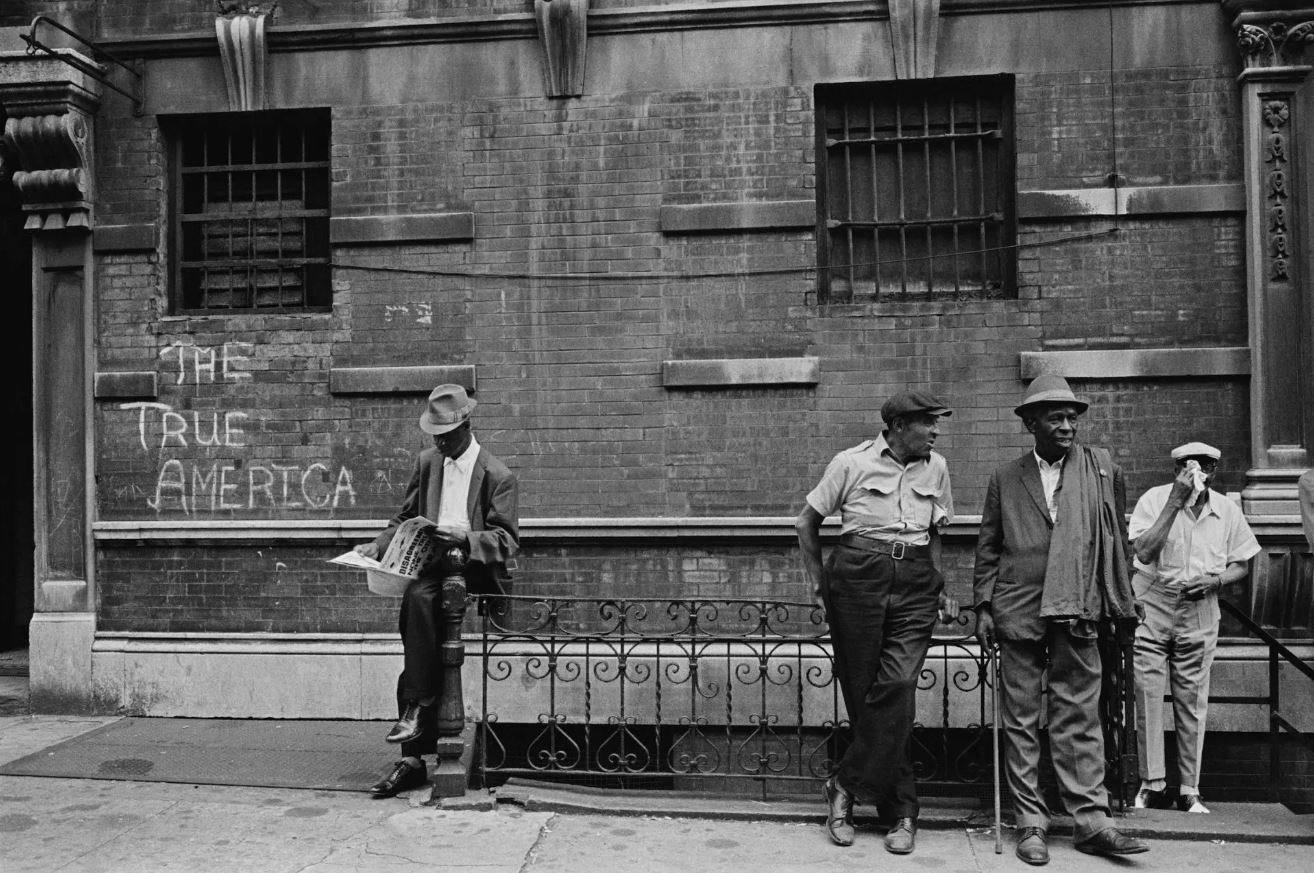
Cole travelled to the South to take photos of poor rural communities but, as far as I can make out, none of these photos have surfaced. For the second project Cole took thousands and thousands of photographs of New York street life, specifically the street life of Harlem, the part of Manhattan Island above 96th Street which was, at the time, almost entirely populated by the Black community. Most are in black and white but about a quarter are in a vibrant but beautifully dated and nostalgic colour.

Harlem, New York City, about 1970 by Ernest Cole © Ernest Cole / Magnum Photos
The rediscovered archive
The introduction to the show comes in the first (small) room. Here we learn from the wall caption that between 1967 and 1972 Cole took an estimated 40,000 photos (!). However, neither the city or rural projects was completed, no book was forthcoming, and Cole released very few of the photos during his lifetime. In the mid-’70s Cole’s life fell into disarray due to illness, he could get no work, he was sometimes reduced to homelessness and lost control of his archive. Surprisingly, despite the highly American provenance of all these images, he spent a lot of time in Sweden where he worked with a photography collective before dropping the medium altogether to take up film-making. He died of cancer back in New York City in February 1990 at the age of just 49.
What’s triggered this revival of interest in his work is that in 2017 a huge trove of his negatives was discovered in a Stockholm bank vault. As a result the Ernest Cole Family Trust was established to publicise and protect his legacy. This helps to explain the impetus behind the recent republication of ‘House of Bondage’ (2022) and the publication, now, finally, of his New York street photos, in a handsome volume titled The True America (2024).

Installation view of ‘Ernest Cole: A Lens in Exile’ at Autograph (photo by Kate Elliott)
‘Photography as a Social Weapon’
In the photo above you can see the small first room through the archway in the middle. In this space are displayed seven photos, the biographical wall label I’ve been quoting from, and a film. The film is a 5-minute clip from a long interview with Cole shot in 1969 and titled ‘Photography as a Social Weapon’. What comes over from this clip first and foremost is what a very charismatic and articulate man he was. But there are two main learnings from the interview:
1. The first is about the model for his vision. Cole tells us that the first ever photobook he got his hands on in South Africa inspired his vision and crystallised what he wanted to achieve. It was ‘People of Moscow’ by Henri Cartier-Bresson and he was inspired by the Frenchman’s way of capturing of the poetry of everyday life.
2. The second is his disillusionment. As he educated himself in South Africa (via a photography correspondence course from England and by meeting artists and musicians) he heard about the United Nations and about the existence of an African-Asian bloc. They’ll save us, he thought; they’ll intervene in South Africa to overthrow the evil apartheid system. But when he arrived in New York he slowly realised that South Africa was just one item on the agenda of its regular meetings, that the same countries stood up and made the same loud criticism of SA, and then the meeting moved onto the next item. Nobody was going to intervene. It was up to Black South Africans to liberate themselves.
And this was part of a broader disillusionment with American society. In the interview he expressed a hope of being liberated from the day-to-day experience of racism which had made life so unbearable in South Africa. But everywhere he went (and the label tells us he visited Chicago, Cleveland, Memphis, Atlanta and Los Angeles, as well as rural areas of the South) he found American Blacks to be poor and oppressed and discriminated against. Eventually he reached the devastating conclusion that Black people in America were no better off than Black people in apartheid South Africa. It was oppression everywhere.
He happened to travel American during the climax of the Civil Rights Movement, in the months either side of the assassination of Martin Luther King (4 April 1968) and in some of the photos captures the way many young Blacks had moved beyond King’s Christian faith in non-violent protest to believing that only direct, and potentially violent, action could liberate them. Hence also one of the best photos, of a proud young Black woman staring unflinchingly into the camera, wearing a lapel badge of herself carrying a submachine gun. Hence the several photos of Black Panthers looking uncompromising.

Black Panthers in the Park, Harlem, New York City 1968 by Ernest Cole © Ernest Cole / Magnum Photos
The main gallery contains 42 photos, 20 in colour and four of them blown up and printed on the wall. All of them are shots of people in the street, street scenes, a few posed but mostly spontaneous documentary shots. He had such a gift, he had such an eye for capturing people in their variety and humanity. I can’t show them all so will give a verbal summary.
There’s a drunk passed out on the sidewalk, a street vendor selling clams, a smartly dressed Black couple in downtown Manhattan, a kids playing with a hula hoop, another child held by his Dad brandishing a toy popgun. There’s a man wearing a billboard warning against the dangers of Dope!, there’s a couple of guys in African tribal dress sitting on an open-top car obviously going very slowly through a little mob of onlookers and bearing a placard reading ‘Don’t riot. Get wise. Go to Africa.’
In the same spirit there are three or four shots of what appears to be a motorcade of cars carrying placards depicting African leaders, namely Patrice Lumumba of the Congo and Marcus Garvey, the Jamaican politician and activist. As you might expect there are also some very stylish, cool and nattily dressed people: a cool all of woman wearing what I take to be an African outfit in a north African, Muslim style. A very cool dude wearing no shirt, just a loose gold embroidered waistcoat, a loose necktie and a purple hat, smoking a cigar.
Apart from anything else there’s a very strong nostalgic feel about lots of the images. As a boy I watched a range of TV shows from the late ’60s’ and early ’70s which featured not just Black but white hipsters and dudes, everyone wearing shades and cowboy hats and tasselled suede jackets and so on. Many of these photos, putting aside the race issue, evoke nostalgia for the street fashions of half a century ago.
There are hardly any white people in the photos. Two are very negative. One shows a middle-aged businessmen looking contemptuously, maybe angrily, at a Black couple having a snog in the lee of some building work. There’s a highly symbolic shot of a middle-aged Black shoeshine guy on his knees in front of a suited white man who is nonchalantly leafing through a wad of dollar bills – an upsetting emblem of money-colour-power dominating Black poverty and humiliation.
Harlem, New York, 1969 by Ernest Cole © Ernest Cole / Magnum Photos
And nowadays…?
As you walk round, and as you read the wall labels in which Cole described his disillusionment and growing sense that Blacks are oppressed everywhere, it’s impossible not to ponder the current situation of Black people.
It’s far too big a question for me to handle and, not being Black, my opinion is of questionable use anyway. We now have many Black people in positions of power and position. In the UK not long ago there was a Black Chancellor of the Exchequer and we currently have a Black Foreign Secretary. Black faces are increasingly prominent across public discourse, in the media of TV, film, theatre and art. But how that translates into everyday life, I have no idea. The Guardian reports almost daily of British institutions being called out for institutional racism, racism still (apparently) flourishes in the police, young Black men are five times as likely to be stopped and searched by the cops etc.
I read the news, I watch TV and movies and go to art exhibitions and see more and more Black faces, issues and discussions, but what Black life is like in the UK I haven’t a clue. And that’s just in England, my home country. I couldn’t possibly guess at the situation in the US, except for a) my awareness (like everyone else’s) of the Black Lives Matter movement which sprang up following the murder of George Floyd in May 2020, and b) the fact that all the media I read harp on constantly about ongoing racism and racial injustice in the States.
Anyway, I thought I’d end by mentioning that, in among the many street shots, there are a few more optimistic ones, which depict interracial couples arm-in-arm or hand-in-hand on the New York subway. It’s not much but, in their way, these are the opposite of the standing businessman and the kneeling shoeshine man, these are images of love and equality. If they hardly changed society at large – which, as I’ve just mentioned, appears to remain in many ways horribly unchanged – still, maybe they are images of hope that ordinary people can find their own ways to overcome prejudice and bigotry and to live the lives they want to.

Midtown Manhattan, New York, 1971 by Ernest Cole © Ernest Cole / Magnum Photos
Related links
- Ernest Cole: A Lens in Exile continues at Autograph until 12 October 2024
- Ernest Cole: House of Bondage is at The Photographers’ Gallery until 22 September 2024
- A good selection of images on the My Modern Met website


 Books & Boots