Zofia Rydet: Sociological Record @ the Photographers’ Gallery

In 1978, when she was 67, Polish artist and photographer Zofia Rydet (1911 to 1997) set out to photograph the inside of every Polish household. She would approach a home unannounced, knock and introduce herself, and ask the people living there if they would like to take part in her project. The result was her ‘Sociological Record’ (Zapis socjologiczny), a monumental project and one of the most important achievements in 20th century Polish photography – and this is a big exhibition devoted to the best and most representative images taken from this treasury.

Installation view of ‘Zofia Rydet: Sociological Record’ @ the Photographers’ Gallery showing a wall-sized blow-up of one of her thousands of interior photos (photo by the author)

Aim and timeframe

When she started the project, Rydet was already an artist with a well-established reputation. The Record aimed to satisfy her interest in The Home as a metaphor for human life, in the ways domestic interiors reflect personal people’s aesthetic, religious or political views, but are also repositories of histories and values which were fast disappearing.

Work on the ‘Sociological Record’ would eventually span over 12 years from 1978 to 1990, becoming an increasing obsession for Rydet as she approached the end of her life. During these years she photographed people in their homes, at their doorsteps, building exteriors and landscapes. She also returned to the same houses several years after she first visited to document the transformation of rural Poland.

Zofia Rydet at work in ‘Zofia Rydet: Sociological Record’ @ the Photographers’ Gallery

Historical background

The creation of Zofia Rydet’s ‘Sociological Record’ coincided with a turbulent period in Poland. In 1978 the country was under communist rule and sinking into a deepening economic crisis. This was the backdrop to the rise of the independent trade union Solidarity (Solidarność), a wave of strikes, and the imposition of martial law in December 1981. A long decade of repression ensued, ended only as the Soviet Union began to collapse, triggering the fall of communist regimes across the bloc, and the first free Polish elections in 1989.

Plentiful negatives and rare prints

The Record includes over 20,000 negatives taken in more than 200 provinces of Poland and abroad. By the mid-1980s, Rydet’s drive to document her subjects left no time to spend in the darkroom so she left numerous boxes of negatives. This exhibition focuses on the relatively rare number of prints the artist made in her lifetime alongside books and personal letters.

Installation view of ‘Zofia Rydet: Sociological Record’ @ the Photographers’ Gallery showing one wall covered with 63 examples of Rydet’s thousands of interior photos (photo by the author)

Over time the Record grew into a multifaceted work and developed into a number of subcategories and independent series. These include: Women on Doorsteps; the Myth of Photography; Windows; Professions; Presence; The Infinity of Distant Roads and more.

Although the work does include residents in towns and cities, most of the photographs focused on rural areas where she witnessed traditional ways of life and folk culture fast disappearing, and it’s these simple, rural dwellings and people who look like peasants, living in grim conditions, who the Record records.

A typical interior from ‘Sociological Record’ © Zofia Rydet, courtesy of the Zofia Rydet Foundation

On the Road

Many of Rydet’s journeys were undertaken by bus and this location or situation, too, evolved into an independent series. She always photographed from the front seat, behind the driver, making sure to capture the reflection in the mirror. A couple of examples are on show.

She also developed a series of photographs of roads and road signs, some of which would be incorporated into a subcategory titled ‘The Infinity of Distant Roads’ (Nieskończoność dalekich dróg).

Installation view of ‘Zofia Rydet: Sociological Record’ @ the Photographers’ Gallery showing part of a video about Rydet on the right, and on the left, one of her haunting shots of an empty road sweeping across a wet and windy landscape (photo by the author)

Categories and themes

Women on Doorsteps

Women on Doorsteps, or Standing Women, is the most consistently visualised sub-series within the ‘Sociological Record’. The women of the household would often be the first to greet Rydet on her field trips and, as such, they made a great impression on her.

Installation view of ‘Zofia Rydet: Sociological Record’ @ the Photographers’ Gallery showing examples from the ‘Women in Doorways’ series (photo by the author)

Like the work of Boris Mikhailov in the gallery above, Rydet’s work gains immeasurably from being organised into sets. The consistent composition and framing of the ‘Women in Doorways’ series allows you to dwell on the individuality – the great variety in shapes and sizes – not only of the women but of the doorways. After a while I found the design and construction of the walls and doorways as, if not more, fascinating than the people.

Houses

From shooting a doorway it’s only a few steps backwards (literally), to taking photos of the whole house and so a new category was born. The majority are rural homes and outbuildings which have been, as you can see, beautifully staged against a vast wall-sized blow-up of a particularly striking example.

Installation view of ‘Zofia Rydet: Sociological Record’ @ the Photographers’ Gallery showing examples from the series ‘Houses’ (photo by the author)

She chose distinctive structures, often with traditional designs, recognising the limited time many of them had remaining, as many were being cleared and rebuilt following the death or departure of their owners.

People in interiors

The idea of documenting the interiors of homes came to Rydet from a visit to a Polish car factory in Jelcz. Speaking to journalist and photographer Krystyna Łyczywek, she said:

‘There one of the factory halls had been turned into cubicles, office rooms. And although they were identical, they differed greatly from one another, because the people working there decorated them with whatever they liked to look at. You name it, it was there!… Beautiful girls and holy pictures, jazz idols and photos of children, hunters’ trophies and rosaries… Each of these individuals left the mark of their personality. And that’s how it all began…’

When Rydet started the project in 1978, her working method became quickly established. She would walk around a local area, knock on strangers’ doors, and ask to come in and take pictures. Rarely refused, she would then pose people against a wall, using a wide-angle lens and a strong flash to capture details in the often poorly lit interiors. The sitters were asked not to smile, in part a reflection of the importance she attached to the work but presumably also to ensure a consistency of approach.

Installation view of ‘Zofia Rydet: Sociological Record’ @ the Photographers’ Gallery showing 6 of the 70 or so interior shots (photo by the author)

Rydet wrote of the Record:

‘It is meant to faithfully show a person in their everyday environment, among that sort of shell they create for themselves, which on one hand becomes more of their intimate and private surroundings – the interior – but which also reveals their psyche, sometimes saying more about them than they themselves could.’

The title ‘Sociological Record’ was coined by Rydet’s friend, art historian and critic Urszula Czartoryska. Although Rydet adopted it, she had some reservations about its abstract and ‘scientific’ character.

Windows

Obviously, as well as specific rooms (bedroom, living room), houses have a number of distinct elements such as doors and windows. Alongside other aspects, Rydet came to realise that windows perform an important function, in fact a host of functions:

– In the low light of rural cottage interiors, the kitchen table is often placed by the window, a central focus of family life, revolving around shared meals and food preparation, repairing household items, conversations, and more.

– The window is also an opening onto the neighbourhood, a vantage point where private space turned outward, towards what was communal and external.

– Windows and window sills can also serve a decorative function, displaying plants, religious icons, and family photographs. They offer a kind of intensification of the personality or character of the owners.

Installation view of ‘Zofia Rydet: Sociological Record’ @ the Photographers’ Gallery showing some of the Window shots (photo by the author)

The Myth of Photography

This is a meta move. After photographing a certain number of domestic interiors, Rydet realised that an important part of many people’s interiors is other photographs. Often these are rare and precious objects portraying family members, or the now-ancient occupants of the houses as beautiful young couples.

These were often a specifically Polish artefact, the traditional hand-painted wedding photographs known as monidła. In these cases, she would sometimes pose her sitters holding their own photographs or would prop the images up to enhance the composition.

An old couple with a ‘monidło’ of themselves on their wedding day, from ‘Sociological Record’ © Zofia Rydet, courtesy of the Zofia Rydet Foundation

As soon as you think about it, you realise that photographic images have been freely available, even to the poorest households, and people can choose any images to ornament their lives or express their personalities. Older people have images of Polish politicians or historical figures or writers…

An impressive array of portraits of Polish patriotic figures hanging from someone’s ceiling, from ‘Sociological Record’ © Zofia Rydet, courtesy of the Zofia Rydet Foundation

Whereas it’s very noticeable that younger people decorated their rooms with image of western pop and lifestyle images.

A young Police fan surrounded by posters of her idols, from ‘Sociological Record’ © Zofia Rydet, courtesy of the Zofia Rydet Foundation

Presence

Of course the images most prevalent in older people’s homes were religious, Christian, images of Christ, the Virgin Mary and, of course, the famous Polish Pope, Pope John Paul II, head of the Catholic church from October 1978 until his death in 2005. The Pope was not only an immensely important spiritual figure through the 1970s and 80s but also supported the country’s political aspirations for system change and liberation from Soviet influence.

So it was inevitable that images of the Pope appear in so many of the interiors that Rydent decided to create another sub-genre of them, titled ‘Presence’. There’s no mention anywhere of whether Rydet herself was a person of faith. Here, as in so many of the photos and categories, it feels like she is recording and taxonomising, with no value judgements, precisely with the detachment of a sociologist recording what they see.

Installation view of ‘Zofia Rydet: Sociological Record’ @ the Photographers’ Gallery showing photos of Pope John Paul II in people’s homes (photo by the author)

Professions

Rydet was fascinated by folk culture and disappearing ways of life. This series of people at work particularly focuses on small workshops, local crafts and services, village shops and so on, places which, like the rural houses she photographed, were undergoing rapid modernisation or being abandoned by farmers migrating to cities.

Professions shown here include a postman, an artist, a sign maker, a tailor and teacher. The curators compare them to the German photographer August Sander’s epic project to document the people of his nation between the wars, or the famous Photography Unit of the Farm Security Administration program during the Great Depression in the United States. Which begs the question, why was this type of encyclopedic sociological project undertaken in Germany and the States in the 1930s, but not until half a century later in Poland?

Installation view of ‘Zofia Rydet: Sociological Record’ @ the Photographers’ Gallery showing small traders in their places of work (photo by the author)

Epitaph

The ‘Epitaph’ series was created in 1980 during a return visit to the Biadacz family in Upper Silesia. Following her first visit, Rydet returned to discover the elderly couple she had photographed had recently died. And so she photographed their wedding portrait, found in the empty house, against various backdrops – domestic objects, the yard, the field, the graveyard.

Installation view of ‘Zofia Rydet: Sociological Record’ @ the Photographers’ Gallery showing 9 shots from the ‘Epitaph’ series

Rydet wrote:

‘Not only people vanish, but also everything that surrounded them. Only photography can stop time. Only photography has the power to overcome the spectre of death, and that is my unending struggle with death and transience.’

Is that true? Can only photography stop time? I doubt it. It’s more that photography gives us a heightened sense of time passed, of the passage of time. Also, I know this was done out of kindness but it’s hard for the jaded Londoner not to detect a surreal aspect to this idealised double portrait popping up in a variety of locations.

Video


Related links

Related reviews

Boris Mikhailov: Ukrainian Diary @ the Photographers’ Gallery

From the press photos I wasn’t anticipating too much but ‘Boris Mikhailov: Ukrainian Diary’ turns out to be a really interesting and rewarding exhibition, fully deserving the two floors of gallery space given over to it.

First room of Boris Mikhailov: Ukrainian Diary @ the Photographers’ Gallery

One of the problems is the promotion web pages and images just show one photo at a time and some of them look a bit meh, don’t feel that good, as a group they don’t add up to a unified look’ etc. It’s only when you get to the exhibition that you realise a number of key facts which transform your understanding.

1. Amateur Boris Mikhailov got into photography by accident, had no formal training, and so was free to invent and make things up. A lot of these innovations are really interesting.

2. Articulate Mikhailov is a very good explainer of his own work, so the wall labels which explain it are not only informative but his explanations of his innovations are unusually inspiring and interesting.

3. Bad photography One of these was the simple idea of bad photography. In the Soviet Union photography was a profession like any other, heavily controlled by the state with approved styles and qualities to promote uplifting images of perfect life in the workers’ state.

Mikhailov opened up a whole new world when he realised that bad, out of focus, poorly framed, damaged images were themselves a valid aesthetic, and a political statement. Badly printed, damaged or poor-quality productions were, he realised, the appropriate response to the shabby reality of Soviet life: ‘lousy photography for a lousy reality’. This explains why some of the images, when seen in isolation on a web page are only meh, whereas seen en masse, and accompanied by an eloquent explanation, they gain so much more power.

4. Sets It also explains why Mikhailov’s images are conceived and designed to be seen in sets and the sets don’t just represent a new subject, but the best of them embody an entirely new technique and way of thinking about photography. As he explains:

‘The idea that a single picture contains maximum information is a lie; I don’t believe in absolute truth. Exploring something from many different angles gives you a heightened sense of the truth. I need the sum of the images, the sum of the sequences in order to cast doubt on the correctness of one single, possible perception. The vibration between the images expands their possibilities.’

Biography

Born in Kharkiv, Ukraine in 1938, Boris Mikhailov is a self-taught photographer. Having trained as an engineer, he was first introduced to photography when he was given a camera to document the state-owned factory where he worked. He took advantage of this opportunity to take nude photographs of his first wife – an act forbidden under Soviet norms – which he developed and printed in the factory’s laboratory. He was fired when the photographs were found by KGB agents. From then he pursued photography full time, using it as a subversive tool and operating as part of the underground art scene.

His work first gained international exposure in the 1990s with the series ‘Case History’, a shockingly direct portrayal of the realities of post-Soviet life in the Ukraine. Having learned of him via his post-USSR collapse photos, Western fans were then able to go back and review his subversive works from the 1970s and ’80s. This exhibition presents the complete body of his work in chronological order.

‘Ukrainian Diary’ brings together work from over twenty of Mikhailov’s most important series, including:

Slideshow: Yesterday’s Sandwich (mid-’60s to 1970s)

One day he threw a couple of slides onto his bed and they stuck together. When he held the stuck slides up to the light he realised they made a dramatically surreal image and hence was born the series ‘Yesterday’s Sandwich’. As he experimented with the technique he realised the juxtaposition of random images could be thought of as reflecting the dualism and contradictions of Soviet society.

His commentary is fascinating. He explains that the 60s and 70s were a time, in all the countries of the Soviet bloc, of hidden messages and secret codes. No-one took official propaganda seriously but all organs of free expression were ruthlessly suppressed. Hence codes and secret signs and hidden allusions. In actual fact no particular ‘message’ emerges from these images except a surreal subversion of the normal, logical, sensible everyday world.

Nearly 100 of these wonderfully funny, crazy, surreal images are here displayed as a slideshow projected onto the wall of a darkened space in the gallery. For some reason they are displayed to a severely edited version of the classic Pink Floyd album, Dark Side of the Moon’ which Mikhailov considers an ‘exaggeration of beauty’ conveying a kind of ‘paradise lost’. It makes it an even more surreal experience, watching images from a distant and vanished society accompanied by such a familiar homely soundtrack.

Installation view of Boris Mikhailov: Ukrainian Diary @ the Photographers’ Gallery showing one of the composite images in the Yesterday’s Sandwich slideshow (photo by the author)

Black Archive (1968 to 1979)

‘Black Archive’ documents everyday life in Kharkiv, often revealing the disparity between public life and private life in domestic spaces. Under Soviet rule it was forbidden to photograph everyday life and so Mikhailov was forced to hide his camera in order to take furtive snapshots, often taken from behind and at odd angles. By contrast, the private sphere of people’s apartments was a space of freedom, most vividly expressed in the carefree nudity of many of his subjects.

But in the series Mikhailov also deploys his concept of ‘bad photography’— the deliberate production of sloppily printed, blurred, and low-contrast images full of visible flaws — as a metaphor and a tool for social critique.

Red (1968 to 1978)

The set ‘Red’ brings together more than 70 images taken in Kharkiv in the late 1960s and 1970s, all of which contain the colour red. From the wall labels we learn that red was a powerful symbol of the Russian Revolution (1917) and of the Soviet Union (1922 to 1991). Its presence in these varied photos indicates the extent to which communist ideology saturated everyday life. As usual Mikhailov explains all this in his vivid and fascinating way:

‘The word “red” in Russian has the same root as the word for beauty, it also means revolution and evokes blood and the red flag. Everyone associated red with communism. But few people realised that red had permeated all our lives. Demonstrations and parades are an important part of this series. It’s a place where one of the main images of Soviet propaganda—the face of happy Soviet life, secure in its future—was created. They became absolutely kitschy and vulgar… I sometimes felt that I was surrounded by a herd of cynics, victims, and fools, followed by people wearing red ribbons as if they were policemen. As if the regime was using the people’s desire to celebrate for its own ends. And it was important to me to photograph them in such a way that you could tell the “Soviet” from the “human”.’

From the series ‘Red’ by Boris Mikhailov (1968-75) © Boris Mikhailov, VG Bild-Kunst, Bonn, Courtesy Boris and Vita Mikhailov

Luriki (Coloured Soviet Portraits) (1971 to 1985)

After losing his job as an engineer, Mikhailov managed to make a living as a commercial photographer, sometimes working on the black market, enlarging, retouching, and hand-colouring snapshots of weddings, newborns or family members lost in the war.

In what is considered the first use of found material in contemporary Soviet photography, Mikhailov then appropriated and reworked these manipulated photographs for his own practice. Often using vibrant or exaggerated colours, he made them more ‘beautiful’, staying within the law while simultaneously mocking the way Soviet propaganda glorified mundane events.

By means of these simple techniques, Luriki comically undermined the absurdity of the iconography of Soviet life. Grouped together, the pictures are like a Soviet family album, a collection of surreal, ridiculous situations.

Installation view of Boris Mikhailov: Ukrainian Diary @ the Photographers’ Gallery showing one of the Luriki images (photo by the author)

Dance (1978)

Apparently open-air dancing was a popular activity in Soviet Kharkiv. Mikhailov has a lovely set depicting people of all ages, sizes and shape, in 1970s Soviet clothes, sedately dancing, quite often women dancing with other women.

Installation view of Boris Mikhailov: Ukrainian Diary @ the Photographers’ Gallery showing some of the Dance photos (photo by the author)

Series of Four (early 1980s)

One wall is covered with these images grouped into sets of four. This came about by accident. Mikhailov set out to wander the streets of Kharkiv and take photos of nothing, of non-events, designed to capture the boredom and emptiness of Soviet life. But when he came to make contact prints he realised he didn’t have small-format paper so he put four images together on one sheet. At a stroke he realised he’d created something: the multiple points of view of the same scene creates complex effects. Suddenly a boring scene becomes part of a fragmented, multi-angled world. Presented in this way, they can also have a cinematic effect, telling a story in snapshots. And another effect is to create out of a mundane non-space a kind of cocoon, creating a compression of space, imbuing an anonymous nowhere with strange fugitive meanings.

Installation view of Boris Mikhailov: Ukrainian Diary @ the Photographers’ Gallery showing some of the Series of Four photos (photo by the author)

Crimean Snobbism (1982)

Mikhailov went to Gursuf, a seaside resort on the Crimean Peninsula and took portraits of himself, wife and friends frolicking by the seaside, adopting holiday poses etc. As with many of his sets, Mikhailov gave them a sepia tone, making them feel historic and detached from the present, and also suggesting their subversive intent. Because the entire set is intended as a parody of the kind of carefree, bourgeois lifestyle then associated with ‘the West’ and far beyond the reach of your average Ukrainian citizen, and which he satirises in phrases: ‘We’re so happy. We’re so beautiful. We’re so in love etc’.

Viscidity (1982)

In another interesting experiment, in the early 1980s Mikhailov started combining text and image together in a conceptual way: he glued his photographs carelessly onto sheets of paper, then scribbled thoughts—banal, poetic, or philosophical—in the margins. His fragmentary thoughts were not intended as captions, nor to illustrate or elucidate the photographs; they were often utterly unrelated to them and intended to be equally important, a composite reflection on the social stagnation of the Soviet Union.

‘Viscidity’ is the word he used to describe the period the country was living through at the time — ‘a peaceful, quiet, featureless, dull life, a time of deep political stagnation, a frozen day-to-dayness. There was no catharsis, no nostalgia, just grey, everyday life. Nothing was happening, nothing was at all interesting.’ Hence ‘lousy photographs with these lousy texts’, ‘unchanging ordinariness and timelessness.’

Unfinished dissertation (1984-5)

On the back of the tattered pages of a stranger’s university dissertation found in a rubbish bin, Mikhailov pasted poorly printed black-and-white photos of inconsequential moments and then jotted down his thoughts about art and life in the margins. The photos don’t synch with the text, neither shedding light on each other, except obliquely.

Salt Lake (1986)

Mikhailov’s father used to tell him about a salt lake in southern Ukraine where people went to bathe in the 1920s and ’30s, believing that the warm, salty water had healing properties. When Mikhailov went to visit himself he found the crowds of people on the beach near to a disused old factory, washing themselves in the factory pipes and smearing themselves with mud.

He found it ‘the quintessence of an average person’s life in the Soviet context. Despite the horrible, polluted, inhuman environment, the people were relaxed, calm, and happy.’ To the modern Western ye, this looks like a gallery of grotesques in a grim, squalid environment.

Later Mikhailov toned his images sepia, like photographs from another era and explains: ‘There was a kind of an interplay there, a fusion between the old and the new. Old, because it was something my father had seen, and at the same time a reality that still existed… An elaboration of an idea I’d explored before: we’re both there and not there, it’s both today and a long time ago.’

Installation view of Boris Mikhailov: Ukrainian Diary @ the Photographers’ Gallery showing some of the Salt Lake photos (photo by the author)

By The Ground (1991)

When the Soviet Union collapsed in 1991, Mikhailov took to the streets with his panoramic camera slung low around his waist. While the panoramic format is conventionally used for sweeping vistas and beautiful landscapes Mikhailov captured bleak street scenes which captured the shabby poverty of the streets.

Mikhailov also devised a protocol for installing the series: the prints are hung low on the wall, forcing the viewer to stoop down to see the images, as if to bring us closer to his subjects. As with previous sets, he also treated the images, toning the silver prints brown, imbuing them images with a sense of nostalgia. As always his own comments on his process are fascinating:

‘I “aged” the images by toning them in sepia… embedding the photos in layers of time to trigger parallel, photo-historical associations, to show that photography has become as elusive as existence itself.’

Installation view of Boris Mikhailov: Ukrainian Diary @ the Photographers’ Gallery showing some of the By The Ground wide-angle photos (photo by the author)

I am not I (1992)

A series of nude self portraits in which Mikhailov parodies traditional masculine stereotypes. The stereotypes he mocks are those promoted by the recently collapsed USSR but they are also recognisable as American stereotypes too. Thus he photographs himself in a range of comic or demeaning poses, wearing an absurd curly wig, holding a toy sword or, most strikingly, an artificial phallus. Like all the sets, these gain in meaning and humour when you see 20 variations next to each other.

From the series ‘I am not I’ by Boris Mikhailov (1992) © Boris Mikhailov, VG Bild-Kunst, Bonn. Courtesy Boris and Vita Mikhailov

Green (1991 to 1993)

In the early 1990s Mikhailov produced a series of hand-coloured photographs known as the ‘Green’ series. The images are suffused with a lingering, toxic green tint to reflect the environmental decay and societal collapse following the fall of the Soviet Union. The series is represented here by a monumental triptych showing a decaying junkyard in an overgrown landscape. The colour green has a particular resonance for Mikhailov who says it is the colour of a swamp and indicates the moss which had grown on Soviet life, a metaphor for Soviet decay.

In earlier sets he had had photographed people living in poverty, drug addiction and social degradation using a disposable camera and cheap gelatin silver paper to evoke awkwardness and fragility. Here, he takes the concept further, using stains and drips of paint on the thin, crumpled paper as if to embody the worn, impoverished landscape and lives he saw around him.

Installation view of Boris Mikhailov: Ukrainian Diary @ the Photographers’ Gallery showing ‘Green’ (photo by the author)

At Dusk (1993)

Shortly after the collapse of the Soviet Union Mikhailov wandered the streets of Kharkiv with a swing-lens camera that took in a 120-degree panoramic view, capturing the life of destitute people on the streets. He tinted all the images a heavy cobalt blue. Why? Several reasons: the colour (along with the title) indicate the transition from day to night. But blue also represents his boyhood memories of the Second World War, of fleeing with his mother on one of the last freight trains out of Kharkiv to escape the Nazi advance. Blue, he explains, is the colour of blockade, hunger and war. Tinting these images of street people the same colour a) indicates the severity of the crisis of poverty which hit his country and b) also produces images of intense and haunting beauty.

From the series ‘At Dusk’ by Boris Mikhailov (1993) © Boris Mikhailov, VG Bild-Kunst, Bonn. Courtesy Boris and Vita Mikhailov

Case History (1997 to 98)

A few years after the collapse of communism, Mikhailov realised that in his hometown of Kharkiv, not only had a new ruling elite of millionaires emerged, but a significant part of the population had also been plunged into poverty. The mid-1990s produced a new group of people, the bomzhes or homeless.

So Mikhailov set about photographing these pitiful people, right at the bottom of society. He produced a series of 400 raw portraits. As with other sets, he deliberately transgressed the codes of photojournalism by paying his subjects, and he and his wife Vita also often offered them hot meals in exchange for posing. Some of the poses are stage in the manner of the Pietà or the Descent from the Cross.

This exhibition shows one image of one abject couple blown up on the wall and a display case of 100 small test prints from his archive. They are pitiful to look at.

Installation view of Boris Mikhailov: Ukrainian Diary @ the Photographers’ Gallery showing the one blown-up image and 100 test prints from ‘Case Study’ (photo by the author)

Reflecting on these images the next day, I realised that their abjectness is emphasised by their nudity. What I mean is that, unless you have a buff toned body, most of us already look a bit embarrassing when naked and caught in everyday postures, in the shower, getting out of bed etc. Many (half?) of the shots in the Case History exacerbate the poverty and squalor of the subjects by showing old, ugly, maimed or ill people, naked or half-clothed. What I’m trying to convey is how this nudity powerfully amplifies the general air of degradation and humiliation.

The Theatre of War, Second Act, Time Out (2013 to 2014)

Euromaidan or the Maidan Uprising was a wave of demonstrations and civil unrest in Ukraine, which began on 21 November 2013 with large protests in Maidan Nezalezhnosti (Independence Square) in Kyiv. The protests were sparked by President Viktor Yanukovych’s sudden decision not to sign the European Union–Ukraine Association Agreement, instead choosing closer ties to Russia and the Eurasian Economic Union. Ukraine’s parliament had overwhelmingly approved of finalizing the Agreement with the EU but Russia had put pressure on Ukraine to reject it.

In late December 2013 Boris and Vita Mikhailov documented the protests, photographing protestors who had pitched their tents in the central square in Kyiv. Mikhailov comments that the situation was so tense that scenes felt like they had been staged. ‘The bonfires, the colours, the lights, the people sitting there exhausted — everything created a general feeling of tension. It was unclear how it would all end.’

The protests succeeded in forcing President Viktor Yanukovych to flee to Russia but soon afterwards, on 27 February 2014, Russian forces occupied the Crimea, starting the Russo-Ukrainian War which continues to this day.

Thoughts

Many of Mikhailov’s images are very strong in their own right, and display adeptness in an extraordinary range of styles, from the photojournalism of Salt Lake to the nostalgic surrealism of Yesterday’s Sandwich, the warlike intensity of the At Dusk series to the blistering poverty porn of the miserable Case Histories.

But as well as the appeal of individual images, or the impact of specific sets, the exhibition as a whole builds up into a powerful portrait of life in a Soviet state – to the shabby, unhealthy, stiflingly boring nature of life under communism – and then after 1990, to the catastrophic collapse in living standards for large swathes of the population in post-Soviet society.

It’s not only an impressive body of work by a consistently inventive and innovative artist, but a powerful portrait and indictment of life in Soviet and post-Soviet regimes.

Video

This is not the usual 30-second exhibition promotional video but an extended, 14-minute-long interview with Mikhailov which really brings over how articulate and interesting he is.


Related links

Related reviews

Nothing Lasts Forever by Peter Mitchell @ the Photographers’ Gallery

‘I photograph dying buildings.’
(Peter Mitchell)

Pioneer of documentary colour photography

Peter Mitchell is widely regarded as a path-breaking documentary photography who pioneered the use of colour in social photography in the 1970s and ’80s. His landmark show, ‘A New Refutation of the Viking 4 Space Mission’, staged at the Impressions Gallery in York in 1979, was the first colour photography show at a British photography gallery by a British photographer and strongly influenced other colour photographers working in the same field.

Mrs McArthy and her daughter, Sangley Road, Catford, London by Peter Mitchel (1975) © Peter Mitchell

Derelict Leeds

Born in Manchester in 1943, Mitchell’s family moved to London where he grew up and studied photography, which explains why some of the early photos on the show are from London – Catford, the Old Kent Road, the Horniman Museum. In 1972 he visited Leeds and ended up moving there. He arrived at a time when the city was badly rundown, with the old Victorian slums being torn down but also a lot of mid-20th century social housing falling into disrepair and needing to be demolished.

The result was a cityscape in distress, strewn with derelict and orphan buildings. Mitchell made his name developing a style of taking hundreds of vivid documentary snaps of these knackered old buildings – the last house in a terrace, houses next to Victorian factories, old pubs or grocery shops, boarded-up cinemas – and the mostly working class people who grimly hung on in them.

Max Babbin, Vulcan Street, Leeds by Peter Mitchell © Peter Mitchell

‘A New Refutation of the Viking 4 Space Mission’

In fact Mitchell’s images are a little more curated than this suggests. They are frequently gathered together into projects. I’ve mentioned his most famous one ‘A New Refutation of the Viking 4 Space Mission’, presented at the Impressions Gallery in York in 1979.

In the mid-1970s NASA’s Viking Lander 3 and 4 space probes had recently landed on Mars and sent back the first ever images of the red planet in all its staggering dullness. Mitchell had the bright idea of presenting his images of devastated Leeds as if they were images sent back to some alien planet from a space probe which had landed on earth. Hence the jokey frames to otherwise common-or-garden colour photos. These frames are ‘space charts’, black with white markings indicating degrees west or east, as if attached to highly technical survey diagrams. Here’s a video showing someone leafing through the book of the project where you can clearly see how each photo is embedded in quite obtrusive ‘space charts’.

The concept is quite entertaining for the first five minutes but hardly earth shattering and quite quickly you learn to ignore them and just enjoy his cracking photos.

‘Some Thing Means Everything to Somebody’

Another series, titled ‘Some Thing Means Everything to Somebody’, consists of a sequence of scarecrows. Mitchell explained that ‘Scarecrows have always been a feature of my childhood… I’ve purposefully chosen ones that have no face on them because I didn’t want people to laugh at them but imagine them as people.’

Scarecrow 28 by Peter Mitchell © Peter Mitchell

Ghost Train Man

Another series is devoted to Francis Gavan, the Ghost Train Man. This fellow created a home-made ghost train ride and toured it round the North in the later 197os.

Francis Gavan, Ghost Train Ride, Woodhouse Moor, Leeds, Spring by Peter Mitchell (1986) © Peter Mitchell

The little Ghost Ride section is jokily presented with a trio of children’s toy black rubber bats tacked to the wall above one of the ‘spooky’ images. In fact, as you can see, stripped of the humorous paraphernalia, this is another of his images of the perky but sad seediness of English life, which always seems exaggerated in the North.

Installation view of ‘Nothing Lasts Forever’ by Peter Mitchell at the Photographers’ Gallery showing the Ghost Ride photos (photo by the author)

Quarry Hill

And a separate room is devoted to his awesome series chronicling the demolition of the enormous Quarry Hill estate of flats. This had been a pioneer of modernist design when it was erected in the 1930s but, just 30 years later, had fallen into dereliction and so was slowly destroyed and pulled down, giving Mitchell hundreds of golden opportunities for ghostly shots of abandoned interiors, general views of the stricken buildings, random items left standing amid the detritus, and even a shot of the proud demolition team posing proudly in front of their rubbly handiwork.

Installation view of ‘Nothing Lasts Forever’ by Peter Mitchell at the Photographers’ Gallery showing some of the Quarry Hill photos (photo by the author)

The demolition took a surprising five years, and Mitchell’s project work on it didn’t come to fruition till he published his book on the subject, titled ‘Memento Mori: The Flats at Quarry Hill Leeds,’ in 1990.

Sense of humour

What I haven’t managed to convey so far is Mitchell’s sense of humour. There’s an alcove with some bric-a-brac from his career which also includes a video of an interview the gallery has done with him. In this he is disarmingly honest about his career and delivers funny stories with self-deprecating northern humour. And once you’re alerted to his sly humour it infects everything you see and you realise that a sly, dry northern sense of humour hovers over all these projects and colours every photo.

This is obvious in the conceits such as the whole Voyager 4 idea, and blatant in the children’s-rubber-bat vibe of the ghost rides. But once you’ve noted it, you realise there’s something humorous – a bit bleak, a bit nostalgic maybe but essentially droll – even about the urban destruction. The men and women standing in front of their old-fashioned shops or houses evoke thoughts of 1970s sitcoms like ‘Open All Hours’ or ‘The Last of The Summer Wine’, where even speaking with a northern accent is seen as comic.

For example there’s a classic Mitchell phot which is, on the face of it, another study in bleak and urban abandonment. It’s a shot of two frumpy middle-aged women standing in front of the utterly unglamorous blank brick wall which forms the backside of a cinema.

Two anonymous ladies, Tivoli Cinema, Acre Road from Sisson’s Lane, Leeds by Peter Mitchell (1976) © Peter Mitchell

So far, so urban wasteland. But in the caption underneath, Mitchell explains that he had the devil of a time trying to persuade these ladies to move. They’d bumped into each other and were having a nice natter and why should they move just so he could take his poncey photograph? My friend and I had a jolly couple of minutes ad libbing a sketch of two northern ladies who obstinately refuse to budge so some la-di-dah photographer can take a nice shot. ‘We like it here, don’t we Beryl?’ ‘Yes we meet up at this precise spot every Tuesday morning at 1o o’clock and no fancy photographer is going to budge us!’

Even the photos taken from Quarry Hill being demolished, admittedly many of the interiors of half-demolished flats genuinely are bleak and atmospheric – but the mood is lifted when you learn that Mitchell managed to line up the wrecking crew for a group portrait in front of their handiwork (Noel and his lads, 1978) but when he later sent them all copies of the photo, they complained that they came out too small.

Every photo has a caption and many of them give a droll and humorous spin on what ought to be bleak images of urban decay. Mitchell is more Alan Bennett than Ian Curtis.

Interview

Thoughts

In the interview Mitchell, in self-deprecating mode, happily concedes that his photos are, in one sense, all the same – they’re all done with the same classic, square, face-on approach to each building or object, eschewing fancy angles or perspectives, flashy treatment or distortion of the images or blurring – just straightforward, straight-on colour photos such as you or I might take.

And yet what an eye! Image after image after image is full of juice and meaning. There’s an extraordinary number of ‘hits’, almost all of the photos ‘work’, and you’d be happy to own loads of them.

‘Memento Mori’, ‘Nothing Lasts Forever’ – his subject is the transience of human life but of a particular type – the lives of small people, of little people, of the ordinary people who run local stores and the chippy down the road. There’s no middle class, bourgeois or comfortably-off people in any of the pictures.

Mitchell’s photos come charged with a double nostalgia: first for a bygone era, a pie and a pint and Morecambe and Wise on the telly. And then the poignancy triggered by so much destruction and demolition, so many homes with all their experiences and memories turned to dust. Was it really necessary to tear so much down? And has what was put in its place really turned out to be an improvement?

The Kitson House telephone, Quarry Hill Flats by Peter Mitchell (1978) © Peter Mitchell

Promo video


Related links

Related reviews

By the Seaside @ the Photographers’ Gallery

The Photographers’ Gallery in Soho has a Print Sales Room downstairs, next to the book shop. Here they stage rotating exhibitions of works by the 40 or so photographers whose work they’re licensed to print and sell. Since their roster of artists includes some big international names, and because they always select the best of the best, it’s always worth paying a visit. Smaller and less pressurised than the main exhibitions in the galleries above, these discreet and petite displays regularly come close to pure visual pleasure.

Currently, they’re hosting photos by seven photographers, all on the theme of the English seaside. After the gruelling horrors of the Ernest Cole exhibition about apartheid South Africa and the strange and mysterious Mexican culture photographed by Graciela Iturbide (also currently on display and reviewed in forthcoming blog posts), it’s a relief to stroll into the ‘Carry On…’ simplicity of possibly the quintessential English subject.

John Hinde (1916 to 1997)

Hinde is in a way the most interesting snapper in the show because he is a historical figure. Born in 1916, he developed an interest in photography at the start of the war, from which he was excluded as a Quaker conscientious objector. He had a big hiatus in his life between the mid-40s and the mid-50s when he worked in a circus (!). In 1956 he set up a company to take photos of Ireland where he’d settled. The company wasn’t about high art but a commercial operation designed to sell postcards wholesale to shops or resort owners who sold them onto tourists and visitors.

At the time most postcards sold to tourists were in black and white, since this was felt to convey the misty romance of the landscape and quaint village ways. Hinde set out to find a way of achieving the same effect in colour. His experiments led him to develop a stylised and distinctive approach. His shoots were carefully posed. Anything ugly was covered or moved. There’s a variety of colour in the shots but they feel, at the same time, somehow bleached or dated. Partly that’s due to the colour technology available at the time which played tricks with colour. I remember the holiday snaps my dad took which were converted into slides having the same effect, which I can’t quite put into words.  They looked colourful but faded at the same time. According to his Wikipedia article Hinde achieved a 1) idealistic and 2) nostalgic style, which can maybe be attributed to 1) the careful posing of the shot, and 2) the discreetly faded colouring.

His most famous set of images was from Butlins in the late 1960s and early 1970s. Billy Butlin hired Hinde to provide postcards for the hundreds of thousands of working class families who took advantage of his fun-for-all-the-family camps and low prices.

By this time, Hinde worked more as an art director than an actual photographer, so he hired two German photographers, Elmar Ludwig and Edmund Nägele, and one British photographer, David Noble. They toured Butlin’s camps and took great pains to compose and light each shot for best effect. The result is a peculiar combination of people in relaxed situations which somehow still feel formal. Apparently, Hinde enhanced the colours in post-production to give the shots a more vivid feel.

Despite the care he took, Hinde set no great store by the artistic value of his postcards and sold the company in 1972. But photography critics have taken them very seriously, and in 1993 Irish Museum of Modern Art held a retrospective of his photos and postcards in Dublin. I love it that the show was titled Hindesight.

‘Butlins Bognor Regis, Lounge Adjoining Heated Indoor Pool’ by John Hinde (photographed by Edmund Nagele) (Courtesy of the artist and The Photographers’ Gallery)

Sirkka-Liisa Konttinen (b. 1948)

Born in Finland, Konttinen moved to London to study film in the late 1960s at the Polytechnic in Regent Street. In 1968, she co-founded the Amber Film and Photography Collective, which moved to Newcastle in 1969. From 1969 Konttinen lived in Byker, an area of Newcastle, and for seven years photographed and interviewed the residents of this area of terraced houses until her own house was demolished. She became a real member of the community, capturing locals in all moods, before the entire area was destroyed to make way for the Byker housing estate, which was to become notorious.

This work resulted in the book, Byker, and, today, this body of work is considered by UNESCO to be of high national value as a profound account of the working class and marginalised communities in the North-East of England. In parallel she created a series depicting people on the chilly beaches of Whitley Bay and Tynemouth, titled Writing in the Sand (1978 to 1998) and it’s a couple of images from that album which are on display here.

‘Whitley Bay’ from ‘Writing in the Sand’ (1980) by Sirkka-Liisa Konttinen – £3,000 + VAT (Courtesy of the artist and The Photographers’ Gallery)

These, to be a bit harsh, are good enough, but don’t have the same power as her urban shots, which are quite stunningly brilliant.

Martin Parr (b. 1952)

Parr has become very famous for capturing the ungainly, graceless aspects of everyday British life in big colour-saturated photography. In fact it was seaside photos that really brought him widespread recognition, namely the images in his breakthrough series ‘The Last Resort’ (1985), which captured the exploits of working class people on holiday in the seaside resort of New Brighton, Merseyside. The show features three prints from that project.

Whereas the human brain picks out only the leading actions in any scene, Parr’s photos show an immense attention to every detail in the frame, which is one source of their power and almost overwhelming impact. The gallery says this makes him a great satirical photojournalist and that’s true. But years ago I read a critic who described his capturing of the fat and ugly, the graceless and ungainly, the clumsy and awkward in British life, as ‘cruel’, and I’ve never been able to forget that word. If Parr’s work feels like this, it’s partly because the size and brilliant clarity of his images have a kind of unrelenting quality which, in me at least, creates a negative impact. They’re visually merciless.

‘Ice cream kids, New Brighton, England, 1983-85’ by Martin Parr – £2,750 + VAT (©️ Martin Parr, courtesy of The Photographers’ Gallery / Rocket Gallery)

Anna Fox (b. 1961)

Fox is, apparently, known for her ‘combative, highly charged by the use of flash and colour’. According to Wikipedia she’s part of the ‘second wave’ of British colour documentary photography. Seeing her use of saturated colour to capture scenes of ‘ordinary people’ (meaning working class people) in a not totally flattering way, it comes as no surprise to learn that one of the tutors on her degree course was Martin Parr. He has, apparently, spawned a tradition.

Similarly secondary was her decision to spend two years photographing Butlins Bognor Regis. Surprising really. Wouldn’t it be a tad more modern to cover somewhere like Center Parcs, let alone acknowledge that anyone who can these days, and for some time past, goes on holiday abroad? Brits made 55 million holidays abroad in 2023, mostly to Spain, with 17.8 million trips. Sun, sand and sangria long ago trumped the sad holiday camp. Not to be too critical, the choice feels a bit retro and, if it was chosen in order to capture proles at play, a bit patronising.

‘Hair and Make-up Shop, 2010’ by Anna Fox – £2,200 + VAT (Courtesy of the artist and The Photographers’ Gallery)

Simon Roberts (b. 1974)

Roberts is known for his interest in identity as the titles of his books – Motherland (2007), We English (2009), Pierdom (2013) and Merrie Albion (2017) – suggest. Pierdom, as the name suggests, is a comprehensive survey of Britain’s pleasure piers, contrasting their historical significance with their modern contexts. For me, the widescreen, long-distance nature of his shots here made them feel flat and empty. I think I can see the effect he’s striving for, but the architectural features of Blackpool Pier just aren’t distinct or striking enough to justify the treatment.

Blackpool South Pier, Lancashire, 2008 by Simon Roberts (Courtesy of the artist and The Photographers’ Gallery)

Rob Ball (b. 1977)

Ball has been photographing the coast for fifteen years, viewing the coastline as an intrinsic part of British identity. He examines the rhythms of seaside resorts and the changes that arise from seasonal and generational shifts. I found his images of just buildings, bereft of the people who give them meaning, sad and depressing. They have a kind of stark power, maybe, and usually I like photos of bleak architecture, but for some reason found these soulless.

‘Slots of fun, Blackpool, 2022’ by Rob Ball – £600 + VAT (Courtesy of the artist and The Photographers’ Gallery)

Luke Stephenson (b. 1983)

Stephenson records the quirks of the British character. He combines demotic i.e. popular subject matter, with the studied formality of not just studio portraiture but a fine art approach. 99 x 99s does what it says on the tin, being a collection of formal portraits of the legendary 99 whipped ice cream, complete with Cadburys flake and a variety of colourful sauces, which he took on an extended road trip round the seaside resorts of England. Part of the culinary heritage which explains why 70% of British men and 60% of British women are overweight, and about a fifth of British children are obese. Taste yummy though, don’t they?

#97 Dawlish Warren, 2013 by Luke Stephenson – £850 + VAT (Courtesy of the artist and The Photographers’ Gallery)

In the studied isolation and formality which converts them from real life objects to icons, they reminded me of Andy Warhol’s Campbell soup tins or Coca Cola cans. You can easily imagine them being arranged as grids of images, maybe given the Warhol silk screen treatment, and sold to adorn board rooms and meeting rooms or, like one TV company I worked for, the canteen. Or, for a joke, placed next to an actual Mr Whippy machine with racks of cones and flakes in some cool advertising or tech company.

Other seasides

To give this fun little display more seriousness than it intends, it made me realise that there are plenty of other kinds of English seaside. A friend is a naturist so I immediately thought of nudist camps, not so much for the bare bodies but the joie de vivre she always glows with. Another friend works for the Royal Society for the Protection of Birds and he spends a lot of his time at the coast counting seabirds. Twitchers, they’re everywhere. There’s a lot of nature-watching goes on at the British coast, and not just birds but pond-dipping and rock-pooling for, crabs and such, and spotting the dolphins and seals and whales which are sometimes visible. At Croyde in Devon my son and I learned to surf and there are surfers and windsurfers all round the coast. We admired the rock climbers we saw ascending the perilous cliffs. And of course, sailing. Lots of sailing. The English coast is littered with docks and quays and marinas and all manner of pleasure boats from humble dinghies to swanky yachts.

So I enjoyed this little display, and I know it’s only meant to be a piece of light-hearted summer fun, but it triggered thoughts of how much more varied, active and interesting our engagement with the coast is than when John Hinde made his postcards of Butlins in the 1960s. Although there are seven photographers in this show they have, I think, been curated to depict a very narrow and rather dated vision of ‘the seaside’. Surely there’s a lot more to it than chilly beaches, shabby piers and amusement arcades.

For sale

All the prints are for sale, at prices starting from £600 + VAT but quickly rising to the thousands. If you could only have one, which one would you choose? For me it would be a toss-up between the Butlins lounge and the old lady on the beach with a dog.

All profits from print sales support The Photographers’ Gallery public programme.


Related link

  • By the Seaside continues at the Photographers’ Gallery until 8 September 2024

The photographers’ PG pages

The photographers’ websites

Related reviews

An Alternative History of Photography: Works from the Solander Collection @ the Photographers Gallery

The Solander Collection

OK, so what is the Solander Collection? In its own words:

Dedicated to the enjoyment and understanding of photographic art in all its forms, the Solander Collection has a special emphasis on international traditions, under-represented and forgotten artists, ethnic diversity, and women. The aim of the collection is to broaden the understanding of photography as inclusive and democratic.

Nearly all works are vintage (made within a few years of the negative) and include many rarities and ‘firsts’. It is a working collection, intended to be shared through exhibitions and publications. The collection is based in Oregon and California and is available to view by appointment, when it is not on public view. (About the Solander Collection)

It’s named after the Solander Box, the cloth-covered black box that museums use to store flat works in.

This exhibition

This exhibition at the Photographers’ Gallery displays over 130 works from the Solander Collection. They’ve been selected to make visitors “look again at well-known works by major artists, alongside forgotten greats, regional champions and unknown artists”. Here are curators Graham Howe and Phillip Prodger explaining.

Keywords are:

“feminist photography…connections between things that don’t always get connected…more inclusive, more welcoming…never meant to be a chronology…pockets of thought, ways of seeing, ways of thinking of photography…you’re meant to feel how organic everything is and the connections that exist between different time periods…a wider view, a more diverse pluralistic approach to looking at photography…as rich and diverse and interesting as the people of the world…”

Does it match up?

Does this exhibition match up to these brave words about diversity and inclusiveness? Well, yes and no. On the No side:

Still chronological

Although the curators claim to be eschewing chronology, the exhibition is still very chronological in feel. It starts with works from the very dawn of photography in the 1840s, when people used photos as the basis for fine art and painted over prints, or used the camera lucida as an aid to drawing, or when subjects were chosen to match the subjects of fine art and sculpture, for example the striking male nude included here by Charles Nègre.

It starts with the usual early pioneers such as William Henry Fox Talbot, Julia Margaret Cameron, Roger Fenton and Eadweard Muybridge. And then moves slowly forward through the decades of the nineteenth century before arriving at the explosion of Modernism around the time of the Great War.

So this is all reassuringly chronological and follows the same timeline as umpteen other history of photography exhibitions I’ve been to. The very fact that the curators feel compelled to call the exhibition ‘An alternative history‘ indicates how far they are from throwing off the shackles of chronology and arranging works by some other method. Why not call it ‘Selection from the Solander Collection’ and arrange the pieces in a genuinely non-linear, themed, or free associative manner?

Still very American-centric

Of the 130 or so pieces I counted 24 by American photographers, or about a fifth. There are also a lot from Europe, obvz, and then only a handful each from China, Japan, a few each from some south American countries, and about a dozen in total from Africa. So it may be more geographically diverse than your standard history of photography, but not as diverse as the actual world, the real world out there beyond Galleryland. In the real world the top half dozen nations are currently ordered by population thus:

  1. China 1.5 billion
  2. India 1.4 billion
  3. Africa 1.3 billion
  4. America 335 million
  5. Indonesia 280 million
  6. Pakistan 240 million

So, to be strictly ‘representative’, there ought to be four times as many photos by Chinese, Indian or African photographers as Americans. Another statistic is that America makes up 4.25% of the total world population so to be utterly ‘representative’ exhibitions of global art like this ought to have that amount of representation – whereas, of course, it’s nothing like that. America, with the imperial reach of its technological and commercial supremacy, is still the single most represented country.

The fact that Americans think it is an impressive achievement to feature handfuls of photographers from other countries tells you just how deep-grained American parochialism and chauvinism is, and how slavish the obeisance of British art and culture gatekeepers to American culture is that they unquestioningly, enthusiastically go along with America’s ongoing dominance.

Obscure photographers?

Well, yes, up to a point but maybe a third of the 100 exhibits were by famous photographers – the Victorians ones I’ve mentioned above, plus ‘legends’ like Ansel Adams, Diane Arbus, Robert Frank, Man Ray, Edward Weston, Rodchenko, and the fairly well known African studio photographer, Malick Sidibé.

On the Yes side:

More nationalities

Yes, there are works from Poland, Uzbekistan, Mali, Cameroon, as well as East Germany, Australian, Chile, Jamaica, Mexico, Singapore, Ukraine – nations you rarely see represented in any Anglo art exhibition. It does feel as if more nationalities are represented, albeit in nothing like the proportions they ought to be.

More obscure works

There are a number of anonymous works (particularly from the early period), odd or unexpected works like the studies using native peoples of John William Lindt; and, in the later part of the show, quite a few photos from what feel like obscure and overlooked photographers, from the under-represented countries mentioned above, Poland, Mali and so on.

The Western Gaze

More important/significant/telling is the curators’ inability to escape Anglocentric or Western notions of beauty or quality or the notion of ‘interest’ which they mention in the video. On my trips to Muslim countries, in my engagement with Chinese or Indian or Japanese art, I’ve realised that many other regions of the world have traditions and definitions and canons of ‘art’ utterly different, alien from, the Christian, white western ones I was brought up in.

Feminist curators and critics go on rather a lot about ‘the male gaze’. The phrase often appears on wall labels of numerous exhibitions. But I’m not sure I’ve read so much about ‘the Western gaze’, the way all western people bring very Western values and aesthetics and judgements to bear on all the art forms – music, sculpture, photography – we encounter outside our culture. Often it’s not even clear whether it is art, as we understand it; or some part of what we’d categorise as religious artifacts or cultural traditions or traditional practices.

The mindset whereby we want to take objects from their original location and categorise and label them and put them behind glass cases in antiseptic museums and galleries, that’s quite a Western way of thinking, specific to certain locations and times in Europe then America, and not necessarily fund in other cultures. (Rooms 1 to 5 at the British Museum, the long wood-panneled room on the right of the big central atrium, are devoted to describing the invention of the Western tradition of collecting, categorising and displaying precious artefacts. Visually, it’s the least sexy part of the British Museum but conceptually, maybe the most important: it’s an exploration of the origins of the entire concept of The Museum and The Collection.

In my opinion the curators of this exhibition have obviously made an effort, and have included works from a few more countries than you might expect; but they have come nowhere near throwing off the shackles of the Western Gaze and Western aesthetics, and so barely engaged with other ways of seeing.

The narrowing effect of photography

Then again, when it comes to photography, this may be because the technology and the form themselves such Western creations. Cameras, film and all the rest of the paraphernalia were invented, developed and improved in the advanced industrial nations of Europe and America (and Japan), and exported to other countries.

Maybe photography itself is an imperialist form, colonising the minds of everyone who uses it, co-opting them into modes of observation, alienation, categorisation and detached gazing, which are intrinsically Western.

Maybe to pick up a camera (or a phone with a camera in it i.e. pretty much every smartphone in the world) is to adopt an entirely Western technology and take on Western blinkers. Maybe, on this reading, it’s impossible for photography to be truly ‘diverse’ because, even though the person taking the photograph may be from Jakarta or Kinshasa or Shanghai, or an aborigine or native American, as soon as they pick up a camera they are infected, taken over, co-opted, colonised by the Western controlling, objective, alienating way of seeing. Just a thought…

Commentaries

Arguably, the single most important thing about this exhibition is the commentaries. The Solander Collection maintains a network of contributors in countries around the world, photographers but also critics and writers, and well over half (not all) of the photos in the exhibition are accompanied by fairly long wall labels, four or five thick paragraphs long, short essays –giving detailed information about how each photo was made, the photographer, the subject matter and so on.

if you read all of these commentaries it makes progressing around the two rooms which host the exhibition quite a slow business.

Selected works

So what did I like or what stood out for me? I’ll make a personal selection i.e. create my own networks of connections through the very varied corpus or body of work they’ve selected. To give it some structure I’ll base it on topic or subject matter.

African studio photography

Several African studio photographers are represented including the famous Malick Sidibé from Mali. Apparently the golden age of studio photography in West Africa was during the 1960s and early 70s i.e. the decade following independence from colonial rule.

Studio photographers used the conventions inherited from the West (the very idea of a studio; deeper than that, the very idea of a photograph) but gave it a style and swing, matching the newfound confidence of young urban types dressing according to new Africanised forms of fashion.

I’ve selected a pic by the less well-known Michel Kameni (1935 to 2020) from Cameroon. Apparently his photos are that bit less flamboyant than Sidibé’s, which you can see in the exhibition where examples of each guy’s work are place side by side. This example uses technical tricks to create a mirror image of the same woman, momentarily appearing as her own twin. Thus it is more mysterious and strange than Sidibé’s generally cool and confident but straightforward portraiture. What is the woman looking at us thinking? She’s a kind of African Mona Lisa.

Double Portrait by Michel Kameni (1966) © Studio Kameni

Constructed photography

Oscar Gustave Rejlander (1813 to 1875) spent much of his own life in poverty and set out to document the lives of the poorest in society. But that’s not the most interesting thing here. The interesting thing is that this photo was constructed. Not just staged – as the girl in the foreground standing on a suspiciously clean street sweeping broom is – no, the entire backdrop, a waybill publicising an 1871 rally in Trafalgar Square against the match industry – was added to the photo of the girl. Or the photo of the girl was superimposed onto the background. Fascinating that right from the start photographs were subject to artificial intervention.

Match Girl, 1871 by Oscar Gustave Rejlander

Documentary photography

Meaning recording the lives and practices of ordinary people. Or as the Tate website puts it:

a style of photography that provides a straightforward and accurate representation of people, places, objects and events, and is often used in reportage.

This is an apparently simple documentary photograph taken by Emilio Amero (1901 to 1976) recording a moment in a wedding celebration in Mexico. But this is a carefully curated photograph so it has depths which become clearer the longer you look.

Obviously, the woman is beautiful with a beguiling spiritual beauty which becomes more entrancing the more you look. But her dress is wonderful too, particularly the concatenation of metal necklace, pendant and ear-rings. And the bracelets on her right wrist. How beautiful she looks! And then – this is all happening in the street, far different from an English wedding in a crabbed and constricted English church. This is happening outside and, you realise, there seem to be loads of people in the background, some milling about but a row of figures on the left sitting down. Are all of these people here just for her wedding? How wonderful and sociable! How communal and shared and happy it looks. Which makes the look of concentration and seriousness on the young bride’s face all the more sweet, touching, foreboding, intense and magical.

A Bride Dances by Emilio Amero (about 1937) © Estate of the Artist

Ethnographic photography

John William Lindt (1845 to 1926) was an interesting character (Wikipedia article). Born in Germany he travelled to Australia where he built a reputation as ‘a landscape and ethnographic photographer, early photojournalist, and portraitist’. This is one of 31 photos Lindt took of Gumbaynggirr and Bundjalung people in a book titled ‘Australian Aboriginals’ in 1874. There are all kinds of things going on in this charged image. Most obvious is the clash or tension between the staged background and props and the vivid presence of the woman and child. And cross-threading against that, the similarity to the great Christian image of the madonna and child which he’s posed them in.

The early photographers saw the technology as a way to copy, re-enact, reproduce the poses and subject matter of the fine arts, of the Old Masters of the European visual tradition. One of the most interesting things about photography is how long it took for its practitioners to realise it could represent the world in ways not limited to fine art precedents, it could depict the world as it is, and then the development by Modernist practitioners of realising photography was susceptible to techniques which broke with reality altogether to create forms unique to the technology, such as photomontage, solarisation and so on.

Young Woman with Sleeping Child, Clarence Valley (1870 to 1873) by John William Lindt

Feminist photography

The whole point of ‘feminist photography’ is it has many strands and many meanings. Here are two quotes which indicate what they have in common, namely the quest to overthrow gendered stereotypes and expectations.

Feminist photographers turned a medium used traditionally to reinforce gender norms into a powerful tool of transformation and emancipation, reimagining not only the possibilities of photographic self-expression, but also the kinds of subjects and environments thought to be deserving of aesthetic representation.
(Beyond the Male Gaze: Photography and Feminist Theory)

Photography became an important tool of second-wave feminism to critique the established visual conventions through which gender, sexual, racial, and class identities have been constructed.
(Women and photography)

This pair of photos by German photographer Annegret Soltau (b.1946) were made in 1975 and have no written commentary, leaving us free to interpret or make up our own meanings. I’d have thought the place to start is the way the myriad fine threads covering her face in the left-hand picture have been snapped in the one on the right. But it’s not as if this has been caused by her, for example, opening her eyes to symbolise awakening from her heteronormative slumber or opening her mouth to break the silence and express her truth etc. It’s less predictable than that. Something has snapped, but what has caused it, and what it means remain suggestive but mysterious.

Self by Annegret Soltau (1975). Diptych of gelatin silver prints © Annegret Soltau, courtesy Richard Saltoun Gallery

Glum photography

Not exactly a happy couple, but the main thing about this photograph is that it was hand coloured, which explains the bright but somehow aged and faded tone of the pink shawl and yellow blouse. In one way this image links to the studio photos of the Africans, Malick Sidibé and Michel Kameni, displayed on the wall opposite – but it also links to the painted photo of the maharajah with tiger (see below) raising interesting questions about tradition and continuity.

Portrait of a Couple 1970s by Ram Chand. Hand-coloured gelatin silver print © Ram Chand, courtesy Christophe Prebois

Happy photography

‘Laugh, and the world laughs with you.’ Hard not to find these girls’ innocent mirth infectious. People from sometime in the 1970s and yet you feel an immediate deep contact with them, they could be a couple of girls giggling in gallery right next to me. Photography can do that, make unnerving links with people you know are long dead in places and cultures which have long ago vanished. If you’re feeling robust this can be wonderfully life-enhancing, expanding your sense of humanity. If you’re feeling tragic, it can give you a bad case of Weltshchmerz and loss. Où sont the giggling girls of yesteryear?

Two girls in Kingston, Jamaica by Unknown, possibly Ernesto Bavastro (1870s to 1880s)

Historic photography

This is the first known photograph of a Chinese police unit, which began serving in Hong Kong shortly after its establishment as a British colony in 1841. The tut-tutting wall label reminds us that colonial police forces like this were strictly hierarchical, with British officers in charge, then Indians who could serve as sergeants or inspectors, then local, in this case Chinese people who could serve as constables or sergeants but weren’t allowed to rise higher.

This wasn’t a one-off by the photographer, Lai Fong (1839 to 1890). Lai “created a body of work that laid the foundation for the art of photography in China”. The wall label optimistically declares the Lai “offered a window into the pictorial traditions, history and social structures of the late Qing dynasty” but it’s not obvious that there’s anything particularly Chinese about this photo: the staging of the men and the draped curtains to either side strongly suggest the European, semi-classical visual conventions. This is what I meant, above, when I said that, possibly, photography is an intrinsically imperialist form. If Lai indeed did lay the foundations for photography in China he appeared to do so by importing entirely Western visual conventions.

A Group of Hong Kong Native Police, 1870s, by Lai Fong

Humorous photography

This piece by Austrian artist Valie Export (b.1940) is the biggest thing in the show and more or less the only one which made me laugh. I suppose it’s straight satire, 1970s satire on the identification of women with housework, using the cut-up collage techniques which people like George Grosz pioneered in the 1920s. Obviously it’s taking the mickey out of a thousand renaissance paintings which show a Madonna holding the Christ child, satirically replacing the baby with a hoover, symbol of 1970s women’s greatest care/oppression.

Expectation (1976) unique photomontage by Valie Export © Valie Export 2022

It is an example of photomontage which wasn’t that represented in the show. I can imagine a section of it could have been devoted to this technique, alongside works by Grosz or John Heartfield or other photomontageurs from other traditions making political/satirical points.

Or, at the same time or alternatively, it’s also possibly an example of ‘sculptural photography’ because the silhouetted 70s woman and hoover aren’t laid flat on the surface of the painting but are attached so as to be raised and physically distinct from the backdrop. Which is why the thing requires not a flat frame but more like a glass case to cater for the depth of the effect created.

Anyway, the classical painting in the background is Botticelli’s ‘Madonna of the Pomegranate’ (1487).

Modernist photography

Double exposure became a standard Modernist device. Mark Neven DuMont (1892 to 1959) was born in Germany but emigrated to England. His friend, the avant-garde painter and provocateur George Grosz, was a leading exponent of photomontage so the curators reckon that’s where DuMont got the idea to experiment with it himself. The wall label tells us that photomontage – using two or more camera negatives to create a composite image – is as old as photography; but the striking make-up of the female model and the geometric shape of the palm tree give it a very modernist, Art Deco feel.

Patricia by Mark Neven DuMont (1930s)

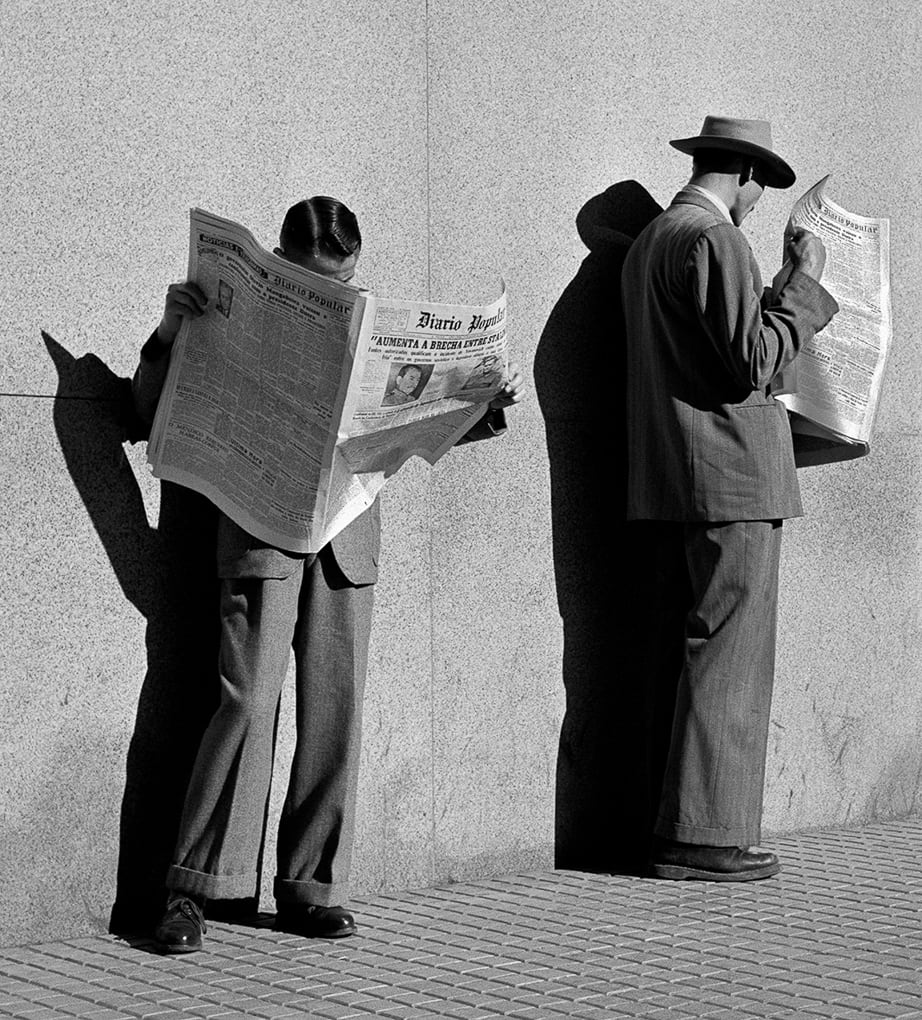
If modernist visual forms (sculpture, painting, drawing as well as photography) have one thing in common it’s a love of sharp lines and geometric shapes. In contrast with gauzy impressionism, gloomy symbolism or scratchy expressionism, modernism loves slick lines and sharp angles. Almost everything in this photograph by the Brazilian photographer German Lorca (1922 to 2021) is precise and geometric: from the tiny regular squares of the paving to the straight seams of the concrete wall behind the two figures; the neatly pressed seams of the two men’s suits to the super-precise outline of the shadows behind them thrown by the hot tropical sun. It’s part of the hyper-modern effect that we don’t see the men’s face, which are turned away or hidden behind a newspaper, thus increasing the sense that this sidewalk drama is not about people but about the lines and energies of the modern city.

Looking for a job by German Lorca (1948)

Motion photography

Eadweard Muybridge (1830 to 1904) is the famous pioneer of ‘motion photography’ which caught the imagination of artists and scientists around the (developed) world. In his studio he set up series of cameras in the same position or staggered along the course of the action he wanted to record, and then fired them off at intervals, experimenting with doing it closer or further apart.

The result was his famous sets of photos showing successive stages in dramatic actions. Once he’d nailed the technique he went mad and, between 1884 and 1886, produced 781 new sequences! The art of fencing is peculiarly suited to this process because it involves dramatic gestures and physical postures while the body itself doesn’t actually change position very much.

Fencing by Eadweard Muybridge (1887) collotype

Naked photography

Lots of women artists and photographers in the 1970s and 80s thought it was a radical and subversive act to take their clothes off and stage happenings or interventions or performances featuring themselves naked, and record themselves for posterity. No doubt this was a radical, subversive and so on gesture in Russian-controlled communist Poland back in 1980. Forty-three years later it looks like a naked young woman in heels confronting a woman cop. What’s not to love?

It is a little disappointing, then, to learn that this scene never took place, but that the piece is in fact a photomontage, combining a shot Ewa Partum (b.1945) took of herself nude in the studio, superimposed on a straightforward snap of a cop in the street.

Döppelgängers always fascinate us and so we are taken by the dualistic oppositions suggested here, between the naked and the clothed, between authority and submission, between the ‘authenticity’ of the artistic naked woman with nothing to hide and the overdress authority figure encumbered with all the rigmarole of legal and physical repression (radio, handcuffs, baton, gun?)

(I appreciate this photo could also come under ‘feminist photography’ or ‘political photography’. But I’m enjoying making up frivolous headings and my own connections.)

Self and policewoman by Ewa Partum (1980)

Nature photography

Possibly my favourite photo of the 130 on display. I myself have taken lots of photos of trees, flowers, plants, lichen on stones and so on, but trees are special. I think trees are talking to us but so slowly, so very slowly, that we can’t slow down enough to hear what they’re saying. And so we chop them down and burn them, over vast areas, and will end up burning the entire planet in the process. Tant pis.

Meanwhile, this is just one of many studies the American photographer Paul Strand (1890 to 1976) took of driftwood, showing a profound feel for the shapes and twists and knots and gnarls which are created by this most beautiful of life forms. Although hyper-naturalistic in feel, capturing every fibre of the gnarled old wood, Strand’s studies like this at the same time suggest flowing zoomorphic forms and, if you’ve smoked a little dope, are gateways almost into another world, enabling the viewer to immerse themselves in the non-human world around us. Entirely naturalistic they are also like meditative states of mind.

Driftwood, Gaspé, Quebec, 1928 by Paul Strand © Paul Strand Archive/ Aperture Foundation

Painted photography

Believe it or not this is a photo, taken about 1890 by an unknown photographer. It looks like a painting because the entire surface has been covered with a thick layer of pigment, so it is a painting: a photo-painting. Apparently this kind of embellishment or overwriting of a factual photographic base with an extravagantly idealised and Romantic backdrop and details was very common. It has a floridness we don’t associate with the European tradition and feels genuinely ‘other’.

This image links to the portrait of a couple from the 1970s shown above. Was this a distinctively Indian approach to photography? Did other cultures do the same kind of thing? Does it persist to this day? Be interesting to know more.

Maharaja with Tiger, possibly Duleep Singh, after a hunt (about 1890) vintage gelatin silver print with hand painting. Maker unknown (India)

Soviet photography

In the heyday of the 1920s and early 1930s Soviet artists made some of the boldest, most radical art of the century in the name of the new society they were building. Alexander Rodchenko (1891 to 1956) specialised in taking photos from experimental and unconventional angles. This was called rakurs in Russian. The most powerful, impactful of these is looking up at the subject from below. This conveys a string sense of dynamism and energy which, when combined or attached to an image of a youth, conveyed just the sense of forward-looking, visionary, striding-into-the-future energy which Stalin and his commissars wanted. As the commentator points out, it also makes the figure look monumental, a photographic equivalent of all those huge statues of working men and women striding boldly into the brave Soviet future which used to litter communist cityscapes.

Pioneer girl (1930) by Alexander Rodchenko

Street photography

Harold Cazneaux (1878 to 1953) became known for naturalistic studies of children, often taken outdoors. During and after the war there was an explosion of technical experimentation associated with modernism, plus a great surge in popular magazines which relied on evermore photos. Thus this photo was taken for a spread in The Home magazine. It’s what you could call soft modernism or popular modernism, in the sense that a) the focus is on the children’s faces, not the ostensible subject (the Punch and Judy show); b) it’s taken from a relatively low angle, a characteristic modernist trait, but not actually down on the ground. So it’s assimilated enough modernist tricks to be considered ‘modern’ and not rattle any cages.

Punch and Judy (1930) by Harold Cazneaux

The promotional video


Related links

More Photographers’ Gallery reviews

Chris Killip @ the Photographers Gallery

This is one of the most powerful and moving exhibitions I’ve ever been to.

Chris Killip was one of the UK’s most important and influential post-war documentary photographers. He was born in 1946 and died in October 2020. He is best known for his gritty photos of working class life in the north of England in the 1970s and 80s and we really mean ‘gritty’ – portraits of people living in the depths of poverty, immiseration, neglect, illness, marginalisation, scraping a living in grim, depressed, forgotten communities.

Spread over the top two floors at the Photographers’ Gallery, including some 150 black and white photographs as well as a couple of display cases of ephemera (magazines, posters, publicity flyers) works, this exhibition amounts to the most comprehensive survey of Killip’s work ever staged. And dear God, it’s devastating.

Helen and her hula-hoop, Seacoal Camp, Lynemouth, Northumbria, 1984 © Chris Killip, Photography Trust. All images courtesy Martin Parr Foundation

I’m going to replicate the structure of the exhibition and summarise the wall labels because it’s important to get a good understanding of time and place to really appreciate the work.

Off to London 1964

In 1963, aged 17 and living on the Isle of Man, Killip opened a copy of Paris Match looking for news about the Tour de France and instead came across the famous photo by Henri Cartier-Bresson of the little boy carrying two bottles of wine along the Rue Mouffetard in Paris. On the spot he realised he wanted to be a photographer. He bought a cheap camera and worked that summer as a beach photographer saving up the money to move to London in 1964, just at the start of Swinging London.

Here he found work as an assistant to the commercial photographer Adrian Flowers. They were heady times and he was at the heart of London, arranging commercial photoshoots for magazines, fashion, commercials.

New York 1969

In autumn 1969 he went on a visit to New York which changed his life. He went to see the exhibition of Bill Brandt photos at the Museum of Modern Art but it was the museum’s permanent collection which made his head spin. Here he saw photos by Paul Strand, August Sander, Walker Evans and others like them, documentary photographers who tried to depict the life of the common people in communities often remote from flashy urban living.

He returned to England, quit his job in flash London and returned to his homeland, the Isle of Man, a man with a mission, to photograph his truth, to record the traditional peasant lifestyle of the island before it was eroded and swept away by the very commercialism he had formerly served.

Isle of Man 1970 to 1972

Between 1970 and 1972 Killip photographed the island and its inhabitants during the day and worked at his dad’s pub by night. In 1973 he completed his book, Isle of Man.

This was the first of the long-form or long-term projects which form the basis of his achievement. the next few decades would see him applying the same in-depth approach to capturing marginalised communities on film, living in them, getting to know them, sharing their privations, getting under the skin of their physically and spiritually impoverished lives.

As you would expect, many of the photos of the Isle of man are landscapes but they are not that great, they are not as powerful as, say, Don McCullin’s louring, threatening studies of his adopted region of Somerset. But it’s not the landscapes that matter, it’s the people.

Mr ‘Snooky’ Corkhill and his son © Chris Killip Photography Trust. All images courtesy Martin Parr Foundation

My God, what a wonderful, wonderful collection of portraits, warm, humane, detailed, candid but compassionate portraits of the kind of plain-living, rural workers who were dying out as a breed even as he photographed them. You know those lines from Yeats’s poem, Easter 1916:

We know their dream; enough
To know they dreamed and are dead;
And what if excess of love
Bewildered them till they died?
I write it out in verse:

Invoking that mood of respect, it feels like an act almost of worship to write out the names of the people Killip photographed, the children, teenagers, farmers, wives and widows:

There is no God, no plan and no redemption. But images like this, full of understated dignity and wholeness on the part of the sitters, and respect and humanity on the part of the photographer, make you think maybe human love and compassion does redeem something, save something from the human wreck, raise us above our everyday lives into a higher realm blessed by more than human love.

(Note the way in the list above all the people are given titles, Mr, Mrs, Ms. It’s an old-fashioned mark of respect.)

Mrs Hyslop, Ballachrink Farm, the Braid © Chris Killip Photography Trust. All images courtesy Martin Parr Foundation

Immersion

He became an immersive photographer, living for months or more among the communities he sought to depict. His mission and his sympathies were not with the well-educated and well-heeled who run the country and write about it, but with ‘those who have had history done to them‘, the proles and chavs and pikeys and white trash who are dismissed by all commentators, make no impact on official culture, live and die in caravans or shitty council houses on sink estates at the arse end of nowhere.

Huddersfield 1972

In 1972 the Arts Council commissioned Killip to do a photo essay comparing and contrasting Huddersfield in Yorkshire with Bury St Edmunds in Suffolk for the exhibition ‘Two Views: Two Cities’. As far as I could see there was just one photo from Bury in the show, a neat-looking shot of some nice castle ruins. By contrast, as you can imagine, the rundown streets of Huddersfield with its mills, tenement housing, crappy high streets, boarded up shops and sad bus shelters grabbed Killip’s sympathies.

Playground in Huddersfield, 1974 © Chris Killip Photography Trust. All images courtesy Martin Parr Foundation

Newcastle 1975 to 1979

In 1975 Killip was commissioned to undertake a British Gas/Northern Arts fellowship. In his spare time from this commission he roved the streets and suburbs and slums of the city and as far afield as Castleford and Workington. My God, the squalor, the neglect, the decline, the decay, the old Victorian slums being demolished and the new cut-price, cheap council estates falling to pieces before your eyes. A landscape of vandalism and graffiti.

Demolished housing, Wallsend, August 1977. © Chris Killip Photography Trust. All images courtesy Martin Parr Foundation

Killip stayed in Newcastle for years, getting to know the area. For two years, 1977 to 1979, he served as director of a photo gallery, Amber’s Side Gallery. The May 1977 issue of Creative Camera was entirely devoted to Killip’s North East photos (a copy of it is one of the ephemera gathered in the display cases I mentioned earlier).

  • Children and terraced housing
  • Terraced house and coal mine
  • Two men on a bench
  • Looking East on Camp Road, Wallsend, 1975

There is a huge difference between the Manx series and this one. The Manx photos are dominated by large portraits of people who fill the screen, who are at home in their surroundings, their crofts or workshops. They’re big. They fill the photos as they fill their lives, at ease with who they are. They are fully human.

In the North East photos what dominates is the built environment. People are reduced to puppets, physically small against the backdrop of the enormous or decaying buildings. The buildings come in two types, terrible and appalling. The terrible ones are the old brick terraces thrown up in a hurry by the Victorian capitalists who owned the mines and steel works and shipbuilding yards and needed the bare minimum accommodation to keep their workers just about alive – badly built, no insulation, draughty windows, outside toilets and all.

Though Killip didn’t plan it, his time in Newcastle coincided with the wholesale destruction of the old brick terraces and their replacement with something even worse: the concrete high rises with broken lifts reeking of piss, the windswept plazas, dangerous underpasses, and oppressive network of toxic, child-killing urban highways, all the products of 1960s and 70s urban planners and brutalist architects.

May 5, 1981, North Shields, Tyneside © Chris Killip Photography Trust. All images courtesy Martin Parr Foundation

This is why I call the architects room at the Royal Academy Summer Exhibition the room of shame. Go on a tour of British cities to see for yourself the destruction of historic centres and their replacement with brutal concrete urban highways full of thundering traffic, concrete underpasses tailor made for muggers and rapists, bleak open spaces where the wind blows dust and grit into your eyes, the concrete facias of a thousand tragic shopping precincts and, looming above them, the badly built tower blocks and decaying office blocks. Concrete cancer.

This isn’t an architecture for people, it’s an architecture for articulated lorries. Thus the human beings in Killip’s harrowing photos of these killing precincts are reduced to shambling wrecks, shadows of humanity, scarecrows in raincoats, harassed mums, bored teenagers hanging round on street corners sniffing glue. This is what Killip captures, the death of hope presided over by a thousand architects and town planners who could quote Le Corbusier and Bauhaus till the cows came home and used them to build the most dehumanised environment known to man.

Killingworth new town, 1975 © Chris Killip Photography Trust. All images courtesy Martin Parr Foundation

As Philip Larkin wrote of young northern mums in their headscarves supervising their unruly children in some suburban playground:

Their beauty has thickened.
Something is pushing them
To the side of their own lives.

(from Afternoons by Philip Larkin, 1959)

It’s epitomised by the photo of the silhouette of an old lady sitting in a half vandalised bush shelter in Middlesbrough. She’s wearing a headscarf and slumped forwards because her life, in this gritty, alienated environment, is bereft.

Woman in a bus shelter, Middlesborough, Teeside © Chris Killip Photography Trust. All images courtesy Martin Parr Foundation

Compare and contrast with the proud, erect, unashamed men and women of the Isle of Man. Pretty much all the humanity has been stolen from the mainlanders.

At some point I realised a lot of these grim Tyneside photos show a disproportionate number of children, children imprisoned in squalid houses, hanging round on derelict streets, trying to play in a crappy playground overshadowed by mines and factories, left outside the crappy, rundown bingo parlour, the cheapest nastiest, knockoff 60s architecture, complete with collapsing concrete canopy. A landscape of blighted lives and stunted childhoods.

Boy outside Prize Bingo Parlour, Newcastle 1976 © Chris Killip Photography Trust. All images courtesy Martin Parr Foundation

  • Two girls in Grangetown
  • Terraced house and coal mine, Castleford, 1976
  • Terraced housing, County Durham, 1976
  • Children and terraced housing, Byker, Newcastle, 1975
  • Butchers shop, Byker, Tyneside, 1975

Skinningrove 1982 to 1984

Skinningrove is a fishing community on the North Yorkshire coast. Killip had noticed its striking landscape on a drive up the east coast back in 1974 but found it difficult to penetrate the community. In fact locals chased him off the couple of times he tried to photograph them. His way in was through friendship with a young local named Leso, who made Killip feel welcome and reassured locals of his good intentions. Between 1982 and 84 Killip documented the crappy, poor, hard scrabbling lives of Leso and his mates – Blackie, Bever, Toothy, Richard, Whippet – as they fixed nets, repaired boats and hung around bored.

Leso and mates waiting for the tide to turn, Skinningrove, 1986 © Chris Killip Photography Trust. All images courtesy Martin Parr Foundation

This is an extraordinary, remarkable, amazing portrait of a dead-end community, poverty, low expectations and young people bored off their faces. No wonder they took to sniffing glue and as the 80s moved on and adopted the punk look pioneered down in London to express some kind of sense of identity and worth, rebellion against grey-clad council houses, the grey sky and the unremitting rhythms of the grey, cold, freezing sea.

This section is given tragic force when we learn that Leso, who got Killip his ‘in’ into the community and of whom there are many photos, fixing nets, waiting round for the tide to turn, hanging with his punk mates, walking across a dirty road carrying a rifle, he died tragically during Killips’s stay.

The fishing boat he and some mates were in was overturned at sea and Leso and David were drowned, tubby Bever made it back to shore. In tribute Killip made Leso’s grieving mother an album of three dozen photos of her lost son.

Leso, Blackie, Bever, ?, David, on a bench, Whippet standing, Skinningrove, 1986 © Chris Killip Photography Trust. All images courtesy Martin Parr Foundation

Seacoal Camp 1981 to1984

Killip discovered Lynemouth, Northumberland, in 1976. It had a strange and eerie vibe because there was a massive coalmine not far from the sea and waste coal was expelled into the sea, only to be brought back to shore on the incoming tides.

And a community of travellers or extremely poor people living in caravans and using horse-drawn wagons in and near the sea had sprung up which made a living scavenging this coal, using it to heat their homes, cook food, and to sell to other locals. An entire lifestyle based on coal scavenging.

Once again Killip had trouble penetrating this closed and fiercely protective community. From 1976 when he first came across it he made repeated attempts to photograph the people but was chased away. Only in 1982 was he finally accepted when, on a final visit to the local pub he was recognised by a man who’d given him shelter from a rainstorm at Appleby Horse fair and vouched for his good intentions.

So Killip set about taking photos, delicately tactfully at first. But in winter 1983 he bought a caravan of his own and got permission to park it alongside the community’s ones. Once really embedded he was able to record all the different types of moments experienced by individuals or between people engaged on this tough work, at the mercy of the elements, permanently dirty with coal muck.

Rocker and Rosie Going Home, Seacoal Beach, Lynemouth, Northumberland, 1984 © Chris Killip Photography Trust. All images courtesy Martin Parr Foundation

In the unpublished preface to the volume of poems he was working on when he was killed in the last days of the Great War, Wilfred Owen wrote:

Above all I am not concerned with Poetry. My subject is War, and the pity of War. The Poetry is in the pity.

Same, with modifications, goes for Killip. The poetry, the deep, deep poetry of these photographs, derives from the immense love and compassion they evince, love of suffering humanity, the candour and accuracy of the shots, finding moments of piercing acuity amid the grinding poverty and mental horizons which are hemmed in on every side by slag heaps, metal works and the four walls of a cramped caravan.

Gordon in the water, Seacoal Beach, Lynemouth, 1983 © Chris Killip Photography Trust. All images courtesy Martin Parr Foundation

Photography and music

Photography is like music. Regarding music you can describe the notes and cadences, the technical manoeuvres and key changes, the invocation of traditions and forms and write at length about the ostensible subject (the Pastoral symphony, the Moonlight sonata etc). But in the end you have to let go of all of that and experience it as music, let the music do its work, what only it can do, triggering emotions, memories, fragments of feelings or thoughts, stirring forgotten moments, making all kinds of neural connections, filling your soul.

Same with these photographs. I’ve described what he was trying to do, bring respect and compassion to people right on the margins of society, the lost, the abandoned, the forgotten. He’s quoted as saying he had no idea he would end up recording the process of de-industralisation, it just happened to be going on as he developed his method and approach as a social photographer. Long essays could be written about class in England, about deindustrialisation and then, of course, about the Thatcher government which supervised the destruction of large swathes of industry and British working class life alongside it.

But at some point you pack all that way and let the photos do their work, which is to lacerate your heart and move you to tears. This is the best our society could offer to God’s children. What shame. What guilt.

Father and son watching a parade, West End of Newcastle, Tyneside, 1980 © Chris Killip Photography Trust. All images courtesy Martin Parr Foundation

The Miners Strike 1984 to 1985

A friend of mine at school in the Home Counties, his older sister was married to a copper. He told us the Miners Strike was great. They were bussed to Yorkshire, put up in army barracks, paid triple time wages and almost every day there was a fight, which he and his mates always won because they had the plastic shields, big truncheons and if things got really out of control, the cavalry. Killip apparently treated the long strike as another project with a view to producing another long-form series.

Durham Miners Gala, 1984 © Chris Killip Photography Trust. All images courtesy Martin Parr Foundation

But images from the Miners Strike project aren’t treated separately as the other projects are. Instead they’re rolled into the In Flagrante section.

In flagrante 1988

In 1985 the publisher Secker and Warburg told Killip they’d be interested in publishing his next book. This would mean access to a larger audience than previously and Killip was inspired. He worked with editor Mark Holborn and designer Peter Dyer to produce the 1988 book In Flagrante. Unlike all his previous projects which were heavily themed around specific communities and locations, In Flagrante deliberately cut his images adrift from their source projects to create a randomised cross-section of his career (although anyone who’d studied the previous projects has a good idea where each of them come from).

For the bitter bleakness and the unerring accuracy of the images, In Flagrante has been described as ‘the most important book of English photography from the 1980s.’ I was particularly taken by the set of photos of miserable English people from the 70s and 80s on various English beaches, at Whitley Bay, and so on. Narrow lives, no expectations, the quiet misery of the English working classes. They’ve come to the seaside for a break, for a ‘holiday’ and none of them know what to do there. Images of a nation at a loss what to do with the land it finds itself in.

Revolt

Respect goes to the tribes of young people who forged ways of rebelling against the poverty and low to zero expectations of their environment. In Flagrante contains a surprising number of photos of young punks who took the form to baroque extremes long after it was abandoned in London. There are lots of shots of the Angelic Upstarts of all bands, playing sweaty punk gigs in Gateshead. In fact the gallery shop has a music paper-size fanzine-style publication entirely full of shots he did of sweaty punk gigs in the mid-80s. ‘We’re the future, your future.’

The Station, Gateshead, 1985 © Chris Killip Photography Trust. All images courtesy Martin Parr Foundation

America 1991

What happened to Killip after that? America. I was disappointed to read that in 1991 he was invited to be a Visiting Lecturer at the Department of Visual and Environmental Studies in Harvard University. In 1994 he was made a tenured professor and was department chair from 1994 to 1998. He only retired from Harvard in 2017. Well, no doubt taking the Yankee dollar was the right move for him, but it meant the abrupt end of the sequence of breath-taking portfolio projects which had begun in 1970.

Summary

Killip’s oeuvre represents not only an invaluable document of social history 1970 to 1985 and, as such, a blistering indictment of an incompetent, uncaring, bewilderingly lost society – but it is also a testament to love and the redeeming possibilities of art.

The compassion and humanity of his work is embodied in its closeness and intimacy with its subjects, not the fake intimacy of eroticism, but being right there with poor suffering humanity; right up close as the dirty kids play in their abandoned playgrounds, the dispirited losers chain-smoke in a wretched bingo hall, an old lady loses the will to live in a vandalised bus shelter, bored young men sniff glue in a remote fishing town, and lost children spend all day every day clambering over filthy mounds of coal to help their mums and dads scrape a flimsy living The poetry is in the pity.

Youth on wall, Jarrow, Tyneside, 1975 © Chris Killip Photography Trust. All images courtesy Martin Parr Foundation

Levelling up

In the 50 years since Killip took these photos generations of politicians have come and gone, promising to narrow the North-South Divide and level up the whole country. All bollocks. Life expectancy for babies born in the North-East, like per household income, remain stubbornly below the national average. Pathetic, isn’t it. What a sorry excuse for a country.

Go and see this marvellous, searing, heart-rending exhibition.

The promotional video


Related links

More Photographers’ Gallery reviews

More photography reviews