Chris Killip @ the Photographers Gallery

This is one of the most powerful and moving exhibitions I’ve ever been to.

Chris Killip was one of the UK’s most important and influential post-war documentary photographers. He was born in 1946 and died in October 2020. He is best known for his gritty photos of working class life in the north of England in the 1970s and 80s and we really mean ‘gritty’ – portraits of people living in the depths of poverty, immiseration, neglect, illness, marginalisation, scraping a living in grim, depressed, forgotten communities.

Spread over the top two floors at the Photographers’ Gallery, including some 150 black and white photographs as well as a couple of display cases of ephemera (magazines, posters, publicity flyers) works, this exhibition amounts to the most comprehensive survey of Killip’s work ever staged. And dear God, it’s devastating.

Helen and her hula-hoop, Seacoal Camp, Lynemouth, Northumbria, 1984 © Chris Killip, Photography Trust. All images courtesy Martin Parr Foundation

I’m going to replicate the structure of the exhibition and summarise the wall labels because it’s important to get a good understanding of time and place to really appreciate the work.

Off to London 1964

In 1963, aged 17 and living on the Isle of Man, Killip opened a copy of Paris Match looking for news about the Tour de France and instead came across the famous photo by Henri Cartier-Bresson of the little boy carrying two bottles of wine along the Rue Mouffetard in Paris. On the spot he realised he wanted to be a photographer. He bought a cheap camera and worked that summer as a beach photographer saving up the money to move to London in 1964, just at the start of Swinging London.

Here he found work as an assistant to the commercial photographer Adrian Flowers. They were heady times and he was at the heart of London, arranging commercial photoshoots for magazines, fashion, commercials.

New York 1969

In autumn 1969 he went on a visit to New York which changed his life. He went to see the exhibition of Bill Brandt photos at the Museum of Modern Art but it was the museum’s permanent collection which made his head spin. Here he saw photos by Paul Strand, August Sander, Walker Evans and others like them, documentary photographers who tried to depict the life of the common people in communities often remote from flashy urban living.

He returned to England, quit his job in flash London and returned to his homeland, the Isle of Man, a man with a mission, to photograph his truth, to record the traditional peasant lifestyle of the island before it was eroded and swept away by the very commercialism he had formerly served.

Isle of Man 1970 to 1972

Between 1970 and 1972 Killip photographed the island and its inhabitants during the day and worked at his dad’s pub by night. In 1973 he completed his book, Isle of Man.

This was the first of the long-form or long-term projects which form the basis of his achievement. the next few decades would see him applying the same in-depth approach to capturing marginalised communities on film, living in them, getting to know them, sharing their privations, getting under the skin of their physically and spiritually impoverished lives.

As you would expect, many of the photos of the Isle of man are landscapes but they are not that great, they are not as powerful as, say, Don McCullin’s louring, threatening studies of his adopted region of Somerset. But it’s not the landscapes that matter, it’s the people.

Mr ‘Snooky’ Corkhill and his son © Chris Killip Photography Trust. All images courtesy Martin Parr Foundation

My God, what a wonderful, wonderful collection of portraits, warm, humane, detailed, candid but compassionate portraits of the kind of plain-living, rural workers who were dying out as a breed even as he photographed them. You know those lines from Yeats’s poem, Easter 1916:

We know their dream; enough
To know they dreamed and are dead;
And what if excess of love
Bewildered them till they died?
I write it out in verse:

Invoking that mood of respect, it feels like an act almost of worship to write out the names of the people Killip photographed, the children, teenagers, farmers, wives and widows:

There is no God, no plan and no redemption. But images like this, full of understated dignity and wholeness on the part of the sitters, and respect and humanity on the part of the photographer, make you think maybe human love and compassion does redeem something, save something from the human wreck, raise us above our everyday lives into a higher realm blessed by more than human love.

(Note the way in the list above all the people are given titles, Mr, Mrs, Ms. It’s an old-fashioned mark of respect.)

Mrs Hyslop, Ballachrink Farm, the Braid © Chris Killip Photography Trust. All images courtesy Martin Parr Foundation

Immersion

He became an immersive photographer, living for months or more among the communities he sought to depict. His mission and his sympathies were not with the well-educated and well-heeled who run the country and write about it, but with ‘those who have had history done to them‘, the proles and chavs and pikeys and white trash who are dismissed by all commentators, make no impact on official culture, live and die in caravans or shitty council houses on sink estates at the arse end of nowhere.

Huddersfield 1972

In 1972 the Arts Council commissioned Killip to do a photo essay comparing and contrasting Huddersfield in Yorkshire with Bury St Edmunds in Suffolk for the exhibition ‘Two Views: Two Cities’. As far as I could see there was just one photo from Bury in the show, a neat-looking shot of some nice castle ruins. By contrast, as you can imagine, the rundown streets of Huddersfield with its mills, tenement housing, crappy high streets, boarded up shops and sad bus shelters grabbed Killip’s sympathies.

Playground in Huddersfield, 1974 © Chris Killip Photography Trust. All images courtesy Martin Parr Foundation

Newcastle 1975 to 1979

In 1975 Killip was commissioned to undertake a British Gas/Northern Arts fellowship. In his spare time from this commission he roved the streets and suburbs and slums of the city and as far afield as Castleford and Workington. My God, the squalor, the neglect, the decline, the decay, the old Victorian slums being demolished and the new cut-price, cheap council estates falling to pieces before your eyes. A landscape of vandalism and graffiti.

Demolished housing, Wallsend, August 1977. © Chris Killip Photography Trust. All images courtesy Martin Parr Foundation

Killip stayed in Newcastle for years, getting to know the area. For two years, 1977 to 1979, he served as director of a photo gallery, Amber’s Side Gallery. The May 1977 issue of Creative Camera was entirely devoted to Killip’s North East photos (a copy of it is one of the ephemera gathered in the display cases I mentioned earlier).

  • Children and terraced housing
  • Terraced house and coal mine
  • Two men on a bench
  • Looking East on Camp Road, Wallsend, 1975

There is a huge difference between the Manx series and this one. The Manx photos are dominated by large portraits of people who fill the screen, who are at home in their surroundings, their crofts or workshops. They’re big. They fill the photos as they fill their lives, at ease with who they are. They are fully human.

In the North East photos what dominates is the built environment. People are reduced to puppets, physically small against the backdrop of the enormous or decaying buildings. The buildings come in two types, terrible and appalling. The terrible ones are the old brick terraces thrown up in a hurry by the Victorian capitalists who owned the mines and steel works and shipbuilding yards and needed the bare minimum accommodation to keep their workers just about alive – badly built, no insulation, draughty windows, outside toilets and all.

Though Killip didn’t plan it, his time in Newcastle coincided with the wholesale destruction of the old brick terraces and their replacement with something even worse: the concrete high rises with broken lifts reeking of piss, the windswept plazas, dangerous underpasses, and oppressive network of toxic, child-killing urban highways, all the products of 1960s and 70s urban planners and brutalist architects.

May 5, 1981, North Shields, Tyneside © Chris Killip Photography Trust. All images courtesy Martin Parr Foundation

This is why I call the architects room at the Royal Academy Summer Exhibition the room of shame. Go on a tour of British cities to see for yourself the destruction of historic centres and their replacement with brutal concrete urban highways full of thundering traffic, concrete underpasses tailor made for muggers and rapists, bleak open spaces where the wind blows dust and grit into your eyes, the concrete facias of a thousand tragic shopping precincts and, looming above them, the badly built tower blocks and decaying office blocks. Concrete cancer.

This isn’t an architecture for people, it’s an architecture for articulated lorries. Thus the human beings in Killip’s harrowing photos of these killing precincts are reduced to shambling wrecks, shadows of humanity, scarecrows in raincoats, harassed mums, bored teenagers hanging round on street corners sniffing glue. This is what Killip captures, the death of hope presided over by a thousand architects and town planners who could quote Le Corbusier and Bauhaus till the cows came home and used them to build the most dehumanised environment known to man.

Killingworth new town, 1975 © Chris Killip Photography Trust. All images courtesy Martin Parr Foundation

As Philip Larkin wrote of young northern mums in their headscarves supervising their unruly children in some suburban playground:

Their beauty has thickened.
Something is pushing them
To the side of their own lives.

(from Afternoons by Philip Larkin, 1959)

It’s epitomised by the photo of the silhouette of an old lady sitting in a half vandalised bush shelter in Middlesbrough. She’s wearing a headscarf and slumped forwards because her life, in this gritty, alienated environment, is bereft.

Woman in a bus shelter, Middlesborough, Teeside © Chris Killip Photography Trust. All images courtesy Martin Parr Foundation

Compare and contrast with the proud, erect, unashamed men and women of the Isle of Man. Pretty much all the humanity has been stolen from the mainlanders.

At some point I realised a lot of these grim Tyneside photos show a disproportionate number of children, children imprisoned in squalid houses, hanging round on derelict streets, trying to play in a crappy playground overshadowed by mines and factories, left outside the crappy, rundown bingo parlour, the cheapest nastiest, knockoff 60s architecture, complete with collapsing concrete canopy. A landscape of blighted lives and stunted childhoods.

Boy outside Prize Bingo Parlour, Newcastle 1976 © Chris Killip Photography Trust. All images courtesy Martin Parr Foundation

  • Two girls in Grangetown
  • Terraced house and coal mine, Castleford, 1976
  • Terraced housing, County Durham, 1976
  • Children and terraced housing, Byker, Newcastle, 1975
  • Butchers shop, Byker, Tyneside, 1975

Skinningrove 1982 to 1984

Skinningrove is a fishing community on the North Yorkshire coast. Killip had noticed its striking landscape on a drive up the east coast back in 1974 but found it difficult to penetrate the community. In fact locals chased him off the couple of times he tried to photograph them. His way in was through friendship with a young local named Leso, who made Killip feel welcome and reassured locals of his good intentions. Between 1982 and 84 Killip documented the crappy, poor, hard scrabbling lives of Leso and his mates – Blackie, Bever, Toothy, Richard, Whippet – as they fixed nets, repaired boats and hung around bored.

Leso and mates waiting for the tide to turn, Skinningrove, 1986 © Chris Killip Photography Trust. All images courtesy Martin Parr Foundation

This is an extraordinary, remarkable, amazing portrait of a dead-end community, poverty, low expectations and young people bored off their faces. No wonder they took to sniffing glue and as the 80s moved on and adopted the punk look pioneered down in London to express some kind of sense of identity and worth, rebellion against grey-clad council houses, the grey sky and the unremitting rhythms of the grey, cold, freezing sea.

This section is given tragic force when we learn that Leso, who got Killip his ‘in’ into the community and of whom there are many photos, fixing nets, waiting round for the tide to turn, hanging with his punk mates, walking across a dirty road carrying a rifle, he died tragically during Killips’s stay.

The fishing boat he and some mates were in was overturned at sea and Leso and David were drowned, tubby Bever made it back to shore. In tribute Killip made Leso’s grieving mother an album of three dozen photos of her lost son.

Leso, Blackie, Bever, ?, David, on a bench, Whippet standing, Skinningrove, 1986 © Chris Killip Photography Trust. All images courtesy Martin Parr Foundation

Seacoal Camp 1981 to1984

Killip discovered Lynemouth, Northumberland, in 1976. It had a strange and eerie vibe because there was a massive coalmine not far from the sea and waste coal was expelled into the sea, only to be brought back to shore on the incoming tides.

And a community of travellers or extremely poor people living in caravans and using horse-drawn wagons in and near the sea had sprung up which made a living scavenging this coal, using it to heat their homes, cook food, and to sell to other locals. An entire lifestyle based on coal scavenging.

Once again Killip had trouble penetrating this closed and fiercely protective community. From 1976 when he first came across it he made repeated attempts to photograph the people but was chased away. Only in 1982 was he finally accepted when, on a final visit to the local pub he was recognised by a man who’d given him shelter from a rainstorm at Appleby Horse fair and vouched for his good intentions.

So Killip set about taking photos, delicately tactfully at first. But in winter 1983 he bought a caravan of his own and got permission to park it alongside the community’s ones. Once really embedded he was able to record all the different types of moments experienced by individuals or between people engaged on this tough work, at the mercy of the elements, permanently dirty with coal muck.

Rocker and Rosie Going Home, Seacoal Beach, Lynemouth, Northumberland, 1984 © Chris Killip Photography Trust. All images courtesy Martin Parr Foundation

In the unpublished preface to the volume of poems he was working on when he was killed in the last days of the Great War, Wilfred Owen wrote:

Above all I am not concerned with Poetry. My subject is War, and the pity of War. The Poetry is in the pity.

Same, with modifications, goes for Killip. The poetry, the deep, deep poetry of these photographs, derives from the immense love and compassion they evince, love of suffering humanity, the candour and accuracy of the shots, finding moments of piercing acuity amid the grinding poverty and mental horizons which are hemmed in on every side by slag heaps, metal works and the four walls of a cramped caravan.

Gordon in the water, Seacoal Beach, Lynemouth, 1983 © Chris Killip Photography Trust. All images courtesy Martin Parr Foundation

Photography and music

Photography is like music. Regarding music you can describe the notes and cadences, the technical manoeuvres and key changes, the invocation of traditions and forms and write at length about the ostensible subject (the Pastoral symphony, the Moonlight sonata etc). But in the end you have to let go of all of that and experience it as music, let the music do its work, what only it can do, triggering emotions, memories, fragments of feelings or thoughts, stirring forgotten moments, making all kinds of neural connections, filling your soul.

Same with these photographs. I’ve described what he was trying to do, bring respect and compassion to people right on the margins of society, the lost, the abandoned, the forgotten. He’s quoted as saying he had no idea he would end up recording the process of de-industralisation, it just happened to be going on as he developed his method and approach as a social photographer. Long essays could be written about class in England, about deindustrialisation and then, of course, about the Thatcher government which supervised the destruction of large swathes of industry and British working class life alongside it.

But at some point you pack all that way and let the photos do their work, which is to lacerate your heart and move you to tears. This is the best our society could offer to God’s children. What shame. What guilt.

Father and son watching a parade, West End of Newcastle, Tyneside, 1980 © Chris Killip Photography Trust. All images courtesy Martin Parr Foundation

The Miners Strike 1984 to 1985

A friend of mine at school in the Home Counties, his older sister was married to a copper. He told us the Miners Strike was great. They were bussed to Yorkshire, put up in army barracks, paid triple time wages and almost every day there was a fight, which he and his mates always won because they had the plastic shields, big truncheons and if things got really out of control, the cavalry. Killip apparently treated the long strike as another project with a view to producing another long-form series.

Durham Miners Gala, 1984 © Chris Killip Photography Trust. All images courtesy Martin Parr Foundation

But images from the Miners Strike project aren’t treated separately as the other projects are. Instead they’re rolled into the In Flagrante section.

In flagrante 1988

In 1985 the publisher Secker and Warburg told Killip they’d be interested in publishing his next book. This would mean access to a larger audience than previously and Killip was inspired. He worked with editor Mark Holborn and designer Peter Dyer to produce the 1988 book In Flagrante. Unlike all his previous projects which were heavily themed around specific communities and locations, In Flagrante deliberately cut his images adrift from their source projects to create a randomised cross-section of his career (although anyone who’d studied the previous projects has a good idea where each of them come from).

For the bitter bleakness and the unerring accuracy of the images, In Flagrante has been described as ‘the most important book of English photography from the 1980s.’ I was particularly taken by the set of photos of miserable English people from the 70s and 80s on various English beaches, at Whitley Bay, and so on. Narrow lives, no expectations, the quiet misery of the English working classes. They’ve come to the seaside for a break, for a ‘holiday’ and none of them know what to do there. Images of a nation at a loss what to do with the land it finds itself in.

Revolt

Respect goes to the tribes of young people who forged ways of rebelling against the poverty and low to zero expectations of their environment. In Flagrante contains a surprising number of photos of young punks who took the form to baroque extremes long after it was abandoned in London. There are lots of shots of the Angelic Upstarts of all bands, playing sweaty punk gigs in Gateshead. In fact the gallery shop has a music paper-size fanzine-style publication entirely full of shots he did of sweaty punk gigs in the mid-80s. ‘We’re the future, your future.’

The Station, Gateshead, 1985 © Chris Killip Photography Trust. All images courtesy Martin Parr Foundation

America 1991

What happened to Killip after that? America. I was disappointed to read that in 1991 he was invited to be a Visiting Lecturer at the Department of Visual and Environmental Studies in Harvard University. In 1994 he was made a tenured professor and was department chair from 1994 to 1998. He only retired from Harvard in 2017. Well, no doubt taking the Yankee dollar was the right move for him, but it meant the abrupt end of the sequence of breath-taking portfolio projects which had begun in 1970.

Summary

Killip’s oeuvre represents not only an invaluable document of social history 1970 to 1985 and, as such, a blistering indictment of an incompetent, uncaring, bewilderingly lost society – but it is also a testament to love and the redeeming possibilities of art.

The compassion and humanity of his work is embodied in its closeness and intimacy with its subjects, not the fake intimacy of eroticism, but being right there with poor suffering humanity; right up close as the dirty kids play in their abandoned playgrounds, the dispirited losers chain-smoke in a wretched bingo hall, an old lady loses the will to live in a vandalised bus shelter, bored young men sniff glue in a remote fishing town, and lost children spend all day every day clambering over filthy mounds of coal to help their mums and dads scrape a flimsy living The poetry is in the pity.

Youth on wall, Jarrow, Tyneside, 1975 © Chris Killip Photography Trust. All images courtesy Martin Parr Foundation

Levelling up

In the 50 years since Killip took these photos generations of politicians have come and gone, promising to narrow the North-South Divide and level up the whole country. All bollocks. Life expectancy for babies born in the North-East, like per household income, remain stubbornly below the national average. Pathetic, isn’t it. What a sorry excuse for a country.

Go and see this marvellous, searing, heart-rending exhibition.

The promotional video


Related links

More Photographers’ Gallery reviews

More photography reviews

Very Posy by Posy Simmonds (1985)

From 1977 to 1987 Posy Simmonds drew a regular cartoon strip in the Guardian gently mocking the middle-class lifestyles and liberal concerns of a regular cast of a dozen or so fictional characters, centred on:

  • Wendy Weber, a former nurse married to verbose polytechnic sociology lecturer George Weber, and mother of a brood of six children, ranging from little Benji to teenage glamour-puss Belinda
  • Jo Heep, married to tedious, drunk whisky salesman Edmund Heep, and mum to two rebellious teenagers who’ve adopted the punk look
  • Trish Wright, married to philandering advertising executive Stanhope Wright, mother of a young baby

Throughout the period the cartoons were periodically gathered together into books, namely:

  • Mrs Weber’s Diary (1979)
  • True Love (1981)
  • Pick of Posy (1982)
  • Very Posy (1985)
  • Pure Posy (1987)

And these books were themselves gathered together into a huge compendium volume, Mrs Weber’s Omnibus which was published in 2012 and now appears to be the only way to get hold of the cartoons.

Very Posy is the third the series of collections, given that 1981’s True Love was a one-off ‘graphic novel’, loosely based on the schoolgirl crush of one of the characters, Janice Brady, for a regular cast member, tall, suave, philandering advertising executive Stanhope Wright.

Historical timeline

Very Posy brings together 91 Posy cartoon strips from 1981 through to 1985. These were the years when I was a student at university. I looked up a historical timeline of the period and discovered that the key events were:

1981

  • Mrs Thatcher is Prime Minister of the United Kingdom
  • Ronald Reagan is President of America
  • Leonid Brezhnev is leader of the USSR
  • In January the Yorkshire Ripper is caught, bringing to an end a reign of terror over the Yorkshire region where he had murdered 13 women over a five year period
  • The Iran Hostage Crisis (which had started in November 1979) ends in January 1981 with the release of American diplomats in Tehran
  • April 4 – first flight of the Space Shuttle Columbia
  • From April to July there are riots in major British cities, the biggest being the Brixton riot in London, the Handsworth riots in Birmingham, the Chapeltown riot in Leeds and the Toxteth riots in Liverpool.
  • MS-DOS was released by Microsoft along with the first IBM PC
  • On 29 July Lady Diana Spencer married Prince Charles
  • In September 1981 a Welsh group, Women for Life on Earth, arrive at Greenham Common air force base to protest against the decision of the British government to allow cruise missiles to be stored there

1982

  • The first CD player sold in Japan
  • Dutch Elm Disease destroys millions of Elm Trees
  • On Friday 2 April Argentina invades the Falkland Islands, sparking an international crisis and a war with Britain which lasts until British victory on 14 June
  • September, the American centres for Disease Control used the term ‘AIDS’ (acquired immune deficiency syndrome) for the first time.
  • November – Leonid Brezhnev dies and is replaced as leader of the USSR by Yuri Andropov

1983

  • The June 1983 general election returns a Conservative government led by Mrs Thatcher with an increased majority of 188 MPs, against the Labour Party led by Michael Foot
  • What would become the world’s most popular word processing programme, Microsoft Word, is launched.
  • In Ethiopia following the worst drought in history the death toll reaches a staggering 4 million.
  • The US starts deploying Cruise Missiles and Pershing Missiles in Europe at the Greenham Common Air Force Base, prompting the growth of the women-only camp of protestors
  • On Saturday 17 December 1983 members of the Provisional IRA set off a bomb outside Harrods in Knightsbridge, killing three police officers and three civilians, and injuring 90 people.

1984

  • February – Soviet leader Yuri Andropov dies and is replaced by Konstantin Chernenko
  • April – the National Cancer Institute announced they had found the cause of AIDS, the retrovirus HTLV-III
  • DNA profiling developed
  • Apple releases the Macintosh computer.
  • 12 October – the IRA bomb the Grand Hotel in Brighton during the Conservative Party conference in a bid to assassinate Prime Minister Margaret Thatcher. Thatcher narrowly escaped injury, five people were killed and 31 were injured
  • 31 October – Indira Ghandi, first woman Prime Minister of India, is assassinated by her own bodyguard and Sikh nationalists
  • 6 November Ronald Reagan re-elected President of the United States, defeating Democrat Walter Mondale.
  • Following the widespread famine in Ethiopia many of the top British and Irish pop musicians join together under the name Band Aid and record the song “Do They Know It’s Christmas, recorded on 25 November and released on 3 December.
  • December 2-3 – the world’s worst industrial accident when the Union Carbide Pesticide plant in Bhopal India leaks lethal gas, leading to a death toll of some 4,000, some estimate long term deaths at 16,000

1985

  • January – Palestinian terrorists the Italian Cruise Liner Achille Lauro and murder an old Jewish man in a wheelchair.
  • March – on the death of Konstantin Chernenko, Mikhail Gorbachev becomes General Secretary of the Central Committee of the Russian Communist Party and so leader of the USSR.
  • May – the Heysel Stadium disaster when Juventus football fans trying to escape from Liverpool fans were pressed against a collapsing wall in the Heysel Stadium in Brussels, Belgium, before the start of the 1985 European Cup Final, leading to the deaths of 39 people – mostly Italians and Juventus fans and 600 injured.
  • Music CDs commercially launched.
  • 10 July – The Greenpeace ship Rainbow Warrior is sunk by French Agents, killing a Dutch photographer.
  • Saturday 13 July – the Live Aid concert is watched by an estimated 1.9 billion viewers, across 150 nations, nearly 40% of the world population.
  • 19 September – Mexico City Earthquake kills 9,000
  • In response to the spread of AIDS governments around the world launch health and public awareness programs, including the promotion of condoms and safe sex.
  • The first .com domain name is registered and the first version of Windows is released.

Very Posy

Next to none of these world-changing (Gorbachev), traumatic (assassinations, terrorist bombings, famine) or innovative (slow spread of personal computers) events are reflected in the Posy strip. The opposite. The Posy strip formed a safe haven from politics and the hurly-burly of events reported everywhere else in the Guardian newspaper. Instead we are treated to the overwhelmingly domestic concerns of the Weber, Wright and Heep households.

Interestingly, Simmonds mixes the strips up so they are deliberately not in chronological order, with strips from 1985 near the beginning, and ones from 1981 at the end. If there is any structure it is a subtle seasonal one with the book opening and closing with Christmas cartoons, with some summer holidays ones in the middle, some spring showers in the first half, giving the whole thing a subtle underpinning of the changing calendar year.

Themes

Women and feminism (21)

  • A soap opera In the form of an opera i.e. everyone sings rhyming arias, Trish Wright rages at her broken washing machine till smug husband Stanhope offers to do it all down the laundrette but discovers it’s not such an easy process as he thought.
  • Men at work Seedy Edmund Heep, in a workspace surrounded by pin-ups, is preparing lewd Valentine Day cards for some of the young women in the office but when he goes to give them he discovers the girls also have pin-ups, of fit young men and he and the other men are (hypocritically) appalled. Tsk, men, eh.
  • The rebirth of Venus in which three women discuss and pester a friend into losing weight in a series of pictures which spoof and parody Botticelli’s famous Birth of Venus to make a feminist comment on how women are forced to conform to body stereotypes.
  • A super woman’s day A cartoon showing how impossible it is to be a modern woman and expected to serve up breakfast to the family, wave them off to work, arrive at the office, do some wise shopping at lunchtime, return to the office, greet the kids back from school, read to them, cook dinner, serve dinner and still have the energy to be… a whore in the bedroom!
  • In a maternity ward three or four female relatives have come to visit a mum with a newborn baby, and the strip shows us all of them, plus visitors to the other mums, all agreeing that a girl is nice but a boy would be better!
  • Momma’s fault Wendy is watching a TV soap in which three generations of women all blame their mother’s for ruining their lives – while her own children stand by, ignored.
  • Acceptable lies and the unacceptable truth A hectic strip in which her assistant and colleagues all lie to clients and customers to cover the fact that Jennifer Cole is not at work because she’s at home looking after her kids during the school holiday. The strip is rounded off with a feminist motto as twee and smug as any Victorian doily: ‘As business folk you now know why / Us working mums are bound to lie.’
  • Waiting for mummy In an anonymous family the mum works while the dad looks after the kids (he is shown reading the paper and ignoring them) until the harassed mum gets home and finds she has to comfort her little girl, and the baby, and her husband and look after the dinner which is coming to the boil. Oh the world is so unfair to women!
  • Debits and credits ‘A full-time working mum has many cares…’ which include trying to persuade her needy infants to accept certain friends round for tea simply to repay the debts she’s accrued from their mums looking after her own kids. Oh it’s so tough being a working mum!
  • Mother’s quiet time Jocasta visits an old friend who’s just had a baby, to discover she is at her wit’s end by the constant endless crying of her infant.
  • Public view A straight-out feminist view on breast-feeding which takes a classical painting of a mother breast-feeding which everyone finds adorable and acceptable in an art gallery, and then cuts and pastes the same image into all kinds of social situations where everyone disapproves.

  • The milk of human kindness A split-screen strip, on one side a frowsy mum, Rose, is disgruntled because she helped out a businesswoman friend for a few hours, tidied and breast-fed the baby and then the businesswoman got home and was disgusted by the breastfeeding and made her feel really inferior – on the other side of the strip the slick businesswoman, Rose, is pissed off because she got home to find Rose had breastfed her baby which made her feel like a negligent mum, made her feel really inferior.
  • Taboo At a packed family lunch Sophie, one of the older Weber children comes and whispers in Wendy’s ear. Then Wendy whispers in all the other women’s ears. Only right at the end do we discover Sophie had whispered that she’d started her period and she nails Wendy’s hypocrisy, for she’d said it was something perfectly natural, something to be celebrated, not something to be hushed up. So why did she whisper about it and not tell anyone?
  • Useful occupations An elderly woman takes a call from her daughter who is upset that she didn’t get a job she applied for. She tries to cheer her up, not least by explaining that women didn’t go out to work in her day – which doesn’t get a very sympathetic response.
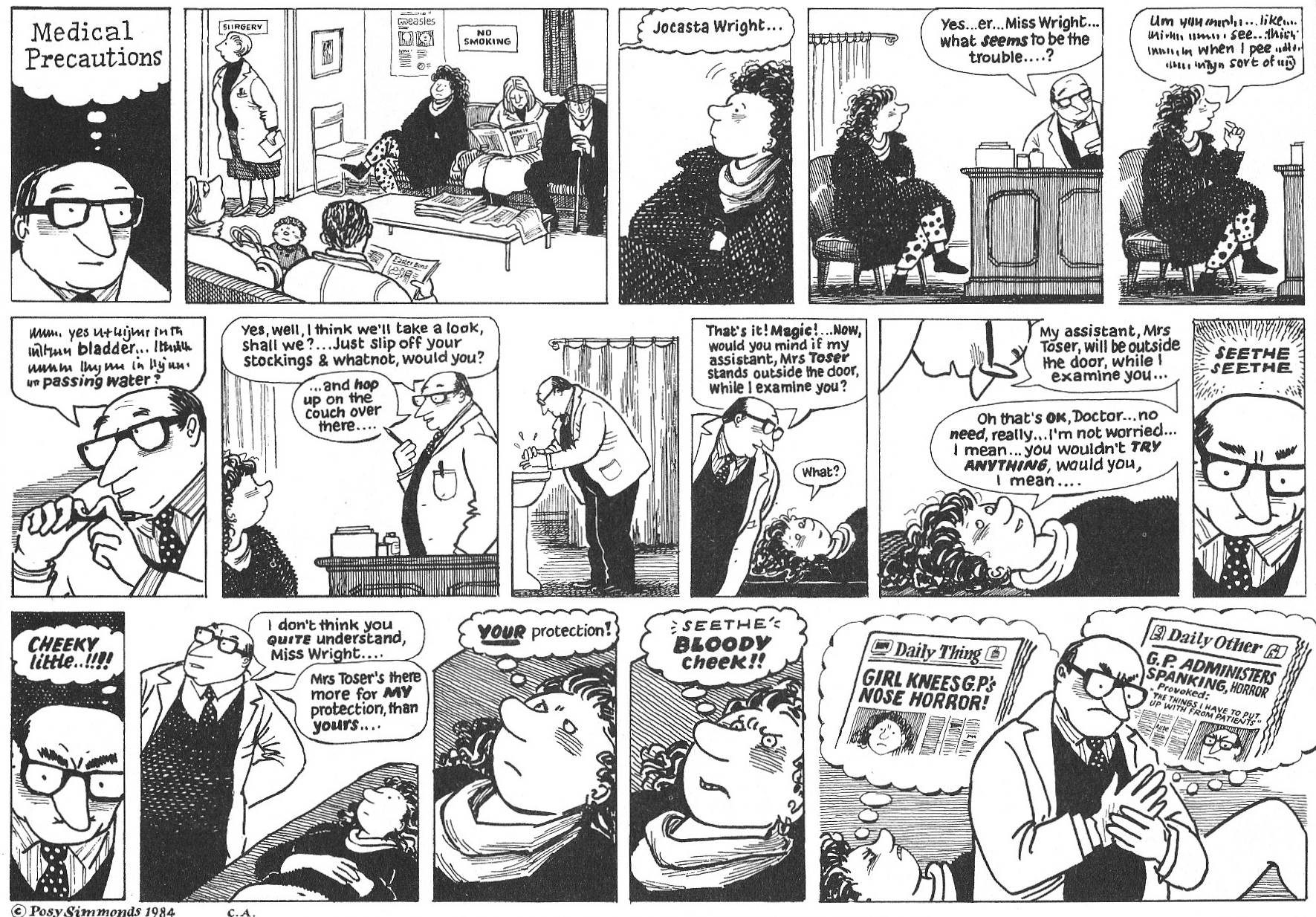
  • Medical precautions Jocasta visits her GP who tells her he is planting a chaperone at the door – leading to a misunderstanding where Jocasta assures the doctor he doesn’t think he’ll try anything and the doctor assures her the chaperone is for his sake, in case Jocasta tries anything – leaving them both seething.

  • Fly’s undoing At a business meeting the only women present manages to persuade the men to back her deal. However she knows they’re all going to go off to the gents and persuade each other to change their minds. She wishes she could be a fly on the wall and… is miraculously transformed into a fly and flies into the gents’ and does indeed hear the hawks talking the doves out of agreeing her deal!
  • Paradise lost the Weber’s are on holiday on a hot beach and the women are going topless when George realises a couple of beach bums are commenting, in French, on the shape of every passing woman’s breasts. He intervenes giving them a feminist lecture, name-checking Lacan and Levi-Bruhl and Rousseau to blast them for objectifying women and giving them another chain to shackle them and so on. The French guys just yawn, stretch and stroll away.
  • Grief A woman’s unrestrained grief embarrasses her friends and family. People think grief should be more restrained and demure. The dichotomy is expressed by a contrast between a Picasso image of a weeping woman and an emollient Victorian image of a slightly sad and dignified lady. Sexism!!

Grief by Posy Simmonds

  • The nightmare of Pauline Woodcock Pauline Woodcock (42) international finance correspondent flies to an assignment in the Middle East but has a nightmare in which she is refused entry to the conference because it is for men only, and is forced to go and sit among the harem women who criticise her for having no husband or family and hating women. But it is only a dream and so not a very valid satire on the sexism of Muslim countries.
  • Momentous news Diane, aged 36 and a TV producer, has finally gotten pregnant but when she tells her friends at a garden party they reveal that everyone they know is having a baby late, it’s a fashion, it’s a trend thus patronising and humiliating her.
  • A message to the Monstrous Regiment Peculiarly, this is the final cartoon in the book: It is in the form of a message from Field Marshall Sir Desmond Blundel-Bolass to what he calls The Monstrous regiment, obviously meaning the entire female population, saying they’re a proud little regiment with a long track record of cooking and cleaning and child-rearing, but recently there have been signs of bolshiness and women deserting the regiment to take up jobs in industry, business and so on. THIS MUST STOP and women return to their proper subservient roles. Maybe it triggered a laugh of recognition at the time (1984) but to me it seems elaborate and ‘clever’ but oddly pointless.

Difficulties of motherhood and childcare (2)

This obviously overlaps with the large number of working mum strips, with some of the Childhood and small children strips, and with the Divorce strips, all of which depict small children shedding light on the hypocrisies of divorced couples.

  • Music and movement At little Katy’s birthday party the parents gather in the kitchen and nervously discuss the way the five year olds are jigging and jiving to highly sexualised pop music, while George delivers another of his pretentious semiotic interpretations which is no good to anyone.
  • Charity begins at home Working mum Gemma leaves her two little kids in the care of wonderful nanny, Anita, but she tells so many people how wonderful Anita is that one by one all the other middle class mums in the street get Anita to care for their children until her place looks like a zoo – much to Gemma’s chagrin.

Childhood and small children (7)

  • Timor mortis The Weber children’s guinea pig dies and the parents, and grandma, give the kids contradictory stories about what happens to dead animals
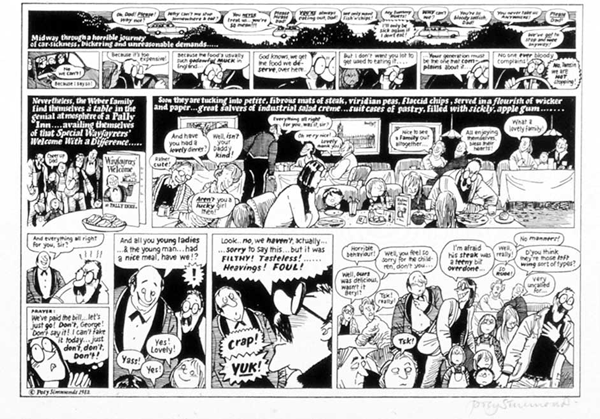
  • On a long-distance drive George and Wendy are pestered to pull over at a roadside pub where the kids pig out on steak and chips but George eventually explodes at the so-called waiter and describes at length why every single item was disgusting.

  • Music and movement At little Katy’s birthday party the parents gather in the kitchen and nervously discuss the way the five year olds are jigging and jiving to highly sexualised pop music, while George delivers another of his pretentious semiotic interpretations which is no good to anyone.
  • The birth of the blues A mum has had a baby and is at home nursing it surrounded by cooing friends and family. The strip focuses on the baby’s sister who is hassled by the grown-ups into saying ‘thank you’ for having a new brother.
  • Monkey business Wendy takes the younger children to the zoo where they see monkeys mating and ask mummy what they’re doing. This dilemma has already cropped up at least twice already in the strip. This time Wendy patiently explains a gentle form of the birds and the bees and the gag is that, as she does so, the monkeys put their hands over their baby monkey’s ears to protect their innocence.
  • Just rewards Billy’s mum takes him to play at a friend’s house where he misbehaves – saying rude words, screaming, snatching things. but each time mummy tells him to stop he does. This, the mum explains to her friend, is because she’s instituted a reward system – every time he obeys mummy he gets a reward, and enough rewards buy him a toy. Cut to Billy who has worked out how to play the system, and so deliberately plays up wherever they go – in order to obey the instruction to behave – and thus earns lots of toys!
  • The dark Two of the Weber kids lock themselves inside the old fridge the Weber’s have thrown out to Wendy’s hysterical horror.

Divorce (3)

This is here because after a divorce, Simmonds is interested in the experience of the mother who usually ends up keeping custody of the children, and so ‘divorce’ comes under the broader heading of Women-Feminism-Motherhood-Childcare-Divorce.

  • Unworthy thoughts Two little children come back from a weekend with their daddy and tell the divorced mummy what a great time they had, he took them on a CND march, introduced them to his lovely new girlfriend, had a barbeque and bought them new clothes. The mum promptly rings up the dad to give him a ear-bashing, asking him why on earth he’s being so nice and trying to suck up to her?
  • Home-sick A divorced dad takes his small kids out to a burger bar and the little girl immediately feels sick. All the way home, including on the bus, he is trying to get the little girl to throw up in the street before she gets home. But she doesn’t. She saves it up for the moment she walks through his ex’s door and throws up all over the phone books – prompting a prolonged ear-bashing from his ex about filling them with junk food etc etc.
  • Dad’s girlfriend A divorced woman’s two little kids are joking and taking the mickey out of her ex-husband’s new girlfriend, Lynn, at which the mum’s smirk of satisfaction grows larger and larger… unti lthe kids say they don’t want to go to dad and Lynn’s at Christmas – at which point the um realises this will ruin all her plans to go skiing with her new boyfriend Robert… and immediately leaps to the defence of Lynn, telling the kids what a wonderful person she is and how she has a really cool new video!

Sex and adultery (7)

  • Strangers in the night In bed together Stanhope discovers his wife is reading a sexy bodice-ripper and teases her about it.
  • Acting one’s age At a crowded theatre bar, Stanhope makes eye contact with a promising young floozy and Simmonds uses the technique whereby they send dotted eye signals at each other while, in another familiar move, she makes the whole thing a parody, with Stanhope imagining the programme to a grand theatrical production of Their Affair… while his wife spots him and reconceives the same events as a tawdry TV comedy titled ‘It always ends in tears’.
  • And no questions asked Stanhope wakes up in bed with a nubile young woman he has slept with and Simmonds uses the comic, or sardonic technique, of counterpointing all the polite things they say to each other with what they’re really thinking, Stanhope in particular smiling smiling and thinking ‘God, when are you going to bugger off?’
  • Flattery A young woman spends half the strip flattering and chatting up a TV star at a party, giving it her best shot until right at the end he makes his excuses and wanders over to the next pretty fan. This is counterpointed by the same events as enacted by a ewe (Aries) trying to chat up a lion (Leo).
  • Married person’s guide to lunching A series of nine lunches which chart the rise, bloom and decay of an affair carried out , as usual, by Stanhope Wright and his latest victim (which includes a(nother) pastiche of Manet’s painting Le Déjeuner sur l’herbe).
  • The transports of love An ironic reference to Stanhope’s car: in the first half he uses it to whisk a pretty young thing off to the countryside where they have a shag, in a picture wherein the car is transformed into an 18th century rococo four-poster bed surrounded by fluttering cherubim – and in the second half, it becomes the scene of an agonised conversation while Stanhope sits with the girl trying to dump her.
  • Derek’s deadly sins A year in the life of a fat gluttonous exec named Derek who regularly stuffs down a heavy lunch with the unbearable Edmund Heep. During the year he chats up a pretty young woman at the office party, and to please his new mistress loses weight, buys new clothes, and the other pub goers take the mickey out of the ensuing affair which runs through May and July but comes a cropper when Derek’s wife finds out about the affair, the relationship breaks up and by the end of the year Derek is back to wearing bad clothes and has his great big beer belly back again.

Academia (8)

  • In his good books Wendy has to sit through dinner with George’s academic colleagues from the Poly all showing off but when they ask her her favourite book, she says Mrs Tiggiwinkle by Beatrix Potter
  • Full stretch George does his yoga while worrying that he is becoming out of touch with developments in the humanities, and ponders resigning.
  • Liaison Presumably published around Valentine’s Day time, this ironically describes the rivalry between the Liberal Studies and Business Studies departments at George’s poly, ending with the suggestion that the two departments amalgamate, which is ironically depicted with one of Simmonds’s flowery rococo pastiches of a valentine’s card between the two.
  • An important meeting George and a colleague go to see the Chairman of governors of the poly but emerge with a surprisingly favourable decision – a big drawing shows what was going on inside each of their skulls, namely that the Chairman made a quick decision because he has a hangover.
  • Unwrappings George and Wendy’s American friend Frisbee Summers is staying. the family pop into a newsagents and while Wendy buys the kids ice-creams George and Frisbee end up discussing the top-row porn mags in high-falutin’ terms of signifying aspects of patriarchal ideology etc. Until Wendy bursts their bubble by whispering ‘Perverts!’ at them both.
  • A notice goes up at the Poly telling staff that unofficial visitors are not allowed. George and his fellow parents on the faculty realise this is a directive designed to stop parents bringing in their children during half term.
  • Eros denied the entire strip is told as a spoof of the Greek gods, wherein Eros fires a dart which hits Mrs Rutland, the Dean’s wife, as she’s chatting to George, and she is suddenly overcome with passion for him, making him blush and the gods panic until another of the gods sends a divine wind to blow away her infatuation and she is restored to normal banality.
  • Funeral rights George is blubbing so much at the funeral of a colleague from the poly who was killed in a car crash that Wendy is proud of him for breaking down sexist stereotypes which insist men keep a stiff, upper lip, and feeling free to express his emotions and… then starts to worry that such an excessive display of mourning will lead colleagues to think he must have been having an affair with the dead woman!
  • The sausage roll that changed the world At a party at his polytechnic, George is pressing the Dean about rumoured cutbacks which might run his new course on Turn of the century Vienna, when the Dean chokes on a sausage roll and Wendy steps in to perform the Heimlich manoeuvre thus saving the Dean’s life – who promptly changes his tune and tells George he’ll see what he can do. (‘It’s an ill windpipe…’)

Middle class mores and hypocrisies (12)

  • Shifting values George and Wendy take a crappy painting his aunt has left him to a valuers who makes an elaborate song and dance over it so that G &W’s opinion is transformed.
  • Black looks George tells Wendy he has just been through an ordeal every bit as bad as the mocking looks he got from his working class dad and his mates when young George went home as an Oxford student – but this time it was the black looks he got as he walked the gauntlet of Belinda and her unemployed punk mates hanging outside the house, as George unpacked the crates of Rioja wine from their Volvo.
  • Left overs George and Wendy have friends round for dinner who praise the cassoulet until Wendy reveals it’s from the freezer of Aunt Gwen who died recently, and left them all her belongings including the contents of her freezer.

  • Killjoy was here Stanhope gets a taxi back from the airport, tanned and still holding his skis from a wonderful skiing break but the glum cab driver soon brings him back to earth and depresses him.
  • Cornish wrestling Taking a cab to the station after a relaxing half-term holiday in Cornwall, George finds a ten pound note down the side of the seat and spends the whole journey agonising whether to hand it in as lost, or use it to pay the fare. He pays the fare.
  • Lingua franca Pippa offers Wendy and the kids a lift back from school and on the way reveals that she’s taken her daughter out of state school and sent her to a private boarding school. ‘They’re very strong on English,’ Pippa explains. They have to be, her daughter in the back thinks – almost all the young ladies at the boarding school are from abroad.
  • Snobs Wendy’s daughter is upset that they won’t buy her a leather skirt for £60, saying all the other girls have got one, and look down on her because she’s poor. What a sordid attitude, Wendy exclaims and tells her daughter that she is in fact, relatively well off with a home and a room of her own and goes to a good school – not to ‘that revolting school in Prosser Street – with all those nasty thugs from the flats.’ To which the family cat comments ‘Sordid attitude’ and Wendy realises what a hypocrite she is.
  • Carping at the shop corner A little gaggle of locals carp about how the local corner shop has changed over the years.
  • Standards of living Wendy leaves Benji with a friend and when her mother and Wendy go to collect him later, the mother spots about a thousand fire and health hazards in the home, whereas Wendy only sees the Noddy book (which I think is meant to be a joke because Noddy books were under fire for being racist).
  • A garden of Eden In early September George and Wendy and a couple of friends are sunbathing in the garden. Then their teenage kids turn up and they become uncomfortably aware of the bumps and blemishes and flab and cover themselves up. Paradise lost.
  • Every picture… At the Wrights’ lovely holiday cottage Stanhope’s art student daughter Jocasta takes Polaroid photos of each other. The joke, such as it is, in the discrepancy between the personal worries and grievances we get to read in their thought bubbles, and the big cheesy smiles they put on for the camera. My daughter read this strip and said, ‘What are they meant to do… shout and scream at the camera? Everyone smiles for bloody cameras and then gets back to their lives.’
  • Lady Bountiful Wendy is walking home from Sainsburys with a friend who points out that Wendy smiles inanely at everyone she meets. Wendy corrects that she only smiles at people less fortunate than her, or who she thinks needs encouraging.  The punchline is that she realises why… why people smile back at her. Standing there weighted down with carrier bags and trailing two mewling children, the reader can see why.
  • Bivouac throughout the strips ‘Bivouac’ is the name given to a kind of Ikea self-service home furnishing company. the strip describes the excitement of buying something in the store, loading it into the car and can’t wait to get it home, then having second thoughts about the extravagant expenditure, and then bickering about who persuaded who to buy it, and then the fate of the bi boxes from Bivouac which is to sit unopened and unloved.

Christmas (8)

Simmonds appears to hate Christmas. Put it this way, all the Christmas-themed strips parody, undermine or satirise the season and its sentiments.

  • Village Christmas
  • What’s in store George and Wendy take the kids to a panto, where they each find something to offend all the family!
  • Och! They’re such a worry The Heeps’ punk sons get kicked out of parties and are forced to go home for New Year’s Eve
  • Festive whirl A circular strip in which George is reluctant to go to a Christmas party, is chivvied into going by Wendy, says they won’t stay long but ends up having a whale of a time, chatting to everyone, then starting to have regrets in the car home, saying he made a number of faux pas, can’t believe he said this, can’t believe he was indiscreet about x, and wakes up the next morning determined not to go to the next Christmas party. Until…
  • The strip World of work has a Christmas theme, consisting of Edmund Heep and a colleague discussing how to wangle the longest break over Christmas.
  • Christmas present George is revolted by a traditional Christmas card from Aunt Bunny containing a traditional cake. George rails against ‘Looking Back Disease’, everyone wanting to preserve a fantasy of some Olde Worlde Christmas and says, if he had his way, they’d dispense with the stagecoach on the Christmas card cover, the Victorian dress, and the port and the lanterns and the snowman, and the robins, out with Santa, in fact out with everything except a message of goodwill. Except that, as he’s dispensed with each of these things, they have been removed from the strip itself until it is just… George and Wendy and a few kids huddling together on a great wide snow-covered plain… with the sound of something hungry howling in the distance.
  • Past 2 o’clock The posh lady with the stiff hairdo and the frightfully, frightfully manner is woken by strangers knocking at the door. It is a reincarnation of Joseph and Mary turned away from the inn and trudging through the snow, and so the humour comes from the tone of voice and excuses made by the posh lady as she explains that she can’t put them up in the main house – the builders are making a frightful mess, but she can put them up in the shed next door, it’s currently housing Sara’s pony but they’re going to do it up and put in a shower and a utility room and decorate it with some rather super tiles they saw in France etc.
  • Christmas wishes A rather bleak strip consisting of two nearly identical big pictures, at the top George and Wendy wishing us a Happy Christmas next to a mantlepiece covered with Christmas cards – underneath, exactly the same scene, but each of the cards has been transformed by one of the worries of contemporary life e.g. a nuclear power station has appeared on the hill behind the sleigh, the wise men had been pointing at a star but now they’re pointing at a mushroom cloud, some deer were looking at a decorated Christmas tree but now they’re looking at a barbed wire fence with a Ministry of Defence Keep Out sign on it. It’s quite funny as humour, but it’s really interesting as social history, as a reminder of just how terrified everyone was of nuclear war or a nuclear accident back in 1983, 36 long years ago.

Pastiches and parodies (7)

Many of the cartoons liven up otherwise mundane events by dressing them in parodies of 18th century rococo or Renaissance paintings, or set them to the tunes of Elizabethan or Victorian songs (updating the words for comic effect) or in other ways frame or transform events into alternative genres, such as when Stanhope imagines a possible affair with a young woman in terms of a grand theatrical production, and visualises a theatre programme giving his and her names as the leading roles…. whereas his wife sees what is going on and imagines the same events as the subject of a silly TV sitcom titled ‘It always ends in tears’.

So humour is often derived not from the events, but from this clever transplanting of them into comically inappropriate genres and formats.

  • The joke Valentine’s Day card in Liaison
  • The appearance and speech of the Greek gods in DIY
  • The use of theatre programmes and the Radio Times format to parody Stanhope chatting up a young lady at the theatre in Acting one’s age
  • Spring fever Spotty punk Julian Heep tries to talk young Helene into shagging him but she refuses saying he’ll just tell everyone at school. The final scene parodies a classical painting of a young man putting his arms round a lady dressed in a classical gown.
  • The transformation of the car into a rococo love nest in Transports of love
  • The rebirth of Venus in which three women discuss and pester a friend into losing weight in a series of pictures which spoof and parody Botticelli’s famous Birth of Venus to make a feminist comment on how women are forced to conform to body stereotypes.
  • Cat lovers is told in the form of a rhyme (as are several others), thus: ‘The cat sat on the mat. Back to the flat come Pat and Jack. Jack hates the cat. The cat hates Jack. Pat loves the cat. The cat loves Pat. Pat sat on Jack’s lap. Jack pets Pat. Jack and Pat want a nap. Scram, cat, scram! Drat the cat!’ which tells the tale of a couple coming back to the flat, smooching and then wanting to go to bed… only to find a big cat poo on the duvet. In strips like this you can see a basic childishness, a simple-mindedness about the strip, which means it wasn’t a big departure for Simmonds to branch out into children’s books – the most successful of which were about… cats!

Teenagers (7)

  • Nature, nurture (and nutrition) Fashionable young Belinda Weber has scorned going to university as her parents hoped and is helping out as waitress in a Directors Dining Room because, as she shouts at her mother, she is sick of living in a poky conversion, sick of kidney beans and lentils, sick of pine dressers. She wants to meet someone rich and drive a Saab and live in a nice house. Thatcher’s children.
  • Virtue’s work Father Stanhope gives lazy skiving art student Jocasta a talking to about needing to get a job.
  • Reaction A mother has a trio of teenagers over, slumped in front of the telly, and is appalled at how heartless and cynical they are, fondly remembering when they were small and got upset at Disney films etc. Suddenly she hears them yukking and moaning and goes in to discover that… they are appalled and revolted by the middle-aged clothes, the bell-bottoms and open shirt being worn by a TV news reporter!
  • Honcho Gun The two punk sons of Edmund and Jo Heep go to the cinema but are so obnoxious they keep being asked to move and are eventually kicked out. Home embarrassingly early, they fend off a bollocking from their dad by ad libbing an enormous long complicated science fiction plot which they make up. ‘When in a spot, baffle ’em wiv Sci-Fi!’
  • Home Jocasta is skint and fed up of living in sordid student accommodationso she turns up back at her parents’ house and moves in, stuffing her face with good food, smoking on the sofa and reading in the bath. As so often, there is an ironic narrative counterpoint to all this as music staves run above the strip depicting the lyrics of the Victorian song ‘there’s no place like home’. My daughter read this strip and asked me, ‘Is it meant to be funny? Because it’s just… obvious’.
  • ABC (as it is spoken) Two young leather-jacketed dudes go into their local pub where the landlord asks them for proof of their age and they get stroppy. The ‘gag; is that the entire dialogue, by all parties, consists of abbreviations: ‘L.O.’ ‘2 G.n.T’ ‘A?’ and so on. Clever. Not particularly funny.
  • Marriage à la mode Belinda announces to her parents that she is going to marry one of the rich directors at the offices where she works as a cook. George and Wendy are distraught that Belinda’s not making the most of her education, those A-levels, doesn’t want to be the strong, independent feminist they brought her up to be and worst of all, wants George to ‘give her away’ at the traditional church service… like a medieval chattel. Ugh!

Second homes (5)

  • Village Christmas The book opens with quite a bitterly satirical cartoon showing a cluster of village cottages round a village church covered in snow in complete silence on December 22, and then in successive pictures how holiday home owners arrive down from London, animate the houses with lights and real fires and arguing and partying over Christmas, nursing hangovers on Christmas Day, and are packed up and gone leaving the village silent again, by 27 December. Looking back from 2019 it’s fascinating to see the seeds of the current housing crisis and resentment at the holiday home-owners who have gutted large numbers or rural and coastal communities, being sown so long ago. But the really striking thing about it is how beautifully it is drawn. In the rest of the book Simmonds’s looseness with faces, which are often erratically drawn, is still in evidence. But her depiction of things, and the details of scenes and scenery (indoors or out) go from strength to strength.
  • Home is the sailor During this period Simmonds introduced the Cornish seaside hamlet of Tresoddit whose point is that it is overrun with Londoners who’ve bought up all the available cottages as second homes.
  • One man’s meat The Weber’s visit posh friends who have a home in the country, and the mum delivers a long speech about how the locals buy really expensive processed food at the local store instead of eating the kind of fresh, vegetarian fare which she recommends.
  • Up and down in the country A satirical speech delivered by the same pomaded lady in a quilted Barbour jacket as the previous strip, who explains the work of the Society for the Preservation of Owners of Second Homes or POSH.
  • Nice little men The same woman with a Barbour jacket and over-elaborate hairdo has such a worry about her second home in the country, and calls out a simply super little man who lives locally, but the nice little man overhears her describing him in belittling, superior, patronising tones on the phone and so does a rush job and clear out grumpily… leaving posh lady wondering ‘But he was such a NICE little man, too.’

Edmund Heep the alcoholic (3)

  • Edmund Heep steps in for a colleague at a conference and gives a deeply embarrassing speech
  • Distinguished service Heep is out of action nursing a hangover so his secretary Jackie has to rummage around in his chaotic filing system to find the needed paperwork.
  • World of work On a crowded bus at Christmas, Heep discusses with a colleague precisely how many days off work they can wangle, this Christmas and next Christmas holidays. Neither of them understand why the two blokes behind them become so angry that one of them shoves Heep’s hat down over his ears until… they pair get off the bus at the next stop and go into the local Job Centre – at which they simply feel SHAME.

Miscellaneous (3)

  • Upright citizens Waiting in a long bus queue an old lady reflects that it’s one of life’s little unfairnesses that whereas young people can lounge or sit in doorways, the elderly cannot without being taken for vagrants.
  • Minor op Wendy goes into hospital for a minor operation. The amusement comes from the way Simmonds quotes Shakespeare’s ‘All the world’s a stage’ speech to name all the ‘roles’ someone having an operation is called on to perform.
  • The house that Jack bought Nice middle-class Jack sells his house in order to move into the one Mr Shite is selling him but at the last minute Shite gets a higher offer and sells it to someone else leaving Jack’s family stuck in expensive rented accommodation. This just seems to be an utterly humourless comment on the sheer hell of trying to buy or sell a house in Britain.

Politics (2)

  • Don’t know A visually funny strip where Jocasta the art student is wakened by a ringing at her doorbell, trudges all the way down the stairs and the hallway to answer the door to a man canvassing for the local Labour candidate. Jocasta takes the flyer, trudges back upstairs and dumps it next to all the other ignored flyers.
  • Judicium extremum Atom bombs fall and wipe out the world. At the pearly gates there are two queues of the dead, one of hawks and one of doves, both of them blaming each other for what has happened.

Household chores and worries (1)

Possibly the once about the Bivouac shopping trip fits in here as well.

  • DIY A parody in which the Greek gods of the household oversee George and Wendy’s frustrated attempts at spring cleaning.

Thoughts

This detailed enumeration of the strips makes it crystal clear that it contains little or no politics but is overwhelmingly concerned with the cosy mundanities, and stroppy grievances and petty frustrations, of domestic and personal life. Feminism, or the role of women, and in particular a) harassed mothers and b) even more harassed working mums, are the most recurrent subjects.

On the plus side is young Belinda Weber, the glamorous teenager/young woman, strong, independent-minded, who rejects all her mother’s pussy-footing, soft soap liberalism and just wants to marry a millionaire. It’s odd how, having root and branch rejected old-style feminism, Belinda is consistently shown as a well-adjusted, happy winner.

One other thing is striking to the modern reader, which is that all the characters are white and straight.

There are no black, Asian, Muslim or ethnic minority characters, whether in the street, in shops, in the various offices or at the poly, in the schools or at any of the parties, lunches and get-togethers. Race appears as an issue once or twice, for example in the strip when Wendy says she smiles at the new Pakistani woman who’s moved into the street, and says the one person she doesn’t smile at is the appallingly racist woman across the road. When Edmund Heep irritates the men sitting behind him on the bus, one of them is black. That appears to be it.

Similarly, there are no gay or lesbian characters anywhere. The rights and wrongs endured by middle-class white women women women women are proclaimed from the hilltops. The experiences of black, Asian, immigrant or lesbian and gay people are invisible. The Posy cartoon strips are a strictly white, middle-class and heterosexual affair. This, I think, goes a long way to explaining why they have such a cosy, reassuring feel. Nothing threatening or strange ever happens in them.

cf Celeb

Surfing cartoons on the internet I stumbled across the ‘Celeb’ strip drawn by ‘Ligger’, which has been appearing in Private Eye for 30 years or so, describing the sardonic attitudes of an ageing rock star named Gary Bloke. Every one of these Celeb cartoons made me laugh out loud.

Celeb by Ligger

I found more laughs in one Celeb cartoon than the entire 488-page Posy collection but then laughs are not really what she’s after.

Credit

All Posy Simmonds cartoons are copyright Posy Simmonds. All images are used under fair play legislation for the purpose of analysis and criticism. All images are freely available on the internet.


Related links

Other Posy Simmonds reviews