Eric Ambler reviews

Eric Ambler (1909 to 1998) was an English author of thrillers, in particular spy novels. Others had written espionage books before him but Ambler is often credited, in his six novels from the 1930s, with creating a lot of the atmosphere which was copied by later writers. During the Second World War and afterwards, he was also a successful screenwriter.

Pre-war novels

1936 The Dark Frontier British scientist gets caught up in a revolution in an East European country while trying to find and destroy the secret of the first atomic bomb. Over-the-top parody.

1937 Uncommon Danger (British journalist Kenton gets mixed up with the smuggling of Russian plans to invade Romania and seize its oil, in which the Russian or KGB agent Zaleshoff is the good guy against a freelance agent, Saridza, working for an unscrupulous western oil company. Cartoony.

1938 Epitaph for a Spy Hungarian refugee and language teacher Josef Vadassy, on holiday in the south of France, is wrongfully accused of being a spy and is given three days by the police to help them find the real agent among a small group of eccentric hotel guests. Country house murder.

1938 Cause for Alarm Engineer Nick Marlow is hired to run the Milan office of a British engineering company which is supplying the Italian government with munitions equipment, only to be plunged into a world of espionage, counter-espionage, and then forced to go on the run from the sinister Italian Gestapo, aided by Zaleshoff, the KGB agent from Danger. Persuasive.

1939 The Mask of Dimitrios Detective writer Charles Latimer sets out on a quest to find the true story behind the dead gangster, Dimitrios Makropoulos, whose dossier he is shown by the head of Istanbul police, discovering more than he bargained for in the process.

1940 Journey into Fear The war has begun and our enemies have hired an assassin to kill Mr Graham, the English engineer who is helping to upgrade the Turkish fleet. The head of Turkish security gets Graham a berth on a steamer heading to Italy but the enemy agent has followed him. Possibly the best of the six.

Post-war novels

1952 Judgment on Deltchev Playwright Foster is sent by a newspaper to report on the show trial of a fallen politician, Deltchev, in an unnamed East European country, and gets caught up in a sinister and far-reaching conspiracy.

1953 The Schirmer Inheritance Young American lawyer George Carey is tasked with finding relatives who may be eligible to receive the large inheritance of an old lady who died without heirs. Because she comes of immigrant stock the task takes him on a tour of European archives – in Paris, Cologne, Geneva, Athens, Salonika – where he discovers the legacy of the Nazis lingering on into the murky world of post-War Greek politics.

1956 The Night-Comers Engineer Steve Fraser is preparing to leave the newly independent Dutch colony of Sunda after a three-year project when he and his Eurasian girlfriend get caught up in a military coup. Trapped by the rebels in their apartment because it is in the same building as the strategically-important radio station, they witness at first hand the machinations of the plotters and slowly realise that all is not what it seems.

1959 Passage of Arms An American couple on a Far East cruise, naively agree to front what appears to be a small and simple, one-off gun-smuggling operation, but end up getting into serious trouble. A thorough and persuasive and surprisingly light-hearted fiction, the least spy-ish and maybe the best Ambler novel so far.

1962 The Light of Day Small-time con man Arthur Simpson gets caught up in a plan by professional thieves to steal jewels from the famous Seraglio Museum in Istanbul, all the time acting as an inside man for the Turkish authorities. An enjoyable comedy-thriller.

1964 A Kind of Anger Journalist Piet Maas is tasked with tracking down a beautiful woman who is the only witness to the murder of an exiled Iraqi colonel in a remote villa in Switzerland, and finds himself lured into a dangerous game of selling information about a political conspiracy to the highest bidder.

1967 Dirty Story Forced to flee Greece in a hurry when a porn movie project goes bad, shabby con man Arthur Simpson (who we first met in The Light of Day) takes ship through Suez to the East Coast of Africa, where he finds himself enrolled as a mercenary in a small war about mineral rights.

1969 The Intercom Conspiracy Two East European intelligence chiefs conceive a money-making scam. They buy a tiny Swiss magazine and start publishing genuine intelligence reports, which publicise American, Soviet, British and NATO secrets. All those countries’ security forces fall over themselves to discover the source of the leaks and, after ineffectually threatening the hapless editor of the magazine, buy it from the colonels for a cool $500,000. Another amusing comedy-thriller.

1972 The Levanter Middle Eastern industrialist Michael Howell is forced much against his will to collaborate with a Palestinian terror group planning a major atrocity, while he and his mistress frantically try to find a way out of his plight.

1974 Doctor Frigo Latino doctor Ernesto Castillo is ‘persuaded’ by French security agents to become physician to political exiles from his Latin American homeland who are planning a coup, and struggles hard to maintain his professional standards and pride in light of some nasty revelations. A very enjoyable comedy thriller.

1977 Send No More Roses Paul Firman narrates this strangely frustrating account of his meeting at the Villa Lipp with an academic obsessed with exposing him as the head of a multinational tax avoidance and blackmailing operation until – apparently – his boss intervenes to try and ‘liquidate’ them all, in a half-hearted attempt which completely fails, and leaves Firman in the last pages, on a Caribbean island putting the finishing touches to this narrative, designed to rebut the professor’s damning (and largely fictional) account of his criminal activities. What?

1981 The Care of Time Ex-CIA agent-turned-writer, Robert Halliday, finds himself chosen by a shadowy Middle Eastern fixer to help out with a very elaborate scam involving a mad Arab sheikh, an underground bunker, germ warfare experiments and a fake TV interview. Typically complex, typically odd.

Autobiography

1985 Here Lies: An Autobiography Droll, sly, giving nothing away.

The Dissolution of the Austro-Hungarian Empire 1867-1918 by John W. Mason (1985)

This is another very short book, one of the popular Seminar Studies in History series. These all follow the same layout: 100 or so pages of text divided up into brisk, logical chapters, followed by a short Assessment section, and then a small selection of original source documents from the period.  It’s a very useful format for school or college students to give you a quick, punchy overview of a historical issue.

This one opens by summarising the central challenge faced by the Austro-Hungarian Empire as it entered the twentieth century: how to take forward a fragmented, multi-cultural empire based on traditional dynastic and semi-feudal personal ties into the age of nationalism and democracy where every individual was, in theory at least, a citizen, equal before the law.

On page one Mason locates four key failures of late imperial governance:

  1. the failure to solve the Czech-German conflict in the 1880s and 1890s
  2. the failure to develop a genuine parliamentary government in the late 1890s
  3. failure to solve the Austro-Hungarian conflict in the early 1900s
  4. failure to solve the South Slav conflict in the decade before World War One

PART ONE The background

1. The Hapsburg Monarchy in European History

The Hapsburg monarchy lasted 640 years from 1278 to 1918. It was a dynastic creation, never attached to a specific country. In 1867 (following Hungary’s defeat to Prussia in the war of 1866) the state was organised into the so-called Dual Monarchy, with the Hapsburg ruler titled the Emperor of Austria and the King of Hungary. This gave Hungary more autonomy and respect than it had previously had.

The name ‘Hapsburg’ derives from Habichtsburg meaning ‘Castle of the Hawks’, located in what is now the Swiss canton of Aargau. During the eleventh century the knights from this castle extended their power to build up a position of growing influence in south Germany.

Meanwhile, the eastern March – the Oster Reich – of Charlemagne’s massive empire was granted to the Babenberg family in the tenth century and they held it for the next 300 years.

In 1273 the electors of the Holy Roman Empire elected Rudolf of Hapsburg to the office of Holy Roman Emperor. In the 14th century the Hapsburgs acquired Carinthia, Carniola, Tyrol, Istria and Trieste to their domain. In the 15th another Hapsburg was elected emperor and from 1438 till the Holy Roman Empire was dissolved by Napoleon in 1806 the Crown remained almost continuously in their house.

When King Louis II of Bohemia and Hungary died without issue in 1526, both his crowns passed to the Hapsburgs. This marked a turning point because up till then all Hapsburg land had been German-speaking. Now the Hapsburg administration had to take account of various non-German nations with their own independent histories.

This leads to a Big Historical Idea: just as the countries of the West were beginning to develop the idea of the nation state, central Europe was going down a different path, towards a multi-national empire.

Even more decisive was the role the Hapsburgs played in defending Europe from the Turks. Twice, in 1529 and 1683, the Turks laid siege to Vienna, a very under-reported and under-appreciated part of European history.

The Turkish threat had effectively been repulsed by the start of the 18th century and the Hapsburgs embarked on their new role in Europe which was to act as a counterweight to ambitious France, starting with the War of Spanish Succession (1702-14).

The long rule of the Empress Maria Theresa (1740-80) saw her undertake reform and centralisation of the administration. But her power in central Europe was challenged by Hohenzollern Prussia under Frederick the Great (1740-86). During this period, Poland was partitioned and Austria was given from it the southern province of Galicia, which she retained right up till the end of the Great War.

The French Revolution and Napoleonic Wars (1789-1815) unleashed the ideas of nationalism and democracy across Europe, both of which struck at the heart of the multi-ethnic and hierarchical structure of the Empire.

Under Maria Theresa and her son Joseph II, Austria had arguably been part of the continent-wide movement of reform associated with the Enlightenment, take for example their legislation to remove many of the restrictions placed on the Jewish population.

But the twin forces of nationalism and democracy were such a threat to a multinational polity that from this point onwards the Hapsburgs and the empire they led, became a reactionary force, embodied in the machinations of their legendary Foreign Minister, Klemens von Metternich (foreign minister from 1809 to 1848).

In 1848 revolutions took place all across Europe, with no fewer than five in capitals controlled by the dynasty – in Vienna, Prague, Budapest, Croatia and in northern Italy (territory which the Hapsburgs had seized after the defeat of Napoleon). Hapsburg forces put down the revolutions in four of the locations, but it required the intervention of the Russian army to defeat the revolutionary Hungarian forces. The Magyars never forgot this bitter defeat.

In the Crimean War (1853-6) Austria kept neutral from both sides (Britain & France versus Russia) which weakened her role in Europe. In 1859 France supported the desire for independence of Piedmont, the north Italian state ruled by the Hapsburgs since the defeat of Napoleon, and hammered the Austrians at the Battles of Magenta and Solferino. In response the Hapsburgs introduced some administrative reforms, but in 1866 lost another war, this time against Prussia under Bismarck, decided at the Battle of Sadowa.

Seriously weakened, and now definitely deprived of all influence in a Germany unified under Prussian rule, the Emperor’s politicians were compelled to bolster the Empire’s authority be devising a new agreement with the large Kingdom of Hungary to the East.

2. The Austro-Hungarian Compromise

Hence the Compromise or Ausgleich of 1867 which recognised the sovereign equality of two states, Austria and Hungary, bringing them under the rule of one man, Franz Joseph, Emperor of Austria and King of Hungary. The dual monarchy wasn’t the same as a federation, constitutionally it was unique. But it bolstered the Hapsburgs a) territory b) manpower. Crucially it provided a bulwark against the Slavs in the Balkans, quelling pan-Slavic sentiment.

The drawback of the Compromise was that it was essentially a personal agreement between the Emperor Franz Josef and the Magyar ruling class. Even liberal and progressive German-speaking Austrians felt left out, and that’s before you consider the numerous other nationalities contained within the empire.

PART TWO Domestic affairs

3. The Nationality Questions

The Treaty of Versailles entrenched the idea of national self-determination preached by American President Woodrow Wilson, and resulted in the break-up of the empire into a host of new nation states based on ethnicity. Viewed from this angle, it looks as though the Austro-Hungarian Empire was foredoomed to collapse. But all the histories I’ve read there was no such inevitability. This one wants to scotch two assumptions –

  1. that all the nationalities thought they’d be better off outside the empire (many realised they wouldn’t)
  2. that all the nationalities were ‘at war’ with imperial authorities; many weren’t, they were in much sharper conflict with each other

In the West the state and the nation were closely aligned; but in the East you can see how they are in fact distinct ideas. The state is an administrative unit and in Central and Eastern Europe was based on ancient rights and privileges of rulers, often going back to medieval origins.

From the mid-nineteenth century these traditional ideas were challenged by a concept of ‘nation’ based on ethnicity, culture and language. Otto Bauer the Austrian Marxist made a famous categorisation of the peoples of the empire into ‘historic’ nations, those which had an aristocracy and bourgeoisie and an independent national history;

  • Germans
  • Magyars
  • Poles
  • Italians
  • Croats

and those who don’t:

  • Czechs
  • Serbs
  • Slovaks
  • Slovenes
  • Ruthenians
  • Romanians

Most modern commentators include the Czechs in the list of ‘historic’ nations.

The Germans

In the western half of the empire the Germans made up 10 million or 35% of the population of 28 million. Nonetheless the administration was thoroughly German in character. The official language of the empire was German. The great majority of the civil servants were German, 78% of the officers in the army were German. The cultural life of Vienna, the capitalist class and the press were overwhelmingly German. Three political parties dominated from 1880 onwards, which adopted the three logical policies:

  1. The Pan-Germans looked beyond Austria to a nationalist union of all German peoples under Bismarcks Prussia
  2. The Christian Socialist Party under Karl Lueger aimed to unite all the nationalities under the dynasty
  3. The left-wing Social Democrats aimed to unite the working class of all the nationalities, thus dissolving the nationalities problem

The Czechs

Third largest ethnic group (after the Germans and Hungarians) with 6.5 million or 12% of the population. In Bohemia roughly two fifths of the people were German, three fifths Czech.The Czechs were the only one of the minorities which lived entirely within the borders of the empire, and some they were bitterly disappointed by the Compromise of 1867, which they thought should have recognised their identity and importance. Czech nationalists thought the deal left them at the mercy of German Austrians in the West and Hungarians in the East.

From the 1880s the struggle between Czech and German expressed itself in the issue of the official language taught in schools and used in the bureaucracy. The Czech population increased dramatically: Prague was an overwhelmingly German city in 1850 but 90% Czech by 1910. Germans found it harder to dismiss the Czechs as peasants Slavs, as Bohemia rapidly industrialised and became the economic powerhouse of the empire.

The Poles

The Poles were the fourth largest group, in 1910 4.9 million or 17.8% of the western part of the empire, most of them living in Galicia. Galicia was a) a province of Poland which had been obliterated from the map when it was divided between Russia, Prussia and Austria in the 18th century b) at the north-east fringe of the empire, beyond the Carpathian mountain range.

The Austrians needed the support of the Poles to make up a majority in the parliament in Vienna, and so made so many concessions to the Polish Conservative Party in Galicia that it enjoyed almost complete autonomy, with Polish recognised as the official  language, Polish universities and so on.

The Ruthenians

Only three fifths of the population of Galicia was Polish; the other two-fifths were Ruthenians. The Ruthenians belonged to the same ethnic group as the Ukrainians but were distinguished by adherence to the Latin/Greek Uniat church. The Ruthenians were the most socially backward group in the empire and very much under the thumb of the politically advanced Poles, responding by setting up a peasants’ party.

Conservative ‘Old Ruthenians’ gave way to ‘Young Ruthenians’ in the 1880s, who sought union with the 30 million Ukrainians living to their East. The more concessions the central government made to the Poles, the more it alienated the Ruthenians. After 1900 Ruthenians and Poles clashed over electoral or educational issues, sometimes violently.

The Slovenes

1.25 million or 4.4 per cent of the population of the Austrian half of the empire, the Slovenes were scattered over half a dozen Crownlands, and lacked even a written literature in their own land. Even mild efforts at nationalism, such as setting up a Slovene-speaking school, were fiercely opposed by the German majorities in their regions.

The Italians

770,000, the smallest national group in the empire, with Italian-speaking areas in the Tyrol and along the Adriatic coast, which had quite different concerns. In the Tyrol the Italians fought against the dominance of the Germans. Along the Adriatic they were a privileged minority among a Slav majority.

In May 1915 Italy betrayed its treaty promises to Germany and Austria-Hungary and joined the Allies because Britain and France promised Italy possession of the Tyrol and the Adriatic Littoral (and money).

The Magyars

10 million Magyars formed 48% of the population of Hungary. The Magyars dominated the country, owning, for example 97% of joint stock companies. It was dominated by ‘Magyarisation’ meaning fierce determination of the magyar ruling class to impose uniformity of language across the territory. If minorities like Romanians or Slovenes agreed to teach their children Hungarian and support Magyar rule, they could become citizens; otherwise they were subject to fierce discrimination. The Magyars didn’t want to exterminate the minorities, but assimilate them into oblivion.

Budapest was three quarters German in 1848 and three quarters German in 1910. Mason tells us that all attempts to reform the Dual Monarchy ultimately foundered on Hungary’s refusal to abandon its unbending policy of Magyarisation.

The Romanians

The largest non-Magyar group in Hungary, about 3 million, their aspirations were ignored in the 1867 Compromise, and the Hungarians’ intransigent policy of Magyarisation drove more and more to think about joining the independent Kingdom of Romania, just across the border from Hungarian Transylvania, and the forming of a National Party in 1881, which slowly poisoned Austria’s relations with Romania.

The Slovaks

The Slovaks were the weakest and least privileged group in the Hapsburg Monarchy, 9% of the population, a peasant people who had lived under Magyar domination for a thousand years. The 1867 Compromise made the Czechs and Croats second class citizens but condemned the Slovaks to cultural eradication. From the 1890s they started co-operating with the Czechs and slowly the idea of a combined Czech and Slovak nation evolved.

The Croats

9% of the population of Hungary. They had a national history and a strong aristocracy and considered themselves in direct touch with the Hapsburg monarchy. By an 1868 compromise Croatia received autonomy within the Hungarian state, but the head of the Croat state was imposed by the Hungarian government and the rule of Count Khuen-Héderváry was so repressive that Croatia became the seat of a movement to unite all the empire’s South Slavs.

The Serbs

About 2 million Serbs lived in the empire, divided between Dalmatia, Hungary, Croatia and Bosnia-Herzegovina. They didn’t have an independent national history until 1878 when the Congress of Berlin created a small state of Serbia independent of the Ottoman Empire, from which point every perceived injustice against the Serbs prompted calls for a pan-Slave movement, and/or for a Greater Serbia. The biggest incident on the road to collapse was the Austrian annexation of Bosnia-Herzegovina in 1908, the majority of whose population were Serbs.

The Jews

The Jews made up about 5% of the population in both Austria and Hungary. From 1850 Jews moved in large numbers into Lower Austria, overwhelmingly from poor rural Galicia (Poland), a large number of them migrating to Vienna, where they came to dominate cultural activity out of proportion to their numbers.

The Jews became so prominent in the Hungarian capital that some called it Judapest. The Jewish journalist Karl Kraus joked that ‘the Jews control the press, they control the stock market, and now [with the advent of Freud’s theory of psychoanalysis] they control the unconscious’.

The success of Jews in business and the stock market and banking created an association between ‘Jew’ and ‘capitalist’ which complicated class conflict and led to an easy demonisation of the Jews as responsible for much of the exploitation, low wages and fat profits of capitalism.

4. The economy

The Hapsburg Empire was behind Germany, France and Britain in industrialisation. It didn’t have large stocks of coal, it had no large ports, parts of it (like Galicia) were split off from the empire by high mountains; the great Hungarian Plain was designed for agriculture not industry.

It was a predominantly agricultural economy: in 1910 agriculture made up 50% of the Austrian economy, two-thirds of the Hungarian. Most of the trade was between Hapsburg regions and nations; the 1867 Compromise established a free trade area throughout the empire.  Only a small percentage of GDP came from exports.

In Hungary serfdom was only abolished in 1848. For most of the period, Hungary was characterised by Magyar landlords, sometimes with very extensive holdings, lording it over illiterate peasants of the various nationalities. That’s one reason why nationalist grievances became mixed up in economic ones. Only in the decade before the war did Hungary begin to industrialise.

Industrialisation was funded by banks which remained firmly in German and Hungarian hands. The industrial heartland of the empire was the Czech Crownlands (Bohemia and Moravia) which developed a strong textiles industry and then iron and steel, metallurgy and engineering. This became another source of tension between Czechs and Germans, because many of the industries remained in the hands of German managers, backed by German hands.

(Remember the passage in Ernst Pawel’s biography describing the end of the Great War, the declaration of independence, and the way the new Czech government immediately a) renamed all its businesses and industries in Czech and b) undertook a wholesale replacement of all German bureaucrats and business men with Czech replacements.)

The late 1860s saw a mounting fever of speculation which led to a stock market crash in 1873 and a prolonged depression afterwards. This led to low growth, and poverty among the urban proletariat and among rural peasants, which led to the rise of nationalist and populist parties.

5. The politics of Dualism

The Austrian (i.e. German-speaking) Liberal Party ruled after the 1867 Compromise. But that compromise had alienated the Czechs whose MPs didn’t even attend the parliament. But it was the massive financial crash of 1873 which ruined the Liberal Party, associated as it was with business and the banks.

In 1871 there was an attempt by the conservative aristocrat Count Hohenwart to reform the monarchy and turn it into a federation, who drafted some ‘Fundamental Articles’ which were intended to give the Czechs parity with the Hungarians, but this was fiercely opposed by the Hungarian prime minister, Count Andrássy. The Czechs never trusted the dynasty after that, and boycotted the Vienna parliament.

In 1879 Franz Joseph asked his boyhood friend Count Taaffe to form a new government and Taaffe went on to govern till 1893, passing a series of reforms which echoed those of Bismarck in Germany, such as extending the franchise, workers health and accident insurance, limiting the working day to 11 hours etc.

But when he tried to tackle the German-Czech issue by breaking up Czech provinces into smaller units based along ethnic lines, his plans were scuppered by the Poles, the Clericals and the Feudals, and the German Liberals and he was forced to resign. Over the next twenty years three parties emerged:

The Social Democrats

This left-wing party emerged from the trade union movement in 1889 and its soft Marxist outlook focused on economic and social reform cut across ethnic lines and so was a force for keeping the empire together. At the Brünner Conference of 1899 they called for the transformation of the empire into a democratic federation of nationalities.

The Christian Socials

Founded in 1890 by the phenomenally popular Karl Lueger who became mayor of Vienna 1897-1910, based around a devout Catholicism which linked democratic concern for ‘the small man’, responsible social reform, anti-semitism and loyalty to the dynasty. Turning artisans and small shopkeepers into a strong anti-socialist, anti-capitalist, pro-Hapsburg bloc.

The Pan-Germans

The extreme anti-semitic Pan-German Party founded by Georg von Schönerer. Starting as a liberal he grew disenchanted and wanted a) to separate out the German-speaking areas from their Slav populations and b) unite with the Reich. In 1884 he led a battle to nationalise the Nordbahm railway which had been financed by the Rothschilds. He failed, but gained wide support for presenting the plan as a battle of the Jews versus the people. Although small in numbers, the Pan-Germans spread vicious racist ideas and their supporters were prone to violence.

The end of parliamentary governance

The next government of Alfred III, Prince of Windisch-Grätz, was brought down after two years because it agreed to allow a German secondary school in southern Styria to have parallel lessons in Slovene at which point the German National Party rejected it, voted against it, and brought down the government.

The next government was led by a Pole, Count Kasimir Felix Badeni. In 1897 he tried to settle the perpetual conflict between Czechs and Germans by moving a law that said that from 1901 no official should be employed in Bohemia or Moravia who wasn’t fluent in German and Czech. Since most Czechs spoke German, this was no problem for them, but hardly any Germans spoke Czech and there was uproar in parliament, with all kinds of tactics used to stall the passage of the bill, riots broke out on the streets of Vienna and then Prague. Franz Joseph was forced to accept Badeni’s resignation, and the Vienna parliament never had the same prestige or power again.

It couldn’t function properly and legislation was from 1897 passed only by emergency decree via Article 14 of the constitution. Government was no longer carried out by politicians and ministers but by civil servants. The Germans and the Czechs continued to obstruct parliament

Several more ministries tried and failed to solve the nationalities problem, while the emperor accepted advice that extending the franchise to the working class might help create a mood of social solidarity. So a bill was passed in 1907 giving the vote to all men over 24. But it was irrelevant. By this stage parliament didn’t govern the empire, bureaucrats did. Extending the franchise brought in a new wave of socialist parties, which combined with the nationality parties, to make governing impossible. During the parliament of 1911 no fewer than 30 parties blocked the passage of all constructive measures in parliament.

6. Vienna – Cultural centre of the Empire

Traditional liberal culture was based on the premise of rational man existing within as stable, civic social order. By the 1890s this society was beginning to disintegrate…

The political crisis in late nineteenth-century Austria-Hungary was caused by the bankruptcy of liberalism. The result was the sudden growth of a number of anti-liberal mass movements. In the cultural sphere the consequence of the breakdown of liberalism were no less dramatic…

Mason distinguishes three phases or artistic eras in this period:

1. The 1870s

In the 1870s students formed the Pernerstorfer Circle, seeking an alternative to liberalism, which they rejected and found inspiration in early Nietzsche, his writings about the imagination and the Dionysian spirit, leading to veneration of the music dramas of Wagner. The most famous member was the composer Gustav Mahler.

2. The 1890s – Young Vienna

Aestheticism and impressionism, focus on the fleeting moment, in-depth analysis of subjective psychology. A moment’s reflection shows how this is a rejection of rational citizens living in a stable social order, and instead prioritises the non-stop swirl of sense impressions. The leading writers of the Young Vienna literary movement were Hugo von Hofmannstahl and Arthur Schnitzler, with his frank depictions of the sex lives and moral hypocrisy of the Viennese bourgeoisie.

3. After 1900 – Kraus, Loos and Schoenberg

The Jewish journalist Karl Kraus published a fortnightly magazine, Die Fackel, in which he flayed all political parties and most of the writers of the day. He carried out a one-man crusade against loose writing, sentimentality and pomposity. Mason doesn’t mention something Ernst Pawl emphasises in his biography of Kafka, which is that plenty of Kraus’s journalism railed against the Jewish influence on German prose, criticising its importation of Yiddishisms and other impurities. It was this attitude which led Pawl to diagnose Kraus as a leading example of the ‘Jewish self-hatred’ of the period.

Adolf Loos was a radical architect who despised any ornament whatsoever. He designed a starkly modernist house which was built in 1910 opposite the imperial palace and was a harsh modernist critique of the wedding cake baroque style of the empire.

Arnold Schoenberg thought Western music had reached the end of the road, and devised an entirely new way of composing music based on giving each note in the scale an equal value i.e. leaving behind traditional notions of a home key or key tones, i.e. 500 years of tradition that a piece of music is composed in a certain key and will develop through a fairly predictable set of chords and other keys closely related to it. Schoenberg demolished all that. In his system all notes are equal and their deployment is based on mathematical principles. Hence his theory came to be known as ‘atonality’ or the ‘twelve tone’ system.

And looming behind these three was one of the most influential minds of the 20th century, Sigmund Freud, the conservative and urbane Jew who did more than almost anyone else to undermine the idea of the rational, citizen or the rational human being. In Freud’s theory most of the activity of the human mind is unconscious and consists of a seething mass of primitive drives and urges. For the early period, from his first formulation of psychoanalysis in 1895 through to the outbreak of the First World War, Freud concentrated on the sexual nature of many or most of these urges, and the psychic mechanisms by which human beings try to repress or control them (via psychological techniques such as displacement or repression).

But the experience of the Great War made Freud change his theory in recognition of the vast role he now thought was played by violence and a Death Drive, which matched and sometimes overcame the sex urge.

Whatever the changing details, Freud’s theory can be seen as just the most radical and drastic attack on the notion of the sensible, rational citizen which were widespread in this time, and at this place.

Leading not only Mason but countless other critics and commentators to speculate that there was something about the complexity of the Austro-Hungarian Empire, and something about the thoroughness with which it collapsed, which led to the creation of so many anti-liberal and radical ideologies.

All the art exhibitions I’ve ever been to tend to praise and adulate 1900s Vienna as a breeding ground of amazing experiments in the arts and sciences. Many of them praise the artistic radicalism of a Loos or Schoenberg or Egon Schiele as a slap in the face to boring old bourgeois morality and aesthetics.

Not so many dwell on the really big picture which is that all these artistic innovations were the result of a massive collapse of the idea of a liberal society inhabited by rational citizens and that, in the political sphere, this collapse gave rise to new types of political movement, anti-liberal movements of the extreme left and extreme right, to the Communism and Fascism which were to tear Europe apart, lead to tens of millions of deaths and murder and torture, and the partition of Europe for most of the twentieth century.

PART THREE Foreign affairs

7. The Dual Alliance

In international affairs the thirty-six years between the Congress of Berlin in 1878 and the start of the Great War in 1914 were dominated by the Balkan Problem or the South Slav Question.

In the 1600s the Muslim Ottoman Empire had extended its reach right up to the walls of Vienna. The Ottomans were held off and pushed back so the border between Christendom and Islam hovered around south Hungary and Bulgaria. But the Balkans contained many ethnic groups and nationalities. Slowly, during the 19th century, Ottoman rule decayed causing two things to happen:

  1. individual ethnic groups or nations tried to assert their independence from the Ottoman Empire
  2. each time they did so tension flared up between Russia, who saw herself as protector of all the Slavs in the Balkans, and Austria-Hungary, who feared that the creation of a gaggle of independent states in the Balkans under Russian control would inflame her own minorities and undermine the empire

The Congress of Berlin was held in 1878 to try and adjudicate between the conflicting claims of Russia and Austria-Hungary, and the host of little countries who wanted independence from the Ottomans.

This section details the long history of the complex diplomatic policies adopted by successive foreign ministers of the empire, which all had more or less the same goal – to preserve the integrity and security of the empire – but changed in the light of changing events, such as the Franco-Prussian War of 1870, the Russo-Turkish War of 1877–78, and so on through to the Russo-Japanese War of 1905, the Young Turk revolution of 1908 which led to the Bosnian Crisis of the same year, and the Balkan Wars of 1912-13.

What’s striking or piquant is that the three autocracies – Prussia, Austria-Hungary and Russia – had a really profound interest in maintaining their semi-feudal reactionary regimes, and this was highlighted by the fact that they periodically signed variations on a Three Emperors Alliance (1881) – but that they kept allowing this fundamental interest to be decoyed by the festering sore of countless little conflicts and eruptions in the Balkans.

So that by 1907 Germany came to see its interests as tied to a strong Austria-Hungary which would prevent Russian expansion southwards; while Russia came to see itself as faced by a Germanic bloc and so sought alliance with France to counterweight the German threat. And so Europe was divided into two armed camps, an impression cemented when Italy joined a pact with Germany and Austria-Hungary, despite historic antagonism to Austria, with whom she had had to fight wars to regain territory in the north.

8. The Drift to war

One way of thinking about the First World War was that the assassination of the Archduke Franz Ferdinand, heir apparent to the crown, was without doubt a scandalous event but that it gave the Austro-Hungarian Empire a golden opportunity to smack down cocky little Serbia and thus re-establish the empire’s authority in the Balkans, which had been steadily slipping for a generation as a) more Balkan states became independent or b) fell under the influence of Russia.

After all, the empire had intervened in 1908 to annex Bosnia-Herzegovina with a view to creating a South Slav bloc of nations under her protection. Seen from her angle, this was one more step of the same type. Although, admittedly, a risky one. Her annexation of Bosnia-Herzegovina in 1908 led to a six-month-long diplomatic crisis which nearly sparked a European war, and there had been further, limited, Balkan Wars in 1912 and 1913. Most people thought this was more of the same.

So Austria issued a fierce ultimatum which was impossible to fulfil and prepared for a quick brutal suppression of Serbia. But she hadn’t anticipated that Russia would mobilise in favour of what was, after all, a small nation, with the result that the German military weighed in giving Austria-Hungary a promise of unconditional support; and when both of them saw Russia proceeding with its war mobilisation, the Germans mechanically and unthinkingly adopted the dusty old plan which had been perfected decades earlier, a plan to knock France out of any coming conflict with a quick surgical strike, just as they had back in 1870, before turning to the East to deal with a Russia they were sure was enfeebled after its humiliating defeat against Japan in 1905.

But the quick surgical strike against France failed because a) the French were supported by just enough of a British Expeditionary Force to stall the German advance and b) the Russians mobilised, attacked and advanced into East Prussia quicker than the Germans anticipated so that c) the German Chief of Staff Moltke made one of the most fateful decisions of the 20th century and decided to transfer some infantry corps from the Belgian wing of the German attack across Germany to staunch the Russian advance. Thus contributing to the German sweep across northern France coming to a grinding halt, to the failure of the Schlieffen Plan, and to four years of grinding stalemate.

All the parties to the war miscalculated, but it was arguably the Germans – with their bright idea of a quick strike to knock France out of the war – who did most to amplify it from yet another in a long line of Balkan Wars to an international conflagration.

What comes over from this section is the hopeless inability of historians to come to a clear decision. Some historians, apparently, think Austria-Hungary’s foreign policy in the decade leading up to war was aggressive; others think it was impeccably defensive.

There is no doubt that the emperor was devoted to peace. Franz Joseph ruled the empire from 1848, when he was 18, to 1916, when he was 86, and if there was one thing he’d learned it was that whenever Austria went to war, she lost. And he was proved right.

9. War Guilt and the South Slav Question

On one level the problem was simple: about twice as many Slavs lived inside the empire (7.3 million) as outside (3.3 million). In the age of nationalism it was unlikely that the ultimate unification of these Slavs could be prevented. The question was: would this unification take place within the empire’s border i.e. at Serbia’s expense; or outside the empire’s borders, under Serbian leadership a) at the cost of the empire losing land (including most of its coastline in Dalmatia) and Slav population to Serbia b) the new Serbian state itself coming under the strong influence of Russia.

Mason discusses how this threat could possibly have been averted if the empire had made any sort of overtures to the Serbs, had courted the South Slavs. All Serbia wanted was better terms of trade and access to the sea. Refusal to countenance even this much resulted from the Austria-Hungarian Monarchy’s internal tensions, above all from the entrenched but anxious rule of the Germans and Magyars, nearly but not quite majorities in their own domains. Their inflexibility brought those domains crashing down around their ears.

10. World War One and the Collapse of the Empire

The book goes on to emphasise that, just because the empire collapsed suddenly at the end of the Great War, doesn’t mean it was doomed to. In fact for most of the four year war onlookers expected it to last, and spent their time speculating about the territorial gains or losses it would have made, but not that it would disappear.

He gives a military account of the war which emphasises the simple fact that the much-vaunted Austro-Hungarian army was simply not up to the task its politicians had set it. Chief of the General Staff Franz Conrad von Hötzendorf intended at the outbreak to take out Serbia with a lightning strike, then move his corps north to Galicia to face the Russians who it was expected would mobilise slowly. But the Austro-Hungarians were repelled by ‘plucky Serbia’ and Conrad moved his forces north too slowly to prevent disastrous defeats to the Russians, who seized Galicia and Bukovina before Christmas.

In the first few months the empire lost 750,000 fighting men and a high percentage of their best officers. It’s a miracle they were able to carry on which they did, but at the cost of taking injections of better trained, better-armed German troops (remember the proud, tall, well dressed, well-fed Reich German soldiers lording it over their starving Austrian allies in the final chapters of The Good Soldier Svejk) and coming more or less under German military command.

Amazingly, in spring the following year, 1915, combined Austrian-Germany forces drove the Russians out of Galicia and seized most of Poland, defeated the numerically stronger Italian army along the Isonzo River. By 1916 the Alliance powers controlled a substantial slice of foreign territory (Poland, Russia, parts of the Balkans) and seemed to be sitting pretty.

The Austrian Social Democrat Otto Bauer wrote a book about the collapse of the empire, The Austrian Revolution, in 1925 which argued that the empire defined itself by its opposition to Tsarist Russia and dependency on Hohenzollern Germany. Certainly when the Bolsheviks seized power in St Petersburg and sued for peace, half the reason for fighting – and even be scared of the Slav menace – disappeared at a stroke.

Internal collapse

As we’ve seen, the Austrian parliament ceased to function properly before 1910 and government was run by civil servants and made by decree (the background to the novels of Franz Kafka with their infinitely complex and incomprehensible bureaucracies). Parliament was suspended from March 1914 to May 1917 because the ruling classes feared it would simply become a forum for criticism of the Crown. In 1916 the prime minister Count Stürgkh was assassinated. On November 1916 the Emperor Franz Joseph died and the crown passed to his great-nephew Archduke Charles, aged 29. The change in leadership gave an opportunity for the central powers to approach the Entente with suggestions for peace in December 1916, which, however, foundered on Germany’s refusal to cede territory back to France.

When Charles was crowned in Hungary he missed the opportunity to force the Hungarian prime minister to consider reforms, to extend the franchise, to give more rights to the non-Magyar minorities, and generally to compromise. On one level, the failure to effect any reform at all in the basic structure of the Dual Monarchy, led to its collapse.

But the most important event was the overthrow of the Romanov dynasty. If the Romanovs, why not the Hapsburgs? When Charles allowed parliament to sit again in summer 1917 initially the calls weren’t for dissolution, but for reform which gave the nationalities autonomy and rights. But during the summer Czech radicals published a manifesto calling for an independent Czech-Slovak state.

The winter of 1917-18 was harsh with widespread food shortages. There were widespread strikes. In the spring Czech prisoners of war began returning from Russian camps bearing revolutionary ideas. But the Hapsburgs were not overthrown. Mason suggests this is because what in Russia were clear, class-based animosities and movements, in Austria-Hungary were diverted into nationalist channels.

Even when America joined the war in April 1917, the Allies still didn’t call for the overthrow of the empire but its reform to give the nationalities more say. According to Mason what finally changed the Allies mind was the German offensive in Spring 1918. It became clear Austria-Hungary wouldn’t or couldn’t detach itself from Germany, and so the Allies now threw themselves behind plans to undermine the empire from within i.e. supporting Czech, Polish and Slav politicians in their calls for the abolition of the monarchy. In the summer they supported the Czechs. In September 1918 they recognised a Czech-Slovak state. Unlike the other minorities the Czechs existed entirely inside the empire, to recognising their independent state was effectively recognising the dismemberment of the empire.

The failure of the German spring offensive in the West, and the Austrian summer offensive against Italy spelled the end. In September Bulgaria sued for peace. In October Austria and Germany asked President Wilson to intervene. At the end of October the Czechs and Yugoslavs proclaimed their independence, followed by the Magyars and the Poles. On 11 November 1918 Emperor Charles abdicated. The Hapsburg Monarchy ceased to exist.

PART FOUR Assessments

Mason recaps some of the arguments about the fate of the Austro-Hungarian Empire which, by now, I feel I have heard hundreds of times. For example, that right up to the end most commentators did not expect the empire to collapse but for the strongest minorities, such as the Czechs, to successfully argue for parity with the Magyars, for more rights and privileges. Karl Marx thought the nations without history needed to be tutored and guided by the more advanced ones i.e. the Germans.

One school sees the collapse as due to the internal contradictions i.e failure to address the nationality question i.e. failure for any serious politician at the top, even Franz Ferdinand, even Charles, to do anything to palliate the nationalities demands which would have meant diluting the stranglehold of the German-Magyar ruling elites. The elites never accepted the nationalities question as a fundamental issue, but always as a problem which could be temporarily dealt with by clever tactics.

A completely opposite view holds that it was the First World War and the First World War alone which led to the collapse of the empire. Supporting this view is the fact that even radical critics and keen slavophiles like the Englishmen Seton-Watson and Wickham Steed as late as 1913 thought the empire was growing, and simply needed to be converted into a federal arrangement of more autonomous states, maybe like Switzerland.

PART FIVE Documents

Nineteen documents kicking off with hardcore economic tables showing, for example, populations of the various nationalities, index of Austrian industrial production, Austria’s share of world trade, steel production, harvest yields.

More interesting to the average reader are:

  • Mark Twain’s eye witness account of the army marching into parliament to suspend the sitting discussing  the 1897 legislation to make Czech equal with German in Bohemia and Moravia, which spilled out into riots in Vienna and Prague
  • Leon Trotsky’s impressions of the Austrian socialist leaders i.e they are smug and self satisfied and the extreme opposite of revolutionary
  • an extract from the memoir of George Clare who was a Jew raised in Vienna and gives a vivid sense of the frailty of Jewish identity, the assimiliated Jews’ shame about his caftaned, ringleted Yiddish cousin but also his sneaking envy for their authenticity – this is exactly the sentiment expressed by Kafka in his reflections on the Jews
  • the impact of Vienna on the young Adolf Hitler, who lived in Vienna from 1908 to 1913 and a) hugely respected the anti-semitic mayor Karl Lueger and b) loathed the multi-ethnic culture and especially the ubiquity of Jews
  • memoirs of the Jewish socialist leader Julius Braunthal, who emphasises the peculiarly powerful fermenting role played by Jews in all aspects of Austrian life, society and culture
  • a society hostess describing the meeting in 1902 between Rodin and Gustav Klimt

And then excerpts from more official documents, being a letter from the leader of the 1848 revolution, the key articles from the Dual Alliance of 1879, prime minister Aehrenthal’s proposed solution to the South Slav problem, census figures about Slavs inside the empire, a report on relations between Serbia and Austria-Hungary,


Related links

Other blog posts about the First World War

Art & music

Books

Very Posy by Posy Simmonds (1985)

From 1977 to 1987 Posy Simmonds drew a regular cartoon strip in the Guardian gently mocking the middle-class lifestyles and liberal concerns of a regular cast of a dozen or so fictional characters, centred on:

  • Wendy Weber, a former nurse married to verbose polytechnic sociology lecturer George Weber, and mother of a brood of six children, ranging from little Benji to teenage glamour-puss Belinda
  • Jo Heep, married to tedious, drunk whisky salesman Edmund Heep, and mum to two rebellious teenagers who’ve adopted the punk look
  • Trish Wright, married to philandering advertising executive Stanhope Wright, mother of a young baby

Throughout the period the cartoons were periodically gathered together into books, namely:

  • Mrs Weber’s Diary (1979)
  • True Love (1981)
  • Pick of Posy (1982)
  • Very Posy (1985)
  • Pure Posy (1987)

And these books were themselves gathered together into a huge compendium volume, Mrs Weber’s Omnibus which was published in 2012 and now appears to be the only way to get hold of the cartoons.

Very Posy is the third the series of collections, given that 1981’s True Love was a one-off ‘graphic novel’, loosely based on the schoolgirl crush of one of the characters, Janice Brady, for a regular cast member, tall, suave, philandering advertising executive Stanhope Wright.

Historical timeline

Very Posy brings together 91 Posy cartoon strips from 1981 through to 1985. These were the years when I was a student at university. I looked up a historical timeline of the period and discovered that the key events were:

1981

  • Mrs Thatcher is Prime Minister of the United Kingdom
  • Ronald Reagan is President of America
  • Leonid Brezhnev is leader of the USSR
  • In January the Yorkshire Ripper is caught, bringing to an end a reign of terror over the Yorkshire region where he had murdered 13 women over a five year period
  • The Iran Hostage Crisis (which had started in November 1979) ends in January 1981 with the release of American diplomats in Tehran
  • April 4 – first flight of the Space Shuttle Columbia
  • From April to July there are riots in major British cities, the biggest being the Brixton riot in London, the Handsworth riots in Birmingham, the Chapeltown riot in Leeds and the Toxteth riots in Liverpool.
  • MS-DOS was released by Microsoft along with the first IBM PC
  • On 29 July Lady Diana Spencer married Prince Charles
  • In September 1981 a Welsh group, Women for Life on Earth, arrive at Greenham Common air force base to protest against the decision of the British government to allow cruise missiles to be stored there

1982

  • The first CD player sold in Japan
  • Dutch Elm Disease destroys millions of Elm Trees
  • On Friday 2 April Argentina invades the Falkland Islands, sparking an international crisis and a war with Britain which lasts until British victory on 14 June
  • September, the American centres for Disease Control used the term ‘AIDS’ (acquired immune deficiency syndrome) for the first time.
  • November – Leonid Brezhnev dies and is replaced as leader of the USSR by Yuri Andropov

1983

  • The June 1983 general election returns a Conservative government led by Mrs Thatcher with an increased majority of 188 MPs, against the Labour Party led by Michael Foot
  • What would become the world’s most popular word processing programme, Microsoft Word, is launched.
  • In Ethiopia following the worst drought in history the death toll reaches a staggering 4 million.
  • The US starts deploying Cruise Missiles and Pershing Missiles in Europe at the Greenham Common Air Force Base, prompting the growth of the women-only camp of protestors
  • On Saturday 17 December 1983 members of the Provisional IRA set off a bomb outside Harrods in Knightsbridge, killing three police officers and three civilians, and injuring 90 people.

1984

  • February – Soviet leader Yuri Andropov dies and is replaced by Konstantin Chernenko
  • April – the National Cancer Institute announced they had found the cause of AIDS, the retrovirus HTLV-III
  • DNA profiling developed
  • Apple releases the Macintosh computer.
  • 12 October – the IRA bomb the Grand Hotel in Brighton during the Conservative Party conference in a bid to assassinate Prime Minister Margaret Thatcher. Thatcher narrowly escaped injury, five people were killed and 31 were injured
  • 31 October – Indira Ghandi, first woman Prime Minister of India, is assassinated by her own bodyguard and Sikh nationalists
  • 6 November Ronald Reagan re-elected President of the United States, defeating Democrat Walter Mondale.
  • Following the widespread famine in Ethiopia many of the top British and Irish pop musicians join together under the name Band Aid and record the song “Do They Know It’s Christmas, recorded on 25 November and released on 3 December.
  • December 2-3 – the world’s worst industrial accident when the Union Carbide Pesticide plant in Bhopal India leaks lethal gas, leading to a death toll of some 4,000, some estimate long term deaths at 16,000

1985

  • January – Palestinian terrorists the Italian Cruise Liner Achille Lauro and murder an old Jewish man in a wheelchair.
  • March – on the death of Konstantin Chernenko, Mikhail Gorbachev becomes General Secretary of the Central Committee of the Russian Communist Party and so leader of the USSR.
  • May – the Heysel Stadium disaster when Juventus football fans trying to escape from Liverpool fans were pressed against a collapsing wall in the Heysel Stadium in Brussels, Belgium, before the start of the 1985 European Cup Final, leading to the deaths of 39 people – mostly Italians and Juventus fans and 600 injured.
  • Music CDs commercially launched.
  • 10 July – The Greenpeace ship Rainbow Warrior is sunk by French Agents, killing a Dutch photographer.
  • Saturday 13 July – the Live Aid concert is watched by an estimated 1.9 billion viewers, across 150 nations, nearly 40% of the world population.
  • 19 September – Mexico City Earthquake kills 9,000
  • In response to the spread of AIDS governments around the world launch health and public awareness programs, including the promotion of condoms and safe sex.
  • The first .com domain name is registered and the first version of Windows is released.

Very Posy

Next to none of these world-changing (Gorbachev), traumatic (assassinations, terrorist bombings, famine) or innovative (slow spread of personal computers) events are reflected in the Posy strip. The opposite. The Posy strip formed a safe haven from politics and the hurly-burly of events reported everywhere else in the Guardian newspaper. Instead we are treated to the overwhelmingly domestic concerns of the Weber, Wright and Heep households.

Interestingly, Simmonds mixes the strips up so they are deliberately not in chronological order, with strips from 1985 near the beginning, and ones from 1981 at the end. If there is any structure it is a subtle seasonal one with the book opening and closing with Christmas cartoons, with some summer holidays ones in the middle, some spring showers in the first half, giving the whole thing a subtle underpinning of the changing calendar year.

Themes

Women and feminism (21)

  • A soap opera In the form of an opera i.e. everyone sings rhyming arias, Trish Wright rages at her broken washing machine till smug husband Stanhope offers to do it all down the laundrette but discovers it’s not such an easy process as he thought.
  • Men at work Seedy Edmund Heep, in a workspace surrounded by pin-ups, is preparing lewd Valentine Day cards for some of the young women in the office but when he goes to give them he discovers the girls also have pin-ups, of fit young men and he and the other men are (hypocritically) appalled. Tsk, men, eh.
  • The rebirth of Venus in which three women discuss and pester a friend into losing weight in a series of pictures which spoof and parody Botticelli’s famous Birth of Venus to make a feminist comment on how women are forced to conform to body stereotypes.
  • A super woman’s day A cartoon showing how impossible it is to be a modern woman and expected to serve up breakfast to the family, wave them off to work, arrive at the office, do some wise shopping at lunchtime, return to the office, greet the kids back from school, read to them, cook dinner, serve dinner and still have the energy to be… a whore in the bedroom!
  • In a maternity ward three or four female relatives have come to visit a mum with a newborn baby, and the strip shows us all of them, plus visitors to the other mums, all agreeing that a girl is nice but a boy would be better!
  • Momma’s fault Wendy is watching a TV soap in which three generations of women all blame their mother’s for ruining their lives – while her own children stand by, ignored.
  • Acceptable lies and the unacceptable truth A hectic strip in which her assistant and colleagues all lie to clients and customers to cover the fact that Jennifer Cole is not at work because she’s at home looking after her kids during the school holiday. The strip is rounded off with a feminist motto as twee and smug as any Victorian doily: ‘As business folk you now know why / Us working mums are bound to lie.’
  • Waiting for mummy In an anonymous family the mum works while the dad looks after the kids (he is shown reading the paper and ignoring them) until the harassed mum gets home and finds she has to comfort her little girl, and the baby, and her husband and look after the dinner which is coming to the boil. Oh the world is so unfair to women!
  • Debits and credits ‘A full-time working mum has many cares…’ which include trying to persuade her needy infants to accept certain friends round for tea simply to repay the debts she’s accrued from their mums looking after her own kids. Oh it’s so tough being a working mum!
  • Mother’s quiet time Jocasta visits an old friend who’s just had a baby, to discover she is at her wit’s end by the constant endless crying of her infant.
  • Public view A straight-out feminist view on breast-feeding which takes a classical painting of a mother breast-feeding which everyone finds adorable and acceptable in an art gallery, and then cuts and pastes the same image into all kinds of social situations where everyone disapproves.

  • The milk of human kindness A split-screen strip, on one side a frowsy mum, Rose, is disgruntled because she helped out a businesswoman friend for a few hours, tidied and breast-fed the baby and then the businesswoman got home and was disgusted by the breastfeeding and made her feel really inferior – on the other side of the strip the slick businesswoman, Rose, is pissed off because she got home to find Rose had breastfed her baby which made her feel like a negligent mum, made her feel really inferior.
  • Taboo At a packed family lunch Sophie, one of the older Weber children comes and whispers in Wendy’s ear. Then Wendy whispers in all the other women’s ears. Only right at the end do we discover Sophie had whispered that she’d started her period and she nails Wendy’s hypocrisy, for she’d said it was something perfectly natural, something to be celebrated, not something to be hushed up. So why did she whisper about it and not tell anyone?
  • Useful occupations An elderly woman takes a call from her daughter who is upset that she didn’t get a job she applied for. She tries to cheer her up, not least by explaining that women didn’t go out to work in her day – which doesn’t get a very sympathetic response.
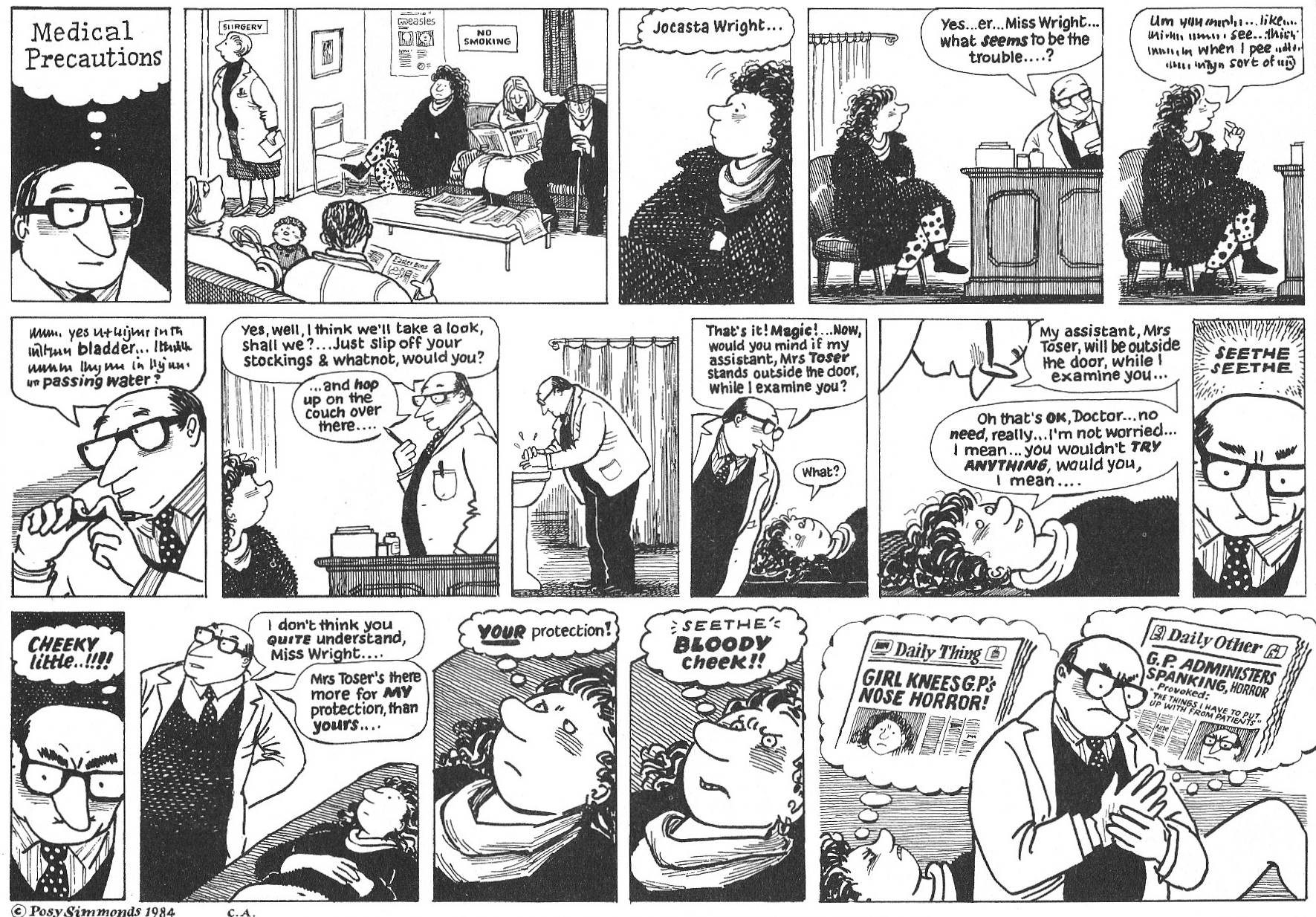
  • Medical precautions Jocasta visits her GP who tells her he is planting a chaperone at the door – leading to a misunderstanding where Jocasta assures the doctor he doesn’t think he’ll try anything and the doctor assures her the chaperone is for his sake, in case Jocasta tries anything – leaving them both seething.

  • Fly’s undoing At a business meeting the only women present manages to persuade the men to back her deal. However she knows they’re all going to go off to the gents and persuade each other to change their minds. She wishes she could be a fly on the wall and… is miraculously transformed into a fly and flies into the gents’ and does indeed hear the hawks talking the doves out of agreeing her deal!
  • Paradise lost the Weber’s are on holiday on a hot beach and the women are going topless when George realises a couple of beach bums are commenting, in French, on the shape of every passing woman’s breasts. He intervenes giving them a feminist lecture, name-checking Lacan and Levi-Bruhl and Rousseau to blast them for objectifying women and giving them another chain to shackle them and so on. The French guys just yawn, stretch and stroll away.
  • Grief A woman’s unrestrained grief embarrasses her friends and family. People think grief should be more restrained and demure. The dichotomy is expressed by a contrast between a Picasso image of a weeping woman and an emollient Victorian image of a slightly sad and dignified lady. Sexism!!

Grief by Posy Simmonds

  • The nightmare of Pauline Woodcock Pauline Woodcock (42) international finance correspondent flies to an assignment in the Middle East but has a nightmare in which she is refused entry to the conference because it is for men only, and is forced to go and sit among the harem women who criticise her for having no husband or family and hating women. But it is only a dream and so not a very valid satire on the sexism of Muslim countries.
  • Momentous news Diane, aged 36 and a TV producer, has finally gotten pregnant but when she tells her friends at a garden party they reveal that everyone they know is having a baby late, it’s a fashion, it’s a trend thus patronising and humiliating her.
  • A message to the Monstrous Regiment Peculiarly, this is the final cartoon in the book: It is in the form of a message from Field Marshall Sir Desmond Blundel-Bolass to what he calls The Monstrous regiment, obviously meaning the entire female population, saying they’re a proud little regiment with a long track record of cooking and cleaning and child-rearing, but recently there have been signs of bolshiness and women deserting the regiment to take up jobs in industry, business and so on. THIS MUST STOP and women return to their proper subservient roles. Maybe it triggered a laugh of recognition at the time (1984) but to me it seems elaborate and ‘clever’ but oddly pointless.

Difficulties of motherhood and childcare (2)

This obviously overlaps with the large number of working mum strips, with some of the Childhood and small children strips, and with the Divorce strips, all of which depict small children shedding light on the hypocrisies of divorced couples.

  • Music and movement At little Katy’s birthday party the parents gather in the kitchen and nervously discuss the way the five year olds are jigging and jiving to highly sexualised pop music, while George delivers another of his pretentious semiotic interpretations which is no good to anyone.
  • Charity begins at home Working mum Gemma leaves her two little kids in the care of wonderful nanny, Anita, but she tells so many people how wonderful Anita is that one by one all the other middle class mums in the street get Anita to care for their children until her place looks like a zoo – much to Gemma’s chagrin.

Childhood and small children (7)

  • Timor mortis The Weber children’s guinea pig dies and the parents, and grandma, give the kids contradictory stories about what happens to dead animals
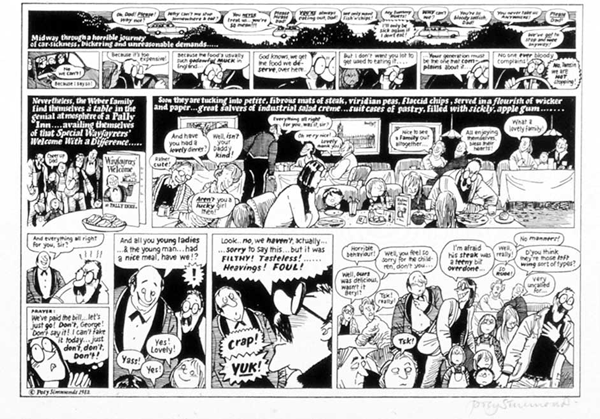
  • On a long-distance drive George and Wendy are pestered to pull over at a roadside pub where the kids pig out on steak and chips but George eventually explodes at the so-called waiter and describes at length why every single item was disgusting.

  • Music and movement At little Katy’s birthday party the parents gather in the kitchen and nervously discuss the way the five year olds are jigging and jiving to highly sexualised pop music, while George delivers another of his pretentious semiotic interpretations which is no good to anyone.
  • The birth of the blues A mum has had a baby and is at home nursing it surrounded by cooing friends and family. The strip focuses on the baby’s sister who is hassled by the grown-ups into saying ‘thank you’ for having a new brother.
  • Monkey business Wendy takes the younger children to the zoo where they see monkeys mating and ask mummy what they’re doing. This dilemma has already cropped up at least twice already in the strip. This time Wendy patiently explains a gentle form of the birds and the bees and the gag is that, as she does so, the monkeys put their hands over their baby monkey’s ears to protect their innocence.
  • Just rewards Billy’s mum takes him to play at a friend’s house where he misbehaves – saying rude words, screaming, snatching things. but each time mummy tells him to stop he does. This, the mum explains to her friend, is because she’s instituted a reward system – every time he obeys mummy he gets a reward, and enough rewards buy him a toy. Cut to Billy who has worked out how to play the system, and so deliberately plays up wherever they go – in order to obey the instruction to behave – and thus earns lots of toys!
  • The dark Two of the Weber kids lock themselves inside the old fridge the Weber’s have thrown out to Wendy’s hysterical horror.

Divorce (3)

This is here because after a divorce, Simmonds is interested in the experience of the mother who usually ends up keeping custody of the children, and so ‘divorce’ comes under the broader heading of Women-Feminism-Motherhood-Childcare-Divorce.

  • Unworthy thoughts Two little children come back from a weekend with their daddy and tell the divorced mummy what a great time they had, he took them on a CND march, introduced them to his lovely new girlfriend, had a barbeque and bought them new clothes. The mum promptly rings up the dad to give him a ear-bashing, asking him why on earth he’s being so nice and trying to suck up to her?
  • Home-sick A divorced dad takes his small kids out to a burger bar and the little girl immediately feels sick. All the way home, including on the bus, he is trying to get the little girl to throw up in the street before she gets home. But she doesn’t. She saves it up for the moment she walks through his ex’s door and throws up all over the phone books – prompting a prolonged ear-bashing from his ex about filling them with junk food etc etc.
  • Dad’s girlfriend A divorced woman’s two little kids are joking and taking the mickey out of her ex-husband’s new girlfriend, Lynn, at which the mum’s smirk of satisfaction grows larger and larger… unti lthe kids say they don’t want to go to dad and Lynn’s at Christmas – at which point the um realises this will ruin all her plans to go skiing with her new boyfriend Robert… and immediately leaps to the defence of Lynn, telling the kids what a wonderful person she is and how she has a really cool new video!

Sex and adultery (7)

  • Strangers in the night In bed together Stanhope discovers his wife is reading a sexy bodice-ripper and teases her about it.
  • Acting one’s age At a crowded theatre bar, Stanhope makes eye contact with a promising young floozy and Simmonds uses the technique whereby they send dotted eye signals at each other while, in another familiar move, she makes the whole thing a parody, with Stanhope imagining the programme to a grand theatrical production of Their Affair… while his wife spots him and reconceives the same events as a tawdry TV comedy titled ‘It always ends in tears’.
  • And no questions asked Stanhope wakes up in bed with a nubile young woman he has slept with and Simmonds uses the comic, or sardonic technique, of counterpointing all the polite things they say to each other with what they’re really thinking, Stanhope in particular smiling smiling and thinking ‘God, when are you going to bugger off?’
  • Flattery A young woman spends half the strip flattering and chatting up a TV star at a party, giving it her best shot until right at the end he makes his excuses and wanders over to the next pretty fan. This is counterpointed by the same events as enacted by a ewe (Aries) trying to chat up a lion (Leo).
  • Married person’s guide to lunching A series of nine lunches which chart the rise, bloom and decay of an affair carried out , as usual, by Stanhope Wright and his latest victim (which includes a(nother) pastiche of Manet’s painting Le Déjeuner sur l’herbe).
  • The transports of love An ironic reference to Stanhope’s car: in the first half he uses it to whisk a pretty young thing off to the countryside where they have a shag, in a picture wherein the car is transformed into an 18th century rococo four-poster bed surrounded by fluttering cherubim – and in the second half, it becomes the scene of an agonised conversation while Stanhope sits with the girl trying to dump her.
  • Derek’s deadly sins A year in the life of a fat gluttonous exec named Derek who regularly stuffs down a heavy lunch with the unbearable Edmund Heep. During the year he chats up a pretty young woman at the office party, and to please his new mistress loses weight, buys new clothes, and the other pub goers take the mickey out of the ensuing affair which runs through May and July but comes a cropper when Derek’s wife finds out about the affair, the relationship breaks up and by the end of the year Derek is back to wearing bad clothes and has his great big beer belly back again.

Academia (8)

  • In his good books Wendy has to sit through dinner with George’s academic colleagues from the Poly all showing off but when they ask her her favourite book, she says Mrs Tiggiwinkle by Beatrix Potter
  • Full stretch George does his yoga while worrying that he is becoming out of touch with developments in the humanities, and ponders resigning.
  • Liaison Presumably published around Valentine’s Day time, this ironically describes the rivalry between the Liberal Studies and Business Studies departments at George’s poly, ending with the suggestion that the two departments amalgamate, which is ironically depicted with one of Simmonds’s flowery rococo pastiches of a valentine’s card between the two.
  • An important meeting George and a colleague go to see the Chairman of governors of the poly but emerge with a surprisingly favourable decision – a big drawing shows what was going on inside each of their skulls, namely that the Chairman made a quick decision because he has a hangover.
  • Unwrappings George and Wendy’s American friend Frisbee Summers is staying. the family pop into a newsagents and while Wendy buys the kids ice-creams George and Frisbee end up discussing the top-row porn mags in high-falutin’ terms of signifying aspects of patriarchal ideology etc. Until Wendy bursts their bubble by whispering ‘Perverts!’ at them both.
  • A notice goes up at the Poly telling staff that unofficial visitors are not allowed. George and his fellow parents on the faculty realise this is a directive designed to stop parents bringing in their children during half term.
  • Eros denied the entire strip is told as a spoof of the Greek gods, wherein Eros fires a dart which hits Mrs Rutland, the Dean’s wife, as she’s chatting to George, and she is suddenly overcome with passion for him, making him blush and the gods panic until another of the gods sends a divine wind to blow away her infatuation and she is restored to normal banality.
  • Funeral rights George is blubbing so much at the funeral of a colleague from the poly who was killed in a car crash that Wendy is proud of him for breaking down sexist stereotypes which insist men keep a stiff, upper lip, and feeling free to express his emotions and… then starts to worry that such an excessive display of mourning will lead colleagues to think he must have been having an affair with the dead woman!
  • The sausage roll that changed the world At a party at his polytechnic, George is pressing the Dean about rumoured cutbacks which might run his new course on Turn of the century Vienna, when the Dean chokes on a sausage roll and Wendy steps in to perform the Heimlich manoeuvre thus saving the Dean’s life – who promptly changes his tune and tells George he’ll see what he can do. (‘It’s an ill windpipe…’)

Middle class mores and hypocrisies (12)

  • Shifting values George and Wendy take a crappy painting his aunt has left him to a valuers who makes an elaborate song and dance over it so that G &W’s opinion is transformed.
  • Black looks George tells Wendy he has just been through an ordeal every bit as bad as the mocking looks he got from his working class dad and his mates when young George went home as an Oxford student – but this time it was the black looks he got as he walked the gauntlet of Belinda and her unemployed punk mates hanging outside the house, as George unpacked the crates of Rioja wine from their Volvo.
  • Left overs George and Wendy have friends round for dinner who praise the cassoulet until Wendy reveals it’s from the freezer of Aunt Gwen who died recently, and left them all her belongings including the contents of her freezer.

  • Killjoy was here Stanhope gets a taxi back from the airport, tanned and still holding his skis from a wonderful skiing break but the glum cab driver soon brings him back to earth and depresses him.
  • Cornish wrestling Taking a cab to the station after a relaxing half-term holiday in Cornwall, George finds a ten pound note down the side of the seat and spends the whole journey agonising whether to hand it in as lost, or use it to pay the fare. He pays the fare.
  • Lingua franca Pippa offers Wendy and the kids a lift back from school and on the way reveals that she’s taken her daughter out of state school and sent her to a private boarding school. ‘They’re very strong on English,’ Pippa explains. They have to be, her daughter in the back thinks – almost all the young ladies at the boarding school are from abroad.
  • Snobs Wendy’s daughter is upset that they won’t buy her a leather skirt for £60, saying all the other girls have got one, and look down on her because she’s poor. What a sordid attitude, Wendy exclaims and tells her daughter that she is in fact, relatively well off with a home and a room of her own and goes to a good school – not to ‘that revolting school in Prosser Street – with all those nasty thugs from the flats.’ To which the family cat comments ‘Sordid attitude’ and Wendy realises what a hypocrite she is.
  • Carping at the shop corner A little gaggle of locals carp about how the local corner shop has changed over the years.
  • Standards of living Wendy leaves Benji with a friend and when her mother and Wendy go to collect him later, the mother spots about a thousand fire and health hazards in the home, whereas Wendy only sees the Noddy book (which I think is meant to be a joke because Noddy books were under fire for being racist).
  • A garden of Eden In early September George and Wendy and a couple of friends are sunbathing in the garden. Then their teenage kids turn up and they become uncomfortably aware of the bumps and blemishes and flab and cover themselves up. Paradise lost.
  • Every picture… At the Wrights’ lovely holiday cottage Stanhope’s art student daughter Jocasta takes Polaroid photos of each other. The joke, such as it is, in the discrepancy between the personal worries and grievances we get to read in their thought bubbles, and the big cheesy smiles they put on for the camera. My daughter read this strip and said, ‘What are they meant to do… shout and scream at the camera? Everyone smiles for bloody cameras and then gets back to their lives.’
  • Lady Bountiful Wendy is walking home from Sainsburys with a friend who points out that Wendy smiles inanely at everyone she meets. Wendy corrects that she only smiles at people less fortunate than her, or who she thinks needs encouraging.  The punchline is that she realises why… why people smile back at her. Standing there weighted down with carrier bags and trailing two mewling children, the reader can see why.
  • Bivouac throughout the strips ‘Bivouac’ is the name given to a kind of Ikea self-service home furnishing company. the strip describes the excitement of buying something in the store, loading it into the car and can’t wait to get it home, then having second thoughts about the extravagant expenditure, and then bickering about who persuaded who to buy it, and then the fate of the bi boxes from Bivouac which is to sit unopened and unloved.

Christmas (8)

Simmonds appears to hate Christmas. Put it this way, all the Christmas-themed strips parody, undermine or satirise the season and its sentiments.

  • Village Christmas
  • What’s in store George and Wendy take the kids to a panto, where they each find something to offend all the family!
  • Och! They’re such a worry The Heeps’ punk sons get kicked out of parties and are forced to go home for New Year’s Eve
  • Festive whirl A circular strip in which George is reluctant to go to a Christmas party, is chivvied into going by Wendy, says they won’t stay long but ends up having a whale of a time, chatting to everyone, then starting to have regrets in the car home, saying he made a number of faux pas, can’t believe he said this, can’t believe he was indiscreet about x, and wakes up the next morning determined not to go to the next Christmas party. Until…
  • The strip World of work has a Christmas theme, consisting of Edmund Heep and a colleague discussing how to wangle the longest break over Christmas.
  • Christmas present George is revolted by a traditional Christmas card from Aunt Bunny containing a traditional cake. George rails against ‘Looking Back Disease’, everyone wanting to preserve a fantasy of some Olde Worlde Christmas and says, if he had his way, they’d dispense with the stagecoach on the Christmas card cover, the Victorian dress, and the port and the lanterns and the snowman, and the robins, out with Santa, in fact out with everything except a message of goodwill. Except that, as he’s dispensed with each of these things, they have been removed from the strip itself until it is just… George and Wendy and a few kids huddling together on a great wide snow-covered plain… with the sound of something hungry howling in the distance.
  • Past 2 o’clock The posh lady with the stiff hairdo and the frightfully, frightfully manner is woken by strangers knocking at the door. It is a reincarnation of Joseph and Mary turned away from the inn and trudging through the snow, and so the humour comes from the tone of voice and excuses made by the posh lady as she explains that she can’t put them up in the main house – the builders are making a frightful mess, but she can put them up in the shed next door, it’s currently housing Sara’s pony but they’re going to do it up and put in a shower and a utility room and decorate it with some rather super tiles they saw in France etc.
  • Christmas wishes A rather bleak strip consisting of two nearly identical big pictures, at the top George and Wendy wishing us a Happy Christmas next to a mantlepiece covered with Christmas cards – underneath, exactly the same scene, but each of the cards has been transformed by one of the worries of contemporary life e.g. a nuclear power station has appeared on the hill behind the sleigh, the wise men had been pointing at a star but now they’re pointing at a mushroom cloud, some deer were looking at a decorated Christmas tree but now they’re looking at a barbed wire fence with a Ministry of Defence Keep Out sign on it. It’s quite funny as humour, but it’s really interesting as social history, as a reminder of just how terrified everyone was of nuclear war or a nuclear accident back in 1983, 36 long years ago.

Pastiches and parodies (7)

Many of the cartoons liven up otherwise mundane events by dressing them in parodies of 18th century rococo or Renaissance paintings, or set them to the tunes of Elizabethan or Victorian songs (updating the words for comic effect) or in other ways frame or transform events into alternative genres, such as when Stanhope imagines a possible affair with a young woman in terms of a grand theatrical production, and visualises a theatre programme giving his and her names as the leading roles…. whereas his wife sees what is going on and imagines the same events as the subject of a silly TV sitcom titled ‘It always ends in tears’.

So humour is often derived not from the events, but from this clever transplanting of them into comically inappropriate genres and formats.

  • The joke Valentine’s Day card in Liaison
  • The appearance and speech of the Greek gods in DIY
  • The use of theatre programmes and the Radio Times format to parody Stanhope chatting up a young lady at the theatre in Acting one’s age
  • Spring fever Spotty punk Julian Heep tries to talk young Helene into shagging him but she refuses saying he’ll just tell everyone at school. The final scene parodies a classical painting of a young man putting his arms round a lady dressed in a classical gown.
  • The transformation of the car into a rococo love nest in Transports of love
  • The rebirth of Venus in which three women discuss and pester a friend into losing weight in a series of pictures which spoof and parody Botticelli’s famous Birth of Venus to make a feminist comment on how women are forced to conform to body stereotypes.
  • Cat lovers is told in the form of a rhyme (as are several others), thus: ‘The cat sat on the mat. Back to the flat come Pat and Jack. Jack hates the cat. The cat hates Jack. Pat loves the cat. The cat loves Pat. Pat sat on Jack’s lap. Jack pets Pat. Jack and Pat want a nap. Scram, cat, scram! Drat the cat!’ which tells the tale of a couple coming back to the flat, smooching and then wanting to go to bed… only to find a big cat poo on the duvet. In strips like this you can see a basic childishness, a simple-mindedness about the strip, which means it wasn’t a big departure for Simmonds to branch out into children’s books – the most successful of which were about… cats!

Teenagers (7)

  • Nature, nurture (and nutrition) Fashionable young Belinda Weber has scorned going to university as her parents hoped and is helping out as waitress in a Directors Dining Room because, as she shouts at her mother, she is sick of living in a poky conversion, sick of kidney beans and lentils, sick of pine dressers. She wants to meet someone rich and drive a Saab and live in a nice house. Thatcher’s children.
  • Virtue’s work Father Stanhope gives lazy skiving art student Jocasta a talking to about needing to get a job.
  • Reaction A mother has a trio of teenagers over, slumped in front of the telly, and is appalled at how heartless and cynical they are, fondly remembering when they were small and got upset at Disney films etc. Suddenly she hears them yukking and moaning and goes in to discover that… they are appalled and revolted by the middle-aged clothes, the bell-bottoms and open shirt being worn by a TV news reporter!
  • Honcho Gun The two punk sons of Edmund and Jo Heep go to the cinema but are so obnoxious they keep being asked to move and are eventually kicked out. Home embarrassingly early, they fend off a bollocking from their dad by ad libbing an enormous long complicated science fiction plot which they make up. ‘When in a spot, baffle ’em wiv Sci-Fi!’
  • Home Jocasta is skint and fed up of living in sordid student accommodationso she turns up back at her parents’ house and moves in, stuffing her face with good food, smoking on the sofa and reading in the bath. As so often, there is an ironic narrative counterpoint to all this as music staves run above the strip depicting the lyrics of the Victorian song ‘there’s no place like home’. My daughter read this strip and asked me, ‘Is it meant to be funny? Because it’s just… obvious’.
  • ABC (as it is spoken) Two young leather-jacketed dudes go into their local pub where the landlord asks them for proof of their age and they get stroppy. The ‘gag; is that the entire dialogue, by all parties, consists of abbreviations: ‘L.O.’ ‘2 G.n.T’ ‘A?’ and so on. Clever. Not particularly funny.
  • Marriage à la mode Belinda announces to her parents that she is going to marry one of the rich directors at the offices where she works as a cook. George and Wendy are distraught that Belinda’s not making the most of her education, those A-levels, doesn’t want to be the strong, independent feminist they brought her up to be and worst of all, wants George to ‘give her away’ at the traditional church service… like a medieval chattel. Ugh!

Second homes (5)

  • Village Christmas The book opens with quite a bitterly satirical cartoon showing a cluster of village cottages round a village church covered in snow in complete silence on December 22, and then in successive pictures how holiday home owners arrive down from London, animate the houses with lights and real fires and arguing and partying over Christmas, nursing hangovers on Christmas Day, and are packed up and gone leaving the village silent again, by 27 December. Looking back from 2019 it’s fascinating to see the seeds of the current housing crisis and resentment at the holiday home-owners who have gutted large numbers or rural and coastal communities, being sown so long ago. But the really striking thing about it is how beautifully it is drawn. In the rest of the book Simmonds’s looseness with faces, which are often erratically drawn, is still in evidence. But her depiction of things, and the details of scenes and scenery (indoors or out) go from strength to strength.
  • Home is the sailor During this period Simmonds introduced the Cornish seaside hamlet of Tresoddit whose point is that it is overrun with Londoners who’ve bought up all the available cottages as second homes.
  • One man’s meat The Weber’s visit posh friends who have a home in the country, and the mum delivers a long speech about how the locals buy really expensive processed food at the local store instead of eating the kind of fresh, vegetarian fare which she recommends.
  • Up and down in the country A satirical speech delivered by the same pomaded lady in a quilted Barbour jacket as the previous strip, who explains the work of the Society for the Preservation of Owners of Second Homes or POSH.
  • Nice little men The same woman with a Barbour jacket and over-elaborate hairdo has such a worry about her second home in the country, and calls out a simply super little man who lives locally, but the nice little man overhears her describing him in belittling, superior, patronising tones on the phone and so does a rush job and clear out grumpily… leaving posh lady wondering ‘But he was such a NICE little man, too.’

Edmund Heep the alcoholic (3)

  • Edmund Heep steps in for a colleague at a conference and gives a deeply embarrassing speech
  • Distinguished service Heep is out of action nursing a hangover so his secretary Jackie has to rummage around in his chaotic filing system to find the needed paperwork.
  • World of work On a crowded bus at Christmas, Heep discusses with a colleague precisely how many days off work they can wangle, this Christmas and next Christmas holidays. Neither of them understand why the two blokes behind them become so angry that one of them shoves Heep’s hat down over his ears until… they pair get off the bus at the next stop and go into the local Job Centre – at which they simply feel SHAME.

Miscellaneous (3)

  • Upright citizens Waiting in a long bus queue an old lady reflects that it’s one of life’s little unfairnesses that whereas young people can lounge or sit in doorways, the elderly cannot without being taken for vagrants.
  • Minor op Wendy goes into hospital for a minor operation. The amusement comes from the way Simmonds quotes Shakespeare’s ‘All the world’s a stage’ speech to name all the ‘roles’ someone having an operation is called on to perform.
  • The house that Jack bought Nice middle-class Jack sells his house in order to move into the one Mr Shite is selling him but at the last minute Shite gets a higher offer and sells it to someone else leaving Jack’s family stuck in expensive rented accommodation. This just seems to be an utterly humourless comment on the sheer hell of trying to buy or sell a house in Britain.

Politics (2)

  • Don’t know A visually funny strip where Jocasta the art student is wakened by a ringing at her doorbell, trudges all the way down the stairs and the hallway to answer the door to a man canvassing for the local Labour candidate. Jocasta takes the flyer, trudges back upstairs and dumps it next to all the other ignored flyers.
  • Judicium extremum Atom bombs fall and wipe out the world. At the pearly gates there are two queues of the dead, one of hawks and one of doves, both of them blaming each other for what has happened.

Household chores and worries (1)

Possibly the once about the Bivouac shopping trip fits in here as well.

  • DIY A parody in which the Greek gods of the household oversee George and Wendy’s frustrated attempts at spring cleaning.

Thoughts

This detailed enumeration of the strips makes it crystal clear that it contains little or no politics but is overwhelmingly concerned with the cosy mundanities, and stroppy grievances and petty frustrations, of domestic and personal life. Feminism, or the role of women, and in particular a) harassed mothers and b) even more harassed working mums, are the most recurrent subjects.

On the plus side is young Belinda Weber, the glamorous teenager/young woman, strong, independent-minded, who rejects all her mother’s pussy-footing, soft soap liberalism and just wants to marry a millionaire. It’s odd how, having root and branch rejected old-style feminism, Belinda is consistently shown as a well-adjusted, happy winner.

One other thing is striking to the modern reader, which is that all the characters are white and straight.

There are no black, Asian, Muslim or ethnic minority characters, whether in the street, in shops, in the various offices or at the poly, in the schools or at any of the parties, lunches and get-togethers. Race appears as an issue once or twice, for example in the strip when Wendy says she smiles at the new Pakistani woman who’s moved into the street, and says the one person she doesn’t smile at is the appallingly racist woman across the road. When Edmund Heep irritates the men sitting behind him on the bus, one of them is black. That appears to be it.

Similarly, there are no gay or lesbian characters anywhere. The rights and wrongs endured by middle-class white women women women women are proclaimed from the hilltops. The experiences of black, Asian, immigrant or lesbian and gay people are invisible. The Posy cartoon strips are a strictly white, middle-class and heterosexual affair. This, I think, goes a long way to explaining why they have such a cosy, reassuring feel. Nothing threatening or strange ever happens in them.

cf Celeb

Surfing cartoons on the internet I stumbled across the ‘Celeb’ strip drawn by ‘Ligger’, which has been appearing in Private Eye for 30 years or so, describing the sardonic attitudes of an ageing rock star named Gary Bloke. Every one of these Celeb cartoons made me laugh out loud.

Celeb by Ligger

I found more laughs in one Celeb cartoon than the entire 488-page Posy collection but then laughs are not really what she’s after.

Credit

All Posy Simmonds cartoons are copyright Posy Simmonds. All images are used under fair play legislation for the purpose of analysis and criticism. All images are freely available on the internet.


Related links

Other Posy Simmonds reviews

Seven Clues to the Origin of Life by A.G. Cairns-Smith (1985)

The topic of the origin of life on the Earth is a branch of mineralogy. (p.99)

How did life begin? To be more precise, how did the inorganic chemicals formed in the early years of planet earth, on the molten rocks or in the salty sea or in the methane atmosphere, transform into ‘life’ – complex organisms which extract food from the environment and replicate, and from which all life forms today are ultimately descended? What, when and how was that first momentous step taken?

Thousands of biologists have devoted their careers to trying to answer this question, with the result that there are lots of speculative theories.

Alexander Graham Cairns-Smith (1931-2016) was an organic chemist and molecular biologist at the University of Glasgow, and this 120-page book was his attempt to answer the Big Question.

In a nutshell he suggested that life derived from self-replicating clay crystals. To use Wikipedia’s summary:

Clay minerals form naturally from silicates in solution. Clay crystals, like other crystals, preserve their external formal arrangement as they grow, snap, and grow further.

Clay crystal masses of a particular external form may happen to affect their environment in ways that affect their chances of further replication. For example, a ‘stickier’ clay crystal is more likely to silt up a stream bed, creating an environment conducive to further sedimentation.

It is conceivable that such effects could extend to the creation of flat areas likely to be exposed to air, dry, and turn to wind-borne dust, which could fall randomly in other streams.

Thus – by simple, inorganic, physical processes – a selection environment might exist for the reproduction of clay crystals of the ‘stickier’ shape.

Cairns-Smith’s book is densely argued, each chapter like a lecture or seminar packed with suggestive evidence about what we know about current life forms, a summary of the principles underlying Darwin’s theory of evolution, and about how we can slowly move backwards along the tree of life, speculating about how it developed.

But, as you can see from the summary above, in the end, it is just another educated guess.

Detective story

The blurb on the back and the introduction both claim the book is written in the style of a detective story. Oh no it isn’t. It is written in the style of a biology book – more precisely, a biology book which is looking at the underlying principles of life, the kind of abstract engineering principles underlying life – and all of these take quite some explaining, drawing in examples from molecular biology where required.

Sometimes (as in chapter 4 where he explains in detail how DNA and RNA and amino acids and proteins interact within a living cell) it becomes quite a demanding biology book.

What the author and publisher presumably mean is that, in attempt to sweeten the pill of a whole load of stuff about DNA and ribosomes, Cairns-Smith starts every chapter with a quote from a Sherlock Holmes story and from time to time claims to be pursuing his goal with Holmesian deduction.

You see Holmes, far from going for the easy bits first, would positively seek out those features in a case that were seemingly incomprehensible – ‘singular’ features he would call them… I think that the origin of life is a Holmesian problem. (p.ix)

Towards the very end, he remembers this metaphor and talks about ‘tracking down the suspect’ and ‘making an arrest’ (i.e. of the first gene machine, the origin of life). But this light dusting of Holmesiana doesn’t do much to conceal the sometimes quite demanding science, and the relentlessly pedagogical tone of the book.

Broad outline

1. Panspermia

First off, Cairns-Smith dismisses some of the other theories about the origin of life. He makes short work of the theories of Fred Hoyle and Francis Crick that organic life might have arrived on earth from outer space, carried in dust clouds or on meteors etc (Crick’s version of this was named ‘Panspermia’) . I agree with Cairns-Smith that all variations on this hypothesis just relocate the problem somewhere else, but don’t solve it.

Cairns-Smith states the problem in three really fundamental facts:

  1. There is life on earth
  2. All known living things are at root the same (using the same carbon-based energy-gathering and DAN-replicating biochemistry)
  3. All known living things are very complicated

2. The theory of chemical evolution

In his day (the 1970s and 80s) the theory of ‘chemical evolution’ was widely thought to address the origin of life problem. This stated that lot of the basic amino acids and sugars which we find in organisms are relatively simple and so might well have been created by accident in the great sloshing oceans and lakes of pre-life earth, and that they then – somehow – came together to make more complex molecules which – somehow – learned how to replicate.

But it’s precisely on the vagueness of that ‘somehow’ that Cairns-Smith jumps. The leap from a random soup of semi-amino acids washing round in a lake and the immensely detailed and complex machinery of life demonstrated by even a tiny living organism – he selects the bacterium Escherichia coli – is just too vast a cliff face to have been climbed at random, by accident. It’s like saying if you left a bunch of wires and bits of metal sloshing around in a lake long enough they would eventually make a MacBook Air.

Cairns-Smith zeroes in on four keys aspects of life on earth which help to disprove the ‘chemical evolution’ theory.

  1. Life forms are complex systems. It is the whole machine which makes sense of its components.
  2. The systems are highly interlocked: catalysts are needed to make proteins, but proteins are needed to make catalysts; nucleic acids are needed to make proteins, yet proteins are needed to make nucleic acids;
  3. Life forms are very complex.
  4. The system is governed by rules and conventions: the exact choice of the amino acid alphabet and the set of assignments of amino acid letters to nucleic acid words are examples.

3. The Miller-Urey experiments

Cairns-Smith then critiques the theory derived from the Miller-Urey experiments.

In 1953 a graduate student, Stanley Miller, and his professor, Harold Urey, performed an experiment that demonstrated how organic molecules could have spontaneously formed from inorganic precursors, under conditions like those posited by the Oparin-Haldane Hypothesis. The now-famous ‘Miller–Urey experiment’ used a highly reduced mixture of gases – methane, ammonia and hydrogen – to form basic organic monomers, such as amino acids. (Wikipedia)

Cairns-Smith spends four pages comprehensively demolishing this approach by showing that:

  1. the ultraviolet light its exponents claim could have helped synthesise organic molecules is in fact known to break covalent bonds and so degrade more than construct complex molecules
  2. regardless of light, most organic molecules are in fact very fragile and degrade easily unless kept in optimum conditions (i.e. inside a living cell)
  3. even if some organic molecules were created, organic chemists know only too well that there are hundreds of thousands of ways in which carbon, hydrogen, nitrogen and oxygen can combine, and most of them result in sticky sludges and tars in which nothing could ‘live’

So that:

  1. Only some of the molecules of life can be made this way
  2. Most of the molecules that would be made this way are emphatically not the ‘molecules of life’
  3. The ‘molecules of life’ are usually better made under conditions far most favourable than those obtaining back in the primordial soup era

He then does some back-of-a-matchbox calculations to speculate about how long it would take a random collection of organic molecules to ‘happen’ to all tumble together and create a life form: longer than the life of the universe, is his conclusion. No, this random approach won’t work.

Preliminary principles

Instead, he suggests a couple of principles of his own:

  1. That some and maybe all of the chemicals we now associate with ‘life’ were not present in the first replicating organisms; they came later; their exquisitely delicate interactivity suggests that they are the result not the cause of evolution
  2. Therefore, all lines of investigation which seek to account for the presence of the molecules of life are putting the cart before the horse: it isn’t the molecules which are important – it is the mechanism of replication with errors

Cairns-Smith thinks we should put the molecules of life question completely to one side, and instead seek for entirely inorganic systems which would replicate, with errors, so that the errors would be culled and more efficient ways of replicating tend to thrive on the available source material, beginning to create that dynamism and ‘sense of purpose’ which is one of life’s characteristics.

We keep coming to this idea that at some earlier phase of evolution, before life as we know it, there were other kinds of evolving system, other organisms that, in effect, invented our system. (p.61)

This seems, intuitively, like a more satisfying approach. Random forces will never make a MacBook Air and, as he has shown in chapter 4, even an entity like Escherichia coli is so staggeringly complex and amazingly finely-tuned as to be inconceivable as the product of chance.

Trying to show that complex molecules like ribosomes or RNA or amino acids – which rely on each other to be made and maintained, which cannot exist deprived of the intricately complicated interplay within each living cell – came about by chance is approaching the problem the wrong way. All these complex organic molecules must be the result of evolution. Evolution itself must have started with something much, much simpler – with the ‘invention’ of the basic engine, motor, the fundamental principle – and this is replication with errors. In other words:

Evolution started with ‘low-tech’ organisms that did not have to be, and probably were not made from, ‘the molecules of life’. (p.65)

Crystals

And it is at this point that Cairns-Smith introduces his Big Idea – the central role of clay crystals – in a chapter titled, unsurprisingly, ‘Crystals’ (pp.75-79).

He now explains in some detail the surprisingly complicated and varied world of clay crystals. These naturally form in various solutions and, if splashed up onto surfaces like rocks or stones, crystallise out into lattices, but the crystallisation process also commonly involves errors and mutations.

His description of the different types of crystals and their properties is fascinating – who knew there were so many types, shapes, patterns and processes, starting with an introduction to the processes of saturation and super-saturation. The point is that crystals naturally occur and naturally mutate. He lists the ways they can vary or diverge from their ‘pure’ forms: twinning, stacking errors, cation substitutions, growth in preferred directions, break-up along preferred planes (p.97).

There follows a chapter about the prevalence of crystals in mud and clay and, therefore, their widespread presence in the conditions of the early planet earth.

And then, finally, he explains the big leap whereby replicating crystals may have attracted to themselves other molecules.

There follows a process of natural selection for clay crystals that trap certain forms of molecules to their surfaces that may enhance their replication potential. Complex proto-organic molecules can be catalysed by the surface properties of silicates.

Genetic takeover of the crystals

It is at this point that he introduces the idea of a ‘genetic takeover’.

When complex molecules perform a ‘genetic takeover’ from their clay ‘vehicle’, they become an independent locus of replication – an evolutionary moment that might be understood as the first exaptation.

(Exaptation = ‘the process by which features acquire functions for which they were not originally adapted or selected’)

Cairns-Smith had already described this process – the ‘genetic takeover’ of an initial, non-organic process by more complex, potentially organic molecules – in his earlier, longer and far more technical book, Genetic Takeover: And the Mineral Origins of Life, published in 1982.

This book – the Seven Clues – is a much shorter, non-technical and more accessible popularisation of the earlier tome. Hence the frivolous references to Sherlock Holmes.

Proliferating crystals form the scaffold for molecules which learn to replicate without them

The final chapter explains how these very common and proliferating entities (clay crystals) might have formed into structures and arrangements which attracted – for purely chemical reasons – various elementary organic molecules to themselves.

Certain repeating structures might attract molecules which then build up into more complex molecules, into molecules which are more efficient at converting the energy of the sun into further molecular combinations. And thus the principle of replication with variation, and competition for resources among the various types of replicating molecule, would have been established.

Thoughts

At this point the book ends, his case presented. It has been a fascinating journey because a) it is interesting to learn about all the different shapes and types of clay crystal b) he forces the reader to think about the fundamental engineering and logistical aspects of life forms, to consider the underlying principles which must inform all life forms, which is challenging and rewarding.

But, even in his own terms, Cairns-Smith’s notion of more and more complex potentially organic molecules being haphazardly replicated on a framework of proliferating clay crystals is still a long, long, long way from even the most primitive life forms known to us, with their vastly complex structure of cell membrane, nucleus and internal sea awash with DNA-controlled biochemical processes.


Related links

Reviews of other science books

Chemistry

Cosmology

The Environment

Genetics and life

Human evolution

Maths

Particle physics

Psychology

High Stand by Hammond Innes (1985)

This is the fourth Innes novel I’ve read in a row and I think it’s fair to say that, although the locations are always original and refreshing, the background and subject matter are thoroughly researched, his evocations of place, and especially seascapes, are always enjoyable – nonetheless, his plots are often strangely and frustratingly static, depending on a large dollop of voodoo-Gothic melodrama to convey a menacing mood often unjustified by the actual action – but that by far his worst fault is the extremely limited range of behaviour his characters display.

She seemed on the point of saying something more, but then she turned her head away, locking whatever it was up inside herself, the silence dragging. (p.15)

Sometimes it seems like all the characters do in an Innes novel is shrug, mumble, break off in mid-sentence, stare away into the distance or get stuck in long meaningful silences. The frustrating thing is that most of them aren’t that meaningful at all – in general the characters actually have very little to say to each other but take ages, sometimes scores, in a few cases, hundreds of pages, not to say it.

The plot

The story is told in the first person by a typically ordinary Innes’ protagonist – staid Sussex solicitor, Philip Redfern. He has set up a nice little practice near Ditchling on the South Downs and has just bought a sailing dinghy, his new pride and joy, which he fits up and sails across the Channel to France. Into his boring world come the Halliday family.

Grandfather Josh Halliday struck it rich in the Yukon gold rush of the 1890s, buying up the land around his claim high in the Rocky Mountains of western Canada, setting up various companies and then dying. It was all inherited by his son, Tom, who has never had to work in his life but has enjoyed a jetset lifestyle and a fondness for sports cars. Philip Redfern ended up acting as his solicitor because Halliday’s English country house was a nice big place tucked away in a fold of the Downs near his office. One day Tom Halliday appears out of the blue and asks Philip to write and witness a codicil to his will, leaving the area of timber planted by grandfather Halliday in the area below the gold mine to his second son, Brian.

A few days later Tom’s wife, Miriam, arrives and asks Philip if he knows where Tom is: he’s disappeared, hasn’t been home, hasn’t left a message as he usually does: mystery. And this is where the novel begins.

Now, Innes tells us, Redfern has always had a bit of a thing about Mrs Halliday (Miriam), bumping into her at various official parties in the neighbourhood and – on one memorable evening – giving her a lift home from Brighton when she invited him in for coffee and one thing led to another… Even as she tells her story, Redfern is distracted by the sight of her cleavage showing through her blouse; he really is an everybloke figure.

Over the following weeks it emerges that old Josh’s goldmine has been running empty for some time and that playboy Tom had been living on an extended bank overdraft which has now been terminated. Suddenly the bills for the house are no longer being paid, ditto the bills at his son’s company. Philip (characteristically for Innes) hasn’t a clue where Tom has disappeared to and isn’t surprised when, a few days later, he learns Miriam has sold some of the family silver and set off for the mine in Western Canada to find out what’s going on. He gets a few postcards from her detailing her progress, saying he’s the only one she can write to, and so reviving the torch he carries for her but then – typically – silence…

Redfern next gets a disconcerting visit from Tom’s son by his first wife – by all accounts a fiery Latin American – the improbably named Brian, whose dark colouring and impulsive (ie angry) temperament reveal his Latino origins. Brian has also come to find out what Philip knows about his father’s disappearance, but ends up discussing the stand of timber old man Halliday planted over a hundred years ago and the ‘curse’ old man Halliday put on it.

As his ancestor is to the Indian, so will I be to my trees. They are my Totem. Let any man fell even one of them, even in the interests of sound forestry, then with the first cut of the saw or swing of the axe my curse will be upon him. Do that and I will never leave you, day or night, till your nerves are screaming and you are dead by your own hand, dead and damned for ever to rot in Hell. (p.41)

Quite a curse.

Despite it, though, it is now emerging that the redwoods old Josh planted (‘the finest plantation of western red cedar he had ever seen’) are probably worth something like $600,000 – a lot of money to the newly-impoverished family. This must be why Halliday turned up a few days earlier to change his will to leave the trees to Brian; Brian alone has a mystical feeling for the trees. He explains their life-giving attributes, their aura, the mystical importance of trees, with a vehemence the dull solicitor finds unnerving.

Thus, after 60 pages or so, we have all the ingredients of a classic Innes yarn: farflung location (Western Canada); Gothic family legacy (the old mine and the curse on the trees); mystery (where’s Tom?); violence (‘I’ll kill any man who touches those trees.’).

In Canada

Redfern sails across to France again, but lies lonely and bored in the bunk of his dinghy – and it’s then he conceives the plan of taking some time off to go and find Miriam. Just as Trevor Rodin drops everything to go off to the Persian Gulf (in Innes’ novel The Black Tide), Roy Slingsby drops everything to go off to the Solomon Islands (Solomons Seal), and Colin Tait drops everything to go into the Kenyan bush (The Big Footprints), so Philip Redfern decides to drop everything to go in quest of Miriam Halliday, to check on the mine and the famous stand of pine, and generally find out what’s happening.

Next thing we know he’s on a flight over the Arctic to western Canada, to Vancouver. Here he has interviews with Halliday’s lawyers, with the timber firm and shipping firm. Turns out some of the timber has been chopped down and is being brought by tug to Vancouver. Already Brian Halliday is being true to his threats, and has steered a dinghy in front of one huge log-bearing tug, wearing a Greenpeace T-shirt and nearly getting himself killed. All this by page 70 of this 330-page book.

From Vancouver Redfern flies to Edmonton and on the flight is lucky enough to run into a guy who can offer him a lift up into the mountains, to the Front Ranges and to Lake Dezadeash. He stays in the lodge here, asking after the Halliday mine – the Ice Cold mine, it is called – and meeting the usual Innes round of surly locals, Kevin and Eddie and Tony, who are obviously hiding something…but what?

And so the narrative continues, mixing improbable motivation with characters who adopt, who only seem capable of, the very limited gamut of Innes’ postures – shrugging, breaking off in mid-sentence, mumbling and just being plain silent – but all set against vivid descriptions of the breath-taking West Canadian landscape.

The rock-scoured mountain that overhung the town gleamed wet and wicked where the great slide had gashed it, tumbling millions of tons of debris down into the waters of the loch to form the hard standing that reached back from the quay. (p.221 cf p.243)

Geography and a map

There is a lot of travelling, travelling vast distances across western Canada. In fact the middle two hundred pages of the book barely make sense without a map and the book really should have included one. I also didn’t understand why Tom and Redfern went by boat into the Yukon, crossed the border into America, then crossed out again and sailed down past Vancouver Island – an entire section that was quite hard to follow unless you were studying the correct maps pretty closely.

I also found it hard to follow when Tom made Redfern travel by coastguard cutter upriver from the sea across numerous lakes to be dropped at a derelict lakeside town, Ocean Falls, before getting a canoe and carrying it up scrabbly rocky hillsides to higher lakes in order to eventually reach the lake above the famous high stand of timber, to look down on the activities of the (illegal) loggers.

A lot of the story is made up of journeys, full of detailed geographical references which are, presumably, accurate, but are just so many words without having a large scale map of the region open in front of you. Much of the text reads like a travelogue – here Redfern is describing the river journey he and Brian take in the coastguard cutter Kelsey, commanded by the friendly captain Cornish:

Ocean Falls was little more than thirty miles away… By the time we had finished lunch we were back in the Fisher Channel, just passing the entrance to Lama Passage. We continued northwards past Evans Inlet and into the narrows by Bold Point… Now the mountains above us were bleak as we followed the King Island shore until we came to the Dean Channel junction and headed up Cousins Inlet… Soon she would turn north-east up the Dean Channel to pass Echo Harbour and Mackenzie Rock and on towards Kimsquit until they opened Cascade Inlet and reached the Halliday Arm of it. (pp.221-222)

A map would have been a very good idea.

I reckoned by then we should be past the entrance to Cousins Inlet and headed into the Fisher Channel. Presuming they followed the same course as before, midnight should see us approaching the point where we altered course to the westward to pass through Hakai Passage. (p.293)

Tom Halliday is alive

Redfern finally makes it up to the old mine and is poking around when he is astonished to bump into a small mining operation further down the hillside being run single-handed by — none other than the missing Tom Halliday! Tom Halliday alive and well, though looking the worse for spending the past month drilling and surveying to little effect. He needs the gold, and he’s irrationally, almost feverishly convinced there’s more gold in the lower valley, if he only had time! As they talk Redfern becomes aware of Halliday’s mania and realises the gossip about him and drugs may be true…

Miriam is kidnapped

But hardly have they clambered back up to the cabin for some outback coffee and Tom goes to an outbuilding to get something, than he comes hurtling back to reveal he’s found a message slipped under the door – ‘They’ve got Miriam! They’ve kidnapped Miriam!!’ So that’s why her postcards to Redfern back in Sussex came to abrupt halt. Although Redfern has no idea who ‘they’ are and Tom is characteristically hesitant, shruggy and pausey about explaining anything…

The loggers want more

It takes the next hundred and fifty pages to screw out of the narrative and the usual network of shrugs, turning away, mumbling and silences from all the characters, the basic fact, the premise of the novel, which is – Tom, in his desperation to pay for his lifestyle and to fund his frantic efforts to strike a new claim further down the mountain, agreed to sell the right to fell some timber from the stand of old redwood planted by his father to an American company. Brian the activist and Redfern, from his own investigations, have realised the timber company has gone beyond the agreement and continuing to fell, shave and send downriver by vast logging barge more trees than was agreed or paid for.

So Brian and Redfern continue their journey to the logging camp under the misapprehension that some Latin American hoodlums – who we met earlier on in the book, back in Lake Dezadeash – a couple of ‘hunters’ with guns and a bad attitude, are probably involved in kidnapping Miriam in order to pressure Tom into signing over the rights to chop down the entire stand – worth a genuine fortune.

Tom is a cocaine addict

During these pages we see it confirmed that Tom Halliwell is indeed a cocaine addict, something the lawyer Redfern deprecates but accepts. His addiction explains why Tom’s speech and behaviour are often so unpredictable. It is only in the final desperate pages that Tom reveals to Redfern and Brian, hunkered down in the woods above the timber operation, hiding out from the timber company and their shady Latino henchmen, that the the whole thing isn’t about illegal timber felling – the timber operation is an elaborate front for the massive drug smuggling operation. The Latin Americans bring in large amounts of cocaine, which is hidden in the logging barge, which then sails freely across the relatively open border between Canada and so into America.

Miriam is being held hostage in the cabin on the lake

Redfern had met Brian at one of the myriad of places mentioned in the text, and Brian drags Redfern across the western outback to the series of lakes above the stand of trees. It is dark and they are hiding or aware they might be followed. They sneak past a cabin which has noisy guard dogs tethered outside on their way to paddle across the final lake, to beach the canoe and then look down at the timber operation. It is only hidden in the trees here that Redfern suddenly realises the significance of the dogs: that must be where they’re keeping Miriam hostage!

Shootout at the cabin

As he realises this, they see the boss man of the timber crew, Wolchak, despatch the two Latino goons, Camargo and Lopez, up the hill towards them. Brian vows to stay on the scene, so Redfern – the boring solicitor from Sussex – finds himself scrambling fast uphill through the trees to the lakeside. He pinches the bad guys’ powered boat and sets off cross the lake, beaches on the other side and creeps up towards the cabin in the dark.

At that moment the front door opens and the man inside, one of the shady characters who have threaded in and out of the narrative, at the Ice Cold mine and on various boats since, emerges saying goodbye to a companion. They walk down to the lake and this gives Redfern the opportunity to dart into the open doorway and immediately see two doors inside barred by makeshift timber bars.

He opens one and is appalled to see Tom Halliday in a wild and crazy state and another man lying badly beaten on the bed. In a rush Tom explains the body is the corpse of Thor Olsen, Tom’s forest manager for the stand of timber, who they were beating in front of Miriam to get her to say how much she and Tom knew about the drug smuggling operation. In the middle of the beating Olsen had a heart attack and died. (p.266)

And Miriam is in the other, barred, room. As Redfern turns to it he hears footsteps towards the main door, springs to it and locks it on the inside. An angry face appears at the window shouting to be let in as a) Redfern opens the other door to release a dirty, dazed-looking Miriam b) incensed beyond words, Tom grabs a hunting rifle lying against the wall and shoots the man knocking at the window, Aleksis.

Tom and Miriam and Redfern emerge, stunned, into the night air, Redfern having to restrain Tom from shooting their guard – now lying moaning on the ground nursing a shattered knee – in the face or heart to finish him off. Redfern warns that he pinched the goons’ powered dinghy but they’ll have found his canoe and be rowing after him across the lake. Let’s go, says Tom and leaps into the dinghy, kicking off the motor.

Half way across the lake they see the canoe with Camargo and Lopez in it, but to Redfern’s horror Tom turns the tiller and sets course for a collision. As the bad guys raise their guns, the powered boat crashes into the side of the canoe, tearing it in half, the goons miss their shots and are thrown into the lake. ‘Shouldn’t we go back and help them?’ Redfern asks. ‘You don’t understand’, Tom replies. He had overheard the radio conversation – the two guys were on their way to ‘play’ with Miriam till they could get her to spill what she knew about the drug operation – ‘drowning’s too good for them.’ (p.270)

Tom is killed by a chainsaw

It’s in this vengeful mood that Redfern, Miriam and Tom beach the dinghy on the shoreline above the stand and begin going down into the woods. Here Brian reappears, the first time he has seen his father since he went missing a month before. He surlily ignores him but is overjoyed to see his (step)mother released from captivity. Together they look down on the timber operation, two big burly lumberjacks chainsawing the trees, while Brian boils over with anger accusing his father of all kinds of derelictions of duty, of betraying Grandad Halliday’s wishes, of ‘raping’ the beautiful landscape out of greed, and so on.

Thus taunted, the (already coked-up) Tom snaps and steps out of their hiding place and walks towards the lumberjacks, shouting at them to stop, he is the owner of the land etc. But they lazily, arrogantly tell him to **** off, they have their orders, doesn’t matter who he is etc. At which Tom really loses it, fires off one shot with the rifle he’s brought and then, discovering there’s no more ammo, charges the lumberjack with the gun above his head like a club. The lumberjack swings the chainsaw round in front of him as a warning or defence but Tom keeps on charging him and at the critical moment, probably, it all happens so fast, stumbles, and falls full onto the roaring chainsaw which rips right through his chest, blood and flesh spurting everywhere (p.279).

Miriam screams, Brian launches forward with his gun as the two lumberjacks turn tail and run down the track back towards the camp to warn everyone. Old man Halliday’s curse has been fulfilled. Tom allowed the high stand to be injured and paid for it with his life!

Hiding on the barge

Our heroes take a moment to get over their shock, Miriam kneeling by the gory remains of her husband long enough to get her blouse and skirt covered in blood. They can hear the dogs being alerted down in the lumber camp and have to make a decision. Brian convinces them not to run back up to the lake and try and escape that way, but – as the heavens open into a torrential downpour – to double back towards the camp – they won’t be expecting that.

In fact, from the trees at the edge of the camp they can see the enormous barge moored in the river, already piled high with lumber. ‘Follow me’, says Brian and goes skidding across the mud in the torrential rain, up the barge ramp and into the (deserted) wheelhouse (p.285).

It turns out to be hours and hours until the now fully-laden barge is hooked up to a tug and begins the long journey across a lake into a river and out to the sea passage next to Vancouver Island. Early on they manage to use the short wave radio to get a message out to the Captain Cornish who piloted the coastguard cutter which brought Brian and Redfern up the river. Now they send out an SOS, with a coded message implying the barge is stashed with drugs and giving their position. Then they climb down into the hold, squeeze among the massive redwood logs and find good hiding places.

All this takes over 24 hours, during which they become very hungry, very thirsty and shivering with cold from the heavy downpour of rain. They lie in their hideouts, hearing the clumping of men overhead, the change of the roll of the barge as it leaves the river and enters the open sea. Being a sailor (the importance of Redfern’s forays across the Channel at the book’s opening become more relevant here, as they were at various points, in Captain Cornish’s cutter, and paddling across various lakes) Redfern can see in his mind’s eye the route the barge is taking.

This goes on for a long time, until they have been without food or water for three days and are in a bad way. The text gives detailed descriptions of the route east of Vancouver Island the narrator and the coastguard cutter think the barge will take, and the actual route they take around the west of the island, rolling along in high seas and through a thick fog.

Climax and arrest

It’s when they eventually spot a lighthouse beam on the port bow that Miriam snaps. 18 days imprisonment followed by three days freezing and starving hidden among logs on a seabound barge have pushed her over the edge and she tells Brian and Philip that either they cut the hawser to the tug towing them or she’s jumping overboard and taking her chances swimming to the mainland. So they go carefully up the barge’s wheelhouse, rifles in hand, to find it deserted. As Brian releases the hawser for’ard, Redfern takes the radio and radios a mayday alert, picking up the coastguard cutter almost immediately, which a) heads towards them b) alerts coastal air-sea rescue helicopter c) alerts any nearby vessels. So that when the tug has swung round to come and investigate the problem, rearing up over them in the heavy seas with armed men in the bows, not only is the coastguard warning them off but suddenly a helicopter packed with customs and police officials appears overhead. Their ordeal is over.

Epilogue

Map required.

It was the Gabriello herself that towed the leaking barge clear of the rocks past Friendly Cove and the entrance to Cook’s Channel and into the quiet of the Zuciarte Channel. This took us south and west of Bligh Island to the grey rock of Muchalat Inlet and so up to the pulp mill some eight miles south of Gold River. (p.319)

Briefly, the barge is tugged to port and strip searched but, while the police concentrate on the matter of Tom’s murder and Miriam’s kidnapping, the customs can find no drugs. Until Philip has an epiphany: the drill he’d seen up at the camp and the logs on their side on a special hoist. He gets customs to try it out and they discover each log has been hollowed out and a 4.5 metre long container of pure cocaine inserted, before being sealed very carefully with the plug from the same tree, accurately positioned to completely hide the seal. Criminal proceedings begin. Wolchak turns out to be the head of American mafia family based in Chicago.

In the closing pages Miriam phones Philip in his hotel room overlooking the bay in Vancouver and takes him out for a meal. Guess what! Halliday’s men back at Ice Cold have discovered gold nuggets where Tom was prospecting. If only he’d found them a month ago, if only he’d found them a year ago, he would still be alive, sob. Philip comforts her and they are finally heading back to his hotel room, when a car tries to run them down and armed men leap out and start taking pot shots.

They run down to the marina just as a boat is docking and Philip yells, ‘Mayday mayday’, leaping aboard and shouting at the owner to pull away, they’re being chased by armed men. The owner, a phlegmatic Yank, steers them out into the safety of the bay and asks for their story. You want my opinion? he asks at the end of it. Drug cartels are tough, very tough. Go back to England and don’t come back unless you’ve got an armed guard.

And so Miriam and Philip make it back to their hotel room and perform the act of love which has been in the offing ever since Philip was entranced by her heaving breasts back in the opening pages. But afterwards he lays awake, worried how they are going to balance returning at some point to open up the new gold diggings up in Ice Cold, with what is now the permanent threat of revenge by a drug cartel.

And on this ambivalent note, the novel ends.


Related links

Fontana paperback cover of High Stand

Fontana paperback cover of High Stand

Hammond Innes reviews

Here Lies: An Autobiography by Eric Ambler (1985)

Only an idiot believes that he can write the truth about himself.
(Here Lies: An Autobiography, page 18)

This autobiography was written when Ambler was in his mid-seventies, living in tax exile in Switzerland. It has the same relaxed, urbane, ironic and amused tone of voice as his later novels. The anecdotes about family, friends, lovers, publishers and fans are rounded and pat. Emotion or confusion or uncertainty are eschewed in favour of crisp declarative sentences and sly humour.

For me, money troubles and puberty arrived together. At about the same time that I became a lecher I also became a thief. (p.58)

It must have been at about that time, I think, that he began his remarkably long career as an embezzler. (p.81)

It contains a lot of information, yet you have the sense that nothing is really revealed, nothing of emotional or personal value, anyway.

Twelve chapters

1: An odd mixture of an account of a car crash he had in his 70s which appears to have crystallised his decision to write an autobiography, with satirical memories of book tours of America.

2: His grandfather came from Preston. His father was born in Salford. In 1903 the Amblers moved to Charlton in south-east London. His mum and dad tried for many years to make a go of a marionette stage act, The Whatnots, in addition to his dad’s day job in a factory in Silvertown. Born in 1909, Eric went to school during the Great War and remembers zeppelin raids. Uncle Frank was captured by the Germans. He passes the exam to go to Colfe’s Grammar School.

3: School and its strange teachers, piano lessons, a pushbike and a passion for chemistry shared with his friend, Sims. Schoolboy discussions about sex. Eric wins a scholarship to an engineering college, unfortunately, just as he decides to become a playwright.

4: Attends trials to observe characters and performances, with playwriting in mind. Attends engineering courses. Joins the Territorial army and helps employers during the General Strike. Dad gets him a job as trainee at the Edison Swan Electric Company in Ponders End. Learns about the manufacture of light bulbs, drilling copper plates, storage batteries, dynamos, radio components.

5: Still a trainee, he is sent to Lydbrook colliery in south Wales, learns about vulcanising rubber, insulated wires etc. Moved into the Publicity department where he concocts copy to promote a batch of duff bulbs. They sell out. He has a gift! Reading Jung, Nietzsche, Spengler. His father collapses and dies. Funeral. Very throwaway reference to an affair with a married woman. He has to pay for her to have an abortion. Good old Uncle Frank lends him the 16 guineas required. His boss secures him a job at the advertising agency which has the Edison Swan Electric Company contact.

6: Thrives in advertising. Meets colourful characters. Begins to meet theatrical people and has his plays read and even performed. Visits a colleague who’s moved to an Italian village and realises many things are done better abroad. Encounters Italian blackshirts. Back in England, taken to court by the Inland Revenue. His plays are read & performed by the Guildhall Arts School: for example, one about a young man who tries to gas himself, is confronted by a supernatural Prosecutor who calls witnesses to his life, and then condemns him – to live! In Marseilles Eric is conned out of all his money by a gambler. He fantasises about assassinating him with a rifle from his hotel window. A few weeks later a Croat assassin kills King Alexander of Yugoslavia at the same road junction. ‘In the Mediterranean sunshine there were strange and violent men with whom I could identify, and with whom, in a way, I was now in touch.’ (p.115)

7: Relationship with Betty Dyson. First novel, The Dark Frontier, published. Thinks the contemporary thriller was very poor: ‘As I saw it, the thriller had nowhere to go but up.’ (p.121) Frontier starts as a parody, with peculiar elements, such as the dual identity of the protagonist, but develops into something genuinely gripping. Eric becomes director of the advertising agency and writes his second novel, Uncommon Danger. He casually refers to going to lectures by communists. ‘If the term fellow-travellers had been used in its present pejorative sense at the time I think that many of us could well have been described in that way.’ (p.124) The precise nature of his political allegiances is debated to this day, but it’s clear he was never politically active. After delivering his third novel, Epitaph For A Spy, to his publisher Eric quits his job at the advertising agency to become a full-time writer. Epitaph is serialised in the Daily Express in March 1938, for which he is paid the princely sum of £135.

8: Eric uses the money to go and live on the Continent, in an out-of-season skiing resort where he completes his fourth novel, Cause For Alarm. He has barely submitted that to his publisher before he is planning the fifth, Mask of Dimitrios from an apartment in Paris. More film offers come in. Eric takes a cargo liner with 30 passengers across the Atlantic to be wined and dined by his publisher in New York, go to literary parties and jazz clubs. Steamer back to London then back to his apartment in Paris where he falls in love with Louise Crombie, an American divorcee with three children working in Paris fashion (p.150). The Nazi-Soviet Pact is announced and they squeeze onto a ferry back to London and are married in Croydon. The Mask of Dimitrios has the distinction of being the Daily Mail book-of-the-month in the same week Britain and France go to war with Germany (p.154). He tries to enrol in various bits of the Armed Forces and starts writing Journey Into Fear, partly based on his recent transAtlantic voyage. Eric makes another brief transAtlantic foray, is briefly reunited with his American wife, before returning to Britain. Journey Into Fear is the Evening Standard‘s book-of-the-month in July 1940, the month the third Republic ceases to exist and the Battle of Britain begins (p.158).

9: Army. Royal Artillery Driver Training. Then motor bike training. RKO pay Ambler $20,000 for the movie rights to Journey Into Fear (Here Lies, p.170). Applies to become a gunnery officer. Commands the artillery unit protecting Winston Churchill at Chequers, near Wendover. An evening with Winston Churchill watching a movie featuring his favourite Hollywood film star, Deanna Durbin. A few more artillery posts, then he is ordered to join ADAK.

10: Assistant Director of Army Kinematography, a unit consisting of Thorold Dickinson, Carol Reed, 21-year-old Peter Ustinov and now Eric, set up to make training films. They collaborate with Army psychiatrists to make The New Lot, designed to bolster confidence among new recruits, but it is suppressed by higher-ups who think it is not sufficiently patriotic. After typical movie production negotiations, The New Lot is converted into a full-scale commercial movie, The Way Ahead, starring David Niven and shot at Denham Studios. Eric is seconded to the American Office of War Information to go to Italy with a film unit led by John Huston. Prolonged negotiations with generals and so on about what is suitable or possible to film. Story of the GI propositioning the wrong Italian lady in daylight. Story of the priest and the dog poo.

11: Detailed account of the unit’s progress along the bombed road into the devastated village of San Pietro. The plan had been to make a film showing the benefits of being ‘liberated’ by the Allies. However, what they find is fields full of dead soldiers and the village an abandoned, booby-trapped pile of rubble. They come under artillery attack, where (according to John Huston’s later reminiscences, Ambler displays characteristic insouciance). The documentary Huston cobbles together is later banned by the US Army. Back in Naples Eric meets and drinks with Humphrey Bogart and his wife. Then flies back to England.

12: Ordered to make a film for British troops profiling the American war contribution, United States, voiced by Niven. Travels to New York to get archive footage. It’s well-received, Eric is promoted and put in charge of a series of educational films. He recounts making 95 of these in 1945, and lists the range of subjects. The issue of informing released POWs and demobbed soldiers. Rents a house in St Margaret’s Bay, near Noël Coward. Rediscovers the wellsprings of his novelist’s imagination. Eric describes the real-life sources for The Schirmer Inheritance and Judgement on Deltchev. His acquaintance with Somerset Maugham, who comes over as very difficult. The reminiscences end with a lecture Eric gave several times about the different frustrations and rewards of writing novels and writing screenplays.

Thoughts

The text is a smooth, untroubled flow of events and anecdotes. Who knows what real emotional crises, passions and affairs it artfully conceals. The anecdotes are amusing but rarely funny. There is very little about the actual process of writing. He refers once to ‘obsessive rewriting’ which certainly explains the pared-down and controlled tone of his novels. Only at the very end does he shed a little light on his collaborations with another novelist, Charles Rodda.

I am touchy, pernickety and possessive about work in progress… when writing for myself I never follow a set story line. I try things out, I rewrite and I change my mind about the characters as I go along. At the end, I make further changes. (p.227)

This certainly accounts for the sense of many of the characters winging it in the plots, and of the plots themselves hingeing on arbitrary and random cruces. Overall, Ambler’s novels lack a kind of depth of conception and inevitability of plot, a lack which prevents them becoming real ‘classics’, which explains why they almost all went out of print in the 1970s and ’80s, and why they will probably remain the preserve of a small but dedicated fan-base for the foreseeable future.

No index

This autobiography has no index, which makes it difficult to look up references to the novels or films etc and makes the text appear more like a novel than a factual reference book. As, possibly, it is intended to be…


Related links

Related reviews

London Match by Len Deighton (1985)

I nodded and wondered where Posh Harry had got the idea that Bret was suspected of leaking to the Americans. Was that Lange’s misinterpretation or Harry’s? Or was it simply that no one could start to envisage him doing anything as dishonourable as spying for the Russians? And if that was it, was I wrong? And, if he was guilty of such ungentlemanly activities, who was going to believe it?
(London Match, page 122)

The whole book – the entire trilogy – is like this. When he said X, did he really mean Y, or is he getting at Z, or am I misunderstanding and it’s all a plot to undermine A?

What [Bret] said about the radio made sense and I felt a bit better about it. But I noted the way he was going into bat for Stinnes. Was that because Bret was a KGB agent? Or simply because he saw in Stinnes a way of regaining a powerful position in London Central? Or both? (p.220)

A miasma of bluff and double bluff, of myriad interpretations of events and intentions, all rotating round the ideas of loyalty and betrayal. There is no particular military secret or big event going on (as, say, in a Frederick Forsyth thriller), there is just endless puzzling over whether this agent is telling the truth or is conspiring with that agent to create a deception in order to implicate a third agent and set the Department on a false trail. Unless the trail isn’t false and one or more of the agents is telling the truth… but then why did they say this? Or did he say that? Or she say the other? For 405 pages.

‘I’ve changed my mind about the whole business.’
‘The whole business? Her collecting that material from the car at the big party in Wannsee? Did she want to get arrested that night when we set it up so carefully and were so pleased with ourselves? Was that confession she gave you at some length – was it all set up?’
‘To implicate Bret? Yes, the Miller woman made a fool of me, Werner.’ (p.334)

Right up to the last few pages there are, as Samson understates it, ‘a lot of unanswered questions’ (p.389). It is not an action adventure novel, it is a puzzle. Or a series of puzzles which shift like a kaleidoscope as new events, and new snippets of information, continually realign the picture.

I poured myself a drink while I pulled my thoughts together. Was Bret admitting to me that he was a KGB mole? Had he come to me convinced that I was a KGB agent too? And how the hell was I going to find out? (p.346)

Sitcom

London Match is the third in Deighton’s trilogy of novels featuring sardonic, downbeat ‘spy’, Bernard Samson. Although the main theme is the bluff and double bluff which is the meat and drink of a counter-intelligence agency, in fact so much time is spent describing his personal life (children, nanny, sister-in-law, father-in-law, visits to the kids’ godfather out in the Cotswolds, and so on), and on office politicking among the small number of his colleagues in ‘the Department’ (Dicky, Bret, Frank), all of them having affairs or difficulties in their marriages, that the novels are settling down to feel like a soap opera or sitcom, with a small cast of characters we see over and over again, getting to know and enjoy their habits and tics and catchphrases – more The Archers than James Bond.

It was like that with all of us. We all knew each other very well; too damned well at times. (p.404)

Completely contrary to the blurbs on the back, I didn’t find this novel at all ‘bleak’ or ‘harsh’, I found it light and gossipy, immensely enjoyable and very more-ish. I can’t wait to read the next trilogy…

Timeframe

I was surprised to read that the escape of ‘Brahms Four’ – one of our top spies in East Germany, whose identification and flight is the subject of the first novel, Berlin Game – is here described as happening ‘a few short weeks ago’ (p.48). Does that mean the entire action of the middle novel, Mexico Set took place in a matter of weeks? On page 197 Samson says he’s been thinking about Bret and the possibility he had an affair with his wife ‘for the past few months’. So have all three novels taken place over the space of a few months at most? Months or weeks, the timeframe of all three novels is extremely compressed.

In a nutshell

Like the others in the trilogy, it can be summarised easily: having exposed his wife, Fiona, as a high ranking KGB mole in the Department (book 1), and organised the defection to our side of a KGB agent (book 2), Samson begins to suspect there is another mole at work, and the novel stacks up a lot of evidence to suggest it is his American superior, Bret Rensaeller.

The plot

The book opens with Samson and his old Berlin friend Werner Volkmann staking out a high-class party in Berlin where they proceed to arrest a senior aide in the Bundestag, on the basis of information supplied by the KGB defector Samson helped defect in Mexico Set, Erich Stinnes.

Mrs Miller

As a bonus, they catch a middle-aged Englishwoman, Mrs Miller, taking a security file from the aide’s car; Samson interrogates her and she breaks down to confess she is a long-time member of the British Communist Party and has been silly and naive and got caught up in regularly passing messages from London to the East. Samson is riveted to learn that she handled messages from London which came under two codenames. Two. One must have been his wife, Fiona: could she have been using two separate codenames? Unlikely. Could it be, then, that there were two moles in London Central?

He’s barely arrived back in London when Samson hears that Miller has tried to commit suicide (pills), and then that the ambulance she was being taken to hospital in has crashed into a Berlin canal. Damn. And double damn, because his boss orders him back to Berlin at Christmas to supervise the recovery of the ambulance… In a scene straight from a movie, Samson stands in the snow with a police inspector watching the big cranes winch the wreck up out of the oily black water: it is empty. Was she spirited away by the KGB, who always look after their own? That’s the last we hear of her for 300 pages…

Kidnap

While in Berlin there is an unusually violent and jarring scene where Samson realises he is being followed and then is suddenly seized, bound, blindfolded and smuggled through the Wall into the East. He wakens handcuffed in a cell, and can see into a neighbouring room, where he is horrified to witness a boy wrapped up and in what appear to be his son’s clothes, being injected by a nurse supervised by a KGB doctor.

Rarely for Samson he loses self-control, starting to shout his son’s name, ‘Billy, Billy’, in blind panic before the door opens and the big strong goon who we met at the end of Mexico Set, Moskvin, beats Samson up a little. Once our man is sat, panting recovering from his injuries, Moskvin tells him the KGB know London Central are planning to fill two vacancies which have come up at the Washington Embassy. ‘Apply for one’, he says. ‘No,’ says Samson.

‘We can pick you up any time we want’, says Moskvin grinning. ‘You, your girlfriend, your children, Any time. Think about it.’ And leaves the cell laughing, calling for the driver who will take Samson back through a checkpoint to the West… Scarey, but quickly forgotten in the giddy round of social life and office politics which continues as usual. The Washington gambit is never mentioned again. In fact the entire scene leaves no trace on the plot, like a hallucination.

Samson’s personal life

There is a lot of personal stuff around his flirty friendship with his wife’s sister, Tessa, and her husband George, the used car salesman, who we see in a number of sympathetic scenes and who Samson spends some effort trying to reconcile. But the main thread in his personal life is that Gloria Kent, the stunning 20-year-old secretary he was flirting with in the last book, has definitely fallen in love with him and they are an item. Improbably. As is the way, she is soon nagging that he’s putting on weight (the same accusation was made against the Ipcress File narrator all those years ago) and nagging that she wants to move in completely and nagging that she wants to get married, which he refuses. There are tears before bedtime.

The defector Erich Stinnes

Samson and others in the Department are frustrated that Stinnes is being held out at the prison-like Berwick House where the clumsy Debriefing Team are getting little out of him. Eventually Samson overcomes various objectors to get Stinnes released to a cosy safe apartment in Notting Hill Gate (with a Special Branch minder), takes him out for a stylish dinner (well, a curry) and Stinnes responds by starting to talk.

The case against Bret

Meanwhile, there’s a continuous drip-drip throughout the book, in various scenes and conversations, interrogations and implications, which appear to throw up evidence incriminating Bret, reinforcing the suspicion planted in Samson’s mind by the Miller woman.

  • Samson visits Lange, a disgruntled American who was recruited by Samson’s father and was successfully running a number of networks after the war, when along came Rensaeller from London with instructions to ‘de-Nazify’ and break them all up: or was it at the behest of Moscow? Bret later gives his version – that Lange was a black market mobster, and he was specifically tasked with decriminalising or dismantling his criminal networks… or so he says…
  • Then, another American, Posh Harry, CIA, shows Samson a photocopy of a Cabinet Office briefing about a security exercise carried out on West German military bases, which has ended up in Moscow. ‘You have a mole’, says Posh Harry. And Samson engineers an interview with a redoubtable senior secretary at Number Ten who confirms that this particular copy must have come from Rensaeller’s office…
  • Later on, tricky Dicky Cruyer adds his two-pennyworth by recalling to Samson an occasion decades earlier, in Kiel, when a defector they were swapping for a captured agent of ours, appeared to recognise Bret but, at a signal, switched to blank non-recognition. Aha. It all makes sense to Dicky now…
  • Two-thirds through the novel a new front opens up, when Stinnes gives his interrogators detailed information about a spy network working around a Cambridge research institution. Uncharacteristically, Bret, the smooth-talking desk jockey, says he will handle the field operation this entails, personally. He chooses Ted Riley, an aged security man who (like so many of the characters) knew and worked for Samson’s father, to go with Samson.
    • The first step is to break into the safe in a solicitor’s office in Cambridge in order to take a load of papers relating to the institution. This goes disastrously (and rather puzzlingly) wrong when the safe turns out to be booby-trapped and Riley and the safe-cracker Bret had imported to carry out this ‘routine job’ are blown to smithereens. The small group we always see meeting and conspiring – Bret, Dicky, Frank and Samson – are shaken.
    • But Bret insists on taking part in a further operation (which, again, wasn’t quite explained, or I didn’t quite follow). They arrange to meet some of Stinnes’ contacts in a laundrette in Hampstead – Bret and Samson waiting in the dingy interior with a laundry bag at the bottom of which is a bundle of cash, Stinnes hidden outside in a car with a minder. This, also, goes disastrously wrong, when the ‘contacts’ turn out to be two thugs in balaclava masks carrying sawn-off shotguns: they’re in the middle of demanding the money and Bret has frozen with fear, when there is a loud explosion – the car Stinnes and his minder were in has exploded, giving Samson the chance to pull his gun, shooting one goon, then chasing the other up a darkened stairwell and shooting him as well. Samson drags the stunned Bret outside where they are amazed and relieved to find Stinnes still alive – the minder pulled him out of the car at the first sign of trouble. Into the spare car they bundle and race off.

What the hell is going on? Is there a Cambridge circle of spies? Is Stinnes’ information genuine? Or are these deliberate traps he’s inventing? Did he somehow tip off Moscow about the break-in to the solicitors’ office so they could booby-trap it? But how, Stinnes is under 24 hour surveillance, surely he couldn’t communicate with anyone? And who were the goons who turned up in the laundrette? More KGB thugs? Or is Bret the mole? Did Bret take personal charge of these (disastrous) operations in order to scupper them? But why risk himself, and put himself in the firing line to take the blame?

These and other questions, and all possible permutations of them, are what Samson discusses at length with his boss Dicky, with Werner, with his lover Gloria, with Frank, with Silas Gaunt at his country mansion, each of them confusing the picture with additional information or conflicting interpretations.

Superficial incidents aside, it is the same basic plot as the first novel: not a ‘whodunnit’, a ‘whoisit‘.

Cast

Personal life

  • Bernard Samson – 40-something intelligence agent, sardonic, clever, tough and, I’m beginning to realise, immensely talkative. In this book’s 400 pages there’s no-one he doesn’t discuss his theories with – Tessa, Gloria, Silas, von Munte, Werner, Zena – about the only person who doesn’t get dragged into his constant theorising about what’s ‘going on’ is the plump nanny from Devon.
  • Fiona – his wife who also worked in the Service and was revealed, in Berlin Game, to be a KGB agent, and so fled behind the Curtain.
  • Billy and Sally (8) – Bernard and Fiona’s children, living with Samson in his central London house, looked after by the plump nanny from Devon, Doris.
  • Tessa – Fiona’s younger sister, posh, feisty, her marriage to George is on the rocks, she fancies Bernard like mad, but is having an ill-judged affair with Dicky Cruyer.
  • David Kimber-Hutchinson – very well-off father of Fiona and Tessa, determined to take custody of his grand-children.
  • George Kosinski – Tessa’s husband, a Polish immigrant and very successful used car salesman who Tessa is serially unfaithful to.
  • Gloria Kent – luscious young secretary who falls in love with Samson at the end of the previous novel and is now seriously infatuated with him, wanting to move in and completely redesign his life.

The Department

  • Richard ‘Dicky’ Cruyer – Oxford man, Controller of German Stations, Samson’s immediate boss, fussy, self-interested. Samson hates these smug, self-satisfied, patronising Oxbridge-educated desk men.

‘Let me tell you something, Bernard,’ said Dicky, leaning well back in the soft leather seat and adopting the manner of an Oxford don explaining the law of gravity to a delivery boy… (p.28)

  • Frank Harrington – pipe smoking, 60-year-old head of the Berlin Field Unit (the job Bernard’s father had way back), fanatical Duke Ellington fan. Proves loyal in the book’s closing section.
  • Tarrant – Frank’s inscrutable valet at his big country house out at Grunewald.
  • Bret Rensselaer – mid-fifties, confident American (an American high up in MI6?), head of the Economics Intelligence Committee of SIS, sleek, suspicious. His plans took a knock with the defection of the agent called Brahms Four in Berlin Game, upon whose steady flow of economic intelligence about the Russkies Bret had built a little empire within SIS. In this book evidence mounts up which appears to incriminate him of also being a mole…
  • Morgan – creepy assistant to the ailing Director-General and therefore powerful.
  • Silas Gaunt – retired legend in the Department, living in a massive ramshackle house – Whitelands – in the Cotswolds, who Samson visits in each novel for a symbolic Communing with the Elders, in this novel bumping into the agent, Brahms Four, who Samson smuggled out of East Berlin in Berlin Game.
  • Henry Tiptree – contemporary of Dicky’s at Balliol college, Oxford, and now SIS’s man in Mexico, crops up here in some meetings and committees.
  • Ted Riley – old-timer who (like so many) worked for Samson’s father, but after getting caught doing a bit of black marketeering, was pushed sideways to become security at the safe house at Berwick House. As such he accompanies Stinnes to the London apartment to guard him and then is tasked with helping Samson in the raid on a Cambridge office, in which he is blown to smithereens.
  • Sir Henry Clevemore – Director-General of the Department, who Samson thinks is more or less gaga. It is a little bizarre to portray the head of Britain’s intelligence service as a senile fool.

Other characters

  • Werner Volkmann – Samson’s oldest friend from his Berlin childhood, big, bearlike, Jewish, he runs a successful if unofficial import-export agency into East Berlin but is keen to work for (and be paid by) the Department. In the later parts of the novel he and Samson have several really long sessions drinking and reminiscing about their childhood escapades in post-war Berlin, interspersed with the usual thorough review of what’s ‘going on’.
  • Zena, Werner’s wife, young tough, ambitious. Show me the money. Improbably, in the first novel she had a brief affair with ageing Frank Harrington. In the second novel she fell passionately in love with the defector Stinnes (well, the money he stood to gain).
  • Lisl Hennig – old lady in Berlin whose house Samson remembers growing up in when his dad moved the family there after the war but which has become a rather run-down boarding house and is where Samson always stays in Berlin, rather than the ritzy hotels he has the expenses for.
  • Lothar Koch – 80-year-old friend of Frau Hennig.
  • John Koby aka Lange or ‘Lofty’ – 70 year old Yank, recruited by Samson’s dad but then dropped for alienating American intelligence. Still bitter, but as the novel progresses we learn he was in fact using his position to become a big player in the Berlin underworld.
  • Posh Harry – flash American ‘businessman’, knows everyone, can fix anything.
  • Erich Stinnes – thin professional KGB man who Samson first met when he was being held by him in Stasi headquarters at the end of Berlin Game, and who Samson persuades to defect in Mexico Set, and who is now the centre of London Match, as he leaks information to his interrogators. But is it the real thing – or is he supplying deliberate disinformation to help discredit the totally innocent Bret Rensselaer?

Finale

Things move swiftly to a climax. The interrogation of Stinnes is handed over to a joint committee from the Department and MI5 and Stinnes makes more admissions implicating Bret, who is promptly placed under house arrest. He manages to escape, cadging a flight with a friend with his own plane, out of England and turns up looking worse for wear in Berlin, at Frau Lisl’s where Samson is staying.

Samson had just reluctantly seen Werner off on a trip to the East, because Werner had spotted the Mrs Miller from the start of the novel not at all drowned and dead but happily working in the east Berlin Town Hall. He is going back over to find out more.

Next day we discover Werner has been seized by the Stasi. Bret’s panic fear about being arrested has made Samson decide which one of the two possible theories about Stinnes he believes: Bret is not a mole, the evidence from Mrs Miller (staged), from Lange (personally biased) and Posh Harry’s document (a set up) is all a put-up job, and Stinnes is no defector but sent to discredit Bret and undermine the Department.

But now his old friend Werner is being held, and so Samson, in Berlin, contacts Frank and recruits him for a desperate gamble. He persuades Frank to pull rank and get Stinnes transferred out to Berlin, while he sends messages to the other side that he’s ready to do a swap.

At a ritzy West Berlin hotel Fiona and an entourage of KGB heavies meet him. During the negotiations for the exchange of Werner and Stinnes, Samson gets Fiona alone in a hotel room for an intense couple of pages in which the entire freight of personal and professional betrayal intensify into a multi-leveled moment of tension, stress, anguish, old love and determined hard-headedness.

Her readiness to make the exchange confirms that Stinnes is a stooge and effectively exonerates Bret, thus making all his colleagues back in London look like fools for believing the defector. But then, driving on the way to the exchange point, there is an accident which the KGB heavy, Moskvin, who’d accompanied Fiona on the trip, takes to be an attempt on his life. He leaps out of the car, runs off into the busy Berlin streets, shooting at his pursuers – Samson, Bret, Frank and numerous Berlin Office staff. In fact from nowhere it turns into a cinematic chase through crowded streets with shots going off in all directions. Some innocent bystanders as well as some of our boys are shot – including Bret, who is seriously injured – before Moskvin is himself shot dead.

The exchange goes ahead anyway, Werner for Stinnes, Werner confirming that Stinnes is greeted like a conquering hero on the East side. In the hotel room Fiona had said her condition for exchanging Werner wasn’t Stinnes – it was that Moskvin be bumped off. Now, whether by intention or lucky accident, that has happened. Could it possibly be that the entire sequence of events starting with Stinnes’ defection was designed solely to get Moskvin off Fiona’s back and give her unrestrained control of the East German setup? What an elaborate plan?

On the last few pages Samson and his cynical old mate Werner sum up what has happened. Was it, as Werner claims, game, set and match to the KGB? Did they get their high-ranking spy – Fiona – back to them with no loss, while using Stinnes to sow confusion and distrust (not least between the Department and MI5 who have seen our chaps’ incompetence at close quarters)? Or is it, as Samson insists, game, set and match to us, because we exposed Fiona – forcing her to leave in a rush without taking incriminating documents – OK, we were taken in by Stinnes but in the end exposed him, and have emerged stronger?

Even at the end it hasn’t ended: even when it’s all over the questions, and the maze of multiple interpretations, continues. As it does in life…

Expertise

Man of the world

As pointed out in my review of the previous Samson novels, the thriller writer (or his protagonist) need to show us he is a man of the world, an expert in many forms of knowledge, and Deighton is a very knowledgeable writer. Thus the text is dotted with offhand insights and knowing asides, especially about his specialist subject, Germany, German history, culture and language.

[von Munte] nodded sadly. ‘Yes, Saupreiss,’ he said, using the Bavarian dialect word for Prussian swine. (p.54)

[Frau Koby] was a small thin woman, her face pale like the faces of most Berliners when winter comes. (p.83)

The Handschlag, the hands slapped together in that noisy handshake with which German farmers conclude a sale of pigs. (p.84)

She had the flat features, narrowed eyes, and pale colouring that are typical of people from Russia’s eastern Arctic. (p.101)

Berliners give themselves wholeheartedly to everything they do: Berlin opera and concert audiences cheer, boo, jeer or applaud with a mad tenacity unknown elsewhere. (p.109)

I’ve never been to Berlin so I’ve no idea whether any of this is true, but it sounds good and makes our man sound like a native and an expert.

Foodie

We know Deighton has special knowledge and expertise when it comes to cookery and cuisine because of his successful cook books. No surprise, then, that his narrator has needle-sharp, accurate knowledge of all things gastronomic.

Brötchen,‘ she said. Zena was born and brought up in Berlin, but she didn’t call the bread rolls Schrippe the way the rest of the population did. (p.19)

Some Kipfel on a silver platter. Klara knew that the little crescent shaped shortcakes were Werner’s favourites. (p.340)

Old and tired

Probably the cliché of the thriller/spy genre is the way the hero always feels old and tired – indicating to us safe, boring, suburban readers what an action-packed life he’s led, what terrible things he’s seen, what a battering his body and soul have taken.

When he thought I wasn’t observing him, I could see the signs of that energy flagging. Stinnes was growing tired. Or old. Or frightened. Or maybe all three. I knew the feeling. (p.186)

I looked at the dangers now and shuddered. I looked at many such previously encountered dangers now and shuddered; that’s why I was no longer suitable for employment as a field agent… I should have noticed the car at the start. I was becoming too old and too careless… (p.97) [The KGB man said] ‘No gun, Samson? This is not the expert we’ve heard so much about. You’re getting old and careless.’ (p.99)

We get the picture. He has lived more than we ever will. (As an aside, is the repetition of ‘old and careless’ within two pages deliberate or an indication that these long (402 pages) novels were written and published at speed?)

Men and woman

Part of this old-hand-ish, seen-it-all-before, jaded attitude is the easy generalisations about men and women which stud the text. In fact, in line with the way at least half the text is about the private life of Samson, Gloria, his kids and nanny, his father-in-law, his sister-in-law Tessa and her lover Dicky and her husband George the car salesman, etc etc, there are as many or more sentences and paragraphs about relationships, about men and women, as there are about spies, the CIA, SIS or KGB.

Women are always attracted by purposeful masculine strength, organising ability, and the sort of self-confidence that leaves everything unsaid. (p.132)

It was only a matter of time. The urge to reform the male is something no woman can resist. (p.163)

‘[Posh Harry] is a slippery bastard,’ I said. But I wouldn’t deliver him to Morgan.
‘It might be him or you,’ she said with that ruthless simplicity that women call feminine logic. (p.181)

Why did women always feel the need to write letters when ending an affair? (p.283)

Did all wives fear and resent the friendships that came before marriage? (p.384)

Like all women she was tyrannised by her biology. (p.385)

These doubtful generalisations, generally about women, are just the most prominent parts, the tips of the great icebergs of text dealing with personal relationships, with love and fidelity and betrayal etc, especially now Samson is sleeping with a 20-year-old secretary and feeling guilty about it.

If you’d told me that these aspects of my love affair with her were only what could be expected when a man of forty falls in love with a woman young enough to be his daughter, I’d have agreed with you. I worried about it constantly and yet I always ended up asking myself whether such elements of paternalism weren’t to be found everywhere. Maybe not in every happy marriage, but certainly in every blissful affair. (p.165)

If you blank out all the spying content (OK, quite a task), there’s the makings of a cracking Jackie Collins novel about a small circle of middle-aged couples having dinner parties and affairs, bonking, splitting up, getting back together, and worrying about children and nannies, trying to get out of this book.

Bureaucracy

There are countless references to the labyrinthine bureaucracy of Whitehall, to the endless delays of Civil Service administration – there is a complex passage about the various colours of chit you need to get access to Cabinet Office documents – references to characters being worried about their pensions, and so on – the same humorous, long-suffering, institutional attitude of the Ipcress narrator – only maybe a bit less jolly, more real.

Public school

Then there is the permanent thread of resentment Samson has against the way most jobs in his Department – and indeed Whitehall – are taken by public school men and the Oxbridge mafia, with their all-important codes of dress and speech designed to put everyone else in their place.

Unlike Bret, who was wearing the same sort of Savile Row suit he wore to the office, Frank had come correctly attired for the upper-class weekend: old Bedford cord trousers and a khaki sweater with a silk scarf in the open neck of his faded shirt. (p.50)

The public-school senior staff at London Central spent just as much money on their Savile Row suits and handmade shirts and Jermyn Street shoes, but they wore them with a careless scruffiness that was a vital part of their snobbery. A real English gentleman never tries; that was the article of faith. (p.134)

Winning one little argument with the public-school mafia at London Central was like landing a blow on a heavy leather punching sack – the visible effect was slight, and two minutes later the pendulum swung the whole contraption back again and knocked you for six. (p.144)

The choice of casual words, and the softness of his voice, did nothing to hide the authority behind what he said; on the contrary, it was the manner in which certain classes of Englishmen give orders to their subordinates. (p.59)

Communism

In this, as in so many spy novels, there are few if any references to actual politics – no mention of Mrs Thatcher and President Reagan who dominated the 1980s with their abrasive anti-communist rhetoric, no mention of the high profile nuclear disarmament talks which dominated the headlines, no mention of the protests at Greenham Common about the siting of US missiles there, which began in 1981.

Characters routinely explain their fear of the KGB, describe its all-powerful rule of terror, explain why they hate ‘traitors’ – but in words which could have been spoken at any time between 1962 (when Deighton and Le Carré published their first novels) and 1985 when this novel was published. It is as if the backdrop of the Cold War is fixed, inflexible, unchanging, like the static ahistorical setting of Hollywood Westerns, where there is never any change or development, never any external events to upset the mythical backdrop, where there are just good guys, bad guys, Injuns and countless shootouts; or, in the spy world, our agents, their agents, double agents and endless plotting.

In the whole book there is only really one passage about contemporary politics, about the actual economic and political issues which divide the West from the East, have pitted them against each other for forty years since the end of World War Two, and which were moving, changing, evolving in the 1980s.

It is a page-long disquisition where Samson deliberately bates Stinnes by describing in detail why the Russian communist economy is collapsing (mentioning, in passing, the rise of the Solidarity trades union in Poland – founded 1980). Samson explains how the populations of the USSR made a sullen pact with the communist party to be quiescent and not cause trouble in return for steady jobs, accommodation, pensions. But as the economy fails, jobs, goods, food, accommodation are no longer guaranteed, the people are restless, the party doesn’t know what to do next.

This is all very prescient: London Match was published in 1985 and it was in May 1985 that new Communist Party General Secretary Mikhail Gorbachev made the speech in which he admitted ‘the slowing down of the economic development and inadequate living standards’ and introduced the new ideas of ‘restructuring’ and ‘openness’, perestroika and glasnost, which he said were required to get the USSR back on track. (Wikipedia article – Perestroika)

These are the first stirrings of the political and social revolution which led to the dissolution of the USSR in 1991, the end of the Cold War, and the evaporation of the worldview which had underpinned spy thrillers for two generations.


Related links

Related reviews