Edwin Austin Abbey: By the Dawn’s Early Light @ the National Gallery

At any one time the National Gallery in London has a number of exhibitions on, some of them big blockbusters with hefty admission fees. but they also have smaller, more niche displays of individual paintings or artists, which are FREE.

Currently, in Room 1 (up the staircase of the original grand entrance, next to the shop) they’ve got just such a display, of a set of related works, the mural and wall decorations created for the Pennsylvania State Capitol building by the now little-known American artist Edwin Austin Abbey.

Compositional study for ‘The Spirit of Light’ lunette in the rotunda of the Pennsylvania State Capitol at Harrisburg (1902 to 1908) by Edwin Austin Abbey. Yale University Art Gallery, Edwin Austin Abbey Memorial Collection

Edwin Austin Abbey (1852 to 1911)

Edwin Austin Abbey was born in Philadelphia, Pennsylvania in 1852. He was of the same generation as John Singer Sargent (1856 to 1925) and in fact Sargent made an attractive portrait of Abbey in chalk and charcoal, which is included in this little show.

Chalk and charcoal portrait of Edwin Austen Abbey by John Singer Sargent at the National Gallery (Yale University Art Gallery, New Haven, Connecticut, Edwin Austin Abbey Memorial Collection)

Murals

The reason Abbey is not as well known as Sargent is that he worked in completely different and less accessible fields. He started his career as a pen-and-ink illustrator of Shakespeare’s plays before turning to easel and in particular mural painting. His first mural commission, begun in 1890, was a cycle for the Boston Public Library on the medieval legend of Galahad’s quest for the Holy Grail.

Meanwhile, in his home state of Pennsylvania, in February 1897 the State Capitol building in Harrisburg was destroyed by a major fire. State officials set about commissioning a modern architect to build a new building on a grand, imposing scale. As the building works proceeded they also decided the building needed grand murals to decorate the interior.

Abbey, as a local boy and with an established track record of doing this kind of thing (in Boston) was a shoo-in and in 1902 he was appointed to paint its vast programme of allegorical and historical murals. And a few aspects of this grand plan are the subject of this exhibition.

Specifically, what we have here in this display is copies of 1) The Apotheosis of Pennsylvania, which was created for the front of the chamber, 2) preparatory studies for a number of lunettes, and 3) a massive circular image, The Hours, which went on its ceiling. I’ll deal with them in this order.

1. The Apotheosis of Pennsylvania

The largest mural Abbey created for the Capitol stands behind the Speaker’s rostrum. It is 35 feet tall and depicts 28 notable Pennsylvanians arranged around allegorical figures representing the state’s history, ideals, and achievements.

Compositional study for ‘The Apotheosis of Pennsylvania’ mural in the House of Representatives Chamber of the Pennsylvania State Capitol at Harrisburg (1902–1911) by Edwin Austin Abbey. Yale University Art Gallery, Edwin Austin Abbey Memorial Collection

As these are murals i.e. fixed in place, the originals are not on display here. Instead the exhibition features a compositional study, in effect a preparatory draft, of the finished work. The curators provide not only the study but a handy guide to key figures, see below.

Guide to key figures in Compositional study for ‘The Apotheosis of Pennsylvania’ mural in the Pennsylvania State Capitol by Edwin Austin Abbey.

They are:

  1. Genius of the State of Pennsylvania
  2. Sir Walter Raleigh (1552-1618) English explorer, writer and statesman
  3. Daniel Boone (1734-1820) American frontiersman
  4. William Penn (1644-1718) Founder of the Province of Pennsylvania
  5. Benjamin Franklin (1706-1790) A Founding Father of the United States
  6. Robert Morris (1734-1806) A Founding Father of the United States

Not only this, but the show includes two full-length preparatory sketches in pastel Abbey did for his figures, namely of Raleigh and Boone. These are impressively realistic in that lovely, almost tangible late-nineteenth century way. Abbey was obviously a phenomenal draftsman.

My wife, more interested in fabrics than history, was impressed by the attention he paid to the characters’ costumes. In fact the wall label accompanying them contains the rather astounding information that, among his other work, Abbey worked as a costume designer for stage plays in London theatres.

Study for the figure of Sir Walter Raleigh in ‘The Apotheosis of Pennsylvania’ mural in the House of Representatives Chamber of the Pennsylvania State Capitol at Harrisburg by Edwin Austin Abbey (about 1907)

2. Studies for lunettes

Speaking of impressive figures studies, the show includes several more for images which were painted into the lunettes of the dome. What is a lunette. It is ‘a crescent or half-moon shaped architectural feature, often a window or decorative panel in a vaulted ceiling or above a door’.

There are lovely, sumptuous, incredibly realistic studies of 1) an extremely muscular topless man (for the figure of Vulcan), 2) of half a dozen white-dressed female figures dancing, for a lunette titled ‘The Spirit of Light’, and 3) a powerful sketch of male steel workers with hammers raised to strike the red hot steel, for the ‘The Spirit of Vulcan, Genius of the Workers in Iron and Steel’ lunette.

Study for ‘The Spirit of Vulcan, Genius of the Workers’ in in the House of Representatives Chamber of the Pennsylvania State Capitol at Harrisburg by Edwin Austin Abbey (about 1907)

The curators tell us that Abbey travelled to Tyneside in 1905 in preparation for his Harrisburg commission. The figures demonstrate the orchestrated effort required to shape metal with hammers at an anvil with perfectly timed, successive blows. Why steel? Because steel production was central to the wealth of Pennsylvania in the early 20th century. Why Tyneside? Because Abbey spent a lot of time in England in the 1890s and 1900s.

3. The Hours

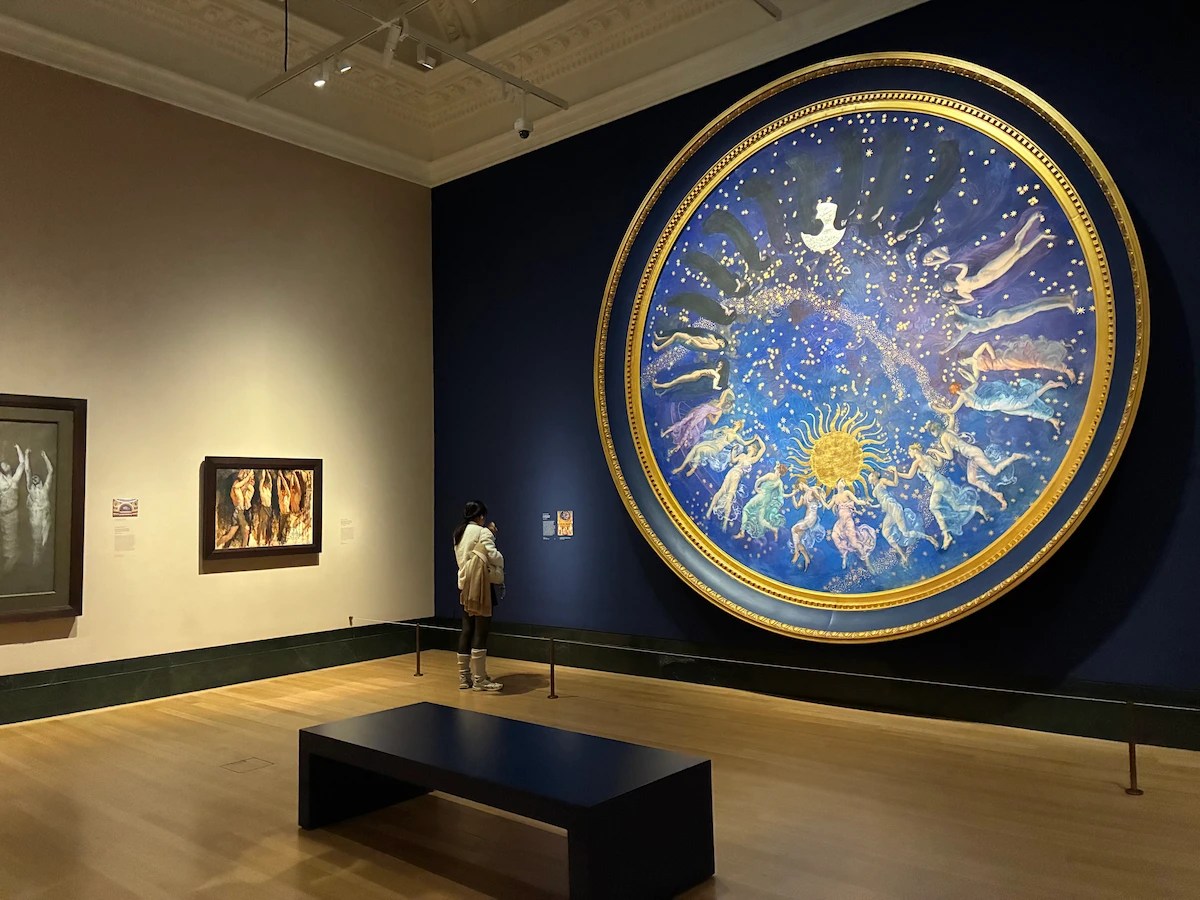
Lastly, to the massive object which dominates the room, a half-scale study or ‘maquette’ for the ceiling mural, ‘The Hours’, which is a striking 12 feet in diameter.

Installation view of ‘Edwin Austin Abbey: By the Dawn’s Early Light’ at the National Gallery, London, showing a preparatory study for the enormous mural, ‘The Hours’ (right) and preparatory sketches for lunettes (left) (photo by the author)

It’s an artistic depiction of the sky imagined over the course of 24 hours, hence the blue background, and images of the moon (at the top) and sun (at the bottom). Around the central axis dance 24 female figures clad in late-Victorian arty dresses, arranged so that they appear to be dancing.

At the top, at dead of night, the figures are blacked out. As they represent the dawning day they become partly visible, until (at the bottom) they are in the bright and highly coloured dress of full day before (as they dance up the left-hand side) they grow paler and increasingly eclipsed by the darkness to which they will return.

Half-scale study for ‘The Hours’ in the Pennsylvania State Capitol by Edwin Austin Abbey (1909 to 1911) (photo by the author)

I’m going to note two things about it:

1. Eurhythmics

One is the beauty of the individual figures themselves. Their faces are only sketchily finished so your attention is on the rhythm of their dancing figures, the variety of their poses and the flow of their light dresses around their bodies. If the anatomy doesn’t completely satisfy the pedantic observer, the effect of rhythm and progression is very effective.

Detail of the half-scale study for ‘The Hours’ in the Pennsylvania State Capitol by Edwin Austin Abbey (1909 to 1911) (photo by the author)

The curators tell us that the loose style of the 24 female figures echoes the innovations of dancers like Isadora Duncan in Abbey’s own time. Their movement is ‘eurythmic’ (flowing and harmonious), a new idea in the early 20th century.

2. Zodiac signs

Second thing is the Zodiac. Oddly this isn’t mentioned in any of the wall labels, and is only apparent when you go right up close to the image and really study it, but dimly sketched behind the dancing figures are the 12 signs of the Zodiac, Aries, Taurus, Gemini, Cancer, Leo, Virgo, Libra, Scorpio, Sagittarius and so on – to be precise, the animals (or human) figures which symbolise the signs. Even once you’ve realised they’re there, they’re quite hard to make out and add a pleasing ‘Where’s Wally’ dimension to your visit. Wife and I spent five minutes trying to identify them all. See if you can spot the image of the ram signifying Aries in this close-up? Pretty easy. Many of the others, a lot less so…

The finished result

The exhibition includes a photo of the murals in situ in the Capitol building, which gives you an adequate enough impression of their context.

The Hours and The Apotheosis of Pennsylvania in situ in the House of Representatives Chamber at the Pennsylvania State Capitol, Harrisburg © Robert Benson Photography

Isn’t it grand? All that gilt ornamentation! But to be honest, in this day and age, I was a bit disappointed that they didn’t have a video of them. Surely it wouldn’t be too much to have made a video panning round the room and examining the ceiling, end wall and lunettes in more detail and in digital quality.

Conclusion

Very enjoyable. Abbey’s draughtsmanship is inspiringly beautiful. Arguably ‘The Hours’ roundel, enormous though it is, is less effective, less memorable, than the individual studies. But this is a very civilised way to spend an hour or so, and it’s FREE.


Related links

Related reviews

Jacob Epstein @ Tate Britain

‘My language is form, in all its variety and astonishing wealth, and that is my native language.’
(Jacob Epstein)

In the main hall of Tate Britain, officially known as the Duveen Gallery, they’ve dusted off 20 or so pieces by British sculptor and modernist pioneer Jacob Epstein to form a lovely display. Some of the large carved stone sculptures fit perfectly into the hall which is constructed of stone columns and panels, which complement Epstein’s bigger stone carvings.

There are (maybe) three aspects to Epstein’s work:

1. Heroic modernism

In the heroic age of modernism, the pioneering 1910s, Epstein’s radically angular vision climaxed in The Rock Drill from 1913, a science fiction vision of the machine age, or the angular and stylised sculpture for the tomb of Oscar Wilde in Paris (1913).

During this period he was a key figure in the ‘direct carving’ movement in Britain. This approach emphasised a ‘truth to materials’, in which sculptors worked directly with the stone, using its natural qualities rather than making wax or clay models first. He was influenced by the techniques and imagery used in ancient Egyptian, West African and Oceanic carvings, which he collected.

2. Stone carvings

Later, in the ’20s and ’30s, he made a series of monumental stone carvings with religious overtones, pagan gods or characters from the Bible, whose monumental blocky scale and composition influenced a younger generation of British sculptors.

3. Bronze busts

Throughout his career he made bronze portrait busts in a completely different style. By contrast with the large angular, slab-like carvings, the busts are more or less life-size, and fiddly, made of knobs and whorls and excrescences where you can almost feel the fingers and thumbs shaping the root material. Nonetheless they’re often good likenesses, and provided Epstein with a regular income from members of elite families and leading figures in the arts who paid for these commissions. The display includes busts of Albert Einstein, the Labour politician Nye Bevin, writer Somerset Maugham, actor Iris Beerbohm Tree and so on.

Gallery

The following text in italics is direct from the curators – why reinvent the wheel?

Rock Drill (1913)

Epstein began this sculpture in a period when artists in the Vorticist and Futurist movements were exploring the dynamic artistic potential of mechanisation. The original sculpture, first exhibited alongside works by Vorticist artists at the London Group exhibition of 1915, was a plaster figure mounted on top of a commercial rock drill.

He later described it as ‘a machine-like robot, visored, menacing, and carrying within itself its progeny… the armed sinister figure of today and tomorrow.’ After the machines of the First World War killed millions of people, Epstein removed the drill, cut the figure down at the waist and chopped off the left hand and right arm and cast it in bronze. This newly truncated figure now looks more vulnerable, a victim rather than a perpetrator of violence.

Torso in Metal from The Rock Drill (1913 to 1914) by Jacob Epstein. Tate © The Estate of Jacob Epstein (photo by the author)

This may be my favourite work of art of all time. It has the geometric angularity of early modernism, highly infused with a Vorticist, machine-age aesthetic, probably my favourite art movement. But more than that, its hard angularity anticipates the unforgiving cruelty and atrocity of the world to come, the world unleashed by the Great War, the great century of catastrophe. And its alien appearance makes it the godfather to almost all the really serious, minatory science fiction of the last century. It is spookily, tragically prophetic. And yet it gives off hard waves of psychic energy. It symbolises the science and technology which have simultaneously liberated us and threaten to annihilate us.

Here’s a photo of what it originally looked like, Epstein’s original conception atop an actual pneumatic drill, which transport it to a whole new level of alien apparition. 1913 when John Singer Sargent was still painting pictures of rich American ladies in their boudoirs!

Doves

A pair of doves, a traditional symbol of love. The two birds are mating, reflecting Epstein’s interest in exploring sexuality and procreation. He simplifies the forms into bold geometric shapes, influenced by the experimental work of sculptor Constantin Brancusi, whom he had met in Paris in 1912 when he was working on Oscar Wilde’s tomb. Epstein made three sculptures on this theme. This version, the third, is the most abstract of the three.

Doves by Jacob Epstein (1914-15) Tate © The Estate of Jacob Epstein (photo by the author)

Jacob and the Angel (1940-1)

Epstein depicts a passage from the Biblical Book of Genesis in alabaster.

In the Bible story Jacob wrestles through the night with an unknown attacker, who eventually overpowers him. In the morning, he realises he has been fighting God and his own conscience. Epstein shows Jacob exhausted, being held up by an angel. The interaction of the figures is ambiguous, both an intimate embrace and the aftermath of a struggle.

Epstein carved several monumental works on biblical subjects in alabaster in the 1930s and 1940s. They all caused controversy because of their use of simplified figural forms and sexual explicitness to depict religious subject matter. In each, Epstein allowed the shape of the stone block to define the figure. He wrote that his intention was to explore ‘the discipline of the simplification of forms, unity of design, and co-ordination of masses.’

Jacob and the Angel by Jacob Epstein (1940 to 1941) Tate © The Estate of Jacob Epstein (photo by the author)

Einstein

The physicist Albert Einstein fled Germany for Britain in July 1933. He was staying at a refugee camp in North Norfolk when Epstein made this portrait. Epstein wrote about his week of sittings with Einstein, which he enjoyed: ‘His glance contained a mixture of the humane, the humorous, and the profound. This was a combination that delighted me. He resembled the ageing Rembrandt.’

Epstein had to work quickly on the bust, which was not fully finished when the sittings ended, because in October Einstein left for the US to take up a post at Princeton University.

Einstein by Epstein (1933) at Tate © The Estate of Jacob Epstein (photo by the author)

Conclusion

If you’re going to see the fabulous Lee Miller exhibition which is just off the central atrium, factor in 15 or 20 extra minutes to take in this display. Most of the bronze busts did nothing for me, whereas the half dozen or so Modernist works are bracing and inspiring, the alabaster Jacob hugely impressive, and I spent 4 or 5 minutes just absorbing the energy, inspiration and horror of the amazing Rock Drill.


Related links

Related reviews

Edvard Munch Portraits @ the National Portrait Gallery

Munch at the British Museum 2019

Six years ago the British Museum held a big exhibition of Edvard Munch’s prints, including the famous Scream. In my review of the exhibition I summarised the exhibition’s narrative of how Munch (1863 to 1944), when a youngish man, in the 1890s, was part of a hard-drinking, permissive Bohemian set in the capital of his native Norway, Oslo (then called Kristiana), and how the hedonistic free-love and hard drinking ethos of this world clashed with his strict Protestant rural upbringing to produce an often unbearable tension and angst in the young man. Not just unhappiness – intense mental distress. The British Museum show had numerous quotes from Munch’s journals and diary up on the walls all making the same point:

For as long as I can remember I have suffered from a deep feeling of anxiety which I have tried to express in my art. (1908)

I was walking along the road with two friends – the sun was setting – suddenly the sky turned blood red – I paused, feeling exhausted – and leaned on the fence – there was blood and tongues of fire above the blue-black fjord and the city – my friends walked on, and I stood there, trembling with anxiety – and I sensed an infinite scream passing through nature. (22 January 1892)

All art, like music, must be created with one’s lifeblood – Art is one’s lifeblood. (1890)

You get the picture, and a feel for the troubled mentality which produced not only The Scream but a host of other deeply haunting woodcuts – of vampire-like young women, of traumatised couples standing in front of lakes of bottomless meaning and forests of endless threat.

However, alongside the woodcuts and paintings with titles like Despair, Anxiety, Death, and so on, Munch throughout his life was an accomplished painter of portraits, of his family, his Bohemian friends, of society patrons, and of himself. In fact he produced hundreds of them.

Munch at the National Portrait Gallery 2025

This fine exhibition at the National Portrait Gallery brings together 40 of Munch’s portraits, ranging across 40 years of his long career, from the 1880s to the 1920s, for us to enjoy, savour, compare and contrast. It is the first such exhibition to focus on Munch’s portraits ever held in the UK and includes foreign loans never before seen in the UK.

A mixed bag

The main point to make at the start is the great variety of size and treatment over these 40 or so years – and the very variable quality. Munch’s star is obviously in the ascendant and the curators, and many of the media reviewers, make a big case for him being one of the twentieth century’s great portraitists. I just don’t think that’s true. It’s nearly true, there are a lot of good portraits here, including some portraits of writers which have long been classic – but there are a lot of poor paintings here as well; ones I thought were poorly executed, showed bad draughtsmanship, sketchy painting technique.

There are quite a few powerful, notable works, but just as many that I’d cross the road to avoid or wouldn’t look twice at in a general exhibition.

Stories

One other point. The gallery labels accompanying the portraits are excellent and full of interest. Very often exhibition labels fall back on woke clichés or very general descriptions of what you can already see for yourself, and can be exasperating or futile, accordingly.

However the picture captions here are uniformly excellent. Almost all of them move beyond a brief background of the image to give fascinating potted biographies of the subjects, and seeing as these come from a surprisingly broad range of figures, in Norway but also Germany where Munch spent a lot of time, all these potted biographies build up into a fascinating mosaic of the times. They range all the way from the biography of Munch’s father and sisters, via the various writers, artists and poets he knew in his merry Bohemian times, through to fascinating accounts of the physicians, industrialists and patrons he painted, and their lives and fates after he painted them.

Putting to one side the questionable merit of some of the paintings, these potted biographies bring to life a whole world of culture and patronage in north-central Europe which we in Britain, in thrall to a very Paris-based view of modern art, are almost completely ignorant of.

Layout

The exhibition is arranged thematically and chronologically, taking visitors on a four-part journey through Munch’s immediate family, bohemian artists and writers, his patrons and collectors, and finally his closest confidants, the so-called ‘Guardians’ who supported him in his later years. I’ll pick a key work from each section.

1. Family

The earliest paintings, from his early 20s, are small oil paintings of himself, his father and the aunt (Karen Bjølstad) who moved in after his mother died of tuberculosis when he was five (in 1868). I really liked the small portrait of his bearded father – Dr Christian Munch, a military doctor – lighting his pipe. They’re small, dark and inside and hark back to naturalist painting of the 1860s and 70s which he would swiftly work through and move beyond.

Quite quickly we move outside, though, to a much larger work like ‘Evening’ (1888). This, the caption tells us, depicts Munch’s sister, Laura, on a family holiday, just a year before she was permanently hospitalized with schizophrenia. The curators claim it captures her sense of alienation from her surroundings. Do you agree? Apparently in the centre of the painting was a standing figure but Munch painted over it in order to emphasise and increase the sense of distance between the soulful woman and the figures by the lake.

Evening by Edvard Munch (1888) © Museo Nacional Thyssen-Bornemisza

2. Bohemian friends

Munch left his family home to study art formally in the mid-1880s, becoming part of the bohemian scene in Kristiania. This was a network of internationally-connected artists and writers whose their ideals ran contrary to the strict religious principles of Munch’s upbringing. They advocated free love, atheism and women’s emancipation.

It was here that he developed a free-er more expressive way with paint which he called ‘soul art’, and which relied on the intensity of the relationship with the sitter as much as technical proficiency. In other words, his brushwork became looser. Leader of this set of freethinkers was the anarchist Hans Jæger whose portrait dominates this section and was chosen by the curators to promote the entire show. They comment on the cynical, confident pose of a man who knows he bosses his social group, comfortably slouched on a sofa in the Grand Café, Kristiana.

Hans Jaeger by Edvard Munch (1889) © Nasjonalmuseet for kunst, arkitektur og design, The Fine Art Collections. Photo: Nasjonalmuseet/Børre Høstland

Munch didn’t stay in Kristiana but travelled to Berlin where he had been invited to show. Here he met the Polish writer and dramatist Stanisław Przybyszewski whose 1894 monograph ‘Das Werk des Edvard Munch’ was the first publication to promote Munch internationally and to suggest the idea of the ‘Naked Soul’ as being fundamental to his work. Przybyszewski believed that society placed such a constraint on basic human instincts that it was the artist’s duty to compensate by giving free rein to unconscious impulses and desires – what he termed ‘the naked soul’.

The other strong work in this section is the portrait of lawyer Thor Lütken. Do you notice anything odd about this picture?

Thor Lütken by Edvard Munch (1892) Private Collection. Photo: Munchmuseet / Sidsel de Jong

The oddity is that, on close inspection, the lawyer’s left sleeve, along the bottom of the picture, contains a moonlit landscape inhabited by two mysterious figures, a man in black and a woman in white.

Detail of Thor Lütken by Edvard Munch (1892) Private Collection. Photo: Munchmuseet / Sidsel de Jong

Are they lovers or a symbolic portrayal of life and death, Death and The Maiden? Whatever the intention, it’s a pretty unconventional thing to do in a professional portrait but indicates the tremendous influence the 1890s movement of Symbolism had on Munch’s thinking.

Talking of Symbolism, the section includes a series of works which aren’t paintings but black-and-white lithographs. These depict some super-famous figures from the time, notably the playwrights Henrik Ibsen and August Strindberg, the French Symbolist poet Stephane Mallarmé, and the composer Frederick Delius who Munch met at the health resort of Wiesbaden, alongside group sketches of north European Bohemians in a number of cafes and bars.

The point is that for some of these portraits – notable Ibsen, Mallarmé and a striking portrait of himself – created a novel approach, presenting the sitters as disembodied heads floating in space. The detached floating head was a familiar motif in Symbolist art, signifying a split between the physical and spiritual self but hadn’t been used in such intimate and realistic portraits before.

The novel format does several things. In the portrait of Ibsen it emphasises the distance between the floating head and the busy life going on outside the window; in the wonderful portrait of Mallarmé, probably the most successful likeness in the show, it focuses you on the face and eyes so you feel you are just about to hear a pearl of wisdom from the witty old gent. According to the ever-interesting picture caption, Mallarmé was fascinated by the occult, which may explain the ghost-like feel of the portrait. And he said that the image reminded him of one of the images of Jesus on a holy shroud…

And in the self portrait with skeleton, the jet black background makes Munch’s head seem as if guillotined and floating in space, as in a bizarre dream.

3. Patrons and collectors

The third section of the exhibition examines Munch’s relationship with his patrons and collectors. By the early 20th century, Munch was one of the most exhibited artists in Europe. Returning to Berlin in 1902, he won the support of a group of wealthy and influential collectors, whose patronage further elevated his profile. It’s fascinating to learn that, in the curators’ words, ‘Many had Jewish heritage and held key professional and institutional positions in German society. They all shared an enthusiasm for the philosophy of Friedrich Nietzsche and his belief in the creative power of the individual’ – indeed the influence of Nietzsche’s insistence on the Superman overthrowing all society’s traditional values and creating his own, is mentioned in the commentary of quite a few works from this period. Also, disapproving moralists nowadays frequently associate Nietzsche with the strains of thought which led to the Nazis, so it’s striking to learn that quite so many Jewish figure were attracted by his ideas.

From 1902 to his breakdown in 1908, Munch began to take commissions from the rich and successful and this marked a turning point in his portrait style. Increasingly he painted in bright and bold colours to reflect the dynamism of his sitters. The outstanding work in this section is the super-striking portrait of German physicist Felix Auerbach, commissioned in 1906.

by Edvard Munch (1906) © Van Gogh Museum, Amsterdam (Vincent van Gogh Foundation)

In my opinion, you can see at least three things going on in this portrait. 1) The face and in particular the eyes address you really directly, with startling immediacy. Their clarity and figurative accuracy are comparable to the Mallarmé image’s eyes.

2) This immediacy distracts you from the fact that a lot of the secondary detail is no precise, is done using Munch’s trademark curves. Look at the hand holding the cigar: the fingers, the hand, the sleeve do not stand out with photographic realism from the background coat but instead are moulded with his trademark blurred curves. Instead of focusing on light and shadow to make the detail crisp, he prefers to go over the rounded outline of the hand again and again, in different colours, to give it an almost cartoon simplicity.

Lastly, of course 3) the bright red background. Maybe it’s an attempt at the actual wallpaper behind this rich patron when he painted him, but it feels more like an aesthetic statement. At first glance it made me think of the Fauves and Matisse who were just starting to do the same kind of thing in France but the wall caption tells me it’s a homage to Van Gogh’s use of bright and non-naturalistic colours. (n fact this painting now resides in the Van Gogh museum in Amsterdam.) It certainly feels like Munch felt free to create any kind of background he wants, and to use very strong vibrant colour in order to create an effect, in this case an extremely powerful and stirring effect.

The redness of the image reminded me of John Singer Sargent’s masterpiece, Dr Pozzi at Home (1881). Look at Sargent’s treatment of the hands, and indeed of the face. Pretty much none of the works in this exhibition demonstrate the draughtsmanship, the accuracy, or the painterly precision of Sargent.

In a very different mode, and much more reminiscent of his famous woodcut prints in its appreciation of feminine sensuality and its air of mystery, is The Brooch (1902), Munch’s lithograph of the Brixton-born violinist Eva Mudocci. As we’ve seen, Munch created a series of Symbolist ‘floating head’ portraits but almost all of them are of men. This portrait of Mudocci is a rare example of a woman depicted in this manner.

The Brooch (Eva Mudocci) by Edvard Munch (1902) © Private collection, courtesy Peder Lund

As usual the picture caption gives us a fascinating potted biography of the sitter and I couldn’t help laughing out loud when I read that ‘Eva Mudocci’ was actually born Evangeline Hope Muddock in Brixton.

These are the outstanding good works in this section, but there began to be ones I didn’t like or felt fell far short of a professional standard. There are three prints from a set of 16 commissioned by a Dr Linde of his wife and young children. These ought to be good and they’re nearly good, but when you look closely, you see that they’re not good. Look at this drawing of his four sons – all the faces are bodged and wonky. Sorry to be so literal minded, but compared to the draughtsmanship of Holbein or Sargent or Lawrence or numerous other painters, ancient and modern, Munch’s technique feels good, but not wow.

Breakdown

Ten years of heavy drinking, of numerous affairs and moving constantly from place to place took their toll and in 1908 Munch had a breakdown. He was admitted to a private nerve clinic in Copenhagen, run by Dr Daniel Jacobson and slowly, steadily made a full recovery, going on to become a virtual teetotaller.

When Jacobson requested a portrait, Munch chose to pose him in a powerful stance echoing Holbein’s iconic portraits of Henry VIII, painted in bright swirling colours as if engulfed by flames. The wall caption amusingly tells us that Jacobson hated the portrait.

Dr Daniel Jacobson by Edvard Munch (1908) © SMK, National Gallery of Denmark. SMK Photo/Jakob Skou-Hansen

This reproduction makes it look quite dark and more coherent than it is in the flesh. In the flesh it is enormous, larger than life size, and scrappy. You can clearly see the untouched canvas through the scrappy hurried brushstrokes. Now ordinarily I really like this kind of thing when it conveys a sense of dynamism, as in Degas, or experimentalism, as in Cézanne. But, sorry everyone, in Munch, for me, it just felt scrappy and half-hearted.

My opinion was exacerbated by the presence in this room of quite a few other middling to poor paintings, which had the effect of dragging the whole thing down. Take Olga and Rosa Meissner from 1908. I can see that Munch is moving into the new world of German Expressionism, in the breakthroughs of post-impressionism, anticipating the scrappy portraits of English artists like Dora Carrington or Vanessa Bell a decade later. But I don’t like it. The faces are poor and the painting style is scrappy and half-hearted.

There were quite a few paintings with this half-finished scrappy vibe in this section and even more in the fourth and final room.

4. The Guardians

Following his recovery at Dr Jacobson’s clinic, in 1909 Munch moved back home and settled permanently in Norway. In that year (1909) Norway had gained independence from its union with Sweden and Munch was hailed a national hero, having been knighted the previous year.

Munch’s recovery of his health and turning away from the ruinous ways of his Bohemian lifestyle were supported by a small group of new friends who he came to call his ‘Lifeguards’ or ‘Guardians’ – friends and supporters he found among writers, artists and patrons. These Lifeguards were so important to Munch that he refused to be parted from their portraits, which acted as talismanic substitutes for them when they weren’t around. So this last section of the exhibition brings together ten or so portraits of these people which, I’m afraid to say, I found almost uniformly ‘bad’.

In its press images the NPG supplies the two strongest pictures in the room, which are the full-length portrait of Jappe Nilssen and the one of Birgit Prestøe in ‘Seated Model on the Couch’ (1924). They do not supply any of the weaker ones, such as the double portrait of Käte and Hugo Perls, of painter Ludvig Karsten or writer Christian Gierløff.

Here’s the best image in the room, the portrait of Jappe Nilssen.

Jappe Nilssen by Edvard Munch (1909) © Munchmuseet. Photo: Munchmuseet / Juri Kobayashi

As you can see, it’s a powerful work, employing van Gogh-style slabs of primary colours to create a dynamic image – although the real source of its power is in the man’s four-square, virile pose. But it’s arguably the best image in the room, and not typical of almost all the others, which feel far weaker and less finished, in at least one case, literally so.

The only other work in the this section that I liked is a portrait of a regular sitter for Munch, Birgit Prestøe. He painted her many times between their meeting in 1924 and 1931.

Seated Model on the Couch (Birgit Prestøe) by Edvard Munch (1924) © Munchmuseet. Photo: Munchmuseet / Sidsel de Jong

I liked this image because, from a distance, it reminded me of the kind of mathematical modernism I really like – the post-cubist angularity of Futurism and Vorticism. But of course, it’s more by accident than design. When you go closer you see that not many of the lines are straight, most are in fact bent or curved or swirly, although I still like the random pools of colour, such as the dark orange on her shoulders and hip and knee.

And here are links to some of the much more characteristic, much less finished, much scrappier, and less pleasing works:

The Olsen, in my view, showcases all Munch’s weaknesses. The draughtsmanship of the face is poor, the arms are worse (at first glance, she looks like a thalydomide victim), the shadow looks like a pool of spilled dirty water.

The Christian Gierløff demonstrates the hold of what I early on came to think of as The Swirl on Munch’s technique, the way 1) the outlines of a figure’s body are echoed and repeated in multiple lines to create a kind of shadowy, faltering effect, and 2) the way the figure doesn’t stand out distinctly from the background, as people do in real life, but what background he can be bothered to paint in shapes itself around the foreground figure. This is most obvious in the rock of whatever it is behind Gierløff and on his right, whose contours entirely shape themselves around his figure, and the yellow line outlining the black which is presumably his shadow, and which curves round to a kind of golden loop on the ground at his feet, which to the schoolboy mind, suggests a puddle of urine.

Clearly Munch considers the backgrounds to his later portraits to be very secondary, to have a mostly decorative effect. Now whereas this works excellently in the striking and very finished portrait of Felix Auerbach, which is indoors, and whose backdrop hovers with pleasing ambiguity between a real wallpaper and pure abstraction – in my opinion this approach does not work when the figure is out of doors and so the background becomes more important, is necessarily more varied, we as animals want to understand the context and precise positioning of a fellow human, so I found Munch’s collapse into semi-abstract swirls and half-arsed shadows, frustrating and incomplete. They’re neither the realism of a Singer Sargent nor the purely decorative abstraction of a Matisse, but a muddy no-man’s-land in between.

Conclusion

The curators, and a surprising number of critics in the papers and magazines, try to persuade us that Munch was one of the great portrait artists of the 20th century. This excellent exhibition makes the strongest possible case for its cause, and is certainly very enjoyable for the biographical and historical facts to be found in all the picture captions – but, in my opinion, ultimately fails. Some of his paintings are excellent, the famous writer lithographs are classic – but, in my opinion, quite a few, especially of the later portraits, are badly drawn, scrappily painted, and the deployment of the swirly outlines which made his 1890s trauma works and the Symbolist portraits so powerful, has degenerated into a messy, irritating mannerism.

Here’s another work which features in the fourth room, a portrait of himself with friend, Torvald Strang.

It’s mildly interesting to learn from the wall caption that 1) the lawyer and barrister Torvald Stang had been a friend of Munch’s since the 1880s, often supporting him during difficult times. He was said to be an elegant man about town. And also to learn that 2) Munch had a strong liking for yellow and often used it as a background for his portraits.

But is this painting any good? Not really, no.

The promotional video


Related links

Related reviews

The Waves by Virginia Woolf (1931)

‘When we sit together, close,’ said Bernard, ‘we melt into each other with phrases. We are edged with mist. We make an unsubstantial territory.’

All for a moment wavered and bent in uncertainty and ambiguity…

‘The Waves’ is an experimental novel made up of highly poetic, sometimes almost abstract and visionary monologues, delivered by six characters, depicting their lives over 30 years or more as they grow from children through maturity to old men and women. The six are:

  1. Bernard (fancies himself a novelist; never goes anywhere without his notebook in which he jots down notes for novels which never get written)
  2. Susan (wants to be a rural materfamilias like her mother)
  3. Rhoda (nervous, anxious)
  4. Neville (fancies himself a poet)
  5. Jinny (party-loving Londoner)
  6. Louis (fancies himself heir to Egypt and all the ages; acutely self-conscious of his Australian accent and his father a banker in Brisbane)

Early on the image of Enid Blyton’s Famous Five appeared in my mind (Julian, Dick, Anne, George and their dog Timmy) and I never quite managed to lose the association. This book is about the Sensitive Six.

Here’s how it opens, to indicate the schematicness of the structure, and the stilted, hieratic nature of the prose.

‘I see a ring,’ said Bernard, ‘hanging above me. It quivers and hangs in a loop of light.’
‘I see a slab of pale yellow,’ said Susan, ‘spreading away until it meets a purple stripe.’
‘I hear a sound,’ said Rhoda, ‘cheep, chirp; cheep chirp; going up and down.’
‘I see a globe,’ said Neville, ‘hanging down in a drop against the enormous flanks of some hill.’
‘I see a crimson tassel,’ said Jinny, ‘twisted with gold threads.’
‘I hear something stamping,’ said Louis. ‘A great beast’s foot is chained. It stamps, and stamps, and stamps.’

In her great novels, ‘Mrs Dalloway’ and ‘To The Lighthouse’, and to a lesser extent in ‘Orlando’, the narrator – or the characters the narrator describes – are continually noticing small details in the world around them: the toot of a car horn, a bird arcing in the sky, a fragment of dress someone’s wearing, the tinkle of cutlery. Quite often the pressure of all these details pressing in on the characters’ senses becomes too much, sensual overload giving rise to a sort of hysteria which I thought I detected in ‘Jacob’s Room’.

In a sense ‘The Waves’ represents the triumph of this detail-noticing approach over conventional plot or characters. The text consists of nothing but random details, hundreds and hundreds of them, described in isolation like jewels hanging in space.

There is the stable clock with its gilt hands shining. Those are the flats and heights of the roofs of the great house. There is the stable-boy clattering in the yard in rubber boots… That is the close-clipped hedge of the ladies’ garden… The ferns smell very strong, and there are red funguses growing beneath them… That is a wood-pigeon breaking cover in the tops of the beech trees… The lady sits between the two long windows, writing. The gardeners sweep the lawn with giant brooms… Listen! That is the flop of a giant toad in the undergrowth; that is the patter of some primeval fir-cone falling to rot among the ferns…

From the start there’s no indication how old the characters are or where any of this is happening: it is a set of free-floating and deliberately random observations which is, to begin with, quite disorientating.

Children

In the event, the initial level of abstraction can’t be maintained for long – the speaker’s speeches become longer and start to contain circumstantial details. We learn that they are all together in one place and are children waiting for ‘lessons’ to begin. ‘My mother still knits white socks for me and hems pinafores and I am a child,’ says Susan. We learn who they all are because Louis very bluntly tells us:

‘My father is a banker in Brisbane and I speak with an Australian accent. I will wait and copy Bernard. He is English. They are all English. Susan’s father is a clergyman. Rhoda has no father. Bernard and Neville are the sons of gentlemen. Jinny lives with her grandmother in London…’

But they don’t speak like children at all. They talk in the fixed hieratic style of adults reciting the words of a play. Around the same time Woolf produced this experimental drama-novel other writers were doing something similar. T.S. Eliot tried to revive plays in verse starting in the early 1930s with ‘Sweeney Agonistes’. W.H. Auden wrote plays in verse starting as early as ‘The Orators’ in 1932. Woolf’s characters, also, speak like characters on a stage, standing facing an audience, reciting the words of a poetic play. Woolf herself referred to it not as a novel but a ‘playpoem’. No pre-school child talks like this:

‘Now the stricture and rigidity are over; and I will continue to make my survey of the purlieus of the house in the late afternoon, in the sunset, when the sun makes oleaginous spots on the linoleum, and a crack of light kneels on the wall, making the chair legs look broken.’ (Neville)

They are children talking in adult terms, using adult language.

Starting time and place

We learn that the children are all together in a country house named Elvedon. They are supervised and catered to by an extensive staff. It is the Edwardian decade because one of the girls refers to Queen Alexandra, wife of King Edward VII, who reigned 1901 to 1910.

Structure

There are no chapters, as in ‘Orlando’, or parts as in ‘To The Lighthouse’. Instead the text is broken up into nine long sections in Roman text, each one preceded by ten short descriptive sections printed in italics. After a while I realised the italicised sections describe the transit of the sun across the sky during a single day. Not just that, it is the sun rising over the sea, over a seascape, necessarily characterised by waves. So each time we cut back to one of these passages the sun is just rising or is half-way up the sky or stands at noon etc, shedding its light on the sea and its endless waves, and that these also change appearance and character at these different times of the day.

These sections are highly formalised, almost all of them opening with the same key words, ‘The sun…’ and containing some reference to the endless waves.

The sun had not yet risen. The sea was indistinguishable from the sky…

The sun rose higher. Blue waves, green waves swept a quick fan over the beach…

The sun rose. Bars of yellow and green fell on the shore, gilding the ribs of the eaten-out boat and making the sea-holly and its mailed leaves gleam blue as steel. Light almost pierced the thin swift waves as they raced fan-shaped over the beach…

The sun, risen, no longer couched on a green mattress darting a fitful glance through watery jewels, bared its face and looked straight over the waves. They fell with a regular thud. They fell with the concussion of horses’ hooves on the turf…

The sun had risen to its full height. It was no longer half seen and guessed at, from hints and gleams…

The sun no longer stood in the middle of the sky. Its light slanted, falling obliquely. Here it caught on the edge of a cloud and burnt it into a slice of light, a blazing island on which no foot could rest. Then another cloud was caught in the light and another and another, so that the waves beneath were arrow-struck with fiery feathered darts that shot erratically across the quivering blue…

The sun had now sunk lower in the sky. The islands of cloud had gained in density and drew themselves across the sun so that the rocks went suddenly black, and the trembling sea holly lost its blue and turned silver, and shadows were blown like grey cloths over the sea. The waves no longer visited the further pools or reached the dotted black line which lay irregularly upon the beach.

The sun was sinking. The hard stone of the day was cracked and light poured through its splinters. Red and gold shot through the waves, in rapid running arrows, feathered with darkness.

Now the sun had sunk. Sky and sea were indistinguishable. The waves breaking spread their white fans far out over the shore…

So it is not just about the passage of the sun through the sky, it is about the interplay between the slow-moving, inevitable sun and the ever-changing sea, the endless waves which, clearly, give the book its title. Right at the end, the text concludes with the briefest of these italicised passages, just one short sentence:

The waves broke on the shore.

So although the prose sections take us through the growth from childhood to adulthood of the six main characters, in some sense their entire lives are compassed within the frame not even of 24 hours, but in the 12 or so hours from the sun rising to the sun setting, as if part of some larger, natural cycle.

No dialogue

I thought the style would loosen up and the characters would get to talk to each other, but they don’t, at all. There is no dialogue. The characters never interact. To all intents and purposes they might be lined up on a stage, facing the audience, declaiming their parts and never facing or interacting with any of the others. Talking of complete lack of interaction…

Aspergers syndrome?

Lack of awareness of others or how to interact with other people are classic symptoms of being on the spectrum from Aspergers syndrome to full-blown autism. Here are the symptoms of Aspergers:

  • difficulty understanding social cues, body language, and facial expressions
  • difficulty relating to others
  • difficulty making eye contact
  • difficulty responding to people in conversation
  • difficulty staying on task and understanding or following directions
  • unusual speech patterns
  • formal style of speaking that’s advanced for their age
  • repeating words, phrases, or movements (‘it is not you, it is not you, it is not you’)
  • hypersensitivity to lights, sounds, and textures
  • sensitivity to loud noises, odours, clothing, or food textures

These are exactly the traits demonstrated by all six characters throughout this strange book.

Section 1. Childhood (13 pages)

We meet the six children, all for some reason living in the same house and sketchily follow a day in their lives, playing in the garden, sitting through lessons. There are several key moments: one when Susan sees Jinny kiss Louis which throws her into a rage. One when Bernard convinces the others the gardeners are after them with their shotguns and persuades them to all runs away and hide in terror. Rhoda is described as floating flower petals on the water in a basin, pretending they’re ships, and this image recurs throughout her sections in the rest of the book.

Then (rather abruptly) they are being bathed and put to bed.

Section 2. School days (29 pages)

They set off for their first days at school, by train, so there’s a description of a railway station and a train arriving. The gaggle of children, the Edwardian formality made me visualise The Railway Children, which is set in 1905, so the children would have worn similar clothes.

Train journeys have for a century and a half been the pretext for random observations, fragments seen out the window cf The Whitsun Weddings by Philip Larkin. Woolf utilises it to the maximum, here as they head to school and even more at the end of the section, where Susan, Jinny and Rhoda all describe the fleeting images they see through the speeding carriage windows.

There a white church; there a mast among the spires. There a canal. Now there are open spaces with asphalt paths upon which it is strange that people should now be walking. There is a hill striped with red houses. A man crosses a bridge with a dog at his heels. Now the red boy begins firing at a pheasant. The blue boy shoves him aside…

The boys arrive at a private school with its quadrangles, statue of the founding father, promise of Latin lessons, the lobsided headmaster, Crane. The girls go to a separate school. At this point you start wondering whether it’s a problem that they all sound alike and that they all sound like Virginia Woolf i.e. no attempt is made to give them childish turns of phrase or to distinguish between them – the opposite, these children are all gifted with Woolf’s lyrical turn of phrase and describe Woolf’s great theme, ‘identity’.

This great company, all dressed in brown serge, has robbed me of my identity. We are all callous, unfriended. I will seek out a face, a composed, a monumental face, and will endow it with omniscience… (Rhoda)

Here’s Louis reacting to the sight of Dr Crane entering the chapel:

I rejoice; my heart expands in his bulk, in his authority. He lays the whirling dust clouds in my tremulous, my ignominiously agitated mind… (p.23)

Although they are given different opinions the opinions are secondary to the style, and the style is all the same. Yes, I think this is a flaw, a failing. Woolf substitutes any feel for how children actually think and speak, with her own lyrical but sometimes ponderous, almost pompous phraseology.

From discord, from hatred… my shattered mind is pieced together by some sudden perception. I take the trees, the clouds, to be witnesses of my complete integration. I, Louis, I, who shall walk the earth these seventy years, am born entire, out of hatred, out of discord. Here on this ring of grass we have sat together, bound by the tremendous power of some inner compulsion. The trees wave, the clouds pass. The time approaches when these soliloquies shall be shared. (p.26)

There’s a service in the chapel. Cricket, of course. Bernard already wants to become a novelist, God help us. He is described as turning everything into stories – except that Woolf doesn’t turn everything into stories. There are hardly any stories in her novels, just page after page after page of lyrical descriptions. Louis envies the other boys, the ones with eminent fathers who dominate sports and clubs. Neville develops a hatred for the sign of the cross and becomes passionately devoted to the Latin poets, Catullus, Horace, Lucretius. Susan hates her school and would like to bury it.

Here, as in ‘Orlando’, Woolf claims a character (Bernard) is always bubbling over with stories, just as she claims various people in ‘Orlando’ (notably Nicholas Greene) are bubbling over with stories, and yet… there are never any stories. Not one, not one anecdote, tale or joke, nothing you could retell to anyone who hasn’t read the book. It is hard to avoid the conclusion that Woolf couldn’t tell a story – with a beginning, middle and an end – to save her life.

It is extremely symptomatic that Bernard is good at setting scenes but that even he acknowledges that his so-called ‘stories’ always fizzle out, ‘tail off absurdly’ (p.34). What Woolf really means when she talks about ‘stories’ is the unstoppable flow of her own dizzyingly acute observations. But listing thousands of acute details and insights is very much not telling a story. In fact it’s the opposite of telling a story. A story is a sequence of linked events in the shape of a narrative. That doesn’t appear in any of Woolf’s novels.

I can sketch the surroundings up to a point with extraordinary ease. But can I make it work? (Bernard)

No. No he (and she) can’t make it work. Instead the tsunami of details never ends. They flood her mind and her text with a stricken profusion, a thousand snapshots, a million moments brilliantly lit.

Passing the open door leading into the private garden, I saw Fenwick with his mallet raised. The steam from the tea-urn rose in the middle of the lawn. There were banks of blue flowers.

When I wake early… I lie and watch the brass handles on the cupboard grow clear; then the basin; then the towel-horse. As each thing in the bedroom grows clear, my heart beats quicker.

I catch sight of something moving – a speck of sun perhaps on a picture, or the donkey drawing the mowing-machine across the lawn; or a sail that passes between the laurel leaves…

Then their school days are over, and they look back at what they’ve learned. Susan gives a half page impression of London which triggers memories of ‘Mrs Dalloway’ and ‘Orlando’ before she catches a train back to her country home. And then the perceptions of Jinny, Rhoda, Louis and Neville on their respective train journeys home. Neville is 18.

Section 3. University (21 pages)

University, Cambridge of course (because that was the Bloomsbury University). Bernard ponders how he is multiple selves (the great theme described at the end of ‘Orlando’). He models himself on Byron (amazingly, given that Byron died 80 years previously). He tries to dash off a letter to his girlfriend but is crippled by self consciousness. It is thumpingly clear that what he means by a ‘story’ is in fact a thousand and one cluttered details with not the slightest sense of a narrative. In the same way Louis and Neville both fancy themselves poets but can’t write a line (see ‘The Bloomsbury Error’, below). They punt up the river and eat fruit from a bag, watching the cows in the meadows.

Susan was sent to finishing school in Switzerland but now she’s gone back to her parents’ farm where she lives a rural life, walking out to see cows and pick mushrooms. She wants to get married and have babies, like her mother.

Jinny lives in London and lives for elegant society parties, large lit rooms full of gilt chairs and being swept off her feet by handsome young men.

Rhoda also lives in London but struggles to make sense of her life, to hold her selves together, lacking the rural conviction of Susan or the society confidence of Jinny.

Section 4. Dinner for Percival (25 pages)

Bernard is engaged and catches a train to London, then stands in the busy street. All six are reuniting for a farewell dinner for their mutual friend Percival (who we haven’t seen much), ‘a hero’, who is leaving for India. Each of the six imagines Percival acting with godlike decision in India, to sort out ‘the Oriental problem’. They all genuinely believe this Percival would have been a great governor who would have ruled India widely and benevolently: ‘He would have done justice. He would have protected.’

Section 5. Percival’s death (10 pages)

News comes that Percival is dead. He was playing some game out in India when his horse threw him and he died on the spot. The Sensitive Six each give their responses which are, predictably, hyperbolic and immoderate:

  • All is over. The lights of the world have gone out.
  • We are doomed, all of us.
  • All palpable forms of life have failed me. Unless I can stretch and touch something hard, I shall be blown down the eternal corridors for ever.
  • I am alone in a hostile world. The human face is hideous.

And so, immoderately, on.

Section 6. Success and babies (11 pages)

Louis has become a successful businessman. He loves his office, his desk and his telephone. He’d like to write poetry but is too busy advancing trade around the world. He and Rhoda are lovers. To do this, he has had to deal with the identity problem and from the many men inside him, make one.

Susan is married with babies. She feels replete, complete, and waxes lyrical about getting them to sleep in her country farm.

Jinny, the London party girl, is now past 30. She seems to be describing her life to a man she’s met, including gossip about loads of society figures, but also a lyric delirium about her body and her wish to go off in a ship over the sea.

Neville delivers an impassioned monologue to a woman he has a troubled relationship with, they walked round London together but then she abandoned him at the Tube but later that night arrived at his front door, so…

Section 7. Middle age (16 pages)

If you can’t think what to do next, send your characters abroad. Bored of middle-aged life, Bernard travels to Italy, to Rome. He is middle-aged and has, at last, acknowledged that he has no real talent, that all those clever hopes come to nothing.

I have made up thousands of stories; I have filled innumerable notebooks with phrases to be used when I have found the true story, the one story to which all these phrases refer. But I have never yet found that story. And I begin to ask, Are there stories? (Bernard)

In other words, there is no final statement, there is no Masterwork all these observations are building towards. The observations themselves, in all their brilliant fragmentation, are the work. Or at least, they are in Woolfworld.

Meanwhile, Susan is very content with her rural life bringing up two children in a world of butterfly nets and home-made jam, and visiting the rural poor, especially the dying in their cottages.

Jinny appears to be single but forces herself to rejoice in London life, in the energy and excitement of the Tube and buses and the hectic streets.

Neville feels himself getting old. He’s lost the old anger and bitterness. Now he reads Shakespeare and drifts from party to friend’s house, all passion spent. His section feels more than usually demented, stricken, mad.

Back to Louis who is a successful businessman, well turned-out in spats and a gold-handled cane. He tells us Rhoda left him so he’s taken up with a slatternly Cockney mistress. He is still attracted to his first love – poetry – and fantasises about writing the one Great Poem which will make sense of everything.

Rhoda has been scared all her life, copying the others to give the right appearance of living normally. Now she is in Spain, on a pilgrimage to go by donkey to the top of a mountain where she hopes she’ll be able to see Africa.

Section 8. Lunch at Hampton Court (19 pages)

They all meet up to have lunch at a restaurant in Hampton Court. Unexpressed jealousies and resentments like stags clashing antlers.

Neville despises Susan for waking up every morning to the same husband, when he has a succession of different women, sensations and conversations every season.

Louis wants everyone to notice his smart clothes and success and yet feels the perennial outsider.

Jinny wants them to acknowledge her fascination with people and life.

Rhoda is terrified of the simplest things and imagines her bed at night falling over the edge of the world. She’s the most mental of the lot:

After all these callings hither and thither, these pluckings and searchings, I shall fall alone through this thin sheet into gulfs of fire. And you will not help me. More cruel than the old torturers, you will let me fall, and will tear me to pieces when I am fallen. Yet there are moments when the walls of the mind grow thin; when nothing is unabsorbed, and I could fancy that we might blow so vast a bubble that the sun might set and rise in it and we might take the blue of midday and the black of midnight and be cast off and escape from here and now. (Rhoda)

And indeed, right at the end of the book, in a throwaway remark, Bernard indicates that Rhoda kills herself: Woolf’s avatar, in this respect. She jumped out the upper story of a house to her death, as Woolf tried to when she was 13…

As I talked I felt “I am you”. This difference we make so much of, this identity we so feverishly cherish, was overcome

Then they all go for a wistful sad walk by the river, arm in arm and hand in hand.

Section 9. Bernard’s recap (40 pages)

Oddly and disappointingly a lot of this final section consists of a recapitulation of stuff we’ve read before.

Woolf has finished with all the other characters, we see and hear them no more, but for Bernard. This section consists entirely of Bernard’s voice and lugubrious reminiscences. It consists of him addressing someone over a meal in the West End, a barely known stranger he remembers boarding a ship to Africa with years ago and has recently bumped into, a virtual stranger to tell his life story and the story of the six characters to. So the text finishes with Bernard ‘winning’ and his version of events being the crowning and defining one. Shame. I preferred the women characters, Susan, Rhoda and Jinny. Tant pis.

Early on in his 40-page monologue, Bernard complains that he’s fed up of telling ‘so many stories’. This is a bit rich seeing as how nowhere at all has there been an indication of him producing even a half-decent anecdote let alone a full-blown story.

He also says he is sick of flamboyantly beautiful phrases, which is maybe Woolf being ironic against herself, seeing as Woolf is praised above all for her lyrical (and often delirious) prose style, and this book consists entirely of fine phrases almost completely bereft of plot, event or psychology. (I say bereft of psychology because, despite a handful of superficial differences, all the characters think and speak exactly like Virginia Woolf.)

Anyway, all Bernard does, at great length, is recapitulate many of the scenes we have already had described to us, described in the childhood, school and university sections. But a scene is not a story, it is just a scene. Repeatedly telling us that Rhoda liked stirring flower petals in a basin and Neville like the Roman poets is not a story, it is creating images which, through repetition, acquire a kind of talismanic power. (Woolf does it in her factual works, as well, for example the image of the officious beadle who shooed her off a lawn in Cambridge which is repeated throughout ‘A Room of One’s Own’ and even in ‘Three Guineas’ to become a kind of looming symbol of the patriarchy.)

And on and on it goes, by far the longest section of the book and essentially a recapitulation of everything we’ve heard before. Tragically, as I’ve mentioned, as he gets towards the end of this bald list of impressions and mild events, he says ‘that’s enough of stories’ and the reader thinks ‘what stories?’ His idea of a story seems to be that Percival died when his horse threw him. Not a scintillating story, is it? Not the most complex of narratives. Woolf is the great writer of anti-stories.

Another one of his cracking stories, so good he repeats it half a dozen times, is that once, Percival invited him to accompany him to Hampton Court but he said no. That’s it. Not the ‘Thousand and One Nights’, is it? It’s more of a motif, a (very small) incident which Bernard keeps remembering and which comes to haunt him. But a story it is not.

This long final section not only recapitulates many of the events (to over-describe them), the feelings and intuitions of the previous chapters, it makes great play of repeating certain memories which have become recurring motifs – like Jinny kissing Louis, Rhoda sailing her flower-petal boats, Bernard turning down Percival’s invitation to go to Hampton Court – and alongside this, repeating certain key phrases. Presumably the intention is to give them a kind of poetic or psychological charge, but I found it just made them more and more inconsequential, like the harmless words of a lullaby.

  • The mind grows rings… the being grows rings… The being grows rings, like a tree…
  • Life is pleasant, life is tolerable. Tuesday follows Monday… Something always has to be done next. Tuesday follows Monday… I put on my hat, and went out to earn my living. After Monday, Tuesday comes… Life is pleasant; life is good. After Monday comes Tuesday, and Wednesday follows…

Empty rhythmic lulling, like the waves which wash across the empty beach, slowly wearing the mind down into utter indifference.

Right at the very end, on the last few pages, Bernard describes an epiphany he had in the countryside, leaning on a gate looking out over a valley, when he felt like his ‘self’ disappear completely, with the result that he blundered on through the countryside, a man without a self.

Now, here, in this restaurant off Shaftesbury Avenue, he begins to doubt the reality of the here and now. And then wonders if any of them are real. Who is he? Maybe he’s not one of them, Bernard, but all of them, Bernard, Susan, Rhoda, Neville, Jinny, Louis?

As I talked I felt ‘I am you’. This difference we make so much of, this identity we so feverishly cherish, was overcome…

It’s the same theme which surfaced towards the end of ‘Orlando’, the suggestion that our so-called identities are almost infinitely malleable and interchangeable.

On the very last page of the book Bernard explains that no matter how old and tired you are, each day the waves come and lift you to start the day again, dawn, rising from your bed, breakfast and the whole day to be faced again. Again and again we are lifted and propelled forward by the endless waves.

And in me too the wave rises. It swells; it arches its back. I am aware once more of a new desire, something rising beneath me like the proud horse whose rider first spurs and then pulls him back.

For the waves endlessly driving us forward are life, and the only enemy of all of this, of this long, dense, verbose, lyrical, empty-headed text, is death. So down with death and on with life, and its endless waves.


Sex

There is no sex. The six characters go through puberty, adolescence and young adulthood without developing genitals, bodily hair, breasts, discovering masturbation, orgasms or having sex. None of them lose their virginities, they just marry and have children without the apparent involvement of sex at all.

Woolf was a Victorian lady. Like most of her class and generation she was too well bred to mention sex. But she also had a personal aversion to it, as well. Victoria Glendinning’s biography of her husband, Leonard Woolf, tells us that every time he broached the subject early on in the marriage, presumably with kissing and touching etc, she began to have a panic attack, beginning to display the symptoms of her full-blown madness. Understandably, he backed off and after a while, stopped trying, and so the marriage was never consummated.

Hence the strange absence of any sexual drive in any of her novels. The entire thing repelled her, was alien to her, she knew nothing about it, and so couldn’t write about it. Hence the impression all her books give of valuing a certain kind of billowing, purely verbal lyricism above anything to do with the body.

(Hence also her revulsion at James Joyce’s novel ‘Ulysses’ with its vivid descriptions of physical activities – not just the sexual ones, but peeing and defecating. She realised ‘Ulysses’ was a great book but couldn’t overcome the revulsion of her class at the vulgar goings-on of plebeians, and the revulsion peculiar to her against any descriptions of human corporeality. Taken together this explains why she couldn’t get past its ‘obscenity’. It’s a big blind spot.)

On the broader issue of physicality, none of the six characters have any physical oddities or ever become ill. That would drag the narrative down into the realm of the physical and, on one level, all of Woolf’s works are attempts to fly above and deny human physicality.

Mental illness, dissociation and fragile identity(ies)

I am not one person; I am many people; I do not altogether know who I am. (Bernard)

Woolf was stricken throughout her life with mental illness, nowadays through to be bipolar disease, striking her down with sustained periods of depression shelving into mania and madness. It’s fairly obvious that a lot of the heightened and often dissociated perceptions which litter her books derive from her own experience of altered psychological states, what Bernard calls his ‘states of detachment.’

Am I not, as I walk, trembling with strange oscillations and vibrations of sympathy… (Bernard)

There is nothing to lay hold of. I am made and remade continually. (Bernard)

Woolf triumphed by turning her illness into a style, into a worldview. Still, some passages stick out as more than usually deranged, vividly describing the alienated, dissociated effects of mental illness.

I flicker between the set face of Susan and Rhoda’s vagueness; I leap like one of those flames that run between the cracks of the earth; I move, I dance; I never cease to move and to dance. I move like the leaf that moved in the hedge as a child and frightened me. I dance over these streaked, these impersonal, distempered walls with their yellow skirting as firelight dances over teapots. (Jinny)

‘That is my face,’ said Rhoda, ‘in the looking-glass behind Susan’s shoulder – that face is my face. But I will duck behind her to hide it, for I am not here. I have no face. Other people have faces; Susan and Jinny have faces; they are here. Their world is the real world. The things they lift are heavy. They say Yes, they say No; whereas I shift and change and am seen through in a second. (Rhoda)

There is no single scent, no single body for me to follow. And I have no face. I am like the foam that races over the beach or the moonlight that falls arrowlike here on a tin can, here on a spike of the mailed sea holly, or a bone or a half-eaten boat. I am whirled down caverns, and flap like paper against endless corridors, and must press my hand against the wall to draw myself back. (Rhoda)

Is it significant, maybe, that these shimmering states of mind are assigned to the girls? No. Bernard feels just the same if not more so. In fact all six characters routinely feel like this. Sometimes the descriptions dwindle down to something approaching a catalogue of symptoms more than anything else:

I choke. I am rocked from side to side by the violence of my emotion. I imagine these nameless, these immaculate people, watching me from behind bushes.

I hate looking-glasses which show me my real face. Alone, I often fall down into nothingness. I must push my foot stealthily lest I should fall off the edge of the world into nothingness. I have to bang my head against some hard door to call myself back to the body.

Unstoppable images

More and more bubbles into my mind as I talk, images and images. (Neville)

So many times it feels as if Woolf is barely in control of the never-ceasing bubbling up of images and similes which throng her mind, all the characters plight of being incurably ‘aware, awake; intensely conscious of one thing, one object in particular’.

I feel at once, as I sit down at a table, the delicious jostle of confusion, of uncertainty, of possibility, of speculation. Images breed instantly. (Bernard)

The bubbles are rising like the silver bubbles from the floor of a saucepan; image on top of image. I cannot sit down to my book, like Louis, with ferocious tenacity. I must open the little trap-door and let out these linked phrases in which I run together whatever happens, so that instead of incoherence there is perceived a wandering thread, lightly joining one thing to another. (Bernard)

Endless lists, lists, lists of things seen, random collocations:

People holding forth under chandeliers in full evening dress, wearing stars and decorations, some spray in a hedge, or a sunset over a flat winter field, or the way some old woman sits, arms akimbo, in an omnibus with a basket… (Neville)

Waves of hands, hesitations at street corners, someone dropping a cigarette into the gutter – all are stories. (Bernard)

A view over chimneypots; cats scraping their mangy sides upon blistered chimney-stacks; broken windows; and the hoarse clangour of bells from the steeple of some brick chapel. (Louis)

Sometimes it feels claustrophobic, makes you want to put down the book and run out into the fresh air in order to escape the relentless bombardment of her text. And in some places the characters express the same sense of borderline hysteria:

I am afraid of the shock of sensation that leaps upon me, because I cannot deal with it as you do – I cannot make one moment merge in the next. To me they are all violent, all separate… (Rhoda)

So Woolf’s texts are matrices of these never-ending perceptions oppressing characters who can never switch off, never lose themselves in action or laughter or any physical activity, trapped in consciousnesses endlessly enmeshed and enmeshing themselves:

Thus we spin round us infinitely fine filaments and construct a system. (Neville)

And always watching themselves like hawks, afflicted with never-ending bombardment of brilliant and oppressive images till they feel like they’re going to burst.

I tremble, I quiver, like the leaf in the hedge, as I sit dangling my feet, on the edge of the bed, with a new day to break open. (Jinny)

There is some check in the flow of my being; a deep stream presses on some obstacle; it jerks; it tugs; some knot in the centre resists. Oh, this is pain, this is anguish! I faint, I fail. (Rhoda)

Identity(ies)

Which of these people am I? It depends so much upon the room. (Bernard)

Who am I, who lean on this gate and watch my setter nose in a circle? (Susan)

What am I? There is no stability in this world. Who is to say what meaning there is in anything?(Bernard)

The characters are continually assailed by the fragility of their own identity, rarely if ever feeling their ‘true’ selves, struggling to define what a true self even is.

In the middle, cadaverous, awful, lay the grey puddle in the courtyard, when, holding an envelope in my hand, I carried a message. I came to the puddle. I could not cross it. Identity failed me. We are nothing, I said, and fell. I was blown like a feather, I was wafted down tunnels. (Rhoda)

I am the ghost of Louis, an ephemeral passer-by, in whose mind dreams have power, and garden sounds when in the early morning petals float on fathomless depths and the birds sing. I dash and sprinkle myself with the bright waters of childhood. Its thin veil quivers. (Louis)

I feel insignificant, lost… I will let the others get out before me. I will sit still one moment before I emerge into that chaos, that tumult… The huge uproar is in my ears… We are cast down on the platform with our handbags. We are whirled asunder. My sense of self almost perishes… (Neville)

I am more selves than Neville thinks. (Bernard)

The woods had vanished; the earth was a waste of shadow. No sound broke the silence of the wintry landscape. No cock crowed; no smoke rose; no train moved. A man without a self, I said. A heavy body leaning on a gate. A dead man. (Bernard)

The ‘message’ of the last part of ‘Orlando’ is not that we are male or female, or even made up of aspects of male and female mingled, but instead that we have scores, hundreds, maybe thousands of selves, which all appear, mix and mingle continuously. Same here. It is Woolf’s central theme and message, expressed again and again and again:

‘What am I?’ I ask. ‘This? No, I am that.’ Especially now, when I have left a room, and people talking, and the stone flags ring out with my solitary footsteps, and I behold the moon rising, sublimely, indifferently, over the ancient chapel – then it becomes clear that I am not one and simple, but complex and many. (Bernard)

I do not know myself sometimes, or how to measure and name and count out the grains that make me what I am. (Neville)

Alone, I rock my basins; I am mistress of my fleet of ships. But here, twisting the tassels of this brocaded curtain in my hostess’s window, I am broken into separate pieces; I am no longer one. (Rhoda)

To be myself (I note) I need the illumination of other people’s eyes, and therefore cannot be entirely sure what is my self. (Bernard)

The Bloomsbury Error

Bernard, Louis and Neville are convinced they are going to be Great Novelists and Poets because of the depth and sincerity of their perceptions, just as Lily Briscoe in ‘To The Lighthouse’ is convinced she will be a great painter because of the vividness with which she perceives things.

Wrong. Just because you feel things deeply doesn’t mean you can express them well. The latter, especially being a poet and an artist, are matters of technique rather than feeling. It’s not clear that John Singer Sargent perceived things particularly strongly, it was his technique which makes him a master painter. (I think of Sargent because the old Granada paperback of ‘The Waves’ which I own has a painting by him, The Black Brook, on the cover.) Ditto what made T.S. Eliot the giant poet he was, wasn’t his depth of feeling (though he harboured terrible depths of feeling) but the dazzling effectiveness of his phrasing. It’s not about feeling, it’s about technique, craft, skill.

What makes reading a bunch of Virginia Woolf novels back to back a bit tedious is her unchanging, unevolving, naive conviction that deep feeling must inevitably lead to the ability to write Great Novels or Great Poetry. It is a fundamental error but one she apparently held and makes all her characters hold.

It is boring reading Bernard and Louis and Neville going on and on and on about how wonderfully intensely they feel things and yet, when they try to get them down on paper, their stories or attempts at poetry just fizzle out. It’s because they’re making the fundamental Bloomsbury Error of confusing deep feeling with artistic ability. It’s not clear that Picasso had particularly fine and sensitive feelings, in fact all the evidence suggests the opposite. Yet he had breath-taking technique which made him the artist of the century. QED.

Death and travel as basic narrative devices

The only significant things which happen in a Woolf novel are death and travel. Having run out of ideas what to do with Jacob in ‘Jacob’s Room’, she packs him off to Italy and Greece, ending up in Constantinople. Unsure how to end it, she simply has him killed off in the Great War.

The meandering mellifluousness of ‘Mrs Dalloway’ builds to an unexpectedly harsh climax with the suicide of Septimus Smith, which overshadows the book’s ending and Mrs Dalloway’s party. Arguably it’s a regrettable stain on an otherwise charming Cath Kidston drawing room of a book.

The dominating event in ‘To The Lighthouse’ is the death in the intermezzo of Mrs Ramsay, which completely changes the flavour of the book and dictates the events of the final part (the journey to the lighthouse undertaken as a sort of penance).

At a loss what to do with Orlando, Woolf has the bright idea of packing him off to Constantinople, ostensibly as British Ambassador and it’s here, abroad, that the decisive event of the book takes place, Orlando’s transformation from a man into a woman. (‘Orlando’ is by way of being the exception that proves the rule, in having no death of a major character; in fact part of the joke is that the central characters very much don’t die but live for hundreds of years.)

Here, in ‘The Waves’, first she bumps off the rather obscure character Percival, who all the others loved but whose voice we never hear; then she sends Bernard off to Rome, admittedly a minor excursion; but then, towards the end, in a throwaway remark we learn that the attractive character Rhoda has killed herself. So it was these deaths and excursions which triggered the reflections that death and travel are Woolf’s only two narrative devices.


Secondary characters

For me, the secondary or tertiary characters in a Woolf novel have a special interest, the characters which peep round from behind the curtain of the main narrative. It’s especially true of the servants, the unspeaking lackeys whose reliable labours enable the privileged lives of the main characters. As I argued in some of my reviews of E.M. Forster, I think part of the reason these classic novels are so enduringly popular derives from the way they provide the reader with the lovely, consoling, escapist fantasy that we, the readers, while we are immersed in the narrative, are living just such a pampered, privileged life – surrounded by cooks and cleaners and maids and servants to cater to our every whim, our only worries which shoes to wear with this skirt and who to invite to dinner. They’re the literary equivalent of the Sunday Times Luxury section.

There’s another aspect of the supporting characters which is how many there are. All of her novels rotate around a handful of main characters, as most novels do, but in each one I’ve been struck by the sheer number of tertiary characters she bothers to identify and name. Here’s a list of tertiary characters in ‘The Waves’:

  • Two gardeners sweeping the lawn with brooms
  • Miss Hudson the teacher
  • Miss Curry, another teacher
  • The cook
  • Florrie, a maid
  • Ernest, a male servant
  • Mrs Constable, who bathes the children
  • George, a servant with bandy legs who carries Bernard’s suitcase
  • The housemaid cleaning the steps
  • The boot-boy made love to the scullery-maid in the kitchen garden
  • The stableboy
  • The railway guard blowing his whistle
  • The headmaster, Old Crane
  • Mrs Crane, his wife, fan of French memoirs
  • The boy who Susan leaves her squirrel (in a cage) and her doves to
  • The fat woman, presumably the matron at the boys’ school
  • Teachers at the boys’ school: Mr Barker, Mr Wickham
  • Older boys, the ‘boasting boys’, at the boys’ school: Larpent, Smith, Archie, Hugh, Parker, Dalton, Fenwick, Baker, Roper
  • Teachers at the girls’ school: Miss Lambert, Madame Carlo the music teacher, Miss Matthews, Miss Cutting and Miss Bard
  • Lady Hampton, wife of General Hampton, one of the boys’ school governors (?)
  • Boys at university: Simes, Billy Jackson, Canon, Lycett, Peters, Hawkins, Larpent, Neville
  • Mrs Moffat, Bernard’s cleaner at university
  • Miss Johnson, Louis’s secretary
  • Louis’s business associates: Mr Burchard, Mr Prentice, Mr Eyres
  • Bernard’s parlourmaid
  • Bernard’s hairdresser

Conclusion

Despite dwelling at length on what I take to be its shortcomings and limitations, the overall impression of reading ‘The Waves’ is strange and haunting. It is an awesome book and Woolf was a great, great writer.


Credit

‘The Waves’ by Virginia Woolf was first published by the Hogarth Press in 1931. Page references are to the 1977 Granada paperback edition, although the text is easily available online.

Related links

Related reviews

The Edwardians by Roy Hattersley (2004)

Executive summary

Half-way through this hefty 600-page popular history, author Roy Hattersley gives a handy little summary of the era under discussion. Most historians agree that:

  • ‘the Edwardian period’ stretches from the death of Queen Victoria in 1901 to the outbreak of the First World War in 1914
  • it was named and typified by its obese jolly king, a sociable hunting, shooting and cigar-smoking man known for his numerous affairs and mistresses, ‘Edward the Caresser’ as Henry James nicknamed him
  • its dominant political figures were:
    • Arthur Balfour (Conservative Prime Minister 1902 to 1905)
    • Herbert Asquith (Liberal Prime Minister 1908 to 1916)
    • young radical firebrand David Lloyd George (driving force behind the People’s Budget, the Parliament Act and the National Insurance Act which laid the foundations for the welfare state)
    • Winston Churchill was on his way up
    • while Joe Chamberlain, associated with jingoism, the Boer War and protectionism (‘imperial preference’), was on the way out
  • it was a decade troubled by explosive social issues such as women’s suffrage, Irish independence, trade union rights and the arrival of the Labour Party as a political force, destined to supersede the Liberals after the war
  • society was transformed by scientific and technological inventions, on the theoretical level the discover of atomic and subatomic particles and Einstein’s theory of relativity, on the technology level, the rise of the motor car, the telephone and wireless, and the first manned airplane flights

There you have it, in a snapshot.

Dating the Edwardian era

Strictly speaking the Edwardian period refers to the reign of King Edward VII, king from the day his mother, Queen Victoria, died (22 January 1901) to the day he passed away (6 May 1910) to be replaced by his son, King George V (reigned 6 May 1910 to 20 January 1936).

However, like pretty much all historians of the period Hattersley stretches the definition of ‘Edwardian’ forwards to include the four years leading up to the Great War (commenced August 1914). And also, because he feels obliged to explain the origins and course of the Boer War (11 October 1899 to 31 May 1902), which was still ongoing when Edward came to the throne and which requires a description of the Jameson Raid (December 1895), Hattersley at various points goes back before his theoretical starting date to explain the deeper origins of this or that issue.

In other words, the dating is quite fluid, not only when it comes to politics but to social history as well, Hattersley reaching, in his chapter on poverty, back to the many reports on the subject published during the 1890s (for example, Charles Booth’s Life and Labour of the People of London 1889 to 1903); or going back to early roots of the suffragette movement which can said to have started in the 1880s; or of the Labour movement, which can be dated all the way back to Henry Hyndman founding Britain’s first left-wing political party, the Democratic Federation, in 1881; or, regarding the Irish Question, having to dig back into the 1880s to describe the secession of the Liberal Unionists who disagreed with Gladstone’s ill-fated policy of Home Rule for Ireland. And so on.

Subverting a straw man

On the cover, on the back, in the blurb and repeatedly within the text, Hattersley and his publishers say this book tackles and refutes the notion that Edwardian England was one long summer of boaters, bathers and village pubs, attacking the notion that the period ‘is often seen as a golden sunlit afternoon, personified by its genial and self-indulgent king’, before the Armageddon of the First World War.

The trouble is that this is what absolutely every book about the Edwardian era claims to do, using the same straw man to assert its novelty and originality. In fact not just histories but anyone who’s read the introduction to novels by H.G. Wells or Arnold Bennett or E.M. Foster reads the same ‘golden summer’ straw man being knocked down in the same way as the author sets out to correct our misconceptions to tell us that the period 1901 to 1914 was in fact crammed with scientific, technological and consumer product innovations and packed with fraught social and political issues, some of which I’ve listed above. It’s the standard trope invoked by all historians of the period.

The book announces its tone of superior gossip with a gorgeous description of Queen Victoria’s funeral (Saturday, 2 February 1901) and then a gossipy portrait of King Edward, his biography, personality and the courtiers and advisers who surrounded him. Initially, I thought maybe the whole thing was going to be a gossipy survey of Edwardian people. It was only on reading further that I realised that each of the 20 chapters, despite their vague and sometimes misleading titles (I’ve added clearer indications of their subject matter in brackets), is devoted to a specific social and political issue and examines each one in some detail.

It’s a romp, it’s a guilty pleasure, it’s good popular history packed to the gills with fascinating factoids – but still, coming to this book from the works of professional historians like Richard Shannon or Eric Hobsbawm is like falling off a cliff in terms of intellectual substance, historical authority and serious analysis.

1. A Cloud Across The Sun (Victoria’s funeral)

Detailed description of the immense and impressive procession of the body of Queen Victoria through London en route to her final resting place in Windsor. The total number of soldiers involved in taking part in or policing the procession was larger than the British Expeditionary Force sent to France at the start of the Great War. Most people were stunned for nobody knew any other monarch than Victoria who had reigned for 63 years. Generations had been brought up to associate the very word ‘Victorian’ with Britain’s world leading position. Her death triggered much soul searching. Educated commentators were uneasily aware that Britain was slipping. America and Germany were overtaking her in terms of industrial output (p.67, 467) and Germany’s Navy Law of 1898 set it on a course to match or exceed the Royal Navy’s firepower (p.15). Imperial anxiety as the old era ended.

2. The Spirit of the Age (Edward’s character)

Edward was 60 when he came to the throne and was (surprisingly) badly prepared for the job. Successive prime ministers (Gladstone, Disraeli) tried to suggest useful jobs and opinions where he could get a feel for the nation he was set to rule but either Victoria or the Prince himself vetoed them.

He had a state income of £100,000. The whole country knew about Edward’s louche reputation. He had been named in a number of scandalous court cases and was well known to enjoy gambling, the horses, yachting and the high life. He was addicted to baccarat. The serious and high-minded (the kind of people who leave written texts such as sermons, newspaper articles, writers’ diaries etc) deplored his character and worried about the moral falling off which his rule would bring. The Marlborough House set.

But the thing about the written records is they tend to preserve the opinions of the worthy, high-minded, literate and concerned and ignore or neglect the opinions of the vast mass of the population who left few if any records. And in this respect, I think a key thing to grasp about the English is that they welcomed Charles II with open arms, and that well-known womaniser, gambler, horse and yacht-racing addict has gone down as arguably the most popular British king ever. So, away from the hand-wringing editorials, there might have been a great portion of the fun-loving proletariat who admired a merry monarch. (Compare and contrast the ongoing popularity of Boris Johnson – inexplicable to liberals and worthy Tories – an adulterer, drinker and shambling liar, but still admired by many for being a bloke you could go down the pub and have a laugh with).

And indeed Hattersley goes on to say that Edward’s much higher profile than his reclusive mother – photos in the press and reports of him opening Parliament or at racing meetings or holidaying in the South of France – associated him with the new taste for leisure and relaxation. Edward epitomised a new age of leisure.

Edward was very fat due to overeating. His chest and waist measured 48 inches. Hattersley gives mind boggling details of a typical royal meal, which usually had at least 14 courses. His coronation had to be postponed to a sudden flaring up of appendicitis and the consequent operation and was eventually held on 9 August 1902.

Edward hated to be alone and was an insatiable socialiser. He was liable to descend on the grand country houses of the aristocracy with little warning, an event which entailed huge disruption. After a string of extra-marital liaisons in 1892 he met Alice Keppel, the daughter of an admiral, and she became his official mistress for the rest of his life.

He was a menace in foreign affairs, acting tactlessly with the touchy Kaiser, but was personally involved in the great diplomatic triumph of his reign, the Entente Cordiale with France, which he did a lot to cement by a personal visit to Paris during which he undertook a lot of engagements with great enthusiasm and was eventually cheered by the French crowds.

Edward revived the state opening of Parliament in all its meretricious pomp and hollow ceremonial, which had been allowed to lapse by his reclusive mother, and which continues to this day, televised to the simpering tones of royal commentators.

3. The Powers Behind the Throne (Edward’s advisers)

When Edward came to the throne Britain was an imperial oligarchy, ruled by groups of aristocratic or mercantile families. Hattersley gives an entertaining tour of the political class, starting with the lingering influence of the Liberal ‘Grand Old Man’ Gladstone who had died in 1898, and the Conservative Lord Salisbury, Prime Minister when Edward acceded, who resigned a year later in July 1902, to be succeeded by his nephew, Arthur Balfour.

The Edwardian Prime Ministers

  • Lord Salisbury (Conservative) 1895 to 1902
  • Arthur James Balfour (Conservative) 1902 to 1905
  • Henry Campbell-Bannerman (Liberal) 1905 to 1908
  • Herbert Henry Asquith (Liberal) 1908 to 1916

(See section on ‘Politicians’, below.) This fusty world of faineant plutocrats was to be shaken up by the two firebrands, Winston Churchill and David Lloyd George.

The chapter morphs into a consideration of Edward’s closest personal advisers, being: Arthur Hardinge, Francis Knollys, Reginald Brett, military adviser Admiral Fisher.

4. The Condition of England

Named after the bestselling analysis of British society published in 1909 by Liberal politician and cabinet minister Charles Masterman.

Masterman copied the method of Matthew Arnold’s Victorian tract, ‘Culture and Anarchy’, by assigning the classes and groups of people in Edwardian England new generic names:

  • the Conquerors (the old aristocracy)
  • the Suburbans (the middle middle-class)
  • the Multitude (the masses)

In the event Hattersley doesn’t dwell on Masterman’s analysis but uses it as a jumping off point for statistics about Britain’s economic decline, her stalling industrial growth, the shrinking of productive agriculture, the reliance on the informal economics of empire. He then goes on to summarise a bevy of reports and surveys which came out during the decade giving hard evidence of the dire poverty of about half the population, especially agricultural workers (‘Social surveys proliferated in Edwardian Britain’, p.74).

Lots of detail about the pay and wages of workers in different sectors, in different parts of the country with special attention to women.

5. Unfinished Business (the Boer War)

Hattersley’s account of the Boer War, with as much or more about its impact on domestic politics i.e. its fractious impact on an already split Liberal Party (because some Liberals were imperialists and some were anti-imperial Radicals). Milner’s miscalculation in thinking the Boers could be intimidated into submitting to Britain. The reasonableness of Paul Kruger’s position in not wanting his small culturally homogeneous country swamped by outsiders who, if given the vote, would support Britain’s policies. The chaotic conduct of the war. The concentration camp policy: in the 13 months between January 1901 and February 1902, to Britain’s eternal shame, 20,000 internees died, mostly women and children. Lloyd George was a rare voice fiercely denouncing the war, while the imperialist Liberals set up something called the Liberal Imperial Council.

6. A Preference for Empire (the tariff campaign)

‘Victory’ in the Boer War cost the British Exchequer some £222 million. This money had to be recouped. Of all UK politicians Joseph Chamberlain was most associated with the war, ‘Joe’s War’. Massively popular after the victory, he now launched a campaign for imperial protectionism i.e. to create a free trade zone between Britain and the white dominions (Canada, Australia, New Zealand, post-Boer War South Africa) and impose tariffs on imports from all other countries.

Hattersley gives his interpretation of the wild enthusiasm which greeted Joe’s campaign: it was widely seen as a cure for what an increasing number of people were realising was Britain’s industrial eclipse.

Manufacture was in decline. The Industrial Revolution had, in reality, ended more than half a century earlier. The consequences of failure to innovate and invest were just working their way through into the economy. Declining industries longed to be protected by a tariff. (p.109)

In 1903 Chamberlain made a big speech for ‘imperial preference’ which was seen as a proclamation that ‘the British Empire must stand together against the world’ (p.109). The government of the day was Conservative, led by Prime Minister Arthur Balfour, but it only had a majority because of its coalition with the Liberal Unionist defectors from the Liberal party. Now the core principle of old school liberalism was the free trade which had made Britain great in the mid-Victorian period.

In fact Hattersley neglects the detail and implications of protectionism to focus on giving an intricate and quite confusing account of the problems Balfour faced keeping his cabinet and his government together, which boiled down to the timing and way of announcing the resignation of various dissidents. Chamberlain resigned because protectionism wasn’t being implemented fast enough but Tory free traders also resigned in opposition to the policy and detestation of the former Liberal Chamberlain’s influence. Balfour dealt with the ongoing crisis with silky subtlety from 1902 to 1905 and then resigned government at the end of 1905. A general election was held in January 1906 and the Liberals stormed home in a landslide. The Liberals were, in fact, deeply divided over various issues, centrally the question of Irish Home Rule, but managed to unite around their anti-protectionism and ran a campaign highlighting the fact that tariffs would raise the cost of food.

Hattersley skimps on this, a key fact brought out in other accounts I’ve read. Instead he is obsessed with the minutiae of what Balfour promised the Duke of Devonshire who upset a trio of colleagues by not resigning alongside them, with details of meetings and dinners and promises and pledges among the Tory elite. No doubt that’s how politics actually works, but this aspect of Hattersley’s account is for politics addicts.

7. Uniting the Nation (social reforms)

Having painted in the background, this is the chapter in which Hattersley gets round to explaining the changes which he’s been claiming were so central to the Edwardian decade. At their core is one thing, a revolution in the political culture of the nation. Victoria’s entire reign was dominated by a laisser-faire philosophy of free trade and unfettered competition and the devil take the hindmost. Classical liberalism thought the state ought to be small and had just two duties, to uphold the law at home and protect from foreign enemies. When it came to the vast majority of the British population which were either poor or very poor or utterly destitute, the almost universal assumption was that their poverty was their own responsibility. Victorian moralists blamed the plight of the poor on their own indigence, immorality, laziness and so on. The only recourse for the poor and unemployed was the workhouse which, since the Poor Law of 1832, was purposely designed to be as inhumane as possible in order to act as a deterrent, and a spur to the indigent poor to try harder.

During the Edwardian decade this political philosophy underwent a swift and amazing revolution. A series of reports by charities and investigators during the 1890s revealed depths of poverty and squalor in all Britain’s cities but also in the countryside that had never been appreciated before. These findings were incorporated into a series of royal commissions which in turn led to a flurry of acts which fundamentally altered the attitude of the state to the poor from judgemental vengeance to support and responsibility.

  • 1902 registration of midwives
  • 1906 Education Act stipulating the supply of school meals
  • a system of medical inspection of schools
  • 1907 borstals were established for young offenders
  • 1908 act made neglect a criminal offence for the first time

Why? The pop history answer is that the Boer War revealed the shocking health of the stunted wretches conscripted from Britain’s slums. Also, the influence of the growing number of Labour MPs, in the 1906 election Labour won 53 seats.

But what really comes over in this chapter is that we were copying Germany which was already decades ahead of us. This was especially true in the area of supporting the unemployed, creating a national insurance tax to pay the unemployed a minimum dole, and creating labour exchanges to help people back into work. Conservatives were persuaded of these lefty measures because they improved the efficiency of the economy as a whole. And far from being radical experiments, Britain copied the tried and tested methods which were already propelling Germany’s economy ahead of ours on every measure. To compete against its rivals, Britain needed a better educated, better fed workforce that wasn’t allowed to rot and lose its skills when laid off by capitalism’s regular slumps. Hence the unemployed workmen’s act and powers to set up labour exchanges (p.130).

It’s startling to learn that a young William Beveridge went to study Germany’s welfare provision in 1905 and was so impressed by what he saw that he brought back to Britain a version of the Bismarckian system which was to form the basis of the hugely influential report published during the war and which, famously, formed the basis of the Welfare State created by the Labour government under Clement Attlee (p.465).

Some of the child and family laws were passed under the Conservatives before 1905, but the working men’s legislation was driven forward by Winston Churchill during his so-called New Liberal phase. Churchill drove forward prison reform, a bill improving conditions in coal mines, a bill limiting the number of hours people could work in shops,

8. Who Shall Rule?

The clash between the old ruling class and the new liberals came to a head in the great constitutional crisis triggered by Lloyd George’s 1909 budget which imposed new taxes on the rich in order to fund old age pensions and welfare policies and which the House of Lords, dominated by rich landowners, promptly rejected. The Liberal government led by Prime Minister Herbert Asquith, First Earl of Oxford, threatened to flood with Lords with Liberal peers while radical firebrand David Lloyd George toured the country giving rabble rousing speeches, backed up by Winston Churchill, still in his fierce new Liberal phase.

Hattersley gives a fairly detailed account of the political machinations, in the middle of which King Edward died (6 May 1910) and was replaced by his son, George V. The Liberals proceeded to win two general elections (in January and December 1910) (admittedly with Labour and Irish Nationalist support) which persuaded the new sovereign, very reluctantly, to accede to Asquith’s threat, which in turn led the Lords to back down and pass Lloyd George’s Budget and the National Insurance Bill.

Hattersley delivers one of those pithy summaries which I remember my history teachers at school used to extract and turn into an essay question, namely: Victoria handed over to her successor the poisoned chalice of the Boer War, and Edward VII handed over to his successor the Peers-versus-the-People crisis.

9. Ourselves Alone (Irish Home Rule)

After decades of frustration among Irish nationalists, the question of Irish Home Rule returned to the agenda in Westminster because, in the 1910 general election called by the Liberal Party to prove their mandate for Lloyd George’s inflammatory budget of 1909, Conservatives and Liberals both won about 270 seats and so the balance of power was held by the Irish Nationalists with their 82 MPs.

It took the sclerotic process of Whitehall to get it together, but the 1912 Home Rule Bill was the price the British Liberals paid the Irish Nationalists for their support in getting the Budget and the act to reform the House of Lords through (p.187).

Hattersley goes back to recap the background. After the fall of its charismatic leader Charles Stewart Parnell 1890, named in a divorce case as an adulterer, the struggle for Irish independence went into abeyance.

‘The era of constitutional possibilities for Irish nationality ended on the day that Charles Stewart Parnell died.’ (Arthur Griffith, quoted on page 182)

Hattersley namechecks the key players and the numerous organisations set up to campaign for home rule, including Michael Davitt and Arthur Griffith (founder of Sinn Fein and editor of The United Irishman), John MacBride and James Connolly, Roger Casement (revealer of the horrors of Belgium’s colony in the Congo and later gun-runner for the IRA), James Larkin (leader of the Irish Transport and General Workers Union), John Redmond (leader of the Nationalist Party in Parliament), Michael Collins, along with the upper class women, Maud Gonne and Constance Gore-Booth, memorialised by the great poet W.B. Yeats.

Ireland was wretchedly badly run by the British, with rural and urban poverty even worse than on the mainland. The nationalist cause was boosted by Britain’s appalling handling of the Boer War, in which another small people was bullied and butchered by an overweening empire.

I read a lot of this stuff as an undergraduate as background to Yeats’s poetry, and periodically over the following years. Rereading it all in detail, I was struck not by the Irish fight for independence which, in a sense, that is simple and logical, like any other colonial struggle against imperial masters. What always impresses me is the strength of the opposing force, the rise of Unionism in Ulster, led by the brilliant and charismatic lawyer, Sir Edward Carson, the hundreds of thousands of northern Protestants who signed petitions, the 100,000 men who joined the proto Ulster army, the mass smuggling in of guns and ammunition, and the acquiescence of senior officers in the British Army in what Churchill bluntly called treason i.e. actions against the express wish of the elected British government and the King (p.188 ff.).

Hattersley shows how the partition of Ireland between an Irish nationalist south and west and a different entity in the Protestant north was originally one of many solutions proposed in the 1910s but slowly became the most favoured, how it was defined in different ways by different factions among the Unionists but within a few years had gained traction as the least bad option.

10. Votes for Women!

Female England awoke during the Edwardian era. (p.81)

Like the Ireland chapter this one goes back a few decades to background events, for example when Millicent Fawcett founded the National Union of Women’s Suffrage Societies in 1887. But the story comes to life when Hattersley gives us biographies of the leading campaigner Emmeline Pankhurst and her daughter Christabel (nicknamed by some papers ‘the Queen of the Mob’).

I knew the suffragettes were violent hooligans who used terrorist techniques (for example, sending letter bombs to leading politicians, p.220) but Hattersley’s account brings out how wilfully violent and destructive they were. Not only throwing bricks and tiles at the Prime Minister and other cabinet members, smashing their windows, vandalising their cars or trying to burn their houses down, slashing paintings in galleries, setting fire to postboxes, rampaging along Oxford Street and Regent Street smashing every shop window with hammers (p.219), spitting at and slapping policemen (p.207), but, when it was discovered some were practicing shooting, it was feared there would be active assassination attempts a la JFK (p.216). They also damaged quite a few works of art.

It was interesting to learn how many of them were lesbians or lived in unorthodox relationships (p.217). It is typical of Hattersley’s enjoyably gossipy approach to learn that the redoubtable Edwardian composer, Ethel Smyth (1858 to 1944), not only went to prison (2 months in Holloway) for smashing the Colonial Secretary’s windows, not only wrote the stirring suffragette anthem, ‘The March of the Women’, but fell passionately in love with (the married) Emmeline P, writing: ‘I knew that before long I would be her slave’ (p.217).

Did you know it was the Daily Mail which coined the word ‘suffragette’ as a term of mockery and abuse but which the activists then adopted with pride and we have used ever since? (p.209)

But the biggest thing that struck me was the reason many Liberal and Labour politicians opposed women’s suffrage wasn’t the principle of the thing, which most approved of – it was fear of its practical consequences.

It had taken decades of fraught negotiation for the existing male electorate to come into being and it still excluded some 5 million men from the vote (always forgotten in this context). Some Labour and Liberals were against women’s suffrage because they knew that the vote would probably, at least at first, only be extended to better-off women who would promptly vote Conservative.

In other words, giving middle-class women the vote (the most feasible strategy) risked destroying radical and progressive politics in Britain for a generation (p.218). It was a cogent and powerful argument, even if making it earned you a slap in the face from Christabel Pankhurst.

In 1912 and ’13 and ’14 bills were drafted to extend the franchise, to which greater or lesser measures of female suffrage were added, and which variously passed or failed in the Commons or in Committee stage but everyone accepted that suffrage was going to happen sooner or later. And then the Great War broke out, putting any further development on the women question – as with Irish independence – on hold but making some sort of solution inevitable once the fighting had finished.

In fact it was before the war ended (in November 1918) that, in January 1918, the Representation of the People Act was passed, giving the vote to men aged over 21, whether or not they owned property, and to women aged over 30 who occupied land or premises with a rateable value above £5, or whose husbands did, thus extending the local government franchise to include women aged over 21 on the same terms as men. As a result of the Act, the male electorate was extended by 5.2 million to 12.9 million and the female electorate went from 0 to 8.5 million, or 2 in 5 adult women.

(It was not until the Representation of the People (Equal Franchise) Act 1928 that women gained full electoral equality with men, the act giving the vote to all women aged over 21, regardless of any property qualification, adding another five million women to the electorate.)

Since 1928 there have been 24 general elections, of which Labour have won 10. From the little research I’ve done, until recently women voters on the whole voted Conservative although that has changed recently (see article on gender divide in general election voting).

11. United We Stand (the trade unions)

The complicated history of trade unions in the Edwardian era. The Taff Vale train dispute case of 1901 recognised trade unions as legal entities but this was the opposite of a Good Thing for it meant that employers could now take trade unions to court if it could be proved that strikes or picketing had adversely affected their business. And not just claim compensation from union funds but sue individual union officials into the bargain (pp.222 to 224).

Hattersley explains that the Trade Union Congress and most unions had regarded politics as peripheral to their core activities of protecting members and campaigning for better pay and conditions, But the potentially crippling implications of the Taff Vale case made them all realise they needed representation in Parliament to defend their interests.

So this chapter traces the earliest history of the Independent Labour Party (founded 1893), the Labour Representation Committee (founded 1900) and its early luminaries, particularly the two key figures of Keir Hardie and Ramsay MacDonald. This leads up to the foundation of the Labour Party proper in 1906, which broke through in that year’s January general election to win 29 seats on 4.8% of the vote (p.234).

Of course Hattersley’s lifelong involvement with the Labour Party, most notably as deputy leader under Neil Kinnock from 1983 to 1992, gives him unprecedented insight into Labour’s traditions and contemporary working. As such it is more than ordinarily interesting when he writes that the party – ‘then, as now, despised theory’, ‘more interested in practice than theory’ – has always been a very soft-left party with little or no theoretical underpinning (p.237).

In fact, the book is sprinkled with asides which sound like the wisdom of practical experience in the field, wry familiarity with the quirks and foibles of Parliamentary politics:

  • [Balfour] took refuge in the expedient employed by uncertain prime ministers down the ages… (p.131)
  • The TUC, always happy to accept half a loaf, was delighted… (p.152)
  • It was a tactic the Tory party was to employ time and time again in an attempt to obstruct the work of elected governments. (p.158)
  • General elections are rarely fought on issues of the parties’ choice… (p.167)
  • Speakers’ judgements on such matters are rarely challenged with success… (p.220)
  • Like so many private members bills it was then buried at the Committee stage and forgotten. (p.231)
  • The new Labour members, euphoric as new members always are… (p.234)
  • The Select Committee Inquiry endorsed the status quo as Select Committee Inquiries often do. (p.282)
  • Select Committees of the House of Commons usually contain one or two Members whose enthusiasm outruns their discretion. (p.457)

Back to the Labour party, it was somehow symbolic that the party’s first leader and Moses, the illegitimate, poorly educated Scotsman, Keir Hardie, made powerful speeches about injustice but knew nothing about economics and had very few practical policies for bringing about the ideal world he depicted in his rousing speeches. Plus ça change…

The detailed series of legal cases which hampered then liberated the Edwardian trade unions, with the explanation of Liberal party support, the advent of the new Labour Party MPs, and the trend for the sometimes very small unions to amalgamate into huge mega-unions based on a specific trade (mining, railwaymen etc) all give a strong sense of a social movement emerging from legal, political and financial weakness, to staking its claim to become a major component of British domestic history for the rest of the century.

12. Useful Members of the Community (education)

It was quite an eye-opener to learn that the central issue in trying to improve education in this country, from 1870s till the 1900s, was religion. To be precise, the majority of schools were run by the Church of England so when any government tried to set up a state-run, nationwide system of primary schools, it had to address two massive problems: 1) the Church of England’s powerful concerns that reforms would mean it losing its influence over the nation’s youth; and 2) the vehement opposition of non-conformists, who strongly objected to Anglican schools being subsidised by their local taxes.

Some non-conformists refused to pay their local taxes under the new system introduced in 1902 and were prepared to go to prison to defend the principle. In fact, the provisions for local authority funding of schools antagonised the large non-conformist community so much that this issue alone goes a long way to explaining why the Tories, who’d brought the Act in, were slaughtered in the 1906 election.

Everyone knew that Britain needed to bring its education system up to the standards of Germany (many British educationists had toured Germany and had realised the German system was way better than ours – just like their industries, businesses, health and welfare systems were streets ahead of ours, p.465). This chapter is a good example of the yawning gulf between political theory and practice; of the way a really simple aim and intention which most of the political class agreed on, could end up requiring endless, torturous negotiations, drafts and redrafts, defeats in the House of Commons and Lords, and so on, before a half-workable compromise finally gets passed.

Just working through the battle of vested interests and the hangover of historic structures and organisations in this one area, education, helps you understand why so many aspects of Britain’s social and economic structure are so compromised, messy, half-cocked and inefficient.

It was also the era when the Workers Education Association was founded (1908), the northern universities received their charters (Birmingham 1900, Manchester and Liverpool 1903, Leeds 1904, Sheffield 1905).

In a parallel stream, the wildly successful Boy Scout movement was founded by General Robert Baden-Powell, hero of the siege of Mafeking, the first camp being on Brownsea Island in 1907. One of the small group of men who founded a movement which they lived to see sweep the world.

13. Ideas Enter the Drawing Room (theatre)

Drawing room drama replaced by theatre of ideas, copying abroad (as usual), in this case Ibsen, and our own provocateur George Bernard Shaw (‘the most famous iconoclast and atheist of his age’, p.370). But first Hattersley conscientiously gives us the owners of London theatres, the price of tickets in London and the provinces, the lives of the great actor managers (Irving) and leading ladies (Ellen Terry, Mrs Patrick Campbell), the quality of middle-brown ‘respectable’ drawing room drama, the advent of musical comedy epitomised by the success of The Merry Widow.

And then the fight against the state censor of plays, the Lord Chamberlain, led by John Galsworthy who, according to Wikipedia:

became known for plays with a social message, reflecting, among other themes, the struggle of workers against exploitation, the use of solitary confinement in prisons, the repression of women, jingoism and the politics and morality of war.

With mention of the plays of Harley Granville-Barker, The Voysey Inheritance and Waste. Throw in the works of George Bernard Shaw and that’s quite a lot of plays about contemporary issues.

But the decade contained the seeds of change. The 1900s saw the first displays of moving pictures and by 1910 buildings had opened devoted to the showing of moving pictures, much more immediate and much cheaper than even the cheapest musical comedy and variety.

14. Literature Comes Home (Edwardian literature)

With the death of Aubrey Beardsley and the imprisonment of Oscar Wilde the Aesthetic Movement petered out. Hattersley quotes Yeats, pre-eminent poet of the Celtic Twilight and then Irish nationalist movement, remarking that around 1900 ‘Everyone got down off their stilts’. The trouble with overviews of the literature by historians or politicians is that they are not professional literary experts, and so they tend to make the obvious points in the obvious ways, writing the same opinions as a thousand other ‘histories of literature’. So: with the end of the Boer War Kipling moved to Britain, settled in Sussex and radically changed his subject matter from tales of the dry and dusty hills of India to stories about England, Puck of Pook’s Hill and the like. The Poet Laureate Alfred Austin and Sir Henry Newbolt supplied a continuation of Kiplingesque patriotic poems but without the subtlety.

If you’re looking for a common thread among the poets it is probably different flavours of patriotism, from Newbolt at the jingo end, through Robert Bridges, GK Chesterton, young Rupert Brooke, and then a flotilla of minor figures, each with one or two anthology poems – Walter de la Mare, John Masefield, poets who would be gathered together in the Georgian anthologies of 1912 and subsequent years.

Hattersley makes the dubiously journalistic claim that one ‘great’ novel was published each year:

1900 – The Way of All Flesh by Butler, Lord Jim by Joseph Conrad

1901 – Kim by Rudyard Kipling

1902 – The Wings of the Dove by Henry James

1903 – The Ambassadors by Henry James

1904 – The Golden Bowl by Henry James, Nostromo by Joseph Conrad

1905 – Where Angels Fear to Tread by EM Foster, Kipps by H.G. Wells

1906 – The Man of Property by John Galsworthy

1907 – The Secret Agent by Joseph Conrad

1908 – The Old Wives Tale by Arnold Bennett, A Room with a View by E.M. Foster

1909 – Tono-Bungay and Ann Veronica by H.G. Wells

1910 – Howard’s End by EM Foster, The History of Mr Polly by H.G. Wells, Clayhanger by Arnold Bennett

The New Woman was a recurring theme in fiction and a flurry of woman writers, admittedly popular writers, such as Maria Corelli, Baroness Orczy, Ethel M Dell, Elinor Glyn, children’s writers Frances Hodgson Burnett, E. Nesbit and Beatrix Potter.

What emerges from Hattersley’s brisk review is a sense of an emerging, educated, intelligent middle class, of the rise and rise of the New Woman, of the lives of working people described with a new seriousness, in Wells and Bennett up to a point, but with sensitivity and insight of genius in the novels of DH Lawrence who emerged just at the end of the period (Sons and Lovers, 1913).

15. The End of Innocence (sport)

With increased leisure time, caused in part by government legislation limiting working hours, went the growth of sport: football, cricket, tennis, athletics, rugby league and union, were all put on a more professional basis, paid, and new stadiums and halls built to accommodate growing crowds. Sport became business. London hosted the 1908 Olympic games. The conflict between gentlemen and players, based on snobbery and a wish to keep the classes distinct i.e. gentlemen unsullied by commerce. The first celebrity sportsmen such as Bob Crompton of Blackburn Rovers and W.G. Grace. The aim of gentlemen, in sport as in every other aspect of life, was to demonstrate ‘effortless superiority’. Contemporary commentary is littered with words like ‘chivalry’ and ‘honour’, words associated with the medieval ruling class. The MCC and other sporting bodies, like the House of Lords, could be relied on to resist the encroachment of commercialisation i.e. working class players being paid, for as long as possible.

Meanwhile in other nations, such as America, sportsmen specialised in one game and practiced intensively, sometimes with the support of a ‘coach’ (p.323). Or the advent of American jockeys who used a new posture, ‘the forward seat’, to win (p.331). In sport, as in industry and commerce Britain’s addiction to amateurism, hobbled by class war, condemned it to long-term mediocrity.

Horse racing has always relied on gambling. In 1906 the government tried to regulate it. In 1908 the sport established a new definition of ‘thoroughbred’, mainly with a view to excluding the threat from American-bred winners.

Surprisingly, given the general chauvinism, women progressed in two sports, gold and tennis, although these remained robustly middle class (as they are to this day). Popular men’s sports, on the other hand, steadily became more working class, football and rugby union being two examples, and boxing, the longest establishment popular sport.

Hunting, of course, remained the preserve of the aristocratic elite, surrounded by all manner of preposterous traditions, like chivalry ultimately dating back to the Norman conquest and subjugation of Saxon serfs. As a Saxon serf I have all my life cordially despised the aristocrats who subtly or not so subtly have asserted their superiority over me, John Buchan’s Lord Leithen, Siegfried Sassoon in his memoirs. No surprise that the resistance to Asquith and Lloyd George’s People’s Budget in the House of Lords was led by fox-hunting aristocrats like Willoughby de Broke (with his floridly Norman name). They were, and are, the class enemy.

So many of these social aspects remind me of what H.G. Wells in Tono-Bungay calls the Bladesover system, the way English society was structured around the grand houses of the landed aristocracy in the 17th and 18th centuries, with a constellation of professions (lawyers, doctors, bankers and brokers) servicing them, and had provided the social, cultural, mental and even geographic structure of Britain up till his own time, the only change being the stepping of new businessmen or financiers into various places as the actual aristocracy became defunct, but everyone working to keeping these archaic structures of thought and ceremonial in place. ‘The new middle class hunters wanted to conform…’ (p.337)

I was forced to play lots of sports at school: I disliked cricket because of the boredom and snobbery, really disliked rugby because of the sadistic pleasure big boys took in stomping everyone else, quite liked hockey because there was little physical contact and some skill, really liked rowing especially sculling because you could disappear down the river on your own; and in breaks played football on the tarmac playground, often with small tennis-sized balls.

16. Gerontius Awakes (art, architecture, music)

Another portmanteau chapter, which is interesting enough but feels like a dutiful ticking of obvious boxes. In 1901 commenced the redesign of the Mall from the statue of Victoria (1901) to Admiralty Arch (1911).

John Singer Sargent was friends with Monet but eschewed foreign experimentalism and made himself the Reynolds (i.e. the highly paid portrait painter of the rich) of his day. Hattersley quotes the avant-garde art critic Roger Fry describing Sargent as: ‘as gentle as a man as he was striking and undistinguished as an illustrator and non-existent as an artist’ (p.358), one of the few moments which ruffles the stolid flow of Hattersley’s dutiful nods to all the obvious greats.

The great composer of the day was Edward Elgar, condemned for ever to be remembered for his Pomp and Circumstance marches, written 1901 to 1907. ‘Land of Hope and Glory’ took music from one of the marches and incorporated words by A. C. Benson in 1902. Notes on Delius, Holst (lots of folk songs, St Paul’s suite 1912), Percy Grainger and the young Vaughan Williams (The Lark Ascending 1914). A little later, in 1916, Hubert Parry would set Jerusalem to music. Celebrations of Englishness comparable to the very English settings of Foster, Wells, Saki, Kipling in Pook’s Hill mode and all those Georgian poets.

Architecture characterised by the Edwardian Baroque. Edwin Lutyens, Giles Gilbert Scott and, in Scotland, Charles Rennie Mackintosh. The influence of Alfred Waterhouse on commissions of large public buildings. The Ritz Hotel. The RAC club in Pall Mall. Royal London House, Finsbury Square. Westminster Cathedral (John F. Bentley).

The garden suburb movement, Ebenezer Howard. Letchworth. Hampstead. the prophets thought it would appeal to all classes but like all high-minded movements it attracted the professional middle classes.

The Camden Town school of art, correlative of Zola’s naturalism. Yuk.

In 1910 Grafton art gallery hosted an exhibition of recent French painting (Gauguin, Matisse) which caused a scandal. The critic Roger Fry could only think to label them all post-impressionists, an unsatisfactory label which has stuck (p.356). It highlighted the philistinism of the ruling class and the sensationalising vulgar sensationalising of the press, led by the Times.

The first Futurist manifesto 1909, the second one 1910. Committed to replicating the machine energy of the age.

17. Would You Believe It? (philosophy and religion)

Summary of G.E. Moore’s Principia Ethica which had such a dynamite impact on the Bloomsbury Group. Hattersley summarises it as claiming that morality is relative, changes according to time and place. This was perceived by the Bloomsburies as a huge liberation from Christian morality which insists that moral values are universal and (incidentally), strict and repressive. Moore gave them a theory which underpinned their already existing practice of passionate friendships and cliques. And non-traditional sexual relations i.e. gays and lesbians and other genders in between. Hattersley tags on a brisk explanation of Bertrand Russell’s work on sets and categories, explaining that both Moore and Russell were anti-Christian. From the heights of academia came an attack on the ideology Oxbridge was invented to guard. Backtracking a bit to The Golden Bough, the pioneering work of anthropology which theorised that all human societies progress from pagan polytheism through monotheism and finally achieve the objective rational thought of science.

The life and extraordinary discoveries of New Zealander Ernest Rutherford i.e. discovering that the atom is not the smallest unit of matter but is itself made up of component parts.

Second half of the chapter is about the Christian churches: the part erection of the Catholic Westminster Cathedral; the divisions in the Church of England between High Church at one end and Modernists seeking to reconcile the creed with all the discoveries of science, at the other; the Methodists and other nonconformists. No mention of Jews, Muslims etc…

18. Hardihood, Endurance and Courage

There were four Polar expeditions during the Edwardian decade. Hattersley describes in detail all four of them: Scott’s first 1902-3, Shackleton’s in 1907-8, Scott’s second in 1910-12, Shackleton’s second 1914.

Scott’s diary and the example of Oates are routinely trotted out as examples of British pluck, but reading any account impresses you more with the bad decisions, bad planning, lack of resources and shambolic amateurishness of the attempt. When you read that some of Scott’s companions questioned the quality of the horses and provisions before they even set sail but decided to defer to their captain and social superiority’s judgement (p.406), you hear the genuine voice of deference to idiots which led Britain to near disaster in the Boer War and to catastrophe in the First World War.

Plus the amazing adventures in Central Asia of Marc Aurel Stein, archaeologist of Buddhism (pages 396 to 397), and Colonel Sir Francis Younghusband’s expedition up from British India to Tibet (394 and 5).

19. Halfpenny Dreadful (newspapers)

Riveting chapter about the explosion of newspapers, magazines and journals at the end of the nineteenth century, and the creation of a particular type of populist paper at the turn of the century, focusing on the career of Alfred Harmsworth, later made 1st Viscount Northcliffe (1865 to 1922), creator of the Daily Mail (in 1896) and the Daily Mirror. His career is set against George Newnes’s creation of Tit-Bits magazine in 1881. Newnes mentored and trained a generation of journalists in what came to be called The New Journalism. Harmsworth was one, another was Cyril Arthur Pearson, who founded the Daily Express in 1900.

Hattersley says there were two types of New Journalism, one which aimed to report politics and the news but in a much more accessible format than the solid wall of prose of The Times; and the other sort which didn’t care about serious news at all and was packed with trivia and celebrities.

How with the outbreak of the Boer War, Harmsworth deliberately made the Daily Mail the newspaper of empire, the jingo paper, taking an attitude of unremitting criticism of the (Conservative) government for its comprehensive mismanagement of the war, thus letting our boys down.

Between 1866 when the Companies Act eased the rules of limited liability and 1914 4,000 newspaper companies were formed in London and the provinces. Between 1900 and 1914 ten evening newspapers tried their luck in London.

I didn’t know the Daily Mirror was set up in 1903 to target women readers, had an all-women staff and a woman editor. It only lasted a year. In the end the chapter is all about Harmsworth and ends with his mounting campaign to warn the government about the dire military and naval threat from Germany. Interestingly, he became obsessed with German interest in the very new technology of flying, which he thought the British Army was ignoring.

20. The Shape of Things To Come (new technologies)

Britain pioneered the canal and the steam railway but was badly behind by the time the two next transport innovations came long, electric trams and motor cars. The Americans and Germans pioneered electric tram cars in the 1850s. It took 50 years for them to appear on British streets. And the Germans, French and Italians were all ahead of us in car design. Where had all the engineers gone? And the investors willing to take a punt?

The 1900 Century Road Race to publicise cars (whose diminished legacy is the annual London to Brighton race). Henry Royce the engineer and Charles Rolls the salesman, a partnership made in heaven. the company went from strength to strength, but Rolls used his share of the profits to invest in airplanes. Lord Northcliffe took up the cause of air flight in The Daily Mail and offered prizes for manned flights across the Channel and from London to Manchester. He was taken for a flight by Orville Wright.

Senior politicians became interested. Louis Bleriot won the prize for crossing the Channel in 1909. Northcliffe arranged a reception at the Savoy and Bleriot’s plane was exhibited at Selfridge’s.

The great race from London to Manchester between plucky Brit Claude Graham-White who, of course, lost to his French rival Louis Paulhan. More competitions followed. Charles Rolls was killed in one (12 July 1910).

Ships: a thorough look at Royal Navy shipbuilding, first the companies and yards around Britain, then the revolutionary introduction of turbine-driven ships in the early 1900s. Commercial liners and the construction of the two huge ships the Mauretania and Lusitania. The Blue Riband competition for crossing the Atlantic fastest. The White Star Line commissions two huge superliners to be named the Olympic and the Titanic. On 14 April 1912 on her maiden voyage the Titanic hit an iceberg in mid-Atlantic and sank, drowning 1,515 people.

The chapter begins to free associate because as it sank, the Titanic sent desperate SOSs out by the newish technology of radio, being picked up by the Carpathia which steamed to the rescue, arriving 80 minutes after Titanic sank and rescuing 700 souls. Impressive technology.

And it leads Hattersley into an account of the scandal of government officials trading in shares on Marconi’s Wireless company as other members of the government were awarding the company the contract to build the Imperial Wireless Chain agreed by the 1911 Imperial Conference. Muck-raking scandal. Accusations of libel. Court cases. Commission of inquiry etc.

Epilogue: The Summer Ends in August

A recap of the very bad personal relationship between Edward VII and his sister’s son (i.e. nephew) Kaiser Wilhelm II, starting with the latter gatecrashing the elaborate ceremonial surrounding the funeral of Victoria. Wilhelm comes over as a tactless idiot, for example the interview insulting Britain he gave to the ‘New York World’ while he was a guest in Britain.

It broadens out to become quite a detailed account of the political, diplomatic and military build up to the outbreak of the Great War, seen exclusively through the prism of British-German relations, and more narrowly still, the erratic, angry, aggrieved behaviour of Wilhelm. It’s a sequence of events, featuring the Entente Cordiale, the naval arms race, the building of the Dreadnoughts, the Agadir and Fashoda crises, and the two Balkan wars, which was drummed into me at school for my history GCSE.

As to one of the most over-determined events in global history, Hattersley’s take is that Germany was determined on war by 1913 i.e. none of it was accidental. Germany had collected almost all her foreign debts while leaving her creditors waiting so that the Bundesbank held record gold reserves. Woodrow Wilson’s emissary to Europe, Colonel House, toured the capitals and reported back that the German Army was determined to attack and conquer France according to the Schlieffen Plan before turning on Russia. According to Hattersley Germany was just waiting for a pretext and the Serbian terrorists supplied it.


Politicians

Tory Prime Minister Arthur Balfour, ‘the most influential Tory in Edwardian England’, was languid and ineffectual, ‘personified the dedicated dilettante’ (p.84).

Joseph Chamberlain was a Unitarian by birth and a troublemaker by nature. (p.255)

Radical Joe Chamberlain banged the drum for a more imperialist foreign policy. He was one of the loudest supporters for the catastrophically mismanaged Boer War (1899 to 1902) in which some 20,000 women and children died in Britain’s concentration camps (p.99; described at length in chapter 5; incompetence p.90).

Chamberlain went on to aggressively support the idea of an imperial customs union, more to bind the empire together than for the economics. The widely reported fact that such a union would almost certainly increase the cost of foodstuffs helped the Conservatives lose the 1906 general election by a landslide (chapter 6: ‘A preference for Empire’).

Two new young stars lead the Liberal government, pro-Boer, anti-imperial, anti-establishment David Lloyd George, and temporary radical Liberal, Winston Churchill.

I was surprised at just how radical Lloyd George was: he told suffragettes that if women had the vote there’d be none of these stupid wars; he declared India would never be properly governed till it was given its independence (p.102).

Issues

Edwardian society was riven by disputes about: the Boer War; imperial tariff reform; the controversial 1902 Education Act; votes for women; Irish Home Rule. The 1906 Liberal government went on, in 1909, to propose a Budget designed to raise taxes on the rich and landowners in order to fund radical social reform, namely the provision of old age pensions, national insurance and unemployment benefit. When the bastion of privilege, the House of Lords, rejected the bill, it led to a constitutional crisis in which the Liberals called and won two elections in 1910, and persuaded King Edward to threaten the Lords with creating hundreds of Liberal peers who would flood the Lords and ensure the budget went through (570, to be precise, p.168) . In order to avoid this outcome the Lords voted reluctantly to pass the budget.

Poverty

If you like social history and poverty porn, chapter 4: ‘The Condition of England’ is entirely devoted to the appalling poverty revealed by the many reports, studies and surveys published during the 1890s and 1900s, which lay behind Lloyd George’s righteous anger and his and Churchill’s radical proposals to improve the lives of the poor. Millions of Britons lived in squalid one-room shacks or tenements, slept in the same beds, didn’t have enough money to feed or clothe themselves. A 1904 report concluded that about a third of all British children went hungry every day.

The theme is renewed in chapter 7: ‘Uniting the nation’, a thorough description of the 1906 Liberal government’s attempts to develop social policies, and includes the fascinating factoid that William Beveridge, the young Oxford social scientist, was sent to Germany to learn what he could about their system of national insurance, unemployment benefit, labour exchanges and so on. Here, as in so many other things, we copied the more advanced Europeans (p.465).

International rivalry

One of the leading anxieties of the age was fear of international competition, economic and military. As anyone with a passing interest in history knows, the Edwardian period was obviously one of increasing rivalry and tension between the great powers of Europe, who developed a network of alliances and pacts which, when triggered by the assassination of the Archduke Ferdinand in Sarajevo on 28 June 1914, fell like dominoes to trigger the First World War.

Whether this sequence of events was ‘inevitable’, whether the war was the inevitable result of commercial and imperial rivalries, or of the alliance system, or of the creation of a large ambitious German state in the centre of Europe, or, on the contrary, was the result of a handful of miscalculations and misunderstandings, the kind of spats which had been defused and managed in the past and could easily have been defused and resolved in this instance, are issues which have kept, and will keep, historians happily occupied till the end of civilisation.

As to the commercial rivalries, it is probably a little less known among the general population than the First World War but, again, anyone with an interest in modern history knows that by around 1900 Britain had been definitively overtaken in terms of production and gross domestic product by its main rivals, Germany and America (pages 67, 109, 465). Only Britain’s ‘invisible’ exports of financial and banking services, largely to the colonies, kept Britain’s balance of payments from being in the red, based on the fact that the pound sterling was the global currency of choice (p.68). That and the large amount of goods we were able to sell to protected colonial markets, the most important of which was India.

It was this commercial anxiety which explains the appeal to many businessmen, politicians and commentators of Joseph Chamberlain’s impassioned campaign for an imperial customs union from 1903 (described at inordinate length in chapter 6: ‘A preference for Empire’). Joe wanted:

to make the empire a worldwide customs union which was held together by bonds of trade as well as the ties of history. (p.111)

Hattersley gives us an eventually mind-numblingly detailed account, not of the policy itself, but of the extraordinarily complicated political manoeuvring it triggered within the Conservative cabinet, 1902 to 1905. All of which proved pretty pointless because tariff reform, like everything else the Tories stood for, was swept away in the Liberal landslide election of January 1906, and soon afterwards Chamberlain himself suffered a crippling stroke (July 1906) and was forced to withdraw from public life.

Speed of change

Like so many historians of this era, Hattersley lists the dramatic advances made in practical technology (electric lights, the early telephone, bicycles, the swift spread of the motor car), in science (X-rays, radioactivity) and theoretical physics (no history of the period is complete without perfunctory reference to the world-shaking theories of Einstein and Freud) without really conveying their social impact. They are listed but not really assessed…

The endurance of deep structural issues

As regular readers of this blog know, one of the things which strikes me most about reading history or old novels is the continual reminder that problems, issues or ideas which we like to think of as new and exciting but have in fact been around for over a century. And the fact that they’ve been around for so long strongly suggests they are somehow hard-wired into the human condition or into the societies we inhabit.

Thus when you read about politicians’ and businessmen’s and commentators’ anxiety about Britain’s technological and industrial failings, and about the poor shape of British education compared to leading rivals on the continent (Germany, the Scandinavian countries) being expressed in 1901, and realise exactly the same sentiments are common now, one hundred and twenty years later, it can’t help but make you wonder whether these kind of issues are too deeply engrained in British society ever to be changed.

This came over when reading the chapter about the challenge facing Edwardian politicians of trying to solve the very widespread and horrifying poverty, ill health and pitiful life expectancy of the poor of their time. The debate about the ‘deserving’ and ‘undeserving’ poor, about whether the poor bear any responsibility for their poverty or are victims of a system which chews them up and spits them out as it requires, about how much financial help the state should give the unemployed, destitute and long-term, sick, what kind of support the unemployed need to get into work, debates about trying to improve basic wages – all these are debates we are still having today. And that, in my opinion, is because we still live under the kind of laissez fair (nowadays called neo-liberal) capitalist economic system that the Edwardians lived under.

This really came into focus when I searched the internet to find out more about ‘The Condition of England’, a searing indictment of Edwardian Britain published in 1909, by Charles Masterman, radical Liberal Party politician and intellectual (discussed by Hattersley on pages 65 and 66).

On the internet I came across an article about it written in 2009 by David Selbourne, ‘political philosopher, social commentator and historian of ideas’, in the New Statesman. Selbourne highlights the issues raised in Masterman’s book solely to reflect on how little has changed in the subsequent 100 years, these issues being:

  • the Edwardian period was one of astonishing technological change (telegraphs, telephones, electricity, bombs and aeroplanes)
  • yet ‘moral progress’ had not kept up with material growth, and the ever-growing wealth of some, their ‘vulgarised plutocracy’, ‘extravagance’ and ‘ostentation’ went hand in hand with gross poverty and ‘monstrous inequality’
  • between the super-rich and the immiserated poor lie what Masterman termed the ‘suburbans’, members of the commercial and business classes, respectable but ‘lacking in ideas’, comfortable in villas with ‘well-trimmed gardens’, perpetually complaining about being ‘over-taxed’, hostile to the Labour Party, objecting to welfare for ‘loafers’ – what Disraeli in the 1870s called ‘villa Toryism’, the basis of the Daily Mail reading class which is still so powerful today
  • Masterman complains that he lived in a society dominated by money, ‘organised on a money basis, with everything else a side-show’; ‘the people in England and America’ are ‘writhing in the grasp of a money power more and more in the hands of enormous corporations’, a complaint you read every day in 2024
  • Masterman sees religion as becoming ‘irrelevant to the business of the day’ which has, probably, been true for decades
  • Masterman sees the institution of the Family ‘breaking in pieces’ under the strain of daily existence
  • Masterman complains about the ‘vacuous vulgarity’ of the ‘cheap and sensational press’ which actively deceives and excites their mass readership, betraying its duty to the truth
  • as for ‘socialism’, Masterman claims there is little real interest in it; whereas the rich may ‘lie awake at night listening fearfully to the tramp of the rising host’, then as now, the ‘people’ has far more pressing issues on its mind: ‘how to get steady work, the iniquities of the “foreigner” and… which football eleven will attain supremacy in some particular league’
  • and the Labour Party? ‘They may perhaps stand for the working man in opinion’, says Masterman, but ‘the majority of them are certainly remote from him in characteristic’, while ‘a Labour leader, if successful, tends to become conservative’
  • Masterman even complains about the ‘strange mediocrity’, the poor quality of British leaders in ‘high positions in church and state’, something I read about in the press almost every day

In other words, Masterman’s analysis of Britain 1909 can appear, at first glance, like an astonishing anticipation of Britain 2021, except that… it isn’t, as I so often insist, an anticipation: It is an indication of how much hasn’t changed in a century and surely a demonstration of the deep economic and social structures which make up England, which are not somehow extraneous to English society, which are not additional extras which can be easily tweaked if only we elected the right politicians – but which make up the fundamental essence of English society and the English character.

Errors

A couple of errors leaped out at me. George Eliot’s novel ‘Middlemarch’ was not published in 1891-2 (p.308) but 1871-2, and General Gordon was not killed in Khartoum in 1865 (p.341) but 1885. The Russian Revolution did not take place in 1916 (p.359). The Christian states of the Balkans did not form a secret alliance in 1914 (p.475) but in 1912 on the eve of the First Balkan War.

Maybe the proofreader had become as overwhelmed with factoids as I felt.

Conclusion

Most of this is familiar – not necessarily a lot of the details, but certainly the general shape of all the issues. The book is packed with information but the reader gets to the very end and discovers that they really haven’t learned that much. The Edwardian decade was an era of rapid social, cultural and technological change and fraught with a number of political crises? Well, which decade of the twentieth century wasn’t?

Gaps

Having made it to the end of this 480-page marathon one glaring omission stood out – the British Empire. There should have been a chapter about the empire, probably divided into white and non-white i.e. a summary of political and economic developments in Canada-Australia-New Zealand; and then ditto for the non-white colonies starting with India (the partition of Bengal, the founding of the Muslim League) and then Africa (for example, the amalgamation of various colonies into Nigeria), maybe others in the Caribbean or elsewhere. The book was only published 20 years ago but already, with our greater than ever awareness of imperial sins, and the relentless multiculturalisation of Britain, this feels like a glaring absence.


Credit

The Edwardians by Roy Hattersley was published by Little Brown in 2004. All references are to the 2007 Abacus paperback edition.

Related reviews

Sargent and Fashion @ Tate Britain

John Singer Sargent (1856 to 1925) is surely among the most visually pleasurable, sumptuous and sophisticated of Victorian artists. Born in Italy to American parents, he studied at places around the Continent and had made his name in Paris in the early 1880s, not least with the scandalous portrait of Virginie Amélie Gautreau, Madame X from 1884, before settling in Britain in 1886. During the later 1880s and 90s Sargent established himself as the leading portrait painter of his day. His astonishing virtuosity amazed contemporaries and still dazzle to this day. In ‘Ena and Betty’ marvel at the juxtaposition, from left to right, of velvet, satin and porcelain – it is a technical tour de force.

Ena and Betty, Daughters of Asher and Mrs Wertheimer by John Singer Sargent (1901) Tate. Photo © Tate (Joe Humphrys)

This is a major exhibition of Sargent’s work selected to focus on the dress and clothes his many sitters wore for their portraits. It investigates in great detail how Sargent worked with his sitters to select clothes, drapes, wraps, hats, fans and other accoutrements to maximise the impact of each portrait. In fact the unique selling point of the show is that next to many of the portraits, they’ve put on display the original dresses, hats, fans and so on which feature in the portraits.

Installation view of ‘Sargent and Fashion’ showing the portrait of Miss Elsie Palmer (1889 to 1890) at centre, flanked by dresses from the House of Worth. Photo © Tate (Jai Monaghan)

Objects

Thus there are display cases in every room, making it feel more like an exhibition at the V&A than an art exhibition per se. Because I like counting, I made a list:

  • 8 dresses
  • 2 fans
  • 1 top hat (as worn by Lord Ribblesdale)
  • 1 opera cloak
  • 1 lace collar
  • 1 shawl
  • 1 sample of batik fabric
  • 8 photos
  • 1 video, a 20 second silent black and white film made by Thomas Edison of Carmencita Dancing from 1894
  • a display case showing the regalia worn by Charles Stewart, sixth Marquess of Londonderry, at the coronation of Edward VII 1904, next to Sargent’s imposing portrait of the Marquess

The photos are used for various purposes: the portrait of Mrs Montgomery Sears (1899) is displayed alongside not only her own dresses but also her photographs of Sargent at work, while ‘Mrs Fiske Warren and her Daughter Rachel’ (1903) is shown alongside fascinating (and rather blurred) photos documenting the portrait sittings in process.

Haute couture

Sargent’s career coincided with the rise of haute couture (defined as ‘exclusive custom-fitted high-end fashion design’) and Sargent’s very rich clients were often among the top customers of the leading fashion houses of Europe. In the social circles he painted, clothes bore a complex system of codes and meanings and one of the interests of the exhibition is reading, in the wall labels, how the decisions made by individual sitters bore precise and carefully weighted meanings and values i.e. analyses of the subtle messages everything you wore sent out in that time and place.

Installation view of ‘Sargent and Fashion’ showing, on the left, the costume worn by La Carmencita around 1890, made of silk, net, beads and sequins (Private Collection © Houghton Hall) and, on the right, Sargent’s portrait of La Carmencita from 1890. Paris, musée d’Orsay. Photo © Musée d’Orsay, Dist. RMN-Grand Palais / Patrice Schmidt

(‘La Carmencita’ depicts 21-year-old Spanish dancer Carmen Dauset Moreno, who performed in music halls across the United States, Europe, and South America.)

So the exhibition’s appeals are:

1. Sheer number of Sargent paintings

It contains 60 enormous Singer Sargent paintings, all painted with consummate skill, which are worth revelling in for their beauty alone.

2. Dresses and accessories

About ten of the paintings are displayed next to the original dress, hat, fan, cloak, shawl and so on, which feature in the painting, and so it is fascinating to compare the real-life object with its depiction in the magic world of art.

One simple conclusion which comes over is that the objects all appear very small compared to their depiction in some of these enormous wall-sized painting. This is particularly true of the elaborate green dress worn by Ellen Terry. The painting is enormous, statuesque and, girded by its golden frame, dominates the space. The dress is amazingly small. The waist in particular, was so tiny I felt I could probably almost put my two hands around it.

Installation view of ‘Sargent and Fashion’ showing Sargent’s imposing portrait of Ellen Terry as Lady Macbeth alongside the original beetle-wing dress she’s wearing in the painting. Photo © Tate (Jai Monaghan)

3. Fashion

The wall labels give an enormous amount of information about late-19th century haute couture, high fashion, dresses and dress-making. For example the several wall labels which tell us a lot about the House of Worth, with a photo of the founder and an explanation of what made him so important and sought after.

4. Rarities

Adding to the point about lots of Sargent paintings, an additional appeal of the show is that there are lots of rare and obscure Sargent paintings on loan. The standard favourites (‘Carnation, Lily, Lily, Rose’, ‘Ena and Betty’, ‘Dr Pozzi’, ‘Ellen Terry as Lady Macbeth’ and so on) are owned by Tate and usually on permanent display. More than the clothes angle, what appealed to me was the opportunity to see lots of wonderful Sargent paintings which are rarely on public view or loaned from overseas and are, more often than not, of quite exquisite, shimmering brilliance.

Mrs Hugh Hammersley by John Singer Sargent (1892) Lent by the Metropolitan Museum of Art. Image copyright The Metropolitan Museum of Art/Art Resource/Scala, Florence

5. Social history

For once the old cliché is true, for every picture here really does tell a story. All the wall labels give pen portraits of the sitter, who they were, why they were rich enough to commission a Sargent portrait, how he and the sitter worked together to choose outfits, poses and backgrounds, and much more. In this respect the exhibition is a sustained look into the lives of the richest people in Britain at the peak of the British Empire, fascinating stuff for fans of the social history, gossip, clothes, marriages and relationships of the elite of that period. Here’s one example, the caption to the Ena and Betty portrait at the top of this review, to give a flavour:

Ena and Betty Wertheimer were the eldest daughters of Asher Wertheimer, a successful London art dealer, and his wife Flora. Their father commissioned paintings of the entire family, making him one of Sargent’s most important patrons. The two women posed for Sargent in the drawing room of their home. Betty wears a red velvet evening gown and holds an open fan. Ena, who is dressed in shiny white satin, began studying at the Slade School of Art shortly after this portrait was painted. She later ran a gallery in London.

Countless interesting titbits like this.

Gender

It wouldn’t be a Tate exhibition if the curators didn’t take the opportunity to lecture us about gender or race. I’m surprised they didn’t make more of the fact that Sargent’s career coincided with the peak of the British Empire, given their keenness to anathematise the British Empire whenever possible, nor to point out how frightfully white all these sitters are, as they do in plenty of other exhibitions.

They do, however, take the opportunity to shoehorn in some stuff about gender. In fact room 4 is devoted to the subject. I’ll quote the wall label in full:

Fixed ideas of masculinity and femininity exerted a strong influence on the society in which Sargent worked. He conformed to these expectations in commissioned portraits such as that of the Harvard benefactor Henry Lee Higginson, who appears as the epitome of virile manliness. In his more personal works, however, Sargent was drawn to sitters who used clothing to subvert these conventions, and embraced the expressive possibilities of clothing. Male sitters were depicted in traditionally feminine spaces or in unconventional clothing. Women in his paintings often wore clothes associated with men, either as playful masquerade or as wholesale rejection of gender conventions, such as Vernon Lee, on display here.

I smiled at the implication that ‘fixed ideas of masculinity and femininity’ somehow applied only in the society of Sargent’s time, as if it was a rare exception from the best practice of gender fluidity and multiple genders which we now enjoy – whereas the truth is the exact opposite, that the extreme gender fluidity of our own day (a full list of modern gender identities) is a very recent development which even now only exists in certain spaces in contemporary society, and that ‘fixed ideas of masculinity and femininity’ have been the norm throughout most of human history in most parts of the world.

Pride of place in this room, and to support this thesis, goes to Sargent’s magnificent portrait of Ena Wertheimer sub-titled ‘A Vele Gonfie’, which is Italian for ‘in full sail’, or ‘with gusto’, designed to capture the energy and enthusiasm of the woman. How much this portrait ‘subverts’ the ‘fixed ideas of masculinity and femininity’ of his day I leave the reader to decide.

Portrait of Ena Wertheimer: A Vele Gonfie by John Singer Sargent (1904) Tate. Photo © Tate (Oliver Cowling)

Conservative

My own view would be that, far from subverting anything, Sargent’s work is extremely conservative in a number of obvious ways: one, he depicts the rich of his day as unquestioningly glamorous and entitled; there is no inkling anywhere of any satirical attitude, not even in private sketches or diaries. He was a fan of the rich and the social order they controlled.

Two, he reinforced the existing social hierarchy in every painting he made, overtly so in depictions of members of the establishment such as the magnificently haughty Lord Ribblesdale and especially so in the portrait of Charles Stewart, Sixth Marquess of Londonderry, carrying the Great Sword of State at the coronation of King Edward VII, in August 1902. Doesn’t come more conservative, more bolstering the establishment, than images like these.

Three, contrary to what the curators have just stated, almost all the paintings are a) of women and b) portray them as fabulous objects of conventional beauty, display and ornament, sheathed in phenomenally expensive dresses, festooned with jewellery, necklaces, ear-rings and so on, depicting women as fabulous objects to be admired and envied. Is this painting of a beautiful woman swathed in gorgeous fabrics ‘subverting’ ‘fixed ideas of masculinity and femininity’?

Lady Agnew of Lochnaw (1864 to 1932) by John Singer Sargent (1892) National Galleries of Scotland. Purchased with the aid of the Cowan Smith Bequest Fund 1925

Not really…and neither do most of the solidly conservative, very gender-unfluid portraits on show here.

Finally, Sargent’s painting style. It’s so obvious that the curators don’t comment on it but Sargent was, arguably, the last magnificent gasp of the pre-modern world of painting. In 1905, the year after Sargent painted Ena Wertheimer and Lord Londonderry, the German Expressionist group Die Brücke (The Bridge) was formed in Dresden and the French modernist group, les Fauves (The Wild Beasts), was founded by André Derain and Henri Matisse. The future of art had arrived.

The curators make some fascinating comments about Sargent’s phenomenal ability with oil paint, at one point noting his interest in and skills with the colour black which explains his enthusiasm for Old Masters of black:

The contemporary vogue for black clothing enabled Sargent to create portraits that were both modern and in dialogue with this tradition. The introduction of aniline (synthetic) dyes in the mid-19th century resulted in an intense pure black, patented in 1863, that enabled a new depth of colour. Sargent’s heroes, meanwhile, included two 17th century masters of black: Spanish painter Diego Velázquez and Dutch artist Frans Hals. Indeed, the colour was so integral to his work that, when visiting his friend, French artist Claude Monet, Sargent was unable to work upon learning that Monet did not have any black paint.

I found this kind of insight fascinating and the exhibition is full of them. But, as I say, Sargent can be seen as representing the acme, under perfect social conditions and in a society of unparalleled wealth, of an art form mostly dedicated to portraying and validating the very rich – monarchs, aristocrats and the new wealthy of the second industrial revolution – using techniques refined over centuries and centuries of craftsmanship (Hals, Velasquez) – most of which were just about to be jettisoned by the revolutionaries poised to invent modern art and create an entirely new climate and context and meaning for art and aesthetics.

Sargent’s kind of technically fluent, traditionalist portrait painting continued on between the wars but is rarely exhibited or discussed, and I’m always interested to see examples when it is. But by 1918 it had been rendered redundant by the dazzling achievements of all manner of modernisms exploding all across Europe, and dwindled into an attractive, proficient but irrelevant backwater.

Conclusion

‘Sargent and Fashion’ is a big, well-staged and fascinating exhibition. This impressive gathering together of paintings and garments certainly succeeds in the curators’ aim of ‘offering a new generation and those already familiar with his work the chance to discover and reconsider Sargent and his enduring influence.’ Well done, Tate.

But I had one last quibble or query. I’ve known and loved several of Sargent’s greatest hits (such as the above-mentioned ‘Carnation, Lily, Lily, Rose’, ‘Ena and Betty’, ‘Dr Pozzi’) for decades. And yet something odd happened to them in this exhibition – they lost their power. In its position in the permanent display, ‘Carnation, Lily, Lily, Rose’ knocks me off my feet every time I see it. When ‘Dr Pozzi’ appeared in an exhibition of Sargent’s portraits at the National Portrait Gallery I was stunned and staggered and spent some time in front of it, soaking up its hypnotic power.

For some reason both of these old favourites, as well as others I love, failed to make the same impact in this exhibition. Was it the light? The way they were hung among a lot of similar works? Days later I’m still puzzling over why they failed to make their usual impact.


Related links

Related reviews

Helene Schjerfbeck @ the Royal Academy

This exhibition takes you on a strange and mysterious journey through the career of one of Finland’s most eminent artists, Helene Schjerfbeck, from entirely conventional late-Victorian naturalism like this:

Self-portrait by Helene Schjerfbeck (1884 to 1885) Finnish National Gallery / Ateneum Art Museum. Photo by Hannu Aaltonen

Via a kind of haughty modernism like this:

Self-portrait with a black background by Helene Schjerfbeck (1915) Finnish National Gallery / Ateneum Art Museum. Photo by Yehia Eweis

To the incredibly bleak, post-Holocaust self-portraits of her last few years.

Self-portrait with Red Spot by Helene Schjerfbeck (1944) Finnish National Gallery / Ateneum Art Museum. Photo by Hannu Aaltonen

Synopsis

Helene Schjerfbeck lived from 1862 to 1945. She is one of Finland’s most eminent artists. This is the first ever UK exhibition ever devoted to her work. It contains some 65 portraits, landscapes and still lifes, selected from the estimated 1,000 works that she produced in a career spanning nearly seventy years.

Early career and studies

Helene was the third child of an office manager in the Finnish state railway’s workshop. The family were lower-middle-class Swedish-speaking Finns. At the age of 11 some of her drawings were shown to a successful painter who arranged a free place for her at the drawing school of the Finnish Art Society. Aged 11! She won a prize every year for the four years she was there.

In 1877 she moved to a private academy in Helsinki, learning to handle oil paints. In 1880 her painting Wounded Soldier in the Snow won a prize from the Finnish Senate which allowed her to go and study in Paris. She made friends and visited Pont-Aven the emerging art colony where Gauguin was later to work.

In 1887 she travelled to St Ives in Cornwall at the invitation of a fellow art student who had married an Englishman. She returned again a year later and made many paintings, enjoying the English coastal light.

The first picture in the show is Two Profiles from 1881, when she was just 18. It took my breath away. The oil paint is laid on in swatches and clearly visible strokes which give a bracing energy and dynamism to what is, on the face of it, a passive image. This reproduction is terrible. In the flesh it is much more bright and airy.

Two Profiles by Helene Schjerfbeck (1881)

All the other early paintings have a tremendous confidence with oil paint, she handles it in the loose expressive way I associate with John Singer Sargent. They all deal with light and sunny Cornish landscapes or healthy looking peasants and workers and family and friends. Chocolate box. The rural settings and confident if (when you look closely) roughly applied paint remind me a bit of the farm paintings of George Clausen.

View of St Ives by Helene Schjerfbeck (1887)

The largest painting from this early phase is The Convalescent from 1888. It is a rich slice of late-Victorian tweeness, complete with a blue-eyed little girl. It was exhibited at the Paris Salon of that year and bought by the Finnish Art Society. It is tremendously proficient. Look at the glass jar on the right of the table. What immense talent she had for this kind of naturalism.

The Convalescent by Helene Schjerfbeck (1888)

Travelling and teaching

There is then a hiatus in the exhibition. The next painting is from 1905. What happened in between? She travelled and got a job as a teacher.

Travel

In 1892 the Finnish Art Society commissioned her to travel to St Petersburg and make copies in the Hermitage Museum of Frans Hals, Diego Velasquez and other Old Masters for the Finnish Collection. In 1894 she visited the Austrian national museum to make more copies, then travelled on to Italy to make copies of Renaissance masters.

Teaching

Schjerfbeck got a job as a teacher in the Finish Art Society’s drawing school. She was, by all accounts, extremely exacting. Complete silence in the classroom.

Ill

Schjerfbeck was always unwell. As a child she had fallen and broken her hip leading to a permanent limp. She fell ill in 1895, took sick leave till 1896, and was again on extended sick leave in 1900. In 1902 she resigned her teaching job and went to live with her mother in the small town of Hyvinkää north of Helsinki. There is a series of portraits of her mother which hint at the psychological tensions between them. Nonetheless her mother’s small state pension meant she didn’t have to work.

Schjerfbeck ended up living in Hyvinkää for fifteen years, corresponding with friends and asking for copies of newspapers and magazines. During this time she used local girls and boys and men and women as models for her painting.

The mature style

All of this goes some way to explaining the radical change which came about in her art. Compare the two women and the little girl in the paintings above with the next one in the exhibition, from 1911.

Schoolgirl by Helene Schjerfbeck (1911)

The idea is that Schjerfbeck no longer needed to compete – to bow to current taste in order to sell things to the Salon or to compete for prizes or sales. Now she could experiment with her vision – and it is completely unlike anything from the 1880s and 90s.

Now the outlines of figures becomes misty and vague. The faces lose the precise features they formerly had. Detailed description disappears in favour of blocks of abstract colour. And the palette becomes deliberately more narrow, so that the compositions seem more aligned, more focused, creating a sense of luminosity.

Many of the paintings are deliberately unfinished, leaving patches of canvas showing through. And in many of them, she either scores the surface of the paint, or lets it dry then scrapes away at it, repaints a new layer, dry, and scrapes it back again – the idea being to mimic the aged and worn affect of the many frescos she had seen on her trip to Italy.

Flappers

The Great War came but didn’t greatly effect her art. Instead this rather misty style continues unabated into the between the wars period. Surprisingly, many of them reflect the fashions of the era. She subscribed to fashion magazines such as Marie Claire and was interested in the slender gender-neutral look of the ‘flapper’, and she also created fictional characters or types. Almost all her models were local working class people but she used them as the basis for novelistic ‘types’ such as The Skiier or The Motorist or, one of the most vivid images, the Circus Girl.

The Circus Girl by Helene Schjerfbeck (1916)

Note the vague unfinishedness of the whole image; the sketchiness of the outline; the sense that it has been scored or marked by charcoal lines; the tonal unity of the yellow background and yellow skin, the pastel top and golden choker. And note the unexpected surprise of the big red lips with their cartoon-style catchlight.

There are 20 or more paintings which are all variations on this theme, and in which the face is more or less stylised. In some it becomes a shield-shaped mask, verging on the abstract and obviously indebted to the experiments the great modernists had made earlier in the century, copying actual tribal masks held in museums of Ethnography.

A handful of other works deliberately reference El Greco who she particularly liked, he was, I suppose, another eccentric or outside-the-mainstream artist.

I love drawing, I love clear defined outlines, but I also love it when they’re not finished, incomplete and hint at a perfection they don’t try to achieve. I love the suggestion of struggle in a work of art. Hence I love lots of sketches and drawings by Degas. And hence I loved lots of Schjerfbeck’s misty, unfinished, gestural works. Is there some Picasso’s harlequin period in this one?

Girl from Eydtkuhne II by Helene Schjerfbeck (1927) Finnish National Gallery / Ateneum Art Museum. Photo by Hannu Aaltonen

The self portraits

Schjerfbeck painted her first self-portrait at age 22 and her last at 83. The exhibition has a room devoted to them, with seventeen examples placed in simple chronological order, and they create quite a harrowing effect, as shown at the top of this review, progressing from sweet and gentle young woman, in her naturalistic phase, to the haughty modernist of between the wars and then, in the 1930s and 40s, to an awesomely bleak and unforgiving vision. During the 1930s the familiar lineaments of her face are subjected to distortions, her cheekbones melting, her mouth becoming a dark wound. The only colour is grey, shades of grey, grisaille, the only tones left when all the colours of life have drained away.

Self-portrait with Palette by Helene Schjerfbeck (1937)

But these turn out to be only the build-up for the final half dozen self portraits painted during the Second World War as Schjerfbeck, by now an old woman and ill with the cancer which would kill her, morphs into a gaunt, grey, death-haunted skull-face which foreshadows the era of the Holocaust, the atom bomb, and the harrowed writings of Samuel Becket.

Green Self-Portrait – Light and Shadows by Helene Schjerfbeck (1945)

What an extraordinary pilgrimage. And what a distinctive, individual, strange and troubling journey she takes us on. This is a remarkable exhibition.

Promotional video

Curators

Rebecca Bray, Anna-Maria von Bonsdorff, Sarah Lea.


Related links

More Royal Academy reviews

Sorolla: Spanish Master of Light @ the National Gallery

This is the first UK exhibition in over a century of the painter who came to be known as ‘Spain’s Impressionist’, Joaquín Sorolla y Bastida.

The 58 works on show have been loaned from Spanish and private collections to present the most complete exhibition of his paintings outside Spain so this is a unique opportunity to see, enjoy and judge for yourself. (A third of the works are on loan from the Museo Sorolla, ‘one of Madrid’s most dazzling small museums, which occupies the house and garden Sorolla designed and built for his family’. So next time you’re in Madrid…)

Sewing the Sail (Cosiendo la vela), 1896

Almost immediately you can see why Sorolla is known as ‘the master of light’. Room two contains what is surely the most impressive painting here, Sewing the Sail, which is a miracle of evocation. You can feel the harsh Mediterranean sun, you can hear the distant susurration of the sea and the laughing chatter of the women as they work, you can smell the scents from the profusion of flowers in baskets and jars.

It is also a big painting, an enormous painting, which takes up most of one wall. You are immersed in the visual experience. Of all the paintings here this was the hardest to tear yourself away from.

But the exhibition brings together works in an impressive variety of genres, large and small. Sorolla was prolific, leaving at his death over a thousand paintings and several thousand drawings and sketches. The exhibition displays a selection of works including vivid seascapes and bather scenes, studies of architecture and formal gardens, many of the portraits from which he made a lucrative living, a whole room of social conscience paintings, and some of the images he prepared for a vast mural depicting Spanish regional customs and dress.

The Return from Fishing (La vuelta de la pesca), 1894

Room 1. Early works and wife

The first room includes an arresting self-portrait of a man determined to make his way in the world. There are portraits of Sorolla’s wife, Clotilde, as well as his daughters María and Elena, and son Joaquín, who became the Museo Sorolla’s first director.

Sorolla married Clotilde, the daughter of his first major patron, in 1888. She remained his favourite model and, in his many portraits, barely appears to age over the decades. The strong family connection resonates with the painting of a rose bush from Sorolla’s house which, legend has it, withered when the artist passed away and wilted away entirely when Clotilde died.

But the room is dominated by this expressive nude of his wife.

Female Nude (1902) by Joaquín Sorolla. Private Collection. Photo Joaquín Cortés

Three things. 1. He is showing off his skill with oil paint. Look at the shimmer and the shadows and the numerous different shades of pink of the presumably silk sheet she is lying on. 2. He was consciously chanelling the Rokeby Venus, a masterpiece by probably the most eminent Spanish painter Diego Velázquez. Sorolla set himself up as Velázquez’s modern heir and incarnation and, like Velázquez, cultivated a wide circle of rich aristocratic patrons until he reached the social pinnacle of being commissioned to paint a portrait of the Spanish king..

3. How very, very traditional it is. By 1902 the Impressionists had been at it for 30 years, and we had had a decade or more of post-Impressionism, Gauguin, van Gogh and so on and were teetering on the brink of the Fauves with their mad garish daubs of vibrant colour. Not in Sorolla’s world. One of the features of the early rooms is the number of international exhibitions Sorolla sent his work to, and the number of prizes he won, in Madrid, Paris, all over Europe. This is the height of late-Victorian Salon art. Sorolla represents everything modern painting set out to overthrow.

Room 2. Social conscience

Sorolla trained in Valencia and studied in Madrid and Rome. He first won an international reputation for major works tackling social subjects. The second room focuses on the 1890s, when Spain witnessed a period of social unrest as well as the final collapse of its overseas empire.

During this period Sorolla launched his career with a series of monumental canvases depicting the realities and hardships of Spanish life. His first great success was Another Marguerite! which depicted a woman arrested for murdering her child and won great acclaim when it was exhibited in Madrid in 1892.

From there, Sorolla set about gaining an international reputation by sending his pictures to exhibitions across Europe. While Sorolla largely moved away from socially engaged subjects after 1900, the pictures had a lasting impact on the next generation of Spanish painter.

And They Still Say Fish is Expensive! (¡Y aún dicen que el pescado es caro!), 1894

Many of them are wonderful but they feel very old. A painting like this reminds me of the British artist Sir Luke Fildes who was painting grittily realistic depictions of working class life in the 1870s.

Room 3. Portraits

The third room shows how Sorolla positioned himself as the heir to the tradition of Spanish artists such as Velázquez and Goya, whose works he closely studied at the Prado in Madrid.

In his portraits, Sorolla often adopted their distinctive palette of blacks, greys and creams. He also sought to achieve the same psychological penetration and sense of human presence for which both painters were famous.

Lucrecia Arana and Her Son (Lucrecia Arana y su hijo), 1906

I wasn’t convinced. Like all his works I began to realise that they make a better effect the further back you stand. But I still found the three faces in this double portrait unsatisfactory. The boy’s face looks like the black eyed boys you seen in the countless kitsch paintings you can buy in sunny markets and harbours around the Mediterranean. The woman just looks flat and ugly, and the image of the painter at work in the mirror isn’t exactly inspiring.

Many of the portraits are large, portrait-shaped depictions of the grand and rich and naturally invite comparison with one of the most successful portrait painters in Europe at the time, the American John Singer Sargent who based himself in London. Here’s a characteristic Sargent joint portrait from the period.

Lady Adele Meyer and her children (1896) by John Singer Sargent

In my opinion the Sargent is better. It captures the expressions on all three faces with a kind of dainty realism, and the fabric of the woman’s dress, the son’s velvet suit and, above all, of the antique sofa she’s sitting on – all of these seem to me to be caught with a kind of shimmering accuracy which Sorolla can’t match.

Room 4. The beach and sunlight

Room Four celebrates Sorolla’s love of sunlight and the sea. Having grown up by the coast in Valencia, Sorolla began after 1900 to create a substantial body of work, painted out of doors, documenting the mixture of leisure and work he witnessed on beaches close to Valencia and further down the coast at Jávea. These scenes proved hugely popular especially in the United States.

Running along the Beach, Valencia (1908) by Joaquín Sorolla © Museo de Bellas Artes de Asturias. Col. Pedro Masaveu

The audioguide is very thorough and comprehensive and includes several photos showing Sorolla at work on the beach, a) wearing an amazingly thick, heavy, conventional set of clothes (waistcoat, hat) in what must have been sweltering conditions b) with his canvas protected by a windbreak and the easel held down with an elaborate system of ropes and heavy stones.

In my opinion these paintings are wonderfully evocative but tread a fine line just this side of kitsch. On the one hand the use of colours in a painting like Boys on the beach is masterful – the commentary highlighted how he creates shadow out of colours, not using black, but looking at the composition as a whole I was struck by how he captures the many colours of sand, caused by the changing depths of sea water and light refracted through it.

Boys on the Beach (Chicos en la playa), 1909

But some of them topple into kitsch and once I’d though of Jack Vettriano’s immensely popular paintings of people on beaches, I couldn’t get them out of my mind. I found it hard not to see the Athena Posters aspect of many of these beach works.

Mad Dogs by Jack Vettriano

Mad Dogs by Jack Vettriano

Compared to the threatening new style of the Fauves or the Cubism which was just being invented by Picasso and Braques, yes, I can well imagine that American millionaires bought this kind of thing by the yard.

Room 5. Studies for the mural

In 1911 Sorolla was commissioned by the Hispanic Society of America in New York to create a vast mural-like series of paintings entitled Vision of Spain.

As preparation Sorolla travelled extensively through Spain, documenting the country’s regional dress, occupations, and traditions. Local people, often provided by Sorolla with costumes and props, were depicted in situ in works which were painted between 1911 and 1919.

The exhibition includes four large-scale preparatory studies for Vision of Spain demonstrating the intensity with which the artist engaged in Spanish folk tradition. Sorolla also painted the landscapes in these regions which he then incorporated in the Hispanic Society paintings.

Bride from Lagartera (1912) by Joaquín Sorolla © Museo Sorolla, Madrid

Three things:

1. The audioguide explains that, because the subjects were not professional models, they had to be painted quickly. The audioguide emphasises a) the terrific skill this required b) the way the paint was applied very quickly, often direct from the tube, in squiggles across the surface, and it’s true, if you get up close the pictures become almost abstract and, the guide suggests, exercises in pure painterliness.

2. They’re not very good, though, are they? They are not a patch on the huge realist works from the start of the exhibition, from the 1890s and, even allowing for the fact that they were rushed and are only preparatory works, still, the overall effect is negative.

3. Shame there weren’t more big colour photos of the finished mural. This does look very impressive but was only available as tiny black and white photos on the screen of the ipod-sized audioguide. Shame.

Room 6. Landscape and gardens

The sixth room of the exhibition is devoted to Sorolla’s views of landscapes and gardens. From a panoramic vista of the barren mountains of the Sierra Nevada glowing in evening light to the medieval towers of Burgos Cathedral under snow, Sorolla had a gift for finding the viewpoint to best communicate the atmosphere and character of a setting.

On several visits to the south, he recorded the country’s heritage in views of the gardens of the Alcázar in Seville and the Alhambra in Granada. None of these paintings pulled my daisy as much as the big realist works in room two or some of the sunlight beach scenes.

Reflections in a Fountain (Reflejos de una fuente), 1908

Room 7. Family

The final room highlights Sorolla’s fascination with depicting his family in large canvases painted out of doors such as Strolling along the Seashore (1909) and The Siesta (1911).

These works are twenty years on from Another Marguerite! and And They Still Say Fish is Expensive! and Sewing the Sail, and in The Siesta in particular you can see him really exploring the possibilities of oil painting, but in a landscape saturated with light. The Impressionists often painted fog or snow, for the German Expressionists it was always stormy night-time, but for Sorolla – even when he is at his most experimental, verging on abstraction – it is always bright and dazzlingly sunny.

The Siesta (1911) by Joaquín Sorolla © Museo Sorolla, Madrid

The Siesta (1911) by Joaquín Sorolla © Museo Sorolla, Madrid

Conclusion

In June 1920 Sorolla suffered a stroke in the middle of painting a portrait which paralysed him down one side, effectively ending his career, and died on the 10th August 1923.

The downstairs exhibition space at the National Gallery includes a comfy little cinema where they were showing a fifteen-minute documentary about Sorolla, complete with extensive explanations from the show’s curator, Christopher Riopelle.

From this we learn that he was given a state funeral, as befitted the official portraitist of the king and the royal family, and one of the last public painters working in the great European tradition, before Modernism swept all that way forever.

Having walked around it a couple of times and listened to the audioguide, I couldn’t help making continual comparisons to the social realist paintings of a Luke Fildes or the much finer portraits of Singer Sargent and, on the couple of occasions Sorolla does statuesque women in bathing suits, I was immediately reminded of the much more precise and lustrous paintings of the late-Victorian Olympians like Lawrence Alma-Tadema.

But… some of the large scale paintings, notably Sewing the Sail, are really stunning, eye-opening exercise in the overwhelming power of painting, and many of the details of the beach and sunlight paintings are wonderful – there’s a way he has of capturing the fading sunlight as it’s thrown across rocks which reminds you of all the Mediterranean holidays you’ve ever had.

And his use of colour, his juxtaposition of shades and hues to create subtle visual effects, is often dazzling. The more you look, the more absorbed you become. The curator claims that ‘No one before or since has painted Mediterranean sunlight like Sorolla’ and this may well be true.

Young Fisherman, Valencia (1904) by Joaquín Sorolla. Private Collection © Photo Laura Cohen

Videos

Review by Visiting London Guide.

Curator’s introduction by Christopher Riopelle.


Related links

Reviews of other National Gallery exhibitions

Reflections: Van Eyck and the Pre-Raphaelites @ the National Gallery

This is a smallish (just 33 works) but really beautiful and uplifting exhibition.

It’s devoted to showing the influence of the northern Renaissance painter, Jan van Eyck, on the Victorian Pre-Raphaelite painters. Well, I love Northern Renaissance art and I love later Victorian art, so I was in seventh heaven.

In the mid-19th century Jan van Eyck was credited as the inventor of oil painting by the Italian painter and historian Giorgio Vasari, author of the Lives of the Great Painters (1550). We now know this not to be strictly true; a more realistic way of putting it is that Van Eyck and his contemporaries in the mid-15th century Netherlands brought oil painting to an extraordinary level of refinement and brilliance. They were the first to use multiple ‘glazes’ (building up successive layers of partly translucent paint) and to pay astonishing attention to detail, producing works which combined amazing precision and sumptuous colour, with an intoxicating sense of depth.

Van Eyck versus del Piombo

The exhibition opens with a ten-minute film (shown in a dark room off to one side) which explains the idea succinctly. In the 1840s the National Gallery only owned one work by any of the Netherlandish masters – Jan van Eyck’s Arnolfini Wedding, which it acquired in 1842 when the National Gallery itself was only 18 years old.

Portrait of Giovanni Arnolfini and his Wife (1434) by Jan van Eyck

Portrait of Giovanni Arnolfini and his Wife (1434) by Jan van Eyck

At that point, the Royal Academy’s School of Art was located in the same building as the small National Gallery collection. All the art students of the day had to do was walk along a few corridors to view this stunning masterpiece. Among these art students were Dante Gabriel Rossetti, John Everett Millais, William Holman Hunt and others who went on to form the Pre-Raphaelite Brotherhood, in 1848.

Nearby hung the very first painting acquired by the Gallery, this enormous work from the High Renaissance, The Raising of Lazarus (1517 to 1519) by Sebastiano del Piombo. The PRBs thought that works like this had become so stylised and formalised as to have become meaningless and devoid of emotion. They disliked the artificial poses, the pious sentiments, the sickly colouring, the simplified pinks and blues and greens.

The raising of Lazarus typified everything the PRBs disliked in painting, a sterile academicism. Compare and contrast the van Eyck, with its precision of detail (look at the pearls hanging on the wall, the candelabra, the fur trimming of husband and wife), the humane mood and emotion, and the realistic use of light.

The PRBs rejected Piombo, Michelangelo, Raphael, all the masters of the High Renaissance and, as a group, made a concerted effort to return to the twinkling detail and humanity of medieval painting. (A trend which was helped by the medievalising tendency in Victorian culture generally, epitomised by the poetry of Tennyson, the historical novels of Scott, and which would be carried through into the Arts and craft movement by William Morris).

The appeal of the Northern Renaissance

In total the exhibitions comprises a room or so of works by van Eyck and contemporaries (Dirk Boults, Hans Memling) before three rooms look at masterpieces by the PRBs which pay homage to the Arnolfini Wedding; and a final room looks at its influence on art at the turn of the century.

Pride of place in the first room goes to van Eyck’s stunning self-portrait. For me this epitomises the strength of northern Renaissance painting in that it is humane and realistic. Unlike Italian Renaissance paintings which tend to show idealised portraits of their sitters, this presents a genuine psychological portrait. The more you look the deeper it becomes. His wrinkles, the big nose, the lashless eyelids – you feel this is a real person. For me, this has extraordinary psychological depth and veracity.

Portrait of a Man (Self Portrait) (1433) by Jan van Eyck © The National Gallery, London

Portrait of a Man (Self Portrait?) (1433) by Jan van Eyck © The National Gallery, London

Near to it is a Virgin and Child by fellow northerner, Hans Memling. I love the medieval details which cling to these works, the toy sailing ship in the background such as might have been used in the Hundred Years War. Note the way there is perspective in the picture (things further away are smaller) but it is not the mathematically precise perspective which Italian Renaissance painters liked to show off. In particular the floor is set at an unrealistically sloping angle. Why? To show off the detail of the black and white tiling, and especially of the beautifully decorated carpet.

As well as the humanity of the figures and faces, it is this attachment to gorgeous detail which I love in north Renaissance art.

The Virgin and Child with an Angel, Saint George and a Donor by Hans Memling (1480) © The National Gallery, London

The Virgin and Child with an Angel, Saint George and a Donor by Hans Memling (1480) © The National Gallery, London

The convex mirror

Next we move on to the first of the Victorian homages to van Eyck and it immediately becomes clear why the exhibition is titled Reflections. The curators have identified a thread running through major early, later and post-Pre-Raphaelite paintings – use of the CONVEX MIRROR.

If you look closely at the Arnolfini Wedding, you can see not only the backs of the married couple but a figure who is usually taken to be a self-portrait of the artist. It adds an element of mystery (nobody is completely certain it is the artist in the mirror), it expands the visual space by projecting it back behind us, so to speak, and painting an image distorted on a convex surface, along with the distorted reflection of the window, is an obvious technical tour de force.

Now look at this early Pre-Raphaelite masterpiece, the Awakening Conscience by William Holman Hunt (1853) in which a ‘kept woman’ is suddenly stirring from the lap of the rich bourgeois who keeps her (in this instance, in a luxury apartment in St John’s Wood).

The Awakening Conscience by William Holman Hunt (1853) © Tate, London

The Awakening Conscience by William Holman Hunt (1853) © Tate, London

Note the sloping floor which gives full scope to a gorgeous depiction of the patterned carpet; the hyper-realistic detailing of every one of the cluttered elements in the room, for example the grain of the piano, the gilt clock on top of it, the crouching cat, which recalls the dog in the van Eyck. But behind the figures is an enormous mirror which adds a tremendous sense of depth to the main image.

Maybe it is a symbol in a painting packed with religious symbolism: maybe the window opening into sunlight and air is an allusion to the woman’s possible redemption from her life of shame.

The curators have selected works which demonstrate the way the mirror theme is repeated by all the pre-Raphaelites, famous and peripheral. Here’s an early Burne Jones watercolour where he’s experimenting with a complex mirror which consists of no fewer than seven convex mirrors each reflecting a different aspect of the main event (the capture of Rosamund by Queen Eleanor).

Fair Rosamund and Queen Eleanor (1862) by Sir Edward Burne-Jones © Tate, London

Fair Rosamund and Queen Eleanor (1862) by Sir Edward Burne-Jones © Tate, London

The exhibition explains that this type of convex mirror became highly fashionable among the PRBs and their circle. Rossetti was said to have over 20 mirrors in his house in Chelsea, including at least ten convex ones. In fact we have a painting done by his assistant Henry Treffry Dunn which shows a view of Rossetti’s own bedroom as reflected in one of his own convex mirrors.

Dante Gabriel Rossetti’s Bedroom at Tudor House, 16 Cheyne Walk (1872) by Henry Treffry Dunn © National Trust Images/ John Hammond

Dante Gabriel Rossetti’s Bedroom at Tudor House, 16 Cheyne Walk (1872) watercolour by Henry Treffry Dunn © National Trust Images/ John Hammond

A generation after The Awakening Conscience Holman Hunt uses a mirror again, this time because it is part of the narrative of the influential poem by Tennyson, The Lady of Shalott. In Tennyson’s poem the eponymous lady lives her life in a high tower, shut off from real life outside, devoting her life to creating an enormous tapestry, seeing the world outside only as it is reflected in a grand mirror. One day along comes the heroic knight Sir Lancelot, the mirror cracks and the lady rises up, leaves her ivory tower and ventures out into ‘real life’.

(A relevant fable for our times, maybe, when so many of us are addicted to computer screens and digital relationships that we have coined an acronym, IRL [in real life] to depict the stuff that goes on outside the online realm.)

The Lady of Shalott (1886-1905) by William Holman Hunt © Manchester City Galleries/Bridgeman Images

The Lady of Shalott (1886 to 1905) by William Holman Hunt © Manchester City Galleries / Bridgeman Images

Note the wooden sandals or ‘pattens’ on the floor which are a direct quote from the Arnolfini Wedding, as is the candelabra on the right.

This painting is hanging in a room devoted to the story of the Lady of Shalott since, obviously enough, the mirror plays a central part in the narrative, and so gave painters an opportunity to explore ideas of distortion, doubling and reflection, ways to convey complex psychological drama.

Nearby is hanging another masterpiece by a favourite painter of mine, John William Waterhouse.

The Lady of Shalott (1888) by John William Waterhouse © Leeds Museums and Galleries (Leeds Art Gallery) Bridgeman Images

The Lady of Shalott (1888) by John William Waterhouse © Leeds Museums and Galleries (Leeds Art Gallery) / Bridgeman Images

In the mirror we can see what the lady sees i.e. the window through which she can see dashing Sir Lancelot and the green fields of the real world. But we are looking at her looking at him although, in fact, she seems to be looking at us. And in her eyes is conveyed the haunting knowledge that, although her life to date may have been a sterile imprisonment – in fact, her emergence into ‘real life’ – in the poem – leads to her mysterious and tragic death.

I love Waterhouse’s faces – like Burne-Jones he hit on a distinctive look which is instantly identifiable, in Waterhouse’s case a kind of haunted sensuality.

By this stage, we are nearly 40 years after the first Pre-Raphaelite works, and Waterhouse’s art shows a distinctively different style. Among the things the PRBs admired in van Eyck was the complete absence of brushstrokes; the work was done to such a high finish you couldn’t see a single stroke: it was a smooth flat glazed surface, and they tried to replicate this in their paintings. Forty years later Waterhouse is not in thrall to that aesthetic. He has more in common with his contemporary, John Singer Sargent, in using square ended brushes and being unafraid to leave individual strokes visible (if you get up close enough), thus creating a looser, more shimmering effect.

In the final room the curators attempt to show that van Eyck’s convex mirror remained a source of inspiration for the next generation of artists, including Mark Gertler, William Orpen, and Charles Haslewood Shannon. These artists incorporated the mirror into their self-portraits and in domestic interiors well into the early 1900s, as seen in Orpen’s The Mirror (1900) and Gertler’s Still Life with Self-Portrait (1918).

Still Life with Self-Portrait (1918) by Mark Gertler © Leeds Museums and Galleries (Leeds Art Gallery) U.K. Bridgeman Images

Still Life with Self-Portrait (1918) by Mark Gertler © Leeds Museums and Galleries (Leeds Art Gallery) U.K. Bridgeman Images

Conclusion

In the final room the curators include a massive copy of Velázquez’s masterpiece Las Meninas (1656) on the basis that the van Eyck was for a time hung in the Spanish Royal Collection and so might have directly inspired Velázquez’s use of the mirror motif.

At moments I became confused whether this was an exhibition about van Eyck’s overall stylistic impact on the Pre-Raphaelites – or a history of ‘the mirror’ in painting. You feel the exhibition doesn’t quite do either theme thoroughly: ‘the mirror in art’ would be a vast subject; ‘van Eyck’s convex mirror’ would result in probably a smaller show than the one here, whereas ‘van Eyck’s influence on the PRBs’ would have stopped earlier, certainly not including the 20th century works and probably not the Waterhouse.

So in the end I was left slightly confused by the way the exhibition had two or three not-totally-complete threads to it. But who cares: on the upside it includes a number of absolutely beautiful masterpieces. The mirror theme is kind of interesting, but I found the alternative thread – the direct relationship between van Eyck’s meticulous realism and that of the early PRBs – much the most visually compelling theme.

It is epitomised in this wonderful masterpiece by John Everett Millais, painted when he was just 22.

Mariana (1851) by John Everett Millais © Tate, London

Mariana (1851) by John Everett Millais © Tate, London

No convex mirror in sight, but what is in evidence is a luminous attention to naturalistic detail (the needle in the embroidery on the table, the leaves on the floor, the wee mouse, bottom right, echoing van Eyck’s doggie) and the technique.

The curators explain that Millais used a resin-based paint for the stained glass and especially the blue velvet dress, comparable to van Eyck’s use of layers of ‘glaze’ – both of them seeking – and achieving – an incredible sensation of depth and colour and sensual visual pleasure which only oil painting can convey.

Videos

Here’s the one-minute promotional film, with funky three-dimensional techniques.

And the 50-minute-long presentation by the exhibition’s co-curators.

There are a few other short films the National Gallery has produced on aspects of the show, all accessible from this page.


Related links

Reviews of other National Gallery exhibitions

Sargent: The Watercolours @ Dulwich Picture Gallery

This is the first UK show in nearly 100 years devoted to the watercolours of the Anglo-American artist, John Singer Sargent (1856 to 1925).

Sargent biography

Sargent was American, born to a successful Philadelphia eye surgeon, who quit his trade to live a peripatetic life travelling round the beauty spots of Europe, with wife and a growing brood of children. Sargent’s parents encouraged his artistic tendencies and supported his decision to train as an artist in Paris in the 1870s. Here he learned precise draughtsmanship and a sumptuous way with oils, though he was also attracted to the new fashion for painting in the open air which came to be called Impressionism.

In Paris Sargent painted a number of successful portraits before moving to London in the mid-1880s where he quickly established a lucrative practice as a portrait painter to the upper classes. Sargent produced some 900 oil paintings, many of them masterpieces of style and grace, as demonstrated by the recent awe-inspiring exhibition of John Singer Sargent portraits at the National Portrait Gallery.

But throughout his life he continued to paint watercolours for his own pleasure and, once his London practice was secure, from the 1890s onwards, took a regular extended summer holiday, travelling all over the most picturesque parts of Europe and painting painting painting wherever he went.

The Lady with the Umbrella (1911) by John Singer Sargent. Museu de Montserrat. Image © Dani Rovira

The Lady with the Umbrella (1911) by John Singer Sargent. Museu de Montserrat. Image © Dani Rovira

The exhibition

This beautiful exhibition brings together a selection of some 80 of the estimated 2,000 watercolours which Sargent produced. Away from the pressurised world of his London studio and expensive commissions, the watercolours depict a relaxed and sunny world of picturesque locations – Venice, the Alps – a world of colourful locals in Italy or Spain, and of leisure ladies lounging with parasols.

It is the world of wealthy, confident Yankee ex-pats depicted in the novels of Henry James and Edith Wharton, a gracious world untroubled by rumours of war, where the moneyed could travel easily and stylishly from hotel to hotel in Venice, Rome, Bologna, Corfu, maybe down into Spain, and, after a good breakfast, set out one’s easel, pin up the cartridge paper, moisten the brushes, adjust one’s straw hat, fix the brollies in place, and then start sketching with light confident pencil strokes before moving on to start building up washes of colour.

Sargent painting a watercolour in the Simplon Pass (c. 1910-11) Sargent Archive, Museum of Fine Arts, Boston

Sargent painting a watercolour in the Simplon Pass (c. 1910 to 1911) Sargent Archive, Museum of Fine Arts, Boston

Architecture

Many of the watercolours give the impression of being deliberately unfinished, accentuating their light and airy effect. In fact one of the four headings into which the exhibition is divided is ‘Fragments’, although it is intended to have a different meaning. The curators use it to draw attention to the way Sargent is deliberately experimental in the way he frames and focuses many of the watercolours, cropping the subject, viewing it from unusual angles. Sargent’s oil portraits had to be pretty conventional, showing the key parts of the body of the sitter in a well-defined and well-decorated space – take one of my favourites, the staggering Ena and Betty, Daughters of Asher and Mrs Wertheimer in Tate Britain.

By contrast, in many of the watercolours Sargent deliberately focuses on details, cropping and cutting off, zooming in on unexpected aspects. This is particularly true of the depiction of buildings which dominate the first few rooms. He is interested not in the whole thing but of significant details and aspects, which he renders luminous with his amazing technique.

Rome: An Architectural Study (c. 1906-7) by John Singer Sargent. Museums & Galleries, City of Bradford MDC

Rome: An Architectural Study (c. 1906 to 1907) by John Singer Sargent. Museums & Galleries, City of Bradford MDC

The curators point out the influence of photography which by the turn of the century had pioneered all kinds of ways of cropping and focusing. I love draughtsmanship and all lines, firm clear lines, so something in me warmed to all of the architectural paintings. Venice is the prime location for these, many of them ‘taken’ from low on the waterline, providing a gondola’s-eye view of the famous crumbling palazzos and churches. a) It’s a question of angle but b) also of the play of light on water.

Light on water is a perpetual challenge to a painter and water is a secret thread which connects many of the works here of ostensibly different subjects – portraits, landscapes, cityscapes and so on. There are lots of boats in harbours. Or streams in the mountains. Or lakes. His depiction of Palma harbour is an amazing attempt to capture the really dazzling, blinding white light of the Mediterranean midsummer noon, shimmering on the blue water.

Palma, Majorca (1908) by John Singer Sargent © Fitzwilliam Museum, Cambridge

Palma, Majorca (1908) by John Singer Sargent © Fitzwilliam Museum, Cambridge

Of the six rooms here one is devoted to the subject of ‘Cities’, but in fact of the 13 paintings in the room, 11 are of Venice. Venice Venice Venice. Light on water, on aging stone, the detail of columns and porticos, friezes and balustrades. There are several rather touristy paintings of gondoliers punting their boats along canals, the spume of the waves highlighted with white impasto.

But there are plenty more of buildings, stone catching the reflections of water, and a moment’s reflection suggests that Venice combined the two great subjects, very classical monumental architecture, and shimmering surfaces of water.

The Church of Santa Maria della Salute, Venice (c. 1904-9) by John Singer Sargent © Calouste Gulbenkian Foundation, Lisbon. Photo: Catarina Gomes Ferreira

The Church of Santa Maria della Salute, Venice (c. 1904 to 1909) by John Singer Sargent © Calouste Gulbenkian Foundation, Lisbon. Photo: Catarina Gomes Ferreira

One of my favourites was this dazzling depiction of a grand baroque statue in Bologna: it demonstrates several characteristics – it is cropped (you can’t see either the top of the statue which apparently is a huge statue of Neptune, or the sides of the bowl) – it shows fascination with light on different surfaces, specifically the aged stone walling, the bronze statues and a slender line of acquamarine water – it is somehow both monumental and light and airy – and the casual pink washes give the sense of the background architecture with a wonderful casualness. It is often the bravura confidence of the backgrounds as much as anything which fills you with a sense of respect and awe at his ability.

The Fountain, Bologna (c. 1906) by John Singer Sargent. Private Collection

The Fountain, Bologna (c. 1906) by John Singer Sargent. Private Collection

Boats

Not everything is genius, however. I found the exhibition a mixed bag, with several startlingly brilliant images in each room, but also a fair amount of average or so-so works. Maybe this is because the standard of all of them is so high that you just accept it and quickly take it for granted.

In the earlier rooms I surprised myself by not liking so much his depictions of boats. I can’t quite put my finger on it but I think I want my lines to be firmer and straighter, to bring out the toughness of lines to be found in rigging, the geometric complexity and angularity. There were several showing ships in a dry dock and one of some mill machinery (The Mill, Arras), but, for me, they lacked the rigour of the modernism which was to take the world by storm a generation later, when art found a language for machinery in modernist painting and social realist photography. Sargent’s ships are too soft for me.

Italian sailing Vessels at Anchor (c. 1904-07) by John Singer Sargent © Ashmolean Museum, University of Oxford

Italian sailing Vessels at Anchor (c. 1904 to 1907) by John Singer Sargent © Ashmolean Museum, University of Oxford

Some of the scenes of classic tourist destinations had a touristy tweeness; they are the kind of painting you actually find on sale in the streets of Venice, being hawked by street vendors. Depicting sweet peaceful scenes but lacking any oomph.

Loggia, View at the Generalife (c. 1912) by John Singer Sargent. Aberdeen Art Gallery & Museums Collections

Loggia, View at the Generalife (c. 1912) by John Singer Sargent. Aberdeen Art Gallery & Museums Collections

Landscapes

I thought the landscapes were his weakest works. Sargent developed a routine summer itinerary from the late 1890s through to the start of the Great War: each vacation began with a spell in the Alps, then on to Venice, Rome, Bologna, maybe to Corfu. He visited Spain several times and even went on a Middle Eastern tour, as research for a historical mural he was painting back in the States. Everywhere he went, painting painting painting.

A Glacier Stream in the Alps (c. 1909-11) by John Singer Sargent. Laing Art Gallery, Newcastle-upon-Tyne/Bridgeman Images

A Glacier Stream in the Alps (c. 1909 to 1911) by John Singer Sargent. Laing Art Gallery, Newcastle-upon-Tyne/Bridgeman Images

If you Google ‘John Singer Sargent landscape‘ you can surf through hundreds of images, many of them stunning. But some of the ones on display here were, I thought, weak. The Glacier stream (above) highlights some of those weaknesses – the perspective seems out, none of the details, of rock or water, are very convincing, and the human figure is worse. It was just as well the show included some of the weaker works: it made you realise Sargent wasn’t a god, he had his off days like other people.

That said, one of the best works in the show was a quiet but absorbing study of stones by a stream. It may not look much reproduced on a screen, but the closer you looked the more uncannily brilliant it became, you could touch each individual rock, feel the soggy sand bordering the stream. The brown blotches of heather in the background seemed perfectly judged. If I had a million pounds, I’d buy this one.

Bed of a Torrent (c. 1904) by John Singer Sargent. Royal Watercolour Society, London. Image © Justin Piperger

Bed of a Torrent (c. 1904) by John Singer Sargent. Royal Watercolour Society, London. Image © Justin Piperger

People

The final room is devoted to watercolours with people in them and there is a wide variety of settings. There are Bedouins in Arabia, gondoliers in Venice, Spanish street singers (this latter I find rather disturbing).

Blind Musicians (1912) by John Singer Sargent. Aberdeen Art Gallery & Museums Collections

Blind Musicians (1912) by John Singer Sargent. Aberdeen Art Gallery & Museums Collections

There are ladies in billowing skirts lounging by streams, a kind of quintessence of ease and relaxation.

A Turkish Woman by a Stream (c. 1907) by John Singer Sargent © Victoria and Albert Museum, London

A Turkish Woman by a Stream (c. 1907) by John Singer Sargent © Victoria and Albert Museum, London

There’s a number of so-so studies of male nudes, smudgy faces and black loins. Again, if you Google ‘John Singer Sargent nudes‘ you can see scores of marvelous charcoal and pencil studies of males nudes online. The male nude watercolours on display here aren’t so good.

What did stand out for me was a trio of genius watercolours. One was of his sister, Emily. She was a painter in her own right. There’s a small display case of photos of the man himself, with friends, and of Emily and she looks a very starchy character, dressed in dense Victorian black. She travelled everywhere with a ‘companion’, a Miss Eliza Wedgwood, and there is a stunningly good watercolour depicting Emily painting, paintbrush in mouth, while spinsterish Miss Wedgwood looks off to the side. The character in Eliza’s face is wonderful; and the calm companionableness of the pair is like a novel in paint.

There are several depictions of soldiers. Sargent spent the early years of the Great War back in the States, but was recruited to become an official British war artist at the request of the Prime Minister himself. In the landscape room there are so-so depictions of ammunition dumps which don’t really have much to them, certainly none of the sketches compares to his studied masterpiece, Gassed (1919), they’re not meant to. But there are a couple of studies of soldiers from a Highland regiment, wearing kilts, at rest.

Highlanders Resting at the Front (1918) by John Singer Sargent © Fitzwilliam Museum, Cambridge

Highlanders Resting at the Front (1918) by John Singer Sargent © Fitzwilliam Museum, Cambridge

But the one I would like to own is this fantastic study of two soldiers pinching apples in an orchard. The light on the main figure’s helmet, and on the back of his jacket and top of his kilt, is to die for.

Last of this trio was a ravishing study of a man lying naked on a bed.

This is a stunningly relaxed and liberated, redolent of holidays anywhere hot, the big wooden bedsteads, the sharp tan lines on the body, the rumpled white sheets, the cigarette casually held. And, after I’d looked at it for a while, I came to admire the nose – the use of pink and cream to model the sheeny shiny nose of someone who’s been out in the sun, it’s just one of thousands of stunning details throughout the exhibition which Sargent’s amazing eye and staggering technique capture and record forever.

Conclusion

80 out of 2,000, that’s 4% of his total output of watercolours. A surf of the internet indicates the riches among the other 96%, but these are here, now, and available to view in the flesh in Dulwich.

Close up, you can see the texture of the cartridge paper, see the skimming pencil lines he sketched out first, capturing the essence of shapes, buildings, people, rocks – and then marvel at the confidence with which he applied colour washes and highlights to create, at their best, almost magical effects, stunningly evocative and atmospheric works.

A Street in Spain (c. 1880) by John Singer Sargent © Ashmolean Museum, University of Oxford

A Street in Spain (c. 1880) by John Singer Sargent © Ashmolean Museum, University of Oxford

The video


Related links

More Dulwich Picture Gallery reviews