Edwin Austin Abbey: By the Dawn’s Early Light @ the National Gallery

At any one time the National Gallery in London has a number of exhibitions on, some of them big blockbusters with hefty admission fees. but they also have smaller, more niche displays of individual paintings or artists, which are FREE.

Currently, in Room 1 (up the staircase of the original grand entrance, next to the shop) they’ve got just such a display, of a set of related works, the mural and wall decorations created for the Pennsylvania State Capitol building by the now little-known American artist Edwin Austin Abbey.

Compositional study for ‘The Spirit of Light’ lunette in the rotunda of the Pennsylvania State Capitol at Harrisburg (1902 to 1908) by Edwin Austin Abbey. Yale University Art Gallery, Edwin Austin Abbey Memorial Collection

Edwin Austin Abbey (1852 to 1911)

Edwin Austin Abbey was born in Philadelphia, Pennsylvania in 1852. He was of the same generation as John Singer Sargent (1856 to 1925) and in fact Sargent made an attractive portrait of Abbey in chalk and charcoal, which is included in this little show.

Chalk and charcoal portrait of Edwin Austen Abbey by John Singer Sargent at the National Gallery (Yale University Art Gallery, New Haven, Connecticut, Edwin Austin Abbey Memorial Collection)

Murals

The reason Abbey is not as well known as Sargent is that he worked in completely different and less accessible fields. He started his career as a pen-and-ink illustrator of Shakespeare’s plays before turning to easel and in particular mural painting. His first mural commission, begun in 1890, was a cycle for the Boston Public Library on the medieval legend of Galahad’s quest for the Holy Grail.

Meanwhile, in his home state of Pennsylvania, in February 1897 the State Capitol building in Harrisburg was destroyed by a major fire. State officials set about commissioning a modern architect to build a new building on a grand, imposing scale. As the building works proceeded they also decided the building needed grand murals to decorate the interior.

Abbey, as a local boy and with an established track record of doing this kind of thing (in Boston) was a shoo-in and in 1902 he was appointed to paint its vast programme of allegorical and historical murals. And a few aspects of this grand plan are the subject of this exhibition.

Specifically, what we have here in this display is copies of 1) The Apotheosis of Pennsylvania, which was created for the front of the chamber, 2) preparatory studies for a number of lunettes, and 3) a massive circular image, The Hours, which went on its ceiling. I’ll deal with them in this order.

1. The Apotheosis of Pennsylvania

The largest mural Abbey created for the Capitol stands behind the Speaker’s rostrum. It is 35 feet tall and depicts 28 notable Pennsylvanians arranged around allegorical figures representing the state’s history, ideals, and achievements.

Compositional study for ‘The Apotheosis of Pennsylvania’ mural in the House of Representatives Chamber of the Pennsylvania State Capitol at Harrisburg (1902–1911) by Edwin Austin Abbey. Yale University Art Gallery, Edwin Austin Abbey Memorial Collection

As these are murals i.e. fixed in place, the originals are not on display here. Instead the exhibition features a compositional study, in effect a preparatory draft, of the finished work. The curators provide not only the study but a handy guide to key figures, see below.

Guide to key figures in Compositional study for ‘The Apotheosis of Pennsylvania’ mural in the Pennsylvania State Capitol by Edwin Austin Abbey.

They are:

  1. Genius of the State of Pennsylvania
  2. Sir Walter Raleigh (1552-1618) English explorer, writer and statesman
  3. Daniel Boone (1734-1820) American frontiersman
  4. William Penn (1644-1718) Founder of the Province of Pennsylvania
  5. Benjamin Franklin (1706-1790) A Founding Father of the United States
  6. Robert Morris (1734-1806) A Founding Father of the United States

Not only this, but the show includes two full-length preparatory sketches in pastel Abbey did for his figures, namely of Raleigh and Boone. These are impressively realistic in that lovely, almost tangible late-nineteenth century way. Abbey was obviously a phenomenal draftsman.

My wife, more interested in fabrics than history, was impressed by the attention he paid to the characters’ costumes. In fact the wall label accompanying them contains the rather astounding information that, among his other work, Abbey worked as a costume designer for stage plays in London theatres.

Study for the figure of Sir Walter Raleigh in ‘The Apotheosis of Pennsylvania’ mural in the House of Representatives Chamber of the Pennsylvania State Capitol at Harrisburg by Edwin Austin Abbey (about 1907)

2. Studies for lunettes

Speaking of impressive figures studies, the show includes several more for images which were painted into the lunettes of the dome. What is a lunette. It is ‘a crescent or half-moon shaped architectural feature, often a window or decorative panel in a vaulted ceiling or above a door’.

There are lovely, sumptuous, incredibly realistic studies of 1) an extremely muscular topless man (for the figure of Vulcan), 2) of half a dozen white-dressed female figures dancing, for a lunette titled ‘The Spirit of Light’, and 3) a powerful sketch of male steel workers with hammers raised to strike the red hot steel, for the ‘The Spirit of Vulcan, Genius of the Workers in Iron and Steel’ lunette.

Study for ‘The Spirit of Vulcan, Genius of the Workers’ in in the House of Representatives Chamber of the Pennsylvania State Capitol at Harrisburg by Edwin Austin Abbey (about 1907)

The curators tell us that Abbey travelled to Tyneside in 1905 in preparation for his Harrisburg commission. The figures demonstrate the orchestrated effort required to shape metal with hammers at an anvil with perfectly timed, successive blows. Why steel? Because steel production was central to the wealth of Pennsylvania in the early 20th century. Why Tyneside? Because Abbey spent a lot of time in England in the 1890s and 1900s.

3. The Hours

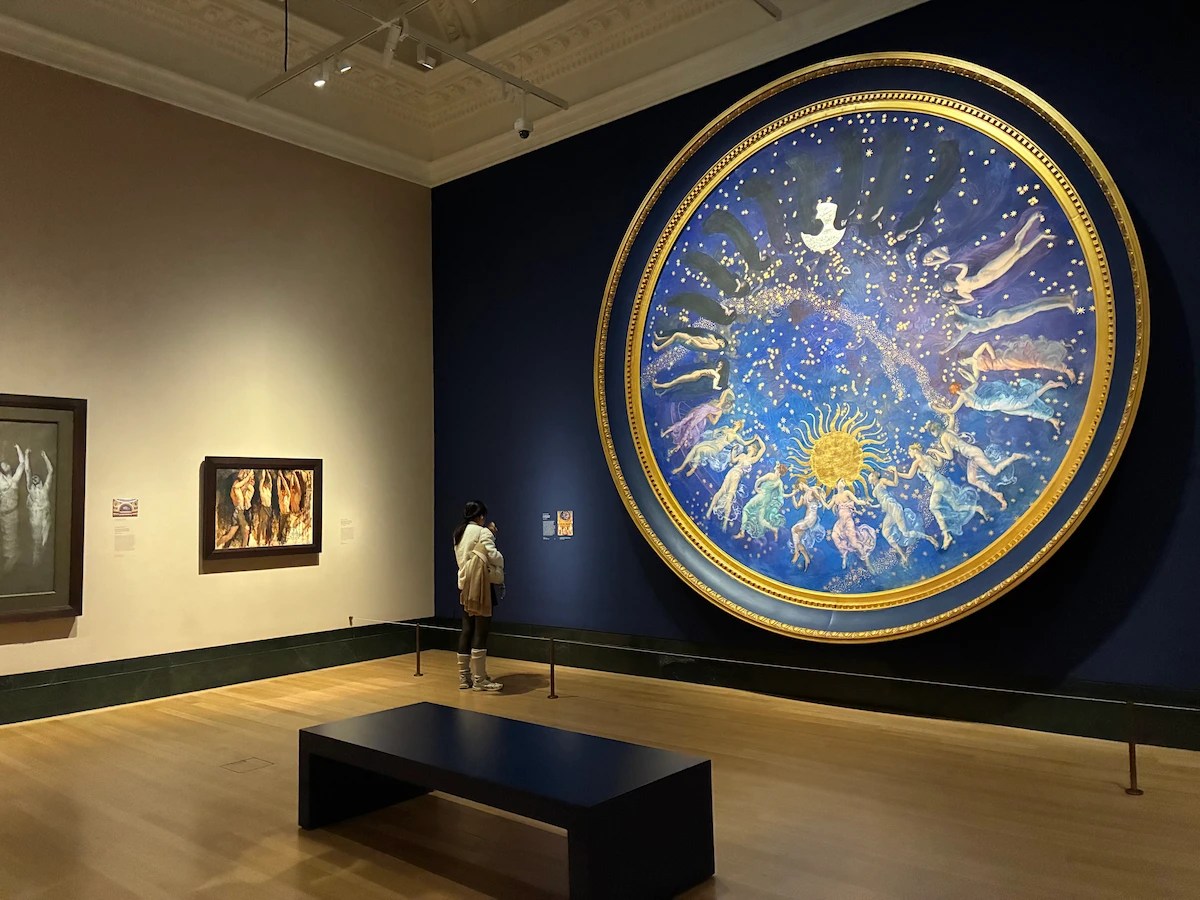
Lastly, to the massive object which dominates the room, a half-scale study or ‘maquette’ for the ceiling mural, ‘The Hours’, which is a striking 12 feet in diameter.

Installation view of ‘Edwin Austin Abbey: By the Dawn’s Early Light’ at the National Gallery, London, showing a preparatory study for the enormous mural, ‘The Hours’ (right) and preparatory sketches for lunettes (left) (photo by the author)

It’s an artistic depiction of the sky imagined over the course of 24 hours, hence the blue background, and images of the moon (at the top) and sun (at the bottom). Around the central axis dance 24 female figures clad in late-Victorian arty dresses, arranged so that they appear to be dancing.

At the top, at dead of night, the figures are blacked out. As they represent the dawning day they become partly visible, until (at the bottom) they are in the bright and highly coloured dress of full day before (as they dance up the left-hand side) they grow paler and increasingly eclipsed by the darkness to which they will return.

Half-scale study for ‘The Hours’ in the Pennsylvania State Capitol by Edwin Austin Abbey (1909 to 1911) (photo by the author)

I’m going to note two things about it:

1. Eurhythmics

One is the beauty of the individual figures themselves. Their faces are only sketchily finished so your attention is on the rhythm of their dancing figures, the variety of their poses and the flow of their light dresses around their bodies. If the anatomy doesn’t completely satisfy the pedantic observer, the effect of rhythm and progression is very effective.

Detail of the half-scale study for ‘The Hours’ in the Pennsylvania State Capitol by Edwin Austin Abbey (1909 to 1911) (photo by the author)

The curators tell us that the loose style of the 24 female figures echoes the innovations of dancers like Isadora Duncan in Abbey’s own time. Their movement is ‘eurythmic’ (flowing and harmonious), a new idea in the early 20th century.

2. Zodiac signs

Second thing is the Zodiac. Oddly this isn’t mentioned in any of the wall labels, and is only apparent when you go right up close to the image and really study it, but dimly sketched behind the dancing figures are the 12 signs of the Zodiac, Aries, Taurus, Gemini, Cancer, Leo, Virgo, Libra, Scorpio, Sagittarius and so on – to be precise, the animals (or human) figures which symbolise the signs. Even once you’ve realised they’re there, they’re quite hard to make out and add a pleasing ‘Where’s Wally’ dimension to your visit. Wife and I spent five minutes trying to identify them all. See if you can spot the image of the ram signifying Aries in this close-up? Pretty easy. Many of the others, a lot less so…

The finished result

The exhibition includes a photo of the murals in situ in the Capitol building, which gives you an adequate enough impression of their context.

The Hours and The Apotheosis of Pennsylvania in situ in the House of Representatives Chamber at the Pennsylvania State Capitol, Harrisburg © Robert Benson Photography

Isn’t it grand? All that gilt ornamentation! But to be honest, in this day and age, I was a bit disappointed that they didn’t have a video of them. Surely it wouldn’t be too much to have made a video panning round the room and examining the ceiling, end wall and lunettes in more detail and in digital quality.

Conclusion

Very enjoyable. Abbey’s draughtsmanship is inspiringly beautiful. Arguably ‘The Hours’ roundel, enormous though it is, is less effective, less memorable, than the individual studies. But this is a very civilised way to spend an hour or so, and it’s FREE.


Related links

Related reviews

Arpita Singh: Remembering @ Serpentine North

There are two Serpentine galleries, one north of the bridge over the lake, one south of it.

Currently on show at Serpentine North is the first solo exhibition ever to be held outside India by the Indian woman artist Arpita Singh (born 1937). Here’s her Wikipedia entry:

From the show’s posters and publicity material I didn’t think I’d like it and initially I didn’t – but slowly, slowly I changed my mind and eventually came round to finding it an interesting, memorable and even haunting show.

A show of two halves

For me there was one big fact about the exhibition: the Serpentine North Gallery is a converted armoury with a perimeter corridor running round three sides of a square with big white walls suitable for hanging big works. In the middle, two distinct passages or long narrow rooms run between the two opposite sides of the square. These darker spaces retain the original dark brickwork and are suitable for hanging smaller works. I learned from a gallery assistant that the staff refer to the white outer corridor, as The Perimeter, and the two cut-through passages as The Powders.

Entrances to the two powder rooms from the main perimeter corridor. Compare the large oil painting in the perimeter with the set of much smaller works just visible on the wall in the first powder room. At ‘Arpita Singh, Remembering’ at Serpentine North © Photo: Jo Underhill. Courtesy Arpita Singh and Serpentine

The Perimeter: big oil paintings

So, as with other shows, the Perimeter hosts a series of big works, unglazed oil paintings which span Singh’s long career, from the 1960s to the present day, evolving from the big, through extra large, to the final handful of works which are Enormous.

I can confidently say that I didn’t like any of these. I reacted badly to what I took to be the badness of the draughtsmanship, the busy-ness of the compositions which overflow with loads of inconsequential details without any focus, teeming with cartoon-simple human figures and cars or airplanes or buildings or other objects which a 7-year-old might be ashamed of painting – all depicted amid the choppy seas effect of the impasto i.e. unattractive ridges and whirls of thick oil paint.

One of the very big, very cluttered oil paintings at ‘Arpita Singh, Remembering’ at Serpentine North © Photo: Jo Underhill. Courtesy Arpita Singh and Serpentine

And they felt very alien. They felt like they come from a completely alien tradition, one which cares nothing for all the Western achievements of perspective and depth and pictorial realism – in preference for a highly stylised notion of what a painting is, which comes closer to a depthless, perspectiveless, shapeless clutter of human figures, maps, roads, buildings, all out of perspective and filling every available inch of the space as a child would do.

My Lollipop City: Gemini Rising by Arpita Singh (2005) Vadehra Art Gallery © Arpita Singh

The Powders: smaller acrylics

BUT… Big but… when I went into the ‘powders’, the two smaller, more intimate spaces, something happened. I began to like the works here and, given time and sympathy, ended up really liking many of them. Why?

Smaller

Well, they’re all a lot smaller than the monsters in the Perimeter. I can’t quite put into words why this felt important but somehow they were easier to relate to.

Sets

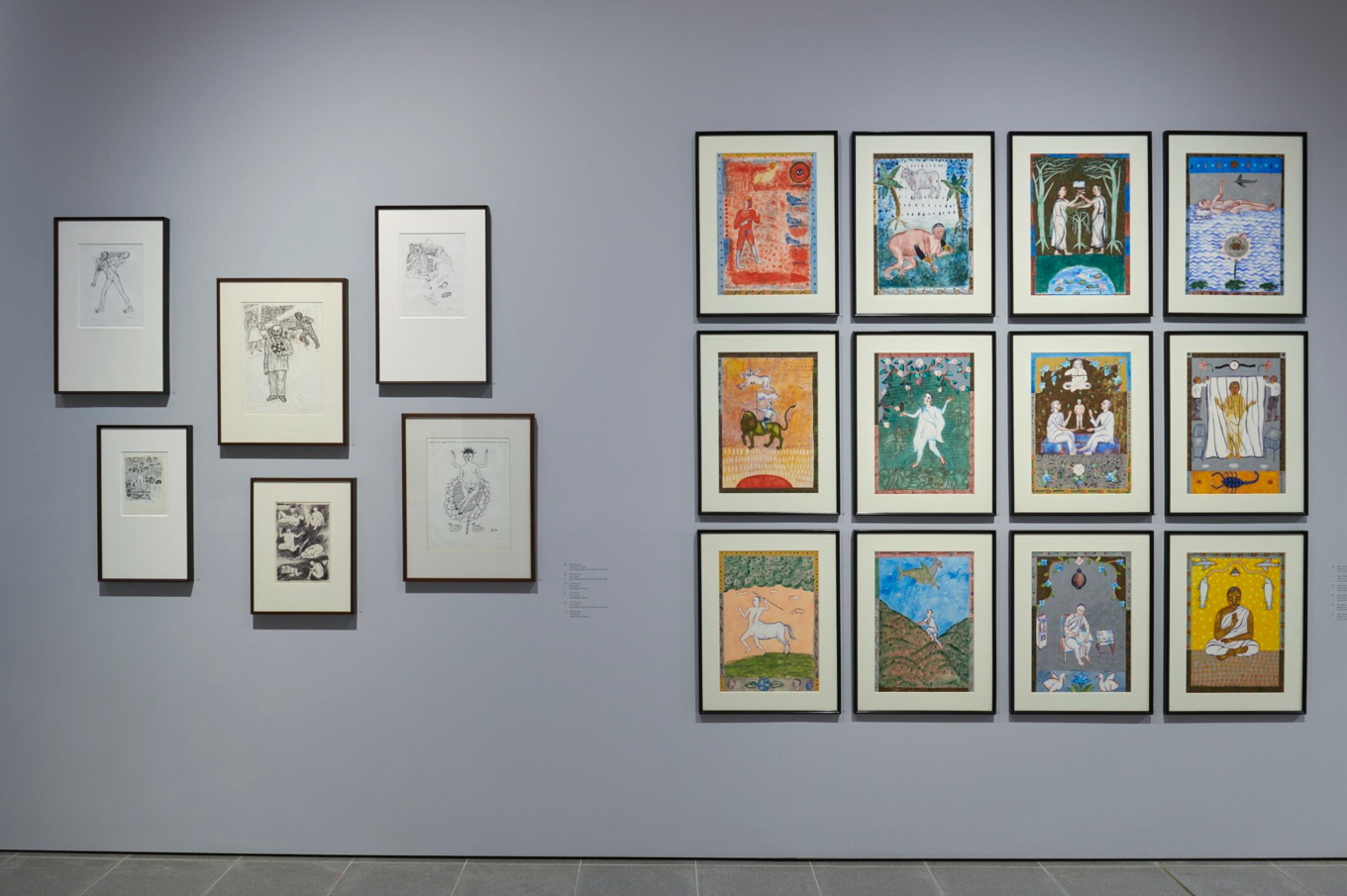
They often come in sets or series, like the series of her reworking of the 12 signs of the Zodiac, and when seen like this her apparently random, childlike imagery becomes more accessible and more likeable, when seen in recurring settings.

Installation view of ‘Arpita Singh: Remembering’ at Serpentine North showing a set of pen and ink drawings on the left, and the 12 acrylic versions of the Zodiac on the right © Photo by Jo Underhill. Courtesy Arpita Singh and Serpentine

Acrylic

A really important reason was the significant difference in psychovisual impact between the big heavily layered oil paintings and the far more muted acrylic and watercolour works. The latter are not only smaller but the lack of surface agitation found in the oil paintings somehow made them seem a lot more calm and civilised. Less hysterical maybe, more serene.

Fewer human figures

And this lack of surface busy-ness, greater calmness, allows you to savour and enjoy the figures more. Some of the larger ones still have lots of figures in but many don’t. In many of them the figures are fewer, bigger and so more impactful, more interesting.

Mysterious

And a lot more beguiling. In the huge oil paintings so much is going on that it’s hard to care. In these smaller, more intimate acrylics and watercolours there’s more time to ponder the compositions and wonder what’s going on.

Influences

The curators tell us that Singh’s art draws on Bengali folk art and Indian stories, interwoven with experiences of social upheaval and global conflict, and that her style is a mashup of Surrealism, figuration, abstraction and Indian Court paintings. And it’s true, at various points all these can be seen: the first few big oil paintings are flat smooth Surreal depictions of random symbols that might have been by the Surrealist Leonora Carrington, while in one of the Powders there are early pen and black ink drawings which might have been by Paul Klee. And the flatness and decorativeness of the images, with a lack of concern for perspective reminded me of the Mughal-era courtly Indian paintings you can see at the Victoria and Albert Museum.

Urban settings

Except that these aren’t in any sense courtly figures. The opposite, they feel like men and women from very modern urban environments, people trapped within or struggling against their environments. In many of them the city seems to be represented by a kind of simple version of an A to Z or city map, showing various roads, all forking and branching out behind the human figures. Some of these lines are blue and so might represent a river (?).

One of the best of these urban alienation images shows what seems to be the same figure of a woman dressed in a black burqa, bent over in various postures of struggling to battle her way through a city represented by what looks like images of a skyscraper (rows of rectangular windows) which has been torn into pieces and scattered around the surface.

Reviewing all this made me think there’s something of Franz Kafka in Singh’s depiction of the city as a challenge, puzzle and maze.

Technology

Onto these child’s-style views of cities are often pasted images of modern technology. Two which recur are cars or taxis stuffed with her primitive figures, or airplanes flying in her childlike sky.

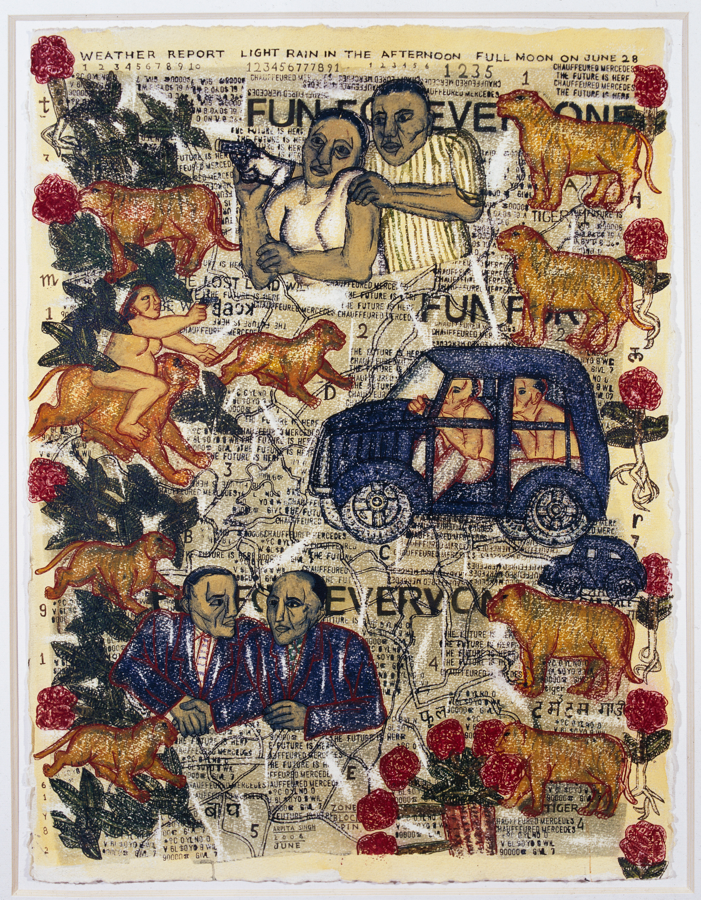
Lesser Myth by Arpita Singh (2006) Courtesy of Vadehra Family Collection © Arpita Singh

Naked women

Arpita Singh is, of course, a feminist, and the two feminist curators of the exhibition (Tamsin Hong and Liz Stumpf) point out that:

Since the 1990s, Singh has increasingly explored themes of motherhood, the aging female form, feminine sensuality, vulnerability, and violence, demonstrating the impact of relationships and external events on the emotional and psychological landscape of the artist. Her works are intimate portrayals of domestic and inner life but are equally concerned with the experiences of women navigating the outside world.

This, I think, is true but what I came to actively like was the way she portrays women; was the way her drastically unwestern eye or style extends to the way she portrays women. It turns out that the rather childlike, gawky style, which doesn’t give a damn about western realism, means that her images of women capture something completely other, different. Western iconography of women is so dominated by the Christian church for 1,000 years and then by the male gaze for the last 500 years, that it’s all but impossible for any depiction of women to escape its clutches. But Singh’s women do. Escape, I mean.

They are obviously ‘adult’ in the sense that they are often naked or wearing diaphanous outfits and she goes to some lengths to depict the women’s vulva, labia etc. In western hands this might be unavoidably graphic and problematic. But somehow, in Singh’s childlike, non-western iconography, it begins to say something else. Something about women’s privacy, integrity, distinctiveness. It’s not salacious. It doesn’t sexualise women in any way. It just emphasises that women are.

A Feminine Tale by Arpita Singh (1995) Courtesy of Taimur Hassan Collection © Arpita Singh, Photo by Justin Piperger

There’s a linked set of images of women pulling transparent saris or fabrics round their bodies which are nothing like the stately dressed aristocratic ladies of Bengali court painting but… but somehow, they bespeak an entirely modern, late 20th century reality of women’s lives and independence. It’s hard to put into words but the more I saw of these, the more I felt like I was entering a really, genuinely, alien and alternative artistic world.

Threatening men

One of the woman wrapping herself in a sari has half a dozen much smaller male figures pulling it down or pinning it down around her and you can feel her resistance to this male… what? Something. Power. Oppression. And you can feel this atmosphere of resistance throughout.

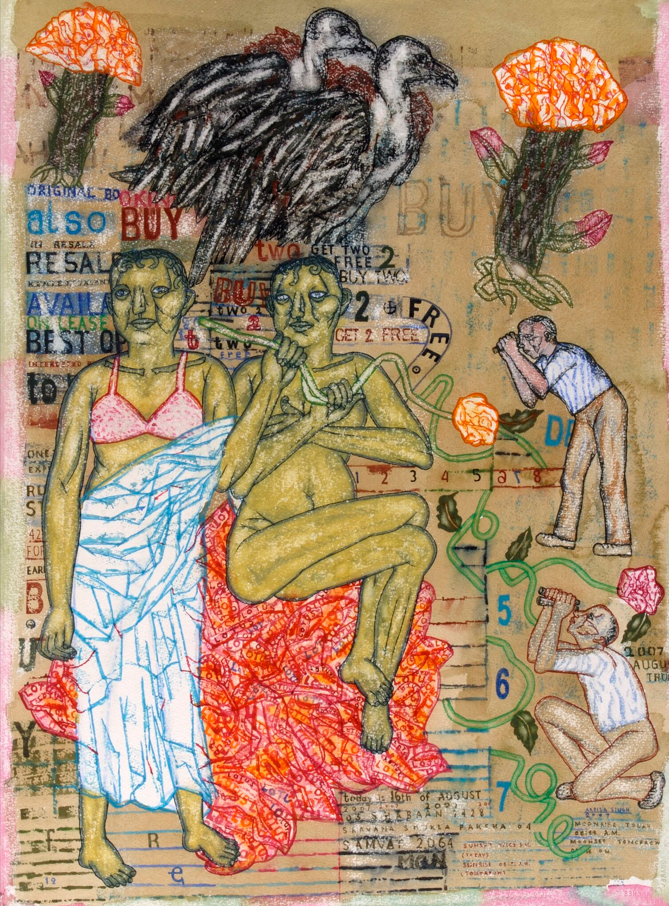
Or take this dense painting. Note the familiar recurring motifs. There’s lots of text all over the work. The women figures are by no stretch of the imagination in any way created for the male gaze but instead express something important but inscrutable about women’s independence. The green line, is it the tendril of some plant? The orange cloth behind the women, is it a curtain or spread of some kind or a sort of map, a sort of tangled A to Z.

Buy Two, Get Two Free by Arpita Singh (2007) Private Collection © Arpita Singh

So the men with the binoculars, are they peeping Toms, are they looking through windows to get a glimpse of scantily clad women? In which case the birds at the top, are they vultures? In which case do the vultures ‘symbolise’ the men, picking over the scraps of women’s bodies chopped up by binocular vision, picking over scraps, exploiters and parasites? Or is the iconography more complex than that? And what do the two trees or bushes with orange heads have to with anything?

Resisting interpretation

This brings us to one of Singh’s strongest points which is that she is not programmatic. Lots of the works have words in, lots of words, mostly in English (why? why not in Bengali or any other Indian language?) as the three images above indicate. ‘Fun Fun Everyone’ are the biggest words visible in ‘Lesser Myth’ amid what seem to be newspaper fragments cut out and collaged together. But what does it really mean? And why are there nine lionesses in the picture? And why is a naked woman riding one of them? And what are the two men in suits at the bottom talking about? And why are there two half-dressed men crammed into one of her characteristically dinky cars? And why is the man in the couple at the top holding a pistol over the woman’s shoulders and why is her arm bent up to support it? And why are there lots of red rose bushes everywhere (or are they hibiscus or some other bright bush native to India which I’m completely ignorant of)?

The pleasure of mystery

It is actively enjoyable not to know the answers to these questions. The more of her acrylic and watercolour work I looked at, the more beguiled I became. All that writing feels as if she has something very important to say and yet all the texts tempt and tease and then veer away, turning out to be more elliptical and obscure than they first appear. And this is very enjoyable.

And there are lots of them. The exhibition features a rather staggering 165 works. I hope I’ve conveyed my journey to you, from initial dislike and scepticism, through slow understanding, and letting the works teach me how to see them, until I felt I had, to some extent, entered her world, a world really very far removed from my own culture and experiences. And that’s what art can do, so well.


Related links

Related reviews

A Silk Road Oasis: Life in Ancient Dunhuang @ the British Library

Want to see the oldest printed book which contains its own date of publication (868 AD)? The earliest known atlas of the night sky produce by any civilisation? See a copy of the Diamond Sutra written in the scribe’s own blood? Read an angry letter written by a wife abandoned by her husband 1,400 years ago? Learn about the life of a 10-year-old Buddhist nun?

If all this pulls your daisy, then come to this small but beautifully designed and fascinating exhibition at the British Library.

Scroll in Sanskrit and Khotanese embellished with an opulent silk painting of birds facing each other (943 AD) © British Library

Background history

The Silk Road was a term invented by German explorer Ferdinand von Richthofen in the 1870s to describe the tangle of trade routes stretching across central Asia from China in the East to the Mediterranean in the west. The silk roads went past the Gobi desert, split up to skirt the Taklamakan desert to the north and south, continued on through the Pamir mountains to Kashgar, then on to Samarkand in modern Uzbekistan, through Persia, Iraq and Syria to the Mediterranean in the West. At several points offshoots went south into Tibet or India.

The heyday

The network of silk roads began with the expansion of the Han dynasty (202 BC to 220 AD) into Central Asia around 100 BC, and grew and thrived until the tenth century AD. The blockbuster exhibition about them currently on at the British Museum takes its golden age to have been around 500 to 1000 AD.

Silk roads, plural

These days, modern archaeologists and historians refer to the silk roadS very much in the plural 1) in order to take in subsidiary routes, 2) to extend its length eastwards to the coast of China and Korea and westwards to take in Europe, 3) to include the contemporaneous sea routes from China to the Persian Gulf. All this is explained in some length at the British Museum show. However, this exhibition at the British Library focuses more narrowly on the roads’ core zone, from Chang’an in the East to Samarkand in the West.

Map of the silk roads © the British Library

The significance of Dunhuang

As you can see from this map, if you were heading west from China one of the major splits in the route occurred at a place called Dunhuang, where the route split into two roads skirting to the north and south of the uncrossable, huge and ever-shifting Taklamakan Desert.

The way stations along the northern and southern routes consisted of oases created by water in streams and rivers flowing down from the high mountains of the Tien Shan in the north and the Kunlun Shan in the south. According to Peter Hopkirk in his book ‘Foreign Devils on the Silk Road, one of the reasons the silk roads fell into disuse – apart from political turmoil in China and widespread banditry – was because many of these watersources dried up or moved or were filled with sand and silt. As they were abandoned, sand from the great Taklamakan blew over the ruined settlements and buried them for centuries.

Back to Dunhuang, it also was an oasis town, the last one in China (if you were heading west) the first one in China (if you were arriving from the east) and the place where the two major routes round the Taklamakan divided (or rejoined). It was established in 111 BC as a military outpost, fortified with defensive walls and watchtowers.

Buried treasure

Unlike the oasis settlements lining the desert Dunhuang was never abandoned when the roads fell into disuse, but continued to be a populated settlement up to the present day. But over the troubled centuries much of its silk road heritage was lost, forgotten, covered in sand. It was only at the end of the nineteenth century that a stream of explorer-archaeologists realised that there was buried treasure waiting to be dug up in this vast and remote part of central Asia. The story of the scramble for loot between representatives of Western colonial powers who identified and excavated sites right across the region is told in Hopkirk’s book.

Confessional book of the Manichean Uyghurs (ninth to tenth century) © British Library Board

This is one of the most important and complete manuscripts among the Old Uyghur Manichaean texts, the Xuastuanift, a confessional book of Manichaean Uyghurs, on display for the first time. It is a repentance prayer known as the Xuastwanift, which is widely used by the followers of Mani (216 to 277), a Persian prophet. It is around 4.5 metres long, written in Old Turkic in Manichaean script. The scroll demonstrates the eastwards spread of Manichaeism among the Uyghurs, whose West Uyghur Kingdom was tightly connected to Dunhuang.

The Mogao caves

One of the unique things about Dunhuang is the proximity of the astonishing complex of Buddhist caves, the Mogao cave complex, 15 miles to the south-east. We now know that during the silk road era nearly 500 caves were carved into the cliff face here, most of them by Buddhists, many decorated with beautiful multicoloured frescoes and containing artefacts and manuscripts.

The guardian Wang

Aware of a long tradition of Buddhist worship and relics in the region, the local Chinese authorities at the turn of the 20th century had put a Buddhist monk named Wang Yuanlu in charge of sites around the town. As a devout monk Wang earnestly wanted to raise money to regenerate and preserve the caves and regularly toured and examined them.

Photo of the priest, Wang Yuanlu, taken by Aurel Stein and included in his photographic album, 1907 © British Library Board

Wang discovers the Library Cave

One day Wang discovered a false wall at the back of one of these caves, chipped it away and made one of the great archaeological discoveries of all time. For in this cave, subsequently named The Library Cave and now more prosaically referred to as Cave 17, he discovered tens of thousands of ancient scrolls, manuscripts, printed documents, paintings, diagrams, histories, calendars and star charts from the fifth to the eleventh centuries, rolled up and stored higgledy-piggledy.

These scrolls contained an extraordinary range and diversity of documents, on a wide array of subjects, from huge religious scrolls to personal letters, from diplomatic documents to textbooks on astrology, from wills to instructions for the souls of the dead.

They are written in a surprisingly range of contemporary languages, such as Tibetan, Sogdian, Chinese, Old Uyghur, Phags-pa, Tangut and Turkic.

And they attest not only the predominant religion of the region, Buddhism, but many other faiths including Zoroastrianism, Manichaeism and Christianity which, because of them, we now know thrived in the area.

Paul Pelliot - Wikipedia

French archaeologist Paul Pelliot examines manuscripts in the library cave (photo by expedition photographer Charles Nouette, 1908)

Western archaeologists pounce

The western explorers I mentioned above, who made various expeditions throughout the 1890s and early 1900s and whose stories are told in Hopkirk’s book, soon heard rumours about a cave of magical discoveries and made the arduous journey to Dunhuang.

Here the western archaeologists, starting with Marc Aurel Stein, schmoozed the site’s curator, Wang, offering him money, technical assistance, promises to renovate the big painted caves and so on, and talked Wang into parting with thousands and thousands of these priceless scrolls. Crates full of them were dispatched by pony back to Kashgar, by train across Russia and then onto the capitals of Europe. Eventually these priceless manuscripts were scattered across 30 or so collections in 8 or so western nations, chief among them the British Museum in London.

Collectors’ guilt

Two world wars and the decolonisation of most of most of the European empires later, many of these institutions felt guilty about being party to such epic looting of China’s cultural heritage. In 1973 the British Library was founded. In the 1980s the British Museum handed over its hoard of documents from the Library Cave to the British Library.

Founding of the International Dunhuang Programme

In 1994, after much discussion between the various European and American institutions which owned documents from the library cave, the British Library was instrumental in setting up the International Dunhuang Programme (IDP). The IDP is a pioneering international collaboration that brings together online collections from the Eastern Silk Roads and promotes understandings of the history and cultures of the region.

That was 30 years and so this small but beautifully formed exhibition marks the thirtieth birthday of the International Dunhuang Programme. (All this is explained in the final part of the exhibition, which includes a timeline of the events I’ve just summarised.)

The exhibition

The exhibition showcases over 50 manuscripts, printed documents and pictorial works, most though not all, from the ‘Library Cave’ in the cave complex of Mogao and on public display for the first time.

The exhibition is contained in one long room downstairs. The light levels are low to preserve these ancient manuscripts which contributes to the subterranean, treasure-trove vibe.

The show is divided into ten sections, consisting of eight display cases (4 down the middle, 2 embedded in either wall). At the far end there’s a partition cleverly made from shelves piled high with rolled-up paper scrolls, recreating the effect of the original treasure cave. And off to one side there’s a bench seating about 5 people in front of a video projected on the wall which shows general views of the desert, the Mogoao cave complex, and handy maps showing the shifting silk roads and indicating the spread of religious beliefs along them. You can make out most of the elements I’ve listed in the photo below (video on the right, display cases down the middle, the scroll partition is visible at the far left).

Installation view of ‘A Silk Road Oasis: Life in Ancient Dunhuang’ at the British Library

Topics and stories

The key thing about the displays is that the curators have had the bright idea of dividing the documents into sections grouped around typical types of profession from medieval central Asian society. Each case is named after one of these characteristic professions of the time, constellates around the story of a specific named individual who we know of from a scroll, and then groups around it half a dozen other manuscripts from the same subject area. Thus the cases are named after:

  • The Merchant
  • The Diplomat
  • The Fortune-Teller
  • The Artist
  • The Scribe
  • The Printer
  • The Buddhist Nun
  • The Lay Buddhist

Installation view of ‘A Silk Road Oasis: Life in Ancient Dunhuang’ at the British Library showing a typical display case, in this instance scrolls relating to The Lay Buddhist (see below) (photo by the author)

As is my usual practice, all the text which follows in italics is direct quotation from the curators’ wall labels.

The Merchant (unnamed)

As a key trade centre on the Silk Roads, Dunhuang attracted merchants from as far afield as central Asia and India. Among these were the Sogdians, a group of Iranian people who dominated commerce in the region from the 4th to the 8th century. From their motherland near Samarkand (present-day Uzbekistan), Sogdian merchants established settlements stretching all the way to China.

Map showing location of Sogdiana © the British Library

This allowed them to act as agents for fellow Sogdians back home and along the trade network. Sogdian merchants sold many prized goods and transmitted religious ideas from their own culture and that of nearby regions.

Earthenware figure from China (7th to 10th century) probably representing a central Asian merchant, possibly of Sogdian origins, as suggested by his large beard and conical hat (photo by the author)

This section focuses on the letter written by an unnamed Sogdian merchant based near Dunhuang, which was addressed to two of his business partners in Samarkand, over 3,000 km to the west. It warns them about the devastating effects of political instability in China. The letter describes the famine that resulted from the sack of several Chinese cities by the Huns, a nomadic people from central Asia.

It also includes a letter from a wife who was abandoned by her husband at Dunhuang and who writes to reproach him in 313 AD. Her name was Miwnay and the letter tells us she moved from Samarkand to Dunhuang with her merchant husband Nanai-dhat. This letter was found in a lost mailbag and complains how, not having not heard from him in three years, Miwnay and her daughter Shayn have become destitute and forced to serve a local Chinese household.

“Behold, I am living wretchedly, and I consider myself dead. […] I obeyed your command and came to Dunhuang and did not observe my mother’s bidding or that of my brothers. Surely the gods were angry with me on the day when I did your bidding! I would rather be a dog’s or a pig’s wife than yours!” (Translated by Nicholas Sims-Williams)

Emphasising the theme of multiculturalism, this section also includes:

  • one of the oldest surviving Zoroastrian scriptures, consisting of a text about the prophet Zoroaster (born between 1500 and 500 BC) and a transcription of the holy ‘Ashem Vohu’ prayer
  • a letter from a Christian priest named Sergius to a Turkic government official based at Dunhuang

Dunhuang Limes

I need to digress for a moment about the Dunhuang Limes.

The Dunhuang Limes is a series of military sites spread over a distance of more than 140 miles, and are considered to be parts of the westernmost portion of the Great Wall. The sites begin in Anxi to the east of Dunhuang and extend to the Lop Nor desert to the west, and date back as far as the 2nd century BC [see the map at the top of this review for the line of the Great Wall].

The term limes, usually used to describe Roman military roads and their fortifications, was assigned by Aurel Stein to this series of watchtowers, forts, storehouses, beacon towers, walls, and other defensive structures. The items excavated from the sites reveal much about the daily life and administration of the garrisons stationed at the frontiers of the Chinese Empire. These items include tools, stationery, pottery, arrowheads and textiles, as well as important written documents including the Sogdian ‘ancient letters’.

Hence the shoe:

A shoe made of hemp from Dunhuang Limes © the British Museum

This utilitarian everyday object serves as a poignant reminder of the early settlers who resided along the Dunhuang Limes. These defensive walls and watchtowers, constructed north of the town, protected the territory then ruled by the Chinese Han Empire (206 BC to 220 AD). Doubling as farmers, the soldiers transformed the rugged landscape into cultivated land, while monitoring the desert Silk Roads for potential attacks.

The booklets

Another digression to mention that each of the characters or job types is introduced not only via the usual object labels but in nifty printed booklets (attached to each display case) made of a kind of artificial vellum and decorated with patterns from the period. Some thought and effort went into these and they’re very stylish.

One of the stylish fake-vellum booklets which contain object information in ‘A Silk Road Oasis: Life in Ancient Dunhuang’ at the British Library (photo by the author)

The Diplomat: Ca Kima-sana

From the 10th century, the rulers of Dunhuang strengthened their ties with Khotan, a central Asian kingdom located 1,800 km to the west. Sent by their state, Khotanese envoys frequently travelled to the oasis to help maintain close diplomatic relations, especially by seeking marriage alliances.

Map showing location of Khotan © the British Library

Khotanese delegations varied in size and were hosted by the local government. Their members, who spoke an Indo-Iranian dialect, had to operate in a multilingual environment. They were actively engaged in Dunhuang’s Buddhist community as patrons and helped spread medical and geographical knowledge during their visits.

This section is named for two figures: one is Sam Khina Hvam Samgaka, a high-ranking Khotanese official who commissioned a devotional scroll, wishing for a long life and the well-being of his relatives. The manuscript is over 21 metres long and contains six different Buddhist texts. It was embellished with an opulent silk painting.

Scroll in Sanskrit and Khotanese, over 21 metres long, embellished with an opulent silk painting (943 AD) © British Library

The other named figure is the diplomat Ca Kima-sana, also known as Zhang Jinshan. He is represented by a long scroll in which he explains that he led a delegation of over 100 people to secure the hand of a Chinese princess for their king. He also recounts the religious activities he undertook at Dunhuang in exchange for safe return. This section also includes:

  • a tenth-century Chinese-Khotanese phrasebook
  • an account of hospitality given to foreign visitors at Dunhuang between 979 and 982
  • a Khotanese translation of the Siddhasara, a medical text attributed to the ancient Indian physician Ravigupta

The Fortune-Teller: Shenzhi, the Yin and Yang Master

Fortune-tellers, whose practices were regulated by the local administration, helped both the ruling elite and ordinary people navigate daily life. They advised on anything from the best time to start a construction project to the best direction to take on a journey. They also guided people when choosing a life partner, looking for lost things or strategising for battles.

Fortune-tellers produced calendars and other astrological works. These were considered a form of scientific knowledge, normally controlled by China’s imperial court. At the same time, divination traditions from central Asia spread along the Silk Roads and converged at Dunhuang, leading to a unique blend of approaches.

This section includes a striking almanac:

Official almanac showing the 12 spirits of the zodiac animals, portrayed as officials with animals in their hats (978 AD) © British Library Board

An almanac is a yearly publication that typically contains information such as astronomical data and astrological predictions. This incomplete document for the year 978 is a copy of the almanac originally printed by the imperial Chinese Bureau of Astronomy. It shows the 12 spirits of the zodiac animals, portrayed as officials with animals in their hat. They surround the deity Taisui, who is associated with Jupiter and governs people’s destiny in a given year.

This section also contains:

  • the longest surviving manuscript text in the Old Turkic script, the Irk Bitig or Book of Omens, a 4-metre-long Tibetan divination scroll written in Old Turkic which contains 65 divinations
  • the oldest star chart from any civilisation which depicts 1,345 stars across 13 maps, dating to the second half of the 7th century
  • a 4-metre long divination scroll in Tibetan, featuring 12 divination diagrams in the Chinese astrological tradition
  • eight diagrams linked to a divination form known as the ‘Nine Palaces’ which indicate lucky and unlucky dates and directions for construction work, in a scroll which belonged to Shenzhi,
    a Yin and Yang Master and a monk at the Longxing Temple

The Printer: Lei Yanmei, the woodblock carver

Using a method derived from earlier stamping processes, printers chiselled content in reverse into woodblocks. They then inked those blocks and impressed them onto paper. The quality of the prints thus depended on their woodcarving skills. Printing technology emerged in China around the 7th century, about 700 years before appearing in Europe. The work of printers quickly became essential for Buddhists, as a way of enabling the large-scale reproduction of sacred texts and images. As printing spread to East Asia and to central Asia along the Silk Roads, printers set up many local workshops. While some places, like Sichuan, became major printing centres, Dunhuang printers also produced, on a much smaller scale, copies of Buddhist scriptures, prayer sheets and almanacs.

The Diamond Sutra, the world’s earliest printed book with a date, 868 AD

This 5 metre scroll is the oldest complete printed book with a date. Preceding the finely carved text is a depiction of the Buddha preaching to his elder disciple, Subhuti, amid a large assembly. Such sophisticated design attests to a mature printing industry, calling for collaboration between highly skilled artists, scribes and woodcarvers. It is thus possible it came from Chengdu, Sichuan, which was a major printing centre at the time.

This section also includes:

  • a text containing numerous identical images of the Bodhisattva Avalokiteshvara
  • a woodblock printed prayer sheet with pigments
  • a booklet of Diamond Sutra translated by Kumarajiva

The Scribe: Ke’u Monley

Between 786 and 848, Dunhuang came under Tibetan rule. It was transformed into a bustling centre for scribes who worked for the Tibetan empire.

The Tibetan Empire in the 8th to 9th centuries © the British Library

Local scribes, some of whom were from mixed Chinese and Tibetan parentage, produced thousands of copies of Buddhist sutras in Tibetan. These works, presented in a range of formats, were even distributed to monastic libraries in central Tibet. The rules of the scriptorium were stringent and scribes had to manage the resources they received carefully for fear of punishment. They were also taught to write in different styles, tailored to their tasks, such as transcribing sacred texts or drafting official documents. 

This section includes:

  • old Tibetan annals giving a year-by-year account for the period 641 to 764, the earliest surviving historical source on the Tibetan empire
  • a bilingual manuscript which features the Tibetan version of the Lankavatara Sutra in red ink alongside a Chinese commentary in black ink
  • a large book of Buddhist scripture titled The Perfection of Wisdom Sutra
  • a document giving information about the scribe Ke’u Monley who belonged to a team of scribes entrusted with copying the Perfection of Wisdom Sutra for the Tibetan prince
  • along with some original scribal tools, namely a glue brush and a wooden pen

Tibetan woodslip pen (eighth to tenth century) © British Library Board

The artist: Dong Baode

Artists from different regions shaped Dunhuang’s creative landscape. The projects they were commissioned for ranged from adorning the Mogao Caves with breathtaking murals and stucco figures, to crafting portable paintings on silk, hemp and paper. Surviving sketches, preparatory drawings and tools like stencils offer a window into artists’ creative process. While workshops likely existed earlier, a government-supported painting academy emerged in the 10th century, providing official backing for artistic endeavours. Most artists remained anonymous unless they reached a particularly elevated status. They combined visual traditions and techniques from along the Silk Roads, leaving an enduring legacy through their contributions.

Sketch of protective deities (tenth century) © British Library Board

These two figures, depicted on thick paper, stand dynamically on rocks, almost mirroring each other. Precise lines render their flowing scarves, flexed muscles and facial hair. This type of sketch served as a reference for artists and could have been resized as needed to fit across various compositions. Very similar illustrations are found in Dunhuang manuscripts.

This section contains:

  • a stencil of a Buddha figure
  • a scroll relating to the master painter named b who other documents tell us managed a local painting guild, controlled and deployed painting resources
  • a 1.2 metre tall black ink study representing Avalokiteshvara, the bodhisattva of compassion

The Lay Buddhist: the 80-year-old who wrote in blood

Buddhism left the largest imprint at Dunhuang, although faiths such as Daoism, Zoroastrianism and Manichaeism were also present. With the spread of Buddhism on the Silk Roads, the oasis became a major hub for Buddhist worship and pilgrimage from the 4th century onwards. The worship of images, through portable paintings and other media, held a central place in Buddhism. Copying scriptures was also paramount to Buddhist devotees, as a way of accumulating spiritual benefits. While wealthy patrons could commission elaborately decorated manuscripts, ordinary people wrote sacred texts themselves. Manuscripts served various functions, as reflected by the variety of formats and languages they came in. They could be chanted during ceremonies, worn as talismans and employed in memorial services.

Illustrated Sutra of the Ten Kings (tenth century) © British Library Board

This scripture depicts the purgatory-like period following death. The Ten Kings, shown as magistrates seated at desks, assess the deeds of the departed. The last king spins the wheel of rebirth, deciding how they will be reincarnated. This handscroll is almost 5 metres long. It was likely produced to assist a dead relative in their voyage to the next life and used during memorial services.

This section also contains:

  • a decorative copy of the Great Parinirvana Sutra
  • a miniature Tibetan scroll less than 5cm wide, containing verses about the path to liberation from the sufferings of death and rebirth, and a prayer to end the reincarnation cycle
  • a scroll of the Nilakantha Dharani, dharanis being incantations believed to be protective and to generate spiritual benefits when chanted
  • a banner painting of a bodhisattva
  • and three small booklets of the Diamond Sutra in Chinese written by an unknown 80-year-old devotee using his own blood as ink

The Buddhist Nun: Deng Ziyi

Buddhism gradually changed the lives of female devotees by offering them a role beyond those of daughter, mother and wife: they could become nuns. Dunhuang documents give us a glimpse into their experiences, from joining as novices, sometimes before the regulatory age of 12, to embracing the rules of monastic discipline upon being ordained. Between 800 and 1000, there were more nuns than monks living in the town. Censuses provide a sense of the community structure and demographics within nunneries at the time. It was not uncommon for nuns to retain some possessions after embracing monastic life. They could also play a significant role in the local lay community.

Rules of a women’s association (959 AD) © British Library Board

This circular is over 1,000 years old. It defines the objectives, bylaws and structure of a women’s club, established to promote friendship among women. All 15 signatories agreed to these rules by signing a mark under their name. The association was overseen by a nun, underscoring the influential role of nuns within the Dunhuang community.

This section includes:

  • information about Deng Ziyi who became a nun aged just 10 in 914, including the official permit granting her permission to become a novice
  • a finely calligraphed scroll copied in 543 by a nun named Xianyu listing the voluntary commitments for fully ordained Buddhist women
  • a tenth century list of nuns at the Dasheng Temple, the largest of five nunneries at Dunhuang, which had a total of 209 members
  • a votive painting depicting the 11-headed manifestation of Avalokiteshvara, the bodhisattva of compassion
  • the will, written in 865, of the nun Linghui, written in the presence of witnesses, including close relatives and two officials

The caves

As I mentioned, at the far end of the exhibition space is an alcove partitioned off by a floor-to-ceiling stand containing scores of rolled-up paper mimicking the scrolls found in the famous Library Cave.

Installation view of ‘A Silk Road Oasis: Life in Ancient Dunhuang’ at the British Library showing the scroll partition (photo by the author)

This space gives more detail about the caves, namely:

Away from the busy streets of Dunhuang, 25 km southeast of the town, is a large Buddhist site made up of hundreds of richly decorated caves called the Mogao Caves. It is here that, in 1900, the Daoist priest Wang Yuanlu found a small room containing tens of thousands of manuscripts, paintings and other objects dating from the 5th to 11th century. Known as the ‘Library Cave’ or Cave 17, this extraordinary time capsule is one of the world’s greatest archaeological discoveries. It has revolutionised our knowledge of the Silk Roads, offering glimpses of religious and secular everyday life. Many of the objects in the exhibition are from Cave 17. They were acquired by archaeologist Marc Aurel Stein and taken to the UK.

There’s:

  • a copy of Stein’s photo album open to the photo he took of Wang
  • a timeline of key events starting at Wang’s discovery of cave 17 in 1900 and continuing up to the opening of this exhibition
  • more objects including:
    • a confessional book of the Manichaean Uyghurs
    • three Buddhist ritual objects, being: a paper-cut flower; a carved wooden figure of a Buddha; a Tibetan tantric ritual implement
  • a small sculpture by modern artist Xie Xiaoze titled ‘Rain of Languages (Buddhist Sutras)’

Rain of Languages (Buddhist Sutras) by Xie Xiaoze (2023) in ‘A Silk Road Oasis’ at the British Library

Most usefully, there was a small monitor showing photos of some of the decorated caves. These are mind blowing, showing beautifully preserved caves decorated from floor-to-ceiling with complicated colourful motifs and often including one or more statues of the Buddha or Boddhisatvas. I think these should have been included in the short film projection on the wall at the start of the exhibition, they’re too stunning and important to be stashed away here, and on a fairly tiny screen, smaller than a laptop screen.

Photo from the slideshow of photos of the interiors of some of the Mogao cave, complete with explanatory text. Courtesy of Dunhuang Academy, Photo by Sun Zhijun

In fact the friend I showed them to said these are stunning, mind-blowing, amazing – they should have been blown up and printed on the walls life-size. Maybe, although space is limited in this little downstairs gallery. But they certainly impress on you the huge culturual importance of the cave complex, the extravagantly beautiful carvings and frescoes, make you realise it’s up there with the Egyptian Valley of the Kings in terms of priceless decorated ancient interiors.

Music

I haven’t yet mentioned that this room packed full of priceless manuscripts also features a mellow and evocative soundscape. This has been created by a Dr Xiaoshi Wei using recordings from the British Library’s vast sound archive and from the China Database for Traditional Music with a view to recreating the sounds of the ancient Silk Road. Birds sing, gongs sound, monks chant, adding to the atmosphere of peace, calm, civilisation and enlightenment.

This is a small-ish exhibition, but full of wonders and revelations.


Related links

Related reviews

The Georgics by Virgil (39 to 29 BC)

Time’s flying by, time we’ll never know again,
while we in our delighted state savour our subject bit by bit.
(Eclogue 3, lines 284 to 285)

Publius Vergilius Maro (70 to 19 BC), generally referred to in English simply as Virgil (or Vergil), was the greatest Roman poet. He wrote three of the most famous poems in Latin literature: the Eclogues, the Georgics, and the epic poem, the Aeneid.

Poetic background to the Georgics

In about 39 BC Virgil became part of the circle of poets associated with Gaius Cilnius Maecenas (70 to 8 BC), close friend and political advisor to Gaius Octavius, who was to become the first Roman Emperor under the name Augustus. According to the introduction to the Peter Fallon OUP translation of the Georgics, they took Virgil seven years to write, 35 to 28 BC (Fallon p.xxxix).

There are four Georgics. If Virgil took the Greek poet Theocritus as his model for the Eclogues, in the Georgics he bases himself on the much older, ‘archaic’ Greek poet Hesiod, author of Works and Days, a miscellany of moral and religious advice mixed in with practical instruction on agriculture.

Virgil’s four long poems pretend to be giving practical advice to the traditional figure of the Roman smallholder. The word ‘georgic’ comes from the Greek word γεωργικά (geōrgika) which means ‘agricultural (things)’. But in fact the advice, although extensive, manages somehow to be very shallow and is certainly not very practical. An entire book is devoted to the care of bees but nothing about, say, goats or chickens.

Moreover, the nominal addressee, the smallholder, was a vanishing figure in Virgil’s day. Already by 73 BC Spartacus’s gladiators, marching across Italy, were amazed to discover the quaint patchwork of family farms they were expecting to find had been swept away and replaced with vast estates or latifundia worked not by cosy extended families but by armies of badly treated slaves (many of whom they recruited to their cause). The word ‘slave’ occurs nowhere in the Georgics just as the harsh economic and social realities of the Roman countryside are ignored. So what was Virgil’s real motive for writing these long and often very detailed texts?

Political background

In his introduction to the Oxford University Press edition of the Georgics translated by Cecil Day Lewis, the classicist R.O.A.M. Lyne pins everything on their historic context. The period 39 to 29 saw ongoing political instability with a barely maintained alliance between Julius Caesar’s adoptive son, Gaius Octavianus (who had renamed himself Gaius Julius Caesar Octavianus in honour of his assassinated great-uncle, and is generally referred to by historians as as Octavian) and his colleague in the so-called Second Triumvirate, Marcus Antonius (Mark Antony).

In 36 Antony embarked on his ill-fated campaign to invade the Parthian Empire in the East, while Octavian led a campaign to defeat Gnaeus Pompeius Magnus’s surviving son, Sextus Pompeius, who had established a military and naval base in Sicily.

Antony lost badly and retreated to Egypt, while Octavian astutely used the Sicilian War to force the retirement of the third triumvir, Lepidus, thus making himself ruler of the central and western Mediterranean. Throughout 33 and 32 BC he promoted fierce propaganda in the senate and people’s assemblies against Antony, accusing him of going native in Egypt, transgressing all Roman values, abandoning his legal Roman wife (Octavia) and debasing himself in a slavish passion to the Egyptian queen, Cleopatra.

In 32 BC Octavian manipulated the senate into depriving Antony of his executive powers and declaring war on Cleopatra. It was another genuine civil war because, despite decades of anti-Egyptian propaganda, and the record of his own scandalous misbehaviour and defeats in Parthia, a large number of the Roman ruling class still identified with Antony. On the declaration of war, both consuls, Gnaeus Domitius Ahenobarbus and Gaius Sosius, and a third of the senate abandoned Rome to meet Antony and Cleopatra in Greece.

Nonetheless, the decisive naval Battle of Actium in September 32 was a disaster for Antony. When he saw Cleopatra’s contingent leaving his side, he abandoned his own fleet to follow her. Octavian then led his army to Egypt and besieged the capital, Alexandria. After the Egyptian fleet sallied out only to defect to Octavian, both Antony and Cleopatra realised the game was up and committed suicide rather than be captured and dragged through the streets of Rome in a vulgar triumph.

So the Georgics were composed during yet another period of prolonged and bitter civil dispute and then open warfare between Romans. And so, Lyne suggests, their real purpose was not in the slightest to give ‘practical’ advice to that non-existent figure, the Latin smallholding farmer. Their intention was moral and religious.

In reaction to an era of chaos and destruction, Virgil wrote four works hymning the values of hard work, piety and peace.

Lyne’s overview

In his introduction to the Oxford University Press (OUP) edition, R.O.A.M. Lyne gives a précis of each of the four books and then proceeds to an overarching thesis. For him the key books are 1 and 4. Book 1 gives a tough, unsentimental description of farming as demanding unremitting effort and attention. The text is packed with instructions on what to expect and what to do at key moments throughout the year.

However, the final book is a lengthy description of bees and bee-keeping and, in Lyne’s opinion, this represents a significant shift in Virgil’s opinion. When restoring the Republic seemed an option, albeit remote, a society of rugged individuals seemed a desirable prospect. However, sometime during the decade 39 to 29 Virgil appears to have changed his view and come round to the opinion that only the suppression of individualism and the submission of individuals to the needs of the community can benefit or save society as a whole. In other words, the progress of the four books embodies Virgil’s move from Republican to Imperial thinking.

It’s a powerful interpretation but, as Lyne points out, there’s a lot of other stuff going on the Georgics as well. Lyne ends this very political interpretation by saying that it is only one interpretation and others are possible. And also that there are long stretches which are just beautiful poetry, in the same sense that an 18th or 19th century landscape painting may have had umpteen ulterior motives (not least to gratify the landowner who paid for it) but it can also just be…beautiful – just there to be enjoyed as a sensual evocation of country life.

Packed

I don’t have a problem with Lyne’s interpretation, I get it in a flash. The real problem is in fully taking on board, processing and assimilating what are very dense poems. The Georgics are far from easy to read because they are so cluttered. And (it has to be said) badly laid out. I found them confusing. It was only by dint of reading the first one three times, and introductions to it twice, that I began to get a handle on what is going on. When you read a summary saying it describes a calendar year in terms of the many jobs that a smallholding farmer needs to do, it sounds graspable and rational, but it is much more than that.

The passage of the year is difficult to grasp because Virgil doesn’t mark it off by clearly describing the passage of the seasons let alone the months. And when he does do it, he does it via astrology i.e. the coming into dominance of various star signs. For the ancients this counted as knowledge (and is still serving that function in, for example, the Prologue to the Canterbury Tales, 1,400 years later) but for us it obscures the dating.

Also, Virgil rarely alights on one subject, announces it clearly and describes it properly. Instead, line after line describe individual sights or features of the season, rivers flooding, leaves falling, lists of crops that need to be sown, lists of weeds that need to be hoed up, and the behaviour of domestic and wild animals.

My view is the poem is designed to be a cornucopia, a horn of plenty. It is designed not to be a clear and rational handbook, but to overflow with images. It’s not so much a depiction of country life as a feast of agricultural lore and traditions and descriptions.

Two translations

I have the Georgics in two translations. I bought the old Day Lewis translation, albeit packed in a shiny new OUP paperback, because it was the only cheap way of getting the Eclogues. However, I found Day Lewis’s verse rhythms a little unwieldy, maybe because he is closely following or ghosting the strict hexameter of Virgil’s original, or maybe it’s his 1940s style, I don’t know. I struggled through his translation of the first Georgic.

But I had also bought the OUP paperback edition of a much more recent translation, by Peter Fallon, from 2004. Oh my God, it is a totally different reading experience. Fallon appears to translate it into something approaching free verse where the length and rhythm of each line appears to vary to suit the meaning and vocabulary of each individual line. It is enormously more appealing and attractive and readable than the Day Lewis.

Georgic 1 (514 lines)

Yes, unremitting labour
And harsh necessity’s hand will master anything.
(Day Lewis, lines 145 to 146)

‘pitiful man’ (Fallon, 238)

Opening prayer to various agricultural deities (Liber/Bacchus, Ceres, Neptune, Pan, Minerva, Triptolemos, Sylvanus) and then to Augustus (‘and I address you, too, O Caesar’), with 15 lines prophesying Augustus’s divinity, his place among the stars, a new sign of the zodiac etc.

At which point Virgil plunges straight into a description of ‘the sweet o’ the year’ which I take to be spring, when streams begin to melt and clods crumble and it’s time to put the bull before ‘the deep-pointed plough’ etc. A litany of agricultural products, including ones from far flung regions of the earth (Arabia), each from its specific place as ordained by nature.

Plough the soil twice (line 48). Rotate crops. Respect the laws Nature has imposed on the soil (60). Fertilise the soil with manure (80) or spread ashes. Set fire to stubble (he speculates why this seems to work). Break the soil with hoe and mattock (95). The countryman should pray for wet summers and mild winters (100).

Then something which none of the summaries I’d read had quite prepared me for: Virgil says Jupiter has made husbandry difficult in order to prevent idleness. Honey used to fall from the trees, the crops sowed themselves, there were never storms. Jupiter overturned all this and deliberately made life hard in order to spur men’s creativity. God overturned the Golden Age in order to make men creative, come up with tools and processes. God instantiated into the world, into the way of things, a fundamental need for work, piety and order:

Hard work prevailed, hard work and pressing poverty. (146)

Because now, since God’s intervention, nature is set towards decline and fall, entropy, things fall apart, unless maintained with unremitting toil:

world forces all things to the bad, to founder and to fall (200)

Like a man paddling a canoe against the current; if you stop for even a second, you are borne backwards and lose all your work.

Back to practicalities, Virgil describes the construction of the ideal plough (160 to 175). It hovers between instructions of a sort, for example, how to build a proper threshing floor (178) – and the history of agriculture i.e. who invented what under the inspiration of which god or goddess.

Work according to the sky / stars / the zodiac, with different tasks appropriate under Arcturus, the Charioteer, Draco (205), Taurus, the Dog, the Seven Sisters. At the equinox sow barley, linseed and poppies (212). But in springtime (see what I mean by the chronology jumping around a bit?) sow alfalfa and millet (215).

An extended passage on the structure of the globe, consisting of freezing zones at each pole, an uninhabitably hot zone in the middle, and two temperate zones inhabitable my ‘pitiful man’ in between. This morphs into a description of the underworld, dark and infernal, inside the earth.

So: the importance of always being aware of the seasons and the stars and the constellations (252). If it rains, there are lots of odd jobs to do indoors, which he proceeds to list (260). Some days are, traditionally, lucky and some very unlucky for different types of work, Beware the fifth!’ (276). ‘The seventeenth’s a lucky day’ (284).

This morphs into consideration of what tasks are appropriate for times of the day, with a sweet description of a countryman staying up all night by winter firelight to edge his tools, while his wife weaving and minding a boiling pot (296).

Winter is a time of rest but there are still chores: gathering up acorns, setting traps for herons (307).

In a confusing passage he says he’s going to describe the trials of autumn (following winter) but then of spring. Since this follows vivid evocations of winter, it shows how the poem is not a neat chronology moving through the seasons of the year at all; it’s a confusing mess.

The book comes to a first climax with the description of a great storm in lines 311 to 350. He describes the sudden devastation of raging storms and rainstorms, Jupiter, ‘squire of the sky’, straddling the skies and sending down deluges and laying human hearts low in panic. For which reason, observe the stars and zodiac and make your offerings to the appropriate gods (338) in particular Ceres, and a passage describing various rituals and observances.

But this is barely done before we’re off describing the meaning of the different phases of the moon. You tell a storm at sea is coming when cormorants fly inland, herons forsake the lake and there are shooting stars (366).

Quite a long passage listing countrymen’s signs to detect the approach of rain (374 to 392). This, like many of these passages, is really beautiful. I loved the crow cawing Rain, rain and the housewife working by lamplight noticing the sputtering of the wick.

Or the signs predicting sunshine and clear weather: stars unblurred, the moon brighter. 12 lines on how ravens croak and caw to celebrate the coming of fine weather (410 to 412).

More reasons for why you need to pay attention to the sun and moon. How to interpret different appearances of the moon (427 to 437). Same for different appearances of the sun, clear, blurred, emerging from clouds, with tinges of other colours, and so on: ‘Who’d dare to question the sun’s word?’ (438 to 464).

And mention of the sun’s signs leads us into the last 40 or so lines, 2 pages of paperback text, in which Virgil lists some of the portents associated with Caesar’s assassination and the coming of the civil war. These are far more lurid and ridiculous than anything in Plutarch. According to Virgil, cattle spoke, the Alps trembled, ghosts walked abroad at night, statues wept, rivers ground to a halt, the Po flooded and devastated farmland, wells spouted blood, wolves howled all night long.

This is all very vivid but, stepping back a bit – it is all twaddle. How much of this nonsense did men like Virgil and Plutarch genuinely believe? If even a fraction, then ‘credulous fools’ would be a polite description of them.

Anyway, Virgil deliberately conflates the universal upheaval triggered by Caesar’s assassination with other signs and portents observed before the Battle of Philippi, where Octavian and Antony defeated the assassins (as depicted in Shakespeare’s play Julius Caesar). In fact the notes tell me something I would have never noticed, which is that Virgil also conflates it with the Battle of Pharsalus, where Caesar triumphed over Pompey, 6 years earlier in 48 BC.

He clearly does so in order to create a grand sense of wear and ruin in order to finish the book with…a second hymn to Octavian. He begs Romulus and Vesta, patrons of Rome, to stand back and allow the rise of young Octavian:

this young one who comes to save / a world in ruins (500)

In fact, it doesn’t end with the sycophantic words of praise I was expecting but with a vivid ten lines or so depicting a world run completely mad with war (lines 505 to 514), like (in a simile as vivid as the one about the rower borne back by the tide) a charioteer competing in the circus whose horses run out of control, he can’t rein them in, a world hurtling towards ruin.

Little conclusion

Pyne points out that the overall vibe of the book is negative. If we neglect the principles of hard work, fail to follow best practice, are not sufficiently alert to all the signs of nature and the gods – then we will have chaos and destruction. The harshness of Virgil’s tone reflects the very bitter experience of civil wars he has lived through. Pyne takes this to be the meaning of the ‘tumultuous’ consequences of the assassination of Caesar and it’s pretty obvious in the vision of chaos at the very end of the eclogue. Only Octavian/Augustus offers any hope of salvation.

Georgic 2 (542 lines)

Book 2 is less harsh and more attractive. It starts by hymning trees before focusing in on the vine. Its moral is that Nature is fruitful, especially in Italy.

Invocation to Bacchus, god of wine, to be with him and support him. Then a second dedication, to Maecenas, Virgil’s friend and patron.

Lesson one is about trees and how they seed themselves and grow. Many species and many varieties, oak, elm, ash, alder etc etc. Each land has trees specific to it. The medicinal attributes of citron.

A passage of praise of Italy, a passage which came to have its own name, the Laudes Italiae (lines 136 to 176): ‘Hail to thee Italy, holy mother of all that grows, mother of men ‘ (173), mixed with an address to Caesar, ‘first of all mankind’ (170). I keep thinking I must read a biography of Mussolini to see how much of this slavish praise of a dictator was revived 2,000 years later.

Different types of terrain and soil, the wooded fields and open spaces of Tarentum, the rolling plains of Mantua etc.

Black friable soil is best for corn, gravel in a hilly place, chalkland. The best soil for olives. The difference between land for corn and land for vines. Order the rows of vines like troops lined up for battle (279). Dig shallow trenches for vines, but deep holes for trees. Don’t plan a vineyard facing west.

The perils of wildfires. Don’t plough rock solid ground while north winds bare their teeth.

Best to sow vines in the spring for then the almighty father, Air, marries the earth, penetrating her body with showers. This is a beautifully sensuous passage which, apparently, is famous enough to have been given its own name, the Praises of Spring (323 to 345).

After you’ve planted your vines you need to hoe and weed them, then erect canes and supports (358). At first pluck new buds only with your fingers, don’t use metal tools.

Build hedges to keep animals out (371). Their incessant nibbling and destruction of crops, especially vines, is why a goat is sacrificed to the god Bacchus (380). An extended passage on how Virgil associates rural worship of Bacchus with the origins of theatre and the origin of sacrifices and rites they still perform.

More work: break up the clods around vines and clear away leaves (401).

Virgil makes reference to the turning of the year, the procession of the seasons, and yet his poem emphatically does NOT follow the cycle of the seasons at all. It is NOT rational, ordered or structured, but wanders all over the place, one digression after another.

More chores with vines, but he suddenly switches to consideration of olive growing (420). Olives do it by themselves, as do apple trees.

Clover must be cut for fodder. Deep in the woods pines are cut down to provide firewood.

Suddenly we are in the far distant Caucasus, home to various useful trees (440) and what tools are made from them.

Then suddenly back to Bacchus and, with no logic I can discern, into a final hymn in praise of country life (458 to 542). How lucky the lowly countryman who doesn’t live in a mansion crowded with sycophants! He has the quiet, carefree life! Pools of running water, cool grottos, naps in the shade and sweet Justice.

Then he turns to address himself and used to wish that sweet Poetry would open up to him the secrets of the earth (480). But since that appears not to be happening, maybe because of his ‘heart’s lack of feeling’, well, at least let him be satisfied with rural beauty and streams running through glens.

In line 490 he appears to envy one referred to only as ‘that man’ who is lucky enough to understand the workings of the world and escaped fear of hell and death. Even without the note I’d have guess this referred to Epicurus, whose entire materialist philosophy was designed to assuage anxiety, especially when it goes on to confirm that this man is not interested in the bitter competition for high public office which led to the downfall of the Republic.

The different types of bad rich man are enumerated in lines 495 to 512 – then compared with the simple countryman who tills his native soil and increases its wealth, who glories in the harvest, who keeps an ordered homestead with dutiful sons, who organises feasts and games for his hired hands (javelin throwing, wrestling matches). Ah, those were the virtuous activities of the old Sabines. Ah, the good old days, the Golden Age of Saturn before his son, Jupiter, overthrew him and instituted the Iron Age when everything became bloody hard work (as described at the start of Georgic 1).

Georgic 3 (566 lines)

George 3 is in two halves and mainly about animal husbandry. The first half is devoted to the selection of  good breeding stock and the breeding of horses and cattle.

The opening 39 lines are nothing whatever to do with rural life, but a poetic invocation describing his ambition to achieve things never before achieved in verse (much the same as invocations on the same theme by Ennius and Lucretius), and a vivid description of a massive festival, complete with elaborate games, he will hold in honour of Caesar. I hadn’t realised Virgil was such a thorough-going courtier and sycophant.

This segues into a secondary invocation to his patron, Maecenas, asking for his help in his self-appointed task. Revealingly, he tells us the time is not far off when he will have to gird himself to write a full account of Caesar/Octavian’s ‘hard-fought battles’ – the plan to celebrate Octavian which evolved into the Aeneid.

So there’s all this fol-de-rol before we get back to the rural tone and subject of the poem, but we’ve barely had 15 lines about horses and horse breeding before Virgil gives way to some moralising lines commiserating poor humans that we are, the best days of our lives are first to fly etc.

Then he finally gets back to the subject in hand – how to recognise good horses to breed, by their age, their colour and their behaviour – but this barely lasts 20 lines before he digresses off to talk about famous horses from mythology, the horses of Pollux, Mars, Achilles, Jupiter and so on.

There are 8 lines on how you shouldn’t choose a knackered old horse which can’t get an erection to breed from, before he’s off on another digression, this time a thrilling description of the horses in a chariot race at the Circus. And then a few lines on the man who first tamed horses and tied four to a chariot i.e. godfather to the circus chariot races (Erichthoneus).

It feels very much as if Virgil doesn’t want to write this boring manual about animal husbandry and would rather be writing a much more exciting epic poem, invoking gods and figures from history.

Anyway: how to choose and prepare the stallion; how to prepare the mares for insemination namely by lots of exercise so, when they are mounted, they will tuck the seed away deep inside; when they are pregnant don’t use them to pull carts or let them swim in rivers.

Avoid the gadfly which will drive them into a frenzy, as it did when Hera turned Io into a heifer and set it on her. Only release pregnant horses out to pasture at dawn or as evening falls.

When they foal, the best will be selected for sacrifice, some for breeding and some for farmwork. How to train young horses to bear a collar and bridge (170).

How to train a horse for warfare, to become a cavalry mount (179 to 194).

Sex

And it’s at this point that we come to the most striking passage in the poem which concerns sex. From line 209 onwards the narrator counsels horse breeders to keep male horses and cattle away from females. This is the best way of ensuring their strength. This leads into an extended set piece on the futile and destructive lengths to which sexual passion drives animals and, by implication, men. It is a wild fantastical passion, a helter-skelter of images and legends of horses and other animals (lioness, bear, boar, tiger) running completely mad with lust and sexual frenzy.

Man and beast, each and every race of earth,
creatures of the sea, domesticated animals, and birds in all their finery,
all of them rush headlong into its raging fury; love’s the same for one and all.
(242 to 244)

As Pyne puts it, this isn’t a description, it’s a denunciation and Pyne links it to Epicurus’s great denunciation of irrational sexual passion in De rerum natura book 4. Certainly, this makes little or no sense as ‘practical’ advice to any farmer: it is clearly didactic moralising. Virgil is making a general point about The Good Life and asserting that passion must be eliminated in order to enable the peaceful and moral life.

Anyone familiar with the plot of his great epic poem, the Aeneid, knows that this is the thrust of the most famous narrative sequence, where prince Aeneas falls in love with Queen Dido of Carthage and is strongly tempted to settle down and be happy with her but, eventually, acknowledges his destiny, puts duty above love, and abandons her to sail for Italy. Sex, and all forms of emotion, must be renounced in order to lead The Good Life and fulfil one’s duty.

At line 284 he pivots to the second half of the book. This is devoted to the care and protection of sheep and goats and their by-products.

Death

Some very lovely lines about taking out sheep and goats to their summer pasture first thing in the morning when the dew is glistening (322).

For some reason shepherds from Libya occur to him, who are in constant motion because their land is so hot; and this triggers a description of the exact opposite, an extended description of the legendary people who live in the farthest north, near the pole, and endure conditions of ultimate winter (352 to 383). Structurally, a lot of the poem consists of a kind of learnèd free association.

Half a dozen lines about how to choose a breeding ram segue into a legend about Pan disguising himself as a sheep in order to seduce the moon. If you want milk, give your ewes lucerne, clover and salted grass.

Keep dogs, they will help you hunt, protect against rustlers at night or wolves.

In cattle stalls burn juniper to keep snakes at bay. Kills snakes with a big rock or stick (420). Extended description of a particularly fearsome three-tongued serpent.

At line 440 Virgil commences a new subject, the diseases which afflict livestock, with an extended description of how to treat scab. If sheep bleat for pain and have a fever, bleed them from a vein in the feet. If you see a ewe dilly-dallying or sloping off to slump under the shade of a tree, waste no time in killing it to prevent the infection spreading (468).

Just as a great storm wrecks the farmer’s work in the first Georgic, the third Georgic moves towards  an extended description of the havoc and devastation among livestock caused by an actual historical plague  which broke out in Noricum (470 to 566). (To be clear: a plague affecting only of animals, not humans.)

Animals selected for sacrifice died at the altar; entrails refuse to light; a knife slipped under the skin draws no blood; calves dropped in droves; house-trained dogs went mad; pigs’ throats welled up so they couldn’t breathe; horses fell sick; the plough ox collapsed.

Lyne interprets this to mean that the farmer must acknowledge, that even if he follows all the rules laid down in Georgic 1, is pious and hard working and true, a hellish plague may come along and ruin his life’s work. The dying ox is anthropomorphised as if it had human feelings:

All the work he did, all he contributed – and to what end? (525)

It was a universal plague: fish died on the shore; seals tried to escape upriver; vipers died in their dens; birds fell dead out of the skies. There was no cure, all the animals died and their hides and skins were worthless; anyone who tried to wear them broke out in ‘a fester of pustules’. And with that, the book abruptly ends.

In the face of overwhelming external forces of destruction, what is the reasonable man to do?

Georgic 4 (566 lines)

Georgic 4 is about bees and bee keeping. Instructions to the beekeeper. An interlude describing an old gardener, Corycian (116 to 148). Then the bee description develops into an obvious allegory.

Bee society stands for a model of ideal human society: absolute patriotism, complete concord, total subordination of the self to the common good. In line 201 the bees are even referred to as quirites, the Latin word for Roman citizens. And yet all this harmony and submission is based on service to a monarch (lines 210 onwards), an extremely unroman attitude, the precise thing all Romans have railed against for the entire history of the Republic.

His bees are also absolutely passionless (197 onwards):

bees refrain from intercourse, their bodies never
weaken into the ways of love

This is obviously picking up the denunciation of passion from Georgic 3, continuing the Epicurean attack on passion. (Just as obviously, Virgil’s entire account of bee keeping is wildly wrong and shows no understanding of how bees reproduce. Amazingly, Virgil seems to imply that bees populate their hive  by discovering their young on leaves in lovely meadows, 4.201).

The book ends with by recapitulating the end of Georgic 3, but this time with a happy ending. For, whereas human society may be ruined by a cataclysmic plague, devastated bee societies can be restored. The poem describes the method for recreating devastated bee colonies as the invention of one Aristaeus and describes it at length.

The most obvious thing about the relatively short passage giving practical advice on how to create a bee colony is it’s twaddle. Virgil describes at length how to rebuild a bee colony (4.295 to 314). Take a bull calf 2 years old. Build an enclosure with apertures facing the four directions of the wind and a tiled roof. Plug his nostrils and, despite his struggles, beat him to death, though without breaking the skin. Under his ribcage place branches of thyme and newly picked spurge laurel. Do all this before the onset of spring. The dead bull’s bones will start to ferment, and from them insects will appear: at first legless, but then with wings, eventually spilling out like rain.

Do you think that’s how modern beekeepers create a new colony?

The Aristaeus epyllion (lines 317 to 566)

After giving this absurd advice, Virgil shifts to safer ground and cuts and pastes into the end of this book a relatively long mythological poem. All the critics refer to this as an epyllion, being ‘a relatively short narrative poem (or discrete episode in a longer work) that shows formal affinities with epic but whose subject and poetic techniques are not characteristic of epic proper.’

Just to be crystal clear, the entire rationale of the previous three poems, to provide ‘practical’ advice for yeoman farmers, is simply dropped. Instead we enter a completely different imaginative realm, a sustained piece of mythological writing.

Virgil has Aristaeus lament the collapse of his farming efforts to his mother, the nymph Cyrene, living in the river Peneius, sitting spinning wool attended by her handmaidens, who are each lovingly named, leading into another passage which gives a similarly sensuous list of classical rivers.

Cyrene gives permission for Aristaeus to be wafted through the waves to her (much sensual description) and he is amazed at life under a river. Then she explains that he will have to go on a mission to capture the god Proteus in order to extract from him the reason why all his (Aristaeus’s) ventures have failed. This permits a florid description of Proteus’s legendary ability to change shape.

Cut to a lovely description of night falling over the sea and the cave where Proteus lives, surrounded by the race of mermen splashing in the briny sea while seals frolic around them. Aristaeus pounces and holds him tight, whatever shape Proteus assumes. Eventually, tired out, Proteus he admits defeat, at which point Aristaeus asks his question.

As in a chamber of mirrors, Proteus then explains that Aristaeus has undergone the punishment of his labours on the orders of Orpheus who is angry with him for the role he played in the abduction of his beloved Eurydice.

What? Where did all this come from?

It seems that Aristaeus was in love with Eurydice, too, and one day pursued her out of lust so that she stumbled across a seven-headed water snake and was bitten and died. Hence her passage to the underworld, hence Orpheus’s journey thither to reclaim her. Here’s a taste of one aspect of an epyllion’s epic style i.e. stuffing the text with exotic place names:

Then the chorus of her peers, the Dryads, filled the mountaintops with their lament,
the heights of Rhodope cried out, too, in mourning,
as did lofty Pangaea, and the land of the warring Rhesus,
and the Getae, the river Hebrus and the princess Orothyia.
(4.460 to 464)

There follows an extensive description of Orpheus venturing down into the underworld to the amazement of its denizens, his pleading with the god of hell to release his beloved, her release and their slow progress back up towards the light when, of course, in a moment of madness, Orpheus looked behind him, broke his promise and Eurydice disappeared back into the shadows.

Returned to earth, Orpheus spends ages bewailing his fate, seven months singing his lamentations, until the bacchantes, thinking themselves slighted by his obsession, tore him to pieces and distributed the pieces throughout the land. But even in death Orpheus’s head continued to cry out ‘Eurydice’ as it was carried down the river.

At which point Proteus ends his recitation of the Orpheus story and plunges back into the waves, handing the narrative back to Atraeus’s mother, Cyrene. Cyrene summarises: so that’s the reason Orpheus cursed his agricultural work. The only cure is to make an offering, and pay respect to the nymphs, and she gives instructions on how to do this:

Select four bulls and four heifers. Build four altars ‘by the tall temples of the goddesses’. Cut their throats and let the blood pour. Leave the carcasses in a leafy den. After nine days send as offerings to Orpheus soporific poppies and sacrifice a black ewe, then go back to the thicket (presumably where the 8 cattle corpses are) and worship Eurydice with a slaughtered calf.

So Aristaeus does exactly as his mummy told him and lo and behold, when he returned to the thicket nine days later…

And there they met a miracle and looked it in the face –
from those cattle’s decomposing flesh, the hum of bees,
bubbling first, then boiling over and, trailing giant veils into the trees,
they hung like grapes in bunches from the swaying branches.

In other words, this enormous digression has been by way of explaining how Aristaeus discovered that killing cattle and letting them rot, under the right conditions, triggers the creation of a colony of bees! Wow. What a round-the-houses way of doing it. As Seneca said (every commentary I’ve read mentions this opinion of Seneca) Virgil never intended his book for the instruction of anyone, let alone an actual farmer: it is an aristocratic entertainment, pure and simple.

Virgil’s conclusion

Virgil rounds out his book with a 9-line conclusion:

Such was the song that I took on to sing, about the care of crops
and stock, and trees with fruit, while he, our mighty Caesar,
was going hell for leather along the great Euphrates
adding victory to triumph, winning the war for people who appreciate his deeds,
and laying down the law – enough to earn his place in heaven.

And I, Virgil, was lying in the lap of Naples, quite at home
in studies of the arts of peace, I, who once amused myself
with rustic rhymes, and, still a callow youth,
sang of you Tityrus, as I lounged beneath the reach of one great beech.
(4. 458 to 566)

Pyne’s interpretation

Pyne largely ignores the presence of the epyllion to focus on the last piece of practical advice in the book, about how to recreate a bee colony. For Pyne the metaphor is clear: war or revolution may devastate a society, but that society may be recreated and regenerated by a saviour, a man of destiny, particularly if that man has divine parentage like… like Augustus Caesar, adoptive son of the now deified Julius.

Thus, in Pyne’s view, the poem dramatises a problem in political and moral theory: Georgic 3 shows that, no matter how hard working and pious the individual is, all his work may still be ruined by forces beyond his control. Georgic 4 offers the solution, which is to shift the focus away from the individual altogether, and see things from the perspective of the entire society.

If the individual can identify, not with his personal, highly fragile situation, but with society as a whole, in particular with a strong leader, then he can rise above the tribulations of his individual story.

Incompletion

There is another interpretation of the plonking down of this extended epyllion into the fourth Georgic (at 249 lines, it makes up nearly half the book). This is that Virgil really struggled to finish things. I’m saying this with advance knowledge that he, notoriously, failed to complete – to his own satisfaction – his epic poem, the Aeneid, and asked his literary executors to burn it (which the latter, very fortunately, refused to do).

The fourth Georgic, and therefore the book as a whole, doesn’t work its subject through in the same way the previous ones did. Instead it feels like Virgil has abandoned his subject and treatment completely – until the very end where he suddenly brings his long story back to being, rather improbably, about how the first farmer learned to recreate a bee colony.

This thought highlights in retrospect what struck me as odd in the previous books, which is Virgil’s complaints about how hard he was finding it to write the damn thing. When he invokes his patron Maecenas, more often than not it’s because he’s really struggling to write. At the start of book 1 he asks Caesar to ‘grant him an easy course’.

And you, Maecenas, stand behind me now in this, the work I’ve taken on,
you to whom the largest fraction of my fame belongs by right,
have no second thoughts before the great adventure into which I’ve launched myself.
Not that I could ever hope to feature all things in my verses –
not even if I had a hundred mouths, as many ways of speech,
and a voice as strong as iron. Stand by me now – as we proceed along the shoreline…
(2.39 to 40)

Meanwhile we’ll trace the Dryads’ woods and virgin glades,
no little task that you’ve laid out for me, Maecenas,
for without encouragement from you, what could I amount to?
Come on! Help me shake off this lassitude…
(3.40 to 43)

Was it a task laid on him by Maecenas? And then there are the other places where Maecenas isn’t mentioned but Virgil candidly shares with the reader the sheer effort of writing this stuff, like his sigh of relief at getting to the end of book 2:

But we have covered vast tracts of matter and, besides,
it’s high time that we released the sweating horses from their halters.
(2.541 to 542)

And the several times in book 4 that he gets excited about the fact that he’s nearly bloody finished:

Indeed, if I were not already near the limit of my undertaking,
furling my sails and hurrying my prow to shore…
(4.116 to 117)

And his apology that he’s running out of time and space:

The like of this, however, I must forgo – time and space conspiring
to defeat me – and leave for later men to make more of.
(4.147 to 148)

Why? Why couldn’t Virgil have carried on for another year and described these things fully? No doubt it’s a familiar trope or topos to include in an extended poem, but still…it speaks to Virgil’s sense of himself as unable to finish, harassed by time but, deeper down, haunted by inadequacy and incompletion.

The influence of Lucretius

As soon as I learned that Georgic 3 ends with an extended description of a plague I immediately thought of the powerful but odd way that Lucretius’s long didactic poem describing Epicurean belief, De rerum natura, also ends in a devastating plague, of Athens (albeit it’s important to emphasise that Lucretius’s plague afflicts humans whereas Virgil’s one decimates only animals).

Epicurus had already made an appearance in Georgic 2 in the passage towards the end which describes a great man who both understands how the universe works and is divinely detached from the strife-ridden competition for political office which has wrecked Rome.

Pyne emphasises Lucretius’s influence by pointing out the several places where Virgil insists on the absence of passion as being a crucial prerequisite for happiness which, of course, evoke Lucretius’s Good Life of divinely passionless detachment. Pyne doesn’t fully explore the Lucretius connection so I might as well quote Wikipedia on the subject:

The philosophical text with the greatest influence on the Georgics as a whole was Lucretius’ Epicurean epic De rerum natura. G. B. Conte notes that ‘the basic impulse for the Georgics came from a dialogue with Lucretius.’ David West states that Virgil is ‘saturated with the poetry of Lucretius, and its words, phrases, thought and rhythms have merged in his mind, and become transmuted into an original work of poetic art.’

I found this very interesting because, as I know from my reading of Cicero’s De rerum deorum, Cicero strongly criticised Epicureanism, principally because it counselled withdrawal from the public realm, whereas Cicero espoused Stoicism, which was more suitable to his model of the responsible Republican citizen throwing himself into the permanent civil strife which is what Republican politics consisted of.

Stoicism = political involvement = messy Republican democracy = Cicero

Epicureanism = political detachment = submission to the princeps = Virgil

Invocations

Worth reminding myself how many invocations there are in the poem. These are (it seems to me) of three types.

1. Virgil tends to start each book with an extended appeal to one or more gods, chosen to be appropriate to the subject matter, calling on them to assist him in his task or organising the right material and help his eloquence.

2. As mentioned above, he also appeals to his worldly patron, Maecenas, friend and cultural fixer for Augustus.

And you, Maecenas, stand behind me now in this, the work I’ve taken on,
you to whom the largest fraction of my fame belongs by right…
(2.39 to 40)

Lend kind ears to this part, my lord Maecenas (4.2)

3. Lastly, there are the direct addresses to Octavian/Caesar/Augustus himself, or references to his greatness:

and I address you too, O Caesar, although none knows the gathering of gods
in which you soon will be accommodated…
(1.24 to 25)

Long, long ago since heaven’s royal estate
begrudged you first your place among us, Caesar…
(1. 502 to 503)

…and you yourself, Caesar, first of all mankind,
you who, already champion of Asia’s furthest bounds,
rebuffs the craven Indian from the arched portals of the capital…
(2.170 to 173)

These addresses are often very extravagant, witness the 18 lines at the start of book 1 (1.24 to 42) extravagantly wondering whether Caesar will be gathered among the gods, whether the wide world will worship him as begetter of the harvest or master of the seasons, or whether he will become ‘lord of the endless sea’, worshipped by sailors, or becomes a new sign of the zodiac. Whatever the details, his power will reach to the ends of the earth and everyone will bow down to him.

These are quite extravagantly oriental obeisances before a Great Ruler, worthy of the emperors of Babylon or Assyria. In Georgic 3 Virgil dreams of erecting a marble temple in his home town of Mantua, by the banks of the river Mincius and:

At its centre I’ll place Caesar, master of the shrine,
and in his honour – the day being mine – resplendent in my purple robes,
I’ll drive five score of teams-of-four up and down along the bank.
(3.16 to 19)

But the thing is… Virgil was right. Augustus did usher in a new golden age of peace and prosperity and he was worshipped as a god (in the superstitious East, anyway), had a month named after him and any number of other imperial honours.

Fallon fantastic

Spring it is, spring that’s good to the core of the wood, to the leaves of groves,
spring that reawakens soil and coaxes seeds to fruitfulness.
(1.323)

The Peter Fallon translation of the Georgics is absolutely brilliant. Rather than sticking to any defined metre, his lines feel wonderfully free, each line free to have the rhythm and shape its content suggests. That means there is no monotony of rhythm but a continual cascade of surprises. Here’s his translation of Virgil’s (oblique) description of Epicurus:

That man has all the luck who can understand what makes the world
tick, who has crushed underfoot his fears about
what’s laid out in store for him and stilled the roar of Hell’s esurient river.
(2.400 to 402)

The tone is relaxed (‘what makes the world tick’), the rhythm is deliberately playful (holding ‘tick’ over till the second line), there are rhymes but not at each line end, instead dotted artfully within the line (‘about/out’ and ‘store/roar’) and then a surprise at the end where he allows himself the unusual word, the Latinate word ‘esurient’ (meaning hungry or greedy), gently reminding us that this is a translation from another language: the low tone (tick) for us, the high tone (esurient) reminding us of the much more formalised, aristocratic Roman origins of the work.

The free verse allows a free attitude. It allows his lines to be hugely varied and inventive, jewelled with occasional recherché vocabulary (hasky 1.453; smigs 3.311; violaceous 3.372; exscinding 3.468; mastic 4.39, eft 4.242, clabber 4.478, paludal 4.493) and effects subtle or obvious, ever-interesting and accessible. Take the entertaining alliteration, distantly echoing the organising principle of Anglo-Saxon verse:

Now tell me about the tools and tackle unflagging farmers had to have…
(1.160)

I’ll waste none of your time with made-up rhymes,
or riddles, or prolonged preambles.
(2.45 to 46)

It’s high time we released the sweating horses from their halters.
(2.542)

First find a site and station for the bees
far from the ways of the wind…
(4.8 to 9)

a swarming tone that brings to mind the broken blast of a bugle-horn
(4.72)

the Curetes’
songlike sounds, their shields clashing like cymbals.
(4.150 to 151)

on the Nile
whose flowing waters form floodpools
(4.289)

already she was making her stiff way across the Styx
(4.506)

In fact once I started to look for alliteration I found it everywhere: it’s a key component of Fallon’s style. He combines it with internal rhymes for greater effect:

and, though enraptured by such strange delight, they mind
their nestlings and newborn, seed and breed of them.
(4.54 to 56)

the way a troubled sea shrieks and creaks at ebb-tide
(4.262)

He can be intensely lyrical:

Come the sweet o’ the year, when streams begin to melt and tumble down the hoary hills
and clods to crumble underneath the current of west winds…
(1.43 to 44)

Oh for the open countryside
along the Spercheus, or the mountains of Taygetus, its horde of Spartan maidens
ripe for picking! Oh, for the one who’d lay me down to rest
in cool valleys of the Haemus range and mind me in the shade of mighty branches!
(2.486 to 489)

Come night, the youngsters haul themselves back home, exhausted,
leg-baskets loaded down with thyme; they pick randomly on wild strawberry,
the blue-grey willow, spunge laurel (that’s the bee plant), blushing saffron,
and a luxury of limes and lindens and lilies tinted rust.
(4.180 to 184)

Fallon is sometimes demotic i.e. uses everyday turns of phrase:

you might as well get on with it (1.230)

and no let up and no let off, they’re kicking up such a storm (3.110)

The Lapiths, all the way from Pelion, bequeathed us bits and bridles
and – riders astride – the lunging ring, and taught the cavalry
to hit the ground running
(3.115 to 117)

and spare no end of trouble to flesh him out and fatten him up
(3.124)

You see, that’s why they banish horses to the back of beyond
(3.212)

There’s nothing that can snaffle them when they’re in season
(3.269)

at the mercy of the worst those east winds have to offer
(3.383)

…all this
in case an east wind occurred to sprinkle them [bees]
while they were dawdling, or dunked them head first in the drink.
(4.28 to 30)

and on their beaks they hone their stings; they are limbering up
(4.73)

going to no end of bother
(4.265)

And uses short phrases of command in the many places where Virgil tells us to sit up and pay attention, in phrases which are presumably as short and imperative in the original Latin as in this translation:

So pay close attention (1.187)

Keep all this in mind. (2.259)

Listen. Here’s how you’ll tell the sort of soil you’re dealing with. (2.226)

So spare no efforts to shield them from the bite of frosts and icy winds (3.318)

So listen now, while I outline the qualities bestowed on bees by Jupiter…(4.149)

Listen. I’ll tell you all… (4.286)

Mostly, it hovers around a combination of the above with a sort of semi-hieratic, not-too-elevated form of translationese i.e. not language any ordinary English speaker would write, which registers the heightened tone of the original, but without heaviness or portentousness, acknowledging the folk wisdom and maybe proverbial basis of a lot of the content:

For that’s the way it is –
World forces all things to the bad, to founder and to fall
(1.199 to 200)

At moments dipping into Shakespearian phraseology:

And it was he that felt for Rome that time that Caesar fell…
(1.466)

In a slightly different mood I might have complained about this unevenness of tone, except that it’s carried out with such style and charm. You like Fallon for his cheek and tricks and twists and endless invention. It’s a mashup of registers and tones, which matches his mashup of rhythms. There are hundreds of precise and evocative moments. I love his descriptions of birds, especially the crow:

Then a crow, strutting the deserted shore,
proclaims in its mean caw, Rain, rain, and then more rain.
(1.387 to 390)

This is up there with Rolfe Humphrey’s translation of Epicurus as maybe the best two verse translations I’ve ever read.

And that’s a fact

Fallon’s translation has frequent repetition of the phrase ‘that’s a fact’ and ‘it’s a fact and true’ (2.48 and 61), ‘as a matter of true fact’ (4.221).

a) I wonder why Virgil felt the need to keep telling his readers that what he’s telling them is true.

b) It automatically raises the doubt that the opposite is the case. I planted seven trees in my garden this spring, dug over two separate borders, forked in manure and compost, and planted bushes and flowers for bees and insects. I didn’t find a single sentence in all these 2,188 lines of hexameter verse which was remotely useful or even rang a vague bell.

I wonder if any of Virgil’s advice is true. I have no doubt he conscientiously gathered tips and folklore on the widest range of agriculture available to him (and the notes point out his abundant borrowings from all available previous writers on these subjects). I have no doubt that he crammed in as many relevant myths and legends as he could, plus the usual tall tales about remote peoples and their fantastical habits (most memorable is the absolute winter passage in Georgic 3). But I wonder if any of it is true.

What would be interesting to read is an assessment of the book by an agricultural expert, going through line by line, and assessing whether anything he tells us about planting vines or trees (2.290) or nipping buds off new vines (2.366), or how to select the best breeding stallion or ram, or how to ensure a good yield of milk from your sheep – whether any of it is the slightest use.

‘Take my word’ he says (4.279). Should we?


Credit

Georgics by Virgil, translated by Peter Fallon, was first published by The Gallery Press in 2004. I read the 2009 Oxford University Press edition, with an excellent introduction and notes by Elaine Fantham.

Roman reviews