A Silk Road Oasis: Life in Ancient Dunhuang @ the British Library

Want to see the oldest printed book which contains its own date of publication (868 AD)? The earliest known atlas of the night sky produce by any civilisation? See a copy of the Diamond Sutra written in the scribe’s own blood? Read an angry letter written by a wife abandoned by her husband 1,400 years ago? Learn about the life of a 10-year-old Buddhist nun?

If all this pulls your daisy, then come to this small but beautifully designed and fascinating exhibition at the British Library.

Scroll in Sanskrit and Khotanese embellished with an opulent silk painting of birds facing each other (943 AD) © British Library

Background history

The Silk Road was a term invented by German explorer Ferdinand von Richthofen in the 1870s to describe the tangle of trade routes stretching across central Asia from China in the East to the Mediterranean in the west. The silk roads went past the Gobi desert, split up to skirt the Taklamakan desert to the north and south, continued on through the Pamir mountains to Kashgar, then on to Samarkand in modern Uzbekistan, through Persia, Iraq and Syria to the Mediterranean in the West. At several points offshoots went south into Tibet or India.

The heyday

The network of silk roads began with the expansion of the Han dynasty (202 BC to 220 AD) into Central Asia around 100 BC, and grew and thrived until the tenth century AD. The blockbuster exhibition about them currently on at the British Museum takes its golden age to have been around 500 to 1000 AD.

Silk roads, plural

These days, modern archaeologists and historians refer to the silk roadS very much in the plural 1) in order to take in subsidiary routes, 2) to extend its length eastwards to the coast of China and Korea and westwards to take in Europe, 3) to include the contemporaneous sea routes from China to the Persian Gulf. All this is explained in some length at the British Museum show. However, this exhibition at the British Library focuses more narrowly on the roads’ core zone, from Chang’an in the East to Samarkand in the West.

Map of the silk roads © the British Library

The significance of Dunhuang

As you can see from this map, if you were heading west from China one of the major splits in the route occurred at a place called Dunhuang, where the route split into two roads skirting to the north and south of the uncrossable, huge and ever-shifting Taklamakan Desert.

The way stations along the northern and southern routes consisted of oases created by water in streams and rivers flowing down from the high mountains of the Tien Shan in the north and the Kunlun Shan in the south. According to Peter Hopkirk in his book ‘Foreign Devils on the Silk Road, one of the reasons the silk roads fell into disuse – apart from political turmoil in China and widespread banditry – was because many of these watersources dried up or moved or were filled with sand and silt. As they were abandoned, sand from the great Taklamakan blew over the ruined settlements and buried them for centuries.

Back to Dunhuang, it also was an oasis town, the last one in China (if you were heading west) the first one in China (if you were arriving from the east) and the place where the two major routes round the Taklamakan divided (or rejoined). It was established in 111 BC as a military outpost, fortified with defensive walls and watchtowers.

Buried treasure

Unlike the oasis settlements lining the desert Dunhuang was never abandoned when the roads fell into disuse, but continued to be a populated settlement up to the present day. But over the troubled centuries much of its silk road heritage was lost, forgotten, covered in sand. It was only at the end of the nineteenth century that a stream of explorer-archaeologists realised that there was buried treasure waiting to be dug up in this vast and remote part of central Asia. The story of the scramble for loot between representatives of Western colonial powers who identified and excavated sites right across the region is told in Hopkirk’s book.

Confessional book of the Manichean Uyghurs (ninth to tenth century) © British Library Board

This is one of the most important and complete manuscripts among the Old Uyghur Manichaean texts, the Xuastuanift, a confessional book of Manichaean Uyghurs, on display for the first time. It is a repentance prayer known as the Xuastwanift, which is widely used by the followers of Mani (216 to 277), a Persian prophet. It is around 4.5 metres long, written in Old Turkic in Manichaean script. The scroll demonstrates the eastwards spread of Manichaeism among the Uyghurs, whose West Uyghur Kingdom was tightly connected to Dunhuang.

The Mogao caves

One of the unique things about Dunhuang is the proximity of the astonishing complex of Buddhist caves, the Mogao cave complex, 15 miles to the south-east. We now know that during the silk road era nearly 500 caves were carved into the cliff face here, most of them by Buddhists, many decorated with beautiful multicoloured frescoes and containing artefacts and manuscripts.

The guardian Wang

Aware of a long tradition of Buddhist worship and relics in the region, the local Chinese authorities at the turn of the 20th century had put a Buddhist monk named Wang Yuanlu in charge of sites around the town. As a devout monk Wang earnestly wanted to raise money to regenerate and preserve the caves and regularly toured and examined them.

Photo of the priest, Wang Yuanlu, taken by Aurel Stein and included in his photographic album, 1907 © British Library Board

Wang discovers the Library Cave

One day Wang discovered a false wall at the back of one of these caves, chipped it away and made one of the great archaeological discoveries of all time. For in this cave, subsequently named The Library Cave and now more prosaically referred to as Cave 17, he discovered tens of thousands of ancient scrolls, manuscripts, printed documents, paintings, diagrams, histories, calendars and star charts from the fifth to the eleventh centuries, rolled up and stored higgledy-piggledy.

These scrolls contained an extraordinary range and diversity of documents, on a wide array of subjects, from huge religious scrolls to personal letters, from diplomatic documents to textbooks on astrology, from wills to instructions for the souls of the dead.

They are written in a surprisingly range of contemporary languages, such as Tibetan, Sogdian, Chinese, Old Uyghur, Phags-pa, Tangut and Turkic.

And they attest not only the predominant religion of the region, Buddhism, but many other faiths including Zoroastrianism, Manichaeism and Christianity which, because of them, we now know thrived in the area.

Paul Pelliot - Wikipedia

French archaeologist Paul Pelliot examines manuscripts in the library cave (photo by expedition photographer Charles Nouette, 1908)

Western archaeologists pounce

The western explorers I mentioned above, who made various expeditions throughout the 1890s and early 1900s and whose stories are told in Hopkirk’s book, soon heard rumours about a cave of magical discoveries and made the arduous journey to Dunhuang.

Here the western archaeologists, starting with Marc Aurel Stein, schmoozed the site’s curator, Wang, offering him money, technical assistance, promises to renovate the big painted caves and so on, and talked Wang into parting with thousands and thousands of these priceless scrolls. Crates full of them were dispatched by pony back to Kashgar, by train across Russia and then onto the capitals of Europe. Eventually these priceless manuscripts were scattered across 30 or so collections in 8 or so western nations, chief among them the British Museum in London.

Collectors’ guilt

Two world wars and the decolonisation of most of most of the European empires later, many of these institutions felt guilty about being party to such epic looting of China’s cultural heritage. In 1973 the British Library was founded. In the 1980s the British Museum handed over its hoard of documents from the Library Cave to the British Library.

Founding of the International Dunhuang Programme

In 1994, after much discussion between the various European and American institutions which owned documents from the library cave, the British Library was instrumental in setting up the International Dunhuang Programme (IDP). The IDP is a pioneering international collaboration that brings together online collections from the Eastern Silk Roads and promotes understandings of the history and cultures of the region.

That was 30 years and so this small but beautifully formed exhibition marks the thirtieth birthday of the International Dunhuang Programme. (All this is explained in the final part of the exhibition, which includes a timeline of the events I’ve just summarised.)

The exhibition

The exhibition showcases over 50 manuscripts, printed documents and pictorial works, most though not all, from the ‘Library Cave’ in the cave complex of Mogao and on public display for the first time.

The exhibition is contained in one long room downstairs. The light levels are low to preserve these ancient manuscripts which contributes to the subterranean, treasure-trove vibe.

The show is divided into ten sections, consisting of eight display cases (4 down the middle, 2 embedded in either wall). At the far end there’s a partition cleverly made from shelves piled high with rolled-up paper scrolls, recreating the effect of the original treasure cave. And off to one side there’s a bench seating about 5 people in front of a video projected on the wall which shows general views of the desert, the Mogoao cave complex, and handy maps showing the shifting silk roads and indicating the spread of religious beliefs along them. You can make out most of the elements I’ve listed in the photo below (video on the right, display cases down the middle, the scroll partition is visible at the far left).

Installation view of ‘A Silk Road Oasis: Life in Ancient Dunhuang’ at the British Library

Topics and stories

The key thing about the displays is that the curators have had the bright idea of dividing the documents into sections grouped around typical types of profession from medieval central Asian society. Each case is named after one of these characteristic professions of the time, constellates around the story of a specific named individual who we know of from a scroll, and then groups around it half a dozen other manuscripts from the same subject area. Thus the cases are named after:

  • The Merchant
  • The Diplomat
  • The Fortune-Teller
  • The Artist
  • The Scribe
  • The Printer
  • The Buddhist Nun
  • The Lay Buddhist

Installation view of ‘A Silk Road Oasis: Life in Ancient Dunhuang’ at the British Library showing a typical display case, in this instance scrolls relating to The Lay Buddhist (see below) (photo by the author)

As is my usual practice, all the text which follows in italics is direct quotation from the curators’ wall labels.

The Merchant (unnamed)

As a key trade centre on the Silk Roads, Dunhuang attracted merchants from as far afield as central Asia and India. Among these were the Sogdians, a group of Iranian people who dominated commerce in the region from the 4th to the 8th century. From their motherland near Samarkand (present-day Uzbekistan), Sogdian merchants established settlements stretching all the way to China.

Map showing location of Sogdiana © the British Library

This allowed them to act as agents for fellow Sogdians back home and along the trade network. Sogdian merchants sold many prized goods and transmitted religious ideas from their own culture and that of nearby regions.

Earthenware figure from China (7th to 10th century) probably representing a central Asian merchant, possibly of Sogdian origins, as suggested by his large beard and conical hat (photo by the author)

This section focuses on the letter written by an unnamed Sogdian merchant based near Dunhuang, which was addressed to two of his business partners in Samarkand, over 3,000 km to the west. It warns them about the devastating effects of political instability in China. The letter describes the famine that resulted from the sack of several Chinese cities by the Huns, a nomadic people from central Asia.

It also includes a letter from a wife who was abandoned by her husband at Dunhuang and who writes to reproach him in 313 AD. Her name was Miwnay and the letter tells us she moved from Samarkand to Dunhuang with her merchant husband Nanai-dhat. This letter was found in a lost mailbag and complains how, not having not heard from him in three years, Miwnay and her daughter Shayn have become destitute and forced to serve a local Chinese household.

“Behold, I am living wretchedly, and I consider myself dead. […] I obeyed your command and came to Dunhuang and did not observe my mother’s bidding or that of my brothers. Surely the gods were angry with me on the day when I did your bidding! I would rather be a dog’s or a pig’s wife than yours!” (Translated by Nicholas Sims-Williams)

Emphasising the theme of multiculturalism, this section also includes:

  • one of the oldest surviving Zoroastrian scriptures, consisting of a text about the prophet Zoroaster (born between 1500 and 500 BC) and a transcription of the holy ‘Ashem Vohu’ prayer
  • a letter from a Christian priest named Sergius to a Turkic government official based at Dunhuang

Dunhuang Limes

I need to digress for a moment about the Dunhuang Limes.

The Dunhuang Limes is a series of military sites spread over a distance of more than 140 miles, and are considered to be parts of the westernmost portion of the Great Wall. The sites begin in Anxi to the east of Dunhuang and extend to the Lop Nor desert to the west, and date back as far as the 2nd century BC [see the map at the top of this review for the line of the Great Wall].

The term limes, usually used to describe Roman military roads and their fortifications, was assigned by Aurel Stein to this series of watchtowers, forts, storehouses, beacon towers, walls, and other defensive structures. The items excavated from the sites reveal much about the daily life and administration of the garrisons stationed at the frontiers of the Chinese Empire. These items include tools, stationery, pottery, arrowheads and textiles, as well as important written documents including the Sogdian ‘ancient letters’.

Hence the shoe:

A shoe made of hemp from Dunhuang Limes © the British Museum

This utilitarian everyday object serves as a poignant reminder of the early settlers who resided along the Dunhuang Limes. These defensive walls and watchtowers, constructed north of the town, protected the territory then ruled by the Chinese Han Empire (206 BC to 220 AD). Doubling as farmers, the soldiers transformed the rugged landscape into cultivated land, while monitoring the desert Silk Roads for potential attacks.

The booklets

Another digression to mention that each of the characters or job types is introduced not only via the usual object labels but in nifty printed booklets (attached to each display case) made of a kind of artificial vellum and decorated with patterns from the period. Some thought and effort went into these and they’re very stylish.

One of the stylish fake-vellum booklets which contain object information in ‘A Silk Road Oasis: Life in Ancient Dunhuang’ at the British Library (photo by the author)

The Diplomat: Ca Kima-sana

From the 10th century, the rulers of Dunhuang strengthened their ties with Khotan, a central Asian kingdom located 1,800 km to the west. Sent by their state, Khotanese envoys frequently travelled to the oasis to help maintain close diplomatic relations, especially by seeking marriage alliances.

Map showing location of Khotan © the British Library

Khotanese delegations varied in size and were hosted by the local government. Their members, who spoke an Indo-Iranian dialect, had to operate in a multilingual environment. They were actively engaged in Dunhuang’s Buddhist community as patrons and helped spread medical and geographical knowledge during their visits.

This section is named for two figures: one is Sam Khina Hvam Samgaka, a high-ranking Khotanese official who commissioned a devotional scroll, wishing for a long life and the well-being of his relatives. The manuscript is over 21 metres long and contains six different Buddhist texts. It was embellished with an opulent silk painting.

Scroll in Sanskrit and Khotanese, over 21 metres long, embellished with an opulent silk painting (943 AD) © British Library

The other named figure is the diplomat Ca Kima-sana, also known as Zhang Jinshan. He is represented by a long scroll in which he explains that he led a delegation of over 100 people to secure the hand of a Chinese princess for their king. He also recounts the religious activities he undertook at Dunhuang in exchange for safe return. This section also includes:

  • a tenth-century Chinese-Khotanese phrasebook
  • an account of hospitality given to foreign visitors at Dunhuang between 979 and 982
  • a Khotanese translation of the Siddhasara, a medical text attributed to the ancient Indian physician Ravigupta

The Fortune-Teller: Shenzhi, the Yin and Yang Master

Fortune-tellers, whose practices were regulated by the local administration, helped both the ruling elite and ordinary people navigate daily life. They advised on anything from the best time to start a construction project to the best direction to take on a journey. They also guided people when choosing a life partner, looking for lost things or strategising for battles.

Fortune-tellers produced calendars and other astrological works. These were considered a form of scientific knowledge, normally controlled by China’s imperial court. At the same time, divination traditions from central Asia spread along the Silk Roads and converged at Dunhuang, leading to a unique blend of approaches.

This section includes a striking almanac:

Official almanac showing the 12 spirits of the zodiac animals, portrayed as officials with animals in their hats (978 AD) © British Library Board

An almanac is a yearly publication that typically contains information such as astronomical data and astrological predictions. This incomplete document for the year 978 is a copy of the almanac originally printed by the imperial Chinese Bureau of Astronomy. It shows the 12 spirits of the zodiac animals, portrayed as officials with animals in their hat. They surround the deity Taisui, who is associated with Jupiter and governs people’s destiny in a given year.

This section also contains:

  • the longest surviving manuscript text in the Old Turkic script, the Irk Bitig or Book of Omens, a 4-metre-long Tibetan divination scroll written in Old Turkic which contains 65 divinations
  • the oldest star chart from any civilisation which depicts 1,345 stars across 13 maps, dating to the second half of the 7th century
  • a 4-metre long divination scroll in Tibetan, featuring 12 divination diagrams in the Chinese astrological tradition
  • eight diagrams linked to a divination form known as the ‘Nine Palaces’ which indicate lucky and unlucky dates and directions for construction work, in a scroll which belonged to Shenzhi,
    a Yin and Yang Master and a monk at the Longxing Temple

The Printer: Lei Yanmei, the woodblock carver

Using a method derived from earlier stamping processes, printers chiselled content in reverse into woodblocks. They then inked those blocks and impressed them onto paper. The quality of the prints thus depended on their woodcarving skills. Printing technology emerged in China around the 7th century, about 700 years before appearing in Europe. The work of printers quickly became essential for Buddhists, as a way of enabling the large-scale reproduction of sacred texts and images. As printing spread to East Asia and to central Asia along the Silk Roads, printers set up many local workshops. While some places, like Sichuan, became major printing centres, Dunhuang printers also produced, on a much smaller scale, copies of Buddhist scriptures, prayer sheets and almanacs.

The Diamond Sutra, the world’s earliest printed book with a date, 868 AD

This 5 metre scroll is the oldest complete printed book with a date. Preceding the finely carved text is a depiction of the Buddha preaching to his elder disciple, Subhuti, amid a large assembly. Such sophisticated design attests to a mature printing industry, calling for collaboration between highly skilled artists, scribes and woodcarvers. It is thus possible it came from Chengdu, Sichuan, which was a major printing centre at the time.

This section also includes:

  • a text containing numerous identical images of the Bodhisattva Avalokiteshvara
  • a woodblock printed prayer sheet with pigments
  • a booklet of Diamond Sutra translated by Kumarajiva

The Scribe: Ke’u Monley

Between 786 and 848, Dunhuang came under Tibetan rule. It was transformed into a bustling centre for scribes who worked for the Tibetan empire.

The Tibetan Empire in the 8th to 9th centuries © the British Library

Local scribes, some of whom were from mixed Chinese and Tibetan parentage, produced thousands of copies of Buddhist sutras in Tibetan. These works, presented in a range of formats, were even distributed to monastic libraries in central Tibet. The rules of the scriptorium were stringent and scribes had to manage the resources they received carefully for fear of punishment. They were also taught to write in different styles, tailored to their tasks, such as transcribing sacred texts or drafting official documents. 

This section includes:

  • old Tibetan annals giving a year-by-year account for the period 641 to 764, the earliest surviving historical source on the Tibetan empire
  • a bilingual manuscript which features the Tibetan version of the Lankavatara Sutra in red ink alongside a Chinese commentary in black ink
  • a large book of Buddhist scripture titled The Perfection of Wisdom Sutra
  • a document giving information about the scribe Ke’u Monley who belonged to a team of scribes entrusted with copying the Perfection of Wisdom Sutra for the Tibetan prince
  • along with some original scribal tools, namely a glue brush and a wooden pen

Tibetan woodslip pen (eighth to tenth century) © British Library Board

The artist: Dong Baode

Artists from different regions shaped Dunhuang’s creative landscape. The projects they were commissioned for ranged from adorning the Mogao Caves with breathtaking murals and stucco figures, to crafting portable paintings on silk, hemp and paper. Surviving sketches, preparatory drawings and tools like stencils offer a window into artists’ creative process. While workshops likely existed earlier, a government-supported painting academy emerged in the 10th century, providing official backing for artistic endeavours. Most artists remained anonymous unless they reached a particularly elevated status. They combined visual traditions and techniques from along the Silk Roads, leaving an enduring legacy through their contributions.

Sketch of protective deities (tenth century) © British Library Board

These two figures, depicted on thick paper, stand dynamically on rocks, almost mirroring each other. Precise lines render their flowing scarves, flexed muscles and facial hair. This type of sketch served as a reference for artists and could have been resized as needed to fit across various compositions. Very similar illustrations are found in Dunhuang manuscripts.

This section contains:

  • a stencil of a Buddha figure
  • a scroll relating to the master painter named b who other documents tell us managed a local painting guild, controlled and deployed painting resources
  • a 1.2 metre tall black ink study representing Avalokiteshvara, the bodhisattva of compassion

The Lay Buddhist: the 80-year-old who wrote in blood

Buddhism left the largest imprint at Dunhuang, although faiths such as Daoism, Zoroastrianism and Manichaeism were also present. With the spread of Buddhism on the Silk Roads, the oasis became a major hub for Buddhist worship and pilgrimage from the 4th century onwards. The worship of images, through portable paintings and other media, held a central place in Buddhism. Copying scriptures was also paramount to Buddhist devotees, as a way of accumulating spiritual benefits. While wealthy patrons could commission elaborately decorated manuscripts, ordinary people wrote sacred texts themselves. Manuscripts served various functions, as reflected by the variety of formats and languages they came in. They could be chanted during ceremonies, worn as talismans and employed in memorial services.

Illustrated Sutra of the Ten Kings (tenth century) © British Library Board

This scripture depicts the purgatory-like period following death. The Ten Kings, shown as magistrates seated at desks, assess the deeds of the departed. The last king spins the wheel of rebirth, deciding how they will be reincarnated. This handscroll is almost 5 metres long. It was likely produced to assist a dead relative in their voyage to the next life and used during memorial services.

This section also contains:

  • a decorative copy of the Great Parinirvana Sutra
  • a miniature Tibetan scroll less than 5cm wide, containing verses about the path to liberation from the sufferings of death and rebirth, and a prayer to end the reincarnation cycle
  • a scroll of the Nilakantha Dharani, dharanis being incantations believed to be protective and to generate spiritual benefits when chanted
  • a banner painting of a bodhisattva
  • and three small booklets of the Diamond Sutra in Chinese written by an unknown 80-year-old devotee using his own blood as ink

The Buddhist Nun: Deng Ziyi

Buddhism gradually changed the lives of female devotees by offering them a role beyond those of daughter, mother and wife: they could become nuns. Dunhuang documents give us a glimpse into their experiences, from joining as novices, sometimes before the regulatory age of 12, to embracing the rules of monastic discipline upon being ordained. Between 800 and 1000, there were more nuns than monks living in the town. Censuses provide a sense of the community structure and demographics within nunneries at the time. It was not uncommon for nuns to retain some possessions after embracing monastic life. They could also play a significant role in the local lay community.

Rules of a women’s association (959 AD) © British Library Board

This circular is over 1,000 years old. It defines the objectives, bylaws and structure of a women’s club, established to promote friendship among women. All 15 signatories agreed to these rules by signing a mark under their name. The association was overseen by a nun, underscoring the influential role of nuns within the Dunhuang community.

This section includes:

  • information about Deng Ziyi who became a nun aged just 10 in 914, including the official permit granting her permission to become a novice
  • a finely calligraphed scroll copied in 543 by a nun named Xianyu listing the voluntary commitments for fully ordained Buddhist women
  • a tenth century list of nuns at the Dasheng Temple, the largest of five nunneries at Dunhuang, which had a total of 209 members
  • a votive painting depicting the 11-headed manifestation of Avalokiteshvara, the bodhisattva of compassion
  • the will, written in 865, of the nun Linghui, written in the presence of witnesses, including close relatives and two officials

The caves

As I mentioned, at the far end of the exhibition space is an alcove partitioned off by a floor-to-ceiling stand containing scores of rolled-up paper mimicking the scrolls found in the famous Library Cave.

Installation view of ‘A Silk Road Oasis: Life in Ancient Dunhuang’ at the British Library showing the scroll partition (photo by the author)

This space gives more detail about the caves, namely:

Away from the busy streets of Dunhuang, 25 km southeast of the town, is a large Buddhist site made up of hundreds of richly decorated caves called the Mogao Caves. It is here that, in 1900, the Daoist priest Wang Yuanlu found a small room containing tens of thousands of manuscripts, paintings and other objects dating from the 5th to 11th century. Known as the ‘Library Cave’ or Cave 17, this extraordinary time capsule is one of the world’s greatest archaeological discoveries. It has revolutionised our knowledge of the Silk Roads, offering glimpses of religious and secular everyday life. Many of the objects in the exhibition are from Cave 17. They were acquired by archaeologist Marc Aurel Stein and taken to the UK.

There’s:

  • a copy of Stein’s photo album open to the photo he took of Wang
  • a timeline of key events starting at Wang’s discovery of cave 17 in 1900 and continuing up to the opening of this exhibition
  • more objects including:
    • a confessional book of the Manichaean Uyghurs
    • three Buddhist ritual objects, being: a paper-cut flower; a carved wooden figure of a Buddha; a Tibetan tantric ritual implement
  • a small sculpture by modern artist Xie Xiaoze titled ‘Rain of Languages (Buddhist Sutras)’

Rain of Languages (Buddhist Sutras) by Xie Xiaoze (2023) in ‘A Silk Road Oasis’ at the British Library

Most usefully, there was a small monitor showing photos of some of the decorated caves. These are mind blowing, showing beautifully preserved caves decorated from floor-to-ceiling with complicated colourful motifs and often including one or more statues of the Buddha or Boddhisatvas. I think these should have been included in the short film projection on the wall at the start of the exhibition, they’re too stunning and important to be stashed away here, and on a fairly tiny screen, smaller than a laptop screen.

Photo from the slideshow of photos of the interiors of some of the Mogao cave, complete with explanatory text. Courtesy of Dunhuang Academy, Photo by Sun Zhijun

In fact the friend I showed them to said these are stunning, mind-blowing, amazing – they should have been blown up and printed on the walls life-size. Maybe, although space is limited in this little downstairs gallery. But they certainly impress on you the huge culturual importance of the cave complex, the extravagantly beautiful carvings and frescoes, make you realise it’s up there with the Egyptian Valley of the Kings in terms of priceless decorated ancient interiors.

Music

I haven’t yet mentioned that this room packed full of priceless manuscripts also features a mellow and evocative soundscape. This has been created by a Dr Xiaoshi Wei using recordings from the British Library’s vast sound archive and from the China Database for Traditional Music with a view to recreating the sounds of the ancient Silk Road. Birds sing, gongs sound, monks chant, adding to the atmosphere of peace, calm, civilisation and enlightenment.

This is a small-ish exhibition, but full of wonders and revelations.


Related links

Related reviews

The Penguin History of Modern China: The Fall and Rise of a Great Power, 1850 to the Present by Jonathan Fenby (2nd edition, 2013)

Westerners bore some blame for China’s plight, but the prime cause lay in the empire itself and its rulers. (p.94)

The bloodshed! The murders! The killings! The massacres! The public beheadings! The drownings! The executions! The torture! The mass rapes! The famines! The cannibalism! It’s a miracle China exists after so much death and destruction.

This is a huge book with 682 pages of text and on every page there are killings, murders, massacres, pogroms, famines, floods, executions, purges and liquidations. 150 years of murder, massacre and mayhem. It is a shattering and gruelling book to read.

An estimated 20 million died in the Taiping Rebellion which dragged on from 1850 to 1871. 20 million! Maybe 14 million died in the 8-year-war against Japan 1937-45. And then maybe as many as 45 million died during the chaotic thirty-year misrule of Chairman Mao!!!!

Throw in the miscellaneous other rebellions of the Taiping era (the Nian Rebellion, 100,000+ killed and vast loss of property), the Boxer Rebellion of 1900 (about 100,000 civilians and soldiers dead), the chaos of the Warlord Era (1916-28), immense losses during the long civil war between Nationalists and Communists (1927-49), and Fenby comes up with the commonly accepted figure that between 1850 and 1980 around 100 million Chinese died unnatural or unnecessary deaths.

100 million! The sheer scale of the killing, the torture and executions and butchery and burnings and beheadings and starving to death and burying alive is difficult to comprehend, and also difficult to cope with. Several times I lay the book down because I was so sickened by the butchery. Contemporary China is soaked in the blood of its forebears as no other country on earth.

Here’s a few examples from just the opening pages:

  • In 1850 Han officials massacred tens of thousands of Muslims in remote Yunnan (p.18)
  • When the Taiping army reached the Wuhan cities in 1851, it massacred the inhabitants. When it took Nanjing it ‘systematically butchered’ all the Manchu inhabitants (p.20)
  • The mandarin in charge of putting down the revolt in Canton boasted of having beheaded over 100,000 rebels and only lamented he couldn’t exterminate the entire class (p.22)
  • When the Xianfeng emperor died in 1861 he left the throne to a minor. A regency council was formed by a senior censor, Sushun. He was outwitted by the former emperor’s concubine Cixi, and was beheaded (the original plan had been to skin him alive) and two princes allied with him were allowed to hang themselves. (p.24) Can you imagine anything remotely similar happening at the court of Queen Victoria? Skinning alive?
  • 13 days after the death of the emperor, a gentry army took the river port of Anqing. The river was full of the headless bodies of rebels (p.26)
  • The silk city of Suzhou was held by 40,000 Taiping rebels. General Li Hongzhang besieged it and the rebel leaders surrendered. Li had all the leaders executed and half the defenders massacred, then the city was comprehensively looted (p.28)
  • When the poet and Taiping rebel leader Shi Dakai surrendered to save his troops from imperial forces, he himself was slowly sliced to death in the process sometimes translated as ‘death by a thousand cuts‘ (a form of punishment and torture commonly used in China until it was officially banned in 1905), and 2,000 of his troops were massacred (p.28)
  • The last engagement of the Taiping Rebellion was the imperial reconquest of the rebels’ capital at Nanjing in 1864. At least 100,000 rebels were killed in the three-day battle and the imperial army went on to massacre the entire population of Nanjing (p.29)
  • While the Taiping devastated the south, northern China was rocked by the Nian Rebellion with its snappy motto: ‘kill the rich and aid the poor’. (The more you learn, the more the disasters of Mao’s communism reveal their deep roots in Chinese tradition i.e. he was invoking and repeating well-established cultural practices.)
  • Having finally conquered the Taiping rebels, Qing imperial forces went north to exterminate the Nians, at first by surrounding and starving them. In one canton the population was reduced to eating the crushed bones of the dead and then to cannibalism. Then they were massacred (p.30).
  • In 1872 the leader of the rebellious Hui Muslims in Yunnan, surrounded in his capital Dali by imperial armies, swallowed an overdose of opium and had his corpse carried in a sedan chair to the imperial camp, where it was ceremonially decapitated. Then the imperial army launched a ferocious attack on Dali, an eye-witness claiming that not a single Muslim man, woman or child was left living, while the streets ran ankle deep in blood. The ears of the dead were cut off and more than 20,000 ears were sent in baskets to the court in Beijing. Any surviving women and children were sold as sex slaves (p.30)
  • Imperial general Zuo Zongtang besieged the leader of the anti-Qing rebellion in Gansu province, Ma Hualong, in his capital at Jinjipu. Having reduced the population to cannibalism, Zuo accepted the surrender of Ma before having him sliced alive, executing his son and officials, then massacring the town’s inhabitants, and burning it to the ground (p.31).

That’s just 13 pages out of 680. On and on it goes, the mind-boggling violence and cruelty – with murders, massacres, battles and pogroms, torture and beheadings, floods and famine on nearly every page.

The complete absence of democracy or debate

If the accumulated disasters ram home one bitter lesson, it is that Chinese politics and culture entirely lacked the ability to cope with dissenting voices and differing opinions. The Imperial system was based on total obedience. It was backed up by the phenomenally hierarchical philosophy of Confucius, in which everyone is subordinate to superiors and must obey (sons obey fathers, wives obey husbands etc).

From the court down, through the gentry class, the army, intellectuals and students – it was either Total Obedience or Total Rebellion, no middle way was possible because no middle way was conceivable. Mild dissent or liberal debate was – literally – incapable of being thought.

This top-down mindset was inherited by the Nationalist Party which imposed a sort of government over most of China between the wars – and then was repeated once again in the terrifying dictatorship of Mao Zedong from 1949 till his death in 1976.

The messy polyphony of Western democracies, with its satire, criticism, proliferating parties, all sorts of newspapers, magazines and outlets for opposition and dissent – with its free speech – was just one of the many things the Chinese despised about the West, and considered themselves loftily superior to.

Whether it was imperial China or Nationalist China or communist China: all Chinese disdained and mocked the uncultured buffoonery of western democracy.

And the result was war upon war upon war – your opponents weren’t guys you could just invite round for a beer and a chat about their demands and do deals with: they were ‘impious rebels’, ‘imperial running dogs’, ‘idolatrous demons’, ‘surrenderists’, ‘mountaintopists’ and so on.

On the evidence of this book China doesn’t appear to have much political theory. Instead it has a rich vocabulary of abuse based on one fundamental idea – he who is not with me is against me. Hence the litany of dehumanising insults used by all political players throughout this book which were designed to turn your opponents into non-human vermin who couldn’t be talked to, God no – who must simply be exterminated. And exterminated they were, on an industrial scale.

None of this changed when the empire fell in 1911: the Nationalists under Chiang Kai-shek carried on using the same language both about all their enemies (‘foreign devils’, ‘communist dogs’), while the communists went on, after 1949, to develop their own special language of abuse and dehumanisation.

As Fenby shows in excruciating detail, both Nationalists and communists not only massacred each other, but were riven by internal splits which led to pogroms and mass liquidations of their own sides. People couldn’t just agree to disagree (and what a beautiful achievement of English civilisation that phrase seems in this context): they felt compelled to exterminate the ‘capitalist roaders’ or ‘communist dogs’ on their own side.

For, as Fenby shows, from Tiananmen Square in 1989 to this day, the Chinese communist party leadership, despite having transformed their country into a peculiar type of state capitalism, is still incapable of managing dissenting voices and opinions. From mass movements like the Falun Gong, to the wishes of the Tibetan people kindly not to have their culture destroyed, to the Muslim separatists of Xinjiang, through to individual dissidents like the high-profile artist Ai Weiwei – there are no mechanisms for dialogue, there never have been: there is only the language of demonisation and total repression.

This utter inflexibility buried deep in the Chinese psyche, this inability of its leaders to tolerate any form of free speech, combined with an unbending sense of their own superiority and rectitude, is the enduring characteristic of Chinese leaders and one which has plunged their country again and again and again into bloodshed and terror on an unimaginable scale.

This book covers the 170 years from 1850 to the present. It feels like it skimps a bit on the earlier years – not telling me much more about the vast, calamitous Taiping Rebellion (1850-64) that I hadn’t learned from John Keay’s history of China – in fact it made me wonder whether there’s a good up-to-date history devoted to just the Taiping Rebellion, it’s such an extraordinary event.

So it’s only really in the 1870s and 80s that Fenby’s book hits its stride, the text becomes increasingly detailed, that you feel you are beginning to get to grips with the minutiae of the period, and to get a feel for the enormous cast of characters. In particular you get a good sense of how the later 19th century in China rotated around the figure of the cunning dowager empress Cixi and the constellation of young emperors and courtiers who circled round her.

As with Keay’s book, there is no point trying to summarise such a vast and complex history. Instead, I’ll give a basic timeline and then highlight a few of the thoughts and issues that arose.

China timeline

  • 1644 to 1912 Qing Dynasty Although the Qing rulers adapted quickly to traditional Chinese rule they were ethnically different from the majority of the native, Han Chinese, hailing from Manchuria in the north. This provided a pretext for all sorts of nationalist Han rebellions against Qing rule from the 1850s onwards. The later Qing emperors are:
    • Emperor Xianfeng (1850 – 1861)
    • Emperor Tongzhi (1861 – 1875)
    • Emperor Guangxu (1875 – 1908)
    • Emperor Xuantong (1908 – 1911)
  • 1850 to 1864 Taiping Rebellion – led by a religious zealot, Hong Xiuquan. Convinced he was Jesus’s younger brother, Hong whipped up his followers to expel all foreigners, which included not only westerners but the ‘alien’ Manchu dynasty. Wherever they triumphed, they massacred Manchus, and established a reign of terror based on countless public beheadings. The Taiping Rebellion was the bloodiest civil war and the largest conflict of the 19th century, and one of the bloodiest wars in all human history, with estimate of deaths ranging as high as 70 million, although more often set are a more reasonable 20 million. ‘Only’ 20 million.
  • 1894 to 1895 First Sino-Japanese War Fought over possession of Korea, until then a Chinese vassal state, to secure its coal and iron and agricultural products for Japan. The Japanese seized not only Korea but the Liaodong Peninsula and Port Arthur, within marching distance of Beijing, as well as the island of Taiwan.

Japanese soldiers beheading 38 Chinese POWs as a warning to others. Illustration by Utagawa Kokunimasa

  • 1898 The Guangxu Emperor’s Hundred Days’ Reform is stopped in its tracks and reversed by the Dowager Empress Cixi.
Empress Dowager Cixi, maybe the central figure of the last 50 years of the Chinese empire

Empress Cixi, the central figure of the last 40 years of the Chinese empire

  • 1899 to 1901 The Boxer Rebellion – Han Chinese rose up against foreigners, the highlight being the siege of the Western embassies in Beijing.
  • 1911 Anti-Qing rebellions break out accidentally and spread sporadically across China with no single unifying force, just a wave of local strongmen who reject Qing rule.
  • 1912 The last Qing emperor abdicates – Temporary presidency of republican hero Dr Sun Yat-sen.
  • 1912-1915 presidency of General Yuan Shikai, a military strongman who works through a network of allies and placemen around the provinces. Power goes to his head and he has himself declared emperor of a new dynasty, before dying of blood poisoning.
  • 1916-1928 The Warlord Era – China disintegrates into a patchwork of territories ruled by local warlords, creating a ‘meritocracy of violence’.
  • 1919 May 4th – Student protests against the humiliating terms of the Versailles peace Treaty (China, who sent over 100,000 coolies to help the Allies, was given nothing, while Japan, who did nothing, was given all the territory previously held by the defeated Germany, including territory in the province of Shandong, birthplace of Confucius, creating the so-called Shandong Problem).
  • 1919 October – foundation of the Kuomintang (KMT) or Nationalist Party of China, a right-wing reaction against the pro-democracy 4th of May movement, which emphasised traditional Chinese values and, led by Chiang Kai-Shek in the 1920s and 30s, went on to form the nearest thing to a government China had, until defeated by the communists in 1949.
  • 1921 Inspired by the Fourth of May protests against imperialism and national humiliation, the Communist Party of China is formed with help from Russian Bolsheviks.
  • 1937 to 1945 Second Sino-Japanese War (see the book about it by Rana Mitter).

Themes and thoughts

Mass killing

Wow, the sheer scale of the the numbers who were killed. In the hundred and ten years from the Taiping Rebellion to the Cultural Revolution, maybe 100 million Chinese died unnatural deaths, actively killed or dying from avoidable starvation or drowning. The Taiping Rebellion itself was responsible for maybe 20 million deaths. The war with Japan caused another 14 million or so. Mao’s famine and general mismanagement maybe 45 million. 45 million.

Even what sound like fairly minor revolts in cities and towns, rural disturbances, seem to result in thousands of deaths almost every year. Every dozen or so pages Fenby quotes another western journalist arriving at the scene of another massacre by the Taiping rebels or Boxer rebels or warlord rebels, by the imperial forces or Muslim rebels, by the Nian or the nationalists or the communists – and finding the city razed to the ground and the river choked with corpses.

  • In 1895 James Creelman of the New York World finds Port Arthur devastated and the unarmed civilians butchered in their houses, the streets lined with corpses and heads stuck on pikes by the rampaging Japanese army (p.51).
  • In 1900 Richard Steel witnessed the aftermath of Boxer rebels’ attempt to take the foreign section of Tianjin, where they were mown down by Japanese and Russian soldiers, leaving the city in ruins and the river choked with Chinese corpses (p.90).

Brutality

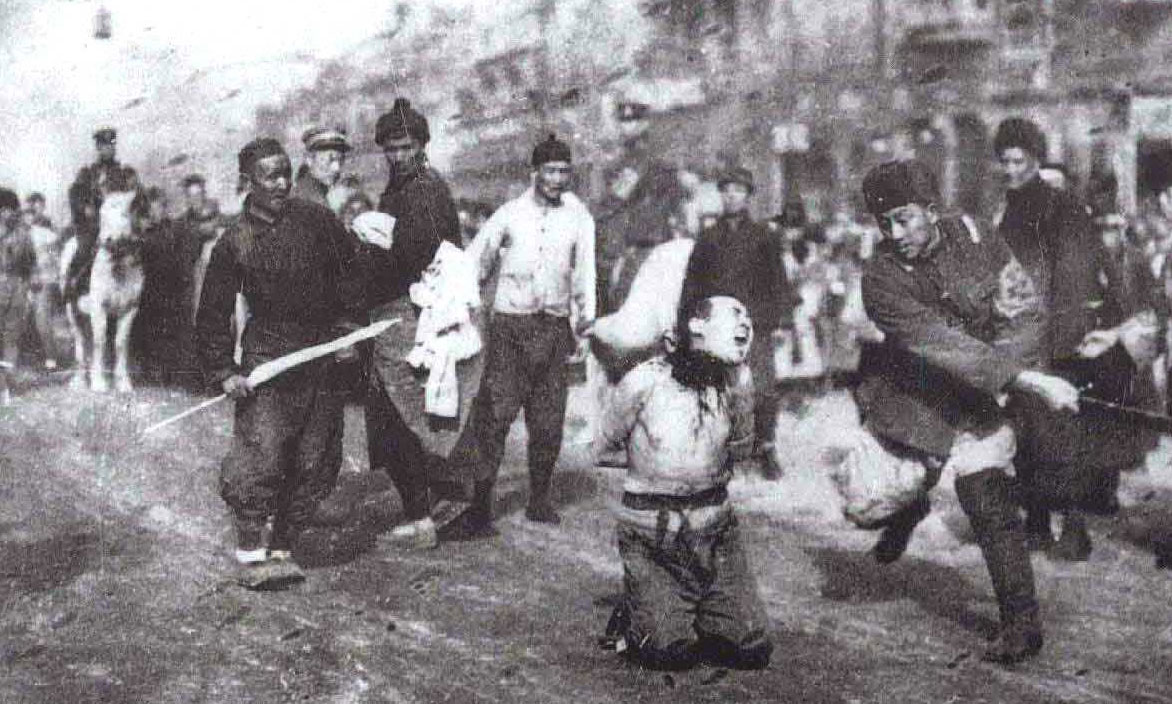
Being made to kneel and have your head sliced off with a scimitar was a standard punishment for all sorts of crimes. As the empire crumbled and was subject to countless rebellions small and large across its vast territory, their suppression and punishment required an astonishing number of Chinese to chop each others’ heads off.

The Mandarin in charge of suppressing the Taiping Revolt in Canton boasted of having beheaded 100,000 rebels (p.22). During the 1911 revolution the new governor of Sichuan had his predecessor decapitated and rode through the streets brandishing his head (p.121).

Arms tied behind their backs, forced to kneel in big public gatherings, then head sliced off with a ceremonial sword

Arms tied behind their backs, forced to kneel in big public gatherings, head sliced off with a ceremonial sword. The Chinese way.

Resistance to change

I was staggered by the absolute, dead-set determination from top to bottom of Chinese society to set its face against modernisation, industrialisation, liberalisation, democracy and all the other new-fangled ideas from the West, which it so despised. From 1850 to about 1980, all Chinese governments were determined to reject, deny, censor and prevent any incorporation of corrupt, decadent, capitalist Western ideas and techniques.

As John Keay remarked in his history, a central characteristic of the Chinese is an ingrained superiority complex – their leaders, from the emperor to Chaing Kai-shek to Mao, just know that China is the centre of the world and is superior to the whole of the rest of the world, all evidence to the contrary notwithstanding.

Fenby describes the late-imperial world as ‘a system which was not designed to accommodate, let alone encourage, change’ (p.38.) As the late 19th century reformer Li Hongzhang admitted in 1884:

‘Affairs in my country have been so confined by tradition that I could not accomplish what I desired.’ (p.41)

The first railway in China, built by the British in Shanghai, was bought by the local council who had the rails torn up and the station turned into a temple. Railways interfered with feng shui and local customs, they brought in foreign devils. Like every other western innovation – i.e. like every single aspect of the modern world – they were resisted hammer and tongs by Chinese at all levels. As an edict from the Guangxu Emperor’s Hundred Days’ Reform put it, China was afflicted by:

‘the bane of the deeply-rooted system of inertness and a clinging to obsolete customs.’ (p.67)

Reformers were always in a minority, within the court itself, let alone in a country overwhelmingly populated by illiterate peasants. Which explains why it took China about 100 years – from the 1880s when it began to grasp some of the implications of capitalism – until well into the 1980s, to even begin to implement the basics of economic and technological reform.

Fenby’s immensely detailed picture takes account of the endless war, violence and conflict China was caught up in. But what comes over most strongly is the way Chinese of all ranks and levels of education didn’t want it – western ‘democracy’, ‘free speech’, competition, egalitarianism, innovation, entrepreneurism, disruptive technologies.

没有! Méiyǒu! NO!

Foreign devils

Rana Mitter’s book about the China-Japanese war contains a surprising amount of anti-western and anti-British feeling and he frequently refers to the ‘unequal treaties’ of the nineteenth century between European powers and a weakened China, but since his book is about the war of the 1930s, he doesn’t give a lot of detail.

Fenby’s book by contrast covers exactly the period of ‘unequal treaties’ (where European countries took advantage of China’s weakness to get her to sign away rights to trade, to give foreigners legal immunity from any kind of wrongdoing, handed European countries entire treaty ports like Hong Kong and Macau) gives a lot more detail, and really drills home why the century from 1840 to 1940 was a period of sustained national humiliation for the Chinese – it is in fact known as ‘the century of humiliation’ or ‘the hundred years of national humiliation’.

Basically, Westerners imposed an unceasing stream of treaties designed, initially, to create special trading cantonments on the coast, but which one by one encroached further inland, ensured Westerners were exempt from Chinese law (in effect, free to do what they wanted) and could force trade with the Chinese on unfavourable and biased terms.

Moreover, there were so many foreign nations each scrambling to get a piece of the action in China – most obviously trading basic commodities but also competing for the broader opportunities which opened up later in the 19th century, for example, building railways or setting up banks.

I hadn’t realised how many western countries queued up to get their slice of the action. I knew about the usual suspects – Britain with its powerful navy, and France encroaching up from its colony down in Indo-China i.e. Vietnam-Laos. But Bismarck’s unification of Germany in the 1870s announced the arrival of a new, more brutal competitor who was determined not to miss out in either Africa or China.

And Fenby makes clear that, more than all the others, the Chinese feared neighbouring Russia because of its steady expansion into Manchuria and the North of China:

The British, French and Germans were a constant irritant, but the Tsarist empire and its communist successor represented a much greater territorial threat to China. p.31

And above all, the Chinese should, of course, really have been most scared of Japan, another ‘divine empire’, which turned out to be by far its worst destroyer.

I was startled when Fenby gives the process the overall title ‘the Scramble for China’, since this is a term usually reserved for the European ‘Scramble for Africa’ – but as he piled example on example of the countless unequal trading deals, the intimidation of Chinese authorities with gunships and punitive armed raids by European armies, I came to realise how true it was, how carved up, humiliated and exploited China became – and so why getting rid of foreigners and foreign influence came to be such a dominating strand in the mindset of early 20th-century Chinese intellectuals and revolutionaries.

'China - the cake of kings and emperors' French political cartoon by Henri Meyer (1898)

‘China – the cake of kings and emperors’ French political cartoon by Henri Meyer (1898)

The ratcheting effect

A key element of the unequal treaties was the way each of the European nations was able to out-trump the others… and then all the others demanded parity. Some German missionaries were harmed in a remote province? Germany demanded reparations and increased trading rights. At which the British, French, Russians and Americans all demanded a similar ratcheting up of their rights and accessibility. Some British merchants were attacked in Canton? The British sent in gunboats, demanded reparations and the rights to entire industries – and all the other European nations then demanded parity or they’d send in their gunboats.

So it went on with an apparently endless ratcheting up of the legal and commercial privileges and the sums of cash demanded by the rapacious Europeans.

Unequal treaties

  • 1839 to 1842 The First Opium War leading to the 1842 Treaty of Nanjing – granted an indemnity and extraterritoriality to Britain, the opening of five treaty ports, and the cession of Hong Kong Island
  • 1844 The Treaty of Whampoa between France and China, which was signed by Théodore de Lagrené and Qiying on October 24, 1844, extended the same privileged trading terms to France as already exacted by Britain
  • 1845 The Treaty of Wanghia between China and the United States, signed on July 3, 1844 in the Kun Iam Temple.
  • 1856 to 1860 The Second Opium War pitting the British Empire and the French Empire against the Qing dynasty of China.
  • 1858 – British attack on Canton after Chinese sailors were arrested aboard a ship carrying the British flag. British houses were burned and a price put on the heads of foreigners. British forces secured Canton. British and French forces attacked Tienjin, the coastal area east of Beijing. The westerners marched on Beijing and burned down the emperor’s Summer Palace (1860), among the looters being Charles Gordon, later to make his name at Khartoum. In the final peace treaty the allies were paid a large indemnity, trading concessions and Russia was given 300,000 square miles of territory in the far north!
  • 1884 to 1885 The Sino-French War, also known as the Tonkin War, in which the French seized control of Tonkin (northern Vietnam).
  • 1895 Treaty of Shimonoseki ending the first Sino-Japanese war cedes to Japan Taiwan, the Pescadores islands and the Liaodong Peninsula, along with an indemnity of 16.5 million pounds of silver as well as opening five coastal ports to Japanese trade.

Fenby’s account makes vividly and appallingly clear the treadmill of endless humiliation and dismemberment which educated Chinese felt their country was being remorselessly subject to. And the hypocrisy of the Western nations who went on about ‘democracy’ and ‘human rights’, while all the time lining their pockets and showing no morality whatsoever.

Western advantages

All that said, the Chinese needed the West and Fenby (thankfully) paints a nuanced and complex picture. Just as not all Chinese were pigtailed ignoramuses, so not all Westerners were hypocritical exploiters. A shining example is Robert Hart, an Ulsterman from a poor family, who rose to become the head of the China’s Customs Service, just one of many Westerners employed by the imperial court for their (Western) knowledge and expertise. Hart ran the service from 1863 to 1911 and transformed it from a corrupt, antiquated and inefficient sinecure into a well-run organisation which ended up being one of the main contributors to imperial finances. He became a byword for honesty and dependability, and was awarded a number of China’s highest honours.

Hart’s story reminds us that it is a complicated world, then as now, and that many Westerners made significant contributions to China, establishing a range of businesses, banks, building railways, developing areas of the economy. If there was a lot of shameful gunboat diplomacy, there was also a lot of genuine collaboration and contribution.

Fleeing to the West

It is also notable the number of times that native Chinese reformers, dissidents, disgraced court officials and so on fled to the European ports to find sanctuary. Here they found law and order, cleanliness and hygiene which, if not perfect, were vastly superior to the dirt, zero plumbing and violence of their native China.

In 1912, as revolutionary violence swept China, many members of the Imperial court took refuge in the foreign compounds. After the Tiananmen Square ‘Massacre’ of June 1989, as many of the student leaders as could manage it fled abroad, most ending up in America, for example prominent student leader Chai Ling who went on to head up a successful internet company. Plus ca change…

The Japanese

‘As we entered the town of Port Arthur, we saw the head of a Japanese soldier displayed on a wooden stake. This filled us with rage and a desire to crush any Chinese soldier. Anyone we saw in the town, we killed. The streets were filled with corpses, so many they blocked our way. We killed people in their homes; by and large, there wasn’t a single house without from three to six dead. Blood was flowing and the smell was awful. We sent out search parties. We shot some, hacked at others. The Chinese troops just dropped their arms and fled. Firing and slashing, it was unbounded joy. At this time, our artillery troops were at the rear, giving three cheers [banzai] for the emperor.’
– Diary of Japanese soldier, Makio Okabe, describing the capture of Port Arthur, November 1894

Multiply this several million times to get the full impact of what it meant to be a neighbour of Imperial Japan in the first half of the twentieth century: Korea, Manchuria, mainland China all benefited from Japan’s goal of building a glorious Asian empire. This is described at great length in Rana Mitter’s history of the China-Japanese war and there are regular scenes of such stomach-churning violence as to make you want to throw up your last meal.

Maoist madness

The madness of the Mao Zedong era is described in my reviews of Frank Dikotter’s book:

But Fenby dwells at length on the paranoia and crazed whims of the Great Helmsman, with results that eclipse the horrors of the late Qing Empire. The famine which resulted from his Great Leap Forward policy (1958 to 1962) resulted in anything from 30 to 55 million deaths. And that’s before the separate category of deaths actively caused by the security forces implementing their brutal policy of forced collectivisation. Madness on an epic scale.

Plus ça change…

Countries are like people, they rarely change. The modern history of Chinese history is a fascinating case study. Again and again Fenby points out that certain patterns of behaviour recur and recur, the most notorious being the attempt to impose reform of Chinese society from the top, reform which threatens to get out of hand, and then is harshly repressed, followed by a period of harsh control. As predictable as a, b, c.

Thus his description of a) the attempted reforms of the Guangxu Emperor in 1898, which b) began to get out of hand c) were brought to an abrupt halt by the power behind the throne, the Dowager empress Cixi, eerily pre-echo a) Mao’s unleashing of revolutionary change from above in the Cultural Revolution b) which by the 1970s even the Mad Helmsman realised was getting out of hand and c) so he repressed.

Or the way the a) very mild liberal reforms begun by Deng Xiaoping in the 1980s led to b) the unpredictable outburst of student protests in Tiananmen Square which the party hierarchy tolerated for a few weeks before c) brutally suppressing it. a, b, c.

To this day the rulers of China daren’t institute anything like real democracy because they know the chaos they would unleash, they remember the history of the Warlord Era, indeed the terrifyingly violent 20th century history history this book describes. Maybe such a vast and varied terrain, containing so many ethnicities and levels of economic development, can still only be managed by a really strong central authority?

And the more you read and learn about the Chinese history of the past century – the more you sympathise with them. Fenby’s long and gruelling narrative ends with the repeated conclusion that China’s rulers are as repressive as ever – indeed, given the arrival of the internet, they are able to practice surveillance and social control of their populations which previous dictators could only have dreamed of.

And yet they are all too aware that they are sitting astride a bubbling cauldron of vast social inequality, political corruption, popular resentment, ethnic division (most obvious in Tibet and Xinjiang but present among a hundred other ethnic minorities), and the pressures and strains caused by creating a dynamic go-head 21st century economy controlled by a fossilised, top-down, 20th century Leninist political structure.

This is an extraordinarily insightful and horrifying book. Anybody who reads it will have their knowledge of China hugely increased and their opinion of China and the Chinese irreparably damaged.


Other reviews about China