Samurai @ the British Museum

This is a magnificent exhibition, beautifully staged, showcasing a huge number of objects (over 280) from both the British Museum’s collection and 29 other national and international lenders, most of them objects of exquisite beauty, accompanied by highly informative and fascinating captions.

Suit of samurai armour with bullet-proof cuirass embossed with crest, 1600–1700 © The Trustees of the British Museum

Debunking myths

It follows the basic template of many of the British Museum’s big blockbuster exhibitions which can be summarised as: ‘Think you know about X? Well, think again, because everything you’ve ever been taught about X is wrong and this exhibition showcases the latest scholarship to set you straight’.

So the idea is that we in the West are victims of myths, clichés and stereotypes about the Japanese samurai which this exhibition is going to correct. In the past the Museum has taken the same debunking approach to the Vikings and the Roman emperor Nero, among many others.

The two most common myths the exhibition debunks are 1) all samurai were men (no – a notable number were women) and 2) samurai were all about violence (no – in the post 1600 period they were more like a landed aristocracy versed in the arts of peace and good living).

Definitions and dates

The samurai began as mercenaries for the imperial court and developed over time into rural gentry. From the AD 900s to 1300s, Japanese fighting men were organised into ‘warrior bands’ (bushidan), often based on family loyalties. After a series of brutal and bloody civil wars, a warrior government, or shogunate, was established in 1185. Though the first shogunate collapsed and was replaced by another, warrior governments ruled Japan until the 1570s. The warrior era as a whole is said to come to an end in 1603 with the establishment of the Tokugawa shogunate.

Samurai helmets ornate and simple in ‘Samurai’ at the British Museum

Both military training and engagement in cultural activities were essential to a warrior’s identity. The imperial court, which co-existed with the shogunate, provided a cultural model for samurai to emulate.

By the eighteenth century Japan had enjoyed a century of peace and the samurai had become local administrators and benchmarks of civilised behaviour. In this they reminded me a bit of the English lord of the manor who was also a justice of the peace.

NB: The word samurai is more commonly used in the West than in Japan.

Chronological structure

1. Civil wars 900 to 1600

Broadly speaking the first third of the exhibition describes the historical reality of the rise of the samurai, embedding them in Japan’s long period of civil wars and conflict from the dark ages of the 900s, through a prolonged period of civil wars to the establishment of the Tokugawa shogunate in 1603.

2. From 1600 peace

From that date Japan enjoyed about 250 years of peace and prosperity and the exhibition shows how the samurai tradition was adapted to more peaceful times in the 1700s and 1800s with a wide range of objects demonstrating their role in civil society. If the earlier displays focused on weapons of war, many objects from this phase are domestic, and demonstrate one the exhibition’s chief debunkments, one of the core stereotypes it aims to overthrow, which is the notion that all samurai were men. No they weren’t. There were female samurai warriors during the heroic age of civil wars and this number increased in the peaceful times until up to 50% of samurai were women. Who knew.

3. Nineteenth century stories

The 19th century section looks in detail at how the stories of half a dozen or so of the legendary figures from the golden age of samurai in the middle ages were depicted in woodcuts and fabrics and fans and other media. Here’s a typically striking coloured woodcut of a female samurai, Tomoe Gozen.

Woodblock print by Utagawa Kuniyoshi (1797 to 1861) showing Tomoe Gozen riding away after the Battle of Awazu (1852) © The Trustees of the British Museum

4. Japanese empire

A further section briefly explains how the samurai tradition was co-opted into the rise of Japanese nationalism from 1900 to 1945, was used to justify Japan’s aggressive imperial expansion into Korea and China, and was invoked during the Second World War, before reaching its nemesis in the defeat of 1945.

So far, so historical, the exhibition beautifully displaying often rare and precious objects from all aspects of samurai life, accompanied by detailed historical explanations.

5. Commercial exploitation of the samurai image

This all changes in the final stretch of the exhibition which shows how, in the post-war period, the image of the samurai was fabricated, idealised and adapted for many purposes, both within Japan and beyond.

The most obvious one was making money from movies and TV, manga comics and video games. There are clips from a surprising number of these running on half a dozen video screens where you can watch in detail, as well as projected as vivid displays onto half a dozen big hanging screens. I counted 20 or so TV shows, both Japanese and Western, plus umpteen video games, but probably missed some. And then there’s a selection from the modern world of samurai-themed merchandise, toy swords, figurines, helmets, magazines, you name it, in the display cases underneath.

This final section is in quite a different mode and vibe from the previous, sober and scholarly displays. It’s visually and aurally loud and dynamic, a bit overwhelming. For me it really goes to show how any historical trope is liable to be exploited and milked to the hilt by modern consumer capitalism. Obviously the curators are highly invested in merch about the samurai but this final section makes you realise that the same process of complete commercialisation applies just as much to the Vikings, the Romans, to medieval knights and so on. You could find just as many contemporary movies, TV shows and merchandise about any of them. Pretty much any historical culture which relied on violence, and especially sword fighting, has been turned into violent video games and violent movies.

Proving Karl Marx’s old adage true that History repeats itself, first time as tragedy, second time as Netflix (or HBO or Disney+) historical drama.

Installation view of ‘Samurai’ at the British Museum showing the hanging video screens which display composite feeds from scores of samurai films, TV shows and videogames, with selections of modern samurai merchandise in the display cases (photo by the author)

Modern artworks

All this slashing and bleeding tends to overshadow an interesting aspect of the final section which is that it includes a few pieces of modern and contemporary art. Some of them are by men who fought in the Second World War and lived on to reflect on war and peace. One is by the ‘celebrated’ Japanese artist, Noguchi Tetsuya who, in my ignorance, I’ve never heard of.

Fair enough – but I think these works would have benefited from having their own, quiet space and not being placed next to video screens of hyperactive men in pigtails eviscerating each other with enormous swords.

The paradox of civilised exhibitions about hyper-violence

Thus saturated in the history and imagery of the samurai, when I got home I toyed with watching one or other of the recent samurai movies – 47 Ronin, the Last Samurai, Shogun etc – but they almost immediately had so much hacking off of limbs and necks and blood spurting everywhere that I quickly stopped. On the same day I read about the suicide bomb in Pakistan, the total casualties to date in the Ukraine War, the rapes and murders taking place in Sudan. God knows there’s enough bloody violence in the world without inviting even more into my living room.

And this led onto an obvious reflection that an exhibition like this is, in a sense, the height of civilisation: created by highly educated people working with international networks of museums in Japan, America and elsewhere, to create a beautifully staged show of exquisite objects all described with minute scholarly scrupulousness. And yet the subject of the show is based on appalling violence and butchery.

These beautifully crafted swords which we are encouraged to admire, well, in a clip from a Japanese TV series we watch the hero slash open the chests, cut off the fingers, and behead all-comers in an epic fight using just such a razor sharp sword. They are instruments of atrocious brutality.

I was particularly struck by adjacent cases showing a huge bow, a quiver and some metal arrows. The arrows had obviously been selected for the beauty of their varied designs and the craftsmanship of their metalwork. And yet, as I admired their curves and points, I reflected that they were designed to pierce the advanced armour and undervests which warriors wore, in order to enter the body and cause as much tearing eviscerating damage as possible to muscles and organs.

I looked up and around the lovely calm gallery, at the other old ladies and gentlemen pottering politely between exhibits, and felt for a moment that I’d entered a parallel universe.

Three ages of samurai

Now I’ll go back over the three ages of the samurai in more detail, and naming some of the most striking exhibits in each section. According to the curators, the history of samurai can be divided into 3 periods.

1. 800 to 1600: Rise of the samurai

  • mid-900s AD: a warrior class emerges in service to the aristocracy
  • 1185: the Minamoto clan establishes the first shogunate (warrior government)
  • 1330s: the Ashikaga clan seizes power and establishes a new shogunate
  • 1570 to 1615: intense conflict as a series of warlords attempt to unify Japan; attempted invasion of Korea

2. 1600 to 1850s: The long peace

  • 1603: the Tokugawa shogunate is established
  • Japan enjoys 250 years of peace and prosperity
  • 1867–8: after more than a decade of violence between competing samurai clans, the Tokugawa shogunate collapses
  • 1871: Samurai status is abolished; subsequent samurai rebellion fails

3. 1876 to the present: After the samurai

  • 1894 to 1910: conflict with China and Russia for control of the Korean peninsula; Japan annexes Korea
  • 1931 to 1945: Japan participates in the Second World War, ending in defeat
  • 1945 to the present day: in peacetime, the samurai image is taken up around the world in popular culture

Part 1: 900 to 1600: war

The samurai – known in Japan as musha or bushi – were engaged in protracted warfare and gained political dominance from the 1100s. This section includes detailed looks at their arms and armour.

Cuirasses and armour

The small warrior bands (bushidan) of early battles comprised full-time mounted archers and part-time foot soldiers. Archers wore oyoroi armour with a square, loose form, optimised for drawing the bow. The exhibition includes a cuirass (breast and backplates) with no fewer than 2,000 scales of lacquered iron or leather laced together and covered with leather, making it tough yet flexible. The huge shoulder-guards deflected arrows, serving in place of a shield.

Suit of armour and helmet made of iron, silk, wool, leather, gold and lacquer: Japan, 1519 (helmet), 1696 (armour) and 1800s (textiles) © The Trustees of the British Museum

Bows and arrows

Samurai employed a distinctive tactic in which archers on horseback circled and manoeuvred around each other on open ground, while small groups of foot soldiers skirmished in denser, hilly terrain. Archers used a longbow with the grip below the centre that bent more easily. Bows developed from wood coated with lacquer to a more powerful laminate of wood and bamboo, increasing flexibility and the arrows’ flight range. The quiver developed in form from the open ebira (giving easy access to the arrows) to the closed utsubo (designed to protect arrows from humidity.

The establishment of the Tokugawa shogunate (1603 to 1868) ushered in an era of peace. The new government created a social hierarchy with samurai at the top, followed by farmers, artisans and merchants. The superior social status of the samurai derived from their identity as warriors, so they needed to maintain their military training even during peacetime. In earlier centuries archery had been the primary mode of combat (rather than swordsmanship) and it remained an essential military skill. This set of archery equipment comprises two quivers and two bows, with a bowstring, all decorated with the Tokugawa crest.

Set of archery equipment made from wood, lacquer, leather, gold, metal, bamboo, feathers and silk, Japan, 1800 to 1900 © The Trustees of the British Museum

Saddles

Beautiful yet practical, Japanese saddles were designed as platforms for shooting arrows. (I imagine scholars have made comparisons with Scythian saddles, designed for the same purpose.) Made of red oak and richly decorated with lacquer of various colours, they were sometimes inlaid with mother-of-pearl and other fine materials. Thick leather pads provided cushioning. Larger saddle-flaps protected the horse’s flanks from the lacquer-coated iron stirrups, which supported the rider standing up. Arches at the front and back were often decorated with motifs taken from the natural world.

Swords

As mentioned, swords were less important for samurai than archery. For much of the samurai’s existence as warriors, swords played a limited role in warfare. However, they were always markers of status and refinement. Their forms developed over time. The long tachi, worn with the blade down, was suitable for warriors on horseback. Several examples here indicate the sophistication and skill of sword-makers from the 1200s. (Later on we see swords made for entirely ceremonial purposes up to and including the ones handed over by surrendering Japanese officers in 1945.)

A surcoat

Toyotomi Hideyoshi is a prominent figure in samurai history. In the late 1500s he rose from foot soldier – more peasant than samurai class – to the highest rank in the land, thanks to his military ability and political skill. He became a trusted general of the warlord Oda Nobunaga. After the latter’s demise Hideyoshi forged alliances, built palaces and castles, and received the title ‘regent’. This jinbaori (surcoat), with a target design, supposedly belonged to him. Originally protective garments to be worn over armour, jinbaori became statements of the personal taste of the wearer.

Jinbaori (surcoat) Pheasant and drake feathers mounted on hemp, with Chinese silk, Japan, 1570 to 1598 © The Trustees of the British Museum

Beheading

Warfare was brutal and bloody. Samurai warriors cut off enemy heads and presented them to claim rewards from their daimyo (lord). The exhibition includes a handscroll which records the suppression of a revolt in 1083-7. It depicts bodies and limbs lying heaped under a shield. One warrior carries a head on the end of his curved blade (naginata). Another holds his trophy by the hair. ‘Brutal’ is a word which recurs in the descriptions of the warfare of the period.

Culture

And yet throughout this era, alongside his military skills, a fully rounded warrior was expected to be culturally sophisticated. Samurai patronised the arts and hosted social gatherings, including the ritualised consumption of tea. Performances of Nõ, an aristocratic dance-drama, were sponsored by shoguns and regional warlords. Samurai petitioned Buddhist deities for success in combat and a peaceful afterlife. Some samurai were diplomats, travelling to Europe to negotiate trade relations. And the exhibition features extensive displays of the arts of peace and civilised living. This is the other great debunking the exhibition aims to carry out: to show us that samurai weren’t just about relentless warfare, but were also symbols of civilised living.

Hosting

Powerful lords used formal social gatherings to cement relationships with their allies and followers. Such events were richly furnished with paintings and objects. Hosts sat before folding screens decorated with shimmering gold leaf. The exhibition includes several such screens including this one, which depicts cherry trees above a stream, denoting spring, and deutzia flowers at left for summer. It was created during the Muromachi period (1336 to 1573), a time of immense political turmoil and civil wars.

Folding screen made of ink, silver and gold on paper, Japan, 1500 to 1600 © The Trustees of the British Museum

Part 2: 1600 to 1900: peace

Tokugawa shogunate

By 1615, Tokugawa leyasu had achieved military supremacy and boasted the title shögun. After more than a century of warfare, the Tokugawa government brought peace and stability. Japan was divided into about two hundred and sixty domains each with a ruling lord who pledged allegiance to the shogun.

10%

The samurai became a hereditary class forming about ten percent of the population. Beneath them were ranked merchants, artisans and agricultural labourers. The role of samurai changed from warrior to bureaucrat. Men and women of samurai rank participated in the arts and intellectual life. Many were artists and poets and began the process of recording and idealising the the legendary warriors of the past in books, prints and theatre.

Culture of peace

During the long era of peace from 1615, the samurai moved away from the battlefield to serve as government officials, scholars and patrons of the arts, with women making up to half of the samurai class. To demonstrate this the exhibition includes: hanging scrolls, cutlery, incense, woodblock books, fashion plates in the forms of scrolls and hangings, hats and tunics, kimonos, poetry, a sedan chair, naginata or ‘polearms’, spear covers with clan emblems, the miniature toggles known as netsuki, a mirror decorated with peacocks, children’s toys, and much more.

Staging and soundscape

In the first, warrior section, the entire wall is given over to a dramatic film of charging samurai done in a highly stylised way as black silhouettes against a scarlet background. In the peace section there’s an extended (20 minute) soundscape recreating the sounds of Japan’s then capital, Edo (Samurai march and horses hooves thump on the packed earth street. Music from Kabuki theatre drifts in and out, and temple bells ring. There are birds and other wildlife.)

A woman’s firefighting jacket and hood

On loan from the John C. Weber Collection, worn by women serving within Edo Castle. Fires were so common in the wooden city of Edo (present-day Tokyo) that they were known as the ‘flowers of Edo’, and this jacket’s design of tasselled grappling hooks amid surging water evokes protection against the flames. Many women took part in these fire brigades.

Woman’s firefighting jacket and hood made from wool, satin-weave silk appliqué, and silk and gold-thread embroidery, Japan (1800 to 1850) John C. Weber Collection. Photo © John Bigelow Taylor

Nostalgia

In a period of peace, people became fascinated by legendary samurai heroes from the civil wars of the 1180s. Historical tales offered action and fantasy as an escape from everyday life. Print artists, painters and artisans created dynamic renderings of famous samurai in every available medium. Stories of heroism, sacrifice and betrayal provided endless inspiration for theatre.

I’ve mentioned that this part of the exhibition consists of sections or ‘booths’, each one devoted to a particular legendary figure and bringing together woodcuts, prints and other formats in which their adventures were dramatised. I suppose this is a bit like nineteenth century British nostalgia for a bygone age of chivalric heroes, the knights of the Round Table or Sir Walter Scott’s medieval heroes. The samurai heroes described and depicted here include:

  • Minamoto no Yoshitsune (1159 to 1189) who learned special fighting techniques from the King of the Goblins
  • Kumagai Naozane who challenges the fleeing Taira no Atsumori to a fight but upon removing Atsumori’s helmet, realises he is only young and takes his life tearfully, afterwards, Naozane renouncing the world to become a monk
  • Nitta Yoshisada (1301 to 1038) who offered up his sword to the Dragon God
  • the battles of between rival warlords Takeda Shingen (1521 to 1573) and Uesugi Kenshin (1530 to 1578)
  • Minamoto no Yoshi-ie (1039 to 1106) who, while returning to Kyoto victorious from battle, paused to compose a poem about the poignancy of falling cherry blossoms
  • The Tale of the Drunken Acolyte (Shūten-dōji) which describes Minamoto no Yorimitsu’s (944 to 1021) quest to vanquish an ogre who abducted and devoured women
  • Minamoto no Tametomo (1136 to 1170) was an archer of legendary strength and skill in the conflict of the 1150s between the Minamoto and Taira clans. The victorious Taira exiled him to the ‘Isle of Demons’

And so very much on.

Installation view of ‘Samurai’ at the British Museum showing one of the sections or ‘booths’ which gather together 19th century depictions of a specific samurai hero, in this instance Minamoto no Yoshitsune who ‘trained with goblins’ (photo by the author)

Abolition of samurai status

A new government took power in 1868, ruling in the name of the emperor. The new era was named ‘Meiji’, or ‘enlightened government’. In 1869 the samurai’s hereditary status was abolished. Many former samurai struggled to find employment and resented the loss of their stipends and other privileges. They lost their traditional right to wear swords in public. Disaffected ex-samurai gathered in the southwestern island, Kyushu, planning what became known as the Satsuma rebellion until in 1877 government forces moved to suppress them. The exhibition includes dramatic prints of this whole sequence of events.

Ironically, the abolition of the samurai class released thousands of suits of armour onto the market. Huge numbers were exported to Europe and the United States as part of a fashion for medievalism. The show includes an example bought by the architect William Burges (1827–81) and displayed at his house in Holland Park, London.

Part 3

Japanese imperialism

From the 1890s onwards, Japan was involved in military conflicts in a struggle for geopolitical influence. The ‘samurai legacy’, including the supposed bushido ethos, was used domestically as motivation for Japanese soldiers, and as the basis for propaganda and stereotypes by Japan’s enemies during the Second World War (1939–45).

In fact the exhibition argues that foreign powers used samurai images as much or more than the Japanese themselves in order to stereotype their opponents. The impressive poster on the wall in this photo was actually created by an Italian artist, Gino Boccasile, since Japan was allied with Germany and Italy. It celebrates the Japanese sinking of the British ships HMS Prince of Wales and HMS Repulse in 1941.

Installation view of ‘Samurai’ at the British Museum showing a display case which deals with the use of the samurai image leading up to and during the Second World War (photo by the author)

The curators don’t mention it but this action resulted in the deaths of 840 seamen and the thousand or more survivors went into Japanese captivity where many more died in the brutal conditions inspired by the Japanese military’s ideas of ‘honour’. The war is mentioned here but, in my opinion, the role of the thousand-year-long warrior cult in the formation of Japanese fascism, and in the way they treated the countries they conquered and Allied prisoners of war, isn’t really explored, not as much as it deserves.

Imagine an exhibition which covered the 1,000-year-long role of the Prussian aristocracy and its military ethos up to and including the Second World War but then only briefly mentioned their role in supporting the Nazi regime, and skated over the appalling atrocities which ensued from their sense of their racial and moral superiority, which didn’t mention the Holocaust at all. You’d rightly feel that something was missing.

Same here. Inspired by militaristic pride indissociable from the samurai ideal, wartime Japan committed unspeakable atrocities not only on Allied prisoners but on the populations of conquered Korea and China, the Philippines, Indonesia, Malaysia, Singapore, Burma, Thailand, Indochina.

Caption showing cover of a Japanese wartime magazine introducing students to the Japanese values of bushido (photo by the author)

Sure, the exhibition includes a 1942 magazine cover showing a Japanese instructor in its newly conquered colony, the former Dutch East Indies, introducing students to bushido, the military’s guiding ethos (see above). And there’s a shin-guntō sword with scabbard, of the type all Japanese soldiers were meant to wear to associate themselves with the samurai ideal. There’s another sword handed over to a British general at the surrender with a photo of the event. And that’s it, when it comes to homegrown Japanese products.

There are samurai-themed images created by foreigners, like the Italian poster shown above, a British cartoon of a samurai in Punch and mention of a Nazi pamphlet which praised the samurai warrior ethos. But that’s about it. There’s almost as much in the next section about Star Wars memorabilia (because Darth Vadar’s helmet and uniform were influenced by samurai armour).

To be fair to the curators, if you check out the exhibition catalogue it looks as if there are 30 or more pages which go into the role of the samurai ideal in Japanese fascism in much more detail. So it looks like it’s been worked through in print but not so much in the physical exhibition which most people will visit.

Fun, film and video games

Instead, much more space is devoted to the post-war era when Japan (under American control for a decade) reinvented itself as a peaceful producer of hi tech goods and products. This is the section which goes heavy on umpteen movies and TV shows which have exploited / recycled the samurai image, not to mention a slew of video games.

Hence the monitors showing suitable violent clips from popular video games such as Assassin’s Creed: Shadows (2025) and Nioh 3 (2026). Apparently, the latter game launched just three days after the exhibition opened. If you read the (characteristically thorough and informative) object label you discover that in Nioh 3 you play as the heir of the shogun, tasked with stopping the spread of non-human powers across four eras in Japanese history, while encountering famous figures, such as the famous 16th century warlord Takeda Shingen. What better way to while away the hours?

Still from the videogame Nioh 3, 2026. Koei Tecmo

Summary

Amazing exhibition. Beautifully staged, with the dramatic animated backdrops and atmospheric soundscapes. Nearly 300 objects, far too many to process in one visit, giving you a tremendous overview of samurai culture in all its historical extent and cultural breadth. I’ve mentioned my personal reservations about the wartime period, but they don’t detract the impact of such a carefully curated collection of stunning objects. An amazing achievement.

Installation view of ‘Samurai’ at the British Museum showing the beautiful, themed set design – imagine the 20-minute-long soundscape of street sounds from 16th century Edo echoing round you as admire the beautiful artefacts and read the fascinating captions (photo by the author)


Related links

  • Samurai continues at the British Museum until 4 May 2026

Related reviews

Executions @ the Museum of London Docklands

For over 700 years London was the scene of public executions, a practice which wove itself into the city’s history and popular culture. This excellent and imaginatively designed exhibition at the Museum of London Docklands explores all aspects of public executions in London, using a combination of artifacts, letters, informative videos, songs and voices, paintings, engravings and caricatures, and some really gruesome exhibits.

Above all, it is amazingly comprehensive – it touches on all the aspects of the subject I’d expected beforehand but goes on to explore all kinds of nooks and crannies I’d never have thought of. I’d never thought about the effort some condemned prisoners put into being well dressed for their trip to the gallows. Well, the exhibition tells the stories of condemned men and women who went to great lengths to look their best on their death day, and even has the fine dress and fancy suit worn by a female and male executionee:

  • on the left, the ‘white muslin gown, a handsome worked cap and laced boots’ worn by Eliza Fenning who was hanged for attempting to poison her employers
  • to the right, the ‘superb suit of white and silver, being the clothes in which he was married’ worn by Laurence Shirley, Earl Ferrers, was hanged on 5 May 1760 for the murder of his steward John Johnson, whom he shot in a rage

Final clothing section in the ‘Executions’ exhibition at the Museum of London Docklands © Museum of London

(The door on the right of this photo is one of the three doors you had to pass through to enter Newgate Prison. The architect George Dance thoughtfully positioned swags of chains and shackles over the main entrance door at Newgate to terrify and intimidate new prisoners.)

I’d never thought about what happened to the bodies of the hanged after their execution. Turns out that from the mid-16th century the bodies of executed criminals were given to the Company of Barber-Surgeons and the Royal College of Surgeons for dissection and medical research. The thought of being dissected filled the condemned with horror. Fights could break out at executions as friends and family of the deceased would attempt to stop the surgeons claiming bodies. In the same spirit I had no idea that life sized casts of the heads of the executed were often made – there’s a selection of them on display here, which, as the nineteenth century progressed, were used to study ‘criminal’ physiognomy. Alternatively, the casts of notorious criminals were kept in a special display at Newgate where they could be viewed by visitors, who included Charles Dickens.

Death masks at the ‘Execution’ exhibition at the Museum of London Docklands © Museum of London

I knew that broadsheets and leaflets were often sold at executions which claimed to give the last speech of the condemned man, along with a ballad poem describing his fate – but I’d never had the opportunity to read some of these before. Ditto the last letters condemned men wrote to their loved ones. There’s not only letters but rings and coins sent by those condemned to transportation instead of execution in the mid-nineteenth century.

I knew that prisoners in gaol were often shackled but I don’t think I’ve seen a collection of the different types of handcuffs, shackles and ‘waist belts’ used for this purpose on display before. Apparently the weight of shackles prisoners were manacled with sometimes meant they could barely move. As well as direct punishment of the prisoner, the sound of all this metalwork clanking through the echoing vaults of the grim prisoner had a demoralising and terrifying psychological effect on other inmates. The practice of routinely keeping prisoners shackled in irons ceased in the 1820s.

Shackles and handcuffs used in Newgate Prison at the ‘Executions’ exhibition at the Museum of London Docklands © Museum of London

I’ve certainly never seen a real actual gibbet before and I didn’t know that they didn’t come in a standard size, but that a gibbet ‘tailor’ took the corpse’s measurements and built the gibbet to perfectly fit. In line with the state of the art interactivity of the exhibition, the display of this real-life gibbet had a gruesome audio soundtrack with the noise of flies buzzing round the rotting corpse.

Wrought iron gibbet cage from ‘Executions’ at the Museum of London Docklands © Museum of London

I was at first puzzled why the gibbet was so elaborate but realised that a lifeless body would flop in all directions unless its limbs were very strictly compassed and controlled. The effect can be seen in this illustration of the body of the notorious pirate Captain Kidd.

Captain Kidd, gibbeted near Tilbury in Essex, following his execution in 1701

More criminals were gibbeted in the greater London area than elsewhere in the country. The bodies of murders and highwaymen were gibbeted on heaths located on the outskirts of London and main highways into the capital, especially on the wide open Hounslow Heath which became famous for the number of gibbets.

Capital punishments

Between the first recorded execution at Tyburn in 1196 and the last public execution in 1868, there were tens of thousands of executions in London. Nobody knows the precise number because records weren’t kept before the 18th century.

Right at the start there’s a wall-sized video which shows a scrolling list of all the offences which carried the penalty of capital punishment. By the end of the 18th century some 200 crimes were punishable by death in a list which became known as the ‘Bloody Code’. London’s courts condemned more people to die than those in the rest of the country combined.

Scrolling list of capital offences at the ‘Executions’ exhibition at the Museum of London Docklands © Museum of London

Types of execution

Most ordinary criminals were hanged. More florid ways of being despatched were reserved for VIPs.

1. Drawing, hanging and quartering

An ancient punishment for treason, the prisoner was ‘drawn’ or dragged from prison to the execution site, hanged until they were nearly dead, then castrated, disembowelled, beheaded and cut into quarters. Thee practice continued into the 19th but by then prisoners were hanged first and then beheaded.

there’s a vivid engraving of the fate of the Gunpowder Plotters who, after being found guilty in 1606, were publicly executed over two days in St Paul’s Churchyard and Old Palace Yard, Westminster, where they were dragged by horses through the streets, hanged, castrated, disembowelled and cut into pieces.

2. Burning

In 1401 an Act of Parliament made burning the punishment for heresy. It aimed to ‘strike fear into the minds’ of people who questioned the teachings of the church. Women convicted of murdering their husbands or counterfeiting could also be burned to death. By the 18th century they were strangled first.

The exhibition features illustrations of the Protestant martyrs burned at the stake at Smithfield. Over 280 religious dissenters were burned at the stake during the five-year reign of Mary I, known as ‘Bloody Mary’. Besides Smithfield others were burned to death at Stratford-le-Bow, Barnet, Islington, Southwark, Uxbridge, Westminster and throughout England.

Woodcut depicting John Rogers, the first of the ‘Marian martyrs’, being burned at the stake in Smithfield (1555)

3. Boiling

Death by boiling was a rare punishment. In 1531 a cook named Richard Roose poisoned the porridge of the household of Bishop John Fisher, causing two deaths. Henry VIII was so disgusted he declared this crime treason and Parliament passed the ‘Acte for Poysoning’ ordering those who murdered by poison to be boiled to death. Roose was boiled at Smithfield. Eleven years later Margaret Davies suffered the same fate for poisoning four people. Edward VI abolished this execution method in 1547.

4. Beheading

Members of the nobility condemned for treason were often beheaded out of respect for their high status, rather than suffering the agony and humiliation of drawing, hanging and quartering. Most beheadings took place in public on Tower Hill before a large crowd.

5. Hanging

Most ordinary criminals were executed by hanging. There appear to have been two methods. Initially the condemned were placed under a gallows (in the very early period just a tree) standing on a cart. A rope was noosed round their neck and the cart slowly pulled away by horses or oxen till the condemned fell off the back of it and was left dangling. This could be a fairly slow, excruciating death. Laster the ‘short drop’ method was introduced, where the condemned stood on a raised platform and, with the flick of a handle, a trapdoor opened underneath them, dropping them through and making it more likely their neck would snap with the sudden ratchet of the noose. But both methods were far from foolproof and family members or the executioner often pulled the legs of the hanged person to speed up their death.

Places of execution

In the City of London you are never more than 500 metres from a former place of execution. London was packed with them. Early on in the exhibition there’s a useful wall-sized video, with a bench to sit and watch it, which shows maps of London from early medieval times onwards, showing not only ow its street plan grew and developed (interesting in itself) but where the ever-growing number of places of execution were sited (indicated on the maps by entertaining ochre blotches of blood).

1. Smithfield

In the medieval and Tudor periods Smithfield was used for various public purposes, including a livestock market, fairs and executions, as in the burning of the Protestant martyrs mentioned above.

2. Tyburn

Tyburn stood slightly to one side of the current position of Marble Arch at the north-east tip of Hyde Park. It served as London’s principal site of execution for around 600 years. The earliest account records the execution of William FitzOsbert in 1196. Until the late 18th century it was a semi-rural location, easy to get to and easy for crowds to assemble and watch the spectacle.

A huge amount of popular tradition and iconography grew up around the public hanging of criminals at Tyburn. The exhibition contains umpteen engravings and pictures, stores and facts, not least about the carnivalesque atmosphere which reigned along the route of carts transporting convicted criminals from Newgate Prison, via St Giles’s-in-the-Fields church and then along what is now Oxford Street. Many of the condemned went to their execution drunk, in fact it became customary for the cart to stop off at a pub at St Giles where the executioner and victim shared a last pint of beer. This became known as ‘the St Giles Bowl’.

Bernard Mandeville wrote that ‘all the way from Newgate to Tyburn, is one continued Fair, for whores and rogues of the meaner sort.’

In 1961 construction began on new pedestrian subways by Marble Arch and the excavators found large quantities of human bones around the site of the Tyburn gallows which archaeologists presume are the remains of the executed who were buried where they died.

Execution at Tyburn by Thomas Rowlandson (1803)

A lot of slang and catchphrases grew up about the place. The scaffold was known as ‘the Tyburn tree’. To ‘take a ride to Tyburn’ (or simply ‘go west’) was to go to one’s hanging. The ‘Lord of the Manor of Tyburn’ was the public hangman while ‘dancing the Tyburn jig’ was the act of being hanged because of the wriggling, dancing movement of the hanged in their last moments.

The last execution at Tyburn was of John Austin, a highwayman, on 3 November 1783.

3. Newgate

With the closure of Tyburn London’s public executions moved to the open space in front of the rebuilt Newgate Prison. This was to be London’s principal site of public execution for the next 85 years until public executions were discontinued in 1868.

The move meant the end of the great public procession from Newgate to Tyburn. It was an assertion by the authorities of their control over the timing and atmosphere of the executions. The Newgate scaffold featured two beams with capacity for up to 12 hangings.

Newgate Prison itself closed in 1902. The demolition of one of London’s most iconic buildings aroused considerable public interest and relics of the prison were sold at auction. A keystone from the main doorway is on display here, as is one of the heavy wood-and-metal doors (see first photo).

4. Horsemonger Lane

Public executions at Horsemonger Lane in Southwark took place on the roof of the gatehouse, making them highly visible to spectators.

5. Tower Hill

A small number of noble men and women, soldiers and spies were privately executed within the walls of the Tower of London. Many more – at least 120 between 1388 and 1780 – were executed in public on Tower Hill. Beheadings and hangings, were common enough for the ‘posts of the scaffold’ to become a landmark. It was here that Thomas, Earl of Strafford, a key ally of Charles I, was executed on 12 May 1641, as part of the political divisions which opened up before the outbreak of civil war the following year.

6. Execution Dock

On the Thames near Wapping, Execution Dock was used for more than 400 years to execute pirates, smugglers and mutineers who had been sentenced to death by Admiralty courts. The ‘dock’ consisted of a scaffold for hanging. The last executions there took place in 1830. Just up the river at Blackwall Reach where it bends bodies of convicts were gibbeted so as to be more visible to boats entering the city.

7. Charing Cross

Public executions took place at Charing Cross in the 16th and 17th centuries. A pillory that locked the head and hands of a criminal into a wooden frame for public humiliation was later erected at the site.

8. New Palace Yard and Westminster Hall

The area around the Palace of Westminster was used for public executions, the display of body parts and pillorying criminals.

9. Kennington Common

From at least 1678 until 1800 Kennington Common was the principal execution site for the county of Surrey.

The execution and embowelling of Jacobite rebels on Kennington Common mid to late 18th century)

10. Cheapside

Temporary gallows were erected on several occasions at Cheapside between the 14th and 17th centuries. They were in place for over 100 days in 1554 following the execution of two rebels involved in a Protestant uprising against Mary I.

Ordinary criminals and reprieves

The exhibition contains the story of what feels like 50 or so ordinary criminals, whose names are preserved for some or other aspect of their crime or their trial or their plea for pardon or the way they died. One by one their pitiful stories build up into an upsetting profile of the generally poor and wretched who committed often petty crimes and went to their deaths miserably.

As the number convicted of capital offences rose in the later 18th century the number of reprieves increased, if only to manage down the number of executions which threatened to swamp the system. The exhibition features letters written by the condemned, their friends and relatives and influential contacts. I like the story of the Dane Jørgen Jørgenson, who was convicted in 1820 of robbery but managed to get a letter to the Duke of Wellington for whom he had worked as a during the Napoleonic wars. The exhibition includes a letter from the Duke pardoning Jørgenson on condition he ‘transports’ himself out of the country.

The most famous victim: Charles I

Probably the most famous execution ever to take place in London was not of a common criminal or aristocratic traitor but of the king himself, namely Charles I, brought to trial by the Puritan junta and found guilty of treason against his own people. The exhibition devotes a large case to his execution, on 31 January 1649, with several contemporary illustrations and a number of artefacts said to be linked to it, namely a pair of royal gloves he was said to have taken with him, and even the silk undershirt he insisted on wearing to prevent him shivering with cold (it was January in London) which, he told his attendant, Sir Thomas Herbert, might be misinterpreted as fear.

Later on in the exhibition there are several objects pertaining to the punishment of his killers. 59 leading Puritan generals and MPs signed the king’s death warrant and so came to be known by their enemies as the ‘regicides’. On his Restoration in 1660, Charles II had special agents arrest any of the regicides living in England and track down those who had fled abroad and assassinate them.

Three of the leading regicides, Oliver Cromwell, John Bradshaw and Henry Ireton, had already died of natural causes and been buried at Westminster Abbey, but in 1661 Charles’s Cavalier Parliament ordered their bodies to be exhumed, executed and decapitated. Their heads were displayed on poles outside Westminster Hall. Cromwell’s head remained there until 1685.

The most famous criminal: Jack Sheppard

John ‘Jack’ Sheppard was convicted of robbery in 1724, aged 22. Sheppard was one of London’s greatest criminal heroes. Notorious for escaping multiple times from Newgate, he became a symbol of freedom for London’s working classes. An apprentice carpenter, Jack fell into a life of thieving, reputably led astray by ‘bad company and lewd women’. Although eventually executed at Tyburn at the age of 22, his effrontery and skill in challenging authority ensured his story was recounted in popular books and plays for generations. The artist James Thornhill paid one shilling and sixpence to visit him in his cell to draw this portrait.

Portrait of Jack Sheppard by Sir James Thornhill (1724)

In the 1850s the campaigning journalist Henry Mayhew discovered that ‘chapbooks’ recounting Sheppard’s exploits were hugely popular in low lodging houses, where they were read aloud to illiterate youths. He interviewed 13 boys who confessed to thieving in order to pay for a theatre ticket for the  current play about Jack’s life.

The most famous executioner: Jack Ketch

In 1685, the Duke of Monmouth, illegitimate son of Charles II, led a rebellion to seize the throne from his uncle, James II. The rebellion was defeated, Monmouth was captured, condemned for high treason and beheaded on Tower Hill. Despite asking to be killed with one clean blow, Monmouth’s executioner, Jack Ketch, made a right monkeys of the procedure, failing to despatch the Duke after two strikes with an axe and being forced to resort to a knife to cut through the neck while the Duke made a grim effort to rise from the block to the horror of onlookers. As a result of this heroic failure Ketch’s name became infamous and, eventually, became a byword for public executioners, who, by and large preferred to keep their identities secret.

Transportation

A final section of the exhibition explains how crimes which had previously resulted in execution were amended to ‘transportation’ to the colonies, generally meaning Australia. In fact the first convicts transported out of England had been despatched as long ago as 1718, when they were sent to America to supply plantations there with labour. Thus Moll Flanders, heroine of Daniel Defoe’s 1722 novel, is convicted of a capital offence but gets it commuted to transportation to British America.

Transport to America ended when that country became independent in 1776 but, as luck would have it, just a few years earlier (in 1770) Australia had been discovered and provisionally mapped by Captain James Cook. Between 1788 and 1868 over 160,000 convicts were sent to Australia from England and other parts of the Empire.

The exhibition includes a few paintings of the first settlement, which are fairly predictable – but I had never heard about ‘convict tokens’ before. Apparently, convicts awaiting transportation presented loved ones with smoothed coins engraved with messages of affection. Often created by prisoners skilled in metalwork, for a fee, the tokens could be highly decorative and became known as ‘leaden hearts’. Half a dozen examples are on display here.

A convict’s love token from the ‘Executions’ exhibition at the Museum of London Docklands © Museum of London

The campaign to abolish public executions

The advent of Queen Victoria to the throne in 1837 marked a sea change in social attitudes. The young queen consciously rebelled against the louche morals of her rakish predecessor, William IV. She wanted a chaste, sober court and her high moral tone and sincere Anglicanism set the style for the new reign among the aristocracy and aspiring upper middle classes. There was a general wish to make all aspects of public life more respectable and, in time, the new mood extended to the utterly disreputable practice of public executions, with all their opportunities for immorality of every description which this exhibition has chronicled.

In 1840 William Makepeace Thackeray attended the execution of the Swiss valet François Courvoisier, executed for murdering his master, Lord William Russell. He wrote that ‘I feel myself ashamed and degraded at the brutal curiosity which took me to that brutal sight…I came away…that morning with a disgust for murder, but it was for the murder I saw done.’

In 1849 Charles Dickens had attended the execution of Maria and Frederick Manning and wrote a furious letter to The Times criticising the ‘inconceivably awful behaviour’ of the crowd. Describing public execution as a ‘moral evil’, he doubted communities could prosper where such scenes of ‘horror and demoralisation’ could take place.

Prison reform had been an issue since the start of the nineteenth century and combined with the campaign to abolish public executions. The exhibition cites the MP Thomas Hobhouse in 1866 arguing that the spectacle, instead of instilling fear of crime and respect for the law, resulted in the crowds who became ‘hardened and literally acquired a taste for blood.’

The exhibition features a powerful satirical cartoon published in Punch magazine mocking the commercialisation of state executions. The scaffold is a theatrical stage with a sign for ‘opera glasses’ and a booth selling tickets while the mixed crowd is worked by hawkers and costermongers. ‘Ere’s lots o’ the rope which ‘ung the late lamented Mr Greenacre, only a penny an inch!’

The Trial for Murder Mania, illustration for Punch, 1850

After several attempts to move a bill in Parliament, the Capital Punishment Amendment Act was finally passed in 1868 public executions in Britain were officially banned. The last person to be publicly executed in London was the Irish republican Michael Barrett, on 26 May 1868. Three days later the practice was outlawed.

But it wasn’t the abolition of the death penalty, though. Another century was to pass before that occurred. Only in 1965 was the death penalty for murder in Britain suspended for five years and in 1969 was this made permanent. And it wasn’t until 1998 that the death penalty in Britain was finally abolished for all crimes. The last people executed in the UK were Peter Allen and Gwynne Evans on 13 August 1964.

Amnesty International

Things take a very earnest turn at the end of the exhibition with a large video screen showing an interview with Paul Bridges from Amnesty International. He reminds us that 55 countries still retain the death penalty (although, admittedly, many have not used it for some time). Nonetheless, Amnesty International recorded 579 executions in 18 countries in 2021.

Summary

This is an outstandingly interesting, comprehensive, thought-provoking, sometimes funny, but mostly grisly and gruesome exhibition, beautifully staged, with absorbing interactive elements. You have two more weeks to catch it.


Related links

Related reviews

More seventeenth century reviews

More eighteenth century reviews

The Penguin History of Modern China: The Fall and Rise of a Great Power, 1850 to the Present by Jonathan Fenby (2nd edition, 2013)

Westerners bore some blame for China’s plight, but the prime cause lay in the empire itself and its rulers. (p.94)

The bloodshed! The murders! The killings! The massacres! The public beheadings! The drownings! The executions! The torture! The mass rapes! The famines! The cannibalism! It’s a miracle China exists after so much death and destruction.

This is a huge book with 682 pages of text and on every page there are killings, murders, massacres, pogroms, famines, floods, executions, purges and liquidations. 150 years of murder, massacre and mayhem. It is a shattering and gruelling book to read.

An estimated 20 million died in the Taiping Rebellion which dragged on from 1850 to 1871. 20 million! Maybe 14 million died in the 8-year-war against Japan 1937-45. And then maybe as many as 45 million died during the chaotic thirty-year misrule of Chairman Mao!!!!

Throw in the miscellaneous other rebellions of the Taiping era (the Nian Rebellion, 100,000+ killed and vast loss of property), the Boxer Rebellion of 1900 (about 100,000 civilians and soldiers dead), the chaos of the Warlord Era (1916-28), immense losses during the long civil war between Nationalists and Communists (1927-49), and Fenby comes up with the commonly accepted figure that between 1850 and 1980 around 100 million Chinese died unnatural or unnecessary deaths.

100 million! The sheer scale of the killing, the torture and executions and butchery and burnings and beheadings and starving to death and burying alive is difficult to comprehend, and also difficult to cope with. Several times I lay the book down because I was so sickened by the butchery. Contemporary China is soaked in the blood of its forebears as no other country on earth.

Here’s a few examples from just the opening pages:

  • In 1850 Han officials massacred tens of thousands of Muslims in remote Yunnan (p.18)
  • When the Taiping army reached the Wuhan cities in 1851, it massacred the inhabitants. When it took Nanjing it ‘systematically butchered’ all the Manchu inhabitants (p.20)
  • The mandarin in charge of putting down the revolt in Canton boasted of having beheaded over 100,000 rebels and only lamented he couldn’t exterminate the entire class (p.22)
  • When the Xianfeng emperor died in 1861 he left the throne to a minor. A regency council was formed by a senior censor, Sushun. He was outwitted by the former emperor’s concubine Cixi, and was beheaded (the original plan had been to skin him alive) and two princes allied with him were allowed to hang themselves. (p.24) Can you imagine anything remotely similar happening at the court of Queen Victoria? Skinning alive?
  • 13 days after the death of the emperor, a gentry army took the river port of Anqing. The river was full of the headless bodies of rebels (p.26)
  • The silk city of Suzhou was held by 40,000 Taiping rebels. General Li Hongzhang besieged it and the rebel leaders surrendered. Li had all the leaders executed and half the defenders massacred, then the city was comprehensively looted (p.28)
  • When the poet and Taiping rebel leader Shi Dakai surrendered to save his troops from imperial forces, he himself was slowly sliced to death in the process sometimes translated as ‘death by a thousand cuts‘ (a form of punishment and torture commonly used in China until it was officially banned in 1905), and 2,000 of his troops were massacred (p.28)
  • The last engagement of the Taiping Rebellion was the imperial reconquest of the rebels’ capital at Nanjing in 1864. At least 100,000 rebels were killed in the three-day battle and the imperial army went on to massacre the entire population of Nanjing (p.29)
  • While the Taiping devastated the south, northern China was rocked by the Nian Rebellion with its snappy motto: ‘kill the rich and aid the poor’. (The more you learn, the more the disasters of Mao’s communism reveal their deep roots in Chinese tradition i.e. he was invoking and repeating well-established cultural practices.)
  • Having finally conquered the Taiping rebels, Qing imperial forces went north to exterminate the Nians, at first by surrounding and starving them. In one canton the population was reduced to eating the crushed bones of the dead and then to cannibalism. Then they were massacred (p.30).
  • In 1872 the leader of the rebellious Hui Muslims in Yunnan, surrounded in his capital Dali by imperial armies, swallowed an overdose of opium and had his corpse carried in a sedan chair to the imperial camp, where it was ceremonially decapitated. Then the imperial army launched a ferocious attack on Dali, an eye-witness claiming that not a single Muslim man, woman or child was left living, while the streets ran ankle deep in blood. The ears of the dead were cut off and more than 20,000 ears were sent in baskets to the court in Beijing. Any surviving women and children were sold as sex slaves (p.30)
  • Imperial general Zuo Zongtang besieged the leader of the anti-Qing rebellion in Gansu province, Ma Hualong, in his capital at Jinjipu. Having reduced the population to cannibalism, Zuo accepted the surrender of Ma before having him sliced alive, executing his son and officials, then massacring the town’s inhabitants, and burning it to the ground (p.31).

That’s just 13 pages out of 680. On and on it goes, the mind-boggling violence and cruelty – with murders, massacres, battles and pogroms, torture and beheadings, floods and famine on nearly every page.

The complete absence of democracy or debate

If the accumulated disasters ram home one bitter lesson, it is that Chinese politics and culture entirely lacked the ability to cope with dissenting voices and differing opinions. The Imperial system was based on total obedience. It was backed up by the phenomenally hierarchical philosophy of Confucius, in which everyone is subordinate to superiors and must obey (sons obey fathers, wives obey husbands etc).

From the court down, through the gentry class, the army, intellectuals and students – it was either Total Obedience or Total Rebellion, no middle way was possible because no middle way was conceivable. Mild dissent or liberal debate was – literally – incapable of being thought.

This top-down mindset was inherited by the Nationalist Party which imposed a sort of government over most of China between the wars – and then was repeated once again in the terrifying dictatorship of Mao Zedong from 1949 till his death in 1976.

The messy polyphony of Western democracies, with its satire, criticism, proliferating parties, all sorts of newspapers, magazines and outlets for opposition and dissent – with its free speech – was just one of the many things the Chinese despised about the West, and considered themselves loftily superior to.

Whether it was imperial China or Nationalist China or communist China: all Chinese disdained and mocked the uncultured buffoonery of western democracy.

And the result was war upon war upon war – your opponents weren’t guys you could just invite round for a beer and a chat about their demands and do deals with: they were ‘impious rebels’, ‘imperial running dogs’, ‘idolatrous demons’, ‘surrenderists’, ‘mountaintopists’ and so on.

On the evidence of this book China doesn’t appear to have much political theory. Instead it has a rich vocabulary of abuse based on one fundamental idea – he who is not with me is against me. Hence the litany of dehumanising insults used by all political players throughout this book which were designed to turn your opponents into non-human vermin who couldn’t be talked to, God no – who must simply be exterminated. And exterminated they were, on an industrial scale.

None of this changed when the empire fell in 1911: the Nationalists under Chiang Kai-shek carried on using the same language both about all their enemies (‘foreign devils’, ‘communist dogs’), while the communists went on, after 1949, to develop their own special language of abuse and dehumanisation.

As Fenby shows in excruciating detail, both Nationalists and communists not only massacred each other, but were riven by internal splits which led to pogroms and mass liquidations of their own sides. People couldn’t just agree to disagree (and what a beautiful achievement of English civilisation that phrase seems in this context): they felt compelled to exterminate the ‘capitalist roaders’ or ‘communist dogs’ on their own side.

For, as Fenby shows, from Tiananmen Square in 1989 to this day, the Chinese communist party leadership, despite having transformed their country into a peculiar type of state capitalism, is still incapable of managing dissenting voices and opinions. From mass movements like the Falun Gong, to the wishes of the Tibetan people kindly not to have their culture destroyed, to the Muslim separatists of Xinjiang, through to individual dissidents like the high-profile artist Ai Weiwei – there are no mechanisms for dialogue, there never have been: there is only the language of demonisation and total repression.

This utter inflexibility buried deep in the Chinese psyche, this inability of its leaders to tolerate any form of free speech, combined with an unbending sense of their own superiority and rectitude, is the enduring characteristic of Chinese leaders and one which has plunged their country again and again and again into bloodshed and terror on an unimaginable scale.

This book covers the 170 years from 1850 to the present. It feels like it skimps a bit on the earlier years – not telling me much more about the vast, calamitous Taiping Rebellion (1850-64) that I hadn’t learned from John Keay’s history of China – in fact it made me wonder whether there’s a good up-to-date history devoted to just the Taiping Rebellion, it’s such an extraordinary event.

So it’s only really in the 1870s and 80s that Fenby’s book hits its stride, the text becomes increasingly detailed, that you feel you are beginning to get to grips with the minutiae of the period, and to get a feel for the enormous cast of characters. In particular you get a good sense of how the later 19th century in China rotated around the figure of the cunning dowager empress Cixi and the constellation of young emperors and courtiers who circled round her.

As with Keay’s book, there is no point trying to summarise such a vast and complex history. Instead, I’ll give a basic timeline and then highlight a few of the thoughts and issues that arose.

China timeline

  • 1644 to 1912 Qing Dynasty Although the Qing rulers adapted quickly to traditional Chinese rule they were ethnically different from the majority of the native, Han Chinese, hailing from Manchuria in the north. This provided a pretext for all sorts of nationalist Han rebellions against Qing rule from the 1850s onwards. The later Qing emperors are:
    • Emperor Xianfeng (1850 – 1861)
    • Emperor Tongzhi (1861 – 1875)
    • Emperor Guangxu (1875 – 1908)
    • Emperor Xuantong (1908 – 1911)
  • 1850 to 1864 Taiping Rebellion – led by a religious zealot, Hong Xiuquan. Convinced he was Jesus’s younger brother, Hong whipped up his followers to expel all foreigners, which included not only westerners but the ‘alien’ Manchu dynasty. Wherever they triumphed, they massacred Manchus, and established a reign of terror based on countless public beheadings. The Taiping Rebellion was the bloodiest civil war and the largest conflict of the 19th century, and one of the bloodiest wars in all human history, with estimate of deaths ranging as high as 70 million, although more often set are a more reasonable 20 million. ‘Only’ 20 million.
  • 1894 to 1895 First Sino-Japanese War Fought over possession of Korea, until then a Chinese vassal state, to secure its coal and iron and agricultural products for Japan. The Japanese seized not only Korea but the Liaodong Peninsula and Port Arthur, within marching distance of Beijing, as well as the island of Taiwan.

Japanese soldiers beheading 38 Chinese POWs as a warning to others. Illustration by Utagawa Kokunimasa

  • 1898 The Guangxu Emperor’s Hundred Days’ Reform is stopped in its tracks and reversed by the Dowager Empress Cixi.
Empress Dowager Cixi, maybe the central figure of the last 50 years of the Chinese empire

Empress Cixi, the central figure of the last 40 years of the Chinese empire

  • 1899 to 1901 The Boxer Rebellion – Han Chinese rose up against foreigners, the highlight being the siege of the Western embassies in Beijing.
  • 1911 Anti-Qing rebellions break out accidentally and spread sporadically across China with no single unifying force, just a wave of local strongmen who reject Qing rule.
  • 1912 The last Qing emperor abdicates – Temporary presidency of republican hero Dr Sun Yat-sen.
  • 1912-1915 presidency of General Yuan Shikai, a military strongman who works through a network of allies and placemen around the provinces. Power goes to his head and he has himself declared emperor of a new dynasty, before dying of blood poisoning.
  • 1916-1928 The Warlord Era – China disintegrates into a patchwork of territories ruled by local warlords, creating a ‘meritocracy of violence’.
  • 1919 May 4th – Student protests against the humiliating terms of the Versailles peace Treaty (China, who sent over 100,000 coolies to help the Allies, was given nothing, while Japan, who did nothing, was given all the territory previously held by the defeated Germany, including territory in the province of Shandong, birthplace of Confucius, creating the so-called Shandong Problem).
  • 1919 October – foundation of the Kuomintang (KMT) or Nationalist Party of China, a right-wing reaction against the pro-democracy 4th of May movement, which emphasised traditional Chinese values and, led by Chiang Kai-Shek in the 1920s and 30s, went on to form the nearest thing to a government China had, until defeated by the communists in 1949.
  • 1921 Inspired by the Fourth of May protests against imperialism and national humiliation, the Communist Party of China is formed with help from Russian Bolsheviks.
  • 1937 to 1945 Second Sino-Japanese War (see the book about it by Rana Mitter).

Themes and thoughts

Mass killing

Wow, the sheer scale of the the numbers who were killed. In the hundred and ten years from the Taiping Rebellion to the Cultural Revolution, maybe 100 million Chinese died unnatural deaths, actively killed or dying from avoidable starvation or drowning. The Taiping Rebellion itself was responsible for maybe 20 million deaths. The war with Japan caused another 14 million or so. Mao’s famine and general mismanagement maybe 45 million. 45 million.

Even what sound like fairly minor revolts in cities and towns, rural disturbances, seem to result in thousands of deaths almost every year. Every dozen or so pages Fenby quotes another western journalist arriving at the scene of another massacre by the Taiping rebels or Boxer rebels or warlord rebels, by the imperial forces or Muslim rebels, by the Nian or the nationalists or the communists – and finding the city razed to the ground and the river choked with corpses.

  • In 1895 James Creelman of the New York World finds Port Arthur devastated and the unarmed civilians butchered in their houses, the streets lined with corpses and heads stuck on pikes by the rampaging Japanese army (p.51).
  • In 1900 Richard Steel witnessed the aftermath of Boxer rebels’ attempt to take the foreign section of Tianjin, where they were mown down by Japanese and Russian soldiers, leaving the city in ruins and the river choked with Chinese corpses (p.90).

Brutality

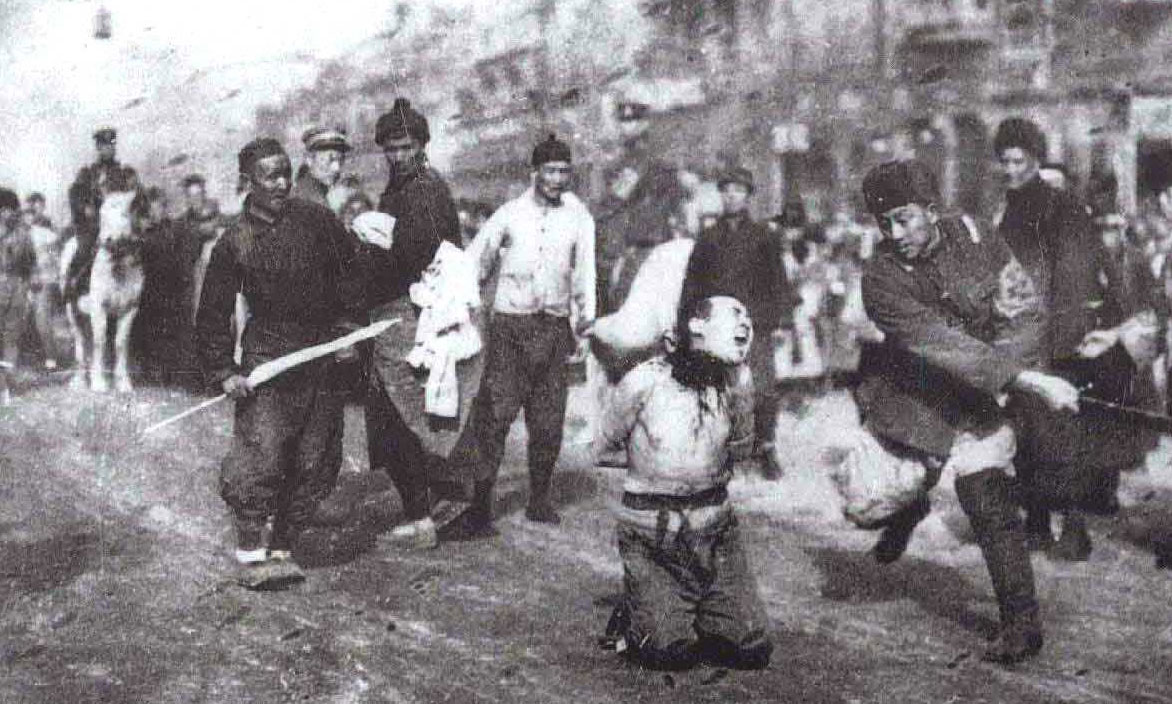
Being made to kneel and have your head sliced off with a scimitar was a standard punishment for all sorts of crimes. As the empire crumbled and was subject to countless rebellions small and large across its vast territory, their suppression and punishment required an astonishing number of Chinese to chop each others’ heads off.

The Mandarin in charge of suppressing the Taiping Revolt in Canton boasted of having beheaded 100,000 rebels (p.22). During the 1911 revolution the new governor of Sichuan had his predecessor decapitated and rode through the streets brandishing his head (p.121).

Arms tied behind their backs, forced to kneel in big public gatherings, then head sliced off with a ceremonial sword

Arms tied behind their backs, forced to kneel in big public gatherings, head sliced off with a ceremonial sword. The Chinese way.

Resistance to change

I was staggered by the absolute, dead-set determination from top to bottom of Chinese society to set its face against modernisation, industrialisation, liberalisation, democracy and all the other new-fangled ideas from the West, which it so despised. From 1850 to about 1980, all Chinese governments were determined to reject, deny, censor and prevent any incorporation of corrupt, decadent, capitalist Western ideas and techniques.

As John Keay remarked in his history, a central characteristic of the Chinese is an ingrained superiority complex – their leaders, from the emperor to Chaing Kai-shek to Mao, just know that China is the centre of the world and is superior to the whole of the rest of the world, all evidence to the contrary notwithstanding.

Fenby describes the late-imperial world as ‘a system which was not designed to accommodate, let alone encourage, change’ (p.38.) As the late 19th century reformer Li Hongzhang admitted in 1884:

‘Affairs in my country have been so confined by tradition that I could not accomplish what I desired.’ (p.41)

The first railway in China, built by the British in Shanghai, was bought by the local council who had the rails torn up and the station turned into a temple. Railways interfered with feng shui and local customs, they brought in foreign devils. Like every other western innovation – i.e. like every single aspect of the modern world – they were resisted hammer and tongs by Chinese at all levels. As an edict from the Guangxu Emperor’s Hundred Days’ Reform put it, China was afflicted by:

‘the bane of the deeply-rooted system of inertness and a clinging to obsolete customs.’ (p.67)

Reformers were always in a minority, within the court itself, let alone in a country overwhelmingly populated by illiterate peasants. Which explains why it took China about 100 years – from the 1880s when it began to grasp some of the implications of capitalism – until well into the 1980s, to even begin to implement the basics of economic and technological reform.

Fenby’s immensely detailed picture takes account of the endless war, violence and conflict China was caught up in. But what comes over most strongly is the way Chinese of all ranks and levels of education didn’t want it – western ‘democracy’, ‘free speech’, competition, egalitarianism, innovation, entrepreneurism, disruptive technologies.

没有! Méiyǒu! NO!

Foreign devils

Rana Mitter’s book about the China-Japanese war contains a surprising amount of anti-western and anti-British feeling and he frequently refers to the ‘unequal treaties’ of the nineteenth century between European powers and a weakened China, but since his book is about the war of the 1930s, he doesn’t give a lot of detail.

Fenby’s book by contrast covers exactly the period of ‘unequal treaties’ (where European countries took advantage of China’s weakness to get her to sign away rights to trade, to give foreigners legal immunity from any kind of wrongdoing, handed European countries entire treaty ports like Hong Kong and Macau) gives a lot more detail, and really drills home why the century from 1840 to 1940 was a period of sustained national humiliation for the Chinese – it is in fact known as ‘the century of humiliation’ or ‘the hundred years of national humiliation’.

Basically, Westerners imposed an unceasing stream of treaties designed, initially, to create special trading cantonments on the coast, but which one by one encroached further inland, ensured Westerners were exempt from Chinese law (in effect, free to do what they wanted) and could force trade with the Chinese on unfavourable and biased terms.

Moreover, there were so many foreign nations each scrambling to get a piece of the action in China – most obviously trading basic commodities but also competing for the broader opportunities which opened up later in the 19th century, for example, building railways or setting up banks.

I hadn’t realised how many western countries queued up to get their slice of the action. I knew about the usual suspects – Britain with its powerful navy, and France encroaching up from its colony down in Indo-China i.e. Vietnam-Laos. But Bismarck’s unification of Germany in the 1870s announced the arrival of a new, more brutal competitor who was determined not to miss out in either Africa or China.

And Fenby makes clear that, more than all the others, the Chinese feared neighbouring Russia because of its steady expansion into Manchuria and the North of China:

The British, French and Germans were a constant irritant, but the Tsarist empire and its communist successor represented a much greater territorial threat to China. p.31

And above all, the Chinese should, of course, really have been most scared of Japan, another ‘divine empire’, which turned out to be by far its worst destroyer.

I was startled when Fenby gives the process the overall title ‘the Scramble for China’, since this is a term usually reserved for the European ‘Scramble for Africa’ – but as he piled example on example of the countless unequal trading deals, the intimidation of Chinese authorities with gunships and punitive armed raids by European armies, I came to realise how true it was, how carved up, humiliated and exploited China became – and so why getting rid of foreigners and foreign influence came to be such a dominating strand in the mindset of early 20th-century Chinese intellectuals and revolutionaries.

'China - the cake of kings and emperors' French political cartoon by Henri Meyer (1898)

‘China – the cake of kings and emperors’ French political cartoon by Henri Meyer (1898)

The ratcheting effect

A key element of the unequal treaties was the way each of the European nations was able to out-trump the others… and then all the others demanded parity. Some German missionaries were harmed in a remote province? Germany demanded reparations and increased trading rights. At which the British, French, Russians and Americans all demanded a similar ratcheting up of their rights and accessibility. Some British merchants were attacked in Canton? The British sent in gunboats, demanded reparations and the rights to entire industries – and all the other European nations then demanded parity or they’d send in their gunboats.

So it went on with an apparently endless ratcheting up of the legal and commercial privileges and the sums of cash demanded by the rapacious Europeans.

Unequal treaties

  • 1839 to 1842 The First Opium War leading to the 1842 Treaty of Nanjing – granted an indemnity and extraterritoriality to Britain, the opening of five treaty ports, and the cession of Hong Kong Island
  • 1844 The Treaty of Whampoa between France and China, which was signed by Théodore de Lagrené and Qiying on October 24, 1844, extended the same privileged trading terms to France as already exacted by Britain
  • 1845 The Treaty of Wanghia between China and the United States, signed on July 3, 1844 in the Kun Iam Temple.
  • 1856 to 1860 The Second Opium War pitting the British Empire and the French Empire against the Qing dynasty of China.
  • 1858 – British attack on Canton after Chinese sailors were arrested aboard a ship carrying the British flag. British houses were burned and a price put on the heads of foreigners. British forces secured Canton. British and French forces attacked Tienjin, the coastal area east of Beijing. The westerners marched on Beijing and burned down the emperor’s Summer Palace (1860), among the looters being Charles Gordon, later to make his name at Khartoum. In the final peace treaty the allies were paid a large indemnity, trading concessions and Russia was given 300,000 square miles of territory in the far north!
  • 1884 to 1885 The Sino-French War, also known as the Tonkin War, in which the French seized control of Tonkin (northern Vietnam).
  • 1895 Treaty of Shimonoseki ending the first Sino-Japanese war cedes to Japan Taiwan, the Pescadores islands and the Liaodong Peninsula, along with an indemnity of 16.5 million pounds of silver as well as opening five coastal ports to Japanese trade.

Fenby’s account makes vividly and appallingly clear the treadmill of endless humiliation and dismemberment which educated Chinese felt their country was being remorselessly subject to. And the hypocrisy of the Western nations who went on about ‘democracy’ and ‘human rights’, while all the time lining their pockets and showing no morality whatsoever.

Western advantages

All that said, the Chinese needed the West and Fenby (thankfully) paints a nuanced and complex picture. Just as not all Chinese were pigtailed ignoramuses, so not all Westerners were hypocritical exploiters. A shining example is Robert Hart, an Ulsterman from a poor family, who rose to become the head of the China’s Customs Service, just one of many Westerners employed by the imperial court for their (Western) knowledge and expertise. Hart ran the service from 1863 to 1911 and transformed it from a corrupt, antiquated and inefficient sinecure into a well-run organisation which ended up being one of the main contributors to imperial finances. He became a byword for honesty and dependability, and was awarded a number of China’s highest honours.

Hart’s story reminds us that it is a complicated world, then as now, and that many Westerners made significant contributions to China, establishing a range of businesses, banks, building railways, developing areas of the economy. If there was a lot of shameful gunboat diplomacy, there was also a lot of genuine collaboration and contribution.

Fleeing to the West

It is also notable the number of times that native Chinese reformers, dissidents, disgraced court officials and so on fled to the European ports to find sanctuary. Here they found law and order, cleanliness and hygiene which, if not perfect, were vastly superior to the dirt, zero plumbing and violence of their native China.

In 1912, as revolutionary violence swept China, many members of the Imperial court took refuge in the foreign compounds. After the Tiananmen Square ‘Massacre’ of June 1989, as many of the student leaders as could manage it fled abroad, most ending up in America, for example prominent student leader Chai Ling who went on to head up a successful internet company. Plus ca change…

The Japanese

‘As we entered the town of Port Arthur, we saw the head of a Japanese soldier displayed on a wooden stake. This filled us with rage and a desire to crush any Chinese soldier. Anyone we saw in the town, we killed. The streets were filled with corpses, so many they blocked our way. We killed people in their homes; by and large, there wasn’t a single house without from three to six dead. Blood was flowing and the smell was awful. We sent out search parties. We shot some, hacked at others. The Chinese troops just dropped their arms and fled. Firing and slashing, it was unbounded joy. At this time, our artillery troops were at the rear, giving three cheers [banzai] for the emperor.’
– Diary of Japanese soldier, Makio Okabe, describing the capture of Port Arthur, November 1894

Multiply this several million times to get the full impact of what it meant to be a neighbour of Imperial Japan in the first half of the twentieth century: Korea, Manchuria, mainland China all benefited from Japan’s goal of building a glorious Asian empire. This is described at great length in Rana Mitter’s history of the China-Japanese war and there are regular scenes of such stomach-churning violence as to make you want to throw up your last meal.

Maoist madness

The madness of the Mao Zedong era is described in my reviews of Frank Dikotter’s book:

But Fenby dwells at length on the paranoia and crazed whims of the Great Helmsman, with results that eclipse the horrors of the late Qing Empire. The famine which resulted from his Great Leap Forward policy (1958 to 1962) resulted in anything from 30 to 55 million deaths. And that’s before the separate category of deaths actively caused by the security forces implementing their brutal policy of forced collectivisation. Madness on an epic scale.

Plus ça change…

Countries are like people, they rarely change. The modern history of Chinese history is a fascinating case study. Again and again Fenby points out that certain patterns of behaviour recur and recur, the most notorious being the attempt to impose reform of Chinese society from the top, reform which threatens to get out of hand, and then is harshly repressed, followed by a period of harsh control. As predictable as a, b, c.

Thus his description of a) the attempted reforms of the Guangxu Emperor in 1898, which b) began to get out of hand c) were brought to an abrupt halt by the power behind the throne, the Dowager empress Cixi, eerily pre-echo a) Mao’s unleashing of revolutionary change from above in the Cultural Revolution b) which by the 1970s even the Mad Helmsman realised was getting out of hand and c) so he repressed.

Or the way the a) very mild liberal reforms begun by Deng Xiaoping in the 1980s led to b) the unpredictable outburst of student protests in Tiananmen Square which the party hierarchy tolerated for a few weeks before c) brutally suppressing it. a, b, c.

To this day the rulers of China daren’t institute anything like real democracy because they know the chaos they would unleash, they remember the history of the Warlord Era, indeed the terrifyingly violent 20th century history history this book describes. Maybe such a vast and varied terrain, containing so many ethnicities and levels of economic development, can still only be managed by a really strong central authority?

And the more you read and learn about the Chinese history of the past century – the more you sympathise with them. Fenby’s long and gruelling narrative ends with the repeated conclusion that China’s rulers are as repressive as ever – indeed, given the arrival of the internet, they are able to practice surveillance and social control of their populations which previous dictators could only have dreamed of.

And yet they are all too aware that they are sitting astride a bubbling cauldron of vast social inequality, political corruption, popular resentment, ethnic division (most obvious in Tibet and Xinjiang but present among a hundred other ethnic minorities), and the pressures and strains caused by creating a dynamic go-head 21st century economy controlled by a fossilised, top-down, 20th century Leninist political structure.

This is an extraordinarily insightful and horrifying book. Anybody who reads it will have their knowledge of China hugely increased and their opinion of China and the Chinese irreparably damaged.


Other reviews about China