Pesellino: A Renaissance Master Revealed @ the National Gallery

The Renaissance artist Fancesco Pesellino (about 1422 to 1457) was successful and famous in his day. Whether producing commissions for Florence’s ruling Medici family or working collaboratively with leading artists of the Italian Renaissance, Pesellino’s talents were hugely sought after during his lifetime.

However, Pesellino died young and this, combined with the difficulty of attributing works (many have been attributed to collaborators or to his grandfather, who had the same name) has meant that his legacy has been largely overlooked, making him ‘one of the greatest Renaissance painters that few people have heard of’.

This FREE exhibition at the National Gallery aims to rectify this neglect. It brings together 20 or so of Pesellino’s works across a range of media, including altarpieces, chest decorations, sketches and illuminations.

Central to the exhibition (all held in just one dazzling room) are two masterpieces from the National Gallery collection: the Pistoia Trinity altarpiece (1455 to 1460), and the newly restored ‘Stories of David’ cassone panels (about 1445 to 1455).

The Pistoia Santa Trinità Altarpiece by Francesco Pesellino, Fra Filippo Lippo and Workshop (1455 to 1460) © The National Gallery, London. Royal Collection Trust / © His Majesty King Charles III 2022

The curators write:

The ‘Pistoia Trinity Altarpiece’ is one of only two large-scale altarpieces Pesellino is known to have produced. Left unfinished at his death, it was completed in the workshop of Filippo Lippi, for whom Pesellino had completed a predella for the Novitiate chapel in Santa Croce 15 years earlier and who added the predella, or base. This is the earliest pala (an altarpiece with a single main panel) in the National Gallery.

The altarpiece is an ambitious depiction of the Trinity, the Christian doctrine of one God in three persons, the Father, Son and Holy Spirit (represented as a dove). Pesellino designed and partly painted the main panel. In the 18th century, the altarpiece was sawn up to make independent paintings for sale. Individual pieces arrived in Britain incrementally and were later acquired and reassembled by the National Gallery. The lower right section is a modern reconstruction.

Biography

Francesco di Stefano was born into a family of painters in Florence in about 1422. ‘Pesellino’ is a diminutive of his grandfather’s nickname, Pesello (‘the pea’). His grandfather was a specialist in banners and festive ephemera who taught him the rudiments of painting. Pesellino likely received further training from leading masters in the city. Early in his career, Pesellino often worked in collaboration, both with established painters on major commissions and on smaller projects alongside his peers. By his late twenties he was already undertaking commissions for high-ranking clergy and Florence’s ruling elite.

Pesellino devised lucrative profit-making schemes in partnerships with fellow artists and set his sights
on becoming a specialist in painting altarpieces. The exhibition includes templates of popular subjects he created for other artists to copy, such as the Madonna and child.

His ambitions were cut short in the hot summer of 1457, when Florence was ravaged by plague. He died leaving his most ambitious work to date, the Pistoia Trinity altarpiece, unfinished. It was eventually completed by his elder contemporary and one-time collaborator, Fra Filippo Lippi.

Narrative paintings

The show emphasises Pesellino’s skill at narrative or storytelling in paint. His range is indicated by some of the painting titles (the first four are scenes painted at the base of the Pistoia Santa Trinità Altarpiece, above):

  • Saint Mamas in Prison thrown to the Lions*
  • The Beheading of Saint James the Great*
  • Saint Zeno exorcising the Daughter of the Emperor Gallienus*
  • Saint Jerome and the Lion*
  • The Stigmatism of Saint Francis and Miracle of the Black Leg
  • A Miracle of Saint Silvester

Obviously, most of these paintings are religious in tenor, depicting scenes from the Old Testament, New Testament or Legends of the Saints. An example of the legend category is the striking painting of ‘King Melchior Sailing to the Holy Land’.

King Melchior Sailing to the Holy Land by Francesco Pesellino (1445 to 1450) © Sterling and Francine Clark Art Institute, Williamstown, Massachusetts

The curators explain:

A fleet of vessels carrying colourfully dressed crews navigates an impossibly short stretch of water, the shorelines dotted with walled cities. The seascape is fantastical, but with carefully observed naturalistic details like the foamy spray around the boats and pink undersides of the clouds at sunrise. Enthroned at the stern of the largest ship, Melchior travels to pay homage to the new-born Jesus, bringing a casket of gold. The panel was part of a series Pesellino made in collaboration with other artists. Some of the faces reveal the hand of another painter.

Three things struck me about this painting. One was the childlike clumsiness and lack of perspective. The main ship is much too huge for the tiny bit of sea it’s wedged into, the little rowboat in front of it looks silly, the dog at bottom right is poorly done, the tiny monk hiding in the rock at the bottom is a bit absurd.

Second was the extraordinary simplicity of the landscape: the rocks at the bottom and bottom right, the headlands and hill further up, are ridiculously simplified; they look like the polystyrene rocks from an episode of Star Trek.

But what really his me is how bright and vivid the colours are. The red and yellow striped awnings over the stern of each ship look like children’s sweet wrappers. Almost everyone’s clothes are painted in super-vivid shades of blue, green and red. The whole affect is almost day-glo.

Compare and contrast with a work which has a completely different feel, a diptych (two paintings in adjacent frames) of The Annunciation.

Diptych: The Annunciation by Francesco Pesellino (about 1450 to 1455) The Courtauld, London. Photo by the author

This feels completely different from the Melchior painting: the perspective is accurate and effectively conveys the sense of the colonnade on the left and room on the right. And the realistic depiction of the folds of the angel’s and the virgin’s cloaks. But above all the subtle use of shading, on the cloaks and on the walls (e.g. behind the virgin) give it a completely different feel from the Melchior. It feels warm and intimate and sophisticated.

Illuminations

Off to one side and easy to miss is a set of three beautiful illuminations Pesellino made for a book.

Three illuminations from the De Bellum Poenicum of Silius Italicus by Francesco Pesellino (1447) being: Allegory of Carthage, Mars in a Chariot and Nicholaus V Pontifex-Maximus, courtesy of the State Hermitage Museum St Petersburg, the Biblioteca Marciana Venice, and the State Hermitage Museum, respectively

As the curators explain:

A milestone in Pesellino’s career was the illuminated manuscript he made for Pope Nicholas V. He again worked in collaboration, this time with the established miniaturist Zanobi Strozzi, a fellow Florentine. The partnership was probably a calculated means of advancing his reputation. Together they produced a lavish volume of the Roman poet Silius Italicus’s epic about the Second Punic War (218 to 201 BCE).

Pesellino’s full-page illuminations show allegorical figures, ancient generals, the Roman god Mars and a portrait of Pope Nicholas himself. With their exuberant colour and animated drawing, these miniatures embody his aptitude for grandeur and dynamism on a small scale. They also indicate the heights that Pesellino had reached by the age of just 25. Whether commissioned by Nicholas himself, or perhaps given to him by a member of the Florentine elite, the volume was apparently a successful calling card. Pesellino subsequently received further commissions from the papal court.

Restoration of David

The Pistoia Santa Trinità Altarpiece is the biggest thing in the show – it is huge and dominates the whole room – but it’s not really the centrepiece. That role falls to the two wide, narrow panels depicting the ‘Stories of David.’ In fact, from what I can make out, it’s the recent completion of conservation work on the panels which provided the peg for this whole display.

The Story of David and Goliath: panel 1 by Francesco Pesellino (about 1445 to 1455) © The National Gallery, London

To quote Wikipedia: ‘A cassone or marriage chest is a rich and showy Italian type of chest, which may be inlaid or carved, prepared with gesso ground then painted and gilded.’

Pesellino created two of these cassoni and both are given the full treatment here. They are displayed next to each other along with picture labels which explain the origin and purpose of the paintings, and then identify individual people and elements in each painting.

The panels illustrate the Old Testament story of David and Goliath. The first panel shows three successive episodes in the same frame, something which takes a moment to get used to. Over on the left young David is leaning over to select a stone for his sling. Just right of centre, right of the prancing white horse, he is shooting the sling at big Goliath who dominates the right-hand side. And then in the centre, just below the prancing white horse, is depicted David gruesomely sawing Goliath’s head off.

The second panel shows the triumphant procession of David, accompanied by a boisterous entourage, bearing Goliath’s head back to his local town where he is greeted by elders and a clutch of toothsome young ladies (far right).

The Story of David and Goliath: panel 2 by Francesco Pesellino (about 1445 to 1455) © The National Gallery, London

There are hundreds of talking points but four things stood out for me.

1) How incredibly packed and dense they are, huge crowds, scores of people and animals in all kinds of poses. Their arrangements have dramatic and psychological impact. For example, silly though it sounds, I really liked the scene on the right of panel 2 where half a dozen fresh-faced young men are being welcomed back to the town by a group of lovely young women. They both, young men and women, look so happy, so young and fresh and full of life. It gave me a moment of pure loveliness.

2) As the commentary points out, Pesellino very obviously tested his technical abilities by depicting, especially animals, in unusual poses; hence several horses with their bottoms towards us (for example, next to the fallen Goliath in panel 1) and the dogs facing away from us in panel 2.

3) As regular readers of my blog know I rather dislike the Italian Renaissance. This is based primarily on the feeling the drought-ridden, barren rocky backdrops give me, bereft of plants, flowers or life. I much prefer the contemporaneous art of the Northern Renaissance. A good example of this sterile barrenness is the simple-minded ‘landscape’ of the Melchior painting. By complete contrast, these panels show in great detail the grass everyone is treading on, and that it is sprinkled with flowers. It has the lovely feel for nature I associate with more northern paintings. For this reason alone I loved it.

4) Lastly, the gold! An extraordinary amount of the picture has been painstakingly gilded with gold leaf. Off to one side of the panels is a TV monitor showing a 4-minute video which is hugely instructive. Silent, using close-ups and written captions, it takes you into the secrets which were revealed during the panels’ extensive restoration work. Above everything they showcase the ubiquity in every part of the paintings of gold leaf – X-ray photography shows that about a third of the images is golden. But the video also showcases the astonishing attention to detail given to every feather, every head-dress and countless pieces of armour.  I was dazzled by the use of splashes of tiny dots which create a shimmering highlight on the golden sections.

Pesellino carefully applied gold and silver leaf, sometimes in tiny pieces, to describe items as small as horse shoes. These details were then burnished, incised, punched and sometimes glazed to create shimmering effects.

The display cases feature magnifying glasses to help you pick out the thousand and one details and marvel at the intricacy of the metalwork. Amazing.

Detail from The Story of David and Goliath: panel 2 by Francesco Pesellino. Note 1) the dogs done from an odd perspective 2) young men and women on the right and 3) intricately worked gold everywhere © The National Gallery, London

It’s 50 years since the David panels were displayed side by side like this and it’s a marvel and a delight. They emphatically demonstrate ‘the depth and breadth of Pesellino’s talents as a painter of complex narratives, ceremonial splendour, animals and intricate detail,’ just as the curators claim.

Thoughts

I wasn’t expecting to enjoy loads of religious paintings very much but was entranced. The annunciation and the illuminations are lovely, but I got really absorbed in the David panels, especially after watching the video which opened my eyes to the gilding technique and the amazing detailing throughout. The more you look, the more you see.

Giorgio Vasari, the Renaissance artist and biographer, included Pesellino in his Lives of Artists, writing that, ‘From what we know of him, if he had lived longer, he would have achieved much more than he did’. One of art history’s great might-have-beens.


Related links

More National Gallery reviews

Three Men on the Bummel by Jerome K. Jerome (1900)

I wish this book to be a strict record of fact, unmarred by exaggeration…

What is ‘the Bummel’?

Deliberately, but oddly, the book doesn’t explain what a Bummel is until the very last paragraph, where J, the narrator, writes:

‘A “Bummel”,’ I explained, ‘I should describe as a journey, long or short, without an end; the only thing regulating it being the necessity of getting back within a given time to the point from which one started. Sometimes it is through busy streets, and sometimes through the fields and lanes; sometimes we can be spared for a few hours, and sometimes for a few days. But long or short, but here or there, our thoughts are ever on the running of the sand. We nod and smile to many as we pass; with some we stop and talk awhile; and with a few we walk a little way. We have been much interested, and often a little tired. But on the whole we have had a pleasant time, and are sorry when ’tis over.’

Bummel is a German word, appropriately enough since the book describes a cycling tour around Germany. The American edition of the novel avoided this obscurity by being titled simply Three Men on Wheels.

Is Three Men on The Bummel a sequel to Three Men in a Boat?

Sort of. It was published in 1900, eleven years after his most famous work, Three Men in a Boat and features the exact same three characters – ‘J’ the narrator, George and Harris – 11 years further on, when two of them (J and Harris) have gotten married and had children.

What is it about?

It opens in the same way as Boat, with the same three chaps chatting and realising they need a break from their everyday lives. They consider hiring a boat for a sea cruise but remember various disasters when they’ve tried that before, at which point Harris suggests a cycling tour of Germany.

So if the twin narrative frames of Boat were the nature of boats and boating and descriptions of the River Thames and its surrounding towns and cities, the parallel frames in Bummel are comic meditations on the nature of cycling and descriptions of the Germany towns, cities and countryside which they pass through.

What was the bicycling craze?

The 1890s saw an outburst in the popularity of cycling. It was partly due to technical developments in 1880s which made bikes much easier to ride than the former, penny farthing, model, namely the invention of the ‘safety bicycle’ with its chain-drive transmission whose gear ratios allowed for smaller wheels without a loss of speed and then the invention of the pneumatic (inflatable air-filled) bicycle tire which made the whole experience significantly smoother, partly the ongoing development of mass manufacturing process which made bikes much more affordable.

So the two books have this in common: Boat was written to capitalise on the new fashion for pleasure boating on the Thames in the 1880s, and Bummel to capitalise on the 1890s fad for cycling.

(It’s worth noting that the up-and-coming young novelist H.G. Wells was one among many other authors who sought to take advantage of the new craze, publishing his light-hearted bicycling novel, The Wheels of Chance in 1896, between his two heavyweight science fiction classics, The Island of Doctor Moreau (1896) and The Invisible Man (1897).)

To quote a useful (American) blog on the subject:

The bicycling craze swept the nation in the 1890s, with insatiable demand keeping nearly 2,000 manufacturers in business. Numerous manuals were published to instruct riders on road etiquette, proper breathing and riding technique, and accident prevention. Sometimes referred to as steel horses, bikes were a cheaper, faster, and more adaptable means of transportation that fostered both self-reliance and sociability. Earlier uncomfortable and unsafe models transformed into safety bicycles featuring cushion and pneumatic tires, coaster brakes, and most importantly a drop frame that was easier for women to mount and navigate.

Which makes it all the stranger that there is actually almost no description at all of the actual bikes. We are told there’s one single bike and tandem, and that’s that. We’re not even told how they carry luggage and such; presumably it is sent ahead by train or somehow, but none of this is explained.

‘What bicycle did you say this was of yours?’ asked George.
Harris told him. I forget of what particular manufacture it happened to be; it is immaterial.
(Chapter ten)

But of course, it would have been of considerable interest, to keen cyclists in his own day and ever since.

Why is Three Men on the Bummel a disappointment?

I remember reading the Bummel immediately after the Boat 30 years ago and being disappointed. Three reasons:

1. Bachelors carefree

When they were young bachelors they could do anything. They expected and forgave each other for their irresponsible antics, and so did the reader. The situation is transformed now they are family men and fathers. What is attractive in a 25 year old just starting a career feels immature in a 35 year old father.

2. Family men tied down

Families add complexity. I admit to being confused by the entire first chapter of this book, confused about where it is set and who is speaking and who is related to whom. The second sentence is:

At this moment the door opened, and Mrs. Harris put her head in to say that Ethelbertha had sent her to remind me that we must not be late getting home because of Clarence.

Only in the next chapter did I firmly grasp that Ethelberta is J’s wife, Mrs Harris is Harris’s wife (could have been his mother) and – I’m still not sure, but think that Clarence must be J’s son. Anyway it took a bit of effort to figure out who was who and what was going on and effort is not what you want from a comic novel.

All this is in complete contrast to the opening of Boat where the setting is immediately clear and comprehensible: the three chaps are in someone’s apartment thinking about holidays and this segues into the brilliant extended passage about J’s hypochondria. The opening of Boat gripped me; the opening of Bummel confused and irritated me.

3. Cycling tour more random that a journey upriver

But by far the most obvious reason why Bummel is less engaging than its predecessor is the setting. Boat follows a lazy boat trip along the River Thames, which, in itself, is packed with meaning and resonances and associations, historical, nautical and – to those of us who grew up or lived by the Thames – personal. Whatever flights of fancy ‘J’ indulges in, the narrative always returns to the simple, central plot of them slowly rowing or towing their way up the Thames. The very simplicity of the central theme is what allows for such wild and fanciful digressions.

Whereas a cycling holiday around Germany has at least 2 problems:

1. It is by its nature random; they could be going anywhere for any reason, there’s nothing compelling, there is no deeper logic to the narrative.

2. They could be anywhere. Next to none of its English readers, then or now, have any idea where the Black Forest or Hanover or Mecklenburg are. Whereas Boat had the deep, almost archetypical logic of the route of the ancient river Thames, Bummel appears random and capricious. It may have many scenes of comedy as intense and fantastical as the previous book, but it lacks the slow steady underlying structure.

4. Less funny

Sorry, but the simple fact of the matter is that a lot of Jerome’s comic digressions and sketches in this book are just less funny than in Boat.

5. Sometimes serious

See the section below, about Mensurs.

Is it any good as a guide book?

No. I won’t give an exhaustive plot summary because there isn’t a lot of plot. There’s a rough itinerary of their progress around Germany but, even more so that Boat, it’s really just a pretext for a steady supply of digressions and comic tales, some short, some extending for 5, 6 or more pages.

Suddenly, with no mention of the sea crossing, they are in Hamburg, which is not described at all; a sentence later they are in Hanover.

There is an extended passage at the start of chapter 5 where the narrator describes his experiences working on a cheap periodical designed to convey ‘useful information’ on a huge range of topics to its naive readers, the titbits, snippets and advice in question generally having been cut and pasted out of cheap encyclopedias. (Presumably this genuinely funny passage was based on Jerome’s extensive experience as the editor of The Idler magazine, 1892 to 1897, and then of To-Day, 1893 to 1898.)

J tells a story about how a little boy misused a piece he wrote for the magazine about manufacturing hydrogen to cause a small explosion to comically justify why he made the editorial decision that BUmmel should contain no useful information whatsoever.

There will be no useful information in this book…nothing in the nature of practical instruction will be found, if I can help it, within these pages…There will be no description of towns, no historical reminiscences, no architecture, no morals…Lastly, in this book there will be no scenery.
(chapter 5)

This is quite funny as a comic conceit, but it strips away what might have been a useful structure to the text, not so much guide-book useful, but useful in creating some kind of narrative structure. Without even the pretence of trying to be useful, it really does become a long series of anecdotes, reminiscences, comic scenes and observations, many of which are funny, but it lacks the underlying imaginative punch or force or coherence which you want from a book.

Does it at least give their itinerary round Germany?

Up to a point. Although once they actually manage to get clear of England (which they only manage to do by chapter 6 of this 14-chapter book, so that almost half the book is digressive preamble), the first part of the ensuing travelogue is often little more than a name, a brief description, and then some extended comic digressions. Thus the text mentions Hamburg, Hanover, Berlin, Dresden, Prague, Nuremberg, Carlsbad, Stuttgart, Carlsruhe, Baden, which they seem to have travelled between exclusively by train. There is some guide book-style content. Here’s a taste:

Stuttgart is a charming town, clean and bright, a smaller Dresden. It has the additional attraction of containing little that one need to go out of one’s way to see: a medium-sized picture gallery, a small museum of antiquities, and half a palace, and you are through with the entire thing and can enjoy yourself.

Brief and pithy, and then it’s off on another comic anecdote. His deflating comments on Berlin are interesting:

Berlin is a disappointing town; its centre over-crowded, its outlying parts lifeless; its one famous street, Unter den Linden, an attempt to combine Oxford Street with the Champs Elysée, singularly unimposing, being much too wide for its size; its theatres dainty and charming, where acting is considered of more importance than scenery or dress, where long runs are unknown, successful pieces being played again and again, but never consecutively, so that for a week running you may go to the same Berlin theatre, and see a fresh play every night; its opera house unworthy of it; its two music halls, with an unnecessary suggestion of vulgarity and commonness about them, ill-arranged and much too large for comfort.

So when does the actual cycling come in?

It is only in chapter ten (of this 14-chapter book) when they arrive in Baden that, as the narrator puts it, ‘we started bicycling in earnest’, from which the reader deduces that all the previous destinations have been little more than tourist visits, with the bikes mostly consigned to the baggage car of trains.

It is here in Baden, that they finally start the actual cycling holiday.

We planned a ten days’ tour, which, while completing the Black Forest, should include a spin down the Donau-Thal, which for the twenty miles from Tuttlingen to Sigmaringen is, perhaps, the finest valley in Germany…

But:

We did not succeed in carrying out our programme in its entirety.

As far as I can tell the cycling part of the tour takes them from Baden and features Todtmoos, Waldshut, ‘through Alt Breisach and Colmar to Münster; whence we started a short exploration of the Vosges range’, Barr and St Ottilienberg.

Comic moments, sometimes

Patriotism

Harris is inclined to be chronically severe on all British institutions… George, the opposite to Harris, is British to the core. I remember George quite patriotically indignant with Harris once for suggesting the introduction of the guillotine into England.
‘It is so much neater,’ said Harris.
‘I don’t care if it is,’ said George; ‘I’m an Englishman; hanging is good enough for me.’

The disastrous sea cruise

The long, long story about the time J and his wife hired a boat for a sea cruise and the extreme laziness of the captain, which dominates chapter 2, I found almost completely unfunny. Similarly, there was a long passage about the narrator’s fictional Uncle Podger and the mayhem he causes in his house every time he leaves for work, which wasn’t a patch on the brilliantly funny description of the same Uncle Podger trying to hang a picture on the wall in Boat.

The hose fight

There is a funny description of Harris getting involved in a fight with a man who was hosing down the road outside Hanover and splashed a pretty woman cyclist, which leads to general mayhem.

German kisses

George visits a shop to buy a cushion (Kissen) but by mistake asks for a kiss (Kuss) leading the shop girls to collapse in fits of giggles, though not the reader.

Prague, windows and guides

Having read a very long book about the Thirty Years War recently, which starts with the Defenestration of Prague in 1618, when the disgruntled Protestant estates threw two royal governors out of a window of the Hradčany Castle, I appreciated his joke that the history of Prague would have been much more peaceful if only they’d their houses and castles ‘possessed windows less large and temptingly convenient.’

In Prague they hire a guide for the day who takes them all round town and doesn’t stop talking in a rough mix of German and Slavonic. It is only late in the day they realise that almost he’s been saying hasn’t been elaborate descriptions of historic architecture but has a prolonged sales pitch for a patent hair restorer lotion the man has invented.

It is interesting that Jerome comments on the fierce enmity between German-speaking and Czech-speaking populations of Prague. Guides tell them not to speak German in certain parts of the city or they’ll get beaten up. This reinforces the prolonged explanation of the ethnic animosity given in Ernst Pawel’s excellent biography of Franz Kafka who was 7 years old when this book was published.

German law and order

Jerome has an extended comic disquisition on the German mania for order.

Your German likes his view from the summit of the hill, but he likes to find there a stone tablet telling him what to look at, find a table and bench at which he can sit to partake of the frugal beer and ‘belegte Semmel’ he has been careful to bring with him. If, in addition, he can find a police notice posted on a tree, forbidding him to do something or other, that gives him an extra sense of comfort and security.

And:

In Germany there is no nonsense talked about untrammelled nature. In Germany nature has got to behave herself, and not set a bad example to the children. A German poet, noticing waters coming down as Southey describes, somewhat inexactly, the waters coming down at Lodore, would be too shocked to stop and write alliterative verse about them. He would hurry away, and at once report them to the police. Then their foaming and their shrieking would be of short duration.

German regulations

And, naturally enough, for a (sort of) travel book set in Germany, the book has many passages describing the national character and especially the complicated nature of their laws. For example, none of our heroes appreciate the fact that you need not one but three tickets to travel on a train: one for general train travel, one for travel on a particular train, and one to specify whether you are seated or standing. George ignores this and related rules and is fined a hefty sum.

Our heroes are arrested

On the same theme of Order and Rules, the narrator is arrested because he takes a bicycle off a train which is just about to depart the station which he mistakenly believes is George’s. Only when he catches up with George does he realise George has his bicycle and the one the narrator has taken is some innocent German’s. He turns to see the train steaming out the station. He tries to stash it inconspicuously but is spotted by a typically officious German official. He only escapes actual prison because he happens to know a well-placed official in the town (Carlsbad) who testifies to his good character.

All of which leads to reflections on the ‘frequency with which one gets into trouble here in Germany’ and he gives a comic list of German bylaws. In Germany:

  • you must not wear fancy dress in the streets
  • you must not feed horses, mules, or donkeys, whether your own or those belonging to other people
  • you must not shoot a crossbow in the street
  • you must not ramble about after dark ‘in droves’
  • you must not throw anything out of a window
  • you must not joke with a policeman: it is treating them with disrespect
  • you must absolutely positively not walk on the grass
  • you must sit on the correct benches provided, marked for adults or for children
  • you must not leave your front door unlocked after ten o’clock at night, and you must not play the piano in your own house after eleven

Not very enticing, is it? ‘Go for a relaxing holiday in Germany and get arrested for laws you didn’t even know existed!’ is not a very convincing tourist slogan.

In Germany there is no law against a man standing on his head in the middle of the road; the idea has not occurred to them. One of these days a German statesman, visiting a circus and seeing acrobats, will reflect upon this omission. Then he will straightway set to work and frame a clause forbidding people from standing on their heads in the middle of the road, and fixing a fine. This is the charm of German law: misdemeanour in Germany has its fixed price.

German prams

Or take the humble pram. Apparently the Germans had a world of laws regarding what you may or may not do with a perambulator, which he cheerfully describes in all their absurdity, concluding, with typically Jeromian mischief:

I should say that in Germany you could go out with a perambulator and get into enough trouble in half an hour to last you for a month. Any young Englishman anxious for a row with the police could not do better than come over to Germany and bring his perambulator with him.

The deceptions of advertising

Plenty of contemporaries noticed and complained about the explosion in advertising during the 1890s and 1900s, in magazines, newspapers and increasingly intrusive hoardings. Jerome takes the mickey out of posters which very deceptively make cycling look wonderfully easy and relaxing and contrasts it with the often very hard work of puffing up a steep hill in Germany.

Generally speaking, the rider is a lady, and then one feels that, for perfect bodily rest combined with entire freedom from mental anxiety, slumber upon a water-bed cannot compare with bicycle-riding upon a hilly road. No fairy travelling on a summer cloud could take things more easily than does the bicycle girl, according to the poster.

Cycling and women’s liberation

Interestingly, Jerome confirms the comments of social historians I’ve been reading that bicycling amounted to a real social revolution and, in particular, liberated women, giving them an entirely new mobility, and, as a result, transforming the freedom of young couples to ‘date’ far from the eyes of their parents.

Occasionally the poster pictures a pair of cyclists; and then one grasps the fact how much superior for purposes of flirtation is the modern bicycle to the old-fashioned parlour or the played-out garden gate. He and she mount their bicycles, being careful, of course, that such are of the right make. After that they have nothing to think about but the old sweet tale. Down shady lanes, through busy towns on market days, merrily roll the wheels of the ‘Bermondsey Company’s Bottom Bracket Britain’s Best,’ or of the ‘Camberwell Company’s Jointless Eureka.’.. And the sun is always shining and the roads are always dry. No stern parent rides behind, no interfering aunt beside, no demon small boy brother is peeping round the corner…

And in the final chapter, where he delivers an extended review of the German character circa 1900, Jerome makes a special place for the German version of the New Woman sweeping Europe:

The German woman…is changing rapidly—advancing, as we call it. Ten years ago no German woman caring for her reputation, hoping for a husband, would have dared to ride a bicycle: to-day they spin about the country in their thousands. The old folks shake their heads at them; but the young men, I notice, overtake them and ride beside them. Not long ago it was considered unwomanly in Germany for a lady to be able to do the outside edge. Her proper skating attitude was thought to be that of clinging limpness to some male relative. Now she practises eights in a corner by herself, until some young man comes along to help her. She plays tennis, and, from a point of safety, I have even noticed her driving a dog-cart.

The insular English

In several places he satirises the English for their complete and utter failure to learn any foreign language, to get quickly exasperated with any foreigner who is dim enough not to speak fluent English, and the tendency of the English not to simplify their language when dealing with a foreigner, but to repeat the same thing, in difficult idiomatic English, but louder, a phenomenon I have observed countless times.

‘It is very disgraceful,’ I agreed. ‘Some of these German workmen know hardly any other language than their own.’

Taken alongside his comparison of the English and German education systems (the German infinitely superior) shows how some cultural stereotypes (the English are badly educated and useless at languages, the Germans are excellently educated and speak English among other languages, fluently) just never change.

German student duelling clubs

There’s some lovely frivolity in the cycling chapters, but the entire book ends with some unexpectedly serious thoughts. Jerome describes at length German student duelling societies which he candidly considers disgusting and squalid. They were expensive to join and the sole purpose was to spend time in a greasy dirty room with one opponent and two seconds, both your bodies well protected but your faces exposed to the slashes of heavy broadswords. The aim was to acquire as many impressive cuts as possible, which were then tended by not very competent student doctors and result in extravagant scars, in faces ‘cut and gashed, which prove your manliness and social status and are much desired by eligible young ladies. It was ‘a cruel and brutal game’.

Jerome describes the entire culture as being as inexplicable to outsiders but making perfect sense to insiders, as being as compelling to insiders, as bullfighting in Spain or fox hunting in England. But Jerome doesn’t find it at all funny. He thinks it brutalises both participants and arouses in onlookers ‘nothing but evil’.

Jerome on German character

Jerome had a good understanding of Germany. Soon after the the cycling trip the book was based on, he took his wife and children to live in Dresden for two years. When the First World War broke out 12 years later, Jerome made himself unpopular by speaking out against the torrent of anti-German propaganda the conflict unleashed in the press. When the many jokes wear off, you are left pondering his descriptions of the Germans as a nation obsessed with orders and regulations, over-willing to take instructions from every policeman or military officer.

Individualism makes no appeal to the German voter. He is willing, nay, anxious, to be controlled and regulated in all things… The German citizen is a soldier, and the policeman is his officer. The policeman directs him where in the street to walk, and how fast to walk. At the end of each bridge stands a policeman to tell the German how to cross it. Were there no policeman there, he would probably sit down and wait till the river had passed by. At the railway station the policeman locks him up in the waiting-room, where he can do no harm to himself. When the proper time arrives, he fetches him out and hands him over to the guard of the train, who is only a policeman in another uniform. The guard tells him where to sit in the train, and when to get out, and sees that he does get out. In Germany you take no responsibility upon yourself whatever. Everything is done for you, and done well. You are not supposed to look after yourself; you are not blamed for being incapable of looking after yourself; it is the duty of the German policeman to look after you.

And with an officer class trained at university in the enjoyment and infliction of disfigurement and pain.

We prate about our civilisation and humanity, but those of us who do not carry hypocrisy to the length of self-deception know that underneath our starched shirts there lurks the savage, with all his savage instincts untouched…

And:

The German idea of it would appear to be: “blind obedience to everything in buttons.” It is the antithesis of the Anglo-Saxon scheme; but as both the Anglo-Saxon and the Teuton are prospering, there must be good in both methods. Hitherto, the German has had the blessed fortune to be exceptionally well governed; if this continue, it will go well with him. When his troubles will begin will be when by any chance something goes wrong with the governing machine. But maybe his method has the advantage of producing a continuous supply of good governors; it would certainly seem so…

Or not.

Summary

After a clumsy start, and some long, not very funny stories set in England and/or involving wives, the book gets more interesting when it actually gets to Germany in chapter 6, and, in my opinion, really blooms when they finally get to the actual cycling holiday bit in chapter 10.

A final thought is the odd tonal imbalance in Jerome, or the overlapping of historical periods. What I mean is that his naughty schoolboy relishing of hi-jinks and breaking the law and getting into comedy fights is completely at odds with the stuffy, mutton chops side-whiskers mental image we have of Victorian men, it seems hugely more modern. One minute he’s describing the fight over the water hose, which sounds like utterly contemporary, the next he is talking about chaperones and how young ladies are supervised by their families in drawing rooms and dances which takes us right back to Victorian values.

And then there’s the fantastical Monty Python aspect. He begins a digression about how you find more breeds of dog in Germany than in England but almost immediately steps over a boundary into the fantastical and absurd.

George stopped a dog in Sigmaringen and drew our attention to it. It suggested a cross between a codfish and a poodle. I would not like to be positive it was not a cross between a codfish and a poodle.

Jerome’s signature note is not the ‘gentle Edwardian humour’ I associated him with before I reread these books, it is the continual schoolboy urge to push every comic conceit far beyond the bounds of reason, into the utterly surreal.

I do not know what the German breeder’s idea is; at present he retains his secret. George suggests he is aiming at a griffin. There is much to bear out this theory… Yet I cannot bring myself to believe that such are anything more than mere accidents. The German is practical…about a house, a griffin would be so inconvenient: people would be continually treading on its tail. My own idea is that what the Germans are trying for is a mermaid, which they will then train to catch fish.

Or:

Orchards exist in the Vosges mountains in plenty; but to trespass into one for the purpose of stealing fruit would be as foolish as for a fish to try and get into a swimming bath without paying.

This is the wonderfully fantastical Jeromian note and, at the end of the day Bummel is not as good as Boat because in the later book we hear less of it, it is often more strained and contrived, and, in the final chapter completely eclipsed by the extended meditation on the German character which can’t help but evoke dark thoughts of the terrible events which were to come.


Related links

Related reviews

Klimt / Schiele @ the Royal Academy

This exhibition is much more varied and interesting than the Royal Academy’s promotional material suggests. The main poster shows two female nudes with prominent nipples and, of the eight images further down the page, all but one are nudes, leading you to expect a festival of bottoms and boobs.

There certainly are plenty of nudes in the show, but there’s considerably more to it than that, and it’s the fuller, broader context which makes it so interesting and rewarding.

The pretext

Both Gustav Klimt (born July 1862) and Egon Schiele (born June 1890) died in 1918, Klimt 27 years older and much the more famous and successful figure, having developed a style which combined beautiful draughtsmanship with a fin-de-siecle and semi-symbolist fondness for placing his human figures within two-dimensional sheaths of glittering colours, most famously in 1908’s The Kiss. (Be warned: there is nothing this finished and this glamorous in this exhibition.)

The Kiss by Gustav Klimt (1908)

The Kiss by Gustav Klimt (1908)

Schiele was much under the older man’s influence throughout the 1900s (they first met in 1907) until around May 1910, when he himself realised he had broken through to find his own voice and style – basically Klimt unplugged, the same addiction to the human figure, to sensuous depictions of nudes, but with a ferociously modern, twisted, angular, abrasive sensuality.

To some extent, as the gallery notes make clear, this was the sensuality of poverty. Whereas Klimt ran a successful studio which won public commissions – painting complex ceiling schemes for grand buildings of Vienna’s Ringstraße, did a series of commissions for Vienna’s high society ladies and was married to Austrian fashion designer Emilie Louise Flöge who ran a successful fashion business, and so had access to all manner of sumptuous fabrics, in the latest designs, for his drawings and paintings – Schiele was barely 20 when he hit his stride, and lived in poorly furnished flats with a succession of ‘companions’, most of them even poorer than him, which is why so many of his women are wearing basic kit, stockings, a blouse, and not much else.

To mark the coincidental centenary of their deaths the Royal Academy has arranged to borrow 100 or so portraits, allegories, landscapes and erotic nudes by Klimt and Schiele from the Albertina Museum in Vienna, allowing visitors an amazing opportunity to see these powerful, skilled and stimulating works.

Six rooms

The exhibition is upstairs in the Sackler Wing of the Academy, and is divided into six rooms.

Room 1. Photos, early sketches and the Secession

Photos of Klimt as a middle aged man, in his trademark blue smock, early and very Victorian realist drawings. Next to early photos of Schiele adopting one of his art school poses.

Egon Schiele in Front of the painting ‘Shrines in the Forest’ (1915) by Johannes Fischer

Egon Schiele in Front of the painting ‘Shrines in the Forest’ (1915) by Johannes Fischer

This rooms explains Klimt’s rise to dominance of the Vienna art scene and his leadership of the ‘Secession’ of new young artists set up in 1897. There’s a Secession poster which Klimt designed, with a graceful image of Athena in 1903, next to the bitingly Expressionist picture of the selection board around a table which Schiele created for the 1918 Secession exhibition, after Klimt’s death.

Room 2. Klimt’s drawing process

This room is devoted to several sets or series of drawings Klimt made for grand allegorical projects. In 1894 he was commissioned to create three paintings to decorate the ceiling of the Great Hall of the University of Vienna and chose the subject of Philosophy, Medicine, and Jurisprudence. On display are a series of preparatory drawings for ‘Medicine’ which he conceived as a naked woman floating in space, feet towards us.

In 1902, Klimt finished the Beethoven Frieze for the Fourteenth Vienna Secessionist exhibition, and there are a number of sketches here for female figures. And several preparatory sketches for his 1905 oil painting, Three Ages of Woman, including a strikingly drawn naked middle-aged woman.

Standing older woman in profile (study for three Ages of Woman) by Gustav Klimt (1905)

Standing older woman in profile (study for three Ages of Woman) by Gustav Klimt (1905)

The most obvious thing about all the pieces in this room is none of them are coloured: they are literally just pencil drawings on paper. They allow you to examine and admire Klimt’s technique, and to understand better his interest in the surfaces and folds of the dresses his figures (almost all women) are wearing. But they lack all the exquisite finish and colour and golden luxuriance of his paintings.

It is, therefore, quite a shock and a pleasure to walk into the next room, which is packed with Egon Schiele’s vibrant colourful paintings.

Room 3. Schiele’s drawing process

You immediately notice that all the drawings in this room are coloured, very carefully and fully coloured. And I noticed that the strong angular outlines of Schiele’s figures are emphasised by often being drawn in black crayon as opposed to weak pencil. As if this wasn’t enough some of the most striking figures are outlined with a rough swathe of white gouache, which really makes them leap off the page. Exemplified in this nude.

Female Nude (1910) by Egon Schiele

Female Nude (1910) by Egon Schiele

Female nude also epitomises other Schiele traits:

  • the angularity of the anatomy – look at the painfully pointed hip and shoulderbone
  • the uncomfortableness of the pose – what’s happened to her right arm?
  • the attention to the hand which is long and heavily jointed, looking like a four-legged spider crawling up her side
  • the unashamed bluntness of the loins with their pubic hair
  • and the use of colour not so much to describe as to highlight and bring out the composition

The guide makes a central point:

Schiele frequently used watercolour and gouache in his works on paper, but rarely to create three dimensional modelling. Colour is employed expressively or as a graphic compositional device, similar to Klimt’s division of decorative surface pattern in his paintings.

Not all, but a number of the Klimt sketches in the previous room sketched in the face and body shape merely in order to allow him to create the characteristic series of whorls and geometric shapes across the fabric of women’s skirts and dress which obviously fascinated him. By contrast Schiele’s colours don’t even and smooth out, but create dramatic highlights which leap out of the image.

Not only is the shock of walking into this room like watching colour TV after black and white – it is also by far the most varied in subject matter.

Thus Schiele was arrested in April 1912 when a thirteen-year-old girl who had sought protection in the house he shared with his unmarried partner and model Wally Neuzil, was tracked down by her irate father. He was arrested on charges of seduction and abduction and ended up spending 24 days in Neulenbach prison before the case was dismissed. The exhibition displays five of the drawings and paintings he made during this brief incarceration, one is a full-body self-portrait, but four are of the interior of the prison and his cell. I liked the one of a chair with some handkerchiefs and a green scarf (?) draped over it.

Beside these were two striking and dynamic architectural studies of houses, showing how well Schiele’s strong black lines bring out the architectonics of anything, be it body or building. Alongside these a set of landscapes. I never knew Schiele painted landscapes, they tend to be eclipsed by the explicit nudes.

Field landscape (Kreuzberg near Krumau) 1910 by Egon Schiele

Field landscape (Kreuzberg near Krumau) 1910 by Egon Schiele

This reproduction doesn’t bring out how bright and vivid the greens of the field are. And next to these landscapes was a set of three drawings of chrysanthemums. Again, I had forgotten that Schiele made many flower studies.

White chrysanthemum by Egon Schiele (1910)

White chrysanthemum by Egon Schiele (1910)

Klimt may, for all I know, be the finer artist of the two, but in this exhibition, in this selection of their works hanging side by side, Schiele comes over as vastly more colourful, inventive, varied and dynamic.

Room 4. Klimt portraits

By the 1890s Klimt was a sought-after portrait painter for society ladies. He made his rich women appear tall, statuesque, elegant, often with fashionable dresses buttoned right up to the chin, and a carefully styled bouffant haircut. In the ten or so pencil drawings and sketches for portraits presented here, Klimt is obviously interested in the overall shape and, in some of them, the potential of the dresses to be turned into his trademark fantasias of geometric shapes and mosaics. This approach is exemplified in this study for the sumptuous portrait he eventually painted of Frau Fritza Riedler. Note the absence of eyes. it is the patterns and shapes of the dress which take up most of the space, with just enough outline of face to make it human.

Study for a painting of Fritza Riedler by Gustav Klimt (1904)

Study for a painting of Fritza Riedler by Gustav Klimt (1904)

The curators have artfully hung this eyeless sketch next to a penetrating study by Schiele of his younger sister, Gerti Schiele. You immediately see the difference: the brim of the hat and the ruff around her chest are confidently sketched in, but the rest of the body, for example her right arm, just tapers away. Schiele’s real interest is obviously in the intense black eyes of the sitter, which are staring right out at you.

They are hung right next to each other and looking from one to the other you realise that The Klimt is a design, whereas the Schiele is an intensely felt portrait.

Gerti Schiele by Egon Schiele (1911)

Gerti Schiele by Egon Schiele (1911)

Maybe the difference can be explained in terms of tradecraft – the Klimt sketches were never to be intended to be anything more than preparations, try-outs for what would be the very labour-intensive process of creating finished luxury paintings. By contrast, the Schieles are what they are, not many of them are preparations for paintings, they are pencil, crayon, gouache and watercolour works in their own right.

Maybe there’s a sociological explanation: Klimt could afford to make numerous preparations of expensive works for rich clients; Schiele never became that financially successful, so most of his portraits are of people he knew, models, lovers, friends and family, so they come out of more intimate and close relationships. Maybe that explains why almost all the Schiele knock you for six.

Room 5. Schiele portraits

This is really rammed home in the room devoted to Schiele portraits which, once again, demonstrates his versatility. There are one or two nudes but the emphasis is on his ability to capture the features and character of perfectly respectable, fully dressed citizens of Vienna. There’s a little set of portraits of middle-class men like Heinrich Benesch, the railway inspector who became an important collector of Schiele’s work.

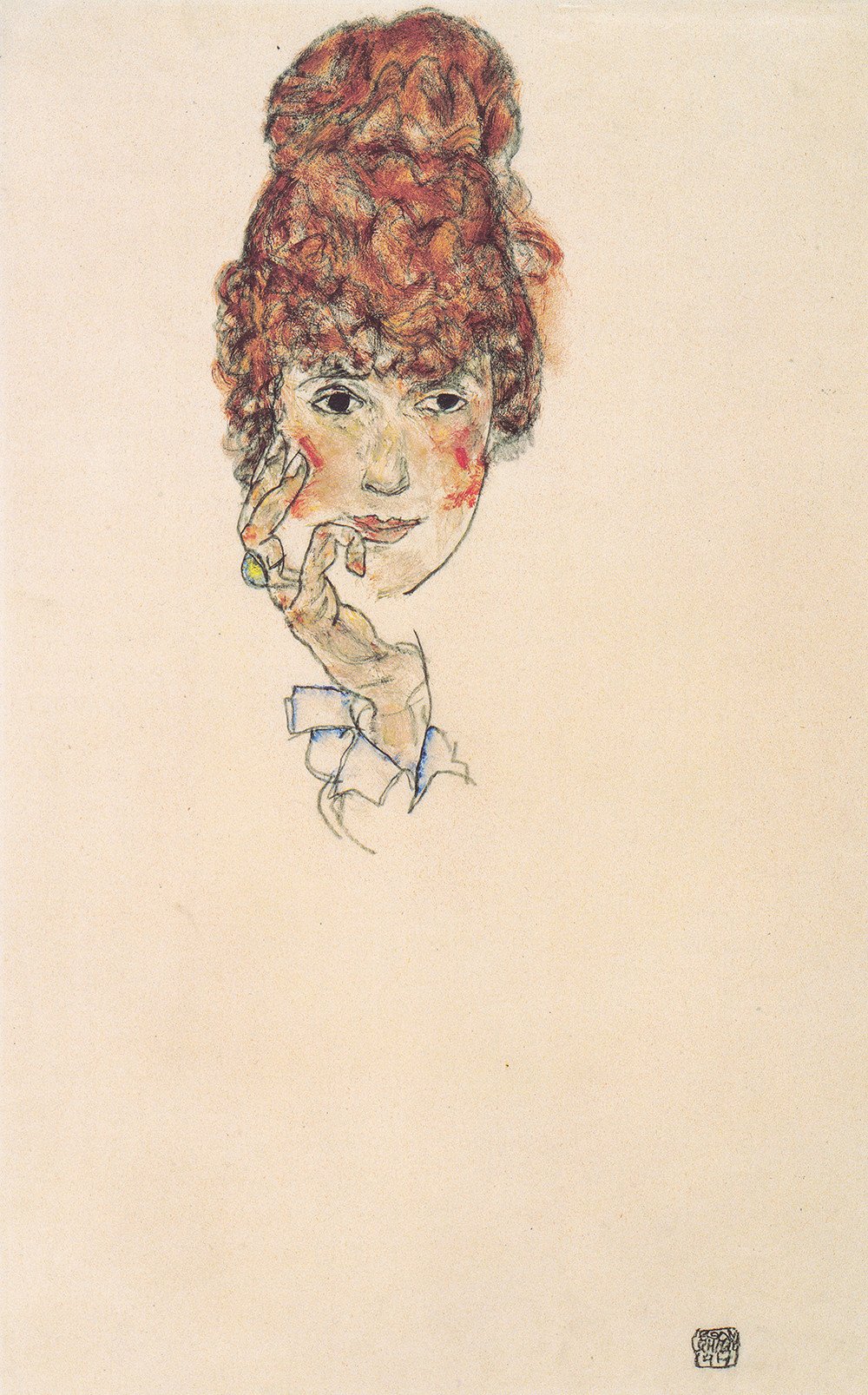
One wall displays a set of portraits of his family, including touching portraits of his sister, his mother and his father-in-law. Set amid these is a staggeringly evocative face of his wife, Edith Harms, who he married in 1914. The guide tells us a bit of gossip about their marriage, namely that nice, middle-class Edith insisted Schiele cut off all contact with his working class mistress and muse, Wally Neuzil. Seems cruel. Needs must. But what remains of Edith is Schiele’s staggeringly evocative portraits of her, like the one featured here. A face, hair, a hand – and an entire personality is before us. It is a staggering testimony to what art can do.

Edith Schiele by Egon Schiele (1917)Edith Schiele by Egon Schiele (1917)

Edith Schiele by Egon Schiele (1917)

Yet another aspect of Schiele’s vision is displayed across two walls of this room – his numerous, inventive and varied self-portraits. Klimt never did a self portrait in his life, Schiele did hundreds. Maybe, again, partly out of poverty. But mostly because, whereas the Symbolist, fin-de-siecle art of the 1890s reached beyond itself to some secret realm trembling on the brink of revelation, the Expressionist art of the 1910s explored the self, and the fracturing of the self, into anguished fragments.

It’s an oddity or irony of the German Expressionists that so many of them considered themselves spiritual leaders, heralding a great spiritual awakening of humanity – and yet, to us, so many of their paintings look hard, heavy and anguished. Same here, with Schiele – the commentary tells us that he identified with Francis of Assissi, wrote about the artist being a spiritual leader, gave his self-portraits titles like ‘redemption’ – and yet to us they seem to anticipate the acute and anguished self-consciousness of the twentieth century, which didn’t decline after Schiele’s death, but achieved new heights of neurotic panic after the Holocaust, the atom bombs and the spread of nihilism and existentialism across mid-century Europe.

It is that tormented self-consciousness which Schiele’s countless experimental self-portraits seem to communicate to us today, not songs about birds.

Nude Self-Portrait, Squatting (1916) by Egon Schiele. Pencil and gouache on packing paper. The Albertina Museum, Vienna

Nude Self-Portrait, Squatting (1916) by Egon Schiele. Pencil and gouache on packing paper. The Albertina Museum, Vienna

By no means all of these self-portraits are nude; the one above is the most naked and explicit. In many others he’s wearing clothes but posing in one of his characteristically agonised, ungainly stylised positions. This angularity prepares us for the last room.

Room 6. Erotic nudes

Bang! the room explodes with some of the most erotic paintings and drawings ever made. They are erotic because they are so candid. You feel like you are in the room, with a good-looking young woman who is happy to share her body with you, no shame, no false modesty, no recriminations. For me, at any rate, it’s this spirit of complete, unashamed, naked complicity which makes them emotionally or psychologically powerful.

Seated Female Nude, Elbows Resting on Right Knee (1914) by Egon Schiele. Graphite and gouache on Japan paper. The Albertina Museum, Vienna

Seated Female Nude, Elbows Resting on Right Knee (1914) by Egon Schiele. Graphite and gouache on Japan paper. The Albertina Museum, Vienna

But having looked carefully at all the works which precede them it is also possible to set aside their erotic charge altogether and consider them as compositions. In this respect the most successful of them vividly bring together features we’ve already noted:

  • the stylised pose, deliberately not classical, not a nude woman carefully standing so as to conceal her loins, but a real woman squatting, lying back with her legs open, gazing at the viewer, completely unembarrassed
  • the angularity of the anatomy – note the weirdly pointed hips, the visible ribs, the jagged angles around the shoulder, the accurate depiction of the lines made by the tendons of the inner thigh just next to the pubic hair, the pointed chin – the human figure as sharp angles
  • the use of colour not to describe naturalistically, but as expressive highlighting – much earlier Klimt had coloured the nipples of his nude paintings, but they were set amid an entire composition of gleaming rich colours: Schiele repeatedly uses the trick of painting the labia, nipples and lips a bright orange colour, on one level highlighting the erogenous zones, but on another making the figures almost into painted puppets, marionettes, an unsettling ambiguity

Note, also, the use of the colour green. By her breast, and armpit, and under her eyes and, the more you look at it, the more you see that Schiele has used that very unhuman colour, green, just touches and flecks of it, which… which do what, exactly? They make this woman’s body look a bit more emaciated than it already is: but the sparingness with which it’s used also makes you look closer, lean in, get drawn in.

Once I started looking, I noticed a very fleeting use of green in many of the nudes, creating just a hint of a kind of heightened, floodlit, hyper-vividness. There’s even green in the self-portrait wearing a yellow waistcoat. I’ve read scores of articles about Schiele and nudes and pornography and the male gaze and so on. It would be interesting to read just one good article about his very sophisticated use of colour.

Schiele’s nudes, hundreds of them, were notorious in his day and now are widely known and admired. I had no idea that Klimt did quite so many nudes and that, in their way, they are more sexually explicit. The wall opposite Schiele’s green-flecked nudes is covered with the detailed pencil drawings Klimt made of nubile young women naked and very blatantly masturbating.

In 1907 Klimt provided fifteen avowedly erotic drawings for a luxury edition of the Roman classic, Lucian’s dialogue of the courtesans. The title of one drawing – shown in the original pencil version and then as an illustration in a copy of the book which is on display here – says it all: Woman reclining with leg raised. She is lying on her back on a bed with one leg pulled up and back by her left arm while she is masturbating with her right hand. Art doesn’t come much more explicit than this. Although even when he’s being as rude as an artist possibly can be, it’s amusing that Klimt can’t stop himself drifting off to think about the decorative spots and patterns on the fabric she’s lying on (her dress? a blanket?)

Reclining nude with leg raised by Gustav Klimt (1907)

Reclining nude with leg raised by Gustav Klimt (1907)

The commentary suggests that, because Klimt’s nude women have their eyes closed they are somehow passive victims of the male gaze, whereas Schiele’s explicit female nudes generally have their eyes open and are often looking straight at the viewer – and so are therefore empowered, have agency etc – an issue of vital concern to female art curators.

I don’t think it’s quite that simple: it’s certainly not that a consistent rule, because some Klimt women have their eyes open and some Schiele women have theirs closed.

In my opinion the scholars are over-explaining something which is more obvious: not only Schiele’s female nudes but the male nudes and most of the fully-dressed portraits as well, are simply more powerfully drawn and more vividly coloured than any of the Klimt drawings on show here.

Klimt’s masturbating women may have their eyes closed, but more importantly (for me, anyway) – although they are just as explicit, in fact in the way they are actively masturbating, they are more explicit than the Schiele – nonetheless, they are drawn with much finer and paler lines, lines which almost fade away into nothingness, as the left leg of the model, above, dwindles from the heft of her buttock and hip down to a small foot which is merely an outline.

In other words, in my opinion, it is not the model, the human being depicted – it is Klimt’s technique or style which is passive and mute. As pencil drawings, the Klimt nudes in this final room are probably better, more accurate draughtsmanship, than the Schiele. But the Schiele erotic nudes, with their strong black outlines, weird angularities, piercing black eyes, and coloured highlights, are incomparably the more powerful and bracing works of art.

Video introduction to Schiele

By Tim Marlow, Artistic Director of the Royal Academy.

//player.vimeo.com/video/298238498


Related links

More Royal Academy reviews