Austerity Britain: A World to Build 1945–48 by David Kynaston (2007)

David Kynaston (b.1951) has written about 16 history books on broadly three topics: cricket, the City of London, and Britain after the Second World War. His post-war histories (to date; the plan is to take them up to 1979) have been published as three volumes, each of which – rather confusingly – contains two ‘books’:

Should one review the portmanteau volume – Austerity Britain (692 pages long in its current Bloomsbury paperback edition) – or the two ‘books’ it contains? I’ve chosen the latter option, because each of the ‘books’ is so dense and packed with information that they require separate posts.

Approach

What makes the books so delightful and addictive is that they are an oral history. Rather than the stats and graphs of an economic history, or the acts and votes of a political history, or the treaties and negotiations of a diplomatic history, Kynaston’s account quotes at length from diaries, letters, journals and accounts kept by the widest range of people alive during the period, as they react to events large and small, national, international and parochial.

Fairly regularly he stops to consider this or that ‘issue’ – rationing, nationalisation, town planning – in what you might call the traditional historical way, describing key publications or speeches in that area. But then he swiftly returns to the more gossipy main stream of his approach, to quote housewives, workers, local officials.

The result is to be led through the key events and debates of the period, but to see it overwhelmingly in human terms, in the words of the people who shed and led debate but also the reactions of the ordinary man and woman in the street.

Some of the voices

The Famous

  • Neil Kinnock, future leader of the Labour Party, aged 3 when the war ends in 1945
  • Patrick Stewart, 5, moved along by a policeman for singing outside a polling booth in 1945
  • Bill Wyman, bassist with the Rolling Stones, starts grammar school, 8
  • Glenda Jackson, aged 9 when the war ends, starts grammar school in 1947
  • Alan Bennett, 11, spent VE Day in Guildford
  • Kenneth Tynan, drama critic to be, now Birmingham schoolboy, 18
  • Humphrey Lyttleton, 24
  • ultra-royalist James Lees-Milne, diarist, architectural historian, worked for the National Trust, 36
  • Cyril Connolly, editor of Horizon literary magazine, 41
  • Noel Coward, playwright, aged 45
  • J.B. Priestley, novelist and radio broadcaster, 50
  • J.R.R. Tolkien, 53, commenting on the insanity of the atom bomb
  • Harold Nicholson, British diplomat, author, diarist and politician, 58
  • Violet Bonham Carter, Baroness Asquith of Yarnbury, politician and diarist, 58

There are hundreds more but this gives a flavour. Kinnock is quoted as remembering the prefab house his parents moved into. Bill Wyman remembers how going to grammar school in 1947 cut him off from his working class roots, though the boys at his new school teased him for being poor. Lees-Milne is very posh and quoted liberally throughout with his generally negative reactions to the Labour government.

Connolly, as a magazine editor and essayist, wrote reams of material, but Kynaston quotes him, fascinatingly, commenting on the way the great wall of left-wing / communist solidarity among artists, writers, poets and so on during the 1930s simply evaporated after the war and had quite disappeared by 1947. The problem was that they finally had a ‘socialist’ government and there wasn’t a man or woman in ‘the movement’ who wasn’t bitterly disappointed at the reality (p.235). The same sentiment is expressed by George Orwell, who in his long essay, The Lion and the Unicorn (1942), wrote confidently about the general public’s swing to the Left and the notion of central planning but, by 1946, had become disillusioned (pp.45, 173).

All this was exacerbated by the Berlin Airlift, the coup in Czechoslovakia, and the general start of the Cold War. I hadn’t realised that this led to actual legislation banning car carrying communists from public office, with the ruin of many a career.

There are also extensive quotes from key players in politics, from the diaries or letters or speeches of men like Clement Attlee (Labour Prime Minister), Hugh Gaitskell (Minister of Fuel and Power), Aneurin Bevan (Minister of Health overseeing the creation of the National Health Service), Ernest Bevin (Foreign Secretary who oversaw the independence of India, Israel etc), Herbert Morrison (Deputy Prime Minister), Stafford Cripps (Chancellor of the Exchequer).

Slowly you get a feel for their personalities, achievements and disagreements. Around them swim all kinds of minor figures, private secretaries, and MPs, and policy makers such as Michael Young, who wrote Labour’s 1945 manifesto (Let Us Face The Future), coined the term meritocracy and went on to play a key role in setting up the Consumer Association and the Open University.

The Obscure

Kynaston takes his lead from Mass Observation, set up in 1937 by three Cambridge graduates, anthropologist Tom Harrisson, poet Charles Madge and filmmaker Humphrey Jennings. Mass Observation aimed to:

record everyday life in Britain through a panel of around 500 untrained volunteer observers who either maintained diaries or replied to open-ended questionnaires (known as directives). They also paid investigators to anonymously record people’s conversation and behaviour at work, on the street and at various public occasions including public meetings and sporting and religious events. (Wikipedia)

Kynaston relies heavily on material from the M-O archive now held at the University of Sussex. This takes many forms. M-O carried out tailored surveys on specific issues throwing up statistical results of the numbers in favour or against particular policies. Their contributors often reported on conversations overheard on the street, on the buses or tube, at the theatre etc. And other contributors kept detailed diaries. The most famous of these was Nella Last (1889-1968), who wrote over two million words about everything she died, heard and observed, from 1939 to 1966, making her one of the single largest contributors to M-O.

But Kynaston quotes from a large number of other diarists and recorders, including:

  • Michael Burns, grew up in Tolworth
  • Lawrence Daly, coalminer
  • Alice ‘Judy’ Haines, a young married mother of two living in Chingford
  • Anthony Heap, a middle-aged local government officer from St Pancras
  • Mary King, retired teacher
  • Gladys Langford, deserted by her husband, living alone in the Woodstock Hotel
  • Ernest Loftus, headmaster of Barking Abbey School
  • Edith Palmer, ex-pat’s daughter, late-20s, arriving in England from Kenya
  • Mrs Michael Pleydell-Bouverie who spent three years on behalf of the Daily Mail speaking to ‘the Women of Britain’ about homes and housing
  • Kenneth Preston, a middle-aged English teacher at Keighley Grammar School
  • Marian Raynham, a housewife from Surbiton
  • Henry St John, son of a sweetshop owner, living in Bristol
  • Sir Raymond Streat, head of the Cotton Board
  • Rose Uttin, housewife from Wembley
  • Mrs Madge Waller

Post-war issues

So what do these people comment on and discuss? A huge array of issues and problems which faced Britain right from the moment war ended (Victory in Europe 8 May 1945, Victory in Japan and the final end of the war, 15 August). As stated, Kynaston is not a conventional historian of diplomacy or economics. Issues appear insofar as they impinged on the minds of his huge cast of Britons. None of them are pursued in detail and, after 300 pages, I realised that he rarely comes to a conclusion about any of them. Instead we are presented with a variety of opinions, from top politicians and expert down to housewives and coalminers – and then he moves on.

Domestic affairs

  • Rationing
  • The General Election 5 July 1945
  • The Labour government’s attempts to:
    • nationalise industry
    • set up a National Health Service (launched, after much struggles with the doctors, on 5 July 1948)
  • The housing crisis
  • Education  (everyone accepted the 11-plus, the division between grammar and technical schools, and nobody touched the public schools which were [and are], according to Kynaston, ‘the single most important source of political, social and economic privilege’, p.153)

International affairs

  • Surrender of Germany, suicide of Hitler
  • Atom bombs dropped on Japan
  • Berlin Blockade and airlift
  • June 1947 Marshall Plan
  • February 1948 communist coup in Czechoslovakia

But most of the people Kynaston quotes have little or no interest in international affairs. After initial relief that the war is over, and then shock at the revelation of the atom bomb, most people sink back into their customary indifference to international affairs (and to politics generally).

Britain might as well not have an empire at all. The independence of Israel and India/Pakistan are not mentioned. Decades ago I read the comment by the Trinidadian historian C.L.R. James, that the tragedy of the British was that all their history took place abroad – by which he meant in the empire.

One of the biggest aspects of the book is the way the British Empire is almost completely absent from it. The people Kynaston quotes are struggling to make ends meet, to find somewhere to live, find a job, and then find food to eat. He quotes a survey of 2,000 adults made in 1948 which revealed that only 49% could name a single British colony. The majority of those surveyed could not name a single British colony.

And so, since so few people knew or cared about the empire, Kynaston devotes much space to popular radio programmes (Woman’s Hour, first broadcast on 7 October 1946 on the BBC’s Light Programme, the popular comedy It’s That Man Again), to the very slow spread of television (only 50,000 sets in 1945). There is more about the Grand National than there is about Gandhi, more about Stanley Matthews (the footballer) than Stalin.

In this book nobody travels abroad (nobody can afford it) but plenty of people have a summer holiday at Margate or Morecambe or at Billy Butlin’s new holiday camps (first one at Skegness in 1936).

Kynaston gives us the results of the key test matches and FA Cup Finals for 1945, 46, and 47, as well as the Epsom Derby, and reports from greyhound races and boxing matches – while all kinds of high-minded middle-class commentators lament that the average working man seems more interested in a pint, a packet of fags and the sports results than he does about the Iron Curtain.

The intellectuals and the masses

This reflects what, for me, is the main impression of the book, which is the enormous divide between the relatively small educated liberal intelligentsia – the policy makers and politicians and thinkers and writers and architects and planners – and the vast majority of the population, still very working class, often illiterate or, as Kynaston puts it:

the profound cultural mismatch between progressive activators and the millions acted upon (p.267)

Kynaston shows how all of the 1945 Labour government’s policies were not just controversial but opposed by large number of people, even the working people the Labour Party claimed to represent. For example, efforts to pass laws guaranteeing the trade unions representatives on boards of the new nationalised industries (a policy followed in Germany) were rejected by the unions. Why? Because they preferred to negotiate wages from a position of freedom and strength (p.229) It was a mindset which, arguably, crippled British industry for generations.

Similarly, it is fascinating to read how many ordinary people (not just the usual suspects, Tory MPs and toff writers), really hard core working class people, were suspicious of, or actively against, the welfare state, the new system of national insurance and the National Health Service.

The gaping chasm between well-meaning left-leaning university-educated intellectuals and ‘the masses’ is probably best demonstrated in the area of housing. Vast amounts of Britain’s housing stock was destroyed by German bombing. But a fair percentage of what survived was desperately rundown slums, particularly in the industrial cities – London’s East End, Manchester, Birmingham, Glasgow and so on contained acres of slums, houses with no running water, gas or electricity, millions of people living with no indoor toilet.

The chasm comes about when the planners and architects put their heads together to solve the problem. There was debate and argument at all levels, but roughly speaking, people wanted houses with a little garden of their own, and the planners wanted to put them in blocks of flats. People wanted their bombed out city centres to be restored to how they were before the war. Urban planners and go-ahead young architects wanted, on the contrary, to demolish what old buildings were left, and create sweeping new town centres, dominated by pedestrian precincts and car parks, surrounded by ring roads. As he writes of the brave new plan devised to demolish and rebuild central Plymouth:

There was little or no local consultation, with all objections overruled. (p.36)

The opening of the book is devoted to arguments about how to rebuild Britain and, through the thicket of specific details about new schemes for Plymouth or Hull, one gets a really clear feel for the divide between those who know best what the people want, and the people themselves – not least, of course, because Kynaston’s whole book is devoted to the people’s voices. He quotes one of the founders of Mass Observation, Tom Harrison:

worried most by the way that planners and others associated with the matter talked as if they were winning over the general public when they were only winning over each other. He had never met any group of people who ‘scratched each other’s backs’ more than planners did. (p.47)

In Bristol the local retail association organised a poll which showed that only 400 were in favour of the new Broadmead shopping centre, while 13,000 opposed it. The planners ignored this and all other opposition, and went ahead and built it.

This Great Divide, this sense of a mass population profoundly alienated from their lords and masters, grows as the book progresses from the May 1945 General Election through to its end point, 5 July 1948, the day the National Health Service was inaugurated. Intellectuals at the time were agonisingly aware of it. Various papers and reports guesstimated that ‘the thinking minority’ ranged from 20% down to a mere 5% of the population (p.55). How could they break out of their bubble to really engage with the great unwashed (an expression coined around 1830 by the novelist Edward Bulwer-Lytton)?

Ronald

Maybe the single biggest surprise is the couple of pages devoted to the four months spent by American actor, Ronald Reagan at Elstree Studios making a war movie called The Hasty Heart (pp.314-315). Reagan was appalled by the filthy London smogs and rundown hotels, and – although he went out of his way to praise the director and all the other technicians he worked with – it was a grim first-hand sight of socialism in action which, in his view, amounted to stoppages dictated by the militant trade unions, six-hour queues at hospitals, gaunt impoverished passersby and mile after mile of slate-roofed council houses in the rain.

So far so anecdotal: but Kynaston goes on to say that Reagan himself, writing twenty years later in the 1970s, pointed to this trip to Britain – to seeing the ‘natural’ economic order of free markets replaced by rationing and state interference at every level, and the resulting lack of all basic facilities in a culture dominated by the petty tyrannies of trade union shop stewards and local government officials – as a defining moment in his journey to the Right.

So that, considering Reagan’s centrality to world politics during the 1980s and the role he played in the collapse of the Soviet Union, of communism, and even of full-blooded socialism as a viable political programme, there’s a case for saying that these few months in rainy Hertfordshire changed the history of the world.

General impoverishment

Kynaston devotes pages to political debates about Marshall Aid, about the end of Lend-Lease, about the currency crisis and devaluation of sterling, and so on.

But by far the biggest and most enduring subject of the book is RATIONING, the rationing of food and clothing, which not only continued after the war, but got worse, a lot worse. From the poshest in the land down to a variety of housewives, Kynaston’s quotes convey the sheer numbing crushing effect of days and months and year after year of shortages of meat, bacon, milk, sugar, butter, even of bread.

Demobbed soldiers, or visitors from abroad (including the American playwright Tennessee Williams), or British children arriving in Britain back from the colonies (Cliff Richard arriving from India in 1948, aged 8) all noticed how pale and underfed the population looked. For years after the war the gas supply was weak and the electricity was turned off at certain times of day. Witnesses like Harold Nicholson testify that even in the best London clubs, the food came in minuscule portions and was barely edible.

And then in February 1948 the population was afflicted by the coldest winter of the 20th century. Young Roy Hattersley remembers sledging down the middle of usually busy streets (p.199) but thousands of the elderly and the infirm died. And millions had to dig a path from their back doors to their outside toilets.

There are thousands of wonderful anecdotes, gems and insights throughout the book – but the predominating image is of impoverishment and endurance.

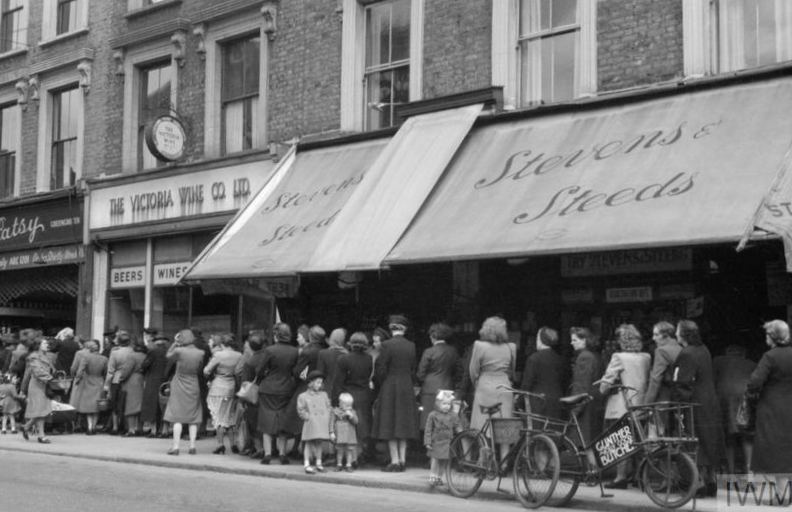
The queue for rationed food - symbol of post-war Britain

The queue for rationed food – symbol of post-war Britain

P.S. Obscure novelists

A lot of the people Kynaston quotes are, inevitably, writers, a self-selecting cohort since he is himself a writer dealing with written records which ‘writers’ dominate.

Your ears prick up at the famous ones (Graham Greene, Noel Coward, Doris Lessing) but he also introduces us to a cocktail party of less well-known writers from the period, a list which has the effect o making you realise how selective ‘literary history’ is, picking out the half dozen ‘serious’ writers from each era or decade, and letting plenty of other authors drop into obscurity.

It is one of the many many pleasures of the book to come across forgotten authors he mentions, and google them and toy with tracking down and reading their (mostly forgotten) works:

  • Ruby Mildred Ayres b.1881 – one of the most popular and prolific romantic novelists of the twentieth century
  • Ethel M. Dell b.1881 – author of over 30 popular romance novels
  • Naomi Jacob b.1884 – author and actress
  • Ivy Compton-Burnett b.1884 – novelist
  • Angela Thirkell b.1890 – author of a series of 19 novels set in Home Counties ‘Barsetshire’
  • James Lansdale Hodson b.1891 – journalist and novelist
  • Sylvia Townsend Warner b.1893 – novelist and poet
  • Elizabeth Bowen b.1899 – Irish novelist and short story writer
  • Mollie Panter-Downes b.1906 – novelist and writer of Letters from England for the New Yorker magazine
  • Pamela Hansford Johnson, Baroness Snow b.1912 – novelist, playwright, poet, literary and social critic
  • Denton Welch b.1915 – writer and painter
  • Sid Chaplin b.1916 coal miner who wrote novels about mining communities in the North-East
  • Joan Wyndham b.1921 – rose to literary prominence late in life through the diaries she had kept about her romantic adventures during the Second World War

Related links

To the Finland Station by Edmund Wilson (1940)

Edmund Wilson

Edmund Wilson (1895 to 1972) was one of mid-twentieth century’s great literary journalists and critics. (In her biography of Somerset Maugham, Selina Hastings describes Wilson as being, in 1945, ‘America’s most influential critic’, p.482)

Friends with F. Scott Fitzgerald, Hemingway and many other authors from that generation, he wrote extended essays on the French Symbolist poets, on T.S. Eliot, Proust, James Joyce and the classic Modernists, on Kipling, Charles Dickens, a study of the literature of the Civil War, memoirs of the 1920s and 30s, a book length study of the Dead Sea Scrolls, and much, much more.

Edmund Wilson in 1951

Edmund Wilson in 1951

His style now seems very old-fashioned, a leisurely, bookish approach which was long ago eclipsed by the new professionalism of academia and the blizzard of literary and sociological theory which erupted in the 1960s.

Most of Wilson’s books are not currently in print, and many passages in this book demonstrate the relaxed, belle-lettreist, impressionist approach – often more in love with the sound of its own rolling prose than with conveying any clear information – demonstrate why.

Though Marx has always kept our nose so close to the counting-house and the spindle and the steam hammer and the scutching-mill and the clay-pit and the mine, he always carries with him through the caverns and the wastes of the modern industrial world, cold as those abysses of the sea which the mariner of his ballad scorned as godless, the commands of that ‘eternal God’ who equips him with his undeviating standard for judging earthly things. (p.289)

That said, Wilson was an extremely intelligent man, more of a literary-minded journalist than an academic, capable of synthesising vast amounts of information about historical periods, giving it a literary, bookish spin, and making it accessible and compelling.

Some themes or ideas

To The Finland Station is Wilson’s attempt to understand the Marxist tradition, and its place in the America of his day i.e. the angry left-wing American literary world produced by the Great Depression of the 1930s. He began researching and writing the book in the mid-1930s as well-meaning intellectuals all across America turned to socialism and communism to fix what seemed like a badly, and maybe permanently, broken society.

Like many guilty middle-class intellectuals who lived through the Great Depression, Wilson went through a phase of thinking that capitalism was finished, and that this was the big crisis, long-predicted by Marxists, which would finish it off.

He was simultaneously attracted and repelled by the psychological extremism and religious fervour of communism. Even after actually visiting Russia and seeing for himself the poverty, mismanagement and terror as Stalin’s grip tightened, Wilson couldn’t eradicate this feeling. He tried to analyse its roots by going back to the intellectual origins of socialism – then reading everything he could about Marx and Engels – and so on to Lenin and the Russian Revolution. This book is a kind of diary of his autodidactic project.

The myth of the Dialectic

As Wilson prepared the book he realised that to understand Marx and his generation you need to understand Hegel – and he couldn’t make head or tail of Hegel, as his chapter on ‘The Myth of the Dialectic’ all too clearly reveals. He ends up comparing Hegel’s Dialectic to the Christian notion of the Trinity (Thesis, Antithesis and Synthesis as a kind of modern version of Father, Son and Holy Ghost) in a way that’s superficially clever, but ultimately wrong. To understand Hegel’s importance for Marx and the German thinkers of that generation you should read:

More telling is Wilson’s point that Marx invoked his version of Hegelianism to give a mystical, quasi-religious sense of inevitability, a pseudo-scientific rationale, for what was simply, at bottom, the burning sense of moral outrage (i.e. at poverty and injustice) shared by so many of his contemporaries.

Aesthetics in Marx

A later chapter dwells at length on Capital Volume One, pointing out that it is an aesthetic as much as an economic or political text, before going on to point out the ultimate inaccuracy of Marx’s Labour Theory of Value.

The Labour Theory of Value

Marx thought he had invented a new insight, that the value of a product is the value of ‘the labour invested in it’ – and that because the bourgeois owners of factories only paid their workers the bare minimum to allow them to live, they were thus stealing from the workers the surplus value which the workers had invested in the finished products.

This theory appeared to give concrete economic basis for the moral case made by trade unionists, socialists and their allies that capitalists are thieves. 

The only flaw is that there are quite a few alternative theories of ‘value’ – for example, as I’ve discovered whenever I’ve tried to sell anything on eBay, the ‘value’ of something is only what anyone is prepared to pay for it. In fact ‘value’ turns out to be one of the most tortuously convoluted ideas in economics, deeply imbricated in all sorts of irrational human drives (what is the ‘value’ of a gift your mother gave you, of your first pushbike, and so on?).

Wilson is onto something when he says that both the idea of the ‘Dialectic of History’ and the ‘Labour Theory of Value’ are fine-sounding myths, elaborate intellectual schemas designed to give some kind of objective underpinning to the widespread sense of socialist anger – but neither of which stand up to close scrutiny.

And although socialism or communism are meant to about the working class, Wilson’s book about Marx and Lenin, like so many others of its ilk, is a surprisingly proletarian-free zone, almost entirely concerned with bourgeois intellectuals and their highfalutin’ theories, with almost no sense of the experience of the crushing work regimes of capitalist industry, which were at the heart of the problem.

I’ve worked in a number of factories and warehouses (a Dorothy Perkins clothes warehouse, a credit card factory, the yoghurt potting section of a massive dairy) as well as serving on petrol pumps in the driving rain and working as a dustman in winter so cold the black binliners froze to my fingers. As in so many of these books about the working classes, there is little or nothing about the actual experience of work. The actual experience of actual specific jobs is nowhere described. Everything is generalisations about ‘History’ and ‘Society’ and ‘the Proletariat’ – which may partly explain why all attempts to put Socialism into action have been so ill-fated.

To The Finland Station

Wilson’s book is more like a series of interesting magazine articles about a sequence of oddball left-wing thinkers, often throwing up interesting insights into them and their times, always readable and informative, but lacking any theoretical or real political thrust. The book is divided into three parts.

Part 1. The decline of the bourgeois revolutionary tradition

I was deeply surprised to discover that part one is a detailed survey, not of the pre-Marxist socialist political and economic thinkers – but of the careers of four of France’s great historians and social critics, namely:

  • Jules Michelet (1798-1874) author of a massive history of the French Revolution
  • Ernst Renan (1823-1892) expert on Semitic languages and civilizations, philosopher, historian and writer
  • Hippolyte Taine (1828-1893) critic, historian and proponent of sociological positivism
  • Anatole France (1844-1924) poet, critic, novelist and the most eminent man of letters of his day i.e. the turn of the century and Edwardian period

Why? What’s this got to do with Lenin or Marx? It is only in the very last paragraph of this section that Wilson explains his intention, which has been to follow ‘the tradition of the bourgeois revolution to its disintegration in Anatole France’ (p.68).

Scanning back through the previous 68 pages I think I can see what he means. Sort of.

The idea is that Michelet came from a poor background, taught himself to read and study, and expressed in his sweeping histories a grand Victorian vision of Man engaged in a Struggle for Liberty and Dignity. He was heavily influenced by the memory of the Great Revolution, which he dedicated his life to writing about. Thus Michelet is taken as a type of the post-revolutionary intellectual who espoused a humanist commitment to ‘the people’. He provides a kind of sheet anchor or litmus test for what a humanist socialist should be.

Renan and Taine, in their different ways, moved beyond this humanist revolutionary vision, Renan to produce a debunking theory of Christianity in which Jesus is not at all the son of God but an inspired moral thinker, Taine embracing Science as the great Liberator of human society. Both were disappointed by the failure of the 1848 French Revolution and its ultimate outcome in the repressive Second Empire of Louis-Napoleon.

Anatole France, 20 years younger than Renan and Taine, was a young man during the Franco-Prussian War and the Commune. This turned him completely off revolutionary politics and steered him towards a dandyish appreciation of art and literature. France represents, for Wilson, a disconnection from the political life around him. He continues the trajectory of French intellectuals away from Michelet’s humane engagement.

Anatole France

Anatole France A Corpse

During the 1890s the Symbolist movement in art and literature continued this trajectory, moving the artist even further from ‘the street’, from the deliberately wide-ranging social concerns of a Michelet.

The Paris Dadaists moved even further away from the Michelet ideal, choosing the day of Anatole France’s funeral in 1924 to publish A Corpse, a fierce manifesto excoriating France for representing everything conventional and bourgeois about French culture which they loathed.

And the Dadaists morphed into the Surrealists who proceeded to turn their back completely on politics and the public sphere – turning instead to ‘automatic writing’, to the personal language of dreams, to the writings of people in lunatic asylums.

So Wilson’s point is that between the 1820s and the 1920s the French intellectual bourgeoisie had gone from socialist solidarity with the poor, via sceptical Bible criticism and detached scientific positivism, to dilettantish symbolism, and – in Dada and Surrealism – finally disappeared up its own bum into art school narcissism. It amounts to a complete betrayal of the humanist, socially-conscious tradition.

Now all this may well be true, but:

  1. It would have been good manners of Wilson to have explained that describing all this was his aim at the start of part one, to prepare the reader.
  2. It is odd that, although he takes a literary-critical view of the writings of Michelet, Taine et al, he doesn’t touch on the most famous literary authors of the century – for example, the super-famous novelists Balzac, Flaubert, Maupassant and Zola, to name a few.
  3. And this is all very literary – there is next to nothing about the politics or economics of the era (apart from brief mention of the revolutions of 1830, 1848 and 1870 as they affected his chosen writers). There is no historical, social, economic or political analysis. The whole argument is carried by a commentary on the literary style and worldview of the four authors he’s chosen, with no facts or figures about changing French society, industrialisation, wars, the rise and fall of different political parties, and so on.

So even when you eventually understand what Wilson was trying to do, it still seems a puzzling if not eccentric way to present an overview of bourgeois thought in the 19th century – via a small handful of historians? And why only in France? What happened to Britain or Germany (or Russia or America)?

Having made what he thinks is a useful review of the decline of bourgeois thinking of the 19th century, Wilson moves on to part two, which is a review of the rise of socialist thinking during the 19th century.

Part 2. The origins of socialism through to Karl Marx

You might disagree with his strategy, but can’t deny that Wilson writes in a clear, accessible magazine style. The opening chapters of this section present entertaining thumbnail portraits of the theories and lives of some of the notable pre-Marxist radical thinkers of the early 19th century, men like Babeuf, Saint-Simon, Fourier and Owen.

Wilson’s account of the large number of utopian communities which were set up across America in the first half of the century is particularly entertaining, especially the many ways they all collapsed and failed.

The Mormons

It is striking to come across the Mormons being described as one of the early American utopian communities. They were pretty much the only idealistic community from the era to not only survive but thrive, despite fierce opposition. As Wilson reviews the fate of the various utopian communities set up during the early nineteenth century, it becomes clear that the key to survival was to have a strong second leader to succeed the founding visionary. For example, all the communities which Robert Owen founded failed when he left because they were only held together by his strong charisma (and dictatorial leadership).Hundreds of Fourieresque communities were set up, flourished for a few years, then expired. The Mormons were the exception because when their founder, Joseph Smith, died (he was actually murdered by an angry mob) he was succeeded by an even stronger, better organiser, Brigham Young, who went on to establish their enduring settlement of Utah.

Babeuf

François-Noël Babeuf was a French political agitator during the French Revolution of 1789 who vehemently supported the people and the poor, founding a Society of Equals, calling for complete equality. As the bourgeois class which had done very well out of the overthrow of the king and aristocracy consolidated their gains during the period of the Directory (1795-99) Babeuf’s attacks on it for betraying the principles of the revolution became more outspoken and he was eventually arrested, tried and executed for treason. But his idea of complete equality, of everyone living in communes with little or no property, no hierarchy, everyone working, work being allotted equally, everyone eating the same, was to endure as a central thread of 19th century communism and anarchism.

Robert Owen

ran a cotton factory in Scotland, and focused in his writings the paradox which plenty of contemporaries observed – that the world had experienced a wave of technological inventions which ought to have made everyone better off – and yet everyone could see the unprecedented scale of misery and poverty which they seemed to have brought about.

Karl Marx

Young Karl Marx was just one of many thinkers determined to get to the bottom of this apparent paradox. The difference between Marx and, say, most British thinkers, is that Karl was drilled in the philosophical power of Hegel’s enormous Philosophy of World History.

Marx arrives in chapter five of part two and dominates the next eleven chapters, pages 111 to 339, the core of the book. Wilson gives us a lot of biography. Karl is the cleverest child of his Jewish-convert-to-Christianity father. He rejects advice to become a lawyer, studies Hegel, gets in trouble with the police and starts work as a newspaper editor.

Karl Marx

Karl Marx

Friedrich Engels

Through this newspaper Karl meets Friedrich Engels, who sends him articles to publish. Two years younger, handsome and full of life, Engels is sent by his father to supervise the family factory in Manchester, north-west England. Here Engels is appalled by the staggering immiseration of the urban proletariat, several families packed to a damp basement room in the hurriedly-built shanty towns surrounding Manchester, enslaved 12 hours a day in the noise and dirt of factories and, whenever there was a depression, immediately thrown out of work, whole families begging on the street, boys turning to theft, the girls to prostitution, in order to survive.

And yet when Engels talked to the factory owners – and he was a man of their class, an owner himself – all they saw was profit margins, capital outlay, money to be made to build big mansions in the countryside. Questioned about the lives of their workers, the owners dismissed them as lazy, shiftless, good-for-nothings. Engels was disgusted by their greed, selfishness and philistinism.

Traipsing the streets of the city, shown into the homes of hundreds of workers, awed by the scale of the misery produced by the technological marvels of the industrial revolution, Engels could see no way to reform this society. The only way to change it would be to smash it completely.

The hypocrisy of classical economists

As for contemporary British political and economic writing, it was a con, a sham, a rationalisation and justification of the rapacious capital-owning class. Adam Smith, David Ricardo and the rest of the so-called ‘classical’ economists merely provided long-winded rationalisations of exploitation. Smith said that the free market worked with a kind of ‘hidden hand’, a magic force which united people all over the globe in common enterprises, like the cotton pickers in America who supplied factories in Manchester to manufacture clothes which were then sold in India. Smith predicted that this ‘hidden hand’ of capitalism would, as if by magic, mean that, although everyone in society pursued their own interests, they would ineluctably be brought together by ‘the market’ to work together, to improve the lot of all, to create a balanced and fair society.

Well, Marx, Engels and anyone else with eyes could see that the exact opposite of these predictions had come about. British society circa 1844 was full of outrageous poverty and misery.

Marx meets Engels

These were the thoughts Engels brought when he met Marx in Paris in 1844. His ideas and his practical experience electrified the brilliant polymath and provided Marx with the direction and focus he needed. He set about reading all the British political economists with a view to mastering classical economics and to superseding it.

Although Wilson periodically stops to summarise the development of their thought and give a précis of key works, I was surprised by the extent to which this middle section about Marx was mostly biographical. We learn a lot about the squalid conditions of Marx’s house in Soho, about Engels’s ménage with the Irish working class woman, Mary Burns, and there are entertaining portraits of rival figures like Lassalle and Bakunin.

All this is long on anecdote and very thin on theory or ideas. Wilson tells us a lot more about Lassalle’s love life than the reason why he was an important mid-century socialist leader. I learned much more about Mikhail Bakunin’s family life in Russia than I did about his political theories.

Wilson is at pains to point out on more than one occasion that he has read the entire Marx-Engels correspondence – but makes little more of it than to point out how Engels’s natural good humour struggled to manage Marx’s bitter misanthropy and biting satire.

Friedrich Engels

Friedrich Engels

Swiftian insults

Wilson is happier with literary than with economic or political analysis, with comparing Marx to the great Anglo-Irish satirist Jonathan Swift, than he is trying to explain his roots in either German Hegelianism or economic theory. He repeatedly compares Marx’s misanthropy, outrage and sarcasm to Swift’s – passages which make you realise that bitterly anti-human, savage invective was core to the Marxist project right from the start, flowering in the flaying insults of Lenin and Trotsky, before assuming terrifying dimensions in the show trials and terror rhetoric of Stalinism.

Failures of theory

In the last chapter of the section Marx dies, and Wilson is left to conclude that Marx and Engels’s claim to have created a scientific socialism was anything but. Dialectical Materialism only works if you accept the premises of German idealist philosophy. The Theory of Surplus Labour doesn’t stand up to investigation. Their idea that the violence and cruelty needed to bring about a proletarian revolution will differ in quality from the violence and cruelty of bourgeois repression is naive.

There is in Marx an irreducible discrepancy between the good which he proposes for humanity and the ruthlessness and hatred he inculcates as a means of arriving at it. (p.303)

The idea that, once the revolution is accomplished, the state will ‘wither away’ is pitiful. For Wilson, their thought repeatedly betrays:

the crudity of the psychological motivation which underlies the worldview of Marx (p.295)

the inadequacy of the Marxist conception of human nature (p.298)

In a telling passage Wilson shows how happy Marx was when writing about the simple-minded dichotomy between the big, bad exploiting bourgeoisie versus the hard-done-by but noble proletariat in The Communist Manifesto and to some extent in Capital. But when he came to really engage with the notion of ‘class’, Marx quickly found the real world bewilderingly complicated. In the drafts of the uncompleted later volumes of Capital, only one fragment tries to address the complex issue of class and it peters out after just a page and a half.

Marx dropped the class analysis of society at the moment when he was approaching its real difficulties. (p.296)

Larding their books with quotes from British Parliamentary inquiries into the vile iniquities of industrial capitalism was one thing. Whipping up outrage at extreme poverty is one thing. But Marx and Engels’ failure to really engage with the complexity of modern industrial society reflects the shallowness and the superficiality of their view of human nature. Their political philosophy boils down to:

  • Bourgeois bad
  • Worker good
  • Both formed by capitalist society
  • Overthrow capitalist society, instal communist society, everyone will be good

Why? Because the Dialectic says so, because History says so. Because if you attribute all the vices of human nature to being caused by the ‘capitalist system’, then, by definition, once you have ‘abolished’ the ‘capitalist system’, there will be no human vices.

At which point, despite the hundreds of pages of sophisticated argufying, you have to question validity of the Marxist conception of both the ‘Dialectic’ and of ‘History’ as anything like viable explanations of what we know about human nature.

Marx’s enduring contribution to human understanding was to create a wide-ranging intellectual, economic and cultural framework for the sophisticated analysis of the development and impact of industrial capitalism which can still, in outline, be applied to many societies today.

But the prescriptive part of the theory, the bit which claimed that capitalism would, any day now, give rise inevitably and unstoppably to the overthrow of the capitalist system, well – around you. Look at the device you’re reading this on – the latest in a long line of consumer goods which have enriched the lives of hundreds of millions of ‘ordinary’ people around the world (the telephone, cheap cars, fridges, washing machines, tumble dryers, microwaves, radios, televisions, record players, portable computers, smart phones) invented and perfected under the entirely capitalist system of America which – despite a century of hopeful prophecies by left-wingers – shows no signs of ceasing to be the richest, most advanced and most powerful nation on earth.

As so many people have pointed out, the Great Revolution did not take place in the most advanced capitalist societies – as both Marx and Engels insisted that it inevitably and unstoppably must. Instead it came as, in effect, a political coup carried out in the most backward, least industrialised, most peasant state in Europe, if indeed it is in Europe at all – Russia.

Part 3. Lenin and the Bolsheviks

The final section of 123 pages goes very long on the biography and character of its two main figures, Lenin and Trotsky. (It is strange and eerie that Wilson describes Trotsky throughout in the present tense because, in fact, Trotsky was alive and well, broadcasting and writing articles when Wilson was writing his book. It was only later the same year that To The Finland Station was published, 1940, that Trotsky was assassinated on Stalin’s orders).

Thus I remember more, from Wilson’s account, about Lenin and Trotsky’s personal lives than about their thought. Lenin’s closeness to his elder brother, Alexander, images of them playing chess in their rural house, the devotion of their mother, the family’s devastation when Alexander was arrested for conspiring with fellow students to assassinate the Tsar, Lenin’s exile in Siberia and then wanderings round Europe – all this comes over very vividly.

I was startled to learn that Lenin lived for a while in Tottenham Court Road, where there was a longstanding centre for communist revolutionaries. Wilson also quotes liberally from the memoirs of Lenin’s wife, Nadezhda Krupskaya, about their trials and tribulations.

What comes over is that Lenin was good at lending a sympathetic hearing to working men and women, quick to make friends everywhere he went. Unlike Marx he didn’t bear rancorous grudges. Unlike Marx he didn’t have an extensive library and lard his books with literary references. Lenin was totally focused on the political situation, here and now, on analysing power structures, seizing the day, permanently focused, 24/7 on advancing the revolutionary cause.

Vladimir Ilyich Ulyanov, better known by the alias Lenin

Vladimir Ilyich Ulyanov, better known by the alias Lenin

Hence his 1902 pamphlet What Is To Be Done? Burning Questions of Our Movement addresses the practical problems of the communist movement at that specific moment.

I know a reasonable amount about the Russian Revolution itself. What I know less about and so fascinates me are the dog years between the death of Engels in 1895 and the Great War broke out in 1914. These were the years in which the legacy and meaning of Marxism were fought over by a floating band of revolutionaries, and in the meetings of the Second International, right across Europe, with factions splitting and dividing and reuniting, with leading communists bitterly arguing about how to proceed, about whether there would ever be a workers’ revolution and, if so, where.

Wilson brings out the constant temptation to so-called ‘bourgeois reformism’ i.e. abandoning the hope for a revolutionary transformation of capitalist society, and instead forming a democratic party, campaigning for votes and getting into the national parliament (in Britain, France, Germany, wherever).

This was the position of Edward Bernstein in Germany, who pointed out that the Social Democratic Party was having great success being elected and introducing reforms to benefit the working classes, building on the establishment of a welfare state, old age pensions and so on by Bismarck.

Reformists could also point to the way that the middle classes, far from being removed by the war between monopoly capitalists and an evermore impoverished proletariat, were in fact growing in numbers, that the working classes were better off, that all of society was becoming more ‘bourgeois’ (p.382).

This, we now know, was to be the pattern across all the industrialised countries. A large manufacturing working class, frequently embittered and given to strikes and even the occasional general strike, was to endure well into the 1970s – but the general direction of travel was for the middle classes, middle management, for ‘supervisors’ and white collar workers, to grow – something George Orwell remarks on in his novels of the 1930s.

The vision of an ever-more stark confrontation between super-rich capitalists and a vast army of angry proletariat just didn’t happen.

Lenin was having none of this bourgeois reformism. Wilson calls him the watchdog, the heresy hunter of orthodox Marxism. He turns out pamphlets attacking ‘reformism’ and ‘opportunism’. In Russia he attacks the ‘Populists’, the ‘Legal Marxists’, in books like Materialism and Empirio-Criticism (1908) (p.384).

His 1902 pamphlet What Is To Be Done? Burning Questions of Our Movement attacks Bernstein and bourgeois opportunists. What is to be done is that the working classes can never get beyond trade union level of political activity by themselves – they need to be spurred on by a vanguard of committed professional revolutionaries. People like, ahem, Comrade Lenin himself.

The same thinking was behind the creation of the ‘Bolsheviks’. At the Second Congress of the Social Democrats in summer 1903 some delegates brought forward a motion that the party should let concerned and sympathetic liberals join it. Lenin vehemently opposed the idea, insisting that the party must remain a small, committed vanguard of professional revolutionaries. When it came to a vote Lenin’s view won, and his followers became known as the majority, which is all that Bolsheviki means in Russian, as opposed to the Mensheviki, or minority. But over time, the overtones of majority, the masses, the bigger, greater number, would help the Bolsheviks on a psychological and propaganda level in their forthcoming struggles.

Throughout his thought, Lenin also dwells on the special circumstances of Russia, namely that:

a) 999 in a 1,000 of the population are illiterate peasants
b) even educated intellectuals, liberals and socialists, had been demoralised by centuries of Tsarist autocracy, reinforced by the recent decades of anti-socialist repression (all the revolutionaries had been arrested, spent time in prison even – like Trotsky – long periods in solitary confinement, as well as prolonged stays in Siberia)

The vast gulf in Russian society between a handful of super-educated elite on the one hand, and the enormous number of illiterate peasants sprinkled with a smaller number of illiterate proles in the cities, meant that the only practical way (and Lenin was always practical) to run a revolution was with top-down leadership. Lenin writes quite clearly that Russians will require a dictatorship not only to effect the revolutionary transformation of society, but to educate the peasants and workers as to what that actually means for them.

While even close associates in the communist movement such as Bernstein and Kautsky criticised this approach, while many of them wrote accurate predictions that this approach would lead to dictatorship pure and simple, others, like Trotsky, were energised and excited by the psychological vision of a ruthless and cruel dictatorship. The only thing the Russian people understood was force, and so the revolutionaries must use force, relentlessly. Amid the civil war of 1920 Trotsky found time to write a pamphlet, The Defense of Terrorism, refuting Kautsky’s attacks on the Bolshevik government and defending the shooting of military and political enemies.

What this all shows is how difficult it is for liberals and people with moral scruples to stop revolutionaries who eschew and ignore moral constraints, particularly when it comes to revolutionary violence and terror. The most violent faction almost always wins out.

At the Finland Station

In his chapter on Marx’s Capital Wilson had pointed out (rather inevitably, given his belle-letterist origins) that the book has an aesthetic, as well as political-economic-philosophic aspect – i.e. that Marx had crafted and shaped the subject matter in order to create a psychological effect (namely arousing outrage at the injustices of capitalist exploitation, then channelling this through his pages of economic analysis into the climactic revolutionary call to action).

Wilson’s book is similarly crafted. Having moved back and forth in time between the childhood of Lenin and Trotsky and their actions in the 1920s and 30s, even mentioning Trotsky’s activities in the present day (1940), Wilson goes back in time to conclude the book with a detailed account of Lenin’s train journey.

In April 1917 Lenin and 30 or so supporters were provided with a train by the German Army High Command which took them from exile in Switzerland, across Germany to the Baltic, by ferry boat across to Sweden, and then on another train through Finland, until he finally arrived in St Petersburg in April 1917, into the political turmoil caused by the overthrow of the Tsar and the creation of a very shaky provisional government.

Lenin was welcomed by pompous parliamentarians but it was to the workers and soldiers present that, with typical political insight, he devoted his speeches. He knew that it was in their name and with their help, that his small cadre of professional revolutionaries would seize power and declare the dictatorship of the proletariat. Which is what they finally did in October 1917.

‘All power to the soviets’ would be their catchphrase. Only time would reveal that this meant giving all power to the Bolshevik Party – leading to civil war and famine – and that, a mere 15 years later, it would end with giving all power to Joseph Stalin, one of the greatest mass murderers of all time.


Related links

Related reviews

Marx and Engels

Communism in Russia

Communism in China

Communism in Vietnam

Communism in Germany

Communism in Poland

  • Warsaw 1920 by Adam Zamoyski (2008) How the Polish army stopped the Red Army from conquering Poland and pushing on to foment revolution in Germany.
  • The Captive Mind by Czesław Miłosz (1953) A devastating indictment of the initial appeal and then appalling consequences of communism in Poland: ‘Mass purges in which so many good communists died, the lowering of the living standard of the citizens, the reduction of artists and scholars to the status of yes-men, the extermination of entire national groups…’

Communism in France

Communism in Spain

  • The Battle for Spain by Antony Beevor (2006) Comprehensive account of the Spanish civil war with much detail on how the Stalin-backed communist party put more energy into eliminating its opponents on the left than fighting the fascists, with the result that Franco won.
  • Homage to Catalonia by George Orwell (1938) Orwell’s eye-witness account of how the Stalin-backed Spanish communist party turned on its left-wing allies, specifically the Workers’ Party of Marxist Unification which Orwell was fighting with, leading to street fighting in Barcelona and then mass arrests which Orwell only just managed to escape arrest, before fleeing back to England.

Communism in England

Shirley Baker: Personal Collection @ the Photographers’ Gallery

Three years ago the Photographers’ Gallery held the first ever solo exhibition of acclaimed street photographer Shirley Baker (1932 to 2014).

Now, downstairs in the Print Sales Gallery of the Photographers’ Gallery, for the next month, there’s a small display of 27 rare vintage and lifetime prints from Baker’s own collection, each one stunning in its own way, and all for sale.

Manchester 1966 © Estate of Shirley Baker. Courtesy of The Photographers’ Gallery

Manchester 1966 © Estate of Shirley Baker. Courtesy of The Photographers’ Gallery

Slum clearance

Housing was a critical issue after the Second World War. House building had more or less ceased for the six years of the duration, and some 475,000 houses were destroyed or made uninhabitable by German bombing.

But many of the homes which remained – unhygienic and rundown slums – remained a big problem in many cities, especially in the manufacturing towns and cities of the North, where they had been thrown up in a hurry by Victorian developers and then left to decay.

In 1956 the Conservative Government under Anthony Eden passed The Slum Areas improvement and clearance Act 1956. The Act defined ‘a slum’ as:

An area unfit for human habitation because of dilapidated buildings, overcrowding, faulty arrangement and design of buildings, narrowness or faulty arrangement of streets, lack of ventilation, light or sanitation facilities or any other combination of these factors.

The act was one of several measures, along with new funds, designed to encourage local authorities to clear out the old Victorian slums and build bright, new, airy homes fit to live in.

There was much debate among architects, planners and authorities, about how best to rehouse the people whose homes were being knocked down, and one result was the proliferation of new concrete tower blocks across all England’s cities and towns in the 50s, and especially the 60s and 70s.

Manchester 1968 © Estate of Shirley Baker. Courtesy of The Photographers’ Gallery

Manchester 1968 © Estate of Shirley Baker. Courtesy of The Photographers’ Gallery

Altogether some 900,000 slums were cleared in the 1950s and 1960s and two and a half million people were re-housed.

Shirley Baker

Born in Kersal, north Salford, Lancashire, Baker’s family moved to Manchester when she was two. After school, she studied photography at Manchester College of Technology, and took other courses at Regent Street Polytechnic in London and the London College of Printing.

Baker started working as an industrial photographer for fabric manufacturers Courtaulds before working freelance, as a photographer for other businesses and as a writer and photographer on various magazines, books and newspapers, including The Guardian.

In 1960 she began work as a lecturer at Salford College of Art and it was during the fifteen years that she held this post, that she made a huge collection of unposed, spontaneous photographs of people living in the area in Salford and Manchester during a time of massive slum clearance.

Manchester 1967 © Estate of Shirley Baker. Courtesy of The Photographers’ Gallery

Manchester 1967 © Estate of Shirley Baker. Courtesy of The Photographers’ Gallery

According to Baker she didn’t consciously embark on what would turn out to be such a prolonged project:

Wandering the unpicturesque streets of Manchester and Salford with a camera seemed quite crazy to most people at the time.

But she saw it as a kind of duty to be there with her camera, to represent peoples’ experiences in a time of great change and disturbance for whole communities.

Mums and kids

Manchester 1963 © Estate of Shirley Baker. Courtesy of The Photographers’ Gallery

Manchester 1963 © Estate of Shirley Baker. Courtesy of The Photographers’ Gallery

Around 90 per cent of the images feature women and children. Men are conspicuous by their absence. While the photographer had a particular interest in the role of women as mothers, carers and nurturers, there is also a practical reason: the men were mostly at work during the weekdays, which is when she went a-shooting.

The men you tend to see are those at the end of their lives, sitting around, watching time drift… and a few others who couldn’t get work, who you might call feckless.

The back-to-backs were squalid and crowded, with families often sharing two rooms and few if any green spaces. Deprived of playgrounds and parks, little girls pushed their dollies among the cracked pavements and boys set up cricket games in the rubble-strewn streets.

Time and patience

Baker was frustrated in attempts to find a permanent job in the 1950s, partly because she was a woman in a man’s world. It was only after she married a doctor in 1957 that she gained a measure of financial freedom and, crucially, time – time to wander the streets of Salford and Manchester, time to get to know them intimately, time to set up her camera in good locations and…. wait.

Her photographs have a sense of planned spontaneity. The settings seem to have been carefully chosen and framed, but with the human subjects within these frames acting independently and naturally. Part of the ‘beauty’ or the effect, is in the contrast between the careful framing (generally involving architectural elements, houses and walls) and the unexpected spontaneity of the people who populate and animate each shot.

Her technique was to observe quietly, camera set up, waiting for something to enter the frame and fill it with life. And what life! Again and again her photos demonstrate the triumph of the human spirit over real poverty and deprivation. And cheeky kids. Long suffering mums and cheeky kids up to no good.

Manchester 1966 © Estate of Shirley Baker. Courtesy of The Photographers’ Gallery

Manchester 1966 © Estate of Shirley Baker. Courtesy of The Photographers’ Gallery

As she explained in an interview:

Whole streets were disappearing and I hoped to capture some trace of the everyday life of the people who lived there. I wanted to photograph the mundane, even trivial aspects of life not being recorded by anyone else. My sympathies lay with the people who were forced to exist miserably, often on end, sometimes years, whilst demolition went on all around them.

Some squatted in old buildings, trying to hang on to the life they knew. They didn’t have much. Things were decided for them…

What happened next

Baker’s photos capture the reality of what it meant when Manchester councils embarked on their programme of tearing down Victorian terraced houses to make room for larger, ‘modern’, low-rise flats in areas such as Salford and Hulme.

She saw the process as a needless attack on the street life of the area’s poor but vibrant communities, reducing the areas families had lived in for generations to smouldering rubble.

Salford 1964 © Estate of Shirley Baker. Courtesy of The Photographers’ Gallery

Salford 1964 © Estate of Shirley Baker. Courtesy of The Photographers’ Gallery

These new ‘brutalist’ flats and tower blocks (such as the infamous Hulme Estate) were a utopian attempt to solve the housing crisis in the Manchester area at the time, enthusiastically supported by architects, designers, planners and councillors.

However, within 20 years, due to poor construction, high crime rates, and pest infestations, many of these buildings went the same way as their terraced forefathers, only with new layers of urban alienation – rotting windows, broken lifts, smelling of piss, covered in graffiti, crack dens. As one writer commented:

The upper floors had wide walkways which were envisaged as ‘sophisticated streets in the sky’ but which ended up providing handy escape routes for drug dealers and other ne’er-do-wells who could make a quick getaway by bike.

This is why I have an abiding dislike and suspicion of architects and town planners: their forebears sold millions of British citizens down the river, condemning them to live, raise children, and die in dirty, faulty, crumbling, crime-infested blocks of flats.

Baker’s photos aren’t as proselytising as my text. She lets her photos do the talking.

These are my pictures. They are the observations of one person. And they tell only a fraction of the story.

Manchester 1966 © Estate of Shirley Baker. Courtesy of The Photographers’ Gallery

Manchester 1966 © Estate of Shirley Baker. Courtesy of The Photographers’ Gallery

For sale

The 27 works by Shirley Baker which are on display in the Print Sales Gallery of the Photographers’ Gallery, many of them rare and vintage prints, are all for sale. Prices range from £750 to £2,500 plus VAT for stamped, annotated and signed prints.

A video

On YouTube there’s a slideshow of Baker’s photos made for an exhibition held at the Lowry a few years ago.


Related links

More Photographers’ Gallery reviews

More photography reviews

The short stories of Arthur Conan Doyle

Arthur Conan Doyle (1859 to 1930) wrote some hundred and twenty short stories, excluding the 56 Sherlock Holmes stories and the 17 or so Brigadier Gerard stories. The excellent Société Sherlock Holmes de France website estimates the total number of all Conan Doyle’s fictions as 239, for he also wrote some 20 short novels. His first story was published when he was 20, the last when he was 70.

For boys

The overall affect is rip-roaring adventures for boys. None of them are really for adults, none of them have much psychology, much interiority, and the plots – though superficially gripping – are all wound up in a brisk few final paras. They anticipate hundreds of adventure movies and comics and graphic novels. They are short and punchy and great fun.

Reassuring

Even the horror and science fiction stories, though they ostensibly deal with the bizarre and grotesque, are ultimately reassuring because there is never any doubt as to the good sense and decency of the narrator(s). It is always a man and he is always soundly for the Empire and the natural fair play of the British, innately superior to all other nations and divinely ordained to rule vast tracts of the world and over their occasionally troublesome natives (and, quite often, over the great unwashed back here in Blighty).

Many of the stories exemplify that specially British sense of justice and fairmindedness which, in the mind of Imperialists, justified, indeed demanded, our Imperial role and which, similarly, justified the existence of a landed aristocracy with its Justices of the Peace, Lord Lieutenants and whatnot.

(For a thorough depiction of this deeply conservative worldview see my review of Andrew Young’s biography of Lord Salisbury, Prime Minister 1886 to 1892 and 1895 to 1902.)

G.M. Young, historian of the Victorian era, writes about ‘the most precious element in Victorian civilisation, its robust and masculine sanity’, and Conan Doyle is a kind of quintessence of this, a charmingly unreflective, unquestioning, untroubled supporter of everything British.

Conan Doyle comes over as everyone’s favourite uncle, full of rattling good stories and anecdotes – but nobody for a minute takes any of his opinions seriously. He is Mr Chips.

Magazines

The stories were written for money to be published in the impressively wide variety of magazines which flourished in the 1890s. They were reprinted in numerous subsequent collections. One of the collections was titled Round the Fire Stories and that perfectly captures the Boy Scout ambience of so many of them.

The 1880s and 90s were a golden age of little magazines, created to feed the appetite of the middle and lower classes who had been taught to read as a result of the 1870 Education Act and its sequels, who, due to the wealth-creating effect of the Second Industrial Revolution, increasingly had the means to buy cheap titles.

Conan Doyle’s most effective outlet was the Strand magazine (established 1891), packed with articles, news and stories by leading writers of the day, all for the bargain price of one shilling in which he continued to publish to the end of his career.

These magazines demanded sensational storylines, glamorous protagonists, short, sharp doses of the mysterious, the macabre, the haunting or the humorous, and this well-defined format and sensation-seeking audience should be kept in mind when reading Conan Doyle’s stories.

Themes

Patriotism

‘I do not go so far as to say that the English are more honest than any other nation, but I have found them more expensive to buy.’ (The Lost Special)

‘He was a villain, but he was a Briton!’ said the captain, at last. ‘He lived like a dog, but, by God, he died like a man!’ (The Slapping Sal)

No more striking example could be given of the long arm and steel hand of the British law than that within a few months this mixed crew, Sclavonian, negro, Manila men, Norwegian, Turk and Frenchman, gathered on the shore of the distant Argentine, were all brought face to face at the Central Criminal Court in the heart of London town. (The Tragedy of Flowery Land)

The British Empire

The colonies, especially Australia, New Zealand, South Africa, are the playground of white men – the justification of the Empire goes without saying i.e. that native peoples should have their land taken and their goods stolen doesn’t occur. See Doyle’s good-humoured and open-handed pamphlets justifying the Second Boer War, which simply don’t consider the possibility that the British might have been motivated solely by power politics and greed. In The Green Flag even mutinous Irish republicans, when faced with the fuzzy wuzzies, turn out to be the stoutest defenders of the British Empire.

London

‘…now gradually overtaken and surrounded by the red brick tentacles of the London octopus.’

London is always growing, throwing out ever-expanding avenues of redbrick terraces. The ones so many of us still live in to this day.

Women

Chivalry is the way the patriarchy, men, reassured themselves that they deserved to be in charge, that it was OK to keep women in powerless subjugation. Chivalry was men’s reply to women demanding the vote or control of their own lives: look, we defer to you in everything sweet ladies, why on earth would you need the vote?

‘Ladies are in danger of losing their privileges when they usurp the place of the other sex. They cannot claim both.’ (Doctors of Hoyland)

Women in Conan Doyle are tall, stately, and the most beautiful woman in England. Defending their ‘honour’ is the motivation for quite a few of the stories.

Diamonds

Diamonds seem to be the treasure and currency of choice, the bigger the better, and feature in his very first story, The Mystery of Sasassa Valley as well as The Stone of Boxman’s Drift, Our Midnight Visitor, The Club-Footed Grocer.

Comedy

A constant throughout is Conan Doyle’s bluff good humour. Rising to overt comedy in the GP reminiscences and Brigadier Gerard stories, or just lying low, purring in the background. Constantly, pervasively there is his confidence and solidity, as ubiquitous as his splendid Edwardian moustache.

Crime

Crime of the most sensational and puzzling sort, of course, for example, The Story of the Lost Special or The Story of the Lost Watches.

Sensation

The stories were published in popular magazines which often contained sensational news or features. The stories take this tone from their surroundings. Nothing is subtle or underplayed. Everything is the most sensational scandal in London or England or the world.

Stanniford, the banker! I remembered the name at once. His flight from the country some seven years before had been one of the scandals and sensations of the time. (The Sealed Room)

Such was the position of affairs when, upon the evening of Monday, June 21st, there came a fresh development which changed what had been a mere village scandal into a tragedy which arrested the attention of the whole nation. (The Black Doctor)

It’s the same breathless sensationalism which characterises the Holmes stories and give them their delightful, thrilling sense of (utterly spurious) importance.

Scandal

Scandal and the fear of scandal is a motivation in these and the Holmes stories to a degree which is hard for us to understand. The reputation of upper middle class people was so important that they were willing to kill or die to preserve it. Just the hint that some misbehaviour in a former life abroad might revisit someone in respectable England causes numerous Conan Doyle protagonists to drop dead of horror. The Jew’s Breastplate is a particularly preposterous example of a story driven by this ludicrous sentiment.

Secret societies

Secret societies flourished in the 1880s and 1890s. They merged in the public mind with terrorist groups such as nihilists, anarchists, Fenians, even the violent suffragettes. They are routinely offered as explanations when some crime, especially a murder, goes unsolved and were so familiar a subject that Conan Doyle can make a comic story about a chemist who is mistakenly invited to give a lecture about dynamite to a group of nihilists.

Murder

Plenty of people get murdered and the murders are horrible and yet, in some difficult-to-define way, romantic and exciting. They upset the characters – but they don’t upset us, because they are so transparently the engines of a rattling good yarn.

Horror

The great horror trope of the pale ghastly face at the window occurs in scores of the stories – Uncle Jeremy’s Household, A Pastoral Horror – and melodramatic horror is one of the commonest emotions: ‘… and she realized, with a thrill of horror, that what she had taken to be a glove was the hand of a man, who was prostrate upon the floor.’

And now I come to that portion of my story which fills me even now with a shuddering horror when I think of it (The Striped Chest)

This could be the epigraph to many of the collected stories.

The 1880s

The Mystery of Sasassa Valley (September 1879)

‘Tell it? Oh, certainly; but it is a longish story and a very strange one; so fill up your glass again, and light another cigar, while I try to reel it off.’

The opening words sets the tone for the entire oeuvre. Jack Turnbull as an old man recalls how he and Lucky Tom Donahue, two young lawyers who packed in study to emigrate to South Africa, took their cue from a native tale of a haunted valley and discovered the weird glowing was given off not by demons but by diamonds!

The American’s Tale (December 1880)

“Deuced rum yarn!” said young Sinclair. Hard core Western redneck Jefferson Adams regales a posh English literary club with a tall tale about a feud in 1870s Arizona between cool Brit called Scott and short-fused Alabama Joe which ends with Joe being eaten alive by a giant Venus flytrap plant!

A Night Among the Nihilists (April 1881)

‘By the way,’ he remarked, as we smoked a cigar over our wine, ‘we should never have known you but for the English labels on your luggage.’

Robinson, a clerk in a corn merchant’s, is sent to Russia to open up trade with a major landowner. There is a mix-up and he is introduced into a secret society of Nihilists and saved just as he is rumbled, when the police burst in!

That Little Square Box (December 1881)

‘Dick was just the man I wanted; kindly and shrewd in his nature, and prompt in his actions, I should have no difficulty in telling him my suspicions, and could rely upon his sound sense to point out the best course to pursue. Since I was a little lad in the second form at Harrow, Dick had been my adviser and protector.’

The narrator is a nervous, solitary, literary type who, when he boards the ship from Boston to London, overhears two foreign men whispering about a secret box and when to set it off, thinks he is hearing anarchist/terrorists. In fact, they are releasing racing pigeons!

The Gully of Bluemansdyke: A True Colonial Story (December 1881)

‘The two men lapsed into silence for some time, moodily staring into the glow of the fire, and pulling at their short clays.’

New Zealand in the 1850s. A posse is formed to hunt down seven men who bushwhacked the young sons of two old-timers. A paean to the rugged spirit of the emigrant colonial trooper. Trooper Braxton and his capture of the Bluemansdyke murderers. The Australia stories are linked.

Bones, The April Fool of Harvey’s Sluice (April 1882)

Comic tale. ‘

Boss, with the keen power of calculation which had made him the finest cricketer at Rugby in his day, had caught the rein immediately below the bit, and clung to it with silent concentration.’

Another tale of derring-do in the New Zealand outback, but lightened with romance and humour, as two English miners, posh John ‘Boss’ Morgan and herculean Abe ‘Bones’ Durton save the life of pretty young Miss Carrie Sinclair who transforms the life of mining shanty Harvey’s Sluice.

‘With these few broken words the strangely assorted friends shook hands and looked lovingly into each other’s eyes.’

Reminiscent of Paint Your Wagon. Climaxes with a big shootout as the pals save Miss Sinclair from bushrangers.

Our Derby Sweepstakes (May 1882)

Two men compete for the hand of the fair Miss Eleanor Montague and decide the winner of the Derby will win her hand. Told in 1st person by Eleanor in an impersonation of a Victorian airhead.

That Veteran (September 1882)

Very amusing. A gentleman on a walking holiday in Wales pulls into an inn where he is regaled with stories of the Crimean War and a soldier’s career by one sergeant Turnbull until his head is swimming and he passes out. The soldier is a fake, a criminal, who has drugged him and stolen his watch.

My Friend the Murderer (December 1882)

A further New Zealand story: the prison doctor narrator (Conan Doyle/Watson) hears the life story of Maloney, the Bluemansdyke murderer who escaped the rope by turning queen’s evidence and had sundry adventures trying to escape revengers as he fled to Australia, England, France and then back to Oz where he finally dies in a bar brawl.

The Captain of the Polestar (January 1883)

‘Being an extract from the singular journal of John McAlister Ray, student of medicine’. He is the doctor on the Polestar which travels unwisely far into the northern, Arctic ice fields, supposedly in search of whales, but in fact driven by the haunted captain Nicholas Craigie who is pursuing the phantom of his murdered sweetheart which flees across the ice.

See an interesting article about the story’s origins in Conan Doyle’s actual Arctic voyage aboard the whaler Hope.

Gentlemanly Joe (March 1883)

The narrator is a young man working at a bank along with four other blue-bloods and the vulgar, jumped-up son of a bookie who they ironically name Gentlemanly Joe. They mercilessly rib him, especially when he falls in love with little Miss Cissy who is in fact engaged to one of them. Then comes the night of the great fire when the Newsome house burns down and it is big strong Gentlemanly Joe who breaks down the door and rescues Miss Cissy. Though she marries her fiancée she and the others will never forget Gentlemanly Joe!

The Winning Shot (July 1883)

A genuinely eerie supernatural story. One Octavius Gaster arrives at a charming upper class household in Dartmoor where Lottie Underwood is due to marry her sweetheart. He casts clouds over the gathering, defends spiritualism, has a newspaper cutting implicating him in black magic, falls in love with Lottie, which leads to a fight with Charley and he is evicted. Then the great shooting match between soldiers at locals where Gaster turns up and, at the climax of the match, appears to make Charley shoot through a phantasm of himself, killing himself. The spookiest thing is that after weeks of delirium Lottie is seen getting into a train with him.

Selecting a Ghost (December 1883)

Comic story told by a preposterously pretentious narrator Mr d’Odd, a successful grocer who has bought a big old house and now wants a ghost to go with it so he asks his brother-in-law in London to find one, resulting in a crook from London coming down and pretending to be a purveyor of ghosts who audition for him as he drinks some magic potion. When he awakes, he has of course been robbed.

The Silver Hatchet (December 1883)

‘On the 3rd of December 1861, Dr. Otto von Hopstein, Regius Professor of Comparative Anatomy of the University of Budapest, and Curator of the Academical Museum, was foully and brutally murdered within a stone-throw of the entrance to the college quadrangle.’

Then another victim is found. Then the friendship of two medical students who stumble across a silver-handled ax and, as he holds it, one goes homicidally mad. They are arrested it and the police inspector handling it also becomes homicidal. It is cursed:

‘Ever evil, never good, Reddened with a loved one’s blood.’

The inclusion of the students makes it seem like the short melodramatic plot of an Austrian operetta.

An Exciting Christmas Eve or, My Lecture on Dynamite (December 1883)

Odd tone of tale about a short bespectacled Herr Doctor Otto von Spee to whom lots of accidents occur, the final one being kidnapped on Christmas Eve to deliver a lecture on gunpowder to a secret, presumably revolutionary, society which climaxes with some sample guncotton being detonated and Dr von Spee escaping.

J. Habakuk Jephson’s Statement (January 1884)

Remarkably powerful fiction which claims to be a true account of what happened on the Marie Celeste (discovered drifting December 1873): the boat is slowly taken over by an evil half-caste – Mr. Septimius Goring – who along with two black sailors murders all the white crew and passengers, steering to a remote African settlement where he lords it over the natives instead of to Portugal. When the natives see the lucky charm an old slave gave him in America their superstitious reverence forces Goring to set Jephson adrift and so be picked up by a passing ship.

The Heiress of Glenmahowley (January 1884)

First person narrative. Bob Elliott and John Vereker are two unsuccessful lawyers marooned in a pub in the west of Ireland, passing the time being unpleasantly racist about the locals when the publican tells them of a local widow who is fabulously wealthy and her beautiful young daughter the heiress. Comedy as both men pretend not to be interested but next day climb over the big spiked wall, tumbling into the ditch and scrambling through briars to try to woo and win the beauty. It is made plain he English narrator is a pompous preening twerp.

The Blood-Stone Tragedy: A Druidical Story (February 1884)

The narrator begins to discuss the recent case of Williams the druid when the other man in the railway carriage says, Hush, don’t mention the word, it might wake my sleeping wife. And then proceeds to tell the story of how his then fiancée got lost in the mountains and fell into the clutches of a maniac who thinks he is a druid and plans to sacrifice her at midnight.

John Barrington Cowles (April 1884)

Longer and more psychologically penetrating than usual: the narrator’s friend falls for an ice cold beauty who is associated with two men who went mad, with cruelty to her dog, with tyranny over her mother, the daughter of a soldier in India who indulged in black magic. She beats a mesmerist at a public lecture and then, at the height of their engagement, she reveals something hideous to John Barrington Cowles. He raves that she is a werewolf. He goes down with brain fever and then is taken by the narrator to the Isle of May to recover. One night with a storm approaching, JBC hears her calling and runs to his death over a cliff.

The Cabman’s Story: the Mysteries of a London ‘Growler’ (May 1884)

A London cabbie tells a few of his colourful experiences like carrying a corpse, and carrying a forger. Nice ventriloquism of the cabbie, similar to My Friend The Murderer.

The Tragedians (August 1884)

Young Mr Barker the narrator enters the happy life of the Latour family in Paris, the widowed Madame, young Rose and brother Henry the would-be actor. In another part of town the famous actor and seducer of women, Lablas, wins at cards and plans the abduction of Rose. Barker and the brothers are walking home late when they encounter Lablas and accomplices abducting Rose. Fight. Broken up with the promise of a duel. And, as Henry had just got the role of Laertes opposite Hamlet, the duel is fought for real onstage in a scene which rises to real intensity and power.

Crabbe’s Practice (December 1884)

Pure comedy as two medical students cook up a fake drowning and electrical resuscitation to boost Crabbe’s practice.

The Man from Archangel (January 1885)

1st person narrator. Lonely young scientist John M’Vittie inherits money and a barren stretch of property in Scotland to which he moves to carry out his obscure experiments. One stormy night a schooner is shipwrecked on the shore and, out of character, he rows out and saves a beautiful young damsel who doesn’t speak English. Days later a tall, brown-faced, red-shirted, leather-booted pirate-type comes snooping claiming the woman is his bride. But she hates him. He and his crew kidnapped her from her wedding.

The Lonely Hampshire Cottage (May 1885)

3rd person. Very moody landlord John Ranter is advised by his doctor to retire and moves to a remote cottage where he beats his wife and is a byword. Then a strange sailor appears, walking to Southampton, in need of a bed for the night. Ranter offers it and slowly unravels that the stranger has struck it rich in California and bears dollars and gold. In the middle of the night he creeps up the stairs to murder him but is caught by the stranger who reveals himself as Ranter’s runaway son.

The Great Keinplatz Experiment (July 1885)

Professor von Baumgarten is an expert on mesmerism and spiritualism and carries out an experiment with his daughter’s fiancé and his student, Fritz von Hartmann, to see if souls leave the body during hypnosis. They do, but re-enter the wrong bodies, the professor’s soul entering the student’s body and vice versa, with hilarious consequences. Played for laughs, this reminded me of a Laurel and Hardy short.

The Parson of Jackman’s Gulch (December 1885)

1853 in this rough mining settlement 150 miles from Ballarat when a pastor arrives and wins over the miners by reading the Bible whenever they blaspheme. His campaign climaxes with the first ever sermon in the back of the pub where he proceeds to lock them in and reveal himself to be the noted bushranger Conky Jim while his partners rob the assay office of its entire haul of gold.

The Fate of the Evangeline (December 1885)

1st person. John Vincent Gibbs reveals the true story behind the loss of the ‘Evangeline’, namely that, rejected in love he had become an anchorite on a remote Scottish island when who should turn up but his erstwhile fiancée, mercenary father and calculating suitor, all of whom he overhears, before swimming out to the yacht Miss Lucy is sleeping aboard, cutting the painter and absconding with her. The schooner is run down in the Irish Sea by a freighter bound for Australia where they make a new life and, ultimately, write this ‘true account’. Quotes the Scotsman quoting Edgar Allen Poe’s detective, C. Auguste Dupin, on the necessity of eliminating the impossible etc.

Touch and Go: A Midshipman’s Story (April 1886)

1st person. It is 1868 and the narrator was a lad of 14 back on the banks of the river Clyde from his first journey as a seaman. He, his sister and cousin fool old Jock their minder and take a sailing boat out for a pleasure run alone and on impulse decide to sail to the mouth of the river where a storm pushes them out into the Irish Sea. Caught in heavy waters they are like to drown when they are rescued by a steam launch, dried and slept and dropped on the beach of the Isle of Man.

Cyprian Overbeck Wells : A Literary Mosaic (December 1886)

1st person. Humorous: the narrator Smith fancies himself a writer and after 10 years a clerk leaves his job to write a masterpiece, decides to read all English literature to give himself a boost: then one night hallucinates a tableful of the great novelists who proceed to tell a story in tag.

Uncle Jeremy’s Household (February 1887)

1st person. Long one. Student Hugh Lawrence goes to Dunklethwaite House in Yorkshire to stay with his friend John Thurston who is staying with old eccentric, poetry-obsessed Uncle Jeremy and the nanny, Miss Warrender, an attractive Indian young woman, orphan of a famous Indian chief, and Uncle J’s amanuensis, the tall creepy Copperthorne. Hugh becomes curious about the troubled relationship between secretary and nanny and puzzled by her sometimes savage demeanour until one night, he overhears their conversation in the greenhouse and discovers she is the daughter of a Thuggee leader, worships a goddess of murder, killed her adopted father’s daughter and the little girl Uncle J had adopted; and now they both plan to murder old Uncle J as the secretary has got himself named in the will. In the end a) Miss Warrender escapes having b) tasked a wandering Indian stranger in the village to murder Copperthorne.

The Stone of Boxman’s Drift (December 1887)

3rd person. The early 1870s in the Vaal valley near Kimberley, South Africa, barren land except for the diamonds and therefore wild prospectors from all over the world.

Headley Dean, with his crisp, neatly-trimmed hair and beard, his quick, glancing eyes, and his nervous, impulsive ways, had something of the Celt, both in his appearance and in his manner. Eager, active, energetic, he gave the impression of a man who must succeed in the world, but who might be a little unscrupulous in his methods of doing so. Big Bill, on the other hand, quiet, unimpressionable, and easy-going, with a sweeping yellow beard and open Saxon countenance, may have had a stronger and deeper nature than his partner, but was inferior to him in fertility of resource, and in decision of character in all the minor matters of life.

A morality tale whereby the Celt comes over selfish and greedy when they find a huge carbuncle. In their struggle it bounces into a bottomless pit. The dim Saxon reveals he had found it earlier and placed it for the Celt to discover, who is then covered in guilt and shame.

John Huxford’s Hiatus (June 1888)

John works in a cork factory in Brisport which is forced to close down by competition from south America. He is offered a job in Canada and leaves his weeping fiancée, promising to write. Within days of arriving he is attacked and beaten over the head in a low dive. He recovers but has amnesia. He rises by hard work to be a rich man and, upon hearing Devon voices down at the docks, suddenly remembers everything. He sails over the sea and is reunited with his sweetheart who has stayed true to him these past seventy years.

The 1890s

The Ring of Thoth (January 1890)

Third person. An Egyptologist in the Louvre stumbles upon a 4,000 year old Egyptian who discovered the secret of eternal life and now is going to end his life in the arms of his mummified love.

A Physiologist’s Wife (September 1890)

3rd person. Social comedy/satire in which cold-hearted rationalist and scientist Professor Ainslie Grey marries one Mrs. O’James. A younger colleague is due to marry his daughter, until he meets the new Mrs Grey and is stunned to realise she is his first wife from Australia who ran off and left him and was drowned in a shipwreck. In fact she didn’t take the boat but came to England to start a new life. Cold rationalist Professor tells them to go be happy and reunited. He dies of a broken heart.

A Pastoral Horror (December 1890)

1st person. Murder in a beautiful Alpine valley. An Englishman awaiting the outcome of a bankruptcy case in England has moved to the isolated village of Laden where he is witness to several gruesome murders of peasants. The one other educated man in the village is the curé, Father Verhagen. So imagine everyone’s horror when it turns out to be him, going insane.

The Surgeon of Gaster Fell (December 1890)

1st person. 1885. James Upperton moves to an isolated cottage on the Yorkshire Moors to study but becomes embroiled with several mysterious people, Miss Cameron, the Italianate beautiful young woman staying in the boarding house he puts up in, and the self-styled surgeon of Gaster Fell who is the only neighbour, who warns him to bolt his door at night and who he sees cruelly mistreating a wizened old man. One stormy night his front door creaks open and a ghastly evil figure is revealed by lightning. Chased off by another man. In the cold light of day it turns out the old man is clinically and violently insane and being ‘cared’ for by his son and daughter, the surgeon and mysterious young lady.

Our Midnight Visitor (February 1891)

1st person. A long atmospheric story set on the small isle of Uffan near Arran. The scenery and mood painted very well in the style of Robert Louis Stevenson. A stranger appears, a wealthy American calling himself Digby, dropped by his yacht who comes to stay with young MacDonald and his bad-tempered father. The narrator’s suspicions mount until a newspaper cutting reveals that Digby is Frenchman who has stolen a fabulous diamond and is on the run.

A Straggler of ’15 (March 1891)

A patriotic portrait of Corporal Gregory Brewster, last survivor of the battle of Waterloo. Superpatriotic and vivid description of working class Chatham. This was turned into a play, as describe in Andrew Lycett’s biography of Doyle.

The Voice of Science (March 1891)

3rd person. Drawing room comedy as Mrs Esdaile’s son Rupert takes advantage of the new ‘phonograph’ to record a message listing the conquests and cheating of his sister Rose’s fiancé, Captain Beesley, who mysteriously runs out the French windows and down the drive never to be seen again.

The Colonel’s Choice (July 1891)

Colonel Bolsover marries young Miss Hilda Thornton despite rumours and the attempt of friends to dissuade him. Several years of happiness follow but then Captain Tresillian appears from India and, in a confrontation scene, he reveals that he and Hilda were engaged but he was penniless. A fire breaks out at Melrose Lodge and the colonel saves his wife then nobly steps into the flames to give her a better life.

A Sordid Affair (November 1891)

A hymn to honest working women. Mrs Raby is trying hard to support her ex-drunk husband by dressmaking. She makes a beautiful dress for a posh client but her husband steals it, pawns it and gets blind drunk, forcing Mrs Raby to spend all her savings buying the original dress from its Bond Street shop in order to keep her promise to her client. Then she recovers her husband from the gutter and takes him home.

Oh, blind, angelic, foolish love of woman! Why should men demand a miracle while you remain upon earth?

A False Start (December 1891)

3rd person. Comedy about young Dr Horace Wilkinson who has several false starts of first patients including the gas man and an impoverished gypsy before he called quite by mistake to the house of the local millionaire. Turns out to be a comedy case of mistaken identity in which Wilkinson shines nobly.

Out of the Running (January 1892)

Pretty young Dolly, farmer’s daughter, has two suitors Adam and Elias and in a number of scenes we meet them and hear her mother’s opinion about which one to take. Dolly thinks it is Adam leaves a dog rose on her window sill every morning and so accepts him. There is an accident with the hayrick which crushes the orphan inarticulate farmhand Bill. Next morning, unable to walk, he crawls to her window to leave another rose sprig and is found there dead. Dolly distraught. Hardy territory.

The Great Brown-Pericord Motor (March 1892)

3rd person. Short, grotesque story of two inventors who fall out over a flying machine they’ve created. They fight and one is killed in the struggle. Pericord attaches Brown’s body to the machine and sends it off out to sea, then goes mad. ‘He walked swiftly down the stair and was quickly reabsorbed into the flood of comfortless clammy humanity which ebbed and flowed along the Strand.’

De Profundis (March 1892)

Strange and gruesome. Starts with a hymn to the British Empire and its insatiable need for British men. Then the tale of John Vansittart a planter from Ceylon who visits the narrator, goes staying with his friends, marries suddenly but just before departing comes down with smallpox. He sails early and is due to be met by his wife and friend at Falmouth; the ship goes on to Madeira and JV appears in a vision to the narrator out of the calm Atlantic waves…

A Regimental Scandal (May 1892)

A tale of our fine men in the Army, specifically rich Major Errington who tries to help Colonel Lovell when his shares crash by cheating against himself at cards – until it is revealed. Far from being a scandal this is a hymn to how jolly decent the British Army is.

A Question of Diplomacy (summer 1892)

Comedy. The Foreign Secretary, laid up with gout, is outwitted by his wife who arranges for his daughter’s fiancé to get a position in Tangiers and for the daughter to accompany him and for them to get married asap, all against the FS’s wishes.

Lot No.249 (September 1892)

At an old Oxford college a fat evil undergraduate has been conducting experiments, bringing a 4,000 year old mummy back to life, and increasingly using it to terrorise his enemies – before a steady young sporting chap steps in and stops it.

Jelland’s Voyage (November 1892)

Henry Jelland and Willy McEvoy get into serious debt in a trading port in Japan, and steal the money from their employer who’s on a long trip. When he unexpectedly returns they steal more money to buy a yacht, which is then pursued by the irate employer until the men shoot themselves but their empty yacht is then carried by storm into the wastes of the Pacific.

The Los Amigos Fiasco (December 1892)

A very short light-hearted comic-horror piece about a town which tries to execute a man with electricity by increasing the voltage, but only succeed in giving him superhuman life.

The Green Flag (June 1893)

The Irish Question:

For Irish regiments have before now been disaffected, and have at a distance looked upon the foe as though he might, in truth, be the friend; but when they have been put face on to him, and when their officers have dashed to the front with a wave and halloo, those rebel hearts have softened and their gallant Celtic blood has boiled with the mad Joy of the fight, until the slower Britons have marvelled that they ever could have doubted the loyalty of their Irish comrades.

In faraway Sudan a British force is overcome by attacking dervishes, the square collapses, things are going badly, when the Republican leader Dennis Connolly unexpectedly rallies the Irish contingent and dies saving the day. Propaganda how even dissidents within rally to the Empire when faced with opponents from without.

The Slapping Sal (August 1893)

An 18th century yarn.

‘He was a villain, but he was a Briton!” said the captain, at last. “He lived like a dog, but, by God, he died like a man!’

A British man o’war is struggling against a more powerful French ship but is saved by the mutineers of another British boat, the Slapping Sal and their fierce leader Hairy Hudson who turned out to be a true Brit.

The Case of Lady Sannox (November 1893)

A dashing surgeon is having an affair with a high society lady, is called late at night to operate on the wife of a Turkish merchant; he horribly disfigures the woman, then it is revealed it is his high-born lover and the merchant her husband who has taken a horrific revenge.

The Lord of Château Noir (July 1894)

During the Franco-Prussian War a French aristocrat terrorises a Prussian officer in vengeance for his dead son.

Round The Red Lamp (1894)

A collection 15 stories themed around medicine, the red lamp being the sign of a GP.

A Medical Document (October 1894)

Three old doctors – a GP, a surgeon and an alienist – sit around discussing eerie cases. There’s passing reference to the way popular fiction uses very rare or vague conditions (‘brain fever’) but rarely actually common diseases (typhoid). And how fiction rarely uses those outbreaks of vice which are so common. I think he’s talking about sex.

Behind the Times (October 1894)

Comic, warm-hearted memoir of an old-fashioned doctor way behind modern scientific times, but with a magical healing touch and bedside manner.

His First Operation (October 1894)

Comic, warm-hearted memoir of a young student attending his first operation and fainting.

The Third Generation (October 1894)

Seasoned Dr Horace Selby is visited by Sir Francis Norton who, it quickly transpires, is infected with syphilis. He explains the taint comes from his hard-living Regency grandfather. He is due to marry the following week. The doctor suggests creating a sudden reason to go abroad and cancel the nuptials. But next morning Dr Selby reads that the noble aristocrat has thrown himself under the wheels of a heavy dray and died, in order to spare the damsel and kill the hereditary taint. True Brit.

Sweethearts (October 1894)

The doctor in a seaside town meets an old man on a bench who wastes and declines over three consecutive days. Finally he reveals it is because he is waiting for his wife, his childhood sweetheart, to return. I wonder whether Conan Doyle’s readers found this sickly sweet, or lapped it up.

The Curse of Eve (October 1894)

The nondescript life of Robert Johnson, gentleman’s outfitter, is turned upside down when his wife begins her labour. He chase all over town for one doctor, and then again for a second opinion. After an all-night vigil, his son is delivered.

Lives had come and lives had gone, but the great machine was still working out its dim and tragic destiny.

The Doctors of Hoyland (October 1894)

Dr James Ripley of Hoyland in Hampshire is astonished when a lady doctor moves to the town. Quickly she establishes herself a practice and ends up treating Ripley himself after he fractures his leg falling from a carriage. His initial sexist resistance to a female doctor is completely overcome by close experience of her ability and he inevitably falls in love with her. Thankfully, Conan Doyle foresees the utter hopelessness of such a resolution and has her remaining devoted to Science, departing for further education in Paris, leaving the country doctor sadder and wiser.

The Surgeon Talks (October 1894)

Like A Medical Document this consists of paragraph-long anecdotes: how they removed the ear from the wrong patient; how most people receive the diagnosis of impending death nobly etc. The woman who hides her cancer form her husband.

‘…Besides, [a doctor] is forced to be a good man. It is impossible for him to be anything else. How can a man spend his whole life in seeing suffering bravely borne and yet remain a hard or a vicious man? It is a noble, generous, kindly profession, and you youngsters have got to see that it remains so.’

The Parasite (December 1894)

‘He has to thank his phlegmatic Saxon temperament for it. I am black and Celtic, and this hag’s clutch is deep in my nerves.’

A Foreign Office Romance (December 1894)

Introduces the figure of the comically garrulous old Frenchman who would mutate into Brigadier Gerard. Here he is named Alphonse Lacour, assistant to the French ambassador who is finalising a treaty with the English Foreign Secretary when a messenger arrives to say the French have handed over Egypt i.e. lost their bargaining power; at which Alphonse kidnaps the messenger and drives him up and down in a carriage reciting the Koran until it is too late, the treaty is signed, and Alphonse flees back to France a national hero.

The Recollections of Captain Wilkie (January 1895)

On a train an experienced doctor carries out some Holmesian analysis of the man sitting opposite. He reveals himself to be a reformed professional thief and recounts a number of his adventures. The collection-of-anecdotes story.

The Three Correspondents (1896)

Incredibly Kiplingey. Three newspaper correspondents riding through the heat of Egypt to join the army. Racial stereotypes:

‘Mortimer was Saxon—slow, conscientious, and deliberate; Scott was Celtic—quick, happy-go-lucky, and brilliant. Mortimer was the more solid, Scott the more attractive. Mortimer was the deeper thinker, Scott the brighter talker.’

And Anerley the nube. They are attacked by four Arabs who they shoot, Anerley is wounded. But it is he who finds the Arabs’ camel and beats his colleagues back to the telegraph station to send a famous despatch to his paper.

Tales of the High Seas: I. The Governor of St. Kitt’s (January 1897)

Set in the early 18th century, time of pirates in the Caribbean and among all the pirates the most feared and savage is Captain Sharkey. Captain Scarrow of the ship Morning Star is told that: a) Sharkey is captured and due to hang next morning, b) ordered to take the governor of St Kitts back to London.

The governor is duly rowed out the next morning and off they set and he proves a jovial guest who can hold his liquor and tell a good yarn. Having crossed the Atlantic to Beachy Head he rips off his disguise to realise that he is Captain Sharkey, who had cut the governor’s throat and stolen his clothes! With his loyal mate he departs on the only seaworthy boat left and Scarrow watches them commandeer a fishing barque and disappear.

Tales of the High Seas: II. The Two Barques (March 1897)

Stephen Craddock, an American Puritan gone bad, volunteers to the governor of Kingston to lead an expedition to trap Sharkey when his boat is reported as drydocked on a remote island, with a similar boat painted to look the same. Doubles. Craddock and crew go hunting for him ashore for several days, then return to their own ship, only to find it is Sharkey’s own Happy Delivery. They imprison him and sail to Kingston where they are greeted as victorious heroes and are about to capture the governor and leading citizens, when heroic Craddock breaks free of his bonds, dives into the sea, and raises the alarm before being shot and drowned by Sharkey.

Tales of the High Seas: III. The Voyage of Copley Banks (May 1897)

Captain Sharkey murdered Copley Banks’s wife and two children. He plans his revenge, hiring a crew of wrong ‘uns and himself becoming a pirate then fast friends with Sharkey before tricking him aboard his ship, tying him to the muzzle of a gun and booby trapping it all with gunpowder. Boom! End of Captain Sharkey.

The Striped Chest (July 1897)

Captain Barclay and mate Allardyce go aboard a Portuguese barque which has foundered in a storm. It is abandoned except for a corpse they find. They carry to portable cargo aboard their ship, including an enormously heavy chest which has a note on saying, Don’t open. The second mate, overcome by greed, is discovered dead with his head cloven in like the corpse on the wreck. As the first mate goes to open it Captain Allardyce pulls him back just as a mechanism springs out to crush his head. This is a genuinely atmospheric and powerful story.

The Fiend of the Cooperage (October 1897)

Mr Meldrum, skipper of the private yacht The Cooperage, puts into an island off Sierra Leone where two Brits are maintaining a trading outpost (compare with Conrad’s An Outcast of the Islands). The nautical terms and atmosphere of the island very well described. But something evil is haunting the island, scaring the negro servants, and stealing away a man every third day… Meldrum and Dr Spelling stay up all night in a tropical thunderstorm to find out what…

The New Catacomb (1898)

Two archaeologists in Rome, one of them a dashing bounder just returned from a failed elopement with an English girl. His colleague takes him at night to a new catacomb then traps him there; for he had loved the girl he had ‘ruined’.

The Confession (January 1898)

She looked down at the grating, and shrank in terror from the sight. A convulsed face was looking out at her, framed in that little square of oak. Two terrible eyes looked out of it—two eyes so full of hungry longing and hopeless despair that all the secret miseries of thirty years flashed into that one glance.

Very short. A Jesuit priest accidentally reunited with his long-lost love who has herself taken the veil, and they bemoan the doomed love affair which separated them.

The Story of the Beetle-Hunter (June 1898)

This and the following stories make a set in the Strand of longish, factual stories about mysterious crimes, Holmes stories without Holmes. An unemployed doctor answers an advert in the Standard and goes for an interview with Lord Linchfield who requires a strong man with a good knowledge of beetles. They go by train to Pangbourne to Delamere Court, home of tall eccentric beetle expert Sir Thomas Rossiter. In the middle of the night Rossiter sneaks into their bedroom and attacks the dummy figure in the bed. They are able to accost him and show that he is subject to mad fits, as his wife had claimed.

The Story of The Man with the Watches (July 1898)

A long puzzle concerning that could almost be a Holmes mystery. A man and lady enter a train to Manchester, having refused to enter a carriage with a bearded man smoking. At Manchester all three are gone, and a young man no-one can account for is found shot dead. The article describes the various theories of police detectives before quoting a long letter form one of the protagonists which explains what happened. It is one of Doyle’s favourite tropes, the ‘revenge from overseas’. A Holmes story without Holmes.

The King of the Foxes (July 1898)

The setting is a crew of old fox hunters telling yarns and one tells the story of Wat Danbury, whose doctor had told him to lay off alcohol before he began hallucinating, who goes an epic hunt, finally being the only rider left as he enters spooky woods to find himself confronted by a monster giant fox, the king of foxes, killing the hounds. He flees home and never touches a drop again.

The Story of The Lost Special (August 1898)

‘It is one of the elementary principles of practical reasoning, that when the impossible has been eliminated the residuum, however improbable, must contain the truth.’

A foreigner hires a special train from Liverpool to Manchester. it never arrives but vanishes into thin air. As in The Man with the Watches the story takes the form of an official report, collating the puzzling crime and then revealing the unriddling solution.

The Story of the Sealed Room (September 1898)

‘It was in the course of one of these aimless rambles that I first met Felix Stanniford, and so led up to what has been the most extraordinary adventure of my lifetime.’

Lawyer sees a young man nearly run over by a cab and helps him into his decayed big house. Discovers his father was the banker who ruined lots of people and disappeared. There is one room sealed shut which the absconded father wrote the son not to open till he was 21. A few months later the young man arrives at that age and the lawyer is present at the unsealing of the door where they find the father’s body, dead these seven years. He committed suicide in shame but didn’t want his poorly wife to know.

The Story of the Black Doctor (October 1898)

Another very detailed and forensic crime mystery which the narrator examines in detail, weighing all the evidence in the mysterious murder of the dark-skinned doctor of Bishop’s Crossing near Liverpool. A Holmes story without Holmes.

The Story of The Club-Footed Grocer (November 1898)

‘With every fresh incident I felt that I was moving in an atmosphere of mystery and peril…’

Stephen is invited by letter to visit his disreputable uncle who used to be a ship’s chandler in Stepney but was attacked and beaten and, when the attacker was gaoled, moved to a remote cottage in the Lake District. Thence Stephen goes to discover the pirate has been released from gaol, gathered his crew and is besieging the uncle. There’s a showdown in which the uncle leaps to his death and the stolen diamonds are – cunningly – discovered to be hidden in his club foot boot heel.

The Brazilian Cat (December 1898)

The protagonist visits his cousin, Everard King, at his country pile where he has housed his large collection of Brazilian flora and fauna, especially the prize exhibit, a huge black puma. Despite warnings from the collector’s wife, the protagonist allows himself to be locked in to the animal’s cage. He manages to survive and when evil Everard returns in the morning it is he and not the protagonist who is killed. And as a result, the protagonist inherits the land, house and title.

The Retirement of Signor Lambert (December 1898)

A grim and sadistic story in which, like The Case of Lady Sannox, a jealous husband arranges the disfigurement of a lover; in this case the strong-minded self-made man Sir William Sparter discovers a letter from his wife to a celebrated tenor, Signor Lambert. He teaches himself about neck anatomy, goes to the tenor’s house, chloroforms him and permanently damages his vocal cords.

A Shadow Before (December 1898)

‘Before’ meaning before the Franco-Prussian War. We are in Ireland, 1870, and City financier (i.e. gambler) John Worlington Doddshorse, ordered by his doctor to treat the stress of incipient bankruptcy, stumbles across the biggest horse fair in the land. He sees two different men in the hotel opening lengthy telegrams which appear to be in code. Then witnesses them paying way over the odds for the horses brought to sale. He telegrams his colleague in the City – sells all French and German stocks – there’s going to be a war.

The Story of The Japanned Box (January 1899)

The old crumbling Thorpe Place in the Malverns in the heart of England, where the narrator goes as tutor to the children of old weathered Sir John Bollamore. He was a hellraiser in his youth but reformed by his sweet wife who died. But the narrator hears a woman’s voice coming from his rooms, and so do the servants. He thinks Sir John a reprobate and hypocrite until he falls asleep in an alcove of the room (ah, that old ruse, like the narrator of The Ring of Thoth) and accidentally sees Sir John open and play a phonograph of his dying wife’s voice.

The Story of The Jew’s Breastplate (February 1899)

Preposterous chauvinist tosh in which a young curator is given responsibility for a museum of antiquities only to receive an anonymous letter warning that it might be burgled. Which it duly is the the urim and thurim breastplate of the ancient Hebrews tampered with. The narrator lies in wait with the young curator and they are astonished to discover it is the eminent archaeologist and former curator, Professor Andreas, who is damaging the breastplate. Why? Because his daughter is in love with a cad who had already stolen the jewels and the former curator is ham-fistedly tying to replace them in order to prevent a ‘scandal’, shame and disgrace.

The Story of B.24 (March 1899)

Cast entirely as a written submission to a court of appeal, it is from a burglar who is tempted to burgle the grand house of Lord Mannering but discovers Lady Mannering waiting to aid and abet him so furious is her hatred of her husband and she then proceeds to stab him to death and blame the burglar.

A True Story of the Tragedy of Flowery Land (March 1899)

Grim unrelenting account of the mutiny of rebellious Malays aboard a British barque, they murder the captain and captain’s brother and first mate and Chinaman, pilot the ship to South America, scuttle it and go ashore. Nonetheless they are betrayed and end up standing in a London court and are hanged.

The Story of the Latin Tutor aka The Usher of Lea House School (April 1899)

The narrator gets a job at a dodgy sounding school in Hampstead and is astonished at the rudeness with which the only other master treats the Head. Things come to a head when he hears them fighting and intrudes, only to discover the repellent master is the Head’s son!

The Story of The Brown Hand (May 1899)

After a successful career in India a surgeon retires to England where he is haunted by the ghost of an Indian whose hand he promised to keep safe after having to amputate it. the hand was lost in a fire. the ghostly Indian searches for it every night. The protagonist goes to a surgeon in the East End and obtains a hand recently amputated from an Indian sailor and returns with it to the country house where the ghostly Indian finds it, politely bows to the surgeon, and departs for ever. Which is why the protagonist is made the surgeon’s heir.

The Croxley Master (October to December 1899)

A long and very persuasive account of a poor but educated doctor’s assistant, starved of funds, who is persuaded to take part in a boxing match against the local champion. If the plot is contrived the writing conveys real atmosphere. Depiction of the mining community reminds me of DH Lawrence whose first novel, The White Peacock, was published only 12 years later.

‘Work was struck at one o’clock at the coal-pits and the iron-works, and the fight was arranged for three. From the Croxley Furnaces, from Wilson’s Coal-pits, from the Heartsease Mine, from the Dodd Mills, from the Leverworth Smelters the workmen came trooping, each with his fox-terrier or his lurcher at his heels. Warped with labour and twisted by toil, bent double by week-long work in the cramped coal galleries or half-blinded with years spent in front of white-hot fluid metal, these men still gilded their harsh and hopeless lives by their devotion to sport. It was their one relief, the only thing which could distract their minds from sordid surroundings, and give them an interest beyond the blackened circle which enclosed them. Literature, art, science, all these things were beyond their horizon; but the race, the football match, the cricket, the fight, these were things which they could understand, which they could speculate upon in advance and comment upon afterwards. Sometimes brutal, sometimes grotesque, the love of sport is still one of the great agencies which make for the happiness of our people. It lies very deeply in the springs of our nature, and when it has been educated out, a higher, more refined nature may be left, but it will not be of that robust British type which has left its mark so deeply on the world. Every one of these raddled workers, slouching with his dog at his heels to see something of the fight, was a true unit of his race.’

The 1900s

The Debut of Bimbashi Joyce (January 1900)

Sent out to command one of the front line garrisons in south Egypt against incursions by the Mahdists, young Joyce is taken in by a wandering Arab who they nearly torture to get him to speak and turns out to be the senior head of intelligence in disguise. They all joke about it over a fine meal then cigars. No irony when Doyle writes that, in riposte to the successes of fanatical Islam, ‘ten years of silent work in Cairo, and then all was ready, and it was time for civilisation to take a trip south once more, travelling as her wont is in an armoured train.’

Playing with Fire (March 1900)

Account of a séance including an artist who had been painting a unicorn. At the height of the séance the ectoplasm forms a unicorn which goes rampaging through the house!

An Impression of the Regency (August 1900)

A brief powerful vignette of the Prince Regent and his gross companions larking about when the mad George III bursts in, lowing like an animal, to appal them all.

The Leather Funnel (1902)

The narrator visits a friend in Paris who suggests objects which have witnessed powerful scenes affect our dreams. As an experiment the narrator sleeps with a battered leather funnel by his bed and has a nightmare of a woman being tried and then beginning a course of water torture. Screaming himself awake, his friend shows the historical documents proving he has witnessed the torture of the Marquise de Brinvilliers, a real historical woman, a poisoner and murder!

There’s a hiatus in my list of Conan Doyle’s short stories between 1902 and 1908, as this is a period when he wrote and published six Brigadier Gerard stories as well as 13 Holmes stories (which I’ve reviewed elsewhere) and two novels, Waterloo and Sir Nigel. Then:

The Pot of Caviare (1908)

Set during the Boxer Rebellion (overlapped with the Boer War 1899 to 1901) in the absurd little legation of Ichau where a handful of white men and woman hold out against the encroaching fanatics. The American professor tells the German colonel about the last time he survived a siege because he was a doctor but he was forced to witness rape and torture. Never again. They both realise the relief column is delayed three days. Almost certainly they will be overrun. The colonel bids the professor put arsenic in the prized caviar. The others think it is a celebration dinner. They all eat it and die but, in is dying moments the professor hears the shots of the relief column which does arrive to save them!

The Silver Mirror (August 1908)

Classic diary format. A boring accountant is set a demanding task of combing 20 big ledgers to find evidence against a forger but, as the work intensifies he begins to feel he is going mad because he starts to see visions in the big old mirror he keeps on his side table. Each night the same scene emerges from a mist, assuming steadily clearer shape and showing some atrocity from remote history…

The Home-Coming (December 1909)

The first of the historical stories. 528 AD in Constantinople. 10 year old Leon is the daughter of the Empress Theodora, her love child who she abandoned at a monastery before rising to become consort to the great Emperor Justinian. When the old Abbot brings Leon to Constantinople the wicked eunuch sees his chance to control the Empress, and she must make a cruel choice…

The Lord of Falconbridge (August 1909)

1818. Tom Cribb has retired from prize fighting to become a publican but his son is in the fancy. A strange woman enters and offers the son £50 to train for a fight. Despite misgivings Tom Spring trains, then is instructed by the woman to catch a stagecoach to Tonbridge where he is taken to a remote country house. Here walks the brutish husband of the mystery woman and it is he she wishes Tom to fight, and so they fight, Tom eventually overcoming the brute. He is abandoned by the fair lady but rescued by the landlord of the pub he change coaches in, a devoted fan of the fancy.

The 1910s

The Terror of Blue John Gap (August 1910)

Dr John Hardcastle is on a rest cure in Derbyshire, and finds out the hard way that local lore about a monster inhabiting a deep ancient cavern is in fact true.

In 1911 Conan Doyle published a collection bringing together a number of historical tales, The Last Galley: Impressions and Tales. His interest in history is stimulating, even if he used the different settings for more or less the same tales of derring-do and romance. In the preface he wrote:

It has seemed to me that there is a region between actual story and actual history which has never been adequately exploited. I could imagine, for example, a work dealing with some great historical epoch, and finding its interest not in the happenings to particular individuals, their adventures and their loves, but in the fascination of the actual facts of history themselves. These facts might be coloured with the glamour which the writer of fiction can give, and fictitious characters and conversations might illustrate them; but none the less the actual drama of history and not the drama of invention should claim the attention of the reader. I have been tempted sometimes to try the effect upon a larger scale; but meanwhile these short sketches, portraying various crises in the story of the human race, are to be judged as experiments in that direction.

Fine words, but what they mean in practice is Doyle selects tableaux from the past which form an improving picture, in which noble sentiments may be vapoured forth. His ‘history’ stories are the equivalent of the luxuriously smug, hyper-realistic paintings of the late Victorian Olympians such as Sir Lawrence Alma-Tadema, Sir Frederick Leighton and Albert Moore. They are pre-Modern in that there is no threat to the narrator’s psyche, to his sturdy Edwardian values. No matter how gruesome or bloody the events described, they are profoundly unthreatening. This is their main selling point and appeal, as it is of the Holmes stories.

The link with contemporary art is also pointed by the way the stories are, mostly, illustrated by fine late-Victorian and Edwardian illustrators who depict a world of tall, manly men and lovely chaste Victorian women, threatened by stunted foreign or working class villains.

The Last Galley (November 1910)

146 BC. Boy scout tableau of the final Phoenician galley returning to Carthage after the fleet has been destroyed by Rome. Watched by Carthaginians from their terrace, one of them has met a strange prophetess in the Land of Tin (Cornwall) who predicted that the Romans would succeed Carthage as Queen of the Sea but that people form her own island would, in time, become rulers of a great empire. It ends with the Romans destroying and sowing salt into the ruins of Carthage, and with the same message as Kipling’s Islanders:

And they understood too late that it is the law of heaven that the world is given to the hardy and to the self-denying, whilst he who would escape the duties of manhood will soon be stripped of the pride, the wealth, and the power, which are the prizes which manhood brings.

Through the Mists I: The Coming of the Huns (November 1910)

Unusually detailed impression of the Christian heresies of the mid-fourth century, the Donatists, Arians and Trinitarians, is the backdrop to a Greek leaving his city to go be a hermit in the mountains beyond the river Dniester where, one day, he witnesses the arrival of the Huns. He kills a Hun who enters his cave then rides in a frenzy to the nearest Roman outpost to warn them.

Through the Mists II: The First Cargo (1910)

A Roman who’s remained behind in Britain writes to one who’s returned to Italy to describe his first meeting with the Saxons who British king Vortigern has invited to come and defend them. There is strong racial stereotyping as the narrator contrasts the strong, practical, democratic Saxons with the weak-minded, impetuous, unwarlike Britons (who will go on to become the Welsh and Cornish).

The Last of the Legions (December 1910)

The last Roman governor receives the order to leave (410) and then, ironically receives a deputation of Britons calling for independence. When they learn that they suddenly are going to become independent the beg the Romans to stay but it is too late. A parable on the various movements demanding independence from the British empire i.e. Ireland, India.

Through the Mists III: The Red Star (January 1911)

630 in Constantinople, three successful merchants reminisce, and one remembers being on a long caravan trail through Arabia when they meet the caravan of Mohammed and his followers and how he stays up all night listening to the charismatic leader. Interesting insight into how 1911 saw the Prophet.

The Contest (March 1911)

A comic story of Nero who set sail to Greece with an army of supporters to compete in singing competitions and is bested by a peasant goatherd who, however, is hustled off by his friends. A canny courtier tells Nero it was none other than the great god Pan in disguise which pleases the megalomaniac.

An Iconoclast (March 1911)

The year 92 in the reign of the Emperor Domitian in Rome. Senator Emilius Flaccus returns from boozing with the emperor to find his priceless statue has been damaged by a fanatical Christian. When the emperor arrives Flaccus decides to show him mercy and release Datus from his chains if he will only pray to the statue. But once again he attacks it, to the emperor’s amusement.

The Blighting of Sharkey (April 1911)

1720. Return to the antihero wicked pirate Jack Sharkey from the three Tales of the High Seas from 1897. The crew are mutinying when a rich merchantman is seen and boarded. They kill all the passengers except a fine Spanish maiden but back in Sharkey’s cabin she strokes them all with her leprous hand. This clinches the crew’s decision to mutiny and they set Sharkey and the girl adrift in an open boat.

Through the Veil (April 1911)

A decent married Scottish man and wife are shown round he recent excavations of a Roman fort and later that night they both dream powerfully that they are participants in the storming of the fort by Picts some 1800 years previously.

Giant Maximin (July 1911)

210 AD. The fate of the eight-foot giant Theckla told in three scenes: who sees the Roman Army marching by and runs down to join it, becoming the bodyguard of the Emperor; 25 years later who is there when the Army mutinies against the emperor Alexander and is unexpectedly proclaimed emperor himself; who fails to cultivate Rome and the politicians and loses the love of the army as it starves, and so is killed by the very legionaries who raised him to the purple.

One Crowded Hour (A Pirate Of The Land) (August 1911)

A light dash of social history. On the Eastbourne-Tunbridge road one Sunday night a masked man holds up three cars, taking the slim pickings of a don’t-you-know posh young chap, of two screechy actresses, and then he assaults a rich man in a big Daimler beating him insensible before stealing everything of value. Next morning the dashed young chap walks into the morning room of Sir Henry Hailworthy, of Walcot Old Place, Deputy-Lieutenant of the county and accuses him of being the highway robber. He admits it. The first two robberies were to disguise the third one, of a loathsome City spiv who diddled him out of his savings. The dashed young chap shakes his hand and agrees to forget about it. The title refers to the poem and the usually staid, respectable Deputy Lord Lieutenant and JP quotes it to express his excitement at pretending to be a highway robber.

Most of 1912 was taken up with the serialisation in the Strand of the great adventure novel, The Lost World.

The Fall of Lord Barrymore (December 1912)

Very entertaining story about London man about town Sir Charles Tregellis during the Regency. His sophisticated nephew appears and promises to do down his rival about town, the thuggish Lord Barrymore. And proceeds to do it. Told with great wit and gusto!

The spring of 1913 was taken up with the serialisation of the novella The Poison Belt.

How It Happened (September 1913)

Haunting short account of a man who is in an early car crash, recalling the lead-up to it and then, in the final sentences, realising he is dead!

Borrowed Scenes (September 1913)

A peculiar squib which seems to be satirising the style and the character of the contemporary author George Borrow.

The Horror of the Heights (November 1913)

Brilliantly gripping account of Captain Joyce-Armstrong, an airman who flies higher than any man before him and discovers the upper atmosphere is inhabited by vast jellyfish-like monsters.

Danger! being the Log of Captain Sirius (July 1914)

A strange and disturbing story. The Captain Sirius works for a ‘small country’ which offends Britain which issues an ultimatum. He persuades his king to let him take his eight submarines and destroy British merchant navy, thus starving her. Predicts German tactics in both World Wars – but why was it published within days of the Great War breaking out?

As the Great War began, for September 1914 to May 1915, Conan Doyle was serialising the last of the four Sherlock Holmes novellas, the Valley of Fear.

The Prisoner’s Defence (January 1916)

An intense melodrama set in the present day, during the War. An officer is charged with murdering a beautiful woman but refuses to defend himself. Only a month later does he read out a prepared statement. He was in love with tall French blonde. On leave she pushed him so hard, he was indiscreet and mentioned an Allied offensive. Later he discovers she has written it all up and is posting it to her control: she is a German spy! They lock her in a room and he goes to alert the cops but on his return she tears past him on her motorbike (!). He shoots his revolver and kills her. The prisoner’s defence rests.

In 1917 Doyle published only one story, the Holmes spy tale His Last Bow.

Three of Them (April 1918)

After 3 and a half years of war, Conan Doyle could only bring himself to write five ‘stories’ which are really just chats between a kindly middle aged dad and his three adorable middle class children, Laddie, Dimples and Baby. If you were in a cynical mood the tweeness of these little sketches might make you puke. They certainly capture a fantasy of professional upper middle class living. The titles sum them up. I. A Chat About Children, Snakes and Zebus (April). II. About cricket (April) III. Speculations [about God and the Devil] (July). IV. The Leatherskin Tribe (August). V. About Naughtiness and Frogs and Historical Pictures (December).

‘Oh, Daddy, come and talk about cricket!’ Daddy was pulled on the side of the bed, and the white figure dived between the sheets. ‘Yes; tell us about cwicket!’ came a cooing voice from the corner. Dimples was sitting up in his cot.

A Point of View (December 1918)

An odd short squib wherein an American journalist, staying at an English country house, writes a piece wondering why any self-respecting man would be a servant. At a later stay the valet this was based on takes exception and makes it very plain that servants have self-respect and deserve respect: ‘I wish you would make them understand that an English servant can give good and proper service and yet that he’s a human bein’ after all.’

The 1920s

The Bully of Brocas Court (November 1921)

1878. Bareknuckle fighting has been outlawed but special rings and gloves not come in. Sir Fred Milburn is despatched to London to find someone who can stand up to Farrier-Sergeant Burton. He chooses the London fighter Alf Stevens. They are returning to Luton when their coach is stopped by an oddly-dressed pair of men in a dark dell who challenge them to a fight. So they fight and it’s honours even when they hear a howling from the woods and clear off. Later, at an inn, the landlord says they were fighting the ghosts of Tom Hickman and Joe Rowe, both killed in a carriage accident in the 1820s.

The Nightmare Room (December 1921)

A room is all Victorian sumptuous rugs and curtains at one end, completely bare at the other, with a divan upon which a beautiful but immoral woman is lounging. In bursts her husband declaring he knows about her affair with young Douglas; she must choose one of them. In bursts Douglas and the husband produces poison: Let’s play cards for her, old man. All written in the highest pitch of melodrama with everyone gasping or turning white. In the final line the director steps forward and shouts, Cut! It was all a scene from a movie 🙂

The Lift (June 1922)

Flight-Commander Stangate with his sweetheart has a premonition of evil. They ascend the big funfair lift with a motley crew of civilians. It jams 500 feet up. The wild-eyed bearded engineer reveals, from the girders, that he has arranged for it to plummet to their deaths as a sign to this wicked generation. At the last minute Stangate kicks down the wooden walls of the lift and helps the passengers onto the girders just as the madmen jumps into it and the cable snaps!

The Centurion (October 1922)

[Being the fragment of a letter from Sulpicius Balbus, Legate of the Tenth Legion, to his uncle, Lucius Piso, in his villa near Baiæ, dated The Kalends of the month of Augustus in the year 824 of Rome.] wherein he witnesses the siege and fall of Jerusalem, 70AD, and then talks to a centurion who was there when Jesus was crucified.

A Point of Contact (October 1922)

Tyre. 1100BC. In the noble stereotypes to which we are accustomed, Doyle paints a tableau, the moment when King David of the Israelites, come to buy building material for Jerusalem, meets Odysseus, refitting his ship before sailing on to Troy.

One of these men was clearly by his face and demeanour a great chieftain. His strongly-marked features were those of a man who had led an adventurous life, and were suggestive of every virile quality from brave resolve to desperate execution. His broad, high brow and contemplative eyes showed that he was a man of wisdom as well as of valour.

Billy Bones (December 1922)

One more in the twee three of Them series about Daddy and his three adorable children, Laddie, Dimples and Baby. Written as practical advice to daddies about how to create a Treasure Hunt.

The years 1923 to 1928 were taken up with a reduced turnover of 11 Sherlock Holmes stories and a couple of Professor Challenger novellas.

Spedegue’s Dropper (October 1928)

The Death Voyage (September 1929)

A long and detailed counterfactual in which Doyle envisions the Kaiser not abdicating but travelling to Kiel to inspire his Navy to set out for a final epic battle against the joint British and American fleets. What a strange story. And, like so many Great War fictions, it had to wait 11 years to be born.

The Last Resource (August 1930)

Kid Wilson is an American gangster in hiding in Soho. Late one night he tells his English crook hosts about an American town whose citizens form a committee, tell the chief of police to go away for a few days, round up all the crooks in town and machine gun them to death in a dance hall. It was only a dream 🙂 Interesting though, that that’s the kind of solution which people invoked to the out-of-control gangster violence of the Prohibition era.

The End of Devil Hawker (August 1930)

Back to the Regency period and another boxing story.

It was in these very rooms of Cribb that this little sketch of those days opens, where, as on a marionette stage, I would try to show you what manner of place it was and what manner of people walked London in those full-blooded, brutal and virile old days.

The Parish Magazine (1930)

Very funny light-hearted story set in the present day of a printer who is persuaded to publish an addendum to the parish magazine. Only when he receives letters from outraged local worthies and their lawyers does he actually read it and realise it is full of scandalous allegations and innuendoes about half the parish. After a sleepless night he is called to a mysterious meeting which turns out to be of the ‘Rotherheath Society of Bright Young People’ who have, in fact, not sent it out, fabricated the outraged letters to him, and did it all as a practical joke.

It is very fitting that his last published story should be one which continued to show the jovial good-humour which makes Conan Doyle such a good companion.


Related links

Related reviews