Europe’s Tragedy: A New History of The Thirty Years War by Peter H. Wilson (2010)

Introduction

This is an enormous book (weighing in at 997 pages, including index and notes) which covers an enormous subject, in enormous depth.

The Thirty Years War lasted from 1618 to 1648. It was in fact made up of a series or sequence of wars featuring different antagonists. The central strand linking them is that the staunchly Catholic Holy Roman Emperor Ferdinand II was fighting mainly Protestant opponents, and that he mostly won. The war is usually divided into four phases:

  • The Bohemian Revolt 1618-20, a rising of the Protestant Bohemian ‘Estates’ against Habsburg rule (‘The revolt was not a popular uprising, but an aristocratic coup led by a minority of desperate militant Protestants’, p.269), which was decisively crushed at the Battle of White Mountain on 8 November 1620.
  • The Danish intervention 1625-30, also referred to as the Low Saxon War or Emperor’s War, when Christian IV of Denmark (who was also Duke of Holstein and Schleswig which lay within the Empire) led an army in support of north German protestant states against Imperial forces. After five or so years of fighting, the war was concluded with the Treaty of Lübeck in 1629.
  • The Swedish intervention 1630-35, when King Gustavus Adolphus of Sweden led an invasion of north (and mostly Protestant) Germany. He was motivated by a) alarm at the Emperor’s harsh reimposition of Catholicism on the German states under the Treaty of Lübeck b) the goal of gaining economic influence in the German states around the Baltic Sea. Like Christian IV before him, Adolphus was heavily subsidized by Cardinal Richelieu, the chief minister of Louis XIII of France, who gave him a million livres a year. Gustavus Adolphus died in battle in 1632 but his forces continued the war until the Peace of Prague in 1635 brought peace between most of the Empire’s Protestant states and the Emperor.
  • The French intervention 1635-48, as you can see this is the longest single part of the war. Cardinal Richelieu feared the power of the Habsburg empire on his eastern border and used innumerable policies, treaties with the Danish and Swedes to try and limit and hamper Ferdinand. Finally this broke out into overt war.

This summary nowhere near conveys the complexity of the wider context within which these conflicts took place. When the war broke out, Spain was stuck in a never-ending conflict with its provinces in the Netherlands, what would eventually be called the Eighty Years War (1568-1648) and where its brutal suppression, inquisition, torture and execution of Protestant rebels laid the foundation for the Black Legend of Catholic Spain’s scheming brutality, compounded, in 1588, when the Spanish launched the Great Enterprise, the plan for an amphibious invasion of England to overthrow the Protestant monarch and return to England to being a good Catholic country under Spanish tutelage – what we refer to as the Spanish Armada.

France was a fellow Catholic country and so should have supported both the Emperor and Spain, but in fact politicked against both of them at every turn. For example, the French government supported the Dutch against the Spanish in order to keep the Spanish bogged down, wasting money in the Netherlands, and so presenting less of a threat to French power.

There were other flashpoints such as in Italy where Spain controlled the duchy of Milan. Italy was where the (relatively small-scale) War of the Mantuan Succession (1628–31) broke out and drew in the other European powers in parallel to the 30 Years War. Savoy in north-west Italy, which maintained a precarious independence from the Empire while being eyed by France, was another flashpoint.

In the south-east of Europe, the Holy Roman Empire was threatened by attack from the Ottoman Empire, whose power stretched far into modern-day Hungary (although for long stretches the Turks were distracted by the war they were fighting on their Eastern border against the Persian Empire under Shah Abbas the Great (p.100) who launched a fierce invasion capturing Baghdad in 1623 (p.103.)

North of Hungary there were repeated clashes over the border territory of Transylvania, and this drew in two other powers to the East of the Empire, namely Russia (or the Duchy of Muscovy, as it was commonly referred to), and the Polish-Lithuanian Commonwealth, who periodically fought each other.

When Gustavus Adolphus invaded north Germany it was not only to support the struggling Protestant German states, but in order to solidify his power in the Baltic as a whole, specifically projecting his power into Polish territory, who Sweden was, at one stage, directly at war with.

In other words, the Thirty Years War only makes sense – or you can only understand the motives of all the sides – if you appreciate a) the total context of European geopolitics of the time and b) you grasp that all the numerous states of Europe and beyond were continually prepared to use ‘war’ to further their ends.

Accustomed to two disastrous world wars, it is hard for us to reach back to a mindset in which wars were envisioned as relatively limited operations and completely acceptable methods to achieve power-political and territorial ends. To give an example of how it worked, we read time and again of kings or emperors continuing to deploy their armies, while at the same time hosting peace talks and negotiations, each victory or defeat in a local battle, strengthening or weakening their bargaining positions.

Discussions, negotiations, conferences and diets and assemblies, embassies and missions continued between all parties even while armed conflict broke out, was carried on, or suspended during truces.

The role of individual rulers

After the first 500 pages or so I realised I was becoming heartily sick of reading about the endless fighting over the same bits of territory, mainly because the little battles and squabbles come to seem utterly senseless. From the hundreds of separate micro-conflicts which made up the big ‘wars’, what came over most strongly to me was how many of them were driven by personal ambitions.

The entire social structure of the day was build around a fractious, rivalrous and competitive aristocracy who paid nominal homage to their king or emperor but who in reality were endlessly jostling for titles and land and possession. Apparently this was particularly true in France, with senior members of families related to the royal line (‘princes of the blood’) continually conspiring and politicking against each other (p.372).

The Holy Roman Empire was different and vastly more complex because it was made up of four major ‘states’, within which sat 40 or so duchies and princedoms, within which or alongside existed a large number of free cities and autonomous regions – from the very large to the very small, each with their own rulers and constitutions and parliaments or ‘Estates’, as they were called, their traditions and fiefs and privileges and customs and taxation systems, who were joined by a variety of links to the figure of the Emperor.

There were seven Electors, so-named because they were the electorate who chose each new emperor, being the archbishops of the imperial cities Mainz, Cologne and Trier, then the King of Bohemia, the Count Palatine of the Rhine, the Duke of Saxony, the Margrave of Brandenburg. There were fifty spiritual and 30 lay fiefs held by lords of princely rank and then some 200 lesser fiefs, and then 400 or so baronial and knightly families. There were 80 ‘free and imperial cities’. States which were large enough earned the right to attend the imperial Reichstag which was more of a consultative body than a parliament, where the emperor was meant to get his way through negotiation and concessions.

Everyone was competing against everyone else. Everyone wanted more land, more power, to expand their territory, seize new towns and ports and cities and bishoprics and titles and forests and land. And warfare offered a quick way of achieving these ambitions, not only for the rulers who owned armies but for their generals. A massive motivation for being a general in the army was that, if you were successful, you were rewarded with titles and land.

At a very high level the wars can be presented as conflicts between Protestants and Catholics, or between France and the Empire, or between Spain and the Dutch. But at the level Wilson describes, the conflict breaks down into scores of micro-conflicts between Electors and local rulers who had their eye on this or that piece of nearby territory, fighting or negotiating to acquire bishoprics or cities or control of fisheries or forests.

And when large states were defeated, the leader of the victorious forces (for example Gustavus Adolphus or Ferdinand, in the middle Swedish part of the war) was able to parcel out and award all the conquered territory to his successful generals and followers. Thus ‘ownership’ of land could pass through multiple hands which, of course, created an ever-expanding set of grievances and wishes for revenge or reconquest etc.

Seen from a really high level the war amounted to a succession of armies tramping across the same old territory, fighting each other to a standstill or dropping like flies from dysentery and plague, while ravaging the land around them, burning villages and towns, consuming all available food and ruining agricultural land and livestock, devastating the very territories their lords and masters were squabbling over like spoilt children. It is estimated that around a third of the Empire’s cultivable land had been abandoned by 1648 (p.802). Grain production didn’t return to 1618 levels until 1670 (p.806).

And this is what amounted to statecraft in early modern Europe. Endless rivalry and conflict, continually spilling over into ruinous wars.

Why is the Thirty Years War important?

Wilson explains why the Thirty Years War was and is important in his (relatively brief) introduction:

About 8 million people died in this huge, prolonged and devastating war. Many regions and cities of Germany didn’t recover for a hundred years.

The war occupies a place in German and Czech history similar to that of the civil wars in Britain, Spain and the United States, or the revolutions in France and Russia. A defining moment of national trauma that shaped how a country regards itself and its place in the world.

For most Germans the war came to symbolise national humiliation, and was blamed for retarding the economic, social and political development of the country, condemning Germany to 200 years of internal division and international impotence, until Bismarck began the process of German unification in the 1850s.

Wilson’s interpretations

Right at the start Wilson explains that his huge history has three big underlying aims which deliberately set it apart from most ‘traditional’ histories of the conflict:

1. Most accounts simplify the extraordinary complexity of the war. Wilson seeks to restore all of its complexity and the complex way it evolved out of, and interacted with, other parallel conflicts in the Europe of the time (notably the Spanish-Dutch war). But above all he wants to show how the central thread running through the war is their common relationship to the imperial constitution. The emperor wanted to secure peace in his Empire, to enforce the imperial constitution.

2. Thus Wilson wants to assert that the war was not a war of religion. It is true that the Emperor was a staunch Catholic and the Bohemian rebels, the king of Denmark and the king of Sweden were Protestants, and Protestant imperial states (notably the Palatinate and Saxony) allied with them. But Wilson wishes to emphasise that the primary causes were not religious but were – in his view – driven by conflicts over the rights and freedoms allowed the states by the imperial constitution, a constitution the Emperor Ferdinand II had sworn to uphold. Contemporaries rarely spoke or wrote about Protestants or Catholics – they spoke about Saxons or Bavarians or Swedes or Danes or French or Spanish troops. In Wilson’s view, the focus on Protestants and Catholics is a construction of 19th century historians who a) had their own religious culture wars to fight and b) sought to simplify the war’s complexity.

3. It was not inevitable. The Empire had been at peace after the 1555 Treaty of Augsburg, in fact the period from 1555 to 1618 was the longest period of peace Germany experienced until after 1945. Meanwhile civil war raged in France and a bitter struggle in the Netherlands. So war was not inevitable and not the result of inevitable religious divisions. It was more the result of fortuitous and contingent events, starting with the decision taken by a small number of Bohemian aristocrats to rebel against imperial rule, which triggered a conflict in which some of the Protestant states (namely Saxony and the Palatinate) decided to take sides, before the king of Denmark made an unpredictable and personal decision to take advantage of the confusion in north Germany to try and expand his territory. And when the Danish venture had clearly failed, by 1629, the king of Sweden then decided to have a go himself, in order to seize north German territory and solidify his power in the Baltic.

None of these three events were inevitable, they were the contingent decisions of small groups of individuals, kings and their advisors, who decided to use warfare for the traditional goals of expanding their territories and power.

The deep historical context of the Thirty Years War

Wilson’s account doesn’t arrive at the outbreak of actual hostilities until page 269, nearly a third of the way into the book.

This is because, to understand a) why the war broke out b) why it spread c) why it became so horribly complicated, you need to have as full a grasp as possible of the history and complex constitution of the Holy Roman Empire, and of all the neighbouring countries which had an interest in what was happening in Central Europe.

This includes (going in clockwork direction) Spain, France, Britain, the Spanish Netherlands, the Dutch, Denmark, Sweden, Russia (Muscovy), Poland (the Commonwealth of Poland), Transylvania, Hungary, the Ottoman Empire, Serbia, Croatia, the Republic of Venice and various other Italian states, not least the Papacy, and Savoy.

Wilson gives us the deep history not only of the Holy Roman Empire itself, but of all these other countries, for each of them delving back into the 1500s, often into the 1400s, sometimes as far back as the 1300s, in order to explain the dynastic struggles, arranged marriages, land grabs and redistributions and wars which formed the mind-bogglingly complex web of political and military relations across the Europe by the start of the 17th century. (I think the earliest of these references is to 1160, the year when the Hanseatic League was founded, page 176.)

The war was deeply bound up with the complex practices of inheritance, for example the routine appointment, in noble families, of younger sons as prince-bishops or prince-abbots, and the complexities of dynastic marriages between ruling families of different states and principalities.

The Holy Roman Emperors

I found the sequence of Holy Roman Emperors a little hard to follow, though on the face of it there’s a simple enough succession:

  • Rudolph II (1576 to 1612)
  • Matthias (1612 to 1619)
  • Ferdinand II (1619 to 1637)

Looks simple, doesn’t it, but Wilson places this trio and their reigns within the context of the vast Habsburg empire ruled by Charles V (1519 to 1556). Charles inherited extensive domains, including all of Spain and its new colonies in South America, Austria and territories scattered all across Germany, Hungary and Bohemia, in the Netherlands, and large chunks of Italy (e.g. Sicily and Naples). (Wilson gives an extended description of the growth of Spanish colonies in the New World, their use of slavery, and the importance of the silver trade, pages 116 to 121.)

It was Charles V who decided he had to divide this unwieldy entity into two massive parts (p.50), the Habsburg Partition of 1558. He gave Spain, the Netherlands and the New World to his son Philip II of Spain, and Austria and the Imperial territories of central Europe to his younger brother, the Emperor Ferdinand I (1556 to 1564).

Thus the creation of a Spanish branch and an Austrian branch of the Habsburgs or ‘family firm’.

But of course it was more complicated than that because 1) the Austrian emperor had numerous other titles, and these were awarded by a range of bodies within his scattered states, each with its own constitution and procedures. Thus the Austrian ruler was at the same time King of Bohemia, King of Hungary and Croatia. But he needed to be elected King of Germany by the seven electors (see the list, above). In general the next-in-line to the throne was elected while the current one was still alive, and received the honorary title ‘King of the Romans’ (a bit like our Prince of Wales).

Incidentally that title indicates the deeply held belief that the emperor was descended from the rules of ancient Rome and, like the later Roman emperors, carried the responsibility for the defence of all Christendom.

And 2) because the emperor was elected, this meant there were other candidates – although in practice this meant only other Habsburgs, in Ferdinand’s case, his brothers. Nonetheless these alternative candidates might be supported by various nations or special interest groups within the Empire because they thought this or that candidate would give them better rewards and payoffs.

So as the Holy Roman Emperor who ruled just before the war broke out – Rudolf II – sank into madness or mania, his eventual successor Matthias had not only to face rival candidacies from his brothers Ernst, Maximilian and Albert, but found himself drawn into a prolonged conflict with Rudolf which lasted so long and was so destructive that it gained a name of its own, the Brothers’ Quarrel. As Wikipedia puts it:

The Brothers’ Quarrel was a conflict between Rudolf II, Holy Roman Emperor and his brother, Matthias in the early 17th century. Their other brothers – Maximilian III and Albert VII – and their cousins – especially Ferdinand II and Leopold V – were also deeply involved in their dispute. The family feud weakened the Habsburgs’ position and enabled the Estates of their realms to win widespread political and religious concessions.

Supporters and opponents in this intra-Habsburg rivalry came not only from within the Empire, but from the other wing of the Habsburg firm, in Spain, as well as from a range of nations bordering the Empire. (So, for example, we find the King of Spain leaning on Matthias to make his older cousin, Ferdinand, his successor [which is what happened] in preference to the more unpredictable cousin, Leopold.)

So, even before he was elected, the Holy Roman Emperor had to have advanced political and diplomatic skills.

Early 17th century issues facing the Holy Roman Emperor

And when he finally did come to power, the Emperor faced a number of ongoing issues, which Wilson describes in detail, including:

  • the religious wars in France from 1562 to 1598, which the emperor had to be careful not to get involved in
  • the immense Eighty Years’ War or Dutch War of Independence (1568 to 1648), the revolt of the Seventeen Provinces of what are today the Netherlands, Belgium, and Luxembourg against Philip II of Spain, the sovereign of the Habsburg Netherlands – which frequently spilled over into north-western territories of the Empire
  • ongoing wars between Denmark and Sweden for primacy in the Baltic
  • the Time of Troubles, a period of anarchy, famine and civil war in Russia, 1598 to 1613
  • war between Poland and Russia
  • and, of course, the largest threat of all – from the Ottoman Empire, ‘the terror of Europe (p.76), whose power stretched into Hungary and which permanently threatened to invade up the Danube into the Austrian heartland itself. This threat had flared up most recently in the Long Turkish War or Thirteen Years’ War, fought over the Principalities of Wallachia, Transylvania and Moldavia from 1593 to 1606

These were just some of the geopolitical issues which the Emperor inherited, continually having to assess which side, if any, to back in all these wars, and prevent physical or political damage to polities within the Empire. And that was before you get to the issues and conflicts bubbling away within the territories which he directly ruled.

In this high-level map of the European context, note:

  • how far into Europe the Ottoman Empire extended, pressing up through Hungary, and why Wallachia and Transylvania were important border states
  • Spain’s territory in the south of Italy, and the south or Spanish Netherlands
  • the distinction between the Holy Roman Emperor’s inherited Austrian holdings (in pink) and the German states which he ruled over but which had independent princes, Electors, margraves and so on (in orange)

The Thirty Years War in its European context (source: International History blog)

The role of religion in the Thirty Years War

And then there was religion. The disaffected monk Martin Luther kicked off the Reformation in 1517. His reformed version of Christianity spread quickly through some parts of the empire, gaining princely converts who were able to protect the feisty monk and theological rebel.

Despite Catholic attempts to crush it in the 1520s and 30s, by the 1540s the existence of large populations and important leaders who had converted to the new religion quickly became a fact of life within the Empire, which was finally ratified in the Treaty of Augsburg in 1555.

But this new religious conflict was just the latest in a litany of conflicting histories, traditions, cultures and languages, constitutions and processes which differentiated and separated inhabitants of the 1,800 or so states which made up the Empire (!).

What distinguished religion was that religious belief struck home to the real core of a person’s identity and psychology; and that the more devout the believer, the more they considered religion a matter of life and death, not only for themselves but for the world. Wilson has a fascinating passage (pages 261 to 262) describing the rise of apocalyptic writings and end-of-the-world interpretations of Bible texts which, he thinks, were partly sparked by the economically disruptive change in Europe’s climate which we now refer to as the Mini Ice Age.

That said, Wilson goes out of his way to emphasis that religion wasn’t an inevitable cause of conflict, and describes in detail a number of religious clashes in the late 16th and early 17th centuries where rulers sought and achieved compromise and peace. Thus it’s true that a Protestant Union was set up in 1608 and a Catholic Liga in 1609, but by 1618 the Liga had been dissolved and the Union marginalised (p.239).

Religion – like other cultural differences – only becomes a problem if some people are determined to make it a problem, in either of two obvious ways: 1) as a cynical tool to gain advantage or power, 2) because the trouble-makers genuinely believe that theirs is the Only Religion, and that their opponents are infidels, heretics, the Devil’s spawn etc.

Some leaders and some states were determined to use religion as a tool, namely the Protestant ruling class of the Palatinate, a fragmented territory in central and west Germany. For zealots like these the election of the devoutly Catholic Ferdinand II presented a threat.

But the Important Point to grasp is that, although all the successive Emperors were devout Catholics, they also had a good grasp of Realpolitik and so realised that they had to find peaceful accommodations and practice toleration for all their citizens. The emperors tried to hold the ring and contain and limit religious conflicts wherever they arose.

Another flaw with the argument that it was a religious war, is the fact that both ‘sides’ – the Catholic and Protestant ‘sides’ – were deeply divided among themselves, something Wilson explores in great detail (chapter 7); not only among themselves (there was a big gap between Lutherans and Calvinists), but also with their foreign sponsors or backers, e.g. Catholic Spain was at odds with Catholic France who, in 1635, went directly to war with the Catholic Emperor.

Thus Wilson opposes historians who see the war as an ‘inevitable’ result of the religious divide which ran through the Empire. He gives much more importance to the prolonged uncertainty about the Imperial Succession i.e. the Brother’s Quarrel, which pitted the ailing Rudolph against his likely successor Matthias (p.255 ff). In this prolonged struggle both sides conspired to weaken the other which, of course, merely weakened the Habsburg Dynasty as a whole, and handed more power to the Parliaments and Estates and other constitutional bodies which ran the Empire’s numerous constituent states, from big kingdoms like Bohemia and Hungary, through large German states like Saxony and Bavaria, down to the tiniest principalities.

Wilson sees the real cause of the war more in the wish of the states to consolidate the power they had wrested from a weakened Habsburg administration and, if possible, to opportunistically extend it.

Events leading up to the Thirty Years War

Having described this complicated situation in great detail, Wilson then describes a series of events which didn’t cause the war, but help to explain the attitudes and policies of the key players when the war broke out, including such little-known incidents as:

  • The Bocskai Revolt 1604-6
  • The Donauwörth Incident 1606
  • The Jülich-Cleves crisis 1609 to 1610
  • The Uskok War 1615 to 1617

There are others and with each one I realised a) the complexity of European politics in the 17th century b) that I know nothing about it.

The defenestration of Prague 1618

The elite of upper-class Bohemian nobles (just to explain that Bohemia was for centuries the name of the territory which, in the 20th century, was renamed Czechoslovakia and then the Czech Republic) felt aggrieved by Imperial decisions and appointments. A small number of conspirators decided to take direct action and one evening stormed the castle in Prague and three a couple of Imperial representatives (and their servant) out the window of their state apartment and into the moat.

However the three men did not die, but limped away, were hidden and made good their escapes. This was a bad omen, for the rising of the Protestant Bohemian nobility which the conspirators were aiming for wasn’t as whole-hearted as they wishes and, although some of the Empire’s Protestant states joined their rebellion (Saxony and the Palatinate) most didn’t, wisely waiting the outcome of events.

Briefly, after two years of battles and skirmishes across Bohemia and beyond, the Bohemian rebellion was crushed at the decisive Battle of the White Mountain in November 1620 and Prague was occupied by Imperial forces.

However, the rebellious Protestant provinces of central Germany still had to be brought to heel and this took three more years. And that process was only just being wound up when King Christian of Denmark decided to invade, so inaugurating the second of the four main phases of the war listed above.

I don’t have anything like the time or space or energy to even summarise what happened next. For a detailed account read the Wikipedia article.

The Edict of Restitution 1629

So the really key turning points are:

  • 1618 start of the Bohemian rebellion
  • 1620 The Battle of the White Mountain, where the initial Bohemian rebellion was crushed
  • 1625 The entrance of Denmark under King Christian IV into the war
  • 1630 the entrance of Sweden under King Gustavus Adolphus

But there’s another one – the passage of the Edict of Restitution in 1629. Having defeated Denmark’s forces, the Emperor Ferdinand II felt in a strong enough position to impose the Edict of Restitution. This attempted to turn back all the changes in ownership of religious land and property which had taken place since the 1555 Peace of Augsburg. In the intervening years there had been a steady flow of archbishopric, churches, monasteries (‘the secularised archbishoprics of Bremen and Magdeburg, 12 bishoprics and over 100 religious houses’) which had been expropriated by Protestant princes and rulers. The Edict attempted to reverse all these changes.

The result in 1629 and 1630 was a great transfer of power and property away from the Protestants to the Catholics. Thousands of Protestants had to leave places they’d lived in for generations and flee to Protestant territory.

The Edict applied especially to north-eastern Germany where the Emperor’s writ had been weak for a century. Ferdinand appointed Imperial administrators to take over the secularised states and cities in a bid to re-establish Imperial authority in areas where his control had become weaker.

Apart from alienating a lot of Protestant opinion, the Edict had two consequences. In 1630 Frederick had to call a meeting of Electors to have his son, also named Ferdinand, elected King of the Romans i.e. emperor in waiting.

However, some of the Protestant Electors stayed away from the meeting in protest at the Edict and others demanded, in exchange for supporting his son, that the Emperor sack his hugely successful but contentious general, Wallenstein. Reluctantly, Ferdinand did so, a victory for the dissident Electors and Protestant faction – and evidence for Wilson’s central thesis, that the war was more tied up with the complexity of the Imperial constitution and Imperial power than with religion per se, i.e. the Emperor could never just do what he wanted, but always had to work through the Reichstag, the Electors, the Estates and so on, in an ever-changing web of complicated negotiations.

Anyway, the second result was that the Edict provided the figleaf the king of Sweden, Gustavus Adolphus, needed for undertaking his invasion of north Germany.

The role of Sweden

As a newcomer to this vast and tortuous history, it’s hard to avoid the fairly simple conclusion that most of the war was Sweden’s fault. The Bohemians, the Danes and many of the Protestant states had been fought to a standstill by 1630, and the war could have been ended. Gustavus Adolphus’s invasion of north Germany meant that the war continued for another eighteen years – and, from what I understand, it was these later years which were by far the most destructive.

So the entry-level questions, for me, are: 1. why did Gustavus invade, and 2. – more importantly – why did the Swedes stay on in Germany for sixteen years after Adolphus died in battle in November 1632?

There appear to be three answers to question 1. Because Gustavus saw the chaos in north Germany as a) an opportunity to seize territory there and b) to consolidate Swedish control of the Baltic (against rivals Poland and Russia). And c) he and his chancellor, Axel Oxenstierna, presented themselves as ‘Champions of Protestantism’, rescuing the Protestant German states threatened by the Emperor’s Edict of Restitution (cynically or sincerely, who can say?).

So much for question 1. But it seems to me that the biggest question about the whole war is: Why did the Swedes stay on for a further 16 years, causing epic destruction and ruination across vast swathes of central Europe? The war caused devastation across all central Europe, but the Swedish armies alone may have destroyed up to 2,000 castles, 18,000 villages, and 1,500 towns in Germany, one-third of all German towns! They presented themselves as the champions of the Protestant cause, but in the final months before peace, the Swedes attacked and pillaged the area around Protestant Prague. Surely they weren’t ‘saviours’ but great destroyers?

(Wilson confirms my two-part interpretation on page 719, where he explains that, from Ferdinand’s point of view, the war fell into two parts – 1. the initial Bohemian rebellion which triggered revolts among various other Protestant rulers in Germany (namely the Palatinate and Saxony) and which was finally concluded with the Peace of Lübeck and the Restitution Edict); and 2. the Swedish part, by far the longest and most ruinous part.)

Historical events alongside the Thirty Years War

Eighty years war

Throughout the duration of the war, Spain was at war with the rebellious northern provinces of the Netherlands, although both sides managed to keep their conflict from the German war going on next door, even if there were localised incursions or aid, specially from the Protestant Dutch to some of the Protestant states.

British civil wars

In 1639, rebellion by Presbyterian Scots led to the First Bishops War, which triggered the descent of Britain into what is variously called the British Civil Wars or the Wars of Three Kingdoms (or the Great Rebellion by contemporary Royalists). It is fascinating to learn that irritation at Charles I’s support for the Emperor led Sweden to send arms and some officers to support the Scottish rebellion. (And also to learn that so many Scots served in the Swedish army, sometimes for decades, and had built up a wealth of practical knowledge of modern warfare. Meaning that, when in 1639 they returned to their homeland they were able to help Scotland thrash England in both Bishops’ Wars, 1639 and 1640).

I was also fascinated to read about two rebellions Spain faced, which added to her long-running war with the Dutch and the conflict with France. These were the rebellions of Portugal and Catalonia.

Portugal

The Portuguese rebelled in 1640, in what became known as the Portuguese Restoration War and lasted until 1668, eventually bringing an end to the union of the Spanish and Portuguese crown (the Iberian Union) and establishing the House of Braganza as Portugal’s new ruling dynasty, replacing the Spanish Habsburg who had ruled the country since 1581. It was a member of this ruling dynasty, Catherine of Braganza, who Charles II of Britain married in 1662, soon after his restoration, thus acquiring the territory of Tangiers, not much money, and a wife who proved incapable of bearing an heir, thus indirectly triggering the eventual overthrow of the Stuart dynasty.

Catalonia

The Reapers’ War Catalan revolt sprang up spontaneously in May 1640, leading King Philip IV sent an army to suppress it, which sacked several Catalan towns before being defeated outside Barcelona. The French seized the opportunity to take the country of Roussillon from the Spanish and sent arms and soldiers to help the Catalans in exchange for which the Catalans half-heartedly accepted the French king Louis XIII as King of Catalonia. The rebellion dragged on until 1659 when it was wound up as part of the wider peace settlement between Spain and France (the Peace of the Pyrenees).

Brazil

A small but fascinating sidelight is Wilson’s detailed account of the rivalry between the Dutch and the Portuguese in Brazil. Basically the Dutch in the 1630s confidently seized a lot of Portugal’s colonial holdings, but Portugal fought back, retaking most of the colony, leaving the Dutch to concentrate on their new colonies in the East Indies.

The Peace of Westphalia

One of the most fascinating aspects of the Thirty Year War was its conclusion, and the long peace conference which led up to the Treaty of Westphalia. Wilson makes the – to me – fascinating point that the peace conference invented the model of international negotiation which was consciously copied at all complex European peace negotiations ever since, at Utrecht in 1714, the Congress of Vienna in 1815, at the Versailles Conference in 1918-19 and which underpins the modern system reflected in the United Nations.

Early modern society was utterly drenched in the notion of hierarchy, starting with God at the top and moving down though his Son, to the angels, to the created world which had Christian kings at the top and their aristocrats, sharing top billing with the Pope and the top notables of the church on one wing, before finally reaching the urban bourgeoisie, and so on down to the peasants, squatting at the bottom. Then the animals.

In this hierarchical view, various nations of Europe fiercely competed to be Top Dog, which in their world meant being the Most Christian nation. It was a status claimed by Spain whose monarchs, after Ferdinand and Isabella had expelled the last Arabs in 1492, thus winning the title of Their Most Catholic Majesties – but also claimed by the Holy Roman Emperor who thought of himself as the Protector of all Christendom – while French kings tried to dignify themselves as the Arbiters of Christendom, and so on.

Certainly, there were lots of flunkeys and carriages and servants and grand display at the peace conference venues in the two Westphalian cities of Osnabrück and Münster. And yet, when it came down to negotiating, the various powers (chief among them the Emperor, Spain, France and Sweden, but also the Electors and other key German princes) were forced to acknowledge the interests and concerns of each other as free and independent entities.

In other words, through the long course of the negotiations (which began in 1643, and so lasted some five years) the conflicting parties were forced to abandon the Early Modern theory of Hierarchy, and adopt what we think of as the Modern Theory, that all nation states are free and independent, have absolute rights and interests and must be negotiated with as individuals.

The positive interpretation of Westphalia regards it as the birth of the modern international order based on sovereign states interacting (formally) as equals within a common secularised legal framework, regardless of size, power or internal configuration. (p.754)

The Emperor could no longer intimidate his dependent states with fine words and a big crown, but had to address their anxieties and requirements.

The final deal consisted of two treaties: the Peace of Osnabrück in which the Emperor settled all issues with Sweden and the states within the Empire, and the Peace of Münster, which settled outstanding issues with France, although carefully excluding the duchy of Lorraine which remained occupied by French troops (p.747).

Devastation and disease

The Thirty Years War became a byword for savagery and brutality even while it was going on. Contemporary accounts emphasised the burning and looting, raping and casual murders which infested the territory, and many artists captured this in disturbing visual form, such as the contemporary engravings of Jacques Callot.

Pillaging a house, plate 5 from the engraving series The Miseries and Misfortunes of War by Jacques Callot (1633)

(Other artists who documented the atrocities of war include Valentin Wagner, Rudolf Meyer and Pieter Snayers.)

But as you might expect, Wilson takes a sophisticatedly revisionist attitude to this as to every other aspect of the war. He labels the view that the war was an unmitigated catastrophe the ‘Disastrous War’ school of thinking, pointing out that different regions had widely differing experiences, which also varied over time. He takes a long cold look at the figures, pointing out all kinds of problems with contemporary records and definitions (for example ’cause of death’).

Nonetheless, it is clear that some regions of Germany saw a loss of 50% or more of their populations. There is agreement that some areas didn’t see a return to their 1618 population figures until 1710 or 1720 (p.795).

It used to be said that around a third of the total population of the Empire perished, but more recent figures revise this down. Still, to put it in context, Wilson points out that the Soviet Union is widely seen to have suffered extraordinary levels of death and devastation as a result of the 1942 Nazi invasion – yet fewer than 12% of the population perished. So even a ‘low’ estimate of 15% of the Empire perishing implies spectacular destruction.

But for me the standout insight is the usual one about almost any war, even into modern times:

Disease proved more potent than muskets, swords and cannon. (p.790)

And again:

The pattern of civilian deaths confirms the general picture of military casualties. Disease was the main killer. (p.792)

Human societies are very fragile things, often only just about able to provide food, clean water and sewage facilities for their existing populations. The second you start a war, and start displacing people, you interrupt the growth, harvesting and distribution of food and deprive people of clean water and sewage facilities. Within days populations begin to starve and become prey to waterborne diseases like typhoid and dysentery.

Human efforts are feeble compared to the forces of nature which are poised all around to massacre us as soon as we let our highly organised but fragile defences slip. This felt like a slightly eccentric minority view till the spring of this year and the outbreak of COVID-19. Hopefully now everyone can agree with it.

Anyway, the usual diseases of war (typhoid, dysentery) were compounded by plague, still a common disease and one which ravaged specific areas. Beyond the bounds of the war, large parts of Italy were decimated by plague in the 17th century, but troops of dirty soldiers traipsing all across the Empire brought it too, and some areas of Germany were laid low. As a tiny example, Wilson describes the town of Ingelfingen where 241 people died in 1634, of whom precisely 7 died during its violent capture but 163 died of plague. 20 times as many.

Although, even here, Wilson is cautious and careful, making the good point that a large number of these people might have died anyway, because plague recurred at ten-year periods throughout Europe. How many died of illnesses they would have got anyway, and how many died because the privations of living in a warzone made them susceptible? Contemporary records are not sophisticated to let us calculate.

Summary

I found this a very hard book to read.

Long

Partly because it’s long, very long – very, very long – and very detailed, so it is easy to put down, then pick up again and have completely forgotten where you were and who Maximilian, Frederick or the Elector Georg are, or which precise part of Germany their armies are tramping over and where they’re headed and why.

Writing about war requires special skills

Eventually I came to realise that Wilson doesn’t write about war very well. Max Hastings or Anthony Beevor manage the brilliant trick of combining a full and clear explanation of the high-level reasons for a war and the strategic changes and developments which develop as a result, alongside brutal eye-witness accounts which convey the fury and horror of individual battles. They clearly signpost key moments, key personalities and key decisions so that they stand out amid the endless sequence of events.

Not enough signposting of key events

Reluctantly, I came to the conclusion that Wilson can do neither. On page after page I found myself lost or confused as I read that Georg marched East to take the three main towns of Upper Saxony while Tilly was heading West to join up with the forces of Wallenstein who had recently seized the imperial cities of x, y and z. There are literally hundreds and hundreds of pages made up of prose like this.

The truce allowed Oxenstierna to move Lennart Tortensson and 9,700 men from Prussia. These troops began arriving in Pomerania in late October 1635 along with a morale-boosting delivery of new clothes for Banér’s ragged army. Tortennson’s units surprised Marazzino, prompting Johann Georg to fall back to protect Berlin in December, while Banér retook Werben and relieved Magdeburg in January 1636. The unpaid, hungry Saxons retreated to Halle. (p.578)

Maybe I’m dim, but by the end of this sentence I was thoroughly confused, and there are hundreds and hundreds of pages just like it.

Ferdinand regarded the third army of the Guelphs as already lost. He formally enfeoffed the elector of Cologne with Hildesheim on 22 August, and authorised Hatzfeldt to enforce this in October and compel the Guelph troops to join the imperial army. Piccolomini had already moved his 15,000 men from Luxembourg in September to assist. Duke Georg responded by tightening his mutual defence pact with Hessen-Kassel on 9 November, while Melander broke the Hessian truce to capture Bielenfeld. (p.617)

All these endless troop movements eventually blurred into one, and I lost any sense of why they were important, who their leaders were, and where any of these places were. At first I thought it was me, but eventually I concluded it is Wilson.

Suddenly out of the blue he’ll mention that all this marching has led up to one of the key battles of the war or marked some decisive turn — but there isn’t nearly enough scene-setting or signposting in the text. He doesn’t prepare us for the Big Events well enough, and then doesn’t bring out their consequences fully enough. I began to drown in the endless tide of detail.

When I did an apprenticeship in journalism, years ago, this was called ‘burying the lead’. If Something Big happens you make sure it is flagged up with a headline and a clear statement of the main event at the top of the copy. The headline and the opening sentence grab you and convey the key information.

The most glaring example of Wilson’s failure to think or write dramatically is the following. The Emperor Ferdinand II was the leading figure of the war from his accession in 1619. He is mentioned on every page, it is he who makes key decisions large and small, appoints generals, sets strategy and negotiates with other states and rulers. Ferdinand is the dominating figure of the narrative and the war. And yet his death only casually mentioned in parentheses on page 586.

Archduke Ferdinand was duly elected as King of the Romans on 22 December 1636 (just in time, because his father died a month after the congress closed).

That’s it, that’s all you get on the passing of this gigantic figure, and then the tide of details flows on as if nothing had happened. There is no build-up, no lead-up to this signal event – not even any explanation what Ferdinand died from, no mention of a funeral, no summary of what he had achieved during his reign. It’s a quite astonishing dereliction of the historian’s responsibility to explain.

Same happens with two other massive figures, Cardinal Richelieu of France and the French King Louis XIII, whose deaths in 1642 are briefly mentioned in the same sentence before the text moves briskly on with no mention anywhere of their importance, what their goals were and whether they achieved them, their responsibility in the war. Nothing.

It is a staggeringly cavalier attitude, and a prime example of the way Wilson is not writing history in a way designed to engage you with individuals and personalities, to make the story exciting or gripping, but with other aims in mind.

Wilson’s revisionist intentions

Part of the reason for this lack of good storytelling is that Wilson is more of an academic writer than Hastings or Beevor. You feel he is not setting down the welter of details in order to tell a good story, but because Wilson wants to make academic points. You begin to realise his primary motivation is overturning ‘traditional interpretations and asserting his revisionist account.

And you begin to recognise the moments when he does this as they all follow a similar template or formula – he writes that so-and-so event is usually interpreted as meaning x, but that he is going to reinterprets it as meaning y.

The general conclusion is that Wallenstein represented the last of the condottiere, or great mercenary captains who emerged in the Italian Renaissance. Such figures are thought to represent a transition in historical development as expedients employed by states until governments were capable of organising armies themselves. This is misleading. (p.542)

Or:

The war is customarily portrayed as entering its most destructive and meaningless phase after 1640, as it allegedly descended into ‘universal, anarchic and self-perpetuating violence.’ The development is often attributed to the deaths of the ‘great captains’ like Gustavus, Wallenstein and Bernhard, and is associated with the supposed internationalisation of the war… Much of this is a myth. (p.622)

In other words, for Wilson the text doesn’t exist as a dramatic story studded with key moments which represent massive historical and cultural turning points (like the Czech defeat at the Battle of the White Mountain or the death in battle of Gustavus Adolphus or the murder of the legendary Imperial general Wallenstein). These highly dramatic moments are almost peripheral to his real concern which is to take on the received ideas and interpretations of previous historians and to give key moments his own interpretation.

Thus in chapter 21, towards the end of the book, Wilson goes to great lengths to proves that, far from leaving the Empire a ‘hollow shell’, as many, especially 19th century critics of the treaty claimed, it in fact rejuvenated the Empire,

injected new life into its constitution and strengthened its political culture. (p.778)

But there’s another problem with this approach, beyond making the book lack narrative drive and consistently failing to signpost key moments so that the book ends up feeling like one damned thing after another for 850 pages of dense and detailed text.

This problem is that, to really get the most out of his new takes on old issues – to really understand how Wilson is upending traditional interpretations and giving new readings and slants on well-known events, people or policies – you have to know what the traditional interpretations are.

You have to have a good grasp on how historians have traditionally interpreted, say, Wallenstein’s character or Gustavus Adolphus’s motives, in order to really appreciate how Wilson is giving them a new interpretation, but the feeling that this would help your understanding of what Wilson is trying to do adds to the levels of complexity and slight anxiety I experienced reading his book.

This is, quite simply, asking too much of the average reader – that they should have a detailed enough knowledge of the traditional picture of the Thirty Years War in order to appreciate Wilson’s innovations and new readings.

Wilson’s interest in the finances of the war

Just a mention that Wilson’s book is very, very thorough about the financial aspects of the war. He devotes a great deal of space to the ongoing financial tribulations of the Emperor, and the kings of Spain, France, Denmark and Sweden. He explains how they all had to borrow to finance the war, and then were reduced to various extreme expedients, raising taxes, extorting money from conquered territories, looting gold and silver, squeezing Jewish financiers, a whole range of desperate measures, to pay the money back, and often never did.

Towards the end of the book he has a fascinating passage about the so-called ‘Kipper and Wipper’ hyperinflation which afflicted the Empire as states debased their currencies to pay for the exorbitant costs of war, which itself mostly meant paying the wages of the huge numbers of mercenary troops employed by both sides (pp.795-798).

Included in this theme is the fascinating fact, which I knew from other sources but still blows my mind, that although Spain was extracting huge amounts of silver from its mines in the New World (working to death slave labour populations of local Indians and then importing African slaves to carry out the work) it still managed to go bankrupt repeatedly throughout the later 16th and most of the 17th century. Basically, the Spanish Empire wasted all that treasure and more, on its stupid, futile wars, chief of which was trying to suppress the Protestant Dutch for 80 years. An epic example of historic futility.

Back with Wilson’s focus on finances, his summary of the Westphalia settlement includes a detailed consideration of the demobilisation of the troops of all sides stationed in garrisons, castles and cities all over the empire, and the cost of demobilisation. Peace treaties of the time usually included a so-called ‘satisfaction’ money i.e. money given by the loser to the victor to pay off his armies. Earlier in the book, Wilson explained the fascinating fact that it was often difficult to end local conflicts and even entire wars, because armies refused to be demobilised until they were paid.

This book contains an astonishing amount of information and shows an encyclopedic knowledge of the myriad of issues and subjects involved in the history of the period.

Lack of maps

Finally, it is a scandal that an 850-page-long book about the most complicated conflict in European history has precisely one map. And quite early on I realised that many places mentioned in the text aren’t even on it. This made it difficult-to-impossible to understand page after page after page of the text which describes this army marching from x to y via the river z, and meeting up with the army of p near the town of m not far from the lake of c — if none of these places are indicated on the book’s one and only map.

Of course, you can try googling all these placenames and, sure enough, find the places on Google Maps (although sometimes the names have changed and it takes a while of checking and double checking to be sure you’ve got the right one). But of course Google Maps doesn’t show the way the territory looked in the 17th century, nor does it show you the route of the complicated army manoeuvres you’ve just read about, or where the armies camped or set up and fought, or anything that you really need to see in order to understand the text.

The complete impossibility of establishing where half the things Wilson was describing were taking place was another big reason why the text eventually became a blur of similar-sounding names and places which became impossible to keep track of.

Conclusion

This book is an awe-inspiring achievement. To have reviewed so much material, to have consulted so many sources, in so many languages, in so many libraries, and to have mastered the early modern history of almost all European countries, and not least the terrifying complexity of the Holy Roman Empire and the complex web of power structures whose failure helped to trigger the war – and then to set it all down into an enormous, lucid, calm, reasonable, well-judged and balanced account like this is an awesome, almost a supernatural achievement.

Nonetheless, my conclusion would be that you should only consider reading this book if you want a really, really, really detailed account of the minutiae of the Thirty Years War, complete with academic reassessments of received historical opinions, and stripped of almost all excitement, drama and interest.

For most normal people, reading the Wikipedia article about the war (and all the related conflicts and key figures) will be more than they’ll ever need to know.

Video

Here’s a video of Peter H. Wilson himself delivering a lecture about the war. The main thing that comes over in this lecture which isn’t obvious from his book, is his simple explanation of why the war lasted so long, which is that both the Dutch and the French wanted to prevent it ending, for if it ended, the Austrian Habsburgs would be in a position to fully support their Spanish cousins to finally defeat the Dutch rebels.

Obviously the Dutch didn’t want this to happen, but neither did the French who were worried about being surrounded by Habsburgs to the south, east and north – and so first the Dutch and then, increasingly, the French, subsidised first the Danish intervention, and then the longer-lasting Swedish invasion of the empire, and then finally, the French themselves became directly involved in the war in 1635.

Appendix. Where does the word ‘Protestant’ come from?

A ‘diet’ or imperial conference was convened at the city of Speyer, in Germany in 1529. Its aims were:

  1. organising the German states to deal with renewed Ottoman Turkish attacks in Hungary
  2. to settle the religious question

The Holy Roman Emperor Charles V, himself a devout Catholic, was prepared to take a conciliatory approach to the Empire’s princes and dukes who had converted to the new ‘reformed’ religion of Martin Luther. But the diet was managed by his brother Ferdinand who took a harsher, non-negotiable line. He condemned all those princes who had interpreted a previous diet held at Speyer just three years earlier as allowing them to choose what religion was practiced in their states. No, they couldn’t, Ferdinand said. On the contrary, Ferdinand ordered that all states within the Empire must follow Catholicism, that all church reforms must be scrapped, and that any further reform was punishable by death. The Lutherans’ lives were to be spared, but more radical reformers like Zwinglians and Anabaptists were simply to be executed out of hand. Ferdinand and the Catholic rulers present – the majority – voted for these proposals.

The Lutheran members of the Diet (namely the rulers of Saxony, Brandenburg, Braunschweig-Luneburg, Hesse, Anhalt and the representatives of fourteen imperial cities) entered a formal protest against the decision and appealed to the Emperor Charles V (who had not attended the diet) to reverse its dictates.

Their protest against the harsh results of the second Diet of Speyer led to them becoming known as the protestors or the Protestants and the name became attached to all followers of reformed religion, whatever their precise theology or practice.

Related reviews

Anglo-Saxon Kingdoms: Art, Word, War @ the British Library

According to the lady on the door, this has turned out to be one of the most popular exhibitions ever held at the British Library. I got there when it opened at 10 and within fifteen minutes it was so packed it began to be difficult to see some of the exhibits.

Why? Because it is the largest ever exhibition on the history, literature and culture of Anglo-Saxon England, with many manuscripts and objects brought from overseas, some for the first time in centuries, and many others on loan from museums all around England.

Which makes it an unprecedented opportunity to see treasures and texts, manuscripts and swords, carved crosses and coins, which paint the completest ever picture of the mysterious and evocative centuries between the departure of the Romans in 410 and the conquest of the Normans in 1066 – 650 years which saw the formation of the English language, geography (the founding of towns and cities and roads), politics and religion.

A brief recap of Anglo-Saxon history

According to the Venerable Bede, within a generation of the last Roman soldiers leaving Britain, raiders from north Europe came pillaging. They came from tribes Bede names as the Angles, Saxons and Jutes, based in north Germany and Denmark.

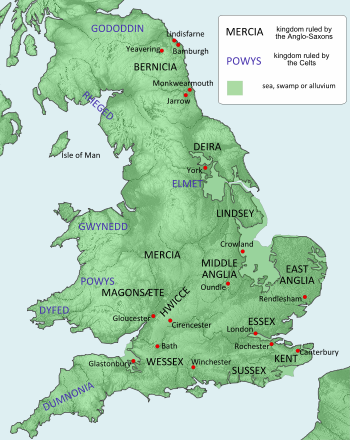
From bases in south England these tribes spread out and established kingdoms the length and breadth of the country. By the sixth century the land had stabilised into seven kingdoms, traditionally known as the Heptarchy, consisting of East Anglia, Essex, Kent, Mercia, Northumbria, Sussex, and Wessex.

Alongside the main entities was a fluctuating set of smaller kingdoms which included, at one time or another, the kingdoms of Bernicia and Deira within Northumbria, Lindsey in present-day Lincolnshire, the Hwicce in the southwest Midlands, the Magonsæte or Magonset, a sub-kingdom of Mercia in what is now Herefordshire, the Wihtwara, a Jutish kingdom on the Isle of Wight, the Middle Angles, a group of tribes based around modern Leicestershire, and the Hæstingas (around the town of Hastings in Sussex.

The main Anglo-Saxon kingdoms (source: Wikipedia)

The main Anglo-Saxon kingdoms (source: Wikipedia)

By 660 Northumbria was the most powerful Anglo-Saxon kingdom, and its contacts with both Ireland and Rome produced a golden age of culture.

Mercia began to displace Northumbria as most powerful kingdom in the early 8th century, a process which reached its climax in the long reign of King Offa, from 757 until his death in July 796. Offa controlled London, built the famous dyke along the border with Wales, and conquered Kent, East Anglia, Essex and Sussex.

In 793 Vikings attacked Lindisfarne monastery way up towards the Scottish border, and for the next two hundred years Danish invaders were a constant threat, eventually controlling the east of the country from the Thames to the border with the Scots. This area became known as the Danelaw, with its capital city at Viking-founded York.

England about 900 AD, showing the border between the Danelaw and Wessex

England about 900 AD, showing the border between the Danelaw and Wessex

Alfred the Great (849 to 899) is remembered because he fought the Danes out of Wessex, recaptured London, and unified all the tribes of England against the foreigner, signing a peace treaty with the Danish leader, Guthrum, in about 880.

But he didn’t manage to expel them. It was only under his grandson, King Æthelstan that, in the 930s, the Danes were completely expelled.

And even this unity was lost when the Danes under Sweyn Forkbeard reinvaded in 1013, leading the throne of England to be seized by his son, Cnut the Great, a Dane who ruled England from 1016 to 1035.

One last Anglo-Saxon king, Edward the Confessor, ruled again, from 1042 to 1066, but it was a dispute over the succession following his death, which led to the invasion of the county by William and the Conqueror and his Normans, and the death of the last Anglo-Saxon king, Harold Godwinson, at Hastings.

The period from 450 to 1066 was, in other words, one of almost constant warfare, in which kingdoms depended for their existence and stability on the military might and strategic canniness of strong rulers. The sophisticated economic systems of the Romans, their agricultural organisation, their towns laid out logically with strong defensive walls – all this was lost within a few generations of the Roman departure in 410.

For most of the next 600 years small communities of peasants eked out a subsistence living, and their surplus was skimmed off by violent kings to fund their high lifestyle and elaborate jewellery and weapons.

The Anglo-Saxon church

But alongside the history of kings and conquest, there is a parallel history, deeply intertwined with it – the history of the Christian Church in England.

There were Christians among the Roman community but their version disappeared when they left. Some missionaries came from Ireland which had a Christian tradition before England. But the main story begins with the mission to Britain of St. Augustine of Canterbury (not to be confused with St Augustine of Hippo, the great 4th century theologian).

Augustine arrived in 597, converted the king of Kent, Æthelberht a, established an episcopal seat at the Kentish capital, Canterbury (which is why we still have archbishops of Canterbury to this day), and established a monastery and seat of learning which could train and educate the monks who would then, themselves, be sent out to convert the various rival warlords to the true faith, throughout the 600s.

We know a lot about the process of conversion because it is described in detail by the monk known as the Venerable Bede, in his masterpiece, A History of the English Church and People, which I have reviewed elsewhere.

Bede was a product of Northumbrian culture, a Benedictine monk who spent his entire life at the monastery of St. Peter and its companion monastery of St. Paul near Jarrow. He wrote some 40 books but his masterpiece, the Historia ecclesiastica gentis Anglorum or The History of the English Church and People.

The point is that, although the Anglo-Saxon kings and their people were all pagans they were also illiterate and so all we know about them is filtered through the writings of the literate Christian monks, who all wrote in Latin.

And the little we have of actual Anglo-Saxon, the language these people spoke and recited their histories and legends in, was also recorded by Christian monks.

We have some pagan jewellery, most notably the content of the fantastic burial hoard found at Sutton Hoo, attributed to King Raedwald who lived in the 7th century.

But even carved crosses, much of the remaining jewellery, and all of the remaining texts, are Christian in content, the crosses’ inscriptions in Latin, the jewellery including the cross motif, and even the handful of Anglo-Saxon texts we have – even the great Anglo-Saxon epic poem Beowulf – contain Christian imagery, or subject matter, and were written down by Christian monks.

Beowulf © British Library Board

Beowulf © British Library Board

Alfred the Great’s renaissance

By the 850s most of the kingdoms were thoroughly Christianised. Alfred the Great (d.899) acquired his reputation not only for his military victories against the Danes, but because he saw the need to raise the cultural level of the people he now ruled in the area known as Wessex. He realised he needed educated literate civil servants to administer his kingdom, and – being a good Christian king – he realised the gospels needed to be spread.

Alfred commissioned monks to begin writing a yearly chronicle of events, thus founding the Anglo-Saxon Chronicles which ended up existing in various versions, kept by monks in monasteries around the kingdom. These are an invaluable source of historical information, and for the grammatical structure of the various regional dialects of Anglo-Saxon. Some of which continued for a generation after the Conquest.

Alfred also commissioned the translation of important texts into Anglo-Saxon. These included a translation and copies of Pope Gregory the Great’s book Pastoral Care. He distributed these along with ‘æstels’ or wooden pointer sticks, which were used for following words when reading a book.

Attached to the end of each pointer was a valuable example of Anglo-Saxon jewellery which featured a portrait of the king and, around the sides, the words ‘Aelfred mec heht gewyrcan’, meaning ‘Alfred ordered me made’. The one and only surviving copy of this is usually in the Ashmolean Museum in Oxford, but has been brought here for this exhibition. It is wonderful, the quaintness of the likeness of the king contrasting vividly with the sophistication of the dragon (snake?)’s head beneath it, from whose mouth pokes the nozzle which is where the wooden pointing stick came out.

Alfred Jewel © Ashmolean Museum, University of Oxford

Alfred Jewel © Ashmolean Museum, University of Oxford

Anglo-Saxon treasures on display

This exhibition is so blockbusting because just about every single book, every Bible, psalter, breviary, every manuscript letter, poem, deed and legal document which tells and illustrates these tumultuous 650 years has been brought together and assembled in one place.

The Alfred jewel is just one of the inestimable treasures on display at this massive, comprehensive and dazzling exhibition. Other highlights include:

  • the stunningly ornate gold buckle from Sutton Hoo
  • treasures from the Staffordshire Hoard
  • the River Erne horn, a wooden trumpet from the 8th century discovered in the river in the 1950s on loan from National Museums Ireland
  • displayed alongside the Vespasian Psalter, which includes the oldest translation of part of the Bible into English and depicts two musicians playing similar instruments
  • archaeological objects including:
    • the Binham Hoard, the largest collection of gold from 6th century Britain, on loan from the Norfolk
    • the Lichfield Angel, which has never been displayed outside of Lichfield since it was excavated in 2003
    • key objects from the Staffordshire Hoard, discovered in 2009, the largest hoard of Anglo-Saxon gold ever found
  • the Sutton Hoo gold buckle
  • the Fuller Brooch on loan from the British Museum

Layout

The exhibition is beautifully laid out, in mysterious low lighting (obviously, to protect these priceless manuscripts), the walls hung with long, narrow photographs of unspoilt countryside, vividly conveying a sense of what must have been the largely untamed landscape of the times. It is organised into rooms which take us carefully through the period, with rooms and areas devoted to:

  • Kingdoms and Conversion
  • The Rise of the West Saxons
  • Mercia and its Neighbours
  • Language, Learning and literature
  • Kingdom and Church
  • Music making
  • Conquests and Landscape
  • The Empire of Cnut
  • The Cnut Gospels
  • Domesday Book

There are three or four videos scattered throughout, interviewing scholars who explain key moments or ideas in Anglo-Saxon culture, namely curator, Dr Claire Breay, and well-known TV historian Michael Wood.

The video on the Domesday book is simple and interesting. And there’s a longer one showing the process of preparing vellum parchment and then how the ink and pain for the illuminations were prepared.

Vespasian Psalter © British Library Board

Vespasian Psalter © British Library Board

Mostly manuscripts

But the exhibition, as you would expect from its location, focuses mostly on books, on a huge selection of early medieval manuscripts, alongside, letters and other written matter, including:

  • the beautifully illuminated Lindisfarne Gospels
  • the one and only surviving copy of Beowulf
  • a copy of Bede’s Ecclesiastical History
  • the St Augustine Gospels on loan from Corpus Christi College Cambridge
  • the Book of Durrow on loan from Trinity College Dublin
  • the Echternach Gospels on loan from the Bibliothèque nationale de France
  • the Utrecht, Harley and Eadwine Psalters from Utrecht University Library, the British Library and Trinity College Cambridge respectively
  • the four principal manuscripts of Old English poetry on display together for the first time, with the British Library’s unique manuscript of Beowulf displayed alongside:
    • the Vercelli Book returning to England for the first time from the Biblioteca Capitolare in Vercelli
    • the Exeter Book on loan from Exeter Cathedral Library
    • the Junius Manuscript on loan from the Bodleian Library
  • Domesday Book, the most famous book in English history and the earliest surviving public record, on loan from The National Archives
  • the earliest surviving English charter, issued in 679 and granting land to the Abbot of Reculver;
  • the oldest original letter written in England, from the Bishop of London to the Archbishop of Canterbury, dating from early 8th century
  • the earliest surviving letter in English, the Fonthill letter, from the early 10th century on loan from Canterbury Cathedral
  • the earliest surviving will of an English woman, Wynflæd
  • St Cuthbert Gospel, the oldest intact European book with its original binding, made at the monastery of Wearmouth-Jarrow in the north-east of England in the early 8th century
  • and the enormous Codex Amiatinus, the earliest surviving complete Bible in Latin made at the monastery of Wearmouth-Jarrow in the north-east of England in the early 8th century and taken to Italy in 716 as a gift for the Pope. It will be returning to England for the first time in more than 1,300 years, on loan from the Biblioteca Medicea Laurenziana in Florence
Codex Amiatinus on loan from Biblioteca Medicea Laurenziana to Anglo-Saxon Kingdoms at the British Library © Sam Lane Photography

Codex Amiatinus on loan from Biblioteca Medicea Laurenziana to Anglo-Saxon Kingdoms at the British Library © Sam Lane Photography

Cnut and Emma

I’d expected it to end sometime after the loosely titled Kingdom and Church section, so I was surprised that the exhibition devotes not one but several sections to reign of King Cnut, the Dane who united England with his home territory to form a short-lived North Sea Empire. He was king of England from 1016 to 1035 and the exhibition shows how manuscripts and books, gospels and psalters of great quality continued to be produced.

There is a section devoted just to Cnut’s strong-minded queen Emma, bringing together references in documents and even illustrations which appear to be of the queen.

The Norman Conquest

And then a final section devoted to a massive copy of the Domesday Book, commissioned by William the Conqueror to list in fine detail every scrap of land in his new domain. The exhibition includes not only a hefty copy of the book, but a rare example of one of the preliminary rolls on which data was initially gathered by William’s army of census takers,before being collated and copied into the Big Book.

Domesday © The National Archives

Domesday Book © The National Archives

Thoughts

Several points emerged for me:

  • The distinction between the Northumbrian Golden Age of the 660s onwards, which is all about Iona, Lindisfarne, St Cuthbert, Benedict Biscop and Bede – and the rise of Mercia under Offa about a century later – there are illuminated books from both periods which, to the really scholarly eye, show the difference in date, origin and cultural links.
  • The idea that the rise of Wessex (which led, eventually, to the unification of England) was a product of the Viking invasions: pushed back into the South-West and West Midlands, the remaining Saxon kingdoms were forced to co-operate and coalesce, and Alfred is the symptom of this newfound focus
  • The sense that, once you get to Alfred, the difficulty of trying to remember the kings and rulers of all the scattered other kingdoms disappears; Alfred is succeeded by his son, Edward the Elder (899 to 924), who is himself succeeded by his son, Æthelstan, who, from 927 to 939 has the right to claim himself to be the first king of all the English. From this point onwards it becomes easier to follow the kings, and there is a kind of cultural and legal as well as military unification.

Slaves

I was surprised to come across a record of Athelstan freeing a slave. The earliest will made by an Englishwoman, Wynflæd, from the tenth century, records her wish to free her slaves. And the section about Domesday Book, while running through some of the staggering stats included in the book, mentions that there were some 28,325 slaves in England in 1086 (compared with some 288,000 peasants). I.e. around 10% of the work-force was slaves.

A little-known fact about the Norman Conquest is that it was William the Bastard who formally abolished the (thriving) slave trade in Anglo-Saxon England.

Slight criticism

I had one big caveat. I counted 125 books and manuscripts in the exhibition – books carefully propped open so we could see illuminations and text, manuscripts carefully flattened. These were all, of course, accompanied by information panels explaining what they were, what to look for in the illumination or style of writing, and so on.

BUT – none of them contained a translation of the actual words on show.

Most of the books are in Latin, Latin versions of various books of the Bible, breviaries and psalters, texts of Christian advice, letters from bishops to kings or vice versa, deeds to properties, adjudications in land disputes, and so on, with just a handful of texts in Anglo-Saxon, such as Beowulf, the Exeter Riddles, the Dream of the Rood, wills, charters and so on.

But early medieval writing was highly stylised. Although I studied Latin for GCSE and Anglo-Saxon at university, I always find it next to impossible to read Latin or Anglo-Saxon manuscripts because of the cramped and stylised nature of the handwriting.

So it would have been a very good idea, next to the panel telling you the history of the book, to have had a panel simply laying out the actual words on display, in modern orthography.

And then, logically enough – it would have been a good idea to have translated the words into modern English.

We are presented with a page of Beowulf, or of the Domesday Book. It looks great – but I can’t read a word of it. Not only can I not read it, but even if I could, I wouldn’t understand it.

I think this was a big flaw with the exhibition. The overwhelming majority of objects on display are texts. And although the exhibition gives plenty of help with the manuscripts’ provenance and style and general content – visitors are given no help at all with actually reading or understanding them.

Lindisfarne Gospels f.27r © British Library Board

Lindisfarne Gospels f.27r © British Library Board

Introduction by the exhibition curator


Related links

Other Dark Age reviews

Other British Library exhibitions

In Search of the Dark Ages by Michael Wood (2005)

Michael Wood

This was historian and TV presenter Michael Wood’s first book. Back in 1979 Wood burst onto our TV screens as the boyishly enthusiastic presenter of a BBC series about ‘the Dark Ages’, spread across eight episodes, his hippy-length hair and flapping flairs blowing in the breeze as he strode along castle walls and all over Iron Age forts. I remember chatting to a middle-aged woman TV executive who openly lusted after Wood’s big smile and tight, tight trousers.

Since this debut, Wood has gone on to present no fewer than 19 TV series as well as eight one-off documentaries and to write 12 history books. Time flies and I was surprised and dismayed to read that the former boy wonder of history TV is now nearly 70.

Dated

The first edition of this paperback was published in 1981 and its datedness is confirmed by the short bibliography at the back which recommends a swathe of texts from the 1970s and even some from the 1960s i.e. 50 long years ago.

The very title is dated, as nowadays all the scholars refer to the period from 400 to 1000 as the Early Middle Ages‘. No-one says ‘Dark Ages’ any more – though, credit where credit’s due, maybe this TV series and book helped shed light on the period for a popular audience which helped along the wider recategorisation.

But the book’s age does mean that you are continually wondering how much of it is still true. Wood is keen on archaeological evidence and almost every chapter features sentences like ‘new archaeological evidence / new digs at XXX are just revealing / promise to reveal major new evidence about Offa/Arthur et al…’ The reader is left wondering just what ‘new evidence’ has revealed over the past 40 years and just how much of Wood’s interpretations still hold up.

Investigations

It’s important to emphasise that the book does not provide a continuous and overarching history of the period: the opposite. The key phrase is ‘in search of…’ for each chapter of the book (just like each of the TV programmes) focuses on one particular iconic figure from the period and goes ‘in search of’ them, starting with their current, often mythologised reputation, then going on to examine the documentary texts, contemporary artifacts (coins, tapestries etc) and archaeological evidence to try and get at ‘the truth behind the myth’.

The figures are:

  • Boadicea
  • King Arthur
  • the Sutton Hoo Man
  • Offa
  • Alfred the Great
  • King Athelstan
  • Eric Bloodaxe
  • King Ethelred the Unready
  • William the Conqueror

Each gets a chapter putting them in the context of their day, assessing the sources and material evidence for what we can really know about them, mentioning the usual anecdotes and clichés generally to dismiss them.

Contemporary comparisons

Part of Wood’s popularising approach is to make trendy comparisons to contemporary figures or situations. Some of this has dated a lot – when he mentions a contemporary satirical cartoon comparing the Prime Minister to Boadicea (or Boudicca, as she was actually called) he is of course referring to Margaret Thatcher, not Theresa May. When he says that the late-Roman rulers of Britain effectively declared U.D.I. from the Empire, I just about remember what he’s referring to – Rhodesia’s unilateral declaration of independence from Britain back in 1965 – and it’s a thought-provoking comparison – but most readers would probably have to look it up.

Similarly, he writes that contemporaries remembered the bad winter of 763 ‘just as we do that of 1947’ – do we? He says the Northumbrians felt about Athelstan’s conquest of their kingdom ‘the same way as we feel about the Russian invasion of Czechoslovakia’ (p.145).

That said, I found many of the comparisons worked well bringing these ancient people to life, in highlighting how their behaviour is comparable to the same kind of things going on in the contemporary world:

For example, he compares the native British merchants getting involved with Roman traders to entrepreneurs in contemporary Third World countries taking out, for example, a Coca Cola franchise from the modern commercial superpower. Or compares Boudica’s rebellion against the imperial Romans with rebellions against British Imperial rule – the most disastrous of which was probably the ‘Indian Mutiny’ – invigorating my thinking about both.

In the 440s the British King Vortigern invited warbands from Germany, Frisia and Denmark to come and help him fight against the invading Picts and Scots. As we know, a number of them decided they liked this new fertile country and decided to stay. Wood entertainingly compares the situation to modern mercenaries deciding not just to fight in but to settle and take over a modern African country.

The seventh-century English kingdoms were ruled by the descendants of the illiterate condottieri who had seized their chances in the fifth and sixth centuries. It is, let us say, as if Major ‘Mad Mike’ Hoare had founded his own dynasty in the Congo in the early sixties. (p.63)

I understood the reference the more since Hoare is mentioned in the memoirs of both Frederick Forsyth and Don McCullin who covered wars in Africa back in the distant 1960s.

Elsewhere he compares the builders of Offa’s Dyke to modern motorway construction companies, kingly announcements as sounding like modern propaganda by Third World dictators, the lingering influence of Rome on the 7th and 8th century kings comparable to the lingering afterglow of European imperial trappings on African dictators like Idi Amin or Jean-Bédel Bokassa.

He compares the partition of England between the Anglo-Saxons and the Vikings to the partition of Israel, and the readiness of armed civilians to mobilise against the invader as comparable to the readiness of Israeli reservists (p.124); the burning of Ripon Minster by the southern army of King Eardred marching north to confront Erik Bloodaxe ‘had the same effect that the shelling of Reims had in 1914’ (p.181).

Learning that King Athelstan was the first king to definitively rule the entire English nation and in fact to extend his mastery over Wales and Scotland, you might think ‘game over’, it’s all peaceful from now on, but far from it. The decades after Athelstan’s death in 939 saw the ravaging of the north of England by conflicting hordes of Saxons, Vikings, Northumbrians, Scots and Welsh, until it became a kind of ‘Dark Age Vietnam’, despoiled by the Dark Age equivalent of our modern ‘saturation bombing’ (p.165).

Quibbles and kings

Pedants might quibble that Boudicca’s rebellion against the Romans took place in 60AD, quite a long time before the official start date of the Dark Ages/Early Middle Ages, which is generally given as 400. But I can see the logic: a) Boudicca is more or less the first named leader of the Britons that history records and b) the themes of Roman colonialism and British resistance and c) the broader themes of invasion and resistance are set up very neatly by her story. In fact, given that a lot of the book is about invasion and resistance, leaving her out would have been odd.

For invasion is the main theme: the Romans arrived to find the native ‘Britons’ illiterate and so it’s only with the Romans that the written record begins, although archaeology suggests that successive waves of peoples had arrived and spread over Britain before them. But after the Romans there is a well-recorded set of invaders:

  • First the Angles and Saxons under their legendary leaders Hengist and Horsa in the 450s; the legend of King Arthur grew out of stories of native ‘British’ resistance to the Germanic invaders in the late 400s and Wood, like every other serious historian, concludes that there is not a shred of evidence for Arthur’s actual historical existence.
  • It is from the period when the Anglo-Saxon invaders settled into different ‘kingdoms’ – in fact themselves made up of loosely affiliated tribal groups – that dates the stupendous grave at Sutton Hoo with its wonderful Dark Age treasure: Wood goes ‘in search’ of the king who was buried there but, like every other scholar, says we will probably never know, though the name of King Raedwald of the East Angles is most often referred to in the scholarly literature.
  • King Offa of Mercia (757 to 797) was the most powerful king of his day – he was even deemed worthy of correspondence from the great Charlemagne, king of Francia (768 to 814) and Wood goes in search of his royal ‘palace’ at Tamworth.
  • It was King Alfred the Great (871 to 899) who had to deal with the arrival of a massive Viking army and, although pushed back into the marshy maze of the Somerset Levels, eventually emerged to fight the invaders to a truce, in which the Danes held all of England east of a line drawn from London to the Mersey – the so-called Danelaw.
  • It fell to his son, Edward, to successfully continue the fight against the Danes, and it was only in the reign of his son, King Athelstan (927 to 939) that all of England was for the first time unified under one ruler.
  • In fact, the Danes fought back and the Norse adventurer Eric Haraldsson, nicknamed Eric Bloodaxe, briefly seized and ruled Yorkshire from York. When he was finally overthrown (in 954), that was meant to be the end of Danish rule in England…
  • Except that the Danish King Cnut managed, after a long campaign led by his father, to seize the English throne in 1016 and reigned till his death in 1035, and was succeeded by his son Harthacnut, an unpopular tyrant who reigned for just two years (1040 to 1042). During Cnut’s reign England became part of his North Sea Empire which joined the thrones of Denmark and Sweden.
  • Cnut’s Anglo-Danish kingdom is generally forgotten because it, like a lot of Anglo-Saxon history, is eclipsed by the Norman Conquest of 1066, with which Wood logically concludes his story.

Brutality

Though he conveys infectious excitement at the achievement of an Offa or Athelstan, Wood is well aware of the brutality which was required of a Dark Ages king.

For most Dark Age kings had the inclinations of spoilt children and their moral sense was unrefined. (p.221)

We learn that after Offa’s death the men of Kent rose up against Mercian rule and were crushed, their king, Eadberht Praen, taken in chains to Mercia where his hands were cut off and he was blinded (p.107). The Vikings practiced a ritual sacrifice of their fallen opponents to Wodin, the blood eagle, which involved cutting the ribs and lungs out of the living man and arranging them to look like eagle’s wings (p.114). The great Athelstan himself barely survived an attempt apparently organised by his brother, Edwin, to capture and blind him (p.140). When the invading Danish king Sweyn Forkbeard died in 1014, his army elected his son, Cnut, as king to replace him. Ethelred took advantage of the hiatus to raise levies and attack Cnut in Gainsborough, forcing him to go to sea. But the Danes had taken a number of nobles or their sons hostage for good behaviour, and Cnut put them all ashore at Sandwich, after cutting off their noses and hands (p.216).

Ravaging not fighting

There was no shortage of battles during this period (the thousand years from Boudicca’s revolt in 60 to Hastings in 1066) but what I began to realise was the steady drip-drip of ‘campaigns’ which never involved two armies directly confronting each other; instead during which one or more armies rampaged through their opponents’ territory, murdering, raping, destroying crops and burning down villages, in order to terrorise their opponents into ceasing fire and offering a truce. The Romans, the Britons, the Saxons, the Welsh, the Scots and the Picts and the Irish, the Vikings, the Danes and the Normans – all in their time waged ‘military’ campaigns which amounted to little more than systematic murder, rape and plunder of completely unarmed peasants as a deliberate war strategy.

I’ve always wondered why there’s a massive statue of Boudicca opposite the Houses of Parliament given that one of her main achievements was burning London to the ground, after previously ravaging all Roman settlements in her native East Anglia; and a thousand years later William the Bastard, having defeated the main Wessex army at Senlac Ridge, then set about ravaging the countryside in a wide circle to the west and up and around London – then when the English in the north resisted him, William went on a massive campaign of destruction known as the Harrying of the North (1069 to 1070) resulting in huge destruction and widespread famine caused by his army’s looting, burning and slaughtering.

From Boadicea to the Bastard, a thousand years of horrific violence and destruction.

As David Carpenter points out in his history of the Plantagenet kings, direct confrontation in battle is risky; quite often the bigger better-led force loses, for all sorts of reasons. Hugely more controllable, predictable and effective is to ravage your opponents’ land until he sues for peace. You lose no soldiers; in fact the soldiers get all the food they want plus the perks of raping and/or killing helpless civilians, which saves on pay as well; if you do it long enough your opponent will cave in the end.

This is the depressing logic which means that, time after time, king after king and invader after invader found it cheaper, safer and more effective to kill and burn helpless civilians than to engage in a set piece battle. And it is a logic which continues to this day in horribly war-torn parts of the world.

Slavery

I’m well aware that slavery was one of the great trades of this era, that slaves were one of Roman Britain’s main exports and were still a mainstay of the economy even after William the Bastard tried to ban the trade a thousand years later, but Wood himself admits to being astonished by the range of breadth of the Dark Age slave trade (pages 183 to 185):

  • The Spanish Arabs engaged in a lucrative slave trade with the Dublin Norse who often planned their attacks on Christian towns to coincide with Christian festivals when they’d be packed, for example, the raid on Kells in 951 in which the Norse took away over 3,000 slaves to sell on.
  • The Church in Britain was economically dependent on its slaves.
  • The Norse settlements on the east coast of Ireland served as clearing houses for slaves seized from the interior or Wales or England and then sold on to Arab Spain, to North Africa or via the Baltic via the Russian river routes to the Islamic states of the Middle East.
  • An Arab traveller of Erik Bloodaxe’s time (the 950s) reported from Spain on the great numbers of European slaves in the harems and in the militia. The Emir of Cordoba, in particular, owned many white women.
  • Most British slaves seem to have ended up being sent via the Russian river route to the Middle East. The numerous Icelandic sagas mention the slave trade and even give portraits of individual named slave impresarios.
  • The Holy Roman Emperor Otto the Great (962 to 973) captured tens of thousands of Slavs in his conquests eastwards, sending them in chains back to be processed by Jewish and Syrian slave merchants in Verdun, and then shipped south into Arab lands, many of them castrated first so as to be fit servants in the harem.
  • An eighth-century pilgrim in Taranto saw nine thousand Italian slaves being loaded aboard boat, just one of countless shipments to Egypt.

Almost everything about the Dark Ages is terrifying, the never-ending warfare, the endless ravaging burning and looting, but I think the vision of an entire continent dominated by the trade in slaves is the most harrowing thing of all.

The inheritance of Rome

Chris Wickham’s book, The Inheritance of Rome (2009), makes the claim that only in recent times have we come to realise the extent to which the legacy of Rome lived on for centuries after the end of the Roman Empire in the West (traditionally dated to the death of the last emperor in 475). So it’s interesting to read Wood making exactly the same point in 1980:

For the so-called barbarians of the seventh and eighth centuries, the Roman empire cast the same sort of afterglow as the British Empire did in post-colonial Africa… The ruins of Rome stood around them in tangible form, of course. But it went deeper than that. The Northumbrian bretwalda, Edwin, unsophisticated but immensely proud, as Bede portrays him, made the point of having the insignia of Roman office carried aloft before him in public. He was baptised by a Roman missionary in the Roman city of York, and for all we know held court in the still standing Roman HQ building there. Such men were setting themselves up as civilised heirs of Rome… (p.108)

Conclusion

All in all this is a popularising and accessible account, dipping into the most dramatic highlights of this long period, a quick entertaining read, with many stimulating thoughts, insights and comparisons thrown in.


Other Dark Age reviews

The short stories of Arthur Conan Doyle

Arthur Conan Doyle (1859 to 1930) wrote some hundred and twenty short stories, excluding the 56 Sherlock Holmes stories and the 17 or so Brigadier Gerard stories. The excellent Société Sherlock Holmes de France website estimates the total number of all Conan Doyle’s fictions as 239, for he also wrote some 20 short novels. His first story was published when he was 20, the last when he was 70.

For boys

The overall affect is rip-roaring adventures for boys. None of them are really for adults, none of them have much psychology, much interiority, and the plots – though superficially gripping – are all wound up in a brisk few final paras. They anticipate hundreds of adventure movies and comics and graphic novels. They are short and punchy and great fun.

Reassuring

Even the horror and science fiction stories, though they ostensibly deal with the bizarre and grotesque, are ultimately reassuring because there is never any doubt as to the good sense and decency of the narrator(s). It is always a man and he is always soundly for the Empire and the natural fair play of the British, innately superior to all other nations and divinely ordained to rule vast tracts of the world and over their occasionally troublesome natives (and, quite often, over the great unwashed back here in Blighty).

Many of the stories exemplify that specially British sense of justice and fairmindedness which, in the mind of Imperialists, justified, indeed demanded, our Imperial role and which, similarly, justified the existence of a landed aristocracy with its Justices of the Peace, Lord Lieutenants and whatnot.

(For a thorough depiction of this deeply conservative worldview see my review of Andrew Young’s biography of Lord Salisbury, Prime Minister 1886 to 1892 and 1895 to 1902.)

G.M. Young, historian of the Victorian era, writes about ‘the most precious element in Victorian civilisation, its robust and masculine sanity’, and Conan Doyle is a kind of quintessence of this, a charmingly unreflective, unquestioning, untroubled supporter of everything British.

Conan Doyle comes over as everyone’s favourite uncle, full of rattling good stories and anecdotes – but nobody for a minute takes any of his opinions seriously. He is Mr Chips.

Magazines

The stories were written for money to be published in the impressively wide variety of magazines which flourished in the 1890s. They were reprinted in numerous subsequent collections. One of the collections was titled Round the Fire Stories and that perfectly captures the Boy Scout ambience of so many of them.

The 1880s and 90s were a golden age of little magazines, created to feed the appetite of the middle and lower classes who had been taught to read as a result of the 1870 Education Act and its sequels, who, due to the wealth-creating effect of the Second Industrial Revolution, increasingly had the means to buy cheap titles.

Conan Doyle’s most effective outlet was the Strand magazine (established 1891), packed with articles, news and stories by leading writers of the day, all for the bargain price of one shilling in which he continued to publish to the end of his career.

These magazines demanded sensational storylines, glamorous protagonists, short, sharp doses of the mysterious, the macabre, the haunting or the humorous, and this well-defined format and sensation-seeking audience should be kept in mind when reading Conan Doyle’s stories.

Themes

Patriotism

‘I do not go so far as to say that the English are more honest than any other nation, but I have found them more expensive to buy.’ (The Lost Special)

‘He was a villain, but he was a Briton!’ said the captain, at last. ‘He lived like a dog, but, by God, he died like a man!’ (The Slapping Sal)

No more striking example could be given of the long arm and steel hand of the British law than that within a few months this mixed crew, Sclavonian, negro, Manila men, Norwegian, Turk and Frenchman, gathered on the shore of the distant Argentine, were all brought face to face at the Central Criminal Court in the heart of London town. (The Tragedy of Flowery Land)

The British Empire

The colonies, especially Australia, New Zealand, South Africa, are the playground of white men – the justification of the Empire goes without saying i.e. that native peoples should have their land taken and their goods stolen doesn’t occur. See Doyle’s good-humoured and open-handed pamphlets justifying the Second Boer War, which simply don’t consider the possibility that the British might have been motivated solely by power politics and greed. In The Green Flag even mutinous Irish republicans, when faced with the fuzzy wuzzies, turn out to be the stoutest defenders of the British Empire.

London

‘…now gradually overtaken and surrounded by the red brick tentacles of the London octopus.’

London is always growing, throwing out ever-expanding avenues of redbrick terraces. The ones so many of us still live in to this day.

Women

Chivalry is the way the patriarchy, men, reassured themselves that they deserved to be in charge, that it was OK to keep women in powerless subjugation. Chivalry was men’s reply to women demanding the vote or control of their own lives: look, we defer to you in everything sweet ladies, why on earth would you need the vote?

‘Ladies are in danger of losing their privileges when they usurp the place of the other sex. They cannot claim both.’ (Doctors of Hoyland)

Women in Conan Doyle are tall, stately, and the most beautiful woman in England. Defending their ‘honour’ is the motivation for quite a few of the stories.

Diamonds

Diamonds seem to be the treasure and currency of choice, the bigger the better, and feature in his very first story, The Mystery of Sasassa Valley as well as The Stone of Boxman’s Drift, Our Midnight Visitor, The Club-Footed Grocer.

Comedy

A constant throughout is Conan Doyle’s bluff good humour. Rising to overt comedy in the GP reminiscences and Brigadier Gerard stories, or just lying low, purring in the background. Constantly, pervasively there is his confidence and solidity, as ubiquitous as his splendid Edwardian moustache.

Crime

Crime of the most sensational and puzzling sort, of course, for example, The Story of the Lost Special or The Story of the Lost Watches.

Sensation

The stories were published in popular magazines which often contained sensational news or features. The stories take this tone from their surroundings. Nothing is subtle or underplayed. Everything is the most sensational scandal in London or England or the world.

Stanniford, the banker! I remembered the name at once. His flight from the country some seven years before had been one of the scandals and sensations of the time. (The Sealed Room)

Such was the position of affairs when, upon the evening of Monday, June 21st, there came a fresh development which changed what had been a mere village scandal into a tragedy which arrested the attention of the whole nation. (The Black Doctor)

It’s the same breathless sensationalism which characterises the Holmes stories and give them their delightful, thrilling sense of (utterly spurious) importance.

Scandal

Scandal and the fear of scandal is a motivation in these and the Holmes stories to a degree which is hard for us to understand. The reputation of upper middle class people was so important that they were willing to kill or die to preserve it. Just the hint that some misbehaviour in a former life abroad might revisit someone in respectable England causes numerous Conan Doyle protagonists to drop dead of horror. The Jew’s Breastplate is a particularly preposterous example of a story driven by this ludicrous sentiment.

Secret societies

Secret societies flourished in the 1880s and 1890s. They merged in the public mind with terrorist groups such as nihilists, anarchists, Fenians, even the violent suffragettes. They are routinely offered as explanations when some crime, especially a murder, goes unsolved and were so familiar a subject that Conan Doyle can make a comic story about a chemist who is mistakenly invited to give a lecture about dynamite to a group of nihilists.

Murder

Plenty of people get murdered and the murders are horrible and yet, in some difficult-to-define way, romantic and exciting. They upset the characters – but they don’t upset us, because they are so transparently the engines of a rattling good yarn.

Horror

The great horror trope of the pale ghastly face at the window occurs in scores of the stories – Uncle Jeremy’s Household, A Pastoral Horror – and melodramatic horror is one of the commonest emotions: ‘… and she realized, with a thrill of horror, that what she had taken to be a glove was the hand of a man, who was prostrate upon the floor.’

And now I come to that portion of my story which fills me even now with a shuddering horror when I think of it (The Striped Chest)

This could be the epigraph to many of the collected stories.

The 1880s

The Mystery of Sasassa Valley (September 1879)

‘Tell it? Oh, certainly; but it is a longish story and a very strange one; so fill up your glass again, and light another cigar, while I try to reel it off.’

The opening words sets the tone for the entire oeuvre. Jack Turnbull as an old man recalls how he and Lucky Tom Donahue, two young lawyers who packed in study to emigrate to South Africa, took their cue from a native tale of a haunted valley and discovered the weird glowing was given off not by demons but by diamonds!

The American’s Tale (December 1880)

“Deuced rum yarn!” said young Sinclair. Hard core Western redneck Jefferson Adams regales a posh English literary club with a tall tale about a feud in 1870s Arizona between cool Brit called Scott and short-fused Alabama Joe which ends with Joe being eaten alive by a giant Venus flytrap plant!

A Night Among the Nihilists (April 1881)

‘By the way,’ he remarked, as we smoked a cigar over our wine, ‘we should never have known you but for the English labels on your luggage.’

Robinson, a clerk in a corn merchant’s, is sent to Russia to open up trade with a major landowner. There is a mix-up and he is introduced into a secret society of Nihilists and saved just as he is rumbled, when the police burst in!

That Little Square Box (December 1881)

‘Dick was just the man I wanted; kindly and shrewd in his nature, and prompt in his actions, I should have no difficulty in telling him my suspicions, and could rely upon his sound sense to point out the best course to pursue. Since I was a little lad in the second form at Harrow, Dick had been my adviser and protector.’

The narrator is a nervous, solitary, literary type who, when he boards the ship from Boston to London, overhears two foreign men whispering about a secret box and when to set it off, thinks he is hearing anarchist/terrorists. In fact, they are releasing racing pigeons!

The Gully of Bluemansdyke: A True Colonial Story (December 1881)

‘The two men lapsed into silence for some time, moodily staring into the glow of the fire, and pulling at their short clays.’

New Zealand in the 1850s. A posse is formed to hunt down seven men who bushwhacked the young sons of two old-timers. A paean to the rugged spirit of the emigrant colonial trooper. Trooper Braxton and his capture of the Bluemansdyke murderers. The Australia stories are linked.

Bones, The April Fool of Harvey’s Sluice (April 1882)

Comic tale. ‘

Boss, with the keen power of calculation which had made him the finest cricketer at Rugby in his day, had caught the rein immediately below the bit, and clung to it with silent concentration.’

Another tale of derring-do in the New Zealand outback, but lightened with romance and humour, as two English miners, posh John ‘Boss’ Morgan and herculean Abe ‘Bones’ Durton save the life of pretty young Miss Carrie Sinclair who transforms the life of mining shanty Harvey’s Sluice.

‘With these few broken words the strangely assorted friends shook hands and looked lovingly into each other’s eyes.’

Reminiscent of Paint Your Wagon. Climaxes with a big shootout as the pals save Miss Sinclair from bushrangers.

Our Derby Sweepstakes (May 1882)

Two men compete for the hand of the fair Miss Eleanor Montague and decide the winner of the Derby will win her hand. Told in 1st person by Eleanor in an impersonation of a Victorian airhead.

That Veteran (September 1882)

Very amusing. A gentleman on a walking holiday in Wales pulls into an inn where he is regaled with stories of the Crimean War and a soldier’s career by one sergeant Turnbull until his head is swimming and he passes out. The soldier is a fake, a criminal, who has drugged him and stolen his watch.

My Friend the Murderer (December 1882)

A further New Zealand story: the prison doctor narrator (Conan Doyle/Watson) hears the life story of Maloney, the Bluemansdyke murderer who escaped the rope by turning queen’s evidence and had sundry adventures trying to escape revengers as he fled to Australia, England, France and then back to Oz where he finally dies in a bar brawl.

The Captain of the Polestar (January 1883)

‘Being an extract from the singular journal of John McAlister Ray, student of medicine’. He is the doctor on the Polestar which travels unwisely far into the northern, Arctic ice fields, supposedly in search of whales, but in fact driven by the haunted captain Nicholas Craigie who is pursuing the phantom of his murdered sweetheart which flees across the ice.

See an interesting article about the story’s origins in Conan Doyle’s actual Arctic voyage aboard the whaler Hope.

Gentlemanly Joe (March 1883)

The narrator is a young man working at a bank along with four other blue-bloods and the vulgar, jumped-up son of a bookie who they ironically name Gentlemanly Joe. They mercilessly rib him, especially when he falls in love with little Miss Cissy who is in fact engaged to one of them. Then comes the night of the great fire when the Newsome house burns down and it is big strong Gentlemanly Joe who breaks down the door and rescues Miss Cissy. Though she marries her fiancée she and the others will never forget Gentlemanly Joe!

The Winning Shot (July 1883)

A genuinely eerie supernatural story. One Octavius Gaster arrives at a charming upper class household in Dartmoor where Lottie Underwood is due to marry her sweetheart. He casts clouds over the gathering, defends spiritualism, has a newspaper cutting implicating him in black magic, falls in love with Lottie, which leads to a fight with Charley and he is evicted. Then the great shooting match between soldiers at locals where Gaster turns up and, at the climax of the match, appears to make Charley shoot through a phantasm of himself, killing himself. The spookiest thing is that after weeks of delirium Lottie is seen getting into a train with him.

Selecting a Ghost (December 1883)

Comic story told by a preposterously pretentious narrator Mr d’Odd, a successful grocer who has bought a big old house and now wants a ghost to go with it so he asks his brother-in-law in London to find one, resulting in a crook from London coming down and pretending to be a purveyor of ghosts who audition for him as he drinks some magic potion. When he awakes, he has of course been robbed.

The Silver Hatchet (December 1883)

‘On the 3rd of December 1861, Dr. Otto von Hopstein, Regius Professor of Comparative Anatomy of the University of Budapest, and Curator of the Academical Museum, was foully and brutally murdered within a stone-throw of the entrance to the college quadrangle.’

Then another victim is found. Then the friendship of two medical students who stumble across a silver-handled ax and, as he holds it, one goes homicidally mad. They are arrested it and the police inspector handling it also becomes homicidal. It is cursed:

‘Ever evil, never good, Reddened with a loved one’s blood.’

The inclusion of the students makes it seem like the short melodramatic plot of an Austrian operetta.

An Exciting Christmas Eve or, My Lecture on Dynamite (December 1883)

Odd tone of tale about a short bespectacled Herr Doctor Otto von Spee to whom lots of accidents occur, the final one being kidnapped on Christmas Eve to deliver a lecture on gunpowder to a secret, presumably revolutionary, society which climaxes with some sample guncotton being detonated and Dr von Spee escaping.

J. Habakuk Jephson’s Statement (January 1884)

Remarkably powerful fiction which claims to be a true account of what happened on the Marie Celeste (discovered drifting December 1873): the boat is slowly taken over by an evil half-caste – Mr. Septimius Goring – who along with two black sailors murders all the white crew and passengers, steering to a remote African settlement where he lords it over the natives instead of to Portugal. When the natives see the lucky charm an old slave gave him in America their superstitious reverence forces Goring to set Jephson adrift and so be picked up by a passing ship.

The Heiress of Glenmahowley (January 1884)

First person narrative. Bob Elliott and John Vereker are two unsuccessful lawyers marooned in a pub in the west of Ireland, passing the time being unpleasantly racist about the locals when the publican tells them of a local widow who is fabulously wealthy and her beautiful young daughter the heiress. Comedy as both men pretend not to be interested but next day climb over the big spiked wall, tumbling into the ditch and scrambling through briars to try to woo and win the beauty. It is made plain he English narrator is a pompous preening twerp.

The Blood-Stone Tragedy: A Druidical Story (February 1884)

The narrator begins to discuss the recent case of Williams the druid when the other man in the railway carriage says, Hush, don’t mention the word, it might wake my sleeping wife. And then proceeds to tell the story of how his then fiancée got lost in the mountains and fell into the clutches of a maniac who thinks he is a druid and plans to sacrifice her at midnight.

John Barrington Cowles (April 1884)

Longer and more psychologically penetrating than usual: the narrator’s friend falls for an ice cold beauty who is associated with two men who went mad, with cruelty to her dog, with tyranny over her mother, the daughter of a soldier in India who indulged in black magic. She beats a mesmerist at a public lecture and then, at the height of their engagement, she reveals something hideous to John Barrington Cowles. He raves that she is a werewolf. He goes down with brain fever and then is taken by the narrator to the Isle of May to recover. One night with a storm approaching, JBC hears her calling and runs to his death over a cliff.

The Cabman’s Story: the Mysteries of a London ‘Growler’ (May 1884)

A London cabbie tells a few of his colourful experiences like carrying a corpse, and carrying a forger. Nice ventriloquism of the cabbie, similar to My Friend The Murderer.

The Tragedians (August 1884)

Young Mr Barker the narrator enters the happy life of the Latour family in Paris, the widowed Madame, young Rose and brother Henry the would-be actor. In another part of town the famous actor and seducer of women, Lablas, wins at cards and plans the abduction of Rose. Barker and the brothers are walking home late when they encounter Lablas and accomplices abducting Rose. Fight. Broken up with the promise of a duel. And, as Henry had just got the role of Laertes opposite Hamlet, the duel is fought for real onstage in a scene which rises to real intensity and power.

Crabbe’s Practice (December 1884)

Pure comedy as two medical students cook up a fake drowning and electrical resuscitation to boost Crabbe’s practice.

The Man from Archangel (January 1885)

1st person narrator. Lonely young scientist John M’Vittie inherits money and a barren stretch of property in Scotland to which he moves to carry out his obscure experiments. One stormy night a schooner is shipwrecked on the shore and, out of character, he rows out and saves a beautiful young damsel who doesn’t speak English. Days later a tall, brown-faced, red-shirted, leather-booted pirate-type comes snooping claiming the woman is his bride. But she hates him. He and his crew kidnapped her from her wedding.

The Lonely Hampshire Cottage (May 1885)

3rd person. Very moody landlord John Ranter is advised by his doctor to retire and moves to a remote cottage where he beats his wife and is a byword. Then a strange sailor appears, walking to Southampton, in need of a bed for the night. Ranter offers it and slowly unravels that the stranger has struck it rich in California and bears dollars and gold. In the middle of the night he creeps up the stairs to murder him but is caught by the stranger who reveals himself as Ranter’s runaway son.

The Great Keinplatz Experiment (July 1885)

Professor von Baumgarten is an expert on mesmerism and spiritualism and carries out an experiment with his daughter’s fiancé and his student, Fritz von Hartmann, to see if souls leave the body during hypnosis. They do, but re-enter the wrong bodies, the professor’s soul entering the student’s body and vice versa, with hilarious consequences. Played for laughs, this reminded me of a Laurel and Hardy short.

The Parson of Jackman’s Gulch (December 1885)

1853 in this rough mining settlement 150 miles from Ballarat when a pastor arrives and wins over the miners by reading the Bible whenever they blaspheme. His campaign climaxes with the first ever sermon in the back of the pub where he proceeds to lock them in and reveal himself to be the noted bushranger Conky Jim while his partners rob the assay office of its entire haul of gold.

The Fate of the Evangeline (December 1885)

1st person. John Vincent Gibbs reveals the true story behind the loss of the ‘Evangeline’, namely that, rejected in love he had become an anchorite on a remote Scottish island when who should turn up but his erstwhile fiancée, mercenary father and calculating suitor, all of whom he overhears, before swimming out to the yacht Miss Lucy is sleeping aboard, cutting the painter and absconding with her. The schooner is run down in the Irish Sea by a freighter bound for Australia where they make a new life and, ultimately, write this ‘true account’. Quotes the Scotsman quoting Edgar Allen Poe’s detective, C. Auguste Dupin, on the necessity of eliminating the impossible etc.

Touch and Go: A Midshipman’s Story (April 1886)

1st person. It is 1868 and the narrator was a lad of 14 back on the banks of the river Clyde from his first journey as a seaman. He, his sister and cousin fool old Jock their minder and take a sailing boat out for a pleasure run alone and on impulse decide to sail to the mouth of the river where a storm pushes them out into the Irish Sea. Caught in heavy waters they are like to drown when they are rescued by a steam launch, dried and slept and dropped on the beach of the Isle of Man.

Cyprian Overbeck Wells : A Literary Mosaic (December 1886)

1st person. Humorous: the narrator Smith fancies himself a writer and after 10 years a clerk leaves his job to write a masterpiece, decides to read all English literature to give himself a boost: then one night hallucinates a tableful of the great novelists who proceed to tell a story in tag.

Uncle Jeremy’s Household (February 1887)

1st person. Long one. Student Hugh Lawrence goes to Dunklethwaite House in Yorkshire to stay with his friend John Thurston who is staying with old eccentric, poetry-obsessed Uncle Jeremy and the nanny, Miss Warrender, an attractive Indian young woman, orphan of a famous Indian chief, and Uncle J’s amanuensis, the tall creepy Copperthorne. Hugh becomes curious about the troubled relationship between secretary and nanny and puzzled by her sometimes savage demeanour until one night, he overhears their conversation in the greenhouse and discovers she is the daughter of a Thuggee leader, worships a goddess of murder, killed her adopted father’s daughter and the little girl Uncle J had adopted; and now they both plan to murder old Uncle J as the secretary has got himself named in the will. In the end a) Miss Warrender escapes having b) tasked a wandering Indian stranger in the village to murder Copperthorne.

The Stone of Boxman’s Drift (December 1887)

3rd person. The early 1870s in the Vaal valley near Kimberley, South Africa, barren land except for the diamonds and therefore wild prospectors from all over the world.

Headley Dean, with his crisp, neatly-trimmed hair and beard, his quick, glancing eyes, and his nervous, impulsive ways, had something of the Celt, both in his appearance and in his manner. Eager, active, energetic, he gave the impression of a man who must succeed in the world, but who might be a little unscrupulous in his methods of doing so. Big Bill, on the other hand, quiet, unimpressionable, and easy-going, with a sweeping yellow beard and open Saxon countenance, may have had a stronger and deeper nature than his partner, but was inferior to him in fertility of resource, and in decision of character in all the minor matters of life.

A morality tale whereby the Celt comes over selfish and greedy when they find a huge carbuncle. In their struggle it bounces into a bottomless pit. The dim Saxon reveals he had found it earlier and placed it for the Celt to discover, who is then covered in guilt and shame.

John Huxford’s Hiatus (June 1888)

John works in a cork factory in Brisport which is forced to close down by competition from south America. He is offered a job in Canada and leaves his weeping fiancée, promising to write. Within days of arriving he is attacked and beaten over the head in a low dive. He recovers but has amnesia. He rises by hard work to be a rich man and, upon hearing Devon voices down at the docks, suddenly remembers everything. He sails over the sea and is reunited with his sweetheart who has stayed true to him these past seventy years.

The 1890s

The Ring of Thoth (January 1890)

Third person. An Egyptologist in the Louvre stumbles upon a 4,000 year old Egyptian who discovered the secret of eternal life and now is going to end his life in the arms of his mummified love.

A Physiologist’s Wife (September 1890)

3rd person. Social comedy/satire in which cold-hearted rationalist and scientist Professor Ainslie Grey marries one Mrs. O’James. A younger colleague is due to marry his daughter, until he meets the new Mrs Grey and is stunned to realise she is his first wife from Australia who ran off and left him and was drowned in a shipwreck. In fact she didn’t take the boat but came to England to start a new life. Cold rationalist Professor tells them to go be happy and reunited. He dies of a broken heart.

A Pastoral Horror (December 1890)

1st person. Murder in a beautiful Alpine valley. An Englishman awaiting the outcome of a bankruptcy case in England has moved to the isolated village of Laden where he is witness to several gruesome murders of peasants. The one other educated man in the village is the curé, Father Verhagen. So imagine everyone’s horror when it turns out to be him, going insane.

The Surgeon of Gaster Fell (December 1890)

1st person. 1885. James Upperton moves to an isolated cottage on the Yorkshire Moors to study but becomes embroiled with several mysterious people, Miss Cameron, the Italianate beautiful young woman staying in the boarding house he puts up in, and the self-styled surgeon of Gaster Fell who is the only neighbour, who warns him to bolt his door at night and who he sees cruelly mistreating a wizened old man. One stormy night his front door creaks open and a ghastly evil figure is revealed by lightning. Chased off by another man. In the cold light of day it turns out the old man is clinically and violently insane and being ‘cared’ for by his son and daughter, the surgeon and mysterious young lady.

Our Midnight Visitor (February 1891)

1st person. A long atmospheric story set on the small isle of Uffan near Arran. The scenery and mood painted very well in the style of Robert Louis Stevenson. A stranger appears, a wealthy American calling himself Digby, dropped by his yacht who comes to stay with young MacDonald and his bad-tempered father. The narrator’s suspicions mount until a newspaper cutting reveals that Digby is Frenchman who has stolen a fabulous diamond and is on the run.

A Straggler of ’15 (March 1891)

A patriotic portrait of Corporal Gregory Brewster, last survivor of the battle of Waterloo. Superpatriotic and vivid description of working class Chatham. This was turned into a play, as describe in Andrew Lycett’s biography of Doyle.

The Voice of Science (March 1891)

3rd person. Drawing room comedy as Mrs Esdaile’s son Rupert takes advantage of the new ‘phonograph’ to record a message listing the conquests and cheating of his sister Rose’s fiancé, Captain Beesley, who mysteriously runs out the French windows and down the drive never to be seen again.

The Colonel’s Choice (July 1891)

Colonel Bolsover marries young Miss Hilda Thornton despite rumours and the attempt of friends to dissuade him. Several years of happiness follow but then Captain Tresillian appears from India and, in a confrontation scene, he reveals that he and Hilda were engaged but he was penniless. A fire breaks out at Melrose Lodge and the colonel saves his wife then nobly steps into the flames to give her a better life.

A Sordid Affair (November 1891)

A hymn to honest working women. Mrs Raby is trying hard to support her ex-drunk husband by dressmaking. She makes a beautiful dress for a posh client but her husband steals it, pawns it and gets blind drunk, forcing Mrs Raby to spend all her savings buying the original dress from its Bond Street shop in order to keep her promise to her client. Then she recovers her husband from the gutter and takes him home.

Oh, blind, angelic, foolish love of woman! Why should men demand a miracle while you remain upon earth?

A False Start (December 1891)

3rd person. Comedy about young Dr Horace Wilkinson who has several false starts of first patients including the gas man and an impoverished gypsy before he called quite by mistake to the house of the local millionaire. Turns out to be a comedy case of mistaken identity in which Wilkinson shines nobly.

Out of the Running (January 1892)

Pretty young Dolly, farmer’s daughter, has two suitors Adam and Elias and in a number of scenes we meet them and hear her mother’s opinion about which one to take. Dolly thinks it is Adam leaves a dog rose on her window sill every morning and so accepts him. There is an accident with the hayrick which crushes the orphan inarticulate farmhand Bill. Next morning, unable to walk, he crawls to her window to leave another rose sprig and is found there dead. Dolly distraught. Hardy territory.

The Great Brown-Pericord Motor (March 1892)

3rd person. Short, grotesque story of two inventors who fall out over a flying machine they’ve created. They fight and one is killed in the struggle. Pericord attaches Brown’s body to the machine and sends it off out to sea, then goes mad. ‘He walked swiftly down the stair and was quickly reabsorbed into the flood of comfortless clammy humanity which ebbed and flowed along the Strand.’

De Profundis (March 1892)

Strange and gruesome. Starts with a hymn to the British Empire and its insatiable need for British men. Then the tale of John Vansittart a planter from Ceylon who visits the narrator, goes staying with his friends, marries suddenly but just before departing comes down with smallpox. He sails early and is due to be met by his wife and friend at Falmouth; the ship goes on to Madeira and JV appears in a vision to the narrator out of the calm Atlantic waves…

A Regimental Scandal (May 1892)

A tale of our fine men in the Army, specifically rich Major Errington who tries to help Colonel Lovell when his shares crash by cheating against himself at cards – until it is revealed. Far from being a scandal this is a hymn to how jolly decent the British Army is.

A Question of Diplomacy (summer 1892)

Comedy. The Foreign Secretary, laid up with gout, is outwitted by his wife who arranges for his daughter’s fiancé to get a position in Tangiers and for the daughter to accompany him and for them to get married asap, all against the FS’s wishes.

Lot No.249 (September 1892)

At an old Oxford college a fat evil undergraduate has been conducting experiments, bringing a 4,000 year old mummy back to life, and increasingly using it to terrorise his enemies – before a steady young sporting chap steps in and stops it.

Jelland’s Voyage (November 1892)

Henry Jelland and Willy McEvoy get into serious debt in a trading port in Japan, and steal the money from their employer who’s on a long trip. When he unexpectedly returns they steal more money to buy a yacht, which is then pursued by the irate employer until the men shoot themselves but their empty yacht is then carried by storm into the wastes of the Pacific.

The Los Amigos Fiasco (December 1892)

A very short light-hearted comic-horror piece about a town which tries to execute a man with electricity by increasing the voltage, but only succeed in giving him superhuman life.

The Green Flag (June 1893)

The Irish Question:

For Irish regiments have before now been disaffected, and have at a distance looked upon the foe as though he might, in truth, be the friend; but when they have been put face on to him, and when their officers have dashed to the front with a wave and halloo, those rebel hearts have softened and their gallant Celtic blood has boiled with the mad Joy of the fight, until the slower Britons have marvelled that they ever could have doubted the loyalty of their Irish comrades.

In faraway Sudan a British force is overcome by attacking dervishes, the square collapses, things are going badly, when the Republican leader Dennis Connolly unexpectedly rallies the Irish contingent and dies saving the day. Propaganda how even dissidents within rally to the Empire when faced with opponents from without.

The Slapping Sal (August 1893)

An 18th century yarn.

‘He was a villain, but he was a Briton!” said the captain, at last. “He lived like a dog, but, by God, he died like a man!’

A British man o’war is struggling against a more powerful French ship but is saved by the mutineers of another British boat, the Slapping Sal and their fierce leader Hairy Hudson who turned out to be a true Brit.

The Case of Lady Sannox (November 1893)

A dashing surgeon is having an affair with a high society lady, is called late at night to operate on the wife of a Turkish merchant; he horribly disfigures the woman, then it is revealed it is his high-born lover and the merchant her husband who has taken a horrific revenge.

The Lord of Château Noir (July 1894)

During the Franco-Prussian War a French aristocrat terrorises a Prussian officer in vengeance for his dead son.

Round The Red Lamp (1894)

A collection 15 stories themed around medicine, the red lamp being the sign of a GP.

A Medical Document (October 1894)

Three old doctors – a GP, a surgeon and an alienist – sit around discussing eerie cases. There’s passing reference to the way popular fiction uses very rare or vague conditions (‘brain fever’) but rarely actually common diseases (typhoid). And how fiction rarely uses those outbreaks of vice which are so common. I think he’s talking about sex.

Behind the Times (October 1894)

Comic, warm-hearted memoir of an old-fashioned doctor way behind modern scientific times, but with a magical healing touch and bedside manner.

His First Operation (October 1894)

Comic, warm-hearted memoir of a young student attending his first operation and fainting.

The Third Generation (October 1894)

Seasoned Dr Horace Selby is visited by Sir Francis Norton who, it quickly transpires, is infected with syphilis. He explains the taint comes from his hard-living Regency grandfather. He is due to marry the following week. The doctor suggests creating a sudden reason to go abroad and cancel the nuptials. But next morning Dr Selby reads that the noble aristocrat has thrown himself under the wheels of a heavy dray and died, in order to spare the damsel and kill the hereditary taint. True Brit.

Sweethearts (October 1894)

The doctor in a seaside town meets an old man on a bench who wastes and declines over three consecutive days. Finally he reveals it is because he is waiting for his wife, his childhood sweetheart, to return. I wonder whether Conan Doyle’s readers found this sickly sweet, or lapped it up.

The Curse of Eve (October 1894)

The nondescript life of Robert Johnson, gentleman’s outfitter, is turned upside down when his wife begins her labour. He chase all over town for one doctor, and then again for a second opinion. After an all-night vigil, his son is delivered.

Lives had come and lives had gone, but the great machine was still working out its dim and tragic destiny.

The Doctors of Hoyland (October 1894)

Dr James Ripley of Hoyland in Hampshire is astonished when a lady doctor moves to the town. Quickly she establishes herself a practice and ends up treating Ripley himself after he fractures his leg falling from a carriage. His initial sexist resistance to a female doctor is completely overcome by close experience of her ability and he inevitably falls in love with her. Thankfully, Conan Doyle foresees the utter hopelessness of such a resolution and has her remaining devoted to Science, departing for further education in Paris, leaving the country doctor sadder and wiser.

The Surgeon Talks (October 1894)

Like A Medical Document this consists of paragraph-long anecdotes: how they removed the ear from the wrong patient; how most people receive the diagnosis of impending death nobly etc. The woman who hides her cancer form her husband.

‘…Besides, [a doctor] is forced to be a good man. It is impossible for him to be anything else. How can a man spend his whole life in seeing suffering bravely borne and yet remain a hard or a vicious man? It is a noble, generous, kindly profession, and you youngsters have got to see that it remains so.’

The Parasite (December 1894)

‘He has to thank his phlegmatic Saxon temperament for it. I am black and Celtic, and this hag’s clutch is deep in my nerves.’

A Foreign Office Romance (December 1894)

Introduces the figure of the comically garrulous old Frenchman who would mutate into Brigadier Gerard. Here he is named Alphonse Lacour, assistant to the French ambassador who is finalising a treaty with the English Foreign Secretary when a messenger arrives to say the French have handed over Egypt i.e. lost their bargaining power; at which Alphonse kidnaps the messenger and drives him up and down in a carriage reciting the Koran until it is too late, the treaty is signed, and Alphonse flees back to France a national hero.

The Recollections of Captain Wilkie (January 1895)

On a train an experienced doctor carries out some Holmesian analysis of the man sitting opposite. He reveals himself to be a reformed professional thief and recounts a number of his adventures. The collection-of-anecdotes story.

The Three Correspondents (1896)

Incredibly Kiplingey. Three newspaper correspondents riding through the heat of Egypt to join the army. Racial stereotypes:

‘Mortimer was Saxon—slow, conscientious, and deliberate; Scott was Celtic—quick, happy-go-lucky, and brilliant. Mortimer was the more solid, Scott the more attractive. Mortimer was the deeper thinker, Scott the brighter talker.’

And Anerley the nube. They are attacked by four Arabs who they shoot, Anerley is wounded. But it is he who finds the Arabs’ camel and beats his colleagues back to the telegraph station to send a famous despatch to his paper.

Tales of the High Seas: I. The Governor of St. Kitt’s (January 1897)

Set in the early 18th century, time of pirates in the Caribbean and among all the pirates the most feared and savage is Captain Sharkey. Captain Scarrow of the ship Morning Star is told that: a) Sharkey is captured and due to hang next morning, b) ordered to take the governor of St Kitts back to London.

The governor is duly rowed out the next morning and off they set and he proves a jovial guest who can hold his liquor and tell a good yarn. Having crossed the Atlantic to Beachy Head he rips off his disguise to realise that he is Captain Sharkey, who had cut the governor’s throat and stolen his clothes! With his loyal mate he departs on the only seaworthy boat left and Scarrow watches them commandeer a fishing barque and disappear.

Tales of the High Seas: II. The Two Barques (March 1897)

Stephen Craddock, an American Puritan gone bad, volunteers to the governor of Kingston to lead an expedition to trap Sharkey when his boat is reported as drydocked on a remote island, with a similar boat painted to look the same. Doubles. Craddock and crew go hunting for him ashore for several days, then return to their own ship, only to find it is Sharkey’s own Happy Delivery. They imprison him and sail to Kingston where they are greeted as victorious heroes and are about to capture the governor and leading citizens, when heroic Craddock breaks free of his bonds, dives into the sea, and raises the alarm before being shot and drowned by Sharkey.

Tales of the High Seas: III. The Voyage of Copley Banks (May 1897)

Captain Sharkey murdered Copley Banks’s wife and two children. He plans his revenge, hiring a crew of wrong ‘uns and himself becoming a pirate then fast friends with Sharkey before tricking him aboard his ship, tying him to the muzzle of a gun and booby trapping it all with gunpowder. Boom! End of Captain Sharkey.

The Striped Chest (July 1897)

Captain Barclay and mate Allardyce go aboard a Portuguese barque which has foundered in a storm. It is abandoned except for a corpse they find. They carry to portable cargo aboard their ship, including an enormously heavy chest which has a note on saying, Don’t open. The second mate, overcome by greed, is discovered dead with his head cloven in like the corpse on the wreck. As the first mate goes to open it Captain Allardyce pulls him back just as a mechanism springs out to crush his head. This is a genuinely atmospheric and powerful story.

The Fiend of the Cooperage (October 1897)

Mr Meldrum, skipper of the private yacht The Cooperage, puts into an island off Sierra Leone where two Brits are maintaining a trading outpost (compare with Conrad’s An Outcast of the Islands). The nautical terms and atmosphere of the island very well described. But something evil is haunting the island, scaring the negro servants, and stealing away a man every third day… Meldrum and Dr Spelling stay up all night in a tropical thunderstorm to find out what…

The New Catacomb (1898)

Two archaeologists in Rome, one of them a dashing bounder just returned from a failed elopement with an English girl. His colleague takes him at night to a new catacomb then traps him there; for he had loved the girl he had ‘ruined’.

The Confession (January 1898)

She looked down at the grating, and shrank in terror from the sight. A convulsed face was looking out at her, framed in that little square of oak. Two terrible eyes looked out of it—two eyes so full of hungry longing and hopeless despair that all the secret miseries of thirty years flashed into that one glance.

Very short. A Jesuit priest accidentally reunited with his long-lost love who has herself taken the veil, and they bemoan the doomed love affair which separated them.

The Story of the Beetle-Hunter (June 1898)

This and the following stories make a set in the Strand of longish, factual stories about mysterious crimes, Holmes stories without Holmes. An unemployed doctor answers an advert in the Standard and goes for an interview with Lord Linchfield who requires a strong man with a good knowledge of beetles. They go by train to Pangbourne to Delamere Court, home of tall eccentric beetle expert Sir Thomas Rossiter. In the middle of the night Rossiter sneaks into their bedroom and attacks the dummy figure in the bed. They are able to accost him and show that he is subject to mad fits, as his wife had claimed.

The Story of The Man with the Watches (July 1898)

A long puzzle concerning that could almost be a Holmes mystery. A man and lady enter a train to Manchester, having refused to enter a carriage with a bearded man smoking. At Manchester all three are gone, and a young man no-one can account for is found shot dead. The article describes the various theories of police detectives before quoting a long letter form one of the protagonists which explains what happened. It is one of Doyle’s favourite tropes, the ‘revenge from overseas’. A Holmes story without Holmes.

The King of the Foxes (July 1898)

The setting is a crew of old fox hunters telling yarns and one tells the story of Wat Danbury, whose doctor had told him to lay off alcohol before he began hallucinating, who goes an epic hunt, finally being the only rider left as he enters spooky woods to find himself confronted by a monster giant fox, the king of foxes, killing the hounds. He flees home and never touches a drop again.

The Story of The Lost Special (August 1898)

‘It is one of the elementary principles of practical reasoning, that when the impossible has been eliminated the residuum, however improbable, must contain the truth.’

A foreigner hires a special train from Liverpool to Manchester. it never arrives but vanishes into thin air. As in The Man with the Watches the story takes the form of an official report, collating the puzzling crime and then revealing the unriddling solution.

The Story of the Sealed Room (September 1898)

‘It was in the course of one of these aimless rambles that I first met Felix Stanniford, and so led up to what has been the most extraordinary adventure of my lifetime.’

Lawyer sees a young man nearly run over by a cab and helps him into his decayed big house. Discovers his father was the banker who ruined lots of people and disappeared. There is one room sealed shut which the absconded father wrote the son not to open till he was 21. A few months later the young man arrives at that age and the lawyer is present at the unsealing of the door where they find the father’s body, dead these seven years. He committed suicide in shame but didn’t want his poorly wife to know.

The Story of the Black Doctor (October 1898)

Another very detailed and forensic crime mystery which the narrator examines in detail, weighing all the evidence in the mysterious murder of the dark-skinned doctor of Bishop’s Crossing near Liverpool. A Holmes story without Holmes.

The Story of The Club-Footed Grocer (November 1898)

‘With every fresh incident I felt that I was moving in an atmosphere of mystery and peril…’

Stephen is invited by letter to visit his disreputable uncle who used to be a ship’s chandler in Stepney but was attacked and beaten and, when the attacker was gaoled, moved to a remote cottage in the Lake District. Thence Stephen goes to discover the pirate has been released from gaol, gathered his crew and is besieging the uncle. There’s a showdown in which the uncle leaps to his death and the stolen diamonds are – cunningly – discovered to be hidden in his club foot boot heel.

The Brazilian Cat (December 1898)

The protagonist visits his cousin, Everard King, at his country pile where he has housed his large collection of Brazilian flora and fauna, especially the prize exhibit, a huge black puma. Despite warnings from the collector’s wife, the protagonist allows himself to be locked in to the animal’s cage. He manages to survive and when evil Everard returns in the morning it is he and not the protagonist who is killed. And as a result, the protagonist inherits the land, house and title.

The Retirement of Signor Lambert (December 1898)

A grim and sadistic story in which, like The Case of Lady Sannox, a jealous husband arranges the disfigurement of a lover; in this case the strong-minded self-made man Sir William Sparter discovers a letter from his wife to a celebrated tenor, Signor Lambert. He teaches himself about neck anatomy, goes to the tenor’s house, chloroforms him and permanently damages his vocal cords.

A Shadow Before (December 1898)

‘Before’ meaning before the Franco-Prussian War. We are in Ireland, 1870, and City financier (i.e. gambler) John Worlington Doddshorse, ordered by his doctor to treat the stress of incipient bankruptcy, stumbles across the biggest horse fair in the land. He sees two different men in the hotel opening lengthy telegrams which appear to be in code. Then witnesses them paying way over the odds for the horses brought to sale. He telegrams his colleague in the City – sells all French and German stocks – there’s going to be a war.

The Story of The Japanned Box (January 1899)

The old crumbling Thorpe Place in the Malverns in the heart of England, where the narrator goes as tutor to the children of old weathered Sir John Bollamore. He was a hellraiser in his youth but reformed by his sweet wife who died. But the narrator hears a woman’s voice coming from his rooms, and so do the servants. He thinks Sir John a reprobate and hypocrite until he falls asleep in an alcove of the room (ah, that old ruse, like the narrator of The Ring of Thoth) and accidentally sees Sir John open and play a phonograph of his dying wife’s voice.

The Story of The Jew’s Breastplate (February 1899)

Preposterous chauvinist tosh in which a young curator is given responsibility for a museum of antiquities only to receive an anonymous letter warning that it might be burgled. Which it duly is the the urim and thurim breastplate of the ancient Hebrews tampered with. The narrator lies in wait with the young curator and they are astonished to discover it is the eminent archaeologist and former curator, Professor Andreas, who is damaging the breastplate. Why? Because his daughter is in love with a cad who had already stolen the jewels and the former curator is ham-fistedly tying to replace them in order to prevent a ‘scandal’, shame and disgrace.

The Story of B.24 (March 1899)

Cast entirely as a written submission to a court of appeal, it is from a burglar who is tempted to burgle the grand house of Lord Mannering but discovers Lady Mannering waiting to aid and abet him so furious is her hatred of her husband and she then proceeds to stab him to death and blame the burglar.

A True Story of the Tragedy of Flowery Land (March 1899)

Grim unrelenting account of the mutiny of rebellious Malays aboard a British barque, they murder the captain and captain’s brother and first mate and Chinaman, pilot the ship to South America, scuttle it and go ashore. Nonetheless they are betrayed and end up standing in a London court and are hanged.

The Story of the Latin Tutor aka The Usher of Lea House School (April 1899)

The narrator gets a job at a dodgy sounding school in Hampstead and is astonished at the rudeness with which the only other master treats the Head. Things come to a head when he hears them fighting and intrudes, only to discover the repellent master is the Head’s son!

The Story of The Brown Hand (May 1899)

After a successful career in India a surgeon retires to England where he is haunted by the ghost of an Indian whose hand he promised to keep safe after having to amputate it. the hand was lost in a fire. the ghostly Indian searches for it every night. The protagonist goes to a surgeon in the East End and obtains a hand recently amputated from an Indian sailor and returns with it to the country house where the ghostly Indian finds it, politely bows to the surgeon, and departs for ever. Which is why the protagonist is made the surgeon’s heir.

The Croxley Master (October to December 1899)

A long and very persuasive account of a poor but educated doctor’s assistant, starved of funds, who is persuaded to take part in a boxing match against the local champion. If the plot is contrived the writing conveys real atmosphere. Depiction of the mining community reminds me of DH Lawrence whose first novel, The White Peacock, was published only 12 years later.

‘Work was struck at one o’clock at the coal-pits and the iron-works, and the fight was arranged for three. From the Croxley Furnaces, from Wilson’s Coal-pits, from the Heartsease Mine, from the Dodd Mills, from the Leverworth Smelters the workmen came trooping, each with his fox-terrier or his lurcher at his heels. Warped with labour and twisted by toil, bent double by week-long work in the cramped coal galleries or half-blinded with years spent in front of white-hot fluid metal, these men still gilded their harsh and hopeless lives by their devotion to sport. It was their one relief, the only thing which could distract their minds from sordid surroundings, and give them an interest beyond the blackened circle which enclosed them. Literature, art, science, all these things were beyond their horizon; but the race, the football match, the cricket, the fight, these were things which they could understand, which they could speculate upon in advance and comment upon afterwards. Sometimes brutal, sometimes grotesque, the love of sport is still one of the great agencies which make for the happiness of our people. It lies very deeply in the springs of our nature, and when it has been educated out, a higher, more refined nature may be left, but it will not be of that robust British type which has left its mark so deeply on the world. Every one of these raddled workers, slouching with his dog at his heels to see something of the fight, was a true unit of his race.’

The 1900s

The Debut of Bimbashi Joyce (January 1900)

Sent out to command one of the front line garrisons in south Egypt against incursions by the Mahdists, young Joyce is taken in by a wandering Arab who they nearly torture to get him to speak and turns out to be the senior head of intelligence in disguise. They all joke about it over a fine meal then cigars. No irony when Doyle writes that, in riposte to the successes of fanatical Islam, ‘ten years of silent work in Cairo, and then all was ready, and it was time for civilisation to take a trip south once more, travelling as her wont is in an armoured train.’

Playing with Fire (March 1900)

Account of a séance including an artist who had been painting a unicorn. At the height of the séance the ectoplasm forms a unicorn which goes rampaging through the house!

An Impression of the Regency (August 1900)

A brief powerful vignette of the Prince Regent and his gross companions larking about when the mad George III bursts in, lowing like an animal, to appal them all.

The Leather Funnel (1902)

The narrator visits a friend in Paris who suggests objects which have witnessed powerful scenes affect our dreams. As an experiment the narrator sleeps with a battered leather funnel by his bed and has a nightmare of a woman being tried and then beginning a course of water torture. Screaming himself awake, his friend shows the historical documents proving he has witnessed the torture of the Marquise de Brinvilliers, a real historical woman, a poisoner and murder!

There’s a hiatus in my list of Conan Doyle’s short stories between 1902 and 1908, as this is a period when he wrote and published six Brigadier Gerard stories as well as 13 Holmes stories (which I’ve reviewed elsewhere) and two novels, Waterloo and Sir Nigel. Then:

The Pot of Caviare (1908)

Set during the Boxer Rebellion (overlapped with the Boer War 1899 to 1901) in the absurd little legation of Ichau where a handful of white men and woman hold out against the encroaching fanatics. The American professor tells the German colonel about the last time he survived a siege because he was a doctor but he was forced to witness rape and torture. Never again. They both realise the relief column is delayed three days. Almost certainly they will be overrun. The colonel bids the professor put arsenic in the prized caviar. The others think it is a celebration dinner. They all eat it and die but, in is dying moments the professor hears the shots of the relief column which does arrive to save them!

The Silver Mirror (August 1908)

Classic diary format. A boring accountant is set a demanding task of combing 20 big ledgers to find evidence against a forger but, as the work intensifies he begins to feel he is going mad because he starts to see visions in the big old mirror he keeps on his side table. Each night the same scene emerges from a mist, assuming steadily clearer shape and showing some atrocity from remote history…

The Home-Coming (December 1909)

The first of the historical stories. 528 AD in Constantinople. 10 year old Leon is the daughter of the Empress Theodora, her love child who she abandoned at a monastery before rising to become consort to the great Emperor Justinian. When the old Abbot brings Leon to Constantinople the wicked eunuch sees his chance to control the Empress, and she must make a cruel choice…

The Lord of Falconbridge (August 1909)

1818. Tom Cribb has retired from prize fighting to become a publican but his son is in the fancy. A strange woman enters and offers the son £50 to train for a fight. Despite misgivings Tom Spring trains, then is instructed by the woman to catch a stagecoach to Tonbridge where he is taken to a remote country house. Here walks the brutish husband of the mystery woman and it is he she wishes Tom to fight, and so they fight, Tom eventually overcoming the brute. He is abandoned by the fair lady but rescued by the landlord of the pub he change coaches in, a devoted fan of the fancy.

The 1910s

The Terror of Blue John Gap (August 1910)

Dr John Hardcastle is on a rest cure in Derbyshire, and finds out the hard way that local lore about a monster inhabiting a deep ancient cavern is in fact true.

In 1911 Conan Doyle published a collection bringing together a number of historical tales, The Last Galley: Impressions and Tales. His interest in history is stimulating, even if he used the different settings for more or less the same tales of derring-do and romance. In the preface he wrote:

It has seemed to me that there is a region between actual story and actual history which has never been adequately exploited. I could imagine, for example, a work dealing with some great historical epoch, and finding its interest not in the happenings to particular individuals, their adventures and their loves, but in the fascination of the actual facts of history themselves. These facts might be coloured with the glamour which the writer of fiction can give, and fictitious characters and conversations might illustrate them; but none the less the actual drama of history and not the drama of invention should claim the attention of the reader. I have been tempted sometimes to try the effect upon a larger scale; but meanwhile these short sketches, portraying various crises in the story of the human race, are to be judged as experiments in that direction.

Fine words, but what they mean in practice is Doyle selects tableaux from the past which form an improving picture, in which noble sentiments may be vapoured forth. His ‘history’ stories are the equivalent of the luxuriously smug, hyper-realistic paintings of the late Victorian Olympians such as Sir Lawrence Alma-Tadema, Sir Frederick Leighton and Albert Moore. They are pre-Modern in that there is no threat to the narrator’s psyche, to his sturdy Edwardian values. No matter how gruesome or bloody the events described, they are profoundly unthreatening. This is their main selling point and appeal, as it is of the Holmes stories.

The link with contemporary art is also pointed by the way the stories are, mostly, illustrated by fine late-Victorian and Edwardian illustrators who depict a world of tall, manly men and lovely chaste Victorian women, threatened by stunted foreign or working class villains.

The Last Galley (November 1910)

146 BC. Boy scout tableau of the final Phoenician galley returning to Carthage after the fleet has been destroyed by Rome. Watched by Carthaginians from their terrace, one of them has met a strange prophetess in the Land of Tin (Cornwall) who predicted that the Romans would succeed Carthage as Queen of the Sea but that people form her own island would, in time, become rulers of a great empire. It ends with the Romans destroying and sowing salt into the ruins of Carthage, and with the same message as Kipling’s Islanders:

And they understood too late that it is the law of heaven that the world is given to the hardy and to the self-denying, whilst he who would escape the duties of manhood will soon be stripped of the pride, the wealth, and the power, which are the prizes which manhood brings.

Through the Mists I: The Coming of the Huns (November 1910)

Unusually detailed impression of the Christian heresies of the mid-fourth century, the Donatists, Arians and Trinitarians, is the backdrop to a Greek leaving his city to go be a hermit in the mountains beyond the river Dniester where, one day, he witnesses the arrival of the Huns. He kills a Hun who enters his cave then rides in a frenzy to the nearest Roman outpost to warn them.

Through the Mists II: The First Cargo (1910)

A Roman who’s remained behind in Britain writes to one who’s returned to Italy to describe his first meeting with the Saxons who British king Vortigern has invited to come and defend them. There is strong racial stereotyping as the narrator contrasts the strong, practical, democratic Saxons with the weak-minded, impetuous, unwarlike Britons (who will go on to become the Welsh and Cornish).

The Last of the Legions (December 1910)

The last Roman governor receives the order to leave (410) and then, ironically receives a deputation of Britons calling for independence. When they learn that they suddenly are going to become independent the beg the Romans to stay but it is too late. A parable on the various movements demanding independence from the British empire i.e. Ireland, India.

Through the Mists III: The Red Star (January 1911)

630 in Constantinople, three successful merchants reminisce, and one remembers being on a long caravan trail through Arabia when they meet the caravan of Mohammed and his followers and how he stays up all night listening to the charismatic leader. Interesting insight into how 1911 saw the Prophet.

The Contest (March 1911)

A comic story of Nero who set sail to Greece with an army of supporters to compete in singing competitions and is bested by a peasant goatherd who, however, is hustled off by his friends. A canny courtier tells Nero it was none other than the great god Pan in disguise which pleases the megalomaniac.

An Iconoclast (March 1911)

The year 92 in the reign of the Emperor Domitian in Rome. Senator Emilius Flaccus returns from boozing with the emperor to find his priceless statue has been damaged by a fanatical Christian. When the emperor arrives Flaccus decides to show him mercy and release Datus from his chains if he will only pray to the statue. But once again he attacks it, to the emperor’s amusement.

The Blighting of Sharkey (April 1911)

1720. Return to the antihero wicked pirate Jack Sharkey from the three Tales of the High Seas from 1897. The crew are mutinying when a rich merchantman is seen and boarded. They kill all the passengers except a fine Spanish maiden but back in Sharkey’s cabin she strokes them all with her leprous hand. This clinches the crew’s decision to mutiny and they set Sharkey and the girl adrift in an open boat.

Through the Veil (April 1911)

A decent married Scottish man and wife are shown round he recent excavations of a Roman fort and later that night they both dream powerfully that they are participants in the storming of the fort by Picts some 1800 years previously.

Giant Maximin (July 1911)

210 AD. The fate of the eight-foot giant Theckla told in three scenes: who sees the Roman Army marching by and runs down to join it, becoming the bodyguard of the Emperor; 25 years later who is there when the Army mutinies against the emperor Alexander and is unexpectedly proclaimed emperor himself; who fails to cultivate Rome and the politicians and loses the love of the army as it starves, and so is killed by the very legionaries who raised him to the purple.

One Crowded Hour (A Pirate Of The Land) (August 1911)

A light dash of social history. On the Eastbourne-Tunbridge road one Sunday night a masked man holds up three cars, taking the slim pickings of a don’t-you-know posh young chap, of two screechy actresses, and then he assaults a rich man in a big Daimler beating him insensible before stealing everything of value. Next morning the dashed young chap walks into the morning room of Sir Henry Hailworthy, of Walcot Old Place, Deputy-Lieutenant of the county and accuses him of being the highway robber. He admits it. The first two robberies were to disguise the third one, of a loathsome City spiv who diddled him out of his savings. The dashed young chap shakes his hand and agrees to forget about it. The title refers to the poem and the usually staid, respectable Deputy Lord Lieutenant and JP quotes it to express his excitement at pretending to be a highway robber.

Most of 1912 was taken up with the serialisation in the Strand of the great adventure novel, The Lost World.

The Fall of Lord Barrymore (December 1912)

Very entertaining story about London man about town Sir Charles Tregellis during the Regency. His sophisticated nephew appears and promises to do down his rival about town, the thuggish Lord Barrymore. And proceeds to do it. Told with great wit and gusto!

The spring of 1913 was taken up with the serialisation of the novella The Poison Belt.

How It Happened (September 1913)

Haunting short account of a man who is in an early car crash, recalling the lead-up to it and then, in the final sentences, realising he is dead!

Borrowed Scenes (September 1913)

A peculiar squib which seems to be satirising the style and the character of the contemporary author George Borrow.

The Horror of the Heights (November 1913)

Brilliantly gripping account of Captain Joyce-Armstrong, an airman who flies higher than any man before him and discovers the upper atmosphere is inhabited by vast jellyfish-like monsters.

Danger! being the Log of Captain Sirius (July 1914)

A strange and disturbing story. The Captain Sirius works for a ‘small country’ which offends Britain which issues an ultimatum. He persuades his king to let him take his eight submarines and destroy British merchant navy, thus starving her. Predicts German tactics in both World Wars – but why was it published within days of the Great War breaking out?

As the Great War began, for September 1914 to May 1915, Conan Doyle was serialising the last of the four Sherlock Holmes novellas, the Valley of Fear.

The Prisoner’s Defence (January 1916)

An intense melodrama set in the present day, during the War. An officer is charged with murdering a beautiful woman but refuses to defend himself. Only a month later does he read out a prepared statement. He was in love with tall French blonde. On leave she pushed him so hard, he was indiscreet and mentioned an Allied offensive. Later he discovers she has written it all up and is posting it to her control: she is a German spy! They lock her in a room and he goes to alert the cops but on his return she tears past him on her motorbike (!). He shoots his revolver and kills her. The prisoner’s defence rests.

In 1917 Doyle published only one story, the Holmes spy tale His Last Bow.

Three of Them (April 1918)

After 3 and a half years of war, Conan Doyle could only bring himself to write five ‘stories’ which are really just chats between a kindly middle aged dad and his three adorable middle class children, Laddie, Dimples and Baby. If you were in a cynical mood the tweeness of these little sketches might make you puke. They certainly capture a fantasy of professional upper middle class living. The titles sum them up. I. A Chat About Children, Snakes and Zebus (April). II. About cricket (April) III. Speculations [about God and the Devil] (July). IV. The Leatherskin Tribe (August). V. About Naughtiness and Frogs and Historical Pictures (December).

‘Oh, Daddy, come and talk about cricket!’ Daddy was pulled on the side of the bed, and the white figure dived between the sheets. ‘Yes; tell us about cwicket!’ came a cooing voice from the corner. Dimples was sitting up in his cot.

A Point of View (December 1918)

An odd short squib wherein an American journalist, staying at an English country house, writes a piece wondering why any self-respecting man would be a servant. At a later stay the valet this was based on takes exception and makes it very plain that servants have self-respect and deserve respect: ‘I wish you would make them understand that an English servant can give good and proper service and yet that he’s a human bein’ after all.’

The 1920s

The Bully of Brocas Court (November 1921)

1878. Bareknuckle fighting has been outlawed but special rings and gloves not come in. Sir Fred Milburn is despatched to London to find someone who can stand up to Farrier-Sergeant Burton. He chooses the London fighter Alf Stevens. They are returning to Luton when their coach is stopped by an oddly-dressed pair of men in a dark dell who challenge them to a fight. So they fight and it’s honours even when they hear a howling from the woods and clear off. Later, at an inn, the landlord says they were fighting the ghosts of Tom Hickman and Joe Rowe, both killed in a carriage accident in the 1820s.

The Nightmare Room (December 1921)

A room is all Victorian sumptuous rugs and curtains at one end, completely bare at the other, with a divan upon which a beautiful but immoral woman is lounging. In bursts her husband declaring he knows about her affair with young Douglas; she must choose one of them. In bursts Douglas and the husband produces poison: Let’s play cards for her, old man. All written in the highest pitch of melodrama with everyone gasping or turning white. In the final line the director steps forward and shouts, Cut! It was all a scene from a movie 🙂

The Lift (June 1922)

Flight-Commander Stangate with his sweetheart has a premonition of evil. They ascend the big funfair lift with a motley crew of civilians. It jams 500 feet up. The wild-eyed bearded engineer reveals, from the girders, that he has arranged for it to plummet to their deaths as a sign to this wicked generation. At the last minute Stangate kicks down the wooden walls of the lift and helps the passengers onto the girders just as the madmen jumps into it and the cable snaps!

The Centurion (October 1922)

[Being the fragment of a letter from Sulpicius Balbus, Legate of the Tenth Legion, to his uncle, Lucius Piso, in his villa near Baiæ, dated The Kalends of the month of Augustus in the year 824 of Rome.] wherein he witnesses the siege and fall of Jerusalem, 70AD, and then talks to a centurion who was there when Jesus was crucified.

A Point of Contact (October 1922)

Tyre. 1100BC. In the noble stereotypes to which we are accustomed, Doyle paints a tableau, the moment when King David of the Israelites, come to buy building material for Jerusalem, meets Odysseus, refitting his ship before sailing on to Troy.

One of these men was clearly by his face and demeanour a great chieftain. His strongly-marked features were those of a man who had led an adventurous life, and were suggestive of every virile quality from brave resolve to desperate execution. His broad, high brow and contemplative eyes showed that he was a man of wisdom as well as of valour.

Billy Bones (December 1922)

One more in the twee three of Them series about Daddy and his three adorable children, Laddie, Dimples and Baby. Written as practical advice to daddies about how to create a Treasure Hunt.

The years 1923 to 1928 were taken up with a reduced turnover of 11 Sherlock Holmes stories and a couple of Professor Challenger novellas.

Spedegue’s Dropper (October 1928)

The Death Voyage (September 1929)

A long and detailed counterfactual in which Doyle envisions the Kaiser not abdicating but travelling to Kiel to inspire his Navy to set out for a final epic battle against the joint British and American fleets. What a strange story. And, like so many Great War fictions, it had to wait 11 years to be born.

The Last Resource (August 1930)

Kid Wilson is an American gangster in hiding in Soho. Late one night he tells his English crook hosts about an American town whose citizens form a committee, tell the chief of police to go away for a few days, round up all the crooks in town and machine gun them to death in a dance hall. It was only a dream 🙂 Interesting though, that that’s the kind of solution which people invoked to the out-of-control gangster violence of the Prohibition era.

The End of Devil Hawker (August 1930)

Back to the Regency period and another boxing story.

It was in these very rooms of Cribb that this little sketch of those days opens, where, as on a marionette stage, I would try to show you what manner of place it was and what manner of people walked London in those full-blooded, brutal and virile old days.

The Parish Magazine (1930)

Very funny light-hearted story set in the present day of a printer who is persuaded to publish an addendum to the parish magazine. Only when he receives letters from outraged local worthies and their lawyers does he actually read it and realise it is full of scandalous allegations and innuendoes about half the parish. After a sleepless night he is called to a mysterious meeting which turns out to be of the ‘Rotherheath Society of Bright Young People’ who have, in fact, not sent it out, fabricated the outraged letters to him, and did it all as a practical joke.

It is very fitting that his last published story should be one which continued to show the jovial good-humour which makes Conan Doyle such a good companion.


Related links

Related reviews