The Struggle For Mastery: The Penguin History of Britain 1066 to 1284 by David Carpenter (2003)

This is Volume Three of the Penguin History of Britain and I’m afraid to say it’s pretty boring. It opens logically enough with chapters on ‘The Peoples of Britain’ and then on ‘The Economies of Britain’, which no doubt synthesise the latest findings in archaeology and textual analysis, and do shed light if you’re really paying attention (I had to read them twice) and are already familiar with the key historical events of the period, but are still, well…boring.

A major challenge is the way that, in order to make his thematic points, Carpenter’s narrative jumps all over the chronology, so that we skip from 10th century Scotland to mid-1100s England, there’s an anecdote from 1175 and then he’s summarising changes made in the early 13th century or the mid-13th century or the late-13th century, all in one sentence. These swooping leaps around the period make it hard to follow a lot of the analysis.

The Norman Conquest

I was looking forward to getting to Chapter Three, on the Norman Conquest when, as Carpenter promises, a more traditional chronological narrative of events kicks in, but I was disappointed. Key players, key relationships like Harold’s with Morcar or Tostig – are introduced mid-way through the narrative, and then only fleetingly. In fact, when he is first introduced into the narrative Carpenter doesn’t make it clear enough that Harold of England was the son of the Earl Godwin, who had risen to be the most powerful man in the land and threatened the reign of King Edward the Confessor. It feels like you have to figure out a lot of the relationships and jostling for power by yourself: I kept having to reread paragraphs to understand what he’d just said.

Same for the complex background which explains why Harold Hardrada, King of Norway, and William the Bastard, Duke of Normandy, both felt they were entitled to the English throne after Edward the Confessor died – I felt these situations weren’t conveyed thoroughly or powerfully enough.

Reading the Norman Conquest chapter reminded me just how complicated a business it was: all the main players were related to each other by marriages stretching back several generations. In fact to tell the story properly you have to go back to the reign of Ethelred the Unready (978 to 1013) and get a sense of the deeply destabilising impact of the Danish invasion of Sweyn Forkbeard, whose campaigns in the early 1000s led up to the reign over England of his Danish son, Cnut the Great (1016 to 1035), then the brief rule of his son Harthacnut (1040 to 1042), before the throne reverted to an Englishman, Edward the Confessor, himself married to the daughter of the overbearing Earl Godwin.

During this period the female relatives of most of these players were married off into each other’s families or into families in France and Normandy, creating a very complex web of alliances and relationships. You really need to have a good sense of these dynastic matrices in order to understand the constraints and pressures all the players were operating under.

The best book I know on the subject is ‘The Norman Conquest 1066’ by Marc Morris, because it does indeed require an entire book to fully describe the sixty years or so of complex warfare, invasion, foreign rule and dynastic intermarriages which lay behind the successful Norman invasion. Carpenter’s book touches on all this, of course, but doesn’t go anywhere near conveying the depth and complexity and fraughtness of the political situation. He conveys the facts with a kind of deadening punctiliousness, with no sense of the threat or risk or excitement.

Social history

This is chiefly because Carpenter is much more interested in social and economic history than in kings and conquerors. The opening chapters set the tone with their wealth of information about the fundamental social and geographical realities of 11th century Britain, and how it slowly, slowly evolved under the Norman kings. There is an awful lot about the way the country was defined, laid out, administered, farmed and taxed – a lot about nucleated villages and carucates (the extent of land which could be ploughed in a year and a day), demesnes (the land attached to a manor), sokes (an area overseen by a local court), sokemen (the peasant inhabitant of a soke), wapentakes (the northern equivalent of the hundreds which southern counties were divided into) and so on. A typical sentence runs:

Tax records from the end of the thirteenth century show that at Aberffraw wheat was grown extensively, indeed the balance between wheat and oats was better than in some parts of Oxfordshire. (p.39)

There are hundreds of snippets like this. Are you supposed to remember them all? True, they form the basis for and lead up to more graspable general conclusions, but still…

Wales

Wales was economically and socially undeveloped compared to England. The Welsh had no coins and no mint; any coins circulating came from England. There was no one central ruler but hosts of petty kings and princes and dukes who fought among themselves (this was to a large extent determined by the geography of Wales, divided by highlands and steep river valleys). This fighting was rarely what we would call a ‘war’, but more a life of constant raiding and plundering. Thus ‘the law’ was difficult to enforce, and mostly took the form of revenge and vendettas. There was a lot of murdering and maiming. Even Welsh writers lamented the violence and instability of their own society and looked with envy at the strong centralised organisation of England, which benefited from the rule of one strong king, with one set of laws, with a sophisticated system of regional courts, with a strong agricultural economy and one centrally controlled currency.

Ireland

Ireland was even ‘worse’, a land of unbridled internecine conflict between umpteen ‘kings’ – mostly just local warlords – lacking writing and so written laws, without courts or taxation, coinage, even settled towns, apart from Viking-founded Dublin – lacking everything, in fact, which the Normans defined as ‘civilisation’ (p.15).

One aspect of this was the practice of war: the Normans brought a new war-winning technology from the continent – heavy warhorses, crossbows and ‘the castle’ (there wasn’t a single castle in England in 1066; by 1100 there were an estimated 500!) But they also brought rules and a certain amount of ‘chivalry’ to the business of war. Most obviously this meant the aim of battle was to capture rather than just slaughter opposing nobles, and then barter them for big ransoms or land (p.126).

(According to one online definition, ‘chivalrous’ means: ‘gracious and honourable toward an enemy, especially a defeated one’.)

By contrast, a contemporary chronicler laments that the Irish and Welsh practice in battle continued to be to kill, mutilate and behead captive nobles, and take non-noble prisoners into lifelong slavery.

The ransom played a key role in chivalrous continental warfare and was dependent on the existence of money and coinage: a captured lord could be ransomed if you could muster £1,000 in money; but if – as in Wales and Ireland – there was no money at all, then you could only offer his holders… what? Cows, horses, sheep? Giving these would undermine the ability of the people dependant on you to eat and survive. So…Let him die.

So it is a fascinating insight that chivalry depended on the institute of ransom which itself depended on the existence of cash.

Scotland

Scotland is the exception to the Celtic rule due to the sweeping changes wrought under King David I (1124 to 1153). David had been brought up in the court of King Henry I and witnessed the fluency and power of a continental-style monarchy. When he ascended to the Scottish throne, he invited Norman and Flemish settlers to come and settle the Lowlands; he introduced written records for tax purposes, along with continental-style tax and coinage, land-holding patterns. He took wide-ranging steps to generally ‘civilise’ – certainly to ‘continentalise’ – Scotland.

Hence, where Carpenter describes the rise of Anglo-Norman ‘racism’ in the 1100s against the Irish and Welsh (because they were perceived as being illiterate, having no central court or authority, no taxation, no coinage, no modern economy, and because of their inveterate habit of mutilating and slaughtering each other) he also reports the Anglo-Normans were forced, in the 1200s, to concede that Scotland was different. ‘Savages’ though the Highlanders might be, the Lowlanders had more in common with their Anglo-Norman neighbours than with the Celts.

Conclusion

This is a very long book which trawls through the reigns of kings William, William Rufus, Henry I, Stephen, Henry II, Richard, John, Henry II and the start of the reign of Edward I. A lot happens at the level of high politics – successions and civil wars and battles – which Carpenter dutifully reports, but he tends to get these bits out of the way so he can get back to what really interests him, which is the social and economic developments during the period, the changing patterns of trade and agricultural practice, reforms to tax laws or the ongoing reforms to church regulation and monastic rule.

Though this is mostly rather dull, it does throw up a steady trickle of useful insights. But for the thrill of high political intrigue, and a sense of how the pressure of tumultuous events limited and determined the actions of successive kings, I would look elsewhere.

Insights

English or Norman?

It seems there was 150 years during which different writers, kings and nobles called themselves English or Norman or French, depending on the context. In the 1120s chroniclers still complained about having been defeated by the Normans. But from the start, the Conqueror described himself as king of the English. Carpenter quotes lots of evidence before summarising, uncontroversially, that by the 13th century England, Scotland and Wales all had a greater sense of national identity than in 1066.

Revolt

Carpenter makes the subtle point that England was so far in advance of the Celtic countries, politically, that by 1200 not only did it have a strong centralised unified monarchy, but the nobles and aristocrats had a highly developed sense of their rights, and what the kingdom should expect from its king. This was the point of Magna Carta, to define and circumscribe the rights and role of the English king, and the political history of the 13th century – as I know from Dan Jones’s rip-roaring history of the Plantagenets and from Marc Morris’s thorough history of King Edward – was the conflict between errant kings (John, Henry III) and rebellious nobles who tried to curb their power and hold them to account against written standards of behaviour.

1204

1204 is referenced repeatedly as the key date in the Englishisation of the Normans because it was the year King John lost the Duchy of Normandy to the French king. John, his court and senior nobles all stopped being able to shuttle between their Norman estates and their English estates and were henceforth bottled up in Britain. Carpenter downplays the ongoing holdings in Gascony in south-west France to emphasise that the loss of Normandy set the kings of ‘England’ on the path towards mastering the rest of Britain i.e. the loss of Normandy leads to the conquest of Wales, the Norman colonisation of Ireland, the invasion of Scotland. Maybe. Quite a long lead time, though – from 1204 until King Edward’s campaigns in Wales the 1280s. Also, this downplays the simple geographical logic: strong powers tend to attack their neighbours sooner or later. The Anglo-Norman invasion of eastern Ireland began much earlier, in the 1170s.

As it happens, 1204 was the year of the Sack of Constantinople by members of the Fourth Crusade, which led to the imposition of Latin control over the Eastern Empire. So a key year to remember.

Slavery

As with Robert Bartlett’s book on the Making of Europe, I was shocked at the extent of slavery in pre-Conquest Anglo-Saxon Britain and by the fact that it continued on into this period of the High Middle Ages.

It is estimated that a the time of the conquest about 10% of the rural population of Britain were slaves; Domesday Book mentions 28,000 slaves. You could become a slave by being captured in an armed raid (generally by the Scots or Welsh) but also for simply being unable to pay a debt. Carpenter claims one of the few trades we know about in 11th century Wales was the export of slaves to Ireland.

The Conqueror banned slavery but it lingered on into the 11th century. It was regularly attacked by the Church (although the Church itself owned slaves) but the reason slavery declined and disappeared in the 12th century is that it was uneconomic in a more advanced economy. Slaves have no land and have to be fed. Norman lords realised it was more effective to give slaves land and then extract routine work or produce from them. Thus slaves were converted into ‘villeins’, the precise category of what is more loosely called ‘serfs’ – peasants who were attached to estates and manors, and could be sold on with them. But the key legal difference is that a slave could be punished, physically mutilated and killed by their owner with no comeback. Serfs, on the other hand, as the new stricter laws of the Anglo-Normans insisted, belonged to the king; an attack on their bodies was an attack on the king’s property.

Not war but slave hunts

I was particularly surprised to read about the behaviour of the Scottish during this period i.e. they engaged in routine, large-scale invasions of northern England, during which they lay the country waste, murdered, raped and dragged off the survivors into slavery. Repeatedly. For example, contemporary chroniclers were appalled by the behaviour of the Scots army led into Northumbria by King David and eventually brought to battle at the Battle of the Standard on 22 August 1138. Richard of Hexham described:

An execrable army, more atrocious than the pagans, neither fearing God nor regarding man, spread desolation over the whole province and slaughtered everywhere people of either sex, of every age and rank, destroying, pillaging and burning towns, churches and houses.

The Scots were perceived as going beyond normal Norman ‘harrying’ by systematically carrying off women and children as slaves. In the contemporary Celtic world this was regarded as a useful source of revenue, and not significantly more reprehensible than cattle-raiding.

Then (horrible to relate) they carried off, like so much booty, the noble matrons and chaste virgins, together with other women. These naked, fettered, herded together; by whips and thongs they drove before them, goading them with their spears and other weapons. This took place in other wars, but in this to a far greater extent.

This testimony supports the chroniclers’ tales of sexual abuse of the slaves and the casual slaughter of unsalable encumbrances:

For the sick on their couches, women pregnant and in childbed, infants in the womb, innocents at the breast, or on the mother’s knee, with the mothers themselves, decrepit old men and worn-out old women, and persons debilitated from whatever cause, wherever they met with them, they put to the edge of the sword, and transfixed with their spears.

So the Anglo-Normans’ description of the extremely violent, cruel, enslaving Scots, Welsh and Irish wasn’t just prejudice. This wasn’t war as continental chivalry; it was war as slave-hunt and butchery. These tales influenced English attitudes to their neighbours for generations.

Poverty

Carpenter lays out very clearly the techniques and the source materials used by modern demographers to try and work out the population of Britain in 1066 and then calculate how much it increased in the following two centuries (this lays bare just how much guesswork is involved and why the estimates vary so much). Best guess is the British population was 2 million in 1086 and doubled to over 4 million by 1300, possibly as many as 5 million.

But the more powerful aspect of his account of the British population is the grinding poverty of most of the population. An elite peasant might have a pig, a few cows, some chickens for eggs; a basic ‘cottager’ might have a cow; but the majority of peasants only ate what they could grow, and mostly lived on an unchanging diet of bread and pottage (porridge of oats and corn).

Life still remained miserable and short. Most of the population lived right on the borderline of survival. If there was a bad harvest large numbers starved to death. A bad harvest in 1257 led to large numbers of starving peasants roaming the countryside in 1258, commented on by chroniclers and prompting the government to slacken the law on burying the dead without a full identification, because corpses were piling up so fast. In the second half of the 13th century life expectancy was 24. 24! In 1300 60% of the peasantry were too poor to be taxed.

So the population doubled, new towns were founded along with hundreds of new markets and fairs, a small new merchant class began to crystallise – but the vast majority of the population increase was in the shape of chronically poor peasants tied to the land, who, at a dip in agricultural yields, starved to death.

In 1066 there were no towns north of York, in either England or Scotland, and no towns at all anywhere in Wales! Britain was an almost unrecognisably underdeveloped and empty land.


Credit

The Struggle For Mastery: The Penguin History of Britain 1066 to 1284 by David Carpenter was published by Penguin Books in 2003.
Other medieval reviews

Anglo-Saxon Kingdoms: Art, Word, War @ the British Library

According to the lady on the door, this has turned out to be one of the most popular exhibitions ever held at the British Library. I got there when it opened at 10 and within fifteen minutes it was so packed it began to be difficult to see some of the exhibits.

Why? Because it is the largest ever exhibition on the history, literature and culture of Anglo-Saxon England, with many manuscripts and objects brought from overseas, some for the first time in centuries, and many others on loan from museums all around England.

Which makes it an unprecedented opportunity to see treasures and texts, manuscripts and swords, carved crosses and coins, which paint the completest ever picture of the mysterious and evocative centuries between the departure of the Romans in 410 and the conquest of the Normans in 1066 – 650 years which saw the formation of the English language, geography (the founding of towns and cities and roads), politics and religion.

A brief recap of Anglo-Saxon history

According to the Venerable Bede, within a generation of the last Roman soldiers leaving Britain, raiders from north Europe came pillaging. They came from tribes Bede names as the Angles, Saxons and Jutes, based in north Germany and Denmark.

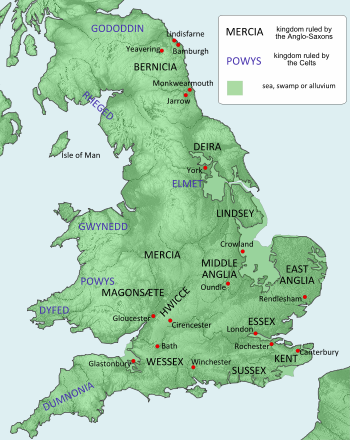
From bases in south England these tribes spread out and established kingdoms the length and breadth of the country. By the sixth century the land had stabilised into seven kingdoms, traditionally known as the Heptarchy, consisting of East Anglia, Essex, Kent, Mercia, Northumbria, Sussex, and Wessex.

Alongside the main entities was a fluctuating set of smaller kingdoms which included, at one time or another, the kingdoms of Bernicia and Deira within Northumbria, Lindsey in present-day Lincolnshire, the Hwicce in the southwest Midlands, the Magonsæte or Magonset, a sub-kingdom of Mercia in what is now Herefordshire, the Wihtwara, a Jutish kingdom on the Isle of Wight, the Middle Angles, a group of tribes based around modern Leicestershire, and the Hæstingas (around the town of Hastings in Sussex.

The main Anglo-Saxon kingdoms (source: Wikipedia)

The main Anglo-Saxon kingdoms (source: Wikipedia)

By 660 Northumbria was the most powerful Anglo-Saxon kingdom, and its contacts with both Ireland and Rome produced a golden age of culture.

Mercia began to displace Northumbria as most powerful kingdom in the early 8th century, a process which reached its climax in the long reign of King Offa, from 757 until his death in July 796. Offa controlled London, built the famous dyke along the border with Wales, and conquered Kent, East Anglia, Essex and Sussex.

In 793 Vikings attacked Lindisfarne monastery way up towards the Scottish border, and for the next two hundred years Danish invaders were a constant threat, eventually controlling the east of the country from the Thames to the border with the Scots. This area became known as the Danelaw, with its capital city at Viking-founded York.

England about 900 AD, showing the border between the Danelaw and Wessex

England about 900 AD, showing the border between the Danelaw and Wessex

Alfred the Great (849 to 899) is remembered because he fought the Danes out of Wessex, recaptured London, and unified all the tribes of England against the foreigner, signing a peace treaty with the Danish leader, Guthrum, in about 880.

But he didn’t manage to expel them. It was only under his grandson, King Æthelstan that, in the 930s, the Danes were completely expelled.

And even this unity was lost when the Danes under Sweyn Forkbeard reinvaded in 1013, leading the throne of England to be seized by his son, Cnut the Great, a Dane who ruled England from 1016 to 1035.

One last Anglo-Saxon king, Edward the Confessor, ruled again, from 1042 to 1066, but it was a dispute over the succession following his death, which led to the invasion of the county by William and the Conqueror and his Normans, and the death of the last Anglo-Saxon king, Harold Godwinson, at Hastings.

The period from 450 to 1066 was, in other words, one of almost constant warfare, in which kingdoms depended for their existence and stability on the military might and strategic canniness of strong rulers. The sophisticated economic systems of the Romans, their agricultural organisation, their towns laid out logically with strong defensive walls – all this was lost within a few generations of the Roman departure in 410.

For most of the next 600 years small communities of peasants eked out a subsistence living, and their surplus was skimmed off by violent kings to fund their high lifestyle and elaborate jewellery and weapons.

The Anglo-Saxon church

But alongside the history of kings and conquest, there is a parallel history, deeply intertwined with it – the history of the Christian Church in England.

There were Christians among the Roman community but their version disappeared when they left. Some missionaries came from Ireland which had a Christian tradition before England. But the main story begins with the mission to Britain of St. Augustine of Canterbury (not to be confused with St Augustine of Hippo, the great 4th century theologian).

Augustine arrived in 597, converted the king of Kent, Æthelberht a, established an episcopal seat at the Kentish capital, Canterbury (which is why we still have archbishops of Canterbury to this day), and established a monastery and seat of learning which could train and educate the monks who would then, themselves, be sent out to convert the various rival warlords to the true faith, throughout the 600s.

We know a lot about the process of conversion because it is described in detail by the monk known as the Venerable Bede, in his masterpiece, A History of the English Church and People, which I have reviewed elsewhere.

Bede was a product of Northumbrian culture, a Benedictine monk who spent his entire life at the monastery of St. Peter and its companion monastery of St. Paul near Jarrow. He wrote some 40 books but his masterpiece, the Historia ecclesiastica gentis Anglorum or The History of the English Church and People.

The point is that, although the Anglo-Saxon kings and their people were all pagans they were also illiterate and so all we know about them is filtered through the writings of the literate Christian monks, who all wrote in Latin.

And the little we have of actual Anglo-Saxon, the language these people spoke and recited their histories and legends in, was also recorded by Christian monks.

We have some pagan jewellery, most notably the content of the fantastic burial hoard found at Sutton Hoo, attributed to King Raedwald who lived in the 7th century.

But even carved crosses, much of the remaining jewellery, and all of the remaining texts, are Christian in content, the crosses’ inscriptions in Latin, the jewellery including the cross motif, and even the handful of Anglo-Saxon texts we have – even the great Anglo-Saxon epic poem Beowulf – contain Christian imagery, or subject matter, and were written down by Christian monks.

Beowulf © British Library Board

Beowulf © British Library Board

Alfred the Great’s renaissance

By the 850s most of the kingdoms were thoroughly Christianised. Alfred the Great (d.899) acquired his reputation not only for his military victories against the Danes, but because he saw the need to raise the cultural level of the people he now ruled in the area known as Wessex. He realised he needed educated literate civil servants to administer his kingdom, and – being a good Christian king – he realised the gospels needed to be spread.

Alfred commissioned monks to begin writing a yearly chronicle of events, thus founding the Anglo-Saxon Chronicles which ended up existing in various versions, kept by monks in monasteries around the kingdom. These are an invaluable source of historical information, and for the grammatical structure of the various regional dialects of Anglo-Saxon. Some of which continued for a generation after the Conquest.

Alfred also commissioned the translation of important texts into Anglo-Saxon. These included a translation and copies of Pope Gregory the Great’s book Pastoral Care. He distributed these along with ‘æstels’ or wooden pointer sticks, which were used for following words when reading a book.

Attached to the end of each pointer was a valuable example of Anglo-Saxon jewellery which featured a portrait of the king and, around the sides, the words ‘Aelfred mec heht gewyrcan’, meaning ‘Alfred ordered me made’. The one and only surviving copy of this is usually in the Ashmolean Museum in Oxford, but has been brought here for this exhibition. It is wonderful, the quaintness of the likeness of the king contrasting vividly with the sophistication of the dragon (snake?)’s head beneath it, from whose mouth pokes the nozzle which is where the wooden pointing stick came out.

Alfred Jewel © Ashmolean Museum, University of Oxford

Alfred Jewel © Ashmolean Museum, University of Oxford

Anglo-Saxon treasures on display

This exhibition is so blockbusting because just about every single book, every Bible, psalter, breviary, every manuscript letter, poem, deed and legal document which tells and illustrates these tumultuous 650 years has been brought together and assembled in one place.

The Alfred jewel is just one of the inestimable treasures on display at this massive, comprehensive and dazzling exhibition. Other highlights include:

  • the stunningly ornate gold buckle from Sutton Hoo
  • treasures from the Staffordshire Hoard
  • the River Erne horn, a wooden trumpet from the 8th century discovered in the river in the 1950s on loan from National Museums Ireland
  • displayed alongside the Vespasian Psalter, which includes the oldest translation of part of the Bible into English and depicts two musicians playing similar instruments
  • archaeological objects including:
    • the Binham Hoard, the largest collection of gold from 6th century Britain, on loan from the Norfolk
    • the Lichfield Angel, which has never been displayed outside of Lichfield since it was excavated in 2003
    • key objects from the Staffordshire Hoard, discovered in 2009, the largest hoard of Anglo-Saxon gold ever found
  • the Sutton Hoo gold buckle
  • the Fuller Brooch on loan from the British Museum

Layout

The exhibition is beautifully laid out, in mysterious low lighting (obviously, to protect these priceless manuscripts), the walls hung with long, narrow photographs of unspoilt countryside, vividly conveying a sense of what must have been the largely untamed landscape of the times. It is organised into rooms which take us carefully through the period, with rooms and areas devoted to:

  • Kingdoms and Conversion
  • The Rise of the West Saxons
  • Mercia and its Neighbours
  • Language, Learning and literature
  • Kingdom and Church
  • Music making
  • Conquests and Landscape
  • The Empire of Cnut
  • The Cnut Gospels
  • Domesday Book

There are three or four videos scattered throughout, interviewing scholars who explain key moments or ideas in Anglo-Saxon culture, namely curator, Dr Claire Breay, and well-known TV historian Michael Wood.

The video on the Domesday book is simple and interesting. And there’s a longer one showing the process of preparing vellum parchment and then how the ink and pain for the illuminations were prepared.

Vespasian Psalter © British Library Board

Vespasian Psalter © British Library Board

Mostly manuscripts

But the exhibition, as you would expect from its location, focuses mostly on books, on a huge selection of early medieval manuscripts, alongside, letters and other written matter, including:

  • the beautifully illuminated Lindisfarne Gospels
  • the one and only surviving copy of Beowulf
  • a copy of Bede’s Ecclesiastical History
  • the St Augustine Gospels on loan from Corpus Christi College Cambridge
  • the Book of Durrow on loan from Trinity College Dublin
  • the Echternach Gospels on loan from the Bibliothèque nationale de France
  • the Utrecht, Harley and Eadwine Psalters from Utrecht University Library, the British Library and Trinity College Cambridge respectively
  • the four principal manuscripts of Old English poetry on display together for the first time, with the British Library’s unique manuscript of Beowulf displayed alongside:
    • the Vercelli Book returning to England for the first time from the Biblioteca Capitolare in Vercelli
    • the Exeter Book on loan from Exeter Cathedral Library
    • the Junius Manuscript on loan from the Bodleian Library
  • Domesday Book, the most famous book in English history and the earliest surviving public record, on loan from The National Archives
  • the earliest surviving English charter, issued in 679 and granting land to the Abbot of Reculver;
  • the oldest original letter written in England, from the Bishop of London to the Archbishop of Canterbury, dating from early 8th century
  • the earliest surviving letter in English, the Fonthill letter, from the early 10th century on loan from Canterbury Cathedral
  • the earliest surviving will of an English woman, Wynflæd
  • St Cuthbert Gospel, the oldest intact European book with its original binding, made at the monastery of Wearmouth-Jarrow in the north-east of England in the early 8th century
  • and the enormous Codex Amiatinus, the earliest surviving complete Bible in Latin made at the monastery of Wearmouth-Jarrow in the north-east of England in the early 8th century and taken to Italy in 716 as a gift for the Pope. It will be returning to England for the first time in more than 1,300 years, on loan from the Biblioteca Medicea Laurenziana in Florence
Codex Amiatinus on loan from Biblioteca Medicea Laurenziana to Anglo-Saxon Kingdoms at the British Library © Sam Lane Photography

Codex Amiatinus on loan from Biblioteca Medicea Laurenziana to Anglo-Saxon Kingdoms at the British Library © Sam Lane Photography

Cnut and Emma

I’d expected it to end sometime after the loosely titled Kingdom and Church section, so I was surprised that the exhibition devotes not one but several sections to reign of King Cnut, the Dane who united England with his home territory to form a short-lived North Sea Empire. He was king of England from 1016 to 1035 and the exhibition shows how manuscripts and books, gospels and psalters of great quality continued to be produced.

There is a section devoted just to Cnut’s strong-minded queen Emma, bringing together references in documents and even illustrations which appear to be of the queen.

The Norman Conquest

And then a final section devoted to a massive copy of the Domesday Book, commissioned by William the Conqueror to list in fine detail every scrap of land in his new domain. The exhibition includes not only a hefty copy of the book, but a rare example of one of the preliminary rolls on which data was initially gathered by William’s army of census takers,before being collated and copied into the Big Book.

Domesday © The National Archives

Domesday Book © The National Archives

Thoughts

Several points emerged for me:

  • The distinction between the Northumbrian Golden Age of the 660s onwards, which is all about Iona, Lindisfarne, St Cuthbert, Benedict Biscop and Bede – and the rise of Mercia under Offa about a century later – there are illuminated books from both periods which, to the really scholarly eye, show the difference in date, origin and cultural links.
  • The idea that the rise of Wessex (which led, eventually, to the unification of England) was a product of the Viking invasions: pushed back into the South-West and West Midlands, the remaining Saxon kingdoms were forced to co-operate and coalesce, and Alfred is the symptom of this newfound focus
  • The sense that, once you get to Alfred, the difficulty of trying to remember the kings and rulers of all the scattered other kingdoms disappears; Alfred is succeeded by his son, Edward the Elder (899 to 924), who is himself succeeded by his son, Æthelstan, who, from 927 to 939 has the right to claim himself to be the first king of all the English. From this point onwards it becomes easier to follow the kings, and there is a kind of cultural and legal as well as military unification.

Slaves

I was surprised to come across a record of Athelstan freeing a slave. The earliest will made by an Englishwoman, Wynflæd, from the tenth century, records her wish to free her slaves. And the section about Domesday Book, while running through some of the staggering stats included in the book, mentions that there were some 28,325 slaves in England in 1086 (compared with some 288,000 peasants). I.e. around 10% of the work-force was slaves.

A little-known fact about the Norman Conquest is that it was William the Bastard who formally abolished the (thriving) slave trade in Anglo-Saxon England.

Slight criticism

I had one big caveat. I counted 125 books and manuscripts in the exhibition – books carefully propped open so we could see illuminations and text, manuscripts carefully flattened. These were all, of course, accompanied by information panels explaining what they were, what to look for in the illumination or style of writing, and so on.

BUT – none of them contained a translation of the actual words on show.

Most of the books are in Latin, Latin versions of various books of the Bible, breviaries and psalters, texts of Christian advice, letters from bishops to kings or vice versa, deeds to properties, adjudications in land disputes, and so on, with just a handful of texts in Anglo-Saxon, such as Beowulf, the Exeter Riddles, the Dream of the Rood, wills, charters and so on.

But early medieval writing was highly stylised. Although I studied Latin for GCSE and Anglo-Saxon at university, I always find it next to impossible to read Latin or Anglo-Saxon manuscripts because of the cramped and stylised nature of the handwriting.

So it would have been a very good idea, next to the panel telling you the history of the book, to have had a panel simply laying out the actual words on display, in modern orthography.

And then, logically enough – it would have been a good idea to have translated the words into modern English.

We are presented with a page of Beowulf, or of the Domesday Book. It looks great – but I can’t read a word of it. Not only can I not read it, but even if I could, I wouldn’t understand it.

I think this was a big flaw with the exhibition. The overwhelming majority of objects on display are texts. And although the exhibition gives plenty of help with the manuscripts’ provenance and style and general content – visitors are given no help at all with actually reading or understanding them.

Lindisfarne Gospels f.27r © British Library Board

Lindisfarne Gospels f.27r © British Library Board

Introduction by the exhibition curator


Related links

Other Dark Age reviews

Other British Library exhibitions

The Norman Conquest by Marc Morris (2012)

Marc Morris

Historian and TV presenter Marc Morris has written a racy pacy account of the ‘most important event in English history’, a 350-page overview which starts 50 years before the big event, continues for a generation afterwards, and effortlessly integrates scholarly weighing of the various sources and their reliability with common-sense interpretation and stylish factual asides.

For example, the population of 11th century England was some 1.5 million of whom over 10% were slaves. Most of the population above them were smallholding churls, with around 5,000 significant landowners in the whole country, of whom only an estimated 90 held enough land to be rich enough to attend the king, and only 4 earls at a time ruled the four main regions of Wessex, Mercia, Northumberland and East Anglia.

There are some fascinating sections on the rise of Norman church architecture, later named the ‘Romanesque’, whose soaring new designs eclipsed the clunky windowless churches of the Saxons.  And a chapter dedicated to the origin and implementation of the amazing Domesday Book.

However, no matter how brightly and enthusiastically it starts, like every account of this era, Morris’s book soon bogs down in the tangled web of family trees and promises – ie who promised who the throne of which country when, who invaded who, who made solemn oaths of friendship and then declared war etc – webs which ensnare not just the throne of England but those of Norway, Denmark, Sweden, Scotland, Wales and France as well as the dukedoms and earldoms of Anjou and Flanders and Normandy, to name just the main ones.

As one way through this complex web I set out to record simply why each king of England – from Æthelred the Unready onwards – actually became king. Not their acts and achievements. Just why they became king.

Æthelred the Unready (978 to 1013 and 1014 to 1016)

Son of King Edgar and Queen Ælfthryth, Æthelred was the great-grandson of Alfred the Great. King Edgar had an older son by another wife, Edward, who duly became king in 975 but was not the choice of many powerful nobles and was murdered just three years later in 978. It’s at this point that the Witan or council of powerful landowners elected the ten-year-old Æthelred king. Over the following 40 years Æthelred failed to bind together the factions which had made his election so bloody, and his long reign was characterised by backstabbing weakness at the centre and betrayal at the periphery. All made worse for coinciding with a resumption of the Danish/Viking raiding which everyone thought had been staunched in the mid-900s. Thus in 1002 Sweyn Forkbeard, king of Denmark, landed and began harrying whole swathes of England in sustained campaigns until, in 1013, Æthelred was forced to flee abroad (to the court of Normandy, home of his wife Emma) whereupon Sweyn declared himself king.

Sweyn Forkbeard (1013 to 1014)

Sweyn had himself crowned king of England on Christmas Day 1013. He reigned for 5 weeks, dying on 3 February 1014. He had one son, Cnut, aged about 20, who had been an active helper in his wars. But the English ealdormen rejected Cnut and invited Æthelred back to be their king. Kingship in Anglo-Saxon England was elective.

Æthelred the Unready part 2 (1014 to 1016)

Æthelred accepted the invitation, returned from Normandy and organised an army which defeated the Danes in Lincolnshire, the one and only military victory of his reign. However, old divisions among his senior advisers once again opened up and soon his eldest son, Edmund, was in open opposition to him. In September 1015 the Danes led by Cnut re-invaded and Edmund led the armies against them while Æthelred fell into his final illness and his court squabbled as usual. In April 1016 Æthelred died.

Edmund Ironside (April to November 1016)

Third of the six sons of Æthelred by his first marriage to Ælfgifu, Edmund gathered loyalist forces around him to fight the Danes, first Sweyn and then his son Cnut. Edmund was king of England from April 1016, when his father died. He led fierce resistance to the invading Danes, fighting five major battles against them before defeat at the battle of Battle of Assandun led him to agree to a division of the country, Edmund keeping Wessex, the old English heartland of Alfred the Great, and Cnut taking the rest. These arrangements were rendered moot when Edmund himself died 0n 30 November, probably from wounds sustained in the battle.

—At  this point Æthelred’s children by his second wife, Emma of Normandy – Alfred, the future Edward the Confessor and their sister, Godgifu – fled abroad to Normandy.—

Cnut the Great (1016-1035)

Cnut and his Danish army successfully regained the throne claimed by his father Sweyn. He was to rule as king of England for nearly 20 years, at the same time being king of Denmark and of as much of Norway as he could conquer.

[Edmund’s heirs – Edmund had two children by Ealdgyth – Edward and Edmund. Cnut sent them to the king of Sweden to be murdered, but the Swedish king forwarded them to Hungary where Edmund died but Edward prospered. Edward ‘the Exile’, as he became known, returned to England in 1057 only to die within a few days of his arrival...]

Cnut had sons by two wives:

  • Ælfgifu of Northampton, who he was betrothed to by his father Sweyn upon the conquest in 1013, gave him Svein and Harold, called ‘Harefoot’. Svein was to die on campaign in Norway in 1035.
  • Upon taking the throne Cnut invited Æthelred’s widow, Emma of Normandy, to marry him; she did and bore him Harthacnut.

Hiatus (1035 to 1037)

When Cnut died after nearly 20 years on the English throne he left the conditions for a bloody struggle between the two sets of sons. The great men of the kingdom held a meeting at Oxford on the river Thames, the border between Wessex and the south where Emma based herself and which supported Harthacnut, and the more Scandinavian north which supported Harold. They agreed to partition the country (once again) but in fact Harthacnut found it impossible to leave Denmark where he was threatened by invasion by the kings of both Norway and Sweden, for some years. And so, the record suggests, Harold little by little made himself actual ruler of the whole country.

Harold I ‘Harefoot’ (1035 to 1040)

Son of Cnut by his second wife, Ælfgifu of Northampton, some historians speculate that his mother was the real power behind the throne. After the conflicts surrounding his election not much is recorded of his reign. He died in on 7 March 1040 at the relatively young age of 24, just as his half-brother Harthacnut had finally got round to organising a fleet to invade England.

Harthacnut (1040 to 1042)

Son of Cnut and his second wife, Emma the widow of Æthelred. He arrived with a fleet of 62 ships at Sandwich on 17 June 1040.  Most of the army were mercenaries and one of Harthacnut’s first acts was to levy an enormous tax to pay for them. Unpopular across the country, two tax collectors in Worcester were killed by the mob which led Harthacnut to send forces to kill everyone in the city and raze it to the ground. His popularity never recovered and he levied the same punitive tax the next year. After two brief years, on 8 June 1042 Harthacnut dropped dead at a wedding feast in Lambeth.

But, according to Morris, one of the few good things Harthacnut did in his reign was, in the second year, unexpectedly, to invite Edward, son of Æthelred and Emma, to come and join him in a joint rule (p.42). Maybe he realised how unpopular he was and needed an English intermediary. Whatever the motivation it paved the way for Edward’s swift acclamation.

Edward the Confessor (1042 to 1066)

Ason of Æthelred by his second marriage to Emma of Normandy. Æthelred already had no fewer than six sons by his first marriage to Ælfgifu and so it must have seemed unlikely that Edward would ever inherit the crown. However, the most powerful son, Edmund Ironside, was killed resisting Cnut as, it seems, were four of the others, and the survivor, Eawdwig, was executed by Cnut along with any other members of the English nobility who seemed a threat soon after his victory in 1016. So now, in 1042, the son of Emma and Cnut – Harthacnut – was dead – and so were the sons of Cnut and Ælfgifu – Svein and Harold – and so were all the sons of Æthelred and Ælfgifu – leaving Edward on the spot and eligible. He was elected king by the Witan and crowned on Easter Day 1043.

Harold II Godwinson (1066)

Edward reigned for a long time and a lot happened. A central thread is the presence of the great earl Godwine, who had risen under Cnut from relative obscurity to become, through his fighting prowess, earl of Wessex and one of the most powerful earls in the country by about 1020. A theme of Edward’s reign was the difficulty he had managing Godwine, problems which reached a climax in 1051 when Edward ordered Godwin to punish the population of Dover for a drunken brawl with visiting Frenchmen. Godwin refused, it became a battle of wills and Edward rallied the other earls and leaders and managed to get Godwin and his sons exiled and seized all his land. However, in 1052, the Godwins returned with a large armed force and won enough support to compel Edward to restore him. In 1053 he died and his son Harold inherited the earldom of Wessex, every bit as strong and imperious as his father.

The fatal promise

The crux of the Norman Conquest is whether Edward the Confessor promised the English throne to Duke William of Normandy, as is depicted in the Bayeaux tapestry and in all Norman accounts. When Cnut ruled England the entire Saxon royal family sought refuse in Normandy, where Edward was raised. As it became clear he was going to have no male issue, he allegedly, in 1051, sent a promise to Duke William that he would inherit the English throne. Over the years he infiltrated various Normans into high positions, including Archbishop of Canterbury.

Edward was well aware that earl Godwin’s headstrong son, Harold, considered himself a legitimate heir and so in 1064 Edward ordered him to go to Normandy to confirm Edward’s election of Duke William as his successor. This Harold did with very bad grace and William forced him to make the oath of allegiance over holy relics, effectively making Harold William’s vassal. But in his heart Harold didn’t accept it.

For Harold and the Saxons the crown was passed on by the decision of the Witan or council or by brute force; one king couldn’t choose to pass it to another. For William, Edward’s promise and Harold’s confirmation of it on holy relics, was a solemn and binding legal agreement.

And so when Edward died and Harold, ignoring his forced promise, and acclaimed by the other nobles of the country, took the throne, Duke William felt cheated and was able to persuade not only his own people but even Pope Alexander II that his cause was Just, to raise a massive armada, and to get the Pope’s blessing for his invasion. Harold counter-claimed that Edward gifted him the throne on his deathbed.

Who was telling the truth? Did such a gift supersede – if it was made – the solemn promises Edward had made earlier to William? Did those solemn promises have meaning in English custom and law?

Harold was crowned in Westminster Abbey on January 6 1066. In September he had to march north to deal with the invasion of the Norwegian warrior, Harold Hardrada.

Harald Sigurdsson (called ‘Hardrada’)

Half-brother to King Olaf the Saint of Norway. Following Olaf’s defeat and death at the battle of Stiklestad in 1030, Harald saw action in Russia and then as a member of the Byzantine emperor’s famous Varangian Guard in warfare around the Mediterranean. In 1046 he returned to Scandinavia and to conflict with his nephew Magnus I who had become king of Denmark and Norway. When Magnus died in 1047 Harald became king of Norway but hankered after Denmark as well and raided the country every year for nearly 20 years. Moreover, he contemplated invading England more than once, to restore the Empire of Cnut the Great. The Confessor was well aware of this and sent numerous emissaries to pacify Harald, but who also gave him the impression he would get the throne of England when Edward died.

In 1066 Harold Godwinson’s brother Tostig, former earl of Northumbria, was driven out of England and into exile. He came to Norway and persuaded Harald to try and invade the north of England, the part of the country with strong Scandinavian ties due to the prolonged settlement there of Vikings in the 9th and 10th centuries. The landings were initially successful and Harald and his forces won the battle of Fulford outside York. However, King Harold II Godwinson arrived with a large force and, catching the Norwegians by surprise, massacred them at the Battle of Stamford Bridge on 25 September 1066.

William the Bastard (1066 to 1087)

In 1036 Duke Robert of Normandy died on pilgrimage to the Holy Land leaving a 7-year-old son by a working woman to whom he was not married and who he named William. William’s childhood and teens were spent in a court in crisis and beset by war, an environment he mastered, making himself the most successful military leader in northern Europe. He was convinced Edward the Confessor had promised him the crown of England and was outraged when Harold ‘usurped’ it. He assembled a huge invasion fleet and an army well-stocked with mercenary fighters, before waiting impatiently for the weather in the English Channel to become favourable. Landing in Pevensey Bay on 28 September 1066, he marched his army to Hastings and then inland to the ridge at Senlac where, on 14 October, the Battle of Hastings was fought, King Harold Godwinson killed, and the Saxon forces decimated.

William then marched his men from the coast through Sussex and Surrey, across the Thames and then north-east along the Chilterns to Berkhamsted, ravaging and burning as he went. All resistance was crushed and eventually the English nobles in London realised they had to capitulate. William had himself crowned in Westminster Abbey on Christmas Day 1066. For the Normans coronation put God’s seal on power. He also had the Pope’s imprimatur. William claimed the throne:

  • by right of the Confessor’s solemn promises
  • by right of conquest
  • by right of the Pope and Mother Church
  • by the (eventual) acclamation of the leading English nobles

Edward the Aetheling

Remember Edward the Exile, the son of Edmund Ironside? Who came back to England in 1057 only to drop dead? Well, he had a son known to history as Edgar the Ætheling (b.1051?). After Harold II was killed at Battle, Edward was briefly proclaimed king of England and based himself in anti-Norman London, at least for the few months that William ravaged his way through the Home Counties.

It was Edward who led the deputation from London which went to submit to the Conqueror at Berkhamsted. He was allowed to live but plagued William by putting himself at the head of a number of rebellions against William’s rule between 1067 and 1075. With the end of English opposition in that year he went and fought alongside the Conqueror’s son Robert of Normandy in campaigns in Sicily (1085 to 1087) and accompanied Robert on the First Crusade (1099 to 1103) before dying of old age in England in 1126.

The failure of monarchy

The fundamental reason there was a Norman Conquest is because Edward the Confessor failed to have a son, indeed any children. His widow, Edith, later commissioned a Life of Edward which claimed he was so devout and holy that the couple never had sex. More likely it was just a common-or-garden case of infertility, in which case two of the most seismic events in English history – the Norman Conquest and the Reformation – can be attributed to the malfunctioning sex organs of the monarch.

King Edward the Confessor promising what, exactly, and to whom?

King Edward the Confessor promising what, exactly, and to whom?


Related links

Other medieval reviews

King Harald’s Saga

Introduction

This is a relatively short and straightforward read in an excellent, fluent translation by Magnus Magnusson and Hermann Pálsson.

It was published in 1966, 900 years after the events of the Great Year which it describes, for this is the life story of King Harald Sigurdsson, known as Harald Hardrada (hard ruler), the Norwegian king who invaded the north of England in late summer 1066 before being brought to battle, defeated and killed by Harold Godwinsson, King Harold II of England, at the Battle of Stamford Bridge.

The same ill-fated Harold of England who then had to force-march his army 270 miles south to confront that other invasion, from the Norman pretender William the Bastard, where things didn’t turn out quite so well.

King Harald’s saga is significantly different from the 15 or so sagas I’ve read hitherto for the following reasons:

It is authored 

All the so-called Family sagas are anonymous, whereas Harald’s was written by a known and famous medieval author and historian, Snorri Sturlason.

Poetry

All the other sagas include poetry and several of them are about famous poets (Egil Skallagrimsson, Gunnlaug Wormtongue); but the historian Snorri uses poetry not as illustration but as evidence, carefully assessing what it tells us about the events it decribes.

It is an excerpt

All the so-called ‘Family sagas’ are self-contained stories (though some key characters appear in more than one saga); whereas Harald’s saga is an excerpt from a much longer work, the Heimskringla, which is some 850 pages long.

Linear

The ‘Family sagas’, although they concern the deeds of actual historical people, are consciously shaped and moulded for artistic affect; whereas Harald’s saga, being an almost year-by-year account of his career, is much more linear.

Interference

We often know nothing more about the heroes of the ‘Family sagas’ than their sagas tell us and, given the artistic intention of the texts, it is satisfying and sufficient to accept their narratives and stories at face value without needing to delve deeper; whereas King Harald was a real historical figure and a major player in the events of the dramatic year of 1066 which are taught to all schoolchildren. So his character – and the events described in the narrative – are easily swamped by our outside knowledge of him and his doings from numerous other sources.

Snorri Sturlason

One of the key figures in the creative upsurge which led to the explosion of saga-writing in Iceland during the 12th and 13th centuries was the Icelandic historian, Snorri Sturlason (c.1179 to 1241).

Snorri was an astonishing renaissance man – poet and historian, politician, chieftain and lawyer. It is to Snorri that we owe one of the two key texts about Norse mythology, the Prose Edda.

This long text was designed as a primer on poetic technique, leading up to a long section about the different stanzas and methods available to Icelandic poets, the opening section about the Norse myths was only intended as a kind of background briefing for these poets. But as most other sources have been lost, the Prose Edda now stands as an invaluable source – often the only source – for many of the tales of the Norse gods.

As if this wasn’t enough of an achievement, Snorri is also famous, in Norway, for having written the definitive history of the kings of Norway from the earliest mythical times up to around the time of his birth, 1177, in a vast book titled the Heimskringla.

The Heimskringla

This vast text is a comprehensive history of the kings of Norway from the mists of prehistory, when they were caught up in the doings of Odin and Loki, through to factually accurate accounts of the kings who ruled just before Snorri’s birth. It is divided into 16 chapters which are, in style and structure, very like sagas. By far the longest chapter consists of the saga of St Olaf, taking up two thirds of the total.

But unlike the Family sagas, Snorri’s long text is very aware of the problems of historical technique, of weighing and comparing sources, of choosing which version of events to follow, and so on. Snorri explicitly addresses these problems in his preface and in other places.

Maybe the most striking aspect of the book is the very strong reliance on poetry as a form of historical evidence.

Poetry

Over 90 verses of skaldic poetry are quoted in the saga, there’s a verse on every page, and most of them are credited to named individuals since the kings of Norway had a special fondness for keeping poets around them to sing their praises and Harald was no exception. I particularly liked this verse by Bolverk Arnorsson:

Bleak showers lashed the dark prows
Hard along the coastline;
Iron-shielded vessels
Flaunted colourful rigging.
The great prince saw ahead
The copper roofs of Byzantium;
His swan-breasted ships swept
Towards the tall-towered city.

Interference

The Magnusson translation is wonderful, no problems there. It has a really useful introduction, good maps, invaluable family trees, and potted biographies of almost everyone mentioned in the text. In addition there are ample footnotes on every page, so that many pages are often more notes than text.

And it’s here that a teeny-tiny problem emerges, because at key cruxes of Harald’s biography – his time with the Varangian Guard in Constantinople, his wars against Svein Ulfsson, king of Denmark, and Earl Hakon Ivarsson, nomadic chieftain, and in the detail of his final campaign against Harold Godwinsson in England – the notes intrude up into the body of the text to give really detailed explanations of the complicated genealogical and political connections between the main characters, and this:

  • swamps the text you’re reading: for example, after two pages of factual scholarly notes detailing just what Harold Godwinsson promised Duke William of Normandy, it’s difficult to rejoin the fictional narrative in the same, rather fairy-tale frame of mind
  • undermines the text because, unfortunately, it turns out that the saga is plain wrong in many of its factual claims

The notes, in places, become a kind of anti-text which is actively warring against the saga, undermining its facts and interpretation.

This doesn’t happen in the ‘Family sagas’ which are much more like, say, the tragedies of Shakespeare in that they use genuine historical figures but are obviously crafted to produce dramatic twists and confrontations.

Snorri, also, creates dramatic moments in this tale, but they are continually undermined by the scientific tone of the footnotes, which leap in to correct Snorri’s many historical errors and so continually interfere with your enjoyment.

In a nutshell, the first time you read the Magnusson translation, I suggest you skip the notes, just read the narrative for the speed and excitement of the story.

Plot summary

The story opens when Harald is 15 and fighting alongside his half-brother, King Olaf, at the Battle of Stiklestad in 1030. Olaf loses and is killed and Harald flees east to Sweden. From there he journeys south-east through Russia, stopping to impress King Jaroslav before carrying on down to Constantinople to join the Varangian Guard, the elite band of mercenaries mostly from Scandinavia who served the emperor directly. He fights for the Byzantines in Greece, Sicily, then in the Holy Land where he makes pilgrimage to the shrines. Back in Constantinople he asks to return home, is refused and thrown in prison, is released by a miracle and takes part in some kind of uprising against the emperor in which he is said to have personally put out the emperor’s eyes. He and his fellow Scands escape across the Black Sea and back upriver to Russia, collect the loot they’d been stashing with King Jaroslav, and return to Norway.

The middle part of the saga details Harald’s numerous confrontations, battles, negotiations, treaties with and double crosses of King Magnus of Denmark (his nephew), his successor King Svein Ulfsson, and the slippery chieftain  Earl Hakon Ivarsson who fights first for one side then for the other then against both. It is a confusing picture made more so by the tangled skein of intermarriages among the royal families of Norway, Sweden and Denmark and the endless squabbles about who promised who which kingdom when they died.

Thus, in around 1038, King Magnus of Norway had made a pact with King Hardacnut of Denmark (son of Cnut the Great who actually ruled England from 1016-1035) that if either of them died childless the other would inherit their realm. Hardacnut died childless in 1042 and so Magnus claimed Denmark. But since  Hardacnut’s father had been king of England, Magnus also claimed the English throne. When Edward the Confessor had himself crowned English king after Hardacnut’s death, Magnus had planned to invade England only to be distracted by war with rebellious chieftains nearer home. When Magnus died in 1047 Harald considered that he’d inherited England along with Denmark. Edward negotiated with his both Harald and William of Normandy throughout the 1050s and managed to keep both at bay. But after his death in January 1066 both William of Normandy and Harald of Denmark considered themselves cheated of the kingdom when Harold Godwinsson got himself crowned, and they both set out to invade and conquer the land they thought rightfully theirs.

And that account not only partly explains the reason for Harald’s invasion, but gives a good flavour of how the fictional or artistic aspect of the saga, the creation of telling vignettes and insightful dialogue, is unfortunately swamped in the great sea of factual prose which is required to explicate these complicated events.

Harald sails Norway with 300 ships and maybe 6,000 men, lands on the Yorkshire coast, wins a battle at Fulford near York and is recovering with his men when the huge army Harold Godwinsson has raised attacks. The slaughter takes place in three terrible waves and leaves a battlefield glutted with corpses and Harald dead, killed by an arrow. Only 20 or so ships suffice to take the survivors back to Norway, and the memory of the slaughter more or less ends Scandinavian ambitions to invade let alone rule England.

In its last few chapters the saga has an obituary of Harald with a 13th century assessment of his strengths and weaknesses.  His old adversary Svein of Denmark gathers forces to invade Norway yet again, but wiser heads prevail to defuse the threat and preserve the peace, and Harald is succeeded by his sons Magnus (d.1069) and Olaf (d.1093) who preside over a long period of much-deserved peace.


Related links

Other saga reviews