A Story of South Asian Art: Mrinalini Mukherjee and Her Circle @ the Royal Academy

Upstairs at the Royal Academy, the three rooms of the Jillian and Arthur M. Sackler Wing of Galleries are currently given over to an exhibition of modern-ish art from south India. The show is based around the figure of the female Indian artist and sculptor Mrinalini Mukherjee (1949 to 2015) but doesn’t stop there. Both her parents, Benode Behari Mukherjee (1904 to 1980) and Leela Mukherjee (1916 to 2002), were artists and we are shown quite a lot of their work too along with their biographies i.e. they taught at Kala Bhavana in Santiniketan, the pioneering art school founded by poet and polymath Rabindranath Tagore.

Mukherjee was strongly influenced by a mentor at her art college in the Indian city of Baroda, K. G. Subramanyan, and we get a selection of his work. At college Mukherjee was part of a group or cohort of young artists and we are introduced to work by some of these, namely Gulammohammed Sheikh (b.1937) and Nilima Sheikh (b.1945). Lastly, when the group moved to new Delhi, they encountered the older artist Jagdish Swaminathan (1928 to 1994) whose exploration of tribal art and iconography encouraged their efforts to create an authentic Indian art, free of Western influences.

So in these three rooms is gathered the work of seven distinct artists, from two different generations, who worked across a wide range of media, in a great diversity of styles, all of them consciously reacting against and trying to escape from European aesthetics and methods. The show features paintings, ceramics, collages and drawings, sculptures in hemp and clay and bronze, and some enormous painted screens.

Installation view of ‘A Story of South Asian Art: Mrinalini Mukherjee and Her Circle’ @ the Royal Academy (photo by the author)

This range and diversity makes the exhibition a challenging experience to process and understand. There is quite a lot to like and enjoy, alongside much that is puzzling, and quite a lot which seemed, well, bad.

Mukherjee’s hemp sculptures

Mukherjee had a long career, active from the 1970s right up to her death in 2015. She painted and drew but her reputation rests on the large sculptures she made from dyed and woven hemp fibre arranged over metal frames to create large, impressive semi-abstract shapes.

Jauba by Mrinalini Mukherjee (2000) Hemp fibre and steel © Tate. Courtesy of Mrinalini Mukherjee Foundation

I didn’t realise it until a wall label pointed it out, but there is a deliberate evocation of female genitalia. Once it’s pointed out I suppose I can see the folds of labia to left and right, and even the difference between the large vaginal opening at the bottom and the smaller urethral opening above it, but hesitate to go any further. My gallery partner, who rarely bothers to read the wall labels, just warmed to the tumbling feel of the thing, and to its arrangement of folds and colours.

Seeking a post-colonial art

The key point, which is made repeatedly throughout the show, is that Mukherjee grew up in the post-independence generation who were powerfully committed to breaking free of colonial, European values and aesthetics and part of this was a very conscious return to and promotion of native Indian folk arts and crafts.

Benode Behari Mukherjee (1904 to 1980)

The curators really emphasise these artists’ wish to escape Western influence and create a truly independent Indian art and in some works maybe they do. But my own impression was the opposite: I was struck by how many of the paintings in particular very clearly showed the influence of modern Western art. A number of the paintings seemed to me to be copying between-the-wars Picasso, cartoon faces with both eyes visible on the same side of the nose, that kind of thing.

Here’s the work by Mukherjee’s father, Benode Behari Mukherjee, which the press people make available to us, a work made from coloured paper in the 1950s and it seems to me a straight pastiche of Matisse’s later coloured-paper cutouts. Maybe the brown skin of the central figure is a nod to the Indian nature of the work but surely it’s dwarfed by the utterly Matisse-an conception.

Lady with Fruit by Benode Behari Mukherjee (1957) © Tate. Courtesy of Mrinalini Mukherjee Foundation

Leela Mukherjee (1916 to 2002)

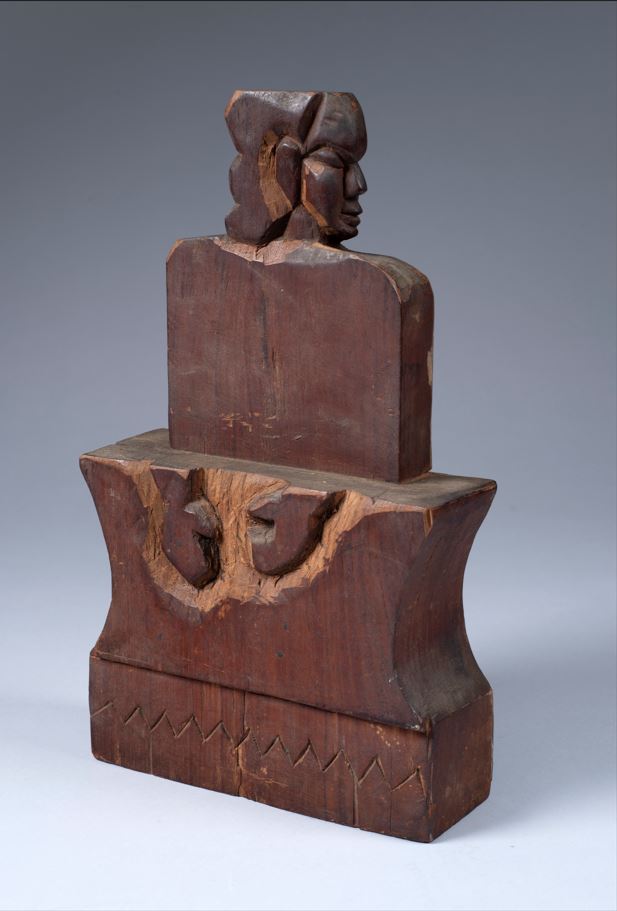
Here’s the work the press office makes available to represent Mukherjee’s mother, Leela Mukherjee. I don’t want to harp on about this too much but here again, I struggled to discern the distinctly Indian quality because the shape of the faces and the generally primitive working of the wood reminded me very much of African tribal art, such as you see in the British Museum.

Schematic Seated Figure by Leela Mukherjee (1950s-80s) Taimur Hassan Collection. Photo by Justin Piperger. Courtesy of Mrinalini Mukherjee Foundation

Gulammohammed Sheikh (b.1937)

Similarly, here are two works from 60 years later by Mukherjee’s friend Gulammohammed Sheikh, depicting (on the left) birds which might be cranes and (on the right) a kind of dragony-peacock bird, depicted in tall, narrow images which instantly reminded me of classical Chinese art. I can’t see anything Indian about them at all, they radiate Chinese shape, composition and styling.

Two paintings by Gulammohammed Sheikh 2018 to 2024 (photo by the author)

K. G. Subramanyan

K.G. Subramanyan (1924-2016) studied under under Mukherjee’s father and, according to the curators, developed into a ‘prolific artist-educator’. He rallied fellow artists to mine folk and craft traditions in unconventional ways, forging a postcolonial vision of Indian modernism. Here’s a gouache work demonstrating what this means in practice.

Untitled by K. G. Subramanyan (c.1950s) Taimur Hassan Collection. Photo by Justin Piperger © Uma Padmanabhan

Now this does have the amateurish quality I associate with modern Indian art, the very basic, child-level depiction of the human form which I saw just a few months ago in the extensive display of work by Indian artist Arpita Singh (born in 1937) at the Serpentine.

The exhibition’s long timeframe

Another challenge presented by the exhibition is the long timeframe it covers. The earliest work is from the very early 1970s whereas the most recent is from the 2020s. That’s a very long period of time. During that half century the international art world has changed out of all recognition. It has outgrown its European and American origins to become truly international. It has, for some time, promoted and valued artists from an enormous range of cultures, including many indigenous traditions such as Aboriginal art, which is now highly prized.

The patriotic, post-independence drive to create an authentic Indian art which the curators attribute as a central motivation to Mukherjee, her friends and colleagues, has long since become history. An ethnocentric perspective is now seen as reactionary and dangerous, witness liberal repugnance at the rise of right-wing nationalisms in countries around the world, including Hindu Nationalist sentiment in Mukherjee’s own India.

The modern art world floats above individual countries, in a kind of multicultural, cosmopolitan, liberal, enlightened, post-gender world of its own. So Mukherjee and her friends’ insistence on an Indian nationalist art, as well as her particular interest in the old-fashioned gender binary between phallic and vulvic forms, all seem rather quaint now.

To look specifically at Mukherjee’s work, when she began ‘sculpting’ in fabrics in the 1970s this was a radical and innovative technique, quite obviously rejecting the whole ‘carving in stone or marble’ tradition of the West. But by the time she began exhibiting in Europe, in the 1990s, it was a lot less unique. Numerous other artists were working in the same vein.

Jagdish Swaminathan (1928 to 1994)

Back to the art, here’s the example of Jagdish Swaminathan which we are given. This painting of a thin sliver of a bird singing above a mildly phallic lily plant against a big abstract yellow background is from Swaminathan’s ‘Bird, Tree and Mountain’ series. We find him in the late ’60s and early ’70s rejecting any type of naturalism, along with Western modernism, and instead returning to tribal and folk visual traditions. This probably is a good example of a non-western, Indian visual style although I’m not sure I like it. Do I not like it because it is not Western? No, because I love lots of non-Western art starting with Aboriginal art and lots of African art. It’s more that it’s like Western art but without enough real kick and originality.

Untitled (Lily by my Window) by Jagdish Swaminathan (early 1970s) Photo courtesy of Sotheby’s Inc © 2025 © J. Swaminathan Foundation

Gallery

A selection of photos I took to indicate the (sometimes bewildering and confusing) range of works on show.

Untitled by K.G. Subramanyan 1955-9

I liked this because it reminds me of something almost exactly the same I’ve seen by Paul Klee, in other words a European model or origin.

Untitled by K.G. Subramanyan 1955-9 (photo by the author)

Intertwined by Leela Mukherjee

Relatively small, crudely carved and unfinished wooden sculptures.

From left to right, Figure with Raised Hand, Intertwined Figures and Intertwined Figures II, by Leela Mukherjee, 1950s to ’80s (photo by the author)

Landscape 1968

My partner liked this because of the simplicity of the black silhouette but also the ambiguity of whether it’s some hills and a tree, as it appears at first glance, or whether the two lines dangling down in the middle indicate that it’s a human being.

Landscape by Gulammohammed Sheikh (1968) (photo by the author)

Untitled by Jagdish Swaminathan (1980)

According to the curators:

By the 1980s, Jagdish Swaminathan’s art reflected his deepening engagement with India’s tribal and Indigenous traditions. Moving away from the pristine colour planes of his earlier works, he adopted earthy palettes, textured surfaces, and symbolic forms. Shapes such as triangles and serpentine lines evoked mountains and snakes, resonant with Hindu mythologies of the god Shiva. These later canvases fuse abstraction with spiritual metaphor, recalling Swaminathan’s lifelong insistence that art should reveal nature and myth in their primal, symbolic essence.

Not knowing very much about ‘India’s tribal and Indigenous traditions’, I liked it because it reminded me of the brown abstract works my parents picked up at Heals or Habitat in the 1970s. And then of Paul Klee’s beautiful abstract shapes and patterns, which also often include gold or striking highlights.

Untitled by Jagdish Swaminathan, 1980 (photo by the author)

Also because of the rough impasto finish, especially of the two mysterious orange glyphs written across the image.

Detail of Untitled by Jagdish Swaminathan, 1980 (photo by the author)

Songspace by Nilima Sheikh (1995)

‘Songspace’ is the name of a series of scroll paintings by Nilima Sheikh, which I prefer to think of as ‘hangings’. Apparently there are ten in the series, of which 5 are hung in this exhibition in such a way as to create a kind of alcove into which you can step and be surrounded on 3 sides. Apparently the use of casein tempera paint on canvas is very distinctive and gives them their light and floating feel. Most of the surface is made up of abstract shapes, some of which may be landscapes in brown or green or red. Scattered in these shapes are wispy human figures which, apparently, reference Indian folktales, especially from Kashmir. They reference the style of classical Indian miniatures only blown up to wall size and refracted through a postmodern sensibility.

Songspace by Nilima Sheikh (1995) (photo by the author)

I liked the size, and the format of the hanging scroll, and the light and uplifting colouring but, as with most of these works, wasn’t impressed by, or was actively put off by, the scrappy amateurishness of the human figures.

Snake Column I by Mrinalini Mukherjee (1995)

According to the curators:

This terracotta sculpture is one of two ‘snake columns’ that reflect Mrinalini Mukherjee’s engagement with fertility and vitality. The cylindrical, phallic form recalls the ‘lingam’ of Shiva, while the serpent motifs and raised hood canopy reference Bankura terracotta vases dedicated to Manasa, a goddess of fertility. Like ‘Adi Pushp II’, nearby, the work channels sexuality as a generative power, fusing sacred imagery with organic, body-like forms that pulse with energy.

Snake Column I by Mrinalini Mukherjee (1995) (photo by the author)

If it as deliberately phallic as they say, then the snakes could as easily be sperm fighting their way to the front of the queue.

Forest Flame IV by Mrinalini Mukherjee (2009)

According to the curators:

In her final years, Mrinalini Mukherjee turned from hemp to bronze, creating sculptures that progressively grew in scale and ambition. Casting leaves, fronds and branches into molten form, she transformed nature into something both corporeal and otherworldly. ‘Forest Flame IV’ recalls the striking ‘Flame of the Forest’ tree of Santiniketan, which bursts into vivid orange blossoms each spring. Here, a trunk-like column erupts into flame-like petals, conflating vegetal growth with bodily emergence. Light animates the textured bronze surface, giving the work a sense of continual unfolding and transformation.

Forest Flame IV by Mrinalini Mukherjee (2009) (photo by the author)

I didn’t particularly like these because, as I said much earlier, by the 2000s, art had become so globalised, with so many artists creating so many kinds of object, that Mukherjee’s don’t really stand out. Downstairs at the Royal Academy are metal sculptures by Anselm Kiefer which are not unlike this. What made her very distinctive in the 1970s and ’80s had become utterly diluted 30 years later.

Adi Pushp II Mrinalini Mukherjee (2009)

To finish, back to what she did best, hemp sculptures. This one supposedly derives from her interest in botany and flowers and ‘adi pushp’ means ‘first flower’. But the curators go on to tell us that:

The sculpture’s central bulges and folds evoke human sexual organs, transforming the flower into a potent emblem of generative energy, and affirming nature as a vital, erotic life force.

None of which – the use of sublimated sexual imagery, the idea of sex as a central force in human nature – is at all distinctively ‘Indian’ but the common currency of humankind and any number of artworks, traditional or contemporary.

Adi Pushp II Mrinalini Mukherjee (2009) (photo by the author)

At the end of this small but sometimes confusing, sometimes enjoyable, sometimes boring, sometimes lovely exhibition, it looked less to me like a tumble of sexual organs than a comfortable-looking chair to have a nice sit-down in.


Related links

Related reviews

Revelations by Judy Chicago @ Serpentine North

Judy Chicago is an American art celebrity, a feminist superstar, a ‘trailblazing artist, author, educator, cultural historian’, a godmother of modern American feminist art.

Born Judith Cohen in 1939, Chicago struggled against the patriarchal condescension of the art world in the mid-1960s and eventually made a number of drastic decisions. The most striking was, in 1970, changing her name to adopt the city of her birth, thus erasing the gender-controlling aspects of going by either her father or husband’s names. She assembled collectives of women artists and founded the first feminist art program in the United States at California State University, Fresno.

The Dinner Party

Her most famous work is ‘The Dinner Party’ which she began in 1974 and can be said to summarise many of her concerns and practices.

‘The Dinner Party’ is not a painting or sculpture but an installation made of multiple elements: most obviously it consists of a large triangular table on which are 39 elaborate place settings for 39 mythical and historical famous women such as Sojourner Truth, Eleanor of Aquitaine, Empress Theodora of Byzantium, Virginia Woolf and so on.

So it is 1) an unconventional object, not painting, sculpture or quite installation, 2) setting out to address one of Chicago’s central concerns, which is the erasure and omission of eminent women from history, secular history, religious history, art history, all of it created and written by men.

It’s also a characteristic piece in that it was 3) a collaboration which required a lot of assistance from collaborating artists and assistants. Over the 8 years of its creation some 400 women worked on it, mostly volunteers.

Participants gather in The Dinner Party studio, Santa Monica, CA, 1978. Courtesy the Judy Chicago Visual Archive, Betty Boyd Dettre Library and Research Center, the National Museum of Women in the Arts.

‘The Dinner Party’ is also characteristic in that 4) it confronts women’s sexuality head-on by having all of the 39 plates being vulvar in shape i.e. based on the shape and pattern of a woman’s genitals, a pattern she came to call ‘butterfly-vagina’ imagery. Broadly speaking, this is consists of a vertical oval representing the vaginal opening, with the folds of skin surrounding it (the labia minoria, labia majora and so on [according to the anatomy diagram I’m consulting]) represented in different ways, from folds of fabric to entirely schematic geometric patterns. Each of the 39 plates is a variation on the butterfly-vagina motif but vulvar imagery re-occurs frequently throughout Chicago’s oeuvre.

Hildegarde of Bingen plate line drawing from ‘The Dinner Party’ (1977) by Judy Chicago © Judy Chicago/Artists Rights Society (ARS), New York. Photo © Donald Woodman/ARS, NY Exhibition prints courtesy of the artist

‘The Dinner Party’ is also typical of Chicago’s work 5) in emphasising crafts, such as crockery and the needlework and fabrics which ornament the table, in foregrounding crafts which have traditionally, in the male-dominated art world, been relegated to a position inferior to painting and sculpture.

It is also characteristic in yet another way, in that 6) it went on tour, rather like a rock band, being shown in 16 venues in six countries on three continents to a viewing audience of 15 million. The very fact that the publicity around it emphasises these stats indicates the showbiz, world tour aspect of Chicago’s practice and reputation.

In this exhibition at Serpentine North ‘The Dinner Party’ has an alcove to itself, which, alas, doesn’t show the table itself (which has come to rest as a permanent installation at the Centre for Feminist Art at the Brooklyn Museum, New York) but displays various resources about it. So there are print versions of the designs on each plate, along with early colour studies of the banners used in the finished work and sketchbooks that reveal the working process and components that led up to it. There are three video screens showing interviews with members of the studio, documentary footage and a film that takes visitors on a tour of the work led by Chicago herself.

Installation view of ‘Judy Chicago: Revelations’ at Serpentine North showing the alcove containing sketches and videos relating to ‘the Dinner Party’ © Judy Chicago/Artists Rights Society (ARS), New York. Photo: Jo Underhill. Courtesy Judy Chicago and Serpentine

Maybe the last way in which ‘the Dinner Party’ is characteristic of Chicago’s work is that 7) it was made a long time ago, begun in 1974, half a century ago. Arguably, it speaks to a particular time and place and stage in the development of feminism as an ideology or collection of positions which have been eclipsed and superseded. Far from being occluded from history, nowadays you can’t go into a bookshop, turn on TV or radio, without encountering books, plays, films, documentaries and no end of other information about women in history, science, the arts and every other sphere of human activity. Which doesn’t detract from its power as a concept and a work and as a piece of feminist art history.

It’s interesting to read The Dinner Party Wikipedia article for the contemporary critical response among women critics and artists and then among Black women, to get a feel for how endlessly contentious these subjects are, and how the fiercest opposition often comes, not from the famous Patriarchy, but from members of your own movement.

Atmospheres

Talking of art from a long time ago, the second of Serpentine North’s ‘alcoves’ (or brick-lined passages) is devoted to an even older piece, or concept for multiple pieces, the use of coloured smoke.

Between 1968 and 1974, Chicago explored the male-dominated field of pyrotechnics and carried out a series of immersive, site-specific performances collectively known as ‘Atmospheres’. In these works Chicago moved right outside conventional artistic boundaries to use smoke as a medium to create expansive drawings in space. According to the curators:

Chicago saw ‘Atmospheres’ as a “gesture of liberation” that marked the release of colour previously contained within the “rigid structures” of her drawings and paintings and freed her from societal expectations.

She used smoke machines, fireworks, road flares and dry ice to ‘transform and soften the landscape’ and, crucially, to introduce ‘a feminine impulse into the environment.’ This would later become a central concern.

By their nature ephemeral, Chicago documented the smoke pieces through video and photography which is why a dozen or so photos and several videos projected onto hanging screens record the performances.

Installation view of ‘Judy Chicago: Revelations’ at Serpentine North showing the alcove/passage devoted to ‘Atmospheres’ © Judy Chicago/Artists Rights Society (ARS), New York. Photo: Jo Underhill. Courtesy Judy Chicago and Serpentine

Apparently, 40-plus years later, Chicago was invited to recreate or develop the idea of pyrotechnic art so that alongside the 70s footage there are films of much more recent events where, in what look like big festival-style events, she set off smoke displays and what look like pretty standard firework displays, at night, in American and European cities, to the whoops and cheers of delighted crowds.

Comparing these movies from 2019 and 2020 with the original small-scale, delicate and evocative films from the 1960s shows you how far American or Western culture has fallen, how so much that was novel or strange has been sucked into show business at VIP prices, with little or no space for strange, eccentric, individual gestures and thoughts.

The footage of naked young women painted red and green dancing in the desert holding smoke canisters in their hands are powerful not only because of their youth and beauty, but because their mysterious gestures, designed to invoke women-only rites and rituals, along with the very grainy quality of the old 16mm footage, hark back to a lost age of innocence and optimism.

Then (sweet, amateurish and interesting)

‘Smoke Bodies’ from ‘Women and Smoke’ by Judy Chicago (1972) Fireworks performance performed in the California Desert © Judy Chicago/Artists Rights Society (ARS), New York Photo courtesy of Through the Flower Archives Courtesy of the artist; Salon 94, New York; and Jessica Silverman Gallery, San Francisco

Now (slick, professional and boring)

‘Purple Poem for Miami’ by Judy Chicago (2019) Fireworks performance commissioned by the Institute of Contemporary Art Miami in conjunction with the exhibition Judy ‘Chicago: A Reckoning, 2018 to 2019’© Judy Chicago/Artists Rights Society (ARS), New York Photo © Donald Woodman/ARS, New York Courtesy of the artist; Salon 94, New York; and Jessica Silverman Gallery, San Francisco

‘Turning rebellion into money’ as the Clash predicted, 50 years ago.

Revelations

But despite The Dinner Party’s central place in Chicago’s oeuvre and biography, this exhibition is not about it. The exhibition is titled ‘Revelations’ because this is the title of a book Chicago started working on in the early 70s and added to throughout the period of the creation of ‘The Dinner Party’, but which only now, 50 years later, is finally being published.

The idea is that this book expressed fundamental feminist and religious beliefs which have underpinned Chicago’s practice ever since (at one stage it was titled ‘Revelations of the Goddess’). We are told that only recently has she found the time to revise and complete the book as a kind of illustrated manuscript, a little in the style of William Blake’s self-illustrated books. To quote the blurb:

‘Revelations’ draws on Chicago’s extensive research into goddess worship and women’s history, offering readers a radical retelling of mythological creation and sharing Chicago’s lifelong vision of a just and equitable world.

Installation view of ‘Judy Chicago: Revelations’ at Serpentine North showing a display case containing pages from the illuminated edition of ‘Revelations’ © Judy Chicago/Artists Rights Society (ARS), New York (photo by the author)

Not only did she complete it, but got it published. This exhibition is timed and designed to coincide with the official publication of ‘Revelations’ by quality art publisher Thames & Hudson. Which explains why the show a) displays selected pages from the final book b) is laid out according to the central concepts of feminist theology which Chicago develops in the book and c) of course, copies are stacked high for visitors to buy in the exhibition shop (or on Amazon).

Apparently, if you download the app using the QR code supplied on the wall labels, you can listen to Chicago reading excerpts from the book which vary as you walk around the gallery.

Feminist theology

‘Feminist theology’ I hear you ask? Yes, for although Chicago rejects the patriarchy and man-centric male control of the art world, of politics and the world in general, she nonetheless appears to believe in God.

As far as I could tell, this god is female. God is a woman. In this respect her thinking amounts to a mirror image of male theology: there is a God, but she is a woman and therefore created Woman first and Man simply to be her clumsy helpmate. Crucially – and a point she comes back to again and again – the most fundamental act of creation is female because it is giving birth. Only women give birth, in a shattering and dangerous and exhilarating process which has been both ignored, suppressed, rarely mentioned and never portrayed in patriarchal art. Addressing this glaring omission explains why the exhibition includes series of works addressing God the (Female) Creator and why the entire exhibition opens with a big, a really, really big wide frieze depicting the creation myth according to Judy, complete with text explaining the all-female creation of the universe in cod Biblical phraseology.

Installation view of ‘Judy Chicago: Revelations’ at Serpentine North showing ‘In the Beginning’, her feminist creation myth (1982) © Judy Chicago/Artists Rights Society (ARS), New York (photo by the author)

This focus on the true, female nature of creation also explains why, later in the show, there’s a series of works depicting childbirth – not in realistically messy detail, not in blood-spattered photographs – but stylised into the mythological cartoon style Chicago developed and perfected in the later 1970s and 80s. This series is titled ‘The Birth Project’ and includes a number of finished works alongside preparatory drawings and sketches. Pretty much all of them show the act of birth from the business end, facing directly between a woman’s legs so as to see the parted thighs, the opening vulva and anus, with the breasts like two hills in the distance and, often, no head in sight.

Installation view of ‘Judy Chicago: Revelations’ at Serpentine North showing ‘The Crowning’ (1983) © Judy Chicago/Artists Rights Society (ARS), New York (photo by the author)

The correlation between the female body and landscape is no accident – in this vision, women make the world and so are the landscape.

Evolution from abstract to cartoon style

The exhibition actually starts back before ‘The Dinner Party’ or ‘Atmospheres’ with a set of her earliest works, which are far more conventional drawings on paper consisting of lightly drawn geometric shapes shaded with pastel colours.

These are very soothing and calming. They reminded me a bit of the Hilma af Klimt abstracts shown at Tate Modern last year, or of the visionary drawings of Emma Kunz shown here at the Serpentine 5 years ago but much lighter and less cluttered than either. Simpler, airier. Maybe more like Agnes Martin.

Installation view of ‘Judy Chicago: Revelations’ at Serpentine North showing early drawings from the late 1960s) © Judy Chicago/Artists Rights Society (ARS), New York (photo by the author)

Placed next to them are drawings from just a few years later which demonstrate a far more assertive use of colour, with the structure of the shapes more obviously defined, using bolder colours and with the grading of the colours from intense to pale, creating a more dynamic effect.

Installation view of ‘Judy Chicago: Revelations’ at Serpentine North showing early drawings from the early and mid-1970s © Judy Chicago/Artists Rights Society (ARS), New York (photo by the author)

The curators make the point that the entire exhibition has a strong emphasis on Chicago’s drawings and sketches, maybe half the pieces here are drawings, and this is also the pretext for some quotes by Chicago on the centrality of drawing to her practice, before she gets near to the later, larger, more finished works.

Anyway I’m sharing these early pieces to highlight the next step in her development which is to treat human beings in much the same abstract shadow style, showing only the silhouette emphasised by dark shadowing, and using bold colours which shade away into pastel hues, which has the effect of making the images dynamic and, at the same time, simplified and cartoony.

‘Wrestling with the Shadow for Her Life’ from ‘Shadow Drawings’ (1982) by Judy Chicago © Judy Chicago/Artists Rights Society (ARS), New York; Photo © Donald Woodman/ARS, NY Courtesy of the artist

There are a dozen or so images like this and I liked them, probably because I like cartoons, I like strong defined outlines which is why, for example, I worship Degas. The flexible distorted postures of the human figures also appealed because they reminded me of both Matisse and Picasso who, in different ways, did something similar to the human body, turning it into bendy dancing outlines (for example Matisse’s The Dance, 1910). Probably there’s a strong feminist message to this image, as to all the others, but after a while I stopped reading the wall captions and just enjoyed the pictures.

There’s a subset of these which appear to address how horrible men are, a series titled ‘PowerPlay’ (1982 to 1987) which, as the curators put it, ‘interrogate notions of power, social conditioning, and the construct of masculinity’ – or, as a normal person might put it, are entertainingly comic cartoons.

So, for example, we have an imagine of a muscly man grasping a steering wheel which has morphed out of a version of planet earth which is going up in flames – presumably showing how toxic masculinity has instrumentalised the earth and is driving it down the road to ruin.

There’s a comic image of one of her shadow silhouette man with his willy hanging between his legs, letting rip a flow of yellow pee onto the earth. Yes folks, toxic men pissing all over nature (presumably because women don’t pee or, if they do, it’s in a discreet, non-toxic and environmentally friendly kind of way).

Installation view of ‘Judy Chicago: Revelations’ at Serpentine North showing shadow drawings of toxic men from the early 1980s © Judy Chicago/Artists Rights Society (ARS), New York (photo by the author)

Simplistic images conveying a simplistic message: man bad. Destroy environment. Woman good. Save planet.

The environmental turn

Which goes to show that, like many older artists, half-way through her career Chicago’s work began to incorporate environmental and green concerns. Probably it was there from the start, as the green movement was born around the same time as feminism and was part of the studenty-60s counterculture rebellion climate which Chicago came out of. But whatever the history of her engagement with the issue, this exhibition goes on from the cartoon men to show work in which she consciously focuses on green issues.

One wall holds 13 or so smallish prints, from 2013 and 2014, of endangered animals outlined in white on a jet black background, and each one is given a text, written in Chicago’s characteristic cursive script, pleading with us to save the planet.

‘Stranded’ by Judy Chicago in ‘Judy Chicago: Revelations’ at Serpentine North © Judy Chicago/Artists Rights Society (ARS), New York

These, we are told, are all part of the #CreateArtForEarth campaign which Chicago set up along with the artist Swoon and Jane Fonda (of all people) who, apparently already runs an environmental campaign called Fire Drill Fridays.

Judge for yourself but these images all seemed to me to be, well, er, a little amateurish. At about this point in the exhibition the thought occurred that a lot of Chicago’s mid-period and later art depends quite heavily on the worthiness of the cause as much as, or more than, its aesthetic quality.

A tell-tale indicator of this is the increasing presence – you might say dominance – of text in the images. By the 2010s many, if not most, of the works here contain texts which ‘educate’ – or hector and harangue – the viewer, depending on taste.

Anyway, you too can contribute to #CreateArtForEarth just by posting on social media using the hashtag. You can upload anything, paintings, photos, sculptures, writings, poems, symbols, every little helps, and you can see how this matches the collaborative and co-operational mindset which I pointed out 35 years earlier in the heady ‘Dinner Party’ days.

I don’t want to come over as unduly cynical but as I read all this it did strike me as a prime example of ‘slacktivism’, whose dictionary definition is: ‘the practice of supporting a political or social cause by means such as social media or online petitions, characterized as involving very little effort or commitment.’ Uptick ‘Save the planet’. Like ‘End consumption’. There. That’s my contribution.

Anyway, the shadow cartoon style I highlighted earlier is combined with the environmentalism in one of the most successful pieces here, ‘Rainbow Warrior’ from 1980, named after Greenpeace’s activist ship. Another of her stylised naked women, apparently giving birth to the creatures of the sea. (The ‘rainbow warrior’ is, apparently, an ocean goddess from Inuit mythology, so it’s not just a whimsical image but an ethnographically accurate one.)

‘Rainbow Warrior – for Greenpeace’ by Judy Chicago (1980) in ‘Judy Chicago: Revelations’ at Serpentine North. Collection of Paul and Rhonda Gerson © Judy Chicago/Artists Rights Society (ARS), New York. Photo © Donald Woodman/ARS, New York

Digression: 1930s posters

As I processed all these images of the human form simplified down to stylised silhouettes with the heavy use of shading and often multiple outlines as if echoing or mirroring the central one, plus the use of slogans or good causes – I knew I’d seen something similar before. It took me a while to realise they were reminding me of a certain type of poster from the 1930s, generally depicting armed struggle, the classical examples being from the Spanish Civil War, but sometimes Nazi Germany or Stalin’s USSR.

It tickled me that these images of muscle-bound, toxic male warriors are pretty much the last thing in the world Chicago would want to be associated with, but hopefully you can see the stylistic similarities. Not suggesting any kind of indebtedness, just the visual similarity.

Snapshot from Google Images showing cartoon figures relying on strong outlines, shadow, ‘echoes’ of silhouettes and simple colour palettes

What if women ruled the world?

The exhibition builds up to a finale in the very big, interactive and collaborative piece, ‘What if women ruled the world?’

The main product of this is a massive quilted banner covered in images and text, lots of text. It was a highly collaborative piece. Chicago formulated 10 or so ancillary questions to the main central one, such as [if women ruled the world] ‘Would men and women be equal?’, ‘Would buildings resemble wombs?’ and so on.

Rather mind-bogglingly the first person to answer all 11 questions ‘during a call to action at the ICA Miami in December 2022’ was Nadya Tolokonnikova, founding member of the all-women Russian punk band, Pussy Riot. Her prompt and enthusiastic response resulted in her being recruited by Chicago, an inveterate collaborator, in this new project.

In the end thousands of people replied, from all round the world, and these responses were ‘digitally threaded’ together to create the finished tapestry. Here’s my photo of it in the Serpentine which shows how it is made out of panels. At the centre sits an embroidered portrait-shaped rectangle containing the master question. If you look closely you can see how scattered around the rest of the quilt are long narrow ‘letterbox’ panels, which contain the 10 ancillary questions. And all the rest of the quilt is made up of smaller, letter-shaped panels containing answers contributed by respondents around the world, most of whom are represented by photos of themselves.

Installation view of ‘Judy Chicago: Revelations’ at Serpentine North showing ‘What if women ruled the world?’ © Judy Chicago/Artists Rights Society (ARS), New York (photo by the author)

You can see it in more detail, read more and watch the video, on the dedicated What if women ruled the world? website. (If you hover your cursor over the main image of the quilt it magnifies the individual panels so you can read the contributions and comments woven into it).

The exhibition here at the Serpentine includes, next to the main quilt, a set of decorated prints of each of the questions written out in Chicago’s attractive, cursive script.

A last-minute change

And with that you have completed your tour of the exhibition – laid out in Serpentine’s usual four long narrow galleries and 2 walk-through alcoves – and have arrived back at the massive frieze depicting her mythological depiction of the Female Goddess giving birth to the universe, which greeted us as we walked in the door.

But there is one last wrinkle. On the wall next to the quilt, Chicago has created a piece specially for this show. It uses what had, by the 1980s become her characteristic rainbow palette, using her trademark Prismacolor pens, across which is written a text in her (just as characteristic) cursive hand saying: ‘And God Created Life.’

Beneath this is a normal-sized print depicting God as a hermaphrodite, displaying the primary and secondary characteristics of both a woman and a man (i.e. a vulva and a penis).

Installation view of ‘Judy Chicago: Revelations’ at Serpentine North showing ‘And God Created Life?’ (2023) © Judy Chicago/Artists Rights Society (ARS), New York (photo by the author)

What??? Right next door is the huge frieze saying that God is a woman and created the universe using female techniques, body parts and substances (breast milk becoming rivers etc) and asserting that the fundamental act of creation, suppressed by millennia of patriarchy, is the unique ability of women to give birth. God. Woman. Universe.

But now, according to the curators:

Foregrounding a shift in the artist’s perspective from an inherently female position to an all-encompassing view, the exhibition culminates in ‘And God Created Life’ (2023). This is Chicago’s most recent work included in the exhibition and calls for an expanded and inclusive concept of God, one that is neither distinctly male or female.

Here, right on the very last wall, as it were on the last page of the book, in the last frame of the movie, with no further explanation, Chicago appears to revise and contradict pretty much everything the entire previous 50 years of her art was premised on. After spending 40 years telling us God is a woman now she’s telling us that…maybe our religious thinking should transcend the simplistic binary of male or female, for something less divisive and more inclusive…

It’s a weird curveball to throw right at the very end of the entire show and begs loads of questions which remain completely unanswered.

If you like vexatious questions about feminist mythology, God and the universe you can go away and worry about this puzzling turn of events at length. Or if, like me, you like pretty pictures and enjoy seeing how an artist’s style and ideas change and develop over time, then this a stimulating, often very beautiful, sometimes funny, sometimes a bit meh, but always interesting exhibition – with a mysterious sting in the tail!

‘And God Created Life’ by Judy Chicago (2023) © Judy Chicago/Artists Rights Society (ARS) New York. Photo: © Donald Woodman/ARS, New York. Courtesy of the artist

And like all the shows at the two Serpentine galleries – it’s FREE! Go and enjoy, be inspired and, maybe, a little puzzled.


Related links

Other London exhibitions which featured Chicago

More Serpentine reviews

Feminist reviews

RE/SISTERS: A Lens on Gender and Ecology @ the Barbican, version 2

This is a huge, stunning, world-bestriding and often very challenging exhibition. Its 250 photographs (and some films and video installations) cover the subject of women and the environment, providing a wide-ranging survey of the multiple ways the planet is being exploited and degraded, how women too often bearing the brunt of environmental destruction, and the scores of ways women artists and activists are fighting back, often creating a sense of female community in the process – hence the punning title of the show which is designed to promote the work of re-sisters, in the realms of social politics and art.

Huge volume of material

It’s a challenging exhibition to get your head around because the curators interpret the notion of environment in such a wide way as to bring together a huge variety of specific instances and examples of environmental degradation, each one of which is like reading a Sunday supplement feature. You could say it’s like reading about 50 serious magazine articles in a row i.e. quite demanding on your ability to process facts and figures. But it’s challenging in other ways, which I list below.

Environmental stories

Firstly, it’s about such a huge subject, the industrial-scale destruction of the environment, which comes in such a huge variety of forms and prompts some pretty big and scary thoughts.

Eyes and Storms #1 by Simryn Gill (2012)

Some of the subjects, such as vast open-cast mining in places like Australia or Namibia (in photo series by Simryn Gill and Otobong Nkanga), or the catastrophic impact of oil extraction in the Ogoniland area of southern Nigeria (depicted in the photos of Zina Saro-Wiwa), I knew about already.

Similarly, the ruinous pollution of the world’s oceans, as conveyed in a video given a room of its own, A Draught of the Blue by Minerva Cuevas (2013) is a topic I feel I’ve been reading about for years.

But other subjects were completely new to me, such as the ruinous extraction of sand from places like the Mekong Delta in Vietnam (photos by Sim Chi Yin); or the impact of oil extraction in Azerbaijan. Although I knew about Azerbaijan’s historic importance, going as far back as the First World War, I don’t think I’d seen pictures of the area and its culture as evocative as the series of photos on display here by Chloe Dewe Matthews.

From the series Caspian: The Elements by Chloe Dewe Matthews (2010) Courtesy of the artist

I don’t think I’d come across the word extractivism before, which the curators define thus:

‘Extractivism is the exploitation, removal or exhaustion of natural resources on a massive scale. Rural, coastal, riverine, and Indigenous communities are disproportionately impacted by mining and other extractive industries, resulting in severe negative consequences on local livelihoods, community cohesion and the environment.’

There was lots and lots of new information about numerous aspects of environmental destruction to be read, understood and processed.

Women as victims

The curators move on to claim that environmental destruction or ‘ecocide’ particularly targets women, and especially women from Indigenous communities, and they’ve chosen exhibits and stories to back up this claim. Shanay Jhaveri, Head of Visual Arts at the Barbican, is quoted as saying:

‘In this era of deepening ecological crisis, we are proud to present RE/SISTERS which interrogates the disproportionate detrimental effects of extractive capitalism on women and in particular Global Majority groups.’

The curators claim there is a direct link between men’s degradation of the planet and men’s oppression of women. They are part of the same oppressive system. They call for the same kinds of resistance.

Straight men as culprits

Because the exhibition asserts (repeatedly) that the environmental crisis is caused by men, that it derives from male capitalism, from a male colonial and imperial mindset, from masculinism and white supremacism, from male-led multinational corporations, all of which are underpinned by patriarchal, masculinist, cis-heterosexual ideologies.

In the 80 or so very wordy, very theory-laden wall labels and picture captions, the curators claim that only men run ‘the mechanical, patriarchal order that is organised around the exploitation of natural resources’ and deploy the ‘masculine cultural imperialism’ that underpins it.

‘Terms such as Capitalocene, Plantationocene and Anthropocene act as cultural-geological markers that make clear that the violent abuses inflicted upon our ecological processes are inherently gendered, and shine a light on the toxic combination of globalised corporate hegemony and destructive masculinities that characterise the age of capitalism.’ (Catalogue page 16)

‘The violent abuses inflicted upon our ecological processes are inherently gendered’ and that gender is male.

‘Ecofeminist scholars have long critiqued feminised constructions of “nature” while challenging patriarchy, the masculinism of capitalism, and colonial abuses against nature, women and marginalised communities.’

And:

‘Caycedo’s photographs of rivers and waterfalls are remixed into pulsating, fractal, perception-shifting images that invite the viewer to reflect on the fluidity of bodies of water, which consistently resist the phallogocentric logic of extraction.’

The exhibition is based on notion of:

‘the connections between patriarchal domination and the violence perpetrated against women and nature’

The notion that the ongoing destruction of the environment, ravaging of nature, destruction of ecosystems and disruption of traditional ways of life of Indigenous peoples around the globe is a distinctively heterosexual male practice, with which women have no share or responsibility, is obviously controversial and debatable. It may be true in many aspects, and certainly when viewed through the exhibition’s strongly feminist lens, but surely some women somewhere are a bit involved in the capitalist extractive system, buy products, run companies, benefit from consumer capitalism?

Can the destruction of the earth really be blamed on just one gender? That’s what the curators are claiming. Along with the idea that only by overthrowing male power can the world be saved:

‘Critical of the term “revolution”, in 1974 the French ecofeminist Françoise D’Eaubonne proposed the term “mutation”, which, she argued, would enact a “great reversal” of man-centred power. This grand reversal of power does not imply a simple transfer of power from men to women, instead it suggests the radical “destruction of power” by women – the only group capable of executing a successful systemic change, one that could liberate women as well as the planet.’

Women as political resisters

But women aren’t just victims, no feminist would leave it at that. The curators move on to give lots of examples of the way women as individuals or groups are fighting back against all this ecocide. They are, in the curators’ words, practicing ‘a radical and intersectional brand of eco-feminism that is diverse, inclusive, and decolonial’.

I also found this theme challenging to get my head around because the examples of women’s resistance were so varied. For example, there are two big sections devoted to the anti-nuclear weapons protests led by women in the 1980s, one in the UK, one in the US (as documented by American photographer Joan E. Biren). The UK one was the women’s camp at Greenham Common airbase.

Greenham Common Women’s Peace Camp: Embrace the Base action 12/12/1982 by Maggie Murray (1982) © Maggie Murray / Format Photographers Archive at Bishopsgate Institute Courtesy of Bishopsgate Institute

I worked my way along the wall of photographs from the camp’s heyday and the display case of posters and leaflets and badges and was a bit confused. I suppose this is an early example of women very consciously organising as women to resist an obviously destructive technology, but it felt different from protesting the environmental degradation of the mines or oil pollution or ocean pollution. OK, the nuclear missiles imported into the base threatened nuclear armageddon but…It felt slightly askew from the theme of the environment.

Not only that, it felt very old and a bit, well, clichéd. Greenham has been trotted out in umpteen different contexts, in anti-war exhibitions I’ve been to or shows about the 1980s or about political art and, well, it feels like trotting out a tired old favourite. Better to have had much more up-to-date and specifically environment-focused content.

Third World resistance

This was highlighted, somehow, by the series of photos in the same room by Poulomi Basu’s who has been documenting the activities of the People’s Liberation Guerrilla Army who are fighting, with actual guns, against the activities of mining companies in south central India and the Indian security forces. Women take a lead role in the group and are depicted looking very warrior-like. But this obviously jarred with the message that conflict is somehow a very male creation, which emanated from the Greenham Common display.

Untitled from the series Centralia (2010 to 2020) by Poulomi Basu

It was also at odds with the other striking exhibit in the same room, which is a series of black-and-white documentary photos taken by Pamela Singh of the Chipko movement of women from the villages of the Garhwal Hills in the Himalayas in Uttarakhand, northern India. These protesters took to peacefully embracing trees to save them from state- and industry-sanctioned loggers.

Chipko Tree Huggers of the Himalayas number 4 by Pamela Singh © Pamela Singh Courtesy of sepiaEYE

According to the curators, these women ‘became emblematic of an international ecofeminist movement eager to showcase the subordination of women and nature by global multinationals while underscoring women’s environmental consciousness.’

Women artists

So far I’ve given the impression that this is a very political exhibition, and it is, and movements such as Greenham Common or the People’s Liberation Guerrilla Army or the Chipko treehuggers are obviously collective movements or organisations which brought women together to achieve social and political goals.

However, this is an art exhibition in an art gallery and half or more of it has a significantly different feel from the early sections I’ve been describing with their factual, documentary feel.

Interwoven from the start are works by all kinds of artists who interpret the subject of the environment in the widest possible way and generate a very wide range of environment and protest-themed art. So in the early sections about mining and ‘extractivism’ are hung huge long flowing abstract fabrics by Carolina Caycedo.

Installation view of ‘Multiple clitoris’ by Carolina Caycedo (2016) (Photo by the author)

These, we are told, are part of her multidisciplinary project Be Dammed, which critiques the ‘mechanics of flow and control of dams and rivers’ to address ‘the privatisation of waterways and the social and environmental impact of extractive, large-scale infrastructural projects’.

These specific hangings are part of a series titled Water Portraits (2015 to the present), printed on silk, cotton or canvas and portray the water that carves through the long, narrow chasm known as Garganta del Diablo (Devil’s Throat), a canyon in the Iguazú Falls, on the border between Argentina and Brazil.

Now this is conceptually challenging because how are we meant to understand these lovely, colourful, semi-abstract hangings (there are 3 or 4 hanging from the ceiling throughout the show) as in any way really ‘resisting’ the activities of mining companies. They obviously don’t, or not in the same way that the Greenham women or the tree huggers were carrying out ‘direct action’ and explicit protest.

These kinds of works exist purely in the realm of art and art galleries, a realm which is, above all these days, extremely conceptual and intellectual. What I mean is Caycedo’s work is the result of a deep training in modern art and in turn triggers lengthy commentary from the art curators.

It’s a different world and a different type of discourse from that surrounding the political activity of Greenham and the huggers, which itself felt very different from the opening sections about the mining of oil and sand and ore.

What I’m getting at is there’s not just a lot of stuff and stories to read and process, but that they are drastically different types of information, from the kind of engineering stuff about extraction, to the rather nostalgic politics of the 1980s anti-nuke protests, through to something like this, what you could call traditional contemporary art, which asks to be processed and assessed partly for its ‘political’ intent, maybe (addressing ‘the privatisation of waterways and the social and environmental impact of extractive, large-scale infrastructural projects’) but also as works of art i.e. how you react to the size and shape and pattern and design, the fabric and the way it hangs in space. Whether you like it.

This requires activating a different part of your brain, a more floaty open receptive part, than the bit which had just been reading about mining techniques, or the bit which is activated by nostalgic photos from the 1980s.

Art about women’s bodies

But that’s not all. As the name of the work suggests, Multiple Clitoris is also saying something not just about women’s politics but about women’s bodies. According to the curators, Caycedo’s fabrics evoke ‘the feminist, orgasmic energy of our “corporeally connected aqueous community”‘ and are an example of the importance women artists give to their bodies.

It’s a truism of healthcare that women are more aware of, and take better care of, their bodies than men do. This is reflected in much contemporary art where women artists, and especially consciously feminist women artists, often take their own bodies as their subject, finding endless material in reflecting on and depicting their own or other women’s bodies.

This gender difference in attitudes stands out to me, in so many of the art exhibitions I’ve visited, because I’m a typical bloke and think of my body as a dumb machine which I use to carry around my mind, which is the thing which interests me. I consider my body boring. Not so many many many feminist artists.

Thus it is that, as the exhibition develops, the idea of organised political resistance which we encounter in the first few rooms develops into the idea that women’s bodies are themselves somehow a force of resistance or sites of resistance.

Whenever you go to an exhibition of women’s art you are going to read about ‘the male gaze’ and women’s attempts to escape, evade it and reclaim their own bodies, not as objectivised objects for male pleasure, but as the vehicles for their own perceptions and thoughts, to do with as they please. To reclaim ‘agency’ over their bodies.

And so it is that on the upper floor of the show that the visitor comes to a room devoted to feminist body art i.e. women artists who get naked, paint themselves, carry out performances naked, and so on. A good example is ‘Immolation’ from the series ‘Women and Smoke’, where, in the dim distant past of 1972, performance artist Faith Wilding got naked in the Californian desert, painted her body, set off smoke bombs and had herself photographed by artist and photographer Judy Chicago.

Immolation from Women and Smoke. Fireworks performance Performed by Faith Wilding in the California Desert by Judy Chicago (1972) © Judy Chicago/Artists Rights Society (ARS), New York Photo courtesy of Through the Flower Archives Courtesy of the artist; Salon 94, New York; and Jessica Silverman Gallery, San Francisco

The curators explain that:

‘In Immolation Chicago captures the performance artist Faith Wilding sitting cross-legged in the desert, enveloped in orange smoke. This work referenced the ongoing Vietnam War, the self-immolation of Buddhist monks, and similar acts by people in the United States, who were setting themselves alight to protest the war and advocate for peace, while the orange smoke alludes to Agent Orange, the herbicide that was sprayed to devastating effect in Vietnam.’

Women’s bodies and nature

I’ve always been confused by the disagreement among feminists themselves as to whether women – because their bodies are designed to conceive and bear children and they have historically done most if not all of the child care – are uniquely nurturing and caring and, therefore, have a kind of mystical understanding of Mother Nature unavailable to men. Or whether that’s a load of patronising, sexist, stereotyping garbage cooked up by the heteropatriarchy to keep women in their place.

The great universe of feminist thought seems to contain both, completely opposed, points of view. This exhibition seems to lean towards the women-as-nurturing and close-to-nature view. Here’s another example. I include the curator’s commentary in full.

Nature Self-Portrait #5 by Laura Aguilar (1996)

‘For Laura Aguilar, photography was instrumental in visualising her identity, and in the mid-1990s she began creating powerful black-and-white nude self-portraits in nature. In contrast to the heteropatriarchal settler-colonial tradition of landscape photography, Aguila’s portraiture homes in on her identity as a large-bodied, working class, queer Chicana woman. Mirroring the natural forms of the rocky desert landscape of the American Southwest, in her Nature Self-portrait series, Aguilar inserts herself into a “racially stratified landscape” to become a boulder or perform as a tree. As Macarena Gomez-Barris notes, Aguilar seems to want us to “trespass into the territory that feminists have long considered taboo by considering a profound relationship between the body and territory, one that provides a possibility for ecology of being in relation to the natural world. In that sense, her self-portraits provide a way to foreground modes of seeing that move away from capitalism, property and labour altogether, into a more unifying relationality that allows for haptic and sensuous relations with the natural world.” Ultimately, by affiliating her body with the natural beauty of the landscape, Aguilar’s work both empowers and transcends the various categories of her identification.’

Of this specific photo they say:

‘In these works, Aguilar photographs herself resting beside large boulders that seem to echo her curvaceous bodily form. Facing away from the camera, and folding inward, her body emulates the cracks and dents of the boulders while the shadows cast from her body intensify the affinity with the stones before her. In a sense she has “grounded” herself in a landscape that oscillates with “the largeness of her own body”.’

Nature Self-Portrait #5 by Laura Aguilar (1996) © Laura Aguilar Trust of 2016

The sequences of photos of women taking their clothes off and painting themselves in natural settings could be considered as the kind of entry level of the women-and-nature theme. However, some of the artists here have gone one step further to play with the idea of women turning into nature or natural objects; certainly moving beyond the merely human. Here’s what I mean:

The Body Covered with Straw by Fina Miralles (1975)

‘Fina Miralles’s conceptual photo-performance works from the 1970s embody a return to a profound relationship with nature. As she wrote in 1983 following a transformative five-month journey travelling through Argentina, Bolivia and Peru: “I am abandoning bourgeois culture and embracing Indigenous culture. The World Soul, Mother Earth and the protective and creative Pachamama.” Read through this lens, Miralles’s series Relating the Body and Natural Elements, in which the artist cocoons herself in straw, as seen here, or surrenders her body to sand or grass until she disappears, her body merging with the land, illustrates Donna Haraway’s concept of “becoming with” and offers a metaphysics grounded in connection, challenging the illusion of separation – the erroneous belief that it is somehow possible to exempt ourselves from earth’s ecological community.’

Relationship: The Body’s Relationship with Natural Elements. The Body Covered with Straw by Fina Miralles (1975) Courtesy of MACBA

The most striking variation on this theme of women-as-nature is the series of photos by Tee A. Corinne, titled Isis, where she photoshopped large close-up photos of a woman’s vulva into traditional landscape compositions so as to create surreal, disturbing (and beautiful?) juxtapositions.

Isis in the Woods by Tee A. Corinne (1986)

The curators explain that landscape painting has not only long been historically dominated by men, but in its very conception contains the idea of land ownership, precisely the kind of capitalist-colonial mindset which has brought the earth to the brink of ruin. So these ‘vulva landscapes’ are a way of subverting the male tradition of landscape painting and reclaiming it. They’re certainly about as in-your-face as the women-as-nature theme can be.

It is typical of the curators that they can’t explain the purpose of this kind of women’s art without taking a pop at  the men’s equivalent. I was saddened that they have a go at Land art which I love and have always thought of as promoting the value of walking through unsullied nature, leaving environmentally friendly, transient works, like a circle of stones. But, alas, Land art has mostly been created by men and so, in the eyes of the curators, is invalid:

‘In contrast with much Land art, which has staged large-scale and controlled interventions into the natural environment predominantly by men, the ecologically oriented works presented here by women artists place the body in communion with the land.’

Anyway, to go back up a couple of levels, my overall point is that all these women stripping off in the desert have brought us a long, long way from the highly factual documentary items which opened the show and recorded actual political resistance to open cast mines or oil exploitation in Nigeria, to tree felling in India or the deployment of nukes to Britain.

Taking photos of yourself naked in the woods or superimposing the image of a vulva onto landscapes is obviously a different register of information: it’s a different kind of subject matter, treated in a different way, to be processed with a different part of the mind.

It was this continual switching of subject matter, approaches, tones and registers which I found so challenging and exhausting about this exhibition. Which explains why, having read my way through the extensive wall captions on the ground floor, I realised I needed a break. I walked out of the gallery and spent five minutes staring out over the grey Barbican pond at the church of St Giles Cripplegate, trying to let all this information and babel of concepts soak in, before going back in to tackle the 12 further rooms on the first floor.

Other-than-human

Up here, on the first floor of the show, the curators arrive at the idea of the animals who live in these destroyed environments. In fact animals and wildlife in general are surprisingly absent from the exhibition. Maybe wildlife is excluded because the focus is overwhelmingly on women as the endangered species in this narrative.

When plants and trees, animals, birds and fish do crop up, it’s under the slightly odd terms of ‘other-than-human entities’, ‘other-than-human organisms’, ‘other-than-human habitats’, ‘other-than-human communities’ and so on.

The only exhibit which actually focuses on all the animals we’re driving to extinction is a film, ‘Ziggy and the Starfish’ by Anne Duk Hee Jordan (2018) which, characteristically, isn’t about pollution or extinction, but the curators’ number one subject, which is gender and sexuality. The curators turn animals into symbols of the kind of gender-fluid, anti-binary type of sexuality we are all nowadays meant to admire:

‘Taking its name from Ziggy Stardust, the androgynous, extraterrestrial rock star persona that musician David Bowie personified in the early 1970s , Anne Duk Hee Jordan’s sculptural video environment that houses the film Ziggy and the Starfish (2018) celebrates the fluidity of marine sexuality. The film pictures the sexual exploits of various ocean creatures with an exuberance and playful excitement, recalling the earlier work of the French photographer and filmmaker of marine life, Jean Painlevé. The effects of human-made climate change on the hydrosphere have become a key factor impacting the reproductive lives of marine animals, and by focusing on this aspect of the ecosphere Jordan underscores our deep entwinement with our fellow earthly inhabitants. In response to the present ecological crisis, the work offers a portal into the vivid world of our nonhuman cohabitors and looks to their colourful erotic lives as an example of how not only to think against binary dualisms, but to desire the seductively plural.’

Referring to other life forms on earth as other-than-human, defining them solely in terms of the species that is destroying them, feels like an odd conceptual strategy. I doubt whether the feminist curators would like being referred to as other-then-men.

The rights of ice

The theme of the non-human reaches a kind of logical conclusion with Susan Schuppli’s film reflecting on ‘the right of ice to remain cold’, as advocated by the Inuk activist Sheila Watt-Cloutier. Conceptually mind-bending though this sounds, in reality it is a lament for the global warming-triggered melting of sea ice of a pretty conventional, David Attenborough kind.

Queer art

It is axiomatic of contemporary art that the only good man is a gay man, preferably Black. Toxic heterosexual white men have been oppressing women and destroying the planet for centuries so what we need is the opposite; gay Black men. So it is that a handful of men were allowed into this exhibition about women resisters, on the strict condition that they are gay.

This reminded me very much of the last big exhibition I came to here, the ‘Masculinities’ exhibition where, after a sustained and prolonged rubbishing of white heterosexual men, the ideal of masculinity held up by the curators was the writer James Baldwin, American, Black and gay. Same mentality here: white heterosexual men bad; Black gay (ideally American) men good.

Looking for ‘Looking for Langston’ by Ada M. Patterson (2021)

‘Looking for “Looking for Langston” by Ada M. Patterson is both inspired by and directly references Isaac Julien’s eponymous 1989 film, which offers a meditation on the life of the queer poet Langston Hughes and the wider cultural scene of the Harlem Renaissance in 1920s New York. As the title of the work suggests, Patterson, whose quest to learn more about the film ended in failure, constructs her own response that borrows from Hughes’s poetic imaginary as well as fragments she’s gleaned about Julien’s film. The result is a surreal and phantasmagoric exploration of Blackness and desire, using symbols such as the sailor and the sea to explore the fluidity of queerness. Patterson’s film also incorporates allusions to the histories of colonialism extant not only in Barbados (the artist’s birthplace and where this film was mostly shot) but also in Hughes’s United States and Julien’s United Kingdom. The film pays homage to these forebears, connected through oceanic bodies, legacies of Blackness and queerness, and the forever speculative pursuit of desire.’

Looking for ‘Looking for Langston’ by Ada M. Patterson (2021) Courtesy of Maria Korolevskaya and Copperfield

Personal favourite

A lot of the photography, especially the documentary photography, was good, very professional, but didn’t really pull my chain. My favourite image from the whole exhibition was this:

Mud by Uýra (2018)

‘Uýra is an indigenous artist, biologist and educator from Brazil who works in and around the riverine communities of the Amazon region. In these photo-performances, Uýra transforms into multi-species characters, fluidly merging the human and non-human by adorning herself with organic matter. Borrowing from the aesthetic language of drag, and its ability to disrupt the stasis of gender-normativity, Uýra exuberantly shows how other binaries, such as the one between human and nature, can also be understood to be fluid states that are performatively constructed. As an educator, Uýra also uses her works as pedagogical tools to uncover different forms of knowledge about the land that have been suppressed by the logic of Western extractive capitalism. In doing so, the works call for a material and spiritual restoration of the ravaged ecologies to which we belong.’

Lama (Mud) by Uýra (2018) Courtesy of the artist

Last word

Although I of course understand what the curators are getting at, and wouldn’t dispute the claims that women, especially in the developing world, often suffer most from the rapacious activities of multinational extractive corporations and of environmental destruction in general.

(It’s such a sweeping claim, it’s difficult to see how you’d even start to gather the evidence for the other side of the debate. I guess you’d start by pointing out that plenty of countries have or have had women leaders; plenty of multinational companies are run or staffed by women; plenty of women benefit from the products of all this extractivism e.g. cars, airplane flights, cheap clothes, cheap food, digital gizmos, that kind of line of argument).

But granted the truth of a lot of what the curators say, nonetheless, I still think I fundamentally disagree with their premises or, rather, I approach the whole situation from a different, more totalising angle.

For me it is blindingly obvious that it’s not heterosexual white men, it’s humans who are the problem. Whether they’re men or women, gay or straight, white or Black, from the developed or the developing world, humans everywhere are degrading and destroying the environments and ecosystems they live in.

I can see that the curators have a gallery to fill and so need clear, strong propositions to hang their exhibitions on. I appreciate that they are women, and feminists, so naturally see the environmental crisis through their personal and professional biases, through the ‘lens’ of their title. I can understand that women artists, even contemporary ones, might be considered overlooked and under-represented and so an exhibition which pulls together works from half a century by 50 or more women photographers and artists a) redresses the balance b) promotes the specifically womanist point of view and c) creates a sense of community and continuity between them. I think I do understand where this is all coming, and the sizeable merits of a feminist exhibition like this.

But, in my opinion, trying to portray all men as capitalist villains and all women as heroic resisters is not only patronisingly simplistic, it misses the bigger, more obvious point: that it’s people, people of all genders and skin colours who are destroying the world, the Chinese and Indians and Brazilians every bit as much as the wicked white Eurowesterners.

By trying to exempt women from any blame and cast them either as tragic victims or heroic resisters, I think the exhibition seeks to hide a bigger, bleaker truth: If you want to overthrow something, it isn’t the subset of issues to do with the cis-heteropatriarchy or white Western neo-colonialism, it isn’t one particular gender who you can pin everything onto – you should be trying to overthrow the tyranny of Homo sapiens over all the organisms of the world. We have to abolish ourselves.


Related links

Related environmental reviews

Books

Exhibitions

Related art reviews

RE/SISTERS: A Lens on Gender and Ecology @ the Barbican

This is a huge, stunning, world-bestriding exhibition of some 250 photographs (and some films and video installations) on the subject of women and the environment, a wide-ranging survey of the multiple ways the planet is being exploited and degraded, how women too often bearing the brunt of environmental destruction, and the scores of ways women artists and activists are fighting back. At least that’s the exhibition’s aim.

A review in six parts

My review is in six parts. In part one I summarise the hyper-feminist premises or assumptions which underlie this very text-heavy and theory-driven exhibition.

In part two I give a selection of some of the feminist theory and critical theory keywords which abound in the wall captions and which were new to me.

In part three I go through the exhibition itself, quoting in full the wall labels for the introduction and the six themes or categories into which the exhibition is divided, to give you a good flavour of the text-heavy, theory-rich discourse surrounding it. Under each theme I show one or two works from that section, mostly photographs, accompanied by the complete wall caption for the relevant artist and work.

My aim is to show not only how text-heavy the show is but also how parti pris, propagandist and chauvinist the curators’ commentary is. ‘Parti pris’ means ‘preconceived, prejudiced or biased’. ‘Chauvinist’ means ‘displaying excessive or prejudiced support for one’s own cause or group’. This may sound unfair or itself biased as you read it here, which is why I’m going to quote the curators at such length, to back up this opinion and so you can judge for yourself.

Part four lists all the participating artists a) for your information and b) to show that, despite the curators’ fine words about empowering artists from the developing world or Indigenous communities, a full 40% of the artists on display are, of course, from America, home of rapacious capitalism, international finance, the biggest industrial-capitalist complex in the world, and proud birthplace of Donald Trump. So the show has a kind of inbuilt irony between its radical aspirations for diversity, and its all-too-familiar reliance on American voices and perspectives.

Part five briefly mentions some of the other recent big art exhibitions on the subject of the environment, global warming etc, as a comparison.

Part six gives my own responses, to the subject of eco-activism, to the art works and to the feminist discourse which dominates the exhibition. I wouldn’t blame you if you skip this bit. I’m not sure how much of it I myself fully believe. I spoke to two strangers at the exhibition and both of them were finding it as challenging to process the sheer amount of information, the range of issues, and the fiercely feminist perspective of the exhibition, as I was.

Why the extensive quotes

The sweeping generalisations in part one are as much as possible based on the curators’ own words. They may seem extreme or satirical to begin with but: a) I base the summary on quotes from the exhibition press release or wall labels or catalogue and have indicated quotations by single speech marks; and b) as you read on into the section quoting all the wall labels, I hope you’ll see that wild though they at first seem, they simply reflect the spirit and rhetoric of the show.

This is one of the most text-heavy exhibitions I’ve ever been to. There are six themes or categories and about 50 artists, each of whom gets a long explanatory wall caption and then additional ones for many of the works. There are maybe 80 wordy captions in total.

Not only that, but the captions come straight out of contemporary feminist and critical theory and are dense with jargon, using terms I’d never come across before (which is why I select some of these terms for consideration in part 2).

The sheer number and length of the captions means that if you read all them (as I did) Re/Sisters is like being trapped inside a book, a degree-level textbook on feminist theory, ecofeminism and post-colonial theory. I had to take a ten-minute break after doing the ground floor before going up to the first floor rooms because my brain was reeling.

I’m going to quote the introductions to each of the six sections in full to give you a sense of a) how long they are and b) how densely laden with the assumptions and jargon of feminist and critical theory.

And I’m question lots of it. Just because it’s written on a gallery wall doesn’t mean it can’t be pondered, questioned and, sometimes, rejected.

Part 1. The feminist premises of the exhibition

In the feminist discourse of this exhibition all women are fabulous. All women are creative. All women have an instinctive feel for nature and mother earth. All women are nurturing and caring and so, obviously, all women are environmentalists. No women drive cars, fly in planes, buy wasteful consumer goods or run companies and corporations which contribute to pollution and ecocide. No woman is responsible for in any way harming any part of the environment. Only men do any of these wicked things, only men run ‘the mechanical, patriarchal order that is organised around the exploitation of natural resources’ and deploy the ‘masculine cultural imperialism’ that underpins it.

‘Terms such as Capitalocene, Plantationocene and Anthropocene act as cultural-geological markers that make clear that the violent abuses inflicted upon our ecological processes are inherently gendered, and shine a light on the toxic combination of globalised corporate hegemony and destructive masculinities that characterise the age of capitalism.’ (Catalogue page 16)

‘The violent abuses inflicted upon our ecological processes are inherently gendered’ and that gender is male.

Men are not only destroying the planet but, in the process, oppressing all women everywhere and all Indigenous peoples everywhere, via ‘the oppression of “othered” bodies’. There is a direct link between men’s degradation of the planet and men’s oppression of women and men’s oppression of Indigenous societies.

Battling against oppressive men and their destruction of the planet are brave women activists and artists all around the world. They practice ‘a radical and intersectional brand of eco-feminism that is diverse, inclusive, and decolonial’. They celebrate the fact that merely by being born a woman means you are morally, spiritually and environmentally superior.

This exhibition, ‘RE/SISTERS: A Lens on Gender and Ecology’, celebrates the women (or gender non-conforming) artists and the women activists who are fighting against male oppression and male capitalism, against the cis-heteronormative patriarchy, against masculinist capitalism, against phallogocentrism to save the planet.

RE/SISTERS brings together 50 international female (and gender non-conforming) artists to ‘show how women are regularly at the forefront of advocating and caring for the planet’.

The curators claim that environmental and gender justice are indivisible parts of a global struggle for equality and justice. Art exhibitions can ‘address existing power structures that threaten our increasingly precarious ecosystem’.

Shanay Jhaveri, Head of Visual Arts at the Barbican, is quoted as saying:

‘In this era of deepening ecological crisis, we are proud to present RE/SISTERS which interrogates the disproportionate detrimental effects of extractive capitalism on women and in particular Global Majority groups.’

In other words, the planet is being destroyed – women and minorities suffer most.

So the exhibition includes not just women but artists from ‘the Global Majority and Indigenous peoples’ because these peoples are even more intrinsically sympathetic to the environment than women are, and even more the victims of heteropatriarchal global capitalism. Including Indigenous peoples in this way offers ‘a vision of an equitable society wherein people and planet alike are venerated and treated fairly’.

It’s usually about this point in the press release that you learn that the exhibition was sponsored by BP or the Sackler family and burst out laughing. Not this time. Big art galleries have finally cleaned up their acts. This exhibition was sponsored by environmentally-friendly companies such as the Vestiaire Collective:

‘Our mission is to transform the fashion industry for a more sustainable future. As the world’s first B Corp fashion resale platform, we champion the circular fashion movement as an alternative to overproduction, overconsumption and the wasteful practices of the fashion industry. Our philosophy is simple: Long Live Fashion.’

And the Helen Frankenthaler Foundation, which sponsors the Frankenthaler Climate Initiative (FCI). In the gallery bookshop there’s a space where you can donate your ‘pre-loved’ clothing to the Vestiaire Collective.

Part 2. New words

Here’s some quotes from the exhibition catalogue to get you in the zone, and also so you can check how up-to-speed you are with the latest terminology from feminist, eco-feminist, post-colonial and critical theory.

The infrastructural gaze, as in:

‘[Sim Chi Yin’s] works juxataposes the aestheticisation of the “infrastructural gaze” with the human gaze’.

Heteropatriarchal, as in:

‘Operating at the nexus of race, gender, urban ecological infrastructure, systemic injustice, environmental racism and heteropatriarchal capitalism, LaToya Ruby Frazier’s striking series “Flint is Family” exposes the segregation and racism that persists in the contemporary American landscape.’

Or:

‘In stark contrast to the received dualistic, heteropatriarchal value system of the Global North that views nature and culture as fundamentally opposed ways of being, Caycedo’s work advocates an interspecies politics that recognises nature as having agency.’

The heteropatriarchal gaze, as in:

‘Directly refuting the freighted position that men are producers of culture and that women are synonymous with nature and are therefore objects, subjects and products to be dominated by the heteropatriarchal gaze, Kruger’s searing, defiant and radical work opens our eyes and minds to the possibility of a third way, a new mode of being in our womanist bodies, freed from the shackles of masculine cultural imperialism while embracing non-separability from our ecological community.’

Cis-heteropatriarchal, as in:

‘Today, with climate catastrophe breathing ever more oppressively down our necks (egged on, of course, by the murderous white-supremacist, colonial and cis-heteropatriarchal systems that are its enablers), dealing with these questions seems all the more pressing.’

Other-than-human as an adjectival phrase as in ‘other-than-human entities’, ‘other-than-human organisms’, ‘other-than-human habitats’, ‘other-than-human communities’ and so on.

Raced, as in:

‘Understanding the body as situated, raced, gendered and sexed is not a novel idea, but the muscular geographies of petropolitics, and the populist narratives of masculinity and extraction, are rarely attended to as subjective geosocial practices that need to be undone before new earth geographies can take hold.’

Or:

‘As Esperanza makes clear, exploitation within these geophysics of extraction is intersectional, that is, it is raced and gendered. In the mine, race and gender intersect as a stratigraphic relation that becomes a mode of governance.’

Extractivism, as in:

‘These interventions gesture towards a broader understanding of how extraction – rather than extractivism, which becomes a specifically geologically-inflected formation – functions as an ideological undercurrent to colonial dispossession, racial subjection and gendered violence.’

Or:

‘I am, first, reminded not to draw easy – and, as [curator Lindsay] Nixon emphasises, colonising – equivalences between Indigenous women’s and nonbinary people’s struggles for land and life, and the movements that have expressed, in various ways, my own situated feminist and queer opposition to capitalism, colonialism, militarism and extractivism, which began in the 1980s and continues, albeit in much-changed form, into the present.’

Masculinism, as in:

‘Ecofeminist scholars have long critiqued feminised constructions of “nature” while challenging patriarchy, the masculinism of capitalism, and colonial abuses against nature, women and marginalised communities.’

Phallogocentric as in:

‘Caycedo’s photographs of rivers and waterfalls are remixed into pulsating, fractal, perception-shifting images that invite the viewer to reflect on the fluidity of bodies of water, which consistently resist the phallogocentric logic of extraction.’

Speciesism, as in:

‘As Greta Gaard notes: “Most provocative is her [Carolyn Merchant]’s intersectional linkage of racism, speciesism, sexism, colonialism, capitalism, and the mechanistic model of science–nature via the historical co-occurrence of the racist and colonialist “voyages of discovery” that resulted in appropriating indigenous peoples, animals, and land.’

Survivance, as in:

‘[Zina Saro-Wiwa] asks complex questions about Ogoni survivance that are unique to the people and place and that resist incorporation into Eurowestern narratives of environmental and climate politics.’

Eurowestern, as in:

‘Extraction as abstraction works as a representational genre precisely because within a Eurowestern context we are visually trained in the colonial (then modernist) optics that present a disembodied, planimetric view from above.

Or:

‘In this same light, then, I must also make a clear distinction between the works in RE/SISTERS that echo and amplify the Chipko women’s embodied protests as part of a contemporary network of Indigenous feminist and nonbinary activisms, and a framework emerging from more current Eurowestern discursive formations that might fold these embodied actions into queer, trans or even multispecies feminist ecological projects.’

Positionality, as in:

‘This view demands of Eurowestern environmentalists, including ecofeminists, a deep reckoning with our own positionalities, philosophies and politics.’

Part 3. The exhibition

  • features about 250 works by 50 artists
  • includes work from emerging and established artists in the specific fields of photography, film and installation
  • after an initial introduction, is organised into six categories or themes

Introduction

‘RE/SISTERS surveys the relationship between gender and ecology to highlight the systemic links between the oppression of women and Black, trans and Indigenous communities, and the degradation of the planet. It comes at a time when gendered and racialised bodies are bending and mutating under the stresses and strains of planetary toxicity, rampant deforestation, species extinction, the privatisation of our common wealth, and the colonisation of the deep seas. RE/SISTERS shines a light on these harmful activities and underscores how, since the late 1960s, women and gender-nonconforming artists have resisted and protested the destruction of life on earth by recognising their planetary interconnectedness.

‘Emerging in the 1970s and 1980s, ecofeminism joined the dots between the intertwined oppressions of sexism, racism, colonialism, capitalism, and a relationship with nature shaped by science. Ecofeminist scholars have long critiqued feminised constructions of ‘nature’ while challenging patriarchal and colonial abuses against our planet, women and marginalised communities. Increasingly, feminist theorists recognise that there can be no gender justice without environmental justice, and ecofeminism is being reclaimed as a unifying platform that all women can rally behind.

‘Uniting film and photography by over 50 women and gender-nonconforming artists from across different decades, geographies, and aesthetic strategies, the exhibition reveals how a woman-centred vision of nature has been replaced by a mechanistic, patriarchal order organised around the exploitation of natural resources, alongside work of an activist nature that underscores how women are often at the forefront of advocating for and maintaining our shared earth.

‘Exploring the connections between gender and environmental justice as indivisible parts of a global struggle to address the power structures that threaten our ecosphere, the exhibition addresses the violent politics of extraction, creative acts of protest and resistance, the labour of ecological care, the entangled relationship between bodies and land, environmental racism and exclusion, and queerness and fluidity in the face of rigid social structures and hierarchies. Ultimately, RE/SISTERS acknowledges that women and other oppressed communities are at the core of these battlegrounds, not only as victims of dispossession, but also as comrades, as protagonists of the resistance.’

This is the first work in the exhibition:

Untitled (We won’t play nature to your culture) by Barbara Kruger

‘In Barbara Kruger’s seminal work “Untitled (We won’t play nature to your culture)” a close-cropped image, likely culled from a 1950s fashion magazine, shows a glamorous white woman lying against a grassy background with her eyes gently covered by leaves, entangling woman and nature in a symbiotic whole. With the woman’s face sandwiched between the title’s liberatory feminist message, which serves as a jarring reminder of women’s historical role in society, the work signals how women have been straitjacketed in the West by reductive Cartesian dualisms and dichotomies – culture/nature, male/female, mind/body – and a hierarchically ordered worldview. Directly refuting the freighted position that men are producers of culture and women are synonymous with nature and are therefore objects, subjects and products to be dominated by the heteropatriarchal gaze, Kruger’s searing, defiant and radical work opens our eyes and minds to the possibility of a third way, a new mode of being in our womanist bodies, freed from the shackles of masculine cultural imperialism while embracing non-separability from our ecological community.’

Untitled (We won’t play nature to your culture) by Barbara Kruger (1983) Courtesy of Glenstone Museum, Potomac, Maryland

Theme 1. Extractive Economies / Exploding Ecologies

‘Extractivism is the exploitation, removal or exhaustion of natural resources on a massive scale. Rural, coastal, riverine, and Indigenous communities are disproportionately impacted by mining and other extractive industries, resulting in severe negative consequences on local livelihoods, community cohesion and the environment. Women often face the worst impacts of a violent politics of such practices, and yet they are leading the resistance against extractivism and stepping outside of traditional gender roles to champion movements fighting these destructive tendencies.

 ‘Over the past century rivers, forests, deserts and other natural environments have been subject to multiple forms of extraction, domestication, enclosure, erasure and pollution on an unprecedented global scale. This has entailed the profound transformation of the flow of rivers and the disappearance of once lush, fertile land, raising questions about ecological justice for the communities that rely on these environments.

‘Through their work Carolina Caycedo, Sim Chi Yin, Mabe Bethonico, and Talo Havini survey the material impact of extractive activities on rivers and dams, from Colombia to Vietnam, that support both human and more-than-human life in their nourishing embrace.

‘Meanwhile Simryn Gill, Otobong Nkanga, Chloe Dewy Matthews, and Mary Mattingly investigate the effects of industrial scale mining on landscapes and communities, from Australia to Namibia. Ultimately the works gathered here consider how extractivism operates as a material process underpinned by a pervasive colonial-capitalist mindset towards the exploitation of disempowered bodies and land.’

From the series Caspian: The Elements by Chloe Dewe Matthews (2010)

‘From images of bodies coated in the prized, thick brown crude oil found in the semi-desert region of Azerbaijan, to worshippers on pilgrimage to Shakpak-Ata, believed to have been home to a goddess of fertility and womanhood, Chloe Dewe Matthews’s photographs of the countries that border the Caspian Sea bear witness to the sticky entanglement of their geologic material realities, industrial scale extraction, and the myths, folklore and traditions that have shaped the contours of their individual cultures.

‘Over the course of six years, Dewe Matthews travelled across Azerbaijan, Iran, Kazakhstsan, Russia and Turkmenistan, photographing the diversity of the region’s cultures, their unique connection to the land, and these countries’ ever-increasing economic reliance on global petropolitics, something that threatens to destroy and already fragile ecological landscape.

‘From dramatic images of the eternally burning gas crater known as the Door to Hell in the Karakum Desert in Turkmenistan to elaborate mausoleums built to service a generation newly rich on oil, Dewe Matthews’s striking series reminds the viewer of the ecological, corporeal and cultural cost of energy politics.’

Of this specific image:

‘A young woman bathes in crude oil at the sanatorium town of Naftalan. This ‘miracle oi’ is found exclusively in the semi-desert region of central Azerbaijan, and it is claimed that bathing in it for ten minutes a day has medicinal benefits.’

From the series Caspian: The Elements by Chloe Dewe Matthews (2010) Courtesy of the artist

Multiple clitoris by Carolina Caycedo (2016)

‘Part of her multidisciplinary project Be Dammed, which critiques the “mechanics of flow and control of dams and rivers” to address “the privatisation of waterways and the social and environmental impact of extractive, large-scale infrastructural projects”, Carolina Caycedo’s Water Portraits (2015 –) float across gallery spaces, suspended from ceilings and cascading along walls.

‘Printed on silk, cotton or canvas, Caycedo’s photographs of rivers and waterfalls are remixed into pulsating, fractal, perception-shifting images that invite the viewer to reflect on the fluidity of bodies of water, which resist the phallogocentric logic of extraction.

‘Ultimately, Caycedo’s work encourages us to view these bodies of water as life-sustaining, life-embracing, other-than-human living organisms and not just as resources for human extraction. A portrait of the water that powerfully carves through the long, narrow chasm known as Garganta del Diablo (Devil’s Throat) – a canyon in the Iguazú Falls, on the border between Argentina and Brazil – Caycedo’s vibrantly coloured Multiple Clitoris evokes the feminist, orgasmic energy of our “corporeally connected aqueous community”.’

Installation view of ‘Multiple clitoris’ by Carolina Caycedo (2016) (Photo by the author)

Theme 2. Mutation: Protest and Survive

‘Women have a long history of protesting ecological destruction – from creative acts of civil disobedience and non-violent protest to armed resistance and climate legislation. Pamela Singh’s photographs of the Chipko movement document women resisting the felling of trees in northern India, while Format Photographers and JEB (Joan E. Biren) captured the women-led anti-nuclear peace movements of the 1980s in the UK and US, respectively.

‘Susan Schuppli’s film reflects on the right of ice to remain cold, as advocated by the Inuk activist Sheila Watt-Cloutier. Offering insights into the connections between patriarchal domination and the violence perpetrated against women and nature, the works in this section highlight the intertwined relationship between the survival of women and the struggle to preserve nature and life on earth.

‘Critical of the term “revolution”, in 1974 the French ecofeminist Françoise D’Eaubonne proposed the term “mutation”, which, she argued, would enact a “great reversal” of man-centred power. This grand reversal of power does not imply a simple transfer of power from men to women, instead it suggests the radical “destruction of power” by women – the only group capable of executing a successful systemic change, one that could liberate women as well as the planet.

‘Artists such as LaToya Ruby Frazier, Format Photographers, JEB, Pamela Singh and Poulomi Basu explore how communities of women – from web weavers to tree huggers and water defenders – have joined forces to combat violence against their bodies and land.’

Greenham Common Women’s Peace Camp: Embrace the Base action 12/12/1982 by Maggie Murray

Greenham Common Women’s Peace Camp: Embrace the Base action 12/12/1982 by Maggie Murray (1982) © Maggie Murray / Format Photographers Archive at Bishopsgate Institute Courtesy of Bishopsgate Institute

Chipko Tree Huggers of the Himalayas #74 by Pamela Singh

‘Pamela Singh’s powerful black-and-white documentary photographs of the Chipko movement depict women from the villages of the Garhwal Hills in Himalayas in Uttarakhand, northern India, calmly and peacefully clinging onto and embracing trees to save them from state- and industry-sanctioned loggers. Positioning themselves as human shields, with their arms interlocked around tree trunks, the women of this successful nonviolent protest became emblematic of an international ecofeminist movement eager to showcase the subordination of women and nature by global multinationals while underscoring women’s environmental consciousness.

‘The women were directly impacted by the rampant deforestation, which led to a lack of firewood as well as water for drinking and irrigation; by successfully opposing the planned fate of the trees, the women gained control of the means of production and the resources necessary for their daily lives, demonstrating the entangled relationship between the material needs of the women and the necessity to protect nature from domination and oppression.’

Chipko Tree Huggers of the Himalayas #74 by Pamela Singh (1994) © Pamela Singh Courtesy of sepiaEYE

Cold Rights by Susan Schuppli (2020)

Theme 3. Earth Maintenance

‘The practice of earth maintenance and the labour of ecological care stand in direct opposition to the masculinist value system of the capitalist economy. In the late 1970s and early 80s, feminist artists such as Mierle Laderman Ukeles and Helène Aylon practiced earth care as a form of resistance, linking classed, racialised and gendered struggles to ecological justice.

‘Further, the works assembled here make clear the link between maintenance work in the domestic sphere, which was traditionally defined as “women’s work”, and the undervalued labour required to care for the planet.

‘From 1979 to 1980, Mierle Laderman Ukeles set out to make visible the overlooked yet fundamental work of New York’s sanitation workers, the caretakers of the city who repeatedly cleaned up the refuse and waste polluting its environment. Around the same time, Helène Aylon politicised earth care by gathering toxic soil from nuclear military sites, placing it inside pillowcases and carrying the soil to institutions of power in her “Earth Ambulance”.

‘Seeking new modes of earth maintenance and protest against the continuous exploitation of nature, through the mid-1990s Fern Shaffer performed private rituals at locations in need of healing. melanie bonajo’s film Nocturnal Gardening (2016), part of their series Night Soil Trilogy (2014 to 2016), positions women as agents of political and social change by studying how communities come together to forge alternative ways of living in harmony with the land. The audio installation The Grindmill Songs Project, from the People’s Archive of Rural India, brings into the gallery the collective singing of women from central India who are typically silenced while their daily existence is absorbed into a local and global system of value creation from which they do not benefit.’

A Draught of the Blue by Minerva Cuevas (2013)

Nine Year Ritual of Healing: April 9 1998 by Fern Shaffer

‘Over the course of nine years at locations across North America, Fern Shaffer performed private healing rituals at sites affected by the industrial-agricultural complex and impending extinction. Shaffer performed these self-designed spiritual performances at places including Big Sur, on California’s Pacific Coast; a cornfield outside Mineral Point in Wisconsin; on the summit of the Blue Ridge Mountain in Virginia; and at the Cache River basin in Illinois, among others. Photographed by her collaborator Othello Anderson in sequential images, Shaffer is pictured twisting and twirling in a handmade garment that conceals her bodily form and face, rejecting a human-centred and individualistic relationship to nature.’

Nine Year Ritual of Healing: April 9 1998 by Fern Shaffer (1998) Photo by Othello Anderson Courtesy of the artist

Theme 4. Performing Ground

‘For women artists in the 1970s and 80s, to locate the body as part of the natural world was to perform a highly politically charged act. At a time when even the countercultural “return” to nature was bound up in the discourse of patriarchy, picturing and performing the body as ecologically entangled carried with it radical feminist potential. Entwined, cocooned, or concealed, artists such as Laura Aguilar, Tee A. Corinne, Ana Mendieta, Fina Miralles, and Francesca Woodman blurred the boundaries between body and ground, undoing the distinction between human and more-than-human in their merging of animal, vegetal, and mineral. By deploying camouflage strategies, the artists gathered here resist demands for gendered and racialised bodies to be contained by settler–colonial politics or extractive logics, and rather forge mutual relationships with their environments.

‘To “perform ground” is to deliberately and strategically locate the self not merely in the world, but of it. It asks us to rethink established hierarchies of relations between the human and the more-than-human. In contrast with much Land art, which has staged large-scale and controlled interventions into the natural environment predominantly by men, the ecologically oriented works presented here by women artists place the body in communion with the land.

‘Judy Chicago, The Neo Naturists, and Xaviera Simmons heighten the visibility of their bodies in relation to the more-than-human world by painting themselves in vivid colours and patterns or using paint to critique racial stereotypes. In doing so, these artists explore how the representation of women and nature has always been an act entangled in history, power, and agency.’

Immolation from Women and Smoke, performed by Faith Wilding, photographed by Judy Chicago (1972)

‘In Immolation Chicago captures the performance artist Faith Wilding sitting cross-legged in the desert, enveloped in orange smoke. This work referenced the ongoing Vietnam War, the self-immolation of Buddhist monks, and similar acts by people in the United States, who were setting themselves alight to protest the war and advocate for peace, while the orange smoke alludes to Agent Orange, the herbicide that was sprayed to devastating effect in Vietnam.’

Immolation from Women and Smoke. Fireworks performance Performed by Faith Wilding in the California Desert by Judy Chicago (1972) © Judy Chicago/Artists Rights Society (ARS), New York Photo courtesy of Through the Flower Archives Courtesy of the artist; Salon 94, New York; and Jessica Silverman Gallery, San Francisco

The Body Covered with Straw by Fina Miralles (1975)

‘Fina Miralles’s conceptual photo-performance works from the 1970s embody a return to a profound relationship with nature. As she wrote in 1983 following a transformative five-month journey travelling through Argentina, Bolivia and Peru: “I am abandoning bourgeois culture and embracing Indigenous culture. The World Soul, Mother Earth and the protective and creative Pachamama.”

‘Read through this lens, Miralles’s series Relating the Body and Natural Elements, in which the artist cocoons herself in straw, as seen here, or surrenders her body to sand or grass until she disappears, her body merging with the land, illustrates Donna Haraway’s concept of “becoming with” and offers a metaphysics grounded in connection, challenging the illusion of separation – the erroneous belief that it is somehow possible to exempt ourselves from earth’s ecological community.’

Relationship: The Body’s Relationship with Natural Elements. The Body Covered with Straw by Fina Miralles (1975) Courtesy of MACBA

Nature Self-Portrait #5 by Laura Aguilar (1996)

‘For Laura Aguilar, photography was instrumental in visualising her identity, and in the mid-1990s she began creating powerful black-and-white nude self-portraits in nature. In contrast to the heteropatriarchal settler-colonial tradition of landscape photography, Aguila’s portraiture homes in on her identity as a large-bodied, working class, queer Chicana woman. Mirroring the natural forms of the rocky desert landscape of the American Southwest, in her Nature Self-portrait series, Aguilar inserts herself into a “racially stratified landscape” to become a boulder or perform as a tree.

‘As Macarena Gomez-Barris notes, Aguilar seems to want us to “trespass into the territory that feminists have long considered taboo by considering a profound relationship between the body and territory, one that provides a possibility for ecology of being in relation to the natural world. In that sense, her self-portraits provide a way to foreground modes of seeing that move away from capitalism, property and labour altogether, into a more unifying relationality that allows for haptic and sensuous relations with the natural world.”

‘Ultimately, by affiliating her body with the natural beauty of the landscape, Aguilar’s work both empowers and transcends the various categories of her identification.’

Of this specific photo:

‘In these works, Aguilar photographs herself resting beside large boulders that seem to echo her curvaceous bodily form. Facing away from the camera, and folding inward, her body emulates the cracks and dents of the boulders while the shadows cast from her body intensify the affinity with the stones before her. In a sense she has “grounded” herself in a landscape that oscillates with “the largeness of her own body”.’

Nature Self-Portrait #5 by Laura Aguilar (1996) © Laura Aguilar Trust of 2016

Isis in the Woods by Tee A. Corinne (1986)

The Isis series photoshop large close-ups of a human vulva into traditional landscape compositions creating surreal and disturbing juxtapositions.

Isis in the Woods by Tee Corinne (1986)

Theme 5. Reclaiming the Commons

‘Reclaiming the Commons considers the power dynamics of capitalist land ownership, environmental racism, and environmental memory, while reflecting on who has access to our common land, who owns the land and how earth-beings – both human and more-than-human – move through our increasingly enclosed natural world. Notions of ‘the commons’ are grounded in forms of egalitarian land stewardship in which members of a community have access to common land for pasturing animals, growing crops, and foraging, with feminists arguing that the commons are also social and economic sites that are crucial for female empowerment.

‘Questions of access to land are considered in Fay Godwin’s photographic series Our Forbidden Land (1990), which tracks how the long history of enclosures in Britain has shaped a sinister landscape in which fields and pathways are emptied of people through physical barriers, legal measures, and acts of dispossession. Diana Thater’s work RARE (2008) investigates the effects of enclosures from an interspecies perspective, focusing on the disappearing habitats of endangered species in the iSimangaliso Wetland Park in KwaZulu-Natal, South Africa. In Al río/To the River (2016 to 2022), Zoe Leonard uses photography to testify to the weaponisation of landscapes through the transformation of waterways such as the Río Bravo/Rio Grande from a source of life and means of migration to a militarised border.

‘Environmental racism and memory are explored in the work of Ingrid Pollard, Dionne Lee, Mónica de Miranda, and Xaviera Simmons, who variously interrogate the racialised histories of settler–colonial and plantation landscapes. Their photographs – which are often manipulated with embroidery, collage, hand-tinting, and more – call into question the heteropatriarchal tradition of landscape photography and draw attention to the entwined struggles of decolonisation and the healing of our planet.’

Karikpo Pipeline by Zina Saro-Wiwa

Theme 6. Liquid Bodies

‘Liquid Bodies explores the relationships between the human cultures of gender and sexuality and the world of water. The works assembled here imagine a relationship between human animals and the non-human world that rejects the dualisms of ‘natural and unnatural’, ‘alive and not alive’, or ‘human and non-human’ – colonial ways of seeing that divide the world into humans and everything else. Rather, the artists in this section start from a simple point of departure: we, too, are water. They look to the potential of this natural resource to destabilise a binary sense of gender and the categorisation of the world into neat taxonomies that shape conventional Western ideas of the human experience.

‘Ideas of watery immersion, submersion, and transformation unite the work of Nadia Huggins, Anne Duk Hee Jordan, Josèfa Ntjam, Ada M. Patterson, and Uýra. Cross-species becoming is explored in the Indigenous queer artist Uýra’s arresting photo-performances, in which the artist fuses with Amazonian plants, creating what she describes as hybrids of human, animal, and plant. Nadia Huggins’ striking self-portraits depict her becoming one with the corals that hug the coast of her Caribbean home. Playing out in the vast continuum of oceanic space, Anne Duk Hee Jordan’s film Ziggy and the Starfish (2018) depicts marine life as powerfully sensual. Bobbing along to a soundtrack culled from vintage erotic films and underwater sounds, it considers the porous boundaries of multispecies kinship that is presented as endlessly subversive. Colonial, mythic, and queer histories of water are further addressed in Josèfa Ntjam’s installation that considers Black being in the afterlives of Atlantic slaver.’

Ziggy and the Starfish by Anne Duk Hee Jordan (2018)

‘Taking its name from Ziggy Stardust, the androgynous, extraterrestrial rock star persona that musician David Bowie personified in the early 1970s , Anne Duk Hee Jordan’s sculptural video environment that houses the film Ziggy and the Starfish (2018) celebrates the fluidity of marine sexuality. The film pictures the sexual exploits of various ocean creatures with an exuberance and playful excitement, recalling the earlier work of the French photographer and filmmaker of marine life, Jean Painlevé. The effects of human-made climate change on the hydrosphere have become a key factor impacting the reproductive lives of marine animals, and by focusing on this aspect of the ecosphere Jordan underscores our deep entwinement with our fellow earthly inhabitants. In response to the present ecological crisis, the work offers a portal into the vivid world of our nonhuman cohabitors and looks to their colourful erotic lives as an example of how not only to think against binary dualisms, but to desire the seductively plural.’

Looking for ‘Looking for Langston’ by Ada M. Patterson (2021)

‘Looking for “Looking for Langston” by Ada M. Patterson is both inspired by and directly references Isaac Julien’s eponymous 1989 film, which offers a meditation on the life of the queer poet Langston Hughes and the wider cultural scene of the Harlem Renaissance in 1920s New York. As the title of the work suggests, Patterson, whose quest to learn more about the film ended in failure, constructs her own response that borrows from Hughes’s poetic imaginary as well as fragments she’s gleaned about Julien’s film. The result is a surreal and phantasmagoric exploration of Blackness and desire, using symbols such as the sailor and the sea to explore the fluidity of queerness. Patterson’s film also incorporates allusions to the histories of colonialism extant not only in Barbados (the artist’s birthplace and where this film was mostly shot) but also in Hughes’s United States and Julien’s United Kingdom. The film pays homage to these forebears, connected through oceanic bodies, legacies of Blackness and queerness, and the forever speculative pursuit of desire.’

Looking for ‘Looking for Langston’ by Ada M. Patterson (2021) Courtesy of Maria Korolevskaya and Copperfield

Mud by Uýra (2018)

‘Uýra is an indigenous artist, biologist and educator from Brazil who works in and around the riverine communities of the Amazon region. In these photo-performances, Uýra transforms into multi-species characters, fluidly merging the human and non-human by adorning herself with organic matter. Borrowing from the aesthetic language of drag, and its ability to disrupt the stasis of gender-normativity, Uýra exuberantly shows how other binaries, such as the one between human and nature, can also be understood to be fluid states that are performatively constructed. As an educator, Uýra also uses her works as pedagogical tools to uncover different forms of knowledge about the land that have been suppressed by the logic of Western extractive capitalism. In doing so, the works call for a material and spiritual restoration of the ravaged ecologies to which we belong.’

Lama (Mud) by Uýra (2018) Courtesy of the artist

Part 4. Participating artists

The curators claim that ‘at its core, the exhibition seeks to platform the work of artists from the Global South and Indigenous communities’, but does it? Here’s a full list of the contributors in alphabetical order:

  • Laura Aguilar (US)
  • Hélène Aylon (US)
  • Poulomi Basu (India)
  • Mabe Bethônico (Brazil)
  • JEB (Joan E Biren) (US)
  • melanie bonajo (The Netherlands)
  • Carolina Caycedo (Columbia)
  • Judy Chicago (US)
  • Tee Corinne (US)
  • Minerva Cuevas (Mexico)
  • Agnes Denes (US)
  • FLAR (Feminist Land Art Retreat) (US)
  • Format Photography (UK)
  • LaToya Ruby Frazier (US)
  • Gauri Gill (India)
  • Simryn Gill (Malaysia)
  • Fay Godwin (UK)
  • Laura Grisi (Italy)
  • Barbara Hammer (US)
  • Taloi Havini (Bougainville / Australia)
  • Nadia Huggins (St Vincent & the Grenadines)
  • Anne Duk Hee Jordan (Korea/Germany)
  • Barbara Kruger (US)
  • Dionne Lee (US)
  • Zoe Leonard (US)
  • Chloe Dewe Mathews (UK)
  • Mary Mattingly (US)
  • Ana Mendieta (Cuba)
  • Fina Miralles (Spain)
  • Mónica de Miranda (Angola/Portugal)
  • Neo Naturists (Christine Binnie / Jennifer Binnie / Wilma Johnson) (UK)
  • Otobong Nkanga (Nigeria)
  • Josèfa Ntjam (France)
  • Ada M. Patterson (Jamaica)
  • PARI (People’s Archive of Rural India) (India)
  • Ingrid Pollard (UK)
  • Zina Saro-Wiwa (Nigeria)
  • Susan Schuppli (Canada)
  • Seneca Women’s Encampment for the Future of Peace and Justice (US)
  • Fern Shaffer (US)
  • Xaviera Simmons (US)
  • Pamela Singh (India)
  • Gurminder Sikand (India)
  • Uýra (Brazil)
  • Diana Thater (US)
  • Mierle Laderman Ukeles (US)
  • Andrea Kim Valdez (UK)
  • Francesca Woodman (US)
  • Sim Chi Yin (Singapore)

As you can see, in this list of 49 artists, 19 (39%) are from the USA, heartland of rapacious global capitalism. 5% of the global population; 40% of global art. And it’s always a pleasure to have Americans lecturing the rest of us about the environment. Compare with the American activists lecturing the visitor at the Hayward Gallery’s recent ‘Dear Earth’ exhibition. The full score is:

  • US – 19
  • UK – 6
  • India – 5
  • Brazil – 2
  • Nigeria – 2
  • Angola/Portugal – 1
  • Bougainville / Australia – 1
  • Canada – 1
  • Columbia – 1
  • Cuba – 1
  • France – 1
  • Italy – 1
  • Korea/Germany – 1
  • Malaysia – 1
  • Mexico – 1
  • The Netherlands – 1
  • Singapore – 1
  • Spain – 1
  • St Vincent & the Grenadines – 1

US and UK participants number 25 or just over half the total. If you add in another 5 or 6 from Canada, Australia and Europe that makes roughly 30 out of 49. Whether having 60% of the contributors come from Europe and America equals platforming ‘the work of artists from the Global South and Indigenous communities’ is open to question.

Part 5. Other environmental art reviews

Artists have been worrying about the environment for decades but it’s only recently that exhibitions on the subject have broken through into the mainstream i.e. the big London galleries. RE/SISTERS is just the latest of a clutch of high profile eco-art exhibitions in London:

There is, as you might expect, some overlap: the work of Agnes Denes appears in both Dear Earth and RE/SISTERS, specifically her Agnes Denes’s ‘iconic’ 1982 work ‘Wheatfield: A Confrontation’, where she planted 8,000 square meters of wheat at Battery Park Landfill within sight of the Twin Towers in New York. I reviewed Mónica de Miranda’s recent exhibition at Autograph ABP. Here she’s represented by a piece I liked, Salt Island, five photographs into which have been sewn fine green threads hanging from the surface like the lianas of a tropical forest. They feel genuinely ‘chill’ as my son would say.

Installation view of ‘Salt Island’ by Mónica de Miranda. What you can’t see is the gossamer-fine green silk threads dangling from the foliage

What makes this exhibition sharply and distinctively different from the Hayward and Royal Academy shows is the fierce and unforgiving feminism which colours every aspect of it and every word of every caption.

Part 6. My responses

It’s a huge exhibition. The more you study it, the bigger and wider, the more confrontational or thought-provoking the issues become.

As to the actual subjects and images, a lot of these are very familiar: the ravages of open-cast mining, the oil spills which destroy rivers and lakes, the destruction of the rainforests, I feel like I’ve been reading about these all my life. How me and my friends thrilled to the film ‘Koyaanisqatsi’ with its vision of a world being heedlessly destroyed, and that was back in 1982!

In fact there are two ways of processing a huge, text-heavy like this. Or maybe three. 1) One is to read the captions and focus on the environmental and pollution aspect. On this perspective, although I felt I knew about a lot of the topics already – knew about the destructive effects of oil and mining, that we’re killing the oceans, I knew young women who actually took part in the Greenham Common protests, and so on. On the other hand, I’d never heard about the very bad effects of sand extraction documented by Sim Chi Yin, and about many of the other resistance movements in the developing world, such as the People’s Liberation Guerrilla Army in India.

2) Second way is to react to the hyper-feminism of the captions, nod approvingly, rise to the bait, or be immediately struck by the illogic or contradictions of various parts of it. Rather than comment, I’ve quoted the wall captions at such great length so you can make up your own mind.

3) Third way is like my friend Andrew the gay designer. He prides himself on rarely if ever reading the wall captions at any exhibition, and instead reacting purely to the works themselves, liking them, disliking them (or making a note to pinch good ideas). Andrew avoids the captions because they almost always create a barrier between visitors and works. More and more often these days, as in this exhibition, they dispense a polemical discourse designed to coerce you into responding to all the works in an officially approved and constraining way. He hates that.

In contrast, I read every single caption, was appalled by a whole series of terrible environmental degradations they described, was irritated by the sanctimonious and misandric tone of most of them, and generally let my head be filled up with caption clutter which stopped me seeing what was actually in front of me. I need to be more like Andrew: stop reading the captions – just respond to the work.

Feminist discourse

Feel free to skip this bit. I’m not even 100% sure I completely believe what I’m writing. I’m just trying to work through my responses to the very strong feminist point of view shouting from every caption on every wall of this show:

In my review of Women, Art and Society by Whitney Chadwick (2012) I develop a sustained critique of this feminist theory way of thinking and writing. In brief, it feels like feminism has personally empowered hundreds and hundreds of millions and girls and women to feel more empowered and confident in their lives, which is an unqualified good thing. But that at the same time, on a purely political level, a weird dialectic is playing out in which feminist discourse – which has overrun and saturates all academic study of the humanities, art studies, media studies, film studies, feminist, gender and queer studies, history, literature etc etc, as it becomes more powerful, dense with theory and new terminology – has, at the same time and quite obviously, withdrawn from the real world. It has become the discourse of an academic elite, or of an intensely committed but very restricted membership.

Inside this group of university-educated middle-class women, of professors and lecturers of feminist studies, gender studies, queer studies and of generations of their students who have gone out into the world to make films, make art, make documentaries, write novels, become journalists and commentators – the zeal of the committed to their cause is matched only by the dazzling virtuosity of their jargon and the fierce extremity of their beliefs (which is why I’ve quoted the wall captions at such length, so you can see what I’m talking about).

Inside the cause, once you’ve accepted its basic premises (‘women’ are wonderful and have nothing to do with capitalism or environmental destruction; all men are toxic, are entirely responsible for the industrial revolution, for capitalism and raping the planet, are perpetrators of everyday sexism, sexual harassment, sexual abuse, mansplaining, manspreading, the manosphere etc etc) then everything makes sense and every event in the news, every word said by any man anywhere, every news story about some powerful man abusing his position, confirms this self-reinforcing worldview.

And the sustained bombardment of this exhibition’s captions work hard to cajole or coerce you into this looking glass world where all men are toxic capitalists and all women are heroic artists and activists.

It’s only when you step outside the bubble and shake your head, pinch yourself and awake from the dream, that you return to the real world, a world in which women in positions of supreme power are nothing like the portrait of ‘women’ created by the exhibition. Not long ago Liz Truss was Prime Minister of the UK and Priti Patel was Home Secretary. Today Suella Braverman is Home Secretary and the UK Environment Secretary is Thérèse Coffey. Both have acquiesced in Rishi Sunak’s rolling back of climate commitments. At least 5 million women voted for Boris Johnson’s Conservative Party, around 7 million women voted for Brexit. All this without going into women who voted for Donald Trump in the US. It’s a lovely statistic, though contested, that some 53% of white women voted for Trump in the 2016 Presidential election.

The precise figures don’t particularly matter. I’m just making the obvious point about the drastic disconnect between the rhetoric of this exhibition, and of so much feminist rhetoric, which:

  • claims to speak for all women, which uses the word ‘women’ as if all women agree with radical feminism, when they quite obviously do not
  • and claims that radical feminists are making ‘radical’ changes to the world, reshaping the world, overthrowing the cis-heteropatriarchy and so on when, in the real actual world that we live in, the exact opposite is happening; the forces of anti-feminism seem to be triumphing everywhere

Denying responsibility

Deep down, I think feminist exhibitions like this and the rhetoric which accompanies them (not the actual artists and certainly not the often brave and resourceful activists whose efforts shine through the miasma of jargon) are really about trying to escape blame, trying to place yourself on the side of the saints and martyrs, identifying with the nobility and righteousness of the cause.

After all, if you can blame everything terrible in the world on masculinist capitalism, on toxic masculinity, on extractivism and phallogocentrism, on the patriarchy, and on the heteropatriarchy and on the cis-heteropatriarchy, then you can escape blaming yourself.

(As a digression, note the inflation in terminology. The term ‘patriarchy’ no longer gives members of the tribe the same psychological kick that it used to, so it’s been escalated to become the ‘heteropatriarchy’ (i.e. rule of straight men); but maybe that is no longer enough to get the same kick and buzz so the dose has been increased to cis-heteropatriarchy. I understand that the people who coined these terms would say they are needed to the capture new insights into non-binary and gender-fluid identities of the younger generation. Nonetheless, at the same time, my view is that the the clear rhetorical escalation epitomised by the expansion of the original boo word ‘patriarchy’, also function as a form of magic: this increasingly hyperbolic jargon comes more and more to resemble chants and incantations designed to bind together the faithful and ward off the outside world. In this context, of global ecocide, to resist acceptance of your own responsibility; they are spells to help you deny that you too are completely embedded within the extractive capitalist economy.)

The exhibition’s section about extractivism tells us that the US military is the largest user of precious metals such as cobalt which are mined by virtual slave labour with disastrous ecological consequences in places like the Congo. Fine. But nowhere does it mention the well-known fact that the same kinds of rare metals, also ravaged out of the earth by forced labour in the poorest places, are also used in domestic smart phones, laptops, Alexa boxes and all the other digital accoutrements of modern life.

If you have a smart phone in your hand – and everyone I saw going round this exhibition did have a smart phone in their hand – then you’re guilty, you’re part of the extractive economy. No amount of railing against the patriarchy, or the heteropatriarchy, or the cis-heteropatriarchy, gets you off the hook.

My personal view is that all of us in ‘the West’, men and women, are guilty and that we should start from this frank acknowledgement of our mutual responsibility. The streams of complex jargon-laden discourse reeling at the visitor from every direction are, in my opinion, designed to hide this one fundamental truth because they continually exonerate ‘women’ i.e. half the population, as in some way magically not responsible. If all women are artists and activists resisting the destruction, then it follows that no women can be to blame.

My position is that all of us, men as well as women, are in the same boat, facing the same peril, and must work together to try and find solutions. Privileging all women and denigrating all men i.e. sowing division and recrimination, feels like the last thing we need to be doing right now. We should be building bridges and finding allies and forming coalitions to try and force major change.

In my view, everyone in the western world needs to drastically alter their lives in order to reduce their carbon footprint and to keep their involvement in environmental destruction to an absolute minimum. That means not having a car, never flying again, having few if any digital gizmos, as well as going vegetarian, if possible dairy free and vegan, and try to reorganise your finances to support environmentally friendly banks, insurance and pension companies. The same prospectus outlined by Christiana Figueres 5 or 6 years ago. On a political front, lobby your council or MP to take green and environmentally friendly policies wherever possible. Vote for the parties most likely to carry out green policies, which in the UK, at the next election, means Labour, since any Green vote risks splitting the anti-Conservative vote, as at the recent Uxbridge by-election.

The mindset of an exhibition like this which tells all its female visitors that all the bad stuff can be blamed on men, and that simply being a woman automatically qualifies you for membership of the sisterhood of artists and activists, allows you to deny your guilt and your complicity in the extractivist systems this exhibition so vividly depicts.

Revolutionary rhetoric without the revolution

To take another angle, so much of this kind of rhetoric, the ‘radical’ rhetoric shouting from every picture caption, is just right-on revolutionary posing without the slightest intention of doing anything ‘revolutionary’.

In this respect hardly anything has changed since Tom Wolfe’s 1970 essay ‘Radical chic’ satirised the haute bourgeoisie gathered for an evening at Leonard Bernstein’s New York apartment to lionise members of the revolutionary Black Panther Party, who were simply too too adorable for words! So radical, darling.

Something similar can be felt here in texts which flirt with the rhetoric of revolution without the slightest intention of upsetting the cosy worlds of the Barbican Friends and Corporate Sponsors who have gathered to cheer this marvellous exhibition and applaud the curators for their wonderful work.

This thought occurred at the moments when the texts occasionally reverted to pure, old school Marxist rhetoric, revealing the ancient communist assumptions which underpin them. Thus the catalogue, when describing the achievement of the tree huggers of Chipko, praises them for regaining ‘control of the means of production’.

This is of course a straight quote from The Communist Manifesto and the millions of communist books, pamphlets, lectures which repeated it all around the world for the subsequent 140 years (1848 to 1988) with, in the end, zero effect. How many countries in the world currently implement the Marxist-Leninist social and economic policies of which this used to be a central plank? None.

The exhibit which most repeatedly invokes the word ‘revolutionary’ is the series of Poulomi Basu’s photographs which capture (very vividly) members of the People’s Liberation Guerrilla Army who are actually fighting, with actual guns, against the activities of mining companies in south central India and the Indian security forces. They describe themselves as a revolutionary force. A panel in the catalogue is devoted to ‘Comrade Matta Rattakka’ who died a ‘martyr’ to the cause. This is the rhetoric of the old Soviet Union and its satellites and Cold War guerrilla movements. These are phrases I haven’t read, delivered straight, with no irony, for decades.

Untitled from the series Centralia (2010 to 2020) by Poulomi Basu

On one level Basu’s work is gripping photojournalism of a real conflict. But its inclusion in this exhibition incorporates it into what is, in practice, revolutionary chic without the slightest possibility of a revolution. Because revolutions are difficult, violent and, even if they initially triumph, we now know, over the long term, degrade and collapse.

What the godly revolution in Britain in the 1640s and the French revolution in the 1790s and the Russian revolution in the 1910s and the Iranian revolution in the 1970s all demonstrated is that it’s relatively easy to overthrow a tyrannical regime and seize power. But it is then fiendishly difficult, if not impossible, to impose your revolutionary values on the vast majority of the population who don’t share them and never will share them. On the whole, revolutions can only it can only be carried forward with large scale repression of and execution of the classes which oppose you, more often than not, the bien-pensant liberal bourgeoisie. The liberals tend to be first up against the wall in any revolution. I.e. exactly the kind of people who attend exhibitions about revolutions.

The beautiful thing, for its exponents and their followers, about this kind of feminist rhetoric about ‘revolutions’ and overthrowing masculinism and abolishing the patriarchy and rebelling against the military-industrial complex, the summaries of Françoise D’Eaubonne’s theory of a ‘great reversal’ of man-centred power, and countless thousands of variations on the theme – the great thing about it is that they will never happen.

Feminists get to thrill in the writing or reading of extensive urgent texts bravely declaring radical change and revolutionary overthrow and interrogating gender stereotypes and all the rest of it, all the time confident in the knowledge that any actual revolution, any genuinely transformative overthrow of the existing structures of power, won’t actually ever happen.

It’s bourgeois play acting. It’s bourgeois posing with the rhetoric of ‘revolution’ with absolutely no intention of ever carrying it out. Because if anything like it ever was carried out, the revolutionary feminists would make the same discovery as the Puritans in the 1640s, the Jacobins in the 1790s, the Bolsheviks in the 1920s and the Party of God in the 1980s, that the majority of the population they would find themselves governing don’t share your values and don’t want your revolution.

That’s what I mean by saying that this kind of bourgeois feminism exists in an academic dreamland, will never be tested against reality, and so its followers will be able to live their entire lives without ever having to experience the disillusions of real power, instead enjoying a pleasing sense of righteousness to the end of their days.

Non humans

The exhibition does have interesting things to say about non-humans. All of these struck me as being more interesting and more true than just blaming men for everything. Quite obviously humans of all sexes are the problem. The world would be better off without us and, at moments in the show, this basic truth peeped through, struggling against the curators’ aim of redeeming and absolving women. But no humans are free of guilt. Eurowestern liberals like the curators like to fetishise the lifestyles of Indigenous peoples, whether in the Amazon or Australia, but they kill animals, they burn the bush, they poo in the rivers, there are just a lot, lot fewer of them. Given modern medicine to help them survive, they also breed quickly, overfill their ecosystems, start degrading everything. By trying to exculpate and valorise women the exhibition seeks to hide the bleaker truth: If you want to overthrow something, you shouldn’t be bothering with the cis-heteropatriarchy, you should be trying to overthrow the tyranny of Homo sapiens over all the organisms of the world.

Saving the environment?

Lastly, do exhibitions like this do anything at all for ‘the environment’? No. Like all art exhibitions, they preach to the converted, to the white liberal bourgeois bien-pensant converted who I saw strolling round snapping everything with their latest model camera-phones, white, middle-aged, university-educated women who are already signed up to ‘the revolution’, chat confidently about the complete transformation of masculinist society, discuss how ghastly cis-heteropatriarchal capitalism is, before rushing off to their next viewing, clutching their phones and their designer bags, before catching the plane back to New York.

At the press launch I heard the American accents of some of the American artists and journalists who’d flown over to cover it. Maybe when they drive their big American cars or take their plane trips to Australia or Amazonia, planet earth realises that they’re feminist flyers and drivers and so their carbon dioxide, magically, doesn’t count. In my opinion we have to stop, we all have to stop, men, women and every other gender. The era of cheap foreign holidays and long road trips, of commuting by car and taking weekend city breaks to the continent, the era of new gizmos every Christmas, buying new clothes to be in the fashion, of steaks and burgers and unlimited meat, of vast hecatombs of slaughtered pigs and cattle and chickens taking up huge resources, pumped full of antibiotics, their chemical waste poisoning drinking water, the era of boundless mindless consumption is drawing to a close, even if most people haven’t realised it yet.

Well, I’ve given you enough visual and textual evidence. What do you think?


Related links

Related reviews

Women’s art book reviews

Crash by J.G. Ballard

WARNING: This review contains written text of an extremely brutal and explicit sexual nature.

Crash is Ballard’s most ‘controversial’ book because of its combination of psychotic behaviour (the characters’ obsession with car crashes) with extraordinarily powerful pornographic writing. It depicts the sexual fetishisation of car crashes with tremendous intensity:

In these crude photographs, Vaughan had frozen my uncertain embraces as I edged my wounded body into its first sexual encounters since the accident. He had caught my hand stretching across the transmission tunnel of my wife’s sports car, the inner surface of my forearm dented by the chromium gear lever, my bruised wrist pressing against the white flank of her thigh; my still-numb mouth against Renata’s left nipple, lifting her breast from her blouse as my hair fell across the window-sill; Helen Remington sitting astride me in the passenger seat of her black saloon, skirt hitched around her waist, scarred knees pressing against the vinyl seat as my penis entered her vulva, the oblique angle of the instrument panel forming a series of blurred ellipses like globes ascending from our happy loins.

The book is packed with scenes like this, in which the two central male characters become sexually addicted to fantasies of brutal car crashes, masturbating and ejaculating over their photos and film footage of terribly car wrecks or paying prostitutes to adopt the postures of car crash victims for their semen-filled, pornographic satisfaction.

Source explanations in The Atrocity Exhibition

Why? Well, a clue is given in one of the intense, experimental texts which make up Crash’s predecessor, The Atrocity Exhibition. In it are several little speeches given by the book’s resident psychiatrist, Dr Nathan, who suggests that:

‘Now that sex is becoming more and more a conceptual act, an intellectualization divorced from affect and physiology alike, one has to bear in mind the positive merits of the sexual perversions. Talbert’s library of cheap photo-pornography is in fact a vital literature, a kindling of the few taste buds left in the jaded palates of our so-called sexuality.’

And later the same idea is repeated:

‘Sex is now a conceptual act, it’s probably only in terms of the perversions that we can make contact with each other at all. The perversions are completely neutral, cut off from any suggestion of psychopathology – in fact, most of the ones I’ve tried are out of date. We need to invent a series of imaginary sexual perversions just to keep the activity alive.’

Nathan is suggesting that conventional sex has become so ‘vanilla’, and we humans so incapable of reaching each other during it, that only extreme perversions and pornography can nowadays prompt a response, a reaction, a genuine connection.

The Atrocity Exhibition doesn’t stop at car crashes, but suggests the erotic potential of newsreel atrocities, napalm burning Vietnamese villages, and speculates that eye witnesses to the Kennedy assassination experienced a surge in their sex lives for months afterwards. The book is saturated to overflowing with sexual imagery and feelings.

Ballard is being frank about the way that sex, sexual arousal and sexual excitement is nowhere near as easily defined or controlled as we like to think. But in Crash he is concentrating on the weird obsession people have with cars, on cars as the focal point of post-war culture.

The mystique of car crashes

Crash is obviously related to the famous exhibition Ballard put on in 1969 titled Crashed Cars, displaying three auto wrecks complete with photos of their original locations and conditions, an exhibition which scandalised right-thinking people at the time but would pass with barely a flicker today (it was fifty years go, after all).

Why stage it at all? Because there is something genuinely hypnotic and entrancing about car crashes. We stop to stare at them on the motorway or the street but, more symptomatically, our culture is full of all sorts of thrills and excitements to do with cars, from Formula One racing to stock car rallies to the American fad for demolition derbies, and thousands of movies which feature ‘thrilling’ car chases.

Crash is only really taking the idea of risk and excitement implicit in our culture’s obsession with cars to its logical, intense and irrational conclusion.

It is clear that the car crash is seen as a fertilizing rather than a destructive experience, a liberation of sexual and machine libido, mediating the sexuality of those who have died with an erotic intensity impossible in any other form. (The Atrocity Exhibition)

Part of what shocked readers then and now is the calm, detached, scientific way in which Ballard describes, using only the correct biological terminology (there are no swearwords anywhere in the book), the sexual obsession of the two central male figures, their erections, the shape of their penises, the way they rub the glans against the hand or shoulder of a paid-for prostitute, and the calm way he describes arranging the prostitutes so that their ‘vents’ and ‘clefts’ are presented in stylised poses, or imagines the vaginal mucus of the film star who both men are obsessed with, Elizabeth Taylor.

Vaughan propped the cine-camera against the rim of the steering wheel. He lounged back, legs apart,one hand adjusting his heavy groin. The whiteness of his arms and chest, and the scars that marked his skin like my own, gave his body an unhealthy and metallic sheen, like the worn vinyl of the car interior. These apparently meaningless notches on his skin, like the gouges of a chisel, marked the sharp embrace of a collapsing passenger compartment, a cuneiform of the flesh formed by shattering instrument dials,fractured gear levers and parking-light switches. Together they described an exact language of pain and sensation, eroticism and desire.

Part of the book’s transgressive thrill comes from the way the most outlandish sexual impulses are treated in this blank, detached, factual way. ‘Have you no shame, no manners, no restraint?’ the books critics asked. No, replied Ballard.

The collision of our two cars, and the death of her husband, had become the key to a new sexuality. During the first months after his death she moved through a series of rapidly consumed affairs, as if taking the genitalia of all these men into her hands and her vagina would in some way bring her husband back to life, and that all this semen mixed within her womb would quicken the fading image of the dead man within her mind.

See – no swearwords, just a documentary factuality. But of a subject (‘all this semen mixed within her womb’) that is usually discussed and described in polite circumlocutions (‘she had several boyfriends after her husband died’). It is this incredibly blunt reduction of all aspects of relationships to penises and vulvas which is, I think, the most calculatingly offensive aspect of the book.

The plot: short version

The plot is fairly straightforward: The married narrator is a professional producer of TV commercials. He has a car crash and as a result finds his (already rampant) sexuality being warped into re-enacting or remembering the crash, not least with the woman survivor of the car he crashed into, Dr Helen Remington. He is spied on and then meets Dr Robert Vaughan, a former TV presenter and a man obsessed with the sexual fetishisation of car crashes. He meets Vaughan’s small circle of fellow scarred crash survivors, and both the narrator and his wife find themselves drawn into the sexual fetishisation of car crashes in its most intense form, exploring the outer limits of perverse sexuality, before the book ends with Vaughan’s failed attempt to crash his car into the limousine of Elizabeth Taylor, the Hollywood film star who is in London to make a film.

The plot: long version

The (initially unnamed) first-person male narrator is a 4-year-old producer of television commercials (p.80) and lives near the film studios in Shepperton, west of London. He has a wife named Catherine and is having an affair with his secretary, Renata. One day he is involved in a car crash, his tyre blows out, propelling his car across the central reservation into the path of an ongoing car and they collide head-on. The male driver of the other car is thrown clean through the windscreen and bleeds to death all over the narrator, the man’s stunned wife staring into his eyes.

Narrator and wife – now widow – are taken to Ashford hospital where they both slowly recuperate and notice a burly doctor prowling around. Through a series of events the narrator finds himself bumping into the crash victim, whose name is Dr Helen Remington.

First a note that his sex life with his wife was already intensely erotic. She has affairs with fellow pilots or businessmen, knowing about his affair with Renata. During their marital sex, together they describe and/or re-enact Catherine’s latest sexual adventure and, at the moment of climax, she reveals her latest lover’s name.

The narrator drives Renata to the location of the crash, parks on the hard shoulder, and proceeds to have sex with the reluctant woman. A car is parked not far behind them and he notices a man with a camera. Later he’ll find out this was Vaughan voyeuristically photographing him.

A few days later, having dropped his wife at her work, the narrator picks up one of the hookers who hang round London airport and drives her to the top of Northolt multi-story car park to have sex. She is giving him a blowjob when a flashbulb goes off. Detaching himself and getting out, the narrator follows the photographer back to his car and realises a) it is the same man he saw prowling in Ashford hospital and parked behind him on the hard shoulder b) it is Dr Robert Vaughan, former computer scientist with a glamorous career as a TV presenter (a new type of crossover figure in the late 1960s and 70s). Vaughan refers to the narrator as ‘Ballard’. Aha. It is one of those kinds of novels, the kind where the narrator has the same name as the author. Not very often, though, so I’ll continue to refer to him as ‘the narrator’ since this is how he comes over in the text.

A week or so later, Ballard goes to the Northolt police pound to find his wrecked car, he finds Helen there. They drift into conversation and, in an electrifying scene, he offers to drive her home and they find themselves driving towards the location of the crash. The narrator becomes carried away by hyper-sexual fantasies

I followed the queue of cars, already thinking of how she would behave during sexual intercourse. I tried to visualize her broad mouth around her husband’s penis, sharp fingers between his buttocks searching out his prostate.

The narrator surreptitiously rubs the glans of his penis against the steering wheel until he ejaculates. He is quite shaken up; Helen seems to notice, and she puts his hand on her shoulder and guides him to a quiet side street, where she tells him about her job in the immigration department of the airport, while the narrator trembles with complicated lusts. He drops her home.

A week after the coroner’s inquest, the narrator sees Helen waiting at a bus stop at one of the airport terminals and offers her a lift. Once again they ascend the motorway and head towards the crash site. She presses against his shoulder. Wordlessly he comes off the motorway and drives to a deserted service road among the reservoirs. Here they have shatteringly erotic sex, mutual masturbation followed by her mounting him, all parts of their bodies in contact with the complicated mouldings, plastic and glass of the car’s interior.

The plastic laminates around me, the colour of washed anthracite, were the same tones as her pubic hairs parted at the vestibule of her vulva. The passenger compartment enclosed us like a machine generating from our sexual act an homunculus of blood, semen and engine coolant.

Over the next few weeks they have sex in his car routinely, but discover they can’t achieve it at her house: he can’t get an erection, she gets irritable and snappy.

While his wife is away at some conference the narrator takes Helen to a stock car rally – his jilted secretary gave him two tickets as an ironic gesture. One of the contestants is a wrecked-looking man with a ponytail of white hair who we learn is named Seagrave, a former stunt driver at Shepperton studios. He is encouraged in taking part by none other than the sinister Dr Vaughan.

When the stunt Seagrave is involved in goes wrong, Vaughan asks Helen to accompany him as he drives Seagrave to the nearest hospital, with the narrator following in his car. Once at the hospital, Helen takes Seagrave in, while the narrator gets into the passenger seat of Vaughan’s car. It is here, during their long wait, that the narrator first becomes sexually attracted to Vaughan and his (already hyper-active sexual imagination) fantasises about holding the bigger man’s penis, about masturbating him, or being entered by him, and almost sees the globules of the big man’s sperm spurting across the car dashboard. (It is like this all the way through.)

When Seagrave is released, Vaughan takes him, Helen and the narrator back to Seagrave’s house. Here they meet his thin nervy 30-year-old wife Vera, his 2-year-old son, and two friends, a TV producer who worked with Vaughan early in his career and a 30 year-old social worker named Gabrielle who has metal braces on her arms and back from a severe crash. While they sit on Seagrave’s sofa in his suburban house, Vaughan takes Ballard out to the back where he shows him his ‘project’, which is a big album of photos showing every stage of Gabrielle’s life from the crash, which he attended and helped at, through every stage of her recovery. Entranced, the narrator realises the crash blessed her with an entire new sexuality.

This agreeable young woman, with her pleasant sexual dreams, had been reborn within the breaking contours of her crushed sports car. Three months later, sitting beside her physiotherapy instructor in her new invalid car, she held the chromium treadles in her strong fingers as if they were extensions of her clitoris. Her knowing eyes seemed well aware that the space between her crippled legs was constantly within the gaze of this muscled young man. His eyes roved among the damp moor of her pubis as she moved the gear lever through its cage. The crushed body of the sports car had turned her into a creature of free and perverse sexuality, releasing within its twisted bulkheads and leaking engine coolant all the deviant possibilities of her sex.

Then Vaughan shows the narrator the sequence of photos he’s taken of him, in the car crash, in hospital, in cars having sex with Renata and then Helen. The narrator isn’t offended or upset, he’s fascinated. then Vaughan shows him the next stage of the project: photos of the movie star Elizabeth Taylor, who is currently in London, staying at the Hilton Hotel while she makes a movie at Shepperton Studios. Vaughan asks if the narrator knows her. Well, obviously not. But she is making a film at Shepperton and the narrator has an office there to produce commercials.

A few days later the narrator is at the studio, watching Liz Taylor herself be made up for the next scene of her film which is, eerily, spookily and unsurprisingly- a car crash. not only that, but Seagrave is being made up as Elizabeth Taylor in order to be her stunt double. There’s a kerfuffle at the door of the studio and the narrator sees Vaughan fighting off a security camera who is trying to take Vaughan’s camera away. Vaughan is a big man and retains it. He intends to photograph the scene.

The scene cuts to the narrator in bed with his wife. She is a very dirty lady, they are perfectly suited, as their marital sex reaches a climax, she asks the narrator insistently about Vaughan – has he seen Vaughan’s penis, how big is it, what shape is it, has he sucked his penis, would he like to, what flavour is his semen – and so on, until they both have thunderous orgasms.

In The Atrocity Exhibition some of the characters speculate about the invention or advent of a ‘new sexuality’. I realise that in Crash all the characters are living a new sexuality, and not just the men, not at all:

Gabrielle ‘The crushed body of the sports car had turned her into a creature of free and perverse sexuality.’

Catherine ‘That Catherine should choose Vaughan, whose manic style summed up everything she found most unnerving, struck me as perfectly logical. The multiple car-crash we had seen had sprung the same traps in her mind as in mine.’

Helen ‘The collision of our two cars, and the death of her husband, had become the key to a new sexuality… Only in the car could she reach her orgasm.’

Helen has got a new job at the Road Research Laboratory. She takes the narrator along to witness one of those staged car crashes where the car is full of text crash dummy mannequins. Inevitably, Vaughan shows up, with his camera, and surreptitiously masturbates as the crash is carefully and elaborately staged by the RRL technicians, and Ballard gives a minutely detailed, moment-by-moment description of the test car crash, as filmed in slow motion.

Shavings of fibreglass from [the test motorbike rider’s] face and shoulders speckled the glass around the test car like silver snow, a death confetti.

The 30 or so spectators, including the Minister’s wife, stand around in silence, dumbfounded. It is like a religious ceremony. The narrator glances across and sees the wet patch at Vaughan’s crotch. Then Vaughan strolls over to the smashed car, wrenches open the front door and wedges onto the seat next to the mangled mannequin. Later he drives the narrator home and shows him the questionnaires he’s been getting his ‘friends’ and contacts to fill out, asking which politicians or celebrities they would like to see in car crashes; what sort of crashes they would be; what kind of wounds the celebrities would receive. The answers amount to an encyclopedia of physical atrocities which Ballard takes to the limit and beyond, as the entire book is intended to.

As Vaughan turned the car into a filling station courtyard the scarlet light from the neon sign over the portico flared across these grainy photographs of appalling injuries : the breasts of teenage girls deformed by instrument binnacles, the partial mammoplasties of elderly housewives carried out by the chromium louvres of windshield assemblies, nipples sectioned by manufacturers’ dashboard medallions; injuries to male and female genitalia caused by steering wheel shrouds, windshields during ejection, crushed door pillars, seat springs and handbrake units, cassette player instrument toggles. A succession of photographs of mutilated penises, sectioned vulvas and crushed testicles passed through the flaring light…

They pull over at a motorway services where the narrator buys a couple of bottles of wine, Vaughan rolls some joints and they pick up a couple of whores. The blonde sits in front next to the narrator as he drives, but in the back seat Vaughan subjects the dark-haired, slim-hipped one to extraordinary humiliations, moving and arranging her body into the postures of crash victims, exploring her cleft and orifices with scientific detachment, continually changing their positions. As he drives, the narrator realises he can control the sexual junctions taking place in the back by varying his speed, overtaking, accelerating, or going down exit ramps. Vaughan climaxes, they drive back to the services and dump the girls.

Over the next few days Vaughan bombards requests to get access to the actress and hand her his questionnaire. He is mad. In the narrator’s office he feverishly draws in imaginary car crash wounds on a publicity photo of Elizabeth Taylor while hitting his penis in a karate chop gesture, working himself towards orgasm, till the narrator stops him, all too aware of how aroused he is by Vaughan’s arousal. The narrator is fantasising almost continually about performing fellatio on Vaughan or being sodomised by him.

A few days later the narrator is driving Vaughan and Catherine back from the airport into central London. They are forced to slow down by the emergency services surrounding a three-car pile-up. The postures of the victims are graphically described as well as the firemen’s efforts to cut them out of the wreckage. They park on the hard shoulder a hundred yards further along, and Vaughan leaps out with his camera. A footbridge over the motorway is packed with sightseers gawping at the crash. The narrator notes the sexualised atmosphere, with the gawpers eventually leaving, arms round their partners.

On the way back into London the narrator pulls over into a service station and pays to go through the car wash repeatedly, while Vaughan has sex with his wife in the back seat, arranging their bodies in a series of stylised postures. Back in their apartment, the narrator dabs the wounds and bruises on her body with the tip of his penis.

Increasingly in thrall to Vaughan, the narrator becomes his unofficial chauffeur as they first steal cars, then borrow them using passkeys obtained from Seagrave’s wife for cars parked at the airport, and drive round looking for crashes or picking up whores or just available girls who Vaughan can position and abuse in innumerable poses in the back seat.

It’s during this period that they arrive at a devastating crash scene in order for Vaughan to a) get his camera and flash bulbs and take countless photos of the woman victim as she lies mangled across the front seats b) then cradle her head as she bleeds out into her white blouse and c) soon afterwards pick up a cheap prostitute and, in the back of his and the narrator’s car, makes her adopt the posture of the dying woman, examining her from all angles, and stylising her position before ejaculating over her.

They arrive at another crash to find the car of a middle-aged dentist has rolled over and off the road into a suburban garden. Waiting till the police and other services have quite left, Vaughan jumps down into the garden, takes his penis out and rubs it along various surfaces of the car. Finding a piece of chalk the police had used, he draws an outline of his penis against the paintwork. Pleased, he draws a succession of penis outlines all over the car and across the car’s seats and dashboard.

Vaughan, Gabrielle and the narrator visit the Motor Show at Earl’s Court. Showroom salesmen are embarrassed by Gabrielle’s extensive wounds and braces. Later, the narrator has sex with Gabrielle in her car, both of them bored with the conventional motions, until she starts kissing and sucking his scars, and he pushes his erect penis into the scarred grooves and clefts of her body caused by her crash. At which point they both become very aroused, and go on to have sex in her car over the following weeks.

The final chapters describe Vaughan’s increasing restless frustration. It’s a shock to both of them when they hear on the police radio of a crash involving Vaughan’s muse, Elizabeth Taylor. When they get to the scene they realise that – garishly and gruesomely and ironically – it is the raddled old stuntman, Seagrave, wearing the Elizabeth Taylor he’s been paid to wear when he was her body double in the staged car crash in the film she is still making at Shepperton.

Seagrave was high on LSD and drive head-on into the car of a faded TV presenter, and is dead, the present badly injured, and Vaughan follows the stretcher bearers carrying her to the ambulance (only to be turned away by the police who are coming to know Vaughan and his suspicious behaviour). Later he picks up a prostitute and rams his erect penis down her throat for ten minutes straight, making her gag and then vomit.

As the narrator accompanies Vaughan on their midnight outings to film or photograph crash scenes, or pick up prostitutes to arrange in ever more ghoulish postures of crash victims, the narrator realises his is increasingly attracted to Vaughan’s own sexuality, letting his homosexual tendencies become evermore obvious until, as he watches Vaughan copulating with prostitutes in the back seat of their car, he imagines it is he himself who is submitting to Vaughan’s oily, scarred hands and receiving his swollen penis in his anus or mouth.

The ante-penultimate chapter (21) is devoted to an extraordinarily vivid description of an acid trip, Vaughan giving the narrator a sugar cube dipped in acid as they set off driving and the drug kicking in as the narrator drives along the motorway, the text becoming carefully more visionary to reflect the gathering hallucinations.

Despite being tempted to drive into the oncoming traffic they manage to negotiate their way to a quiet slip road where, tripping off their faces, the narrator finally gets his long-held wish and has sex with Vaughan, unbuttoning him and kicking and kissing all his scars, before sucking his penis and then sodomising him and ejaculating in his anus, before the two very odd men return to slumping half naked in the front seats of their parked car, watching the light pour in glory from the crashed cars lying in the wrecker’s yard they’ve stopped next to.

Chapter 22 is brief and describes the narrator coming down from his acid trip, the world slowly returning to its banal grey, as he staggers from Vaughan’s heavy American Lincoln car and takes refuge in a wreck at the entrance to the wrecker’s yard. After an hour or so he stretches and stands up, and is walking back when he hears the roar of an engine and the Lincoln comes racing out from the underpass and tries to kill him, smashing into the side of the wrecked car and tearing down a stretch of the yard’s wooden fence, before roaring off along the slip road.

In chapter 23 it has taken the narrator some days to come down from his acid trip, and he is still having flashbacks and feeling shaken, not only by the intensity of the hallucinations, but by the memory of Vaughan suddenly, aggressively gunning the engine of the car and heading straight for him, trying to run him down.

The affair with Helen seems to have ceased and now he is recovering at the apartment and is looked after by Catherine who, having had sex with Vaughan, understands his addiction. They go out together in his car looking for the damaged archangel of the motorways, the concrete constructions described with the errant luminosity of the acid aftershocks.

They bump into Seagrave’s widow, Vera, at a filling station. She tells them the police are now definitely after Vaughan after an American serviceman was run over at Northolt. The narrator begins to explain that it’s not people but technology that stimulates Vaughan, but Vera cuts him short by telling him she was in the car with Vaughan. Ah. So he’s gone postal, crossed the line, achieved critical mass. Not sleeping or eating, haggard and grim-faced, Vaughan really has become the psychotic killer of the highways.

He is laying in wait for them. Catherine tells the narrator Vaughan followed her home from work at the airport, tailing her. The narrator follows Catherine as protection and next day takes part in a high-speed chase as Vaughan ram up alongside her, fades in the slow lane, then makes another approach and scrapes right alongside Catherine’s right car, before pulling away and disappearing down an exit ramp.

Day after day Vaughan follows Catherine along the expressways and airport perimeter roads. His old heavy Lincoln car is becoming a battered wreck, with dented fenders and wings, quarter windows smashed out, paintwork damaged and bent. The narrator doesn’t warn his wife about Vaughan’s intentions, but then he hardly needs to. Both of them have entered the end-zone, hypnotised by the high speed death-game they’re playing which is, of course, inextricably interfused with a panoply of sex games.

Aware of this coming collision, Catherine had entered an entranced room within her mind. Passively, she allowed me to move her limbs into the positions of unexplored sex acts.

After sex, in the quiet of the night, the narrator hears a heavy car gunning outside. He waits, dresses and goes down. There is Vaughan’s Lincoln, in all its battered dishevelled glory. Inside is a tartan blanket and empty food tins, Vaughan has evidently been living in it, on the run from the police. Catherine appears, she noticed his absence. As they stand beside the wrecked auto in the midnight silence, they hear the roar of another engine and walk back towards the ramp up out of the underground garage of the high rise where they live. Suddenly the narrator’s car appears, driven by Vaughan at manic speed. Before they have chance to cry out, the silver car has swerved round them and off into the night.

Ten days pass and the Lincoln slowly dies, its tyres deflating, rain and leaves getting in through the smashed windows, then a gang of youths completing the decay with a thorough trashing.

The short final chapter returns us to the start. Ballard’s stories are often book-ended like this, opening with a macabre scene and then going back to tell us how we ended up here. This is the structure of Crash. It opens with the narrator arriving at the scene of Vaughan’s final crash, the one in which he tried to collide with the chauffeur-driven limousine of movie star Elizabeth Taylor but missed, sailing through the safety barriers of a flyover and landing into the roof of a passing coach full of tourists. Vaughan is killed outright. Many of the tourists are killed or horribly maimed.

Now the narrator watches the white-faced film star, Liz Taylor, who the entire story has, in a sense, been about, standing by her stationary limo and being comforted by the chauffeur.

As well as the police and ambulance and helicopters fluttering overhead, a huge crowd has been drawn by (untrue) radio reports of the actress’s death and Ballard deploys his hallucinatory skills to great effect to describe the scene as a great stage set.

On the roofs of the police cars the warning lights revolved, beckoning more and more passers-by to the accident site, across the recreation grounds from the high-rise apartment blocks in Northolt, from the all-night supermarkets on Western Avenue, from the lines of traffic moving past the flyover. Lit by the arc-lights below, the deck of the flyover formed a proscenium arch visible for miles above the surrounding traffic. Across the deserted side-streets and pedestrian precincts, the concourses of the silent airport, the spectators moved towards this huge stage, drawn there by the logic and beauty of Vaughan’s death

The final apotheosis of the car crash as media event and public spectacle, liberating a multitude of latent sexual forces, attracting hundreds of sightseers, they know not why, and opening previous unknown doors in their minds.

The Epilogue describes the narrator and Catherine visiting the police pound, the one where he began his affair with Dr Remington, now in search of the wreckage of the car Vaughan stole and died in. They cram themselves into the wrecked back compartment and, inevitably, conduct a small sex act, she sitting astride him to ‘draw off a small spurt of semen after a short throe’. Then they walk among the wrecked cars.

Headlights are turned on, blinding them. Walking round to the car they find it occupied by Gabrielle, the car-crash cripple and Dr Remington. Ah. They are now a lesbian item. They reverse away and are gone. a) They were paying homage to Vaughan’s wrecked car and celebrating his legacy b) Ballard was handily informing us how their story ended up, the narrator pleased that Dr Remington’s explorations of sexual perversity are continuing.

The narrator realises he had cupped his hand under Catherine’s vulva after their sex to catch his oozing semen. Now, in the final scene of the book, they stroll among the wrecked cars and the narrator uses his semen to bless and anoint the instrument panels and steering wheels and handbrakes and all the other implements of pain and wounding and maiming which a car’s passenger compartment contains. It so perfectly conveys the jewelled perversity of the book that it’s worth quoting at length.

When they had gone, Helen’s arm on Gabrielle’s shoulder as she reversed away, Catherine and I moved among the cars. I found that I was still carrying the semen in my hand. Reaching through the fractured windshields and passenger windows around me, I marked my semen on the oily instrument panels and binnacles, touching these wound areas at their most deformed points.

We stopped at my own car, the remains of its passenger compartment sleek with Vaughan’s blood and mucilage. The instrument panel was covered with a black apron of human tissue, as if the blood had been sprayed on with a paint gun. With the semen in my hands I marked the crushed controls and instrument dials, defining for the last time the contours of Vaughan’s presence on the seats. The imprint of his buttocks seemed to hover among the creases of these deformed seats. I spread my semen over the seat, and then marked the sharp barb of the steering column, a bloodied lance rising from the deformed instrument panel.

Catherine and I stood back, watching these faint points of liquid glisten in the darkness, the first constellation in the new zodiac of our minds. I held Catherine’s arm around my waist as we wandered among the derelict cars, pressing her fingers against the muscles of my stomach wall. Already I knew that I was designing the elements of my own car-crash.

Stylised gestures, junctions and angles

Rereading the book I was taken by storm by the intensity of the sexual feelings and fantasies described by the narrator.

But also by another major thread, which is harder to describe and also a lot less sexy and so less grabby and impactful. And this is that, underlying the sexualisation of car crashes there is a kind of deeper level of weirdness, which is the basic, foundational insight – perception – hallucination, call it what you will, whereby Ballard identifies the geometry, the angles and abstract shapes and angles, underlying human bodies, human gestures and human behaviour.

In The Atrocity Exhibition Ballard mentions the Vorticists, the short-lived English avant-garde art movement which flourished just before the Great War. As the Tate website puts it:

Vorticist painting combined cubist fragmentation of reality with hard-edged imagery derived from the machine and the urban environment.

Add intense sexuality to the hard-edged imagery and you have Ballard:

The same unseen sexuality hovered over the queues of passengers moving through airport terminals, the junctions of their barely concealed genitalia and the engine nacelles of giant aircraft…

The same conjunctions, all the more terrifying when they seemed to evoke the underlying elements of character, I saw in the photographs of facial injuries. These wounds were illuminated like medieval manuscripts with the inset details of instrument trim and horn bosses, rear-view mirrors and dashboard dials. The face of a man whose nose had been crushed lay side by side with a chromium model-year emblem. A young coloured woman with sightless eyes lay on a hospital couch, a rear-view mirror inset beside her, its glassy stare replacing her own vision.

If the Vorticists (and the Futurists and other Modernist painters) saw the machine beneath the skin of the human organism, Ballard sees the machine beneath the skin – and then sees the machine and the human having sex.

As I explored her body, feeling my way among the braces and straps of her underwear, the unfamiliar planes of her hips and legs steered me into unique culs-de-sac, strange declensions of skin and musculature. Each of her deformities became a potent metaphor for the excitements of a new violence. Her body, with its angular contours, its unexpected junctions of mucous membrane and hairline, detrusor muscle and erectile tissue, was a ripening anthology of perverse possibilities.

A violent world sensationalised but also sanitised by mass media

There’s another thread running through the book, too, which is the sensationalising of atrocity by the newly available mass media i.e. television and photojournalism magazines.

Commentators in Ballard’s day were paying a lot of attention to the power of this new mass media, ‘new’ mainly referring to the newish technology of television, which was becoming more and more widespread.

It was only a few years since the Canadian philosopher Marshall McLuhan had published his book Understanding Media: The Extensions of Man, in 1964, which introduced the phrase: “The medium is the message”. The imaginative dominance of television was new, and it was taking place at the same time as an explosion in the uncensored coverage of war and atrocity, the mid-60s seeing the burnt corpses of Vietnam brought into everyone’s living room on the nightly news.

To many people, such as McLuhan, it seemed as if the visceral power of TV was introducing a new era in human consciousness and I think it’s important, for a sympathetic reading of the book, to grasp the novelty and power of these new insights about this popular new medium – and then to realise that Ballard was giving them visceral expression, taking to a straight-faced extreme the psychological damage which worried lots of contemporaries.

Here is the narrator’s wife visiting him in hospital after the crash:

Catherine watched me trying to catch my breath. I took her left hand and pressed it to my sternum. In her sophisticated eyes I was already becoming a kind of emotional cassette, taking my place with all those scenes of pain and violence that illuminated the margins of our lives – television newsreels of wars and student riots, natural disasters and police brutality which we vaguely watched on the colour TV set in our bedroom as we masturbated each other. This violence experienced at so many removes had become intimately associated with our sex acts. The beatings and burnings married in our minds with the delicious tremors of our erectile tissues, the spilt blood of students with the genital fluids that irrigated our fingers and mouths. Even my own pain as I lay in the hospital bed, while Catherine steered the glass urinal between my legs, painted fingernails pricking my penis, even the vagal flushes that seized at my chest seemed extensions of that real world of violence calmed and tamed within our television programmes and the pages of news magazines

So it’s not just a book about car crashes and sex: it’s a wider investigation or hallucination about the impact of extremely violent images being served up to quite ordinary citizens day after day after day in newspapers and on TV, and an exploration of the numbing, desensitising, and then disturbing impact this ultimately has on its consumers.

Here is the narrator, who has just driven his secretary to the site of that first crash and parked on the hard shoulder and finds himself in a psychotic state, linking: a) an extreme terminology describing sex and her body with b) the traumatic experience of the crash – all melded with c) the terrible images of human suffering which are now routinely packaged and promoted by the mass media. It makes for a searing combination:

I moved my hand along her thigh. Her vulva was a wet flower. An airline coach passed, the passengers bound for Stuttgart or Milan peering down at us. Renata buttoned her coat and took a copy of Paris-Match from the dashboard shelf. She turned the pages, glancing at the photographs of famine victims in the Philippines. This immersion in parallel themes of violence was a protective decoy. Her serious student’s eyes barely paused at the photograph of a swollen corpse that filled a complete page. This coda of death and mutilation passed below her precise fingers as I stared at the road junction where, fifty yards from the car in which I now sat, I had killed another man.

Car crashes and sex, yes: but also, between the lines, an indictment of the cynicism and exploitativeness of the high-minded magazines and TV programmes which distributed images of atrocity for profit.

If you need novels to have ‘themes’, then it is not hard to extract some weighty and still-very-relevant themes and ideas from this, at first glance, deliberately obscene and provocative novel.


Credit

‘Crash’ by J.G. Ballard was published by Jonathan Cape in 1973. Page references are to the 1985 Triad/Panther Books paperback edition. All quotations are used for the purpose of criticism and review.

Related link

Related reviews