A Story of South Asian Art: Mrinalini Mukherjee and Her Circle @ the Royal Academy

Upstairs at the Royal Academy, the three rooms of the Jillian and Arthur M. Sackler Wing of Galleries are currently given over to an exhibition of modern-ish art from south India. The show is based around the figure of the female Indian artist and sculptor Mrinalini Mukherjee (1949 to 2015) but doesn’t stop there. Both her parents, Benode Behari Mukherjee (1904 to 1980) and Leela Mukherjee (1916 to 2002), were artists and we are shown quite a lot of their work too along with their biographies i.e. they taught at Kala Bhavana in Santiniketan, the pioneering art school founded by poet and polymath Rabindranath Tagore.

Mukherjee was strongly influenced by a mentor at her art college in the Indian city of Baroda, K. G. Subramanyan, and we get a selection of his work. At college Mukherjee was part of a group or cohort of young artists and we are introduced to work by some of these, namely Gulammohammed Sheikh (b.1937) and Nilima Sheikh (b.1945). Lastly, when the group moved to new Delhi, they encountered the older artist Jagdish Swaminathan (1928 to 1994) whose exploration of tribal art and iconography encouraged their efforts to create an authentic Indian art, free of Western influences.

So in these three rooms is gathered the work of seven distinct artists, from two different generations, who worked across a wide range of media, in a great diversity of styles, all of them consciously reacting against and trying to escape from European aesthetics and methods. The show features paintings, ceramics, collages and drawings, sculptures in hemp and clay and bronze, and some enormous painted screens.

Installation view of ‘A Story of South Asian Art: Mrinalini Mukherjee and Her Circle’ @ the Royal Academy (photo by the author)

This range and diversity makes the exhibition a challenging experience to process and understand. There is quite a lot to like and enjoy, alongside much that is puzzling, and quite a lot which seemed, well, bad.

Mukherjee’s hemp sculptures

Mukherjee had a long career, active from the 1970s right up to her death in 2015. She painted and drew but her reputation rests on the large sculptures she made from dyed and woven hemp fibre arranged over metal frames to create large, impressive semi-abstract shapes.

Jauba by Mrinalini Mukherjee (2000) Hemp fibre and steel © Tate. Courtesy of Mrinalini Mukherjee Foundation

I didn’t realise it until a wall label pointed it out, but there is a deliberate evocation of female genitalia. Once it’s pointed out I suppose I can see the folds of labia to left and right, and even the difference between the large vaginal opening at the bottom and the smaller urethral opening above it, but hesitate to go any further. My gallery partner, who rarely bothers to read the wall labels, just warmed to the tumbling feel of the thing, and to its arrangement of folds and colours.

Seeking a post-colonial art

The key point, which is made repeatedly throughout the show, is that Mukherjee grew up in the post-independence generation who were powerfully committed to breaking free of colonial, European values and aesthetics and part of this was a very conscious return to and promotion of native Indian folk arts and crafts.

Benode Behari Mukherjee (1904 to 1980)

The curators really emphasise these artists’ wish to escape Western influence and create a truly independent Indian art and in some works maybe they do. But my own impression was the opposite: I was struck by how many of the paintings in particular very clearly showed the influence of modern Western art. A number of the paintings seemed to me to be copying between-the-wars Picasso, cartoon faces with both eyes visible on the same side of the nose, that kind of thing.

Here’s the work by Mukherjee’s father, Benode Behari Mukherjee, which the press people make available to us, a work made from coloured paper in the 1950s and it seems to me a straight pastiche of Matisse’s later coloured-paper cutouts. Maybe the brown skin of the central figure is a nod to the Indian nature of the work but surely it’s dwarfed by the utterly Matisse-an conception.

Lady with Fruit by Benode Behari Mukherjee (1957) © Tate. Courtesy of Mrinalini Mukherjee Foundation

Leela Mukherjee (1916 to 2002)

Here’s the work the press office makes available to represent Mukherjee’s mother, Leela Mukherjee. I don’t want to harp on about this too much but here again, I struggled to discern the distinctly Indian quality because the shape of the faces and the generally primitive working of the wood reminded me very much of African tribal art, such as you see in the British Museum.
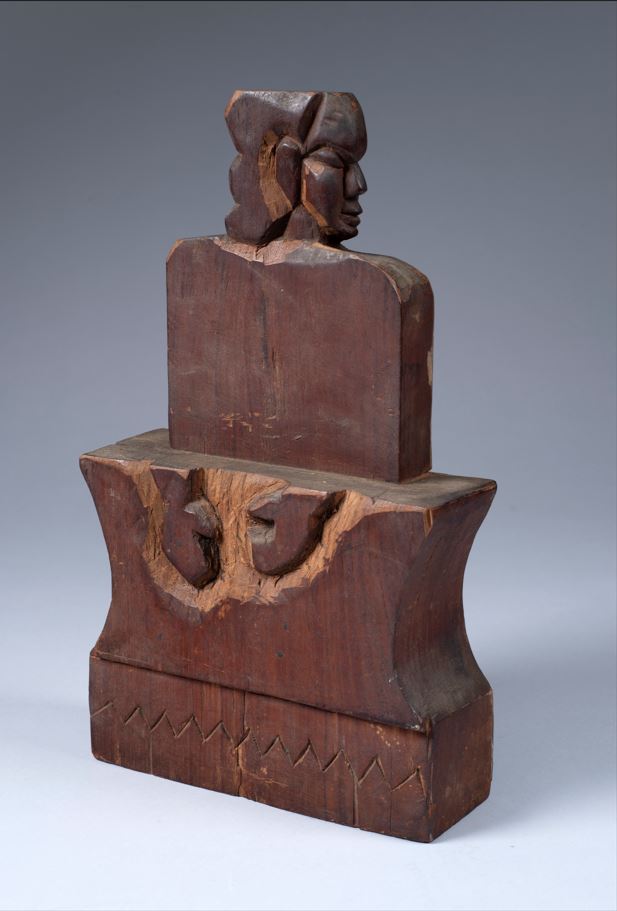
Schematic Seated Figure by Leela Mukherjee (1950s-80s) Taimur Hassan Collection. Photo by Justin Piperger. Courtesy of Mrinalini Mukherjee Foundation

Gulammohammed Sheikh (b.1937)

Similarly, here are two works from 60 years later by Mukherjee’s friend Gulammohammed Sheikh, depicting (on the left) birds which might be cranes and (on the right) a kind of dragony-peacock bird, depicted in tall, narrow images which instantly reminded me of classical Chinese art. I can’t see anything Indian about them at all, they radiate Chinese shape, composition and styling.

Two paintings by Gulammohammed Sheikh 2018 to 2024 (photo by the author)

K. G. Subramanyan

K.G. Subramanyan (1924-2016) studied under under Mukherjee’s father and, according to the curators, developed into a ‘prolific artist-educator’. He rallied fellow artists to mine folk and craft traditions in unconventional ways, forging a postcolonial vision of Indian modernism. Here’s a gouache work demonstrating what this means in practice.

Untitled by K. G. Subramanyan (c.1950s) Taimur Hassan Collection. Photo by Justin Piperger © Uma Padmanabhan

Now this does have the amateurish quality I associate with modern Indian art, the very basic, child-level depiction of the human form which I saw just a few months ago in the extensive display of work by Indian artist Arpita Singh (born in 1937) at the Serpentine.

The exhibition’s long timeframe

Another challenge presented by the exhibition is the long timeframe it covers. The earliest work is from the very early 1970s whereas the most recent is from the 2020s. That’s a very long period of time. During that half century the international art world has changed out of all recognition. It has outgrown its European and American origins to become truly international. It has, for some time, promoted and valued artists from an enormous range of cultures, including many indigenous traditions such as Aboriginal art, which is now highly prized.

The patriotic, post-independence drive to create an authentic Indian art which the curators attribute as a central motivation to Mukherjee, her friends and colleagues, has long since become history. An ethnocentric perspective is now seen as reactionary and dangerous, witness liberal repugnance at the rise of right-wing nationalisms in countries around the world, including Hindu Nationalist sentiment in Mukherjee’s own India.

The modern art world floats above individual countries, in a kind of multicultural, cosmopolitan, liberal, enlightened, post-gender world of its own. So Mukherjee and her friends’ insistence on an Indian nationalist art, as well as her particular interest in the old-fashioned gender binary between phallic and vulvic forms, all seem rather quaint now.

To look specifically at Mukherjee’s work, when she began ‘sculpting’ in fabrics in the 1970s this was a radical and innovative technique, quite obviously rejecting the whole ‘carving in stone or marble’ tradition of the West. But by the time she began exhibiting in Europe, in the 1990s, it was a lot less unique. Numerous other artists were working in the same vein.

Jagdish Swaminathan (1928 to 1994)

Back to the art, here’s the example of Jagdish Swaminathan which we are given. This painting of a thin sliver of a bird singing above a mildly phallic lily plant against a big abstract yellow background is from Swaminathan’s ‘Bird, Tree and Mountain’ series. We find him in the late ’60s and early ’70s rejecting any type of naturalism, along with Western modernism, and instead returning to tribal and folk visual traditions. This probably is a good example of a non-western, Indian visual style although I’m not sure I like it. Do I not like it because it is not Western? No, because I love lots of non-Western art starting with Aboriginal art and lots of African art. It’s more that it’s like Western art but without enough real kick and originality.

Untitled (Lily by my Window) by Jagdish Swaminathan (early 1970s) Photo courtesy of Sotheby’s Inc © 2025 © J. Swaminathan Foundation

Gallery

A selection of photos I took to indicate the (sometimes bewildering and confusing) range of works on show.

Untitled by K.G. Subramanyan 1955-9

I liked this because it reminds me of something almost exactly the same I’ve seen by Paul Klee, in other words a European model or origin.

Untitled by K.G. Subramanyan 1955-9 (photo by the author)

Intertwined by Leela Mukherjee

Relatively small, crudely carved and unfinished wooden sculptures.

From left to right, Figure with Raised Hand, Intertwined Figures and Intertwined Figures II, by Leela Mukherjee, 1950s to ’80s (photo by the author)

Landscape 1968

My partner liked this because of the simplicity of the black silhouette but also the ambiguity of whether it’s some hills and a tree, as it appears at first glance, or whether the two lines dangling down in the middle indicate that it’s a human being.

Landscape by Gulammohammed Sheikh (1968) (photo by the author)

Untitled by Jagdish Swaminathan (1980)

According to the curators:

By the 1980s, Jagdish Swaminathan’s art reflected his deepening engagement with India’s tribal and Indigenous traditions. Moving away from the pristine colour planes of his earlier works, he adopted earthy palettes, textured surfaces, and symbolic forms. Shapes such as triangles and serpentine lines evoked mountains and snakes, resonant with Hindu mythologies of the god Shiva. These later canvases fuse abstraction with spiritual metaphor, recalling Swaminathan’s lifelong insistence that art should reveal nature and myth in their primal, symbolic essence.

Not knowing very much about ‘India’s tribal and Indigenous traditions’, I liked it because it reminded me of the brown abstract works my parents picked up at Heals or Habitat in the 1970s. And then of Paul Klee’s beautiful abstract shapes and patterns, which also often include gold or striking highlights.

Untitled by Jagdish Swaminathan, 1980 (photo by the author)

Also because of the rough impasto finish, especially of the two mysterious orange glyphs written across the image.

Detail of Untitled by Jagdish Swaminathan, 1980 (photo by the author)

Songspace by Nilima Sheikh (1995)

‘Songspace’ is the name of a series of scroll paintings by Nilima Sheikh, which I prefer to think of as ‘hangings’. Apparently there are ten in the series, of which 5 are hung in this exhibition in such a way as to create a kind of alcove into which you can step and be surrounded on 3 sides. Apparently the use of casein tempera paint on canvas is very distinctive and gives them their light and floating feel. Most of the surface is made up of abstract shapes, some of which may be landscapes in brown or green or red. Scattered in these shapes are wispy human figures which, apparently, reference Indian folktales, especially from Kashmir. They reference the style of classical Indian miniatures only blown up to wall size and refracted through a postmodern sensibility.

Songspace by Nilima Sheikh (1995) (photo by the author)

I liked the size, and the format of the hanging scroll, and the light and uplifting colouring but, as with most of these works, wasn’t impressed by, or was actively put off by, the scrappy amateurishness of the human figures.

Snake Column I by Mrinalini Mukherjee (1995)

According to the curators:

This terracotta sculpture is one of two ‘snake columns’ that reflect Mrinalini Mukherjee’s engagement with fertility and vitality. The cylindrical, phallic form recalls the ‘lingam’ of Shiva, while the serpent motifs and raised hood canopy reference Bankura terracotta vases dedicated to Manasa, a goddess of fertility. Like ‘Adi Pushp II’, nearby, the work channels sexuality as a generative power, fusing sacred imagery with organic, body-like forms that pulse with energy.

Snake Column I by Mrinalini Mukherjee (1995) (photo by the author)

If it as deliberately phallic as they say, then the snakes could as easily be sperm fighting their way to the front of the queue.

Forest Flame IV by Mrinalini Mukherjee (2009)

According to the curators:

In her final years, Mrinalini Mukherjee turned from hemp to bronze, creating sculptures that progressively grew in scale and ambition. Casting leaves, fronds and branches into molten form, she transformed nature into something both corporeal and otherworldly. ‘Forest Flame IV’ recalls the striking ‘Flame of the Forest’ tree of Santiniketan, which bursts into vivid orange blossoms each spring. Here, a trunk-like column erupts into flame-like petals, conflating vegetal growth with bodily emergence. Light animates the textured bronze surface, giving the work a sense of continual unfolding and transformation.

Forest Flame IV by Mrinalini Mukherjee (2009) (photo by the author)

I didn’t particularly like these because, as I said much earlier, by the 2000s, art had become so globalised, with so many artists creating so many kinds of object, that Mukherjee’s don’t really stand out. Downstairs at the Royal Academy are metal sculptures by Anselm Kiefer which are not unlike this. What made her very distinctive in the 1970s and ’80s had become utterly diluted 30 years later.

Adi Pushp II Mrinalini Mukherjee (2009)

To finish, back to what she did best, hemp sculptures. This one supposedly derives from her interest in botany and flowers and ‘adi pushp’ means ‘first flower’. But the curators go on to tell us that:

The sculpture’s central bulges and folds evoke human sexual organs, transforming the flower into a potent emblem of generative energy, and affirming nature as a vital, erotic life force.

None of which – the use of sublimated sexual imagery, the idea of sex as a central force in human nature – is at all distinctively ‘Indian’ but the common currency of humankind and any number of artworks, traditional or contemporary.

Adi Pushp II Mrinalini Mukherjee (2009) (photo by the author)

At the end of this small but sometimes confusing, sometimes enjoyable, sometimes boring, sometimes lovely exhibition, it looked less to me like a tumble of sexual organs than a comfortable-looking chair to have a nice sit-down in.


Related links

Related reviews

The Imaginary Institution of India: Art 1975 to 1998 @ the Barbican

Anyone wanting to skip my comments can go straight to the gallery of images, a third of the way through this review.

Barbican art is big

The great blessing and curse of the Barbican Art Gallery is that it’s so huge. It has four large open-plan spaces on the ground floor (which always house very large works or installations), three alcoves running off the side corridor, while the first floor gallery contains 8 more room-sized alcoves – so about 15 distinct spaces in total.

This sheer size explains why the Barbican’s art exhibitions are routinely epic in scope and scale, and this new one, ‘Imaginary Institution of India: Art 1975 to 1998’, is no exception. It features nearly 150 works by 30 artists across the full range of media including painting, drawing. sculpture, photography, installation and film.

The dates

The exhibition takes its start and end points from two pivotal moments in India’s post-independence history – the declaration of the State of Emergency by Indira Gandhi in 1975 and the Pokhran Nuclear Tests in 1998. As the curators point out, these 23 years were marked by social upheaval, economic instability and rapid urbanisation. But they’re also a kind of introduction into the way other parts of the world don’t follow our timelines. Neither 1975 nor 1998 are particularly significant years in British political cultural life. These key political moments, like much else in the exhibition, come from a different culture and history.

Woke

A couple more general points. Art exhibitions in general represent a kind of advance guard of wokeness and political correctness, and the Barbican is at the forefront of these up-to-the-minute discourses. Reading their wall labels and captions can feel like reading an omnibus of Guardian editorials. Thus I predicted before I went that there would be displays about feminist, LGBTQ+ and indigenous art, and I wasn’t disappointed. Here’s an example, a paintings by the overtly gay painter Bhupen Khakhar.

‘Grey Blanket’ by Bhupen Khakhar (1998) © Estate of Bhupen Khakhar

The free booklet

Talking of wall labels, this exhibition is a bit unusual in not having any. Most exhibitions feature a big wall label introducing each room and then captions for each particular work. Here’s there’s none of that. The curators have chosen to put all the text into a very nicely produced and surprisingly ample free booklet, complete with a Timeline of Social and Political Events in India 1975 to 1998, and a Glossary of Indian terms. All that indicates which work is which is a simple number printed on the wall or dais beside them. This makes the whole exhibition feel unusually clean and uncluttered, and the booklet feels like a very generous gift and memento.

Too dark to read

However there is a catch with the booklet concept, which is that the curators have decided to use very low light levels throughout the exhibition, apart from spots shining directly onto the works. Unfortunately, this makes it quite difficult, often impossible, for an old guy like me to read the handout, even with my glasses on, even leaning towards the artworks to try and get better light, and I can’t believe I’m the only one. Maybe they’ll adjust the lighting levels as the show progresses…

Installation view of ‘The Imaginary Institution of India: Art 1975 to 1998’ at the Barbican showing terracotta heads by Himmat Shah in the foreground and abstract paintings by Jagdish Swaminathan on the wall in the background (photo by the author)

Extraordinary variety

As to the works, the curators have gone to great trouble to ensure that there’s something for everyone.

Large At the large end of the scale there’s a shed-sized installation titled ‘House’ by Vivan Sundaram. This is close to a life-sized wooden figure standing at the centre of a rosette of agricultural tools (‘The Tools’ by N. N. Rimzon). There’s a hexagonal shelter formed from painted screens (‘Shamiana’ by Nilima Sheikh), a strange skeletal mannekin covered in purple velvet (‘Desert Queen’ by Anita Dube), a set of coloured ropes hanging from the wall (‘Untitled’ by Sheela Gowda) and a big colourful canvas suspended across the ceiling (also part of Nilima Sheikh’s ‘Shamiana’ installation).

Installation view of ‘The Imaginary Institution of India: Art 1975 to 1998’ at the Barbican showing the big painted canopy suspended from the ceiling by Nilima Sheikh (photo by the author)

Small At the small end of the scale there’s a series of lovely drawings of holy animals done in a kind of naive decorative style by Jangarh Singh Shyam; and a set of brilliant metal sculptures packed with strange humanoid figures cast in bronze by Meera Mukherjee.

For feminists there’s a room featuring a series of 19 black-and-white photos by Sheba Chhachhi featuring seven women activists from the 1990s (‘Seven Lives and a Dream,’); and an upsetting set of 12 A4-sized paintings by Nilima Sheikh following the life of Champa, a carefree teenage girl who was married off while still a child, abused in her new home, and then murdered for her dowry by her husband and in-laws.

Indigenous art There’s a lovely series of black-and-white photos by Jyoti Bhatt capturing indigenous artists at work on wall and floor paintings. This is next to a series of upsetting colour photos documenting the 1984 Union Carbide disaster by Pablo Bartholomew.

Gay 1 The first gay room features eight colour photos of gay men staged among famous Delhi landmarks by Sunil Gupta. Gupta’s was the only name I recognised since he at one point moved to New York and I’ve seen his photos of the New York gay community in numerous other exhibitions. The photos are given droll and sarcastic text captions. I especially liked the one which reads:

People operate here harassing people and intimidating them with beatings and extortion. Sometimes they just want a blowjob.

Yes, sometimes men just want a blowjob – if a gay man says that, it’s a bold declaration, challenging societal expectations and interrogating heteronormativity; if a straight man says it, not so much. One of the many reasons to enjoy queer art is the queer artist’s ability to be completely candid about sex in a way that a heterosexual male artist would be wise not to attempt…

Gay 2 The second gay room features paintings by Bhupen Khakhar. I admired the candid way these depicted that taboo part of human anatomy, the erect penis. Considering how much trouble they’ve caused to untold billions through all history, it’s remarkable how few erect penises you get in art of any kind. I didn’t really like Khakhar’s naive home-made style but I admired his willies.

Struggling to understand Indian art

This is a challenge. I have only a shaky grasp of British art, a reasonable understanding of selected spots of European art, and a loose hold on American art (despite it being everywhere) because even in art you think you know well, there are always hidden depths and meanings. There are always traditions and currents and precedents the artists were inspired by, or are reacting against, are reinterpreting, reviving, critiquing and so on. Nonetheless, as an inhabitant of the Euro-American world, I feel I have a reasonable grasp of its visual (dramatic, filmic and musical) languages.

But Indian art? Despite having been to 2 or 3 exhibitions of it, I’m all too aware that it comes from a world almost completely closed to me, a world of visual iconography, traditions, religions and political movements, local cultures and languages which are way beyond my experience or understanding.

Therefore it’s challenging, this exhibition, because so many of the works seem to be coming out of traditions or mixtures and updatings and reinterpretations of contexts and traditions which I have no feel for.

What’s more, a lot of the art is obviously very political, kicking off with responses to the state of emergency instituted by Indira Gandhi in 1975 and taking in war with Pakistan, the rise of communalism and incipient Hindu nationalism, the spectacular growth of India’s cities and comcomitant loss of many rural traditions, the rise of Indian feminism with campaigns against suttee, honour killing, femicide and so on. I can read long explanations about these things but found it very hard to really relate to them. Hard to become as involved as, presumably, an Indian visitor would be.

The exhibition is a big bold window onto an art world most of us are not very familiar with at all. There was plenty to enjoy but quite a lot which I felt was only so-so – clumsily naive paintings, abstract designs I felt had been done earlier and better elsewhere, installations I felt I’d seen before somewhere else … but then it crossed my mind that maybe I was wrong, maybe I was misreading it, maybe I’m a victim of my own ignorance. Hard to tell whether my taste is valid or just trapped in the parochial world of the Anglosphere… So I tried my best to give everything the benefit of the doubt and to let the art teach and educate me in how to see it, rather than viewing it through blinkered Anglophone spectacles…

Press gallery

The following are the official press images, accompanied by the curators’ original captions i.e. none of it is written by me. Why? To give you as much of the original source information as possible, to let you make up your own minds.

Speechless City by Gulammohammed Sheik (1975)

A forbidding glow pervades ‘Speechless City’. Foraging cattle and wild dogs huddle around abandoned dwellings in a town empty of inhabitants. Evoking the repressiveness of the Emergency era (1975 to 1977) and referencing the eruption of Hindu-Muslim riots in Gujarat from 1969 onwards, Gulammohammed Sheikh made this painting while teaching at his alma mater, Maharaja Sayajirao University, Baroda (Vadodara). The desolate urban landscape suggests the aftermath of an unknown, terrible event. The work originally featured a fleeing figure, which Sheikh later painted out to create a scene devoid of people.

‘Speechless City’ by Gulammohammed Sheik (1975) © 2024 Gulammohammed Sheikh.
Courtesy of The Artist and Vadehra Art Gallery

Village Opera-2 by Madhvi Parekh (1975)

Madhvi Parekh’s oil paintings depict remembered landscapes from both her childhood village of Sanjaya, Gujarat, and her subsequent travels. She painted ‘Village Opera-2’ after attending an artist’s camp organised by artist G. R. Santosh in Kashmir in 1975. The copper pots she saw there inspired the black anthropomorphic figures at the centre of this work. Working first with oil paint, Parekh then used oil pastels to add small, vibrant creatures which resemble birds, fish, snakes and amphibians. The scene floats in a colourful net of dots and lines, patterns drawn from the folk crafts of Rangoli and embroidery that she had practised as a child. Initiated into art by her artist husband Manu Parekh, Madhvi Parekh began to paint only after leaving Sanjaya, and with memory as their subject, her paintings provide a way back to the idyll of village life. “I have never forgotten the sights and sounds of my village,” she says. “I carry them with me everywhere and, although they are often combined with elements I have imbibed in the city, they still endure.”

‘Village Opera-2’ by Madhvi Parekh (1975) © Madhvi Parekh. Courtesy DAG

This was, I think, my favourite piece in the show, possibly because it reminds me of Paul Klee. It was one of the very few pieces which seemed happy.

Dhakka by Sudhir Patwardhan (1977)

Sudhir Patwardhan’s large-scale paintings visualise the effects of urbanisation on the body of the individual city dweller and the landscape of the city. A practising radiologist till 2005, Patwardhan uses his art to articulate stories of social struggle. His emphasis on figuration is a result of his belief in the accessibility of art for all. In the late 1970s, Patwardhan painted solidly built individuals against a minimal background. ‘Dhakka’ shows a labourer straining to pick up his shirt, the title (which translates as ‘push’ in Hindi) emphasising the effort of this activity. Dignified but worn out, this subject embodies the difficult lives of the working class.

‘Dhakka’ by Sudhir Patwardhan (1977) © 2024 Sudhir Patwardhan. Courtesy of The Artist and Vadehra Art Gallery

Two Men with Handcart by Gieve Patel (1979)

Under a vibrant pink sky, time is suspended as two men pause in their labour for a relaxed chat. Behind them, lightly shaded windows and bricks hint at a dense metropolis under construction. In the 1960s, Gieve Patel, a self-taught artist as well as a celebrated poet, playwright and doctor, began painting urban landscapes inspired by his native Bombay (Mumbai). While he documented the rapidly changing nature of the city around him, his focus remained on its working-class inhabitants. Placing the labourers at the centre of this work, Patel interrogated the impact of India’s social and economic transformations on its people. The artist had believed his use of colour in this work was non-naturalistic, but then was surprised to observe a sunset bathing the entire city in a pink glow. “The problem of how to relate to the given colours of life is full of thrilling ambiguities and possibilities,” he commented in 1985.

‘Two Men with Handcart’ by Gieve Patel (1979) © Gieve Patel. Courtesy of the Peabody Essex. Museum Photography by Barbara Kennedy

Two Men in Benares by Bhupen Khakhar (1982)

Bhupen Khakhar, an accountant by training, was a self-taught artist who took to painting in the 1960s. His early works comprised portraits of tradesmen. In 1980, he began to address his homosexuality, which he had struggled with until then. In this dramatic painting, the intertwined nude lovers are set against a blue background with numerous vignettes unfolding around them. Such narrative representation reveals Khakhar’s interest in fourteenth-century Sienese painting, especially the work of Ambrogio Lorenzetti. Khakhar integrates the lovers into the quotidian reality of the hallowed city of Benares (Varanasi), with its holy men, small shrines and kneeling devotees. By staging this sexual tryst within a religious context, he knowingly props up the erotic against the sacred, and provocatively collapses the boundaries between private and public. First exhibited at Gallery Chemould, Bombay (Mumbai), in 1987, the painting had to be stored away just two days later for fear of protests from the Central Cottage Industries Emporium, in whose premises the gallery was located.

‘Two Men in Benares’ by Bhupen Khakhar (1982) © Estate of Bhupen Khakhar. Note the willies

India Gate by Sunil Gupta (1987)

Staged amongst famous New Delhi landmarks and some cruising sites, these constructed images present the complexities faced by gay men when homosexuality was still a punishable offence in India. Section 377, a colonial law enacted in 1861, criminalised homosexuality and was only repealed by India’s principal court in 2018. The series was realised in 1986 to 1987 through a commission awarded by The Photographer’s Gallery, London, and was for Sunil Gupta “about locating Indian cis men in an international gay landscape”. Born in New Delhi, the artist moved to Canada in 1969 at the age of fifteen. He relocated to the United States prior to settling in London. Accompanied by excerpts of conversations with his subjects, all voluntarily offered, the colour photographs reveal the sentiments of gay Indian men and their vulnerable, clandestine lives. Gupta ensured he had the consent of his subjects to print the photographs, with the understanding that the images would not be shown at the time in India. Finally, in 2004, Gupta exhibited ‘Exiles’ at the India Habitat Centre in New Delhi as a belated, affirmative homecoming.

‘India Gate’ by Sunil Gupta (1987) from the series ‘Exiles’ 1987 © Sunil Gupta. Courtesy the artist and Hales London and New York

Construction Woman Washing Her Face by Sudhir Patwardhan (1998)

Sudhir Patwardhan’s graceful female construction worker as she raises her hands to wash her downcast face. Very economically, Khakhar and Patwardhan imbue simple gestures with tremendous power and emotion, demanding recognition for their subjects.

‘Construction Woman Washing Her Face’ by Sudhir Patwardhan (1998) © 2024 Sudhir Patwardhan. Courtesy of The Artist and Vadehra Art Gallery

House by Vivan Sundaram (1994)

Vivan Sundaram transitioned from painting and drawing in the early 1990s to embrace a broader, spatially oriented approach. ‘House’ portrays his reflections on the changing political landscape and communal tensions in India at the time. Held by a metal armature, the installation elaborates on the concept of refuge. A walled sanctuary cast in kalamkhush (paper handmade from khadi, the hand- spun, natural-fibre fabric promoted by Mahatma Gandhi during India’s anti-colonial struggle), ‘House’’s surface carries embossed emblems of the tools of labour and speaks to collective struggles against power. Alongside a mineral hue reminiscent of coagulated blood, the outer walls exhibit marks of brutality: scattered limbs, jagged outlines of weapons, and closed windows. Within, a pedestal bears a wide-brimmed vessel filled with water, and flickering through the transparent base of the bowl, a fiery video projection conveys an allegory of simmering injustice.

‘House’ by Vivan Sundaram (1994) from the series ‘Shelter’ 1994 to 1999. Photo by Gireesh G.V. Photo courtesy The Estate of Vivan Sundaram

Untitled by Sheela Gowda (1997/2007)

Alongside her explorations with cow dung, Sheela Gowda employed a range of everyday materials in her installations through the 1990s. ‘Untitled’ (1997/2007), made for the show ‘Telling Tales – of Self, of Nation, of Art’ at Victoria Art Gallery, Bath, is her first fully realised installation in which needle and thread are used. For this work, Gowda strung individual needles with threads varying in length from 40 to 133 centimetres. This labour-intensive process was very important for Gowda, who would reject a ball of thread if she encountered a single knot because “the process of threading empowers every inch” of the thread. She then anointed the threads with kumkum paste, and bound them together to form ropes, with a menacing head of needles at the end of each length. ‘Untitled’ comprises of eight such lengths of rope, which allow Gowda to configure and arrange them site-specifically. They travel viscerally along the wall and snake across the floor, intimating a transmuting body, an umbilical cord, intestines, trails of blood. Gowda has described the work as possessing “a very insidious sort of violence … the needles hang at the end almost passively but they have the potential for hurting.”

‘Untitled’ by Sheela Gowda (1997/2007) © Sheela Gowda. Courtesy Museum Gouda

Mild Terrors-II by C. K. Rajan (1991 to 1996)

Using only scissors and glue, C. K. Rajan composed the ‘Mild Terrors II’ series by pasting imagery from discarded popular magazines and dailies onto blank sheets of A4 paper. An erstwhile member of the Indian Radical Painters’ and Sculptors’ Association, Rajan began work on these collages in 1991, the year India liberalised its economy to allow foreign investment. Made quickly and intuitively, the perspective of these small-scale collages is purposefully disorienting. They are replete with rescaled objects and discordant visual mash-ups. Rajan cannily juxtaposed outsized human torsos and limbs (often female) with consumer goods, and inserted them into urban or rural settings to create surreal scenes. They convey the ‘mild terrors’ that lurked behind India’s rapid entry into a global free-market system – the unreported uneven economic development, the social disparities, the displacements. It was a strangely transforming landscape, somewhere between pre-modern, modern and post-modern, captured strikingly in these unsettling collages.

‘Mild Terrors-II’ by C. K. Rajan (1991 to 1996) Courtesy the artist and Kiran Nadar Museum of Art, New Delhi

Installation gallery

The following are my own photos of the exhibition accompanied, where relevant, by the curators’ comments. (I forgot to mention that many of the pictures are displayed on stands made of raw bricks which give the whole thing a…what vibe? Building site? Or are these holey bricks intended to be a characteristic symbol of Indian street scenes?)

Installation view of ‘The Imaginary Institution of India: Art 1975 to 1998’ at the Barbican showing ‘Two Men with Handcart’ by Gieve Patel on a stand made of raw bricks (photo by the author)

The Tools by N. N. Rimzon (1993)

N. N. Rimzon, whose practice was already sculptural, began turning towards a more installation-based approach, as many other artists did in the 1990s. In ‘The Tools’, a figure stands in a state of meditation. Rimzon derived the pose from sculptures of devotees in temple architecture, symbolising non-violence and inner peace. The figure is encircled by iron tools, the broken parts of agricultural equipment. Tension forms between the figure and these mundane objects: strikingly incongruous, the implements threaten violence. ‘The Tools’ exposes the lurking hostilities of the early 1990s with the rise in communalism and the advent of globalisation. In ‘House of heavens’ (1996), on display nearby, similar themes recur. While the human figure is absent, the effects of human action are palpable. A house and an egg rest against each other, intimating the home as a space for solace, refuge and the continuity of life. However, this ideal is destabilised by the iron sword upon which the house precariously rests, signifying the disruptions caused by rising social tensions and their intrusion into people’s lives.

Installation view of ‘The Tools’ by N. N. Rimzon (1993) (photo by the author)

Shamiana by Nilima Sheikh (1996)

The double-sided painted scroll or ‘kanats’ (side screens) of this work centre on the journeys taken by women for devotion, love and celebration in the face of hardship. This nomadic theme is echoed in the installation’s form as a ‘shamiana’, a temporary shelter or gathering place often used as a marriage tent. Nilima Sheikh began designing sets for the feminist theatre troupe Vivadi in 1989. This influenced her painting, and she experimented with ideas of scale and new ways of engaging with viewers. ‘Shamiana’ allows its audience to move around and within the installation. From tender domesticity in ‘Before Nightfall’ to the tragedy of ‘When Champa Grew Up’, and then to a more hopeful paradigm in ‘Shamiana’, Sheikh invokes mythology and other vernacular literary traditions of the Indian subcontinent to explore human conditions of celebrating, mourning, protesting and offering shelter.

Installation view of ‘Shamiana’ by Nilima Sheikh (1996) (photo by the author)

Bronzes by Meera Mukherjee

Meera Mukherjee sought a modernism that would articulate an Indian national identity in the aftermath of British colonisation. Educated at the Delhi Polytechnic College and the Academy of Fine Arts, Munich, she rejected their curriculums which adhered to the western canon of modern art. A grant from the Anthropological Survey of India provided the opportunity to work with Gharua craftsmen in Bastar in central India. She travelled widely, studying the metal-casting techniques of Dhokra artisans in West Bengal, Khoruras and Ghantrars in Odisha, and Sakya craftsmen in Bhaktapur, Nepal. This composite tradition informed Mukherjee’s own use of lost-wax casting, in which a wax model is used as a mould for molten metal. When cooled, the sculpture is finished by hand. Inspired by the devotion with which craftsmen attended sacred subjects, Mukherjee approached the ordinary with similar spiritualism. Small-scale and intricately detailed, Mukherjee’s sculptures elevate figures from everyday village life: labouring artisans in ‘Untitled (Smiths Working under a Tree)’, students in mass protest in ‘Untitled (Andolan)’, and religious devotees in ‘Pilgrims to Haridwar’. Configured in compositions at once rhythmic and organic, these figures from the contemporary world appear subject to larger, celestial forces.

Installation view of one of Meera Mukherjee’s bronzes (photo by the author)

Seven Lives and a Dream’ (1980 to 1991) by Sheba Chhachhi

Sheba Chhachhi’s series of nineteen black-and-white photographs follows seven women activists. Chhachhi became involved with the women’s movement when she returned to her hometown of Delhi in 1980 after completing degrees at the Chitrabani Centre for Social Communication, Calcutta (Kolkata), and the National Institute of Design, Ahmedabad. Amidst a wave of protests against dowry-related violence, Chhachhi photographed her fellow campaigners, the tightly focused images emphasising their emotional intensity. While these images were initially intended for circulation within the movement, Chhachhi felt the need to move beyond documentary photography – a form in which ‘the power of representation’ always remains with the photographer. She also felt that the single image could not adequately capture the complexity of the women, whom she knew personally. Almost a decade later, Chhachhi invited the same women to collaborate on a series of portraits, in settings and with props of their choosing. Satyarani chose to be depicted on the steps of India’s Supreme Court, the location of her decades-long battle for justice for her murdered daughter. Many of the women were photographed within their homes, the private, domestic realm sitting alongside the public forum of street protests. The props – books, family photographs, typewriters, grain – allude to facets of the sitters’ identities, from which emerges an image of the movement that united women across class lines.

Installation view of ‘Seven Lives and a Dream’ (1980 to 1991) by Sheba Chhachhi (photo by the author)

‘When Champa Grew Up’ by Nilima Sheikh (1984 to 1985)

This series of twelve narrative paintings on handmade paper immerses the viewer in the life of Champa, a teenager. At first, she appears as an idealistic girl, her bicycle a symbol of independence. In the following images, however, she is married off while still a child and subjected to abuse in her new home. The series culminates in her dowry-related murder by her husband and parents-in-law. Nilima Sheikh knew the young girl in real life and deliberated upon how to represent her tragedy. The artist explains that she moved away from wall painting because she “didn’t want to trivialise Champa’s fragile story”. The vivid realism of Indian miniature painting, particularly in traditions from the Punjab hills, as well as in East Asian scrolls, informed her method of creating a narrative that unfolds laterally in the unbound series of images.

Installation view of ‘When Champa Grew Up’ by Nilima Sheikh (1984 to 1985) (photo by the author)

Jangarh Singh Shyam and Himmat Shah

Jangarh Singh Shyam did the lovely sequence of ink-on-paper drawings on the wall, featuring serpents, birds, crocodiles and stags, in stylised way which reminded me of illustrations of the nature poems of Ted Hughes. In the foreground is a set of sculpted heads in terracotta by Himmat Shah.

Installation view of ‘The Imaginary Institution of India: Art 1975 to 1998’ at the Barbican showing sculptures by Himmat Shah in the foreground and drawings by Jangarh Singh Shyam on the wall (photo by the author)

Participating artists


Related links

Related reviews