
Upstairs at the Royal Academy, the three rooms of the Jillian and Arthur M. Sackler Wing of Galleries are currently given over to an exhibition of modern-ish art from south India. The show is based around the figure of the female Indian artist and sculptor Mrinalini Mukherjee (1949 to 2015) but doesn’t stop there. Both her parents, Benode Behari Mukherjee (1904 to 1980) and Leela Mukherjee (1916 to 2002), were artists and we are shown quite a lot of their work too along with their biographies i.e. they taught at Kala Bhavana in Santiniketan, the pioneering art school founded by poet and polymath Rabindranath Tagore.
Mukherjee was strongly influenced by a mentor at her art college in the Indian city of Baroda, K. G. Subramanyan, and we get a selection of his work. At college Mukherjee was part of a group or cohort of young artists and we are introduced to work by some of these, namely Gulammohammed Sheikh (b.1937) and Nilima Sheikh (b.1945). Lastly, when the group moved to new Delhi, they encountered the older artist Jagdish Swaminathan (1928 to 1994) whose exploration of tribal art and iconography encouraged their efforts to create an authentic Indian art, free of Western influences.
So in these three rooms is gathered the work of seven distinct artists, from two different generations, who worked across a wide range of media, in a great diversity of styles, all of them consciously reacting against and trying to escape from European aesthetics and methods. The show features paintings, ceramics, collages and drawings, sculptures in hemp and clay and bronze, and some enormous painted screens.

Installation view of ‘A Story of South Asian Art: Mrinalini Mukherjee and Her Circle’ @ the Royal Academy (photo by the author)
This range and diversity makes the exhibition a challenging experience to process and understand. There is quite a lot to like and enjoy, alongside much that is puzzling, and quite a lot which seemed, well, bad.
Mukherjee’s hemp sculptures
Mukherjee had a long career, active from the 1970s right up to her death in 2015. She painted and drew but her reputation rests on the large sculptures she made from dyed and woven hemp fibre arranged over metal frames to create large, impressive semi-abstract shapes.

Jauba by Mrinalini Mukherjee (2000) Hemp fibre and steel © Tate. Courtesy of Mrinalini Mukherjee Foundation
I didn’t realise it until a wall label pointed it out, but there is a deliberate evocation of female genitalia. Once it’s pointed out I suppose I can see the folds of labia to left and right, and even the difference between the large vaginal opening at the bottom and the smaller urethral opening above it, but hesitate to go any further. My gallery partner, who rarely bothers to read the wall labels, just warmed to the tumbling feel of the thing, and to its arrangement of folds and colours.
Seeking a post-colonial art
The key point, which is made repeatedly throughout the show, is that Mukherjee grew up in the post-independence generation who were powerfully committed to breaking free of colonial, European values and aesthetics and part of this was a very conscious return to and promotion of native Indian folk arts and crafts.
Benode Behari Mukherjee (1904 to 1980)
The curators really emphasise these artists’ wish to escape Western influence and create a truly independent Indian art and in some works maybe they do. But my own impression was the opposite: I was struck by how many of the paintings in particular very clearly showed the influence of modern Western art. A number of the paintings seemed to me to be copying between-the-wars Picasso, cartoon faces with both eyes visible on the same side of the nose, that kind of thing.
Here’s the work by Mukherjee’s father, Benode Behari Mukherjee, which the press people make available to us, a work made from coloured paper in the 1950s and it seems to me a straight pastiche of Matisse’s later coloured-paper cutouts. Maybe the brown skin of the central figure is a nod to the Indian nature of the work but surely it’s dwarfed by the utterly Matisse-an conception.

Lady with Fruit by Benode Behari Mukherjee (1957) © Tate. Courtesy of Mrinalini Mukherjee Foundation
Leela Mukherjee (1916 to 2002)
Here’s the work the press office makes available to represent Mukherjee’s mother, Leela Mukherjee. I don’t want to harp on about this too much but here again, I struggled to discern the distinctly Indian quality because the shape of the faces and the generally primitive working of the wood reminded me very much of African tribal art, such as you see in the British Museum.
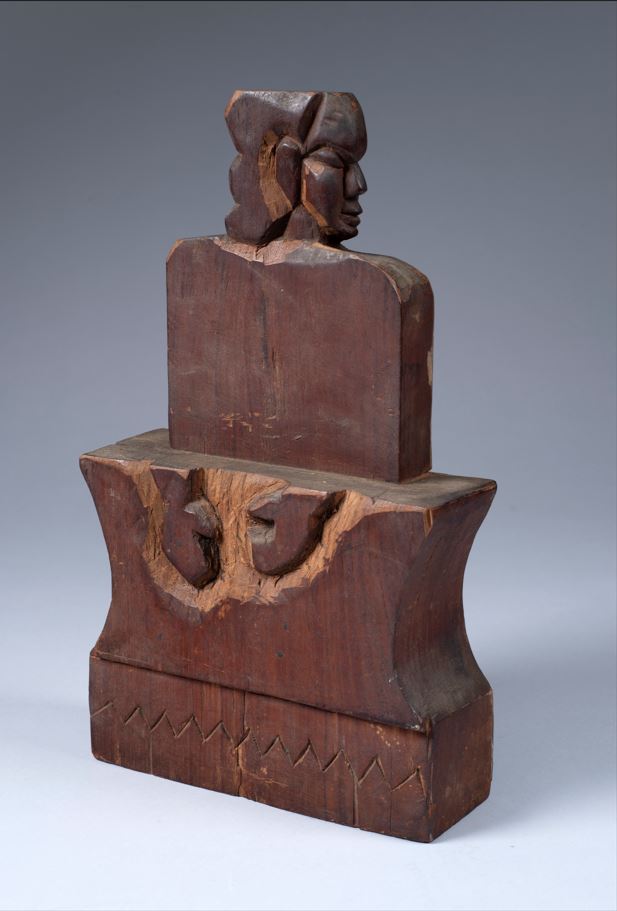
Schematic Seated Figure by Leela Mukherjee (1950s-80s) Taimur Hassan Collection. Photo by Justin Piperger. Courtesy of Mrinalini Mukherjee Foundation
Gulammohammed Sheikh (b.1937)
Similarly, here are two works from 60 years later by Mukherjee’s friend Gulammohammed Sheikh, depicting (on the left) birds which might be cranes and (on the right) a kind of dragony-peacock bird, depicted in tall, narrow images which instantly reminded me of classical Chinese art. I can’t see anything Indian about them at all, they radiate Chinese shape, composition and styling.

Two paintings by Gulammohammed Sheikh 2018 to 2024 (photo by the author)
K. G. Subramanyan
K.G. Subramanyan (1924-2016) studied under under Mukherjee’s father and, according to the curators, developed into a ‘prolific artist-educator’. He rallied fellow artists to mine folk and craft traditions in unconventional ways, forging a postcolonial vision of Indian modernism. Here’s a gouache work demonstrating what this means in practice.

Untitled by K. G. Subramanyan (c.1950s) Taimur Hassan Collection. Photo by Justin Piperger © Uma Padmanabhan
Now this does have the amateurish quality I associate with modern Indian art, the very basic, child-level depiction of the human form which I saw just a few months ago in the extensive display of work by Indian artist Arpita Singh (born in 1937) at the Serpentine.
The exhibition’s long timeframe
Another challenge presented by the exhibition is the long timeframe it covers. The earliest work is from the very early 1970s whereas the most recent is from the 2020s. That’s a very long period of time. During that half century the international art world has changed out of all recognition. It has outgrown its European and American origins to become truly international. It has, for some time, promoted and valued artists from an enormous range of cultures, including many indigenous traditions such as Aboriginal art, which is now highly prized.
The patriotic, post-independence drive to create an authentic Indian art which the curators attribute as a central motivation to Mukherjee, her friends and colleagues, has long since become history. An ethnocentric perspective is now seen as reactionary and dangerous, witness liberal repugnance at the rise of right-wing nationalisms in countries around the world, including Hindu Nationalist sentiment in Mukherjee’s own India.
The modern art world floats above individual countries, in a kind of multicultural, cosmopolitan, liberal, enlightened, post-gender world of its own. So Mukherjee and her friends’ insistence on an Indian nationalist art, as well as her particular interest in the old-fashioned gender binary between phallic and vulvic forms, all seem rather quaint now.
To look specifically at Mukherjee’s work, when she began ‘sculpting’ in fabrics in the 1970s this was a radical and innovative technique, quite obviously rejecting the whole ‘carving in stone or marble’ tradition of the West. But by the time she began exhibiting in Europe, in the 1990s, it was a lot less unique. Numerous other artists were working in the same vein.
Jagdish Swaminathan (1928 to 1994)
Back to the art, here’s the example of Jagdish Swaminathan which we are given. This painting of a thin sliver of a bird singing above a mildly phallic lily plant against a big abstract yellow background is from Swaminathan’s ‘Bird, Tree and Mountain’ series. We find him in the late ’60s and early ’70s rejecting any type of naturalism, along with Western modernism, and instead returning to tribal and folk visual traditions. This probably is a good example of a non-western, Indian visual style although I’m not sure I like it. Do I not like it because it is not Western? No, because I love lots of non-Western art starting with Aboriginal art and lots of African art. It’s more that it’s like Western art but without enough real kick and originality.

Untitled (Lily by my Window) by Jagdish Swaminathan (early 1970s) Photo courtesy of Sotheby’s Inc © 2025 © J. Swaminathan Foundation
Gallery
A selection of photos I took to indicate the (sometimes bewildering and confusing) range of works on show.
Untitled by K.G. Subramanyan 1955-9
I liked this because it reminds me of something almost exactly the same I’ve seen by Paul Klee, in other words a European model or origin.

Untitled by K.G. Subramanyan 1955-9 (photo by the author)
Intertwined by Leela Mukherjee
Relatively small, crudely carved and unfinished wooden sculptures.

From left to right, Figure with Raised Hand, Intertwined Figures and Intertwined Figures II, by Leela Mukherjee, 1950s to ’80s (photo by the author)
Landscape 1968
My partner liked this because of the simplicity of the black silhouette but also the ambiguity of whether it’s some hills and a tree, as it appears at first glance, or whether the two lines dangling down in the middle indicate that it’s a human being.

Landscape by Gulammohammed Sheikh (1968) (photo by the author)
Untitled by Jagdish Swaminathan (1980)
According to the curators:
By the 1980s, Jagdish Swaminathan’s art reflected his deepening engagement with India’s tribal and Indigenous traditions. Moving away from the pristine colour planes of his earlier works, he adopted earthy palettes, textured surfaces, and symbolic forms. Shapes such as triangles and serpentine lines evoked mountains and snakes, resonant with Hindu mythologies of the god Shiva. These later canvases fuse abstraction with spiritual metaphor, recalling Swaminathan’s lifelong insistence that art should reveal nature and myth in their primal, symbolic essence.
Not knowing very much about ‘India’s tribal and Indigenous traditions’, I liked it because it reminded me of the brown abstract works my parents picked up at Heals or Habitat in the 1970s. And then of Paul Klee’s beautiful abstract shapes and patterns, which also often include gold or striking highlights.

Untitled by Jagdish Swaminathan, 1980 (photo by the author)
Also because of the rough impasto finish, especially of the two mysterious orange glyphs written across the image.

Detail of Untitled by Jagdish Swaminathan, 1980 (photo by the author)
Songspace by Nilima Sheikh (1995)
‘Songspace’ is the name of a series of scroll paintings by Nilima Sheikh, which I prefer to think of as ‘hangings’. Apparently there are ten in the series, of which 5 are hung in this exhibition in such a way as to create a kind of alcove into which you can step and be surrounded on 3 sides. Apparently the use of casein tempera paint on canvas is very distinctive and gives them their light and floating feel. Most of the surface is made up of abstract shapes, some of which may be landscapes in brown or green or red. Scattered in these shapes are wispy human figures which, apparently, reference Indian folktales, especially from Kashmir. They reference the style of classical Indian miniatures only blown up to wall size and refracted through a postmodern sensibility.

Songspace by Nilima Sheikh (1995) (photo by the author)
I liked the size, and the format of the hanging scroll, and the light and uplifting colouring but, as with most of these works, wasn’t impressed by, or was actively put off by, the scrappy amateurishness of the human figures.
Snake Column I by Mrinalini Mukherjee (1995)
According to the curators:
This terracotta sculpture is one of two ‘snake columns’ that reflect Mrinalini Mukherjee’s engagement with fertility and vitality. The cylindrical, phallic form recalls the ‘lingam’ of Shiva, while the serpent motifs and raised hood canopy reference Bankura terracotta vases dedicated to Manasa, a goddess of fertility. Like ‘Adi Pushp II’, nearby, the work channels sexuality as a generative power, fusing sacred imagery with organic, body-like forms that pulse with energy.

Snake Column I by Mrinalini Mukherjee (1995) (photo by the author)
If it as deliberately phallic as they say, then the snakes could as easily be sperm fighting their way to the front of the queue.
Forest Flame IV by Mrinalini Mukherjee (2009)
According to the curators:
In her final years, Mrinalini Mukherjee turned from hemp to bronze, creating sculptures that progressively grew in scale and ambition. Casting leaves, fronds and branches into molten form, she transformed nature into something both corporeal and otherworldly. ‘Forest Flame IV’ recalls the striking ‘Flame of the Forest’ tree of Santiniketan, which bursts into vivid orange blossoms each spring. Here, a trunk-like column erupts into flame-like petals, conflating vegetal growth with bodily emergence. Light animates the textured bronze surface, giving the work a sense of continual unfolding and transformation.

Forest Flame IV by Mrinalini Mukherjee (2009) (photo by the author)
I didn’t particularly like these because, as I said much earlier, by the 2000s, art had become so globalised, with so many artists creating so many kinds of object, that Mukherjee’s don’t really stand out. Downstairs at the Royal Academy are metal sculptures by Anselm Kiefer which are not unlike this. What made her very distinctive in the 1970s and ’80s had become utterly diluted 30 years later.
Adi Pushp II Mrinalini Mukherjee (2009)
To finish, back to what she did best, hemp sculptures. This one supposedly derives from her interest in botany and flowers and ‘adi pushp’ means ‘first flower’. But the curators go on to tell us that:
The sculpture’s central bulges and folds evoke human sexual organs, transforming the flower into a potent emblem of generative energy, and affirming nature as a vital, erotic life force.
None of which – the use of sublimated sexual imagery, the idea of sex as a central force in human nature – is at all distinctively ‘Indian’ but the common currency of humankind and any number of artworks, traditional or contemporary.

Adi Pushp II Mrinalini Mukherjee (2009) (photo by the author)
At the end of this small but sometimes confusing, sometimes enjoyable, sometimes boring, sometimes lovely exhibition, it looked less to me like a tumble of sexual organs than a comfortable-looking chair to have a nice sit-down in.
Related links
- A Story of South Asian Art: Mrinalini Mukherjee and Her Circle continues at the Royal Academy until 24 February 2026
- Exhibition guide and wall labels
- The Mrinalini Mukherjee Foundation
- Mrinalini Mukherjee Wikipedia article
- The ten images of Songspace
 Books & Boots