Myth and Reality: Military Art in the Age of Queen Victoria @ the National Army Museum

The National Army Museum, at the west end of Royal Hospital Road, between the Royal Chelsea Hospital (home of the famous Chelsea Pensioners) and the Chelsea Physic Garden (and just round the corner from Oscar Wilde’s main London home in Tite Street) is a lovely place to visit on a Saturday morning.

It’s clean and light and airy and you just waltz right in with only a minimal bag search, there’s a lovely clean café with free drinking water, lovely clean toilets, and it’s never very busy so it’s easy to stroll around the exhibitions without having to fight your way through crowds of tourists unlike, say, the pressure cooker experience of visiting British Museum or National Gallery.

There are 3 or 4 permanent galleries accompanied by one or two rotating exhibitions, and it’s all completely FREE.

In the exhibition space on the second floor the Museum is currently hosting quite a large display of oil paintings, watercolours, sketches and memorabilia on the theme of the Victorian Army – some 140 works and objects in total.

I enjoyed it very much: there are lots of talking points, not only about the specific history/battles/wars behind many of the paintings, but about individual artists, about the evolution of artistic styles across the period, about the relative merits of big oil paintings, watercolours or sketches to capture the reality of soldiering, the spirit of battle, and so on.

Installation view of Myth and Reality: Military Art in the Age of Queen Victoria at the National Army Museum showing, on the left, a print of the Charge of the Light Brigade by Lady Elizabeth Butler and, on the right, the huge painting of ‘Reveille at Waterloo’ by the same artist (photo by the author)

First I’ll list the rooms or sections which the curators have divided their material up into, as a kind of evidence base, and then I’ll go on to my own topics or headings.

The official themes

  1. Myth and Reality
  2. Lady Butler
  3. Women and Military Art
  4. Patriotism and Portraiture
  5. The Victoria Cross
  6. Realism and Reportage
  7. The End of an Era

The general premise is that it was during Queen Victoria’s long reign (1837 to 1901) that not only did artists come to depict war and soldiers more realistically than ever before, but developments in publishing and print technology made these images more accessible and popular than ever before. This meant that major exhibitions were attended by huge crowds, while affordable prints and publications and even cheap postcards could be mass produced at increasingly affordable prices, and so found in homes across the country.
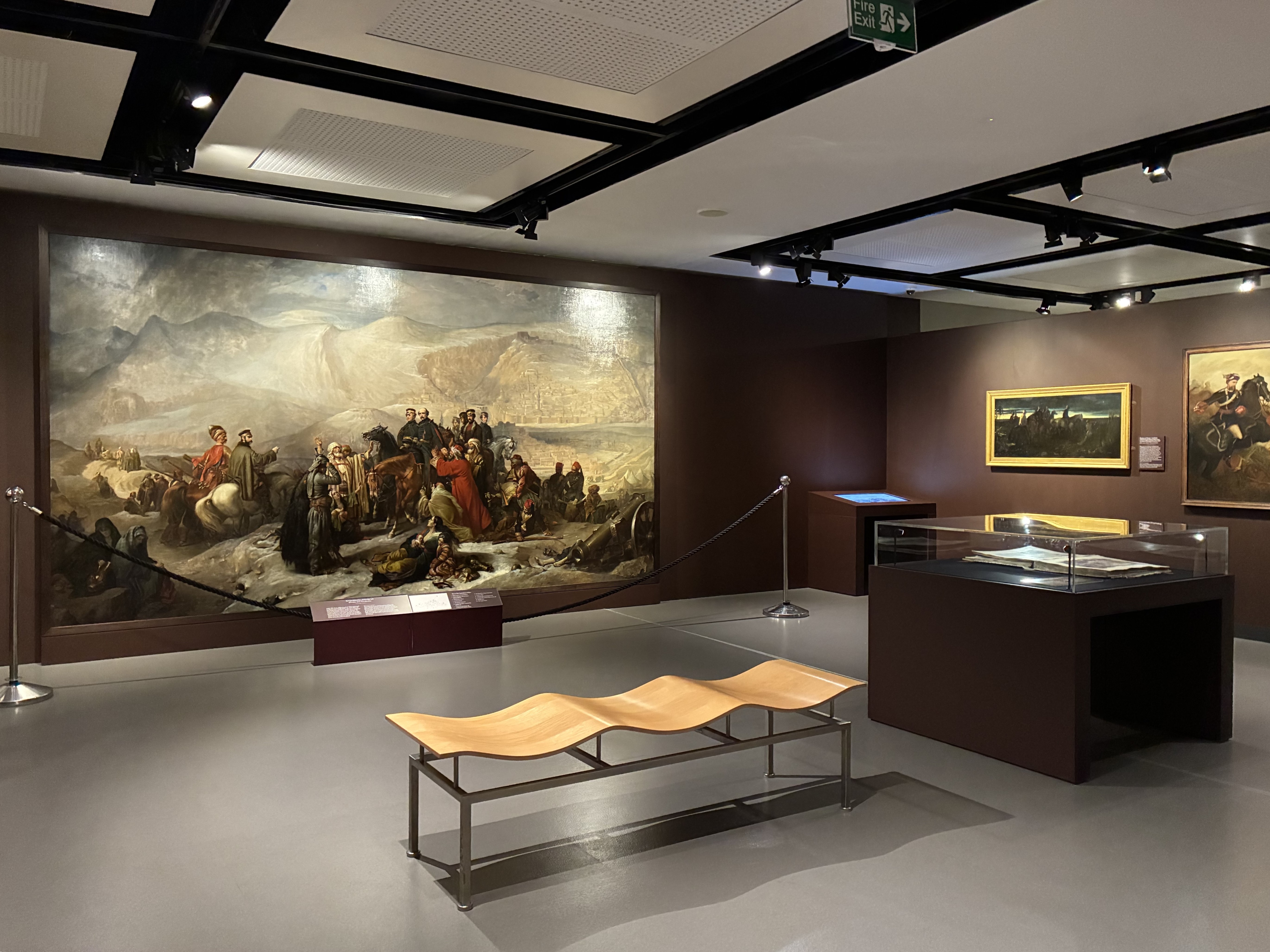
Installation view of Myth and Reality: Military Art in the Age of Queen Victoria at the National Army Museum showing the five-yard-wide oil painting ‘The Capitulation of Kars, Crimean War’ by Thomas Jones Barker (1855) with its static explanatory panel in front and an interactive screen off to the right (photo by the author)

Victoria’s Wars timeline

The exhibition includes a timeline of wars fought during Victoria’s reign. The point is that the British Army campaigned almost constantly throughout the period. There were a few big wars (the Crimean War, the Indian Mutiny and, right at the very end, the Boer War) but most of the conflicts we were involved in were small and localised, what modern historians call Victoria’s ‘small wars’.

  • 1837 – Queen Victoria ascends the throne
  • 1839 – the first photographs by Louis Daguerre in France and William Fox Talbot in England
  • 1842 – the world’s first illustrated weekly news magazine launched, the Illustrated London News
  • 1845 to 1846 – First Sikh War
  • 1852 to  1853 – The Second Anglo-Burmese War
  • 1853 to 1856 – the Crimean War
  • 1854 – Florence Nightingale travels to Crimea with 38 nurses. William Howard Russell’s reporting for The Times transforms people’s understanding of the squalid reality of war. 25 October – Battle of Balaklava and Charge of the Light Brigade.
  • 1854 – the Victoria Cross (VC) was introduced by Royal Warrant on 29 January 1856 to acknowledge the bravery displayed by soldiers and sailors during the Crimean War and soon after the Queen awards it to 62 Crimean war veterans

Queen Victoria and Prince Albert inspecting the wounded Grenadier Guards in Buckingham Palace. Coloured lithograph by George Thomas after himself (1855) Wellcome Collection

  • 1857 to 1858 – the Indian Rebellion
  • 1873 to 1874 – Third Anglo-Ashanti War
  • 1878 to 1880 Second Anglo-Afghan War
  • 1879 Anglo-Zulu War, featuring the Battle of Rorke’s Drift, 23 January 1879
  • 1880 to 1881 First South African War
  • 1882 Anglo-Egyptian War
  • 1884 to 1885 – Siege of Gordon at Khartoum, leading to its fall on 26 January 1885
  • 1885 Third Anglo-Burmese War
  • 1895 to 1896 Fourth Anglo-Ashanti War
  • 1898 – British reconquest of Sudan, featuring the Battle of Omdurman, 2 September 1898
  • 1899 to 1902 – Second South African War, featuring the sieges, the concentration camps etc
  • 1900 Fifth Anglo-Ashanti War

My take

There are about 40 artists, amateur and professional, soldiers and civilians, represented across the exhibition but the exhibition begins in a very decided way which raises a number of questions, because it starts with a strong emphasis on women war artists.

A feminist emphasis on women’s military art

The curators – all women – have decided that the first dozen or so works you see are all by women artists and devote several sections to them.

Victorian women artists, they tell us, helped to shape public perceptions of Army life. Many women were connected to soldiers through marriage or family, sometimes travelling with them abroad and depicting the people and places they saw.

Women were also important supporters and collectors of art, none more so than Queen Victoria herself. The Queen was also one of the most prominent subjects of military art, along with another celebrated figure of the time, Florence Nightingale – which explains why there’s a wall of works depicting the Queen meeting war veterans, awarding medals etc, and a little section about Florence Nightingale (who was famously averse to having her image captured, as she believed it detracted from her work).

However, as the exhibition proceeds you realise that most of the artists on display are not women, and, of course, none of the soldier artists are female – so why start this way unless you’re making a polemical feminist point? The implication seems to be that, after centuries or millennia of The Patriarchy, of tellings of history and art which downplay or completely ignore the role of women in the creation and consumption of art, this exhibition is doing its bit to redress the balance.

Fine. I understand. Why not? But there’s a second element to this approach which is notable and, maybe, problematic: this that one of the greatest, if not the greatest war artist of the Victorian era was Lady Elizabeth Butler, and so, hand-in-hand with the ‘women and military art’ section goes the ‘Lady Elizabeth Butler’ section. On one level there’s no quibbling with this: Butler was an outstanding artist and produced some of the standout works of the entire century. She was an absolute mistress of her craft, the half a dozen big paintings of hers brought together here are alone worth travelling to visit the show for, especially as several of them are usually buried in the Royal Collection.

So on the plus side, ignoring all its other features for a moment, you could say this is an outstanding selection of paintings, sketches and anecdotes by one of the nineteenth century’s great artists, and this is all to the good.

So why am I kvetching? Because the curators state, in these opening sections, in these early wall labels, that Lady Butler transformed military painting, depicting the life of soldiers with a new realism, taking a new, humane approach and setting a new standard for the subject. And this is all well and good, too, except that… In order to understand why Lady Butler is so important, and what she transformed, and what she changed it would have been good to have been fully introduced to the tradition of Victorian military painting which preceded her.

Instead, the result of placing Lady Butler right at the start of the show is to jump quite a long way into the later Victorian period without any preliminary explanation.

The work which really brought her to general attention was her ‘Roll Call’ which was displayed in 1874, 37 years into Victoria’s reign – and the first big work of hers which the curators feature, on the first wall of the exhibition, is ‘Dawn of Waterloo’ which was first displayed in 1895! 58 years into Victoria’s reign and only 6 years before her death. It’s a great painting but it comes at the very fag end of the period being covered and so is pretty misleading about the military art of Victoria’s era.

‘The Dawn of Waterloo: The Reveille in the Bivouac of the Scots Greys on the morning of the battle’ by Lady Butler (1895) the first full-scale painting by Lady Butler which the visitor encounters in ‘Myth and Reality: Military Art in the Age of Queen Victoria’ at the National Army Museum

Recap

So the decision to emphasise women’s role in military art may be laudable, and bringing a number of women’s works all together in the first few rooms ensures that the subject gets the prominence it deserves, rather than interspersing women’s works chronologically among the men’s pictures where they might be overlooked and unnoticed (as very probably happened in so many previous exhibitions on the subject).

Fine. And if you’re going to mention women artists of the time, then it would be silly not to mention and indeed have a section about the greatest of them, Lady Butler, also here right at the start. OK. Fine.

But the (maybe unintended) consequence of all this is that the visitor is deprived of a chronological understanding of the subject – of what military art looked like before Victoria, then at the start of her reign, how it developed through the decades leading up to the two seismic conflicts of the Crimean War and the Indian Mutiny in the 1850s, how it reflected trends in the broader art world, and so on.

You see how a chronological survey like this would have been interesting in itself and might also have better prepared the way for Lady Butler’s dramatic innovations: by the time you got to Lady B you’d have had a much better understanding of The Tradition she was transforming… but instead you have to work it out for yourself.

Five styles

This unchronological approach characterises the rest of the exhibition, too. Particularly in the sections about ‘Patriotism and Portraiture’ and ‘Realism and Reportage’, works from the 1840s or ’50s are placed next to works from the 1880s, ’90s or even early 1900s – it’s up to the visitor to make chronological, historical and aesthetic sense of the many different styles on display.

Having gone round the exhibition three or four times, dwelling on favourite works (and being drawn back again and again to the brilliant Butler paintings) I think I came up with about five different, roughly chronological styles of painting. They are:

  1. Romantic-sublime
  2. Patriotic-sentimental
  3. Mid-Victorian anecdotal
  4. Lady Butler
  5. Stiff official portraits

(This isn’t taking into account the pencil or charcoal sketches, and the many watercolours, which are specialist areas unto themselves.)

1. Romantic-sublime

Although painted in 1853 this picture strikes me as epitomising high Romanticism with its fondness for dramatic mountainous scenery and The Sublime. Look at the big baby eyes of Wellington (and his horse), the ethnic outfits of the local guides – it all has the rosy, soft-focus approach of Sir Water Scott’s novels.

Wellington at Sorauren, 27 July 1813 by Thomas Jones Barker 1853 © National Army Museum

2. Patriotic-sentimental

Kars is a city in north-eastern Turkey. In June 1855, as part of the during the Crimean War (1854 to 1856) it was besieged by a Russian army of 25,000. Demoralised by their defeats at the hands of the Russians, the Turks left the defence of Kars to Brevet Colonel (later General Sir) William Fenwick Williams, the British commissioner. The garrison was able to repulse three major Russian attacks but eventually cold, famine and an outbreak of cholera forced it to surrender on 26 November 1885. In recognition of their heroism, the Russians allowed the British garrison to march out of the city with the honours of war and into captivity.

‘The Capitulation of Kars, Crimean War’ by Thomas Jones Barker (1855) (National Army Museum)

This is a huge painting, over five yards wide (!), and it’s accompanied by not one but two diagrams identifying all the figures in it, one a static diagram, one an interactive display of the same. But it was only chatting to one of the (very well-informed) visitor assistants that I really understood what is going on.

You see the local in the red cloak clutching the hand of the bald British officer on his horse (Major General Fenwick Williams) and the cascade of similar locals off to his right, and the pitiful woman lying on the ground with her helpless children in the foreground, and similar locals on his left?

These are the local Turks who the British are abandoning to the kindness of the conquering Russians. So they are pleading with the British not to leave and abandon them but the British, defeated, have to. (Maybe a modern analogy would by NATO forces pulling out of Afghanistan and letting the Taliban take over.) It is this acute sense of regret and shame which explains the expression on the face of the British officer.

(You could write a book about the peoples the British Army promised to protect, only to abandon them – I’m currently reading a book about the Dutch Revolt which mentions that Queen Elizabeth I made all kinds of promises to the Dutch patriots in the 1580s which she then completely broke… It’s a long tradition.)

Back to the painting: ‘The Capitulation’, then, is a psychological study in the pain and embarrassment of duty, of a fine upstanding officer mortified to be abandoning the people he promised to protect. As such it is full of all kinds of melodramatic details, the thrown-up hands of the man in white on the left, the tearful eyes of the woman on the ground. It’s like a tableau from a mid-Victorian melodrama, at the centre of which is the British officer maintaining a stiff upper lip despite being deeply moved.

In fact it tells you a lot about mid-Victorian art and audiences that the work was commissioned, not by an aristocratic patron, but by the art dealers and print makers Agnew and Sons, precisely to be turned into prints and widely sold. So it is very deliberately catering to popular taste and demand.

3. Mid-Victorian anecdotal

The Victorians loved detail and clutter. Dickens’s novels overflow with wonderfully telling details and so do classic mid-Victorian paintings like William Powell Frith’s Derby Day (1858) or The Railway Station (1862), packed with little stories and anecdotal details. The exhibition includes an absolute classic of this style, ‘Home Again’ by Henry Nelson O’Neil.

‘Home Again’ by Henry Nelson O’Neil (1860)

‘Home Again’ depicts soldiers disembarking from a troopship at Gravesend on their return from the Indian Mutiny (1857 to 1859). For military history buffs the curators tell us that about 40,000 British troops were sent to India (more than had been mobilized for the Crimean conflict) to suppress the mutiny among the Indian troops of the East India Company’s Bengal Army.

But in purely visual terms we are invited to relish the details! At the very top a young woman peers over the shoulder of a bearded infantry corporal, who holds their baby for the first time. In the middle-right a young soldier of the 60th (The King’s Royal Rifle Corps) dressed all in black leans down to offer his Victoria Cross to a Chelsea Pensioner. The central action depicts sailors assisting a wounded sergeant to disembark. We are told that he wears a Kilmarnock ‘pork-pie’ cap under the white cotton ‘Havelock’ cover distinctive to the campaign, with the neck flap for protection from sunstroke.

There is patriotic pride here, and sentimentality of a sort, but it is very clearly all about the common people, ordinary soldiers (and sailors) and their reunions with wives and sweethearts. As such, it a little bit anticipates Lady Butler’s humanism but still with that mid-Victorian obsession with anecdote and detail.

4. Lady Butler

‘The Roll Call’ is one of the most celebrated British paintings of the 19th century. On its public appearance in 1874 it cemented Butler’s reputation as one of the leading painters of the age. It depicts a roll call of soldiers from the Grenadier Guards following the Battle of Inkerman in 1854 but can stand for thousands of similar occasions.

The Roll Call by Lady Elizabeth Butler (1874) © Royal Collection Enterprises Limited 2025 | Royal Collection Trust

The composition expresses Butler’s profound feel for the plight and experiences of the ordinary soldier, for the pity of war and the walls of the show feature not one but two quotations by her, emphasising how she eschewed patriotic guff in her concern for the actual lived experiences of the men who fought and suffered.

‘I never painted for the glory of war, but to portray its pathos and heroism’.

‘The Roll Call’ was fantastically successful. When it went on display at the Royal Academy it attracted over 300,000 visitors in a 3-month period and the more you look, the more brilliant it becomes.

The curators explain that historical or military painting for a long time worked with the basic design of a triangle which places the most important person – generally the commanding officer – at the apex (as in the pictures of Wellington and Major General Fenwick Williams, above). As soon as that’s pointed out to you, you realise really drastic difference her, the polemical message sent by the composition which is the equality of the men, all placed on the same level.

There’s still an anecdotal aspect to the thing, if you go up close and work slowly from left to right, starting with the two soldiers on the left lighting a sneaky fag or cigar, and working along through the bandages and blood of the wounded to the striking element of the man who’s collapsed into the snow. It really conveys the wretched pity of war, 44 years before Wilfred Owen coined the phrase for his volume of First World War poetry.

There is, of course, a figure on horseback, but he isn’t treated with the Romantic sentimentalism of the Wellington, above. Instead we can feel the gruff sympathy of the sergeant in charge as he reviews his wounded troops. And he also acts as the viewer’s entrance point into the work. If it was just the row of soldiers it would be slightly impenetrable: the officer on horseback not only relieves what might have been monotonous, but his movement carries the eye into the composition.

But there’s more because, after you’ve finished admiring the overall shape and canny dynamism of the composition, if you step back you notice the colours. You notice how Butler has depicted the uniforms of the men with great accuracy but used them as a springboard to create a composition of shades of grey. The grey coats and badges are reflected under the line of men by the different shades of snow and above them by the extremely nuanced and varied shading of the clouds.

On a literal level the coldness of the winter is evoked by the dominant tones of black, grey, white and brown, contrasting with small splashes of red from coatees and flags. But on a more aesthetic level, the awareness of shades of grey makes you think of James McNeil Whistler’s compositions, symphonies of certain palettes and timbres.

And then you notice the crows, the brilliant broken flight of crows coming from the middle of the composition and looping up over the head of the reviewing officer.

In its: 1) absence of sentimentality; 2) its immediately felt humanistic concern for the plight of the average soldier; and 3) its stunning painterliness, its brilliance of composition and colouring, ‘Roll Call’ really is a masterpiece. It’s worth visiting the exhibition just to see this one work in the flesh.

5. Stiff official portraits

Something the curators of the Army Museum must struggle with is that so much military art is decidedly average, if not actively poor. One or two of the battle paintings here struck me as ludicrously bad, but there’s a more subtle problem and that’s to do with military portraits.

I bet there are tens of thousands of these up and down the land, professional portraits of Britain’s countless officers, generals, admirals and so on which are good enough, decent enough, professional likenesses, but are never going to make it into anyone’s history of art because they are, by their nature, a very conservative wing of the medium.

Their number, their prevalence and popularity in Victorian times explain why there is a section titled ‘Patriotism and Portraiture’ here. Not only did ‘the people’ want to see portraits of heroes like Wellington or Gordon or Roberts, but countless military families wanted professional portraits of their eminent male members to hang alongside all their forebears, and hundreds of officers messes and regimental headquarters, ditto.

Hence a half dozen masterpieces of stultifying conventionality and woodenness.

Lieutenant The Honourable Frederick Hugh Sherston Roberts VC, Kings Royal Rifle Corps by Julian Russell Story (1899)

There’s a story behind this portrait, which is that Roberts not only won the Victoria Cross, but the same medal was awarded to his father, Field Marshal Frederick Sleigh Roberts, 1st Earl Roberts, making them one of only three father-and-son pairs to be awarded the VC in its 169-year history.

Watercolours

As mentioned, the exhibition includes 20 or so watercolours, much smaller and more intimate than the bombastic oil paintings. In a sense, watercolours under-promise and so are often able to over-deliver.

Installation view of Myth and Reality: Military Art in the Age of Queen Victoria at the National Army Museum showing a set of six watercolours of the Crimean War by William Simpson (photo by the author)

General Cannon’s landing, July 7 1854

My wife and I play a simple game when visiting exhibitions. Having crawled through the exhibits and rooms, reading and processing every wall label, we reach the end, turn round and go back through it, this time lightly, airily choosing one work per room which we like and having to explain why. A variation is to choose a work we would buy and take home to hang in the landing or hall or wherever. As I’ve stated, the Lady Butler paintings are all brilliant, but in terms of something I’d actually buy and live with, something a bit more modest, I kept returning to one of the 20 or so watercolours on display, ‘General Cannon’s landing, July 7 1854’, a pencil and watercolour by Joseph Archer Crowe (who has seven works in the exhibition).

‘General Cannon’s landing, July 7 1854’ Pencil and watercolour by Joseph Archer Crowe

Crowe worked at the Crimean War as a special artist for The Illustrated London News. This watercolour depicts how, on 7 July 1854, Turkish forces launched an amphibious assault across the River Danube on Russian positions at Giurgiu (in modern day Romania). The Russians were driven back and Giurgiu was occupied by the Turks.

It’s not going to rock anyone’s world, I just liked the composition, the line of ships going in from roughly right to left, and the light impressionistic touches of colour.

Women artists

I may have missed some but, for the record, here are the women military artists featured in the exhibition:

  • Lady Elizabeth Butler
  • Jane Drummond (portrait of Mrs Anne Steele)
  • Gertrude Ellen Burrard (portrait of Nussiban, our ayah)
  • Elizabeth Anne Leslie Melville (portrait of Major General Sir Owen Tudor Burne)
  • Emily Henrietta Ormsby (portrait of Colonel Henry Francis Strange; portrait of Major General John William Ormsby)

Lady Butler’s works

  • Tenth Bengal Lancers tent pegging (1873)
  • The Roll Call (1874)
  • Study of a Wounded Guardsman (1874)
  • Quatre Bras (engraving of oil painting, 1879)
  • Patient Heroes: A Royal Artillery Gun Team in Action (1882)
  • Scotland Forever! (engraving after oil painting, 1882)
  • After the Battle of Tel-el-Kebir (engraving of original painting, 1888)
  • After the Battle of Tel-el-Kebir (fragment of original painting, 1888)
  • The Defence of Rorke’s Drift (1882)
  • The Ballad of the Royal Irish at Sebastapol (6 x pencil illustrations of a poem, 1890)
  • Military sketches (pen, watercolour and pencil, 1893)

Summary

I don’t know whether my point about the lack of chronology and build-up to Lady B is even worth mentioning. My wife went round the displays two or three times with me and didn’t even notice or care, just enjoyed various works on their own merit.

So: if you’re interested in military history the exhibition contains lots of titbits about key wars and engagements of Victoria’s reign, about medals and uniforms, some lovely watercolours and a dozen or so really impressive oil paintings, along with a number of average or also-ran works which, however, illustrate interesting topics, such as the section about the creation of the Victoria Cross, and so on.

And the National Army Museum is always a lovely place to visit because – ironically, given its subject matter – it’s such a calm, clean and peaceful place to be. Go see.


Related links

Related reviews

Selected Essays by Virginia Woolf – 2. Life-Writing

The Oxford World Classic edition of ‘Selected Essays by Virginia Woolf’, edited by David Bradshaw, brings together 30 of Woolf’s essays, reviews and miscellaneous prose pieces, and groups them under four headings:

  1. Reading and Writing
  2. Life-Writing
  3. Women and Fiction
  4. Looking On

Summarising each of the essays was taking so long that I broke my review up into parts, one for each section. This one addresses the four essays in the ‘Life-Writing’ i.e. biography section, being:

  1. The New Biography (1927) [review of Some People by Harold Nicholson]
  2. On Being Ill (1930) [fantasia]
  3. Leslie Stephen: The Philosopher at Home: A Daughter’s Memories (1932) [memoir of her father]
  4. The Art of Biography (1939) [specifically Lytton Strachey]

Woolf, her father and biography

Virginia’s father, Sir Leslie Stephen (1832 to 1904) was an English author, critic, historian and biographer. He was editor of the influential Cornhill Magazine. Virginia grew up in a house filled with books, and was given free rein to its large library with, crucially, the support and guidance of an extremely bookish parent. She grew up to believe and promote in all her essays the dazzlingly unoriginal idea that writing, literature and poetry, were the highest art and encapsulated indelible human truths. I wonder if anyone believes such a narrow simple-minded idea in our times. Literature quite obviously doesn’t represent any kind of truth. The case against it is similar to one of the arguments against the Bible being the word of God, simply that it expresses, with profound conviction, a vast array of completely contradictory and chaotic beliefs. In fact literature’s virtue is its lack of any one Great Truth, the whole point is its mad diversity and plurality.

The point is that young Virginia grew up in a hyper-bookish household, dominated by a hyper-bookish father, and went on to spend a career telling everyone that the most important thing in the world was books and writing, as the essays in the first two sections of this book demonstrate. The apple doesn’t fall far from the tree.

Anyway, in the early 1880s, the owner of the Cornhill magazine, the publisher George Smith, approached its editor, Stephen, to sound him out about creating an encyclopedia of notable people. This led to the creation of the Dictionary of National Biography or DNB, still with us 140 years later. Stephen was the dictionary’s founding editor, working on it from 1885 to 1891. His daughter, Virginia, was to give a special place to biography in the genres of writing. Her novel Orlando is a tribute to and critique of traditional biography. I was struck by how her powerful feminist polemic, Three Guineas, relies not on data, sociology or economics, but leans very heavy on the evidence of the innumerable literary biographies she’s read. Biography was very important to this daughter of the man who founded the country’s definitive encyclopedia of biography. The apple doesn’t fall far from the tree.

When her father resigned as editor, he was replaced by Sidney Lee, Stephen’s assistant editor from the beginning of the project. Lee served until the first edition was completed in 1900, then returned to edit the first supplement which was published in 1912.

1. The New Biography (1927: 6 pages)

This is a book review of Some People by Harold Nicholson. It starts with a quote from Sidney Lee’s 1911 book, Principles of Biography, where he writes that:

The aim of biography is the truthful transmission of personality.

Almost any educated person could spot the flaws in this statement, starting with the idea that you can ever have a truthful transmission of anything, and going on to wonder whether the point of a biography is solely to convey personality. That’s a nice outcome but surely there are a lot of other aims as well, not least getting the facts right and setting the record straight about someone’s life.

Anyway, this quote allows Woolf to set up a dichotomy between truth and personality. On the first page she astonishes with an unironic and naive praise of The Truth, believing that such a thing exists.

There is a virtue in truth; it has an almost mystic power.

Here as in so many other places, Woolf shows herself a child of the deep Victorian era, whose intellectual traces lingered for a long time in the Stephen household, her attachment to Truth and Beauty deriving from Keats, Shelley, Coleridge and so on, nothing from the thinkers, writers and artists of her own time.

But partly it’s just a rhetorical device. She builds up Truth as a big concept so she can oppose it with Personality. According to her this emerged into the genre of biography with Boswell’s ‘Life of Johnson’. We hear and see Dr Johnson as no other figure before him. We hear him, we can argue with him.

Victorian biography contained more psychology, more delving into personality than its predecessors, but was constrained by the Victorian need to dwell on virtue and goodness. The result was huge biographies which resembled the Victorian tombs of Great Men lacking all sense of life and spontaneity.

But now, she claims, twentieth century biography represents a sea change, in two main ways. Modern biographies are no longer the ten volume tombstones of the Victorian era, but are short and swift. Alongside this, the biographer no longer considers themselves a lowly drudge beavering away in the footsteps of their giant subjects; the modern biographer considers themselves the equal of their subjects, and freely able to pass judgement on them.

And now, after this thoughtful if wrong-headed introduction, we come to the book under review, Some People by Harold Nicholson. Now Nicholson was a ridiculously over-talented posh man. He was a diplomat, politician, journalist, broadcaster, historian, biographer, diarist, novelist, lecturer, literary critic, essayist and gardener nowadays maybe mostly remembered for his candid, scandalous Diaries.

He had already written fairly conventional biographies of Byron and Tennyson when he produced Some People. It consists of nine chapters, each the biography of a different person but here’s the thing – all nine are imaginary. They are: being a sort of character sketch: Miss Plimsoll; J. D. Marstock; Lambert Orme; The Marquis de Chaumont; Jeanne de Henaut; Titty; Professor Malone; Arketall; Miriam Codd.

Nicholson joked that they were all entirely imaginary, abstract character sketches. But those in the know recognised some of them as combining traits from real living people, and a couple of them are straight portraits of real people just given fictional names.

As such it is a hybrid book, biographies, but of non-existent people, except they are real people, except they are treated as fictions.

It may be worth pointing out that Nicholson was married to the posh aristocrat Vita Sackville-West, with whom Woolf was having a lesbian affair. Woolf was especially interested in biography at this time because she was quickly writing her own fictional biography, Orlando, which was in the same ballpark as Some People and which is dedicated to Sackville-West. Orlando is in fact in many respects based on Vita, even including photos of her in the text and captioning them as portraits of Orlando.

Back to Nicholson, Woolf says his chief quality is his sense of humour. He laughs at his subjects and he laughs at himself. She makes the rather obvious point that the tenth subject who emerges from this sequence of nine portraits is the author himself, mentioned self-mockingly at various moments, and whose own life and opinions emerge from references scattered throughout the other sketches.

What makes all this new is ‘the lack of pose, humbug, solemnity’, ‘freedom from pose, from sentimentality, from illusion’. He has opened new ground by deploying the techniques of fiction to biography.

At the same time she points out its limitations, which that all the characters, deliciously mocked though they are, are small. They lack real depth or complexity and they can’t be allowed it or the delicate balancing act will be spoiled.

Caveat

As I wrote this out I thought, Hang on: surely a vast number of novels have been biographies of fictional people, starting with books like Moll Flanders or Tom Jones. When she says that Nicholson writes with delightful humour well, er, Henry Fielding, let alone Dickens, most of whose early novels purport to be biographies of named people (Oliver Twist, Nicholas Nickleby). Fiction and biography have always been closely aligned, haven’t they? Maybe Nicholson just seemed so new by contrast with the long dark shadows of the vast and pious Victorian biographer? Or maybe what was novel in his work was the pretence that his people were real? To us nowadays what Woolf finds so exciting in this book sounds to us pretty commonplace.

Or maybe what excited her was that she, also, at this very time, was writing a fantasy biography, an experimental biography, an experiment mixing fact and fiction, so it chimed with her own intense interest in this zone. As in her important essays about fiction, she is working through her own ideas in public?

Or that she was having an affair with the author’s wife. The literary world, eh?

2. On Being Ill (1930: 10 pages)

Wikipedia says:

‘On Being Ill’ is an essay by Virginia Woolf, which seeks to establish illness as a serious subject of literature along the lines of love, jealousy and battle. Woolf writes about the isolation, loneliness, and vulnerability that disease may bring and how it can make even the maturest of adults feel like children again. The essay was written in 1925, when she was 42 years old, while she was in bed shortly after experiencing a nervous breakdown.

Like most of Woolf’s essays, its premise, discussion and conclusions feel highly questionable. Take for a start her claim that that no serious writer had previously written about illness. Wikipedia points out that even when she was writing (1930), she had Proust’s extensive descriptions of illness in In Search of Lost Time (1913 to 1927) not to mention Thomas Mann’s The Magic Mountain (1924) set in an Alpine sanatorium, to refer to.

But facts aren’t what Woolf is about, here as in most of her essays. She mainly wants to get on and write, in a heightened poetic style, about the basic conflict between the mind and the body. And so she claims that most literature is about the mind and little attention is given to the demands, especially when ill, of the body. Partly this is due to the poverty of the vocabulary surrounding illness:

The merest schoolgirl, when she falls in love, has Shakespeare or Keats to speak her mind for her; but let a sufferer try to describe a pain in his head to a doctor and language at once runs dry. There is nothing ready made for him.

(Here, as everywhere, see how her mind, when considering almost any aspect of writing, immediately turns to Shakespeare as a reference point, something she does in virtually everything she wrote.)

Also, there’s the slight problem that her description of being ill bears no resemblance to actually being ill. I had flu for a week recently and Woolf’s extended and highly poetic fantasias about illness, fanciful and poetic though they are, bear no relation to the sense of exhaustion and lack of interest in anything at all which I experienced. Hers is a kind of over-literary person’s fantasy of what illness ought to be like.

In fact the whole text is really a fantasia, an imaginative extravaganza, often with no connection to the nominal subject. She describes how lying on a sick bed makes you look up into the sky and describes her impression of watching it for hours (the sky), how it continually changes like a vast open-air cinema. When I was lying sick in bed and looked up, I saw the ceiling.

Overwhelmed, as so often, by the intensity of her own sense impressions, Woolf shifts her attention to something smaller and closer to hand, roses in vases in her room. For some reason, this morphs into a fantasy about the heat death of the solar system, the sun going out and the earth being covered in ice. free-associating, she wonders whether there will be a heaven and immortality, and goes rambling on:

Surely, since men have been wishing all these ages, they will have wished something into existence; there will be some green isle for the mind to rest on even if the foot cannot plant itself there. The co-operative imagination of mankind must have drawn some firm outline.

But no. One opens the Morning Post and reads the Bishop of Lichfield on Heaven. One watches the church-goers file into those gallant temples where, on the bleakest day, in the wettest fields, lamps will be burning, bells will be ringing, and however the autumn leaves may shuffle and the winds sigh outside, hopes and desires will be changed to beliefs and certainties within.

Do they look serene? Are their eyes filled with the light of their supreme conviction? Would one of them dare leap straight into Heaven off Beachy Head? None but a simpleton would ask such questions; the little company of believers lags and drags and strays. The mother is worn; the father tired. As for imagining Heaven, they have no time.

Heaven-making must be left to the imagination of the poets. Without their help we can but trifle—imagine Pepys in Heaven, adumbrate little interviews with celebrated people on tufts of thyme, soon fall into gossip about such of our friends as have stayed in Hell, or, worse still, revert again to earth and choose, since there is no harm in choosing, to live over and over, now as man, now as woman, as sea-captain, or court lady, as Emperor or farmer’s wife, in splendid cities and on remote moors, at the time of Pericles or Arthur, Charlemagne or George the Fourth…

See what I mean by fantasia? There’s no point trying to process or assess this rationally: all you can do is relax and go with the flow of her rather delirious mind…

She eventually veers back into the world of sense when she makes the point that when we’re ill, the rational controlling mind is weakened and so, with your defences turned down, you respond more directly to sense impressions.

In illness words seem to possess a mystic quality. We grasp what is beyond their surface meaning, gather instinctively this that, and the other—a sound, a colour, here a stress, there a pause—which the poet, knowing words to be meagre in comparison with ideas, has strewn about his page to evoke…

Incomprehensibility has an enormous power over us in illness… In health, meaning has encroached upon sound. Our intelligence domineers over our senses. But in illness, with the police off duty, we creep beneath some obscure poem by Mallarmé or Donne…

This may or may not be true. When I had flu I was too ill to read anything, to do anything, to care about anything at all, even eating. So this seems to me yet another of her poetic fantasies, it is a bookish account of what being ill ought to be like. And how characteristic that her first example of the conscious mind lowering its guard and being more susceptible, is that it be more susceptible to poetry and the Great Classics of Poetry in particular.

This dogged return of so many essays to her obsession with Poetry made me reflect that, although Woolf’s best novels are really great, in all other respects her imagination was horribly constricted. Essay after essay after essay praises the same handful of Great English Poets and, above all, Shakespeare, again and again and again. It’s like listening to a tame parrot repeat its half dozen catchphrases all day long. And lo and behold, in the very next paragraph, here is the Bard of Avon, yet again.

Rashness is one of the properties of illness—outlaws that we are—and it is rashness that we need in reading Shakespeare. It is not that we should doze in reading him, but that, fully conscious and aware, his fame intimidates and bores, and all the views of all the critics dull in us that thunder-clap of conviction which, if an illusion, is still so helpful an illusion, so prodigious a pleasure, so keen a stimulus in reading the great. Shakespeare is getting flyblown; a paternal government might well forbid writing about him, as they put his monument at Stratford beyond the reach of scribbling fingers. With all this buzz of criticism about, one may hazard one’s conjectures privately, make one’s notes in the margin; but, knowing that someone has said it before, or said it better, the zest is gone. Illness, in its kingly sublimity, sweeps all that aside and leaves nothing but Shakespeare and oneself. What with his overweening power and our overweening arrogance, the barriers go down, the knots run smooth, the brain rings and resounds with Lear or Macbeth…

Is she seriously claiming that being ill helps you read Shakespeare better? This is not a sensible remark because it’s quite the opposite. You need your wits about you when reading such wonderfully complex, multi-levelled works – the multi-levelled complexity of plot, character, psychology and diction are key to the deep sensual but intellectual pleasure Shakespeare gives.

The last few pages of the essay follow through on Woolf’s idea that when you’re ill you’re not up to reading the Great Works of Literature and fancy something lighter. In Woolf’s case this is biography, which she goes out of her way, in essay after essay, to emphasise is not an art on the same level as writing a novel (see ‘The Art of Biography’, below).

At which point the essay takes an unexpected turn to look at a very specific author. The last couple of pages of this little essay stop being about illness at all and turn into praise for the Victorian writer, painter and raconteur, Augustus Hare (1834 to 1903). Specifically, it turns out Woolf is a big fan of Story of Two Noble Lives, Hare’s big biography of two sisters and artists, Countess Canning and the Marchioness of Waterford. Woolf gives us an extended summary of these ladies’ lives, of the extended Victorian families they lived in, of their marriages, children, careers and whatnot and then, after this brisk impressionistic summary of this now-obscure work, her favourite sick-time reading, the essay simply stops, leaving you puzzled and (pleasurably) disorientated.

Thoughts

1) Being ill is nothing like Woolf describes. This is just a literary fantasia.

2) Her obsession with Great English Literature and, above all, with Shakespeare Shakespeare Shakespeare, is enough to make you scream. English literature is huge and varied and strange but hardly any of this comes over from Woolf who makes everything, all English literature, sound like one thing, like the same, high-minded and lyrical seeking after Poetry.

3) It is symptomatic that she ends not with a novel but a biography. Biographies are easy to read, serious novels often very hard. Hence my mild criticism of the way so much of her powerful polemic Three Guineas was based on biography, anecdote and extensive newspaper cuttings rather than serious research into history or sociology. I knew medics and scientists at university who never read novels but loved a good biography. This is because reading a biography is easy, reading the biography of a writer is a lazy copout: at the risk of sounding schoolmasterish, you should always read the original works – because it’s there that the unexpected, the strange and the marvellous reside, not in biographical summaries, no matter how interesting.

4) Ten thousand critics have labelled Woolf a modernist but, in my opinion, underlying the technique of drifting, free-associating consciousness which she developed for her great novels, there actually lurks an extremely conservative, backwards-looking mentality. ‘Poetry, darling, seeking The Truth of Life. Keats and Shelley. And above all, the Master, Shakespeare!’ My reading of her novels and essays is that Woolf wasn’t the first of the moderns, she was the last of the Victorians who carried a kind of purified, quintessential Victorian aestheticism on into the troubled culture of the post-war era.

3. Leslie Stephen, The Philosopher at Home: A Daughter’s Memories (1932: 5 pages)

Woolf’s father was an eminent biographer, who helped found and develop the definitive encyclopedia of biographies of notable British people. He was also a noted essayist. And so she became… a noted essayist with a lifelong fascination in biography. The apple doesn’t fall far from the tree.

This brief text isn’t anything like a biography or an obituary for her famous father. It’s more a eulogy but of a highly personal and limited nature. Woolf’s stock-in-trade wasn’t so much analysis but ‘memories’. Compare and contrast the way the supposed introduction to the book about the English Women’s Co-operative Guild (see my next blog post) is called ‘Memories of a Working Women’s Guild’, and proceeds not by rational argument, not by logical structure, but through the highly personal medium of her own memories, dwelling on her own responses and feelings.

Back to this essay, it’s a relatively brief collection of memories of her famous father:

  • how Leslie Stephen’s adventurous days – as a rower, mountaineer and even author – were over before his children were old enough to know him
  • he liked to go on huge walks across the Cornish moors, rarely speaking more than a few words to anyone who accompanied him
  • he wrote lying almost horizontally in an old rocking chair, picking up and dropping source books as he needed them, with a thump which could be heard downstairs
  • he unconsciously doodled animals in the margins of his books as he read
  • he had a magical ability to make animal shapes out of sheets of plain paper
  • he didn’t speak much but even his briefest remarks were freighted with meaning
  • he disregarded conventional values, frequently embarrassing the family, such as when he wondered aloud whether people who had dropped in for tea were ever going to leave
  • he loved clear thinking and hated sentimentality
  • he hated wars
  • he was paranoid about running out of money and going bankrupt
  • he liked going for brisk walks from the family home at Hyde Park Gate, up to Kensington Gardens and round the Serpentine to the Marble Arch and back
  • his children regularly heard the story about him and his brother encountering Queen Victoria in the Park and bowing low to which the Queen curtseyed, and as a boy once seeing the great Duke of Wellington
  • he smoked a pipe continually
  • he worse clothes till they became shabby
  • like so many industrious Victorians, he hated idleness
  • he didn’t give his daughters higher education but when Vanessa expressed the wish to become a painter he promised to do everything in his power to help her
  • as for Virginia, he gave her free run of his large library when she was just 15 and taught her to be true to her own opinions, to be honest, never to pretend to admire something she didn’t

At the end is a flurry of tributes to him from the writers of his time. Woolf quotes a few lines by Thomas Hardy about Stephen. She quotes the novelist George Meredith saying her father was the only man worthy of her mother (who Meredith knew and admired).

You’ve heard of Simone de Beauvoir’s autobiography, Memoirs of a Dutiful Daughter? Well, this little sliver feels like Woolf’s Memories of a Dutiful Daughter. You’d never know from this pious recital, that she based the character of the occasionally malicious and hurtful Mr Ramsay in To The Lighthouse on her father. Scholars claim that Mr Ramsay is a much more subtle and nuanced depiction of some of her father’s complex and difficult character. By contrast, this reads like the official version.

4. The Art of Biography (1939)

Divided into four sections.

1.

On any given topic Woolf tends to revert to the same handful of ideas. Here she repeats the idea stated in ‘The New Biography’ that it was only in the 18th century that Westerners developed sufficient interest in other people to write really flavoursome biographies, with Boswell’s vast ‘Life of Johnson’ epitomising the new interest, while in the Victorian century biographies grew vast and ponderous and worthy.

Belleletterist writing often proceeds by asking rhetorical questions. Here she asks: Is biography an art? despite being well aware that ‘the question is foolish perhaps.’ In fact it’s such a fatuously pointless question that nobody cares about the answer and Woolf doesn’t answer it.

Instead she moves onto another question: Why do so few biographies endure? Because the novelist is free to write what they want, whereas the biographer is bound by friends and family, by legal restrictions, libel, slander and so on.

The novelist is free; the biographer is tied.

With the result that ‘the art of biography is the most restricted of all the arts.’

2.

She now goes on to discuss the significance of (her friend) Lytton Strachey, author of the volume ‘Eminent Victorians’ (1918), notorious in its day for its warts-and-all portrayal of four Victorian heroes: Cardinal Manning, Florence Nightingale, Thomas Arnold and General Charles Gordon. (Victoria Glendinning’s biography of Leonard Woolf tells me that they weren’t just friends but that the flamboyantly gay Strachey actually proposed to Virginia only to be turned down, a season or so before his Cambridge friend, Leonard Woolf, proposed, and was accepted.)

She knows from personal acquaintance that Strachey wanted to be a writer but lacked the skills required for poetry or plays, whereas in 1918, after the immense disillusionment of the Great War, a new mood was abroad in biography. The plaster saints and stuffed effigies of the Victorian period were ripe for debunking and Strachey found his metier as a debunker and Eminent Victorians was his most famous debunking. That said, the examples Woolf gives of the controversial questions he raised seem ridiculously trivial.

Once more they were the centre of a buzz of discussion. Did Gordon really drink, or was that an invention? Had Florence Nightingale received the Order of Merit in her bedroom or in her sitting room?

Nowadays in our oversexed era, no biography can be published which doesn’t dwell at length on the subject’s sex life, whether they are abused as children or survived all the other horrors life can offer, a melodramatic concern which gave rise a generation ago to the mocking term misery porn. We’ve come a long way from politely wondering if a great military hero might have enjoyed a glass of wine too many.

Anyway, after this early success Strachey went on to write two massive and authoritative biographies of Britain’s queens, Queen Victoria (1921) and Queen Elizabeth I (1928). Woolf has an interesting point to make about these. Basically, the Victoria was a great success (winning prizes) while the Elizabeth was a relative failure. Why? Woolf thinks the answer tells us something about biography ‘as an art’, namely that when he wrote the Victoria he accepted the limitations of biography as a form, its need to stick to verifiable facts, documents, eye witness accounts and so on, and so he worked as a craftsman, assembling his materials. But when he wrote the Elizabeth he got cocky, he tried to make it a work of art, he wanted the book to have more of Woolf’s shibboleth, Poetry, ignored the form’s intrinsic limitations, and failed.

Strachey wanted to invent events and dialogue and motives, specifically in the mysterious relationship between Elizabeth and one of her favourite courtiers, the Earl of Essex. What he found out the hard way is that you can’t add fiction into biography in small doses. To work, fiction must have a free hand to develop character and plot. There was some obscurity in the Elizabeth-Essex relationship but not enough. Just as the fiction was getting going it bumped up against the documents and records we do have which contradicted it, blocked the flow of a narrative. Worse:

By fact in biography we mean facts that can be verified by other people besides the artist. If he invents facts as an artist invents them — facts that no one else can verify — and tries to combine them with facts of the other sort, they destroy each other. (p.120)

(All this prompts the obvious thought that in the 100 years since Strachey’s Elizabeth was published, thousands of writers have managed to write fictional books about historical characters i.e. which blend historical fact with fictional narratives, from Robert Graves to Hilary Mantel, so this last point doesn’t really stand.)

3.

But ‘the facts’ of biography change, they are coloured by changes of opinion by which she means social conventions or beliefs. To demonstrate this she chooses the subject of homosexuality, though she is not allowed to say so.

What was thought a sin is now known, by the light of facts won for us by the psychologists, to be perhaps a misfortune; perhaps a curiosity; perhaps neither one nor the other, but a trifling foible of no great importance one way or the other. The accent on sex has changed within living memory.

Maybe she chooses this particular topic among many other views which shifted with the end of the Victorian era, because Strachey was gay.

Anyway, given these ever-shifting social values, the biographer needs to keep on their toes, alert to the way that so-called biographical ‘facts’ are liable to change completely in a generation. This is why Woolf suggests chucking out the old conventional chapters in a conventional biography and rethinking it as more subtly psychological (like her novels).

Many of the old chapter headings — life at college, marriage, career—are shown to be very arbitrary and artificial distinctions. The real current of the hero’s existence took, very likely, a different course.

4.

Summing up, then, Woolf asserts that it’s exciting times for biographers as biography is poised to take significant new steps forward. But, in line with her obsessive need to rank literary genres, she persists in insisting that biography is an inferior type of writing.

It is a different life from the life of poetry and fiction — a life lived at a lower degree of tension. And for that reason its creations are not destined for the immortality which the artist now and then achieves for his creations. (p.122)

The great characters from fiction last forever. No biographer’s work will last forever. And so she comes round to answering the question she set herself at the start, whether biography is an art. No. No it isn’t.

The artist’s imagination at its most intense fires out what is perishable in fact; he builds with what is durable; but the biographer must accept the perishable, build with it, imbed it in the very fabric of his work. Much will perish; little will live. And thus we come to the conclusion, that he is a craftsman, not an artist; and his work is not a work of art, but something betwixt and between. (p.122)

So Woolf is very tough on biographers, then. According to her they are simply not in the top ranking. Oh well.

But she does throw biographers a consolation prize. This is that the Imagination needs a rest from time to time and biography provides good recreation. Their works make a good playground. A playground where, more importantly, the Creative Writer (the Important Writer, someone like Woolf) may find nuggets of fact, anecdotes or insights:

the creative fact; the fertile fact; the fact that suggests and engenders

which may inspire the superior Creative Writer, which the superior Creative Writer may be able to incorporate into their Work of Art. And so all the biographer’s hard work will have been worthwhile. It would be entertaining to read professional biographer’s responses to this patronising, dismissive point of view.


Credit

‘Selected Essays of Virginia Woolf’ was published by Oxford World Classics in 2008. Most of the essays can be found online. David Bradshaw’s introduction can be read on Amazon.

Related links

Related reviews

Mussolini: His Part in My Downfall by Spike Milligan (1978)

I was determined to pursue the matter to its illogical conclusion.
(Spike summarises his methodology in Mussolini: His Part in My Downfall, page 8)

I was getting twitchy, doing nothing positive for so long. I had started talking to myself and I wasn’t satisfied with the answers.
(Spike beginning to lose it, page 60)

Mussolini: His Part in My Downfall is the fourth of Spike Milligan’s seven (!) volumes of war memoirs. It covers the period from his regiment’s landing in Salerno, Italy, on 23 September 1943 to the date he was invalided out of the front line with nervous exhaustion in March 1944.

Longer, seriouser

Although covering a period of just under six months, the text, at 288 pages, is longer than the two previous volumes put together. Although the relentless gags and wisecracking are similar, the Hitlergams have, mercifully, ended (actually, he sneaks a few through, e.g. p.139) and there are far fewer visual elements i.e. photos, sketches, cartoons and so on, than in previous volumes.

There are still quite a few photos but they are documentary and factual, in the sense that they show members of his brigade, tanks, lorries crossing Bailey Bridges and so on. Mind you, although of military subjects, Spike still comes up with some funny captions. I laughed at the photo of squaddies working on setting up a Bailey bridge across a river where the caption tells us that ‘the ugly soldiers’ were told to face away from the camera.

But overall the tone is quite a bit more serious than in the previous volumes and quite a few passages are entirely serious in intent such as the description of: air attacks, of devastated Italian villages, of the fury of Allied attacks on German positions, the terrible scenes after a direct hit on a neighbouring battery, and so on. It has a permanent edge, a barely suppressed anger which I didn’t feel in the previous volumes (see final section, below, for examples) all building up to the intense and unhappy final passages of him being wounded and psychologically traumatised, returned to the front too soon, bullied for being a coward and then his final collapse.

Spike is peeved

The more earnest tone is set by the surprisingly cross preface or author’s note preceding the text. Spike had been really nettled by a review by Clive James of one of the previous books which jovially referred to it as ‘an unreliable history of the war’. This upset Spike who, in this preface, goes to great lengths to insist that, on the contrary, the text is very heavily researched and completely factual.

All that I wrote did happen, it happened on the days I mention, the people I mention are real people and the places are real…I wish the reader to know that he is not reading a tissue of lies and fancies, it all really happened…I’ve spent a fortune on beer and dinners interviewing my old Battery mates, and phone calls to those overseas ran into over a hundred pounds…Likewise I included a large number of photographs actually taken in situ…

He goes on to mention 18 former colleagues by name for their help with documents, maps, photos and recollections. There are lots of photos but, as I mentioned, most of them are documentary i.e. factual photos of individuals in his battery or contemporary scenes – the silly Edwardian photos with humorous captions which littered the earlier volumes have disappeared.

He also gives excerpts from Alf Fildes’s diary and regularly includes written anecdotes from his best mate Harry Edgington (e.g. pages 120, 142, 234). In fact he mentions ringing up Harry (who had emigrated to New Zealand) and also calling Ken Carter (p.232), to confirm specific facts and memories.

This irritated preface ends with another (i.e. they also appeared in the previous volumes) tribute to his mates and their ongoing closeness, mentioning their twice-a-year reunions, and the text is sprinkled with references to meeting old comrades at reunions or at other events, decades later. These links to old comrades matters a lot to Spike and their importance comes over with far more urgency, and need, than in the previous volumes.

Day-by-day diary format

As with the previous three, it’s done in diary form. But in line with his irritation Spike’s diary entries are given in capitals and preceded by MY DIARY just to ram home the message that it all actually happened.

So what we read is the daily account of how Spike and the boys lived, day to day, with very little analysis, little overview of the campaigns he took part in, no detachment or distance. Instead this happens, and they take the mickey out of it – then that happens, and they make gags about it – then this happens and they all have a larf about it, and so on, for a surprisingly long 288 pages in the Penguin paperback edition.

Gags

Kidgell looks pensively out towards Italy. ‘I was worried about the landing.’
‘Don’t worry about the landing. I’ll hoover it in the morning.’ (p.9)

‘I thought you were a champion swimmer.’
‘Yes, but you can’t swim in army boots.’
‘You’re right, there isn’t enough room.’ (p.9)

Lunch was a mangled stew, lumps of gristle floating on the surface. Edgington said if you held your ear to it you could hear an old lady calling ‘Helpppp.’ (p.13)

Budden tells us, ‘We’ll walk to HQ and get fresh orders.’
I tell him I don’t need fresh orders. I’m perfectly satisfied with the ones I’ve got. (p.29)

Edgington is speaking heatedly. It’s the only way to keep warm. (p.68)

Ernie Hart was a nice lad with a quiet sense of humour, so quiet no one ever heard it. (p.123)

Outside I rubbed my hands with glee. (I always kept a tin handy.) (p.245)

Incidentally the boys themselves are aware that many of these gags are corny or stretched. He often recalls the bit of repartee then writes ‘(groans)’ afterwards (pages 102, 218).

‘I’m too bloody tired to smoke,’ he said.
‘Try steaming,’ I said. ‘It’s easier.’ (p.253)

They were joking on the battlefield, whistling to keep their spirits up, trying to encourage and cheer each other up and fairly often it seems stretched and contrived. I’ve pointed out in some of my reviews of thrillers that many of the classic thriller writers of the 50s and 60s carried the intense atmosphere of the war, its threat and peril, into civilian life; their protagonists carry it around with them. In the same way, maybe, we can say that Spike carried the rather desperate gagging which kept him and his mates going through the war into his civilian career, to great effect in the Goon Show but with diminishing returns after that.

(Incidentally, more, if very casual, information is thrown on the origin of the term when Spike tells us that it was a common nickname for Gunners like himself to be referred to as Gooners or just Goons. And at one point he parodies someone referred to as Florence Nightingale, saying they were more like Florence Nightingoon, the Lady of the Lump, p.135.)

(A few days after reading Spike I was reading Fitzroy Maclean’s war classic, Eastern Approaches’, and came across references to him and fellow members of the SAS listening to Tommy Handley and It’s That Man Again on the wireless and went to listen to some on YouTube. It’s immediately obvious that Handley’s humour uses the same kind of bad puns and deliberate misunderstandings as Spike – ‘I’ve been taking a walk, and if anybody else wants to take it, they can have it. I’ve finished with it’ – making me realise that Spike was peddling the same kinds of gags into the late 1970s that he’d grown up listening to in the 1930s. A proper appreciation of where he was new or innovative would have to start with a really thorough understanding of the British comedy landscape of the 1930s, something which is way beyond my scope.)

(Deliberately?) bad proofreading

Mussolini: His Part in My Downfall is written in a deliberately flaky style. Lots of the sentences contain three or four or five clauses just separated by commas which would be better broken up into shorter sentences by full stops. There are unnecessarily hyphenated words, unnecessarily capitalised words:

  • He stayed for launch, a lovely Stew (p.108)
  • Bentley has diagnosed his own illness as Malaria only to have another doctor diagnose it correctly as Jaundice. (p.136)

Both together:

In the dark night the war went on, being able to sleep peacefully, dry, snug and warm was I suppose, Luxury. (p.144)

There are occasional grammar errors (‘This bloody army were food mad!’, p.98) and erratic typographical gaps or breaks between main text and quotations (from other people’s diaries or letters etc). And regular outbreaks of multiple exclamation or other punctuation marks:

An OP has been established on Monte Croce. Not again! Rain!!! Where does the stuff come from?? (p.104)

The overall effect is of deliberate scrappiness, like a scrapbook, like a kind of student mag or fanzine, as if this adds to the spontaneousness and wackiness of the text, as if breathless sentences and random capitals make it all more wacky and humorous.

Same goes for the misspellings. He talks about ‘the Scotts’ (p.47) or a ‘recoco chair’ (p.67), describes his Major playing the clarionet (although that one’s debatable, p.82), refers to ‘the Bosche’ (p.94), writes ‘Above us the battle was going on full belt’ (p.278). My point being some of these are such egregious errors no professional proofreader would have missed them, so it must have been a conscious editorial choice – all of it, the caps, the misspellings, the bad punctuation, the random caps…

Maybe the manuscript arrived like this from Spike and the editors decided to leave them in to increase the sense of wackiness and improvisation. But then the whole thing was supposedly ‘edited’ by Jack Hobbs, so it was clearly a high-level decision to let it be like this.

Sex

They’re young, fit, healthy men so they think about sex all the time, a great deal of the banter is about sex and, being men, this means rude observations about the size, shape and state of each other’s penises. Any woman – our nurses or Italian civilians – will be mercilessly ogled.

‘Buon giorno, Maria.’
She smiled and blushed, the innocence of Italian country girls was something to see. Something else to see was the top of her stocking tops when she bent over. (p.171)

Travelling on the back of a lorry, the sight of a pretty girl immediately erupted into mass drooling until she was out of sight. (p.194)

There were loads of pretty girls who came under fire from the tailboard. The cries ranged from ‘I can do you a power of good, my dear’ to the less poetic ‘Me give you ten inches of pork sword, darlin”. (p.218)

Not just unacceptable but illegal, these days.

There are the usual half-disguised references to masturbation, which must have been rife (and again I refer the reader to Eric Newby’s mention of men masturbating every night in his prisoner of war camp) (pages 154, 265).

There’s a running joke that Edgington doesn’t join in chatting up every ‘bird’ they see and certainly doesn’t go to the two brothels described in the text; instead he writes long letters to his sweetheart back home, Peg, the joke being that the more he writes the more he remembers having sex with her, the more aroused and frustrated he becomes, for example pages 86 and 87:

At the mention of Peg his eyes went soft and his trousers boiled.

Some of the sex slang was new to me. A simple-minded soldier refers to squeezing liquid mud through the holes in a hessian sack so as to create little worms of mud spaghetti as ‘sexy’. To which:

‘Sexy?’ said Bombardier Fuller. ‘You must be bloody hard up for it if you get the Colin’ watchin’ that.’ (p.130)

‘Get the Colin?’ Later he refers to vaseline by its navy nickname ‘starters’, as in ‘a pot of starters’ and goes on to explain that if the reader doesn’t understand this they should contact Royal Navy PR, as ’70 per cent of the officers are Gay up there’ (p.137). So he is aware of homosexuals, I had been wondering (and p.158).

Race

Spike refers to Indians as wogs (pp. 16, 133) and to Black people using the n word (pages 133, 195) and ‘coon’ (as in ‘Coon-type singing’, p.265) – though not all the time, he also refers to Blacks as ‘negroes’ (p.182) or ‘coloured’. In other words he used (or was depicting) the idiom of the time. It feels done without malice, because (re. ‘wogs’) he was raised in India and liked the culture and people and (re. the n word) he was a massive fan of Black jazz music. Still, the modern woke reader should be warned.

The politically correct would also be incensed by the three or four times the lads do cartoon impersonations of imagined Black servants on a southern plantation from a Hollywood movie (‘Gone with the Wind’ had been released just four years earlier, 1939). Thus, when his mate Edgington turns up at a new billet:

‘Welcome home, young massa,’ I said. ‘De plantation ain’t been de same widout you.’ (p.254)

It’s the idiom of the day and it’s spoofing a popular movie (1943) but it does, admittedly, have an extra edge of satire or sarcasm or needle. Given a choice Spike always prefers the slangy or disrespectful term for anything (the Germans, the army, officers, soldiers as a whole, the Brits, himself, anything if it’ll raise a laugh). It was part of the humour of the day, but double edged. He can never mention Gunner Kidgell without called him ‘short-arse Kidgell’. And he refers to the Italians throughout as ‘Itis’.

Spike is also very aware when people are Jewish and, again, invokes stock stereotypes of Jews i.e. being tight with money or being in the rag trade in the East End (pages 160). I think I remember from the 70s that calling someone a ‘Jew’ was an insult indicating that they were tight (with money). Unacceptable these days, and has been for some time. He mentions someone being Jewish or Jews in general, often emphasising their alleged tightness with money, on pages 160, 193, 198, 202, 223, 258, 271, 274.

At one point an attack by German Messerschmitts forces him and comrades to run naked from showers and jump into nearby slit trenches for protection. But what bothers him is not the risk of getting killed but that he left all his money in his battledress hanging up outside the shower. The second the danger’s over, he goes running back.

Thank God! Money was safe! I just have Jewish blood. (p.258)

Events

The journey aboard ship from North Africa to Italy. Landing on Salerno beach, unopposed because it’s secure, but with the wreckage of fierce fighting all around. Journey up into the hills and then a long slog of positions taken up by his artillery battery, Battery D.

Almost immediately he comes down with sand fly fever and is taken off to hospital for a week long interlude of clean sheets, decent food and pretty nurses. But he starts to go round the bend with boredom and is relieved to be one day collected by a truck and taken back to his mates on the battery. Here, as in every memoir I’ve ever read about war, it’s about friendship, mateship and camaraderie rather than any grand cause.

The new-found seriousness extends as far as an argument he gets into with a northerner who sings the praises of Gracie Fields and George Formby who Spike cordially loathes, explaining that he is a devotee of the Marx Brothers and Bing Crosby (p.54). (Regarding styles of humour, later he hears a broadcast by ITMA and thinks ‘corny bastards’, p.256).

There’s still quite a lot about music, they hear the kind of big band jazz they like on the radio, in an Italian church they discover a piano and play Cole Porter (in fact they perform and sing some Cole Porter but then the Italian priest sings plays and sings some Verdi opera thus trumping them). Othertimes they perform with what they have, including one night they have a little performance with an ocarina, guitar and shaken matchbox, with the others joining in banging mugs (p.138).

He visits the ruins of Pompeii (pages 51 to 53).

Spike’s job

I’d read his descriptions of his duties in volume 2 but it was only in this one that it was made unmistakably clear that Spike’s job was ‘wireless operator’ for an artillery battery (p.46) i.e. laying (or retrieving) phone cables, then using radio sets to co-ordinate with other observation posts to target artillery fire accurately at enemy positions, as described pages 76 to 77.

His battery constantly move to new positions as the front line advances, and enemy planes fly over and occasional shells land nearby but he is repeatedly grateful that he’s not in the poor infantry, sent forward into withering machinegun fire.

The Germans slowly retreat into the mountains which the poor bloody infantry have to storm while Spike’s battery and many others lob shells up into the mountains. The main event is the rain: it rains incessantly, the tents, the men, their uniforms and equipment become sodden. The artillery stands become so sodden that the guns slip backwards or sideways when they fire. All their efforts become devoted to trying to find somewhere dry to shelter and sleep.

Maybe the most vivid scene, possibly the longest lasting all of three pages, is his vivid recreation of a concert he and his mates organised and staged on Christmas Day 1943, giving us the full list of acts, an impressive series of farcical performances and musical interludes.

Just days later they’re given four days’ leave in Amalfi which seems like Disneyland after the muddy farms they’ve been staying in. Memorable evening, standing on the garden terrace watching night fall over the bay, and then onto a cafe kept by a Cockney-speaking Italian momma who lays on an unprecedented feast.

In Amalfi he’s invited into a brothel and initially refuses all offers, preferring to sit relaxed, drink and get pissed, until – according to his account – the lady of the house dragged him into a bedroom and not only screwed him but paid him.

On 5 January they are moved to a new forward position just outside the village of Lauro.

15 January a direct hit on a gun emplacement, exploding munitions and burning four gunners he knows to death, with many other burns casualties. Happens in the middle of the night, Spike is up and running round helping as best he can.

He develops piles (‘the curse of the Milligans’), goes see the medical officer (MO) but there doesn’t seem to be any treatment short of having them operated on and removed. They go from painful to actively bleeding. Normally irrepressibly chirpy, this throws him into a depression (p.271).

The climax, Spike is wounded

On 20 January 1944 Spike is in pain from bleeding piles, depressed, and hasn’t had much sleep for two nights when a lieutenant asks for a volunteer to go and replace a signalman up at Tac HQ, which is near the front lines, also where their commanding officer, now regularly referred to as ‘Looney’ Jenkins, is based. Very reluctantly Spike volunteers and sets in train the sequence of events which will see him wounded and invalided out.

Alf Fildes drives him to Tac HQ which entails crossing the makeshift bridge across the river Garigliano, shrouded in camouflage smoke because the Jerries are throwing over lots of artillery. They pull up outside a cluster of farmhouse buildings which is Tac HQ. All round are dead German bodies no-one’s had time to bury.

the moment Spike arrives Major Jenkins puts him on the headphones and keeps him at it for 17 hours without a break (‘the bastard’), monitoring and sending radio signals, he even has to argue for permission to go for a piss. Machinegun bullets whine over the roof and shells land, some scarily close, shaking the buildings. His piles start to bleed and he feels at the end of his tether.

Then Jenkins orders him and three colleagues to go forward, under fire, to the observation post (OP) carrying batteries and a new 22 wireless set. They cross a field containing a recently hit Sherman tank, scramble up a gully full of cowering infantry and emerge into the open to climb up the hillside, tiered for agriculture, as machine gun bullets and mortars land all around.

They all throw themselves to the ground then Spike remembers lying on his front, then a terrific explosion and he’s lying on his back, regaining consciousness, seeing red, strangely dazed (p.278).

He knows if they stay there they’ll be sitting ducks and turns and scrambles back down the mountain. Next thing he knows he’s talking to Major Jenkins crying his eyes out – the major tells him to get his wound dressed and he realises he’s wounded in the right thigh, couple of inches long quarter of an inch deep, but it’s not the wound, it’s the shaking and the crying – he’s put into an ambulance, given pills, in a gesture of kindness he’ll never forget, comforted by another wounded man – then he’s on a stretcher, loaded into a Red Cross truck – arrives at a camp and tent and bunk…

Next morning he’s woken up by an American band playing reveille – an orderly tells him he’s at camp 144 CS and has been categorised as suffering from Battle Fatigue – bereft of any kit he goes to the American camp where, true to form, the Yanks are fantastically generous, giving him a towel, razor soap etc and Spike starts crying Thanks – it’s not the wound that bothers him it’s the way he can’t stop crying…

He’s taken to see a psychiatrist who’s an army captain who tells him, rather threateningly, that he will get better, understand? He’s given a hot dinner and more tranquilisers –

On 27 January, just a week later, far from rested and recuperated, Spike finds himself back with his battery, still in the same position outside Lauro but he feels broken…

I was not really me any more

The spring that made me Spike Milligan was gone (p.284)

He has stopped crying but can’t stop stammering – Major Jenkins gives him a dressing down for being a coward and he is stripped of his one stripe i.e. demoted from Lance Bombardier back to Gunner. He is taking the pills prescribed him at the hospital which deprive him of his old personality.

I am by now completely demoralised. All the laughing had stopped. (p.284)

In retrospect, Spike thinks that if they’d given him a couple of weeks rest he might have bounced back, but being sent straight back and then shouted at by the martinet Major finished him off. After a couple of days he can’t take it any more and is driven away from the Battery, no longer to serve, never to see his mates again…

I felt as though I were being taken across the river Styx. I’ve never got over that feeling. (p.285)

Psychiatric hospital

10 February 1944. He is sent to a proper hospital, bright, light, clean, airy, miles behind the lines. Psychiatric ward. About 50 patients, most doped to the gills. Silence.

He is seen by a Major Palmer, a tough former boxer who suffers no malingerers but who accepts he is in shock. He is sent to a rehabilitation camp north of Naples.

Final collapse

Cut to a month later, 9 March 1944. Spike is now out of his unit and far from the front. He is taken to a terrible muddy camp outside a suburb of Naples called Afrigola. He is given a job in ‘reception’ i.e. in a tent at the gateway to the camp where he asks the same questions of new arrivals, fills in and files their paperwork. The last paragraph of the book tries to put a brave face on it:

Will Milligan recover? Will he get back to the big time among the Lance-Bombardier set? Above all, will he lose the stammer that makes him take four hours to say good morning? All this and more in Vol. 5, Goodbye Soldier, to be serialised in Gay News. (p.288)

So he ends the narrative by trying restore the cheeky chappy, zany character of the preceding text but, well, it doesn’t work.

(Incidentally the last gag isn’t homophobia, I think, just surrealism. It’s an off-the-cuff gag citing just about the last place the memoirs of girl-mad shagger Milligan were likely to be serialised.)

Shall I read volume 5? Volume 4 is not as funny as its predecessors and, at 288 pages, turned into quite a grind. Plus I always knew it was heading for this sad denouement. According to the blurbs volume 5 is just as long at 280 pages, and devoted to Spike’s personal battle with depression and psychiatric problems… Not a thrilling prospect, is it?

Class animus

Spike really hates their new commanding officer, the over-officious unbending Major Jenkins, ‘Fuck him’ (p.128) and this dislike curdles into outright hatred, citing everyone under Jenkins’ command who gave him the nickname ‘Loony’ for his impenetrably stupid orders.

He enjoys retailing stories of officers making wallies of themselves, like the officer who very grandly swanked into view of the battery, took out a shooting stick, unfolded it, sat squarely on it, and then it sank slowly into the quagmire till he fell on his back in the mud. How they laughed (p.76).

He is also thrilled to bits when the officers’ mess catches fire and gleefully describes how hated Major Jenkins runs into the flames to retrieve his belongings into a pile which some of the men (who all hate him), as soon as his back is turned, promptly throw back into the fire (p.152).

He contrasts Churchill meeting Roosevelt in the warmth and Cairo in some luxury hotel with the plight of him and his mates, living for weeks in soaking tents, wearing sodden clothes which start to fall apart and riddled with lice.

(Anti-officer stories or reflections on pages 164, 165, 202)

Spike doesn’t need to comment when he and a few comrades, who are billeted in farm outbuildings covered in centuries or ordure lay a phone line up to headquarters and open the door to the officers mess to find it a cosy clean billet with a warm fire and the officers all swigging whisky and laughing (p.195). The class resentment bubbles off the page.

Seriouser

I mentioned that, although Spike continues to blitz us with gags, he also shares quite serious opinions, much more so than in the previous three volumes:

We drive through Sparanise, badly shelled and bombed, some buildings still smouldering. The inhabitants are in a state of shock, women and children are crying, men are searching amid the ruins for belongings or worse, their relatives. It was the little children that depressed me the most, that such innocence should be put to such suffering. The adult world should forever hang its head in shame at the terrible, unforgivable things done to the young… (p.80)

This reminded me of the description in ‘SAS: Rogue Heroes’ of a German artillery attack on the Italian town of Termoli which wiped out a civilian family except for the little boy who was running round screaming with his intestines hanging out of a terrible stomach wound, till SAS hard man Reg Seekings grabbed him and shot him dead on the spot.

Any leader who declares war, whether in Congo, Sudan, Yemen, Syria, Gaza, Ukraine, Myanmar, is committing to blowing up little children and should be damned forever.

Half a dozen times he refers to coming from an Irish family and having been raised a Catholic but, in the face of the suffering he’s seen, he has suffered a fairly predictable loss of faith:

A Catholic priest visited us this evening and asked if anyone wanted Confession and Holy Communion. I nearly went but since the war started my belief in God had suffered a reverse. I couldn’t reconcile all the killing by two sides who both claimed to be Christian societies… (p.83)

Undertones of madness

Because I know this is the volume which ends with him getting invalided out with shell shock or PTSD, I noticed the increased number of references to madness littered throughout the text. If he’d been a literary author i.e. one who carefully planned his narrative and effects, I’d say he had carefully seeded the notion, or references to different types of madness, in a cunning preparation for his eventual collapse. In practice, the text is so chaotically assembled I doubt there was that much calculation. Conscious or not, they’re there.

At one point there’s a shortage of fags and Spike goes four days without a puff. The pupils of his eyes dilate and ‘I spoke in a high strained voice on the edge of a scream’ (p.48).

‘There’s a bloke in a truck waiting for you.’
‘Is he wearing a white coat.’ (p.60)

Inside the farm an Italian an Italian baby was crying and the mother was trying to calm it in a hysterical high-pitched shriek. (p.63)

From the distant hill we hear the dreadful sound of Spandaus and Schmeisers that are spraying the early morning with bullets, and I can’t but wonder at the courage of these lads in the Guards brigade going forward into it. What a terrible, unexplainable lunacy. (p.75)

‘How?’ said Gunner White looking down at the brown sea of mud, ‘how can we get out of this before we all go stark ravin’ bloody mad?’ (p.82)

And on pages 200, 204, 228, 229, 265, 272…

‘See?, we’re not the only ones who’ve lost our marbles,’ said Edgington. (p.228)

‘Your power to bend words will one day end you in the nick, nuthouse or graveyard.’ (p.229)

On page 193 the boys discuss the random theory that Hitler was driven mad due to piles. In which case a tube of Anusol would have prevented the whole war.

There are also rumbling references to suicide. They are kept so long at a position on the hill in the endless rain that Milligan wonders if some of the men will commit suicide to escape and, in fact, a soldier at HQ does (p.178).

Part of it is the cognitive dissonance of war. He and his mates enjoy a hot meal, stew and potatoes, huddled round a fire in their freezing dugout. Down in the plain they hear a sudden outbreak of machinegun fire, first theirs, then ours (they can recognise the different makes of machinegun by the sound). Down there, two patrols have clashed and are murdering each other.

I slide another spoonful of dinner in. I really can’t get it all together, us dining, them dying… (p.257)

You can hear the mental strain, the same insanity of war which Kurt Vonnegut struggled to manhandle into the fantastical storyline of Slaughterhouse Five and Joseph Heller transformed into the masterpiece of bureaucratic craziness, Catch-22.

Il Duce

Volume 3 is named after Montgomery who is never actually mentioned in the text (just in one picture caption). Mussolini, by contrast is, I think, mentioned three times, pages 55, 63 and 197.

Evelyn Waugh

Why has he got it in for Evelyn Waugh? There was a fantasy scene depicting Waugh getting drunk and buggering Randolph Churchill in the previous book. In this one he envisions Waugh, pissed off his face, standing up during an air raid in Yugoslavia shouting abuse at Randolph Churchill (p.175). Are they symbols, for Spike of upper class privilege.

Angry or grumpy?

When does justifiable anger against the world morph into sounding like a grumpy old man? At what point do you cross the line from righteous indignation to sounding like a tirade in the Daily Mail or Daily Telegraph, homes for people who can’t adapt to a changing world? Spike and this book are a kind of test bed for that question.

Pity the children

One morning after roll-call I was exploring the environs of the camp when I discovered the remains of what had been a big bonfire. The surviving pieces were interesting: Fascist uniforms worn by schoolchildren during indoctrination training, Bambini della Lupa (Children of the Wolf) and along with them were little wooden rifles and kindergarten books praising Mussolini, Il Duce nostra Buona Padre … etc etc. How in God’s name can adults do this to children? To pervert their minds… (p.56)

And the passage quote above, from page 80.

General misanthropy

During the brief R&R in Amalfi they watch fishermen kill octopuses they’ve captured by turning them inside out.

It was obscenely cruel, but then Man is. (p.238)

Reunions

The reunions with his old army pals were obviously important to Spike. He goes out of his way to mention, in his irritated preface, that he and his comrades have not one but two reunions a year ‘something no other British Army unit have’, before spelling out that he’s referring to D Battery, 56th Heavy Regiment, Royal Artillery. And he repeats this again at the very end when he’s spelling out what esprit de corps means, how his mates had it and their hated CO, Major Jenkins, absolutely didn’t (p.285).

He tells us that in December 1976 he organised a reunion at the Medusa Restaurant of those involved in the fighting in and around Steam Roller Farm, 26 February 1943. Strikingly, they invited one of the Germans who’d been fighting opposite them to the meal (p.63).

On a particularly freezing wet night one of the lads. Gunner Trew, asked for a sip of Spike’s tea and ended up draining it.

Now, whenever there’s a reunion, I walk straight up to him and say ‘Gi’s a sip’, take his beer and drain it to the bottom and say ‘Remember Italy’. (p.89)

Vindictiveness

This points to another aspect of the text which feels new, which is that Spike never forgets a grudge. The Trew story is, if you read it briskly, funny – but it chimes with other places which aren’t funny and where resentment smoulders on after 35 years. For example, he doesn’t let up in his criticism of their unbearable commanding officer, Major Evans.

In another, surprising, passage he has it in for his Dad. He says that his Dad’s letters from home become an increasing pain in the arse. This is because his Dad relentlessly nags him to reply to his Mum’s letters. But Spike insists to the reader that he does answer all his Mum’s letters. He goes on to tell us that, after the war, he sent every letter to his Mum registered post and kept the receipts and pasted them into a book and showed his Dad the book – at which he claims his Dad said the book could be a fake! It reveals Spike’s inability to let it go.

And he also emphasises to the reader that it cost him a ‘fortune’ in registered letters, an indication of his own ‘tightness’ with money which, as we’ve seen, he tends to attribute to Jewish people. (Compare the phrase in the preface which emphasises that calling up old comrades who live abroad, to check the facts, ‘ran into over a hundred pounds’. Money was obviously an issue for Spike who never really made it big, not ‘big’ like his frenemy Peter Sellers.)

Post-war sadness

A number of remarks are more redolent of 1970s Britain than 1940s Italy, especially the references to Britain going down the tubes, no longer being ‘Great’ and so on. Daily Mail territory.

…even today the indoctrination goes on. China. Russia. Out own democracies corrupt with pornography and Media Violence… (p.56)

Combined with the sense, which comes over in the references to contemporary reunions, that they will never recover that carefree esprit de corps, they will never be so young or so free again, which takes shape as quiet despair at the dullness of suburban life. For example, they bunk down in an abandoned farmhouse and Spike records the graffitti including ‘The Tebourba Tigers’.

The latter refers to the name they conferred on themselves after a savage action at Tebourba in Tunisia. Where are those tigers now? Watching telly? Washing up?… (p.67)

At moments like this the book reflects the general sense of frustrated malaise widespread across the Britain of the 1970s, see the Reginald Perrin novels, or the exasperated frustration at the start of the Hitchhiker’s Guide to the Galaxy or any number of 70s sitcoms like Rising Damp. ‘Hanging on in quiet desperation is the English way,’ as Pink Floyd sang in 1973.

And then throw Spike’s own, personal, depression into the mix. It doesn’t explicitly appear that often in this long text, but it’s a strong, depressive tone which flavours the whole thing.

The ugly English

Related to the sense of Britain going down the tubes and the dullness of suburban life goes a passage about the sheer crapness of English ‘cuisine’.

the Anglo-Saxon will devour stale bread, bully beef, hard rolls, food boiled to death and obliterated with artificial seasoning – yet delightfully cooked octopus in garlic? No! You are what you eat, that’s why we all look so bloody ugly. (p.238)

Similarly, tea. I, personally, hate tea but the soldiers lived for mugs of the sweet brown dishwater. But even so:

As I walk I sip the life-giving tea – why do we dote on tea? It tastes bloody awful, it’s only the sugar and milk that make it drinkable. It’s like fags – we’ve got hooked… (p.261)

Emigration

All this explains why he sympathises with the idea of emigrating away from poor old Britain…

His brother Desmond is 17 and has a crappy job. No wonder he emigrated to Australia p.263

The Russian threat

It’s not untrue but Spike’s warnings against Russian threat reminded me of another radical turned grumpy old man, Kingsley Amis, who wrote several novels warning against a Russian conquest of Britain p.249

Other complaints

He complains that in a village they came to, the British were allowing suspect collaborators to be kept packed in the tiny local police station in inhumane conditions.

Why this situation was allowed to exist can only be put down to the wonderful ‘I’m alright, Jack’ attitude of the British. We are not cruel but, by Christ, sometimes we come very close to it. (p.251)

He describes a local woman cook, Portence, who helps out in the cookhouse, working from dawn till one in the morning and then compares her with:

some of the soppy females of today who get a charlady to clean their flat of three rooms while they phone their friends and eat chocolates. (p.252)

These examples go to show, I hope, that although there are still loads and loads of quickfire gags, there is also a lot more moaning and complaining about the modern (1970s) world. That’s what I meant by the way his anger against a world which started a world war and destroyed entire cities and killed so many civilians and good blokes and damaged little kids forever morphs and mutates into general ranting against the modern world, modern women, modern TV and porn and video nasties etc etc, into a general rant.

Some of the rants can be funny. Many are interesting as examples of social history. But between the rants and the grim descriptions of (distant) battles and death, it feels like we have travelled a long way from the relative innocence of the first volume, Adolf Hitler: My Part in his Downfall (1971).


Credit

Mussolini: His Part in My Downfall by Spike Milligan was published by Michael Joseph in 1978. References are to the 1978 Penguin paperback edition.

Related reviews

  • Adolf Hitler: My Part in his Downfall (1971)
  • ‘Rommel?’ ‘Gunner Who?’: A Confrontation in the Desert (1974)
  • Monty: His Part in My Victory (1976)

The Crimean War by Orlando Figes (2010)

This was the first war in history in which public opinion played so crucial a role.
(The Crimean War, page 304)

Introduction

This a brilliant book, a really masterful account of the Crimean War, a book I reread whole sections of and didn’t want to end. It covers the military campaigns (along the Danube, in Crimea) and battles (at the Alma river, Balaklava, Inkerman) competently enough, maybe with not quite the same dash as the Crimea section of Saul David’s Victoria’s Wars – but where it really scores is in the depth and thoroughness and sophistication of Figes’ analysis of the political and cultural forces which led to the war in the first place and then shaped its course – his examination of the conflict’s deep historical roots and in its long lasting influence.

Thus the first 130 pages (of this 490-page text) deal with the background and build-up to conflict, and drill down into the issues, concerns, plans and fantasies of all the main players. Not just the British (though it is a British book by a British historian) but a similar amount of space is devoted to the Russian side (Figes is a world-leading expert on Russian history), as well as the situation and motives of the French and the Ottoman Turks, with insights into the position of the Austrian and Prussian empires.

The Holy Places

The trigger for the war has always struck anyone who studied it as ridiculously silly: it concerned the conflict about who should have control of the ‘Holy Places’ in Jerusalem, the Catholic church (championed by France) or the Orthodox church (championed by Russia). (Who could have guessed that the acrimonious theological dispute about the meaning of the word filioque which split the two churches in the 11th century would lead to half a million men dying in miserable squalor 800 years later.)

To recap: the life and preaching and death of Jesus took place in Palestine; by the time of the Emperor Constantine (c.320), Roman Christians had supposedly tracked down the very barn Jesus was born in, at Bethlehem, and the precise site of the crucifixion in Jerusalem – and begun to build chapels over them.  By the 1800s there were well-established Churches of the Nativity (at Bethlehem) and of the Holy Sepulchre (in Jerusalem) with attendant monasteries, chapels and so on stuffed with Christian priests and monks of all denominations.

The situation was complicated by two factors. 1. In the 700s the Muslim Arabs stormed out of Arabia and by the 900s had conquered the Middle East and the North African coast. The Muslim world underwent a number of changes of leadership in the ensuing centuries, but from the 1300s onwards was ruled by the Ottoman dynasty of Turkish origin. The Ottoman Empire is alleged to have reached its military and cultural peak in the late 1500s/early 1600s. By the 1800s it was in obvious decline, culturally, economically and militarily. Many of the ‘countries’ or ‘nationalities’ it ruled over were restive for independence, from the Egyptians in the south, to the Christian ‘nations’ of Greece and Serbia in the Balkans.

What Figes’ account brings out in fascinating detail is the extent to which the Russian Empire, the Russian state, Russian culture, Russian writers and poets and aristocrats, academics and military leaders, were all drenched in the idea that their entire Christian culture owed its existence to Constantinople. The founding moment in Russia’s history is when missionaries from Greek Orthodox Byzantium converted the pagan ‘Rus’ who inhabited Kiev to Christianity in the 9th century. This newly-Christian people went on to form the core of the ‘Russians’, a people which slowly extended their empire to the Baltic in the North, the Black Sea in the south, and right across the vast territory of Siberia to the Pacific Ocean.

In a really profound way, which Figes’ book brings out by quoting the writings of its poets and philosophers and academics and Christian leaders, Russia saw itself as the Third Rome – third in order after the original Christian Rome and the ‘Second Rome’ of Constantinople – and felt it had a burning religious duty to liberate Constantinople from the infidel Turks (Constantinople, renamed Istanbul, being of course the capital of the Ottoman Empire). It is fascinating to read about, and read quotes from, this broad spectrum of Russian nationalist writers, who all agreed that once they’d kicked the Turks out of Europe they would rename Istanbul ‘Tsargrad’.

Alongside the deep and varied rhetoric calling for a ‘Holy War’ against the infidel Turks was the linked idea of the union of all the Slavic peoples. Russians are Slavs and felt a deep brotherly feeling for the Slavic peoples living under Ottoman rule – in present-day Serbia and Bulgaria in particular. The same kind of Russian intelligentsia which wrote poems and songs and pamphlets and sermons about liberating Constantinople, and – in extreme versions – going on to liberate the Christian Holy Places in Jerusalem, also fantasised about a great pan-Slavic uprising to overthrow the shackles of the infidel Turk, and uniting the great Slavic peoples in an Empire which would stretch from the Adriatic to the Pacific.

Intoxicating stuff, and this is where Figes is at his tip-top best, taking you deep deep inside the mind-set of the Russian educated classes and leadership, helping you to see it and understand it and sympathise with it.

The only snag with this grand Russian vision was the unfortunate fact that there is such a thing as Catholic Christianity, and that a number of the ‘nations’ of the Balkans were not in fact either Slavs or Orthodox Christians – e.g. the Catholic Romanians. In fact, there was a lot of animosity between the two distinct versions of Christianity, with the Catholics, in particular, looking down on the Orthodox for what they regarded as their more primitive and pagan practices.

The simmering conflict between the two came to a head at the two churches mentioned above, especially the Church of the Holy Sepulchre in Jerusalem. The churches had become rabbit warrens themselves, with holy grottoes underneath and vestries and side chapels sprouting onto them, with both Orthodox and Catholics clerics building monasteries and so on in the immediate vicinity and claiming complete access and ownership to the sites.

The Ottoman Turks had done their best to resolve disputes between the squabbling Christians and there had even been a succession of treaties in the 1700s which laid down the precise access rights of each Christian sect. But when the silver star embedded in the floor of the Church of the Nativity by the Catholics was dug up and stolen in 1847 the ‘dishonour’ was so great that the new ruler of Catholic France became involved, demanding that the Ottomans cede the French complete control of the Holy Sites to ensure there wasn’t a repetition of the sacrilege.

In that same year, the religiously significant silver star was stolen that had been displayed above the Grotto of the Nativity. In 1851, the Church of the Nativity was under the control of the Ottoman Empire. But near Christmas of 1852, Napoleon III sent his ambassador to the Ottoman Empire and forced the Ottomans to recognise France as the “sovereign authority” in the Holy Land, which the Latins had lost in the eighteenth century. The Sultan of Turkey replaced the silver star over the Grotto with a Latin inscription, but the Russian Empire disputed the change in ‘authority’, citing two treaties – one from 1757 and the other from 1774 (the Treaty of Küçük Kaynarca) – and deployed armies to the Danube area. (Wikipedia)

Egged on by the pan-Slav and religious zealots in his court, Tsar Nicholas I saw the opportunity to teach the Ottomans a lesson, to reassert Orthodox authority over the Holy Places, to spark the long-awaited Slavic uprising in the Balkans and to extend Russian power to the Mediterranean. Hooray! In May 1853 Russian forces moved into the two principalities which formed the border between Russia and the Ottoman Empire – the Danubian Principalities of Moldavia and Wallachia, ‘Danubian’ because the river Danube ran through them. The Ottomans moved armies up to face them, and the war was on!

Politics in depth

What sets Figes’ account apart is the thoroughness with which he explains the conflicting political and cultural pressures within each of the countries which then got drawn into this conflict.

France, for example, had recently been through a revolution, in 1848, which had eventually been crushed but did manage to overthrow the Bourbon monarchy and usher in the Second Republic. To people’s surprise the man who managed to get elected President of the Republic was Louis-Napoléon Bonaparte, nephew and heir of the famous Napoleon Bonaparte. When Napoléon’s presidential term expired in 1851, he first organised a coup d’état in that year, and then the following year, reclaimed the imperial throne, as Napoleon III, on 2 December 1852. At which point the Second Republic changed its name to the Second Empire. (19th century French history is a hilarious farce of revolutions, coups, republics and empires, each one more incompetent than the last. Mind you, 20th century French history isn’t much better – between 1946 and 1958 the French Fourth Republic had 22 Prime Ministers!)

But that’s not the interesting stuff, that’s just the basic factual information: the interest Figes brings to his account is his analysis of the various political pressures which the new president found himself under from within France. Obviously the Catholic Right and many actual churchmen were calling for action to defend the rights of Catholics in the Holy Places; but there was a large left-wing grouping in France whose hopes had been crushed by in the 1848 revolution. Napoleon realised that he could reconcile these opposing factions by depicting war against Russia as a pro-Catholic crusade to the Church and as a setback to the autocratic Tsarist regime – which was widely seen on the Left as the most repressive and reactionary regime in Europe. On top of which a glorious French victory would of course secure his place as successor to his famous uncle.

Polish liberation was a big cause in France. It wasn’t so long since 1830 when Polish nationalists had risen up to try and throw off Russian control of their country. The rebellion was brutally put down and Tsar Nicholas I (the same Tsar who launched the Crimean offensive 20 years later) had decreed that Poland would henceforward be an integral part of Russia, with Warsaw reduced to a military garrison, its university and other cultural activities shut down.

A stream of Polish intellectuals and aristocrats had fled west, many of them settling in France where they set up presses, publishing newspapers, pamphlets, books and poems and establishing networks of lobbyists and contacts. Figes investigates the writers and activists who made up this Polish lobby, specifically Prince Adam Czartoryski, and explains how they went about demonising Russia (and you can understand why), losing no opportunity to exaggerate Russia’s threatening intentions and, of course, lobbying for the liberation of Poland. Figes is excellent at showing how the Polish activists’ influence extended into both British and French ministries and military hierarchies.

But this was just one of the many forces at work across Europe. All the way through his account of the war, which lasted two and a half years, the constellation of forces at work in France shifted and changed as public opinion evolved from feverish support of a war against the Russian aggressor to increasing war-weariness. It is absolutely fascinating to read how Napoleon III tried to manage and ride the changing positions of all these factions, the vociferous press, and fickle public opinion.

And the same goes for Britain. In the 1830s and 40s conflicts in the Middle East – not least the rebellion of Mehmet Ali, pasha of Egypt, who rebelled against his Ottoman masters and demanded independence under his personal rule for Egypt and Syria – had forced the British to realise that, corrupt and collapsing though it may be, it was better to have a weak Ottoman Empire imposing some order, rather than no Ottoman Empire and complete chaos over such a huge and crucial region.

Thus the French and British governments, though perennially suspicious of each other, agreed that they had to prop up what became known as ‘the sick man of Europe’.

Again where Figes excels is by going much much deeper than standard accounts, to show the extent of the ‘Russophobia’ in British politics and culture, identifying the writers and diplomats who showed a fondness for Turkish and Muslim culture, explaining how British diplomats, the Foreign Office, and the cabinet staked their hopes on British-led reforms of Turkey’s laws and institutions.

Figes presents not a monolithic slab called ‘Britain’, but a complex country made up of all kinds of conflicting interests and voices. For example, it’s fascinating to learn that the British had the most varied, free and well-distributed press in the world. A side-effect of the railway mania of the 1840s had been that newspapers could now be distributed nationally on a daily basis. The prosperous middle classes in Bradford or Bristol could wake up to the same edition of The Times as opinion leaders in London.

This led to the first real creation of an informed ‘public opinion’, and to a huge increase in the power of the press. And Figes is fascinating in his depiction of the robust pro-war politician Lord Palmerston as the first ‘modern’ politician in that he grasped how he could use the press and public opinion to outflank his opponents within the British cabinet. Thus the British Prime Minister, Lord Aberdeen, was against war and supported the moderate Four Points which a peace conference held in Vienna suggested be put to the Russians. But Palmerston, as Foreign Secretary, had a much grander, much more aggressive vision of attacking Russia on all fronts – in the Baltic, Poland, the Balkans, the Crimea and in the Caucasus.

Figes’ account goes into great detail about these other little-known fronts in the war – for example the repeated efforts by the British to storm the Russian naval port of Kronstadt on the Baltic, with a view to ultimately marching on St Petersburg! (The successive British admirals sent out to size up the plan consistently declared it impossible pp.337-339.) Or the plan to foment a Muslim Holy War amongst the tribes of the Caucasus, who would be levied under the leadership of the charismatic leader Imam Shamil and directed to attack the Russians. In the event there were several battles between Turks and Russians in the Caucasus, but Palmerston’s Holy War plan was never implemented (pp.336-337)

The summary above is designed to give just a taste of the complexity and sophistication of Figes’ analysis, not so much of the actual events which took place – plenty of other histories do that – but of the amazingly complex kaleidoscope of political forces swirling in each of the combatant countries, of the various leaders’ attempts to control and channel them, and of the scores of alternative plans, alternative visions, alternative histories, which the leaders were considering and which could so nearly have taken place.

Being taken into the subject in such detail prompts all kinds of thoughts, big and small:

One is that history is a kind of wreck or skeleton of what is left when leaders’ grand plans are put into effect and come up against harsh reality. History is the sad carcass of actual human actions left over when the glorious dreams of night time meet the harsh reality of day.

The Tsar dreamed of liberating the Balkans, creating a great pan-Slavic confederacy and throwing the Turks completely out of Europe, liberating Istanbul to become the centre of a reinvigorated empire of Orthodox Christianity.

The Polish agitators dreamed of throwing off the Russian yoke and creating a free united independent Poland.

Napoleon III dreamed of establishing French supremacy over a weakened Ottoman Empire, thus consolidating his reputation at home.

Palmerston dreamed of a grand alliance of all the nations of Europe – Sweden in the Baltic, France and Prussia in the centre, Austria in the Balkans, allied with the Turks and Muslim tribesmen in the Caucasus to push back the borders of the Russian Empire a hundred years.

Figes is just as thorough in his analysis of the forces at work in the Ottoman Empire, which I haven’t mentioned so far. The Ottoman Emperor also struggled to contain domestic opinion, in his case continual pressure from Muslim clerics, imams and muftis, and from a large section of educated opinion, who all dreamed of an end to the ‘humiliation’ of the Muslim world by the West, who dreamed of a ‘Holy War’ to repel the Russians and restore Muslim power and dignity.

All these shiny dreams of glory, honour, liberation and holy war ended up as battlefields strewn with the corpses of hundreds of thousands of men blown up, eviscerated, decapitated, butchered, bayoneted, as well as plenty of civilian women and children raped and murdered – all rotting in the blood-soaked soil of the Crimea, the Danube, the Caucasus.

No matter what glorious rhetoric wars start off with, this is how they always end up. In rotting human bodies.

Figes brilliantly shows how, as reality began to bite, the various leaders struggled to control the rising tides of disillusionment and anger: Napoleon III deeply anxious that failure in the war would lead to another French revolution and his overthrow; the Tsar struggling to contain the wilder pan-Slavic fantasies of many of his churchmen and court officials on the one hand and a steady stream of serf and peasant rebellions against conscription, on the other; and, strikingly, the Ottoman Emperor (and his British advisors) really worried that unless he acted aggressively against the Russians, he would be overthrown by an Islamic fundamentalist revolution.

In standard histories, the various nations are often treated as solid blocks – Britain did this, France wanted that. By spending over a quarter of his book on an in-depth analysis of the long cultural, historical, religious, technological and social roots of the conflict, Figes gives us a vastly more deep and sophisticated understanding of this war, and of the deeper social and historical trends of the time.

Relevance

Many of which, of course, endure into our time. Why read history, particularly a history of a forgotten old war like this? Because it really does shed light on the present. In a number of ways:

1. The area once ruled by the Ottoman Empire is still desperately unstable and racked by conflict – civil war in Libya, military repression in Egypt, chaos in northern Iraq, civil war in Syria. Almost all Muslim opinion in all of these regions wants to restore Muslim pride and dignity, and, whatever their factional interests, are united in opposing meddling by the West. And it doesn’t seem that long ago that we were living through the civil wars in former Yugoslavia, in lands where Catholic Croats, Orthodox Serbs and Muslim Bosnians were raping and murdering each other.

2. In other words, the religious and cultural forces which lay behind the Crimean War still dominate the region and still underpin modern conflicts. Again and again, one of Figes’ quotes from the pan-Slavic visions of the Russians or the Muslim doctrine of Holy War read exactly like what we read in the newspapers and hear on the radio today, in 2017. After all it was only as recently as March 2014 that Russia annexed the Crimea, an act most UN member states still consider an act of illegal aggression, and the Foreign Office consequently advises against any foreign travel to the Crimea.

165 years after the events analysed so brilliantly in this book, Crimea once again has the potential to become a flashpoint in a wider war between East and West. What could be more relevant and necessary to understand?

3. And the book continually stimulates reflection not just about the possible causes of war, but about how national and religious cultures have eerily endured down to the present day. Figes paints a fascinating portrait of the fundamentally different social and political cultures of each of the belligerent countries – I was particularly struck by the contrast between the essentially open society informed by an entirely free press of Britain, as against the totalitarian closed society of Russia, which had only a handful of state-controlled newspapers which never criticised the government, and where a secret police could cart people off to prison and torture if they were overheard, even in private conversations, to utter any criticism of the tsar or the army. 160 years later Britain is still a raucously open society whereas journalism in Vladimir Putin’s Russia is a risky occupation and open opposition to the President has landed many of his opponents in gaol, or worse. Plus ca change… Also, it becomes quite depressing reading the scores and scores of references to Muslim leaders, mullahs, muftis and so on, insistently calling on the Sultan to put an end to Western interference, to declare a Holy War on the Western infidels, to attack and punish the Christians. Again, almost every day brings fresh calls from Al Qaeda or the Taliban or ISIS to defeat the infidel West. How long, how very, very long, these bitter hatreds have endured.

4. And the book offers another, more general level of insight – which is into the types of political pressure which all leaders find themselves under. The leaders of all the belligerent nations, as described above, found themselves trying to manage and control the often extreme opinion of their publics or churches or courts or advisors. How they did so, where they gave in, where they stood firm, and with what results, are object lessons modern politicians could still profitably study, and which give fascinating insight to us non-politicians into the sheer difficulty and complexity of trying to manage a big modern industrialised country, let alone a modern war.

The Crimean War was a shameful shambles for nearly all the participants. This book not only describes the squalor and suffering, the disease and dirt, the agonising deaths of hundreds of thousands of men in a pointless and stupid conflict – it sheds fascinating light on how such conflicts come about, why they are sometimes so difficult to avoid and almost impossible to control, and how sequences of decisions which each, individually, seem rational and reasonable, can eventually lead to disaster.

This is a really outstanding work of history.

Memorable insights

The trenches

The Siege of Sevastopol lasted from September 1854 until September 1855. Criminally, the British were completely unprepared for winter conditions in Russia (like Napoleon, like Hitler) resulting in tens of thousands of British soldiers living in pitifully inadequate tents, with no warm clothing, amid seas of mud and slush, so that thousands died of frostbite, gangrene and disease. In an eerie anticipation of the Great War both sides created elaborate trench systems and settled into a routine of shelling and counter-shelling. In between times there were pre-arranged truces to bury the dead, during which the opposing armies fraternised, swapped fags and booze and even toasted each other. In this element of prolonged and frustrating trench warfare,

this was the first modern war, a dress rehearsal for the trench fighting of the First World War. (p.373)

Alcohol

5,500 British soldiers, about an eighth of the entire army in the field, were court-martialled for drunkenness. It was rampant. Some soldiers were continually drunk for the entire 11-month siege.

Disease

As usual for all pre-modern wars, disease killed far more than weapons. For example, in January 1855 alone, 10% of the British army in the East died of disease. Died. Cholera, typhoid and other waterborne diseases, combined with gangrene and infection from wounds, and frostbite during the bitter winter of 1854-55. Figes has a splendid few pages on Florence Nightingale, the tough martinet who tried to reorganise the wretched hospital facilities at Scutari, on the south side of the Black Sea. I was staggered to read that the Royal Inquiry, sent out in 1855 to enquire why so many soldiers were dying like flies, despite Nightingale’s intentions, discovered that the hospital barracks was built over a cesspit which regularly overflowed into the drinking water. As Figes damningly concludes, the British wounded would have stood a better chance of survival in any peasant’s hut in any Turkish village than in the official British ‘hospital’.

Nikolai Pirogov

Figes goes into some detail about Florence Nightingale (fascinating character) and also Mary Seacole, who is now a heroine of the annual Black History Month. But Figes brings to light some other heroes of the 11-month long siege of Sevastapol, not least the Russian surgeon Nikolai Pirogov. Pirogov arrived in Sevastapol to find chaos and squalor in the main hospital, himself and the other doctors operating on whoever was put in front of them by harassed orderlies and nurses, as the allies’ continual bombardment produced wave after wave of mangled bodies. Finally it dawned on Pirogov that he had to impose some kind of order and developed the  system of placing the injured in three categories: the seriously injured who needed help and could be saved were operated on as soon as possible; the lightly wounded were given a number and told to wait in the nearby barracks (thus not cluttering the hospital); those who could not be saved were taken to a rest home to be cared for by nurses and priests till they died (pp.295-298). He had invented the triage system of field surgery which is used in all armies to this day.

Irish

A third of the British army consisted of Catholic Irish. This surprising fact is explained when you learn that the army was recruited from the poorest of the urban and rural poor, and the poorest rural poor in the British Isles were the Irish.

The camera always lies

The Crimean War is famous as seeing the ground breaking war reporting of Russell of The Times and some of the earliest photographs of war, by the pioneer Roger Fenton. However, Figes points out that the wet process of photography Fenton employed required his subjects to pose stationary for 20 seconds or more. Which explains why there are no photographs of any kind of fighting. He goes on to explain how Fenton posed many of his shots, including one claiming to be of soldiers wearing thick winter wear – which was in fact taken in sweltering spring weather – and his most famous photo, of the so-called Valley of Death after the Light Brigade charged down it into the Russian guns – in which Fenton carefully rearranged the cannonballs to create a more artistic effect.

The Valley of the Shadow of Death (1855) by Roger Fenton

The Valley of the Shadow of Death (1855) by Roger Fenton

This reminded me of the account of Felice Beato I read in Robert Bickers’ The Scramble for China. Beato was an Italian-British photographer, one of the first people to take photographs in East Asia and one of the first war photographers. Beato was allowed into the Chinese forts at Taku after the British had captured them in 1860 towards the climax of the Second Opium War and – he also arranged the bodies to create a more pleasing aesthetic and emotional effect.

Interior of the North Fort at Taku (1860) by Felice Beato

Interior of the North Fort at Taku (1860) by Felice Beato


Related links

Related reviews

Victoria’s Wars by Saul David (2006)

The 2nd Europeans, 31st and 70th Regiments of Native Infantry drove the enemy from their cover with great slaughter. I only saw one European amongst the dead; at least a part of one. He was a sergeant of the 2nd Europeans; his cap, grog bottle, and his head was all we saw. There was a letter in the cap, but I could not make out any of it, for it was saturated with blood.
(An anonymous British private describing the aftermath of the Battle of Sadiwal, Second Sikh War, 21 February 1849, quoted on page 136)

This book is unashamed good fun, intelligent, gripping, informative and horrifying by turns.

Victoria’s Wars: The Rise of Empire consists of 400 pages of lucid and compelling prose which retell the rattling stories of the British imperial conflicts during the 24 years between Queen Victoria ascending the throne in 1837 and the death of her much-beloved husband, Albert, in 1861. The period is sometimes referred to as the ‘Dual Monarchy’ and saw the size of the British Empire almost quintuple in size from 2 million to 9.5 million square miles. But this didn’t happen peacefully: the British Army fought 30 or so campaigns during this relatively brief period. David explains that his book will cover the two major and the nine medium-sized wars of the period. That’s a lot of fighting.

David disarmingly admits in the Author’s note that he first got addicted to the thrill and swashbuckling adventure of Britain’s early Victorian imperial wars from a boyhood reading of George MacDonald Fraser’s Flashman novels. When he came to research the period as a mature historian, he discovered that Victoria and Albert had more say in some of these conflicts than had previously been reported.

And so he had the idea of interweaving his accounts of these (pretty well-known) imperial conflicts with the key events in the lives of the royal couple: how Victoria inherited the throne (in 1837), her coronation (in 1838), her wooing and wedding to Albert (February 1840), and then their periodic interventions in politics through till Albert’s death in December 1861.

So a central thread of this narrative is the surprisingly detailed interest the royal pair took in Britain’s imperial conflicts. David quotes the letters which show Victoria being surprisingly critical of her governments for the way they (mis)managed both the Crimean War and the Indian Mutiny, and the other conflicts of the period.

The early Victorian wars

The wars are:

  • First Afghan War (1839 to 1842)
  • First Opium War (1839 to 1842)
  • First Anglo-Sikh War (1845 to 1846)
  • Second Anglo-Sikh War (1848 to 1849)
  • Second Anglo-Burmese War (1852 to 1853)
  • The Crimean War (1853 to 1856)
  • Second Opium War (1856 to 1860)
  • The Anglo-Persian War (1856 to 1870)
  • Indian Mutiny (1857 to 1859)

The nature and scope of these ‘wars’

This is essentially a military history, not a political or diplomatic or strategic or cultural history. These accounts take us right into the guts of the fighting and this approach, as always, has numerous benefits.

For a start they make it clear what ‘war’ actually means in each instance, in terms of geographic location and strategic intention. I’ve never really read in detail about the Crimean War before, and so was surprised and enlightened to learn that Britain and France, for a start, need never have fought it at all.

The conflict arose because the Czar insisted on bullying Turkey into granting authority over all Christians in the ailing Ottoman Empire to Russia. The Turks vacillated between agreeing with Russia or giving in to France who, under Napoleon III, also wanted control of the Turkish Christians, and Britain, who saw the whole thing as yet another pretext for Imperial Russia to extend her power south and take control of the entire Black Sea, thus threatening Britain’s supply lines to India.

If the allies had managed to pull Austria into the alliance of France, Britain and Turkey this would probably have sufficed to make Russia back off, but instead, while the diplomats wrangled, Russia sent her armies into the Balkans to besiege strategic towns there with a view to marching on Constantinople. Britain and France decided Russia must not only be threatened out of the Balkans but taught a lesson. This lesson, it was decided, would be the seizure of Russia’s main military port in the Black Sea, Sevastapol on the Crimean Peninsula.

That was it. That was the aim of the Crimean War: to teach Russia a lesson by seizing Sevastapol. But the allies landed 20 miles away to the north of the port, took ages to get all the equipment ashore, slowly marched to the city and then dithered about attacking – all of which gave the defenders of Sevastapol time to create awesome defences around it, thus setting the stage for a long and bloody siege which dragged on through the cruel Russian winters in which thousands of men slept in mud and water and snow and, not surprisingly, died like flies from cholera when the hot summer came.

What a miserably mismanaged cock-up. The three battles I’d heard of – at the River Alma, Inkerman and Balaklava – were all subsidiary battles fought only to achieve the main goal, seizing Russia’s only warm water port.

We are used, in our time, to the Total Wars of 1914 to 1918 and 1939 to 1945 and so tend to think of ‘war’ as something pursued on an epic scale, fought to obliterate the opponent. It is thought-provoking to read about ‘wars’ of much more limited geopolitical, geographical and military scope, fought with much smaller numbers, using much more primitive weapons and with much more limited, diplomatic aims.

Blow-by-blow eye-witness accounts

The second feature of a military history like this is its detailed, blow-by-blow description of the actual fighting, the battles and encounters, feints and charges and stands. (David’s book is graced with lots of charming hand-drawn maps – perfectly clear but in a whimsical deliberately archaic style – maps of the whole country affected, and then detailed maps of specific battles. These are vital.)

Thus David’s account of the ill-fated Kabul expedition, or the Crimea, or the Sikh Wars or the Mutiny, are studded with eye-witness accounts, scavenged from letters, journals, diaries and official battle reports, which take the reader right into the sweat and fury of battle.

Again and again we read the specific actions of named individuals and their vivid, terrifying descriptions of fighting off Pathan warriors with swords, parrying Russian soldiers with bayonets, of rushing walls and stockades or helping comrades under fire.

The following is from the account of Private Wightman of the 17th Lancers describing how the survivors of the Charge of the Light Brigade, disorientated and riding back through dense smoke, veered by mistake up the sides of the valley only to encounter Russian infantry:

My horse was shot dead, riddled with bullets. One bullet struck me on the forehead, another passed through the top of my shoulder; while struggling out from under my dead horse a Cossack standing over me stabbed me with his lance once in the neck near the jugular, again above the collar bone, several times in the back, and once under the short rib; and when, having regained my feet, I was trying to draw my sword, he sent his lance through the palm of my hand. I believe he would have succeeded in killing me, clumsy as he was, if I had not blinded him for the moment with a handful of sand. (quoted on page 233)

I guess this sort of thing is not for everyone but if you’re a certain sort of boy or man then you’ll find these hyper-detailed accounts of combat thrilling and exciting. ‘Why do men fight?’ girlfriends have asked me over the years. For the simple reason that it is the most exciting thing a man can experience – or a certain sort of man, at any rate.

One example can stand for thousands: here is the young British officer Garnet Wolseley describing the feeling of standing on the battlefield shouting for volunteers to help him charge a well-defended enemy stockade in Burma in 1853.

Wolseley could see the numbers of the Burmese above their stockade, urging the British on with shouts and gesticulations. Once again he experienced the thrill of the charge as adrenalin coursed through his veins. ‘The feeling is catching,’ he wrote; ‘it flies through a mob of soldiers and makes them, whilst the fit is on them, absolutely reckless of all consequences. The blood seems to boil, the brain to be on fire.’ (p.169)

Or here is Lieutenant E.A. Noel of the 31st Foot describing the exhilaration of charging the Sikh artillery at the Battle of Ferozeshah on 22 December 1845. The battle was:

‘murderous, but glorious, the excitement of charging right into the mouth of the guns you cannot conceive.’ (quoted p.101)

Most of the common infantry fought because a career in the army offered the security and pay their lives in Britain couldn’t provide, as well as training and camaraderie and a sense of identity. The officers – as David brings forcefully home – were mostly upper-class twits, not least because throughout this era officers could simply buy their ranks no matter how inexperienced or incompetent they were, seeing the army as a means to social and financial advancement.

Nevertheless, ragamuffin proles or chinless toffs, all or any of them could be swept up in the heat of actual battle and find themselves performing super-human feats.

Heroism

For men under pressure reveal extraordinary capacities. There are accounts of mind-boggling heroism here, of men fighting on single-handed, manning guns after all their comrades are killed, racing across open ground towards walls stuffed with musketeers shooting at them, and so on.

It was during this early Victorian period, in 1857 to be precise, that a new medal, the Victoria Cross was instituted for just such acts of stunning bravery. (David has a fascinating section about the creation, the design and casting of the first Victoria Crosses: they were, and still are, cast from the bronze cascabels – the large knobs at the back of a cannon used for securing ropes – of two Russian cannon captured at Sevastapol, hence the dull gunmetal colour. The remaining metal from these cascabels has still not all been used up; there is said to be enough metal for eighty-five more medals, p.282)

At the battle of the Alma the defeated Russians were limbering up their guns and withdrawing them, when Captain Edward Bell of the 23rd Fusiliers ran forward alone and, armed only with a pistol, surprised the Russian driver, who fled, while Bell seized the horse and led horse and Russian gun back to the British side of the breastworks. For this he later won the first Victoria Cross awarded in the Crimea (p.207).

At the Battle of Inkerman (5 November 1854) Captain John Crosse of the 88th Foot found himself defending the Saddle Top Ridge against advancing Cossacks:

‘I found myself close to a knot of six Russians who were advancing to attack me… I shot four of the Russians, the fifth bayoneted me & fell pulling me down on top of him, the sixth then charged on me & [with my sword] I cut down his firelock on to his hands and he turned back.’ (quoted p.241)

Who needs movies?

Butchery

But, of course, scattered moments of heroism are all very fine, and tend to be remembered by all concerned for the fine light they shed on combat, but fighting boils down to men killing each other in hair-raisingly grisly ways, hacking at each others’ bodies with blunt swords, stabbing and gouging and strangling and bludgeoning, while others are shooting bullets which smash bones, joints, shoot through your eyes or mouth or skull.

Take the relief column under Lieutenant Robert Pollock which was sent to rescue the British hostages held in Kabul (those who had been held back and so not slaughtered in their passage through the mountains). As this force went back over the ground taken by the retreating Kabul garrison, it walked over bodies the whole way.

All along the road from Fatiabad lay the remains of the Kabul garrison, the corpses ‘in heaps of fifties and hundreds, our gun-wheels passing over and crushing the skulls and other bones of our late comrades at almost every yard.’ (quoted p.71)

Having rescued the British hostages, this column also withdrew back to India, but was harried all the way by the fierce Ghilzai tribesmen. One of the last to die was Ensign Alexander Nicholson of the 30th Native Infantry. The following day, John Nicholson, just released from Afghan captivity and following the same path to safety, came across his brother’s mutilated corpse, with his penis and balls cut off and stuffed into his mouth, as was the local custom (p.72).

After the Battle of Sobraon (Sikh War, 10 February 1846), the British drove the Sikh defenders back onto a narrow bridge over the River Sutlej, which promptly broke. Thousands tried to swim across but were slaughtered by rifle and grape and canister fire shot into the swimming mass at point blank range. Gunner Bancroft described the river water as:

‘a bloody foam, amid which heads and uplifted hands were seen to vanish by hundreds.’ (p.109)

By the same token as he uses eye-witness accounts to describe the progress of battles, giving the sense of total immersion in the gripping, terrifying experience of combat, so David also details the appalling gory butchery and bloodshed of battle. He gives a harrowing account of the Charge of the Light Brigade in the Crimea, on 25 October 1854:

A corporal who rode on the right of the 13th was ‘struck by a shot or shell in the face, completely smashing it, his blood and brains spattering us who rode near’. A sergeant of the 17th had his head taken off by roundshot, ‘yet for about thirty yards further the headless body kept the saddle, the lance at the charge firmly gripped under the right arm.’ (p.232)

There is an appalling price to pay for all these conflicts and the pages of this book are drenched in blood and brains. Describing the Indian ‘rebels’ at Sikandarbagh, Fred Roberts recalled:

‘Inch by inch they were forced back to the pavilion, and into the space between it and the north wall, where they were all shot or bayoneted. There they lay in a heap as high as my head, a heaving, surging mass of dead or dying inextricably entangled. It was a sickening sight… ‘ (quoted p.342)

I wonder if David did a tally of how many people died during these imperial conquests, men killed in battle, and women and children murdered in the accompanying atrocities by both sides: to the casual reader it seems like it must have been several million – the Crimean War alone accounted for some three quarters of a million dead on all sides. So much blood. So many human bodies composted back into the soil.

‘We overtook numbers of their infantry who were running for their lives – every man of course was shot. I never saw such butchery and murder! It is almost too horrible to commit to paper.’ (An officer of the 9th Lancers at the Battle of Sadiwal, Second Sikh War, 21 February 1849, p.137)

One example from hundreds sticks in my mind. At the siege of Cawnpore, when the ‘rebel’ Indian regiments rose up against their European officers and families, pushing them back into a hastily defended cantonment, a ball from an Indian canon decapitated the son of the British commander, Major-General Sir Hugh Wheeler, leaving the boy’s hair and brains smeared on the wall of his father’s wall. His son’s brains and hair (p.310). In fact, the rebels promised the garrison safe passage down the river but, as they loaded into the boats, treacherously opened fire, killing 800 or more Europeans. The survivors were thrown into a small building along with Brits from other locations, nearly 200 in all, almost all women and children, and kept prisoner in the blistering heat, without food or water for weeks. When a relief column of British forces arrived, all these Europeans – 194 women and children – were hacked to death with swords. It is recorded that the killers needed replacement swords because the first ones became blunt hacking on human bone. Then all the bodies were thrown down a well, quite a few still alive at the time, only to asphyxiate under the weight of the dead.

Yes, I know – the butchery on both sides, during the Indian Rebellion requires a book of its own. But still, it’s the father having to see the hair and brains of his son smeared across the wall which has stayed to haunt me at nights…

Incompetence

But maybe the main learning from the book is the staggering level of blundering incompetence shown by so many Brits at so many levels. As a survivor of the catastrophic retreat from Kabul put it, the complete destruction of the allied force was due to the ‘incompetency, feebleness and want of skill’ of the military leaders (p.70) and this story is echoed again and again during these 24 fraught years.

The absolute epitome of mismanaged, confused, dunderhead behaviour was the Charge of the Light Brigade, sent into the wrong valley against well-placed Russian guns which wiped them out, an event David goes into in great detail (pp.227 to 237) and which just gets worse the more you understand it.

The entire Crimean campaign became a byword for mismanagement, not least in the inability to feed, clothe and medicate British troops who died in their thousands during the first winter besieging Sevastapol. It was this dire situation which prompted T.J. Delane, the editor of The Times, to write an editorial excoriating the incompetence of the army and the government.

The noblest army England ever sent from these shores has been sacrificed to the grossest mismanagement. Incompetence, lethargy, aristocratic hauteur, official indifference, favour, routine, perverseness, and stupidity reign, revel and riot in the camp before Sevastapol, in the harbour at Balaklava, in the hospitals of Scutari, and how much closer to home we dare not venture to say. (p.254)

How the devil did these clodhoppers manage to acquire and run the greatest empire the world has ever known? The book suggests a number of levels at which British incompetence and stupidity operated:

1. The wrongness of basic aims

Was it even worth fighting the Crimean War or the Afghan war in the first place? Diplomatic pressure was already making the Russians withdraw from the Balkans; after three years of war, the peace treaty at the end of the Crimean War didn’t achieve much more than had been on the table at the start.

Similarly, the First Afghan ‘war’ amounted to an armed expedition into Afghanistan to overthrow the existing ruler – Dost Mohamed – for being too friendly to the Russians and to replace him with an exile of our choosing, Shah Suja, who would then owe us undying loyalty. The British force with some 10,000 camp followers fought its way through south Afghanistan, finding it harder than predicted, and eventually took Kabul, forcing Dost to flee and imposing the new ruler. But then a) the people rejected him b) we never controlled the outlying settlements c) we promised subsidies (bribes) to various tribes which we failed to pay or cut back – so nobody should have been very surprised when there was a popular Afghan uprising which quickly took back control of Kabul, and besieged the Europeans in their indefensible cantonment.

The divided British leadership patched up an agreement with Dost Mohamed’s son in which our people were promised free passage over the mountains back to Jelalabad but a) it was winter, the first weeks of January and b) nobody told the various angry tribes who controlled the mountains about the deal,. With the result that the vast retreating force of several thousand soldiers and over 10,000 camp followers, were picked off at leisure by bandits or died of exposure in the sub-freezing temperatures. Notoriously, of the 16,000 or so total Brits who went into Afghanistan, only one – ONE – survivor, a Dr Brydon, made it alive to Jelalabad.

The Remnants of an Army (1879) by Elizabeth Butler, depicting the arrival of William Brydon, sole survivor the disastrous retreat from Kabul in January 1842

The Remnants of an Army (1879) by Elizabeth Butler, depicting the arrival of Dr William Brydon, sole survivor of the disastrous retreat from Kabul in January 1842

2. Strategic blundering

The Kabul disaster reads like a textbook example of how not to do it. For a start leadership of the expedition was divided between the military leader Elphinstone and the political emissary, Macnaghten. The cantonment where the British Army based itself was significantly outside the city of Kabul rather than commanding its centre. We didn’t build a citadel of strength to act as a secure base. And we relinquished control of the only secure building in the city, the Bala Hissar fort, to the new playboy ruler we had installed and his harem.

3. Indecision and hesitation

These two elements really come across as a key cause of failure in almost all these conflicts. Even after fighting broke out in Kabul the British leaders refused to take it seriously. Quick and decisive action might have stamped it out, captured the ringleaders and dissipated the local aggression. But the military leaders on the ground hesitated or plain refused to march into the city and so it was lost, and the rest – the siege of the isolated British encampment and its eventual surrender – followed logically.

The same hesitation or plain refusal to attack leaps out of David’s account of the Crimean War. A quick attack on Sevastapol immediately after the allied forces had landed might have taken the city in weeks and prevented two years of costly siege. But the generals in charge – Lord Raglan for the British, Jacques Leroy de Saint-Arnaud for the French – wanted to wait until everything was ready and everyone had landed etc, thus giving the Russkies plenty of time to prepare extensive and impenetrable defences. After the hard-fought Battle of the Alma River, with Prince Menshikov’s army retreating in disarray, both allied generals lost a golden opportunity to devastate the enemy with the as-yet unbloodied British cavalry.

Only by taking chances are crushing victories won. And the Battle of the Alma could have been a crushing victory; it might even have ended the war… [but] neither Raglan nor Saint-Arnaud had the genius or nerve required to destroy the Russian Army in a single battle. Instead it was allowed to withdraw largely intact to fight another day – with disastrous long-term consequences for the allies. (p.212)

The same reluctance and refusal shines out of David’s account of the Indian Mutiny, a much bigger and more complex event, in which there’s one silver thread concerning how the British garrison was forced out of the capital Delhi by the ‘rebels’, but was quickly joined by reinforcements and took the cantonment to the north-west of the city. Had they then attacked the centre of the city immediately they might have driven the rebels out and squashed the rebellion at its heart. Instead, just like Raglan and Saint-Arnaud in Crimea, they waited, they prevaricated, under the reluctant leadership of Brigadier Archdale Wilson, who drove his officers mad with frustration by continually claiming he needed just a few more guns, ammunition, soldiers, before he launched the attack to retake the city – and the moment was lost (p.307).

A very crude rule emerges from all of these accounts which is: If you see an advantage, SEIZE IT! Even if all your regiments, cavalry, artillery or whatever haven’t totally arrived – if you see the enemy retreating or vulnerable – GO FOR IT. Time and again opportunities were lost for quick, decisive knockout blows because the men in charge hesitated, were afraid, wanted to be sure of total success… and all too often delay turned what could have been quick campaigns into brutal struggles of attrition in which tens of thousands died needlessly.

4. Penny pinching

Prevarication was often caused by the wish to save money, for another thread which emerges from this book is the way the British wanted to have an empire on the cheap. It’s striking to realise how nothing has changed in the national culture in 180 years – we’ve always been a penny-pinching, austerity nation. Garnet Wolseley complained that all the logistical support for the army had been shut down ‘on so-called economical grounds’ and much of the rest contracted out to private suppliers – hence the revolting inedibility of the food provided for the soldiers in the Crimea. Ring any bells?

Thus the disaster at Kabul was partly caused by the Treasury demanding cuts to the costly expedition with the result that its political leader, Macnaghten, halved the subsidy or bribe being paid to a northern tribe of Afghans, who promptly rose against us. Then Macnaghten, in order to save money, sent a column out to meet a relief force supposedly coming from the north which was itself promptly massacred.

The Crimea was a classic example of a major war which we tried to fight on the cheap, resulting in military stalemate (we won the side battles of Inkerman and the Alma but obstinately failed to take Sevastapol for years) and the deaths due to lack of equipment (proper winter uniforms, tents, even food) of thousands and thousands of poor bloody infantry.

‘The Army is a shambles’, David quotes one officer as commenting (p.186). Eventually, the government was shamed by the extensive newspaper reporting of Russell (among others), the reports of Florence Nightingale, and pressure from the Queen herself, to face the facts that it was going to cost money to win the damn thing.

And David highlights the same mindset at the outbreak of the Indian Rebellion: the government didn’t take it seriously because it didn’t want to take it seriously because it didn’t want to spend the money which ended up being required to put it down. By this stage, twenty years into her reign, Queen Victoria had the confidence to write to her Prime Minister, Lord Palmerston, criticising the government for, yet again, being:

anxious to do as little as possible, to wait for further news, to reduce as low as possible even what they do grant…’ (quoted p.327)

I’ve read so many times that the Empire was a device for looting and creaming off vast wealth from colonised countries that I am genuinely puzzled how come an account like this gives the strong impression of a colonial government in a permanent financial crisis, consistently underfunding and under-equipping the army it needed to police the empire, acting slowly, refusing to recognise the severity of the crises it faced, and always trying to get away with the cheapest possible option. If we were rolling in loot, why the penny-pinching?

David gives a handy checklist of responsibility for the Afghan disaster, which serves as a useful checklist for many of the other imperial fiascos. Who was to blame?

  • The political ruler of India, Lord Auckland, for ordering an invasion of Afghanistan which was never really necessary in the first place – the existing ruler was fairly friendly and could have been bribed to be on our side without the loss of a single life.
  • The Tory government which, in order to save money, demanded a reduction in troop numbers and reduction of local bribes – thus helping to spark the rebellion.
  • General Cotton, the senior military man on first arrival in Kabul, who acquiesced in making the large, indefensible, out-of-town cantonment the main British base.
  • Sir William Macnaghten, the senior political agent on the spot, who deliberately played down the rebellion when it started, refusing to give permission for quick, decisive suppressing action, then made a hash out of negotiating with the enemy chieftains (for which he was shot dead on the spot by one of them).
  • Brigadier-General Shelton, the man in charge of the British forces, who made a series of decisions all based on hesitation and caution, which allowed the rebellion to spiral out of control.

5. Unwanted freelancing

Another theme is the regularity with which the men on the spot far exceeded their orders from the home government which then found itself forced to back them up. For example, the governor-general of India, Lord Ellenborough, sent Sir Charles Napier in 1842 with a force designed to bring the amirs of Sind, in north-west India, into submission to the British. Instead, Napier fought a series of battles and annexed the territory outright, to the horror of the board of the East India Company (who still, technically, ruled India) and the government of Robert Peel. It was felt to have been unnecessarily aggressive but also –more importantly – incurred unwanted cost. All very well for these soldier chaps to go a-conquerin’ territory, but then someone had to pay for the new lands to be garrisoned, manned, administered and so on, which cost a fortune.

6. Disease

Three quarters of the 20,000 British deaths in the Crimea were caused by disease. 10,000 allied lives were lost to cholera, dysentery and fever before the allied armies even arrived at the Crimea, due to the squalid conditions at the base camp of Varna. In the winter of 1855 it was clear both sides in the Crimean War desired peace, but Napoleon III of France let himself be persuaded by the British to keep his forces at the Sevastapol siege through the winter to keep the pressure on Russia. With the result that the French lost more men – at least 30,000! – to disease in the final three months of the war than they lost in all combat operations of the previous two years.

Disease was the bane of all these wars, fought in extreme heat or freezing cold in the plains of India, the jungles of Burma, the snowbound Afghan mountains or the frozen trenches of the Crimea.

The grim dynamic of imperialism

Again and again the same pattern and sequence of events took place: local rulers of land bordering the existing empire refused to become our allies (Dost Mohammed in Afghanistan) or harassed British traders (the ruler of Burma or the Qing Emperor in China) so a British force was dispatched to bring them to heel/punish them/force them to let free trade continue.

If they resisted in any way, especially if any of our chaps was killed, then the whole thing was converted into a massive Insult and Dishonour to Queen and Country and suddenly the entire nation was whipped up by the government/popular press to avenge/redeem this Insult, carrying out ‘the just retribution of an outraged nation’ (p.71) and a large force was sent to sort them out.

Then all of a sudden it turned out to be tougher going than we expected. There were unexpected defeats, casualties mounted up, it took longer than we expected, soldiers started dying of heat and disease, they had the wrong uniforms (winter for summer or vice versa), ran out of ammunition, reinforcements were delayed, individual acts of amazing heroism helped to conceal systematic failings of strategy, funding and logistics and so the whole thing dragged on, sometimes for years.

Eventually, enough extra forces, ammunition and cannon finally arrived to force a ‘victory’ of sorts or at least a face-saving compromise, news of which was cabled back to a jubilant nation, there was dancing in the streets, pubs and streets were named after the various bloody battles – the Alma, the Balaklava – medals were handed out, victory parades were held, the native rulers were arrested, exiled, replaced, the native peoples were brutally massacred and cowed into submission, for the time being…

All in all, it is a shameful narrative of bullying, exploitation and hypocrisy but almost everyone was caught up in it, the national narrative. It is inspiring that there were radical thinkers and even MPs who were solidly against the notion of Empire, who consistently thought it directly contradicted Britain’s own rhetoric about Freedom and Liberty. But they made little impression on the jingoistic national culture, which only became more and more imperialistic as the century progressed.

Vandalism

A summary of these years wouldn’t be complete without some mention of European vandalism and destructiveness.

  • After the gruesome retreat from Kabul in which over 10,000 died, British forces were despatched to rescue the European hostages being held west of the city. They successfully rescued them and fell back on a pacified Kabul but quickly realised they couldn’t hold it and so ended up retreating back into British India. But not before the force, under Lieutenant Robert Pollock and widely nicknamed the ‘Army of Retribution’, had blown up Kabul’s ‘magnificent Great Bazaar’ amid widespread looting and destruction (p.71), as punishment for the murder of the British envoys whose dismembered bodies had been hung up there a year earlier (p.54).
  • During the Crimean War Sir George Brown was despatched with a force to capture Kertch, a vital supply port on the east coast of the Crimean Peninsula. Once they’d captured the relatively undefended town the allied troops went wild, looting homes, murdering civilians and raping women. They also burnt to the ground Kertch Museum with its priceless collection of early Hellenic art (p.261).
  • The Summer Palace of the Chinese Emperors at Beijing was (to quote Wikipedia) ‘widely conceived as the pinnacle work of Chinese imperial garden and palace design… an architectural wonder, known for its extensive collection of gardens, its architecture and numerous art and historical treasures.’ Towards the end of the Second Opium War in 1860, as an Anglo-French expeditionary force approached Beijing, two British envoys were sent to meet Prince Yi under a flag of truce to negotiate a Qing surrender. When news emerged that the delegation had been imprisoned and tortured, resulting in 20 deaths the British High Commissioner to China, Lord Elgin, retaliated by ordering the complete destruction of the palace. It was comprehensively looted and then burned to the ground. The Chinese have never forgotten or forgiven this crime.

The British crap on about the Blitz. I wonder if there is a single country we ran in our imperial heyday where we didn’t commit gross acts of vandalism, looting and destruction.

Footnotes and insights

This is the kind of fact-packed popular history where even the footnotes are jammed with interesting information. There’s a footnote on almost every page and every one is worth reading – from details of the several assassination attempts on Queen Victoria, the Indian origin of the words sepoy, sirdar, pundit and so on, what a regiment’s ‘colours’ actually are (two flags, one regimental, one for the queen), how the town of Ladysmith in South Africa got its name, and an extended sequence on how the famous Koh-i-noor diamond came to be handed over the British and included in the crown.

The evolution of military hardware

Alongside the thread about Victoria and Albert’s interventions is another thread which dwells on the evolution of military technology during this period. I was fascinated to read about the arrival of steam warships. At first battleships continued to have masts and depend on sail power – if there was wind – but were also equipped with steam engines for when there wasn’t. Only slowly did they make the full transition to steam. I was particularly interested in the advent of a new design of much smaller warship, only 200-foot long, powered by steam and equipped with a small set of rotatable guns. Because of their size these could penetrate up even minor rivers and still deliver punishing artillery fire. They were called gunboats and for the first time really allowed the Royal Navy (and Britain) to extend its might / force / violence into the remotest river frontages all over the globe (p.159).

And so for the first time I really understood the meaning of the hoary old expression ‘gunboat’ diplomacy’, which is always used to describe Lord Palmerston’s belligerent foreign policy during this period. The use of gunboats is exemplified here by their use in the Second Burma War, 1852 to 1853.

Just as interesting was David’s detailed description of how the new ‘rifles’ manufactured at the new workshops on the River Lee at Enfield (hence the ‘Lee Enfield rifle’) were developed to replace the old flintlocks which were still in use at the start of the period. The new rifles were much more accurate at a longer distance, giving our boys a distinct advantage.

A little less interesting, but still giving you the sense of getting a complete overview of the military world of this era, is David’s attention to the evolution of uniforms, which moved away from the heavy double-buttoned tunic and the clumsy tall shako hat towards a more practical (but still to us, improbably unwieldy) mid-Victorian uniform.

Conclusion

This is a compellingly written, exciting and illuminating book on many levels: accessible, thrilling, horrifying and insightful popular history at its best.


Related links

Related reviews