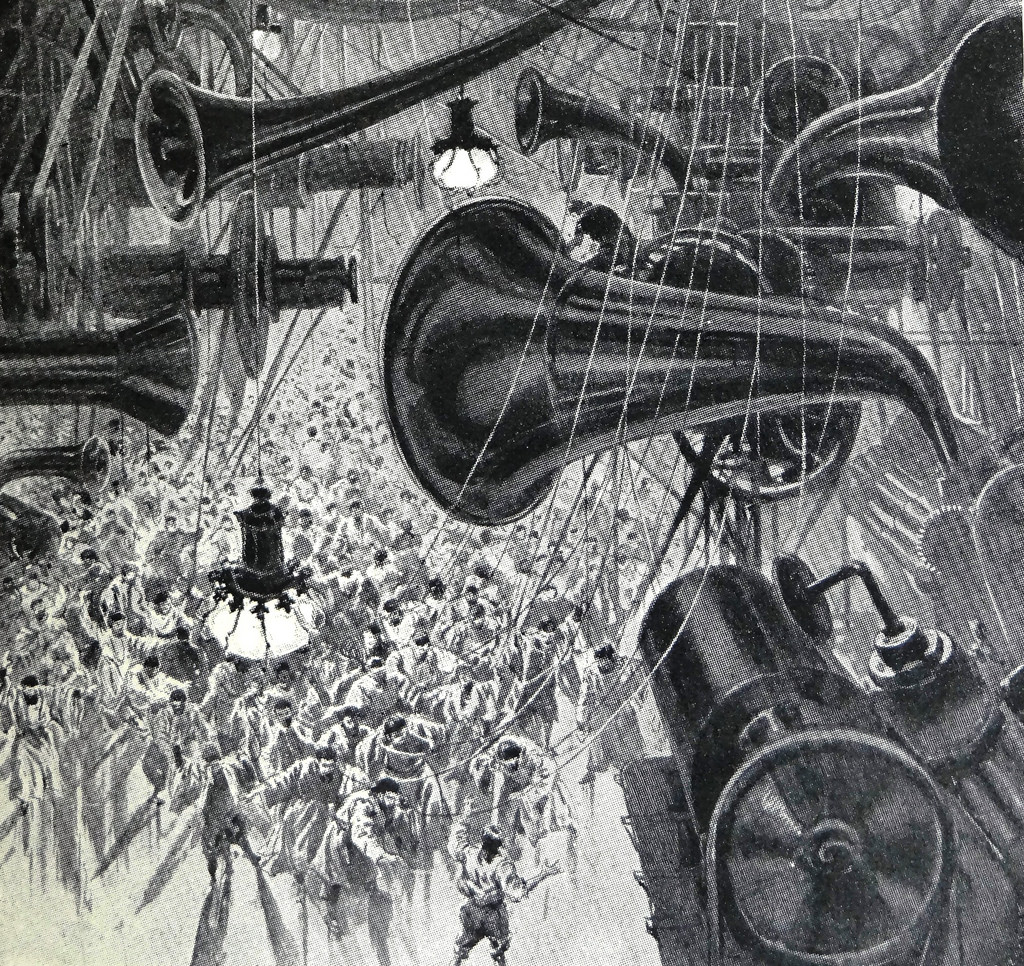
Writing In A War edited by Ronald Blythe (1982)

This is a good, chunky selection of British writing from the Second World War, poems and stories and essays either written and published during the actual conflict or memoirs of wartime experiences published a little later. It consists of 400 densely-printed pages in the Penguin paperback, and features work from some 56 authors: 18 prose writers and 37 poets.

Poets (37)

Dylan Thomas, Edith Sitwell, Henry Reed, Edith Scovell, Henry Treece, Herbert Cory, C. Day-Lewis, Terence Tiller, George Barker, John Pudney, Charles Causley, Roy Fuller, Roy Campbell, Alun Lewis, W.J. Turner, W.R. Rodgers, Sidney Keyes, Mervyn Peake, Robert Graves, Rayner Heppenstall, Keith Douglas, R.N. Currey, Alan Rook, Fancis Scarfe, Timothy Corsellis, Kathleen Raine, F.T. Prince, Louis MacNeice, W.H. Auden, William Empson, Stevie Smith, Vernon Watkins, David Gascoyne, Paul Dehn, T.S. Eliot, G.S. Fraser, Stephen Spender, W.J. Turner.

Short stories (9)

Elizabeth Bowen, William Sansom, William Chappell, Fred Urquhart, James Hanley, J. Maclaren-Ross, V.S. Pritchett, Glyn Jones, Elizabeth Berridge.

Factual memoirs/reportage (5)

  • Bryher – recalls her impressions of Blitz London upon her return to it from Switzerland
  • John Sommerfield – description of his squadron travelling through North-East India to the front line against the Japs in Burma
  • Richard Hillary – description of learning to fly a spitfire
  • Keith Douglas – how he disobeyed orders to rejoin his tank regiment in the desert west of Cairo
  • Denton Welch – a very home front story of being taken to meet the eccentric painter Walter Sickert

Essays (3)

By George Orwell, Arthur Koestler, Virginia Woolf.

Structure

The pieces are divided into seven themed sections, being:

  • The City
  • The Sky
  • The Sea
  • Declarations
  • The Patient Khaki Beast (i.e the soldier)
  • Confessions and Conclusions
  • The Dark

Introduction

In his introduction the book’s editor, Ronald Blythe, explains that the 1930s was the decade of grand declarations, literary cliques and widespread left-wing or even communist confidence that the British establishment was about to be swept away in a wonderfully liberating revolution (traits I noted in my review of Robin Skelton’s Poetry of the Thirties).

The Spanish Civil War

However, a great deal of that fervour to change the world drained away during the three gruelling, disillusioning years of the Spanish Civil War (see my review of the Penguin Book of Spanish Civil War Verse) in which several of the youngest, keenest English poets were killed and those who survived were thoroughly disillusioned, above all by the revelation of Stalin’s willingness to betray the revolutionary cause in order to further Russia’s national agenda.

(Stalin didn’t want there to be a successful communist revolution in Spain because he thought it would alarm and alienate the governments of France and Britain, which he needed to keep sweet as potential allies against the obviously growing threat from Nazi Germany. Therefore Stalin did not want there to be a successful revolution in Spain. It took British communist volunteers in Spain a long time to grasp the Realpolitik of the situation and when it did, disillusion was total.)

And then the outbreak of the Second World War happened so quickly. The nationalist leader General Franco declared the Spanish Civil War over on 1 April 1939. The Nazi-Soviet Pact was signed four and a half months later, on 23 August 1939, and one week later, on 1 September, Hitler invaded Poland.

The people of Europe, and their writers, artists and intellectuals, were thrown into six long years of chaos, bloodshed and holocaust. The world had never before seen destruction and mass murder on such a scale.

Retreat to the personal

Against this background of political disillusion (on the Left), a widespread feeling that the entire political class had let them down, and the universal sense of forces too vast to comprehend tearing the world apart, the writers who flourished during the Second World War retreated back to the personal.

If there was a common theme found across many of the writers during the Second World War, it was the notion that the entire world was being darkened by vast totalitarian movements devoted to wiping out the personal life, to exterminating the individual. Therefore, the greatest protest against the forces of darkness was to assert the importance of individual thoughts and feelings. As so often, W.H. Auden managed to summarise the mood perfectly in his famous poem, September 1 1939.

Defenceless under the night
Our world in stupor lies;
Yet, dotted everywhere,
Ironic points of light
Flash out wherever the Just
Exchange their messages:
May I, composed like them
Of Eros and of dust,
Beleaguered by the same
Negation and despair,
Show an affirming flame.

But Auden had left Britain for America in January 1939, and so was hors du combat. The writers left in Blighty, men and women, either too old to serve or conscripted into the forces, all had to find their own ways of expressing themselves and showing their affirming flames.

So what you have in this book is a wide range of personal reactions to the disaster the world found itself in, writings which are hard to generalise about because they are often so distinctive, not to say idiosyncratic: from the obliquely poetic short story of Elizabeth Bowen, to the intensely religious verse of Edith Sitwell, from the brisk no-nonsense memoir of Bryher to the visionary description of a torpedoed ship going down by James Hanley, from John Sommerfield’s larky description of a long journey by train, paddleboat, train and lorry to the front line in Burma to William Sansom’s brilliant accounts of being a firefighter in Blitzed London, the collection is characterised by its variety of location and event and style.

The collection itself is obviously divided into two distinct forms, verse and prose, with prose further sub-divided into fiction and factual.

Poetry

Having lived through the experimental Modernism and free verse of the 1920s, and the reversion to much more traditional forms with regular stanzas and regular rhyme schemes of the 1930s, poets of the 1940s felt free to pick and choose from either approach as suited their purpose.

So there’s quite a variety of verse forms, but I think I’m right in saying not much of it feels new. Not formally. But in terms of content, there is much that feels new, and I think can be divided into two broad categories, the realistic and the fantastical.

The New Apocalypse and Neo-Romanticism

The war saw an intensification of an aesthetic strand which had existed throughout the 1930s, an interest in the English countryside reimagined as a place of spirits and gods and paganism and Christianity interpreted in its wildest, most apocalyptic shapes. This trend had overlapped with some of the spirit of 1930s Surrealism and had been a reaction against the lucid, rational and political concerns of the dominant school of Thirties poetry.

In the fateful year, 1939, the best writings from this tradition were brought together in a volume titled The New Apocalypse with the result that a ‘movement’ of sorts was named after the book. To quote Wikipedia:

The New Apocalypse (1939)… was edited by J. F. Hendry (1912 to 1986) and Henry Treece. There followed the further anthologies The White Horseman (1941) and Crown and Sickle (1944).

The New Apocalyptics reacted against the political and social realism of the 1930s with its loving descriptions of factories and arterial roads and motorcycles and electricity pylons, and the belief that human nature was rational and could be rationally appealed to by rational argument. The name itself referenced D. H. Lawrence’s posthumous collection, Apocalypse (1931) and the poets in this tradition turned their backs on the Modern World and plunging into a heady stew of surrealism, myth, and expressionism. And then, of course, the world war broke out and quickly outdid their wildest imaginings of destruction, extreme situations and death.

George Barker

In this volume the Apocalyptics are represented by poems by Henry Treece and George Barker. Blythe includes in his book a very useful 21-page section called ‘Notes on Contributors’ which gives potted biographies and select reading lists for all his authors, and spends half a page explaining Barker’s motivation: the preface to the Apocalypse volume spoke of ‘word explosions’, of their poetry’s ‘air of something desperately snatched from dream or woven around a chime of words, are the results of disintegration, not in ourselves, but in society…’ (G.S. Fraser, another founder member of the New Apocalyptics, quoted page 376).

But to be blunt, I dislike the examples of Barker’s poetry given here. If this is the best, I’m not impressed.

From Sacred Elegy by George Barker

From this window where the North Atlantic
Takes the crow in my mind home in a short line
Over the kissing fish in the wave, and the mine
Where the sailor clasps his death as mermaid like
Sex of a knife in the depth, from this window
Watching I see the farewelling seasons fall
Ever between us like rain. And the lachrymal
Memory, trailing its skirts, walks like a widow
Across those seas looking for home. O my Dido
Heart! Sail, sail the ships ever away from us all.

The phrasing and some of the obscurity which derives from it seems wilful. ‘Farewelling’ sounds like a schoolboy attempt to be interesting. The kissing fish in the wave seems pitifully inadequate to describe the Atlantic Ocean. The reference to Dido at the end kills it for me; falling back on classical references only highlights the main text’s weakness. Possibly, if you are predisposed to an anti-rational, pagan view of the world, this might ring your bell. But reading it in 2024, it felt strained and dated.

Henry Treece

Henry Treece is much more direct and therefore attractive:

From In The Beginning Was The Bird by Henry Treece

In the beginning was the bird,
A spume of feathers on the face of time,
Man’s model for destruction, God’s defence…

Though the third line is notably weaker than the first two (because over the top, grandiloquent, too much). And the word ‘spume’ instantly recalls W.B. Yeats’s much more powerful use of the same word in his wonderful poem Among Schoolchildren:

Plato thought nature but a spume that plays
Upon a ghostly paradigm of things;
Solider Aristotle played the taws
Upon the bottom of a king of kings…

Blythe’s note on Treece tells us that he went on to write an enormous number of books for children or young adults, often about the Dark Ages i.e. Arthur’s Britain, the Romans, the Vikings and so on. You can already feel that in this charming and simple poem.

Lincolnshire Bomber Station by Henry Treece

Across the road the homesick Romans made
The ground-mist thickens to a milky shroud;
Through flat, damp fields call sheep, mourning their dead
In cracked and timeless voices, unutterably sad,
Suffering for all the world, in Lincolnshire.

And I wonder how the Romans liked it here;
Flat fields, no sun, the muddy misty dawn,
And always, above all, the mad rain dripping down,
Rusting sword and helmet, wetting the feet
And soaking to the bone, down to the very heart . . .

It’s a big idea, which I don’t have the scholarship to verify, but I wonder whether the 1940s Neo-Romantic urge to write about the mysterious countryside, pagan beliefs, spirits and so on, after the war went into children’s fiction, went into all those novels about Roman Britain, by authors like Henry Treece or Rosemary Sutcliffe, which I read as a boy in the 1960s.

Dylan Thomas

Some critics tried to lump George Barker and Dylan Thomas together as founders or exponents of a broader literary movement called ‘Neo-Romanticism’. This label works better in the world of art and painting than in literature. In painting there was a definite turning away from the urban towards nostalgic, if highly stylised, sometimes nightmarish, depictions of the English countryside, but a countryside under stress, prey to visions and strange atmospheres. Not Constable’s England at all. (Neo-Romanticism in art.)

But although critics tried to rope him into these movement, Thomas wasn’t interested. Dylan Thomas was just 24 when the war broke out and Blythe amusingly tells us that he took it as a personal affront, a calculated attempt by the world to blunt his promising career. Nevertheless, he produced some fiery, clanging verse responses to the war. Blythe acutely points out that in several of his most famous wartime poems (Ceremony After A Fire Raid and A Refusal to Mourn the Death, by Fire, of a Child in London) Thomas ignores the statistics, the general headlines, and – as per Blythe’s thesis – zeroes in on the particular, in each case on one particular victim of the Blitz.

From A Refusal to Mourn the Death, by Fire, of a Child in London

Never until the mankind making
Bird beast and flower
Fathering and all humbling darkness
Tells with silence the last light breaking
And the still hour
Is come of the sea tumbling in harness

And I must enter again the round
Zion of the water bead
And the synagogue of the ear of corn
Shall I let pray the shadow of a sound
Or sow my salt seed
In the least valley of sackcloth to mourn

The majesty and burning of the child’s death…

Here is Thomas reading it himself:

This is in a different class from the Barker. Nobody could compete with these ringing declarations. Thomas seemed to have tapped deep into the wellspring of some pagan power, tapped ‘the force that through the green fuse drives the flower’.

Edith Sitwell

Thomas may be associated with New Romanticism but he is sui generis, one of a kind, his grandiloquent poetry buttressed by the amazingly sonorous power of his readings. But out in the same paddock as Barker and Thomas were the more brittle but just as apocalyptic visions of Edith Sitwell. As Blythe points out, Sitwell’s wartime verse had travelled a long way since ‘the rhyming tomfoolery’ of the 1920s and the best of it uses Christian imagery to achieve a genuine sense of tragedy.

From Still Falls the Rain (The Raids, 1940: Night and Dawn)

Still falls the Rain –
Dark as the world of man, black as our loss –
Blind as the nineteen hundred and forty nails upon the Cross.

Still falls the Rain
With a sound like the pulse of the heart that is changed to the hammer beat
In the Potter’s Field, and the sound of the impious feet

On the Tomb:
Still falls the Rain
In the Field of Blood where the small hopes breed and the human brain
Nurtures its greed, that worm with the brow of Cain.

Still falls the Rain
At the feet of the Starved Man hung upon the Cross,
Christ that each day, each night, nails there, have mercy on us…

Here she is reading it:

T.S. Eliot

The godfather of Modernist poetry was T.S. Eliot and the war saw him complete the epic undertaking of the Four Quartets, four long meditations on death and history and society, underpinned by his complex and sophisticated understanding of Christian faith. They are Burnt Norton (1936), East Coker (1940) The Dry Salvages (1941) and Little Gidding (1942).

These poems are unlike anything before or since in their complexity of structure and interlinking themes and images. To briefly summarise, each one is set in a specific rural location (hence the names) and then uses a physical description of this location and its historical associations to weave a complex web of ideas about time, history, reality and religion.

The Quartets are among the absolutely top masterpieces of twentieth century poetry in English and Blythe makes the super-sensible decision to quote the fourth and final one, Little Gidding, in its entirety. Here is the second part of section 2, a sustained homage to Eliot’s hero, Dante, in which he envisions himself walking through the glass-strewn streets of London after an air-raid and encountering a mysterious stranger, much as Dante walked through hell encountering strange figures in the flickering half-light of the underworld.

From Little Gidding by T.S. Eliot

In the uncertain hour before the morning
Near the ending of interminable night
At the recurrent end of the unending
After the dark dove with the flickering tongue
Had passed below the horizon of his homing
While the dead leaves still rattled on like tin
Over the asphalt where no other sound was
Between three districts whence the smoke arose
I met one walking, loitering and hurried
As if blown towards me like the metal leaves
Before the urban dawn wind unresisting…

Magnificent. Simple language, simple syntax, but a weird and brooding atmosphere leading up to the spooky final line…

Little Gidding online

Soldier poets

Away from the grandeurs of the London literary scene and its professional writers was the completely different category of soldiers, sailors and airman who wrote poetry and prose. The three most famous British soldier-poets of the Second World War are Keith Douglas (1920 to 1944), Alun Lewis (1915 to 1944) and Sidney Keyes (1922 to 1943). See how young they all died (24, 29, 21).

I have to say straight away that my favourite poet of the Second World War is Keith Douglas. It might not be a totally true generalisation, but it seems, working through this selection, that the further away you were from the fighting, the more gorgeous, visionary and surreal your writing became (Sitwell, Raine, Barker, Thomas), whereas the closer you were to the fighting, the more precise, detailed (and sometimes banal and everyday) the writing became, as soldiers, sailors and airman tried to nail down precisely what it felt like – to fly a Spitfire (Richard Hillary), to be aboard a torpedoed ship (James Henley), to be stuck in an infantry camp behind the lines during long hours of rainy boredom (Alun Lewis).

In this respect – in terms of clear, convincing description of what it’s like – Richard Hillary’s prose memoir of training as a Spitfire pilot, and Keith Douglas’s memoir of the war in the desert leading up to the Battle of El Alamein, are the standout pieces.

But it is striking that Douglas is the only author featured in this selection as both a poet and a prose writer. Something about his mentalité made him write memorably in both forms. For me, it’s his precision, his ability to get to the point. This doesn’t mean his poetry is prosey. It is as full of metaphor and vision as much other poetry. It’s just that the metaphor and imagery are subsumed, in his best poems, into a kind of laser-like accuracy.

From How to Kill by Keith Douglas

Under the parabola of a ball,
a child turning into a man,
I looked into the air too long.
The ball fell in my hand, it sang
in the closed fist: Open Open
Behold a gift designed to kill.

Now in my dial of glass appears
the soldier who is going to die.
He smiles, and moves about in ways
his mother knows, habits of his.
The wires touch his face: I cry
NOW. Death, like a familiar, hears

and look, has made a man of dust
of a man of flesh. This sorcery
I do. Being damned, I am amused
to see the centre of love diffused
and the wave of love travel into vacancy.
How easy it is to make a ghost…

There’s plenty of simile, rhetoric and artifice about this but somehow it also has a shining clarity. It certainly lacks any sentiment or bullshit, just what it feels like to aim and shoot another human being.

It’s assisted by the preciseness of the half rhyme (also known as ‘imperfect rhyme’, ‘slant rhyme’, ‘near rhyme’ or ‘oblique rhyme’). Thus ball/kill; man/-pen; long/sang. As you read or hear it you sense that there’s a formal structure, a half-rhyme scheme, and yet the absence of exact rhymes prevents it from being predictable, makes it much closer to speech, like the speech of a man talking to you.

Of course it isn’t, and in fact lines like ‘This sorcery/I do’ has an Elizabethan feel to the syntactical reversal of the ordinary everyday phrase (‘I do this sorcery’) and the vocabulary likewise.

The subtle half rhymes, the use of unexpected sentence structures, the ultra-modern subject matter and yet the knowing echoes of much older verse (are there echoes of Dr Faustus in ‘Being damned, I am amused’?) makes for an utterly brilliant read, rich in resonances and enjoyments.

Prose descriptions

Prose is more suited to descriptions of action. Thus two of the most vivid pieces are heart-in-the-mouth descriptions and/or stories of being a fireman during the Blitz by William Sansom. In both you are really right there as the vast flaming wall of a warehouse shivers and then topples towards him and his firefighting crew.

I liked John Sommerfield’s description of being part of a squadron which has to undertake an epic journey across North-East India by train and paddleboat and train again to get to the ravaged frontline with the Japanese in Burma.

What a lot of writers from the period share is a tremendous clarity of style and thought. Thus Richard Hillary comes across as very self-absorbed but he describes with wonderful clarity the experience of flying a Spitfire. Keith Douglas conveys with similar clarity the experience of being a tank commander in the excerpt from his memoir of war in the desert, Alamein to Zem Zem.

The memoir of London during the Blitz written by Bryher (pen-name of Annie Winifred Ellerman) is snobbish and self-serving (she keeps on about how she warned everyone about the Nazis since 1933 but would they listen? No, the fools) but also displays great clarity of description in her encounters with shop assistants or soldiers during the Blitz.

Essays

George Orwell

Rather as T.S. Eliot towers over the poets by virtue of the depth and breadth of his vision, in respect of clarity of thinking and prose style George Orwell towers over all the other prose writers. His essay in defence of P.G. Wodehouse (who foolishly and naively made a handful of radio broadcasts for the Nazis in 1940) is a masterpiece of clarity and honesty, and insights.

Orwell makes it clear he’s got hold of as many of Wodehouse’s writings as possible as well as the transcripts of his German broadcasts, and tried to clarify the events surrounding them i.e. he has done as much homework as possible. And then he proceeds to make a convincing case, based on the arguments that:

  • Wodehouse had no idea how his broadcasts would be interpreted
  • he had absolutely no political sense
  • he had been interned by the Germans for a year and so had missed the intensification of the conflict during 1940
  • that the fuss being kicked up about him was really a ruse by the media-owning classes (e.g. Lord Rothermere, owner of the Daily Mail) to distract attention away from their own much more seriously pro-Hitler, appeasement attitudes

But it’s not only the clarity of the argument but the many insights it throws up along the way which make it still such an interesting read. For example, Orwell shows how both American and German critics in different ways had completely misunderstood Wodehouse. They thought he was a merciless satirist of the English upper classes. Orwell shows how Wodehouse was a dyed-in-the-wool, public school member of those classes and that all his tomfoolery comes from inside the worldview and is full, ultimately, of love and respect for it.

Arthur Koestler

I’ve reviewed Koestler’s two most famous books, the novels Darkness at Noon (1940) and Arrival and Departure (1943). They contain much vivid detail but are a bit ‘muddy’ in their thinking by which I mean the logic of the arguments, specially in Darkness, are harder to remember than the plight of the central character (an old Russian Bolshevik in prison having been arrested as part of Stalin’s purges).

The Koestler piece here is his short essay The Yogi and the Commissar (1945) which gave its title to a collection of essays published at the end of the war. It goes some way to explaining why Koestler turned into such an old bore, publishing some 25 volumes of essays and explorations in the coming decades and becoming steadily more irrelevant.

Koestler proposes a ‘spectrum of philosophies’ which stretch from ‘the Commissar’ at the materialist, scientific end of the spectrum to ‘the Yogi’ at the spiritual, metaphysical end. The Commissar wants to change the individual from outside, the Yogi wants to change the individual from within. This is precisely the kind of clever-sounding intellectual conceit which has bugger-all relevance to the real world and gives rise to a surprising amount of high-sounding verbiage in such a short space. It sounds fine but everything it deals with – Fascism, Communism, Democracy, Art, Science – it does so in a shallow, superficial way. I found it unreadable and consider it the only actively bad piece in the book.

Short stories

Elizabeth Bowen

Broadly speaking, the closer they stick to the subject, the more effective the prose works tends to be. Not always, though. The selection kicks off, not with any scene of battle, but with a ghostly and evocative description of a young couple walking round London in the Blackout after a bombing raid has departed. The young woman explains to her soldier boyfriend that she makes sense of it all, the Blitz, the chaos, by imagining the city is the fantasy city of Kôr, mentioned in Henry Rider Haggard’s adventure novel, She.

After this arrestingly atmospheric opening scene the story shifts to the domestic embarrassment of the young lady having to take her boyfriend back to the poky, cramped flat she shares with a girlfriend, and everyone’s general embarrassment and inconvenience. Yet the story is full of sly insights and perceptions just on the edge of consciousness, a subtle poetry of the periphery.

At half past ten, in obedience to the rule of the house, Callie was obliged to turn off the wireless, whereupon silence out of the stepless street began seeping into the silent room.

It took me a moment to realise that ‘stepless’ means empty of people and therefore with no sounds of stepping, of people walking. It’s a tasty sentence and the story is full of just such odd obliquities. It made me want to read more Elizabeth Bowen.

Fred Urquhart

There are other striking experiments. Fred Urquhart (‘described by one critic as the foremost Scottish short story writer of the twentieth century’) is represented by a story about potato pickers in a part of deeply rural Scotland which I didn’t catch because I barely understood the intense dialect he has his characters talking in. It is a war story because it is set during the war and the tattie pickers observe planes flying overhead, which all leads up to the climax when a German bomber crashes and blows up a few miles away.

James Hanley

Far more experimental is James Hanley’s piece, Sailor’s Song, an account of a torpedoed ship going down and a handful of men surviving by clinging to a raft which ought to be grittily realistic but is actually done in the style of Walt Whitman, with both the Ship and the Sea singing, describing their song and the human characters referred to with a kind of Biblical anonymity.

Glyn Jones

A different tone is presented by Welsh short story writer Glyn Jones’s story, Bowan, Moragan and Williams, which is a larky portrait of a boy and his family and friends and friends’ families in a tight-knit Welsh community, where everyone is odd and eccentric. I particularly liked the friend’s relative who is so nervous of other people that he speaks in an increasingly shrill voice and jams the napkin ring into his eye socket as if it is a jeweller’s eyeglass. The war is peripheral to this gallery of likeable eccentrics.

Elizabeth Berridge

Not so the very short story by Elizabeth Berridge in which a woman’s flat in the city is burgled and smashed up (when she’s not there), but she’s been living for some time in a retirement home with a snug community of friends and, after going with the police to examine the wreckage, she enjoys embellishing the description on the train back to the retirement home, relishing the opportunity to make her friends’ flesh creep with this appalling example of society going to the dogs… Only to arrive at the home that night and discover it wildly on fire, having been bombed and all her friends killed. The starkness of the facts and the protagonist’s inability to process what has happened are beautifully captured.

Summary

Except for a handful of poems by the obvious gods – Auden, Eliot, Thomas, Douglas – the short stories are, on the whole, more varied and powerful than any of the poems. This last story by Berridge, stands symbol for the countless millions of people who, although physically unharmed, had their lives ruined and their minds scarred by the appalling, meaningless violence of war.


Credit

Writing In A War edited by Ronald Blythe was first published in 1966. References are to the revised 1982 Penguin paperback edition.

Related reviews

A Brief Revolution @ the Photographers’ Gallery

The Architectural Review is a monthly international architectural magazine. It was founded in London in 1896 and does what its title suggests, covering all aspects of the built environment.

Manplan

Just over 50 years ago, in 8 issues from September 1969 to September 1970, the Review ran a series of eight specially commissioned reports on the state of architecture at the end of the 1960s. It was to review not just architecture in the narrow sense but the entire state of town planning, in an age when old Victorian slums were being torn down to make way for gleaming new towns made of high-rise towers, medium-rise blocks characterised by lifts and concrete walkways, subways under sweeping new ring roads, nicely laid-out grassed areas and so on.

The Review’s editors called the series of articles ‘Manplan’ and hired leading photojournalists and street photographers to address a set of eight themes, being:

  1. Frustration
  2. Travel and communication (‘Society is its contacts’)
  3. Town Workshop
  4. Education (‘The continuing community’)
  5. Religion
  6. Health and Welfare
  7. Local government
  8. Housing

The result was a series of brilliant photos shot on a 35mm camera in a spirit of photo-reportage – vivid and dramatic black-and-white works which captured a nation in the midst of great social, cultural and environmental change. To the horror of some of its contributors and readers, the magazine turned its back on large-format, heroic photography of buildings and their details, instead embracing a grainy, 35mm black-and-white reportage aesthetic, where people were as, if not more, important than the places. In the words of The Royal Institute of British Architects, publishers of the Architecture Review:

The aim was to propose an alternative and more holistic approach to urban planning, which would look at all basic human needs as a whole. The photographs illustrating the issues were created in the spirit of photo reportage and often featured people inhabiting the spaces studied by the survey, thereby shifting the focus from the architecture itself to the human element within the built environment.

So it was intended to be polemical stuff. The photographers were:

  • Ian Berry
  • Tony Ray-Jones
  • Tim Street-Porter
  • Patrick Ward

Altogether the Architectural Review published about 80 photographs. Just 16 are on display here, but every single one of them is a masterpiece; there’s no slack. Each one is a densely packed, highly charged vignette. This exhibition isn’t big but it is packed with social history, with memories and nostalgia for a time within the living memory of many but feeling evermore distant.

Design and layout

On a separate wall is a display of the actual copies of the magazine which the photo-essays appeared in, along with the words and designs of ‘Manplan’ editor Tim Rock and designers Michael Reid and Peter Baistow. This section goes into detail about how the photographs were processed, reproduced and printed (using ‘special matt black ink’) along with analysis of the layout and typography. All a bit over my head but interesting for students of design.

The photographs

Private terraced houses on the Old Kent Road opposite Camelot Street Estate, London by Tony Ray-Jones (1970) part of ‘Manplan 8: Housing’, in Architectural Review, September 1970. Courtesy Architectural Press Archive / RIBA Collections

Housing at New Ash Green, Kent by Tony Ray-Jones (1970), part of ‘Manplan 8: Housing’, in Architectural Review, September 1970. Courtesy Architectural Press Archive / RIBA Collections

Low-rise housing, Tavy Bridge, Thamesmead, Greenwich, London, 1970 by Tony Ray-Jones, part of ‘Manplan 8: Housing’, in Architectural Review, September 1970. Courtesy Architectural Press Archive/RIBA Collections

Classroom windows in a school in Wales, 1969 by unknown photographer, part of ‘Manplan 4: The continuing community (education)’, in Architectural Review, January 1970. Courtesy Architectural Press Archive / RIBA Collections

High-rise flats and multi-storey car park, Birmingham, 1970 by Peter Baistow, part of ‘Manplan 5: Religion’, in Architectural Review, March 1970. Courtesy Architectural Press Archive / RIBA Collections

Chatsworth Street school and high-rise housing block overlooking the cleared site, Liverpool, 1969 by Tom Smith, part of ‘Manplan 4: The Continuing Community (education)’ in Architectural Review, January 1970. Courtesy Architectural Press Archive / RIBA Collections

Salvation Army officers picnicking on the steps of the figure group Asia by J H Foley, Albert Memorial, Kensington Gardens, London, 1969 by Peter Baistow, part of ‘Manplan 5: Religion’, in Architectural Review, March 1970. Courtesy Architectural Press Archive/RIBA Collections

Unidentified primary school, 1969 by unknown photographer, part of ‘Manplan 4: The continuing community (education)’, in Architectural Review, January 1970. Courtesy Architectural Press Archive / RIBA Collections

Thamesmead film

To one side of the 16 framed photos on the wall, is a TV monitor showing a film from around the same time (in fact the year before the project, 1968). So far as I can tell it’s not directly connected with RIBA or the Manplan project except for the slender link that one of the 80 Manplan photos happens to cover the same subject as the film, namely the new estate being built at Thamesmead.  So it wasn’t directly related to the Manplan project but gives context to the kind of architectural and town planning thinking which was going on at the time of the Manplan project.

Directed by Jack Saward, this 25-minute public education film gives an overview of the history and construction of Thamesmead, a sort of new model suburb built down the River Thames from London on the site of the old Royal Arsenal, a site that extended over Plumstead Marshes and Erith Marshes.

Alas, to quote the introduction to the video on YouTube:

The ambition is commendable but it didn’t quite work in practise, with Thamesmead becoming a notoriously problematic estate and its architects perceived as exhibiting many of the faults of post-war planning, with communities being tinkered with from above like a real-life experiment. This is where utopia meets authoritarianism.

Hard to believe, but the planners that designed the place provided insufficient transport links with London, no way of crossing the Thames for 5 or 6 miles in either direction and – best of all – an almost complete lack of shopping facilities and banks. Lots of pretty little lakes but…nowhere to buy food. According to the label in the exhibition, the estate ‘was soon plagued by social problems caused by lack of facilities and public transport’.

The half-built estate won an unwanted fame when American film director Stanley Kubrick used parts of it as the setting for his notoriously violent 1971 movie, A Clockwork Orange, a vision of an alienated, dystopian society. Here’s the photo of it taken by the brilliant Tony Ray-Jones which provides a sort of coincidental link between the Manplan series and the film.

Thamesmead under construction, Greenwich, London, 1970 by Tony Ray-Jones in ‘Manplan 8: Housing’, Architectural Review, September 1970. Courtesy Architectural Press Archive / RIBA Collections

Which do you prefer? Which do you think is telling the truth, the film or the photo?

The Robert Elwall Photographs Collection

All the materials for the Manplan exhibition, photos and old copies of the AR magazine, come from the Robert Elwall Photographs Collection. This comprises around 1.5 million images from the earliest days of photography to the present day. The collection includes photographic archives of individual architects and practices, travel and topographic images from across the world, press photographs from major architectural journals, and large bodies of work by some of the best known architectural photographers of the 20th century. The collection includes prints, negatives, slides, transparencies, photographically illustrated books and digital files. It is itself part of the larger Royal Institute of British Architects collections.

Conclusion

Flicking through some of the text on the walls is a dispiriting experience. These 1970 writers were raging against the soulless design of modern cities, the daily struggle of commuting to work on overcrowded public transport, against air pollution, excess traffic and the destruction of the environment, against the dominance of the car over human-friendly spaces, against the dehumanising effects of modern technology, against social inequality and the lack of social housing, against the prioritising of profit over people.

It’s as if, 53 years later, nothing has changed except we all have smart phones to share our frustration about how things obstinately carry on being rubbish. The Manplan writers’ rage and frustration is captured by this, the last entry in the exhibition.

Double page spread from Manplan 1. ‘Frustration’

It’s a copy of the original magazine, open to a double page spread showing a traditional Pearly King and Queen standing in front of the typically sterile, barren waste ground surrounding a clutch of looming, threatening tower blocks. Up in the top right is a text reading: ‘The richness of East End life is replaced by monotony and inhumanity.’

Yep. that’s the world I grew up into and which punk rock, with its angry nihilism, was a direct response to. Eternal shame on England’s architects and town planners.


Related links

More Photographers’ Gallery reviews

Waugh in Abyssinia by Evelyn Waugh (1936)

On Monday night there was a bacchanalian scene at Mme Idot’s, where, among other songs of international popularity, ‘Giovanezza’ was sung in a litter of upturned tables and broken crockery.
(Waugh in Abyssinia, page 107)

In 1935 Italy declared war on Abyssinia, an independent sovereign state in north-east Africa, and Evelyn Waugh was hired by a British newspaper (I think it’s the London Evening Standard) and sent to the capital, Addis Ababa, to cover the conflict. This was because it was widely assumed that he knew about the country because of the hilarious and colourful, but also detailed and thoughtful, account of the 1930 coronation of the Ethiopian emperor Haile Selassie which he had covered for The Times and then expanded into his book, Remote People.

Serious opinions

Waugh in Abyssinia opens a lot more seriously than its predecessor, with a chapter he jokingly titles ‘The Intelligent Woman’s Guide to the Ethiopian Question’ (a humorous reference to the book ‘The Intelligent Woman’s Guide to Socialism and Capitalism’, published by George Bernard Shaw in 1928.)

This opening chapter reads like an entry in the Encyclopedia Britannica. It gives a detailed history of Abyssinia from the turn of the nineteenth century till the present day. The facts Waugh gives are illuminating but what’s really striking is his opinions: this dyed-in-the-wool Tory repeats at face value the standard Marxist critique of Empire, that the scramble for Africa, although dressed up in pious sentiments, was mainly motivated by the need of Western capitalists for:

new sources of raw material, new markets, but, more than anything, for new fields of profitable investment.

Even more surprisingly, he frankly agrees with modern ideas that Africa was seized by force from its traditional owners, who were swindled or simply out-gunned out of their land.

The most remarkable feature of the partition was the speed with which it was accomplished. In less than ten years the whole of pagan Africa was in the hands of one or other of the European Powers. Explorers pushed on from village to village armed with satchels of draft treaties upon which hospitable chiefs were induced to set their mark; native interpreters made gibberish of the legal phraseology; inalienable tribal rights were exchanged for opera hats and musical boxes; some potentates, such as the Sultan of Sokoto, thought they were accepting tribute when they were receiving a subsidy in lieu of their sovereign rights, others that it was the white man’s polite custom to collect souvenirs of this kind; if, when they found they had been tricked, they resisted the invaders, they were suppressed with the use of the latest lethal machinery: diplomats in Europe drew frontiers across tracts of land of which they were totally ignorant, negligently overruling historic divisions of race and culture and the natural features of physical geography, consigning to the care of one or other white race millions of men who had never seen a white face. A task which was to determine the future history of an entire continent, requiring the highest possible degrees of scholarship and statesmanship, was rushed through in less than ten years.

These are the kind of progressive sentiments which authors writing in the 1990s or 2000s pride themselves on and yet here they are, forcefully and clearly stated as long ago as 1935, and not just as the property of the left or progressives, but as a universally acknowledged truth held by all educated people of the day:

But the avarice, treachery, hypocrisy and brutality of the partition are now a commonplace which needs no particularisation…

Not only that, but this Tory patriot then zeroes in on the record of his own country and the particular brand of hypocrisy which the English brought to their colonising.

It is worth remembering indeed, in the present circumstances, the particular nature of the reproach which attaches to England. France, Germany and Belgium were the more ruthless; we the more treacherous. We went into the shady business with pious expressions of principle; we betrayed the Portuguese and the Sultan of Zanzibar, renouncing explicit and freshly made guarantees of their territory; we betrayed Lobenguela and other native rulers in precisely the same method but with louder protestations of benevolent intention than our competitors; no matter into what caprice of policy our electorate chose to lead us, we preached on blandly and continuously; it was a trait which the world found difficult to tolerate; but we are still preaching.

And then his comments about the important impact of African art on Western art:

For centuries Africa has offered Europe successive waves of aesthetic stimulus…the gracious, intricate art of Morocco or the splendour of Benin…the dark, instinctive art of the negro — the ju-ju sculpture, the carved masks of the medicine man, the Ngomas, the traditional terrifying ballet which the dancing troops carry from the Great Lakes to the islands of Zanzibar and Pemba.

Although we might bridle at some of his phrasing, nevertheless this is the kind of claim you find made in up-to-the minute art exhibitions by the wokest of curators (for example, Tate’s self-flagellating exhibition about British Imperialism). I was genuinely startled that a man who’s often seen as an epitome of blimpish reaction held views 90 years ago which are identical with the most progressive of progressives in 2021.

Abyssinia and Ethiopia

As to Ethiopia’s origins:

At the beginning of the nineteenth century Abyssinia consisted of the four mountain kingdoms of Amhara, Shoa, Tigre and Gojjam, situated in almost complete isolation from outside intercourse.

Waugh says the word ‘Abyssinia’ is a corruption of the Arabic Habasha, variously said to mean ‘mongrels’ or ‘members of the Arabian Habashat tribe.’

They believed they had migrated from Arabia at some unrecorded date, probably before the Christian era; they employed a common literary language, Ghiz, which had some affinity with ancient Armenian, and spoke dialects derived from it, Tigrean and Amharic; they shared a common culture and feudal organisation and recognised a paramount King of Kings as their nominal head.

He says he will use the term ‘Abyssinian’ to describe the Amharic-speaking, Christian peoples of the four original kingdoms, and Ethiopian to describe the tribes and naturalised immigrants subject to their rule.

He describes the series of kings who sought to unite the four squabbling kingdoms, namely Emperor Theodore and Emperor Johannes, and then goes on to describe the rule of Menelik II, who is the key figure in the story. It was Menelik II (ruled 1889 to 1913) whose organisation, diplomacy and buying up of Western guns and ammunition allowed the well organised Ethiopian army to massacre an Italian army which had been sent to colonise his country, at the decisive Battle of Adowa in 1896. For the rest of his reign, from 1896 to 1913, Menelik devoted himself to expanding his ’empire’, and is a record of conquests, treaties and submissions by neighbouring tribes and chieftains until, by 1913, he had quadrupled the size of his ‘country’.

This long opening chapter is designed to show that the Italian invasion of Abyssinia in 1935 was far from being a simple act of unprovoked aggression. His aim is to show that Ethiopia was a much more complex place, with a complex and troubled history, than the simple shape on the map of Africa suggested. It was itself the product of imperial conquest, above all by the legendary King Menelik II, who attacked Tigray in the north, Somalia in the south and East, seizing territory, forcing countless chieftains, sheikhs and local leaders into obeisance. ‘Ethiopia’ was the result of conquest every bit as brutal as the European conquest of Africa, a ‘country’ which was more a:

vast and obscure agglomeration of feudal fiefs, occupied military provinces, tributary sultanates, trackless no-man’s-lands roamed by homicidal nomads; undefined in extent, unmapped, unexplored, in part left without law, in part grossly subjugated; the brightly coloured patch in the schoolroom atlas marked, for want of a more exact system of terminology, ‘ Ethiopian Empire’.

Return to farce

So the opening chapter is surprisingly serious, factual and (liberally) opinionated. But as soon as we move to chapter two we enter the more familiar territory of Waugh farce and fiasco.

He describes for comic effect the panic throughout London’s media as war in Abyssinia looms and companies scrabble to capitalise on the fact: publishers dust off rubbish old books about the north east Africa, which suddenly sell like hot cakes, press agencies buff up photos of Borneo head hunters or Australian aborigines to flog them as pics of Abyssinian natives.

Above all anyone with the slightest acquaintance with Ethiopia is suddenly in great demand and thus it is that Waugh finds himself able to wangle another commission as a foreign correspondent, sent by his paper to buy a mountain of comic equipment, catching the boat train to Paris, train to Marseilles, boarding a steamer along with hordes of other journalists, steaming across the Med and through the Suez Canal to Djibouti, then scrambling aboard the shabby stopping train across the barren desert and then up into the Ethiopian highlands to Addis Ababa.

Comedy

There is ample comedy about the farcical aspects of journalism, war, and Africa. Here is Waugh at his magisterial comic best, this paragraph like a magnificent galleon sailing though a comic extravaganza of his own devising.

There were several hotels in Addis Ababa, all, at the time of our arrival, outrageously prosperous. The ‘Splendide,’ at which we all assumed we should stay — the Radical had had the name painted in large white letters on his medicine chest — was completely full with journalists and photographers living in hideous proximity, two or three to a room even in the outbuildings. It was a massive, shabby building of sepulchral gloom, presided over by a sturdy, middle-aged, misanthropic Greek, who had taken it over as a failing concern just before the troubles. There was something admirable about the undisguised and unaffected distaste with which he regarded his guests and his ruthless disregard of their comfort and dignity. Some attempted to be patronising to him, some dictatorial, some ingratiating; all were treated with uniform contempt. He was well aware that for a very few months nothing that he did or left undone could affect his roaring prosperity; after that anything might happen.

Deadpan

A very Waughesque effect is the deadpan statement of bizarre or extreme facts.

Presently [the Italian consul’s] luggage arrived, prominent in its midst a dripping packing case containing bottled beer on ice, and a caged leopard.

Charles G. had had the fortune to witness a fight between two of the European police officers. As a result he had lately been expelled on a charge of espionage. His parting act was to buy a slave and give her to Mati Hari as a tip.

We secured [a cook] who looked, and as it turned out was, all that a cook should be. A fat, flabby Abyssinian with reproachful eyes. His chief claim to interest was that his former master, a German, had been murdered and dismembered in the Issa country. (p.125)

The chauffeur seemed to be suitable until we gave him a fortnight’s wages in advance to buy a blanket. Instead he bought cartridges and tedj, shot up the bazaar quarter and was put in chains. (p.125)

[The soldiers] were ragged and dilapidated, some armed with spears but most of them with antiquated guns. ‘ I am sorry to disturb you,’ said James [our servant] politely, ‘ but these people wished to shoot us.’ (p.129)

Waugh doesn’t approve of a slave being given as a tip any more than he approves of a German being murdered and dismembered. His records a world brimful of violent absurdities. It is the harshness of some of these absurdities which gives his books their bite, and also helps to explain the depth of his Roman Catholic faith. Only faith in a benevolent God could stay him against the panorama of violence, futility and fiasco he saw all around him. He reports it deadpan for its comic effect. But sometimes his despair peeks through.

Before the war

Although there were armed clashes in late 1934, and Mussolini made a steady stream of blustering warnings throughout the spring and summer of 1935, in reality Italy was happy to bide its time till the right time and place to commence hostilities.

With the result that ship after shipload of correspondents arrived from all over Europe, America, Japan and beyond, booking up all the rooms at every hotel and, like Waugh, spilling over into neighbouring boarding houses, engaging in feverish rounds of press conferences, meetings with diplomats, interviewing every official they could find, creating an over-excited community of feverish scribblers liable to over-react to every new rumour no matter how far fetched, and yet – long weeks went by and nothing happened.

Waugh is tempted to go on excursions to locations said to be vital in the strategic planning of the attackers, and so find himself going with an old friend (Waugh’s world is full of old friends from public school or Oxford or London’s narrow literary clique) back to Harar, the town he first visited in 1930, which is east of Addis. They had an interesting time, he gives an evocative description of how the place had changed in just 5 years since he was previously there. They press on further east to the town of Jijiga on the border with Somalia (p.70) and here Waugh and Balfour stumble on the story of a French aristocrat, Count Maurice de Roquefeuil du Bousquet, who runs a mining concession in the district and who has just been arrested, along with his wife, for spying for the Italians. He had been taking photographs of Ethiopian defences and sending the rolls of film by secret courier to the Italian Consulate at Harar (p.74). Balfour and Waugh take photographs of all the relevant locations, of the count himself in prison and send off excited despatches to their papers back in Blighty.

Slowly, however, their excitement at having secured a scoop fades and by the time they arrive back at Addis they realise that, by being absent for those few days, they have missed one of the great scoops of the period, which was that the emperor had granted to an American consortium, led by one Mr Rickett, the mineral concession for the entire north of Ethiopia, precisely the territory an invading Italian army would have to cross, in a typically canny attempt to invoke international law and get the international community on his side (p.80). In fact it failed, as a diplomatic ploy, because the US government refused to ratify the concession and by doing so, in effect, gave the green light to Italy to invade.

Comic characters

In Waugh’s hands every person he meets becomes a comic character: Mr Kakophilos the gloomy Greek owner of the Hotel Splendide; Herr and Frau Heft, owners of the Deutsches Haus boarding house, also home to two fierce geese and a pig; the Radical journalist, a high-minded reporter for, presumably, the Manchester Guardian; Mme Idot and Mme Moriatis, French owners of the only two places of entertainment in town and bitter enemies; Dr Lorenzo Taesas, the beady-eyed Tigrayan head of the Press Bureau; the accident-prone American newsreel cameraman, Mr Prospero; the avaricious Greek owner of the only hotel in Harar, Mr Caraselloss; the bibulous chief of police in Harar; a spy Waugh hires, an imposing old Afghan named Wazir Ali Beg who roams the country sending Waugh ever-more ludicrous reports (p.68); the spy his friend Patrick Balfour hires, who they all nickname Mata Hari (p.69); Gabri, Patrick’s Abyssinian servant who speaks eccentric French; the wily customs officer of Jijiga, Kebreth Astatkie; the Swiss chef hired by the emperor who, when he doesn’t get paid for a few months, quit in high dudgeon and the emperor tried to persuade to return by arresting his entire kitchen staff (p.93).

These aren’t people so much as a cast, the cast of a wonderful comic extravaganza. At several points Waugh just lists the weird and wonderful types who have washed up in Addis, for their oddity value.

There was a simian Soudanese, who travelled under a Brazilian passport and worked for an Egyptian paper; there was a monocled Latvian colonel, who was said at an earlier stage of his life to have worked as ringmaster in a German circus; there was a German who travelled under the name of Haroun al Raschid, a title, he said, which had been conferred on him during the Dardanelles campaign by the late Sultan of Turkey; his head was completely hairless; his wife shaved it for him, emphasising the frequent slips of her razor with tufts of cotton-wool. There was a venerable American, clothed always in dingy black, who seemed to have strayed from the pulpit of a religious conventicle; he wrote imaginative despatches of great length and flamboyancy. There was an Austrian, in Alpine costume, with crimped flaxen hair, the group leader, one would have thought, of some Central-European Youth Movement; a pair of rubicund young colonials, who came out on chance and were doing brisk business with numberless competing organisations; two indistinguishable Japanese, who beamed at the world through hornrimmed spectacles and played interminable, highly dexterous games of ping-pong in Mme. Idot’s bar. (p.81)

And:

Two humane English colonels excited feverish speculation for a few days until it was discovered that they were merely emissaries of a World League for the Abolition of Fascism. There was a negro from South Africa who claimed to be a Tigrean, and represented another World League for the abolition, I think, of the white races, and a Greek who claimed to be a Bourbon prince and represented some unspecified and unrealised ambitions of his own. There was an American who claimed to be a French Viscount and represented a league, founded in Monte Carlo, for the provision of an Ethiopian Disperata squadron, for the bombardment of Assab. There was a completely unambiguous British adventurer, who claimed to have been one of Al Capone’s bodyguard and wanted a job; and an ex-officer of the R.A.F. who started to live in some style with a pair of horses, a bull terrier and a cavalry moustache—he wanted a job to.

In my review of Remote People I remarked that these collections of eccentrics and oddballs reminded me of the Tintin books from the 1930s and 40s, a seemingly endless supply of colourfully cosmopolitan eccentrics.

Dodgy dossier

I was fascinated to learn that the Italians compiled a dossier of grievances against Ethiopia which they presented to the League of Nations in Geneva as justification for their invasion. It brought together all the evidence they could muster from the legalistic to the cultural.

Thus they claimed the emperor had signed a contract giving an Italian firm the job of building a railway from Addis to the coast but in the event gave the work to a French company. They complained that Ethiopia had breached various clauses of the 1928 Treaty of Friendship between the two states. The new arterial road, which was specifically provided in the 1928 agreement, joining Dessye with Assab was abandoned and, instead, Selassie concentrated in opening communications with the British territories in Kenya and Somaliland. The construction of a wireless station at Addis Ababa was undertaken by an Italian company, heavily subsidised by the Italian government, but on completion was handed over to the management of a Swede and a Frenchman. They documented slights, insults, abuse and even the arrest of Italian citizens.

The Italians accused Ethiopia of what we would nowadays call ‘human rights abuses’, namely the fact that slavery and slave-raiding were universal (and this isn’t a bootless accusation; Waugh meets many officials or rich Ethiopians who are accompanied by one or more slaves). The Italians claim that justice, when executed at all, was accompanied by torture and mutilation; the central government was precarious and only rendered effective by repeated resort to armed force; disease was rampant, and so on.

How similar to the ‘dodgy dossier’ assembled by our own dear government and presented to the UN and the nation to justify our attack on Iraq back in 2003.

The state of Ethiopian prisons was confirmed by Waugh who made a horrified visit to one, discovering prisoners manacled to the walls of tiny hutches by chains which barely let them crawl a few yards into a courtyard to catch a little sun, no food or water provided, the prisoners surviving amid their own excrement. It was ‘the lowest pit of human misery’ he had ever seen (p.94)

The feverish press pack attend various ceremonies connected with the week-long festival of Maskar, some officiated over by the emperor, understanding little or nothing of what was going on.

Waugh becomes so bored he buys a baboon who, however, turns out to be ‘petulant and humourless’, and ‘added very little to the interest of these dull days’ (p.101)

The war

War finally broke out – that’s to say Italy invaded northern Ethiopia without any formal declaration of war – on 3 October 1935. It immediately resulted in a ramping up of baseless rumours and shameless speculation. The Italian forces consisted entirely of natives; a Red Cross hospital full of women and children had been obliterated by Italian bombing; the Italians were deserting in droves. All turned out to be utterly false.

The absurdity intensifies. The press pack in Addis is remarkably isolated from the front and the outside world. Therefore they routinely find themselves discovering by telegraph or even in newspapers, events which are happening in the war they’re meant to be covering. Waugh discovers a perverse law is at work: the London editors imagine stereotyped scenes, for example riots at the Addis railway station as desperate refugees fight their way onto the last train out of town weeks before anything like that happens; so that when there finally is something approximating to fights to get onto what everyone believes (erroneously, as it turns out) will be the last train, the newspaper editors aren’t interested: it’s old news even though it’s only just happened. Again and again Waugh has the dizzy experience of seeing the media-manufactured fictions precede the facts, creating ‘an inverted time lag between the event and its publication’ (p.113).

Eventually the press pack begin to discuss leaving. The most experienced foreign correspondent does in fact depart. Waugh embarks on another visit to Harar where there is a serious interlude when he talks to venerable Muslim elders of the town, who tell him, at some risk to themselves, how saddened they are by the attrition of the Muslim culture and customs of the place by the swamping Abyssinian Christians with their drunkenness, prostitution and corruption. It is to Waugh’s credit that he listens and retails their concerns with sympathy.

Back in Addis he discovers the press have been granted permission to head north to the town of Dessye, nowadays called Dessie. He decides to travel there with the Radical journalist and they buy a knackered lorry off a shifty looking Syrian. In the event the outing is a total farce. At the first little town on the way they are pulled over and given the third degree by the officious chief of police who their servant, ‘James’ buys off with a half pint of whiskey. But a few hours drive further along the road, at Debra Birhan, the shabby mayor and chief of police conspire to forbid their further progress. When they return from the chief’s shabby office they find the locals have built barricades of stone in front and behind their lorry. They are obliged to spend the night camping there, and in the morning the chief removes the barricade behind them and obliges them to trundle back to Addis. Oh well.

Barely have they got back than the Press Office gives the entire press corps permission to travel to Dessie, so now our heroes set out on the same road but this time accompanied by many other cars and lorries packed with journalists and are not hindered or stopped.

In other words, Waugh at no time gets anywhere near a front, sees no fighting, doesn’t even hear the roar of distant artillery, never sees an enemy airplane. The text is entirely about the fatuity of the press corps and the obstructiveness of the Ethiopian authorities.

The emperor arrives at Dessye which would thenceforward be his headquarters for the war, until, in the spring, he was forced to flee the Italian advance, driving fast back to Addis, then catching the train to the coast and then by ship into exile.

By now it was December and the European press and American film companies were bored of the lack of action, coverage, footage, photos and stories. One by one the journalists find themselves being withdrawn. Everyone expects the war to drag on and end with some kind of diplomatic fudge which would revert to the status quo ante, Italy with a bit more influence, maybe Britain and France intervening under cover of a League of Nations mandate, foreign companies seeking concessions, then demanding justice if there was any murder or harassment. Same old.

Waugh’s newspaper terminates his contract. Having come this far he toys with staying on as a freelancers but, like everyone else, expects nothing will happen. He blags a seat in a Red Cross car heading back for the capital.

The German driver — an adventurous young airman who had come to look for good fortune after serving in the Paraguayan war — kept a rifle across the wheel and inflicted slight wounds on the passing farmers at point-blank range. (p.142)

Bereft of its emperor, the capital is dead. The bars are empty. The thronging press pack has gone, He packs his things and gets the train to Djibouti where he discovers a little community of journalists who never even bothered to go to the capital, but were making a perfectly happy living reporting events which they entirely invented. Ship back up through the canal, to Palestine where he fulfils an ambition to see Christmas in Bethlehem. And so by easy stages back to dear old Blighty.

Collapse

The final chapter reports events as a historian, from England. The Italian advance through February and March 1936, the sudden complete collapse of Ethiopian forces and the flight of the emperor to Djibouti and into exile. It had to compete with the German occupation of the Rhine and the outbreak of the Spanish Civil War.

But he follows events, aware as few others how much being printed in the papers was nonsense, eventually overcome by curiosity he applies for permission to return to Abyssinia and, one year after his initial setting off, once again crosses France, then the Mediterranean, then down the Red Sea and so to Djibouti. It is packed with Italians and native hawkers.

Waugh is amused at the sight of the Italian soldiers having to travel from Djibouti, which was in French Somaliland, as far as the border with Ethiopia proper, in mufti. At the border they were allowed to change back into the garish uniforms. Absurdity.

Immediately things are counter-intuitive. He had read that his favourite town of Harar had been bombed and devastated. His friend Patrick Balfour wrote an eloquent obsequy for it in a newspaper. Except it hadn’t. If anything it was cleaner. the pavements had been fixed. The town was packed with Italians. The Hararis looked happy as sandmen to replace the oppressive rule of the Abyssinians with the more permissive – and lucrative – rule of the bon vivant Italians.

He discovers currency chaos with seven different currencies in circulation. There have been attacks on the train by ‘bandits’ prompting ‘pacification’ measures by the Italians in the surrounding villages. When the emperor left there was wholescale looting in Addis Ababa. Waugh discovers no building was untouched, curtains ripped down, electric light fittings torn out.

Waugh meets the Italian general running the new imperial administration, the Viceroy, Field Marshall Graziani. He is frank and forthright, happy to give Waugh whatever help he needs. Slowly it is revealed how extensively Addis was not only looted but burned down. The main hotel looted, the boarding house where Waugh stayed, attacked and burned. Accommodation is difficult. Everywhere is overflowing with the new Italian soldiers and administrators. The streams of lazy Abyssinians riding mules in their white cloaks have disappeared. Crops have not been sown. Food prices are astronomical. There will be famine.

Addis feels besieged. Groups of armed men, sometimes in their hundreds, penetrate the defences on raids. In the four days he spends there, Waugh hear of a substantial attack on the airdrome, and numerous other incursions. Waugh’s trademark deadpan humour:

I had an appointment that afternoon to visit Ras Hailu ; drove out to his house beyond the American hospital and was politely informed that his Highness was unable to see me ; he had gone out to a battle. (p.157)

The Europeans fear for the day a massed attack will be met by an insurrection of blacks within the city and they’ll all be murdered in their sleep. Uneasy sleeps the colonist.

Waugh gives his view frankly and openly, as he did at the start about the process of Western colonialism, as he did in the previous book about the cause of the white settlers in Kenya. For him the central fact is nobody expected the Abyssinian nation to collapse to quickly and completely. Instead of Abyssinians fighting against the Italians and their former subject peoples (which he and other intelligent commentators expected) the Abyssinians themselves had disintegrated into scores of warlords and warrior bandits, living off the peasantry and fighting each other. Complete anarchy, in other words.

As always, the colonists hold the cities and towns, the railway and most of the roads, during the day at least. but the vast expanse of the country is the home of warring bandits as per Afghanistan in our time, as per Vietnam, as per so many colonially occupied countries. Waugh thinks the Italians are tougher than opinion credits them and they’ll make a go of their new empire, but it will be hard.

The road

The book closes with a short chapter describing progress on the new modern motorway the Italians are constructing to run the length of their new colony, praising the engineers and navvies who have built a wide, modern trunk road from the north coast through the heart of the country to Addis and which is still being constructed south towards Somalia and Mogadishu as he writes.

Waugh is positively propagandistic about the new Italian empire. He sees white men working very hard to build the road, something incomprehensible to the Abyssinians who watch them.

The Italian occupation of Ethiopia is the expansion of a race. It began with fighting, but it is not a military movement, like the French occupation of Morocco. It began with the annexation of potential sources of wealth, but it is not a capitalistic movement like the British occupation of the South African goldfields. It is being attended by the spread of order and decency, education and medicine, in a disgraceful place, but it is not primarily a humane movement, like the British occupation of Uganda. It can be compared best in recent history to the great western drive of the American peoples, the dispossession of the Indian tribes and the establishment in a barren land of new pastures and cities.

Very surprising that someone with such a shrewd, pitilessly realistic eye, and a temperament disposed to ennui and sometimes depression, should write such rose-tinted hogwash.

He goes on a whistlestop tour of the occupied north of the country: Asmara, Axum, Adowa and many more now made accessible in hours via the modern autostrada which only a year before had been inaccessibly remote hypothetical places marked on the journalists’ maps, which would have taken weeks of driving then mule trekking to reach. Quite obviously, it is this incredible turnaround in wretched, backward, squalid Ethiopia’s landscape which prompted his raptures about the Italian occupation.

Abandoning everything which makes him such good company, such an alert, malicious, eagle-eyed observer, such a cynic, with such an acute eye for human foibles and follies, right at the very end Waugh delivers a ridiculous hymn of praise to Italian Fascism. I quote it in full a) to give the full mounting rhythm of the thing but b) because it reviews and summarises some of the places he visited and experiences he described and c) it’s an important passage:

They [the engineers and navvies] are at work there at this moment, as I write. They will be at work there when these words appear, and in a few months the great metalled highway will run uninterrupted along the way where the Radical and I so painfully travelled a year before, past the hot springs where our servants mistook the bubbles for rising fish, past the camping ground where Dedjasmach Matafara entertained us to breakfast, up the immense escarpment, past Debra Birhan, where the one-eyed chief held us prisoner, to Addis, where a new city will be in growth — a real ‘New Flower’ — to take the place of the shoddy ruins of Menelik and Tafari. And from Dessye new roads will be radiating to all points of the compass, and along the roads will pass the eagles of ancient Rome, as they came to our savage ancestors in France and Britain and Germany, bringing some rubbish and some mischief; a good deal of vulgar talk and some sharp misfortunes for individual opponents; but above and beyond and entirely predominating, the inestimable gifts of fine workmanship and clear judgement — the two determining qualities of the human spirit, by which alone, under God, man grows and flourishes.

What utter horseshit. I wonder what Evelyn’s friends, let alone his enemies, made of this misplaced paean seven short years later when many of them were fighting against and being killed by these same charming Fascists in the Italian campaign of the Second World War.

Pondering Waugh’s imperialist rhetoric

This florid passage is, on the face of it, a stunning contrast with the entirely progressive, left-wing view of colonialism which he expressed in chapter one of the book. Then again, revisiting that opening rhetoric may be a clue to its meaning or its origin. Waugh lived in a world where there were no aid agencies (with the notable exception of the International Red Cross which, however, restricted itself to treating victims of war). There were none of the long-established mechanisms of international aid, foreign loans, ministries of overseas aid, ministries of international development, nor the hundreds and hundreds of charities which offer medical help, teaching, water aid, famine relief, mine clearing, humanitarian assistance and all the other mechanisms for assisting developing countries which I have grown up with and take entirely for granted. (Although, thinking about it, I realise that there were quite a number of missionary agencies which had been operating since at least the mid-nineteenth century, and supported schools and, to a lesser extent, hospitals.)

Waugh had visited the country twice, travelled round it more extensively than most Westerners. He had learned that it was a ramshackle ’empire’ built on the conquest and suppression of neighbouring peoples and tribes. He had seen that, even at the centre, it was characterised by backward obscurantism, inefficiency, endless delay and inaction. No roads worth the name, hardly any hospitals, rarely any schools, and a population mostly illiterate living in poverty in the towns and absolute destitution in the countryside, where famine often brought starvation, many parts of which were prey to wandering bands of murdering bandits.

It is worth, therefore, mentally trying on Waugh’s position, I mean experimenting with the view he is clearly expressing, that Italian colonisation genuinely might offer the best way forward for the people of Abyssinia. If you genuinely cared for the population, if you wanted to see roads built, and the economy developed, and modern commerce, and schools and hospitals built in regional centres and the population educated…then the building of the big new trunk road to run right across the country was a symbol of a new life for Ethiopia’s people.

This perspective goes some way to explain Waugh’s enthusiasm, this and maybe the decision to end the book on an upbeat, positive note. It still doesn’t justify the extravagance of his rhetoric, which seems ludicrous to us now. And, as with his support for the white settlers in Kenya which he expressed in Remote People, we have the immense advantage of hindsight, of knowing that his view was swept away by three or four cumulative forces: that Italian colonisation would be short-lived and ineffectual; that Mussolini’s government would be swept away by the Second World War; that the entire ideology of imperialism and colonisation would a) be swept away in the early 1960s and b) become associated with criminal exploitation.

I’m not defending his position, I’m just pointing out that Waugh knew none of this was going to happen and that, at the time of writing, while the colonisation process had barely even begun, he was genuinely inspired with hope that Italian hegemony would bring a new era of education and enlightenment to a country he had ample evidence for thinking backward and, in some areas (take his harrowing description of Addis Ababa’s prison) positively barbaric.

It is also worth remembering that we, in our fabulously enlightened modern era, despite knowing vastly more about international development than Waugh, have been prone to the same kind of triumphalist rhetoric. Witness the gushingly positive commentary that surrounded the Western invasion of Afghanistan in 2001 and of Iraq in 2003, when Western nations invaded Third World countries and overthrew their dictatorial regimes, promising a new dawn of peace and prosperity, the rule of law, hospitals, schools and all the rest of it – only to find themselves bogged down in years of violent conflict with unreconciled resistance fighters.

The opening chapter of the book makes it clear that Waugh was very aware that high-minded European involvement in a developing country all-too-often masked self-serving commercial and strategic considerations. This makes it all the odder that he gave way to such a booming passage of high-minded rhetoric at the end of the narrative.

Well, a Western country hadn’t invaded a developing country in quite that way, with quite the modern facilities Italy brought to Ethiopia in the 1930s, for quite a while, when Waugh wrote. Presumably he thought this time it’ll be different.

And he had actually seen with his own eyes the impressive new trunk road being built across the country and seen the contrast between the dynamic Italian navvies and the shiftless, poverty stricken native peasants who looked on in amazement. So he has the excuse that he was writing about what he had actually seen at first hand and this included his genuine excitement that genuine change was at hand for the country’s people.

Whereas 70 years later, the armchair commentators, politicians and populations of Western countries who greeted America’s invasion of first Afghanistan and then Iraq had no excuses. Seventy years of brutal, disillusioning global history had intervened and they should have known better. But hope springs eternal in the human breast and the supporters of those invasions, just like Waugh supporting the Italian invasion, thought this time it’ll be different.

But it’s never different. It’s always the same.

Some Ethiopian words

  • dedjasmatch = civic leader or commander in the field
  • khat = wild plant whose leaves, when chewed, release a stimulant drug which produces mild euphoria and makes people feel more alert and talkative
  • tedj/tej = a honey wine, like mead, that has an alcohol content generally ranging from 7 to 11%
  • tukal/tukul = a traditional thatched roof hut

Credit

Waugh in Abyssinia by Evelyn Waugh was published by Longmans in 1936. All references are to the 1985 Penguin paperback edition.

Evelyn Waugh reviews

Africa-related reviews

The Road to Wigan Pier by George Orwell (1937)

Columbus sailed the Atlantic, the first steam engines tottered into motion, the British squares stood firm under the French guns at Waterloo, the one-eyed scoundrels of the nineteenth century praised God and filled their pockets; and this is where it all led – to labyrinthine slums and dark back kitchens with sickly, ageing people creeping round and round them like blackbeetles. (Chapter 1)

This was Orwell’s second book of social reportage.

Like 1933’s Down and Out in Paris and London it is in two parts, but in a different way. The first hundred pages comprise a detailed but selective account of his journey to the North of England to see the results of the Depression and mass unemployment for himself. The second half switches tone completely to become a long account of his own intellectual development towards a belief in Socialism.

By 1936 social reporting had become a respectable intellectual activity. J.B. Priestly had published a successful book about England north of the Trent two years earlier. The Mass-Observation social research organisation was to be founded the following year. The new wave of young writers and poets, led by W.H. Auden, had been writing about the landscape of modern industrial England and on the social impact of the depression since around 1930. Quite radical left-wing attitudes were widely held among the intelligentsia, the trade unions and ordinary workers. Indeed, Orwell was commissioned to write this book by radical publisher Victor Gollancz, and it was published by his Left Book Club.

Part one

Like Down and outWigan pier is obviously based on Orwell’s real experiences, but artfully arranged and edited to create a certain impression.

For example, it is artful that the book opens with a semi-comic account of the cramped and dirty lodging house-cum-tripe shop kept by permanently filthy Mr Brooker and the sofa-bound and obese invalid Mrs Brooker. The tales of their moaning and mean-mindedness, alongside pen portraits of the other inhabitants of the house, repeat Down and Out‘s technique of combining close observation with comedy to create an atmosphere of seediness and petty-minded poverty.

But the passage also has the structural function of easing you into the subject matter and into ‘the north’, by numerous casual asides and observations. Using the techniques of the imaginative writer.

The next chapter switches tone to begin a serious examination of both the working conditions, pay and economic importance of coal mining to Britain. It includes Orwell’s famously gruelling description of a coal miner’s working day. If the book had opened like this it would have seemed too much like a worthy left-wing pamphlet. The Brooker chapter’s function is to soften the blow and allow you to settle in with humour and human foibles before he deals you the hard-hitting description.

Chapter 2 is a gripping and detailed account of his trips down coal mines to give a visceral description of the appalling back-breaking work involved. Chapter 3 continues the coal mining theme with more detail about the work, which then morphs into a breakdown of miners’ earnings and outgoings, showing how wretchedly they are paid.

Chapter 4 is a grim description of the really appalling condition of northern slum housing. The small rooms, windows that don’t open, no heating, no hot water, no toilets, back to back housing where you have to walk 200 yards to the nearest toilet, in all weathers, and then queue. The families of five, six, seven or more people sleeping in two beds.

A dreadful room in Wigan where all the furniture seemed to be made of packing cases and barrel
staves and was coming to pieces at that; and an old woman with a blackened neck and her hair coining down denouncing her landlord in a Lancashire-Irish accent; and her mother, aged well over ninety, sitting in the background on the barrel that served her as a commode and regarding us blankly with a yellow, cretinous face. I could fill up pages with memories of similar interiors. (Chapter 4)

Chapter 5 is a detailed analysis of unemployment figures (if you include the dependents of the unemployed, then truly huge numbers, probably over ten million, were in dire poverty). It goes on to analyse the complicated structure of the dole payments made in the 1930s.

Let’s face it, almost all of this material is of historical interest. Coal has almost ceased to be mined in this country. Now almost every aspect of our lives is dominated by oil, which is extracted in much better-paid conditions and in far-away countries. There is unemployment, there is a long-term underclass in this country, but it is very difficult to get information about them. Much council housing may be grim but nowhere near as squalid as the Victorian slums gone rotten which Orwell describes.

There is a note of relevance in an interesting section at the end of chapter 5 which describes Orwell’s puzzlement at how this period of mass unemployment and demoralisation has oddly coincided with the rise of cheap luxuries: off-the-peg clothes and cheap movies were an innovation in his generation. Sweets and crap food are cheap, whereas meat and vegetables remained expensive. He saw for himself that some families barely had enough to feed themselves, but that every single household had a radio.

Similarly, maybe, to our own times when even the poorest of the poor have a mobile phone and a TV. Orwell considers the common media studies argument that these devices were ways for the ruling classes to keep the workers sated and distracted with cheap gewgaws, but I agree with his preferred analysis, that it is just the market working logically.

People want luxuries, the unemployed want to live in a fantasy of Hollywood stars and celebrities, no matter how poor they are, people will prefer cheap fattening foods and dinky devices to a nourishing diet and the fine arts.

People are people, even the poorest want to look like Kim Kardashian and Justin Bieber. You have to begin from that basis, from a realistic assessment of human nature. not from some fantasy of a revolution-wishing proletariat which is just gagging to be fed classical concerts and agit-prop theatre.

Trade since the war has had to adjust itself to meet the demands of underpaid, underfed people, with the result that a luxury is nowadays almost always cheaper than a necessity. One pair of plain solid shoes costs as much as two ultra-smart pairs. For the price of one square meal you can get two pounds of cheap sweets. You can’t get much meat for threepence, but you can get a lot of fish-and-chips. Milk costs threepence a pint and even ‘mild’ beer costs fourpence, but aspirins are seven a penny and you can wring forty cups of tea out of a quarter-pound packet.

And above all there is gambling, the cheapest of all luxuries. Even people on the verge of starvation can buy a few days’ hope (‘Something to live for’, as they call it) by having a penny on a sweepstake. Organized gambling has now risen almost to the status of a major industry. Consider, for instance, a phenomenon like the Football Pools, with a turnover of about six million pounds a year, almost all of it from the pockets of working-class people. I happened to be in Yorkshire when Hitler re-occupied the Rhineland. Hitler, Locarno, Fascism, and the threat of war aroused hardly a flicker of interest locally, but the decision of the Football Association to stop publishing their fixtures in advance (this was an attempt to quell the Football Pools) flung all Yorkshire into a storm of fury.

And then there is the queer spectacle of modern electrical science showering miracles upon people with empty bellies. You may shiver all night for lack of bedclothes, but in the morning you can go to the public library and read the news that has been telegraphed for your benefit from San Francisco and Singapore. Twenty million people are underfed but literally everyone in England has access to a radio. What we have lost in food we have gained in electricity. Whole sections of the working class who have been plundered of all they really need are being compensated, in part, by cheap luxuries which mitigate the surface of life. (Chapter 5)

Chapter 6 continues the theme, focusing on food but lamenting that a) the northern working classes prefer cheap luxuries – tinned peas, fish and chips, sweetened milk – to more straightforward nutritious food; but then conceding that when you are unemployed and demoralised little luxuries are vital to keeping your spirits up.

Orwell goes on to speculate that the preference for cheap luxuries might be a contributory factor to why the physiques of the poor are so stunted. Nobody over thirty has any of their own teeth. Even children’s teeth are blue and carious. Orwell repeatedly admires many of the miners’ wonderful physiques, but they are nearly all short men (for the obvious reason that the mine shafts are generally only 4 or 3 feet high).

The men are stunted and ill; you never see a good-looking working woman. Where are the six-foot heroes he read about as a boy? Grimly, he concludes, ‘buried in the Flanders mud’.

If the English physique has declined, this is no doubt partly due to the fact that the Great War carefully selected the million best men in England and slaughtered them, largely before they had had time to breed. (Chapter 6)

D.H. Lawrence, also, lamented the stunted ugliness of body, face and manner of the Nottinghamshire working class he grew up among.

An hour walking bent double to the coalface, seven and a half hours hard labour, an hour walking back and then the walk back to a slum house with no bath or hot water

An hour walking bent double to the coalface, seven and a half hours hard labour, an hour walking back to the lift to the surface, and then a couple of miles walk back to a slum house with no bath or hot water, every day, for thirty years or more

Part two

In part two of the book Orwell describes in some detail his intellectual development towards a belief in socialism.

This is, frankly, plain weird and pretty disappointing. Although it contains many striking sentences and sheds light on social changes from his Edwardian childhood through the 1930s, nonetheless it is an intensely personal, even cranky, set of opinions. It is not the clear and logical manifesto you would like it to have been.

For a start, Orwell focuses to an embarrassing extent on how the main difference between the proletariat and the bourgeoisie is smell, sweat and dirt. He tells quite a few stories, which we really don’t need to hear, about how, as a snobbish little boy, the thought of swigging from bottles others had drunk from made him feel sick, how the sight of soldiers marching past made him nauseous – because of their proletarian sweat.

Again and again Orwell is distracted from any kind of theoretical ideas by the immediacy of his physical feelings of repulsion. For example, there is a fascinating section about his experiences in Burma as an officer in the Imperial Police. This makes the astonishing claim that many if not all Anglo-Indian officers thought the Empire was a bad thing, realising there was absolutely no justification for us to be ruling over foreigners in their country.

But anecdotes about the handful of officers who ever dared break the taboo about discussing the subject are sidetracked with an equally long disquisition (a page) comparing the average Burmese body (smooth, brown, hairless) and English body (ugly, clumsy, podgy, hairy in embarrassing places). Orwell is obsessed by bodies.

Here’s a typical passage which is a) characteristically well written b) conveys powerful thoughts with energy but c) is so completely personal and autobiographical as to be way out of place in a general essay about politics.

When I came home on leave in 1927 I was already half determined to throw up my job, and one sniff of English air decided me. I was not going back to be a part of that evil despotism. But I wanted much more than merely to escape from my job. For five years I had been part of an oppressive system, and it had left me with a bad conscience. Innumerable remembered faces – faces of prisoners in the dock, of men waiting in the condemned cells, of subordinates I had bullied and aged peasants I had snubbed, of servants and coolies I had hit with my fist in moments of rage (nearly everyone does these things in the East, at any rate occasionally: Orientals can be very provoking) – haunted me intolerably.

I was conscious of an immense weight of guilt that I had got to expiate. I suppose that sounds exaggerated; but if you do for five years a job that you thoroughly disapprove of, you will probably feel the same. I had reduced everything to the simple theory that the oppressed are always right and the oppressors are always wrong: a mistaken theory, but the natural result of being one of the oppressors yourself.

I felt that I had got to escape not merely from imperialism but from every form of man’s dominion over man. I wanted to submerge myself, to get right down among the oppressed, to be one of them and on their side against their tyrants. And, chiefly because I had had to think everything out in solitude, I had carried my hatred of oppression to extraordinary lengths. At that time failure seemed to me to be the only virtue. Every suspicion of self-advancement, even to ‘succeed’ in life to the extent of making a few hundreds a year, seemed to me spiritually ugly, a species of bullying. (Chapter 9)

Most of what Orwell writes is readable because he writes it in the clear, crisp prose of a man educated at Eton, who then went on to serve in the Imperial Police, a man trained to getting to the point, to writing crisp reports for his school masters and then military superiors.

And his prose is backed up with his almost pathological need to tell the complete honest truth, no matter how embarrassing to himself, which is a large part of what makes it psychologically compelling. He so regularly flays himself, his own opinions and sensations, that he can’t help winning you over.

Each page is littered with fascinating insights into the society of his time and its attitudes, not least where it reveals what we today would consider – despite his claims to be a progressive thinker – attitudes of astonishing racism and everyday sexism.

But there are also long passages dealing with attitudes, caricatures, personas and social ‘types’ which have completely vanished, satirising stereotypes which you have to look up on Google to understand. Maybe these were acute and funny in his day but they now read like long woolly padding.

It is only when you meet someone of a different culture from yourself that you begin to realize what
your own beliefs really are. If you are a bourgeois ‘intellectual’ you too readily imagine that you have somehow become unbourgeois because you find it easy to laugh at patriotism and the G. of E. and the Old School Tie and Colonel Blimp and all the rest of it.

But from the point of view of the proletarian ‘intellectual’, who at least by origin is genuinely outside the bourgeois culture, your resemblances to Colonel Blimp may be more important than your differences. Very likely he looks upon you and Colonel Blimp as practically equivalent persons; and in a way he is right, though neither you nor Colonel Blimp would admit it. So that the meeting of proletarian and bourgeois, when they do succeed in meeting, is not always the embrace of long-lost brothers; too often it is the clash of alien cultures which can only meet in war. (Chapter 10)

Orwell is almost always incredibly anecdotal, his insights based on highly personal opinions, experiences, conversations and so on. The more I read the more I realised that Orwell’s factual books lack three things which characterise modern political discourse.

1. They are utterly untheoretical: the terms bourgeois and proletariat and intellectual are chucked about without any definitions or precision, let alone any of the vast weight of radical theory which began to be generated, I suppose, in the 1960s and 70s. In fact, Orwell goes out of his way to disparage anyone who studies or uses Marxist terminology:

As for the technical jargon of the Communists, it is as far removed from the common speech as
the language of a mathematical textbook. I remember hearing a professional Communist speaker address a working-class audience. His speech was the usual bookish stuff, full of long sentences and parentheses and ‘Notwithstanding’ and ‘Be that as it may’, besides the usual jargon of ‘ideology’ and ‘class-consciousness’ and ‘proletarian solidarity’ and all the rest of it. After him a Lancashire working man got up and spoke to the crowd in their own broad lingo. There was not much doubt which of the two was nearer to his audience… (Chapter 11)

2. No sense of the complexity of social groupings. Modern marketing and advertising from the 1960s onwards have led to sophisticated ways of categorising western societies not only into social classes but into groups and types with their own specific interests (the grey pound, the gay community), not to mention the influx of immigrants who now have to be taken account of.

Twenty years of internet marketing have gone hand in hand with the growth of identity politics to create a sense of a society teeming with special interest groups. Reading Orwell’s division of society into a ruling upper class, a bourgeois class, and a proletariat is like reading a fairy tale. When he does talk about other social groupings they read like Bateman cartoons, the most simple of stereotypes. For example, there is a long sequence where he says the average person is put off ‘socialism’ because it seems to attract so many cranks:

In addition to this there is the horrible – the really disquieting – prevalence of cranks wherever Socialists are gathered together. One sometimes gets the impression that the mere words ‘Socialism’ and ‘Communism’ draw towards them with magnetic force every fruit-juice drinker, nudist, sandal-wearer, sex-maniac, Quaker, ‘Nature Cure’ quack, pacifist, and feminist in England. One day this summer I was riding through Letchworth when the bus stopped and two dreadful-looking old men got on to it. They were both about sixty, both very short, pink, and chubby, and both hatless. One of them was obscenely bald, the other had long grey hair bobbed in the Lloyd George style. They were dressed in pistachio-coloured shirts and khaki shorts into which their huge bottoms were crammed so tightly that you could study every dimple. Their appearance created a mild stir of horror on top of the bus. The man next to me, a commercial traveller I should say, glanced at me, at them, and back again at me, and murmured ‘Socialists’, as who should say, ‘Red Indians’. He was probably right – the I.L.P. were holding their summer school at Letchworth. But the point is that to him, as an ordinary
man, a crank meant a Socialist and a Socialist meant a crank. (Chapter 11)

It’s quite funny but hopelessly anecdotal (and note the thread of intense physical repulsion which runs like a vein through all Orwell’s writings). It’s interesting as social history but useless as any kind of argument. Passages like this are really a kind of ‘higher gossip’, it’s a story told in the pub – ‘You know I was on the bus the other day…’. It’s almost as far from political argument as you can get.

3. Numbers: Modern political discourse is absolutely saturated by numbers, be it percentages of the population or particular groups who say they want this or that, in countless opinion polls, or amounts of money required to support the NHS, Britain’s schools or hospitals or prisons or drug rehabilitation centres.

Modern political discourse is saturated with statistics and it feels quaint and old fashioned to read a supposedly political essay which revolves around the author’s memories of childhood, of school, of his early jobs, and then in adult life how his sense of smell or hygiene is offended by workers and foreigners.

4. Using literature as evidence Lacking theoretical precision, lacking a sociological or economic understanding of the complexity of modern society, lacking a grasp of agricultural or industrial production, Orwell’s most repeated tactic is ad hominem attacks on the failings of other writers.

Chapter 10 sets out to answer the question ‘What is socialism?’ but very disappointingly falls away into a string of shallow hits at contemporary writers or social stereotypes (he really hates naturists, sandal-wearers, vegetarians, fruit juice drinkers and feminists).

He slags off the high profile Roman Catholic converts of the day (G.K. Chesterton, Ronald Knox – notably omitting the more famous – to us – Evelyn Waugh and Graham Greene). He calls Auden ‘a gutless Kipling’; he thinks George Bernard Shaw’s plays show that Shaw is averse to revolutionary socialism from below and only wants to impose his own sense of order and discipline from above.

Fellow Fabian Beatrice Webb’s autobiography gives ‘unconsciously, a most revealing picture of the high-minded Socialist slum-visitor’. Henri Barbusse (author to the First World War classic, Le Feu) is criticised for his mindless claims that he wants to bayonet the bourgeoisie. A certain Prince Mirsky who stayed in exile in England for a while before returning to the USSR and writing an excoriating criticism of the British intelligentsia, is quoted at length. William Morris is a ‘windbag’.

Orwell claims it is a common phenomenon that intellectuals and writers heartily support the downtrodden, the urban poor and so on… until there’s the remotest chance that the downtrodden might actually stand up for themselves and start to change things, at which point they turn into the most reactionary of conservatives. And his proof for this assertion? The novels of John Galsworthy.

Chapter 11 sets out to address what he sees as a common objection to socialism, which is ordinary people’s dislike of the mechanisation of life and society. This is represented in an astonishingly vague abstract way via – once again – purely literary authors. The utopia of Samuel Butler (in Erewhon, 1872) is contrasted with a lengthy critique of the idea of ever-increasing mechanisation proposed in the sci-fi novels of H.G. Wells, and both contrasted with the dystopian vision of Aldous Huxley’s Brave New World (1932).

This is fine as literary chat but is useless as political analysis.

What is socialism?

It is really striking that nowhere does Orwell present or discuss the policies of actual political parties, neither the British Liberals, Conservatives nor Labour Party, let alone any parties from the continent.

Instead the entire debate is frame either in terms of Orwell’s own very personal experiences or by way of paraphrasing authors old or contemporary.

He continually tells his readers that the only possible choice for the sensible modern person is Socialism, we must put aside our differences and adopt Socialism, now is the time to promote Socialism etc etc. But as to what Socialism actually is, he only gets around to addressing on a handful of occasions, and his definitions are tragically banal:

  • Socialism means justice and common decency. (Chapter 11)
  • The essential aims of Socialism are justice and liberty. (Chapter 12)
  • We have got to fight for justice and liberty, and Socialism does mean justice and liberty when the
    nonsense is stripped off it. (Chapter 13)
  • I suggest that the real Socialist is one who wishes – not merely conceives it as desirable, but actively wishes – to see tyranny overthrown. (Chapter 14)
  • Socialism means the overthrow of tyranny. (Chapter 14)
  • The Socialist movement has not time to be a league of dialectical materialists; it has got to be a league of the oppressed against the oppressors. (Chapter 14)
  • All that is needed is to hammer two facts home into the public consciousness. One, that the interests of all exploited people are the same; the other, that Socialism is compatible with common decency. (Chapter 14)

Pitifully inadequate. How many sceptics do you think were won over by these trite formulations?

Interesting as social history and literary gossip, the long second part of The Road To Wigan Pier is a desperately disappointing failure to present even the most basic tenets of socialism or give any idea how it could be implemented or brought about.

Illustration by H. Lanos to When the Sleeper Awakes by H.G. Wells which Orwell uses at length in his discussion of the mechanisation of modern society

Illustration by H. Lanos to When the Sleeper Awakes by H.G. Wells which Orwell uses at length in his discussion of the mechanisation of modern society

Postscript: Orwell and cranks

Orwell’s hatred of ‘cranks’ is itself cranky. He is obsessed with a whole raft of alternative life style nudists, vegetarians, feminists and sandal wearers. These kinds of people come in for farm more criticism than the bankers, financiers, big businessmen, conservative politicians who you might have thought ought to be the targets of his ire.

And then there is the outer-suburban creeping Jesus, a hangover from the William Morris period, but still surprisingly common, who goes about saying ‘Why must we level down? Why not level up?’ and proposes to level the working class ‘up’ (up to his own standard) by means of hygiene, fruit-juice, birth-control, poetry, etc. (Chapter 10)

The middle-class I.L.P.’er and the bearded fruit-juice drinker are all for a classless society so long as they see the proletariat through the wrong end of the telescope; force them into any real contact with a proletarian – let them get into a fight with a drunken fish-porter on Saturday night, for instance – and they are capable of swinging back to the most ordinary middle-class snobbishness. (Chapter 10)

The typical Socialist is not, as tremulous old ladies imagine, a ferocious-looking working man with greasy overalls and a raucous voice. He is either a youthful snob-Bolshevik who in five years’ time will quite probably have made a wealthy marriage and been converted to Roman Catholicism; or, still more typically, a prim little man with a white-collar job, usually a secret teetotaller and often with vegetarian leanings, with a history of Nonconformity behind him, and, above all, with a social position which he has no intention of forfeiting. (Chapter 11)

The only thing for which we can combine is the underlying ideal of Socialism; justice and liberty. But it is hardly strong enough to call this ideal ‘underlying’. It is almost completely forgotten. It has been buried beneath layer after layer of doctrinaire priggishness, party squabbles, and half-baked ‘progressivism’ until it is like a diamond hidden under a mountain of dung. The job of the Socialist is to get it out again. Justice and liberty! Those are the words that have got to ring like a bugle across the world. For a long time past, certainly for the last ten years, the devil has had all the best tunes. We have reached a stage when the very word ‘Socialism’ calls up, on the one hand, a picture of aeroplanes, tractors, and huge glittering factories of glass and concrete; on the other, a picture of vegetarians with wilting beards, of Bolshevik commissars (half gangster, half gramophone), of earnest ladies in sandals, shock-headed Marxists chewing polysyllables, escaped Quakers, birth-control fanatics, and Labour Party backstairs-crawlers. Socialism, at least in this island, does not smell any longer of revolution and the overthrow of tyrants; it smells of crankishness, machine-worship, and the stupid cult of Russia. Unless you can remove that smell, and very rapidly, Fascism may win.  (Chapter 12)

It would help enormously, for instance, if the smell of crankishness which still clings to the Socialist movement could be dispelled. If only the sandals and the pistachio-coloured shirts could be put in a pile and burnt, and every vegetarian, teetotaller, and creeping Jesus sent home to Welwyn Garden City to do his yoga exercises quietly! (Chapter 14)

It is fatal to let the ordinary inquirer get away with the idea that being a Socialist means wearing sandals and burbling about dialectical materialism. (Chapter 14)

Orwell’s quite vitriolic dislike of faddists and cranks and of all the left-wing writers he disagrees with, of Catholic converts and communists, of proletarian writers and high-minded reformers, of writers and the entire London literary scene as a whole, is itself a (quaintly English) symptom of the hopeless lack of unity and infighting which has so often bedevilled the parties of the Left, and which in his day paralysed their opposition to Mussolini and Hitler and, on a much more serious level, was a key element in the defeat of the republic in the Spanish Civil War.

His rhetoric often operates on precisely the kind of visceral physical insults which he was later to condemn in Stalinism. For example, he is very prone to calling people he despises fat:

  • Mrs Brooker used to lament by the hour, lying on her sofa, a soft mound of fat and self-pity… (Chapter 1)
  • Ideally, the worst type of slum landlord is a fat wicked man, preferably a bishop, who is drawing an immense income from extortionate rents. (Chapter 4)
  • ‘I think running water is much more attractive in moor and mountain country than in the fat and sluggish South.’ (from a letter written to him by a friend which he quotes in Chapter 7)
  • The white man is generally ill-shaped, and when he grows fat he bulges in improbable places. (Chapter 9)
  • Please notice that this essentially fat-bellied version of ‘progress’ is not an integral part of Socialist doctrine; but it has come to be thought of as one… (Chapter 12)
  • Barring wars and unforeseen disasters, the future is envisaged as an ever more rapid march of mechanical progress; machines to save work, machines to save thought, machines to save pain,
    hygiene, efficiency, organization, more hygiene, more efficiency, more organization, more machines–until finally you land up in the by now familiar Wellsian Utopia, aptly caricatured by Huxley in Brave New World, the paradise of little fat men. (Chapter 12)
  • Brave New World belongs to a later time and to a generation which has seen through the
    swindle of ‘progress’. It contains its own contradictions (the most important of them is pointed out in Mr John Strachey’s The Coming Struggle for Power), but it is at least a memorable assault on the more fat-bellied type of perfectionism. (Chapter 12)
  • Clearly I do not, in a sense, ‘want’ to return to a simpler, harder, probably agricultural way of life. In the same sense I don’t ‘want’ to cut down my drinking, to pay my debts, to take enough exercise, to be faithful to my wife, etc., etc. But in another and more permanent sense I do want these things, and perhaps in the same sense I want a civilization in which ‘progress’ is not definable as making the world safe for little fat men. (Chapter 12)
  • This [opposition to socialism] is traceable to two main causes. One is the personal inferiority of
    many individual Socialists; the other is the fact that Socialism is too often coupled with a fat-bellied, godless conception of ‘progress’ which revolts anyone with a feeling for tradition or the rudiments of an aesthetic sense. (Chapter 13)

Instead of criticising pretty much every group he could identify and every author he’d ever read, Orwell should have been trying to unite as many disparate groups as possible by hammering out an anti-fascist, anti-Right wing platform which could be agreed on by the widest possible range of parties and groups.

This is precisely what he tries to do in the final chapter of the book, by saying that the ‘comrades’ need to tone down the anti-bourgeois rhetoric because it is precisely the petty bourgeois office workers and commercial travellers and clerks that they need to win over to the cause.

Alienate them by telling them they are capitalist running dogs and you push them into the Fascist camp. But these exhortations to unity come at the end of nearly a hundred pages of unrelenting criticism and vituperation. Too little, too late.

And above all, there is a huge, a vast chasm in the book which is where he should have been explaining just exactly what he means in practical terms by Socialism and how it would be brought about and just why it is in the direct personal interest of a floor walker or commercial traveller, the clerks and drapers and civil servants and millions of other petty bourgeois to espouse it and fight for it.

Part one – conditions of miners in the North – priceless reportage and still shocking to this day.

Part two – his own personal views about Socialism – a desperately confusing rag-bag of personal anecdote, obsessions and ringing rhetorical calls for Justice, totally devoid of any practical policies.


Related links

All Orwell’s major works are available online on a range of websites. Although it’s not completely comprehensive, I like the layout of the texts provided by the University of Adelaide Orwell website.

Related reviews

Down and Out in Paris and London by George Orwell (1933)

Poverty is what I’m writing about, and I had my first contact with poverty in this slum. (p.9)

This is George Orwell’s first published book. It is a book of two halves – a tale of two cities, in fact.

Eric Blair

George Orwell’s real name was Eric Arthur Blair. Eric was born in India in 1903 to an Imperial civil servant father. The family returned to England in 1907 and sent young Eric to prep school then to, surprisingly, managed to wangle him a scholarship to Eton. Good at sports (not least because of his gangling six-foot-two height) Eric’s poor academic record made it seem unlikely he’d get into Oxbridge so the decision was made to send him to join the Imperial Police Force in Burma in 1922.

Eric served for five years before quitting and returning to England in 1927, determined to make a career as a writer. (His time in Burma and his growing disillusionment with the empire is described in chapter 9 of The Road to Wigan Pier; a huge amount of background knowledge and observation went into his first novel, Burmese Days.) Eric took odd jobs while scratching together drafts of novels, but found it easier to write essays and factual descriptions.

By the late 1920s Eric was living in London and fascinated by the East End. He made the first of numerous forays into the world of the doss house, the spike or the kip, the very basic lodgings provided for tramps. It fed something in him to turn his back on his genteelly upper-class milieu and confront really grinding poverty. In fact, in Wigan Pier he explains that he returned from Burma feeling guilty at being one of the oppressors; he thought he could only throw off his guilt by really sinking himself into the life of the oppressed. The sights, sounds and people he met provided the material for the second – London – section of Down and Out in Paris and London.

In 1928 Eric went to live in a ragamuffin hotel in a poor quarter of Paris hoping, in the traditional manner, to become a writer. He stayed for nearly two years. The area is named the Coq d’Or quarter in the book, and he claims he lived there for a year and a half (p.14). Eric managed to sell some journalistic pieces to French journals, was ill and hospitalised for a while and, upon his release, had all his money stolen from a lodging house.

The first hundred pages of Down and Out detail the sights and sounds and smells of this shabby area, of the squalid hotel and its impoverished but colourful inhabitants. In the opening chapters, robbed of almost all his cash, Eric is living in complete poverty off what he could pawn, often going completely hungry for days on end. Then he teams up with an ex-waiter, an émigré Russian named Boris and, after many hopes and disappointments, he finally gets a job for a glorious month or so working very long hours but with a regular income, as a plongeur at a swanky hotel-restaurant off the Rue de Rivoli.

Against his better judgement he is persuaded by Boris to quit this job to help at a new venture, the Auberge de Jehan Cottard, which turns out not even to have been properly wired, plumbed or decorated. Eric helps with all this work while, yet again, virtually starving. Finally the auberge opens and he finds himself working even longer hours, in the furnace-like kitchen where the super-harassed staff and cook spend 17-hours a day shouting abuse at each other and preparing awful food.

Eventually, Eric can’t stand the squalor, the stress and the lack of sleep any more and cables a friend in London. The friend (referred to only as B.) sends back a fiver and the promise of a job in England looking after an invalid. Eric quits the auberge, says goodbye to Boris, packs his bags and takes the cross-Channel ferry back to Blighty in chapter 24.

Here Eric is devastated to find the invalid has upped stumps and gone to the continent, so he is once again thrown on his uppers, pawns his suit and changes into the smelliest old clothes and tries his luck at a variety of filthy doss houses. For the last 80 or so pages the narrative switches to London and the towns around it, detailing the squalid conditions in the different sorts of kips in and around London, as well as his encounters with other tramps and the short-lived friendships he makes.

This second part lacks the charge and joie de vivre of the first half. The irrepressible Russian optimism of Boris brings the Paris section to life, and also the hotel is a permanent base whose inhabitants he gets to know very well, drinking and carousing with them (when he is in funds). Also the depiction of the life of a plongeur in a smart hotel is genuinely fascinating, even gripping. You get a strong flavour of Paris with descriptions of trams and night noises and dawn over the city.

By contrast the second section is not really about London at all, since many of the kips are out of town. And because he is constantly on the move (many of the doss houses only let tramps stay for one night), even when he meets other tramps and gets to know them a bit, it is only for fleeting encounters. There are no real friends such as Boris, and none of the warm camaraderie of the Hotel des Trois Moineaux. Instead the dominant theme is of large groups of extremely poor, old and sick men stripping bare in squalid bath rooms, their bodies covered in sores and rashes, all of them forced to ‘wash’ in a couple of filthy metal bath tubs.

Eric Blair becomes George Orwell

The book marks Eric’s first use of the pen-name George Orwell. Apparently he didn’t want to publish it under his own name as he didn’t want his family or friends or literary contacts to know the squalor he’d been living in. He wanted to disassociate himself from his earlier scattered articles. And he had come to consider the surname ‘Blair’ as being ‘too Scottish’.

So he submitted a list of four possible pen-names to his agent and they both agreed on George Orwell, George sounding hearty and patriotic, Orwell from the river in Suffolk not far from Southwold where his parents had by this stage bought a house and where he often stayed. (The other three were P. S. Burton, Kenneth Miles and H. Lewis Allways.)

Anyway, the name has become set in stone and it shows the essentially comical and absurd transmutations of language and culture that a sleepy little river in Suffolk has come to be the adjective educated people around the world now use to describe a dystopian vision of a crushingly totalitarian future – Orwellian.

Aspects of poverty

Taken together these 200 pages provide a vivid picture of the life of poverty in the capital cities of the two main Western democracies in the early 1930s. The book established Orwell as a great writer of social reportage, a genre he was to excel in.

Early on in the Paris section Orwell lists the characteristics of poverty (chapter 3 – the entire text is available online courtesy of the fabulous George Orwell – The Complete Works website – I’ll link off to the relevant sections of the text, as appropriate).

For a start people think poverty must be very simple, but being poor is surprisingly complicated. You have to work out dodges and wheezes both to scrounge money or food, and to avoid the unnecessary commitments you can no longer afford. You have to fib to the laundress why you no longer send her your laundry; to the tobacconist why you no longer buy your baccy from him. You pay for a handful of vegetables but discover one of the coins is Belgian, which they refuse and, since you have no others, have to slink off without paying, covered in humiliation. You find yourself lying to people, and Orwell hated lying. (It is notable that Orwell’s humiliations are not ours e.g. bringing food home to eat in the hotel room is obviously a source of deep shame for him, whereas it’s commonplace today). Shops full of delicious food (this is Paris!) make you realise how starving hungry you are. Your starving mind tells you just to grab a baguette and run, but you are too afraid to even do that. Your self-loathing deepens.

To some extent all of this is compensated for by the one great positive aspect of poverty – it abolishes care for the future, because there is no future. There is only day-to-day survival, to eke out the little money you have, to calculate how to eat, drink and find somewhere to sleep, and then to waste the day working through the thousand and one mean dodges required to stay alive.

Comedy and character

One of the blurbs of an older edition describes it as being ‘a savage portrait of the lower depths’. It’s true that the dwelling on the hunger, squalor and humiliation of utter poverty is grim, but this is to overlook the fact that the book is full of humour. He describes the couple who live in his shabby hotel and make a living by the Seine selling the postcards in bags which usually include pornographic photos – only theirs contain pictures of the chateux of the Loire, which, when they open them, the purchasers are too embarrassed to return and ask for their money back.

The majority of the Paris experience describes his shared tribulations with his friend Boris, a Russian emigre whose bumptious optimism, encyclopedic knowledge of the military campaigns of Napoleon, swanking references to his many old mistresses, and incessant bad luck make him a triumphantly comic character.

When Orwell finally finds a job as a plongeur or kind of washer-up-cum-food-server in the hellish bowels of a swanky Paris hotel, his revelations of how filthy the whole behind-the-scenes operation is may come as a shock to many people (I’ve worked in posh pubs and in the kitchen at Royal Ascot where I quickly overcame my horror at the casual lack of hygiene of food preparation; what people don’t know won’t hurt them – probably).

He gives a particularly gloating description of how the best steak will be pawed and padded and its gravy licked first by the maitre d’, then by the waiter, their unwashed filthy fingers more likely than not drenched in hair oil and nicotine, and only once they’re satisfied will they wipe their fingermarks off the plate with a cloth and sally forth to present it as a work of art to the oblivious customer.

Roughly speaking, the more one pays for food, the more sweat and spittle one is obliged to eat with it. (p.72)

This isn’t ‘savage’; it is gloating at the way the rich are abused behind their backs. He gleefully claims that all French cooks without exception spit into the soup they’re making. The communist Magyar waiter at his next job tells Orwell that he sometimes wrings a dirty dishcloth into a customer’s soup ‘just to be revenged on a member of the bourgeoisie’ (p.101).

Orwell’s dissection of the hotel’s complex class system which demarcates, the maitre d’, the cooks, the waiters, and the plongeurs like himself is fascinating, wonderful reporting of an unknown world, and full of humorous touches. Take the Italian waiter who, after a big slanging match with a plongeur who has accidentally broken a wine bottle, threatens to cut the offender with a razor, lets forth a last stream of Italian abuse and farts contemptuously as he exits the first of the swing doors out of the fiery kitchen — only to completely transform his demeanour into stylish subservience as he exits the second door into the hotel dining room, gliding like a swan across the swish floor to the customer’s table where he presents the much-pawed dish with balletic grace, and standing attentively to serve. He was, Orwell, comments, a natural aristocrat (p.61). This and almost all of the scenes are wonderfully humorous and human.

Orwell gleefully explains how the food served at the hotel is average to poor – all the ingredients bought at local markets and the prices at least doubled; the wine is common vin ordinaire poured into posh bottles. The waiters live on tips and one of the many dodges among waiters is to get commission from champagne brands for every cork returned to them. The management are therefore at a loss what to do with the faddish American who orders for dinner a glass of hot water and salt. In the end they serve it and charge a ludicrous 25 Francs which the American pays without a murmur.

This comes among a sequence of broad humour at the expense of American guests who, Orwell suggests, deserve to be ripped off for their wealth, their faddishness and their lack of taste, who ‘seemed to know nothing whatever about food’ (p.74). It is an indicator of just how far away Orwell is from us that one of his prime proofs of how swinish Americans are is their habit of eating ‘disgusting American “cereals”‘ (p.74), a habit which had pretty much conquered the western world by the time I was a boy and shows no sign of going away.

An entire chapter, 17, is a wonderful description of the weekly piss-up in the cellar bar of the cheap hotel he lodged in, the Hotel des Trois Moineaux, with thumbnail portraits of the villainous characters who lived there and each got drunk in their own way. The ex-soldier who started the evening as a communist but got progressively more patriotic the more he drank, until he was easily baited into launching into a raucous version of La Marseillais until he is pinned down by two jokers while a third suddenly shouts ‘Vive l’Allemagne’ in his face and the whole room roars with laughter at his helpless rage – all this is deliberately comic and poignant, in fact the chapter is a masterpiece of mood and description.

Or take Charlie’s story about how he nearly got caught out in scam to diddle food from one of Paris’s hospital for pregnant mothers, in chapter 18. This is a straightforward comic anecdote.

Consideration of these two chapters brings out how short all of the chapters are. The Penguin paperback text stretches to 185 pages in total, divided into 38 chapters = an average of 4.8 pages per chapter. It is, then, a book of snapshots and anecdotes.

Typical is the pen portrait of Bozo the screever which makes up chapter 30. Less warm and funny than one of the Paris sections, it is nonetheless eye-opening and poignant on a number of levels.

Comparing Paris and London

All day I loafed in the streets, east as far as Wapping, west as far as Whitechapel. It was queer after Paris; everything was so much cleaner and quieter and drearier. One missed the scream of the trams, and the noisy, festering life of the back streets, and the armed men clattering through the squares. The crowds were better dressed and the faces comelier and milder and more alike, without that fierce individuality and malice of the French. There was less drunkenness, and less dirt, and less
quarrelling, and more idling. Knots of men stood at all the corners, slightly underfed, but kept going by the tea-and-two-slices which the Londoner swallows every two hours. One seemed to breathe a less feverish air than in Paris. It was the land of the tea urn and the Labour Exchange, as Paris is the land of the bistro and the sweatshop. (Chapter 25)

Politics

In chapter 22 Orwell gathers his thoughts on the life of a plongeur, considered as a kind of slave.

He presents two ideas. The weaker one is the idea that the upper classes and the liberal intelligentsia are both terrified of the mob and believe their best way of preventing a revolution in which they’ll be shot, their house burned, their precious library despoiled or end up forced to work in a lavatory, is to keep the terrifying working class in its place by forcing it to work all the hours God sends. This may have been a plausible interpretation in his day, but it’s not clear if there is a working class in that way any more. I read lots about the ‘gig economy’ these days but if people continue to work long hours in catering, retail and – especially – out in the fields picking crops, it is because there is a slander margin on these activities and they continue to be, despite all the crap about robots taking over, very labour intensive.

His second point is more pertinent, for he attacks the whole basis of ‘luxury’ and ‘hotels’. Are they really needed? I agree with him that they’re not, and that the so-called ‘luxury’ they provide is in fact trashy and fake – airport luxury, Dubai luxury. But then I am a Puritan like Orwell, I share his honesty, his hatred of cant and jargon, and his physical revulsion at luxury and comfort.

But having just got back from a holiday in Spain, from reading the daily papers with their ads for luxury products and holidays, and from watching daytime TV at the gym where it is beamed onto half a dozen screens, I can confidently say that we are in a minority. There will continue to be hotels and restaurants and bars and cafes because lots and lots of people like being served. Every day in Starbucks and all the other coffee chains, and food shops, and restaurants etc, people in the rich West like to be served. And from what I’ve seen of Arab countries, of Turkey and Greece, of India and south-east Asia, it is a universal pleasure to take a seat at an outdoors table, order a little coffee or chai, light up a cigarette and watch the world go by.

Luxury, no matter how fake, continues because people want it and enjoy it. It feeds the human spirit to be able to ‘take your ease at your inn’, to quote Falstaff.

London Labour

Orwell is on safer ground when presenting sociological material. Chapter 32 is a brief consideration of London slang and swear words. It starts with the slang for different types of beggars and the tools of their trade. This immediately put me in mind of Henry Mayhew’s epic and classic account of the livelihoods of the London poor in the 1840s, London Labour and the London Poor, a veritable encyclopedia listing and categorising hundreds of types of street worker, along with their stories and trade secrets in five enormous volumes. Orwell’s slender chapter is like a snowdrop next to an iceberg in comparison.


Related links

All Orwell’s major works are available online on a range of websites. Although it’s not completely comprehensive, I like the layout of the texts provided by the University of Adelaide Orwell website.

Related reviews