
This is a lovely, lovely, heart-warming, domestic, very English and quietly strange and wonderful exhibition.
Context
Many art lovers have heard of the English printmaker Eric Ravilious (1903 to 1942) and would certainly recognise his work if they saw it. You can buy umpteen books of his art as well as calendars, jigsaws and all the usual merch.
Quite a lot less well-known is the life and career of Ravilious’s wife, Tirzah Garwood (1908 to 1951). This beautiful exhibition at Dulwich Picture Gallery aims to correct this oversight and to establish Garwood as an artist, designer and printmaker in her own right.
This is the first retrospective ever dedicated to Garwood, bringing together lots of works held in private collections to reveal the full extent of her small but diverse output. It provides a rare opportunity to view more than 80 of Garwood’s works, including most of her existing oil paintings, almost all of which are drawn from private collections. As they so often say, it really is a once-in-a-lifetime opportunity o see all these works together in one place, and to see many of them at all.
Biography
Born Eileen Lucy Garwood, she was nicknamed ‘Tirzah’ when her two older siblings misheard ‘Tertia’ (or ‘the third’ child) and the nickname suited her lively, unconventional character. When she was sixteen Garwood attended the Eastbourne School of Art where Ravilious was a tutor and taught her wood engraving. Her career falls into four or so parts, or has four components or media she worked in.
Early wood prints
First, under the influence of Ravilious, she was a talented woodprint maker. A quick learner, Garwood was soon exhibiting with The Society of Wood Engravers. The works in show here include amusing prints to illustrate calendars plus sets depicting her family, a recurring subject. One series includes a comic depiction of Ravilious as a gangster in a marrow patch and a middle-aged lady whose fallen asleep in a chair while reading a book.
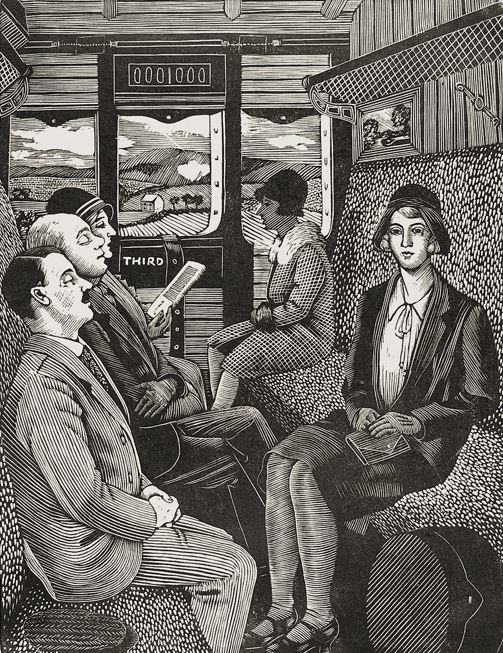
‘Train Journey’ by Tirzah Garwood (1929) wood engraving, 1929. Private collection
But her career doing this was relatively brief, from 1927 or so until, in 1930, she married Ravilious. In 1931 the couple moved to rural Essex, at first lodging with artist friends Edward Bawden and his wife Charlotte in the village of Great Bardfield. The couple moved into their own house and had three babies in quick succession, John, James, and Anne.
Garwood found herself the mother of three small children and having to do almost all the household management herself. The result was to put her woodprint work on hold and she never really returned to it, something she later regretted.
Marbled paper
Instead, she was inspired by Charlotte Bawden to experiment with marbled paper and became an expert at this specialised technique, gaining a growing artistic and commercial reputation which saw her commissioned to create her unique designs for book publishers, interior design shops and private clients. According to the curators she pioneered a distinctive decorative style, layering delicate repeat patterns to create harmonious designs that were unlike anything being made in Europe.
Here style chimed with the 1930s resurgence in arts-and-crafts interiors and Garwood fulfilled orders of fifty or more papers at a time for London design shops, publishers and private clients, making special curved designs for lampshades and becoming adept at cutting and pasting papers for specific decorative needs.
As you walk into the second room of the show you pass between three big examples of these abstract marbled designs on either side of you and the effect is magical. Who would have thought that patterned papers could be so wonderful, entrancing and lovely.

Four of the 12 marbled paper designs in ‘Tirzah Garwood: Beyond Ravilious’ at Dulwich Picture Gallery (photo by the author)
Trauma and autobiography
In 1942 Garwood experienced two life-changing events. In March she had a mastectomy for breast cancer, then 6 months later, Ravilious was killed while on active service as a war artist. The same year she began writing what would become her autobiography, published as Long Live Great Bardfield.
Oil paintings
At the same time she developed a wonderfully distinctive style of oil painting. She adopted a deliberately naive, direct style with a pronounced on traditional children’s toys, creating works that are straightforward yet strange. A series of paintings show a sophisticated creative mind at play, including highlights Horses and Trains (1944), Etna (1944) and, slightly later, The Old Soldier (1947).

‘Etna’ (the name of the old Victorian toy train) by Tirzah Garwood (1944) Oil on canvas. Image courtesy of Fleece Press/Simon Lawrence
House models
In 1946 Garwood married BBC Producer Henry Swanzy and around the time developed a new genre, house models. These three-dimensional paper and card constructions were inspired by the kind of things her children were making at school, but also influenced by the post-war Pictures for Schools exhibitions.
They are 3D models but stylised so as to be only a couple of inches deep. One of the wall labels explains that they are housed in butterfly display cases i.e. wooden frames with glass covers but only 2 inches or so deep. This allowed her to perfect a style of doing shallow models of houses, which give a stylised impression of depth. There are about 10 of these in the exhibition and they are all wonderful. They have a lovely charming handmade amateurish feel about them. They incorporate disparate elements such as paper, fabrics, lace, corduroy, cardboard and even filigree metalwork, along with bits cut out of magazines.

‘Baker’s Shop in Daren’ by Tirzah Garwood (1946) in the bottom third window pane you can just see a little girl asking the baker to buy a bun (photo by the author)
The ‘best’ one might be the elaborate model of a village baker’s shop, with tiny model loaves and buns in the window and, just visible inside, a small depiction of her daughter asking the baker to buy a bun. The others are of different designs of houses and front gardens, presumably based on models from the villages round her in Essex. My (bad) photo might give the impression that this is a flat painting but in fact, if you removed the glass, you’d be able to put your hands into the model, move the model loaves and buns around in the window or rehang the bunting at the top left. It’s a two-and-a-half D model.
One of them has a little stream running between the front fence and the house itself, represented by a little inch wide strip of fabric with little model ducks attached to it. This had been constructed so that there’s a little handle sticking out the front of the box and if you turn the handle, the stream-strip moves along, giving the impressions of ducks moving on the water.
These like everything else in the exhibition, the house models convey a lovely sense of a quiet, unspoilt rural England, not only innocent in itself, but seen from a child’s point of view, seen from the point of view of her three young children.
Last room, last works
In 1948 Garwood’s cancer returned and by the summer of 1950 she was increasingly confined to bed. In the last year or so of her life she painted works which excelled in a kind of quiet understated mystery, brightly coloured but odd visions of nature, Victorian toys and dolls’ house set amid flowers and insects.
The curators have made the simple but excellent decision to fill the final room with 16 of these small but powerful and strange oil paintings. As you progress round them, you feel yourself entering a wonderful, strange and mysterious zone.

‘Hornet and Wild Rose’ by Tirzah Garwood (1950) Oil on canvas. Towner Art Gallery, Eastbourne. Image courtesy of Fleece Press/Simon Lawrence
The style owes something to the tradition of ‘naive’ painting which grew up in the twentieth century alongside the loud gimmicks of modernism, but mixed with her interest in antique Victorian toys and dolls, and then something else again – a quirky interest in the small-scale world of insects among the flowers and grass. ‘Surrealism’ like any other art history label is too strong to convey the subtle blend of flavours and styles which make these last works so calm, quiet and mysterious.
For me the best work in the show was ‘Hide and Seek’ from her last year. This doesn’t have the spooky model trains or dolls which feature in so many of the other last paintings. What it does have is a fuzzy blurred effect of the paint which makes it wonderfully entrancing and mysterious. You feel yourself drawn in, partly to find all the children who are hiding in it (can you see all of them?) but then to be drawn deeper into something else, some deeper mystery of gardens and childhood and lost magic.

‘Hide and Seek’ by Tirzah Garwood (1950) Private collection
Should they have included Ravilious?
Tirzah’s (first) husband, Eric Ravilious, was far better known in their lifetimes and his light and airy, cartoon-style depictions of the rolling southern countryside have gone on to adorn any number of calendars, posters books and so on. He is arguably a bit over-exposed. This isn’t a major criticism at all, just a thought, but I wondered whether it was wise of the curators to include no fewer than ten Ravilious pictures in this exhibition.
I can see why. They place them next to paintings of the same subject by Garwood, to show how they influenced each other and, in a couple of instances, to try and prove that Garwood, the younger artist, the female artist, at one stage his student, nonetheless influenced his ideas about composition. Well and good.
But any Ravilious picture tends to dominate the room it’s in, bathes the eye and mind in a soothing bubble bath of niceness, loveliness and reassurance. So I’m not sure it was such a good idea to include quite so many alongside the Garwood pictures. They inevitably distract you. Garwood isn’t so immediately accessible. Her works – whether prints, oil paintings or house models – are more quirky and flavoursome, it takes a bit more effort to acquire their strange taste.
This is another reason I said I liked the way the last room was devoted solely to her last oil paintings. Partly because, taken together, they powerfully convey a strange and mysterious world. But also, it’s a relief that this last room doesn’t contain any Ravilious works because they would have been too light and easy, would have punctured the dark strangeness of her mysterious world.
Other elements
– There’s a display case showing photos of her and Ravilious, which also contains some wonderful sketches she did of her small children.
– There are two portraits of Garwood, one by Phylis Dodd, one by Duffy Ayers.
– And in the mausoleum space which separates the two runs of galleries, loudspeakers project extensive passages from her autobiography, ‘Long Live Great Bardfield’, read by the actress Tamsyn Greig.
It’s a really beautifully holistic show which gives you a very strong flavour of all aspects of Garwood life and output, and soaks you in the calm and understated, but all the more beautiful and moving magic of her imagination. I didn’t think I’d especially like it but the longer I stayed, the more entranced I became, and I’m going to definitely go back for a second visit before it closes, probably during the Christmas holidays because it felt like such a lovely treat.
The promotional video
Related link
- Tirzah Garwood: Beyond Ravilious continues at Dulwich Picture Gallery until 26 May 2025
- Tirzah Garwood Wikipedia page
 Books & Boots