William Gibson reviews

William Gibson (born 1948, so nearly 80) is a speculative fiction writer and essayist. In the 1980s he pioneered the science fiction subgenre known as cyberpunk. In his 1982 short stories, ‘Burning Chrome’, he coined the term ‘cyberspace’ for the ‘widespread, interconnected digital technology’ which was, at that point, merely a dream and a speculation, and went on to develop the idea in his brilliant first trilogy of novels, starting with ‘Neuromancer’ (1984). The trilogy came to be called the Sprawl trilogy after the name given by its characters to the vast urban sprawl which engulfed the east coast of America when they are set i.e. the mid-to-late 21st century. He also collaborated with Bruce Sterling on the alternate history novel ‘The Difference Engine’ (1990), which became a key work in the science fiction subgenre of ‘steampunk’.

But having established these early (dazzling) achievements, the key fact for me about Gibson is that he wrote two further trilogies of novels, each of which is set closer and closer to the present day, with steadily less and less science fiction in them. In my opinion, the final trilogy, which abandons science fiction tropes altogether to become all about the buccaneering owner of a high end advertising agency, marks a steady decline from his early visionary work, to becoming just a glorification of the GQ, men’s magazine world of consumer capitalism.

List of reviews

List with plot summaries

The Sprawl trilogy (set in mid- to late-21st century)

All set in a thrillingly conceived digital noir future, which Gibson himself snappily described as ‘a combination of lowlife and high tech’. Cyberspace consists of:

‘A consensual hallucination experienced daily by billions of legitimate operators, in every nation, by children taught mathematical concepts… A graphic representation of data abstracted from the banks of every computer in the human system. Unthinkable complexity. Lines of light ranged in the nonspace of the mind, clusters and constellations of data. Like city lights, receding…’ (Neuromancer, page 67)

Neuromancer (1984) In a fast-moving, hi-tech future, after a catastrophic war between America and Russia, digital hackers can insert chips into sockets behind their ears and ‘jack into’ ‘cyberspace’. Case, a young hacker, just 24, is recruited for a final job—restoring his ability to enter cyberspace in exchange for helping a mysterious AI manipulate a team of criminals into carrying out a complex heist.

Count Zero (1986) Seven years after ‘Neuromancer’, three seemingly separate storylines — a corporate mercenary rescuing a scientist’s enhanced daughter, a young hacker nearly killed by mysterious software, and a disgraced art dealer searching for the creator of strange objects — gradually converge to reveal that powerful corporations and a dying billionaire are competing for advanced ‘biosoft’ technology, while fragmented AIs in cyberspace (appearing as voodoo gods!) secretly manipulate events.

Mona Lisa Overdrive (1988) Eight years after ‘Count Zero’ and fifteen years after ‘Neuromancer’, the story is formed of several interconnecting plot threads converge — a prostitute hired in a plot to abduct a famous simstim star, a yakuza boss’s daughter protected in London by a disguised Molly Millions (from the previous novel), a damaged artist caring for a comatose hacker linked to a powerful ‘Aleph’ device, and the star herself struggling to regain her cyberspace abilities. The kidnapping is foiled and key characters upload their consciousness into the Aleph, while Mona is surgically altered to replace the star. In the strange ending powerful AIs appear to be evolving beyond human control…

Sprawl short stories

Burning Chrome (short stories, 1986) Ten science fiction short stories, three of which shed light on characters we’ve met in the ‘Sprawl’ universe.

Steampunk / alternative history (set in 1855)

The Difference Engine (1990; with Bruce Sterling) In this alternative history, inventor Charles Babbage not only speculated about a computer, he actually built one, creating an entire new history. So we are in London 1855 but a London with far more advanced technology, and a completely different political system reflecting the rise of ‘the Industrial Radical Party’. In this brilliantly conceived alternative London, multiple characters — including a data courier, a fallen aristocrat, and a radical thinker — become entangled in political intrigue over a set of mysterious punched cards containing a powerful program which could determine the future. It ends as obliquely and puzzlingly as many other Gibson novels.

The Bridge Trilogy (set in 2006 onwards)

When he published the novels, 2006 was a decade into the exciting future. Now, of course, it is twenty years back in the boring past. But in the future of the trilogy California has been wrecked by an earthquake which divided it into the separate states of NoCal and SoCal, and wrecked the San Francisco–Oakland Bay Bridge, whose ruins have been converted into a huge vertiginous shanty town of noir low lives and crims – the wrecked bridge being the setting and symbol of all three novels and giving its name to the trilogy.

Virtual Light (1993) Chevette-Marie Washington, a young bicycle courier, steals a pair of advanced ‘virtual light’ glasses that contain valuable data, triggering a pursuit by corporate and security forces. Her story intersects with disgraced ex-cop, Berry Rydell. Together they uncover a conspiracy tied to urban redevelopment and surveillance technology. Half way through the novel I realised that, beneath its digital, cyberpunk gloss, Rydell is basically a tough-guy hero in the mould of John McClane or Jack Reacher, and all of a sudden Gibson seemed less special.

Idoru (1996) Set largely in post-earthquake Japan, Idoru centres on rock star Rez who announces he is going to ‘marry’ Rei Toei, an ‘idoru’, a type of artificial intelligence who exists as a virtual media star. The novel follows two intersecting storylines, that of data analyst Colin Laney and a teenage Rez fan, Chia Pet McKenzie, as they are drawn into a conspiracy about nanotechnology smuggling, which involves corporate forces, criminals, and online networks. The book’s focus on celebrity and identity feel much more contemporary, of our time, and modish than previous novels.

All Tomorrow’s Parties (1999) Reunites characters from the previous novels, namely Berry Rydell (security guard and protagonist of ‘Virtual Light’), computer hacker Colin Laney (the protagonist of ‘Idoru’), Shinya Yamazaki (self-described ‘student of existential sociology’) and bicycle courier Chevette. There are numerous intertwined storylines – Berry is sent to San Francisco by Laney who can predict key ‘nodal points’ in history; Chevette trying to hide from her past; pawnbroker Fontaine looking after young orphan Silencio; and a mysterious assassin working for a powerful media figure — all gradually converging on the bridge, where they disrupt an attempt by corporate interests to control an impending historical shift.

Blue Ant trilogy (set in the present day)

Having retreated from visions of the future, this trilogy of novels was set in the present, and centred on the ludicrous figure of advertising executive and futurologist, Hubert Bigend. When I first read that name it struck me that Gibson was taking the piss out of his legions of fans and devotees in the book world, daring them to swallow such a preposterous moniker. Also, his manipulative behaviour towards young women has shades of Harvey Weinstein and Jeffrey Epstein. Yuk. Creepy.

Pattern Recognition (2003) Follows Cayce Pollard – a marketing ‘coolhunter’ with an unusual sensitivity to branding – who becomes obsessed with a series of mysterious, anonymously released online film clips known as ‘the footage’. She is hired by Bigend and travels between London, Tokyo, and Moscow to uncover their creator, navigating a global subculture of fans and a web of corporate intrigue.

Spook Country (2007) Three loosely connected storylines — rock journalist Holly Henry investigating a new form of ‘locative’ art that uses GPS to project virtual images into real space; former addict Milgrim, recruited by a mysterious government-linked figure to transport a secret shipping container; and Tito, a Cuban-Chinese operative tracking the same cargo — gradually converge to reveal a covert intelligence operation involving stolen data and post-9/11 surveillance networks. A sad decline from Gibson’s early glory, these books are hymns to Dad Rock and boomer aesthetics, all black leather jackets, dark glasses and creepy middle-aged men ordering round pretty young women.

Zero History (2010) A 400-page novel about has-been rock stars and pretentious advertising executive: set: set mostly in London and featuring key characters from Spook Country, namely rock singer-turned journalist, Hollis Henry, and reformed drug addict Milgrim, who are commissioned by advertising guru Hubertus Bigend to track down the mysterious designer of fashion brand, Gabriel Hounds. Flashy twaddle.

Martin Cruz Smith reviews

Martin Cruz Smith (1942 to 2025) was a prolific author of mystery and suspense fiction, publishing over 30 novels. He was best known for his 11-book series featuring Russian investigator Arkady Renko, who was introduced in 1981 with ‘Gorky Park’ and last appeared in ‘Hotel Ukraine’. ‘Gorky Park’ was made into a successful Hollywood movie starring William Hurt.

List of my reviews

Arkady Renko series

Standalone novels

List with plot summaries

Arkady Renko series

1981 Gorky Park – Introducing Russian/Soviet detective Arkady Renko, and the case of the three faceless corpses found in Gorky Park, in the heart of Moscow, who turn out to be victims of John Osborne, the slick American smuggler of priceless live sables.

1989 Polar Star – In the first Arkady Renko novel, Renko had clashed with his own superiors in Moscow. Now he is forced to flee across Russia, turning up some years later, working on a Soviet fish factory ship in the Bering Sea. Here, once his former profession becomes known, he is called on by the captain to solve the mystery of a female crew member whose body is caught in one of the ship’s own fishing nets. Who murdered her? And why?

1992 Red Square – After inadvertently helping the Russian security services in the previous book, Arkady is restored to his job as investigator in Moscow. It is 1991 and the Soviet Union is on the brink of dissolution so his bosses are happy to despatch the ever-troublesome Arkady to Munich, then on to Berlin, to pursue his investigations into an art-smuggling operation – to be reunited with Irina (who he fell in love with in Gorky Park) – before returning for a bloody climax in Moscow set against the backdrop of the August 1991 military coup.

1999 Havana Bay – Some years later, depressed by the accidental death of his wife, Irina, Arkady is sent to Havana, Cuba, to investigate the apparent death of his old adversary, ex-KGB officer Colonel Pribluda. He finds himself at the centre of a murderous conspiracy, in an alien society full of colourful music by day and prostitution and voodoo ceremonies by night, and forced to work closely with a tough local black policewoman, Ofelia Orosio, to uncover the conspiracy at the heart of the novel.

2004 Wolves Eat Dogs The apparent suicide of a New Russian millionaire leads Arkady to Chernobyl, the village and countryside devastated by the world’s worst nuclear accident – and it is in this bleak, haunting landscape that Arkady finds a new love and the poisonous secret behind a sequence of grisly murders.

2007 Stalin’s Ghost The odd claim that Stalin has been sighted at a Moscow metro station leads Arkady to cross swords with fellow investigator Nikolai Isakov, whose murky past as a special forces soldier in Chechnya and current bid for political office come to dominate a novel which broadens out to become an wide-ranging exploration of the toxic legacy of Russia’s dark history.

2010 Three Stations In the shortest novel in the series, Arkady solves the mystery of a ballet-obsessed serial killer, while the orphan boy he’s found himself adopting, Zhenya, has various adventures in the rundown district around Moscow’s notorious Three Stations district.

2013 Tatiana – is Tatiana Petrovna, an investigative journalist who appears to have jumped to her death from the 6th floor of her apartment block. When Arkady investigates her death he discovers a trail leading to Kaliningrad on the Baltic Coast and a huge corruption scandal which will involve him in love and death amid the sand dunes of the atmospheric ‘Curonian Split’

Standalone novels

1986 Stallion Gate – Set in 1945 at Los Alamos, during the development of the first atomic bomb, Stallion’s Gate blends real historical figures, namely J. Robert Oppenheimer, with fictional characters, namely Sergeant Joe Peña, a Native American soldier, former boxer, and jazz pianist, recruited from military prison to work as Oppenheimer’s driver and secretly spy on him for security chief Captain Augustino. The novel contrasts the instrumental, western mindset of the physicist and the army, with the values of Native American culture.

2002 Tokyo Station – Set in Japan, during three key periods — 1920s Tokyo, 1937 Nanking, and 1941 Tokyo— culminating just before the Japanese attack on Pearl Harbour. The novel covers Harry Niles, an American raised in Japan – con man, nightclub owner, fixer, and spy – as he moves through its criminal underworld and high society. As war approaches, pressure intensifies: enemies close in, alliances shift, and escape becomes urgent!

Hiroshige: artist of the open road @ the British Museum

This is a wonderfully beautiful show of pure visual, intellectual and aesthetic pleasure.

A leading US collector of Hiroshige’s work, Mr Alan Medaugh, has recently gifted 35 prints by Hiroshige to the American Friends of the British Museum and loaned a further 82 works, and it’s these – plus additions from the British Museum’s own collection and the more modern works in the final section –which make up the contents of this fabulous exhibition. Thank you very much indeed Mr Medaugh!

Ferry on the Fuji River, Suruga Province from Famous Places in Japan c. 1832 by Utagawa Hiroshige. Colour-woodblock print © The Trustees of the British Museum

Hence this exhibition, the first on Hiroshige to be held in London for quarter of a century, and the first ever to be held at the British Museum. The great majority of the prints in the exhibition have never been displayed before, and several are believed to be the only surviving examples of their kind in the world.

The title has two elements, Hiroshige, and the open road, and thereafter is divided into themes or topics. I’ll address them one by one.

Preliminary note

This review relies more than usual on the curators’ own words, which can be found in the large print guide i.e. the complete wall labels, for the exhibition. This is because it is a more than usually scholarly and academic exhibition. At exhibitions of Giuseppe Penone or even Arpita Singh, I can start from my knowledge of western art and the traditions those artists invoke and movements they work within, to generate my own thoughts about the design and style and themes of their work.

This is not that kind of exhibition. It is highly educational about a subject and style remote from most of us. It is a display of immense scholarship which digs into levels of detail – for example about different types of Japanese nature painting, or the subtle influence of Chinese schools of landscape painting on Japanese art – which you and I are just not informed about.

Did you know that a yūjo is the name for a Japanese sex worker or courtesan or that bijin-ga (pictures of beautiful women) were one of Hiroshige’s most popular print subjects? Could you distinguish between Hiroshige’s style and the compositionally bolder style of the Kyoto Maruyama-Shijō school? Or that the tanzaku is the name for the tall, narrow format of a strip of paper used to record poems?

No. Me neither. This is a very information-dense exhibition which is why to write a meaningful review I need to repeat a lot of the scholarly commentary which informs the show.

Hiroshige

Utagawa Hiroshige (1797 to 1858) was one of Japan’s most prolific and popular artists. People at every level of society embraced his calm, lyrical depictions of daily life, nature and the rural landscape. The work of modern and contemporary artists across Europe, the US and Japan reveals his lasting influence.

Born into a low-ranking samurai family in Edo (present-day Tokyo), Hiroshige was orphaned at the age of 12 and inherited his father’s title of fire warden. A superior in the fire department taught him to paint in the Kano school style. By the 1830s he was focusing on what were to become his best-known subjects: tranquil views of famous places, panoramic views of city life, and beautiful depictions of the natural world. Over time he became renowned for his innovative compositions and subtle use of graded ink tones (bokashi).

Hiroshige’s earliest series depict scenes in and around his home city of Edo, such as ‘Famous Places in the Eastern Capital’ and ‘Eight Views of the Eastern Capital’. They depict well-known sights around Edo Bay.

Pleasure Boats at Ryōgoku in the Eastern Capital, 1832-4 by Utagawa Hiroshige. Colour-woodblock print triptych. Collection of Alan Medaugh © Alan Medaugh. Photography by Matsuba Ryōko

Following a career spanning more than four decades, Hiroshige died on the 12 October 1858, perhaps the victim of a cholera epidemic then afflicting Edo.

Avoiding politics

Hiroshige lived at the end of the Edo period (1615 to 1868), when a samurai government ruled Japan from the city of Edo. It was a time of urban growth, but also of famine, social crisis and foreign military incursions. Hiroshige, however, avoided depicting turmoil in his art. On the contrary it was his realistic but beautifully stylised landscapes that earned him greatest fame in his lifetime and continue to win admiration today.

The open road

The samurai government of Japan had banned foreign travel since the 1630s but by Hiroshige’s time there was a growing interest in domestic journeys. Samurai lords with hundreds of attendants made their way to Edo to pay their respects to the shogun. Others set off on business, pilgrimage and sightseeing trips, independently or in organised groups.

Inspired by his own explorations, and by East Asian painting traditions and guidebooks, Hiroshige created landscape pictures that were visually inviting and filled with human interest. They offered an imaginative escape for those unable to travel. As the man himself wrote:

[My] drawings present completely true-to-life landscapes to give people just a moment of pleasure without the inconvenience of a long journey.

Landscapes and meisho (famous places) were a safe subject for publishers during the early 1840s, a period of severe censorship.

Evening View of the Eight Scenic Spots of Kanazawa in Musashi Province, 1857 by Utagawa Hiroshige. Colour-woodblock print triptych. Collection of Alan Medaugh © Alan Medaugh

The Eastern Coast Road

But the exhibition focuses on a couple of famous roads in particular. The 500-kilometre-long Tōkaidō (Eastern Coast Road) connected Edo (present-day Tokyo) in the east with Kyoto, the emperor’s capital, in the west. It was the most travelled highway in Japan. There’s a big map of the route of the road(s) on the wall which, like a numpty, I forgot to take a photo of.

The fifty-three post stations along its route provided travellers with places to rest and stock up on supplies. Accommodation ranged from simple guest houses to luxury inns reserved for daimyō (samurai lords). From around 1833 until the end of his life, Hiroshige designed more than 20 series of prints on the Tōkaidō, about 700 works in total.

Nihonbashi, ‘Morning Scene’, from the 53 Stations of the Tōkaidō, c. 1833-35 by Utagawa Hiroshige. Colour-woodblock print © The Trustees of the British Museum

The Central Mountain Road

Later in the exhibition there’s a work from a series depicting a different rout. The Kisokaidō (Kiso highway, also called the Nakasendō or Central Mountain Road) took travellers on a difficult journey through the mountain ranges north-west of Edo, today called the Japanese Alps. It crossed some of Japan’s most awe-inspiring scenery. Steep passes and heart-stopping suspension bridges made it an adventurous route through sixty-nine stations connecting Kyoto and Edo.

Hiroshige depicted the highway in only one major series, which he took over from another artist. It’s represented by a really evocative depiction of a tiny road winding among snow-covered mountains.

Wherever he travelled Hiroshige took a sketchbook which he packed with sketches of different landscapes, and several of them are on display here.

Prolificness

Mention of the 700 works raises a key fact about Hiroshige which is his astonishing prolificness. Hiroshige was commissioned by publishers. The publishers published works in series. If a series was popular, more would be commissioned.

The point of these colour woodblock prints is they were designed to be cheap, affordable, and popular, in subject matter and format. Late in the show they tell us about scientific forensic work which has been done on Hiroshige’s surviving woodblocks and so we think that his most popular designs may have been printed up to 15,000 times before the woodblocks wore down completely.

Throughout his life Hiroshige returned to depictions of Edo, capital of the Tokugawa government during the Edo period (1615 to 1868). He did so in more than 150 print series, including ‘One Hundred Famous Views of Edo’ which covered every neighbourhood, including areas that were not especially famous.

The mass-production of these colour woodblock prints during the Edo period met the demand from an expanding audience for inexpensive art and meant that ordinary people could buy beautifully made but disposable prints for a few pennies.

Print production began with the publisher, who hired the artist, block cutter and printer. Hiroshige worked for around 90 publishers! In a competitive business environment Japanese publishers needed to cultivate as wide an audience as possible. They may have issued variant designs of a single work as a way of appealing to different tastes, which explains the samples here of the same basic design (of a pheasant, say) being reversioned to appear as if in spring, summer and winter, by changing details of the design (adding snow for winter etc).

All this explains why the complete catalogue of Hiroshige’s work amounts to some 5,000 designs for colour woodblock prints, as well as hundreds of paintings and dozens of illustrated books.

Uchiwa (fans)

In Edo-period Japan, warm weather brought a demand for inexpensive, hand-held fans that people could use and enjoy for a season and then discard. A popular type was the uchiwa, an oval fan on fixed ribs with a handle. Unlike folding fans (ōgi), uchiwa are non-collapsible and so allow woodblock prints to be pasted onto their rigid bamboo frame. Uchiwa fan prints were disposable and only a few examples of each design survive.

Several examples are here along with depictions of them in works by Hiroshige and contemporaries, with a copy of a book of stories based on different types of fan by Hishikawa Moronobu.

Modern specialists in ukiyo-e (Edo-period popular prints) have counted every known uchiwa design by Hiroshige and concluded that he produced well over 500, far more than any other artist. The subjects range from rustic and urban scenes to still life.

The exhibition doesn’t have any fans decorated by him, but examples of his works which depict fan-bearing geishas, along with a very big portrait-shaped depiction of a young geisha with an older woman carrying different types of fan, by Kitagawa Tsukimaro.

Kachō hanga (prints of birds and flowers)

Hiroshige’s depictions of nature, especially his kachō hanga (prints of birds and flowers), show his intuitive bond with the natural world. Many include a Japanese or Chinese poem inscribed in flowing calligraphy, reflecting the connection between nature and poetry in Japanese culture and the high level of literacy at the time. Hiroshige’s kachō hanga contributed to a sudden flourishing of the genre in Japan from the 1830s and furthered the artist’s popularity.

Crane and asters, Three geese and full moon, Pheasant and chrysanthemums by Utagawa Hiroshige. Colour-woodblock prints. Gift from the collection of Alan Medaugh to the American Friends of the British Museum Centre © Alan Medaugh. Photograph by Matsuba Ryōko

This section was, for me, the most appealing. There are lots of works depicting a wide range of birds, plants and trees, including wonderful depictions of an owl, mandarin duck, cuckoo, parakeet, cockerel, Eurasian jay, heron, wagtail, kingfisher, falcon, pheasant, tit, oriole, you get the picture.

Also, there’s sound. The curators commissioned a 25-minute long audio track combining the sound of streams, waterfalls, rainfall and animals, including birds and crickets.

One of the most striking images is from late in his career when he experimented with putting objects in the foreground so that they dominate the image, and did so with an enormous carp.

An enormous black carp appears to leap into the air high above the samurai neighbourhood of Surugadai in Edo. In popular East Asian belief, if a carp reaches the top of a waterfall it turns into a dragon, symbolising hard work leading to success. People in Edo displayed koi-nobori (carp banners) like this during the Boys’ Day Festival (5th day of the 5th month, now called Children’s Day).

Bijin

After his attention shifted to landscapes in the early 1830s, Hiroshige did not return to depicting bijin (beautiful women) for more than a decade. As government censorship restrictions started to ease in the late 1840s, he began designing bijin triptychs, depicting women beautifully dressed in kimonos which are depicting in loving and yet always stylised detail.

Cherry Blossoms on a Moonless Night along the Sumida River (1847-8) by Utagawa Hiroshige. Colour-woodblock print triptych. Gift from the collection of Alan Medaugh to the American Friends of the British Museum © Alan Medaugh. Photograph by Matsuba Ryōko

Videos and tools

The exhibition includes three or four videos showing modern craftsmen demonstrating the techniques of woodcarving, and painting, which Hiroshige used in his prints.

  • the artist Hiroko Imada demonstrates the bokashi (gradation) woodblock printing technique – this is an effect achieved in the printing process by the controlled application of ink to the woodblock
  • extracts from a film by the artist Kawase Hasui (1883–1957) showing him cutting the omohan or key block
  • Capucine Korenberg, scientist at the British Museum, discusses her work on the different versions of Hiroshige’s Plum Garden at Kameido prints

And, of course, display cases containing tools of the trade, woodblock-cutting tools like a mallet and chisel, an omohan or key or outline block, a baren or printer’s pad, and explaining the techniques

  • kimedashi or relief printing
  • musenzuri or contourless printing
  • kasanezuri or over-printing

Hiroshige’s influence in the West

In the late nineteenth century there was a vogue in Europe and America for Japanese prints, fashions and designs on vases, tea services etc which goes under the name of Japonisme. It was fed by the opening up of Japan to trade in the 1850s which led to the rapid dissemination of Japanese products in the West.

The exhibition has a modest section describing some highlights of this. Most notable are two big names from the end of the century, Vincent van Gogh and James McNeil Whistler.

In a fascinating little section, we are shown an original Hiroshige print – The Plum Garden at Kameido, 1857 – and told that Vincent van Gogh bought a copy around 1887 and then meticulously traced it onto a numbered grid which he used to enlarge the composition to scale onto the canvas for his oil copy, with van Gogh’s numbered grid placed net to it.

In fact Van Gogh and his brother Theo purchased over 400 Japanese colour woodblock prints and Vincent copied a number of them. Further along the wall is a large-scale sketch of ‘The Countryside along the Shore of the Rhône’ in which he consciously tried to adopt the Japanese approach to landscape, seeking harmony of composition over photographic realism.

The Whistler connection is less dramatic: American artist and educator Arthur Wesley Dow published a book which included examples of Hiroshige prints next to reproductions of works by Whistler to show the influence, namely abandoning the quest for photographic realism in an effort to create atmospheric compositions.

A bit more tenuously there’s a not very good 1895 print by Henri de Toulouse-Lautrec titled The Passenger in 54 which may, or may not, have been influenced by Hiroshige’s strategy of placing the subject in the foreground so as to eclipse the background setting. This is the kind of thing we’re referring to where, pretty obviously, the tree is the focal point of the image, with the people in the background utterly eclipsed.

The Plum Garden at Kameido from 100 Famous Views of Edo, 1857 by Utagawa Hiroshige. Colour-woodblock print. Collection of Alan Medaugh © Alan Medaugh. Photography by Matsuba Ryōko

Modern homages

This final section brings together a dozen or so artworks by contemporary artists which pay homage one way or another to Hiroshige’s achievement. They include:

  • Julian Opie who produced a set of lenticular prints of the landscape around Mount Fuji (2009)
  • Koya Abe who digitally altered Hiroshige’s print Seba to convey the destruction caused by the Great Tōhoku Earthquake on 11 March 2011
  • Emily Allchurch who has digitally collaged hundreds of her photographs of Japan to create new interpretations of Hiroshige in Tokyo Story
  • Noda Tetsuya who noticed the similarity between the view from Tate Modern looking down on the Thames and Millennium Bridge and Hiroshige’s print, ‘Sudden Shower over Ōhashi and Atake’ and so did a Hiroshige-style treatment of the London view, titled Diary: Feb. 23rd

Thoughts

Magic. ‘Luxury, peace, and pleasure’ Japanese style. Go and see it.


Related links

Related reviews

Japan: Myths to Manga @ Young V&A

Young V&A

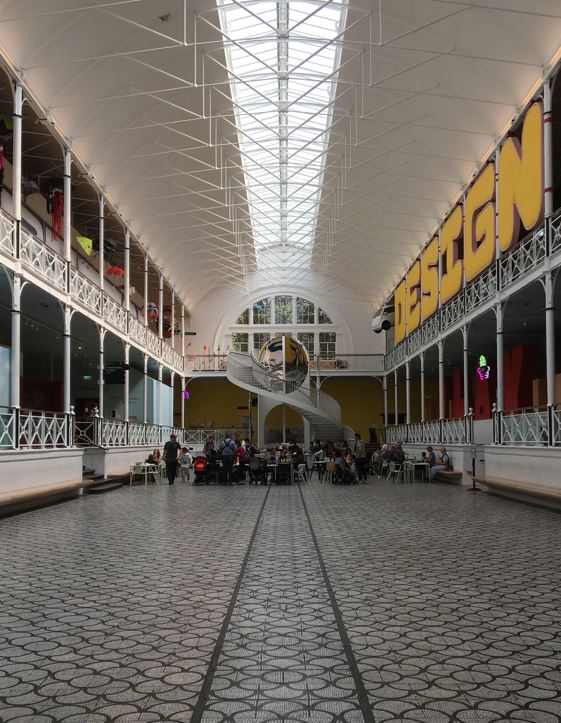
Older readers may remember the Museum of Childhood sited near Bethnal Green tube station out in East London. This has always been part of the Victoria and Albert Museum but in the early 2020s was rebranded ‘the Young V&A’. They’ve cleared the central space with just a café at the far end, and moved  all the exhibits onto galleries overlooking it.

The very open, uncluttered ground floor of Young V&A, just a cafe at the far end (photo by the author)

I remember going to the Childhood Museum decades ago and being disappointed at the array of old dolls in fusty wooded display cases. Nowadays they’ve made a big effort to make as many exhibits as possible interactive, with a build-your-own meccano ball rollerball thing, machines to make patterns in sand and more basic things like tables with pens and paper and stencils (I used one of the stencils to trace a guitar and then draw a silly face on it).

But I’d come to see the ‘Myths to Manga’ exhibition which has been running for almost a year and I’ve kept putting off. For some reason I’d got hung up on the word ‘manga’ and thought it was another manga exhibition which, after the good one at Japan House and the massive one at the British Museum, I was in no special rush to see.

Myths to Manga

But I was wrong. Manga takes up a small, almost imperceptible part of this exhibition. It is more like a review of Japanese myths, legends, folk tales and religion, told through a great miscellany of objects. And, given its location in a children’s museum, I think we can safely assume say that a lot of these objects were not chosen in order to give a dry scholarly overview of the subject, but because they’re FUN!

So, at the interactive end of the show, echoing the emphasis on interactivity in the rest of the museum, there’s a little ‘forest’ area with fake trees and beanbags to lie on and listen to a Japanese folk stories on headphones; there’s an origami table with books on how to do origami and lots and lots of squares of origami paper, and a separate table with paper and pencils and books on how to draw manga characters. And maybe most fun, certainly noisiest, there’s a trio of traditional Taiko drums for small kids to bang the life out of.

Installation view of ‘Japan: Myths to Manga’ at Young V&A. Note the drums on white stands in the foreground, and in centre frame, bean bags around a table covered in paper to do manga (photo by the author)

In display cases there are lots of toys, including Pokemon, Doreamon, Sylvanians, Hello Kitty, maneki-neku, all manner of dolls. There’s a stand of small Transformer toys from the 1980s (‘These are no ordinary toy cars!’) next to a more traditional V&A set of life-sized mannekins modelling the designs of Coco Pink Princess.

Installation view of ‘Japan: Myths to Manga’ at Young V&A showing street fashion designs by Coco Pink Princess (Photo by the author)

There are games and models based on a number of traditional Japanese characters or types of spirit or demons, such as this one about the Yōkai, shapeshifting supernatural beings that include spirits, creatures and demons.

Yokusai display case in ‘Japan: Myths to Manga’ at Young V&A (Photo by the author)

At the big end of the spectrum there are painted screens and decorated kimonos. At the tiny end of the spectrum there are a number of absolutely exquisite netsuke. There are decorated vases, plates and styled shoes. There’s dolls house furniture from the last century next to the model for a Royal Shakespeare Company production of Studio Ghibli films. And talking of films, there are half a dozen monitors showing clips from recent animé movies.

Still from ‘My Neighbour Totoro’ in ‘Japan: Myths to Manga’ at Young V&A © 1988 Studio Ghibli

Themes

How is all this arranged and organised? I’m glad you asked. The curators have taken primal aspects of Japanese (and probably any ancient mythology) and arranged all the exhibits under these great big headings. They are:

  • Sky (flying gods, demons and heroes)
  • Sun (the country’s name in Japanese, Nihon, means origin of the sun’, so some flags; in the Shinto religion the most important god is Amaterasu no Okami, goddess of the sun)
  • Stars (in East Asia the stars Vega and Altair are unlucky lovers, the Cowherd and the Weaver Princess who only meet up once a year when their stars align, an event celebrated in the Tanabata festival)

The Seventh Month from the series the Five Festivals, woodblock print, by Utagawa Kunisada (1830s) in ‘Japan: Myths to Manga’ at Young V&A © Victoria and Albert Museum

  • Moon (moon-viewing festivals called otsukimi; in East Asian mythology the moon is home to a white rabbit who makes mochi cakes for everyone)
  • Sea Below (mermaids and the amabie, the whiskered catfish namazu)
  • Sea Above (14,000 islands, waves, beaches, fishermen)
  • Forest (ancient forests full of legendary creatures like the tanuki raccoon dogs and kitsune foxes and heroes with superhuman powers like Momotarō and Princess Kaguya)
  • City (400 years ago Tokyo was a small fishing village, now it has a population of 14 million)
  • Streets (skyscrapers soaring above Shinto shrines, with old folk stories about the demons which come out at night)
  • Home (a place to display a small number of beautifully designed artefacts)

Each theme is explored through half a dozen or so objects of – as I’ve indicated – very varied size, shape and medium.

Part of the ‘Home’ theme, in installation showing examples of manga, anime, videogames, Pokemon, Gameboys and so on, in ‘Japan: Myths to Manga’ at Young V&A (photo by the author)

To take an example utterly at random, the ‘Streets’ section includes a poster using traditional woodprint style to depict a woman so absorbed in her smartphone that she’s about to stumble off the platform at a train station. It’s a 2017 warning poster from the Tokyo subway, ‘Please do not use smartphones while walking’. Puts Transport for London’s poster to shame for style.

‘Please do not use smartphones while walking’, 2017 poster in ‘Japan: Myths to Manga’ at Young V&A © Victoria and Albert Museum

Under each theme there are summaries of traditional Japanese folk stories related to them. These include:

I liked the print of the Seven Gods of Good Fortune, six ugly men and a fair maiden, known for sailing round in a boat. I liked the idea that you should sleep with a picture of the seven gods under your pillow on New Year’s Eve in order to have a lucky year.

I was also very taken with the witch’s shoes. In Shinto, some animals are thought to be messengers of the gods, in particular cockerels and crows. These bird-witched shoes were designed by Masaya Kushino in 2014 using crocodile leather and cockerel feathers.

Bird-witched shoes by Masaya Kushino (2014) in ‘Japan: Myths to Manga’ at Young V&A (photo by the author)

Modern art

In among the toys and models, plates and kimonos, shoes and dresses, there are a number of contemporary works of art which could have dropped here from a completely different, entirely adult exhibition. These included:

  • a large black and white photo of magical lights in the forest, Hakkoda #2 by Tokihiro Sato
  • a large digital ‘painting’, Tokyo Dizzily Land by Shigetoshi Furutani
  • a large sculpture made from car parts, Double Spiral by Keita Miyazaki

Installation view of the Street section of ‘Japan: Myths to Manga’ at Young V&A’, showing (left to right) the smartphone poster, ‘Tokyo Dizzily Land’ by Shigetoshi Furutani and ‘Double Spiral’ by Keita Miyazaki (photo by the author)

Woodblock prints

Lastly, it took a while for me to realise that, in a way, the backbone of the show is provided by a series of beautiful woodblock prints, ranging in date from the 1770s to 1900, but with most of them coming from the 1830s, ’40s and ’50s. These also feel like they come from a different exhibition, a different world, one with far more artistic depth and resonance than the Transformers and Sylvanians. I counted 15 of them, by the following artists:

  • Utagawa Hiroshige (7)
  • Utagawa Hiroshige II (1)
  • Utagawa Kurisada (2)
  • Utagawa Kuniyoshi (1)
  • Totoya Hokkei (1)
  • Ishikawa Toyomasa (1)
  • Katsushika Hokusai (1)
  • Utagawa Sadahide (1)

Yes, this would be the same Katsushika Hokusai who did the famous Wave and it’s here, Under the Wave off Kanagawa from the series ‘Thirty-six Views of Mount Fuji’.

But although all of them were interesting and half of them were really good, my favourites were both by Utagawa Hiroshige – Star Festival at Yanagishima (1856) and Moonlight at Ryogoku (1856).

Moonlight at Ryogoku by Utagawa Hiroshige in ‘Japan: Myths to Manga’ at Young V&A © Victoria and Albert Museum

Summary

If you’ve got small children they might like the interactive stuff, for a bit. If you’re interested to find out a bit about Japanese culture, their beliefs about the sun, moon, sea and so on, and to learn about some traditional folk stories accompanied by related prints and illustrations, games and toys, then it’s interesting enough. But if you’re an art lover then I think you’d go to see the prints, some of which are really beautiful – and also the half dozen or so miraculously small and intricate netsuke. In the example below, each ‘clam’ is the size of a fingernail. Even with my glasses on I couldn’t see the full details of each carving, it’s a miracle an artist ever carved them, so small, so precise and so beautiful.

Netsuke of clam shells with the eight famous views of Omi by Nagamitsu (1800 to 1850) in ‘Japan: Myths to Manga’ at Young V&A © Victoria and Albert Museum (photo by the author)


Related link

Related reviews

Pattern Recognition by William Gibson (2003)

This is the first novel in what became known as the ‘Blue Ant’ trilogy. I was wondering what Blue Ant would turn out to be, my mind alive with images of mutating insects, or maybe it was the nickname of some groovy digital weapon, or a piece of cyberspace code.

But no, my heart sank when I learned that Blue Ant just refers to a fictional advertising agency set in the contemporary world i.e. turn of the century New York and London and Tokyo. And that the lead figure in the book is a ‘brilliant’ young logo expert, 32-year-old (page 2) Cayce Pollard who is a freelance fashion spotter, ‘an actual on-the-street cool-hunter’ (page 32), ‘a very specialised piece of human litmus paper’ (page 13):

  • ‘What I do is pattern recognition. I try to recognise a pattern before anyone else does.’ (page 86)
  • All the time she’s spent on the world’s various streets, scouting cool for the commodifiers. (page 195)
  • ‘I find things, or styles, for other people, companies, to market. And I evaluate logos – trademark emblems.’ (page 231)

Just like the character Count Zero in the Neuromancer trilogy or Colin Laney in the Bridge trilogy had special, almost supernatural gifts for spotting trends, nodes and emerging meanings in the endless flow of data in cyberspace, so Cayce is credited with a special, almost supernatural gift to spot new fashion trends –

She’s met the very Mexican who first wore his baseball cap backwards, asking the next question. She’s that good! (page 32)

Except that Count Zero and Laney were dealing with the genuinely weird, visionary idea of dataflows, set in interesting futures, whereas Cayce has a special ability to spot… the latest trends in footwear. Or shirts. Or handbags. It feels like a crashing descent into the banal.

In the first 150 pages of this book the one piece of actual work which Cayce performs for the Blue Ant agency is they show her a new logo designed for a client which looks a bit like a sperm.

‘They wanted me here to tell them whether or not a new logo worked.’ (page 190)

She doesn’t like it so it’s sent back to the designer (Heinz) in Germany, who amends it to more of a squiggle – which she does like. That’s it. That’s how her supernatural abilities are put to use. Felt pathetic, to me.

The novel opens as Cayce arrives in London for a meeting with the Blue Ant advertising agency with a bad jet lag.

She’s here on Blue Ant’s ticket. Relatively tiny in terms of permanent staff, globally distributed, more post-geographic than multinational, the agency has from the beginning billed itself as a high-speed, low-drag life-form in an advertising ecology of lumbering carnivores. (page 6)

The prose from the get-go is whip-smart and street savvy and cool and all those other adjectives, but cannot conceal what for me, as a person completely indifferent to fashion, is the crushingly dull and vapidly narcissistic world of fashion and marketing. And this is the first novel in which the real thinness of Gibson’s plots became clear.

Characters

The book is cleverly constructed and has a number of strands. Cayce is staying at the flat of a mate of hers, Damian, who is off shooting a documentary in Russia. The Blue Ant agency was founded and is run by the preposterous Hubertus Bigend, who drives a fast car, wears a stetson hat, looks like Tom Cruise with big teeth, and has advanced views about how advertising bypasses the rational mind and goes straight for the primitive hippocampus, the basic mammalian stem of the brain (page 69). Just, in fact, like all the pretentious, high-talking heads of all advertising agencies are ‘visionaries’, ‘gurus’, ‘geniuses’, prophets, intellectuals, blah blah blah.

Hubertus Bigend and contempt for the reader

Calling his central character Hubertus Bigend struck me as being a gesture of contempt by Gibson. In the third of Thomas Harris’s Hannibal Lecter novels, Hannibal (1999), written some time after the smash hit success of the Anthony Hopkins movie version of The Silence of the Lambs (1991), Harris has a scene where the psychopath moves amid the crowd in the London Dungeon and freely expresses his loathing and contempt for the shallow philistines who love being titillated by gruesome murders. Peasants! Plebs! It seemed to me that Harris was deliberately gobbing in the face of the people who bought his books and paid to see the movies.

Something comparable struck me as happening here. It seems to me Gibson that is taunting his readers, saying if you can believe in a character I’ve named Hubertus Bigend, you’ll believe anything; if you swallow this stupid, insulting name, it just goes to prove what gullible mugs you are, falling over yourselves to associate yourself with my shimmering street-savvy prose, to slip on a leather jacket and shades and a ripped t-shirt and pretend to be in on the latest thing, in a pathetic attempt to hide from yourself how middle-aged and white and boring you are.

In fact it’s not only Hubertus Bigend who has a stupid name, they all do:

  • Cayce Pollard
  • Hubertus Bigend
  • Damian Pease (page 104)
  • Boone Chu (page 100)

In the Neuromancer trilogy Gibson really did feel like he was writing about gutter punks strung out on future drugs as they hacked in and out of cyberspace in gorgeously whip-sharp prose. You are totally in that world.

The Bridge trilogy which followed felt to me more contrived: its focus is on solidly lowlife types, or people bumping along the bottom of society – a security guard and ex-bike courier and rasta shopkeeper and a damaged teenager – giving the impression of a world which is fly and sharp and cool and street and happening, man. It’s only when the story refers to the authorities who actually run all the amenities of post-earthquake California – for example when the fire brigade gets called in to put out the climactic blaze on the Golden Gate bridge – that you realise that beyond Gibson’s handful of street types and scandi noir assassins, there is actually a great big world of grown-ups, where taxes are gathered to pay for schools and hospitals and police and fire brigade, where bureaucrats and businessmen commute to work every day and get things done. Where people aren’t lowlife drifters, living in cardboard boxers, mixing with cool assassins in long black coats.

Suddenly, the story felt…well… juvenile, wilfully focusing on a handful of rather pathetic outsiders with no particular redeeming qualities or features, certainly in no way representative of the wider world.

The Blue Ant novels feel like they continue this downward arc – that what began as something genuinely subversive and new in Neuromancer has metamorphosed into something shiny and empty and corrupt. The triumph of style over soul. It feels like he’s sold out. The Clash lyric, ‘Huh, you think it’s funny – turning rebellion into money’ kept coming to mind (The Clash are actually quoted on page 130 and the novel features Gibson’s usual clutch of supposed rock stars and fake rock bands).

When you’re a kid you think the music and look of your time is the big deal which is going to overthrow the corrupt old order. Then you watch as the record labels and promoters and stadium bookers and the TV pundits and fashion journalists and style gurus turn it into just another brand, and next thing you know it’s being sold back to you at extortionate prices, marketed and advertised by would-be cool, creepy, slimey, 40-something sell-outs in designer leather jackets.

That’s what this book felt like to me: a creepy exercise in cynical box-ticking set among a jet-setting international advertising and media elite who know all the right people and who are all so fabulous – fabulously well dressed, fabulously well connected, fabulously stylish, and so fabulously interesting, dahhhling, Hubertus has just got the most fabulously interesting theory of why advertising works, dahling, you must hear it, the man is a complete genius!

Absolutely fabulous characters

Cayce, as is repeatedly pointed out, is supernaturally gifted at spotting fashion trends, and this is one of the obvious examples of pattern recognition which crop up throughout the book. Her father was Win Pollard, a leading security expert who made American embassies round the world secure. He had many wise words and sayings like a good father should, well, certainly in an airport thriller.

He advised her to always ‘secure the perimeter’. He warned her against apophenia which is the tendency to perceive connections between unrelated things when there are none. It is a way of overdoing pattern recognition, a form of paranoia. (It crossed my mind, reading this, that creating patterns out of human activity is, in a broad sense, the core approach of all narratives.)

Cayce’s mother, Cynthia is equally as interesting and eccentric, a gen-you-ine Virginia eccentric (page 31) who lives in a nutty community who all believe in Electronic Voice Phenomena, a form of pattern recognition gone wrong (page 115).

Cayce had a therapist, Katherine McNally (page 253) (later this turns out to have been a string of therapists). She goes to a café in Camden and bumps into the famous Billy Prion, lead singer in the famous band, BSE. Her friend Damian is off in Russia making simply the most amazing documentaries ever.

In other words, her life is just so effortlessly glamorous, dahhling. It’s a Sunday Times Style supplement version of cool.

The shiny people in their black leather jackets, black Fruit of the Loom t-shirts, black skinny 501 jeans (page 2) and black shades, collars moodily turned up on their long black coats, or black leather and shiny nylon and squared-off shoes (page 153), smoking Gitanes like Albert Camus, drinking expensive Colombian coffee, hanging out in their cool redesigned interiors and stylish cars are like the pencil-thin, heroin-chic young things out of any number of indistinguishable fashion shoots from the last 30 years, or which populate hundreds and hundreds and hundreds and hundreds of cynical, smooth, stylish, utterly empty car ads.

An ex-boyfriend of Cayce’s (oh, dahhling, how many have there been?) once compared her to a Helmut Newton portrait of Jane Birkin. Well, of course he did. A character she knows looks like Michael Stipe on steroids – ‘Oh I simply love REM, don’t you!’ (page 21).

Later Boone’s luggage is described as ‘one of those Filson outfitter bags that look like L.L. Bean on steroids’, page 172. In other words Gibson is starting to write in clichés and to repeat those clichés.

Cayce’s New York apartment is painted a shade of blue she discovered in Northern Spain and had the paint people mix from a Polaroid she took of it, she’s that good!

The book keeps up a steady stream of name-dropping, trailing any number of undergraduate cultural references from Tarkovsky to Baudrillard (page 48) because the book has intellectual pretensions as well, in much the way that high-end fashion magazines and style outlets like to quote Deep Thinkers, or at least put their faces onto t-shirts, turning them into yet another kind of shiny surface reflecting the characters’ bottomless shallowness.

They’re just names on labels, like all the other brands the text carefully namechecks – Tommy Hilfiger, Levi 501, Volvo, Agnes B, Molton Brown, Burberry, Gucci (127), Prada (188), Gap, L.L. Bean, Louis Vuitton (188), suede boots from Parco, Armani, Versace (271), Cartier (309), Hermès (310).

Everyone is just so fabulously fabulous, thus:

  • Hubertus is a philosopher king who founded the coolest ad agency anywhere (‘He’s brilliant, isn’t he?’ gushes a member of his staff on page 87)
  • Cayce’s friend Margot is doing a course at NYU in disease-as-metaphor (‘Oh how wonderfully Susan Sontag of her!’), as it happens, she is a former girlfriend of Bigend’s – small world, when you’re this brilliant and that good !
  • the text drops key names from an undergraduate media studies course like car keys – Baudrillard, Derrida, Foucault, Lacan, Jameson, August Strindberg, Andrei Tarkovsky (at least three times pp.146), Truffault, Peckinpah, Apocalypse Now (180), William S. Burroughs (186), James Joyce and Tennessee Williams (286), it’s a shopping list of rather dated intellectual ‘cool’
  • characters wonder whether the director of the fragments is some kind of ‘Garage Kubrick’ (page 47)
  • film-makers are all auteurs
  • Cayce is stopped in the street by someone who thinks he saw her at a fabulous event at the Institute of Contemporary Arts’ (page 19)
  • not one but two of her former boyfriends were fans of Japanese actor Beat Takeshi, star of existential gangster films (page 167); of course they were, haven’t you heard of Beat Takeshi, oh dahling, where have you been hiding?
  • Cayce keeps bumping into rock singer Billy Prion, you all remember Billy Prion the famous rock singer, don’t you?

The text drops not only names but fashionable buzzwords, too, like a checklist from a student reading list of critical theory – liminal (54, 253), discourse, semiotics (‘semiotics of the marketplace’ 2, ‘a semiotic neutrality’ 89, ‘semiotic agoraphobia’ 264), hegemony, hermeneutics, God aren’t we clever and well-read.

As you can tell, I found Pattern Recognition unbearably pretentious, elitist and dull. It’s such a shame because in the Neuromancer novels Gibson seemed to have invented a dazzlingy jazzy, funky, street prose style to match the extraordinary goings-on in his digital future. But in a book like this, the style is broader, deeper and more accomplished, but now feels like it is dressing up distressingly lame, boring, fashion magazine material.

The McGuffin

All Gibson’s previous novels managed to cook up a sense of expectation and mild dread because they all contrived to have a Big Secret at their centre, a secret the characters slowly stumble across and which, in the case of the Neuromancer books, is genuinely mind-expanding (in the second novel a self-conscious, self-aware being emerges from the world’s data; in the third novel, it becomes aware that there are others like it out in space).

However, this entire Big Thing-at-the-heart-of-the-story strategy begins to run out of steam in the Bridge trilogy: in the last of those books we spend the entire narrative being promised that something big, really, really big is going to happen, something that is going to change the world forever, so we spend the entire novel on tenterhooks. And then… it doesn’t happen. Nothing happens at all. Well, the Golden Gate catches fire and then, er, is put out. That’s it.

The McGuffin in this novel is ‘the fragments’. Someone is releasing onto the internet brief fragments of what appear to be a movie. This cryptic procedure has spawned a community of obsessives around the world who have swiftly assigned themselves a ‘cool’ name, the ‘footageheads’, who have wasted vast amounts of time speculating what The Footage means, who took it and why and where it’s all going to end. Footageheads are obsessives and addicts. They think repeated watching of the various fragments, in various orders, gives them a sense of an opening into something, a universe, a narrative (page 109).

There are web communities devoted solely to analysing The Fragments, including one named F:F:F, which stands for Fetish: Footage: Forum, maintained by someone named Ivy, with about 20 regular posters including Parkaboy, La Anarchia, Maurice and Filmy, and where Cayce has been posting thoughts for some time.

As the novel begins and Cayce flies into London to undertake her brief job assessing the new logo for a Blue Ant client (why couldn’t the logo have been emailed or faxed or posted to her?) she is fussing and fretting over the release of the latest fragment, #135.

This silly idea really is the centre of this long novel, I kid you not. When, on the evening of her 1-minute logo-disapproving meeting, Cayce is invited out for dinner and then drinks with the swashbuckling Hubertus Bigend (‘Isn’t he brilliant?’), Hubertus takes Cayce to a cool designer bar in cool Clerkenwell (natch) where he springs on her the real reason he paid for her flight from New York — turns out Hubertus is a footagehead himself and is prepared to pay Cayce big bucks to find out who’s making The Fragments and why.

Before she knows what’s happening, Hubertus introduces her to a Chinese-American named Boone Chu. Cayce initially says no to the whole proposition, but, like Cayce herself, Boone is a genuine footagehead and his passion is contagious.

Tokyo

Cayce spends the first hundred and fifty pages mooching round the environs of her mate Damian’s flat in Camden i.e. up to the Lock, around the market, there are walks up Primrose Hill, she meets people in cafés, has a bizarre encounter in the street with three dudes who are buying and selling a suite of fake hand grenades which contain wind-up calculators (named Voytek and Ngemi), the nips over to Notting Hill and the Portobello Road. Then there’s all the taking of cabs to and from meetings at Blue Ant’s HQ in Soho. In other words, fashionable north and west London are given a good going over in Gibson’s slick stylish prose. Cool.

But via the community of footageheads Cayce has learned that there are various footage experts in Tokyo and so, once Boone Chu has helped persuade her to agree to Hubertus’s commission to track down the footage maker, she finds herself handed a Blue Ant Mac, ipad, mobile, credit card and plane tickets to Tokyo and whoosh! she’s aboard a British Airways flight to Japan. ‘New York, London, Paris, Munich, everybody’s talking ’bout… pop music!’

There’s quite a bit of reportage about what it’s like to arrive in Tokyo, deboard the plane, catch a cab into town, all the skyscrapers, the bombardment of foreign signs which every tourist since Roland Barthes has felt compelled to write a book about. The Blue Ant Tokyo office is terrifyingly prompt and efficient and, after she’s checked into a luxury hotel, arranges an hours-long pampering session with seaweed facials, wax and haircut. Then a new outfit, all in black, obvz.

Then, finally, we arrive at the point of the whole trip, which is some of her pals in F:F:F have identified a certain ‘Taki’, a Japanese footagehead, who claims to know of a ‘coven’ of other footageheads who have discovered a watermark on fragment #78.

Do you care? No, neither do I. Her friends then devise an elaborate scam which is to invent a horny, porny anime babe, call her Keiko, and persuade this Taki to a meeting on the promise that in exchange for his information, he’ll get a picture and contact details for this Keiko. I suppose they could have just rung him up and asked him or asked to meet for a coffee and asked him, But this way creates more cloak-and-dagger suspense.

So Cayce meets Taki in a seedy bar which he has chosen, he hands over the number he claims is in the watermark of fragment #78 and she hands over the bosomy photo of a made-up Japanese babe, goes for a pee and Taki is gone when she gets back.

Out in the dirty alley she is mugged by two guys dressed all in black (obvz) who seem to have Italian accents. But it turns out Cayce was trained in self-defence by her spy father (of course she was) and gives one of them a Glasgow Kiss before stamping on the other’s one’s shoe with her stilleto and running. At the end of the alleyway a lone figure on a moped is waiting, who lifts the visor of his helmet to reveal… it is Boone Chu! He flew out on the same plane as her and has been tailing her.

Long story short, he sweeps her off to a hotel, drinks and recovers and throws on new clothes (all black, natch), then a plane back to London.

Back in London

Boone and Cayce are collected by Hubertus in a cab, so he can debrief them about everything that happened. Boone does the talking and leaves out the mugging and his rescue of Cayce.

Back at Damian’s Cayce is disconcerted to discover Damian has returned to his flat from Russia, and brought along a moody sulky Russian girlfriend, Marina (dresses only in Prada, only in black, natch). Cayce crashes, the others go for meals, Camden is so cool.

Burglary I forgot to mention that after Cayce arrived in Damian’s flat she unpacked then went for a walk. When she came back she realised someone had been tampering with the laptop she uses i.e. had broken into the flat, but using the correct keys. This led to an outburst of paranoia which led her to barricade Damian’s door, then to get new locks.

Logophobia I also forgot to mention that Cayce has a severed phobia which is the other side of her having such a phenomenally good feel for fashion and logos, which is a phobia of logos. Thus a visit to Harvey Nichols upscale department store makes her nearly pass out, and conversation leads to the fact that the Michelin man, logo of Bibendum in Knightsbridge, gives her panic attacks. Thus it is no accident that when she gets back to Damian’s flat after some outing she finds a model of the Michelin man nailed to the door. She nearly throws up and has to detach it without looking directly at it.

Now, no sooner has she arrived back in London than she’s called to a meeting at Blue Ant with Hubertus. On the way in she almost collides with… the man who tried to mug her in Tokyo and is sporting a very broken nose. When she asks reception who he is, reception tells her that’s Dorotea’s driver, Franco (page 199).

Dorotea? Yes we met Dorotea Benedetti (page 9) in the early scenes. She is another freelance, this time an imposing executive, who had been liaising with the German designer about the sperm logo. Boone  explains that Dorotea was angling for a senior job at Big Ant and thought Hubertus had flown Cayce to London to consider her for the post i.e. to be a rival. And that’s why Dorotea commenced this barrage of psychological attacks against Cayce.

But in this new meeting at Blue Ant, also attended by Boone, Cayce now discovers that none of it was Dorotea’s idea, she was put up to it by a Russian who paid her, a tax lawyer based in Cyprus (described as being a centre of Russian money laundering, page 204). Not only did this Russian pay Dorotea to unsettle Cayce but someone passed on to her deeply personal information about Cayce’s logo phobia which she had only shared with her New York therapist. I.e. the Russians appear to have burgled Cayce’s therapist’s office.

So there’s some kind of deeper conspiracy against Cayce going on. When all this comes out in this boardroom meeting, Cayce is speechless with rage and calls Dorotea a ‘vicious lying cunt’ (page 203). But Hubertus stuns Cayce even more by announcing that he has hired Dorotea to Big Ant. Cayce reels out and goes to a Starbucks with Boone who explains that Hubertus doesn’t trust Dorotea but wants her on the inside of the tent pissing out.

Boone announces he’s flying to Columbus Ohio because that’s the location of a firm, Sigil, which specialises in watermarking movies. He thinks it might be them who placed the watermark on the fragment which they swindled out of Beat in Tokyo. So we’re back to The Footage, again, as providing the main narrative engine.

Bournemouth

Remember the oddballs Cayce walked past in Portobello Road, gathered round a car boot where she was astonished to see full of hand grenades till she went closer and discovered that they were only novelty calculators, one of the only hand-wound calculators in the world. To add a bit of grit, the story goes on to explain that they were designed by a Jewish designer Herzstark while imprisoned in a Nazi concentration camp.

Now we learn that the two guys gathered round that boot were collectors and aficionados, being Voytek the Slav, Ngemi the black guy. They were waiting for a potential purchaser, Hobbs Baranov to show up. But he didn’t, so they packed up and left, disgruntled.

Well, Voytek gets hooked up with Damian somehow I can’t quite remember, and is part of the ‘Camden set’. Cayce sees him a few times in Camden cafés, even round Damian’s place. Conversation reveals that Baranov is well connected as well as being a fanatical collector. He’s the son of a Soviet defector from the 1950s, possibly recruited to American intelligence (page 242).

We are told that a rare and valuable artifact, a prototype Curta calculator, went at auction to a Bond Street dealer, Lucian Greenaway. Cayce finds out the black guy Ngemi is catching a train down to Bournemouth to see Baranov the purchaser and asks Voytek to ask Ngemi if she can accompany him.

Yes. So Cayce catches a cab to Waterloo (with comic descriptions of British Rail announcements, sandwiches and English tabloid newspapers. Yuk.) Train to Bournemouth, borrows a car, drives out to derelict Ministry of Defence test centre, a handful of pitiful caravans, this is where Hobbs Baranov lives. He is very unpleasant but a fanatical collector of early computers and calculators.

The T diagram The F:F:F people continue to dangle the bait of a made-up hot Japanese footagehead babe in front of Taki i.e. continue sending fake emails from her to him and, having been given the photo Cayce gave him, he more than ever believes she is real and big-breasted and gagging to meet her if only he will hand over Footagehead facts. So Taki excitedly emails Cayce a diagram. It is an image which shows a sort of T-shaped piece of geography and written all over it are numbers. One of them is the same as the number watermarked into fragment #78 as revealed by Taki. So presumably they’re all watermarks to do with the Footage.

Now Cayce has come all the way down to this dingy caravan outside Bournemouth to show it to the collector and expert in the arcane, Hobb. She shows the image to Hobbs and he nods knowingly. Cayce makes Hobbs a deal. She’ll buy the Bond Street piece for him in exchange for information: she wants the email address to which the particular encrypted number Taki gave her was sent.

Back at Waterloo Ngemi tells Cayce that Hobbs, before he became a shambling alcoholic recluse, was something to do with setting up Echelon, an American system that monitors the entire traffic on the web. As so often with Gibson, this snippet is heavy with implied meaning, but light on actual content.

So Ngemi and Cayce go to this Bond Street dealer who is the epitome of superior snobbishness but sells them the Curta calculator, which they promptly hand to Baranov who was waiting outside with the email address Cayce wanted (stellanor@armaz.ru).

Cayce goes sits in Kensington Gardens where, on her iBook, she writes an email to the address asking who he or she is and what they’re aiming to achieve with the footage. (Email is written as e-mail throughout the book.)

Throughout the book she’s plugging her phone into her I-book in order to receive emails. Maybe this was cutting edge in 2002 or 3 but quite obviously it was to be completely superseded with the advent of smartphones by 2007 or 8.

Anyway, Cayce investigates the domain name @armaz.ru and discovers it’s owned by an Andreas Polakov based in Cyprus. She phones Bigend, asks the name of the Cyprus-based Russian lawyer who paid Dorotea to frighten off Cayce and it is… Andreas Polokov (page 259). One and the same man: so, Is the man who appears to be disseminating The Footage the same one who paid Dorotea to put the frighteners on Cayce? And if so, Why?

The guy at the other end of the email replies within half an hour saying he’s in Moscow. Cayce immediately gets Blue Ant’s people to buy her an Aeroflot flight to Moscow.

Moscow

There is the same kind of travelogue description of driving into the city from the airport which Gibson has already given us for London and Tokyo. ‘New York, London, Paris, Munich, everybody’s talking ’bout… pop music!’

The constant shifting of locale is like a James Bond movie and just like in the movies we get a lot of local colour and background information, almost like a tourist brochure.

We get descriptions of Moscow motorways, signage, the imposingly huge hotel (the President), the crappy hotel room, the poor cellphone reception, the rude staff, a couple of super-sexualised hookers hanging round in the lobby. It all sounds like notes Gibson has made on his travels promoting his earlier books.

Throughout the novel Cayce’s closest friend on the Fetish: Footage: Forum has been Parkaboy. He’s been avidly following her investigations into the source of the footage. Now in an email exchange he begs to be allowed to join her in Moscow.

Now, back when Hubertus originally hired Cayce to track down the Footage Maker, Hubertus said she could have anything she wanted, unlimited expenses, buy cars, take flights anywhere, stay in the best hotels etc. So Cayce now tells Parkaboy she’ll get him a plane ticket to Moscow, whereupon he tells her his name for the plane ticket, Peter Gilbert (page 278).

She gets another email from the footage guy telling her to meet him in a Moscow café. So she’s very surprised when the figure who weaves its way through the cafe to her turns out to be… a woman, introduces herself as Stella.

The big reveal

Stella explains everything, explaining the entire plot.

Stella was one of twin sisters, Stella and Nora born and bred in Russia. She and her sister were in a terrorist attack, a claymore mine stuck in a tree, which killed both their parents immediately, Nora was very badly injured with shrapnel lodged in her brain. She had been a film student in Paris. She had been working on several films which she cut shorter and shorter in line with her minimalist aesthetic.

After the injury she spoke only to Stella and only in the special private language which twins often develop. Stella and friends bring Nora her film equipment from Paris which is the only thing which perks her up. She resumes editing her film and paring it down till it ends up as just one shot.

Then they notice Nora staring at the monitor showing closed circuit TV footage of the reception area of the hotel. She is entranced by it. So, hoping to aid her cure, one of the doctors hooks Nora’s recording equipment to the CCTV camera, she begins recording it and editing it. And that, children, is the origin of The Footage which has been dazzling and puzzling the worldwide community of Footageheads. Bit disappointing, isn’t it.

They part, Cayce goes back to her hotel and sleeps, has calls with Boone, Hubertus, then receives a long email about his archaeology project from Damian. Then Stella’s car comes to collect Cayce and take her to an abandoned cinema, which became a squat in the chaotic 90s and is now where Nora sits in a shawl obsessively editing and re-editing fragments of her ‘film’. And where Stella sits for hours watching the genius of her sister, the Creator, the Maker.

Dorotea in Moscow

In the middle of all this, Cayce is astonished when Dorotea turns up in the Moscow hotel. Dorotea urgently takes Cayce for a drink, telling her that the twins (Stella and Nora’s) uncle, the one Stella says is rich and powerful and has been protecting them, well he’s not happy that Cayce has discovered who Nora is. She also casually reveals that she, Dorotea, knows all about The Footage, in fact is the most irritating member of the F:F:F, Madam Anarchia.

But even as she explains all this, Cayce realises Dorotea has drugged her Perrier water and she starts to pass out.

Cayce kidnapped

Cayce wakes up in what feels like a hospital ward, in a hospital ward, strapped to a bed. She dozes, wakes again, is no longer strapped down, climbs out of bed, finds her bag with her clothes stuffed in it underneath, gets into them, goes tentatively out into a corridor, walks towards a door showing daylight, out into the grounds and away from the nasty 1960s building before anyone notices, down rough paths, going down, then up and up and eventually coming to a wire fence topped with razor wire, which she gets over (at the price of ripping her precious Rickson’s leather jacket) and walks on across bare red soil till night begins to fall. She has no food, no water, no idea where she is and no idea where she’s headed.

Parkaboy

When out of nowhere a helicopter with a searchlight comes swooping overhead, lands, and a guy with night vision goggles walks up, oh my God is it Russian Security, the FSB, the Mafia? Is he going to shoot Cayce, take her back for torture and interrogation, is he…

No. As in any Hollywood action movie the dark, helmeted figure walks right up to her to create maximum threat and… introduces himself as Parkaboy! Her friend! From Chicago! Who she helped arrange the plan ticket for.

Parkaboy gives Cayce water then bundles her into the chopper taking them back to the facility while he explains everything (it’s lovely how people do that in thrillers, explain everything. I wish they’d do that in real life).

Back in the hotel bar Dorotea drugged Cayce with rohypnol. But as she went under, Cayce went postal and attacked Dorotea, giving her a bloody nose and black eye. Ambulance was called. All this just as Parkaboy walked into the hotel bar. In one of her last emails to him, Cayce had sent Parkaboy Stella’s contact details so Parkaboy rang rich, influential Stella and within minutes an expensive car with private goons turns up. Cayce was flown to the establishment where she woke up and which she’s just escaped from. Parkaboy explains it is an experimental private prison run by Stella and Nora’s super-rich uncle, really rich, maybe the richest man in Russia. Of course.

Prison? Yes and what are the inmates of this model prison being paid to do? To watermark every frame of the fragments of the movie which mad Nora is creating. Why?

Parkaboy now amazes Cayce by telling her that he was in the room when Volkov and Bigend first met. And talked. He says it was like watching spiders mate.

All this during the helicopter flight. Now the chopper lands. Cayce is cleaned and showered, her bleeding feet tended by a doctor, dressed and taken up to the tower overlooking the facility where she is dazed to meet Hubertus Bigend – he gets everywhere, but then he is a genius! – who suavely introduces her to the oligarch Andrei Volkov.

Over dinner everything is explained

Volkov looks like Adolf Eichman, a non-descript middle-aged man except with a chunk missing from his right ear (page 334). Through a translator he apologises to Cayce for the trouble she’s been through, shakes hands, says something in French to Bigend and departs with his three security guys, flying back to Moscow.

Cayce is introduced to Volkov’s Polish head of security, Wiktor Marchwynska-Wyrwal and Sergei Magomedov, as he, Bigend, Parkaboy and Cayce sit down at a cloth-laid table as an expensive dinner is brought to them and served up.

Marchwynska-Wyrwal takes up the explanation. Volkov is now the richest man in Russia. The claymore mine attack was an assassination attempt on him which failed but killed his brother, Nora and Stella’s father. From that point onwards, out of guilt for his dead brother, nothing was too good for his nieces, Nora in particular, and Volkov paid for an editing suite to be installed in her Swiss clinic.

As Nora created footage, her sister Stella wanted it to be conveyed to the world, but it was Sergei who developed the methodology of releasing it in numbered fragments, each containing watermarks, with a view to creating a cult following.

They monitored the various forums and chatrooms and groups which set themselves up as footageheads but it was a casual remark of Cayce’s, in her early days of posting, a casual throwaway remark that maybe the entire thing was the whim of a Russian mafiosi, which made all their security operations sit up.

Turns out Volkov had two security operations, a traditional KGB one and a web-based one. The traditionalists broke into Cayce’s flat and bugged all her devices. The less conventional ones hired Dorotea to sabotage Cayce’s career. Now, Volkov’s security guys already knew that Bigend had been making strides in discovering the footage creator, so when they learned that Cayce was going to join Bigend’s company the team went into overdrive and Dorotea was ordered to bug Cayce’s London base (Damian’s flat), then to try and mug her in Tokyo to get the watermark number which Taki had just given her.

All this is explained over this formal meal in a Russian prison-turned-hospital. As if all this wasn’t enough, Cayce’s father comes up in the conversation. For a moment I thought he was going to actually walk through a door and turn out to be a key player in this bonkers conspiracy to get a psychologically damaged young woman’s movie fragments out to a waiting world. But no. Volkov’s security people think Cayce’s father is dead, as she does. Nonetheless there is what is presumably meant to be a deliciously ironic toast to Wingard Pollard and men like him in the security services of the West who kept capitalism alive, for without him where would the oligarchs to today be? Lol.

Possibly this was wicked satire in 2003 but now it just reads like factual description of Vladimir Putin’s oligarch capitalism.

This bizarrely tranquil climax to the story prompts the thought that thrillers are ultimately comforting because, although a bunch of people might get shot or tortured along the way, things always turn out to be entirely comprehensible and loose ends are always neatly tied up like the ribbons tying up a fancy birthday gift.

It’s this childlike explanatoriness of thrillers, the neat tying up of loose ends, the complete explanations of the world, which makes them, ultimately, genre fiction and not literature.

Trouble is the explanations always happen right at the end of the text and are often contorted as hell in order to explain away the exciting but contrived scenes from earlier in the book, when it was still in ‘thrill mode’. As here. All those thrills and spills, burglaries and muggings and high-speed escapes, boil down to very little in the end.

Bigend walks Cayce to her room and explains that Dorotea was playing both sides. Only when Cayce used the .ru email address did Volkov’s security operation really leap into action, and Dorotea’s position become exposed. She flew to Moscow and was quizzing Cayce about the source of the email trying to identify who Cayce got that email address from (we know it was Hobbs) because Dorotea thought it would be a bargaining chip with Volkov’s people. But instead Volkov’s people arrived at the bar of the Hotel President to discover Dorotea assaulting the new best friend of Volkov’s nieces, so it was all up for her.

The long and the short of it is that nobody knows her current whereabouts. Best not to ask, Hubert advises. The implication is that Dorotea has been liquidated. Bigend bids Cayce goodnight, leading her to the small motel room she’s been assigned within the facility.

Immediately after dinner Wiktor Marchwynska-Wyrwal had given Cayce an envelope. Opening it she sees it’s a summary of Volkov’s security people’s extended efforts to track down her father. But no joy. Missing presumed dead in south Manhattan on the morning of 9/11. So, once again, what has been  trailed throughout the novel as an exciting and mysterious disappearance of her father the senior American security official turns out to be… a damp squib.

And Cayce was given another envelope. It contains a stylish handbag containing lots of fresh cash. Parkaboy drops by with bottled water. She tells him everything and starts to cry about her father. He gives her a hug and says, Well, at least they found the Maker.

Epilogue

The short final chapter ties up loose ends.

Cayce sends the money she was given to Voytek so he can stage some mad art exhibition involving lots of scaffolding.

Billy Prion the former rock star she kept bumping into in Camden is chosen as the face of some new yoghurt drink.

And she sends some cash to her mum, which helps pay the lawyers who are establishing her father’s legal status as deceased so as to free up his pension and insurance.

Her friend Margot writes to say she just saw Bigend on telly with some oligarch.

Damien writes to say he’s finished shooting his archaeology documentary about digging up a Stuka on some Second World War battlefield. Cayce had gone to visit him and ended up down in the digging trench, shovelling mud and crying helplessly. For her buried past. For her dead father.

Cayce’s therapist is pleased to hear that her panic attacks, her logophobia, her abreaction against all kinds of branded consumer goods, seem to have disappeared, but offers her a few slots in the autumn. Somehow this whole crazy experience has been therapeutic. Cayce is cured!

The book ends with her lying in bed in Paris, spooned up next to Parkaboy aka Peter Gilbert, who, we learn, is now her boyfriend. She’s in no rush to go back to work. Which must be nice. Nice swanning round the world on other people’s expense accounts. But then that’s the life which, ultimately, this book portrays.

New York, London, Tokyo, Moscow, Paris, expense accounts, upscale therapists and cabs everywhere, Cayce is a perfect epitome of the globalised, international, jetsetting advertising and media élite.

If you want a more realistic account of London advertising agencies try this.


9/11

Early on Cayce describes how her dad, Wingard Pollard, was in New York on the morning the twin towers were blown up. His family doesn’t know why, he didn’t live in New York. He left his hotel in lower Manhattan on the fateful morning and was never seen again (pages 185 to 187). Cayce’s dad was a security expert. Security. 9/11. Russians. The reader suspects there might be connections. The reader hopes there might be interesting and mind-stretching connections. But no.

Cayce herself was also in Manhattan that morning and saw the attacks from the room of a business contact she’d gone to see.

She looks up, then, and sees, borealis-faint but sharp-edged and tall as heaven, twin towers of light. As her head goes back to find their tops a vertigo seizes her: They narrow up into nothing at all, a vanishing point, like railway tracks up into the desert of the sky. (page 227)

Great writer, isn’t he, Gibson? Great creator of snappy, vivid sentences, acute imagery. Shame his plots can’t quite match his prose style.

Looking back to 2003, we can assess how 9/11 seemed so important for a long time. For quite a few years afterwards, it felt like it had ushered in an entirely new era, one of perma-fear and anxiety, periodically stoked up by further terrorist atrocities in England and across Europe. I suppose the book was written in the immediate backwash of 9/11 and that including it as a thread lent the book a kind of hyper-charged paranoia, giving a dark halo to the story about mysteries, espionage and paranoia.

But one of Donald Trump’s many achievements has been to bring America to such a verge of social upheaval that 9/11 seems like a tea party now. Al-Qaeda never got to storm the Capitol. Feels like the real terrorists are all-American patriots and the next bloodbath / atrocity might be carried out by guys wearing baseball caps or the American police mowing down an apparently endless list of unarmed black men. 9/11 was eclipsed by the war in Afghanistan and then by the massive fiasco in Iraq. And then the near collapse of the entire financial system in 2008, and… so on and so on.

Reading the 9/11 passages in this novel made me realise it will have been 20 years ago this September. 20 years. It feels well settled in the past, now, superseded by many more recent events.

9/11 references pages: 136 to 137, 185 to 187, 232, 348 to 349.

Black

Gibson has a really tedious obsession with black, the teenage colour of cool. Black jeans, black t-shirts, black leather jackets, black sunglasses. He is, as my last review suggested, the Lou Reed of science fiction, the man in black wearing a black leather jacket, ripped t-shirt and black shades.

Except that, with this book, Gibson abandons science fiction altogether. But not the obsession with black as the colour of cool. On every page someone’s clothes or car or room is black, it is so oppressively ubiquitous that way before page 100 I began to wonder whether he was sending himself up, or maybe his readers; maybe he’s parodying himself.

The hotel room in Japan has all-black furniture. The replacement keys Cayce gets for his flat are black. Cayce has a black Rickson’s jacket, which comes folded in black tissue. Boone wears an old black horsehair coat. On the plane back to London she wears a black blindfold. Damian’s girlfriend Marina only wears black Prada. Damian wears a black hooded sweatshirt. Cayce wears black Levi 501s, black t-shirt, black shoes. Hubertus’s associated Bernard wears a permanently rumpled black suit. To dress for a meeting Cayce wears a black t-shirt, a black skirt, black leggings, black Harajuku Japanese schoolgirl shoes, a black leather jacket and a black East German handbag. Ngemi wears a black faux leather jacket. He wears black 4-eyelet Doc Marten boots. The make figure in the fragments wears a black leather coat. In dreams she sees her father holding a black Curta calculator. The cases passengers are wheeling towards the Eurostar terminal are black. Dorotea wears an entirely black Armani outfit. The German designer from whose apartment she watches the World Trade Centre burn wears black glasses (136). Cayce’s Pedipole at the Pilates gym includes black foam stirrups (247). Cayce wears a black nylon flight jacket (249). When Cayce first saw the Albert Memorial it had been black (253). Stella’s drivers wear black leather jackets. They drive black Mercedes (290). Cayce wears a black cardigan (297). When Dorotea turns up in Moscow she is dressed all in black (312). When Parkaboy turns up he is wearing a heavy black shirt (326). After the scene in the hotel bar three dudes with black leather coats turn up (327). Cayce’s blistered feet are put into black felt house slippers (332). Cayce has a shower and changes into her black cardigan (332). Parkaboy has a shower and changes into new black jeans (333).

Men in Black. Back in Black. Paint it black. Gibson’s obsession with black could be interpreted psychologically, as a form of displacement activity. As his plots became more complex but more contrived and, in the end, more trivial, so Gibson upped his concern with style and surface, and the growing obsession with black clothes and shirts and boots and shades is a kind of compulsive attempt to make the characters ‘cool’ even as the plots become more complex and inconsequential.


Credit

Pattern Recognition by William Gibson was published by Viking Press in 2003. All references are to the 2011 Penguin paperback edition.

Other William Gibson reviews

Idoru by William Gibson (1996)

Arleigh’s van smelled of long-chain monomers and warm electronics.
(Idoru page 201)

Virtual Light, the first novel in William Gibson’s ‘Bridge trilogy’, made me fall out of love with Gibson. Once I’d realised the tough ex-cop hero of the book, Berry Rydell was, underneath all the sci-fi add-ons, basically an avatar of John McClane from the Die Hard movies or Jack Reacher, i.e. a rough, tough hero of the type found in all airport thrillers, I found myself noticing on every page, barely disguised by Gibson’s gee-whizz, cyberpunk style and settings, all the clichés of the American thriller genre.

However, I think Idoru is by way of being a return to form, combining Gibson’s street-smart, cyberpunk attitude and jive prose style, with passages of genuinely visionary writing about the experience of cyberspace and virtual reality, passages as strange and poetic and haunting as anything in Neuromancer. I liked it, though with a few reservations, which I’ll explain at the end.

Plot summary

It’s a few decades into what was then the future, maybe about 2010, after a fictional mega-earthquake has devastated Tokyo and San Francisco, leading to the abandonment of the San Francisco-Oakland Bay Bridge to thousands of squatters who’ve built a shanty town on it (which is why these three books are known as the Bridge trilogy).

Colin Laney has a natural talent for spotting patterns and nodes in information. He gets a job at Slitscan, a downmarket scandal TV channel, ‘descended from reality programming’. His boss is an intense woman named Kathy Torrance, who has jaded views about celebrity, namely that celebrities deserve to be made famous then crushed by media outlets like hers. A typical Slitscan ‘story’ is the revelation that a popular band, the Dukes of Nuke ‘Em, uses Iraqi fetal tissue to remain youthful looking, supposedly a shock-horror revelation although, in this cynical world, the story leads only to a surge in the band’s record sales and a bout of hangings and executions in Iraq among the officials responsible.

Laney is employed to scour DatAmerica (which appears to be the corporate version of the internet) for links, connections, ‘nodal points’, assembling clusters out of the vast oceans of data which hint towards news and gossip which the TV channel can use.

But Laney quits the job at Slitscan after a job wrecking someone’s reputation goes too far, and he finds himself staying in an expensive hotel, ‘the Chateau’. Here the security guard, Rydell (who we recognise as the hero of Idoru‘s predecessor, Virtual Light), recommends an opening he knows about out in Tokyo, which turns out to be a tip he heard from another character from Virtual Light, the Japanese sociologist Shinya Yamazaki (still making notes in his electronic notebook with a lightpen as he did in the earlier novel) who’s now working for a new employer.

So, on this recommendation, Laney the node detector flies out to Tokyo and is met by Keith Alan Blackwell, an enormous Australian with one ear missing and a body criss-crossed by scars. Laney is tired, jet-lagged and wants to know what the job is about.

Meanwhile, in a parallel storyline, a teenage girl, Chia Mackenzie from Seattle (page 85) also flies out to Tokyo. She is an advanced user of plug-in digital reality programs, a favourite being ‘the sandbenders’ (the hand-made product of a commune she describes on page 138) which she plugs in, then puts on the eyephones and whoosh! she’s walking around Venice in the moments before dawn, accompanied by her ‘Music Master’, a thinly disguised digital David Bowie. So she’s a teenage pop music fan.

Mackenzie is a big fan of the band Lo/Rez which appears to consist of two people, Lo the Chinese guitarist and Rez, the half-Irish singer (page 94), famous for their album, Dog Soup. Lo/Rez have a worldwide fanclub among pubescent girls and Chia is a member of the Seattle fan club. In the opening chapter we find her and a couple of girlfriends all jacked into cyberspace and discussing the scandalous news that singer Rez has declared he wants to marry a virtual woman, nothing more than a system of programs. One of the girls, Kelsey, has access to her dad’s frequent flyer account and so she buys Chia a plane ticket to Tokyo so she can go over there and find out what is going on and report back to the rest of the teenage Lo/Rez fans.

On the plane to Tokyo Chia is befriended by a suspicious-looking woman, a fake blonde with hair implants, one of which she pulls out and inserts in the DNA control which is now common at these airports of the future.

The blonde calls herself Maryalice (page 47), hands Chia a suitcase to take through passport control for her, and then disappears: clearly there’s something dodgy in the case, clearly Chia is very naive. Without her realising it, Maryalice also slipped something into Chia’s hand luggage, a cigarette carton-sized metal object

The narrative is carefully structured. The Laney and Chia plotlines alternate neatly like a tennis rally throughout the book. But there’s also extensive use of flashback to fill in backstory. It is a nicely engineered text.

Laney has barely unpacked before he’s met and is taken out for drinks and sushi by the enormous Blackwell, with skinny little sociologist Yamazaki in attendance and so, in a series of flashbacks, Laney tells his backstory i.e. the job at Slitscan and why he quit.

We learn Laney quit because he was tasked with finding out about a young woman, Alison Shires, who was having an affair with a famous movie star, and so was a ripe target for a Slitscan scandal program. But Laney’s supernatural ability to scope data had made him increasingly fearful that Shires was going to kill herself, till one feverish night he went round to her apartment, let himself in (being a data hacker he knows all her security numbers) only to find her slitting her wrists. Laney stops her, patches the wrists up, but trips and bangs his head which stuns him long enough for her to get up, walk into the kitchen and shoot herself.

The cops come quickly, but more importantly so do representatives of a media outlet called ‘Out of Control’ which makes TV programmes about TV programmes and want to screw Laney’s employers, Slitscan.

Upset by how they set him onto Alison Shires but gave the poor woman no help, Laney agrees to stiff his old employers. So the Out of Control people put him on a contract, give him lawyers to help with the cops, and put him up at the luxury hotel, ‘the Chateau’, packed with their staffers and lawyers and producers. So this is how he comes to meet Rydell, the hero of Virtual LIght, now reduced to working as a security guard there (page 69) and who, when he learns Laney is a digital whizz, gives him the tipoff about the job in Japan.

On the plane flight Maryalice had told Chia about her boyfriend Eddie, and he meets them at the airport and they offer Chia a lift into town and then invite her up to their apartment. From the whole treatment, I’d be astonished if Chia doesn’t get caught up in some criminal scam… and indeed, it’s only at this point, about a quarter into the book, that we discover that Chia is, indeed, only 14-years-old, not a young woman at all, but genuinely a naive child (p.86).

Back in the bar, Blackwell finally explains who he is to Laney. Blackwell is chief of security for the world-famous band Lo/Rez which we’ve heard so much about (page 72). Somebody has ‘got at’ Rez (maybe the Russian ‘Kombinat’, which appears to be a name for Russian organised crime) and Blackwell wants Laney to use his node analysis skills to find out who (page 73).

Meanwhile, Eddie and Maryalice take Chia up to their apartment above a bar, which turns out to be more like a warehouse, stuffed with cartons and a bank of monitors managed by a Japanese named Calvin. When Eddie and Maryalice lock themselves into the office and start having a row, Calvin whispers to Chia asking if she’s ‘part of it’ and when she says, ‘No, part of what?’, he hustles her out of the apartment, into a talking elevator, tells her how to get to the nearest tube station and the hell away before it’s too late.

So off scoots Chia and uses a public digital docking port to contact a Tokyo member of the international fan club for Lo/Rez (like the Bay City Rollers of my youth, like the Take That fans of a few decades ago). She hooks up with a local member and goes to her house. This local fan is Mitsuko, aged 13. Hmmm. So this plotline is about teenyboppers, about gushy teenage girls. The two girls pop on earclips which translate from English to Japanese and the reverse so they can talk to each other.

We learn more about ‘the Sandbenders’, virtual tech built by a commune in Oregon: to use it, you slip silver thimbles over your finger and thumb tips and affix wrist straps, put on eyephones and then you are in the virtual reality program of your choice, in Chia’s case, a beautified version of Venice, empty of tourists, just before dawn (page 89).

Idoru On page 92 we discover what an idoru is. It means ‘idol-singer’ in Japanese. This particular idoru is a virtual woman. A digital creation. Unreal. She is named Rei Toei. She is a ‘personality construct’, a congeries of software agents, the creation of information-designers (as Yamazaki explains it on page 92).

Chia is invited to a meeting of the Tokyo chapter of the Lo/Rez fanclub, which confirms more than ever that it is a fanclub of teenage girls, linked in hyperspace, dedicated to revering Lo/Rez. There is some cultural relativity stuff comparing American and Japanese fans i.e. the Japanese, even though schoolgirls, are formal and considered and first of all give Chia a thorough history of the creation of their ‘chapter’, then politely turn to her to give a similar history of the Seattle ‘chapter’. However, being a crude Yank, Chia ignores all that and blurts out her question about Rez – ‘Is it true he wants to marry a virtual woman?’

By this stage it is crystal clear that the Chia storyline and the Laney storyline are both about Rez and the virtual woman, and the reader can see that they will, at some point, converge.

It’s worth noting that the characters jack into cyberspace more in the first fifty pages of this novel than in all of Virtual Light put together (one of the weaknesses of that book) and that when they do, the descriptions of their cyber-experiences are brilliant, in a way Gibson patented and excels at. The description of the haunting empty cyber-Venice; or the meeting place the Tokyo chapter have created (since none of them are physically in the same room), a pagoda created from digital data; and the way the half dozen teenage girls in it have created their digital avatars, all this is vividly and brilliantly done.

After Chia’s left the Tokyo fanclub meeting, she has has a separate online meeting with a friend from the Seattle chapter, Zona Rosa, who lives in Mexico City and is famous for her bad temper and for the vast private cyber-program she’s created, an Arizona desert-type environment complete with lizards and cacti.

Anyway, this Zona tells Chia that someone is snooping after her data and has contacted their mutual friend Kelsey, the girl who used her dad’s frequent flyer points to buy Chia’s plane ticket. I.e. the standard thriller trope ‘Someone’s after you!’.

But the cyber-environment is brilliantly described: it’s cool how Zona’s encryption program is represented by a lizard she at first is holding, then places on the lapel of her jacket to signify that she’s turning up the security settings. That’s the kind of vivid realisation of the codes and protocols people create in this cyberworld which Gibson really excels at, which he made his own.

Back to Laney who now understands who’s hired him and why. Blackwell takes him back to an office full of other digital techs and monitors etc, introduces him round, then asks him to jack into the system, being DatAmerica, the world’s largest set of cyberdata, and look for Rez’s personal data.

With his eyephones on, Laney sees random artefacts, binoculars, a palm tree by the sea, a link fence around a stone fort. He’s been sent in to find digital traces of Rez, but can see nothing. In fact it’s eerily void of digital traces…

Meanwhile, Chia meets Mitsuko’s 17-year-old brother Masahiko. He is a digital denizen, an otaku (‘a Japanese term for people with consuming interests, particularly in anime and manga’, in Masahiko’s case a consuming interest in virtual reality hacking) who spends most of his time curating ‘the Walled City‘ a secretive digital community.

Laney returns to his hotel to find a fax (a fax!) from Rydell telling Laney a bunch of techs and staff from Slitscan came to the Chateau searching for Laney, seem have discovered that Rydell has rung him a few times in Japan, so they left and told one of the garage attendants they were going to Tokyo, presumably after Laney, it’s not really clear why.

I.e. more or less the same thriller trope as we just saw applied to Chia, namely ‘They’re coming to get you!’

Meanwhile, Matsoku takes Chia on a subway ride, then through umpteen streets, past hi-tech Tokyo buildings and adverts to track down ‘the Monkey Boxing Club’. Why? because it was in this club that Rez grabbed the DJ’s mic and announced to the world that he intended to marry an idoru, a virtual reality woman. They interview the disgruntled wiry DJ (Jun) who tells them that Lo/Rez’s people promptly bought up the club and closed it down, making all employees sign non-disclosure agreements.

Remember the roomful of techs Blackwell introduced Laney to, before he put on the eyephones and entered the matrix and tried to find traces of Rez? Well, one of them now turns up at his hotel, a slender young woman named Arleigh McCrae (page 129).

In line with the book’s extensive use of flashbacks, Laney proceeds to tell her the story of why he was dropped like a hot potato by Out of Control. He was lazing by the pool at the Chateau when his minder, Rice Daniels, arrived with a wise old lawyer, Aaron Pursley, who gets Laney to confirm that when he was at a federal orphanage in Gainesville from age 12 to 17 the authorities experimented on him with an experimental new behaviour drug, 5-SB. Well, long-term studies of this drug now show it is connected to male patients becoming psychotic stalkers. I.e. if it comes to a lawsuit between Slitscreen and Out of Control, the latter’s lawyers will be able to assert that Laney didn’t go to see Alison Shires to protect her but because he is a fame-obsessed psychotic due to his early drug experience.

Laney has to admit that all these facts are correct, at which point the lawyer packs up his bag and leaves – and within hours Laney, his evidence now worthless for the TV show, finds his contract with Out Of Control has been terminated and the company ceases to pick up his hotel bills (pages 131 to 134). He’d been dumped. He’s on his own. It was at this point that Rydell, knowing the situation and having, in fact, experienced something similar himself, made the suggestion about the job in Tokyo…

Back in the present, Arleigh takes Laney out for a drink (to a downstairs bar themed after American chewing gum) and gives him the backstory of Blackwell. Turns out Blackwell rescued Rez when he gave a concert at a high-security Australian gaol and was kidnapped by Italian inmates. Blackwell, also an inmate, got into the cell where Rez was being held and killed three of the Italians with a tomahawk before the other two fled, Blackwell released Rez and handed him over to the authorities. Rez’s lawyers got Blackwell released from prison a few months later and he’s been Rez’s bodyguard ever since.

Remember how Maryalice, as well as making Chia take her bag through customs, slipped a hard rectangular object into her hand luggage? When she rediscovers this, Chia is in two minds about whether to dump it at the various locations she visits, but doesn’t… The reader rightly suspects a lot of the plot is going to be about this mystery object…

Now Chia and Masahiko are on a tube train going to meet someone at a restaurant when Masahiko receives a message on his tablet warning him that Russians are at the restaurant (above which he and his sister live) asking after them. Masahiko suspects it’s the Kombinat, the Russian criminal underworld who have been mentioned off and on throughout the novel.

In a gaming arcade they meet a mate of Masahiko’s, Gomi Boy. Gomi Boy explains that he and Masahiko have both got responsibilities to maintain ‘the Walled City’, and that, when they heard enquiries were being made about Chia’s cashcard, Gomi Boy went to Masahiko’s and removed his computer, for protection.

Gomi Boy says that a bit later Eddie and Maryalice’s car turned up at the restaurant where they were going to meet (Chia remembers the description of the car, it’s a Daihatsu Graceland). Gomi Boy asked some nearby skaterboys to report if anything else unusual happened and they phoned 20 minutes later to report a smaller car turning up and three bulky Russians getting out and going into the restaurant.

To summarise the story so far

We now know that Eddie and Maryalice are after Chia and the Russian mafia are also asking after her. By now Chia is really, really scared and wants to go home. But she can’t ‘port’ or call her friends from a public portal, she’ll be traced, similarly she cannot now buy anything with her cashcard, which has also been traced and tagged. She’s stuck.

Rock bands with teenybopper fan clubs, bars with silly themes (right at the start there’d been a Kafka-themed bar, then the one plastered with bubblegum brands), noisy amusement arcades, skateboard gangs, cheesy TV shows, nerdy teenagers obsessed with computer games and gadgets and showing off smoking. Brilliant though the cyberspace descriptions are, many aspects of the plot strike me as not really being fiction for adults. Surely it’s teen fiction? Young adult fiction?

More plot developments

This dawning suspicion was reinforced by the next scene, in which Masahiko and Gomi Boy decide it’s a smart move to check into a Tokyo love (i.e. sex) hotel, because it’s a good place to port and or use cashcards anonymously.

(The hotel is humorously named the Hotel Di, presumably after Princess Diana, but with the same kind of tuppenny pun on the verb ‘die’ that you get in James Bond movie titles.) This prompts a passage about a 14-year-old girl (Chia) opening various cupboards and discovering various sex aids, dildos and rubber vaginas, sitting on the bed and it starts to move up and down etc. All this, I imagine, was intended to be comic, but in 2021’s neo-Victorian moral climate, came over as distinctly dubious.

Meanwhile, Blackwell takes Laney and Arleigh to a club which was created within days of the catastrophic Tokyo earthquake, atop a ruined building, with the lights turned out, and ironically titled ‘The Western World’. And it is here that Laney, Blackwell and Arleigh sit down with half a dozen Japanese minders and finally meet Rez himself and, even more impressively, his hologram girlfriend, THE idoru of the title.

The descriptions of virtual reality are more frequent and vivid in this than the previous novel and now we discover that a particularly disconcerting aspect of the idoru is that, when Laney looks at it, just looks, he feels like he’s falling into a vast bottomless pit of pure information: the idoru has a hypnotic, vertigo-inducing effect on the digitally sensitive like Laney. THis is weird and strange and imaginatively persuasive.

Back to Chia and Masahiko in the love hotel. Chia is plugged into the net and we get more super-vivid descriptions of Chia moving through a number of virtual realities, including Masahiko’s room, Zona Rosa’s huge desert landscape, then back to the Venice which is her own personal playground. But she senses something is wrong and when she takes off the eyephones, discovers Maryalice sitting on the bed pointing a gun at her. Oops. They’ve tracked her down.

Cut back to the party at the ‘Western World’ nightclub. Laney goes for a pee, sees a hulk he thinks must be Russian mafia combing his hair in the men’s loo, and has only just returned to the dining room when all the lights go out, there’s screaming, people are knocked over, Laney falls down, is picked up by a member of Lo/Rez – drummer Blind Willy Jude. Jude turns out to have a handy pair of infrared goggles which he pops on and guides Laney through the stampeding crowds and broken glass to the concrete steps, down the thirteen flights of stairs back down to ground level.

On the way they collect Arleigh and Yamazaki and, as they emerge into the street to find cops surrounding the building and phoning for helicopters, they are joined by Rez. So he’s alright, hasn’t been kidnapped or anything. Arleigh gets her hands on the TV crew van and they all jump in.

Cut back to Chia in the room at the love hotel, who has a perfectly civilised conversation with Maryalice who puts down the gun – and it turns out it was a joke cigarette lighter, anyway. Maryalice lights a cigarette, rustles around in the fridge looking for margarita and explains what she got Chia to smuggle through customs in her bag for Eddie.

It is a ‘nanotech assembler’, the thing they program to make all the nanotech skyscrapers sprouting up all over earthquake-damaged Tokyo. To be precise, it is a ‘Rodel-van Erp primary molecular programming module C/7a’ (page 211).

Usually, these things are tightly controlled, but Eddie bought this one and wanted it smuggled into Tokyo so he can sell it to the Russian Kombinat. Chia realises this is the thing in the carrybag she’s been toting all over Tokyo and begs Maryalice to take it please – but Maryalice says it’s too late, the Russians are coming for it and Eddie will stand back and let them kill everyone who knows about it. Sorry, babes.

Meanwhile, Arleigh is still driving the crew van with the guys who escaped from the fight at the Western World. She takes them back to the hotel where she and Laney are staying. Laney, Arleigh, Rez, Yamazaki go to her room and wait for Blackwell to arrive, which he soon does, telling Rez he’s dumb to marry a hologram, but Rez insists she is the future. Exhausted, Laney slips out their room and slopes off to his one, opens it only to discover… bloody Kathy Torrance from Slitscan TV sitting at the end of his bed watching a porno. What the devil is she doing in Tokyo?

Cut to Chia in the love hotel, where she and Masahiko jack into cyberspace and meet people from ‘the Walled City’ which turns out to be a community of very advanced hackers. One, ‘the Etruscan’, gets money for Chia from her father’s secret bank account.

Zona arrives (online). Chia reveals to all of them what she hadn’t so far mentioned, namely that she has this contraband in her bag. Masahiko whips out the nanotech assembler, scans it and confirms that it is the latest version of nanotech assembler, very illegal, automatic life sentence for all of them.

There follows a detailed explanation of the origin of ‘the Walled City’ as a place whose denizens wanted to preserve the freedom and anarchy of the original internet before governments started putting up restrictions, ‘an outlaw place’ (page 221). The descriptions of Chia floating through random surreal hyperspace, and investigating the canyons and rooftops of the Walled City are brilliantly evocative.

Cut back to Laney in his hotel room. Kathy Torrance explains that Slitscan TV have cut and spliced Laney’s face onto the body in the porno, which is of a man who appears to be raping a girl. She says they’ll make it public and also publicise the notion that the 5-SB drug made him a psychotic stalker i.e. destroy his reputation, unless he agrees to spy on Rez for Out of Control. He’s trapped.

Cut back to Chia in cyberspace. Zona, with typical aggression, tells Masahiko and Gomi Boy they must attack, also mentions she’s sensed some intruder in her desertworld. Chia says she also has glimpsed the same in Venice, and takes them all into her Venice recreation. She sees her Music Man walking towards them, but then the Venice scenery slowly gets blanked out with snow and they see that the figure walking towards them is… the idoru!

Cut back to Laney in his hotel room with blackmailer Kathy Torrance. Yamazaki phones him repeatedly from down in the car park, they’ve got things set up for him to go into cyberspace and explore Rez’s files with the addition of the fandom data, hundreds of thousands of teen girl thoughts, ideas, observations.

Laney tells Kathy he’ll think about her offer but she says there’s nothing to think about. So, deeply troubled, Laney catches the lift down to the car park, limps to the van where the techies are fixing things up, jacks into cyberspace and… encounters the idoru.

She was there before him. She shows him a small gig Lo/Rez did when Rez lectured the audience about ‘new modes of being‘. This phrase has been repeated several times throughout the novel, it is a leitmotif.

Cut back to Chia, as she talks to the idoru in Venice while Zona sulks. (It’s a joke among the Seattle chapter of the Lo/Rez fanclub that Zona Rosa, based in Mexico City, is wildly aggressive, but Chia has told her to shut up and so she shrinks to the size of a burping frog.) All this is weird and brilliantly described and jogging along nicely when someone takes Chia’s eyephones off and she discovers that Eddie the scary crim has got into the love hotel room. He stuns Masahiko with a stun gun, then turns and asks her, ‘Where is it?’

Cut back to Laney in the car in the underground car park. He has only just starting exploring cyberspace with the idoru when he is tapped on the shoulder by Yamazaki, removes his eyephones and is introduced to Michio Kuwayama, Chief Executive Officer of Famous Aspect corporation, who developed the idoru program.

Kuwayama invites Laney into his Land Rover in the car park, close the doors so the others can’t overhear and the idoru appears between them, a shimmering phantom. The idoru explains that she is already united with Rez, they are becoming a new mode of being. Kuwayama-san explains that this is about Futurity, they are creating futurity.

Cut back to Chia in the hotel bedroom with Eddie and an evil Russian named Yevgeny. From their conversation we learn that the Russian mafia guys knew that the teenage girl who Maryalice picked up on the plane and used as a mule (Chia) was involved with some rock band, so they’d only gone along to the party at the Western World to find out more. It certainly wasn’t some sinister kidnap plot, as Blackwell had feared, and they hadn’t expected it to turn into a huge fight and incident. As a result of all this confusion Yevgeny doesn’t trust Eddie at all.

In the middle of all this exposition, Maryalice (who had been passed out on the bed, having drunk the hotel fridge’s entire supply of miniatures) sways up off the bed gripping her little toy gun, pointing at Eddie who thinks it’s real and forcing him and the Russian back into the bathroom.

But Maryalice makes the mistake of firing it and, since it is a toy, all that happens is a little cigarette lighter flame comes out – at which point Eddie goes ballistic and grabs her and starts hitting her. So Chia grabs the stun gun Eddie had used on Masahiko and stuns him, with the result that both Eddie and Maryalice start shaking with electric shock.

Masahiko had slammed the bathroom door on the Russian, but the latter is very strong and starts to turn the metal doorhandle, so Masahiko lets go and Chia zaps the doorhandle with the stun gun, too. Very exciting fast action!

Masahiko and Chia are debating what to do when the doorknob turns again and the Russian emerges, having used one of the rubber vagina sex toys stored in the bathroom to insulate his hand (incongruous comedy). Just as he steps menacingly towards the two kids, the main door opens and Blackwell arrives, accompanied – to Chia’s delight – by Rez himself! Blackwell takes out his trademark tomahawk (the one he murdered the Italian kidnappers in prison with and has carried ever since) and we suspect the Russian is not long for this world.

But what follows is not the massacre gunfight you might have expected, but a civilised negotiation. All sides establish that the thing in Chia’s bag is the nanotech assembler. The Russian reluctantly admits his people were hoping to use it for expensive buildings and factory creation in Russia. Blackwell tells Rez not to believe it, that they only want to build drug factories.

But at this point there is a surreal development. The characters inside the room become aware that someone has announced on social media that Rez has died in the love hotel and has told all Tokyo’s teen nymphet Lo/Rez fans to go and pay tribute, light candles and hold a vigil. Looking out the window Blackwell et al see it’s true. There’s now a vast concourse of teenage girls outside the hotel and growing by the minute.

At the self-same moment, Laney, plugged into cyberspace from the car park of his hotel gets the same message. He tears off his eyephones and yells to Arleigh that they must drive to the Hotel Di as quickly as possible, so Arleigh yells at the other techs and team members to guard all the kit and she and Laney set off on an exciting high-speed drive across Tokyo.

What had happened is that Zona, back in Mexico but tuned into the cybercall with Chia, so that when Eddie tore off Chia’s eyephones the call continued and Zona saw everything that happened. Zona was previously legendary for her high cybersecurity and had kept her identity totally secret but, seeing her friends in big trouble, she had taken the risk of revealing her identity by contacting the Tokyo branch of the Lo/Rez fanclub and telling them (the fiction) that Rez had died, and to organise the vigil, and then broadcast it to as many people as she could reach.

Hence the crowds of pubescent girls assembling outside the hotel which are becoming such a public nuisance that everyone learns that police helicopters and cop cars are on the way.

At this point all parties in the hotel room realise there’s no way they can have any kind of fight and get away with it, so Blackwell and the Russian in a surly truce, Rez and Chia and Masahiko, take the elevator to the car park just as Arleigh arrives in the crew van. They all climb aboard and then drive carefully through the hordes of weeping Japanese teenage girls, get free of them and hack it back to the hotel.

Coda

And that is the end of the main plot. That’s the story. The last few chapters are brief and tie up loose ends:

Laney confesses to Blackwell that he’s being blackmailed by Kathy Torrance, so Blackwell says ‘Leave it to me, I will have a very personal conversation with her’. Among other things we have learned during the course of the book that two of Blackwell’s techniques involve a) nailing people’s hands to the bar or table b) chopping their toes off one by one. Seems probable he won’t actually have to do that to terrify Kathy so much that she drops the blackmail attempt.

So Laney is in the clear, he has fulfilled his job and a one-page chapter finds him in bed with Arleigh, they’ve clearly had sex, they’re an item and later that night he phones Rydell, who tipped him off about this whole job in the first place, to tell him everything turned out just fine.

Chia has the longest chapter. Rez pays for her to fly back to Seattle first class and we have a fairly lengthy look into her mind and feelings and see her maturing, growing up, realising the reality of her pop star crush is very different from her fantasy. On one level, the novel could almost be interpreted as a teenage girl’s ‘coming of age’ story.

The most problematic thing about the ending is the marriage of Rez and the idoru. I haven’t managed to bring it out so far, but in the later phases of the book there were references to the way Rez believed the nanotech assembler could facilitate his marriage to the idoru. That this would happen somehow via the creation of shiny new high-rise buildings out in Tokyo Bay.

I’ve read this passage several times and I remain mystified what this actually means in practice. It feels very like a kind of imaginative sleight-of-hand whereby Gibson evades any sort of logical ending and gives us this semi-mystical one except that, unlike the conclusions of all three Sprawl trilogy novels, is not so much mind-blowing as just puzzling.

Worldview details

Gibson supplies hundreds of vividly imagined, incidental details which contribute to the sense of a totally convincing futureworld, including:

  • overnight there are rumours of rocket attacks and chemical weapons in the former Financial District, doesn’t bother any of the characters, suggesting they live in a semi warzone (page 51)
  • fridges talk, tell you what’s inside them and to close the damn door (page 53)
  • logging into the virtual world to contact friends or whoever is called ‘porting’ – ‘I have to port’ (page 75) because you plug into a ‘dataport’ (page 77)
  • a revolutionary new technology of nanobuildings which literally build themselves by tiny elements of the building intelligently replicating, like watching a candle burn but in reverse – ‘They are like Giger paintings of New York’ (page 81) watching them ripple and move makes Laney feel queasy
  • toilets flush then disinfect themselves with UV light (page 78)
  • elevators talk, well, you tell them where you want to go (page 78)
  • Chia’s phone uses GPS to locate people she’s calling (page 85)
  • Masahiko interacts with the Walled City program via a slender rectangle, much like a modern tablet
  • ‘meshbacks’ is a general term for what we call chavs
  • cigarettes are banned in America and the authorities have gone back through movies and digitally erased them (page 156)
  • the Kombinat seems to be the name of the government in Russia which is actually a mafia government (page 157)
  • cars drive on gasohol, leaving an oddly sweet polluting smell behind

Cyberpunk prose

Gibson writes highly finished, stylised, jazzy, jive prose, no doubt about that – he takes the hard-boiled prose style of the 1940s noir writers, Hammett and Chandler, itself subsequently pared down and refined by generations of American airport thriller writers, and then mixes it with his own highly distinctive combination of high tech jargon and low-life street life. Imagined tech is mashed up with multimedia imagery, skyscraper and 4-by-4 consumer products, neon signs, shiny chrome hotel rooms, black Range Rovers; the text keeps presenting vivid contrasts between the precise spec of high-end, shiny products and streets full of broken glass from the great earthquake, patrolled by hoods and skaterpunks.

It’s a dazzling mix which Gibson handles with extraordinary verve and confidence, creating hundreds of examples of vivid, chrome poetry.

The rain was running and pooling, tugging reflected neon out of the perpendicular and spreading it in wriggly lines across sidewalk and pavement. (page 161)

Blackwell thunked the door behind him, then opened the front, should’ve-been driver’s side door and seemed to pour himself into the car, a movement that simultaneously suggested the sliding of a ball of mercury and the settling of hundreds of pounds of liquid concrete. (page 161)

‘Who owns the building?’ Laney asked, watching Blackwell float up the stairs in front of them, his arms, in the matte black sleeves of the drover’s car, like sides of beef dressed for a funeral. (page 164)

Here is a description of Chia’s first shadowy encounter with ‘the Walled City’ in cyberspace, which brilliantly conveys Gibson’s vision of it as shifting shapes and images, more sensed than ‘seen’:

Something at the core of things moved simultaneously in mutually impossible directions. It wasn’t even like porting. Software conflict? Faint impressions of light through a fluttering of rags. And then the thing before her: building or biomass or cliff face looming there, in countless unplanned strata, nothing about it even or regular. Accreted patchwork of shallow random balconies, thousands of small windows throwing back blank silver rectangles of fog. Stretching either way to the periphery of vision, and on the high, uneven crest of that ragged facade, a black fur of twisted pipe, antennas sagging under vine growth of cable. And past this scribbled border a sky where colours crawled like gasoline on water. (page 182)

Gibson can write this kind of thing by the mile and I find it beguiling and entrancing – he creates real electronic dreams.

He uses another characteristic effect – the pregnant pause, the ominous intimation, the hint that something momentous is hovering just out of range of eye and mind which recurs again and again in Gibson’s novels, giving them a constant sense of mystery and threat:

Between stations there was a grey shudder beyond the windows of the silent train. Not as of surfaces rushing past, but as if particulate matter were being vibrated there at some crucial rate, just prior to the emergence of a new order of being. (page 137)

Reservations

Fiction about and for teens?

Although it’s about other things as well, the weight of the novel feels dominated by the story of a teenage fan of a famous rock band. The amount of time Gibson devotes to describing the Seattle club of teenage girl fans and the Japanese fan club, and then the way the novel climaxes with all those teenage girls crowding round the Hotel Di… it felt like they… It helped to make it feel like Idoru is, at bottom, a book for teenagers or young adults.

Embarrassed teenage attitude towards sex

This sense of it not quite being a book for adults crystallises in the couple of chapters featuring sex. When Chia and Masahiko explore the ‘love hotel’ room, her discovery of the various rubber sex aids is played for laughs. ‘Yuk,’ she says, wrinkling up her nose at the rubber vaginas or extra-large dildos. So the reader sees adult sex urges and aids through this young teenager’s basically virginal, innocent eyes.

This makes the short scene right at the end which finds Laney in bed with Arleigh feel strangely… out of place. Grown-up sex somehow doesn’t fit into this book. The narrative is much more at home with made-up rock bands and their teenybopper fan clubs, taking us to bars with silly theme bars (the Kafka-themed bar, the bar plastered with bubblegum brands, the ‘Western World’ bar, notable for having a large plastic replica tank in the middle of the dance floor, and so on).

Teenage environments

It’s a book of noisy amusement arcades, skateboard gangs, cheesy TV shows, nerdy teenagers obsessed with computer games and gadgets, who show off by smoking (banned) cigarettes. Even the main adult character, Laney, is himself immature, naively impressed by swanky hotels and shiny cars, impressed in the way a gawky teenager would be.

Dated rock music

Another issue is Gibson’s taste in music. His novels feature rock bands with silly names like Chrome Koran (isn’t that a terrible name?) or Dukes of Nuke ‘Em (a ‘hideous ‘roidhead metal band’).

But it’s not that these are silly names, it’s that the entire idea of ‘rock’ music seems rather retro nowadays, in 2021, a time of female singers (Beyonce, Taylor Swift, Adele) and rap artists from Kanye West to Stormzy. Gibson’s obsession with rock bands feels a bit dated.

Digging deeper into this theme, there are references to:

  • Chia’s Music Master hologram being modelled on David Bowie (he’s not actually named but there’s a reference to his unmatching eyes, which is a famous Bowie factoid)
  • the way this hologram refers to the Procol Harum song Whiter Shade of Pale (1967)
  • the way Rez is referred to in a BBC music documentary as ‘the next Hendrix’ (p.131)

All these old references remind the reader that the third novel in the Bridge trilogy is named All Tomorrow’s Parties after the Velvet Underground song sung by Nico and released way back in 1967.

Hendrix, Procol Harum, Nico. They’re all from over half a century ago. That’s old, in fact it’s Dad Rock. So it’s a paradox that Gibson, who made a reputation for inventing the cyberfuture before it happened is, in this central respect, a central theme to all his later novels, so deeply conservative.

The odd centrality of old-world television

The numerous descriptions of what Laney and Chia see when they jack into cyberspace are genuinely visionary, beautiful and compelling. But back out in the real world (when they’re not jacked in) it’s an oddity that a key element in the plot is, surprisingly, Television.

Some people might find the satire about TV programmes which make a living dishing the dirt on celebrities, and then another TV programme which makes a living dishing the dirt on programmes which dish the dirt on celebrities, amusing and witty satire. But taking the mickey out of TV for being mostly trash feels very dated to me, reminds me of those Clive James TV shows from the 1980s which took the mickey out of Japanese TV, and the scores of programmes which have copied this simple idea.

Nonetheless, television companies and programmes are a surprisingly big component of many of Gibson’s books.

Thus the previous novel, Virtual Light, opens with Rydell being taken up by a reality TV show and the climax of that book relies on the fact that Rydell is again taken up and his story told by the same TV show – Cops in Trouble – whose lawyers spring him and his beautiful assistant, Chevette, from gaol, make them sign exclusive contracts, and make them media stars for a few weeks.

Similarly, in this novel, the central theme of the opening hundred pages is Laney’s experience working for another reality TV show company, Slitscreen, complete with a supposed exposé of its trashy, exploitative values.

My point is that this is all very old media. Rock bands and television, Hollywood producers and lawyers. I know a whole load of futuristic details have been bolted onto it, and I know a key element in the novel is the repeated and brilliant evocations of cyberspace, and yet… somehow, the core vibe feels very nineteen seventies.

A teenage coming-of-age novel?

In the end, the marriage of idoru and Rez doesn’t really come off. I read the last passage a couple of times, but still didn’t understand how they were being united in what was basically a property development project. Here’s Chia reflecting on her experiences:

But mainly it was the City taking up her time, because Rez and [the idoru] were there, shadows among the other shadows but still you could tell. Working on their Project. Plenty there who didn’t like the idea, but plenty who did. The Etruscan did. He said it was the craziest thing since they’d turned the first killfile inside out. Sometimes Chia wondered if they all weren’t just joking, because it just seemed impossible that anyone could ever do that. Build that, on an island in Tokyo Bay. But the idoru said that that was where they wanted to live, now that they were married. So they were going to do it. (pages 291 to 292)

All the way through, characters including Rez refer optimistically to ‘new modes of being’ and Rez refers to his partnering the idoru as an ‘alchemical marriage’, but when it comes down to it, in these last pages, Gibson fails to give us any sense at all of what that actually means.

Whereas the absolute final chapter, an extended reflection on Chia’s feelings once she’s safely back home after her Big Adventure, is much more effective at somehow encapsulating the book’s essential adolescence.

It is fitting that the novel ends not with the evanescent idoru concept but with the much more solid and traditional trope of Chia, the adolescent girl, feeling she’s grown up a bit now and is no longer so in thrall to the Lo/Rez mystique, having seen the reality of his life, of adult life.

This final chapter helps crystallise your sense that the novel is less ‘a vision of a dystopian future’ (as the blurb on the back puts it) and far more a rather sweet, teenage girl’s ‘coming of age’ story.


Credit

Idoru by William Gibson was published by Viking Press in 1996. Page references are to the 1997 Penguin paperback edition.

William Gibson reviews

  • William Gibson reviews

Virtual Light by William Gibson (1993)

Yamazaki crossed to the smooth curve of cable that interrupted the room’s floor. Only an oval segment of it was visible, like some mathematical formula barely breaking a topological surface in a computer representation. He bent to touch it, the visible segment polished by other hands. Each of the thirty-seven cables, containing four hundred and seventy-two wires, had withstood, and withstood now, a force of some million pounds. Yamazaki felt something, some message of vast, obscure moment, shiver up through the relic-smooth dorsal hump. The storm, surely; the bridge itself was capable of considerable mobility; it expanded and contracted with heat and cold; the great steel teeth of the piers were sunk into bedrock beneath the Bay mud, bedrock that had scarcely moved even in the Little Grande. (Virtual Light, page 182)

The Sprawl trilogy and Gibson’s prose

Gibson is a science fiction author but incorporates a good deal of noir, pulp, thriller and other genre tropes as well as, occasionally, rising to genuinely ‘literary’ complexity of psychological affect. I just read Michael Crichton’s debut novel, The Andromeda Strain, and that has a very straightforward plot, a thriller mapped out across five days, written in extremely clear and lucid prose, written so a 9-year-old could understand it. There are occasional demanding passages describing scientific theories around biology, extra-terrestrial life and so on, but these also are written with the clarity of a school textbook. Clarity is the aim.

Gibson by contrast, is noted for the cool, streetwise, technologically savvy and drug-wired prose style which he invented for his so-called Sprawl trilogy – being Neuromancer (1984), Count Zero (1986) and Mona Lisa Overdrive (1988).

All three of those novels concern ‘street’ people, hustlers, living among the shanties and hi-tech canyons of a futuristic society, living lives full of violence and drugs, and in all three these hustlers are slowly introduced to the higher levels of society, to the professional middle classes, then to billionaires, and so take us on a journey of discovery to uncover the real workings of their post-war society (the Sprawl trilogy is set 50 or 60 years in the future, after World War III).

Another feature of all three Sprawl novels is you’re never really sure what is going on – even when I reached the semi-apocalyptic endings of all three novels, I wasn’t completely sure what had just happened. Since I felt the same about his collaboration with Bruce Sterling, The Difference Engine, which also rises to a kind of visionary apocalyptic climax, I concluded that this is a consistent element of Gibson’s approach: that key aspects of the narrative are kept mysterious, giving you the feeling of something ungraspable, just out of reach.

This is one way in which his books might be said to be ‘literary’, in a way the utterly obvious and unmysterious Crichton never is. Everything is explained in Crichton; big important things are not explained, in Gibson.

The Bridge trilogy

Virtual Light is the first of what developed into a new set of three novels, the Bridge Trilogy. How are the Sprawl and Bridge trilogies different? Well, the Sprawl stories were set about fifty years in the future, in around 2035 (they were written in the 1980s), after World War III, when everyone has access to advanced digital technology, and hackers make a living ‘jacking into’ cyberspace in order to carry out hit and run raids against the vast data icebergs of the future corporations which run everything.

The Bridge Trilogy is set in the future, but not so far into the future nor in so different a society. To be precise, it is set only ten years or so after the first novel was published – in what was then the ‘future’ of 2006.

There have still been society-changing events: a mega earthquake (which seems to be named Little Grande) has divided California into NoCal and SoCal (first mentioned page 8) resulting in a steady stream of new volcanoes up in Washington state (p.32). The President is a black woman (p.9), the air is toxic from all the polluting vehicles, skin cancer is a problem, everyone wears a lot of suntan cream (p.14) (see a full list of characteristics of the Bridge world, below).

Why is it called the Bridge trilogy? Because a central feature is the San Francisco–Oakland Bay Bridge, broken during the earthquake, which has been transformed by homeless survivors into a huge, futuristic shantytown. For some of the old-timers who ‘colonised’ it, like Skinner, it’s a place to end their days, but for others like the fresh young heroine of the book, Chevette, it’s all they’ve ever known.

She looked up, just as she whipped between the first of the [concrete] slabs, and the bridge seemed to look down at her, its eyes all torches and neon. She’d seen pictures of what it looked like, before, when they drove cars back and forth on it all day, but she’d never quite believed them. The bridge was what it was, and somehow always had been. Refuge, weirdness, where she slept, home to however many and all their dreams. (p.122)

Given that the trilogy is named after the bridge, it’s notable that the bridge, as such, doesn’t feature that much in the plot, although it is woven in as a key setting, being the temporary home of Chevette and featuring the scene where a bounty hunter comes looking for her there.

The word ‘bridge’ possibly also has a metaphorical sense in that the entire trilogy is a ‘bridge’ from the present (well, the 1990s when Gibson wrote them) to the hyper-digital future envisioned in the Sprawl trilogy of the 2030s and ’40s.

All manner of cool references are slipped into the text about this cool future, which combines a maximum of stoner, drug, derelict street savvy with the highly-armed, gun expertise of Judge Dredd. Thus there is a lot of talk about Glock machine guns, knives, flick-knives, stunguns, SWAT stun grenades and many more weapons. This is meant to be a semi-dystopian future but a) the fact that it is set in what is now our past and b) its obsession with guns, just reinforces my sense of what a screwed-up, hyper-violent society America is, now.

The cool gun expertise alternates with cool references to a new designer drug, ‘dancer’.

Seriously tooled-up intruders tended to be tightened on dancer, and therefore were both inhumanly fast and clinically psychotic. (p.9)

From the get-go Gibson is master of a street savvy, whip-smart, post-Beat prose. Here’s a paragraph from the first page:

The air beyond the window touches each source of light with a faint hepatic corona, a tint of jaundice edging imperceptibly into brownish translucence. Fine dry flakes of fecal snow, billowing in from the sewage flats, have lodged in the lens of night. (page 1)

A lot is going on here, but to pick three obvious points:

  1. It’s poetic prose, designed to be savoured and reread for its sound alone.
  2. ‘The sewage flats’? This is the one and only time they’re mentioned in the book so they take their place alongside hundreds of other details which are thrown away, unexplained, and from which the reader uses their imagination to construct the functioning and appearance of this futureworld (see the list below).
  3. ‘lodged in the lens of night’ is a self-consciously poetic and imaginative image. The book is full of them. It is a self-consciously stylish book, on all levels (in its prose style and setting and characters and plot).

Cops

However, having said all this about Gibson’s zippy prose style and slick future-vision, the reader quite quickly realises the novel is about a cop, Berry Rydell, who’s become a kind of private security guard. An American novel about a cop-turned private detective? Actually this is a very old trope, going back to the noir novels of the 1930s and 40s, to Dashiel Hammett and Raymond Chandler…

And then, as the novel progresses, we watch as this tough private eye rescues the attractive young woman from the bad guys and whisks her off to safety while he tries to figure out the Right Thing To Do.

Hmmm, in this elementary respect, the basic plot structure of Virtual Light seems far from experimental or new – it is, to some extent, a cyberspace update of film noir tropes and characters and plot.

So: we learn that Berry Rydell, born 1983 (p.14) is an ex-cop from Knoxville, Tennessee, who was cashiered out of the service after shooting to pieces a drug-addled maniac who was holding his wife and kids hostage and demanding to speak to the president. He’s managed to get a job with a private security firm named IntenSecure in Los Angeles, alongside a ripe collection of freaks and allergy monkeys… Here’s a plot summary:

Plot summary

Berry Rydell is fired from the Tennessee police force for shooting a hostage-taker, the demented Kenneth Turvey.

Rydell is in his twenties looks like Tommy Lee Jones (p.81) i.e. ruggedly handsome.

The notoriety Rydell wins from shooting Turvey and being sacked leads to him briefly being taken up by the sexy presenter of a TV show, Cops With Problems, Karen Mendelson (p.16) who flies Rydell out to LA and up to her swank penthouse apartment for a few weeks of expense account living and wild sex, before a new and better story comes along, she dumps him and has him escorted from the apartment by security guards who work for IntenSecurity Corporation, a ‘rentacop’ outfit.

That’s what gives Rydell the idea of applying for a job there. He gets one driving a vast 6-wheel ‘Hotspur Hussar’ around the houses of the rich up in Benedict Canyon who’ve paid for security checks (to be precise, he is employed in ‘the residential armed-response branch’ of the IntenSecurity Corporation p.48), alongside a skinny streak of piss named Sublett, who grew up in a trailer park dominated by his born-again Christian mother, watching old movies and harangued all day by TV evangelists.

One evening Rydell and Sublett follow instructions beamed from ‘the Death Star’, the nickname they give to the Southern Californian Geosynclinical Law Enforcement Satellite (p.11).

But it’s a hoax; someone has hacked into the system in order to make Rydell think a robbery and hostage situation is taking place at some luxury home. So Rydell rams the huge truck through the house’s security gate, across the Japanese garden and through the living room wall, and is staggering into the house with his machine gun when… an LAPD helicopter descends over the wreckage and arrests him; the children were off with their father somewhere; there was no hostage situation; the wife was having kinky sex (PVC and handcuffs) with the Polish gardener. As a result she sues IntenSecurity for physical and emotional damages, and they suspend Rydell from all duties: it’s another screw-up.

Cut to San Francisco. Here Chevette-Marie Washington (p.120), who long ago escaped from a juvenile detention centre outside Beaverton (p.125), is a bicycle courier. After making a drop (or ‘pull a tag’ as they seem to call it) at the Hotel Morrisey, she bumps into a drunk in the elevator who takes her up to a party hosted by someone called Cody Harwood, where she spends 15 minutes feeling seriously out of place, gets hit on a by a slimeball with a wet cigar then, on the way out, pushed up against the slimeball by the dense crowd while his attention is distracted talking to a hooker, something is sticking out his pocket and so, on impulse, Chevette nicks it, and is out the apartment door and over to a service elevator, down to the car park, unlocks her bike and is off into the city within minutes…

This turns out to be the core of the plot. Without realising it, Chevette has stolen a very expensive pair of sunglasses. Why? Because they are Virtual Light shades, see below.

Chevette lives high up on the San Francisco–Oakland Bay Bridge, with a broken-down old man named Skinner in a shack he’s built high up amid the cabling. In the years since the earthquake, thousands of homeless people have constructed a shanty town in the sky, building home-made apartments which have slowly crept up the struts and along the cables of the old bridge till it looks like a giant crustacean, covered with Gothic excrescences.

Skinner is regularly visited by Yamazaki, a Japanese sociologist who is writing a study of how the bridge was colonised and so interviews Skinner because he was one of the ‘pioneers’ of its settlement. T, this being a handy prompt for a series of flashbacks or retellings from Skinner of how it all happened. Yamazaki is not, however, an impressive or powerful figure; when we see Yamazaki from Chevette’s viewpoint, he is ‘the Japanese nerd… the college boy or social worker’ who always looks lost.

LA Back in Los Angeles, Rydell – having been suspended from work by IntenSecurity – is told by his immediate boss Juanito Hernandez about a job opportunity, working for a freelance security operative, Lucius Warbaby, up in San Francisco. Rydell needs a job so he flies economy up to Frisco sitting next to a sweet old lady who goes on about having to arrange for her husband’s brain, which is in cryogenic storage, to be moved to a better facility. The wacky old future, eh.

Rydell is met at the airport by huge black Lucius Warbaby and his gofer, Freddie (both described on page 80). Freddie’s loud shirt is covered with images of guns, Warbaby has a brace on one leg and walks with a cane. He is the size of a refrigerator but stylish and dignified.

San Francisco Chevette works for Allied Couriers. She’s called in for a grilling by her boss, Bunny Malatesta (p.94) who asks why she checked in to Hotel Morrissey security (on the job where she strayed into the party) but never checked out. The hotel is following it up because the heat is on about the missing shades. In fact, Bunny tells her, the heat is turned up because the owner of the shades has been murdered.

In the next scene Rydell is with Warbaby when he meets two SF homicide cops who are investigating the self-same murder, of Hans Rutger Blix (p.102). The cops are Russians, Svobodov and Orlonsky. Warbaby is a big man but precise and punctilious and polite; he has beautiful handwriting (p.163). He reminds me a bit of the Fat Man in The Maltese Falcon.

Chevette’s courier colleague, a beautiful black man named Samuel Saladin DuPree (p.129), or Sammy Sal, gets her to admit to stealing the shades. She shows them to him and he explains that the shades are Virtual Light sunglasses (p.113). They interact directly with the optical nerve without needing actual light. Sammy explains they’re fairly common among professionals, like a hologram.

In fact Warbaby has a pair which he uses when he takes Freddie and Rydell to the crime scene – the hotel room where Blix was murdered – and further explains that the VL shades have ‘drivers’ in the lenses and frames which affect the optic nerves directly (p.120).

Freddie takes Rydell shopping to ‘Container City’, comprised of loads of derelict cargo ships and their containers with stairways strung up and between them, very trash futuristic, maybe like the final scene in the movie I, Robot.

A character named Loveless, a hired thug, arrives at Skinner’s shack on the Bridge with a gun. Chevette is up on the roof with Sammy. Loveless doesn’t see Sammy but orders Chevette to climb down and back into Skinner’s shack. He handcuffs Skinner and Yamazaki with funky futuristic handcuffs made of flexible plastic which tighten if you struggle against them.

Loveless has come looking for the stolen shades. Chevette lies and tells him they’re in the pannier of her bicycle so he forces her down ladders towards the rigged-up lift which takes them down to road level. Here Chevette cleverly arranges for the bike’s electric defence mechanism to give Loveless an electric.

Sammy has silently followed them both down to street level and now bops Loveless on the head but not hard enough. He just has time to hand Chevette back the shades (he’d been holding them up on the roof when Loveless appeared in Skinner’s apartment) before a dazed Loveless staggers back to his feet and pumps Sammy full of lead – Sammy simply disappearing backwards between the cables off the bridge and falling to his death. Shocked, Chevette just turns and runs.

Meanwhile, Warbaby and Freddie arrive with Rydell at the base of the bridge and send him onto it to find Chevette, they being scared by exaggerated stories of its voodoo, cannibalistic inhabitants.

To ensure drama, a heavy rainstorm comes on and in the thick of it Rydell stumbles across Chevette standing in the rain. He tails her as she staggers along the bridge in the rainstorm and comes across her one-time boyfriend, Lowell, and his ghoulish sidekick Cody, sitting atop a container.

Rydell tails the three as they head off to a bar, humorously named Cognitive Dissidence. Rydell goes into the warm fug of the bar after them, taking a place at the bar and ordering a beer while he ponders what to do next. But into this bar suddenly arrives one of the two Russian homicide cops Warbaby had introduced him to soon after he arrived in SF, coming in huge and silent and with a drawn gun. He orders Chevette to come with him but then…all the lights go out.

In the darkness the fat lady who operates a dancing hologram which is a feature of the bar, makes it dance all round the Russian’s head, giving Rydell long enough to make it across the bar, scoop up Chevette and carry her kicking and screaming to the stairs out of the place. Unfortunately, he runs straight into the other Russian waiting at the top of the stairs who stops them. Rydell and Chevette are both disarmed and handcuffed and forced to trudge under the watchful guns of the Russians to the San Francisco end of the bridge.

Here Warbaby and Freddie, who commissioned the Russian heavies, are waiting for them. They unhandcuff Rydell and are beginning to explain what’s going on when there is another dramatic surprise: one of Chevette’s friends who we’d been very briefly introduced to a bit earlier, a big bear of a man incongruously named Nigel, seeing Chevette taken away at gunpoint, now attacks everyone on a heavyweight bike, ramming the Russian with the gun, grabbing him and banging his head against the hood of Rydell’s car.

As the others set about dealing with this Nigel, Rydell drags Chevette into his Patriot 4 x 4, kick starts it and they skid off, Warbaby raising his cane which turns out to be a concealed gun and shooting out the Patriot’s rear window, but then they’ve turned a corner and are escaping!

Chevette directs Rydell to Haight Street, where they drop the Patriot (which is promptly stolen) and hide out in a tattoo parlour, pretending to take their time in the waiting room deciding on a joint tattoo, while they calm down.

When they eventually leave the tattoo parlour, in a striking coincidence, who should stop and ask the way but the nice old lady Rydell had chatted to on the plane up here, Mrs Danica Elliott, who has hired a big white camper van to drive back to LA in. She asks Rydell if he can drive since she is completely lost. So he and Chevette get in and drive nice and slow out of town. Eventually they’re so tired they hand the driving back to Mrs Elliott and go to sleep in the bed in the back of the camper.

BUT – when they wake up the camper is stationary and Mrs Elliott is gone and who else but Loveless, the hired killer, is waiting for them! I had a sinking feeling that he might have murdered the old lady (one gets sick of all the murder and carnage in American novels) and so was relieved to discover she was herself an IntenSecurity operative put in place to tail and watch Rydell.

Loveless now proceeds to explain The PLOT. The Virtual Light shades Chevette stole contain the blueprint for the comprehensive rebuilding of shattered San Francisco by foreign investors. These are based in Costa Rica (which has been mentioned a number of times as the location for stored data in the same way Switzerland is for huge foreign bank accounts in our day).

The rebuilding project has to be handled carefully because the local Americans might object, but the core issue is that big corporations want to buy up the land the new city is going to be built on. So if the plans get out, all sorts of other actors (for example, the state) might buy it up instead. Thus the precise plans must be kept secret because inconceivably vast fortunes stand to be made or lost.

And it all comes down to possession of the shades. Blix was a courier tasked with delivering them to the right person in San Francisco, but instead let himself be distracted, getting drunk at that party and then stupidly losing them (when Chevette picked his pocket). Loveless had been tasked with shadowing Blix and when the latter lost the shades was only too happy to murder him, not just killing him but slitting his throat and pulling his tongue out to make it look like some South American drug killing.

While Loveless is talking he gets thirsty and orders Chevette to get him a drink from the camper’s fridge, nice and slow. Out of his sight, Chevette slips into Loveless’s drink an entire stash of the designer drug dancer, and hands it to him. Thus, as Loveless carries on explaining The Plot to Rydell and Chevette, he starts to sweat and hallucinate, and ends up firing his pistol manically. Rydell and Chevette throw themselves out the doors, and hide while Loveless runs off shooting wildly. Then they jump back into the camper and make off at speed.

Rydell and Chevette stop to get directions from an old-timer at a derelict Shell gas station. Rydell had used a phone they picked up in their adventures to ring the only person he trusts, Sublett, who we met back at the start of the story – only to discover Sublett has quit his job at IntenSecurity and gone home to his mother’s trailer on a wacky Christian base camp. Looking at the map Rydell realises it’s fairly close by, so Rydell and Chevette drive there and bluff their way in by pretending to be extreme born-again Christians.

There follows extended satire about TV evangelists, in this instance a fictional one named the Reverend Fallon. This actually feels quite old now, very 1980s. No-one cares about TV evangelists any more, compared to the power of the internet, social media, Facebook, the Russians and President Trump.

Rydell devises A Cunning Plan. First he calls Chevette’s ex, Lowell, and puts the frighteners on him to get him to give them access to the digital online place known as ‘the Republic of Desire’. Then he ascertains that one of Sublett’s nerdy friends in the born-again caravan park, Buddy, has a set of eyephones. He pays Buddy to use them, then Chevette watches as Rydell puts them on and dials into early cyberspace.

Rydell has got details of how to dial into the Republic of Desire and here, in cyberspace, sees three weird figures, a woman made of TV shows, a man mountain and a kind of Tyrannosaurus Rex with human hands. These three entities instantly access Rydell’s records and read everything about his life and history, are bored and are leaving the call when Rydell asks them whether any of them lives in San Francisco and likes it the way it is. This gets their attention and Rydell goes on to explain how the plans stored on the Virtual Light sunglasses reveal how San Francisco is going to be handed over to foreign developers and changed out of all recognition. That gets the three digital warriors’ attention.

Together they cook up a plan which dominates the last thirty pages of the novel, which feels like a scam or heist in the style of Ocean’s 11.

Chevette dresses as a courier and enters Century City II, the luxury condo where Rydell had briefly lived with top lawyer Karen Mendelson when they had their brief affair. Soon as Karen Mendelson opens her apartment door, Sublett pushes her and Chevette back into her apartment.

Meanwhile Rydell has recruited the three hackers in the Republic of Desire to help him. The man mountain figure refers to himself as the God-Eater, but they could be anyone, anywhere, Rydell reflects ruefully. Rydell makes his way to Century City II, where he’s arranged to meet Warbaby at 3pm. He watches Warbaby and Freddie and the two Russian hoods (the Bad Guys) arrive in two separate cars, then enter the mall. He follows them up inside, then phones the three hackers in the Republic of Desire again. The narrative explains that they decided to ‘help’ because they don’t want to see San Francisco over-developed and also it presented a new technical challenge, which amuses them.

What happens is: the hackers take control of SF police in order to fly armed drones into the mall which tell Warbaby, Freddie and the Russians to get on their faces. This is because the system has been hacked to identify them of being terrorists planning to blow up the entire mall.

But where’s their hired goon, Loveless? Seeing he hasn’t come along with Warbaby, Rydall guesses he must have gone straight to Karen’s apartment. Rydell dashes up there and arrives just in time, just at the split second Loveless emerges from hiding and raises his little gun to Chevette’s temple planning to take her hostage or just to shoot her. And that’s the moment Rydell hits him with the capsicum spray he carries round with him like mace gas only much worse.

Epilogue

Then – The Payoff. The cops arrest the five baddies, Warbaby, Freddie, the two Russian hoods and Loveless. Then a whole fleet of Karen Mendelson’s lawyer friends arrive, including the legendary lawyer Wellington Ma, and these media operators immediately see the TV potential of the story and so sign up Chevette and Sublett to tell their stories. While Chevette had been in the apartment with Karen she’d shown her how to play the Virtual Shades, so Karen has seen the development scams which were planned and is able to retell it to her lawyers and the cops. Rydell et al are in the clear, and a good TV show will be made about it all, and the baddies will be brought down. Rydell et al will be arrested but the head lawyer from Cops in Trouble tells him they’ll get bail within the hour and then they can start working on the documentary and then the made-for-TV movie.

In other words – despite the futuristic sci-fi trappings – this feels, in the end, like an American crime caper: the goody is a cop with a heart of the gold, the young girl assistant has nice ‘tits’ (as Rydell puts it, more than once) the baddies are crooked property developers, foreigners and blacks – and everything will be sorted out by shit-hot LA TV lawyers.

Ultimately, feels more like an episode of LA Law than genuine science fiction.

Features of Gibson’s futureworld of 2006

  • the President is a woman named Millband (p.17) and is black! (p.183)
  • there’s a vaccination against AIDS (p.18) seems you need certificates of vaccination to show partners before having sex (p.21), the origin of the vaccine is just one individual, J.D. Shapely, who was found to host a benign version of HIV which eradicated the malign version (see below)
  • cops wear air-conditioned helmets with plastic visors
  • ‘gyms’ offer injections of Brazilian fetal matter and having your skeleton ‘reinforced’
  • Italy is no longer a unified state, people come from parts of ‘what used to be Italy’ (p.40) (cf Canada, below)
  • Chevette’s motorbike has a recognition loop you slip your hand into to unlock it (p.44)
  • swimwear is designed to keep off dangerous UV rays and to keep out the dangerous poisons in the sea
  • the ozone hole is a problem (p.46)
  • a virus has destroyed palm trees (maybe all trees) (p.50), later identified as ‘some Mexican virus’ (p.273)
  • five dollar coins, suggesting inflation (p.58)
  • Thomasson is a generic name Gibson’s invented for pointless yet curiously art-like features of the urban landscape (p.61)
  • the big nations of the world (Russia, Canada, Brazil) have fragmented into numerous mini-states (p.71), Canada has broken up into five states (p.242)
  • the Cease Upon The Midnight movement and other self-help euthanasia groups prefer peaceful suicide to having your brain put in a cryogenic store (p.79)
  • it’s been illegal to manufacture cigarettes in the US since 2000 (p.101)
  • the Sword of the Pig movement (p.108)
  • after the earthquake there seem to have been waves of disease or ‘plagues’, which Gibson lists on page 117
  • New Zealand appears to have been occupied by Japanese armed forces who have to suppress resistance movements (p.190)
  • much is made throughout the book of posters and image of AIDS survivor J.D. Shapely dotted around San Francisco and, at one point, Yamazaki channel surfs to a BBC documentary which gives an extremely thorough biography of Shapely (pages 190 to 192). Shapely was a gay prostitute who ended up in prison where they discovered he had AIDS but it didn’t kill him; in him HIV had mutated to a strain which was a) benign b) ate the original virulent strain. Thus a vaccine was made from his version and was administered to everyone in the world.

Funky phrases

So rich in slang and neologisms, American writers.

  • inner trivia banks (p.14)
  • telepresence rig (p.15)
  • Thiobuscaline (3,5-dimethoxy-4-butylthiophenethylamine) – a lesser-known psychedelic drug (p.16)
  • bunny down (p.75)

Conclusion

My opening comments reflected my memories of the Sprawl trilogy and Gibson’s place in science fiction. As I read on into this novel I came to realise it is far less a science fiction book than a techno update of the long lineage of noir cop crime thrillers; that Gibson’s hard-nosed cop with a heart of gold has more in common with Raymond Chandler’s Philip Marlow, or Deckard in the movie Blade Runner or John McClane in the Die Hard franchise than with more standard science fiction; i.e. that Rydell is an avatar of a very familiar type, the tall, handsome, strong cop or ex-cop, rough around the edges, prepared to bend the rules, but basically a good guy.

Similarly, although Chevette is a ballsy, street girl, an urchin, a reform school runaway, she, also, has a heart of gold and has to be rescued by Sir Galahad, thus fulfilling a thousand-year old stereotype. And – sigh – she, of course, starts to fall for him.

  • She wondered if maybe she wasn’t starting to fall for Rydell… she had to admit he had a cute butt in those jeans. (p.261)
  • She was starting to really like him… (p.276)

Rydell reminds me most of Lee Child’s creation, Jack Reacher, another knight errant who combines physical prowess with basic moral rectitude (although, admittedly, Reacher didn’t make his debut till 1997, four years after this novel was published).

They all supply the reader with the same basic pleasure, which is they’re rule-breakers and naughty boys who are, at heart, good boys really. No matter how much they bend or break the law, it’s always in a good cause. And they all combine a bunch of characteristics most men wish they had – size and strength and physical prowess, expertise with guns, all kinds of practical know-how with cars and gadgets – and their basic decency wins over even the most initially independent or resistant of women.

To quote a seventy-year-old tagline, ‘Men want to be him; women want to be with him’ (James Bond memes)

In other words, the setting of the Bridge trilogy is novel and creative, and the hundreds of details Gibson works into the novel certainly convey a great fullness and plausibility to his fictional world. But the basic narrative structure is very, very old.

Nothing dates as fast as the future

One last thought: setting the novel closer to the present day, paradoxically makes it more dated. In the far future (well, the 2030s when Neuromancer is set) anything goes. But if you set something in the near future, you have to be more measured and realistic with your predictions and chances increase that whatever you predict will be wrong.

Thus some of the baddies in the book, like Warbaby, get their information via faxes; computers are used a bit but nowhere near as much as they turned out to; there are one or two remote phones but not many – in other words Gibson did not accurately predict the full impact of the great transformative agents of our time, the internet, increasingly lightweight personal computers, and mobile phones.

And his cultural references feel dated, as well. As in the Sprawl novels, many things have a strong Japanese flavour i.e. the inclusion of the Japanese character Yamazaki and repeated references to a catastrophic earthquake that’s taken place in Tokyo. But in the years since 1993, Japan has slipped out of the cool cultural and economic position Gibson gives it:

Japan’s economy has struggled with deflation since its bubble economy peaked in 1989. (Investopedia)

Japan has, since the turn of the century, in terms of culture and economy and products and even art, increasingly been replaced by China.

Also Gibson’s pop culture references have aged. The entire concept of rock music, which is referenced throughout the novel, seems old now. The character Sublett has an obsession with the movies of David Cronenberg, which might have marked him off as at the cutting edge of pop avant-garde in 1993, but not now, in 2020.


Credit

Virtual Light by William Gibson was published by Viking Press in 1993. All references are to the 1994 Penguin paperback edition.

William Gibson reviews

  • William Gibson reviews

WOW: City Lights and Woodland Shade @ Japan House

WOW is a visual arts studio based in Tokyo and Sendai, Japan. Their aim is ‘to reach beyond the boundaries of motion graphics, presenting installations which raise questions of how we interpret and express the modern world.’

WOW has been involved in a wide field of design work, including advertising and commercial works for brands including Sony, Suntory, Aston Martin, Dior, Chandon, Pokémon, Issey Miyake and Shiseido.

Until the end of March, Japan House in High Street Kensington is home to two installations by WOW studios, amounting to the company’s first UK solo exhibition.

Both installations are in the downstairs gallery space (although there is a display of the carved wooden dolls filling Japan House’s shop windows) and both are completely FREE. The one large gallery space has been partitioned in two.

POPPO – part of the WOW: City Lights and Woodland Shade exhibition at Japan House London. Credit: Image by WOW

Room 1 – Tokyo Light Odyssey

You walk through curtains into a pitch-black space with curved walls shaped like a teardrop – you’ve walked into the pointed end and the walls curve away from you and then form a half circle at the far end, about ten yards way.

Onto the walls on both sides of you and facing you, in one seamless image, is projected a fantastic, five-and-a-half-minute long, 360-degree journey through Japan’s capital city by night. Remember the space travel ending of 2001 A Space Odyssey, or any footage you’ve seen of cars driving at speed through cityscapes? It’s like that, only better, and totally immersive. A lot of artists talk about immersive but this is a genuinely sensaround film experience.

Still from the Tokyo Light Odyssey installation at the WOW: City Lights and Woodland Shade exhibition at Japan House London. Credit: Image by WOW

The ‘camera’ moves seamlessly through the neon lights of a subway station, which morph into the lights of convenience stores, then down into a tube train of the Yamanote Line, moving forwards over the head of the strap-hangars then the camera’s point of view swivels through 180 degrees so it’s travelling back the way it came then bursts free of the train to fly through the night sky between skyscrapers which change shape as in a kaleidoscope before shooting through the window of a hotel, across a room, through a door and then through a sequence of corridors of numerous ‘capsule’ hotels, pausing for a view of the iconic Tokyo Tower which changes and distorts before your eyes and then shooting forward to confront a vision of the world as one watery orb on which a series of illuminated ocean liners are railing, before flying past their lit portholes.

Wow, indeed. The five minutes pass in a flash. I loved it so much I watched it three times, the third time actively walking round the room-sized space, experimenting on my own perception as I walked either towards or backwards away from the fast-moving imagery, adding a further level of dizziness to the vertiginous visual journey. It’s brilliant.

Room 2 – POPPO

The second room is a more conventional display, with a range of objects and few interactive activities. It introduces us to the wooden folk craft of Tohoku – a region in the north east of Japan damaged by the large scale 2011 earthquake and tsunami. There are three main parts to POPPO.

This digital display includes three different installations focusing on kokeshi – wooden dolls – and poppo – the popular word for small carved wooden toys.

Poppo woods

In the POPPO Woods section there is a wall where people (mainly children) can place magnetic ‘tree segments’ against the wall, and after they’ve built their tree stump, digital birds will come and land on them.

A child places a magnetic mat against the Poppo Woods projected graphic in order to build a tree which an animated bird will then come and land on, at WOW: City Lights and Woodland Shade exhibition at Japan House London. Credit: Image by WOW

The birds are native to Tohoku and there’s a display of half a dozen sweet, non-digital, carved birds, explaining that each one has a symbolic meaning, for example the hawk is an image of business success and prosperity, the owl is an image of happiness and good fortune, the wagtail a sign of fertility (!)

Bird poppo, small, hand-carved wooden toys made in the Tōhoku region of Japan, at WOW: City Lights and Woodland Shade exhibition at Japan House London. Photo by the author

Rokuro

In the second part, Rokuro, visitors are presented with a couple of digital screens. The screen prompts you to activate it and then a computer animation of a circular piece of wood appears spinning at high speed on a lathe. By touching the screen, you decide where the lathe-cutting instrument interacts with the spinning wood pole, carving rings into it – these can be deep or shallow, wide or narrow, just one or many. And so you carve your own digital kokeshi, or wooden doll.

After thirty seconds the process is complete and the program automatically colours in the curved shape you’ve made and then it appears on the wall-sized computer-generated screen behind the little screens, a wall-sized projected gallery of all the carvings visitors have made to the exhibition so far.

A child uses an interactive screen to ‘carve’ a kokeshi doll, which will then be coloured and appear on the shelves full of similar dolls projected on the wall. Part of WOW: City Lights and Woodland Shade exhibition at Japan House London. Credit: Image by WOW

Yadoru

In the final part, Yadoru, there are 130 unpainted kokeshi dolls which have the faces of 130 Tohoku residents (pulling a variety of faces) projected on to them. The body of the dolls are imbued with ‘auspicious meaning’ and have been decorated using designs from a veteran Japanese kokeshi maker based in Zao Onsen.

Some of the 130 kokeshi dolls with real faces projected onto them at the WOW: City Lights and Woodland Shade exhibition at Japan House London

To one side of this display is a screen and chair. You sit and line up your face with the cam above the screen, as in a passport photo machine, get is just so and click the button. The computer saves the image of your face and any silly expression you were making, then projects it onto the blank face of one of the half dozen dolls in a special display away from the main collection…. So that you have projected your own face onto the kokeshi to create their own unique doll.

Project your own face onto a kokeshi doll in the WOW: City Lights and Woodland Shade exhibition at Japan House London

It’s not an academic exhibition. It’s a small, fun, interactive display and, as the photos with kids suggest, it is probably one for people with kids below the age of about 11. But if you’re an adult with an interest in Japanese crafts, or know enough to be interested in kokeshi dolls, then it’s for you, too.


Related links

Other exhibitions at Japan House

Manga @ the British Museum

Wow! The British Museum sure knows how to put on an exhibition! This comprehensive overview of the history and variety of Japanese manga comics, characters and stories, is the largest show on manga ever staged outside of Japan, and an all-singing, all-dancing feast for the mind and imagination and the senses!

Higashikata Josuke, a hero from Jojo’s Bizarre Adventure (1987 to the present) by Araki Hirohiko. Photo by the author

The long Sainsbury Exhibition Galleries at the back of the Museum’s main courtyard have been turned into lowlit funfair and phantasmagoria of all things manga, absolutely packed with a riot of ways of displaying, showing, highlighting, explaining, animating and enjoying all things manga. There are:

  • bookshelves packed with manga books (tankôbon) to take down and read
  • blow-ups of favourite manga characters in striking poses stuck to the walls
  • frames from manga books blown-up onto big canvases hanging from the ceiling
  • animated manga adventures (anime) projected onto screens all over the place
  • display cases examining scores of aspects and elements of the manga style
  • wall labels explaining the history and origins of manga
  • an long, painted theatre curtain covered with traditional Japanese characters from the 1880s, showing manga’s roots in theatrical costume and caricature
  • a huge model of a human head flayed of its skin to become a looming, muscled menace (a manga character, not an anatomical model)
  • footage of the enormous Comiket convention which attracts tens of thousands of manga fans every year
  • footage of a typical ‘cosplay’ festival where thousands of Japanese and foreigners dress up as their favourite manga characters
  • clips from some of the classic animated films produced by the famous Studio Ghibli projected onto a couple of big screens hanging from the ceiling
  • TV monitors which show interviews with famous and venerable practitioners of manga art
  • and all the way through, countless wall labels giving an enjoyable overload of information – either long ones giving you the history and development of the form, or shorter ones giving brief explanations of the huge variety of genres and subject matters which manga has covered

The press release explained that the exhibition is actually structured into six sections but it didn’t feel like that at all, and this review reflects the random, scattergun and sometimes repetitive experience of wandering around the big exhibition hall attracted to this or that image or TV interview or display or information label, sometimes several times, as I tried to get the facts and history and varieties of manga clear in my head.

Information panel early on in the exhibition. Photo by the author

Manga: a quick overview

To quote Wikipedia:

Manga are comics or graphic novels created in Japan or by creators in the Japanese language, conforming to a style developed in Japan in the late 19th century.

The term manga in Japan is a word used to refer to both comics and cartooning. ‘Manga’ as a term used outside Japan refers to comics originally published in Japan.

In Japan, people of all ages read manga. The medium includes works in a broad range of genres: action, adventure, business and commerce, comedy, detective, drama, historical, horror, mystery, romance, science fiction and fantasy, erotica, sports and games, and suspense, among others.

Since the 1950s, manga has steadily become a major part of the Japanese publishing industry. By 1995, the manga market in Japan was valued at $7 billion, with annual sales of 1.9 billion manga books and manga magazines in Japan (equivalent to 15 issues per person per year [the population of Japan is 127 million]).

Manga stories are typically printed in black-and-white, although some full-color manga exist. In Japan, manga are usually serialized in large manga magazines, often containing many stories, each presented in a single episode to be continued in the next issue.

A manga artist (mangaka in Japanese) typically works with a few assistants in a small studio and is associated with a creative editor from a commercial publishing company. If a manga series is popular enough, it may be animated after or during its run.

Nowadays Manga has expanded way beyond printed magazines and books to include animated films (anime) and a huge gaming industry.

Icaro by Moebius and Jirō Taniguchi (1997) describes the mind-bending adventures of a young man, Icaro, with the ability to fly and a young woman, Yukiko, who risks her life – and more – to help Icaro achieve his dream. Photo by the author

Modern origins

Manga developed from serialised cartoon strips in newspapers in the late 1800s. Political and satirical artists Kitazawa Rakuten (1876 to 1955) and Okomoto Ippei (1886 to 1948) are considered the first manga artist. Their work inspired the next generation, including manga legend Tezuka Osamu, creator of Astro Boy.

Osamu’s first manga book was New Treasure Island published in 1947, which blended influences of earlier manga, Disney cartoons and movies. It sold a sensational 400,000 copies, not bad for an 18-year-old and just after the war when the country’s economy was in ruins. Osamu went on to pioneer various manga ‘looks’, not least in his use of cinematic page layouts, casts of recurring characters, and imaginative stories.

Osamu produced manga aimed at both male and female readers, The Mighty Atom (1952) for the former, Princess Knight (1953) for the latter.

Some young visitors enthusiastically copying details about one of the many manga characters blown up and painted on the wall. Photo by the author

Visual techniques of manga

Manga has evolved a set of signs and symbols (manpu) which manga artists use to suggest actions or emotions.

Reading direction

Like Japanese writing manga is read from top to bottom and from right to left. The action is contained within frames called koma, which divide the page.

Fukidashi

Speech bubbles. The shapes of speech and thought bubbles change to reflect mood and content.

Gitaigo / giseigo

Sound effects are used to convey drama and to involve the reader in the action.

Screen tone (tōn)

The colour and texture and ‘tone’ of the background, or of the entire image, can be varied to reflect the mood of a scene.

Two characters from the women-only Princess Jellyfish series (2008 to 2017). Photo by the author

The profession of manga

There are about 5,000 professional manga artists in Japan and the number continues to grow. There are many routes into the industry: some up-and-coming artists submit manga ideas to publishing houses, some are spotted at fan conventions, some get work as editorial assistants and work their way up.

There’s a monitor showing footage of manga artists and scriptwriters working away in a modern studio, in almost factory, mass production, conditions. The books and magazines and stories are certainly churned out on an industrial scale.

Typical manga stories progress through fixed stages, from sketches and drafts, to a script and storyboard (neemu), to final pages approved by an editor for publication. Many artists write and illustrate their own manga, some use a scriptwriter. Others rely heavily on their editors for content and drawing.

Shelves packed with manga books and a bench to sit and read on. Note the nationality and age of the visitors. Photo by the author

The manga industry

Manga is big business. The total income of the Japanese manga industry in 2016 was about three billion dollars. Four of the top manga publishers – Hakusensha, Kodansha, Shogakukan and Shueisha – dominate the market. They are in constant competition, publishing new stories and characters, striving to keep popular manga artists on their books, and running regular competitions to discover new artists, while any new innovation is quickly copied.

Alongside many other audiovisual displays, the exhibition includes half a dozen TV monitors showing interviews with current leading practitioners of the art, including:

  • Nahuma Ichirō, born 1963 and now editor-in-chief of Big Comic
  • Suzuki Haruhiko (b.1955) co-creator of the popular series Captain Tsubasa (1981 to 1988) and now Managing Director of Shueisha
  • Torishima Kazuhiko (b.1952) now chairman of Hakusensha, but who, as editor of the weekly Shōnen Magazine helped to create the popular Dragon Ball series (1984 to 1995)

Visitor demographics

The exhibition was heaving, absolutely packed. There were a lot of Japanese here, and I heard French and Italian being spoken. But what really impressed me was the age of the visitors. At Tate Britain’s Frank Bowling exhibition, which I went to last week, most of the visitors were the traditional older, grey-haired types – and, after soaking myself in manga, I popped upstairs at the British Museum to see the Edvard Munch show which was rammed with really old people, including at least three old men who were using sticks and moving very slowly – the oldest of the old – barely mobile.

The contrast between those shows of ‘fine’ art, and the crowd in the Manga show couldn’t have been more dramatic. Manga was packed with kids and teenagers and – mirabile dictu – even non-white people!

At the end of the show there’s an interactive gimmick where you stand on a white circle that’s been painted on the floor and a camera up on the wall captures you and projects it onto a computer screen where you can select a variety of manga backgrounds and even, I think, change your own appearance to become a manga character.

The point is there was a whole cluster of black kids doing it, pushing and joking with each other and clustered round the screen giving each other ridiculous appearances. From visiting well over 150 art exhibitions I can tell you that you never get groups of black kids at art exhibitions. Isolated black individuals or couples, maybe.

I smiled as I watched them larking about, genuinely having fun, and it crossed my mind that, if art galleries and museums are sincere about ‘reaching out to all sectors of the community’ and ‘promoting diversity’, the obvious way to do it is to put on shows on popular subjects. Trying to attract the street people I see everyday in Streatham and Tooting to an emotionally and intellectually challenging exhibition of woodcuts by the late-Victorian and chronically depressed Norwegian artist Edvard Munch is always going to be an impossible challenge.

Putting on a fun, interactive show, with plenty of moving pictures, animations, cartoons, TV clips and things to do, on a subject which lots of kids and teenagers can immediately relate to – that’s the secret of attracting more diverse and varied (and younger) audiences.

Busy and immersive

This is a terrible photo but it shows you how busy and visually immersive the exhibition is. At bottom is a huge video photo of a typically packed manga bookshop (it is in fact Comic Takaoka, in Jinbôchô Tokyo, one of the oldest continually operating manga bookstores in Japan).

Above it is one of several screens hanging from the ceiling on which are projected an animated version of Professor Munakata’s British Museum Adventure which the British Museum commissioned from leading manga artist Hoshino Yukinobu and which has gone on to be animated.

You can see loads of other blown-up images hanging like a forest in the background.

And off to the left, there is the enormous plastic sculpture of a flayed head, the Colossal Titan, maybe ten feet tall, from a manga story called The Attack on Titan (2012 to 2013). It’s like a fair.

Installation view of Manga at the British Museum. Photo by the author

Historical precursors

Manga as we know it emerged in the late 1800s, building on Japan’s long tradition of visual storytelling. Precursors of manga include narrative handscrolls and woodcut prints and cheap illustrated novels. The exhibition goes way back to display a picture handscroll dating to 1100, the so-called Handscroll of Frolicking Animals, which shows cartoon animals wrestling, playing and, well, generally frolicking.

Other examples of historical precursors are scattered through the exhibition but the most striking example of manga’s historical roots is the 17-metre-long Kabuki theatre curtain from the Shintomiza theatre in Tokyo which dates from the 1880s and depicts traditional Japanese folk characters and monsters. This repays some study and a slow stroll along it taking in the garish and grotesque characters and animals.

Shintomiza Kabuki Theatre Curtain (1880) by Kawanabe Kyōsai (1831 to 1889). Photo by the author

Style and gender

During the 1950s two styles of manga emerged:

  1. shōnen and seinen aimed at boys and young men, respectively and focusing on action and adventure
  2. shōjo aimed at girls and women, focusing on romance and relationships

In fact these gendered genres were created by, and read by, either sex indistinguishably. Around 1970 a pioneering group of women, named the Year 24 Group, brought a new stylishness and sophistication to shōjo stories.

Genres

In the latter half of the exhibition are loads of displays, each one highlighting the wide range of subject matter manga stories can cover. Each of them was accompanied by a couple of examples of storylines around that particular subject.

Sport

Packed with passion, competition, rivalry, and dramatic physical activities which forge lasting friendships, sport is a natural subject for manga and has even been credited with making certain sports like soccer more popular in Japan

Sci fi

An obvious area is science fiction, not least because the cartoon style gives scope for drawing any number of futuristic spaceships, gadgets and gizmos. An example is Toward the Terra (1977 to 1980) set in a future where computers controal all aspects of birth, life and death. Only the Mu, a mutant breed of humans with telepathic powers, question the oppressive status quo.

Horror

Arising out of traditional Japanese horror stories, the clever use of frames means the horrifying thing can be ‘off screen’ or only hinted at, while the reader only sees the characters’ terrified reactions

Religion

Japan has two belief systems, Buddhism and Shinto. the example given here was of a manga comic which imagines what would happen in Jesus and the Buddha were modern flatmates, an idea which made me burst out laughing

Love and sex

This is a huge area. Some titles are sexually explicit and so veer into pornography. Others are squeaky clean romances for younger schoolgirls. And everything in between, including high school romance, maternal love, and Boys Love, an odd term which apparently refers to gay love affairs. As with everything to do with sex – a basic element of human behaviour which no society has ever been able to understand or police – there are, apparently, ‘concerns’ about some of the depictions of sex, and the United Nations, no less, has apparently listed some manga stories and threads as violent pornography. Should it be banned in order ‘to protect women and children’? Discuss.

Transformation

Adventure stories are full of people or things which can transform shift shapes – think of all the superheroes who pop into a phone box to change from boring salarymen into saviours of the world. Then multiply that idea by a thousand themes and variations. They give the example of Cyborg 009 which ran from 1964 to 1992 and concerned nine cyborgs, forced to transform into weapons by the evil Black Ghost Corporation, but who gained superhuman powers and escaped to run off and have thirty years’ worth of colourful adventures. Cyborgs creator – Ishinomori Shōtarō (1938 to 1998) currently holds the world record for manga output, having created 770 titles and 550 volumes.

Education

Manga is incorporated into educational texts, to produce simplified introductions to all manner of subjects from Marxism to sex education.

Current affairs

Manga can be produced on current political affairs or traumatic national history. The curators give the example of Kōno Fumiyo’s moving story about a family living with the after effects of the atomic bombing of Hiroshima, which won international praise.

Among the scores of snippets from various manga plotlines and heroes which I read, the most memorable was The Willow Tree, created by Hagio Moto in 2007. The entire story was displayed in its entirety in a long glass case. A woman stands by a tree and a boy passes by, growing older in each passing scene. As the seasons pass the willow tree grows and the boy becomes a man. On the final page the man approaches the woman under the tree, and we learn that she is his dead mother who has been watching over him all this time. When he tells her that he knows she is there and that he is fine, she disappears. The changing appearance of the tree, and its falling and regrowing leaves, symbolise not only the passage of time, but the evolving nature of maternal love.

Willow Tree by Hagio Moto (2007)

Comiket

Twice a year there’s a Comiket convention-event which lasts three days and attracts hundreds of thousands of participants and visitors. A big screen shows a speeded-up video of the hordes of visitors arriving outside the convention hall and then circulating round the vast arena of displays and stands, intercut with interviews with fans explaining why they attend.

Lots of fans bring along their own manga comics which they’ve created, known as dōjinshi, often using well-known characters, the manga equivalent of fan fiction. There are about 35,000 dōjinshi groups in Japan.

Cosplay

Short for ‘costume play’, this simply refers to dressing up as your favourite manga characters. Another massive video display shows a montage of mainly young people dressed up as all manner of manga characters and fooling around for the cameras, some acting out entire scenes, some going as far as staging entire storylines.

The annual World Cosplay Summit began in Nagoya in 2003. Cosplayers attend from round the world and the event includes a parade and a competition to be crowned world cosplay champion.

A still from the film about the World Cosplay Competition. Photo by the author

Studio Ghibli

Studio Ghibli is a Japanese animation film studio based in Koganei, Tokyo. The studio is best known for its anime (or animated cartoon) feature films. It was founded in 1985, after the worldwide success of the anime, Nausicaä of the Valley of the Wind (1984).

Six of Studio Ghibli’s films are among the 10 highest-grossing anime films ever made in Japan, with Spirited Away (2001) the second highest, grossing over $290 million worldwide, and winning that year’s Academy Award for Best Animated Feature Film.

Two big screens suspended from the ceiling play a montage of clips from the Studio’s greatest hits, and down at floor level there are monitors showing interviews with some of the studio’s leading animators, explaining their approach and how anime differs from manga.

Still from The Wind Rises (2013) directed by Hayao Miyazaki for Studio Ghibli. Photo by the author

The frame

In among this bombardment of information and entertainment, I came across one information panel which struck me as saying the most interesting thing about manga as a visual art form. Inoue Takehiko was commissioned by the Museum to create a manga triptych to conclude the exhibition, and has contributed large, blown-up portraits of three of the tough urban heroes from his series REAL. These are accompanied by clips from an interview with him in which he says:

For me it is all in the frame (koma). I think frames are set to take you beyond, and at the same time to confine, infinity within their confines…a good manga is composed of human figures drawn as if alive defined within an artificial environment defined by the frame.

The second part of this statement is not necessarily true. The human figures of manga are most notable for not looking remotely lifelike, but having highly simplified, open, innocent facial features (characterised by unnaturally large, doe eyes), and for being improbably athletic and dynamic.

But the first half touches on something really profound about all art, which is the power of the frame in limiting and defining the image. This is true of one-off paintings, drawings and prints. But is immensely important in the creation of all manner of cartoon strips, from manga to the French tradition of bandes dessignées through to Anglo-American comic strips.

It is not about the individual picture – although these can often be of stunning impact and beauty – but fundamentally it is about the dynamic experience of reading through a series of framed pictures. And, as Takehiko points out, the framing is vital in creating the mood and tone of each image; and the way successive frames are defined, creates a kind of visual narrative energy, over and above the logical content of the pictures, of their narrative.

It would be really interesting to learn more about the psychology of reading comic strips – how they affect the eye and the mind in a way that static individual images don’t. Wonder if anyone’s researched this subject.

In fact, now I reflect on it the day after visiting, I realise that the exhibition gave a lot of information about the various subject matters of manga, but maybe not enough analysis of that look. All the characters and stories have the same simplified cartoon style and all have the supersize eyes with big catchlights in them.

And, reviewing all the photos I took, and manga online, I realise another fact which is so obvious no-one comments on it. Which is that manga characters don’t look very Japanese. Here’s a photo of a typical Japanese young woman picked at random off the internet, after googling ‘Japanese girl.’

A random Japanese young woman

And here’s a manga of a young woman, from the Wikipedia article.

Figure in manga style by Jez (2016)

The real woman has brown or lightly tanned skin, the manga has pure white skin; and the Japanese has the characteristically narrow eyes of the Far East, while the manga figure has those alarmingly big, round catchlit, cartoon eyes.

It would have been good to have had it explained just how that look came about. Why – for over fifty years – it has stayed essentially the same. And why it denatures the ethnic Japanese appearance in favour of something more…generic and, often, more white and western-seeming. (I may be wildly wrong about this, I’m just going on the impression gained from studying the examples of manga on display here, in this particular exhibition. For example the lead figure in the still from The Wind Rises could be Harry Potter, there is absolutely nothing Japanese about his appearance. Why?)

Golden Kamuy (2014 to the present) is set in early 20th century Hokkaido, where young Sugimoto Sa’ichi leads a ragtag band on a dangerous quest to locate a stolen golden hoard belonging to the Ainu people

Anyway – this is a fabulous and hugely enjoyable exhibition. If you or your friends or kids are remotely interested in manga, this is a must-visit experience.

The Guardian review

The next day I read the review by the Guardian art critic Jonathan Jones.

Jones savages the exhibition, raising two issues: 1) the unnecessary comparison with Old Masters, and 2) the omission of the filth and the fury associated with Japanese art.

1. Manga versus the Old Masters

Seems like whoever took Jones round, knowing he was a critic of high or fine art, tried to justify the show by comparing manga with classical Japanese art. This leads Jones to dismiss the exhibition we have as unworthy of the British Museum’s purpose and to wish it had been a completely different show:

I’ve rarely seen a show whose catalogue is so much more interesting than the display in the gallery. Not only are the drawings in the book dirtier, but there are far more illustrations of classic Japanese art. Surely this is what the exhibition should have been. It should have used the contemporary allure of manga to draw us into a huge survey of Japan’s art history.

I think he’s wrong. An exhibition of classic Japanese art should be that, and just that, and not need any gimmicks. This is an exhibition of a worldwide visual and commercial phenomenon. It needs no other justification. Jones accuses the museum of pandering to popular tastes. As I discussed above – if you want to attract kids and young people to museums you have to reach out to where they are. If, on the way to the manga show, the walk past Egyptian mummies and Assyrian lions and Viking helmets, all the better. They are acquiring the museum-going habit, the air of elitism and snobbery which I know – from personal experience – puts so many people off visiting art galleries and museums, is being dispelled. Once they’ve been to this, it’ll be easier (less intimidating) to go to something a bit more recherché.

2. Manga and pornography

Jones’s article also mentions the fact that lots of manga is ‘dirty’ (an oddly old-fashioned choice of word) by which he means pornographic. This confirms a nagging feeling I had that associates manga with random pornographic images I’ve come across in years of surfing the web. Even googling just the word ‘manga’ produces results which include topless or bottomless manga schoolgirls, some with a variety of sex aids. And some of the comments at the bottom of Jones’s article go into greater detail, giving the types of pornographic manga that are readily available, along with the Japanese terminology defining them (for example hentai, which refers, apparently, to ‘any type of perverse or bizarre sexual desire or act.’)

Having read those comments, and looked up some of the images, two obvious points emerge, for me. One is that Japanese erotic taste is different from ours. They are casually explicit about some things we are shocked by, and, as anyone who’s met a Japanese knows, quite easily shocked and even insulted by the casualness of our Western manners.

Yes, folks, it’s almost as if they come from a strikingly different culture and tradition (something which is so easy to forget in our 24/7, internationalised, global culture). Having read all the Guardian comments, collected the pornographic terminology, and looked up some of the examples, there is a second easy point to make.

Which is that the Museum and its curator obviously set out to attract the widest audience possible, to attract visitors of all ages – I saw plenty of teenagers, and families with kids, sometimes toddlers, excitedly looking at the cartoons or filling in the Children’s Trail handout they’d be given. I stood by one wall label while a girl about 7-years-old read out the label to her sister who was too young to read. Should the curators have included hard-core manga pornography in the exhibition? Should that little girl have found herself spelling out the precise meaning of pornographic terms to her young sister?

Obviously not. As Jones points out, some of that stuff can be found in the catalogue, all exhibition catalogues generally going into more detail than exhibitions can, and no child is going to buy the catalogue.

So it was the right call. You or I can explore porno manga on the internet to our heart’s content, if we wish. It would have been a disaster to include any in this show, thus created an X-rated zone kids couldn’t go into and probably causing shock horror stories in the press.

This exhibition is about creating a family-friendly, child-safe environment in which a) to enjoy yourself b) to learn lots about manga c) to inspire kids and the museum-averse to coming more often. It’s a success in every way.

Curator

Professor Nicole Coolidge Rousmaniere, founding Director of the Sainsbury Institute and Professor of Japanese Art and Culture at the University of East Anglia.


Related links

  • Manga continues at the British Museum until 26 August 2019

Other British Museum reviews

Kolymsky Heights by Lionel Davidson (1994)

‘Many tricky dicks walk the trail.’
(Jean-Baptiste Porteur on page 88 of Kolymsky Heights)

I saw this book in several second-hand bookshops before I picked it up for a pound imagining, from the stylish cover, that Davidson was one of the new young generation of thriller writers.

How wrong I was. Davidson was born in 1922 and published his first novel, The Night of Wenceslas, in 1960, the year before John le Carré made his debut – i.e. he is very much one of the old generation of thriller writers.

After Wenceslas Davidson published a novel every couple of years throughout the 1960s and early 70s until 1978 when he disappeared from view. After a gap of 16 years he returned with Kolymsky Heights, his last novel, which gained rave reviews.

Is it any good? What’s it about? Does it make me want to go in search of his other seven thrillers?

Kolymsky Heights

Kolymsky Heights is relatively long at 478 pages and you quickly realise this is because Davidson’s defining quality is a long, drawn-out and frustrating, round-the-houses approach.

We are introduced to a fusty old don in Oxford, Professor Lazenby. His secretary, Miss Sonntag, opens a letter from Sweden which turns out to be empty. Until the prof roots around in the bottom of it and finds some cigarette papers. These contain indentations. He calls in a pupil of his who now works in ‘Scientific Services’ and who, a few years earlier, had called on the Prof and asked him to do a little gentle spying – in fact more like ‘alert observation’ – when he was attending a conference in the Eastern Bloc.

Lazenby calls up this man, Philpott, to come and interpret the cigarette papers. They realise the bumps on the surface contain a message coded as a set of numbers. These turn out to relate to books of the Bible, giving chapter and verse numbers. By piecing together the fragmented quotes they arrive at a message which, in an elliptical way, refers to a dark-haired man from the north who can speak tongues and who the writer wants to visit him.

If you like crosswords, I think you’d like this book. Or if you’re partial to railway timetables. Precise hours and timings are given for everything, and become vitally important in the later stages of the book.

Philpott passes the message up to a level of the British security services where it is shared with the Americans. They have spy satellites patrolling the earth and photographing every inch of Russia, especially secret installations. Recent satellite photos indicate that a well-established camp in the heart of Siberia has had an explosion and fire, and shows figures tramping amidst the ruins. The guy in charge of monitoring this, W. Murray Hendricks, calls in a second opinion, a naturalist who confirms that… the figures walking around appear to be… ape-men! They have the stance of men but… their arms and legs are the wrong shape!

This chimes with the opening section of prose right at the start of the book, a (characteristically unexplained) preface which appears to be a message written from someone working at a Russian security base, writing to a colleague who is about to join him. It describes the way a baby mammoth was found deeply embedded in ice, was chipped out and transported back to the base, where it turned out not to be a mammoth at all but a human, a woman lying on her side, who had fallen into a crevasse along with some bags and a tusk, and was heavily pregnant (big and bulky with tusks – that’s what caused the initial mistaken diagnosis).

So we have learned that: a 40,000-year-old frozen pregnant woman is brought to a top secret Russian research base. Some time later, American satellite photos show ape-like men at a top secret Russian research base. Are we dealing with a 1990s version of The Island of Dr Moreau?

If we are, it takes a bloody long time to get there, because we are still with Philpott and Lazenby trying to interpret the coded and elliptical cigarette-paper message. Eventually it dawns on the Prof that the reference is to a dark-haired, native American from British Columbia, a man known by his clan name of ‘Raven’, a man he met at a scientific conference in Oxford some 15 years back, which had also been attended by some Russians.

About the Raven

The novel then switches to give us Raven’s complicated biography. Christened Jean-Baptiste Porteur, he was brought up in the matrilinear society of the Gitksan people in the Skeena river region of British Columbia, north-west Canada, before being dumped into the care of a local missionary. Porteur was taught English enough to excel in his studies but then ran away to sea for a few years. Eventually he returned to settled society and took up serious studies, becoming known as Johnny Porter.

Porter is a super-gifted linguist, one of the few people to be in a position to make academic studies of the families of languages spoken by the natives of the Pacific North-West from the inside. He publishes work on the subject, is awarded a PhD and academic prizes, but remains, nonetheless, a surly non-player of the academic game.

Now he comes to think about it, Prof Lazenby remembers getting really drunk with Raven and another man, a Russian research scientist named Rogachev, at a conference in Oxford years ago. This Russian, Rogachev, then disappeared off the grid some 15 years ago, rumoured to have joined some secret research facility. They have (through a series of deductions which I found too obscure to follow) decided that the man sending the cigarette messages must be Rogachev. And that he wants to talk to Raven.

So then the CIA are tasked with tracking down Johnny Porter and find him in a remote fishing village in British Columbia. Lazenby flies out there accompanied by Philpott who hands him over to a fresh-faced young CIA man named Walters. The CIA are now heavily involved. At least I think it’s the CIA. Langley is referred to (the world-famous headquarters of the CIA) but the agency itself is not mentioned explicitly. Davidson prefers to keep things shadowy and instead refers to ‘the plan’ which appears to be shared by the Brits and the Yanks.

They finally track down Porter to a backwoods cabin, and present him with all the evidence that Rogachev wants him to travel to a top secret Russian research base in deepest Siberia. In fact, its precise location is still unknown (I found this a little too obscure to understand: I thought they had satellite photos. Like most of the novel, these early passages required rereading to try and figure out what was going on, and even then I often gave up trying to understand the minutiae and just read on regardless.)

Raven becomes a Korean seaman

A vast amount of effort then goes in to describing Johnny’s trip by tramp steamer from Japan up into the Arctic Ocean.

As soon as he said yes to the mission, Raven (shall I call him Raven or Porter? Raven has more mystique) was taken to some kind of camp where he was trained in spying and spycraft.

This experience, which took several months, is not actually described in the book, simply referred back to as and when necessary. During his time in ‘the camp’, the surly, secretive multilingual academic Raven has been rather magically transformed into a kind of superspy, a man who will turn out to be capable of carrying out secret rendezvous with other agents, of picking up new outfits and passports and changing identities and carrying himself off as a whole range of different people, fluent in an impressive array of languages (English, Japanese, Korean, half a dozen tribal languages and Russian) which I found increasingly unbelievable.

Thus the next chapter skips over the training camp episode to give us Raven flying into Tokyo where, with typical stubbornness, he promptly refuses to do what the Japanese CIA agent, Yoshi, tells him.

The CIA plan is for Raven to masquerade as a Korean merchant seaman aboard a Japanese tramp steamer, Suzaku Maru, which is scheduled to puff up along the northern, Arctic coast of Siberia, till it gets to the nearest port to the fabled research base.

I still didn’t understand how they know where the base is, or how Johnny will know that, or how they know the ship will stop there, or anywhere nearby. Probably I should have reread the first hundred pages again, to try and piece together the highly elliptical clues. Davidson keeps his cards very close to his chest and only tells the reader the relevant bits of the plan, just before they fall due, and are about to kick in, sometimes only after they’ve happened. The result is a permanent sense of confusion.

Thus it was only a hundred pages later that the reader learns that ‘they’ (presumably the CIA) had approached one of the crew of this tramp steamer, Ushiba, and bribed him with a lot of money to take a pill which mimics the symptoms of yellow fever. He becomes extremely ill just as they dock in Japan. The captain transfers the sick sailor to an ambulance, and Raven just happens to be hanging round and have contacted the ship’s manpower agencies, as it arrives. So he is quickly hired, masquerading as a rough Korean merchant seaman, Sun Wong Chu, complete with pigtail, speaking the language with a slight speech impediment to the Japanese crew, who despise and ignore Koreans anyway.

There’s some tough sailor stuff, in particular a brutal fight with the bosun, who breaks his nose, but Raven works his passage and is gruffly accepted by the others. The ‘plan’ is for he himself to take a yellow fever pill so that, as the ship approaches Green Cape on the Arctic coast of Siberia, it is forced to put in to port and unload him. This he does, and the captain and bosun think he has somehow picked up the earlier sailor’s disease, maybe from infected sheets, mattress etc.

He is treated at Green Cape hospital by several doctors including a woman, Dr Komarova. Then, in a move which bewildered me, Dr Komarova hands him over to the Russian militia who put him on a flight to Yakutsk, where he is transferred to an Aeroflot flight to Murmansk – because that is where the steamer Suzaku Maru, was heading and where, they assume, he will want to rejoin his ship once he is well.

Except that, after recovering for a day or two at a seaman’s mission, Raven goes to a rendezvous with an agent, picks up from him a suitcase containing new clothes and identity papers, goes to the gents loos and shaves off all his hair and Korean pigtail, and emerges with a new identity as Nikolai (Kolya) Khodyan, a member of the Chukchee people from the Siberian east, and catches a plane to Irkutsk, changes to one to Yakutsk, then another local flight on to Tchersky, the nearest airport to Green Cape.

Hang on. If it was so easy to get there, to fly there – what was the point of the scam about him pretending to be a Korean sailor? Why the enormous complication of bribing the seaman he replaced to take a pill giving him fever (and trusting that the feverish sailor wouldn’t give away the plan) – and then making Raven grow a ponytail and pretend to be Korean for weeks, and get beaten up by the bosun and nearly crushed by dangerous equipment and then take the same damn pill and seriously endanger his health when… he could have just flown there in the first place?

I read all this carefully, but remained completely puzzled. I am obviously missing something and I would say that that sense – the nagging sense of missing some vital piece of the jigsaw – is the permanent and frustrating feeling given by reading this book.

So Raven is now Nikolai (Kolya) Khodyan. As planned, he proceeds to the vacant apartment of one Alexei Mikhailovitch Ponomarenko. It turns out that this man was on holiday in the Black Sea when he was approached by the CIA who knew he was a drug smuggler. They threatened to tell the authorities unless he extended his stay on the Black Sea and let his apartment in Tchersky be used by their man Raven. More, it turns out that Khodyan is a friend of Ponomarenko’s, whose identity they have borrowed to create a ‘legend’ (fake identity) for Raven.

Raven discovers Ponomarenko had a gossipy old housekeeper, Anna, and a big brassy girlfriend, Lydia Yakovlevna, both of whom we are introduced to, and both need careful (though very different) handling. Our suave superspy is up to both challenges.

Once unpacked and settled in, Raven goes straight to the Tchersky Transport Company and get a job as a long-distance lorry driver. A great deal of description goes into detailing the work of truck companies in the frozen north of Siberia, and the organisation of this particular company, and the shouty director, Bukarovksy, and various foremen who Raven has to sweet-talk into getting a job – and then we learn a great deal about the different types of trucks.

Davidson very powerfully transports us to a completely strange world, with its language, customs, slang, prejudices and the sheer, backbreaking nature of the work. In summer everything melts, the ships can bring in goods but they can’t be distributed because the countryside is a bog. In winter the ocean freezes over – no more ships – but so does the landscape and so trucks can now drive across it. Especially, it turns out, along the rivers, whose flat, deep-frozen-ice surfaces make perfect highways.

(Davidson gives historical background to the economy of the area, which began as appalling forced labour camps in the 1930s and 40s, but was transformed by the discovery of gold and other minerals in the 1960s to something like a viable, if gruelling, mining economy, pp.188-189)

Raven of course knows how to drive all the trucks (including the small, all-purpose ‘bobik’). He has – by impersonating a Korean seaman, surviving a brutal fight with the bosun, surviving a bout of yellow fever, carrying out a secret rendezvous in an airport and completely transforming his appearance and emerging a fluent Chukchee-speaking truck driver – established himself as a kind of spy superman, speaking as many oriental languages as required and capable of blending in anywhere as a member of the minority Siberian native peoples.

Raven is signed up as a driver and does the work well, earning respect and friendship among the rough crews. At a party of truck drivers Raven is horrified to notice the woman doctor Komarova, who treated him as the sick Korean seaman a few weeks earlier, taking an inordinate interest in him. (Didn’t anyone writing this grand plan foresee that he would meet one set of people as a sick Korean and then, returning in a completely different guise, risked bumping into the same people again?)

She comes over and talks. She is interested that he is a Chukchee. She invites him to come and meet her mother who lives in a community of Chukchee. Raven goes and we meet the little old lady and her Chukchee friend who, it turns out (the Chukchee community being so small) was present at his birth!!

Luckily, Raven has memorised the ‘legend’ prepared for him so immaculately that he is able to talk to this old lady about his numerous relatives and their mutual acquaintances (all the time, obviously, speaking in Chukchee). I found this wildly improbable.

On the way back from the little tea party, Raven determines to kill the doctor who has been asking more and more suspicious questions about his background. He gets as far as putting his arm round her neck and is on the verge of snapping it (he is a big, strong lad) when she squeals that she is in on The Plan, she is part of The Plan, she is his contact with Rogachev!

After that they go back to her place, she explains some of the background (her father and Rogachev were in the same labour camp together; she knew him as a kindly uncle when she was a girl), and the big revelation that it was she who bribed a merchant seaman who she was treating to take the coded cigarette papers which Rogachev had smuggled out to her, placed in a letter and addressed to Prof Lazenby, the fateful letter which was opened by his secretary in her calm Oxford office all those months earlier.

Then they have sex. Obviously. Most women I know like to shag a man who’s just tried to murder them.

She was not as well found as Lydia Yakovlevna; lankier, less yielding. But she was lithe, controlled, and quite used, as she said, to getting what she wanted. She was also very much more genuine, arching without histrionics when her moment came, and he arched at the same time, and afterwards she kissed his face and stroked it. (p.247)

Now they work together to smuggle Raven into the research base. This new plan stretched credibility to breaking point and beyond. It turns out the research base is very heavily patrolled and guarded (of course), but is serviced by a rotating squad of native Evenk people, selected from the large Evenk tribe which makes a living herding reindeer nearby. The Evenk are honest and reliable and deeply clannish i.e. don’t talk to outsiders, and, anyway, don’t do anything more secret than laundry, cooking, humping heavy equipment about. None of them has any idea what the research going on at the base is about.

Dr Komarova will smuggle Raven in by using a ruse. The ruse is this:

Rogachev, head of the research station, is attended by one of the Evenk tribe, Stepan Maximovich. Stepan inherited the job from his father. He never leaves the base. Raven will be taken to meet the clan leader of the tribe, Innokenty, and pretend to be one of them, an Evenk, but who moved as a boy to Novosibirsk in the distant south (to explain his rickety accent). He will then give a long complicated story about how he met down in the south some members of a white (Russian) family, worked for them, got to know and admire them, but how the father, some kind of scientist, was sent by the state off to some kind of ‘weather station’ in the north 15 or 16 years earlier. Money was sent the family, but no letters, Then the mother of the family died young, but the daughter survived, grew up, got married and is now pregnant. But she herself is now ill. A few months ago he got a letter from the daughter begging to see him. Raven goes sees her and she begs him to track down her father for her, name of Rogachev. He poked around in local offices and got a hint that M. Rogachev was posted somewhere in the Kolyma region. This woman begged Raven to travel to the north to find her father, and ask him to give her unborn child a name, it being the role of parents to name new babies.

This sob story will persuade the Evenk to smuggle Raven into the top secret research facility, hand him on to the personal assistant Stepan, who is the only one who can gain him admittance to the presence of the legendary scientist, Rogachev – so that Raven can hand deliver to him the letter written by his daughter.

And this is what happens. Dr Komarov takes Raven to a meeting with Innokenty and the tribe (flying there by helicopter on the pretext of making a routine medical visit). The Evenk elders completely accept Raven’s long cock-and-bull story (pp.262-268). They offer to give him all the help he needs (incidentally, also accepting his use of the Evenk language, which is different from the Chukchee Raven has been using in his persona as Kolya. He is, it will be remembered, a super-linguist).

There then follows the cloak and dagger business of smuggling Raven into the site. Raven poses as the driver of a lorry full of parts and goods which Dr Komarova is taking to the base. They pass through the security barrier, the guards checking her and her Chukchee driver (Raven)’s passes and wave through. Then, as is usual, some of the Evenk porters come out into the snow to help unpack the truck in the sub-zero conditions.

Komarova chooses a moment when the guards’ backs are turned and Raven swaps clothes with one of the Evenk tribesmen. This Evenk dresses as Raven, then accompanies Pomarova back to the truck, heavily swathed in scarves and muffles and is signed back out of the complex, while Raven, also heavily muffled, is accepted on the inside by the cohort of Evenk tribesmen currently working there – because they are all in on the conspiracy of him smuggling the letter from the pregnant woman to Rogachev, as agreed off by headman Innokenty. In fact they are almost too much in on the conspiracy as they all smile and grin and wink at the doctor and Raven so much they become tensely afraid the Russian guards will notice something is wrong. But they don’t. They think the native peoples are nuts, anyway.

There follows yet more cloak and dagger as, late that night, when the Evenk have gone to bed in their dormitory, Stepan the personal assistant comes and smuggles Raven out of the Evenk dormitory, through secret passages in the research base, and finally into an enormous luxury underground library, with a gallery running round the bookshelves dotted with masterpiece paintings by Picasso, Rembrandt and so on, and leaves him there.

There’s a whirring of motors and Rogachev, the man who started this whole preposterous series of events, whirs into the library in his wheelchair. Wheelchair. That explains why he couldn’t have gone anywhere to meet a western representative.

First Raven explains the subterfuge which has got him this far, i.e. that he’s delivering a letter to Stepan from his pregnant but ill grand-daughter, and they get an envelope and scribble on a blank sheet which Raven can show to the Evenks as the grateful father’s reply.

That out of the way, Rogachev can at last explain to Raven, and to the impatient reader, what the devil the whole thing is about. What it’s about is this:

The mystery at the heart of Kolymsky Heights

Rogachev tells Raven that the Russians have been experimenting for generations to try and breed a type of intelligent but hardy ape who can function as labour in this bleak, sub-freezing terrain.

(I blinked in disbelief at this point. We know that during the 1930s, 40s and 50s they used slave labour to work these areas. If Russians don’t want to do it nowadays, why not pay the local tribespeople, or do what the rest of the West does and import cheap immigrant labour? Breeding an entire new species seems a rather costly and unpredictable way of solving your labour problem, the kind of fantasy idea which only exists in science fiction novels.)

Rogachev tells a cock-and-bull story (this novel is full of them) about his predecessor, Zhelikov, being in a labour camp, but being plucked out and flown to Moscow after the war to meet the great Stalin because the dictator had read a scientific paper about hibernation. This planted the seed in Stalin’s mind that he might not die but be preserved alive. Zhelikov listened to Stalin’s musings and realised they were his passport out of the labour camp, and so nodded wisely, and agreed to set up a research base to bring suspended animation / hibernation/ cryogenics to the peak of perfection which would be required before they could try it on the Great Leader. Stalin rang up Beria and told him to make it so.

Zhelikov asked that the existing weather research base at Tcherny Vodi, near the labour camp of Tchersky, be greatly expanded. They’d have to dig down into the small mountain it was built on, to build multiple levels below the surface, levels for scientists, for ancillary workers, all the laboratories and so on. Stalin said, Make it so.

With the result that the best of Soviet engineering built the James Bond-style secret underground base which Raven now finds himself in, quaffing sherry amid the bookshelves, surrounded by masterpieces by Mondrian and Matisse. All quite bizarre. I didn’t know if I was meant to take this as a parody of a James Bond movie, where the mad scientist reveals his plan for world domination amid symbols of uber-wealth and corruption. All it needed was for Rogachev to be stroking a white cat. Are we meant to take it seriously?

Once the base was established Zhelikov wrote to Rogachev describing the work they were doing and inviting him to join. So he came and had been there ever since.

Now the mad scientist in the wheelchair introduces Raven to his star patient. It is an ape named Ludmilla, lying in bed in a dress, wearing lipstick and glasses and reading. She says hello to Raven. Raven says hello to Ludmilla. The reader wonders if he is hallucinating.

Rogachev explains that the research program to breed intelligent apes made great advances but suffered a fatal flaw: they found they could produce either intelligent apes, or hardy apes, but never the two together. They had been exploring all aspects of the problem including brain circuitry. The discovery of the pregnant neolithic woman and her foetus led to a breakthrough, but not the one they were expecting.

By a series of accidents the research stumbled across discoveries to do with eyesight. Davidson goes into mind-numbing but incomprehensible detail as Rogachev describes the step-by-step progress made, first with rats, then with experimental apes, by which they blinded the subjects – but then used a ‘harmonic wave’ which they had accidentally stumbled across, and which turned out to ‘restore eyesight’ (explained from page 315 onwards).

This ‘harmonic wave’ had several practical applications and Rogachev shows Raven one of them. Turns out Ludmilla the talking ape had been badly injured in the explosion at the research lab which had been detected by American satellites all those months earlier. Her eyes had been damaged and infected (the explosion released some kind of contamination, we aren’t told what).

The point is that Russian grasp of this harmonic wave technology is so advanced that they were able to build a) glasses which convert light into digital information which is then b) transported along wires in the wings of the glasses to electrical contacts which c) interact with contacts embedded behind the subjects’ ears, contacts which they have wired up to the optical regions of the subject’s brain so that d) the blind can see through their glasses!

All this is taking us a long, long way from the initial idea of ape-men and H.G. Wells. Now we are curing the blind. But even this turns out not to be the secret at the book’s core.

Because tests of the harmonic band wave had another unforeseen consequence: it completely disrupts the electrical signals which are used to direct guided and intercontinental missiles. By accident, the base has stumbled over a perfect defence system against all kinds of missile attack!

Rogachev now hands Raven two of the shiny square plates which we used to call computer floppy disks, back in the early 90s (p.326). These floppy disks contain all the information needed to recreate the Russian experiments and build harmonic wave machines and so develop their own anti-missile defences. But they must be opened in laboratory conditions, at lower than 240 degrees below freezing, or they will self-destruct.

I will die soon, Rogachev says (he, too, was infected in the explosion and fire). These will be my legacy. Goodbye. And he turns and whirs out of the room in his wheelchair. Raven goes back to the main door and a few minutes later Stepan opens it and lets him out, they retrace their steps to the Evenk dormitory and smuggle him in. In the morning Raven tells the Evenk that the grateful father has given him a letter and a ring to hand on to his beloved daughter. the Evenk think he is a hero and grin at their own involvement in the kind-hearted plot. A few days later Dr Komarova returns for more medical treatment and Raven is again swapped for the Evenk driver, this time the other way round, the Evenk returning to the dormitory, Raven reverting to his role as driver, driving Dr Komarova out of the complex and away, back to Tchersky. Mission accomplished. Well, first part anyway.

Complications

Unfortunately, there are two complications. One, at a literally very high level, is that the Chinese launch two test rockets during this period, designed to fly the length of China. Both fail due to direction mechanism failure. Davidson takes us into the nitty gritty of the designs and the failures but the upshot is they’re being interfered with by Russian satellites which hover in fixed position way up over the Asian landmass. Is this going to become important? Are the Chinese going to interfere in the story somewhere?

Closer to home, the drug dealer Ponomarenko, unhappy by the rainy Black Sea, hears on the radio that the state is announcing an amnesty for drug dealers. He checks with a lawyer and the cops and then comes forward to report that he has been blackmailed into lending his flat in Tchersky to some dodgy operators, who also wanted to know all about his friend Nikolai (Kolya) Khodyan.

The Black sea cops contact the small police office in Tchersky. They put out a warrant for Kolya/Raven. Dr Komorova hears about it in her capacity as a senior government official in the region. She warns Raven. One escape plan had been for Raven to fly out of the region. Or maybe take another ship. Both now impossible with the authorities checking all papers. Good job he had made a back-up plan.

The bobik

The whole Siberian section of the story has taken several months, during which Raven has wormed his way into the good books of the Tchersky Transport Company, undertaking long distance and countless short distance drives for them. The ‘plan’ had made provision for ‘extracting’ him from the location once the mission was accomplished. But Raven is stroppy and contrary by nature and had begun to make an independent escape plan. Just as well.

This plan is to a) cosy up to the chief engineer at the Tchersky Transport Company and b) persuade him to let him have all the component which make up a bobik light truck so he can build one himself from scratch.

On one of his many delivery trips around the region Raven has discovered a big cave, hidden by frozen bushes, big enough to turn into a workshop where he can secure a block and tackle to the ceiling, instal lamps around the place, store food, a sleeping bag and blankets – and then, slowly steadily, week after week, persuade the head engineer at Tchersky, to let him have more and more pieces of bobik and drop them off at the cave, and build a truck from scratch, by himself!

Implausible doesn’t seem an adequate word to describe how wildly improbable and unnecessary I found this. Why not just pile Dr Pomarova and a load of food into one of the existing bobiks he gets to use perfectly legally, set off on a long, perfectly legal trip, and just keep going? No. In Davidson’s story, he has to build his own truck!

The Tchersky militia led by Major Militsky become more officious and search every house. Raven hides in Dr Komarova’s cellar. Then she drives him out to the cave with food and he does back-breaking work constructing the bobik. She is due to come next night at midnight. Is hours late. He goes out to watch. Tension, stress.

She turns up with food and the battery, the last component needed to complete the bobik, and news that the hunt is getting serious. In fact it has become a region-wide hunt and a general from Irkutsk has flown in to take charge of it. Pomorova tells Raven how much she loves him. Oh darling. Oh sweet man. Yes, yes, says Raven, but realises that she is the only official allowed into Tcherny Vodi. They will interrogate her. They go over her story, trying to plant red herrings. Then kiss goodbye. ‘I will see you again, won’t I, my love?’ She asks. ‘Of course,’ he replies, lying.

She leaves. He tries to sleep. He can’t. He gets up and starts the bobik and inches out onto the frozen river. Half an hour later a military patrol passes by. He has got out just in time.

Raven on the run

Raven drives East. On the map there is a tributary of the main river-highroad which the map says is impassible. It is certainly strewn with rocks embedded in the ice, but he drives slowly and carefully and the bobik is designed to be indestructible. After several hours Raven comes to a hump-backed bridge which carries the highway from Tchersky to Bilibino (p.377). At a succession of Road Stations, Raven cruises in silently with his lights doused, parks and siphons petrol from the tanks of other bobiks in the car parks, the drivers tucked up inside the warm lodges. Not weather to be outside. He is heading east into a big range of mountains known as the Kolymsky Heights. Aha.

In parallel, a security forces general flies into Tchersky from Irkutsk and takes charge of the search. Having interrogated Ponomarenko, he realises this is a sophisticated spying project mounted by foreign powers. He realises the agent will have left the area. He orders all transport within a 500 mile radius to be frozen and checked.

Basically these last 100 pages turn into quite a nailbiting chase, Raven a clever resourceful fugitive, pitted against the General who is also a very intelligent and thorough investigator. While Raven drives East in a bobik the General is misled by several false clues into telling his forces to search to the south for a missing rubbish truck. But when that avenue runs dry, follows other clues, until he is right on the tail of our man.

The cold calculation of the fugitive, and the clever deductions of the general (I don’t think we’re ever given his name) reminded me strongly of the similar set-up in Frederick Forsyth’s classic thriller The Day of the Jackal. A high tension chase.

Raven drives on on on through the snow, hiding under bridges for snatched sleep, surviving on bread and salami, driving over a thousand kilometers, with a number of close shaves, and just squeezing past security barriers along the way, until he arrives at a tiny settlement named Baranikha which has an airport sure enough, but no flights in our out due to a fierce blizzard.

Raven hooks up with a drunk Inuit who he lets drink all his vodka till he passes out, whereupon Raven takes his coat and boots and backpack and skis and identity papers and hustles himself onto the first plane which is now leaving the airport as the snow lifts, to a tiny place out east, towards the Bering Strait, named Mitlakino.

Here he signs in with a jostling noisy scrum of other workers but in the dead of night retrieves his papers, backpack and steals a snowplough. The geography now becomes crucial. Baranikha and Mitlakino are way out at the easternmost tip of Siberia, on the blocky peninsula which sticks out into the Bering Strait and faces on to Alaska. Raven hadn’t planned it this way, it was pure fluke that the only plane flying from the airport was heading here. But now he’s here he conceives the plan of crossing the Bering Strait from the Russian side to the American side, and freedom. (Although Davidson nowhere explicitly explains this, the reader eventually deduces that at this time of year – the winter solstice – the Bering Strait is completely frozen over. Since it is only 50 miles wide, a man could walk it, admittedly hampered by the fog, snow and frequent blizzards.)

To cut a long story short, the security general has caught up with Raven’s trail, they’ve found the drunk Inuit at the airport as he sobers up and complains that someone’s stolen his papers, they’ve followed the trail to the workers dormitory at Mitlakino, so the general yells down the phone to the dopey head of the Mitlakino settlement who does a search and discovers a snowplough is missing. They deduce Raven must be heading to the coast and the general dispatches helicopters from a nearby military base to catch him.

The border between America and Russia runs down the middle of the Bering Strait. There are two islands there, the Greater Diomede Island is on the Russian side of the sea border, the Lesser Diomede Island is on the American side.

Raven drives his snowplough through a blizzard along the coast till he gets to a settlement called Veyemik. He hides the plough and knocks on the door of the biggest house, waking the headman of the local tribe of native peoples, Inuit. Here he pretends to be an Inuit on the run from the authorities. The people take him in. Next morning they all go out fishing to iceholes they cut in the deep frost covering the sea. Raven asks to go with them. They take him in a motorised ski-bus out to the hole where the Inuits split up to fish different holes. Raven has asked a series of questions establishing that they are almost within sight of Greater Diomede Island. He slips away from the Indians and sets out on skis.

But there is unusual helicopter activity overhead. The general has figured out where he is, and even has men at Veyemik interrogating the inhabitants, and now knows the fugitive is out on the ice. The general mobilises the defence forces on Greater Diomede who turn out in ski busses, little ski scooters and on skis. Plus the helicopters overhead.

After some complicated hide and seek, during which Raven, in the ongoing blizzard fog, isolates and knocks out a security soldier and steals all his equipment, he eventually realises the general has created a solid wall of trucks and soldiers with headlights and torches on, 250 metres from the border. Raven climbs up a cliff on the eastern side of Greater Diomede and hides in a cave, but then a helicopter flies slowly low along the cliff, guiding a truck of soldiers which uses a mortar to fire gas mortars into every cave. Raven tucks himself back against the wall but the mortar which shoots into his cave bounces on to his chest and explodes leaving him deaf and half blind. Only a little later do we discover it blew out one of his eyes (!).

Half-blinded he crawls to the cave entrance and shoots down the militia in the jeep, then half climbs half falls to the ground, crawls to the jeep, and half drives it. The chase becomes horrible now, as the militia close in and shoot out the tyres and lob mortars at the engine (the general has shouted down the phone to the local commander that the fugitive must be taken alive). A mortar detonates on the bonnet which blows shards of metal into Raven’s body. He cannot hear and barely drive or think. The wrecked jeep slews in circles but…

Once again and for the final time I was confused by Davidson’s elliptical descriptions and by the way he intrudes into this vivid description, parallel accounts of the aftermath and what the Russian authorities discovered in the cave and along Raven’s trail. All of this fooled me into thinking he made it just to the edge of the international border but was captured by the Russkies.

Which turns out to be wrong. The first the reader realises of this is when we are told that Raven is being rushed to hospital in Anchorage which is in America. I.e., although it is nowhere explicitly stated that he crossed the border, and there is no description of anything the American troops did on their side or how his body was recovered or anything – the next we know we have entered a different type of register as the book becomes like an official record of events, describing at high-level the transport of the body. Then we are told that Raven’s severely injured body packs up and he dies. Lost one eye, blinded in the other, shot through one knee, chest cluttered with shrapnel, lost one lung, it packs up and Raven dies. His funeral is attended by officials from Russia, who apologise for this sorry incident and for how a confused native must have wandered by accident into a military exercise. And who, naturally, make a note of everyone who attends the funeral.

Which is why none of the CIA officials attend, obviously. In fact no-one attends except the mortician and coroner.

But another reason no-one attends is that Raven isn’t dead. Davidson’s last trick in this very tricksy narrative is the not-altogether-unexpected revelation that the agency spirited the heavily-wounded Raven away to a super-advanced hospital, and swapped his boy with that of an unknown vagrant who had been – very conveniently – run over and trashed. That’s the heavily-bandaged body which is placed in a coffin and whose funeral the Russkies attend and who is cremated.

Meanwhile, Raven recuperates, given the best medical treatment the agency can provide.

And, in the final pages, there is the ring. You may recall that Rogachev gave Raven a ring, supposedly a blessing to his ‘daughter’, part of the cover story which got Raven into the compound. The ring was in fact Rogachev’s weeding ring which, knowing he is soon to die, he gives to Rogachev. Inside is engraved the motto As our love the circle has no end. After he’d been extracted from the base, among many other things Raven showed the ring to Dr Komarova, who has fallen deeply in love with him. Later, after he has fled the tightening net, Komarova goes to check out the cave where Raven had built the bobik. He has very professionally completely emptied it of every trace of his presence (loading it into the bobik and disposing of most of it in faraway ravines on his escape drive east). But she finds a small scrap of paper scrunged up. Inside is the ring with its motto.

Now, on the last page of the book, Dr Komarova has quit her job in Kolymsk and moved west to Petersburg (despite a shrewd interrogation by the general, she managed to throw the investigators off her trail and survived the whole episode without reproach). And three months later she receives a letter, containing an open-ended air ticket to Montreal, an immigration department slip bearing her correct name and passport number. And tucked away at the bottom of the envelope a tiny slip of cigarette paper bearing a single line of writing: As our love the circle has no end.

As love stories go, it has to be one of the weirdest I’ve ever read, but then the entire novel is meticulously detailed, powerfully atmospheric, often completely preposterous, sometimes incomprehensible but despite everything, exerted a very powerful tug on my imagination and memory.

Maps

There are four maps in the novel (more than you sometimes get in history books). Good quality ones, too, showing:

  1. the whole of northern Asia (pages 32 to 33)
  2. the coast of British Columbia, where Lazenby and the CIA man go to find Raven (p.76)
  3. Cape Dezhnev and Bering Strait region (p.158)
  4. the Kolymsky Region (p.417)

But there is the same sense of oddity or something wrong about these as there is over the whole book. Very simply, the two latter maps should be reversed.

The central section of the novel is set in the Kolymsky region, so the detailed map of the area – which shows Cape Green where the ship docks, Tchersky where the doctor lives and Raven gets his job on the lorries, the location of the research centre and even of the cave he discovers and uses to build his bobik – quite obviously this map should go at the beginning of that section instead of where it is actually positioned, well after that whole section has finished (?)

Whereas it is only on page 410 that we first hear of the small settlement of Mitlakino and Raven decides to take the plane there. At which point the precise geography of the area becomes vital to his plans for escape, and for the final nailbiting descriptions of his escape across the ice – and so this is where the map of Cape Dezhnev and Bering Strait should go – not 250 pages earlier, where it was completely irrelevant and didn’t register as important. It wasn’t important, yet.

Is this an editorial mistake, a mistake in the printing of the book? Or yet another subtle way of blindsiding the reader and keeping us puzzled, as the suppression of so many other key facts in the narrative succeeded in puzzling me all the way through.

Style

Flat descriptions

Although the book is set in some dazzling and awe-inspiring landscapes (the seascapes and frozen landscapes of Siberia) Davidson is not very good at descriptions. He gives the facts ok, but they rarely come to life. Here’s an example of his prose.

He got up and walked about the room. In a recess beside the stove an icon was on the wall. The stove was cold, the house now electrically heated, very stuffy, very warm. Books were everywhere, on shelves, tables. He couldn’t make out the titles in the dark. (p.243)

You can see the bit of effort Davidson has made to create something more than flat factual description with his use of the verbless phrases such as ‘very stuffy, very warm’. Not very inspiring, though, is it?

Martin Cruz Smith’s sequel to Gorky ParkPolar Star, finds his Moscow detective, Arkady Renko way off his beat, working on a factory ship in the Bering Sea. It’s the same location as the coastal scenes of Kolymsky Heights, at about the same time (Polar Star 1989, Kolymsky Heights 1994). Smith’s book is sensationally vivid in description and atmosphere. I think it’s the best of the eight Renko novels because you can feel the icy temperature, the salt spray in your face, the harshness of frozen metal.

None of that is captured by Davidson’s prose. It is flat and functional. Eventually, by dint of repetition of the facts, you get the powerful sense of brain-numbing cold, of ice and snow and blizzards. But it is done rationally, by repetition of factual information, not by the style.

Mind you, Davidson has a few mannerisms of his own:

Echoing

One is a kind of dumb, blank repetition of events. Very often he’ll end a paragraph saying so-and-so plans to do x, y or z. And then the next paragraph begins with ‘And so-and-so did x, y, or z.’

‘I have thought how this could be managed’.
He explained how this could be managed. (p.306)

He was contacting them himself immediately.
Which, immediately, he did. (p.443)

It’s a kind of rhetorical echolalia. It doesn’t add to atmosphere or even tension. The opposite. I found it helped harden the colourless carapace of Davidson’s prose, often making it even harder to work out what was happening and, in particular, why.

I suppose, it also creates an effect of inevitability. Someone says something is going to happen… and then it happens. Maybe the aim is to create a sense of fatefulness and predestination, to give the narrative a slightly mythic quality.

‘Sure, Kolya. You’ll take the job – just when we get the call.’
And they got the call, and he got the job. (p.197)

It all falls into place, more as if it’s a myth or legend or fairy tale than an ordinary sequence of contingent human events. But I found it irritatingly mannered.

Phrase reversal

Another tic is reversing the usual structure of an English sentence, from subject-verb-object to object-subject-verb.

His present job he greatly disliked. (p.281)

With his security chief Beria he had discussed this idea. (p.299)

This idea he suddenly found himself discussing in the most bizarre circumstances… (p.300)

The route to Anyuysk she knew, and he stayed under a blanket in the back while she drove. (p.348)

This ridiculous situation he had promptly ordered Irkutsk to deal with… (p.385)

It’s a not very successful attempt to jazz up Davidson’s generally flat prose. I suppose it might be argued that playing with the word order of conventional English like this goes a little way towards mimicking the various foreign languages that are spoken in the book, and maybe creating a sense of the ‘otherness’ of Russia and the Russian-speakers who the second half of the story is set amongst. Maybe.

Her intense nervousness she covered with an air of impatience. (p.386)

To Zirianka a long-distance helicopter was required… (p.404)

Italics

In the extended account of Raven’s meeting with Innokenty and the Evenks, Davidson used an excessive amount of italics to make his points, often rather unnecessarily. This reminded me of John le Carré’s nugatory use of italics to try and make his dialogue more dramatic.

Since they started their careers at almost the same time, this made me wonder if it’s a feature of the fiction of the time: was there something about emphasis in the late 1950s, a historic idiolect from that period which lingered on in their prose styles.

If they merely hovered over his route, they would catch him now. How far, in three or four minutes, could he have gone? (p.444)

For me, the random use of italics didn’t intensify the reading experience but created a constant sense of annoying distraction.

Gaps and absences

I read the book with a permanent sense that I kept missing key bits of information about who was going where, and why.

Unless this is simply part of Davidson’s technique: to leave key bits of information and motivation out of the novel so as to leave the reader permanently off-balance.

Possibly, a second reading of the book, knowing in advance the information which is only revealed later on in the text, would help you make sense of all the hints and obliquities early on in the narrative. Maybe the pattern only fully emerges after several readings.

Maybe this is why Philip Pullman is liberally quoted on the front, the back and in the short introduction he provides for the book, describing it as ‘the best thriller he’s ever read’. In the introduction he says he’s arrived at this opinion after reading the book four times. Maybe that’s the amount of effort you’d have to put in to really see the full pattern.

But certain inexplicabilities would still remain: why did Raven undertake the long sea voyage if he could just have flown to Tchersky any day of the week? And nothing can eliminate the truly bizarre scene where Raven shakes hands with an ape in a dress named Ludmilla. The final hundred pages of fast-paced chase revert to something like conventional thriller style. But shaking hands with a talking ape? I still have to shake my head to be sure I actually read that. Or did someone spike my drink?


Related link