
Young V&A
Older readers may remember the Museum of Childhood sited near Bethnal Green tube station out in East London. This has always been part of the Victoria and Albert Museum but in the early 2020s was rebranded ‘the Young V&A’. They’ve cleared the central space with just a café at the far end, and moved all the exhibits onto galleries overlooking it.
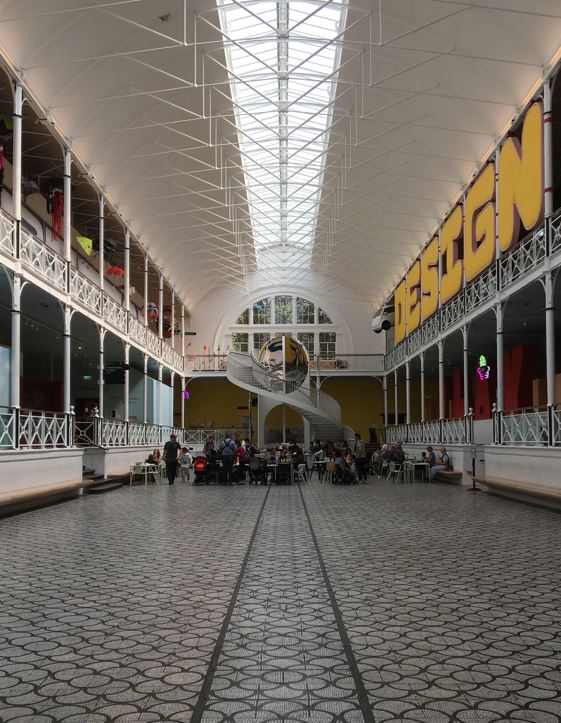
The very open, uncluttered ground floor of Young V&A, just a cafe at the far end (photo by the author)
I remember going to the Childhood Museum decades ago and being disappointed at the array of old dolls in fusty wooded display cases. Nowadays they’ve made a big effort to make as many exhibits as possible interactive, with a build-your-own meccano ball rollerball thing, machines to make patterns in sand and more basic things like tables with pens and paper and stencils (I used one of the stencils to trace a guitar and then draw a silly face on it).
But I’d come to see the ‘Myths to Manga’ exhibition which has been running for almost a year and I’ve kept putting off. For some reason I’d got hung up on the word ‘manga’ and thought it was another manga exhibition which, after the good one at Japan House and the massive one at the British Museum, I was in no special rush to see.
Myths to Manga
But I was wrong. Manga takes up a small, almost imperceptible part of this exhibition. It is more like a review of Japanese myths, legends, folk tales and religion, told through a great miscellany of objects. And, given its location in a children’s museum, I think we can safely assume say that a lot of these objects were not chosen in order to give a dry scholarly overview of the subject, but because they’re FUN!
So, at the interactive end of the show, echoing the emphasis on interactivity in the rest of the museum, there’s a little ‘forest’ area with fake trees and beanbags to lie on and listen to a Japanese folk stories on headphones; there’s an origami table with books on how to do origami and lots and lots of squares of origami paper, and a separate table with paper and pencils and books on how to draw manga characters. And maybe most fun, certainly noisiest, there’s a trio of traditional Taiko drums for small kids to bang the life out of.

Installation view of ‘Japan: Myths to Manga’ at Young V&A. Note the drums on white stands in the foreground, and in centre frame, bean bags around a table covered in paper to do manga (photo by the author)
In display cases there are lots of toys, including Pokemon, Doreamon, Sylvanians, Hello Kitty, maneki-neku, all manner of dolls. There’s a stand of small Transformer toys from the 1980s (‘These are no ordinary toy cars!’) next to a more traditional V&A set of life-sized mannekins modelling the designs of Coco Pink Princess.

Installation view of ‘Japan: Myths to Manga’ at Young V&A showing street fashion designs by Coco Pink Princess (Photo by the author)
There are games and models based on a number of traditional Japanese characters or types of spirit or demons, such as this one about the Yōkai, shapeshifting supernatural beings that include spirits, creatures and demons.

Yokusai display case in ‘Japan: Myths to Manga’ at Young V&A (Photo by the author)
At the big end of the spectrum there are painted screens and decorated kimonos. At the tiny end of the spectrum there are a number of absolutely exquisite netsuke. There are decorated vases, plates and styled shoes. There’s dolls house furniture from the last century next to the model for a Royal Shakespeare Company production of Studio Ghibli films. And talking of films, there are half a dozen monitors showing clips from recent animé movies.

Still from ‘My Neighbour Totoro’ in ‘Japan: Myths to Manga’ at Young V&A © 1988 Studio Ghibli
Themes
How is all this arranged and organised? I’m glad you asked. The curators have taken primal aspects of Japanese (and probably any ancient mythology) and arranged all the exhibits under these great big headings. They are:
- Sky (flying gods, demons and heroes)
- Sun (the country’s name in Japanese, Nihon, means origin of the sun’, so some flags; in the Shinto religion the most important god is Amaterasu no Okami, goddess of the sun)
- Stars (in East Asia the stars Vega and Altair are unlucky lovers, the Cowherd and the Weaver Princess who only meet up once a year when their stars align, an event celebrated in the Tanabata festival)

The Seventh Month from the series the Five Festivals, woodblock print, by Utagawa Kunisada (1830s) in ‘Japan: Myths to Manga’ at Young V&A © Victoria and Albert Museum
- Moon (moon-viewing festivals called otsukimi; in East Asian mythology the moon is home to a white rabbit who makes mochi cakes for everyone)
- Sea Below (mermaids and the amabie, the whiskered catfish namazu)
- Sea Above (14,000 islands, waves, beaches, fishermen)
- Forest (ancient forests full of legendary creatures like the tanuki raccoon dogs and kitsune foxes and heroes with superhuman powers like Momotarō and Princess Kaguya)
- City (400 years ago Tokyo was a small fishing village, now it has a population of 14 million)
- Streets (skyscrapers soaring above Shinto shrines, with old folk stories about the demons which come out at night)
- Home (a place to display a small number of beautifully designed artefacts)
Each theme is explored through half a dozen or so objects of – as I’ve indicated – very varied size, shape and medium.

Part of the ‘Home’ theme, in installation showing examples of manga, anime, videogames, Pokemon, Gameboys and so on, in ‘Japan: Myths to Manga’ at Young V&A (photo by the author)
To take an example utterly at random, the ‘Streets’ section includes a poster using traditional woodprint style to depict a woman so absorbed in her smartphone that she’s about to stumble off the platform at a train station. It’s a 2017 warning poster from the Tokyo subway, ‘Please do not use smartphones while walking’. Puts Transport for London’s poster to shame for style.

‘Please do not use smartphones while walking’, 2017 poster in ‘Japan: Myths to Manga’ at Young V&A © Victoria and Albert Museum
Under each theme there are summaries of traditional Japanese folk stories related to them. These include:
- Amaterasu and the sun
- The Cowherd and the Weaver Princess
- The tale of Urashima Taro
- The tale of the rabbit and the moon
- The wonderful tea-kettle
- The tale of Momotarō
- The tongue-cut sparrow
- The tale of the bamboo cutter
- Seven gods of good fortune
I liked the print of the Seven Gods of Good Fortune, six ugly men and a fair maiden, known for sailing round in a boat. I liked the idea that you should sleep with a picture of the seven gods under your pillow on New Year’s Eve in order to have a lucky year.
I was also very taken with the witch’s shoes. In Shinto, some animals are thought to be messengers of the gods, in particular cockerels and crows. These bird-witched shoes were designed by Masaya Kushino in 2014 using crocodile leather and cockerel feathers.

Bird-witched shoes by Masaya Kushino (2014) in ‘Japan: Myths to Manga’ at Young V&A (photo by the author)
Modern art
In among the toys and models, plates and kimonos, shoes and dresses, there are a number of contemporary works of art which could have dropped here from a completely different, entirely adult exhibition. These included:
- a large black and white photo of magical lights in the forest, Hakkoda #2 by Tokihiro Sato
- a large digital ‘painting’, Tokyo Dizzily Land by Shigetoshi Furutani
- a large sculpture made from car parts, Double Spiral by Keita Miyazaki

Installation view of the Street section of ‘Japan: Myths to Manga’ at Young V&A’, showing (left to right) the smartphone poster, ‘Tokyo Dizzily Land’ by Shigetoshi Furutani and ‘Double Spiral’ by Keita Miyazaki (photo by the author)
Woodblock prints
Lastly, it took a while for me to realise that, in a way, the backbone of the show is provided by a series of beautiful woodblock prints, ranging in date from the 1770s to 1900, but with most of them coming from the 1830s, ’40s and ’50s. These also feel like they come from a different exhibition, a different world, one with far more artistic depth and resonance than the Transformers and Sylvanians. I counted 15 of them, by the following artists:
- Utagawa Hiroshige (7)
- Utagawa Hiroshige II (1)
- Utagawa Kurisada (2)
- Utagawa Kuniyoshi (1)
- Totoya Hokkei (1)
- Ishikawa Toyomasa (1)
- Katsushika Hokusai (1)
- Utagawa Sadahide (1)
Yes, this would be the same Katsushika Hokusai who did the famous Wave and it’s here, Under the Wave off Kanagawa from the series ‘Thirty-six Views of Mount Fuji’.
But although all of them were interesting and half of them were really good, my favourites were both by Utagawa Hiroshige – Star Festival at Yanagishima (1856) and Moonlight at Ryogoku (1856).

Moonlight at Ryogoku by Utagawa Hiroshige in ‘Japan: Myths to Manga’ at Young V&A © Victoria and Albert Museum
Summary
If you’ve got small children they might like the interactive stuff, for a bit. If you’re interested to find out a bit about Japanese culture, their beliefs about the sun, moon, sea and so on, and to learn about some traditional folk stories accompanied by related prints and illustrations, games and toys, then it’s interesting enough. But if you’re an art lover then I think you’d go to see the prints, some of which are really beautiful – and also the half dozen or so miraculously small and intricate netsuke. In the example below, each ‘clam’ is the size of a fingernail. Even with my glasses on I couldn’t see the full details of each carving, it’s a miracle an artist ever carved them, so small, so precise and so beautiful.

Netsuke of clam shells with the eight famous views of Omi by Nagamitsu (1800 to 1850) in ‘Japan: Myths to Manga’ at Young V&A © Victoria and Albert Museum (photo by the author)
Related link
- Japan: Myths to Manga continues at Young V&A until 8 September 2024
 Books & Boots