First World War reviews

Not a recommended reading list, this is just a list of reviews of books I’ve read and exhibitions I’ve visited on the subject of the First World War.

History

Fiction and memoirs

The Good Soldier Švejk

Exhibitions

Ubu Roi by Alfred Jarry (1896)

Executive summary of the Ubu plays

Alfred Jarry’s trilogy of absurdist, scatological plays about the grotesque cartoon figure, Père or Father or Pa Ubu, scandalised theatre-goers at the time (the later 1890s) but were to be revived and lionised by the Surrealists in the 1920s and ’30s, and to become a reference point for the Theatre of the Absurd long after Jarry’s premature death in 1907 at the age of just 34.

Introduction

Starting as a fairly sensible Symbolist writer when the movement was at its peak in the early 1890s, Jarry announced his own bizarre take on the movement in the 1895 play ‘Caesar Antichrist’ before departing the movement altogether, in 1896, with the work that made him immortal, Ubu Roi.

Since ‘roi’ is the French word for ‘king’ the title easily translates as ‘King Ubu’ but a lot of the rest of the play doesn’t translate easily at all. Its language is a unique mix of slang code-words, puns and near-gutter vocabulary, set to strange speech patterns. The tone is established in the very first words of the play – ‘Merdra merdra’ – which aren’t French words at all. They’re distortions of the French word ‘merdre‘ which means ‘shit’.

With its scatological language, its studied disrespect for all conventional language, and its wild absurdist plot studded with atrocities and mass murders, you can see why the first night of Ubu Roi resulted in uproar, the audience (allegedly) coming to blows between supporters and outraged opponents.

Schoolboy origins and puppet performances

Eventually the Ubu oeuvre would end up as three plays and a version with music and songs but it began as schoolboy jokes. In 1888 the 15-year-old Alfred Jarry arrived at the lycée in Rennes and became friends with another boy, Henri Morin. He discovered Henri was part of a group which took the mickey out of the heir well-meaning, but obese and incompetent physics teacher Physics teacher, Monsieur Hébert, known variously as P.H., Pére Heb, Ebé and other nicknames. Henri and his older brother had gone to the trouble of writing a short satire, ‘The Poles’, in which the cartoon figure of le Pere Ebé became King of Poland only to suffer various misfortunes and indignities.

Jarry threw himself into this fictional world and adapted it as a play for marionettes which was performed first at the Morin house then in the Jarry household. Jarry developed some of the themes and characters into a play entirely of his own, Onésime ou les Tribulations de Priou featuring ‘le PH’.

In 1891 the 18-year-old Jarry left Rennes and moved to Paris to attend the Lycée Henri IV to prepare for admission to the École Normale Supérieure. Here he carried on developing the material, rewriting the Morin brothers’ Polish play and his own Onésime, which became Ubu Roi and Ubu Cocu, respectively. These plays he performed with schoolfriends at his Paris lodgings and it was now that the chief protagonist’s name settled as ‘le Père Ubu’. But by now Jarry had his eye set on a literary career.

In 1893 young Jarry managed to get fragments of the plays published in a literary journal. Jarry was becoming known for his poems and short prose pieces. In October 1894 some of these were published in his first book, the ultra-symbolist Minutes de Sable Mémorial. At the end of the year Jarry was briefly called up for military service but his short stature caused ridicule and he was discharged for medical reasons. A year after Minutes his second book was published, César-Antéchrist (1895).

In January 1896 Jarry was introduced to the theatre director Aurélien-Marie Lugné-Poe. In June Lugné-Poe invited Jarry to become a writer-secretary at his theatre and in the same month the text of Ubu Roi was published. Then Ubu Roi had its first stage performance on 10 December 1896, to the accompaniment of shouting, screaming, cheers and jeers and fighting among the audience.

The controversy was picked up in the papers and journals and Jarry became a celebrity overnight. His friends took to jokingly calling him Père Ubu and he copied the manner and ambling walk of his character for their amusement.

As we’ve seen the plays always had a puppet version or equivalent right from their inception as a schoolboy prank. Jarry had it performed as a marionette play at his friend’s and his own house. What’s surprising that this puppet version lived on into the ‘adult’ world. In 1898 a performance by marionettes was given of Ubu Roi at a small theatre owned by none other than the artist Pierre Bonnard.

At this time Jarry finished a new version of Ubu Cocu but failed to find a publisher for it. In fact neither version of Ubu Cocu was published or performed during his lifetime. It was only half a century later, in 1944, that the second version was published. The English essayist and editor Cyril Connolly was the first to publish an English version, in his magazine Horizon in 1945 and went on to become a great promoter of Jarry’s work.

During 1899 Jarry worked on the third play, Ubu Enchaíné (‘Ubu in Chains’). Although published in 1900 this, also, wasn’t to be performed for a long time, not until 1937.

In 1899 and 1901 Jarry published the ‘Illustrated Almanac of Père Ubu’, illustrated by his friend Pierre Bonnard. He also devoted time to rewriting Ubu Roi as a two-act musical with songs. This version mutated sufficiently to be considered the fourth in the series, Ubu sur la Butte. Once again the puppet theme surface because this version was first performed by the marionettes of the Théâtre Guignol des Gueules de Bois in November 1901, although it wasn’t published until 1906, the year before his death.

As the summary shows, after the first scandal of the Roi premier wore off Jarry struggled to get his works either published or performed. He wasn’t exactly a one-hit wonder, because he did have novels, stories and a three-volume fictionalised autobiography published, and he was working all the time as a poet, journalist and literary and art critic. he was a busy bee. He also became a fixture of avant-garde circles, acting as a kind of court jester becoming increasingly reliant on alcohol to fuel his performances.

His other famous achievement was developing the nonsense science of pataphysics, which he defined as the ‘science of imaginary solutions’ which ‘will examine the laws governing exceptions and will explain the universe supplementary to this one’. References to this anti-science cropped up in various works and was given full bizarre expression in Exploits and Opinions of Dr. Faustroll, Pataphysician. But this, also, didn’t see the light of day till after his death, not being published till 1911.

King Ubu

Any prose summary can’t convey how absurd, nonsensical and caricature-like the characters and action are. The best short summary is to think of it as a kind of puppet parody of Macbeth, in which a lazy army officer is encouraged by his scheming wife to assassinate the King of Poland, usurp the throne, and then behave with appalling and wanton cruelty, butchering entire classes before declaring war on Russia.

Act 1

Scene 1: Ubu says he’s content with his position of captain of the dragoons and aide de camp to King Wenceslas while his wife (Ma Ubu) encourages him to assassinate the king and all his heirs and make himself king, plonk his bum on the throne and scoff as many bangers as he wants.

Scene 2: Dining room laid out for a feast. Ma Ubu tells him to wait till the guests arrive but greedy Ubu can’t stop himself tucking into the chicken then the veal.

Scene 3: Captain MacNure and his men arrive for the feast which, Ma Ubu explains, includes ‘Jerusalem fartichokes and cauliflower à la pschitt’. There’s not actually much to eat so Ubu exits and returns holding a toilet brush which he flings at the soldiers. Some of them taste it and collapse from poisoning (or poosening). He then forces all the soldiers out by throwing bison ribs at them.

Scene 4: After the scatological pleasantries:

PA UBU: Well, captain, how did you enjoy your dinner?
CAPTAIN MACNURE: Very much, sir, except for the pschitt.
PA UBU: Oh I didn’t think the pschitt was too bad.

Ubu asks the captain to join his conspiracy to overthrow the king. The captain enthusiastically signs up, revealing he is a mortal enemy of the king. Ubu promises to make him Duke of Lithuania.

Scene 5: A messenger arrives from the king requesting Ubu’s presence and he and Ma panic, thinking their conspiracy has been discovered. ‘Oh pschitt!’

Scene 6: Ubu at court, the king surrounded by his three sons and courtiers, in fact doesn’t suspect a thing, in fact he’s called him in to appoint him Count of Sandomir. Overwhelmed with gratitude (and relief) Ubu gives the king a fine decorated kazoo! The king gives it to his son Boggerlas and invites Ubu to the Grand Review tomorrow. As he turns to go Ubu trips and falls and the king helps him up. Won’t stop him from being ‘liquidated’ Ubu mutters.

Scene 7: A meeting of the conspirators discussing how to kill the king. Ubu suggests they lace his food with arsenic. Captain McNure suggests he cleaves the king from head to toe with his sword. Ubu is momentarily tempted to turn the conspirators in and claim a reward but they all boo so he suggests another plan. He’ll tread on the king’s foot, yell PSCHITT and that will be the signal for the conspirators to attack. Ubu makes them swear an oath.

Act 2

Scene 1: The day of the Grand Review. His queen and eldest son Boggerlas warn him against Ubu but the king insists he’s his most loyal servant. The queen describes a dream she had of the king being killed and thrown into the River Vistula. Irritated, the king says he will attend to the Grand Review without sword or breastplate to prove them wrong and sweeps out with his other sons. The queen and Boggerlas go to the chapel to pray.

Scene 2: The Grand Review. After a few preliminary comments Ubu treads on the king’s foot, shouts pschitt, and the conspirators attack him. Ubu grabs the crown and the king’s two sons flee.

Scene 3: From a balcony the queen and Boggerlas watch all the soldiers chasing the two sons and striking them dead.

Scene 4: The conspirators break into the chapel and confront the queen and Boggerlas. The latter defies them and kills quite a few of them. In face of this Ubu is a terrified coward but inches towards Boggerlas who takes a sword slash at him then escapes with the queen through a hidden passage.

Scene 5: A cave in the mountains where Boggerlas and the queen have retreated. She laments the death of her husband and sons and then collapses dead from grief. Then appear ghosts of the king, his brothers, and the founder of their dynasty (Lord Matthias of Königsberg) who tells Boggerlas to be brave and hands him an immense sword. It’s only during this scene that we’re told that Boggerlas is only 14 years old.

Scene 6: Ubu is now crowned in the king’s stateroom. He is arguing with Ma and the captain. They’re saying he must distribute largesse to the masses or they’ll overthrow him in his turn. He vehemently refuses till the captain explains that with no money the masses won’t pay their taxes. At which point Ubu orders the distribution of millions of gold pieces and the roasting of 50 oxen to feed the mob.

Scene 7: From his balcony King Ubu throws gold to the cheering mob. Captain Macnure suggests organising a race, which they promptly do, the winder winning a chest of gold pieces, the mob cheering and racing and falling over each other in their glee. Bread and circuses.

Act 3

Scene 1: In the palace Ma Ubu reminds Pa Ubu he promised to ennoble the captain. Ubu replies the captain can whistle for his dukedom and Boggerlas can go jump in a lake. Ma Ubu says he’s making a big mistake underestimating his enemies, so Ubu threatens to chop her into little pieces and chases her offstage.

Scene 2: Ubu calls together all the nobles of the land into the Great Hall of the palace and announces that he is going to liquidate them all and confiscate all their wealth. One by one they come forward, identify themselves and Ubu pushes them with a boathook through a trapdoor down into the bleed-pig chambers from where they’ll be led to the cash-room and debrained.

Ubu interrogates four or so, pushing each into the trapdoor, before having his own numerous titles proclaimed. Ma Ubu warns him he is being too brutal. Next he proposes to stop paying the judges and, when they protest, has them all pushed through the hole too, telling Ma Ubu that he will administer justice. Then he proposes a new range of taxes. When the financiers protest he has them all thrown down the hole.

MA UBU: Come, come, Lord Ubu, kings aren’t supposed to behave like that. You’re butchering the whole world.
PA UBU: So pschitt!

Scene 3: In a peasant’s house the peasants exchange the news that the old king’s been murdered, Pa Ubu is king. One of them has just come from Cracow where he saw the bodies of 300 nobles and 500 magistrates that Ubu had killed. At that moment there’s a great banging on the door and Ubu announces he’s come to collect their taxes.

Scene 4: Ubu enters the peasant’s house with ‘an army of moneygrubbers’ then orders his Lords of Phynance (a word which recurs throughout the Ubu oeuvre) to wheel in the phynancial wheelbarrow.

PA UBU: I’ve had it announced in the official gazette that all the present taxes have to be paid twice over, and all those I may think up later on will have to be paid three times over. With this system I’ll soon make a fortune, then I’ll kill everyone in the world and go away.

Goaded beyond endurance the peasants rebel but Ubu has his men massacre them all and burn the village to the ground.

Scene 5: Ubu visits Macnure who he’s had thrown in prison (specifically, ‘the casemate of Thorn’) for raising a rebellion against him. Macnure tells him that in just five days Ubu has more crimes than would damn all the saints in paradise but Ubu mocks him and warns him that the rats at night are very hungry.

Scene 6: Cut to the palace of the Tsar in Moscow. Somehow Macnure escaped the casemate of Thorn and has ridden for five days and five nights to beg the Tsar to come to the aid of the people of Poland. He offers his sword and a map of the city of Thorn. The Tsar accepts him into his service.

Scene 7: Ubu announces to his council that his plans to get rich are working. In every direction are vistas of burning villages and people suffering under his extortions. Now he is going to share a plan he’s conceived to keep rain at bay and bring good weather. Ma Ubu mutters that he’s gone mad and Ubu threatens her.

A messenger enters with a message from Macnure which announces that he is in the service of the Tsar and is going to invade Ubu’s land alongside Boggerlas. Ubu is thrown into a cowardly panic but Ma Ubu counsels war and all his advisers start chanting war war war.

Scene 8: The army camp outside Warsaw. Ubu’s soldiers cheer for him. He puts on a set of complicated armour pieces until he looks like an armour-plated pumpkin. He’s far too fat to get on a small horse and when they lead in a giant horse he keeps falling off. Ubu makes a series of bragging boasts then clatters off. Ma Ubu says that now that overstuffed dummy is out of the way she can kill Boggerlas and get her hands on the treasure herself.

Act 4

Scene 1: Ma Ubu is in the crypt of the kings of Poland in Warsaw cathedral searching for buried treasure. She eventually opens a tomb to find old bones and gold all mixed together and begins extracting it when ghostly sounds and then a voice from the dead terrifies her into running offstage.

Scene 2: In the main square in Warsaw Boggerlas has rallied the surviving nobles and the people to overthrow Ubu. Ma Ubu emerges with her guards and there’s a massive fight. During this her ‘Palcontent’, Gyron (who Jarry specified should be played by a Black man) at first wreaks havoc in the crowd and then is brought down. As the crowd makes to grab Ma Ubu she escapes.

Scene 3: Ubu at the head of his army which has been marching through the Ukraine seeking the Russian army. Ubu is so ludicrously over-armoured that even the big horse couldn’t carry him so he’s been walking and leading it by the reins. A messenger arrives to tell him that, in his absence, there’s been a rebellion in Warsaw, Gyron is killed and Ma Ubu fled to the mountains.

Now his army sights the Russians. Ubu issues fairly reasonable instructions for the order of battle based on the notion that the Polish army will remain on the hilltop and wait for the Russians to come up towards them at which point they’ll cut them down with their artillery. But, nonsensically, as it’s 11 o’clock, instructs the army to have lunch, saying the Russians won’t attack. At that moment a cannon ball goes whizzing by, crashing into the nearby windmill.

Scene 4: Confused melee of the battle in which Ubu is shot, thinks he’s dead but gets up again, while Captain Macnure enters cutting a swathe through the Polish troops till he comes face to face with Ubu. Ubu again shows his cowardice by thinking he’s been hit by another cannonball but Macnure laughs that it was just a cap pistol. Infuriated, Ubu tears him to pieces!

Encouraged by his lead general, General Laski, Ubu throws himself on the Tsar and they have a fierce hand-to-hand fight which the Tsar wins and proceeds to chase Ubu across the battlefield. There’s a trench and Ubu jumps over it while the Tsar falls in.

TSAR: Now I’m in the soup!

Ubu describes the scene of the Tsar getting massacred by Ubu’s soldiers and does it in an elaborately formal and periphrastic style quite unlike anything, deployed for comic or incongruous effect. He then admires his own eloquence. Despite this the Russian soldiers rescue their Tsar and pursue Ubu and his army off-stage.

Scene 5: Finds Ubu holed up in a cave in the mountains with a category of companions called ‘the palcontents’ and humorously named Head and Tails. They mock the way Ubu cowardly fled the battlefield while Ubu describes himself as the hero of the battle, struggling manfully against overwhelming odds.

Scene 6: A bear comes into the cave and attacks Tails while Heads attacks the bear. Ubu, obviously, climbs up a rock out of the way but says he is high-mindedly (and absurdly) offering a prayer to him. Heads and Tails finally overcome and kill the bear as Ubu comes down from his rock delivering another long pompous speech about how he saved the day with his prayers. He sends Tails off to fetch wood and orders Heads to carve up the bear, making sure he himself remains safely distant.

Throughout all this Heads and Tails have been muttering comments about Ubu’s cowardice and now, when he demands a share of the cooked meat, they come out into the open and call him a fat pig, saying he won’t get anything to eat unless he shares in the work.

Deprived of food Ubu beds down and goes to sleep. The other two wonder whether the rumours are true that Ma Ubu was overthrown, and decide to slip off and head for home while Ubu’s asleep.

Scene 7: Ubu talks in his sleep delivering a stream-of-consciousness monologue which includes elements of everything which has happened in the play up to and including the bear fight.

Act 5

Scene 1: It’s night time in the same cave and Ma Ubu enters, not noticing her husband asleep in the corner. She delivers a long monologue recapping her adventures since Ubu left Warsaw, namely: rummaging about in the kings’ crypt; exiting to discover Boggerlas leading rebels in the main square; the resulting fight in which her lover, the Black Gyron was cut down; how she made it to the River Vistula but all the bridges were guarded so she swam across; how she barely escaped the baying mob; how she has trudged through the snow for four days and arrived, starving, at this cave.

With allowance for some of the delivery, this isn’t absurd at all but is the language of the contemporary adventure novel.

At which point Ubu stirs and starts mumbling half awake, obviously starting Ma Ubu who quickly realises who it is, and then decides to take advantage of the situation, puts on a booming voice and pretends to be the archangel Gabriel! She then embarks on the comic enterprise of having the angel Gabriel tell Ubu what a beautiful, charming woman his wife is, an ‘absolute saint’, while Ubu, predictably and to comic effect, rebuts her at every point, describing her as a sexless old hag.

Ma Ubu goes on to tell Ubu he must forgive her for stealing a little bit of his money, but this backfires as it only confirms what Ubu suspected. Moreover dawn is coming up and it’ll soon be light enough in the cave for him to see and recognise her.

And that’s what happens. Ma Ubu tries to brazen it out but Ubu realises it’s her. He asks what happened back in Warsaw and she tells him about the rebellion and how she had to run away from the Poles. Ubu counters that he had to run away from the Russians, just goes to prove what they say, that ‘great minds think alike’.

MA UBU: They can say that if they want, but my great mind thinks it’s just met a pea-brained idiot.

Enraged Ubu throws the bear’s body over her which a) makes Ma Ubu scream that she’s being attacked, and the way her movements seem to be animating the bear b) makes Ubu scream that the bear’s come back to life.

When they both realise they’re wrong she launches a tirade of abuse at him which makes him jump over, force her to her knees, list the tortures he’s about to subject her to, and then start to tear her in pieces when…there’s a loud noise at the entrance to the cave.

Scene 2: Enter Polish soldiers led by Boggerlas who orders them to surrender. Instead Ma and Pa Ubu reply with volleys of abuse and start attacking him, the Polish soldiers attack them and it’s another general melee.

At which point there’s a cry of ‘Long live Pa Ubu’ and Heads, Tails and other Ubuists run into the cave, turning it into a real free-for-all. The Ubuists get the better of it, wounding Boggerlas. Two Poles are guarding the entrance to the cave but Ubu knocks them down with the bear corpse and they escape outside.

Scene 3: Just four lines long as Ma and Pa Ubu struggle across the snow-covered landscape, concluding that Boggerlas has given up chasing them and gone back to Warsaw to be crowned.

Scene 4: Suddenly we are aboard a ship in the Baltic. Pa Ubu makes a nonsensical little speech about the ‘knots’ a ship’s speed is measured in. The sea kicks up and the ship begins leaning. the captain issues sensible orders but Ubu insists on taking over himself and issues a stream of nonsensical, garbled orders to the sailors. In fact his orders are so nonsensical that some of the sailors literally die of laughter.

Several great waves break over the ship as Ubu continues his nonsense. In the last few lines Ma and Pa, Heads and tails all illogically say how they’re looking forward to returning to their native France, Spain, Paris, Germany, only for Pa to conclude.

PA UBU: Beautiful though [Germany] may be, it’s not a patch on Poland. Ah gentlemen, there’ll always be a Poland. Otherwise there wouldn’t be any Poles!

And with this inconsequential thought, the play ends.

Literary references

To augment the mock heroic vibe and absurdity the play contains a surprising number of references to ‘serious’ works of literature. The respected general overthrowing his own king and ruling like a tyrant comes from Macbeth. The various armies traipsing back and forth are reminiscent of Hamlet, a reference which is made explicit when, in the last scene, the ship rounds the Cape of Elsinore (where Hamlet is set). The involvement of a bear could be referencing the famous bear in The Winter’s Tale.

And behind all these smaller references looms the title, which echoes the primary tragedy in all European literature, Sophocles’ play ‘Oedipus Rex’ which translates into French as ‘Œdipe Roi’. This conforms to the very common view, at the end of the nineteenth century and which also informed the first modernists, that the present day is a pathetic echo of the greatness of the past, as Ezra Pound put it, a beer bottle on a pediment.

Thoughts

Well, it’s quite funny in parts and I enjoyed the schoolboy humour but:

1. ‘Ubu Roi’ shows how difficult it is to sustain absurdity. What struck me is how unabsurd most of it is. I mean there’s lots of swearing and made-up words and Ubu is made to sound like a megalomaniacal imbecile and the scenes with the bear and Ma pretending to be the angel Gabriel are farcical enough – but the basic narrative of 1) a coup, 2) the usurper leading an army against the neighbouring country, 3) a counter-coup in the capital city in his absence… Far from being absurd this sounds like the history of too many countries during the twentieth century and of too many post-colonial nations since independence. In other words, many passages of it felt all too realistic.

2. Unfortunately, Jarry’s vision of pointless barbarism was very much overtaken by the events of the twentieth century. Assassinations and coups and the coming to power of brutal tyrants who massacre their own subjects were dwarfed by the horrific regimes of Hitler and Stalin in the mid-century. But as I read the descriptions of Ubu combining real ignorance with terrifying brutality, I couldn’t help thinking of many of the African dictators I was reading about last year, specifically the terrifyingly stupid, cunning and sadistic Idi Amin.

Compared to the real world the Ubu plays come over as what they began as, schoolboy pranks.

Ukraine

Eerie that at the centre of the play is war in Ukraine, then, as now, contested borderlands. Ukraine was destined to be the scene of unbearable suffering in the first half of the twentieth century, long before its present tragedy unfolded.

Influences

I list a few of the artists, musicians and composers who’ve engaged with the Ubu texts in my review of the third play. But here I should mention the splendid American industrial band, Pere Ubu, formed in 1975 and highly influential in the later ’70s and ’80s. They combined fairly standard, if colourful rock grooves with the witch-doctor madness of front man David Thomas. Remember that the first words of Ubu Roi are ‘Merdra, merdra’? Well, they’re refrain of what is maybe Pere Ubu’s best song, Modern Dance (1978).


Credit

I read ‘Ubu Roi’ in the 1968 translation by Cyril Connolly and Simon Watson Taylor, included in ‘The Ubu Plays’, first published by Methuen World Classics in 1968, republished in a new edition in 1993.

Related links

Related reviews

Holocaust reviews

This is not a general reading list or a list of recommended reading, but simply a list of reviews I happen to have written about books (and two exhibitions) directly related to the Holocaust. Hopefully they’re all pretty good books, but the list makes no pretence to be definitive or authoritative.

Memoirs

Fictions

  • Funeral in Berlin by Len Deighton (1964) – contains a description of the death march of prisoners from Treblinka concentration camp at the very end of the war.
  • Fatherland by Robert Harris (1992) – I know it’s a fictional thriller but the first-person description at the end of being ushered into the gas chambers is one of the most vivid and harrowing things I’ve ever read

History

Exhibition


Related link

Ukraine: Photographs from the Frontline by Anastasia Taylor-Lind @ Imperial War Museum London

The Imperial War Museum London is hosting a free exhibition of photos taken in the Ukraine by internationally renowned photojournalist Anastasia Taylor-Lind from the Ukraine. It’s a smallish display, in just one room, of 17 big colour photos.

Maybe the Ukraine came to most people’s notice with Russia’s invasion of 24 February 2022. But something like that doesn’t come out of the blue and in fact Ukraine has been in a low-level war since 2014, the year when a complex political crisis in Ukraine came to a head. This explains why the exhibition is divided into three parts or ‘moments’ and 2014 is the first one:

1. 2014 protests (3 photos)

Background

In 2013 the Ukrainian parliament had overwhelmingly approved finalising a political association and free trade agreement with the European Union (EU), something which marked a decisive shift away from its eastern neighbour, Russia. Russia, for its part, offered Ukraine very favourable trading arrangements, large state loans and brought political pressure to bear on Ukraine’s president, Viktor Yanukovych who, as a result, at the end of 2013 abruptly cancelled the negotiations with the EU and reaffirmed Ukraine’s economic and political ties with Russia.

This led to huge pro-EU protests in Kiev and other Ukrainian cities which turned into violent clashes between protestors and security forces. Government buildings were occupied, there were running street battles, in all over 100 protesters were killed and over 1,000 injured. The protesters opposed what they saw as widespread government corruption and abuse of power, the influence of oligarchs, police brutality, and human rights violations. A large, barricaded protest camp occupied Independence Square in central Kyiv throughout the ‘Maidan Uprising’.

Eventually a bill was introduced into Parliament stripping Yanukovych of the presidency and a few days later another one called for his arrest. He fled to the Russified east of the country. This demonstration of people power came to be referred to as the Revolution of Dignity or the Maidan Revolution.

Photos

Taylor-Lind was in Kiev during the Maidan Revolution and took some cracking photos, in fact the single best image from the exhibition captures the messy defiance of protesters swarming over some grand statuary in central Kiev while thick black smoke from burning tyres gives the scene an apocalyptic vibe.

Anti-government protests, Kyiv, February 2014 © Anastasia Taylor-Lind

The 17 photos in the exhibition can perhaps be sorted into 3 or so categories: one is actuality, snapped on the hoof, as it appears, such as the image above. A completely different type is the photographs Taylor-Lind took in the makeshift studio she created which could be quickly set up in trouble spots. She rigged one up in central Kiev during the revolution and spend weeks photographing hundreds of protesters, including tired, injured Yevhen Shulga.

Yevhen Shulga, Kiev 2014 © Anastasia Taylor-Lind

There are four of these ‘studio’ portraits in the show and, interestingly enough, one of the other three is also of Shulga, but from 2022, showing his transformation from street protester to fully-fledged soldier in the Ukraine Army.

2. 2014 to 2020 the Donbas (4 photos)

Unfortunately, overthrowing an unpopular president wasn’t the end of it, the Maidan Revolution wasn’t as decisive or final as the overthrow of communism had been in Poland, Czechoslovakia and the other Eastern bloc countries 25 years earlier.

Ukraine’s situation is complicated and the war doesn’t make any sense unless you listen to the Russian side. The Russians have a number of grievances. Number one, in deep history, Kiev is actually the spiritual home of the Russian Orthodox Church, for it was here, in 987, that the Kievan Prince Vladimir married the daughter of the Byzantine emperor and concerted, along with all his subjects, to the Orthodox religion. To quote Michael Ignatieff’s excellent study of modern nationalism, ‘Kievan Rus is the beginning of the Russian nationalist experience’ (Blood and Belonging by Michael Ignatieff, 1993, page 87). So there’s a deep Russian nationalistic claim to the capital.

During the nineteenth century the Ukraine was fully incorporated into the Russian Empire and the eastern part of the country heavily settled by Russian speakers. As a result of the Russian Revolution the aristocracy fed and the middle classes expropriated of their land. Between the wars Stalin pushed through the forced collectivisation of the vast fertile farms of central Ukraine and this led to one of the biggest man-made catastrophes of the twentieth century, when as many as 5 million Ukrainians starved to death between 1931 and 1933. The Russians also attempted to exterminate the Ukrainian intelligentsia.

This explains why, when the Nazis invaded as part of their attack on the USSR in June 1941, they were at first greeted as liberators from the yoke of the murderous, semi-genocidal Soviet regime, at least until it became clear that the Nazis were even worse. The whole brutal period is described in Timothy Snyder’s often stomach-churning book.

So Ukrainian nationalists, predominantly in the west of the country, found themselves fighting a three-way war, against the Soviets and against the Nazis and, a few years later, when the resurgent Red Army pressed the Germans back through the Ukraine, many nationalists fought the Russians. In fact Ignatieff says that some nationalist guerrilla forces weren’t completely neutralised until the 1950s. Ukrainian nationalists may remember these forces as heroes but the Russians, of course, lump them together with the Nazi enemy and this gives them a veneer of plausibility when Russian propaganda paints anyone who opposes Moscow’s wishes, right up to the present day, as ‘fascists’.

Back to 2014 and Russia didn’t take the ousting of Viktor Yanukovych lying down. Within a matter of weeks two things happened:

  1. Russia annexed the Crimea
  2. Russia sent paramilitary forces to bolster armed uprisings in the far east of Ukraine, on the Russian border

Bucha, April 2022 © Anastasia Taylor-Lind

1. The annexation of the Crimea

Crimea was part of Russia from 1783, when the Tsarist Empire annexed it a decade after defeating Ottoman forces in the Battle of Kozludzha, until 1954, when the Soviet government transferred Crimea from the Russian Soviet Federation of Socialist Republics to the Ukrainian Soviet Socialist Republic. This in-depth article gives the reasons why.

In summary, 1) the Russians had only just finished managing a violent little civil war in the newly annexed western regions of Ukraine, especially Volynia and Galicia; 2) the new Communist Party boss, Nikita Khrushchev, had himself been head of the CP of Ukraine and knew the republic well; 3) in the 1950s the population of Crimea — approximately 1.1 million — was roughly 75 percent ethnic Russian and 25 percent Ukrainian.

In other words, assigning the Crimea to the Ukraine added nearly a million ethnic Russians to the troublesome Republic. It was a swift, administrative way of increasing the Russian minority in the country.

The downside was that the Crimea is host to Russia’s Black Sea ports and navy. This didn’t matter so long as Ukraine was under the thumb of Russia within the USSR. But amid the chaotic collapse of the Soviet Union in 1991, it was clear to the Russian military (Navy) that handing over Russia’s main Black Sea naval base to a different country was crazy. The status of the Crimean bases remained a source of controversy and tension throughout the 1990s, with Boris Yeltsin and successive leaders negotiating leasing and access deals.

In a way it’s a surprise that a leader as increasingly bullish and nationalistic as Vladimir Putin took until 2014 to annex the Crimea. You can see why, from his point of view, if Ukraine had remained under Yanukovych who would have been cemented to Russia by favourable trade deals, then Putin and the Russian military would have let the negotiated arrangements about Crimea continue; but how, when Yanukovych was overthrown, and the Ukraine parliament made clear its commitment to ally with the West, Putin and the Generals acted.

According to the 2014 census, Crimea had a population of 2.3 million, of whom 68% were Russian and 16% were Ukrainian. So although many in the West and international fora like the UN disapproved of the annexation, you can see both the a) military and b) ethnically nationalist thinking behind the move.

2. The Donbas

Back to the exhibition, the second consequence of the overthrow of President Yanukovych was that Russia supported rebellions against Ukraine’s government in areas along the border. I’ll just quote Wikipedia:

In March 2014, following Ukraine’s Revolution of Dignity, anti-revolution and pro-Russian protests began in Ukraine’s Donetsk and Luhansk oblasts, collectively ‘the Donbas’. These began as Russia invaded and annexed Crimea. Armed Russian-backed separatists seized Ukrainian government buildings in the Donbas and declared the Donetsk and Luhansk republics (DPR and LPR) as independent states, leading to conflict with Ukrainian government forces. Russia covertly supported the separatists with troops and weaponry, only later admitting sending “military specialists”. After a year of fighting, the conflict developed into trench warfare. There were 29 failed ceasefires. About 14,000 people were killed in the war: 6,500 pro-Russian separatist and Russian forces, 4,400 Ukrainian forces, and 3,400 civilians on both sides of the frontline. The vast majority of civilian casualties were in the first year.

Apparently, the conflict was very fierce in 2014 and 15 but then settled down to First World War-style trenches and attrition.

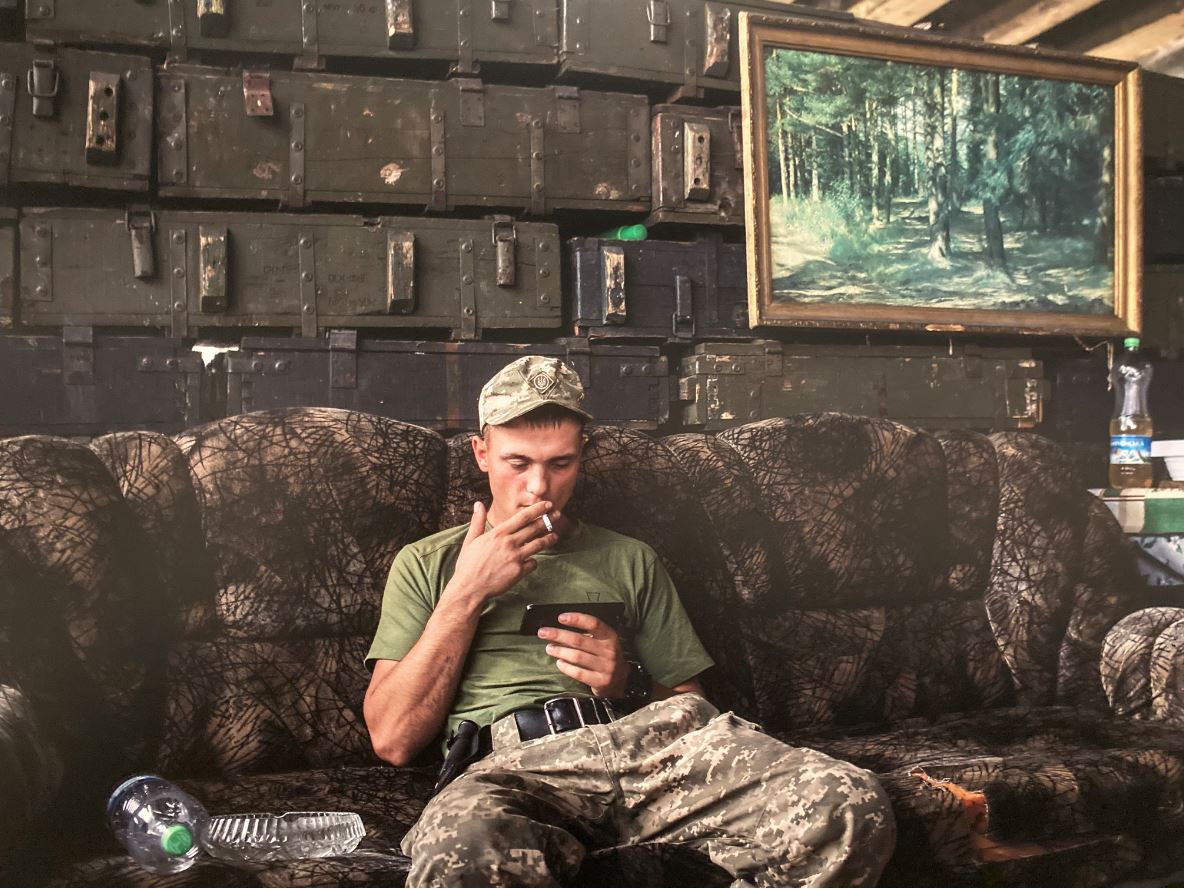
The exhibition includes four photos to cover this prolonged conflict. I mentioned categories of photos, above. The best photo here is an example of a hybrid form, which is posed, but not as posed as a studio photo. This, for me, is arguably the best image in the show.

A Ukrainian soldier, Donbas, 2018 © Anastasia Taylor-Lind

At first I thought this was an interior, and the backdrop was some kind of old wood panelling, fitting for a comfy sofa and a framed oil painting. Only when I looked more closely did I realise that the ‘wall’ is made from a big stack of army ammunition boxes. In fact the wall label explains that the whole thing was set up under a bridge and completely outside. When you look closer you can see the sofa is a bit of old tat with rips in it and the painting is a cheap reproduction in a chipped frame.

So the whole thing represents a complex attempt to recreate the comforts of home in a war zone but is by way of being a sort of trompe l’oeil fabrication which, at the same time, beautifully captures the spirit of invention and blagging which characterises all front lines.

3. Spring 2022 Russian invasion (10 photos)

The third and largest part of the little exhibition contains 10 photos covering aspects of Russia’s invasion of the whole of Ukraine which started on 24 February 2022. By now you can see that this attack didn’t come out of the blue but had deep historical, cultural, political and military roots.

But if annexing the Crimea could, possibly, be justified by ethnic nationalism and politics, a full-scale attack on an independent nation state is clearly in breach of the United Nations charter and international law. It’s has been deplored by the International Court of Justice, the Council of Europe, and the International Criminal Court.

There’s widespread consensus (in the West, at any rate) that Putin intended his forces to mount a pincer movement on Kiev and seize it within a week, presumably intending to force the government of Volodymyr Zelenskyy into exile, whereupon the Russians could impose their own Russia-friendly government and then hold some kind of rigged referendum or plebiscite. Their playbook really hasn’t changed since the deepest communist days of 1956 in Hungary and 1968 in Czechoslovakia.

The most obvious thing about the war is it has revealed how rubbish the Russian army is. Despite the element of surprise and overwhelming superiority of numbers, their advances got bogged down on all fronts. As usual, their leadership was bad and the quality of the average Russian squaddie very poor. Discipline was bad, units fell apart, equipment was inferior to Ukraine’s western kit.

For humanitarians like Taylor-Lind and the IWM the focus is less on the historical and military roots than on the humanitarian tragedy the invasion has triggered. These 10 photos come from spring 2022 i.e. three or four months into the present conflict, and show: a grieving mother; one of Taylor-Lind’s makeshift studio portraits of two adult sisters who have fled the fighting and are now refugees; an older lady taking receipt of a coal delivery (since all the gas pipelines have been blown up).

There’s the shot of the back of a middle-aged woman receiving hospital treatment after a shell exploded in her back garden; there’s a sick old woman with a name tag tied to her wrist who’s being evacuated from a hospital near the front line. There’s a shot of four soldiers digging a defensive trench and another of five soldiers firing a volley over the grave of a local farmer.

There’s a mass grave being excavated at Bucha where the Russians are alleged to have carried out atrocities against civilians, tying their hands behind their backs, torturing them, executing them – a grim roll-call which recalls the behaviour of the Serbs during the Yugoslav Civil wars 30 years ago.

The brutal nature of this kind of hybrid warfare, with its paramilitaries and mercenaries, with its badly-disciplined troops encouraged by their officers to spread terror, hasn’t changed or evolved. Like a plague, like a scourge of God, it just visits different areas and leaves grieving relatives, burned out houses and mass graves. Above all it leaves destruction on an epic scale, and this is the fourth category of photo I’d identify in the exhibition – unpeopled ruins.

A damaged apartment block, Sumy region, April 2022 © Anastasia Taylor-Lind

It’s not so much the deaths which appal me, it’s the unremitting, pointless, futile, death-drive destruction and devastation which forces like the Russians or the 1990s Serbs inflicted everywhere they went. Too weak, badly led and indisciplined to actually win battles, these forces nonetheless have the resources to destroy, mindlessly, pointless, for days and weeks and months, destroying home and offices, infrastructure, power plants, water. If they can’t have it, no-one can. It’s the pathetic infantile, teenage spitefulness of it which is so utterly soul-destroying. What wankers.

P.S.

Every photo has a caption. Initially, I thought these were the words of the people in the picture but, after counting, I note that only four of them are directly quoted, all the other captions are the comments of Anastasia Taylor-Lind or her long-term collaborator and friend, Ukrainian journalist Alisa Sopova. Some of Alisa’s comments are enlarged and painted directly onto the wall to create a textual commentary.

May also be worth commenting that all the text, from the introductory wall label to the photo captions, is bilingual, printed in English and Ukrainian. The curators tell us this is designed to ‘engage directly with the UK’s Ukrainian community’. As a matter of interest I checked and at its peak, in 2019, there were 25,000 Ukrainians in the UK. Since the war that number has been swelled by some 82,000 refugees i.e. a little over 100,000 in total.

The end

I’ve been rereading Michael Ignatieff and Anthony Loyd’s books about the Yugoslav Wars. Ukraine is a different situation but, based on comparable situations in Bosnia in particular, where neither side was strong enough to secure a convincing victory, my guess would be that:

  1. the war drags on throughout 2023
  2. if Western support for Ukraine doesn’t remain high i.e. keeping up a reliable supply of arms and ammunition, then the Russians might score some victories, but
  3. eventually the UN will draw a ceasefire line across the eastern and southern parts of the country, which will remain in Russian hands, and the line will be like the one which divides Cyprus or Korea

It’s hard to imagine Russia seizing the entire country; think of the permanent insurrection and guerrilla war they’d face. On the other hand, it’s hard to imagine Ukrainian forces pushing the Russians right out of their country. So some kind of stalemate / ceasefire / partition seems the most likely outcome. But war is unpredictable, so it’s anybody’s guess.


Related links

More Imperial War Museum reviews

More photography reviews

Ring of Steel by Alexander Watson (2014) and multi-ethnic societies

Mutual suspicion, brinkmanship, arrogance, belligerence and, above all fear were rife in the halls of power across Europe in the summer of 1914. (p.8)

I’m very surprised that this book won the ‘2014 Guggenheim-Lehrman Prize in Military History’ and the ‘Society of Military History 2015 Distinguished Book Award’ because it is not really a military history at all.

It’s certainly an epic book – 788 pages, if you include the 118 pages of notes and 63 pages of bibliography – and it gives an impressively thorough account of the origins, development and conclusion of the First World War, as seen from the point of view of the politicians, military leaders and people of Germany and Austria-Hungary.

More social than military history

But I found it much more of a sociological and economic history of the impact of war on German and Austro-Hungarian society, than a narrative of military engagements.

Watson gives a broad outline of the German invasion of Belgium and northern France, but there are no maps and no description of any of the vital battles, of the Marne or Aisnes or Arras or Ypres. Instead he spends more time describing the impact on Belgian society of the burning of villages and the atrocities carried out by the Germans – in retaliation for what they claimed were guerrilla and francs-tireurs (free-shooter) attacks by civilian snipers.

I was specifically hoping to learn more about the famous three-week-long battle of Tannenberg between Germany and Russia on the Eastern Front, but there is no account of it at all in this book.

Instead Watson gives a detailed description of the impact on society in Galicia and East Prussia of the ruinous and repressive Russian advance. Little or nothing about the fighting, but a mass of detail about the impact on individual villages, towns and cities of being subject to Russian military administration and violence, and a lot about the impact of war on the region’s simmering ethnic tensions. I hadn’t realised that the Russians, given half a chance, carried out as many atrocities (i.e. massacring civilians) and far more forced movements of population, than the Germans did.

Watson does, it is true, devote some pages to the epic battle of Verdun (pp. 293-300) and to the Battle of the Somme (pp. 310-326), but it’s not what I’d call a military description. There are, for example no maps of either battlefield. In fact there are no battlefield maps – maps showing the location of a battle and the deployment of opposing forces – anywhere at all in the book.

Instead, what you do get is lots of graphs and diagrams describing the social and economic impact of war – showing things like ‘Crime rates in Germany 1913-18’, ‘Free meals dispensed at Viennese soup kitchens 1914-18’, ‘German psychiatric casualties in the First and Second Armies 1914-18’ (p.297) and so on. Social history.

Longer than the accounts of Verdun and the Somme put together is his chapter about the food shortages which began to be felt soon after the war started and reached catastrophic depths during the ‘Turnip Winter’ of 1916-17. These shortages were caused by the British naval blockade (itself, as Watson points out, of dubious legality under international law), but also due to the intrinsic shortcomings of German and Austro-Hungarian agriculture, compounded by government inefficiency, and corruption (all described in immense detail on pages 330-374).

So there’s more about food shortages than about battles. Maybe, in the long run, the starvation was more decisive. Maybe Watson would argue that there are hundreds of books devoted to Verdun and the Somme, whereas the nitty-gritty of the food shortages – much more important in eventually forcing the Central Powers to their knees – is something you rarely come across in British texts. He certainly gives a fascinating, thorough and harrowing account.

But it’s not military history. It’s social and economic history.

A lot later in the book Watson gives a gripping account of the German offensive of spring 1918, and then the Allied counter-offensive from July 1918 which ended up bringing the Central Powers to the negotiating table.

But in both instances it’s a very high-level overview, and he only gives enough detail to explain (fascinatingly) why the German offensive failed and the Allied one succeeded – because his real motivation, the meat of his analysis, is the social and political impact of the military failure on German and Austrian society.

Absence of smaller campaigns

Something else I found disappointing about the book was his neglect of military campaigns even a little outside his main concern with German and Austro-Hungarian society.

He gives a thrilling account of the initial Austrian attack on Serbia – which was, after all, the trigger for the whole war – and how the Austrians were, very amusingly, repelled back to their starting points.

But thereafter Serbia is more or less forgotten about and the fact that Serbia was later successfully invaded is skated over in a sentence. Similarly, although the entry of Italy into the war is mentioned, none of the actual fighting between Austria and Italy is described. There is only one reference to Romania being successfully occupied, and nothing at all about Bulgaria until a passing mention of her capitulation in 1918.

I had been hoping that the book would give an account of the First World War in the East, away from the oft-told story of the Western Front: the war in Poland and Galicia and the Baltic States he does cover, but in south-eastern Europe nothing.

The text – as the title, after all, indicates – is pretty ruthlessly focused on the military capabilities, mobilisation, economy and society of Germany and Austria-Hungary.

Ethnic tension

If there’s one theme which does emerge very clearly from this very long book it is the centrality of ethnic and nationalist divisions in the Central Powers themselves, and in the way they treated their conquered foes.

Throughout its examination of the impact of war on German and Austro-Hungarian society – on employment, women’s roles, propaganda, agriculture and industry, popular culture and so on – the book continually reverts to an examination of the ethnic and nationalist fracture lines which ran through these two states.

For example, in the food chapter, there are not only radical differences in the way the German and Austro-Hungarian authorities dealt with the crisis (the effectiveness of different rationing schemes, and so on) but we are shown how different national regions, particularly of Austria-Hungary, refused to co-operate with each other: for example, rural Hungary refusing to share its food with urban Austria.

What emerges, through repeated description and analysis, is the very different ethnic and nationalist nature of the two empires.

Germany

Germany was an ethnically homogeneous state, made up overwhelmingly of German-speaking ethnic Germans. Therefore the fractures – the divisions which total war opened up – tended to take place along class lines. Before the war the Social Democrat Party (much more left-wing than its name suggests) had been the biggest socialist party in Europe, heir to the legacy of Karl Marx which was, admittedly, much debated and squabbled over. However, when war came, Watson shows how, in a hundred different ways, German society closed ranks in a patriotic display of unity so that the huge and powerful SDP, after some debate, rejected its pacifist wing and united with all the other parties in the Reichstag in voting for the war credits which the Chancellor asked for.

Watson says contemporary Germans called this the Burgfrieden spirit of the time, meaning literally ‘castle peace politics’. In effect it meant a political policy of ‘party truce’, all parties rallying to the patriotic cause, trades unions agreeing not to strike, socialist parties suspending their campaign to bring down capitalism, and so on. All reinforced by the sense that the Germans were encircled by enemies and must all pull together.

Typical of Watson’s social-history approach to all this is his account of the phenomenon of Liebesgaben or ‘love gifts’ (pp.211-214), the hundreds of thousands of socks and gloves and scarves knitted and sent to men at the front by the nation’s womenfolk, and the role played by children in war charities and in some war work.

He has three or four pages about the distinctive development of ‘nail sculptures’, figures of soldiers or wartime leaders into which all citizens in a town were encouraged to hammer a nail while making a donation to war funds. Soon every town and city had these nail figures, focuses of patriotic feeling and fundraising (pp. 221-225).

Watson is much more interested by the impact of war on the home front than by military campaigns.

Austria-Hungary

The spirit of unity which brought Germany together contrasts drastically with the collapse along ethnic lines of Austria-Hungary, the pressures which drove the peoples of the empire apart.

The Empire was created as a result of the Compromise of 1867 by which the Austrians had one political arrangement, the Hungarians a completely different one, and a whole host of lesser ethnicities and identities (the Czechs, and Poles in the north, the Serbs and Greeks and Croats and Bosnians in the troublesome south) jostled for recognition and power for their own constituencies.

Watson’s introductory chapters give a powerful sense of the fear and anxiety stalking the corridors of power in the Austro-Hungarian Empire well before the war began. This fear and anxiety were caused by the succession of political and military crises of the Edwardian period – the Bosnia Crisis of 1908, the First and Second Balkan Wars of 1911 and 1912, the rising voices of nationalism among Czechs in the north and Poles in the East.

To really understand the fear of the ruling class you have to grasp that in 1914 there was a very clear league table of empires – with Britain at the top followed by France and Germany. The rulers of Austria-Hungary were petrified that the collapse and secession of any part of their heterogenous empire would relegate them to the second division of empires (as were the rulers of Russia, as well).

And everybody knew what happened to an empire on the slide: they had before them the examples of the disintegrating Ottoman and powerless Chinese empires, which were condemned to humiliation and impotence by the Great Powers. Austria-Hungary’s rulers would do anything to avoid that fate.

But Watson shows how, as soon as war broke out, the empire instead of pulling together, as Germany had, began dividing and splitting into its component parts. Vienna was forced to cede control of large regions of the empire to the local governments which were best placed to mobilise the war effort among their own peoples.

This tended to have two consequences:

  1. One was to encourage nationalism and the rise of nationalist leaders in these areas (it was via wartime leadership of the Polish Legions, a force encouraged by Vienna, that Józef Piłsudski consolidated power and the authority which would enable him to establish an independent Poland in 1918, and successfully defend its borders against Russian invasion in 1920, before becoming Poland’s strongman in the interwar period).
  2. The second was to encourage inter-ethnic tension and violence.

The difference between homegeneous Germany and heterogeneous Austria-Hungary is exemplified in the respective nations’ responses to refugees. In Germany, the 200,000 or so refugees from Russia’s blood-thirsty invasion of East Prussia were distributed around the country and welcomed into homes and communities all over the Reich. They were recipients of charity from a popular refugee fund which raised millions of marks for them. Even when the refugees were in fact Polish-speaking or Lithuanians, they were still treated first and foremost as Germans and all received as loyal members of the Fatherland (pp. 178-181).

Compare and contrast the German experience with the bitter resentment which greeted refugees from the Russian invasion of the Austro-Hungarian border region of Galicia. When some 1 million refugees from Galicia were distributed round the rest of the empire, the native Hungarians, Austrians or Czechs all resented having large number of Poles, Ruthenians and, above all, Jewish, refugees imposed on their communities. There was resentment and outbreaks of anti-refugee violence.

The refugee crisis was just one of the ways in which the war drove the nationalities making up the Austro-Hungarian empire further apart (pp. 198-206).

Two years ago I read and was appalled by Timothy Snyder’s book, Bloodlands, which describes the seemingly endless ethnic cleansing and intercommunal massacres, pogroms and genocides which took place in the area between Nazi Germany and Stalin’s Russia in the 1930s.

Watson’s book shows how many of these tensions existed well before the First World War – in the Balkans they went back centuries – but that it was the massive pan-European conflict which lifted the lid, which authorised violence on an unprecedented scale, and laid the seeds for irreconcilable hatreds, particularly between Germans, Poles, Ukrainians, Russians and Jews.

The perils of multi-ethnic societies

Although I bet Watson is a fully paid-up liberal (and his book makes occasional gestures towards the issue of ‘gender’, one of the must-have topics which all contemporary humanities books have to include), nonetheless the net effect of these often harrowing 566 pages of text is to make the reader very nervous about the idea of a multinational country.

1. Austria-Hungary was a rainbow nation of ethnicities and, under pressure, it collapsed into feuding and fighting nationalities.

2. Russia, as soon as it invaded East Prussia and Galicia, began carrying out atrocities against entire ethnic groups classified as traitors or subversives, hanging entire villages full of Ukrainians or Ruthenians, massacring Jewish populations.

3. The to and fro of battle lines in the Balkans allowed invading forces to decimate villages and populations of rival ethnic groups who they considered dangerous or treacherous.

Austro-Hungarian troops hanging unarmed Serbian civilians (1915)

Austro-Hungarian troops hanging unarmed Serbian civilians (1915) No doubt ‘spies’ and ‘saboteurs’

In other words, everywhere that you had a mix of ethnicities in a society put under pressure, you got voices raised blaming ‘the other’, blaming whichever minority group comes to hand, for the catastrophe which was overtaking them.

Unable to accept the objective truth that their armies and military commanders were simply not up to winning the war, the so-called intelligentsia of Austria-Hungary, especially right-wing newspapers, magazines, writers and politicians, declared that the only reason they were losing must be due to the sabotage and treachery of traitors, spies, saboteurs and entire ethnic groups, who were promptly declared ‘enemies of the state’.

Just who was blamed depended on which small powerless group was ready to hand, but the Jews tended to be a minority wherever they found themselves, and so were subjected to an increasing chorus of denunciation throughout the empire.

Ring of Steel is a terrible indictment of the primitive xenophobia and bloodlust of human nature. But it is also a warning against the phenomenon that, in my opinion, has been ignored by generations of liberal politicians and opinion-formers in the West.

For several generations we have been told by all official sources of information, government, ministries, and all the media, that importing large groups of foreigners can only be a good thing, which ‘enriches’ our rainbow societies. Maybe, at innumerable levels, it does.

But if you import several million ‘foreigners’, with different coloured skins, different languages, cultures and religions into Western Europe – and then place the societies of the West under great economic and social strain thanks to an epic crash of the financial system, well..

You get the rise of right-wing, sometimes very right-wing, nationalist parties – in Russia, in Poland, in Hungary, in Germany, Sweden and Denmark, in Italy, in France, in Britain and America – all demanding a return to traditional values and ethnic solidarity.

I’m not saying it’s right or wrong, I’m just saying the evidence seems to be that human beings are like this. This is what we do. You and I may both wish it wasn’t so, but it is so.

In fact I’d have thought this was one of the main lessons of history. You can’t look at the mass destruction of the Napoleonic Wars and say, ‘Well, at least we’re not like that any more’. You can’t look at the appalling suffering created by industrialisation and say, ‘Well, at least we’re not like that any more’. You can’t look at the mind-blowing racist attitudes I’ve been reading about in the American Civil War and say, ‘Well, at least we’re not like that any more’. You can’t look at the mad outbreak of violence of the First World War and the stubborn refusal to give in which led to over ten million men being slaughtered and say, ‘Well, at least we’re not like that any more’. You can’t look at the Holocaust and say, ‘Well, at least we’re not like that any more’.

We cannot be confident that human nature has changed at all in the intervening years.

In just the last twenty years we have all witnessed the savagery of the wars in former Yugoslavia, the Rwandan genocide, the genocide in Darfur, the 9/11 attacks, the wars in Iraq and Afghanistan, the failure of the Arab Springs and the civil wars in Syria and Libya, the rise of ISIS, the war in Yemen, the genocide of Rohingya Muslims in Myanmar, renewed civil war in Sudan and now the war in Ukraine.

If all these conflicts prove anything, they prove that —

WE ARE STILL LIKE THAT

We are just like that. Nothing has changed. Given half a chance, given enough deprivation, poverty and fear, human beings in any continent of the world will lash out in irrational violence which quickly becomes total, genocidal, scorched earth, mass destruction.

In the West, in Britain, France, Germany or America, we like to think we are different. That is just a form of racism. In my opinion, we are not intrinsically different at all. We are just protected by an enormous buffer of wealth and consumer goods from having to confront our basest nature. The majority of the populations in all the Western nations are well off enough not to want, or to allow, any kind of really ethnically divisive politics or inter-ethnic violence to take hold.

Or are they?

Because creating multi-ethnic societies has created the potential for serious social stress to exacerbate racial, ethnic and nationalist dividing lines which didn’t previously exist. When I was growing up there was no such thing as ‘Islamophobia’ in Britain. 40 years later there are some 2.8 million Muslims in Britain, some 5% of the population – and I read about people being accused of ‘Islamophobia’, or Muslims claiming unfair discrimination or treatment in the media, almost every day.

It’s not as if we didn’t know the risks. I lived my entire life in the shadow of ‘the Troubles’ in Northern Ireland which were based entirely on ethnic or communal hatred. And now not a day passes without a newspaper article bewailing how Brexit might end the Good Friday Agreement and bring back the men of violence. Is the peace between the ethnic groups in Northern Ireland really that fragile? Apparently so. But British governments and the mainland population have always had an uncanny ability to sweep Ulster under the carpet and pretend it’s not actually part of the UK. To turn our backs on 40 years of bombings and assassinations, to pretend that it all, somehow, wasn’t actually happening in Britain. Not the real Britain, the Britain that counts. But it was.

Anyway, here we are. Over the past 40 years or so, politicians and opinion makers from all parties across the Western world have made this multicultural bed and now we’re all going to have to lie in it, disruptive and troubled though it is likely to be for the foreseeable future.

Conclusion

Although it certainly includes lots of detail about the how the societies of the Central Powers were mobilised and motivated to wage total war, and enough about the military campaigns to explain their impact on the home front, overall Watson’s book is not really a military history of the Central Powers at war, but much more a social and economic history of the impact of the war on the two empires of its title.

And in the many, many places where he describes ethnic and nationalist tensions breaking out into unspeakable violence, again and again, all over central and eastern Europe, Watson’s book – no doubt completely contrary to his intentions – can very easily be read as a profound historical argument against the notion of a multicultural, multi-ethnic society.


First World War reviews

Revolution: Russian Art 1917 to 1932 @ the Royal Academy

1. The historical context

The best book about the Russian Revolution I know of is Orlando Figes’ epic history, A People’s Tragedy: The Russian Revolution, 1891 to 1924. There is no end to the poverty, misery and bloodshed it recounts. Russia was an astonishingly backward, primitive country in 1917. On top of the vast population of serfs living in their primitive wood huts in a hundred thousand muddy villages, sat the class of landowners in their country estates, serviced by local doctors and lawyers. These bourgeois aspired to the fine things enjoyed by the upper classes in the handful of notable cities – Kiev, Petersburg, Moscow. They are the class portrayed in the plays of Anton Chekov (1860 to 1904).

In these big cities the fabulously wealthy aristocracy mingled with a small class of intellectuals – Russians called them the intelligentsia – who congratulated themselves on the flourishing of the arts which transformed Russian cultural life in the late 19th century, and was evolving quickly as the new century dawned. (Many of these artists, writers and impresarios were depicted in the wonderful ‘Russia and the Arts’ held last spring at the National Portrait Gallery.)

But when the weak Czar Nicholas II took Russia into the Great War in 1914, the weakness of Russia’s economy and industrial ability was painfully highlighted. Troops with few modern weapons, uniforms or equipment were quickly defeated by the German army. Among his many mistakes, the Czar took personal responsibility for the running of the war. There were soon food shortages and other privations on top of national humiliation at the many defeats. The surprise is that it took until spring 1917 for the Czar’s government to be overthrown and the Czar was forced to abdicate.

The provisional government which came to power in February 1917 was competing from the start against workers councils, or soviets, which claimed genuine authority, and were dominated by communists. The provisional government made the mistake of continuing the war and this, along with worsening privations and its own internal squabbles, led to its overthrow in October 1917, in a revolution spearheaded by Lenin’s Bolsheviks.

The Bolsheviks made good on their popular promise to bring the war to an end, immediately began negotiating with the Germans and signed the Treaty of Brest-Litovsk in March 1918. But it was only the end of one kind of violence, for a massive civil war broke out in Russia, with so-called ‘White Armies’ led by Russian generals, fighting against what became known as the ‘Red Army’, manned and staffed by everyone who wanted to overthrow the rotten old regime.

After initial setbacks, the Red Army became better organised and slowly crushed their opponents. In 1920 Lenin ordered part of it to advance westwards through Poland with the aim of linking up with communist forces in the post-war chaos of Germany, and spreading the Bolshevik revolution right across Europe.

The heroic Poles fought the Soviets to a standstill at the Battle of Warsaw (described in Adam Zamoyski’s excellent book, Warsaw 1920), forcing the Red Army back onto Russian soil and, for the time being, curtailing the Bolsheviks’ messianic dream of leading a World Revolution.

During these years of tremendous upheaval and turmoil, the liberal or left-leaning intelligentsia experienced a wave of euphoria and optimism. There was a tremendous sense of throwing off the shackles and restrictions of nineteenth-century, personal, subjective, ‘bourgeois’ art. Artists and theoreticians rejected all its aesthetic and cultural and moral values in the name of creating a completely new art which would be for the people, the masses, communal art, popular and accessible art which would depict the exciting possibilities of the New Society everyone would build together. This led to radical new ways of seeing and creating, the cross-fertilisation of traditional artistic media with new forms, an explosion of avant-garde painting, music, architecture, film, agitop theatre for workers in factories and so on.

It is perfectly possible to be amazed, stunned and overwhelmed at the outburst of experimentation and exuberance and optimism expressed by artists across all media in the decade after the revolution – but still to be uncomfortably aware of the sub-stratum of revolutionary violence which it was based on and, in some cases, glorified.

And also to be bleakly aware that the death of Lenin in 1924 set the scene for the inexorable rise of the tyrant Josef Stalin. In fact the revolution was characterised from the start by the criminal stupidity of Soviet economics and social policy, which almost immediately resulted in worsening shortages of food and all other essentials. But laid on top of this was Lenin’s deliberate use of ‘revolutionary violence’ to intimidate and often, to simply arrest and execute anyone opposing the regime – violence which was taken up and deployed on an increasingly mass scale by Stalin later in the 1920s.

It was the combination of incompetence and slavish obedience to party diktat which led to the horrors of the Ukraine famine in the early 1930s (graphically described by Timothy Snyder in his book Bloodlands: Europe between Hitler and Stalin) and crystallised into Stalin’s mass purges of the 1930s and the creation of a huge network of labour camps across frozen Siberia, the infamous gulag archipelago. This economically incompetent tyranny was forcibly imposed onto the nations of Eastern Europe after the Second World War, and was then exported to China (which fell to Mao’s communists in 1949) and on into other developing countries (Korea, Vietnam) with catastrophic results.

It was the historical tragedy of countless colonised countries in the so-called developing world,  that when they sought their independence after the Second World War, it was in a world bitterly divided between a brutal communist bloc and an unscrupulous capitalist West, thus forcing them to choose sides and turning so many of the liberation struggles into unnecessarily protracted civil wars, covertly funded by both sides in the Cold War.

And then, after one final, brutal fling in Afghanistan (comprehensively described in Afgantsy: The Russians in Afghanistan, 1979 to 1989 by Rodric Braithwaite), the entire Soviet Union collapsed, communism ceased to be a world power, and Russia emerged from the wreckage as an authoritarian, nationalist bandit-state.

2. Atrocity and accountability

This long, sorry saga started 100 years ago this year and we can’t un-know what we all know about its grim legacy – i.e the mass slaughter of the mid-twentieth century, followed by decades of repression and decline. And this exhibition is frank about that.

  • A whole section is devoted to the collapse of pure communism in the very early 1920s and the way Lenin was forced to reintroduce some elements of market capitalism in his New Economic Plan of 1922.
  • Later, a room is dedicated to the forced collectivisation of agriculture – and the discrepancy between the heroic posters and silent movies showing happy, smiling peasants swimming in lakes of milk and climbing mountains of grain – while the actual peasants were, of course, in many places starving, killing their livestock and eating their seed grain rather than have it ‘stolen’ by the state and its often corrupt agents.
  • And at the very end of the exhibition there is a gruesome conjunction of state propaganda films of healthy young men and women putting on acrobatic displays in Red Square – contrasted with a slide show of mugshots of some of the millions and millions of Russian citizens who were arrested, interrogated, tortured, dragged off to labour camps for decades or simply executed, mostly on trivial or invented charges. All overseen by the man who, by the end of the period covered by this exhibition, was emerging as the Soviet Union’s brutal lord and master, Stalin.

Russian revolutionary art, the exhibition

This is an epic exhibition about an epic subject, a huge and seismic historical and social event, the creation of the ideology which disfigured and scarred the 20th century, leading directly to countless millions of avoidable deaths. But nobody at the time knew that. The exhibition makes a heroic attempt to reflect the contradictions, capturing the huge wave of euphoric invention which swept through all the arts, alongside the doubts many artists and creators had from quite early on, reflecting the revolution’s early economic failures, and then the looming growth of Stalin’s influence.

For example, an entirely new form of typography was developed with new fonts laid in bands across the page, often at angles, with photographs which were similarly taken from new and exciting angles, especially of new modernist buildings and the paraphernalia of the second industrial revolution – steelworks, electricity pylons, steam trains.

Some of the most appealing exhibits are the clips from heroic black-and-white propaganda films from the period, depicting smiling workers engaged in bracing physical labour, in shipyards and coalmines and construction sites, on farms and factories. Propaganda it obviously is, but they still have a wonderful virile energy.

Films, lots of photographs, paintings, magazines and pamphlets, along with revolutionary textiles, fabrics and ceramics, architectural and interior design, it is all here in overwhelming profusion, and all are introduced with excellent historical background and explanation.

1. Avant-garde versus traditional naturalism

I knew that by the mid-1930s the doctrine of ‘Socialist Realism’ had triumphed as the official state-sanctioned form of Soviet art. But the exhibition for the first time explained to me how forms of realistic, figurative painting depicting heroic moments and the heroic leaders of the revolution existed right from the start – it wasn’t artificially created by Stalin and his henchmen, it was always there. Thus there were two main groups debating the fate of Soviet art throughout the period – futurists and traditionalists – and they co-existed at the same time.

The Futurists, many of whom had in fact been experimenting with abstract ‘formalist’ art since before the revolution, believed that the revolution required a complete break with the past, the deliberate abandonment of traditional aesthetic values and modes. ‘Death to art!’ wrote Alexei Gan in his 1922 book on constructivism. At the 1921 exhibition 5 x 5 = 25 Alexander Rodchenko presented three canvases, each of a single colour (red, yellow and blue), which he declared to be ‘the end of painting’. He abandoned painting in favour of photography and, even here, pioneered new forms of photojournalism, photomontage and book and poster design.

Not only was painting rejected on aesthetic grounds, but on moral and political ones, too. Old fashioned painting carried the connotation of subjectivity and individual genius, both of which were rejected in the name of capturing the new spirit of the people. Moreover, oil painting was also inextricably linked with the world of the ‘fine’ arts, wealth, power, patrons and exploiters.

By contrast, traditionalists believed in the ongoing importance of realistic representations of everyday life in a highly traditional figurative style, perhaps cranked up with a kind of heroic tone.

What’s fascinating is the way both traditions flourished side by side. Thus the exhibition opens with some big paintings depicting the unquestioned hero of the revolution, Vladimir Ilyich Ulyanov, as well as key historical moments such as the storming of the Czar’s Winter Palace and so on.

V.I.Lenin and Manifestation (1919) by Isaak Brodsky. The State Historical Museum. Photo © Provided with assistance from the State Museum and Exhibition Center ROSIZO

V.I. Lenin and Manifestation (1919) by Isaak Brodsky. The State Historical Museum. Photo © Provided with assistance from the State Museum and Exhibition Center ROSIZO

By 1928 the Soviet government was strong enough to repeal the New Economic Plan (a kind of state capitalism which they’d been forced to introduce in the early 1920s to stop the economy collapsing). The NEP was ended and 1928 was the year which saw the first of Stalin’s Five Year Plans. The resulting clampdown on market enterprises ended support for avant-garde fringe groups who found it harder to get sponsors or exhibit their works. Meanwhile, the realist artists found themselves enjoying greater official recognition and support.

This exhibition ends in 1932, the year the term ‘socialist realism’ was first officially used. The proletarian writer Maxim Gorky published a famous article titled ‘Socialist Realism’ in 1933 and by 1934 Anatoly Lunacharsky, the commissar in charge of art, had laid down a set of guidelines for socialist realist art. Henceforward all Soviet art works must be:

  1. Proletarian: art relevant to the workers and understandable to them.
  2. Typical: scenes of everyday life of the people.
  3. Realistic: in the representational sense.
  4. Partisan: supportive of the aims of the State and the Party.

It was the death knell of the entire innovative field of futurist, constructivist, supermatist and all other forms of avant-garde experimental art. It was the triumph of the philistines.

Bolshevik (1920) by Boris Mikailovich Kustodiev. State Tretyakov Gallery. Photo © State Tretyakov Gallery

Bolshevik (1920) by Boris Mikailovich Kustodiev. State Tretyakov Gallery. Photo © State Tretyakov Gallery

In fact, this exhibition is itself based on one that was actually held in 1932 in the Soviet Union. Titled Fifteen Years of Artists of the Russian Soviet Socialist Republic, it contained works from all the disparate traditions which had flourished between 1917 and 1932. Many of the works which appeared in that 1932 exhibition are being shown here. However, the Royal Academy show isn’t nearly as big as the original (some 200 works compared with the original’s 2,640 by 423 artists!) – and it also includes photos, posters, films, ceramics and so on – a far wider range of media – which weren’t in the original.

The 1932 exhibition marked the defeat of the entire futurist-modernist tradition in Russia. The same year saw the incorporation of all independent artistic groups and movements into the state-controlled Union of Artists. Private galleries were all closed down, replaced by State-sponsored exhibitions. From now on it was impossible to be an artist or make any money unless it was working on state-commissioned, state-approved projects. Many of the avant-garde saw their work banned, were thrown out of work or, at worst, were arrested, imprisoned or even executed.

One of the great poets of the time, Alexander Blok, had died in 1921, already disillusioned by the direction the revolution was taking. ‘Blok’s death signified the beginning of the end of artistic freedom in Russia.’ The hugely influential Futurist poet Vladimir Mayakovksy, who had devoted so much energy not only to revolutionary poems but to a new type of agitprop poster (many included here) committed suicide in 1930. The curator of the 1932 exhibition on which this one is based, Nikolay Punin, was arrested and sent to a labour camp. Later the poet Osip Mandelstam was arrested and sent to a prison camp in 1938, where he died. The innovative theatre designer Vsevolod Meyerhold was arrested, tortured and shot by firing squad in February 1940.

The modernist poet Anna Akhmatova – her first husband killed by the security services as early as 1921, her second husband and son imprisoned in the gulag – went into her long period of internal dissidence, during which she produced some of the great poems which captured the atmosphere of mourning and loss under the Stalin dictatorship.

2. Famous artists

The exhibition includes some marvellous works by painters we are familiar with in the West: there are several examples of the fabulous zoomorphic abstractions of Wassily Kandinsky (who had the good sense to leave Soviet Russia in 1920, moving to Germany to become a leading light of the famous Bauhaus of art and design).

Blue Crest (1917) by Wassily Kandinsky. State Russian Museum, St. Petersburg. Photo © 2016, State Russian Museum, St. Petersburg

Blue Crest (1917) by Wassily Kandinsky. State Russian Museum, St. Petersburg. Photo © 2016, State Russian Museum, St. Petersburg

There are also a few of the wonderful dreamy fantasies of Marc Chagall, a kind of Douanier Rousseau of the Steppe (he hailed from the provincial town of Vitebsk in modern Belarus). Chagall was doubly fortunate – as both a Jew and an experimental artist – to survive Soviet Russia (he left for Paris in 1923) and the Holocaust (he fled France in 1941, one step ahead of the Nazis) and to live to the ripe old age of 97. A rare happy ending, which suits his gay and colourful paintings.

Promenade (1917-18) by Marc Chagall. State Russian Museum, St. Petersburg. Photo © 2016, State Russian Museum, St. Petersburg © DACS 2016

Promenade (1917 to 1918) by Marc Chagall. State Russian Museum, St. Petersburg. Photo © 2016, State Russian Museum, St. Petersburg © DACS 2016

3. Kazimir Malevich

In the 1932 exhibition which this show is based on, Russian avant-garde painter had an entire room devoted to him. The RA exhibition recreates it.

Malevich (as we learned from the fabulous Tate Modern exhibition in 2014, and the Black Square exhibition held at the Whitechapel Gallery in spring 2015) thought intensively about representation and art. He wanted to ‘free art from the dead weight of the real world’, and boiled all art down to a kind of ground zero – his famous black square, painted in 1915. A painting is no longer a window into anything, a view of anything: it is an abstract arrangement of shapes and colours which does its own work.

From this reductio ad absurdum he then built up a particular version of modernism which he called Suprematism, embodied in a series of works which use geometric shapes criss-crossing on the picture plane to generate purely visual feelings of dynamism and excitement. The colours have no tone or shading, so there is no sense of a light source or their existence in three dimensions. There is no perspective so no sense of how the objects relate to each other, if at all.

I liked the Kandinskys in the previous room, but for me they were eclipsed by the power and beauty of Malevich’s abstracts. These have a tremendous force and impact. For some reason to do with human psychology and perception, they just seem right.

However, as the doctrine of Socialist Realism took hold, Malevich found it expedient in the 1930s to retreat from pure Suprematism and to return to a kind of figurative painting. Figurative but with a very abstract flavour, not least in his use of blank eggs for heads, or very simplified heads painted in bright colour stripes. Socialist realism, Jim, but not as we know it.

The Malevich room here uses photographs of the 1932 hang to recreate it as nearly as possible, with the famous Black Square and its partner Red Square in the middle, flanked by suprematist works, with an outer circle of the strange 1930s automaton paintings, and then a set of display cases showing the white models, the skyscraper-like maquettes of abstract forms, which Malevich called ‘architektons’. It’s almost worth visiting the exhibition for this one room alone.

Here is one of Malevich’s later, semi-figurative works.

Peasants (c. 1930) by Kazimir Malevich. State Russian Museum, St. Petersburg. Photo © 2016, State Russian Museum, St. Petersburg

Peasants (c. 1930) by Kazimir Malevich. State Russian Museum, St. Petersburg. Photo © 2016, State Russian Museum, St. Petersburg

4. Constructivism

But there are many, many more works here – exciting modernist newspaper, magazine and book designs; clips from quite a few black-and-white propaganda and fiction movies (there are several split screen projectors showing scenes from the epic films of Sergei Eisenstein); agitprop posters and pamphlets, including the revolutionary graphic design of El Lissitzky.

‘The Constructivists compared the artist to an engineer, arranging materials scientifically and objectively, and producing art works as rationally as any other manufactured object.’ (Tate website).

This aesthetic, based on industrial designs and materials and workers, underpinned much of the work of the period and spread beyond Russia, into Germany and France and some extent the USA, because an explosion of new industrial techniques, with new products and designs was part of the spirit of the age.

There are even fabrics and ceramics which carried revolutionary slogans and images; huge paintings; photos of leading artists, directors, theatre designers and poets from the era.

5. Photography

Photography was perhaps the medium best suited to capturing revolutionary conditions.

  • Obviously enough, it was faster than painting – a photo could be published in newspapers, posters or pamphlets the same day it was taken.
  • Also, photos are, on the face of it, more truthful and ‘realistic’ than painting, capturing a likeness or a situation with an honesty and immediacy which painting can’t match. As Alexander Rodchenko put it, ‘It seems that only the camera is capable of reflecting contemporary life’.
  • In the hands of constructivist or futurist photographers, photographs also turn out to be the perfect medium for conveying the geometric or abstract quality of industrial machinery, and the bold new architecture of soaring factories, apartment blocks, electricity pylons and all the other paraphernalia of a peasant society forced to industrialise at breakneck speed.

Thus swathes of propaganda photography showing men and machinery in dynamic semi-abstract images of tremendous power.

A little more traditional is the photographic portrait. There is a sequence of works by Moisei Nappelbaum, a fabulously brilliant portrait photographer, who was working before the revolution and managed to survive the new circumstances, eventually becoming Head of the State Photographic Studio.

But at the same time as it could convey a ‘realist’ vision of the world, photography during  this period turned out to be capable of all kinds of technical innovations and experiments. A leading figure in both constructivist design and experimental photography was Alexander Rodchenko.

6. Movies

The most famous Soviet director was Sergei Eisenstein so there are inevitably clips from his epic films about key moments in the revolution – Battleship PotemkinThe Strike.

But there are plenty of other examples of propaganda films. One of the most striking is Man with a Movie Camera, an experimental 1929 silent documentary film with no story and no actors, directed by Dziga Vertov and edited by his wife Elizaveta Svilova. Man with a Movie Camera shows city life in Kiev, Kharkov, Moscow and Odessa. From dawn to dusk Soviet citizens are shown at work and at play, and interacting with the machinery of modern life. The ‘characters’, if there are any, are the cameramen, the film editor, and the modern Soviet Union they present in the film.

The film is famous for the range of cinematic techniques Vertov uses, including double exposure, fast motion, slow motion, freeze frames, jump cuts, split screens, Dutch angles, extreme close-ups, tracking shots, footage played backwards, stop motion animations and self-reflexive visuals.

The film was publicised with a suitably constructivist poster.

7. Less well-known artists

So far, so well-known. But completely new to me were the works of the artists working more in the Socialist Realist tradition, a whole area which is usually ignored in 20th century art history. Many, it must be said, are very so-so.

Probably the most impressive is Isaak Brodsky, who established himself as a kind of court painter to the Bolsheviks, and produced works which are both wonderfully accurate masterpieces of draughtsmanship, combined with great technical finish with the medium of oil – a kind of communist John Singer Sargent. I like Victorian realism and so I responded to the warmth and figurative accuracy of these works.

Brodsky flourished under the new regime and would go on to become Director of the All-Russian Academy of Arts in 1934.

Another figure who we get to know throughout the exhibition, is Alexander Deineka, according to Wikipedia ‘one of the most important Russian modernist figurative painters of the first half of the 20th century’. His paintings are big and are a unique and distinctive combination of figurative depiction of the human body in attractively abstract settings.

Deineka’s paintings aren’t exactly pleasing, but are very striking. This one, supposedly of workers in a textile factory, doesn’t look remotely like any real factory and the people are hardly the big muscular men of Soviet propaganda, but rather fey elfin figures (bare footed!). The whole looks more like a science fiction fantasy than a work of ‘socialist realism’.

Textile Workers (1927) by Alexander Deineka. State Russian Museum, St. Petersburg. Photo © 2016, State Russian Museum, St. Petersburg © DACS 2016

Textile Workers (1927) by Alexander Deineka. State Russian Museum, St. Petersburg. Photo © 2016, State Russian Museum, St. Petersburg © DACS 2016

Later in the exhibition there are more Deinekas, some depicting heroic war situations, others depicting sportsmen and women.

An entire room is devoted to 15 or so paintings by Kuzma Petrov-Vodkin, who is little known in the West. Petrov-Vodkin managed to combine a formalist interest in geometry with a recognisably figurative approach, a bit like the later Wyndham Lewis. He is included by the curators precisely to redress the balance away from the avant-garde artists we in the West tend to know about, and to present a better sense of the Russian culture of the time. His paintings are wonderfully attractive.

And towards the end there was a flurry of realist works by another big name of the day, Alexander Somokhvalov:

Somokhvalov is in the final room, which represents the triumph of Socialist Realism: Is it kitsch? Is it rubbish? Possibly. Is it valuable in its own right, or because it sheds light on the ideology of the time?

Taken together, these relatively unknown Socialist Realist painters certainly provide a different vision, a way of looking at the world aslant from the usual Western heroes of modernism we’re used to. Giving them space and attention is one of this fabulous exhibition’s main achievements.

8. Tatlin’s glider

The Royal Academy is a big building and they’ve really gone to town here, filling the space with some monster exhibits. One entire room is devoted to a lifesize recreation of one of the glider-cum-flying machines developed by futurist designer, Vladimir Tatlin, between 1929 and 1932. Tatlin dreamed of building a machine which would genuinely allow humans – all humans – cheaply and easily to – fly! Hard to conceive a more utopian dream than this.

The glider is suspended from the ceiling and imaginatively lit so that, as it slowly rotates in the breeze, a continually changing matrix of shadows is cast by its elaborate wooden struts onto the walls and ceiling, forming ever-changing shapes and patterns. It’s a darkened, quiet and calming room. Small children came into the room and looked up at this strange flying machine with amazement. It reminds you that quite a few of these artists’ output may look radical and revolutionary, urban and atheist, but that they themselves often came from a deeply spiritual place: Tatlin, Kandinsky, Malevich.

9. Revolutionary fabrics

Vast amounts of fabrics and textiles were produced which contained and distributed revolutionary logos and imagery, incorporating wonderfully powerful constructivist motifs.

10. Soviet women

There are lots of strong women in Soviet art (as in Soviet life). They often feature or star in movies like Women of Ryazan (1927) as well as in countless posters and paintings hymning the gender equality which was an important component of Soviet life.

My favourite, and a standout work in the whole exhibition, was this stunning piece, a huge painting of a woman tram ticket collector titled Tram Ticket Lady, by Alexander Samokhvalov (1894 to 1971). It is enormous and enormously compelling – a wonderful picture of female pagan power.

Conclusion

This is a huge, wide-ranging and awe-inspiring exhibition, which does a good job of capturing the excitement and terror of one of the most important periods in human history and one of the most innovative eras in Western art.

Artists to remember


Related links

Reviews

Reviews of books about communism and the Cold War

Reviews of other Russian art exhibitions

More Royal Academy reviews

Bloodlands: Europe between Hitler and Stalin by Timothy Snyder (2010)

In the middle of Europe in the middle of the twentieth century, the Nazi and Soviet regimes murdered some 14 million people.

In 400 pages of densely packed text, illustrated by numerous maps, backed up by 40 pages of bibliography and 40 pages of notes, American historian Timothy Snyder places the Holocaust within the broader context of the planned and institutionalised mass murder of civilians undertaken by the Soviet and Nazi regimes between 1933 and 1945.

The Ukraine famine

Snyder points out that Stalin and the Soviet apparat began killing people in bulk before Hitler even became Chancellor. In fact Hitler’s rise to power in January 1933 coincided with, and helped to conceal from public interest, the vast famine Stalin caused in the Ukraine which led to the deaths of over three million people. Hunger was the most consistent tool used by both dictatorships to kill millions, as many as seven million victims in all.

The Nazi Hunger Plan

I don’t think I knew about the Nazis’ Hunger Plan, a deliberate scheme to starve to death all the Russians in the area they invaded in the first winter of the attack on Russia (1941). Hitler intended to destroy Poland and Russia as states, exterminate their ruling classes and intelligentsia and then, in that first winter of conquest, deliberately starve some 30 million Slavs to death. Tens of millions more would have been killed or enslaved in what would have become permanent slave colonies supplying the Fatherland.

Nazi mass murder of Soviet POWs

Snyder calls Operation Barbarossa – the Nazi invasion of Russia – a ‘fiasco’ for the complete dysjunction between plan and achievement: Russia didn’t collapse, the Red Army fought on with growing confidence, and the Nazis didn’t seize vast stocks of food to feed their army and people, as they had planned.

What they could do was starve to death the Russians under their control and so they did. Russian POWs were corralled into prisoner of war camps which were mostly just barbed wire fencing around empty fields, with no toilets or shelter and no food. Here Russian POWs were crammed, sometimes packed so tight they couldn’t move, let alone sit – and then left to die, the living skeletons trampling over the growing mound of corpses. Snyder describes these (as all the other killing methods) in unsparing detail. Over three million Russian POWs are estimated to have died of starvation and exposure, as deliberate German policy.

The scale of the killing, the number of individual tragedies encompassed by these numbers, dwarfs anything else in human history until the great disasters of Mao’s China in the 50s and 60s.

A hecatomb of examples

  • The flower of Belorusia’s literary culture deliberately exterminated: 218 of the country’s leading writers were all executed.
  • Ten thousand Poles of the officer class executed in the Katyn Forest, followed by mass killing of schoolteachers. The Nazi plan was for Polish children to be brought up to understand enough German to obey orders and to count to 20. Nothing more. A slave nation.
  • Between 1931 and 1933 over three million Ukrainian peasants were deliberately left to starve once it became clear that Stalin’s policy of forced collectivisation of Ukraine’s farms had backfired and catastrophically reduced, not increased, harvests. Cannibalism became widespread, parents ate their children, children ate their parents, brothers ate sisters. Visitors to the region became used to seeing bloated corpses littering the streets. NKVD and communist officers were given quotas of peasant ‘saboteurs’ and ‘spies’ i.e. anyone who complained about starving to death – to be captured, interrogated and shot, so industrial killing was added to mass starvation.
  • But the Russians did it to themselves, too. During the great leap forward of the Soviet collectivisation of agriculture, over five million starved across the USSR in 1932 and 1933. Starved to death.
  • When the NKVD ran low on bullets they made prisoners sit side by side so one bullet could be fired through two or more skulls simultaneously, then tipped the corpses into mass graves.
  • Order 00447 ‘On the operations to repress former kulaks, criminals, and other anti-Soviet elements’ (dated 30 July 1937) led to the execution of nearly 400,000 Soviet citizens in 18 months in 1937 and 1938.
  • It ran concurrently with order 00485, mandating the ‘total liquidation of the networks of spies of the Polish Military Organisation’, issued 11 August 1937. Quotas were issued to all NKVD offices throughout the USSR to capture, interrogate, despatch to the gulag or just execute a fixed number per week; if you didn’t fulfil your quota you yourself would be arrested. Since there was in fact no Polish Military Organisation, the NKVD had to manufacture networks of spies by arresting anyone with a Polish name, who had Polish relatives, had ever been to Poland or worked for Poles, then extracting confessions under torture, then executing them to fulfil their quotas.
  • Evgenia Babushkina wasn’t Polish, she was a promising organic chemist, but her mother had once been washerwoman for Polish diplomats and so she was arrested and shot. One of millions.
  • Sometimes more than a thousand death warrants were signed by NKVD authorities per day, and then rubberstamped en masse by their superiors. It was hard to find secure places to execute so many people, and vast areas of mass graves had to be organised outside major settlements throughout the USSR. Work work work.

I gave up listing even random examples. There are too many, too many statistics on every page. Thirty-three thousand seven hundred and sixty-one people, the entire Jewish population of Kiev, were forced to march to the Jewish graveyard where they were stripped of their valuables and clothes, forced to lie face down on the still warm corpses beneath them, and machine gunned through the head. Then another line. Then another. Then another. For years. In Europe’s killing fields.

Snyder has a way with days, with the way figures per day bring home the horror.

  • On any given day in the second half of 1941, the Germans shot more Jews than had been killed in all the pogroms in the whole history of the Russian Empire. (p.227)
  • On any given day in autumn 1941, as many Soviet prisoners of war died as the total British and American POW deaths in the entire war. (p.182)

Comment

This book sheds new light on well-known events because:

  • it brings together into one gruesome continuum Soviet and Nazi killing, usually kept separate
  • it uses newly accessible and translated archives all across Eastern Europe and Russia to give a detailed account of Soviet mass murder, and to put precise numbers to the Nazi killings
  • its focus on the Bloodlands – a broad loop of territory from the Baltic republics (Estonia, Latvia, Lithuania) down through Poland and East through the Ukraine to the Black Sea – unifies the story and shows how the competing dictatorships learned from each other, shared murder techniques and bureaucratic procedures

It is a transformative book, completely reshaping how you think about these events, placing them in completely new contexts and prompting new thoughts and insights, not least about the dictators’ aims and strategies and how these changed in the stressed, pressure-cooker atmosphere of the 1930s.

In its thoroughness and its presentation of unstoppable facts and statistics of mass murder on every page, it drives the reader down and and further down into the deepest pits of hell, till you almost feel like one of the countless thousands, tens of thousands, of children thrown alive into the death pits and buried alive by the bulldozers. Why anybody would ever think well of humanity ever again defeats me.

Utopias of blood

But mostly this book reinforces the terrible truth that all powerful leaders with utopian visions for transforming societies, always seem to start by having to murder some, then many, and then millions and millions, of their own citizens in order to get to the Promised Land of their dreams – a utopian fantasy which they never, in fact, reach. By the time they’re done all they leave behind is mountains of skulls – in Poland, Ukraine, Belarusia, China, Cambodia, Rwanda.

Building a paradise on earth is difficult, given that even building a house is demanding, raising healthy, happy children is well nigh impossible. But burning down houses, villages, entire towns – shooting, gassing and starving unarmed civilians. Easy peasy. The lazy way out.

Snyder’s long concluding chapter engages with various commentators on modernity or the industrial state or theorists of totalitarianism like Hannah Arendt. But maybe maybe all this evil really just stems from laziness and stupidity: neither Stalin nor Hitler were great thinkers, they were great manipulators of people’s stupid fears and stupid utopian hopes: ‘if only we can get rid of the Jews-kulaks-saboteurs-right deviationists etc, we’ll all be rich, everything will be better, we can sleep safe in our beds.’

And so they tried to get rid of the bourgeoisie in Mao’s China and the urban intellectuals in Pol Pot’s Cambodia and the Tutsis in Rwanda and the Croats and Bosnians in Greater Serbia, and now they are trying to get rid of the ‘infidel’ in the ‘caliphate’.

Primitive tribal fear of ‘the other’, shaped by dictators into genocidal violence. And when you’ve killed this lot of suspects and things don’t get better, well, it must be because of deeper conspiracies, of darker forces undermining the Volk or the People or whatever gibberish you’ve manipulated your people into worshiping – and that calls for another round of purges, killing and purification, until the cycle of mass murder becomes a self-fulfilling machine.

The hardest thing for humans seems to be accepting the otherness of other people, other beliefs and other traditions, of living and letting live. Truly tolerant and multicultural states seem to be among the hardest to create and the most liable to collapse. I’m thinking about the Ottoman empire in its heyday and the Austro-Hungarian empire, ramshackle entities which seemed to allow a tremendous diversity of peoples to live together, grumbling and complaining but tolerating each other.

But almost any state, anywhere, ever, would be better than the hell on earth created by Hitler and Stalin in Eastern Europe in the 1930s.


Related links