
The Imperial War Museum London is hosting a free exhibition of photos taken in the Ukraine by internationally renowned photojournalist Anastasia Taylor-Lind from the Ukraine. It’s a smallish display, in just one room, of 17 big colour photos.
Maybe the Ukraine came to most people’s notice with Russia’s invasion of 24 February 2022. But something like that doesn’t come out of the blue and in fact Ukraine has been in a low-level war since 2014, the year when a complex political crisis in Ukraine came to a head. This explains why the exhibition is divided into three parts or ‘moments’ and 2014 is the first one:
1. 2014 protests (3 photos)
Background
In 2013 the Ukrainian parliament had overwhelmingly approved finalising a political association and free trade agreement with the European Union (EU), something which marked a decisive shift away from its eastern neighbour, Russia. Russia, for its part, offered Ukraine very favourable trading arrangements, large state loans and brought political pressure to bear on Ukraine’s president, Viktor Yanukovych who, as a result, at the end of 2013 abruptly cancelled the negotiations with the EU and reaffirmed Ukraine’s economic and political ties with Russia.
This led to huge pro-EU protests in Kiev and other Ukrainian cities which turned into violent clashes between protestors and security forces. Government buildings were occupied, there were running street battles, in all over 100 protesters were killed and over 1,000 injured. The protesters opposed what they saw as widespread government corruption and abuse of power, the influence of oligarchs, police brutality, and human rights violations. A large, barricaded protest camp occupied Independence Square in central Kyiv throughout the ‘Maidan Uprising’.
Eventually a bill was introduced into Parliament stripping Yanukovych of the presidency and a few days later another one called for his arrest. He fled to the Russified east of the country. This demonstration of people power came to be referred to as the Revolution of Dignity or the Maidan Revolution.
Photos
Taylor-Lind was in Kiev during the Maidan Revolution and took some cracking photos, in fact the single best image from the exhibition captures the messy defiance of protesters swarming over some grand statuary in central Kiev while thick black smoke from burning tyres gives the scene an apocalyptic vibe.

Anti-government protests, Kyiv, February 2014 © Anastasia Taylor-Lind
The 17 photos in the exhibition can perhaps be sorted into 3 or so categories: one is actuality, snapped on the hoof, as it appears, such as the image above. A completely different type is the photographs Taylor-Lind took in the makeshift studio she created which could be quickly set up in trouble spots. She rigged one up in central Kiev during the revolution and spend weeks photographing hundreds of protesters, including tired, injured Yevhen Shulga.

Yevhen Shulga, Kiev 2014 © Anastasia Taylor-Lind
There are four of these ‘studio’ portraits in the show and, interestingly enough, one of the other three is also of Shulga, but from 2022, showing his transformation from street protester to fully-fledged soldier in the Ukraine Army.
2. 2014 to 2020 the Donbas (4 photos)
Unfortunately, overthrowing an unpopular president wasn’t the end of it, the Maidan Revolution wasn’t as decisive or final as the overthrow of communism had been in Poland, Czechoslovakia and the other Eastern bloc countries 25 years earlier.
Ukraine’s situation is complicated and the war doesn’t make any sense unless you listen to the Russian side. The Russians have a number of grievances. Number one, in deep history, Kiev is actually the spiritual home of the Russian Orthodox Church, for it was here, in 987, that the Kievan Prince Vladimir married the daughter of the Byzantine emperor and concerted, along with all his subjects, to the Orthodox religion. To quote Michael Ignatieff’s excellent study of modern nationalism, ‘Kievan Rus is the beginning of the Russian nationalist experience’ (Blood and Belonging by Michael Ignatieff, 1993, page 87). So there’s a deep Russian nationalistic claim to the capital.
During the nineteenth century the Ukraine was fully incorporated into the Russian Empire and the eastern part of the country heavily settled by Russian speakers. As a result of the Russian Revolution the aristocracy fed and the middle classes expropriated of their land. Between the wars Stalin pushed through the forced collectivisation of the vast fertile farms of central Ukraine and this led to one of the biggest man-made catastrophes of the twentieth century, when as many as 5 million Ukrainians starved to death between 1931 and 1933. The Russians also attempted to exterminate the Ukrainian intelligentsia.
This explains why, when the Nazis invaded as part of their attack on the USSR in June 1941, they were at first greeted as liberators from the yoke of the murderous, semi-genocidal Soviet regime, at least until it became clear that the Nazis were even worse. The whole brutal period is described in Timothy Snyder’s often stomach-churning book.
So Ukrainian nationalists, predominantly in the west of the country, found themselves fighting a three-way war, against the Soviets and against the Nazis and, a few years later, when the resurgent Red Army pressed the Germans back through the Ukraine, many nationalists fought the Russians. In fact Ignatieff says that some nationalist guerrilla forces weren’t completely neutralised until the 1950s. Ukrainian nationalists may remember these forces as heroes but the Russians, of course, lump them together with the Nazi enemy and this gives them a veneer of plausibility when Russian propaganda paints anyone who opposes Moscow’s wishes, right up to the present day, as ‘fascists’.
Back to 2014 and Russia didn’t take the ousting of Viktor Yanukovych lying down. Within a matter of weeks two things happened:
- Russia annexed the Crimea
- Russia sent paramilitary forces to bolster armed uprisings in the far east of Ukraine, on the Russian border

Bucha, April 2022 © Anastasia Taylor-Lind
1. The annexation of the Crimea
Crimea was part of Russia from 1783, when the Tsarist Empire annexed it a decade after defeating Ottoman forces in the Battle of Kozludzha, until 1954, when the Soviet government transferred Crimea from the Russian Soviet Federation of Socialist Republics to the Ukrainian Soviet Socialist Republic. This in-depth article gives the reasons why.
In summary, 1) the Russians had only just finished managing a violent little civil war in the newly annexed western regions of Ukraine, especially Volynia and Galicia; 2) the new Communist Party boss, Nikita Khrushchev, had himself been head of the CP of Ukraine and knew the republic well; 3) in the 1950s the population of Crimea — approximately 1.1 million — was roughly 75 percent ethnic Russian and 25 percent Ukrainian.
In other words, assigning the Crimea to the Ukraine added nearly a million ethnic Russians to the troublesome Republic. It was a swift, administrative way of increasing the Russian minority in the country.
The downside was that the Crimea is host to Russia’s Black Sea ports and navy. This didn’t matter so long as Ukraine was under the thumb of Russia within the USSR. But amid the chaotic collapse of the Soviet Union in 1991, it was clear to the Russian military (Navy) that handing over Russia’s main Black Sea naval base to a different country was crazy. The status of the Crimean bases remained a source of controversy and tension throughout the 1990s, with Boris Yeltsin and successive leaders negotiating leasing and access deals.
In a way it’s a surprise that a leader as increasingly bullish and nationalistic as Vladimir Putin took until 2014 to annex the Crimea. You can see why, from his point of view, if Ukraine had remained under Yanukovych who would have been cemented to Russia by favourable trade deals, then Putin and the Russian military would have let the negotiated arrangements about Crimea continue; but how, when Yanukovych was overthrown, and the Ukraine parliament made clear its commitment to ally with the West, Putin and the Generals acted.
According to the 2014 census, Crimea had a population of 2.3 million, of whom 68% were Russian and 16% were Ukrainian. So although many in the West and international fora like the UN disapproved of the annexation, you can see both the a) military and b) ethnically nationalist thinking behind the move.
2. The Donbas
Back to the exhibition, the second consequence of the overthrow of President Yanukovych was that Russia supported rebellions against Ukraine’s government in areas along the border. I’ll just quote Wikipedia:
In March 2014, following Ukraine’s Revolution of Dignity, anti-revolution and pro-Russian protests began in Ukraine’s Donetsk and Luhansk oblasts, collectively ‘the Donbas’. These began as Russia invaded and annexed Crimea. Armed Russian-backed separatists seized Ukrainian government buildings in the Donbas and declared the Donetsk and Luhansk republics (DPR and LPR) as independent states, leading to conflict with Ukrainian government forces. Russia covertly supported the separatists with troops and weaponry, only later admitting sending “military specialists”. After a year of fighting, the conflict developed into trench warfare. There were 29 failed ceasefires. About 14,000 people were killed in the war: 6,500 pro-Russian separatist and Russian forces, 4,400 Ukrainian forces, and 3,400 civilians on both sides of the frontline. The vast majority of civilian casualties were in the first year.
Apparently, the conflict was very fierce in 2014 and 15 but then settled down to First World War-style trenches and attrition.
The exhibition includes four photos to cover this prolonged conflict. I mentioned categories of photos, above. The best photo here is an example of a hybrid form, which is posed, but not as posed as a studio photo. This, for me, is arguably the best image in the show.
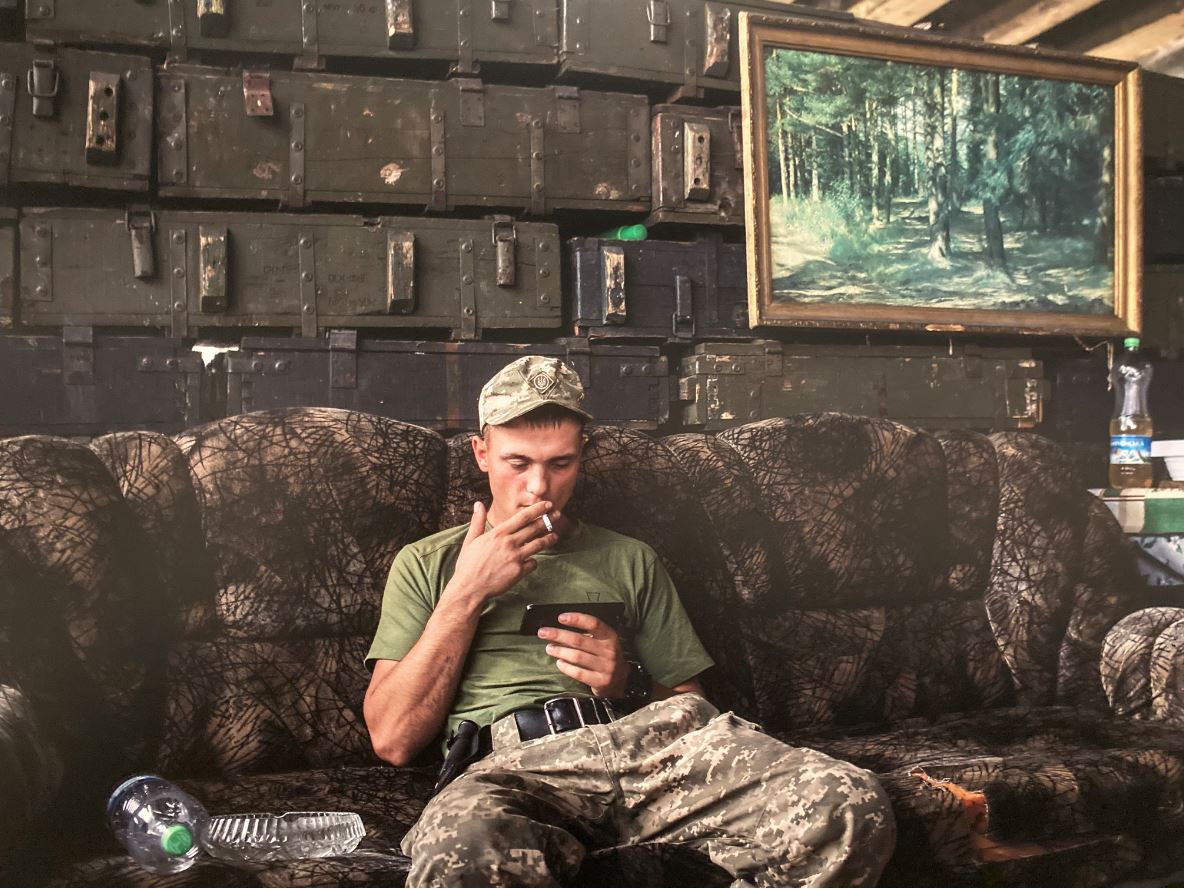
A Ukrainian soldier, Donbas, 2018 © Anastasia Taylor-Lind
At first I thought this was an interior, and the backdrop was some kind of old wood panelling, fitting for a comfy sofa and a framed oil painting. Only when I looked more closely did I realise that the ‘wall’ is made from a big stack of army ammunition boxes. In fact the wall label explains that the whole thing was set up under a bridge and completely outside. When you look closer you can see the sofa is a bit of old tat with rips in it and the painting is a cheap reproduction in a chipped frame.
So the whole thing represents a complex attempt to recreate the comforts of home in a war zone but is by way of being a sort of trompe l’oeil fabrication which, at the same time, beautifully captures the spirit of invention and blagging which characterises all front lines.
3. Spring 2022 Russian invasion (10 photos)
The third and largest part of the little exhibition contains 10 photos covering aspects of Russia’s invasion of the whole of Ukraine which started on 24 February 2022. By now you can see that this attack didn’t come out of the blue but had deep historical, cultural, political and military roots.
But if annexing the Crimea could, possibly, be justified by ethnic nationalism and politics, a full-scale attack on an independent nation state is clearly in breach of the United Nations charter and international law. It’s has been deplored by the International Court of Justice, the Council of Europe, and the International Criminal Court.
There’s widespread consensus (in the West, at any rate) that Putin intended his forces to mount a pincer movement on Kiev and seize it within a week, presumably intending to force the government of Volodymyr Zelenskyy into exile, whereupon the Russians could impose their own Russia-friendly government and then hold some kind of rigged referendum or plebiscite. Their playbook really hasn’t changed since the deepest communist days of 1956 in Hungary and 1968 in Czechoslovakia.
The most obvious thing about the war is it has revealed how rubbish the Russian army is. Despite the element of surprise and overwhelming superiority of numbers, their advances got bogged down on all fronts. As usual, their leadership was bad and the quality of the average Russian squaddie very poor. Discipline was bad, units fell apart, equipment was inferior to Ukraine’s western kit.
For humanitarians like Taylor-Lind and the IWM the focus is less on the historical and military roots than on the humanitarian tragedy the invasion has triggered. These 10 photos come from spring 2022 i.e. three or four months into the present conflict, and show: a grieving mother; one of Taylor-Lind’s makeshift studio portraits of two adult sisters who have fled the fighting and are now refugees; an older lady taking receipt of a coal delivery (since all the gas pipelines have been blown up).
There’s the shot of the back of a middle-aged woman receiving hospital treatment after a shell exploded in her back garden; there’s a sick old woman with a name tag tied to her wrist who’s being evacuated from a hospital near the front line. There’s a shot of four soldiers digging a defensive trench and another of five soldiers firing a volley over the grave of a local farmer.
There’s a mass grave being excavated at Bucha where the Russians are alleged to have carried out atrocities against civilians, tying their hands behind their backs, torturing them, executing them – a grim roll-call which recalls the behaviour of the Serbs during the Yugoslav Civil wars 30 years ago.
The brutal nature of this kind of hybrid warfare, with its paramilitaries and mercenaries, with its badly-disciplined troops encouraged by their officers to spread terror, hasn’t changed or evolved. Like a plague, like a scourge of God, it just visits different areas and leaves grieving relatives, burned out houses and mass graves. Above all it leaves destruction on an epic scale, and this is the fourth category of photo I’d identify in the exhibition – unpeopled ruins.

A damaged apartment block, Sumy region, April 2022 © Anastasia Taylor-Lind
It’s not so much the deaths which appal me, it’s the unremitting, pointless, futile, death-drive destruction and devastation which forces like the Russians or the 1990s Serbs inflicted everywhere they went. Too weak, badly led and indisciplined to actually win battles, these forces nonetheless have the resources to destroy, mindlessly, pointless, for days and weeks and months, destroying home and offices, infrastructure, power plants, water. If they can’t have it, no-one can. It’s the pathetic infantile, teenage spitefulness of it which is so utterly soul-destroying. What wankers.
P.S.
Every photo has a caption. Initially, I thought these were the words of the people in the picture but, after counting, I note that only four of them are directly quoted, all the other captions are the comments of Anastasia Taylor-Lind or her long-term collaborator and friend, Ukrainian journalist Alisa Sopova. Some of Alisa’s comments are enlarged and painted directly onto the wall to create a textual commentary.
May also be worth commenting that all the text, from the introductory wall label to the photo captions, is bilingual, printed in English and Ukrainian. The curators tell us this is designed to ‘engage directly with the UK’s Ukrainian community’. As a matter of interest I checked and at its peak, in 2019, there were 25,000 Ukrainians in the UK. Since the war that number has been swelled by some 82,000 refugees i.e. a little over 100,000 in total.
The end
I’ve been rereading Michael Ignatieff and Anthony Loyd’s books about the Yugoslav Wars. Ukraine is a different situation but, based on comparable situations in Bosnia in particular, where neither side was strong enough to secure a convincing victory, my guess would be that:
- the war drags on throughout 2023
- if Western support for Ukraine doesn’t remain high i.e. keeping up a reliable supply of arms and ammunition, then the Russians might score some victories, but
- eventually the UN will draw a ceasefire line across the eastern and southern parts of the country, which will remain in Russian hands, and the line will be like the one which divides Cyprus or Korea
It’s hard to imagine Russia seizing the entire country; think of the permanent insurrection and guerrilla war they’d face. On the other hand, it’s hard to imagine Ukrainian forces pushing the Russians right out of their country. So some kind of stalemate / ceasefire / partition seems the most likely outcome. But war is unpredictable, so it’s anybody’s guess.
Related links
- Ukraine: Photographs from the Frontline continues @ the Imperial War Museum to 8 May 2023


 Books & Boots