Selected Essays by Virginia Woolf – 4. Looking On

‘… to give up this arduous game… of assembling things that lie on the surface…’
(Woolf describing the effort required to hold her mind together, in ‘Flying over London’, page 211)

‘Mental fight means thinking against the current, not with it.’

The Oxford World Classic edition of ‘Selected Essays by Virginia Woolf’, edited by David Bradshaw, brings together 30 of her essays, reviews and articles and groups them under four headings:

  1. Reading and Writing
  2. Life-Writing
  3. Women and Fiction
  4. Looking On

Summarising each of the essays was taking so long that I broke my review of the book up into multiple blog posts. This post summarises and comments on the ten essays contained in the fourth and final section of the selection, titled ‘Looking On’. Unlike the essays in the previous sections, which closely addressed the relevant topic heading, the volume’s editor, David Bradshaw, has deliberately chosen these ones to be more diverse in subject matter and approach. The essays are:

  1. Thunder at Wembley (1924) [the British Empire exhibition at Wembley]
  2. The Cinema (1926)
  3. Street Haunting: A London Adventure (1927) [a walk from her home at Hyde Park Gate to the Strand one winter evening as night was falling]
  4. The Sun and The Fish (1928) [a solar eclipse and visit to London Aquarium]
  5. The Docks of London (1931)
  6. Oxford Street Tide (1932)
  7. Evening Over Sussex: Reflections in a Motor Car (1942)
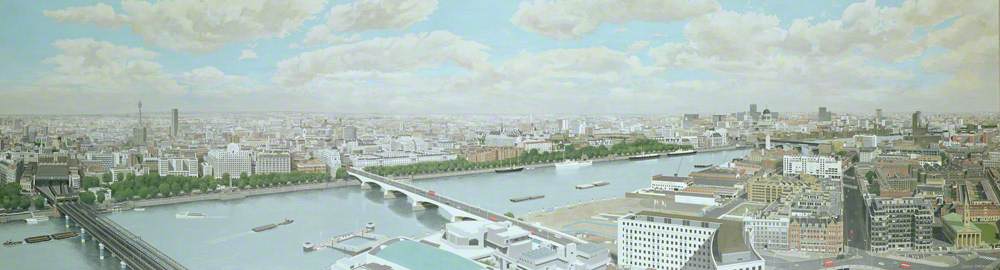
  8. Flying Over London [an imagined flight in a small plane over London]
  9. Why Art Today Follows Politics (1936)
  10. Thoughts on Peace in an Air Raid (1940)

I keep reading references to Woolf being an ‘intellectual’ which astonishes me because she hardly anywhere mounts clear, sustained arguments, with reasons and evidence to support her. Even when she is making a point – as in her essays criticising the Edwardian novelists and promoting her new version of literature, or discussing what a feminist literature might be like – what her essays are far more noticeable for their slow beginnings, their whimsical digressions, her easy distraction by the surface of things, objects and phrases, by her indirections and odd approaches, which sometimes barely make sense.

This is more than usually true of these ten descriptive and impressionistic pieces.

If there’s one common theme or thread linking all of them, and maybe all her writing as a whole, I think it’s her mental illness. In Street Haunting, Sun and Fish and Evening over Sussex she describes having multiple ‘selves’, which initially sounds cool and post-modernist but, I think, was an aspect of her mental illness.

You particularly feel the struggle it involved when she talks about the need to marshal all these selves back together, to create a unified personality to face society with. This isn’t a criticism, it’s the opposite: it’s sympathy. Both my kids have mental health issues and I struggle sometimes. Maybe that’s why I’m making too much of it as an issue…

Anyway, my interpretation is that her obsessive listing of everything she sees, on all her walks and travels, her distraction by endless streams of shiny details, was both a symptom of her problems but also a way of coping with them. When the inner world gets cluttered with multiple selves all shouting at you, you take refuge in the ever-changing world outside you to try and regain, and hang onto, some calm, something outside yourself. I take this to be the message made explicit in ‘Street Haunting’ and lurking, implicitly, beneath all the other pieces; maybe, beneath her whole oeuvre.

1. Thunder at Wembley (1924: 3 pages)

A brisk description of attending the 1924 Empire Exhibition at Wembley. It has an odd tone. She mocks the organisers for not making the vast concrete edifice which enclosed the exhibition, sealed off from the sky, for making the error of letting nature intrude here and there: a few trees, some birds. But the real feeling that comes over is Woolf’s lofty snobbish view of the crowds who are attending it. The words vulgar and mediocrity recur. She ironically comments that the exhibition would have been much better if the organisers had only kept all the people out. In the last paragraph she becomes delirious and has a vision of the end of the world.

The sky is livid, lurid, sulphurine. It is in violent commotion. It is whirling water-spouts of cloud into the air; of dust in the Exhibition. Dust swirls down the avenues, hisses and hurries like erected cobras round the corners. Pagodas are dissolving in dust. Ferro-concrete is fallible. Colonies are perishing and dispersing in spray of inconceivable beauty and terror which some malignant power illuminates. Ash and violet are the colours of its decay. From every quarter human beings come flying—clergymen, school children, invalids in bath-chairs. They fly with outstretched arms, and a vast sound of wailing rolls before them, but there is neither confusion nor dismay. Humanity is rushing to destruction, but humanity is accepting its doom.

What?

The Cinema (1926: 5 pages)

It starts out in the typically frivolous and gaseous style which makes Woolf’s essays such a trial to read.

No great distance separates [we moderns] from those bright-eyed naked men who knocked two bars of iron together and heard in that clangour a foretaste of the music of Mozart. The bars in this case, of course, are so highly wrought and so covered over with accretions of alien matter that it is extremely difficult to hear anything distinctly. All is hubble-bubble, swarm and chaos. We are peering over the edge of a cauldron in which fragments of all shapes and savours seem to simmer; now and again some vast form heaves itself up and seems about to haul itself out of chaos.

?

Woolf briefly describes the black-and-white newsreels of the day. She begins to be interesting when she says that one of the disconcerting features of film is that it shows what life is like when we’re not there and a world which has gone.

But that’s newsreels and factual movies. As to the development of fiction movies, lots of other arts stood ready to help. Of course Woolf has only one art in mind, her own specialist subject, literature. But the marriage of literature and film has been a disaster. Why? Because literature shows people from the inside, shows us their minds and thoughts and emotions, whereas movies can only show them as stock figures from the outside.

So we lurch and lumber through the most famous novels of the world. So we spell them out in words of one syllable, written, too, in the scrawl of an illiterate schoolboy.

I’m sure all Hollywood screenwriters were flattered by this description. On the other hand, I like this next bit which I totally agree with, that movies simplify complex human emotions down into stock gestures and expressions.

A kiss is love. A broken cup is jealousy. A grin is happiness. Death is a hearse.

In Woolf’s view film needs to free itself from a literalistic interpretation of content from another medium, books, and free itself to explore its own language and vocabulary.

It seems plain that the cinema has within its grasp innumerable symbols for emotions that have so far failed to find expression… Is there, we ask, some secret language which we feel and see, but never speak, and, if so, could this be made visible to the eye? Is there any characteristic which thought possesses that can be rendered visible without the help of words?

Interesting thought. Obviously there’s been a hundred years of movies since Woolf wrote but you feel her point is still valid. Film ought to consist of more than just popcorn-munching, Technicolour-fabulous summer blockbusters, surely it does have the potential to convey human experiences in an utterly novel and revolutionary way. And yet it has failed. The movies I see nowadays (2025) are crushingly banal and familiar, and the whole concept of a ‘film’ is bleeding out into the extravaganzas shown on Netflix et al. There are more films than ever before but at the same time, a strong sense of exhaustion and repetition.

As usual, Woolf invokes Shakespeare, her go-to guy for symbolising the peak of literary complexity i.e. multiple associations are triggered in the brain by his verse. But it’s precisely the multi-faceted and evanescent and subjective nature of the reader’s response, which is unique to literature and cinema’s tactic of showing a man on a screen talking fails to convey.

Instead, she repeats the thought: surely there are visual symbols, maybe accentuated with music, which could convey complex emotions in a purely filmic way.

That such symbols will be quite unlike the real objects which we see before us seems highly probable. Something abstract, something which moves with controlled and conscious art, something which calls for the very slightest help from words or music to make itself intelligible, yet justly uses them subserviently – of such movements and abstractions the films may in time to come be composed.

Then indeed when some new symbol for expressing thought is found, the film-maker has enormous riches at his command.

All this guessing and clumsy turning over of unknown forces points at any rate away from any art we know in the direction of an art we can only surmise.

She concludes with the thought that cinema has been born the wrong way round: it demonstrates tremendous sophistication of technology, engineering, design and logistics, but has no soul, no content, no emotional complexity worth the name.

The mechanical skill is far in advance of the art to be expressed.

This falls into the category of one of her Hortative Essays. In linguistics, hortative modalities are verbal expressions used by the speaker to encourage or discourage an action. In more common speech, hortative is an adjective meaning something which to encourages, urges, or calls to action. So in an earlier section of the book, ‘Life-Writing’, we read her essay claiming that the genre of biography was poised at the dawn of a new era, which would require hard work and commitment but would lead through to a new vision. Same here. In her opinion film is just at the start of an era of innovation and discovery.

I guess she was right, insofar as film was poised on the brink of introducing talkies (published in 1926, this whole essay is based on the experience of only silent movies) and continued to evolve at a rate of knots throughout the twentieth century. But whether it ever developed the symbols and methods to really convey the human soul, as she hoped, is very much to be doubted. Maybe in lots of rarer, indie or art or non-American movies. One for film buffs to discuss forever.

3. Street Haunting: A London Adventure (1927: 11 pages)

How beautiful a London street is…

After a long day cooped up in a room writing, what better release than going for a ramble across London. Evening is best and winter the best season when there is magic in the air. The lamplight gives the bustling passersby a spurious glamour.

This is all unusually high-spirited and positive for Woolf and she deploys some stylish phrases.

Here under the lamps are floating islands of pale light through which pass quickly bright men and women, who, for all their poverty and shabbiness, wear a certain look of unreality, an air of triumph, as if they had given life the slip, so that life, deceived of her prey, blunders on without them. (p.178)

Once or twice she is tempted to imagine the lives of the people in the houses and has to remind herself to stay on the surface of things, an observer, a wandering eye, as the characters in so many of her books.

The eye is not a miner, not a diver, not a seeker after buried treasure. It floats us smoothly down a stream; resting, pausing, the brain sleeps perhaps as it looks… Let us… be content still with surfaces only—the glossy brilliance of the motor omnibuses; the carnal splendour of the butchers’ shops with their yellow flanks and purple steaks; the blue and red bunches of flowers burning so bravely through the plate glass of the florists’ windows.

For some reason she pops into a shoe shop and is there when a dwarf enters, accompanied by two normal-sized adults. Woolf describes her preening over he normal sized foot but when she goes back out into the street and Woolf follows her, she finds all the other passersby infected with the grotesque.

(This all reminds me of the French poet, Charles Baudelaire, famous for his visions of strange passersby in the streets of Paris, and of the whole French nineteenth century intellectual cult of the flaneur, all of which was being written about seventy years before Woolf wrote this essay.)

The dwarf had started a hobbling grotesque dance to which everybody in the street now conformed…

So she sees two drunk men pass by both leaning on a small boy, a stout woman dressed in shiny sealskin, a feeble-minded boy sucking the silver knob of his stick, an old man squatting on a doorstep as if suddenly overcome by the absurdity of the human spectacle – the randomness of these people seen in the street reminds me very much of all the background people who appear in her wandering-round-central-London novel, Mrs Dalloway.

In shops windows she sees good which spark fancies. Sofas and furnishings allow you to create and decorate a fantasy home of your own. When you wave that away, a glimpse of pearls in a jewellers’ window prompts visions of herself at a grand party in Mayfair, in June, looking out over the darkened streets while back in the main room the Prime Minister describes some political crisis to Lady So-and-So.

Why this continual turnover of fantasies? Because nature made human beings with ‘instincts and desires which are utterly at variance with his main being, so that we are streaked, variegated, all of a mixture’.

I’ve commented on how the same dozen or so ideas recur across Woolf’s oeuvre. Here she mentions the idea of multiple selves which features in the mature novels and Orlando.

Is the true self this which stands on the pavement in January, or that which bends over the balcony in June? Am I here, or am I there? Or is the true self neither this nor that, neither here nor there, but something so varied and wandering that it is only when we give the rein to its wishes and let it take its way unimpeded that we are indeed ourselves? (p.182)

Then she comes to the neighbourhood of second hand book shops and for a couple of page sings the delights of exploring the strange detritus of sold-off libraries and dead men’s collections, the eternal hope that you will take down some little treasure and be transported by dashing narratives or wonderful poetry, and all those travellers to far-off lands. But there’s no end to books and so after this cosy interlude in a warm second-hand bookshop, it’s back out into the streets.

She passes two women complaining about how selfish ‘Kate’ is, then they’re gone and she never finds out more. Two men discussing racing tips under a lamp-post. Thousands of other commuters, freed from work and thronging from the Strand over Waterloo bridge, who she fondly fantasises are themselves fondly fantasising about being ‘great cricketers, famous actresses, soldiers who have saved their country at the hour of need.’

When you stop and read that you realise how essentially childish her view of other people is. Those aspirations – ‘great cricketers, famous actresses, soldiers who have saved their country at the hour of need’ – are the aspirations of the Famous Five. Real people who are worried about money, worried about their marriages, their children about work, don’t enter in, they are too real, sordid, vulgar. None of her imagined people ever think about sex because that is crude and vulgar. The fantasy must be kept pure, romantic, chaste and childish.

Coming into the Strand she feels her conscious mind telling her she has to do something. What was it? Oh yes, the spurious aim of buying a pencil with which she justified this evening stroll in the first place. That’s one self, the practical self. But another self steps in and says Why can’t we just enjoy ourselves and ramble where we wish? Multiple selves in conflict. You can see why she was interested in Freud’s dynamic model of the mind, and why the Hogarth Press was to publish his complete works in a definitive English translation. You can also hear a ghost of her lifelong mental problems: the voices in her head, conflicting and arguing.

From a psychiatric point of view it’s telling that the only way she can manage the voices is to transcend them with another image, with the sight of the wide cold black River Thames. And memory. Memory which we saw so important in coping with a task in Memories of a Working Women’s Guild and Leslie Stephen, The Philosopher at Home: A Daughter’s Memories. We get a deeper understanding that backing away from the clamorous present and retreating into distant memories is not so much a cop-out as a psychological coping mechanism.

This becomes really obvious when she remembers leaning over the parapet last summer and being happy. Maybe if she goes to the same place now she can regain that mood of calm.

We see it through the eyes of somebody who is leaning over the Embankment on a summer evening, without a care in the world. Let us put off buying the pencil; let us go in search of this person—and soon it becomes apparent that this person is ourselves. For if we could stand there where we stood six months ago, should we not be again as we were then—calm, aloof, content? Let us try then…

But the attempt fails. A young couple are smooching nearby, the air is cold, a tug with two barges slowly passes under the bridge, she can’t regain that last-summer mood. She draws the conclusion that:

It is only when we look at the past and take from it the element of uncertainty that we can enjoy perfect peace.

To be honest, I don’t understand what that means. Finally, she arrives at a stationery shop where she can buy the pencil which was the pretext for this trek and this essay. As soon as she enters she realises she’s interrupted an argument between the old couple who own it. They break up and the old buffer tries to find her a pencil but keeps making mistakes amid the many shelves and boxes, until his wife comes back into the shop and silently indicates the correct box. Even then, Woolf lingers in order to enjoy the experience of the couple slowly calming down until, eventually, full peace is restored.

The old man, who would not have disgraced Ben Jonson’s title-page, reached the box back to its proper place, bowed profoundly his good-night to us, and they disappeared. She would get out her sewing; he would read his newspaper; the canary would scatter them impartially with seed. The quarrel was over.

Now, either you think that last sentence is beautifully imagined or, like me, you find it too pat. In fact the entire episode feels too neatly rounded and complete to be a depiction of real life, which is always more edgy and incomplete than this little fable.

When she exits back onto the street, it is completely empty and she walks home through the silver city which triggers another reflection on the idea of multiple selves.

Walking home through the desolation one could tell oneself the story of the dwarf, of the blind men, of the party in the Mayfair mansion, of the quarrel in the stationer’s shop. Into each of these lives one could penetrate a little way, far enough to give oneself the illusion that one is not tethered to a single mind, but can put on briefly for a few minutes the bodies and minds of others. One could become a washerwoman, a publican, a street singer. And what greater delight and wonder can there be than to leave the straight lines of personality and deviate into those footpaths that lead beneath brambles and thick tree trunks into the heart of the forest where live those wild beasts, our fellow men?

On my reading, all of literature provides a cure for mental illness by allowing us to escape from our troubled selves into other, more completed and so simpler, more manageable lives.

She sings the praises of her big ‘adventure’ in the streets of London and this triggered a memory of Three Guineas with its angry attack on how women in her lifetime and for all British history before her, had been legally, socially and financially excluded from public life, from all the professions, from business, from paid work, from any independence. And so had to make from the tiny incidents of their cramped lives what satisfaction and adventures that they could.

And one last thought: any writer, male or female, can describe the lovely, warm comfort of arriving home but, given the Enid Blyton interpretation I’ve given to much of the narrative, I couldn’t help the ending feeling like the cosy rounding-off of a reassuring children’s story.

As we approach our own doorstep again, it is comforting to feel the old possessions, the old prejudices, fold us round; and the self, which has been blown about at so many street corners, which has battered like a moth at the flame of so many inaccessible lanterns, sheltered and enclosed. (p.187)

4. The Sun and The Fish (1928: 5 pages)

This is the most peculiar essay in the selection.

Exordium: The introduction tells us that memory works by yoking together two, sometimes random elements i.e. we remember things best when they’re associated with something else memorable.

[A] sight will only survive in the queer pool in which we deposit our memories if it has the good luck to ally itself with some other emotion by which it is preserved. Sights marry, incongruously, morganatically… and so keep each other alive.

This appears to be the justification for the collocation of the two memories which follow.

Memory 1: On 29 June 1927 Leonard and Virginia Woolf travelled with a party of friends to Bardon Fell in Yorkshire, where they stood on the ridge at dawn with thousands of others to witness a total eclipse of the sun. That is a rational, factual account of the event, but Woolf’s account is delirious. She compares the watchers to participants in the prehistoric ceremonies at Stonehenge and then gives a vivid description of the eclipse itself, during which the entire world loses colour and laments its death. Fear and anxiety lest the sun never returns. I’ve been reading D.H. Lawrence alongside Woolf, and this essay is more or less the only which one which has the psychological intensity of Lawrence. Maybe because it’s the only place in any of her works where the narrator is scared.

This was the defeat of the sun then, and this was all, so we thought, turning in disappointment from the dull cloud blanket in front of us to the moors behind. They were livid, they were purple; but suddenly one became aware that something more was about to happen; something unexpected, awful, unavoidable, The shadow growing darker and darker over the moor was like the heeling over of a boat, which, instead of righting itself at the critical moment, turns a little further and then a little further; and suddenly capsizes. So the light turned and heeled over and went out. This was the end. The flesh and blood of the world was dead and only the skeleton was left. It hung beneath us, frail; brown; dead; withered… (p.191)

Memory 2: But weirder is to come because Woolf links the eclipse memory to a visit she made to London Zoo and, in particular, to the Aquarium. This again makes it seem nice and logical when it is anything but. Instead it’s a fantasia on the life and being of fishes, in their watery tanks, and the sense of them being far more at home in their element than we poor, helpless, pink animals are on ours.

The fish themselves seem to have been shaped deliberately and slipped into the world only to be themselves. They neither work nor weep. In their shape is their reason. For what other purpose, except the sufficient one of perfect existence, can they have been thus made, some so round, some so thin, some with radiating fins upon their backs, others lined with red electric light, others undulating like white pancakes on a frying pan, some armoured in blue mail, some given prodigious claws, some outrageously fringed with huge whiskers? More care has been spent upon half a dozen fish than upon all the races of mankind.

And having exhausted this strange vision, the essay finishes with the abrupt line:

The eye shuts now. It has shown us a dead world and an immortal fish.

5. The Docks of London (December 1931)

In 1931 Woolf published The London Scene, a collection of six essays published individually in ‘Good Housekeeping’ magazine, over the course of a year. They were not published as a collection until long after her death. According to Wikipedia, the title was not chosen by Woolf but comes from the 1975 republication of five of the essays. Originally the essays were referred to as ‘Six Articles on London Life’.

The first of the six essays was The Docks of London. It records a guided tour Woolf was given round the docks on a Port of London Authority launch on 20 March 1931.

Compared to the eclipse fantasia it is a model of sense and description. She describes coming up the Thames from the Kent end, coming across ruined warehouses and reeking waste dumps and barges full of the city’s refuse, a pub and a few trees in this wasteland, then turning a corner and coming across the beautiful Greenwich Hospital buildings, up and round and so arriving at the Tower of London.

She cuts to a description of a cargo ship being unloaded with careful regulated industry and all its goods being stored in a low unadorned warehouse. She lists the bizarre items sometimes found stashed amid all this imported goods: a snake, a scorpion, a lump of amber, a basin of quicksilver. Among a pile of elephant tusks the customs officers have found older browner ones which they think come from mammoths. Virginia is finding out about the big world of work, and the imperial trade which her pampered life relies on for its luxuries and perquisites. She learns the great principle:

Trade is ingenious and indefatigable beyond the bounds of imagination. (p.196)

Everything is weighed and graded. A use is found for everything. Nothing is wasted. She savours the ‘dim sacerdotal atmosphere’ of the wine vaults. In the precision and dexterity of the work, the endless movement of the cranes, the unloading and stacking and packing and storing, she sees beauty. This feels like an awakening for young Virginia into the world of real work and the appeal of doing a job well, the subject of so many Rudyard Kipling stories.

She ends with the slightly unexpected thought that it is we, the consumers, who dictate all this energy, day in day out, all year round. It is we with our taste for shoes, furs, bags, stoves, oil, rice pudding, candles, that dictate what crops are grown, what animals are reared, what minerals extracted, what is brought here to the world’s largest port. So that:

One feels an important, a complex, a necessary animal as one stands on the quayside watching the cranes hoist this barrel, that crate, that other bale from the holds of ships that have come to anchor. (p.198)

6. Oxford Street Tide (1932: 4 pages)

The garishness and gaudiness of the great rolling ribbon of Oxford Street has its fascination. (p.199)

This was the second piece in her ‘Six Articles on London Life’ series, published in the January 1932 issue of Good Housekeeping. As you might expect, it’s about shops. In her day, as now, Oxford Street didn’t have the best shops, in fact it was looked down on for its bargains and sales. ‘The buying and selling is too blatant and too raucous’.

What stood out for me was the differences. In 1932 one could find barrows parked selling fresh tulips, violets, daffodils; see magicians make bits of paper unfold into clever shapes on bowls of water; sell live tortoises which are kept in litters of straw.

She gives a blizzard of sense impressions: placards selling endless editions of newspapers; a whole brass band; omnibuses grazing kerbs; buses, cars, vans, barrows streaming past. The old aristocracy were dukes and earls who built grand town houses along the Strand. The new, commercial, aristocracy build department stores along Oxford Street which dole out music and news, welcome you in to their high and airy halls, thickly carpeted and with the magic of lifts. (The notes tell us that the American Harry Gordon Selfridge opened his department store on Oxford Street in 1909.)

You can’t help noticing how flimsy these new stores are, concrete walls and metal floor bases. When you see other buildings being demolished so quickly and thoroughly, you realise these stores, to large and showy, with such modelled facades, are less solid and enduring than a labourer’s stone cottage from the time of Elizabeth I.

Then again, that’s the appeal. ‘The charm of modern London is that it is not built to last; it is built to pass.’ The owners of the citadels of consumer capitalism must:

persuade the multitude that here unending beauty, ever fresh, ever new, very cheap and within the reach of everybody, bubbles up every day of the week from an inexhaustible well. (p.202)

It is vivid and wrily comic, and she doesn’t mention Shakespeare once!

7. Evening Over Sussex: Reflections in a Motor Car (1942: 3 pages)

Despite the title, it’s a very static, ghostly impression of Sussex, which she prefers to imagine at dusk, as night falls and the stars come out and the busy fret of the day disappears and you see the country in its essentials, as it was in days past. She gives a vivid poetic description of the county but then feels unhappy, conflicted. It is too beautiful, too big to contain, to master and this triggers her characteristic psychological reaction or problem, of feeling divided into multiple selves.

It is well known how in circumstances like these the self splits up and one self is eager and dissatisfied and the other stern and philosophical.

She has to struggle with herself, to force herself to sit still and take in what’s in front of her. While these two selves argue about how to cope with beautiful scenery, a third self, observes to herself how happy both the other selves were when they were driving around in a motor car, just to see the never-ending stream of sights. Although when they were quiet and happy, the conscious self was in fact unhappy at the thought that everything is transient, everything passes out of sight and memory so fast as you zoom around the country.

This is, in other words, an essay about Virginia coping with her mental health issues and struggling to maintain an even keel. Compare ‘Street Haunting’, where she similarly struggles with the voices in her head and tries to find some way of calming them. Her mental illness is never very far from the surface.

Then there appears a fourth self, an ‘erratic and impulsive self’, interrupts the others with an unexpected perception, pointing out a light hovering in the sky. Only after some moments of confusion does her rational self realise it’s a car’s headlights coming over the brow of a hill, but this visionary self takes it as a portent of the future, of a distant future when Sussex will be full of magic gates and electric light.

In the final paragraph she tells us she assembles her many selves, as official presider over them, and tries to reckon up the sights they have all seen. But this is a surprisingly thin list and almost immediately describes ‘disappearance and the death of the individual’. That’s a bit shrill, isn’t it?

David Bradshaw’s notes tell us this wasn’t published during her lifetime but in the posthumous collection Death of the Moth and Other Essays. Is it an indication of how she was ‘declining’ into mental illness? Or does its candour about the struggle of managing multiple selves suggest a new art, a new style which she might have explored and expanded?

8. Flying Over London (6 pages)

The notes tell us this essay was only published in 1950. Reading the book’s notes builds up the impression that Woolf wrote a huge amount, that gathering together all the essays and fugitive pieces published in numerous outlets, from classy Vogue to transient student magazines, has taken decades to track them all down and been a labour of love for Woolf scholars.

It opens with a strikingly fanciful analogy, comparing the planes lined up at the aerodrome to giant grasshoppers, ready to spring into the air. She is self-consciously aware that ‘a thousand pens have described the sensations of leaving earth’ and you can’t help feeling how dogged she is by a self consciousness so intense that it is consciousness of multiple selves. Woolf is crippled by selves-consciousness.

Anyway, she makes the original observation that, when the plane takes off it’s not so much that the land falls away as that the sky falls upon you, immerses you. A lifetime of judging all objects in your field of view by their static appearance at ground level is swept away by this radical new perspective. ‘Land values’ have to be swapped for ‘air values’.

She wonderfully describes being in the air, amid the clouds, where perspectives and orientation disappear and this reminds me of the extended passage describing looking up at the clouds in ‘On Being Ill’.

And yet, as the previous essay has made clear, there is always another self in Woolf, tugging and restraining all her attempts at spontaneity. She knows it. ‘So inveterately anthropomorphic is the mind’ that she imagines the plane is a boat, and then imagines it, as in some Victorian poem, sailing towards a harbour:

And there we shall be received by hands that lift themselves from swaying garments; welcoming, accepting. (p.207)

Don’t you think that’s very Pre-Raphaelite, the hands that lift from swaying garments? I’m sticking with my impression that, despite the so-called modernism of her deploying a dreamy kind of stream-of-consciousness and jumping between characters’ points of views in her books, deep down – in fact not very deep down at all – Woolf has an essentially Victorian sensibility, Keats and Tennyson and Christina Rossetti, everything must be elegant and decorous and just so.

She sees the Thames as the Romans saw it, as paleolithic man saw it, reprising the theme of prehistoric London found in Mrs Dalloway and especially Between the Acts where Mrs Swithin is reading H.G. Wells’s Outline of History which starts with just such prehistoric descriptions of dinosaurs in what were to become London landmarks. But then things suddenly take a dark turn.

It was the idea of death that now suggested itself; not being received and welcomed; not immortality but extinction. (p.208)

She sees a flight of gulls and thinks how alien they are, where only gulls are, is death. ‘Life ends; life is dowsed in that cloud… That extinction now becomes desirable… And so we swept on now, up to death’ Why? Again you have the strong sense of a woman fighting her own psychological demons.

The pilot’s head suddenly reminds her of Charon, the ferryman across into the realm of the dead, and she claims the mind is proud of extinction ‘as if it deserved extinction, extinction profited it more and were more desirable than prolongation on other terms by other wills.’ Usually the experience of flying in a small plane is one of exhilaration. For Woolf it brings flooding thoughts of death. She wants to die, and die she soon would, at her own hand.

The pilot turns into a flame of death and she imagines dying together with him. ‘Extinction! The word is consummation’. But there’s a lot more. We’re only half way through. She vividly imagines flying into cloud, being immersed in the ever-changing shapes and colours.

All the colours of pounded plums and dolphins and blankets and seas and rain clouds crushed together, straining – purple, black, steel.

It’s as if John Keats went for a plane ride. Here’s a stanza from John Keats’s poem Ode to a Nightingale:

O, for a draught of vintage! that hath been
Cool’d a long age in the deep-delved earth,
Tasting of Flora and the country green,
Dance, and Provençal song, and sunburnt mirth!
O for a beaker full of the warm South,
Full of the true, the blushful Hippocrene,
With beaded bubbles winking at the brim,
And purple-stained mouth…

The technology and the subject and the continual changing of scene may be from the 1920s but the sensibility dates back a hundred years, to the 1820s, an impression confirmed by lots of details of phrasing like when she says that when they emerge from the clouds and see ‘the fairy earth’ beneath them.

The voice I hear this passing night was heard
In ancient days by emperor and clown:
Perhaps the self-same song that found a path
Through the sad heart of Ruth, when, sick for home,
She stood in tears amid the alien corn;
The same that oft-times hath
Charm’d magic casements, opening on the foam
Of perilous seas, in faery lands forlorn.

I wonder if she’s just been reading ‘Ode to a Nightingale’ and that explains why the sensibility and even specific phrases of Keats spill over into this fantasia?

One way of thinking about Woolf’s writing is that she had to adopt different techniques to shake herself out of her madness, out of being dominated by the voices in her head. The ‘Street Haunting’ essay describes one technique, which was to go to a place where she had been calm and try to recapture that feeling. A cruder one is to change the subject to something which focused all her selves into a unity, such as her feminist scorn of men. This lines up all the voices into unanimity. Here’s something the squabbling voices can all agree upon.

I think this is why, after the fantastical passages which have seen her mind split into multiple levels and ages and perspectives, she brings everything back with the tried-and-tested technique of taking the mickey out of pompous rich men in the City of London.

There were blocks in the city of traffic sometimes almost a foot long; these had to be translated into eleven or twelve Rolls Royces in a row with city magnates waiting furious; and one had to add up the fury of the magnates; and say – even though it was all silent and the block was only a few inches in length, how scandalous the control of the traffic is in the City of London. (p.211)

This is feminism as therapy, submerging her squabbling selves and the multifarious observations which threaten to overwhelm her conscious mind, into the reassuring, all-pulling-together mode prompted by the activity of mocking rich men. Ha ha ha, silly little men. Oh, I feel much better now.

The narrative goes on to describe flying over the East End and seeing good working people wave up at them, flying over Oxford Street where everyone is too busy with bargain hunting to acknowledge them, onto Bayswater with its deadening rows of identical houses and then does something odd. She claims to see a door in one house open, and to see into a flat, and to see a particular woman and… you realise it has all been a fiction. Then I woke up and it was all a dream.

And a glance at the notes indeed confirms that Virginia Woolf never went up in an airplane. The entire thing is a fiction. It is a bold and strange fiction, and candidly reveals some of the ramifications of her mental illness and yet… I couldn’t help feeling disappointed that it was utterly fictional.

In fact she tries to make a joke of it. The last paragraph is a rare attempt by Woolf at explicit humour. After she’s given a vivid description of coming in to land and bumping over the grassy airfield, she goes on:

As a matter of fact, the flight had not begun; for when Flight-Lieutenant Hopgood stooped and made the engine roar, he had found a defect of some sort in the machine, and raising his head, he had said very sheepishly, ”Fraid it’s no go today.’ So we had not flown after all.

Contemporary flying reviews

9. Why Art Today Follows Politics (1936: 3 pages)

Surprisingly maybe, this very short piece was first published in The Daily Worker newspaper in 1936. Woolf opens the piece, as so often, by candidly explaining the terms of its commission:

I have been asked by the Artists International Association to explain as shortly as I can why it is that the artist at present is interested, actively and genuinely, in politics.

I think her views on this subject are not much worth considering, since she had made a career out of ridiculing, mocking and ignoring conventional politics as irredeemably male. Bit late in the day to change her tune.

What struck me most about this essay was the way that, when she came to consider examples of classic artists, the very first name she came to was John Keats and the very first ‘work of art’ his poem, Ode to a Nightingale. This, for the umpteenth time, confirmed my sense that underneath her modernist tricks and strategies, Woolf remained, in her core sensibility, an unreformed Victorian Romantic of the purest kind, oblivious of the radical art being created in Bolshevik Russia or Weimar Germany, of symbolist or Expressionist or Surrealist poetry, but again and again and again and again, judging everything by the purest, most conservative, arch-Romantic figure of John Keats.

As to the essay, I found it pompous, self-satisfied twaddle. This is because of her narrow, blinkered, restricted and wildly unrealistic notion of what an Artist is and what Art is, something pure and untainted by Society which aspires to the perfection of a Shakespeare. Instead of a much more realistic sociological view of ‘art’, which sees it being produced by a huge array of people, working in all kinds of fields, at multiple levels.

It is a fact that the practise of art, far from making the artist out of touch with his kind, rather increases his sensibility. It breeds in him a feeling for the passions and needs of mankind in the mass which the citizen whose duty it is to work for a particular country or for a particular party has no time and perhaps no need to cultivate.

This notion of the artist as a special superior and privileged personage, blessed with more sensibility than the average person, feels, to us today, I think, absurd. Artists in all fields may have been trained to a level of specialist knowledge in particular fields and techniques but this doesn’t make them ‘superior’ to everyone else. Plus we have had too many examples of artists who were very superior, refined and sensitive but who still wrote books and poems against the Jews, say, or in favour of Stalin or Mussolini.

Between Woolf’s narrow, conservative values and our own times stands the dire history of the twentieth century which ought to have disabused anyone of these Victorian notions of the Superiority of Art.

She’s on firmer grounds when she leaves off her notions of art and takes a more sociological view of the pressures modern artists come under. This echoes, repeats or invokes the notion of multiple voices which we’ve encountered her struggling with in earlier essays. Here she gives them external form as types or groups or classes of people who are perpetually haranguing the modern artist, including:

  • the voice which cries: ‘I cannot protect you; I cannot pay you. I am so tortured and distracted that I can no longer enjoy your works of art’
  • the voice which asks for help: ‘Come down from your ivory tower, leave your studio and use your gifts as doctor, as teacher, not as an artist’
  • the voice which warns the artist that unless he can show good cause why art benefits the state he will be made to help it actively – by making aeroplanes, by firing guns etc
  • the voice which artists in other countries have already heard and had to obey, the voice which proclaims that the artist is the servant of the politician, of a Hitler, Stalin or Mussolini

So, in the face of all these voices shouting at him, no wonder the modern artist is forced to take part in politics, and decides to form or join societies like the Artists International Association.

And that’s what she was commissioned to explain, and she has just explained it. You can see how it’s still written from a position which mocks and scorns all these external voices, the voices of society, and tries to preserve the separateness and aloofness of the artist, the high artistic calling she learned in her father’s library in the last years of Queen Victoria’s reign.

10. Thoughts on Peace in an Air Raid (1940: 4 pages)

Written in August 1940, for an American symposium on current matters concerning women.

As she writes in London, Germans are flying overhead dropping bombs trying to kill her. This is the same situation with which George Orwell starts his famous essay, The Lion and the Unicorn. The difference is that Woolf is a woman and a feminist. Therefore she is aggrieved that women on both sides of the fighting are not given guns or any material means of helping. Sure they can make guns and munitions and serve food and protect the children. But there’s another way. They can use their minds. (This is always a doubtful tactic in Woolf whose mind was liable to stray and loses its place far more than the average person, as all her writings show.)

But she sticks to her feminist message. The whole Establishment tells women they are fighting Hitler because he is the embodiment of aggression, tyranny, the insane love of power. And yet she quotes Lady Astor in a speech saying:

Women of ability are held down because of a subconscious Hitlerism in the hearts of men.

It’s the same point she made in the ferociously powerful feminist tract, Three Guineas. So I understand that the challenge is how to get rid of this subconscious Hitlerism in the hearts of men, but I didn’t understand what she was proposing to do.

She makes a detour to describe how training to become a soldier and readiness to fight appears to be instinctive to many men. How can this instinct be eradicated? Well, imagine if the government told all women that childbearing would be banned for most of them, and restricted to a tiny handful i.e. sought to abolish a fundamental instinct of women, what luck would it have? Not much. So trying to make young men more peace-minded is the same kind of challenge.

We must help the young Englishmen to root out from themselves the love of medals and decorations. We must create more honourable activities for those who try to conquer in themselves their fighting instinct, their subconscious Hitlerism. We must compensate the man for the loss of his gun.

What does this mean in practical terms? She repeats the same ideas in a slightly different formulation.

If we are to compensate the young man for the loss of his glory and of his gun, we must give him access to the creative feelings. We must make happiness. We must free him from the machine. We must bring him out of his prison into the open air.

These ‘We must…’ sentences could be written on till infinity but won’t change anything and so have no meaning except as expressions of fine feelings.

Comment 1: the failure of feminism

Like so many of the feminist articles and essays I read every day in the Guardian, New Statesman, London Review of Books, The Atlantic, The Conversation, the New York Review of Books, even in the Financial Times and sometimes in the Economist, Woolf laments that (some/quite a few) men are violent, in thrall to ‘the subconscious Hitlerism in the hearts of men’, and calls for a wholesale transformation of human nature.

Go on, then. Transform human nature. In fact I’ve been reading the same lament, and hearing it from feminist friends and girlfriends and wives and daughters for over 40 years, tens of thousands of articles, documentaries, films, plays and so on calling for a radical overhaul of human nature to try and make men less toxic and more like women.

How is the project to radically transform human (male) nature going? Well, according to the thousands of articles lamenting the election of Donald Trump or bewailing the rise and rise of Andrew Tate, it is going backwards, which is impressive. I don’t mean I applaud Trump the know-nothing bully or the poisonous snake Tate, far from it. It’s just impressive that the feminist cause seems to be going backwards.

And I’m not especially singling out feminism. Although everyone knows that they are being exploited by huge corporations and multinational banks, that every service in their lives is ripping them off, yet somehow, magically, more and more voters are turning to an essentially right-wing solution, rather than what seems to me the more obvious need for a string of left-wing policies to rein in excess wealth, excess pay and excess control of corporations over our lives. (Just think of all the privatised water companies paying their shareholders huge dividends while filling our rivers with sewage.)

Same with global warming and the environment. Although everyone knows about it now, and governments are taking steps to invest in renewable energy and diversity power grids, on the cultural level society seems to be taking against the green and environmental policies we desperately need.

What I’m trying to do is understand and report what people are actually like instead of what high-minded progressives would like them to be like.

So back to Woolf, I know she’s a patron saint for feminists, but, tome, she’s also a kind of patron saint of feminist fantasy. I mean her narrow, blinkered, limited, upper-middle-class experience of life excluded her from understanding the great majority of population in her time and my thesis is that, in following her, in adopting her voice and tone, latterday feminists make the same mistake – of not understanding human nature in all its squalid horribleness and of simply wishing toxic masculinity away, without any practical plans to deal with it. To repeat, her solution is:

If we are to compensate the young man for the loss of his glory and of his gun, we must give him access to the creative feelings. We must make happiness. We must free him from the machine. We must bring him out of his prison into the open air.

Like so many progressives, she thinks that if only we could give our enemies a reading list of classic literature – and in particular make them read more Keats and Shakespeare – we could magic the problems of managing human nature away.

My position is simply that it’s much harder than that.

Comment 2: preparing for war

Eighty-five years after Woolf wrote this piece, the British government and fleets of commentators are all worrying about how to encourage more young Englishmen to cultivate their fighting instinct and join the British Army which, like the armies of all European nations, need to be significantly increased to counter the threat from Putin’s Russia.

Telling men to cultivate their finer feelings is not really an adequate strategy for coping with Putin’s Russia or Xi Jinping’s China, just ask the young men of Ukraine. Why are there always wars and the threat of wars? The feminists I knew at university and subsequently all had one answer: it’s men’s fault. It’s toxic masculinity. There. Done. Understood. Sorted. Dismissed.

Except it isn’t sorted, it’s never sorted. All the essays in the world – no matter how high minded and correct and lovely in their sentiments and wishes – can change human nature with its endless lust to fight the enemy and destroy the planet.


Credit

‘Selected Essays of Virginia Woolf’ was published by Oxford World Classics (OWC) in 2008. Most but not all of the essays can be found online. The OWC introduction can be read on Amazon.

Related links

Related reviews

  • Virginia Woolf reviews

Jacob’s Room by Virginia Woolf (1922)

Words have been used too often; touched and turned, and left exposed to the dust of the street…
(Woolf’s sense of exhaustion and futility, page 88)

What people go through in half an hour!
(Woolf’s profound sense of the unhappiness of life)

Virginia Woolf was mad* and, I think, in this book as elsewhere, it really shows. She had a lifelong history of mental illness and ended up committing suicide. Reading this book, her third novel, helps you, I think, to understand why.

The basic subject matter is simple, insultingly simple, really: it’s another Bildungsroman or coming-of-age or growing-up novel about a clever young man from ‘the provinces’ named Jacob Flanders. The novel twist is the way the nominal protagonist, Jacob, is actually absent from most of the narrative.

We first meet Jacob as a boy on a beach holiday in Cornwall with his (widowed) mother, Betty Flanders. Then we see him roaming up the hill behind the family house in Scarborough. The local vicar and schoolmaster recommend him for Cambridge and lo and behold, in the following chapter we meet him there, hanging with other undergraduates, declaring, as if he’d invented the thought, that Greek literature is better than all modern literature. Virginia takes the opportunity to mock crusty old dons.  Then he graduates and moves to London where he meets ‘Life’ in the form of boring parties, does boring research at the British Museum and, as far as I could tell from the text, becomes involved with a prostitute, Florinda (in fact, I was wrong: Wikipedia tells me that Florinda is a sexually permissive art student; my mistake indicative of the way it’s often hard to make out exactly what’s going on.)

So far, so boring, so very like E.M. Forster’s worst novel, The Longest Journey, which describes the growth from boyhood of another provincial youth who goes up to Cambridge, knocks around with other callow undergraduates who all worship Greek literature and think they’ve invented being clever, before going on to discover how disappointing the world of work is (he becomes a teacher and is slowly crushed by the mundanity of it). So far, so dull, narrow and predictable.

But in literature it’s not the (over-familiar) subject matter, it’s the treatment of it which you pay for, and it’s here that Woolf is either a genius or a deeply disturbed individual, depending on your point of view.

A personal digression on mental illness

My sister had serious post-natal depression for years and is still on medication. Both her kids have mental health issues. At uni I went out with a woman whose mother was a schizophrenic, a trait she passed onto my girlfriend’s (deeply disturbed) brother and which darkened the lives of everyone in their family. My best friend at school had a nervous breakdown at university, jacked it in and ran off to the Continent, to the distress of his parents. Both of my children had troubled teenage years, my daughter cutting herself, my son developing month-long psychosomatic migraines which kept him off school for over two years. In the end I packed in my job to look after them both and try to get their lives back on track, but I found myself suffering a kind of secondary stress from the endless worry and ended up needing anti-depressant medication myself.

A few years ago my wife had the bright idea of taking me to see the stage production of ‘The Curious Incident of the Dog in the Night-Time’ in the West End. The production used flashing white lights and loud sound affects to do an excellent job of taking you inside the mind of a severely autistic boy, so good that after ten minutes or so I had a panic attack and, at first, sat with my fingers jammed in my ears, rocking backwards and forwards, humming loudly myself to try and block out the chaos. Eventually I could stand it no longer and pushed along the aisle of seats and ran through the labyrinth of corridors till I burst out into the fresh air of Soho, leaned against a lamp-post and threw up. It took me the rest of the evening to calm down and days and days to get back to feeling ‘normal’ and being able to smile.

Reading ‘Jacob’s Room’ made me feel a bit like that. I experienced it as a kind of assault on my mental health and equilibrium. I’m glad it is so short (160 pages) because much more would have been bad for my sanity. Having finished it I went out in the garden and start the weeding and pruning, in the winter sunshine, to try and regain my balance.

Fragments

‘Jacob’s Room’ was Woolf’s third novel and the one in which she really announced herself as an experimental novelist, shedding Victorian novelistic conventions left, right and centre in order to achieve her effects. Fans of Woolf focus on her concern to ignore the traditional contexts of plot, scene or character, and instead zero in on fragments and details. These include:

  • focusing on very peripheral details of a scene or location
  • giving fragments of speech with no attempt to report a complete or coherent dialogue
  • jumping from one half-completed scene to a completely new scene with no explanation or introduction
  • jumping into the middle of conversations without bothering to report the start or finish
  • mentioning characters as if we ought to know who they are despite never having mentioned them before (e.g. ‘old Mrs. Temple’ who pops up for a passing appearance in chapter 7)

The London chapters are littered with descriptions of London street scenes which describe random passers-by, people begging or pitifully selling shoe laces or whatnot, crammed into paragraphs which either convey a marvellous panorama of London life or are the dazed fragments of an alienated mind, according to taste.

The book is all about fragments and a deliberately skittish, mosquito jumping from fragment to fragment. At moments I enjoyed this, at others I didn’t. Why?

I very much liked the opening chapter which is, I think, brilliant. It starts with Jacob’s mum, Mrs Betty Flanders, on holiday in Cornwall, sitting on the beach writing a letter, and something’s made her start to cry and the scene is depicted through her tears.

Slowly welling from the point of her gold nib, pale blue ink dissolved the full stop; for there her pen stuck; her eyes fixed, and tears slowly filled them. The entire bay quivered; the lighthouse wobbled; and she had the illusion that the mast of Mr. Connor’s little yacht was bending like a wax candle in the sun. She winked quickly. Accidents were awful things. She winked again. The mast was straight; the waves were regular; the lighthouse was upright; but the blot had spread.

I see what Woolf did here, I understand the effect she’s aiming for, I thought it was brilliant and fresh. Incidentally the sentence ‘Accidents were awful things’, jarringly pasted into the stream of her thoughts, indicates the cause of her crying, thinking about an accident in which a friend has died. So you have a brilliant description of what she sees through tears and a deliberately hyper-elliptical reference to the cause of the tears.

It starts to rain and Betty makes her kids pack up their things and scamper from the beach up to the boarding house. Here she gives them tea and puts them to bed as the rainstorm continues outside and the chapter ends by zooming in on one of the kids’ buckets abandoned in the garden.

Outside the rain poured down more directly and powerfully as the wind fell in the early hours of the morning. The aster was beaten to the earth. The child’s bucket was half-full of rainwater; and the opal-shelled crab slowly circled round the bottom, trying with its weakly legs to climb the steep side; trying again and falling back, and trying again and again.

Brilliant.

I think I liked the two details I’ve selected, crying on the beach and the garden in the rain, (or I understood them) because they are both visual effects, they paint a very vivid visual picture indeed. In subsequent chapters the incidence of these visual details falls away as the book becomes increasingly psychological. As Jacob grows into a student he becomes steadily less interesting (having had two of my own, I know that student-aged people are a lot, lot less interesting than small children: small children are joyous and funny, students not so much). By the time we see Jacob attend some posh party or studying in the British Museum or walking through the busy streets, the disconnected fragments are no longer visual but psychological.

So Woolf finds herself applying her technique of fragments and pieces to people and situations which are 1) increasingly psychological and 2) of increasingly narrow subject matter (students at Cambridge, Cambridge graduates in London) and so 3) increasingly boring.

And unbearable to the narrator. What I found increasingly hard to read was not so much the tedious portraits of bright Cambridge students (God help us) or the descriptions of dinner parties or tea parties (give me strength) but the strong feeling Woolf gives of these things being too much for her.

In chapter 3 Jacob is invited to a tea party with his Cambridge tutor and wife and finds it stiflingly conventional and boring and, the second he escapes from the house,

‘Oh God, oh God, oh God!’ exclaimed Jacob, as the four undergraduates left the house. ‘Oh, my God!’ Bloody beastly!’ he said, scanning the street for lilac or bicycle — anything to restore his sense of freedom.

That’s how I felt every time I put this book down and I escaped from the prison house of mental illness, of a narrator who comes under such pressure she feels she’ll start screaming – and back into my world of birds in my garden and sunshine and freedom.

There’s a vivid example of this Woolf pressure-cooker effect in chapter 4 when Jacob takes Florinda, a girl who fancies him (I think), to dinner at some restaurant. As more and more people come in, the noise level in the big echoing restaurant goes up and up:

The room was filling; the heat increasing. Talk in a restaurant is dazed sleep-walkers’ talk, so many things to look at — so much noise — other people talking. Can one overhear?

Until:

The room got fuller and fuller; talk louder; knives more clattering.

Knives more clattering. As you read, you can feel the mental stress of the narrator building and building until, the next thing we know, someone at a nearby table, a woman, suddenly leaps to her feet, sweeps the contents of the table onto the floor and shouts something at the man she’s lunching with, clearly the climax of some kind of argument.

I can see how Woolf fans would appreciate the technique used here and it’s powerfully vivid. But what I took from it was the sense of a super-sensitive sensibility being overloaded, being oppressed by the growing roar of the large echoing room, by the clattering of the knives and then… snapping, standing screaming, smashing plates, making a scene. I felt like I was standing outside that West End theatre again, my insides screaming in distress, pushed over the edge and beyond.

Why would I read a book that makes me feel like I’m having a panic attack? And when I wasn’t having panic attack flashbacks, I just felt desperately sad for her, for Woolf. She has, it seems to me, two modes: pent-up screaming panic mode or, when her mania is under control, a sense of glum, defeated depression. At the end of chapter 4 the narrator observes:

The thought saddened him. It’s not catastrophes, murders, deaths, diseases, that age and kill us; it’s the way people look and laugh, and run up the steps of omnibuses.

Woolf was 36 when ‘Jacob’s Room’ was published. Reading that little bit of authorial wisdom didn’t strike me as very wise, it just made me feel sorry for her. Sorry for a woman who found the most commonplace sights and sounds too much to bear, which either made her want to scream and run out the room, or made her feel like they were aging and killing her. All her thoughts saddened me.

Tired of life

Here are some more examples of Woolf just sounding tired:

‘Holborn straight ahead of you,’ says the policeman. Ah, but where are you going if instead of brushing past the old man with the white beard, the silver medal, and the cheap violin, you let him go on with his story, which ends in an invitation to step somewhere, to his room, presumably, off Queen’s Square, and there he shows you a collection of birds’ eggs and a letter from the Prince of Wales’s secretary, and this (skipping the intermediate stages) brings you one winter’s day to the Essex coast, where the little boat makes off to the ship, and the ship sails and you behold on the skyline the Azores; and the flamingoes rise; and there you sit on the verge of the marsh drinking rum-punch, an outcast from civilization, for you have committed a crime, are infected with yellow fever as likely as not, and — fill in the sketch as you like. As frequent as street corners in Holborn are these chasms in the continuity of our ways. Yet we keep straight on. (p.91)

Is this an inspiring flight of fantasy? Or a kind of delirium? You can choose to be thrilled by the imaginative fantasia she projects onto the old man with the white beard she walks past in a London street – yes, excellent – or notice the tone of the last sentence: how we all ignore the fantasies of the street, walk straight past, missing out, leading blinkered lives. A sad thought.

And in the following, the never-ending people you see, lost and abandoned in the street, carries over into the powerful sense of the futility of trying to find meaning anywhere, which spills (characteristically) into the futility of reading, of seeking an answer which can’t be found.

The little man fingering the meat must have squatted before the fire in innumerable lodging-houses, and heard and seen and known so much that it seems to utter itself even volubly from dark eyes, loose lips, as he fingers the meat silently, his face sad as a poet’s, and never a song sung. Shawled women carry babies with purple eyelids; boys stand at street corners; girls look across the road — rude illustrations, pictures in a book whose pages we turn over and over as if we should at last find what we look for. Every face, every shop, bedroom window, public-house, and dark square is a picture feverishly turned — in search of what? It is the same with books. What do we seek through millions of pages? Still hopefully turning the pages… (p.92)

She has lots of these descriptions of London streets, London street scenes, which are superficially attractive – which, as a Londoner, I really enjoyed – except that they all end on the same note of futility or exhaustion. ‘Yet we keep on… What do we seek…?’

‘Come to tea, come to dinner, what’s the truth of the story? have you heard the news? life in the capital is gay; the Russian dancers….’ These are our stays and props. These lace our days together and make of life a perfect globe. And yet, and yet… when we go to dinner, when pressing finger-tips we hope to meet somewhere soon, a doubt insinuates itself; is this the way to spend our days? the rare, the limited, so soon dealt out to us — drinking tea? dining out? And the notes accumulate. And the telephones ring. And everywhere we go wires and tubes surround us to carry the voices that try to penetrate before the last card is dealt and the days are over. ‘Try to penetrate,’ for as we lift the cup, shake the hand, express the hope, something whispers, Is this all? Can I never know, share, be certain? Am I doomed all my days to write letters, send voices, which fall upon the tea-table, fade upon the passage, making appointments, while life dwindles, to come and dine? Yet letters are venerable; and the telephone valiant, for the journey is a lonely one, and if bound together by notes and telephones we went in company, perhaps — who knows? — we might talk by the way.

Doubt, doom, is this all? She sounds as depressed as T.S. Eliot:

For I have known them all already, known them all:
Have known the evenings, mornings, afternoons,
I have measured out my life with coffee spoons;

So that eventually I learned that whenever she sets off on one of her digressions, I know it’s going to end up being depressing. ‘Is this all? Am I doomed? Why do we bother reading books? We have to keep on.’ On every page of this book there is the heavy, lowering sense of Woolf’s struggle against depression and futility.

He sat at the table reading the Globe. The pinkish sheet was spread flat before him. He propped his face in his hand, so that the skin of his cheek was wrinkled in deep folds. Terribly severe he looked, set, and defiant. (What people go through in half an hour! But nothing could save him. These events are features of our landscape. A foreigner coming to London could scarcely miss seeing St. Paul’s.) He judged life. These pinkish and greenish newspapers are thin sheets of gelatine pressed nightly over the brain and heart of the world. They take the impression of the whole. Jacob cast his eye over it. A strike, a murder, football, bodies found; vociferation from all parts of England simultaneously. How miserable it is that the Globe newspaper offers nothing better to Jacob Flanders!

‘How miserable it is…’ could be Woolf’s motto.

A window tinged yellow about two feet across alone combated the white fields and the black trees …. At six o’clock a man’s figure carrying a lantern crossed the field …. A raft of twig stayed upon a stone, suddenly detached itself, and floated towards the culvert …. A load of snow slipped and fell from a fir branch …. Later there was a mournful cry …. A motor car came along the road shoving the dark before it …. The dark shut down behind it….

Spaces of complete immobility separated each of these movements. The land seemed to lie dead …. Then the old shepherd returned stiffly across the field. Stiffly and painfully the frozen earth was trodden under and gave beneath pressure like a treadmill. The worn voices of clocks repeated the fact of the hour all night long.

Mrs Jarvis wonders why we all run round doing foolish unnecessary things, in tones which sound just like her creator:

‘I never pity the dead,’ said Mrs. Jarvis, shifting the cushion at her back, and clasping her hands behind her head. Betty Flanders did not hear, for her scissors made so much noise on the table. ‘They are at rest,’ said Mrs. Jarvis. ‘And we spend our days doing foolish unnecessary things without knowing why.’ (p.124)

Chapter 9 contains an extended description of scholars working in the British Museum Reading Room. I suppose it’s intended to be satirical but the effect isn’t funny, it’s just sad. It conveys all too vividly the immense waste of life in futile scribbling.

Nobody laughed in the reading-room. There were shirtings, murmurings, apologetic sneezes, and sudden unashamed devastating coughs. The lesson hour was almost over. Ushers were collecting exercises. Lazy children wanted to stretch. Good ones scribbled assiduously — ah, another day over and so little done! And now and then was to be heard from the whole collection of human beings a heavy sigh, after which the humiliating old man would cough shamelessly, and Miss Marchmont hinnied like a horse. (p.101)

There’s lots of sighing in the book.

‘The Daily Mail isn’t to be trusted,’ Jacob said to himself, looking about for something else to read. And he sighed again, being indeed so profoundly gloomy that gloom must have been lodged in him to cloud him at any moment… (p.132)

What is the point, of this, of anything?

It all seemed to him very distasteful. Something ought to be done about it. And from being moderately depressed he became like a man about to be executed…

This gloom, this surrender to the dark waters which lap us about, is a modern invention.

The artist’s model, Fanny Elmer, falls in love with Jacob but he doesn’t even notice which makes her feel suicidal.

‘Anyhow, I can drown myself in the Thames,’ Fanny cried, as she hurried past the Foundling Hospital. (p.132)

Hard not to read that and remember that Woolf, of course, eventually killed herself by drowning. On every page the characters sigh, are filled with gloom, wonder what the point is of all this fuss and fret.

Jacob went to the window and stood with his hands in his pockets. There he saw three Greeks in kilts; the masts of ships; idle or busy people of the lower classes strolling or stepping out briskly, or falling into groups and gesticulating with their hands. Their lack of concern for him was not the cause of his gloom; but some more profound conviction — it was not that he himself happened to be lonely, but that all people are. (p.133)

Lonely, lonely and sad. The over-familiar line from Pink Floyd came to mind: ‘Hanging on in quiet desperation is the English way.’ In this book Woolf seemed to me a perfect epitome of quiet, well-mannered desperation.

Strolling in at dusk, Sandra would open the books and her eyes would brighten (but not at the print), and subsiding into the arm-chair she would suck back again the soul of the moment; or, for sometimes she was restless, would pull out book after book and swing across the whole space of her life like an acrobat from bar to bar. She had had her moments. Meanwhile, the great clock on the landing ticked and Sandra would hear time accumulating, and ask herself, ‘What for? What for?‘ (p.153)

‘What for? What for?’ I wonder if Woolf made repeated suicide attempts before she finally succeeded. It sounds like it. Misery dribbles from every page of this grimly depressing book.

The thought saddened him. It’s not catastrophes, murders, deaths, diseases, that age and kill us; it’s the way people look and laugh, and run up the steps of omnibuses.

(A few days later, I read in the notes to the Oxford University Press edition of ‘Mrs Dalloway’ that Woolf suffered mental collapses in 1895, 1904 and 1913 to 1915; that she tried to kill herself by jumping out a window in 1895 (aged 13) and again in 1913 (aged 31). In 1922 when she felt another attack coming on, she went to see a Harley Street specialist who was, predictably, useless. Anyway: I wasn’t wrong to feel through the pages of this book a profound experience of barely controlled unhappiness, gloom, misery and mental dislocation.)

Muddle

It’s odd that the ‘serious’ authors of the 1900s, 1910s and 1920s went out of their way to indicate how puzzled and perplexed they were by the world around them. The buzzword which recurs in so many of these novelists is ‘muddle’, as they throw up their hands and declare: ‘It’s too complicated for me to understand; it’s all a big muddle’. E.M. Forster routinely gives up trying to understand his own narratives and admits it’s all a ‘muddle’. Woolf isn’t much better. Here she is in the Cornish holiday home in chapter 1:

There was a click in the front sitting-room. Mr. Pearce had extinguished the lamp. The garden went out. It was but a dark patch. Every inch was rained upon. Every blade of grass was bent by rain. Eyelids would have been fastened down by the rain. Lying on one’s back one would have seen nothing but muddle and confusion — clouds turning and turning, and something yellow-tinted and sulphurous in the darkness.

And now in central London:

Indeed, drums and trumpets is no phrase. Indeed, Piccadilly and Holborn, and the empty sitting-room and the sitting-room with fifty people in it are liable at any moment to blow music into the air. Women perhaps are more excitable than men. It is seldom that any one says anything about it, and to see the hordes crossing Waterloo Bridge to catch the non-stop to Surbiton one might think that reason impelled them. No, no. It is the drums and trumpets. Only, should you turn aside into one of those little bays on Waterloo Bridge to think the matter over, it will probably seem to you all a muddle — all a mystery. (p.106)

So many of Woolf’s digressions kick off with bold declaration, with fine phrases, then get bogged down in her digressive meandering, and then completely give up, admitting it’s ‘all a muddle — all a mystery.’ Joseph Conrad’s more discursive passages quickly turn into moralising about Man and the Cruel Universe. E.M. Forster’s frequent digressions tend to bring in the Greek gods. Woolf’s digressions again and again end in the admission of defeat, failure to understand and a stifling sense of futility.

Send your hero abroad…

Like so many of the authors of the day, when Woolf couldn’t think what to do with her protagonist she sent him off abroad in the hope that something interesting might crop up, first to Italy, then to Greece. Just like Forster sending Lucy Honeychurch to Florence (A Room with a View) and Lawrence sending Aaron to Florence (Aaron’s Rod). So we are treated to descriptions of train journeys across Italy, views of the hot dry landscape, sturdy Italian peasants, Florence, the Colosseum blah blah, then – shazam! – we are in Greece, Patras, more trains, even hotter drier landscapes, Athens, the Parthenon.

Woolf may be a clever writer but this feels like a desperately tired expedience. Her views on the timeless beauty of the Acropolis join the exact same views of the thousands and thousands of other British tourists and diarists and journal-writers and essayists and archaeologists and historians and novelists who preceded her. Boring. And her protagonist is (rightly) bored. He diligently visits all the sights, reads all the guidebook facts but is stubbornly ‘morose’ (p.141).

I was hoping he’d get run over and killed by a tram, in the completely pointless way the protagonist of ‘The Longest Journey’ is run over by a train at the abrupt ending of that book, but no such luck. Instead, in Italy he falls in with an older couple, Evan Wentworth Williams who is a frustrated would-be politician, and his wife, Sandra Wentworth Williams, who sensitively swans around Athens in a long white dress.

It is made clear that Sandra wants to collect Jacob, to leech on to his youthful gaucheness, and that her husband acquiesces, staying behind in their hotel while Sandra and Jacob go for a walk up the Parthenon in the moonlight. But then, in a characteristic move to frustrate our conventional expectations, just as we are expecting something to happen (a kiss in the moonlight!), the narrative cuts away to Jacob’s mother in bed in her house in Scarborough. And after a few pages with her, when it cuts back to Athens, Jacob and Sandra have disappeared. It is a deliberate strategy of obliquity and evasion.

Then it’s the next morning, they all get up early and journey on to Constantinople. I don’t think anything at all happened between them, even a kiss. The only practical outcome is that Jacob gives Sandra the copy of John Donne’s poems which he’s reading and annotating and we are told it joins the select number of volumes the older lady keeps on her dressing table, and occasionally picks up as she moons over her old lovers. He has been collected.

All the important moments in these little scenes is deliberately omitted leaving a narrative made of fragments built around absences. The central character and all his key experiences, those character-forming experiences you expect from a Bildungsroman, have been carefully excised to leave a hole in the middle of the text.

… then bring him back

The penultimate chapter, chapter 13, gives a kind of panoramic overview of all the characters we have met so far, in the course of one day of coming and going, mostly in London.

Jacob is back in London, lean, brown and boring everyone with his trite opinions about the glories of Greece. He is walking through Hyde Park with his best buddy Dick Bonamy who is unhappy (of course) because of his frustrated love affair with the elusive Clara Durrant.

From one point of view the entire History of The Novel is a record of the long, pitifully useless efforts of adult human beings to manage even the simplest affairs of the heart, to manage their love lives. Whenever anybody gets up on their hind legs and starts pontificating about ‘human wisdom’ and what a clever species we are, even before you get out the history books with their mountainous records of wars and tortures, just hand them a couple of classic novels and say ‘Here: this is the evidence against’. Here are a half dozen examples of the human race who couldn’t manage the most basic aspects of human relationships and ended up killing themselves – Madame Bovary, Anna Karenina.

We are introduced to Mr Bowley, a new character, an older gentleman, who accompanies Clara as she puts her dog Troy on a leash and takes him for a walk in the park. They are disturbed when a horse which has thrown its rider goes galloping by. Characteristically for Woolf, this tear in the fragile surface of good manners and etiquette, is all it takes to trigger Clara to tears, just like the slow crescendo of knives and forks clattering triggered the unnamed woman in the restaurant.

“‘This statue was erected by the women of England…'” Clara read out with a foolish little laugh. ‘Oh, Mr. Bowley! Oh!’ Gallop—gallop—gallop—a horse galloped past without a rider. The stirrups swung; the pebbles spurted. ‘Oh, stop! Stop it, Mr. Bowley!’ she cried, white, trembling, gripping his arm, utterly unconscious, the tears coming. (p.159)

‘White, trembling, gripping his arm.’ It is my contention that this hysteria lies just below the surface of every sentence, every perception in the book, just waiting to burst out. Nice polite well-mannered young women are poised to snap and burst into tears at the slightest provocation.

This horse bolting is a symbol which is used to bring together disparate strands right at the end of the book. Assiduous visitor of the sick, Mrs Julia Eliot, saw the incident too, en route to her appointment with Lady Congreve in Bruton Street.

At that precise moment Florinda (the sexually permissive art student) who’s discovered she’s pregnant, watches the arrival of the painter Nick Bramham, at the restaurant, Verrey’s, where she’s booked a table. Have they agreed to marry? Has he agreed to pretend to be the father? Is he the father? Or is he stepping in for Jacob who is the real father? I can see that the way it isn’t spelled out is deliberate and artful. It joins the collection of many other issues which are elided and cut off. It creates the sense of a panorama of puzzles, allusions, mysteries, which is clearly how Woolf saw life.

At that moment far away in her country house, Sandra Wentworth Evans fondles the volume of Donne and wonders whether she can emotionally manipulate Jacob. Meanwhile, back in Hyde Park, abandoned by a cross Bonamy, Jacob idly draws in the dirt with the end of his umbrella what may or may not be a sort of diagram of the Parthenon.

A deckchair attendant asks him for a penny, but Jacob can only find half a crown which he gives the man, with some asperity.

Fanny Elmer loves Jacob more than ever and writes him notes and postcards which she never sends. She’s taken to hanging round the British Museum in the hope of sighting him. Why did no-one tell her that life is grim and frustrating?

‘One’s godmothers ought to have told one,’ said Fanny, looking in at the window of Bacon, the mapseller, in the Strand — told one that it is no use making a fuss; this is life, they should have said, as Fanny said it now, looking at the large yellow globe marked with steamship lines. ‘This is life. This is life,’ said Fanny. (p.163)

At which point, with Woolfian misery, she bursts into tears. She catches a bus which is held up in the Charing Cross Road because there’s a big political rally marching down Whitehall, past the various government ministries and Woolf gives us the last of what have been quite a few page-long digressions about international politics, about the enormous reach of the British Empire and the need to address issues with Kaisers and Rajahs and so on all around the world. Because of my own personal interest in history, these were the only bits of the novel I really enjoyed, because of their sense of range, of the wider world rising above the petty, small-minded backbiting of most of the ‘characters’.

Back to individuals: Timmy Durrant (Clara’s brother) is at work in one of these government departments which Fanny is walking past. He is aided by Miss Thomas, one of the typists who doesn’t want to be late to meet her beau at the Gaiety Theatre.

Jacob gets up from his deckchair. It’s past five and the sun is setting. Far away in Scarborough his mother is writing a letter to his older brother, Archer, who works in Singapore.

Coming out of Carter’s shop in Piccadilly, the Reverend Andrew Lloyd half recognises Jacob as he walks past because it was he, Floyd, back in chapter 2, who recommended Betty to try her son for Cambridge i.e. had a hand in the formation of Jacob’s personality, in a sense is partly responsible for the entire narrative. But he hesitates to approach Jacob just long enough for the latter to disappear into the crowd. It is a world of lost opportunities. Fleeting glimpses and unfulfillment.

In a cab in a traffic jam in Long Acre sit smooth Mr Wortley, Clara and her mother Mrs Durrant, who is concerned about arriving late to the opera and missing the overture.

Far away on the edge of the moors overlooking the sea, Mrs Pasco watches two ships pass each other out on the waves.

Even further away, Greek housewives knit their stockings while the sunset colours the Parthenon red. Artillery fires over the Piraeus to mark the end of the day.

Betty Flanders is woken by a distant booming but can hear nothing distinct. It connects back to the guns in Greece but (being 1920), was it a prolepsis or anticipation of the sound of the guns of the Great War which was to sweep all this away?

I liked the panoramic effect of this chapter very much, although maybe it was simply from the relief of having gotten to the end of the book on one piece.

Chapter 14

The final chapter is precisely one page long and shows Jacob’s friend Dick Bonamy in Jacob’s room tutting about the chaos and the letters scattered everywhere. Then Jacob’s mother, Betty, enters, asking what is she to do with these, holding up a pair of Jacob’s old shoes? Is Jacob dead? Thank God! But how? There is no clue whatsoever, so I turned to the internet for help.

The SuperSummary web page tells me that:

When World War I breaks out in Europe, Jacob enlists in the British army and is killed in combat. The novel ends with a scene of Betty Flanders and Richard Bonamy clearing out Jacob’s London apartment in the wake of Jacob’s death.

Ah. OK. but none of that is expressed in the text. I had picked up on the booming of the guns but was misled because I thought Betty heard them on the same evening when Jacob was strolling through Hyde Park. No. Turns out that all the events the SuperSummary lists (war breaking out, Jacob enlisting, training, being shipped to France, fighting, dying, Betty receiving notification of his death and travelling to his London room) takes place with no mention or description in the narrative. Offstage. That’s a really significant amount of information, data, events, to completely omit from your story, wouldn’t you say?

It was already a strikingly non-conformist book, a revolutionary book in its understated way, simply ignoring most of the conventions of the novel up to that date. This highly elliptical conclusion really rams that home. Contemporary readers must have been mystified.

The implied author

I happily admit that the picture I’ve built up here of Woolf-the-author may bear no close relationship to the actual Virginia Woolf of 1920. Here’s the Wikipedia definition of ‘the implied author’:

The implied author is a concept of literary criticism developed in the 20th century. Distinct from the author and the narrator, the term refers to the ‘authorial character’ that a reader infers from a text based on the way a literary work is written. In other words, the implied author is a construct, the image of the writer produced by a reader as called forth from the text. The implied author may or may not coincide with the author’s expressed intentions or known personality traits.

Many people’s main reaction to a novel they’re reading, whether they like it or not, is in fact a response to the character of its implied author – whether they find them warm and sympathetic or cold and brutal, whimsical and funny or difficult and literary, etc.

And canny authors exploit this, creating a persona which is not identical even with the narrator, but a larger thing – the book’s personality. As every reader knows, liking or disliking a novel often relies on your response to the total mood of the text, to the implied author, to the book’s personality.

I like literature which adds something to life, which adds factually or psychologically a richness or strangeness. Everything by D.H. Lawrence explodes with life and enhanced perception, even when he’s at his most messianic and delusional. My enthusiasm even extends to the wildest of Samuel Beckett’s prose works, a man renowned for concentrating on futility and despair, works such as the very strange How It Is. What is exhilarating about Beckett’s works is the totality of their commitment. They are bleak as hell but written with a visionary intensity.

By comparison, Woolf, to me, seems half-hearted. She is like E.M. Forster seen through a kaleidoscope, a distorting mirror. Her works radiate a kind of wet unhappiness. She – well the author implied by this book, its authorial persona – is very clever, very perceptive, very artful, but very wounded.

* A note on the word madness

I wondered whether I’m allowed to use the term ‘mad’ and ‘madness’. Surely I should be more sympathetic, up-to-date and use terms like ‘mental illness’ or ‘neurodivergent’? So I was struck by the way the author biography on the inner sleeves of the Granada paperback editions of Woolf’s works which I read bluntly states:

Recurring bouts of madness plagued both her childhood and married life and in April 1941 Virginia Woolf took her own life.

And it’s not just here. Throughout Victorian Glendinning’s excellent biography of Leonard Woolf, Glendinning refers to Virginia’s ‘madness’. And in her own writings and diary, Woolf freely uses the term mad and madness. She used it in the intensely moving suicide note she left for her husband – ‘Dearest, I feel certain I am going mad again’. So I’m not using the word flippantly or insensitively. I’m using the same word used by her editors, publishers, biographers and by Virginia herself to describe her condition.


Credit

‘Jacob’s Room’ by Virginia Woolf was first published by the Hogarth Press in 1922. References are to the 1965 Penguin paperback edition, 1971 reprint.

Related links

Related reviews

The Big City @ the Guildhall Art Gallery

What’s the largest painting you know? What’s the biggest picture you can think of? Monet’s huge water lilies? Mark Rothko’s Seagram murals at Tate Modern? Juan Miro’s huge canvases of biomorphic shapes? These canvases are so big that if you ever find yourself sitting on an exhibition bench in front of a trio of them, as I have done with Monet and Miro, you realise entire field of vision is filled with them. It is an immersive experience. You are in Miroworld or Monetland.

Is size important? When it comes to art? Does a big painting really do a lot more than a medium-sized one? What, exactly? At what size does a big painting become an immersive one? Have psychologists or art colleges done research into viewers’ psychological and aesthetic responses to size? Is there a recognised point at which a painting goes from ‘big’ to ‘massive’ or is it subjective i.e according to the viewer’s physical size and visual range?

Do artists, collectors or galleries categorise paintings by size? Have there been fashions for huge canvases? Or historical periods particularly associated with them? Are there particular artists famous for their monster canvases? Is there a record for the biggest painting ever made? By who? Why?

These are some of the questions raised by ‘The Big City’, an exhibition at the little known but well-worth-a-visit Guildhall Art Gallery, a hop, skip and a jump from Bank tube station.

The gallery is owned by the Corporation of London, which possesses some 4,500 works of art. Fifty or so of these are on display in the gallery’s permanent exhibition, itself packed with gems, and then the gallery runs rotating exhibitions of selections of the others, alongside exhibitions of new, original art works.

The Big City

This exhibition is titled ‘The Big City’. It is housed in three rooms, respectively small, medium and large. The small room, the third one you come to, houses a display which comes first in terms of chronology:

Sir James Thornhill

Sir James Thornhill (1676 to 1734) was the premier exponent of the Italian Baroque style in Britain in the early 1700s. Much of this took the form of site-specific allegorical murals for public or grand buildings. He supervised large painting schemes in the dome of St Paul’s, in the hall of Blenheim Palace, at Chatsworth House.

In the early 1720s Thornhill was commissioned to create an Allegory of London for the ceiling of the council chamber at the Guildhall where the Lord Mayor and aldermen held their meetings. He used the established style of Baroque allegory to create a central image of London, represented by a topless woman, being advised by the goddess of wisdom, Pallas Athena, and women symbolising Peace and Plenty. It features putti or podgy winged toddlers who often flit around Baroque paintings. Here they are depicted at the bottom right among images of: the City insignia, the sword bearer’s fur cap, a pearl sword and the City mace.

Allegory of London by Sir James Thornhill (1725) © Guildhall Art Gallery, City of London

This oval painting was fixed in the middle of the ceiling and was accompanied by four smaller pieces, one in each corner of the ceiling, depicting flying cherubs or putti representing the four cardinal virtues: Temperance, Prudence, Fortitude and Justice.

We know what the whole design looked like because there’s a painting of the room by John Philipps Emslie showing how it looked in 1886. The story is that the centrepiece and four smaller parts were dismantled and stored during the Second World War. The building was damaged in the Blitz and the original decorative scheme destroyed but these individual pieces were saved, along with some preparatory sketches by Thornhill. All of this is on display here.

It would be easy to say the figures ‘looked down’ on the City officials meeting below but a glance at the image shows they’re not looking down at all, they are tied up in their own conversations in their own world.

The piece’s content, size and position are obviously connected with values – moral and social values. The size not so much of the individual elements, but the way they were arranged over the entire roof, were designed to act as a constant reminder to the officials below, of the longevity and depth of the values associated with the City and its officials and business. This is what we stand for: commerce and prosperity, bringing justice and peace.

So the images aren’t instructive, they are aspirational. It wasn’t a case of the gods looking down but of ordinary mortals looking up and, whenever they did, being reminded of the traditions and values they were meant to be aspiring to. (Also, a point often not made about Baroque painting – they’re quite playful.)

Prudence from The Allegory of London by Sir James Thornhill (1725) © Guildhall Art Gallery, City of London

Grand occasions

Before you get to the Thornhill room you walk through the medium-sized first room in the show. This has a completely different look and feel. It contains nine big paintings of ceremonies associated with the City of London from the late Victorian period through to the 1960s. They depict lots of old white men wearing formal clothes, gowns and regalia, chains of office, wigs and so on.

The paintings depict different types of event which the curators usefully itemise: civic, royal, state, ceremonial, funeral.

They are big, and their size is more obviously connected to notions of power than the relatively benign Thornhill. By power I don’t mean images of solders or Big Brother looming threateningly, not direct power. But the soft power implicit in grand occasions which serve to bolster and underpin ideas of hierarchy. The pictures are big because the event was big.

Take ‘Queen Victoria at St. Paul’s Cathedral on Diamond Jubilee Day 22 June 1897’ by Andrew Carrick Gow, completed in 1899. The painting was commissioned to capture the magnificence and the magnificence is exemplified in the extraordinary scene of the packed steps of St Paul’s. Not just packed but, as you look closer, you realise arranged in a highly structured way, as was the event, to include representatives of the army, the Church, politicians and academics, arranged in groups and hierarchies. The crème de la crème, the top figures in all the important fields of state.

Queen Victoria at St. Paul’s Cathedral on Diamond Jubilee Day 22 June 1897 by Andrew Carrick Gow (1899) © Guildhall Art Gallery, City of London Corporation

The curators point out that a massive royal state occasion like this transformed the centre of London into a stage, a set on which the thousands of figures here, and lining the route of the royal procession to the cathedral, were arranged – and which the painter then has to capture as best he can. Put this way I sympathise with the scale of the challenge the artist faced. He had to be in complete control of the old values of structured composition and extremely detailed naturalism.

There’s another super-simple way to categorise the paintings on display here, which is: inside or outside. The Gow is a good example of outdoor magnificence; ‘The Coronation Luncheon to Her Majesty Elizabeth II in the Guildhall, London, 12 June 1953’ by Terence Cuneo is a good example of magnificence in an indoors setting.

The Coronation Luncheon to Her Majesty Queen Elizabeth II in the Guildhall, London, 12 June 1953 by Terence Cuneo. © Guildhall Art Gallery, City of London Corporation. Image © Terence Cuneo

Once again the size of the painting is an attempt to match the scale of the actual event and, as you can see here, the size of the actual banqueting hall which is, as it is intended to be, awesome. And, leaving aside the ostensible splendour of the occasion, it’s hard not to be awed by the photographic realism of Cuneo’s painting. There’s a ‘Where’s Wally’ element to looking closely at the hundred or more individual guests, how they’re sitting, what they’re going (eating, talking, turning to their neighbour and so on).

(It might be worth pointing out that the word ‘magnificence’, like so many English words used to describe this kind of thing, has a Latin root, and so carries with it the connotation of learning and cultural capital which Latinate words always bestow. It derives from magnus meaning big or great [the Roman general Gnaeus Pompeius Magnus is translated into English as Pompey the Great] and facere meaning ‘to make or do’. So at its root ‘magnificence’ means ‘to make big’. At its origin, it is about size. During 2,000 years of evolution through medieval Latin, French and into English it has come to mean ‘splendour, nobility and grandeur’, themselves all Latinate words.)

Terence Cuneo OBE (1907 to 1996) was a prolific English painter noted for his scenes of railways, horses and military actions. He was the official artist for the coronation of Queen Elizabeth II in 1953 and the Queen’s favourite portraitist. Including ceremonial occasions he painted her no fewer than 17 times. He’s represented by two works here, the coronation lunch (above) and:

Frank O. Salisbury (1874 to 1962) was an English artist who specialised in portraits, large canvases of historical and ceremonial events, stained glass and book illustration. In his heyday he made a fortune on both sides of the Atlantic and was known as ‘Britain’s Painter Laureate’. He painted over 800 portraits (!) and painted Churchill more times than any other artist.

What you’ll have realised by now is that most of these works are, by modern standards, barely what we’d call art at all. Sure they’re well composed, efficiently worked paintings, but they are in a style that was old fashioned by 1900 and completely moribund by the 1960s.

In this respect, despite their size and detail and polish, they epitomise the opposite of what was intended; rather than impressing with awe and magnificence they tend, to the modern viewer, to emphasise how remote and out of touch these figures of power were with the wider world of the 40s, 50s and 60s.

You could argue that the grand old panelled rooms in which they suited old boys had their gala dinners protected and insulated them from a world moving beyond their grasp and even their understanding.

Churchill, who features in two of the paintings here (one alive, one dead) fought the Second World War to preserve the empire. Fifteen short years later he lived to see it being dismantled and the influx of immigrants from the former colonies who would bring new voices and new perspectives to Britain. None of that historic change is even hinted at in these old-fashioned depictions of old-fashioned institutions carrying out their time-honoured ceremonies.

There are some older paintings on the same type of subject. These, as it were, have permission to be dated, or are easier to take ‘straight’ because they are in styles appropriate to their day.

In this latter painting, apparently Paton, a noted painter of maritime scenes and naval occasions, did the composition and painted the main scene while Wheatley, famous for a series of paintings called ‘The Cries of London‘, did the figures in the foreground.

Contemporary art

The third and biggest room contains the biggest variety of paintings and the biggest single works. Size is not the only factor for their inclusion here, since each of the paintings also has a specific setting or story and these to some extent represent different aspects of life in the city.

I counted 18 paintings in this big room. I won’t list them all but will select some highlights and themes.

Ken Howard’s ‘Cheapside 10.10 am. 10 February 1970‘ is big and sludgy. It shows the north side of Cheapside looking west on the kind of cold overcast February morning typical of London. This reproduction softens the impact of the paint which Howard has laid on in thick dollops, makes it look a much cleaner, slicker object than it is in real life. A reproduction also brings out instantly what is less obvious in the flesh, which is the fact that it’s a painting about a mirror, namely the way St Mary le Bow church on the left is reflected in a shop window on the right.

Howard is quoted as saying that urban landscapes give more scope for an artist interested in shape, tone and colour than the countryside. This is exemplified in the next work, which is a splendid depiction of Fleet Street in the 1930s.

Fleet Street, London, 1930s by unknown artist © Guildhall Art Gallery, City of London

There’s quite a backstory to this painting. It was commissioned by Viscount Rothermere, owner of the Evening Standard and Daily Mail, to depict the hustle and bustle of Fleet Street, then centre of Britain’s newspaper industry. But the artist intended to include portraits of real Fleet Street luminaries down at the bottom right, and one of the first to be completed was a portrait of Rothermere’s rival press baron, Lord Beaverbrook, owner of the Express group. At which point Rothermere took the painting from the artist, which explains why, if you look closely, you realise it is unfinished, many of those figures without faces and some little more than ghosts. Which in its own way, makes the image quite haunting.

What is finished is the central vista along the ‘Street of Shame’ and, in particular, the gleaming Art Deco glass and steel building on the left. This was the newly opened Daily Express building (1932) which features, thinly disguised, in Evelyn Waugh’s great satire on the 1930s newspaper industry, Scoop.

What does size have to do with it? Well, at 2.13 metres tall this is a big painting, but clearly the scale doesn’t aim to do the same as the Thornhill (embody inspiring moral values) or the civic paintings we saw earlier (impress the viewer with rank and hierarchy).

I suggest its implicit aim is to do with modernism whose fundamental driver is excitement about life in the modern city, in this instance the new technologies and new designs and new architecture represented by Art Deco. It is an image of hustle and bustle and energy. Since it was commissioned by a multi-millionaire media baron I suppose you could also say it represents a capitalist’s, a plutocrat’s view of the city, full of folk hustling and bustling to make him money for him, his class, society at large. It is a celebration of the system.

This enjoyable work was succeeded by a sequence of paintings which I didn’t like at all, in fact actively disliked.

1. Walk by Oliver Bevan (1995) is certainly big (2.29m high, 2.13 m wide). It is a depiction of the pedestrian crossing in front of the Barbican tube station. Apparently Bevan specialises in the depiction of ‘non-personal urban spaces’. Actually, the tiny reproduction I’ve linked to makes it look a lot better than it does in real life. Confronting the 2 metre high thing in real life makes you all too aware of the crudity of the painting and the unsatisfying randomness of the arrangement of the people. I know people mill about randomly all the time but this has been carefully arranged to look gauche and clumsy.

I’m guessing the intention of doing such a humdrum scene on such a large scale is somehow democratic, to say that size isn’t limited to the high and mighty but that any moment in our everyday lives is worthy of record and depiction, can be made ‘monumental’ in scale and implication.

Maybe. But in this instance the size of the piece did the exact opposite of almost all the earlier works, which was impress me with its graceless lack of design and poor finish. Its size worked against it.

2. Jock McFadyen is represented by a work called Roman (1993). McFadyen depicts scenes around his flat and studio in Bethnal Green. This murky painting is of a block of flats in Roman Road nearby. It’s horrible. Again, the tiny online reproduction intensifies and clarifies the image. In reality it’s 2 metres square and an offence to the eye. Everything possible has been done to make it feel shitty. The left vertical of the flats is wonky, which is upsetting. The flats themselves are depicted with wobbly lines which completely fail to capture the hard geometric shape of such blocks which is their only redeeming feature. The human figure on a balcony is poorly drawn. The red VW in the street is appallingly badly drawn. And the decision to paint railings across the bottom spoils the entire composition even more and made me turn away quickly. I actively like scenes of urban devastation, graffiti and whatnot. But this just felt shoddy and amateurish.

3. Worse is to come. Flyover St Peter’s (1995) by Paul Butler is a whacking 2.74 metres wide and a big donkey turd of a painting. Regular readers of my blog know I actively like pictures or sculptures to be textured or incorporate detritus like dirt, wood, glass or whatever (see Hepher, below); but that I fiercely dislike the paintings of Frank Auerbach and Leon Kossof with their inch-deep sludges of filthy puddle-coloured oils.

They seem to me to do dirt on the entire idea of painting. They deny clarity, structure, composition, delicacy, skill, light, everything which makes painting worthwhile. The Ken Howard painting, earlier on in this room, was well on the way to achieving Auerbach levels of sludge, but Butler goes full throttle and annihilates the human spirit in a disgusting refuse tip of stricken oil spillage. Again, the reproduction you’re looking at flattens and clarifies the image so that it almost becomes appealing. In the flesh it’s like someone has spent a year blowing their nose and menstruating on a canvas to produce a thick layer of rotting mucus and menses. Yuk.

(All three of these works, plus a few others nearby, are, in their different ways, poor. This in itself is quite interesting. Most exhibitions you pay to go to in London represent the best of the best – tip-top Surrealist works at the Design Museum or Cezanne’s greatest hits at Tate Modern. You don’t often get to see a collection of art works that are average or plain bad, and it was interesting to dwell on what made all these works so sub-standard or actively objectionable.)

Anyway, this little set of poor works contrast dramatically with the series of paintings on the opposite wall, which are much cleaner, airier panoramas of London. Indeed, the canvas of London as seen from the top of the Shell Centre by David Thomas (1968) is the widest painting in the show, at a whopping 4.88 metres.

London from the top of the Shell Centre by David Thomas (1968) © Guildhall Art Gallery, City of London Corporation. Image © David Thomas

But it’s not this that impresses; it’s the lightness and the clarity of the image, which was like walking out of a dark room (Bevan, McFadyen, Butler) into the light and clarity of a lovely spring day. The painting feels wonderfully lucid, with all the buildings lining the Thames in central London depicted with thrilling geometric accuracy, almost like an architect’s conspectus come to life.

For people who like a bit of gossip or social history with their art, the label tells us that the picture shows at the centre bottom the Royal Festival Hall – the most enduring legacy of the 1951 Festival of Britain – to its right the daring Hayward Gallery which had just opened, and to the right of Waterloo Bridge a brown open space which had just been cleared to make way for construction of the new National Theatre.

What size does here is introduce the notion of the panorama, a particular genre of art which has reappeared in urban centres over the centuries. It embodies the pleasure of being up at a viewing platform looking over a city we mostly only get to see from ground level. The same kick which has people queuing up to buy tickets to the (disappointing) London Eye.

It begins a little series of urban panoramas which include a view over Clerkenwell by Michael Bach. The thrill or bite in something like this has to come from the architectural accuracy of the depiction. Bach, like Thomas’s, is very accurate and it’s big (2 metres wide) but…something (for me) is lacking.

Possibly that something is demonstrated in a much older work, the classic ‘Heart of Empire’ by Niels Moeller Lund. Though born in Denmark (hence the name) Lund grew up in Newcastle-upon-Tyne before moving to Paris to study painting. He is best known for his impressionistic paintings of England, particularly London and the North-East and ‘The Heart Of The Empire’ is his best-known painting.

The Heart of the Empire by Niels Moeller Lund (1904) © Guildhall Art Gallery, City of London Corporation

The view is taken from the roof of the roof of the Royal Exchange looking west across London. There are several obvious points to be made: I suppose the most obvious one is that panoramas over cities taken from up high, like this, give the viewer a sense of freedom, as if we can fly, as if we are gods flying above the mob and the crowd, freed from the cramped dictates of the busy streets, the traffic, the jostling with strangers, flying free. There’s a kind of psychological release.

Second and allied with it is some kind of sense of power. I don’t mean direct power like we’ve been elected president, I mean a kind of psychological empowerment, a sense of somehow owning what we survey. We know we don’t but it feels like it. This is my city with all its awesome hustle and bustle, its millions of lives, its buying and selling and wealth and poverty.

Why, then, do I get that feeling about this painting but not when looking at the view from the Shell building or over Clerkenwell? It’s something to do with the composition and, especially, the style. Lund’s work is described as ‘impressionist’ though it’s nowhere near as hazy as the classic French impressionists.

What he achieves is a soft focus, gauzy effect. The light isn’t champagne-clear as in Thomas’s bright somewhat clinical treatment; it creates a softening, blurring effect. This is evidenced in numerous ways, for example the buildings shimmer and face into the distance.

And after looking at it for a while I noticed the smoke issuing from chimneys across the vista and especially in the foreground. These may or may not be contributing to the blurry hazy effect, but they epitomise another aspect of the painting which is that it is anecdotal. What I mean is there are things going on in the painting. To be precise, note the flight of white birds (presumably pigeons) in front of the neo-classical Mansion House in the lower left. Once you’ve seen them your eye is drawn past them to the blurry throng of horses and carts and red omnibuses below.

The life of the city is dramatised. Because I happen to have watched the Robert Downey movie recently, it makes me think of Sherlock Holmes and a million details of late Victorian London life. When I look at the Thomas painting I get absolutely no sense whatever of the life of London 1968, there don’t appear to be any people in it at all.

So these are preliminary suggestions about how the same type of painting – the big urban panorama – can have dramatically different impact on the viewer depending on the sense of composition and painterly style.

David Hepher

I’ve left the best thing about the exhibition till last. The main room in the exhibition space is a kind of atrium in the sense that the ceiling has been removed to create a hole which lets you see into the floor above. Or, conversely, the floor above requires a modern glass railing to stop people falling down into the floor below, a railing which allows them to look down into the room below and view the artworks from above.

Anyway the point is that this removed ceiling has allowed the curators to place here a big wooden block supporting the three biggest paintings in the exhibition, three fabulous and very big paintings depicting modern brutalist blocks of flats by artist David Hepher.

Born in 1935, over the past 40 years Hepher has established a reputation for painting inner city estates of the 1960s and 70s. The three works here are 3 metres high. They’ve been attached to a wooden display stand to create an enormous triptych which dominates the room and is the biggest and most convincing thing in the exhibition. It’s worth making the journey to the gallery just to see this.

Gordon House East Face; Gordon House Nocturne; Gordon House West by David Hepher (2013) © Guildhall Art Gallery, City of London Corporation. Image © David Hepher

I loved these works for half a dozen reasons. For a start this it the real London, the appalling 70s tower blocks which millions of Londoners are forced to live in every day and which enables London’s intense population density: one seventh of the UK’s population lives in London, the most populous city in Europe, which has a population density of 145,000 per square mile, and it feels like it.

Secondly, tower blocks, like much modern architecture, is a fantastic subject for composition, because it comes ready-made with grids, squares, geometric shapes, which can either be dealt with in an arty modernist style (for example, photographs of their many motifs from unexpected angles as in lots of 20s and 30s photography) or dealt with straight-on, as here. They are just thrilling artefacts – or thrilling to those of us who like lines, symmetries, geometric regularities and angles.

Thirdly, there’s a fabulously dystopian vibe to them. You don’t need to be familiar with J.G. Ballard’s depictions of urban collapse and psychic displacement (Crash, Concrete Island and High Rise‘) to see, realise and feel concrete tower blocks as powerful symbols of social collapse and anomie. You don’t need to know much about the Grenfell Tower disaster to learn that tower blocks have become the cheap, under-maintained dumping ground for the poor, immigrants and the powerless.

They’re real world equivalents of the tower atop Mount Doom in Lord of the Rings, real world sentinels of poverty and deprivation. The broken lifts and urine-stained stairwells and broken pavements littered with dog turds and broken glass, the whole ensemble liberally decorated with impenetrable graffiti create an overwhelming sense of a society which has given up on itself.

The people who designed, built and shunted the poor into these cheap, shoddy death traps are obviously war criminals but in a special kind of war, a kind of below-the-radar class war which has been going on for decades and has become increasingly mixed up with institutional racism and the war on refugees to produce a toxic, and at Grenfell fatal, brew.

In their betrayal of the art, design and architectural utopianism of the 50s, 60s and 70s, in their magical transformation into symbols of social apartheid, exemplifying the scapegoating of the poorest in society, tower blocks like this are absolutely central to the urban experience in cities all around the western world.

The logistics of their size meant they had to be placed in the centre of the atrium, but the positioning also has a deeply symbolic meaning: all the other images, swish modernism of the 1930s, of flyovers and pedestrian crossings, of slick aerial panoramas, are all spokes rotating round the axle of these monster images.

To zero in on the works, another crucial and thrilling aspect of them is that they aren’t just paintings. Hepher has incorporated all the tricks of modern painting to make them rough textured objects. They aren’t flat paintings, they use wood and PVA to give texture to the surface. The graffiti symbols have genuinely been spraypainted over the images. He has dripped green slime down the front of the images to represent the unstoppable decay, concrete cancer and dilapidation which turned out to be a central aspect of these buildings. And most importantly of all he’s used actual concrete to produce rough-hewn, raw grey sections to either side of the central images. I couldn’t resist touching it, as cold and unyielding, as thrillingly alien as the raw concrete in the National Theatre or Barbican centre, as cold as the touch of the devil.

These three huge paintings strike me as classics of their type, of their subject matter and style. On the wall nearby is the Lund ‘Heart of Empire’ painting which I also really liked for its depth and evocative power. It seemed to me they form two ends of a spectrum: London traditional and London modern, London as romantic fantasy and as brutal reality, bourgeois London and chav London, the sublimely uplifting and the sordidly degraded, flying and falling.

I felt a kind of electrical energy crackling between the two completely different imaginative spaces they inhabit which was utterly thrilling. I found it hard to leave. I kept walking back into the room, walking round the stand, viewing these great looming canvases from different angles, drawn back to their thrilling, angry, visionary dystopian energy.


Related links

Other Guildhall Art Gallery reviews

Monet and Architecture @ the National Gallery

This is a staggeringly brilliant exhibition for a number of reasons.

1. It is about an aspect of Monet’s work – the importance of all kinds of buildings to his art throughout his career – which has never been explored before but turns out to shed fascinating light on his art.

2. It brings together 78 works loaned from an astonishing variety of galleries across America and Europe to create a unique opportunity to see so many, and so varied, Monets together in one place. Sometimes big exhibitions are based largely on a gallery’s own collection, but not here: I counted over forty galleries and collections that works have been borrowed from. And not only that; almost a quarter are loaned from private collections. This really is a once in a lifetime opportunity to see so many works – from all round the Western world – all in one place.

3. Monet really was a genius. The first three or so rooms are interesting and contain good things, but the last two rooms, full of the works of his maturity, are quite stunning – spaces in which you feel you should be on your knees praying to the more-than-human brilliance of this complete master of oil painting.

4. They’ve really gone to town on the extras for the exhibition, with not only a fascinating audioguide but in the cinema room off to one side, a long film explaining the importance of architecture in Monet. The free printed guide contains not only a detailed timeline of Monet’s life but maps of France, Italy, London and Venice showing the precise locations where many of the paintings were made.

And the gallery has co-operated with Google Arts to produce a dedicated website / online experience which allows you to see the paintings in digital clarity, alongside text explaining their creation, all playfully titled Monet Was Here.

Seven rooms

There are seven rooms. The first three look at different ways Monet used rural and village buildings, buildings set in landscapes, to point and focus the composition. The next two look at his depictions of Paris and the Paris suburbs, from the smoky railway station of the Gare St Lazare, to the new bridge being built at Argenteuil, to busy scenes at seaside resorts, to some wonderful street scenes in Paris.

Then the last two, the Temples of Monet – the penultimate room has a wall of paintings depicting the facade of Rouen cathedral in changing light with, opposite them, a wall of wonderfully atmospheric paintings of London, Waterloo bridge and the Houses of Parliament.

And the final room is devoted to ten shimmering, magical paintings of the queen of the Adriatic, Venice.

The village and the picturesque

At the start of his career Monet used strong designs, powerfully constructed. In this example, bright colours (green grass, aquamarine sea) boats and distant smoke, but all crystallised by the hut in the foreground.

In the 1870s Monet visited Holland where he played with the influence of the great 17th century Dutch painters of landscapes and interiors. This is a rare example of a Monet where the viewer is entirely enclosed by buildings.

Footbridge at Zaandam, 1871 by Claude Monet. Musées de Mâcon © photo Pierre Plattier, Musées de Mâcon

Footbridge at Zaandam, 1871 by Claude Monet. Musées de Mâcon © photo Pierre Plattier, Musées de Mâcon

Thus the first few rooms explore numerous aspects and experiments with buildings, in townscapes, by the sea, amid fields, from close up, seen on a shimmering horizon, playing with the impact and focus they bring to a composition.

By the sea

All through his life Monet painted sequences showing the same view, or different views of the same subject, like a chemist repeating the same experiment, trying to get at the core of a reaction.

Monet spent a lot of 1882 on the Normandy coast and painted a number of works which feature a modest custom officer’s cottage on the cliffs. Sometimes centre stage, sometimes tucked away or almost hidden, the exhibition includes three of these works to show how Monet took a building as the central focus around which he could experiment. In two of them it dominates the composition but – can you see it in this picture?

The Cliff at Varengeville (1882) by Claude Monet. Private Collection, USA, Courtesy of Richard Green Gallery, London © Photo courtesy of the owner

The Cliff at Varengeville (1882) by Claude Monet. Private Collection, USA, Courtesy of Richard Green Gallery, London © Photo courtesy of the owner

In 1888 Monet travelled to the south of France, staying at Antibes which he painted from the spit or ‘cap’ across the bay. This vantage point allowed endless experimentation with the effect of the shimmering sunlight on the blue Mediterranean.

Antibes from la Salis (1888) by Claude Monet. Private collection © Photograph courtesy of Sotheby’s

Antibes from la Salis (1888) by Claude Monet. Private collection © Photograph courtesy of Sotheby’s

These Antibes paintings include recognisable landmarks – the tower of the cathedral and the medieval castle of the Grimaldi family – but the commentary points out how, in many of his paintings, Monet very deliberately chose not to include more modern elements. For example, there’s a cluster of paintings he made of the picturesque Italian town of Bodighera, which he visited and painted in 1884, and from which he quietly excised newly built holiday homes or the new railway line.

Mist and snow

But Monet isn’t all Mediterranean sunlight. One very vivid painting is a depiction of his home village of Giverny, a few miles west of Paris, in the snow.

Monet is always conscious of the effet, the effects of changing light and weather and even of the clarity or mistiness of the air. In this snowscape it is the dimly visible buildings of Giverny, the architectural elements, which give the painting a sense of depth and volume, and the composition a focus for the eye, while the paint does the work of creating a mood.

Snow Effect at Giverny (1893) by Claude Monet © New Orleans Museum of Art

Snow Effect at Giverny (1893) by Claude Monet © New Orleans Museum of Art

Impressions not precision

At about this point I should mention that Monet isn’t a particularly accurate painter of architecture. His buildings are not mathematically precise renditions of the squares and angles which modern buildings and bridges must necessarily consist of.

I recently visited the Dulwich Picture Gallery’s excellent exhibition of Edward Bawden and I very much enjoyed the way that, whether he’s doing a watercolour of his back garden or a linocut print of Covent Garden market, Bawden’s lines are all clearly defined and mathematically precise.

Albert Bridge (1966) by Edward Bawden. Trustees of the Cecil Higgins Art Gallery © Estate of Edward Bawden

Albert Bridge (1966) by Edward Bawden. Trustees of the Cecil Higgins Art Gallery © Estate of Edward Bawden

Monet’s buildings are never this precise, even when he is painting bridges or railways stations or other highly engineered structures.

Monet’s buildings, like his trees and other elements, are created by shimmering and often vague daubs of paint, overlaid and juxtaposed to create an atmosphere, a mood, an impression, rather than efforts at precise delineation.

Because I, personally, tend to like clear defined lines, I felt ambivalent about the series of big paintings Monet did of the new Gare St Lazare in Paris in 1877, a cluster of which hang here.

The commentary makes the clever point that they are a subtle subversion of the landscape genre, with a metal and glass roof replacing the sky and the shimmers of steam replacing the foliage of trees.

Maybe so. But after looking for some time I realised that I actively dislike the inaccurate draughtsmanship of the engineered roof, lamps and above all of the beautiful and ornate steam engines. All this is a kind of lost opportunity to show gleaming metal, precisely engineered structures, rivets, pistons and coupling rods. They seem to me a kind of acknowledgement of modernity which somehow misses the point of modernity.

The Saint-Lazare Railway Station (1877) by Claude Monet © The National Gallery, London

The Saint-Lazare Railway Station (1877) by Claude Monet © The National Gallery, London

Monet’s use of urban motifs

Monet’s use of contemporary urban subjects in a manner more appropriate to his style is demonstrated in The Boulevard des Capucines, Paris painted in 1873.

The commentary makes the interesting point that the painting captures the view from the first floor of the building where the first ever Impressionist Exhibition was to be held the following year, and where this very painting would be exhibited. Always interesting to learn snippets of art trivia.

And I couldn’t help thinking that there’s a large amount of L.S. Lowry in the way Monet paints his people, or at least his crowds of tottering nine-pin-like figures.

But the real visual interest is obviously in the shadow which casts a great diagonal line across the composition. It is the contrast between light and shade which really pulls Monet’s daisy, the drama it gives to the composition, the way your eye is pulled in by the great diagonal and then wants to explore the different effets of shade and direct sunlight.

So much so that if you look closely at the big buildings on the opposite side of the boulevard, you notice that they are leaning backwards – they are not accurately and strictly vertical. Architectural accuracy is not what he’s about.

The Boulevard des Capucines, Paris (1873) by Claude Monet © The State Pushkin Museum of Fine Arts, Moscow

The Boulevard des Capucines, Paris (1873) by Claude Monet © The State Pushkin Museum of Fine Arts, Moscow

This slight wonkiness is a feature of many of the paintings. It was apparent in one of the earlier seaside paintings where an enormous white cliff seemed to be bulging out and threatening to collapse onto the beach below. The walls of the rural buildings in a number of the early village scenes seemed to meet at odd angles as if about to topple over. There’s a striking early painting of rural houses with Dutch gables reflected in the river (Houses on the Banks of the Zaan, Zaandam) where the wall of the left is leaning outwards at a perilous angle. In all of them the lines are wonky and unvertical, hazy, not ‘true’ in the engineering sense.

The point is – who cares, when he paints like this?

On the Boardwalk at Trouville (1870) by Claude Monet © Photo courtesy of the owner

On the Boardwalk at Trouville (1870) by Claude Monet © Photo courtesy of the owner

In this, as in several other seaside paintings shown side by side, the point is not the mathematical precision of the booth on the left, or the hotels on the right, of the steps down to the beach or of the planking of the boardwalk – these are all elements which go to create the overall effet.

In both boardwalk paintings the important thing is not the precision but the tremendous dynamism given by the plunging perspective of the boardwalk itself, which draws you quickly right into the heart of the painting which is all about vibrant colour, space and life.

Rouen, London, Venice

The previous five rooms have contained 50 or so good and sometimes outstanding paintings – for me the Trouville paintings and Giverny in the snow stood out, and there’s a painting of the Japanese bridge over Monet’s world-famous lily pond for fans of his garden paintings – all accompanied by fascinating and insightful commentary.

But walking into the last two rooms is like walking into a different world. Here you are brought face to face with half a dozen examples each of his famous series of paintings of the facade of Rouen cathedral, opposite a selection of the series of paintings he made of the Thames in London, before you enter the final room devoted entirely to his late paintings of Venice – and it is as if you have died and gone to art heaven.

I have rarely felt so overwhelmed and awed by such an array of astonishingly beautiful artworks.

Rouen

By the 1890s Monet had perfected his technique of having multiple canvases of the same view on the go at once, and painting each of them at a specific time of the day, switching to the next one at the clock moved on, the sun rose, and the play of light and shadows changed.

Cities were easier to do this in since he needed the space to house quite a few wet canvases and all his equipment, somewhere he could leave it all overnight. The three cities represented here – Rouen, London, Venice, were all tourist resorts famous for their great architecture.

Monet painted some 30 canvases in Rouen, between February and April 1892 and the same months of 1893. He rented various rooms from shop owners opposite the cathedral which explains why there are two distinct points of view. The five massive paintings of the facade of Rouen cathedral show that slight difference in vantage point but above all Monet’s godlike ability to capture the changes in light and colour on this elaborate and detailed architectural facade, with quite stunning results.

Rouen Cathedral (1894) by Claude Monet. Private collection © Photo courtesy of the owner

Rouen Cathedral (1894) by Claude Monet. Private collection © Photo courtesy of the owner

London

Monet first stayed in London in 1870 to 1871 to escape from the violence of the Franco-Prussian War and the civil war in Paris which followed (a historical moment documented by the recent Tate Britain exhibition Impressionists in London).

In September 1899 he returned and stayed on the 6th floor of the Savoy Hotel overlooking the Thames Embankment, returning for another visit in January to April 1902. In total Monet made an impressive 100 canvases of London.

He painted the view from the Savoy he painted the view west towards Waterloo Bridge. Later he got permission to paint the houses of Parliament from the newly built St Thomas’s Hospital on the opposite bank of the Thames. In both views what interested him was the play of light.

This was made much more interesting but sometimes frustrating, by the high level of pollution in London’s air not to mention the erraticness of the English weather which made capturing exactly the same light at the same hour on successive days a challenge.

This section about London included one of the many half-finished canvases Monet made, a strikingly vague sketch of the Embankment including Cleopatra’s Needle. The commentary points out that with his London paintings, as with those of Rouen cathedral and Venice, Monet developed the paintings up to a certain point, alongside extensive sketches and notes, and then finished the paintings back home at Giverny.

Two of the Parliament paintings really stood out for me, one where the sun is flaming red and the Thames is on fire. Right next to it the exact same view at night with the moon a divided into fragments by cloud and reflecting shivers of silver all over the river surface.

But the one I really couldn’t tear myself away from was this stunning painting of an orange sun struggling through the London smog to glimmer and fleck red-gold highlights on the Thames. The painting is all about light and colour, it is a masterpiece of what oil painting can do to fill the visual cortex with pleasure – and yet the vague architectural structure of London Bridge with its neat arches, just barely visible through the smog, is a vital part of the composition in the way it enables the light to exist, to function, to perform.

Waterloo Bridge, Sunlight in the Fog by Claude Monet

Waterloo Bridge, Sunlight in the Fog by Claude Monet

Venice

Monet visited Venice in 1908, staying for two months in apartments on the Grand Canal. The floating city under a Mediterranean sun was crying out to be depicted by the greatest impressionist of all. He produced 37 canvases, of which nine are on show here.

No people. No human activity is portrayed. Just the play of unearthly pink and eggshell blue in this watery paradise. (On a practical note, observe how the buildings on the right have the characteristic Monet lean; to my eye all of them look out of ‘true’, bulging out slightly over the water – but, as mentioned before, who cares.) they are quite staggeringly, luminescently transcendent works of art.

The Grand Canal (1908) by Claude Monet © Fine Arts Museums of San Francisco

The Grand Canal (1908) by Claude Monet © Fine Arts Museums of San Francisco

Scholarly conclusion

The rational, historical, art scholarly conclusion is that Monet used a very wide range of buildings, more than has previously been recognised, as motifs in his paintings:

  • as the basis of designs and patterns and compositions
  • as symbols of modernity and the bustling city
  • or to emphasise rural tranquillity or isolation

In all cases using buildings to create, point and highlight his subtle emotional and psychological effects. Then, later in his career, he uses buildings as the subjects of some of his most dazzling, experimental and awe-inspiring works, the London, Rouen, Venice paintings.

Emotional conclusion

Often by the end of an exhibition I’m full to overflowing with facts and impressions and a little relieved to walk back out onto the street, but I found it genuinely difficult to leave this one, in particular to leave the room full of Monet’s London paintings.

I spent a good ten minutes looking from one to another and back again, walking out the room then finding myself drawn back in, to marvel all over again at Monet’s unprecedented handling of paint and the breathtaking creation of gorgeous, transcendent, shimmering works of art.

I’ve rarely encountered such a feeling of pure, unalloyed beauty and wonder in an art exhibition.

Exhibition videos

This is an introduction to the role of architecture in Monet’s life by Christopher Riopelle, The Neil Westreich Curator of Post 1800 Paintings at the National Gallery in London.

And here is Richard Thomson, exhibition curator and Watson Gordon Professor of Fine Art at the University of Edinburgh, introducing The Credit Suisse Exhibition: Monet & Architecture.


Related links

Reviews of other National Gallery exhibitions