Lee Miller @ Tate Britain

This is a quite amazing exhibition, a complete eye-opener not only regarding Lee Miller’s extraordinary range and ability as a photographer and her staggering achievement in so many different fields – but at the same time a portrait of an astonishingly blessed and yet, in parts, harrowing life.

This is the largest retrospective of Miller’s work ever staged and easily fills 11 decent-sized rooms. It features 230 vintage and modern prints, many (especially her wonderful Second World War shots) on show for the first time. You might think that’s a lot of items to take in but if anything it’s not enough. I could easily have lapped up more.

The show also includes a wide range of supporting material, including original copies of the many magazines her work appeared in, numerous copies of Vogue as well as wartime publications.

Quick overview

A quick overview would refer to Miller’s success as:

  • a fashion model
  • a muse and icon for avant-garde photographers
  • an actor in an avant-garde film
  • a core member of French surrealism
  • a collaborator with the great Man Ray
  • a travel photographer in the Middle East
  • a fashion photographer for Vogue in the 1930s and through the first years of the Second World War
  • a war photographer, at first in Britain among air crews and suchlike, before being early on the scene at the D-Day landings and at the liberation of Buchenwald and Dachau concentration camps
  • in post-war life hosting her artist friends at the country house in Sussex she shared with husband Roland Penrose
  • a late-blooming interest in cordon bleu cookery

In room after room, in one area after another, the visitor comes across amazing photos in a wide range of genres. It’s a staggering achievement and this is a thrilling, mind-boggling exhibition.

The exhibition

As I mentioned the exhibition is in 11 rooms. I’ll give a quick summary of each, with an indication of favourite photos.

Room 1. Fashion model

Miller was born in 1907 in Poughkeepsie, New York State. Her father was a keen amateur photographer and she posed frequently for him from early childhood. She began modelling professionally in New York City in 1926 (aged 18) while studying painting at the Art Students League. In March 1927, aged just 19, she appeared on the covers of British and American Vogue, drawn in pearls and furs against a glittering city skyline. She was photographed by celebrated figures like Cecil Beaton and Edward Steichen and room 1 is full of wonderfully atmospheric 1920s photo shoots.

Installation photo of Lee Miller at Tate Britain showing Miller in 1920s cloche hat and furs © Lee Miller Archives, England 2025. All rights reserved. Photo © Tate (Sonal Bakrania)

The photos bring out her height, her strikingly long neck, the rather big nose which gives her a slightly tomboy, androgynous look, which perfectly suited the 1920s era of slender flappers.

The experience of being a model inspired her to become a photographer herself, declaring she would ‘rather take a picture than be one.’ Not only that, but she wanted to be at the cutting edge of photography, which was Europe. So in 1929 she moved to Paris.

Room 2. Association with Man Ray

With extraordinary courage, ambition and chutzpah, Miller tracked down Paris’s leading avant-garde photographer, (the American) Man Ray and announced that she was to be his new student. ‘I told him boldly I was his new student. He said he didn’t take students and anyway he was leaving Paris for his holiday. I said, I know, I’m going with you – and I did.’

Impressed by her looks, confidence and evident ability, Man Ray took her not as a student but as an active collaborator, both a model for many of his most famous photos and a photographer in her own right, and then lover.

The famous photo of a woman’s bottom as she kneels forward, revealing her feet, that’s Miller, along with scores of other striking and iconic images.

This room explains how they jointly stumbled across the process of solarisation, the process where a negative or print is partially re-exposed to light during development, leading to a tone reversal effect where bright areas become dark and vice versa. You can see an example on the left in this photo.

Installation photo of Lee Miller at Tate Britain © Lee Miller Archives, England 2025. All rights reserved. Photo © Tate (Sonal Bakrania)

The Blood of a Poet

Very quickly Miller was established at the centre of Paris’s surrealism circle. In her role as model, she was invited by Jean Cocteau to star in his ground-breaking surrealist film, Le Sang d’un poète, 1930. In it she appears as a classical statue which comes to life. In a darkened room off to one side, you can watch a 3-minute excerpt.

Room 3. The surreal streets of Paris

By the early 1930s, Miller was fully embedded in Paris’s avant-garde circles, in particular befriending artists associated with surrealism, the movement that rebelled against convention and advocated an aesthetic of chance, randomness and the uncanny.

Having established her own studio, Miller took to photographing the City of Light and created a dazzling series of images. Using the avant-garde strategies of photographing everything from above, from an angle, incorporating disorientating reflections – she rendered everyday sights in the city mysterious and surreal.

My favourites were a pair of bird cages set against the ornate metalwork of a shop window. Or the really surreal one of a woman reaching her hand up and behind her to touch her hairdo in a hairdressers’ but which makes the hand look like an alien creature. Tate press give us this one to use, of a sheet of semi-congealed tar oozing across the pavement towards a pair of anonymous feet. All of them weird and wonderful and inspiring.

Untitled, Paris 1930 by Lee Miller. Lee Miller Archives © Lee Miller Archives, England 2025. All rights reserved. leemiller.co.uk

Returning to New York in 1932, she set up Lee Miller Studios Inc. and opened her first solo exhibition. In both the United States and Europe, Miller exhibited regularly alongside fellow pioneers of modern photography and her work was published in numerous artistic journals and magazines.

Room 4. Egypt and other destinations

By 1934 Miller had spent two years running a commercial studio in Depression-era New York and felt burnt out by the repetitive demands of high-profile clients and brands. In that year she met the Egyptian businessman and engineer Aziz Eloui Bey, who had come to New York City to buy equipment for the Egyptian National Railways, and they were married.

At first Miller renounced photography entirely. thanks to her rich husband she no longer needed to earn a living. But a trip to Jerusalem in 1935 reignited her creative spark, and she returned to the camera as a tool of experiment and exploration. Over the next four years, Miller made regular expeditions across remote Egyptian deserts, as well as through Syria, Palestine, Lebanon, Cyprus, Romania and Greece.

This room contains lots of stunning images from these trips, images of the desert, tracks in the sand, decrepit cars, a pile of sandals made from car tyres, the strange and disorientating architecture of the desert world.

Portrait of Space, Al Bulwayeb near Siwa 1937 by Lee Miller. Lee Miller Archives © Lee Miller Archives, England 2025. All rights reserved. leemiller.co.uk.

In Cairo Miller took a photograph of the desert near Siwa that Magritte saw and used as inspiration for his 1938 painting Le Baiser. Miller also contributed an object to the Surrealist Objects and Poems exhibition at the London Gallery in 1934. There’s a great one of bleached snail shells on an old tree.

The room also includes striking black-and-white images of peasants in Greece, Albania and the other ‘exotic’ countries she visited during this period. All of them are good, some are outstanding. I particularly liked the one with the three Albanian peasants and their two bears.

By 1937, Miller had grown bored with her life in Cairo. She returned to Paris and went to a party the day she arrived, where she reconciled with Man Ray, and met the British surrealist painter and curator Roland Penrose who she would marry in May 1947.

Room 5. Arty friends

Charismatic, creative and intelligent, Miller befriended many of the leading artists and intellectuals of her day and throughout her carer created striking, candid, intimate portraits of them.

‘It takes time to do a good portrait … [and] find out what idea of himself or herself he has in mind.’

There’s a set of entertaining ones of Charlie Chaplin, who claimed the shoot was one of the most entertaining days of his life, and best of which appeared in a popular French cinema magazine as well as in modernist photography exhibitions on both sides of the Atlantic.

With Picasso Miller had a long and fruitful relationship, taking over 1,000 photos of him during their lives.

Having returned to Paris in 1937, she took intimate portraits of the surrealists in the troubled period of the late-30s, many of them jolly snaps of larky group holidays. These include Eileen Agar, Max Ernst, Paul Eluard, Leonora Carrington and many more.

Room 6. Vogue and war

Miller moved back from Paris to London to join her lover, Roland Penrose, in September 1939, just as World War Two kicked off.

As a US citizen, Miller was ineligible for war work in the UK and so she offered her services to British Vogue. Before long, with more established figures tied up, she was the magazine’s leading photographer, and this room contains some of her wonderful, inspired photoshoots in wartime London, including shots of the editorial staff busking it after the offices were Blitzed.

Room 7. Photographing the Blitz and women’s war

From 7 September 1940 to 11 May 1941 London was blanket bombed by the Germans. Some 30,000 people were killed during the Blitz but Miller wasn’t the only one to notice the bizarre and surreal imagery produced by intensive bombing of urban landscapes. Placing pristine, beautifully dressed models in tailored outfits against the rubble created jarring but striking images. The Blitz was a whole new look.

Model Elizabeth Cowell wearing Digby Morton suit, London 1941 by Lee Miller. Lee Miller Archives © Lee Miller Archives, England 2025. All rights reserved. leemiller.co.uk

All aspects of wartime life inspired Miller, from a documentary news-style photo like:

To consciously surreal compositions like:

Fire Masks by Lee Miller (1941) Lee Miller Archives © Lee Miller Archives, England 2025. All rights reserved. leemiller.co.uk

And a great one of a melted typewriter, titled Remington Silent to jokily echo the Remington typewriter company’s advertising claim that their typewriters were very quiet. Well, this one’s never going to bother anyone again.

Her sense of humour was never far away.

David E. Scherman dressed for war, London 1942 by Lee Miller. Lee Miller Archives © Lee Miller Archives, England 2025. All rights reserved. leemiller.co.uk

Many of Miller’s Blitz photographs were published as a book, Grim Glory: Pictures of Britain Under Fire (1941). Although intended primarily for a US audience, it proved highly popular on both sides of the Atlantic, and there are several copies open to various pages here in a display case.

At least ten of her photographs were also included in ‘Britain at War’, an influential exhibition at the Museum of Modern Art in New York. Touring North and South America over the next three years, these works shaped international perceptions of the Blitz.

Women’s war

Several walls here hold photos describing women’s lives in war. British women, conscripted for the first time from 1941, poured into the workplace. Miller took inspiration photos of women working as mechanics, journalists and searchlight operators, a striking photo of a woman fighter pilot in her cockpit, her photos were a vital contributions to the war effort.

Room 8. In warzones

Once the USA had joined the war (Japan. Germany and Italy declared war on the United States on December 11, 1941) Miller was able to apply to become an accredited war correspondent with the US Army. This she did in late 1942. She continued to take photos of war work in Britain. it was only after the Normandy landings of June 1944, that she – like most correspondents – was able to follow the army into combat.

This room contains vivid photos of the Normandy beaches still littered with wreckage, and then a series depicting the claustrophobic lamplit environment of army field hospitals, and then photos of sometimes grossly injured soldiers in their makeshift beds.

Most of these stories were produced for Vogue with whom she’d kept all her contacts. She produced a regular supply of not only photos but reporting to accompany them. Up till now she hadn’t written much but she proved a natural journalist, producing vivid first-hand descriptions of what she saw as she followed the US Army in its fiercely contested progress across Europe.

Installation photo of Lee Miller at Tate Britain showing the case containing Miller’s war correspondent uniform and, at the left hip, her lightweight Rolleiflex camera (photo by the author)

She turned out to have the journalist’s fundamental skill, being in the right place at the right time. In France, Belgium, Luxembourg, Germany, Denmark, Austria, Hungary and Romania she produced a range of images: some, as mentioned, of field hospitals, others artillery exploding on nearby buildings. In many of them she drew on the surrealist aesthetic to bring out the absurdity as well as the stupid cruelty of war.

Room 9. The Holocaust

The war thread reaches a peak of horror in room 9. This displays the photos Miller took after entering Buchenwald concentration CAMP on 16 April 1945, soon after it had been liberated. Two weeks later, on 30 April, she visited Dachau, a concentration camp near Munich. Thirty-five years later I went to Dachau.

Most of these photos have never been seen before. They show piles of bones or prisoners so starved they were little more than skin and bones.

The trains pulling cattle wagons which used to be packed full of victims, now bestilled in the summer heat with just a few corpses lying around on the gravel. There’s a sequence showing Nazi camp guards who have been soundly thrashed. And one which really stuck in my mind, a discomfortingly idyllic one of a dead German camp guard floating in a ditch or canal – a kind of mid-twentieth century version of Millais’s Ophelia, which hangs not far away in Tate Britain.

Miller’s Rolleiflex camera had no zoom lens and so, in order to get the shots, she had to get very close to the subjects, to all those piles of corpses, to the starved inmates dying of disease in the barracks. Up close with the worst evil in history.

This is a devastating subject, Miller captured images with her usual skill and eye for detail, but the experience marked her for life.

Months later, she was among the first to reach Hitler’s weekend retreat at Berchtesgarten just as American GIs began to loot it. In images overflowing with historical irony, she and her war photographer comrade David E. Scherman photographed each other taking baths in Hitler’s own personal bath The sight of the enemy cavorting in the most private inner sanctum of the great Leader rammed home the message of total defeat. It also represented the par washing off the filth and grime of months living through the apocalypse which the deranged leader started. And, for Scherman who was Jewish, a particularly sweet and apposite revenge on the Antisemite-In-Chief.

Unbeknown to Miller and Scherman as they set up these shots, just a few hours later Hitler and Eva Braun would commit suicide in their bunker in Berlin and the war in Europe would soon be over.

Room 10. War’s aftermath

But the suffering wasn’t over, not for tens of millions of people, not by a long chalk. The war left unthinkable devastation all across Europe.

Miller continued photographing and reporting into 1946 and recorded how the euphoria of liberation gave way to disillusionment. Her images and writing show people facing mass displacement, starvation and disease. Much of this is covered in Keith Lowe’s harrowing history of the war’s aftermath:

She travelled in eastern Europe, capturing the poverty of really dirt-poor peasants. There’s an extraordinary photo of the public execution of László Bárdossy, the fascist ex-Prime Minister of Hungary, on 10 January 1946.

Throughout she maintained her eye for the surreal detail, the sur- in the real.

She went out of her way to photograph children, believing they represented the future everyone now had to build towards, but this quote shows her acrid realism:

‘I’m taking a lot of kid pictures, because they are the only ones for whom there is any hope … And also we might as well have a look at who we’re going to fight twenty years from now.’

Room 11. At home in Sussex

Happily married Finally it was over, Miller quit being a correspondent and returned to England. After she discovered she was pregnant by her long-time lover, the artist Roland Penrose, she divorced her Egyptian husband Bey and, on 3 May 1947, married Penrose. Their only son, Antony Penrose, was born on 9 September 1947.

Happy home In 1949 the couple bought Farley Farm House in Chiddingly, East Sussex. During the 1950s and 1960s Farley Farm became a popular resort for visiting artists such as Picasso, Man Ray, Oskar Kokoschka, Henry Moore, Eileen Agar, Jean Dubuffet, Dorothea Tanning, Max Ernst, Yves Tanguy, Humphrey Jennings and many more…

Cookery In the 1950s Miller drifted away from photography and became increasingly interested in cordon bleu cookery, developing her own eccentric and humorous recipes. But her mental health was problematic. What she’d seen so close-up during the war cast a shadow over the rest of her life.

In this final room are many of the photos she took of the artistic giants of the twentieth century who were also her friends, as well as a charming display case showing magazine features about her staid, domestic home life.

Installation photo of Lee Miller at Tate Britain showing a photospread in a 1973 edition of Home and Gardens featuring the interior of her Sussex home complete with some of her cooking (photo by the author)

Sometimes Miller claimed that her photographic archive had been destroyed. The true extent of her work was only discovered after her death in 1977. The roughly 60,000 negatives, prints, journals and ephemera uncovered in the family attic now form the basis of the Lee Miller Archives and this exhibition represents a dazzling opportunity to delve into those archives and savour their countless treasures.

Summary

What an amazing life! What a prodigious, multifaceted talent! And what a brilliant exhibition!

Promo video


Related links

Related reviews

Felicity Hammond: V3 Model Collapse @ the Photographers’ Gallery

The main reason for visiting the Photographers’ Gallery at the moment is to see the hugely enjoyable exhibition of wonderful photos of the 1970s society, reggae and punk rock by Dennis Morris. But if you’re there it’s worth making the effort to check out this much more challenging installation by contemporary photo-artist Felicity Hammond.

As ‘V3’ suggests this is the third of a series of four installations. They are about contemporary issues around the brave new world of digital imagery, artificial intelligence, and their real-world costs and implications.

The key concept is model collapse which has at least two meanings.

AI model collapse

In the digital realm it refers to the progressive deterioration in quality of AI outputs. First generation AI is trained on all the content of the internet (which contains plenty that is imperfect or misleading). AI then generates a new generation of content which contains all the errors it inherited and adds countless ‘hallucinations’ and errors of its own. The next generation is then trained on a totality of data which contains a large amount of errors, and in turn generates fresh errors. Thus the introduction of artificial intelligence tools will inevitably and unstoppably lead to the degradation of information on the internet.

With conscious irony, here’s a definition of model collapse generate by Google AI:

Model collapse in AI refers to the phenomenon where generative models, trained on their own or other models’ outputs (synthetic data), degrade in performance over time. This degradation manifests as reduced diversity, increased bias, and ultimately, the model producing nonsensical or repetitive outputs. Essentially, the model ‘learns’ to imitate its own errors, leading to a decline in its ability to accurately represent the original data distribution.

Environmental collapse

At the same time as the digital world is being irreversibly degraded so, of course, is the real world. Presumably everyone knows that making AI work requires enormous new datacentres, in vast air-conditioned warehouses which, of course, use up a lot of energy and a lot of water, which is an increasingly precious resource in our overheating world. But there’s also the well-known mining of rare and precious metals which are needed in our shiny digital gadgets, namely smartphones.

So ‘collapse’ has a double meaning, referring to both the collapse and degradation of quality in an AI-infested digital world, and also the environmental collapse and degradation required by our digital technologies.

As it happens there’s also a double meaning to the word ‘mining’. In the digital world, data mining refers to the process of extracting information from vast datasets (like the whole internet); but ‘mining’ also has its older meaning of referring to digging up stuff under the ground, namely the rare minerals and metals required for this technology, such as lithium.

Ditto ‘extraction’: data extraction refers, fairly obviously, to AI’s mining of the internet’s data resources, and has obviously been adapted or copied from the older real-world term which describes the extraction of actual mineral wealth…

One wall label explains that one particular form of mining exposes buried sulphides which oxidise a bright orange on contact with air, and is often washed by the water involved in mining operations into streams and rivers and lakes, creating large toxic orange swamps, obviously killing all forms of life. These toxic orange waste dumps dominate the palette of the exhibition.

Model collapse summary

To summarise, then: ‘model collapse’ is a technical term referring to the degradation of AI information, which also echoes the physical degradation of the natural environment caused by the real-world requirements of supporting the digital realm.

Model collapse depicted in art

So what about the art? Well it comes in roughly two forms: there are relatively flat images hung on walls, and then there are a couple of big installations set back from the viewer with space in front covered in mining detritus etc. The biggest one, with huge, digitally fragmented images of orange mudpools at the back and industrial scraps and sacking scattered around in the foreground, kind of speaks for itself.

But something more complex is going on with many of her images. Basically she uses digital feedback to distort, degrade and fragment the original imagery. Grasp this simple principle and you understand most of what’s going on.

Also, this being V3, it refers back to the earlier versions, V1 and V2, so here’s a brief recap.

V1. Content Aware, 24 to 27 October 2024, Brighton

Installation view of V1: Content Aware (Photoworks Weekender, Brighton, October 2024)

V1 was staged in Brighton in a shipping container, the kind used in their tens of thousands to move goods around the world. these standardised objects bear coded numbers so are part of a digital system. they criss-cross the oceans above the deep sea cables which carry all our digital data. And, seen from above and at a distance, they resemble the pixels which digital images are made out of. Hammond’s images play with all these intersections and ambiguities. So it was a kind of the investigation of the global infrastructure that supports the digital economy,

‘Content Aware’ is also the name of an image editing tool. Hammond likes these puns or multiple meanings.

The installation included cameras which recorded visitors movements and interactions.

V2. Rigged, 13 March to 15 June 2025, Derby

Installation view of V2: Rigged (QUAD Gallery, FORMAT festival, Derby, March 2025)

Rigged is another pun in the sense that a rig can refer to the enormous structures which drill for oil land gas at sea. But it’s also the term for the structures which hold cameras in a studio setting. there’s also a connotation of the game being ‘rigged’ because Hammond used images of visitors to V1 and fed them through AI algorithms to generate ‘mean’ or ‘average’ images of humans. As you might expect, these didn’t come out too well.

V3. Model Collapse gallery

So what does it all look like?

Installations

Installation view of V3 Model Collapse by Felicity Hammond @ the Photographers’ Gallery (photo by the author)

Installation consisting of a massive photo of open cast mining, surrounded by detailed photos, all presented at the back of a kind of sandbox of industrial detritus.

Installation view of V3 Model Collapse by Felicity Hammond @ the Photographers’ Gallery © Felicity Hammond

On the wall

Shards and fragments, visual representations of the fragmented outputs of AI and the environmental collapse involved in digital technology.

Installation view of V3 Model Collapse by Felicity Hammond @ the Photographers’ Gallery (photo by the author)

On a screen made up of 80 or so imperfect mirrors, further muddied by white smearing, are hung four images which were probably originally fairly straightforward self-portraits taken against Hammond’s emblematic green and orange designs, but have been distorted to represent AI degradation.

Installation view of V3 Model Collapse by Felicity Hammond @ the Photographers’ Gallery (photo by the author)

Portrait of the artist, through an AI glass, distortedly

Close-up of one of those four self-portraits showing how AI mostly captures the details of the original but with inexplicable ‘hallucinations’ and distortions.

V3 Model Collapse by Felicity Hammond @ the Photographers’ Gallery © Felicity Hammond

The video


Related links

Related reviews

Saïdou Dicko: Tracing Shadows @ the Photographers’ Gallery

I like the shadow because the shadow is neutral.
The shadow is my childhood.
The shadow has guided me in art.
I like the imaginary side of the shadow.
(Saïdou Dicko)

The Print Room at the Photographers’ Gallery

Downstairs at the Photographers’ Gallery (PG) is the Print Room. Here they have rotating displays of works by the 30 or so professional photographers from around the world which the PG commercially represents i.e. all the works are for sale.

It’s a small space but it’s large enough to hang ten or so works by each photographer and it’s often a relief to only have to process a small number of works rather than the 50, 60, 70 images up in the main galleries. And they tend to be the best of the best. And, unlike the main exhibition galleries, it’s FREE!

Saïdou Dicko

Currently on display is a selection of ten big colourful works by Saïdou Dicko. These are absolutely wonderful. Striking silhouettes of Black figures against highly colourful, vivid fabric backdrops.

Pirate act 1, T NID abeilles by Saïdou Dicko (2024): £3,850 + VAT = £4,620

Burkina Faso

Saïdou Dicko was born in the African nation of Burkina Faso in 1979. Where is Burkina Faso? It is a landlocked country to the west of Nigeria and south of Mali. From 1958 to 1984 it was known as the Republic of Upper Volta. It was renamed Burkina Faso by president Thomas Sankara in 1984. Its citizens are known as Burkinabes, and its capital and largest city is Ouagadougou. It was a French colony which is why the official language remains French.

Saïdou Dicko

Amazingly, Dicko started life as a shepherd in the Sahel, where he began drawing by tracing the shadows of his sheep in the sand, and then drawing the outlines of bushes, animals the river and so on. This formative act, the tracing of shadows or outlines, remains one cornerstone of his work, as the outlines or silhouettes of all the figures in all these pieces demonstrate, and it explains the title of the show.

And yet there’s a lot more going on, isn’t there? Because the shadows or outlines are quite obviously placed against gorgeous, colourful fabric backgrounds. These, as you might expect, are based on traditional fabrics and designs from his native land (the correct adjective is Burkinabè – these are Burkinabè fabrics).

TGV ouaga lome, TMS2 by Saïdou Dicko (2023): £2,575 + VAT = £3,090

And the smart but casual poses and dress of the human subjects also references the specific aesthetic of African studio photography. Hence the very attractive tension or dichotomy between the realistic and expressive figures, and the utterly abstract background patterns.

The red crosses above the heads of the figures? These also echo his childhood being a reference to a motif in a particular fabric from the Peulh tradition which he saw in the traditional rugs of his youth. For him, it is a way to pay a tribute to beauty and to represent the humanity of his characters. To us western viewers a red cross is a global symbol of distress, precisely the kind of poverty and famine Africa has so often been associated with.

La plume act 1, T UK Lines by Saïdou Dicko (2025): £2,575 + VAT = £3,090

To those of us brought up in the Western tradition of spy movies and thrillers it momentarily reminded me of a target, the kind of target you see through telephoto lenses or some such weaponry hovering over the target of an assassination. I strongly doubt any of this was in Dicko’s mind but meaning has its own agendas.

Transformations

Dicko’s process is to take photographs of people and then transform them with paint and collage. His subjects, reduced to silhouettes without facial features, thereby become allegorical figures, symbols of African humanity set against fabric backgrounds registering ancestral traditions, heritage and memory.

Although faces are defeatured, beads and jewellery remain visible, highlighting their cultural significance and some other everyday items are elevated by the shadowplay into subtle symbols. It’s all nicely, deftly done.

Fragile

The only thing I didn’t really like is that three of the ten images have an intrusive white frame around which has been stencilled the word FRAGILE in red capital letters.

Installation view of Saïdou Dicko: Tracing Shadows @ the Photographers’ Gallery Print Room showing two of the ‘Fragile’ works (photo by the author)

From the wall labels we learn that this does, indeed, have a sort of political significance. As the curators put it:

Dicko subtly reframes plastic vessels as essential tools in regions where access to clean water is limited – acknowledging the fragility of this reality while representing the care and creativity of sustainable reuse.

But it is, in my opinion, rather a blunt tool, a hammer to crack a nut. Its blatancy rather overwhelms the subtlety and beauty of the images themselves, which are already things of great delicacy and fragility without any moralising.

Related Black artists

All I mean by this is that the combination of black silhouettes with vibrant traditional fabrics reminded me of a couple of other Black artists who might interest you, namely:

Kara Walker

The use of black silhouettes reminds me powerfully of the African-American artist Kara Walker, who we’ve met in The American Dream: pop to the present at the British Museum, in the Royal Academy’s slavery and Black art exhibition, and in her huge slavery installation in the Tate Modern Turbine Hall. I hope it’s not inappropriate to point out that maybe the idea of silhouette art is suggested by the quality of black skin which can render a Black person more easily into a silhouette (in many lights), whereas facets of lighter skin tone are, maybe, more detectable in the faces and figures of people of non-Black – European, Latino, Chinese, Japanese and so on – descent. Maybe.

Yinka Shonibare CBE

As to the use of brightly coloured, highly decorative patterns and fabrics with an ethnic African vibe, it’s only a few months since I went to the fairly big exhibition by Yinka Shonibare CBE, Suspended States at Serpentine South. In this, Shonibare used the patterns from ‘traditional’ fabrics (which, the exhibition told us, actually derived from Dutch traders bringing fabrics back from Indonesia and selling them at waystations on the west Africa coast) and applied them to old imperial statues, as well as including them in his print works, especially of native African birds. A few of these are also on display at the current Royal Academy Summer Exhibition. It’s Dickou’s use of African fabric designs which reminded me of Shonibare.


Related links

Related reviews

Dennis Morris: Music + Life @ the Photographers’ Gallery

This is a fabulous exhibition by a pioneer Black British photographer who started out recording the Windrush generation of Black immigrants, branched out into photojournalism about Asians in Southall and documentary photography of white life in the shabby 1970s, before having a fabulous stroke of luck in getting permission to photograph Bob Marley on his 1973 UK tour, snapping iconic photos which turned him into one of rock’s most successful photographers, a reggae connection which gave him an entrée into the circle of the Sex Pistols whose agenda-setting tours he documented, before going on to produce iconic images of numerous other bands and performers throughout the 1980s and ’90s.

It’s a delight and a pleasure because the subject matter (the rock, pop, punk and reggae music of my youth) is so easy to process and enjoy – and because Morris is such a brilliant photographer, producer of numerous iconic photos for press, magazine and record covers.

Growing Up Black

Part of the Windrush generation, Morris and his mother immigrated from Jamaica to Britain in the early 1960s. He was given his first camera at the age of 8 and became around his East End neighbourhood as Mad Dennis, due to his preference for photography over football. After inadvertently stumbling across a demonstration by the PLO one Sunday, savvy young Dennis snapped the march then took his photos to a photo agency on Fleet Street which promptly sold it to the Daily Mirror for £16. He was just 11 years old!

He had made pocket money by taking photos of christenings and birthday parties but now he realised it could pay. He rigged up a studio in his flat (which consisted of hanging a sheet up on the wall) and started doing portraits of the community. There are ten or so of these really early portraits here and they show both his commitment but juvenile technique – subjects are a bit out of focus or not properly framed.

But he was soon branching out into street photography in the style of the great photographers he read about in photography magazines, men like Robert Capa, Henri Cartier-Bresson and Don McCullin.

This evolved into the project titled ‘Growing Up Black’, which includes Black immigrants in a variety of activities, shopping, cooking, kids on the street, dressing up, singing in a choir, licking a lolly – as well as the underground sound system culture strongly connected with reggae, and shots of the Black House in north London run by the controversial Michael X as a hostel for disaffected Black youth.

Count Shelley Sound System, 1970s by Dennis Morris © Dennis Morris

Southall

Having mastered the art of gaining people’s trust in his own community, Morris made the bold decision to investigate the Asian community in Southall, west London. He succeeded spectacularly, the trust he won and the access he gained and the candour and intimacy of the shots he took of Asian life are very powerful.

Man with his two daughters and his most prized possession, Southall, 1976 by Dennis Morris © Dennis Morris

The curators, as is their wont, tend to focus on the ethnicity and multiculturalism of the photos, but what gets me is the poverty and the shabbiness of so many people’s lives. If you didn’t live through the 1970s you can’t really know how rundown and derelict everything felt, and how people put up with extremely low standards of accommodation, hygiene, food and culture. Morris’s photos of Black, Asian and White life all bring back the sights and smells and sounds and the terrible narrowness of life at that time.

The curators single out the way Morris was impressed by the ‘resilience’ of Asian kids who came home from school and went straight to work in their parents’ shops. Well, I did the same. I still remember the Great Day when the register in my parents’ shop where you had to push down the money keys, as on a big clunky typewriter, to make big price labels appear behind the glass screen at the top, was replaced by a zippy new electric till where you lightly tapped the keys and the sums were shown on a digital display. Revolutionary!

This Happy Breed

Having done Black and Asian life, Morris turned his camera on the indigenous white population. If Blacks and Asians can talk about their communities and their people, then this section is about my people, lower middle class and working class white people. Morris would roam the streets with his camera, looking for subjects. A favourite destination was Hyde Park Corner with its guaranteed cohort of eccentrics.

The exhibition includes wonderfully candid shots of barbers with all their old paraphernalia and cheap scents, greengrocers filled with crates of fresh fruit and veg – I can smell the aromas of wilting cabbage and over-ripe tomatoes, I can hear the matey laughter of the shopkeeper. These are wonderfully vivid, alive, varied and beautifully shot images.

There’s a Darby and Joan club, football supporters, Pearly Kings, a gurning competition (if anyone remembers those) and that old stalwart, that reliable old subject which always shows the English at their embarrassing worst, the seaside.

On a school trip to Woolacombe in 1974, Morris took this photo of two of his teachers and won the prize in his school’s photo competition © Dennis Morris

The title is obviously a reference to the 1939 play of the same name by Noel Coward which was made into a classic British movie. As it happens I’ve read and reviewed it recently, and here’s the link if you want to find out more.

Enter Bob Marley

In a much-told story, Morris read that his reggae hero Bob Marley was going to play some gigs at the Speakeasy club on Margaret Street in Soho and so, aged just 14, he bunked off school and hung around outside the club all day hoping to meet his hero. And he did, Marley was taken by the keen young snapper and let him into the club and to take photos of the band and the performance.

Thus began a lifelong friendship and collaboration with Marley right up to the singer’s untimely death in 1981. Of their lifelong partnership, he said ‘It was much more than just taking the photos. It was a teaching, a learning, a growing’ and this comes over in the sheer number of photos on display here.

Here’s a wall of shots showing the great man lying in bed, playing ping-pong, sitting under a tree in his garden, looking over his shoulder in a taxi, and generally exuding effortless class and charisma. In Morris’s words, ‘he just radiated grace.’

A wall of Bob Marley photos in Dennis Morris at the Photographers’ Gallery (photo by the author)

Pre-eminent are three big colour prints of the shots he took at the famous 1975 concert at the Lyceum Theatre in London, one of which was used for the cover of the live album.

Some of the Bob Marley room showing colour stills from the legendary 1977 Rainbow gig, on the wall, with a display case of New Musical Express and Melody Maker covers featuring shots by Morris, in Dennis Morris at the Photographers’ Gallery (photo by the author)

What really comes over is how extravagantly photogenic Marley was, how handsome and cool and charismatic, whatever his mood, in whatever pose.

It was the 1975 Lyceum shots which made Morris’s career. In 1973 he was little known but by 1975 he was emerging as a superstar and also a figurehead for an entire genre of music. Lots of photographers went but only Morris had the access due to his established friendship. He got the best shots and sold them to all the cool mages, the New Musical Express, Melody Maker, and Time Out. From now on he was able to sell his photos not only of Marley but of a new generation of London musicians just hitting the street.

The Sex Pistols

After the Sex Pistols signed to Virgin Records in May 1977, Johnny Rotten approached Morris personally and asked him to photograph them. Morris spent the next year with the Pistols, documenting their onstage and offstage antics in depth, taking hundreds of classic shots of the band. The only photographer to put the Sex Pistols fully at ease in front of the lens, Dennis’ work with the band established, not only their public image, but also Dennis’ position as one of the most exciting and striking music photographers in the country. In the wall of Pistols, below, note especially:

  • second column, second down – the classic shot of guitarist Steve Jones (which he used as the cover of his autobiography)
  • fourth column, top – Johnny Rotten in classic pose
  • fourth column, second down – the three front men in classic pose

The wall of Sex Pistols photos in Dennis Morris at the Photographers’ Gallery (photo by the author)

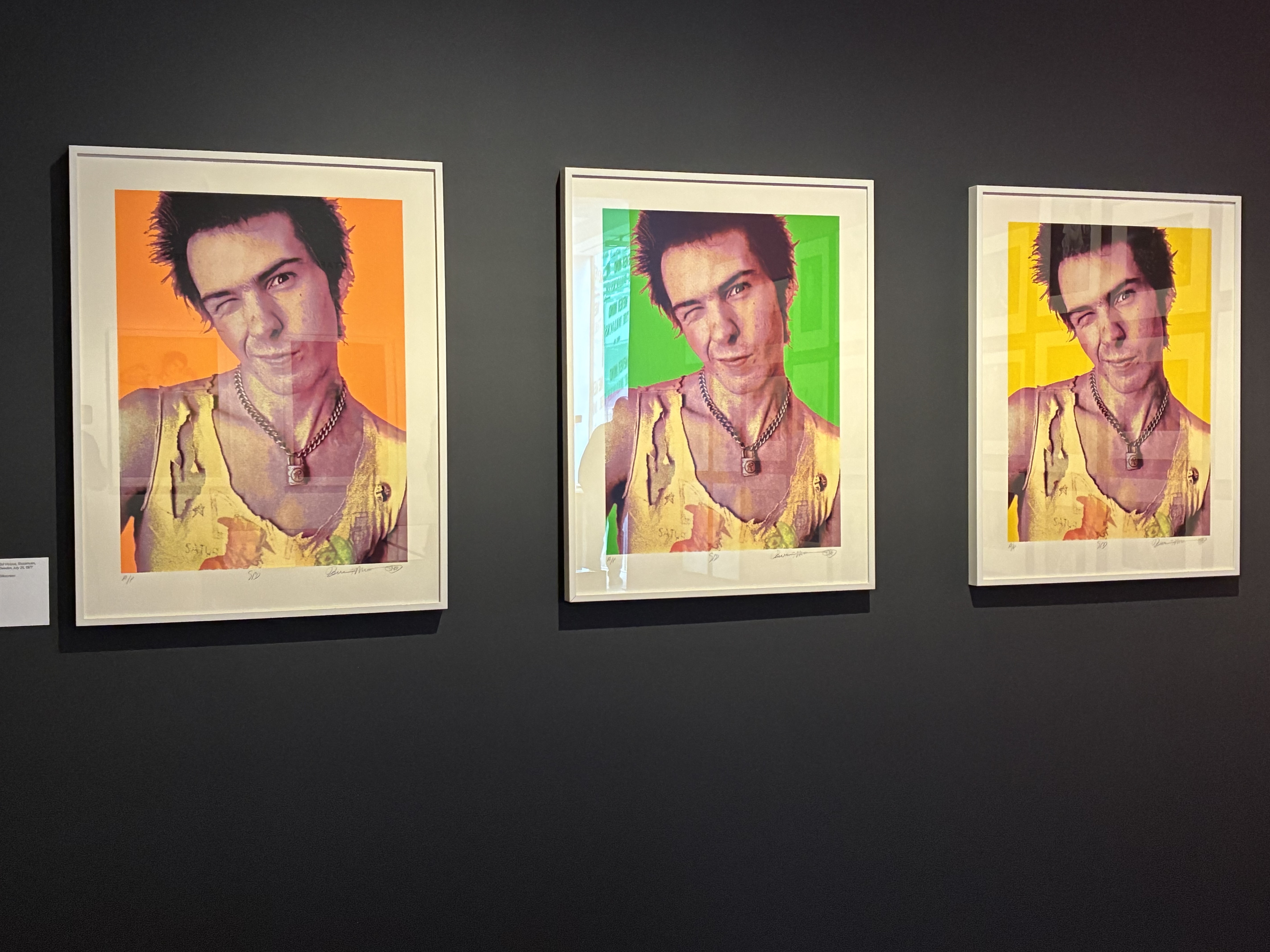
Another wall has a set of images of Sid Vicious given the Andy Warhol-Marilyn Monroe silk screen treatment.

Sid Vicious given the Marilyn silk screen treatment in Dennis Morris at the Photographers’ Gallery (photo by the author)

Here’s a reminder of what we’re talking about:

Public Image Ltd

In 1978, as the Pistols broke up, Virgin boss Richard Branson invited Morris to accompany him on a talent-spotting trip to Jamaica and Morris persuaded Virgin that Rotten (now reverting to his given name of John Lydon) should accompany them. Quite apart from the reggae talent that Morris helped bring to Virgin’s attention, the reggae sound of performers like Lee Perry, the Abyssinians, Big Youth and U Roy made a deep impression on Lydon as he was assembling his post-punk band, Public Image Limited. PiL were to pioneer a distinctive sound mixing the experimental Krautrock-inspired guitar of Keith Levene with the heavy dub bass of Jah Wobble. The more you listen, the more fascinating Levene’s unconventional guitar patterns become.

Morris played a key role in not just photographing the new band, in a deliberately post-punk, anti-punk style – but crafting their public image. He created the PiL logo and designed the innovative Metal Box album packaging – as documented in a wall of images and display case here.

The Public Image Limited wall, showing stylised portraits of (top left to right) guitarist Keith Levene, drummer Jim Walker, and John Lydon looking like a choirboy – with at the far right an early version of the band’s logo: in the display case are more photos and a copy of the metal box LP – all in Dennis Morris at the Photographers’ Gallery (photo by the author)

After punk

There’s more, lots more. The story of how Morris got the image for the cover of Marianne Faithfull’s 1979 solo album, Broken English.

This was part of his work as art director of Island Records which saw him design album covers for Linton Kwesi Johnson, Marianne, Marley and many others. Downstairs is a gallery of his LP covers, as well as other rock memorabilia depicting his photos or designs (t-shirts, lighters, cigarette papers etc).

Display of LP album covers which Morris contributed images and design for, in Dennis Morris at the Photographers’ Gallery (photo by the author)

During this period Morris replaced Don Letts as vocalist of Basement 5, a reggae punk fusion band. He created their logo, image, photography and graphics and gained a recording contract with Island Records.

Subsequently he did photo shoots with a series of icons: from 1970s rock artists like Patti Smith and Grace Jones, through Prince’s heyday in the 1980s and on into the 1990s, the era of the Stone Roses, Oasis, Primal Scream and much more.

At the same time he maintained his close connection with reggae artists and the exhibition features a slideshow projected on a wall of a pantheon of reggae stars including The Gladiators, the Mighty Diamonds and many more.

And he promoted Black British performers such as Steel Pulse, Aswad, often photographing them and taking a hand in designing and styling their images and record artwork. It was Morris who persuaded Island records to sign the great Linton Kwesi Johnson, for which act alone he deserves a medal.

Summary

What range, from the poor streets of Hackney and Southall, to hobnobbing with music royalty, from the Sex Pistols to Steel Pulse, from white punk rock to the blackest of hard-core reggae, and then on to a galaxy of top pop stars. But it’s maybe those early shots, from Hackney, Southall and white working class lives from the 1970s, which linger longest in the memory…

The Trot, Southall Horse Market from This Happy Breed © Dennis Morris


Related links

Related reviews

Royal Academy Summer Exhibition 2025

Huge

The Royal Academy Summer Exhibition 2025 contains the usual overwhelming number of works of art plastered all over the walls of 12 rooms – small, medium and huge. This year’s total is 1,729 prints, paintings, photographs, drawings, sculptures, films and architecture models. Where to start and how to think about this annual jamboree except to abandon yourself to the bombardment.

‘On your marks – get set – go!’ – installation view of Gallery 2 at the Royal Academy Summer Exhibition 2025 (photo © Royal Academy of Arts / David Parry)

Go with someone

I went round once, pretty carefully, trying to look at everything, then went round a couple more times and noticed a load of items I simply hadn’t registered on a first pass. That’s why it’s best to go with friends or family, because there’s too much for one person to process and other people notice other types of things and bring them to your attention. Plus which, it’s always fun to listen to other people’s opinions: why did they love x, y or z?

Installation view of room 1 in the Royal Academy Summer Exhibition, aka the Wohl Central Hall, which is dominated by one of Ryan Gander’s big black balls (left) and a set of ostrich feather car wash wipers suspended from thick chains, ‘Body Shop’ by Alice Channer (£70,000) (photo © Royal Academy of Arts / David Parry)

Exhibition guide

The little pocket-sized exhibition guide they offer each year now costs £3.50, which is beginning to feel a bit pricey, but it is a vital piece of equipment. None of the 1,729 works have captions giving name of work or name of artist, there’s just a number on the wall next to each piece (from 1 to 1,729) so it’s absolutely vital to have the guide to hand in order to look up who the artist is, what the work is called and, because the great majority of works are for sale, the price.

It lists the works in numerical order but, since works by the same artist are sometimes scattered between different rooms, it also lists them by artist. So, for example, we learn from this index that Michael Craig-Martin has five works in the show, numbers 110, 490, 1087, 1205, 1206. Then you scan the main numerical index to discover these are hung in the Lecture Room, Gallery 7, Gallery 4, and Gallery 3.

So if you want to track down works by particular favourite artists (Norman Ackroyd, Tracey Emin, Yinka Shonibare) there’s an element of Where’s Wally or Sudoku sleuthing to find the numbers, find the gallery, and then the challenge of finding them on a wall absolutely plastered with pictures or surfaces crammed with little sculptures.

How many little sculptures can you fit onto one display table? at the Royal Academy Summer Exhibition 2025 (photo © Royal Academy of Arts / David Parry)

The digital version

One last point: most of the works are medium sized, many relatively small, and it is often difficult or even impossible to really see these because a) there are just so many of them and b) lots of them are hung high up on the walls.

This year, as every year, I discovered loads and loads of images on the RA exhibition website that I have no memory of seeing in the flesh. I think it’s reasonable to say that there are, in effect, two Royal Academy Summer exhibitions, the real life one, and the digital one.

The courtyard

As usual the exhibition starts with a big sculpture or installation in the main courtyard. This year it’s a set of huge black inflated balls by Ryan Gander RA. Each one has a gnomic question printed on it in big white letters. Apparently these were developed in collaboration with schoolkids and, well, to be a little harsh, it shows: How much is a lot? When do you know you’re right? Does abstraction have rules? Will time tell?

Courtyard of the Royal Academy Summer Exhibition 2025 showing some of Ryan Gander’s big balls (photo © Royal Academy of Arts / David Parry)

Light white walls

My immediate impression was that the show felt lighter and airier and more attractive than in the past few years, which gave me a positive feeling about the thing. After visiting several rooms it dawned on me that this is because the curators have left (most of) the walls white. Bright white walls respond well to the ambient light coming through skylights and make the place feel light and airy and happy. I was tired from the working week when I headed for the Tube but walking into the galleries was a refreshing and uplifting moment.

And if you turn left out of the Wohl Central Hall into the vast room 3, you are met by a welter of huge and impressive works, with summer light pouring through the skylight and reflected from the white walls. All very positive.

Installation view of the enormous Gallery 3, by far the best room at the Royal Academy Summer Exhibition 2025 (photo © Royal Academy of Arts / David Parry)

However, when I looked closer at the numbers I realised room 3 is pretty much the last room you’re meant to visit (if you care about doing it in order) and you’re in fact meant to turn right out of the Wohl Central Hall into the much smaller Lecture Room.

This room and the subsequent ones (galleries 9, 8, 7, 6 etc), nice and white-painted though they are, had what felt to me far fewer really standout works in them. Obviously lots and lots of goodish things, some very nice things but, as I continued round the overwhelmingly densely hung spaces, navigating the crowds of other visitors, slowly the suspicion grew on me that there were fewer really notable works than in previous years. Maybe. Possibly.

But that’s just one person’s point of view. The point is there’s such a glut of stuff to look at, consider, analyse and judge that everyone’s opinions are going to differ, at hundreds of points. I considered structuring this review by the RA’s own categories:

  • Prints
  • Painting
  • Photography
  • Drawing
  • Sculpture
  • Architecture
  • Film prints

But quickly realised this doesn’t really work. The things you like tend to be random and clustered in certain mediums. In my case, I like paintings and sculptures. I rarely pay much attention to films which a) require a lot of time b) are rarely worth it c) not least because they’re displayed on tiny monitors (poor film-makers, they must be gutted) and d) I used to work in TV where I professionally reviewed films made for the magazine format TV shows I edited, so I am used to a very high standard of image and editing and art films are, on the whole, notable for their deliberately low-fi quality.

And don’t get me started on architecture and architectural models: I regard the entire subject as a colossal fail. While international starchitects devise evermore silly and absurd projects to build dream cities in China or on Mars, the rest of us have to live in the disastrously badly planned, badly designed, badly built houses inflicted on us by previous generations of shoddy planners and cheapskate builders:

‘England boasts the highest percentage of substandard housing in Europe, with 15% of existing homes failing to meet the Decent Homes Standard. This is a higher proportion than countries like Hungary, Poland, and Lithuania.’
(England’s Housing Crisis: Among the Worst in the Developed World?)

I appreciate that architects large and small, world famous or local, have very little to do with all this, with local planning, house design, building, new developments etc, they’re all vying to build the next gherkin or shard or designing ideal communities for Utopia or, as here, Lord Forster of South Bank’s design for the new Manchester United stadium.

But in which case… if most of them have little or no say about the built environment most of us live and move in, why are we bothering to register their fantasias?

Among the numerous architect models, I was struck by this one which appeared to be made almost entirely from corrugated cardboard.

Suspense, Trans-Caucasian Trail, Armenia by Gumuchdjian Architects: number 1584:  5,000

Size matters

It sounds silly but faced with such an overwhelming number of artworks you quickly realise that size really does matter. To give a simple example, there are a number of portraits of dogs or cats which are obviously meant to be twee and sentimental and reassuring and they are nearly all small, deliberately small and intimate in scale.

A lot of them are prints which are designed to be run off in multiple editions and you often see their glass fronts festooned with little red dot stickers. This indicates how many people have bought a copy – so there’s another game you can play here, with friends or family, particularly small children, which is set them to find the most popular picture, by number of sales.

What caught my eye

Having abandoned the attempt to consider the works logically by format or size or price, I’m just going to share half a dozen of the works which really stood out for me.

Mummer

Number 177, Mummer (Irish border sculpture proposal) by Tim Shaw. Sculpture from carved and constructed wood. £150,000, standing in front of a ragged red curtain.

Mummer (Irish border sculpture proposal) by Tim Shaw (photo by the author)

Rats

101 white rat pelts lined with 22 carat gold, by Zatorski + Zatorski. Number 1,713. £85,000

101 white rat pelts by Zatorski + Zatorski. Number 1,713. £85,000 (photo by the author)

Dialogue with God

Dialogue with God by Jane Hewitt, catalogue number 1727, £1,000.

Dialogue with God by Jane Hewitt (photo by the author)

Day 3

Number 1592: Day 3 by Eleanor Lakelin – made from bleached horse chestnut burr. £78,600

Day 3 by Eleanor Lakelin (photo by the author)

Archive of Lost Memories I

Archive of Lost Memories I by Yinka Shonibare, catalogue number 105: £300,000. We’re familiar with Shonibare’s work from his solo exhibition at the Serpentine. Half of it is very post-colonial, with statues of imperial heroes decorated with colourful floral patterns, and this shelf display is a variation on that theme, with its terracotta versions of the Benin bronzes (still to be seen in the British Museum) juxtaposed with a flower-covered imperial bust. But another strand of his work is colourful portraits of African birds generally accompanied by a tribal mask, and there are three or four examples here as well.

Archive of Lost Memories I by Yinka Shonibare, catalogue number 105: £300,000 (photo by the author)

Simorgh and Solent avocet

These could be in a local village craft fair, couldn’t they? But for some reason they caught my eye, made me smile.

Simorgh and Solent avocet by Emma Christmas, numbers 1106 and 1005, £695 and £625 (photo by the author)

Touchstone

Touchstone by Neil Jeffries, number 461, £6,000

The absence of real life

It’s amazing to me how unreal art is, how utterly unlike real, everyday life, how little of most people’s average experiences are captured by art. What do most of us do, what makes up our experience of life? Surely work and commuting to and from work and worrying about work takes up half or more of life, followed by shopping for food, cooking and eating. Vast amounts of time are spent watching telly, going to the movies, taking part in sports or health activities such as simply walking or, in my case, cycling and the gym. And, of course, more or less everybody now seems to have a mobile phone and pay an enormous amount of time looking at a tiny screen.

My point is that none of this is depicted anywhere in any of the 1,729 works of art on show here. When you see it from this perspective, it is absolutely staggering the extent to which ‘art’ – presumably derived from art school, art teaching, art courses and what you could call Art Ideology – suppresses and excludes the vast majority of everyday human experience.

To be more specific, most people’s work involves sitting in front of a computer screen and yet there was just one depiction of this universal activity in the show (At The Screen by David Tindle) plus a schematic Michael Craig-Martin silhouette of a laptop. That’s it.

Driving – how many people own a car, how many hours a week do people spend driving, drive busses coaches vans Deliveroo scooters: yet there were very few depictions of this extremely common activity: some photos of picturesquely derelict old cars, a few photos or paintings of the view through what appear to be wet windscreens. But of the apparatus surrounding driving, and the vast infrastructure of motorways, service stations, A roads, B roads and so on, almost nothing. (Actually there is one picturesque gas station, but it’s in America which is generally considered by the art world to be more picturesque than shabby England, obviously.)

Instead: lots of real life as most of us experience it, there are lots of still lifes of apples, or pears, or vases of flowers, of isolated birds, of landscapes and seascapes, plus hundreds and hundreds of images which aren’t identifiable as anything specific, abstracts and semi-abstracts, vivid, beautifully executed, and all strangely detached from the world we live in…

How many pictures can you fit on a wall? at the Royal Academy Summer Exhibition 2025 (photo © Royal Academy of Arts / David Parry)

All I’m really saying is that, when you assemble nearly 2,000 of the best contemporary artworks, paintings, prints, photos, sculptures and installations by artists famous and obscure, it is really quite striking how much of contemporary lived experience is not in it.

Mr Potato Head

New World Man by Robert Mach

New World Man by Robert Mach, catalogue number 1723, £1,400.

How you’ll feel by the end

Lulu in the Sky with Diamonds Catalogue by John Humphreys (number 1661) from £120,000 (photo by the author)


Related links

Related reviews

Nothing Lasts Forever by Peter Mitchell @ the Photographers’ Gallery

‘I photograph dying buildings.’
(Peter Mitchell)

Pioneer of documentary colour photography

Peter Mitchell is widely regarded as a path-breaking documentary photography who pioneered the use of colour in social photography in the 1970s and ’80s. His landmark show, ‘A New Refutation of the Viking 4 Space Mission’, staged at the Impressions Gallery in York in 1979, was the first colour photography show at a British photography gallery by a British photographer and strongly influenced other colour photographers working in the same field.

Mrs McArthy and her daughter, Sangley Road, Catford, London by Peter Mitchel (1975) © Peter Mitchell

Derelict Leeds

Born in Manchester in 1943, Mitchell’s family moved to London where he grew up and studied photography, which explains why some of the early photos on the show are from London – Catford, the Old Kent Road, the Horniman Museum. In 1972 he visited Leeds and ended up moving there. He arrived at a time when the city was badly rundown, with the old Victorian slums being torn down but also a lot of mid-20th century social housing falling into disrepair and needing to be demolished.

The result was a cityscape in distress, strewn with derelict and orphan buildings. Mitchell made his name developing a style of taking hundreds of vivid documentary snaps of these knackered old buildings – the last house in a terrace, houses next to Victorian factories, old pubs or grocery shops, boarded-up cinemas – and the mostly working class people who grimly hung on in them.

Max Babbin, Vulcan Street, Leeds by Peter Mitchell © Peter Mitchell

‘A New Refutation of the Viking 4 Space Mission’

In fact Mitchell’s images are a little more curated than this suggests. They are frequently gathered together into projects. I’ve mentioned his most famous one ‘A New Refutation of the Viking 4 Space Mission’, presented at the Impressions Gallery in York in 1979.

In the mid-1970s NASA’s Viking Lander 3 and 4 space probes had recently landed on Mars and sent back the first ever images of the red planet in all its staggering dullness. Mitchell had the bright idea of presenting his images of devastated Leeds as if they were images sent back to some alien planet from a space probe which had landed on earth. Hence the jokey frames to otherwise common-or-garden colour photos. These frames are ‘space charts’, black with white markings indicating degrees west or east, as if attached to highly technical survey diagrams. Here’s a video showing someone leafing through the book of the project where you can clearly see how each photo is embedded in quite obtrusive ‘space charts’.

The concept is quite entertaining for the first five minutes but hardly earth shattering and quite quickly you learn to ignore them and just enjoy his cracking photos.

‘Some Thing Means Everything to Somebody’

Another series, titled ‘Some Thing Means Everything to Somebody’, consists of a sequence of scarecrows. Mitchell explained that ‘Scarecrows have always been a feature of my childhood… I’ve purposefully chosen ones that have no face on them because I didn’t want people to laugh at them but imagine them as people.’

Scarecrow 28 by Peter Mitchell © Peter Mitchell

Ghost Train Man

Another series is devoted to Francis Gavan, the Ghost Train Man. This fellow created a home-made ghost train ride and toured it round the North in the later 197os.

Francis Gavan, Ghost Train Ride, Woodhouse Moor, Leeds, Spring by Peter Mitchell (1986) © Peter Mitchell

The little Ghost Ride section is jokily presented with a trio of children’s toy black rubber bats tacked to the wall above one of the ‘spooky’ images. In fact, as you can see, stripped of the humorous paraphernalia, this is another of his images of the perky but sad seediness of English life, which always seems exaggerated in the North.

Installation view of ‘Nothing Lasts Forever’ by Peter Mitchell at the Photographers’ Gallery showing the Ghost Ride photos (photo by the author)

Quarry Hill

And a separate room is devoted to his awesome series chronicling the demolition of the enormous Quarry Hill estate of flats. This had been a pioneer of modernist design when it was erected in the 1930s but, just 30 years later, had fallen into dereliction and so was slowly destroyed and pulled down, giving Mitchell hundreds of golden opportunities for ghostly shots of abandoned interiors, general views of the stricken buildings, random items left standing amid the detritus, and even a shot of the proud demolition team posing proudly in front of their rubbly handiwork.

Installation view of ‘Nothing Lasts Forever’ by Peter Mitchell at the Photographers’ Gallery showing some of the Quarry Hill photos (photo by the author)

The demolition took a surprising five years, and Mitchell’s project work on it didn’t come to fruition till he published his book on the subject, titled ‘Memento Mori: The Flats at Quarry Hill Leeds,’ in 1990.

Sense of humour

What I haven’t managed to convey so far is Mitchell’s sense of humour. There’s an alcove with some bric-a-brac from his career which also includes a video of an interview the gallery has done with him. In this he is disarmingly honest about his career and delivers funny stories with self-deprecating northern humour. And once you’re alerted to his sly humour it infects everything you see and you realise that a sly, dry northern sense of humour hovers over all these projects and colours every photo.

This is obvious in the conceits such as the whole Voyager 4 idea, and blatant in the children’s-rubber-bat vibe of the ghost rides. But once you’ve noted it, you realise there’s something humorous – a bit bleak, a bit nostalgic maybe but essentially droll – even about the urban destruction. The men and women standing in front of their old-fashioned shops or houses evoke thoughts of 1970s sitcoms like ‘Open All Hours’ or ‘The Last of The Summer Wine’, where even speaking with a northern accent is seen as comic.

For example there’s a classic Mitchell phot which is, on the face of it, another study in bleak and urban abandonment. It’s a shot of two frumpy middle-aged women standing in front of the utterly unglamorous blank brick wall which forms the backside of a cinema.

Two anonymous ladies, Tivoli Cinema, Acre Road from Sisson’s Lane, Leeds by Peter Mitchell (1976) © Peter Mitchell

So far, so urban wasteland. But in the caption underneath, Mitchell explains that he had the devil of a time trying to persuade these ladies to move. They’d bumped into each other and were having a nice natter and why should they move just so he could take his poncey photograph? My friend and I had a jolly couple of minutes ad libbing a sketch of two northern ladies who obstinately refuse to budge so some la-di-dah photographer can take a nice shot. ‘We like it here, don’t we Beryl?’ ‘Yes we meet up at this precise spot every Tuesday morning at 1o o’clock and no fancy photographer is going to budge us!’

Even the photos taken from Quarry Hill being demolished, admittedly many of the interiors of half-demolished flats genuinely are bleak and atmospheric – but the mood is lifted when you learn that Mitchell managed to line up the wrecking crew for a group portrait in front of their handiwork (Noel and his lads, 1978) but when he later sent them all copies of the photo, they complained that they came out too small.

Every photo has a caption and many of them give a droll and humorous spin on what ought to be bleak images of urban decay. Mitchell is more Alan Bennett than Ian Curtis.

Interview

Thoughts

In the interview Mitchell, in self-deprecating mode, happily concedes that his photos are, in one sense, all the same – they’re all done with the same classic, square, face-on approach to each building or object, eschewing fancy angles or perspectives, flashy treatment or distortion of the images or blurring – just straightforward, straight-on colour photos such as you or I might take.

And yet what an eye! Image after image after image is full of juice and meaning. There’s an extraordinary number of ‘hits’, almost all of the photos ‘work’, and you’d be happy to own loads of them.

‘Memento Mori’, ‘Nothing Lasts Forever’ – his subject is the transience of human life but of a particular type – the lives of small people, of little people, of the ordinary people who run local stores and the chippy down the road. There’s no middle class, bourgeois or comfortably-off people in any of the pictures.

Mitchell’s photos come charged with a double nostalgia: first for a bygone era, a pie and a pint and Morecambe and Wise on the telly. And then the poignancy triggered by so much destruction and demolition, so many homes with all their experiences and memories turned to dust. Was it really necessary to tear so much down? And has what was put in its place really turned out to be an improvement?

The Kitson House telephone, Quarry Hill Flats by Peter Mitchell (1978) © Peter Mitchell

Promo video


Related links

Related reviews

Deutsche Börse Photography Foundation Prize 2025 @ the Photographers’ Gallery

The annual Deutsche Börse Photography Foundation Prize is awarded to the best photography exhibition staged, or the best photography book published, in Europe, in the preceding twelve months. Obviously they start with a long list, then select a short list, from which are chosen four finalists, and it’s the four finalists’ work which features in this annual exhibition at the Photographer’s Gallery. The winner is announced on 15 May and will be awarded a handsome £30,000 prize, with the other finalists each receiving £5,000.

As usual, each of the four photographers are represented by projects or books which usually take a bit of explaining. Each photographer has a room each devoted to their project. This year’s four finalists are (in alphabetical order):

  • Cristina De Middel
  • Rahim Fortune
  • Tarrah Krajnak
  • Lindokuhle Sobekwa

1. Cristina De Middel (b. 1975, Spain)

De Middel’s project is titled ‘Journey to the Centre’. It’s a photographic testament to the migrants who cross Mexico from South America with the aim of getting into the United States. So it starts off from Tapachula, a town on the southern border of Mexico (with Guatemala) and then covers the trail heading north until it reaches the famous Trump wall, just this side of the border, across from an American town with the ironic name of Felicity.

First off what strikes you about Middel’s room is that it is dominated by a massive orange metal frame on which hang some of her images, presumably representing the Trump Wall.

Installation view of ‘Journey to the Centre’ by Cristina De Middel at the Photographers’ Gallery (photo by the author)

Next thing you notice is that the photos are interspersed by what appear to be picture cards from a game I’m not familiar with.

Installation view of ‘Journey to the Centre’ by Cristina De Middel at the Photographers’ Gallery (photo by the author)

When you look closer you see that the images in the cards are recreated or strongly echoed in the photos placed alongside them. So in this installation view the big picture of the sun is echoed on its left by a photo of a woman holding her hand up to protect herself from the sun, while the red figure of El Diablo is echoed on its right by a man wearing a bright red cloak. This parallelism between the big bright cards and Middel’s clear bright photos is much more obvious than the rather more muted and obscure references to the Jules Verne novel.

The card-photo juxtaposition is also, you come to realise, funny.

Next thing you quickly notice is how classically Middel’s photos are framed and composed. The subjects are in the middle, shot very cleanly and crisply in perfect focus, with a nice space all around, giving a classic, almost studio effect, although all of them are clearly shot on location.

Installation view of ‘Journey to the Centre’ by Cristina De Middel at the Photographers’ Gallery (photo by the author)

In this (admittedly not great) installation shot, you can see at the top-left how the single boot, abandoned and half buried in the desert sand, is shot at just the right distance, square on, with plenty of space around it, so that it almost looks like an image from a surreal ad.

Same with the guy apparently preparing to pole vault over Trump’s Wall – the wall itself is framed carefully so that we fully see its continuation into the sea, while the high jumper himself is set as squarely in the middle of the shot as possible.

These are not casual shots. They have all been carefully composed and framed. And it’s the resultant timeless, classic effect which makes them so appealing. As I’ve said, almost every one looks like an ad for something, whether a commercial product or a charity, but all with a kind of classic, commercial perfectness.

Installation view of ‘Journey to the Centre’ by Cristina De Middel at the Photographers’ Gallery (photo by the author)

Finally, as you can see in this installation view, there’s also a display case showing some of the bric-a-brac Middel came across in her pilgrimage across Mexico, abandoned shoes and the like.

It was only after I’d been round the room three or four times that I realised something else, something connected to the advertisement-style finish, which is the absence of people. Certainly about half of the images feature a person, but only one. Whereas of the ten photos hanging on the frame in my first installation view, only one or two of them feature a human being at all, the other eight or nine are bereft of people – stark but beautifully composed and shot images of the desert, of cacti and scrubland, an ancient pyramid, a Welcome tourists sign, a vivid one of a burned-out car, and so on.

Now when I’ve seen news footage of migrants trekking north through Mexico to try and reach the United States, it’s generally been in family groups, sometimes in big crowds. The curators claim that Middel’s work is challenging stereotypes about the migrants who trek across Mexico to reach America, but the impression I had is that she’s more or less erased those migrants in order to be left with consciously poignant images of emptiness and abandonment.

2. Rahim Fortune

From one project about America to another. Rahim Fortune is a young American Black man. His room doesn’t have a big metal frame or any props, just the old-fashioned thing of 30 or so crisp black-and-white photos depicting aspects of Black culture and community from his home state of Texas and the American South.

His project is titled ‘Hardtack’ which requires a word of explanation.

Hardtack is an unleavened bread made with flour, water and salt that was typical of the southern states of America during the Civil War era. Due to its extremely long shelf life, hardtack is long associated with survivalism and land migration. Fortune draws on this as a metaphor for the enduring nature of Black culture and traditions.

All his photos are great, beautifully framed and beautifully shot, classic, very achieved. But, I’m afraid to say, I feel like I’ve seen them all before. Old Black guys who look like they’ve had a hard life, sweet Black bridesmaids dressed in white at a wedding, the Revivalist meeting, the worn old clapperboard Baptist chapels, random people on horseback emphasising the rural backwardness of the region, I feel like I’ve seen them all before.

Praise Dancers in Edna, Texas by Rahim Fortune (2022) © Rahim Fortune

I felt guilty thinking this but then I came across Fortune himself articulating the thought in the three-minute interview he gave the gallery.

Interview with Rahim Fortune

In his own words:

“There’s a lot of baggage that comes with photographing in the American South. There’s so much photographic fog and fodder and it’s a place that’s been so heavily photographed.”

Well, like I say, all his images are beautifully composed and shot, displaying wonderful technique, and I really liked quite a few of them, it’s just that… I feel like I’ve seen many of them, or shots very like them, lots of times before.

Windmill House by Rahim Fortune © Rahim Fortune

And America again! The rules of the competition are that the prize is awarded to an outstanding exhibition held in Europe so why are these finalists from or about America? Are we seriously to believe that no photography exhibition and no photography book by any European photographer merited inclusion?

3. Tarrah Krajnak

This oppressive sense of American cultural dominance continues with the third finalist, Tarrah Krajnak. Krajnak was born in an orphanage in Lima, Peru, in 1979 and adopted by Slovak-Americans. She is now an American citizen who lives and works in Eugene, Oregon, USA. The curators explain that she subverts this and interrogates that, but the one thing she isn’t interrogating is the American cultural dominance of this exhibition.

In the Krajnak room there’s a massive blue painting and a video but the real meat is two series of black and white works on opposite walls. One of them is titled ‘Self-Portrait as Weston’ which needs a word of explanation: in 1977 a book was published collecting together the the best of the stylised studies of the female nude which classic American photographer Edward Weston had made during his long career (1886 to 1958). So Krajnak (an Associate Professor of Photography at the University of Oregon and so well-versed in the canon) had the bright idea of taking photos of herself nude re-enacting the same poses as the classic Weston poses, with the Weston book placed in shot, open to the relevant image she is recreating or pastiching or subverting.

Self-Portrait as Weston #4 by Tarrah Krajnak © Tarrah Krajnak

You can almost hear Krajnak explaining that she is subverting the male gaze and interrogating the male canon and asserting women’s agency. You can feel her saying ‘This is what a real woman looks like’, her own naked body being a realistic, common-or-garden human shape rather than the svelte and sexy women Weston (sexistly) featured in his studies.

Installation view of ‘Self-Portrait as Weston’ by Tarrah Krajnak at the Photographers’ Gallery (photo by the author)

There are 16 of these homages/subversions, all neatly laid out in rows on the bare white gallery wall. You can see how the walls in the photos are grubby and have a developing world vibe, more like Peru or Mexico than the spick and span studios of the University of Oregon.

I also think the prints have been treated in some way to make them appear agèd, maybe this is what the curators mean when they refer to Krajnak’s use of ‘pigment prints’ and other technical processes. I assume this is all an attempt to recreate the atmosphere of the original Weston photos, some of which date from the 1920s and ’30s.

I dare say Krajnak is interrogating the male gaze and subverting the canon of dead white males, asserting her agency and all the other buzzwords of feminist academia, but it seems like a tired trope to me. As recently as a month ago I visited the exhibitions of Mickalene Thomas and Linder who have both, for decades, been depicting half-naked women in a bid to subvert the male gaze and assert female agency and interrogate the canon of white male art and so on. I do get the idea and am pretty bored by it. Subverting the male gaze isn’t nowadays a radical strategy, if it ever was one, but more a well-established genre like photographs of flowers or village fetes.

My wife, a feminist businesswoman, didn’t like the series because of its obvious and formulaic preachiness; she far preferred the other series in the room, ‘Rock, Paper, Sun’ from 2023.

Installation view of ‘Rock, Paper, Sun’ by Tarrah Krajnak at the Photographers’ Gallery (photo by the author)

Also black-and-white images which have been treated or printed to give the effect of age and depth, this is a series of images of Krajnak holding rocks of different shapes, placed next to photos of her notebook in which she’s sketched each rock and described her feelings about it.

My wife particularly liked the idea that if you hold the rocks long enough, they start to talk to you, to communicate their stories. We both liked that very much.

On the third wall was a smaller set which in a sense combines the best of the other two, in that they are again self portraits, of her whole body (though fully dressed, this time) engaging with rocks. They’re lovely images of her curling up and cuddling rocks and boulders.

‘Sister Rock/Rock that Tries to Forget (from Automatic Rocks/Excavation)’ by Tarrah Kjanak (2020) © Tarrah Krajnak

These feel sweet and lovely and genuinely do convey some sense of harmony between humans and the environment. They’re beautiful because they sweetly convey a beautiful sentiment. They’re gentle. They suggest closure and harmony in a way not many of the other images in the show do.

(The rock hugging reminded me a bit of the tree hugging Chipko movement of women from the villages of the Garhwal Hills in the Himalayas in Uttarakhand as photographed by Pamela Singh and featured in the Barbican exhibition RE/SISTERS: A Lens on Gender and Ecology.)

4. Lindokuhle Sobekwa

The fourth and final entrant is not from or about America, which makes a nice change, although it is from another over-familiar country, South Africa. It’s a room devoted to the highly personal project of the South African (male) photographer Lindokuhle Sobekwa titled ‘I carry Her photo with Me’. Like the others, this needs some explanation.

The project began when Sobekwa found a family portrait with his older sister Ziyanda’s face cut out. It remains the only photograph he has of her. One day when the siblings were seven and thirteen, she chased him and he was hit by a car and badly injured. She disappeared hours later, only returning a decade later, ill. By this time Sobekwa had become a photographer. He tried to take her portrait, but stopped when she reacted angrily. Ziyanda died soon after.

Tragic story of a broken family. The display combines family photographs, handwritten notes, sketches and drawings, as well as photos of the wider environment around Sobekwa’s home, to create a scrapbook-like effect which is deeply rooted in his family but reaches out, as it were, to portray the crushing poverty deeply embedded in South African society to this day.

Again, as with the technically perfect images of Rahim Fortune, many of the photos here are wonderful – an old woman labouring a ploughed field in a vast derelict expanse, a dejected Black woman sitting in a shiny bathroom (the poster image for the whole show) and the one I liked best, a middle-aged Black woman in what looks like a shanty shack, reading by candlelight.

From ‘I carry Her photo with Me’ by Lindokuhle Sobekwa

But, well, like the Fortune set, I feel I know the outline of this story, in fact I am over-familiar with it. Apartheid was terrible. Thirty five years after its fall, there’s still crushing poverty in South Africa. None of this is news. I’m sure I’ve seen loads of photojournalism about grim lives in South Africa, in fact all I had to do was look up last year’s Deutsche Börse Photography Foundation Prize to discover that it, also, featured the work of a Black South African photographer chronicling Black poverty, Lebohang Kganye. Maybe there’s a clause in the competition saying there always has to be an entry from South Africa – and that the curators have to mention the world ‘colonialism’ at least once in every exhibition.

Interview with Lindokuhle Sobekwa

Sobekwa’s personal story and the inclusion of many pages from his scrapbooks, complete with scribbled text and rough drawings projected onto one wall, give this room a distinctive flavour – but then I’m sure I’ve seen the inclusion of a photographer’s scrapbooks and notebooks in at least two other photography exhibitions in the past few years.

In fact arguably the most distinctive thing about his room was the very beautiful, calm if slightly sentimental piano music playing in it. This, we learn, was composed specially for the exhibition, ‘Meditations for Ziyanda’ by Nduduzo Makhathini. This lovely lulling music makes the Sobekwa room the nicest one to linger in, although the actual imagery is (deliberately) the most scrappy and fragmented.

Thoughts: Old

If there’s one thing my kids, now in their early 20s, have taught me, it’s that I’m completely out of date. My entire worldview of what is radical or strange, what is politically or culturally important, what music, films, art or photography I like, not only seem out of date to them, but irrelevant to their tastes and concerns and anxieties.

They live in a hyper-digital age where billions of images and videos about everything are available all the time and they are continually adding to the vast pile by sending each other Snapchat, Whatsapp and TikTok images and texts and sounds all the time.

Even the idea of going to an art or photography gallery seems to them like an incredibly out-of-date, Stone Age thing to do. Why bother when all the art you could ever want to see and much more is available at the touch of a finger?

It’s with this in mind that my overall feeling about the show was how old it all seemed, how old and tired and clichéd so many of the images and earnest concerns seemed.

1. Oh the poor migrants trekking across Mexico to smuggle themselves into America, how long has that being going on? I remember liking the Jack Nicholson movie ‘The Border’, about the US border patrol and the misery of migrants trying to cross into rich America, and that dates from 1982.

2. Similarly, I remember protesting against apartheid South Africa as a student, the radical press swimming in images of the poverty-stricken townships, in the 1980s.

3. I grew up in the 1970s amid the backwash of images from the American Civil Rights movement and pictures of poor rural Blacks in the American South abounded in Sunday supplement photo-essays, in books and posters and movies, half a century ago.

4. Hugging trees and rocks may be a little more recent but concern for the environment likewise dates back to the 1970s when Friends of the Earth and Greenpeace and all the others were founded. I’ve always loved the land art of Richard Long, featuring immaculate photos of rocks and boulders similar to the ones in Krajnak’s work, and he started doing that in the late 1960s.

So, completely contrary to the curators’ claim that these works are somehow cutting edge, state-of-the-art and addressing bang up-to-date issues, I felt the exact opposite. All of them seemed to me to be not only 1) addressing issues which were old and familiar before some of these photographers were even born but 2) in a curiously static, classic and old-fashioned aesthetic which also feels very dated.

Where’s the photography which captures the all-enveloping digital realm all of us live in these days, and register the complex effect that’s had on our perceptions of ‘reality’ and value? Not here, not by a long shot. All four photographers here soak us in the warm and comforting ambience of well-worn and familiar and easily assimilable issues, presented in reassuringly familiar styles.

Making America great again

I know I bang on about it but the inclusion of three projects about or America or the American border made me wonder: were there really no photographers from Europe, no European photography projects, no European photography books, covering European subjects, worthy of inclusion among the finalists?

No photography exhibitions anywhere in Europe about the war in Ukraine, about refugees, about the long afterglow of the wars in Yugoslavia, about the rise of right-wing parties in Italy, Germany, about the bombs and gang warfare in Sweden. No stories and no photographers from Europe? Apparently not. America again. And again. And again.

It feels like the curators, despite all their progressive rhetoric, despite all their conscious intentions, despite Donald Trump demonstrating to the whole world that America is nobody’s friend and should be nobody’s icon, and the obvious fact that we need to consciously decouple – politically, militarily and culturally – from a country which chose authoritarian mobster rule, cannot shake off the dead hand of American cultural imperialism.

Who do you think should win?

From what I’ve shown you and what you can see for yourselves on the links I’ve provided, who do you think should win? Obviously they’re all highly accomplished and technically adept. For me it’s a toss-up between Middel’s advert-slick images of the Mexican desert and the humour of juxtaposing her images with those big colourful playing cards – and Krajnak’s images of her hands holding rocks or herself cuddling a big boulder, for their gentleness and sweetness. Tricky choice. Who would you vote for?

Promo video


Related links

Related reviews

Brasil! Brasil! The Birth of Modernism @ the Royal Academy

Executive summary

To be really blunt, my wife said, ‘If this is the best Brazilian art has to offer, you can see why we’ve never heard of it before.’ A proper review needs to be more nuanced and caveated than that, and as you study each of the individual artists, you come to appreciate them more deeply… but it is a not unreasonable thumbnail summary. There are lots of really good works here, easily enough to make it worth visiting, but no one artist that really, really broke through – and many of the works I liked partly because they so clearly showed their European influences and origins.

Because as you read the wall panels, the key point to emerge is that almost all of the artists featured here spent some or a lot of time in Europe studying art – especially in the early part of the show, during the period just before and after the First World War – which is why, in the first half, you are continually seeing paintings which remind you of cubism, the Fauves, German Expressionism, then later on, Art Deco and 1930s socialist realism.

This process of assimilation from European sources was directly addressed in the ‘Anthropophagic Manifesto’ by a writer closely associated with the early Brazilian modernists (and husband of the great Tarsila do Amaral) Oswald de Andrade. The manifesto describes modern Brazilian artists eating and digesting the great European innovations of the early twentieth century, mixing them with local subject matter and non-European traditions to produce a distinctive new hybrid.

Watching the artists’ Western influences and training being remodelled and fused with Brazilian subject matter to create each artist’s personal vision is one of the main interests of the show. (Although important to be clear that some of them never went to study in Europe and so developed their own native or naive style from scratch.)

For what it’s worth, in my opinion Tarsila do Amaral emerges as the artist with the most distinctive and fully formed vision in her own right, closely followed by Lasar Segall and Vicente do Rego Monteiro (see below for all of them).

This is a big exhibition, filling the Royal Academy’s main galleries and yet it doesn’t quite feel like it. Most of the works are relatively modest in scale and, with the exception of a handful of massive paintings and a few large sculptures towards the end, the rows of medium-sized paintings often feel over-awed by the hugeness of the gallery space. I couldn’t help seeing this as a metaphor for the way this often very striking post-colonial art, despite everyone’s best intentions, derived its strength from the series of innovations taking place in the European heartland and, latterly, in America.

Anyway, on to a more detailed review.

Overview

In the early 20th century a new modern art was emerging in Brazil. Starting in the 1910s and continuing through the 1950s, ’60s and ’70s, Brazilian artists adapted contemporary trends, international influences and artistic traditions to create new visual styles informed by the vibrant cultures, identities and landscapes of Brazil.

This exhibition celebrates this 60-year period between 1910 and the 1970s through the stories of ten influential artists. The show reveals the development of their artistic styles and the context in which they were created. It brings together over 130 works to capture the diversity of Brazilian art at the time. The artists are, in (rough) chronological order:

  1. Anita Malfatti (1889 to 1964)
  2. Lasar Segall (1891 to 1957)
  3. Tarsila do Amaral (1886 to 1973)
  4. Vicente do Rego Monteiro (1899 to 1970)
  5. Candido Portinari (1903 to 1962)
  6. Flávio de Carvalho (1899 to 1973)
  7. Djanira (1914 to 1979)
  8. Alfredo Volpi (1896 to 1988)
  9. Rubem Valentim (1922 to 1991)
  10. Geraldo de Barros (1923 to 1998)

The majority of works come from rarely-seen Brazilian private collections, as well as Brazilian public collections, most of which have never been exhibited in the UK. So this is a unique opportunity to see key works by ten of Brazil’s major twentieth century artists brought together in one place, and to get a sense of how pioneers of Brazilian visual culture took their European sources, developed and moulded them for their own purposes.

Brazil: history and ethnicities

1. History

I take a historical view of everything (art, politics, literature) so I liked it being explained right at the start that Brazilian history can be divided into four eras:

  • pre-Colombian i.e. before Europeans arrived
  • colonial (1500 to 1815)
  • Imperial (1815 to 1889)
  • modern since Brazil became a republic in 1889

The original inhabitants of this vast area of north-east South America consisted of numerous tribes and clans with their own languages and religions. The Portuguese explorer Pedro Álvares Cabral, hoping to sail west around the world to India, arrived in the territory that would become Brazil on April 22 1500, claiming the land for the King of Portugal.

2. African slavery

There followed centuries of colonisation and settlement by the Portuguese who first of all enslaved the local inhabitants to work on their ranches and mines, and then set up a transatlantic slave trade importing kidnapped Africans. In 1526 Portuguese mariners carried the first shipload of African slaves to Brazil. Of the 12 million enslaved Africans brought to the New World, almost half – 5.5 million people – were forcibly taken to Brazil as early as 1540 and until the 1860s. Slavery was only abolished in Brazil in May 1888, one year before the country overthrew its imperial regime to become a republic.

3. Mass immigration

The abolition of slavery in 1888 and the expansion of coffee plantations created a demand for labour. Many people internally migrated from the impoverished north-east, but Brazil also became a popular destination for immigrants. In the last decades of the nineteenth century Brazil experienced a surge in immigration, particularly from Europe, with Italians, Portuguese and Spanish immigrants fleeing poverty in their own countries, as well as Jews fleeing pogroms in Russia and Eastern Europe. Between 1872 and 1903 almost two million immigrants arrived in Brazil, increasing the population to around 17 million.

4. Technological change

Like every other country, Brazil (well, the cities and more developed regions) experienced the shock of new technologies, which seemed to follow each other with dizzying speed: the telegraph, the telephone, electrification of street lights and homes, the tram, the motor car.

These four factors explain why, as the twentieth century dawned, many Brazilian intellectuals realised they needed to create new literary and art styles to capture their newly republican, newly modern, newly multicultural society. They had to break away from the stuffiness and formality of the country’s nineteenth century Salon art, with its fondness for bog historical and religious subjects painted with painstaking realism.

Some of the leading figures were women who, like women in all the developed countries, thought women’s art and artists needed promoting. Some came from very poor backgrounds and reckoned the working classes needed to be sympathetically represented in art. And some were of Indigenous extraction and reckoned the original peoples of the land deserved better representation.

A curatorial mistake

The curators make what I think is a very big mistake right at the start of the exhibition. As usual the first room you enter is the octagonally-shaped Central Hall. Now the early wall labels emphasise the heaviness of the country’s nineteenth century art, with its European tastes for academic art and typical subjects such as historical allegories and religious scenes, as approved by Brazil’s own Royal Academy, the Academia Imperial de Belas Artes, which dominated Brazil’s arts and crafts for a century.

In my opinion, the curators would have done well to fill this Central Hall with examples of this stuffy old art, introducing us to the key figures of the old style, showing us massive realist depictions of some important battle and sentimental images of saints turning their tearful eyes towards heaven etc. This would very effectively have indicated what the ten artists in the subsequent galleries were breaking away from and given a better sense of just how radical their artistic revolution was.

Instead, with lamentable solipsism, the curators choose to fill this room by telling us that in November 1944, the Royal Academy of Arts hosted the first and, at that date, largest exhibition of modern Brazilian art in the UK. It was divided into two sections containing 80 paintings and 86 works on paper and was linked to a related exhibition about contemporary Brazilian architecture.

Now this is sort of interesting but only for art historians, and it doesn’t directly shed light on what is to follow. I thought it was a distraction and, as I say, a lost opportunity to provide deeper historical context.

Key historic event: Semana de Arte Moderna 1922

The early presentation of modernist art in Brazil crystallised in the Semana de Arte Moderna (Modern Art Week) that took place in Sao Paolo in 1922. ‘A cultural milestone in Brazil’, the Semana played a crucial role in bringing Brazilian Modernism to public awareness, and is referred to in the introduction and the biographies of the four or five artists who featured in it.

So, to the ten artists. Ten is a lot to take in. I’ll give a thumbnail sketch of each and a work which is either characteristic or exemplifies a theme of the show.

1. Anita Malfatti (1889 to 1964)

Pioneering woman artist who first brought European avant-garde styles (cubism, Fauvism, Expressionism) to Brazil.

  • the first Brazilian artist to introduce European and American forms of Modernism to Brazil
  • born in São Paulo, of Italian and German-American descent, when her father died the family moved to Germany
  • lived in Berlin from 1910 to 1914, attended drawing classes, influenced by German museum collections
  • 1915 moved to continue her education in the United States

Malfatti returned to Brazil in the autumn of 1916 and in December 1917 held the ‘Exposição de pintura moderna Anita Malfatti’ (Anita Malfatti Modern Painting Exhibition) in São Paulo. She must have blown people’s minds. The show was the first to challenge the orthodoxy of academic and Salon art and is now celebrated as the first modernist exhibition in Brazil. You know I mentioned the obvious influence of European pioneers on many of the Brazilians? Well:

First Cubist Nude or The Little Nude by Anita Malfatti (1916) Private collection, Rio de Janeiro

In 1923 Malfatti moved back to Europe, to Paris on a scholarship. She lived in Montparnasse and was mentored by French painter Maurice Denis, exhibiting at the Salon d’Automne in 1927. She returned to São Paulo in 1928 but the days of her experimental and progressive art were behind her.

The wall of her works is mostly portraits in a cubist-modernist style. I really liked two or three of these which leaned more towards German Expressionism in their strident colouring.

Portrait of Oswald by Anita Malfatti (1925) Collection of Hecilda and Sérgio Fadel. Photo by Jaime Acioli © Anita Malfatti

As usual this drab reproduction doesn’t convey the subtlety and vibrancy of the original.

2. Lasar Segall (1891 to 1957)

Colourful, stylised depictions of rural life, lots of green palm tree leaves, until his midlife turn to grimmer subject matter.

  • Jewish, born in 1891 in Vilnius, Lithuania, and so an outsider to a tropical country, to Catholic culture etc
  • 1906: moved to Berlin and studied at the Imperial Academy of Fine Arts of Berlin and Dresden Academy of Fine Arts, where he was exposed to the Expressionist and Neue Sachlichkeit (New Objectivity) movements
  • first visited Brazil in 1913, meeting fellow artists and intellectuals, and exhibiting and selling his work before returning to Europe
  • leading figure of the Dresden Expressionist movement – 1919 set up the Dresden Secession group with Expressionist painter Otto Dix
  • 1923 Segall migrated to São Paulo and was quickly welcomed by modernist artists and writers who saw him as a representative of the European avant-garde
  • 1932, with Anita Malfatti and Tarsila do Amaral, he founded the Sociedade Pró-Arte Moderna (SPAM) in 1932 to promote modern art
  • his work was at times subject to anti-immigrant and anti-Semitic attacks

His early depictions of favelas in a naive style are lovely, really simplified, stylised, semi-abstract. A scholar calls it a tropicalisation of early cubism but surely it’s more readable, less distorted than cubism. For example, Boy with Gecko (1924).

This is the painting which is included in the articles and promo material. Early on you realise that green, numerous shades of green, are a recurring colour in many of these paintings, capturing the distinctive greenness of tropical foliage.

Banana Plantation by Lasar Segall (1927) Collection of the Pinacoteca do Estado de São Paulo. Photo by Isabella Matheus © Lasar Segall

There are half a dozen of these deliberately stylised and naive paintings and then the viewer is brought up short by a very big painting in a completely different style. This is Pogrom from 1937. As the Nazi tyranny proceeded, Segall who had such an attachment to Germany, turned to depicting the horrors being inflicted on his co-religionists.

Pogrom by Lasar Segall (1937)

Note the headstone with Hebrew writing at the bottom left. The curators point out the dove at the top of the work, which indicates, or aspires to, a kind of hope. Ill-placed though, wasn’t it? There was no hope.

After the war Segall’s images became increasingly abstracted in the 1950s, producing a series of paintings featuring forests, brown paintings of vertical lines. These look like a traumatised response to the Holocaust, in the same way that Francis Bacon or Giacometti convey post-war trauma. A bit dazed by ‘Pogrom’, I read these as references to the thick forests of his native Lithuania, where so many Jews were murdered and buried.

3. Tarsila do Amaral (1886 to 1973)

do Amaral is the first painter you feel who develops a really distinctively Brazilian, non-European style, depicting the jungle and village life. Her work is very attractive.

  • pioneering woman artist who developed a distinctively Brazilian modern style
  • daughter of wealthy parents who owned numerous coffee plantations, and so ‘a coffee heiress’
  • private painting lessons then moved to Paris in 1920 to enrol at the Académie Julian, one of the few schools which offered women artists life drawing classes
  • 1922: returned to São Paulo where she formed the Grupo dos Cinco (Group of Five) alongside Anita Malfatti, Mário de Andrade, Menotti Del Picchia and Oswald de Andrade, who became her partner (whose portrait was painted by Anita Malfatti, see above)
  • 1923: she returned to Paris with Oswald where they lived till 1928
  • Tarsila’s art became known for its vibrant colours, simplified forms and distinctly Brazilian themes
  • her 1928 painting Abaporu, a simplified solitary figure with distorted proportions, inspired Oswald to write the ‘Manifesto Antropófago’, which proposed artists engage in “cultural cannibalism” that would metaphorically “devour” wide-ranging influences to create something new and uniquely Brazilianhttps://en.wikipedia.org/wiki/Abaporu
  • 1929: economic crash, she separated from Oswald
  • 1931: held an exhibition in Moscow, returned to Brazil and attended meetings of the Brazilian Communist Party. Paintings from this period, such as ‘Second Class’ (1933), reflect her more socially aware perspective

do Amaral produced the exhibition’s keynote image, the one used on the poster and all the promotional material and you can see why – it’s nice to look at. Pinks and greens and blues, very relaxing. Obviously she has taken a Brazilian jungle scene and utterly transformed it from the old Salon realism, into a series of semi-abstract shapes which are strongly reminiscent of Surrealism.

Lake by Tarsila do Amaral (1928) Collection of Hecilda and Sérgio Fadel. Photo by Jaime Acioli © Tarsila do Amaral S/A

4. Vicente do Rego Monteiro (1899 to 1970)

Big brown stylised Art Deco figures with a strong pre-Colombian flavour.

  • Rego Monteiro was born in the coastal city of Recife in the north-eastern state of Pernambuco
  • 1911 moved to Paris, where he studied drawing and sculpture
  • 1914: at the outbreak of the First World War his family moved back to Brazil, to Rio de Janeiro where he became interested in the culture of the Amazon and started using native themes and motifs into his work
  • 1922: joined the group who organised the famous Semana de Arte Moderna in São Paulo
  • he returned to Paris where he lived for the next decade and thereafter alternated between Paris and Recife

Rego Monteiro’s is arguably the most distinctive of the set. They are highly stylised brown paintings which depict human figures in a style derived from pre-Colombian native traditions.

Archer by Vicente do Rego Monteiro (1925) Courtesy of Almeida and Dale Galeria de Arte. Photo by Sergio Guerini © Vicente do Rego Monteiro

Initially I thought they felt the most free from any European influence – none of the cubism or Expressionism or Surrealism we’ve seen up till now. Until my wife pointed out that they’re Art Deco, with the repetitions and symmetries of the stylised human figures. Yes. Or like the stylised figures in the friezes of Eric Gill.

Before he developed this primitive style, he produced some lovely Art Deco images. The most famous is Tennis from 1928. As Mrs Simon pointed out, this is a rare instance of someone having fun in a painting. Most paintings show portraits of intense intellectuals or hard working peasants or murdered Jews or African-Brazilians working in the fields. People having fun is a rarity in art, which may be why it remains such a minority interest.

5. Candido Portinari (1903 to 1962)

Portinari is something else again. Born the son of Italian immigrants and he grew up in relative poverty on a coffee plantation and had a lifelong concern for the lives of the poor. This led him to a kind of 1930s social realism we haven’t yet seen in the rather elite Group of Five artists we’ve hitherto been learning about.

  • 1918 sent by his parents to Rio de Janeiro where he studied at the Escola Nacional de Belas Artes
  • 1928: won a scholarship to travel Europe in 1928 and spent two years moving around France, England, Italy and Spain, studying the old master
  • on his return determined to paint the hard lives of peasants in the backlands and developed his socialist-realist style

My wife pointed out a common theme of his paintings is the figures have enormous chunky feet. I thought this was a facetious remark, but it is picked up by the curators who state: ‘He enlarges the hands and feet of the coffee-plantation worker to emphasise his connection to the land.’

Coffee Agricultural Worker by Candido Portinari (1934)

A bit of historical background. The 1929 crash in world markets led to the collapse in Brazil of the coffee industry and widespread unemployment, impoverishment. This led to a coup establishing the populist government of Getúlio Vargas. (Vargas served as president of Brazil from 1930 to 1945 and then again from 1951 until 1954. Due to his long and controversial tenure as Brazil’s provisional, constitutional, dictatorial and democratic leader, he is considered by historians as the most influential Brazilian politician of the 20th century.) It was against this troubled economic, social and political background that Portinari copied Picasso’s 1930s style of big chunky figures, but for political effect.

Like his Mexican contemporary Diego Rivera, Portinari created massive public murals depicting the dignity of labour. He collaborated on numerous projects with the modernist architect Oscar Niemeyer. He received various high-profile commissions, including a Rivera-style commission to create huge murals, titled ‘War and Peace’, for the United Nations Headquarters in New York (1952 to 1956). The curators, a tad disappointingly, don’t include even photos of these, but there’s always the internet.

Commissions like this gave Portinari a huge international profile, so that in the mid-century he was widely seen as Brazil’s most important artist.

Portinari had a song written to him, ‘Un Son para Portinari’, regularly performed by the legendary Argentine singer, Mercedes Sosa.

6.Flávio de Carvalho (1899 to 1973)

de Carvalho was a painter, architect, theatre producer and designer, but appears to be mainly remembered as the first performance artist in Brazil.

  • born in Rio de Janeiro into an aristocratic family, raised in São Paulo, studied in Paris, and gained a degree in civil engineering from Durham University (!)
  • as an artist he was largely self-taught, his only formal training being the evening drawing classes he took while at university
  • he returned to Brazil in time to take part in the famous Semana de Arte Moderna of 1922
  • he entered national and international architecture competitions for public buildings with outlandishly ambitious designs, experimented with writing, and designed and staged several avant-garde theatre productions
  • 1933: founding member of the multidisciplinary Clube dos Artistas Modernos (Modern Artists’ Club) which attracted the attention of established modernists including Oswald de Andrade (author of the manifesto, partner of Tarsila do Amaral) who dubbed de Carvalho ‘the Ideal Anthropophagus’
  • his paintings blended Surrealist, Cubist and Expressionist influences
  • 1934: first public exhibition closed down on the grounds of obscenity

I think I liked de Carvalho’s paintings the least of any in the set. Grungy, they gave me the shivers. They reminded me of Graham Sutherland’s art, one of the few modern artists I really dislike, but de Carvalho caught the mood: he was successful and was invited to represent Brazil at the 1950 Venice Biennial.

In stark contrast to all his paintings is a photo recording one of de Carvalho’s several ‘performances’. He started doing these as early as the 1930s. According to Wikipedia, he created:

what he called ‘Experiências’ (experiments), ‘performance art’ before that term was introduced. In 1931, he joined a Catholic Corpus Christi parade in São Paulo, walking in the opposite direction and wearing a cap although removing headgear was considered a necessary sign of respect, driving the crowd to call for his lynching, which he later said was an experiment in crowd psychology. This work, the Experiência n. 2, has come to be understood as an early work of performance art, but it could also be understood in terms of Surrealist provocation that comments on the contested structures of political and religious authority in São Paulo following the Revolution of 1930.

The photo on display here is from 25 years later, when, on 18 October 1956, de Carvalho staged ‘Experiência N.3’, walking through São Paulo in the ‘New Look’ outfit he had designed for men in the tropics, which comprised a skirt, blouse and fishnet stockings, scandalising the crowd who gathered to watch him.

Photo of Experiência N.3’ by Flávio de Carvalho

7. Djanira (1914 to 1979)

Christened Djanira da Motta e Silva (she preferred to be referred to simply as Djanira) was a largely self-taught artist whose simple, dynamic paintings reflected the working class world of her upbringing.

  • born in Avaré, São Paulo, to a working-class family, father was of Indigenous ancestry, her mother the daughter of Austro-Hungarian immigrants
  • throughout her childhood Djanira worked as a seamstress and on a coffee plantation
  • her artistic practice began aged 23 (1937) while recovering from tuberculosis in a sanatorium in São José dos Campos
  • 1939: Djanira settled in the Bohemian neighbourhood of Santa Teresa, Rio de Janeiro, where she established a boarding house where many intellectuals lodged, including Emeric Marcier (1916 to 1990) who taught her the basics of painting
  • the only other formal training Djanira received was through evening classes in drawing
    at a private art school in São Paulo

Her subjects were self- portraits, portraits of people close to her, and the landscapes and everyday life of Rio. Her style, a hybrid of figuration and abstraction, was sometimes described as naïve, a description she rejected: ‘I might be naïve, but my painting is not.’

From 1945 to 1947, Djanira lived in New York, where she met the Surrealist artists Joan Miró and Marc Chagall. During the 1950s she journeyed around Brazil to study its landscapes, peoples, customs and social realities. Notably, she travelled to Bahia, where she experienced the Candomblé religion, and she also lived among the Canela people in Maranhão, which allowed her to reflect on her Indigenous Brazilian heritage. This explains why many of her paintings are accompanied by sociological or anthropological explanations.

Flying a Kite by Djanira (1950) Banco Itaú Collection. Photo by Humberto Pimentel/Itaú Cultural © Instituto Pintora Djanira

All her paintings are in this style. I could see what she was doing, the socio-political and artistic aims of it, but I didn’t warm to them. The best and biggest, one of the biggest works in the show, is ‘Three Orishas’ from 1966. It has a backstory:

Candomblé is an Afro-Brazilian religion of West African origin that combines elements of Yoruba, Fon and Bantu. Enslaved peoples brought the religion to Brazil and it developed in the port city of Salvador, the capital of the state of Bahia. Djanira encapsulates the rituals and beliefs of Candomblé with a triad of Afro-Brazilian deities, from right to left: Yemanjá, a maternal, protective deity; Oxalá, the creator, unusually represented as a woman here; and Oxum, deity of the river and fresh water.

Installation view of ‘Three Orishas’ by Djanira in Brasil! Brasil! The Birth of Modernism @ the Royal Academy. Photo by the author

8. Alfredo Volpi (1896 to 1988)

Volpi was self-taught and a pioneer of pure abstraction.

  • born in Lucca, Italy, his family emigrated to Brazil when he was just two years old
  • grew up in a working-class neighbourhood in São Paulo, and left school at 12 to work as a painter-decorator to support his family
  • never receiving a formal artistic education, Volpi began painting in the 1920s, adapting the materials and techniques of his trade, including preparing his own paints and canvases

Volpi’s early paintings were relatively conventional. He made landscapes and genre scenes alongside a group of other self-taught artists on weekend trips to the countryside, including to the seaside fishing village of Itanhaém.

His style changed significantly in the 1940s, when he turned his attention to urban scenes and began to work with egg tempera instead of oil paint. Some of them are naive and stylised depictions of buildings, such as the many paintings he titled Facade. These alternated with completely abstract works based on repeated geometric patterns.

Untitled by Alfredo Volpi (1950) Daniela and Alfredo Villela Collection. Photo by Jaime Acioli © Alfredo Volpi

His work became increasingly abstracted, taking architectural elements including apartment blocks, windows and roof tiles, and simplifying them to bold geometric shapes with a flat use of vibrant colour, reflecting the vitality and life of the cities he portrayed.

Volpi received widespread recognition during his lifetime; he was joint winner of the prestigious São Paulo Biennial Prize in 1953. He aligned himself with no particular art movement but followed artistic developments both in Brazil and Europe. He was responsible for introducing a generation of Brazilian artists to the work of Swiss-German artist Paul Klee (1879 to 1940) who emerges as an influence on the following two artists, as well.

Today his work is understood as a bridge between Brazil’s earlier modernists and the Concrete Art movement of the later twentieth century, which emphasised geometric abstraction, see Geraldo de Barros, below.

9. Rubem Valentim (1922 to 1991)

Lovely, Klee-like, colourful abstract paintings and sculptures.

  • born in Salvador, in the north-eastern state of Bahia, Rubem Valentim grew up in a region deeply influenced by spirituality, both Roman Catholicism and Candomblé, a religion rooted in West African beliefs, that would profoundly shape his art
  • Valentim initially trained in dentistry, but left the profession by the late 1940s to pursue painting
  • early work adopted the social-realism popular among local artists, but by the 1950s he began to develop his own distinct visual language
  • this geometric abstract style synthesised African symbols, particularly those associated with Candomblé, with modernist forms
  • his works came to feature vibrant colours and structured arrangements of symbols, evoking sacred Afro-Brazilian totems and spiritual iconography

The charming home-made quality of Valentim’s abstract paintings reminded me of Paul Klee, geometric shapes strung together on straight lines like kebabs. Here’s what I mean.

Installation view of Brasil! Brasil! The Birth of Modernism @ the Royal Academy showing Untitled (1962) by Valentim Rubem. Photo by the author

The paintings are complemented by four or five big sculptures which repeat the technique of abstract symmetrical designs.

Installation view of Brasil! Brasil! The Birth of Modernism @ the Royal Academy showing a painting and two reliefs by Valentim Rubem. Photo by the author

By the 1960s, Valentim had gained national and international recognition and took part in the São Paulo Biennial, the Venice Biennale, and the First World Festival of Black Arts in Senegal, which helped to cement his reputation as a leading voice in Brazilian art.

Calling himself an ‘artist-priest’, Valentim infused his works with powerful cultural significance as a means of preserving and celebrating African identity in Brazil.

In 1976 he wrote ‘Manifesto ainda que tardio’ (‘A Manifesto, Albeit Late’) in which he advocated for recognition of African cultural heritage as a vital part of Brazilian identity, challenged Eurocentric artistic norms, and promoted a greater cultural synthesis: ‘The Afro- Amerindian-Northeastern-Brazilian iconology is alive… and we must drink in it with lucidity and great love.’

We have come a long way from Malfatti and do Amaral bravely importing cubist or Expressionist motifs.

10. Geraldo de Barros (1923 to 1998)

Right at the end of the exhibition there comes a sharp change in format. All nine of the preceding artists had been painters. Suddenly there’s a wall of black and white photos, clever modernist studies in sharp angles and abstract shapes made by things like rooftops and telegraph wires, shot from high up or low down to emphasise their geometric shapes, or multiple exposures overlaying different perspectives of stark industrial artefacts (railway stations, electricity pylons). de Barros has his own website which includes a page of these photos under the title ‘Fotoformas’.

Here’s a thumbnail bio:

  • de Barros born in a small town in the state of São Paulo; shortly afterwards his family moved to the state capital
  • his interest in art began in 1941, and for several years he juggled working in a bank with studying for a degree in economics and taking art classes at the Associação Paulista de Belas Artes (São Paulo Association of Fine Arts)
  • de Barros soon found himself drawn to abstraction
  • in 1946 de Barros acquired his first camera and soon focused his artistic energies on photography
  • his approach was highly experimental, employing techniques such as photomontage, multiple exposures and physical interventions on negatives to explore the medium’s conceptual potential
  • by 1949 he was invited to set up the Museu de Arte de São Paulo’s photographic lab, and it was there in 1950 that he held the influential solo exhibition ‘Fotoforma’

All the photos on display here are really good in their way, although they reminded me of other modernist photographic experiments from the 1920s and ’30s, specifically the Bauhaus photos of Constructivist artist László Moholy-Nagy.

But the de Barros wall also featured a series of small quirky paintings which look exactly like Paul Klee paintings. He was well aware of the influence. One of photos is titled ‘Homage to Paul Klee’. I really liked Port View which I can see on the internet but can’t open as a separate image. Here it is in Google Images.

So he produced lovely Paul Klee-esque paintings, as well as a striking body of semi-abstract, modernist photographs. But it’s actually as a founded or pure abstraction in Brazil that he’s remembered.

  • 1951: a scholarship from the French government enabled de Barros to spend a year
    studying in Europe
  • on his return he founded the Grupo Ruptura (Rupture Group) which championed geometric abstraction as a means of transforming society, overcoming limits of language, geography and nationality
  • these ideas became cornerstones of Brazil’s Concrete Art movement

Arrangement of Three Similar Shapes within a Circle by Geraldo de Barros (1953) Collection Lenora and Fabiana de Barros. Courtesy Luciana Brito Galeria, São Paulo. Photo by Gustavo Scatena, Imagem Paulista © Geraldo de Barros

de Barro’s progressive approach extended to furniture design, marrying technical innovations with a Concrete aesthetic.

In 1954 he co-founded Unilabor, a cooperative that sought to merge modernist principles with accessible, affordable production and was in production until 1961. There’s a page devoted to Unilabor on his website.

In 1964 he founded a new furniture company, Hobjeto. This was a more commercial operation and it’s interesting to compare the 1950s Unilabor designs with the bolder, more colourful 1960s Hobjeto designs.

His output continued until his retirement in 1989. In terms of his range, from fine art to commercial furniture design, de Barros was obviously a major cultural influence.

The Klee connection

The three final artists in the show – Alfredo Volpi, Rubem Valentim and Geraldo de Barro – produced works that look very like Paul Klee paintings and watercolours, and even namecheck Klee directly.

It was intriguing, then, to read, on the credits label right at the end of the show, that this exhibition was organised by the Zentrum Paul Klee in Bern. Not contributed to, but organised by. Did that influence the selection of artists in this show? Were they chosen deliberately to reflect Klee’s influence? Or because the Zentrum just happens to own a lot of Brazilian art? At the time of writing, não sei.


Related links

Related reviews

Linder: Danger Came Smiling @ the Hayward Gallery

Rewiring ideas of glamour and gender roles, Linder’s artworks engage in vibrant and powerful take-downs of male-oriented consumer culture.
(The official view)

Principle of Totality (Version I) by Linder (2012) detail © Linder

Linder and Mickalene

A word of explanation. The Hayward Gallery is currently hosting two exhibitions, one of the radical British feminist artist Linder, one of the radical Black queer American feminist artist, Mickalene Thomas. When I got there I mistakenly thought they shared the same main gallery space, with Mickalene downstairs and Linder upstairs. This was my mistake. Although you buy a joint ticket to both of them, the two exhibitions are completely distinct and you enter them by different doors. The Mickalene is situated in the Hayward’s main gallery with its huge rooms, while you enter the Linder by a different entrance into a series of smaller, more intimate rooms along the ground floor. This is a review of the Linder show. I’ve written a separate review of the Mickalene Thomas show.

Linder: Danger Came Smiling

It was 1976 and Linda Sterling, born in Liverpool in 1954, was coming to the end of her graphic design course at Manchester Polytechnic (now Manchester Metropolitan University) just as the pop culture storm of punk rock exploded like a bomb. It started in London with the Sex Pistols who were invited by founder members of the Buzzcocks, Howard Devoto and Pete Shelly, to come and play the Manchester Lesser Free Trade Hall. This they did, on a famous occasion, on June 4, 1976.

This gig is considered one of the most influential concerts of all time. Everybody who went on to become a name in the northern branch of punk claimed to have been there and had their ideas about not only music, but style and art, blown wide open. These included not only Buzzcock founders Devoto and Shelley but Morrissey (the Smiths) and the founding members of Joy Division.

Sterling was an instant adopter of the new, home-made, razor blade, torn t-shirts and aggressive attitude of the new movement, which chimed perfectly with her own style of satirical photomontage which she’d been developing on her course. Moving in the inner circles of the Manchester art-punk scene she was invited to create posters and flyers for Buzzcocks gigs and then the cover art of the band’s first single, Orgasm Addict. Here’s the song, with cobbled-together live footage.

And here’s Sterling’s iconic cover for the single.

Cover of Orgasm Addict by Linda Sterling

Notice anything? Yes, it’s a naked woman, one of the ‘depictions of nudity and images of a sexual nature’ which the Hayward thoughtfully warned us against. But it’s a naked woman who has had smiles from some glamour magazine tactfully pasted over her nipples and her head replaced by an iron.

You immediately realise that 1) this is what the professionals call photomontage and 2) it is a bitingly satirical feminist comment.

And this one image captures the artist’s entire style and worldview. By combining the sexy body with an everyday household appliance, Sterling is satirising contemporary stereotypes of women, whether the objectifying soft porn which was dominant in the 1970s or anodyne pictures of housewives in floral pinnies smiling at their husbands which filled a thousand Good Housekeeping-type magazines. And all using just a pile of glamour magazines, a ‘medical grade scalpel’ and some glue.

Here she is explaining her thinking.

‘At this point, men’s magazines were either DIY, cars or porn. Women’s magazines were fashion or domestic stuff. So, guess the common denominator – the female body. I took the female form from both sets of magazines and made these peculiar jigsaws highlighting these various cultural monstrosities that I felt there were at the time.’

It’s the same ‘Fuck off, sexist pigs’ attitude which drove Jill Posener to write her brilliant graffiti on the era’s sexist adverts, which were featured at Tate Britain’s Women in Revolt! exhibition.

Saw his head off by Jill Posener (1981)

Early on Sterling asked to be known by an art name or moniker, Linder, a slight adjustment to her given name. That’s how she’s referred to throughout the exhibition and how I’ll refer to her from now on.

Ludus

And inspired by all the boys getting up on stage, she set up her own punk band, Ludus, which ended up lasting for six years (1978 to 1984), playing numerous gigs, releasing half a dozen singles and two albums. They were produced by Linder’s boyfriend of the time, Howard Devoto who left The Buzzcocks to set up the much more art school band Magazine and, apparently, they influenced singer Morrissey, later of The Smiths, who remains one of the group’s most vocal fans.

Their most notorious moment came on 5 November 1982 when the band played the Haçienda club in Manchester and Linder came onstage wearing in a dress made from raw meat. Here’s their first album.

Notice the spare, black-and-white artwork? Linder did that. And can you spot the glossy lips and teeth cut out from a fashion magazine, same kind of lipstick smile as in the Buzzcocks’ cover, and in the Principle of Totality montage at the top of this review. Recurring motifs.

Feminist rebellion

Anyway, that, in a nutshell, is Linder’s brand. Take howlingly clichéd (and dated) images of women– either housewives or ‘glamour’ models – and subject them to photomontage transformation in the name of radical thingummy in order to subvert the blah blah. All very feminist rebellion, but also very funny, consistently signalling what curators call her ‘outrageous sense of humour’. And, in quite a few of them, surreally beautiful.

For nearly 50 years she’s been ploughing more or less the same furrow. There are forays into other forms. Three of the rooms have large installations. There’s a series of documentary photos of gay nightclubs from the early years. There’s some massive colour photos she did of herself and a friend covered in multi-coloured gloop from more recently. There are display cases (or ‘vitrines’) showing her early work on punk record covers. So there’s some variety, yes. But the core of this exhibition is four moderate-sized rooms containing about 80 A4-sized works in anonymous frames, almost all of them black and white photomontages.

Installation view of Linder: Danger Came Smiling @ the Hayward Gallery. Photo by the author

Room 1. Grammar (35 works)

As you walk into Room 1 you are struck by a couple of big pieces before you get to the much smaller works on the walls. These are the massive blow-up of the artist (above) and hiding behind it, an installation of five mannequin heads adorned with BDSM masks hanging from the ceiling against a backdrop of gauze curtains. One of the visitor assistants told me the mannequin heads were part of her final year show at Manchester Poly though the wall labels didn’t confirm this. No doubt it’s meant to subvert something or other but this kind of thing is available at any branch of Victoria’s Secret or Lovehoney, crops up in kinky movies or is even mentioned and joked about in TV shows these days. Any sexy-shocking impact long ago vanished. Now the sensory vibe they give off is calm and peaceful.

On the walls are several series of satirical photomontages. Unfortunately for the purposes of identification, most of them are labelled ‘Untitled’. One series that is named is ‘Pretty Girls’ from 1977.

Pretty Girl 1 by Linder (1977)

As the curators explain:

Cyborg-like, with consumer products for heads, the ‘pretty girls’ in this series are the same woman, who has been photographed performing classic ‘pin-up’ poses in a simple domestic scene. The eroticised coffee pot, electric fire, record player and other items masking the model’s face remind us of how sexual desire is manipulated by advertising and redirected towards consumption. Masking the model’s facial expressions, these montaged elements remove any semblance of individuality and expose how the pornographic figure is likewise presented as a passive consumer object.

And:

Inspired by recent feminist writings, Linder’s work from the [late 1970s and ’80s] undermined traditional gendered associations of domesticity, romance and desire. Using a surgical scalpel, Linder cut out images of female bodies found in women’s magazines, romantic novels and soft pornography, and recombined them in photomontages that derail the usually dominant role of the male gaze in consumer culture, subverting it with satirical effect.

‘Derailing the male gaze.’ ‘Subverting consumer culture.’ Where have we heard these phrases before? In scores and scores of other feminist exhibitions, in fact in pretty much every exhibition by a woman artist I’ve ever been to, which is why my brain glazes over when I read them. They have become as meaningless as Boris Johnson promising to level up the country or Rachel Reeves promising to kick start economic growth or Donald Trump promising to make America great again. Yeah, right.

Feminism, especially dated white feminism like this, is one more jargon, one more discourse among so many competing for our attention in the endless mediascape, in the vast public Imaginary, in the sea of discourses which long ago reached saturation point, and now reproduce themselves endlessly in a place beyond satire or meaning.

If it’s never occurred to you before that women’s bodies in our consumer capitalist culture are used to sell things, that glamour magazines and pornography exploit women’s bodies, that a vast amount of the public imagery of women objectifies, sexualises and submits women to the dictates of the male gaze, then this show will come as a terrible shock to you.

If, on the other hand, you grew up with, or have been exposed to, the feminist critique of society for decades, then your main reaction will be exasperated boredom with the wall captions and their repetitive claims that this arts subverts, derails and interrogates anything at all.

Instead, in my view, Linder’s works are primarily justified by their style and humour. Lots of them made me smile. In a world hurtling towards destruction that is an important achievement. Far more important than repeating tired old political slogans, no matter how relevant they remain today (because they will be relevant forever, and so eventually become threadbare and completely ineffective). Whereas waspish humour and stylish design endures and pleases. This one made me laugh out loud.

Untitled by Linder (1977). Collection of Paul Stolper, London

To be fair this is probably the crudest, most explicit image in the show. The reversioning of gay porn photos are fairly naughty, but most of the other images are much more low-key and inoffensive than this.

White feminism

Incidentally, in case you think I made up the phrase ‘white feminism’, I didn’t, I’m citing a well-known concept in feminist theory.

Small

After the vast scale of the Mickalene Thomas work next door, you can’t help being struck by the relatively small scale of almost all the pieces (bar the three installations and a couple of images blown up to wall size). Why so small? Linder herself addresses the issue.

‘I often ponder the most minimal interruption that I can create to totally change the meaning of the original image. It’s non-monumental, intimate work made deliberately to draw the viewer in closer.’

So it’s a conscious decision to exercise her disconcerting cutting and pasting on an ‘intimate’ scale. It forces you to lean in and notice the details. It’s not quite the art of the miniature but some of the finer detailing is getting there.

Vitrine

Here’s one of the glass cases displaying her design work during the Ludus period along with photos of the band performing.

Vitrine showing art work for, and photos of, Ludus. Photo by the author

Room 2. Glamour (34 works)

Each of the rooms is assigned a one-word title, which is then explained in the wall label. Thus Glamour:

In the 18th century, to ‘cast a glamour’ meant to cast a spell of enchantment. Growing up in the northwest of England in the 1950s and 1960s, Linder was drawn to the ‘incredibly glamorous Liverpool women’ around her. Although their dress code of ‘lipstick and a bullet bra’ didn’t align with the aesthetics of feminist empowerment, their glamorous transformation of gender and social class had a subversive power.

You know the office cliché, ‘When everything’s a priority, then nothing’s a priority’. Well, when everything is subversive, nothing is subversive. The fact that all contemporary art is routinely described as ‘subversive’ goes a long way to explaining why it has no effect whatsoever.

This room contains her photographs of working class drag clubs in 1970s Manchester, small, black and white. And portraits capturing her own physical transformation through bodybuilding in the early 1980s. There’s a screen hanging from the ceiling on which is projected a film of her working out at the gym, rather dark and grainy. Maybe a woman working out at the gym is subverting something.

More interestingly, ‘glamour’ is also the euphemistic term coined by British pornographer Harrison Marks in the late 1950s to describe a certain kind of relatively restrained soft porn magazine. So there are sets of humorous photomontages where Linder’s taken classic ‘glamour’ shots and pasted on household appliances etc. The curators claim that these reveal ‘the misogynistic portrayal of women as passive objects of male pleasure’, as if anyone seeing a soft porn magazine wasn’t capable of working that out for themselves.

In Linder’s hands, these photographs are transformed with an empowered glamour of their own.

The ‘Magnitudes of Performance’ series applies the same technique to gay pornographic photographs from the 1970s, pasting over rude photos of men with advertising images of expensive watches, taps and furniture. these are predominantly funny but I can see that there is an interest in playing with the ‘erotic charge’ of these photos i.e. by stopping them being straightforward gay porn, seeing just how much deformation the images can stand and still have an erotic aura.

Across time, queer identities and their meanings shift, and so too does the reading of these erotically charged works.

This feels like the kind of thing the Surrealists were doing in the 1930s, most famously Salvador Dali, taking very sexy images and deforming and weirding them to invent a new type of erotic charge, maybe.

There’s a wall of selfies of the artist, in striking early ’80s styling interspersed with meaningful texts.

Installation view of Linder: Danger Came Smiling @ the Hayward Gallery. Photo by the author

There’s a series titled ‘Sordide Sentimentale’ which involve her holding, embracing, standing next to etc what looks like a styrofoam mannequin or part of one. Note the classic styling and framing which have a strong 1930s vibe, and which along with the slightly sepia colouring of the print, remind me of Man Ray.

Installation view of Linder: Danger Came Smiling @ the Hayward Gallery. Photo by the author

This is emphasised by the Art and Industry series which pastes onto athletic bodies taken from a folio published in Germany in 1939 images of industrial objects taken from art historian Herbert Read’s book, ‘Art and Industry: The Principles of Industrial Design’ from 1934. The juxtaposition of idealised bodies with sleek industrial products evokes (and undermines?) imagery associated with the fascist aesthetics of 1930s Germany.

Room 3. Seduction (26)

The next room has more small photomontages but is dominated by huge colour photos of herself and a friend covered in multicoloured gloop, and a big multi-fabric sculpture in the middle of the room.

Installation view of Linder: Danger Came Smiling @ the Hayward Gallery showing ‘Ritual Action of the Ancestors’ (2011). Photo by the author

Apparently:

Inspired by her discovery of a fetish magazine dedicated to the practice of ‘sploshing’, in which people are covered in food and everyday household substances, this series of photographs documents Linder and a friend as they smear their bodies with food and liquids. With mouths open in ambivalent expressions of pleasure or disgust, their sticky embrace blurs the boundaries between the self and other.

It often feels like art curators have to shoehorn gender and queerness into every aspect of every exhibition. They are beyond buzzwords, they are the sine qua non of contemporary art, they are as ubiquitous as gravity. It often feels like no contemporary art at all can be without its queer aspect or interpretation. Thus these swirling paint works:

In a series of photographs, which call to mind the messy, fetish practice of ‘sploshing,’ Linder and a friend are covered in the kind of liquid food that can be spoonfed. Brightly coloured, it transforms them into living paintings, queering the legacy of machismo Abstract Expressionism via the kitchen.

Do those gloop paintings ‘queer the legacy of machismo Abstract Expressionism’ for you?

Back on a small scale there’s a series of montages where she’s taken her standard glamour model base and pasted big flowers onto them. As a keen gardener I liked these a lot, funny and floral. The most vivid example is in the form of a lightbox i.e. on the surface of a box containing a light which illuminate the image, titled ‘The Goddess Who Lives in the Mind’ from as recently as 2020.

Installation view of Linder: Danger Came Smiling @ the Hayward Gallery showing ‘The Goddess Who Lives in the Mind’ (2020). Photo by the author

One of my favourite series is titled ‘Post-mortem’ and takes photographs of women from the book ‘Barron of the Ballet’ (1950) and splices them with b&w images of dissected marine specimens. These really feel like photomontages from the 1930s, the kind of thing Eileen Agar did.

Installation view of Linder: Danger Came Smiling @ the Hayward Gallery showing some of the ‘Post Mortem’ series. Photo by the author

Room 4. Cut (21)

In filmmaking, ‘cut’ marks the end of a shot or a scene. The term is taken from the physical cut made to celluloid film as it is spliced together in the editing room; a process not unlike Linder’s approach to working with printed images. For Linder the cut is a transformational act. By severing images from their original contexts she makes cuts in time, revealing links between the past and present.

In recent years Linder has, apparently, been exploring classic myths and fairy stories, notably the Cinderella story. The works in this room are far more complicated than previous images, with a multiplicity of coloured images elaborately interwoven, for example The Pool of Life.

Installation view of Linder: Danger Came Smiling @ the Hayward Gallery showing ‘The Pool of Life’ (2021). Photo by Mark Blower. Courtesy the artist and the Hayward Gallery

Of this image the curators write:

‘The Pool of Life’ is a repository for the diverse motifs Linder has used across decades of her work, including lips, eyes, flowers and animals. She describes the work as a love letter to her home city, especially the women and the queer communities that shaped her identity and visual language. The work is named after psychoanalyst Carl Jung’s 1927 essay of the same title, including a stirring dream in which it was revealed to him that Liverpool – a city he had never visited, nor ever would – was the centre of the universe, through which all lifeblood flowed.

Unexpectedly there’s a series of photomontages starting with photos of the stone busts of Roman leaders or emperors onto which have been pasted random and bizarre elements. But the room is dominated by another installation. These three figures are titled ‘The Ultimate Form’ from 2013. They are in fact ballet costumes designed by Richard Nicoll.

Installation view of Linder: Danger Came Smiling @ the Hayward Gallery showing ‘The Ultimate Form’ (2013). Photo by the author

The curators:

These three costumes – The Groom, The Bride, The Youth – were worn by characters in Linder’s 2013 ballet, ‘The Ultimate Form’. Linder created the work with choreographer Kenneth Tindall from Northern Ballet and fashion designer Richard Nicoll. Inspired by Barbara Hepworth’s sculpture ‘The Family of Man’ (1970), the work signified a shift in Linder’s role from performer to orchestrator. In these costumes, fabric, texture and pattern are used to create, as Nicoll commented, ‘a surreal sense of visual trickery,’ which Linder saw as an extension of the body and of the collaging of the self in real-time.

Summary

Linder is in her 70s now and this is her first London retrospective, so I suppose it’s about bloody time. Writing this review has made me realise there was in fact more diversity and range in the show than I picked up when I was there.

Although the curators make the usual claims for her subverting the patriarchy and overthrowing societal norms and queering the thingummy, I think this kind of discourse – the wall labels – have the very negative effect of making it seems if she’s just been doing the same old thing for fifty years. They narrow everything down to the same old issues around gender and identity. You can see why my (gay) friend Andrew has given up reading the wall labels at exhibitions. He just concentrates on what you can see.

And when you do that – look without reading – you realise that there’s more variety here than the harping on about gender suggests. Putting the big installations and the wall-sized photos to one side for a moment, you could see all the cut & paste works as an exploration of what’s possible within the genre of photomontage.

Pasting household appliances on the heads of glamour models, taking cheesy 1960s images of happy couples and pasting cookers and hoovers on them, yes that has the polemical humour of many feminist artists of the time, such as Jill Posener who I mentioned at the start.

But pasting lovely colour flowers over the bums and willies of men from gay porn magazines, is obviously taking it somewhere else. That’s not subverting the patriarchy, that’s exploring a different kind of effect. The curators, as always, want to restrict it to gender and queerness, but if you can escape from their narrow interpretation and really look at these works, you can see something else is going on, something strange which will mean different things to different viewers.

And the ones I liked the best, the sea creature ones – taking her standard b&w glamour photos but combining them with marine animals, shells and so on – that has definitely become a Surrealist move, which is more about the borders between the human and animal worlds than gender or sex.

And the bigger, much more colourful and complicated images in the final room, which are named after myths and fairy tales, they have departed altogether from feminist polemic into something much more interesting about history, culture and imagery.

Installation view of Linder: Danger Came Smiling @ the Hayward Gallery showing ‘The Bardo of Dharmata’ (2024). Poor quality photo by the author

‘The Bardo of Dharmata’ is bang up to date, from just last year, inventive and fun but at the same time it feels deeply nostalgic. The colour tones of presumably an old 1960s celebrity magazine, combines with the equally dated-looking photos of porcelain statuettes (?) of parrots to feel deeply dated and nostalgic.

Maybe the entire form of photomontage, the genre itself, is starting to feel old, dating (as I’ve indicated) to the collage mentality of Dada and Surrealism, back to the 1930s or ’20s, with Linder’s most forceful work in the form dating from the ’70s and ’80s.

Even the polemically feminist montages, all those glamour models with irons on their heads, deep down don’t subvert anything but trigger nostalgia for a simpler, more confident era, when you really could subvert public imagery.

Advice

So my advice is ignore the wall labels and respond to each image, picture, painting and installation as openly as possible. You’ll still get the feminist hit the early works clearly aim for but I’m just suggesting that, as she explores her chosen medium (the small and intimate photomontage) she uncovers a load of other aesthetic effects which are harder to name and categorise and should be enjoyed for their own indeterminate and strange impacts.


Related links

Related reviews

The 80s: Photographing Britain @ Tate Britain

Linton Kwesi Johnson

Johnson isn’t mentioned anywhere in this exhibition but thinking about the 1980s made me dig up favourite playlists, and I ended up writing most of this review listening to his great 1979 album, ‘Forces of Victory’.

Introduction

Sometimes you wonder whether exhibitions at the Tate galleries are really about art at all any more, but aren’t more like polemically woke sociology lectures, with art, photography, sculpture and other evidence used merely as illustrations for a familiar set of well-worn, ‘radical’ themes.

This exhibition contains rooms or sections devoted to immigration, race, race riots, racism, the Black Experience, the Black Body, the Queer Black Body, feminism, identity, gender, colonialism, imperialism, immigration, sectarianism, pollution and environmentalism. As you can see, these look like the topic tabs on the Guardian website or a list of fashionable humanities subjects at any modern university.

As to the lived experiences of anyone not a left-wing activist, not a feminist, not Black or Asian, and not gay or lesbian during the 1980s, these are less in evidence than the subjects I’ve just listed and where they do appear, it’s mainly to be mocked and ridiculed.

I visited with a friend and we loved the first room because it is packed with a Greatest Hits selection of political issues from the 1980s: photos of anti-racism demonstrations (by Syd Shelton and Paul Trevor), of Rock Against Racism gigs, of the Miners Strike (by John Harris and Brenda Prince), of Greenham Common (by Format Photographers), protests about Section 28 and AIDS, all leading up to the Poll Tax riots – yes, all the usual suspects, shot in vivid black and white, which took us both back to our heady student days.

But as the exhibition progressed her enthusiasm turned to puzzlement and then irritation and, by the end, she was so fed up with being lectured about identity and gender and race and queer Black bodies that she gave up. She described it as the worst exhibition we’ve been to this year and I came to agree. If you read all the wall captions (as I’m addicted to doing), it felt like being trapped in a lift full of woke humanities lecturers all talking at the same time.

‘No title’ from the series Strictly by Jason Evans (1991) Tate © Jason Evans

The central problem with this exhibition

I naively thought the exhibition would be a portrait of the 1980s, that the curators would make an honest attempt to give a balanced account of this troubled decade and the wide range of social and cultural changes it witnessed, as captured in photography – that it would be a visual history of the decade.

Very wrong. What the curators have done is to make a personal selection of just the radical photographers from the period who covered what they think are the important issues (then, as now), the disruptors, the radicals, the subversives. And, as mentioned, although they initially touch on many of the obvious issues of the time (the Winter of Discontent, Thatcher, Miners Strike, unemployment, inequality, Greenham Common, poll tax) this is not where the curators’ hearts lie.

The curators are far more concerned with contemporary woke issues of gender and ethnicity than with genuinely trying to reach back and understand what it was like to live through the 1980s, as my friend and I (and, obviously, scores of millions of other Brits) did.

The result is an exhibition which feels top heavy with the woke curatorial concerns of our own day – gender, race, colonialism, immigration, inequality – but feels like it misses out important aspects of the decade in they’ve chosen to cover.

While the wall labels are fairly neutral and factual about the political history (Callaghan government; winter of discontent; days lost to strikes; Thatcher elected; deindustralisation; working class poverty; anti-nuclear protests) the actual exhibits are utterly one-sided, with a plethora of photos, pamphlets and posters decrying the authorities, the police, the government, for their racism, lack of concern for the poor, inequality, tax and regulation changes to benefit business and the middle classes, and so on.

While all these criticisms are true, they fail to take account of the key fact of the decade which is that Mrs Thatcher was, and continued to be, phenomenally popular with about 40% of the population. Here’s how many voted for her three Conservative administrations.

  • 1979: 13,697,923 (44%)
  • 1983: 13,012,316 (42%)
  • 1987: 13,760,583 (42%)

Lots and lots of people thought Britain had gone down the drain in the 1970s, thought the Labour governments of Wilson and Callaghan were in hock to the trade unions who, despite all their promises, seemed to be continuously on strike, while all manner of public services collapsed – that Britain was becoming a failed state or Third World country.

In this narrative, Thatcher not only saved Britain from endless decline under Labour, but went on to remodel the entire economy, letting unprofitable nationalised industries go to the wall while privatising other state monopolies in order to enable international investment (for example, modernising the dire railway network or allowing greater innovation in telecoms). The deregulation of the City of London allowed British banks and investment companies to compete more aggressively around the world and become phenomenally successful. Selling council houses to their owners (as per the 1980 Housing Act) allowed millions of poor people to feel the pride and security of owning their own home for the first time. And, on the patriotic front, her staunch attitude in the Falklands War and victory against quite daunting odds, allowed tens of millions of Brits to feel proud about their country again.

I personally disagree with a lot of this or can point out the obvious criticisms of most of these policies – but 40% of the population enthusiastically agreed with it, saw the world this way, voted for her, and hero-worshipped her.

And my point is simple: None of that is in this exhibition. This is an exhibition of radical feminists, Black and Asian civil rights marchers, gay rights activists, of campaigners against race hate and misogyny and unemployment and nuclear weapons etc. It is like a collection of all the fringe groups you find at a Labour Party conference vying for the attention of those in power who are always too busy to listen, today as 40 years ago.

The large number of people who were relieved by the breaking of union power, the end of permanent strikes, the people who made fortunes in the City or found their pay doubling in newly privatised companies or suddenly owned a home for the first time in their lives or felt the government was (unlike labour) seriously backing them in the war against the IRA, all the people who benefitted from the booming North Sea oil industries in Aberdeen or working on the rigs, all the people who were encouraged by the new spirit of entrepreneurism to set up their own business and prospered – none of them are here.

To be clear, and to bend over backwards for the curators, the main wall labels which introduce each room and give the historical facts behind each theme are broadly objective historical summaries, albeit of the predominantly leftish issues they’ve chosen to discuss. It’s the selection of photos and objects which are unrelentingly one-sided, tendentious and biased and it is, of course, these which make the main impact on the visitor.

For example, the exhibition includes a photo by Anna Fox of this jokey cutout of Mrs Thatcher which has been splattered with orange or something. But to really convey the atmosphere of the decade it should have included many more images of Thatcher, including some of the terrifying ones of her at her most domineering. Now I think about it, the show could have had an entire section devoted just to images of Mrs Thatcher, showcasing all the photographic and image manipulation styles of the day, from adoring Conservative posters to satirical photomontages by Peter Kennard or photos of the Spitting Image puppet of her. That would have been interesting, funny and thought provoking but no. Just this image of the cutout spattered with soup. Disappointing. Missed opportunity. Photos of the woman who dominated a decade.

Friendly Fire, target (Margaret Thatcher) by Anna Fox 1989 © Anna Fox

The relentlessly left-wing perspective of the curators quickly comes to feel so narrow. Can it really be true that every single photographer, photographic studio or collective during the entire 1980s was vehemently left wing, concerned only with radical causes, with ‘pushing boundaries’ and ‘subverting’ all the usual suspects (gender norms, heteronormative stereotypes, racist myths etc)? Can the entire decade‘s photographic output really have been so narrow, repetitive and obsessed with the same handful of left-wing themes and issues?

Facts about the exhibition

This is a vast show: ten rooms, 16 themes, over 70 ‘lens-based artists and collectives’ are represented by over 550 art works and archive items: lots of ‘radical’ photography magazines such as Ten.8 and Camerawork; lots of posters, leaflets, handouts, Greenham Common posters and flyers and badges, anti-racism pamphlets, posters etc. It is massive. Prepare to be overwhelmed and exhausted.

No reasonable human being can be expected to fully process and assess 550 photos and objects at one go – so the curators are either assuming people will go back a second time (probably a good idea) or will hop from one section to another, or will skim through and not give anything enough attention (all too likely).

The negative affect of this jumble-sale overcrowding is exemplified by the sections devoted to the black-and-white documentary photography of two photographers I revere, Tish Murtha and Chris Killip. I raved about their depictions of dirt-poor working class communities when I first saw them in shows at the Photographer’s Gallery entirely devoted to their work, when they had a devastating impact on me. Tish Murtha, in particular, was a photographer of genius.

But here, half a dozen of their (outstanding) photos are wedged in between 6 by someone else, 9 by someone else, 4 by someone else, 7 by someone else, a section about Asian identity, another about the Black Experience, some stuff about pollution in Devon, a sequence of seaside snaps… and so on and so on until the whole thing becomes a blur. They both deserve a better environment and more respect.

Critch’ and Sean by Chris Killip (1982) Tate © Chris Killip

It’s the difference between walking through a landscape, stopping to give every tree and plant time and attention – and driving through the same landscape in a car, noticing the occasional standout feature against the general blur.

Chronological slippage

The exhibition is so huge that it overflows its own boundaries. It is everywhere referred to as ‘The 80s’ and yet the first photo dates from 1976 and the last one from 1993. That’s a 17-year spread, not a ten-year one. It feels bloated chronologically as well as content-wise.

Exhibition structure

At one point I drafted a long section comparing my own lived experience of the 1980s (including going on protest marches as a student, then living in the Brixton depicted in some of these photos, clubbing, protesting, walking through one of the Brixton riots etc) with the depictions given here but it got too long and irrelevant. Instead here is a boiled-down version of Tate’s own exhibition guide (which you can read in full here).

As you can see, the opening sections tick all the boxes, contain interesting facts and seem set fair to give you an interesting historical overview of the decade. It’s only slowly that the curators’ obsession with race and gender become more prominent and you begin to wonder, and then become irritated by, the absence of so many other things.

First a list of what is in the exhibition. Then my list of what, in my opinion, has been omitted.

1. Documenting the decade

Protests and riots from the 1976 Grunwick strike through the Miners Strike, National Front rallies met with anti-racist demonstrations, the Clash playing their famous Rock Against Racism gig in Victoria Park, the election of Mrs Thatcher and the ideology of Thatcherism, Greenham Common (obviously), the poll tax riots.

Paul Simonon of the Clash at a Rock Against Racism concert, Victoria Park, East London, April 1978, photo by Syd Sheldon/White Riot, in The 80s: Photographing Britain at Tate Britain

2. Anti-racist movements

The 1948 British Nationality Act allowed everyone born in Britain or its Empire to become a ‘Citizen of the United Kingdom and Colonies’ and tens of thousands came to fill job vacancies. Regrettably, sometimes tragically, this triggered hostility and racial discrimination, marking the beginning of decades of racist rhetoric, rioting and civil rights activism. 1968 Enoch Powell’s river of blood speech. By the mid-1970s, the far-right, anti-immigration National Front was England’s fourth largest political party. So the show has many photos of their rallies and protests by opponents (and posters, badges and flyers), including quite a few about the so-called Battle of Lewisham which took place on 13 August 1977.

Darcus Howe addressing the anti-racist demonstrators, Lewisham, 13 August 1977 by Syd Shelton (1977) Tate © Syd Shelton

Was 1977 in the 1980s? No. Why is it in the exhibition? Because this isn’t an exhibition about the 1980s: it is an exhibition about radical causes the curators support, and which had their origins in the 1970s.

Also, a bit of digging revealed that quite a few of the black-and-white protest photos in this first room are loans from the National Portrait Gallery a mile up the road. Handy. And they’re not just dusty old photos from the archive but are, in fact, star entries in the National Portrait Gallery’s Schools Hub. This includes the Darcus Howe photo and the photo of Jayaben Desai by David Mansell.

3. The Miners’ strike

In March 1984, the National Coal Board announced plans to close 20 collieries, putting 20,000 jobs at risk. The National Union of Mineworkers, led by Arthur Scargill, responded with a series of year-long strikes. Observed across England, Scotland and Wales, the strikes put industrial issues and workers’ rights on the national agenda. Many dramatic photos including the famous one of a mounted policeman wielding a baton against photographer Lesley Boulton at the Battle of Orgreave, 1984.

4. Greenham Common

On 5 September 1981, a group of women marched from Cardiff to the Royal Air Force base at Greenham Common in Berkshire. The site was common land, loaned to the US Air Force by the British Government during the Second World War and never returned. The group called themselves Women for Life on Earth. They were challenging the decision to house nuclear missiles at the site. When their request for a debate was ignored, they set up camp and the site became a women-only space. The camp lasted for 19 years although it was after only 6 years, in 1987, that Soviet President Mikhail Gorbachev and US President Ronald Reagan signed a treaty which paved the way for the removal of cruise missiles from Greenham.

Greenham Common, 14 December 1985 by Melanie Friend (1985) reprinted 2023. © Melanie Friend, Format Photographers

I smiled when the curators proudly explained that Gorbachev subsequently paid tribute to the role ‘Greenham women and peace movements’ played in this historic agreement as if they, the curators, were partly responsible for its achievements. And I also liked the implication that you should always believe what a Russian politician says.

The massive political exhibition which filled the same Tate Britain galleries before this, Women In Revolt! Art and Activism in the UK 1970 to 1990, also featured an entire room about Greenham Common. My friend jokingly suggested that maybe every Tate exhibition should have a section devoted to Greenham Common: The Pre-Raphaelites and Greenham Common. Victorian sculpture and Greenham Common.

5. Poll Tax

The community charge, commonly known as the ‘poll tax’, was introduced by Margaret Thatcher’s Conservative government in 1989 in Scotland, and 1990 in England and Wales. This flat-rate tax on every adult replaced previous taxation based on property value. The tax was accused of benefitting the rich and unfairly targeting the poor. The national anti-poll tax movement began on the streets of Glasgow and led to a series of anti-poll tax actions across the UK. Many demonstrations saw clashes between police and protestors, and resulted in rioting. The fallout from the tax triggered leadership challenges against the prime minister and, in 1990, Thatcher resigned. In 1991, following vehement national opposition, John Major’s Conservative government announced the poll tax would be replaced by council tax.

So news photos of anti-poll tax marches, some of which turned into riots, ‘ordinary people’ carrying placards, burning cars in Trafalgar Square. Ah, those were the days.

Nidge and Laurence Kissing by David Hoffman (1990) © David Hoffman

6. The Gay Rights Movement

In 1967, the Sexual Offences Act partially decriminalised sexual acts between two men. It was the result of decades of campaigning but did nothing to address the discrimination gay and lesbian communities continued to face. So photos of LGBTQ+ people protesting for equal rights.

In 1981 the UK saw its first identified cases of AIDS. By 1987 the HIV/AIDS epidemic was a global health crisis. The public focus was largely on gay men who were being infected in much greater numbers than the general population, fuelling anti-gay rhetoric in politics and the press. Queer activists organised in opposition to the resulting homophobia, as well as Conservative ‘family values’ campaigns. Do you remember some media labelling it the gay plague? Bigotry on a national scale. Lots of photos of anti-homophobia and AIDS awareness marches.

7. (Political) Landscapes

This is the first and, as it turns out, pretty much the only section which isn’t about political protest, gender awareness and Black issues. But don’t imagine it’s pretty photos of the British Isles. It, also, takes a heavily ‘theoretical’ i.e. politicised approach to its subject.

This section points out how the entire concept of ‘landscape’ is socially, culturally and politically constructed, and how the British tendency to see the countryside as cosy and reassuring often conceals the way the land has been a battlefield for rights to common land and to roam.

Also, in line with the gloomy focus elsewhere in the show, there’s an emphasis on landscapes as places of deindustrialisation and ruins, and as degraded by pollution and fly tipping.

That said this room contained some of the best sets of images, neither part of the obvious political issues of the first few rooms nor of the gender and race obsession of the second half of the exhibition. Having walked through the whole exhibition twice I found myself gravitating towards this room for the understated, sometimes elusive quality of its photos.

For example, I liked the red river sequence by Jem Southam, a set of 12 colour photos of the country around a stream in west Cornwall. None of them individually are ‘great’ photos but the fact there’s 12 of them collectively creates a great sense of location and strangeness. And the dramatic black-and-white study of a standing stone on Orkney by Albert Watson.

Orkney Standing Stones by Albert Watson (1991) © Albert Watson. Courtesy Hamilton Gallery

But the pull of politics is unavoidable. Nearby are upsetting images from the Troubles in Northern Ireland, namely The Walls by Willie Doherty, and the disturbing series Sectarian Murder by Paul Seawright. This records the sites where murdered bodies were found, after the bodies had been removed and they had returned to their normal, litter-strewn banality.

Even this apparently bucolic image by Paul Graham contains the tiny detail of a Union Jack high up in the tree which, in its little way, throws the shadow of 800 years of history across the green fields and blue sky.

Union Jack Flag in Tree, Country Tyrone by Paul Graham (1985) © Paul Graham

8. Remodelling history

Extensive coverage of radical feminist photographers Jo Spence and Maud Sulter who set out to ‘challenge photography’s sexist and colonial past’, and its relationship to class politics.

Remodelling Photo History: Revisualization by Jo Spence (1982) Tate © The Jo Spence Memorial Archive

There’s a surprising amount about these two figures, Spence and Sulter, including a separate section on Spence’s collaboration with artist Rosy Martin to develop photo-therapy. As with other Tate exhibitions, maybe there’s so much of it simply because Tate owns their archive and needs a pretext to display a decent amount of their work. (We’ll see the same is true of the unexpected prominence given to an American photographer, Lyle Ashton Harris, at the end of the show. Tate owns them so this is a prime opportunity to dust them off and display them.)

9. Black women

There’s a separate section devoted to Maud Sulter who’s quoted as saying, ‘Black women’s experience and Black women’s contribution to culture is so often erased and marginalised’, and so set about rectifying this in series of photos of her dressed up in period costume looking like an extra from Bridgerton.

Zabat, Terpsichore, 1989 from Zabat by Maud Sulter (1989) © Estate of Maud Sulter. All rights reserved, DACS/Artimage 2023. Image courtesy of Street Level Photoworks, Glasgow

10. Image and Text

A section on the use of text in photos, texts designed to amplify or undermine the central image. There is much citing of the artist and theorist Victor Burgin who, the curators tell us, was very influential during this period. He’s represented by some of his series of large, poster-sized photos which include ironical texts, titled ‘UK 76‘. 1976? But I thought this was an exhibition of photography from the 1980s? No. As with all the photos of anti-National Front marches, the Battle of Lewisham and so on, the curators bend their own rules and boundaries when it suits them. (As with the Jason Evans photo at the top of this review, and Albert Watson’s Orkney Standing Stones, both from 1991 and so spilling over the other end of the boundary.)

This section also included some big poster-sized images of rubbish new townscapes with official-sounding quotes from brochures pasted on top (which I liked very much). And it’s the section with the satirical images of office workers by Anna Fox (with mockingly ironic text) and Kroll’s sequence of posh chaps in private clubs (with mockingly ironic text) which I’ll describe below.

10. Reflections of The Black Experience

This is the biggest room in the exhibition. It takes its name from ‘Reflections of the Black Experience’ which was an exhibition held at Brixton Art Gallery in 1986, commissioned by the Greater London Council’s Race Equality Unit. It was followed by D-MAX: A Photographic Exhibition in Bristol.

Both exhibitions played an important role in the development of the Association of Black Photographers, which is now called Autograph ABP. Established in 1988, Autograph’s mission was to advocate for the inclusion of ‘historically marginalised photographic practices’. Working from a small office in Brixton, the agency delivered an ambitious programme of exhibitions, publications and events. Autograph is now one of my favourite small galleries in London, which I’ll discuss below.

There’s lots in this big room, including photos of Brixton from the later 1980s, when I lived there. The display that made the most impact on me was the brilliant series of Handsworth self portraits. This project was set up by Derek Bishton, Brian Homer and John Reardon in which they set up a makeshift studio in Handsworth, a multicultural part of Birmingham, and invited people to take self portraits of themselves. Over 500 people took part and the joy of people messing about, as solo shots, in pairs or larger family groups, is infectious. Once again, though, as throughout the show, works are included from outside the nominal time range because, well, they’re good.

Ting A Ling, from Handsworth Self Portrait, 1979 © Derek Bishton, Brian Homer and John Reardon

11. (Political) Self portraiture

You might have thought this would feature a fascinating range of self portraits by people across society throughout the ten years of the 1980s but no, this is Tate and so only a handful of social groups really count, namely radical feminists, Black activists and LGBTQ+ people. In the curators’ words:

In the nineteenth century, photography was a valuable tool for colonial powers. Ethnographic images of Indigenous Peoples and landscapes were distributed through postcards and magazines. They ‘othered’ subjects and created racist stereotypes that legitimised the mission of empire. The photographs on display here challenge this colonial gaze. They present nuanced, multi-dimensional representations of Black and Asian British selfhood.

So the self portraits in this section are entirely concerned with subverting imperialist, colonialist stereotypes. They link up with the series in the last room by Grace Lau of him or herself dressing up as types from the decade in order to subvert gender norms etc.

From the series ‘Interiors’ by Grace Lau © Grace Lau 1986

Black activists or gender activists. Little attempt to consider the myriad other types of self portrait taken outside these areas, by anybody else, at any other part of the decade.

12. Community

This room hosts series from half a dozen photographers who went to live with communities around the UK to share their experiences and create accurate depictions. Most are in black and white with a 100% left-wing focus on poverty, crappy housing, unemployment, aggressive policing and racial stereotypical. It includes outstanding photos by Chris Killip which, for some reason, didn’t hit me as hard as when I saw his one-man show at the Photographers’ Gallery. I think being set next to the work of 3 or 4 other photographers (for example, the equally as good Sirkka-Liisa Konttinen) doing more or less the same, attenuated all of them.

13. Colour photography

A room full of big, blaring, gaudy colour photos. Apparently, Britain’s first exhibition of photography taken on colour film was Peter Mitchell’s 1979 show at Impressions Gallery in York. During the 1980s technological developments continually improved the quality of colour photography and this room brings together sequences of giant colour photographs by Martin Parr, Paul Reas and Tom Wood. Because they are almost entirely very unflattering photos of very ordinary white people I came to think of it as the Chav Room or the White Trash Room (fuller explanation below).

14. Black bodyscapes

In case you didn’t get enough Blackness in the opening room about anti-racist protests, in the room about Black women or the massive room about The Black Experience, here is a room devoted to the Black Queer Experience. The assembled photographs of Rotimi Fani-Kayode, Ajamu X and Lyle Ashton Harris ‘explore masculinity, sexuality and Blackness’.

Fani-Kayode was described by Ajamu X as ‘the most visible, out, Black, queer photographer’ of the 1980s’. Ajamu X’s desire to document ‘the whole of Black queer Britain’ has been dubbed ‘Pleasure Activism’. Harris describes his photographs as a celebration of ‘Black beauty and sensuality’. The photos of Ajamu (black and white) and Fani-Koyode (moody, shadowy colour) are, in their different ways, staggeringly impactful.

Body Builder in Bra by Ajamu X (1990) Tate © Ajamu X

15. Celebrating subculture

The final room. You might have thought that a documentary look at the ‘subcultures of the 1980s’ might have covered some of the movements closely associated with ever-changing fashions of pop music such as post-punk, industrial music, Goths, New Romantics, synthpop and, later, Madchester, acid house, raves and so on. These affected how people dressed, thought about themselves, danced, partied, affected not just styles of music but graphics, album art, posters and many other types of visual content.

But no. None of that is here. Tate curators only know two subjects, race and sex, gender and ethnicity, and so they ignore all the pop cultures I’ve listed. Instead, at the mention of ‘subculture’ their thoughts immediately go to gender issues, to LGBTQ+, and to the furore surrounding the notorious Section 28 of the Local Government Act.

The wall labels go into great detail about how Section 28 prohibited local authorities from ‘promoting homosexuality’ and triggered a wave of protest from gay and lesbian communities. They tell us how Section 28 forced many LGBT groups to disband and saw literature depicting gay life removed from schools and libraries, but that it also galvanised the Gay Rights movement. People took to the streets in a series of marches and so, with thumping predictability, the exhibition ends with lots of photographs of people protesting, marches, banners etc, very much as in the first room, or the Greenham Common room, or the Black Experience room.

If you’re maybe a little bored by the subject of gay activism, tough, because not far away there’s photos by Tessa Boffin who ‘subversively reimagines literary characters as lesbians’, while nearby Grace Lau ‘documents members of various fetishist sub-cultures’.

To be crystal clear, none of this is ‘bad’ in itself, some of it is very good. It’s just that by this stage the visitor who’s been reading all the wall labels is exhausted by the curators’ obsessive harping on just the same two or three subjects to the exclusion of everything else.

End of exhibition summary

I suppose I could stop here, having given you a good summary of what there is to see and my own negative response to it. And you might be wise to stop reading here. But several things triggered me so much I needed to work them through in print.


Omitted subjects

As explained, my friend and I got increasingly frustrated as we looked for evidence of the other, non-political, non-woke aspects of the 1980s which we and millions like us like us experienced. Without trying too hard I made a list of the domestic and international events, music, style and commercial changes which I associate the decade with.

Take sport. There’s nothing about sport at all. Apparently there was no sport during the 1980s and no sports photography. Even if you wanted to ‘keep it Tate’ and make sport as political as possible, they could have mentioned the disastrous Bradford City stadium fire, the legislation which followed forcing all football grounds to become all-seated, and the resulting accusations that the sport was losing its working class fanbase and becoming embourgeoisified. And there were lots of other sporting events, highlights and scandals. But not a hint here.

Pop music. There’s one photo of The Clash performing at a Rock Against Racism gig in Victoria Park and that’s it. Nothing else: no industrial rock, post-punk, synth pop, New Romantics, no Smiths and, at the end of the decade, no Madchester, no ecstasy, no raves, no ambient music. There’s a wall of style magazines at the end, sections on the impact of, for example, i-D magazine, but somehow the curators’ focus purely on design manages to omit the extraordinary output of a decade many consider the greatest era in British pop history. Where’s Wham for God’s sake?

This was the decade when MTV arrived in the UK (1981) and its reliance on pop videos changed the dynamic of how people consumed pop. Same with cable TV generally, and the arrival of Sky TV (1984) with its crazy aerials. I appreciate these aren’t photographic but someone must have taken photographs of them and of this huge transformation of the cultural and visual landscape. Not here.

No jazz. No classical music. None. They didn’t exist during the 1980s or if they did, no one took any photos of them. Whereas I remember in the early 1980s transitioning away from pop music altogether and listening to the likes of Courtney Pine, Loose Tubes or Andy Shepherd. OK they’re not photographers, but it felt like a big cultural shift at the time and surely someone took photos of them.

World music same. Lots of young people got fed up with boring old rock music and sought new sounds from around the world. WOMAD (World of Music, Arts and Dance) was founded in 1980 and the first WOMAD festival was held in Shepton Mallet 1982. Nothing here.

Live Aid, remember that, Saturday, 13 July 1985? Not here, not a whisper, not so much of the event itself, but as the invention of really epic mass charity events which it invented. It was based around images because of Bob Geldof’s response to Michael Buerk’s reporting of the Ethiopia famine. I know that’s TV reporting, but there were lots of photographs of it (of the famine and of the concert). Why is Greenham Common included but Live Aid, which was a vastly bigger event and, arguably, more socially transformative, not? All curators are feminists. 39 iconic photos of Live Aid at London’s Wembley Stadium

Fashion photography? No. None. There’s a wall about style magazines but this is chiefly about the magazine design itself: I saw nothing recording the drastic new looks which appeared in the early 1980s, the New Romantics, Blitz nightclub, big hair, big shoulder pads which became crazy fashionable. According to this exhibition, never happened. 38 Iconic ’80s Fashion Photos.

The royal wedding On Wednesday 29 July 1981 Prince Charles married Lady Diana Spencer. It was a huge social and media event. If you think about it, royal photography is a specialised area or genre all to itself. As with Mrs Thatcher, the curators could have done an intellectually reputable section on how royal images are created, curated, marketed and disseminated, mocked and satirised. 70 Rare Photos From Princess Diana’s Wedding.

The Brighton bombing on 12 October 1984. See the relevant photos by brilliant photojournalist John Downing.

Architecture The 1980s was the great decade of postmodernism in architecture with its flagship building, Lloyds of London. Surely there were photographers specialising in the built environment across the UK and in particular this completely new look which swept across Britain? Not according to this exhibition. A Spotter’s Guide to Post-Modern Architecture.

Foreign reporting? Live Aid was of course a response to the Ethiopian famine and, in particular, the work of photojournalist Mohamed Amin, but there is no photography of events outside the UK in this exhibition. I take the point that the curators decided to limit their scope to the UK, but images of the major foreign stories of the decade were published in the UK and many taken by British photographers. So why aren’t they included here? How Mo Amin Inspired Change in Ethiopia

Chernobyl? No. No British photography of any aspect of it.

The Mujahideen in Afghanistan? Signature images of the decade were the reports on the evening news by some BBC or ITV journalist wearing a keffiyeh or pakol hat while Islamic freedom fighters fired off a Stinger missile in the background. Did no British photographers take any photos of this ten-year war? If they did, why are they excluded from this exhibition? To take one example from hundreds, the Afghan War photos of Scottish photographer David Pratt.

The fall of the Berlin Wall, 9 November 1989. That was a massive, world historic event with photos and footage beamed into every home. The curators can quote Gorbachev when it suits their agenda, when he’s praising the Greenham women, but on none of the other vast issues of the 1980s, namely the collapse of communism and the Soviet Union in which he was the prime actor.

Photos linked to film and theatre, glitz, actors, red carpets – forget Hollywood, just here in the UK? No. Didn’t happen during the 1980s. None here.

One of the biggest domestic stories of the decade was the deregulation of the City of London, nicknamed the Big Bang, which transformed the worlds of finance, banking and insurance, and made lots of people very rich, with far-reaching consequences for the British and maybe global economies. There’s text about it in the room labels but not a single image. Surely someone took photos of the changing culture in the City of London? No? Why not?

North Sea oil? Nada. Did no British photographer take photos of oil workers, Aberdeen, the creation of the refining infrastructure in that boom town? No photographer made a project of recording all this?

And what about The Falklands War (2 April to 14 June 1982) which had a seismic impact on British society and politics – footage of ships setting sail, news photos of battles, muddy paratroopers yomping through the long grass, looking shattered after a firefight, guarding nervous Argentinian captives, the celebrations when the ships arrived back in Portsmouth or Southampton? Even, if you are a Tate curator and insist on taking a left-wing view of the war, surely there was a world of anti-war photos, posters, and what not. Here are 30 Photographs From The Falklands Conflict they could have borrowed from the Imperial War Museum. But no, nothing, zip. Zilch.

Summary

Can you see why I became increasingly dismayed, and then irritated, by how many issues, events, music and fashion styles, new industries and technological innovations that were absolutely central to the 1980s the Tate curators left out because they didn’t fit their handful of woke concerns?

Omitted ethnic groups

As I’ve shown there is plenty of stuff about Black photographers, Black resistance, Black identity, Black photographic practice, Black selfhood, Black representation and much more and yet there are other ethnic groups in the UK – where are they?

From the series Revival, London by Roy Mehta (1989 to 1993) Courtesy of the artist and L A Noble Gallery

It’s not that extensive coverage of Black issues is ‘wrong’, it’s that the curators’ monomaniacal obsession feels like it comes at the neglect of all the other issues, types of people, professions and experiences alive in 1980s UK. Here are some wall labels to recreate the experience:

Frustrated by the misrepresentation of Black people in British mainstream media of the period, Zak Ové used his camera to challenge this visual discourse.

Dave Lewis‘s photographs of Black British communities in South London emphasise the diversity of experiences within these communities.

Marc Boothe‘s photographs sought to challenge traditional documentary practices and introduce viewers to a ‘Black aesthetic’.

Suzanne Rodan‘s candid shots capture moments of everyday life within Black and South Asian communities in 1980s London.

In Impressions Passing Roshini Kempadoo manipulates photographic prints to reflect how racist imagery is perpetuated in modern media.

Ajamu‘s portrait photographic series Black Bodyscapes focuses on intimate sexual desires.

Autoportrait is a series of nine self-portraits which challenge the under-representation of Black women in British fashion and beauty magazines.

Magenta Dress with Pink Tulips by Joy Gregory (1984) Courtesy of the Artist © Joy Gregory. All rights reserved, DACS

To be fair, there’s also quite a lot in the early rooms about the Asian experience, starting with the very first photos of the 1976 Grunwick strike which was triggered by Asian women walking out of the Grunwick Film Processing Laboratories in Dollis Hill. In that first room there are photos of Asians protesting about racism, against police violence (again, from the 1970s). The ‘Representing the Black Experience’ room also contains images of many Asians. The Communities room has some quieter photos celebrating Asian communities, religious festivals and so on.

Outside police station, Bethnal Green Road, London E2, 17 July 1978. Sit down protest against police racism, 1978 by Paul Trevor © Paul Trevor

I smiled when I saw the section devoted to Indian-born Canadian photographer Sunil Gupta. Gupta also has a wall dedicated to him at the Barbican exhibition of contemporary Indian art, and had no fewer than three sections dedicated to him in the Barbican’s epic exhibition about Masculinity.

Why is Sunil Gupta so popular with art curators? Because he is Asian and gay and so ticks two boxes in the curator’s diversity and inclusion checklist. No exhibition of 1980s or ’90s photography dare be without its Sunil Guptas. Now, you may love Gupta’s work but I found the photos at the Barbican and again, here, very meh. He is represented by ‘Pretended Family Relationships which juxtaposes portraits of queer couples with the legislative wording of Section 28 in order to subvert the blah blah bah. They seemed very average to me, but they are gay activism, so he’s in!

Anyway, despite the Asian presence in many of the photos, the word ‘Asian’ appears precisely once in the exhibition guide while the word ‘Black’ appears 27 times. Draw your own conclusion.

And were they any other ethnic groups in the UK in the 1980s? Apparently not. I tell you a word which doesn’t appear anywhere in the exhibition, which is ‘Jew’. Apparently there were no Jewish photographers in Britain during the 1980s and no Jews to photograph. In the ‘Community’ room there are (inevitably) Black communities, Asian communities and working class communities, but no Jewish community. Didn’t exist or no one bothered to photograph it.

In the same spirit of omission, there are no photos by or of Chinese, Arabs or Muslims. They either didn’t take photographs during the 1980s or have been omitted by the curators. Why? Hispanic communities, all the Brazilians in Stockwell, or European immigrants like the Poles, or the Somalis of Streatham, just to mention ethnic communities I live near? No. Nada.

Because feminism, Black and queer is where the money is. It’s where the academic courses and academic careers are. When I flicked through the exhibition catalogue and saw chapters titled ‘Feminist praxis’ and ‘Challenging colonialism’ I couldn’t help laughing. That’s where the money is, kids. Specialise in those areas and you’ll never be unemployed. Unlike being a trawlerman or a steel worker, being an expert in feminist praxis or post-colonial theory is a career for life.

Underground Classic (John Taylor) by Zak Ové (1986) © Zak Ové

Why Yanks?

Remember I was irritated by the lack of coverage of central events of the 1980s like Chernobyl, Afghan War, the fall of the Berlin Wall and so on while it seemed fine to have stuff about strikes or race riots from the 1970s? You could argue that those pivotal events are omitted because they’re in some sense foreign / happened abroad – which is why I was irritated by the presence of an American photographer, Lyle Ashton Harris, in the exhibition.

Why, you might well ask, are nine photos by American photographer Lyle Ashton Harris (born and works in New York) of American subjects – including one titled ‘Miss America’ – included in an exhibition about Britain and British photographers in the 1980s? Why is one entire wall devoted to four massive self portraits of the American photographer wearing bits of ballet costume?

Constructs 10 to 13 by Lyle Ashton Harris (1989) Tate

Because 1) Harris is Black and queer and, with Tate curators, Black or Queer trumps all other considerations, including the criteria of their own exhibition.

Because 2) America is like heroin to art curators. Everything ends up being about America.

And because 3) it turns out, after a bit of digging, that Tate owns these big Lyle Ashton Harris photos and so, like the room devoted to extensive coverage of Jo Spence and Maud Sulter – whose archives Tate also owns – it’s a good example of the way exhibitions are created around what a gallery already owns, or what curators can cheaply get their hands on, rather than an accurate, objective exploration of the nominal subject matter.

Conclusion

I hope you can see now why I told you this is very much not a photographic history of Britain in the 1980s – it is a selection of ‘radical’ left-wing, feminist, politically committed Black and Asian or LGBTQ+ photographers who were working from the late 1970s through to the early 1990s, some of whose work touches on social or political issues from the time, but a lot simply doesn’t. Unless you consider gay pride or feminism or anti-racism as uniquely 1980s phenomena – which, of course, they very much weren’t and aren’t.

Photos of the white working class

Amid the radical deconstructions of colonialism and the subverting of heteronormative stereotypes and celebrations of the Black Queer Body, there are some powerful photos of British working class life. Two of the best photography exhibitions I’ve ever been to were of Tish Nurtha and Chris Killip at the Photographers’ Gallery in Soho, and both are represented here by half a dozen or so photos of supernatural power. In this vast show they were, however, swamped by so many other images along similar lines, and so neither of them had the devastating power of their Photographers’ Gallery shows.

There’s a set of vividly squalid colour photos by Paul Graham of the unemployed waiting like souls in hell in smelly 1980s job centres. Ken Grant took grim photos of working class people in and around Liverpool. There’s an excellent set of black-and-white photos of working class white people on the Meadow Wall Estate in North Shields taken by Finnish photographer Sirkka-Liisa Konttinen.

Apparently it was in the 1980s that the phrase poverty porn was first used and, somehow, having so many series of stark black-and-white photos of poor people living in squalid or sad circumstances, demonstrated the law of diminishing returns. They began to seem rather samey. Again, this feels like an example of poor curatorship.

Photos of the white middle class

And what about the middle class people, the political, cultural and demographic centre of the United Kingdom? Not just the 13 million who consistently voted for Mrs Thatcher but all the people who made up the bulk of the population: the accountants or lawyers, doctor and dentists, people running family businesses or working at big corporations, the police and fire and ambulance services, people who worked in local government, the social services, in thousands of care homes, in the hundreds of thousand of charities, ordinary people? Not Black or gay or radical feminists or horribly impoverished Brits, but run-of-the-mill, ordinary people like the hundreds I saw visiting this exhibition, people like you or me?

Well, it was hard to not to conclude that these kinds of people, what you could call the white bourgeoisie, appear in this exhibition solely to be mocked and ridiculed. Anna Fox is represented by a series titled Work Stations which satirises people working in London offices. These are horribly vivid colour shots of ordinary office workers captured in the most awkward and unflattering poses, accompanied by ironic captions pinched from business articles and magazines in order to take the piss out of them and their values. Here’s a prime example. The text under the photo reads ‘Fortunes are being made that are in line with the dreams of avarice’, from Business magazine 1987.

Work Stations, Café, the City. Salesperson by Anna Fox (1988) © Anna Fox. The Hyman Collection, Courtesy of the Centre for British Photography

Next to Fox is the Old Master of colour photodocumentary, Martin Parr, represented by works from his ‘Cost of Living’ series (1986 to 1989). Parr felt the kind of people he mixed with, the comfortably-off middle class, had been systematically under-represented by 1970s and ’80s photography, so he set out to depict them. So he simply went along to art gallery openings, garden parties, Conservative party fetes, and photographed the people he saw. Because it’s Parr deploying his customary, unforgiving colour technique, all these people come out looking extraordinarily awkward and ugly, just like the people in the Anna Fox series.

The mere fact that an expert on contemporary photography believed that this huge tranche of the British population, the middle classes, the inhabitants of Middle England, was under-represented in his medium speaks volumes about the narrow ideological focus of the photography of his day. And the way both Fox and Parr’s photos are described as ‘satirical’ confirms how this huge class of people have become, as pictorial subjects, almost an outsider group in their own country.

Installation view of the ‘satirising the white bourgeoisie’ corner at ‘The 80s: Photographing Britain’ at Tate Britain, with the Anna Fox sequence at the back, Martin Parr on the right. Photo © Tate (Jai Monaghan)

Near to the Parr ‘mocking the middle classes’ photos is a selection of 9 photos from the 26 in the famous series Gentlemen by Karen Knorr. Knorr was given permission to photograph the very posh members of the most exclusive gentlemen’s clubs in London’s St James’s district. Beautifully staged and shot, she then ironically undercut the images with texts taken from news reports and parliamentary speeches (just as Fox had done with her office workers). Again, the aim is to mock and satirise.

It’s hard to avoid the conclusion that all of the depictions of the English middle classes in this exhibition are associated with irony and satire. Now, nobody takes the mickey out of the Black or Asian or women subjects – they are all portrayed as dignified or joyous or righteously angry. But posh white people? Look at the ugly, rich, privileged wankers air kissing, answering phones, stuffing their faces!

The Colour Photography room gives interesting explanations of the technological developments which made colour photography cheaper and better – but it, also, flays its white subjects mercilessly. It includes another series by Parr, his famous seaside scenes, The Last Resort, in which everyone is captured in bright colour with unforgiving candour.

Next to them are half a dozen similarly merciless photos of very ordinary people in Welsh supermarkets by Paul Reas. Like Parr’s photos, like Fox’s series, these seem so pitilessly unflattering as to be actively cruel. The Photography of Cruelty. Or maybe just mockery. Look at the poor white chavs.

Hand of Pork, Caerphilly, South Wales by Paul Reas (1988) © Paul Reas. Martin Parr Foundation

White trash, Black gods

The humiliation of white chavs and poshos in Parr and Fox and Wood’s photos is emphasised by the way that, in the rooms directly before and after them, Black people are depicted in stylish black-and-white photos which make them look dignified, noble or even godlike.

In the room before the white chavs is this set of serious, searching portraits made by Pogus Caesar. They were taken on an Ilford HP 5 camera using 35mm film to achieve a rich grainy effect as he travelled round the country taking shots of people in the street, as far as I can see, solely Black people. They’re really good. Stylish and atmospheric, they dignify and enrich their subjects.

Installation view of ‘The 80s: Photographing Britain’ at Tate Britain showing ‘Into the Light’ by Pogus Caesar (1985 to 89) (photo by the author)

The room after the white trash room is the one titled ‘Black Bodyscapes’, the one featuring photos by Rotimi Fani-Kayode, Ajamu X and Lyle Ashton Harris, photos which ‘explore masculinity, sexuality and Blackness’. I dare say these are important issues to the curators but to the ordinary visitor what you see is a set of spectacularly buff Black male bodies. Wow! Gorgeous, hunky men in prime physical condition, what’s not to lust after?

The Golden Phallus by Rotimi Fani-Kayode (1989) © Rotimi Fani-Kayode / Autograph ABP. Courtesy of Autograph ABP

(I first encountered both Rotimi Fani-Kayode and Ajamu X at the drolly titled A Hard Man is Good to Find! exhibition at the Photographers’ Gallery, and loved them both. I dare say they’re exploring this issue and subverting that stereotype but they are also extraordinarily sexy pictures of beautiful male bodies.)

Anyway, it’s impossible to miss the stark contrast between the dignified Black people in Pogus Caesar, the stunning Black nudes of Fani-Kayode and Ajamu X, and the 15 or so images of the pale, pasty, fat, badly dressed white people captured by Wood, Parr and Reas in the Chavs Room. Step into the Black room to be thrilled. Then back into the white room to be appalled. This isn’t a contrived comparison. The two rooms are right next to each other. They make for an unavoidable and extremely powerful visual contrast.

Autograph ABP versus Tate

Autograph ABP in Hoxton specialises in photography by Black photographers from around the world and is maybe my favourite small gallery in London. Everything I’ve ever seen there has been outstanding. It is a centre of photographic excellence and I was interested to read about its history in the ‘Representing the Black Experience’ room here in this show.

But it also made me wonder, why do I love Black photography at ABP but bridle at the exact same work when it is shown here in Tate Britain? Three reasons. 1) The attitude of the curators. At ABP it is taken for granted that the work is by Black photographers. There may be some stuff about combatting racism, if relevant, but quite often the labels just explain the specifics of the particular project. The ABP curators treat their artists and visitors with respect, as if they’re grown-ups.

Whereas Tate curators can’t stop haranguing their visitors about the horrors of racism and colonialism and the white gaze, as if we’re first year arts students who need to have all the evils of the world explained to us in a tearing hurry. The photographers’ Blackness or queerness becomes the primary thing about them.

This is what I meant be saying the Tate curators treat their artists and works as specimens in extended lectures on their handful of woke topics, about the evils of capitalism and colonialism and racism and sexism, explaining all these issues in words of one syllable or less as if it’s the first time their visitors had ever heard of such things.

So I’m not bridling at the photographers or their works. In other contexts I’ve really loved many of them. I’m reacting very negatively to the patronising tone of Tate’s curators.

2) Individually, many of the works here are great but something negative happens when a load of works by different photographers are all bunched together in a room demonstrating a thesis. So, for example, when I first saw Rotimi Fani-Kayode’s photos, I read the captions about the queer sensibility and undermining stereotypes of Black male sexuality etc, but I also responded to their plain weirdness. To what they look like. These are strange, disconcerting, haunting images which trigger responses beyond the verbal or easily expressed. They did what all good art does which is take you to strange places in the imagination, open doors you didn’t know were there.

But here, lumped together in one room, they feel subservient to the curators’ concerns to lecture us all about the Black Queer Body. This is what I mean by turning art into specimens, pinned like butterflies to a board to make a point.

3) Bulk. Volume. Sheer number. Same point I made about Tish Murtha and Chris Killip. Seen by themselves, their work felt seismic. Bundled together with half a dozen photographers working on the same subject (dirt-poor white communities), and making the same point (Thatcherism, inequality, poverty = bad), a lot of the power and individuality leached out of them.

Message to the curators

  1. Less is more.
  2. If you’re going to group lots of artists together, doing it by their most obvious feature (feminists, Black, queer, working class) tends to diminish their individuality and impact. Think of more imaginative, left-field ways of arranging them. Try to create surprises.
  3. If you claim your exhibition is about a subject, please make an effort to make it fully and adequately about that subject and don’t just restrict it to the handful of woke subjects dear to your hearts plus chucking in some archives you happen to own. Make it about the world, not just the same three curator obsessions (gender, ethnicity, class).

Yet another conclusion

So you can see why, by the end, I was fed up of being lectured about the wonders of queerness and feminism and the Black body and post-colonial identity, and deeply disappointed that so much of the actual history of the 1980s, the global incidents or – just to restrict it to the UK – the key social and media events, and the changing face of technology, music and style which meant so much to me personally, had simply been left out.

This is why the friend I went with thought it was the worst exhibition we’d visited all year: because of its glaring omissions of loads of the things we liked and remembered about the 1980s, because of its systematic rewriting of cultural history to be only about radical left-wing artist-activists, because of its flagrant political bias, because of its mockery of the white middle class which (I’m afraid) I belong to (just like everyone else I saw visiting this show) but, above all, because of its terrible, terrible narrowness of vision.

Well, I’ve given you a strong flavour of my own negative reaction to the thing, but I’ve also tried to give an accurate summary of the exhibition structure, objective summaries of all the rooms, and a good selection of the images, along with the curators’ own words.

This is a massive, exhausting and deeply problematic exhibition – but there’s lots of very good stuff in it and maybe you’ll have a completely different response. Go along and make your own mind up.


Related links

Related reviews