
‘Leap Year’ is the first major UK survey of female South Korean artist, Haegue Yang, ‘one of the world’s most pioneering artists’. It covers her work from 1995 to the present day and includes three major new commissions and several new productions.
It’s a fun show, big, bright, bold, inventive, combining all kinds of materials to make sculptures large and small, collages, hangings, videos and even a ‘sensorial installation.’ Some are more immediately appealing than others, some you get straightaway, some require a bit of reading up about the traditional crafts or media she is invoking, quoting or combining. So you notice something new each time you go round. I did the tour three times. The central elements of her work are:
1. Sculptures: It’s almost all sculpture – there are actually quite a few collages, lots of prints and maybe 6 or 7 videos, but it’s the big sculptures and installations which strike you first and foremost.
2. Materials: Yang’s sculptures are made from a wide variety of materials. Her works often feature a variety of household and industrial objects including drying racks, light bulbs, metal-plated bells, nylon pom-poms, hand-knitted yarn and hanji (Korean paper).
3. Multicultural: It is extremely multicultural. Yang includes traditions and folklore from her homeland, Korea, but also magpies themes, ideas, craft and fabric practices and traditions from all round the world. (Half way through the show we hear about her interest in her interest in paper cutting traditions from other cultures including wycinanki from Poland, amate by the Otomi people of the Americas, and pabalat from the Philippines).
The exhibition is arranged into five thematic zones. To be honest my own experience of it cut across the formal zone ideas. I experienced it more as ‘rooms’, each with a particular vibe and highlights, so that’s how I’ll describe them in what follows.
Room 1
You enter through a curtain of blue and silver stainless-steel bells suspended from a characteristic Korean wooden porch structure. This is ‘Sonic Droplets in Gradation – Water Veil’ (2024), part of Yang’s ongoing Sonic Sculptures series. Visitors are invited to walk through a curtain of blue and silver stainless-steel bells which trigger ‘sonic reverberations’. This is one of the three installations created for this exhibition.

Installation view of Haegue Yang: Leap Year at the Hayward Gallery showing the bead curtain you have to walk through to enter (photo by the author)
What hits you in the first room is two obvious elements:

Installation view of Haegue Yang: Leap Year at the Hayward Gallery showing ‘Non-Indépliables, nues’ (photo by the author)
1) the huge collage on the far wall on the left, which is titled ‘Drip Drop Blob Dance – Trustworthy #228’, from 2013
and 2) the way the space is filled with a variety of plastic clothes horses, stacked across each other and festooned with lights. These are ‘Non-Indépliables, nues’, composed of drying racks, light bulbs, cables, zip ties and terminal strips. The idea is that these everyday domestic objects have been transformed into ‘expressive sculptural beings’ that perform delicate balancing acts or complex acrobatic poses. The French title ‘non-indépliable’ translates as ‘non-unfoldable’.
Once you’ve explored the impact of both these works, you come down to a smaller scale and realise there are some chairs for you to sit on and watch slides being projected on the wall. This is ‘Dehors’ (2006), two slide projectors projecting two sets of 81 colour slides in a loop.
Room 2
You go up the ramp (on the right in the photo above) into the second room or space which is arguably the best, certainly the one that’s used in all the posters and promotional material. The salient elements are:
- a set of spectacularly large and colourful abstract sculptures
- which are joined by geometric shapes, spirals, checkerboards, dots and fragmented lines drawn onto the floor – these are, apparently, inspired by meteorological charts
- and on the wall a series of big black and white collages using striking, humorous black and white photos
Here’s a wide view of the two most vivid sculptures with some of the amusing collages in the background. The two sculptures are, left to right, ‘The Randing Intermediate – Earth Alienage Rising Sporing’ and ‘The Randing Intermediate – Sea Alienage Fanned-Out Bang’. Great names, aren’t they, as preposterous as the objects themselves.

Installation view of Haegue Yang: Leap Year at the Hayward Gallery showing ‘The Randing Intermediates’ in the foreground and ‘Eclectic Totemic’ on the walls (photo by Mark Blower)
They are, apparently, made from naturally dyed rattan and were created in collaboration with local artisans in the Philippines using the basic weaving technique called randing, where a single wicker is woven onto a sculptural frame. The colourful zoomorphic shapes are said to resemble sea creatures or spores although they reminded me of the fantastical fossilised creatures from the Burgess Shale which Stephen Jay Gould describes in his book ‘Wonderful Life‘. When you look closer you can see they are topped with artificial plants, making them feel even more bizarre.
And here’s the same room from the other side, showing not only another sculpture and collage but also one of the half dozen geometric sculptures with neon lights hanging from the ceiling. The floor sculpture made from panels with differently patterned tinsel across them is ‘Sonic Dress Vehicle – Hulky Head’ from 2018. I think the orange one with neon hanging from the ceiling is titled ‘Stacked Corners – Ventilating Orange and Blue Square’ from 2022. Note how the basic element is a set of Venetian blinds which have been coloured orange and blue. We’ll be hearing a lot more about Venetian blinds.

Installation view of Haegue Yang: Leap Year at the Hayward Gallery showing ‘Sonic Dress Vehicle – Hulky Head’ and ‘Stacked Corners – Ventilating Orange and Blue Square’ (photo by the author)
Room 3
Then you go downstairs and into a room filled with these guys. They’re great. Not as multi-coloured as the ‘The Randing Intermediates’, to me they had more of an African vibe, the two on the right looking like the thatching from tribal huts. Although the one I thought most African is in fact titled ‘Chinese bride’. Completely wrong. Oh well.

Installation view of Haegue Yang: Leap Year at the Hayward Gallery showing ‘The Intermediates – Dancing in Woven Masks’ (photo by the author)
In fact they’re titled ‘The Intermediates – Dancing in Woven Masks’ from 2015. A propos of Yang’s use of disparate materials, these guys are made of:
Artificial straw, powder-coated steel frame, powdercoated mesh, casters, plastic raffia string, jute twine, cotton twine, knitting yarn, cord, folkloric tricolour band, root carving, artificial plants, gourds, Korean bridal crowns, artificial feathers, artificial seaweed, barnacles, abalone shells, sea shells, conch shells, metal basket, palm tree basket, coconut basket, wood perches, bird toys, trumpet, rubber object, Indian bells, bells, metal chain, split rings.
And they blend various motifs from traditional Korean cultural rituals, dances and festivals. As to what they mean, like all Yang’s works, like everything in the exhibition, there is no real guide or instruction on what to think or how to interpret them. There they are. Make of them what you will.
On a partition to the right of the Intermediates is a set of coloured paper collages, subtly made using Korean paper folding techniques.
Beyond the partition is another space, probably part of the same ‘zone’, whose walls are lined with works which, as you can see, combine woodwork and fabric decoration with 2D images, the whole design obviously referencing East Asian architecture and design. These are examples of the series ‘Mesmerizing Mesh’ (2021 to the present) collages which reference ‘sacred and ritualistic paper objects related to shamanism and folk or pagan traditions’. The wooden shrine-like or ‘enshrinement’ was inspired by the shamanistic home altars of the Hmong people from South East Asia.

Installation view of Haegue Yang: Leap Year at the Hayward Gallery showing pieces from the ‘Mesmerizing Mesh’ series (photo by the author)
In the middle of the room is another dramatic sculptural ensemble with a powerful mashup of zoomorphic shapes and metal household objects. The round one in the foreground is ‘The Intermediate – Psychic Turbine Vents Ball’ (2017), the one on the left ‘Dry Spell at Villeperdue’ (2016), the one with the gold curtain strands is ‘Sonic Fabric over Brass Plated Web’ (2015).

Installation view of Haegue Yang: Leap Year at the Hayward Gallery, showing ‘The Intermediate – Psychic Turbine Vents Ball’, ‘Dry Spell at Villeperdue’ and ‘Sonic Fabric over Brass Plated Web’ (photo by the author)
There’s more, a video, little sculpture cone and ball made of what look like blue Christmas tree baubles, a large black and white abstract drawing, there’s always more, each time I visited a room I saw new things I hadn’t noticed first time round.
Room 4
In this room are some works on the wall, a series of her careful Lacquer Paintings but, again, you are struck by the big sculpture or, more properly, installation. After the brilliantly imagined sculptures of the previous couple of rooms, this is big but felt a bit underwhelming. On the left, partitioned off by a low rope, is an assembly of small tables and chairs, moveable fans, fenced off with a low rope fence. Beyond it you can see an assembly made of a wooden pallet, packages and beer crates. I think the whole ensemble is titled ‘Storage space’.
According to the curators, Storage space ‘conceived during a precarious and nomadic phase of her life when she was unable to afford to hire storage space for her artworks’. Usually I like sculptures made from industrial objects very much – having worked in a number of factories and warehouses I have a more than usual connection with them, I can imagine humping and lifting them, they give me a physical response, but not here. As you can see, they might have autobiographical significance for the artist but they’re not a patch on the spectacular abstract shapes in the previous couple of rooms.

Installation view of Haegue Yang: Leap Year at the Hayward Gallery showing ‘Storage space’ (photo by the author)
Room 5
Then you go up the stairs to the next space. This is devoted to a massive work made of sets of Venetian blinds. Coloured lights are projected through them which create a rippling dappling effect on the wall. This is one of the new commissions, ‘Star-Crossed Rendezvous after Yun’ (2024). This work features ascending layers of Venetian blinds in varying formations and colours that guide visitors through the space, alongside two breathing stage lights and a historic musical score.

Installation view of Haegue Yang: Leap Year at the Hayward Gallery showing ‘Star-Crossed Rendezvous after Yun’ (photo by the author)
It is ‘after Yun’ in a reference to the late Korean composer and political dissident Isang Yun (1917 to 1995). The work was inspired by Yun’s Double Concerto (1977), a classic of plinky-plonky avant-gardeism which sounds like this.
Unfortunately, when I was visiting, first thing in the morning, the music was not playing which was a big shame. The raw sparse music in the big white space filtered by flickering blinds would have been an intriguing experience.
The view
At the end of this space is a long wide window, part of the Hayward building, which looks out over Waterloo Bridge. Yang has filled the space beyond the window with water in which are inserted tiny toy windmills, 100 of them apparently. But the obvious thing is the reflection of the sky. Very chill, as my kids would say. It’s titled ‘Windy Terrace Beyond Reach’ and is, of course, specific to this site.

Installation view of Haegue Yang: Leap Year at the Hayward Gallery showing ‘Windy Terrace Beyond Reach’ (photo by the author)
Off to one side there’s a small periscope. The viewing part of it, where you put your eye, is really low, only a few feet off the ground, so either we’re meant to kneel down to look through it, or it is (thoughtfully) for children.
Room 6
This room is the largest and busiest. A lot is going on but your initial feel is that it involves a lot more Venetian blinds. Wide expanses of blinds hanging from the ceiling divide it into different zones with different things going on. According to the curators ‘Yang is drawn to Venetian blinds for their obliqueness, semi-transparent quality, and their capacity to divide and configure a space’, which you may or may not agree with as you walk round.

Installation view of Haegue Yang: Leap Year at the Hayward Gallery showing ‘Recollection of Sadong 30 – Version London’ (photo by the author)
I found it a bit hard to follow or understand, so I’ll quote the curators at length. The entre installation is titled ‘Recollection of Sadong 30 – Version London’ and is another of the installations which have been created especially for this show. It consists of: digital slideshow, digital colour print, corrugated roof, origami objects, fairy lights, light bulbs, plant, fan, plastic stools.
In 2006, Yang staged her first solo exhibition in Korea in her grandparent’s former home in Incheon, a city to the west of Seoul, using the address as the project’s title. She made the crumbling house accessible and carefully placed origami, light bulbs on stands, a dressed drying rack, frozen water bottles and an electric fan in the rooms. These objects later became recurrent motifs in her work. ‘Recollection of Sadong 30 – Version London’ is an attempt to recall this moment through recreations of some of the original objects, architectural elements and projections that provoke the visitor’s own experiences and sentiments around this seminal work.
So now you know. Among the units on the floor there are some heaters and, somewhere, some humidifiers. I think the aim is to walk into a sensory zone which makes you feel what it’s like to be in humid tropical Seoul rather than chilly windy London. Bolstering this effect are a number of videos Yang shot in Seoul of what looks like pretty straightforward street life and maybe even her backyard, with chairs arranged for you to sit and watch, as you can see in the photo above.
Each of the spaces, so carefully partitioned by hanging Venetian blinds, contains a different set of objects, videos or photos. Some contain what look like air conditioner units but made from blinds, illuminated with coloured lights. These no doubt have a resonant meaning but, strolling round them, felt a bit meh, particularly by comparison with the vivid works we saw downstairs.

Installation view of Haegue Yang: Leap Year at the Hayward Gallery showing part of ‘Recollection of Sadong 30 – Version London’ (photo by the author)
One of the most accessible pieces is a panel of blown-up black-and-white photos with fairy lights strewn across the floor in front of them. Photography is, after all, the easiest and most accessible of the arts, conveying countless more times information and atmosphere than any of the other random objects scattered across the floorspace.

Installation view of Haegue Yang: Leap Year at the Hayward Gallery showing part of ‘Recollection of Sadong 30 – Version London’ (photo by the author)
Venetian sinks
The last element I’ll note is that, off to one side of the main space, were a couple of stainless steel kitchen sinks which had been hung on the wall with (yet more) Venetian blinds hung over them and a bit of coloured lighting. I liked these for their strong surreal vibe. They are titled, with Yang’s characteristic fondness for long names, ‘Twelve Pyeongchang-gil Moisture – #AP MJ134’ and ‘Seven Dircksenstraße Moisture – #AP ZL10164’.
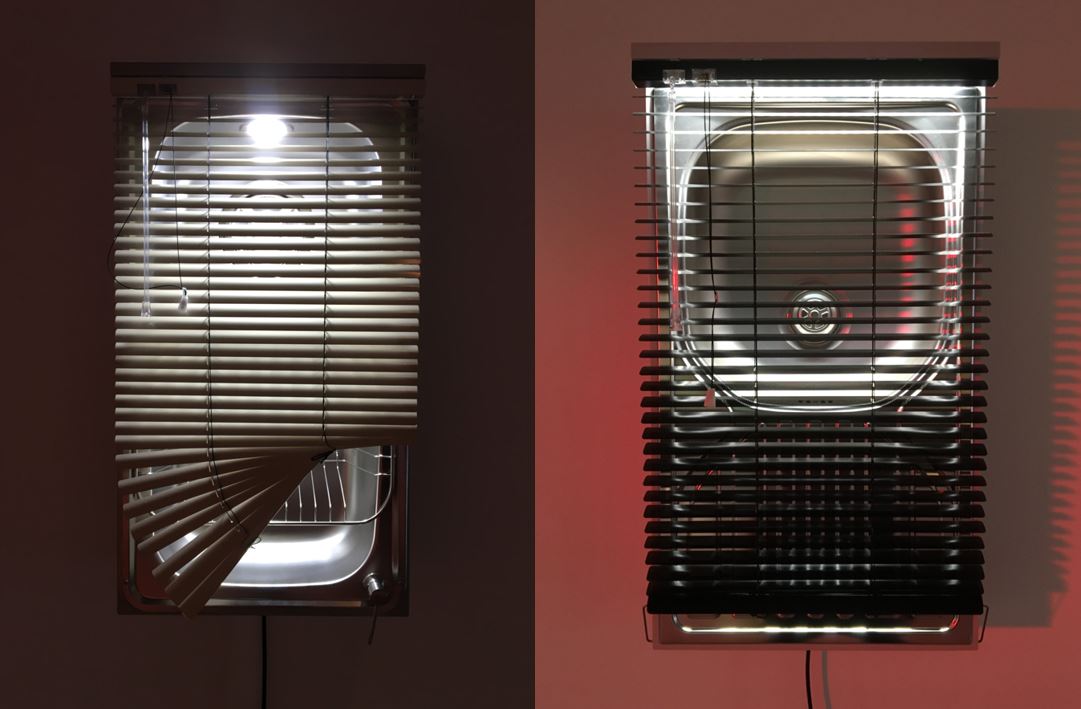
Installation view of Haegue Yang: Leap Year at the Hayward Gallery showing ‘Twelve Pyeongchang-gil Moisture – #AP MJ134’ and ‘Seven Dircksenstraße Moisture – #AP ZL10164’ (photo by the author)
Thoughts
I liked it, some bits more than others, but there’s a very wide range of types and sizes and forms of work here. The blockbuster sculptures are the obvious show stoppers but once you’ve taken them in, enjoyed walking round and marvelling at them, on the second go round I noticed a lot of quieter, subtler works on paper – collages and prints – which require a different sort of attention. Plus the half dozen or so videos, if you have the patience.

Installation view of Haegue Yang: Leap Year at the Hayward Gallery (photo by the author)
It’s not going to rock your world like the Van Gogh exhibition at the National Gallery or overawe you with Masters of Art like the Michelangelo and Leonardo show at the Royal Academy, but it’s light and fun and intriguing and pleasing in a way neither of those are, and an insight into the look and feel of bang up-to-date, international contemporary art. Give it a go.
Related link
- Haegue Yang: Leap Year continues at the Hayward Gallery until 5 January 2025
 Books & Boots