Haegue Yang: Leap Year @ the Hayward Gallery

‘Leap Year’ is the first major UK survey of female South Korean artist, Haegue Yang, ‘one of the world’s most pioneering artists’. It covers her work from 1995 to the present day and includes three major new commissions and several new productions.

It’s a fun show, big, bright, bold, inventive, combining all kinds of materials to make sculptures large and small, collages, hangings, videos and even a ‘sensorial installation.’ Some are more immediately appealing than others, some you get straightaway, some require a bit of reading up about the traditional crafts or media she is invoking, quoting or combining. So you notice something new each time you go round. I did the tour three times. The central elements of her work are:

1. Sculptures: It’s almost all sculpture – there are actually quite a few collages, lots of prints and maybe 6 or 7 videos, but it’s the big sculptures and installations which strike you first and foremost.

2. Materials: Yang’s sculptures are made from a wide variety of materials. Her works often feature a variety of household and industrial objects including drying racks, light bulbs, metal-plated bells, nylon pom-poms, hand-knitted yarn and hanji (Korean paper).

3. Multicultural: It is extremely multicultural. Yang includes traditions and folklore from her homeland, Korea, but also magpies themes, ideas, craft and fabric practices and traditions from all round the world. (Half way through the show we hear about her interest in her interest in paper cutting traditions from other cultures including wycinanki from Poland, amate by the Otomi people of the Americas, and pabalat from the Philippines).

The exhibition is arranged into five thematic zones. To be honest my own experience of it cut across the formal zone ideas. I experienced it more as ‘rooms’, each with a particular vibe and highlights, so that’s how I’ll describe them in what follows.

Room 1

You enter through a curtain of blue and silver stainless-steel bells suspended from a characteristic Korean wooden porch structure. This is ‘Sonic Droplets in Gradation – Water Veil’ (2024), part of Yang’s ongoing Sonic Sculptures series. Visitors are invited to walk through a curtain of blue and silver stainless-steel bells which trigger ‘sonic reverberations’. This is one of the three installations created for this exhibition.

Installation view of Haegue Yang: Leap Year at the Hayward Gallery showing the bead curtain you have to walk through to enter (photo by the author)

What hits you in the first room is two obvious elements:

Installation view of Haegue Yang: Leap Year at the Hayward Gallery showing ‘Non-Indépliables, nues’ (photo by the author)

1) the huge collage on the far wall on the left, which is titled ‘Drip Drop Blob Dance – Trustworthy #228’, from 2013

and 2) the way the space is filled with a variety of plastic clothes horses, stacked across each other and festooned with lights. These are ‘Non-Indépliables, nues’, composed of drying racks, light bulbs, cables, zip ties and terminal strips. The idea is that these everyday domestic objects have been transformed into ‘expressive sculptural beings’ that perform delicate balancing acts or complex acrobatic poses. The French title ‘non-indépliable’ translates as ‘non-unfoldable’.

Once you’ve explored the impact of both these works, you come down to a smaller scale and realise there are some chairs for you to sit on and watch slides being projected on the wall. This is ‘Dehors’ (2006), two slide projectors projecting two sets of 81 colour slides in a loop.

Room 2

You go up the ramp (on the right in the photo above) into the second room or space which is arguably the best, certainly the one that’s used in all the posters and promotional material. The salient elements are:

  1. a set of spectacularly large and colourful abstract sculptures
  2. which are joined by geometric shapes, spirals, checkerboards, dots and fragmented lines drawn onto the floor – these are, apparently, inspired by meteorological charts
  3. and on the wall a series of big black and white collages using striking, humorous black and white photos

Here’s a wide view of the two most vivid sculptures with some of the amusing collages in the background. The two sculptures are, left to right, ‘The Randing Intermediate – Earth Alienage Rising Sporing’ and ‘The Randing Intermediate – Sea Alienage Fanned-Out Bang’. Great names, aren’t they, as preposterous as the objects themselves.

Installation view of Haegue Yang: Leap Year at the Hayward Gallery showing ‘The Randing Intermediates’ in the foreground and ‘Eclectic Totemic’ on the walls (photo by Mark Blower)

They are, apparently, made from naturally dyed rattan and were created in collaboration with local artisans in the Philippines using the basic weaving technique called randing, where a single wicker is woven onto a sculptural frame. The colourful zoomorphic shapes are said to resemble sea creatures or spores although they reminded me of the fantastical fossilised creatures from the Burgess Shale which Stephen Jay Gould describes in his book ‘Wonderful Life‘. When you look closer you can see they are topped with artificial plants, making them feel even more bizarre.

And here’s the same room from the other side, showing not only another sculpture and collage but also one of the half dozen geometric sculptures with neon lights hanging from the ceiling. The floor sculpture made from panels with differently patterned tinsel across them is ‘Sonic Dress Vehicle – Hulky Head’ from 2018. I think the orange one with neon hanging from the ceiling is titled ‘Stacked Corners – Ventilating Orange and Blue Square’ from 2022. Note how the basic element is a set of Venetian blinds which have been coloured orange and blue. We’ll be hearing a lot more about Venetian blinds.

Installation view of Haegue Yang: Leap Year at the Hayward Gallery showing ‘Sonic Dress Vehicle – Hulky Head’ and ‘Stacked Corners – Ventilating Orange and Blue Square’ (photo by the author)

Room 3

Then you go downstairs and into a room filled with these guys. They’re great. Not as multi-coloured as the ‘The Randing Intermediates’, to me they had more of an African vibe, the two on the right looking like the thatching from tribal huts. Although the one I thought most African is in fact titled ‘Chinese bride’. Completely wrong. Oh well.

Installation view of Haegue Yang: Leap Year at the Hayward Gallery showing ‘The Intermediates – Dancing in Woven Masks’ (photo by the author)

In fact they’re titled ‘The Intermediates – Dancing in Woven Masks’ from 2015. A propos of Yang’s use of disparate materials, these guys are made of:

Artificial straw, powder-coated steel frame, powdercoated mesh, casters, plastic raffia string, jute twine, cotton twine, knitting yarn, cord, folkloric tricolour band, root carving, artificial plants, gourds, Korean bridal crowns, artificial feathers, artificial seaweed, barnacles, abalone shells, sea shells, conch shells, metal basket, palm tree basket, coconut basket, wood perches, bird toys, trumpet, rubber object, Indian bells, bells, metal chain, split rings.

And they blend various motifs from traditional Korean cultural rituals, dances and festivals. As to what they mean, like all Yang’s works, like everything in the exhibition, there is no real guide or instruction on what to think or how to interpret them. There they are. Make of them what you will.

On a partition to the right of the Intermediates is a set of coloured paper collages, subtly made using Korean paper folding techniques.

Beyond the partition is another space, probably part of the same ‘zone’, whose walls are lined with works which, as you can see, combine woodwork and fabric decoration with 2D images, the whole design obviously referencing East Asian architecture and design. These are examples of the series ‘Mesmerizing Mesh’ (2021 to the present) collages which reference ‘sacred and ritualistic paper objects related to shamanism and folk or pagan traditions’. The wooden shrine-like or ‘enshrinement’ was inspired by the shamanistic home altars of the Hmong people from South East Asia.

Installation view of Haegue Yang: Leap Year at the Hayward Gallery showing pieces from the ‘Mesmerizing Mesh’ series (photo by the author)

In the middle of the room is another dramatic sculptural ensemble with a powerful mashup of zoomorphic shapes and metal household objects. The round one in the foreground is ‘The Intermediate – Psychic Turbine Vents Ball’ (2017), the one on the left ‘Dry Spell at Villeperdue’ (2016), the one with the gold curtain strands is ‘Sonic Fabric over Brass Plated Web’ (2015).

Installation view of Haegue Yang: Leap Year at the Hayward Gallery, showing ‘The Intermediate – Psychic Turbine Vents Ball’, ‘Dry Spell at Villeperdue’ and ‘Sonic Fabric over Brass Plated Web’ (photo by the author)

There’s more, a video, little sculpture cone and ball made of what look like blue Christmas tree baubles, a large black and white abstract drawing, there’s always more, each time I visited a room I saw new things I hadn’t noticed first time round.

Room 4

In this room are some works on the wall, a series of her careful Lacquer Paintings but, again, you are struck by the big sculpture or, more properly, installation. After the brilliantly imagined sculptures of the previous couple of rooms, this is big but felt a bit underwhelming. On the left, partitioned off by a low rope, is an assembly of small tables and chairs, moveable fans, fenced off with a low rope fence. Beyond it you can see an assembly made of a wooden pallet, packages and beer crates. I think the whole ensemble is titled ‘Storage space’.

According to the curators, Storage space ‘conceived during a precarious and nomadic phase of her life when she was unable to afford to hire storage space for her artworks’. Usually I like sculptures made from industrial objects very much – having worked in a number of factories and warehouses I have a more than usual connection with them, I can imagine humping and lifting them, they give me a physical response, but not here. As you can see, they might have autobiographical significance for the artist but they’re not a patch on the spectacular abstract shapes in the previous couple of rooms.

Installation view of Haegue Yang: Leap Year at the Hayward Gallery showing ‘Storage space’ (photo by the author)

Room 5

Then you go up the stairs to the next space. This is devoted to a massive work made of sets of Venetian blinds. Coloured lights are projected through them which create a rippling dappling effect on the wall. This is one of the new commissions, ‘Star-Crossed Rendezvous after Yun’ (2024). This work features ascending layers of Venetian blinds in varying formations and colours that guide visitors through the space, alongside two breathing stage lights and a historic musical score.

Installation view of Haegue Yang: Leap Year at the Hayward Gallery showing ‘Star-Crossed Rendezvous after Yun’ (photo by the author)

It is ‘after Yun’ in a reference to the late Korean composer and political dissident Isang Yun (1917 to 1995). The work was inspired by Yun’s Double Concerto (1977), a classic of plinky-plonky avant-gardeism which sounds like this.

Unfortunately, when I was visiting, first thing in the morning, the music was not playing which was a big shame. The raw sparse music in the big white space filtered by flickering blinds would have been an intriguing experience.

The view

At the end of this space is a long wide window, part of the Hayward building, which looks out over Waterloo Bridge. Yang has filled the space beyond the window with water in which are inserted tiny toy windmills, 100 of them apparently. But the obvious thing is the reflection of the sky. Very chill, as my kids would say. It’s titled ‘Windy Terrace Beyond Reach’ and is, of course, specific to this site.

Installation view of Haegue Yang: Leap Year at the Hayward Gallery showing ‘Windy Terrace Beyond Reach’ (photo by the author)

Off to one side there’s a small periscope. The viewing part of it, where you put your eye, is really low, only a few feet off the ground, so either we’re meant to kneel down to look through it, or it is (thoughtfully) for children.

Room 6

This room is the largest and busiest. A lot is going on but your initial feel is that it involves a lot more Venetian blinds. Wide expanses of blinds hanging from the ceiling divide it into different zones with different things going on. According to the curators ‘Yang is drawn to Venetian blinds for their obliqueness, semi-transparent quality, and their capacity to divide and configure a space’, which you may or may not agree with as you walk round.

Installation view of Haegue Yang: Leap Year at the Hayward Gallery showing ‘Recollection of Sadong 30 – Version London’ (photo by the author)

I found it a bit hard to follow or understand, so I’ll quote the curators at length. The entre installation is titled ‘Recollection of Sadong 30 – Version London’ and is another of the installations which have been created especially for this show. It consists of: digital slideshow, digital colour print, corrugated roof, origami objects, fairy lights, light bulbs, plant, fan, plastic stools.

In 2006, Yang staged her first solo exhibition in Korea in her grandparent’s former home in Incheon, a city to the west of Seoul, using the address as the project’s title. She made the crumbling house accessible and carefully placed origami, light bulbs on stands, a dressed drying rack, frozen water bottles and an electric fan in the rooms. These objects later became recurrent motifs in her work. ‘Recollection of Sadong 30 – Version London’ is an attempt to recall this moment through recreations of some of the original objects, architectural elements and projections that provoke the visitor’s own experiences and sentiments around this seminal work.

So now you know. Among the units on the floor there are some heaters and, somewhere, some humidifiers. I think the aim is to walk into a sensory zone which makes you feel what it’s like to be in humid tropical Seoul rather than chilly windy London. Bolstering this effect are a number of videos Yang shot in Seoul of what looks like pretty straightforward street life and maybe even her backyard, with chairs arranged for you to sit and watch, as you can see in the photo above.

Each of the spaces, so carefully partitioned by hanging Venetian blinds, contains a different set of objects, videos or photos. Some contain what look like air conditioner units but made from blinds, illuminated with coloured lights. These no doubt have a resonant meaning but, strolling round them, felt a bit meh, particularly by comparison with the vivid works we saw downstairs.

Installation view of Haegue Yang: Leap Year at the Hayward Gallery showing part of ‘Recollection of Sadong 30 – Version London’ (photo by the author)

One of the most accessible pieces is a panel of blown-up black-and-white photos with fairy lights strewn across the floor in front of them. Photography is, after all, the easiest and most accessible of the arts, conveying countless more times information and atmosphere than any of the other random objects scattered across the floorspace.

Installation view of Haegue Yang: Leap Year at the Hayward Gallery showing part of ‘Recollection of Sadong 30 – Version London’ (photo by the author)

Venetian sinks

The last element I’ll note is that, off to one side of the main space, were a couple of stainless steel kitchen sinks which had been hung on the wall with (yet more) Venetian blinds hung over them and a bit of coloured lighting. I liked these for their strong surreal vibe. They are titled, with Yang’s characteristic fondness for long names, ‘Twelve Pyeongchang-gil Moisture – #AP MJ134’ and ‘Seven Dircksenstraße Moisture – #AP ZL10164’.
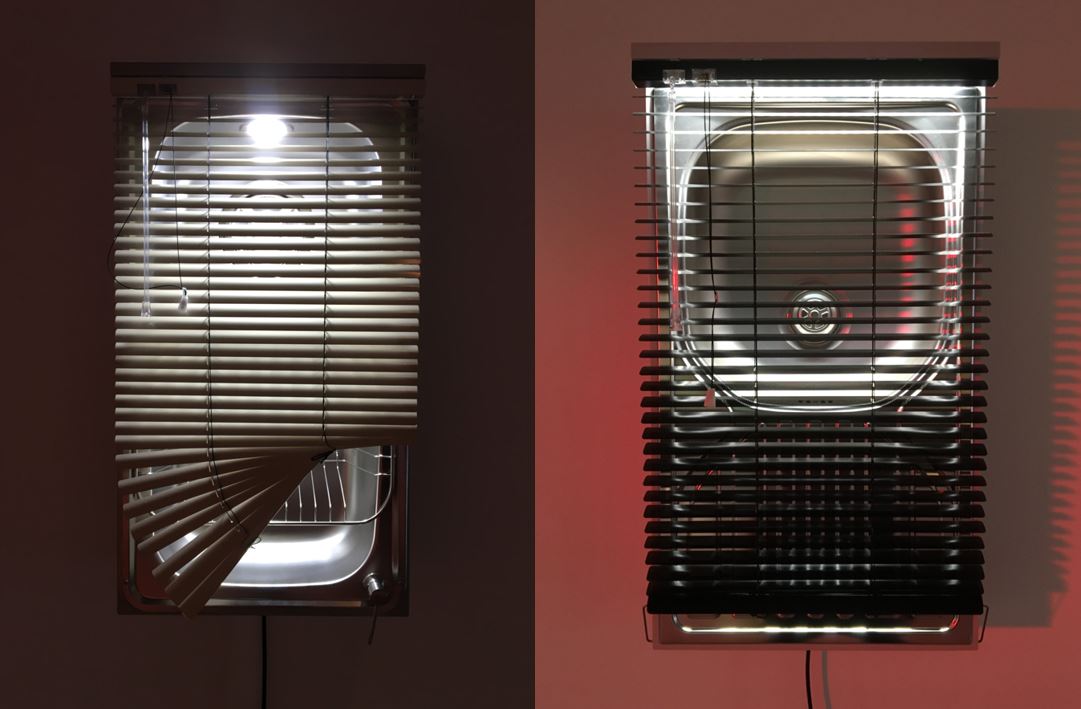
Installation view of Haegue Yang: Leap Year at the Hayward Gallery showing ‘Twelve Pyeongchang-gil Moisture – #AP MJ134’ and ‘Seven Dircksenstraße Moisture – #AP ZL10164’ (photo by the author)

Thoughts

I liked it, some bits more than others, but there’s a very wide range of types and sizes and forms of work here. The blockbuster sculptures are the obvious show stoppers but once you’ve taken them in, enjoyed walking round and marvelling at them, on the second go round I noticed a lot of quieter, subtler works on paper – collages and prints – which require a different sort of attention. Plus the half dozen or so videos, if you have the patience.

Installation view of Haegue Yang: Leap Year at the Hayward Gallery (photo by the author)

It’s not going to rock your world like the Van Gogh exhibition at the National Gallery or overawe you with Masters of Art like the Michelangelo and Leonardo show at the Royal Academy, but it’s light and fun and intriguing and pleasing in a way neither of those are, and an insight into the look and feel of bang up-to-date, international contemporary art. Give it a go.


Related link

Related reviews

The Korean War by Max Hastings (1987)

This book

This account of the Korean War (1950-53) is thirty years old this year, and so dates from before the collapse of the Soviet Union and the end of the Cold War. Nevertheless, although there are several shorter accounts on the market, this seems to be the only lengthy, in-depth, narrative history of the Korean War in print – an indication of the general lack of interest in the war, both at the time and since (compare and contrast the number of books which come out every year about WW2 or Vietnam).

Why the neglect? The Korean War lacked the scale of the Second World War, so only a relatively small number of soldiers’ families were involved. Around 100,000 British troops were posted to Korea in total, but the British population was more concerned with its own problems – ongoing food rationing, a general election – or the Soviet threat on the continent of Europe. Who cared whether Korea was partitioned along this line or that line?

a) The war was on the other side of the world and
b) After the dramatic reverses of the first year of the conflict, the latter two years dwindled down to a grinding stalemate, demoralising and inglorious. In the end there was no Allied victory (as in WW2), merely a ceasefire which created a border not very much different from the pre-war line. So it turned out to have been a boring, faraway war which achieved nothing.

Background to the partition of Korea

A newcomer to the subject might ask, Why was Korea partitioned between north and south at the 38th parallel in the first place?

To go back a bit, Japan had interfered in Korea’s affairs since the late 19th century. In 1905 Japan made Korea a protectorate; in 1907 the Japanese took control of Korean domestic affairs and disbanded their army; and in 1910 Japan formally annexed Korea.

In the following decades Japan forced some 100,000 Koreans to join the Imperial Japanese Army, and up to 200,000 Korean women were forced into sexual slavery to service Japanese soldiers in Korea and Japanese-occupied China.

Then in 1931 Japan invaded Manchuria, the huge block of territory between northern China and Russia, and in 1937 attacked the rest of the coastal regions of China (as well as into Indochina, Malaya, Burma and so on). Korea was the earliest conquest of Japan’s Far Eastern empire.

Korea became an armed camp, in which mass executions  and wholesale imprisonment were commonplace, and all dissent forbidden. (p.16)

When the Second World War broke out in Europe, Stalin was careful to remain at peace with Japan. When Nazi Germany invaded the Soviet Union in June 1941, the Japanese did not declare war on Russia or attack in Siberia, which they could easily have done from their base in Manchuria. Stalin, for his part, maintained Russian neutrality even after Japan attacked Pearl Harbour in December 1941 thus provoking war with America, and Japan and Russia remained at peace right up to the closing days of the war.

In February 1945, at the Yalta conference, Stalin promised Roosevelt and Churchill that he would enter the war against Japan but he delayed till the last minute. (This, among other things, meant that the Japanese government held out the vain hope right into August 1945 that ‘neutral’ Russia would somehow stand up for them and negotiate good surrender terms with the Allies – a delusion.) So Stalin’s Soviet Union only abandoned its policy of neutrality and declared war on Japan on 9 August 1945. A huge Soviet army crossed the border from Siberia into Japanese-occupied Manchuria and swept south.

A glance at the map shows that the southern border of Manchuria is mostly sea, the Sea of Japan to the east and the Yellow Sea to the west of the Korean peninsula, which dangles down from the Chinese mainland like an Asian Scandinavia. So, with the goal of attacking the Japanese wherever they found them, it was natural that the invading Soviet army crossed the Chinese-Korea border (formed by the Yalu river) and headed south into the peninsula, defeating Japanese forces as they went.

‘Suddenly’ the Americans who, according to Hastings hadn’t really considered the strategic significance of Korea, realised they didn’t want Stalin to occupy the entire peninsula create a communist stronghold so close to soon-to-be-defeated Japan. So the Americans requested Stalin to halt his forces and informed him that American forces would invade Korea from the south.

Two American officers were put in charge of figuring out where the dividing line should be between the uneasy allies. Poring over a map, they reached the ‘hasty’ decision that the 38th parallel was a handy dividing line: it more or less divided the country in two, with the capital Seoul, the best agriculture and industry, and most of the population, to the south i.e. in the American sector.

President Roosevelt duly contacted Stalin with the request that he stop his forces at the 38th parallel and, to the Americans’ surprise, Stalin readily agreed. Stalin didn’t want to risk confrontation with the ally he was working so closely with in Europe, and was also very aware of the atom bombs the Americans had just dropped on Japan. Yeah, sure, you can keep half of Korea.

(There is a nice irony here, that the Americans from Roosevelt down were vehement opponents of the European empires, and actively tried to sabotage the return to European imperial rule of Burma, Malaya or Indochina. But quite quickly they found themselves dragged into drawing precisely the kind of arbitrary lines and borders which they had criticised the Europeans for making in Africa and the Middle East. The existence of separate states of North and South Korea and the fates, the life chances and premature deaths of tens of millions of Koreans, were determined by this hurried decision made in the last gasp of the Second World War.)

North and South Korea

So Stalin stopped his troops at the 38th parallel, when he could easily have pressed on and seized the entire peninsula. American forces landed at Incheon on September 8 and liberated southern Korea from their Japanese occupiers. In time both countries put their own regimes in place in their sector, the Soviets basing their government in the northern city of Pyongyang, the Americans in the traditional capital, Seoul, permanently crystallising the distinction between communist North Korea and capitalist South Korea.

While the Russians proceeded with their standard process of step-by-step managing the local communists into government and then picking off the opposition one by one to create a mini Stalinist state, Hastings describes the Americans as making a number of important mistakes in the South.

For a start, the Americans found the native Koreans completely unused to governing their own country. Thus, against their intentions, in the early days they ended up being forced to work closely with the now-defeated Japanese authorities, for the simple reason that the Japs had the experienced men in place to carry on carrying out the function of the state. Only slowly were these replaced by native Koreans, and then the Americans had the devil of a time selecting which of the many groups of clamouring Korean politicians to choose to run things.

As the threat from Soviet communism became more palpable into 1946, the Americans found themselves setting up a government run by the smooth-talking, right-wing émigré Syngman Rhee. Hastings recounts how left-of-centre Korean groups were too quickly marginalised because of the taint of communism and how the Americans, despite their best intentions, found themselves installing Rhee, and then coming to regret the choice of such a corrupt, brutal figure. Rhee ended up being president of South Korea from 1948 to 1960 and was an early example of the kind of brutal, repressive and corrupt right-wing regime which the Americans would find themselves supporting again and again throughout the Cold War.

This had the result of fuelling left-wing and communist agitation against his government, which led to a spiral of repression, and left many Americans feeling ambivalent and uneasy in their support for Rhee. This was epitomised by a reluctance to arm his air force, artillery and infantry with more than a token minimum of equipment, since there was good evidence that arms were mainly used against his own civilian population.

Meanwhile, throughout the late 1940s North Korea kept up a steady stream of propaganda broadcasts to the south, designed to appeal to all Korean patriots, calling for the reunification of the country, as well as predictable calls for the overthrow of Rhee and his unlikeable clique. In the spring of 1950 this rhetoric became steadily more heated and experts in the U.S. State Department warned of the growing threat of some kind of attack by the North on the South. The American government, under President Harry Truman, had its hands full coping with crises in the more obvious cockpit of the Cold War, Europe, beset by a sequence of crises including the Berlin Airlift from June 1948 to May 1949, the communist coup in Czechoslovakia in 1948, and so on.

The Korean War

1. The North invades Thus it came as a complete surprise to the world when Kim Il-Sung’s North Korean army invaded South Korea on 25 June 1950. The United Nations immediately voted it an illegal act and sent forces to stop the advance. These were at first mostly American, but in time came to consist of a coalition including other Western countries and eventually 20 nations from round the world. But before this could be organised, the North Koreans succeeded in storming through the south, pushing the under-equipped demoralised Republic of Korea’s army back until it and its American support were, by September 1950, pinned into a pocket in the south-east of the peninsula, the Pusan area.

2. Landing at Inchon Not only did the Americans reinforce their troops who fought bravely to hold the line at Pusan but General MacArthur, the hero of the Pacific War, who had been ruling post-war Japan as American Vice-Consul, now conceived his last great strategic coup, which was to organise a massive American amphibious landing at Inchon in mid-September 1950, on the coast near Seoul, thus attacking the North Koreans in their rear, and threatening their supply lines.

The Americans broke out of the Pusan pocket and drove north, pushing back the demoralised and exhausted North Koreans, back across the 38th parallel and further north. At this point Hastings’ account dwells on the massive disagreements within the American administration on whether or not the Allies should halt at the parallel or press on to take the entire peninsula. This latter view prevailed and the American, ROK and other UN national forces (British and Commonwealth as well as a large contingent from Turkey) pressed north.

3. China enters the war Allied forces had come within sight of the Yalu river which forms the border between Korea and China when they were horrified to learn that a vast contingent of the People’s Republic of China had crossed the border and was attacking along the line. Briefly, sheer weight of numbers overran Allied positions, creating confusion and panic, and it is chastening to read accounts of Allied troops dropping their guns and equipment and running in panic fear. The Chinese routed the Allies, pushing them relentlessly southwards back towards the 38th parallel.

Hastings excels, in this book as in his later one about the War in the Pacific, at combining at least three levels of analysis:

  • Carefully chosen eye witness accounts (from letters, diaries and reports made at the time along with highlights of the scores of interviews with veterans which he conducts for each book).
  • Detailed descriptions, with maps, of specific battles and the broader military situation.
  • But what I enjoyed most is Hasting’s ability to pull out of this narrow focus to explain in detail the strategic and geopolitical issues behind the war. Thus there is a lot of analysis throughout the book of the conflicting aims and strategies of the Allies, and particularly within the US administration and armed forces. It is riveting to read how war aims a) can be so contradictory and fiercely debated within a set of allies b) change over time according to all sorts of pressures, like domestic opposition, political attacks from opponents, looming elections, threats elsewhere.

4. Shall we bomb China? The largest issue raised by the Chinese victories and our troops’ humiliating defeats was whether to broaden the war to attack China itself i.e. why only fight the Chinese forces inside Korea, why not bomb mainland China, as we did Germany and Japan? 1. The scattered terrain of hilly Korea, lacking main roads and railways, and the methodology of the communists, moving across country, made it difficult to attack enemy formations in Korea. 2. All their supplies were coming from factories in China, and Chinese MiG jets were flying from airfields in China – why not attack those?

The highpoint of this point of view, strongly espoused by senior figures in the US army and air force, was MacArthur’s request that the Allies use the atom bomb against Chinese forces not only in Korea, but against Chinese cities. The army drew up a list of twenty possible targets. Imagine!

Within Truman’s own cabinet there were – as always – hawks and doves, with some supporting broadening the war, others strongly against. In the event, Truman took the cautious line, and posterity has to agree. If both sides, by tacit consent, limited their confrontation to within the peninsula, it was containable and manageable. In February 1950 Russia and China had signed a defensive alliance committing each to go to war if the other party was attacked, so if the UN forces had bombed Chinese cities, would Russia have been forced to come to China’s defense? Would it have triggered World War III? Was it worth taking the risk?

Hastings brings out how US hawks saw the conflict in terms of the global Cold War against communism. The gruesome way Soviet-backed regimes were established across Europe and the victory of Mao Zedong’s communists in China in 1949, gave a very real sense that communism was advancing on all fronts. The North Korean attack fitted right in with that view of the democratic West being under sustained attack, and revelations of the extent of Soviet spies inside the atom bomb programme and throughout the US establishment, go a long way to explaining the mounting hysteria epitomised by the rise of Senator Joseph McCarthy and his House Unamerican Activities Committee. Truman had to stand up against a great deal of pressure, within the military establishment, from the McCarthyites, from some sections of the media and public opinion, in refusing to widen the war. 60 years later we pay him credit.

Only very slowly, did some parts of the US administration come to realise that China’s motives stemmed at least from simple nationalism as from world communist conspiracies. A captured Chinese soldier is quoted as saying, ‘How would you like your enemies armies, complete with atom bombs, parked just across your 450-mile-long border?’ If the Americans hadn’t pushed on north beyond the parallel, maybe the Chinese wouldn’t have been prompted to invade. Maybe a lot of lives could have been saved.

5. Stalemate Of course, the decision not to widen the war i.e. attack the Chinese mainland – condemned a lot of American, British Commonwealth and UN troops to ongoing slog, battle, injury and death. In December 1950 Lieutenant-General Matthew B. Ridgway took over command of the US Eighth Army and began to turn it around. Retrained, re-equipped and remotivated, his forces held the Chinese and then began to press northwards, retaking Seoul in March 1951, and pressing forward to the parallel.

Throughout this period General MacArthur, in overall command of US forces in the Far East, had given interviews and communicated to representatives of other governments his wish to expand the war, often in direct conflict to the stated aims of the US administration. Eventually, President Truman felt compelled to relieve him of his command on 10 April 1951. This caused a storm of protest within the military, in Congress and among the general public, for whom MacArthur was a great American hero. Truman’s popularity fell to the lowest ever recorded for a US President. And without it being the immediate intention, MacArthur’s sacking sent out a strong message to America’s allies, to China and Russia, that the United States did not intend to attack China, did not even intend to seize the whole Korean peninsula, but would settle for the much more limited aim of returning to the status quo ante.

As spring 1951 turned to summer, the front line advanced and receded around the parallel, slowly settling into a stalemate. A year after the initial invasion, the armies were back more or less where they had started. The North Koreans reluctantly agreed to open ceasefire talks and protracted armistice negotiations began on 10 July 1951 at Kaesong, before moving to the neighbouring village of Panmunjom. Due to the intransigence of the North and the Chinese, these talks dragged on for two long years, while on the ground there was a steady stream of offensives and counter-offensives, none of which really changed the strategic picture, but in which a lot of soldiers died pointlessly on both sides.

The narrative pauses at this point for a series of chapters looking at specific aspects of the war:

  • The war in the air, where the West learned for the first time the limits of air power – something which was to be repeated in Vietnam – and for the first time jet fighter fought jet fighter, Soviet MiGs against US Sabres.
  • The creation more or less from scratch of a U.S. intelligence operation, which featured a number of gung-ho operations behind the lines but precious little usable intelligence. I was tickled to read that the CIA’s Seoul station had 200 officers, but not a single speaker of Korean, an attitude of uninterest in local cultures and languages which the Americans repeated later in Vietnam and the Middle East.
  • The issue of communist prisoners of war, whose numbers had risen to some 130,000 by the end of the war and whose repatriation back to the North became one of the big stumbling blocks of the peace negotiations.

The mounting frustration at having to fight and die in bloody, futile engagements while the diplomats at Panmunjom, just a few miles away, drew the peace negotiations out with unbearable delays, is well depicted in this 1959 movie, Pork Chop Hill. It illustrates the brutality and heavy losses incurred for insignificant hilltops, the effectiveness of Chinese propaganda broadcast to Allied troops by loudspeaker across the front line, and the widespread demoralisation of the American soldiers with many, perhaps most, of them expressing intense doubt about what they were fighting for and whether it was worth it.

Hard not to see foreshadowings of the irresolution and crushing sense of futility which were to bedevil the Vietnam War.

6. Ceasefire Josef Stalin died in March 1953 and Soviet policy went into a shadowy period of uncertainty. Meanwhile, Republican President Eisenhower replaced Democrat President Truman. Part of his campaign had included the pledge to bring the war to an end. These final stages include the unnerving plans made by the new administration to: massively boost South Korean armed forces; bomb China north of the Yalu; deploy the new artillery-fired nuclear weapons the US had developed; and to transport Chinese Nationalist fighters from Formosa to the Chinese mainland to carry out guerrilla operations (p.473). These aims were communicated to the Soviets and Chinese and at last broke the logjam. In April the communist delegates at Panmunjom began to respond to suggestions.

Ironically, the final stumbling block turned out to be the obstinate dictator of South Korea, Syngman Rhee, who was refused by America’s decision to ‘abandon’ his nation and refused to agree to a ceasefire or sign the agreement. The Americans, not for the last time, found themselves struggling to contain a right-wing leader of their own creation, but by immense pressure managed to prevent Rhee actively sabotaging the negotiations. It is rather staggering to learn that they developed a plan for kidnapping Rhee and overthrowing his government if he refused to play ball (plan EVER-READY p.479).

On 27 July 1953 a ceasefire was finally declared and a demilitarised zone (DMZ) created either side of the ceasefire line. Legally, the war has never ended and this, along with the belligerent rhetoric which has continued to pour out of Pyongyang, along with the occasional terrorist atrocity and a trickle of shooting incidents across the DMZ, explains why South Koreans have lived in a state of tension and high alert for the past 64 years.

And now that Kim Il-sung’s son and successor as Great Leader, Kim Jong-il, has developed nuclear weapons and is testing long-range missiles to deliver them, who knows what further trouble this barren peninsula might cause.

Stats

  • 1,319,000 Americans served in Korea, of whom 33,629 were killed and 105,785 wounded
  • The South Korean army lost 415,000 killed and 429,000 wounded
  • The Commonwealth lost 1,263 killed and 4,817 wounded
  • The Americans estimate that 1.5 million Chinese and North Koreans died, but this is an educated guess
  • Wikipedia reports that some 2.5 million Koreans, north and south, were killed or wounded

This huge loss of civilian and military lives is captured in Taegukgi: The Brotherhood of War from 2004, a phenomenally violent Korean film directed by Kang Je-gyu, and saturated with blood-spattering special effects.

The lessons of history

The Korean War is interesting for a number of reasons:

  1. as a dramatic and very hard-fought war in and of itself
  2. as the first armed confrontation between two superpowers in the Cold War
  3. as a template for the Vietnam War

It’s the latter which is, at this distance of time, maybe the most resonant. Their convincing win against Japan gave the Americans the sense that overwhelming might on land and sea and in the air guaranteed victory. Korea disabused them of this confidence. In Korea the Americans stumbled upon issues which were to plague them 15 years later in Vietnam:

  • the difficulty of supporting an unpopular native regime
  • the problems of creating a native army to support an unpopular regime, in a corrupt and inefficient society
  • the cost of underestimating an Asian army
  • the difficulty of using air power, no matter how overwhelming, against a peasant army with no identifiable infrastructure – this wasn’t like bombing German or Japanese factories
  • the difficulty of deploying a highly mechanised army in broken country against a lightly armed, highly mobile enemy (p.xvi)

This is an excellent, thorough, well-written and gratifyingly intelligent account of an important war which, paradoxically, makes it clear why it has been so often overlooked by historians in the Allied countries which fought in it, namely America and Britain. It powerfully explains why fighting a pointless war in a faraway country for an ugly regime was so unpopular at the time and has been neglected ever since.

P.S. Japan

Big strategic history like this is full of ironies. I was delighted to learn that the Korean War helped to set Japan on its feet again and kick-started its astonishing post-war economic recovery, helped along by the vast amounts of money poured into the country which served as ‘aircraft carrier, repair base, store depot, commissariat, hospital, headquarters and recreation centre’ for the UN forces in the Far East (p.444). Every cloud has a silver lining.


Credit

The Korean War by Max Hastings was published in 1987 by Michael Joseph. All quotes and references are to the 2010 Pan Macmillan paperback.

Related links