
This is the children’s version of the Royal Academy’s Annual Summer Exhibition. In my opinion it’s much more fun than the grown-up show, for several reasons. Grown-ups always have to be so serious and po-faced whereas kids, especially young children, know how to have fun! They can be unselfconsciously silly. This lack of adult seriousness means loads of the works here are lovely, and charming, and sometimes very striking.

Ostrich by Anastasiia, aged 14
Here is a cat which has done an enormous poo, a wasp which has just farted, two pet dogs dressed up as vampires, a fox which has eaten two chickens, a crow nesting in a chimney pot, a family tree of bouncy balls, a lamp fish made out of rubbish, three hamsters dressed up for a party! What’s not to find adorable 🙂

Installation view of Royal Academy Young Artists’ Summer Show 2025 (photo by the author)
It’s only in one room (on the ground floor at the back of the RA building) but manages to contain an impressive 270 works of art, by children aged from 4 to 18. As soon as you see that age range you realise there’s going to be a real range of abilities, skills and techniques. Plenty look and feel like very small children’s work:

A cat and a rat – by Fox aged 11 and Jago, aged 10 (photo by the author)
While at the other end of the scale is work which feels fully achieved and adult, such as this stunning portrait of her friend, Louisa, by Rosa, aged 18. Rosa tells us that making this work, with its staggering photographic accuracy, took over her entire life for two months. Wait till you have kids, Rosa, and they take over your whole entire life for twenty years 🙂

More than 23,000 students entered the competition this year and the works were whittled down by a panel of artists and arts professionals. Tough job. Some were awarded prizes, though that didn’t influence me much. Visitors can take part in the annual People’s Choice Award.
Captions
There’s a lavishly produced free catalogue of works in which every piece is accompanied by a short paragraph from the artist, big or small. You couldn’t help detecting the voice of art teachers or parents in some of this text, specially when they started going on about ‘desire’ and ‘diversity’ and other artspeak jargon. On the other hand some of the captions had the artless comedy of larky kids.
‘I love capybaras,’ says Martha, aged 8, and you can’t say fairer than that.

Capybara Takes a Sip While Balancing a Peach by Martha, aged 8
Memorable works
Chicken in Blue by Erin, aged 15
Who tells us that the intense cobalt blue background was inspired by van Gogh’s similar use of a pure blue background which she saw at the National Portrait Gallery. Art speaks to art, across the ages.

Chicken in Blue by Erin, aged 15
Entangled in Waste by Coral, aged 18
This poor clay octopus is entangled in some of the billions of tons of plastic waste we pump into the sea every day. Coral aims to show how even the ocean floor has become infested with rubbish.

Entangled in Waste by Coral, aged 18 (photo by the author)
Squirrel and hamsters
A red squirrel made from recycled junk, paper mache and wound wool, by Jake, aged 7. Below which are the party hamsters, Toffee and Pumpkin and a friend, made out of fabric with hand and machine sewing, by Ellen, aged 9.

A papier mache squirrel above three fabric hamster dressed up for a party, not forgetting a Lego spaceship lost in the grass, by Jake aged 7, Ella aged 9, and Eden aged 7, respectively (photo by the author)
The Life Inside a Book by Clara, aged 12
Clare explains that she imagined what the text and illustrations in a book do when we’re not around, namely come to life, jumping around between pages.
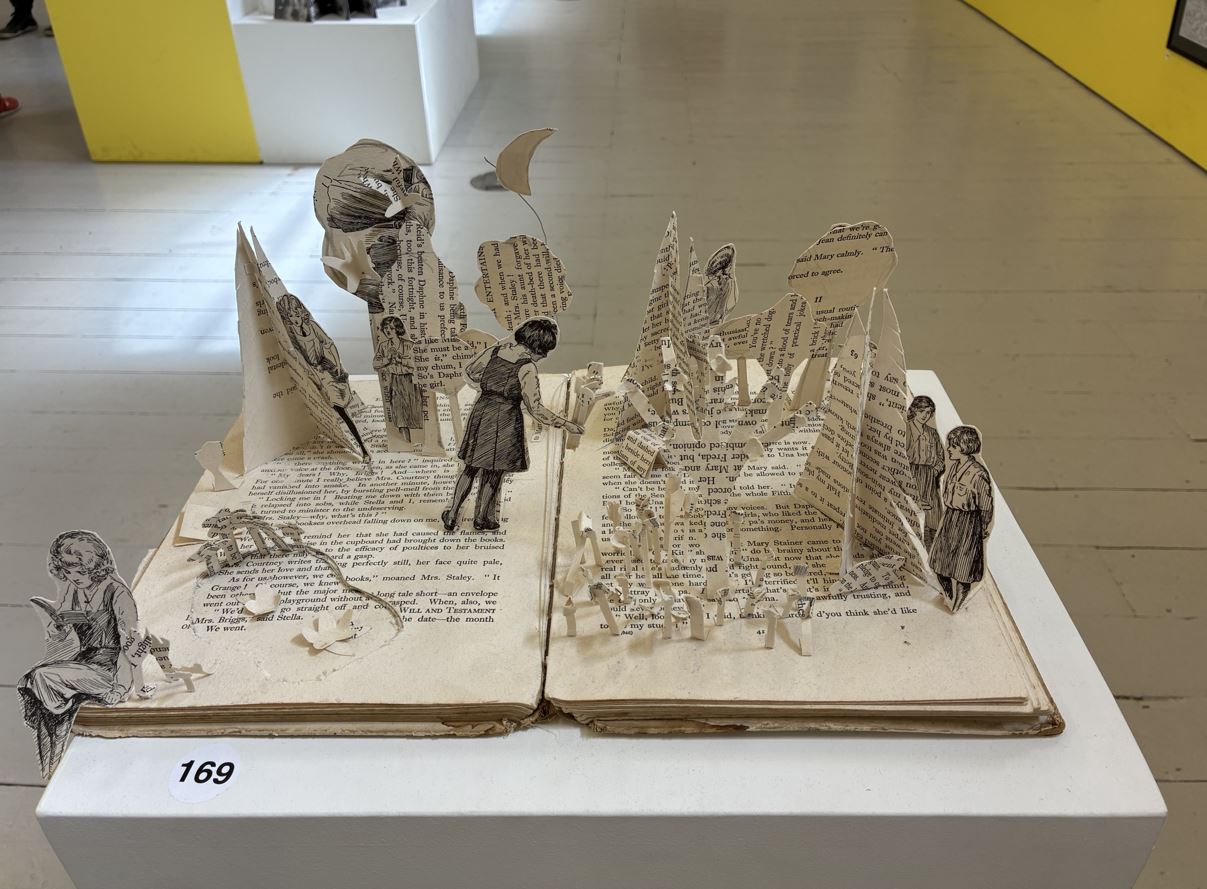
The Life Inside a Book by Clara, age 12 (photo by the author)
Ballami by Bonnie, aged 10
Bonnie’s been collecting rubber balls since she was three, has made them houses, a school, a playground and imagined them getting married and having little baby rubber balls, all recorded in this intricate rubber ball genealogy.

Top right: Ballami by Bonnie, aged 10, plus others (photo by the author)
Themes
Pets So lots of family pets – cats, dogs and guinea pigs – with the occasional fox and ostrich thrown in! Here are some paper moths attracted to and trapped in an attractive green lantern.

Endangerment by Luka, aged 18
The sea I noticed there’s a lot about the sea – ships and a storm-beset lighthouse – but much of it very environmentally aware / political, pieces harping on about plastic pollution, overfishing and so on – for example the octopus above, and the brilliant plastic lantern fish below – the kind of thing people have been harping on about for over 50 years with bugger-all impact. Be nice if we were making the world a nicer place. But we aren’t, I’m afraid. We’re destroying it.

Plastic Lantern Fish by Nicolas, age 13
Transport I noticed a number of works about planes, cars, buses, trains contemporary and steamy, plus bicycles. Here are some buses by Artur who is 7 and is neurodivergent and has a special interest in London buses, their numbers and where they go. He knows many bus directions by memory – which is more than I do and ‘ve lived here for 40 years. Well done, Artur.

London Buses by Artur, aged 7
Ethnicity There are a number of works about race and ethnicity – from the purely descriptive type i.e. depicting their Black or Asian family or schoolmates, through to a rather more polemical tone, with one which seemed to be about the Edward Colston statue in Bristol and similar vestiges of empire.

The Challenges of History by Beatrice, aged 18
Well, if we need to address topical adult issues, it’s not as if these aren’t covered in the massive adult show next door, not to mention in countless other art exhibitions, articles, documentaries, books and so on.
But, meanwhile, back in kiddyland, it’s the silly ones I remember.

From the top, clockwise, a cat which has done a big poo, a lioness holding a cocktail, an odd sock, a bicycle against a lamp-post, and a colourful frog (photo by the author)
A lioness with a cocktail. Genius!
Gaps and absences
Know what isn’t here? Just like in the main Summer exhibition? Mobile phones and computers. It’s as if they don’t exist, whereas I was under the strong impression that most people and pretty much all kids, have smartphones of their own and are glued to them at all hours of the day and night. But completely absent here, utterly unrecorded. Most of these images could have been from an exhibition 10, 20 years ago. Why is the digital age, the lived experience of living in the digital world, so impossible to depict in art?
Related links
- Royal Academy Young Artists’ Summer Show 2025 ran from 15 July to 10 August 2025
- All the artworks
 Books & Boots