Stories of the East by Leonard Woolf (1921)

Leonard Woolf’s first novel, the brilliant evocation of peasant life in Ceylon, ‘The Village in the Jungle’, was published in 1913. His second novel, the more conventional ‘Wise Virgins’, a thinly disguised account of his and Virginia’s Bloomsbury friends, was published the following year. There then followed a seven year hiatus while he concentrated on publishing the serious political and sociological works he wished to be remembered by:

  • International Government – 1916
  • The Future of Constantinople – 1917
  • The Framework of a Lasting Peace – 1917
  • Cooperation and the Future of Industry – 1918
  • Economic Imperialism – 1920
  • Empire and Commerce in Africa – 1920
  • Socialism and Co-operation – 1921

Then, in among all these serious works about international affairs and the future of imperialism (of which he was a fierce critic) the Hogarth Press, which he had set up with Virginia in 1917, published a slim volume titled ‘Stories of the East’. There are just three stories:

  1. A Tale Told by Moonlight
  2. Pearls and Swine
  3. The Two Brahmans

1. A Tale Told by Moonlight

The setup

This has the influence of Joseph Conrad all over it, from the narrator within a narrator structure, through to the pretty insignificant story itself, which is jazzed up to try and make it about treatment and atmosphere which, in my opinion, doesn’t come off.

The narrator is staying somewhere in the English countryside with Alderton, the novelist. The other house guests are Pemberton the poet and Hanson Smith, the critic. The fourth member of the party is Jessop who the narrator starts the story by telling us is generally unpopular for his habit of being blunt to the point of rudeness and incivility.

After dinner these chaps stroll down through the fields to the river and lie around chatting as dusk falls. When it’s dark they hear footsteps coming along the river and realise it’s a young couple out for a stroll. Concealed in the darkness and on a bank over the riverside path, our chaps hear the young couple murmuring sweet nothings then the sounds of kissing, before they stroll on.

This puts our chaps in a sentimental mood and they share stories about first loves and wooing. All except Jessop who hears the others out then weighs in with his unsentimental withering opinion, which is:

‘Think of it for a moment, chucking out of your mind all this business of kisses and moonlight and marriages. A miserable tailless ape buzzed round through space on this half cold cinder of an earth, a timid bewildered ignorant savage little beast always fighting for bare existence. And suddenly it runs up against another miserable naked tailless ape and immediately everything that it has ever known dies out of its little puddle of a mind, itself, its beastly body, its puny wandering desires, the wretched fight for existence, the whole world. And instead there comes a flame of passion for something in that other naked ape, not for her body or her mind or her soul, but for something beautiful mysterious everlasting—yes that’s it the everlasting passion in her which has flamed up in him. He goes buzzing on through space, but he isn’t tired or bewildered or ignorant any more; he can see his way now even among the stars. And that’s love, the love which you novelists scatter about so freely…’

So Jessop ridicules all the soppy talk about love and moonlight and says real love is strange, uncanny, unpredictable, makes no sense, is the rarest thing in the world. He’s knocked around the world and only ever seen two cases of it, and he’s now going to tell us about one of them.

So all this has been by way of introduction and this it is so redolent of Conrad: the all-male company; after dinner, in the dark; all described by an unknown narrator who then introduces one of the party telling a story-within-a-story. Structurally, it’s identical with the famous setting of Heart of Darkness.

The story

Among Jessop’s many friends and acquaintances was a man named Reynolds, a novelist. They were at Rugby (public school) together. Jessop was living ‘out East’, in Ceylon, in the capital Colombo. Reynolds and he exchanged occasional letters until Reynolds announced he was heading in that direction and it was arranged he’d come and stay for a week.

He was a thin, weedy man who’s ‘stood aside’ from life, out of nervousness, a legacy of being bullied at school, knew all about people’s little tricks and mannerisms but didn’t know how they felt because he’d never felt anything except fear and shyness. So Jessop took him to all the expat clubs and they sat and talked about love and life and Jessop realised he’d never actually lived a day in his life.

So he determines to show him a side of life he hadn’t seen before, and takes him in a rickshaw out into the seedy, native part of town, to a dingy house which is a native brothel. Here they are greeted by ten or so beautiful young scantily-clad women, laughing and giggling. Poor Reynolds is terribly embarrassed at the bare boobs and golden bodies and doesn’t respond to their kisses or caresses so most of them gravitate over to Jessop who can speak their language and is prepared to listen to their stories about the native villages they come from and the arduous lives they’ve escaped to come to the big city. All except one.

She was called Celestinahami and was astonishingly beautiful. Her skin was the palest of pale gold with a glow in it, very rare in the fair native women. The delicate innocent beauty of a child was in her face; and her eyes, Lord, her eyes immense, deep, dark and melancholy which looked as if they knew and understood and felt everything in the world. She never wore anything coloured, just a white cloth wrapped round her waist with one end thrown over the left shoulder. She carried about her an air of slowness and depth and mystery of silence and of innocence.

Long story short, they fall in love and, Jessop insists, it was the real thing not the milk and moonlight version of English poets and novelists. It was something deep and inexplicable.

He looked into her eyes that understood nothing but seemed to understand everything, and then it came out at last; the power to feel, the power that so few have, the flame, the passion, love, the real thing. It was the real thing, I tell you; I ought to know…

So Reynolds becomes hooked and goes back to the brothel night after night in order to see Celestinahami. But Reynolds becomes so unhappy at the impracticality of the whole situation that he makes a feeble attempt to shoot himself. He buys a revolver but Jessop burst into his room to find him struggling with the mechanism which clips chamber shut and seized it out of his hands.

Then Jessop read him the riot act and this is the bit I didn’t really understand, or thought contradicted itself. Because Jessop tells Reynolds that the girl is nothing like he imagines:

not a bit what he thought her, what his passion went out to—a nice simple soft little animal like the bitch at my feet that starved herself if I left her for a day

BUT, at the same time, acknowledging that what Reynolds feels for her IS the real thing:

You’re really in love, in love with something that doesn’t exist behind those great eyes. It’s dangerous, damned dangerous because it’s real—and that’s why it’s rare.

So it’s real love, one of the only two times Jessop has seen ‘real’ love – and yet he’s perfectly aware that it’s love for something which doesn’t exist. Reynolds is utterly projecting something onto this girl which simply isn’t there. And yet this is what Jessop calls real love. See why I’m a bit confused?

Anyway, Jessop roughly tells Reynolds to either get on the next ship home or ‘practise what you preach and live your life out, and take the risks.’ So for the first time in his life, Reynolds takes a chance on life. He buys the girl out of the brother (for the bargain price of 20 rupees) and Jessop fixes them up in a nice cottage by the sea.

At first they were happy. He taught her English and she taught him Sinhalese. He started to write a novel about the East. But pretty quickly he comes to realise the truth. He comes to realise the vast difference in intellect and education and culture between them.

He couldn’t speak to her and she couldn’t speak to him, she couldn’t understand him. He was a civilized cultivated intelligent nervous little man and she—she was an animal, dumb and stupid and beautiful.

He loved her but she tortured him. She got on his nerves.

But the cruellest thing of all was that she had grown to love him, love him like an animal; as a bitch loves her master.

Because:

There’s another sort of love; it isn’t the body and it isn’t the flame; it’s the love of dogs and women, at any rate of those slow, big-eyed women of the East. It’s the love of a slave, the patient, consuming love for a master, for his kicks and his caresses, for his kisses and his blows. That was the sort of love which grew up slowly in Celestinahami for Reynolds. But it wasn’t what he wanted, it was that, I expect, more than anything which got on his nerves.

So, the story tells us, there are two types of love: the big visionary type which, it has been clearly explained, Reynolds projected onto Celestinahami; and the dog-like, slave-like master-love of Celestinahami. Neither sound to me like ‘the real thing’, which Jessop set out to describe.

She used to follow him about the bungalow like a dog. He wanted to talk to her about his novel and she only understood how to pound and cook rice. It exasperated him, made him unkind, cruel. And when he looked into her patient, mysterious eyes he saw behind them what he had fallen in love with, what he knew didn’t exist. It began to drive him mad.

And so the story hurtles to its inevitable, Conradian end. She takes desperate steps to try and keep his ‘love’, the most florid being to dress up like the white women she sees in Colombo, in stays and white cotton stockings and shoes. But the more she tries, the more she destroys the image Reynolds had of her, the more angry he becomes, the more wretched she.

Eventually Reynolds realises he has to leave and carry on his travels. He swears to Celestinahami and Jessop that he’ll be back, he considerately makes over the house to Celestinahami’s ownership, then one fine day sails away on a P&O liner.

I never saw Reynolds again but I saw Celestinahami once. It was at the inquest two days after the Moldavia sailed for Aden. She was lying on a dirty wooden board on trestles in the dingy mud-plastered room behind the court… They had found her floating in the sea that lapped the foot of the convent garden below the little bungalow—bobbing up and down in her stays and pink skirt and white stockings and shoes.

I suppose this is all very well done, but very much in the manner of Conrad even down to the punchline. Just as in one of Conrad’s classic tales told by his sailor-narrator Charles Marlow, the storyteller ends his tale, there’s a pause, and then one of the company of listeners brings us back to reality with a down-to-earth comment.

Jessop stopped. No one spoke for a minute or two. Then Hanson Smith stretched himself, yawned, and got up. ‘Battle, murder and sentimentality,’ he said. ‘You’re as bad as the rest of them, Jessop. I’d like to hear your other case—but it’s too late, I’m off to bed.’

Commentary

The feel and structure of the thing are, as pointed out, very Conradian, from the double narrative structure through to the deliberately throwaway ending, designed to evince that mood of cynical, jaded, man-of-the-world indifference to what is, in essence a tragedy (reminiscent of the plot of Puccini’s opera ‘Madame Butterfly’).

And you don’t have to be a feminist to find the fundamental structure – or two narrative structures – objectionable. What I mean is the frame story, in which four comfortably-off men sound off to each other about love without much or any admission of the woman’s point of view – and then listen to a tragedy based around the innocence and ignorance of poor Celestinahami. The power imbalances in both these structures are there for everyone to see. And the worldly note of the throwaway ending may be designed to indicate the fundamental heartlessness of the world, but it highlights that none of the listeners has a word of lament over poor Celestinahami.

But what puzzled me, more than anything, was that the story, the first narrator, and then Jessop all promise some great revelation about The Truth of Love, and then it doesn’t arrive. Maybe the narrator and Jessop’s point is that such a thing doesn’t exist, and instead, what actually exists in the real world is more complex, unsentimental, irrational and almost unpleasant, than the moon-in-June sentimental clichés.

In which respect, then, it chimes very much with the heartless worldview which radiates from his wonderful if extremely bleak novel, ‘The Village in the Jungle’.

2. Pearls and Swine

The setting

The unnamed first-person narrator is staying at a hotel in Torquay. After dinner and a game of billiards he joins three other chaps sitting round the fire. They’re talking about India, which reminds him of the 15 years he spent out there. Two of the three – a stock jobber and a clergymen – have never been out East and so sound off with insufferably imperialist cant and clichés: the stock jobber says the Indians must accept our racial superiority; the clergymen says we are undoubtedly raising them up to our level of civilisation, not least through the work of earnest young missionaries, basing his views on:

‘I read the papers, I’ve read books too, mind you, about India. I know what’s going on.’

All this cant goads the third member of the group, a small man with dark skin and wrinkles round his eyes (the narrator recognises a fellow servant of empire) beyond endurance, and he bursts out with a Tamil proverb. When asked to translate he explains that it’s a polite way of indicating the foolishness of earnest young Englishmen who go out to idea full of naive ideas drummed into them by their School Board education and think that somehow, after just 18 months, they understand the place from top to bottom, from ‘Benares to Rameswaram’. Compared to the Tamils who have lived in India for at least 7,000 years, compared to the hundreds of races who share the continent (‘there are more races in India than people in Peckham’).

Mention of views and opinions provides the hinge or pretext for the little Anglo-Indian man to announce that instead of views, he will tell them some facts. And this is what he proceeds to do.

The story

This is the real point of the story. The Anglo-Indian gives a ten-page account of his time serving in southern India as government administrator of a peal fishery. This was based on a God-forsaken stretch of the coast which consisted of nothing but barren sand and scrub for hundreds of miles, without a town or village or river or fresh water. But off this coast were marvellously rich oyster beds and every year, for 6 to 8 weeks between monsoons, thousands of fishermen in hundreds of boats, come to farm the oysters, a varied crew including scores of different races of Indians, plus Arabs and their Black ex-slaves, a multicultural community devoted to one end, diving to bring up thousands of oysters every day, to leave them rotting in the sun for the flies to devour, in the hope they will reveal pearls of great price embedded in their flesh.

The British Imperial government taxes their catch, taking two-thirds of the pearls. And the small, dark intense storyteller once performed this role and now describes, in vivid and powerful detail, what it was like – the heat, the unbearable flies, the nauseating smell of thousands of rotting oysters, the babble of native voices. All the several thousand fishermen had to be confined in a compound for 6 to weeks, creating a madly unhygienic and disease-ridden environment.

So that establishes the ground base of the story. Into this environment come two more white men: one is Robson, a 24-year-old bright spark who passed the Civil Service exams and is overflowing with bright new ideas about reforming everything, who criticises the narrator for giving up on changing the East and instead letting the East change him.

He was too cocksure altogether, of himself, of his School Board education, of life, of his ‘views’. He was going to run India on new lines, laid down in some damned Manual of Political Science out of which they learn life in Board Schools and extension lectures.

Predictably, his body and mind are not prepared for the disgusting conditions of the compound, the heat and the flies, and he ends up vomiting lots of time every day, becoming sicker and sicker.

The other white man is (ironically) named White. He’s a drunk, a rummy, with a pinched face and sharp teeth with gaps between them. But he’s a white man so Robson and the (unnamed) narrator let him eat at the same table. White tells the others he went to public school, which is probable, failed in England and so came out East. But even here he has been bedevilled by ‘damn bad luck’ and tells sob stories about a succession of dubious-sounding jobs.

So that’s the setup: three white men in a huge barren hot inhospitable semi-desert next to the sea, trying to control thousands of native pearl divers from all across India and beyond. We expect trouble, if not tragedy.

Sure enough, things happen. First a fight breaks out between a group of Arabs and one of Tamils over a handful of oysters which fall out of a bag. By the time the narrator separates them one Tamil is dead and ten or so have been injured. Idealistic Robson, for all his fancy ideas of ‘Reforming The Empire’, turns out to be predictably useless, running around like a distracted hen and crying.

But the main event in the story is that White comes down with a severe attack of delirium tremens or DTs. He starts raving and threatening violence so the narrator has to knock him out with a rifle butt. When he comes round, the narrator ties him to his bed. His raving, his tormented hallucinations are a trial for the narrator but tip young Robson over the edge, reducing him to sitting and crying.

All this allows Woolf to write some highly enjoyable bravura passages of the different mentality of the old India hand, of how you come to adopt the native mentality, become more passive, and accept the vast impersonal forces which dictate life, your life, everyone’s lives.

One just did one’s work, hour after hour, keeping things going in that sun which stung one’s bare hands, took the skin off even my face, among the flies add the smell. It wasn’t a nightmare, it was just a few thousand Arabs and Indians fishing tip oysters from the bottom of the sea. It wasn’t even new, one felt; it was old, old as the Bible, old as Adam, so the Arabs said. One hadn’t much time to think, but one felt it and watched it, watched the things happen quietly, unastonished, as men do in the East. One does one’s work,—forty eight hours at a stretch doesn’t leave one much time or inclination for thinking,—waiting for things to happen. If you can prevent people from killing one another or robbing one another, or burning down the camp, or getting cholera or plague or small-pox, and if one can manage to get one night’s sleep in three, one is fairly satisfied.

And again, a meditation on the profound difference between East and West:

Things here feel so different; you seem so far from life, with windows and blinds and curtains always in between, and then nothing ever happens, you never wait for things to happen, never watch things happening here. You are always doing things somehow—Lord knows what they are—according I suppose to systems, views, opinions. But out there you live so near to life, every morning you smell damp earth if you splash too much in your tin bath. And things happen slowly, inexorably by fate, and you—you don’t do things, you watch with the three hundred millions. You feel it there in everything, even in the sunrise and sunset, every day, the immensity, inexorableness, mystery of things happening. You feel the whole earth waking up or going to sleep in a great arch of sky; you feel small, not very powerful. But who ever felt the sun set or rise in London or Torquay either? It doesn’t: you just turn on or turn off the electric light.

This is all rather wonderful. But White won’t stop raving, all through the night. He moves on from hallucinations to describing shocking, immoral, cruel and corrupt behaviour all through his life, which is worse, more demoralising. The narrator moves him from his bed and ties him to a pole near his official desk where he can keep an eye on him. Arabs and Tamils come to watch him silently. The narrator explains that he is ill, the heat has driven him mad, and they accept this as they accept everything and move away with the ‘calm patient eyes of men who watched unastonished the procession of things’.

For one long night White raves and then, as dawn arrives, he cries out and dies. The narrator cuts him down from the pole and lays him out. But at that exact moment he is called by some locals. An oyster boat is coming inshore with a dead body on it, an Arab who died in mid-dive.

Woolf creates a very deliberate and stark contrast between the two dead men: White is a symbolic figure, symbolising the absolute worst of white men in the East, a corrupt drunk and public scandal who dies with horrible indignity.

By contrast the dead Arab is brought ashore by his colleagues, his brother sits by his body quietly weeping, an Arab sheikh comes up, lays his hand on the head of the lamenting man, and quietly and calmly consoles him. He died doing his work, doing his duty as a man. Everyone – dead man, brother and sheikh – are drenched in dignity and honour as the dawn breaks.

At this point the little brown man finishes his story. As with ‘A Tale Told by Moonlight’ the ending is deliberately dismissive, realistic, indicating the place of this, just one more story among a million stories in the western realm of endless discourse.

There was silence in the smoking-room. I looked round. The Colonel had fallen asleep with his mouth open. The jobber tried to look bored, the Archdeacon was, apparently, rather put out.

This feels much better than the first story for two obvious reasons. The dichotomies or binaries are easy to spot and enjoy, namely: between the shallow pontificating of the stock jobber and the clergyman, and the little brown Anglo-Indian; then between young idealistic Robson and the narrator; and then between the dignified locals and the wildly undignified, drunken White. There is the deeper dichotomy between imperial rules and the ruled to unpick as well, if you want to.

But mostly what makes it enjoyable is Woolf’ couple of paragraph-length descriptions of the mentality of the East, the spirit of the East, so utterly different from the pampered ignorance of London clubland where the frame story is set. All very neat, well constructed and enjoyable.

The Two Brahmans

Description of Yalpanam, a very large town in the north of Ceylon, which always feels abandoned and sleepy as all the living goes on behind the high fences made of the dried leaves of the coconut palms which conceal the compounds in which sit the huts and houses.

In the north of the town is the section devoted to Brahmans, to most senior caste in India’s caste system, who must keep themselves from being defiled, losing caste and face in countless ways. For example they do no work for themselves, all their needs are catered to by lower cast workers devoted to trades such as fishing tending rice, digging wells and so on.

In order to avoid defilement, the 50 or so Brahman families in Yalpanam all live in the same part of town, on the northern edge abutting the big lagoon. And for centuries if not millennia they have all married off their sons and daughters to each other to preserve their purity.

The story spans four generations of two particular families, headed by two fathers Chellaya and Chittampalam whose compounds neighbour each other. To be brief, both Chellya and Chittampalam shame their families by undertaking manual work. They try to keep it hidden but words get out and the other Brahman families cut them off. Among other things, this means their children and their children’s children and their children’s children’s children, will not be accepted for marriage by anyone in the town. They’ll have to go to distant settlements to find Brahman families which have never heard of their shame.

Chittampalam is a miser. When the water in his well starts to become brackish he should have gotten an earth carrying caste member to dig him a new well. Instead, in order to save, money he dug it and carries the soil away on his head himself. People saw him and he lost caste.

But it’s Chellaya who gets the lion’s share of (this very short) story. He likes to spend his afternoons staring out over the big lagoon and slowly becomes obsessed with the fishermen who wade out into the water and cast their nets. It looks so idyllic, it looks so relaxing. So one day he shamefacedly asks one of the fisherman if he could show him how to cast a net. He comes up with a cock-and-bull story about having made a vow to some god to do it as reward for healing his son but nobody is fooled. So for a small payment the fisherman sells him a net and then on successive days, far away from the village, shows him how to cast it. But someone, inevitably, sees, and he, too, loses caste.

I was wondering how these two bad Brahmans were going to be brought into contact or conflict but they aren’t. Chittampalam dies soon after being discovered carrying earth and Chellaya a few years later. It’s their great-great-great grandchildren who are. Four generations later the male descendants of the two naughty Brahmans bear the same names, Chellaya and Chittampalam.

Everybody’s forgotten which one of them carried the earth and which one cast nets, but they are still shunned by the other Brahman families and still have to marry outside the town.

And so we reach the climax of this little tale. The descendant Chellaya and Chittampalam still live in the same compounds as their ancestors, next to each other. And Chittampalam has a very beautiful daughter and Chellaya has one son unmarried, who one day sees the beautiful daughter through the compound wall, and suggests to his father that he marries her.

So the two fathers meet up and are in agreement that it would be an excellent marriage. However there’s one sticking point, the same sticking point there always is in all these native marriages, the size of the bride’s dowry: the father of the girl wants the dowry to be small and the father of the boy wants it to be large.

Well, the denouement, climax or punchline of the story turns out to be that… each time they meet to discuss the dowry it isn’t long before Chittampalam loses his temper and calls Chellaya a fisher, Chellaya loses his temper and calls Chittampalam a pariah and they both storm off.

Chellaya’s son calms his father down and arranges for the two men to have another meeting a few days later, but the exact same thing happens, with negotiations which start sensibly ending in a shouting match and both men storming away. Oh well, they realise; like their fathers and grandfathers and great-grandfathers before them, they will have to marry off their children to partners from some distant village which has never heard of their shame.

So the moral of the story, children, is that the sins or errors or mistakes of the ancestors continue to bedevil and stymie the wishes of their descendants. Silly, isn’t it? And yet it’s those values and traditions which give our lives their meaning and aren’t as easy to shake off as glib outsiders think.

In a poignant and symbolic coda, Chellaya’s son, lovesick for Chittampalam’s daughter, takes to going and sitting at the exact same spot where his great-great-great-grandfather Chellaya used to sit and watch the fishermen cast their nets.

Maybe it’s not just social conventions and transgressions which are passed down through the generations, but something deeper; something about gestures and longings and desires which are revived and repeated in every generation…

Thoughts

‘Pearls and Swine’ is clearly the best of the three stories, which is why Eland chose to include it in their paperback edition of ‘The Village in the Jungle’ but not the other two.

‘The Two Brahmans’ is fine as far is it goes, conveying not only the restrictions of Brahman life but, better, the sense of the yearning of the Brahman who wanted to become a fisherman, briefly standing for everyone who has a dream or desire beyond their station in life; but is too short to make a big impact.

‘A Tale Told by Moonlight’ is clearly the worst story, because of the unsympathetic character of Jessop the blunt cynic; because it is based – like so many turn-of-the-century stories, plays and operas – on the immiseration and suicide of an innocent young woman; but most importantly, I thought it didn’t live up to the promise to be some kind of meditation on the nature of Real Love. Didn’t strike me as being that at all, but instead a cliché, and an unpleasant exploitative cliché at that.


Credit

‘Stories of the East’ by Leonard Woolf was published by the Hogarth Press in 1921. I read ‘Pearls and Swine’ in the 2008 Eland Publishing paperback edition of ‘The Village in the Jungle’ which includes it as a kind of bonus. The other two I read online.
Related link

Related reviews

The Power-House by John Buchan (1916)

I was alone in that great crowd, isolated and proscribed, and there was no help save in my own wits.
(The Power-House, page 88)

A short book, at just 110 pages in this paperback edition, The Power-House was expanded from a 1913 short story. It starts slowly but builds into an exciting (if sometimes incomprehensible) thriller set among the posh upper class of Edwardian England. The narrator is Sir Edward Leithen, a Scottish barrister and Conservative MP living in London, a character who was to go on and feature in four other Buchan novels which are, as a result, regarded as a set. Half-way through the novel we are told that he is 34 years old.

Frame narratives

It’s a frame narrative or story within a story. The first page explains that the following story was told by Leithen to a group of ‘us’ one evening during a hunting trip in Scotland, duck shooting at Glenaicill to be precise. We’re given the names of some of their circle of posh friends and their wacky adventures.

The main narrative starts with one of Leithen’s circle, fellow Conservative MP Tommy Deloraine, throwing a dinner party at which we’re introduced to a second group of posh, pukka pals (‘an Indian cavalry fellow; Chapman, the Labour member, whom Tommy called Chipmunk; myself, and old Milson of the Treasury’). I confess to finding this blizzard of names and characters a bit confusing. I was left wondering who was going to emerge as the central protagonist.

The use of a frame device reminds me of Joseph Conrad’s use of the technique in the novels narrated by his character Marlow (Heart of Darkness, Lord Jim, Chance, The Arrow of Gold and the short story Youth). But the comparison only highlights the difference. Conrad is a literary giant, Buchan is a cheapjack entertainer. In Conrad the frame story of, say, Heart of Darkness, is an intimate part of the meaning of the narrative, giving it immeasurable depth and significance. Here the only reason for these two sets of posh names and settings (the Scottish duck shoot and the dinner party) is nothing creative or artistic but, as far as I can tell, snob value. It simply indicates the posh, upper-crust setting.

(Actually, half-way through, another thought occurred to me. One of Buchan’s chief characteristics as a writer is his prolificness. I’ve just read Prester John, whose protagonist is a young and relatively hard-up Scotsman; a few years after this book, Buchan published his most successful novel, The Thirty-Nine Steps, which features a middle-class protagonist. Maybe the very showy showcasing of posh friends and connections in the Leithen books is not pure showing off but more to signal the difference in social class and setting of the Leithen novels from the other types. Not snobbery, but narrative positioning.)

Where is Pitt-Heron?

Anyway, when all the guests have left the party, Tommy tells Leithen (the narrator) that a mutual friend, Charles Pitt-Heron, a well-known adventurer and free spirit, has disappeared, not returning home to his lady wife a few days previously. His valet has found a card in his things with a Russian name on it, Konalevsky, and enquiries have shown that it belongs to an official at the Russian embassy. When Tommy went to see him Konalevsky told Tommy that Pitt-Heron has gone to Moscow, nobody knows why.

Now Tommy explains that he’s telling Leithen all this because he, Tommy, is all set to depart for Moscow with a view to tracking down Pitt-Heron, finding out what it’s all about, and offering him help. But he needs someone back in London to know what’s going on, where he’s gone, and generally look after his interests while he’s away. Puzzled by the whole thing, Leithen agrees.

So next day Tommy catches the boat-train from Victoria and Leithen goes round to see Pitt-Heron’s wife, Ethel. With the incestuousness characteristic of the British upper class, Leithen himself had feelings for Ethel before she married the mad adventurer, Tommy, so the visit has undertones. But she tells him she’s discovered the draft of a letter he wrote but obviously never got round to completing, warning of terrible danger and telling her to come and meet him at …. and the chosen destination hadn’t been filled in. What does it mean? Leithen promises his old flame to find out.

The Lumley-Pitt-Heron connection

The plot then thickens or gets more cluttered. Through a series of random incidents, Leithen becomes aware of a man who owns a big house in Blackheath named Pavia, and that he has an aggressive butler named Tuke. Checking up information in court cases he’s involved in, Leithen then discovers the house in South London is also registered to a man named Lumley. Could they be the same person?

When Leithen goes to this house to interview the butler (because he’s been involved in a car crash which is going to court), the owner is away, but Leithen discovers a scrap of paper with a cryptic message on it: ‘Suivez a Bokhare Saronov’. Why Bokhara? Who is Saronov?

The country house

In a huge coincidence, Leithen undertakes a motor car tour of the West Country (the car is driven by his chauffeur, Stagg) but, on the way back, in Surrey, they crash, not seriously, but both are a little cut and shaken. Leaving Stagg to look after getting the motor repaired, Leithen goes wandering the neighbourhood to see if he can find a nice upper-middle-class chap who can put him up. The coincidence is that he comes across a lovely grand house, home to a very friendly old man.

Altogether it was a very dignified and agreeable figure who greeted me in a voice so full and soft that it belied his obvious age. Dinner was a light meal, but perfect in its way. There were soles, I remember, an exceedingly well-cooked chicken, fresh strawberries and a savoury. We drank a ’95 Perrier-Jouet and some excellent Madeira.

International anarchy

After dinner the two very civilised men sit by the fire for a long conversation. The gracious host very slowly steers the subject round to international affairs, points out the thinness of the veneer of civilisation, suggests how little it would take to sink the currency, the only thing which keeps civilisation together is the compact of most of its educated members to do so. But what would happen if that failed, if some members rejected the compact or social contract?

What is everything you read in the papers is just persiflage, even the stuff about wars and new weapons is only the surface? What if the real power lies hidden?

The true knowledge, the deadly knowledge, is still kept secret

And so, in this mesmeric scene, Leithen finds himself being drawn into a vision of a vast international conspiracy. ‘Supposing anarchy learned from civilisation and became international,’ the host says. But you would want a great military genius, a modern-day Napoleon to manage such a conspiracy, objects Leithen.

‘Let us call it iconoclasm, the swallowing of formulas, which has always had its full retinue of idealists. And you do not want a Napoleon. All that is needed is direction, which could be given by men of far lower gifts than a Bonaparte. In a word, you want a Power-House, and then the age of miracles will begin.’

Their after-dinner chat tails off and Leithen goes to bed in the spare bedroom, but he can’t sleep because of the vision of international anarchy which has opened before him. Next morning he is up early, deliberately to avoid further conversation with his unnerving host.

In fact it is only as the housekeeper serves him an early breakfast, that she mentions that her master’s name is Mr Andrew Lumley. Lumley! The same name that’s come up regarding the house in London and mysterious connections with Pitt-Heron.

Leithen is driven back to London by Stagg, in the now-repaired motor, reeling from the coincidences which have brought him to spend the night in the home of the very person who seems to be involved in Pitt-Heron’s disappearance.

Developments

Mr Lumley, the quietly civilised connoisseur and man behind the Power-House, not only has a country house in Surrey, and a house in Blackheath, but mostly stays in rooms at the Albany in central London.

His butler’s real name is Josiah Routh. Leithen finds out that he is a crook who made a career as a trade unionist until he was caught embezzling funds and did a runner. Now, as he pieces together the evidence, Leithen realises that:

  1. Pitt-Heron is mixed up somehow with Lumley and become so frightened for his life that he fled to Moscow.
  2. Tommy has contacted a mutual friend in the Moscow embassy and gone to find Pitt-Heron.

Leithen has a contact at ‘one of the embassies’ (surely the French embassy?) who he calls Felix. He goes to see Felix and together they ponder where the Tommy and Pitt-Heron would then travel to. If Pitt-Heron was going on from Moscow to Bokhara, then they would probably head south towards British India.

This Felix becomes a source of information, first that Tommy arrived in Moscow, then that he set off towards central Asia, and then that he was pursued by another Englishman, a man answering to the description of Tuke, the super-butler, also known as Routh. This Routh had hooked up with a Russian named Saronov. So Saronov and Tuke are in pursuit of Pitt-Heron and Tommy in the wilds of Central Asia.

Complicated, isn’t it? And doesn’t totally make sense. We have no idea how Pitt-Heron is connected to Lumley or why he’s fleeing into Central Asia of all places.

Anyway, Leithen also reaches out to a contact of his in Criminal Investigation Department at Scotland Yard, one Macgillivray. They meet for a drink and Leithen asks this old hands if he’s ever heard of the Power-House? Macgillivray laughs and says there are hundreds of criminal organisations with florid names, colourful names are the hallmark of half-baked political subversives round the world.

Pursued

Leithen becomes convinced he’s being spied on, the eerie feeling that people are watching him and following him in the streets. He bumps into Lumley in Piccadilly who very politely warns him to steer clear of the Pitt-Heron affair. The sense of paranoia and urban claustrophobia thickens.

So much so that Leithen reaches out to the bluff Yorkshire Labour MP Chapman and asks him to move in with him, to be a kind of bodyguard. He has to tell Chapman about the international conspiracy he’s stumbled across and the latter is very excited at the prospects of fighting and punch-ups. The pair take to practicing boxing for half an hour every morning.

Der Krafthaus

Leithen runs into Macgillivray in his club who tells him that, as it happens, a letter from a German colleague contains references to several espionage plans, all linked to something called the Krafthaus, Krafthaus being German for ‘power house’.

Macgillivray’s correspondent concluded by saying that, in his opinion, if this Krafthaus could be found, the key would be discovered to the most dangerous secret organisation in the world. He added that he had some reason to believe that the motive power of the concern was English.

Premonitions

In his imagination Leithen sees Tommy and Pitt-Heron riding south from Bokhara, being pursued by Tuke and Saronov, certain that when they meet up there will be death – ‘and I knew, though how I could not tell, that death would attend the meeting.’

Leithen has come clean to his friend in the Foreign Office, Felix, and asked him to get the British Embassy to despatch help to Tommy and Pitt-Heron. All he can do is hope that help will arrive in time.

Leithen attends a big political dinner given by the chief of his party in the House of Lords. There are fifty or sixty guests and he is horrified to see Lumley sitting at the top of the table as one of the most honoured guests. When he asks the man sitting next to him who the guy at the head of the table is, the man (an Under-Secretary) replies that he is Lumley, one of the most powerful men in England: ‘If you wanted any out-of-the-way bit of knowledge you could get it by asking Lumley. I expect he pulls the strings more than anybody living.’

The trap

Macgillivray phones Leithen to say he has something important to tell him and invites him to an out-of-the-way restaurant in Fitzrovia, Rapaccini’s in Antioch Street. It’s a trap. Leithen is shown into a small dining room and the door is locked behind him. There’s bottles of champagne and he’s tempted to drink but is too tense.

After a long wait, the odd-looking French windows open from outside to reveal a burly crook. Now, as it happens, this is a crook Leithen once acted as defence lawyer for and got off, one Bill Docker. (Not the most original name for a working class London man, is it?)

Docker is surprised to see him and explains that he’s been paid to force him outside and into a waiting car which will drive him away (why? where?). Leithen tries to persuade him to let him go, but Docker says if he does a) he’ll have his own throat cut and b) ‘they’ will just send someone else.

Now during this tense conversation Docker had helped himself to several glasses of the champagne and now begins to feel woozy. It is, of course, drugged, and when Leithen points this out to him, Docker becomes angry at his own employers and, with his bull-like physique, smashes the locked door down before proceeding to pass out.

Leithen grabs a champagne bottle as a weapon and goes out into the corridor where he immediately encounters one of the waiters with a knife but clobbers him over the head with the bottle. Just as Docker had been battering the door, Leithen had heard the voice of his friendly Labour MP, Chapman, yelling up the stairs. Now Leithen jumps over the banisters and falls amid three other waiters who try to corner him but they all fall in a roiling ruck. Chapman wades in, disperses them and pulls Leithen to safety.

Out in the street, Chapman explains that after Leithen rang to say he was going to Rapaccini’s, he suddenly remembered it was the London base for Tuke, the renegade trade unionist, and immediately suspected something fishy, so had hurried round. The supposed ‘manager’ tried to put him off but Chapman barged past him and started yelling Leithen’s name just, as chance would have it, as Docker was breaking the door down.

Now they booth hustle out of the place and walk sharpish along Oxford Street, west back towards Leithen’s flat. On the way he is several times jostled by random passersby off the pavement and once into the door into building works, crying out for Chapman who came wading in to save him.

In other words, the Power-House seems to be a vast organisation, with followers everywhere, who have been ordered to capture him.

News from Asia

They make it back to his flat where they virtually barricade themselves in before calming down. Leithen is smoking a pipe when Felix phones with news of goings-on on Turkmenistan. Felix had commissioned some British Indian frontier police to shadow Tuke and Saronov from Moscow. They followed them into a valley where they met Tommy and Pitt-Heron and, after a little parlay, Tuke had fired deliberately at Pitt-Heron, grazing his ear, whereupon Tommy had charged him and knocked the pistol from his hand. Tuke turned to flee but was killed by a long shot from the police on the hillside. Meanwhile Tommy had felled Saronov with his fists, and the man had abjectly surrendered.

This is all well and good but what’s it all about? What has Pitt-Heron got to do with Lumley? Why did he flee? Why did he flee to Moscow, of all places, and then onto Central Asia? What was so important that Tuke was sent thousands of miles to kill him?

Break for it

Next day Leithen writes a full account of events to date, in duplicate. He sends Chapman to deliver one of them to Macgillivray at Scotland Yard. But a few hours later he’s rung up by a doctor from St Thomas’s Hospital who tells him that Chapman has been admitted for cuts and bruises sustained when he was run over by a car in Whitehall. And that while he was being helped to his feet, someone pickpocketed the letter. The enemy now know how much he knows.

When Leithen tries to phone Felix he discovers the phone line has been cut. He is under siege in his flat. But he had previously arranged to be picked up by his man Stagg the chauffeur at 2pm. A little late, Stagg appears in the car and Leithen makes a dash for it. He has the other letter on him and is going to deliver it to the embassy in Belgravia. But he tells Stagg to do a detour west to throw followers off the scent. But half way down the Edgeware Road he realises the driver of his car does not have the Boer War scar on his neck that he and Stagg have sometimes discussed. He is an imposter!

Next time they come to a traffic jam Leithen jumps out and makes his way between cars then pedestrians to a shop he knows, where he asks the owner to be let out the back entrance into a mews. He doubles back through Hyde Park, across Park Lane and through Mayfair. He has that classic thriller sensation of moving among the urban crowds who are living their everyday boring lives while he is involved in a life-or-death, high stakes chase.

I was alone in that great crowd, isolated and proscribed, and there was no help save in my own wits.

As he crosses into Green Park more and more ‘innocent’ bystanders are revealed as being in on the conspiracy, moving in on him, trying to cut him off, as he runs down into Belgrave Square, and then along the mews behind the (French?) embassy. In a comic scene he bursts into the kitchen, mortally offending the chef who was in the final stages of creating a perfect casserole (surely the French embassy?).

A footman, nervously fingering in his pocket what Leithen suspects is a pistol, tries to apprehend him but at this moment the butler appears and suavely agrees to take Leithen to see his friend, Felix. For a moment I thought Felix might be in on the conspiracy (since it’s always the person you trust the most who betrays you), but Felix remains true and lets Leithen send a message to Macgillivray summarising events and, most boldly, to Lumley himself at the Albany, informing him that he intends to call on him at 8pm tonight. Then he makes one more request, that he be allowed a serving of the chef’s wonderful casserole at 7pm.

Face to face with Lumley

This short intense but puzzling yarn comes to a climax when Leithen makes his way from Belgrave Square up and along Piccadilly to confront Lumley at the Albany. He is shown into the quiet man’s rooms and they have a very enjoyable, highly theatrical confrontation. What is repeatedly emphasised is the way they respect each other as gentlemen and so won’t resort to anything crude. Instead Leithen says that at 9.30 he will hand over everything he knows to the police, which gives Lumley an hour and 45 minutes to pack his bags and flee the country. Why is he letting him go, in exchange for Pitt-Heron, in exchange for Lumley forgiving and forgetting whatever hold he has over Pitt-Heron. A favour for a favour.

Lumley delivers the classic speech of the baddie, respecting the brains and character of his enemy, lamenting that he didn’t meet him when he was younger and could have recruited him for his crusade.

Do you know, Mr. Leithen, it is a mere whimsy of fate that you are not my disciple. If we had met earlier and under other circumstances I should have captured you.
‘I abominate you and all your works,’ I said, ‘but I admire your courage.’ (p.101)

All accompanied with some bucket philosophy, because Lumley is the kind of baddie (like Moriarty) who justifies his crimes with specious sophistry.

‘I am a sceptic about most things,’ he said, ‘but, believe me, I have my own worship. I venerate the intellect of man. I believe in its undreamed-of possibilities, when it grows free like an oak in the forest and is not dwarfed in a flower-pot. From that allegiance I have never wavered. That is the God I have never forsworn.’

Lumley asks to be left alone while he ponders his next move and/or makes plans to pack to catch the next boat-train. Leithen never felt so relieved as when he emerges back onto the busy streets of Piccadilly, among normal men and women.

I had carried myself boldly enough in the last hour, but I would not have gone through it again for a king’s ransom. Do you know what it is to deal with a pure intelligence, a brain stripped of every shred of humanity? It is like being in the company of a snake.

So then he goes to see Chapman, the Labour MP who has been such a brick and sure ally. Chapman is understandably scandalised that Leithen is letting Lumley get away. He wants to have him arrested along with all the people in his network, and accused in a big public trial which would provide an opportunity for blockbuster speeches delivered by himself (Chapman) in Parliament, denouncing the wickedness of capitalism. It is only when Leithen points out that the deal he did was solely to protect his pal Tommy Deloraine and Charles Pitt-Heron, that Chapman grudgingly agrees to be sworn to secrecy.

(It’s easy to forget the suave humour which ripples all through Buchan. Even at the most tense moments his characters are liable to have a pukka quip on their lips, or a sly aside about the various character stereotypes they deal with, Docker the worker, Chapman tribune of the people etc. Part of upper-class sang-froid.)

Lumley’s end and tying up loose ends

In their big confrontation scene, Lumley had made the cynical point that maybe he wasn’t defeated, maybe he was relieved. He had been carrying the burden of super-intelligence and secret agency for decades. (‘No man since Napoleon has tasted such power.’)

So Leithen isn’t surprised to read in the following morning’s paper that Mr Lumley had not taken advantage of the time Leithen gave him to catch the boat-train to the continent but had, instead, died in his sleep of heart failure, presumably suicide (?). Three days later Leithen attends Lumley’s funeral and is impressed by the number of VIPs and top people who carry or follow the casket to the grave.

The papers, also, are full of Lumley’s charitable work, of his achievements as a collector and as a civilised host of parties and receptions. Not a word is breathed anywhere of the secret Leithen uncovered, Leithen’s role as leader of an international terror and anarchist organisation.

Leithen arranges for Lumley’s death to be mentioned in the Russian papers that Tommy and Pitt-Heron could be counted on to read. This is to alert Pitt-Heron that the man who had hounded him out of England is dead, without giving away the fact that he (Leithen) knows about the connection. In other words, done with delicacy and tact. Gentlemen.

All of which leads up very neatly to Leithen being paid a visit a few weeks later by Tommy, looking tanned and travelled, who – in complete ignorance of Leithen’s role in the affair – proceeds to rib Leithen about what a very boring, office-bound existence he leads.

And Leithen plays along, never letting him know that in Tommy’s absence, it was he, Leithen, who had played the key role in the affair, who had arranged for his protection in distant Asia, who had disposed of the great antagonist. How cool, clever and entertaining.

BUT – we never did find out what Lumley was up to and what he was holding over Pitt-Heron or why the latter fled 3,000 miles to escape it. Strange how this short text has all the feel of a thriller but with this great big plot hole right at the centre.

AND – Leithen is mighty confident that with Lumley dead the Power-House will evaporate into thin air, but will it? Surely such a vast enterprise would just find a new cog to fill the slot, like James Bond’s SPECTRE or SMERSH. And anyway, is Lumley really dead? Surely all the best baddies fake their deaths only to return from the grave in the gripping sequel!

Social history

People in conversation, on the radio and telly, in comedies and dramas, complain about the colonisation of the rest of England by Londoners buying up second homes and yet, here, in 1916, we have Leithen lamenting that:

The south of England is now so densely peopled by Londoners that even in a wild district where there are no inns and few farms there are certain to be several week-end cottages.

In 1916!

Artspeak

Lumley at one point dismisses the cheap rhetoric of anarchists and communists who spout slogans without appreciating the true nature of power, describing it as:

‘the half-scientific, half-philosophic jargon which is dear at all times to the hearts of the half-baked.’

Which rang a bell for someone who has just been to four contemporary art exhibitions and read hundreds of wall labels filled with the same endlessly repeated jingle of art critical terms.


Related link

John Buchan reviews

Planet of the Apes by Pierre Boulle (1963)

Extraordinary the impact this book had. First a series of five movies 1968-73, then a TV series (1974-5). In recent years the movie franchise rebooted, first with Tim Burton’s 2001 version and then again, with a new sequence of films (Rise of the Planet of the Apes 2011, Dawn of the Planet of the Apes 2014, War for the Planet of the Apes in 2017). Just these three movies alone have grossed over $2 billion.

And ever since the original movie there’s been an impressive array of comic books and graphic novels, computer games, toys and theme park rides (!).

Why is the story so powerful? What is its hold?

Frame story – Jinn and Phyllis

It is thousands of years in the future. The planets have been colonised and interstellar travel is common. Many travel on business in fast rockets. Jinn and Phyllis are more like tourists in space, dallying in a sealed sphere whose sails can be set larger or smaller to catch the solar winds coming from the stars and drift around the universe. One day they see an object flying by, change course to collect it, and find it is a message in a bottle, a glass bottle. Inside it are sheafs of paper with a long narrative scrawled on them.

Jinn reads out this narrative which makes up the main body of the text.

The narrative of Ulysse Mérou

This text is written by the journalist Ulysse Mérou in the year 2500. He has been invited to join the space expedition led by Professor Antelle, and accompanied by his assistant Arthur Levain, which is travelling to the nearest star, the mega-star Betelgeuse.

(Although published in 1963 everything about the space trip reminds me of H.G. Wells. We are not told anything about the design of the ship or nature of the propulsion system (always the snag in space travel sci-fi). Antelle is travelling in a ship he designed and built himself, almost as if he’d done it in a shed at the bottom of the garden. And they choose Mérou to accompany them because he is good at chess. In other words the whole story has the charming amateurism of Conan Doyle’s Professor Challenger stories or Well’s earlier science fantasies, many light years remote from the reality of the vast army of technicians backed up by the state, which would be required just to take a man to the moon later the same decade.)

It takes two years to travel to Betelgeuse, one year to accelerate to nearly the speed of light, a few days travelling at phenomenal speed, then a year slowing back down. As any reader of science fiction should have picked up, the closer to the speed of light you travel, the more time slows down relative to objects and people travelling at normal speeds i.e. people on Earth. Thus, while the trip to Betelgeuse will only take the trio two years, something like 350 years will have passed on Earth. Everyone they know and everything they know will have died and changed utterly.

Arrival on Soror

When they get to Betelgeuse, they discover there are four planets circling the super-star, and one of them, surprise surprise, is the same distance from the big star as Earth from the sun, and appears to have the same gravity and atmosphere as our home planet.

Our trio takes to one of the space ‘launches’ built into the main spaceship (no description whatsoever of what it looks like or how it works) and shuttle down to the planet, skimming over what appear to be cities, with buildings laid out along streets, before landing in a clearing in a ‘jungle’.

Once again, it comes as no surprise that the air on the planet is breathable – made of oxygen and nitrogen pretty much the same ratio as on Earth.

(This is as wildly improbable as when Cavor and Bedford unscrew the door of their sphere in First Men In The Moon and discover that the moon has a breathable atmosphere, if rather thin. Monkey Planet is not hard science fiction of the heavily factual Arthur C. Clarke variety. We are more in the realm of science fable.)

They christen the planet Soror, sister to our Earth.

So the three Frenchmen get out, stretch, wander around, see birds flying overhead, are struck by how similar the trees and flower are and discover a waterfall, so they strip off and swim and wash. It feels like a film already. You can imagine the tropical sunlight dappling through exotic leaves onto the sun-kissed bodies of our three hunky heroes.

Nova

At which point there is a Robinson Crusoe moment, as they spot a human footprint in the sand. A woman’s footprint by the shape of it. And then she appears.

Being a man, Boulle casts this first alien human as a woman, and being a Frenchman he imagines her a naked woman – and the whole thing veers towards the crudest pulp sci-fi when he describes her as a golden-skinned, physically perfect woman, a goddess perfect in form and feature etc.

I shall never forget the impression her appearance made on me. I held my breath at the marvellous beauty of this creature from Soror, who revealed herself to us, dripping with spray, illuminated by the blood-red beams of Betelgeuse. it was a woman – a young girl, rather, unless was a goddess. She boldly asserted her femininity in the light of this monstrous sun, completely naked and without any ornament other than her hair which hung down to her shoulders…Standing upright, leaning forwards, her breasts thrust out towards us, her arms raised slightly backwards in the attitude of a diver…It was plain to see that the woman, who stood motionless on the ledge like a statue on a pedestal, possessed the most perfect body that could be conceived on earth. (p.23)

Mérou christens her Nova, and she strikes this reader as being the oldest pulp fiction trope in the world – the pure, innocent, scantily-dressed (in fact, naked) damsel, who will, later on in the book, be threatened by great big hairy apes – with only our gallant narrator to protect her.

But, puzzlingly, it quickly becomes clear that Nova cannot talk and is scared when they laugh or talk. She can only make quick grunting noises, almost like an ape. In fact the three Frenchmen’s smiles and laughter scare her off.

Next day they go frolic in the waterfall again, and the perfect woman returns, with a man, fine figured but also mute. More mute humans assemble. When our trio put on their clothes, the humans recoil in fear and disgust. Walking back to the spaceship our heroes are attacked from all sides by quite a crowd of humanoids, as many as a hundred, who rip and tear their clothes off. Then the mob of animal-humans proceeds to break into the space launch and destroy, rip and tear apart everything they can get their hands on. But not like human vandals working systematically. More like animals, tearing and worrying and biting at something they don’t understand.

Destruction of the ship

Having trashed the ship, the savage humans drag our heroes back to their village. Except it doesn’t even have huts, is more a random scattering of makeshift shelters, a few branches leaning against trees, just as the great apes make. Nova, as you might have guessed, has formed a bond with our gallant narrator and comes and snuggles up against him, again more like an animal seeking warmth than an intelligent partner.

The manhunt

The next morning they are all woken by alarming sounds, ululations and shouts, yes shouts, language, as of humans. The humanoids run round in a panic and set off in the opposite direction, Mérou fleeing with them.

He begins to realise the people coming behind are beaters and the humanoids are being driven – and then he hears shots, gunshots. They are being driven towards hunters out for some sport.

Mérou comes to a break in the tall grass and is flabbergasted to see an enormous gorilla wearing clothes and wielding a shot gun, taking shots at the terrified humans as they emerge from the long grass into this break.

Mérou watches a human burst out of the grass into the open area and the gorilla carefully take aim and shoot him. He hands his gun to a smaller chimpanzee, behind him, also dressed, who recharges it with cartridges and returns it to the gorilla. Mérou’s head is spinning at what this seems to say about the planet they’ve arrived on – the traditional roles of ape and man appear to have been completely reversed.

Mérou waits till the gorilla fires (hitting another human) and hands the gun over to be reloaded, and then takes his chance. He runs across the break of open ground and into the long grass on the other side. But it is only to stumble into a trap of mesh netting which scoops him and other humans up into a huge struggling bundle, waiting for the master apes to come.

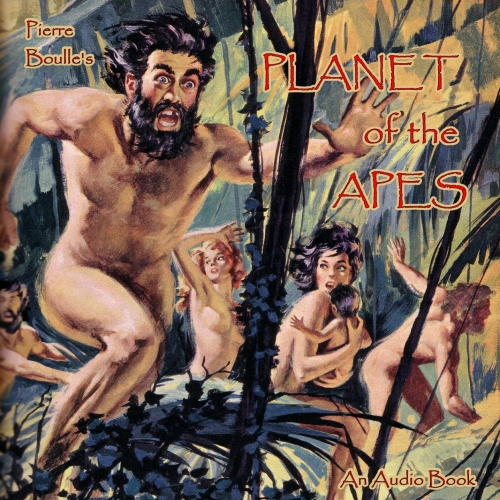
Cover of an audiobook of Monkey Planet which captures the terror of the hunt, artwork by Harry Schaare

Cover of an audiobook of Monkey Planet which captures the terror of the hunt, artwork by Harry Schaare (1964)

The human laboratory

Mérou is thrown into a cage along with other naked humans. He watches in disbelief as the gorillas return from the hunt and lay out the killed humans neatly and artistically, smoothing down ruffled hair as a human hunter would smooth down an animal’s fur or feathers, arranging the corpses in aesthetic poses.

Mérou is still reeling from the way the gorillas are wearing clothes, normal clothes, hunting clothes. One sneezes and brings a handkerchief out of his breeches to blow his nose. The cages are on wheels and are pulled by a sort of tractor back to a sort of hunting lodge where the female gorillas are waiting, wearing dresses and hats. A photographer turns up and snaps the hunter gorillas posing by their kills, with their proud womenfolk on their arms. Mérou feels as if he’s going mad.

Finally the hunters clamber onto some of the tractors, and along with those pulling cages full of human captives, they set off some distance to arrive at a town. Mérou observes a grocer pulling down his blind as he opens up shop. They have motor cars, banks, shops. It all sounds like a French provincial town except… populated by apes!

Mérou is unloaded at a hospital-like building and ushered down a corridor into a cage, one of many containing single or pairs of humans bedded on straw. Over the weeks it becomes clear that they are lab animals, kept to be experimented on. The experiments are mostly behavioural i.e. the Pavlov experiment of ringing a bell and offering food to make the animals salivate, eventually just ringing the bell to produce the same reaction.

The warders – two gorillas named Zoram and Zanam – hang fruit from the roof of a cage, then put four cubes in the cage. Only Mérou has the intelligence to realise that if you stack the four boxes on top of each other you can simply step up them and reclaim the fruit. The other humans watch him with complete incomprehension. By now he has realised that the humans really are animals without the slightest flicker of intelligence, let alone intellectual ability.

Then there is observation of mating rituals. The apes place male and female subjects in the same cage and observe their mating ritual – which amounts to the male circling round the female with ornate steps… before eventually pouncing on his hypnotised prey.

Mérou swears he won’t sink to the same level when they place Nova in his cage (yes, Nova has miraculously survived the manhunt and was thrown into a tractor cage and was transported to the same ‘hospital’ and has, by happy coincidence, now been thrown into Mérou’s cage). But when he fails to perform and they take her away and replace her with an old crone, and he sees another hulking male preparing to mate with Nova, Mérou changes his mind, makes a fuss and Nova is restored to him, at which point… well… when on Soror, do as the Sororians do.

(The fact that Mérou mates with Nova fulfils the soft porn, pulpy sexual promise which has been latent in the story ever since the trio sighted her splendid naked body by the waterfall. It is as inevitable as falling off a log.)

(Incidentally, Mérou saw the body of the professor’s assistant, Arthur Levain, stretched out in the array of ‘kill’ at the hunting lodge. Of the professor, he has seen no sign.)

Befriending Zira

But it isn’t just the gorillas who conduct these experiments. A female chimpanzee attends with a pen and notebook. Over the course of her visits, Mérou manages to impress on her his intelligence, first of all parroting back to her some of the simian language, which he has begun to pick up. But then, in a decisive move, Mérou seizes her pen and notebook and draws a sequence of geometric shapes, hands it back to her and she draws some more, and gives it back to him who draws some more.

She is deeply shaken, but begins – when the gorillas’ attention is distracted by other prisoners – to talk to him. She is Zira. Her fiancé is Cornelius. She poo-poos the pompous orangutan, Dr Zaius, who has come to visit the lab several times, obviously the head of the institute who orders around the gorillas and ignores Zira’s comments.

Zira lends Mérou some books which he hides and reads at night. He is making progress in the simian language and is nearly fluent. He learns that Soror has only one world government, divided into three chambers, one each for the chimps, orangs and gorillas. The gorillas are still the most physical among the apes, a legacy from the days when they ruled, and they’re the ones who implement and carry out discoveries. The orangutans are the ’embodiment of science’ and wisdom except that, in Zira’s opinion, it is a hidebound, out-of-date science. According to Zira all the important discoveries have been made by the chimps.

(We know from our own planet that the human race is split into thousands of cultures and languages, with wildly different levels of technical achievement; and yet so many science fiction stories fly in the face of all this evidence and land on planets where this is just one World Government, or one Ruler, and one language, which the human arrivals quickly pick up. it’s one of the most flagrant ways in which science fiction is so disappointingly simple-minded and simplistic.)

Zira gets permission one day to take Mérou for a walk (obviously on the end of a leash and naked – he is a pet after all) to a park where she introduces him to her fiancé, Cornelius. by this stage Mérou has used drawings to persuade Zira that he is in fact from a different planet in a different solar system, and now his explanation in fluent simian persuades Cornelius as well.

But, the chimps explain, the orangutans are resistant to all change, they still teach that Soror is the centre of the universe and Zaius refuses to accept that Mérou is anything more than a performing pet. And Mérou is in danger. They have extensive labs in which they conduct experiments on the brains of humans, sometimes while they’re conscious – something to be avoided.

Mérou addresses the conference and wins his freedom

Cornelius and Zira come up with a plan: there is soon to be a scientific conference. Dr Zaius wants to present Mérou as an example of man’s mimetic abilities, as a kind of performing pet. There will be an immense convocation of scientists, and journalists, and members of the public. It will be a perfect opportunity for Mérou to step forward and address public opinion directly.

And this is exactly what he does. Mérou is brought onstage as a specimen for Zaius to put through his paces but astonishes everyone by taking the microphone, bowing, making polite reference to the chair of the meeting and proceeding to make a long, pompous and respectful speech to the members of the academy explaining that he is an astronaut from the planet Earth (drawing a map of Earth’s location). Now not even Zaius can deny the fact that Mérou is an intelligent, autonomous human being, something which defies all their science.

This understandably causes an uproar and, over the next few days, Mérou is released from his captivity, allowed to get dressed and meets other scientists to discuss his story.

Mérou can now be taken on a tour of simian society and discovers it to be in almost every respect identical to human: there are theatres, athletic games and sports contests. He is taken to the zoo and, unwisely, asks to see the human cages. There he is horrified to discover Professor Antelle, naked and dishevelled like the other human-animals, begging for food from the child apes who throw bits of cake through the bars.

Mérou begs for a personal meeting with the professor. Cornelius uses Mérou’s new-found celebrity to persuade the director of the zoo to allow Mérou a meeting with the professor, but we are horrified to see that Antelle really has descended to the level of the animals. There is nothing behind his eyes. There isn’t a flicker of recognition as Mérou talks to him. In fact this section ends, hauntingly, with Antelle lifting his head and letting out a prolonged animal howl.

The archaeological site on the other side of the world

Mérou now comes to learn more about Cornelius’s research and to share his investigation into the origins of ape society. The most salient fact about it is the way it appears to have stagnated at the same technological level for centuries, indeed millennia. Ape records stretch back some 10,000 years but then there is a complete blank. Mérou himself has spent hours speculating about how the situation came about – why are the apes in charge and humans voiceless, unintelligent animals? Is it fluke? Accident? At some point of evolution could it have gone either way and, on Earth went one way, and here went another?

Their speculations are brought to a climax by two incidents:

1. He is invited to an archaeological site on the other side of the world. (He flies there in a jet, a detail which is swiftly glossed over but gives you an indication of how different Boulle’s vision of ape society is from the ape society depicted in all the movies: in the movies it is a society reduced to medieval level, everyone rides on horses, the townships are little more than mud huts; in Boulle’s vision, ape society is exactly like human society, with cars driving along busy city streets lined with shops and, as here, jet planes taking off from airports.) Cornelius’s colleagues are excavating a settlement which appears to date from before the apes’ earliest records of 10,000 years ago. And they have found something seismic – a doll, a human doll, which is wearing not only the vestiges of clothes, but which, when pressed, says the word ‘Papa’. It is a fragment, but a fragment which confirms Cornelius and Mérou’s suspicions. The humans came first.

2. The second incident is when Cornelius takes Mérou to see the brain experiments the apes conduct on humans. The first set of these are genuinely horrifying, sticking electrodes in human brains to observe the flexing of various muscles or to bring on epileptic fits. This sequence is the clearest example of the way Boulle uses his fable to argue against cruelty to animals. Mérou is sickened and eventually cries out in anger at the torture he’s seeing his fellow humans subjected to.

The voices of history

But then there is an extraordinary scene where Cornelius takes us to nother room where electrodes have been applied to the brains of two humans. This operation makes the male patient talk, although only broken fragments of phrases he’s obviously overheard in the lab and cages. Still, it is empirical proof that humans can talk.

But it’s the woman specimen who is the real prize. Applying electrodes to her brain unlocks the collective memory of the race.

In a wildly unscientific and implausible manner which is, nonetheless, fantastically imaginatively powerful, through this woman as via a clairvoyant, we hear the voices of the humans from that long-ago era, before 10,000 years ago, who one by one record the fateful sequence of events which led to the downfall of mankind and the rise of the apes.

Various voices dramatise and comment on the way the human race became lazy and unmotivated, while the apes they had trained to be servants banded together, learned to communicate and speak simple phrases, were heard muttering together at nights. A woman tearfully admits she has handed over her house to the gorilla who used to be the maid and cleaner, and has come to the ‘camp’ of humans outside the city. Another laments the passivity and lassitude of humans. A final one describes in terror hearing the approach of a hunt of apes who don’t even bother to chase them with guns any more, but simply use whips! The woman’s story ends.

Cornelius and Mérou look at each other. So, it is as they thought. Ape culture has stayed more or less the same for millennia because it is a copy of the human culture which preceded it.

The moral of the story

If there is a moral to the story it is here, and it is about the peril to the human race of losing its drive and purpose and will to live. This kind of thing routinely crops up in mid-century science fiction although it is, I think, incomprehensible to us now. I think it was a warning frequently issued by ‘prophets’ in the West (America and Europe) against succumbing to materialism, consumerism and losing our souls, losing our thirst for the higher, intellectual life.

In fact Planet of the Apes taps into the anxiety about the Degeneration of the West which goes back at least as far Max Nordau’s bestseller, titled simply Degeneration, which was published in 1892 and which took French art and morality as demonstrating the degeneration and decline of the West. The notion that humanity got slaves (in this case, apes) to do their work for them, and became too lazy to maintain their place at the top of the tree, has a long lineage.

As far as I can see, the West has utterly succumbed to consumer capitalism, everyone in the West is addicted to their phone and its apps and gadgets and wastes hours on endless social mediatisation. And yet the apocalypse has not followed: art is still created, more books and poems and plays than ever before are produced.

The ‘collapse of civilisation’ which Boulle appears to be warning about never came.

Nova has a baby and they escape

Several scenes earlier Zira had told Mérou that Nova is pregnant with his child.

Other episodes intervene, such as the flight to the archaeological site, seeing the vivisection experiments on the humans, trying to get through to Professor Antelle whose purpose is to make the nine months fly past until Nova has her baby. Mérou christens the baby boy Sirius.

At this point things become really dangerous for Mérou, Nova and the baby. Zira and Cornelius tell him that Dr Zaius and the orangutans are winning the argument at a senior level. They are arguing that Mérou and Sirius represent an existential threat to ape rule. Already the humans in the cages where Mérou was first kept are noticeably respectful of him when he makes occasional visits back there, despite wearing clothes, something which made them shriek with horror when they first saw him. As if he is in the early stages of becoming their leader.

Similarly, Nova, after all this time in contact with Mérou, has learned to make a few sounds and the first tentative attempts to smile, to make facial expressions, something which was unthinkable when we first met her.

And, as the months go past, the infant Sirius begins to make articulate noise, not just animal cries. Cornelius warns Mérou that the orangs are persuading the gorillas to eliminate all three of them, carry out brain experiments on them, remove their frontal lobes, anything to eliminate the threat.

The pace of the narrative speeds up here, maybe because it’s becoming so wildly implausible, and Mérou writes increasingly in the present tense, drawing the reader directly into the fast-moving sequence of events.

Cornelius now tells Mérou that the apes are about to launch a manned probe into space, literally ‘manned’ with a man, a woman and a child, who will be trained to carry out basic tasks, so the apes can study the impact of them of space radiation, weightlessness etc.

Cornelius knows the chimpanzee running the programme. He’s persuaded him to do a switch.

And so it unfolds. In half a page Mérou describes how he, Nova and Sirius are smuggled aboard the ape probe, how it is launched into space, how he is able to navigate it to the master spaceship in which the three men originally travelled from Earth over a year earlier, manoeuvres it into the ‘bay’ from which the ‘launch’ had departed, the air doors closed, robots take over, and then he steers the spaceship out of orbit round Soror, and back to Earth at nearly light speed.

The punchline

And here comes the part of the book which, if you’re open and receptive and young enough, packs a killer punch.

Mérou steers the spaceship into earth orbit, round the earth towards Europe, then down through the clouds towards France, and finally brings it gently to land on the airfield at Orly airport.

Turns the engines off and sits in silence. Then all three clamber out and watch as a fire engine heads across the runway towards this unexpected arrival.

As explained at the start of the book, and reprised on the flight home, travelling at near light speeds means that while only two years pass for Mérou, Nova and Sirius, something like seven hundred years have passed back on Earth. Given this immense passage of time Mérou is surprised there seem to have been so few changes. As they flew over Paris he noticed the Eiffel Tower was still there. Now he notices that the airfield is in fact a bit rusty and dotted with patches of grass, as if rundown.

And he’s surprised that the fire engine that comes wailing towards them is a model familiar from his own time. Has nothing changed? Surprising.

As the engine draws up fifty yards from them the setting sun is reflected in its windscreen so Mérou can only dimly make out the two figures inside. They climb down with their backs towards him, also obscured by the long grass here at the edge of the airstrip. Finally one emerges from the long grass. Nova screams, picks up Sirius and sets off running back towards the ship.

The fireman is… a gorilla!

In a flash Mérou – and the reader – grasps the situation: here, as on Soror, humans cultivated the apes, made them servants, taught them the basics of language, then got lazier and more dependent on their servants who, at some stage, overthrew their human masters, reducing them to voiceless slaves, though themselves proving incapable of improving on human technology – this terrible fate has happened on Earth, too!

Frame story Jinn and Phyllis

Well. This is how the narrative in a bottle ends and Jinn stops reading to Phyllis. They are both silent for a long time. Then they both break out in agreement. Humans! Capable of speech and thought! It was a good yarn but, on this point, too far-fetched.

Humans talking! What a ridiculous idea. And Jinn uses his four hands to trim the sails of their cosy little space-sphere, and Phyllis applies some make-up to her cute little chimpanzee muzzle. We now realise that they, too, are apes. Mérou’s narrative was from the last intelligent human on either planet. The triumph of the apes is complete.

Reasons for success

I think it is the thoroughness of the fable which makes it so enduring. Boulle has really thought through the implications of his reversal, of the world turned upside down.

Details of the spaceship and its advanced rockets are trivia compared with the archetypal power of the story. What if… What if the entire human race is overthrown and reduced to a state, not even of savagery, but lower than that, dragged right back to brute animality?

I think the fable addresses a deep anxiety among thinking humans that the condition of reason and intellect and mentation are so fragile and provisional. And at the same time sparks the familiar thrill which apparently resonates with so many readers and cinema goers, at witnessing the overthrow and end of the human race. In my (Freudian) interpretation, reflecting a profound, mostly unconscious death wish, which many many people thrill to see depicted in gruesome detail on the screen and then, primitive urges sated, return to our humdrum workaday lives.

Style and worldview

It has gone down in pop culture lore that the first words the astronaut hero of the first Planet of the Apes movie (played by Charlton Heston) utters to an ape is, ‘Take your stinking paws off me you damn dirty ape!’

Whereas the first words Ulysse Mérou addresses to an ape, are spoken to one of the gorilla wardens feeding him and supervising him once he has arrived at the human laboratory-cages: ‘How do you do? I am a man from Earth. I’ve had a long journey.’

Obviously, one is a movie, an American movie, and the other is a novel, a French novel, but the two moments can be taken as symbolic of the differing worldviews of the two cultural artefacts. The French novel is full of high-flown sentiments about the nature of humanity and the human spirit. Like Olaf Stapledon back in the 1930s, Boulle considers human intelligence to be a kind of peak of creation, something of special importance and significance, hence his shock at finding the humans mute animals is all the greater. His sense of the unparalleled importance of humanity is tied to his sense of his own importance, self-love, a concept so French that we have imported their phrase for it – amour propre – ‘a sense of one’s own worth; self-respect’. This is wryly expressed in the scene where he finds himself having to copy the mating ritual of the animal-humans:

Yes, I, one of the kings of creation, started circling round my beauty; I, the ultimate product of millenary evolution, I, a man… I, Ulysse Mérou, embarked like a peacock round the gorgeous Nova. (p.76)

Nowadays, I take it there is a much more realistic and widespread feeling that humans are not particularly important, that plenty of other species turn out to be ‘intelligent’ and communicate among themselves, and many people share my view that humans are, in fact, a kind of pestilential plague on the planet, which we are quite obviously destroying.

But this book, from 55 years ago, although it is about man’s fall into a bestial condition, nevertheless is full of rhetoric about the special, privileged position of intelligence in the universe, and is full of a very old-fashioned kind of triumphalist rhetoric about the ongoing march of intelligence.

Here is Cornelius arguing with Mérou, arguing that the rise of the apes was inevitable because they have a loftier destiny:

‘Believe me, the day will come when we shall surpass men in every field. It is not by accident, as you might imagine, that we have come to succeed him. This eventuality was inscribed in the normal course of evolution. Rational man having had his time, a superior being was bound to succeed him, preserve the essential results of his conquests and assimilate them during a period of apparent stagnation before soaring up to greater heights.’ (p.148)

The idea of a Great Chain of Being, a hierarchy of intelligence which you can imagine as a sort of ladder whose occupants become increasingly intelligent as you climb up it, is a basic element of the Renaissance worldview, going back through medieval texts, deriving from the systematising of late classical followers of Plato. In the Middle Ages it became the ladder which led up through the Natural World, to man, then the angels, then to God himself.

When science came along in the 19th century the idea of there being an up and a down to life on earth, of a forwards and upwards drive in evolution, was taken over by positivists and lingered long into twentieth century political, social and fictional rhetoric.

It’s gone now. It was associated with the notion of a hierarchy of races (wise whites at the top), of genders (wise men at the top), and class (the wise Oxbridge-educated at the top), all of which began to be questioned and undermined soon after Boulle’s book was published.

Also, in biology and evolution, there is now no sense at all that humans are somehow ‘superior’ to all other animals because (in the tired old trope) we produced a Shakespeare or a Mozart. Watch any David Attenborough nature documentary and you’ll see that biology, for some decades now, assumes that everything is highly evolved, where highly evolved means that the organism fits perfectly into the niche it occupies.

The notion that ‘evolution’ means some vague, half-religious drive ‘upwards’ towards greater and greater intelligence has been replaced by a notion of ‘evolution’ which is a computer-aided understanding of the myriad complexities of DNA and genetics, and how they act on organisms to ensure survival. There is no ‘onwards and upwards’. There is merely change and adaptation, and that change and adaptation has no innate moral or spiritual meaning whatsoever.

Thus reading Monkey Planet is, like reading most science fiction, not to be transported forwards into a plausible future, but the opposite – to travel backwards in time, to the completely outdated social and intellectual assumptions of the 1940s and 50s.


Related links

Other science fiction reviews

1888 Looking Backward 2000-1887 by Edward Bellamy – Julian West wakes up in the year 2000 to discover a peaceful revolution has ushered in a society of state planning, equality and contentment
1890 News from Nowhere by William Morris – waking from a long sleep, William Guest is shown round a London transformed into villages of contented craftsmen

1895 The Time Machine by H.G. Wells – the unnamed inventor and time traveller tells his dinner party guests the story of his adventure among the Eloi and the Morlocks in the year 802,701
1896 The Island of Doctor Moreau by H.G. Wells – Edward Prendick is stranded on a remote island where he discovers the ‘owner’, Dr Gustave Moreau, is experimentally creating human-animal hybrids
1897 The Invisible Man by H.G. Wells – an embittered young scientist, Griffin, makes himself invisible, starting with comic capers in a Sussex village, and ending with demented murders
1898 The War of the Worlds – the Martians invade earth
1899 When The Sleeper Wakes/The Sleeper Wakes by H.G. Wells – Graham awakes in the year 2100 to find himself at the centre of a revolution to overthrow the repressive society of the future
1899 A Story of the Days To Come by H.G. Wells – set in the same future London as The Sleeper Wakes, Denton and Elizabeth defy her wealthy family in order to marry, fall into poverty, and experience life as serfs in the Underground city run by the sinister Labour Corps

1901 The First Men in the Moon by H.G. Wells – Mr Bedford and Mr Cavor use the invention of ‘Cavorite’ to fly to the moon and discover the underground civilisation of the Selenites
1904 The Food of the Gods and How It Came to Earth by H.G. Wells – scientists invent a compound which makes plants, animals and humans grow to giant size, prompting giant humans to rebel against the ‘little people’
1905 With the Night Mail by Rudyard Kipling – it is 2000 and the narrator accompanies a GPO airship across the Atlantic
1906 In the Days of the Comet by H.G. Wells – a comet passes through earth’s atmosphere and brings about ‘the Great Change’, inaugurating an era of wisdom and fairness, as told by narrator Willie Leadford
1908 The War in the Air by H.G. Wells – Bert Smallways, a bicycle-repairman from Kent, gets caught up in the outbreak of the war in the air which brings Western civilisation to an end
1909 The Machine Stops by E.M. Foster – people of the future live in underground cells regulated by ‘the Machine’ until one of them rebels

1912 The Lost World by Sir Arthur Conan Doyle – Professor Challenger leads an expedition to a plateau in the Amazon rainforest where prehistoric animals still exist
1912 As Easy as ABC by Rudyard Kipling – set in 2065 in a world characterised by isolation and privacy, forces from the ABC are sent to suppress an outbreak of ‘crowdism’
1913 The Horror of the Heights by Arthur Conan Doyle – airman Captain Joyce-Armstrong flies higher than anyone before him and discovers the upper atmosphere is inhabited by vast jellyfish-like monsters
1914 The World Set Free by H.G. Wells – A history of the future in which the devastation of an atomic war leads to the creation of a World Government, told via a number of characters who are central to the change
1918 The Land That Time Forgot by Edgar Rice Burroughs – a trilogy of pulp novellas in which all-American heroes battle ape-men and dinosaurs on a lost island in the Antarctic

1921 We by Evgeny Zamyatin – like everyone else in the dystopian future of OneState, D-503 lives life according to the Table of Hours, until I-330 wakens him to the truth
1925 Heart of a Dog by Mikhail Bulgakov – a Moscow scientist transplants the testicles and pituitary gland of a dead tramp into the body of a stray dog, with disastrous consequences
1927 The Maracot Deep by Arthur Conan Doyle – a scientist, engineer and a hero are trying out a new bathysphere when the wire snaps and they hurtle to the bottom of the sea, there to discover…

1930 Last and First Men by Olaf Stapledon – mind-boggling ‘history’ of the future of mankind over the next two billion years
1938 Out of the Silent Planet by C.S. Lewis – baddies Devine and Weston kidnap Ransom and take him in their spherical spaceship to Malacandra aka Mars,

1943 Perelandra (Voyage to Venus) by C.S. Lewis – Ransom is sent to Perelandra aka Venus, to prevent a second temptation by the Devil and the fall of the planet’s new young inhabitants
1945 That Hideous Strength: A Modern Fairy-Tale for Grown-ups by C.S. Lewis– Ransom assembles a motley crew to combat the rise of an evil corporation which is seeking to overthrow mankind
1949 Nineteen Eighty-Four by George Orwell – after a nuclear war, inhabitants of ruined London are divided into the sheep-like ‘proles’ and members of the Party who are kept under unremitting surveillance

1950 I, Robot by Isaac Asimov – nine short stories about ‘positronic’ robots, which chart their rise from dumb playmates to controllers of humanity’s destiny
1950 The Martian Chronicles – 13 short stories with 13 linking passages loosely describing mankind’s colonisation of Mars, featuring strange, dreamlike encounters with Martians
1951 Foundation by Isaac Asimov – the first five stories telling the rise of the Foundation created by psychohistorian Hari Seldon to preserve civilisation during the collapse of the Galactic Empire
1951 The Illustrated Man – eighteen short stories which use the future, Mars and Venus as settings for what are essentially earth-bound tales of fantasy and horror
1952 Foundation and Empire by Isaac Asimov – two long stories which continue the future history of the Foundation set up by psychohistorian Hari Seldon as it faces attack by an Imperial general, and then the menace of the mysterious mutant known only as ‘the Mule’
1953 Second Foundation by Isaac Asimov – concluding part of the ‘trilogy’ describing the attempt to preserve civilisation after the collapse of the Galactic Empire
1953 Earthman, Come Home by James Blish – the adventures of New York City, a self-contained space city which wanders the galaxy 2,000 years hence powered by spindizzy technology
1953 Fahrenheit 451 by Ray Bradbury – a masterpiece, a terrifying anticipation of a future when books are banned and professional firemen are paid to track down stashes of forbidden books and burn them
1953 Childhood’s End by Arthur C. Clarke a thrilling narrative involving the ‘Overlords’ who arrive from space to supervise mankind’s transition to the next stage in its evolution
1954 The Caves of Steel by Isaac Asimov – set 3,000 years in the future when humans have separated into ‘Spacers’ who have colonised 50 other planets, and the overpopulated earth whose inhabitants live in enclosed cities or ‘caves of steel’, and introducing detective Elijah Baley to solve a murder mystery
1956 The Naked Sun by Isaac Asimov – 3,000 years in the future detective Elijah Baley returns, with his robot sidekick, R. Daneel Olivaw, to solve a murder mystery on the remote planet of Solaria
1956 They Shall Have Stars by James Blish – explains the invention – in the near future – of the anti-death drugs and the spindizzy technology which allow the human race to colonise the galaxy
1959 The Triumph of Time by James Blish – concluding story of Blish’s Okie tetralogy in which Amalfi and his friends are present at the end of the universe

1961 A Fall of Moondust by Arthur C. Clarke a pleasure tourbus on the moon is sucked down into a sink of moondust, sparking a race against time to rescue the trapped crew and passengers
1962 A Life For The Stars by James Blish – third in the Okie series about cities which can fly through space, focusing on the coming of age of kidnapped earther, young Crispin DeFord, aboard New York
1962 The Man in the High Castle by Philip K. Dick In an alternative future America lost the Second World War and has been partitioned between Japan and Nazi Germany. The narrative follows a motley crew of characters including a dealer in antique Americana, a German spy who warns a Japanese official about a looming surprise German attack, and a woman determined to track down the reclusive author of a hit book which describes an alternative future in which America won the Second World War
1968 2001: A Space Odyssey a panoramic narrative which starts with aliens stimulating evolution among the first ape-men and ends with a spaceman being transformed into galactic consciousness
1968 Do Androids Dream of Electric Sheep? by Philip K. Dick In 1992 androids are almost indistinguishable from humans except by trained bounty hunters like Rick Deckard who is paid to track down and ‘retire’ escaped andys
1969 Ubik by Philip K. Dick In 1992 the world is threatened by mutants with psionic powers who are combated by ‘inertials’. The novel focuses on the weird alternative world experienced by a group of inertials after a catastrophe on the moon

1971 Mutant 59: The Plastic Eater by Kit Pedler and Gerry Davis – a genetically engineered bacterium starts eating the world’s plastic
1973 Rendezvous With Rama by Arthur C. Clarke – in 2031 a 50-kilometre long object of alien origin enters the solar system, so the crew of the spaceship Endeavour are sent to explore it
1974 Flow My Tears, The Policeman Said by Philip K. Dick – America after the Second World War has become an authoritarian state. The story concerns popular TV host Jason Taverner who is plunged into an alternative version of this world in which he is no longer a rich entertainer but down on the streets among the ‘ordinaries’ and on the run from the police. Why? And how can he get back to his storyline?
1974 The Forever War by Joe Haldeman The story of William Mandella who is recruited into special forces fighting the Taurans, a hostile species who attack Earth outposts, successive tours of duty requiring interstellar journeys during which centuries pass on Earth, so that each of his return visits to the home planet show us society’s massive transformations over the course of the thousand years the war lasts.

1981 The Golden Age of Science Fiction edited by Kingsley Amis – 17 classic sci-fi stories from what Amis considers the Golden Era of the genre, namely the 1950s
1982 2010: Odyssey Two by Arthur C. Clarke – Heywood Floyd joins a Russian spaceship on a two-year journey to Jupiter to a) reclaim the abandoned Discovery and b) investigate the monolith on Japetus
1987 2061: Odyssey Three by Arthur C. Clarke* – Spaceship Galaxy is hijacked and forced to land on Europa, moon of the former Jupiter, in a ‘thriller’ notable for Clarke’s descriptions of the bizarre landscapes of Halley’s Comet and Europa