Franz Kafka reviews

Biography

Franz Kafka was born into the German-speaking Jewish community in Prague, capital of Bohemia in what was then the Austro-Hungarian Empire, in 1883.

He began writing stories in 1905 while studying law at university. In 1908 he joined the Worker’s Accident Insurance Institute for the Kingdom of Bohemia where he worked for the rest of his life.

His first published book was ‘Meditation’, a collection of short prose pieces, in 1912. This was the year he wrote his first great work, ‘The Metamorphosis’, published in 1915. Scattered short stories were subsequently published in various literary magazines but attracted little attention. He began his most famous novel, ‘The Trial’, in 1914, but never finished it. It was edited from drafts and notes after his death by his friend and literary executor, Max Brod, who ignored Kafka’s express wish to destroy all his papers – giving rise to much debate about the morality of his decision ever since.

Same goes for his other famous novel, ‘The Castle’, which Kafka began writing in 1922 but also abandoned (it breaks off in mid-sentence in chapter 25). Again, Brod ignored Kafka’s instruction to burn his manuscripts, instead editing and publishing the incomplete novel in 1926.

Brod’s posthumous publication of the two great novels, along with carefully edited selections of short stories, began Kafka’s rise to becoming acknowledged as one of the great European writers of the twentieth century, famous for conveying a cramped, anxiety-ridden sense of bureaucratic absurdity. His name has become an adjective, Kafkaesque, which describes:

situations, often bureaucratic, that are nightmarishly complex, surreal, illogical and oppressive. It indicates a person’s sense of powerlessness in face of a superior but nonsensical authority.

Works

The years in brackets are dates of composition.

  • The Stoker (1911 to 1912) – First chapter of his novel ‘America’ which he started but abandoned: in it Karl Rossmann, aged 16, has been packed off by his family to America and encounters a rude stoker on the transatlantic liner.
  • The Metamorphosis (1912) – One morning salesman Gregor Samsa wakes up to discover he’s been transformed into a man-sized, woodlouse-kind of insect.
  • In the Penal Colony (1914) – Maybe his most harrowing short story, set in an unnamed European colony where The Explorer watches The Officer demonstrate a torture machine on a prisoner.
  • The Trial (1914 to 1915) – Unfinished at his death, Kafka’s most famous novel. Joseph K wakes up one day to find himself accused of a crime he didn’t commit and spends the rest of the novel in a nightmare quest through an impenetrable bureaucracy to clear his name.
  • Max Brod’s afterword to the Trial – Kafka’s friend and literary executor, Brod explains why he ignored Kafka’s dying wish to burn his manuscripts, and instead tidied up ‘The Trial’ and ‘The Castle’, and supervised their publication.
  • The Great Wall of China (1917) – Surprisingly mellow story, the reminiscences of an old Chinaman involved in the building of the Great Wall, which includes the Parable of the Emperor’s Message.
  • A Country Doctor and other stories (1917) – Dazzling collection of very short stories (the shortest is one page, the longest 10 pages long). Strange and visionary.
  • The Castle (1922) – His second-most famous novel, also unfinished: in the depths of winter land surveyor K arrives at an unnamed village in the shadow of a looming castle, and spends the rest of the novel trying to get an audience with anyone up at the Castle who can tell him why he’s been summoned and what his task is. As in ‘The Trial’, a nightmare vision of endless delays and frustrations.
  • Investigations of a Dog by Franz Kafka (1922) – His reputation as the godfather of existentialist Angst belies the variety of tone and subject matter found in Kafka’s stories, for example the ones he wrote narrated by animals. These include ‘A Report to an Academy’ (narrated by an ape), ‘Josephine the Singer’ (narrated by a mouse), ‘The Burrow’ (narrated by a mole) and this one, narrated, as the name suggests, by a dog.
  • A Hunger Artist and other stories (1924) – Four odd, non-naturalistic short stories which have the feel of dreams or fables, three of them concerning the circus or animals.
  • The Burrow (1924) – Some kind of badger-like animal spends 37 pages in long-winded agonising whether the elaborate maze of underground tunnels it has devoted its life to building is anywhere near sufficient to protect it from the hordes of enemies and predators of which it lives in permanent, heart-stopping fear.

Biography

Critics

Lucian Freud: Drawing into Painting @ the National Portrait Gallery

Lucian Freud (1922 to 2011) was a British painter and draughtsman, specialising in figurative art, who is known as one of England’s leading 20th-century portraitists.

Towards the end of his life, the Lucian Freud Archive was created by accumulating the artist’s personal papers, sketchbooks, and working materials over his lifetime. Spanning his long working life from about 1939 to 2011, the Archive contains over 160 childhood drawings, 47 sketchbooks containing some 600 drawings, and personal letters. In 2015 the Archive was officially acquired by the National Portrait Gallery.

Now a generous selection of images from the Archive is on display at the National Portrait Gallery. These include a wealth of early drawings and sketches, newly acquired etchings of family members which, along with Freud’s etching tools and his paintbox. As we progress through the show, we watch him evolve from his early bug-eyed cartoony style, into something more caustic and realistic, showing his development from standalone drawings into sketches which are obvious preparations for paintings, and then on to a dozen or so finished oil paintings in his mature style. The combination of all these formats is designed to showcase Freud’s skill as a draughtsman across many mediums, in

Created in close collaboration with David Dawson, Director of the Lucian Freud Archive, this is the first exhibition of Freud’s work at the National Portrait Gallery since the major painting retrospective Lucian Freud Portraits, in 2012.

Gallery

The show opens with a wall-sized blown-up image of Freud’s studio.

Wall-sized photo of Freud’s studio towards the end of his life, in ‘Lucian Freud: Drawing into Painting’ at the National Portrait Gallery (photo by the author)

There’s a selection of schoolboy drawings, for real completists.

Lucian Freud schoolboy drawings in ‘Lucian Freud: Drawing into Painting’ at the National Portrait Gallery (photo by the author)

Early style – portrait drawings from the 1940s.

Early ‘cartoon’ style in ‘Lucian Freud: Drawing into Painting’ at the National Portrait Gallery (photo by the author)

‘Girl with Roses’, painted in 1948, is a seminal early oil-on-canvas portrait by Lucian Freud, of his first wife, Kitty Garman. It depicts a tense, pregnant Kitty looking away with a stiff posture, clutching a ‘Peace’ rose while another lies in her lap.

Girl with roses / portrait of his wife (1948) in ‘Lucian Freud: Drawing into Painting’ at the National Portrait Gallery (photo by the author)

One of several display cases showing drawings from the sketchbooks.

Display case of drawings in ‘Lucian Freud: Drawing into Painting’ at the National Portrait Gallery (photo by the author)

Portraits from the 1950s – in my opinion, scrappy and inconsistent.

Wall of 1960s portraits in ‘Lucian Freud: Drawing into Painting’ at the National Portrait Gallery (photo by the author)

Forty years later, 2000s portraits: more consistent, more detailed, darker, closer up. Far more impactful.

Wall of 2000s portraits in ‘Lucian Freud: Drawing into Painting’ at the National Portrait Gallery (photo by the author)

Transitioning to his mature style i.e. naked figures, in ungainly poses, painted with a kind of brutal honesty. This relatively small work is one of a series of naked portraits of his lover Jacquetta Eliot.

Small naked portrait from 1973-4 in ‘Lucian Freud: Drawing into Painting’ at the National Portrait Gallery (photo by the author)

Preparatory sketches and final painting, in his mature style. Studying these, it struck me that the drawings have an open quality – the poses are somehow more free and suggestive – whereas the finished oil painting is much more heavy and closed. On reflection maybe part of this is because the painting has a detailed backdrop – the sofa and rumpled white sheet, depicted in great detail – whereas the bodies in the sketches float free in an abstract white space.

Preparatory sketches and final painting in his mature style in ‘Lucian Freud: Drawing into Painting’ at the National Portrait Gallery (photo by the author)

Letters and comments by friends reveal that as a boy and young man, Freud did lots of drawings of animals. The exhibition includes some of these, including a number of etchings of his whippet, Eli. Here’s one from 2002 set next to a drawing of a toy rabbit from 60 years earlier, in his early style.

Eli (2002) and Rabbit on a chair (1944) in ‘Lucian Freud: Drawing into Painting’ at the National Portrait Gallery (photo by the author)

The exhibition has a section on group portraits he made as direct homages to works by classical painters, one by Watteau (Large interior W11, 1983), a few etchings inspired by Chardin.

The last few rooms contain prime examples of both his massive full body nude paintings, alongside more ‘discreet’ portrait busts. There are famous portraits of David Hockney (2002) and Queen Elizabeth II (2001), alongside equally vivid portraits of less well-known figures, and a couple of his really vivid self portraits.

Thoughts

In my mind I had a simple mental model of Early style – Naked style – Mature style, but this exhibition is distinguished by a lot more variety and digressions and distractions than that suggests (the school drawings, animals, Old Master homages, among many others) which you will either find enchanting (if you’re a Freud fan) or maybe a little confusing (as I think I did).

A problem with Freud is that, once you’ve seen a number of his naked portraits, especially the ones where the sitters are showing off their big, sore-looking red scrotums, it’s a little hard to expunge the shock of these images from your mind.

Sprawling naked men in ‘Lucian Freud: Drawing into Painting’ at the National Portrait Gallery (photo by the author)

In among the mix, a distinct and different theme which came over to me was the importance of Family and Friends – a recurrent theme in the sketches, drawings and paintings of his wife, his lovers, his children and grandchildren. (Freud was known for his vast, often chaotic family life, having acknowledged at least 14 children with various women.) These are ‘intimate’ in a different sense, an emotional sense.

Intimate late portraits in ‘Lucian Freud: Drawing into Painting’ at the National Portrait Gallery (photo by the author)


Related links

Related reviews

Catherine Opie: To Be Seen @ the National Portrait Gallery

Self-portrait/Nursing, 2004 © Catherine Opie, courtesy Regen Projects, Los Angeles; Lehmann Maupin, New York, Hong Kong, London, and Seoul; Thomas Dane Gallery

This is a self portrait by Catherine Opie. Born in 1961, Opie is a lesbian and one of America’s leading fine art photographers. For forty years she’s been creating photographic projects concerned with community and identity in the USA. Now the National Portrait Gallery is staging the first major museum exhibition of her work in the UK.

Half way round the show I came across a phrase which offers a handy entry to Opie’s oeuvre: a wall label refers to ‘the politics of visibility’. This was a new phrase for me, so I looked it up:

The politics of visibility is the strategic management, contestation, and control of who and what is seen, heard, or recognized within public, media, and digital spaces. It acts as a form of power that shapes social identities, recognizes marginalized groups, or enforces surveillance and exclusion.

The idea is that the community Opie belongs to – the queer or gay or lesbian community – has historically been unrepresented in Western art, photography, or just mainstream media, and so she has devoted her career to redressing this imbalance, to making her people seen, giving visibility to her community.

According to one online biography, Opie at an early age discovered the work of photographer Lewis Hine, who documented the plight of child labourers at the turn of the 20th century. Inspired by Hine’s images, she requested a camera for her ninth birthday and was given a Kodak Instamatic by her parents. She immediately began photographing her family and neighbourhood and, in a sense, has never stopped.

And hence the title of the exhibition: To Be Seen. As to this self portrait, Opie depicts herself breast-feeding her son Oliver. Her real, scarred and tattooed body proudly reclaims motherhood from depictions of pious devotion, represented through the Madonna and Child. It’s also, let’s face it, an assertion of pride in being big, heavy, as the Yanks say. I think it works in both ways, asserts two kinds of pride. It is, I think, a beautiful image of love and care and tenderness. In many ways it’s the best image in the exhibition, candid, open, unembarrassed and loving.

Projects

Being and Having (1991)

Her first major work, ‘Being and Having’ consists of 13 closely cropped portraits of Opie (as her alter ego, ‘Bo’) and her ‘leather dyke community enacting their moustachioed masculine alter-egos’. They were, apparently, inspired by court painter Hans Holbein. It was her first major artwork setting out to challenge a binary approach to gender identity. Opie says: ‘Being and Having stares right back at you – we’re women occupying a masculine space.’

Self portrait as Bo

Bo, 1994 © Catherine Opie, courtesy Regen Projects, Los Angeles; Lehmann Maupin, New York, Hong Kong, London, and Seoul; Thomas Dane Gallery

A ‘leather dyke community enacting their moustachioed masculine alter-egos’

Installation view of the exhibition Catherine Opie: To Be Seen at the National Portrait Gallery. Photo copyright © David Parry

Portraits (1993–97)

Portraits depicts her friends in the lesbian and gay community in Los Angeles, mixing traditional portrait photography with less traditional subjects.

Divinity Fudge, 1997 © Catherine Opie, courtesy Regen Projects, Los Angeles; Lehmann Maupin, New York, Hong Kong, London, and Seoul; Thomas Dane Gallery

Domestic (1995–98)

In the mid-1990s Opie embarked on an American road trip, traveling 9,000 miles over three and a half months to photograph lesbian couples and families in their homes. ‘Domestic’ was a response to the seminal exhibition ‘Pleasures and Terrors of Domestic Comfort’ at MoMA in 1991, curated by Peter Galassi. In ‘Domestic’ Opie wanted to represent her community, which was absent from the MoMA show. Using an 8 × 10 large format camera, ‘Domestic’ was Opie’s response to the absence of Queer lives in visual representations of home life.

Flipper, Tanya, Chloe & Harriet, San Francisco, California, 1995 ©Catherine Opie, courtesy Regen Projects, Los Angeles; Lehmann Maupin, New York, Hong Kong, London, and Seoul

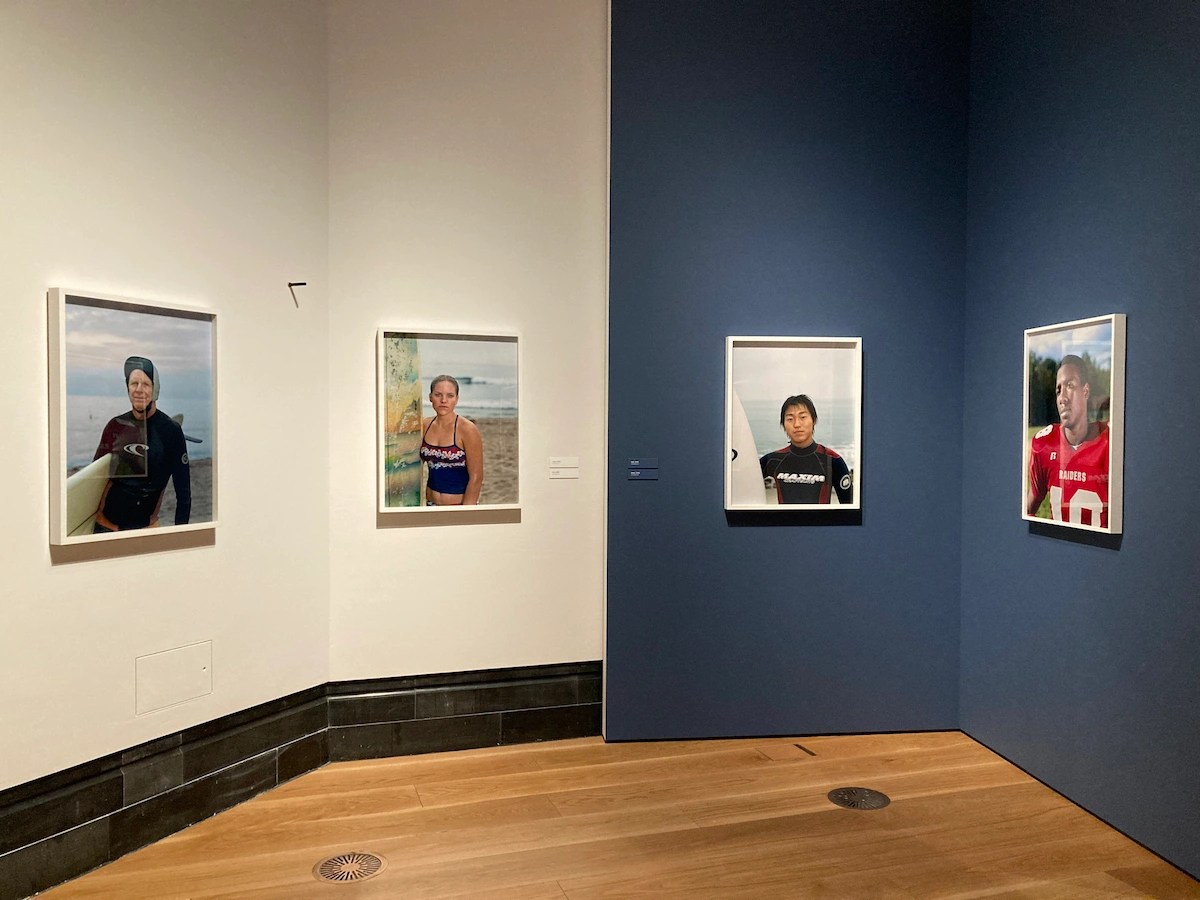
Surfers (2003)

‘Surfers’ depicts the California surfing subculture. Rather than showing them riding waves, Opie portrays her surfers emerging from the sea looking unglamorously wet and cold and dazed – surprisingly British, in fact.

Installation view of Catherine Opie: To Be Seen @ the National Portrait Gallery, showing some of the ‘Surfing’ portraits’ (photo by the author)

In and Around home (2004)

In the early 2000s, Opie explored her Los Angeles neighbourhood and the domestic setting of her home. ‘Oliver in a Tutu’ from the series ‘In and Around Home’ depicts her son in a pink tutu in the kitchen doing laundry. This domestic scene is aligned with Opie’s politics of visibility against the backdrop of the continued homophobia within American culture at the time during the Bush era.

Oliver in a Tutu, 2004 © Catherine Opie, courtesy Regen Projects, Los Angeles; Lehmann Maupin, New York, Hong Kong, London, and Seoul; Thomas Dane Gallery

Doesn’t he look like a sweetheart! What a lovely image of everyday domestic happiness.

Children (2004)

For ‘Children’ Opie returned to the studio and to her signature highly focused portraits, this time of children set against bright solid colour backdrops.

Installation view of Catherine Opie: To Be Seen @ the National Portrait Gallery, showing some of the ‘Children portraits’ (photo by the author)

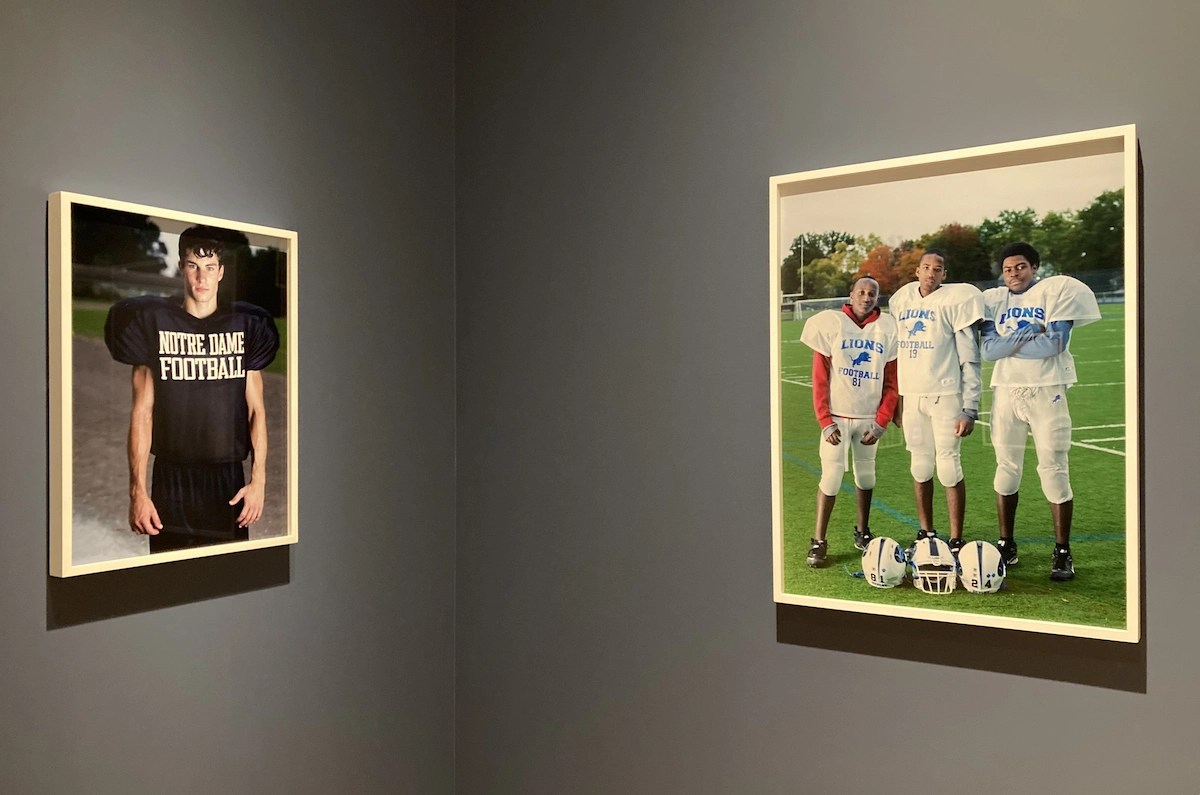
High School Football (2007-09)

From 2007 to 2009 Opie’s continued her exploration of the American landscape through the specificity of identity as it is played out on high school football fields. Opie made portraits of high school football players across several US states, vulnerable portraits of the young men counter stereotypes of athletic masculinity at a time when the US was engaged in a war with Iraq and Afghanistan.

Installation view of Catherine Opie: To Be Seen @ the National Portrait Gallery, showing some of the ‘American football’ portraits (photo by the author)

Do these images subvert, interrogate or deconstruct masculinity? Ask the marines steaming towards the Gulf of Hormuz.

Girlfriends (2010)

A series of black-and-white portraits (1989-1999) which were first exhibited in 2010), the series continues Opie’s longstanding examination of the history of photography and her community in a different format.

Studio Portraits (2012–2018)

In the 2010s Opie used theatrical lighting against a black velvet backdrop to illuminate masterly and striking portraits. Allegorical elements allude to the political and spiritual concerns of art. They evoke Renaissance and Baroque painting, presenting her subjects in allegorical poses in front of black backgrounds, which remove the individuals from any sense of time or place.

Installation view of Catherine Opie: To Be Seen @ the National Portrait Gallery, showing some of the Baroque Studio Portraits (2012–2018) (photo by the author)

These portraits are characterized by highly staged, theatrical lighting against a black background, intended to create a painterly, intimate, and often allegorical quality. I haven’t mentioned that the exhibition space has been unusually designed into box-shaped rooms and corridors with, as here, the wall colour chosen to offset the images.

Walls, Windows and Blood (2023)

Opie’s photograph of Pope Francis, diminutive at his Vatican window amid the ‘constructed architecture of power’, is drawn from a body of work entitled ‘Walls, Windows and Blood’ (2023), made during a pandemic-era residency at the American Academy in Rome. The title of this portrait of the former head of the Catholic Church is a reference to the delayed papal acknowledgement of the deaths of Canada’s First Nation’s children under the church’s administration. It’s part of a small selection of images from larger locations which includes shots from President Obama’s inauguration, a Boy Scout Jubilee, and others.

Installation view of Catherine Opie: To Be Seen @ the National Portrait Gallery, showing some of the photos she took at the inauguration of President Obama on 20 January 2009 (photo by the author)

Comments

When you read the press material, the online promotion and the wall labels, you are given the impression that Opie is a radical political figure. But when you stroll from photo to photo you come to realise nothing could be further from the truth. Everything is very quiet and homely. Photos of friends, of her house and child, of other children, images of young surfers and football players, documentary images of the Obama inauguration or a handful of other mass events (a Boy Scouts Jubilee, some festival).

The more it went on, the blander it felt. The set of lesbians with moustaches is funny in a 1990s kind of way. The half dozen local children are sweet. The surfers look very wet. The footballers look fit. The friends posing against black backgrounds look very stagey.

But few if any of the images really stood out for me. Compare and contrast the vividly seedy colour photographs of the recently deceased Martin Parr to see what unnerving commentary colour photography is capable of. If you strip away the excited queer rhetoric, most of the Opie images seemed to me, well, OK, proficient enough, quite nice, meh.

In the end I thought the opening image of her breastfeeding her son was the one really standout image, and the one which had the most ‘political’, emotional and visual impact.


Related links

Related reviews

Leslie Thomas reviews

Leslie Thomas OBE (1931 to 2014) was a Welsh author best known for his bestselling comic novel ‘The Virgin Soldiers’. Thomas had a hard start in life: he was orphaned in 1943 at the age of 12, when his mariner father was lost at sea and his mother died only a few months later from cancer. He was subsequently brought up in a Dr Barnardo’s home (and made his upbringing the subject of an autobiographical book).

In 1949 Thomas was called up for National Service and embarked on a two-year tour of duty in Singapore with the Royal Army Pay Corps, where he was briefly involved in a military action against communist rebels in the Malayan emergency, experiences which he used in ‘The Virgin Soldiers’.

Returning to England in 1951, he embarked on 15 years or so working for a succession of local newspapers until the success of his first book allowed him to embark on a full-time career as a writer.

Thomas was prolific, writing about 30 novels, 3 travel books and a couple of works of autobiography. It’s nice to know that a man who overcame such challenging background ended up being awarded an OBE for all his hard work, an improbable life trajectory he records in his aptly named autobiography, ‘In my wildest dreams’.

Thomas’s fiction drives a coach and horses right through any notions of political correctness or wokeness, overflowing with attitudes – particularly towards women (and teenage girls) – which are completely unacceptable nowadays; they single-handedly explain the historic need for women’s liberation and feminism.

That obvious point made, I value them (up to a point) because they describe what it was like – the soldier ones giving an insight into raw squaddie life, the civilian ones giving a vivid feel of the shabby, shameful 1970s. I admire authors like Thomas. He knew what his job was, which was to write popular entertainments for middle-brow readers, and he did it very well and with some style, according to the spirit of the times.

But although written with great brio, and containing many vivid scenes and characters, they eventually began to feel too grubby and seedy to continue with. I abandoned plans to read any more and feel a bit embarrassed about having read this many.

Thomas novels

Virgin Soldiers

  • The Virgin Soldiers (1966) A frank, often tender, sometimes genuinely moving account of one young man among many (John Brigg, aged 19), forced to do National Service far from home (Malaya), lonely and scared, trying to make sense of his life, of sex, of love, a tale told with tremendous verbal energy, and containing a genuinely scary attack by communist insurgents.
  • Onward Virgin Soldiers (1971) Twenty years later Brigg is still in the Army, now a sergeant, stationed in Hong Kong and prone to drunken misadventures and sexual escapades, but unlike the original’s freshness, this one has a jaded, rather grubby feel about it.
  • Stand Up Virgin Soldiers (1975) Worst of the three, Thomas rewrites the ending of the first novel so that, instead of ending his National Service and returning to Blighty, his young hero, John Brigg, is forced to serve another six months, so it’s a (patchy) attempt to revive the characters and dynamics of the original book.

Others

  • His Lordship (1970) A peculiar and uncomfortable novel about William Herbert, a man with a voyeuristic obsession with teenage girls who gets a job at a girls’ school as a tennis coach, then gets into all sorts of farcical trouble, before being arrested. The novel is told as a flashback from a police cell where he’s been arrested and questioned but, right at the end, it comes out that the interrogating officer is himself just as perverted as Herbert, maybe more so. There are many comic and some sexy moments, but the dominant feeling is of seedy grubbiness.
  • Tropic of Ruislip (1974) A classic 1970s depiction of the quiet desperation of suburban life in the mould of ‘Rising Damp’, ‘Fawlty Towers’ or ‘The Fall and Rise of Reginald Perrin’, ‘Tropic’ charts the farcical misadventures of Andrew Maiby, his resentful wife, reluctant teenage girlfriend and nitpicking neighbours in the suburban enclave of Plummers Park, all genuinely funny and spirited, right up to the unexpectedly brutal and upsetting ending.
  • Dangerous Davies: The Last Detective (1976) A would-be comic novel about Peregrine ‘Dangerous’ Davies, a shambling middle-aged police detective constable and his sidekick Mod Lewis. Davies was clearly invented with commercial opportunities in mind – and indeed Thomas went on to write three further novels about him, and managed to get him made into an ITV series starring Peter Davison. It has its moments and is persuasively written, but I found the characters and social landscape of the mid-70s unremittingly depressing, not helped by the queasy centrality of yet another teenage girl as the love object. It put me off reading any more Thomas.

Tom Sharpe reviews

Tom Sharpe (1928 to 2013) was an English satirical novelist, best known for his Wilt series, as well as ‘Porterhouse Blue’ and ‘Blott on the Landscape’, all three of which were adapted for TV.

After prep school, public school, national service and Cambridge, in 1951 Sharpe went to live and work in South Africa as a social worker and a teacher, and this is the setting of his first two, and arguably best, novels, the outrageous satires ‘Riotous Assembly’ and ‘Indecent Exposure’.

After returning to England in 1961, Sharpe worked as a history lecturer at the Cambridge College of Arts and Technology (later Anglia Ruskin University) and this provided the material for his hapless comic anti-hero, demoralised English lecturer Henry Wilt, who appears in five campus novels, putting Sharpe in the same campus comedy territory as his younger contemporaries, David Lodge (b. 1935) and Howard Jacobson (b.1942).

Sharpe’s novels

1971 Riotous Assembly Absurdly violent and frenzied black comedy set in apartheid South Africa as three incompetent police officers try to get to the bottom of the murder of her black cook by a venerable old lady who turns out to be a sex-mad rubber fetishist, a simple operation which leads to the deaths of 21 policemen, numerous dogs, a vulture and the completely wrongful arrest and torture of the old lady’s brother, the bishop of Basutoland.

1973 Indecent Exposure Sequel to the above, in which the same Kommandant van Herden is seduced into joining a group of (fake) posh colonial English at their country retreat, leaving Piemburg in charge of his deputy, Luitenant Verkramp, who sets about a) ending all inter-racial sex among the force by applying drastic aversion therapy to his men b) tasks with flushing out communist subversives a group of secret agents who themselves end up destroying most of the town’s infrastructure.

1974 Porterhouse Blue Hilarious satire on the stuffiness and conservatism of Oxbridge colleges epitomised by Porterhouse, as a newcomer tries in vain to modernise this ramshackle hidebound institution, with a particularly cunning enemy in the ancient college porter, Skullion.

1975 Blott on the Landscape MP and schemer Sir Giles Lynchwood so loathes his battleship wife, Lady Maud, that he connives to have a new motorway routed slap bang through the middle of her ancestral home, Handyman Hall, intending to abscond with the compensation money. But he reckons without his wife’s fearsome retaliation or the incompetence of the man from the Ministry.

1976 Wilt (Wilt 1) Hen-pecked lecturer Henry Wilt is humiliated with a sex doll at a party thrown by the infuriatingly trendy American couple, the Pringsheims. Appalled by his grossness, his dim wife, Eva, disappears on a boating weekend with this ‘fascinating’ and ‘liberated’ couple, so that when Wilt is seen throwing the wretched blow-up doll into the foundations of the extension to his technical college, the police are called which leads to 100 pages of agonisingly funny misunderstandings.

1977 The Great Pursuit Literary agent Frederick Frensic receives the anonymous manuscript of an outrageously pornographic novel about the love affair between a 17-year-old boy and an 80-year-old woman, via a firm of solicitors who instruct him to do his best with it. Thus begins a very tangled web in which he palms it off as the work of a pitiful failure of an author, one Peter Piper, and on this basis sells it to both a highbrow but struggling British publisher and a rapaciously commercial American publisher, who only accept it on condition this Piper guy goes on a US tour to promote it. Which is where the elaborate deception starts to go horribly wrong…

1978 The Throwback Illegitimate Lockhart Flawse, born and bred in the wastes of Northumberland, marries virginal Jessica whose family own a cul-de-sac of houses in suburban Surrey, and, needing the money to track down his mystery father, Lockhart sets about an elaborate and prolonged campaign to terrorise the tenants out of the homes. Meanwhile, his decrepit grandfather has married Jessica’s mother, she hoping to get money from the nearly-dead old geezer, he determined to screw as much perverse sexual pleasure out of her pretty plump body before he drops dead…

1979 The Wilt Alternative (Wilt 2) After a slow, comic, meandering first 90 pages, this novel changes tone drastically when international terrorists take Wilt and his children hostage in his nice suburban house leading to a stand-off with the cops and Special Branch.

1980 Ancestral Vices Priggish left-wing academic Walden Yapp is invited by cunning old Lord Petrefact to write an unexpurgated history of the latter’s family of capitalists and exploiters because the old bustard wants to humiliate and ridicule his extended family, but the plot is completely derailed when a dwarf living in the mill town of Buscott where Yapp goes to begin his researches, is killed in an accident and Yapp finds himself the chief suspect for his murder, is arrested, tried and sent to prison, in scenes strongly reminiscent of Henry Wilt’s wrongful arrest in the first Wilt novel.

1982 Vintage Stuff A stupid teacher at a minor public school persuades a gullible colleague that one of the parents, a French Comtesse, is being held captive in her chateau. Accompanied by the stupidest boy in school, and armed with guns from the OTC, master and pupil end up shooting some of the attendees at a conference on international peace taking part at said chateau, kidnapping the Comtesse – who turns out to be no Comtesse at all – and blowing up a van full of French cops, bringing down on themselves the full wrath of the French state.

1984 Wilt On High (Wilt 3) Third outing for lecturer in Liberal Studies, Henry Wilt who, through a series of typically ridiculous misunderstandings, finds himself, first of all suspected of being a drug smuggler and so bugged by the police; then captured and interrogated on a US air base where he is delivering an innocuous lecture, on suspicion of being a Russian spy; before, in a frenzied climax, the camp is besieged by a monstrous regiment of anti-nuke mothers and news crews.

1995 Grantchester Grind The sequel to Porterhouse Blue, following the adventures of the senior college fellows as they adopt various desperate strategies to sort out Porterhouse College’s ailing finances, climaxing with the appointment of a international drug mafiosi as the new Master.

1996 The Midden Miss Marjorie Midden discovers a naked ex-City banker trussed in bedsheets hidden in her rural farmhouse, The Midden, and then the ancestral hall she owns under attack from the demented forces of nearby Scarsgate police force led by their corrupt chief constable Sir Arnold Gonders, in a blistering satire on the corruption and greed of post-Thatcher Britain.

2004 Wilt in Nowhere (Wilt 4) Fourth novel about the misadventures of Henry Wilt in which his wife Eva and the 14-year-old quads ruin the life of Uncle Wally and Auntie Joanie over in the States, while Wilt goes on an innocent walking holiday only to be accidentally knocked out and find himself implicated in a complicated murder-arson-child pornography scandal.

2009 The Gropes Driven out of his mind by his wife, Vera’s, sentimental fantasies, timid bank manager Horace Wiley pretends he wants to murder their teenage son Esmond, who is therefore hustled off to safety by Vera’s brother, Essex used-car dealer, Albert Ponson. Albert gets the teenage boy so drunk that his wife, Belinda, leaves him in disgust – locking their bungalow’s internal and external doors so securely that Albert has to call the police to get released, with disastrous results – while Belinda drives with the unconscious Esmond back to her ancestral home, the gloomy Grope Hall in remote Northumberland where – to the reader’s great surprise – they fall in love and live happily ever after.

2010 The Wilt Inheritance (Wilt 5) Sharpe’s last novel, the fifth and final instalment of the adventures of Polytechnic lecturer Henry Wilt, his naggy wife, Eva, and their appalling teenage daughters, all of whom end up at the grotesque Sandystones Hall in North Norfolk, where Wilt is engaged to tutor the lady of the manor’s psychotic teenage son, and Eva gets caught up in complications around burying dead Uncle Henry, whose body the quads steal from the coffin and hide in the woods with dire consequences that even they don’t anticipate.

Hedging in Kingsley Amis

Introduction to hedging

Having read nearly all of Kingsley Amis’s novels, I have become increasingly interested in his peculiar ways with the English language. Many of his sentences and paragraphs feel long-winded – simultaneously over-embroiled and disconcertingly vague and gaseous. Only recently have I realised that the techniques he deploys so heavily have a formal name in linguistics, which is ‘hedging’.

‘Hedges’ are used to soften the impact of what we say or write. They are a feature of polite conversation in English i.e. conversation which is considerate of the other person. Hedges make what we say less direct, less confrontational. According to the Cambridge Online Dictionaries article on the subject, the most common forms of hedging include:

  • the tense and aspect of verbs
  • the use of modal expressions including modal verbs and adverbs
  • the use of vague language such as ‘sort of’ and ‘kind of’
  • use of the passive voice

Credit

To be clear, my understanding of ‘Hedges’ is taken from the article on ‘Hedges’ on the Cambridge Dictionaries Online English Grammar Today website. I then illustrate the types of hedges it lists with examples from Kingsley Amis’s 1992 novel, The Russian Girl.

Aspects of hedging

Tense and aspect

It is polite to add conditional verbs to verbs to wish/want/desire. For example, ‘I wondered if I could have a word with you?’ (less direct and more polite than ‘Could I have a word with you?’).

Both of these examples are in the past tense because it is also a feature of English to put verbs of wishing/wanting/desiring into the past, to soften them.

‘I wondered if I could have a word with you?’ is less direct and more polite than ‘Could I have a word with you?’ but both of them are notably softer than the same sentiment a) without the conditional verb b) in the present tense — ‘Can I have a word with you?’

Modal expressions

‘Modality’ refers to verbs or adverbs which help express a speaker’s or writer’s attitude towards the world. Modal words express certainty, possibility, willingness, obligation, necessity and ability – or, as in Kingsley Amis, their opposite. For example: The problem could be that there’s no petrol in the car. [Less direct than ‘There’s no petrol in the ****** car’]

Vague language

English is full of possibilities to use vague and diffuse language. Especially when speaking, people often add unnecessary tags, such as ‘about, kind of, sort of, and that kind of thing’. The most obvious reason to use them is when you’re not sure what to call something or how to refer to it; alternatively, you might want to be deliberately vague about a feeling or intention: ‘He sort of meant it.’

The most basic sort of vague language is created by adding any of a large number of logically unnecessary tags, such as ‘about, kind of, sort of, and that kind of thing’.

Her response told him beyond doubt there was something that interested her more than anything to do with class systems or drink, for the moment at any rate… Unlike others Richard could have named, she evidently sensed this or something of the kind. (p.120)

‘Er, excuse me,’ she sort of called as if accosting a stranger in some public place. (p.129)

Well, it’s not my kind of thing, in a sense… (p.90)

‘And you want to give her a hand with her petition and scheme and what-not?’ (p.91)

‘I hope at least you’ll agree to see her, Crispin.’ (p.92)

The following example demonstrates plain confusion and bewilderment, so often the mood of an Amis protagonist, in this case forty-something, married professor of Russian literature, Richard Vaisey:

He hurried towards the exit, or entrance, distracted only when he passed a stray group of four or five presumably horsy people drinking what was surely champagne. (p.193)

Firstly, Richard doesn’t know whether it’s the entrance or exit. Then he is distracted. The group of people is ‘stray’ i.e. connected to the main party but in an unclear way. Does it consist of four or five people? It would only take a moment to determine but Amis deliberately doesn’t. Then ‘presumably’ and ‘surely’. That’s six hedges or indeterminables in just one sentence, six out of 27 words.

Vague language reflects vague and blurred perceptions. In the thriller writing tradition, especially the American one, the protagonist always knows the brand and make of everything from cars to guns to jewellery. Amis is the extreme opposite, never knowing any brand or make, barely able to manage colours, pointing in the general direction and saying sort of, and suchlike and what-have-you.

She was wearing a long-sleeved orange-yellow garment with a loose belt of the same material and all told no general description or certain provenance. (p.99)

Verbs

Some verbs (such as feel, suppose, reckon) can be used to hedge personal statements, that is, to make personal statements less direct: ‘We feel he should let them decide whether to buy the flat’ is less direct than ‘He should let them decide…’

Stance adverbs

Stance adverbs express opinions (perhaps, apparently, maybe), evaluations (sadly, unfortunately, happily) or the circumstances under which a clause is being spoken or written (frankly, briefly, confidentially). The stance adverb is a loosely-related, add-on comment about the content of the entire clause. Amis is particularly fond of conditional stance adverbs: ‘Perhaps’, ‘maybe’, ‘possibly’, ‘probably’, which all help to diffuse sentences, increase uncertainty. Example sentences from Amis:

  • Cordelia replaced her telephone, which perhaps recalled a model of 1950… Indeed she was perhaps lucky to have caught him… (p.114)
  • She had spoken with more animation than just now and he began to wonder if she had perhaps taken a quick nip or so… (p.119)
  • So perhaps on the whole not. (p.141)
  • She was sitting up in bed wearing a woolly garment that was probably a bed-jacket. (p.140)

Fine discriminations

It is at first sight a paradox that someone so addicted to vagueness as Amis is, spends so much time making fine discriminations between things, but less so on examination. It is an upper-class English trait to say something is ‘just a bit too…’, or ‘a little under…’, ‘just a fraction more…’, or ‘a shade under…’ These posh phrases which demonstrate how knowledgeable you are and what fine judgement you have, especially on the ever-boring but ever-snobbish subject of food and drink.

Like Anna, Richard chose the lemonade, which was slightly undersweetened in a refined way.’ (p.170)

This sentence is designed to tell you lots about the host, Russian émigré Kotolynov, but also about Richard, whose consciousness we are sort of sharing, showing that he appreciates the subtlety and fineness of the home-made lemonade. And tell you about the author, who spends so much effort defining these precise discriminations. And, at the end of the chain, says something about us readers, who for a few seconds are flattered into thinking that we also share the same super-civilised palate.

‘I’ve booked you in for one o’clock. Avoid the house claret, but the red burgundy is really quite good.’ (p.172)

Not good. Not quite good. Really quite good. The speaker is saying, See how civilised I am! In the event:

The set lunch at the Cor Anglais turned out to be rather better than passable. (p.174)

These apparently fine distinctions don’t contradict the earlier statement about vagueness because they are in fact meaningless. They are discriminations which are invisible to anybody else. They are to all intents and purposes made up. You can say of any drink whatsoever that ‘It is a shade less unappealing than I feared it might possibly be’ and sound frightfully knowledgeable. But the same person, when called on to name the colour of a dress or the make of phone, something real in the objective real world, turns out to be hopelessly at sea. Like Amis’s characters. Like Amis’s prose.

Unnecessary distinctions

Then or later, but mostly later, Richard read [the introduction to the book]. (p.172)

‘Don’t you actually like any of it?’ Richard had asked then or later. (p.94)

No sentence, no phrase is too short for Amis not to squeeze in some unnecessary distinction, to distinguish between two scintillas of meaning. Sometimes they actually mean something and suggest a real, if marginal, differentiation – but sometimes they feel like he’s done it because, well, it’s what he does, because it has become a mannerism.

Talking made Richard feel drunk again, or perhaps more precisely, for the first time. (p.190)

‘Yes, negative reasons chiefly, or entirely really.’ (p.191)

Kotolynov was… asking Anna rather less than inquisitively. (p.164)… said Kotloynov, bringing out a nearly fresh packet of camels… (p.165) But the glance he sent Richard, furtive and humorous, suggested that his last statement, at least, was not quite true. (p.170)

[Anna was wearing] a dark high-necked jacket that only just possibly might have come from the market near Professor Léon’s house. (p.258)

Maybe in Amis’s early novels, this mannerism had been comic, a form of comic exaggeration. Maybe some readers still find it comic. Maybe I’m missing the point, the intention.

When Anna reappeared she was looking much better and smelling like a not very distant pine-forest. (p.258)

Ors

Fine, almost invisible and often unnecessary, distinctions overlap with the related strategy of giving up and just plonking down a bunch of alternatives next to each other and letting the reader choose. Or decide. Or make their mind up. Or something.

‘How would it be if we went and picked her up from her hotel or safe house or whatever it is?’ (p.93)

‘Well you’ve earned a drink. Or ought to have one. Or you need one.’ (p.192)

Richard prepared himself for the odd remark about how similar or dissimilar this or that was to one Russian matter or another. (p.259)

It’s not just the narrator: all the characters without exception also use these multiple ‘ors’ whenever they can. It isn’t a calculated tactic, it is a basic way Amis thinks and writes.

‘I was afraid of what I might say to make your situation bad or worse than it was or need have been.’ (p.259)

Conclusions

Kingsley Amis was a champion hedger. It is a rare Amis sentence which doesn’t contain at least one hedge, generally more. Why?

Is hedging used to be polite… or rude?

The Cambridge article on ‘Hedging’ emphasises that hedging is generally used out of politeness, to soften communication between civilised people, to make human interaction gentler and more humane. In some situations, Amis’s characters do use hedging language for this purpose, and the novels record upper-middle-class English good manners. But routinely this shades off into subtler purposes: sometimes hedging language is used to imply the opposite, that a character is being rude beneath multiple layers of ostensible politeness. Or, further beyond this, that hedging is obviously going on, but it is unclear exactly what its purpose is.

Subtle discriminations… or no discriminations

Another definable purpose of Amis’s hedging language is to suggest a sort of fine discrimination, acute observation of what is taking place. In some sentences he displays very close observation of his characters’ gestures, tones of voice, mannerisms, tweaks and twitches. Hedging can be used to add to this effect, to augment it, giving you the impression the author is alert to even the tiniest disparities, the finest discriminations, noticing the precise type of this, that or the other behaviour.

And yet, paradoxically, such extensive hedging can also suggest the precise opposite: a bloody-minded ‘so what’, ‘who cares’ attitude, an attitude the narrator conveys throughout, of being at odds with the modern world, modern life, London, women, music, art ‘and all the rest of it’.

Amis novels, and most of his characters, are full of this dismissive attitude, they use hedging language because they can’t be bothered to be precise about things which are so obviously beneath their notice, so obviously unworthy of attention in the first place, so obviously crappy.

Does hedging suggest inebriation?

Another interpretation arises naturally from the scene two-thirds of the way through The Russian Girl where the protagonist, Richard Vaizey, gets very drunk. One of the ways we know this is because the hedges, the pointless alternatives, the vagueness of phraseology, all increase sharply.

This passage suggests that hedging is associated with being drunk. In which case, does the ubiquity of hedging throughout Amis’s works reflect the permanent light-headed detachment from reality of an alcoholic? Perceiving some things with preternatural clarity, other things a complete blur. And if so, could this be taken to reflect Amis’s own, permanently slightly pissed take on the world?

Or is it pure mannerism?

Finally, heading is so ubiquitous throughout Amis’s texts, both in the dialogue of the characters and the voice of the narrator, that sometimes it seems to have no purpose at all, but to have become a mannerism. He adds ‘perhaps’ to a sentence because it makes it more interesting, because it forces the reader to pause an extra second trying to decide if it adds any extra information, if this one quaver in the music changes its meaning. And when it happens at least once in paragraph after paragraph, you’d be forgiven for beginning to feel the entire text has a provisional, slightly arbitrary feel.

And is this the real, deep meaning of all the hedging: that Amis himself feels novels, writing, fiction are themselves not entirely serious – to quote his lifelong buddy, Philip Larkin, that ‘Books are a load of crap.’

Is all the hedging not only the narrator distancing himself from his characters and situations but Amis distancing himself from the entire activity of being a writer?

‘Here’s another novel, chaps, see what you make of it, quite a funny one this time, should earn me a few shekels, who’s for a top-up?’


Credit

The Russian Girl by Kingsley Amis was published by Hutchinson in 1992. Page references are to the 1993 Penguin paperback edition. All quotations are used for the purpose of criticism and review.

Related link

Kingsley Amis reviews

Graham Greene reviews
Graham Greene (1904 to 1991) was an English writer and journalist who came to dominate his age. Over a 60-year career he wrote over 25 novels, novellas, scores of short stories, masses of journalism, and was heavily involved in film, adapting many of his novels for the screen (such as the classic ‘Brighton Rock’), or converting screenplays into novels (as in the case of the wildly successful ‘The Third Man’).

He dominated the British literary scene of the 1950s, 60s, 70s and 80s, producing a steady stream of high quality fictions, often set in wartorn troublespots (the Congo, Vietnam, Haiti) thus doubling up as a kind of foreign correspondent for the literary world. By sheer dogged determination, he turned his personal demons and suicidal depression into a compelling worldview, combining despair with a relentless focus on the seedy aspects of human existence, all clothed in a personal brand of nihilistic Roman Catholicism, which critics came to call ‘Greeneland’.

Most of his books are good, some are very good, but I’m not sure any individual one is great: the closest one is ‘The Heart of the Matter’ which is often held up as his masterpiece but which George Orwell rightly ridiculed for its suburban Angst and Catholic self-dramatisation. ‘The Unquiet American’ may be his best straight novel, with ‘The End of The Affair’ packing a genuinely terrifying punch right at the end. ‘A Burnt Out Case’ was a pleasure to read.

Being strongly allergic to the Catholic despair which characterises almost everything he wrote, I prefer his surprisingly funny comedies, such as ‘Our Man In Havana’ and ‘Travels With My Aunt’.

Fiction

  • The Man Within (1929) One of the worst books I’ve ever read, a wretchedly immature farrago set in a vaguely described 18th century about a cowardly smuggler who betrays his fellows to the Excise men then flees to the cottage of a pure and innocent young woman who he falls in love with before his pathetic inaction leads to her death. Drivel.
  • The Name of Action (1930) (repudiated by author, never republished)
  • Rumour at Nightfall (1931) (repudiated by author, never republished)
  • Stamboul Train (1932) A motley cast of characters find out each others’ secrets and exploit each other on the famous Orient Express rattling across Europe, climaxing in the execution of one of the passengers, a political exile, in an obscure rail junction, and all wound up with a cynical business deal in Istanbul.
  • It’s a Battlefield (1934) London: a working class man awaits his death sentence for murder while a cast of seedy characters, including a lecherous H.G. Wells figure, betray each other and agonise about their pointless lives.
  • England Made Me (1935) Stockholm: financier and industrialist Krogh hires a pretty Englishwoman Kate Farrant to be his PA/lover. She gets him to employ her shiftless brother Anthony who, after only a few days, starts spilling secrets to the seedy journalist Minty, and so is bumped off by Krogh’s henchman, Hall.
  • A Gun for Sale (1936) England: After assassinating a European politician and sparking mobilisation for war, hitman Raven pursues the lecherous middle man who paid him with hot money to a Midlands town, where he gets embroiled with copper’s girl, Anne, before killing the middle man and the wicked arms merchant who was behind the whole deal, and being shot dead himself.
  • Brighton Rock (1938) After Kite is murdered, 17 year-old Pinkie Brown takes over leadership of one of Brighton’s gangs, a razor-happy psychopath who is also an unthinking Catholic tormented by frustrated sexuality. He marries a 16 year-old waitress (who he secretly despises) to stop her squealing on the gang, before being harried to a grisly death.
  • The Confidential Agent (1939) D. the agent for a foreign power embroiled in a civil war, tries and fails to secure a contract for British coal to be sent to his side. He flees the police and unfounded accusations of murder, has an excursion to a Midlands mining district where he fails to persuade the miners to go on strike out of solidarity for his (presumably communist) side, is caught by the police, put on trial, then helped to escape across country to a waiting ship, accompanied by the woman half his age who has fallen in love with him.
  • The Power and the Glory (1940) Mexico: An unnamed whisky priest, the only survivor of the revolutionary communists’ pogrom against the Catholic hierarchy, blunders from village to village feeling very sorry for himself and jeopardising lots of innocent peasants while bringing them hardly any help until he is caught and shot.
  • The Ministry of Fear (1943) Hallucinatory psychological fantasia masquerading as an absurdist thriller set in London during the Blitz when a man still reeling from mercy-killing his terminally ill wife gets caught up with a wildly improbable Nazi spy ring.
  • The Heart of The Matter (1948) Through a series of unfortunate events, Henry Scobie, the ageing colonial Assistant Commissioner of Police in Freetown, Sierra Leone, finds himself torn between love of his wife and of his mistress, spied on by colleagues and slowly corrupted by a local Syrian merchant, until life becomes intolerable and – as a devout Catholic – he knowingly damns himself for eternity by committing suicide. Whether you agree with its Catholic premises or not, this feels like a genuinely ‘great’ novel for the completeness of its conception and the thoroughness of its execution.
  • The Third Man (1949) The novella which formed the basis for the screenplay of the famous film starring Orson Welles. Given its purely preparatory nature, this is a gripping and wonderfully-written tale, strong on atmosphere and intrigue and mercifully light on Greene’s Catholic preachiness.
  • The End of The Affair (1951) Snobbish writer Maurice Bendrix has an affair with Sarah, the wife of his neighbour on Clapham Common, the dull civil servant, Henry Miles. After a V1 bomb lands on the house where they are illicitly meeting, half burying Bendrix, Sarah breaks off the affair and refuses to see him. Only after setting a detective on her, does Bendrix discover Sarah thought he had been killed in the bombing and prayed to God, promising to end their affair and be ‘good’ if only he was allowed to live – only to see him stumbling in through the wrecked doorway, from which point she feels duty bound to God to keep her word. She sickens and dies of pneumonia like many a 19th century heroine, but not before the evidence begins to mount up that she was, in fact, a genuine saint. Preposterous for most of its length, it becomes genuinely spooky at the end.
  • The Unquiet American (1955) Set in Vietnam as the French are losing their grip on the country, jaded English foreign correspondent, Thomas Fowler, reacts very badly to fresh-faced, all-American agent Alden Pyle, who both steals his Vietnamese girlfriend and is naively helping a rebel general and his private army in the vain hope they can form a non-communist post-colonial government. So Fowler arranges for Pyle to be assassinated. The adultery and anti-Americanism are tiresome, but the descriptions of his visits to the front line are gripping.
  • Loser Takes All (1955) Charming comic novella recounting the mishaps of accountant Bertram who is encouraged to get married at a swanky hotel in Monte Carlo by his wealthy boss who then doesn’t arrive to pick up the bill, as he’d promised to – forcing Bertram to dabble in gambling at the famous Casino and becoming so obsessed with winning that he almost loses his wife before the marriage has even begun.
  • Our Man In Havana (1958) Comedy about an unassuming vacuum cleaner salesman, Jim Wormold, living in Havana, Cuba, who is improbably recruited for British intelligence and, when he starts to be paid, feels compelled to manufacture ‘information’ from made-up ‘agents’. All very farcical until the local security services and then ‘the other side’ start taking an interest, bugging his phone, burgling his flat and then trying to bump him off.
  • A Burnt-Out Case (1960) Tragedy. Famous architect Querry travels to the depths of the Congo, running away from his European fame and mistress, and begins to find peace working with the local priests and leprosy doctor, when the unhappy young wife of a local factory owner accuses him of seducing her and fathering her child, prompting her husband to shoot Querry dead.
  • The Comedians (1966) Tragedy. Brown returns to run his hotel in Port-au-Prince, in a Haiti writhing under the brutal regime of Papa Doc Duvalier, and to resume his affair with the ambassador’s wife, Martha. A minister commits suicide in the hotel pool; Brown is beaten up by the Tontons Macoute; he tries to help a sweet old American couple convert the country to vegetarianism. In the final, absurd sequence he persuades the obvious con-man ‘major’ Jones to join the pathetic ‘resistance’ (12 men with three rusty guns), motivated solely by the jealous (and false) conviction that Jones is having an affair with his mistress. They are caught, escape, and Brown is forced to flee to the neighbouring Dominican Republic where the kindly Americans get him a job as assistant to the funeral director he had first met on the ferry to Haiti.
  • Travels With My Aunt (1969) Comedy. Unmarried, middle-aged, retired bank manager Henry Pullman meets his Aunt Augusta at the funeral of his mother, and is rapidly drawn into her unconventional world, accompanying her on the Orient Express to Istanbul and then on a fateful trip to south America, caught up in her colourful stories of foreign adventures and exotic lovers till he finds himself right in the middle of an uncomfortably dangerous situation.
  • The Honorary Consul (1973) Tragedy. Dr Eduardo Plarr accidentally assists in the kidnapping of his friend, the alcoholic, bumbling ‘honorary consul’ to a remote city on the border of Argentina, Charley Fortnum, with whose ex-prostitute wife he happens to be having an affair. When he is asked to go and treat Fortnum, who’s been injured, Plarr finds himself also taken prisoner by the rebels and dragged into lengthy Greeneish discussions about love and religion and sin and redemption etc, while they wait for the authorities to either pay the ransom the rebels have demanded or storm their hideout. It doesn’t end well.
  • The Human Factor (1978) Maurice Castle lives a quiet, suburban life with his African wife, Sarah, commuting daily to his dull office job in a branch of British Security except that, we learn half way through the book, he is a double agent passing secrets to the Russians. Official checks on a leak from his sector lead to the improbable ‘liquidation’ of an entirely innocent colleague which prompts Castle to make a panic-stricken plea to his Soviet controllers to be spirited out of the country. And so he is, arriving safely in Moscow. But to the permanent separation with the only person he holds dear in the world and who he was, all along, working on behalf of – his beloved Sarah. Bleak and heart-breaking.
  • Monsignor Quixote (1982) Father Quixote is unwillingly promoted monsignor and kicked out of his cosy parish, taking to the roads of Spain with communist ex-mayor friend, Enrique ‘Sancho’ Zancas, in an old jalopy they jokingly nickname Rocinante, to experience numerous adventures loosely based on his fictional forebear, Don Quixote, all the while debating Greene’s great Victorian theme, the possibility of a doubting – an almost despairing – Catholic faith.
  • The Captain and The Enemy (1988) 12-year-old Victor Baxter is taken out of his boarding school by a ‘friend’ of his father’s, the so-called Captain, who carries him off to London to live with his girlfriend, Liza. Many years later Victor, a grown man, comes across his youthful account of life in this strange household when Liza dies in a road accident, and he sets off on an adult pilgrimage to find the Captain in Central America, a quest which – when he tells him of Liza’s death – prompts the old man to one last – futile and uncharacteristic – suicidal gesture.

Short stories

  • Twenty-One Stories (1954) Generally very short stories, uneven in quality and mostly focused on wringing as much despair about the human condition as possible using thin characters who come to implausibly violent endings – except for three short funny tales.

Travel

  • The Lawless Roads (1939) Greene travels round Mexico and hates it, hates its people and its culture, the poverty, the food, the violence and despair, just about managing to admire the idealised Catholicism which is largely a product of his own insistent mind, and a few heroic priests-on-the-run from the revolutionary authorities.

Biography

My essays

Stubbs: Portrait of a Horse @ the National Gallery

’Stubbs fundamentally changed the approach to depicting the horse in late 18th-century British art, combining his hard-earned knowledge and understanding of their anatomy with a desire to capture a distinct individual character.’
(Dr Mary McMahon, Associate Curator)

George Stubbs (1724 to 1806)

George Stubbs was an eighteenth century English painter, best remembered for his paintings of horses. This small but beautifully formed exhibition in one room at the National Gallery is displaying one of his horse portrait masterpieces, the only life-size horse portrait by Stubbs still in a private collection, and so rarely seen in public. It’s of ‘Scrub, a bay horse belonging to the Marquess of Rockingham’, painted in about 1762, and it dominates the room.

Scrub, a bay horse belonging to the Marquess of Rockingham by George Stubbs (about 1762) © Private Collection. Photo: The National Gallery, London

What makes the exhibition interesting is that it places this wonderfully vivid image in the context of a few of Stubbs’s other horse paintings but, more interestingly, with half a dozen of his detailed and ground-breaking anatomical drawings of horses.

The Horkstow drawings

Stubbs was born in Liverpool, the son of a currier (leather worker) and he spent his early career in the north of England, painting portraits and developing his interest in anatomy. In the later 1740s he lived in York and supplied the illustrations for a treatise on midwifery. Following a brief visit to Rome in 1754 he returned to England the following year. In 1756, working in a remote barn in Horkstow, Lincolnshire, Stubbs spent 18 months carrying out meticulous dissections of horses. Stubbs carefully removed layers of skin and muscle, recording every detail as he went. It was the most thorough study of the anatomy of horses for over a hundred years and resulted in the greatest images of the subject ever recorded in Britain.

Finished study for ‘The First Anatomical Table of the Muscles, Fascias, Ligaments, Nerves, Arteries, Veins, Glands, and Cartilages of the Horse’ by George Stubbs (1756-1758) © Royal Academy of Arts, London

In 1759 Stubbs came down to London looking to further his career and bringing his drawings. But despite making influential contacts like Joshua Reynolds, Stubbs couldn’t get his drawings published. As a result he set out to teach himself how to make engravings. Over the next seven years he carefully converted his meticulous drawings to etchings and these were finally published in his major treatise, ‘The Anatomy of the Horse’ (1766).

The book was a contribution both to art and science and was an immediate success, translated into French and receiving praise across Europe.

The Anatomy Of The Horse

The exhibition includes a) a display case showing an original copy of Stubbs’s treatise whose full eighteenth century name was:

The Anatomy Of The Horse, (Including A particular Description of the Bones, Cartilages, Muscles, Fascias, Ligaments, Nerves, Arteries, Veins, and Glands. In Eighteen Tables, all done from Nature)

Alongside this are b) six of Stubbs’s original working drawings and finished studies. (I was interested to learn that the book and drawings are all on loan from the Royal Academy of Arts just up the road, which owns 42 surviving drawings.)

Display case showing the Royal Academy’s copy of ‘The Anatomy Of The Horse, (Including A particular Description of the Bones, Cartilages, Muscles, Fascias, Ligaments, Nerves, Arteries, Veins, and Glands. In Eighteen Tables, all done from Nature)’ by George Stubbs in Stubbs: Portrait of a Horse at the National Gallery (photo by the author)

Rockingham

Joshua Reynolds introduced Stubbs to his own roster of rich patrons and this included Charles Watson-Wentworth, 2nd Marquess of Rockingham (1730 to 1782). Rockingham was an eminent politician and served as Prime Minister from 1765 to 1766. He was also a keen collector of antique sculpture and active in horse breeding and horse racing and so commissioned the man who was emerging as the best horse painter in Britain.

Whistlejacket

Having processed the information in Room 1, visitors are recommended to walk a hundred yards through the Gallery to Room 34 where they can see probably Stubbs’s most famous masterpiece, Whistlejacket. The two equine portraits were painted in the same year for Rockingham, who owned them both.

Whistlejacket by George Stubbs (about 1762) as currently displayed in Room 34 of the National Gallery, London (photo by the author)

A retired racehorse, Whistlejacket was the second Marquess of Rockingham’s stud horse, used for breeding. Stubbs depicts the stallion on a scale more usual for a group portrait or historical painting. Whistlejacket rises in the levade position, a movement in dressage and featured in heroic equestrian portraiture.

The connection between the two portraits: George III

‘Whistlejacket’ was to be the basis for a commissioned portrait of George III (who had succeeded to the throne in October 1760) to hang in the Great Hall at Wentworth Woodhouse (as a pendant to an equestrian portrait of George II). Stubbs would to the horse and then other painters would paint in a) the royal rider and b) the rural background.

But once the portrait of Whistlejacket was completed, it was thought so striking that Rockingham (possibly with Stubbs) decided it should remain without a rider or background. So Rockingham then decided to have another picture painted for the king to be sitting on and Stubbs began a fresh painting with the bay colt Scrub as the subject.

But before Stubbs finished ‘Scrub’, Rockingham had resigned his post as Lord of the Bedchamber (1762) and decided not to buy it, apparently abandoning his plans for an equestrian portrait of the king.

And so Stubbs retained ‘Scrub’ for some twenty years, before finally selling it to William Wynne Ryland, a picture dealer, engraver and forger who tried – unsuccessfully – to have it sold in India. Damaged at sea, the painting was returned to Stubbs was sold in the studio sale after his death, and has remained in private hands ever since.

The horse alone

There had, of course, been tens of thousands of representations of horses in Western art, but nearly always being ridden by a human or taking part in human activities. Thus, in typical equestrian portraits, horses feature in a supporting role to the human figures, and this had been interpreted for centuries as depicting nature brought under the control of a skilful rider.

Stubbs’s importance as a painter of horses was not only that he introduced a new level of anatomical accuracy, but for the first time gave them a sense of individuality and character. Stubbs’ pictures are genuine portraits, of specific individual horses. This represented a radical shift in the representation of the horse and was an innovation that influenced all subsequent painters of horses.

Stubbs and Wright

This FREE exhibition makes a nice pendant or accompaniment to the ticketed exhibition just 50 yards away on the first floor of the National Gallery, which is devoted to the marvellous light paintings of Joseph Wright of Derby. Together they make up a deep dive into the art and culture of mid-eighteenth century England, and an insight into how closely aligned Science and Art were in that gentlemanly age.


Related links

Related reviews

Konrad Mägi @ Dulwich Picture Gallery

Konrad Mägi (1878 to 1925) was a pioneer of Estonian modernism. Renowned in his home country for his avant-garde, unique colouristic style, he is widely considered the greatest Estonian artist of his generation. I’d never heard of him before which is why Dulwich Picture Gallery are doing us a service by presenting this, the first major exhibition of Mägi’s works ever held in the UK. The exhibition brings together 61 paintings, mostly landscapes or portraits, many of which have never been seen outside of Estonia.

Norwegian Landscape by Konrad Mägi (1909) Courtesy of the Art Museum of Estonia

Four or five themes come over very strongly:

  1. Different styles Mägi’s style was unstable and variable. The first room contains works done in three or four completely different styles which could be by completely different artists.
  2. Self-taught This was partly because, after a brief spell at art school in St Petersburg, Mägi was largely self-taught. This explains the way other styles and influences appear throughout his career, with successive works showing the influence of Impressionism, Art Nouveau, Symbolism, Pointillism, Post-Impressionism and Expressionism, with some of his later works from the 1920s showing the sudden arrival of cubism in his style.
  3. Heavy All the paintings dark and heavy. Dark blues, dark greens, dark reds predominate. These feel a bit heavy and louring in the flesh but I was surprised how well they reproduce on the posters and postcards in the shop.
  4. Clouds In the fourth and final room I realised the importance of clouds in his paintings: of the 45 landscapes not one has a clear blue sky. Maybe this reflects the climate of Estonia but, in the final room, it also feels connected with his mental illness.
  5. Mental illness Mägi suffered from mental illness throughout his life. As a struggling young artist he lived in poverty and ‘despair’, and was afflicted with recurring feelings of Angst and futility. At the end of his life he suffered a breakdown, started destroying his paintings until students intervened to stop him, and he was admitted to a mental asylum where he died. This knowledge affects your reception, if not of all the works, then certainly the ones in the final, cloud-oppressed paintings.

The show is divided into four rooms, each addressing a specific period or theme.

Room 1. Norwegian landscapes

Room 1 contains 14 paintings on the wall and 3 in a display case. The curators tell us that Mägi started his working life in 1896 when he joined a furniture factory where he specialised in decorative carving, and where he took drawing classes organised for the factory workers. He was athletic, enjoyed wrestling, and co-founded a youth society in 1897 for the improvement of the body and mind.

In 1903, at the age of 24, Mägi decided to study at the Stieglitz Art School in St Petersburg. During this time he encountered numerous exhibitions, museums and visual art. Following the pivotal period after the Revolution in 1905, many Estonian intellectuals travelled abroad to experience other cultures, a trend inspired by the founding of the Noor-Eesti movement (Young Estonia) and their motto ‘Let us remain Estonians, but let us also become Europeans’.

In 1907 he was in Paris, living in great poverty but soaking up the new art movements of the day. But apparently it was only when Mägi scraped together the money to visit Norway in 1908, that his style crystallised, sort of, and he started to produce landscapes which found an audience. Room 1 room contains good examples of these, but also demonstrates the variability of Mägi’s style.

  • There are three or four paintings in a nice impressionist style, notably Field of Flowers with a Little House.
  • There’s the extraordinary Norwegian Landscape with a Pine Tree, which I joked to my wife looked like Mordor from Lord of the Rings but maybe reveals the influence of the great Norwegian painter, Edvard Munch.
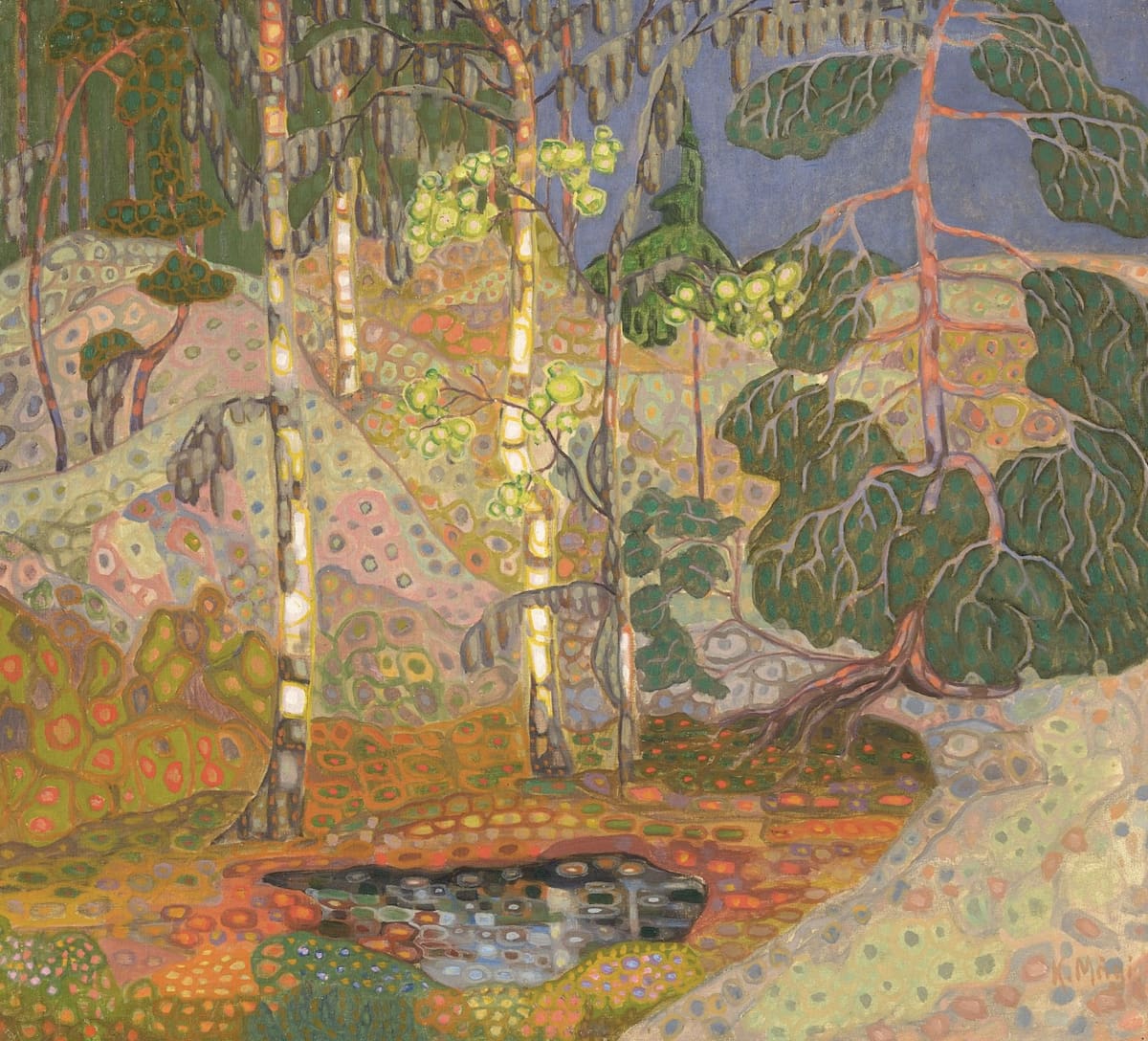
  • The Mordor painting is just the most extreme of the style he developed which combines the garishness of symbolism with the use of blobs of pure colour derived from pointillism. My favourite example was the bog painting (below). It’s figurative in the sense that you can make out the silver birch trees, but what’s happening on the ground isn’t remotely an effort to be realistic, but the use of brightly coloured blobs, lozenges and organic shapes (‘cellular structures’) which are more decorative than realistic. In the flesh, this painting is much more colourful and vibrant than this reproduction.

Norwegian Landscape: Bog Landscape by Konrad Mägi (1908-1910) Courtesy of the Art Museum of Estonia

  • Beside these were more realistic, less abstract landscapes, but still using a big blob pointillist style, such as the Norwegian lake at the top of this review.
  • And then, next door to all these stylised, sort-of-pointillist works, were some landscapes from Norway done in a completely different style, where instead of blobs, the paint has been applied in smooth brushstrokes, so the paintings appear much more traditionally figurative; such as Norwegian Landscape (Winter Landscape).

Room 2. Portraits

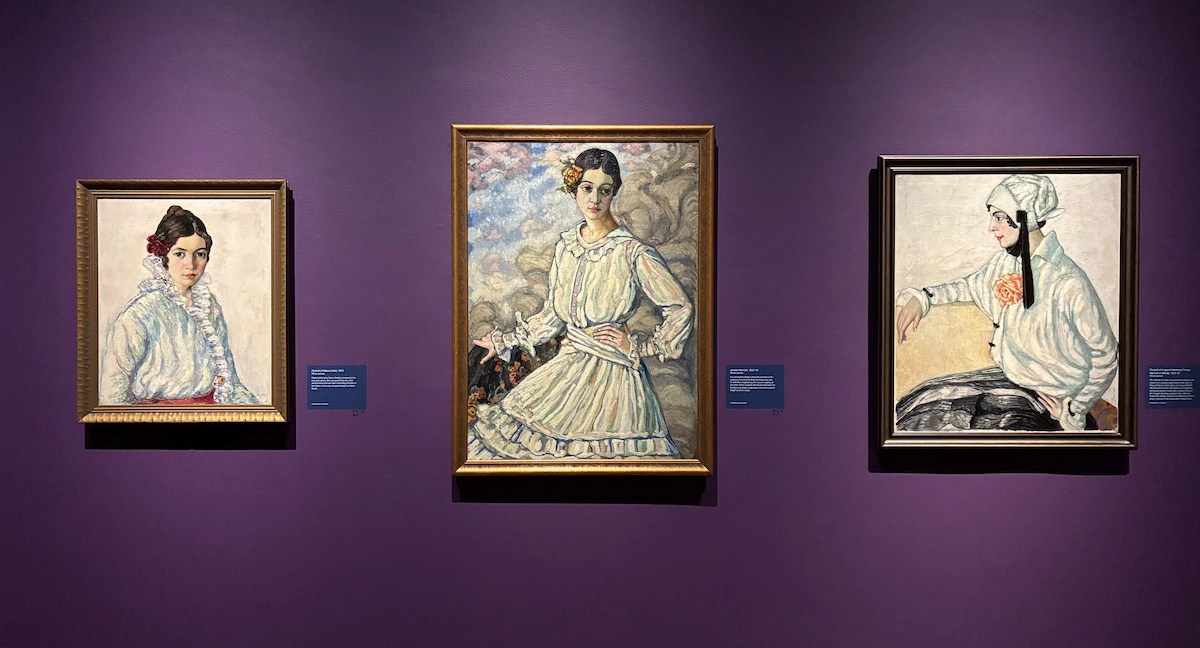
In 1912 Mägi returned to Tartu and, from spring 1913, began accepting portrait commissions for considerable sums of money, largely of wealthy women who were known to him through his cultural and political associations. Room 2 contains 17 of these generally large oil portraits. They showcase a stylised approach to the human face. They’re not unrecognisably distorted as in cubism, just simplified and done with deliberately unnaturalistic colouring. Mostly. But again, there’s a variety of styles. The ones I liked most had a hard angularity and used dark greens and blues to achieve an effect akin to German Expressionism.

Portrait of a Woman by Konrad Mägi (1918–1921) in Konrad Mägi @ Dulwich Picture Gallery

At the other end of the spectrum are some portraits of women whose cartoon, doe-eyed faces seem strangely at odds with the stylised backdrops, such as Portrait of Alvine Käppa from 1919.

Installation view of Konrad Mägi at Dulwich Picture Gallery showing three female portraits (photo by the author)

Somewhere in the middle were maybe the most attractive ones, which combined realistic faces with stylised backgrounds, the outstanding example being another ‘Portrait of a Lady’, below. Note the use of green to indicate shadowing on the skin.

Portrait of a Lady by Konrad Mägi (1916–1917) in Konrad Mägi @ Dulwich Picture Gallery

Room 3. The Baltic

Room 3 contains 16 landscapes from Mägi’s extended stays on the Baltic coast during the summers of 1913 and 1914. The paintings depict the landscape around Saaremaa and Vilsandi and, according to the curators, represented an artistic breakthrough for Mägi. The paintings here are certainly more consistent in style.

As if to demonstrate this, the centrepiece is a rare series by this artist, a set of 6 paintings depicting the same view of the lighthouse at Vilsandi. Three of these show the exact same view at different times towards the end of the day, as the (ever-present) clouds turn deeper shades of pink. the more I looked, the more I liked these three linked works.

Installation view of Konrad Mägi at Dulwich Picture Gallery showing three views of the Vilsandi lighthouse at different times of day (photo by the author)

As to the others, two things struck me:

  1. Lightless Although they are seascapes, and the curators tell us the Estonian coast is flat and open, Mägi’s paintings of it convey very little sense of light. His skies are always full of clouds and the terrain is depicted in thick heavy shapes.
  2. Botany Which is connected to the other thing which is that, although the bits of land he includes are busy with shapes and colours, giving an impression of luxuriant growth – and although the curators tell us that Mägi had an enduring fascination with the unique botanical species of his landscape, including its flora and fauna – there is precious little detail. In the garlands painted by Michaelina Wautier, currently on show at the Royal Academy, I spent some time trying to identify every species of flower. No point trying to do that with Mägi’s coastal paintings which are liberal with elements but all done in his familiar, blobby, stylised manner. Can you identify the plants in this picture?

Vilsandi Motif by Konrad Mägi (1913-14) Courtesy of the Art Museum of Estonia

Room 4. Southern Estonia

The walls of the fourth and final room are painted deep purple and this is an appropriate background for the 11 landscapes on display here, which I found heavy and louring. (I’ve just looked up ‘louring’ to check I’m using it in the right sense. The dictionary defines it as meaning ‘a dark, gloomy, or threatening appearance, usually referring to overcast weather, or a forbidding atmosphere.’ Seems about right.)

The landscapes are from Southern Estonia, from the last decade of his life. Note how the ‘blobby’ technique I’ve mentioned so many times has largely disappeared. Instead the pain is applied more smoothly but several other things are new.

One: the natural elements of the composition (the trees, the bushes, the outline of the lake) are heavily defined in black. Everything has a strong black outline, something I personally, always warm to.

Two: the clouds, the clouds! Look at the swirling, moiling, dark and threatening clouds coming to getcha!

Three: taken together these features indicate how much the landscape is actually an expression of the artist’s inner turmoil. This is the room whose wall label informs us that, after a lifetime struggling against mental illness, in 1924 Mägi suffered some kind of mental collapse and had to be placed in an institution for his own protection. Does that knowledge affect how you feel about this picture?

Lake Kasaritsa by Konrad Mägi (1915-17) Courtesy of the Art Museum of Estonia

As a footnote, not all the 11 works in this final room are as dark and ominous. In fact a couple of them right at the very end work with a much lighter palette and use light square blocks to create a landscape, completely opposite to the heavy, blobby, organic style which dominated so many of his central works. The curators tell us that here, right at the end of his working life, he was experimenting with the kind of Futuro-Cubism which was being used by radical Soviet artists of the 1920s.

Installation view of Konrad Mägi at Dulwich Picture Gallery showing three of the landscapes in the fourth and final room – note the cloud-congested skies (photo by the author)


Related links

Related reviews