
Konrad Mägi (1878 to 1925) was a pioneer of Estonian modernism. Renowned in his home country for his avant-garde, unique colouristic style, he is widely considered the greatest Estonian artist of his generation. I’d never heard of him before which is why Dulwich Picture Gallery are doing us a service by presenting this, the first major exhibition of Mägi’s works ever held in the UK. The exhibition brings together 61 paintings, mostly landscapes or portraits, many of which have never been seen outside of Estonia.

Norwegian Landscape by Konrad Mägi (1909) Courtesy of the Art Museum of Estonia
Four or five themes come over very strongly:
- Different styles Mägi’s style was unstable and variable. The first room contains works done in three or four completely different styles which could be by completely different artists.
- Self-taught This was partly because, after a brief spell at art school in St Petersburg, Mägi was largely self-taught. This explains the way other styles and influences appear throughout his career, with successive works showing the influence of Impressionism, Art Nouveau, Symbolism, Pointillism, Post-Impressionism and Expressionism, with some of his later works from the 1920s showing the sudden arrival of cubism in his style.
- Heavy All the paintings dark and heavy. Dark blues, dark greens, dark reds predominate. These feel a bit heavy and louring in the flesh but I was surprised how well they reproduce on the posters and postcards in the shop.
- Clouds In the fourth and final room I realised the importance of clouds in his paintings: of the 45 landscapes not one has a clear blue sky. Maybe this reflects the climate of Estonia but, in the final room, it also feels connected with his mental illness.
- Mental illness Mägi suffered from mental illness throughout his life. As a struggling young artist he lived in poverty and ‘despair’, and was afflicted with recurring feelings of Angst and futility. At the end of his life he suffered a breakdown, started destroying his paintings until students intervened to stop him, and he was admitted to a mental asylum where he died. This knowledge affects your reception, if not of all the works, then certainly the ones in the final, cloud-oppressed paintings.
The show is divided into four rooms, each addressing a specific period or theme.
Room 1. Norwegian landscapes
Room 1 contains 14 paintings on the wall and 3 in a display case. The curators tell us that Mägi started his working life in 1896 when he joined a furniture factory where he specialised in decorative carving, and where he took drawing classes organised for the factory workers. He was athletic, enjoyed wrestling, and co-founded a youth society in 1897 for the improvement of the body and mind.
In 1903, at the age of 24, Mägi decided to study at the Stieglitz Art School in St Petersburg. During this time he encountered numerous exhibitions, museums and visual art. Following the pivotal period after the Revolution in 1905, many Estonian intellectuals travelled abroad to experience other cultures, a trend inspired by the founding of the Noor-Eesti movement (Young Estonia) and their motto ‘Let us remain Estonians, but let us also become Europeans’.
In 1907 he was in Paris, living in great poverty but soaking up the new art movements of the day. But apparently it was only when Mägi scraped together the money to visit Norway in 1908, that his style crystallised, sort of, and he started to produce landscapes which found an audience. Room 1 room contains good examples of these, but also demonstrates the variability of Mägi’s style.
- There are three or four paintings in a nice impressionist style, notably Field of Flowers with a Little House.
- There’s the extraordinary Norwegian Landscape with a Pine Tree, which I joked to my wife looked like Mordor from Lord of the Rings but maybe reveals the influence of the great Norwegian painter, Edvard Munch.
- The Mordor painting is just the most extreme of the style he developed which combines the garishness of symbolism with the use of blobs of pure colour derived from pointillism. My favourite example was the bog painting (below). It’s figurative in the sense that you can make out the silver birch trees, but what’s happening on the ground isn’t remotely an effort to be realistic, but the use of brightly coloured blobs, lozenges and organic shapes (‘cellular structures’) which are more decorative than realistic. In the flesh, this painting is much more colourful and vibrant than this reproduction.
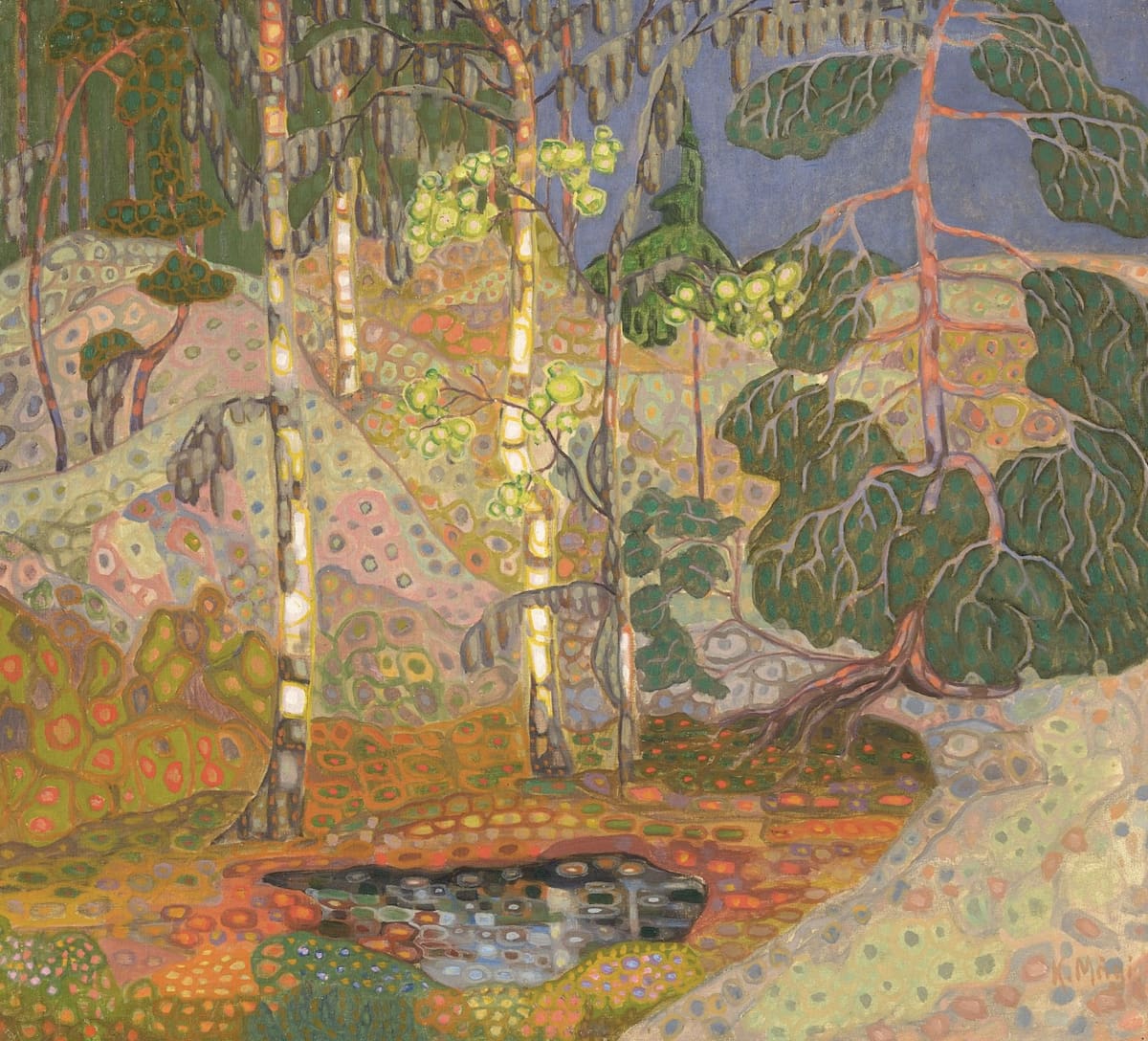
Norwegian Landscape: Bog Landscape by Konrad Mägi (1908-1910) Courtesy of the Art Museum of Estonia
- Beside these were more realistic, less abstract landscapes, but still using a big blob pointillist style, such as the Norwegian lake at the top of this review.
- And then, next door to all these stylised, sort-of-pointillist works, were some landscapes from Norway done in a completely different style, where instead of blobs, the paint has been applied in smooth brushstrokes, so the paintings appear much more traditionally figurative; such as Norwegian Landscape (Winter Landscape).
Room 2. Portraits
In 1912 Mägi returned to Tartu and, from spring 1913, began accepting portrait commissions for considerable sums of money, largely of wealthy women who were known to him through his cultural and political associations. Room 2 contains 17 of these generally large oil portraits. They showcase a stylised approach to the human face. They’re not unrecognisably distorted as in cubism, just simplified and done with deliberately unnaturalistic colouring. Mostly. But again, there’s a variety of styles. The ones I liked most had a hard angularity and used dark greens and blues to achieve an effect akin to German Expressionism.

Portrait of a Woman by Konrad Mägi (1918–1921) in Konrad Mägi @ Dulwich Picture Gallery
At the other end of the spectrum are some portraits of women whose cartoon, doe-eyed faces seem strangely at odds with the stylised backdrops, such as Portrait of Alvine Käppa from 1919.
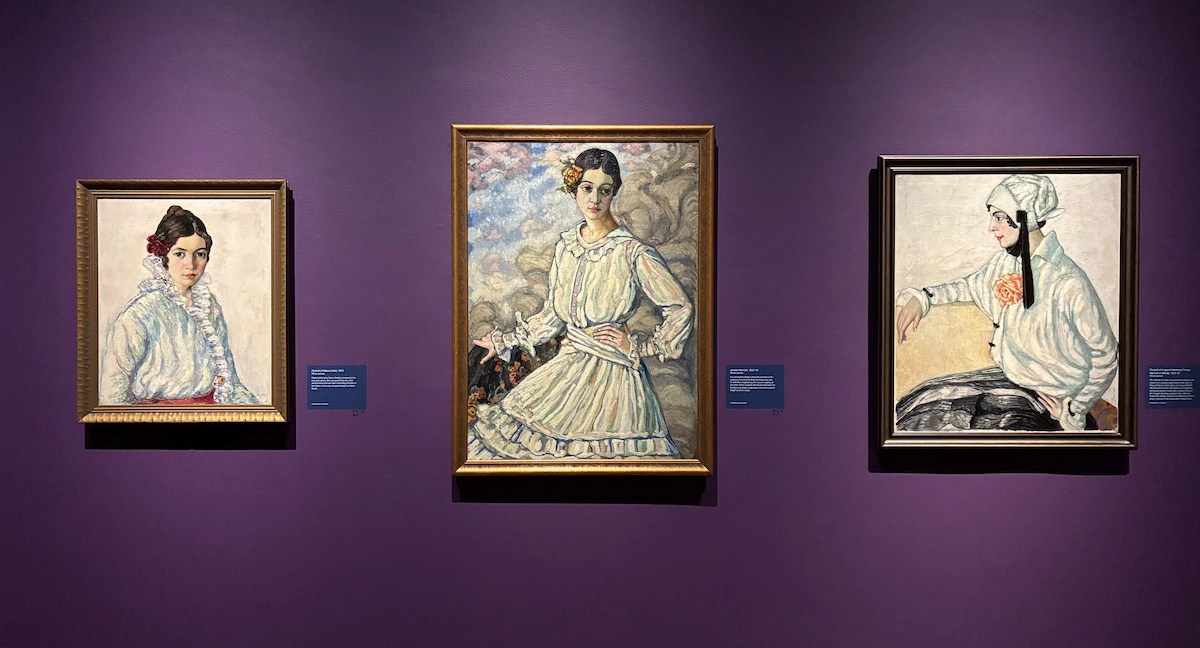
Installation view of Konrad Mägi at Dulwich Picture Gallery showing three female portraits (photo by the author)
Somewhere in the middle were maybe the most attractive ones, which combined realistic faces with stylised backgrounds, the outstanding example being another ‘Portrait of a Lady’, below. Note the use of green to indicate shadowing on the skin.

Portrait of a Lady by Konrad Mägi (1916–1917) in Konrad Mägi @ Dulwich Picture Gallery
Room 3. The Baltic
Room 3 contains 16 landscapes from Mägi’s extended stays on the Baltic coast during the summers of 1913 and 1914. The paintings depict the landscape around Saaremaa and Vilsandi and, according to the curators, represented an artistic breakthrough for Mägi. The paintings here are certainly more consistent in style.
As if to demonstrate this, the centrepiece is a rare series by this artist, a set of 6 paintings depicting the same view of the lighthouse at Vilsandi. Three of these show the exact same view at different times towards the end of the day, as the (ever-present) clouds turn deeper shades of pink. the more I looked, the more I liked these three linked works.

Installation view of Konrad Mägi at Dulwich Picture Gallery showing three views of the Vilsandi lighthouse at different times of day (photo by the author)
As to the others, two things struck me:
- Lightless Although they are seascapes, and the curators tell us the Estonian coast is flat and open, Mägi’s paintings of it convey very little sense of light. His skies are always full of clouds and the terrain is depicted in thick heavy shapes.
- Botany Which is connected to the other thing which is that, although the bits of land he includes are busy with shapes and colours, giving an impression of luxuriant growth – and although the curators tell us that Mägi had an enduring fascination with the unique botanical species of his landscape, including its flora and fauna – there is precious little detail. In the garlands painted by Michaelina Wautier, currently on show at the Royal Academy, I spent some time trying to identify every species of flower. No point trying to do that with Mägi’s coastal paintings which are liberal with elements but all done in his familiar, blobby, stylised manner. Can you identify the plants in this picture?

Vilsandi Motif by Konrad Mägi (1913-14) Courtesy of the Art Museum of Estonia
Room 4. Southern Estonia
The walls of the fourth and final room are painted deep purple and this is an appropriate background for the 11 landscapes on display here, which I found heavy and louring. (I’ve just looked up ‘louring’ to check I’m using it in the right sense. The dictionary defines it as meaning ‘a dark, gloomy, or threatening appearance, usually referring to overcast weather, or a forbidding atmosphere.’ Seems about right.)
The landscapes are from Southern Estonia, from the last decade of his life. Note how the ‘blobby’ technique I’ve mentioned so many times has largely disappeared. Instead the pain is applied more smoothly but several other things are new.
One: the natural elements of the composition (the trees, the bushes, the outline of the lake) are heavily defined in black. Everything has a strong black outline, something I personally, always warm to.
Two: the clouds, the clouds! Look at the swirling, moiling, dark and threatening clouds coming to getcha!
Three: taken together these features indicate how much the landscape is actually an expression of the artist’s inner turmoil. This is the room whose wall label informs us that, after a lifetime struggling against mental illness, in 1924 Mägi suffered some kind of mental collapse and had to be placed in an institution for his own protection. Does that knowledge affect how you feel about this picture?

Lake Kasaritsa by Konrad Mägi (1915-17) Courtesy of the Art Museum of Estonia
As a footnote, not all the 11 works in this final room are as dark and ominous. In fact a couple of them right at the very end work with a much lighter palette and use light square blocks to create a landscape, completely opposite to the heavy, blobby, organic style which dominated so many of his central works. The curators tell us that here, right at the end of his working life, he was experimenting with the kind of Futuro-Cubism which was being used by radical Soviet artists of the 1920s.

Installation view of Konrad Mägi at Dulwich Picture Gallery showing three of the landscapes in the fourth and final room – note the cloud-congested skies (photo by the author)
Related links
- Konrad Mägi continues at the Dulwich Picture Gallery until 2 July 2026
- Konrad Mägi website


 Books & Boots