A Monarchy Transformed: Britain 1603 to 1714 by Mark Kishlansky (1996) 5. The Commonwealth 1649 to 1660

In my life I’ve met plenty of earnest republicans who think we in the UK should abolish the monarchy because it stands at the apex of the system of power and privilege which entrenches privilege and inequality in British society, that we should disestablish the Church of England – whose only role is to prop up ‘the Establishment’ – and we should abolish the House of Lords, a ramshackle combination of Anglican bishops, hereditary peers and dodgy political nominees given places for ‘services rendered’ to the ruling party.

But in fact all these policies were once carried out, 370 years ago, during the English Civil War and Commonwealth, and all modern republicans would do well to study in detail what happened.

Basically, the big constitutional experiment of the English Republic (from the execution of Charles I in 1642 to the restoration of Charles II in 1660) was a failure, because 1) nobody knew what to replace the existing system with and 2) all attempts at a replacement were a) unworkable and b) unpopular. With the result that the new Republic came to rely entirely on the abilities and achievements of one man, Oliver Cromwell, so that when he died 3) the delicate balance of forces he’d held in place collapsed like a pack of cards.

The history of the Commonwealth is a political laboratory in which the people who had overthrown the monarchy, the established church and the House of Lords tried to find an equitable and effective replacement – and failed.

In the end it became clear that the country could only be ruled by a strong leader – Oliver Cromwell – and in the end – and I think this is a crucial point – they offered him the kingship. Even his own supporters, republicans and Puritans, eventually tired of the ceaseless constitutional experiments and said, ‘Listen, just be king’.

Why? Because everyone understood kingship. The entire social and legal system was built around it. Everyone understood where they stood in terms of kingship and its powers, in fact it defined where many, perhaps most, people stood. The existence of the monarchy underpinned their sense of identity and meaning.

To effect a revolution you don’t just overthrow the existing order, you have to train everyone in the new order. You have to indoctrinate them in the new set of values. You have to create new identities for an entire nation.

The French Revolution had a good stab at this by declaring 1790 Year Zero, inventing a new calendar and a new religion of the Rights of Man – although all this was to be swept into the dustbin of history only a few years later upon the rise of Napoleon who, as soon as he could, restored all the trappings and regalia of monarchy, much to most peoples relief.

Only the Russians were brutal enough to realise that a revolution requires not just the overthrow of the old ruler and the extermination of the entire old ruling class (killing not only the Czar but his entire family, and then imprisoning/executing as many of the old aristocracy as they could get their hands on) but the wholesale indoctrination of the entire population in new ways of thinking, something which, under Stalin, they made a sustained attempt to do.

But the Puritan revolutionaries of Cromwell’s day had nothing like the propaganda tools of those later societies although they used what they had – Sunday sermons, early newspapers and pamphlets – to maximum effect.

After the execution of King Charles I

While he was still alive, King Charles acted as one clearly identified enemy who served to unify the very disparate factions in the Parliament and New Model Army. After the king was executed in January 1649 the differences between his opponents began to come out into the open. Cromwell, who had been a leading force in the execution, was away on military campaign from the middle of 1649 until 1651, and this allowed factionalism to grow in the Rump Parliament.

Once he had defeated the Royalists at the Battle of Worcester in 1651 – the last battle of the English civil wars – Cromwell returned to London and tried to force the Rump to set dates for new elections, to unite the three kingdoms under one ruling body, and to create a large, tolerant national church.

During the crisis leading up to the execution of the king many moderates had expressed all kinds of reservations, reluctant to kill the king and recoiling from the social and religious radicalism which had bubbled up in the New Model Army. Now the Rump Parliament dithered about setting an election. It passed a law allowing liberty of conscience but failed to devise any alternative for the tithes or to dismantle other aspects of the existing religious structure which supported the Anglican church.

In frustration, Cromwell demanded that the Rump establish a caretaker government in April 1653 of 40 members drawn jointly from the Rump and the army and then dissolve itself. But for the umpteenth time, the Rump ignored him, preferring to debate its own bill for setting up a new government.

This endless delay was what prompted Cromwell’s famous step of dissolving the Rump Parliament by force. On 20 April 1653 he entered the chamber accompanied by troopers, sat and listened to the debate for a while, and then stepped to the Mace, and declared:

You are no Parliament, I say you are no Parliament; I will put an end to your sitting.

He seized the ceremonial mace, symbol of Parliament’s power, called it a ‘bauble’ and demanded it be removed. The troops, commanded by Charles Worsley, later one of his Major Generals and one of his most trusted advisers, cleared the chamber. England now had no Parliament and no government.

Barebone’s Parliament, 1653

Nine days after the forced dissolution of the Rump, on 29 April Cromwell set up a small Council of State of thirteen members, responsible for foreign policy and administration of the country. The council debated what form a new English constitution should take. Major-General Thomas Harrison called for a sanhedrin of ‘saints’, a sanhedrin being an assembly of either twenty-three or seventy-one elders, appointed to sit as a tribunal in every city in the ancient Land of Israel, as recorded in the Bible.

Harrison was a Fifth Monarchist, who believed that the overthrow of the king signalled the imminent Second Coming of Jesus. Cromwell didn’t share these beliefs but liked the idea of an assembly of men chosen for their upright, religious credentials.

The Council raised the suggested number to 140 – 129 from England, five from Scotland and six from Ireland. The Council nominated all the new MPs themselves, with some informal consultation with independent congregations around the country.

At the opening of the assembly on 4 July 1653, Cromwell gave a speech lasting two hours reviewing the events which had led up to it, highlighting God’s Providence in the course of events, and emphasising that the nominated representatives now had divine sanction to govern the nation.

The Nominated Assembly, sometimes known as the Parliament of Saints, was quickly nicknamed Barebone’s Parliament after one of its members, Praise-God Barebone, a leather seller, Fifth Monarchist and lay preacher from Fleet Street in London.

Cromwell tasked them with finding a permanent constitutional and religious settlement (Cromwell was invited to be a member but declined). But almost immediately the assembly, despite being hand-picked by the narrow group of the Council of State, began to fall out over big issues, namely:

  1. reforming tithes, objected to by many sects on the grounds that they were a remnant of Catholicism, that they supported a professional rather than voluntary clergy, and that their economic burden fell unequally: everyone agreed they were bad, but no-one could devise a workable replacement
  2. the trial of professional trouble-maker John Lilburne, which split opinion
  3. reform of the legal system, with Fifth Monarchists arguing that only laws contained in scripture should be reflected in the temporal legal system while moderates pushed for practical reform

Fierce argument over bills to abolish the Court of Chancery, regulate legal fees, and speed up settlement of cases in the Court of Admiralty added to the splitting of the assembly into factions. Attendance dropped from 140 to 100 to as few as 70 towards the end of its brief existence.

On 6 December the defeat of new proposals to reform tithes led a majority of moderates to give up. They wrote a letter and physically carried it down the road to Cromwell in Whitehall, asking for the Assembly to be dissolved. Faced with its simple refusal to carry on, Cromwell was forced to agree.

The Protectorate: 1653 to 1658

After the dissolution of the Barebones Parliament, John Lambert put forward a new constitution known as the Instrument of Government, closely modelled on a document called the Heads of Proposals which had first been drawn up by the Army in 1647.

The Instrument made Cromwell Lord Protector for life to undertake ‘the chief magistracy and the administration of government’. Cromwell was sworn in as Lord Protector on 16 December 1653, with a ceremony in which he was careful to wear plain black clothing, rather than any monarchical regalia.

But Cromwell did start signing his name ‘Oliver P’, P being an abbreviation for Protector, in the style of monarchs who use an R after their name to mean Rex or Regina – and it soon became the norm for others to address him as ‘Your Highness’. When you reflect on this, you realise that apparent backsliding like this from ‘republican principles’ take place because people need to know what they’re doing. They had all been raised in a very hierarchical model of society (and religion). Everybody, including Oliver, needed to know where they stood.

As Lord Protector, Cromwell had the power to call and dissolve parliaments but was obliged under the Instrument to seek the majority vote of a Council of State to do so. Nevertheless, Cromwell’s power was buttressed by his continuing popularity among the army. As the Lord Protector he was paid £100,000 a year, a vast sum.

Cromwell had two key objectives as Lord Protector. The first was ‘healing and settling’ the nation after the chaos of the civil wars and the regicide, which meant establishing a stable form for the new government to take.

Although Cromwell declared to the first Protectorate Parliament that ‘Government by one man and a parliament is fundamental’, in practice social priorities took precedence over precise forms of government. Cromwell was never interested in forms and details. The precise constitutional arrangements, were, Cromwell declared, ‘but … dross and dung in comparison of Christ.’

But Cromwell was no social revolutionary. Despite the revolutionary nature of the government, his thinking was socially conservative. Cromwell declared, ‘A nobleman, a gentleman, a yeoman; the distinction of these: that is a good interest of the nation, and a great one!’

His first Protectorate parliament proceeded to make small-scale reforms in the legal system, but these were outweighed by the broader attempts to restore order to English politics and affairs. Direct taxation was reduced slightly and peace was made with the Dutch, ending the First Anglo-Dutch War.

Cromwell secured the submission to his rule of England’s colonies in America. One of his notable acts was intervening to curb Puritans who were usurping control over the Maryland Colony by confirming the former Roman Catholic proprietorship and enforcing an edict of tolerance there. It’s interesting to learn that of all the English dominions, Virginia was the most resentful of Cromwell’s rule, and Cavalier emigration there increased during the Protectorate, laying the foundation for the elaborately courtly style of behaviour you find in novels about the Old South generations later.

Cromwell convened the first Protectorate parliament on 3 September 1654. He declared that ‘healing and settling’ were the ‘great end of your meeting’. However, the Parliament was quickly dominated by those pushing for more radical, republican reforms. After some initial gestures approving appointments previously made by Cromwell, the Parliament began to work on a radical programme of constitutional reform. Cromwell, a conservative by nature, balked at many of these changes but, rather than enter into endless meetings with constitutional lawyers, simply dissolved it on 22 January 1655.

Cromwell’s second objective for his Protectorate was spiritual and moral reform. He aimed to restore liberty of conscience and promote both outward and inward godliness throughout England. During the early months of the Protectorate, a set of ‘triers’ was established to assess the suitability of future parish ministers, and a related set of ‘ejectors’ was set up to dismiss ministers and schoolmasters who were judged unsuitable for office. The triers and the ejectors were intended to be at the vanguard of Cromwell’s reform of parish worship.

The Major Generals

After the dissolution of the first Protectorate Parliament, Cromwell tried another constitutional experiment. A Royalist uprising was planned for locations around the country early in 1655. In most places it was a damp squib with few if any civilians rallying to the handful of rebels, but the rising led by Sir John Penruddock in the West succeeded in seizing Salisbury for a few days, before being crushed by a troop of the New Model Army.

Since the uprising had been planned for centres all round the country it made sense to reinforce New Model garrisons everywhere. This led Cromwell’s adviser, General John Lambert to suggest going one step further and dividing England into military districts each ruled by army major-generals who answered only to him.

Map of the major generals and the regions they administered (source: BBC Bitesize)

Thus Cromwell appointed 15 major-generals and deputy major-generals each to rule a region of England and Wales. They were called ‘godly governors’ and charged not only – were central not only with maintaining national security, but forwarding Cromwell’s crusade to reform the nation’s morals.

The generals not only supervised militia forces and security commissions, but collected taxes and ensured support for the government in the English and Welsh provinces. Commissioners for securing the peace of the Commonwealth were appointed to work with them in every county.

While a few of these commissioners were career politicians, most were zealous puritans who welcomed the major-generals with open arms and embraced their work with enthusiasm. However, the major-generals lasted less than a year. Many commissioners feared they threatened their reform efforts and authority. Their position was further harmed by a tax proposal by Major General John Desborough to provide financial backing for their work, which the second Protectorate parliament – convened in September 1656 – voted down for fear of creating a permanent military state.

Ultimately, however, the fall of the major-generals was due to Cromwell’s failure to support his men in their conflicts with the commissioners. Their activities between November 1655 and September 1656 had, however, reopened the wounds of the 1640s and deepened antipathies to the regime.

Historians agree that the Major-Generals were tremendously unpopular and left a legacy of hostility towards standing armies which has, arguably, saved Britain from coming near the possibility of a military dictatorship ever again.

Cromwell and the Jews

Cromwell was aware of the Jewish community’s involvement in the economic success of the Netherlands, by the 1650s England’s leading commercial rival. This, and Cromwell’s principled tolerance of the right to private worship for those outside Puritanism, led to his personal encouragement of Jews to return to England in 1657, over 350 years after their banishment by Edward I, in the hope that they would help speed up the recovery of the country after the disruption of the Civil Wars.

Cromwell offered the crown

In 1657 a cohort of Cromwell’s closest advisers, frustrated by the repeated failures of their constitutional experiments, offered Cromwell the crown as part of a revised constitutional settlement. He agonised for six weeks over the offer. He was attracted by the prospect of stability it offered but finally, in a speech on 13 April 1657, he made clear that God’s providence had spoken against the office of King.

Instead, Cromwell was ceremonially re-installed as Lord Protector on 26 June 1657 at Westminster Hall, sitting upon King Edward’s Chair, which was moved specially from Westminster Abbey for the occasion. The event in part echoed a coronation, using many of its symbols and regalia, such as a purple ermine-lined robe, a sword of justice and a sceptre (but not a crown or an orb). But the office of Lord Protector was still not to become hereditary, though Cromwell was now able to nominate his own successor.

Cromwell’s new rights and powers were laid out in the Humble Petition and Advice, a legislative instrument which replaced the Instrument of Government. This new constitution echoed many aspects of the old constitution, including a house of life peers (in place of the House of Lords). In the Humble Petition it was called ‘the Other House’ as the Commons could not agree on a suitable name.

But the Humble Petition and Advice did not provide for the vetting of members of the House of Commons and when it assembled in 1658 many of those who had been excluded in the first session, retook their seats and immediately began attacking the new settlement – rather as, every time Charles I reconvened Parliament, it picked up its fierce criticism of him exactly where it had left off.

So on 4 February 1658, Cromwell again dissolved Parliament. During 1658 Cromwell increasingly took on the trappings of traditional monarchy, notably creating three peerages: Charles Howard was made Viscount Morpeth and Baron Gisland in July 1657 and Edmund Dunch was created Baron Burnell of East Wittenham in April 1658.

Death and legacy

On 3 September 1658 Oliver Cromwell died, aged 59, exhausted by his efforts to create an honest, godly, English society. The Lord Protectorship passed to his son, Richard, who had none of his father’s qualities and struggled to hold together the rival political, religious and military factions of the regime. Nine months later he was gone.

So Cromwell:

  • overthrew monarchy, the House of Lords and the Church of England
  • tried to hold free and fair elections
  • nominated a parliament of the righteous
  • divided the country into administrative units run by army generals in co-operation with civilian commissioners
  • tried to institute freedom of religious belief
  • tried to resist the forceful offer of the monarchy from his closest supporters
  • supervised but then was forced to dissolve two elected parliaments

It’s easy to interpret Cromwell as a religious fanatic, a hypocrite and, from an Irish point of view, as a genocidal bigot. But he can also be seen as a man into whose lap fell a unique, once-in-history opportunity to utterly redraw the constitution of England, something he tried to do again and again – and failed.

In May 1660 Charles II was restored to the throne and with him came the House of Lords, the Church of England and its bishops. The ten-year experiment to devise some other way of ruling this country had failed. Many of the best minds of the time had joined in the attempt, but none of could concoct a system which a) could win the support of even a minority of the nation b) could come up with solutions to the numerous issues which confronted them (funding of the church, ownership of church land, reform of the law, management of international affairs, and so on).

Abolishing the monarchy and the House of Lords and disestablishing the Church of England would, even today, in a sense, be relatively easy, a few acts of Parliament would achieve it. But:

  1. What, exactly, would you replace them with? that’s the catch
  2. And would whatever you replace them with be in any better position to tackle and solve the intractable social problems which confront us, than Barebones Parliament or the Major-Generals were to tackle the pressing problems of Cromwell’s day?

The restoration of Charles II was greeted with wild enthusiasm, and he has gone down in history as one of the most popular English monarchs and what did he represent, on a popular level? Booze and boobs. Drinking, gambling and mistresses.

What the Restoration proved once and for all is that England is not a nation of high-minded, earnest intellectuals just gagging to be reformed by high-minded Puritans. It is a nation of Sun-readers, who follow the football, like a flutter on the horses, a pie and a pint on a Friday night, and the chance to dress up and go on the pull at the local nightclub every Saturday night. It is a nation of overweight shopaholics with an average reading age of 11.

So when I argue with high-minded and (generally) very well-educated republicans, I ask them, ‘Who do you think you would be abolishing the monarchy and the House of Lords for? Apart from your high-minded Guardian-reading friends? Do you think this nation of party animals, obese alcoholics and lager louts will thank you for your efforts? You’re offering a society with no more coronations, no more royal weddings, no more tittle tattle about Megan and Catherine. Do you expect the people of this great nation to thank you for that?’

Old Olly wasn’t jolly, whereas Charles II had at least thirteen mistresses and 21 illegitimate children. Which one did ‘the people’ prefer, then as now? It is a lowering and dispiriting fact, but it is a fact which all progressives and liberals have to acknowledge and start from.


Seventeenth century reviews

A Monarchy Transformed: Britain 1603 to 1714 by Mark Kishlansky (1996) 3. The reign of Charles I

The reign of Charles I

The 1620s

King James I died on 25 March 1625 and was succeeded by his son, Charles I. A month and a half later Charles married the French Princess Henrietta Maria (sister of King Louis XIII) by proxy in a ceremony in Paris. She was then sent to Kent where they met and spent their marriage night.

Charles was crowned in Westminster in February 1626 but Henrietta’s Catholicism prevented her from being crowned with him and this lack of a formal coronation, along with her overt Catholicism and the stipulation that she be allowed to practice her Catholicism in the royal court, were all to build up popular animosity against her.

In fact, the French stipulation that she be allowed to bring up her children in the Catholic religion lay the seeds of the overthrow of her son James II in 1685. It’s odd that Charles’s advisers didn’t grasp this obvious fact.

With James dead, Charles gave hid father’s former favourite, and his own best friend, the Duke of Buckingham, his head to launch a war against Spain. Yet just like his father, Charles soon found himself stymied.

  1. Brave talk of capturing the annual Spanish treasure fleet coming from South America turned out to be pointless as the fleet had already safely arrived in Spain.
  2. Buckingham led a naval attack on the port of Cadiz which failed to achieve anything.
  3. Ships which the British lent the French to combat the Spanish off the coast of Holland, ended up being used, instead, to attack France’s own Protestant rebels holed up in the Atlantic port of La Rochelle.

Like his father, Charles called a Parliament expecting patriotic enthusiasm and uncritical support, and was taken aback when it promptly launched a series of attacks on him and his favourite adviser.

Instead of voting him the subsidies he wanted, Parliament impeached Buckingham. Charles responded by imprisoning the leaders of the impeachers, which led to predictable outcries about free speech, which Charles ended by shutting Parliament altogether. So much for the Parliament of 1625.

The forced loan

Charles initiated a ‘forced loan’ i.e. the compulsory taxation of his rich subjects, but this led to a storm of protest and Charles found himself having to imprison a whole series of eminent protesters and other officials to carry it through. By this stage relations with France had collapsed – both sides were confiscating each others’ ships – and Charles and Buckingham spent the £200,000 raised by the loan to launch a well-equipped campaign to relieve La Rochelle, the Atlantic port which had become the focus for Protestant resistance to the Catholic king and his chief adviser, Cardinal Richelieu.

The British fleet and army attacked the island of Saint-Martin-de-Ré in order to relieve the Siege of La Rochelle but, for a number of reasons, the siege was a failure, many English lives were lost, and the expedition was eventually forced to withdraw in humiliation.

The 1628 Parliament

Charles was forced to call another Parliament, in May 1628, which immediately began debating the various measures he had taken the preceding year, plus abuses arising from the passing of martial law to organise the troops sent to France. Many aspects of this – for example, billeting soldiers on civilians – had become deeply unpopular.

The Petition of Right

The upshot was that before Parliament voted him more money, it insisted on Charles agreeing to a ‘Petition of Right’. This was drawn up to confirm four traditional liberties:

  • freedom from arbitrary arrest
  • freedom from taxation not approved by parliament aka arbitrary taxation
  • freedom from the billeting of troops
  • freedom from being governed by martial law

Assassination of Buckingham

Charles was careful to specify that these liberties did not affect his own prerogative, and then agreed. Parliament voted him the subsidies he wanted. Buckingham hurried off to Portsmouth to ready the fleet for another attempt to relieve the French Protestants. Then Buckingham was assassinated.

The Duke was stabbed to death on 23 August 1628 at the Greyhound Pub in Portsmouth, where he had gone to organise yet another campaign. According to an eye-witness account, he lived just long enough to jump up, shouting ‘Villain!’ and making to chase after his assailant, but then fell down dead. The assassin was John Felton, an army officer who had been wounded in the earlier military adventure and believed he had been passed over for promotion by Buckingham.

Felton

Buckingham was by now so hated that his assassin, John Felton, was feted as a hero, had poems and pamphlets written about him. He was tried and executed, of course, but when his body was taken back to Portsmouth to be publicly hung up, it became an object of popular veneration. A few months later, in October 1628 La Rochelle finally fell to French Catholic forces.

So his favourite was dead and the policy which had driven his first four years as king had completely failed. Charles needed to regroup. He sought to make peace with both France and Spain, and he knew he needed to call one more Parliament. The first of his reign had refused to grant the traditional tonnage and poundage tax to him for the whole reign. He needed that money. But in the meantime…

Peace

Charles signed peace treaties with France in 1629 and Spain in 1630. Sick to death of confrontations with Parliament he decided – now he no longer needed special funds for war – not to call another one, and so ruled through his council and by exercising the Personal Prerogative. In fact, he wasn’t to call another Parliament until 1640, a period of 11 years which is referred to as the period of his Personal Rule or (by his harshest critics) as the Eleven Years Tyranny.

After the tribulations of the 1620s, Charles tried to make the 1630s a decade of peace and reconciliation. But such was the distrust generated by the opening years of his reign, that everything he did tended to be misinterpreted for the worst, and in four or five main areas of government, he took aggressively centralising decisions which alienated large numbers of his subjects.

Issues of the 1630s

Ship Money

Charles was still chronically short of money and his Chancellors came up with a series of ever-more ingenious ways of mulcting money from his subjects. The most controversial was ship money. This was a traditional and well-accepted tax imposed on coastal communities to pay for ships to be built and crewed to defend coastal towns. Ship money had traditionally been authorised only during wars, and only on coastal regions.

Charles, however, argued that there was no legal bar to collecting the tax for defence during peacetime and throughout the whole of the kingdom. Ship money, paid directly to the Treasury of the Navy, provided between £150,000 to £200,000 annually between 1634 and 1638, after which yields declined. Opposition to ship money steadily grew, but the 12 common law judges of England declared that the tax was within the king’s prerogative, though some of them had reservations. The prosecution of John Hampden for non-payment in 1637–38 provided a platform for popular protest, and the judges only found against Hampden by the narrow margin of 7–5.

Monopolies

Charles also raised money by the granting of monopolies for specific trades. This was despite a statute forbidding such action, which, though inefficient, raised an estimated £100,000 a year in the late 1630s.

Act of Revocation

Charles also raised funds from the Scottish nobility, at the price of considerable acrimony, by the Act of Revocation (1625), whereby all gifts of royal or church land made to the nobility since 1540 were revoked. If the owners wanted to continue in possession of their property, they had to pay an annual rent.

Forest money

In addition, the boundaries of the royal forests in England were extended to their ancient limits as part of a scheme to maximise income by exploiting the land and fining land users within the expanded boundaries for ‘encroachment’.

Sales of Royal lands, especially the large expanses of under-developed Royal forests was another way of raising money. The programme arranged for the sale of forest lands for development as pasture and arable, or in the case of the Forest of Dean, development for the iron industry. This included providing compensation to people using common land, but not for people who had settled illegally. Pushed off land they had been working for some time, many of these rioted. In fact such was the sale of the discontent in the west of England it became known as the Western Rising, with other scattered riots in Feckenham Forest and Malvern Chase.

Despite all these measures, Charles still faced bankruptcy in the summer of 1640. The City of London refused to make any further loans to the king. Pushed to extreme measures, Charles then seized the money held in trust at the mint of the Exchequer in the tower of London. This represented the capital of the merchants and goldsmiths of the city. In August Charles seized all the stocks of pepper held by the East India Company, and sold it off cheap.

You can see how virtually every expedient Charles developed to raise money alienated and embittered large groups of subjects, and especially merchants in the City of London, who came to think of the king as a public menace.

Strafford and Ireland

Another long-term problem for any British king was the situation in Ireland. Throughout the Tudor period, from Henry VIII through Elizabeth, parts of Ireland had been settled by ‘planters’, not without resistance from the native Irish and their traditional lords, who rose in repeated uprisings.

But the so-called ‘Flight of the Earls’ in 1607 had left a lot of the land in north-east Ireland leaderless, and so James I set about organising the Plantation of Ulster, a plan to encourage emigrants from Scotland to settle in what is now known as Ulster, with funding from the City of London.

With the result that Ireland, by Charles’s time, contained about four identifiable groups:

  • the Irish population, mostly rural peasants
  • the Irish leadership – the traditional lords of various lands and estates who, however, a century of negotiating and compromising with their English invaders had split into various parties, some for compromise, some for submission, some burning for rebellion and independence
  • the ‘Old English’ settlers i.e. the originally English families who had been in Ireland for generations and begun to think of themselves as in a sense Irish, appreciated local customs and laws and who were often put out or deprived by the new plantation
  • the ‘New English’ who had arrived in the past generation and who had a vested interest in expanding and consolidating the new plantation

Managing this situation took a firm hand, and Charles was clever in selecting Thomas Wentworth, the Earl of Strafford, to be his Viceroy in Ireland. Strafford brought all sides to heel, though at the cost of uniting them all in hatred of his strong-arm, inflexible approach.

Archbishop Laud and religion

Something similar happened in religion, where Charles appointed Laud as archbishop of Canterbury. Charles wanted order and clarity and beauty in his church. However, religion continued to be a source of discontent among virtually all his subjects.

Arminianism

Charles’s reign saw the spread of Arminianism among Anglican intellectuals. The Dutch Reformed theologian Jacobus Arminius  reacted against the iron predestinationism of Calvin and the Calvinists. According to Calvin, God had already chosen who was saved (the Elect) and who was damned. All we could do was examine our own lives with scrupulous attention and live as purely as possible in the hope we were one of the Elect.

This was in sharp contrast to traditional Catholic teaching which is the more commonsense view that we attain salvation through our works. We may sin and err but we can be forgiven through Church rituals such as confession and the Mass.

Starting in the 1610s, Arminius proposed a sort of middle way, adopting the outlines of Calvinism, and certainly espousing a Christianity much purified of Catholic superstitions (veneration of saints, the Virgin Mary, miracles and so on). But still he modified the harshness of Calvinist theology, asserting that the Atonement of Christ offers each individual some leeway, some freedom, in determining their own salvation or damnation.

To Puritans this was blasphemy, but it was attractive to Charles and his archbishop, Laud. The rise of Arminianism within moderate sections of the Anglican church therefore became a battleground with more radical Puritans.

Buildup to the outbreak of civil war

Thus there were many long-term issues which Charles was struggling with. But the first spark which led to outright violence was his attempt to impose a new prayer book on the Scottish church or Kirk as they called it.

On a visit to Scotland, Charles and Laud had been upset at the variation in church services there, and the scrappy state of many of the churches. Being a devout Christian Charles thought it was his duty as King to renovate and improve the Scottish church. He gave money to repair buildings. But in the same vein he wanted to bring Scottish church practice in line with English. And so he commissioned English clerics to write a new unified prayer book.

When this was first used in a service at Edinburgh in July 1637, it caused a riot. It was seen as an imposition of English values on Scottish religion, and as blasphemously Arminian, or pseudo-Catholic. Religious chauvinism combined with Scottish nationalism. With characteristic arrogance, Charles had held no consultations, either in the Scottish Parliament or in an Assembly of the Kirk.

The protests quickly spread across Scotland, and – as with many religious disturbances – became a handy opportunity for the powerful in the land to push for more independence (and power) from England.

The Scottish National Covenant

Quickly they organised the Scottish National Covenant. In February 1638, at a ceremony in Greyfriars Kirk in Edinburgh, large numbers of Scottish noblemen, gentry, clergy and burgesses signed the Covenant, committing themselves under God to preserving the purity of the Kirk. Copies were distributed throughout Scotland for signing on a wave of popular support. Those who hesitated were often intimidated into signing and clergymen who opposed it were deposed. This was followed in August 1639 by a series of acts passed by the Parliament of Scotland that amounted to a constitutional revolution.

First Bishops’ War

Charles decided to invade Scotland and impose his will. A complicated plan to co-ordinate a land invasion and an amphibious landing failed (remember the long list of military failures which characterised the 1620s). A Scottish army was raised and marched to within a few miles of the English border. Talks were held and a peace treaty signed, but both sides regarded it only as a truce.

Charles called a Parliament, as usual hoping for patriotic support and money but, as usual, the Parliament immediately drew up a list of grievances, notably ship money and the arbitrary behaviour of the feared Star Chamber, and called for the impeachment of many of his advisers, so Charles promptly dissolved it.

Second Bishops’ War

Alexander Leslie, 1st Earl of Leven, had fought in the Thirty Years War. He led a vastly better trained and provisioned Scottish army into England in August 1640, which swept aside the ill-trained English militias and seized Newcastle, main source of coal for London. The Scots were in the driving seat. The Scots insisted on being paid £850 per day maintenance.

The Long Parliament

Charles was forced to call a Parliament to raise the money to pay the Scots. What was to become known as the Long Parliament organised to take revenge on Charles, impeaching his advisers, and demanded the return of Strafford from Ireland. Strafford was tried and executed Strafford in May 1641 and in August the Scots finally evacuated Northern England after the Treaty of London.

The Irish Rising

However, the withdrawal of Strafford, the only man strong enough to balance the conflicting sides in Ireland, turned out to be a disaster. In October 1641 the Irish Rebellion broke out, beginning as an attempted coup d’état by Irish Catholic gentry, who tried to seize control of the English administration in Ireland to force concessions for Catholics, but developing into an ethnic conflict between Irish Catholics on one side, and English and Scottish Protestants on the other. Thousands of English and Scots were forced to flee their homes, amid scare stories of burning and looting and murder and rape.

When news of this arrived in London it transformed the atmosphere from crisis into hysteria. Once again the Protestants felt the deadly paranoia of a Catholic conspiracy. Both Charles and Parliament realised an army needed to be raised quickly to combat the Irish rebels, but neither side trusted the other with such a large force.

And that crux, control of the army raised to put down the Irish rebellion, was the issue which triggered the civil war.


More seventeenth century reviews

A Monarchy Transformed: Britain 1603 to 1714 by Mark Kishlansky (1996) 1. Key features of 17th century Britain

Mark Kishlansky (1948 to 2015) was an American historian of seventeenth-century British politics. He was the Frank Baird, Jr. Professor of History at Harvard University, editor of the Journal of British Studies from 1984 to 1991, and editor-in-chief of History Compass from 2003 to 2009.

Kishlansky wrote half a dozen or so books and lots of articles about Stuart Britain and so was invited to write Volume Six of the Penguin History of England covering that period, under the general editorship of historian David Cannadine.

I think of the history of Britain in the 17th century as consisting of four parts:

  1. The first two Stuarts (Kings James I and Charles I) 1603 to 1642
  2. The Civil Wars and Protectorate (Oliver Cromwell) 1642 to 1660
  3. The Restoration (Kings Charles II and James II) 1660 to 1688
  4. The Glorious Revolution and Whig monarchs (William and Mary, then Queen Anne) 1688 to 1714

Although obviously you can also divide it by monarch:

  1. James I (1603 to 1625)
  2. Charles I (1625 to 1642)
  3. Wars of the three kingdoms (1637 to 1653)
  4. Protectorate of Oliver Cromwell (1653 to 1660)
  5. Charles II (1660 to 1685)
  6. James II and the Glorious Revolution (1685 to 1688)
  7. William and Mary (1688 to 1702)

I appreciate that this is an English perspective, and Kishlansky is the first to acknowledge that his history tends to focus on England, by far the largest and most powerful of the three kingdoms of Britain. The histories of Scotland and Ireland over the same period shadowed the English timeline but – obviously – had significant events, personnel and continuities of their own. From the start Kishlansky acknowledges he doesn’t have space to give these separate histories the space they deserve.

Why is the history of seventeenth century Britain so attractive and exciting?

The seventeenth century has a good claim to being the most important, the most interesting and maybe the most exciting century in English history because of the sweeping changes that affected every level of society. In 1600 England was still a late-medieval society; in 1700 it was an early modern society and in many ways the most advanced country on earth.

Social changes

  • business the modern business world was created, with the founding of the Bank of England and Lloyds insurance, cheques, banknotes and milled coins were invented; the Stock Exchange was founded and the National Debt, a financial device which allowed the British government to raise large sums for wars and colonial settlement; excise and land taxes provided reliable sources of revenue for the government
  • empire the British Empire was defined with the growth of colonies in North America and India
  • feudal forms of government withered and medieval practices such as torture and the demonisation of witchcraft and heresy died out
  • media newspapers were invented and went from weekly to daily editions
  • new consumer products domestic consumption was transformed by the arrival of new products including tobacco, sugar, rum, gin, port, champagne, tea, coffee and Cheddar cheese
  • the scientific revolution biology, chemistry and physics trace their origins to discoveries made in the 1600s – Francis Bacon laid the intellectual foundations for the scientific method; William Harvey discovered the circulation of the blood; Robert Boyle posited the existence of chemical elements, invented perfected the air pump and created the first vacuum; Isaac Newton discovered his laws of thermodynamics, the composition of light, the laws of gravity; William Napier invented logarithms; William Oughtred invented the multiplication sign in maths; Edmund Halley identified the comet which bears his name, Robert Hooke invented the microscope, the quadrant, and the marine barometer; the Royal College of Physicians published the first pharmacopeia listing the properties of drugs; Peter Chamberlen invented the forceps; the Royal Society (for the sciences) was founded in 1660
  • sport the first cricket and gold clubs were founded; Izaak Walton codified knowledge about fishing in The Compleat Angler; Charles II inaugurated yacht racing at Cowes and Queen Anne founded Royal Ascot
  • architecture Inigo Jones, Sir Christopher Wren, Nicholas Hawksmoor and John Vanbrugh created wonderful stately homes and public buildings e.g. Jones laid out the Covent Garden piazza which remains an attraction in London to this day and Wren designed the new St Paul’s cathedral which became a symbol of London
  • philosophy the political upheavals produced two masterworks of political philosophy, the Leviathan of Thomas Hobbes and John Locke’s Two Treatises of Government, which are still studied and applied in a way most previous philosophy isn’t
  • non conformists despite repeated attempts to ban them, Puritan sects who refused to ‘conform’ to the Restoration settlement of the Church of England were grudgingly accepted and went on to become a permanent and fertile element of British society – the Quakers, Baptists and Presbyterians

Political upheaval

At the centre of the century sits the great 20-year upheaval, the civil wars or British wars or Great Rebellion or the Wars of Three Kingdoms, fought between the armies of parliament and the armies of King Charles I, with significant interventions by armies of Scotland and Ireland, which eventually led to the execution of the king, the abolition of the House of Lords and the disestablishment of the Church of England – achievements which still form a core of the radical agenda to this day. These revolutionary changes were followed by a series of constitutional experiments under the aegis of the military dictator Oliver Cromwell, which radicalised and politicised an entire generation.

Soon after Cromwell’s death in 1658, his regime began to collapse and elements of it arranged for the Restoration of King Charles II, who returned but under a new, more constitutional monarchy, restrained by laws and conventions guaranteeing the liberties of British subjects and well aware of the mistakes which led to the overthrow of his father.

But none of this stopped his overtly Roman Catholic brother, who succeeded him as James II in 1685, making a string of mistakes which collectively alienated the Protestant grandees of the land who conspired to overthrow him and replace him with the reliably Protestant Prince William of Orange. James was forced to flee, William was invited to become King of England and to rule according to a new, clearly defined constitution or Bill of Rights, which guaranteed all kinds of liberties including of speech and assembly.

All of these upheavals meant that by 1700 England had the most advanced, liberal and open society in Europe, maybe in the world, had experimented with a wide variety of political reforms and constitutions, and developed one which seemed most practical and workable – which was to become the envy of liberals in neighbouring France, and the basis of the more thoroughly worked-out Constitution devised by the founders of the American republic in the 1780s.

Studying the 17th century combines the intellectual excitement of watching these constitutional and political developments unfold, alongside the more visceral excitement of following the dramatic twists and turns in the long civil wars – and then following the slow-burning problems which led to the second great upheaval, the overthrow of James II. There is tremendous pleasure to be had from getting to know the lead characters in both stories and understanding their motives and psychologies.

Key features of 17th century England

The first two chapters of Mark Kishlansky’s book set out the social and political situation in Britain in 1600. These include:

Patriarchy

Britain was a comprehensively patriarchal society. The king ruled the country and his word meant life or death. Le Roy le veult – the King wishes it – was the medieval French phrase still used to ratify statutes into law. The monarch made all political, legal, administrative and religious appointments – lords, ministers, bishops, judges and magistrates owed their position to him. In every locality, knights of the shires, justices of the peace administered the king’s laws. The peerage was very finely gradated and jealously policed. Status was everything.

Hierarchy

And this hierarchy was echoed in families which were run by the male head of the household who had complete power over his wife and children, a patriarchal household structure endorsed by the examples in the Bible. Women might have as many as 9 pregnancies, of which 6 went to term and three died in infancy, with a further three children dying in infancy.

The family was primarily a unit of production, with all family members down to small children having specified tasks in the often backbreaking toil involved in agricultural work, caring for livestock, foraging for edibles in woods and fields, producing clothes and shoes. Hard physical labour was the unavoidable lot of almost the entire population.

Marriages

Marriages were a vital way of passing on land and thus wealth, as well as family names and lineages. Most marriages were arranged to achieve these ends. The top responsibility of both spouses were the rights and responsibilities of marriage i.e. a wife obeyed her husband and a husband cherished and supported his wife. It was thought that ‘love’ would grow as a result of carrying out these duties, but wasn’t a necessary component.

Geography

80% of the population in 1600 worked on the land. Britain can be divided into two geographical zones:

1. The North and West

The uplands of the north-west, including Scotland and Wales, whose thin soils encouraged livestock supplemented by a thin diet of oats and barley. Settlements here were scattered and people arranged themselves by kin, in Scotland by clans. Lords owned vast estates and preserved an old-fashioned medieval idea of hospitality and patronage.

Poor harvests had a catastrophic impact. A run of bad harvests in the 1690s led to mass emigration from Scotland to America, and also to the closer ‘plantations’ in Ulster.

It was at this point that Scottish Presbyterians became the majority community in the province. Whereas in the 1660s, they made up some 20% of Ulster’s population… by 1720 they were an absolute majority in Ulster, with up to 50,000 having arrived during the period 1690-1710. (Wikipedia)

2. The south and east

The south and east of Britain was more densely populated, with villages and towns instead of scattered homesteads. Agriculture was more diverse and productive. Where you have more people – in towns and cities – ties of kinship become weaker and people assess each other less by ‘family’ than by achievements, social standing and wealth.

The North prided itself on its older, more traditional values. The South prided itself on being more productive and competitive.

Population

The population of England rose from 4 million in 1600 to 5 million in 1700. There were maybe 600 ‘towns’ with populations of around 1,000. Big provincial capitals like Norwich, Exeter or Bristol (with pops from 10,000 to 30,000) were exceptions.

London

London was unlike anywhere else in Britain, with a population of 200,000 in 1600 growing to around 600,000 by 1700. It was home to the Court, government with its Houses of Lords and Commons, all the main law courts, and the financial and mercantile hub of the nation (Royal Exchange, Royal Mint, later the Bank of England and Stock Exchange). The centre of publishing and the new science, literature, the arts and theatre. By 1700 London was the largest city in the Western world. Edinburgh, the second largest city in Britain, had a paltry 40,000 population.

Inflation

Rising population led to a squeeze on food since agricultural production couldn’t keep pace. This resulted in continuous inflation with foodstuffs becoming more expensive throughout the century, which reduced living standards in the countryside and contributed to periods of near famine. On the other hand, the gentry who managed to hang onto or increase their landholdings saw an unprecedented rise in their income. The rise of this class led to the development of local and regional markets and to the marketisation of agriculture. Those who did well spent lavishly, building manors and grand houses, cutting a fine figure in their coaches, sending the sons to university or the army, educating their daughters in order to attract wealthy husbands.

Vagrancy

The change in working patterns on the land, plus the rising population, led to a big increase in vagrancy, which the authorities tackled with varying degrees of savagery, including branding on the face with a V for Vagrant. Contemporary theorists blamed overpopulation for poverty, vagrancy and rising crime. One solution was to encourage the excess population to settle plantations in sparsely populated Ireland or emigrate to New England. There were moral panics about rising alcoholism, and sex outside marriage.

Puritans

Leading the charge to control immoral behaviour were the Puritans, a negative word applied to a range of people who believed that the Church of England needed to be further reformed in order to reach the state of purity achieved by Calvinists on the continent. Their aims included:

  • abolition of the 26 bishops (who were appointed by the king) and their replacement by Elders elected by congregations
  • reforms of theology and practice: getting rid of images, candles, carvings etc inside churches, getting rid of elaborate ceremonies, bells and incense and other ‘Roman’ superstitions
  • reducing the number of sacraments to the only two practiced by Jesus in the New Testament
  • adult baptism replacing infant baptism

Banning

Closely connected was the impulse to crack down on all ungodly behaviour e.g. alcohol (close pubs), immorality (close theatres), licentiousness (ban most books except the Bible), lewd behaviour (force women to wear modest outfits, keep their eyes on the ground), ban festivals, ban Christmas, and so on.

Trans-shipping

The key driver of Britain’s economic wealth was shipping and more precisely trans-shipping – where goods were brought in from one source before being transhipped on elsewhere. The size of Britain’s merchant fleet more than tripled and the sized of the cargo ships increased tenfold. London’s wealth was based on the trans-shipping trade.

The end of consensus politics

The second of Kishlansky’s introductory chapters describes in detail the political and administrative system in early 17th century Britain. It is fascinating about a) the complexity of the system b) its highly personal orientation about the person the monarch. It’s far too complicated to summarise here but a few key themes emerge:

Consensus

Decisions at every level were reached by consensus. To give an example, when a new Parliament was called by the king, the justices of the peace in a county met at a session where, usually, two candidates put themselves forward and the assembled JPs discussed and chose one. Only very rarely were they forced back on the expedient of consulting local householders i.e. actually having a vote on the matter.

Kishlansky explains how this principle of consensus applied in lots of other areas of administration and politics, for example in discussions in Parliament about acts proposed by the king and which needed to be agreed by both Commons and Lords.

He then goes on to launch what is – for me at any rate – a new and massive idea: that the entire 17th century can be seen as the slow and very painful progression from a political model of consensus to an adversarial model.

The entire sequence of civil war, dictatorship, restoration and overthrow can be interpreted as a series of attempts to reach a consensus by excluding your opponents. King Charles prorogued Parliament to get his way, then tried to arrest its leading members. Cromwell, notoriously, was forced to continually remodel and eventually handpick a Parliament which would agree to do his bidding. After the Restoration Charles II tried to exclude both Catholics and non-conforming Protestants from the body politic, imposing an oath of allegiance in order to preserve the model of consensus sought by his grandfather and father.

The point is that all these attempts to purify the body politic in order to achieve consensus failed.

The advent of William of Orange and the Bill of Rights in 1689 can be seen as not so much defining liberties and freedoms but as finally accepting the new reality, that political consensus was no longer possible and only a well-managed adversarial system could work in a modern mixed society.

Religion

What made consensus increasingly impossible? Religion. The reformation of Roman Catholicism which began in 1517, and continued throughout the 16th century meant that, by the 1620s, British society was no longer one culturally and religiously unified community, but included irreducible minorities of Catholics and new-style Calvinist Puritans. Both sides in what became the civil wars tried to preserve the old-fashioned consensus by excluding what they saw as disruptive elements who prevented consensus agreements being reached i.e. the Royalists tried to exclude the Parliamentarians, the Parliamentarians tried to exclude the Royalists, both of them tried to exclude Catholics, the Puritans once in power tried to exclude the Anglicans and so on.

But the consensus model was based on the notion that, deep down, all participants shared the same religious, cultural and social values. Once they had ceased to do that the model was doomed.

Seen from this point of view the entire history of the 17th century was the slow, bloody, and very reluctant acceptance that the old model was dead and that an entirely new model was required in which political elites simply had to accept the long-term existence of sincere and loyal but completely different opinions from their own.

Political parties

It is no accident that it was after the Glorious Revolution that the seeds of what became political parties first began to emerge. Under the consensus model they weren’t needed; grandees and royal ministers and so on managed affairs so that most of them agreed or acquiesced on the big decisions. Political parties only become necessary or possible once it had become widely accepted that consensus was no longer possible and that one side or another in a debate over policy would simply lose and would have to put up with losing.

So Kishlansky’s long and fascinating introduction leads up to this insight – that the succession of rebellions and civil wars across the three kingdoms, the instability of the Restoration and then the overthrow of James II were all necessary to utterly and finally discredit the old late-medieval notion of political decision-making by consensus, and to usher in the new world of political decision-making by votes, by parties, by lobbying, by organising, by arguing and taking your arguments to a broader political nation i.e. the electorate.

In large part the English Revolution resulted from the inability of the consensual political system to accommodate principled dissension. (p.63)

At a deep level, the adoption of democracy means the abandonment of attempts to repress a society into agreement. On this view, the core meaning of democracy isn’t the paraphernalia about voting, that’s secondary. In its essence democracy means accepting other people’s right to disagree, sincerely and deeply, with what you hold to be profoundly true. Crafting a system which allows people to think differently and speak differently and live differently, without fear or intimidation.


More seventeenth century reviews

Gainsborough’s Family Album @ the National Portrait Gallery

This exhibition is pure visual, intellectual and emotional pleasure. It is beautifully hung and really informatively labelled and guided. In particular the American scholar who curated it, David Solkin, is pitch perfect in his audioguide commentary, telling you exactly what you need to know about each key painting, and about Gainsborough’s wider family background.

It’s a simple enough idea: Thomas Gainsborough (1727 to 1788) was one of the 18th century’s most successful portrait painters, rising from modest beginnings in Sudbury Suffolk, to owning a mansion on Pall Mall and being painter to Britain’s aristocracy, rivalled only by the towering figure of his contemporary, Sir Joshua Reynolds.

But alongside his formal commissions he painted an unusual number of portraits of his immediate and extended family. This exhibition brings together some 50 of these paintings and a few drawings, some familiar from national collections, some never before publicly displayed, to tell the story of his changing and evolving painterly style, as well as the biographies of himself, his wife and daughters, parents, brothers and sisters, and other members of the extended family.

It’s not quite a portrait of the age but it’s certainly a portrait of a charming, sometimes tragic, often comic and endearing family, told via sketches, drawings and paintings which are sometimes breath-takingly beautiful.

The two Gainsboroughs

It’s always seemed to me there are two Gainsboroughs: the early paintings from the 1740s feature beanpole figures with Woodentop faces which I personally find difficult to take seriously.

the artist with his wife Margaret and eldest daughter Mary by Thomas gainsborough (1748)© The National Gallery, London

‘The artist with his wife Margaret and eldest daughter Mary’ by Thomas Gainsborough (1748) © The National Gallery, London

Then something seismic happened to his technique during the 1750s, so that within a decade his handling of the human face had become marvellously expressive, and his handling of the volume and shape of the human body, masterful.

The following is one of my all-time favourite paintings, one of the best depictions of love and affection and innocence I know of. it looks and feels as if by a completely different artist from the painting above.

Mary and Margaret Gainsborough, the artist's daughter, with a cat by Thomas Gainsborough (1760-61) © The National Gallery, London

‘Mary and Margaret Gainsborough, the artist’s daughter, with a cat’ by Thomas Gainsborough (1760 to 1761) © The National Gallery, London

It demonstrates several of Gainsborough’s qualities. One is the characteristic ‘feathering’ of the trees and clouds in the background. Another is that it is unfinished – a lot of the paintings in this exhibition are unfinished. They demonstrate his sprezzatura, his ability to rough out an image at astonishing speed.

And for me, personally, I love the way you can see the artist at work. I almost like the rough sketching of the arms and hands as much as the smooth finish of the seraphic faces. They remind me of the quick evocative charcoal sketches by Degas which were exhibited next door at the National Gallery earlier this year. I love draughtsmanship, outlines, the miraculous way a few lines on a flat surface can conjure up the look and feel of warm human bodies, and many of even the most mature paintings on display here have an unfinished quality, which allows you to enjoy Gainsborough’s terrific verve and confidence.

Gainsborough’s speed

In fact Gainsborough’s legendary speed often caused him problems. One was that, even once he was famous, his clients regularly complained that he’d left his paintings unfinished. There’s an example here of his wife, done in sumptuous silks but, when you look closer, lacking hands, as if he was in too much of a hurry to bother.

As to sheer speed the commentary tells us that he made this painting of his nephew and protégé, Gainsborough Dupont, in one hour. One hour. It is riveting to be able to examine this painting really closely and observe the nerveless precision of his draughtsmanship and the dash and confidence of his brushstrokes. The eyes and eyebrows in particular dazzled me. Note the ‘feathering’ effect of the background and the quick, dashed-off impression of the boy’s ‘cavalier’ costume.

Gainsborough Dupont, the artist's nephew by Thomas Gainsborough (1773) Waddesdon (the Rothschild family)

‘Gainsborough Dupont, the artist’s nephew’ by Thomas Gainsborough (1773) Waddesdon (the Rothschild family)

The influence of van Dyck

As he became more successful the young painter moved from his Suffolk home to the fashionable spa resort of Bath. Here he made important contacts with rich clients and also got the opportunity, when visiting the aristocracy, to see their collections of Old Masters.

Of all the past masters, the one that struck him most was Sir Anthony van Dyck, the Flemish painter who came over to work at the court of Charles I in the 1630s. I’d love to know whether it was the deliberate attempt to copy van Dyck which led to the revolution in his work which I indicated above. Certainly Gainsborough revered van Dyck till his dying day. In fact the exhibition tells us that, as his death from terminal cancer approached, he told those around him he wanted to be measured against van Dyck, and apparently his very last words were ‘Van Dyck is right’.

The commentary on the Gainsborough Dupont portrait mentions that van Dyck used flicks of red to create depth of colouring of human skin and then points out just such red flecks which you can see if look closely above the figure’s left eye. It’s the type of opportunity to lean right into the real paintings, and to really appreciate their subtle technique – to see at first hand exactly how paint is laid onto the canvas – which makes visiting exhibitions like this so worthwhile.

Gainsborough’s daughters

The exhibition brings together all twelve surviving portraits Gainsborough made of his beloved daughters. The ones of them as children are wonderful (see above) but the portraits follow them through into young womanhood and then maturity. We learn at one point that he taught them both how to paint landscapes so that they would have a trade to fall back on in case he should be struck down. Later on we learn that the younger sister married but the marriage broke down after just two years. She suffered mental illness and moved in with her older sister who never married and cared for her for the rest of her life.

In this painting I was drawn to the peripheral details, to Gainsborough’s ‘feathery’ treatment of the trees’ foliage, and to the shaggy dog, a symbol, we are told, of fidelity, to the extraordinary finish on the shimmering silk of the daughter on the left. But keep returning to the faces, especially of the daughter on the right, which seems to frank and open and candid.

Mary and Margaret Gainsborough, the artist's daughters by Thomas Gainsborough (1770-74) Private collection

‘Mary and Margaret Gainsborough, the artist’s daughters’ by Thomas Gainsborough (1770 to 1774) Private collection

Gainsborough’s wife

Family tradition had it that Gainsborough painted a portrait of his wife every year and gave it to her as a present on their wedding anniversary.

The commentary doesn’t make a meal of it but strongly hints that Gainsborough was serially unfaithful to his wife who was well known for having a fierce temper. Maybe the paintings were a form of atonement.

Rather beautifully, their relationship is discussed in terms of their dogs because Thomas owned a brisk alert collie which he called Fox (maybe because it looked a bit fox-like but also in humorous reference to the fat radical politician of the day, Charles James Fox). His wife owned a spaniel, which she named Tristram after the hero of the wildly popular contemporary novel, Tristram Shandy. Moreover:

‘Whenever [Gainsborough] spoke crossly to his wife …he would write a note of repentance, sign it with the name of his favourite dog, ‘Fox’, and address it to his Margaret’s pet spaniel, ‘Tristram’. Fox would take the note in his mouth and duly deliver it…’

In 1746, aged just 19, Gainsborough had married Margaret Burr, an illegitimate daughter of the Duke of Beaufort, who settled a £200 annuity on the couple. The commentary points out that at various tight moments in the 1750s and before he became successful, the couple had to borrow extensively against the promise of this annuity.

Apparently, Margaret was the tough-minded, business-minded person in the relationship, with Gainsborough being the more slothful and phlegmatic. He casually had affairs. She went mad with anger.

None of this is present in the later portraits of her, quite a few of which are gathered here, which really beautifully capture the flavour of mature married love, of mutual forgiveness and affection. Next to the daughters with the invisible cat, this painting of Margaret Gainsborough was my favourite work in the show. It is marvellous how he has captured (or invented or created) the impression of deep and affectionate character in her face, in the deep calm accepting maturity of her gaze.

Margaret Gainsborough, the artist's wife by Thomas Gainsborough (1777) The Courtauld Gallery, London

‘Margaret Gainsborough, the artist’s wife’ by Thomas Gainsborough (1777) The Courtauld Gallery, London

Other points

The exhibition has other themes. Although he made his living as a Society portrait painter, throughout his life Gainsborough’s first love was landscape painting, and the exhibition contains a massive unfinished landscape, included on the pretext that two of the figures in its central incident of a farm cart pulled by unruly horses are based on his two daughters (the white-chested figure looking up, and the woman being pulled up into the cart).

The Harvest Wagon by Thomas Gainsborough. (1767) the Barber Institute of Fine Arts

‘The Harvest Wagon’ by Thomas Gainsborough. (1767) The Barber Institute of Fine Arts

We learn an awful lot about Gainsborough’s extended family and there is a big family tree at the start of the show showing just how extensive it was. The wall labels give us interesting anecdotes about his father and mother (he went bankrupt) about his sisters (one was a milliner which gave him a lifelong interest in fabrics and women’s dresses) about one brother, Humphrey, who became a non-conformist minister and was also a noted inventor, while the other one, John, became known in the family as ‘Scheming Jack’ because of his endless moneymaking plans and schemes all of which came to nothing with the result that Scheming Jack and his family lived on handouts from his siblings.

In other words, there’s a lot of fascinating gossip-cum-social history mixed in with the art appreciation.

And then there is the steady sequence of self-portraits, not quite as profound and searching as, say, Rembrandt’s, but stretching from his earliest works in the 1740s right to the end of his life in 1788, which take you on a fascinating journey from ambitious neophyte, to proud father, to accomplished craftsman, to ageing husband.

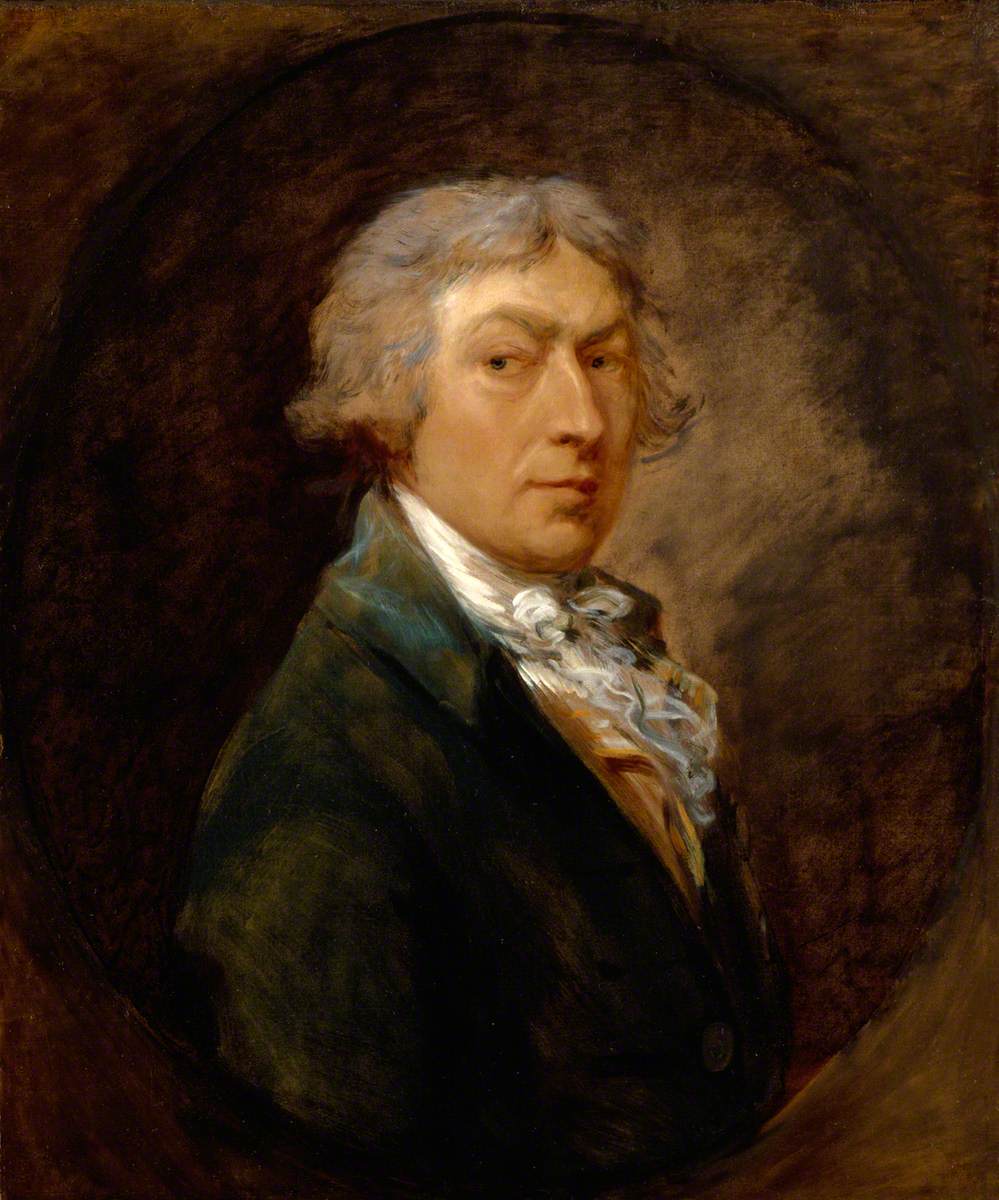
The exhibition tells us that he wanted this self-portrait to be the approved one, with (as the commentary points out) its rather quizzical raised eyebrow, and the air of a calm mature man, confident in his powers and conscious of a life well lived (and note the jazzy, unfinished squiggles which depict his neckerchief. Dazzling sprezzatura and confidence right to the end!)

Self Portrait by Thomas Gainsborough (1787) Royal Academy of Arts, London

Self Portrait by Thomas Gainsborough (1787) Royal Academy of Arts, London

This is a wonderful, gossipy, beautiful and life-affirming exhibition.

Battle of the videos

NPG have commissioned an official video of the show:

But there’s also an informal review by Visiting London Guide which shows more pictures and gives more information.


Related links

More eighteenth century reviews

More National Portrait Gallery reviews

Charles I: King and Collector @ the Royal Academy

King Charles I is most famous for getting his head chopped off in 1649, at the climax of the civil war he had triggered against his Puritan, ’roundhead’ opponents in Parliament.

(I am aware that there’s controversy about all aspects of the wars, from their very name [should it be called the Great Rebellion, the British Civil Wars, the Wars of Three Kingdoms, etc] through to the dates, because the civil wars across all four of his realms actually started with the rebellion of the Scots at having an English prayer book imposed on them in 1637 – which triggered Charles’s hapless manoeuvrings with his Parliament to get them to fund an army to repel the Scots invasion of 1638 – although it wasn’t until rebellion broke out in Ireland in 1641 that the final breach between Charles and his Puritan opponents in Parliament became irreconcilable. It’s a much more complicated story than usually depicted.)

Anyway, before he mismanaged his kingdoms so badly that he triggered war in all three of them (Wales was not a kingdom but a principality) Charles had been one of the most sophisticated royal patrons and collectors of art anywhere in Europe. This big exhibition at the Royal Academy brings together an impressive number of the sculptures, paintings, tapestries and so on that Charles either directly commissioned or purchased through his roving agents from the leading artists of the day. it is a magnificent display of some 150 works of art, ranging from classical sculptures to Baroque paintings, and from exquisite miniatures to monumental tapestries.

Equestrian painting of Charles I with M. de St Antoine by Anthony van Dyck (1633)

Scattered and reunited

A simple but important point about the exhibition – and a demonstration of the vanity of human wishes – is that, having spent a lifetime collecting all these riches, soon after Charles’s execution the new Puritan regime sold them off to pay their soldiers and all these masterpieces were scattered across Europe.

Some were tracked down and rebought by his son, Charles II after his restoration to the throne in 1660, especially the ones which had gone to British purchasers who were no keen to ingratiate themselves with the new king. Most remained abroad and, indeed, made very nice additions to the royal collections of the Louvre and the Prado. But what was returned, along with the works which Charles’s queen, Henrietta Maria, had taken to France and brought back in 1660, went on to form the core of the future Royal Collection.

Charles the collector

In 1623, two years before he became king, Prince Charles visited Madrid. The purpose of the visit was to sound out the possibility of marriage to Maria Anna of Spain, daughter of King Philip III of Spain. Negotiations broke down when the new king, Philip IV, demanded that Charles convert to the Catholic Church and live in Spain for a year as pre-conditions.

But although the diplomatic aim of the visit failed, one thing made a deep impact on the future king of England, namely the huge and dazzling art collection of the Philip IV. This, thought Charles, was the magnificence and grandeur befitting a divinely appointed monarch! Charles went shopping and returned to England with a number of works, including paintings by Titian and Veronese, while agents were sent to France and Italy to snap up anything which came on the market. Thus Charles was able to snap up the famous Gonzaga collection which had been accumulated by successive dukes of Mantua, through the work of Nicolas Lanier, his Master of Music and agent.

It was this collection which included Andrea Mantegna’s monumental series, The Triumph of Caesar, (1484 to 1492) which is given a whole room to itself in the exhibition.

Triumph of Caesar: The Vase Bearers by Andrea Mantegna (1484 to 1492)

But it wasn’t just a matter of liking fine art. A king’s collection bespoke his power, both to the few subjects who saw it, but, more importantly, to visiting ambassadors and princes. According to historian Jenny Uglow, ‘ceremonies were delayed and dinners cooled as he showed visiting dignitaries proudly round’ his collection, including the so-called Bear Gallery containing works like Titian’s portrait of Charles V with a Dog (1533) and Rubens’s Daniel in the Lions’ Den (1616), to the Privy Lodging Rooms which housed works by Titian, Correggio, Giorgione and others; and then, the core of the collection, the Cabinet Room, which held 80 paintings, 36 statues and statuettes, as well as bas-reliefs, miniatures, books, engravings, drawings, medals and precious objects.

Charles V with a Dog by Titian (1533) Museo Nacional del Prado

Moreover portraits, such as those by van Dyck, then had multiple copies made of them which could be sent to foreign monarchs as testaments to Charles’s majesty and glory.

By 1649, Charles’s collection comprised around 1,500 paintings and 500 sculptures. An inventory compiled by Abraham van der Doort (c.1580 to 1640), first Surveyor of The King’s Pictures, recorded the contents of the collection, providing a detailed account of the artistic tastes and high level of connoisseurship within the king’s circle.

Changing British taste

One of the aims of the exhibition is to demonstrate how Charles was the first British monarch to really grasp the artistic culture of the Continent. The Protestant Tudor monarchs (Henry VIII, Edward VI, Elizabeth I), with the brief exception of the Catholic Queen Mary (1553 to 1558), had been wary of Catholic Europe and its culture.

But Charles’s father, James I, changed this policy. During the long reign of Queen Elizabeth Catholic Spain had been the enemy, justifiably so since its king, Philip II, had launched an armed invasion of England, which, if it had succeeded, would have resulted in the forced conversion of the church and people back to strict Roman Catholicism, with untold numbers of arrests, tortures and public burners of recusants.

James came from a different family and tradition and so was able to break with Elizabeth’s policy and seek a rapprochement with Catholic Spain. During his reign the treaties with Spain were moderate but still sparked murmurs of dissent from the Protestant aristocracy. (Anti-Spanish murmurings became louder when the Protestant hero, Sir Walter Raleigh, was beheaded in 1618, largely at the behest of the Spanish ambassador, and as a result of a last, ill-fated expedition to South America in 1617.)

The apotheosis of James I, commissioned by Charles I from Peter Paul Rubens to form the centrepiece of the newly refurbished Banqueting House, completed in 1636

James’s eldest son, Henry, surrounded himself with scholars, artists and musicians and acquired ‘Catholic’ paintings from Holland and from Florence. On Henry’s death in 1612 his collection passed to his mother, Anne of Denmark, who herself became a keen patron of painters, dramatists and architects as well as court masques, and filled her rooms at Somerset House and Oatlands Palace with religious pictures, still-lifes, landscapes and allegorical scenes.

So this was the family atmosphere Charles grew up in, far more relaxed about Catholic culture than his Protestant forebears of the previous century. The Puritans in Parliament disliked this cultural shift, as they had disliked Charles’s trip to Spain (still Europe’s most Catholic power) and then really disliked Charles’s marriage to the Catholic Henrietta Maria, youngest daughter of Henry IV of France, who – to the Puritans’ outrage – was allowed to attend Catholic masses in the Royal Palaces.

But Charles wasn’t alone in his taste for Continental art. Other super-rich aristocrats vied with him to create superb collections, including Thomas Howard (1586 to 1646), Earl of Arundel, and George Villiers (1592 to 1628), Duke of Buckingham. At the height of his success, Buckingham’s palace in the Strand contained over 300 paintings by artists including Rubens, Titian, Tintoretto and Bassano. It became a fashion and a competition.

Titian was the main man. Titian (1490 to 1576) had loyally served Habsburg monarchs, sending them paintings on a wide range of subject from his base in Venice. Titian’s portraits, especially those of the Holy Roman Emperor Charles V, proved him the supreme painter of kingly, military and diplomatic power, and Charles wanted some.

The Allocution of Alfonso d’Avalos to His Troops by Titian (1540 to 1541) Museo Nacional del Prado, Madrid

Charles and Van Dyck

The artist most associated with Charles is Sir Anthony van Dyck (1599 to 1641). Charles persuaded the great Flemish painter to come to London in 1632, where he was appointed ‘principalle Paynter in Ordenarie to their Majesties’.

Triple Portrait of Charles I by Sir Anthony van Dyck (1636)

Van Dyck’s achievement was immense. His fluency and sense of composition, his extraordinary ability to capture not just the likeness but the mood and character of his sitters, was unparalleled. The exhibition includes some of his most spectacular works, including:

  • Charles I and Henrietta Maria with Prince Charles and Princess Mary (1632)
  • his two magnificent equestrian portraits, Charles I on Horseback with M. de St. Antoine (1633) and Charles I on Horseback (1638)
  • ‘Le Roi à la chasse’ (1635)

Many portraits were done in several versions, to be sent as diplomatic gifts or given to supporters of the increasingly embattled king. Altogether van Dyck has been estimated to have painted forty portraits of Charles himself, as well as about thirty of the Queen.

Such was the impact and range of his works that van Dyck became the dominant influence on English portrait-painting for the next 150 years. Charles awarded him a knighthood and a £200 annual pension. When van Dyck died young, in 1641, he was buried in (the old) St Paul’s Cathedral.

The Mortlake tapestries

But it wasn’t just van Dyck. Charles I commissioned some of the most important artists of his day. Beside the ceiling of the Banqueting House (above) Charles commissioned from Peter Paul Rubens paintings such as ‘Minerva Protects Pax from Mars’ (1630) and his ‘Landscape with Saint George and the Dragon’ (1630 to 1635).

Another major highlight of the exhibition is the Mortlake tapestries of Raphael’s Acts of the Apostles. These have a complicated history. In 1513 Pope Leo X commissioned Raphael to design a set of tapestries of the Acts of the Apostles to be hung in the Sistine Chapel. Detailed versions of the works were painted in gouache on sheets of paper which were glued together to achieve the scale required, and these preparatory studies are referred to as ‘cartoons’. These cartoons were the send to Brussels, at that time the premiere centre of tapestry making in Europe. The final tapestries took some time to create but were complete and delivered to Rome by the time of the Pope Leo’s death in 1521.

The cartoons were kept on at the workshops in Brussels for some years, and more versions of the tapestries created from them. But a hundred years later many had found their way back to Italy, to the city of Genoa to be precise. And it was here that one of Charles’s agents ascertained that they were available for sale and so young Prince Charles hurriedly bought them.

His aim was to bring the cartoons to England, where they could be used as models for the tapestry factory established in 1619 by his father, James I, at Mortlake in south-west London, and several partial sets of the Acts of the Apostles were indeed woven here over the next two decades. After passing through the hands of various monarchs, the reassembled cartoons were eventually gifted to the Victoria and Albert Museum. And it’s these huge and awesome works that the visitor can see in a room devoted to them.

The Miraculous Draft of Fishes by Raphael (1515 to 1516)

Summary

To visit the exhibition is to bask, for a while, in the reflected glory and magnificence of royalty, strolling past the masterpieces mentioned above as well as stunning works by other Renaissance artists such as Correggio, Agnolo Bronzino, Jacopo Bassano, Tintoretto and Paolo Veronese as well as Albrecht Dürer, Jan Gossaert, Hans Holbein the Younger and Pieter Bruegel the Elder. What a banquet of Baroque art, a visual feast fit for a king.

The promotional video


Related links

More seventeenth century reviews

More Royal Academy reviews

A Chronology of the Crusades

The Crusades lasted about two hundred years from 1095 to about 1295 and were designed to ‘liberate’ Jerusalem and the Christian Holy Places from the control of Muslim rulers. Although there were later military adventures or social movements which called themselves crusades, they either petered out or were diverted to other targets. Historians squabble over whether there were seven or eight or nine crusades.

Muhammed

632 Muhammed dies.

637 Muslim armies besiege and take Jerusalem from the Byzantines.

The Great Schism

1054 Eastern and Western Christianity finally split after years of drift, crystallising into the Eastern Orthodox church based in Byzantium and the Roman Catholic church based in Rome, their respective followers known as Latins (or Franks) and Greeks.

1063 King Ramiro I of Aragon murdered by a Muslim and Pope Alexander II offers an indulgence (forgiveness of all sins; go directly to heaven) to anyone taking arms to revenge this crime.

1064 to 1066 – A group of about 7,000 Germans, some heavily armed, travel to Jerusalem and back unhindered.

1073 Pope Gregory VII helps organise an army against the Muslims in Spain, promising any soldier he can keep the land he seizes.

1095 Byzantine Emperor Alexios I sends an ambassador to Pope Urban II asking for military help against the growing Turkish threat (in fact the fast-expanding Great Seljuk Empire). Urban sees an opportunity to reassert Western control over the East and starts preaching a new idea: anyone who takes up arms and travels to liberate the Holy Land under the order of the Pope will go to heaven. Killing the infidel will no longer require penance: it will be a penance.

The First Crusade 1096 to 1099

1096 Easter. Peter the Hermit led a mass of maybe 20,000 people to set off to the Holy Land. As they moved through Germany they sparked off a series of massacres of Jews in every town and city. Having reached the Byzantine Empire they were ambushed by Muslim forces and only about 3,000 survived. Official crusader armies departed Europe August and September 1096.

1097 Siege of Antioch until June 1098. Crusaders massacre the Muslim inhabitants and loot the city.

1099 15 July – CAPTURE OF JERUSALEM The remnants of the army enter/liberate Jerusalem, massacre native Muslims, killing all the Jews, burning the synagogue, looting all the holy buildings. The chronicler claims some 70,000 were slaughtered and the streets piled high with corpses.

1100 On Christmas Day in the Church of the Nativity in Bethlehem, Baldwin of Edessa is crowned King of Jerusalem.

[1101 The Crusade of 1101, also known as The crusade of the faint-hearted due to the involvement of soldiers who had turned back from the First Crusade, was in three distinct groups of western soldiers, all of which were soundly thrashed by Seljuk Turks led by Kilij Arslan. As usual when the crusaders took Caesarea they rounded up all the Muslims into the Grand Mosque and massacred them all. And were then themselves beaten and killed by Kilij. The survivors eventually made it to Jerusalem, more as a pilgrimage than a military force.]

1109 The Franks sack the city of Tripoli after a five year siege, then rampage through it, burning the Banu Ammar library, the largest in the Muslim world, containing over 100,000 manuscripts.

1118 Baldwin dies, succeeded by his cousin, Baldwin II.

1124 Tyre falls to the Franks who now hold the entire cost from Egypt to Antioch.

1131 King Baldwin II dies and is succeeded by his son-in-law, Count Fulk of Anjou.

1122 to 1124 The Venetian Crusade A combination of religious fervour (it was sponsored by Pope Callixtus II) and commercial savvy, some 120 ships carrying over 15,000 men left Venice on 8 August 1122: they besieged Corfu to settle a commercial dispute; defeated a navy from Fatimid Egypt; besieged and took the sea port of Tyre, which became a Venetian trading centre, and on the way home ravaged various Greek islands, forcing the Empire to concede their trading privileges.

1135 Pope Innocent II’s grant of crusading indulgences to anyone who opposed papal enemies can be seen as the beginning of politically motivated crusades.

The Second Crusade 1145 to 1149

1144 King Fulk dies. Army of Imad ad-Din Zengi recaptures Edessa (modern Urfa), massacring the men and selling the women into slavery. Which leads Pope Eugenius III to call for another crusade, supported by various clerics, notably Bernard of Clairvaux.

1146 March 31 – Bernard delivers the first of many thundering first crusade sermons. In May and June armies from France and Germany led by King Louis VII and Conrad III set off.

[1147 A group of crusaders from northern Europe allied with the king of Portugal, Afonso I, retaking Lisbon from the Muslims.]

1147 October 25 – Battle of Dorylaeum: Conrad III and his army of 20,000 men was badly defeated by the Seljuk Turks led by Mesud I. The Germans abandoned the crusade and Conrad and the 2,000 survivors retreated to join the forces of King Louis VII of France.

1148 Louis and Conrad’s surviving soldiers besiege Damascus. It ends in complete defeat and a ruinous retreat. ‘St Bernard’s crusade ended in fiasco.’ (p.93)

1150 Louis and Conrad return home, failures.

The Wendish Crusade

1147 German knights attacked western Slavs on their border with a view to christianising them. Henry restarted efforts to conquer the Wends in 1160, and they were defeated in 1162.

[1172 Henry the Lion, Duke of Saxony, made a pilgrimage that is sometimes considered a crusade.]

Saladin

1169 Saladin – Ṣalāḥ ad-Dīn Yūsuf ibn Ayyūb – a Kurdish Muslim from Damascus, is in complete control of Egypt.

1169 to 1187 the campaigns of Saladin to unite the usually warring Arab kingdoms.

1180 King Baldwin IV negotiates a peace treaty with Saladin.

1185 24-year-old Baldwin IV dies, leaving the throne of Jerusalem to the eight-year-old Baldwin V.

1186 Baldwin V dies. The kingdom is weakened by complicated dynastic feuds which lead to Guy of Lusignan being crowned king.

1187 SALADIN RETAKES JERUSALEM Saladin led an enormous army of 30,000 into Palestine and inflicted a crushing defeat on the army of Jerusalem at the Battle of Hattin on 4 July. He took his time capturing all the surrounding towns and then retook Jerusalem on 29 September. In studied contrast to the crusader’s massacre and pogrom of 1099, Saladin enforces his army to respect the city and its inhabitants: not a building was looted, not a person harmed.

When Pope Urban III heard the news he died of a heart attack. On 29 October Pope Gregory VIII issued a papal bull calling for the…

The Third Crusade 1189 to 1192

1189 Frederick I ‘Barbarossa’, Holy Roman Emperor, commanded a vast army which sailed to Constantinople, then fought its way across Anatolia, winning battles but suffering from the heat and lack of supplies. Coming down the other side of the Taurus Mountains, Frederick went for a swim in the river Göksu and drowned. His disheartened troops turned back. Philip II of France, and Richard I of England led their armies on to the Holy Land.

1190 Pre-Crusade pogroms of Jews spread across England climaxing in a particularly violent massacre of Jews at York in March.

1191 Richard the Lionheart captured Cyprus from the Byzantines, then recaptured Acre and Jaffa. But they ran out of food before reaching Jerusalem which he knew, anyway, he didn’t have the force to hold.

1192 Richard negotiates a treaty with Saladin allowing Christian pilgrims free passage, then sails home. ‘Jerusalem would never again be captured by crusaders.’ (Crusades p.151) In Palestine Richard had had a big argument with Leopold of Austria. Now, travelling overland back through Leopold’s territory, Richard was identified and arrested. Leopold handed him over to the Emperor Henry VI who held him in prison for a year before a vast ransom could be organised to buy his freedom.

1193 Saladin dies worn out.

1199 Richard dies of gangrene from an arrow wound at an insignificant siege in Aquitaine.

The German Crusade

1197 Henry VI, Holy Roman Emperor, fulfils a promise to his father. Led by Conrad of Wittelsbach the army landed at Acre and captured Sidon and Beirut, but when Henry died most of the forces returned to Germany.

The North European Crusade

1193 Pope Celestine III called for a crusade against Northern European pagans and his successor Pope Innocent III issued a papal bull declaring a crusade against the pagan Livonians. Bishop Berthold of Hanover led a large army against them, during which the Christian settlers found the city of Riga, although Berthold was himself killed in battle in 1198.

1201 Albrecht von Buxthoeven established Riga as the seat of his bishopric in 1201.

1202 Albrecht formed the Livonian Knights to convert the pagans to Catholicism. The Livonians were conquered and converted between 1202 and 1209.

1217 Pope Honorius III declared a crusade against the Prussians.

1226 Konrad of Masovia gave Chelmno to the Teutonic Knights in 1226 as a base for the crusade.

1236 The Livonian Knights were defeated by the Lithuanians at Saule.

1237 Pope Gregory IX merged the remainder of the troops into the Teutonic Knights as the Livonian Order.

1249 The Teutonic Knights completed their conquest of the Old Prussians. They then conquered and converted the Lithuanians, a process which lasted into the 1380s. The order tried unsuccessfully to conquer Orthodox Russia.

The Fourth Crusade 1202 to 1004: the Sack of Constantinople

1199 Pope Innocent III began preaching the Fourth Crusade in France, England, and Germany. The two military leaders Doge Enrico Dandolo of Venice and German King Philip of Swabia had their own political agendas and when the enterprise turned out not be able to pay the Venetian fleet, they decided to conquer and loot Constantinople instead.

1202 They seized the Christian city of Zara prompting Innocent to excommunicate them.

1203 Easter – the army set sail for Byzantium.

1204 The army entered Constantinople and enacted the complicated plot to put Prince Alexius IV on the throne. Alexius had promised wild amounts of money in return but turned out to be unable to pay. Alexius was murdered in a palace coup; the blind old emperor died; the coup plotter announced himself emperor. All this made it easier for the Latins and their Catholic leaders to give the go-ahead for a devastating sack of the city, which spread out of control to unbridled looting, massacring, churches pillaged and thousands murdered in the streets.

1205 Bulgars defeated the crusaders and remaining Greeks at Adrianople. The devastation of Byzantium permanently weakened the Eastern Empire, didn’t bring its church under Latin rule, as the Pope dreamed, and probably benefited Venice most, which seized control of commerce in the empire.

The Albigensian Crusade 1208 to 1229

1208 launched to eliminate the Cathars of Occitania (present-day southern France) lasted for decades and led to Northern French domination of the South. In July 1208 the crusaders took Béziers and massacred every man, woman and child. When soldiers asked the Abbot how they could avoid killing ‘true’ believers, he replied:

‘Kill them all. God will know his own.’

Mindset of terrorists throughout the ages.

[1221 Pope Honorius III asked King Andrew II to put down heretics in Bosnia. Hungarian forces answered further papal calls in

1234 and 1241. This campaign ended with the Mongol invasion of Hungary in 1241.]

The Fifth Crusade 1213 to 1221

1215 Pope Innocent III called the Fourth Council of the Lateran in 1215. It was at this mass assembly of bishops and cardinals that ‘heresy’ was defined, ‘inquisition’ formalised, Jews were ordered to wear special clothing and Innocent announced his new crusade.

1216 Innocent III dies.

1217 Duke Leopold VI and Andrew II arrived in Acre but failed to assert their power and left.

1219 The remaining forces besieged Damietta in Egypt and captured it in November 1219. But further plans were blocked by the Arab leader Ayyubid Sultan Al-Kamil and the crusaders were forced to surrender and hand back Damietta.

The Sixth Crusade b.1228

1228 Holy Roman Emperor Frederick II, after being repeatedly threatened and eventually excommunicated by Innocent’s successor, Pope Honorius III, for his delays, finally landed at Acre.

1229 RESTORATION OF JERUSALEM – However, both sides being reluctant to fight, Frederick agreed a peace treaty with Al-Kamil which allowed Latin Christians to rule most of Jerusalem and a strip of land along the coast, with the Muslims controlling their sacred areas in Jerusalem. Frederick had himself crowned in the Holy Sepulchre and declared himself the mouthpiece of God. Frederick returned home to find the Pope had organised armies to invade his realm.

1238 Frederick tried to extend his lands into northern Italy and Pope Gregory declared a crusade against him. ‘The Holy War was now being preached not against the ‘infidel’, not even against a heretic – no such charge was made against Frederick – but against a political enemy of the Pope.’ (Crusades p.181) Crusade had become degraded to a purely secular concept.

1239 A force led by King Theobald I of Navarre arrived in Acre in September. Defeated in battle in November, Theobald negotiated another treaty with the Ayyubid Sultan Al-Kamil.

1244 The Destruction OF Jerusalem

The Ayyubids invited Khwarazmian forces whose empire had been destroyed by Genghiz Khan’s Mongols, to reconquer the city. It fell July 15, 1244 and the Khwarezmians completely razed Jerusalem to the ground, leaving it in ruins.
1244 An Arab force led by al-Salih Ayyub seized Jerusalem.

The Seventh Crusade 1248 to 1254

1245 to 1250 King Louis IX of France organized a vast army, set sail in 1248 and landed in Egypt in June 1249. In a series of battles they were defeated, and in 1250 Louis was captured and ransomed for 800,000 bezants, and a ten-year truce agreed.

1254 Louis withdrew to Acre, now the only Crusader territory of any significance, which he built up again until his money ran out in 1254 and he had to return to France.

[1256 The Venetians were evicted from Tyre, prompting the War of Saint Sabas over territory in Acre claimed by Genoa and Venice. The war dragged on for a decade during which both Christian sides allied with Muslim forces and most fortified buildings in Acre were destroyed.

1266 Louis IX’s brother Charles seized Sicily and other parts of the eastern Mediterranean with a view to restoring the Latin empire by reconquering Byzantium.]

The Eighth Crusade 1270

1265 The ferocious Mameluk Sultan Baibars ibn-Abdullah had captured Caesarea, Nazareth, Haifa, Safed, Toron, and Arsuf.

1268 Baibars captures Antioch and massacres its entire population.

1270 These events inspire King Louis IX of France to sail to Tunis with a large fleet and impressive army. However it was the height of the Saharan summer, the army was devastated by disease and Louis died. Thus ended the last major attempt to take the Holy Land.

The Ninth Crusade 1272

1270 The future Edward I of England had travelled with Louis. He sailed with his forces to Acre in May 1271. His forces were small and he was unable to alter the existing peace treaties between Baibars and King Hugh of Jerusalem.

1272 Edward learned of his father’s death.

1274 Edward I returns to England to take up his crown.

1277 The fearsome Baibars dies.

The last crusade

1281 Election of a French pope, Martin IV who threw himself behind the campaigns of French king Charles I. His ships were at Sicily when the Emperor of Byzantium conspired to provoke the ‘Sicilian Vespers’, an uprising during which the crusader fleet was abandoned and burnt.

1287 King Charles I dies, allowing Henry II of Cyprus to reclaim Jerusalem.

These kinds of struggles are typical of the endless disunity and conflict among the Roman Christians which continually undermined efforts to hold the Holy Land. In this two hundred year period the papacy, far from creating the kind of total control over Christendom which Innocent and Urban dreamed of, had become just one among a hectic throng of nationalist kings and princes all fighting each other. The papacy had lost all its moral authority. Thus:

1284 The Crusade of Aragon was called by Pope Martin against Peter III of Aragon, Peter supporting anti-Angevin forces in Sicily, Martin supporting Charles of Anjou.

1298 Pope Boniface VIII proclaimed a crusade against Frederick III of Sicily (Peter’s younger brother).

The end of the Crusader states

1291 A group of pilgrims from Acre was attacked by Muslim forces and in retaliations killed some innocent Muslim merchants. The Sultan demanded compensation from the king of Acre and, when none came, used it as a pretext to besiege and then capture the city. Men, women and children were massacred: prisoners were beheaded. Acre had been the last independent Crusader state in the Holy Land and its fall signified that – The Crusades had ended.

Non-Holy Land ‘crusades’

1365 The Alexandrian Crusade Peter I of Cyprus captured and sacked Alexandria for mainly commercial reasons, killing as many Christians as Muslims and Jews.

1390 The Mahdian Crusade Louis II led a ten-week campaign against Muslim pirates in North Africa. After a siege the crusaders signed a ten-year truce.

1396 Crusade against the Ottomans led by Sigismund of Luxemburg, king of Hungary which was defeated by the Ottomans in the Battle of Nicopolis.

1420s The Hussite Crusades military action against the followers of Jan Hus in Bohemia from 1420 to about 1431. Crusades were declared five times during that period: in 1420, 1421, 1422, 1427, and 1431.

1440s Crusade against the Ottomans Polish-Hungarian King Władysław Warneńczyk invaded recently conquered Ottoman territory, reaching Belgrade in January 1444. Negotiated a truce with Sultan Murad II. The Ottomans won a decisive victory at the Battle of Varna on 10 November, and the crusaders withdrew. This left Constantinople exposed and it fell to the Ottoman Turks in 1453.

John Hunyadi and Giovanni da Capistrano organized a 1456 crusade to lift the Ottomon siege of Belgrade.
1487 Pope Innocent VIII called for a crusade against the Waldensians in the south of France but little military activity followed and it had no effect…


Sources

Other medieval reviews

Shoes: Pleasure and Pain @ Victoria & Albert Museum

A wonderful exhibition of the fantastical designs, shapes, engineering, ingenuity and expertise the human imagination has brought to the humble shoe, a basic item of equipment invented to protect feet from the environment which, throughout human history and around the globe, has mutated into thousands of patterns and purposes and continues, in our time, to inspire designers and craftsmen to ever giddier flights of fancy.

The show brings together over 200 pairs of shoes, ranging from a sandal decorated in pure gold leaf from ancient Egypt to the most elaborate concoctions of contemporary makers.

One sandal, gilded and incised leather and papyrus, Egypt
(c.30 BC to 300 AD) © Victoria and Albert Museum, London.

The exhibition is divided into two parts:

  • Downstairs the carpet, walls and curtains are all a dark purple, creating a womb-like ambience as soothing new age music pipes through hidden speakers and visitors process past glass panels each showing 10 or 15 or 20 shoes of amazing variety, antiquity and geographical spread.
  • Upstairs is light and white, the stands are on a big circular podium open to the enormous atrium room, with huge video screens suspended from the ceiling showing craftsmen at work creating shoes, a series of cases showing how shoes are designed and constructed, as well as several cases dedicated to the collections of some epic shoeaholics, and a 12-minute video featuring interviews with such shoe gods as Manolo Blahnik, Sandra Choi and Christian Louboutin.

Killer Heels at the Brooklyn Museum

It just so happens that I went to the ‘Killer Heels’ exhibition at the Brooklyn Museum this time last year. It focused more on the glitz and glamour of contemporary designers whereas the V&A show features more examples from around the world and from past eras – as befits the world’s leading historical museum of design. The V&A show definitely brought together a much wider range of footwear but, I think, was less penetrating in its analysis.

For example, where the V&A points out that shoes can be sexy and seductive, the Brooklyn show goes the extra mile to show exactly why, explaining that high heels:

  • push the chest out
  • lift the bottom
  • make the legs appear longer and therefore thinner
  • make the calves more taut and rounded
  • make the feet appear smaller

In other words, high heels make the wearer’s body seem less stumpy and clumpy (less like the body most of us actually possess) and taller, leaner, more agile and athletic, while emphasising bust and buttocks. In biological terms, they highlight a woman’s fertility, youth and fitness as a mate. On a cultural plane, they dramatise a woman’s sexuality and have done for centuries.

 'Parakeet’ shoes Artist: Caroline Groves, England (2014 ) Photography by Dan Lowe .


‘Parakeet’ shoes by Caroline Groves, England (2014) Photography by Dan Lowe.

Folklore, fairy tales and myths

The show starts with the Cinderella fairy story which dates in one form or another back to the first centuries AD. It makes the central point of the show: Cinderella is the virtuous girl whose shoes elevate her literally and socially. Cinderella’s life is transformed because wearing high-heeled shoes gets her noticed by the heir to the throne, the handsome prince. This is the focus of the exhibition – the way that across space and time, the wearing of fancy shoes signals privilege, rank and status.

The same display case goes on to mention other examples of powerful and transformative footwear: the Seven League Boots worn by Hop o’ my Thumb. Reference is also made to Puss In Boots, surely the smartest cat to wear shoes, but not to the Old Lady Who Lived In A Shoe, nor to Hermes, the messenger god with little wings attached to his ankle boots. I would have liked more about the importance of footwear in myth and legend. I bet Marina Warner could write an entire book on the subject – I’d have liked a thoughtful paragraph or two.

Film footwear

Too quickly for my taste the eye was drawn away from the depths of myth and legend to the shallows of shoe-ey film clips: There’s a short bit of Dorothy in The Wizard of Oz tapping her ruby slippers, as well as clips of Gene Kelly dancing in the rain and Marilyn Monroe tottering along on high heels which emphasise her waggling bottom. On actual display are the red shoes worn by dancer and actress Moira Shearer in the classic Powell & Pressburger film The Red Shoes, which give their wearer her semi-magical power of dance, but also propel her to her death. Yes, and, and…?

Again I bet there are umpteen studies of footwear in films and it would have been interesting to have had even a few sentences analysing how, for example, close-ups of footwear are a useful shorthand to quickly identify character types, or any other suggestions or thoughts…

Red ballet shoes made for Victoria Page (Moira Shearer) in The Red Shoes (1948), silk satin, braid and leather, England Artist: Freed of London (founded in 1929), Date: 1948 . Photograph reproduced with the kind permission of Northampton Museums and Art Gallery.

Red ballet shoes made for Victoria Page (Moira Shearer) in The Red Shoes (1948), silk satin, braid and leather, England. Freed of London (founded in 1929). Photograph reproduced with the kind permission of Northampton Museums and Art Gallery.

Status and display

Instead the exhibition is rarely distracted from its core mission which is to show how footwear is overwhelmingly about status and display. It is about how rich you are, how your footwear asserts your membership of an elite group or class or circle. Many of the shoes are celebrated for their impracticality: they display and assert that the wearer is quite incapable of physical labour or looking after themselves or managing even the slightest physical obstacle, they are so pampered.

One wall label rather casually pairs Queen Henrietta Maria and Sex and the City‘s Sarah Jessica Parker as ‘style leaders’ whose shoes (and overall look) other people copied. Well, Henrietta’s main achievement was contributing, via her Catholicism, her luxury and her inflexible snobbery, to the unpopularity of her husband King Charles I who plunged his country into civil war and was eventually beheaded.

The exhibition treats ‘status’, being a member of an ‘elite’, of ‘an exclusive circle’, as cost-free activities, as if this appetite for inclusion doesn’t imply a mass exclusion, keeping out the vast majority of people who aren’t in the charmed circle.

The displays range impressively far and wide in its examples: there are shoes from the Ottoman Empire, Ming Dynasty China, Meiji Japan, from Caroline England, from a rajah in pre-Independence India – all regimes which were overthrown in violent revolutions. What role did (and do) ostentatious shoes play in alienating the 99% of the population not allowed or too poor to wear them? Maybe there is no meaningful answer, but the question goes unasked…

Chopines, Punched kid leather over carved pine, Venice, Italy, c. 1600. © Victoria and Albert Museum, London.

Chopines, Punched kid leather over carved pine, Venice, Italy, c. 1600

Sex

In the (surprisingly) small panel about fetish boots and sex, the commentary makes some rather sweeping generalisations:

  • The modern high heel is associated with sexual availability rather than just desirability.‘ Really? As I wrote in my review of the Brooklyn show, I’d have thought it’s more that expensive shoes, especially heels, are about adopting a role, assuming a pose, feeling more glamorous and attractive. Not at all the same thing as making yourself sexually available. For most people most of the time, I’d have thought the sexual suggestiveness of high heels and glamour shoes is implicit, repressed, unacknowledged, beneath the socially (and personally) acceptable activity of making yourself look ‘glamorous’, ‘gorgeous’, ‘classy’, ‘enchanting’, ‘smart’.
  • Further, the commentary asserts that ‘sexy shoes affect the movements of the body, titillating the watcher and creating a sensual experience for the wearer… Shoes equal sex.’ Well, quite obviously most shoes do not equal sex. And, as and when they do, it’s surely in a number of ways: the Brooklyn exhibition put into words precisely how heels cantilever the female form to emphasise its sexual characteristics. But thigh length boots, stilletoes, studded shoes? I could have done with more explanation, from psychologists or sexologists, about just why shoes can be so erotic.

Scores of the shoes and boots scattered randomly throughout the exhibition are doubtless ‘sexy’, designed to emphasise a woman’s sexuality, designed to cater to (changing) sexual tastes through the ages – but restricting this big theme to one small display case, for me raised but then didn’t sufficiently explore the idea.

‘Invisible Naked Version' by Andreia Chaves (2011) Photo by Andrew Bradley .

‘Invisible Naked Version’ by Andreia Chaves (2011) Photo by Andrew Bradley.

Shoes and control

In fact, one of the themes that emerges from the show is that many shoes through history were designed not to flaunt their wearer’s sexuality, but to cripple the wearer, to severely restrict their ability to walk. The Japanese prostitute heels linked to above, are one example. Another well-known extreme is the terrifying traditional shoes worn by Chinese women, whose feet had been broken and bound in order to look petite and exquisite.

Clearly some cultures developed traditions designed to hamper walking in all sorts of ingenious ways. For some cultures the motive was to highlight the wearer’s wealth and status, emphasising that they didn’t need to move very much because everything was done for them, brought to them. For another large group, mainly women, their ability to walk was limited by their masters, who thereby demonstrated their power and control.

Again, I’d have welcomed some thoughtful commentary about the importance of shoes as implements of power and control through the ages. Maybe sustained investigation of these themes is in the exhibition book…

Below are silver platform shoes, named padukas, traditionally given to brides in India to create height, and to emphasise (as usual) their wealth and status. I imagine the most the wearer could manage would be a shuffle. Maybe a cautious totter…

Wedding toe-knob paduka, silver and gold over wood, India (1800s)

Wedding toe-knob paduka, silver and gold over wood, India (1800s)

Work and gender

The curators know their audience, white, middle-class, older, female. The world of work, and especially the vast world of male physical labour, is largely invisible. All forms of working boot, steel-capped boots, footwear worn on building sites and in factories, by sailors and truck drivers, was not here. I particularly missed Doc Martens, that symbol of skinheads and the violent 1970s (which have, in fact, largely reinvented themselves as style accessories).

For as well as physical labour, the equally male world of violence is largely invisible, the bloody civil war which the extravagance of Henrietta Marie helped to spark and the elaborately be-shoed Charles II managed to escape, nowhere mentioned.

The Duke of Wellington is here because of his well-known boots but nothing else about Army or Navy or Air Force footwear, riding wear, driving wear, flying wear, climbing wear. Tucked away in a corner of one display were some fantastic glam rock platform boots from 1973, which the original owner is quoted as saying were good for ‘kicking the shit’ out of other men. But for the most part, marching, tramping, working, kicking, fighting, all these male foot-related activities are invisible.

NOVA by Zaha Hadid for United Nude © Image Courtesty of United Nude

Makers and collectors

Upstairs the focus shifted to the making and collecting of shoes. There were several stands devoted to explaining just how shoes are designed, how patterns are generated from the prototype and then the necessary shapes cut from leather. There was an array of heels, the same shape, but painted different colours and with various diamante applications, which I found fascinating. I was also interested to learn that the metal spike heel was invented in the 1950s, which allowed designers to play with a whole new type of look.

Around the corner is a brilliant semi-circular 7-foot-high wall made of everyday cardboard shoeboxes. I really liked this as a piece of sculpture, but it’s also practical for it creates an auditorium effect, there are benches placed in front of it and in the middle is suspended a big video screen on which plays the 12-minute video I mentioned earlier, featuring interviews with shoe gods Manolo Blahnik, Sandra Choi, Christian Louboutin and others.

The final section of the exhibition contains a number of cases which display the collections of several notable collectors of shoes. Lionel Ernest Bussey collected shoes from about 1914 until his death in 1969, all ladies shoes bought from fairly ordinary shoe shops. By the time of his death he’d collected about 600 pairs, all new and unworn, many not even taken out of their boxes. He left his collection to the V&A. Robert Brooks (age 42) collects just adidas trainers and travels the world to acquire rare items for a collection which now numbers over 800 pairs. Also featured is Katie Porter from west London who has more than 230 shoes in her collection.

Why? We are invited to marvel at these impressive collections, but I’d have welcomed a sentence or two exploring and explaining the psychology of collecting, and of collecting shoes in particular.

Installation view of Shoes: Pleasure and Pain , Victoria and Albert Museum, London.

Installation view of Shoes: Pleasure and Pain, Victoria and Albert Museum, London. Note the wall of shoe boxes in the background and the display of Robert Brooks’s adidas trainers in the foreground.

Lighten up

But maybe I was expecting too much. Maybe I’m missing the point: maybe it is simply that all these shoes – removed from their historical contexts, from too much depth or meaning – are all transformed by this exhibition into objects of fantasy and escape. The exhibition invites us to gawp and marvel and not dig too deep.

We ordinary folk who can never afford Henrietta Maria chopines or Sarah Jessica Parker’s Blahniks, can enjoy them, and hundreds of other weird and exotic specimens, here in the V&A and, by extension, on the internet, in magazines, in videos. Via all these channels we can enter, without too much thought, into magical worlds where we are all thinner, taller and richer, where we all live for a moment more interesting, colourful lives, in remote historical eras and exotic countries, inhabiting the countless fantasies these amazing and endlessly inventive objects offer us. Maybe marvelling and admiring is enough.

On YouTube

A good overview of the show by Euromaxx TV.


Related links

More V&A reviews

The Trial of Charles I by Dame Veronica Wedgwood (1964)

I own about 50 books on the Civil Wars and am a member of the Cromwell Association, have attended lectures and visited battlefields and key Civil War sites. If you asked me what to read on the subject I would unhesitatingly recommend the ageing but brilliant trilogy of books by Dame Veronica Wedgwood (1910 to 1997):

  • The King’s Peace (1955)
  • The King’s War (1958)
  • The Trial of Charles I (1964)

The reason is simple. All the other books I’m aware of are either high-level overviews of the entire period (from the 1630s or earlier, to the Restoration in 1660) or specialist books by professional historians arguing a particular thesis or interpretation. Wedgwood’s books are the only ones I know of which give a straightforward, chronological account of what happened on an almost daily basis. This level of detail about the helter-skelter of day-to-day events, the rush and pressure of unpredictable crises and alarm, is crucial to understanding the decisions the key players made as they struggled to understand and control events.

Ten fateful weeks

Wedgwood concentrates on the 10 weeks between Cromwell’s Army, on 20th November 1648, laying before a reluctant Parliament their demands that the king be brought to trial – and the execution of the king January 30 1649. First she sketches in the background and the key political groups which had emerged during the Civil War:

The Royalists

Mostly in exile or hiding after the failed rising or ‘second civil war’ in the Spring and Summer of 1648 which had been convincingly crushed by the New Model Army. Royalists throughout the land were being repressed and, if they’d helped in the uprising, often had their land and money confiscated.

The Army

Under its brilliant commander Sir Thomas Fairfax the army had emerged victorious in the second civil war, defeating all Royalist forces. This battle-hardened army was to go on to occupy Scotland and then storm through Ireland. But the Army was divided into two faction:

  1. The Levellers During the war there emerged from the common troops, formerly uneducated men who had found a voice and confidence through their success and solidarity, a group nicknamed the Levellers, who demanded a comprehensive overhaul of the English State, starting with free elections on the basis of universal male suffrage to form a new House of Commons with a mandate to review Common Law, abolish the Church of England, abolish tithes and so on. Their most effective leader was the young, impassioned John Lilburne, once whipped through the streets of London at Charles’s order for slandering the Court.
  2. ‘The Grandees’ This was the Levellers’ nickname for the landed gentry and aristocrats who led the Army, who opposed the king on legal or religious principle but had not the slightest interest in reordering society, who were convinced that would lead to anarchy. They formed a small Council of the Army, dominated by the ruthless workaholic Henry Ireton, who happened to be son-in-law to Cromwell.

Parliament

The House of Lords

Heavily biased towards the king, most of the Royalists were abroad in exile, in hiding or dead. In the leadup to the trial sometimes as few as six Lords attended some sessions.

The House of Commons

Claiming to represent the people of England, the Commons was already diminished by up to 200 of the original members of the 1642 House. Even so it was still dominated by the Presbyterians, so-called moderate Puritans who desperately wanted to reach agreement with the king. It was these moderates that Charles had been stringing along since 1647 while he hoped against hope for further uprisings or help from a foreign government to free him.

The Army MPs

Oliver Cromwell, Henry Ireton and some 20 others combined leadership positions in the Army with membership of the House of Commons and used their position repeatedly to get the Army’s way.

Pride’s Purge

When the Presbyterian majority in the Commons delayed debating the Army’s demand for a trial, events took a dramatic turn. On December 5th Colonel Thomas Pride stood with a small troop of soldiers outside Westminster Hall and, as each MP arrived, he only let through the ones favourable to the Army, taking into custody all those opposed. Only 45 MPs were let in. It became known as ‘Pride’s Purge’. It was in effect a military coup, ensuring that the Parliament whose rights and prerogatives Cromwell and the others took up arms to defend in 1642, now consisted of few if any Lords, and only a hard core of MPs favourable to the Army’s wishes. A rubber stamp.

The Commission

This reduced ‘Rump’ was persuaded to set up a Commission with 135 members to administer the trial and decide the king’s guilt. Of this hand-picked group rarely more than 60 attended any of the sessions. Wedgwood gives a brilliant, day by day of the trial and the central clash – between the obscure lawyer John Bradshaw chosen to run the court, who repeatedly tried to get Charles to enter a plea – and the dignified king who knew the law inside out and refused to acknowledge the legitimacy of the court.

The conflict

Charles I was convinced he had a God-given duty to preserve not only the laws and traditions of England, but the rights and prerogatives of the Crown, as handed to him by his father, in order to hand them on to his son. The religious zealots in the Army were convinced that Charles’s defeat in the first and second civil wars showed beyond doubt that God had decided against him, that he was guilty of starting the war in the first place, and therefore was the ‘Man of Blood’ as they called him, and deserved to die. More practical Roundheads like Henry Ireton probably Cromwell just simply realised there was no dealing with this king. One way or another they had been trying to negotiate with him since 1640 and it had led to nothing but bloodshed, political collapse, economic depression, while the king endlessly prevaricated and endlessly schemed, trying to get the Scots to invade, to raise an Irish army, to persuade the French king to aid him.

Wedgwood’s account brilliantly conveys why both sides were convinced God was on their side, and how the different interpretations of what that meant led to complete stalemate. The only way to break the stalemate was to remove one of the players.

Reactions to the execution

The execution of the king was very unpopular. Even within the Army there were protests. The Presbyterian interest in London and beyond opposed it. It prompted the Presbyterian Scots to declare war on England. Royalists sincerely considered it the most heinous act since the Crucifixion of Christ, to which it was immediately compared.

Cromwell

War in Scotland and Ireland took up Cromwell’s time over the next few years while the Rump Parliament gained a damning reputation for corruption until, in April 1653, Cromwell ejected it by force. Leaders of the Army offered Cromwell the crown. He refused but accepted the title Lord Protector in December 1653 and set about instituting the godly, fair and just government he had hoped for. But the various experiments in democracy, nominated Parliaments, and rule by military Governor-General all failed. Cromwell died in September 1658, almost ten years after he’d led the men who executed Charles I.

The Restoration

Within a year his regime had unravelled, the Protectorate collapsed, and the strongest surviving military figure, General Monk, bowing to popular demand and political realism, invited Charles II to return to Britain and take the throne.

The disappearance of Christian belief

As Wedgwood concludes, the strongest element in these events, the devout and sometimes fanatical Christian belief of all the players involved, is the one that has most faded from contemporary view, becoming almost inaccessible from our modern perspective. We fill the gap with Marxist or mercantilist or psychoanalytical, with political or biographical interpretations. But it was upon the rock of a shared Christian faith, reflected through vastly different interpretations, that all four nations in the British Isles came to bloody grief for 20 long years.

‘Cromwell before the Coffin of Charles I’ (1849) by Hippolyte Delaroche. Hamburger Kunsthalle


More seventeenth century reviews

The Pleasures of the Imagination: English Culture in the Eighteenth Century by John Brewer (1997)

It was in the 18th century that the notion of the arts or high art separated from lower, mechanical activities & trade. Poetry, music, painting, sculpture, all dated back to antiquity – but the idea of linking them all into a new category, a separate field of investigation, as done by philosophical pioneers by Kant or Burke, was an 18th century innovation.

The word ‘aesthetics’ was coined in the 1750s – a new area of philosophical study.

The figure of the connoisseur (French) appears, supported by the concept of ‘taste’ and ‘good taste’, separate from the king & aristocracy, the previous sole guardians of taste.

Similarly, the figure of the impresario (Italian) – the middleman, the artistic manager, art dealers, printers & engravers, a Europe-wide network of people feeding the growing demand for ‘art’ from a newly affluent middle class.

David Hume & Adam Smith associated the civilising arts with the influence of commerce in bringing together remote people in a common cause. 18th century polite society was urban – a thing of coffee shops and salons and exchanges and assembly rooms and dining clubs and reading societies – where a wide range of people could meet and debate – no longer with courts.

Critics & sociologists, by defining polite, commercial, refined & tasteful society, also created their opposite, the vulgar, peasant cultures of, for example, the Scottish Highlands – or the backward savage cultures of America & Tahiti. Only later in the century did intellectuals begin to hanker after the folk traditions, stories, poems, legends, songs which had allegedly been expunged by the spread of civilisation – the origins, for example, of the taste for ‘the Celtic’, as explained in the British Museum exhibition Celts: Art and Identity – which also became a component of the Romantic Movement.

The King and Court

After the Civil War no monarch had the money or could get it off Parliament to realise the kind of extravagant building plans executed on the Continent by, for example Louis XVI (Versailles). Charles II couldn’t afford Christopher Wren’s grand plans to rebuild Whitehall, James II didn’t have the time, William III was sour & anti-social, preferring his palaces in Holland, though he grubbed the money to pay for Wren to refurbish Hampton Court. The Georges were foreign and so didn’t want to waste money on English palaces.

First half of the 18th century: The Kit-Kat Club (1696-1720) symbolises the move from Court – royal patronage & libertinage – to the ideals of a civilised society of polite gentlemen, as described in the new Tatler and Spectator magazines. Members; Addison, Steele et al.

Second half of 18th century: Dr Johnson’s Literary Club (1764-94): Johnson, Garrick, Reynolds, Burke.

Polite society

Politeness as a cure for the severe stresses left by the Civil War: politeness more important than ideology or creed: politeness ensuring tolerance & peace. As promoted in the hugely influential Spectator and Tatler.


Related links