Orientalism by Edward Said, Afterword (1995) and Preface (2003)

This blog post is a summary of the 1995 Afterword and 2003 Preface which Edward Said added to his classic work of cultural criticism, ‘Orientalism’, itself first published in 1978.

Afterword (1995)

Said starts off by remarking on the surprising success of the book, which had become a bestseller and been translated, as he wrote, into at least 10 languages, having an influence and life far greater than he ever expected.

Then he sets out to address several misconceptions. One is that the book aims to be a comprehensive attack on the West. The other is that it is an unquestioning defence of Islam or the Arab world. This second one couldn’t be further from the truth for the simple reason that he is not qualified:

I explicitly say that I have no interest in, much less capacity for, showing what the true Orient or Islam are really like. (p.331)

Nonetheless, Muslim fundamentalists apparently welcomed the book as it was a huge indictment of Western Islamophobia. Said is not thrilled to find himself in this company which he regards as being as essentialist as its opposite, Orientalism. By essentialism he means the belief in fixed, unaltered, almost Platonic ideals or essences, in Islamic fundamentalism’s case, a belief in the timeless, unchanging, eternal truths of a primeval and pristine Islam.

Whereas Said again and again says he believes the opposite. He is anti-essentialist, he is trying to deliver the anti-essentialist message that history is made by people, that ideas are created, invented, nurtured and adapted by people who are themselves the products of societies with intellectual constraints and ideological pressures and so on. This view underpins his scepticism about academic world in general and the disciplines connected with Orientalism in particular.

My objection to what I’ve called Orientalism is not that it is just the antiquarian study of Oriental languages, societies and peoples, but that as a system of thought it approaches a heterogeneous, dynamic and complex human reality from an uncritically essentialist standpoint; suggesting both an enduring Oriental reality and an opposing but no less enduring Western essence which observes that Orient from afar and, so to speak, from above. This false position hides historical change. (p.333)

(The fact that he keeps having to restate his position reinforces my experience of his book as being slippery, obtuse, imprecise and hard to understand. He’s a desperately poor communicator. He sounds good, he sounds like he’s making awesome sense, but, in the end, there’s just a handful of ideas which he restates in countless ways.)

So he spends nearly a page recapping the facts about Napoleon’s Description of Egypt, the starting point of modern Orientalism, and the subtlety of its interplay with local Arab accounts of the same events because this is what he’s trying to achieve, a subtle sense of the complex interplay of texts and ideology which are continually changing ideologies and ideas, an ongoing dialectic – before repeating that he was not about something as vulgar and simplistic, as binary, as just pitting East and West against each other, let alone creating either an anti-Western or a pro-Islamic work.

Hmm. He can tell us that he intended it to be a subtle and sophisticated account all he likes (he flatters himself that his account is ‘nuanced and discriminating’) but, to be honest, I thought Said’s book was profoundly and howlingly anti-Western, fierce criticism of Western attitudes mentioned on every page, occasionally rising up to really angry diatribes against Western prejudice and racism and colonialism. One Arab reviewer, he tells us, described the author as:

a champion of the downtrodden and abused, whose mission was to engage Western authorities in a kind of epic and romantic mano-a-mano

The second reason why he thinks his subtle, ‘nuanced and discriminating’ message has been overlooked is the brutality of contemporary politics. Little did he know that the year after it was published Iran would witness the great Islamic Revolution and that this would be followed by new depths of brutality in the Arab-Israeli conflict i.e. the 1982 invasion of Lebanon and the 1987 start of the Palestinian intifada. Then there was the 1979 Soviet invasion of Afghanistan to which the West responded by arming the mujihadeen, then the rise of Gorbachev, then the collapse of the Soviet Union, the end of the Cold War, alongside the First Gulf War against Saddam Hussein.

The thing is, Edward, if you tie your book to highly contentious issues in international affairs (Israel, Palestine, Islamic fundamentalism, Western neo-imperialism) then your book will inevitably get caught up in the maelstrom surrounding all these complex, continually changing events, with two results:

  1. People on all sides will try to co-opt you for their cause.
  2. ‘Events, dear boy, events’; the world carries on its violent unpredictable way and, if you’ve tied your text to the tiger’s tail, you’ll find yourself being dragged along behind it.

Like all his writings, this Afterword is long but goes round and round in circles, repeating that he wanted to avoid an ‘Orient-versus-Occident opposition’ and yet insisting on using the simple binary terms ‘the Orient’ and ‘the West’ that litter the main text; insisting that he thought he was offering ‘a multicultural critique of power using knowledge to advance itself’ while anyone who reads the book encounters impassioned protests against the abuse and exploitation of ‘the Orient’ and ‘Orientals’ at every turn.

He talks bravely about ‘crossing’ the barriers of the ‘imperial East-West divide’ in his own life, and seeking to rise above it, and yet…what has he just called it, what does he call it throughout the book? An ‘East-West’ divide. He insists that his analyses of each different author and each different era are distinctive, different, nuanced etc, but that’s not how I read it. Whatever distinctions he thinks he makes between eras and authors are continually being collapsed when he claims that they all are based on the same, basic latent Orientalism which underpins prejudicial views of ‘the East’ in 1780, 1860 or 1910.

In fact, the reader struggling to the end of this 350-page book emerges with a hugely expanded sense of a much deeper divide between East and West than I previously appreciated. Said’s book seems to me to exacerbate the very problem he claims to be curing.

He has an entertaining passage criticising (insulting) the eminent Arabist Bernard Lewis, an expert in the field who, nonetheless, despises the Arab world and Islam he knows so much about, and who, predictably, wrote a scathing and personal review of Orientalism when it came out. Now Said returns the favour with some biting criticism.

The second part of the Afterword is much more understandable and interesting. It is a pithy overview of developments which had taken place between 1978 and 1994 in academia, in studies of culture and history. These were the rise of feminism, black studies, post-colonial studies and subaltern studies (a history-from-below perspective applied to south Asia i.e. India, Pakistan etc).

What they all had in common was the aim of restoring the voices of types of people erased or overlooked by the traditional white European male narratives of history and culture. And, as part of this, overturning monolothic and essentialist narratives. of East and West etc. Modern developments in all these fields have all tended to show that history is far more complex, mongrel and interactive than previously thought. And Said is (justifiably) proud that his book (profoundly flawed and difficult though I, personally, found it to be) has contributed to these developments.

Preface (2003)

Born in 1935, Said was 43 when Orientalism was published, 50 years old when he wrote the Afterword, and 68 when he wrote this Preface. He says he feels old. He was to die later the same year from leukaemia.

Said begins by expressing his ongoing amazement that a book he produced as a personal project has gone on to become a worldwide (academic) bestseller, translated into 40 languages, and hugely influencing the new(ish) disciplines of post-colonial and subaltern studies.

Then, as W.H. Auden wrote, ‘Let your last thinks all be thanks,’ and so Said generously thanks colleagues and the entire American university system, specifically Columbia University, New York, his employer for 30 years. He says in his entire career he published plenty of articles about Palestine, but never actually taught anything about the Middle East. His day job was teaching comparative literature for all those years, his first love and the profession he was trained to.

Whereupon he picks up the cudgels again to repeat all his arguments. He tells us (as he did in the Introduction and in his 1999 memoir, ‘Out of Place’) that he grew up between two contradictory worlds, the Arab world and the West.

One fundamental thing I find puzzling about Said’s entire schtick is that he repeatedly says he wrote Orientalism to try and abolish the naive binary of East and West, yet he invokes it every turn, as here, in the rather tired trope of growing up ‘between two worlds’. He asserts for the umpteenth time that neither term ‘the Orient’ nor ‘the West’ have any ontological stability and yet here he is, using them both in exactly the same way he did 25 years earlier, and as we do today (2023) i.e. as if they have exactly the ontological stability he claims they don’t have.

Back to current affairs and he tells us the fairly obvious fact that 2003 was an even more politically turbulent time than 1978 or 1994. Again I bridle at this idea, it’s a classic example of two tropes ever-present in our culture. One is presentism, which is where a political commentator claims that the present moment is more critical, urgent and crisis-ridden than ever before, evah!

Check out any one of the daily articles in the liberal press wringing their hands at the prospect that Donald Trump might be elected president again and that this time it will mean the end for democracy in America. In other words, fostering the same atmosphere of panic that they all did last time, for the long year of the presidential campaign and then the gruelling four years of Trump’s presidency, when the liberal press overflowed with outraged articles about every single presidential tweet.

But of course, a properly historical perspective, such as Said is always saying we must take, militates against the view that the present is somehow uniquely and unprecedently critical and urgent: the outbreak of World War Two was a pretty critical moment, the attack on Pearl Harbour, the dropping of the atom bomb, the outbreak of the Korean War, the Suez Crisis, the Cuban Missile Crisis when the world nearly ended, I could go on.

To take one of cardinal years in Orientalism‘s publishing history, 1978 wasn’t a particularly turbulent year, but 1979 was the year of the Iranian Revolution and the Soviet invasion of Afghanistan, which are both having repercussions to this day. To look closer at the year of the Afterword, 1995, this was just a year after the Rwanda genocide, a pretty turbulent year if you lived in Rwanda, and the terrible war in Bosnia and siege of Sarajevo was still ongoing, a running sore in Europe’s conscience.

Today, as this is published, is day 579 of the war in Ukraine, I don’t know how many days into the civil wars in Syria, Yemen and Libya, a month of more into the civil war in Sudan, and month into the coup in Niger, and so on.

Plus climate change plus the Conservative government plus the collapse of the NHS plus the threat of another pandemic etc etc etc.

So my point is simple: it’s always terrible times.

The second reason this is such a tiresomely common trope is because political commentators have to make a living and so have a vested interest in persuading their editors and readers that we live in times of unprecedented jeopardy and that, if you want to understand why, you simply have to buy my article / magazine / book.

Quite obviously 9/11 was an epoch-making event which created a genuine sense of crisis around the world (or the Western world, anyway) and Said, writing in 2003, was doing so against the backdrop of a campaign of anti-Arab rhetoric being orchestrated by the Bush administration to justify its upcoming invasion of Iraq. It was a bad time for anyone trying to improve relations between ‘the West’ and ‘the Arab world’.

Trying to be even-handed, he laments that this is all taking place against a resurgence of pride and arrogance in both the West and the Arab world. It was definitely a bad time to be the kind of liberal exponent of calm and reason which Said tried to be and very bad to be the guy trying to speak up for the Arab world, or at least the Palestinian people, in the midst of such an avalanche of anti-Arab propaganda.

But, as he goes on to concede, the really interesting thing (for me) about all of this impassioned discourse is the question that, after 25 years of academic effort put into creating and teaching post-colonial and subaltern studies and the widespread dissemination of all the anti-racist, anti-colonial teachings promoted by Orientalism, had all this effort improved America’s image of the Arab world or Islam?

No, Said has to concede that, tragically – for the country soon to be invaded and ruined and for the region as a whole – the reverse is true, the situation has, if anything, gotten worse, with:

the hardening of attitudes, the tightening of the grip of demeaning generalisation and triumphalist cliché (p.xiii)

This interests me because it highlights the limitations of academic discourse, particularly the kind of critical theory Said made such a big contribution to, a discourse which overflows with bombastic claims to be ‘interrogating norms’ and ‘subverting stereotypes’ and ‘questioning prevailing ideologies’ etc etc and yet, when push comes to shove, turns out to have precisely zero effect in the wider world.

There’s something deeply comic about the massive discrepancy between the world-shattering rhetoric of so much critical theory, that it is ‘subjecting the discourse of power to radical scrutiny’ etc etc, and its actual impact on the world of power: zero.

Anyway, Said is right to nail the ignorant arrogance of the Bush administration which thought that a quick surgical invasion of Iraq could change the map of the Middle East, plant democracy and transform the entire region as if its ‘ancient societies and myriad peoples can be shaken up like so many peanuts in a jar’.

He’s right to wail that he Arabists, Islamists and ‘experts’ Bush’s White House gathered round itself were just the latest incarnation of the ‘Orientalist’ scholars who had produced 200 years of stereotypes designed to empower conquest and colonialism, who had provided power with ‘expedient forms of knowledge’ (p.xiii).

But I had the usual experience, in reading Said, of swinging from total agreement with his political analysis to coming up short and disagreeing with other aspects of his commentary.

For example, he mentions the terrible looting of Baghdad not once but twice, predictably, for an arts professor, dwelling on the ruination of the museums and their artefacts and for anyone who loves art and archaeology and history, it was of course a catastrophe.

But he irked me by implying that it was the direct fault of the invading Allies. It was the Iraqis who, the second there were no police on the street, looted everything from every possible public building, including all schools, ministries, factories, power stations, dams, water purification facilities, destroying their own country far more extensively than any conquering army could have done (see my reviews of detailed accounts of the Iraq War).

Certainly all the looting occurred because an army had invaded and overthrown the dictator, and in particular because the irresponsible moron Donald Rumsfeld ignorantly forbade the American army to take along enough military police to restore law and order to the streets once the Saddam regime was overthrown. The invading Americans certainly carry a huge burden of responsibility.

But, in the end, that invading army didn’t make the Iraqis loot their own country. When the Allies liberated France, the French population didn’t embark on an orgy of looting and destruction, burning down the Louvre and stealing everything they could from every single public building. The Iraqis did that to themselves.

Because Said sees absolutely everything through the spectacles of his obsessive monomania that ‘the West’ is responsible for everything bad that ever happened in the Middle East, his thought isn’t free, isn’t flexible enough to acknowledge real complexity. Which is ironic because it’s precisely this kind of ideological inflexibility that he continually accuses Orientalists and the West of displaying.

Said is right to castigate the intellectual bankruptcy of the American administration which, in its bottomless ignorance, not only of the country it was invading but of its own country, of the complex economic, religious, ideological and political roots of its own ideas, thought that ‘democracy’ and ‘free market capitalism’ are things you can take out of a suitcase and hand around like Smarties.

Said proceeds to name some of the guilty men, modern Orientalists who lent their ‘learning’ to neo-imperialism, singling out the egregious Bernard Lewis (see the his earlier criticism of Lewis in the 1995 Afterword) and Fouad Ajami, plus an army of journalists, shock jocks, right wing radio hosts, Fox News and so on, the vast mediascape of ignorance, prejudice and belligerence. Without the basic lies of Orientalism – those people aren’t like us, they don’t understand our values, we have to ‘liberate’ them, educate them, raise them up to be like us etc – the invasion couldn’t have happened.

This Preface is definitely the clearest thing, the most easily comprehensible 17 pages, in the whole book because a) his subject is so simple and universally known – the US invasion of Iraq is an act of gross imperialism justified by shameful lackey intellectuals – so b) his style is unusually frank and accessible; it reads more like a magazine article than the more gnarly and obtuse prose of the main text itself.

Said makes some good points. He refutes all the apologists who tell the formerly colonised people to stop belly aching about their imperial oppression and get on with building their countries (singling out the Anglo-Indian write V.S. Naipaul as guilty of this) and points out that the disastrous impacts of empire live on for generations, continuing to impact the impoverished lives of hundreds of millions of the voiceless and oppressed, in Algeria, the Congo, Iraq and Palestine. In his characteristically eccentric prose he makes the point that:

We allow justly that the Holocaust has permanently altered the consciousness of our time: why do we not accord the same epistemological mutation in what imperialism has done, and what Orientalism continues to do? (p.xvii) (cf Orientalism p.262)

That’s a telling point, and he attributes the tragic succession across the Third World of colonisation, nationalist movements, liberation, the era of military coups, insurgencies against them, civil wars, the rise of religious fanaticism and the descent into ever more brutal chaos – in his view all of these disasters were the direct result of a century or more of European imperialism, which hasn’t just altered the consciousness of our time but makes up the consciousness of our time, for everyone, for the entire world, colonisers and colonised alike.

Said tells us that he wanted to use critical analysis to reveal the cultural and intellectual power structures which enabled and then justified imperialism. He did so in the name of ‘humanism’ i.e. the hope that calm, rational enlightened study creates its own environment of sympathy and inclusiveness, undermines idées recues and idées fixes, lets people escape from the tropes and clichés, ‘the reductive formulae’ of the past, confront the realities of the present, and establish a basis on which discussion and negotiation can take place for a better future. It’s incumbent on independent intellectuals such as him ‘to provide alternative models to the simplifying and confining ones, that have prevailed in the Middle East and elsewhere for so long’ (p.xvii).

See what I mean by this is the clearest part of the book? Possibly you could read just these 17 pages and pick up virtually all you need to know about the book and Said’s political stance.

Then, unexpectedly, he shifts his ground entirely to mount a defence of philology as ‘the most basic and creative of the interpretive arts’. That’s the tradition he was raised in and he singles out as the peak of its achievement Erich Auerbach and his great book Mimesis. In this book Auerbach takes passages from the entire history of European literature, from the Iliad to Virginia Woolf, and enters into their worlds via a very close reading of the actual text, the words and their meanings and histories and connotations. That’s what Auerbach, and Said, mean by philology.

Huh. This is identical to what I feel and what I value about literature. Fully committing yourself to literary texts means entering into these other worlds, opening a space in your mind for other worlds, other peoples, other languages, other values, other stories.

Said then goes into grumpy old man mode and laments that this practice of wholesale immersion in books which he loves so much has disappeared from the academy of his time (2003). He accuses modern (2003) academia of  a) having become compartmentalised into ever smaller specialisms, while b) students are encouraged to get bite-sized snips of information off the internet and no-one reads books any more – nothing like the expansive, curious, enquiring and committed way that he, Said, obviously grew up reading. God, what would he have made of the world of TikTok and Instagram?

But then, after this charming interlude, it’s back to contemporary politics, to 2003 and the war in Iraq and Said is warning his readers against the viciously simplistic influence of the handful of zealots (Dick Cheney, Donald Rumsfeld, Paul Wolfowitz) who have taken control of the White House and disseminate the most appallingly simplistic messages about ‘Arabs’ and ‘Islam’. (See my forthcoming reviews of the wars in Iraq and Afghanistan.)

But then, in an effort to be even-handed, Said goes on to be just as hard on the Muslim world where, he says, repressive rulers (often backed by the West) crush their populations, who in response turn to simplistic slogans and rebellion, among which is an anti-Westernism every bit as stereotyped as Western Orientalism. In particular he laments the crushing of the Islamic tradition of free and flexible enquiry which he says has been replaced by fanaticism, purism and rote learning. Interesting that he concedes the charge of fanaticism which, throughout the main book, is viewed as an unjustifiable stereotype and slur. Now he’s admitting that it’s an empirical fact.

He concludes with a hymn of praise for humanism, for a humanism:

centred upon the agency of human individuality and subjective intuition, rather than on received ideas and approved authority. Texts have to be read as texts that were produced and live on in the historical realm in all sorts of what I have called worldly ways. (p.xxii)

Yes. I am in complete sympathy. That is what I try to do, how I try to approach texts, in this blog, and with the same motive: to set them in their historical context, to pay close attention to individual sentences and words, but also to be aware of how words and phrases are shaped by contemporary politics and have changed meanings over time as history has shifted our frames of reference. Paying attention to all of this, in my opinion, helps to broaden and widen and increase imaginative spaces and sympathies, for other times and places and people.

Practical criticism

See if you can identify the kind of essentialising Orientalist stereotypes about the Middle East, Arabs and Islam which Said describes, in Western (British) coverage of the recent Hamas attack on Israel (I’m just giving the BBC as a starting point):


Credit

Orientalism by Edward Said was first published by Routledge and Kegan Paul in 1978. References are to the 2003 Penguin paperback edition (with new Afterword and Preface).

Related reviews

Relating to Ancestors @ the British Museum

Walk in the main entrance of the British Museum, go through the central courtyard past the great round building in the middle and walk on through the archway into room 24. This room is titled ‘Living and Dying’ and contains cases exploring ‘how people everywhere deal with the tough realities of life and death’. There’s a number of display cases looking at particular aspects of this (big) subject via the customs and artefacts of First Peoples from around the world, a lot of them from around the Pacific, although some are from Africa. But four or so big display cases are devoted to artefacts and explanations about the culture of indigenous Australians, or Aborigines as we used to call them.

Note on the text

Just to be clear, I have lifted most of the text of this post directly from the British Museum wall labels and captions, so you can read exactly what the curators say.

Indigenous Australian beliefs

Indigenous Australians understand that ancestral beings created the land, the oceans and all living things, passing on knowledge of how to live from, and care for, the land. People burn bush-land to maintain the fertility of species and perform ceremonies to mark important life stages.

Ancestral knowledge is passed from one generation to the next through painting, dancing and telling stories about the great ancestral beings. It is embodied in the designs and materials of both art works and functional, everyday objects, and these vary greatly across the continent, reflecting the great environmental and cultural diversity of Australia.

The AIATSIS map of Indigenous Australia which attempts to represent the language, social or nation groups of indigenous Australia

Colonisation

Australia has been inhabited for at least 60,000 years, predating the modern human settlement of  both Europe and the Americas. Although William Dampier visited the north-west coast of Australia in the late 1600s, and Captain Cook mapped the east coast in 1770, the permanent British occupation of the continent only began in 1788 with the arrival of the First Fleet of convicts, which established a penal colony at modern-day Sydney.

The first whites came into contact with the native peoples from the first day and relations between the white interlopers and black natives were troubled and sometimes violent from the start. However, some native peoples managed to stay out of contact with whites until as late as the 1980s, 200 years after the first settlement.

Weaving ancestral knowledge

Aboriginal people and Torres Strait Islanders believed that ancestral beings were transformed into animals and plants, and that the properties of plants embody ancestral knowledge. Maintaining land and sea resources, knowing how to use the different parts of plants, and creating objects from them, thus had a spiritual as well as practical side.

One case contains nine baskets demonstrating the wide variety of styles and materials used by the hundreds of different clans or peoples ranged right across Australia’s diverse environment.

Aboriginal dilly-bag (1925) © The Trustees of the British Museum

Dealing with death

Purukapali is a major ancestral being for the Tiwi people of Bathurst and Melville Islands. In accordance with ancestral law laid down by Purukapali, Islanders mark death with public funeral ceremonies called Pukamani, in which men and women sing and dance, and erect posts on the graves of the deceased.

Baskets called tunga are woven to hold the dead person’s possessions and payment for those taking part in the ceremony. Men and women adorn themselves with elaborate body decoration and wear specially designed armlets and other ornaments. The men dance holding carved and painted hardwood spears. The distinctive baskets are placed upside down on the grave poles.

This case displays some tunga baskets, a selection of ceremonial armlets for men and women, and some impressive multi-barbed spears.

Aboriginal barbed spears from the Tiwi Islands

Painting ancestral stories

Indigenous Australians often depict the great travelling paths of ancestral beings in their paintings. In the guise of humans, plants or animals, spiritual beings crossed the land, creating features such as hills and waterholes. Some of these ancestral journeys (or ‘Dreamings’) cover thousands of miles.

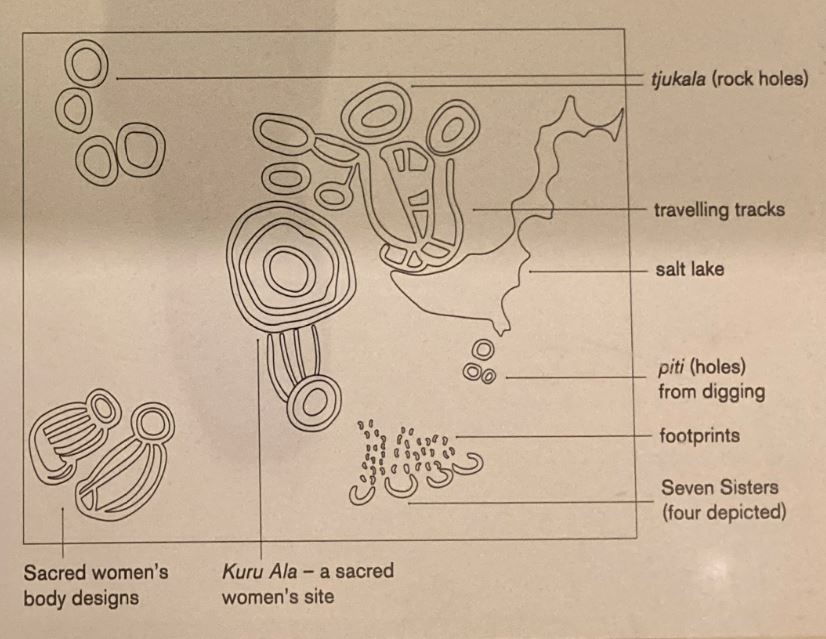
The places where the ancestors stopped or performed important deeds have great spiritual influence. Many of these sites and their associated stories are known only to men or only to women.  This picture, Kungkarangkalpa (Seven Sisters), depicts an important woman’s place near salt lakes in the Great Victoria Desert of Western Australia.

Kungkarangkalpa (Seven Sisters) painted by Anne Ngantiri Hogan, Tjaruwa Angelina Woods, Yarangka Elaine Thomas, Estelle Hogan, Ngalpingka Simms, Myrtle Pennington of the Tjuntjuntjara Community of Western Australia (2013) © The Trustees of the British Museum

The artists, all senior women of the Spinifex people, depict a story about ancestral beings that took place there. Seven sisters who are singing and dancing across the land are being pursued by a lustful man, Wati Nyiru. The women escape his unwanted attentions by launching themselves from a hill into the sky, where they become the Seven Sisters constellation. Here’s a schematic version of the painting explaining its various aspects.

Schematic explanation of Kungkarangkalpa © The Trustees of the British Museum

The Spinifex people

A number of objects on display in the museum were made by the Spinifex people. Many of the Spinifex people were moved off their land when the British carried out atom bomb tests in the 1950s and 1960s. After a long struggle their claim for native title to the land was recognised by the Australian courts in 2000.

Typical of their art is this painting made by senior men of the Spinifex people: Roy Underwood, Lennard Walker, Simon Hogan and Ian Rictor. It depicts an important songline (or ‘Dreaming’) relating to a place called Pukara and the travels of two ancestral men (Wati Kutjara) who travelled across the land, creating its features and customary law.

Pukara, collaborative painting by artists of Spinifex people (2013) from Tjuntjuntjara, Spinifex region of Western Australia © The Trustees of the British Museum

The museum provides another schematic explaining key elements in the painting.

Schematic view of Pukara © The Trustees of the British Museum

Interestingly, artists from the Spinifex people, in the last 30 years, have taken to painting their stories and country in a for suitable for sale to outsiders i.e. they have engaged with the white art market, not only at home but abroad. The result is that you can now buy Spinifex art at galleries around the world. This particular painting was created by the community-based Spinifex Arts Project and bought by the British Museum in 2013.

Artistic innovation

Inspired by ancestral land and traditions, Indigenous Australians are bringing artistic innovation to ancestral traditions.

Sculptural objects made from plant fibres have long been part of Indigenous Australian culture. Historically, woven fibre baskets and sculptural forms were made for practical or ceremonial use but since the 1970s an increasing number of fibre works have been produced for the fine art market. In Arnhem Land in the Northern Territory, women create woven sculptures of ancestral beings and animals.

In Pukatja (formerly Ernabella) in South Australia, Aboriginal artists use a wide range of materials and techniques. These include batik, a method of producing coloured designs on cloth, by brushing or stamping hot wax on the parts not to be dyed. The textile designs are inspired by ancestral landscapes, local plants and animals. The display case shows three sculptures of camp dogs and three batik textiles.

Batik on silk textile by Nyuwara Tapaya (2000) © The Trustees of the British Museum

Women at Ernabella Arts in Pukatja, South Australia, began producing batik work after visiting Indonesia and seeing the technique being used there. The artists are inspired by the colours and forms of the ancestral landscape of the desert region where they live. Unlike some of the other paintings we’ve looked at, they don’t attach specific meanings to their designs i.e. they are purely decorative.

Torres Strait Islanders

The Torres Strait is the body of water which separates northern Australia from Papua New Guinea to the north. It is littered with a large number of medium-sized and small islands. Each of these was populated by Indigenous peoples, known collectively as the Torres Straits Islanders.

A map of the Torres Strait Islands showing the large number of tiny islands, by Kelisi (source: Wikipedia)

Although many islanders now live on the mainland they retain strong connections with their island homes. The sea, the sky and the land remain central to their identity and spirituality.

Before Christianity was introduced to the Torres Straits in 1871 the islanders held elaborate funerals involving masks and ceremonial dances. Often wearing turtle-shell masks, feathered head-dresses called dhari and pearl-shell chest pendants. Contemporary masks and head-dresses often incorporate new materials and forms but they are still inspired by ancestral beings and stories.

Thus the case displays a couple of traditional masks, a warup drum, dhari head-dress, stone-headed club and pearl-shell pendants. The Torres Strait drum known as the warup drum is shaped like an hourglass.  This one is carved from solid dark wood. The larger end represents a fish’s head with open jaws. On the top is carved a lizard and along each side run two projecting bands ornamented with cassowary feathers and seeds. Feathers and goa nuts are attached to each side and incised decoration is infilled with white.

But it’s not just about old and traditional artefacts. The British Museum has bought, and displays, plenty of works by contemporary Indigenous Australian artists. This head-dress was made by contemporary artist Alick Tipoti.

Kaygasiw Usul by Alick Tipoti (2014) © The Trustees of the British Museum

Tipoti is from Badu Island in the Torres Strait. The name of this mask, Kaygasiw Usul, means ‘shovel-nose dust trail reflected in the heavens as the milky way’. It’s made from fibre-glass stained with polyester resin to create the transparent effect of turtle shell, along with plastic, nylon and superglue fastening more traditional materials.

The mask represents an ancestral shark, the Kaygasiw Usul, whose tail fin stirs up an underwater sand trail that forms the Milky Way. The small mask on top represent ancient dancers and the mask inside the mouth symbolises the main dancer.


Related links

More Australia reviews

A Year in Art: Australia 1992 @ Tate Modern

This is a very, very political exhibition, bigger than I expected (5 rooms), artistically important, wide-ranging, illuminating and sometimes very upsetting.

It’s a broad selection of art from contemporary Australia all based round the theme of the calamitous impact of white European colonisation on the continent’s indigenous people. (As I understand it, we should nowadays not use ‘Aborigine’ or ‘aboriginal’; it’s best practice to say ‘indigenous Australians’ or ‘indigenous people’.)

This exhibition brings together art works by indigenous people, alongside works by Australian artists of European descent, all revolving round the themes of colonialism, expropriation, racism, and cultural erasure i.e. the systematic denial of the existence of indigenous people, their deprivation of legal and voting rights, crude attempts to turn them into good Christian citizens, and the banning of their culture, language and traditions.

The exhibition displays a wide variety of media including paintings, photos, artistically treated documents, maps, a huge video installation, some very large fabrics accompanied by sculptures. There’s a lot of explanatory text which makes you feel thoroughly ashamed to be white, British and, of course, a man, since some of the women artists in the show consider the appalling violence and injustices meted out to the Indigenous people the result not only of colonialism but of specifically ‘male modes of power’.

Untitled (Alhalkere) by Emily Kame Kngwarreye

Australia 1992 is part of a series Tate has recently devised which aims to look at the artworks which cluster round a key year in a country’s history, the series having the general name ‘A Year In Art’. The first one was ‘A Year in Art: 1973’ which explored how artists responded to the 1973 coup d’etat in Chile which brought General Pinochet to power.

This is the second in the series and the title, ‘Australia 1992’, begs the question: what is so important about the year 1992? Well, it was the year of a landmark decision by the Australian High Court which overturned the concept of terra nullius (meaning ‘land belonging to nobody’). This was the doctrine by which the British had justified colonising the land now known as Australia.

The concept was used to, in effect, deny the existence of the native Aboriginal peoples who had inhabited Australia for 30,000 years, had developed a lifestyle in balance with its particular natural characteristics, as well as complex societies built on clan structures, a culture rich in hundreds of distinct languages. The High Court decision was the climax of decades of work by indigenous rights campaigners and provided a new legal basis for ongoing campaigns to expand indigenous rights and extend legal protections to indigenous culture.

Buluwana, Female Ancestor by John Mawurndjul (1989)

The art works in the show aren’t all from the year 1992, far from it, much of it is from the subsequent thirty years and some of it is bang up to date. But it all rotates and revolves around the issues thrown up by that 1992 ruling.

Room one

The first room contains three important elements. Firstly, a set of four videos by key artists featured in the show, namely Helen Johnson, Judy Watson, and Dale Horton. These are all 4 or so minutes long. The fourth video features an extended interview with Aborigine artist John Mawurndjul who explains how, although he lives in the new world, the new dispensation of the white man, he maintains the stories and traditions handed down from his father and his father’s father, hence the title of the film, ‘I am the old and the new’. John takes the camera team to a dry and dusty location out in the country where he explains the design and meaning of ancient Aboriginal rock art. He’s also filmed using traditional tools and paints, in particular a kind of soft bark brush, to create the fine striping visible in a work like Buluwana, Female Ancestor.

Another important display in this room is of drawings made by Edward Koiki Mabo of the land on Torres Island which he claimed was his under ancestral indigenous law, drawings used in the 1992 court case. There are three of these, indicating the location of plants, landmarks, traditional use and ownership, which had been passed down to Mabo through 17 generations of tradition. They’re the subject of a wall label explaining more of the detail of the case, its results and implications.

Lastly, there’s a factual (i.e. non-art) map of Australia, an attempt by scholars to represent the language or nation groups of Aboriginal and Torres Strait Islander peoples.

The AIATSIS map of Indigenous Australia attempts to represent the language, social or nation groups of indigenous Australia, by David R. Horton (1996)

Note that the word ‘Country’ is used in a special sense to denote the Aborigines’ ancient connection with the land of their ancestry. So throughout the exhibition the curators refer to Country not ‘the country’ or ‘the landscape’.

Artists and works

There are five rooms in the show and, given that the central one is enormous, space for lots of art works.

Emily Kame Kngwarreye expresses her cultural life as an Anmatyerre elder and her intricate relationship to country in Untitled (Alhalkere) (top of this review).

John Mawurndjul is featured with his bark painting Buluwana, Female Ancestor, created with a fine cross-hatching technique used by generations of Kuninjku artists.

Dale Harding was the subject of one of the videos in the first room. There he explained that he often paints directly onto a gallery wall to create a site-specific work and images of these make them look dramatic. Sadly, that hasn’t happened here and he’s represented by a moveable work, The Leap/ Watershed, in which he’s blown ochre onto a large canvas to create an abstract shape. Although this isn’t particularly obvious, apparently it is intended to reference both the life-giving attributes of the land and the 1867 massacre of Aboriginal people in Mackay, Queensland. ‘The Leap’ refers to a rock formation in Yuwi Country where around 200 indigenous people chose to leap to their deaths rather than surrender to the Queensland Native Police Force.

The Leap by Dale Harding

There’s a great series of works by Judy Watson entitled ‘A Preponderance of Aboriginal Blood’. These 15 framed works take official documents used by the Australian authorities in the 19th and 20th centuries to categorise indigenous peoples and allot them (or not) voting and other rights. Thus, until 1965 you had to be able to prove you had a ‘White’ parent in order to vote, in Queensland. The categorisations include racial ones by which a person was defined as being ‘fullblood’, ‘half-blood’, ‘quadroon’ and so on, terms I’m familiar with from the same system applied in the American South in the slavery era.

What turns them into art is that Watson has spattered them with red pain mimicking blood. These documents obsessed with ‘blood’ have been drenched in the object of their enquiry, blood which also indicates the numbers of indigenous people murdered by the white military and police over the centuries. A stain on Australia’s history and conscience.

From ‘A Preponderance of Aboriginal Blood’ by Judy Watson (2005)

The complete set, along with a detailed explanation, is available on the Tate website.

In a similar spirit of taking colonial documents or concepts and undermining them, is the work of Helen Johnson. She’s represented by a couple of enormous rectangular fabrics, suspended from the ceiling, on which she creates images complex satirical images. The series is titled ‘Seat of Power’ and is from 2016.

Seat of Power by Judy Watson (2016)

This work needs a bit of explanation (which is available on the Tate web page devoted to it). It consists of a large unstretched acrylic painting on canvas which depicts a satirical image of the British parliament in session by the Victorian illustrator Richard Doyle, itself overlaid with partially legible text which refers to a chair that was gifted to the House of Representatives in Canberra, Australia by the UK branch of the Empire Parliamentary Association in 1926.

It’s big and it’s striking but, as you can see, it needs a fair bit of explaining unlike, say, all of the indigenous art on display which speaks immediately to the eye and heart. It also demonstrates a small principle about art and literature, which is that satire doesn’t have to be funny. It can be, but it doesn’t have to be and Watson’s works aren’t.

This point is easily made by comparison with a set of works by Gordon Bennett titled ‘How to Cross the Void’. These are a series of gawky cartoons or sketches of scenes, with satirical text written in, but unlike the Watson they are actively funny. The best example is this one depicting a dark-skinned man hanging himself in a cell, with the advice that, if you get into difficulty hanging yourself, you can always ask a policeman. They’ll be happy to help 🙂

‘Ask a policeman’ from ‘How to Cross the Void’ by Gordon Bennett (1993)

But alongside the amusing cartoon element there’s also something quite conceptual or cerebral going on in this series. All the images incorporate a black square. This is a reference to the clack square painted by the Russian Suprematist painter, Kazimir Malevich, made in 1915. In retrospect, art historians take this to be a founding work and moment in modern art for completely rejecting all vestiges of realism or figuratism. Malevich intended it to be the end of that tradition of painting and the start of a new tradition of pure abstraction and sometimes referred to it not as a square but as a void.

So why is there a black square in all these works? Because Bennett is asking whether any cultural artefact can truly inhabit a void, in other words whether any artwork can escape from the time and place of its making, escape from its history and transcend its cultural context. The general idea is that, no, it can’t, and this might be more true of Australian modern art than many other types…

A different work by Bennett is assigned a room of its own. Dominating the room is a characteristic example of the traditional heroic white conception of the discovery, claim and colonising of Australia, ‘The Founding of Australia 1788’ by Algernon Talmage from as late as 1937

‘The Founding of Australia 1788’ by Algernon Talmage (1937)

As you might expect any modern artist to do, Bennett subverts and interrogates this kind of pompous white triumphalism with a version of his own, titled Possession Island (Abstraction) (based on a different painting, ‘Captain Cook Taking Possession of the Australian Continent On Behalf of the British Crown (1770)’ by John Alexander Gilfillan).

Possession Island (Abstraction) by Gordon Bennett (1991)

As you can see, a once fluid realistic oil painting has been converted into a stippled black-and white image in the style of a blown-up newspaper illustration. The coloured bands do three things: 1) they mask the only indigenous figure in the original painting, who has thus been erased in the same way the indigenous presence was erased for so many centuries. All that is left is the drinks tray he was holding for the refreshment of his white master. 2) The precise rectangular shapes may or may not be a reference to Malevich, which I’ve just explained. 3) But I was intrigued to learn that the colours of the blocks are those of the Aboriginal flag. In my ignorance, I didn’t know that there was an aboriginal flag.

There’s another aspect to this. Tate have cannily displayed these works in a room with a window looking out across the River Thames towards St Paul’s Cathedral, which is bang opposite Tate Modern. Insofar as St Paul’s is a seat of state, religious and ceremonial power of the Australian colonial power, Britain, the sight of it juxtaposed with these stories of colonial repression and brutality amounts to a form of geographical satire.

View across the River Thames and Millennium Bridge to St Paul’s Cathedral from a room in Tate Modern

A bit more subtly, the window in question is a tall narrow one whose shape echoes the tall red rectangle in Bennett’s work. Conceptual and visual echoes and ironies are bouncing round this room.

Yhonnie Scarce

Arguably the best items in the exhibition are the set of enormous hanging fabrics by Yhonnie Scarce. Scarce is an Australian glass artist who is a descendant of the Kokatha and Nukunu people of South Australia. The idea behind the works is fairly simple but results in extraordinary pieces which, for me, dominated the exhibition.

Each work is a hugely magnified antique photo of members of Scarce’s family, blown up and printed onto bed linen. These are then displayed alongside blown glass artefacts relating to the images. In the photo below, the work on the left is ‘Remember Royalty: Papa Willy’ and is a photograph from 1920 showing Scarce’s great-grandfather, William, at work shearing sheep. The image is printed onto an antique woollen blanket, an obvious reference to, or invocation of, this labour. He worked hard all his life to support his 12 (!) children. The toolbox below the blanket contains actual tools (I noted shiny new spanners) mingled with glass-blown replicas of yams, traditional foodstuff of Will’s Kokatha people.

Two works from the series ‘Remember Royalty’ by Yhonnie Scarce

The work on the right follows the same patter: it is a vintage photo taken in around 1911 at the Koonibba Mission Schoolhouse and showing Scarce’s maternal grandparents and children. The wall label tells us that mission schools like this were dotted all across Australia where indigenous people were exposed to brutal regimes of cultural assimilation i.e. forced to wear European clothes and practice Christianity. In another act of care and tribute to her ancestors, the trunk below the printed sheet contains glass balls, each of which contains a horizon line and constellations: the artist is returning to her ancestors the connection with their land which deprived of during their lives.

There are four of these huge photo-sculptures (in the other two, Scarce’s blown glass artefacts are sewn into the fabric of the photos), and because of the immediacy of the images, and the directness and poignancy of their family stories, these were, for me, the standout works in the exhibition.

Three videos

1. Vernon Ah Kee

At the far end of the exhibition is a big long darkened room containing Vernon Ah Kee’s four-screen video installation ‘tall man 2010’. This splices together news footage of the protests and riots following the death in custody of Mulrunji Doomadgee on 26 November 2004, on Palm Island, an island off the coast of Queensland. Doomadgee died in police custody as a result of multiple injuries. In the protests that followed, the police station, local courthouse and police barracks were burnt down. Sergeant Chris Hurley, who arrested Doomadgee, was tried and acquitted for causing his death.

One of the central figures leading the protests was Lex Wotton, a member of the Palm Island Aboriginal Council. Ah Kee presents him as the ‘tall man’ – an Aboriginal term for a bogey man or spirit who elicits the truth from wrongdoers. Wotton later won a lawsuit, alongside other Palm Island residents, which found that the police had illegally discriminated against them. The State of Queensland paid them A$30 million compensation.

So, from what the wall labels tell us, it seems to be an equivalent of the murder of George Floyd by Minneapolis police in May 2020. It is typical of the American-centric nature of all our media that the Floyd incident and movement it gave rise to massively entered Britain’s consciousness and cultural sphere (houses round where I live still have ‘Black Lives Matter’ posters in their windows) while the death of Doomadgee didn’t cause a ripple.

Still clip from ‘tall man’ by Vernon Ah Kee (2010)

On a practical level, the footage is continually punctuated by the bars used in the creation and editing of film footage and by the loud sonic whine which indicates to editors that there is no soundtrack. Unfortunately I have mild tinnitus and found this very loud, penetrating high-pitched whine made it impossible for me to be in the room.

2. Bonita Ely

In 1979 eco-feminist Bonita Ely travelled to Jabiluka in the Northern Territory and filmed this performance, titled ‘Jabiluka U02’. Here the Mirrar indigenous community has waged a decades-long campaign against plans to mine uranium in the Kimberley flood plain. To be frank, watching her dig a pile of sand in what looks like a park is a little underwhelming. But the wall label links it with ongoing struggles against Australia’s mining corporations, singling out two current instances: in 2019 the Australian government allowed the Adani company to develop a coal mine that will endanger the Barrier Reef. And in 2020 the mining company Rio Tinto deliberately destroyed rock shelters in the Juukan Gorge, holy to the Puutu Kunti Kurram and Pinikura peoples for thousands of years. I did hear about this in the British media. Why aren’t Rio Tinto boycotted? Why aren’t the people responsible for vandalism like this named and shamed?

3. Peter Kennedy and John Hughes

This is a long video which is shown at a completely different scale from the Vernon Ah Kee; that is shown across a huge screen dominating a very big wall; the Kennedy and Hughes video, by contrast, is shown on an old-fashioned TV. It addresses the history of white management, capitalism and institutionalised denial of indigenous rights, but I found it completely impossible to watch because of the highly repetitive, droning high-pitched soundtrack which eclipsed the contents and gave me a headache. Must be better ways to get your message across, guys.

Tracey Moffat

Filling one side of the big central room is a series of 24 large photos by Tracey Moffatt titled ‘Up in the Sky’, shot in 1997. They depict life in a rough and ready Outback town. The whole series can be viewed on the Tate website.

The curators say the subject of the series is the forced separations of Aboriginal families by government agencies i.e. taking indigenous babies from their families and giving them to white foster parents or, as in some of these photos, Catholic convents. The abducted babies became known as the Stolen Generations.

From ‘Up in the sky’ by Tracey Moffatt (1997)

But if you look at the whole set you’ll see that Moffatt’s photos do much more than that. Most of the photos are of poor whites, what Americans call ‘trailer trash’. They prompted upset and outrage at the gross injustice of all those stolen babies and broken families. But the pictures of the immediate present also triggered feelings about living that kind of life, in that kind of place, not dissimilar from the feelings triggered by the Chris Killip exhibition at the Photographers’ Gallery. Imagine living there, in a one-horse town where the horse died long ago, leaving desolation and wasted lives.

It triggered one big thought which goes slightly against the grain of the show: this is that, whereas all of the works by all of the artists in the exhibition address the injustices done to and the tragedies suffered by the indigenous people, nowhere (I think) is there mention of the injustice done to the white people sent to Australia. Almost all of them were convicts or the soldiers sent to guard them.

According to Robert Hughes in The Fatal Shore, some 160,000 convicts were sent from Britain to Australia during the 50-year existence of ‘The System’ of transportation, most of them the poorest of the poor who had never been more than ten miles from their places of birth. Suddenly they were transported to a different planet.

Imagine being a nineteen-year-old woman sentenced to transportation for stealing a loaf of bread, wrenched away from your family and place of birth and familiar surroundings and sent half way round the world in the company of criminal and violent strangers to a completely alien, unfamiliar and unfriendly landscape. Imagine being the young soldiers sent to guard them.

My point is that there’s a kind of double injustice at work here. First the injustice and cruelty of the forced transportation of over a hundred thousand Britons. And then the behaviour of these scared, angry, brutalised Brits, to the relatively defenceless native peoples they discovered. Brutality upon brutality. Horror doubled. It’s a terrible historical legacy and this exhibition really drums into your mind multiple threads of injustice, violence and cultural erasure which continue up to the present day.

Video

Most exhibition promotional videos are a zippy 30 seconds long. This one, at 14 minutes, is a more in-depth consideration of the issues and starts by explaining the 1992 High Court ruling in favour of Torres Strait Islander, featuring the man who brought the case, land-rights activist Edward Koiki Mabo, before going on to describe the practice of some of the artists in the show.


Related links

More Australia reviews

More Tate Modern reviews

The Martian Chronicles by Ray Bradbury (1950)

This is a sometimes hauntingly beautiful,sometimes thumpingly obvious, collection of visions, fables, dreams and nightmares. It consists of 26 linked short stories arranged in chronological order to describe mankind’s first expeditions to Mars, the colonisation of Mars, strange encounters with Martians, and then the abrupt abandonment of the planet as almost all the settlers fly back to earth in response to a catastrophic nuclear war.

In fact that figure of 26 breaks down into about 13 substantial stores, interspersed with 13 very short linking passages or free-standing vignettes. But whereas in, say, I, Robot by Isaac Asimov, the linking passages between the stories provide important factual information – Bradbury’s linkers are much softer, gentler, more evocative; if they introduce a theme it is often done only obliquely. Sometimes they are almost prose poems in their own right.

Although they come from the era of hard sci-fi, and were all first published in classic sci-fi magazines, most of the stories have an uncanny, sometimes hallucinatory effect. These two effects – dreaminess, and a concern for prose poetry over ‘facts’ – are well conveyed by the very first opening link section, itself barely a page long, and titled Rocket Summer.

One minute it was Ohio winter, with doors closed, windows locked, the panes blind with frost, icicles fringing every roof, children skiing on slopes, housewives lumbering like great black bears in their furs along the icy streets.

And then a long wave of warmth crossed the small town. A flooding sea of hot air; it seemed as if someone had left a bakery door open. The heat pulsed among the cottages and bushes and children. The icicles dropped, shattering, to melt. The doors flew open. The windows flew up. The children worked off their wool clothes. The housewives shed their bear disguises. The snow dissolved and showed last summer’s ancient green lawns.

Rocket summer. The words passed among the people in the open, airing houses. Rocket summer. The warm desert air changing the frost patterns on the windows, erasing the art work. The skis and sleds suddenly useless. The snow, falling from the cold sky upon the town, turned to a hot rain before it touched the ground.

Rocket summer. People leaned from their dripping porches and watched the reddening sky.

The rocket lay on the launching field, blowing out pink clouds of fire and oven heat. The rocket stood in the cold winter morning, making summer with every breath of its mighty exhausts. The rocket made climates, and summer lay for a brief moment upon the land…

That’s it. Blank faced prose, super simplified, to create an often fairy tale effect, or sound like a fable, or as if translated from a simpler language. Note the use of repetition to create the dreamy effect – ‘The rocket lay… the rocket stood… the rocket made…’

For this level of simplicity is deceptive. Simple sentences can contain strange, unexpected effects, odd juxtapositions of the homely and the eerie.

The rocket stood in the cold winter morning, making summer with every breath of its mighty exhausts.

What’s true of individual sentences is true of entire stories. Bradbury’s simple diction can be really simplified down to a kind of Biblical portentousness, or lifted to a fairy tale simplicity, it can have oddities added to turn it into something strange and unexpected. But just as easily, it can topple over into stereotypes and clichés. In the story The Earth Men, the men climbing out of the shiny rocket ship are 1950s Hollywood. The Martians taking them perfectly for granted is satire. The Martians then locking them up in a lunatic asylum is Swiftian satire. Then the Martians executing them all crosses a line into horror.

Bradbury’s deceptively simple prose is capacious and flexible enough to convey enormous shifts in tone and register in consecutive sentences, or within one story.

This is one of the things which makes the stories so disconcerting. Their changeableness.

Future history

The dates and even the events are not really the point of the stories, but despite their hallucinatory weirdness, there is a coherent timeline of sorts, which Bradbury emphasises by placing precise year dates next to each story – and which can be divided into three sections.

The first six stories (January 1999 to April 2000) describes a succession of expeditions to Mars in which the Martians kill each successive little party of earth intruders.

The pivotal story, ‘—And the Moon be Still as Bright’, describes the fourth mission to Mars, which discovers that almost all the Martians have been wiped out by a plague of chicken pox brought by one of the earlier earth missions.

In the middle bloc of stories (December 2001 to November 2005) humans proceed to colonise Mars with no interference – although there are a few eerie encounters with the remaining Martian survivors. Despite the presence of the spookily empty canals and the deserted Martian cities, Mars turns out to have pretty much the same gravity as earth, albeit the air is thinner and sometimes harder to breathe. but the human settlers quick turn it into a second earth, complete with earth agriculture, earth towns with earth names, and populations and prejudices.

The second pivot comes in the story, The Off Season, in which a dumb and violent working class earthman, who has set up a hot dog stall on the main highway from the rocket landing fields to the main colonial city (a hot dog stall? – yes the stories are that American, and the earth settlers make it into that much of a replica of home) hoping to make a killing from the next big influx of settlers — watches, with his pissed-off wife, as the earth is devastated by a nuclear holocaust. They both happen to be looking at distant earth, up in the Martian sky, when –

Earth changed in the black sky. It caught fire. Part of it seemed to come apart in a million pieces, as if a gigantic jigsaw had exploded. It burned with an unholy dripping glare for a minute, three times normal size, then dwindled.
‘What was that?’ Sam looked at the green fire in the sky.
‘Earth,’ said Elma, holding her hands together.
‘That can’t be Earth, that’s not Earth! No, that ain’t Earth! It can’t be.’

‘as if a gigantic jigsaw had exploded’. See how simple, but dramatically effective, Bradbury’s prose can be.

Driven by overwhelming nostalgia, all the Mars colonists pack into their spaceships and head off back to earth, leaving Mars almost abandoned. A handful of earthlings remain among the now-derelict earth settlements, which are themselves built next to the long-abandoned Martian settlements. A double layer of abandonment and melancholy.

The third section (December 2005 to October 2026) describes the experiences of these last few human survivors scattered across Mars. The very last story describes the arrival of the last-but-one spaceship from earth – bringing an all-American nuclear family, Mom, Dad and three boys. They expect one other family group to follow, a family with four girls. Between them, the adults plan that these children will leave behind all the destructive values of earth and found a new civilisation, becoming ‘the new Martians’.

The stories with nominal dates and lengths

The substantial stories in bold.

  • Rocket Summer (January 1999) 2 pages
  • Ylla (February 1999) 20 pages
  • The Summer Night (August 1999) 4 pages
  • The Earth Men (August 1999) 24 pages
  • The Taxpayer (March 2000) 2 pages
  • The Third Expedition (April 2000) 26 pages
  • —And the Moon Be Still as Bright (June 2001) 39 pages
  • The Settlers (August 2001) 2 pages
  • The Green Morning (December 2001) 8 pages
  • The Locusts (February 2002) 2 pages
  • Night Meeting (August 2002) 13 pages
  • The Shore (October 2002) 2 pages
  • The Fire Balloons (November 2002) 28 pages
  • Interim (February 2003) 2 pages
  • The Musicians (April 2003) 3 pages
  • Way in the Middle of the Air (June 2003) 21 pages
  • The Naming of Names (2004-05) 2 pages
  • The Old Ones (August 2005) 1 page
  • The Martian (September 2005) 21 pages
  • The Luggage Store (November 2005) 3 pages
  • The Off Season (November 2005) 18 pages
  • The Watchers (November 2005) 3 pages
  • The Silent Towns (December 2005) 16 pages
  • The Long Years (April 2026) 17 pages
  • There Will Come Soft Rains (August 4, 2026) 10 pages
  • The Million-Year Picnic (October 2026) 16 pages

Dying falls

As this brief synopsis indicates, it is not an optimistic narrative. We witness the extermination of not one, but two civilisations. Hence many of the stories have a plangent, dying tone. Hence there are a good number of atmospheric moments when people find themselves alone, marooned, isolated, standing amid the ruins of a Martian city, or at the edge of a dried-up Martian sea.

There Will Come Soft Rains,

The story, There Will Come Soft Rains, epitomises this sense of abandonment, although it’s one of the few set on earth. It describes the automatic functioning of a 21st century house – alarm clocks going off, breakfast automatically prepared, little robot cleaners tidying everything away – long after its human inhabitants have been vaporised by the atomic blast which destroyed the whole of the rest of the city the house stands in.

The nuclear war left only this one house standing, with one, city-facing wall charred black by the blast, except, that is, for the silhouettes of the Mom and Pop and the two kids who were playing on the lawn when the bomb detonated and whose vaporised outlines are preserved on the crumbling wall.

You could characterise a story like that as blunt, meaning it is a creative embroidering around a basically hard, crude subject. What’s more, a hyper-clichéd subject. I wonder how many teenage stories and poems and songs describe the horrors of a nuclear war in despairing detail.

The gag, or twist in Bradbury’s story, which lifts it above the utterly clichéd, is the humorous precision with which he describes the continued functioning of all the little futuristic gadgets in the house, creating a wan sense of pathos, once we realise all the humans they work for are long dead.

The Earth Men

A similarly blunt story is the satire The Earth Men, which describes how the second spaceship full of earth explores arrives, and they are disconcerted to find the Martians taking them in their stride. ‘Yes yes,’ the Martians communicate telepathically, ‘I’m busy right now, run along to see Mr Aaa,’ so they go along to another Martian dwelling, to find a harassed official too busy with his paperwork to give them full attention.

The increasingly exasperated explorers are eventually passed onto an official who can barely be bothered to look up from his paperwork before handing them a big silver key and telling them to go down the corridor and open the door.

When the men do as told, they enter a big dome to find loads of excitable Martians who lift them on their shoulders, and hurrah and toast them. ‘This is more like it,’ say the gee whizz space crew, until it slowly dawns on the captain that this is a Martian lunatic asylum. All the Martians who sent them along to Dr so and so who referred them to Mr Aaa who told them to come to this dome – they all thought they were run-of-the-mill Martians having telepathic hallucinations, that’s to say, faking a human (alien) appearance. The Martians who greet them in the dome quickly reveal themselves as suffering from all kinds of delusions, claiming to be explorers from earth or Nepture on the sun.

Finally the earth explorers are attended by Mr Xxx, a psychologist, who diagnoses them as normal Martians who happen to possess abnormal powers of telepathic projection with which they have changed their appearance. He finds their story of being ‘from earth’ very amusing and, when they insist, agrees to be escorted out to their ‘spaceship’.

Mr Xxx enters the ship, pokes and prods around, but remains fixed in his beliefs that it is a remarkable hallucination. Then he pronounces the only cure Martians know for this level of brain sickness i.e. execution.

He took out a little gun. ‘Incurable, of course. You poor, wonderful man. You will be happier dead. Have you any last words?’
‘Stop, for God’s sake! Don’t shoot!’
‘You sad creature. I shall put you out of this misery which has driven you to imagine this rocket and these three men. It will be most engrossing to watch your friends and your rocket vanish once I have killed you. I will write a neat paper on the dissolvement of neurotic images from what I perceive here today.’
‘I’m from Earth! My name is Jonathan Williams, and these — ‘
‘Yes, I know,’ soothed Mr. Xxx, and fired his gun.
The captain fell with a bullet in his heart. The other three men screamed.
Mr. Xxx stared at them. ‘You continue to exist? This is superb! Hallucinations with time and spatial persistence!’ He pointed the gun at them. ‘Well, I’ll scare you into dissolving.’
‘No!’ cried the three men.
‘An auditory appeal, even with the patient dead,’ observed Mr. Xxx as he shot the three men down.

The satire is swift and brutal. It has barely anything to do with science fiction, more a use of science fiction tropes to satirise the self-satisfied lack of imagination of the American psychiatric profession circa 1950. The story doesn’t tap deep emotional roots, although it is effective burlesque.

Night meeting

You could compare the blunt stories in the collection with the many others which are a bit more subtle or poetic in intention.

In Night Meeting an earthman on his way to a party suddenly encounters in the bleak bare Martian landscape, a bronze-skinned, golden-eyed Martian who is on his way to a Martian festival.

Both can hear the music in the distance of their respective parties, can anticipate the warmth, the wine, the beautiful women they will meet there. But when they go to touch each other, their hands go through each other’s bodies. They are both there, but not there. Two moments in time, which are equally as unreal to each other, have somehow overlapped.

Now, even though this story has a vague sense of déjà vu about it – as if I’ve seen it in an episode of The Twilight Zone or Star Trek or somewhere – you can straightaway see that it aims to capture something more eerie and uncanny than the blunt stories. All the details and dialogue of the story are focused on creating a mood of weirdness.

And it’s often true of these more poetic stories that, although they’re set on Mars, they could be set anywhere: this one is basically a ghost story and could just as well have been describing an encounter between, say a modern character and an 18th century highwayman on some remote midnight heath in Cornwall, as an event on planet Mars.

The Fire Balloons

Something of the same yearning, evocative quality dominates The Fire Balloons in which a Catholic priest and his colleagues come to Mars, determined to convert the rare and obscure Martians to Christianity. (For the purposes of this story, we are told that the previous species of Martians, the ones who have been wiped out, lived alongside a much smaller and rarer species, beings which look to us like luminous blue globes).

The priests have several eerie encounters with these strange, remote, hovering globes who, at a key moment, indicate their good intentions by saving the earthmen from a mountain avalanche.

Bu at the finale of the story, the blue globes communicate telepathically that they are perfectly happy, at peace, know no sin and so need no redemption.

This story contains some pretty blunt satire on religion, on Christianity, on Catholic superstition and dogma. But at its core is the wistful memories of the protagonist, Father Peregrine, of being a small boy and watching his grandfather light red, white and blue balloons to send off into the air on Independence Day. I suspected these warm happy memories would mislead the Father into trusting the blue globes who would then savagely let him down – but no, the mood of warm contentment continues right to the end as the happy, fulfilled globes float out of the story.

Civil rights

The Other Foot

Unexpectedly, there is a story strongly redolent of the Civil Rights movement in that it unmistakably set in the Deep South of America, and powerfully supports black characters against the narrow-minded hick racism of white bigots.

This us the second Bradbury story I’ve read which is fiercely critical of white prejudice against black people in America – The Illustrated Man contains the story The Other Foot, in which Mars has been entirely settled by black people, more or less exiled there from America, who have settled and made their own life and are happy. No spaceship has come from earth for twenty years and they think they have been ignored and forgotten.

When a spaceship is sighted, a black man named Willie Johnson recalls all the injustices black people suffered in 1920s and 1930s and 1950s America and whips the crowd up into a frenzy ready to lynch and string up the white folks who emerge from it.

There is real bite and anger in the story which lists in some detail the everyday social, cultural, political, economic and psychological oppression which black people have suffered in America.

Anyway, when the spaceship lands, the knackered old white man who appears in the door tells them there has been a nuclear apocalypse and earth has completely destroyed itself, nothing of civilisation remains. He and his team have patched together the last spaceship on earth and come to ask their forgiveness, come to ask if they will use their (the black peoples’) spaceships, and return to earth and help rebuild civilisation.

The plot sounds pretty silly, but the descriptions of black humiliation left me more shaken than anything else in the book.

Way in the Middle of the Air

Same goes for the ‘black’ story in this collection, Way in the Middle of the Air. It describes a bunch of hard-core, red-neck, southern bigots assembled on the porch of the hardware store owned by Samuel Teece. It describes in full their bigoted comments as a great tide of black humanity sweeps through the high street in front of them on their way to the rocket fields, where the entire black population of the South is going to take ship to Mars.

Teece, the big bully bigot, attempts to prevent two individuals going, a man named Belter riding a horse, who owes him $50. As the crowd gets wind of what’s going in they politely have a whip round and pay Teece his $50 and he is forced to let Belter go. And then Teece spots ‘Silly’, his shop boy, and pulls him over and refuses to let him go, even though the car with the rest of his family is impatient to get going and not to miss the spaceships. he begs, he pleads, he weeps, and eventually some of the other white men on the porch start feeling guilty and uneasy and one old dude says he’ll step in and replace ‘Silly’ and, eventually, Teece is shamed into letting him go, and off he roars in his family car.

Teece gets his gun and waves it around in rage and for a while there’s a real risk he’ll start shooting people in the great crowd at random. By God, he remembers the good old days, riding with the Klan and the lynchings, and Bradbury gives him some paragraphs of reminiscence.

He remembered nights when men drove to his house, their knees sticking up sharp and their shotguns sticking up sharper, like a carful of cranes under the night trees of summer, their eyes mean. Honking the horn and him slamming his door, a gun in his hand, laughing to himself, his heart racing like a ten-year-old’s, driving off down the summer-night road, a ring of hemp rope coiled on the car floor, fresh shell boxes making every man’s coat look bunchy. How many nights over the years, how many nights of the wind rushing in the car, flopping their hair over their mean eyes, roaring, as they picked a tree, a good strong tree, and rapped on a shanty door!

Enraged, Teece gets in his car with a few of the others, and drives off after the crowd. But they come to a great area where the entire black population of the South has abandoned all its unnecessary goods and belongings, a wasteland of trash and memorabilia. And then they hear the roar of the rockets and watch the little silver fins fly up into the sky.

In the cotton fields the wind blew idly among the snow dusters. In still farther meadows the watermelons lay, unfingerprinted, striped like tortoise cats lying in the sun.

The men on the porch sat down, looked at each other, looked at the yellow rope piled neat on the store shelves, glanced at the gun shells glinting shiny brass in their cartons, saw the silver pistols and long black metal shotguns hung high and quiet in the shadows. Somebody put a straw in his mouth, Someone else drew a figure in the dust.

Finally Samuel Teece held his empty shoe up in triumph, turned it over, stared at it, and said, ‘Did you notice? Right up to the very last, by God, he said “Mister”!’

Like The Other Foot, this is a really fierce, penetrating story and utterly unexpected in a book of otherwise quite hokey science fiction stories. It has a science fiction basis or trope, but is really all about earth and injustice in 1950. Even if you don’t like science fiction, you should give The Other Foot and this story a read, this one is the better, I think, because of the intensity with which it recreates the personality and psychology of its central character, the brute bigot Teece.


Related links

Ray Bradbury reviews

1950 The Martian Chronicles – 13 short stories with 13 linking passages loosely describing mankind’s colonisation of Mars, featuring strange, dreamlike encounters with Martians
1951 The Illustrated Man – eighteen short stories which use the future, Mars and Venus as settings for what are essentially earth-bound tales of fantasy and horror
1953 Fahrenheit 451
1955 The October Country
1957 Dandelion Wine
1959 The Day It Rained Forever
1962 Something Wicked This Way Comes

Other science fiction reviews

1888 Looking Backward 2000-1887 by Edward Bellamy – Julian West wakes up in the year 2000 to discover a peaceful revolution has ushered in a society of state planning, equality and contentment
1890 News from Nowhere by William Morris – waking from a long sleep, William Guest is shown round a London transformed into villages of contented craftsmen

1895 The Time Machine by H.G. Wells – the unnamed inventor and time traveller tells his dinner party guests the story of his adventure among the Eloi and the Morlocks in the year 802,701
1896 The Island of Doctor Moreau by H.G. Wells – Edward Prendick is stranded on a remote island where he discovers the ‘owner’, Dr Gustave Moreau, is experimentally creating human-animal hybrids
1897 The Invisible Man by H.G. Wells – an embittered young scientist, Griffin, makes himself invisible, starting with comic capers in a Sussex village, and ending with demented murders
1898 The War of the Worlds – the Martians invade earth
1899 When The Sleeper Wakes/The Sleeper Wakes by H.G. Wells – Graham awakes in the year 2100 to find himself at the centre of a revolution to overthrow the repressive society of the future
1899 A Story of the Days To Come by H.G. Wells – set in the same London of the future described in the Sleeper Wakes, Denton and Elizabeth fall in love, then descend into poverty, and experience life as serfs in the Underground city run by the sinister Labour Corps

1901 The First Men in the Moon by H.G. Wells – Mr Bedford and Mr Cavor use the invention of ‘Cavorite’ to fly to the moon and discover the underground civilisation of the Selenites
1904 The Food of the Gods and How It Came to Earth by H.G. Wells – two scientists invent a compound which makes plants, animals and humans grow to giant size, leading to a giants’ rebellion against the ‘little people’
1905 With the Night Mail by Rudyard Kipling – it is 2000 and the narrator accompanies a GPO airship across the Atlantic
1906 In the Days of the Comet by H.G. Wells – a passing comet trails gasses through earth’s atmosphere which bring about ‘the Great Change’, inaugurating an era of wisdom and fairness, as told by narrator Willie Leadford
1908 The War in the Air by H.G. Wells – Bert Smallways, a bicycle-repairman from Bun Hill in Kent, manages by accident to be an eye-witness to the outbreak of the war in the air which brings Western civilisation to an end
1909 The Machine Stops by E.M. Foster – people of the future live in underground cells regulated by ‘the Machine’ until one of them rebels

1912 The Lost World by Sir Arthur Conan Doyle – Professor Challenger leads an expedition to a plateau in the Amazon rainforest where prehistoric animals still exist
1912 As Easy as ABC by Rudyard Kipling – set in 2065 in a world characterised by isolation and privacy, forces from the ABC are sent to suppress an outbreak of ‘crowdism’
1913 The Horror of the Heights by Arthur Conan Doyle – airman Captain Joyce-Armstrong flies higher than anyone before him and discovers the upper atmosphere is inhabited by vast jellyfish-like monsters
1914 The World Set Free by H.G. Wells – A history of the future in which the devastation of an atomic war leads to the creation of a World Government, told via a number of characters who are central to the change
1918 The Land That Time Forgot by Edgar Rice Burroughs – a trilogy of pulp novellas in which all-American heroes battle ape-men and dinosaurs on a lost island in the Antarctic

1921 We by Evgeny Zamyatin – like everyone else in the dystopian future of OneState, D-503 lives life according to the Table of Hours, until I-330 wakens him to the truth
1925 Heart of a Dog by Mikhail Bulgakov – a Moscow scientist transplants the testicles and pituitary gland of a dead tramp into the body of a stray dog, with disastrous consequences
1927 The Maracot Deep by Arthur Conan Doyle – a scientist, engineer and a hero are trying out a new bathysphere when the wire snaps and they hurtle to the bottom of the sea, there to discover…

1930 Last and First Men by Olaf Stapledon – mind-boggling ‘history’ of the future of mankind over the next two billion years
1932 Brave New World by Aldous Huxley
1938 Out of the Silent Planet by C.S. Lewis – baddies Devine and Weston kidnap Ransom and take him in their spherical spaceship to Malacandra aka Mars,

1943 Perelandra (Voyage to Venus) by C.S. Lewis – Ransom is sent to Perelandra aka Venus, to prevent a second temptation by the Devil and the fall of the planet’s new young inhabitants
1945 That Hideous Strength: A Modern Fairy-Tale for Grown-ups by C.S. Lewis– Ransom assembles a motley crew to combat the rise of an evil corporation which is seeking to overthrow mankind
1949 Nineteen Eighty-Four by George Orwell – after a nuclear war, inhabitants of ruined London are divided into the sheep-like ‘proles’ and members of the Party who are kept under unremitting surveillance

1950 I, Robot by Isaac Asimov – nine short stories about ‘positronic’ robots, which chart their rise from dumb playmates to controllers of humanity’s destiny
1951 Foundation by Isaac Asimov – the first five stories telling the rise of the Foundation created by psychohistorian Hari Seldon to preserve civilisation during the collapse of the Galactic Empire
1952 Foundation and Empire by Isaac Asimov – two long stories which continue the future history of the Foundation set up by psychohistorian Hari Seldon as it faces down attack by an Imperial general, and then the menace of the mysterious mutant known only as ‘the Mule’
1953 Second Foundation by Isaac Asimov – concluding part of the ‘trilogy’ describing the attempt to preserve civilisation after the collapse of the Galactic Empire
1954 The Caves of Steel by Isaac Asimov – set 3,000 years in the future when humans have separated into ‘Spacers’ who have colonised 50 other planets, and the overpopulated earth whose inhabitants live in enclosed cities or ‘caves of steel’, and introducing detective Elijah Baley to solve a murder mystery
1956 The Naked Sun by Isaac Asimov – 3,000 years in the future detective Elijah Baley returns, with his robot sidekick, R. Daneel Olivaw, to solve a murder mystery on the remote planet of Solaria

1971 Mutant 59: The Plastic Eater by Kit Pedler and Gerry Davis – a genetically engineered bacterium starts eating the world’s plastic

1980 Russian Hide and Seek by Kingsley Amis – in an England of the future which has been invaded and conquered by the Russians, a hopeless attempt to overthrow the occupiers is easily crushed
1981 The Golden Age of Science Fiction edited by Kingsley Amis – 17 classic sci-fi stories from what Amis considers the Golden Era of the genre, namely the 1950s

American Colonies by Alan Taylor (2001)

Alan Taylor’s American Colonies is the first volume in the multi-volume Penguin History of the United States, edited by Eric Foner. It is a big-format book, with 470 densely packed pages covering the colonisation of America from the arrival of the first humans 15,000 years ago up to AD 1800. It is an extraordinarily thorough, wide-ranging, thought-provoking and exhilirating read, but which deals with some extremely grim and depressing subject matter.

Broad canvas

Most of the histories of America I’ve read start with Sir Walter Raleigh and the early English settlements of the 1580s and 90s, and then briskly run through the Anglo-Saxon settlement of the Atlantic coast in the 1600s, in a hurry to get to the War of Independence (in the 1770s) when the ‘true’ story of America begins.

Taylor’s approach couldn’t be more different. His canvas is longer and broader and much, much bigger. Longer, in that he starts with the arrival of the first humans in America some 13,000 BC. Echoing the picture painted by Jared Diamond in Guns, Germs and Steel, he describes how a probably small group of hunter-gatherers in Siberia moved across what we now think of as the land bridge between Siberia and Alaska and then, as the climate improved, a) the land bridge flooded, separating America and Asia and b) the early settlers were able to move south into the huge empty continent.

Domesticable mammals

As we know from Guns, Germs and Steel, their arrival coincided with the mass extinction of all the large mammals in America – presumably through human overhunting – leaving no mammals on the continent capable of being domesticated. According to Jared Diamond this is perhaps the decisive difference between the inhabitants of Eurasia – which domesticated pigs, goats, cows and sheep and, crucially, the horse – and the inhabitants of all the other continents, which had hardly any or simply no domesticable mammals.

Animal diseases

The domesticated animals of Eurasia were important not only for their use as food, in providing skins and hides, manure to fertilise crops and the pulling power of horses and oxen – large numbers of farm animals allowed the fomenting of terrible epidemic diseases, which jumped the species barrier into humans and then spread through our densely populated towns and cities. We are the descendants of the survivors of repeated epidemics of plague, smallpox, tuberculosis and so on which devastated Asia and Europe.

Thus when the first Europeans arrived in the New World (on Columbus’s First Voyage of 1492), it wasn’t the gunpowder or steel swords or even the warriors on horseback which did for the natives – it was the diseases we brought. Again and again and again, Taylor tells harrowing stories of how our diseases – especially smallpox- devastated the populations of the West Indies, of the Aztec and Inca empires, then of the Mississippian civilisation, and then all up and down the Atlantic seaboard.

It’s only recently that historians have taken the measure of this devastating biological warfare: for a long time it was thought that the Native American population was about 1 million when the English started colonising the Atlantic coast; but now it is thought the original population, before the Spanish arrived in 1492, may have been as high as 20 million. I.e. in about a century (1490-1590) 95% of the Indian population was wiped out by European diseases.

Thus, Taylor emphasises, until recently historians thought that the Indian tribes which the European settlers encountered had inhabited their territories from time immemorial. The new ‘disease-aware’ theories suggest the exact opposite: that Europeans encountered survivors who were still reeling from the devastation of their populations by disease, which in turn had led to internecine warfare and the seizing of territory, to regrouping and realliancing (p.74). Often this occurred before the main body of European explorers arrived – after all it only took a few sailors going ashore from a Spanish ship to fill water barrels on the south coast to infect an Indian, who then took the disease back to his tribe, which passed it up along the Mississippi and to decimate the entire population.

Thus Taylor shows again and again that the social and ecological and political arrangements of the Indians which Europeans encountered, and took to be timeless, had in fact only come about because of the disruptive activities of the Europeans themselves.

The Spanish

So – number one – Taylor’s vastly broader canvas starts thousands of years before the conventional histories, in order to place the Native Americans within the fullest possible context.

It then – number two – very sensibly takes the time to give a thorough account of the Spanish conquests starting with Columbus’s first voyage of 1492. In fact, Taylor goes back before Columbus to give us enough European history to place the entire ‘Navigation Revolution’ in its full global context. The biggest single element of this was the continuing success of imperial Islam. The Turkish or Ottoman Empire finally captured Constantinople, capital of the Eastern Roman or Byzantine Empire, in 1453, and spread up into the Balkans (thus creating the hodge-podge of ethnicities and religions which has caused instability and conflict right up to the present day).

These Ottoman conquests closed off overland trade routes from Europe to India and the Spice Islands far to the East. And it was this closure of the Eastern route which gave a big financial incentive to adventurers and explorers to try and find a route west, across the seas, to the Spice Islands. As countless commentators have pointed out, it is one of the greatest ironies in history that the discovery of America was a terrible disappointment to the explorers and their royal patrons back in the capitals of Spain and Portugal and France and England. (And Taylor’s book is brutal about the terrible consequences for the native peoples everywhere the Europeans went.)

Taylor explains the economic and technological background to the Spanish conquests of Central and South America not just for their own sake, but because the Spanish also expanded up into what was later to become the USA. The Spanish colonised Florida and sent expeditions deep into what would later become California, New Mexico, Arizona and Texas. In doing so they established a particular pattern of landholding – vast haciendas farmed by natives turned into serfs – which would remain influential in the south-west USA for centuries, as well as bringing disease and disruption to the native peoples.

The West Indies

Taylor devotes a lot of space to the settlement of the numerous islands of the West Indies, firstly by Spain in the early 1500s. He describes how French and English pirates took to preying on the regular Spanish shipments of silver and gold from central America back to Europe via the Indies. Then how France and England set about establishing colonies of their own in this scattered archipelago of islands.

Taylor describes tells in great detail the settlement of Barbados and then of Jamaica. Several points emerge.

  1. The original settlers dropped like flies. The climate was inimical to white men, who also didn’t know – for a long time – what to farm in these places. It took some time before the invaders worked out that sugar cane was the perfect crop for the climate. Unfortunately, working cane is – as Taylor explains in detail – extremely labour-intensive.
  2. So the Europeans then proceeded to enslave and work to death as many of the native population as they could capture, waging genocidal wars with the rest, all the while spreading their fatal germs.
  3. It was when they’d worked the natives to annihilation, that the settlers began buying African slaves. The trade had existed for over a hundred years, but the Spanish and Portuguese had mainly made do with enslaving the local Indians. It was the sugar economy of the West Indies which converted the Slave Trade into an industrial concern.

The British colonies

There then follow a sequence of chapters which describe the English settlement of the Chesapeake Bay area. I learned that originally, the entire coast from the Spanish colony of Florida up to the French territories in Canada, was all known as ‘Virginia’, after the supposedly virgin queen, Elizabeth I. A familiar pattern is established. The original settlers drop like flies (mostly from water-borne diseases caused by the low tidal movement of the bay – for decades they were drinking water polluted by their own faeces). So it takes a long time for settler deaths to be outweighed by new arrivals and the colony to really take hold. The ‘indenture system’ is widespread i.e. poor whites from England sell themselves into 4 or 5 years servitude, to pay for the transatlantic crossing. After 4 or 5 years they are released, having paid their debt, and given a basic amount of land and tools to make it themselves. Initially weak in numbers and understanding of the environment, the colonists rely on trade with the Indians to get by. But as soon as they are strong and numerous enough, they start expanding their settlements, inevitably coming into conflict with the Indians who, in any case, are regularly devastated by the diseases the colonists have brought, especially smallpox.

Eventually, in Virginia the settlers discovered that tobacco is the crop of choice, hugely profitable when shipped back to Europe. But Indians refused to work in the kind of prison-camp labour the crop requires, and the flow of indentured servants dried up in the 1650s as economic conditions in England – the bad economy, overcrowding and unsettled social conditions of the British Civil Wars (1637-60) – improved. Solution: African slaves.

Slaves to the sugar plantations of the West Indies, slaves to the tobacco plantations of Virginia. Taylor describes how large planters flourished, picking off smaller planters who tended to go under in bad periods of trade fluctuation. This set the pattern for what would later be seen as the ‘Old South’ of vast plantations worked by slaves and overseen by fine white lords and ladies living in grand style, in big mansions, with countless servants to organise their lavish feasts etc. The lifestyle of Gone With The Wind. Very hard for a modern white liberal not to despise.

Taylor then goes on to describe the settlement of New England, the northern colonies settled by English Puritans – religious exiles from the old country – arriving in the 1620s. A key distinction which sticks in my mind is that, whereas the Virginia settlers were mostly single men, the Puritans came in well-organised groups of families. Those Virginian men were aggressive competitors who broadcast their success once they’d ‘made it’. The Puritans, by contrast, set up tightly organised and disciplined townships, each with local administrators based on their numerous churches and congregations, and closely monitored each others every word and action to make sure they conformed with ‘godly’ practice. In time the New England Puritans were to get a reputation for republicanism and democracy, both dirty words in the 17th century.

I knew some of this already, but it is all given in more detail, more intelligently and with more insight than I’ve ever read before. Also I hadn’t appreciated just how thoroughly New England fed into the Atlantic Economy. Put simply, New England farmers produced the staple food crops which were traded down to the West Indies sugar plantations. Ships from the West Indies and Virginia brought sugar and tobacco to Boston, where it was transferred into ships to carry it across to Bristol and Liverpool. The empty ships carried back food to the sugar and tobacco colonies. The ships which sailed east across the Atlantic emptied their goods in England, then sailed down the coast of Africa to buy slaves, before catching the Trade Winds which carried them west across the Atlantic to the West Indies and up to Virginia where they sold the slaves, and loaded up with sugar and tobacco.

I knew about the Atlantic Economy and the Slave Trade but Taylor’s book is the first I’ve ever read which explains lucidly and thoroughly the background, the climatological, environmental, social and economic forces behind the growth of this immense money-making machine.

New York and Pennsylvania

Different again was the settlement of New York, which was originally carried out by the Dutch. I knew that the Dutch had created a surprisingly far-flung empire, given the smallness of their country and population (1.5 million to England’s 5 million). And I knew that the British fought three wars (1652 to 1654, 1665 to 1667, and 1672 to 1674) with the Dutch, because they loom large in the history and literature of the British Civil Wars (1637 to 1660).

Taylor explains the fundamental reason the British were able to seize the few Dutch territories on the Atlantic coast (famously New Amsterdam, which we renamed New York after the Duke of York, Charles II’s brother and future King James II). Because a) the Dutch lacked the manpower to defend it b) it wasn’t making much money, unlike their colonies in South America, at the Cape in South Africa, and especially in the Far East.

Taylor gives a characteristically thorough account of the creation of Pennsylvania, a huge tract of land simply given to the aristocrat William Penn by Charles II in 1681 to pay off a gambling debt, and which Penn then settled in a systematic and well-organised way with members of his own non-conformist sect, the Quakers, naming its first main town Philadelphia, the city of Brotherly Love.

New France

Meanwhile, up in what would become Canada, the French had been exploring and settling the St Lawrence Waterway, the long river which penetrates at an angle deep into North America, ultimately linking up with the Great Lakes. They founded settlements at its mouth, Louisbourg, and along its length at Quebec and Montreal. In the cold north, the French could barely grow wheat let alone the hot-climate crops of tobacco or sugar. Therefore they pioneered trading with the Native Americans for furs and pelts: because of the climate and this economic model ‘New France’ was always thinly populated, mainly by hunters who worked closely with their Indian allies and often went native, marrying Indian women and adopting their ways. All the chapters about the French echo with the lamentations of the French governor or military commander, that they barely have the men or resources to hold the territory.

This is all the more puzzling since France was the largest, most powerful nation in Europe, population 20 million, compared to England’s 5 million, and the Dutch 1 million. In chapter 16 Taylor gives some reasons:

  • In France the peasantry was more rooted to the land. In England the 17th century saw a movement of ‘enclosure’ acts in which the gentry seized common land and drove the rural poor off it, creating a pool of unemployed keen to travel to find work.
  • If French peasants did want work all they had to do was walk south into Spain where there were labour shortages.
  • The English encouraged their religious dissidents (the Puritans) to emigrate to the colonies, where they turned out to be hard working and disciplined pioneers. The French banned it. French protestants – known as Huguenots – were forbidden by law from going to new France. Instead some 130,000 artisans, craftsmen and merchants fled to Switzerland, Germany, Holland and England, especially after the fool King Louis XIV in 1685 revoked the Edict of Nantes, which had previously granted them religious freedom.
  • Word came back that New France was freezing cold, with poor agricultural prospects – all true enough.
  • Finally, the ‘Sun King’ Louis XIV was determined to make France the greatest power on the Continent and so built up a massive war machine, inheriting an army of 20,000 in 1661 and growing it to 300,000 by 1710. England’s surplus population created America; France’s created an army.

The furs and pelts never covered the cost of the colony. This is the single most important fact about New France: it always needed to be subsidised by the Crown, and was a constant drain on French finances. This was even more true of ‘Louisiana’, the vast area either side of the Mississippi which the French optimistically claimed for themselves in the 17th century. In reality this boiled down to a poverty-stricken settlement at New Orleans, which suffered from disease, lack of crops, periodic flooding, hurricanes and constant harassment by local Indians (pp. 384-385).

The sole reason the French crown continued to subsidise both wretched settlements was geopolitical – to hem in and contain England’s settlements along the Atlantic coastline. As I know from reading about The Seven Years War (1756 to 1763) the simple geography of the situation made conflict between the two empires inevitable, indeed French and Indian raids were a menace to settlers in New York state and Pennsylvania from as early as the 1690s. The surprising thing is that it took until the 1760s for the British to defeat the French, but this is the benefit of hindsight. During the later 1600s and early 1700s both sides were too weak and geographically separated to engage in proper conflict.

Indian torture and European brutality

At several places Taylor goes into detail about Indian beliefs and religion (granting, of course, that different nations and tribes often had different practices). Broadly speaking:

  • men were warriors, seeking opportunities to display their prowess, which they proved through the number of scalps i.e. the skin and hair from the top of an enemy’s head
  • in wars among themselves, the Indians sought plunder and increased hunting territory
  • the loss of warriors prompted grief but also fear of the dead which was assuaged by loud mourning and ritual feasts
  • deaths in battle prompted further ‘mourning wars’, in which they raided enemy tribes and seized prisoners
  • these prisoners were then incorporated into the tribe, replenishing its numerical and spiritual power
  • most tribes were matrilinear i.e. power descended through the female line and so the older women of the tribe decided the fate of captives: women and children were invariably adopted into the tribe and given new names; young male captives were generally tortured to death
  • death was inflicted as slowly and painfully as possible: the Iroquois tied the captive to a stake and villagers of both sexes took turns to wield knives, torches and red hot pokers to torment and burn the captive to death
  • ‘the ceremony was a contest between the skills of the torturers and the stoic endurance of the victim, who manifested his own power, and that of his people, by insulting his captors and boasting of his accomplishments in war’ (p.103)
  • once dead, the victim was dismembered, his parts put in a cooking kettle and the resulting stew served to the entire tribe to bind them together in absorbing the captive’s power
  • torture and cannibalism bound the tribe together, gave them spiritual power, hardened adolescent boys for the cruelties of war and dramatised the tribe’s contempt for outsiders

It goes without saying that the Europeans had their own grisly punishments. Accounts of the conquistadores’ behaviour to captured Aztecs and Incas are stomach-turning, and the slave-owning British invented all kinds of brutal punishments for rebellious or insubordinate slaves. What surprised me was the brutality of the French in Louisiana to their own men. I’m disgusted but not really surprised to learn that the French turned over rebel or runaway slaves to their Indian allies to be tortured or burned to death as only the Indians knew how – to deliberately inspire terror of rebellion or flight in their slaves. But the French paid their own soldiers so badly that they lived in conditions little better than the slaves – a visitor reported them lacking shirts or boots and on starvation rations – leading to repeated desertion and runaways. And if these runaway soldiers were caught, ‘the lucky died on the gallows; others died as their backs were broken on the wheel or severed by saws’ (p.387). Severed by saws!

This is why I described the book as depressing at the top. Maybe grim and hateful would be better words. The breadth of Taylor’s view, the grasp of detail, the clarity of the narrative and the incisiveness of his insights all make this a brilliant read. But the subject matter is appalling: the catalogue of suffering and violence and epidemic disease and starvation and torture and more violence call for a very strong stomach.

Summary

All of this is covered in just the first half of this long and fascinating account.

You can see how Taylor’s account restores to ‘the colonisation of America’ its full historical scope (stretching back to the very first human arrivals) and fullest geographical scope (making it abundantly clear that any telling of the story must include the economic and social colonisation by the Spanish and explain the colonisation of the West Indies a) because the Caribbean economy established the pattern of slave-worked ‘plantations’ which was to be copied on the mainland, and b) because the West Indies sugar colonies formed the lynchpin of the entire Atlantic Economy which allowed the North American colonies to flourish).

His account explains the surprising variety of types of European settlement made in American – in terms of their economies and cultures, their crops and religions – and how this variety left a legacy of diverse and conflicting social ideals to later Americans.

It explains in great detail the tragic encounter between Europeans and native peoples, with scores of examples of how initial co-operation turned sour as both sides failed to understand each other’s notions of law and rights and property, leading to violence and counter-violence, to wars large and small – and how the Indians always ended up on the losing side, partly because the whites controlled their access to guns and ammunition, but mostly because the Indians everywhere fell victim to the terrible diseases the whites didn’t even realise they’d brought with them from the Old World.

And it explains in thorough and appalling detail the scale and brutality of the transatlantic Slave Trade, explaining why it became ‘necessary’ to the one-crop economies of sugar in the West Indies and tobacco in Virginia, why the nature of these crops demanded exhausting and back-breaking labour which couldn’t be supplied by either local Indians or indentured labourers from England, but why – as a result – the white owners lived in constant fear of rebellion by blacks who came to outnumber them by as much as 9 to one and so were forced, by a bitter logic of fear, into more and more brutal discipline and punishments of slaves who ran away or organised any kind of rebellion.

His book paints an enormous canvas, full of startling and terrible revelations, which for the first time fits together every element in the story into what must become a definitive account for our times of the very troubled origins of the ‘United States’ of America.

The landing of William Penn in 1682 by J.L.G. Ferris

The landing of William Penn in 1682 by J.L.G. Ferris (1932)


Related links

More eighteenth century reviews