
‘I paint my plant, the one I am named after… I am Kam.’
I fell instantly in love with contemporary Aboriginal art when I saw my first big selection of a range of artists at the British Museum’s Indigenous Australia exhibition back in 2015. Examples are on permanent display in the Museum’s Room 24.
What makes this exhibition at Tate Modern different from the BM shows is that it focuses on just one artist, Emily Kam Kngwarray. I expected to enjoy it but wondered whether one artist could justify having an entire suite of Tate Modern galleries devoted to her. The answer is a triumphant and eye-opening Yes!

Ntang Dreaming by Emily Kam Kngwarray, (1989) National Gallery of Australia, Canberra © Emily Kam Kngwarray/Copyright Agency. Licensed by DACS 2025
Background
Emily Kam Kngwarray (born around 1910, died in 1996) was an Aboriginal Australian artist from Alhalker, in the Sandover region of the Northern Territory. The exhibition opens with a map and a detailed explanation of the tribal group she hailed from, along with some explanation of their traditions and languages, before going on to explain how Kngwarray’s paintings transmit stories and knowledge about the land and its peoples and flora and fauna which have been handed down over countless generations.
Kngwarray began her career in art relatively late: she worked with batik in the 1970s before transitioning to painting on canvas from the late 1980s. It was only in 1988 that she painted her first acrylic work, ‘Emu Woman’. Thus she was in her late 70s when she began painting in earnest, and for the next eight years until her death she painted prolifically, producing a substantial body of work that continues to make impact today. According to Wikipedia:
In 1996 Kngwarray died and in 1997 she posthumously represented Australia at the Venice Biennale. Her work has made an immense impact in Australia and globally, and has inspired many new generations of Aboriginal artists from Australia.
Her work is rarely seen outside Australia so this is a once-in-a-generation opportunity to see now fewer than 80 works collected in one place, and it feels awesome. To quote the curators:
Over half a century ago, Aboriginal artists from Central Australia began experimenting with new ways of expressing their ongoing cultural traditions. For millennia they had drawn on the ground, etched designs into rock and wood, and painted on the body for ceremonies. They then started to create art using watercolour and acrylic paint, and techniques such as batik. Emily Kam Kngwarray was at the forefront of this artistic revolution. Her unique style and powerful creative vision gained international attention, redefining the scope of contemporary art across the world.
Her works initially feel abstract but are laced with figurative motifs derived from the distinct wildlife and geology of the desert ecosystems around her. In among the abstract fields of coloured dots you can make out schematic depictions of vines, seeds, lizards and emus.

Not titled by Emily Kam Kngwarray (1981) National Gallery of Australia © Estate of Emily Kam Kngwarray / DACS 2024, All rights reserved
Two types of information
The facts come in two flavours: 1) one is the extensive explanation of the Aboriginal culture Kngwarray was raised in and expresses in her works, quite a lot of information about a culture so different from ours that it’s sometimes quite challenging to process and remember all of it.
2) The second category is information about the shape of her career, above all the way Kngwarray evolved her style over her last few decade and experimented with different media, namely acrylic painting and batik. The shape of her career can be summarised as:
- early batiks on silk or cotton
- the first paintings on canvas
- large-scale canvases
- later, gestural works
From the early detailed batik dots to the later gestural lines, her colour palette broadens over time as the scale becomes steadily more monumental.
Aboriginal culture
Here are some of the key points about the Aboriginal culture she came from and depicted:
Dreamings
For Aboriginal and Torres Strait Islander Peoples, the concept of the Dreaming or Creation time is fundamental to their social, cultural and spiritual practices. Ancestral beings, popularly known as Dreamings, manifest themselves in Country and its many diverse life forms. Plants, animals and natural phenomena, such as wind, fire and rain, travel across Country, shaping landscapes as they go. Important places and their Dreamings are celebrated in songs and ceremonies. Of special significance to Kngwarray are ankerr (emus) and anwerlarr (pencil yams). Emily was herself was named after kam, the seeds and seedpods of the pencil yam.

Anwerlarr (pencil yam) by Emily Kam Kngwarray (1990) National Gallery of Australia © Estate of Emily Kam Kngwarray / DACS 2024, All rights reserved
Landscape
‘Landscape’ triggers misleading connotations if we think about it in the Western sense, as a territory which is essentially passive, either having been tamed by agriculture and land management, or wild in a carefully curated scenic way. For Kngwarray and her people ‘landscape’ refers to a sense of the relationships between all the elements of a territory, of the plants, animals, ancestors, tracks, ceremonies, seeds and more.
Ankerr
In Anmatyerr culture emus – large, flightless birds – are highly respected and the people have developed a rich and extensive lexicon of terms exclusively for them. For example, there are specific words for young and old emus as well as particular terms for parts of their bodies – their necks, feet and feathers – that do not apply to any other bird or animal.

Emu woman by Emily Kam Kngwarray (1988–89) © Emily Kam Kngwarray/Copyright Agency. Licensed by DACS 2025
Batiks
Batik is a form of textile art, originally from Indonesia. Artists draw their designs on the fabric with hot wax, using a brush or a small spouted tool called a canting. They can also use a wooden or metal stamp called a cap to make imprints with the wax. A batik artist must work quickly, before the wax cools. When the fabric is immersed in dye, the wax resists the dye, so only the parts without wax take up the colour. After the fabric is dry, the cloth can be waxed and dyed again to create elaborate, multicoloured designs. The beauty of the batik is fully revealed after the wax is removed.
One of the rooms in the exhibition contains a series of these batiks suspended to form a succession of hangings. These are wonderful and I returned to them again and again to savour their lovely designs, patterns, swirling shapes and vibrant colours.

Installation view of Emily Kam Kngwarray at Tate Modern showing a set of her batik works (photo by the author)
Mid-period: the Alhalker Suite (1993)
The Alhalker Suite is widely seen as one of Emily Kam Kngwarray’s crowning achievements. It represents the desert country of her birth and conveys the cycles of nature and the spiritual forces that inhabit the landscape. The 22 panels take up a big wall and describe the land in flood, celebrating the coming of rain after long periods of drought. After the rain, brilliantly coloured wildflowers carpet the landscape and the soft-looking spinifex bushes appear beside the desert oak trees and blossoming wattle.
According to the curators, the 22 panels of this work can be displayed in any order as she didn’t determine the sequence or impose any limitations on the overall configuration. Each display creates a new combination.

Installation view of Emily Kam Kngwarray at Tate Modern showing the 22 panels of the Alhalker Suite (1993) (photo by the author)
As you can see, these mid-90s paintings have gone beyond the early ‘dot’ paintings to use much bigger washes of colour, bigger chunks or blocks or shapes of colour. The effect is very different from the earlier works, a completely different aesthetic.
Gestural works / lines
In the mid-1990s, Kngwarray started working with thick stripes or lines of acrylic paint on paper and canvas (see installation view below). They are displayed in a room of their own and walking into this space is to enter another visual world, quite distinct from the batik/dot paintings, and from the blocks-of-colour works. This is something else again. Cumulatively, the effect of walking into each new room, each with a substantially different look and feel, really conveys the sense of a major artist who went through a number of styles and approaches, creating lovely works in each of them.

Installation view of Emily Kam Kngwarray at Tate Modern showing some of her line or stripe paintings (photo by the author)
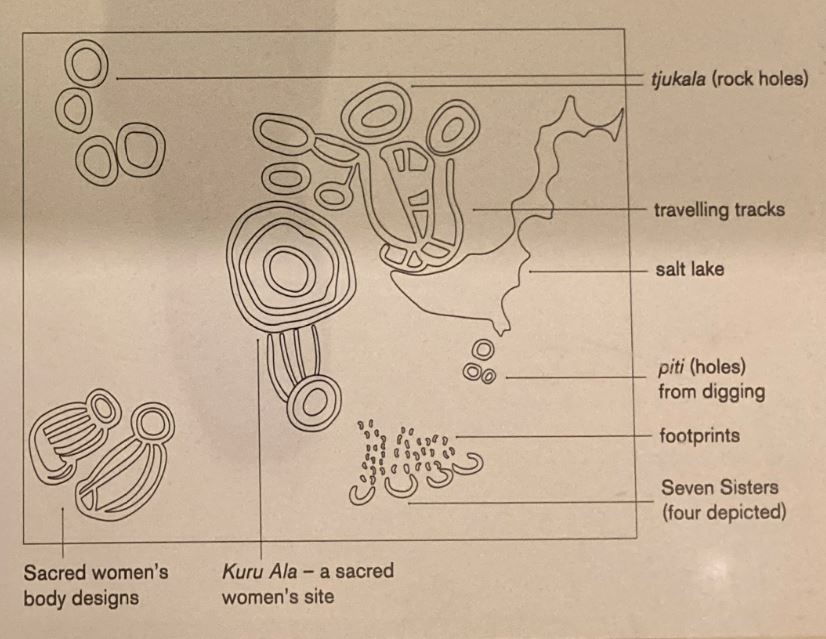
These stripe-line-gestural works may look the most abstract of her work but are actually derived from real objects. Some derive from awelye, the designs which Anmatyerr women paint on their bodies to take part in ceremonies (see video still below). Others, like the network of black lines on the work on the left in the photo below, reflect the complex network of vines thrown out by pencil yams across the surface of the earth.

Installation view of Emily Kam Kngwarray at Tate Modern showing some of her line or stripe paintings (photo by the author)
Portrait of the artist
Photo of Emily Kam Kngwarray painting at Delmore Downs Station in 1994, taken by Greg Weight. I was pleased to see that she’s a southpaw, like me.

Emily Kam Kngwarray. Photo by Greg Weight
The video
One room is given over to a video. In early 2023, a women’s camp was held in Alhalker and Anangker Countries as part of the community consultations for this exhibition. It was an occasion for remembrance, reunion and celebration. The women searched for anwerlarr yams (pencil yams), which were prolific after summer rains. They shared their knowledge of other plants and animals that inspired Kngwarray’s artworks. We watch them wash, then paint their torsos, then perform dances while chanting.
In this still, note the shape of the body designs, with half circles like necklaces under the neck and vertical stripes on the breasts. This pattern of a smiley curve above two sets of vertical lines recurs in a number of Kngwarray’s earlier works.

Installation view of Emily Kam Kngwarray at Tate Modern with a still from the video showing women elders who have painted their chests in order to dance and perform (photo by the author)
A lot of the film looks as if it was shot using cameras on a drone to move very slowly in that characteristic droney, slow-motion way, above the landscape. And this has been done very deliberately because it really helps you understand the relationship between the shape of the land – with its bushes and scrub and rocks, see from directly above – and the dotting style of Kngwarray’s early paintings. There really is a very close relationship between the visual impact of the predominantly brown, mottled earth, dotted with scrub, and the browns and ochres and mottled dots of her early paintings.

Installation view of Emily Kam Kngwarray at Tate Modern with a still from the video showing women elders who have painted their chests in order to dance and perform (photo by the author)
I can’t find the exact film online. The one in the exhibition is only about three minutes long and has no news footage or voiceover from white people. This one was made by Tate, and includes many of the same shots (women painting and dancing, slow tracking shots of the earth) but is longer and, to be honest, a bit spoiled by the wordy commentary.
This is not only an outstanding exhibition, but a thought-provoking revelation that someone from such a poor, excluded, marginalised background could rise through sheer vision and talent to become such a powerful artistic force.
Related links
- Emily Kam Kngwarray continues at Tate Modern until 11 January 2026
- Emily Kam Kngwarray Wikipedia article




 Books & Boots