The Life of Tiberius by Suetonius

‘Poor Rome, doomed to be masticated by those slow-moving jaws.’
(Augustus’s dying comment on his adoptive son and successor, Tiberius, quoted in Suetonius’s Life of Tiberius, section 21)

Tiberius Julius Caesar Augustus was the second Roman emperor. He succeeded his stepfather and adopted father, the first Roman emperor, Augustus, in 14 AD. Born in 42 BC, Tiberius reigned from 14 (i.e. aged 56) until 37 AD, 23 years in total, dying at the age of 78.

Roman texts were divided into short sections, sometimes called ‘chapters’ though most are less than a page long. Suetonius’s biography of the emperor Tiberius is 76 chapters long. Like all the emperors, you can divide his biography into two parts, before he was emperor, and his reign as emperor.

The central fact about Tiberius is that he was a grumpy, unsociable and reluctant emperor who began his reign with exaggerated respect for the institutions of Rome but slowly declined until he was overseeing a reign of terror, especially as a result of encouraging unaccountable spies and informers to bring charges against eminent men.

Already, in 6 BC, while he was being groomed as first among equals in Augustus’s extended family to succeed the great man and had established himself as an effective general after leading the army in Germany, he abruptly quit public life and retired to Rhodes, where he remained for seven years.

The historian Tacitus thinks the biggest reason among many possible ones for Tiberius’s retirement was that Augustus had forced him to divorce his wife, Vipsania, who he really loved, and marry Augustus’s own daughter, Julia who a) despised Tiberius’s relatively lowly origins and b) was extremely promiscuous, taking numerous lovers and publicly humiliating Tiberius.

Suetonius covers the important political and military events of Tiberius’s life, but really comes into his own when discussing the personal quirks and gossip surrounding the second emperor. Key learnings of the opening chapters are:

The Claudian clan, which Tiberius descended from, was famous for its arrogance.

Nero became a common surname in the Claudian clan, from the Sabine tongue meaning ‘strong and valiant’.

His father was the politician Tiberius Claudius Nero and his mother was Livia Drusilla. This Nero opposed the party of Octavian and so as a boy Tiberius was always on the move as his parents moved from place to place dictated by the tribulations of the civil wars.

But once the assassins of Julius Caesar had been defeated, Nero (Tiberius’s father) returned to Rome and was reconciled with Octavian. At which point Octavian, triumphant after winning the civil wars and establishing the Second Triumvirate with Mark Antony and Lepidus, forced Livia to divorce Nero and marry him, even though she was heavily pregnant by Nero at the time. This was in 38 BC. So Augustus married Livia knowing she was pregnant with another man’s child (unless, of course, it was he who had gotten her pregnant, not the husband).

The life of Tiberius: before he was emperor

Tiberius had a younger brother, Drusus Nero.

At the age of nine Tiberius delivered a eulogy of his dead father from the rostra. Just as he was reaching puberty, he accompanied the chariot of Augustus in his triumph after Actium (31 BC),​ riding the left trace-horse, while Marcellus, son of Octavia, rode the one on the right.

Tiberius presided, too, at the city festival, and took part in the game of Troy during the performances in the circus, leading the band of older boys.

Chapter 7. Between attaining manhood and ascending the throne:

  • Tiberius gave a gladiatorial show in memory of his father, and a second in honour of his grandfather Drusus, the former in the Forum and the latter in the amphitheatre
  • he also gave stage-plays, but without being present in person

Around 19 BC Tiberius married Vipsania Agrippina, daughter of Marcus Agrippa, and granddaughter of Caecilius Atticus, the Roman knight to whom Cicero’s letters are addressed.

But after she had given Tiberius a son, Drusus, Augustus forced Tiberius to divorce Vipsania and marry his (Augustus’s) daughter, Julia, in 11 BC. This greatly upset Tiberius who continued to be in love with Vipsania. His new wife, Julia, bore him a child but it died in infancy, at which point it is thought the couple ceased to have relations.

Tiberius’s brother, Drusus, died in Germany and he conveyed his body to Rome, walking before the coffin the entire way.

Chapter 8. Tiberius began his civil career by defending client kings and states. He prosecuted a noble who had conspired against Augustus.

He undertook two public commissions: to improve the grain supply to Rome and to investigate the slave-prisons​ throughout Italy, the owners of which had gained a bad reputation for kidnapping and enslaving travellers, and as havens for men seeking to evade military service.

9. Tiberius’s first military service was as tribune of the soldiers in the campaign against the Cantabrians. Then he led an army to the Orient and restored the throne of Armenia to Tigranes. For about a year he was governor of Gallia Comata which was in a state of unrest through the inroads of the barbarians and the dissensions of its chiefs. Then he conducted war with the Raeti and Vindelici, then in Pannonia, and finally in Germany. He brought 40,000 prisoners of war over into Gaul and assigned them homes near the bank of the Rhine.

For these achievements he was given an ovation in Rome, riding in a chariot and having been honoured with the triumphal regalia, a new kind of distinction never before conferred on anyone.

Tiberius proceeded quickly through the offices of quaestor, praetor, and consul, five years before the usual age limit (he was consul in 13 BC). He was made consul again in 7 BC and the following year received the tribunicial power for five years.

10. In 6 BC, while on the verge of accepting command in the East and becoming the second-most powerful man in Rome, Tiberius announced his withdrawal from politics and retired to the island of Rhodes.

Some say it was due to disgust with his wife, her mockery of him and her indiscriminate promiscuousness, which he daren’t confront, seeing as she was Augustus’s daughter. Others think that, since the children of Augustus were now of age, Tiberius voluntarily gave up the position of number two in the empire, in order to clear the way for them. At the time he simply gave the reason that he was exhausted after years of campaigning in Germany and holding public office and needed a rest.

Augustus was furious and openly criticised him in the Senate. When Augustus and Livia tried to stop him leaving Tiberius went on hunger strike for four days (!). When he was permitted to leave, he did so hugger-mugger, hardly saying goodbye to anyone. He was an odd, secretive, unhappy man.

Tiberius chose Rhodes because he’d liked it when he stopped off there on the way back from campaigning in Armenia. Once there, he settled into a modest house and adopted an unassuming manner of life, at times walking in the gymnasium without a lictor or a messenger, exchanging courtesies with the common people.

He was a constant attendant at the schools and lecture-rooms of the professors of philosophy.

In 2 BC Tiberius’s wife, Julia, was disgraced and sent into exile by Augustus. Despite disliking her, Tiberius performed the husbandly duty of sending letters to intercede with Augustus.

Then, when his tribunician period of office came to an end, and now that Augustus’s grandsons Gaius and Lucius had come of age and were clearly nominated for the succession, Tiberius wrote asking to be allowed to visit his relatives, whom he sorely missed. But Augustus rejected his appeal and told him to forget about ever seeing his family again, who he had so eagerly abandoned.

12. So Tiberius remained in Rhodes against his will. Through his mother he secured the title of envoy of Augustus, so as to conceal his disgrace. He wasn’t left in peace because every Roman official who sailed past the island felt duty bound to stop off and pay their respects

In his absence from Rome negative rumours accumulated around him. When he crossed to Samos to visit his stepson Gaius, who had been made governor of the Orient, he found him alienated due to slanders spread by Gaius’s staff. It was also claimed that Tiberius had sent messages to some centurions which possibly hinted at overthrowing Augustus. Tiberius swore it wasn’t so and asked Augustus for the appointment of someone, of any rank whatsoever, to keep watch over his actions and words to prove it.

13. Tiberius gave up his usual exercises with horses and arms and dropped the traditional costume of his people i.e. the toga, taking to the cloak and slippers of Greece – prompting criticism. There’s a story that, when his name came up at a dinner party hosted by Gaius, a man got up and assured Gaius that if he would say the word, he would at once take ship for Rhodes and bring back the head of “the exile,” as he was commonly called.

At this point Tiberius realised his life was actually at risk, so he renewed his pleas to his mother, and, as it happens, Augustus’s eldest son was at odds with Marcus Lollius, Gaius’s adviser, and so ready to oppose him on this issue (of recalling Tiberius). So, as a result of palace intrigue, Tiberius was grudgingly allowed to return to Rome, but on condition that he took no part or active interest in public affairs. So in the eighth year of his retirement Tiberius returned to Rome.

14. Since his early days Tiberius’s life had been marked by omens and predictions:

  • when Livia was pregnant with him, and was trying to divine by various omens whether she would bring forth a male, she took an egg from under a setting-hen, and when she had warmed it in her own hand and those of her attendants in turn, a cock with a fine crest was hatched
  • in his infancy the astrologer Scribonius promised him an illustrious career and even that he would one day be king, but without the crown of royalty
  • on his first campaign, when he was leading an army through Macedonia into Syria, it chanced that at Philippi the altars consecrated in bygone days by the victorious legions gleamed of their own accord with sudden fires
  • on his way to Illyricum he visited the oracle of Geryon near Patavium and drew a lot which advised him to seek an answer to his inquiries by throwing golden dice into the fount of Aponus – and then the dice which he threw showed the highest possible number (and those dice may be seen to this day, under the water)
  • a few days before his recall an eagle, a bird never before seen in Rhodes, perched on the roof of his house
  • the day before he was notified that he might return, his tunic seemed to blaze as he was changing his clothes

On the day the ship bearing Augustus’s permission came into sight, Tiberius was walking along the cliffs with his astrologer Thrasyllus, who saw it and declared that it brought good news. This was lucky for him because Tiberius had made up his mind to push the man off the cliff, believing him a false prophet because things up to that moment had all turned out contrary to his predictions. [How could anyone know the truth of this story? Only if Tiberius himself told someone, who told someone else etc.]

15. Tiberius returned to Rome in 2 AD. Here he introduced his son, Drusus Julius Caesar (born in 14 BC and so aged 16) to public life. Forbidden to take part in public life, Tiberius moved to the gardens of Maecenas on the Esquiline Hill, where he led a very retired life, merely attending to his personal affairs and exercising no public functions.

The situation was transformed when the two young heirs to the throne died in quick succession, Lucius in 2 AD, Gaius in 4. This prompted Augustus to rearrange the pieces on the chess board: he now formally adopted Tiberius as his own son and heir, compelling him, in turn, to adopt his nephew Germanicus.

From this time onwards (4 AD) nothing was left undone which could add to his prestige, especially after the disowning and banishment of Agrippa made it clear that the hope of the succession lay in him alone.

16. Augustus gave Tiberius the tribunician power for a second term of three years. He was assigned responsibility for subjugating Germany. But then a revolt broke out in the province of Illyricum, in the western Balkans, and Tiberius was transferred to take charge of quelling it.

This war lasted four years, from 6 to 9 AD. It came to be called the Bellum Batonianum and Suetonius describes it as the most serious of all foreign wars since those with Carthage (the three Punic Wars between 264 and 146 BC). Tiberius commanded fifteen legions and a corresponding force of auxiliaries, surmounting difficulties of terrain, the scattered nature of the tribal enemy and scarcity of supplies. His perseverance paid off and Tiberius completely subdued and reduced to submission the whole of Illyricum, which became a Roman province.

17. Tiberius’s exploits in Illyricum won him all the more glory because it was during this period, in 9 AD, that Quintilius Varus lost his three legions in an ambush in Germany, and no one doubted that the victorious Germans would have united with the Pannonians to foment rebellion on two fronts, had not Illyricum been subdued first.

Consequently a triumph was voted to Tiberius and many high honours. Some recommended that he be given the surname of Pannonicus, others of Invictus, others of Pius. Characteristically, Augustus vetoed these suggestions. Tiberius himself put off the triumph, because the country was in mourning for the disaster to Varus.

18. The next year Tiberius returned to Germany and, realising that the disaster to Varus was due to that general’s rashness and lack of care, he took no step without the approval of a council, having previously been a man of independent judgment and self-reliance. He ordered baggage to be kept to a minimum. Once across the Rhine he took his meals sitting on the bare turf, often passed the night without a tent, and gave all his orders for the following day in writing, for the avoidance of doubt or ambiguity. He ordered that if any officers were in doubt, they were to consult him personally, at any hour whatsoever, even in the night.

19. In Germany Tiberius insisted on the strictest discipline, reviving bygone methods of punishment. For example, he demoted the commander of a legion for sending a few soldiers across the river to accompany one of his freedmen on a hunting expedition.

Despite all these rational procedures, he remained deeply superstitious, embarking on battle with greater confidence when, the night before, his lamp suddenly and without human agency died down and went out, claiming this had always been a good omen, for himself and his ancestors.

One assassination attempt was made, by a member of the Bructeri tribe who got access to Tiberius among his attendants, but was detected through his nervousness and was then tortured till he confessed.

20. After two years Tiberius returned to Rome from Germany and celebrated the triumph which he had postponed, accompanied by his generals, for whom he had obtained the triumphal regalia. Before turning to enter the Capitol, he dismounted from his chariot and fell at the knees of Augustus, who was presiding over the ceremonies.​

Tiberius sent Bato, the leader of the Pannonians, to Ravenna,​ after presenting him with rich gifts, thus showing his gratitude to him for allowing him to escape when he was trapped with his army in a dangerous place. Then he gave a banquet to the common people at a thousand tables, and distributed a largess of 300 hundred sesterces to every man. With the proceeds of his spoils from the war Tiberius restored and dedicated the temple of Concord, as well as that of Pollux and Castor, in his own name and that of his brother.

21. Tiberius was scheduled to return to Illyricum to govern it, but he was at once recalled for Augustus was entering his last illness. Tiberius spent an entire day with him in private. it is said that when Tiberius left the room after this confidential talk, Augustus was overheard by his chamberlains to say: ‘Alas for the Roman people, to be ground by jaws that crunch so slowly!’

It is said that Augustus so disapproved of Tiberius’s austere manners that he sometimes broke off his lighter conversation when Tiberius entered the room. Here comes Old Gloomy Guts.

But Augustus gave in to Livia’s pleading for her son to be made heir. It may also be that Augustus concluded that, with such a successor he himself would come to be all the more venerated and respected – although Suetonius himself can’t believe such a responsible ruler as Augustus would behave so irresponsibly.

Suetonius thinks Augustus had to make a difficult decision – all the heirs he had lined up had died and Tiberius, despite his dour manner and the black mark of his retirement to Rhodes, had proved himself an assiduous and victorious general in Illyricum, so…on balance…his merits outweighed his faults.

[Such is the weakness of an imperial or royal system of government, that it can only choose successors from a very limited pool of candidates and so, by the law of averages, is as likely to produce bad or terrible rulers as good or excellent ones, more likely in fact, since the demands of ruling an empire require more than normal abilities.]

Suetonius’s interpretation is backed up by the record, for he cites the fact that Augustus took an oath before the people that he was adopting Tiberius for the good of the country, and alludes to him in several letters as a most able general and the sole defence of the Roman people. Suetonius goes on to quote from Augustus’s correspondence where, among other epithets, Augustus calls Tiberius ‘most charming of men’ and ‘most charming and valiant of men and most conscientious of generals’.

The life of Tiberius: his rule as emperor

22. Tiberius didn’t make the death of Augustus public until the young Agrippa had been disposed of. The latter was slain by a tribune of the soldiers appointed to guard him, who received a letter with the order. It is not known whether Augustus left this letter when he died, to remove a future source of discord, or whether Livia wrote it herself in the name of her husband, or whether it was with or without the connivance of Tiberius.

Anyway, when the tribune reported that he had done his bidding, Tiberius replied that he had given no such order, and that the man must render an account to the senate, apparently trying to avoid odium at the time, for later his silence consigned the matter to oblivion.

23. When Tiberius first addressed the senate after Augustus’s death he broke off his speech with a groan, saying he was overcome with grief, wished he also was dead, handed the speech to his son Drusus to finish.

Then he had Augustus’s will read out. It began: ‘Since a cruel fate has bereft me of my sons Gaius and Lucius, be Tiberius Caesar heir to two-thirds of my estate’ – hardly a ringing endorsement, and confirming the suspicion that Augustus had named Tiberius his successor from necessity rather than from choice.

24. Though Tiberius did not hesitate at once to assume and to exercise the imperial authority, surrounding himself with a guard of soldiers, with the actual power and the outward sign of sovereignty, nonetheless he refused the title for a long time. When his friends urged him to adopt it, he upbraided them for not realising what a monster the empire was.

At last, reluctantly and complaining that a wretched and burdensome slavery was being forced upon him, Tiberius accepted the empire, but in such a way as to suggest the hope that he would one day lay it down. His own words were: ‘Until I come to the time when it may seem right to you to grant an old man some repose’ [anticipating his later retirement to Capri].

25. Tiberius described being emperor as like ‘holding a wolf by the ears’. There were plots against his life:

  • a slave of Agrippa, Clemens, had collected a band to avenge his master
  • Lucius Scribonius Libo, one of the nobles, was secretly plotting a revolution
  • a mutiny of the soldiers broke out in two places, Illyricum and Germany

Both armies demanded numerous special privileges – above all, that they should receive the same pay as the praetorians. The army in Germany was reluctant to accept an emperor who was not its own choice and vociferously preferred their general, the nephew whom Augustus had forced Tiberius to adopt, Germanicus – although the latter, with characteristic grace and propriety, refused.

Tiberius asked the Senate to appoint colleagues to share the burden of rule. He also feigned ill-health, to induce Germanicus to wait with more patience for a speedy succession, or at least for a share in the sovereignty. The mutinies were put down, and he also got Clemens into his power, outwitting him by stratagem.

Not until his second year did he finally arraign Libo in the senate, fearing to take any severe measures before his power was secure, and satisfied in the meantime merely to be on his guard. In the meantime Tiberius took precautions: thus when Libo was offering sacrifice with him among the pontiffs, he had a leaden knife substituted for the usual one; when Libo asked for a private interview, Tiberius would not grant it except with his son Drusus present, and as long as the conference lasted he held fast to Libo’s right arm, under pretence of leaning on it as they walked together [in order to stop him grabbing a knife or other weapon].

26. Tiberius at first played an unassuming​ part, almost humbler than that of a private citizen. Of many high honours he accepted only a few of the more modest. He barely consented to allow his birthday to be recognized by the addition of a single two-horse chariot to the scheduled games. He forbade the voting of temples, flamens, and priests in his honour, and even the setting up of statues and busts without his permission.

He refused to allow an oath to be taken ratifying his acts,​ nor the name Tiberius to be given to the month of September, or that of Livia to October.

He declined the forename Imperator,​ the surname of ‘Father of his Country’ and the placing of the civic crown​ at his door (as Augustus had had done). He did not even use the title of ‘Augustus’ in any letters except those to kings and potentates, although it was his by inheritance.

Tiberius held only three consul­ships after becoming emperor – one for a few days, a second for three months, and a third, during his absence from the city, until the Ides of May.

27. Tiberius so loathed flattery that he would not allow any senator to approach his litter, either to pay his respects or on business, and when an ex-consul in apologizing to him attempted to embrace his knees, he drew back in such haste that he fell over backward.

If anyone in conversation or in a set speech spoke of him in too flattering terms, Tiberius interrupted him and corrected his language on the spot. Being once called ‘Lord’, he warned the speaker not to address him again in an insulting fashion.

28. Tiberius rose above abuse, slander and lampoons of himself and his family. He said that in a free country there should be free speech and free thought.

29. Tiberius treated the Senate with exaggerated respect, openly stating that a princeps ought to be the servant of the senate, of the citizenry as a whole, and sometimes even of individuals.

30. There was no matter of public or private business so small or so great that he did not lay it before the senators, consulting them about revenues, restoring public buildings, levying and disbanding soldiers, the disposal of the legionaries and auxiliaries, about the extension of military commands and appointments to the conduct of wars, his replies to the letters of kings.

31. Tiberius was content for the Senate to vote against his expressed wishes and on one famous occasion opposed a motion so popular that he was the only man to go into the minority lobby, and not a single colleague followed him.

Tiberius revived the importance of the consuls. He had foreign delegations address themselves to the consuls, rose when they entered a room, and made way for them on the street.

32. Tiberius rebuked some ex-consuls in command of armies for addressing their reports to him and not to the Senate. To the governors who recommended burdensome taxes for his provinces, he wrote in answer that it was the part of a good shepherd to shear his flock, not skin it.

33. Tiberius intervened to prevent abuses. Sometimes he offered the magistrates his services as adviser, taking his place beside them at the tribunal. If word got around the bribery was being deployed in a court case, he would appear remind the jurors of the laws and of their oath to uphold justice.

34. Tiberius reduced the cost of the games and shows by cutting down the pay of the actors and limiting the pairs of gladiators to a fixed number. He recommended that prices in the market should be regulated each year at the discretion of the senate.

He was personally frugal. As part of his campaign against waste, he often served at formal dinners half-eaten dishes from the night before – on one occasion serving the remaining half of a boar eaten the night before, declaring that it contained all that the other half did.

He issued an edict forbidding general kissing as well as the exchange of New Year’s gifts​ after the Kalends of January.

35. Tiberius revived the custom whereby married women guilty of improprieties could be punished by a family council. Married women of good family had begun to practice as prostitutes and to escape punishment for adultery by renouncing the privileges of their class. Profligate young men voluntarily incurred degradation from their rank so as to appear on the stage and in the arena without incurring punishment. Tiberius punished all such men and women with exile.

36. Tiberius abolished foreign cults, especially the Egyptian and the Jewish rites. He compelled adherents to these religions to burn their religious vestments and all their paraphernalia. He assigned Jews of military age to provinces with unhealthy climates, ostensibly to serve in the army. Jews over the age of military service he banished from the city on pain of slavery for life.

He banished the astrologers from Rome, unless they promised to abandon their practices.

37. Tiberius safeguarded the country against banditry and lawlessness. He stationed garrisons of soldiers nearer together than before throughout Italy, while in Rome he established a camp for the barracks of the praetorian cohorts, which before that time had been quartered in isolated groups in divers lodging houses.

He took great pains to prevent city riots. When a quarrel in the theatre ended in bloodshed, he banished the leaders of the factions as well as the actors who were the cause of the dissension.

He abolished the traditional right of sanctuary throughout the empire.

After his accession to the throne, Tiberius undertook no further military campaigns. If regional kings were disaffected, he used threats and cajolery rather than military campaigns. Or he lured them to Rome with flattering promises and then kept them there.

38. For two whole years after becoming emperor he did not set foot outside the gates. After that he made promises to tour the provinces and even hired transports and food, but never managed to actually leave, leading to many jokes.

39. Both Tiberius’s sons died before him: his nephew and heir, Germanicus, who he adopted in 4 AD, died in 19, aged 33. His natural son, Drusus the younger (named after Tiberius’s brother), Tiberius’s son by his first wife, Vipsania, died in 23, aged 26.

After their deaths, Tiberius retired to Campania and it became widely believed that he would die there. In fact he nearly died in a freak accident when he was attending a luxury dinner in a grotto and some of the ceiling gave way, killing guests near him.

40. The official reason for the journey through Campania was to dedicate a temple to Capitoline Jupiter at Capua and a temple to Augustus at Nola, but when he’d done this he didn’t return to Rome but crossed to the island of Capri. Shortly afterwards he was recalled to the mainland after a disaster at an amphitheatre which had given way during a gladiatorial show, killing thousands. So he crossed to the mainland and made himself accessible to all, for a spell.

41. But then he returned to Capri and from this point onwards began to neglect all his responsibilities, for example not filling the vacancies in the decuries​ of the knights, nor changing the tribunes of the soldiers and prefects or the governors of any of his provinces. He left Spain and Syria without consular governors for several years, allowed Armenia to be overrun by the Parthians, Moesia to be laid waste by the Dacians and Sarmatians, and the Gallic provinces by the Germans, to the great dishonour and danger of the empire.

Tiberius retreated to Capri in 26 AD and never afterwards visited Rome. From this point onwards Suetonius’s account turns into a lurid account of Tiberius’s decline into moral degeneracy.

42. Tiberius had from the start of his military career been known as a heavy drinker. He had acquired the nickname of ‘Biberius Caldus Mero’, meaning ‘Drinker of hot wine with no water added’. He spent two days and a night feasting and drinking with Pomponius Flaccus and Lucius Piso, immediately afterwards making the one governor of the province of Syria and the other prefect of Rome.

Tiberius attended had a dinner given him by Cestius Gallus, a lustful and prodigal old man, who had once been degraded by Augustus, but ensured he kept his usual custom of having the serving girls naked.

43. On Capri Tiberius indulged his sexual fantasies. He built a sexual sporting house as the setting for orgies. He selected men and women from across the empire to engage in acts of deviant sex for his stimulation. The bedrooms were decorated with erotic paintings and sculptures. He had an erotic library, in case a performer needed an illustration of what was required. In Capri’s woods and groves he arranged a number of nooks where boys and girls, dressed as Pans and nymphs, prostituted themselves outside bowers and grottoes.

44. Suetonius goes on to list grosser allegations made against him, for example:

  • that he trained little boys, who he called his ‘minnows’, that when he went swimming they swam between his thighs to lick and nibble his genitals
  • that he put unweaned babies to his penis for them to suckle
  • that he owned a painting by Parrhasius depicting Atalanta fellating Meleager

45. Tiberius terrorised women of high birth. When a certain Mallonia refused to submit to his lust he had her informed on and taken to trial, with the result that she went home, delivered a tirade against ‘that filthy-mouthed, hairy, stinky old man’ and stabbed herself to death.

46. He was tight-fisted to the extent of miserliness.

47. In striking contrast to Augustus, Tiberius constructed no magnificent public works. He undertook only two, the temple of Augustus and the restoration of Pompey’s theatre, but both were left unfinished at the end of his reign. He gave no public shows at all and very seldom attended those given by others.

48. Tiberius showed generosity to the public only twice: once when he offered to lend a hundred million sesterces without interest for a period of three years in response to a widespread financial crisis; and then when he made good the losses of some owners of blocks of houses on the Caelian mount, which had burned down.

He acted generously to the army once, doubling the legacies provided for in the will of Augustus, but thereafter never gave gifts to the soldiers, with the exception of a thousand denarii to each of the praetorians for not taking sides with Sejanus during the latter’s attempted coup.

He did not relieve the provinces by any act of liberality, except Asia, when some cities were destroyed by an earthquake.

49. As the years went by Tiberius’s stinginess turned to rapacity. He drove Gnaeus Lentulus Augur to make Tiberius his heir, then kill himself. He confiscated the property of leading men of the Spanish and Gallic provinces, as well as of Syria and Greece. He deprived many states and individuals of immunities of long standing meaning that he collected their revenues.

Tiberius persuaded Vonones, king of the Parthians, after he’d been dethroned by his subjects and taken refuge at Antioch with a vast treasure, to put himself under the protection of the Roman people, then had him treacherously put to death.

50. One by one Tiberius turned against his own family. When his brother Drusus wrote a letter suggesting they band together to force Augustus to restore the Republic, Tiberius snitched on his brother to Augustus in order to blacken his name.

Tiberius so hated his banished second wife, Julia, that, when he came to power he intensified her exile not just to one town, but to one house, and deprived her of her allowance​.

Tiberius was very touchy about accusations that his mother Livia influenced him or shared his rule. He refused to let her be awarded the title ‘Parent of her Country’ or any other public honour.

[Livia died in 29, aged 87 i.e. Tiberius had to put up with her overbearing presence for the first 15 years of his rule.]

51. During an argument Livia is said to have produced letters from Augustus complaining about Tiberius’s sour character. This suggested such a deep and long-held enmity towards him that some say this was the reason for his retreat to Capri.

In the last three years of Livia’s life, Tiberius is said to have visited her only once, for a few hours, and didn’t visit her at all when she was ill.

After Livia’s death, Tiberius forbade her deification. He ignored the provisions of her will, and within a short time caused the downfall of all her friends and intimates, even those she had commended to his care. He had one of them, a man of equestrian rank, condemned to the treadmill.

52. Tiberius had a father’s affection neither for his own son Drusus (d. 19 AD) nor his adopted son Germanicus (d. 23 AD). After Drusus died he barely waited for the traditional period of mourning to end before resuming his usual routine.

Germanicus was handsome, successful, charming (remember how Ovid placed all his hopes for clemency in him, in his Black Sea Letters). According to Tacitus, many Romans considered Germanicus to be their equivalent to Alexander the Great, and believed that he would have easily surpassed the achievements of Alexander had he become emperor. But Tiberius mocked his achievements and openly complained to the Senate about him.

It was widely believed that Tiberius arranged to have Germanicus poisoned while on active service in Syria at the hands of Gnaeus Piso, governor of Syria. When Piso was tried on that charge, it was rumoured that he was about to produce Tiberius’s written instructions to him, so Tiberius had him quickly poisoned. As a result the slogan ‘Give us back Germanicus,’ was posted around Rome.

Tiberius then confirmed everyone’s worst suspicions by cruelly abusing Germanicus’s widow, Agrippina, and their children.

53. Tiberius embarked on a campaign to blacken the name of Germanicus’s wife, Agrippina. He stage-managed a dinner where he offered her an apple which she refused to take, assuming it was poisoned. He accused her of not trusting him. He falsely accused her of trying to flee, seeking sanctuary with the statue of Augustus or fleeing to the army. So he exiled her to Pandataria and, when she complained, had her beaten by a centurion until one of her eyes was destroyed.

Agrippina decided to starve herself to death in which, although he had her mouth forced open and food crammed into it, she succeeded. After Agrippina’s death Tiberius slandered her, persuading the senate to add her birthday to the days of ill omen and claiming credit for not having her publicly executed and thrown onto the Stairs of Mourning.

54. By Germanicus Tiberius had three grandsons, Nero, Drusus and Gaius (the future emperor Caligula), and by Drusus one, called Tiberius. Tiberius recommended Nero and Drusus to the senate and celebrated the day when each of them came to his majority. But almost immediately he began criticising and undermining them. When they complained about him he had witnesses stationed nearby and accumulated enough instances to have them pronounced public enemies and starved to death, Nero on the island of Pontia and Drusus in a lower room of the Imperial Palace. Drusus was said to be so tortured by hunger that he tried to eat the stuffing of his mattress.

55. Tiberius asked the Senate to select 20 leading men to form a council of state. Only 2 or 3 of them died natural deaths. He promoted Aelius Sejanus in order to use his cunning and services to destroy the children of Germanicus and secure the succession for his own grandson, the child of his son Drusus.

56. Tiberius was cruel to his Greek companions, banishing one, forcing another to commit suicide.

57. Even at the start of his reign, when he was still courting popularity by a show of moderation, Tiberius occasionally burst out with vengeful acts, executing people who offended him or questioned him.

58. Tiberius began to enforce laws for lèse-majesty regarding Augustus, which slowly escalated in triviality and severity. Eventually people could be tried beating a slave near a statue of Augustus carrying a ring or coin stamped with Augustus’s image into a privy or a brothel. Finally, a man was put to death merely for allowing an honour to be voted him in his native town on the same day that honours had previously been voted to Augustus.

59. Slowly, more and more cruel and savage deeds were carried out under the guise of the improvement of the public morals but in reality to gratify Tiberius’s pleasure in seeing suffering.

60. Cruelty: A few days after he reached Capri a fisherman appeared unexpectedly and offered him a huge mullet. Tiberius was so freaked out by the man’s appearance out of nowhere that he had his face rubbed raw with the fish’s scales.

When the litter he was being carried in was blocked by brambles, he had the centurion responsible for scouting the path stretched out on the ground and flogged half to death.

61. The 20s AD saw the creation of an atmosphere of fear in Roman noble and administrative circles with the expansion of treason trials and the widespread use of delatores or informers. Informers were always believed and could betray people for a few mildly critical words. All sentences became death sentences. Not a day passed without an execution.

Eventually, this degenerated into carnage. On some days 20 people were killed. Entire families, women and children too. Since it was illegal to execute virgins, the public executioners raped them first, then executed them. Corpses were dragged to the Tiber with hooks.

Many thought that Sejanus, as his henchman, egged him on, but after Sejanus’s fall the cruelty only got more ferocious.

62. Upon discovering that his own son, Drusus, had not died from his dissipated lifestyle but been poisoned by his wife Livilla and Sejanus, Tiberius went mad and spared none from torment and death, devoting all his time to unmasking what he saw as endless conspiracy, submitting random strangers to torture and execution.

On Capri people still point out the cliff Tiberius had his victims thrown off into the sea. If the tide was out a crew of marines waited below and broke their bones with boathooks and oars.

He devised a form of torture whereby he tricked men into drinking copious draughts of wine, and then had their genitals tightly bound so they couldn’t pee.

The soothsayer Thrasyllus is said to have saved many lives by telling Tiberius he would live a long life and so had plenty of time to torture and execute as many as he wanted. Tiberius even hated his own grandsons, Gaius and Tiberius the Younger.

63. He prevented ex-consuls taking up governorships in their provinces, because he didn’t trust them.

64. After the exile of his daughter-in‑law and grandchildren, Tiberius never moved them anywhere except in fetters and in a tightly closed litter, while a guard of soldiers kept any who met them on the road from looking at them or even from stopping as they went by.

65. Tiberius realised that his henchman Sejanus was plotting revolution, that he was being celebrated back in Rome and statues erected to him, so he embarked on a complicated strategy to discredit and overthrow him. This began by having Sejanus appointed consul with Tiberius, in 31 AD.

66. Public disgust at Tiberius broke out in a hundred ways, in lampoons and graffiti and slogans and jokes about his grotesque cruelty. Artabanus, king of the Parthians, sent a long letter detailing his crimes against the state and his own family, and telling him to commit suicide.

67. Suetonius makes the interesting point that Tiberius appears to have anticipated that his own wretched character would come to the fore. Soon after his accession the Senate had grovellingly offered him the title of ‘Father of his Country’ and an even more sycophantic gesture that anything he had said or done or would say or do would be honoured. Suetonius quotes Tiberius’s letters of reply to these offers in which he turns them down on the basis that, despite themselves, men change their character – almost as if he knew that, once granted supreme power, his worst nature would come to the fore.

68. Tiberius’s physique. He was above average height and strong (unlike short, weedy Augustus). He could crack someone’s skull with a single punch. He had blonde hair which he wore long at the back, concealing his neck. He was handsome but liable to pimples. He had large eyes. He enjoyed excellent health till the end of his life.

69. He didn’t venerate the gods as Augustus had done, but he was addicted to astrology. He was immoderately afraid of thunder. Whenever the sky darkened he wore a laurel wreath because it was said that that kind of leaf was not blasted by lightning.

70. Tiberius was greatly devoted to Greek and Roman literature. He wrote poetry in Greek. His specialist interest was Greek mythology and he cultivated the company of historians and grammarians who he asked teasingly obscure questions (Who was Hecuba’s mother? What was the name of Achilles when he hid among the girls of King Lycomedes’ court?)

71. Tiberius spoke Greek fluently yet he insisted on Latin being used on formal, political and legal occasions.

72. After his retirement to Capri, Tiberius made two attempts to return to Rome, once up the river Tiber, once by road, but both times turned back, afraid, it is said, of the mob. It was on the second attempt that he fell ill and, on the journey back to Capri, tried to conceal it by staying up late feasting at all the waystations, thus exacerbating the condition.

73. Reading that people named by informers were now being released without trial, Tiberius exclaimed this was treason and vowed to return to his safe place, Capri. But he became increasingly unwell and died in the villa of Lucullus, aged 78, in the 23rd year of his reign.

Some believe he was poisoned by Gaius (Caligula). Others that during convalescence from a fever, food was refused him when he asked for it. Some say that a pillow was put over his face to smother him. Seneca writes that, conscious of his approaching end, Tiberius took off his signet ring as if to give it to someone but couldn’t bring himself to part with it and, eventually, slipped it back on his finger. Having been unconscious with illness, he woke, called for attendants and, when no-one came, got up but his strength failed him and he fell dead near his couch.

74. The Romans really loved stories about omens. No biography is complete without them. Thus:

  • on his last birthday he dreamt that the huge statue of Apollo he had brought to adorn the library of the Temple of Augustus, came to him and announced he would not be dedicated by Tiberius
  • a few days before his death the lighthouse at Capri was wrecked by an earthquake

75. Tiberius’s death prompted celebrations around Rome. He was survived by one last atrocity. Hearing he was ill, the Senate declared all executions should be delayed by 10 days. Tiberius died on that tenth day but, since there was no-one in authority to extend the period or sign remittances, the executioners went ahead and strangled all the condemned, so that it was said his cruelty lived on after his death. Thus many called for there to be no funeral or his body to be only half cremated as an insult.

In the end his body was taken to Rome by the soldiers and cremated in the approved way.

76. Tiberius’s will named his grandsons, Gaius, son of Germanicus, and Gemellus, son of Drusus, heirs to equal shares of his estate. He gave legacies to several to the Vestal Virgins, with a bounty for every serving soldier and every member of the commons of Rome.

[Tiberius was succeeded by Gaius, more generally known as Caligula, son of Germanicus, and Tiberius’s great-nephew. Caligula was the only one of Germanicus’s children to survive Tiberius’s persecution. He adopted Caligula and took him to live with him in his debauched retirement on Capri. In Suetonius’s Life of Caligula, Tiberius is quoted as saying that he was ‘nursing a viper in Rome’s bosom.’ It was widely believed that Gaius had his very old great-uncle murdered, possibly himself smothering him with a pillow. After a promising beginning, Caligula’s reign swiftly descended into four years of chaotic misrule.]

Thoughts

Tiberius’s life divides very much into two halves, the dutiful imperial servant and the disgraceful debauchee. Tiberius’s military service in Germany and particularly Illyricum inspire respect. Compared to the military ‘service’ of his successors (Caligula, Claudius, Nero), he is a truly impressive figure.

But once he had settled into power, and begun to indulge his personal tastes for torture and debauchery, what a sickening contrast to his adoptive father, Augustus, who worked tirelessly for the improvement of Rome and the fair administration of justice right to the end of his long life.

Suetonius reports that some people wondered if Augustus chose Tiberius as his heir because he knew what a monster he’d turn out to be and that Tiberius’s rule would probably make his (Augustus’s) reputation all the more glorious.

Tiberius’s life shows what absolute power does to dissolute or depraved characters.

During the republican era Roman propagandists prided themselves that the rule of law and their complex constitutional procedures set them apart from the oriental despotisms of the East. By the turn of the first century BC Rome had imported a number of Eastern religions and rites, notably the cult of the Egyptian goddess Isis. You could say that the reign of Tiberius marked the full arrival in Rome of the political traditions of oriental despotism – namely, palace intrigue and public terror.


Credit

Robert Graves’s translation of The Twelve Caesars by Suetonius was published by Penguin in 1957. A revised translation by Classicist Michael Grant, more faithful to the Latin original, was published in 1979. A further revised edition was published in 1989 with an updated bibliography. I read the Penguin version in parallel with the 1914 Loeb Classical Library translation which is available online.
Related links

Roman reviews

The Year One by M.I. Finley (1968)

History tends to be the history of the winners, with the losers assigned the passive, largely unvoiced, faceless role of the people on whom the winners operated.
(‘Aspects of Antiquity’, page 189)

Notes on ‘The Year One’, a short essay included in Finley’s 1968 collection, ‘Aspects of Antiquity’.

Ancient calendars

People living through a momentous year (1066, 1789, 1939, 2000) usually know about it. The most obvious thing to say about the year 1 is nobody living through it knew about it at the time. The entire chronological framework of Western civilisation, whereby we divide years into before Christ (BC) or after Christ (in the year of the Lord, anno Domini, AD) hadn’t been invented.

Instead, all the different cultures of the ancient world kept their own calendars relating to their own cultural landmarks. The Greeks thought in terms of four year blocks or ‘Olympiads’ which began with the first Olympic Games in 776 BC, so year one was the first year of the 195th Olympiad.

The Romans had, for centuries, dated events by referring to the two consuls who were in office for that year, thus ‘in the consulship of Caius Caesar, son of Augustus, and Lucius Aemilius Paullus, son of Paullus.’

Only the learned wanted to look back deeper than a few decades and, for those purposes, Roman historians had worked out the year of the legendary foundation of Rome, and dated everything AUC standing for ‘ab urbe condita’ or ‘since the founding of the city (Rome)’. Many centuries later Christian historians aligned this legendary date to 753 years before the birth of Christ. So the year one was 754 AUC. This system was devised by the Christian historian Dionysius Exiguus, a Greek-speaking monk.

The evidence of the gospels

Of the four gospels only two give details of the birth of Jesus, Matthew and Luke

Matthew’s Gospel

Matthew’s gospel includes the story of ‘the massacre of the innocents’ (chapter 2, verses 16 to 18). Herod the Great, king of Judea, is said to have heard a prophecy that his kingdom will be overthrown by a child about to be born in Bethlehem, so he ordered the execution of all male children aged two and under in the vicinity of Bethlehem. The Catholic Church regards them as the first Christian martyrs, and their feast – Holy Innocents’ Day (or the Feast of the Holy Innocents) – is celebrated on 28 December. In this story, Joseph and Mary were warned by angels about the impending massacre and so made their way secretly to Egypt, ‘The Flight to Egypt’, a journey depicted in countless paintings.

Unfortunately for the veracity of this version, Herod the Great died in 4 BC. If Matthew is literally correct, Jesus must have been born in 4 BC at the latest.

Luke’s Gospel

Luke’s story is different. He says the Romans sent out a decree that everyone had to return to their home town in order to take part in a national census of the population of Judea so they could be taxed more efficiently.

Unfortunately, the only census decreed by the Romans that we know of occurred in either 6 or 7 AD.

In 6 AD the Romans deposed Herod’s son, Archelaus, themselves took over Judea, and installed a Roman governor with instructions to conduct a census. (The northern province of Galilee remained under the rule of the Herod family; Finley says this slight inconsistency between direct and indirect rule was common in provinces on the edge of the empire.)

The Roman Empire

Was an empire in the full sense. The ‘Roman people’ i.e. citizens of Rome and central and northern Italy, ruled all the other inhabitants of the empire as subjects. The empire outside Italy was divided into provinciae. In 1 AD the Roman empire covered about 1,250,000 square miles with a population of about 60 million (population figures are deeply contested). Censuses were taken in the provinces to maximise tax revenue, but at different times in different provinces, using different methods and definitions, so…

The tax collector, along with the soldier, was the most obvious and ubiquitous link between the provinces and Rome. (p.187)

The limits of Empire

In 9 AD a Romanised German warrior chief named Arminius lured three legions into an ambush in the Teutoburg Forest and annihilated them, seizing the precious standards. Traumatised by this terrible news, the emperor Augustus ordered the remaining two legions and all Roman citizens to withdraw back across the Rhine, a decision reinforced by his successor Tiberius, which crystallised into a fiat. The Romans never attempted to conquer and colonise Germany and the north European border settled for the next four centuries along the Rhine-Danube line.

The borders finalised as England in the north-west, the Atlantic in the west, the Atlas mountains, the Sahara and the cataracts of the Nile in Africa, Judea in what is now the Middle East, and Asia i.e. half of Anatolia up to the border with Armenia.

Imperial exploitation

The Romans had no shortage of writers and propagandists (Horace, Virgil and so on) praising Augustus’ rule and, by extension, Rome’s right to rule the entire world (Virgil). The Christian European empires 1700 years later (Spain, France, Britain, Holland) made lengthy attempts to justify their imperial conquests in terms of bringing civilisation etc to barbarian lands. The Romans used the same rhetoric but were much more honest about the sheer greed and looting involved in conquest. As Finley says in his essay about slavery, Julius Caesar set out for Gaul a penniless aristocrat from a down-at-heel family and he returned 8 years later a multi-millionaire and the most powerful man in Rome. That’s what 8 years of burning and looting did for him.

Once a province had been conquered and pacified there an infrastructure was imposed designed to extract wealth, consisting of extensive taxes(in goods and services and money) for the state, but great personal income skimmed off by high officials and members of the tax farming corporations.

Rome had no mission to civilise comparable to France’s great pretension to a mission civilisatrice. Some of her propagandists later developed this idea but the reality was that, so long as they paid their taxes, Rome left her subject peoples largely to themselves, only interfering if there was disorder, rebellion etc. Over a century of conquering and administering other peoples had shown that minimal interference paid off and…was cheap to run.

This was particularly true in the East, which had well-established cultures/civilisations long before the Romans arrived. Latin was the language of the new rulers but Greek remained the language of intellectuals and the ruling classes which sat directly below the Roman governor. Educated Romans learned Greeks but Greeks rarely bothered to learn Latin, a far simpler, cruder language.

Josephus

Finley makes a pit stop to spend a page profiling Joseph ben Matthias, member of a Jewish priestly family known to history as Josephus and for the epic history of the Jewish War, an account of the 4-year rebellion of Jews against Roman rule 66 to 70 AD which led up to the Romans storming Jerusalem and destroying the Great Temple built by Herod.

Josephus was a Pharisee, a member of the elite priestly caste who identified with law and order and the Romans, so the enemies in his book are the Zealots, who he calls rebels and bandits, religious visionaries who stirred up the people to revolt by playing on their grievances, their extreme poverty and promises of a new world.

Augustus

The essay then turns to consider Augustus’s achievement, namely bringing to an end 60 odd years of chaos as the Roman Republic proved incapable of managing its empire, or, more precisely, the scale of the wealth and power pouring into Rome exacerbate the toxic rivalries among great men which had previously been contained by its republican institutions, but now boiled over into repeated civil wars by over-mighty rulers. Until Octavian put a stop to it (helped by the fact that all the eminent men of his generation had been killed in the civil wars, committed suicide or been murdered in his ‘proscriptions’, leaving him the last significant military-political figure standing).

Augustus’s titles

In 27 BC Octavian was awarded the title ‘Augustus’ by the senate. But his other titles are significant. He wanted to be known as ‘princeps’ i.e. principle figure, partly because it avoided the dreaded term rex or king. And also kept the title Imperator, originally given to victorious generals, but now awarded him a) as recognition of victorious campaigns but b) as continual reminder of where his power lay – the complete loyalty of the army.

Around the time of Christ’s birth, in 2 AD Augustus was awarded a further title, ‘Father of the Nation’, which is not as cuddly as it sounds, given the draconian authority the father of a family had over all its other members, male or female.

Augustus tries to ensure heirs

In his magisterial biography of Augustus Adrian Goldsworthy goes out of his way to emphasise that through most of his rule Augustus appears to have not wanted to create a dynasty and been succeeded by one heir. On the contrary he tried to create a cohort of experienced young men who, Goldsworthy thinks, were meant to form a small cabinet, to rule collegiately.

The two problems with this was that they all tended to come from within his own close family, so royal, monarchical, imperial logic was hard to deny – but worse, that almost all his proteges died, leaving, the grumpy, surly, graceless Tiberius as the last most obvious figure standing.

But before all this had become clear Augustus spent time and energy grooming a succession of young male relatives for rule and in doing so rode roughshod over many of the conventions of the Republic he claimed to be defending. Thus in 4 BC the Senate was prevailed upon to decree that Augustus’s two grandsons (who he had adopted to make legally his sons) Gaius and Lucius, should be designated consuls at the tender age of 15 and then awarded the actual posts, for a year, when they turned 20. Each was titled ‘Princeps of the Youth’. In the Year One Gaius was indeed ‘elected’ consul (as everyone the Princeps recommended to the voters tended to be). But then the curse struck…Lucius died in 2 AD, Gaius in 4 AD.

Augustus’s propaganda machine

Augustus had statues of himself carved and erected in cities all over the empire. Instead of realistic depictions they show an idealised, tall virile commander of men. He ensured his face was on all coinage, so even the illiterate knew who he was. He encouraged his inclusion in the ceremonies of all the religions and cults practiced across the empire. Via his unofficial minister of the arts, Maecenas, he ‘encouraged’ praise by the leading poets of the day, poets like Virgil, Horace and Ovid whose words of sycophantic praise have survived down to our time, 2,000 years later.

Augustus’s campaign for moral regeneration

Alongside a major programme of rebuilding and renovating not only Rome but all the major cities in the Empire, Augustus tried to bring about a moral revival as well. He had roughly two concerns: one was that the ancient noble families of Rome had been severely depleted by the civil wars and so he passed successive legislation promoting marriage and punishing adult men who failed to marry or have children. He gave legal and financial incentives to families with three or more children – legislation collectively known as the Leges Iuliae.

Augustus wasn’t concerned about sexual morality as such but was concerned about its impact on the stability and fecundity of the ruling class which he wanted to grow and stabilise in order to secure Rome’s future. It’s in this context that he passed legislation severely punishing adultery. He wanted more sons of the aristocracy, and that they should marry and do their military and civic duty, instead of not marrying and frittering away their family fortunes on increasing displays of opulence.

Exiling the Julias

It was in this context that in 2 BC he exiled his only biological child, his daughter Julia the Elder (39 BC to 14 AD), who he married to an unwilling Tiberius, allegedly for flagrant adultery and sexual depravity. Several men who had allegedly been her partners were also exiled. In 8 AD he similarly exiled Julia the Elder’s daughter and so Augustus’s grand-daughter, Julia the Younger, again for adultery.

On each of these occasions the ostensible reason was breaching the emperor’s own code of morality, but he also spoke about Julia the Elder being involved in some kind of plot against his life. The details remain obscure but most modern historians think there was more to both affairs than meets the eye, and that in both cases the exiled women were in some way figureheads of attempts to overthrow Augustus’s rule. Hence historians speak of a ‘Julian’ party at his court.

Although the details continue to elude us, Finley draws the central point which is that as soon as you have courts you have courtly intrigue, you have palace plotting – in the later empire this kind of conspiracy became endemic but it is instructive to note that it appears to have arisen as soon as there was a court, in the close family of the very first emperor.

Ovid is exiled

This is the view of Peter Green who devotes most of the long 80-page introduction to his translation of Ovid’s Art of Love to a forensic analysis of events and accusations surrounding the 8 AD exiling of Julia the Younger, because the poet was caught up in the same event and, with little or no warning, exiled by Augustus to the furthest border of the Roman empire, to the miserable provincial town of Tomis on the Black Sea. Ovid wrote a large number of letters to former friends and officials begging to be allowed to return, and a series of poems elaborating on the wretchedness of his fate – but to no avail. Even when Augustus died, his successor, Tiberius, renewed his exile and Ovid died miserably, far from his beloved Rome.

Frustratingly, despite writing a huge amount about his exile, Ovid never anywhere specifies the nature of his error. He insists it was minor, that he never plotted against the emperor, or planned to use poison or a knife or anything like that. Green weighs all the evidence and thinks Ovid must have seen something or been present at meetings where such plots were discussed and failed to report them to the authorities. Because he wasn’t an active plotter, Ovid’s life was spared; but because he didn’t report whatever he saw, his lack of loyalty to the emperor – and to the entire peaceful regime which Augustus had spent a lifetime creating – was called into doubt. Hence exile.

The Augustan peace

It’s easy to criticise Augustus’s early career, his cut-throat manoeuvres, his participation in the proscriptions i.e. mass murder of anyone who stood in the way of the Second Triumvirate, his hugely unpopular land redistribution away from traditional farmer and to veterans of the military campaigns leading up to the decisive Battle of Philippi. But by these expedients he secured the end of the civil wars which had lasted as long as anyone could remember, brought military, civil and social peace, order and stability. He secured the longest period of continuous peace the Mediterranean world had ever known. In this atmosphere of peace and stability business flourished and people got rich.

If the theatre was the characteristic secular building of the ancient Greeks, the amphitheatre was its Roman counterpart, and the long peace saw them built in cities all around the Central Sea.

Augustus worship

The result, especially in the East, was that people began to worship Augustus:

as Saviour, Benefactor and God Manifest (Epiphanes) just as they had deified a succession of Ptolemies, Seleucids and other rulers of the preceding centuries. (p.194)

In Rome he couldn’t be worshipped as a god while alive, only his spirit was said to be holy. But the east had no such hesitations and built temples to Augustus the god. This had nothing to do with love or respect but simple pragmatism. Most people were utterly powerless to influence events, least of all the slaves. It made simple sense to venerate and appease the mighty; that was the way of the world. Finley draws the major conclusion with huge implications for the growth of Christianity, that:

Religion became increasingly centred on salvation in the next world, whereas it had once been chiefly concerned with life in this one. (p.194)

Client kings and dependent rulers had a vested interest in encouraging the cult of Augustus as it underpinned their own authority, for most of the East was a patchwork of cults and religions which, for the most part, co-existed peacefully enough.

The Jewish Revolt

The Jews stood apart in their fierce insistence on monotheism. Jews had migrated and had communities all around the Mediterranean and in Rome (where Ovid recommends the synagogue as a good place to pick up women in The Art of Love). The Old Testament writings had been translated into Greek as far back as the third century BC as Jews in the diaspora lost touch with Hebrew.

Herod the Great, King of Judaea, had more in common with his Roman rulers than his Jewish subjects. When he introduced an amphitheatre and gladiator fights in the Roman style there were mutterings of discontent, but when he tried to impose official worship of Augustus the god there was an outcry and an assassination attempt.

The Jews’ dogged insistence on the uniqueness of their god puzzled the Romans (and their neighbours). Neither Augustus nor Tiberius took any steps against the Jews, but Roman officials in the provinces were less tolerant and insistence on conformity to Augustus worship or other religious practices led to repeated clashes. Many Jews were nervous of their masters’ lack of understanding and religious extremists – the Zealots so criticised by Josephus – played on these fears and encouraged proactive rebellion.

All these forces led to the outbreak of the First Jewish–Roman War (66 to 73 AD), sometimes called the Great Jewish Revolt or The Jewish War. It began in the twelfth year of the reign of Nero, with anti-taxation protests leading to attacks on Roman citizens by the Jews. The Roman governor, Gessius Florus, responded by plundering the Second Temple, claiming the money was for the Emperor, and the next day launching a raid on the city, arresting numerous senior Jewish figures. This prompted a wider, large-scale rebellion and the Roman military garrison of Judaea was quickly overrun by the rebels.

It took the Romans with all their might four full years to quell the rebellion, marked by the sack of Jerusalem, the destruction of Herod’s Temple and the displacement of its people around the Mediterranean, followed by three years of further mopping-up operations. Most other Roman provinces suffered from extortionate taxation, harsh military rule, severe punishment for anyone who breached the peace. What made the Jews different was the involvement of fierce religious belief which shaded into millenarian visions of a Final Battle and Second Coming of the Promised One. Egypt, Greece, Britain, Spain and other equally exploited provinces had nothing like this.

The rise of Christianity

Obviously nobody alive in the Year One had a clue that it would one day, centuries later, be singled out as the start of a new dispensation on human history. If you’re not a Christian, chances are you still use the Christian system of numbering years, if only for business purposes. If you are a Christian this year marked the start of a completely new epoch of world and human history, one in which Divine Grace entered the human realm and all people were offered the chance of salvation through faith in the risen Christ.

Finley dwells on the fairly well-known textual records of early Christianity, within his realm of Roman studies, for example the famous letters of Pliny the Elder to the emperor Trajan asking for advice on how to deal with the men and women being denounced to him as ‘Christians’.

Returning to borders, Finley points out that this same emperor Trajan conquered ‘Dacia’, roughly modern Transylvania, and embarked on a foolhardy campaign against the Parthians (graveyard of the ambitions of Crassus and Anthony to name but two) but Hadrian, who succeeded him, gave up the Parthian gains and settled the borders of the empire for good. Thus, give or take a few small provinces and the elimination of a few client-kingdoms, such as Judaea, the frontiers established by Augustus in the Year One were not far from being the final, definitive borders of the Empire.

Trade

One of the consistent surprises when reading about pre-modern history is the extent and complexity of pre-modern trade routes. It was one of the big messages of the British Museum’s great Vikings exhibition, showing just how far-flung Viking exploration and trade was. Whether considering the trading networks of ancient China or the early explorations of the Portuguese or the vast extent of the Mongol conquests, the message is always the same: pre-modern trading networks were always more wide-reaching than you would have thought.

Same here: Finley points out that the Romans bought silk from as far afield as China (via middlemen in Chinese Turkestan), and more directly with China and Ceylon. Indo-Roman trading stations existed as far away as Pondicherry. ‘There was a drain of Roman coins to India and further East’. Yet references to India were thin and misleading. In the works of the elegiac poets India is usually just linked as a name alongside Parthia to represent the furtherst ends of the earth.

Similarly, there was trans-Sahara trade, especially for ivory, but almost total ignorance of the African continent below the desert. (p.198)

In a way the northern border was more intriguing. After the catastrophe of the Teutoburg Forest (described in vivid detail by Goldsworthy in his biography of Augustus) Augustus withdrew all legions, merchants and settlers in Germany back south of the Rhine and the Rhine-Danube became de facto the northern border of the empire for the next four centuries.

Despite interacting with them extensively, despite making treaties with chieftains, trading with them, understanding something about their societies, in a sense the Romans never got to grips with the Germans. Finley explains part of this was because the Germans were illiterate so had no texts for the Romans to study; no history, art, no architecture.

Also, the Germans were made up of loose and constantly changing tribal confederations. The Parthians had an emperor, the Armenians a great king and so on: you knew who you were dealing with and what they had to offer and how to bargain. None of this worked with the Germans.

(He makes the interesting point that, in their relative ignorance, the Germans relied on ‘primitive agricultural techniques’ which rapidly exhausted what agricultural land they created by forest clearance, and this was a factor in their constant migrations. That and the periodic arrival of entire peoples from further east, which pushed the nearby Germans over the Rhine, often for safety.)

Lastly, he makes a quick point that despite trade with far-flung places outside the empire, most of the cultural and especially religious innovation came from within the empire.

The great matrix of religion innovation was within the empire, in its eastern regions: Egypt, Syria and Palestine, Asia Minor. And, of course, in the end the triumphant contribution from that area in this period was Christianity. (p.198)

East and West

He concludes with the Big Idea that the whole notion of Western Europe in a sense owes its existence to the Augustan settlement which secured Italy, Spain, France and Britain for Roman rule for centuries to come, bequeathing them a common culture, no matter how far it decayed during the Dark Ages.

The East, with far deeper cultural roots of its own, was not ‘Romanised’ to anything like the same extent, retaining a cultural independence which was expressed, first through the survival of the Byzantine Empire for another 1,000 years, and then through its conquest by another Eastern religion, Islam, tearing the Middle East and North Africa out of the Roman Christian family of nations, setting up a profound geographical and cultural divide which lasts to this day.


Credit

‘The Year One’ was included in a collection of essays by M.I. Finley titled Aspects of Antiquity, published by Penguin books in 1968. References are to the 1977 Penguin paperback edition.

Roman reviews

Aulos Kapreilios Timotheos, Slave Trader by M.I. Finley (1968)

This blog post started out as simple notes on a short essay by the noted historian of the ancient world, Sir Moses Finley (1912 to 1986) – until I stumbled on the wider context of the essay on the internet, which I then try to summarise.

Aulos Kapreilios Timotheos, Slave Trader

The essay ‘Aulos Kapreilios Timotheos, Slave Trader’ was published in the early 1960s, then included in a slim Pelican paperback collection, ‘Aspects of Antiquity’, published in 1968, which I picked up sometime in the 1980s.

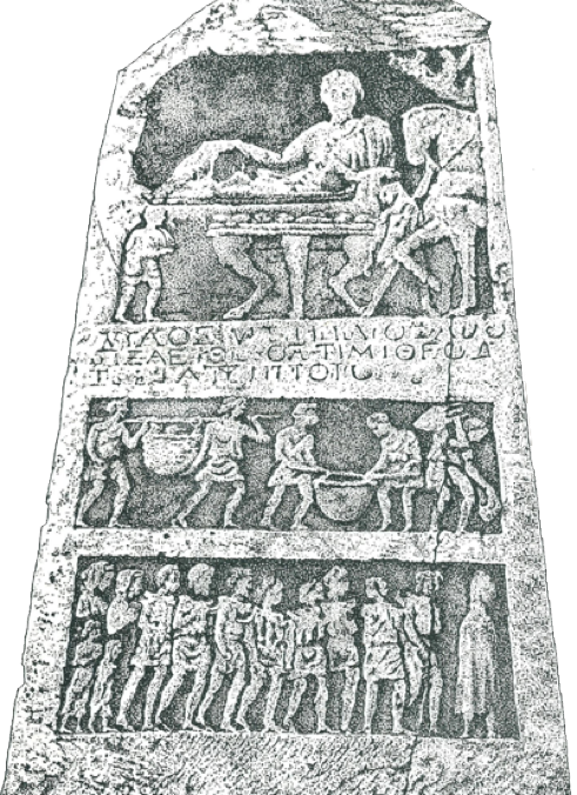
It is far from being a big definitive essay on the huge subject of slavery in antiquity. Rather, it’s a set of meditations which flow from contemplating just one artifact from the ancient world, a seven-feet-high, finely decorated marble tombstone to this man, Aulos Kapreilios Timotheos.

Tombstone of Aulos Kapreilios Timotheos, Slave Trader

The tombstone

This tombstone was found at a town near the border between modern Turkey and Greece. It shows three carved scenes: a typical banquet at the top; a work scene in the middle; and on the bottom, a depiction of 8 slaves, chained together by the neck, being led in single file, accompanied by two women and two children, not chained, preceded by a man who is obviously in charge. Between the top and second row is an inscription in Greek, reading:

Aulos Kapreilios Timotheos, freedman of Aulos, slave trader

Apparently what makes this stone rare and unusual is its blunt candour. In the scattered writings we have from the ancient world slave trading was looked down on, sometimes despised, which is odd because the entire economies of ancient Greece and Rome relied on slaves in enormous numbers. But clearly, the writing classes – the people who left opinions for us to read – were ambivalent about it at best.

The American South

Finley compares and contrasts the situation in the ancient world with that in the Southern United States in the nineteenth century. American slave owners were uneasily aware that the rest of the civilised world had abolished slavery and strongly disapproved of them. Hence their increasingly anxious over-compensating justification of the ‘peculiar institution’.

The ancient Greeks and Romans had no external voice of conscience to upbraid them. The reverse. Everywhere they looked they saw all other societies of their time practising slavery.

The racial justification for slavery

The slave society of the Deep South justified its exploitation with widespread propaganda about the intrinsic inferiority of black people. You don’t read far in any text about the American civil war without coming across southern ideologues using the Bible or any other spurious means they can lay hands on to justify the intrinsic superiority of whites and the intrinsic inferiority of blacks. Plenty of authors and politicians claimed that blacks could only find true happiness in the condition of slavery, blacks are children who need the strong hand of a father etc etc.

So a black person in America could never lose the stigma associated with slavery, even if they were free, even if they lived in the north, ran a business, lived a free life, could never be completely free.

The raceless basis of ancient slavery

The situation was drastically different in the ancient world because slavery wasn’t associated with any particular race or ethnicity. Literally anyone could be enslaved – in Spain, in Gaul, in Greece itself, conquering Roman armies enslaved entire cities of white Caucasians.

The crucial point is that there were no specifically slave races or nationalities. Literally anyone and everyone might be enslaved, and which groups predominated at one time or another depended on politics and war. (p.157)

The association of slavery with skin colour was an invention of the Atlantic slave trade of the 17th and 18th centuries.

Freed names

Back to Aulos – his first two names, Aulos Kapreilio were those of his master, which he took when he was made free, as per Roman custom. Timotheos was his slave name.

Roman slave names

In the early days of slavery Romans gave their slaves names like Marcipor or Lucipor which was simply a contraction of Marcus puer or Lucius puer, puer being Latin for ‘boy’ (hence the English word ‘puerile’, which has come to mean ‘childishly silly and immature’).

From the year of the twin defeats of Carthage and Corinth, 146 BC, the number of slaves began to steadily increase and so they needed more names.

After 146 the empire became unofficially divided into a Latin-speaking West and a Greek-speaking East, and so slave names sometimes indicate a slave’s origins, east or west.

Side

A city on the south coast of Anatolia, became notorious as a slave market. But maybe the epicentre of the ancient slave trade was the island of Delos

The people of Phrygia in central were notorious for selling their own children into captivity. Many slaves from Scythia (the area to the north of the Black Sea) were bought from their own chieftains, captives in their own wars, or children, or simply human levies, like tax, sold at a profit (p.163).

Slave sales

Given the millions of men, women and children who were slaves it is notable that we have just two visual depictions of an actual slave auction. In both of them a male slave stands on a platform while another man, presumably the buyer, lifts his tunic to admire his strong thighs.

The condition of a slave

is to be brought into a new and alien society violently and traumatically; to be torn not only from his homeland but from all the relationships which provide identity and psychological stability, with family, kin, tribe, village, region, gods, customs, dress – everything.

All this is replaced with just one cardinal relationship – with the slave’s male owner who controls not only every aspect of his physical existence, but his mental horizons, the language he has to use, the new religion he has to practice, rules he has to obey – everything.

Slave sexual exploitation

Complete control over the person of slaves meant the master class had unfettered unlimited sexual access to all slaves, male, female, young or old. As I’ve read the chatty odes of Horace or elegiacs of Tibullus, Propertius or Ovid, I have been disturbed again and again by the casual way they talk about being ‘given’ slaves (of either gender) for sexual purposes.

Slave punishments

The most chilling thing for me, though, has been the casual references, in all the Roman literature I’ve read from Plautus onwards, of the horrific punishments slaves could be subject to, starting with whipping and escalating through torture, having limbs deliberately broken, and so on, up to the ultimate punishment of crucifixion.

Finley returns to the attempts of Americans to justify slavery through the intrinsic inferiority of one race and say not only was it not attempted in the ancient world, it was actively disproved by the case of the Greeks.

Greek revenge

After the brutal conquest of the Greek League in 146 BC, over the next few centuries hundreds of thousands of Greek men, women and children were brought back to Italy as slaves. However, in the long term this caused a kind of cultural revolution. The Gauls or Germans might have been considered ‘barbarians’ (they wore trousers, for God’s sake!) but the Greeks were citizens of the culture which had taught the Romans literature, philosophy and architecture. Hard to maintain the fiction that these people were in any way ‘inferior’. On the contrary many of them, while remaining technically ‘slaves’, rose to become secretaries, assistants or teachers to the master’s children.

Manumission

This leads into another important issues, which is manumission, which is the fancy word for freeing your slaves. The Romans became famous among the cultures of the ancient world for freeing their slaves, as reward for loyal service. It was a disconcertingly simple procedure – the owner declaring the slave free, maybe touching them or gently pushing them away, and a state official such as a consul or a praetor touching the slave with a rod called a vindicta and pronouncing him or her to be free.

The slave’s head was shaved and a pileus was placed upon it. The pileus was a brimless felt cap of undyed wool. Based on what we can see in surviving frescos, sculptures, and coins, the pileus ranged from a short cone to a gumdrop shape. It was the identifying garment of a freedman.

Anyway, we know that the rate of manumission became a real problem in Roman society because the emperor Augustus passed laws trying to limit it:

He established maxima on a sliding scale, according to which no one man was allowed to free more than one hundred slaves in his will. (p.158)

Finley points out a notorious contradiction in Roman attitudes to slavery: which is that noted jurists such as Florentinus clearly stated that slavery as an institution was ‘contrary to nature’, that this idea was shared in some of the literature and incorporated into legal codes – and yet it didn’t make any difference to the actual practice.

He instances the moral philosopher Seneca who freely admitted that a slave is a person with a soul like you and me, but from this premise he draws the conclusion that one should live on friendly terms with one’s slaves, dine with them, converse with them etc – everything except actually free them, which seems beyond the scope of his philosophy (p.164).

War

Because, as Finley points out, war was central to the entire institution of slavery and the slave trade.

The ancient world was one of unceasing warfare, and the accepted rule was that the victor had absolute rights over the person and property of the captives, without distinction between soldiers and civilians. (p.159)

Caesar

went to Gaul an impoverished nobleman and returned a multi-millionaire and this was partly because of the huge number of captives he seized and sold into slavery, taking a commission. After he captured the town of the Atuatuci he sold the entire population of 53,000 into lifelong slavery. After the Battle of Alesia in 52 BC he gave one captive to every one of his legionaries.

War slavers

Enormous numbers like this would slow an army down so by Caesar’s time arrangements were in place to have slave traders accompany the army, or meet them at arranged rendezvous, there to buy the newly captured slaves, take them off the commander’s hands, and do with them as he please, tramp them all the way back to Italy or sell them locally.

Maybe the procession on Timotheos’s tombstone depicts such a merchant marching off some of his new merchandise.

Pirates

From a business point of view the problem was the extreme unpredictability of war. Hence the inexorable rise from 150 or so onwards of piracy in the Mediterranean. This wasn’t a case of a few swashbuckling privateers but ‘a complex business network of pirates, kidnappers and slave dealers’, with its headquarters at Side and its main emporium on the Greek island of Delos. Finley quotes the figure I’ve read elsewhere that the docks and warehouses of Delos were extended so that at its peak it turned over as many as 10,000 slaves a day.

(On the subject of scale, Finley says that as early as the 4th century BC the number of slaves working in Athens’s silver mines was probably as high as 30,000.)

Latifundia

The rise and rise of slavery went hand in hand with a crucial socio-economic development in mainland Italy. This was the eradication of the small family farm – the kind of place which Virgil and Horace idolised as the cradle of morality and right living – and its replacement by vast estates or latifundia owned by enormously rich absentee landlords and worked by slave gangs often working in chains.

The servile wars

The scale of the exploitation and the resentment it bred led to the three major slave revolts which escalated so far as to be called ‘wars’, the so-called Servile Wars:

  • First Servile War (135 to 132 BC) in Sicily, led by Eunus, a former slave claiming to be a prophet, and Cleon from Cilicia
  • Second Servile War (104 to 100 BC) in Sicily, led by Athenion and Tryphon
  • Third Servile War (73 to 71 BC) on mainland Italy, led by Spartacus

Training

Specialist skills were in great demand. If a slave could play music, recite poetry, take dictation or any number of other skills then he or she might secure a relatively comfortable lifestyle. Alternatively, slaves could be trained, specially if started young.

Many slaves became masters of crafts and trades; the chain-ganged brute labour of the countryside was matched by highly skilled slaves in more urban settings who worked in potteries or textile mills, on temples and other public works, sometimes performing artistic and delicate work.

The sheer number of slaves present at every level of Roman society, participating in a huge range of activities, suggests the ‘condition’ or psychology of slavery must have been hugely varied, as varied, maybe, as the number of individual slaves.

The end of ancient slavery

Slavery ended not because of any abolitionist movement but because of profound socio-economic changes in the Roman Empire. These slow economic transformations replaced both the ‘chattel slave’ and the free peasant of Virgil and Horace’s dreams, with a new social class, a new type of ‘bondsman’ – the colonus, the adscripticius, who was himself to evolve into the serf.

For the most part. But slavery didn’t disappear from Europe, not even from the Empire. Finley tells us that when the sixth-century emperor Justinian drew up a codification of all existing laws, the issues thrown up by slavery took up more space than any other topic.

The essay in the context of Finley’s career

Online you can read the first page of an essay about Finley and slavery by the American academic, Arnaldo Momigliano. This tells us that Finley had a lifelong interest in the question of slavery in the ancient world and that the present essay repeats some themes and ideas already discussed in his 1958 essay, ‘Was Greek civilisation based on slave labour?’ (itself included in a 1960 collection, ‘Slavery and Classical Antiquity’) and takes its place alongside other papers on the subject gathered in the 1981 volume, ‘Economy and Society in Ancient Greece’.

Apparently, Finley’s ideas about slavery were most fully expressed in the book-length study, ‘Ancient Slavery and Modern Ideology’, published in 1980 (so when he was 68). If you go looking for it on Amazon, you find the latest imprint of the book and discover that it was republished in 1998 with new material by an academic named Brent Shaw.

This volume, ‘Ancient Slavery and Modern Ideology’, isn’t a history of slavery as such, it’s an account of the interpretations succeeding ages have made of slavery in the ancient world, according to each era’s ideologies and principles. In what follows I’m indebted to the excellent review of ‘Ancient Slavery and Modern Ideology’ on Amazon by Richard Mathisen. To be clear, I’m putting Mathisen’s words in italics.

Richard Mathisen’s summary of ‘Ancient Slavery and Modern Ideology’

For Finley, there have been only five genuine slave societies, two ancient (Greece and Rome), and three modern (the Caribbean, Brazil, and the American South).

Historians of ancient societies have always been affected by ideological bias. Classical historians admired Greek and Roman civilisations so they downplayed the ugly aspects of slavery. Christian historians tried to claim that Christianity ended slavery, but it didn’t. Marxist historians wanted to interpret ancient slavery through their lens of class war while anti-Marxist historians took the opposite view.

While ancient slavery had no racial component, modern historians are influenced by racial concerns so that every “new interpretation of slavery has professed to be more anti-racist than the one it replaces.”

Finley’s aim is to trace the distorting effect of each of these ideologies on the history of slavery. Finley explains the emergence of ancient slave societies, which requires three conditions: private ownership of land, commodified systems of production, and a shortage of labour. He considers societal attitudes toward the humanity of slaves and traces the end of slavery as it transitioned into feudalism.

Finley carefully defines slavery, because many examples of forced labour have existed, including Egyptian pyramids, Assyrian and Babylonian empires, Spartan helots, feudal serfs, and indentured servants, but they were not slaves. Indeed, he notes that the most unusual labour system in history is modern free wage labour, with individuals free to move.

This leads to Finley’s real interest. What factors led to ancient slavery? When did it start, when did it end, and why? What aspects of ancient society were part of slavery’s support system? What were the ideological presuppositions of the Greeks and Romans? Why was the legitimacy of slavery never questioned in ancient times, even during slave revolts? Why did slavery exist only in certain areas of Rome, such as Italy and Sicily? Could slavery ever come back again in the modern world, if the necessary conditions seemed to demand it?

When re-issuing Finley’s book, Brent Shaw added a 1981 response by Finley to his critics and a 1979 essay on “Slavery and the Historians.” Shaw himself wrote a 76-page essay updating the slavery debate since 1980.

The vast historiography of a complex subject

All this builds up to quite a complex picture which can be summarised as:

  • during his career Finley wrote a number of essays about slavery in the ancient world
  • his main statement on the subject is a book which describes the changing interpretations of ancient slavery made by the leading ideologies of different eras
  • critics criticised this book
  • Finley wrote an essay addressing these criticisms
  • Brent Shaw added a long essay updating the debate since 1980 (presumably up till 1998, when this new edition was published)

But quite obviously a lot of this is very old. When I skimmed through the passages of ‘Ancient Slavery and Modern Ideology’ available on Amazon, I caught references to the Soviet Union. The idea of describing an aspect of the ancient world as it has been interpreted, reinterpreted and misinterpreted by the leading ideologies of successive ages sounds really interesting, but…1980. Surely I ought to be reading something far more up to date.

And then, when I saw that the Arnaldo Momigliano essay about Finley had been published in a periodical titled ‘Slavery and Abolition: A Journal of Slave and Post-Slave Studies’, my heart sank. Every month or so since the late 1970s this journal has been publishing articles about slavery. By now there must be a mountain of content – and I bet there are other journals on the subject, not to mention the hundreds of thousands of academic papers and tens of thousands of books, and hundreds of conferences which must have been held on the subject. How long would it take to read all the relevant studies, paper and books on the subject? A year? Three years? I’d like to learn and understand more but do I have the time required? Does anyone have the time?


Credit

‘Aulos Kapreilios Timotheos, Slave Trader’ was included in a collection of essays by M.I. Finley titled Aspects of Antiquity, published by Penguin books in 1968. References are to the 1977 Penguin paperback edition.

Related link

Roman reviews

The silent women of Rome by M.I Finley (1965)

Obviously the issues of women, gender, sexuality, ‘the body’ and so on have come to dominate academic discourse in the humanities over the last 30 years or so. Before it was fashionable, 60 years ago, the classicist M.I. Finley wrote a thoughtful essay on the role of women in ancient Rome, which must have seemed fairly radical in its time but has itself come to be criticised by modern feminist historians.

M.I. Finley

Finley himself is an interesting character. He was born in 1912 in New York City to Nathan Finkelstein and Anna Katzenellenbogen, so was Jewish. Young Finkelstein was precociously intelligent and graduated from Syracuse University at the age of 15, and took another degree at Columbia University. He then taught at Columbia and City College of New York, where he was influenced by members of the Marxist Frankfurt School who had fled Nazi Germany and were working in exile in America. About 1945 he changed his name to Finley, nobody seems to know why, maybe to forestall antisemitism.

Finley was teaching at Rutgers University when, in 1951, he was named by a witness before the House Unamerican Activities Committee as a communist. He was then summoned before the committee and, when asked whether he was a communist, took the Fifth Amendment, like many other fellow travellers. J. Edgar Hoover leaned on Rutgers and, after the affair had dragged on for 3 years, Finley was eventually dismissed.

So he emigrated to Britain where he was quickly appointed university lecturer in classics at Cambridge, elected to a fellowship at Jesus College, and eventually rose through the hierarchy to become Master of Darwin College (1976 to 1982). He was made a Fellow of the British Academy in 1971 and knighted in 1979, becoming Sir Moses Israel Finley. He died in 1986.

The silent women of Rome

Finley’s essay has a straightforward aim: to lament the passive, repressed, largely voiceless role of aristocratic women in ancient Rome, using a number of examples, laws and situations to do so.

To start with he says that not many names of Roman-era women are remembered: the most famous woman from the period, Cleopatra was neither Roman nor Egyptian but Greek. As to Roman women, how many of them are remembered? Messalina, Agrippina, Catullus’s Lesbia, some legendary women such as Lucretia or, going way back, Dido.

[This is obviously a weak way to begin, with purely anecdotal summary of ‘famous women’ and no actual evidence.]

Obviously, most societies have been patriarchal and suppressed women but Finley asserts it’s hard to think of any other great civilised state ‘without a single really important woman writer or poet, with no truly regal queen…no patron of the arts.’

He then moves on to a more careful consideration of the evidence which he places under five headings:

  1. through the erotic and satirical poetry of the late Republic and empire, ‘all written by men’
  2. through the historians and biographers, ‘all men’ and attracted to salacious scandal
  3. through the letter writers and philosophers, ‘all men’
  4. through painting and sculpture, inscribed tombstones and religious monuments
  5. through innumerable legal texts

So Finley, with his left-wing credentials, is fully aware of the patriarchal slant of his sources and that they record ideals and stereotypes ‘formulated and imposed by middle- and upper-class Roman males.’ For his day (1965) this feels like a full-on, left-wing, feminist mindset, and you’d have thought he anticipated a million feminist plaints by lamenting that what will always be missing from histories of Rome is the voices of women themselves.

For a start, until late in Roman history, women didn’t have individual names. The names they were given were the family name with an ‘a’ added, so that a daughter of the Claudii gens was named Claudia, of the Julii gens, Julia, and so on. In this spirit sisters were given the same name and only distinguished by the addition of ‘elder’ and ‘younger’, or ‘first’, ‘second’ etc. In the case of marriage between paternal cousins, mother and daughter could easily end up with the same names. For example, Augustus’s daughter was named Julia because he and she came of the Julii clan, and her daughter (Augustus’s grand daughter) was also named Julia.

This in itself is a staggering fact, really worth stopping to take onboard. Roman women didn’t have individual names. As Finley goes on to say, it’s as if Roman society as a whole wished to emphasise that girls and women were not genuine individuals but only offshoots of male-dominated families.

In fact he goes on to point out that although the word familia is Latin it never meant to Romans what it does to us nowadays. Familia either meant all the persons under the authority of the head of the household, or all the descendants from a common ancestor, or all one’s property, or all one’s servants – never our modern notion of the small nuclear family. ‘The stress was on a power structure, rather than on biology or intimacy.’

The Roman paterfamilias need not even be a father; the term was a legal one and applied to any head of a household. Biological children were excluded if illegitimate, whereas the practice of legal adoption was very common (two famous examples being Publius Clodius Pulcher having himself adopted by a plebeian family; and Julius Caesar’s adoption of his great-nephew Octavius).

Theoretically a paterfamilias’s power over his wife, sons and daughters and son’s wives and children, over all his slaves and property, was absolute. In law it was the power of life or death. A Roman woman was rarely if ever, at any point in her life, not in the legal power of a man.

Roman legislators and lawyers devoted a lot of space to precise definitions of the status of all possible permutations of family members (in the extended sense). This was because the family, in this extended sense, was the basic building block, the foundation, of their society. Not just women had highly defined places, but children, sons, heirs, and so on. Finley explains that strict rules were enacted prohibiting certain kinds of marriage: between a Roman citizen and a non-citizen; or between a Roman of the senatorial class and a citizen who had risen from the class of freemen (former slaves).

We miss the full picture if we concentrate only on women. The Roman state sought to regulate and control all social relationships.

Finley’s essay then uses the complex family life of Octavian/Augustus to demonstrate the absolute power of the paterfamilias at arranging the lives and marriages of all those in his power; but this strikes me as not a useful example because the greatest, longest-serving emperor is just about the least representative example you can imagine, and it’s all available in any life of Augustus, anyway.

Finley then goes back a bit in time to guesstimate that the submissive role of women in the Roman state was very ancient, and certainly by the time Hannibal was defeated (about 200 BC) all the elements were in place of the social situation Augustus tried to manage.

Male infidelity was widely accepted. Husbands could have mistresses, multiple partners and illegitimate children. ‘There was no puritanism in the Roman concept of morality.’ When you think about it this follows naturally from the central axiom that all that concerned the state was the efficient management of family legal matters; beyond carrying out their legal functions and duties towards the state, what people got up to in their ‘private lives’ was their own affair.

Throughout his long rule Augustus wasn’t concerned with reforming what we, the heirs to Christianity, think of ‘morality’, so much as social order. Above all he was concerned that not enough upper-class citizens were getting married and having children. Childlessness was an abrogation of responsibilities to the state. The licentious living he saw becoming more common around him wasn’t completely reprehensible in itself, but to be criticised insofar as it indicated a dereliction of duty to the state which he saw it as his responsibility to protect and maintain. Augustus disapproved of the Roman aristocracy living debauched lives because they were spending money on themselves which they should have been investing in their children and The Future of Rome.

There was nothing at all holy about marriage, as the chopping and changing of Augustus’s own marital career and of umpteen aristocrats amply demonstrated. This explains why divorce was easy and commonplace. It was a purely legal transaction. Marriage was important because:

  • it ensured the creation of the next generation of citizens
  • it ensured the smooth transition of property from one generation to the next
  • the entire social hierarchy depended on cleanly defined lineage and descent within families, which themselves needed to be clearly defined as patrician or plebeian or knightly in order to take their place in the systems of political management and control

So marriage was really important in ancient Rome from a social, economic, political and legal point of view. But hardly at all from a moral or emotional point of view, the two ways in which we have been increasingly taught to view it over the past 200 years, maybe since the so-called Romantic revolution around 1800 began to change a lot of attitudes in favour of the primacy of personality and emotion over duty and sacrifice.

Finley has a digression about the laws of marriage governing soldiers. These kept changing, as soldiers’ terms of service were themselves changed and developed, eventually becoming so complicated it resulted in an entire specialised area of Roman law.

Having discussed the aristocracy at some length, Finley then goes on to speculate about the condition of women in the working class. We know next to nothing about them but the chances are they were a lot more free of the social codes and restrictions imposed on aristocratic women because a) they had to work, and probably helped their husbands in a wide variety of trades and b) the rapid expansion of the slave trade and the slave population after the destruction of Carthage (146 BC), along with the surprisingly generous Roman habit of freeing slaves, meant that an ever-increasing proportion of the free population was directly descended from slaves, almost certainly giving them a drastically different notions about marriage norms than the aristocracy.

Mortality was higher among women than men. It is estimated that of the population which reached the age of 15 (i.e. evaded the high infant mortality) more than half the women were dead by forty, in some places, by 35. Women were a lot more likely to die due to a) multiple childbirths without any modern medicine b) sheer exhaustion of bearing children, rearing them, and working.

Divorce was easy and men often remarried. You can see how this would enormously complicate the legal situation around heirs, property, citizenship and so on. Hence the jungle of legislation.

And yet (Finley says, swinging his train of thought into a new groove), there is evidence that aristocratic Roman enjoyed some autonomy. They attended dinner parties and certainly the many festivals and games. Many Roman writers report the stimulating conversation of educated women in mixed company. Ovid in The Art of Love gives extensive advice on how to make the best of themselves, advising women of this class to dress and primp properly, to sweeten their breath, to walk gracefully and dance well, to cultivate the best poetry. This makes them sound quite free and independent in their behaviour.

Finley comes to his final thought: How did respectable Roman women of the level of education implied by Ovid and others find outlets for their repressed energies?

1. Religion

Roman religion was very patriarchal. Traditional Roman religion was based on the household gods and public rituals and men controlled both. There was a handful of female cults, such as the women-only Bona Dea, but all religious festivals were led by men and even the famous Vestal Virgins were under the direct supervision of a man, the pontifex maximus.

A big change came with the solidification of the empire and the great influx into Rome of eastern mystery cults, many of them carrying the entirely unroman concepts of personal communion with the god and personal salvation. Although some of these gods were completely closed to women (such as the military cult of Mithras) others offered women status and agency like they’d never had before.

The most notable example of these was the cult of Isis, who subsumed a world of other goddesses and cults (and which Ovid complains about in some of his poems). One of the hymns to Isis says: ‘You gave women equal power with men.’ This explains why the cult of Isis was one of the most obstinately resistant to the rise of the new cult of Christ as the latter spread  around the Mediterranean during the later first century AD.

Christianity itself was a very mixed blessing for women. Women played a crucial role in the life of Jesus. His mother, Mary, quickly assumed cult status. Jesus was genuinely open-handed about the role of women. Take the woman her community is about to stone for adultery. Jesus saves her and shames the vengeful men.

Women quickly held office in the early church, not in ultimate power but as assistants, deacons and sacristans, assisting in ceremonies as well as taking a lead in charitable works. It was the Empress Helena who ‘found’ the true cross in Palestine and brought it back to Rome. A good proportion of the early martyrs were women i.e. women were allowed to be memorialised as martyrs, to be remembered as saints, and their relics worked just as many miracles, as men did. Here was a true holy equality.

But then, alas, St Paul. Paul thrashed out the theology of Christianity but at the expense of embedding it deeply back into the traditional Jewish teachings which Jesus had seemed to escape. In chapter 14 of his first letter to the congregation at Corinth he says:

‘Let your women keep silent in the churches, for they are not permitted to speak; but they are to be submissive, as the law also says. And if they want to learn something, let them ask their own husbands at home; for it is shameful for women to speak in church.’

From the floating repertoire of ancient documents indicated by the Dead Sea Scrolls, the early Christians selected the ones which they thought best bolstered their case, assembling them into a library which eventually came to be called The Old Testament. Much of it was a reversion to a harsher, Jewish concept of the deity than Jesus seemed at many moments to believe. Over coming generations the strange and ominous legend of Adam and Eve came to assume the severity of doctrine, and became an irrefutable accusation with which hundreds of generations of misogynists could bad-mouth and shut down women.

One unintended consequence of Pauline thought was the new emphasis it put on virginity. In our times we think the obsessive importance assigned by generations of Christians to the virginity of a bride ludicrously repressive and bigoted. But if you think about it from the point of view of a 12, 13 or 14 year old girl in a Roman household, who knows she is doomed to be married off to someone she might never have met, who might be four times her age, purely as a business and legal transaction – then a new cult which rejects this bartering of women, and declares that the holiest thing a woman can do is devote her life to Jesus and eternal virginity, maybe in a community of like-minded women – you can see how in many cases this might have been experienced as a wonderful liberation from patriarchal tyranny. An escape route.

Convents began to be set up soon after the first monasteries and offered a way for women to walk out of the entire male-dominated society in a way they hadn’t been able to since Rome was founded. A huge subject but Finley’s brief discussion is suggestive.

2. Entertainments

Much smaller in conceptual terms, but still significant, was the way women were allowed to be spectators in theatres and at games. Finley tells us that gladiators became ‘pin-ups’ for Roman women, ‘especially in the upper classes’. It would be good to see the evidence for this.

3. Imperial women

Finley rather spoils the effect with his third area of female agency, by reverting to the anecdotal level of the opening of his essay, and telling us that many of the women at the top of the next few hundred years of Roman Empire ‘revealed a ferocity and sadism’ that were not often matched by their menfolk. They never held direct power, but they pulled many of the strings for their husbands and sons, brothers and lovers. Well, if feminists want strong independent women, here are some of the most ferociously strong and determined women we have any record of.

Finley tries to interpret the behaviour of this handful of bloodthirsty women as a ‘rebellion’ against the suppression of almost all women almost all the time. Unfortunately, it comes over more as a certain type of sexist stereotyping without any consideration of the fact that strong women everywhere have been subjected to poisonous character assassination. I.e. that much of what male society and its male historians wrote about them may be vicious rumours or simply untrue.

Shame. Finley was very ‘on message’ and sympathetic to Rome’s repressed women up to this very last point.

Thoughts

This is a deeply intelligent, very interesting, well-written essay. It has an elegantly arresting introductory remark about Cleopatra and then moves with a steady, fluent logic through a series of highly interesting points. Agree or disagree with his thesis, it is beautifully written.

It is very persuasive about the topics it addresses. But it can be seen that, at various points, it veers away from a strict consideration of its title; the passage on the marriage laws for Roman soldiers feels some distance from ‘the silent women of Rome’, the extended passage about Augustus and his women is interesting but can hardly be taken as representative of Roman society at large.

The anti-Finley debate

A few minutes surfing on the internet turns up the fact that Finley’s essay was contested by feminists.

The Reverend Dr. J. Dorcas Gordon of Knox College, Canada, in her book ‘Sister or Wife? 1 Corinthians 7 and Cultural Anthropology’, gives a summary of the feminist responses to Finley’s essay, which she calls ‘controversial’.

According to her, there is a relatively straightforward spectrum of views, with one school holding that women in Rome lived passive repressed lives in the shadows of their fathers or husbands (the Finley view), but quite a few more modern revisionists insisting the exact opposite.

These latter are represented by Sarah Pomeroy who, in her pioneering 1975 feminist book, ‘Goddesses, Whores, Wives, and Slaves: Women in Classical Antiquity’, argued that changes in Hellenistic society produced many emancipated but respected upper-class women. She argues that Roman matrons had a much bigger range of choices in their roles and lifestyles, as well as more of an influence on the cultural and political life of their society, than Finley allows.

Gordon goes on to produce pages of evidence showing women having more agency in the ancient world than the Finley side of the debate claims, evidence including history, moral anecdote and exempla, slander, funerary inscriptions.

In Hellenistic Egypt we know that women bought and sold real estate as well as movable property. We know from Cicero’s abundant correspondence that his wife, Terentia, had considerable freedom of action in the areas of finance, politics and matchmaking.

There is evidence that women, despite an explicit ban, argued their cases in the law courts, namely Afrania, wife of a senator and Hortensia delivering a speech before the triumvirs. Servilia was the long-time mistress of Julius Caesar and mother of Brutus and all her contemporaries took her political influence of for granted. Cicero depicts a woman friend, Caerellia, as independently wealthy and a noted intellectual. Everyone was intimidated by Augustus’s formidable wife, Livia.

An inscription from Corinth recognises Junia Theodora who bestowed gifts of money on the city and citizens. More surprisingly an inscription speaks of a certain Hedea racing a chariot and winning at the Isthmean Games of 43 AD. Inscriptions from Asia Minor memorialise wealthy Greek women who civic and federal magistracies and priesthoods. Women with estates and all sorts of businesses were attested at Pompeii.

And so, considerably, on.

The major engine for new historical interpretations

In the end, Dorcas suggests, it depends how you interpret the evidence. Obviously that is true, but I’d go a step further to point out something obvious, to me at any rate, which is: the outcome of many debates in the humanities depends not so much on how you interpret the evidence, but on what evidence you consider; on what evidence you admit to the field of debate.

Time after time, when reading modern history books which claim to be ‘overturning conventional wisdom’ or ‘subverting established beliefs’ blah blah, it turns out that they’re not doing so by presenting startling new evidence; more often than not they are using evidence which has always been known about by scholars, but not previously considered part of the debate; things the experts knew about but nobody had considered including in the body of evidence used in this particular debate.

If the complete corpus of historical evidence can be likened to a landscape, the landscape itself rarely changes – what changes, and sometimes drastically, is which features of the landscape historians choose to pay attention to; which bits of evidence we include and prioritise.

Since you and I can never hope to acquire total mastery of all the evidence from the ancient world on this or any number of other issues (the experiences of slaves, the experiences of gladiators, the experiences of the working classes, the experience of farmers, the experiences of business men) we are, in effect, at the mercy of scholars and their changing interests. Our knowledge of ‘history’ is restricted by the ever-changing fashions for this or that kind of evidence among the historians we read.

Now almost contemporary historians are convinced that we need to be more inclusive, need to pay attention to the lives of women, or black people, or other previously excluded groups. While fine and admirable in itself, this attitude can also be seen as just the latest wave, the latest refocusing of attention and evidence which will, itself, be eclipsed by further waves in the decades to come.

In other words, nothing like a ‘true’ understanding of history is ever possible. Because the study of history covers such a huge area, and historians for decades have been expanding the fields of evidence to include previously ignored groups, any modern read is doing well if they can get a grasp on the history of a period as it is generally understood today i.e. as it is interpreted and conceived for our times by the congeries of historians of our day.

But even if you could wriggle free of the preconceptions and assumptions of our age, penetrating through the veil of how events are presented by contemporary writers is virtually impossible, because as you go further back in time you don’t encourage any kind of truth, all you encounter is previous generations of historians interpreting events in terms of the ideologies, moral values, social needs of their times, biased by all their preconceptions and prejudices.

The thing itself – the objective, ‘true’ and definitive account of events – can it ever be reached, does it even exist? I don’t think so. It’s bias, interpretation and ideology all the way back to the original sources and documents which, themselves, are (fairly obviously) biased and limited. From ever-changing mosaics of evidence historians create narratives which are acceptable to us and our concerns.


Credit

The silent women of Rome by M.I Finley was published in 1965. It was included in a collection of essays by him titled Aspects of Antiquity, published by Penguin books in 1968. References are to the 1977 Penguin paperback edition.

Related link

Roman reviews

Introductions to the Aeneid – 3. David West

I own three English translations of the Aeneid:

  • the 1956 Penguin classics prose translation by W.F. Jackson Knight
  • the 1970 verse translation by Allen Mandelbaum
  • the 1991 Penguin classics prose translation by David West

This is the last of three blog posts giving detailed analyses of the introductions to each of these translations. This one looks at David West’s introduction to his 1991 translation. It also gives examples of each of the translators’ work, first their renderings of the Aeneid’s opening 12 lines, then of the final few lines.

1991 Penguin classics prose translation by David West

Unlike the vapouring spiritualist Jackson Knight, and the namedropping Vietnam War protestor Mandelbaum, West is wonderfully unpretentious and to the point. In his introduction’s brisk 6 pages he bluntly says the Aeneid is about a man who lived 3,000 years ago in Asia Minor so – why should we care?

1. The origins of Rome

He gives a fantastically compressed précis of the plot before going on to say that, 300 years after Aeneas’ legendary death, the city of Rome was founded by his descendants. So that’s one reason to read the Aeneid: because it is the foundation story of the most important city in European history, the state that underpins modern Europe.

2. Aeneas an emblem of the refugee from war

Another reason is because it is a great poem. Part of this is down to it being about a very human figure,  Prince Aeneas, a man who knew defeat and exile, love and the loss of love, who maintained his sense of duty to family and country through thick and thin, who knew war and hated it but was capable of fighting with hatred.

At the end of the twentieth century the world is full of such people.

If West was writing in 1990, then he was about to witness the First Gulf War, the collapse of the Soviet Union, the prolonged civil wars in Yugoslavia, the Rwandan genocide and the Great War of Africa, followed by 9/11, the invasion of Afghanistan and then Iraq. Yes. War and the bitterness of war, and exile and grief and lost love, these are eternal fixtures of the human condition. I am writing this on day 201 of the Russian invasion of Ukraine.

The gods have changed but for the men there is not much difference.

3. Virgil’s humanity

But the Aeneid is not only about The Human Condition but is full of individual human touches, insights  and moments which make the poem a deeply rewarding read:

  • Dido putting the Trojans at their easy 1.567-578
  • the grief of Andromache meeting a Trojan youth who is the same age as her murdered son would have been 3.305
  • Acestes and Aeneas shaming an old champion into fighting in their games 5.389
  • the throwaway remark of Ascanius which has such momentous consequences 7.116
  • old King Evander enjoying looking upon his old friend’s son 8.152
  • the native’s abuse of foreigners 9.598
  • the glorious death of Mezentius and his horse at 10.858
  • the fussing of the doctor as he fails to treat Aeneas’s arrow wound 12.387

The Aeneid presents a ‘heroic’ view of life i.e. all the characters are super-lifesize – but it is also full of these realistic human moments. So its depiction of timeless themes of human suffering, combined with these insights into human nature mean that, even after 2,000 years, it is still not out of date.

Virgil and Augustus

West then devotes a zippy two-thirds of a page to summarising Virgil’s life and career. For me the strong part is the confiscation of his family’s land by Octavius (unlike, Mandelbaum West doesn’t mention Virgil’s trip to Rome to beg for it to be returned) but West adds a new fact: to qualify to be a member of the Senate a Roman citizen needed to be very wealthy; when Virgil died, he had property worth ten times this wealth requirement. Being Augustus’s top poet made Virgil rich. It would be fashionably easy to despise Virgil for sucking up to Augustus, in the Aeneid as in the Eclogues and Georgics, but this would be wrong because:

  1. After a century of violence and civil war, Augustus’s hard-won victories promised peace and moral regeneration. There was every reason to believe a genuine Golden Age was at hand. Virgil’s friend, Horace, believed just as fervently. It is reasonable enough to praise the peace-bringer.
  2. Virgil was no superficial tyrant-pleaser. He had a deep appreciation of the countryside and traditions of a much wider definition of Italy (his upbringing on a farm outside Mantua). He knew it had taken hard fighting to secure peace and would take hard work to create this Golden Age. I like the way West says Virgil didn’t have the answers to these questions and he didn’t even pose the questions. He told an exciting story and lets the story raise, at numerous points, thoughts and questions about love of country, love of family, and what it means to fight for peace. The critique is buried deeply within the narrative.
  3. West draws a distinction between praise and flattery. The Aeneid praises Augustus in two ways: first, it tells the story of his heroic ancestor, in such a way as to reflect well on the emperor. The second way is the direct references to Augustus at key moments of prophecy and prediction.

West’s approach to translation

Finally, a page about the translation itself. Interestingly, West says that up to his time the W.F. Jackson Knight translation (whose introduction I have considered at length) had been the gold standard English translation of the Aeneid. However, it suffers from two weaknesses and that is why it is now being replaced: 1. The prose is old fashioned 2. It follows the original Latin very slavishly, often to the detriment of good sense.

So West is setting out to right the balance, to try and capture some of the allusive, changing poetry of the original – but never at the expense of – and while always writing –good, muscular, rhythmic, expressive English prose. In my opinion, he succeeds very well (see examples, below).

As you can tell, West’s introduction is far and away the best of the three for its complete absence of swank and bullshit, for its brevity, for telling you just enough to warm you up – and then pitching the reader straight into the narrative.

I enjoyed his translation more than the others for the same reason. It is straight-talking, clear and to the point. But it also, despite being in prose, includes subtle effects of alliteration, assonance and rhythm.

Disagreement

Blazing with rage, he plunged the blade full into his enemy’s breast….(Book 12)

But even with West I disagree. He says the poem is a vision of ‘a search for peace and order for Rome and humanity’. Is it, though? The Aeneid portrays a universe of anger and death and ends with a brutal act of murder. All three of these translators, in their introductions, are inexplicably drawn to praise the humanism and sweet sadness of Virgil’s poem. I know what they mean, the sadness is there and is sometimes a very dominant mood. But the narrative is also splattered with blood, the blood of hundreds of men hacked to pieces in battle, the ravening fury of Juno and her agents, screeching harpies, the foul dira, and the stink of the hundreds which are barbarously slaughtered at altars, their hot blood spurting out onto the hungry earth.

Yes, there’s a gentle tone of sweet sadness but, for my money, all three of these translators inexplicably underplay the centrality of war and anger and death and bloodshed which run alongside and, in my opinion, overwhelm the poem’s sweet humanism.

The fact that such diametrically opposite views can be held about it makes me wonder whether, deep down, even Virgil himself knew what his great poem is actually about? What it is really saying? Despite his conscious intentions, did his poem, once he had stitched it all together, end up saying much more, and give a different impression, than he originally intended?


Samples of the translations

Which of the three translations do you prefer?

The Aeneid book 1, lines 1 to 12

Jackson Knight translation:

This is a tale of arms and of a man. Fated to be an exile, he was the first to sail from the land of Troy and reach Italy, at the Lavinian shore. He met many tribulations on his way both by land and on the ocean; high heaven willed it, for Juno was ruthless and could not forget her anger. And he had also to endure great suffering in warfare. But at last he succeeded in founding his city, and installing the gods of his race in the Latin land: and that was the origin of the Latin nation, the Lords of Alba, and the proud battlements of Rome.

Mandelbaum translation:

I sing of arms and of a man: his fate
had made him fugitive; he was the first
to journey from the coasts of Troy as far
as Italy and the Lavinian shores.
Across the lands and waters he was battered
beneath the violence of the High Ones, for
the savage Juno’s unforgetting anger;
and many sufferings were his in war–
until he brought a city into being
and carried in his gods to Latium;
from this have come the Latin race, the lords
of Alba, and the ramparts of high Rome.

West translation:

I sing of arms and of the man, fated to be an exile, who long since left the land of Troy and came to Italy to the shores of Lavinium; and a great pounding he took by land and sea at the hands of the heavenly gods because of the fierce and unforgetting anger of Juno. Great too were his sufferings in war before he could found his city and carry his gods into Latium. This was the beginning of the Latin race, the Alban fathers and the high walls of Rome.

The Aeneid, book 12, lines

Jackson Knight translation:

Aeneas stood motionless, a fierce figure in his armour; but his eyes were restless, and he checked the fall of his right arm. And now at any moment the pleas of Turnus, already working in his mind, might have prevailed on his hesitation, when suddenly, there before him, he saw slung over his shoulder the accursed baldric of Pallas and his belt, inset with the glittering rivets, which he had known of old when they belonged to his young friend whom Turnus had brought low with a wound, and overcome. This Baldric Turnus was wearing now over his own shoulder, and the trophy was fatal to him. Aeneas’ eyes drank in the sight of the spoils which revived the memory of his own vengeful bitterness. His fury kindled and, terrible in his rage, he said: ‘Are you to be stolen hence out of my grasp, you who wear spoils taken from one whom I loved? It is Pallas, only Pallas, who by this wound which I now deal makes sacrifice of you; he exacts this retribution, you criminal, from your blood.’ Saying this and boiling with rage he buried his blade full in Turnus’ breast. His limbs relaxed and chilled; and the life fled, moaning, resentful, to the Shades.

Mandelbaum translation:

Aeneas stood, ferocious in his armour;
his eyes were restless and he stayed his hand;
and as he hesitated, Turnus’s words
began to move him more and more – until
high on the Latin’s shoulder he made out
the luckless belt of Pallas, of the boy
whom Turnus had defeated, wounded, stretched
upon the battlefield, from whom he took
this fatal sign to wear upon his back,
this girls glittering with familiar studs.
And when his eyes drank in this plunder, this
memorial of brutal grief, Aeneas,
aflame with rage – his wrath was terrible –
cried: ‘How can you who wear the spoils of my
dear comrade now escape me? It is Pallas
who strikes, who sacrifices you, who takes
this payment from your shameless blood.’ Relentless,
he sinks his sword into the chest of Turnus.
His limbs fell slack with chill, and with a moan
his life, resentful, fled to Shades below.

West translation:

There stood Aeneas, deadly in his armour, rolling his eyes, but he checked his hand, hesitating more and more as the words of Turnus began to move him, when suddenly his eyes caught the fatal baldric of the boy Pallas high on Turnus’s shoulder with the glittering studs he knew so well. Turnus had defeated and wounded him and then killed him, and now he was wearing his belt on his shoulder as a battle honour taken from an enemy. Aeneas feasted his eyes on the sight of this spoil, this reminder of his own wild grief, then burning with mad passion and terrible in his wrath, he cried: ‘Are you to escape me now, wearing the spoils stripped from the body of those I loved? By this wound which I now give, it is Pallas who makes sacrifice of you. It is Pallas who exacts the penalty of your guilty blood.’ Blazing with rage, he plunged the blade full into his enemy’s breast. The limbs of Turnus were dissolved in cold and his life left him with a groan, fleeing in anger down to the shades.


Roman reviews

The Aeneid by Virgil – books 10 to 12

Book 10 Pallas and Mezentius

A mighty conference of the gods is called on Mount Olympus. Jupiter is puzzled why war has broken out. Aeneas’s mother, Venus, makes a long complaint, saying the Trojans have faithfully done everything they were asked to, and yet Aeolus sank them in his storms, Iris drove the women mad on Sicily and now Allecto has come up from hell to stir up war. For heaven’s sake, please can he at least spare her grandson, Ascanius?

Juno, Jupiter’s wife and inveterate opponent of Aeneas and the Trojans, replies, twisting the truth and making it all look like the impious Trojans’ fault, denying that any Fates told him to come to Italy and blaming him for starting the war. Juno blames Venus for starting the entire thing when she helped Paris to abduct Menelaus’s lawful bride, Helen. She should have thought about her precious Trojans then. And now the Trojans are doing the same again, same as Paris, coming to a foreign country and ravishing away women pledged to local fiancées.

For the root of the war between the natives and Aeneas and the Trojans is that King Latinus, king of the area around the Tiber, has one daughter Lavinia and she had for some time been promised to virile young Turnus, king of the neighbouring Rutuli. But when Aeneas and his men arrive at his court, the king is warned by prophecies that he should break that marriage arrangement and give his daughter to the newcomer. Turnus is, understandably, enraged. And so the cause of the massacre and bloodshed which dominates the second half of the Aeneid is this fighting over a royal princess, and the rights to territory, inheritance, breeding and lineage which she represents. Obviously poor Lavinia has little or no say in the matter but, like Helen, can only watch helplessly as the strong men around her launch a prolonged and ruinous war.

Anyway, after Juno’s speech has muddied the issues, all the gods burst out in confused opinions until Jupiter silences them all and says he’s not interested in the rights and wrongs of the affair: he washes his hands of it. Let each man face his fortune. The Fates will find a way. Then he nods and the earth shakes, which is his way of making a final decision, and the conference of gods breaks up.

Back on earth, the Trojans are desperately defending their camp against the fierce attack of the besieging Rutulians. Meanwhile Aeneas has left them to sail north to meet the Etruscans led by King Tarchon who wants their treacherous former leader, Mezentius (who has fled to join Turnus in his fight against the Trojans) brought to justice. So Aeneas secures the Etruscans as allies. Then their joint fleet sails back south along the coast of Italy to the mouth of the river Tiber to rejoin the battle.

At which point Virgil writes a conventional invocation to the Muses of Mount Helicon, asking their help in describing the names and lineages of all the Etruscan warriors. Catalogue of the Etruscan leaders (the catalogue of warriors was a well known aspect of a good epic poem, as pioneered by Homer in the Iliad).

Aeneas is leading the fleet of the Etruscan allies when they are approached by frolicking nymphs who reveal that they are his former fleet which the goddess changed into sea nymphs. They explain she did this because the Rutulians were about to fire them and go on to tell him his son and the Trojans are in dire straits, besieged in their camp.

As dawn rises Aeneas’s fleet sail up the Tiber and arrive at the camp. He flashes his great shield in the sunlight and the Trojans in the camp roar with delight. The fleet rams into the banks of the river and warriors leap into the shallows or slide down oars to land.

A long passage describing the many Rutulians massacred. Young Pallas speaks to rally the Arcadians, and sets about his own massacres. Eventually Turnus tells all his troops to stand down and back away and walks into an open space for single combat with Pallas. Pallas calls on his city’s god, Hercules, and cast his spear, which breaches Turnus’s armour at the shoulder but only grazes him. Hercules up in heaven weeps. Jupiter tells him every man has his time. Then Turnus throws his spear which pierces Pallas’s shield, armour and chest, and he falls to the ground gouting out his life blood. Turnus stands over him and says his father (Evander) is well rewarded for his hospitality to the invaders.

Pallas’s body is carried back by Arcadians to the camp. Virgil editorialises that Turnus will rue the day he killed Pallas and stole his armour. Hearing of new friend’s son’s death, Aeneas goes on a turbo-charged killing spree, like a raging torrent, like a storm of black wind, killing without mercy, even warriors who clutch his knees and beg.

Meanwhile Juno goes to Jupiter and begs for the life of Turnus. Jupiter grants him a brief respite but says he cannot avoid his ultimate fate. So Juno flies down to the battlefield and creates a phantom effigy of Aeneas. She has Turnus confront him and the phantom Aeneas turn and run. Unable to believe his luck, Turnus sets off in pursuit. Phantom Aeneas jumps onto a ship moored to the bank and Turnus jumps after him but Juno immediately makes the phantom disappear, cuts the ship’s cables and quickly propels it out on the tide.

Meanwhile Aeneas roams the battlefield calling out for Turnus but Turnus is nowhere to be seen. He is on a ship being swept far from the battlefield. He calls out on Father Jupiter, asking why he is being submitted to this disgrace, pleading to be allowed to return to the battlefield, weeping for the humiliation of seeming to have run away in front of his own men and his allies. He tries to jump overboard to swim to shore but Juno prevents him, so then tries to throw himself on his sword, but Juno protects him, too. Eventually the ship touches land up the coast at the ancient city of his father, Daunus (10.689).

Turnus’s place is taken by Mezentius who goes on a similar sadistic killing spree, rejoicing in his power to kill. Pitiless Mars is dealing out death to both sides. The gods look on in pity and grief to see so many fine men suffering.

Finally Aeneas confronts Mezentius. This is Mezentius’s aristeia. The word aristeia is Greek and means ‘excellence’, by extension ‘moment of excellence’ or ‘moment of prowess’ (as Richard Jenkyns puts it, p.10). Greek literary critics analysed and named all aspects of their literary genres, different types of scene or incident or character. An aristeia is a scene in the conventions of epic poetry where a hero in battle has his finest moments (aristos = ‘best’). Very often an aristeia depicts the moment when a warrior both reaches his peak as a fighter but also meets his death at his physical and psychological peak. A climax to his career.

So Mezentius makes a prayer and bravely throws his spear. But it bounces off Aeneas’s shield and kills nearby Antores. Then Aeneas casts his spear which enters Mezentius’s groin. He is limping away as Aeneas closes in but then his son, Lausus, leaps between them. He parries a blow from Aeneas’s sword and all Lausus’s comrades raise a cheer and start pelting Aeneas with rocks and stones. Aeneas ducks and protects himself with his shield biding his time, and then, when the bombardment slackens, buries his sword up to the hilt in the young man’s midriff.

But as he watches Lausus’s beautiful young face bleach white of life, Aeneas is overcome with pity and holds his hand. When he is dead, he turns on Lausus’s colleagues and rails at them.

Meanwhile his father Mezentius is bathing his wound in the river, his armour half off, surrounded by his entourage. He hears lamenting approaching and then his colleagues bring in his dead son’s body on his shield. Mezentius laments that his bad behaviour led to them being exiled and contributed to the death of the only thing valuable to him.

So Mezentius has his horse Rhaebius brought to him, mounts him, and rides into the heart of the battle clutching two javelins. He rides round shouting Aeneas’s name till he confronts him and, riding round him three times, launches spear after spear at him. All these stick in Aeneas’s shield, till he is tired of this and throws his own javelin which hits the horse between the temples and brings it crashing down, pinning Mezentius to the ground.

Dazed, Mezentius, unable to move, makes a last request, that he be properly buried, alongside his son. Then Aeneas runs him through with his sword, and he pours out his life’s breath in wave after wave of blood all over his armour and the narrative just stops with no comment.

Book 11 Drances and Camilla

As so often in Virgil, I found the segue to the next book abrupt and unexplained. The sun is coming up but we never heard of it going down. Aeneas piously sets up the armour of the killed Mezentius, which is described in loving detail, at a shrine. Then he addresses his men at what Virgil calls ‘the hour of their triumph’ and tells them the majority of their work is now over.

None of this quite makes sense. Surely the ‘hour’ of their triumph was the day before when Turnus disappeared and he killed Mezentius? Why wait a night and a calm unfighting morning of hanging up armour before giving this speech?

This is just one of the puzzling places which I suspect Virgil knew he had to come back and adjust and finalise, and explains why he asked his friends to burn the poem.

First Aeneas tells them to bury their dead and he himself turns to address the body of beautiful young dead Pallas: ‘Oh the pity of it.’ Compare Wilfred Owen:

I mean the truth untold:
The pity of war, the pity war distilled.

They place it on a soft wickerwork bier with a green canopy and Aeneas orders a thousand soldiers to escort the body back to his poor old father in a huge procession which includes arms, horses and captives taken from the enemy, Aeneas orders leaders of the army to carry inn their arms ‘tree trunks’ draped in weapons captured from the enemy and inscribed with their names; enemy chariots drenched in Rutulian blood and Pallas’s own warhorse. It is all sent off in a long funeral procession upriver towards Pallantium.

Then Aeneas marches back to the camp and his present concerns. Envoys come from the Latins and ask for a truce to bury their dead. Aeneas delivers a long gracious speech lamenting that it ever came to war, saying he came in peace, saying he could have fought Turnus in single combat to decide everything, but they are all the victims of ‘cruel Fortune’. Or, as the reader knows, Juno’s implacable hate.

Old Drances speaks in reply, saying Aeneas is wise and honourable, he’s never liked Turnus, they will go back to King Latinus and try and make peace. There follow a 12-day truce while both sides roam the hills to cut down trees to make funeral pyres for the dead.

The arrival of the procession at Pallantium. King Evander falls on his body weeping and delivers a long speech. This is a slightly uneasy moment for the poem because the obvious thing to do would be to have him bitterly regret taking Aeneas in and sending his son off to die in a pointless war. Instead Virgil has to tread carefully and make him proud of allying with Aeneas:

I would not wish to blame you, Trojans, nor our treaties, nor regret the joining of our right hands in friendship. (11.165)

And proud his son died in battle, after killing ‘thousands of Volscians’ (11.168). He would not wish his son any other kind of funeral than that of a brave warrior who fell in battle. And he tells the huge processions which has brought his son to return to the fight. And says Aeneas now owes the death of Turnus to him and his son. The logic of war.

Virgil describes a grim day full of burning funeral pyres, the living riding round each pyre three times, wailing, the hecatombs of animals slaughtered, the arms thrown onto the flames, the clamour of men and screaming of dying beasts. A black day of lamentation.

The Latins, on their side, bury their dead, but also build a mound of nameless corpses and burn it. Lamentation in the court of King Latinus where mothers lament the loss of so many sons and call on Turnus to fight it out in single combat. But others speak up for Turnus and his right to Lavinia, led by the queen, a sort of Juno figure.

The Latins had sent an embassy to King Diomede of the Aetolians asking for his help in the war but now they return empty handed. Diomede won’t help. Latinus loses heart. He calls a great council and asks the envoys to repeat what Diomede said. They repeat Diomede’s speech and it is noble and stirring. He describes how the siege of Troy in which he fought took so long solely because of the might of Hector and Aeneas, and the latter was the more pious (a very conscious bigging-up of the founder of Rome). And that the war was impious and that is why all of the Greek survivors have been swept by fate to the four corners of the earth or struck down, like proud Agamemnon, all cursed. He counts himself lucky to have survived, albeit exiled from his homeland, never to see his wife again, and building a new settlement in Italy. Therefore he won’t tempt fate a second time, he will not fight the Trojans again. Instead he advises Latinus to make peace with the Trojans and accept their evident destiny.

King Latinus then laments that they ever got involved in this war. This thought is taken much further by old Drances who, although he speaks for the Trojans, is portrayed as a shifty and sneaky courtier. In another sudden, unexpected and unexplained Jump, it now appears that Turnus – who we last saw raging aboard the ship Juno had lured him onto and being swept out at sea, before making landfall up the coast at the ancient city of his father, Daunus (10.689) – Turnus has magically reappeared in the court of King Latinus. This isn’t impossible or unlikely – obviously he’d make his way back to base. It’s just odd that it goes completely undescribed and even remarked on. Virgil makes no mention of his return journey, just as the very end of book 6 is strangely throwaway – in a dozen or so words Virgil tells us Aeneas made his way back to his ships and comrades. I think it’s loose ends like this that Virgil wanted to go carefully back through his poem and tie up and prompted his request to have it destroyed.

King Latinus proposes that they give a tract of land they own to the Trojans to settle and send 100 men bearing the branch of peace and gifts.

Drances (his voice was ‘always a force for discord’) accuses Turnus of ‘fatal recklessness’, says he is the sole cause of all this grief and lamentation, and says Turnus must accept the loss of his bride and her gift to Aeneas.

Infuriated Turnus refutes all his arguments, calls Drances a coward, says the Trojans have been twice defeated before, the dead have fallen nobly, this is the time to test their vigour and virtue, they must fight on, Italy has many more allies they can call on etc. If Aeneas challenges him to single combat, so be it. This is a moment for courage and glory.

Their great debate is interrupted when news arrives that Aeneas has brought his great army of Trojans and allies out of their camp, across the plain and is threatening their city. Turnus takes control, shouting instructions to his commanders and rousing the young men for renewed battle.

The mothers mount the battlements, the queen escorting young Lavinia, ‘the cause of all this suffering’. Poor young woman. Like Helen, made the scapegoat for thousands of toxic men hacking each other to death. A lot is written about Dido because her emotional suffering is fully dramatised. But next to nothing about poor Lavinia and the guilt and trauma she must be suffering.

While the women lament Turnus dresses in his glowing armour, tossing his head like a virile stallion at the peak of his powers. Camilla joins him and asks the honour of facing the enemy first. Turnus replies he has heard Aeneas is sending his light-armed cavalry into the plain, but bringing his forces on a secret route. Turnus plans to ambush them; Camilla can lead the armies which face the cavalry.

Cut to the goddess Diana, in heaven, who tells us Camilla’s life story, brought up in the wild by Metabus, rejected by his own people. When he had fled them he came to a raging river, dedicated his baby’s life to Diana, tied the baby Camilla to a javelin and threw it across the river to embed in a tree, then swam across himself and retrieved her. She was raised in the wild, fed on wild milk and berries, taught to handle weapons from childhood, dressed in a tiger skin.

Now Diana laments that she will die in this pointless war but sends one of her entourage of nymphs, Opis, down with arrows and instructions to avenge whoever kills Camilla.

The two cavalry forces line up on the plain in front of Latinum, then charge. The usual role call of huge warriors who hack each other to death. But the descriptions lead up to Camilla’s aristeia, her moment of warrior excellence, as she fells fighter after fighter, with mocking taunts.

All this rouses Tarchon leader of the Etruscans to fury and he berates his comrades as cowards, before killing Venulus, racing across the battlefield like fire.

Camilla is pursuing a man named Chloreus, but unknown to her Arruns is stalking her. He makes a prayer to Phoebus Apollo then throws his spear. It pierces Camilla’s chest, she falls and her life bleeds away as she has a last death speech to her closest companion, Acca, telling her to go fetch Aeneas. Then her spirit departs for the underworld.

Opis sees all this. Charged with avenging Camilla by Diana, she now speaks words of revenge, feathers her bow and shoots Arruns, who falls in the dust of the plain, while Opis flew back up to heaven.

Meanwhile the Latins break and flee back to their city pursued by the Trojans and their allies. Panic stricken Latins close the gates behind them, locking out many of their comrades who are crushed in the press or slaughtered. Mothers pack the ramparts and throw down rocks and logs onto the attackers.

Acca brings news of all this to Turnus who bitterly abandons his planned ambush in the woods, and turns his forces back towards the city. Moments later Aeneas and his forces enter the valley where Turnus had planned to ambush him. The fortunes of war. The two columns of troops hear each other and see each other’s dust but night is falling, it is too late for a battle. They both camp under the city walls.

Book 12 Truce and duel

Another one of those non-sequiturs or jumps. Book 11 ends with night falling and Turnus’s army apparently camped outside the city walls not far from Aeneas’s: ‘They both encamped before the city and built stockades on their ramparts’ (11.914).

But the first line of book 12 describes Turnus in the process of watching the Latin line broken and the tide of battle going against them, as if it was back in the middle of the fight, on the day Camilla is killed and the Trojans take heart. Not only that but, once he’s seen this, he turns and addresses King Latinus i.e. he is no longer in a camp outside the walls, but somewhere in the king’s chambers inside the city, maybe on the battlements.

Anyway, he tells Latinus to draw up a treaty, call for peace and allow Turnus to go out and fight Aeneas in single combat. Latinus gives a long winded reply, appears to vacillate, laments never being able to make his mind up. Queen Amata weighs in, still insisting that that Lavinia must marry Turnus, still seeing Turnus as the sole support for her family and kingship, and so weeping at the thought of him confronting Aeneas. Nonetheless, Turnus orders an officer, Idmon, to carry a challenge to Aeneas of single combat at dawn the next day.

At which point he ‘rushes back into the palace’ – so where were they all standing during this conversation? On the battlements?

Anyway, Turnus arrays himself in his magnificent armour – which seems a little pointless because the duel isn’t scheduled until the next morning. Next morning dawn comes and men from both sides set out the duelling field. But Juno, troublesome to the last, goes to see Juturna, a nymph and sister of Turnus, tells her he risks dying today and encouraging her to do whatever she can to save him.

Latinus arrives dressed in splendour. Devout Aeneas, Father of Rome, arrives and makes a great invocation to the gods and swears that if he loses the Trojans will withdraw, but that if he wins they will live in peace with the Latins. Latinus swears a similarly solemn vow, then they murder beasts and rip out their entrails while they’re still alive to festoon the altars. (God, the sadness of things.)

But remember Juturna? Now she takes the form of Camers and wanders through the Rutulians and Laurentines, telling them it is a shame to let Turnus die, a shame on them to let their lands be taken by the incomers, pointing out how few they are, how easy it would be to defeat them etc. And then she inspires an omen in the sky when an eagle swoops down on a swan and is carrying it away when a flock of smaller birds all attack it and force it to drop its prey i.e. Aeneas is the eagle, Turnus the beautiful swan, and the Rutulians and Laurentines the men she is whipping up to break the truce.

At the sight Tolumnius the augur cries out and throws his spear. It kills one of nine brothers and the other eight grab their swords and spears and run shouting towards the Laurentine ranks. And that is how easy it is to restart a war. The violence, the lust for violence, sitting just beneath the surface of things.

More slaughter. Aeneas tries to restore the peace, calling his men to stop fighting but out of nowhere an arrow strikes him. Turnus sees him withdrawing from the field and a wild hope inflames him. Turnus runs through his enemies, massacring and murdering.

Aeneas is helped limping to his camp by an entourage of soldiers and is attended by Iapyx but he can do nothing, the arrow is embedded deep. Meanwhile the raging Rutulians approach closer, the sound of battle gets louder, the cavalry rides up to the walls and arrows fly into the camp.

So Venus flies to Mount Ida and plucks the herb dittany, returns to the Trojans camp and, unseen, infuses the water with it, and with it panacea and juices of ambrosia. When washed with this the arrow comes out and Aeneas’s wound is healed. Iapyx immediately realises this was done by the power of some god.

So Aeneas takes his huge spear (there is much emphasis on the sheer size of this spear) and returns to the battlefield and the Rutulians quail and Juturna runs and hides. The Trojans pursue but Aeneas disdains to fight anyone except Turnus.

Once again Juturna intervenes, this time changing herself into the shape of Turnus’s charioteer, and deliberately driving Turnus away from the hottest parts of the battle. Aeneas doggedly tries to spy and chase him but is getting worn out when someone flings a spear at him which cuts off the plume of his helmet and he really loses it, going fighting mad. The poem matches the massacres and blood-lust frenzied killing of both Aeneas and Turnus.

Then Venus puts it into his head to attack the city of the Latins, terrify them and, if Turnus won’t confront him, burn it to the ground. He rallies his men and they storm the city, siege ladders, javelins, fire, cut to pieces the guards at the gate. Terror spreads in the city, some wanting to open the gates, others vowing to defend it and chucking rocks down on the besiegers.

Queen Amata thinks Turnus must be dead, and it’s her fault, and hangs herself. Lavinia is distraught and tears her golden hair and rosy cheeks. Latinus wanders the palace corridors strewing his hair with dirt and dust.

Far away on the battlefield Turnus hears the sounds of lamentation carried on the wind and pauses. Juturna tries to egg him on to fight but Turnus tells her he realised who she was some time ago, but acknowledges she is sent by some higher power. Now he is tired. He has seen too many of his comrades cut down. He is ready to die honourably and go down to the underworld with honour.

Saces rides up and tells him the city is under attack, Queen Amata is dead, the Trojans are storming the gates, they are throwing firebrands over the walls to torch it. Only he can save them!

Turnus tells his sister he recognises his destiny. The time has come. The fates are too strong. He abandons his grieving sister and runs across the battlefield up to the walls where the fighting is fiercest. He calls out to both sides to cease fire and proclaims he will keep the words of the treaty and fight in single combat.

Throughout the poem Aeneas has been getting bigger, as symbolised by his steadily swelling javelin. And now he is as immense as Mount Athos or Mount Eryx as he comes running towards Turnus. The two go straight into fierce combat without any pauses or fancy speeches. They throw spears then run on to attack each other with swords.

But when Turnus brings his down with a mighty crash is shatters on the armour of Vulcan. Weaponless he takes to flight and Aeneas chases him. The poem has become more punctuated with epic similes and now they come thick and fast and become evermore extended, stretching to a quarter and even a third of a page long, comparing the fighters to mountains, bulls, a stag chased by a hunting dog, as Aeneas flies after Turnus, threatening anyone who tries to help him with instant death.

Aeneas comes up to the tree stump where the spear he through at the start of the contest has stuck fast. While he is struggling to wangle it free Juturna (again) comes forward and gives Turnus the sword he has been seeking so long. So that now the two huge heroes can turn to face each other fully armed.

And now Jupiter makes a final speech to Juno, telling the end of her vendetta has come. She has brought pain and suffering and death on countless houses. Now is the time to give up her anger.

Juno finally acquiesces, but with just one demand. That the people of Latium not give up their name and be absorbed by the Trojans, but the reverse: that the descendants of the peace and marriages which will follow retain the name of Latins and Italians. And here, at the climax of the poem, Jupiter agrees. He will make them one people, Latins, speaking one tongue and no other race will be their equals in doing her honour.

Satisfied, Juno withdraws, and that clears the path for this long tale of violence, finally, to come to an end. Next the Father of the Gods sends down a Dira, one of the dire creatures which sharpen the fears of suffering mortals in times of plague or war. This flies down and takes the form of a bird and batters again and again into Turnus’s face. A strange numbness came over him and he melted with fear. Hardly fair, is it, but then nothing the gods do is fair.

Juturna recognises the dira for what it is and has a page-long lament at the bitterness of the eternal life she has been granted if it is to be spent for her dear brother, but she realises the game is up and plunges down into the depths of her river.

Back on the level of mortals, Aeneas continues his pursuit of Turnus, taunting him, saying this is not a race. Turnus halts and picks up an enormous rock, so big it would take 12 men of the modern age to lift it, and throws it at Aeneas. But his strength fails, his knees give way, he drops it and it rolls harmlessly away. Turnus is like one in a dream, unable to move, unable to escape. He looks around, at the soldiers surrounding him, up at the city, and trembles at the death that is upon him.

Then Aeneas throws his spear big as a tree which crashes like a thunderbolt through Turnus’s armour and pierces his thigh. On his knees Turnus stretches out his arms in supplication, begging Aeneas to think of his father, granting him victory and the hand of Lavinia but begging for mercy.

Aeneas hesitates, but then he catches sight of the baldric – the belt warriors wear over one shoulder and hang their swords from – which belonged to Pallas and which Turnus took from the beautiful young man’s body after he killed him. And the sight drives him wild with anger and he declares he is exacting vengeance for Pallas and plunges his sword up to the hilt in Turnus’s chest.

The limbs of Turnus were dissolved in cold and his life left him with a groan, fleeing in anger down to the shades.

Anger is the dominant mode, right to the bitter end.

Anger management

More than anything, more than love or destiny or patriotism or heroism, the poem is about anger. Almost all the characters are angry, almost all the time. Juno is furious at the Trojans, at Venus, and at Jupiter for protecting the Trojans. Venus is furious at the way her son is being treated. The Greeks who destroy Troy and massacre its population are driven by insensate rage. Dido has a brief spell of happiness and then is driven into a frenzy of anger at Aeneas’s betrayal. The Trojan women on Sicily are driven into wild fury by Juno. And Juno creates the entire second half of the book by commissioning Allecto to inspire wild anger in the hearts of Queen Amata, Turnus and then the farmers whose stag Ascanius kills. And once war escalates, then everyone is inspired to further fury by someone they loved or are related to being killed. And so the poem paints a terrifying picture of an entire world consumed with anger.

Anger is, after all, the subject of the Iliad, the first and greatest epic in the European tradition, whose opening words are:

Sing, goddess, of the anger of Achilles

Maybe an epic poem is a long poem about male rage.

Sore loser

But then – when it comes down to it, the entire poem lasts so long because of a woman, because of Juno’s sustained opposition to Aeneas’s predestined fate. For 12 long books she opposes and delays his inevitable destiny. And for why? Her enmity stems from not being chosen as the most beautiful goddess by Paris. The Aeneid is so long because Juno was the sore loser in a beauty contest. Male rage and female fury.


Roman reviews

Augustus: From Revolutionary to Emperor by Adrian Goldsworthy (2014) – 2

Adrian Goldsworthy’s biography of Augustus is long, thorough and consistently interesting, shedding light not only on the man himself but containing an immense amount of background information on the customs, traditions, laws and so on of the Rome of his time and how he set about reforming and remodelling them so decisively.

It’s impossible to summarise the achievements of the longest-serving and most impressive Roman emperor, Augustus (reigned 31 BC to 14 AD), without ending up repeating long Wikipedia article. Instead, here is an impressionistic list of themes and achievements which emerge from Adrian Goldsworthy’s impressive book.

Peace

Above all everyone wanted peace after decades of chaos, war, disruptions to trade, impressment, deaths and injuries and proscriptions. Once Antony was defeated and had committed suicide (in 30 BC), Goldsworthy repeatedly describes the widespread desire for peace to explain the absence of opposition to let alone rebellion against Augustus (pages 199, 200, 211, 282).

Temple of Janus Germinus

The Janus Geminus (to reflect his twin faces) was a small shrine that held an archaic bronze statue of the god, said to have been dedicated by Numa, Rome’s second king (Plutarch, Life, XX.1-2). Pliny (XXIV.33) relates that its fingers were arranged to indicate the 355 days of the year. Ovid in his Fasti, I.99 says that one hand held a key (as the god of entrances), the other, a staff (to signify his authority and as a guide).

The doors of the Janus Geminus were opened to indicate that Rome was at war and closed during times of peace. Since the time of Numa, the doors were said to have been closed only in 235 BC, after the first Punic war; in 30 BC, after the battle of Actium; and several times during the reign of Augustus (for example, when the Cantabrians were defeated in 25 BC, supposedly ending the Spanish wars (pages 200, 239)

Victories

For Romans peace came through conquest and victory: it was always an imposed peace. Thus, having defeated and eliminated Mark Antony and become ruler of the entire Roman Empire, Augustus still had work to do. Campaigns followed:

  • Egypt was formally annexed to the empire
  • to pacify the north-west of Spain (pages 241 to 245, 254 to 255), final embers stamped out in 19 BC (p.322)
  • Illyria (pages 174 to 178)
  • the Alps, pages 339 to 341 (surprising it took the Romans so long to pacify their own back yard)

Parthia

The Romans never defeated the Parthians. A great achievement was a negotiated settlement with the great Parthian Empire which resulted in the return of the legionary standards lost by Crassus at Carrhae in 53 and then by Antony in 36. This was painted as a great victory. The compliant senate voted Augustus even more honours and a triumph (all of which he rejected). Coins were minted showing the standards, and they are depicted on the breastplate Augustus is wearing in the most famous statue of him, the one found at the suburb of Prima Porta (p.303).

Statue of Augustus wearing a breastplate depicting the return of the legionary standards from the Parthians

Army reorganisation

Augustus reorganised the army, reducing it from 60 or so legions down to 28 (p.247 to 256) making it more professional. Huge scope was opened up for posts for aristocrats and promotions and Octavius made sure to retain control of all appointments and ensure all senior officers were loyal to him.

In 13 BC he carried out more reforms, regularising the period of service for a legionary to 16 years and defining other periods and terms of service. He made auxiliary units more permanent. Many of them were now raised from the provinces, from Gaul, Spain or Thrace and service in them allowed provincial aristocrats the opportunity to acquire citizenship and work their way into the hierarchy of empire (p.349). He laid down regulations for the constructions of camps and forts (p.366).

Building works

Augustus completed Julius Caesar’s forum with its massive temple to Venus Genetrix at one end. Then designed and built his own forum with a massive temple to Mars Ultor, in 2 BC and dedicated to the god Mars in his guise as avenger.

Mausoleum

The huge circular mausoleum Augustus built for himself and his family was one of the first building projects he began after victory at the Battle of Actium in 31 BC. It consisted of several concentric rings of earth and brick, faced with travertine on the exterior, and planted with cypresses on the top tier. It measured 295 feet in diameter and 137 feet in height. He built it for himself but many of his close family were to find resting places there before him, including: Marcus Claudius Marcellus (son of Octavia Minor), Marcus Vipsanius Agrippa (Augustus’s right-hand man and husband of Julia the Elder), Nero Claudius Drusus (son of Livia Drusilla), Octavia Minor (sister of Augustus), Gaius Caesar and Lucius Caesar (his grandsons).

The saepta

The saepta or ‘sheepfolds’ were the traditional structures on the Campus Martius which hosted elections. Augustus turned them from wooden into permanent stone structures. Year after year the whole area was transformed into a giant monument to his glory (p.357). Agrippa, in effect Augustus’s number two, accumulated a vast fortune and spent it nearly as lavishly as his master on public works. The diribitorium was a public voting hall situated on the Campus Martius in Ancient Rome. Agrippa paid for the building called the Diribitorium, where votes were counted by diribitores (election officials). It was begun by Marcus Agrippa but after his death in 12 BC was finished by Augustus (p.385).

The Pantheon

The Pantheon was a part of the complex created by Marcus Vipsanius Agrippa on the Campus Martius in 29 to 19 BC, which included three buildings aligned from south to north: the Baths of Agrippa, the Basilica of Neptune, and the Pantheon. It was rebuilt by Hadrian in the 120s AD, it was later adapted to be a Catholic church and so well maintained, thus ending up being the best preserved building we have from ancient Rome.

The provinces

The restoration of peace led to the revival of trade and, wherever he went or had influence, Augustus encouraged local elites to mimic him and build, refurbishing and improving their cities and towns, building theatres, reviving festivals and games. He dangled offers of citizenship or administrative posts as an incentive to provincial leaders (p.292).

Large numbers of people resident in provincial towns and cities won citizenship. The benefits of Roman citizenship came to be seen as valuable, itself an incentive for powerful or aspiring men to keep the peace in order to gain it (p.298). Every town and city in the empire was encouraged to be rebuilt along Roman lines, in a grid system, with roads converging on an open forum (p.343).

Roman roads

One of the most clichéd achievements of the Romans was building roads. Goldsworthy describes the creation of a network of roads across Gaul, linking the new-look Roman towns (p.341). Good, navigable roads which didn’t flood or wash away in winter led to hugely expanded trade and thus prosperity (pages 342 to 343).

Colonies

Colonae is the term the Romans gave to new settlements or towns. They had been building them for centuries, mainly as places to house the large numbers of men continually being demobilised from their armies. Augustus increased the number of colonies or new towns built in newly pacified Spain and Gaul, including the forebears of modern Zaragoza and Merida (p.347). Most Gauls had lived in defendable hilltop settlements. Now they came down off their hills and lived in towns joined by direct, well-maintained roads. Trade thrived. Prosperity (p.348).

Tours

To aid the process Augustus spent more of his rule away from Rome than in it, systematically touring all the provinces. Anecdotes suggest he went out of his way to make himself very accessible to all who had a grievance or issue (p.324). In his absence from Rome he left administration to loyal subordinates such as Agrippa (p.353) and Statilius Taurus. He increased the grain dole (p.224).

The constitution

The restoration of the constitution is a massive and subtle subject as Augustus spent 45 years restoring then tinkering with the constitution to make it appear as if the Republic had been restored while maintaining a firm grip on power. Thus he restored the post of consul and held annual elections for the consulship, as per tradition – except that he made sure that he was always elected one of the consuls.

In 27 BC, Octavian made a show of returning full power to the Roman Senate and relinquishing his control of the Roman provinces and their armies. But he retained control of the ‘grand provincial command’ whose importance Goldsworthy explains in detail (p.381).

The consulships

Augustus held one of the consulships every year from 31 BC to 23 BC, when he entered his eleventh consulship.

The senate

In practical terms Augustus tried to reform the senate, reducing its numbers from the unwieldy 1,000 it had grown to. Augustus tried to separate senators from the equestrian class with which they overlapped and imposed a minimum wealth requirement of 1 million sestercii (p.320).

He struggled with the problem that quite a few scions of the great houses didn’t even want to sit in the senate but were quite happy with their wealthy lives as equites (p.353). In 9 BC Augustus had another go at reform, determining that the senate would meet on fixed dates, ensuring they didn’t overlap with court cases and other obligations, and requiring all senators to attend, anyone absent being fined. But bribery and corruption persisted. In the consul elections of 8 BC, all the candidates including the winners bribed voters on such a heroic scale that Augustus insisted in future all candidates must pay a deposit which they would forfeit on conviction of bribery (p.383).

His tinkering with various rules and initiatives to get just what he wanted, and the continual stymying of his reforms by a corrupt ruling class, remind me of Oliver Cromwell’s forlorn attempts to get just the right kind of House of Commons, free but also high-minded and responsible.

Titles

He began with the name Gaius Octavius, son of Caius Octavius. When Julius Caesar’s will was read in March 44 he immediately took his adoptive father’s name to become Gaius Julius Caesar, with or without the legacy name Octavianus. From 38 BC at the latest, Octavian officially dropped all of his names except Caesar and began using the victory title imperator (‘commander’) in place of the traditional Roman forename, so Imperator Caesar. In 27 BC the Senate granted him the additional name ‘Augustus’, making Imperator Caesar Augustus.

Awards

Previous Romans were awarded days of thanksgiving when they secured a victory. Augustus’s were off the scale. He was awarded a staggering 51 thanksgivings, adding up to a total of 590 days (p.357).

The month of August

Julius Caesar had reformed the Roman month which had, until then, consisted of ten months (hence the way in our English months September, October, November and December, the first syllable indicates the 7th, 8th, 9th and 10th months, respectively). Because the old calendar only contained 355 days it quickly went out of sync with the seasons and required the addition of an extra, or intercalary, month every so often. Caesar consulted astronomers and devised a new calendar of 365 days, adding a few days to each month and inventing an entirely new month, modestly named after himself, which gives us the English ‘July’ (French ‘Juillet’, Spanish ‘Julio’). His reforms came into force on 1 January 45 BC.

Augustus followed in his adoptive father’s footsteps and received yet another honour from the Senate, the renaming of a month in his name. Some wanted him to have September, the month he was born in. But Augustus chose the sixth month or Sextilis, when he had first been elected consul and won many of his victories. So in 8 BC the month was renamed August and remained so in European calendars including English.

Religion

Augustus embarked on a policy of rebuilding or beautifying temples and reviving, restoring and encouraging the practice of traditional rituals, not only in Rome but throughout Italy and the provinces.

Games and festivals

For example, he created the rather factitious ludi saecularii, supposedly to celebrate the return of what the Romans called ‘the Great Year’ (p.330).

Poets

Augustus prided himself on his association with only the greatest writers. During his rule flourished the three greatest Roman poets:

  • Publius Vergilius Maro, known in the English-speaking world as Virgil (70 to 19 BC)
  • Quintus Horatius Flaccus, known in the English-speaking world as Horace (65 to 8 BC)
  • Pūblius Ovidius Nāsō, a generation younger, known as Ovid (43 BC to 18 AD)

Goldsworthy devotes a significant passage to describing Virgil and then summarising the themes and importance of his great poem, The Aeneid. This is an epic poem telling the story of the flight of Prince Aeneas from Troy after it had been captured by the Greeks at the climax of the Trojan War. It describes his extended dalliance with Dido Queen of Carthage, before piety and duty forces him to abandon her and sail on to Italy, where he is caught up in a series of brutal conflicts with various tribes before conquering them all to establish Alba Longa, the settlement near what would, centuries later, become Rome and to which Roman antiquarians attributed the origin of their city and race (pages 307 to 317).

Breeding

Augustus became concerned about the disastrous impact the civil wars and the proscriptions had than on aristocratic and knightly families, with many lines going extinct. Therefore he passed the lex Julia de maritandis ordinibus to encourage the upper classes to reproduce, granting benefits to fathers of three or more children and penalising the unmarried or childless (p.325).

Succession

This is the issue which Mary Beard identifies as the single biggest political problem for the emperors: who was to succeed? (See my summary of her discussion of the various options.)

What the reader of this book notices is that the first hundred pages describe the traditional republican constitutional forms of consuls and tribunes and so on; the middle 200 describe how Augustus attempted to keep the façade of all these elections and structures, while continuing to hold all the reins of power; how he vehemently denied in the 20s that he was grooming any of his close family to ‘succeed’ because he was not a monarch.

But how, during the last 100 pages or so, the issue of Augustus’s family becomes more and more pressing, with the narrative focussing more and more on the marriages of his extended family and the health or otherwise of his various stepsons and nephews and so on.

In his endeavours to ensure a smooth transition of power Augustus was ill-fated and the labyrinthine complexities of his extended family and the bad luck and/or conspiracies among them are amply recorded in Robert Graves’s best-selling novels I, Claudius and Claudius the god.

Livia

Goldsworthy devotes extended passages to profiling Augustus’s wife, Livia (e.g. pages 377 to 379). She was his third wife. There was a whiff of scandal about their marriage, because she had first been married to Tiberius Claudius Nero around 43 BC, and they had had two sons, Tiberius and Drusus. Octavian saw her, liked her, and compelled her to divorce Nero and marry him in 38 BC.

When the Senate granted Octavian the title Augustus, Livia automatically became Augusta, prototype of all future empresses. Just as Augustus used propaganda tools to depict himself as the ideal Roman male and ruler, Livia was portrayed as the ideal Roman matron.

Rumour surrounded her machinations to get her eldest son Tiberius into position as heir to Augustus, and it’s these rumours Robert Graves used as the central theme of I Claudius. Tiberius was fast-tracked through military education and the old cursus honorem (p.336). Through Tiberius she was grandmother of the emperor Claudius, great-grandmother of the emperor Caligula, and the great-great-grandmother of the emperor Nero.

She liked dwarves and freaks (p.378).

Heirs

Augustus’s ultra-reliable number two, Agrippa, was married to Augustus’s daughter, Julia (p.321). A dynasty was taking shape (p.322).

It is a small indicator of the shift in emphasis that the last ever old-style triumph was awarded to the Younger Balbus in 19 BC. Thereafter, triumphs were only awarded to members of the imperial family (p.305). Something similar happened a few years later when, in 12 BC Augustus had himself appointed head priest or pontifex maximus. No civilian was ever to hold this post again. From now till the fall of Rome in 410 AD this title and post was only held by the emperor (p.350).

Augustus arrogated unprecedented powers and privileges to himself (p.356) but there were never any indications he planned to nominate a sole heir (p.359). He appears to have expected to be succeeded by a college of colleagues, all with advanced power but who would work collaboratively. In other words, he gave no indication of realising that what would happen would be rule by a series of single individuals, kings in all but name (p.360).

Thoughts

Augustus is an awesome figure. Rarely can one man have had such an impact on an entire civilisation.

Reading the book is overwhelming because of the extraordinarily hectic nature of the times Gaius Octavianus lived through and mastered, and then the dizzying list of his achievements.

But it left me with one dominating thought: The book is like a doorway between two eras. For the first hundred pages we are solidly in the world of the Roman Republic, with its complex constitution, its squabbling senate, its fiercely competitive elections to the consulship and the tribunate and the jostling for power of a host of larger-than-life characters including Crassus, Caesar, Pompey, Cicero and so on.

But in the last 100 pages (380 to 480) we are in a completely different world, one of peace and stability, where elections continue but are essentially hollow, where no public figures at all come anywhere close to the wielding the power and significance of Augustus, and where, increasingly, the only people of interest are the members of his own family: Livia, Drusus, Tiberius, Julia and so on.

By around page 390 all his old friends have died off – Agrippa, Maecenas, Virgil and Horace – the old generation has departed, and the narrative becomes evermore focused on the palace intrigues and manoeuvring over who will replace the princeps when he finally dies. These are now the palace intrigues of an emperor in all but name, completely unlike anything which existed under the Republic.

So reading the book gives a slightly vertiginous, Alice-through-the-looking-glass feel, of transitioning the reader, without you quite realising it, without you being aware precisely when it happens, from one world to another, completely different one.

I wonder if people at the time were aware that they were living through such a fundamental transition; or whether it’s just the effect of reading a modern account which, by its nature, tends to focus on what changed and maybe neglects the vast continuities which most people probably experienced in their day-to-day lives.

Augustus: From Revolutionary to Emperor is a thorough, solid, continually interesting and, in the end, rather mind-bending read.


Credit

Augustus: From Revolutionary to Emperor by Adrian Goldsworthy was published in 2014 by Weidenfeld and Nicholson. All references are to the 2015 paperback edition.

Roman reviews

Augustus: From Revolutionary to Emperor by Adrian Goldsworthy (2014) – 1

Augustus was one of the most successful rulers of all time. He rescued Rome from the recurring collapse of its political institutions into civil war which dogged the years 100 to 30 BC, and established an entirely new form of government – what he called the ‘principate’ but which came to be called imperial rule – which went on to last for 250 years. Even after the empire collapsed in the West, its ghostly image lived in for a further thousand years in Byzantium.

Augustus ruled longer than any other Roman ruler, whether king, dictator or emperor. He nearly doubled the size of the empire. His reforms endured for centuries. It beggars belief that he entered the toxic jungle of Roman politics when he was just eighteen years old and proceeded to outwit and defeat all his opponents, defeating some in war, having some murdered, forcing others to commit to suicide, to emerge as the unchallenged ruler of the greatest empire Europe has ever seen.

Augustus’s name

First, the name. He was born Caius Octavius. On being adopted as Julius Caesar’s heir he took his legal father’s name, becoming Caius Julius Caesar. In the decade after Caesar’s assassination he slowly dropped the Caius, sometimes operating under the exact same name as the dead general, sometimes adding the title Imperator at the start of his name. Mark Antony commented that he was ‘a boy who owed everything to his name’ which was certainly true at the start. When Caesar was deified by the senate, Octavianus added ‘son of the divine Julius’ in some contexts. Finally, in 27, he was awarded the made-up title ‘Augustus’ by the senate.

In other words, maybe the most important thing about Augustus is his shape-shifting changes of identity. He played the Name Game as deftly as he played the terrifying power politics of the Republic. And when it ceased to be a republic and he established himself as the sole authority figure, he was again careful not to use the name king (heaven forbid) or even empire and emperor. Instead he used the semi-official term princeps meaning ‘first citizen’ to describe himself and principate to describe the kind of political system he proceeded to build around him.

Goldsworthy says he will use the name Julius Caesar to refer to him, but I think that’s pretty confusing. Although I take the point that only his enemies called him Octavianus, I will use the more usual tradition of calling him Octavian until he is awarded the title Augustus.

Goldsworthy says historians tend to divide history into neat periods, having the Republican era end with the assassination of Julius and starting the Augustan era with the defeat of Antony at Actium. This has the effect of underplaying the key period from 44 to 31 BC which Octavian spent mostly in Rome or Italy, consolidating his grip on power by establishing favourites, contacts and clients who he placed in positions of power at all levels.

Dr Adrian Goldsworthy

Goldsworthy was (born in Wales in 1969, educated at private school and Oxford) is a historian specialising in the Roman army and Roman history (although he has also written half a dozen historical novels set during the Napoleonic wars). According to his introduction to this book, it was while developing his interest in the Roman army into a blockbuster biography of Julius Caesar (2006) that he became aware of the glaring absence of a good, scholarly but accessible biography of the latter’s adoptive son and heir, Caius Octavianus, known to history as the emperor Augustus (63 BC to 14 AD), inventor of the Roman Empire. So he wrote it.

It’s a big book, 607 pages long, including a 100 pages of bibliography, notes, index, a glossary of terms, a list of key personages, and a series of intimidatingly complicated family trees of the key players. But beyond this, it is also an outstanding introduction to the rules and practices surrounding Roman power.

Augustus’s father

In the opening 50 pages in particular, as Goldsworthy describes the promising career of Augustus’s father (Caius Octavius, born 100 BC and steadily rising through the ranks of the cursus honorem and just about to stand for consul when he died of a sudden illness in 59) he interweaves masses of background information about the Roman constitution, customs and conventions, which make the book a useful introduction to all aspects of the Rome of the late Republic.

Background facts

I found his explanation of the precise way in which elections to the different magistracies were held particularly enlightening (the election of the praetors pages 41 to 43), but he also gives to-the-point explanations of:

  • Roman marriage (a Roman husband had only to utter the phrase ‘take your things for yourself’ – tuas res tibi habeto – to separate from his wife, p.163)
  • the meanings of the words optimates (the best men or aristocracy), populares (aristocrats pandering the populist agenda such as free food allowance, forgiveness of debts or land distribution), plebs (the majority of people, defined in contrast to the patricians, or ‘best’ or more noble families) (p.51)
  • the property qualifications needed to be a member of the equites or knightly class
  • the absence of any political parties and so the way Roman society was structured around bonds of obligation between patrons and clients

He explains exactly which officials were involved in Roman trials and how the court was physically laid out (p.43). (Cicero thought so highly of Caius Octavius’s conduct as praetor supervising trials that he wrote to his brother Quintus telling him to copy his example, p.44.) He explains how the role of provincial governor was notoriously regarded as a way to get rich quick by extorting taxes and bribes from Rome’s subjects (p.45).

Training boys He tells us how boys of aristocratic families from the age of five were encouraged to observe their fathers going about their business, receiving clients, attending the senate. Within a year or so they began physical exercise on the Campus Martius and learned to ride a horse, throw a javelin and fight with sword or shield.

Education There were about 20 schools in Rome, for those who could afford them, though the really rich would hire a grammaticus, a teacher of language and literature, to tutor their sons in reading and writing at home (p.55).

Background He gives very clear accounts of the events which formed the background to preceded Gaius’s career, namely the civil war between Marius and Sulla in the 80s, then the rise of the boy wonder general Pompey in the 70s, the rebellions of Lepidus and Sertorius, the disaffection which led up to the conspiracy of Catilina in 63 BC which was the same year Pompey returned from his military command against Mithridates in Asia and ostentatiously disbanded his army at Brundisium, thus demonstrating his democratic bona fides.

Unlike Mary Beard’s rambling history of Rome, which organises itself around a succession of irritating rhetorical questions, Goldsworthy just gets on and tells you interesting stuff, very interesting stuff, in plain no-nonsense prose, which is why I found this an addictive read.

More background facts

Women’s names Roman women kept their name throughout their lives and did not change it at marriage. Generally they only had one name, unlike aristocratic men who had three (the praenomen, nomen and cognomen, sometimes with a nickname added), hence Julia, Fulvia, Terentia, Tullia. They were generally given a female version of the clan name, hence Caius Julius Caesar’s sister was called Julia and Marcus Tullius Cicero’s daughter was named Tullia (p.23), Titus Pomponia’s daughter was called Pomponia (p.356) and so on.

If there were two daughters they were given the same name and the aftername major or minor, meaning in this context, older and junior. If many daughters, they were sometimes numbered: Julia 1, Julia 2, Julia 3 and so on. Thus Augustus’s mother, Atia, was so called because it was the gens or family name of her father, Marcus Atius Balbus. She probably had an older sister, who had the same name, and so was sometimes called Atia Secunda.

Marriage alliances Marriage was a tool of political alignment or social advantage, consolidating links between (generally powerful) families. Hence Pompey’s marriage to Caesar’s daughter, Julia, and Octavius marrying his sister, Octavia, off to Mark Antony (p.35).

Personal abuse was the common coin of political exchanges (p.33) in fact high political discourse and, by extension the courts, were characterised by astonishing levels of ‘violent and imaginative abuse’ (p.131).

Publicans There was a profession of men who undertook state contracts such as collecting taxes in subjugated provinces. These were called publicani, a term which is translated as publicans in the King James version of the New Testament.

Personality Having just read some courtroom speeches by Cicero, it is relevant to read that in the many elections held for official office throughout the Roman year, the electors rarely if ever voted for a clearly articulated political programme or policies, but far more on the basis of character (plus a hefty amount of bribery) – more or less as jurors at trials were subjected to much more argumentation about the defendant’s (and the prosecuting and defence attorney’s) characters, than about any actual facts or evidence (p.37).

Clients The importance to politicians of being accompanied at all times by a crowd of clients, who waited outside your front door from early morning, some of whom you admitted for audience, the rest following you as you emerged and made your way down to the forum and to the senate house. If eminent or notable men were in this attending crowd, all the better (p.39).

These ties of family, clan and class were not incidental but intrinsic to Roman society:

Men rose to high office through the support of new or inherited friendships and bonds of patronage, and by marriage alliances. (p.356)

The praetors Each year eight praetors were elected, seven of them to preside over the seven courts of quaestiones established by the dictator Sulla, the eighth to be praetor urbanus with wide-ranging legal powers.

Prosecuting Goldsworthy confirms D.H. Berry’s account in his introduction to Cicero’s defence speeches, that a) since there was no equivalent of the Crown or State legal cases could only be brought by individuals and b) prosecuting was seen as invidious, unless one was defending family pride or there was a really gross example of wrongdoing – and so accusers tended to be young men out to make a name for themselves with one or two eye-catching prosecutions, before settling into the more congenial and socially accepted role of defence counsel, exactly the career Cicero followed (p.43), a point repeated on page 281:

Prosecution was generally left to the young, and had long provided an opportunity for youthful aristocrats to catch the public eye at an early stage in their careers.

The rabble rouser Publius Clodius Pulcher’s support came largely from the collegia or guilds of tradesemen (p.57).

Aristocratic funerals were public events, designed to impress and remind everyone of a family’s antiquity and noble achievements for the state, commencing with a ceremony in the forum and then a procession to beyond the city walls where the cremation was carried out (p.65).

The toga is, on the face of it, a simple item of clothing: a roughly semicircular cloth, between 12 and 20 feet long, worn draped over the shoulders and around the body. It was usually woven from white wool, and was worn over a tunic. But there were at least half a dozen types or styles, several of which had important social meanings:

  • the toga virilis or ‘toga of manhood’, also known as toga alba or toga pura was a plain white toga, worn on formal occasions by adult male commoners, and by senators not holding a curule magistracy: it represented adult male citizenship and its attendant rights, freedoms and responsibilities
  • the toga praetexta, a white toga with a broad purple stripe on its border, worn over a tunic with two broad, vertical purple stripes, the formal costume for:
    • curule magistrates in their official functions
    • freeborn boys before they came of age
    • the strip indicated the wearer’s protection by law from sexual predation and immoral; a praetexta was thought effective against malignant magic, as were a boy’s bulla, and a girl’s lunula, amulets they wore round their necks
  • the toga candida or ‘bright toga’, from the Latin adjective candida, meaning pure white, a toga rubbed with chalk to a dazzling white and worn by candidates for election
  • the toga picta or ‘painted toga’, dyed solid purple, decorated with imagery in gold thread and worn over a similarly-decorated tunica palmata, this was worn by generals in their triumphs

Courtesans Goldsworthy explains something which had slightly puzzled me in the plays of Plautus and Terence, which is that, above and beyond the many brothels in Rome, there was a class of high-end courtesans ‘who needed to be wooed and cared for in expensive style’ (p.69). In England in 2022, I imagined that a client pays for a courtesan and then can have his way, but the comedies of Plautus and Terence depict courtesans as being every bit as independent and strong-willed as a mistress.

Senate hours The senate was not allowed to sit after dusk. As the sun set senators knew it was time to wind up a debate. This explains how Marcus Porcius Cato was able on numerous occasions to filibuster or talk non-stop, refusing to sit down, until dusk came and the session had to end, in order to prevent decisions being passed which he objected to (p.107).

Centurions Goldsworthy is at pains to bust various myths, for example the one that centurions were experienced old bloods raised from the ranks to become a kind of sergeant major figure. Wrong. They ‘were men of property and often came from the aristocracies of the country towns of Italy’ (p.123).

Piety (pietas in Latin), the honour owed to gods, country and especially parents, was a profound and very Roman duty. [Augustus] proclaimed his own pietas as he avenged his murdered father. (p.158)

Pietas was a virtue central to Rome’s sense of identity and the neglect of proper reverence due to the old gods of the Roman people was symptomatic of the moral decline of recent generations, so evident in the decades of discord and violence. (p.224)

Moral explanations of everything As I explained in reviews of Plutarch and Cicero’s speeches, lacking any of the numerous theories which we nowadays use to explain social change and development, all the Romans had was a very basic recourse to notions of morality:

Moral explanations for upheaval came most readily to the Roman mind, and so restoration must involve changes in behaviour, conduct and a reassertion of a good relationship with the gods who had guided Rome’s rise to greatness. (p.224)

Auguries In a sense, you can see the rich paraphernalia of auguries, soothsayers, oracles and so on as reflecting the same complete absence of rational theory. Completely lacking the modern infrastructure of statistics, data, social trends, as we use them to analyse and manage the economy, trade, population, illness and even military encounters, the ancients were thrown back on two extremely primitive vectors of explanation – the moral character of Great Men, and the moods or wishes of the capricious gods.

Animal sacrifice (p.331)

Decimation was the traditional punishment, though already antiquated by Octavius’s day, of punishing a mutinous or cowardly legion by having one man in ten beaten to death and the rest shamed by receiving barley – food traditionally given to slaves and animals – instead of wheat (p.177)

Spolia opima (‘rich spoils’) were the armour, arms, and other effects that an ancient Roman general stripped from the body of an opposing commander slain in single combat. The spolia opima were regarded as the most honourable of the several kinds of war trophies a commander could obtain, including enemy military standards and the peaks of warships.

Caesar’s scruples By the time Octavius, Antony and Lepidus had raised armies to back them up, with Cassius and Brutus raising armies in the East and Sextus Pompeius in control of Sicily i.e. in the late 40s BC, the issue which triggered the civil war between Caesar and Pompey – whether Caesar was allowed to enter Italy with his army of Gaul – had vanished like dew, become completely irrelevant in a world where first Octavius, then Antony, not only marched legions on Rome, but put it under military occupation. All the pettifogging precision of the debates about Caesar’s rights and privileges were ancient history within less than a decade (p.178)

Antony’s drunkenness Many of the leading politicians were also authors, pre-eminently Caesar. Mark Antony published just the one book, De sua ebrietate (‘On his drunkenness’) a touchy defence admitting that he liked getting drunk buy denying accusations that he was ever under the influence while performing official or military duties. Sadly, like the autobiographies of Sulla and Augustus himself, it has not survived (p.185).

Aged 33 When he was 33, Julius Caesar encountered a statue of Alexander the Great in Spain, and according to Plutarch and Suetonius either burst into tears or heaved a heavy sigh and explained to his colleagues that by his age Alexander had conquered the known world whereas he, Caesar, had achieved nothing. By sharp contrast, Goldsworthy points out how, with the deaths of Brutus and Cassius, Anthony and Cleopatra, by 30 BC Octavius, himself now widely known as Caius Julius Caesar Octavianus, had done the same – making himself master of Rome and unrivalled ruler of the Mediterranean world (p.194). He commanded 60 legions, more than any Roman commander in history (p.204).

Special commands The wonderfully intricate and carefully balanced Roman constitution was a marvel of checks and balances, but it also led, increasingly in the late Republic, to blockage and inaction, as rival political leaders preferred to stymy each other’s initiatives regardless of the best interests of the Republic. Which is why the state found itself reverting increasingly to giving Special Commands to (particularly military) commanders, such as Pompey received to sort out the pirates, then sort out King Mithridates. And which, unconsciously, as it were, prepared both the senate and the people to the idea that rule by one man (Augustus) was more likely to get things done than the increasingly fractious rule of consuls, tribunes and the rest of it (p.235).

Augustus was able to make things happen. If he was not involved then the inertia which had characterised senatorial government for so many years seemed to return. (p.276)

Images In the long years of his rule Augustus worked hard to ensure that his image became more widespread around the Mediterranean than the images of any other individual, whether human or divine. It was on every coin, created in mints all round the empire, and depicted in thousands of statues he had erected in towns and cities everywhere. We have far more images of Augustus than any other figure from the ancient world (250 statues survive and countless coins).

He was everywhere, his name, image or symbols on monuments in the heart of Rome, in the towns of Italy and throughout the provinces. (p.305)

And yet he single-handedly overthrew the longstanding Roman tradition of very realistic sculpture which depicts figures such as Marius, Sulla, Caesar or Pompey with distinctive features, jowls and wrinkles, with pomaded quiffs or thin combovers or whatever – Augustus swept this all away and ensured the image of him was standardised around the empire, to depict an idealised image of the nations’ ruler, handsome, authoritative and tall, and above all in the prime of manhood, young and virile and decisive.

Statue of Augustus found in 1863 nine miles from Rome in the suburb of Prima Porta. Note the depiction on his breastplate of the return to Rome of the legionary standards seized by the Parthians in victories over Crassus and Antony, but returned to Augustus in 20 BC

Among the thousands of images of Augustus which survive none deviate from this strict model, there are no images of him as a middle-aged or old man (p.256). And yet we know from Suetonius how far removed from reality this image was: in real life Octavius was shorter than average, with bad teeth, and a skin so sensitive that far from strutting round in military armour he preferred to be carried about in a litter and wore a broad-brimmed floppy hat to protect himself from the sun (Goldsworthy p.300; Suetonius Augustus, 82).

Temper Augustus had a bad temper, something he learned to control in later life. One of his tutors, the Greek teacher of rhetoric Athenodorus, told him that every time he lost his temper, ‘recite the alphabet before you speak’ (p.202).

Goldsworthy’s military expertise

Goldsworthy began his career as a military historian of the Roman army. His first publications were:

  • The Roman Army at War 100 BC (1996)
  • Roman Warfare (2000)
  • The Punic Wars (2000)
  • Fields of Battle: Cannae (2001)
  • Caesar’s Civil War: 49 to 44 BC (2002)
  • The Complete Roman Army (2003)

His summaries of the hectic political events which led up to the assassination of Caesar (15 March 44 BC) and then the confused manouevrings of the various parties in the years that followed are always good and clear, and he also gives, as mentioned above, a continual feed of clear, useful background information about all aspects of the Roman state.

But with the outbreak of the wars which Octavius was directly involved in, from about page 100 onwards, the narrative gives more space and time to explaining the campaigns and battles and the military background than previously – the number of legions, their actual likely strengths, their supply lines and so on. Suddenly a good deal more military history is included.

Several things emerge from this: for a start size mattered:

In the civil wars of these years there was great emphasis on mass, on simply fielding more legions than the opposition. There was also a well-entrenched Roman belief that throwing numbers and resources at a problem ought to being success. (p.165)

A commander’s prestige relied more on the number of his legions than the precise total of soldiers under his command, so there was a tendency to raise lots of units, which in turn had the added advantage of giving plenty of opportunities to promote loyal followers to the senior ranks. (p.125)

Another key and surprising fact which emerges is that the Roman armies weren’t that good. Good enough to defeat chaotic barbarians, maybe, but just because they were Romans didn’t guarantee quality. Goldsworthy goes out of his way to highlight that Mark Antony was very much not the great military leader later historians mistake him for, having had quite limited experience of command. Several examples: none of the four main commanders at the Battle(s) of Philippi (3 and 23 October 42 BC), Mark Antony, Octavius, Cassius or Brutus, had anything like the experience of Pompey or Caesar. Moreover they had, as explained above, all devoted a lot of energy to raising large armies without making sure that they were particularly well trained; in fact new recruits were by definition the opposite; easily spooked and ready to run.

This was a war fought by large and clumsy armies, where none of the senior officers had any experience of warfare on so grand a scale. On each side the armies remained to a great degree separate, loyal only to the leader who paid them. They formed up beside each other, but they were not integrated into a single command. (p.138)

This all explains why Philippi was such a confusing mess:

Cumbersome and essentially amateur armies given poor leadership, or none at all, turned the First Battle of Philippi into a draw. (p.141)

This is very important information but it’s the kind of thing which is often skipped over in political histories which concentrate solely on the political machinations between rivals. And yet Roman history is pre-eminently military; it was a highly militarised society in which the entire aristocracy was trained and motivated to achieve glorious victories in war.

The greatest service to the Republic was to defeat a foreign enemy. (p.173)

That quite a few of these military leaders were actually incompetent is something which is glossed over in other accounts but foregrounded in Goldsworthy’s.

This explains, for example, the wretched destruction of Marcus Licinius Crassus’s badly led and undisciplined army in Parthia in 53 BC; and also sheds light on Antony’s almost-as-disastrous defeat in the same territory in 36 BC (this is a summary from Wikipedia):

As Antony marched his huge army of 80,000 soldiers into Parthian territory the Parthians simply withdrew. In order to move faster, Antony left his logistics train in the care of two legions (approximately 10,000 soldiers), which was attacked and completely destroyed by the Parthian army before Antony could rescue them. Antony pressed his army forward and set siege to the provincial capital but failed to take it and by mid-October had to withdraw. The retreat was mercilessly harried by the Parthians. According to Plutarch, eighteen battles were fought between the retreating Romans and the Parthians during the month-long march back to Armenia, with approximately 20,000 infantry and 4,000 cavalry dying during the retreat alone.

And so, from page 100 or thereabouts, Goldsworthy with his military historian hat on gives us descriptions of various campaigns which aren’t disproportionately long but longer than a political historian without his specialist military knowledge would have given:

  • Antony’s siege of the senatorial army in Mutina, pages 115 to 120
  • the build-up to the decisive Battle of Philippi, from page 134
  • the campaign against Sextus Pompeius in Sicily, pages 165 to 168
  • Octavius’s campaign in Illyria, pages 174 to 178
  • Antony’s big military disaster in Parthia, pages 172 to 173
  • Antony’s defeat at the Battle of Actium, pages 188 to 192

Goldsworthy makes another interesting point which is that, ideally, the Romans didn’t negotiate:

For the Romans, true peace was the product of victory, ideally so complete that the same enemy would never need to be fought again…Conflicts ended with absolute victory, the Romans dictating the terms, and not in compromise or concessions. (p.197)

This helps to explain the way that, in Caesar’s campaigns in Gaul, he was continually looking for excuses to crush new enemies: the slightest provocation or incursion was all he needed to justify punitive invasions and crushing conquest (p.226) which his critics in Rome (notable Cato the Younger) thought unwarranted and illegal.

Peace was celebrated but it was a Roman peace, following on from military victory…[a] peace of unchallenged Roman dominance. (p.359)

On the one hand this unremitting drive for total victory explains the sense of an unstoppable military machine which peoples all round the Mediterranean experienced. But on the downside, it explains the bitterness and the brutality of their civil wars, for they brought the same drive for total victory to their wars among themselves (p.197).

They don’t swamp the book at all, but Goldsworthy gives more detail about the state and nature of the armies and combatants in these and many other confrontations than a purely political historian would give, and, as always with Goldsworthy, it is presented in a clear, factual way and is very interesting.

Octavius’s escapades

Goldsworthy sheds a shrewd sidelight on the various narratives of this time which have come down to us. In a lot of the official narratives put out by Octavius’s side during this early, battle-strewn part of his life, mention was made of the future emperor’s lucky escapes, when he was nearly hit by a javelin, or escaped from some fire with only singed hair, or was only slightly hurt when a siege drawbridge he was leading troops across collapsed.

Goldsworthy makes the shrewd point that in his great-uncle and adopted father’s copious accounts of his wars in Gaul, Caesar rarely makes an appearance in the fighting (though once or twice he does seize a standard or shield and charge to the front, rallying his troops). In Caesar’s Commentaries on the Gallic Wars the events – Caesar’s relentless steamroller sequence of victories –are allowed to speak for themselves and are all the more impressive for it.

By complete contrast, many of the battles and campaigns Octavius was personally involved in were far more mixed or problematic or failures in outcome – and so the narrative genre is completely different, and is concerned with how Fortune Smiled on our gallant hero as he pulled off a series of close shaves and narrow escapes. This focus on Our Lucky Hero also conveniently concealed the fact that, when he did win, Octavius almost always owed his victory to talented subordinates (above all the tremendously competent and reliable Marcus Vipsania Agrippa). No Caesar he, and he early realised it but learned to turn it – like everything else – to his advantage. (p.169)

Cleopatra

Goldsworthy’s half a dozen myth-busters include quite a big one about queen Cleopatra. Contrary to Egyptian nationalists, Cleopatra was Greek, came from a Greek family, had a Greek name and spoke Greek. There is, according to Goldsworthy, no evidence that she was very interested in the traditional Egyptian gods, but instead cleaved to the Hellenistic gods which held sway around most of the Mediterranean.

Second, she was in essence no different from the numerous other kings, rulers and tetrarchs scattered around the Eastern Mediterranean, generally struggling with family feuds and civil wars at home, who tried to curry favour with whichever Roman ruler was uppermost. Cleopatra’s main achievement was to prostitute herself out to not one but two of them, having affairs with and children by Julius Caesar (a son who she named Caesarion but Caesar never showed interest in) and then with Mark Antony (twins who she named Alexander Helios and Cleopatra Selene II, in 40 BC, and a third, Ptolemy Philadelphus, in 36 BC).

When Mark Anthony committed suicide on the approach of Octavius’s army to the capital, Alexandria, the 29-year-old survivor prepared herself for another seduction and impregnation:

She had always been a loyal ally of Rome, and would no doubt exploit her subjects just as enthusiastically for his benefit as she had for Julius Caesar and Antony. (p.192)

Goldsworthy argues that Cleopatra’s prominence in history is at least in part due to Octavius’s propaganda. It is factually correct that she had a long affair with Antony which lasted to the end of his life, and the children, and that the departure of her ships from the naval engagement off Actium prompted Antony to withdraw and thus lose the battle – but at the same time it suited Octavius very well indeed to exaggerate what to a patriotic Roman audience were all the negative aspects of the situation: that Antony was in thrall to a woman; that he had deserted his noble, long-suffering Roman wife, Octavia; that he let his administrative and military decisions be swayed by a female – all anathema to Roman values (p.192).

Change in narrative tone

Somewhere after page 200 (maybe with the start of Part Four on page 217) the narrative undergoes another subtle change in feel or vibe. The subject matter becomes more…pedestrian. It took me a while to realise why this was but Goldsworthy himself explains it on page 281:

The historian Dio lamented that it was harder to recount events after Augustus’ victory in the Civil War than it was before, since so many key decisions were taken in private and unrecorded, while much that was in the public domain was merely an empty ceremony.

That’s what it is. In the dozen or so accounts I’ve read of the troubled century from 133 to 27 BC there were always multiple players and combatants, vying for political power, either within the bounds of the constitution or spilling over into conflict, all having to stand for election, make speeches in the senate or addressing the popular assemblies or writing accounts of their doings or speeches – historians are able to give often very detailed accounts of political manoeuvrings and positionings because there are so many players involved and many of them left records or we have good accounts from contemporary or near contemporary historians.

Then Augustus wins total victory and it all goes quiet. By the time he has won he is the last man standing: Pompey, Caesar, Cicero, Cato, Cassius, Brutus, Antony, one by one all the great men of the previous generation were killed or killed themselves, leaving Octavius the sole figure on the stage.

He was very careful not to have himself declared dictator, as the ill-fated Caesar did, but to work through the channels of the Republican constitution, to continue to have elections of consuls and tribunes carried out, it was just that he arranged for himself to be elected ten years in a row and arranged who was to be his partner consul. There continued to be a senate, larger than ever in terms of numbers, all holding debates and speaking in the time-honoured way except that none of their debates carried any weight and many of the recorded speeches are eulogies to the princeps as he had himself called, a steady roll call of titles and awards which a grateful nation kept giving him.

Previously we had Pompey and Caesar and the senate all squabbling like ferrets in a sack and historians can calculate what each player’s motives were, and interpret each one’s moves, declarations and so on. And then… a great smothering blanket settles over Roman political life because only one man made the decisions. We have a record of the decisions but why he made them, what his thinking was, remains a matter of speculation.

Which is why all biographies of Augustus circle round to the same conclusion: that he was a mystery, an enigma, unknowable, in a way that Caesar and Pompey and Crassus and Cicero feel highly knowable. He wrote an autobiography but that has vanished. All we have is the Res Gestae Divi Augusti, a monumental inscription composed 35 paragraphs, grouped into four sections – political career, public benefactions, military accomplishments and a political statement – which manage to smother the turbulence and problems of what turned out to be the longest rule by any Roman emperor (45 years) into a series of bland, corporate achievements. It sounds like this:

Wars, both civil and foreign, I undertook throughout the world, on sea and land, and when victorious I spared all citizens who sued for pardon.

And:

I pacified the Alps, from the area closest to the Adriatic Sea all the way to the Tuscan Sea, without waging an unjust war against any tribe. (quoted p.334)

We have this and the biographies of later historians, namely Suetonius (69 to 120 AD), which capture snippets of gossip and factoids, but the rest…is a record of decisions by one of the colossi of history whose ‘true character’, despite hundreds of thousands of analyses, remains a mystery.

Pronunciation

The Latin pronunciation is:

  • praetor – pry-tor
  • quaestor – kwy-stor
  • Julius Kye-zer
  • Kikero

But if, in English, we say Julius Sea-zer, then it follows that all Latin words with ‘ae’ should be pronounced ‘e’ – hence preetor, queestor and so on.


Credit

Augustus: From Revolutionary to Emperor by Adrian Goldsworthy was published in 2014 by Weidenfeld and Nicholson. All references are to the 2015 paperback edition.

Roman reviews

The Life of Augustus by Suetonius

Suetonius’s life of Augustus has 101 chapters compared with his life of Julius Caesar with 89.

(1) Traditional connection of the Octavian family with the town of Velitrae. Tradition that a forebear was in the middle of sacrificing to Mars when a neighbouring tribe attacked so that he grabbed the innards out of the fire half burned [no idea what this really means], giving rise to a tradition of sacrificing that way in the town.

(2) The family was of the equestrian class i.e. neither rich and venerable patricians nor plebeians. Generations back the family split into two branches, one of which sought high office, Octavius’s branch less so. His father was the first family member to become a senator. Mark Antony taunted him that his great-grandfather was a freedman and rope-make, while his grandfather was a money-changer.

(3) His father Gaius Octavius was a man of wealth and repute who served well as governor of Macedonia, defeating Rome’s enemies in battle, meting out justice to Rome’s allies. Marcus Cicero, in a letter to his brother, Quintus, who was serving as proconsular governor​ of Asia, advises him to imitate his neighbour Octavius.

(4) On the way back from Macedonia he died suddenly leaving a wife, Atia, and three children, one by his first wife, 2 by Atia. Atia was the daughter of Marcus Atius Balbus and Julia, sister of Gaius Caesar. Balbus came from a family with many senators in its history and was closely connected on his mother’s side with Pompey the Great.

(5) Augustus was born just before sunrise on the ninth day before the Kalends of October [i.e. 23 September] in the consul­ship of Marcus Tullius Cicero and Gaius Antonius [63 BC], at the Ox‑Heads, a small property in the Palatine quarter, where there is now a shrine, built shortly after his death.

(6) A small room like a pantry is shown to this day as the emperor’s nursery in his grandfather’s country-house near Velitrae, which is now said to be haunted.

(7) His names In his infancy he was given the surname Thurinus in memory of the home of his ancestors. Mark Antony uses the name as an insult when the two fell out in the 30s BC. In 44 BC he took the name of Gaius Caesar by the will of his great-uncle, Julius. In 27 BC he was awarded the surname Augustus, on the motion of Munatius Plancus, Augustus being a made-up name because sacred places and those in which anything is consecrated by augural rites are called ‘august’ from the increase (auctus) in dignity or authority.

Suetonius uses the name Augustus throughout.

(8) He lost his father when he was 4. At 12 he delivered a funeral eulogy to his grandmother Julia. When his uncle went to Spain to engage the sons of Pompey, although he had hardly recovered from a severe illness, he followed over roads beset by the enemy with only a very few companions and so endeared himself to Caesar, who soon formed a high opinion of his character.

Suetonius gives a fantastically abbreviated account of Augustus’s career in order to get onto the character stuff: so, after Caesar defeated the last of the Pompeyans in Spain, thinking peace had arrived for good, Augustus devoted himself to study in Greece. When he learned that his great-uncle had been assassinated, and he had been named his heir, he pondered whether to appeal to the nearest legions, eventually deciding against it. He returned to Rome and entered upon his inheritance, in spite of the doubts of his mother and the strong opposition of his stepfather, the ex-consul Marcius Philippus. Then he levied armies and henceforth ruled the State, at first with Marcus Antonius and Marcus Lepidus, then with Antony alone for nearly 12 years, and finally by himself for 44. That’s it, that’s the complete summary of Augustus’s political career.

(9) “Having given as it were a summary of his life, I shall now take up its various phases one by one, not in chronological order, but by classes, to make the account clearer and more intelligible.” In his introduction to the Penguin edition, Michael Grant points out that Suetonius’s fondness for assigning things to categories reminds us that he wrote the lives of great grammarians (now lost). Very bookish, very librariany, this love of taxonomies.

He wages five civil wars which Suetonius oddly names after their decisive battles: Mutina (43 BC), Philippi (42), Perusia (40), Sicily and Actium (31).

(10) Augustus initially wanted to avenge his uncle [for some reason Suetonius insists on calling Caesar Octavius’s ‘uncle’ not his ‘great uncle’] by gaining a position of power such as tribune of the plebs and then leading forces against Brutus and Cassius. But he was blocked in all attempts by Mark Antony and so went over to the aristocrats’ party. He plotted to assassinate Antony but when the conspiracy was uncovered, raised veterans to protect himself. He was put in command of the army which he had raised, with the rank of propraetor, and bidden to join with Hirtius and Pansa, who had become consuls, in lending aid to Decimus Brutus.

(11) Both Hirtius and Pansa lost their lives in this war and there were persistent rumours that Augustus had them arranged their deaths in order to create vacancies in the consulship.

(12) But when Antony, after his flight north, found a protector in Marcus Lepidus, and realising that the rest of the leaders and armies were coming to terms with them, he abandoned the cause of the nobles without hesitation and entered negotiations.

(13) He now formed a league with Antony and Lepidus and they finished the war against Brutus and Cassius with the two battles of Philippi. He was not merciful. He sent Brutus’s head to be thrown at the foot of Caesar’s statue.

When the duties of administration were divided after the victory at Philippi, Antony undertook to restore order in the East, and Augustus to lead the veterans back to Italy and assign them lands in the municipalities. But he could please neither the veterans nor the landowners, since the latter complained that they were driven from their homes, and the former that they were not being treated as their services deserved.

(14) Dangerous incidents during the siege of Lucius Antonius in Perusia.

(15) After the capture of Perusia he took vengeance on many, meeting all attempts to beg for pardon or to make excuses with the one reply, “You must die.”

(16) Details of the war in Sicily against Pompey’s son, Sextus Pompeius.

(17) When the final breach with Antony came, despite numerous attempts to patch it up, in 32 BC Augustus had Antony’s will read out to the people in which he named his children by Cleopatra as his heirs. Suetonius briskly deals with the battle of Actium, the difficulties he had sending his fleet and troops back to Italy, then his journey with some forces to besiege Antony in Alexandria.

Although Antony tried to make terms at the eleventh hour, Augustus forced him to commit suicide, and viewed his corpse. He greatly desired to save Cleopatra alive for his triumph, and even had Psylli brought to her, to suck the poison from her wound, since it was thought that she had died from the bite of an asp.

The young Antony, the elder of Fulvia’s two sons, he dragged from the image of the Deified Julius, to which he had fled after many vain entreaties, and slew him. Caesarion, too, whom Cleopatra fathered on Caesar, he overtook in his flight, brought back, and put to death. But he spared the rest of the offspring of Antony and Cleopatra, and afterwards maintained and reared them according to their several positions, as carefully as if they were his own kin.

(18) He visited the shrine of Alexander and placed a golden crown in the tomb. He annexed Egypt as a Roman province and had troops clear out the canals from the Nile in order to make it a more efficient bread basket. He founded the city of Nicopolis close to the site of his victory at Actium.

(19) Half a dozen assassination attempts are foiled.

(20) He carried on but two foreign wars in person: in Dalmatia, when he was but a youth, and with the Cantabrians after the overthrow of Antony.

(21) He subdued Cantabria, Aquitania, Pannonia, Dalmatia, and all Illyricum, as well as Raetia and the Vindelici and Salassi, which are Alpine tribes. He put a stop to the inroads of the Dacians, slaying great numbers of them, together with three of their leaders, and forced the Germans back to the farther side of the river Albis. But he never made war on any nation without just and due cause and was far from desiring to increase his dominion or his military glory at any cost. He only took hostages where necessary and if the hostage-giving nation rebelled, did not execute them but sold them into slavery.

His moderation in this and other things prompted India and the Scythians to send friendly envoys. Friendship with the eternally troublesome Parthian Empire allowed Augustus to reclaim the standards lost by Crassus at the battle of Carrhae in 53, and by Antony’s lieutenants in 40 and 36 BC.

(22) He had the doors of the temple of Janus Quirinuse closed three times, having won peace on land and sea. He twice entered the city in an ovation, after the war of Philippi, again after that in Sicily, and celebrated three regular triumphs​, for his victories in Dalmatia, at Actium, and at Alexandria, on three successive days.

(23) He suffered but two severe and ignominious defeats, those of Lollius and Varus, both of which were in Germany. [At the Battle of Teutoburg Forest in AD 9 3 entire legions led by Publius Quinctilius Varus were destroyed by Arminius, leader of the Cherusci.] It was said Augustus was so affected that for several months he cut neither his beard nor his hair, and sometimes he would dash his head against a door, crying: “Quintilius Varus, give me back my legions!” And he observed the day of the disaster each year as one of sorrow and mourning.

(24) He was a strict disciplinarian. He dismissed the entire tenth legion in disgrace because they were insubordinate. If any cohorts gave way in battle, he decimated them, [had every tenth man, chosen by lot, executed].

(25) After the civil wars he never called any of the troops ‘comrades’ either in the assembly or in an edict but always ‘soldiers’, thinking the former term too flattering for the requirements of discipline, the peaceful state of the times, and his own dignity.

He thought the worst quality in a general or officer was haste and risk. Hence his favourite sayings: “More haste, less speed”; “Better a safe commander than a bold”; and “That is done quickly enough which is done well enough.”

(26) He held the consulship an unprecedented 13 times. The first time he bullied the Senate into granting it him when he was only 20. He held his second consul­ship 9 years later, and a third after a year’s interval. The rest up to the eleventh were in successive years, then a long interval of 17 years till his twelfth and 2 years till his thirteenth.

(27) He was for ten years a member of the triumvirate for restoring the State to order, and though he opposed his colleagues for some time and tried to prevent a proscription, yet when it was begun, he carried it through with greater severity than either of them.

While he was triumvir, Augustus incurred general detestation by many of his acts and Suetonius lists the times Augustus had nobles he suspected of treachery arrested, tortured or executed on the spot.

He received the tribunician power for life, and once or twice chose a colleague in the office for periods of five years each. He was also given the supervision of morals and of the laws for all time, and by the virtue of this position, although without the title of censor, he nevertheless took the census thrice.

(28) He twice seriously considered restoring the Republic but both times was given pause at the thought of what would happen to himself, and by what new dissensions would immediately break out. [The same kind of argument which kept Oliver Cromwell in power.]

He undertook such sustained building work that in later life he liked to say he had found Rome built of brick and left it made of marble.

(29) A list of the notable buildings he had erected, and he encouraged other rich citizens to build new buildings or restore old ones.

(30) He reorganised the city into wards, organised fire watches, widened the channel of the Tiber to prevent floods and had all the approach roads to Rome widened and improved.

(31) After assuming the post of pontifex maximus on the death of Lepidus he collected whatever prophetic writings of Greek or Latin origin were in circulation and burned them. He restored Julius’s reform of the calendar and had the month Sextilis renamed after him, August, because it was the month when he held his first consulship and won his most famous victories.

He increased the number and importance of the priests. He increased the privileges of the Vestal virgins. He revived ancient rites which had fallen into disuse, such as the augury of Safety, the office of Flamen Dialis, the ceremonies of the Lupercalia, the Secular Games and the festival of the Compitalia. He provided that the Lares of the Crossroads should be crowned twice a year, with spring and summer flowers.

(32) To put a stop to brigandage, he stationed guards of soldiers wherever it seemed advisable, inspected the workhouses, and disbanded all guilds, except such as were of long standing and formed for legitimate purposes. He reformed the system of juries.

(33) In his administration of justice he was both highly conscientious and very lenient. [As so many have commented, it was as if the bloodshed of the civil wars and the proscriptions led to a psychological backlash, in which he tried to erase his former brutality.]

(34) He revised existing laws and enacted some new ones, for example, on extravagance, on adultery and chastity, on bribery, and on the encouragement of marriage among the various classes of citizens.

(35) Membership of the Senate had swollen to over 1,000 due to bribery and other reasons. He reduced it to 600, partly by having them vote worthy candidates, partly by his own intervention. He had sittings regularised to twice a month.

(36) Description of other administrative innovations designed to save money and avoid corruption.

(37) To enable more men to take part in the administration of the State, he devised new offices: the charge of public buildings, of the roads, of the aqueducts, of the channel of the Tiber, of the distribution of grain to the people, as well as the prefecture of the city, a board of three for choosing senators, and another for reviewing the companies of the knights whenever it should be necessary.

(38) He was generous in honouring military achievement for he had regular triumphs​ voted to over 30 generals. To enable senators’ sons to gain an earlier acquaintance with public business, he allowed them to assume the broad purple stripe immediately after the gown of manhood and to attend meetings of the senate. And when they began their military career, he gave them not merely a tribunate in a legion, but the command of a division of cavalry as well.

(39) His review of the knightly class, scolding and reprimanding many for bad behaviour.

(40) He revised conditions of the knightly class. He reviewed the way the free grain dole was distributed. He tried to abolish the widespread bribery at elections.

He was very hesitant to grant full Roman citizenship on foreigners. He made careful provision as to the number, condition, and status of slaves who were manumitted.

He wished to promote traditional forms of dress and directed the aediles not to allow anyone to appear in the Forum or its neighbourhood who wasn’t wearing a toga and a cloak.

(41) He increased the property qualification for senators, requiring 1,200,000 sesterces instead of 800,000. He loaned money at zero interest to people who needed it. He paid for the grain distribution in times of scarcity.

(42) But he was strict about acts of generosity and got cross when the people demanded more than he had promised.

(43) He surpassed all his predecessors in the frequency, variety, and magnificence of his public shows. If anything rare and worth seeing was ever brought to the city, it was his habit to make a special exhibit of it in any convenient place on days when no shows were appointed. For example, a rhinoceros in the Saepta, a tiger on the stage and a snake of fifty cubits in front of the Comitium.

(44) Reforms to rules surrounding the theatre, shows, gladiatorial combats, athletics competitions and so on.

(45) Games He didn’t attend all the games but when he did, he made a point of giving them his full attention, unlike Julius who was publicly criticised for answering correspondence and working during the show. He improved conditions for athletes. It appears that actors were legendarily lawless and he had some severely punished. For example, Pylades was expelled from the city and from Italy as well, because by pointing at him with his finger​ he turned all eyes upon a spectator who was hissing him.

(46) Population He increased the population of Italy by creating 28 new colonies. He paid for new buildings throughout. To keep up the supply of men of rank and induce the commons to increase and multiply, he admitted to the equestrian military career​ those who were recommended by any town. As he did his rounds of towns and districts he paid all who had had legitimate children 1,000 sesterces for each child.

(47) Provinces He assigned to himself rule of the stronger provinces; the others he assigned to proconsular governors selected by lot. Cities which had treaties with Rome but were on the road to ruin through their lawlessness, he deprived of their independence. He relieved others that were overwhelmed with debt, rebuilt some which had been destroyed by earthquakes, and gave Latin rights​ or full citizen­ship to all who could point to services rendered the Roman people.

(48) Foreign kingdoms He restored the kingdoms of which he gained possession by the right of conquest to those from whom he had taken them or joined them with other foreign nations. He encouraged dynastic intermarriages. He appointed guardians to the children of kings and had some brought up with his own.

(49) Reforms to the administration and pay of the army.

(50) Personal seal In dispatches and private letters he used as his seal first a sphinx, later an image of Alexander the Great, and finally his own image carved by Dioscurides.

(51) Clemency The evidences of his clemency and moderation are numerous and strong. He was content to let people speak ill of him, at dinner parties and such, confident they wouldn’t actually do anything.

[It is faintly miraculous the way the history of the Republic from about 100 BC to Augustus’s realm was continually riven by dissension and people supporting rival great men…and then all such talk just disappears.]

(52) When the people did their best to force the dictator­ship upon him, he knelt down, threw off his toga from his shoulders and with bare breast begged them not to insist.

(53) Lord He angrily refused the title of dominus or Lord. As consul he commonly went through the streets on foot, and when he was not consul, generally in a closed litter. His morning receptions were open to all, including the common people, and he met the requests of those who approached him with great affability, jocosely reproving one man because he presented a petition to him with as much hesitation “as he would a penny to an elephant.”

He was a highly effective socialiser: On the day of a meeting of the senate he greeted all the members in the House​, calling each man by name without a prompter and when he left the House he took leave of them in the same manner. He exchanged social calls with many and attended all their birthdays.

(54) Some senators cheeked him or made slighting remarks but no one suffered for their freedom of speech or insolence.

(55) He was relaxed about anonymous lampoons and satires.

(56) When he voted for officials he did so in his tribe as an ordinary citizen. He made sure all his friends and contacts were subject to the law. He even appeared in court and allowed himself to be cross questioned.

(57) As a result of this phenomenally wise rule he was immensely popular and regularly voted titles and given feasts and festivals by all classes of citizen.

(58) He was offered the title Father of His Country by popular acclaim and the Senate and graciously accepted it.

(59) A statue was erected to his doctor, Antonius Musa. Some of the Italian cities made the day on which he first visited them the beginning of their year. Many of the provinces, in addition to temples and altars, established quinquennial games​ in his honour.

(60) His friends and allies among the kings each in his own realm founded a city called Caesarea.

(61) Now Suetonius turns to consider his personal and domestic life.

(62) Three wives 1. When he became reconciled with Antony after their first quarrel, and their troops begged that the rivals be further united by some tie of kinship, he married Antony’s stepdaughter Claudia, daughter of Fulvia by Publius Clodius, although she was barely of marriageable age; but because of a falling out with his mother-in‑law Fulvia, he divorced her before they had begun to live together.

2. Shortly afterwards he married Scribonia, who had been married before to two ex-consuls, and was a mother by one of them. He divorced her also, “unable to put up with her shrewish disposition,” in his own words on the same day that she gave birth to his daughter, Julia.

3. And on that same day married Livia Drusilla, taking her from her husband Tiberius Nero, although she was with child at the time; and he loved and esteemed her to the end without a rival (although with numerous other sexual partners, see below).

(63) Children i.e. one daughter By Scribonia he had a daughter Julia, by Livia no children at all. He gave Julia in marriage first to Marcellus, son of his sister Octavia and hardly more than a boy, and then after his death to Marcus Agrippa, prevailing upon his sister to yield her son-in‑law to him. At this point the family tree of Augustus and Livia’s families, various children, grandchildren and adopted children becomes increasingly complicated.

(64) His grandchildren and very close supervision of them.

(65) Bad family Despite all his precautions Fortune intervened to screw up his family. He found the two Julias, his daughter and granddaughter, guilty of every form of vice and banished them. He lost grandsons Gaius and Lucius within the span of 18 months, the former dying in Lycia, the latter at Massilia. He then publicly adopted his third grandson Agrippa but soon disowned him because of his low tastes and violent temper.

Julia He exiled his daughter to the island of Pandataria where he denied her the use of wine and every form of luxury. No man, bond or free, was allowed to come near her without his permission, and then not without being informed of his stature, complexion, and even of any marks or scars upon his body. He frequently lamented having been inflicted with such daughters and wives.

(66) Friends He had few friends but was extremely loyal to those. Suetonius names two who he was forced to hand over to the authorities when it was discovered they were conspiring. He was very sensitive to friends’ death bed comments, or comments written in wills (which Romans often used to vent their true feelings, especially about rulers, once they were dead).

(67) Freedmen and slaves He had close friends among his freedmen but was severe with anyone who broke bounds:

  • he forced Polus, a favourite freedman of his, to take his own life, because he was convicted of adultery with Roman matrons
  • he broke the legs of his secretary Thallus for taking five hundred denarii to betray the contents of a letter
  • when the tutor and attendants of his son Gaius took advantage of their master’s illness and death to commit acts of arrogance and greed in his province, he had them thrown into a river with heavy weights about their necks

(68) Gay In young manhood many accusations that he was gay.

(69) Adultery His widespread adultery. He took the wife of an ex-consul from her husband’s dining-room before his very eyes into a bed-chamber, and brought her back to the table with her hair in disorder and her ears glowing. Mark Antony claimed his friends acted as his panders, and stripped and inspected matrons and well-grown girls, as if Toranius the slave-dealer were putting them up for sale.

(70) Vices The anecdote of the scandalous dinner of the twelve gods when Augustus and his circle dressed as, then behaved as, the gods and goddesses.

He was criticized as over fond of costly furniture and Corinthian bronzes. It was said some of the people proscribed in 43 BC were murdered so he could seize their bronzes. Sounds like the kind of gossip that always surrounds this kind of thing, compare and contrast with Sulla’s proscriptions.

(71) He was not greedy and freely distributed treasure he seized abroad. He was promiscuous, though: they say that even in his later years he was fond of deflowering maidens who were brought together for him from all quarters, even by his own wife.

He was open about his addiction to gaming and gambling, particularly dice.

(72) Temperate lifestyle Given his complete power and immense wealth he lived relatively simply, staying in one house in Rome, summer or winter, staying at other people’s houses, disliking grand palaces. He had the mansion built by his disgraced daughter Julia razed to the ground.

At his villa at Capreae he amassed a collection of the monstrous bones of huge sea monsters and wild beasts called the “bones of the giants”. These were fossils.

(73) Clothes He lived and dressed simply. He wore raised shoes to make him seem taller than he was.

(74) Dinner parties He gave dinner parties constantly, which weren’t that lavish or formal, at which he was a considerate host.

(75) Celebrations He celebrated festivals and holiday, sometimes with jokes and pranks, organising lotteries with wildly varying prizes.

(76) Eating He preferred plain food. He particularly liked coarse bread, small fishes, hand-made moist cheese, and green figs of the second crop. He would eat even before dinner, wherever and whenever he felt hungry.

(77) Alcohol He drank little, sometimes three swigs of a glass of wine and that was it. He would take a bit of bread soaked in cold water, a slice of cucumber, a sprig of young lettuce, or an apple with a tart flavour,​ either fresh or dried.

(78) Sleep He took a nap after lunch. After dinner he went back to his study to work. He slept 7 hours or less. He often woke up and called for a storyteller to speak till he fell asleep again. He hated getting up early. Due to his trouble sleeping he often nodded off during ceremonies or in his litter.

(79) Appearance He was unusually handsome and exceedingly graceful at all periods of his life but wasn’t fussed about appearance, having his hair cut any whichway, not bothering whether his beard was shaved or trimmed. He had clear bright eyes in which he liked to think a sparkle of divinity shone and he liked it if people he stared at dropped their gaze as if before the glare of the sun.

His eyebrows met. His ears were of moderate size, and his nose projected a little at the top and then bent slightly inward.​ His complexion was between dark and fair. He was short of stature though you didn’t notice it because his body was perfectly proportioned.

(80) Health He was rather sickly: he was covered in spots, itched constantly and was not very strong in his left hip, thigh, and leg, and even limped slightly at times.

(81) Ailments He suffered from bladder stones, enlargement of the diaphragm, catarrh. He didn’t like the winter cold.

(82) Clothes In winter he wore an undershirt, a woollen chest-protector and wraps for his thighs and shins, four tunics and a heavy toga. He couldn’t endure the sun even in winter, and never walked in the open air without wearing a broad-brimmed hat, even at home. He travelled in a litter, usually at night.

(83) Exercise Riding, pass-ball, balloon-ball, running and leaping dressed in a blanket. He sought out street urchins to play dice with but abhorred dwarfs, cripples, and people of that sort, as freaks of nature and of ill omen.

(84) Speaking From early youth Augustus devoted himself eagerly and with utmost diligence to oratory and liberal studies. To avoid the danger of forgetting what he was to say, or wasting time in committing it to memory, he adopted the practice of reading everything from a manuscript. Even his conversations with individuals and the more important of those with his own wife Livia, he always wrote out and read from a note-book, for fear of saying too much or too little if he spoke offhand.

(85) Writings He wrote numerous works of various kinds in prose, most of which have perished [except for the blankly factual Res Gestae].

(86) Writing style He sought to write as clearly as possible, without the affectations of style common at the time.

(87) Suetonius itemises specific linguistic habits of Augustus.

(88) Orthography i.e. spelling. Augustus wasn’t strict or consistent, preferring to spell as words sounded, phonetically.

(89) Literature He was interested in Greek oratory and studied it but never became fluent in Greek. He gave every encouragement to the men of talent of his own age, listening with courtesy and patience to their readings, not only of poetry and history, but of speeches and dialogues as well.

[Suetonius doesn’t mention it, but the three most important Roman poets flourished under Augustus’s patronage, Virgil, Ovid and Horace.]

(90) Superstition When it thundered and lightninged he took refuge in an underground bunker because he was once being carried in a litter when lightning struck and killed the servant walking in front bearing a lantern, something he never forgot.

(91) Dreams Examples of dreams which saved Augustus’s life or in which he spoke to Jupiter.

(92) Auspices Certain auspices and omens he regarded as infallible. If his shoes were put on in the wrong way in the morning he considered it a bad sign. If there was a drizzle of rain when he was starting on a long journey by land or sea, he thought it a good omen.

(93) He treated with great respect such foreign rites as were ancient and well established, but held the rest in contempt.

(94) Omens Suetonius brings together all the omens surrounding his birth which hinted that he was to be a great man. No difference between him and Plutarch, similarly in thrall to superstitions, omens, auguries and signs:

  • The day he was born the conspiracy of Catiline was before the House, and his father Octavius arrived late because of his wife’s confinement. Then Publius Nigidius, as everyone knows, learning the reason for his tardiness and being informed also of the hour of the birth, declared that the ruler of the world had been born.
  • As soon as he began to talk, it chanced that the frogs were making a great noise at his grandfather’s country place; he bade them be silent, and they say that since then no frog has ever croaked there.
  • As the Deified Julius was cutting down a wood at Munda and preparing a place for his camp, coming across a palm tree, he caused it to be spared as an omen of victory. From this a shoot at once sprang forth and in a few days grew so great that it not only equalled the parent tree, but even overshadowed it. Moreover, many doves built their nests there, although that kind of bird especially avoids hard and rough foliage. Indeed, it was that omen in particular, they say, that led Caesar to wish that none other than his sister’s grandson should be his successor.

(95) As he was entering the city on his return from Apollonia after Caesar’s death, though the heaven was clear and cloudless, a circle like a rainbow suddenly formed around the sun’s disc, and straightway the tomb of Caesar’s daughter Julia was struck by lightning.

(96) Auguries of victory As he was on his way to Philippi, a Thessalian gave him notice of his coming victory on the authority of the deified Caesar, whose shade had met him on a lonely road. As he was walking on the shore the day before the sea-fight off Sicily, a fish sprang from the sea and fell at his feet. And so on…

(97) Omens of death Towards the end of his life the first letter of his name was melted from the inscription on one of his statues by a flash of lightning. This was interpreted to mean that he would live only a hundred days from that time, the number indicated by the letter C, and that he would be numbered with the gods, since aesar (that is, the part of the name Caesar which was left) is the word for god in the Etruscan tongue.

(98) His final journey to the island of Capri. On the sea journey he contracted diarrhea. Anecdotes of his last few days, accompanying Tiberius, attending games, joking at a dinner party. He at last took to bed in Nola.

(99) Last day On his last day he was attended by servants and friends. He passed away as he was kissing Livia, uttering these last words: “Live mindful of our wedlock, Livia, and farewell,” thus blessed with an easy death such as he had always longed for.

(100) Funeral His body was escorted back to Rome. Details of his funeral, his cremation, burial in the Mausoleum. An ex-praetor who took oath that he had seen the form of the Emperor, after he had been reduced to ashes, on its way to heaven.

(101) His will, very detailed and specific, giving sums to Rome, to the praetorian guard, city cohorts and legionaries and other named individuals and groups. Its most important provision was appointing Tiberius his heir.

Summary

It can easily be seen that Suetonius skimps on Augustus’s military or political record – barely records most of it – in order to move onto what really interests him, which is the carefully categorised itemisation of Augustus’s qualities and attitudes.

And many readers just remember the most colourful anecdotes, like the rhinoceros and the elephant, breaking his secretary’s legs, having Roman matrons stripped naked for his inspection, or addressing his wife from written notes to avoid making mistakes. Suetonius encourages the quirks and oddities.


Related links

Roman reviews

Imperium by Robert Harris (2006)

‘Politics is history on the wing! What other sphere of human activity calls forth all that is most noble in men’s souls, and all that is most base? Or has such excitement? Or more vividly exposes our strengths and weaknesses?’
(Cicero defending his fascination with politics to his secretary, Tiro, in Imperium, page 263)

What you notice first about this book are a) its length (480 pages) and b) the blank flatness of its style. Here’s how it opens:

My name is Tiro. For thirty-six years I was the confidential secretary of the Roman statesman Cicero. At first this was exciting, then astonishing, then arduous, and finally extremely dangerous. During those years I believe he spent more hours with me than with any other person, including his own family. I witnessed his private meetings and carried his secret messages. I took down his speeches, his letters and his literary works, even his poetry – such an outpouring of words that I had to invent what is commonly called shorthand to cope with the flow, a system still used to record the deliberations of the senate, and for which I was recently awarded a modest pension. (p.3)

Very clear, plain and factual, with a complete absence of literary effects or colour. Opening my review of Harris’s 2016 thriller Conclave to extract the list of my reviews of Harris’s other novels, I see this is exactly what I thought about that work, too, so I might as well quote myself:

A cliché can be defined as a thought or description which you’ve read or heard so many times before that it slips past the eye or ear with the minimum amount of disturbance, barely registering, like soothing background music in a hotel lift or lobby. It is designed not to detain you but speed you on your way to your business appointment.

This is true of a great deal if not most of Harris’s writing – it is smooth and effective without stirring any ripples. If you pause for thought, it is at what he is reporting – documentary explanations of the personalities and politics of 1st century BC Rome – but never the way he reports it. As befits a man who worked for decades in high level journalism, Harris’s English is unfailingly clear and lucid, a servant of the subject matter, never drawing attention to itself.

Harris isn’t an awful writer, he is a very good writer, but of a kind of clear and rational prose which is almost devoid of colour. This is very effective when conveying factual information (and his novels tend to be packed with factual information which needs to be written out as clearly as possible in order for the reader to understand what is at stake). But it leaves something be desired when it comes to character, setting or atmosphere.

Having read four histories of ancient Rome which all feature passages about Cicero, Sallust’s Catiline War in which he plays a starring role, Plutarch’s Life of Cicero and a selection of Cicero’s letters, I feel pretty familiar, if not slightly bored, by the actual content of the book i.e. the setting, characters and main events of Republican Rome from 79 to 64 BC (the exact dates are indicated on the title pages of the novels two parts).

For me, already over-familiar with the course of events, the interest was not in the narrative as such, but in the way Harris ‘brings the history alive’ by vividly imagining particular moments. These are hardly great literature but they have an uncanny knack of ringing true and, slowly, subtly, without you realising it, placing you right there, in the houses of the great, in the forum and senate house and numerous other locations of ancient Rome, watching the characters interact, the voters queue up on the dusty Field of Mars, the scrum of senators waiting outside the senate house, the night time stink coming from the public dumps just beyond the city walls, Cicero’s habit of tossing a leather ball from hand to hand as he thinks, or working a crowd of clients, pressing the flesh and greeting everyone by name.

The prose is as interesting as tap water, style-wise, but quite quickly the sheer intelligence Harris brings to his descriptions of ancient Roman power politics and the deftness with which he describes scenes and settings, really draw the reader into the narrative.

Ticking the boxes

Having just read Plutarch’s Life of Cicero and Cicero’s letters, I recognise well-known anecdotes or remarks popping up throughout the novel. It feels slightly, to someone familiar with the source texts, as if Harris made a list of key anecdotes about, and descriptions of, Cicero and then found places to insert them into his text. It has a slightly mechanical feel. Thus we get mention of:

  • Cicero’s habit of making witty jokes about people which mortally offended them, thus making unnecessary enemies (pages 62, 296, 325, 326, 347, 403)
  • how Marcus Licinius Crassus got rich by sending his people to wherever a fire had broken out in Rome and offering to buy their houses from the owners at rock bottom prices then, when they’d sold them, sending in his fire brigade to put out the fires and make a massive profit on the properties (pages 79 and 306)
  • Cicero’s touchiness about his lowly provincial origins (p.97)
  • the fact that the leading lawyer in Rome, Quintus Hortensius Hortalus, owned a statuette of the sphinx, the subject of one of Cicero’s wisecracks as reported in Plutarch’s life (pages 237 and 444; Plutarch’s Life of Cicero chapter 7)
  • the anecdote in Plutarch of pushy young Gnaeus Pompeius telling the dictator Lucius Cornelius Sulla that more people worship the rising than the setting sun (p.218)
  • the much-told story of how Caesar was captured by pirates and, after he was eventually ransomed and released, returned with Roman soldiers, tracked down all his captors and supervised their crucifixions (p.287)
  • the anecdote in Plutarch of the raven flying over the forum when Pompey was acclaimed to the special command to eliminate the pirate threat, and which was killed by the roar of approval from the crowd, dropping stone dead out of the sky (p.324 and Plutarch’s Life of Pompey chapter 25)

There’s a steady stream of these little flash bulbs going off in the narrative, as one by one anecdotes from the sources are deftly inserted into the text and ticked off the list.

Politics

But the real subject of the novel is not Cicero’s life but politics.

Harris was famously close to the Blair family during Tony Blair’s years as leader of New Labour. Although not directly involved in politics he saw how power and personality played out at the highest levels, experience which underpins The Ghost, his 2007 novel about a fictional Labour Prime Minister and his wife, which is blatantly based on Tony and Cherie Blair. That novel was published just a year after this one and you can’t help thinking they were worked on simultaneously, insights into the nature of power allotted to one or other of the closely related texts as appropriate.

All this is relevant because political power is also the subject of Imperium. It’s a novel about power and Harris takes every opportunity to really imagine what the exercise of power would have looked and felt like in ancient Rome. Harris’s descriptions can perhaps be categorised into implicit and explicit descriptions.

1. By explicit all I mean is explicit comments on and about the nature of power. Tiro’s narrative is littered with apothegms and reflections on the exercise of power, which are phrased in such a way that they could apply to Westminster today or to any place where power is exercised:

  • Power brings a man many luxuries, but a clean pair of hands is seldom among them. (p.2)
  • ‘The first rule in politics, Tiro, never forget a face.’ (p.29)
  • ‘Sometimes if you find yourself stuck, in politics, the thing to do is start a fight – start a fight, even if you do not know how you are going to win it, because it is only when a fight is on, and everything is in motion, that you can hope to see your way through.’ (p.58)
  • As every fool knows, the quickest way to get to the top on politics is to get yourself close to the man at the top. (p.76)
  • Politics is a country idiot, capable of concentrating on only one thing at a time. (p.77)
  • There are certain politicians who can’t stand to be in the same room as one another, even if mutual self-interest dictates that they should try to get along…This is what the Stoics fail to grasp when they assert that reason rather than emotion should play the dominant part in human affairs. I am afraid the reverse is true, and always will be, even – perhaps especially – in the supposedly calculating world of politics. (p.84)
  • I have frequently observed this curious aspect of power: that it is often when one is physically closest to its source that one is least well informed as to what is actually going on. (p.90)
  • No one can really claim to know politics properly until he has stayed up all night, writing a speech for delivery the following day. (p.132)
  • There are few forces in politics harder to resist than a feeling that something is inevitable, for humans move as a flock and will always rush like sheep towards the safety of a winner. (p.188)
  • ‘The trouble with Lucius is he thinks politics is a fight for justice. Politics is a profession.’ (p.234)
  • The work gave Cicero his first real taste of what it is to have power – which is usually, when it comes down to it, a matter of choosing between equally unpalatable options – and fairly bitter he found it. (p.235)
  • Cicero knew that the way to a great man‘s confidence, curiously enough, is often to speak harshly back to him, thus conveying an appearance of disinterested candour. (p.271)
  • Is this not the dream of every proud and ambitious man? That rather than having to get down in the dust and fight for power, the people should come crawling to him, begging him to accept it as a gift? (p.292)
  • How important appearance is in politics. (p.296)
  • The journey to the top in politics often confines a man with some uncongenial fellow passengers and shows him strange scenery. (p.301)
  • You can scheme all you like in politics, the gesture seemed to say, but in the end it all comes down to luck. (p.333)
  • It is dangerous in politics to find oneself a great man’s whipping boy. (as Cicero began to find himself ‘owned’ by Pompey, p.340)
  • What a heap of ash most political careers amount to, when one really stops to consider them! (p.394)
  • ‘Cicero, you disappoint me. Since when has idiocy been a bar to advancement in politics?’ (p.398)
  • ‘The ability to listen to bores requires stamina, and such stamina is the essence of politics. It is from the bores that you really find things out.’ (p.405)
  • It is always said of elections, in my experience, that whichever one is in progress at the time is the most significant there has ever been. (p.469)

As mention of Tony Blair suggests, quite a few of these sayings about politics could be applied to the contemporary British political world which Harris had seen at first hand. The kind of generalised rules Tiro articulates are designed to be widely applied. Thus when he has Cicero say:

‘The most fatal error for any statesman is to allow his fellow countrymen, even for an instant, to suspect that he puts the interests of foreigners above those of his own people.’ (p.251)

it made me think of how Jeremy Corbyn was monstered in the Tory press for his associations with the IRA and Hamas i.e. was accused of being unpatriotic. When Tiro describes the hysterical fear triggered in Rome when pirates attacked and burned the port city of Ostia, and how Pompey and Caesar describe this as a new kind of threat, international, with no centralised power structure, which must be crushed – it was impossible not to hear echoes of the kind of rhetoric which filled thousands of articles and op-eds about al-Qaeda in the aftermath of 9/11 (p.268).

Tiro’s thoughts are designed to make the reader hover, equivocally, between the ostensible setting of Rome 70 BC and London 1990s or 2020s. If there’s any consistent ‘literary’ effect in the book, maybe it’s this.

2. What I mean by implicit is the way Harris brilliantly captures the dynamics of power as it plays out in personal confrontations, in dramatic scenes and situations cleverly constructed to demonstrate how power politics really works in practice; how cunning political operators handle themselves and manipulate others. Thus:

  • The meeting with Lollius Palicanus who represents Pompey’s interest and tries to persuade Cicero to join up to Pompey’s cause. (p.61)
  • The meeting with Crassus outside Rome after the latter had crushed the Spartacus rebellion and crucified 6,000 of the rebel gladiators along 350 miles of the Appian Way. That’s all very Hollywood, but the point of the scene is the way the two men, intellectually and psychologically, sound each other out, assess each other, sparring and disagreeing while on the surface remaining immaculately polite, all while Tiro looks on. (p.81)
  • The way Cicero is invited to Pompey’s first big levée in the city after returning from his successful campaigns in Spain, and then only cursorily greeted by Pompey in a lineup like the cast meeting a royal at a movie premiere. It is a memorable image of the relationship between true, exceptional power (Pompey) and a rather desperate aspirer (Cicero). (p.97)
  • The entire extended description of the trial of Gaius Verres amounts to Cicero creating power from his oratory and the wealth of evidence he has amassed, and then wielding it against Verres along with the lawyer he has bought (Hortensius) and the corrupt senators he has bribed until they are all swept away in mob anger at the governor (Verres’s) scandalous, criminal behaviour. (chapter 9, pages 203 to 238)
  • ‘There is as much skill in knowing how to handle a meeting of ten as in manipulating a gathering of hundreds.’ (p.290)
  • ‘He leaned in close and moistened his lips; there was something almost lecherous about the way Crassus talked of power.’ (p.309)

And then the climax of the plot, the sequence of events leading up to Cicero’s big meeting with the grandest of Rome’s aristocrats and the Faustian pact he enters into with them in order to get elected consul, is an elaborate, multi-levelled and quite thrilling dramatisation of power in action, dirty deals, betrayals, compromises and all.

Imperium

Hence the title of the book. The plot centres on Cicero as described by his loyal freedman and secretary Tiro, but its real subject is power, how to win it, use it and keep it, as the narrator Tiro himself explains on page 2 with its hokey reference to the opening of Virgil’s epic poem, the Aeneid. ‘Arms and the man I sing’, wrote Virgil. Harris writes:

It is of power and the man that I shall sing. By power I mean official, political power – what we know in Latin as imperium – the power of life and death, as vested by the state in an individual.

I looked up the Wikipedia definition:

In ancient Rome, imperium was a form of authority held by a citizen to control a military or governmental entity. It is distinct from auctoritas and potestas, different and generally inferior types of power in the Roman Republic and Empire. One’s imperium could be over a specific military unit, or it could be over a province or territory…In a general sense, imperium was the scope of someone’s power, and could include anything, such as public office, commerce, political influence, or wealth.

Tiro writes that:

Whenever I picture the word imperium it is always Pompey who comes to mind. (p.326)

But the same is true of half a dozen of the other characters who each exemplify really dizzying, intimidating top-level power in action – the terrifying Crassus, slippery Caesar, suave Publius Clodius Pulcher or half-mad Catiline. The whole novel is heady with the aroma of power and the endless threat and risk from the machinations of super-powerful men. Harris doesn’t need much literary styling because the subject matter itself is so psychologically powerful.

The plot

The text is divided into two parts:

Part one: Senator (79 to 70 BC)

This introduces the narrator, Marcus Tullius Tiro, freed slave and secretary to up-and-coming lawyer and aspiring politician Marcus Tullius Cicero. Tiro tells us he is writing his memoirs as he approaches the ripe old age of 100, long after Cicero and everyone else he will describe is dead. (Since Tiro tells us he was aged 34 in the year Cicero won the Verres case (p.230), which was in 70 BC, then 65 years later, the date must be 5 BC, well after the Roman Republic disintegrated and was replaced by the sole rule of Augustus, who established the template for the emperors who followed.)

Part one quickly jumps over Cicero’s early career, describing his sojourn in Athens where he learned oratory from the best teachers available, his election to the senate, and then the one-year governorship he served in Sicily, followed by his return to Rome and election as aedile.

But the majority of part one is devoted to Cicero’s involvement in the prosecution of the Roman governor of Sicily, Gaius Verres, for outrageous corruption and extortion, showing how it all began when a Sicilian whose business had been ruined by Verres arrives on Cicero’s doorstep, and following the subsequent twists and turns as Cicero and Tiro get drawn into his ‘case’, eventually travelling to Sicily to assemble evidence, and how the case itself gets tangled up in the bitter rivalry between Rome’s two strong men, the great general Gnaeus Pompeius Magnus and the menacing plutocrat Marcus Licinius Crassus.

Part one ends with Cicero overcoming all the vested interests facing him and triumphantly winning the Verres case. Along the way we have been introduced to key politicians and leading figures in Cicero’s personal life, his fearsome wife, Terentia, and beloved daughter, Tullia, his support network of brother Quintus Tullius Cicero and cousin Lucius. And enjoyed Harris’s well-researched descriptions of various aspects of life in ancient Rome, from the squalid apartment blocks known as insulae to the richest mansions, the festivals and triumphs, with special emphasis on the forms and rituals surrounding elections to public posts and ill-tempered debates in the senate.

Part two: Praetorian (68 to 64 BC)

The first part had a really strong central subject in the Verres case. Part two is a bit more diffuse. It starts by giving an insider’s view of the machinations surrounding the senate’s decision to appoint Pompey to a special command to deal with the threat from pirates, against the opposition of the aristocratic party, most of the senate and, most menacing of all, Crassus.

Then the narrative settles onto Cicero’s attempts to be elected one of Rome’s 8 praetors and, once he achieves that position, his manouevring for the ultimate prize, election as consul. Many obstacles present themselves but none as big as the enmity of the half-mad Lucius Sergius Catilina.

The novel develops into a genuinely nerve-wracking thriller as Tiro is smuggled into a secret meeting of Caesar, Crassus, Catiline and others who have developed a master plan to take over the running of the state and then make huge sums by selling off state land and taking over Egypt. Cicero then attends a late-night private meeting of Rome’s senior aristocrats, informs them about this plot and persuades them, reluctantly, that the only way to foil it is to give Cicero their vote in the consular elections, and it is this election which forms the climax of the second part.

Harris has this great knack of generating genuine excitement in a narrative – not anything to do with his style, but with the intelligent laying on of facts and his vivid depiction of the psychology of power politics. The result is that the novel builds to a real climax in the form of a thriller-style conspiracy which Cicero cleverly turns against the conspirators by revealing it to the aristocrats in exchange for their support.

And then…Cicero has won! Achieved his lifetime’s ambition. He is a consul, one of the two most powerful men in Rome for a year. And the book ends with a little family celebration on the roof of his house underneath the stars, where his entourage learn the details of the deal he made with the aristocrats and the compromises he will have to make during his time in power. Politics is nothing if not the art of compromise, dirty deals in smoke-filled rooms.

Imperium is the first in a trilogy of novels about Cicero’s career so the reader can be confident that the consequences of this deal will be described in the second book of the trilogy, Lustrum. Anyone who knows about Cicero, knows that it was during his year as consul that the Cataline conspiracy erupted, one of the most dangerous and florid events in late Republican Rome. Wow, what a feast of political intrigue for Harris the political novelist get his teeth into!

The multi-layered connectivity of Roman politics

From a factual point of view, one thing comes over very strongly in this novel which is often missing from the history books and this is the tremendous importance of family, clan, tribe and social connections among Rome’s elite in creating the very complex political ‘system’ or just situation, seething with competition and rivalry.

Elections in ancient Rome were a complicated business:

  • The Centuriate Assembly elected the highest offices of consul, praetor, and censor. This assembly divided all adult male citizens into 193 centuries organised into tiers by rank and property, with the equites or knights at the top and the unarmed and unpropertied at the bottom. Which century voted first was decided by lot and the winning century was called the centuria praerogativa (p.471)
  • Quaestors and curule aediles were elected by the Tribal Assembly, while tribunes and plebeian aediles were elected by the Plebeian Council. The electorates for both these assemblies were divided into 35 tribes or geographical units of voters. Harris names and gives pen portraits of the important tribes in his description of the election of Cicero as aedile (pages 198 to 200).

A really important point to grasp is that all votes were not equal. The votes of the wealthy and upper classes counted for a lot more than the votes of the average citizen. In the Centuriate Assembly the oldest established tribes voted first and their votes counted for more.

As well as tribes, the city was divided into wards. Each of these had community meeting halls and community (or gang) leaders, who could turn their members out if you needed a crowd, to jeer at a trial or cheer a triumph or jostle senators on their way into the senate house.

The novel gives a vivid description of the ‘voting syndicates’ based on local wards, which had organisers and which could be bought at a price (the precise, elaborate and well established method of bribing these syndicates is described in detail on pages 406 to 408).

The reader is made aware of the way these tribes and wards fed into political situations and calculations.

But sitting above this complicated electoral system was the intricate web of family connections which dictated or rather, made up Roman politics. It had arguably two aspects.

1. Like any aristocracy, the Romans had very ancient, super-well-established families which could trace their origins right back to the legendary times when the monarchy was overthrown (about 500 BC). Their authority was bolstered by their family’s track records in holding office and this was made visible because the atriums of the worthiest families contained wax busts of the ancestors who had held public office, in particular the consulship. These busts could be removed from the home and paraded by the proud descendant at festivals or political events.

The Togatus Barberini, a marble sculpture from first-century Rome depicting an unknown Roman of noble birth holding effigies of his ancestors in either hand

Let’s take a detour into structural linguistics for a moment:

Synchrony and diachrony are two complementary viewpoints in linguistic analysis. A synchronic approach considers a language at a moment in time without taking its history into account. A diachronic approach considers the development and evolution of a language through history.

The Roman upper classes can be considered in both a synchronic and diachronic perspective. I’ve just outlined the diachronic perspective, namely the history of each family and its eminent members. But the ruling class must also be seen synchronically in terms of its alliances in the present.

2. Thus someone like Cicero, trying to play the political game, had to be aware not only of the histories of all the most eminent families, but also of the super-complicated mesh of marriage alliances, of uncles, aunts, first and second cousins which connected families and factions at the highest level.

In addition to the complex interlinking of powerful families by marriage went the uniquely Roman custom of adopting someone from a different family into yours, but not in our modern sense of adopting a baby or toddler. It meant adopting a full-grown adult from one family into another. To take two famous cases, Publius Clodius Pulcher came from a very distinguished and ancient family but in a demonstration of aristocratic eccentricity, in the 50s had himself adopted by an obscure plebeian family so that he could be elected tribune of the plebs. More famously, Octavian was adopted by Julius Caesar as his heir, a legal position he used to maximum advantage when he arrived in Rome after Caesar’s assassination in 44 BC.

Laid on top of this was political alliances which came in at least two flavours: First, as a rule, the aristocracy stuck together and thought of themselves as the optimates or best people (hero figure Sulla, contemporary leader Quintus Lutatius Catulus). Anyone who opposed them was liable to be tarred as populares i.e. upstart representatives of the ever-unruly ordinary people of Rome, unpredictable, cowardly, ignoble (hero figure Marius, contemporary star Caesar).

But of course, the unrelenting competition for power of the ambitious often cut across class divides. Thus the psychopathic Cataline (‘A jagged streak of violent madness ran through Catalina like lightning across his brain’, p.351) who ended up trying to lead an abortive rebellion came from one of the oldest patrician families in Rome, gens Sergia. In his frustrated furious ambition to seize power he ended up allying himself with the working classes and political outcasts of all kinds.

His younger contemporary, Clodius, also came from one of Rome’s oldest and noblest patrician families, the Claudia gens. But, again, lust for power and a certain aristocratic perversity, led him to get adopted by an obscure plebeian so that he could be elected tribune of the plebs, which is why he changed his middle name from the aristocratic ‘Claudius’ to the more plebeian ‘Clodius’.

In addition to all this was the complicated system of clients and patrons. Rich and influential Romans acquired clients who they had done or would do favours for in return for their political or financial support, and so whose patron they would be. Powerful individuals such as Crassus, Caesar or Pompey were continually working behind the scenes to acquire and cultivate networks of hundreds of clients. Nothing came for nothing. All the deals which businessmen, lawyers, politicians and military commanders were doing all the time created new alliances, new networks of clientilism and patronage.

So as you read about figures in Republican Rome, you have to be aware that they operated in a society where people were individuals but also came enmeshed in a tribe, a clan, a family, with both a particular family history and the complexity of recent familial alliances (through marriage or adoption), as well as their position in the simmering conflict between optimates and populares, as well as their calculated commitments to this or that powerful patron.

Taken together these elements or strands created the fantastically complex matrix of history, family, class, financial, legal and political obligations which Tiro at one point (in a rare departure from Harris’s use of the plainest of plain English) describes as the ‘webwork’ of Roman society.

It’s into this webwork of 1st century BC Rome that the book swiftly plunges the reader, and a great deal of the pleasure of reading it derives from getting used to this multi-levelled game of allegiance and obligation which Cicero (and everyone else) finds themselves playing all their adult lives. With the whole thing acutely observed by the clever but non-participating eye-witness, Tiro.

Family connections

Publius Clodius Pulcher’s biography demonstrates the complex interlinking at the top of Roman society. His elder brothers were Appius Claudius Pulcher, consul in 54 BC, and Gaius Claudius Pulcher, praetor in 56 BC and subsequently governor of Asia. His sisters included Claudia, the wife of Quintus Marcius Rex, Claudia Quadrantaria, the wife of Celer, and Claudia Quinta, the wife of the fantastically successful general Lucius Licinius Lucullus.

Through his family, Clodius was closely connected with a number of prominent Roman politicians. His brother-in-law, Lucullus, was consul in 74 BC, while brother-in-law Celer was consul in 60, and the latter’s brother, Quintus Caecilius Metellus Nepos, in 57. Mucia Tertia, a half-sister to the Caecilii, was the wife of Gnaeus Pompeius Magnus, and later Marcus Aemilius Scaurus, praetor in 56 BC. A half-brother, Publius Mucius Scaevola, was a pontifex, while his brother Quintus was an augur, and tribune of the plebs in 54.

So anyone who tangled with Clodius had to be aware that he was also going to provoke some or all of his extended network of family members and spouses, who each had their own positions of power, ambitions and networks of clients to consider. Matrices and intricate webworks of alliance, patronage and position, in every direction…

Aspects of ancient Rome

  • The hubbub as senators gathered in the senaculum before entering the chamber for a debate.
  • Sumptuous description of Pompey’s grand triumph. (p.115)
  • The look, feel and smell of rundown apartment blocks.
  • The stench of decay coming from the public dump outside the Esquiline Gate. (p.193)
  • Detailed description of the melée on the Field of Mars on election day. (pages 196 to 200)

Harris has Tiro describe Catullus as ‘that cruellest of poets’ (p.307).

Cicero describes Tiro as his second brother (p.428).

Lowering

Right at the end of the book I realised what it is I find so depressing about Harris’s books. Not a word in any of his political books hints for a moment that politics is about making a fairer, juster, safer world, could be about plans for building a better society, helping the vulnerable, righting historic wrongs, supporting hard-working families, planning carefully for the future etc. In Harris’s discourse none of this exists.

‘The trouble with Lucius is he thinks politics is a fight for justice. Politics is a profession.’ (p.234)

Like the outstanding political journalist he was, Harris sees politics is just another career, like medicine or the law. Tiro (like the narrator of Harris’s novel of contemporary politics, Ghost) never mentions policy or political programmes, what is best for Rome and its people, but thinks only in terms of individual politicians, their scams and strategems, and the special buzz you get from being in the room with the big beasts as they are making seismic decisions.

It’s depressing because in this world of professional politicians and their journalistic hangers-on nothing ever changes and nothing ever will. A succession of charismatic crooks, desperate wannabes, blustering liars, and bullying blowhards will create coalitions of supporters enough to scrabble their way to the leadership of their parties, then do anything, say anything, make any promise and cook up any impractical policy, in order to ensure good headlines in tomorrow’s papers and cling onto power for another day.

I found that Cicero was fond of repeating certain phrases and these I learned to reduce to a line or even a few dots – thus proving what most people already know, that politicians essentially say the same thing over and over again. (p.14)

Harris’s journalistic cynicism may be intelligent and witty, and the speed of the narrative as it builds up to the big conspiracy at the end is certainly thrilling. But to any thinking reader it is also pretty dispiriting.

If you’re right in the thick of the political vortex it is no doubt tremendously exciting, and this novel powerfully projects Harris’s first-hand knowledge of the nail-biting psychology of power 2,000 years back onto the dramatic political career of Cicero. Countless memoirs testify to how thrilling it can be to be right in the thick of the political world, talking to the leaders of nations as they wage the daily struggle to stay in power, please the people and shaft their rivals. But you only have to walk out of the room, down the corridor and out into the fresh air to suddenly find the hype and hysteria surrounding most politics pathetic and squalid.

And if you’re a citizen of the country unlucky enough to be ruled by these bloviating blunderers, then there is no excitement at all, but depressed resignation at the spectacle of the unending bickering and mismanagement of idiots.

The visceral thrill of the political manoeuvrings which Harris describes so well make it easy to lose sight of the basic fact that the personal rivalries described in Imperium destabilised the late Roman Republic for decades, eventually leading to nearly 20 years of civil war and social upheaval, deaths, destruction, starvation, ruin.

Politics in our own time has given us Brexit, the mismanagement of the COVID-19 crisis, widespread corruption, now a pointless war in Ukraine and a global food crisis. The stupidity of human mismanagement, which some people dignify with the term ‘politics’, never ends.


The Cicero trilogy

My Cicero reviews

Roman reviews

Robert Harris reviews