
Art on the Underground
Art on the Underground traces its origins back to the late 1980s when designers became involved in overhauls of Tube stations to give them distinctive looks (maybe the most striking is the David Gentleman frieze of medieval artisans at Charing Cross). In 2000 Platform for Art was launched as a dedicated art programme for London Underground. Initially the main focus was temporary artworks on the disused platform at Gloucester Road station. In 2007 Platform for Art was rebranded as Art on the Underground.
Gloucester Road
In summary, then, the project of artifying or arting up the Tube network has been going on for the best part of forty years. I was interested to read that the earliest Platform Art works were situated at Gloucester Road tube because that’s where, this weekend, I came across the latest installation by artist Monster Chetwynd.
This consists of five circular relief sculptures, each four metres in diameter, placed at intervals along the disused platform. They feature small creatures such as beetles, dragonfly larvae, tadpoles and tortoises which – as poster on the station pillars explains – are constructing sections of the famous Crystal Palace. Off to one side is a giant sculpture of a salamander holding a parasol.

Salamander by Monster Chetwynd at Gloucester Road tube station (photo by the author)
Waterlily
The imagery combines two elements: Crystal Palace and the Amazonian water lily. What? why?
When she was commissioned to make a piece for this location, Chetwynd researched the area and became interested in two connected facts: 1) that the Crystal Palace was first erected not far from the station, in Hyde Park, for the Great Exhibition of 1851; 2) that the inspiration behind gardener-turned-architect Joseph Paxton’s pioneering design for the Palace was the giant Amazonian waterlily.
Paxton based the structure on the waterlily’s elaborate network of ribbed veins, creating a modular, kit-form design which allowed the building to be manufactured in pieces, brought from distant factories, and assembled like a kit. This modular approach to building revolutionised architecture.
It was revenue from tickets to the Great Exhibition which provided the capital for the construction of the museums situated along Exhibition Road (the Victoria and Albert Museum, the Natural History Museum, the Science Museum) which came to be collectively known as ‘Albertopolis’ since the entire project was the brainchild of Victoria’s husband, Prince Albert.
So Chetwynd has combined the waterlily and Palace motifs to create the art works. Clearly she has taken a light-hearted and fantastical approach to the work, imagining a version of the Palace which is being built by the kinds of creatures which live in ponds among waterlilies, from large creatures such as frogs, lizards and terrapins, through to much smaller entities such as insect larvae. (I’m mildly surprised she missed the opportunity to feature dragonflies, which would have been very striking when rendered 2 or 3 meters across.)
The general idea is to persuade the harassed London traveller that they have stepped down into an underwater world, down among the teeming life of the submerged lily pads, their spiny network of veins playing host to a fantasy workforce of industrious wildlife. The salamander holding an Amazonian lily pad as a parasol, standing off to one side, is a more anthropomorphic addition to this scene of amphibian industry. He is maybe a little bit like one of the animals from ‘Wind in the Willows’ (although, to be honest, a bit scary and creepy).
One last cool little point. The circular shape of the reliefs references both the commemorative coins, medallions and souvenirs that were created to commemorate the Great Exhibition, and also the circular terracotta animal sculptures that decorate the walls and galleries of the Natural History Museum. Neat.
Gallery
1. Beetle and snake

Beetle and snake helping to build Crystal Palace by Monster Chetwynd at Gloucester Road tube station (photo by the author)
2. Water bugs and larvae

Larvae and other waterborne creatures helping to build Crystal Palace by Monster Chetwynd at Gloucester Road tube station (photo by the author)
3. Two salamanders

Salamanders (?) looking up at a waterlily by Monster Chetwynd at Gloucester Road tube station (photo by the author)
4. Frog and terrapins
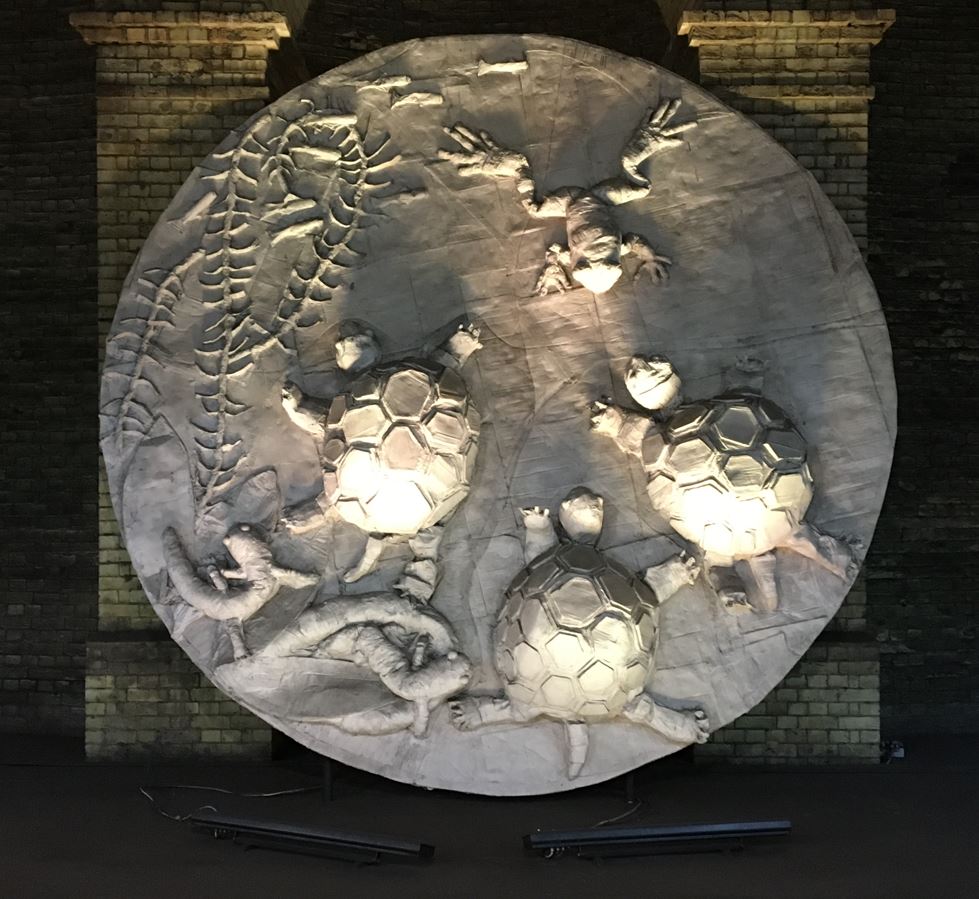
Frog and tortoises (terrapins?) by Monster Chetwynd at Gloucester Road tube station (photo by the author)
5. The Crystal Palace in scaffold

Scaffolding for Crystal Palace by Monster Chetwynd at Gloucester Road tube station (photo by the author)
 Books & Boots