Conversation
or any directory that user has access via group
…r_groups`

Co-authored-by: Stefan Holderbach <sholderbach@users.noreply.github.com>
hardfau1t
pushed a commit
that referenced
this pull request
Feb 16, 2024
<!--
if this PR closes one or more issues, you can automatically link the PR
with
them by using one of the [*linking
keywords*](https://docs.github.com/en/issues/tracking-your-work-with-issues/linking-a-pull-request-to-an-issue#linking-a-pull-request-to-an-issue-using-a-keyword),
e.g.
- this PR should close #xxxx
- fixes #xxxx

you can also mention related issues, PRs or discussions!
-->

This fixes an issue brought up by nihilander in
[Discord](https://discord.com/channels/601130461678272522/614593951969574961/1201594105986285649).

# Description
<!--
Thank you for improving Nushell. Please, check our [contributing
guide](../CONTRIBUTING.md) and talk to the core team before making major
changes.

Description of your pull request goes here. **Provide examples and/or
screenshots** if your changes affect the user experience.
-->

Nushell panics when the spread operator is used like this (the
`...$rest` shouldn't actually be parsed as a spread operator at all):

```nu
$ def foo [...rest: string] {...$rest}
$ foo bar baz
thread 'main' panicked at /root/.cargo/registry/src/index.crates.io-6f17d22bba15001f/nu-protocol-0.89.0/src/signature.rs:650:9:
Internal error: can't run a predeclaration without a body
stack backtrace:
   0: rust_begin_unwind
   1: core::panicking::panic_fmt
   2: <nu_protocol::signature::Predeclaration as nu_protocol::engine::command::Command>::run
   3: nu_engine::eval::eval_call
   4: nu_engine::eval::eval_expression_with_input
   5: nu_engine::eval::eval_element_with_input
   6: nu_engine::eval::eval_block
   7: nu_cli::util::eval_source
   8: nu_cli::repl::evaluate_repl
   9: nu::run::run_repl
  10: nu::main
note: Some details are omitted, run with `RUST_BACKTRACE=full` for a verbose backtrace.
```

The problem was that whenever the parser saw something like `{...$`,
`{...(`, or `{...[`, it would treat that as a record with a spread
expression, ignoring the syntax shape of the block it was parsing. This
should now be fixed, and the snippet above instead gives the following
error:

```nu
Error: nu::shell::external_command

  × External command failed
   ╭─[entry #1:1:1]
 1 │  def foo [...rest] {...$rest}
   ·                     ────┬───
   ·                         ╰── executable was not found
   ╰────
  help: No such file or directory (os error 2)
```

# User-Facing Changes
<!-- List of all changes that impact the user experience here. This
helps us keep track of breaking changes. -->

Stuff like `do { ...$rest }` will now try to run a command `...$rest`
rather than complaining that variable `$rest` doesn't exist.

# Tests + Formatting
<!--
Don't forget to add tests that cover your changes.

Make sure you've run and fixed any issues with these commands:

- `cargo fmt --all -- --check` to check standard code formatting (`cargo
fmt --all` applies these changes)
- `cargo clippy --workspace -- -D warnings -D clippy::unwrap_used` to
check that you're using the standard code style
- `cargo test --workspace` to check that all tests pass (on Windows make
sure to [enable developer
mode](https://learn.microsoft.com/en-us/windows/apps/get-started/developer-mode-features-and-debugging))
- `cargo run -- -c "use std testing; testing run-tests --path
crates/nu-std"` to run the tests for the standard library

> **Note**
> from `nushell` you can also use the `toolkit` as follows
> ```bash
> use toolkit.nu # or use an `env_change` hook to activate it
automatically
> toolkit check pr
> ```
-->

# After Submitting
<!-- If your PR had any user-facing changes, update [the
documentation](https://github.com/nushell/nushell.github.io) after the
PR is merged, if necessary. This will help us keep the docs up to date.
-->

Sorry about the issue, I am not touching the parser again for a long
time :)
hardfau1t
pushed a commit
that referenced
this pull request
Feb 16, 2024
<!--
if this PR closes one or more issues, you can automatically link the PR
with
them by using one of the [*linking
keywords*](https://docs.github.com/en/issues/tracking-your-work-with-issues/linking-a-pull-request-to-an-issue#linking-a-pull-request-to-an-issue-using-a-keyword),
e.g.
- this PR should close #xxxx
- fixes #xxxx

you can also mention related issues, PRs or discussions!
-->

# Description
<!--
Thank you for improving Nushell. Please, check our [contributing
guide](../CONTRIBUTING.md) and talk to the core team before making major
changes.

Description of your pull request goes here. **Provide examples and/or
screenshots** if your changes affect the user experience.
-->

Fixes nushell#11711

Previously, syntax `def a [] (echo 4)` was allowed to parse and then
failed with panic duting eval.

Current error:
```
Error: nu::parser::parse_mismatch

  × Parse mismatch during operation.
   ╭─[entry #1:1:1]
 1 │ def a [] (echo 4)
   ·          ────┬───
   ·              ╰── expected definition body closure { ... }
   ╰────
```

# User-Facing Changes
<!-- List of all changes that impact the user experience here. This
helps us keep track of breaking changes. -->

# Tests + Formatting
<!--
Don't forget to add tests that cover your changes.

Make sure you've run and fixed any issues with these commands:

- `cargo fmt --all -- --check` to check standard code formatting (`cargo
fmt --all` applies these changes)
- `cargo clippy --workspace -- -D warnings -D clippy::unwrap_used` to
check that you're using the standard code style
- `cargo test --workspace` to check that all tests pass (on Windows make
sure to [enable developer
mode](https://learn.microsoft.com/en-us/windows/apps/get-started/developer-mode-features-and-debugging))
- `cargo run -- -c "use std testing; testing run-tests --path
crates/nu-std"` to run the tests for the standard library

> **Note**
> from `nushell` you can also use the `toolkit` as follows
> ```bash
> use toolkit.nu # or use an `env_change` hook to activate it
automatically
> toolkit check pr
> ```
-->

# After Submitting
<!-- If your PR had any user-facing changes, update [the
documentation](https://github.com/nushell/nushell.github.io) after the
PR is merged, if necessary. This will help us keep the docs up to date.
-->
hardfau1t
pushed a commit
that referenced
this pull request
Feb 16, 2024
…r ints (nushell#11724)

# Description

This PR changes `into int` and `into filesize` so that they allow
thousands separators.

### Before
```nushell
❯ '1,000' | into filesize
Error: nu::shell::cant_convert

  × Can't convert to int.
   ╭─[entry #1:1:1]
 1 │ '1,000' | into filesize
   · ───┬───
   ·    ╰── can't convert string to int
   ╰────

❯ '1,000' | into int
Error: nu:🐚:cant_convert

  × Can't convert to int.
   ╭─[entry nushell#2:1:1]
 1 │ '1,000' | into int
   ·           ────┬───
   ·               ╰── can't convert string to int
   ╰────
  help: string "1,000" does not represent a valid integer
```
### After
```nushell
❯ '1,000' | into filesize
1.0 KB
❯ '1,000' | into int
1000
```

This works by getting the system locale and from that, determining what
the thousands separator is. So, hopefully, this will work across
locales.
# User-Facing Changes
<!-- List of all changes that impact the user experience here. This
helps us keep track of breaking changes. -->

# Tests + Formatting
<!--
Don't forget to add tests that cover your changes.

Make sure you've run and fixed any issues with these commands:

- `cargo fmt --all -- --check` to check standard code formatting (`cargo
fmt --all` applies these changes)
- `cargo clippy --workspace -- -D warnings -D clippy::unwrap_used` to
check that you're using the standard code style
- `cargo test --workspace` to check that all tests pass (on Windows make
sure to [enable developer
mode](https://learn.microsoft.com/en-us/windows/apps/get-started/developer-mode-features-and-debugging))
- `cargo run -- -c "use std testing; testing run-tests --path
crates/nu-std"` to run the tests for the standard library

> **Note**
> from `nushell` you can also use the `toolkit` as follows
> ```bash
> use toolkit.nu # or use an `env_change` hook to activate it
automatically
> toolkit check pr
> ```
-->

# After Submitting
<!-- If your PR had any user-facing changes, update [the
documentation](https://github.com/nushell/nushell.github.io) after the
PR is merged, if necessary. This will help us keep the docs up to date.
-->
hardfau1t
pushed a commit
that referenced
this pull request
Feb 16, 2024
# Description
Close: nushell#9673
Close: nushell#8277
Close: nushell#10944

This pr introduces the following syntax:
1. `e>|`, pipe stderr to next command. Example: `$env.FOO=bar nu
--testbin echo_env_stderr FOO e>| str length`
2. `o+e>|` and `e+o>|`, pipe both stdout and stderr to next command,
example: `$env.FOO=bar nu --testbin echo_env_mixed out-err FOO FOO e+o>|
str length`

Note: it only works for external commands. ~There is no different for
internal commands, that is, the following three commands do the same
things:~ Edit: it raises errors if we want to pipes for internal
commands
```
❯ ls e>| str length
Error:   × `e>|` only works with external streams
   ╭─[entry #1:1:1]
 1 │ ls e>| str length
   ·    ─┬─
   ·     ╰── `e>|` only works on external streams
   ╰────

❯ ls e+o>| str length
Error:   × `o+e>|` only works with external streams
   ╭─[entry nushell#2:1:1]
 1 │ ls e+o>| str length
   ·    ──┬──
   ·      ╰── `o+e>|` only works on external streams
   ╰────
```

This can help us to avoid some strange issues like the following:

`$env.FOO=bar (nu --testbin echo_env_stderr FOO) e>| str length`

Which is hard to understand and hard to explain to users.

# User-Facing Changes
Nan

# Tests + Formatting
To be done

# After Submitting
Maybe update documentation about these syntax.
hardfau1t
pushed a commit
that referenced
this pull request
Nov 24, 2024
# Description

Resolves nushell#11274.

```
~/CodingProjects/nushell> let day = 2; echo 0..<$day
╭───┬───╮
│ 0 │ 0 │
│ 1 │ 1 │
╰───┴───╯
~/CodingProjects/nushell> let kb = "jan"; echo 0..$kb
Error: nu::shell::type_mismatch

  × Type mismatch during operation.
   ╭─[entry #1:1:22]
 1 │ let kb = "jan"; echo 0..$kb
   ·                      ┬─┬─┬─
   ·                      │ │ ╰── string
   ·                      │ ╰── type mismatch for operator
   ·                      ╰── int
   ╰────
```


# Tests + Formatting

Relevant test added 🆙

---------

Co-authored-by: Stefan Holderbach <sholderbach@users.noreply.github.com>
hardfau1t
pushed a commit
that referenced
this pull request
Nov 24, 2024
<!--
if this PR closes one or more issues, you can automatically link the PR
with
them by using one of the [*linking
keywords*](https://docs.github.com/en/issues/tracking-your-work-with-issues/linking-a-pull-request-to-an-issue#linking-a-pull-request-to-an-issue-using-a-keyword),
e.g.
- this PR should close #xxxx
- fixes #xxxx

you can also mention related issues, PRs or discussions!
-->

# Description
Resolves nushell#11756.
Resolves nushell#12346.

As per description, shell no longer hangs:
```
~/CodingProjects/nushell> [1 2 3] | select (-2)
Error: nu::shell::cant_convert

  × Can't convert to cell path.
   ╭─[entry #1:1:18]
 1 │ [1 2 3] | select (-2)
   ·                  ──┬─
   ·                    ╰── can't convert negative number to cell path
   ╰────
```


<!--
Thank you for improving Nushell. Please, check our [contributing
guide](../CONTRIBUTING.md) and talk to the core team before making major
changes.

Description of your pull request goes here. **Provide examples and/or
screenshots** if your changes affect the user experience.
-->

# User-Facing Changes
<!-- List of all changes that impact the user experience here. This
helps us keep track of breaking changes. -->

# Tests + Formatting
<!--
Don't forget to add tests that cover your changes.

Make sure you've run and fixed any issues with these commands:

- `cargo fmt --all -- --check` to check standard code formatting (`cargo
fmt --all` applies these changes)
- `cargo clippy --workspace -- -D warnings -D clippy::unwrap_used` to
check that you're using the standard code style
- `cargo test --workspace` to check that all tests pass (on Windows make
sure to [enable developer
mode](https://learn.microsoft.com/en-us/windows/apps/get-started/developer-mode-features-and-debugging))
- `cargo run -- -c "use std testing; testing run-tests --path
crates/nu-std"` to run the tests for the standard library

> **Note**
> from `nushell` you can also use the `toolkit` as follows
> ```bash
> use toolkit.nu # or use an `env_change` hook to activate it
automatically
> toolkit check pr
> ```
-->

Added relevant test 🚀

# After Submitting
<!-- If your PR had any user-facing changes, update [the
documentation](https://github.com/nushell/nushell.github.io) after the
PR is merged, if necessary. This will help us keep the docs up to date.
-->

Possibly support `get` `get`ting negative numbers, as per nushell#12346
discussion. Alternatively, we can consider adding a cellpath for
negative indexing?
hardfau1t
pushed a commit
that referenced
this pull request
Nov 24, 2024
# Description

From @maxim-uvarov's
[post](https://discord.com/channels/601130461678272522/1227612017171501136/1228656319704203375).

When calling `to-lazy` back to back in a pipeline, an error should not
occur:

```
> [[a b]; [6 2] [1 4] [4 1]] | polars into-lazy | polars into-lazy
Error: nu::shell::cant_convert

  × Can't convert to NuDataFrame.
   ╭─[entry #1:1:30]
 1 │ [[a b]; [6 2] [1 4] [4 1]] | polars into-lazy | polars into-lazy
   ·                              ────────┬───────
   ·                                      ╰── can't convert NuLazyFrameCustomValue to NuDataFrame
   ╰────
 ```

This pull request ensures that custom value's of NuLazyFrameCustomValue are properly converted when passed in.

Co-authored-by: Jack Wright <jack.wright@disqo.com>
hardfau1t
pushed a commit
that referenced
this pull request
Nov 24, 2024
# Description
Fixes nushell#12520


# User-Facing Changes
Breaking change:

Any operation parsing input with `PWD` to set the environment will now
fail with `ShellError::AutomaticEnvVarSetManually`

Furthermore transactions containing the special env-vars will be
rejected before executing any modifications. Prevoiusly this was
changing valid variables before while leaving valid variables after the
violation untouched.

## `PWD` handling.

Now failing

```
{PWD: "/trolling"} | load-env
```

already failing

```
load-env {PWD: "/trolling"}
```

## Error management


```
> load-env {MY_VAR1: foo, PWD: "/trolling", MY_VAR2: bar}
Error: nu::shell::automatic_env_var_set_manually

  × PWD cannot be set manually.
   ╭─[entry #1:1:2]
 1 │  load-env {MY_VAR1: foo, PWD: "/trolling", MY_VAR2: bar}
   ·  ────┬───
   ·      ╰── cannot set 'PWD' manually
   ╰────
  help: The environment variable 'PWD' is set automatically by Nushell and cannot be set manually.
```

### Before:
```
> $env.MY_VAR1
foo
> $env.MY_VAR2
Error: nu:🐚:name_not_found
....
```
### After:
```
> $env.MY_VAR1
Error: nu:🐚:name_not_found
....
> $env.MY_VAR2
Error: nu:🐚:name_not_found
....
```

# After Submitting
We need to check if any integrations rely on this hack.
hardfau1t
pushed a commit
that referenced
this pull request
Nov 24, 2024
…to eager frames later in the pipeline. (nushell#12525)

# Description
@maxim-uvarov discovered the following error:
```
> [[a b]; [6 2] [1 4] [4 1]] | polars into-lazy | polars sort-by a | polars unique --subset [a]
Error:   × Error using as series
   ╭─[entry #1:1:68]
 1 │ [[a b]; [6 2] [1 4] [4 1]] | polars into-lazy | polars sort-by a | polars unique --subset [a]
   ·                                                                    ──────┬──────
   ·                                                                          ╰── dataframe has more than one column
   ╰────
 ```

During investigation, I discovered the root cause was that the lazy frame was incorrectly converted back to a eager dataframe. In order to keep this from happening, I explicitly set that the dataframe did not come from an eager frame. This causes the conversion logic to not attempt to convert the dataframe later in the pipeline.

---------

Co-authored-by: Jack Wright <jack.wright@disqo.com>
hardfau1t
pushed a commit
that referenced
this pull request
Nov 24, 2024
# Description
Work for nushell#7149

- **Error `with-env` given uneven count in list form**
- **Fix `with-env` `CantConvert` to record**
- **Error `with-env` when given protected env vars**
- **Deprecate list/table input of vars to `with-env`**
- **Remove examples for deprecated input**

# User-Facing Changes

## Deprecation of the following forms

```
> with-env [MYENV "my env value"] { $env.MYENV }
my env value

> with-env [X Y W Z] { $env.X }
Y

> with-env [[X W]; [Y Z]] { $env.W }
Z
```

## recommended standardized form

```
# Set by key-value record
> with-env {X: "Y", W: "Z"} { [$env.X $env.W] }
╭───┬───╮
│ 0 │ Y │
│ 1 │ Z │
╰───┴───╯
```

## (Side effect) Repeated definitions in an env shorthand are now
disallowed

```
> FOO=bar FOO=baz $env
Error: nu::shell::column_defined_twice

  × Record field or table column used twice: FOO
   ╭─[entry #1:1:1]
 1 │ FOO=bar FOO=baz $env
   · ─┬─     ─┬─
   ·  │       ╰── field redefined here
   ·  ╰── field first defined here
   ╰────
```
hardfau1t
pushed a commit
that referenced
this pull request
Nov 24, 2024
# Description

@maxim-uvarov brought up another case where converting back and forth
between eager and lazy dataframes was not working correctly:

```
> [[a b]; [6 2] [1 4] [4 1]] | polars into-lazy | polars append -c ([[a b]; [6 2] [1 4] [4 1]] | polars into-df)
Error: nu::shell::cant_convert

  × Can't convert to NuDataFrame.
   ╭─[entry #1:1:49]
 1 │ [[a b]; [6 2] [1 4] [4 1]] | polars into-lazy | polars append -c ([[a b]; [6 2] [1 4] [4 1]] | polars into-df)
   ·                                                 ──────┬──────
   ·                                                       ╰── can't convert NuLazyFrameCustomValue to NuDataFrame
   ╰────
```

This pull request fixes this case and glaringly obvious similar cases I
could find.

Co-authored-by: Jack Wright <jack.wright@disqo.com>
hardfau1t
pushed a commit
that referenced
this pull request
Nov 24, 2024
Should close nushell#10833 — though I'd imagine that should have already been closed. # Description Very minor tweak, but it was quite noticeable when using Zellij which relies on OSC 2 to set pane titles. Before the change:  Note that the default `Pane #1` is still showing for the untouched shell, but running a command like `htop` or `ls` correctly sets the title during / afterwards. After this PR:  There are now no-longer any unset titles — even if the shell hasn't been touched. **As an aside:** I feel quite strongly that (at least OSC 2) shell integration should be enabled by default, as it is for every other Linux shell I've used, but I'm not sure which issues that caused that the default config refers to? Which terminals are broken by shell integration, and could some of the shell integrations be turned on by default after splitting things into sub-options as suggested in nushell#11301 ? # User-Facing Changes You'll just have shell integrations working from right after the shell has been launched, instead of needing to run something first. # Tests + Formatting Not quite sure how to test this one? Are there any other tests that currently exist for shell integration? I couldn't quite track them down... # After Submitting Let me know if you think this needs any user-facing docs changes!
hardfau1t
pushed a commit
that referenced
this pull request
Nov 24, 2024
# Description
Close: nushell#12514

# User-Facing Changes
`^ls | skip 1` will raise an error
```nushell
❯ ^ls | skip 1
Error: nu::shell::only_supports_this_input_type

  × Input type not supported.
   ╭─[entry #1:1:2]
 1 │ ^ls | skip 1
   ·  ─┬   ──┬─
   ·   │     ╰── only list, binary or range input data is supported
   ·   ╰── input type: raw data
   ╰────
```

# Tests + Formatting
Sorry I can't add it because of the issue:
nushell#12558

# After Submitting
Nan
hardfau1t
pushed a commit
that referenced
this pull request
Nov 24, 2024
…stStream` (nushell#12412)

<!--
if this PR closes one or more issues, you can automatically link the PR
with
them by using one of the [*linking
keywords*](https://docs.github.com/en/issues/tracking-your-work-with-issues/linking-a-pull-request-to-an-issue#linking-a-pull-request-to-an-issue-using-a-keyword),
e.g.
- this PR should close #xxxx
- fixes #xxxx

you can also mention related issues, PRs or discussions!
-->

# Description
<!--
Thank you for improving Nushell. Please, check our [contributing
guide](../CONTRIBUTING.md) and talk to the core team before making major
changes.

Description of your pull request goes here. **Provide examples and/or
screenshots** if your changes affect the user experience.
-->

Prior, it seemed that nested errors would not get detected and shown.
This PR fixes that.

Resolves nushell#10176:
```
~/CodingProjects/nushell> [[1,2]] | each {|x| $x | each {|y| error make {msg: "oh noes"} } }                        05/04/2024 21:34:08
Error: nu::shell::eval_block_with_input

  × Eval block failed with pipeline input
   ╭─[entry #1:1:3]
 1 │ [[1,2]] | each {|x| $x | each {|y| error make {msg: "oh noes"} } }
   ·   ┬
   ·   ╰── source value
   ╰────

Error:   × oh noes
   ╭─[entry #1:1:36]
 1 │ [[1,2]] | each {|x| $x | each {|y| error make {msg: "oh noes"} } }
   ·                                    ─────┬────
   ·                                         ╰── originates from here
   ╰────
```

Resolves nushell#11224:
```
~/CodingProjects/nushell> [0] | each { |_|                                                                          05/04/2024 21:35:40
:::     [0] | each { |_|
:::         non-existent-command
:::     }
::: }
Error: nu::shell::eval_block_with_input

  × Eval block failed with pipeline input
   ╭─[entry #1:2:6]
 1 │ [0] | each { |_|
 2 │     [0] | each { |_|
   ·      ┬
   ·      ╰── source value
 3 │         non-existent-command
   ╰────

Error: nu:🐚:external_command

  × External command failed
   ╭─[entry #1:3:9]
 2 │     [0] | each { |_|
 3 │         non-existent-command
   ·         ──────────┬─────────
   ·                   ╰── executable was not found
 4 │     }
   ╰────
  help: No such file or directory (os error 2)
```

# User-Facing Changes
<!-- List of all changes that impact the user experience here. This
helps us keep track of breaking changes. -->

# Tests + Formatting
<!--
Don't forget to add tests that cover your changes.

Make sure you've run and fixed any issues with these commands:

- `cargo fmt --all -- --check` to check standard code formatting (`cargo
fmt --all` applies these changes)
- `cargo clippy --workspace -- -D warnings -D clippy::unwrap_used` to
check that you're using the standard code style
- `cargo test --workspace` to check that all tests pass (on Windows make
sure to [enable developer
mode](https://learn.microsoft.com/en-us/windows/apps/get-started/developer-mode-features-and-debugging))
- `cargo run -- -c "use std testing; testing run-tests --path
crates/nu-std"` to run the tests for the standard library

> **Note**
> from `nushell` you can also use the `toolkit` as follows
> ```bash
> use toolkit.nu # or use an `env_change` hook to activate it
automatically
> toolkit check pr
> ```
-->

# After Submitting
<!-- If your PR had any user-facing changes, update [the
documentation](https://github.com/nushell/nushell.github.io) after the
PR is merged, if necessary. This will help us keep the docs up to date.
-->
hardfau1t
pushed a commit
that referenced
this pull request
Nov 24, 2024
# Description

Fix a regression introduced by nushell#12921, where tilde expansion was no
longer done on the external command name, breaking things like

```nushell
> ~/.cargo/bin/exa
```

This properly handles quoted strings, so they don't expand:

```nushell
> ^"~/.cargo/bin/exa"
Error: nu::shell::external_command

  × External command failed
   ╭─[entry #1:1:2]
 1 │ ^"~/.cargo/bin/exa"
   ·  ─────────┬────────
   ·           ╰── Command `~/.cargo/bin/exa` not found
   ╰────
  help: `~/.cargo/bin/exa` is neither a Nushell built-in or a known external command

```

This required a change to the parser, so the command name is also parsed
in the same way the arguments are - i.e. the quotes on the outside
remain in the expression. Hopefully that doesn't break anything else. 🤞

Fixes nushell#13000. Should include in patch release 0.94.1

cc @yizhepku

# User-Facing Changes
- Tilde expansion now works again for external commands
- The `command` of `run-external` will now have its quotes removed like
the other arguments if it is a literal string
- The parser is changed to include quotes in the command expression of
`ExternalCall` if they were present

# Tests + Formatting
I would like to add a regression test for this, but it's complicated
because we need a well-known binary within the home directory, which
just isn't a thing. We could drop one there, but that's kind of a bad
behavior for a test to do. I also considered changing the home directory
for the test, but that's so platform-specific - potentially could get it
working on specific platforms though. Changing `HOME` env on Linux
definitely works as far as tilde expansion works.

- 🟢 `toolkit fmt`
- 🟢 `toolkit clippy`
- 🟢 `toolkit test`
- 🟢 `toolkit test stdlib`
hardfau1t
pushed a commit
that referenced
this pull request
Nov 24, 2024
…ushell#13131)

# Description
Closes: nushell#13010

It adds an additional check inside `parse_string`, and returns
`unbalanced quote` if input string is unbalanced

# User-Facing Changes
After this pr, the following is no longer allowed:
```nushell
❯ "asdfasdf"asdfasdf
Error: nu::parser::extra_token_after_closing_delimiter

  × Invaild characters after closing delimiter
   ╭─[entry #1:1:11]
 1 │ "asdfasdf"asdfasdf
   ·           ────┬───
   ·               ╰── invalid characters
   ╰────
  help: Try removing them.
❯ 'asdfasd'adsfadf
Error: nu::parser::extra_token_after_closing_delimiter

  × Invaild characters after closing delimiter
   ╭─[entry nushell#2:1:10]
 1 │ 'asdfasd'adsfadf
   ·          ───┬───
   ·             ╰── invalid characters
   ╰────
  help: Try removing them.
```

# Tests + Formatting
Added 1 test
hardfau1t
pushed a commit
that referenced
this pull request
Nov 24, 2024
# Description
Fixes nushell#13280. After apply this patch, we can use non-timezone string +
format option `into datetime` cmd

# User-Facing Changes
AS-IS (before fixing)
```
$ "09.02.2024 11:06:11" | into datetime --format '%m.%d.%Y %T'
Error: nu::shell::cant_convert

  × Can't convert to could not parse as datetime using format '%m.%d.%Y %T'.
   ╭─[entry #1:1:25]
 1 │ "09.02.2024 11:06:11" | into datetime --format '%m.%d.%Y %T'
   ·                         ──────┬──────
   ·                               ╰── can't convert input is not enough for unique date and time to could not parse as datetime using format '%m.%d.%Y %T'
   ╰────
  help: you can use `into datetime` without a format string to enable flexible parsing

$ "09.02.2024 11:06:11" | into datetime
Mon, 2 Sep 2024 11:06:11 +0900 (in 2 months)
```

TO-BE(After fixing)

```
$ "09.02.2024 11:06:11" | into datetime --format '%m.%d.%Y %T'
Mon, 2 Sep 2024 20:06:11 +0900 (in 2 months)

$ "09.02.2024 11:06:11" | into datetime
Mon, 2 Sep 2024 11:06:11 +0900 (in 2 months)
```


# Tests + Formatting
If there is agreement on the direction, I will add a test.

# After Submitting

---------

Co-authored-by: Darren Schroeder <343840+fdncred@users.noreply.github.com>
hardfau1t
pushed a commit
that referenced
this pull request
Nov 24, 2024
# Description
From the feedbacks from @amtoine , it's good to make nushell shows error
for `o>|` syntax.

# User-Facing Changes
## Before
```nushell
'foo' o>| print                                                                                                                                                                                                                     07/09/2024 06:44:23 AM
Error: nu::parser::parse_mismatch

  × Parse mismatch during operation.
   ╭─[entry nushell#6:1:9]
 1 │ 'foo' o>| print
   ·         ┬
   ·         ╰── expected redirection target
```

## After
```nushell
'foo' o>| print                                                                                                                                                                                                                     07/09/2024 06:47:26 AM
Error: nu::parser::parse_mismatch

  × Parse mismatch during operation.
   ╭─[entry #1:1:7]
 1 │ 'foo' o>| print
   ·       ─┬─
   ·        ╰── expected `|`.  Redirection stdout to pipe is the same as piping directly.
   ╰────
```

# Tests + Formatting
Added one test

---------

Co-authored-by: Darren Schroeder <343840+fdncred@users.noreply.github.com>
hardfau1t
pushed a commit
that referenced
this pull request
Nov 24, 2024
# Description As part of fixing nushell#13586, this PR checks the types of the operands when creating a range. Stuff like `0..(glob .)` will be rejected at parse time. Additionally, `0..$x` will be treated as a range and rejected if `x` is not defined, rather than being treated as a string. A separate PR will need to be made to do reject streams at runtime, so that stuff like `0..(open /dev/random)` doesn't hang. Internally, this PR adds a `ParseError::UnsupportedOperationTernary` variant, for when you have a range like `1..2..(glob .)`. # User-Facing Changes Users will now receive an error if any of the operands in the ranges they construct have types that aren't compatible with `Type::Number`. Additionally, if a piece of code looks like a range but some parse error is encountered while parsing it, that piece of code will still be treated as a range and the user will be shown the parse error. This means that a piece of code like `0..$x` will be treated as a range no matter what. Previously, if `x` weren't the expression would've been treated as a string `"0..$x"`. I feel like it makes the language less complicated if we make it less context-sensitive. Here's an example of the error you get: ``` > 0..(glob .) Error: nu::parser::unsupported_operation × range is not supported between int and any. ╭─[entry #1:1:1] 1 │ 0..(glob .) · ─────┬─────┬┬ · │ │╰── any · │ ╰── int · ╰── doesn't support these values ╰──── ``` And as an image: 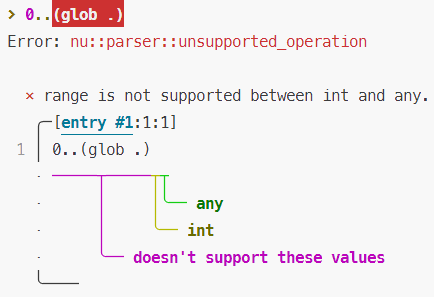 Note: I made the operands themselves (above, `(glob .)`) be garbage, rather than the `..` operator itself. This doesn't match the behavior of the math operators (if you do `1 + "foo"`, `+` gets highlighted red). This is because with ranges, the range operators aren't `Expression`s themselves, so they can't be turned into garbage. I felt like here, it makes more sense to highlight the individual operand anyway.
hardfau1t
pushed a commit
that referenced
this pull request
Nov 24, 2024
# Description
This PR makes it so that non-zero exit codes and termination by signal
are treated as a normal `ShellError`. Currently, these are silent
errors. That is, if an external command fails, then it's code block is
aborted, but the parent block can sometimes continue execution. E.g.,
see nushell#8569 and this example:
```nushell
[1 2] | each { ^false }
```

Before this would give:
```
╭───┬──╮
│ 0 │  │
│ 1 │  │
╰───┴──╯
```

Now, this shows an error:
```
Error: nu::shell::eval_block_with_input

  × Eval block failed with pipeline input
   ╭─[entry #1:1:2]
 1 │ [1 2] | each { ^false }
   ·  ┬
   ·  ╰── source value
   ╰────

Error: nu:🐚:non_zero_exit_code

  × External command had a non-zero exit code
   ╭─[entry #1:1:17]
 1 │ [1 2] | each { ^false }
   ·                 ──┬──
   ·                   ╰── exited with code 1
   ╰────
```

This PR fixes nushell#12874, fixes nushell#5960, fixes nushell#10856, and fixes nushell#5347. This
PR also partially addresses nushell#10633 and nushell#10624 (only the last command of
a pipeline is currently checked). It looks like nushell#8569 is already fixed,
but this PR will make sure it is definitely fixed (fixes nushell#8569).

# User-Facing Changes
- Non-zero exit codes and termination by signal now cause an error to be
thrown.
- The error record value passed to a `catch` block may now have an
`exit_code` column containing the integer exit code if the error was due
to an external command.
- Adds new config values, `display_errors.exit_code` and
`display_errors.termination_signal`, which determine whether an error
message should be printed in the respective error cases. For
non-interactive sessions, these are set to `true`, and for interactive
sessions `display_errors.exit_code` is false (via the default config).

# Tests
Added a few tests.

# After Submitting
- Update docs and book.
- Future work:
- Error if other external commands besides the last in a pipeline exit
with a non-zero exit code. Then, deprecate `do -c` since this will be
the default behavior everywhere.
- Add a better mechanism for exit codes and deprecate
`$env.LAST_EXIT_CODE` (it's buggy).
hardfau1t
pushed a commit
that referenced
this pull request
Nov 24, 2024
# Description
Old code was comparing remaining positional arguments with total number
of arguments, where it should've compared remaining positional with
with remaining arguments of any kind. This means that if a function was
given too few arguments, `calculate_end_span` would believe that it
actually had too many arguments, since after parsing the first few
arguments, the number of remaining arguments needed were fewer than the
*total* number of arguments, of which we had used several.

Fixes nushell#9072
Fixes: nushell#13930
Fixes: nushell#12069
Fixes: nushell#8385

Extracted from nushell#10381

## Bonus

It also improves the error handling on missing positional arguments
before keywords (no longer crashing since nushell#9851). Instead of just giving
the keyword to the parser for the missing positional, we give an
explicit error about a missing positional argument. I would like better
descriptions than "missing var_name" though, but I'm not sure if that's
available without

Old error
```
Error: nu::parser::parse_mismatch

  × Parse mismatch during operation.
   ╭─[entry #1:1:1]
 1 │ let = if foo
   ·     ┬
   ·     ╰── expected valid variable name
   ╰────
```

New error
```
Error: nu::parser::missing_positional

  × Missing required positional argument.
   ╭─[entry nushell#18:1:1]
 1 │ let = foo
   ·    ┬
   ·    ╰── missing var_name
   ╰────
  help: Usage: let <var_name> = <initial_value>
```

# User-Facing Changes
The program `alias = = =` is no longer accepted by the parser
hardfau1t
pushed a commit
that referenced
this pull request
Nov 24, 2024
)

# Description

This PR updates `group-by` and `split-by` to allow other nushell Values
to be used, namely bools.

### Before
```nushell
❯ [false, false, true, false, true, false] | group-by | table -e
Error: nu::shell::cant_convert

  × Can't convert to string.
   ╭─[entry #1:1:2]
 1 │ [false, false, true, false, true, false] | group-by | table -e
   ·  ──┬──
   ·    ╰── can't convert bool to string
   ╰────
```
### After
```nushell
❯ [false, false, true, false, true, false] | group-by | table -e
╭───────┬───────────────╮
│       │ ╭───┬───────╮ │
│ false │ │ 0 │ false │ │
│       │ │ 1 │ false │ │
│       │ │ 2 │ false │ │
│       │ │ 3 │ false │ │
│       │ ╰───┴───────╯ │
│       │ ╭───┬──────╮  │
│ true  │ │ 0 │ true │  │
│       │ │ 1 │ true │  │
│       │ ╰───┴──────╯  │
╰───────┴───────────────╯
```

# User-Facing Changes
<!-- List of all changes that impact the user experience here. This
helps us keep track of breaking changes. -->

# Tests + Formatting
<!--
Don't forget to add tests that cover your changes.

Make sure you've run and fixed any issues with these commands:

- `cargo fmt --all -- --check` to check standard code formatting (`cargo
fmt --all` applies these changes)
- `cargo clippy --workspace -- -D warnings -D clippy::unwrap_used` to
check that you're using the standard code style
- `cargo test --workspace` to check that all tests pass (on Windows make
sure to [enable developer
mode](https://learn.microsoft.com/en-us/windows/apps/get-started/developer-mode-features-and-debugging))
- `cargo run -- -c "use toolkit.nu; toolkit test stdlib"` to run the
tests for the standard library

> **Note**
> from `nushell` you can also use the `toolkit` as follows
> ```bash
> use toolkit.nu # or use an `env_change` hook to activate it
automatically
> toolkit check pr
> ```
-->

# After Submitting
<!-- If your PR had any user-facing changes, update [the
documentation](https://github.com/nushell/nushell.github.io) after the
PR is merged, if necessary. This will help us keep the docs up to date.
-->
hardfau1t
pushed a commit
that referenced
this pull request
Nov 24, 2024
)

# Description

This PR updates `group-by` and `split-by` to allow other nushell Values
to be used, namely bools.

### Before
```nushell
❯ [false, false, true, false, true, false] | group-by | table -e
Error: nu::shell::cant_convert

  × Can't convert to string.
   ╭─[entry #1:1:2]
 1 │ [false, false, true, false, true, false] | group-by | table -e
   ·  ──┬──
   ·    ╰── can't convert bool to string
   ╰────
```
### After
```nushell
❯ [false, false, true, false, true, false] | group-by | table -e
╭───────┬───────────────╮
│       │ ╭───┬───────╮ │
│ false │ │ 0 │ false │ │
│       │ │ 1 │ false │ │
│       │ │ 2 │ false │ │
│       │ │ 3 │ false │ │
│       │ ╰───┴───────╯ │
│       │ ╭───┬──────╮  │
│ true  │ │ 0 │ true │  │
│       │ │ 1 │ true │  │
│       │ ╰───┴──────╯  │
╰───────┴───────────────╯
```

# User-Facing Changes
<!-- List of all changes that impact the user experience here. This
helps us keep track of breaking changes. -->

# Tests + Formatting
<!--
Don't forget to add tests that cover your changes.

Make sure you've run and fixed any issues with these commands:

- `cargo fmt --all -- --check` to check standard code formatting (`cargo
fmt --all` applies these changes)
- `cargo clippy --workspace -- -D warnings -D clippy::unwrap_used` to
check that you're using the standard code style
- `cargo test --workspace` to check that all tests pass (on Windows make
sure to [enable developer
mode](https://learn.microsoft.com/en-us/windows/apps/get-started/developer-mode-features-and-debugging))
- `cargo run -- -c "use toolkit.nu; toolkit test stdlib"` to run the
tests for the standard library

> **Note**
> from `nushell` you can also use the `toolkit` as follows
> ```bash
> use toolkit.nu # or use an `env_change` hook to activate it
automatically
> toolkit check pr
> ```
-->

# After Submitting
<!-- If your PR had any user-facing changes, update [the
documentation](https://github.com/nushell/nushell.github.io) after the
PR is merged, if necessary. This will help us keep the docs up to date.
-->
hardfau1t
pushed a commit
that referenced
this pull request
Nov 24, 2024
…ell#14118)

Fixes nushell#14023

# Description

- Prevents "failed to find added variable" when modules export constants
  with type signatures:

```nushell
> module foo { export const bar: int = 2 }
Error: nu::parser::unknown_state

  × Internal error.
   ╭─[entry #1:1:21]
 1 │ module foo { export const bar: int = 2 }
   ·                     ─────────┬────────
   ·                              ╰── failed to find added variable
```

- Returns `name_is_builtin_var` errors for names with type signatures:

```nushell
> let env: string = "";
Error: nu::parser::name_is_builtin_var

  × `env` used as variable name.
   ╭─[entry #1:1:5]
 1 │ let env: string = "";
   ·     ─┬─
   ·      ╰── already a builtin variable
```
hardfau1t
pushed a commit
that referenced
this pull request
Nov 24, 2024
<!--
if this PR closes one or more issues, you can automatically link the PR
with
them by using one of the [*linking
keywords*](https://docs.github.com/en/issues/tracking-your-work-with-issues/linking-a-pull-request-to-an-issue#linking-a-pull-request-to-an-issue-using-a-keyword),
e.g.
- this PR should close #xxxx
- fixes #xxxx

you can also mention related issues, PRs or discussions!
-->

# Description
<!--
Thank you for improving Nushell. Please, check our [contributing
guide](../CONTRIBUTING.md) and talk to the core team before making major
changes.

Description of your pull request goes here. **Provide examples and/or
screenshots** if your changes affect the user experience.
-->

This PR fixes the quoting and escaping of column names in `to nuon`.
Before the PR, column names with quotes inside them would get quoted,
but not escaped:

```nushell
> { 'a"b': 2 } | to nuon
{ "a"b": 2 }

> { 'a"b': 2 } | to nuon | from nuon
Error:   × error when loading nuon text
   ╭─[entry #1:1:27]
 1 │ { "a\"b": 2 } | to nuon | from nuon
   ·                           ────┬────
   ·                               ╰── could not load nuon text
   ╰────

Error:   × error when parsing nuon text
   ╭─[entry #1:1:27]
 1 │ { "a\"b": 2 } | to nuon | from nuon
   ·                           ────┬────
   ·                               ╰── could not parse nuon text
   ╰────

Error:   × error when parsing
   ╭────
 1 │ {"a"b": 2}
   ·          ┬
   ·          ╰── Unexpected end of code.
   ╰────

> [['a"b']; [2] [3]] | to nuon
[["a"b"]; [2], [3]]

> [['a"b']; [2] [3]] | to nuon | from nuon
Error:   × error when loading nuon text
   ╭─[entry #1:1:32]
 1 │ [['a"b']; [2] [3]] | to nuon | from nuon
   ·                                ────┬────
   ·                                    ╰── could not load nuon text
   ╰────

Error:   × error when parsing nuon text
   ╭─[entry #1:1:32]
 1 │ [['a"b']; [2] [3]] | to nuon | from nuon
   ·                                ────┬────
   ·                                    ╰── could not parse nuon text
   ╰────

Error:   × error when parsing
   ╭────
 1 │ [["a"b"]; [2], [3]]
   ·                   ┬
   ·                   ╰── Unexpected end of code.
   ╰────
```

After this PR, the quote is escaped properly:

```nushell
> { 'a"b': 2 } | to nuon
{ "a\"b": 2 }

> { 'a"b': 2 } | to nuon | from nuon
╭─────┬───╮
│ a"b │ 2 │
╰─────┴───╯

> [['a"b']; [2] [3]] | to nuon
[["a\"b"]; [2], [3]]

> [['a"b']; [2] [3]] | to nuon | from nuon
╭─────╮
│ a"b │
├─────┤
│   2 │
│   3 │
╰─────╯
```

The cause of the issue was that `to nuon` simply wrapped column names in
`'"'` instead of calling `escape_quote_string`.

As part of this change, I also moved the functions related to quoting
(`needs_quoting` and `escape_quote_string`) into `nu-utils`, since
previously they were defined in very ad-hoc places (and, in the case of
`escape_quote_string`, it was defined multiple times with the same
body!).

# User-Facing Changes
<!-- List of all changes that impact the user experience here. This
helps us keep track of breaking changes. -->

`to nuon` now properly escapes quotes in column names.

# Tests + Formatting
<!--
Don't forget to add tests that cover your changes.

Make sure you've run and fixed any issues with these commands:

- `cargo fmt --all -- --check` to check standard code formatting (`cargo
fmt --all` applies these changes)
- `cargo clippy --workspace -- -D warnings -D clippy::unwrap_used` to
check that you're using the standard code style
- `cargo test --workspace` to check that all tests pass (on Windows make
sure to [enable developer
mode](https://learn.microsoft.com/en-us/windows/apps/get-started/developer-mode-features-and-debugging))
- `cargo run -- -c "use toolkit.nu; toolkit test stdlib"` to run the
tests for the standard library

> **Note**
> from `nushell` you can also use the `toolkit` as follows
> ```bash
> use toolkit.nu # or use an `env_change` hook to activate it
automatically
> toolkit check pr
> ```
-->

All tests pass, including workspace and stdlib tests.

# After Submitting
<!-- If your PR had any user-facing changes, update [the
documentation](https://github.com/nushell/nushell.github.io) after the
PR is merged, if necessary. This will help us keep the docs up to date.
-->
hardfau1t
pushed a commit
that referenced
this pull request
Feb 28, 2025
…nushell#14353)

Fixes nushell#14252

# User-Facing Changes

- Special characters in module names are replaced with underscores when
  importing constants, preventing "expected valid variable name":

```nushell
> module foo-bar { export const baz = 1 }
> use foo-bar
> $foo_bar.baz
```

- "expected valid variable name" errors now include a suggestion list:

```nushell
> module foo-bar { export const baz = 1 }
> use foo-bar
> $foo-bar
Error: nu::parser::parse_mismatch_with_did_you_mean

  × Parse mismatch during operation.
   ╭─[entry #1:1:1]
 1 │ $foo-bar;
   · ────┬───
   ·     ╰── expected valid variable name. Did you mean '$foo_bar'?
   ╰────
```
hardfau1t
pushed a commit
that referenced
this pull request
Feb 28, 2025
…time (nushell#14303)

Alternative solution to:
- nushell#12195

The other approach:
- nushell#14305

# Description
Adds ~`path const`~ `path self`, a parse-time only command for getting
the absolute path of the source file containing it, or any file relative
to the source file.

- Useful for any script or module that makes use of non nuscript files.
- Removes the need for `$env.CURRENT_FILE` and `$env.FILE_PWD`.
- Can be used in modules, sourced files or scripts.

# Examples

```nushell
# ~/.config/nushell/scripts/foo.nu
const paths = {
    self: (path self),
    dir: (path self .),
    sibling: (path self sibling),
    parent_dir: (path self ..),
    cousin: (path self ../cousin),
}

export def main [] {
    $paths
}
```

```nushell
> use foo.nu
> foo
╭────────────┬────────────────────────────────────────────╮
│ self       │ /home/user/.config/nushell/scripts/foo.nu  │
│ dir        │ /home/user/.config/nushell/scripts         │
│ sibling    │ /home/user/.config/nushell/scripts/sibling │
│ parent_dir │ /home/user/.config/nushell                 │
│ cousin     │ /home/user/.config/nushell/cousin          │
╰────────────┴────────────────────────────────────────────╯
```


Trying to run in a non-const context
```nushell
> path self
Error:   × this command can only run during parse-time
   ╭─[entry #1:1:1]
 1 │ path self
   · ─────┬────
   ·      ╰── can't run after parse-time
   ╰────
  help: try assigning this command's output to a const variable
```

Trying to run in the REPL i.e. not in a file
```nushell
> const foo = path self
Error:   × Error: nu:🐚:file_not_found
  │
  │   × File not found
  │    ╭─[entry nushell#3:1:13]
  │  1 │ const foo = path self
  │    ·             ─────┬────
  │    ·                  ╰── Couldn't find current file
  │    ╰────
  │
   ╭─[entry nushell#3:1:13]
 1 │ const foo = path self
   ·             ─────┬────
   ·                  ╰── Encountered error during parse-time evaluation
   ╰────
```

# Comparison with nushell#14305
## Pros
- Self contained implementation, does not require changes in the parser.
- More concise usage, especially with parent directories.

---------

Co-authored-by: Darren Schroeder <343840+fdncred@users.noreply.github.com>
hardfau1t
pushed a commit
that referenced
this pull request
Feb 28, 2025
# Description

Closes nushell#14521

This PR tweaks the way 64-bit hex numbers are parsed.

### Before
```nushell
❯ 0xffffffffffffffef
Error: nu::shell::external_command

  × External command failed
   ╭─[entry #1:1:1]
 1 │ 0xffffffffffffffef
   · ─────────┬────────
   ·          ╰── Command `0xffffffffffffffef` not found
   ╰────
  help: `0xffffffffffffffef` is neither a Nushell built-in or a known external command
```

### After
```nushell
❯ 0xffffffffffffffef
-17
```

# User-Facing Changes
<!-- List of all changes that impact the user experience here. This
helps us keep track of breaking changes. -->

# Tests + Formatting
<!--
Don't forget to add tests that cover your changes.

Make sure you've run and fixed any issues with these commands:

- `cargo fmt --all -- --check` to check standard code formatting (`cargo
fmt --all` applies these changes)
- `cargo clippy --workspace -- -D warnings -D clippy::unwrap_used` to
check that you're using the standard code style
- `cargo test --workspace` to check that all tests pass (on Windows make
sure to [enable developer
mode](https://learn.microsoft.com/en-us/windows/apps/get-started/developer-mode-features-and-debugging))
- `cargo run -- -c "use toolkit.nu; toolkit test stdlib"` to run the
tests for the standard library

> **Note**
> from `nushell` you can also use the `toolkit` as follows
> ```bash
> use toolkit.nu # or use an `env_change` hook to activate it
automatically
> toolkit check pr
> ```
-->

# After Submitting
<!-- If your PR had any user-facing changes, update [the
documentation](https://github.com/nushell/nushell.github.io) after the
PR is merged, if necessary. This will help us keep the docs up to date.
-->
hardfau1t
pushed a commit
that referenced
this pull request
Feb 28, 2025
<!-- if this PR closes one or more issues, you can automatically link the PR with them by using one of the [*linking keywords*](https://docs.github.com/en/issues/tracking-your-work-with-issues/linking-a-pull-request-to-an-issue#linking-a-pull-request-to-an-issue-using-a-keyword), e.g. - this PR should close #xxxx - fixes #xxxx you can also mention related issues, PRs or discussions! --> # Description <!-- Thank you for improving Nushell. Please, check our [contributing guide](../CONTRIBUTING.md) and talk to the core team before making major changes. Description of your pull request goes here. **Provide examples and/or screenshots** if your changes affect the user experience. --> This PR makes two changes related to [run-time pipeline input type checking](nushell#14741): 1. The check which bypasses type checking for commands with only `Type::Nothing` input types has been expanded to work with commands with multiple `Type::Nothing` inputs for different outputs. For example, `ast` has three input/output type pairs, but all of the inputs are `Type::Nothing`: ``` ╭───┬─────────┬────────╮ │ # │ input │ output │ ├───┼─────────┼────────┤ │ 0 │ nothing │ table │ │ 1 │ nothing │ record │ │ 2 │ nothing │ string │ ╰───┴─────────┴────────╯ ``` Before this PR, passing a value (which would otherwise be ignored) to `ast` caused a run-time type error: ``` Error: nu::shell::only_supports_this_input_type × Input type not supported. ╭─[entry #1:1:6] 1 │ echo 123 | ast -j -f "hi" · ─┬─ ─┬─ · │ ╰── only nothing, nothing, and nothing input data is supported · ╰── input type: int ╰──── ``` After this PR, no error is raised. This doesn't really matter for `ast` (the only other built-in command with a similar input/output type signature is `cal`), but it's more logically consistent. 2. Bypasses input type-checking (parse-time ***and*** run-time) for some (not all, see below) commands which have both a `Type::Nothing` input and some other non-nothing `Type` input. This is accomplished by adding a `Type::Any` input with the same output as the corresponding `Type::Nothing` input/output pair. This is necessary because some commands are intended to operate on an argument with empty pipeline input, or operate on an empty pipeline input with no argument. This causes issues when a value is implicitly passed to one of these commands. I [discovered this issue](https://discord.com/channels/601130461678272522/615962413203718156/1329945784346611712) when working with an example where the `open` command is used in `sort-by` closure: ```nushell ls | sort-by { open -r $in.name | lines | length } ``` Before this PR (but after the run-time input type checking PR), this error is raised: ``` Error: nu::shell::only_supports_this_input_type × Input type not supported. ╭─[entry #1:1:1] 1 │ ls | sort-by { open -r $in.name | lines | length } · ─┬ ──┬─ · │ ╰── only nothing and string input data is supported · ╰── input type: record<name: string, type: string, size: filesize, modified: date> ╰──── ``` While this error is technically correct, we don't actually want to return an error here since `open` ignores its pipeline input when an argument is passed. This would be a parse-time error as well if the parser was able to infer that the closure input type was a record, but our type inference isn't that robust currently, so this technically incorrect form snuck by type checking until nushell#14741. However, there are some commands with the same kind of type signature where this behavior is actually desirable. This means we can't just bypass type-checking for any command with a `Type::Nothing` input. These commands operate on true `null` values, rather than ignoring their input. For example, `length` returns `0` when passed a `null` value. It's correct, and even desirable, to throw a run-time error when `length` is passed an unexpected type. For example, a string, which should instead be measured with `str length`: ```nushell ["hello" "world"] | sort-by { length } # => Error: nu::shell::only_supports_this_input_type # => # => × Input type not supported. # => ╭─[entry nushell#32:1:10] # => 1 │ ["hello" "world"] | sort-by { length } # => · ───┬─── ───┬── # => · │ ╰── only list<any>, binary, and nothing input data is supported # => · ╰── input type: string # => ╰──── ``` We need a more robust way for commands to express how they handle the `Type::Nothing` input case. I think a possible solution here is to allow commands to express that they operate on `PipelineData::Empty`, rather than `Value::Nothing`. Then, a command like `open` could have an empty pipeline input type rather than a `Type::Nothing`, and the parse-time and run-time pipeline input type checks know that `open` will safely ignore an incorrectly typed input. That being said, we have a release coming up and the above solution might take a while to implement, so while unfortunate, bypassing input type-checking for these problematic commands serves as a workaround to avoid breaking changes in the release until a more robust solution is implemented. This PR bypasses input type-checking for the following commands: * `load-env`: can take record of envvars as input or argument * `nu-check`: checks input string or filename argument * `open`: can take filename as input or argument * `polars when`: can be used with input, or can be chained with another `polars when` * `stor insert`: data record can be passed as input or argument * `stor update`: data record can be passed as input or argument * `format date`: `--list` ignores input value * `into datetime`: `--list` ignores input value (also added a `Type::Nothing` input which was missing from this command) These commands have a similar input/output signature to the above commands, but are working as intended: * `cd`: The input/output signature was actually incorrect, `cd` always ignores its input. I fixed this in this PR. * `generate` * `get` * `history import` * `interleave` * `into bool` * `length` # User-Facing Changes <!-- List of all changes that impact the user experience here. This helps us keep track of breaking changes. --> As a temporary workaround, pipeline input type-checking for the following commands has been bypassed to avoid undesirable run-time input type checking errors which were previously not caught at parse-time: * `open` * `load-env` * `format date` * `into datetime` * `nu-check` * `stor insert` * `stor update` * `polars when` # Tests + Formatting <!-- Don't forget to add tests that cover your changes. Make sure you've run and fixed any issues with these commands: - `cargo fmt --all -- --check` to check standard code formatting (`cargo fmt --all` applies these changes) - `cargo clippy --workspace -- -D warnings -D clippy::unwrap_used` to check that you're using the standard code style - `cargo test --workspace` to check that all tests pass (on Windows make sure to [enable developer mode](https://learn.microsoft.com/en-us/windows/apps/get-started/developer-mode-features-and-debugging)) - `cargo run -- -c "use toolkit.nu; toolkit test stdlib"` to run the tests for the standard library > **Note** > from `nushell` you can also use the `toolkit` as follows > ```bash > use toolkit.nu # or use an `env_change` hook to activate it automatically > toolkit check pr > ``` --> CI became green in the time it took me to type the description 😄 # After Submitting <!-- If your PR had any user-facing changes, update [the documentation](https://github.com/nushell/nushell.github.io) after the PR is merged, if necessary. This will help us keep the docs up to date. --> N/A
hardfau1t
pushed a commit
that referenced
this pull request
Feb 28, 2025
Fixes nushell#14960

# User-Facing Changes

- The output of non-streaming values can now be interrupted with ctrl-c:

```nushell
~> use std repeat; random chars --length 100kb | repeat 2000 | str join ' ' | collect
<data omitted>^C
Error:
  × Operation interrupted
   ╭─[entry #1:1:61]
 1 │ use std repeat; random chars --length 100kb | repeat 2000 | str join ' ' | collect
   ·                                                             ────┬───
   ·                                                                 ╰── This operation was interrupted
   ╰────
```

- When IO errors occur while printing data, nushell no longer panics:

```diff
 $ nu -c "true | print" | -

-Error:
-  x Main thread panicked.
-  |-> at crates/nu-protocol/src/errors/shell_error/io.rs:198:13
-  `-> for unknown spans with paths, use `new_internal_with_path`
+Error: nu:🐚:io::broken_pipe
+
+  x I/O error
+  `->   x Broken pipe
+
+   ,-[source:1:1]
+ 1 | true | print
+   : ^^|^
+   :   `-| Writing to stdout failed
+   :     | Broken pipe
+   `----
```
hardfau1t
pushed a commit
that referenced
this pull request
Feb 28, 2025
# Description

This PR adds two new `ParseError` and `ShellError` cases for type errors
relating to operators.
- `OperatorUnsupportedType` is used when a type is not supported by an
operator in any way, shape, or form. E.g., `+` does not support `bool`.
- `OperatorIncompatibleTypes` is used when a operator is used with types
it supports, but the combination of types provided cannot be used
together. E.g., `filesize + duration` is not a valid combination.

The other preexisting error cases related to operators have been removed
and replaced with the new ones above. Namely:

- `ShellError::OperatorMismatch`
- `ShellError::UnsupportedOperator`
- `ParseError::UnsupportedOperationLHS`
- `ParseError::UnsupportedOperationRHS`
- `ParseError::UnsupportedOperationTernary`

# User-Facing Changes

- `help operators` now lists the precedence of `not` as 55 instead of 0
(above the other boolean operators). Fixes nushell#13675.
- `math median` and `math mode` now ignore NaN values so that `[NaN NaN]
| math median` and `[NaN NaN] | math mode` no longer trigger a type
error. Instead, it's now an empty input error. Fixing this in earnest
can be left for a future PR.
- Comparisons with `nan` now return false instead of causing an error.
E.g., `1 == nan` is now `false`.
- All the operator type errors have been standardized and reworked. In
particular, they can now have a help message, which is currently used
for types errors relating to `++`.

```nu
[1] ++ 2
```
```
Error: nu::parser::operator_unsupported_type

  × The '++' operator does not work on values of type 'int'.
   ╭─[entry #1:1:5]
 1 │ [1] ++ 2
   ·     ─┬ ┬
   ·      │ ╰── int
   ·      ╰── does not support 'int'
   ╰────
  help: if you meant to append a value to a list or a record to a table, use the `append` command or wrap the value in a list. For example: `$list ++ $value` should be
        `$list ++ [$value]` or `$list | append $value`.
```
hardfau1t
pushed a commit
that referenced
this pull request
Jul 7, 2025
Closes nushell#15160

# User-Facing Changes

Certain "variable not found" errors no longer highlight the surrounding
block.

Before:

```nushell
do {
  match foo {
    _ => $in
  }
}

Error: nu::shell::variable_not_found

  × Variable not found
   ╭─[entry #1:1:1]
 1 │ ╭─▶ do {
 2 │ │     match foo {
 3 │ │       _ => $in
 4 │ │     }
 5 │ ├─▶ }
   · ╰──── variable not found
```

After:

```nushell
Error: nu:🐚:variable_not_found

  × Variable not found
   ╭─[entry #1:3:10]
 2 │   match foo {
 3 │     _ => $in
   ·          ─┬─
   ·           ╰── variable not found
```
hardfau1t
pushed a commit
that referenced
this pull request
Jul 7, 2025
# Description

When attempting to pass a null byte in a commandline argument, Nu
currently fails with:

```
> ^echo (char -i 0)
Error: nu::shell::io::invalid_input

  × I/O error
  ╰─▶   × Could not spawn foreground child

   ╭────
 1 │ crates/nu-command/src/system/run_external.rs:284:17
   · ─────────────────────────┬─────────────────────────
   ·                          ╰── Invalid input parameter
   ╰────
```

This does not explain which input parameter is invalid, or why. Since Nu
does not typically seem to escape null bytes when printing values
containing them, this can make it a bit tricky to track down the
problem.

After this change, it fails with:

```
> ^echo (char -i 0)
Error: nu::shell::io::invalid_input

  × I/O error
  ╰─▶   × Could not spawn foreground child: nul byte found in provided data

   ╭────
 1 │ crates/nu-command/src/system/run_external.rs:282:17
   · ─────────────────────────┬─────────────────────────
   ·                          ╰── Invalid input parameter
   ╰────

```

which is more useful. This could be improved further but this is niche
enough that is probably not necessary.

This might make some other errors unnecessarily verbose but seems like
the better default. I did check that attempting to execute a
non-executable file still has a reasonable error: the error message for
that failure is not affected by this change.

It is still an "internal" error (referencing the Nu code triggering it,
not the user's input) because the `call.head` span available to this
code is for the command, not its arguments. Using it would result in

```
  × I/O error
  ╰─▶   × Could not spawn foreground child: nul byte found in provided data

   ╭─[entry #1:1:2]
 1 │ ^echo (char -i 0)
   ·  ──┬─
   ·    ╰── Invalid input parameter
   ╰────
```

which is actively misleading because "echo" does not contain the nul
byte.

# User-Facing Changes
<!-- List of all changes that impact the user experience here. This
helps us keep track of breaking changes. -->

# Tests + Formatting
<!--
Don't forget to add tests that cover your changes.

Make sure you've run and fixed any issues with these commands:

- `cargo fmt --all -- --check` to check standard code formatting (`cargo
fmt --all` applies these changes)
- `cargo clippy --workspace -- -D warnings -D clippy::unwrap_used` to
check that you're using the standard code style
- `cargo test --workspace` to check that all tests pass (on Windows make
sure to [enable developer
mode](https://learn.microsoft.com/en-us/windows/apps/get-started/developer-mode-features-and-debugging))
- `cargo run -- -c "use toolkit.nu; toolkit test stdlib"` to run the
tests for the standard library

> **Note**
> from `nushell` you can also use the `toolkit` as follows
> ```bash
> use toolkit.nu # or use an `env_change` hook to activate it
automatically
> toolkit check pr
> ```
-->

Haven't tried to write a test yet: it's tricky because the better error
message comes from the Rust stdlib (so a straightforward integration
test checking for the specific message would be brittle)...

# After Submitting
<!-- If your PR had any user-facing changes, update [the
documentation](https://github.com/nushell/nushell.github.io) after the
PR is merged, if necessary. This will help us keep the docs up to date.
-->
hardfau1t
pushed a commit
that referenced
this pull request
Jul 7, 2025
<!--
if this PR closes one or more issues, you can automatically link the PR
with
them by using one of the [*linking
keywords*](https://docs.github.com/en/issues/tracking-your-work-with-issues/linking-a-pull-request-to-an-issue#linking-a-pull-request-to-an-issue-using-a-keyword),
e.g.
- this PR should close #xxxx
- fixes #xxxx

you can also mention related issues, PRs or discussions!
-->

# Description
<!--
Thank you for improving Nushell. Please, check our [contributing
guide](../CONTRIBUTING.md) and talk to the core team before making major
changes.

Description of your pull request goes here. **Provide examples and/or
screenshots** if your changes affect the user experience.
-->

Rel: nushell#14429, nushell#16079

Finishes up a TODO in the assignment type checking.

- For regular assignment operations (only applies to `mut`), type
checking is now done using `type_compatible` (which is what `let` uses)
- This allows some mutable assignments to work which weren't allowed
before

Before:
```nushell
let x: glob = ""
# => ok, no error
mut x: glob = ""; $x = ""
# => Error: nu::parser::operator_incompatible_types
# =>
# =>   × Types 'glob' and 'string' are not compatible for the '=' operator.
# =>    ╭─[entry nushell#6:1:19]
# =>  1 │ mut x: glob = ""; $x = ""
# =>    ·                   ─┬ ┬ ─┬
# =>    ·                    │ │  ╰── string
# =>    ·                    │ ╰── does not operate between 'glob' and 'string'
# =>    ·                    ╰── glob
# =>    ╰────

let x: number = 1
# ok, no error
mut x: number = 1; $x = 2
# => Error: nu::parser::operator_incompatible_types
# =>
# =>   × Types 'number' and 'int' are not compatible for the '=' operator.
# =>    ╭─[source:1:20]
# =>  1 │ mut x: number = 1; $x = 2
# =>    ·                    ─┬ ┬ ┬
# =>    ·                     │ │ ╰── int
# =>    ·                     │ ╰── does not operate between 'number' and 'int'
# =>    ·                     ╰── number
# =>    ╰────
```

After:
```nushell
let x: glob = ""
# ok, no error (same as before)
mut x: glob = ""; $x = ""
# ok, no error

let x: number = 1
# ok, no error (same as before)
mut x: number = 1; $x = 2
# ok, no error
```

- Properly type check compound operations. First checks if the operation
(eg. `+` for `+=`) type checks successfully, and then checks if the
assignment type checks successfully (also using `type_compatible`)
- This fixes some issues where the "long version" of a compound
assignment operator would error, but the compound assignment operator
itself would not

Before:
```nushell
mut x = 1; $x = $x / 2
# => Error: nu::parser::operator_incompatible_types
# =>
# =>   × Types 'int' and 'float' are not compatible for the '=' operator.
# =>    ╭─[entry nushell#15:1:12]
# =>  1 │ mut x = 1; $x = $x / 2
# =>    ·            ─┬ ┬ ───┬──
# =>    ·             │ │    ╰── float
# =>    ·             │ ╰── does not operate between 'int' and 'float'
# =>    ·             ╰── int
# =>    ╰────

mut x = 1; $x /= 2
# uh oh, no error...

mut x = (date now); $x = $x - 2019-05-10
# => Error: nu::parser::operator_incompatible_types
# =>
# =>   × Types 'datetime' and 'duration' are not compatible for the '=' operator.
# =>    ╭─[entry #1:1:21]
# =>  1 │ mut x = (date now); $x = $x - 2019-05-10
# =>    ·                     ─┬ ┬ ───────┬───────
# =>    ·                      │ │        ╰── duration
# =>    ·                      │ ╰── does not operate between 'datetime' and 'duration'
# =>    ·                      ╰── datetime
# =>    ╰────

mut x = (date now); $x -= 2019-05-10
# uh oh, no error... (the result of this is a duration, not a datetime)
```

After:
```nushell
mut x = 1; $x = $x / 2
# => Error: nu::parser::operator_incompatible_types
# =>
# =>   × Types 'int' and 'float' are not compatible for the '=' operator.
# =>    ╭─[entry nushell#5:1:12]
# =>  1 │ mut x = 1; $x = $x / 2
# =>    ·            ─┬ ┬ ───┬──
# =>    ·             │ │    ╰── float
# =>    ·             │ ╰── does not operate between 'int' and 'float'
# =>    ·             ╰── int
# =>    ╰────

mut x = (date now); $x -= 2019-05-10
# => Error: nu::parser::operator_incompatible_types
# =>
# =>   × Types 'datetime' and 'datetime' are not compatible for the '-=' operator.
# =>    ╭─[entry nushell#11:1:21]
# =>  1 │ mut x = (date now); $x -= 2019-05-10
# =>    ·                     ─┬ ─┬ ─────┬────
# =>    ·                      │  │      ╰── datetime
# =>    ·                      │  ╰── does not operate between 'datetime' and 'datetime'
# =>    ·                      ╰── datetime
# =>    ╰────
# =>   help: The result type of this operation is not compatible with the type of the variable.
```

This is technically a breaking change if you relied on the old behavior
(for example, there was a test that broke after this change because it
relied on `/=` improperly type checking)

# User-Facing Changes
<!-- List of all changes that impact the user experience here. This
helps us keep track of breaking changes. -->
* Mutable assignment operations now use the same type checking rules as
normal assignments
* For example, `$x = 123` now uses the same type checking rules as `let
x = 123` or `mut x = 123`
* Compound assignment operations now type check using the same rules as
the operation they use
* Assignment errors will also now highlight the invalid assignment
operator in red


# Tests + Formatting
<!--
Don't forget to add tests that cover your changes.

Make sure you've run and fixed any issues with these commands:

- `cargo fmt --all -- --check` to check standard code formatting (`cargo
fmt --all` applies these changes)
- `cargo clippy --workspace -- -D warnings -D clippy::unwrap_used` to
check that you're using the standard code style
- `cargo test --workspace` to check that all tests pass (on Windows make
sure to [enable developer
mode](https://learn.microsoft.com/en-us/windows/apps/get-started/developer-mode-features-and-debugging))
- `cargo run -- -c "use toolkit.nu; toolkit test stdlib"` to run the
tests for the standard library

> **Note**
> from `nushell` you can also use the `toolkit` as follows
> ```bash
> use toolkit.nu # or use an `env_change` hook to activate it
automatically
> toolkit check pr
> ```
-->
Adds some tests for the examples given above

# After Submitting
<!-- If your PR had any user-facing changes, update [the
documentation](https://github.com/nushell/nushell.github.io) after the
PR is merged, if necessary. This will help us keep the docs up to date.
-->
N/A
hardfau1t
pushed a commit
that referenced
this pull request
Aug 25, 2025
# Description
Before this PR, errors without error codes are printed somewhat
strangely, with the `×` and the description being printed on the same
line as the `Error:` text:

    Error:   × Invalid literal
       ╭─[entry #1:1:2]
     1 │ "\z"
       ·  ─┬─
       ·   ╰── unrecognized escape after '\' in string
       ╰────


This PR adds a default error code for the different error types:

    Error: nu::parser::error

      × Invalid literal
       ╭─[entry #1:1:2]
     1 │ "\z"
       ·  ─┬─
       ·   ╰── unrecognized escape after '\' in string
       ╰────

While maybe not as informative as a proper error code, it makes
`GenericError`s and other things which don't have error codes look a lot
nicer.

It would be nicer if we could just set `diagnostic(code:
"nu:🐚:error")` at the top of `ShellError`, but unfortunately you
can't set a "default" at the `enum` level and then override it in the
variants. @cptpiepmatz mentioned he might change miette's derive macro
to accommodate this, in that case we can switch the approach here.

# User-Facing Changes
* Errors without error codes now have a default error code corresponding
to from which part of Nushell the error occurred (shell, parser,
compile, etc)

---------

Co-authored-by: Bahex <17417311+Bahex@users.noreply.github.com>
hardfau1t
pushed a commit
that referenced
this pull request
Aug 25, 2025
# Description
Before this PR, errors without error codes are printed somewhat
strangely, with the `×` and the description being printed on the same
line as the `Error:` text:

    Error:   × Invalid literal
       ╭─[entry #1:1:2]
     1 │ "\z"
       ·  ─┬─
       ·   ╰── unrecognized escape after '\' in string
       ╰────


This PR adds a default error code for the different error types:

    Error: nu::parser::error

      × Invalid literal
       ╭─[entry #1:1:2]
     1 │ "\z"
       ·  ─┬─
       ·   ╰── unrecognized escape after '\' in string
       ╰────

While maybe not as informative as a proper error code, it makes
`GenericError`s and other things which don't have error codes look a lot
nicer.

It would be nicer if we could just set `diagnostic(code:
"nu:🐚:error")` at the top of `ShellError`, but unfortunately you
can't set a "default" at the `enum` level and then override it in the
variants. @cptpiepmatz mentioned he might change miette's derive macro
to accommodate this, in that case we can switch the approach here.

# User-Facing Changes
* Errors without error codes now have a default error code corresponding
to from which part of Nushell the error occurred (shell, parser,
compile, etc)

---------

Co-authored-by: Bahex <17417311+Bahex@users.noreply.github.com>
This file contains hidden or bidirectional Unicode text that may be interpreted or compiled differently than what appears below. To review, open the file in an editor that reveals hidden Unicode characters.
Learn more about bidirectional Unicode characters
Sign up for free
to join this conversation on GitHub.
Already have an account?
Sign in to comment
1 participant
Add this suggestion to a batch that can be applied as a single commit.This suggestion is invalid because no changes were made to the code.Suggestions cannot be applied while the pull request is closed.Suggestions cannot be applied while viewing a subset of changes.Only one suggestion per line can be applied in a batch.Add this suggestion to a batch that can be applied as a single commit.Applying suggestions on deleted lines is not supported.You must change the existing code in this line in order to create a valid suggestion.Outdated suggestions cannot be applied.This suggestion has been applied or marked resolved.Suggestions cannot be applied from pending reviews.Suggestions cannot be applied on multi-line comments.Suggestions cannot be applied while the pull request is queued to merge.Suggestion cannot be applied right now. Please check back later.
Description
User-Facing Changes
Tests + Formatting
After Submitting