Parse time type checking for range#13595
Merged
WindSoilder merged 5 commits intonushell:mainfrom Aug 13, 2024
Merged
Conversation
WindSoilder
reviewed
Aug 12, 2024
WindSoilder
reviewed
Aug 12, 2024
WindSoilder
reviewed
Aug 12, 2024
WindSoilder
reviewed
Aug 12, 2024
|
|
||
| if token.starts_with("...") { | ||
| working_set.error(ParseError::Expected( | ||
| "range operator ('..'), got spread ('...')", |
Contributor
There was a problem hiding this comment.
Good catch! I think it's better to add a test for the behavior
Member
Author
There was a problem hiding this comment.
It's actually covered by the test here: https://github.com/nushell/nushell/blob/main/tests/repl/test_spread.rs#L191-L194. Without this if statement, ...$rest is parsed a string "...$rest". With this change, it's parsed as a call to an external ...$rest and produces a command not found error.
WindSoilder
requested changes
Aug 12, 2024
Contributor
 WindSoilder
left a comment
WindSoilder
left a comment
There was a problem hiding this comment.
Thanks for the changes! I left some comments above
WindSoilder
approved these changes
Aug 13, 2024
Contributor
WindSoilder
left a comment
There was a problem hiding this comment.
Thanks! Looks good to me now
maxim-uvarov
pushed a commit
to maxim-uvarov/nushell
that referenced
this pull request
Aug 14, 2024
# Description As part of fixing nushell#13586, this PR checks the types of the operands when creating a range. Stuff like `0..(glob .)` will be rejected at parse time. Additionally, `0..$x` will be treated as a range and rejected if `x` is not defined, rather than being treated as a string. A separate PR will need to be made to do reject streams at runtime, so that stuff like `0..(open /dev/random)` doesn't hang. Internally, this PR adds a `ParseError::UnsupportedOperationTernary` variant, for when you have a range like `1..2..(glob .)`. # User-Facing Changes Users will now receive an error if any of the operands in the ranges they construct have types that aren't compatible with `Type::Number`. Additionally, if a piece of code looks like a range but some parse error is encountered while parsing it, that piece of code will still be treated as a range and the user will be shown the parse error. This means that a piece of code like `0..$x` will be treated as a range no matter what. Previously, if `x` weren't the expression would've been treated as a string `"0..$x"`. I feel like it makes the language less complicated if we make it less context-sensitive. Here's an example of the error you get: ``` > 0..(glob .) Error: nu::parser::unsupported_operation × range is not supported between int and any. ╭─[entry #1:1:1] 1 │ 0..(glob .) · ─────┬─────┬┬ · │ │╰── any · │ ╰── int · ╰── doesn't support these values ╰──── ``` And as an image: 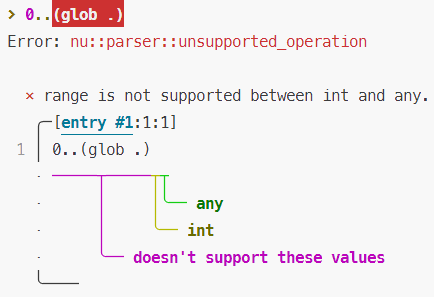 Note: I made the operands themselves (above, `(glob .)`) be garbage, rather than the `..` operator itself. This doesn't match the behavior of the math operators (if you do `1 + "foo"`, `+` gets highlighted red). This is because with ranges, the range operators aren't `Expression`s themselves, so they can't be turned into garbage. I felt like here, it makes more sense to highlight the individual operand anyway.
Contributor
|
Hi @ysthakur, I think this inadvertently broke command paths containing ../foo/bar/bazshould run a command, but now returns a string instead. |
devyn
pushed a commit
that referenced
this pull request
Aug 21, 2024
<!--
if this PR closes one or more issues, you can automatically link the PR
with
them by using one of the [*linking
keywords*](https://docs.github.com/en/issues/tracking-your-work-with-issues/linking-a-pull-request-to-an-issue#linking-a-pull-request-to-an-issue-using-a-keyword),
e.g.
- this PR should close #xxxx
- fixes #xxxx

you can also mention related issues, PRs or discussions!
-->

# Description
<!--
Thank you for improving Nushell. Please, check our [contributing
guide](../CONTRIBUTING.md) and talk to the core team before making major
changes.

Description of your pull request goes here. **Provide examples and/or
screenshots** if your changes affect the user experience.
-->

@devyn found that #13595, which
made ranges be type-checked at parse time, introduced a bug that caused
`../foo` to be parsed as a string rather than a command call. This was
caused by `parse_range` returning a `Some` despite there being parse
errors (`/foo` doesn't match `SyntaxShape::Number`). To go back to the
old behavior, `parse_range` now returns `None` anytime there's any parse
errors met while parsing the range.

Unfortunately, this means that something like `..$foo` will be parsed as
a string if `$foo` isn't defined and as a range if it is defined. That
was the behavior before #13595, and it should probably be fixed at some
point, but I'm just trying to quickly fix the bug.

# User-Facing Changes
<!-- List of all changes that impact the user experience here. This
helps us keep track of breaking changes. -->

Things should go back to the way they were before #13595, except the
type-checking stuff from that PR is still here.

# Tests + Formatting
<!--
Don't forget to add tests that cover your changes.

Make sure you've run and fixed any issues with these commands:

- `cargo fmt --all -- --check` to check standard code formatting (`cargo
fmt --all` applies these changes)
- `cargo clippy --workspace -- -D warnings -D clippy::unwrap_used` to
check that you're using the standard code style
- `cargo test --workspace` to check that all tests pass (on Windows make
sure to [enable developer
mode](https://learn.microsoft.com/en-us/windows/apps/get-started/developer-mode-features-and-debugging))
- `cargo run -- -c "use toolkit.nu; toolkit test stdlib"` to run the
tests for the standard library

> **Note**
> from `nushell` you can also use the `toolkit` as follows
> ```bash
> use toolkit.nu # or use an `env_change` hook to activate it
automatically
> toolkit check pr
> ```
-->

Added a test. Reverted another test that tests that `0..<$day` is parsed
successfully as a string if the variable isn't defined.

# After Submitting
<!-- If your PR had any user-facing changes, update [the
documentation](https://github.com/nushell/nushell.github.io) after the
PR is merged, if necessary. This will help us keep the docs up to date.
-->
This file contains hidden or bidirectional Unicode text that may be interpreted or compiled differently than what appears below. To review, open the file in an editor that reveals hidden Unicode characters.
Learn more about bidirectional Unicode characters
Sign up for free
to join this conversation on GitHub.
Already have an account?
Sign in to comment
4 participants
Add this suggestion to a batch that can be applied as a single commit.This suggestion is invalid because no changes were made to the code.Suggestions cannot be applied while the pull request is closed.Suggestions cannot be applied while viewing a subset of changes.Only one suggestion per line can be applied in a batch.Add this suggestion to a batch that can be applied as a single commit.Applying suggestions on deleted lines is not supported.You must change the existing code in this line in order to create a valid suggestion.Outdated suggestions cannot be applied.This suggestion has been applied or marked resolved.Suggestions cannot be applied from pending reviews.Suggestions cannot be applied on multi-line comments.Suggestions cannot be applied while the pull request is queued to merge.Suggestion cannot be applied right now. Please check back later.
Description
As part of fixing #13586, this PR checks the types of the operands when creating a range. Stuff like
0..(glob .)will be rejected at parse time. Additionally,0..$xwill be treated as a range and rejected ifxis not defined, rather than being treated as a string. A separate PR will need to be made to do reject streams at runtime, so that stuff like0..(open /dev/random)doesn't hang.Internally, this PR adds a
ParseError::UnsupportedOperationTernaryvariant, for when you have a range like1..2..(glob .).User-Facing Changes
Users will now receive an error if any of the operands in the ranges they construct have types that aren't compatible with
Type::Number.Additionally, if a piece of code looks like a range but some parse error is encountered while parsing it, that piece of code will still be treated as a range and the user will be shown the parse error. This means that a piece of code like
0..$xwill be treated as a range no matter what. Previously, ifxweren't the expression would've been treated as a string"0..$x". I feel like it makes the language less complicated if we make it less context-sensitive.Here's an example of the error you get:
And as an image:

Note: I made the operands themselves (above,
(glob .)) be garbage, rather than the..operator itself. This doesn't match the behavior of the math operators (if you do1 + "foo",+gets highlighted red). This is because with ranges, the range operators aren'tExpressions themselves, so they can't be turned into garbage. I felt like here, it makes more sense to highlight the individual operand anyway.Tests + Formatting
Added some test cases for making sure that an unsupported operation parse error is triggered.
After Submitting