Deport This! Arab American Public History and the Powerful Resistance of Memory

This week in North Philly Notes, Edward E. Curtis, IV, editor of Arab American Public History, writes about immigration, xenophobia, and the importance of history and memory.

Professors sometimes sit, stand, and yell on the front lines of great moral conflicts. It’s happening now. Again.

This week, one of my colleagues in Arab American studies wrote that several of her students in Minnesota had been maced and detained by ICE during the protests against the roundups of Black and brown U.S. citizens, visa holders, and foreign visitors throughout the state.

This colleague asked for help as she prepared to join a general strike, to feed and house those affected, to offer basic legal guidance to them, and to sue in federal court to stop ICE from its detentions of tens of thousands.

Anyone familiar with U.S. history knows that deportation of immigrants is a longstanding pattern of xenophobia, an endemic part of the American experience championed by a portion of the American people and legally enacted by branches of the federal government.

For those of us in Arab American studies, our awareness of its 9/11 manifestations in government-sponsored Islamophobia is revived every electoral cycle or when an act of political violence involving Muslims occurs. Since 9/11, foreign and U.S. Arabs and Muslims have been “banned,” lost their citizenship through proxy denaturalization, been the victims of counter-intelligence sting operations, harassed by Homeland Security at the border, rounded up as material witnesses, and even tortured at CIA black sites, Guantanamo Bay, and Abu Ghraib prison.

Many of us in the field of Arab American studies have organized as citizen activists in response to anti-Arab animus.

But as academics, we have also used our scholarship to expose, analyze, and understand not just the prejudice, discrimination, and violence faced by Arabs and Muslims in the United States and abroad but also the resilience of our community. We are more than victims, and some of us write and teach to highlight the strength, the joy, and the (gallows) humor of our community.

We celebrate our humanity in the same public spaces where we are being dehumanized. We claim our place in a nation that has always been home to speakers of Arabic—most of them were enslaved Muslims at first. My ancestors, including my great-great-grandparents and their children, arrived here in the late 1800s. Even as various governmental and popular voices insist that they are “taking their country back” from people like us, my family elders taught me how we have always been part of this country.

For the first time, a group of us have written a book, Arab American Public History, that examines our community’s work outside the traditional classroom in museums, television, film, local communities, libraries, and on the Internet, among other places, to inform ourselves and others about our accomplishments and our challenges.

History done with and for the community is not the same kind of resistance as direct action but, as we know from other minoritized communities in the country, people’s ideas about history shape their politics and their policies. The idea that Arab people and culture are new to the country informs a lot of anti-Arab prejudice.

Arab American Public History is not only an analysis but also an instruction manual for those who want to help us acknowledge the long presence and contributions of my community in the United States. Readers learn about community efforts among Arabs and non-Arabs to unearth the history of Little Syria in Boston, to enjoy the many Arab cuisines of Greater Detroit, to preserve precious archives in Houston, to make a documentary film about Arab Indianapolis, to create walking tours in La Crosse, Wisconsin, and to trace Arab American genealogies, among other topics.

This is history-making that everyone can participate in.

This is a history that stubbornly refuses to yield the space of memory to those who wish that we were never here. No matter what is done to our bodies, and we have come to fear the worst since 9/11, this is a history that, if others help us tell it, resists the terror of contemporary times. You can’t deport our memory.

Remembering marginalized histories

This week in North Philly Notes, Wendi Yamashita, author of Carceral Entanglements, writes about how memory operates within the Japanese American community.

As I write this blog entry regarding the publication of my first book, I find myself struggling with a mixture of excitement and grief. I am beyond excited to have my book out in the world, but this year will be the fourth without my maternal grandmother, who suddenly and unexpectedly passed away at the height of the COVID-19 pandemic. My writing is so intimately connected to her story. Documenting her memories was one of the ways I showed her I loved her.

As a fourth-generation Japanese American (Yonsei) my self-identity and history are intimately tied to my grandparents’ World War II incarceration experiences. For example, my grandfather’s family responded “no, no” to the infamous Loyalty Questionnaire given to all incarcerated Japanese American adults who were expected to pledge their loyalty to the United States with military service. Because of their answer, my grandfather’s family was sent to the Tule Lake Segregation Center and registered to “repatriate” to Japan. At the last minute the family changed their mind and I often think about how I almost didn’t exist.

In many ways, death is a central part of this book. Death is an integral part of memory and memory is an important part of the Japanese American community. It has mobilized Japanese Americans to preserve their history via museums, pilgrimages, national historical sites, and oral history archives, to fight for a national apology and reparations through grassroots organizing and political power, and to fight for others whose civil rights are similarly being infringed upon.

Carceral Entanglements: Gendered Public Memories of Japanese American World War II Incarceration explores how memory operates within the Japanese American community. I argue that the contradictory location of Japanese Americans, as both victims of incarceration and racialized violence and those who experience privilege as model minorities, allows for not only a unique understanding of racial hierarchies but also a chance to explore when our memories of WWII incarceration sustain white supremacy and are thus harmful. Carceral Entanglements looks at sites of community — national museums, digital archives, pilgrimages, and student plays — to determine how and when Japanese Americans can be better allies for and co-conspirators with those also fighting for freedom and justice.

In today’s political climate, remembering marginalized histories is important as attacks on students, diversity and equity initiatives, ethnic studies, and critical race studies that seek to repress voices like my grandmother’s increase. Japanese American memory practices have shifted since I began writing. Ignited by the election of Donald Trump, the renewed rise of anti-Asian hate, and the murder of George Floyd in 2020, Japanese American organizations have taken the time to study, self reflect, and mobilize against police brutality, and immigration detention and deportation, while advocating for African American redress and prison abolition. Carceral Entanglements sees relational organizing as a possibility for a more just future, not just for Japanese Americans, but for all of us. It maps the ways in which Japanese Americans have historically done this work, notes when we have misstepped, and provides a pathway for moving forward.

University Press Week Blog Tour: How to build community

It’s University Press Week and the Blog Tour is back! This year’s theme is Read. Think. Act. Today’s theme is: How to build community

banner.upw2019.jpg

Paul Farber and Ken Lum, co-editors of our new book Monument Lab penned this entry on community building.

From coeditor Paul Farber:

Monument Lab_CMYK_090319_smWhen we started Monument Lab, it was not a fully-realized curatorial project or interventionit was a classroom experiment. Ken and I were teaching in Fine Arts and Urban Studies, respectively, and were galvanized by our conversations with our students about representation, equity, and memory. We each spent time with scholarly texts and we also moved outside of our classes into public spaces as their own primary sources. We met one another, and connected with a circle of collaborators after that expanded what we could have ever dreamed of on our own. We iterated and took our questions outside to the courtyard of City Hall in 2015 for our first discovery phase exhibition. We eventually that moved to public squares and parks around the city for the citywide project with Mural Arts Philadelphia documented in the book, and now work in other cities with similar goals of critically engaging monuments we have inherited and unearthing the next generation of monuments.

We have been fortunate to work with a range of artists, writers, and organizers*. Some have artworks and essays represented in this book. Others put fingerprints and directed their own forms of expertise to the project to make this possible. We hope people will read the essays, but we hope people also tend to the captions, credits, and thank you’s, as they give insights into how monuments could be and are made, critiqued, and re-imagined. This was a profoundly collaborative effort and that is the point.

There is no single fix to our monumental landscape. There are ways of engaging the moment worth nodding to by many people representing previously exisiting and ongoing approaches. This includes antiracist, decolonial, feminist, queer, ecological, and other systems of social justice perspectives that take long first steps toward redress. These practitioners understand we live at once in the deep seated past, changing present, and unknowable future. The book and the work of Monument Lab is meant to document collective aspirations for art and justice and serve an active, living approach to history.

2_Olivier_FC

Enter Karyn Olivier, The Battle is Joined, Monument Lab 2017 (Steve Weinik/Mural Arts Philadelphia)

6_Hayes

Sharon Hayes, If They Should Ask, Monument Lab 2017 (Steve Weinik/Mural Arts Philadelphia)

From editor Ken Lum

I just received Deborah Thomas’ book Political Life in the Wake of the Plantation: Sovereignty, WitnessingRepair. She is an esteemed colleague at Penn and we both co-taught a course in Kingston, Jamaica that looks at a major violent incursion that took place in the impoverished neighborhood of Tivoli Gardens in 2010. From this moment of eruption, there followed an uneven and halting pattern of attempts at recognition, redress and reconciliation for the many human lives affected, and continues to affect, by the incursion. Although a different context, as I started reading this book, it made me think about Monument Lab: Creative Speculations for Philadelphia, the new book from Temple University Press that Paul Farber and I edited. 

There are many sites all over the world, even sites within sites, such as neighborhoods within neighborhoods or streets within streets, whereby were they truly examined in a holistically democratic and critical sense, would reveal many of the same flailing patterns that stymies institutional and official initiatives that attempt to confront issues of human trauma and under-recognition. I started thinking about how Monument Lab: Creative Speculations for Philadelphia is not just a book but also a method of thinking about matters of address and redress that offers no presaged prescription or anticipated conclusion. What Monument Lab offers is a way of thinking about the world in as open a manner as possible. Monument Lab is a project of inclusion including the real inclusion of Philadelphia’s many unheard voices. Monument Lab recognizes the untapped wisdom of the unacknowledged peoples and the truths that they offer. Monument Lab is a means rather than an end, but one that produces hope in the coming together of voices. 

Monument Lab draws on visual art, oral histories, scholarship and subjugated knowledges—there is no one knowledge that takes precedence over another. It is this openness in both thinking and method that accounts for whatever success Monument Labhas been able to achieve.


*Contributors: Alexander Alberro, Alliyah Allen, Laurie Allen, Andrew Friedman, Justin Geller, Kristen Giannantonio, Jane Golden, Aviva Kapust, Fariah Khan, Homay King, Stephanie Mach, Trapeta B. Mayson, Nathaniel Popkin, Ursula Rucker, Jodi Throckmorton, Salamishah Tillet, Jennifer Harford Vargas, Naomi Waltham-Smith, Bethany Wiggin, Mariam I. Williams, Leslie Willis-Lowry, and the editors 

Artists: Tania Bruguera, Mel Chin, Kara Crombie, Tyree Guyton, Hans Haacke, David Hartt, Sharon Hayes, King Britt and Joshua Mays, Klip Collective, Duane Linklater, Emeka Ogboh, Karyn Olivier, Michelle Angela Ortiz, Kaitlin Pomerantz, RAIR, Alexander Rosenberg, Jamel Shabazz, Hank Willis Thomas, Shira Walinsky and Southeast by Southeast, and Marisa Williamson

Why Partition survivors in the US believe it’s vital to keep talking about the trauma of 1947

This week in North Philly Notes, we repost an essay on Partition survivors in the U.S. by Violent Belongings author Kavita Daiya that was recently published on the website Scroll.in

Last week, in the birthplace of America ­– the city of Philadelphia – Indian and Pakistani Americans gathered to share memories of the birth of India and Pakistan.

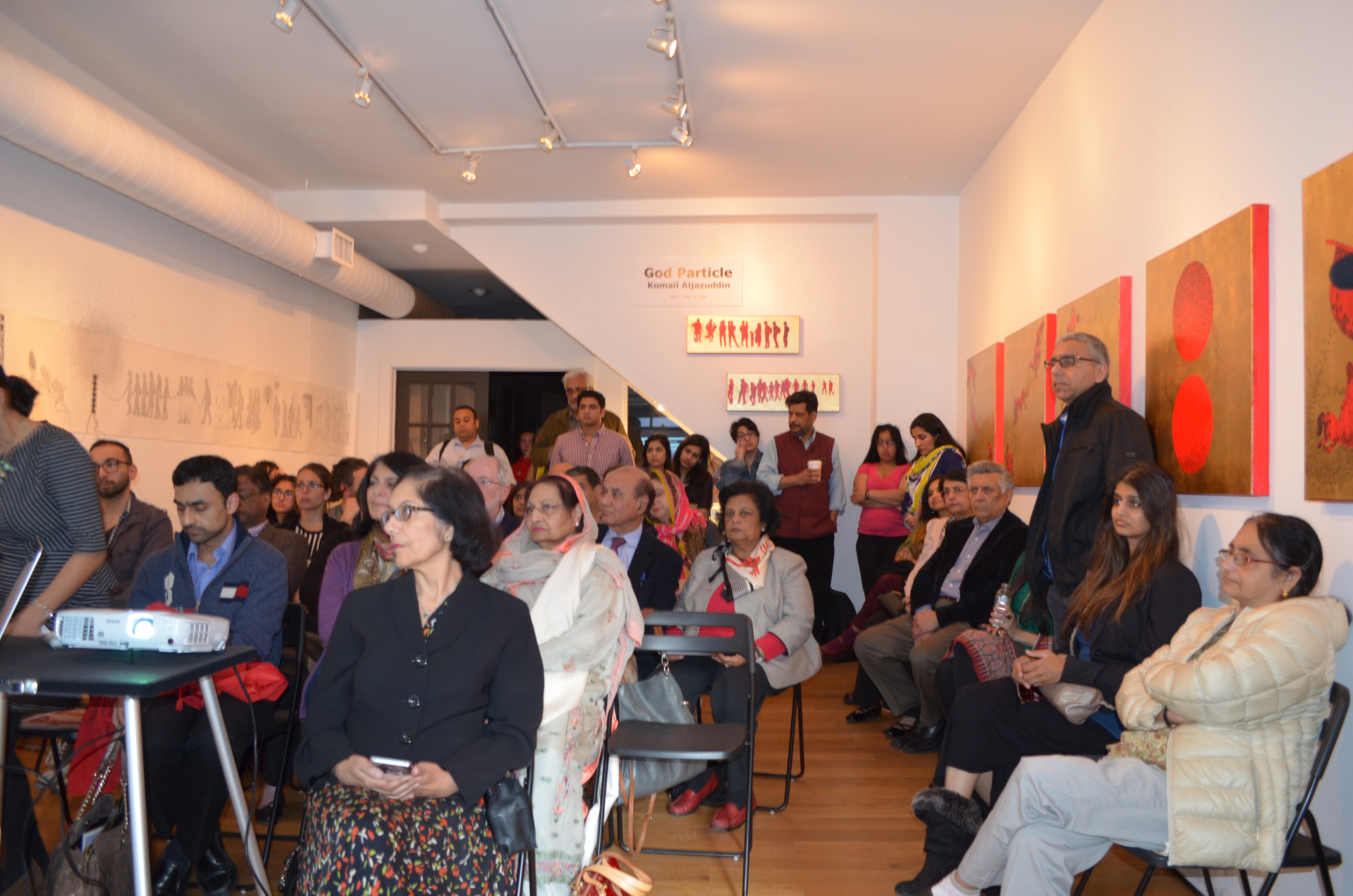
The unique community event was aimed at generating a new public dialogue on the 1947 Partition migrations through storytelling and memory. In the intrepid gallery called Twelve Gates Arts, devoted to South Asia-related arts, the event Voices of Partition presented witness testimonies from both India and Pakistan. Co-hosted by online digital video project, The 1947 Partition Archive, and part of a global series,Voices of Partition was an unexpected success – a flood of RSVPs meant that the gallery had to double its seats; people were standing, sitting on the floor in the aisles, just squeezing into the space to listen.

daiyacomps.inddFragmented memories

Three local South Asian American senior citizens – Hindu and Muslim – shared their memories of migrating as children across the new and bloody borders of India and Pakistan. Sagar and Reena Banka were originally from Lyallpur and Lahore, and Khurshid Bukhari was originally from Patiala. They described their fragmented, episodic memories of how they heard about ethnic violence in August 1947, how their parents decided to leave their homes, and how they slowly rebuilt their lives, in the shadow of homes and friends lost, in new countries. Many commonalities emerged across their stories: All said their parents thought that they were moving temporarily – until things calmed down. None imagined today’s closed borders, and the wars the two countries have fought.

Unlike other moments of collective historical trauma like the bombing of Japan during World War II or the Holocaust, the Partition experience has not been institutionally memorialised, said Guneeta Bhalla, founder and director of The 1947 Partition Archive, in her framing remarks. Approximately two million people were killed, and over 12 million displaced, within nine months during the division of India. But there is no equivalent to the Hiroshima memorial, or the Holocaust memorial, for Partition.

This inspired Bhalla to start gathering and recording witness testimonies in 2010. Today, the archive has gathered 2,500 testimonies, has offices in five countries, and its goal is to gather 10,000 stories by 2017 from a generation we are fast losing to age. Supported by grant funding as well as private citizens from three continents, the project indicates the global impact of Partition’s migrations. Steadily, this archive is creating a historical record of the price that millions of ordinary people paid for freedom in 1947.

Forging new bonds

As the gentle and eloquent speakers narrated their experiences and shared old black and white photos, a new and palpable emotional community was forged between the speakers and their multi-generational audience. The witnesses shared what they remembered of that harrowing time-colored by their childhood. They recalled the stigma of being derisively called “fugees” – because many didn’t know how to pronounce the word refugee. They also reflected on the lessons of that experience of becoming refugees.

DaiyablogSagar Banka said their experience was mirrored today in the Syrian refugees’ reception in Europe. He urged the audience that while Syrians were being derided in the media as refugees, people needed to recognise that they are more than that label. They are, as his father was, teachers, or perhaps doctors, engineers, lawyers… human beings. Pointing to his and his wife’s contributions to American society, he called for a more humane and inclusive response to today’s refugees so that they would also have an opportunity to become contributing members of society.

Bukhari’s harrowing tale of a narrow escape from Amritsar, to which her Patiala-based family had fled after increasing violence, ended with her reminiscing about a certain kachori stall in Patiala. She said, “Oh, I would love to eat those kachoris again.” Someone from the audience warmly replied, “I’m from Patiala, and that kachori-wala is still there!” In the question and answer session, others in the audience, who had also migrated in 1947, started sharing their stories, their journeys. A 21-year-old South Asian American young man noted that when he discovered that his grandfather had migrated to Pakistan during Partition, it had transformed his sense of his identity: “I guess we were refugees. Refugees.”

Delhi calling

What emerged in this diasporic gathering of those who once were refugees was an eagerness to remember that experience without rancour toward the other religious community. For instance, Sagar Banka affirmed that beyond religion, it was the Punjabi language that, here in the US, bound him in closer friendships with Pakistani Punjabis. The shared familiar itineraries of beloved cities (Lahore, Dehradun, Patiala) and schools spun new inter-religious, inter-national emotional bonds in this contingent community, flecked with the red and gold paintings of the Lahore-based artist Komail Aijazuddin.

Daiyablog2Established in 2011, the goal of Twelve Gates Arts is, in its founder Aisha Khan’s words, to “create and promote projects that cross geographic and cultural boundaries. The gates refer to the fortified gates that walled many ancient cities such as Delhi, Lahore, Jerusalem, and Rhodes – inside which lay the heart of each city’s art and culture. Through this Voices of Partition event, Bhalla and Khan opened the gates of our political borders and divided cultures. The dialogue allowed people, through the sharing of remembrances past, to not only see that Indians and Pakistanis have much more in common than our politicians would like us to acknowledge, but also to forge new relations of peace between us”.

This Voices of Partition is not the first event, nor will it be the last. On April 24, The 1947 Partition Archive will host its first Voices of Partition event in India in Delhi. They had hoped it would attract 100 attendees – they have over 1,000 waiting to register. On Facebook, they have 4,500 interested in attending. It seems this submerged history is still very much alive today, and people want to tell and hear these refugee stories. They will need a bigger venue.

Kavita Daiya holds the NEH Chair in the Humanities at Albright College for the academic year 2015-2016. She is the author of Violent Belongings: Partition, Gender, and National Culture in Postcolonial India

Design a site like this with WordPress.com
Get started