Tag Archives: UK

The Ha-Ha by Jennifer Dawson

As I have mentioned before, there is a long tradition of women writers depicting crushing mental health conditions in fiction, from Charlotte Perkins Gilman’s unforgettable short story The Yellow Wallpaper (1892) to Emily Holmes Coleman’s account of a woman’s experiences of post-partum psychosis in The Shutter of Snow, to Sylvia Plath’s semi-autobiographical novel The Bell Jar (1963), surely the most widely read novel in this genre. Now we can add Jennifer Dawson’s The Ha-Ha (1961) to this list, a striking modernist novella which explores society’s treatment of a young woman who simply doesn’t fit in – someone who finds social interactions and the rules of life a complete mystery and whose behaviour is considered odd or grossly inappropriate by conventional societal standards. In today’s language, some might consider Dawson’s protagonist, Josephine Traughton, to be neurodivergent or ‘on the spectrum’; but in 1961, the year of the novella’s publication, such women often found themselves in mental institutions undergoing treatment with the aim of rehabilitation and a potential release back into society. (The Ha-Ha was written in the year following the introduction of the 1959 Mental Health Act, which encouraged a shift away from institutional confinement to community-based care.)

Alongside many other women writers working in this area, Dawson drew on her own life as inspiration for her fiction. While studying history at Oxford University, Dawson experienced a mental breakdown, spending several months in hospital as a result. After graduating, she worked as a teacher in France and as a social worker in a psychiatric hospital in Worcester; and it is her experiences here, alongside those as an in-patient in a similar institution, that inspired The Ha-Ha. The novella, which focuses on a young woman trying to navigate severe mental health challenges, possibly schizophrenia, was awarded the James Tait Black Memorial Prize in 1966 and went on to be adapted for the stage and by the BBC.

While much has changed around the specific treatment of mental illness since the book’s publication in the early ‘60s, the protagonist’s experiences of feeling out of step or disconnected from conventional societal norms remain entirely relevant today, particularly in a world where the treatment of mental health conditions remains sub-optimal and underfunded. It’s a remarkable book, capturing its protagonist’s fractured state of mind in haunting and perceptive prose.

Dawson’s story focuses on Josephine Traughton, a socially awkward twenty-three-year-old who has always been somewhat disconnected from the world around her. As the novella unfolds, we learn how her childhood was shaped by her domineering, conventionally-minded mother, now deceased following a freak accident with an electric blanket. A period at Oxford University duly follows for Josephine, but it is here that her idiosyncratic behaviour becomes problematic for polite society. While the other students find university life an enjoyable whirl of social activities, afternoons spent punting on the river, informal coffee parties, talking until midnight and frequent crises over essays, Josephine remains unsure about how to behave. For her, Oxford is a bewildering environment full of potential traps – social situations in which she simply doesn’t know how to react, where uncontrolled nervous laughter is her default response. In effect, she experiences a rupture between the reality of her private world, populated by hallucinatory visions of animals, and the socially acceptable conventions of the university environment in which she is situated.

As we sat there I could see the even-toed ungulates marching through the waste, and files of armadillos with scaly shells, and hosts of big black flies. (p. 8)

Following a particularly embarrassing incident at the Principal’s tea-party, Josephine finds herself committed to a psychiatric hospital, where, in the fullness of time, progress in her condition is made. Now the hospital is making preparations for her release back to the ‘real world’ despite its myriad of risks.

It was they, the Sister, the Doctor and the social worker who talked about getting back to the ‘real world’ as though there were two; one good and one to be avoided. To me it did not seem as though there were these two, and I would have been as pleased if instead of handing me back my private clothes and giving me town-parole, and money for lunches and bus fares, the authorities had left me to wander round the grounds all day, explore what lay beyond, or just to gaze out of my side-room window on to the other side of the hospital where everything was unfamiliar. (p. 17)

With this transition back to the community in mind, the hospital finds Josephine a part-time job helping a Colonel and his kindly wife to catalogue their sizeable collection of books. While the role offers Josephine some opportunities to step beyond the confines of the hospital, gently reconnecting her with the external world in measured steps, she remains bewildered by every social situation she encounters. For instance, a chance meeting with Helena, her only real friend from university, leads to an invitation to a cocktail party – a perfectly enjoyable situation for many young women but a minefield for someone like Josephine who struggles to converse.

It was so hot. I could feel sweat trickling down my face. The music blared and stopped. Faces popped on and off like lamps. Mouths clapped up and down; words shot in and out, but the room full of people seemed to have escaped me. I could not reach in to it. I tried to stretch out and get caught up in it, but each time my turn came to lay a contribution. I found myself catapulted into this empty space in the middle of nothing, discussing with no one but myself the longevity of badgers or Myra’s thorny spider. (p. 73)

In the end, she leaves the party early, knowing full well that her re-entry into the world she was privy to at Oxford has not been a success.

The party was over, though it sounded from the noise upstairs as though it would not be over for a long time. It was just my début into the real world that was done. (p. 77)

Back at the hospital, Josephine continues to seek solace by lying in the ha-ha, a grassy slope next to the hospital wall, where she chats with fellow inmate, Alasdair, her one friend amongst the other patients. With his cavalier response to authority figures, Alasdair is rather dismissive of the hospital’s methods, pushing back against its infantile approaches while also encouraging Josephine to broaden her horizons. Somewhat inevitably, Josephine is strongly attracted to Alasdair, opening up to him about her deepest feelings and ignorance of life’s unwritten rules.

‘You asked me once why I was here and I couldn’t tell you.’ I trembled. ‘But now I see why – after going to the party I see what’s wrong. It’s because I don’t belong anywhere else. I don’t know the rules of life, and if I kept a phrase-book for twenty years I would not know the right answers. It’s a thing I shall never learn. I am odd, incorrect, illegitimate…’ (p. 87)

But Josephine is more vulnerable than Alasdair, and a day outside the hospital together ends in a breach of the trust she has placed in him. While Josephine seems to be pinning all her hopes on a future with Alisdair, her expectations are not reciprocated. As far as Alisdair sees things, their relationship is fleeting, a source of pleasure and distraction as he waits to be released.

When Alisdair is suddenly discharged, Josephine is distraught, prompting her to flee the hospital in search of the slivers of existence ignited by Alasdair. I couldn’t help but think of Barbara Loden’s critically acclaimed Wanda here, a film in which the titular working-class protagonist breaks away from a stifling marriage, only to drift from one perilous situation to the next in a state of disconnection from conventional society. There’s a similar sense of dislocation in The Ha-Ha as Josephine stumbles from one predatory encounter to another with no clear destination or objective in mind.

Sometimes as I was walking cars purred softly up in felted smoothness and men with cool velvet accents offered me lifts and cigarettes and then suggested drinks at roadhouses as we sped towards the roaring trunk roads. I thought I wanted nothing more than that, an assurance as we sped forwards that I was alive, that I was not flying through unpeopled regions and grey wastes of space, never to be touched or crossed at any point. (p. 126)

I won’t reveal how Dawson’s arresting novella plays out, save to say the ending is open to interpretation, both terrifying and empowering all at once.

The Ha-Ha is written in a candid, immediate style with Dawson conveying what it must feel like to be Josephine as her untethered thoughts flow freely despite the physical restrictions imposed on her liberty. Stylistically, the novella seems to capture the fractured, bewildered nature of Josephine’s mind – a jumble of memories and hallucinations caused by her medical condition and the reality of her vulnerability.

As a title, The Ha-Ha has a dual meaning, nodding to the uncontrollable laughter Josphine defaults to in times of stress, while also representing the barrier between the relative safety of the hospital and the hazardous world outside. As Josephine climbs up the hospital wall, we sense the precarious tension between these two states, one imposing restrictions, the other promising freedom, albeit governed by society’s unwritten rules.

Dawson uses dreamlike imagery to great effect here, particularly when depicting Josephine’s hallucinations and by lacing the text with evocative descriptions of the nearby river.

The world was broken in two by this heavy, dark grey river that stained its banks, and unfolded thickly beneath me like the slow thoughts of an old man.

It was not like the Thames, but wider and deeper and pulling strongly against its banks, fighting to be free. The banks were dark grey, and bordered with fine grey sand and powdered shell, and at the edges tough beds of white, vegetable-like celery shot up in stiff spikes towards the sky. (p. 101–102)

Like The Shutter of Snow, the experience of reading this book feels very immersive, and while there is a narrative thread of sorts, largely driven by the hospital’s attempts to rehabilitate Josephine, the book is primarily an exploration of the nature of incarceration in a psychiatric hospital in the late 1950s/early ‘60s. As the novella unfolds, there are painful explorations of how a woman’s state of mind can sometimes be defined not by a rigorously diagnosed condition but by her lack of adherence to conventional societal norms. Nevertheless, there are moments of poetic beauty here too, shards of light that contrast starkly with the fragile nature of Josephine’s existence. It’s also a book where the modernist prose style and the protagonist’s fractured state of mind fit together in perfect harmony. Very highly recommended, especially for readers with an interest in these themes.

(My thanks to the publisher for kindly providing a review copy, which I read for Karen and Simon’s #1961Club.)
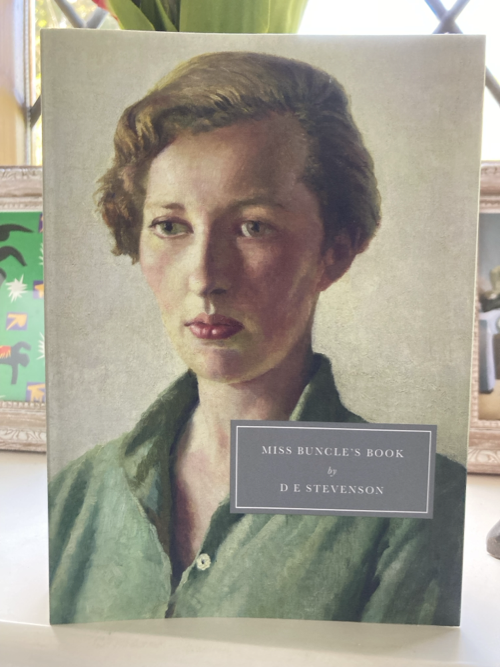
Miss Buncle’s Book by D. E. Stevenson

Unashamedly charming and cosy, Miss Buncle’s Book is an ideal comfort read – a throwback to simpler times when life was less complex and demanding than it is today while also presenting its own particular challenges. I had been looking forward to reading this one for a while and am delighted to confirm that it did not disappoint!

First published in 1934 and reissued by Persephone in 2008, Stevenson’s novel revolves around life in the fictional English village of Silverstream, which might at first sight seem a picturesque idyll, but is in fact seething with discontent. Central to the story is Barbara Buncle, an unmarried gentlewoman, much like those excellent women one finds in Barbara Pym’s novels. (Pym started writing fiction in the 1930s, which does make me wonder whether she might have read and been inspired by Miss Buncle’s Book as she embarked on her literary career. It’s an intriguing thought!)

As her parents are no longer alive, Miss Buncle lives in Tanglewood Cottage with her housekeeper and former nursemaid, Dorcas, who is now elderly but still reasonably fit. Their lives are modest, funded by share dividends Miss Buncle inherited from her parents; but the recent stock market crash has eroded their value, leaving the pair in dire financial straits.

Having ruled out hen-keeping and paying guests as potential sources of income, Miss Buncle decides that the only viable option is to write a book; but because she lacks any form of imagination, our heroine can only draw on her own knowledge – namely  the inhabitants of Silverstream and life in the village – as inspiration. The book, initially titled Chronicles of an English Village, features almost everyone in Silverstream, albeit thinly disguised with different but related names. For instance, Colonel Weatherhead becomes Major Waterfoot, Mrs Bold is renamed Mrs Mildmay and the village of Silverstream itself is disguised as Copperfield. Moreover, the novel’s narrative gives each character the storyline they truly deserve – those who are kind and considerate are appreciated by those around them, while the wicked and meddlesome are pulled up short. To keep her true identity a secret, Miss Buncle submits her book to the publishers, Abbott & Spicer, under the nom de plume, John Smith, hoping they will consider it further.

On reading the manuscript, the publisher, Mr Abbott, is duly impressed and sufficiently intrigued to learn whether its author is in fact a ‘very clever man writing with his tongue in his cheek’, or ‘a very simple person writing in all good faith’. So, imagine his surprise when he discovers that ‘John Smith’ is in fact a woman, and a unassuming one at that! By the end of his interview with Miss Buncle, Abbott is convinced that the novel is not a satire; rather, she has simply drawn on her own knowledge of Silverstream’s inhabitants to depict them as they really are. A contract is drawn up for the publication  of the novel under Abbott’s suggested title ‘Disturber of the Peace’, which Miss Buncle happily signs.

The fun really starts when Disturber of the Peace is published and swiftly becomes a runaway success. Everyone seems to be reading it, not least the inhabitants of Silverstream who soon begin to recognise themselves as characters in the novel. Somehow, John Smith seems to have seen each individual for who they really are, highlighting their hopes, preoccupations, idiosyncratic habits and deepest failings for all the world to see. Mrs Agatha Featherstone Hogg, the self-appointed queen of the village, is revealed by John Smith to be the domineering, power-hungry creature she truly is. Moreover, Agatha’s former life as a chorus girl (prior to her respectable marriage) is scandalously revealed, threatening her social standing in the village! Meanwhile, Mr Bulmer, who makes his family’s lives a complete misery, also gets his comeuppance as Disturber unfolds!

Agatha Featherstone Hogg is convinced that ‘John Smith’ must be a Silversmith resident – how else would he know everyone so intimately? – so she embarks on a campaign to discover his true identity with a view to punishing the scoundrel. There’s a hilarious residents’ meeting chaired by Mrs F. H., during which very little is actually achieved, save a false accusation made against Sarah Walker, the doctor’s intelligent wife, chiefly because she is the only Silverstream resident who doesn’t feature in the book. The main accuser is Vivian Greensleves, a ruthless gold-digger of a woman who is after the vicar’s money and will stop at nothing until he proposes marriage. Moreover, Vivian dislikes Sarah Walker and is quite willing to believe that her mischievous sense of humour and inside knowledge of the villagers (gained from her GP husband) have been channelled into the book.

As unrest mounts within the village and Mrs Featherstone Hogg threatens a libel action, Miss Buncle realises that she must intervene, but I’ll leave you to discover how this scenario plays out should you read the book. It’s all very cleverly done as art imitates life and life begins to imitate art, thereby creating a kind of cycle as one influences the other and vice versa!

Something D. E. Stevenson does extremely well here is to depict the dynamics of a quintessential English village in the 1930s, the type of place where everyone thinks they know everyone else’s business and few secrets are safe. We see how the impact of Disturber of the Peace (an apt title if ever there was one!) seeps into the social fabric of the village, destabilising the secure and comfortable atmosphere these residents have grown accustomed to. On the surface, village life might seem fairly innocuous to the casual observer; nevertheless, there is darkness lurking beneath the veneer of respectability here, much of which is exposed by Miss Buncle’s perceptive novel. While Mr Bulmer submits his compliant wife and children to crippling domestic abuse, Mr Featherstone Hogg is clearly under the thumb of his domineering wife – not pleasurable positions for anyone to be trapped in.

‘It’s a kind of – a kind of allegory,’ continued Sally gravely. ‘Here’s this horrible little village, full of its own affairs and its own importance, all puffed up and smug and conventional and satisfied with itself, and then suddenly their eyes are opened and their shackles fall off and they act according to their real natures. They’re not shams anymore, they’re real. It’s simply marvellous,’ Sally said, turning a shining face upon the astonished author. (p. 108)

A little like the transformative storyline in Vicki Baum’s excellent novel Grand Hotel, everyone in Silverstream is changed by the experience of reading Miss Buncle’s book. Mr Bulmer, for instance, is shaken by the lonely fate that awaits his doppelganger in Disturber, and he vows to be more considerate towards his family in the future. Meanwhile, Mr Featherstone Hogg is emboldened by all the fuss his wife is creating and swiftly threatens to alter his will if she pursues her farcical libel action – after all, no lawyer worth his salt would dream of taking on such a ridiculous case.

She [Agatha Featherstone Hogg] explained, somewhat incoherently, that the character of Mrs Horsley Downs was a horrible character and not in the least like her, but that it was obviously intended for her, because it was exactly like her, and that therefore it was a libel and as such ought to be punished to the upmost rigour of the law. She said the same thing a dozen times in different words, but always loudly, until Mr Spark [a lawyer] thought his head would burst. Her language became more picturesque and less polite every moment. Mr Spark began to wonder whether she really had been in the chorus when Mr Featherstone Hogg had been so misled as to marry her and elevate her to a higher sphere of life. (pp. 129–130)

Alongside the domestic abuse storyline, D. E. Stevenson also draws our attention to other social issues, some of which must have felt very progressive in the mid-1930s. Somewhat surprisingly, the villagers seem very accepting of the two unmarried women, Miss King and Miss Pretty,  who live together in the same house. While the exact nature of their relationship is never explicitly stated, it is clear to the reader that Miss King cares deeply for Miss Pretty, especially when the latter falls ill. There is also a glancing reference to the publication of Radclyffe Hall’s The Well of Loneliness, the groundbreaking novel about love between two women that created such a stir some years earlier.  Once again, the book is not named, but anyone with a knowledge of literature from this period would be able to identify it.

Post-natal depression is also touched on through references to Sarah Walker’s illness following the birth of her twins. Happily, Sarah has rallied since then, but Stevenson makes it clear that Dr Walker – a sympathetic, compassionate and caring man – was very worried about his wife’s physical and mental health following the birth. There’s also the issue of poverty, of course, explored firstly through Miss Buncle’s financial situation, and secondly, through another storyline, in which the vicar, who is actually very comfortably off, tries to live on the church’s stipend for a whole year. By doing so, he hopes to gain  a better appreciation of the challenges facing the poor, even though he struggles to survive on such a meagre income.

In Miss Buncle, D. E. Stevenson has created a most unlikely heroine, a woman that everyone in Silverstream has simply dismissed as a dull, frumpy simpleton – certainly not someone capable of writing a novel, especially one as scandalous as Disturber! Nevertheless, the reader knows that Barbara Buncle is extremely perceptive as she has sized up each Silverstream resident very accurately.

Barbara sometimes wondered what it was that gave Mrs Featherstone Hogg her social position in Silverstream. Why did everyone flock to her dull parties and consume the poor fare provided for them there? Why did everybody do what she told them to do? Why did old Mrs Carter produce her best china and linen for Agatha’s delectation? Was it because of her rude manner? or was it because she bought her clothes from the most expensive place in London? (p. 62)

The villagers, too, are delightfully drawn, from the mercenary Vivian Greensleeves and the overbearing Mrs Featherstone Hogg, to the lonely Colonel Weatherhead and the equally solitary Dorothea Bold, a match made in Heaven through Miss Buncle’s endeavours with Disturber.

In summary, then, Miss Buncle’s Book is an utterly delightful read, that type of book in which the good will be rewarded for their kind efforts while the wicked will get their comeuppance. Without wishing to give anything away, the book’s ending is perfect, showcasing a most surprising metafictional dimension to Miss Buncle’s literary talents. Highly recommended, especially for fans of The Fortnight in September, Miss Pettigrew Lives for a Day and The Enchanted April!

Lucy Carmichael by Margaret Kennedy

The English novelist and playwright Margaret Kennedy is probably best known for her second novel, The Constant Nymph, which swiftly became a bestseller on its publication in 1924. Nevertheless, I think I prefer her 1950 novel, The Feast, a delightful social comedy / morality tale set in Cornwall after the war. Faber scored a hit with this novel when they reissued it a few years ago, and you can read my thoughts on it here – it really is a treat!

Lucy Carmichael swiftly followed in 1951, and while it’s a more uneven novel than its predecessor, there’s still much for fans of Kennedy’s fiction to enjoy here. In short, Kennedy shows us how the titular Lucy Carmichael manages to rediscover herself by finding a new purpose in life following a bitter blow. Resilience is a key theme, but the novel is not without humour, with Kennedy’s flair for wit being evident throughout, despite noticeable moments of disenchantment and despondency. My feelings about this book waxed and waned somewhat as I was reading it, mostly because it would have benefited from some sharper editing; nevertheless, Lucy’s tenacity and spirit won through by the end.

While the novel revolves around Lucy, a bright, principled Oxford-educated young woman, we first glimpse Kennedy’s heroine through the perspective of her college friend, Melissa, as she discusses Lucy with her fiancé, John.

When she is well and happy she is extremely beautiful. When she is out of sorts or depressed she is all nose, and dashes about like an intelligent greyhound after an electric hare. […] She is incautious and intrepid. She will go to several wrong places, and arrive at the right one, while I am still making up my mind to cross the road. She is my opposite in character. She is cheerful and confident and expects to be happy. She taught me how to enjoy myself. (p.10)

Lucy, we soon learn, is also engaged, but Melissa is worried about her friend’s imminent marriage to the botanist / explorer, Patrick Reilly, whom she considers inferior to Lucy. Rumours of a rekindled affair between Patrick and an old flame, Jane Lucas, have reached Melissa’s ears, casting a shadow over her feelings about the wedding. When Lucy’s mother detects that Melissa is harbouring misgivings, she offers the following response:

‘I don’t let myself worry about Lucy,’ she said. ‘I think that, whatever happens to her, she’ll come through it all right. She’s very…very true to herself, if you know what I mean.’

Melissa nodded.

‘She doesn’t deceive herself. She is the more in love of the two. I think she knows it. I am not sure that she is going to be happy. But she will never deceive herself. […] She may be sorry she married him, but she will never be sorry that she loved. (p. 32)

But despite Melissa’s concerns for her friend, Kennedy lets us know that Lucy is entering this marriage with her eyes open, having already learnt of Patrick’s shortcomings.

She [Lucy] had loved him from the first meeting, long before she knew that inner history, his disgust, his self-contempt, his degrading infatuation for Jane Lucas, his half-hearted schemes for escape, for another life. She did not love him because she knew all this: she knew all this because she loved him. (p. 38)

As revealed in the first line of the novel’s blurb, Patrick fails to show up at the church on his wedding day, abandoning Lucy and her family to clear up the mess. In spite of her obvious devastation, Lucy is sufficiently level-headed to know that a move to pastures new would be the best way to start afresh – somewhere where no one knows her relationship history and humiliating rejection.

Through a tip-off from a college friend, Lucy lands a job at an Arts Institute in Ravonsbridge, a small town in Severnshire, well away from the gossips of Goring. In her new role with the Institute’s drama department, Lucy is plunged into a complex web of petty internal politics and underhand manoeuvres involving the organisation’s staff, Council members and longstanding patron, Lady Frances Millwood, who is likened to Jane Austen’s Lady Catherine de Bourgh, but ‘with heart’. Having been established by Lady Frances’ late husband, Matthew Millwood, the Institute aims to provide first-rate concerts, plays and arts education to the local community.

As the novel unfolds, there is no shortage of developments to keep Lucy occupied, from managing the Institute’s production of Hamlet when a senior colleague goes abroad, to a romantic entanglement with Lady Frances’ son, Charles, who becomes increasingly smitten with the new arrival as the weeks pass. In particular, she derives genuine satisfaction from helping quite ordinary people to produce something remarkable in a small, provincial setting. But internal politics at the Institute prove particularly trying for all concerned, and before long, Lucy, with her upstanding principles and values, ruffles some feathers amongst the powerful higher-ups, much to their annoyance.

Central to the novel is the question of whether Lucy should settle for the security of marriage with someone she doesn’t truly love, or hold out for ‘the one’, even though her ideal match might never come along. (Frustratingly, she would have Patrick back in a heartbeat if he ever reappeared.) Kennedy keeps us guessing about Lucy’s future until the closing chapters; nevertheless, fans of a hopeful ending will find it satisfying, I think.

The class divide is another key theme, and Kennedy explores this through tensions between Owen Rees, a talented actor from the working class sector of town, and Lady Frances’ son, Charles, firmly a member of the upper-class milieu. Both Owen and Charles are attracted to Lucy, albeit in different respects, which adds to the antagonism between them.

The novel is at its strongest, however, when focusing on human nature, particularly Lucy’s inner feelings as she tries to recover her sense of self. Kennedy has a keen understanding of human behaviour, and there are several perceptive insights into rejection, resilience and happiness, hiding amongst the pretty politics at Ravonsbridge and other secondary storylines.

But Lucy’s heart was unoccupied, since the sorrowful ghost of Patrick had ceased to haunt it. Friends lodged there and enjoyed its generous hospitality, but no one called it home. (p. 430)

Lucy’s relationship with Melissa is lively, caring and beautifully drawn, so much so that I would have liked less Ravonsbridge politics and more interactions between the two college friends to add spark and genuine insight. At Melissa’s wedding, for instance, everyone remarks on how well Lucy is looking, the unspoken implication being that she is bearing up adequately despite the trauma of being jilted at the altar. Nevertheless, these well-meaning comments have the opposite effect, as they leave Lucy wondering if she will ever be free of this awful stigma.

He [John], like everybody else, was determined to remember her trouble just when he had every excuse for forgetting it. There was to be no escape. Where she was known, she must take it about with her like a label which nobody would allow her to remove. She had thought that she would remember long after everyone else had forgotten, but it seemed as though things might turn out the other way. She herself could now go for days at a time without any painful recollections, while to all these people she was permanently an object of compassion. (p. 209)

There are also some beautifully poignant scenes in the novel’s opening section as Lucy realises that her frequently irritating younger brother, Stephen, is trying to fill their father’s shoes by stepping up to the plate in a time of crisis. It’s heartbreaking for her to observe, particularly as the shock of being abandoned by Patrick is still sinking in at this point.

Nevertheless, the lengthy sections on the Institute’s internal politics lack focus and are too drawn out. There’s the makings of a good novel here, but it seems in need of a ruthless edit to strip away the unnecessary fat.

While the novel in its entirety is something of a curate’s egg, I enjoyed spending time with Lucy and Melissa, and Kennedy’s observations on life, love, and the nature of happiness are undoubtedly perceptive. I’ll finish with a passage from the novel’s closing chapters, which are beautifully done.

She had been perfectly happy by herself. He had seen that in his first glimpse of her. All alone and perfectly happy, flying through the wintry fields. And now he had come tumbling down the bank, wanting to shatter this solitude, wanting her never to be happy again unless he was there. It was, he felt, rather tough to be planning to sweep her off her feet in a week. It was hardly fair to a girl who could manage to be happy, all alone, in spite of so much sorrow, defeat and humiliation. I must never forget it, he told himself. If she comes, I must never forget what she gave up for me. (p. 471)

Lucy Carmichael is published by Penguin Books; personal copy.

Stories for Mothers and Daughters – Maeve Brennan, A. S. Byatt, Jeanette Winterson & more!

Over the past few years, the British Library has been doing sterling work with its excellent Women Writers series, reissuing lesser-known 20th-century novels by female authors for modern-day readers to enjoy. Alongside the novels, the series includes a handful of carefully curated anthologies, one of which – Stories for Mothers and Daughters – I’m discussing here.

Sometimes, these types of collections can be a little uneven, but in this instance, almost all the entries are very good. Here we have stories that explore various facets of mother-daughter relationships, from headstrong, liberated daughters opposing the more traditional authority figures their mothers represent, to shy, uncertain girls being pushed into society with limited support. In other tales, we learn of the sacrifices some mothers are prepared to make for the benefit of their children. It’s a fascinating collection, spanning a variety of different styles and the full breadth of the 20th century in settings / timeframes. As is often the case, different stories will likely resonate with different readers depending on their tastes, but there really does appear to be something for everyone here, from humorous sketches to poignant pieces to dramatic stories of clashing ideals.

The collection opens with Week-End by Richmal Crompton, who is probably best known for her Just William books, which makes perfect sense given the protagonists in this tale. As the story opens, a widowed mother who values peace and quiet is preparing to welcome her three boisterous adult daughters and their friend, ‘Nibbles’, for the weekend. The girls duly arrive, sweeping through the country cottage in a whirlwind of noise, selfish behaviour and blatant disregard for their mother’s way of life, The crux of this story rests on illustrating how blinkered these daughters are to their mother’s true desires – in short, they assume their mother needs cheering up, while in actual fact, she’d much rather be on her own. However, Compton overdoes it in the execution of this tale, portraying these girls as spoilt ten-year-olds rather than working women in their twenties or late teens. I loved the concept behind this one but couldn’t buy the girls’ behaviour, which included sliding down bannisters and surfing on tea trays when the weather turned foul!

Clashing priorities of a different kind feature in Inez Holden’s excellent story, The Value of Being Seen, in which Mrs Ascot is determined to launch her daughter Daphne into London society. Every preparation has been made, from ‘polishing’ Daphne at a Parisian finishing school and taking a house in London for the debutante season to instructing the girl on the importance of being seen and making a good impression. And yet, Daphne, who is shy and retiring at heart, finds the endless whirl of society dances terribly intimidating. As the interminable season unfolds, Daphne finds herself fading into the background to the point of becoming invisible to those around her.

Daphne’s existence went on. There were more dances, tea meetings, Lord’s, Goodwood, helping with plays for good causes; the unending putting on of dresses and having pictures taken; Daphne went about in a group of other débutantes all the time. They had nothing of any interest to say to one another—only cries of approval, foolish little laughs, and accounts of dancers fixed for the future. There was not a quiet minute, and through it all no one seemed to see Daphne. She was unconscious of herself, and she went on being unseen. (p. 22)

It’s a very striking story – sad, dark and beautifully executed.

I also loved A. S. Byatt’s evocative story Rose-Coloured Teacups, my first experience of this writer’s work. When Veronica’s daughter, Jane, breaks her mother’s sewing machine – a treasured family heirloom – Veronica is filled with rage at the girl’s behaviour. But the incident also prompts Veronica to recall a similar experience from her student days when she broke several rose-coloured teacups – a gift she detested at the time. Just like the sewing machine, the rose-coloured tea-cups were a treasured possession, passed from one generation to the next in an emotionally charged gesture. When the terrible breakage was discovered, Veronica’s mother was outraged by her daughter’s carelessness, not only at the destruction of the cups themselves but also as a howl of anguish at being trapped by the restrictions of marriage, motherhood and domesticity in general.

The teacups had been given by her mother’s old college friend, to take back a new generation to the college. She had not liked the teacups. She did not like pink, and the floral shape of the saucers was most unfashionable. She and her friends drank Nescafe from stone mugs or plain cylinders in primary colours. She had left folded in her drawer the tablecloth embroidered for her by her grandmother, whose style of embroidery was now exemplified by the cloth, so stiff and clean and brilliant, in the visionary teaparty she had taken to imagining since her mother died. It was a curious form of mourning, but compulsive, and partly comforting. It seemed to be all she was capable of. The force of her mother’s rage against the house and housewifery that trapped her and, by extension, against her clever daughters, who had all partly evaded that trap, precluded wholehearted mourning. (pp. 122–123)

Another excellent story, full of emotional truth. 

A clash of another sort is central to Mary Arden’s striking story The Stepmother,in which a former schoolmistress, Esther King, who prides herself on being able to understand young girls, finds herself struggling to form a bond with her teenage stepdaughter, Ella. Newly married to Ella’s middle-aged father, Esther tries every trick in her armamentarium to befriend Ella, who remains stubbornly polite yet distant and aloof.

In the days, in the weeks after Ella’s coming, Esther was not at all happy. She felt that she was always trying to be nice to Ella, and yet always her advances were met—no, not exactly coldly, and yet somehow not met at all. And still—utterly unlike the Miss King of former days—Esther simply had to go on being sweet to this obstinate creature who refused to respond to her charms. Sometimes she hated herself for it, sometimes there came a little twinge of hatred for Ella, but there was something about the child… (p. 190)

When an infatuated former pupil of Esther’s comes to stay during the holidays, the situation comes to a head, forcing a brutal showdown between Ella and her stepmother. It’s a crushing story culminating in a dramatic denouement.

Phyllis Bottome’s The Battle-Field is another standout example of a mother and daughter pulling in different directions, but in this instance, the mother’s behaviour poses a serious risk to her child’s health. Madeleine has always been a delicate young woman, prone to lung disease and other related conditions, which her mother has nursed. Nevertheless, when a new physician takes over Madeleine’s care, complete rest in a sanatorium is prescribed, which ultimately means no visits from her mother. As this excellent story plays out, the nature of the maternal bond is tested, emotional truths come to light and secrets are revealed, forcing Madeleine to reassess the true aim of her mother’s actions. Bottome paints a vivid picture of a toxic, co-dependent relationship in this dark, beautifully executed story that chills the soul.

Deceptions of a different kind are at the heart of Amy Bloom’s Love is Not a Pie, in which two grown-up sisters develop a deeper awareness of the tangled nature of their mother’s love life in the wake of her death. The significance of puzzling scenes from the girls’ childhoods now slots into place, revealing hard truths about a family friend and his complex relationships with both of their parents.

What was that, I thought, what did I see? I wanted to go back and take another look, to see it again, to make it disappear, to watch them carefully, until I understood. (p. 139)

This surprising story will take readers to some unexpected places, echoing perhaps the sexual freedoms of the ‘60s and ‘70s in its narrative arc.

Maeve Brennan’s The Shadow of Kindness is a bleak, melancholic gem, in which the absence of Delia Bagot’s two children – on holiday with their aunt and uncle in the country – throws the emptiness of Delia’s life into sharp relief. The most heartbreaking aspects of this story stem from the semi-estranged state of the Bagots’ marriage, now an emotional desert following the early death of their first child some ten years earlier.

She knew things were not as they should be between them, but while the children were at home she did not want to say anything for fear of a row that might frighten the children, and now that the children were away she found she was afraid to speak for fear of disturbing a silence that might, if broken, reveal any number of things that she did not want to see and that she was sure he did not want to see. Or perhaps he saw them and kept silent out of charity, or out of despair, or out of a hope that they would vanish if no one paid any attention to them. (p. 111)

This story appears in Brennan’s superb collection The Springs of Affection, which I would highly recommend if you haven’t read it already – it’s one of my all-time favourites!

Elsewhere, Jeanette Winterson has fun with her darkly humorous tale Psalms, whose fervently religious mother and sanguine daughter reminded me of Oranges are Not the Only Fruit. Janet Frame’s Pictures is particularly lovely – a touching story of a mother and daughter enjoying a trip to the cinema. There is no conflict here, just beauty and humanity, an escape from the lonely boarding house where the pair live.

It was a wonderful picture. It was the greatest love story ever told. It was Life and Love and Laughter, and Tenderness and Tears. (p. 49)

Tillie Olsen’s I Stand Here Ironing is another poignant one, highlighting the challenges faced by a poor single mother, raising a daughter during America’s Great Depression.

She was too vulnerable for that terrible world of youthful competition, of preening and parading, of constant measuring of yourself against every other, of envy… (p. 175)

This is a sad story of a child whose life is shaped by harsh circumstances, but there are glimmers of something more hopeful here, especially towards the end.

Finally, a mention for Winifred Holtby’s The Silver Cloak, one of my favourites in this delightful collection – a memorable story in which age and experience must give way to the freshness of youth, even when the mother is still relatively young (thirty-six!) and beautiful herself.

Annie stared at her daughter, and as she looked, the hot shame brought dark blushes to her own cheeks, bathing her neck in warm colour. “Why, Katie!” Katie was jealous. Jealous of her. She had been a thief. She had wanted to steal the pretty things and the attention and the fun which belonged to youth by right of birth. She had been greedy, usurping the girl’s place, because, through her own experience, she knew so much better than Katie what to say and do and wear. She saw the lovely relationship which had bound them so closely breaking down before her grasping desire for a good time. And all for a cloak, a silly silver cloak which wasn’t even very suitable. (pp. 62–63)

As ever with the BL’s Women Writers series, the book is beautifully produced and comes with an informative introduction – in this instance by Molly Thatcher and Simon Thomas. Highly recommended; my thanks to the publisher for kindly providing a review copy, which I read for Karen’s Read Indies event.

The Waterfall by Margaret Drabble

Alongside my ongoing aim of reading Anita Brookner’s novels in publication order, roughly one every six months, I’m trying to do the same with Margaret Drabble, albeit more slowly. Drabble’s first three books, A Summer Bird-Cage, The Garrick Year and The Millstone, all hit the spot for me, but her fourth, Jerusalem the Golden, seemed to lack a certain spark. This brings me to Drabble’s fifth, The Waterfall (1969), which at first glance might be at risk of being dismissed as simply another story of an extra-marital affair. Nevertheless, what makes this novel so fascinating to read is the way Drabble chooses to tellthe story – in other words, the book’s form, which oscillates between the third and first person as the story unfolds. I’m not entirely convinced that Drabble’s execution of this concept works; nevertheless, it’s a very intriguing way to examine an affair in detail, and I found the novel pretty compelling throughout.

Even when writing in the third person, Drabble remains focused on her protagonist, Jane Gray, a twenty-eight-year-old married woman whose husband, Malcolm, has recently left her. When we first meet Jane, a poet, she is about to give birth to her second child, which duly takes place at home as planned, aided by a midwife. Meanwhile, Jane and Malcolm’s young son, Laurie, is being looked after by her parents. While Jane is recovering at home, her cousin, Lucy, and the latter’s husband, James, take turns in supporting her, with Lucy covering the day shifts and James taking over at night when his wife leaves to look after their own children.

At first, Jane feels uncomfortable with James watching over her at night, but this unease soon disappears, and before we know it, they are sharing a bed, sparking an intense, deeply felt affair. In short, James seems to unlock something in Jane, tapping into feelings she has never experienced before. Her marriage to Malcolm was arid and unfulfilling, a stark contrast to the passion she feels for James.

She [Jane] began to live for his coming, submitting herself helplessly to the current, abandoning herself to it, knowing then at the beginning things that were to be obscured from her later by pain and desire – knowing it could not end well, because how else could it be, what good ends were there to such emotions? And she did not care: she foresaw and surrendered to the whole journey, she did not withhold herself, she kept nothing back. (p. 41)

As the days pass, Jane has less need for Lucy’s help around the house, but James continues to visit at night. What Lucy makes of all this is never mentioned, leaving us to wonder whether she actually knows where he is…

By now, we are 40 pages into this intense account of the affair, all written in the third person; but then, Drabble suddenly changes tack, switching to a first-person narrative that casts doubt on the veracity of what we have been reading.

It won’t, of course, do: as an account, I mean, of what took place. I tried, I tried for so long to reconcile, to find a style that would express it, to find a system that would excuse me, to construct a new meaning, having kicked the old one out, but I couldn’t do it, so here I am, resorting to that old broken medium. Don’t let me deceive myself, I see no virtue in confusion, I see true virtue in clarity, in consistency, in communication, in honesty. Or is that too no longer true? Do I stand judged by that sentence? I cannot judge myself, I cannot condemn myself, so what can I make that will admit me and encompass me? Nothing, it seems, but a broken and fragmented piece: an event seen from angles, where there used to be one event, and one way only of enduring it. (pp. 48–49)

There is a sense here that the third-person narrative is a selective account of the affair – not a lie as such, but an incomplete and carefully edited version of events. As first-person Jane says at one point, ‘this is dishonest, but not as dishonest as deliberate falsehood’ – a misrepresentation of sorts, but not a complete fabrication.

Drabble uses the first-person narrative to explore various aspects. Firstly, there is the meta element in which Drabble, via Jane, seems to be commenting on the writing process, i.e. the challenges of finding a form or style in which to convey this story.

I must make an effort to comprehend it. I will take it all to pieces, I will resolve it to its parts, and then I will put it together again, I will reconstitute it in a form that I can accept, a fictitious form: adding a little here, abstracting a little there, moving this arm half an inch that way, gently altering the dead angle of the head upon its neck. If I need a morality, I will create one: a new ladder, a new virtue. (p. 55)

Secondly, Jane analyses her thoughts and behaviour during the affair, searching perhaps for some justification for her illicit actions. Initially, she does not consider the potential impact on Lucy; nor does she consider her own husband, Malcom, whom she admits to neglecting before his departure. These considerations will come later, once unforeseen developments force her hand. Nevertheless, when Jane hears Malcolm’s voice on the radio (he is a singer), she is assailed by feelings of guilt.

…as she sat there waves of panic, so familiar to her, evoked by that disembodied voice, began to possess her – guilt, senselessness, terror, failure, betrayal. She could not make sense of where she was, of what she was, of what she was doing: she wanted to write poetry and she could not, she wanted this man [James] and she could not have him. (p. 77)

Drabble also uses the first-person narrative to flesh out Malcolm’s backstory, followed by Lucy’s. Winding back in time, we see how Jane meets Malcolm, a singer and classical guitarist, at a party. Following a period of courtship, Jane marries Malcolm (who comes from a lower middle-class background than her own), largely out of convenience. In short, he represents safety, dignity and companionship rather than passion or love; meanwhile, she has no idea what to expect from marriage itself – no knowledge of her own body, sexual desires or untapped depths.

At the time, Jane blames herself, but all too soon, she feels isolated in her marriage with Malcolm – a husband she does not love, partly because he seems to have no emotional need for her. Motherhood, too, leaves her feeling alienated and adrift.

…I felt all the comfort drain so quickly out of our relationship as it transformed itself into the very things I had sought to escape – loneliness, treachery, hardness of heart. I know now that the fault was partly his, because having got me he did not really want me: he did not want a woman at all. It took many me so many years to discover this that I felt oddly light-headed, to be able to write it down, simply, in an ordinary sentence, like that. (p. 106)

Drabble began writing at a time when more young women were going to university than ever before, opening up the possibility of interesting careers for many girls. But despite these developments, traditional societal expectations remained somewhat entrenched, isolating many women in marriage and motherhood despite their potential for personal growth. It’s a recurring theme in Drabble’s early novels, and it comes up again here.

The strange confidence with which I found myself able to handle a baby could, perhaps, have given me an identity, could have rescued me from inertia: I could have turned myself into one of those mother women who ignore their husbands and live through their children. But with me, this did not happen;  my ability to kiss and care for and feed and amuse a small child merely reinforced my sense of division – I felt split between the anxious, intelligent woman and the healthy and efficient mother – or perhaps less split than divided. (p. 110)

In the end, Jane admits to driving Malcolm away due to her detachment, poor housekeeping skills and lack of affection – so much so that he embarks on an affair with another woman, an infidelity that predates Jane’s infidelity with James.

Turning to Jane’s cousin, Lucy, for a moment, the two girls were close in early childhood, having been born within two weeks of one another. If anything, Lucy is more of a sister to Jane than her own younger sibling, Catherine, who happens to be their parents’ favourite.

By the time Lucy and Jane go to university – one to Cambridge, the other to Oxford – Lucy is popular and sexually voracious, working her way through a succession of eligible boys rather than studying for exams. On graduating with a mediocre grade, she finds a job with a publisher, where she meets James. Marriage soon follows, precipitated by her pregnancy with their first child.  

Does Jane have an affair with James simply because he belongs to Lucy, because deep down she wants to be Lucy? Jane asks herself this question at one point in her analysis, then quickly dismisses it as a possible reason. But once again, the reader might wonder whether there is a grain of truth in this hypothesis. More likely, perhaps, is a sense that past failures have conspired to throw Jane and James together, especially once we discover more about the fractured nature of James’ relationship with Lucy.

Inevitably, Jane and James’ affair comes to light – in this instance, when a dramatic development makes concealment no longer an option, taking this story in some surprising directions. It’s a striking denouement, foreshadowed by some of the fears Jane experiences as her reliance on James increases.

As this fascinating, complex novel draws to a close, Jane (in first-person mode) once again casts doubt on the truthfulness of the opening section of this account, which is written in the third person.

At the beginning of this book, I deliberately exaggerated my helplessness, my dislocation, as a plea for clemency. So that I should not be judged. Poor helpless Jane, abandoned, afraid, timid, frigid, bereft. What right had anyone to point an accusing finger? Poor Jane, lying in that bed with her newborn child, alone. Poor Jane, child of such monstrous parents. How could she not be mad? (p. 241)

As an aside, names seem to be significant here as Jane Gray might be a nod to Lady Jane Grey, the Nine Days Queen, beheaded for high treason. There are also references to Jane Eyre in the novel, hinting at possible parallels between James and Mr Rochester, particularly in the story’s closing sections.

The more I think about this novel, the more I like it, partly because it raises interesting questions about how we choose to frame and relate stories to one another, especially when infidelity and other complex feelings are involved. As readers, how can we trust what we are being told? Unreliable narrators are not uncommon in fiction, so it’s natural to be somewhat cautious about the veracity of a first-person narrative. But, conversely, how can we ‘trust’ what is presented to us in the third person? How selective or representative might it be? Sometimes, it’s hard to tell…and maybe that’s partly what Drabble is trying to illustrate here in this intriguing book.

The Levant Trilogy (Book One: The Danger Tree) by Olivia Manning

Five years ago, I read and loved Olivia Manning’s Balkan Trilogy, a superb series of largely autobiographical novels based on the author’s experiences of a life lived on the advancing edges of turmoil as the Germans closed in on Eastern Europe during World War II. The trilogy is also an acutely perceptive portrait of the early years of a fraught marriage unfolding against the backdrop of displacement and uncertainty. In these books, we meet Guy and Harriet Pringle as they embark on married life, firstly in Bucharest, where Guy is employed by the British Council as a University lecturer, and then in Athens, where he finds himself sidelined with fewer opportunities to put his teaching skills to good use. The Pringles are, of course, based on Manning and her husband, Reggie Smith, and the fictional couple’s movements across the Balkans mirror those of the author and Smith.

The final book in The Balkan Trilogy ends with the Pringles sailing from Athens to Alexandria in Egypt, after been forced to flee Greece as the Germans approached. From there, The Danger Tree (the first book in The Levant series) picks up the couple’s story in Cairo, where their lives seem just as precarious and unsettled as before. Allied Government officials and assorted hangers-on from Eastern Europe appear to have come to Cairo to ‘live off the charity of the British government’. Consequently, the city is abuzz with the friendships, rivalries and scandals that occupy the refugees while they await the next development in the ongoing war.

As in Athens, Guy finds himself out of favour with the British Council’s teaching operation in Cairo, now headed up by Colin Gracey, an odious man with a disdainful air. Consequently, Guy finds himself packed off to the outskirts of Alexandria – practically in the desert – to teach English to business students. There are one or two talented pupils in his cohort, but once again, his skills are grossly underutilised due to personal clashes with the higher-ups. Meanwhile, Harriet stays in a cheap pension in Cairo, eking out a living with a clerical role at the American Embassy, where she is acutely conscious of her position as an outsider, even amongst other Allies.

The Pringles see one another at weekends once the working week is through, but the situation is far from ideal. Moreover, as the Germans make inroads into Egypt, there is a genuine risk of Guy being cut off in Alexandria if Rommel chooses to annexe it. Consequently, Harriet travels to the city with the aim of persuading Guy to return to Cairo, but without success.

As before, tension in the Pringles’ marriage is a major focus of this novel, with Guy continuing to prioritise the needs of his students, friends and assorted acquaintances over those of Harriet. Idealistic, naïve and scholarly by nature, Guy persists in throwing himself into his work, partly to provide a sense of purpose and status, even though he is aware of having been sidelined by Gracey. Harriet is unsure whether Guy’s optimism and lack of concern about the war come from his inability to recognise reality, or a refusal to flee from its threat. Nevertheless, despite her personal frustrations with the state of their marriage, Harriet is fully conscious of how this situation is affecting Guy.

‘…He’s stuck at that commercial college, wasting his talents. He’s not allowed to leave the Organization and Gracey can’t, or won’t, give him a job worthy of him. Other men are at war, so he must take what comes to him. He cannot protest, except that his behaviour is protest. He must either howl against his life or treat it as a joke.’ As she spoke, protest rose in her, too. ‘This is what they’ve done to him – Gracey, Pinkrose and the rest of them. He believes that right and virtue, if persisted in, must prevail, yet he knows he’s been defeated by people for whom the whole of life is a dishonest game.’ (p. 113)

But when Gracey is sacked from his role for fleeing from Cairo to the relative safety of Palestine, Guy gets a lucky break. In short, he is appointed as head of the teaching unit in the capital, enabling him and Harriet to move to a room in Garden City, a more desirable area of Cairo. Their new home is a flat share with the British diplomat, Dobson; an attractive and much sought-after socialite, Edwina; and a moody chap named Percy, who seems to resent the Pringles’ presence. Harriet hopes to become good friends with Edwina, but despite her pleasant manner, Edwina is more interested in her own social life than getting to know the new flatmates. Instead, Harriet is taken up by Angela Hooper, a wealthy married woman who has recently separated from her husband following the death of their child.

Alongside the ups and downs of the Pringles’ lives, Manning also introduces another thread to her story of developments in Egypt, that of twenty-year-old Simon Bouldestone, a junior officer in the British army who has come to the country to fight. And it is here that Manning’s narrative extends to areas beyond her own personal experiences to great effect. She is particularly insightful on the realities of war in the desert, when long stretches of travelling or conducting routine patrols can be suddenly interrupted by intense bursts of conflict.

The enemy seemed to be on the alert. Repeated gun flashes dotted the German positions and the men, who were in close order, instinctively kept closer than need be as they marched into no-man’s-land. The moon had set and they moved by starlight. There was little to see and Simon thought it unlikely that anyone had seen them, yet, a few hundred yards from their objective, a flare went up from the hill-top, blanching the desert and revealing the two close-knit platoons. Immediately there was uproar. Red and yellow tracer bullets, like deadly fireworks, passed overhead and machine-guns kept up their mad, virulent rattle. (pp. 154–155)

The heady mix of heat, boredom, fear and uncertainty, punctuated by the adrenaline rush of battle, the anger towards of the enemy, and the dreadful smell of death, is brilliantly conveyed here.

These two storylines briefly intersect in Cairo when Simon meets Harriet and Edwina, whom he believes to be his brother’s girlfriend – connections that seem set to be developed further in the next two books.

A little like her contemporary Elizabeth Taylor, Manning is remarkably adept at sketching memorable secondary characters with economy and precision. Early in the novel, we are reintroduced to Professor Pinkrose, a pompous visiting lecturer whom the Pringles reencounter in Egypt.  

Harriet watched Pinkrose with a smile, quizzical and mildly scornful, while Pinkrose’s small, stony eyes quivered with self-concern. She had known him first in Bucharest where, sent out to give a lecture, he had arrived as the Germans were infiltrating the country and had been abandoned then just as he was abandoned now. He was, she thought, like some heavy object, a suitcase or parcel, an impediment that his friends put down when they wanted to cut and run. (pp. 29–30)

Manning also shows herself to be sceptical of the alleged wisdom of colonialism by questioning the prevailing view that the British are somehow morally, culturally and socially superior to other nationals.

They [the British] arrived in Egypt, fresh and innocent, imbued with the creed in which they had been brought up. They believed that the British Empire was the greatest force for good the world had ever known. They expected gratitude from the Egyptians and were pained to find themselves barely tolerated.

[Harriet:] ‘What have we done here, except make money? I suppose a few rich Egyptians have got richer by supporting us, but the real people of the country, the peasants and the backstreet poor, are just as diseased, underfed and wretched as they ever were.’

Aware of his own ignorance, Simon did not argue but changed course. ‘Surely they’re glad to have us here to protect them?’

‘They don’t think we’re protecting them. They think we’re making a use of them. And so we are. We’re protecting the Suez Canal and the route to India and Clifford’s oil company.’ (p. 24)

As ever with Manning, the settings are vividly evoked. From the bustling streets of Cairo to the great expanse and oppressive heat of the desert, she captures these locations with a painter’s eye for an atmospheric scene.

The main streets impressed and unnerved him [Simon]. The pavements were crowded and cars hooted for any reason, or no reason at all. Here the Egyptians wore European dress, the women as well as the men, but among them there were those other Egyptians whom he had seen flapping their slippers round the station. The men came here to sell, the women to beg. And everywhere there were British troops, the marooned men who had nothing to do but wander the streets, shuffling and grumbling, with no money and nowhere to go. (pp. 14–15)

At various points in the novel, rumours about the relative vulnerability of Cairo swirl around the city, leading Harriet to wonder whether she and Guy will need to flee again. However, as this instalment in Manning’s broader story draws to a close, the Pringles’ marriage appears to be in more trouble than ever as Harriet finds herself questioning her husband’s fidelity, while Guy wonders whether she would be better off in England. Once again, Manning offers us an excellent insight into Guy’s character, particularly his lack of understanding of Harriet’s need for love and affection.

He [Guy] found it difficult to accept that his own behaviour could be at fault. And if it were, he did not see how it could be changed. It was, as it always had been, rational, so, if she were troubled, then some agency beyond them – sickness, the summer heat, the distance from England – must be affecting her. For his part, he was reasonable, charitable, honest, hard-working, as generous as his means allowed, and he had been tolerant when she picked up with some young officer in Greece. What more could be expected of him? Yet, seeing her afresh, he realized how fragile she had become. She was thin by nature but now her loss of weight made her look ill. Worse than that, he felt about her the malaise of a deep-seated discontent. That she was unhappy concerned him, yet what could he do about it? He had more than enough to do as it was… (pp. 192–193)

So, in summary then, this is another immersive, richly imagined instalment in Manning’s ambitious sequence about lives lived on the edge of WW2. The novel is imbued with a profound sense of loss – a loss of stability, of innocence, of opportunities, of spontaneity and fun – and most poignantly of all, the loss of life itself for those unfortunate enough to become the casualties of war.

The Levant Trilogy is published by NYRB Classics in the US and by W&N is the UK; personal copy.

Christmas Pudding by Nancy Mitford

First published in 1932, Christmas Pudding was one of Nancy Mitford’s early books, written before she hit the big time with her semi-autobiographical novels, In the Pursuit of Love (1945) and Love in a Cold Climate (1949). In some respects, Christmas Pudding is a lesser work but no less enjoyable for readers who like farce. In short, it satirises the idiosyncrasies of Britain’s upper classes and Bright Young Things while also having fun with the country house novel, a popular genre in the British literary world at that time.

While Pudding is something of an ensemble piece, the story hinges on Paul Fotheringay, a young writer who has just scored a hit with his debut novel, Crazy Capers, hailed by critics and readers as a hilarious farce. Paul, however, is crestfallen, largely because he’d intended the book to be a serious work of literature, infused with poignancy and tragedy.

As a possible way forward, his friend, the wealthy widow Amabelle Fortescue, advises Paul to make his next book a biography, ideal fare for a writer who longs to be taken seriously. So, following some research on gaps in the biography market, Paul identifies Lady Maria Bobbin as a suitable subject. Lady Maria’s journals and correspondence are now in the hands of her granddaughter, the current Lady Bobbin, who lives at Compton Bobbin in Gloucestershire. But when Paul writes to Lady B requesting access to her grandmother’s papers, his application is turned down, largely because his first book has been deemed a riotous farce!

Consequently, Amabelle devises a ruse to install Paul at the Compton Bobbin estate as a tutor to Lady Bobbin’s seventeen-year-old son, Bobby, currently in his final year at Eton. While Bobby hopes to secure a place at Oxford, Lady Bobbin has other plans for the boy, envisaging a spell at Sandhurst once his Eton days are through. Either way, Bobby will need some additional tuition over the Christmas holidays to pass his exams, hence the reason for employing a tutor – or, in other words, Paul Fotheringay in disguise.

As it happens, Amabelle will also be in Gloucestershire for the season, having rented a house just two miles from Lady Bobbin’s estate. So, with Paul successfully placed at Compton Bobbin, his mornings can be devoted to reading Lady Maria’s journals on the quiet while Bobby naps on the sofa; meanwhile, Lady Bobbin, believes these sessions are devoted to tutoring, so she leaves the boys to it.

The afternoons are another matter altogether as Lady Bobbin insists that Bobby must immerse himself in outdoor activities to prepare for his spell at Sandhurst. Much to her annoyance, the usual hunts have been suspended due to an outbreak of foot-and-mouth; however, there’s nothing to stop Bobby and Paul riding the horses in the grounds. Cue much amusement as Paul, who is scared stiff of riding, tries to cope with one of Lady B’s horses as she watches them setting off.

Paul, his unreasonable terror of horses now quite overcome by his unreasonable terror of Lady Bobbin, whose cold gimlet eye seemed to be reading his every emotion, decided that here was one of the few occasions in a man’s life on which death would be preferable to dishonour, and advanced towards the mounting block with slight swagger which he hoped was reminiscent of a French marquis approaching the scaffold. (p. 83)

Once the boys are safely out of sight, Bobby pays one of the grooms to exercise the beasts. This leaves Bobby and Paul free to while away their afternoons with Amabelle and her society friends, also down for the break.

That, in a nutshell, is the novel’s ‘plot’, although I’m using the term quite loosely here as it’s not really a plot-driven book. Rather, Mitford’s focus seems to be on farce and satirical humour, which gives Pudding the feel of a lighter version of Evelyn Waugh’s early novels, minus the acerbic bite.

Much of the amusement is provided by the other characters in the book, from Lady Bobbin with her outrageously prejudiced views to the jolly japes of Amabelle’s society set. Lady B is particularly good value in this respect, convinced as she is that Communism has infiltrated British society and politics – hence her ‘Bolsheviks in Britain’ rhetoric!

Florence Prague was saying only yesterday, and I am perfectly certain she is right, that the Bolsheviks are out to do anything they can which will stop hunting. They know quite well, the devils, that every kind of sport, and especially hunting, does more to put down Socialism than all the speeches in the world, so, as they can’t do very much with that R.S.V.P. nonsense, they go about spreading foot and mouth germs all over the countryside. I can’t imagine why the Government doesn’t take active steps; it’s enough to make one believe that they are in the pay of these brutes themselves. (p. 55–56)

Amabelle’s friends include Walter and Sally Monteath, who, despite having virtually no money and a baby daughter to care for, seem to be the very embodiment of the phrase ‘live now, pay later’. By day, Walter plays bridge, gambling money he doesn’t really have; then by night, he and Sally drink, dance and party hard, often relying on their friends’ generosity to keep them vaguely afloat. Mitford has much fun satirising the Bright Young Things and their flippant, laissez-faire approach to life, as typified by the following quote.

‘…When’s the christening, Sally?’

Well, if the poor little sweet is still with us then we thought next Tuesday week (suit you?), but she’s most awfully ill today, she keeps on making the sort of noises Walter does after a night out, you know.’

‘D’you think she’s likely to live or not?’ said Paul. ‘Because if there’s any doubt perhaps I could use your telephone, Amabelle, to call up the jewellers and see if I’m in time to stop them engraving that mug. It’s such an expensive sort, and I don’t want it spoilt for nothing, I must say.’ (p. 21)

Mitford seems particularly interested in a woman’s reasons for getting married – or, more specifically, whether she should marry for love or for money. As far as Amabelle sees it, a girl ought to marry for love when she is young, if such an opportunity presents itself. The marriage probably won’t last, but it will be an experience if nothing else. Then, later in life, she should marry for money, as long as it’s big money; one mustn’t settle for anything less. Besides, apart from love or money, there aren’t any compelling reasons for marrying at all!

‘When I was a girl,’ said Sally, ‘and before I met Walter, you know, I fixed a definite price at which I was willing to overlook boringness. As far as I can remember it was twenty-five-thousand pounds a year. However, nothing more than twelve seemed to offer, so I married Walter instead.’ (p. 95)

The introduction of a couple of other characters – Bobby’s twenty-one-year-old sister, Philadelphia, and Amabelle’s former suitor, Lord Michael Lewes – allows Mitford to develop these themes further, exploring what role happiness plays in all of this. In fact, Paul and Amabelle both question whether happiness is a realistic expectation to have in life, especially if marriage is involved.   

‘Oh dear,’ said Paul gloomily, ‘it really is rather disillusioning. When one’s friends marry for money they are wretched, when they marry for love it is worse. What is the proper thing to marry for, I should like to know?’

‘The trouble is,’ said Amabelle, looking at Philadelphia whom she thought surprisingly beautiful, ‘that people seem to expect happiness in life. I can’t imagine why; but they do. They are unhappy before they marry, and they imagine to themselves that the reason of their unhappiness will be removed when they are married. When it isn’t they blame the other person, which is clearly absurd. I believe that is what generally starts the trouble.’ (p. 126)

Amiable, intelligent, and interested in culture, Philadelphia is bored stiff living at home in the country with her mother, and she longs for some genuine, like-minded friends. Both Paul and Michael Lewes are attracted to her, which poses something of a dilemma, especially when Michael proposes. As Amabelle points out, Michael would make the more suitable husband, given his wealth and social position, but Philadelphia’s heart seems wedded to Paul. As the novel unfolds, various developments ensue, but which way will Philadelphia turn? You’ll have to read the book to find out…

The Christmas festivities offer Mitford plenty of scope for ridiculing the upper classes as Lady Bobbin welcomes her guests to Compton Bobbin. On the downside, there are a few superfluous minor characters that could have been cut in the edit, and the story sags a little as these are figures introduced. Nevertheless, it’s a fairly minor quibble in the scheme of things at this stage in Mitford’s career.

Alongside her satirical sideswipes at Bright Young Things and the upper classes, Mitford also takes the opportunity to poke fun at the literary scene, albeit more gently.

[Amabelle:] ‘…Really that young man [Michael], I’ve no patience at all with him; he behaves like a very unconvincing character in a book, not like a human being at all.’

[Bobby:] ‘ Yes, doesn’t he. The sort of book of which the reviewers would say “the characterization is weak; the central figure, Lord Lewes, never really coming to life at all; but there are some fine descriptive passages of Berkshire scenery.”…’ (p. 164)

All in all, then, this is an enjoyable piece of farce, a seasonal treat for lovers of this type of fiction, but not to be taken too seriously. A book club friend chose it as our Christmas read, and I’m looking forward to hearing what everyone thinks (while also suspecting that it might divide opinion due to Mitford’s signature style)!

Christmas Pudding is published by Penguin Books; personal copy.

The Long Shadow by Celia Fremlin

Back in the 1960s and ‘70s, the British author Celia Fremlin carved out a niche with her wonderfully suspenseful domestic noirs, slowly building tension by leveraging her protagonists’ understandable yet sometimes irrational fears. First published in 1975, The Long Shadow is broadly in this vein, although I think it’s best viewed as a family drama in which peculiar things start happening, rather than a tense noir. As with Fremlin’s other recently reissued novels, Uncle Paul, Appointment with Yesterday and The Jealous One, it’s also a very enjoyable read, albeit a little far-fetched in terms of plot!

Central to the novel is Imogen, the recent widow of Ivor, a well-respected but self-centred, egotistical Classics professor, who died in a car accident four months ago. Imogen was Ivor’s third wife, and while his loss has left a mark, it’s fair to say she’s ready to move on.

To Ivor’s vast, irrepressible ego, for ever would have been all too short a tribute. He’d have loved to imagine that Imogen would grieve him for ever, miss him for ever–indeed, that everyone else would, too: pupils, colleague, neighbours; even his former wives and mistresses. All of them, all tearing their hair, rending their garments, flinging themselves on his pyre in an abandonment of grief. (p. 2)

Nevertheless, her friends and family are more concerned – and with Christmas fast approaching, Imogen finds herself with a houseful of unwanted guests, keen to keep her company in what they assume to be a time of need. Firstly, there is Ivor’s daughter, Dot, her husband, Herbert, and their two young sons, Vernon and Timmie – a family with marital troubles in the mix. Then there is Ivor’s unmarried son, Robin, a nonchalant thirty-year-old who doesn’t seem interested in holding down a job – maybe he could move in with Imogen rather than wasting money on rent for a flat? Even Ivor’s second wife, Cynthia, is threatening to fly over from the Caribbean to join in the collective grieving over Christmas, a prospect Imogen is not looking forward to one bit. If only she could tell Cynthia what she really thinks…

O. K., so Ivor would have liked it. But then he won’t be here, will he, dear? It’s whether I like it that counts now, I’m the one who’ll have to meet you at the airport, put clean sheets on your bed, ask you if you’d like hot-water-bottles, cocoa, cornflakes…And then there you’ll still be, next day, and I’ll have to talk to you, pass you the marmalade, think what the hell to do with you. And you’re bound to want to stay for weeks and weeks, coming all the way from Bermuda, £400 return, isn’t it?

It isn’t that I hate you, dear, it’s just that I don’t want to have to bother about you. Just like Ivor… (pp. 15–16)

To add to the confusion, Robin has brought a young woman named Piggy with him – a lovesick waif with nowhere else to go, although why Imogen should be expected to accommodate her, heaven only knows. Fremlin’s trademark wit is very much in evidence here as Robin introduces Piggy to the group.

‘This is Piggy,’ announced Robin, leading in out of the darkness a tall, heavily-built girl with a huge suitcase, and a heavy, loosely-braided plait of blonde hair falling over one shoulder. ‘I’m not sleeping with her,’ he added, glancing round as if for applause. (p. 55)

A widowed neighbour, Edith, is also on hand to inadvertently add to Imogen’s guilt for not grieving Ivor sufficiently, almost as though mourning one’s late husband were some kind of competition or public display. The problem is, Ivor had numerous faults and failings, which Imogen cannot forget as the Christmas traditions get underway…

…a brilliantly expensive Kaftan, covered in golden embroidery, and glitteringly unsuitable for anything except the kind of parties that Imogen would never be going to again. It would have been allright for the kind of parties she sometimes used to go to with Ivor; and he would have liked her to wear a thing like this. Would have liked it, that is, all the while she remained at his side, manifestly his possession; but on the other hand, he hated her to remain at his side at parties: it cramped his style with the beautiful wives of important husbands. And so actually it would all have been rather complicated. Her grief for Ivor was always running into tangles like this… (pp. 57-58)

The sense of unease steps up a notch when strange occurrences begin to happen. Imogen receives a phone call from a man she met at a social gathering, accusing her of being involved in Ivor’s death. All nonsense of course as Ivor was on a business trip at the time while Imogen remained at home. Then she finds some of Ivor’s belongings in unexpected places around the house: a glass and a whisky bottle by his favourite chair; a textbook left out in his study; and an old manuscript scattered over his bed. Stranger still, alterations are being made to this manuscript from one day to the next – in Ivor’s handwriting to boot. And when Imogen receives another warning of her involvement in Ivor’s death – this one claiming the existence of proof – she determines to get to the bottom of it all, even if it means facing an uncomfortable truth.

Uncle Paul, Appointment with Yesterday and The Jealous One are wonderfully suspenseful explorations of what can happen when we allow our imagination to run wild and unfettered, conjuring up all sorts of nightmare scenarios from our fears and suspicions. The Long Shadow, however, seems more focused on the tensions created through family dynamics than sinister theories around Ivor’s accident. Yes, there are the threatening messages about Imogen’s supposed involvement in her husband’s death and various odd things happening around the house, but one never quite gets the sense that Imogen is culpable in any of this. Where Fremlin really excels, though, is in her priceless observations about the pressures and tacit judgements that seem to breed amongst friends and families, particularly in suburban environments.

…’you know, don’t you, that there’s no need to keep a stiff-upper-lip with me. Go on—don’t bottle it up—have a good cry. Remember, I’ve been through it myself, I know just what you’re feeling.’

You don’t, though, Imogen would think sullenly. If you did you’d shut up, shut up, shut up, shut up! While aloud, ‘Yes, Edith, I know’, she’d prevaricate, docile, and dimly guilty, and unable to summon up a single tear. (p. 23)

In fact, as far as Imogen is concerned, the most horrific outcome would be if her relatives moved in for good, especially as they show no signs of leaving once the holiday season is over.  

…At the thought of it all, Imogen felt a sort of panic rising within her, she was actually trembling. An ailment common enough, though little recognised by orthodox psychiatry, had her in its grip: landlady-panic. The thought of all these people actually living here, under her roof, became terrifying. The assorted faces—anxious, kindly, self-absorbed, indifferent—began to coalesce in her mind into a single monstrous entity, an unstoppable force, nosing its way into her home, blindly and brainlessly devouring everything in its path… (p. 124)

The solution to the peculiar occurrences is somewhat far-fetched. Nevertheless, this is a minor quibble in the scheme of things for me, particularly given Fremlin’s wit and sharp insights into families, societal attitudes and the role of women at the time. All in all, then, this is another very enjoyable novel by one of my favourite writers – not top-tier Fremlin, but still pretty good.  

The Long Shadow is published by Faber; personal copy.

My Books of the Year, 2025 – Part 2

As in previous years, I’ve spread my Books of the Year across two posts. Part 1, published on Tuesday, highlighted my favourites from the first half of the reading year (roughly speaking), while Part 2 features the standout reads from the second half of 2025. Apologies, but I couldn’t bear to leave any of them out, even though it means a total of twenty-six books for the year as a whole.

So, to cut to the chase, here are my favourite reads from mid-2025 onwards, most of which were first published in the 20th century. Alongside the titles featured in Part 1, these are the books I loved, the books that have stayed with me, the books I’m most likely to recommend to other readers. I’ve summarised each book in this post, but in each instance, you can find my full review by clicking on the relevant title.

(Not pictured: A Land in Winter, read on audio)

Brother of the More Famous Jack by Barbara Trapido (1982)

Brother… is a coming-of-age novel, and a superb one at that, partly due to Trapido’s prose, which is sharp, lively and flecked with dry wit. Our narrator is Katherine Browne, a bright, impressionable young woman, ready to break away from her prim, suburban upbringing in North London at the age of eighteen. Happily, I found her voice utterly engaging from the start. The novel follows Katherine as she moves to London, where she is taken under the wings of her ebullient philosophy professor and his bohemian family. Love, heartache and a spell in Italy duly follow, with more heartbreak hovering on the horizon.

In summary, it’s a captivating and insightful novel about first love, heartache, disillusionment and growing up – as moving and unsentimental as it is funny and charming. Trapido also touches on motherhood, grief and depression in the narrative, weaving together wry humour and genuine poignancy to excellent effect.

Amongst Women by John McGahern (1990)

Ostensibly the story of Moran, an ageing, tyrannical father, whose wife and daughters both love and fear him, this novel can also be seen as a reflection of the deeply conservative nature of Irish society during much of the 20th century, a world dominated by stifling patriarchal power structures in which women were kept firmly in their place. Beautifully constructed in simple, unadorned prose, McGahern has written a superb character study here – a minor masterpiece with an immersive sense of place. I adored this subtle novel, which feels so well suited to fans of William Trevor, Colm Tóibín, Claire Keegan and Dierdre Madden, all of whom have an innate ability to see into the hearts and minds of their characters with insight and precision, laying bare their deepest preoccupations and insecurities for the reader to see.

Palladian by Elizabeth Taylor (1947)

First published in 1946, Palladian is something of an outlier in Elizabeth Taylor’s oeuvre. On one level, it is the story of a recently orphaned eighteen-year-old girl, Cassandra Dashwood, whose headmistress finds her a position as a governess following the death of her father. Young, naive and something of a romantic, Cassandra quickly determines to fall in love with her new employer, Marion Vanbrugh, a rather closeted, effeminate widower who, in the wake of WW2, seems disconnected from the harsh realities of British life. So far, so Jane Eyre, albeit a 20th-century version.

However, beyond this initial set-up, darker preoccupations emerge. Decay, disintegration and self-destruction seem to be Taylor’s major themes here, from the crumbling façade, interiors and statues that characterise Copthorne Manor, the Vanbrugh’s jaded estate, to the self-loathing, bitterness and angst exhibited by various family members and their acquaintances. As ever with Taylor, the characterisation is sharp and insightful – from the main protagonists to the supporting players, everyone is brilliantly sketched. Interestingly, this book has really grown in my mind since I re-read it earlier this year. A surprisingly enduring novel, which demonstrates that even a ‘lesser’ Taylor is streets ahead of many other writers’ best.

A Woman by Sibilla Aleramo, 1906 (tr. Erica Segre and Simon Carnell)

What a phenomenal book this is, an autobiographical feminist novel first published in Italian in 1906, under a pseudonym due to its radical content! Touching on similar themes to Charlotte Perkins Gilman’s seminal text The Yellow Wallpaper and Alba de Cespedes’ startling confessional novel Forbidden Notebook, in which a woman explores the right to her own existence in light of the demands of marriage and motherhood, Aleramo’s A Woman reads like a howl from the past, a cry of anguish for liberty, independence and intellectual fulfilment in an oppressive world.

In passionate, emotive prose, Aleramo lays bare the horrific realities of life for a young Italian woman trapped in a brutal, patriarchal society, in which a married woman is considered her husband’s property to do with as he pleases. I found it a vital, propulsive read, an early example of feminist autofiction that deserves to be widely read. Annie Ernaux fans should be rushing to pick this up!

Love in a Fallen City by Eileen Chang, 1943-7 (tr. Karen S. Kingsbury, 2007 & Eileen Chang, 1996)

In this insightful, exquisitely written collection of four novellas and two short stories, Chang exposes the traditional social mores at play in 1940s Shanghai and Hong Kong, complete with all the cruelties, restrictions and hypocrisies these unwritten rules dictate. Born into an aristocratic family in Shanghai in 1920, Chang was raised by her deeply traditional father, an opium addict, and her more progressive mother, a woman of ‘sophisticated…and cosmopolitan tastes’, partly developed during time spent as a student in the UK. Her family background and formative experiences enabled Chang to straddle different cultures and see the world from different angles.

In her precision, attention to detail and scalpel-like dissection of the complexities of human behaviour and social mores, Chang reminds me of Edith Wharton, another female writer whose characters often find themselves trapped between two worlds: one driven by personal needs and desires, another by societal conventions and moral codes. There are other similarities too, not least an interest in their characters’ inner lives, often closed to outside observers, but vividly alive inside. Both writers are also adept at combining psychological acuity with a strong sense of cultural place, all cloaked in precise, elegant prose. Highly recommended for fans of this style.

A Note in Music by Rosamond Lehmann (1930)

An exquisitely observed exploration of two loveless, unfulfilling marriages and the shifts in dynamics that occur when two captivating visitors enter their stagnant world. Set in an unnamed provincial town during the interwar years, A Note… features two couples, Grace and Tom Fairfax and their friends, Norah and Gerald MacKay, all of whom are discontented in their different ways. Into this troubled world comes Hugh Miller, a bright, sensitive, passionate young man who charms everyone he meets, and his sophisticated, liberated sister, Clare.

Something that Lehmann does particularly well here is to illustrate how inner lives can be altered in subtle but highly significant ways, even when outwardly everything remains broadly the same. By the end of the year, Hugh and Clare will have departed, leaving the Fairfaxes and MacKays to carry on with their lives largely as before. Nevertheless, internally, the tectonic plates have shifted, opening up new levels of understanding and appreciation between Grace & Tom – and between Norah & Gerald. Early middle age is a tricky period for many of us, a time when the optimism, rapture and ambitions of youth may have given way to routine, resignation and a lack of fulfilment. Lehmann writes beautifully about these challenges, showing us how new understandings can be reached in the present, even if the past can never be recaptured.

A Private View by Anita Brookner (1994)

This superb novel is somewhat different from Brookner’s trademark stories of unmarried women living quiet, unfulfilled lives while waiting for their unattainable lovers to make fleeting appearances before disappearing into the night. In this instance, Brookner turns her gaze towards the aptly named George Bland, a quiet, respectable, recently retired man in his mid-sixties living a dull, highly ordered existence in a comfortable London flat. In many respects, he is the male equivalent of Brookner’s archetypal spinsters – a man adrift, living a narrow life on the periphery, while all the excitement and passion seems to be taking place elsewhere.

As the novel unfolds, Brookner explores what can happen when such a life is disrupted, raising the tantalising possibility that it might veer off course. With Brookner’s A Private View, the catalyst for the potential derailment is the arrival of an alluring, infuriating young woman, who takes up residence in the flat opposite George’s. Every time I read another Brooker, I find a new favourite, and this was no exception to the trend!

The Land in Winter by Andrew Miller (2024)

A moving, elegantly crafted novel that goes deep into character, Miller’s latest takes place in the winter of 1962-63, one of the coldest British winters on record, when temperatures plummeted, blizzards swept in and rivers began to freeze over. It’s an atmospheric backdrop for this story of two marriages, in which the author gives us access to the inner world of each of his main characters – their hopes and dreams, their preoccupations and fears.

As this slow-burning novel unfolds, Miller excels at reflecting the bleak, desolate landscapes of the brittle West Country winter in the emotional isolation felt by his four protagonists – a troubled, hard-to penetrate GP and his lonely, pregnant wife, plus an ambitious, educated farmer and his flighty partner, a former dancer in a Bristol nightclub. Each figure is preoccupied and adrift in their own individual way, raising the possibility that either of these marriages could easily fracture, should the hand of fate twist one way instead of the other. It’s a beautifully written book, very much in tune with the 20th-century writers I love.

The Juniper Tree by Barbara Comyns (1985)

Regular readers of this blog are probably aware of my fondness for Barbara Comyns – a startlingly original writer with a very distinctive style. Her novels have a strange, slightly off-kilter feel, frequently blending surreal imagery and touches of dark, deadpan humour with the harsh realities of life. This wry sense of the absurd is one of Comyns’ trademarks, cleverly tempering the darkness with a captivating lightness of touch. There’s often a sadness in her narratives too, a sense of poignancy or melancholy that runs through the text. First published in 1985, The Juniper Tree is very much in this vein.

In short, it’s a clever, dreamlike reimagining of the Grimms’ fairy tale of the same name – in fact, the novella’s epigraph is a rhyme taken directly from that classic story. Ostensibly set in London in the late 20th century, Comyns’ spin on The Juniper Tree reads like a timeless dark fable, weaving together the innocence and savagery that characterise many of this author’s best books. While much of what happens here is rooted in reality, Comyns invests her narrative with a surreal, otherworldly quality, tilting the familiar into something slightly off-kilter. Right from the very start, the reader is unsettled, sensing perhaps the tragedy to come…

Crooked Cross by Sally Carson (1934)

For a novel first published in 1934, Sally Carson’s Crooked Cross feels remarkably timely, charting, as it does, the rise of Nazism in the early 1930s, the falling apart of a country’s fundamental codes of decency and the moral fortitude required to stand against persecution. Recently republished by Persephone Books, the book makes chilling reading in 2025, a time when far-right extremism, hate speech and inhumane discrimination against various groups continue to increase.

Carson was a frequent visitor to Bavaria in the early 1930s, and her insights into what was happening there fed into Crooked Cross. In some respects, she was writing in real time, sounding a warning alarm on the pernicious rise of fascism and its grip on the nation. By scrutinising the broader political developments spreading across Germany through the lens of the Klugers, an ordinary middle-class family living in the fictional town of Kranach, close to the Austrian border, Carson illustrated the allure of the fascist movement, particularly for disaffected young men. Lacking the structure and focus of regular work, these men saw the Nazi Party as providing many of the things that had been lacking in their lives, from stability, status, power and responsibility to purpose, direction and a reason to exist. Moreover, the movement gave young Germans a convenient scapegoat – i.e. the Jews – to blame for everything that had been denied them in the lean post-WW1 years. A brilliant, terrifying, immersive novel that deserves to be widely read – it’s also an excellent combination of the personal and political, just the type of book I love.

Lady L. by Romain Gary (1958)

Published in English in 1958 and subsequently translated into French by the author himself, Lady L. was my first experience of Romain Gary’s fiction, but hopefully not my last. What a delightful novella this turned out to be – an elegant story of love, long-held secrets and railing against the conventional establishment, in which the pull of personal desires is pitted against political principles and beliefs! It reads like a work of 19th-century French fiction, which fans of du Maupassant, Flaubert and Louise de Vilmorin’s Madame de__ will likely enjoy.

In short, this charming picaresque tale takes the reader from the slum districts of Paris to the upper echelons of French society, with a story involving spectacular robberies, betrayal, capture, escape, reunion and unexpected marriages, all topped off by a surprising denouement. I’m delighted to see this back in print, courtesy of the Penguin Archive series.

The Hearing Trumpet by Leonora Carrington (1974 or ‘76)

Born in Lancashire in 1917, Leonora Carrington is perhaps now best known as a surrealist artist; however, during her career, she also wrote novels, short stories, a play and a memoir, all infused with her dreamlike, idiosyncratic worldview. First published in English in the mid-1970s but reputedly completed in 1950, The Hearing Trumpet is as unconventional as one might expect from this visionary creative – a surreal, subversive, wildly imaginative novella that challenges traditional patriarchal and ageist societal structures, turning them neatly on their heads in thrilling fashion. It is, by turns, hilarious, surprising, esoteric and poignant – a wonderful sui generis work that defies categorisation.

The novella is narrated by Marian Leatherby, a ninety-two-year-old woman who lives in Mexico with her family, who, in turn, consider her somewhat burdensome and eccentric. Before long, Marian is packed off to a care home, which turns out to be more sinister than it appears at first sight. Much is made of the seemingly ‘eccentric’ nature of elderly women here, a label often attached to marginalised individuals to explain away their unconventional qualities. Carrington, however, was well aware of the revolutionary potential of women who looked at the world differently, and as the novella unfolds, eccentricity is portrayed in a positive, liberating light as a rebellious force for good.

The Country of the Pointed Firs by Sarah Orne Jewett (1896)

First published in 1896 and recently reissued as part of the Penguin Archive series, The Country of the Pointed Firs is a classic example of literary regionalism, a genre of writing in which the local setting, landscape, history, community and customs are centre stage. Through a series of evocative vignettes, Jewett conveys a rich picture of everyday life in the fictional small-town community of Dunnet Landing on the east coast of Maine. It’s a gem of a book – reflective, affecting and beautifully crafted.

Central to the story is Jewett’s narrator, an unnamed female writer (possibly Jewett herself) who has come to Dunnet Landing for the summer to work on her writing. Through her landlady, Mrs Todd, who has lived in the area since her birth, the narrator is drawn into the lives of the local inhabitants – their stories and histories, preoccupations, and concerns. Something Jewett does particularly well here is to capture the traditional rhythms and rituals of life in this coastal community, the importance of female friendships and shared stories, resilience and independence, occasional family gatherings and reunions, nature and landscape. In short, it’s a gorgeous paean to ordinary lives well lived, where small acts of kindness and generosity brighten the spirits, easing some of the difficulties humanity must face.

So that’s it for my Books of the Year, 2025! Do let me know your thoughts on my choices – I’d love to hear your views.

Thanks so much to everyone who has read, commented or engaged with my thoughts on books over the past year. I really do appreciate it.

All that remains is to wish you all the very best for the festive season and the year ahead. Here’s to another great year of reading and more book chat in 2026!

My Books of the Year, 2025 – Part 1

I seem to say this every year, but 2025 really has been a great reading year for me. From new releases to treasures from the TBR to brilliant reissues and rediscoveries, the books have been excellent, with very few misses.

As before, I’m splitting my favourite reads of the year into two parts, with thirteen highlights in each post; however, in this instance, the split is fairly arbitrary. Today’s post covers my favourites from the first half of the reading year (roughly speaking), while part two (coming at the weekend) will feature the standout reads from the second half of 2025. I couldn’t bear to leave any of them out, even though it means a total of twenty-six books.

So, without further ado, here are my favourite reads from Jan – May 2025! These are the books I loved, the books that have stayed with me, the books I’m most likely to recommend to other readers. As ever, many of these titles were first published in the 20th century, although there are a few recent releases as well. I’ve summarised each one in this post, but in each instance, you can find my full review by clicking on the relevant title.

The Fate of Mary Rose by Caroline Blackwood (1981)

With its undercurrent of domestic horror and flashes of pitch-black humour, this unnerving novel is a brilliant exploration of our collective fascination with gruesome true crimes, how sometimes we can become emotionally involved in a media story with which we have no personal connection. Blackwood seems particularly interested in how a mother’s protectiveness towards her child can tip over into an unhealthy obsession – in this instance, the transition is prompted by the brutal assault and murder of a young girl in the local community, fuelled by media reports and underlying social anxieties. It’s a fascinating, disturbing book, reminiscent of Shirley Jackson in its darkness and unflinching pursuit of a singular vision.

The Odd Woman and the City by Vivian Gornick (2015)

First published in 2015 and reissued this year by Daunt Books, The Odd Woman and the City is Gornick’s ode to New York, a book that captures the rhythms and idiosyncrasies of this vibrant metropolis in sharp, insightful prose. Presented as a sequence of beguiling vignettes, the book delves into Gornick’s reflections on friendship, romantic love, childhood memories, ageing, navigating life alone in a busy city and the kaleidoscopic nature of New York itself. The relationships other writers enjoy with major cities are also briefly featured. The vignettes are not grouped chronologically or by topic; rather, Gornick moves seamlessly backwards and forwards in time and from one theme to the next, sharing insights and confidences on a variety of different subjects as she goes. In fact, the book’s rhythm – vibrant, fast-moving and constantly changing in nature – reflects the city’s character itself.

There is so much insight, honesty and intelligence in these vignettes, and Gornick is a delightful companion – smart, curious and ever-observant. If, like me, you enjoy exploring cities on foot, soaking up the atmosphere of the urban streets, you will likely love this one.

Mr Bowling Buys a Newspaper by Donald Henderson (1943)

I can’t quite recall where I first heard about Donald Henderson’s excellent novel, Mr Bowling Buys a Newspaper, a wickedly satirical portrayal of a murderer operating under the cloak of the London Blitz. It may have been on Backlisted, always an excellent source of lesser-known gems, or possibly during a discussion about boarding-house novels, a genre close to my heart. Either way, I’m very glad to have discovered it. That said, this pitch-black wartime gem might not be to everyone’s tastes. If you’re a fan of Patrick Hamilton’s Hangover Square, William Trevor’s The Boarding-House or Patricia Highsmith’s The Blunderer, chances are you’ll enjoy this book. If not, you might want to steer clear! I loved this darkly satirical portrayal of Henderson’s twisted, opportunistic killer, and the Patrick Hamilton-style vibe really drew me in. Not for the sensitive or faint-hearted, but a wickedly compelling novel nonetheless. Raymond Chandler was a huge fan!

A Little Luck by Claudia Piñeiro, 2015 (tr. Frances Riddle, 2023)

A fascinating, utterly gripping novel about chance vs fate, split-second decisions and their irreversible consequences, guilt vs responsibility and condemnation vs redemption. In short, this thought-provoking story follows a middle-aged woman, Mary Lohan, who returns to her old neighbourhood in Temperley, Buenos Aires, after an absence of twenty years. At first, we don’t know why she has come back, or the reasons behind her earlier departure, but things gradually become clearer as the novel unfolds. Piñeiro is very skilled at withholding key information, and the novel is a masterclass in measured pacing and the piece-by-piece reveal. The compelling first-person narrative reads like a kind of confession, establishing a level of intimacy with the reader and drawing them into Mary’s story from the opening pages. An outstanding, beautifully written novel that’s hard to shake.

Box Office Poison by Tim Robey (2024)

There is something genuinely fascinating about raking over the coals of a humungous financial disaster – a point eloquently illustrated by film critic and writer Tim Robey in his hugely enjoyable book, Box Office Poison, a catalogue of cinematic catastrophes from the past hundred years. In some respects, this roll call of wreckage presents an alternative history of Hollywood through its most costly failures, and it’s a delight to read!

Robey’s definition of a flop is simple. Crucially, the film must have made a significant loss at the box office. In other words, flops are defined in commercial terms rather than ruinous reviews by critics (although in some instances, the two go hand in hand). Moreover, the production must have been truly insane in some way for a film to qualify for inclusion, thus making the story suitably interesting to recount. From outright horrors with few redeeming features (such as Jan de Bont’s pedestrian actioner Speed 2: Cruise Control and Thomas Lee’s ‘textbook shambles’ Supernova) to genuinely decent films that flopped due to unfortunate circumstances (e.g. William Friedkin’s Sorcerer), this is catnip for the cinephile in your life!

The Sweet Dove Died by Barbara Pym (1978)

Barbara Pym has made several appearances in my reading highlights over the years, and she’s here again in 2025 with a fairly recent reissue. First published in 1978, The Sweet Dove Died is one of Pym’s post-wilderness novels, and as such, the tone feels somewhat darker than her earlier work. There’s a genuine poignancy here, a sense of a woman losing her beauty and allure as younger, more attractive rivals threaten to supersede her in the search for affection. While the novel’s tone is poignant, especially towards the end, there are some wonderful touches of humour here, too. Pym’s fiction may at first seem light or inconsequential, but it’s a testament to her skill as a writer that she captures the delicate tension between humour, pathos and absurdity that characterises so much of our lives. I adored this beautifully written exploration of the narrowing opportunities for love as we age and lose our lustre – it’s top-tier Pym for me!

There’s No Turning Back by Alba de Céspedes, 1938 (tr. Ann Goldstein, 2024)

Groundbreaking on its initial publication in 1938, There’s No Turning Back can now be viewed as a prescient, transgressive exploration of women’s desire for independence, autonomy and self-expression. By weaving together the stories of eight young female students living in the Grimaldi, a convent-style boarding house in Rome, de Céspedes presents the reader with a range of different experiences as each of these women must find a way to live, to shape her future direction for the better.

In essence, each student is trying to bridge the gap between the role society has deemed for her and the one she herself wishes to adopt. Moreover, she must consider what challenges must be overcome and what sacrifices need to be made to achieve her aspirations. With many of these women looking to branch out beyond the traditional gender-based roles of wife and mother, the novel explores themes such as female friendship, agency, independence, autonomy, ambition, desire, and fulfilment in a wonderfully engaging way. By focusing on the choices these characters make to break free from their constraints, de Céspedes explores the upsides and downsides of progression through education vs work, love vs independence and personal desires vs familial duty. An immersive, richly imagined novel that deserves to be better known.

Stone Yard Devotional by Charlotte Wood (2023)

Strange, unsettling and beautifully written, Stone Yard Devotional is a quiet, meditative novel that explores themes of loss, grief, forgiveness, guilt, atonement and death – the kind of mysterious, slow-burning narrative that gets right under the skin. Written partly as brief diary-style entries and partly as a series of reflections on events, the novel is narrated by an unnamed woman in late middle age. With her marriage crumbling and a loss of faith in her environmental work, Wood’s narrator has come to an isolated retreat in New South Wales to reflect and contemplate her existence. All proceeds smoothly until the retreat’s peaceful atmosphere is rudely disrupted by three unsettling visitations (more of which in my full review).

Wood’s style is subtle and understated, leaving much unsaid for readers to contemplate and fill in for themselves. Forgiveness and atonement are recurring themes here as the author invites us to consider what it means to forgive someone who has wronged us and what we truly want when attempting to atone. An absorbing, thought-provoking book – one of the best new novels I’ve read in recent years.

It Lasts Forever and Then It’s Over by Anne de Marcken (2024)

This strange, magical, exquisitely written book is a tricky one to summarise in a few lines, but I’ll give it a go! On one level, it’s a remarkably poignant reflection on what it might be like to exist in the afterlife, how it feels emotionally to be caught between life and death, to be a member of the undead. In other words, it’s a zombie story, but not as we know it – de Marcken’s vision is much more inventive and beautiful than that brief description suggests. Alongside (and perhaps entwined with) its themes of yearning, loss and grief, the book can be viewed as a metaphor for our current existence in an isolated, alienating 21st-century world, where the overwhelming horrors and uncertainties of modern life leave us feeling disillusioned and numbed. The ending, when it comes, is beautiful, enigmatic, sad and strangely fitting. I adored this deeply affecting exploration of grief and all the longing, pain and sadness this all-consuming experience evokes. A highly original novella that deserves to be widely read.

Turtle Diary by Russell Hoban (1975)

First published in 1975 and now well established as a modern classic, Turtle Diary is a charming, piercingly perceptive exploration of different facets of loneliness and the fear of stepping outside one’s comfort zone in the maelstrom of middle age. The novel’s premise seems at once both simple and eccentric – and yet, it all works remarkably well. Divorced bookseller William G. lives in a London boarding house run by a landlady, Mrs Inchcliffe – a far cry from his former life in Hampstead as a husband and father with a job in advertising. While his work at the bookshop brings William into contact with the smart ladies of West London, his personal life is a desert – dry, lonely and painfully directionless.

Also feeling lost is Neaera H., a writer and illustrator of children’s books who works from home with nothing but a water beetle for company. Middle-aged and unmarried, Neaera is adrift in a sea of loneliness, lacking a clear purpose or direction as she struggles with writer’s block. As the novel opens, these two individuals are unaware of one another, but as Hoban’s narrative unfolds, their lives become inextricably entwined, setting up the premise for this marvellous story. An unexpected gem tinged with sadness.

The Reef by Edith Wharton (1912)

Over the years, Edith Wharton has become one of my favourite authors. She writes precisely and perceptively about the cruelties embedded within the upper echelons of American society in the early 20th century. For instance, the tensions that exist between restraint & passion and those between respectability & impropriety. These qualities are central to Wharton’s much-loved society novels The Age of Innocence and The House of Mirth, both of which I adore. The Reef could easily be added to this list, particularly given the devastating nature of the premise. It’s a story of indiscretions, deceptions and complex romantic entanglements where what remains unsaid can be more damaging than the details revealed.

Central to the novel, which revolves around a love triangle (or possibly a quadrangle), are questions of trust and integrity. For instance, it is better for us to be honest about our past mistakes, even when we know such revelations will hurt the ones we love, or should we lie and cover our tracks to avoid undue distress? And if the terrible truth should come to light, will it be possible for our loved ones to forgive and forget?

The Dangers of Smoking in Bed by Mariana Enriquez, 2009 (tr. Megan McDowell, 2021)

Last year, I read and loved Mariana Enriquez’s Things We Lost in the Fire, a superb collection of macabre, deeply disturbing short stories in which elements of Gothic horror and surreal, otherworldly imagery mingle with insightful social critique, tapping into the collective traumas from Argentina’s atrocities, both past and present. Enriquez grew up during the Dirty War, when several thousand Argentine citizens were murdered or disappeared. Consequently, the ghosts of the vanished – both literal and metaphorical – haunt many of her stories, bringing the country’s horrors to life in vivid and compelling ways.

Translated into English in 2021, The Dangers of Smoking in Bed is in a very similar vein to Fire – another unnerving collection of stories with the power to destabilise and disturb contemporary readers. Enriquez excels at weaving together the surreal and supernatural, embedding these into the real-world socio-political horrors of life in Argentina, from poverty, parental neglect and sexual abuse to disappearances, murders and other criminal activities. There’s a wildness or sense of craziness to many of these stories, twisting the recognisable into distorted, destabilising shapes – and it’s this rooting in reality, the real and inescapable, that makes Enriquez’s stories so horrifying and impactful to read. Unnerving, alluring and inventive, these stories are not for the faint-hearted; otherwise, very highly recommended indeed!

The Grand Babylon Hotel by Arnold Bennett (1902)

I loved this hugely enjoyable, fast-moving caper, largely set in a high-class London hotel. Fashioned on the Savoy in London, the Grand Babylon is expensive, exclusive and efficient, a model of discretion and quietude favoured by royalty and other dignitaries from the upper echelons of society. Newly arrived at the hotel are Theodore Racksole, a wealthy American magnate, and his daughter, Nella, a self-assured young woman full of initiative. Following a run-in with the haughty head waiter at dinner, Racksole buys the hotel, and within hours, strange things begin to happen, culminating in a sudden death.

What follows is a gripping sequence of escapades taking Theodore and Nella to the darkest corners of Ostend while also embroiling them in the romantic entanglements of a missing European prince. Along the way, there are kidnappings and disappearances, disguises and concealed identities, not to mention various political machinations afoot. There’s even time for a sprinkling of romance, adding greatly to the novel’s elegance and pleasures. In short, it’s a delightfully entertaining story imbued with glamour, suspense and a great deal of charm!

So, that’s it for Part 1 of my favourite books from another year of reading. Do let me know your thoughts on my choices – I’d love to hear your views.

Join me again for Part 2, when I’ll be sharing another thirteen favourites, this time from the second half of my reading year.