Tag Archives: Interwar Years

Miss Buncle’s Book by D. E. Stevenson

Unashamedly charming and cosy, Miss Buncle’s Book is an ideal comfort read – a throwback to simpler times when life was less complex and demanding than it is today while also presenting its own particular challenges. I had been looking forward to reading this one for a while and am delighted to confirm that it did not disappoint!
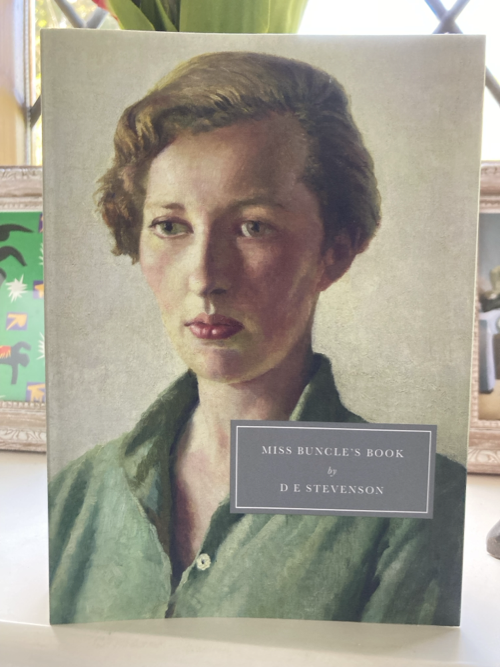
First published in 1934 and reissued by Persephone in 2008, Stevenson’s novel revolves around life in the fictional English village of Silverstream, which might at first sight seem a picturesque idyll, but is in fact seething with discontent. Central to the story is Barbara Buncle, an unmarried gentlewoman, much like those excellent women one finds in Barbara Pym’s novels. (Pym started writing fiction in the 1930s, which does make me wonder whether she might have read and been inspired by Miss Buncle’s Book as she embarked on her literary career. It’s an intriguing thought!)

As her parents are no longer alive, Miss Buncle lives in Tanglewood Cottage with her housekeeper and former nursemaid, Dorcas, who is now elderly but still reasonably fit. Their lives are modest, funded by share dividends Miss Buncle inherited from her parents; but the recent stock market crash has eroded their value, leaving the pair in dire financial straits.

Having ruled out hen-keeping and paying guests as potential sources of income, Miss Buncle decides that the only viable option is to write a book; but because she lacks any form of imagination, our heroine can only draw on her own knowledge – namely  the inhabitants of Silverstream and life in the village – as inspiration. The book, initially titled Chronicles of an English Village, features almost everyone in Silverstream, albeit thinly disguised with different but related names. For instance, Colonel Weatherhead becomes Major Waterfoot, Mrs Bold is renamed Mrs Mildmay and the village of Silverstream itself is disguised as Copperfield. Moreover, the novel’s narrative gives each character the storyline they truly deserve – those who are kind and considerate are appreciated by those around them, while the wicked and meddlesome are pulled up short. To keep her true identity a secret, Miss Buncle submits her book to the publishers, Abbott & Spicer, under the nom de plume, John Smith, hoping they will consider it further.

On reading the manuscript, the publisher, Mr Abbott, is duly impressed and sufficiently intrigued to learn whether its author is in fact a ‘very clever man writing with his tongue in his cheek’, or ‘a very simple person writing in all good faith’. So, imagine his surprise when he discovers that ‘John Smith’ is in fact a woman, and a unassuming one at that! By the end of his interview with Miss Buncle, Abbott is convinced that the novel is not a satire; rather, she has simply drawn on her own knowledge of Silverstream’s inhabitants to depict them as they really are. A contract is drawn up for the publication  of the novel under Abbott’s suggested title ‘Disturber of the Peace’, which Miss Buncle happily signs.

The fun really starts when Disturber of the Peace is published and swiftly becomes a runaway success. Everyone seems to be reading it, not least the inhabitants of Silverstream who soon begin to recognise themselves as characters in the novel. Somehow, John Smith seems to have seen each individual for who they really are, highlighting their hopes, preoccupations, idiosyncratic habits and deepest failings for all the world to see. Mrs Agatha Featherstone Hogg, the self-appointed queen of the village, is revealed by John Smith to be the domineering, power-hungry creature she truly is. Moreover, Agatha’s former life as a chorus girl (prior to her respectable marriage) is scandalously revealed, threatening her social standing in the village! Meanwhile, Mr Bulmer, who makes his family’s lives a complete misery, also gets his comeuppance as Disturber unfolds!

Agatha Featherstone Hogg is convinced that ‘John Smith’ must be a Silversmith resident – how else would he know everyone so intimately? – so she embarks on a campaign to discover his true identity with a view to punishing the scoundrel. There’s a hilarious residents’ meeting chaired by Mrs F. H., during which very little is actually achieved, save a false accusation made against Sarah Walker, the doctor’s intelligent wife, chiefly because she is the only Silverstream resident who doesn’t feature in the book. The main accuser is Vivian Greensleves, a ruthless gold-digger of a woman who is after the vicar’s money and will stop at nothing until he proposes marriage. Moreover, Vivian dislikes Sarah Walker and is quite willing to believe that her mischievous sense of humour and inside knowledge of the villagers (gained from her GP husband) have been channelled into the book.

As unrest mounts within the village and Mrs Featherstone Hogg threatens a libel action, Miss Buncle realises that she must intervene, but I’ll leave you to discover how this scenario plays out should you read the book. It’s all very cleverly done as art imitates life and life begins to imitate art, thereby creating a kind of cycle as one influences the other and vice versa!

Something D. E. Stevenson does extremely well here is to depict the dynamics of a quintessential English village in the 1930s, the type of place where everyone thinks they know everyone else’s business and few secrets are safe. We see how the impact of Disturber of the Peace (an apt title if ever there was one!) seeps into the social fabric of the village, destabilising the secure and comfortable atmosphere these residents have grown accustomed to. On the surface, village life might seem fairly innocuous to the casual observer; nevertheless, there is darkness lurking beneath the veneer of respectability here, much of which is exposed by Miss Buncle’s perceptive novel. While Mr Bulmer submits his compliant wife and children to crippling domestic abuse, Mr Featherstone Hogg is clearly under the thumb of his domineering wife – not pleasurable positions for anyone to be trapped in.

‘It’s a kind of – a kind of allegory,’ continued Sally gravely. ‘Here’s this horrible little village, full of its own affairs and its own importance, all puffed up and smug and conventional and satisfied with itself, and then suddenly their eyes are opened and their shackles fall off and they act according to their real natures. They’re not shams anymore, they’re real. It’s simply marvellous,’ Sally said, turning a shining face upon the astonished author. (p. 108)

A little like the transformative storyline in Vicki Baum’s excellent novel Grand Hotel, everyone in Silverstream is changed by the experience of reading Miss Buncle’s book. Mr Bulmer, for instance, is shaken by the lonely fate that awaits his doppelganger in Disturber, and he vows to be more considerate towards his family in the future. Meanwhile, Mr Featherstone Hogg is emboldened by all the fuss his wife is creating and swiftly threatens to alter his will if she pursues her farcical libel action – after all, no lawyer worth his salt would dream of taking on such a ridiculous case.

She [Agatha Featherstone Hogg] explained, somewhat incoherently, that the character of Mrs Horsley Downs was a horrible character and not in the least like her, but that it was obviously intended for her, because it was exactly like her, and that therefore it was a libel and as such ought to be punished to the upmost rigour of the law. She said the same thing a dozen times in different words, but always loudly, until Mr Spark [a lawyer] thought his head would burst. Her language became more picturesque and less polite every moment. Mr Spark began to wonder whether she really had been in the chorus when Mr Featherstone Hogg had been so misled as to marry her and elevate her to a higher sphere of life. (pp. 129–130)

Alongside the domestic abuse storyline, D. E. Stevenson also draws our attention to other social issues, some of which must have felt very progressive in the mid-1930s. Somewhat surprisingly, the villagers seem very accepting of the two unmarried women, Miss King and Miss Pretty,  who live together in the same house. While the exact nature of their relationship is never explicitly stated, it is clear to the reader that Miss King cares deeply for Miss Pretty, especially when the latter falls ill. There is also a glancing reference to the publication of Radclyffe Hall’s The Well of Loneliness, the groundbreaking novel about love between two women that created such a stir some years earlier.  Once again, the book is not named, but anyone with a knowledge of literature from this period would be able to identify it.

Post-natal depression is also touched on through references to Sarah Walker’s illness following the birth of her twins. Happily, Sarah has rallied since then, but Stevenson makes it clear that Dr Walker – a sympathetic, compassionate and caring man – was very worried about his wife’s physical and mental health following the birth. There’s also the issue of poverty, of course, explored firstly through Miss Buncle’s financial situation, and secondly, through another storyline, in which the vicar, who is actually very comfortably off, tries to live on the church’s stipend for a whole year. By doing so, he hopes to gain  a better appreciation of the challenges facing the poor, even though he struggles to survive on such a meagre income.

In Miss Buncle, D. E. Stevenson has created a most unlikely heroine, a woman that everyone in Silverstream has simply dismissed as a dull, frumpy simpleton – certainly not someone capable of writing a novel, especially one as scandalous as Disturber! Nevertheless, the reader knows that Barbara Buncle is extremely perceptive as she has sized up each Silverstream resident very accurately.

Barbara sometimes wondered what it was that gave Mrs Featherstone Hogg her social position in Silverstream. Why did everyone flock to her dull parties and consume the poor fare provided for them there? Why did everybody do what she told them to do? Why did old Mrs Carter produce her best china and linen for Agatha’s delectation? Was it because of her rude manner? or was it because she bought her clothes from the most expensive place in London? (p. 62)

The villagers, too, are delightfully drawn, from the mercenary Vivian Greensleeves and the overbearing Mrs Featherstone Hogg, to the lonely Colonel Weatherhead and the equally solitary Dorothea Bold, a match made in Heaven through Miss Buncle’s endeavours with Disturber.

In summary, then, Miss Buncle’s Book is an utterly delightful read, that type of book in which the good will be rewarded for their kind efforts while the wicked will get their comeuppance. Without wishing to give anything away, the book’s ending is perfect, showcasing a most surprising metafictional dimension to Miss Buncle’s literary talents. Highly recommended, especially for fans of The Fortnight in September, Miss Pettigrew Lives for a Day and The Enchanted April!

London novels – another ten favourites from my shelves

Back in July, I put together a list of ten favourite novels set in London. It seemed to strike a chord with many of you, so much so that I thought I’d pick another ten, including some of the books recommended by readers when that post came out.

As in my previous list, many of these novels portray lives lived on the fringes of society, from lonely women isolated in spinsterhood or unfulfilling marriages to younger outsiders marginalised from the mainstream for one reason or another. There are some brighter, funnier novels here too, shot through with a sense of adventure. Here are my picks!

The Grand Babylon Hotel by Arnold Bennett (1902)

I loved this hugely enjoyable, fast-moving caper, set for the most part in a high-class London hotel. Fashioned on the Savoy in London, the Grand Babylon is expensive, exclusive and efficient, a model of discretion and quietude favoured by royalty and other dignitaries from the upper echelons of society. Newly arrived at the hotel are Theodore Racksole, a wealthy American magnate, and his daughter, Nella, a self-assured young woman full of initiative. Following a run-in with the haughty head waiter at dinner, Racksole buys the hotel, and within hours, strange things begin to happen, culminating in a sudden death.

What follows is a gripping sequence of escapades taking Theodore and Nella to the darkest corners of Ostend while also embroiling them in the romantic entanglements of a missing European prince. Along the way, there are kidnappings and disappearances, disguises and concealed identities, not to mention various political machinations afoot. There’s even time for a sprinkling of romance, adding greatly to the novel’s elegance and pleasures. In short, it’s a delightfully entertaining story imbued with glamour, suspense and a great deal of charm!

The Death of the Heart by Elizabeth Bowen (1938)

One of my favourite novels by this excellent writer. When both her parents die in fairly quick succession, sixteen-year-old Portia is sent to live with her half-brother, Thomas, and his wife, Anna, in their large house near London’s Regent’s Park. It was her late father’s wish that Portia should live with Thomas for a year, after which time she might move on to stay with an aunt. In truth, neither Thomas nor Anna is particularly keen to have Portia, although Thomas does feel some sense of duty towards the girl. Bowen is brilliant at capturing the sheer awkwardness and uncertainty of adolescence, particularly as Portia has very little understanding of how to behave around Anna, Thomas and their friends; her understanding of the workings of the adult mind is minimal.

Mostly left to her own devices, Portia falls in with Eddie is a selfish, uncaring young man with no real sense of integrity or responsibility. What follows is a very subtle exploration of the pain and confusion of adolescence, of how easy it is for an adult to toy with the emotions of a teenager, especially someone as vulnerable and as trusting as Portia. Bowen excels at capturing the central London setting with its cold, wintry days and brittle atmosphere – a reflection of the chilly mood in Thomas and Anna’s house.

The House Opposite by Barbara Noble (1943)

There is often something very compelling about fiction written and published during World War II, when the outcome of the conflict raging across Europe would still have been uncertain. Set during the turmoil of the London Blitz, Barbara Noble’s novel The House Opposite is one such book, a very absorbing character-driven story in which the tensions underpinning the lives of two families are contrasted with the mundanity, unpredictability and daily destruction unfolding across the city. Noble centres her story on two main protagonists: Elizabeth Simpson, a twenty-eight-year-old secretary living at home with her parents, and Owen Cathcart, an eighteen-year-old boy whose family live in the house opposite the Simpsons’, hence the novel’s title. Elizabeth and Owen don’t much like one another at first, but as the pair share fire-watching duties on Sunday nights, a tentative friendship develops, opening their eyes to the realities around them.

Noble excels is in her portrayal of London during the Blitz, and the novel is peppered with vivid descriptions of the sights, sounds and smells of a city under attack. The images she paints of landscapes devastated by a combination of bombings and the resultant fires, are especially evocative. It’s a thoughtful and absorbing read, ideally suited to lovers of home-front stories from World War II.

Our Spoons Came from Woolworths by Barbra Comyns (1950)

One of my favourite novels featuring a highly distinctive female narrator – in this case, Sophia, a young woman who is looking back on her unhappy marriage to a rather feckless artist by the name of Charles. In writing this book, Comyns has drawn heavily on experiences from her own life. It is, by all accounts, a lightly fictionalised version of her first marriage, a relationship characterised by tensions over money worries and various infidelities on her husband’s part. Sophia and Charles’ hardscrabble bohemian lifestyle and North London flat are vividly evoked. Although it took me a couple of chapters to gel with Sophia’s unassuming conversational style, I really warmed to her character, particularly as the true horror of her story became apparent – her experiences of the insensitive nature of maternity care in 1930s London were especially disturbing to read. This is a wonderful book, by turns humorous, sad, shocking and heart-warming.

Under the Net by Iris Murdoch (1954)

My first experience of Iris Murdoch’s fiction but hopefully not my last. Under the Net – Murdoch’s debut novel – is a subtly clever blend of the picaresque and the philosophical, all set within the bohemian milieu of London and Paris in the early 1950s. The novel is narrated by Jake Donaghue, an impoverished hack who scrapes a living by translating mediocre French novels into English when in need of some ready cash. As the story opens, Jake arrives back in London following a trip to France to discover that he is being thrown out of the flat where he has been living virtually rent-free for the past couple of years. Thus, Jake must find a new place to live, a quest that sets off a sequence of misadventures, chance encounters and close shaves, all of which shape his outlook on life in subtly different ways.

This novel is witty, engaging and fast-paced, with the humour in particular coming as a complete surprise. Along the way, the action takes in various scuffles, the theft of a manuscript, a break-in, a kidnap and a spontaneous night-time dip in the Thames. There’s also some glorious writing about London here, very atmospheric and evocative; on one level it’s all tremendous fun. Nevertheless, debate and self-reflection play their parts too. Central to the novel is the exploration of one of Wittgenstein’s theories, the idea that our deepest emotions remain trapped ‘under the net’ of language, inaccessible to others despite our best efforts to express them through dialogue or the written word. I loved this novel and hope to read more Murdoch very soon!

The Ballad of Peckham Rye by Muriel Spark (1960)

The gloriously off-kilter world of Muriel Spark continues to be a source of fascination for me – she’s a writer whose intense, imaginative visions seem playful and  distinctive. The Girls of Slender Means featured in my first ‘London novels’ post, but this time I’ve chosen The Ballad of Peckham Rye, in which the mercurial, malevolent Dougal Douglas brings chaos into the lives of everyone he encounters. Spark makes excellent use of dialogue here to move the story along, and the setting – a South London borough in the 1960s – is captured to a T. It’s the sort of community where everyone is desperate to know everyone else’s business, and the pubs and shops bristle with gossip and rumour. There’s a touch of the dark arts about this novella with its slyly manipulative protagonist, who always strikes me as an older incarnation of Timothy Gedge from William Trevor’s brilliant novel The Children of Dynmouth.

Turtle Diary by Russell Hoban (1975)

First published in 1975 and now well established as a modern classic, Turtle Diary is a charming, piercingly perceptive exploration of different facets of loneliness and the fear of stepping outside one’s comfort zone in the maelstrom of middle age. The novel’s premise seems at once both simple and eccentric – and yet, it all works remarkably well.

Divorced bookseller William G. lives in a London boarding house run by a landlady, Mrs Inchcliffe – a far cry from his former life in Hampstead as a husband and father with a job in advertising. While his work at the bookshop brings William into contact with the smart ladies of West London, his personal life is a desert – dry, lonely and painfully directionless.

Also feeling lost is Neaera H., a writer and illustrator of children’s books who works from home with nothing but a water beetle for company. Middle-aged and unmarried, Neaera is adrift in a sea of loneliness, lacking a clear purpose or direction as she struggles with writer’s block. When the novel opens, these two individuals are unaware of one another, but as Hoban’s narrative unfolds, their lives become inextricably entwined, setting up the premise for this marvellous story. An unexpected gem tinged with sadness.

Quartet in Autumn by Barbara Pym (1977)

First published in the late ‘70s, at the height of Pym’s well-documented renaissance, Quartet in Autumn is a quietly poignant novel about loneliness, ageing and the passing of time – how sometimes we can feel left behind as the world changes around us. The story follows four work colleagues in their sixties (two of whom are spinsters) as they deal with retirement from their roles as clerical workers in a London office. Pym brings some lovely touches of gentle humour to this bittersweet gem, and the loneliness of life in a big city is sensitively evoked. 

As is often the case with Pym, it’s the small things that prove to be the most revealing, hinting at trouble brewing or secrets yet to be revealed. As the novel draws to a close, the group come together in a time of crisis, reaching out to one another in ways they have not managed to do before. For two of the quartet at least, there are decisions about their futures to be made, showing us that life still holds choices and new possibilities in the autumn of our years.

A Private View by Anita Brookner (1994)

This superb novel is somewhat different from Brookner’s trademark stories of unmarried women living quiet, unfulfilled lives while waiting for their unattainable lovers to make fleeting appearances before disappearing into the night. In this instance, Brookner turns her gaze towards the aptly named George Bland, a quiet, respectable, recently retired man in his mid-sixties, living a dull, highly ordered existence in a comfortable London flat. In many respects, he is the male equivalent of Brookner’s archetypal spinsters – a man adrift, marking time in a narrow life on the periphery, while the excitement and passion take place elsewhere.

As the novel unfolds, Brookner explores what can happen when such a life is disrupted, raising the tantalising possibility that it might veer off course. With Brookner’s A Private View, the catalyst for the potential derailment is the arrival of an alluring, infuriating young woman, who takes up residence in the flat opposite George’s. Every time I read another Brooker, I find a new favourite, and this proved no exception to the trend!

Open Water by Caleb Azumah Nelson  (2021)

This gorgeous, lyrical novella – which focuses on two central protagonists, one male, one female, both black and in their early twenties – is at once both a tender love story and a searing insight into what it feels to be young, black and male in contemporary South London. Nelson writes beautifully about the sensation of a relationship progressing from friendship to love, how our innermost feelings can be exhilarating yet also expose a noticeable sense of vulnerability. The story is imbued with a wonderful combination of intimacy and immediacy, a feeling that fits so naturally with the novella’s intertwined themes.

Nelson is particularly strong when it comes to conveying the experience of inhabiting a black body, that sense of being stared at but not seen – certainly not as a human being with emotions and feelings. What really comes across here is the fear young black men experience on a daily basis, and the South London setting forms a key part of this. Will today be a day when they are stopped and searched? Will today be a day of confrontation? Will today be the day they lose their life? It’s a story for our times, an exploration of love, creativity and the need to be seen, especially in a world where fear and prejudice seem ever-present.

Do let me know your thoughts on these books if you’ve read any of them or are thinking of doing so. Or maybe you have some favourite London novels of your own – if so, feel free to mention them in the comments below, especially those from the 20th century.

Christmas Pudding by Nancy Mitford

First published in 1932, Christmas Pudding was one of Nancy Mitford’s early books, written before she hit the big time with her semi-autobiographical novels, In the Pursuit of Love (1945) and Love in a Cold Climate (1949). In some respects, Christmas Pudding is a lesser work but no less enjoyable for readers who like farce. In short, it satirises the idiosyncrasies of Britain’s upper classes and Bright Young Things while also having fun with the country house novel, a popular genre in the British literary world at that time.

While Pudding is something of an ensemble piece, the story hinges on Paul Fotheringay, a young writer who has just scored a hit with his debut novel, Crazy Capers, hailed by critics and readers as a hilarious farce. Paul, however, is crestfallen, largely because he’d intended the book to be a serious work of literature, infused with poignancy and tragedy.

As a possible way forward, his friend, the wealthy widow Amabelle Fortescue, advises Paul to make his next book a biography, ideal fare for a writer who longs to be taken seriously. So, following some research on gaps in the biography market, Paul identifies Lady Maria Bobbin as a suitable subject. Lady Maria’s journals and correspondence are now in the hands of her granddaughter, the current Lady Bobbin, who lives at Compton Bobbin in Gloucestershire. But when Paul writes to Lady B requesting access to her grandmother’s papers, his application is turned down, largely because his first book has been deemed a riotous farce!

Consequently, Amabelle devises a ruse to install Paul at the Compton Bobbin estate as a tutor to Lady Bobbin’s seventeen-year-old son, Bobby, currently in his final year at Eton. While Bobby hopes to secure a place at Oxford, Lady Bobbin has other plans for the boy, envisaging a spell at Sandhurst once his Eton days are through. Either way, Bobby will need some additional tuition over the Christmas holidays to pass his exams, hence the reason for employing a tutor – or, in other words, Paul Fotheringay in disguise.

As it happens, Amabelle will also be in Gloucestershire for the season, having rented a house just two miles from Lady Bobbin’s estate. So, with Paul successfully placed at Compton Bobbin, his mornings can be devoted to reading Lady Maria’s journals on the quiet while Bobby naps on the sofa; meanwhile, Lady Bobbin, believes these sessions are devoted to tutoring, so she leaves the boys to it.

The afternoons are another matter altogether as Lady Bobbin insists that Bobby must immerse himself in outdoor activities to prepare for his spell at Sandhurst. Much to her annoyance, the usual hunts have been suspended due to an outbreak of foot-and-mouth; however, there’s nothing to stop Bobby and Paul riding the horses in the grounds. Cue much amusement as Paul, who is scared stiff of riding, tries to cope with one of Lady B’s horses as she watches them setting off.

Paul, his unreasonable terror of horses now quite overcome by his unreasonable terror of Lady Bobbin, whose cold gimlet eye seemed to be reading his every emotion, decided that here was one of the few occasions in a man’s life on which death would be preferable to dishonour, and advanced towards the mounting block with slight swagger which he hoped was reminiscent of a French marquis approaching the scaffold. (p. 83)

Once the boys are safely out of sight, Bobby pays one of the grooms to exercise the beasts. This leaves Bobby and Paul free to while away their afternoons with Amabelle and her society friends, also down for the break.

That, in a nutshell, is the novel’s ‘plot’, although I’m using the term quite loosely here as it’s not really a plot-driven book. Rather, Mitford’s focus seems to be on farce and satirical humour, which gives Pudding the feel of a lighter version of Evelyn Waugh’s early novels, minus the acerbic bite.

Much of the amusement is provided by the other characters in the book, from Lady Bobbin with her outrageously prejudiced views to the jolly japes of Amabelle’s society set. Lady B is particularly good value in this respect, convinced as she is that Communism has infiltrated British society and politics – hence her ‘Bolsheviks in Britain’ rhetoric!

Florence Prague was saying only yesterday, and I am perfectly certain she is right, that the Bolsheviks are out to do anything they can which will stop hunting. They know quite well, the devils, that every kind of sport, and especially hunting, does more to put down Socialism than all the speeches in the world, so, as they can’t do very much with that R.S.V.P. nonsense, they go about spreading foot and mouth germs all over the countryside. I can’t imagine why the Government doesn’t take active steps; it’s enough to make one believe that they are in the pay of these brutes themselves. (p. 55–56)

Amabelle’s friends include Walter and Sally Monteath, who, despite having virtually no money and a baby daughter to care for, seem to be the very embodiment of the phrase ‘live now, pay later’. By day, Walter plays bridge, gambling money he doesn’t really have; then by night, he and Sally drink, dance and party hard, often relying on their friends’ generosity to keep them vaguely afloat. Mitford has much fun satirising the Bright Young Things and their flippant, laissez-faire approach to life, as typified by the following quote.

‘…When’s the christening, Sally?’

Well, if the poor little sweet is still with us then we thought next Tuesday week (suit you?), but she’s most awfully ill today, she keeps on making the sort of noises Walter does after a night out, you know.’

‘D’you think she’s likely to live or not?’ said Paul. ‘Because if there’s any doubt perhaps I could use your telephone, Amabelle, to call up the jewellers and see if I’m in time to stop them engraving that mug. It’s such an expensive sort, and I don’t want it spoilt for nothing, I must say.’ (p. 21)

Mitford seems particularly interested in a woman’s reasons for getting married – or, more specifically, whether she should marry for love or for money. As far as Amabelle sees it, a girl ought to marry for love when she is young, if such an opportunity presents itself. The marriage probably won’t last, but it will be an experience if nothing else. Then, later in life, she should marry for money, as long as it’s big money; one mustn’t settle for anything less. Besides, apart from love or money, there aren’t any compelling reasons for marrying at all!

‘When I was a girl,’ said Sally, ‘and before I met Walter, you know, I fixed a definite price at which I was willing to overlook boringness. As far as I can remember it was twenty-five-thousand pounds a year. However, nothing more than twelve seemed to offer, so I married Walter instead.’ (p. 95)

The introduction of a couple of other characters – Bobby’s twenty-one-year-old sister, Philadelphia, and Amabelle’s former suitor, Lord Michael Lewes – allows Mitford to develop these themes further, exploring what role happiness plays in all of this. In fact, Paul and Amabelle both question whether happiness is a realistic expectation to have in life, especially if marriage is involved.   

‘Oh dear,’ said Paul gloomily, ‘it really is rather disillusioning. When one’s friends marry for money they are wretched, when they marry for love it is worse. What is the proper thing to marry for, I should like to know?’

‘The trouble is,’ said Amabelle, looking at Philadelphia whom she thought surprisingly beautiful, ‘that people seem to expect happiness in life. I can’t imagine why; but they do. They are unhappy before they marry, and they imagine to themselves that the reason of their unhappiness will be removed when they are married. When it isn’t they blame the other person, which is clearly absurd. I believe that is what generally starts the trouble.’ (p. 126)

Amiable, intelligent, and interested in culture, Philadelphia is bored stiff living at home in the country with her mother, and she longs for some genuine, like-minded friends. Both Paul and Michael Lewes are attracted to her, which poses something of a dilemma, especially when Michael proposes. As Amabelle points out, Michael would make the more suitable husband, given his wealth and social position, but Philadelphia’s heart seems wedded to Paul. As the novel unfolds, various developments ensue, but which way will Philadelphia turn? You’ll have to read the book to find out…

The Christmas festivities offer Mitford plenty of scope for ridiculing the upper classes as Lady Bobbin welcomes her guests to Compton Bobbin. On the downside, there are a few superfluous minor characters that could have been cut in the edit, and the story sags a little as these are figures introduced. Nevertheless, it’s a fairly minor quibble in the scheme of things at this stage in Mitford’s career.

Alongside her satirical sideswipes at Bright Young Things and the upper classes, Mitford also takes the opportunity to poke fun at the literary scene, albeit more gently.

[Amabelle:] ‘…Really that young man [Michael], I’ve no patience at all with him; he behaves like a very unconvincing character in a book, not like a human being at all.’

[Bobby:] ‘ Yes, doesn’t he. The sort of book of which the reviewers would say “the characterization is weak; the central figure, Lord Lewes, never really coming to life at all; but there are some fine descriptive passages of Berkshire scenery.”…’ (p. 164)

All in all, then, this is an enjoyable piece of farce, a seasonal treat for lovers of this type of fiction, but not to be taken too seriously. A book club friend chose it as our Christmas read, and I’m looking forward to hearing what everyone thinks (while also suspecting that it might divide opinion due to Mitford’s signature style)!

Christmas Pudding is published by Penguin Books; personal copy.

A Note in Music by Rosamond Lehmann

It’s been a while since I last read anything by Rosamond Lehmann, the critically acclaimed author of the excellent novels Invitation to the Waltz (1932) and The Weather in the Streets (1936) – both bestsellers in their day. First published in 1930, A Note in Music was Lehmann’s second novel – probably less well-known than her others, but in my opinion just as good. It’s an exquisitely observed exploration of two loveless, unfulfilling marriages and the shifts in dynamics that occur when two captivating visitors enter this stagnant world. Interestingly, A Note was less positively received than Lehmann’s highly successful debut, Dusty Answer, which I’ve yet to read. Nevertheless, E. M. Forster was an enthusiastic fan, and the novel enjoyed one or two good notices elsewhere. I really loved this one and hope to find a place for it in my 2025 highlights.

Set in an unnamed provincial town during the interwar years, A Note in Music features two married couples, Grace and Tom Fairfax and their friends, Norah and Gerald MacKay, all of whom are discontented and unfulfilled in their different ways. Following the stillbirth of her son and the loss of a puppy, Grace feels isolated from Tom, her unexciting but dependable husband of ten years. Nevertheless, inertia holds her back from doing anything to address this. When Grace considers her life, it is one long sequence of empty days with nothing to look forward to and few achievements to look back on. While the Fairfaxes’ lives are outwardly dreary, Grace’s inner world is richly imagined, inspired by the lush countryside she had to relinquish when she married Tom and her accompanying dreams of romantic love, which now seem a distant memory. In short, she longs to feel something, even if it is just pain.

Everything that was difficult or disagreeable slipped off his consciousness. He [Tom] would be clouded for a moment and then shake himself and come back smiling, a little apologetic, appealing: ‘Let’s all be comfortable and jolly again.’

And she [Grace] would go on sulking, sulking—unresponsive, knotted inwardly like a skein of grey, harsh, tangled wool. (p. 12)

Grace’s close friend, Norah, is also far from happy. Trapped in a disappointing marriage to Gerald – an irritable, resentful University Professor – Norah must slavishly devote herself to domestic routines, taking care of the couple’s boys and tending to Gerald’s many needs and quibbles.

He [Gerald] was in his knotted mood because…probably because she [Norah] had stayed out longer than he expected; because he knew he would not give as good a lecture as he wished to; because the boys had had buttery fingers at tea…something of that sort. Now he was asking her to come and untie him—and defying her to try. Why should this vampire family so prey on her and pin her down that even one afternoon’s freedom became a matter of importance, to be regretted afterwards? Why should she let him forever drain her to sustain himself? (p. 52)

In truth, Norah is still grieving over the loss of her great love, Jimmy, a rather wild, unreliable man who died in WW1. Nothing she has experienced with Gerald can begin to fill that gaping need, leading to a lack of fulfilment for Norah despite her undoubted love for the boys. Like Grace, she internalises her sorrow, allowing it to fester without a suitable release.

Into this troubled world comes Hugh Miller, a bright, sensitive, passionate young man who charms everyone he meets. Hugh is related to the owner of Tom’s firm, instantly establishing a connection with the Fairfaxes, who befriend the new arrival and his sophisticated, liberated sister, Clare, hoping some of the Millers’ sparkle will come their way.

He [Hugh] seemed to have a secret of mastery, of confidence, of being at home in the world. He would disregard inauspicious detail, and be lucky, and know how to manage his life as he wanted it.

What past had shaped him, what experiences defined him so clearly? He was a creature compact of youth, but he was not a boy.

Had he ever loved a woman, she wondered, or been loved? (pp. 63–64)

Grace, in particular, is captivated by Hugh, seeing in him everything she yearns for in life, exposing desires and needs that have remained unmet during her barren marriage to Tom. During a series of brief interactions with Hugh – the occasional chat and a glorious afternoon of boating and tennis in the country – Grace experiences a sort of awakening, a heightening of the senses that manifests itself in a kind of love. Nothing can come of it, of course, but the experience enlivens Grace nonetheless.

She felt in the depths of her being a thrill, a rush of expectation. She stared at the water and saw, as if upon its shining surface, the summer months stretching out before her, bearing a promise as rich and strange as any in the years of youth. (p. 136)

Meanwhile, Hugh is nursing his own loss, pining for his former love, Oliver, feelings he keeps strictly under wraps. Lehmann is particularly adept at portraying these covert yearnings, giving the reader access to Hugh’s inner world, his secret heartbreak and fading hopes of some kind of reconciliation.

Norah, too, is touched by the new arrivals, retreating into her past and thoughts of Jimmy – what might have been had he not been killed in the war. Even Gerald is swept up by it all, falling for glamorous Clare during the afternoon of tennis and boating, leaving Norah to reflect alone.

At some point, it seems as though the Millers’ presence in the town will push both the Faifaxes and the MacKays apart. Grace insists on taking a separate holiday from Tom, leaving the latter to a dismal break alone in Scarborough, from which he longs to escape. His life is tinged by disappointment, and he dreams of having a more ‘womanly’ wife than Grace, someone who will listen and console him. When the pair return home from their respective solo trips, they seem more estranged from one another than ever, until a final visit from Hugh puts Grace back on an even keel.

The MacKays, too, reach a point of crisis when a blazing row over Gerald’s interest in Clare erupts, threatening to fracture their marriage. Nevertheless, an understanding is reached between the couple, bridging some of the gulf that had opened up between them.

Something that Lehmann does particularly well here is to illustrate how inner lives can be altered in subtle but highly significant ways, even when outwardly everything remains broadly the same. By the end of the year, Hugh and Clare will have departed, leaving the Fairfaxes and MacKays to carry on with their lives largely as before. Nevertheless, internally, the tectonic plates have shifted, opening up new levels of understanding and appreciation between Grace & Tom – and between Norah & Gerald. Neither couple could be described as wildly in love, but crises have been averted and a greater realisation of needs has been achieved by each member of the group. If anything, the reader is left feeling more concerned for Hugh, whose future seems open and potentially vulnerable.

Lehmann is also concerned with the importance of living in the moment, appreciating the here and now without dwelling too much on disappointments or past regrets. One can look forward to the future to some extent, but the present should take precedence.

It does not ease the burden of the past to share its recollections; for with each plunge into it, each withdrawal, something is left behind that weighs more heavily than memory; something that can never be shared or imparted… (p. 76)

In my previous reviews, I mentioned how Lehmann’s evocative, modernist style and deep insights into human nature place her somewhere between Elizabeth Taylor and Virginia Woolf, two of the best writers of their generations. A Note is perhaps closer to Taylor than Woolf, and I couldn’t help thinking of A View of the Harbour as I was reading this book, partly because Taylor’s novel also features a stranger – a landscape painter named Bertram, whose arrival in a post-war town affects the local inhabitants in surprising and subtle ways.

Lehmann’s characters are beautifully drawn, and like Taylor, she takes her supporting players seriously, fleshing them out with care and attention to detail. In A Note, Lehmann introduces us to Pansy, a sex worker who has encounters with Hugh and, somewhat surprisingly, with Tom (clearly at a loose end while Grace is away on her solo trip). Even Norah crosses paths with Pansy, but not in a way we might fear. Lehmann also introduces the theme of homosexuality (primarily through Hugh’s yearnings for Oliver) in a sensitive, perceptive way, marking her out as a progressive writer from an early stage.

There is also some gorgeous descriptive writing here. The novel is divided into seven sections, many starting with evocative descriptions of the relevant time of year.

In the southern counties February will come in with a sudden stillness, with mild blue watery air, with the ploughed earth mysterious in the dark fields, yielding to bear the young corn. From the lime tree the blackbird calls, one primrose dusk, a new call, and in the moment of that sound spring bursts upon the imagination, sealed buds have swollen, crocuses crowd the lawn, the swallows are over the river, stark branches swim in fresh mists of green. (p. 25)

A Note in Music is one of those subtle novels in which nothing seems to happen, and yet everything happens if we look closely enough. Early middle age is a tricky period for many of us, a time when the optimism, rapture and ambitions of youth may have given way to routine, resignation and a lack of fulfilment. Lehmann writes beautifully about these challenges, showing us how new understandings can be reached in the present, even if the past can never be recaptured.

(I read this novel to tie in with a group read co-ordinated by christina500 on Bluesky. Check out the #ANote_2025 hashtag for other readers’ thoughts.)

The Spring Begins by Katherine Dunning

When Nora (@pear-jelly on Bluesky and Instagram) announced that she would be hosting #SpinsterSeptember again this year, Simon (at Stuck in a Book) suggested Katherine Dunning’s The Spring Begins as a suitable spinster read. I’m so grateful to Simon for recommending this book to me, as it’s now one of my favourites from the excellent British Library Women Writers series, a wonderful collection of lesser-known gems from the 20th century.

Born in Ireland in 1900, Katherine Dunning lived much of her adult life in England, where she published five novels and many short stories. First released in 1934, The Spring Begins is an evocative portrayal of the lives of three very different young women, all of whom work in service in the 1930s. Dunning writes beautifully and insightfully about each character’s situation, her hopes and ambitions, her constraints and fears. The novel is set during a time when social class and societal expectations placed certain restraints on young women, forcing them to exist within the boundaries allotted to them. Nevertheless, Dunning brings a rare sensitivity to these characters, who are so often the supporting players in fiction from this period. Their inner lives are richly imagined, alive to the complexities of the mysterious, evolving world surrounding them, complete with all the unwritten rules society dictates. Moreover, each woman is at a crucial stage in her personal development, where a significant life choice could shape her destiny for better or worse.

All three live and work within close proximity to each other; however, their lives rarely overlap, largely because each woman’s role is strictly controlled, often allowing little time for interaction between classes and/or domains.

Firstly, there is Lottie, the young, sweet, innocent nursemaid to the Kellaways’ lively young daughters, Isobel and Anne. Raised in an orphanage with no family of her own, Lottie is inexperienced in the wider world, placing her at the mercy of Nurse’s vehement warnings about the horrors of men. Nurse, a bitter, resentful bully, delights in bossing Lottie around, filling her head with frightful stories of the wickedness lying in wait. Consequently, Lottie shrinks away from any encounters with men, especially those involving a sexual charge or undercurrent, however subtle.

Nevertheless, Dunning reveals Lottie to be a sensitive young woman, vividly alive to the kindness of humanity and the wonders of the natural world. As the novel unfolds, Lottie experiences an awakening of sorts under the guidance of George, a kind, tender, loving young man who also works on the Kellaways’ estate. George makes Lottie more aware of her own body, her burgeoning sexuality, without ever taking advantage of it. She feels safe with him, secure in the promise of his unwavering love.

The pool was no longer a blurred radiance before her, her body within the light touch of George’s arm was intensely aware of everything about her. She had yielded instantly and unconsciously to his touch, and he had drawn her closely to him.

For a moment he held her like that. They could hear the sea below them, faint but clear. The dark light around them had a sudden strange brilliant clarity, and there was a fragrance of crushed grass and wet earth and the seaweed that the receding tide was uncovering. (p. 93–94)

While Lottie seeks protection from the terrible ravages of men, Hessie Price – a plain-looking day governess at the nearby rectory – is desperate for a different kind of security, something only a suitable husband can provide. With her intense obsession over respectability, Hessie sees marriage as her only gateway to status, financial security and a respectable position in society. In many respects, she is a victim of circumstance, hemmed in by the narrow boundaries of her class, firmly on the periphery of life. In short, her existence is ‘a grey borderland of gentility and excessive modesty’.

Unable to marry above her station, and unwilling to bow below it, Hessie must find a suitable match from her own social stratum – not an easy task given the limited options available to the surfeit of single women in the interwar years. In the meantime, she lives with her mother and younger sister, Hilda, trying to survive in a household where money is tight.

Time is running out for Hessie, an uncomfortable truth made all the more apparent when Hilda announces her engagement to Albert, a local man she has been seeing. This unexpected development throws Hessie into a tailspin, heightening her ongoing fantasies about the rector’s curate, Mr Saul. Somehow, Hessie has convinced herself that Mr Saul is attracted to her, when in fact, nothing could be further from the truth. It’s all very painful to observe, highlighting the tragedy of Hessie’s situation.

Hilda and Albert Baker. How had Hilda done it? Albert was stocky and red-faced, but he was a man, and he was quite important in the town. Mother, Miss Bowman, everyone was treating Hilda with new respect. A year ago they’d just been Hessie and Hilda Price, sisters, companions, with their little girlish jokes together, and now Hilda had shot away from her. Oh God, if only she could follow Hilda.

‘My sons-in-law…Albert is a good man, steady and kind, but my elder daughter’s husband—one of God priests. Oh, yes, quite a big private income of his own, not like poor Mr. and Mrs. Benson, our rector here. My Hessie is so happy. If you’ll just pass me that album I’ll show you some snapshots. Snapshots are always so natural—aren’t they? Ah, there’s the baby. Yes, a boy…’

A horrible convulsive tremor shook Hessie’s body, and she felt desperately sick and dizzy. (p. 175–176)

While Hessie doesn’t begrudge Hilda her happiness with Albert, their engagement throws the emptiness of Hessie’s own life into sharp relief. The forthcoming marriage is driving a wedge between the two sisters, separating them in new, uncomfortable ways. Consequently, Hessie succumbs to jealousy, becoming increasingly exasperated by Hilda’s excitement over her wedding plans.

Supposing she [Hessie] screamed now. Just dropped the plates and opened her mouth and screamed. Hessie bit her under lip as she ran out into the kitchen. She laid the plates with a clatter onto the dressing-board by the sink, and pressed her hands to her head. How could she live through Hilda’s wedding, and afterwards, too? Evenings alone with Mother, while Hilda sat with her husband, and afterwards Hilda and Albert went upstairs together. Hilda would be a wife, a married woman. Hilda would come back to see them, and she’d talk about ‘my husband’ and Mother and she would exchange meaning glances, leaving Hessie outside the fraternity of married women. (p. 146)

Like Lottie, Hessie is also fearful of sexual desires; however, while Lottie is worried about the wickedness of men, Hessie is more disturbed by suggestions of unspoken longings from within. She constantly torments herself with thoughts of Hilda and Albert together once they are married, a mysterious, intimate world she knows nothing about. Meanwhile, Hessie will be left to fester with her mother, unloved and untouched by a man, until such time as Mr Saul declares his hand.

Men did like women to be women. Be independent, of course, but in a feminine way. Her eyes always looked better at night, too, when the pupils grew large and spread out over the pale irises. If only she were beautiful. But she was nicer looking than Hilda, and Hilda and Mr. Baker were somewhere ahead of them, and Hilda would be kissed. Mr Baker’s small hard mouth would close down on Hilda’s, and then—but, really, really, she was ashamed of herself. Why did she keep on thinking of things like this? Indecent, immodest things, that frightened her with their persistence, that seemed to come from some uncontrollable outside source and take possession of her. (p. 86–87)

By contrast, the Kellaways’ kitchen maid, Maggie, is more at ease with her own body and sexuality; it liberates her to think of its youth and attractiveness to men. Like Lottie, nineteen-year-old Maggie lives and works in service at the Kellaways’ grand house; however, she is much more worldly-wise than her nursemaid colleague. The virile head gardener, Maxwell, has eyes for Maggie, and likewise, she is sexually attracted to him, knowing full well what a night-time invitation to his potting shed will entail…

This was not the first time Maxwell had come up the drive at this time of the morning, and spoken to her. Sometimes she [Maggie] was half afraid of him, especially when he came close to her, bracing himself backwards and forwards on his thick legs, his hands thrust into his pockets.

‘Always working hard—aren’t you?’ he said again.

Maggie tossed back her head. ‘The same as you,’ she answered pertly.

The glint of the smile shone in his eyes. ‘I work pretty hard, too. Come down to the potting-sheds some evening and I’ll show you what I do. Why don’t you?’

Maggie sat back on her heels and glanced at him. She knew pretty well what a man of his type was after, but she could take care of herself all right. Or could she? (pp. 15–16)

At first, it seems that Maggie is primarily interested in the sexual side of her relationship with Maxwell; however, as the novel unfolds, she begins to fall for him more completely, illustrating that she is looking not only for love but sexual pleasure, too. As to whether Maxwell reciprocates Maggie’s feelings, you’ll have to read the book yourself to find out.

Maggie touched his arm. His fierce possessiveness made her feel compassionate and gentle. But things would not be like this always. Her love for him might last, because she thought of him in every way, he was her lover and her child too, but what would be left of his love once his body grew tired of hers? Still, so long as he needed her in any way she was there to give him what he wanted. (p. 170)

These three very different women offer readers some fascinating contrasts. Through Hessie, Dunning shows us the damaging impact of war on thousands of lonely spinsters. Unremarkable, good-natured women who would have made loving wives and mothers, but were instead left on the shelf to wither away untouched and unloved due a shortage of eligible men. Moreover, she clearly signals the potential dangers of such an emotional desert, leading perhaps to bitterness, jealousy and even madness over the years. Nevertheless, as this thoroughly engaging story draws to a close, there is a blossoming of sorts for Hessie – not a happy ending as such, but an awakening, something she can look back on whatever the future may bring.

There is a new beginning for Lottie, too, in the emergence of a more confident, secure young woman, no longer afraid of men and Nurse’s horror stories, safe in the knowledge that George will take care of her.

Alongside her excellent skills with characterisation, Dunning’s prose is gorgeous, peppered with evocative insights into her protagonists’ inner lives, beautifully observed details of their working environments and lush descriptions of the natural world.

There was a shrubbery full of rare shrubs in the grounds to the right of the house. The variety of leaves there alone was astonishing. Pale green leaves; umber-coloured; scarlet-brown, the shade of virginia creeper in the autumn; clear yellow traced with bright green; and a deep cold purple green almost repellent in its strong, forbidding, vanished brilliancy. (p. 3)

I loved spending time with these women, each of whom is seeking her own form of fulfilment, whether it be pleasure and sexual desire, love and liberation or security and social status. Very highly recommended indeed – my thanks to the publishers for kindly providing a review copy.

There’s No Turning Back by Alba de Céspedes (tr. Ann Goldstein)

The Italian-Cuban writer Alba de Céspedes is fast becoming one of my favourites. I’ve posted before about her exquisitely-written feminist novels Forbidden Notebook (1952) and Her Side of the Story (1949), both of which I loved. Now Pushkin Press has published another of her books – an early novel titled There’s No Turning Back – which might just be my favourite of the three.

Groundbreaking on its initial publication in 1938, There’s No Turning Back can now be viewed as a prescient, transgressive exploration of women’s desire for independence, autonomy and self-expression. By weaving together the stories of eight young female students living in the Grimaldi, a convent-style boarding house in Rome, de Céspedes presents the reader with a range of different experiences as each of these women must find a way to live – to shape her future direction for the better.

“…It’s as if we’re on a bridge. We’ve already departed from one side and haven’t yet reached the other. What we’ve left behind we don’t look back at. What awaits us is still enveloped in fog. We don’t know what we’ll find when the fog clears. Some lean too far out, for a better view of the river, and they fall in and drown. Some, tired, sit down on the bridge and stay there. The others, for good or ill, go on to the other shore.” (p. 70)

In essence, each student is trying to bridge the gap between the role society has deemed for her and the one she herself wishes to adopt. Moreover, she must consider what challenges must be overcome and what sacrifices need to be made to achieve her aspirations. While these young women have come to Rome from various backgrounds with different aims and desires for the future, they are united by a common purpose – a desire to have some control. Moreover, they are bound together by their circumstances and daily habits through studying and living at the Grimaldi. Their friendships with one another are intimate but almost certainly fleeting, likely to last two or three years at most. 

When the novel was first published in 1938, it became an instant success, electrifying readers with its transgressive portrayal of women’s lives. Nevertheless, its radical nature attracted the attention of Italy’s Fascist authorities, who banned the book, primarily because its depictions of women’s aspirations were deemed to be in direct opposition to the traditional gender-based roles of wife, carer and mother. Interestingly, de Céspedes revised the book stylistically and structurally a number of times; as a consequence, Ann Goldstein’s translation is based on the author’s final version, published in Italian in 1966.

The novel takes place over eighteen months from autumn 1934 to summer 1936, and de Céspedes does an excellent job of using the Grimaldi’s cloistered atmosphere to emphasise the restrictions these young women face, especially under the watchful eyes of the nuns.

“Ten,” Vinca said, “and we’re shut up in here. We couldn’t go out if we wanted to: the gate is locked, the sister sleeps with the key under her pillow. You know, when I arrived that half-closed gate in the entrance hall—unnecessary after the glass door and the outer door—frightened me? In fact it’s a symbol…” (p. 88)

However, despite the house rules of no talking or smoking, and lights out after ten, the girls gather in a room every evening to share their inner thoughts and experiences, all under the pretext of studying. 

The central character here is Emanuela, an amiable, empathetic twenty-four-year-old from Florence, who quickly makes friends with the other girls on her arrival. Ostensibly at the Grimaldi to study art history, Emanuela is harbouring a secret from her fellow students and the nuns – an illegitimate child, Stefania, whom her conservative father has insisted she keep hidden to preserve the family’s reputation. As such, the toddler attends a boarding house in Rome, which Emanuela covertly visits on Sundays.

Emanuela feels a sense of peace and comfort at the Grimaldi, free from her father’s old-fashioned views and controlling ways. In truth, though, her life is a fragile ‘architecture of deceptions, a cathedral of glass’ at risk of collapse, threatening to expose the different (and entirely separate) compartments of her existence. On the one hand, she is the girl who lives in a student residence (the Grimaldi), while on the other, she is the mother who visits her daughter at a respectable boarding school. If these two distinct worlds were ever to connect, the consequences could be disastrous for all concerned. Somewhat perversely, the novel touches on the idea that a comfortable status and social class can, in some instances, inhibit one’s ability to act freely – mostly because the stakes become relatively high with a significant amount to lose.

Risking everything—Emanuela was considering—is the privilege of those who have no social position. The others, despite freedom and even a flaunted open-mindedness, are constrained by vague but invincible fears, by traditions that everything around them evokes. Absurd as it may seem, freedom is denied to those who exist not only in themselves but also as an expression of a precise value, like social class or wealth. (p. 158)

As the novel unfolds, de Céspedes reveals Emanuela’s backstory – how she met and fell in love with Stefano, the Italian pilot who fathered her child – their tender romance, and his tragic death, killed while on duty just months after he and Emanuela met. 

On falling for Andrea, a male literature student at the university, Emanuela begins to imagine rebuilding her life after Stefano. Consequently, she keeps Stefania a secret from Andrea, fearing he might reject her if the child’s existence should come to light. Nevertheless, as this relationship with Andrea deepens, it becomes harder for Emanuela to keep her two existences separate from one another…

Smart, savvy and resourceful by nature, Xenia is a particularly interesting member of the group, partly because she takes a different path from the other girls at the boarding house. Having unsuccessfully defended her thesis, Xenia refuses to contemplate going home to her parents as it would be tantamount to admitting defeat. (In short, her father mortgaged his vineyard to pay for her education, and now the money has run out.) Instead, she leaves the Grimaldi to set out on her own. By living mainly on her wits, Xenia carves out a new life for herself, working her way up from a poorly paid sales assistant to an efficient secretary in a matter of months. Nevertheless, work is a means to an end for Xenia, so when a speculative businessman, Dino, befriends her, she seems content to become a kept woman – enjoying the finer things in life that her benefactors provide without worrying about morals.

It’s a different direction from those adopted by the other students, but de Céspedes refuses to judge any of her characters for their actions. Rather, she invites us to understand and empathise with them, given their personal circumstances at the time. 

In contrast to the other girls, Augusta – who is well into her thirties – is something of a permanent fixture at the Grimaldi, remaining at the boarding house year in, year out, with no sign of graduating. There was a fiancé once, but she no longer has any interest in men – those days are long gone. What does the future hold for Augusta? She could become a nun, especially if she continues to live at the Grimaldi; but as Emanuela discovers, Augusta is writing short stories and novels in secret, feminist tales that she hopes to publish. In theory, Augusta believes every woman should have the right to carve out an independent existence for herself. In reality, though, writing is a form of escape, a way for Augusta to deny her own uselessness, filling the days that stretch out ahead. Like Xenia, Augusta knows she cannot go home – there’s no going back to her former life, as the novel’s title clearly implies.

“…By now, one can’t go home anymore. Our parents shouldn’t send us to the city; afterward, even if we return, we’re bad daughters, bad wives. Who can forget having been master of herself? And in our villages a woman who’s lived alone in the city is a fallen woman. Those who remained, who passed from the father’s authority to the husband’s, can’t forgive us for having had the key to our own room, going out and coming in when we want. And men can’t forgive us for having studied, for knowing as much as they do…” (pp. 93–94) 

The academically-minded Silvia offers de Céspedes the opportunity to highlight another path for women looking to break free of their constraints – in this instance, one forged through education. Silvia is plain, rational and very clever, hailing from a poor Calabrian family used to adopting submissive roles. Her life revolves around work, a concept her traditional mother fails to understand. Although Silvia eschews boys, she develops a crush on her professor, Belluzzi, who asks her to assist him with his research. It’s a role Silvia feels privileged to perform, but her academic success brings change, and these new opportunities require some adjustment, prompting Silvia to branch out in another direction.   

The group is rounded out by the remaining four young women. Firstly, we have Vinca, an impulsive, emotional Spanish girl who enjoys performing small acts of rebellion against the nuns at the boarding house. When her politically-minded boyfriend, Luis, joins the Civil War, Vinca leaves the Grimaldi, taking up residence with another Spanish family in Rome. While Vinca would like to believe that Luis adores her, there are times when she doubts his commitment, fearing he is in love with a childhood friend from home.

Anna and Valentina have come to the Grimaldi from the same village in Puglia; nevertheless, they belong to different social classes (a distinction that becomes obsolete in the safety of the house). While Valentina’s family are poor, Anna’s parents are relatively wealthy landowners with aspirations to move to the city, a desire that Anna and her grandmother do not share. After graduation, Anna wishes to return home, keen to live a simple life in the farming country of her childhood. Meanwhile, Valentina, who hails from a peasant family in the same area, hopes to become a teacher to support her widowed mother, who currently depends on money from her begrudging brothers-in-law. Valentina has a crush on a local boy, Mario, who seems more interested in Anna, much to Valentina’s dismay. 

Finally, there is Milly, a quiet girl from Milan with a serious heart condition. She has been sent to the Grimaldi by her father to prevent the deepening of an affectionate relationship he considers inappropriate, but letters between the two friends continue to be exchanged. 

Something de Céspedes does so well here is to create complex, nuanced characters capable of experiencing conflicting emotions and holding contradictory thoughts in their minds, just as we all do in real life. In short, these women refuse to be pigeonholed, continuing to surprise us through their thoughts and actions.

She [Emanuela] harboured an undefined feeling that at times made her wish for peace, at times drove her to flee from It, fearing its monotony. She deplored the emptiness of her life without aspirations: but nothing, until now, had satisfied her. She had an innate discontent, along with a solid capacity to adapt, not to mention a vague longing for sacrifice, for altruism. (p. 218)

As the narrative focus moves from one young woman to another, the author also excels at differentiating each member of the group, drawing them clearly and vividly. Even Milly, who features less prominently than the other students, is fleshed out sufficiently for us to appreciate her.

With many of these women looking to branch out beyond the traditional gender-based roles of wife and mother, the novel explores themes such as female friendship, agency, independence, autonomy, ambition, desire, and fulfilment in a wonderfully engaging way. By focusing on the choices these characters make to break free from their constraints, de Céspedes explores the upsides and downsides of progression through education vs work, love vs independence and personal desires vs familial duty. I adored this richly imagined novel and feel sure it will find a place in my end-of-year highlights.

There’s No Turning Back is published by Pushkin Press. My thanks to the publishers and the Independent Alliance for a review copy.

Twice Round the Clock by Billie Houston

In his introduction to this entertaining Golden Age mystery, Martin Edwards explains that the book’s author, Billie Houston, was best known as one half of a successful vaudeville act in the 1920s. It’s a background Houston puts to good use, peppering her novel with some well-judged humour amid the darkness swirling around the crime. First published in 1935 and recently reissued as part of the British Library’s Crime Classics series, Twice Round the Clock was Houston’s only novel, written between her appearances on stage. As other reviewers have noted, it’s a shame she never went on to write more books because her first foray into crime writing seems very promising indeed. Twice Round the Clock is an atmospheric country house murder mystery, the kind of thriller where almost everyone’s a suspect, and the victim himself is universally disliked. It’s an ideal read for a bitterly cold weekend…

The novel opens with a short prologue to set the scene. Just before 4 am on the night of a violent storm, Bill Brent is woken by a scream and the sound of glass breaking beneath his room in Treeholme, Horace Manning’s house. After making his way downstairs to the study, Brent finds a dead body slumped across the desk with an ivory-handled carving knife sticking out of its back. The victim is Brent’s host for the night, Horace Manning, an eccentric, reclusive scientist with a noticeable sadistic streak. Outside, the storm continues to rage – an inconvenience that has forced Brent and the other guests to spend the night at the Manning residence following a tense celebratory dinner.

Brent is soon joined in the study by Dr Henderson, who has also been disturbed by the scream; but when the pair try to call the police, they discover the phone line is dead – either brought down by the storm or sabotaged on purpose, the exact cause is unclear. So, with the scene set for a tantalising mystery, the narrative rewinds to 4 pm the previous afternoon, revealing various events leading up to Manning’s death…

Here, we are introduced to the cast of characters that ultimately find themselves stranded at Treeholme for the night. First amongst them is Tony Fane, who drives to Treeholme to ask Manning for his daughter’s hand in marriage. Given that Manning strikes the fear of God into everyone he encounters – his daughter Helen included – Tony can’t quite believe it when the old man says yes. In fact, Manning goes as far as to invite Tony’s family and close friends over for a celebratory dinner that evening, much to everyone’s surprise. Nevertheless, all this is delivered in such a creepy manner that the reader suspects something untoward is afoot…

What was there about this man which was so elusive? What exactly was the strange impression he made, the undefinable effect he had upon one? Was it something in those eyes which were never more than half-open? Or something in the little smile which played about the corners of the tight-lipped mouth; or in those long, tapering fingers which, at times, seemed to move like tentacles with an intelligence of their own; something perhaps in the curious habit he had of stroking his cheek with one long, thin finger… (pp. 23–24)

So, dining at Treeholme that night, we have: Helen Manning and her fiancé, Tony; Tony’s sister, Kay, an impetuous, forthright young woman who says exactly what she thinks; Tony’s friend, Teddy Fraser, who only has eyes for Kay; Sir Anthony Fane, Tony and Kay’s blustering father; Lady Fane, who defers to her husband, Sir Anthony, on most matters; Bill Brent, Sir Anthony’s solid, dependable secretary; and Dr Henderson, a family friend and the local GP. Not forgetting Horace Manning, of course, who despite being a leading scientist, is possessed of a cruel, vindictive streak.

The whole evening has a sinister atmosphere, heightened by Manning’s creepy behaviour and malevolent experiments involving a deadly gas, which he outlines to his guests during a tour of his lab. Consequently, the diners are left with no illusions about their host’s capacity for cruelty, laying bare his twisted state of mind. Meanwhile, a storm is brewing outside, adding a touch of Gothic melodrama as it erupts overheard…

Sleepwalking servants, midnight assignations and other disturbances add to the action as the night unfolds, casting doubt on various members of the party, particularly after the discovery of Manning’s body. Moreover, with the phone lines down and no easy way of getting outside help, Bill Brent adopts the role of amateur detective, hypothesising about various scenarios based on the guests’ personalities and movements while also looking for clues.

The book takes its name from the timeframe for the story, which runs from 4 pm on the afternoon of the fateful dinner to 4 pm the next day. Huston makes good use of the ticking of the clock as the narrative unfolds, breaking her story into hourly segments covering the twelve hours before the murder and the twelve hours after. This structure helps to give the novel a sense of momentum, adding to the tension and suspense. While the characters are all reasonably familiar types, Houston draws them with enough care and attention to engage the reader. Kay is by far the most interesting figure here, a sharp, quick-witted young woman with the capacity to disrupt. 

Kay swung two shapely, silk-clad legs over the side, heaved the rest of herself after them, and surveyed the house while she finished her cigarette.

“The ogre’s castle,” she remarked, dropping the ash from her cigarette into the hat which Mr Fraser was holding in his hand. (p. 57)

The plot gets a little far-fetched towards the end, with elements of espionage, concealed identities and family secrets adding to the mix. Nevertheless, it’s all delivered in such an engaging manner that questions about credibility feel somewhat secondary to the reader’s enjoyment. All in all, this is a very atmospheric mystery with touches of Gothic horror and melodrama to heighten the mood. There’s also a sprinkling of romance between Bill Brent and Kay Fane to add to the intrigue.

(My thanks to the publishers for kindly providing a review copy.)

Katalin Street by Magda Szabó (tr. Len Rix)

A year ago, I read Iza’s Ballad, an excellent novel by the critically-acclaimed Hungarian writer Magda Szabó. First published in Hungary in 1963, Ballad explores the frustrations and heartbreak between a mother and her daughter, two very different women with contrasting ideals. Among other things, the story exposes the damage we inflict on those closest to us, sometimes unintentionally. It’s a theme that also feels relevant to Katalin Street, another poignant story of complex family relationships, although in this instance much of the trauma stems from war.

This novel, which came later in 1969, focuses on three middle-class Hungarian families living in adjacent houses in Budapest’s Katalin Street: Mr and Mrs Elekes and their two daughters, the dutiful, clever Irén, and the younger, wilder Blanka; Major Biró, his housekeeper, Mrs Temes, and his son, Bálint; and finally, the Jewish dentist Mr Held, his wife Mrs Held, and their amiable daughter, Henriette.

Szabó has given her novel a very interesting structure, showing us key moments in the families’ lives from the mid-1930s to the late-1960s, opening with an initial section on where these characters have ended up. Here we find the Elekes crammed into a flat in a soulless apartment block on the Danube’s left bank, directly opposite their old home in Katalin Street, which they can see across the river.

As the story unfolds, we begin to see how their lives have been impacted over the years. Former headmaster, Mr Elekes – a man of strong moral standing – is losing his sight; moreover, political forces across Europe and events closer to home have undermined his previously solid beliefs in decency and integrity. Mrs Elekes too seems a shadow of her former self, yearning for her old furniture and possessions, many of which were shed during the move from Katalin Street. Her youngest daughter, Blanka, is another painful loss, currently living in Greece in exile from her family, the reasons for her banishment are merely hinted at initially but ultimately become clear in the second part of the book.

No work of literature, and no doctor, had prepared the former residents of Katalin Street for the fierce light that old age would bring to bear on the shadowy, barely sensed corridor down which they had walked in the earlier decades of their lives, or the way it would rearrange their memories and their fears, overturning their earlier moral judgements and system of values. […] no one had told them that the most frightening thing of all about the loss of youth is not what is taken away but what is granted in exchange. Not wisdom. Not serenity. Not sound judgement or tranquillity. Only the awareness of universal disintegration. (pp. 1-2)

The Elekes’ eldest daughter, Irén, still lives with her parents. Now a successful teacher herself, Irén has a young daughter, Kinga, but her emotional life is complex with ties to two men – Kinga’s father, a dependable engineer named Pali, and her childhood sweetheart, Bálint, who also seems to be living in the Elekes’ flat. Hovering over all of this is the ghostly presence of Henriette, the Helds’ gentle daughter who died during the war. Several chapters in the narrative show us events from Henriette’s perspective, adding another layer to an already intricate structure.

Following this opening section, which is entitled ‘Places’, Szabó moves back in time, showing us events at six milestones from 1934 to 1968, with a significant chunk devoted to 1944, a pivotal period in the families’ histories. The focus is on the younger generation of each of the three families – more specifically, Irén and Blanka, who as young girls play with Bálint Biró (the oldest of the four children) and Henriette Held (the youngest).

Over the course of these thirty-four years, there are childhood games and celebrations – but there are also deaths and deportations, lies and betrayals, imprisonments and banishments, much of the trauma stemming from the consequences of war. By tracing the dynamics affecting these families, Szabó weaves a compelling combination of the personal and the political, encompassing the interwar years, WW2 and the rise of Communism under the Soviets in the post-war years. Those who have survived the war are struggling in a strange state of unreality, indelibly altered by the ravages of the past. The gap between the lives these individuals once imagined for themselves and the cards fate has dealt them is devastating – too deep and ruinous to be bridged.

My [Irén’s] thoughts often went back to that moment, just as they did to the sight of Mrs. Temes coming into the bedroom carrying a tray, a strong, laughing, ever-cheerful, and reassuring figure. The Mrs. Temes I know today is very different—tearful and timid, her face empty, watchful, or lit up with greed. I didn’t know then that some people die long before their real death. Nor did I imagine that the last time you saw them might also be the last time they were truly alive. (p. 87)

As in Iza’s Ballad, the characterisation is excellent; all the key figures feel fully fleshed-out, painted in nuanced shades of grey, each with their own beliefs, values, flaws and complexities – their own forms of inner turmoil. Despite her orderly, sensible nature, Irén is prone to jealousy, a trait that taints her relationship with Bálint, just at the time when they ought to be at their happiest. Blanka, on the other hand, has a malicious streak, fabricating lies that prove damaging to Bálint’s medical career at the city’s hospital. Even Bálint has his faults, lapsing into self-loathing, weighed down by the burden of guilt – the circumstances of Henriette’s death proving pivotal here.

In summary, then, Katalin Street is a complex, layered book, an absorbing combination of the personal and the political, highlighting how the destruction of war can tear families apart. It’s a more challenging read than Iza’s Ballad, but ultimately very rewarding for patient readers.   

Katalin Street is published by NYRB Classics; personal copy.

One Year’s Time by Angela Milne

Over the past few years, the British Library has been doing sterling work with its excellent Women Writers series, reissuing lost treasures by female authors from the 20th century for modern-day readers to enjoy. First published in 1942, Angela Milne’s novel One Year’s Time is a relatively recent addition to the series, another welcome release from this fascinating imprint.

Set in the mid-late 1930s – we’re never quite sure of the exact date – Milne’s novel covers a year in the life of Liza, a young unmarried woman who fantasises about ‘The Future’. More specifically, the story is concerned with the pursuit of love and marriage, charting the ups and downs of Liza’s relationship with Walter, a superficially charming young man she has just met at a party.

For a writer working in the early 1940s, Milne is relatively candid about the portrayal of sex before marriage. For instance, Liza and Walter waste little time in cutting to the chase, ending up in bed together the second time they meet. There is a bit of a Nancy Mitford/Bright Young Things vibe to this couple’s interactions, with liberal use of the pet name ‘darling’ as they get to know one another in and out of bed.

The novel is divided into four sections – Spring, Summer, Autumn and Winter – with Milne cleverly using the passing of the seasons to represent the different stages in Liza’s relationship with her beau. So, in spring, we see romance blossoming as Walter spends several evenings at Liza’s Chelsea flat. By the summer, Liza has given up her steady secretarial job in London’s Chancery Lane to rent a cottage in the New Forest with Walter as he works on his book.

While Walter is fairly relaxed about the pair of them living together, Liza is more conscious of social conventions, so she buys a wedding ring from Woolworths for the sake of appearances. In short, Liza likes the idea of being married to Walter, but this pretence comes with its own risks – a multitude of little details that threaten to trip her up. 

As the story unfolds, we begin to see a mismatch in their expectations of the relationship. Liza longs for the security of a more solid bond; consequently, she can never truly be herself with Walter, fearing that she might lose him if her real feelings come to light. (While the novel is written in the third person, Milne gives us access to Liza’s inner world, laying bare her insecurities in a refreshingly candid way.)

She could never be herself till she was married. When they were married she could be nasty to Walter when it was necessary, because she wouldn’t be afraid of losing him. She could tell him he was lazy, she could make him a proper barrister and bully him to write his book. And all she did now was stop him working; not by saying anything, by saying nothing; because he was afraid, because at the heart of their relationship, instead of the courage to take each other for life, was a blank, a fear on her side, on his – she sat down again and thought, trying to put herself in Walter’s place. Yes, he was being perfectly reasonable; he had always told her what he wanted, she had always said she wanted it too, because she was afraid.

Walter, on the other hand, is keen to maintain his freedom. Blessed with a surface-level charm, he is in fact rather selfish at heart, reacting with annoyance when Liza expresses even a hint of disappointment. Consequently, he tries to convince her that they both want the same thing – in other words, a carefree relationship free of the ties of marriage.

I won’t reveal how this enjoyable story plays out, save to say that the New Year marks another change for Liza – hopefully one for the best.

Milne uses humour well, peppering her story with charming dialogue and amusing details. The early scenes featuring Liza’s work colleagues at the office are especially well observed.

The office was rather exciting to-day. First, Miss Derry had a new jumper. Last week she had dyed the navy one turquoise; or rather, as she had said, she had dyed the blasted stripes turquoise, you couldn’t do anything with the navy part. It had made no difference that any one could see, and to-day Miss Derry had been saying, when Liza came in, ‘So I gave it to Mum for polishing brass. What do you think of this one?’ It was magenta, open work, with very short puffed sleeves.

‘Pretty hot,’ Miss Netley had said gloomily. (pp. 30–31)

As always, this edition comes with an insightful afterword by series consultant Simon Thomas, who notes the prominence of money (alongside pre-marital sex) as a significant theme in the novel. While Liza isn’t poor – there is a small inheritance from a family member to supplement her income – she’s not exactly rolling in money, either. Once again, Milne conveys this aspect of her protagonist’s life using some well-judged details, gently evoking the sadness of post-war single life.

Liza bought some steak and tinned carrots in the King’s Road. She was empty, but not hungry. She wasn’t happy now; drinking had squeezed the excitement from the world, which was now flat, dull, showing her such trivialities as the ladder the Underground had made in her stocking, the clothes she must wash and mend to-night; an empty evening in an empty flat, and the office to-morrow, and the next day, and the next day. (p. 18)

In summary, then, this is another welcome reissue from the British Library Women Writers series, which continues to shed light on the social fabric of women’s lives in the mid-20th century. My thanks to the publisher for kindly providing a review copy.

All Among the Barley by Melissa Harrison

All Among the Barley – the third novel from the writer, critic and columnist, Melissa Harrison – is a beautiful evocation of rural life, rich in the English countryside’s rhythms and traditions during the interwar years. It is also an absorbing coming-of-age story in which the novel’s central protagonist is intrigued by the arrival of a visitor to the community, the spirited Constance (Connie) FitzAllen.

The novel is narrated by Edie Mather, a fourteen-year-old girl who lives at Wych Farm with her parents, George and Ada Mather. Also living at the estate to help with the farm work are Edie’s brother, Frank, their paternal grandfather and two farmhands, John and Doble.

A preoccupied, bookish girl at heart, Edie is something of a loner, one who prefer books to the company of other children. She is also interested in superstitions – witch marks, curses, forms of protection and the like – drawing on an active imagination fuelled by folklore.

Into Edie’s life comes Constance FitzAllen, a forthright, engaging young woman from the city who has come to document the countryside’s age-old traditions to aid with their preservation. At first, Ada Mather is suspicious of this stranger; however, she is soon won over by Constance’s willingness to listen and to modify her behaviour.

Perhaps unsurprisingly, Constance’s presence awakens something in Edie – a feeling that she is being seen in a new light. Here is someone who appears to be interested in the impressionable young Edie as a person, viewing her as an individual with her own thoughts and opinions, not just another member of the Mather family.

I smiled back, and realised that I was going to see her. I felt as though she perceived me more clearly than my family did, for they all took me for granted, whereas she seemed curious about who I was and what I thought. Although I did not know her well yet, I felt more real, more interesting even, when I saw myself through Constance’s eyes. (p. 75)

Running through the book is the need for farmers to balance the preservation of traditional methods with the drive for progression and change. As Constance begins to spend more time with the Mathers, her views on certain political and financial principles begin to emerge. While George Mather shares some of Constance’s beliefs on the benefits of protection, John, the experienced farmhand, takes a more open view, sowing the seeds for future tensions to emerge.

‘You can’t trust politicians, George. They lie and lie,’ Connie said. She had stayed on to eat with us, although I wasn’t quite sure if she’d been invited or had simply not left. ‘They’ll tell you the sky is green if they think it’ll win them a vote. We should have proper import controls to protect our native English formers – it’s the only way…’ (p. 113)

‘But this country must be able to feed itself without relying on imports,’ Connie said, ‘and that means ensuring decent honest Englishman like you, George, can continue to farm. (p. 114)

As the narrative progresses, we begin to realise – even if Edie remains blind to it – that Constance’s interest in the traditions of English life extends to holding prejudices against outsiders. In short, Miss FitzAllen harbours anti-Semitic views, beliefs that play a key role in the novel’s dramatic denouement.

Where the novel really excels is in its evocation of rural life in the 1930s – the book is set in the fictional Suffolk village of Elmbourne, an environment alive with the beauty of the natural world as the year passes from one season to the next. There is a lyricism in Harrison’s descriptions of the environment which manages to be both detailed and evocative.

In October, Wych Farm’s trees turned quickly and all at once, blazing into oranges and reds and burnished golds; with little wind to strip them the woods and spinneys lay on our land like treasure, the massy hedgerows filigreed with old-man’s-beard and enamelled with rosehips and black sloes. Along the winding course of the River Stroud the alder carrs were studded with earthstars and chanterelles and dense with the rich, autumnal stink of rot; but crossing Long Piece towards the Lottens the sky opened and into austere equinoctial blue, where flocks of peewits wheeled and turned, flashing their broad wings black and white. (pp. 5–6)

The rhythms and rituals of farming are also beautifully portrayed, augmenting the novel’s captivating sense of time and place. Moreover, the novel captures the sense of loss inherent in the community as a consequence of the Great War. Some fifteen years on, the signs remain. From the empty pews at the church to the tools left idle in barns to the poorly stacked ricks due to a lack of skilled men, these silent absences are deeply felt.

All Among the Barley is an evocative hymn to a lost way of life, a slow-burning narrative that will draw patient readers in – particularly those with an interest in nature. It’s an excellent novel that touches on some important aspects of rural life. More specifically, the balance between tradition and progression; the stealthy rise of nationalism in the early ‘30s; the lack of opportunities for women in a male-dominated society; and perhaps most poignantly, societal attitudes towards women who experienced mental health issues at that time.

The novel’s epilogue is very affecting, a section in which seventy-year-old Edie contemplates her current situation – a life marked by events that took place during Constance’s visit. No spoilers, but it casts the remainder of the book in a somewhat different light, illuminating the tragic consequences of the visitor’s beliefs and actions. There are some very interesting points for discussion here – a great choice for book groups and solo readers alike. Plus, if you need any more persuading about the quality of this novel, I can point you in the direction of Max’s reading highlights for 2020 where it features prominently – there’s a link here

All Among the Barley is published by Bloomsbury; personal copy. Should you wish to buy a copy of this book, you can do so via this link to Bookshop.org (see the disclosure on the home page of my website). 

I’m hoping this piece will qualify for Karen and Lizzy’s Reading Independent Publishers Month, which you can read about here.