New York books – some favourites from my shelves

Following the popularity of previous posts on my favourite London novels (which you can find here and here), I thought it might be fun to do something similar for New York, a location with an atmosphere all of its own. This time, I’m expanding things a little by also including a couple of non-fiction choices: Vivian Gornick’s The Odd Woman and the City, surely one of the most vivid and evocative books ever written about this bustling metropolis, and Olivia Laing’s The Lonely City, a thoughtful meditation on what it means to feel lonely and exposed in a fast-moving city. Naturally, New York has changed radically over the past hundred years, but hopefully these books will give you a flavour of this fascinating place and its diverse inhabitants. Here are my picks!

The New York Stories of Edith Wharton

A fabulous collection of Edith Wharton’s New York stories, published by NYRB Classics. The twenty pieces included here span the period from 1891 to 1934, virtually the whole of Wharton’s career as a writer. Several are in the style of her much-loved society novels, exploring the tensions between restraint and passion, sincerity and hypocrisy, respectability and disgrace. In short, they are sharp, nuanced and incisive. Here we see life as it was in the upper echelons of New York society, with its traditional social mores and codes, frequently suppressing freedom of action in favour of compliance and conformity.

Autres Temps…, one of the standouts here, explores the social scandal surrounding divorce, particularly in the late 19th century. Interestingly, the story also illustrates how attitudes were beginning to change, highlighting the contrast between Old New York and a younger, more liberal society starting to emerge.

Also worthy of a mention is A Journey, in which a respectable woman is escorting her husband home to New York following a spell in warmer climes. The husband is chronically ill and unlikely to recover, but for now appears to be well enough to make the trip. With the train journey underway, the wife proceeds to reflect on the past. There is a sense that the couple’s marriage has deteriorated in line with (or possibly even ahead of) the husband’s decline in health, such is the extent of the change in his character. This superb story is steeped in mood and emotion, giving it the feel of a nightmare or hallucination. Wharton excels in her portrayal of a woman on the edge, with the rhythm of her prose mirroring the relentless momentum of the train as it hurtles onwards to its final destination. A tour de force in miniature with some very memorable imagery.

The Odd Woman and the City by Vivian Gornick

First published in 2015 and reissued by Daunt Books in 2025, The Odd Woman and the City is Gornick’s ode to New York, a book that captures the rhythms and idiosyncrasies of this vibrant metropolis in sharp, insightful prose. Presented as a sequence of beguiling vignettes, the book delves into Gornick’s reflections on friendship, romantic love, childhood memories, ageing, navigating life alone in a busy city and the kaleidoscopic nature of New York itself. The relationships other writers enjoy with major cities also feature briefly. The vignettes are not grouped chronologically or by topic; rather, Gornick moves seamlessly backwards and forwards in time and from one theme to the next, sharing insights and confidences on a variety of different subjects as she goes. In fact, the book’s rhythm – vibrant, fast-moving and constantly changing in nature – reflects the city’s character itself.

There is so much insight, honesty and intelligence in these snippets, and Gornick is a delightful companion – smart, curious and ever-observant. If, like me, you enjoy exploring cities on foot, soaking up the atmosphere of the urban streets, you will likely love this book.

Ex-Wife by Ursula Parrott

When Ex-Wife was published anonymously in 1929, it quickly became a literary sensation, selling 100,000 copies in its first year. Its author, Ursula Parrott, worked as a newspaper reporter in New York in the 1920s, and her experiences of divorce and life as an ex-wife inspired this novel, which I found thoroughly captivating to read.

In short, Ex-Wife is an evocative portrayal of the lives of bright working women in the Roaring Twenties as they navigate the challenges of open marriages, societal double standards, independence and career advancement. While much has changed since the book first caused such a stir, many of its themes remain relevant. In Patricia, Parrott has created a candid, vulnerable, utterly charming narrator, an intelligent young woman who lives in the moment, willing to embrace the freedoms of a changing society while also craving love and a degree of stability.

The novel also paints a wonderfully evocative portrait of New York in the Jazz Age era, a world of Martinis, Manhattans and glamorous dresses, lunch at the Algonquin, evenings at speakeasies and nights at the Harlem dance halls. Highly recommended, a very modern novel for its time.  

Ladies’ Lunch and Other Stories by Lore Segal

The Austrian-American writer Lore Segal, who sadly passed away in late 2024, was born into a middle-class Jewish family in Vienna in 1928. Ten years later, she was evacuated to Britain in the first wave of the Kindertransport rescue mission and placed with a sequence of English foster families for the early part of the Second World War. Unsurprisingly, some of these experiences have inspired Segal’s body of work, including novels, short story collections, children’s books and pieces for The New Yorker.

Published in 2023, Ladies’ Lunch and Other Stories comprises sixteen poignant stories/vignettes, including six previously unpublished pieces, some of which seem autobiographical in style. The collection begins with a sequence of nine stories in which five elderly ladies have lunch together every month – the ‘Ladies’ Lunch’ referred to in the book’s title. During these gatherings, which have been taking place in New York for over thirty years, Ruth, Bridget, Farah, Lotte and Bessie reminisce and share anecdotes, often touching on the challenges of ageing, the loss of friendship, family and independence, alongside other related concerns.

On the surface, these vignettes might seem deceptively slight and sketchy; however, the more we read, the more glimpses into the characters’ histories are revealed. Hints of loss, displacement, dislocation and isolation emerge, adding more flesh to the bones. Segal invests these ‘Ladies Lunch’ stories with a lovely blend of warmth, wit, wisdom and compassion, while her ear for dialogue adds sharpness to the mix.

Family Happiness by Laurie Colwin

Back in 2020, during one of the COVID lockdowns, I received a lovely handwritten letter from Dorian (at Eiger, Mönch & Jungfrau), which contained a personalised recommendation for the writer Laurie Colwin. In his letter, Dorian described Colwin’s books as being very New Yorkey: wry rather than funny, bittersweet but not sentimental, and Jewish, albeit in a low-key kind of way. He made them sound right up my street; a little Woody Allen-ish in style, back in the days when his films were good. In particular, Dorian mentioned Colwin’s 1982 novel Family Happiness, a beautifully observed story of familial obligations and our need to feel loved and valued, especially by those we are closest to.

Central to the novel is Polly, relatively happily married with two children and an interesting job. However, her kindness and accepting nature mean that she is taken for granted by her family. Everything is thrown into sharp relief when Polly meets and falls in love with Lincoln Bennett, a talented painter who values her for who she is, not for what she can do for those around her. Complications and questions soon ensue in this wry, acutely observed novel.  

The Lonely City by Olivia Laing

This is a terrific read – a compassionate, multifaceted discourse on what it means to feel lonely and exposed in a fast-moving city, a place that feels at once both alienating and alive. At the time of writing this book, Laing was living in New York, recently separated from her former partner, an experience that had left her feeling somewhat adrift and alone. During the months that followed, Laing found herself drawn to the work of several visual and creative artists who captured something of the inner loneliness of NYC, a sense of urban isolation or alienation.  

Through a combination of investigation, cultural commentary and memoir, Laing explores the nature of loneliness, how it manifests itself both in the creative arts and in our lives. While this is clearly a very personal and well-researched book, the author uses this wealth of information very carefully, weaving it seamlessly into the body of the text in a way that feels thoughtful and engaging. It’s a fascinating book, beautifully written and constructed – a contemporary classic in the making.

~~~~~~~~~~~~~~~~~~~~~~~~~~~~~~~~~~~~~~~~~~~~~~~~~~~~~~~~~~~~~~~~~~~~~~~~~

Do let me know your thoughts on these books if you’ve read any of them or are thinking of doing so. Or maybe you have some favourite New York books of your own – if so, feel free to mention them in the comments below, especially those from the 20th century. (I’m saving some for a second post of this topic, hopefully later this year!)

The Sundial by Shirley Jackson

Over the past few years, Shirley Jackson has become one of my favourite writers, partly because she excels at exposing the darker sides of domestic life. Like David Lynch with his seminal film Blue Velvet, Jackson seems fascinated by the horrors lurking behind the picket fence and other seemingly innocuous suburban settings, tapping into our fears of danger within the home.

First published in 1958, The Sundial is less well known than some of Jackson’s other novels, but I’m not sure why. With its beguiling blend of Gothic horror, suspenseful ambiguity and caustic humour, I found it utterly compelling – up there with The Haunting of Hill House and We Have Always Lived in the Castle in terms of enjoyment for me. There are shades of Barbara Comyns and Ivy Compton-Burnett at work here – an English eccentricity that acts as an interesting counterpoint to the story’s American setting. In short, I loved this book and hope to find a place for it in my 2026 highlights.

Like The Haunting of Hill House and We Have Always Lived in the Castle, The Sundial features a large, oddly unsettling house that seems to sit apart from its surroundings in terms of stature and mood. Here, the estate is ‘distinguished from the rest of the world by a stone wall’, which encircles the grounds, such that everything inside this barrier represents the Halloran family, while the outside world does not. When we first meet the Hallorans, who have a long history with the property, they have just returned from a funeral – that of Lionel Halloran, who was pushed down the stairs by his mother, Orianna.

Before the day is out, the formidable Orianna seems intent on making sweeping changes to the house, which she duly shares with the group. Lionel’s widow, Maryjane, is to be packed off to her former home, but her daughter, Fancy (Orianna’s granddaughter), can stay. The girl’s governess, Miss Ogilvie, would suit a genteel boarding house, somewhere in keeping with her sheltered lifestyle, leaving Aunt Fanny (Orianna’s sister-in-law) in the house’s tower, well out of Orianna’s way. Jackson’s mischievous streak is very much in evidence here as she blurs the margins between barbed humour and wicked savagery. As with Ivy Compton Burnett and Barbara Comyns, the dialogue is priceless throughout.

[Orianna:] “…I think I shall send Maryjane home again. Lionel found her in a public library in the city, so that is where she is going. She had a little apartment at the time, and I shall arrange for her to have her little apartment back again. She will not absolutely have to go back to work in the library, because of course I will be generous. She may even take up again with her old friends as though no time had passed; I am afraid, however, that she must not hope to find a second Lionel. One Lionel in a lifetime is, I believe, quite enough for anyone.” (pp. 15–16)

A little like Merricat from We Have Always Lived in the Castle, ten-year-old Fancy is a rather unsettling child; whether in truth or in jest, she is already hinting at pushing Orianna down the stairs, thereby mirroring her father’s fate, should her mother desire it.

“Shall I push her?” Fancy asked. “Like she pushed my daddy?”

“Fancy!” said Miss Ogilvie.

“Let her say it if she wants,” young Mrs. Halloran said. ”I want her to remember it, anyway. Say it again, Fancy baby.”

“Granny killed my daddy,” said Fancy obediently. “She pushed him down the stairs and killed him. Granny did it. Didn’t she?

Miss Ogilvie raised her eyes to heaven… (pp. 1-2)

Also currently living at the house are Orianna’s husband, Richard (Aunt Fanny’s brother), who seems to be experiencing the early stages of dementia while also being confined to a wheelchair. Finally, there is Essex, one of Orianna’s young protégés, ostensibly there to catalogue the library, but in reality, more Orianna’s pet.  

Events take a dramatic turn when Aunt Fanny receives a visitation from her late father’s spirit, warning her of a forthcoming apocalyptic event; but, despite this harbinger of doom, everyone within the walls of the Halloran estate will be saved as long as they remain inside the house.

When Orianna hears the news, she has little option but to believe Fanny, despite harbouring doubts about her sanity. If Fanny and Richard are going to be present at the dawn of the New World, then Orianna must be there too!

While The Sundial is not a plot-driven novel as such, the family’s preparations for the end of the world drive the story forward as the summer unfolds. Before long, the group is joined by Orianna’s longstanding friend, Mrs Willow, and her two adult daughters, Arabella and Julia, both of marriageable age; a distant cousin, Gloria, who also has the ability to see into the future; and a random hanger-on named ‘the Captain’, who might prove a valuable asset when disaster strikes. Meanwhile, Fanny is busy stockpiling useful supplies for the new world, from candles and survival manuals to food and other provisions.

With her powers to see into the future, Gloria predicts that the estate will be plunged into darkness by 31st August, which convinces Orianna that the world will end on the previous night. As one last hurrah before the new age dawns, Orianna decides to throw a farewell party for the villagers at the end of August, suitably disguised as a Golden Wedding celebration to avoid announcing the forthcoming apocalypse to all and sundry. Naturally, Orianna also sees this as an opportunity to strengthen her authority over the house’s inhabitants in all her queenly glory!

[Orianna:] “…I have also given some considerable thought to my own costume for the occasion; it is going to be in shocking bad taste, but of course it is for my last public appearance. I think to sit on the terrace under a gold canopy.”

“Disgraceful,” Aunt Fanny said.

“I want my people to have their last remembrance of me—if they have time to give me a thought at all—as truly regal, Aunt Fanny; I plan to wear a crown.” (p. 153)

Alongside the caustic humour, Jackson excels at investing the novel with an unnerving atmosphere and an ominous mood. For instance, as the apocalypse approaches, various sinister events occur: a large picture window suddenly shatters for no discernible reason; a doll that once belonged to Orianna is found on the estate’s sundial with several pins sticking into it; Julia endures a night of terror after being locked out of the grounds in a bid to escape; and Aunt Fanny gets completely lost in the garden maze, a route she knows like the back of her hand. We also learn of the village’s dark history through the story of Harriet Stuart, a young girl who was accused of murdering her parents and two younger brothers with a hammer. Nevertheless, insufficient evidence was found to justify a guilty verdict at the time, and Harriet was duly acquitted. While these events took place shortly before the first Mr Halloran built the family home, their legacy adds another macabre touch to this destabilising novel.

I don’t want to reveal how the story plays out, save to say that I really like the degree of ambiguity Jackson introduces here, as it places the reader in that liminal space between the real and the unimaginable, which might be the most unnerving position of all.

As always with Jackson, the characterisation is vivid and distinctive, perfectly in keeping with the novel’s Gothic mood. Even the minor characters are memorably sketched, from Orianna’s husband, Richard, locked in a dream world of his very own, to her buxom friend, Augusta Willow.

Mrs. Willow was a large and overwhelmingly vocal woman, with a great bosom and an indefinable air of having lost some vital possession down the front of it, for she shook and trembled and regarded herself with such enthusiasm, that it was all the casual observer could do at first to keep from offering to help. (pp. 44–45)

There’s also a hilarious scene in which Orianna meets with the leaders of the True Believers, a religious group that has long believed in the coming of a new dawn – their chief spokeswoman, Edna, is brilliantly drawn. The True Believers, it seems, are convinced that spacemen are on their way from Saturn, ready to bring about a higher state of consciousness, a theory Orianna roundly rejects as nonsensical!

All in all, then, The Sundial is a marvellous novel about a highly dysfunctional family, an irresistible blend of Gothic horror, suspenseful ambiguity and barbed humour in the dying days of an era. With the exception of the titular sundial, which occupies an off-centre position in the garden, the Holloran house and estate have been constructed to follow symmetrical patterns throughout. In essence, the ornament is a metaphor of sorts, a disquieting, off-kilter presence in a seemingly ordered world, just like Jackson’s fiction itself!

The Sundial is published by Penguin Books; personal copy. 

Mr Wrong by Elizabeth Jane Howard

While Elizabeth Jane Howard is best known for her multigenerational family epic, The Cazalet Chronicles, in 1975, she published a collection of short stories, Mr Wrong, which demonstrates a darker, more chilling side to her range. Of the nine pieces included here, two are effectively ghost stories, expertly channelling the unnerving atmosphere one expects from this type of tale. Several others feature sinister or unsettling elements, showcasing Howard’s ability to mine the more disquieting aspects of human nature, especially where sexual relationships are involved. I loved this collection of evocative, beautifully written stories and hope to find a place for it in my 2026 highlights – it really is that good!

The volume opens strongly with the titular Mr Wrong, one of the best and most memorable pieces featured here. Central to this story is Meg, a young, somewhat uncertain girl from the north who has come to London to find her feet. Having landed a job in an antiques shop, Meg buys a second-hand MG, which she will use to travel up the M1 to visit her family at weekends. However, the trouble starts one Friday night when Meg hears a disturbing noise coming from the back of the car.

She awoke very suddenly with a feeling of extreme fear. It was not from a dream; she was sitting in the driver’s seat, cramped, and with rain blowing in through the open window, but something else was very wrong. A sound – or noises, alarming in themselves, but, in her circumstances, frighteningly out of place. She shut her window except for an inch at the top. This made things worse. What sounded like heavy, laboured, stertorous, even painful breathing was coming, she quickly realized, from the back of the car. (p. 6)

As this chilling story unfolds, Meg decides to offer a lift to a desolate-looking girl she spots en route – the weather is horrendous, and the girl looks cold, exhausted and wet through. However, things take a decidedly sinister turn when the girl enters the car, and the source of those odd sounds from earlier is ultimately revealed. This brilliant, thoroughly unnerving story will have you checking the back seat of your car for unexpected intruders, especially when driving at night…Another chilling standout is Three Miles Up, in which a fractious holiday literally veers into unchartered territory when a mysterious but seemingly innocent young woman joins two men on their boat trip along a canal. The less said about the plot of this deliciously creepy story, the better, save to say it’s an unsettling treat. The canal wound and wound, and the reeds grew not only thick on each bank, but in clumps across the canal. The light drained out of the sky into the water and slowly drowned there; the trees and the banks became heavy and black. (p. 197)

A chance encounter also drives the narrative in Toutes Directions, in which a young British girl, Harriet, is on holiday in France. For the most part, the trip isn’t a great success, but Harriet hopes an overnight stay with her friend, Sue, who lives near Marseille, will be more fruitful. But when Harriet arrives, everything is in disarray. Sue will be having an illegal abortion that evening to dispose of an unwanted pregnancy, courtesy of her lover, Jean Christophe. Moreover, a train strike is due to begin the following day, meaning Harriet will need to catch the last train from Marseille that night to avoid being stranded for several days. At first, Harriet is furious with Jean Christophe for causing her friend to undergo the horrors of a backstreet abortion; but the drive back to Marseille station takes an unexpected turn, changing Harriet’s opinion of Sue’s surprisingly charming lover.

The whole thing was mysterious and amazing: in one way she felt that she knew Jean better than she had ever known anyone – in another, not at all. (p. 183)

This strange and disquieting story left me wondering whether it had been influenced by some of Howard’s own experiences with men during the 1960s, a time when women may have felt more pressured to submit to sexual advances than they do today.

Sexual tension also plays a role in Pont du Gard, another troubling story that revolves around a holiday in France. In this instance, an unhappily married couple, Alan and Ruth, are on a break with their sixteen-year-old daughter, Julie, and her slightly older and more experienced friend, Christine. Right from the start, it is evident that all is not well in this family, particularly the relationship between Alan and Ruth.  

‘Now which are we to do? Are we going to have lunch and then bathe, are we going to pack up the boot or not? I simply want to know. I don’t care in the least what we bloody well do if only you’d make up your minds’. His face, scalded by sun, was also steaming from sweat; his sparse, pale ginger hair had gathered into sodden spiky strands, his dry white forearms were blooming with yellow freckles. He was far too hot, Ruth thought: he insisted on spending his holidays in the heat, and it really didn’t suit him. (p. 54)

As this story unfolds, we learn that both Alan and Ruth have been embroiled in extramarital affairs. However, just as Ruth is about to reveal that she plans to leave Alan for her longstanding lover, Mervyn, Alan confesses to an affair of his own, which has now finished for good. Once again, this compelling tale ends on a disquieting note as Alan, having confessed to this previous indiscretion, now feels free to turn his attention to Christine, his daughter’s sexually attractive friend.

Howard continues this vibe with Child’s Play, in which adultery also plays a pivotal role. Kate has become aware that her husband, Brian, has been sleeping with the female farmhand in the couple’s hayloft at night – in fact, there’s a suggestion that this fling is the latest in a long line of similar liaisons, indicating a pattern of infidelity on Brian’s part. Meanwhile, their newly married daughter, Shirley, has come home for a few days to escape marital problems of her own.

Shirley has always been a daddy’s girl, favouring Brian over her mother, whom she seems to dislike; but when Kate is forced to witness a sickening display of flirtatious behaviour between her husband and their married daughter, it is more than she can reasonably bear.

(‘How dare you behave like this! – In front of your wife! Behind your husband’s back!’) She [Kate] needed two voices to scream it, but her body felt like some roaring conduit of surging blood, with a trap-door slammed shut in the bottom of her throat. As they approached her, she began fiddling unsteadily with the strawberries in the colander before her. (p. 150)

Child’s Play is an excellent story in which a mother’s attempts to tarnish her husband’s golden image in the eyes of his dotting daughter backfire in the cruellest manner possible. Howard doesn’t hold back here, ending this cautionary tale with a punch to the gut.

By now, you might be concerned that this collection sounds too unsettling; nevertheless, there are a few brighter elements too, adding delicate shafts of light to the disquieting shade. Sun-drenched, evocative and beautifully written, Summer Picnic showcases Howard’s talent for portraying different generations of women from the same family. In this brief sketch, she moves her point of view from one woman to another as a wealthy family enjoys a leisurely picnic together.

As Lillian watches her teenage daughter Lalage, memories of the halcyon days of her youth come flooding back, particularly an afternoon spent punting on the Thames.

Lalage, on the other hand, lay on a mossy bank of dark delicious green, with her hands clasped behind her golden head, while that nice young man who drove too fast peeled her a nectarine, and told her about motorcars. Suddenly, Lalage’s mother remembered reclining in a punt on the Thames… (p. 47)

Lalage’s grandmother is also reminded of similar outings from her adolescence, most memorably the time when she experienced her first kiss, far away from the other picnickers in a secluded spot.

Also worthy of a mention is The Devoted Ones, another evocative insight into the complex nature of family dynamics; but in this instance, the story takes place on Christmas Day. Central to this tale are two very different brothers, Donald and Russell, and their respective families, most of whom are gathered together in the country for the festive season. Russell, however, is currently in hospital receiving treatment for his alcohol addiction, while his wife, Lillian, waits by his side. As this beautifully crafted story unfolds, we learn that Donald’s wife, Ann, was originally attracted to Russell, but lost out to the more alluring Lillian when the latter appeared on the scene.

Ann was devoted to the house, and she really liked living in the country – it was only when she was tired, or when she compared her life to Lillian’s, that she felt discouraged and a little lost. But the sight of Lillian, haggardly attractive, intelligently debonair, had always roused her to some kind of dim resentment, and now, even Lillian’s children or her mother-in-law’s long-distance anxiety about their father produced the same effect. Russell had always monopolized the attention (and anxiety) of everyone near him. He certainly monopolized mine, Ann thought – fort as long as he wanted to do… (p. 119)

It’s another story where Howard shifts her point of view, giving the reader insights into each character’s inner life as she moves from one member of the household to the next. In this scene, we alight on the family’s nursemaid, Marie-Laure, who clearly misses her own home back in France.

In London, except for the brief, ravishing confidences of Madame, Marie-Laure was alone with the children (the little boy teased her, and spoke too fast, and the girl was jealous of her when Madame was there, and listless when she was not). She lived for the letters from France: for news of her sister’s baby, for the mosaic of domestic detail which made up her home; wept at a distance for the death of her canary, marvelled at the magnificence of Madame Grandet’s funeral, and longed for a proper soup, and her own church, and for the inside of a house to be warm. (pp. 116–117)

Howard’s attention to detail and flair for descriptive writing have always been very strong, and they’re very much in evidence here. I also love the portrait she paints of Russell and Lillian’s daughter, Vanessa, described by her grandmother as ‘a taut, tense little creature, all eyes and bones and secret reserves’. To Ann, however, Vanessa seems ‘morbid’, a closed, uncommunicative girl she finds hard to understand.

In summary, then, Mr Wrong is a fascinating collection of stories, showcasing the full range of Elizabeth Jane Howard’s talents for fiction. Happily, there are no weak links here, just pure unadulterated reading pleasure, especially for readers who enjoy sinister, unsettling, beautifully written stories. Howard, with her perceptive insights into human nature reminds me a little of Elizabeth Taylor, whom Howard names in her opening dedication – a fitting note given Taylor’s death in 1975, the year in which this excellent collection was first published.

Mr Wrong is published by Picador; personal copy.

Inspector Imanishi Investigates by Seichō Matsumoto (tr. Beth Cary)

Born in Fukuoka in 1909, Seichō Matsumoto was one of Japan’s most acclaimed crime writers, publishing over thirty novels and several short stories during the course of his prolific career. His books, which often explored elements of human psychology and the broader social context of post-war Japanese life, made him popular with the country’s readers and critics alike. More recently, a handful of his books have been published in translation by Penguin Books, introducing Matsumoto’s work to a much wider audience.

I’ve already read and can highly recommend Matsumoto’s debut novel Tokyo Express (1958), an excellent howdunnit-style mystery, taking in elements of duplicity, intrigue and corruption, partly played out across Japan’s rail network, and Suspicion (1982) a tight, noirish novella about a suspicious death, which explores how public opinion and media reporting can influence the justice system. This brings me to the 1961 novel, Inspector Imanishi Investigates, one of Matsumoto’s best-loved novels, and an ideal read for Karen and Simon’s #1961Club. Ostensibly a complex, slow-burning police procedural, Inspector Imanishi Investigates also offers an intriguing insight into Japanese society in the early 1960s, a time when social inequalities and post-WW2 malaise characterised the social landscape. While the pace is more leisurely than in the other two Matsumoto novels I’ve read, there’s plenty for fans of his work to enjoy here – not least Inspector Imanishi himself, who proves to be a very likeable detective with a fondness for collecting bonsai trees and composting haikus.

From the opening pages, Matsumoto pitches us straight into the action when early one morning, the mutilated body of a man is found on the train tracks at Tokyo’s Katama Station. Naturally, the police are called in, and Inspector Imanishi quickly establishes himself as a leading player in the team. Despite some dogged detective work, the victim’s identity proves stubbornly hard to establish. A man resembling the victim was seen in conversation with another man, possibly the murderer, at a nearby bar the previous evening, but interviews with the bar staff identify just two potential clues – the name ‘Kameda’ and a distinctive accent native to Tohoku, the northeastern part of Japan’s Honshu region.

What follows is a lengthy, complex investigation as Inspector Imanishi and his younger colleague, Yoshimura, try to unravel the mystery surrounding the victim’s death, which an autopsy soon establishes as strangulation. The case takes the pair on a journey across Japan, exposing readers to a cross-section of Japanese society at the time, from modest workers in traditional rural communities to the more glamorous and murky lives of bar hostesses and their clients in the capital city.

‘…One case after another, the work keeps coming. But even though you’re assigned to something else, this kind of case stays on your mind. I’ve been a detective now for a long time, and I’ve been involved with three or four cases that were never solved. They’re old cases, but they’re always in a corner of my mind. Every now and then they pop up. It’s strange. I don’t remember anything about the cases that were solved, but I can recall clearly the faces of each of the victims of the unsolved cases. Well, now there’s one more to give me bad dreams.’ (pp. 57-58)

Central to the mystery are the Nouveau group, a collective of groundbreaking musicians, directors and critics eager to revolutionise various aspects of the creative arts, and possibly politics as well. One member, the composer, Waga Eiryo, is widely feted for his mission to ‘destroy the nature’ of conventional music’, attracting legions of adoring fans. His engagement to the daughter of a former cabinet minister – also an artist in her own right – adds another touch of prestige to Waga’s standing in the public eye. Also key to the group is Sekigawa, an influential critic who will stop at nothing to keep his affair with a vulnerable bar hostess under wraps. The deeper Imanishi delves, the more convinced he becomes of the Nouveau group’s involvement in the victim’s murder, but precisely how and why remain tantalisingly out of reach…

He left Club Bonheur feeling that he had been put in a difficult position. As he walked Ginza’s back streets, he realized his own contradictory thoughts. Neither Emiko nor Sekigawa was the object of his investigation. It was absurd for him to be pursuing them. Yet he could not figure out Emiko’s sudden move from his sister’s place. He connected this hurried move to the fact that she had found out he was a detective. The elaborate precautions she took in moving were suspicious. She appeared to be hiding something. But strange behaviour wasn’t reason enough for a detective to pursue her. (p. 196)

Part of the pleasure of this absorbing novel is spending time with Inspector Imanishi, who comes across as a courteous and meticulous man, slightly troubled by his advancing age and wasting police resources on an investigation that is proving remarkably challenging to crack. There are various false leads and loose ends along the way, many of which prove frustrating for the seasoned detective, but some lucky breaks prove fruitful, too. In fact, one criticism of the mystery part of the novel might be the numerous coincidences that crop up during the plot – probably too many to be true! However, I’m giving Matsumoto a pass on this, particularly given his interest in the murkier aspects of Japanese society.

The killer’s identity is rooted in the destruction Japan experienced during WW2, a time of great devastation for some and new opportunities for others. The stigmas associated with poverty, disease and homelessness are also significant here, prompting the murderer to disassociate himself from his origins at a formative age. These themes of shifting identities and reinvention are often part of the fabric of British mysteries set during wartime, but it’s interesting to see them in a parallel context here.

It had been very clever of him to establish his supposed parents at number 120, 2 Ebisu-cho, Naniwa Ward, in Osaka. This was an area where all the original family registers had been destroyed in an air raid. His school and the city had also been largely destroyed during the war. There were traces of his past, but nowhere was there concrete proof to establish his personal history, a history he had taken such pains to hide. (p. 322)

The solution to the crime, which includes a scientific element, is somewhat far-fetched, but as with many mysteries of this type, it’s the investigation itself and the insights into human nature that are more engaging than the resolution itself.

So, all in all, an absorbing, slow-burning mystery that offers readers many interesting insights into Japanese society at the time. There are signs of a country grappling with the balance between traditional societies with formal customs / hierarchies and progressive groups eager to push more radical thinking – a tension that provides plenty of opportunity for intriguing fiction, as Matsumoto discovered during his illustrious career.

Inspector Imanishi Investigates is published by Penguin Books; personal copy.

The Ha-Ha by Jennifer Dawson

As I have mentioned before, there is a long tradition of women writers depicting crushing mental health conditions in fiction, from Charlotte Perkins Gilman’s unforgettable short story The Yellow Wallpaper (1892) to Emily Holmes Coleman’s account of a woman’s experiences of post-partum psychosis in The Shutter of Snow, to Sylvia Plath’s semi-autobiographical novel The Bell Jar (1963), surely the most widely read novel in this genre. Now we can add Jennifer Dawson’s The Ha-Ha (1961) to this list, a striking modernist novella which explores society’s treatment of a young woman who simply doesn’t fit in – someone who finds social interactions and the rules of life a complete mystery and whose behaviour is considered odd or grossly inappropriate by conventional societal standards. In today’s language, some might consider Dawson’s protagonist, Josephine Traughton, to be neurodivergent or ‘on the spectrum’; but in 1961, the year of the novella’s publication, such women often found themselves in mental institutions undergoing treatment with the aim of rehabilitation and a potential release back into society. (The Ha-Ha was written in the year following the introduction of the 1959 Mental Health Act, which encouraged a shift away from institutional confinement to community-based care.)

Alongside many other women writers working in this area, Dawson drew on her own life as inspiration for her fiction. While studying history at Oxford University, Dawson experienced a mental breakdown, spending several months in hospital as a result. After graduating, she worked as a teacher in France and as a social worker in a psychiatric hospital in Worcester; and it is her experiences here, alongside those as an in-patient in a similar institution, that inspired The Ha-Ha. The novella, which focuses on a young woman trying to navigate severe mental health challenges, possibly schizophrenia, was awarded the James Tait Black Memorial Prize in 1966 and went on to be adapted for the stage and by the BBC.

While much has changed around the specific treatment of mental illness since the book’s publication in the early ‘60s, the protagonist’s experiences of feeling out of step or disconnected from conventional societal norms remain entirely relevant today, particularly in a world where the treatment of mental health conditions remains sub-optimal and underfunded. It’s a remarkable book, capturing its protagonist’s fractured state of mind in haunting and perceptive prose.

Dawson’s story focuses on Josephine Traughton, a socially awkward twenty-three-year-old who has always been somewhat disconnected from the world around her. As the novella unfolds, we learn how her childhood was shaped by her domineering, conventionally-minded mother, now deceased following a freak accident with an electric blanket. A period at Oxford University duly follows for Josephine, but it is here that her idiosyncratic behaviour becomes problematic for polite society. While the other students find university life an enjoyable whirl of social activities, afternoons spent punting on the river, informal coffee parties, talking until midnight and frequent crises over essays, Josephine remains unsure about how to behave. For her, Oxford is a bewildering environment full of potential traps – social situations in which she simply doesn’t know how to react, where uncontrolled nervous laughter is her default response. In effect, she experiences a rupture between the reality of her private world, populated by hallucinatory visions of animals, and the socially acceptable conventions of the university environment in which she is situated.

As we sat there I could see the even-toed ungulates marching through the waste, and files of armadillos with scaly shells, and hosts of big black flies. (p. 8)

Following a particularly embarrassing incident at the Principal’s tea-party, Josephine finds herself committed to a psychiatric hospital, where, in the fullness of time, progress in her condition is made. Now the hospital is making preparations for her release back to the ‘real world’ despite its myriad of risks.

It was they, the Sister, the Doctor and the social worker who talked about getting back to the ‘real world’ as though there were two; one good and one to be avoided. To me it did not seem as though there were these two, and I would have been as pleased if instead of handing me back my private clothes and giving me town-parole, and money for lunches and bus fares, the authorities had left me to wander round the grounds all day, explore what lay beyond, or just to gaze out of my side-room window on to the other side of the hospital where everything was unfamiliar. (p. 17)

With this transition back to the community in mind, the hospital finds Josephine a part-time job helping a Colonel and his kindly wife to catalogue their sizeable collection of books. While the role offers Josephine some opportunities to step beyond the confines of the hospital, gently reconnecting her with the external world in measured steps, she remains bewildered by every social situation she encounters. For instance, a chance meeting with Helena, her only real friend from university, leads to an invitation to a cocktail party – a perfectly enjoyable situation for many young women but a minefield for someone like Josephine who struggles to converse.

It was so hot. I could feel sweat trickling down my face. The music blared and stopped. Faces popped on and off like lamps. Mouths clapped up and down; words shot in and out, but the room full of people seemed to have escaped me. I could not reach in to it. I tried to stretch out and get caught up in it, but each time my turn came to lay a contribution. I found myself catapulted into this empty space in the middle of nothing, discussing with no one but myself the longevity of badgers or Myra’s thorny spider. (p. 73)

In the end, she leaves the party early, knowing full well that her re-entry into the world she was privy to at Oxford has not been a success.

The party was over, though it sounded from the noise upstairs as though it would not be over for a long time. It was just my début into the real world that was done. (p. 77)

Back at the hospital, Josephine continues to seek solace by lying in the ha-ha, a grassy slope next to the hospital wall, where she chats with fellow inmate, Alasdair, her one friend amongst the other patients. With his cavalier response to authority figures, Alasdair is rather dismissive of the hospital’s methods, pushing back against its infantile approaches while also encouraging Josephine to broaden her horizons. Somewhat inevitably, Josephine is strongly attracted to Alasdair, opening up to him about her deepest feelings and ignorance of life’s unwritten rules.

‘You asked me once why I was here and I couldn’t tell you.’ I trembled. ‘But now I see why – after going to the party I see what’s wrong. It’s because I don’t belong anywhere else. I don’t know the rules of life, and if I kept a phrase-book for twenty years I would not know the right answers. It’s a thing I shall never learn. I am odd, incorrect, illegitimate…’ (p. 87)

But Josephine is more vulnerable than Alasdair, and a day outside the hospital together ends in a breach of the trust she has placed in him. While Josephine seems to be pinning all her hopes on a future with Alisdair, her expectations are not reciprocated. As far as Alisdair sees things, their relationship is fleeting, a source of pleasure and distraction as he waits to be released.

When Alisdair is suddenly discharged, Josephine is distraught, prompting her to flee the hospital in search of the slivers of existence ignited by Alasdair. I couldn’t help but think of Barbara Loden’s critically acclaimed Wanda here, a film in which the titular working-class protagonist breaks away from a stifling marriage, only to drift from one perilous situation to the next in a state of disconnection from conventional society. There’s a similar sense of dislocation in The Ha-Ha as Josephine stumbles from one predatory encounter to another with no clear destination or objective in mind.

Sometimes as I was walking cars purred softly up in felted smoothness and men with cool velvet accents offered me lifts and cigarettes and then suggested drinks at roadhouses as we sped towards the roaring trunk roads. I thought I wanted nothing more than that, an assurance as we sped forwards that I was alive, that I was not flying through unpeopled regions and grey wastes of space, never to be touched or crossed at any point. (p. 126)

I won’t reveal how Dawson’s arresting novella plays out, save to say the ending is open to interpretation, both terrifying and empowering all at once.

The Ha-Ha is written in a candid, immediate style with Dawson conveying what it must feel like to be Josephine as her untethered thoughts flow freely despite the physical restrictions imposed on her liberty. Stylistically, the novella seems to capture the fractured, bewildered nature of Josephine’s mind – a jumble of memories and hallucinations caused by her medical condition and the reality of her vulnerability.

As a title, The Ha-Ha has a dual meaning, nodding to the uncontrollable laughter Josphine defaults to in times of stress, while also representing the barrier between the relative safety of the hospital and the hazardous world outside. As Josephine climbs up the hospital wall, we sense the precarious tension between these two states, one imposing restrictions, the other promising freedom, albeit governed by society’s unwritten rules.

Dawson uses dreamlike imagery to great effect here, particularly when depicting Josephine’s hallucinations and by lacing the text with evocative descriptions of the nearby river.

The world was broken in two by this heavy, dark grey river that stained its banks, and unfolded thickly beneath me like the slow thoughts of an old man.

It was not like the Thames, but wider and deeper and pulling strongly against its banks, fighting to be free. The banks were dark grey, and bordered with fine grey sand and powdered shell, and at the edges tough beds of white, vegetable-like celery shot up in stiff spikes towards the sky. (p. 101–102)

Like The Shutter of Snow, the experience of reading this book feels very immersive, and while there is a narrative thread of sorts, largely driven by the hospital’s attempts to rehabilitate Josephine, the book is primarily an exploration of the nature of incarceration in a psychiatric hospital in the late 1950s/early ‘60s. As the novella unfolds, there are painful explorations of how a woman’s state of mind can sometimes be defined not by a rigorously diagnosed condition but by her lack of adherence to conventional societal norms. Nevertheless, there are moments of poetic beauty here too, shards of light that contrast starkly with the fragile nature of Josephine’s existence. It’s also a book where the modernist prose style and the protagonist’s fractured state of mind fit together in perfect harmony. Very highly recommended, especially for readers with an interest in these themes.

(My thanks to the publisher for kindly providing a review copy, which I read for Karen and Simon’s #1961Club.)

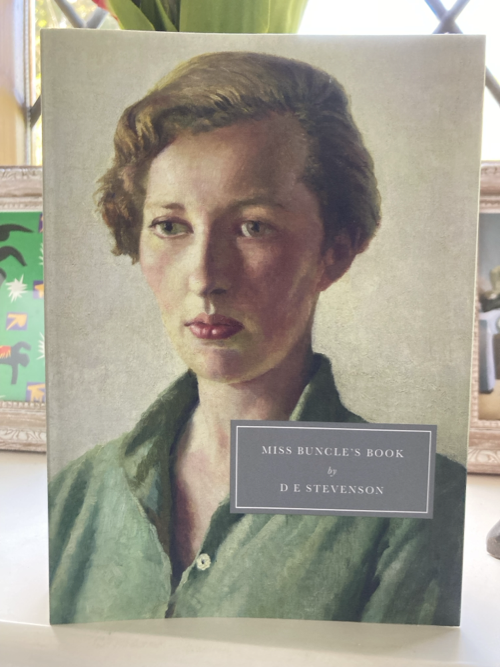
Miss Buncle’s Book by D. E. Stevenson

Unashamedly charming and cosy, Miss Buncle’s Book is an ideal comfort read – a throwback to simpler times when life was less complex and demanding than it is today while also presenting its own particular challenges. I had been looking forward to reading this one for a while and am delighted to confirm that it did not disappoint!

First published in 1934 and reissued by Persephone in 2008, Stevenson’s novel revolves around life in the fictional English village of Silverstream, which might at first sight seem a picturesque idyll, but is in fact seething with discontent. Central to the story is Barbara Buncle, an unmarried gentlewoman, much like those excellent women one finds in Barbara Pym’s novels. (Pym started writing fiction in the 1930s, which does make me wonder whether she might have read and been inspired by Miss Buncle’s Book as she embarked on her literary career. It’s an intriguing thought!)

As her parents are no longer alive, Miss Buncle lives in Tanglewood Cottage with her housekeeper and former nursemaid, Dorcas, who is now elderly but still reasonably fit. Their lives are modest, funded by share dividends Miss Buncle inherited from her parents; but the recent stock market crash has eroded their value, leaving the pair in dire financial straits.

Having ruled out hen-keeping and paying guests as potential sources of income, Miss Buncle decides that the only viable option is to write a book; but because she lacks any form of imagination, our heroine can only draw on her own knowledge – namely  the inhabitants of Silverstream and life in the village – as inspiration. The book, initially titled Chronicles of an English Village, features almost everyone in Silverstream, albeit thinly disguised with different but related names. For instance, Colonel Weatherhead becomes Major Waterfoot, Mrs Bold is renamed Mrs Mildmay and the village of Silverstream itself is disguised as Copperfield. Moreover, the novel’s narrative gives each character the storyline they truly deserve – those who are kind and considerate are appreciated by those around them, while the wicked and meddlesome are pulled up short. To keep her true identity a secret, Miss Buncle submits her book to the publishers, Abbott & Spicer, under the nom de plume, John Smith, hoping they will consider it further.

On reading the manuscript, the publisher, Mr Abbott, is duly impressed and sufficiently intrigued to learn whether its author is in fact a ‘very clever man writing with his tongue in his cheek’, or ‘a very simple person writing in all good faith’. So, imagine his surprise when he discovers that ‘John Smith’ is in fact a woman, and a unassuming one at that! By the end of his interview with Miss Buncle, Abbott is convinced that the novel is not a satire; rather, she has simply drawn on her own knowledge of Silverstream’s inhabitants to depict them as they really are. A contract is drawn up for the publication  of the novel under Abbott’s suggested title ‘Disturber of the Peace’, which Miss Buncle happily signs.

The fun really starts when Disturber of the Peace is published and swiftly becomes a runaway success. Everyone seems to be reading it, not least the inhabitants of Silverstream who soon begin to recognise themselves as characters in the novel. Somehow, John Smith seems to have seen each individual for who they really are, highlighting their hopes, preoccupations, idiosyncratic habits and deepest failings for all the world to see. Mrs Agatha Featherstone Hogg, the self-appointed queen of the village, is revealed by John Smith to be the domineering, power-hungry creature she truly is. Moreover, Agatha’s former life as a chorus girl (prior to her respectable marriage) is scandalously revealed, threatening her social standing in the village! Meanwhile, Mr Bulmer, who makes his family’s lives a complete misery, also gets his comeuppance as Disturber unfolds!

Agatha Featherstone Hogg is convinced that ‘John Smith’ must be a Silversmith resident – how else would he know everyone so intimately? – so she embarks on a campaign to discover his true identity with a view to punishing the scoundrel. There’s a hilarious residents’ meeting chaired by Mrs F. H., during which very little is actually achieved, save a false accusation made against Sarah Walker, the doctor’s intelligent wife, chiefly because she is the only Silverstream resident who doesn’t feature in the book. The main accuser is Vivian Greensleves, a ruthless gold-digger of a woman who is after the vicar’s money and will stop at nothing until he proposes marriage. Moreover, Vivian dislikes Sarah Walker and is quite willing to believe that her mischievous sense of humour and inside knowledge of the villagers (gained from her GP husband) have been channelled into the book.

As unrest mounts within the village and Mrs Featherstone Hogg threatens a libel action, Miss Buncle realises that she must intervene, but I’ll leave you to discover how this scenario plays out should you read the book. It’s all very cleverly done as art imitates life and life begins to imitate art, thereby creating a kind of cycle as one influences the other and vice versa!

Something D. E. Stevenson does extremely well here is to depict the dynamics of a quintessential English village in the 1930s, the type of place where everyone thinks they know everyone else’s business and few secrets are safe. We see how the impact of Disturber of the Peace (an apt title if ever there was one!) seeps into the social fabric of the village, destabilising the secure and comfortable atmosphere these residents have grown accustomed to. On the surface, village life might seem fairly innocuous to the casual observer; nevertheless, there is darkness lurking beneath the veneer of respectability here, much of which is exposed by Miss Buncle’s perceptive novel. While Mr Bulmer submits his compliant wife and children to crippling domestic abuse, Mr Featherstone Hogg is clearly under the thumb of his domineering wife – not pleasurable positions for anyone to be trapped in.

‘It’s a kind of – a kind of allegory,’ continued Sally gravely. ‘Here’s this horrible little village, full of its own affairs and its own importance, all puffed up and smug and conventional and satisfied with itself, and then suddenly their eyes are opened and their shackles fall off and they act according to their real natures. They’re not shams anymore, they’re real. It’s simply marvellous,’ Sally said, turning a shining face upon the astonished author. (p. 108)

A little like the transformative storyline in Vicki Baum’s excellent novel Grand Hotel, everyone in Silverstream is changed by the experience of reading Miss Buncle’s book. Mr Bulmer, for instance, is shaken by the lonely fate that awaits his doppelganger in Disturber, and he vows to be more considerate towards his family in the future. Meanwhile, Mr Featherstone Hogg is emboldened by all the fuss his wife is creating and swiftly threatens to alter his will if she pursues her farcical libel action – after all, no lawyer worth his salt would dream of taking on such a ridiculous case.

She [Agatha Featherstone Hogg] explained, somewhat incoherently, that the character of Mrs Horsley Downs was a horrible character and not in the least like her, but that it was obviously intended for her, because it was exactly like her, and that therefore it was a libel and as such ought to be punished to the upmost rigour of the law. She said the same thing a dozen times in different words, but always loudly, until Mr Spark [a lawyer] thought his head would burst. Her language became more picturesque and less polite every moment. Mr Spark began to wonder whether she really had been in the chorus when Mr Featherstone Hogg had been so misled as to marry her and elevate her to a higher sphere of life. (pp. 129–130)

Alongside the domestic abuse storyline, D. E. Stevenson also draws our attention to other social issues, some of which must have felt very progressive in the mid-1930s. Somewhat surprisingly, the villagers seem very accepting of the two unmarried women, Miss King and Miss Pretty,  who live together in the same house. While the exact nature of their relationship is never explicitly stated, it is clear to the reader that Miss King cares deeply for Miss Pretty, especially when the latter falls ill. There is also a glancing reference to the publication of Radclyffe Hall’s The Well of Loneliness, the groundbreaking novel about love between two women that created such a stir some years earlier.  Once again, the book is not named, but anyone with a knowledge of literature from this period would be able to identify it.

Post-natal depression is also touched on through references to Sarah Walker’s illness following the birth of her twins. Happily, Sarah has rallied since then, but Stevenson makes it clear that Dr Walker – a sympathetic, compassionate and caring man – was very worried about his wife’s physical and mental health following the birth. There’s also the issue of poverty, of course, explored firstly through Miss Buncle’s financial situation, and secondly, through another storyline, in which the vicar, who is actually very comfortably off, tries to live on the church’s stipend for a whole year. By doing so, he hopes to gain  a better appreciation of the challenges facing the poor, even though he struggles to survive on such a meagre income.

In Miss Buncle, D. E. Stevenson has created a most unlikely heroine, a woman that everyone in Silverstream has simply dismissed as a dull, frumpy simpleton – certainly not someone capable of writing a novel, especially one as scandalous as Disturber! Nevertheless, the reader knows that Barbara Buncle is extremely perceptive as she has sized up each Silverstream resident very accurately.

Barbara sometimes wondered what it was that gave Mrs Featherstone Hogg her social position in Silverstream. Why did everyone flock to her dull parties and consume the poor fare provided for them there? Why did everybody do what she told them to do? Why did old Mrs Carter produce her best china and linen for Agatha’s delectation? Was it because of her rude manner? or was it because she bought her clothes from the most expensive place in London? (p. 62)

The villagers, too, are delightfully drawn, from the mercenary Vivian Greensleeves and the overbearing Mrs Featherstone Hogg, to the lonely Colonel Weatherhead and the equally solitary Dorothea Bold, a match made in Heaven through Miss Buncle’s endeavours with Disturber.

In summary, then, Miss Buncle’s Book is an utterly delightful read, that type of book in which the good will be rewarded for their kind efforts while the wicked will get their comeuppance. Without wishing to give anything away, the book’s ending is perfect, showcasing a most surprising metafictional dimension to Miss Buncle’s literary talents. Highly recommended, especially for fans of The Fortnight in September, Miss Pettigrew Lives for a Day and The Enchanted April!

Lucy Carmichael by Margaret Kennedy

The English novelist and playwright Margaret Kennedy is probably best known for her second novel, The Constant Nymph, which swiftly became a bestseller on its publication in 1924. Nevertheless, I think I prefer her 1950 novel, The Feast, a delightful social comedy / morality tale set in Cornwall after the war. Faber scored a hit with this novel when they reissued it a few years ago, and you can read my thoughts on it here – it really is a treat!

Lucy Carmichael swiftly followed in 1951, and while it’s a more uneven novel than its predecessor, there’s still much for fans of Kennedy’s fiction to enjoy here. In short, Kennedy shows us how the titular Lucy Carmichael manages to rediscover herself by finding a new purpose in life following a bitter blow. Resilience is a key theme, but the novel is not without humour, with Kennedy’s flair for wit being evident throughout, despite noticeable moments of disenchantment and despondency. My feelings about this book waxed and waned somewhat as I was reading it, mostly because it would have benefited from some sharper editing; nevertheless, Lucy’s tenacity and spirit won through by the end.

While the novel revolves around Lucy, a bright, principled Oxford-educated young woman, we first glimpse Kennedy’s heroine through the perspective of her college friend, Melissa, as she discusses Lucy with her fiancé, John.

When she is well and happy she is extremely beautiful. When she is out of sorts or depressed she is all nose, and dashes about like an intelligent greyhound after an electric hare. […] She is incautious and intrepid. She will go to several wrong places, and arrive at the right one, while I am still making up my mind to cross the road. She is my opposite in character. She is cheerful and confident and expects to be happy. She taught me how to enjoy myself. (p.10)

Lucy, we soon learn, is also engaged, but Melissa is worried about her friend’s imminent marriage to the botanist / explorer, Patrick Reilly, whom she considers inferior to Lucy. Rumours of a rekindled affair between Patrick and an old flame, Jane Lucas, have reached Melissa’s ears, casting a shadow over her feelings about the wedding. When Lucy’s mother detects that Melissa is harbouring misgivings, she offers the following response:

‘I don’t let myself worry about Lucy,’ she said. ‘I think that, whatever happens to her, she’ll come through it all right. She’s very…very true to herself, if you know what I mean.’

Melissa nodded.

‘She doesn’t deceive herself. She is the more in love of the two. I think she knows it. I am not sure that she is going to be happy. But she will never deceive herself. […] She may be sorry she married him, but she will never be sorry that she loved. (p. 32)

But despite Melissa’s concerns for her friend, Kennedy lets us know that Lucy is entering this marriage with her eyes open, having already learnt of Patrick’s shortcomings.

She [Lucy] had loved him from the first meeting, long before she knew that inner history, his disgust, his self-contempt, his degrading infatuation for Jane Lucas, his half-hearted schemes for escape, for another life. She did not love him because she knew all this: she knew all this because she loved him. (p. 38)

As revealed in the first line of the novel’s blurb, Patrick fails to show up at the church on his wedding day, abandoning Lucy and her family to clear up the mess. In spite of her obvious devastation, Lucy is sufficiently level-headed to know that a move to pastures new would be the best way to start afresh – somewhere where no one knows her relationship history and humiliating rejection.

Through a tip-off from a college friend, Lucy lands a job at an Arts Institute in Ravonsbridge, a small town in Severnshire, well away from the gossips of Goring. In her new role with the Institute’s drama department, Lucy is plunged into a complex web of petty internal politics and underhand manoeuvres involving the organisation’s staff, Council members and longstanding patron, Lady Frances Millwood, who is likened to Jane Austen’s Lady Catherine de Bourgh, but ‘with heart’. Having been established by Lady Frances’ late husband, Matthew Millwood, the Institute aims to provide first-rate concerts, plays and arts education to the local community.

As the novel unfolds, there is no shortage of developments to keep Lucy occupied, from managing the Institute’s production of Hamlet when a senior colleague goes abroad, to a romantic entanglement with Lady Frances’ son, Charles, who becomes increasingly smitten with the new arrival as the weeks pass. In particular, she derives genuine satisfaction from helping quite ordinary people to produce something remarkable in a small, provincial setting. But internal politics at the Institute prove particularly trying for all concerned, and before long, Lucy, with her upstanding principles and values, ruffles some feathers amongst the powerful higher-ups, much to their annoyance.

Central to the novel is the question of whether Lucy should settle for the security of marriage with someone she doesn’t truly love, or hold out for ‘the one’, even though her ideal match might never come along. (Frustratingly, she would have Patrick back in a heartbeat if he ever reappeared.) Kennedy keeps us guessing about Lucy’s future until the closing chapters; nevertheless, fans of a hopeful ending will find it satisfying, I think.

The class divide is another key theme, and Kennedy explores this through tensions between Owen Rees, a talented actor from the working class sector of town, and Lady Frances’ son, Charles, firmly a member of the upper-class milieu. Both Owen and Charles are attracted to Lucy, albeit in different respects, which adds to the antagonism between them.

The novel is at its strongest, however, when focusing on human nature, particularly Lucy’s inner feelings as she tries to recover her sense of self. Kennedy has a keen understanding of human behaviour, and there are several perceptive insights into rejection, resilience and happiness, hiding amongst the pretty politics at Ravonsbridge and other secondary storylines.

But Lucy’s heart was unoccupied, since the sorrowful ghost of Patrick had ceased to haunt it. Friends lodged there and enjoyed its generous hospitality, but no one called it home. (p. 430)

Lucy’s relationship with Melissa is lively, caring and beautifully drawn, so much so that I would have liked less Ravonsbridge politics and more interactions between the two college friends to add spark and genuine insight. At Melissa’s wedding, for instance, everyone remarks on how well Lucy is looking, the unspoken implication being that she is bearing up adequately despite the trauma of being jilted at the altar. Nevertheless, these well-meaning comments have the opposite effect, as they leave Lucy wondering if she will ever be free of this awful stigma.

He [John], like everybody else, was determined to remember her trouble just when he had every excuse for forgetting it. There was to be no escape. Where she was known, she must take it about with her like a label which nobody would allow her to remove. She had thought that she would remember long after everyone else had forgotten, but it seemed as though things might turn out the other way. She herself could now go for days at a time without any painful recollections, while to all these people she was permanently an object of compassion. (p. 209)

There are also some beautifully poignant scenes in the novel’s opening section as Lucy realises that her frequently irritating younger brother, Stephen, is trying to fill their father’s shoes by stepping up to the plate in a time of crisis. It’s heartbreaking for her to observe, particularly as the shock of being abandoned by Patrick is still sinking in at this point.

Nevertheless, the lengthy sections on the Institute’s internal politics lack focus and are too drawn out. There’s the makings of a good novel here, but it seems in need of a ruthless edit to strip away the unnecessary fat.

While the novel in its entirety is something of a curate’s egg, I enjoyed spending time with Lucy and Melissa, and Kennedy’s observations on life, love, and the nature of happiness are undoubtedly perceptive. I’ll finish with a passage from the novel’s closing chapters, which are beautifully done.

She had been perfectly happy by herself. He had seen that in his first glimpse of her. All alone and perfectly happy, flying through the wintry fields. And now he had come tumbling down the bank, wanting to shatter this solitude, wanting her never to be happy again unless he was there. It was, he felt, rather tough to be planning to sweep her off her feet in a week. It was hardly fair to a girl who could manage to be happy, all alone, in spite of so much sorrow, defeat and humiliation. I must never forget it, he told himself. If she comes, I must never forget what she gave up for me. (p. 471)

Lucy Carmichael is published by Penguin Books; personal copy.

Woman in the Pillory by Brigitte Reimann (tr. Lucy Jones)

A few years ago, I read and very much enjoyed Siblings, an edgy and evocative novella by Brigitte Reimann, one of East Germany’s foremost writers from the mid-20th century. Somewhat surprisingly, especially given the quality of her prose. Siblings was the first of Reimann’s books to be translated and published in English; but now we have another novella to enjoy. Woman in the Pillory, also ably translated by Lucy Jones.

When Siblings came out in 1963, it illustrated Reimann’s ideological belief in the possibility of an egalitarian socialist future in the GDR following the turmoil of the Second World War. Woman in the Pillory is, however, an earlier and more straightforward novella than Siblings, but if anything, I found its clarity of focus and underlying message even more compelling. In essence, the book is a testament to the importance of showing compassion and humanity to other nationalities in the most testing of circumstances, while also illustrating the devastating consequences for families when these values are extinguished – in this instance, cruelly overridden by heinous nationalist rhetoric.

Published in Germany in 1956, Pillory is set in a rural German community in 1943, the type of village where everyone closely monitors everyone else’s business, especially during wartime. Reimann’s primary focus is Kathrin Marten, a sensitive, self-effacing woman in her late twenties. Pale, thin and delicate by nature. Kathrin and her husband Heinrich have been married for five years, but they are not terribly well-matched. Heinrich, who we soon discover married Kathrin to gain access to her farmland, is stocky, crude and prejudiced, the very opposite of his wife in appearance and temperament. While Heinrich is away at war, fighting the Russians on the Eastern Front, his equally overbearing sister, Frieda, rules the roost back at the farm, bossing Kathrin around as if she were a maid and the property were Frieda’s own.

With the women in need of additional labour to maintain the farm, Heinrich arranges for a Russian prisoner of war to be sent to help – after all, the captive can be locked in the barn at night to ensure he doesn’t escape. Consequently, Horst Lange, the local overseer, allocates a Ukrainian prisoner named Alexei to the Martens’ farm. At first, Kathrin is wary of Alexei, having heard rumours of brutality elsewhere, a misguided view fuelled by Frieda’s determination to brand the Russians as half-human, no better than animals who need to be watched. If anything, Frieda seems to enjoy working Alexei to the bone, admonishing Kathrin for suggesting they give him a blanket to keep out the cold at night – there will be no mollycoddling of prisoners as long as Frieda is in charge of the house. Meanwhile, Alexei simply accepts his fate, working hard and saying as little as possible to avoid rocking the boat.

One day, when Alexei spontaneously helps Kathrin with a heavy load, she sees the humanity behind the veneer of his status as a POW. Despite losing his entire family to the war, Alexei remains idealistic – touchingly hopeful for the emergence of a new, more positive kind of society once the conflict is over. These glimpses of benevolence give rise to a dilemma in Kathrin’s mind. Should she show some compassion towards Alexei, even though he is Russian and an enemy of her country? Or should she side with Frieda by treating him like a slave? Unsurprisingly, particularly given Kathrin’s sympathetic nature, decency and morality win through, and she warms to Alexei, treating him with dignity as they go about their work.

He looked at her and, for a moment, the apathy and stoicism vanished from his face. He smiled. Confused and shocked, not knowing where to look, Kathrin quickly turned away. The man left, and she could hear his footsteps on the flagstones in the entrance hall alongside the hammering of her heart. […]

The Russian was singing. Kathrin hadn’t sung for a long time, not since she was a little girl. But ever since she’d moved to this house, she’d fallen silent.

In the yard, the stranger’s song was dark, mournful. It seemed both familiar and unfamiliar to Kathrin at the same time. (p. 12)

Slowly but surely, a tender relationship develops between Kathrin and Alexei, mostly through shared private moments when Frieda is out of sight. In due course, this friendship blossoms into love, throwing the emotionally strained nature of Kathrin’s relationship with her husband, Heinrich, into sharp relief. In short, Alexei is everything that Heinrich is not – sensitive, loving, compassionate and humane.

From then on, the prisoner of war and the farmer’s wife sat on the upturned trough next to the pump every evening, talking or sitting together in silence. There was a lot of work to do in May, and time was racing on, but despite their exhaustion, they still found time for that one hour of the day and spent the other twenty-three hours living for it. They called what they felt for each other friendship, and sometimes they even believed that friendship was what they felt for each other. (p. 46)

When Kathrin receives word of Heinrich’s achievements on the front – the remorseless slaughter of entire villages, women and children included – she is disgusted and pledges her heart to Alexei in a shared vision of their future.

But despite these glimmers of hope, we sense a reckoning on the horizon of Kathrin and Alexei, especially given the novella’s ominous title. As talk of the pair’s closeness spreads throughout the village, it is only a matter of time before the lovers are discovered in a compromising position, cleaving open their privacy to the condemnation of others…

When Kathrin Marten walked down the road to the baker’s, she was followed by furtive looks. She’s got a skip in her step today! She’s got her chin up! What a bright blouse she’s wearing! Some women stopped her and tried to draw her into conversation, not bothering to hide their insinuations: How was the prisoner getting along? Was she satisfied? (p. 69)

Reimann skilfully exposes the inherent hypocrisy in German society here. Why, for instance, is it considered an honour for German women to sleep with SS officers and bear their children, while relationships with prisoners of war or foreign nationals are branded as betrayals? Surely, emotions as natural as love and desire should transcend national and racial boundaries? Otherwise, what hope for humanity remains in a strictly segregated world? There are other references to double standards too, not least Heinrich’s determination for his own farm to prosper while he willingly destroys the lives and livelihoods of his Russian contemporaries on the battlefield.

Kathrin said harshly, ‘Can you make sense of it all? Heinrich takes care of his fields and when he’s on leave, he slaves away to keep everything running smoothly – only to set off and destroy fields in another country and burn down other people’s farms…It’s all so hard to understand.’ (p. 56)

Despite the slim nature of this book, Reimann manages to convey some excellent character development here, especially in her portrayal of Kathrin, who blossoms from a slight, submissive creature to a stronger, more assertive woman as her relationship with Alexei deepens. It’s a joy to see her standing up to Frieda, who has grown increasingly bitter and small-minded as her own prospects for happiness have dwindled.

Kathrin said,’ I’m the head of the house, not you [Frieda]! You’re only here on sufferance, you understand? For far too long you’ve been ordering me around – and now that’s over, for good! I’m the one who’s going to run things around here from now on and I say that the Russian eats at our table. If you don’t like it, you can leave.’ (p. 36)

Moreover, Reimann carefully avoids making her characters seem too black or white. Both Henrich and Frieda are shown to experience conflicting emotions from time to time, hinting at more morally complex and nuanced values than might be apparent at first sight. There are glimmers of soul-searching and remorse here, even if these regrets are secondary to racism. The minor characters are nicely drawn too, particularly Kathrin’s friend, Trude, the local district nurse who has lost loved ones in the war. More worldly-wise than Kathrin, Trude warns her friend of the dangers of forming any kind of attachment to Alexei, not because she is prejudiced (in fact the opposite is true) but because she doesn’t want Kathrin to be tortured, a cruel inevitability if a transgression is suspected.

‘But still, Kathrin, you have to be careful. In this country, among these people, even friendship is dangerous. He’s a Russian, after all, and people hate Russians here. They don’t see them as human and call them an inferior race…It’s like there’s a toxic gas in their heads, so that they can’t see clearly any more and believe the craziest nonsense.’ (pp. 63–64)

‘…you probably hate me now. You think I despise these women because they fell in love with Russians. Yes, I wanted to give you a shake. I wanted to show you the terrible things people do in blind hatred and show you what you’re up against if someone pins something on you, or finds out about your relationship with Alexei. Yes, even if it is just a friendship – who’s going to believe that?’ (p. 65)

The novella’s sense of place and descriptions of life on the farm are suitably vivid, and there’s a blunt, raw quality to Reimann’s prose, which somehow feels in keeping with the powerful emotions portrayed in this story of forbidden love in the face of jingoistic nationalism. In truth, no nation should be considered superior to any other, and there are compassionate and heartless Germans, just as their equivalents exist in every other country on earth.

Highly recommended, especially for readers interested in the moral complexities of war and their impact on families. Fans of Sally Carson’s excellent novel Crooked Cross might find this an interesting companion piece from the East German perspective, and there are resonances with other stories from this period, too. My thanks to Penguin Classics for kindly providing a review copy, and I hope to see more of Reimann’s work being translated in the future!

The forthcoming #1961 Club – some recommendations for books to read

In a few weeks’ time, Karen and Simon will be hosting another of their hugely enjoyable ‘Club’ weeks, focusing in this instance on 1961. Starting on Monday 13th April, the #1961Club is a week-long celebration of books first published that year. These reading events are always great fun, with various tweets, reviews and recommendations flying around the web, giving readers an overview of the relevant period in literature.

Unsurprisingly, given my fondness for the 1960s, I’ve already reviewed a few 1961 books on the blog, and they’re all interesting in one sense or another. So, if you’re thinking about taking part in the Club, here are some recommendations for books to consider.

Bird in a Cage by  Frédéric Dard (tr. David Bello)

With an output bordering on that of fellow crime writer Georges Simenon, Frédéric Dard was one of France’s most popular and productive post-war novelists. First published in French in 1961, Bird in a Cage is one of his ‘novels of the night’, a dark, unsettling mystery with a psychological edge.

As the novella opens, our narrator, Albert, has just returned to his former home in Levallois, a suburb in Paris, after a six-year absence. His loneliness and sense of unease are palpable from the outset as he enters a damp, empty flat, the place where his mother died some four years before. In an attempt to reconnect with his life and memories of happier times, Albert heads out into the streets of Levallois, which are bustling with activity on Christmas Eve. At a restaurant, he catches sight of an attractive woman, someone who reminds him very strongly of a girl he used to know from his dark and mysterious past. The woman is with her young daughter, but there is no man on the scene, and in some ways, their shared loneliness strikes Albert as being even more tragic than his own. After exchanging glances a few times during their meals, Albert and the woman end up leaving the restaurant at the same time. It could be a coincidence, but maybe it isn’t…

At the centre of this story is a crime which is fiendishly clever in its execution. I don’t want to say too much about what happens here, save to say that poor Albert finds himself caught in the middle of it. As this fateful night unravels, there is at least one occasion when he could walk away from this situation, removing himself from imminent danger in the process. Instead, Albert chooses to remain close at hand, almost as though he is fascinated by this woman and everything she appears to represent. This taut, dreamlike novella has also been adapted for the screen as Paris Pick-Up (1962), and I can heartily recommend both!

No Fond Return of Love by Barbara Pym

I love Barbara Pym, an author whose humane explorations of unrequited love among the genteel middle classes are both charming and quietly poignant. She creates an idiosyncratic yet oddly recognisable world of ‘excellent’, well-meaning spinsters, fusty academics and other befuddled men, which I find thoroughly engaging. No Fond Return of Love was Pym’s sixth novel, the last one to be published by Jonathan Cape before their well-documented rejection of An Unsuitable Attachment, which ushered in her ‘wilderness years’, a period that eventually ended in 1977 following prestigious recognition from Philip Larkin and Lord David Cecil.  

No Fond Return revolves around Dulcie Mainwaring, a thirty-something spinster who works as an indexer and proofreader from her home in the London suburbs. As the novel opens, Dulcie has just arrived at a ‘learned conference’ for indexers, a gathering she hopes will enable her to meet some new people, particularly as a recent break-up with former fiancé, Maurice, has left her feeling conscious of her status as a lonely, unattached spinster.

On the first evening, Dulcie meets Viola Dace, a fellow indexer who happens to be in the room next door. At first sight, the two women present quite a contrast to one another – Dulcie looks rather dowdy in her tweed suit and brogues, while Viola appears more confident with her black dress and rather unruly hair. As the two women get talking, it becomes clear that Viola knows one of the speakers at the conference, the rather handsome editor, Dr Aylwin Forbes, with whom she has an interesting history.

The suitability or not of various ‘matches’ is a key theme here with Pym using Dulcie’s observations on the nature of relationships, particularly those between men and women, as a recurring thread. On two or three occasions, Dulcie thinks back to her time with Maurice and wonders if it is sadder to have loved someone unworthy of her affection than to never have loved at all. As ever with Pym, there’s much to enjoy here – not least, the beautifully drawn secondary characters and humorous set-pieces, two of this author’s main strengths. To summarise, it’s a delightful novel in which maybe, just maybe, there will be a fond return of love after all!

Call for the Dead by John le Carré

Le Carré’s debut novel, Call for the Dead, was also the first outing for his most famous creation, George Smiley, a career spy within the British overseas intelligence agency, commonly known as ‘the Circus’ due to the specific location of its London base. This very enjoyable mystery serves as a good introduction to Smiley and certain elements of his backstory, particularly the troublesome nature of his relationship with flighty ex-wife, Ann, who is often referenced in le Carré’s books, though rarely seen in depth.

Following a routine security check by Smiley, Foreign Office civil servant, Samuel Fennan, apparently commits suicide, triggering a meeting between Smiley and Maston, who heads up the Circus. All too soon, Smiley realises he is being set up to take the blame for Fennan’s death, something he finds both troubling and suspicious, particularly as his interview with the civil servant had ended quite amicably.

The arrival of a letter from Fennan, posted shortly before the man’s death, adds to the mystery, suggesting that he had something pressing to pass on to Smiley following their initial meeting. When Smiley is warned off the case by Maston, he begins his own investigation into Fennan’s network, which brings him into contact with the East Germans and their agents.

Le Carré clearly has points to make here about the intelligence agencies – for instance, the way they use people as pawns on a chessboard, illustrating a lack of humanity at the heart of the system. While Call for the Dead might not be the author’s most polished novel, it’s still highly compelling and convincing – a well-crafted literary spy novel with some memorable moments of tension along the way. Plus, it’s a great introduction to Smiley with his quiet, perceptive disposition and expensive yet ill-fitting clothes. I liked it a lot!

Voices in the Evening by Natalia Ginzburg (tr. D. M. Low)

The award-winning Italian writer Natalia Ginzburg has been a major discovery for me over the past seven years, largely due to Daunt Books’ and NYRB Classics’ sterling work on reissuing her books. Much of Ginzburg’s fiction explores the messy business of family relationships, the tensions that arise when people behave selfishly at the expense of those around them. In contrast to characters in many British and Irish novels, Ginzburg’s protagonists don’t keep their feelings under wraps; instead, they express them openly, typically using the blunt, direct language that characterises this author’s work.

In many respects, Voices is an episodic book, a series of interconnected vignettes that depict the lives and loves of various members of one particular family, all set in a small Italian village, viewed from the perspective of the years following WW2. Central to the novel is Elsa, an unmarried twenty-seven-year-old woman who lives with her parents in the watchful village community, a place where gossip and arbitrary judgments are prevalent. The narrative is bookended by two ‘conversations’ between Elsa and her mother. I use the term ‘conversation’ with caution, as the dialogue is in effect a monologue with Elsa remaining silent in the face of her mother’s barbed musings and pointed observations. These opening and closing vignettes set the tone for the novel, emphasising the sense of distance between Elsa and her mother, a feeling of separation between the generations.

Voices is a simple yet subtle novel, one that explores the tension and discontentment in various conflicts  – those between mothers and daughters, men and women, and ultimately between different values and ideals, particularly in a small, close-knit community. There’s a strong sense of estrangement running through the story, a feeling of separateness and isolation in a shifting world; meanwhile, the shadow of war looms ominously in the background, accentuating a feeling of unease and instability.

Ginzburg’s prose is direct and unadorned in a way that leaves quite a bit of space in the narrative, and in some instances, what is left unsaid between individuals can seem just as significant as what is shared. It’s a book I’d like to revisit sometime, now that I’ve read almost all of Ginzburg’s translated work.

Clock Without Hands by Carson McCullers

Set in 1953 in a small town in Georgia, this excellent exploration of interracial tensions focuses on four men whose lives are connected by past and present events. As the novel opens, thirty-nine-year-old J.T. Malone, owner of the local pharmacy, learns that he is suffering from leukaemia and is given only twelve to fifteen months to live. This news prompts the unassuming Malone to reflect on his life and its disappointments: for instance, the lack of intimacy and love in his stilted marriage, and a sense of bewilderment as to how he lost his way.

Malone’s closest friend and confidante is Judge Fox Clane, a rambunctious former congressman who has suffered his own tragedies, including the loss of his son, who continues to haunt his thoughts.

Judge Clane believes in white supremacy and the ‘noble standards of the South’. Firmly in favour of maintaining racial segregation in all aspects of civilised life, the Judge holds views in direct opposition to those of his grandson, the sensitive Jester Clane (the third of our four main characters and Johnny’s son).

The story moves up a notch when Jester befriends a local black boy, Sherman Pew, a bright, confident and articulate orphan who was abandoned on a church pew as a baby. Sherman, who is unaware of the identity of either of his parents, is connected to Judge Clane in more ways than one; he once saved Clane from drowning and is now in his employ as an ‘amanuensis’  to write letters and attend to his needs. At times, Sherman revels in his position as Judge Clane’s ‘jewel’; he considers himself a cut above the other household help and often behaves in a rude or fickle manner towards Jester, whose feelings for Sherman run deep.

As the narrative unfolds, we learn more about past events, which shed a different light on the connections between these characters. The circumstances surrounding Johnny’s suicide become clear to Jester, prompting him to choose a particular path for the future. And when Sherman discovers information regarding the identity of his parents, the consequences of subsequent events touch all the main players here.

With great insight and understanding of the human condition, McCullers focuses on interracial tensions and injustices and how these ‘sit’ alongside our beliefs and principles. The novel’s title is also significant; racial integration would move the clock forward, but Judge Clane seems content for the South to remain in the early-‘60s, or even to revert to bygone days. It’s an excellent introduction to Carson McCullers’ work, a writer I’d like to explore in more detail.

The Wycherly Woman by Ross Macdonald

Ostensibly a ‘missing girl’ story, albeit one with many, deeper layers to reveal, The Wycherly Woman is an excellent entry in Macdonald’s Lew Archer series. Based in LA, Archer is a private eye with a conscience, a fundamentally decent man in pursuit of the truth, who finds himself battling against the systemic violence and corruption that frequently exist in dysfunctional families, corrupt organisations and other powerful institutions.

While the novel delves into many of this author’s favourite themes – twisted, dysfunctional families with dark secrets to conceal; highly damaged individuals with complex psychological issues; and finally, elements of greed, murder, blackmail and guilt – there’s something very melancholic about this one, a tragic sadness that’s hard to shake.

As ever, Archer approaches these tangled networks of crime, corruption and cover-ups with his usual world-weariness and dogged pursuit of the truth. In some respects, the intricacies of the plot are not particularly important here (for me, least); rather, much of the pleasure stems from observing Archer doing his job, which Macdonald conveys in his trademark hardboiled style. The writing is excellent throughout, very much in tune with the mood of this genre.

Recommended, especially for fans of Raymond Chandler and Dashiell Hammett – or any crime fiction with a moody atmosphere and strong sense of place

Do let me know if you like the sound of any of these books – and your thoughts if you’ve read any of them. Or maybe you have plans of your own for the #1961Club. If so, feel free to mention them here.

The Levant Trilogy (Books Two and Three) by Olivia Manning

One of my informal reading aims for 2026 is to read Olivia Manning’s Levant Trilogy, which, together with her earlier Balkan Trilogy, forms The Fortunes of War, a superb, largely autobiographical series of novels based on the author’s experiences during the Second World War. Viewed as a whole, the series offers a unique insight into lives lived on the advancing edges of war as the Germans closed in on Eastern Europe and North Africa. Moreover, it also provides an acutely perceptive portrait of the early years of a fraught marriage unfolding against the backdrop of displacement and uncertainty. In these books, we meet Guy and Harriet Pringle as they embark on married life, firstly in Bucharest, where Guy is employed by the British Council as a University lecturer, then in Athens, and finally in Cairo, where he initially finds himself sidelined with fewer opportunities to put his teaching skills to good use. The Pringles are, of course, based on Manning and her husband, Reggie Smith, and the fictional couple’s movements across the Balkans and the Levant mirror those of the author and Smith.

While this post covers books two (The Battle Lost and Won) and three (The Sum of Things) in The Levant Trilogy, I’m going to keep major plot developments to a minimum to avoid spoilers. Instead, this piece is more about the characters, along with some thoughts on Manning’s themes. (I wrote about the first Levant book, The Danger Tree, back in January; so, if you need a refresher, just click on the link.)

As The Danger Tree ends, the Pringles are still in Cairo, but their marriage appears to be in more trouble than ever, with Guy continuing to put the emotional needs of his friends, acquaintances and students ahead of Harriet’s. Meanwhile, Guy wonders if Harriet would be better off in England, particularly as her physical health seems to be suffering in Egypt.

Developments come thick and fast in these novels, taking in adulterous affairs, chance encounters, dramatic separations, numerous close shaves, a murder in the ex-pat community, severe fevers that sometimes end in tragedy, and death in the desert conflict. At one point, a character is declared missing (presumed drowned) following a tragedy at sea, but to say any more would be a spoiler, I think.

While the Pringles remain the beating heart of Manning’s trilogies, we see less of Guy in books two and three of the Levant than in earlier instalments of the series, partly because Guy’s insensitivity over a personal matter prompts Harriet to strike out on her own. 

Dissatisfaction – chiefly Harriet’s – was eroding the Pringles’ marriage. Harriet had not enough to do, Guy too much. Feeling a need to justify his civilian status, he worked outside of normal hours at the Institute, organizing lectures, entertainments for troops and any other activity that could give him a sense of purpose. Harriet saw in his tireless bustle an attempt to escape a situation that did not exist. Even had he been free to join the army, his short sight would have failed him. He thought himself into guilt in order to justify his exertions, and his exertions saved him from facing obnoxious realities. (p. 241)

Harriet’s spur-of-the-moment travels take her to Syria and Palestine, where she demonstrates impressive levels of independence on limited resources while also seeing more of the Levant. Meanwhile, Guy continues to be Guy, throwing himself into his work, partly as a means of justifying his existence. (Again, it’s tempting to say more about the Pringles, but I’ll leave it there to avoid spoilers.)

Manning is especially adept at capturing the social circles in which Harriet and Guy move, including Dobson, the British Embassy official with a comfortable Garden City flat which becomes home to the Pringles, and Edwina Little, a bright young thing with a string of eligible suitors at her fingertips. In truth, Edwina is something of a gold-digger, setting her cap at Peter, an Irish peer stationed in Egypt with the army.

Perhaps sharpest of all is Manning’s portrayal of the wealthy and rather louche British ex-pats determined to carry on dining and drinking in the best restaurants in Cairo, irrespective of the war. Lady Angela Hooper, a good friend of Harriet’s, is a case in point. To the Pringles’ initial surprise. Angela begins a passionate affair with Bill Castlebar, a married poet and lecturer colleague of Guy’s. However, with his possessive wife, Mona, stranded in England, Castlebar is uninhibited by his married status and spends most afternoons closeted together with Angela in her room at Dobson’s Embassy flat. As Harriet reflects at one point:

She had seen common-place English couples who, at home, would have tolerated each other for a lifetime, here turning into self-dramatizing figures of tragedy, bored, lax, unmoral, complaining and, in the end, abandoning the partner in hand for another who was neither better nor worse than the first. Inconstancy was so much the rule among the British residents in Cairo, the place, she thought, was like a bureau of sexual exchange. (pp. 336–337)

As ever, the sense of place here is superb. Manning excels at portraying the cultural feel of her settings, and her depictions of the different pockets of Cairo are especially vivid.

The taxis had taken them past the Esbekiyah into Clot Bey where women stood in the shadows beneath the Italianate archers. From there they passed into streets so narrow that the pedestrians moved to the walls to enable the taxis to pass. No one, it seemed, needed sleep in this part of the city. Women looked out from every doorway. It was here that the squaddies came in search of entertainment and every café was alight to entice them in. Loudspeakers, hung over entrances, gave out the endless sagas relayed by Egyptian radio, while from indoors came the blare of nickelodeons or player pianos thumping out popular songs. (p. 230)

Of all the characters in this trilogy, Simon Boulderstone is the one who grows and develops the most over the course of the story. After arriving in Egypt as a new junior officer barely out of his teens, Simon must cope with the senseless loss of his brother, Hugo, who bled to death in the desert. Despite his recent marriage, Simon gives little thought to his new wife while in Egypt. (In truth, they only had days together before he had to leave for the war.) Instead, his mind turns to the attractive young socialite, Edwina Little, whom he still thinks of as Hugo’s girl. Now that Hugo has been killed in action, Simon wonders if he might stand a chance with Edwina himself, especially given the family resemblance…

As Simon drove back, Edwina was still on his mind. He tried to order her away but she stayed where she was, smiling down on him from the balcony. The desert to air was a sort of anaphrodisiac and he and the other men were detached from sex, yet he could not reject the romantic enchantment of love. (p. 262)

Simon’s story is a coming-of-age of sorts, one that requires him to face emotional and physical challenges in the most trying of circumstances. However, by the end of The Levant Trilogy, he is a new man, free of the burdens that have been holding him back for months.

She [Edwina] had been a fantasy of his adolescence but now he had not only reached his majority, he was verging on maturity. He had been the younger son, Hugo’s admirer and imitator, and Edwina’s attraction had lain not only in her beauty but the fact he had believed her to be Hugo’s girl. He had wanted to be Hugo and he had wanted Hugo’s girl, but now he was on his own. And Edwina had been no more Hugo’s girl then she could be his. (p. 538)

War has changed Simon beyond his wildest expectations. Now he wishes to stay in the army, preferably in the thick of the action. After all, what else can he do? The thought of home doesn’t appeal to him anymore. He knows he would feel out of place there because too much has happened for him to go back.

Thinking of his return to a wife he had almost forgotten, Simon wondered how he would fit into a world without war. He would have to begin again, decide on an occupation, accept responsibility for his own actions. What on earth would he do for a living? He had been trained for nothing but war. (p. 357)

As this wonderfully immersive series draws to a close, there are hints that Guy might be more conscious of Harriet’s emotional needs than he was before, but in practice, one wonders if his day-to-day behaviour will ever change. (Probably not!) Nevertheless, Manning absolutely succeeds in portraying both Pringles as complex, authentic and flawed individuals – just as we all are in life. I’ve loved spending time with these characters and will miss them greatly. Both trilogies are very highly recommended, especially for readers interested in this period.

The Levant Trilogy is published by NYRB Classics in the US and by W&N in the UK; personal copy.