Crunchy

Baby-Led Weaning: Week One

Read more about Baby-Led Weaning here . . .

We’d really been hoping to hold off on introducing solids until Squirm was six months old, but it seems that he had his own opinions on that. There’s a number of signs which indicate that babies are ready for solids, including sitting with little or no support, effectively reaching out and grabbing things, taking objects to their mouth quickly and accurately and making gnawing and chewing motions. Squirm had been doing all of these, plus trying to grab for things from our plates and gnawing on the dining table . . . and he’d started to get really, really upset when he saw people eating and he wasn’t joining in.

So we offered him a piece of cucumber, which went straight in his mouth and was gnawed on – and we were all systems go with baby led weaning.

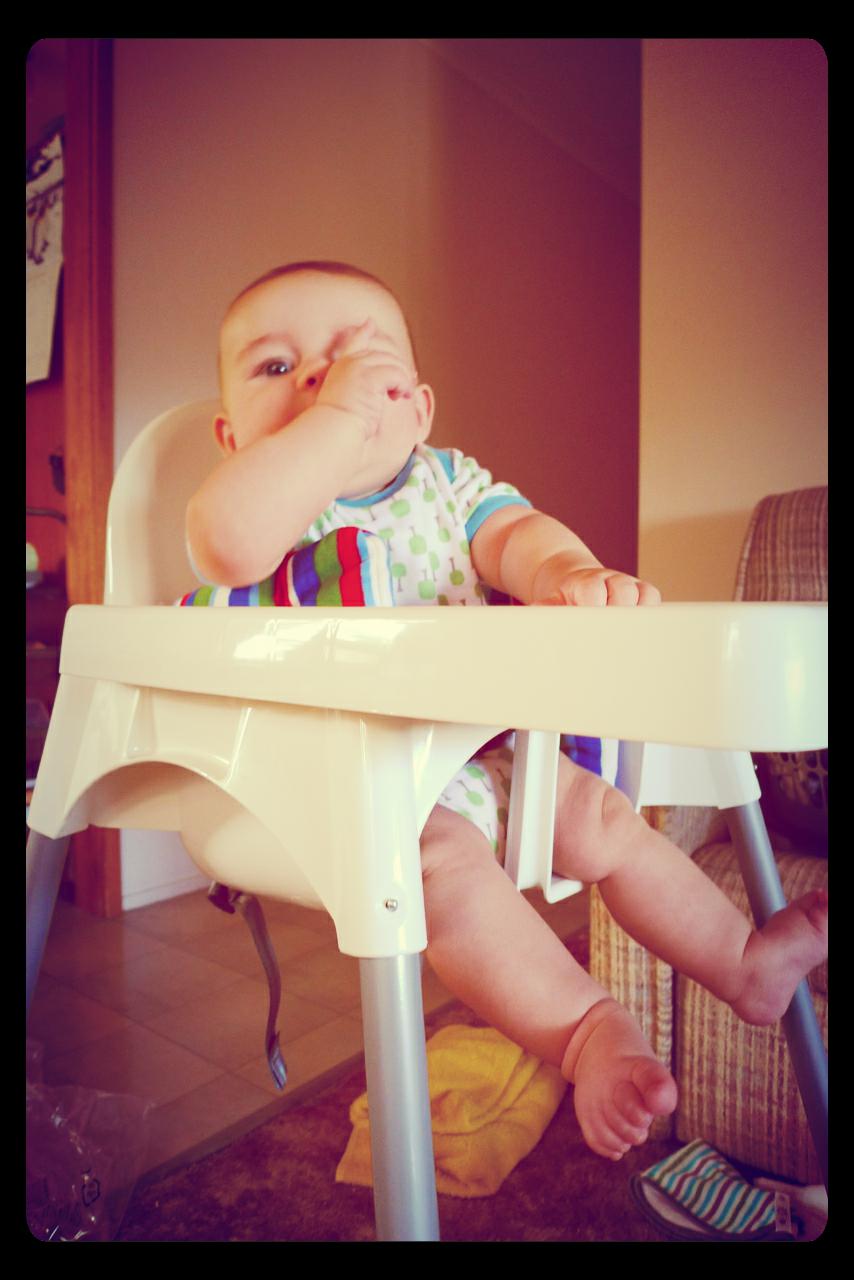
It’s been nearly a week now, and Squirm has been joining us for most breakfasts, lunches and dinners. He pretty much shares what we’re eating, though there’s some food we don’t yet give him for safety reasons. Of course he has much smaller versions of our food! So far he’s tasted a bit of – well almost everything! He’s had bread, yoghurt, cream cheese, weet bix and fruit for breakfast, savoury pancakes, tomato, cucumber and chicken at lunch, vegetables, salad food, rissoles, lamb, salmon and pesto at dinner. Most of the time he doesn’t swallow much, if anything at all – but he has an awful lot of fun picking the food up, squeezing it, putting it near his mouth and moving it around the tray!

What have we discovered so far?

1. Ikea High Chairs are the BEST

Squirm loves his cheap high chair from Ikea. We’ve bought the tray that goes with it, which is perfect for putting his food on (we’ll move him to a plate later) and the whole thing is light to move around (we place it on a plastic mat at meal times) and really quick and easy to clean. If you’re buying a high chair and anywhere near an Ikea, I highly recommend it!

2. The Mess is Big, But Could Be Much Worse

Because Squirm was really ready for solids, we’re finding most of the food is going from the tray to his mouth, so he’s not getting nearly as much on his face as I thought it would. He often drops it back on the tray, or on the floor (thus the mat), but since we’re mostly doing chunked pieces, it’s easy to pick up off his mat (which we clean each time) and pop it back on his tray. His hands get the dirtiest because he likes hitting the food on his tray, and of course he’s using them to eat. The couple of times we’ve been away from home, I’ve made sure to offer less messy food.

3. We Don’t Really Need to Help Him

We put a small range of food on Squirm’s tray and he usually chooses what he wants to eat and puts it up to his mouth to taste – sometimes he grabs two different things in different hands! A couple of times we’ve held food up to him to show him, especially if his attention has wandered, and sometimes he figures out how to do things from watching us. The big surprise was that he can actually handle a spoon pretty well if we put food on it. It started when he kept lunging for my yoghurt, so I popped a bit on a spoon for him, which he then popped straight in his mouth! Most of the time the right end of the spoon goes in the mouth, but part of the time the food goes elsewhere, or he bites on the wrong end – adds to the hilarity.

4. He Likes Food that I’m Still Learning to Like

I’ve moved to natural yoghurt to try and avoid some of the sugars and additives of flavoured yoghurt, but even with fruit in it, I’m still getting used to the taste. Because it’s the only yoghurt Squirm’s ever known he seems to love it. He also enjoys some surprising food like mushrooms, rissoles with cumin and pesto.

5. I’m Cooking Better and Eating Better

Because I want Squirm to have a big range of good food, I’m needing to cook a bigger range of food, from scratch. Too many prepared meals and bases are high in salt, which is probably the number one thing to avoid with baby-led weaning, so that forces me to cook from scratch. Then there’s foods, like salmon, that I’ve never thought about cooking before, but which I was able to cook the other night (with help from the Baby-Led Weaning Cookbook)

Because I eat most of my meals with Squirm, I’m also eating better. I’m not eating on the run, but sitting down and enjoying food with him. He copies Mr Pilot and I when we eat, so we’re really enjoying the family time together.

6. It Takes Time

Although Squirm’s pretty quick at picking up the food and putting it near his mouth, he really takes his time with it. He nibbles, sucks, gnaws, moves the food around his tray and takes his time to finish eating – but that’s ok – he’s constantly learning about food! It does mean I need to organise our time a little bit better though, or I feel like we get nothing done during the day!

feeding 2

What was the first week like when you introduced your child to solids?

Cloth Nappies: Why We Use Them and How . . .

When we were getting ready for Squirm’s birth, there was one thing we were pretty sure of from the beginning – we were going to use cloth nappies. I’d seen some of the fancy new fangled type when one of my old workmates had been showing some off, and I was pretty confident that we could manage those.

We had many, many reasons for choosing cloth nappies over disposable. Mr Pilot and I both lean to the more environmental side of things, so we liked the fact that cloth nappies don’t produce the amount of rubbish that cloth nappies do. Although there’s some extra water and electricity used to clean cloth nappies, we did some research and found that there was also a lot of water and electricity used to produce disposable nappies.

Cloth nappies were also possible for us because of some of our own circumstances. We’re lucky enough to live in Queensland with excellent sunshine all year around which makes drying the nappies easier. We’re fortunate enough to own a dryer and have under cover space if the weather is bad. We had the means to create a good nappy collection to begin with. Squirm also has lovely chubby legs which seem to work really well with the nappies we’ve bought – we have very few ‘leakage’ problems.

Plus, even with the plain colours we mostly went with – cloth nappies are really cute šŸ™‚

When we first started looking into cloth nappies, there was a lot to learn! They’ve definitely moved on from the old cloth squares which my mother used when my sisters and I were young (though you can still buy those and all the pieces if you want some truly old school nappying). These had different styles and sizing. And nappies with multiple sizes all in one.

We wanted something that would be relatively easy to look after, but also nappies that would grow with Squirm. We didn’t really want to be buying new nappies every time he grew! In the end we ended up with one-size-fits-most pocket nappies. This means that they were adjustable nappies (through folding or press snaps) which had a plastic fabric outside sewn to an absorbent material (fleece or bamboo) with a space left to put an absorbent insert in. The inserts were sold with the nappies, so after a couple of washes, everything was ready for Squirm to use them!

Washing turned out to be easier than we thought it would be. We remove the inserts from the outers and dry pail the nappies when we change them (no soaking required), then put them through a long cycle on the washing machine and hang them on the line for maximum sunshine. The nappies were slightly coloured after we first washed them, and I thought the whole venture would be a disaster, but by the time we took them off, the sunshine had removed all the colour (amazing stuff). We can put them through the dryer, but we try to use that only when we need to.

In the end, it’s all been easier than we thought it would be. Sure, it means washing every two or three days, but there’s an increase in washing anyway now that Squirm is here. We’ve been really lucky that the brands we bought (we bought three different brands – Softbots, Snappy Nappys and Sweet Peas) have worked so well for us and allowed us to head down this particular route.

Adventures of a Subversive Reader:Nappies

Breastfeeding: Old Wives Tales and Double Standards

I talked about breastfeeding a little while ago and I thought that would be all I’d have to say on the subject. Apparently, though, there’s more that needs to be said!

A few weeks ago I was at my GPs for Squirm’s check up. All was going great until the doctor asked me if I was still breastfeeding. “Yep!” I said, pretty happy that things were going so well at more than four months (especially with teeth coming in). Instead I got a serious look from the doctor, a lecture on the Vitamin C deficiencies of breast milk (?!) and a recommendation that I should give Squirm juice, and told that I really should have started that from 3 months.

This advice, based on an old wives tale, is just another piece of false advice given to me and other breastfeeding mothers. We are bombarded with them constantly from ‘Breastfeeding will cause saggy boobs’ (Pregnancy causes saggy boobs) to ‘When your breasts are soft you don’t have any milk any more’ (Breasts naturally soften after a little while. Thank goodness.) Sadly, a lot of the old wives tales come from the medical profession. I’ve avoided child health nurses since I was told that I had to introduce Squirm to a bottle and that hand expressing would cause mastitis. Then there’s my doctor friend with his concern that I wasn’t giving my (obviously healthy) baby the right nutrients.

A lot of these tales, unsurprisingly, are reinforced by people interested in promoting companies and products rather than breastfeeding. Henri Nestle, whose company developed an early formula in the late 1800s, was an entrepreneur, not a doctor, so obviously it was in his best interests to get as many mothers using formula as possible – whether they needed to or not. To get people to switch to bottle feeding, they had to convince mothers that breast milk was not as good for their babies as formula was. It’s pretty easy to tell mothers that their milk is too thin (compare what breast milk and formula looks like) or that there can’t be enough vitamins – after all we can’t tell what is in breast milk – there’s no handy ingredients label!

To add to the misinformation, there’s the double standard.

Imagine you were (for whatever reason) using formula. The feeding was going great for you and your baby was putting on good weight, but you were having some sleep issues. You turn to an online forum for help when suddenly every fourth response or so told you that you must give up formula feeding immediately and relactate or find breastmilk donors. People would be (justifiably) outraged. How dare they blame formula feeding for an unrelated problem.

But yesterday, a question about sleep was posted on a popular Brisbane parenting Facebook page. A good number of the respondents told the mother bluntly that she should just stop breastfeeding and change to formula. That breast milk was bad for babies, too thin for babies, didn’t have the right nutrients for babies. One person even declared that breast milk can kill babies. Yet, when I contacted the moderator of the page, I was told that she didn’t take a position. Allowing one kind of response (stop breastfeeding) and not another (stop formula feeding) is taking a side.

(This is where I suddenly get comments about how people were made to feel guilty about bottle feeding. Which I agree sucks. But the general population agrees that it sucks. Ask breastfeeding women how many times they get ill informed, judgmental comments too – only they’re not allowed to talk about it, because it might make people feel guilty . . . )

The double standard continues – doctors and child health nurses who suggest things which are untrue and detrimental to breastfeeding or insist that the mother must stop feeding early for no reason are normal. A breastfeeding advocate who suggests untrue things about formula feeding ends up on the front page of the Courier Mail. Breastfeeding a toddler is seen as perverse or disgusting, but we’re bombarded with ads for toddler formula (which was only introduced after formula companies were prevented from advertising infant formula – so their names, brands, and products would still be seen on television and in print). Organisations like the Australian Breastfeeding Association have strict guidelines around what they can and cannot say – even if you’re just an attendee at a regular meeting, while formula companies like Karicare can set up ‘parenting support websites’ like this one.

The statistics are pretty clear – most women in Australia want to breastfeed. But only 15% (and that’s the generous statistic) of women in Australia are able to breastfeed exclusively for six months (the recommended Word Health Organisation guidelines). The question is, how do we get past the myths and double standards to provide real support for all those women who want to breastfeed?

They’ve actually been working on it in Timor Leste – where they now has a 50% rate of babies exclusively breastfed for 6 months. They’ve done a lot of different things to achieve this, including better educating medical professionals about breastfeeding and using women to support other women in breastfeeding. We can easily do that in Australia. It would take very little for Child Health Nurses and GPs to be better educated on breastfeeding (they could read the fact or fiction page on the ABA website and be a lot better off to start with).

Additionally, every woman can help other women who want to breastfeed. It can be as simple as smiling at a woman who is breast feeding in public rather than telling them to cover the baby’s head or to turn and face the wall (a friend was told she should do that because breastfeeding was ‘disgusting’ – she already had a cover over the bub!) Instead of repeating the old wives tales to someone who is having trouble, you can recommend the ABA helpline (which is open to everyone, whether they are members or not) or a lactation counselor. If you’re not certain about whether you’re repeating an old wives tale (lots of grandmothers still suggest giving babies a bottle of water in summer – because that’s what they were told to do) but you really want to help, then take a little time to learn a little more about breastfeeding through visiting sites like ABA or Kellymom – it’s pretty amazing what our bodies can do and it’s cool to learn about!

This isn’t breastfeeding versus formula feeding. This is making sure accurate information is shared. This is making sure that choices are respected. This is making sure that those women who want to breastfeed are supported. This is making sure that the mothers are making the informed decisions, not the formula companies or the media.

"So, you're telling me that in three months this milk is going to give me scurvy? Interesting . . ."

“So, you’re telling me that in three months this milk is going to give me scurvy? Interesting . . .”

More information on the background of formula companies and dodgy practices
And more dodgy formula company practices

What is Baby-Led Weaning and Why Are We Doing It?

Baby Led Weaning

What is Baby-Led Weaning?

It’s become ‘common understanding’, in most western countries anyway, that there’s a certain path you must follow to introduce solids to your baby. Somewhere between 4 and 6 months (though for medical reasons, some people wait longer) you introduce cereals to your baby, followed by a set period of purees, mashed foods, then finger foods. I thought this was the only way to do it, at least until I was pregnant and came across baby-led weaning.

Baby-led weaning, or baby-led solids, is simply an alternate way of introducing solids to your baby’s diet. It involves the baby becoming part of family meal times – sitting with the family and sharing the family food. Some parents do it by offering food from their own plate, while others put some of the food the family is eating on a plate or a tray for the baby to chose from.

Because it is baby led, the baby chooses what they want to ‘eat’ or not eat. In the early days, this is more exploration or play – they need to work out how food, and their mouths, work, so they still get almost all their food from milk. But as they are being introduced to a wide range of food – and they see their family eating it – they areĀ  likely to eat a wide range of food from a young age.

Why are we doing Baby-Led weaning?

When I came across Baby-led weaning, I became kind of excited. This seemed perfect for us:

  • No preparing purees, mashes or special food different to us. This so appeals to the lazy side of me šŸ™‚
  • Creating the idea of a family table right from the start. Squirm eats with us, at the same time as us, from the beginning
  • Being able to introduce a wide range of food early. I can be a bit picky in my eating, so I’d like Squirm to be introduced to lots of foods
  • Letting Squirm control his food from the start.

What do we need for Baby-led Weaning

  • A way for the baby to sit up at the table – either in a high chair or on the parents lap
  • A cleanable surface. Baby-led weaning can be messy to start with, though that improves with a bit of time.
  • Some modifications to food. Egg must be well cooked and it’s a good idea to avoid honey until the baby reaches 12 months. Small nuts and other things which may cause choking need to be avoided or modified. To start with, it’s easier to cut food into easy to hold shapes. And it’s best to avoid a lot of salt and sugar.
  • And understanding of the difference between gagging and choking.

We read the Gill Rapley books – Baby Led Weaning and the Baby Led Weaning Cookbook. The first one gives a good in depth look at Baby-led weaning, while the second one gives an overview and then some good recipes to try out (if you want to buy one, I’d suggest the cook book. We’ve tried some of the recipes and they’re great). You don’t need to read either book, but they do give some great background and information.

So we’ve got a few more weeks to go until we start and we’re just beginning to get ourselves organised. Squirm sits with us for most meals and enjoys the social aspect of dinner already. We still need to buy a mat to go under his chair, but we’ve been trying out a range of different recipes which we’ve really enjoyed. And we’ll be sure to share the adventure with you.

What was the hardest part about introducing solids with your child? What were the funniest bits?

Considering Organic: What I Learned at a Bloggers Brunch

The cool place tags at our table. The event was held at Wrays Organic and the food was awesome!

At the beginning of this week, I really didn’t know much about organic food. I mean, I knew that it existed, I knew I had friends who preferred to buy organic when they could, I knew it was there in the shops. But I’d always kind of shrugged it off as something that would be nice to do, but it wasn’t essential or anything.

Then, on Tuesday, I attended the Bloggers Brunch organised by Blogs and PR and Birds of Prey PR on behalf of Sunraysia Juice. We were there to learn more about Sunraysia’s new Organic Juices, and to learn a little more about organic food and farming – and to have some great coffee and food! We were lucky enough to have Rob Bauer from Bauer’s Organic Farm attending to tell us more about organic food and farming – and this is where my eyes were really opened.

Rob has been involved in farming pretty much his whole life and he is one of the pioneers in organic farming in Australia. He moved to organic farming in the early 1980s after becoming uncomfortable with selling produce which had been sprayed with chemicals, and the effect that those chemicals might be having on the people exposed to them. Instead of using chemicals, he turned back to a way of farming which had been working for hundreds of years before chemicals were introduced – working with the soil and nature to produce the best possible result.

It dawned on me pretty quick that there were a lot of benefits of moving across to organic food, especially as Squirm will be eating solids in a few months. The chemicals which are used on non organic crops are pretty scary, and I would really like to move away from them as much as possible. But the biggest problem for me, and one of the reasons I’d always dismissed organic food as too hard, was there was no organic food shops in my area and I thought organic food would be too hard to find.

That’s where companies like Sunraysia come in. Sunraysia have been involved in juices for a long time, and felt that it was a natural progression into organic juices. They’ve created a juice which has nothing added – no artificial colours or flavours, no chemical pesticides, no genetic modification and no added sugars or preservatives – and nothing taken away from the fruit. It’s ‘lunch box sized’ in a foil pouch and – importantly – is being sold in major supermarkets – making it easier for people like me to find it.

Since Squirm isn’t old enough to be drinking juice yet, Mr Pilot and I took on the task of taste testing the juice. It comes in four flavours – orange, tropical, apple, and apple and blackcurrant and both of us have been really enjoying the strong flavours present in the juice, as well as how easy it was to eat. I also threw a couple in the freezer, which was brilliant in yesterday’s heat. The foil pack is much easier to open when frozen then the old poppers were!

I think one of the biggest mental barriers for me, when it came to organic food, was that I was thinking you could only buy it in the ‘special’ aisle, and that would be a bit of a pain. However, I visited my local Woolies yesterday and found that a lot of the organic products are in the same area as the other products – it just takes a few more seconds to look for them, rather than reaching for the familiar. Sunraysia Organic Juices are the same – they’re in the same aisle as other juices and ‘poppers’ and easy to throw into the shopping trolley to try out.

So, all in all, I had a wonderful time at the Bloggers Brunch, and I definitely learned a lot more about organic food. I think it’s a subject I’m going to take the time to research more about – which you can do by joining the Bud Organic Club – and which I’ll probably write more about in the future.


Do you buy organic food? Where do you get it from?


A couple of the juices. Mr Pilot is particularly fond of the Tropical

I was a guest at the Bloggers Brunch and received some Sunraysia Organic Juice to try, but my opinions are entirely my own.

I Breastfeed and I’m Proud of It

The first time I fed Squirm

Breastfeeding is probably the top controversy issue of early parenting these days. There’s constant research being published – and then being publicised by media outlets that haven’t read them properly. There’s a constant stream of articles criticising pro-breast feeding associations. Then there’s still places in Australia where women are threatened, insulted and intimidated when they feed in public.

The other day, at my ABA meeting, we talked about how hard it is to get a positive breast feeding message out there. If you talk about breastfeeding at all, in general conversation, you run the risk of being accused of making other people guilty. And one mother added that she’s constantly being bombarded with stories about how other people can’t breastfeed. Just the other day I had to breastfeed at the counter at Spotlight (because the woman serving me was letting everyone else’s purchases be put through before mine – despite the fussing baby!) and was treated to a 5 minute speech on how ‘natural’ it was while making it rather clear that I shouldn’t be making other people feel guilty.

Truthfully, I’m proud that I breastfeed. It wasn’t easy. I missed out on a natural birth, missed out on skin to skin and didn’t get to try and feed until 8 hours after Squirm was born. Although he latched on and fed well at first, we had big trouble for the rest of the week. I kept being told that what I was doing was fine, but he just wouldn’t feed! It took a lesson with a lactation consultant and a lot of feeds to even start to get comfortable. Then we had a painful oversupply problem, complete with Squirm gumming down on my breasts in an attempt to stop the milk flowing so freely.

I’m proud that I persisted. I’m proud that I researched breast feeding so I had some idea of what was going on and how to fix it. I’m proud that I talked to people when I needed to.

And I think any mother who tries their hardest to breastfeed should feel proud about it too.

But I also think that there’s a lot of places where different systems are letting us and our babies down. Media reports sensationalising breastfeeding make people cranky and less open to thoughtful information let us down. Hospitals which make it hard for parents to have skin to skin with their babies let us down. Baby food companies who promote feeding from four months, when the WHO recommendations are 6 months – and then provide posters to doctors surgeries – let us down. Even the old saying ‘almost everyone can breastfeed’ lets us down. I think it should be changed to ‘almost everyone can learn to breastfeed – but they need all the support our collective societies can provide’.

The other side which needs to be considered is that there are people who find breastfeeding prohibitively difficult. PCOS, CFS, fertility issues can all cause difficulties. In these cases, we need to support the parent to do the absolute best for their baby – and themselves. And we need to have the honest conversations about it – the way we do other medical and care issues affecting babies.

How do you think we could promote breastfeeding better in the community?

Happy International Baby Wearing Week!

We’re nearing the end of baby wearing week, so I thought now was a good time to write a post celebrating it. I’ve written about baby wearing before and how it opened up my world when I wasn’t able to drive. I’m still actively baby wearing – at least once a day Squirm is worn by Mr Pilot or myself. I’ve mastered the act of feeding in the ring sling and now I’m actively coveting at least one more ring sling, a soft structured carrier and at least one beautiful woven wrap.

In the last week I have baby worn to:

  • stroll the streets of Maleny
  • visit a bookshop
  • have lunch with my mother and father for Dad’s birthday
  • do the weekly shopping, including buying new sheets and pillows for our bedroom
  • go to library rhyme time
  • clean the kitchen
  • go to Spotlight (still wasn’t going to wait in the fabric cutting line up!)
  • go on a train
  • shop in the city
  • have lunch with Mr Pilot for his birthday
  • have coffee with friends
  • visit another library on our library tour
  • visit another book shop
  • go to my first Baby-wearing event!

The last one was probably the most exciting part of the week. I was a little (ok, a lot) geekishly overcome with happiness. Among the gorgeous wraps and carriers and slings, I felt like I belonged. These were people who knew how it felt to have a little face smooshed against you, sleeping the hours away. They understood that you become a bit (a lot) passionate about baby-wearing, and you want to share all the benefits with everyone. They know the benefits for ourselves – being close to our babies and being able to get out and enjoy life. I can’t wait until the next meet up, to get out and try a woven wrap or a carrier, to be able to have longer discussions without the wind being quite so loud. šŸ™‚

Today and tomorrow, we’ll keep on baby wearing. We’re going to breakfast this morning, then to a fair this afternoon. Then out to a birthday picnic tomorrow. Squirm will be there – nestled close to us the whole time.

Things I Don’t Get: Disposable Breast Pads

Warning – stories about breast feeding ahead. You’ve been warned . . .

I don’t use these. I don’t really get them, either


I know that I’m a crunchy mother type. I use cloth nappies and cloth wipes, even when I’m having nightmares about folding them in my sleep (an exaggeration. Folding them is actually kinda therapeutic). We try pretty hard around here to reduce waste when we can. But when it comes to one particular item, I’m not sure why anyone uses the disposable option most of the time.

And that item – Breast (or Nursing) Pads.

Ok, this might be too much information time. For those who don’t know, breast pads are used to catch breast milk and to prevent you from looking like you’ve always spilt a drink over your front. Because breast milk doesn’t just come when you’re feeding your baby. No, that would be easy. It might come when your baby (or another) cries, or when you get emotional about something, or when you think about your baby. Or in my case – ALL THE TIME.

You see, I have this little thing called over supply. Which, in a world where we constantly hear about women who don’t have enough milk, sounds great. (Well until you have a child clamping down to try and prevent the milk from drowning them – but that’s another story) Of course it comes with its own problems, like constantly dripping boobs. (Really, it’s like a tap running some days.)

So I have to constantly use breast pads (I suppose I don’t really, but I don’t like smelling like milk more than I have to).

Before I knew anything about my supply, I bought two pairs of washable breast pads. My sister, who works in a chemist, gave me some sample packs of disposables. I took the disposables with me to the hospital, where they were brilliant when my milk came in, and being in the hospital I didn’t really have any way of washing reusable pads. But I soon sent Mr Pilot out to buy some more washable pads for when we got home.

I never liked the way the disposable breast pads felt. The minute they got wet (and I tried different brands thanks to my sister) they got mushy and uncomfortable. Whatever absorbent chemical was inside (I don’t want to know) would move to one part of the pad, and they’d feel lumpy and uncomfortable.

The reusable pads, on the other hand, are just made of a few layers of absorbent fabric with a thin plastic fabric preventing the milk getting on your clothes. Nothing moves when they get wet. They dry pretty quickly. I don’t have to mess around with sticky tabs – they just sit in my bra. I can adjust them easily. They are comfortable each day.

Sure, I have to wash them. I stick them in a washing bag when I finish with them. Stick the bag in the wash when I’m washing my clothes or Squirms. Hang them on the line still in the bag, and sometimes even put them away still in the bag. They are really no extra work at all. They cost a little bit to buy, but I’ve heard of lots of people who’ve made their own (apparently old doonas are great for them). And you’re not throwing away lots of plastic and chemicals every time you use them.

Maybe most of the people who use disposable breast pads only need to use them occasionally, or only at the beginning. I still keep some around in case of emergency use, and maybe other people do the same thing. But, I have to say, the idea of using them all the time bewilders me!