Arabisch Marhaban

Learn Arabisch with Videos & Interactive Subtitles

Master Arabisch from real videos. Click any word for instant translation and pronunciation.

420M+ Sprecher
25 Länder
★★★★☆ Very Hard
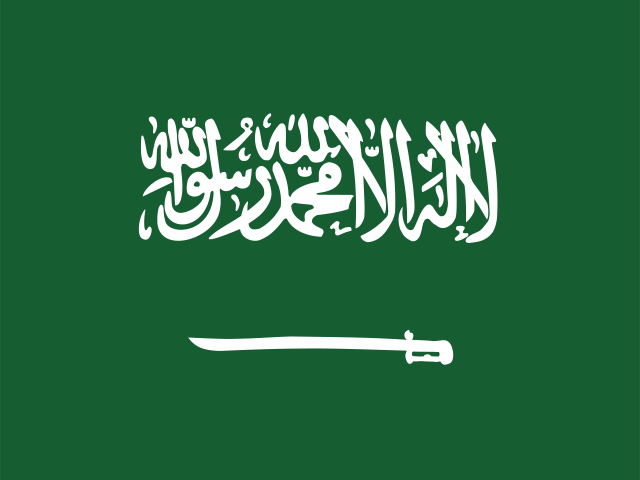
Arabisch Flagge

Tägliches Spotlight

Wort des Tages

مَرْحَبًا

marhaban

interjection

Hello; used as a greeting.

Mehr erfahren

Redewendung des Tages

بالاعتماد على

Relying on

Wörtlich: By the reliance upon

Mehr erfahren

Grammatik-Tipp

Arabic Form VIII Verbs (اِفْتَعَلَ): The 'Intentional' Pattern

B1 verb_forms

Adds intentional effort to basic roots.

Mehr erfahren

Explore Arabisch Learning Resources

Vocabulary, grammar, phrases, and real-life topics — all powered by video immersion

Arabisch CEFR Learning Path

Progress from beginner (A1) to advanced (C2) at your own pace

A1 2025
A2 4171
B1 2997
B2 1274

Arabisch Videos with Subtitles

2382

Kulturecke

Wusstest du?

Tippe zum Aufdecken

Arabic is written right-to-left and has a beautifully connected cursive script.

Tap to close

Wusstest du?

Tippe zum Aufdecken

Arabic has contributed over 1,000 words to English, including "algebra", "algorithm", "coffee", and "zero".

Tap to close

Wusstest du?

Tippe zum Aufdecken

Modern Standard Arabic is understood across 25+ countries, while regional dialects vary significantly.

Tap to close

Schrift: arabic Richtung: Rechts nach links Arabic script: 28 letters written right-to-left, with connected cursive forms that change based on position in a word

Hör es dir an

Al-arabiyyah hiya lughat al-quran wa al-shi3r wa al-hadharah al-islamiyyah.

Ausspracheübung

Hörst du den Unterschied?

vs.
vs.
vs.
vs.

4 pronunciation pairs available

Start Learning Arabisch for Free Today

Watch real videos with interactive subtitles. Click any word to learn it. Track your progress from A1 to C2.

Arabisch Learning FAQ

Arabic is a Category IV language, requiring about 2,200 hours for English speakers. The script, right-to-left writing, and root-based morphology are unique challenges, but the logical root system actually helps vocabulary building.
Start with Modern Standard Arabic (MSA) for reading, writing, and formal communication. Then add a regional dialect (Egyptian, Levantine, or Gulf) for everyday conversation. MSA provides the foundation for all dialects.
Arabic features a tri-consonantal root system where most words derive from 3-letter roots, right-to-left script with positional letter forms, dual number (not just singular/plural), and rich morphological patterns.
Over 420 million people speak Arabic, making it the 5th most spoken language globally. It is the official language of 25+ countries and one of the six official languages of the United Nations.